In today’s fast-paced digital landscape, businesses need to build and deliver online experiences faster than ever. Users expect instant page loads, seamless interactions, and consistent reliability across devices and regions. Meanwhile, development teams are under pressure to deliver more features, respond quickly to customer feedback, and scale their applications without being slowed down by infrastructure complexity.
Enter Vercel—a modern Frontend Cloud platform built to empower developers, designers, and businesses. Best known as the creator and maintainer of Next.js, Vercel has grown beyond being just a framework steward. It is now a complete ecosystem for frontend development and deployment, optimized for speed, scalability, and collaboration.
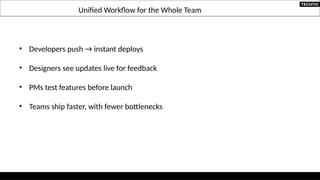
At its core, Vercel eliminates traditional bottlenecks in software delivery, giving teams a frictionless workflow to ship ideas from code to live production in seconds. Whether you are a startup launching your first product or a global enterprise scaling for millions of users, Vercel provides the tools and infrastructure you need to succeed.
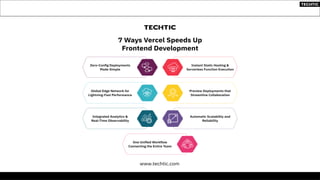
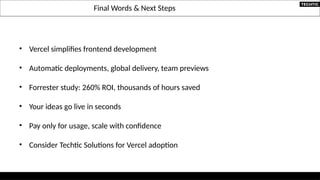
In this deep dive, we will explore seven major ways Vercel accelerates frontend development, followed by real-world benefits, enterprise-grade features, and insights from studies on ROI and productivity. By the end, you’ll understand why Vercel is not just another hosting service, but a true enabler of digital business growth.
1. Zero-Configuration Deployment
Traditionally, deploying a web application required setting up servers, configuring environments, managing dependencies, and handling countless small details before finally going live. Developers often spent more time wrangling infrastructure than actually building features.
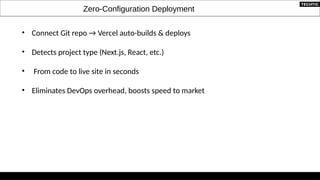
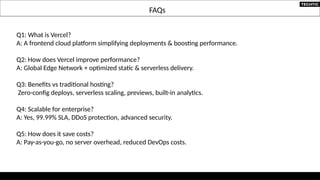
Vercel changes this paradigm with Zero-Configuration Deployment. By simply connecting your GitHub, GitLab, or Bitbucket repository, Vercel automatically detects the framework you’re using—whether it’s Next.js, React, Vue, Svelte, or even a static site—and handles the build and deployment process seamlessly.
This means:
No manual server setup or DevOps overhead.
Automatic build detection and optimization.
From commit to production-ready deployment in seconds.
The impact is massive. Developers can focus entirely on writing features, while businesses benefit from faster time-to-market. Bugs caused by misconfigured environments are eliminated, and the whole release pipeline becomes more predictable and reliable.
In strategic terms, this deployment simplicity reduces technical debt and allows companies to ship with confidence. Instead of spending days wrestling with infrastructure, teams can release updates daily—or even multiple times per day.
2. Instant Static & Serverless Function Deployment
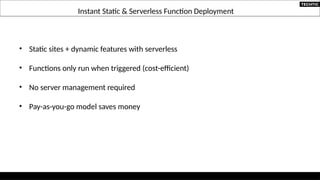
Modern applications often need a balance between static content (fast, cacheable assets like landing pages) and dynamic functionality (API calls, form submissions, e-commerce logic).