(NU) - If you are one of the
millions of Americans that have
a body mass index (BMI) of 35
to 45, you may have thought
about bariatric surgery to lose
weight. The problem is that while
it works, it’s invasive and there
can be significant long-term side
effects. So much so that only a
fraction of those who are obese
consider a surgical option.
Now, however, the future of
weight loss may just lie in a first-
of-its-kind, pacemaker-like device
that reduces hunger and leads to
prolonged fullness without alter-
ing or restricting the anatomy. The
way it works is this: the vagus
nerve is the communicator be-
tween the brain and the stomach.
If interrupted, the stomach tells the
brain it’s full sooner. Thus, pa-
tients eat less and feel full, allow-
ing for safe, sustained weight loss.
Approved by the U.S. Food
and Drug Administration in Jan-
uary 2015, it was the first weight-
loss device to be available to pa-
tients in over a decade.
“Obesity is a global epidemic
with consequences to both public
and personal health,” said Sajani
Shah, MD, and Bariatric Surgeon,
Tufts Medical Center. “From diet
and exercise to bypass surgery, ex-
isting treatment options have failed
to stop the advance of this disease.”
Created by St. Paul-based En-
teroMedics, vBloc Neurometa-
bolic Therapy is implanted in a
minimally invasive outpatient
procedure and allows patients to
eat a normal, healthy diet with-
out food restrictions.
“With this new weight-loss op-
tion, what’s really important to un-
derstand is that it’s less invasive,
less complex and there are ab-
solutely no restrictions to what you
can eat,” said Shah. “Patients like
that it’s reversible, they have more
control over their hunger and they
have more control over how fast
they lose weight. They are able to
go back to work within days, and
it’s outpatient surgery,” she said.
For Erica Roy, who received
her vBloc device over 18 months
ago, the results speak for them-
selves. Down 45 pounds, Roy said
she couldn’t be happier.
“What is amazing to me about
this device is that it doesn’t just
affect me physically, it works on
helping me address my relation-
ship with food,” she said.
Roy said the device caters to
that group of people who feel gas-
tric surgeries like lap band or by-
pass are too extreme.
For more information, please
call 1-800-MyvBloc or visit
www.vbloc.com.
Weight Loss Procedure
Hits a Nerve -- Literally
HEALTH
NewsUSA
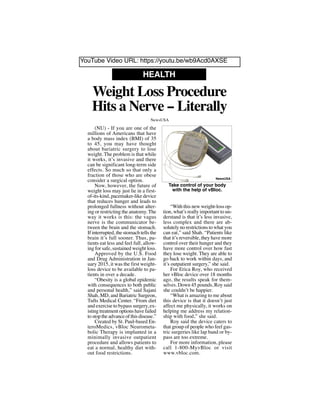
Take control of your body
with the help of vBloc.
NewsUSA
YouTube Video URL: https://youtu.be/wb9Acd0AXSE

vBlocTherapy

  • 1.
    (NU) - Ifyou are one of the millions of Americans that have a body mass index (BMI) of 35 to 45, you may have thought about bariatric surgery to lose weight. The problem is that while it works, it’s invasive and there can be significant long-term side effects. So much so that only a fraction of those who are obese consider a surgical option. Now, however, the future of weight loss may just lie in a first- of-its-kind, pacemaker-like device that reduces hunger and leads to prolonged fullness without alter- ing or restricting the anatomy. The way it works is this: the vagus nerve is the communicator be- tween the brain and the stomach. If interrupted, the stomach tells the brain it’s full sooner. Thus, pa- tients eat less and feel full, allow- ing for safe, sustained weight loss. Approved by the U.S. Food and Drug Administration in Jan- uary 2015, it was the first weight- loss device to be available to pa- tients in over a decade. “Obesity is a global epidemic with consequences to both public and personal health,” said Sajani Shah, MD, and Bariatric Surgeon, Tufts Medical Center. “From diet and exercise to bypass surgery, ex- isting treatment options have failed to stop the advance of this disease.” Created by St. Paul-based En- teroMedics, vBloc Neurometa- bolic Therapy is implanted in a minimally invasive outpatient procedure and allows patients to eat a normal, healthy diet with- out food restrictions. “With this new weight-loss op- tion, what’s really important to un- derstand is that it’s less invasive, less complex and there are ab- solutely no restrictions to what you can eat,” said Shah. “Patients like that it’s reversible, they have more control over their hunger and they have more control over how fast they lose weight. They are able to go back to work within days, and it’s outpatient surgery,” she said. For Erica Roy, who received her vBloc device over 18 months ago, the results speak for them- selves. Down 45 pounds, Roy said she couldn’t be happier. “What is amazing to me about this device is that it doesn’t just affect me physically, it works on helping me address my relation- ship with food,” she said. Roy said the device caters to that group of people who feel gas- tric surgeries like lap band or by- pass are too extreme. For more information, please call 1-800-MyvBloc or visit www.vbloc.com. Weight Loss Procedure Hits a Nerve -- Literally HEALTH NewsUSA Take control of your body with the help of vBloc. NewsUSA YouTube Video URL: https://youtu.be/wb9Acd0AXSE