Department of Personnel & Training
Ministry of Personnel, Public Grievances & Pensions
Government of India
A Distance Learning Module
On
Values in Administration
Sponsored by:
UNDP
&
DEPARTMENT OF PERSONNEL & TRAINING
Anchor Person
Vinod Jindal
Under Secretary
DoPT
Phone No: 011-26107957, Mob: 9818434112, Fax No: 011-26107962
PREFACE
INTRODUCTION TO THE COURSE
Course Content
PREFACE
Under the UNDP Project on ‘Strengthening the
State ATIs’, one of the topics identified for training is
Values in Administration. As the target group to be
catered is supervisory level and below, the number is too
large. Distance Learning Methodology is the only viable
and practical way to reach a wider section of trainees, as
their requirements cannot be met through the
conventional method of classroom training.
Inculcating Values rather than Ethics is becoming a
global concern now a day. Real transformation as a
human being can only bring about a sustainable impact
towards Good-Governance. Human beings only are the
real goal of all developmental activities. The physical
amenities and prosperity achieved through various
measures is meaningless if the human beings are not able
to ascent from the primitive instincts.
While Ethics can ensure outer desired behaviours,
they create a mismatch and conflict within the doer, if
his/her inner disposition is not consistent with the act.
Thus can impose certain rules, codes of conduct
superficially only; which will be followed under given
compulsions, apparently meeting the requirements. But
they may be broken the moment these compulsions are no
more. However, if sound values are inculcated within, the
action outside becomes voluntary, spontaneous and self-
motivated. Naturally, such actions will be much more
effective, humane and wholesome in nature. In this
module, consistent emphasis is laid on values of
individual, as organizational values always derive from
individual values. Individual is the foundation of a group,
a society or a country as a whole. Our great modern
thinkers like Tagore, Vivekanand and Gandhi have devoted
their lives to the betterment of our society. They always
emphasized purity and strength of human character. This
training material deals with normative aspects of values
based on Indian Insights of Human Values.
Values transformation is an experiential process. The
Indian concepts give intellectual clarity, while mind-
stilling exercises offer a practical basis for right kind of
emotional development, which is more critical for human
values. The normal outgoing tendencies in a man, which
tend to land him in a mess, is balanced with a harmonizing
inward journey. Effort is also made to blend conceptual
insights with the practical issues of value-based human
response in organizations.
This training module is an outcome of my learning
and experience sharing in workshop on Management by
Human Values, which I attended in the Management
Centre for Human Values at IIM-Kolkata. I sincerely
acknowledge with gratitude Prof.(Dr) S.K.Chakraborty, the
Convener of the Centre, for allowing me to make use of
publications and invaluable materials on Human Values in
preparation of this module.
It is because of UNDP and DoPT, which have
supported and guided the efforts of the trainers for
development of these modules. I am grateful to
Sh.O.P.Agarwal, Joint Secretary (Trg) for personally
encouraging and monitoring the progress in developing
modules through series of workshops, which provided
opportunities to share ideas as well. My sincere thanks to
Sh. S.Venkatesan, Joint Director (Trg), for giving patient
listening to our problems and and suggesting ways out, to
Sh.J.Minz for managing the things behind the scene.
We are grateful to IGNOU for providing a two-weeks
training input in Distance Learning Methodology, thereby
giving insight into difficulties of Distance learner and ways
and means to overcome them, so essential for preparing
the module.
Thanks are also due in no small measures, to Sh.
Bhagwan Padhy for graciously typing and retyping
numerous and messy handwritten drafts of the manuscript
for over six months; and in all assistance provided in
collecting graphics and doing many other things that go
into preparation of the module.
Vinod Jindal
Back to Title Page
Introduction to the course
When we talk about administration, we have in
our mind the Public Administration only. Invariably it has
to do everything with the whole Government set up and
its variety of activities. All these activities are undertaken
to provide all types of social, economical, and utility
services to its citizens for the all round development of the
people. Not only this, Administration is required to have
capability of acquiring a sustained growth and to cope
with new continuous change towards the achievement of
progressive political, economical and social objectives,
thus leading to National building.
Can you think of an activity, which is outside the
ambit of administration?
We hardly find any activity, which does not fall within
the sphere of administration. One word, which is now
becoming increasingly popular, is Governance.
Governance is what the Government does. Basically, good
Public Administration can only lead to good governance.
The success or failure of activities of the state
depends upon the proper execution of national plans and
programmes. No plan, howsoever, good it may be can be
successful without clean efficient and impartial
Administration. However, today we find ourselves to be a
part of the administration, which is neither clean not
impartial. We find corrupt practices, low morale,
favoritism, culture of high consumerism, casteism, and
nepotism all around us. To an extent, we are also part of
it. That is why we could not progress in all walks of life,
the way we should have.
In the organisation, we are laying much stress on
skills-development, which of course is required to keep
pace with the changing technology and requirements. At
the same time, efforts to some extent are also being made
to develop positive attitude of the government officials
towards the desired acts and behaviours. However, little
is achieved through all the efforts made in this direction.
Today, we find lot of gap between theory and practice,
belief and action. This gap leads to hypocrisy. This
contradiction leads to tensions and stress in the
society. The contradiction between our thought and
practice fetters us. We are able to realise what is ethically
wrong and wish to remove it. But our own doings fail it.
According to Gandhi, social development must aim at
removing as far as possible this contradiction.
Present day administration and politics widely
acknowledge that corruption and power abuse weaken the
nation. The obvious solution is better, more transparent
and accountable administration. Such an administration
can be trustworthy only when it is based on deeply felt
human values. Unless values are inculcated within human
beings, their attitude and behaviour cannot be changed
through superficial efforts. Our national leaders were
conscious of this felt need and had been emphasising the
human values. Shri Rajagopalchari, has thus observed:
“National character is the keystone on which rests the
fate and future of our public affairs, not this or that ism”
“If the parched field of Indian policies and
administration has to get fresh green life and grow, we
need the monsoon of purity in national character. And
the monsoon consists of little drops falling and uniting
to make the rain. Individual purity of character alone
can revive the parched field”.
The need for inculcating values has also been
emphasized in the Parliamentary Standing Committees
and many other Committees. If sound, positive, noble
human values are nurtured within the process of human
development, ethical behaviour tends to become natural,
spontaneous and almost instinctive. Quality of human
values within the individual influence the cognitive
rationality, which is reflected in their behaviour. Such
values only can lead to Good governance. In this Training
material we have dealt with ‘Values in Administration’ in
six chapters.
This module deals with theoretical aspects of values
and ethics and links them with our personal life and day-
to-day official activities, through the knowledge of Indian
Insights. It deals with different aspects of Indian
philosophy and its practice for self-growth towards
Holistic Competence, so important for Good Governance as
well as self-Governance. It also gives us an opportunity to
understand the real nature of our being and have a feel of
it in the Mind Stilling Exercise, which is built side by side
for balanced personality development.
OBJECTIVES
After going through this course you will be able to:
Explain concepts, need and significance of values in
life.
Describe how balanced personality can be developed.
Apply values and ethics in good governance.
Do mind stilling exercise for inculcating peace and
harmony within.
STUDY GUIDE
In this study material, we provide you the reading
material in lucid form, giving you opportunities to get
personal insights into the various aspects of values as well
as administrative functions. We recommend that you
Pace your learning from this module for 30 days
Daily go through a part of it for say one hour or
so
Do all the exercises and activities as and when
required in the hyperlinked file. You can save
your work in a separate folder on your
computer. You may improve revise your
assignments/ activities later. Please send them
to your tutor.
Link your learning to your day-to-day
experiences in life.
You should keep on writing your comments,
views and doubts in the side margin of the
book. This will facilitate discussions during
face-to-face sessions.
Back to Title Page
Course Content
Values in Administration
Contents
Unit I: Values, Ethics and Holistic Competence.
Unit II: Values and Indian insights-The Guna Dynamics.
Unit III: Art and Science of Work-Theory of Nishkam Karma
Unit IV: Moral Law of Cause and effect-Doctrine of Karma
Unit V: The lower self and the Higher Self.
Unit VI: The Giving Model of Inspiration
Back to Title Page
Unit I
VALUES ETHICS and HOLISTIC COMPETENCE
1.1 Introduction
1.2 Objectives
1.3 Values
1.4 Ethics
1.5 Where to start?
1.6 Indian Insights
1.7 Holistic Competence
1.8 Values and Emotions
1.9 Power of Brain
1.10 Introspection
1.11 Mind Stilling exercise
1.12 Let us sum up
1.13 Unit end assignment
1.14 Unit end activity
1.15 Points for Discussion
1.16 Suggested readings
1.17 Speech
1.1 INTRODUCTION
In the entire creations of God, human beings are the most
highly evolved specie. They are capable of becoming
glorious personalities, beautiful and peaceful angels. But in
the modern era, there has been much degradation in the
value system, leading to all round problems. Thus, it is high
time to go to the root of the problems and breakaway the
shackles, in order to evolve and ascend. There is no peace
within the modern human beings. Everyone is groping for
solutions. With our limited intellect we resolve certain
problems. However, we are faced with newer ones soon
after. Experience shows that the lasting solution lies not in
the material circumstances outside, but within us. We have
to emerge from within, through inner collective
transformation. In this Unit, we shall discuss values and
Ethics, and see how inculcating these values help us in
developing Holistic Competence, which is the only solution to
our problems both in Good Governance and self-governance.
We shall also start our effort towards this new type of Self-
development.
1.2 OBJECTIVES
After working on this Unit, you will be able to:
Explain Importance of Values for Good
Governance.
State need of self-development for Holistic
Competence.
Do mind stilling exercise.
1.3 VALUES
Values flow from the highest of our own self. For each
one of us, there are values rooted in the finest part of the
self from where we radiate outwards. These values are an
inbuilt mechanism, which distinguishes the right from the
wrong, the Do’s and Don’ts of any action, even when no one
is looking. Values are concerned with character and conduct
of a person and evaluate the voluntary and habitual actions
of individuals with reference to their being right or wrong.
They are moral principles or standards, which define what is
right and good in human conduct.
There is another view on the values, that this self-
managing mechanism is not intuitive, but it is acquired from
the environment by continuous teaching and the behaviour
of others, especially the superior in age and statues, as
perceived by an individual. We cannot deny the impact of
environment, society and family on an individual for the
values he imbibes. At the same time, we cannot deny the fact
that the source of values is within, which guides one in
making choice in acquisition of learning from the
environment. We can say that there are uniform (Universal)
values inbuilt in each one of us. They flow out of the highest
of our own self, our ultimate holistic potential. They refer to
our intrinsic humanness. Individual or personal values vary
to the extent one is conscious towards this inner source and
the extent to which one tends to compromise with it in the
given cultural environment and other compulsions. Thus
both the source within and the cultural environment are
important for inculcation of values.
Further some degree of variance is possible in value
systems in different social environments, in which a person
lives and acts- be it the family, the neighbourhood, the place
of work, the community or the country at large. However, at
the root of all the value systems, there are certain Universal
Values, which are uniformly accepted. Such values lead to
the betterment of the entire humanity. In the given culture,
some deviations may come in the value-system due to the
compulsions of the circumstances then prevailing. Such
deviations hold good in those circumstances and time only,
but do not hold good forever.
For example wearing of five symbols of Sikhism were
made compulsory during the wartime in eighteenth century.
Marrying upto four women in Muslims was allowed when
male population had reduced drastically due to war. Such
customs are not relevant in the modern times, but due to
conditioning, they keep following the same practices. Many
social evils like untouchability, child marriage and caste-
system also become part of a value system. Thus none of the
value systems is perfect in absolute terms. The nearer a
value system is to the Universal values, the better it is in
terms of virtues and righteousness. The deviations in the
value systems only lead to conflicts and wars and are against
human development.
I.A Can you spell out some Universal Values? Please try
to list as many as possible in the space given below:
There are certain qualities/emotions, which are
accepted as Universal Human Values such as non-violence,
gratitude, humbleness, forgiveness, integrity, honesty,
patience, innocence etc.
Personal values are those principles, which govern our
perceptions and action. For example the terrorist attack on
11th
September 2001 on the twin towers of the World Trade
Center at New York and Pentagon at Washington has
shocked the world. Majority of the people who value
peaceful life and non-injury would condemn the action,
which has resulted in so much of damage to life and
property. But the people who were behind the hijacking of
the plane leading to the tragedy apparently had values of a
different type. Those who are condemning the terrorist
attack probably value the peace in a society, respect for life,
not causing harm to innocent people as important values so
that a society can peacefully progress. On the other hand,
those who wilfully caused the terrorist attack are derived by
different set of values. Such values are condemned by
humanity and are not desirable as they are purely
destructive.
I B. You may also have perceived certain qualities being
useful, desirable and which are of value to you and which
you try to follow, others not desirable. Please list them as
many as possible.
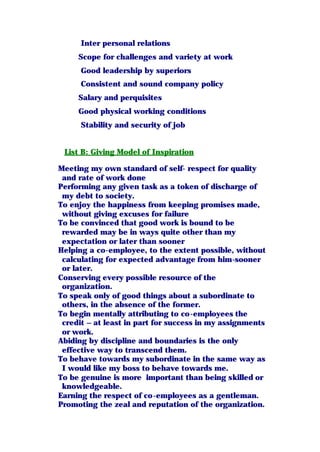
Useful/Desirable qualities Undesirable qualities
_______________________________________________________________________
_________________________________________________________________
Thus the set of traits as are not desirable are greed,
anger, envy, arrogance, vindictiveness and vanity etc. Such
qualities or traits, lead to destructive actions. When
practiced over a period of time, they build into habits.
Desirable values derive a person to use his capabilities for
positive actions, i.e. actions useful to humanity (and not self
alone), while the undesirable values derive them for
negative actions, which may result in his own benefit or
fulfilment of desire, but are in a long run harmful to both the
society and the doer. Values guide us in deciding what is to
be done and also the means that should be used for such
action.
THE VALUE OF VALUES
Let us go into the analysis as done by Swami Dayananda
to explain the impact of “Values vis-à-vis our actions” on
development of our personality:
‘Most of us have a well-assimilated
personal value for money; whereas,
when it comes to speaking truth our
value often is general and half
assimilated. When this is the case, what
happens if there is a conflict between the
money–value and the truth-value? What if a situation
arises where by telling a lie I can make an extra Rs. 500?
Perhaps someone has offered to pay me the same amount
of money for an item that I had originally paid for it. I
had paid Rs 1,000 but I easily can say that I paid Rs. 1500
for this small lie I will gain an extra Rs.500. I know what
that extra Rs. 500 can do for me, what comforts I can buy
with it. On the other hand, it is not very clear to me what
benefit speaking truth in this situation will be to me.
Should I tell the truth or should I lie? Which value will
win? Very likely the assimilated value for money will be
the victor. But, all the same, something goes on
murmuring inside, “Speak truth, speak truth.”
I may lie but I will not be comfortable, because I will
not be able to avoid what happens when I tell a lie. What
happens? First, there is conflict; then there is guilt. I can
ignore conflict but I cannot avoid guilt because I cannot
escape my half-value for truth. Guilt is a great irritant-
greater than chillies! It is a very great irritant. Once I
have guilt I cannot have a fully comfortable self. Fulfilling
an immediate end at the expense of a general value may
bring some passing comfort but in the long run adds to
the discomfort for myself by increasing my accumulation
of guilt, large and small.
The Knower-Doer Split
Does anything else happen when I ignore general ethical
standards? Yes. I create a “knower-doer” split in myself.
For instance, when I lie, I become a speaker: speaking is an
action, so as a speaker I am an actor-a doer. At the same
time, I know what I am saying. I am aware that what I am
saying is something contradictory to truth. Therefore, I, the
knower, am in one position and I, the doer, am in another
position. By my lie, I create a split, a division, between the
knower-I and the doer-I. Everyone has a few lies like this.
What is your age? What is your income? What are your
qualifications? When I make a series of lies like this I create
a split in myself, the knower being one and the doer another.
I am not integrated. I have divided myself into an ‘ideal’
knower who values one course of action and the ‘actual’ doer
who does something else. I have created a Dr. Jekyl-
Mr.Hyde conflict within myself. Living with Jekyl and Hyde,
one cannot get anything out of life. It is impossible. Even in
small things, the knower-doer split does harm. The knower
begins condemning me. I tell myself that I am useless, that
I cannot do what I want to do, that I am not the person I
want to be.
When I am ‘split’ I cannot fully enjoy
anything…………… The quality of my life always suffers
whenever I become ‘split’. To appreciate the beauty of life,
to really be available to enjoy its comforts, I need to be
’together’. ‘Together’ is a good Western expression, which
shows an intuitive appreciation of the problem of ’split’.
When my universal values are only half values, they will
always have the potential of destroying my ‘togetherness’
producing a ‘split’ in me, when they yield to some immediate
situational value.
The above analysis makes it clear that values are
universal, absolute and beyond the situational, cultural, race
and creed disparities. Our outer behaviour reflects how far
we abide by this inner value-system. We can say that
whatever our conduct ought to be when we are in tune with
this inner source is what we term as Ethics. The more our
conduct is in consonance with the inner values, the better
composed and integrated our personality is.
Back to Unit Index
1.4 ETHICS
‘Do not do unto others as you would not be done by’
(Atmani Pratikulani paresham na samachary), is the principle
given in ‘Mahabharat’. The definition of Ethics is well
concretized in this maxim. The same principle is repeated in
Christianity-‘Do unto others as you would, they would do
unto you.’ Thus we should behave with others in the same
manner as we expect them to behave with us. We can say
Ethics are a code of conduct that we expect of others and so
logically from ourselves also.
This means that we should not do anything, which is a
deviation from our intrinsic humanness – Swabhav. If we
are able to do this, our inner core will spontaneously
manifest itself. Ethics is human conduct in the light of moral
principles, which may be viewed as the individual’s standard
of conduct or as a body of social obligations and duties. Our
behaviour outside is a reflection of our values within, which
we radiate outwards thorough our action and deeds. Thus if
the Values guiding an action are positive the results are
positive. One the other hand if the values guiding a
particular action are negative the ultimate outcome will be
negative only.
Idealists such as PLATO have contented that there is
an absolute good to which human activities aspire. Moral
codes or ethics have frequently been based on religious
absolves. The source of an ethical criterion has been
variously equated with religion and the good of the
individual or a group. Religion has its influence on a society.
It ensures that the members follow the religious percepts.
As already mentioned all religions originated in their times to
guide us to the virtuous path for the well being of the
humanity. They form the base of all values. The decline of
religion in modern societies has led to erosion of values.
Seen with reference to Administration, Ethics is the
system of moral principles/ Code of conduct, acting in the
manner consistent with which is upheld as virtuous. Ethics
are reflected in such right actions or deeds. Our conduct
Rules also give a general rule that the Government Servants
should not do anything, which is unbecoming of a
Government Servant.
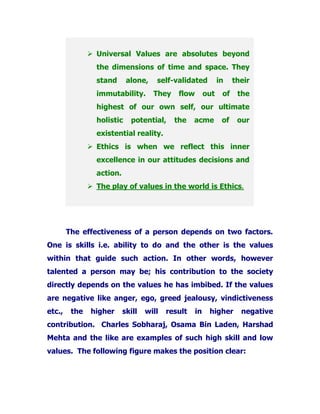
We have seen that ‘Ethics in practice’ derive and flow
from values in the being. We can sum-up the values and
ethics relationship as follows:
Universal Values are absolutes beyond
the dimensions of time and space. They
stand alone, self-validated in their
immutability. They flow out of the
highest of our own self, our ultimate
holistic potential, the acme of our
existential reality.
Ethics is when we reflect this inner
excellence in our attitudes decisions and
action.
The play of values in the world is Ethics.
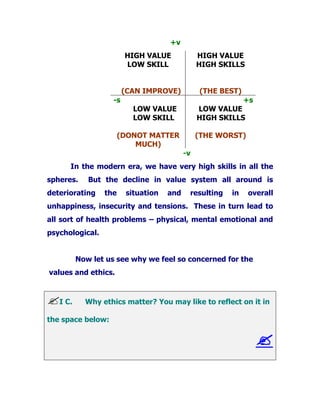
The effectiveness of a person depends on two factors.
One is skills i.e. ability to do and the other is the values
within that guide such action. In other words, however
talented a person may be; his contribution to the society
directly depends on the values he has imbibed. If the values
are negative like anger, ego, greed jealousy, vindictiveness
etc., the higher skill will result in higher negative
contribution. Charles Sobharaj, Osama Bin Laden, Harshad
Mehta and the like are examples of such high skill and low
values. The following figure makes the position clear:
+v
HIGH VALUE
LOW SKILL
(CAN IMPROVE)
HIGH VALUE
HIGH SKILLS
(THE BEST)
-s
LOW VALUE
LOW SKILL
(DONOT MATTER
MUCH)
+s
LOW VALUE
HIGH SKILLS
(THE WORST)
-v
In the modern era, we have very high skills in all the
spheres. But the decline in value system all around is
deteriorating the situation and resulting in overall
unhappiness, insecurity and tensions. These in turn lead to
all sort of health problems – physical, mental emotional and
psychological.
Now let us see why we feel so concerned for the
values and ethics.
I C. Why ethics matter? You may like to reflect on it in
the space below:
‘Institute for Global Ethics’: ( why ethics matter?)
“….……because we will not survive the 21st
century
with the 20th
century’s ethics.
The immense power of modern technology extends
globally. Many hands guide the controls and many decisions
move those hands. A good decision can benefit millions,
while an unethical one can cripple our future.”
One hundred years ago, humanity had less power and
less reach. Catastrophe meant natural disasters such as the
Krakatau volcano, the potato famine, and the San Francisco
earthquake. But in this century, poor ethical judgement has
produced such devastation as the grounding of the Exxon
Valdez, the meltdown of reactor # 4 at Chernobyl, and the
failure of Barings Bank. Technology will advance
exponentially into the 21st
century. Imagine how much
power we will have at our fingertips then!
It’s not just national leaders who have us in their grip.
Technology empowers people at many levels and in many
locations. Do they understand that ethics has consequences,
and that their actions can have enormous impact? Will they
make ethical decisions based on their highest moral values?
Or will they simply do what’s expedient for whatever serves
their self-interest?
While the above situation is true for the whole world
around, let us have a look at the situation in our own country
with reference to ethics.
Our country is one of the oldest civilizations with a rich
cultural and ethical heritage. However, there have been
phases of degeneration of values in our history. At present,
perhaps we are passing through one of the worst such
phases. Our Constitution as well as all our religious books
are full of codes and directives on high values and ethics to
be followed by the state as well as the society.
Notwithstanding these, there is perceptible change in the
mind-set of the people towards achieving materialistic goals
and prosperity irrespective of the “means” to be adopted.
Ironically, the society also respects material prosperity only
because of visible glamour attached with it with little regard
to higher values of simplicity, honesty, hard-work, character
building etc.
When we go further into the situation prevailing all
around, both at micro-level and macro-level, our heart and
mind gets shattered with the dilemma and chaos all around.
We have thousands and thousands of complains to make,
situations to mourn, acts to condemn, deprivations to grieve
upon …… there is no end. And we are surviving with a hope
that one fine morning, one charismatic leader will come who
will lead this country to the ethical state. But we are not
able to find any such leader too. There is a saying that a
country gets the kind of government it deserves’. This is
truly reflected in our present day society and calls for a
serious introspection and concerted effort towards change in
the social mind-set.
Values are formed, through a continuous process of
interaction of individual with his environment. As we are
born we are subject to the values and concepts of our
parents, teachers and colleagues. But the institutions like
home, school, elders, society etc. have also failed to a large
extent in their duties to regenerate and rejuvenate the
system to bring-up citizens with value system of the highest
order.
Back to Unit Index
1.5 Where to start now?
The question thus arises from where should we start
now? For understanding this important point, let us read a
story told by Swamy Vivekananda in his book: The Vedanta
THE WORLD A DOG’S CURLY TAIL
There was a poor man who wanted some money. Somehow
he had heard that if he could get hold of a ghost, he might
command him to bring money or anything else he liked; so
he was very anxious to get hold of a ghost. He went about
searching for a man who would give him a ghost, and at last
he found a sage, who could give him a ghost. When he
requested for a ghost, the sage asked him what he would do
with a ghost. “ I want a ghost to work for me. Teach me how
to get hold of one, sir. I desire it very much”, replied the
man. But the sage said:” Don’t disturb your-self. Go home”.
The next day the man went again to the sage and began to
weep and pray: “ Give me ghost. I must have a ghost, sir, to
help me.” At last the sage was disgusted and said: “ Take
this charm, repeat this magic word, and a ghost will come.
And whatever you say to him he will do. But beware! They
are terrible beings and must be kept continually busy. If you
fail to give him work, he will take your life”. The man
replied:” That is easy. I can give him work for his whole life”.
Then he went to a forest and after long repetition of the
magic word, a huge ghost appeared before him and said: ‘ I
am a ghost. I have been conquered by your magic; but you
must keep me constantly employed. The moment you fail to
give me work I will kill you”. The man said, “ Build me a
palace,” “Bring me money,” said the man. “ Here is your
money,” said the ghost. “Cut this forest down and build a city
in its place.” “That is done,” said the ghost. Anything more?
Now the man began to be frightened and though he could
give him nothing more to do. He did everything in a trice.
The ghost said, “Give me something to do or I will eat you
up.” The poor man could find no further occupation for him
and was frightened. So he ran and ran and at last reached
the sage and said, “Oh, sir, save my life!” The sage asked
him what the matter was, and the man replied: “ I have
nothing to give the ghost to do. Everything I tell him to do
he does in a moment, and he threatens to eat me up if I do
not give him work.” Just then the ghost arrived, saying, “ I
will eat you up,” and he was about to swallow the man. The
man began to shake, and begged the sage to save his life.
The sage said: “ I will find you a way out. Look at that
dog with a curly tail. Draw your sword quickly and cut the
tail off and give it to the ghost to straighten out”. The man
cut off the dog’s tail and gave it to the ghost, saying,
“Straighten that out for me.” The ghost took it and slowly
and carefully straightened it out, but as soon as he let it go,
it instantly curled up again. Once more he laboriously
straightened it out, only to find it again curled up as soon as
he attempted to let go of it. Again he patiently straightened
it out, but as soon as he let it go it curled up again. So he
went on for days and days, until he was exhausted and said:”
I was never in such trouble before in my life. I am an old,
veteran ghost, but never before was I in such trouble. I will
make a compromise with you. You let me off and I will let
you keep all I have given you and will promise not to harm
you.” The man was much pleased and accepted the offer
gladly.
Swamy Vivekanand explains: This world is like a dog’s
curly tail, and people have been striving to straighten it out
for hundreds of years. But when they let it go, it curls up
again. How could it be otherwise? So we should always
remember the instance of the curly tail of the dog. We need
not worry or make ourselves sleepless about the world. It
will go on without each of us. Our worries will not help it.
But when we stop worrying about the world, then alone will
we be able to work well. It is the level-headed man, the
calm man of good judgement and cool nerves, of great
sympathy and love, who does good work and so does good to
himself. The one who is complaining all the time is foolish
and has no sympathy. He can never straighten out the
world, nor can he improve himself.
***
Zone of Discretion
Let us again have a look at the whole gamut of
happenings mentioned at page 14-15. All these spheres are
such with which we feel concerned. The spontaneous
reaction is what can I do for improving the things. Can you
do something? Will there be any impact? What influence
can you have? Many a times we do have the ideas for how
the things can improve. But we are not really able to help
them out, as everything is not in our control.
Let us consider the situation through a small activity.
In the space given below, draw a big circle, as big as you can
and name it ‘ my area of concern’
I. D
Now inside this big circle draw small circle, as small as
possible. Name it ‘my area of influence’.
The real world situation with every one of us is
something like this only. We feel concerned with number of
issues and happening all around us, but we have no control
over them. This is what we call ‘area of concern’. Still there is
a small area, be it very small, but this is the area, where we
can really do something. We have an influence and it is in
our individual control. That is our ‘area of influence’. This is
the area where we can really make an impact. It may be too
small and of little importance, when viewed with reference
to the whole gamut, but this area alone is of utmost
importance to each of us individually. How? If we put our
energies to the area of concern the net result is not only zero
but goes in minus, because nothing is achieved and we are
left most dissatisfied. However, if we withdraw our energies
from all this big ‘area of concern’ and apply them in our ‘area
of influence’; definitely a positive impact will be made, giving
satisfaction. While the energy wasted in ‘my area of
concern’ has the impact of reducing ‘my area of influence’,
the energy utilized in ‘my area of influence’ will result in
increasing this area. Slowly and slowly, this area will grow,
which means our influence will start increasing. This area of
influence only is our respective Zone of Discretion.
The message is very clear. We can start from our own
self only, without looking at what others around are doing
and how. This may be coupled with a positive attitude
towards the world, which is explained as a curly tail of dog.
In other words we should not reject the world, but accept it
the way it is. Thus in every situation where we are required
to perform or act; we should not get upset by the various
problems created by the systems and people around; but
accept and visualize calmly the whole
situations/conditions/problems around and think: ‘Given the
situation what best can I do and how?’
The way a river that originates
from a high mountain makes its
path through all the barriers on
the way; keeps gaining in volume
and might; and ultimately
reaches its destination in the
peaceful arms of the vast ocean.
We never find it grumbling. All
its way, it gives pleasure to the
beholders, sweat water to the
thirsty and charming music to
the passers-by. In fact, the whole nature of the Creator
works without trouble, because of the total harmony. Let us
also maintain this natural rhythm.
As is well said by Marlyn Ferguson:
No one can pursue another to change. Each of us
guards a gate of change, that can only be opened from
inside. We cannot open the gate of another, either by
argument or by emotional appeal.
Thus in this workbook we shall concentrate on
developing our personal effectiveness and enhancement of
personal capabilities ourselves. You may question, why
should I as a person be interested in values? The basic
answer to this is ' for my own personal development.
Because, I want to become more peaceful and integrated
person. For getting relief from day to day tensions. This is a
kind of selfishness, which primarily helps me and in course of
time, goes to help others in the family, society, organisation
and the nation on the whole. Because it is the individuals
who make a society, an organisation or a nation.
Thus: ∑∑∑∑ individuals = Organisation.
Values serve true, permanent, long-term self-interest.
And at the same time, this journey of mine towards values
will serve greater interests. Another thing, that is clearly to
be borne in mind is that by my efforts to inculcate values in
myself, I am not undergoing any sacrifice or doing any
charity. It is my own interest. As is clear now, the source of
values is within a human being, the need is to look within,
work on self, by myself to improve the quality of my life.
Some practice is also deliberately introduced, as an activity,
which we normally do not perform. This will help in
engaging with self and for withdrawing for some moments
from the external situations, so that the mind can relax and
recharge its energies.
Back to Unit Index
1.6 INDIAN INSIGHTS
In our work situations, the organisational behaviour
theories of the west guide us. As is obvious, these theories
and practices which deal with only one-ninth of the Indian
population while the eight-ninth of the Indian population is
traditional (normative). The men in the fields of India are
guided by the insights embedded in the structure of Indian
thoughts. Thus the western thoughts have not been able to
lead us much ahead. It is important to look into our own
Indian thought and find solutions therein. The Indian
philosophy has set the ultimate goals for humans and Indian
psychology provides practical methods in graded steps to
march towards these goals. Thus Indian psycho-philosophy
deals with both of these aspects to bring in holistic
development of the individual.
Doubts may arise as to whether it is possible to progress
and achieve the desired results by following the Indian
thoughts and practices. Also whether it is possible to
practically work on those principles in the today's scenario.
Whether our indigenous thoughts are result oriented or not.
For clarification we have to look into the Indian history and
in the times when it was known as Golden Bird (sone ki
chidia) for all its prosperity and richness. The credit goes to
all the saintly kings, from king Janaka to Ashoka, Akbar,
Harshabardhan and the like; who had put into practice
human values ideology as given in Vedanta and the other
ancient Indian thoughts. It is because of these values that
we could sustain ourselves through all adversities and
cruelties of the earlier invaders and the British Rule. Our
leaders like Tagore and Gandhi have lived the human values
like purity and holiness, non-violence and moral courage.
Gandhi forcefully and convincingly demonstrated the power
of spirit over material things. His greatest leverage was his
command over the Indian masses. He gained such a
command because the simple folk could understand that he
was inspired from within. They called him ‘Mahatma’.
Merely by his hunger strike, the Mahatma could control
behaviour of millions of people. He firmly derived his
political activities from dharmic principles and refused to
compromise with what was wrong.
Coming to the present times; we see all over the world
that even the most developed countries as are at the top of
materialism have started realising that material prosperity
is not development of Human beings in true sense. A
realization has now come that unless we are developed as
better human beings, other forms of development have no
meaning. From USA to UK, Indonesia and Malaysia to the
Philippines, serious attention is being devoted to religion in
order to revive human values. Even USA has realised the
absurdity of the assumption that education can be carried
out without a moral framework. American corporate
management has begun to have managers learn various
mind-centering exercises to cope with stress and have a
clear mind. They have clearly recognised that a manager
with a calmer mind and free from tension can handle
problems with considerably greater lucidity and
competence.
In Indian organisations, both private and public, a
realisation has come that value based management and
administration only can save us from the adverse
consequences of the present situation. Unless all the
individuals who work for an organisation imbibe these
values, both in theory and practice, the system cannot
change.
A systematic and successful effort in this direction has
been made by Management Center of Human Values at
Indian Institute of Management, Kolkata, since 1982-83.
Professor S.K. Chakrabarthy the Convener of the Centre,
has conducted workshops on Human Values/ value System
for Managerial effectiveness for the Managers of Bhilwara
Group of companies, IPCL, IOC, Bharat Electronics Ltd,
Godrej and Boyce, TELCO, RBI, BEL, and the managers from
abroad. These organisations have in turn conducted similar
workshops for their officers and staff and have achieved
both in terms of personal as well as organisational benefits.
In these workshops, Prof Chakraborthy has spelt out the
practicality of Indian spiritual traditions and philosophy
with the realities of management practices. In the field of
politics, Gandhi had also applied an insight and approach
that the spiritual and the mundane are not separate
spheres. According to Prof. S.K. Chakrabarthy also, Value
orientation is central for effectiveness as a Manager or an
administrator.
How can we inculcate the Human Values and how can
they be put into practice in the organisational set up?
Our Indian Insights have the answer to this in
purification of mind. Values emerge spontaneously and
effectively only from a purified mind. The basic Indian goal
of self-transformation towards a more refined spiritual
consciousness and purer mind with its many paths and
practices are more pertinent to many of the issues and
problems of Indian Administration than the current western
models. To quote Shri C. Rajagopalchari again:
"National character, again, depends on and in fact is
individual rectitude. Movements for the encouragement of
personal rectitude, for purifying individual character, are
therefore not irrelevant in the context of politics but are
vitally connected with our hopes in respect of national
affairs”.
Meditation provides us an opportunity to withdraw for a
time being from the outer world and be with our inner
source of values, the highest and the finest part of our own
self. It also gives us a chance to introspect our own acts
and deeds and rectify them by changing our thought
process, withdrawing our mind from the vicious thinking
and applying it in accordance with this higher source of
values. This leads to purification of mind. Thus the effort
to apply right thought for right actions in the organisation
can only slowly go to improve our administration. Such an
effort then goes to have a multiplier effect.
Back to Unit Index
1.7 HOLISTIC COMPETENCE
This journey towards imbibing values (and not only
discussing them) is based on ancient Indian classical work
in the area of philosophy and psychology. Unlike in other
countries where these two are dealt as separate subjects
the Indian psycho-philosophy developed together. The
deep philosophical outputs are dealt with psychological
experiences, which help the seeker to internalise them.
They enable the learner to learn how to put into practice
these rich thoughts so as to enhance practical
effectiveness.
Such value based competence is much more efficient
than the Professional competence. Professional competence
is based only on development of skills and do not take care
of means and thus the results are more visible and
immediate, but are short lived as the approach is not holistic.
As against these, when the skills combined with values are
used in wholesome manner, they result in long-term gains,
though for a short-term it may be painful or more
demanding. Skills, which are not value-based may often be
misused. Thus in a long-term they are the failure. One has
to chose between 'short-term gain and long-term pain’ or
short-term pain and 1ong-term gain’. In value based skill
development, we expand the definition of success, making it
long-term, sustainable and wholesome. Such value-based
skill development leads to ‘Existential or Holistic
Competence'. Thus:
Skills Development leads to Professional competence.
Skills &Values Development leads to Holistic competence.
Value based actions also help in conservation of energy;
where as the actions based on negative values dissipate our
energy. The modem education and training both formal and
informal, take care of professional competence only and
there is no scope for development of existential competence.
While about 50 years back, development of such existential
competence was imparted in natural way in the family,
society and educational institutions. With increase in
materialism, we have started chasing the worldly things,
thus withdrawing our attention from consideration if our
actions are morally sound or not. Moral education has slowly
been taken away. That is why today many of the successful
persons are apparently successful, but are not real winners
within themselves. Existential competence ensures both the
success outside and survival within.
[Let us read a Butterfly’s lesson]
Read
Thus one should hold on to the values even if they do
not give the conventional pay off. We can see in the history
also that the civilizations and cultures like Indian and
Chinese, which have upheld values are able to survive, while
those like Greece and Rome, which were high in skills but
poor in values have vanished. The success of Japan is based
on values similar to Indians, using seishin kyooiku (Spiritual
education) to counter the evils of industrialization and
integrating the family values into management of
organisations. The goal of this workbook is to enhance
existential competence and effectiveness by (a) developing
sensitivity to human values and (b) imbibing those values.
All our efforts towards clean administration and good
governance can bring about the long term improvements
only if the individual functionaries are derived from within to
take right actions. This goal can be achieved through all the
effort on self (I) only.
Back to Unit Index
1.8 VALUES AND EMOTIONS
He is (feeling) jealous. I am (feeling) angry.
My heart filled with (the feeling of) gratitude.
We should have (the emotion of) universal brotherhood.
In all the above sentences, we are talking about
feelings, which are much more linked with heart than brain.
Values have much to do with emotions. A computer, which is
artificial intelligence, is devoid of all these feelings. Let us
have a look at the following two domains of emotions:
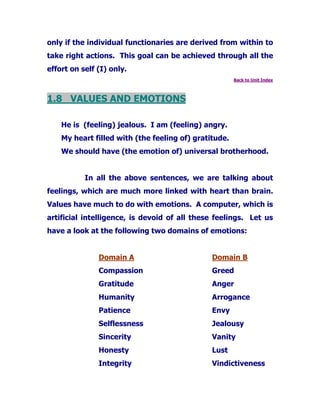
Domain A
Compassion
Gratitude
Humanity
Patience
Selflessness
Sincerity
Honesty
Integrity
Domain B
Greed
Anger
Arrogance
Envy
Jealousy
Vanity
Lust
Vindictiveness
We do have sense of the values in both of these
domains. We feel comfortable in the ambience of emotions
given in domain A and are uncomfortable in the atmosphere
filled with emotions given in domain B. There is affluence in
the quality of emotions in domain A. They have a sense of
fulfillment and have positive vibrations. We call them
positive values or Human-values. The domain B emotions
have some sort of poverty in quality and have negative
vibrations. They give a sense of deficiency and we feel
uncomfortable and tend to derive away from people in that
emotional state. We may call them dis-values or negative
emotions.
Thus for values-orientation (change/transformation),
we have to work on emotions. Naturally the effort required
is much more. On the one hand we have to develop/imbibe
positive values and at the same time we should be aware of
our negative emotions also, so that we can work them out.
It is very difficult to see into one's own negative emotions.
Because, one has some justification for everything that one
does. Say if 'A' is angry, the rationale for being angry may
be some one else has done something wrong; or everybody
is angry, so what if 1 feel angry. Another factor is when
negative emotions overpower us, we are not able to think
properly and do proper reasoning. As is well said:
"Greed (negative emotion) robs learned man of his
wisdom”
The Geeta also warns:
“Desire, anger and greed are the gateways to the hell”
The word ‘emotion’ tends to be commonly used in a
pejorative, negative sense. ‘That person is emotional’ is a
way of stigmatising him or her. On the other hand there is
much emphasis on intellect or reason. We should however
also ponder over the fact that impact of both emotions and
intellect can be positive or negative. When an emotion has
a virtuous basis, e.g. compassion or maitri for the unhappy,
it can inspire the intellect to act usefully, but when an
emotion is vicious, e.g. envy, it can drive the intellect to act
destructively. Emotion is indeed the motive power behind
intellect. This is what must have promoted:
1.Einstein to declare:
‘And certainly we should take care not to make intellect our
God… The intellect has a sharp eye for methods and tools,
but is blind to ends and values’.
2.Russell to warn:
‘Science is no substitute for virtue…. If men were rational
in their conduct… intelligence would be enough to make
the world a paradise………. But men are actuated by
passions which distort their view…That is why the heart is
as important as the head… Where they (kindly impulses of
the heart) are absent, science only makes man more
cleverly diabolic.’
3. Vivekananda to affirm:
‘But the professor is bout by his intellect, and he can be a
devil and an intellectual at the same time; but the man of
heart can never be a devil; no man with emotion was a
devil.’
4. Toynbee to detect:
‘The effect emotion exerts on human actions is as strong
as-perhaps stronger than- that of reason. Consequently,
emotion can get the upper hand and suppress theoretical
knowledge, which is dependent on reason’.
The unanimity amongst some of the best
contemporary eastern and western minds about the heart or
emotion not itself being the arch villain, and about the
intellect or reason not by itself being the supreme hero is
remarkable. Unless our emotions, our hearts are adequately
cultured, intellect tends to play havoc. As already explained,
intellect applied with negative emotions like jealousy, ego,
selfishness brings disasters. While the application of
intellect cannot be ignored at all, the same need to be
applied with balanced emotions. Thus for inculcation of
values, a proper training for bringing emotional balance in a
personality is required. Infect a proper integration of
emotions and intellect can only result in right and holistic
actions. Our Indian psychology lays emphasis on chitta-
shuddhi, i.e. purification of heart or hridaya-vritti as the
more important and prior requirement in human
development. The edifice of intellect or buddhi-vritti can be
safely mounted only on such a base of pure heart only. We
are lately talking of emotional and spiritual intelligence
because we are now able to realise their importance in the
human development in real terms.
Back to Unit Index
1.9 POWER OF BRAIN
Man is endowed with organized, reflective
consciousness and intelligence unlike the instinctive
intelligence of a tiger or the underdeveloped mental system
of a tree. Our brain keeps functioning even when we are
sleeping. Even the thought process rarely stops.
Neuropsychology in West today has rediscovered the truth
that the human brain has two distinct but complementary
powers. These are:
I: Rational, Sequential, logical, Segmented, Inductive,
Analytical.
II: Emotional, Spatial, Synthetic, Impulsive, Intuitive,
Holistic.
The first set, according to them is confined to the left
hemisphere of the brain, and the second to the right. Now,
the modern knowledge-oriented educational system puts
exclusive emphasis on the development of the left
hemispheric powers of the brain. There is much more
emphasis on development of analytical, logical and rational
powers of the brain, while the development of emotional,
intuitive and holistic powers of right hemisphere of brain is
almost totally neglected.
Many really creative persons or genuine entrepreneurs
are usually found to be comparatively less formally
educated, or have somehow been able to retain their natural
intuitive capacity even in the face of awesome analytical
atmosphere. In March 1985, a management student asked
JRD Tata as to what he thought was the secret of his
legendary success as India's foremost industrialist. The first
confession he made was that he had no formal, professional
management education like the one the fortunate student
was having. Yet it was quite apparent from the tone of his
reply that he did not regret this too much. In the sphere of
art and literature, the most towering figure in modem times
like Rabindranath Tagore, Aristotle, Shakespeare and John
Keats had negligible formal education. Pure intuition was
their prime asset. The original ideas and hypothesis of the
greatest scientists too are intuitive flashes of pure
consciousness in the first place.
As the values have much to do with emotions, the left
hemisphere does not help in the transformation of values.
While logic, intellect and reasoning can help us to see what
is wrong and what is right, it does not give us capability to
shun what is wrong and pursue/ follow that is right. As is
well said by Albert Einstein:
"The intellect has a sharp eye for methods and tools
but it is blind to ends and values.”
Further, even if the intellect tells us about what is right
and what is wrong, it does not ensure one's propulsion
towards the right and withdrawal from wrong. As in
Mahabharata, Durayodhana tells Krishna:
I know Dharma, but 1 am not inspired to purse it.
I know Adharma, but I am not able to withdraw from it.
All the factors in category-1 above are very important for
skill development. (when we say skills, knowledge is part of
it). The modern educational system has all its focus on
developing the faculties of the left side of the brain -
intellectual, rationale, logical thinking; while those of right
side are almost ignored. This educational system can
therefore, not help us in inculcating or transformation of
values, which are emotions in nature. Unless the culture of
noble values becomes part of educational system, values will
remain a lip service only. Our brain and mind are two
principle instruments, which are employed for doing work.
If the mind is not pure and the brain is half developed, the
results naturally are going to be poor. Thus the felt need is
to develop the faculties of right hemisphere i.e. emotional,
impulsive. When we say feelings we automatically link them
with heart. Thus purification of heart is required for
inculcating Human Values. As Christ Says:
Blessed are those who are pure in heart.
Transformation of emotions from negative to positive
emotions based on values comes through purification of
Heart (chitta-shuddhi). A consistent effort through
introspection for transformation of emotions from present
state to noble emotion is required. Mind-stilling exercise or
meditation (Dhyana) helps in self-introspection and
transformation. This leads to purification of mind (chitta
shuddhi).
Sri Aurobindo: An unpurified heart, an unpurified
senses, an unpurified life confuse the understanding,
disturb its data, distort its conclusions, darken its seeing,
misapply its knowledge.
So the power of brain is pure heart, or pure character.
Thus Chitta-shuddi is important for effectiveness. We thus
have to see within, introspect our own self and discipline
our selves. In the materialistic world, our attention has
gone completely outwards, no attention is paid to the self
within. The need is to interiorise our attention to our own
fine self, the consciousness. As is well said:
"Problem is not in the world, it is in our consciousness”.
“There is only one sin - Lapse of consciousness”.
How can we distinguish between mind and brain?
We may commonly say our mind is depressed or
restless, but we do not say this for the brain. Moreover, the
brain is a part of our physiology, while mind is a
psychological concept. The nervous system in the brain
may be receiving many signals from outside, but unless the
mind is linked to them through the sense organs, they fail
to make an impact. Finally, the surgeon can operate on the
brain but not the mind. We shall discuss mind further in
Unit II.
Back to Unit Index
1.10 INTROSPECTION:
Let us take an example of an emotion. Say ‘anger’. Is it
harmful to be angry? Yes because when anger overpowers
us, our consciousness lapses. We are not able to think and
decide properly. As against becoming angry, there are wise
and balanced people, who can use 'anger' as a tool. They
show anger for minding the people or children, but they
actually love them and want their benevolence, such
balanced people know how far to show anger and in what
manner. When anger is used as a tool, it does not
overcome the consciousness. This balance can be achieved
through inward and outward movement of the
consciousness. Just as a child who is whirling a stone tied
to his finger with a thread can keep it whirling because the
outward force on the stone (centrifugal force) is balanced
by the inward force (centripetal force) given by his finger.
Movement of a satellite around the earth is also maintained
in the balance of inward and outward force. The moment
inward force of the finger (in case of child) or the
gravitational force (in case of satellite) becomes less than
outward force; the circular movement will get distorted and
lost. In the same fashion, inward movement of
consciousness or Introspection is very important for
maintaining balance in life. When this inner connection is
lost, we get swayed in the outward world. Thus what is
required is to sit with one's own-self. And be one with our
consciousness, the values within. The values do not erode.
Only our capacity to live up to those values erodes.
A great 'Introvert' will know at the same time how to
be a great 'Extrovert' (here the example of Vivekananda
seems to me to be conclusive). Interiorization has never
led in principle to diminution of action. Arguments drawn
from the supposed social passivity of mystic India are
entirely erroneous. The physical and moral de-vitalization
of India during several centuries is due to quite different
factors of climate and social economy. But we shall see with
our own eyes that her Interiorization, where the fires of her
threatened life have taken refuge, is the principle of her
national resurrection.
--ROMAIN ROLLAND
Thus Indian psycho-philosophy is a complete science of
interiorisation practiced by highly disciplined and altruistic
minds down the ages of human history. When such minds
project themselves into the network of human relationship,
they can do nothing but good and only good.
There are many ways to interiorise our consciousness.
We need to withdraw our attention from the outer world and
move it inside so that we can develop insight to realize our
own drawbacks. Only then the effort can be made to
overcome them. The introspection process involves the
following three sequential steps, which lead to inculcation of
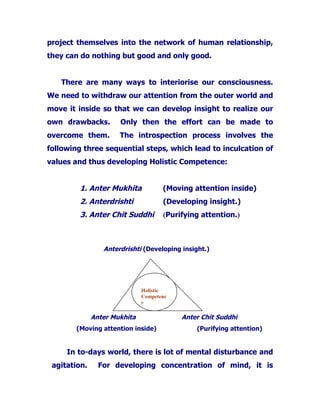
values and thus developing Holistic Competence:
1. Anter Mukhita (Moving attention inside)
2. Anterdrishti (Developing insight.)
3. Anter Chit Suddhi (Purifying attention.)
Anterdrishti (Developing insight.)
Anter Mukhita Anter Chit Suddhi
(Moving attention inside) (Purifying attention)
In to-days world, there is lot of mental disturbance and
agitation. For developing concentration of mind, it is
Holistic
Competenc
e
necessary to gradually calm and still the mind. But the
mind, which is constantly torn amid a riot of passion,
emotions, ideas and desires, cannot become calm. This
mind has to be made progressively clean and pure by
consciously watching the thoughts, which are arising and
up-lifting. We shall now under-go a process to make our
mind calm and still.
Back to Unit Index
1.11 MIND STILLING EXERCISE:
Sit on a chair or on ground in a
comfortable posture. If you are
wearing something, which is tight on
your body, you can loosen it, relax,
close your eyes............ feel from your
toe to head that you are relaxed. Your
mind is relaxed and you do not feel like moving any part of
your body. Keep your attention on the fontanel area of
your head, i.e. on the top of the head where small children
have soft bene. Relax your mind and body. If any thoughts
come just let them go.
Suggest to yourself that you are becoming calm and
peaceful
You may continue to sit so for 5-10minutes or still
longer.
I. E How did you feel? Please narrate below in
few words:
---------------------------------------------------------------
---------------------------------------------------------------
(You may attempt it at the link and save it in your folder)
Let us read the following story from The Hitopadesa
THE TRAVELLER AND THE TIGER
Once upon a time in the southern forests there dwelt a
certain old tiger. Everyday he would take a ceremonial bath
and, gathering some sacred grass in his paw, he would call
out to the passers-by as he sat at the edge of a pond: come
travellers, come! Someone come and take this gold bracelet
which I am giving away free!
This attracted a traveller, but he felt some hesitation.
He thought within himself, "bonanza here! But there may be
a trap. Therefore, I must not be hasty where a risk is
involved. People say, the result of getting a desirable
object from an undesirable source is not good; indeed, even
nectar, when tainted with poison, brings about one's 'death.
But then, any enterprise involves risk. Playing, safe, you
win nothing. To gain success you must take calculated
risks. Let me examine this offer closely”. There upon he
called aloud: "Where is your bracelet?"
The tiger stretched out a paw and showed it to him,
but the traveller said: How am I to trust someone with a
murderous nature like Yours:"' the tiger replied: “My friend.
Your doubts and fears are certainly justified I was killer
once. In my youth I killed so many human beings and
cattle that my sins destroyed my wife and children. And
now. I am without heirs. Then, by Divine Grace, I met a
holy man, who gave me wholesome advice. Obeying him, I
repented all my sins, gave away all I had in charity. I am
old, my teeth and claws are gone: no one need fear me. I
spend my time in ritual baths and alms giving. The Holy
Books prescribe the eightfold path of virtue - sacrifice,
religious study, charity, penance, truthful-ness, patience,
forgiveness, and lack of greed. Of these, the first four may
be practiced merely for ostentation, but the last four belong
to the truly great. And I, being, free from greed, wish to
give away, somehow to someone this gold bracelet, my last
possession. I admit it is difficult to refute the belief that
tigers eat people. For the world never thinks for itself, but
blindly does what has been done before. But I have studied
the Holy Books diligently, and I follow their teachings. Let
me remind you of them.
It is said:
1. "As rain to a desert, as food to the hungry, so
satisfying is a gift to the poor",
2. "As one's life is dear to oneself so is life dear to every
creature. The good think of others as themselves, and
show compassion".
3. "While giving or while refusing, in joy or in sorrow, in
liking, or in disliking. A man should 'judge by placing
himself in the other's position". You are a poor fellow,
and so I would like you to have this bracelet".
4. "Give to the needy, do not add wealth to the rich. The
sick man needs medicine. What use of it to one in
health"
5. "The best charity is giving for giving’s sake, at the
proper place and time, to one who deserves it, and
from whom nothing is expected in return".
Therefore, have a Holy bath in this lake, and then take
this golden bracelet as a gift from me.
The traveller felt confidence at the tiger's words, but no
sooner did he enter the pool in order to bathe than he
found himself stuck fast in the mud and unable to run
away. When the tiger saw him held deep in the mud he
said: Oh! You have fallen into the mud; I will just lift you
out of it. With these words he gently approached the
traveller.
As the tiger seized the traveller, he (the Traveller)
thought to himself, “That a vile person reads moral texts,
or studies the Holy Books, means nothing. Only his natural
disposition counts, - as a cow always gives sweet milk. I
was a fool to trust this killer. I did not do well in having
faith in this murderous beast. So fate ordains it, and who
can wipe out the decrees of fate?"
With these and other thoughts passing through his
mind, the traveller was killed by the tiger and eaten.
(Translated by V. Balasubramanyan, IIM-Kolkata.)
The above story proves how greed robs learned man of
his wisdom. It also tells us that animals do not deviate from
their instinctive behaviour – Swabhav. However, human
beings have intellect and power of discretion, which when
used in deviation of their value based instinctive behaviour
(Swabhav), lead to all sort of problems. Further talking
about values cannot improve the situation (as is done by the
tiger). One has to live up to them, for which rigorous effort
and consistent practice is required. Mind-stilling exercise
helps us in this effort by withdrawing from the exterior,
looking into the inner source of values to live up to them.
Then only the effort to improve upon them can start, one by
one. An affirmation is made to self to stop doing unwanted
deeds and to do the noble ones.
Back to Unit Index
I F.
1. Can you recall any unwanted situation, which often
arises in your workplace, and in which you are also
involved directly or indirectly. If so, please narrate it
shortly.
2. What normally is your contribution in it?
3. Apart from others’ short falls (not to be quoted),
can you find any action on your part, which is also
contributing to create that unwanted situation?
4. Please analyse your own roll critically and indicate
the steps that you resolve to take to overcome your
own shortfall
Back to Unit Index
1.12 LET US SUM UP
In this unit, we have seen that:
all types of efforts being made to improve our
administration or Governance are not able to bring the
desired results because our actions are not based on
human values.
Our leaders had been conscious of the individual
character building based on human values on which
rest the fate of our public affairs.
These values are instinctive to all human beings, but
are ignored in order to meet immediate and personal
ends. This leads to contradiction within our
personality.
The only way to inculcate these values again is to
start with our own self only. Consistent effort is
required to inculcate and apply these values in our
own Zone of discretion (Area of influence). We resolve
to undertake this effort (sadhana) for holistic self-
development, which can lead us to inner peace and
harmony, and improvement in both private and public
affairs.
These values lead us to development of a holistic
personality, which is prepared to undertake short-
term pains for achieving long-term gains.
The Indian philosophy and Insights help us in
getting conceptual clarity on human values and
describes the means to inculcate this purity and
strength of human character.
Values and emotions are closely related and are
linked with the development of right hemisphere of
brain. However, our education system lays emphasis
on development of the left hemisphere only and has
almost no scope for inculcation of values.
Our brain can function in an upright manner only
when it is guided by the pure mind and pure heart.
Self-introspection and mind stilling exercise help us to
purify our mind (Chitta Shudhi) and for development
of right kind of emotions.
Back to Unit Index
1.13 UNIT END ASSIGNMENT
1. List the various activities, as many as possible that
Public Administration has to undertake.
2. What are the different factors that lead to tension
and stress in the society?
3. What is the importance of values for Governance?
4. How are Values related to Ethics?
5.What do you understand by Holistic Competence?
6. The effort to inculcate Values should start from Self
only. Give two good reasons supporting this
statement.
7. List some activities of the right hemisphere of the
brain. How are they linked with values?
(You may attempt it at the link and save it in your folder)
Assignment 1
1.14 UNIT END ACTIVITIES
You may practice mind-stilling exercise for 5-10
minutes daily, if you wish, do it twice a day - in the morning
when you get up and at night just before you sleep. It is
energising exercise even if done for a few minutes any
time.
Please go through the President of India, Dr. Abdul
Kalaam’s Speech given in the following pages.
1.15 POINTS FOR DISCUSSION
In your friends group and your family, please discuss
the concept of values and share your experience of Mind
Stilling Exercise.
1.16 SUGGESTED READING:
1. Values & Ethics for Organisations-Theory & Practice by
Prof.S.K. Chakrabarthy.
2. Vedenta: Voice of freedom by Swami Vivekananda.
Back to Unit Index
The President of India
DR. A. P. J. Abdul Kalaam's Speech in
Hyderabad
"I have three visions for India.
In 3000 years of our history, people from all over the
world have come and invaded us, captured our lands,
conquered our minds. From Alexander onwards, the Greeks,
the Turks, the Moguls, the Portuguese, the British, the
French, the Dutch, all of them came and looted us, took over
what was ours. Yet we have not done this to any other
nation. We have not conquered anyone.
We have not grabbed their land, their culture, and their
history and not tried to enforce our way of life on them.
Why? Because, we respect the freedom of others. That is
why my first vision is that of FREEDOM. I believe that India
got its first vision of this in 1857, when we started the war of
independence. It is this freedom that we must protect and
nurture and build on. If we are not free, no one will respect
us.
My second vision for India is DEVELOPMENT. For fifty
years we have been a developing nation. It is time we see
ourselves as a developed nation. We are among top 5 nations
of the world in terms of GDP. We have 10 percent growth
rate in most areas. Our poverty levels are falling. Our
achievements are being globally recognized today. Yet we
lack the self-confidence to see ourselves as a developed
nation, self- reliant and self-assured. Isn't this incorrect?
I have a THIRD vision.
India must stand up to the world. Because I believe
that, unless India stands up to the world, no one will respect
us. Only STRENGTH respects strength. We must be strong
not only as a military power but also as an economic power.
Both must go hand-in-hand. My good fortune was to have
worked with three great minds. Dr. Vikram Sarabhai of the
Dept. of Space, Professor Satish Dhawan, who succeeded
him and Dr.Brahm Prakash, father of nuclear material. I was
lucky to have worked with all three of them closely and
consider this the great opportunity of my life.
I see four milestones in my career:
Twenty years I spent in ISRO. I was given the
opportunity to be the project director for India's first
satellite launch vehicle, SLV3. The one that launched Rohini.
These years played a very important role in my life of
Scientist.
After my ISRO years, I joined DRDO and got a chance to
be the part of India's guided missile program. It was my
second bliss when Agni met its mission requirements in
1994. The Dept. of Atomic Energy and DRDO had this
tremendous partnership in the recent nuclear tests, on May
11 and 13. This was the third bliss. The joy of participating
with my team in these nuclear tests and proving to the world
that India can make it, that we are no longer a developing
nation but one of them. It made me feel very proud as an
Indian. In fact, we have now developed for Agni a re-entry
structure, for which we have developed this new material, a
very light material called carbon-carbon.
One day an orthopaedic surgeon from Nizam Institute
of Medical Sciences visited my laboratory. He lifted the
material and found it so light that he took me to his hospital
and showed me his patients. There were these little girls
and boys with heavy metallic callipers weighing over three
Kg. each, dragging their feet around.
He said to me: Please remove the pain of my patients.
In three weeks, we made these Floor reaction Orthosis
300-gram callipers and took them to the orthopaedic centre.
The children didn't believe their eyes. From dragging around
a three kg. load on their legs, they could now move around!
Their parents had tears in their eyes. That was my fourth
bliss!
Why is the media here so negative? Why are we in India
so embarrassed to recognize our own strengths, our
achievements? We are such a great nation. We have so many
amazing success stories but we refuse to acknowledge them.
Why?
We are the first in milk production.
We are number one in Remote sensing satellites.
We are the second largest producer of wheat.
We are the second largest producer of rice.
Look at Dr. Sudarshan, he has transferred the tribal
village into a self-sustaining, self-driving unit. There are
millions of such achievements but our media is only
obsessed in the bad news and failures and disasters.
I was in Tel Aviv once and I was reading the Israeli
newspaper. It was the day after a lot of attacks and
bombardments and deaths had taken place. The Hamas had
struck. But the front page of the newspaper had the picture
of a Jewish gentleman who in five years had transformed his
desert land into an orchid and a granary. It was this inspiring
picture that everyone woke up to. The gory details of killings,
bombardments, deaths, were inside in the newspaper, buried
among other news.
In India we only read about death, sickness, terrorism,
crime.
Why are we so NEGATIVE?
Another question: Why are we, as a nation so obsessed with
foreign things? We want foreign TVs. We want foreign
shirts. We want foreign technology. Why this obsession with
everything imported. Do we not realize that self-respect
comes with self-reliance?
I was in Hyderabad giving this lecture, when a 14-year-
old girl asked me for my autograph. I asked her what her
goal in life is. She replied: I want to live in a developed India.
For her, you and I will have to build this developed India.
You must proclaim. India is not an under-developed nation;
it is a highly developed nation.
Do you have 10 minutes? Allow me to come back with a
vengeance.
Got 10 minutes for your country? If yes, then read;
otherwise, choice is yours.
YOU say that our government is inefficient.
YOU say that our laws are too old.
YOU say that the municipality does not pick up the
garbage.
YOU say that the phones don't work, the railways are a
joke, The airline is the worst in the world, mails never reach
their destination.
YOU say that our country has been fed to the dogs and is
the absolute pits.
YOU say, say and say. What do YOU do about it?
Take a person on his way to Singapore. Give him a name
- YOURS.
YOU walk out of the airport and you are at your
International best.
In Singapore you don't throw cigarette butts on the roads or
eat in the stores.
YOU are as proud of their Underground links as they are.
You pay $5 (approx. Rs.60) to drive through Orchard Road
(equivalent of Mahim Causeway or Pedder Road) between 5
PM and 8 PM.
YOU come back to the parking lot to punch your parking
ticket if you have over stayed in a restaurant or a shopping
mall irrespective of your status identity.
In Singapore you don't say anything, DO YOU?
YOU wouldn't dare to eat in public during Ramadan, in
Dubai.
YOU would not dare to go out without your head covered in
Jeddah.
YOU would not dare to buy an employee of the telephone
exchange in London at 10 pounds (Rs.650) a month to, "see
to it that my STD and ISD calls are billed to someone else."
YOU would not dare to speed beyond 55 mph (88 km/h) in
Washington and then tell the traffic cop, "Jaanta hai main
kaun hoon (Do you know who I am?). I am so and so's son.
Take your two bucks and get lost."
YOU wouldn't chuck an empty coconut shell anywhere
other than the garbage pail on the beaches in Australia and
New Zealand.
Why don't YOU spit Paan on the streets of Tokyo?
Why don't YOU use examination jockeys or buy fake
certificates in Boston??? We are still talking of the same
YOU.
YOU who can respect and conform to a foreign system in
other countries but cannot in your own. You who will throw
papers and cigarettes on the road the moment you touch
Indian ground. If you can be an involved and appreciative
citizen in an alien country, why cannot you be the same here
in India?
Once in an interview, the famous Ex-municipal
commissioner of Bombay, Mr.Tinaikar, had a point to make.
"Rich people's dogs are walked on the streets to leave their
affluent droppings all over the place," he said. "And then the
same people turn around to criticize and blame the
authorities for inefficiency and dirty pavements. What do
they expect the officers to do? Go down with a broom every
time their dog feels the pressure in his bowels? In America
every dog owner has to clean up after his pet has done the
job. Same in Japan. Will the Indian citizen do that here?"
He's right.
We go to the polls to choose a government and after that
forfeit all responsibility. We sit back wanting to be pampered
and expect the government to do everything for us whilst
our contribution is totally negative. We expect the
government to clean up but we are not going to stop
chucking garbage all over the place nor are we going to stop
to pick a up a stray piece of paper and throw it in the bin. We
expect the railways to provide clean bathrooms but we are
not going to learn the proper use of bathrooms.
We want Indian Airlines and Air India to provide the best
of food and toiletries but we are not going to stop pilfering at
the least opportunity. This applies even to the staff who is
known not to pass on the service to the public. When it
comes to burning social issues like those related to women,
dowry, girl child and others, we make loud drawing
room protestations and continue to do the reverse at home.
Our excuse? "It's the whole system which has to change,
how will it matter if I alone forego my sons' rights to a
dowry." So who's going to change the system?
What does a system consist of? Very conveniently for us
it consists of our neighbours, other households, other cities,
other communities and the government. But definitely not
me and YOU. When it comes to us actually making a positive
contribution to the system we lock ourselves along with our
families into a safe cocoon and look into the distance at
countries far away and wait for a Mr. Clean to come along &
work miracles for us with a majestic sweep of his hand or we
leave the country and run away.
Like lazy cowards hounded by our fears we run to
America to bask in their glory and praise their system. When
New York becomes insecure we run to England. When
England experiences unemployment, we take the next flight
out to the Gulf. When the Gulf is war struck, we demand to
be rescued and brought home by the Indian government.
Everybody is out to abuse and rape the country. Nobody
thinks of feeding the system. Our conscience is mortgaged to
money.
Dear Indians, The article is highly thought inductive,
calls for a great deal of introspection and pricks one's
conscience too.... I am echoing J.F.Kennedy's words to his
fellow Americans to relate to Indians.....
"ASK WHAT WE CAN DO FOR INDIA AND DO WHAT HAS
TO BE DONE TO MAKE INDIA WHAT AMERICA AND OTHER
WESTERN COUNTRIES ARE TODAY"
Lets do what India needs from us.
Thank you,
Dr. Abdul Kalaam
(PRESIDENT OF INDIA)
Back to Unit Index BACK TO COURSE CONTENT
UNIT- II
THE INDIAN INSIGHTS - THE GUNA
DYNAMICS
2.1 Introduction
2.2 Concept I –The Guna-Dynamics
2.3 The Rajas
2.4 Dynamism: Rajsic or Sattvic
2.5 Interplay of Gunas
2.6 The Gunas & Organisational
effectiveness
2.7 Working on self
2.8 Case-Study
2.9 Mind is a Myth
2.10 Mind Stilling Exercise
2.11 Let us sum up
2.12 Unit End Assignment
2.13 Unit end activities
2.14 Suggested Reading
2.1 INTRODUCTION
We are now pursuing our goal of attaining
progressively purer mind for achieving effectiveness
(Holistic Competence). The following concepts of Indian
philosophy will help us understand ourselves in proper
perspective. Simultaneously, we will step by step, develop
our mind stilling exercise for developing pure mind or
Quality Mind, based on these concepts. You will also come
across quotes from western researches and thoughts; to
validate the universality of these concepts. As the Vedic
Ethics do not stem from a one-book one-prophet
background, it is inherently safe from the danger of
fragmentism and fundamentalism. So our concepts are
mainly based on Vedantic Ethics.
The 5 ConceptsThe 5 Concepts
(SELF(SELF--GROWTH FOR HOLISTIC COMPETENCE)GROWTH FOR HOLISTIC COMPETENCE)
PURE MINDPURE MIND
1.T1.Thehe GunaGuna DynamicsDynamics 2. Art and Science of Work2. Art and Science of Work--
((NishkamNishkam--Karma)Karma)
3.3.Moral Law of CauseMoral Law of Cause
and Effectand Effect--
Doctrine ofDoctrine of KarmaKarma
4.The lower &4.The lower & the Higher Selfthe Higher Self
5.The Giving Model of Inspiration5.The Giving Model of Inspiration
UnitUnitUnitUnit----II :II :II :II : THE INDIAN INSIGHTS-THE GUNA DYNAMICS
2.2 Concept-I THE GUNA DYNAMICS
We have already discussed that outer reflection or
conduct of a person depends upon the values within. The
personality or character of a person thus reflects his inner
disposition or moods. Normally every person shows
variations in his moods within a given range from time to
time. This depends upon the type of values that guide his
mind at the given point of time. The Guna Dynamics helps
us to understand the interplay of different types of values
in a personality and gives us an insight how we can
undertake an effort to improve our personality.
OBJECTIVES:
After working through this unit we shall be able to:
Describe the interplay of the three Gunas.
Analyse the day-to-day situations according to
Guna Dynamics.
Practice inculcating values for self-
development.
As explained in Bhagvad Gita and the various
Upnishads, human nature is a combination of three types of
Gunas. These are the Sattwa Guna, the Rajas Guna and the
Tamas Guna.
Sattwa(S) is purity, fineness, goodness, compassion,
gratitude etc.
Rajas(R) is restlessness, activity, passion and their
derivatives like lust, greed, pride
Tamas(T) is darkness, obstruction, implying laziness,
procrastination,(delaying action) confusion etc.
These gunas coexist and cohere. Human mind is also a
synthesis of these three gunas. In general behaviour of a
person or at a given point of time, any one of the Guna may
be predominant compared to the other two.
The following comparative picture of Gunas is given in
Srimad Bhagawatam:
When Sattwa, which is pure and tranquil and which has
the power to illumine, overcomes the other two gunas,
then a man becomes endowed with happiness, virtue
and knowledge.
When Rajas, which leads, man to action, which rouses
attachment, and causes the vision of multiplicity,
overcomes Tamas and Sattwa, then a man becomes
active, finds wealth and fame, and suffers misery.
When Tamas, which is characterized by inertia, and
which casts a veil of ignorance over one's mind and
makes one lose the power of discrimination, overcomes
Rajas and Sattwa, then man becomes stricken with
grief and delusion; he lives in a dream of hope; he
becomes cruel; he falls asleep spiritually.
We can understand these Gunas and their relationship
by realizing that personality of human beings evolve along
the following three trends or moods:
1. The emotional people are sensitive, daydreaming, and
sentimental and soft- hearted, the group to which most
artists belong, be it in the field of music, painting, poetry
or architect. They are creative emotional innocent and
free from all defilements. They have pure desire and
their artistic creations have quality of divine joy. They
tend to enjoy the natural harmony and rhythm. Normally
we link these qualities with heart and moon. We have
already seen in Unit I that these are the powers of the
right hemisphere of brain. They represent the feminine
aspects of a personality. These qualities are called Tamo
Guna and are controlled by the left side of the
Sympathetic Nervous system.
However, these temperaments when pushed to
extreme bring imbalance in the personality and such
people can sink in lethargy and depression. They can
develop into self-destructive tendencies – and we say
that they have become Tamasic. Such persons then
struggle in their world of emotions, the past and the
psychological conditionings (super ego) that he/she has
wrongly developed. They become very sensitive to
feelings, questing for love, bemoaning their bad luck.
They become victim to their inner tortures and are
dominated by others. Thus they represent darkness.
2. The Active or Dynamic people are builders of
civilization and committed to the common cause. They
represent the masculine aspect and the Sun. They have
search for action and projection into the future. These
qualities are called Rajo Guna and are controlled by the
right side of the Sympathetic nervous system. So long
they act with fairness, firmness, constancy and
moderation without overloading themselves with stress,
they are in balance. But when they start going to
extremes by neglecting others and becoming ego (self)
centric – they run, rush, become impatient, are afraid of
failure, turn pale, get stomach ache; they become
Rajasic. Such people call upon jealousy or envy to carry
out their actions successfully. Vanity, pride and arrogance
stifle their success. They do not have patience to await
victory till the end of the day. Their attention is shattered
into thousand pieces as it is constantly exposed to the
modern materialism. They dominate others and try to be
the masters.
The western nations, which are rajasic in nature, are
the illustration of the negative effect of this Guna, which
has brought them to the edge of disasters and this
disaster, is now being gifted to our country also. The
high technology and science has resulted in ozone layer,
the depletion of natural environment and all perversions
in human behaviour out of ego are the visible effects.
3. There are very few people with Moderate
tendencies. They are able to control their actions and
emotions, much better. They possess ability to watch
with detachment, the ups and downs of life. They are
peaceful, steady and have soothing influence on people
around. They are seldom influenced by events. Their
strength and discernment are such that they can play
around with sticky situations and emerge victorious
without great damage to themselves. They know how to
withdraw from any excess in good time. They are
balanced and unconsciously confident.
Each one of us predominantly belongs to one of these
three categories. We also reflect these three gunas in
different proportions in our general behaviour. Further,
such behaviour is not constant. While we come to the
balanced state of Sattwa Guna also, our attention
constantly keeps moving like pendulum from Rajasic to
Tamasic. Thus our personality shows tendency for one of
the two extreme behaviours- either sensitive emotional
and dreamy one or the active, dynamic and dominating
one. It is difficult to maintain balance between the two,
i.e. to be in the Satwic state.
The Manusmriti draws attention to the distinction
between Gunas as follows:
♦ When man experiences in his soul a feeling full of bliss a
deep calm as it were, and a pure light, then let him know
that it is among those three the quality of Goodness
(Sattwa).
♦ What is mixed with pain and does not give satisfaction of
the soul one may know to be the quality of Activity,
which is difficult to conquer and which ever draws
embodied souls towards sensuous objects (Rajas).
♦ What is coupled with delusion, what has the character of
an indiscernible mass, what cannot be fathomed by
reasoning what cannot be fully known, one must
consider as the quality of Darkness (Tamas).
To put in simple words:
Sattwa is Illumination, Good.
Rajas is passionate, Activity and
Tamas is Darkness and Obstruction.
Sri Aurobindo has given Guna Theory in simple and
clear words as follows:
Sattwa is the force of equilibrium and translates in
quality as good harmony and happiness and light, Rajas
is the force of kinetics and translates in quality as
struggle and effort, passion and action: Tamas is the
force of in-conscience and inertia and translates" in
quality as obscurity and incapacity and inaction.
Ordinarily used for psychological self- analysis, these
functions are valid also in physical nature.
Rajas Sattwa Tamas
Right Balance Left
(Solar Channel) (Lunar channel)
Unit-II :::: THE INDIAN INSIGHTS-THE GUNA DYNAMICS
-Emotion
-Pure Desire
-Sensitivity
-Creativity
-Artistic
-Submission
-Lethargy
-Depression
-Darkness
-Conditioned
-inertia
-Moderation
-Balance between action &
Emotion
-Peace
-Steadiness
-Have Soothing influence on
others
-Generous
-Compassionate
-Calm
-Unconsciously confidant
-Action
-Dynamism
-Practical
-Ego-Orientation
-Aggression
-Restlessness
-Passion
-Greed, Pride
-Jealousy
-Materialistic
-consciously
confident
Thus Sattwic state is a balanced position between the
two extremes the Rajasic state and the Tamasic State.
Rajas Sattwa Tamas
Right Balance Left
(Solar Channel) (Lunar channel)
Thus Sattwic state is a balanced position between the two extremes the
Rajasic state and the Tamasic State.
Unit-II :::: THE INDIAN INSIGHTS-THE GUNA DYNAMICS
In fact the physical nature also displays manifestation
of these three types of moods. When the sun rises in the
morning, the nature looks cool calm and rejuvenated. The
rising Sun illuminates the world. The nature of everything
in the world also is in Sattwic mood. As the sun rises high
everything gets into activity, thus manifesting the Rajsic
Guna. In the evening with the sunset every activity slows
down as if with tiredness and dissipation of energy and then
becomes inactive (the state of inaction) thus showing the
inertia or the Tamsic Guna. As is evident, every guna is
important and we cannot do without any one of them e.g.
without getting proper sleep, we cannot perform our
activity properly in the daytime. The nature keeps dwelling
in these three states and is able to maintain the balance
without going to extreme in Rajasic or Tamasic state. We
human being also need to learn how to maintain this
balance as Sattwa prevails/develops in this state.
Back to Unit Index
2.3 THE RAJAS
Vinoba Bhave has picked up the R-guna in particular,
and given us a number of examples from the world around
to clarify its nature. In his own words:
The chief mark of Rajas is the desire to do all
sorts of things, an overweening ambition to do
superhuman deeds. Through Rajas we conceive a
limitless desire for action, a consuming greed.
The bird flies in the air. Why should 1 not fly
too? The fish lives in the water why should I not
make a submarine and live in water too? Thus,
having got a human body we find satisfaction in
competing the sub-human specie like birds and
fish.
Under its (Rajas) influence man burrows deep
into earth, brings out from its bowels of a few
stones and calls them rubies and diamonds.
Possessed by the same agitation, he dives into the
sea and brings up the rubbish from the depths,
calls it as pearl.
Today a reception in Madras, tomorrow in
Calcutta and the day after in Bombay or Nagpur.
His ambition is to get civic addresses from every
municipality in the land. He sees glory everywhere.
To the modem mind, however, all the examples cited
by Vinoba constitute the symbols of progress and
achievement by mankind. But do such activities bring the
real progress and achievement for the mankind? If it was
so, we should have been happy and peaceful in the
prevailing situation. When the Rajasic Guna dominates us,
we forget that all human endeavours have to be for the
benevolence of the humanity on the whole, and not for the
individual self-interest disregarding implication on others.
Such Rajasic achievements bring pain only to the achiever
in the long run.
2.4 DYNAMISM: RAJSIC OR SATTVIC
Can you make out the difference in the dynamism
of Mahatma Gandhi and that of Hitler?
Mahatma Gandhi's dynamism is driven from
Sattwic forces of Purity, Simplicity, non-violence,
compassion, whereas Rajsic Guna like anger,
arrogance, dominance and selfishness drove the
dynamism of Hitler.
The decisions taken in the earlier case were
wise decisions, which were painful for a short term
but brought long-term gains for the whole nation.
In the later case the decisions were egocentric and
selfish, but destructive for the humanity. Even the
self-interest achieved were which resulted in short-
term gains and resulted in long-term pains. Thus
Sattwa result in wise decisions and Rajas in clever
decisions.
Dynamism is very important and we need it. But if
guided by Rajas qualities, it will be misguiding /blind
dynamism. If it is guided by sattvic qualities, it will be
constructive, productive not harming others.
Sri Aurobindo
Thus Dynamism under Sattwa is holistic.
Sattwic Guna are qualities, which we term
as Human Values.
> Sattwic psycho-forces enlarge the
perspective of gain as a whole - not my
personal gain, but gain for all.
Back to Unit Index
2.5 INTERPLAY OF GUNAS
We can categorize the typical personality in real life as
hybrids like Sattwo-rajasic or Rajo-tamasic and so on. In
these hybrids it is the first guna, which is relatively stronger
than the second. Thus, while in all phenomenal events and
in mans empirical existence the presence of all the three
gunas is inevitable, yet their formulation in a hierarchic
order promises to be an important source for development
and self- growth.
The key problem is that because of predominance of
Rajas and Tamas and because Sattwa is nearly dormant, the
effect of the interplay of the gunas is seen in the form of
anger, abuse in parliament, armories at places of worship,
corruption in bureaucracy, mutual envy and distrust, the
incidence of mutual diseases and suicides in society.
As Sattwa is pure, fine and good, it helps the human
beings in becoming aware of and sensitive to the inner
higher self. Progress and achievement have to be turned
towards the inner world of man also. The worth and value
of so-called progress and achievement in the external world
can be judged by the level of human development that it
brings. In other words, it should help human beings in their
emancipation and evolution towards a wider consciousness.
Hiriyanna conveys the nature of the process of altering the
balance or proportion of the three gunas, and its end-result
in the following words:
The strengthening of Sattwa hastens our
approach towards a purer mind, taking it closer to the
purusha or poorna or atman aspect or our being. Our
idiosyncrasies and biases then begin to be reduced,
for Sattwa is the substance of purity and light itself
And thus we can move closer to understanding things
as they are. This is the crux of our quest for personal
organizational effectiveness, and the improvement of
the quality of work-life.
As already explained, we are faced with the bad
effects of Rajas or Tamas only when we go to
extremes in any of them. However if we are able to
come out of these extremes we are in a balanced
(middle) state on the pendulum of the three Gunas,
i.e. Sattwa. Meditation or mind stilling exercise gives
us an opportunity to withdraw from outer world for a
time being and attain the balanced state of sattwa
within. Our intuitive power also helps us in this
balanced state of Sattwa only.
Back to Unit Index
2.6 THE GUNAS AND ORGANISATIONAL EFFECTIVENESS
Some of the essential characteristics given for
achieving effectiveness in any organisation are:
• Integrity
• Intelligence
• Innovativeness
• Ability to inspire and motivate people
and get along well with others.
• Ability to take a decision
• Possessing skills of planning and organizing
• Being personally effective and efficient
• Having emotional stability and self control
As usual in all such enumeration, there is no reference
to the cause or foundation on which such qualities can
flourish. The theory of Guna dynamics (along with the law
of Karma and concept of samskaras, which are discussed in
later chapters) is a fool proof and comprehensive
framework for understanding as well as developing human
character, bearing the above qualities. In relation to the list
of eight characteristics mentioned above, Rajas or Tamas
dominated individuals can hardly manifest all or any of
these qualities harmoniously or over long spells especially
when we know that the essence of Rajas is passion and that
of Tamas is moha. These leadership qualities are all rooted
in and sustained in awakened Sattwa.
In the modern times we as parents (under the
influence of Rajasic guna) keep stressing on our children
the only objective of better academic performance by
drawing comparisons with their classmates. We tempt
them with different kinds of incentives if they score better
marks or grades than their friends. The notion of ‘survival
of the fittest’ (as in the animal world), and individualistic
competition is thus drilled into them. They are even advised
not to share their notes or reference books with their
colleagues. Thus, strong Rajasic samskaras of isolated,
individualistic success are slowly built up in them over the
years. It is therefore not surprising that in organisations
there is little mutual trust, fragile teamwork constricted
cooperation and so on. Various short-term courses on
team- building, organisational development, conflict
resolution and the like fail to make any noticeable impact,
because of the negative competitive spirit is already inbuilt.
If the foundation of an individual’s identity lies in the theory
of differentiation then the differentiating conditionings
(samskaras) will be so pronounced and active that our
attempts to build team spirit, trust etc., are almost always
likely to prove fruitless. Similarly, when a boss to a number
of his subordinates delegates comparable authority limits,
how is it that some use them with care to good results,
while others misuse the same? Thus the way different
persons internalize similar signals or messages in contrary
and divergent ways depends on the values they have
imbibed. It is Vritti or temperament by which a person is
drawn to a particular action in a particular manner. This
Vritti or temperament develops through our state in the
three Gunas. So mere intellectual learning is almost entirely
incapable of coping with problems of attitudinal change.
Thus, for developing effective leadership and
wholesome teamwork, both so vital for high quality work-
culture, we should be guided by the interplay of the Gunas.
It is the activated Sattwa in managers and employees,
which enhances the probability of wholesome
reconciliation between discipline and obedience on the one
hand, and self respect on the other. Similarly, integrity,
personal effectiveness, emotional stability and so on are
much more the result of Sattwa, rather than R or T. Thus
for developing Sattwa Guna we have to develop purity of
mind.
Back to Unit Index
2.7 WORKING ON SELF
The all-important question which thus arises in our
mind is: can we increase the proportion of Sattwa, after
being convinced that this is a necessary step for enhancing
ones effectiveness in the broadest sense? The following
suggestion, if put to practice can really help:
1. Looking at good in others: As explained earlier every
person is a combination of all the three gunas in different
proportions. We imbibe in ourselves whatever we pay our
attention to. Thus if we start observing their positive
qualities (sattwic), we are likely to gain from them. On the
other hand, if we keep condemning others, our attention is
on negative qualities, which we are likely to imbibe. So we
should sincerely try to find what is good in others. Let us
start working on self for this purpose through the following
activities:
2.I Think of the sattwic qualities of various great
personalities, which made them great and indicate them
in the space given below.
Name Qualities
---------------------------- --------------------- -------------
---------------------------- -----------------------------------
---------------------------- -----------------------------------
---------------------------- -----------------------------------
----------------------------- ------------------------------------
It is a normal human tendency to find faults with
others and to appreciate the good qualities of ones own-self
or of those persons to whom we are emotionally attached.
But how far are we able to see the truth is questionable on
two grounds. One we have all justification for whatever we
do. Out of ego we have a tendency to view it positively.
Second such an attitude does not help us improve upon our
own-self, as unless we are able to see what is Rajsic or
Tamsic in me, we cannot get rid of it. However, if we see
the sattwic qualities of others (however small they may
appear to be) we tend to inculcate them. On the other hand,
if we always try to find fault with others and look at their
negative qualities, we are bound to imbibe those only. This
tendency of looking at the negative aspects leads us to
develop negative feeling for others. We cannot be positive
to others unless we develop an attitude of seeing positive in
others. For example a glass tumbler, which is half filled with
water, may be seen by some people as half empty. Thus in
our own interest it is important, not to look at negative
points and to see positive in others. Let us start this effort
right now.
2.II Please think of 5 members in your family and social circle,
who are very close to you and try to list 5 good qualities in each of
them.
Name Qualities
1)----------------------------------------------------------------------------------
2)----------------------------------------------------------------------------------
3)----------------------------------------------------------------------------------
4)----------------------------------------------------------------------------------
5)----------------------------------------------------------------------------------
It may seem difficult, but it is not impossible, because,
as already said every person does have some good qualities.
Need is to look at those qualities.
2.III. Now think of 5 persons at your work place with
whom you have to closely deal with in official matters and
try to list 5 good qualities in each.
Name Qualities
----------------------------------------------------------------------
----------------------------------------------------------------------
----------------------------------------------------------------------
----------------------------------------------------------------------
----------------------------------------------------------------------
----------------------------------------------------------------------
----------------------------------------------------------------------
----------------------------------------------------------------------
----------------------------------------------------------------------
----------------------------------------------------------------------
---------------------------------------------------
Let us read a story.
One evening a middle-aged gentleman was slowly
walking down a street pavement. He was carrying on his
palms a largish closed cardboard box perforated on all
sides. After a while a friend of his came up to the
pavement from the opposite side. As he came close, he
asked: ‘What is all this about? What on earth is this
mongoose suppose to do? The gentleman replied
seriously, ‘Look you know, after I drink my evening pegs I
begin to get tipsy, and start seeing snakes all around me.
And you know, how dead scared I am of snakes!’ The
friend replied, ‘come on, you know they are all imaginary
snakes. The gentleman retorted immediately, ‘but so is this
mongoose also imaginary’.
The moral of this story is that we all need the
conscious cultivation of counter-thoughts to weed out
perverse thoughts. The mongoose and the snake are
known to be sworn enemies of each other. This is the
symbolism underlying the psychological process in the
realm of the human mind. Thus, if someone’s anger
against a trusted colleague becomes a consuming fire
within him, and he begins to realize that it is harming him
much more than his colleague, how does he confront it?
The samsakara of anger should not be allowed to express
itself. Instead, such angry person should sit down quietly
with a firm command to the mind that it should visualize
his colleague, try to summon up instances of his
friendliness and good deeds in the past, and direct a flow
of gratitude towards him. This process should be repeated
as often as possible. Gradually, even at the sight of his
colleague, his mind will not flare up with anger.
Another way is to forgive the colleague. Christ
forgave all those who put him on the cross. Why can’t we
forgive others? By not forgiving we are just harming
ourselves only. Because, we are normally not in a position
to teach lesson to others or set them right. We know we
can control our own selves only and not others. So it is
otherwise also of no use, if we do not forgive. Thus in our
mind-stilling exercise also if we are not able to get rid of
our thoughts, we should suggest to ourselves that I
forgive all those who have hurt my feelings or me. Very
often, to the pleasant surprise of those who pursue such
experiments with sincerity, it is found that some time later
the erring colleague comes round, unspoken and directly
or indirectly apologizes for his earlier act. One such
victory will lead to speedier assimilation of good
samskaras and relief from the bad ones. In the same way,
jealousy has to be neutralized by congratulation, egotism
by humility and greed by charity all in the mind. New
thought must precede new behaviour.
Often we tend to blame the environment for lapse in
our behaviour. It’s a common saying that nobody bothers
for others and so why should we? But environment is only
the effect the cause is our Rajasic and Tamasic substance
constantly emitted by our personalities, which pollute the
environment. So how can we helplessly resign to the
environment, which is our own creation? So why not take
upon ourselves the task of contributing our humble might
in improving the environment, within our small Zone of
Discretion. Such action can come through Sattwa Guna
only. And as we all know whatever substance we emit in
our environment, it has a multiplier effect (through an
action and reaction chain). So why not make our
contribution to that environment a cordial one.
2. Introspection: We need to see within ourselves to
identify what shortfalls de we have, so that we can set
ourselves on a task to improve. Introspection should not be
confused with self-analysis. In self-analysis, we look at our
actions to see how we feel about ourselves. Instead the
emphasis should be on looking at what kind of effect do we
or our actions have on other people.
2.IV.
We know that there are some negative emotions in our own-
self. Please indicate those.
My negative Qualities Positive Qualities required
--------------------------------------------------------------------------------
Often we indulge in the feeling of guilt when our faults
come to notice. We try to escape our faults. But the
falsehood of guilt does not help us in any way. Need is to
face our faults boldly and to remove them one by one
through our own consistent efforts. The above exercise will
help us to get rid of our negative emotions through our
affirmation in mind stilling exercise. After three days or so
of practicing the mind stilling exercise as outlined in Unit I,
it may be enriched in the following way:
Breathing normally, while inhaling a strong conscious
affirmation should be made within, that along with the
intake, the sattwic, 'substances' or serenity, poise, patience,
illumination etc., are entering and saturating the whole
body mind complex. While breathing out, on the other
hand, an equally strong affirmation should be made that all
greed, anger, restlessness, pride, crookedness, is being
thrown out of the system.
Once we are able to introspect and identify our faults,
it becomes easier to rectify them as we start watching them
in our day-to-day activities and behaviour. There is no need
to confess them before others but before one’s own self
only, and to make an effort to rectify them. Of course we
can ask for forgiveness from God Almighty, and pray for our
own dignity and strength to witness our faults and
overcome them. We need to be genuine to our own selves
and should not deceive ourselves. We can pray for strength
so that we can face and improve our mistakes.
3. Food habits: Food that we eat has a direct impact on
the types of qualities that we acquire. The Geeta classifies
various types of food in terms of the three gunas.
Let us look at them:
The foods, which promote life, vitality, strength,
health, joy and cheerfulness, which are sweet, soft,
nourishing and agreeable, are dear to the goods
(Sattwic).
The foods that are bitter, sour, saltish, very hot,
pungent, harsh and burning, producing pain, grief
and disease are liked by the passionate (Rajasic).
That which is spoiled tasteless, putrid, stale,
refuse and unclean is the food dear to the dull
(Tamasic).
It may be noted that the above classification does
not make any distinction in terms of vegetarian and
non-vegetarian food.
4. The concept of food needs to be widened to include
what we hear, see, read and so on. Thus, if our children go
on watching, high-pressure consumption advertisements,
or gory violence, or indecent dance scenes, it will be no
wonder if a huge stockpile of unwholesome samskaras or
conditionings will permeate their highly impressionable
minds. Similarly, if we adults try to relax by reading
thrillers and saucy magazines, we cannot hope to combat
unwanted tendencies. Sooner or later children also follow
suit, often to the embarrassment of parents. These days,
reasonably well-to-do homes decorate their parlours and
bedrooms with shoddy prints of abstract art or curious
western photographs. All this too ignores, in the name of
cultural finesse or openness, the psychology of conditioning
through Visual Food. Such matters small in themselves add
up to a lot when judged in totality. In the traditional
homes, the pictures of Gods and Goddesses, prophets and
great personalities provide a better psychological
atmosphere.
The continuous association of a child’s
mind with these images should
generally produce better samskaras.
Similarly, large coloured prints of the
Buddha or Christ or Vivekananda or
Nanak or Shankaracharya hanging on
the walls of the bedroom would be more wholesome
for parents as well as children.
We can indeed visualize the all round effects of such
portraits if hung in our offices, schools, parks and busy
street corners. All the tempting and distracting, grossly
romanticized advertisements of films and consumer goods
could very well be replaced by them. National character
comes first, business profits later. Similarly, before going
to bed, instead of reading a book on crime, politics or sex,
one might get into the habit of reading the biography or
autobiography of a noble soul. It is true that the
thoughts, which enter our mind before we sleep work in
our subconscious throughout the night. Similar would be
the effect of listening to soothing music and songs, which
has a healing vibratory effect and charges the listener
with positive vibrations. These are highly practical ways
of gradually absorbing better quality samskaras.
Back to Unit Index
2.8 CASE STUDY
A suicide haunts Vaishali
A recent autobiography stated, in a coldly confessional
tone: 'but it was clear to me by now that Nirmal and the
college must somehow be separated. My problem was one,
which I feel compelled to define with brutal candour: how
to kill him without getting into trouble.'
The words were from autobiography by Dr. P. Upendra,
one of the world's most renowned Sanskrit classicists, and
they describe a series of events that preceded the suicide of
Nirmal, teacher in Sanatan College at Vaishali, ten years
ago.
How much responsibility-if any, Upendra bears for the
death of Nirmal Sen, a brilliant but erratic historian, is a
matter for public debate now that Dr Upendra's
unconventional autobiography has reached the bookstores.
The chapter, dealing with Nirmal’s suicide from pills and
alcohol in October 1986 at the age of 50, constitutes a
modern morality tale. Some see it as the story of Upendra
who was the Principal of Sanatan College, Vaishali
defending his ancient and beloved institution by dealing
firmly with a teacher who had become unmanageable as a
consequence of alcoholism and apparent mental illness.
Nirmal, who began teaching there in 1969, showed
promise of a distinguished career. He was college librarian,
and also editor of the journal Present and Future.
'He was a central figure in the life of the college
throughout the '70s and 80s', said Hemant. 'He didn't
publish enough to be a great scholar, but he could match,
any of them in conversation. He was a strong personality; a
daunting figure. But then problems began with bouts of
moodiness and with drinking.
To Dr. Upendra, who was Principal of Sanatan College
for 10 years beginning in 1979- and to others there-Nirmal
was a pest and an embarrassment. There were squabbles
over his housing, threats of lawsuits, disrupted meetings,
and drunken scenes at the dinner table. 'We could not have
him lurching around the hall in front of the students or
using violent language, in the hearing of guests or visitors,'
Upendra wrote.
I am 100 per cent behind Upendra’, said Binod Das an
anthropology teacher at the college. 'It's astonishing he
bore it all those years. Even knowing that he was a manic-
depressive, you can't hold up operations of a college with
700 people in it’.
In his account of his attitude to Nirmal, Upendra uses
the word 'conscience' only when he is fantasizing about
what would happen if he rejected an appeal for help from
Nirmal in the throes of an overdose and in wondering what
he would tell the authorities. I had no qualms about causing
the death of a colleague from whose non-existence the
College would benefit, but I hindered at the prospect of
misleading the jury', he wrote.
Dr. Upendra sent Nirmal a chiding letter and, in a final
confrontation, informed him that a decision some time
earlier to renew his seven-year contract was not unanimous
but had squeaked through by a slim margin. Nirmal was
upset and shouted: 'You are trying to push me out of the
College!' Upendra wrote that he did not deny it.
A few days later, on the night of 15th
October Dr.
Upendra was, telephoned by a friend who was concerned at
Nirmal's behaviour and warned that he might be
contemplating suicide. He telephoned Nirmal's doctor, but
the two of them decided to take no action.
In a telephone interview Dr Upendra contended that it
was a notice of impending divorce proceedings from his
second wife that drove Nirmal to suicide, not anything he
had done. 'It wasn't I who resolved it', he insisted. 'What I
said in the book was that I contemplated the possibility of
causing his death by an act of omission. But that wasn't in
fact how things turned out.'
The moral, he said is that 'there is a dilemma when one
is weighing the duty of compassion to an individual with the
well being of an institution. He added that he was surprised
at 'all the fuss' his book had created. ‘The whole point of an
autobiography is to tell the truth, as far as I'm concerned'.
Others see it as a case in which the Principal, was fed
up with all the problems and aware of the teacher's
despondency and a recent suicide attempt pushed him to
the brink by writing a letter expressing the collage’s
disapproval of Nirmal’s conduct at a time when his marriage
was collapsing and he was particularly vulnerable.
Even those closely involved in the problems and Nirmal
admit of being shocked by the icy detachment of the
language and apparently, Dr Upendra's feeling; and this
from a scholar whose works on ancient Magadha are read
by students throughout India.
'The intellectual normally values reason above all, said
Hemant Adhikari a lecturer in Kautilyan Studies. 'Upendra
demonstrates that reason divorced from emotion becomes
cold clinics and inhuman'.
The author admits to being aware of Nirmal's long and
troubled psychiatric history. He admits to fantasizing about
Nirmal's death, consulting a lawyer to see if he would be
legally at risk in ignoring a suicide call and failing to
investigate Nirmal’s room at the College after a colleague
expressed concern the night Nirmal died. Dr Upendra also
admits that he had a disturbing sense of elation the
following day.
Now let us analyse the case.
a) When did Nirmal start teaching? ---------------------------
b) What is the time period when Nirmal was a central figure
in the college? --------------------------------------------
c) When did Dr. Upendra join as Principal of Sanatan
College? -------------------
d) When did Nirmal die of suicide? ---------------------------
2. What were Nirmal’s positive points during 70s and 80s.
------------------------------------------------------------------------
3.Did Dr. Upendra, as a Principal of the college, take any
positive steps to deal with the deteriorating situation of
Nirmal?
---------------------------------------------------------------------
------------------------------------------------------------------------
As already mentioned, every person is combination of
the three types of Gunas already discussed. Here we find
Dr. Upendra as a combination of Rajasic qualities like
insecurity jealousy and pride against Nirmal who was a
strong personality and a daunting figure, in the college. The
Tamasic qualities like negligence and procrastination are
also exhibited by Dr Upendra as he is fantasizing about
Nirmal’s death He also reflected dynamism guided by Rajas
qualities, which misguided him to adopt inhuman behaviour
towards Nirmal. Had he been guided by the sattvic guna, he
could have elevated his own image among his colleagues in
the same manner as Nirmal had done. He could take timely
action with the feelings of compassion towards a suffering
colleagues (Nirmal), he could channelise Nirmal’s potentials
once again towards constructive and productive
contributions instead of harming him. We have also
discussed earlier that every person is able to find
justification for his acts. Dr. Upendra also tries to justify his
behaviour towards Nirmal under the cover of well being of
an institution. The decisions taken by him were clever
decisions and not wise ones. It is rightly pointed out by one
of his colleagues 'Upendra demonstrates that reason
divorced from emotion becomes cold, clinics and human’.
Back to Unit Index
2.9 MIND IS A MYTH
We have talked about pure mind and brain, and their
relationship in Unit I. We have discussed three types of
qualities above and their impact in our day to day life as
well as in an organisation. We have also seen that Sattwa
gives a balanced state which is attain by developing Pure
Mind in Mind stilling Exercise. According to Indian
philosophy, our mind takes us away from the real world into
the Myth. Infect, mind itself is a myth, and gives a
particular perception to our vision of the outer world. Thus
our vision gets distorted. Whatever we received in our
brain through our five senses from the exterior world; our
mind reacts to it (a) on the basis of our past experiences
and habits, which we may call as conditionings, and/or (b)
out of Ego or our own desires, feelings of jealousy envy,
pride etc. If the mind becomes still, it will not react to all
these situations and we will be able to witness the things in
thoughtlessness. In such thoughtless witness state only,
we can be in the reality. In such a balanced state, our
perception is not tinted through our pre-conditionings
(Tamas) or our Ego (Rajas). Thus thoughts are there so long
we mind the things. When there is no thought, we may call
it a state of pure mind. Such a state is a Sattwic state.
Does this mean that we are put to inaction in this state?
No. Action in this state is not a reaction of mind but an
automatic response in the given situation and thus a pure
action. It is an unconscious action like all the activities of
the nature. Naturally the dissipation of energy will be very
low. We can compare such actions to the working of our
involuntary nervous system, the working of all our internal
systems, the blood circulatory system, the respiratory
system etc. We do not think that we have to respire. The
process continues automatically. If the lungs are not
getting sufficient oxygen, or need more oxygen (during
jogging or running), the respiration automatically becomes
faster and deeper. Such spontaneous becomes the action,
which are taken in the state of pure mind. We may call them
actions in a Sattwic state, in a state of thoughtless
awareness. We can thus perform in complete calmness
without agitation, noise or rigorous thinking in mind.
In today’s world where Ethical Governance is a global
concern, different countries are making efforts in achieving
clean government. An outright approach is towards
developing service orientation in the public service. The
government servants are expected to serve with the at your
service attitude. Such a temprament can be an outcome of
a Pure Mind only, which is neither influenced by the
preconditions or the preconceived ideas, nor by the ego or
the selfish interests: neither by the Tamasic guna nor by the
Rajasic guna. The balanced state of Sattwa can only
provide the public services without deviation of funds or
interest in one’s own interest.
Back to Unit Index
2.10 MIND STILLING EXERCISE
Before we really start, choose one of the Rajasic or
Tamasic guna, which you have already identified and the
one, which you want to get rid of. Similarly, choose one of
the Sawttic guna, which you feel you should inculcate in
your self.
Now sit comfortably. If you are wearing something,
which is tight on your body, you can loosen it, relax, close
your eyes............ feel from your toe to head that you are
relaxed. Your mind is relaxed and you do not feel like
moving any part of your body. Keep your attention on the
fontanel area of your head, i.e. above your brain. Relax
your mind and body. If thoughts come just let them go.
You may continue to sit so for 5-10minutes.
You are comparatively calm and peaceful now.
If thoughts persist, suggest to yourself that I forget
all those who have harmed me in any manner.
Without thinking of any person or instance, take
this affirmation again and again to forgive everyone
without any condition. Try to feel so from your
heart. Say “I forgive, I forgive..”
When thoughts reduced to great extent, suggest to
yourselves I abandon anger or …… (the negative
quality chosen)
OR
You can say ‘ O God! Please keep me away from
ego that gives me ideas that I am superior to
others or in anyway that takes away my humility.’
You may repeat it a few times.
In the same fashion suggest to your selves “ let my
heart enrich with generosity, humility (whatever
Sattwic guna you have chosen) repeat this for a
while. You can also say O God please bless me with
peace, patience………..
2V How did you feel. You may like to note down
your experience.
Back to Unit Index
2.11 LET US SUM UP
In our pursuit to attain Holistic Competence
through purification of mind, we are depending
on Indian Insights, which give us conceptual
clarity.
In the first concept, the Guna Dynamics, we have
seen that the personality of each individual is a
combination of three types of moods – the
Sattwa, Rajo and Tamo Guna.
Tamo guna is qualified with Emotions, Desire, and
Rest etc. Rajo Guna with Action, Dynamism and
Sattwa Guna with moderation and purity.
While Rajo and Tamo Guna are important
ingredients of a personality, they develop into
negative qualities when we get involved in either
of them excessively, because of our ego, and are
not able to maintain a balance between the two.
Persons with balanced outlook can only keep
themselves away from narrow self-interests and
ego and act with pure desire- the Sattwic.
The characteristics, which are identified as
essential for development of a rich work-culture
and a successful organization, can be constructed
on the foundation of Sattwic Guna only. Without
Sattwic Guna all efforts to bring about change in
behaviour can have little effect.
A consistent effort is required to be made to
inculcate more and more Sattwic Guna and to get
rid of the involvement in Rajasic and Tamasic
Guna.
Meditation gives us an opportunity to introspect
and identify Rajasic and Tamasic trends in our
own personality and to get rid of them. It also
helps us in inculcating Sattwa and equilibrium.
Our food and the general impressions that we
gain from our environment i.e. from books,
magazines, media etc also have a vital impact on
the type of personality we develop.
Back to Unit Index
2.12 UNIT END ASSIGNMENT
1. List five qualities of each of he three gunas.
2. Why do we need to attain a balanced state of Sattwa?
3. How can this state of Sattwa help us
(a) In our personal life
(b) In our work life
4. List some of the steps, which you resolve to take for self-
improvement w.r.t. your family and your office.
(You may attempt it at the link and save it in your folder)
Assignment 2
2.13. UNIT END ACTIVITIES
1. In addition to the mind-stilling exercise, try in your
routine life to gather the Satwic gunas of your family
members, colleagues and others around. Also observe the
negative qualities in self so that you can get rid of them.
2. Please go through the article “Character: A sense of
Right and Wrong” by Lu Ann Pierce MSW, CMSW, given in
the following pages. You may like to follow the practical
tips given in the article.
3. Having understood the Guna Dynamics you will
appreciate how beautifully has Rabindra Nath Tagore
described the three Gunas in his article THE THIRD FLOOR.
4. A small story at the end – please read and enjoy.
1.14 SUGGESTED READING
1. Human Values – The Tagorean Panorama (Translated
from Bengali by S.K.Chakraborty & Pradip Bhattacharya)
Back to Unit Index
CHARACTER: A SENSE OF RIGHT AND WRONG
PART I
by LuAnn Pierce, MSW, CMSW
To be of good character is a lofty goal, but how do
you define good character? Obviously there is no
universally accepted answer to this question. Good
character is defined by people differently based on their
individual, cultural, social and familial beliefs. Our
character is comprised of our moral and ethical decisions
and behavior, based on our beliefs and values. Our values
are determined by our character. Our feelings are
determined by our thoughts; our thoughts are
determined by our beliefs.
When, where and how is character developed?
Character development begins in early childhood. In
those first years of life we are taught right from wrong,
to feel empathy for others who are suffering and to feel
guilt when we do something wrong or hurt others. We
also develop our values during those early years. A child
learns to value behaviors that are believed to be held in
high regard by others around him or her. Those behaviors
and beliefs that are thought to please others are
repeated, and become an intricate part of who we are.
We determine which beliefs and values are acceptable by
mimicking the behavior and following the thinking of
those who influence us. These are the outward
manifestations and processes of their values and beliefs.
Suppose you developed character traits that you no
longer want to uphold? People who grew up in families
and environments that upheld values to which we no
longer choose to adhere may decide to adopt a new set
of values. This is not easily done, as it requires a new
way of thinking and changing the old beliefs that are not
in line with the new value system one wants to
implement. In order to do this, we must examine our
current ways of thinking and our current belief system,
then make the necessary changes.
Like this:
Old thought: I should have whatever I want and will do
what is necessary to get it.
Old belief: My wants and needs are more important than
anyone else's.
Old behavior: Take credit for the work of others to get a
raise or promotion.
New thought: I may not always get what I want, but I
usually get what I need without hurting myself or anyone
else. I would like to have that promotion; but______ had
more sales and deserves the job. I will get another chance
in the future.
New belief: I will not harm (emotionally or otherwise)
myself or others to get what I want.
New behavior: Give credit to co-worker for job well done.
CHARACTER: A SENSE OF RIGHT AND WRONG PART II
by LuAnn Pierce, MSW, CMSW
A good way to learn these things about yourself is by
following a structured program, such as a twelve-step
program. In twelve-step programs members are
encouraged to "take a searching and fearless moral
inventory" of themselves, then make amends "whenever
to do so would not harm others." You have to really want
to make changes in your life to do this.
It takes becoming so distressed with your old way of
life that you are willing to go through the agony of
dredging up old hurts, asking forgiveness and granting
forgiveness for every wrong deed you can remember. The
agony and pain of your old ways has to be worse than
that associated with making these internal changes. It is
hard, but it works if you really put your heart and soul
into it and take the necessary time needed to work the
program. Most changes like these require that we
become willing to face our greatest fears and become
willing to accept whatever comes our way by removing
our pre-conceived ideas, limitations and expectations.
Twelve step programs are not the only ones who have
a blueprint for making these changes. Other examples
are usually found in literature or in work by cognitive
therapists. Other obvious catalysts for change include
church or other religious or spiritual programs that
emphasize pro-social behavior and positive values. See
the references at the end of the article for more
information about those.
How do you relearn right from wrong, good from bad?
The concept of right and wrong, good and bad starts out
being pretty clear and becomes less obvious as we get
older. Indeed, many things are not black and white, right
or wrong. In fact most things are not. However, we base
most of our decisions and actions on our sense of right
and wrong.
If your internal guide, also known as your conscience,
is fully developed you are presented with choices to
make that are based on your ability to follow your inner
guide. You may choose to do things that you know are
not right for several reasons. It may seem that most of
these choices are made because of selfishness, greed,
lust, simplicity or convenience. However, as mentioned in
the previous column about our underlying needs, we
have unconscious needs that drive our choices and
actions.
Those unconscious needs are:
To be capable and successful at
something.
To feel cared for and belong to a
group.
To have power and control.
To give of ourselves and help others.
To be stimulated and have fun.
For example:
Need: To be capable and successful.
Old behavior: Take credit for the work of others to get
a raise or promotion.
Old underlying belief: I have to outshine everyone
else to be successful at work.
New behavior: Give credit to co-worker for job well
done.
New underlying belief: I am a talented and valuable
worker who is a part of a team. When others succeed
I am happy for them. Their success or failure does not
affect my ability or success.
Can you change your value system as an adult?
Sometimes it is easier to make these changes by
changing your behavior first, triggering a psychological
change. This is known as "acting as if" in therapeutic
terms. According to this theory, we imagine our selves as
we wish to be and begin to implement changes in our life
to reflect those traits we wish to incorporate. If you are
limited in your point of reference, identify someone who
has the qualities you wish to adopt and mimic those
qualities. As you begin to act as if you already possess
those traits, they become a reality. For example, if you
want to adopt the value of personal integrity, identify
someone whom you believe has integrity. Note the
qualities that the person exhibits that you find most
appealing. You may even want to talk to them about
their beliefs and values. Ask them what they base their
decisions on and what guiding forces or principles
influence their decisions and actions. Note their
responses and decide which of those you want to explore
for yourself.
Like this:
Value: Integrity
Traits: Honesty and fairness
Beliefs: I treat everyone the way I want to
be treated
Behaviors: Treats others with respect, dignity
and fairness
Now, you try it!
(You may attempt it at the link and save it in your folder)
Character
Back to Unit Index
THE THIRD FLOOR
Three states of ours can be observed. Human life is
built up on three major strata- a natural, a religio-
ethical, a spiritual.
In the first stage it is nature that is our all. Then we
remain only outside. Then it is nature that becomes the
field of all our experiences. Then all our inclinations, all
thoughts, all efforts are only outward. So much so that
we cannot rest without concretizing externally whatever
takes shape within our mind; even the working of our
minds keep assuming external shapes in our
imagination. We regard only that as true which can be
seen and touched. That is why we imprison even the
deity within some external substance or lend it some
external form to equalise Him only with natural objects.
This external deity we try to pacify through external
practices. We perform sacrifices before it, offer it food,
and make it wear clothes. Then the rules imposed by the
deity are also an outer discipline. Bathing in which river
earns merit, which incantation has to be uttered in what
manner during which stellar conjunction at which
instant then it is only all this that becomes the practice
of dharma.
In this manner through sight, smell, touch etc.,
through the mind imagination, fear, and devotion; by
handling the external in various ways, hitting it in many
ways and being hit by it, we reach the limits of knowing
the external. Only then the external no longer appears
as the sole thing as it did formerly. Then no longer do we
know it alone as our only salvation, sole refuge, only
possession. It is precisely because it had captured our
entire attention by arousing all our hopes that, when we
could perceive its limits, we were filled with total
contempt for it. Then we began to abuse nature as
illusory and the mind rebelled, denying the world
absolutely and entirely. Then we began saying that
which comprises only disease, decay and death, only an
endless slavery like the ox yoked to the wheel, is it to
this that we had surrendered ourselves, regarding it as
truth! Shame on that idiocy of ours!
Then, rejecting the external totally, we tried to
take refuge exclusively within. Defeating in strenuous
battle that external which we had at one time hailed as
king, it is the internal that we proclaim the victor. We
engaged in the effort to eradicate totally, by
imprisoning, impaling, and hanging them, those
tendencies which, as henchmen of the external, had for
so long been constantly harassing us at its behest.
All the wants and problems which the external had
used to scare and bind us in chains of slavery, all those
issues we began to treat as wholly irrelevant.
Performing the imperial sacrifice, the rajasuya yajna,
defeating all the tremendously powerful kings to the
north and south, east and west, we flew the victory flag
from the high pinnacle of the palace of our inner capital.
The feet of desire were shackled. Joy and sorrow were
kept under strict watch. It is only after overturning the
previous kingdom completely that we stopped.
In this way, having thwarted the sole over
lordship of the external, when we gained the inner
domain, then what is this that we see within the
innermost cave? This is hardly the arrogance of victory!
This is not only the fully organized set up of self-
discipline. In place of the bonds of the external this is
not only the bondage of the internal rules. In the calm,
controlled, meditative, pure firmament of the
consciousness I saw a radiance of bliss that is flooding
with light both the internal and the external, whose
auspicious rays are radiating from the profound inner
centre towards the entire world.
Then all the conflict between inner and outer
vanished. Then it was no victory, rather bliss; no war,
rather sport; no division, rather union; no “I”, rather
only “all” then neither without nor within, only
Brahman: tacchubhram joyotisham joytih, the purest
light of lights. Then in the ultimate union of the soul
with the Supreme Spirit the universe is included. Then
it is compassion free of self-interest, forgiveness
without arrogance, love without egotism; then there is
an inseparable integral completeness in knowledge,
devotion and action.
DESIRE, WILL, WELFARE
The responsibility for awakening all our
endeavours to act is vested first of all in the external.
From many directions, in different ways, it makes us
alert and active.
It will awaken, not overwhelm us, this was the
understanding. We will awaken for experiencing our
own authority consciously, not for bearing the burden of
slavery. The King’s son has been put into the hands of
the master. The master will drive away
ignorance and laziness by teaching and moulding him
to make him fit for holding full charge of the kingdom-
this was the understanding with him. That the king is
no one’s slave, it is this learning that is the acme of all
his education.
But often the master so bewilders his student in
many ways, entangles him in the ignorant habit of total
dependence only on the master, that on growing up he
sits on the throne but in name it is that very master who
rules over the kingdom.
Similarly, when the external extends far beyond
imparting education, when it seeks to overwhelm us,
then the option of cutting thorough its net by dismissing
it altogether is the way of salvation.
Desire is the power by which the external draws
our endeavours towards the outside. This desire makes
us follow the multifarious in the external. Whatever
presents itself to us at any time is what enchants our
minds. In this way our mind gets dispersed among the
many. This is the natural means of getting to know the
many at first.
If this desire does not stop at the proper place, if the
very intensity of this desire assumes the greatest
importance in life then our life is not able to discard the
ignorant condition of blind attachment. We are unable
to experience and prove our own authority. It is the
external that remains the master; gaining any sort of
authority becomes impossible for us. It is the
immediate lack and present attraction that harasses us
by making us go round and round from one pettiness to
another. In such a situation man is unable to build up
anything permanent.
Where does this desire reach and stop? In will. As
the goal of desire is external things, so is the aim of will
the inner intentions. Intention is something internal.
Will does not permit our desire to roam the path of the
external randomly. It binds down all the restless
desires around some internal intention.
Then what happens? All those desires, which used to
roam outside at the call of different masters rest quietly
within under a single lord's control. From many they
turn towards one.
Wealth has to be created-if this intention is kept
within the mind, then it will not do to allow our desires
to roam around as they will. Many types of greed have
to be restrained, many attractions of luxury have to be
discarded, constant vigil has to be maintained lest any
external thing beguiles our desire away from pursuing
this aim.
However, if it is desire which is more intense than
our will, if it does not want to obey the goal, then at
once the authority of the external increases and reduces
the authority of the internal and destroys the goal.
Then man's work of creation does not progress. When
desire spills over its inner banks, it destroys everything.
Where the power of will is strong, where authority
is well established within, there man, avoiding the
attraction of the tamasic inertia, gains the excellence of
the rajasic-disciplined action. There man gradually
develops in knowledge, possessions, and prowess.
However, just as the objects of desire are varied in
the external world, similarly, the objects of will, too, are
not one or two in the inner world. There is no count of
how many intentions arise in the mind. The will for
knowledge, will for wealth, will for fame and so on,
everyone wants to assume mastery itself. The chaotic
disorder of that will is no less than the disorder of
desire.
Besides that another thing is noticed. When,
obeying desire, I had made the thousand kings of the
external my master, and then the available wages did
not fill the stomach. That is why man has repeatedly
complained that the servitude of desire is an extremely
painful slavery. The food that I secure from this only
increases hunger and, dragging me around in the wake
of a thousand demands, it does not permit me to get
peace anywhere.
Again, obedient to will, when I run after each
individual internal intention, then, too, many a time I
get paid in false currency. Tiredness and depression and
doubt come. Constantly there is need for the liquor of
excitement, and there is lack of peace too. As desire
makes us go round in the confusion of the external.,
similarly will harasses us in the confusion of the
internal. Ultimately, while paying the wages, it escapes
by cheating us.
Therefore, as it is man's innermost need to unite all
the desires under the governance of the will, and if that
cannot be done he cannot enjoy any success, similarly
bringing the various wills under the governance of some
ruler is the subject of his fundamental prayer. If this is
not done, he cannot live. when will gather the inner
armies to defeat the external enemy, in the absence of a
leader it faces death at the hands of those same unruly
armies. A kingdom ruled by an army is undoubtedly
better than a kingdom overrun by brigands, but even
that is not a happy state. In the tamasic there is the
dominance of desires, in the rajasic the dominance of
power. Here it is martial rule.
But the king needs a kingdom. When do we
experience the supreme goodness of that monarchy?
When 1 harmonise all my intentions with the world-will.
It is that will which is the single intention of the
world: the will for welfare. That is not only my wish, not
only your wish that is the fundamental and eternal will
of the universe. That Lord of all, in that one Lord's
mighty empire when 1 marshal the armies of my will,
that is when they stand in the right place. Then
renunciation does not harm, in forgiveness there is no
loss of prowess, in service there is no slavery. Then
danger does not terrify, chastisement cannot punish,
death abandons horror. One day everyone had seized
hold of me. Ultimately when 1 found the King, then 1
found everyone. The world from which 1 had retreated
into my inner fort for succour, depending on that same
world 1 came out fearlessly. There everyone
acknowledged the king's servant respectfully.
SPONTANEOUS WORK
It is regarding that single will which is at the
foundation of the universe that the Upanishads have
said: svabhaviki jnanabalakriya ca- “ the working of that
One's knowledge and power is spontaneous." It is
natural, it is independent; there is no external
imposition on it.
When our will is in harmony with that fundamental
willwillwillwill to goodness, than all its actions, too, are natural.
That is, all its work is not driven by some appetite.
Egotism does not impel it, the emulating of human
society does not create it, it is not just the approval of
people that keeps it alive somehow, the enthusiasm of
communal bodies does not strengthen it, censure does
riot hurt it, oppression does not impede it, poverty of
means does not stop it.
History contains many proofs that hey whose will
has merged with the will-to-goodness gain that
spontaneous force of action, which is the immortal
power of the universe. When Lord Buddha, abandoning
the comfort and wealth of Kapilavastu, had set out to
preach welfare for the world, then where was his royal
treasury, his army and soldiers! Then in external
accoutrements lie was the equal of his ancestral
kingdom's meanest and weakest subject. But, since he
had united his will with the will for the world's welfare,
therefore his will had won the natural action of that
Supreme Power.
That is why how many centuries have passed since
his death but the natural action of his good will is
continuing even now. Even today, visiting
Buddhagaya's solitary temple, we see fishermen from
far off Japan's sea-shore, tormented by the heat of
worldly life, seated before the Bodhi tree in the
darkness of midnight, surrendering to that universal
welfare-working will, chant with folded hands:
buddham sharanam gacchami, I seek refuge in the
Buddha. Even today his life is kindling life in man, his
words are bestowing fearlessness on man. That action
of his will thousands of years ago has not been
exhausted even today.
Jesus had taken birth in the corner of some
unknown village in a stable- not in any scholar's home,
not in any, king's palace, not in any highly prosperous
capital, not in any highly venerated pilgrimage spot.
Only some Jewish youth, who earned their living by
catching fish, had become his disciples. That day when
the representative of the Roman Empire had casually
passed orders for him to be crucified, at that time there
was no hint anywhere that this day would remain
forever blessed. His enemies thought that everything
was over; this tiny spark had been stamped out once
and for all. But, who could put it out? For, Lord Jesus
had united his will with his Father's will-there is no
death for that will, there is no erosion of its natural
action. That which had manifested itself in an
extremely weak and humble way, has been conquering
the world for two thousand years now.
Repeated proof has been found in history that it is in
the midst of obscure, unknown want and poverty that the
supremely auspicious power has manifested its
spontaneous action of knowledge and power. 0
unbeliever, 0 coward! 0 weak! take refuge in that power,
obtain that action. Considering yourself powerless
holding a begging bowl outwards, do not waste time
fruitlessly in complaining. The little that is your resource
will shame a king’s riches.
A Water Bearer in India
A water bearer in India had two large pots, each
hung on the ends of a pole which he carried across his
neck. One of the pots had a crack in it, while the other pot
was perfect and always delivered a full portion of water. At
the end of the long walk from the stream to the house, the
cracked pot arrived only half full.
For a full two years, this went on daily, with the
bearer delivering only one and a half pots full of water to
his house. Of course, the perfect pot was proud of its
accomplishments, perfect for which it was made. But the
poor cracked pot was ashamed of its own imperfection and
miserable that it was able to accomplish only half of what
it had been made to do.
After two years of what it perceived to be a bitter
failure, it spoke to the water-bearer one day by the
stream. "I am ashamed of myself and I want to apologize
to you. I have been able to deliver only half my load
because this crack in my side causes water to leak out all
the way back to your house. Because of my flaws, you
have to do all of this work and you don't get full value from
your efforts," the pot said.
The bearer said to the pot, "Did you notice that there
were flowers only on your side of the path, but not on the
other pot's side? That's because I have always known
about your flaw, and I planted flower seeds on your side of
the path and every day while we walked back, you've
watered them.
"For two years I have been able to pick these
beautiful flowers to decorate the table. Without you being
just the way you are there would not be this beauty to
grace the house.
The moral of the story: each of us has our own
unique flaws. We're all cracked pots, but it's the cracks
and flaws we each have that make our lives together so
very interesting and rewarding. You've just got to take
each person for what they are and look for the good in
them. Blessed are the flexible, for they shall not be bent
out of shape. Remember to appreciate all the different
people in your life.
REMEMBERING TO FORGET
Once labelled “timid as a mouse, but brave as a lion”,
Clara Barton founded the American Red Cross at age
fifty-one. A woman of commitment, she continued to
fulfil her mission through her golden years. She did not
let her age get in her way. Clara went wherever there
was suffering to relieve-after battle, fire, flood,
earthquake or yellow fever. At the age of seventy-seven,
she was on the battlefields of Cuba for the Spanish-
American War. She continued her relief work until she
died at age ninety-one.
One day, someone reminded her about an offence
that another person had committed against her years
before. But she acted as if she had never heard of the
cruel act.
“Don’t you remember it?” her friend asked.
“No,” came Clara’s reply. “I clearly remember forgetting
it”.
Back to Unit Index BACK TO COURSE CONTENT
UNIT-III
THE ART AND SCIENCE OF WORK
3.1 Introduction
3.2 Working of Nature
3.3 Nishkam Karma (NK)
3.4 Detached involvement
3.5 Practicing Nishkam Karma
3.6 Work is worship
3.7 Nishkam Karma and the Gunas
3.8 Case study
3.9 A story
3.10 Mind Stilling Exercise
3.11 Let us sum up
3.12 Unit end Assignment
3.13 Suggested Reading
3.1 INTRODUCTION
We are pursuing our goal of developing Purity of Mind in
order to achieve Holistic Competence. We have seen in Unit II,
that if we get involved in Tamasic and Rajasic Guna out of ego,
they can lead to disaster both personal and organisational. We
have also seen that a moderate life with a balance between these
two gunas can only lead us to values – the Sattwa Guna, which is
so essential and helpful in improving our own life and the work-
culture in our orgaisations. We now come to concept II – the Art
and Science of work. We will see in the following pages how the
work done in the state of Detached involvement and without
expecting result, one as to one, is helpful in making our
achievements wholesome and at the same time keeping us calm,
thus conserving our energy also.
OBJECTIVES:
After going through this Unit, you will be able to:
Describe how Nishkam Karma is much more beneficial
than Sakam Karma
Explain benefits of detached involvement
Analyse your own behaviour for self-improvement
Enrich your Mind-stilling Exercise for self-improvement.
SELF-EXPERIENCE
Let us reflect on our own experience in day-to-day life.
In our life, we undertake different types of jobs and expect a
particular type of outcome or result. Let us recall one such
instance.
?3.I Please think of any instance, be it in your office or
personal life, where you had really worked hard for a
particular achievement and you did not get the desired
result. Briefly narrate it.
----------------------------------------------------------------
------------------------------------------------------------------
2. Why, in your opinion, the desired result was not
achieved? --------------------------------------------------------
---------------------------------------------------------------------
3. How did you feel about the whole thing?
---------------------------------------------------------------
---------------------------------------------------------------------
4. Did this instance have any long term impact on you or
your way of working?
---------------------------------------------------------------
---------------------------------------------------------------------
-----------------------------------------------------------------?
You may like to analyse all that you have mentioned
above, at the end of this unit.
Back to Unit Index
3.2 WORKING OF NATURE
Now let us have a look
at working of nature for a
while. We have many
things to learn from
nature. Ancient Saints also
had been learning from the
nature. Nature is a part of grand cosmos. It is a master
worker. Continuous action is going on in nature. The sun
rises everyday in the morning offers its light, energy and
power for sustenance of life on this earth. The river flowing
all its way from the mountains gives water, so essential for
our sustenance. The earth keeps revolving around its own
axis to form day and night so essential for regularity of life on
the earth. The flowers blossom in their own glory and give
joy to all. The trees give their shade for comfort and fruits for
food to all the living beings. Same way the breeze, the moon
and stars, the clouds and rain, these entire objects keep on
performing their own action.
We know very well that if any of these natural objects fail
to perform the way they are doing; the impact on our life is
going to be direct and adverse. But we find that all of them
keep offering to all the receivers, whatever they have to give.
They are not bothered for who is the
receiver and never expect anything
in return. They keep on performing
their own duty, the way they are
supposed to perform. Through their
action, they are unfolding or
observing their own Dharma; the ‘Law of being’, or
'Swadharma'. They do not calculate or workout the out-
comes.
These natural things, however big or small they may be;
however important or insignificant they may appear to be,
are bound by the natural Laws. But we human beings have
choice. We exercise our discretion to decide - what to do?
How much to do? When to do? For whom they should
perform etc. etc. Because we are different from the natural
things, are at a higher footing as we have much developed
brain, the intellect. With the excessive exercise of our power
of intellect we have failed to maintain consonance with the
cosmic consciousness, the Natural Harmony. The whole
infrastructure of nature is so beautifully maid that each
object of nature is fully taken care of by the ecosystems. In
these systems each individual object is fulfilling its own
Dharma (the law of its being), which is for the benevolence
of all: and is in turn automatically getting everything that is
required for its sustenance from the system.
We have become calculative because of self-interest. We
have deviated from swadharma, the law of (human) being to
Swarthadharma (self interest). Consequently, all the public
affairs in ‘Administration’, which is required to bring about
social welfare, are resulting in 'Swarthdharma'. Not only this,
we have gone to the extreme of self-interest and are
exploiting the blessings of nature to the extent of ruining it.
Such pursuance of self-interest also sets aside the
benevolence of all i.e. Lok-hit. This self-interest only is the
main cause of corruption, red-tapism, misuse of power.
However, if we maintain the natural harmony in all our deeds
and start working for the benevolence of all (Lok-hit), all the
bigger and higher-interests will automatically be taken care
of. And if there is benevolence prevailing all over, how can
the self-interests remain unfulfilled?
Back to Unit Index
3.3 NISHKAM KARMA
Thus what is required is, to
expand the notion of self-
interest, to make it holistic.
Because benefit of an
organisation is inversely
proportionate to the personal
desires. The more personal
desires of the individuals that make an organisation, the less
will be the benefits to the organisation. If we get
oriented to watch self-interest only, the organisation is bound
to ruin. And if the organisation is ruined, how can its
employees flourish? It is just like we cannot enjoy good food
eating with right hand when the left hand is injured and
bleeding.
As opposed to this, if we can learn to perform desire-less
action, the organisation will benefit more. And the benefits
of an organisation in turn benefit the individuals. This desire-
less action is what is termed as Nishkam Karma- the Principle
of Detached involvement i.e. involved in work and detached
from personal rewards or gains. In Mahabharata, Arjuna was
given this lesson in the battlefield at the time of his
psychological crisis. How to fight his own loved ones?
Srikrishna advised him to do the right full action in Lok-hit.
Thus Nishkama Karma is the act done as a duty without
expecting the fruit for self. As against this, Sakam Karma is
involvement in work with an expectation of a quick return.
This is the Art and Science of work given in Geeta:
“Thou hest a right to action but only action, never to
its fruits; let not the fruits of thy works be thy motive;
neither let there be in thee any attachment to inactivity”.
The modern mind is prone to immediately dismiss this
sloka as a hopelessly impractical guideline for the people at
work. We may think that it is just impossible to work without
the motive of result for self. It is important, therefore to
describe the importance of the above sloka. The following
explanation will help the readers:
1. In Sakam Karma we are constantly conscious of the
desired results and the benefits to the self. Our
concentration thus moves to the end result which is
not present but the future. This takes our attention and
energies away, from the present, i.e. the work, thus
resulting in dissipation of energy. As the involvement is
more with the result than the work, the best
performance may not be ensured thereby giving a
chance to failure in achievement. As the future
expectation on the result was too high the failure to
achieve leads to much more agony and dissatisfaction.
2. As against this, in case of Nishkam Karma, the
emphasis is on the Karma and not the desired result.
This reduction of concern for result psychologically
leads to conservation of energy. How? Once the
decision to act has been taken after due deliberation
about the ends and the means, from that moment our
entire energies are focussed on execution. If the result
is not according to expectation; it will not make us feel
completely beaten and hopeless. Neither will its
fulfillment puff us up with euphoria and pride.
3. The strength of Nishkam Karma are the 'Satwic
Guna' which give mental equilibrium i.e. 'Samatwa'-
the state in which one accepts the positive results
gracefully and does not get derailed in case of failure.
One can take success and failure both as the two sides
of the same coin, thus can handle both. The 'Sakam
Karma' is driven by Rajasic forces of ego, greed and
anger, which lead to inequilibrium and can prompt the
doer to twist the meanness to ensure the desired
result. As Mahatma Gandhi said:
He who is ever brooding over result often loses
nerve in the performance of his duty. He becomes
impatient and then gives vent to anger and begins to
do unworthy things; he jumps from action to action,
never remaining faithful to any. He who broods over
results is like a man given to objects of sense; he is
ever distracted, he says good-bye to all scruples,
everything is right in his estimation and he therefore
resorts to means fair and foul to attain his end.
4. In the former case of Niskam Karma, work is
worship of divine, whereas in the later case, work is
worship of ego. Thus the former agrees with the
cosmic order. In Sakam Karma the goals are ego-
centric whereas in Niskam Karma they go beyond to
socio-centric and Cosmo-centric causes. Here the work
is performed in a natural way like the flower that gives
fragrance, the sun that gives sunlight without asking
for the rewards. Management of ego helps in
becoming wholesome worker.
5. In Sakam Karma, success is the aim whereas in
Nishkam Karma, perfection is the aim. The former is
normally short-lived and temporary. When perfection
is the aim the failures are accepted as stepping-stones
and journey to perfection continues. Such performance
only can lead to Sustenance of the World-
'Loksangraha'.
6. The modern concepts of success treat man as a
rational animal. Work is performed in competitive
spirit quoting the law of jungle - survival of the fittest.
One tries to excel through competitive rivalries. As
against this in Nishkama karma excellence is achieved
through the principle of 'work is worship'. And when
one is striving for perfection, who is the competitor?
None else, but you yourself.
As Dr. Radhakrishnan says:
Work is man's homage to the Supreme.
7. One following Nishkam Karma is internally
autonomous and self motivated. The Sakam karma
worker is externally dependent and can attain job-
enrichment only. As against this Nishkam Karma
brings mind enrichment, which bring beauty to all jobs.
Such desire less action can have no decisiveness, no
effectiveness, no efficient motive, no large vigorous
creative power? Not so. Action done in this spirit is
not only the highest but the wisest, the most potent
and efficient, even for the affairs of the world.
---- Sri Aurobindo
Let us see in the story linked below how our worry
of the result distracts us from real performance.
Story
Back to Unit Index
3.4 DETACHED INVOLVEMENT
We have mentioned about the detached involvement
in the preceding pages. Let us perform a small activity
here to understand its importance.
?3.II You are given 9 dots in the space below. All you are
required to do is draw four straight lines without lifting your
pencil once you start, so as to join these 9 points.
ο ο ο
ο ο ο
ο ο ο
There is no trickery and it is possible to join all the nine
points with 4 straight lines, without lifting pen/pencil.
Use pencil so that you can try again and again.
Make sure that all the points are joined.
Make sure that you draw only 4 straight lines.
Make sure that you do not lift your pencil, once you
start, until you complete
drawing 4 straight lines.
You may see the result on the next page.
ο 1 ο 2 ο 4
ο o o
ο ο 3 ο
What message does this exercise convey?
If you had confined yourself to the space within the 9
points, you would not have succeeded in joining the
points as desired.
The same is true with our involvements in life. If we get
attached to them, we are not able to solve the problems
with which we are confronted, because we are involved.
If we become detached and view the problem from
outside, without involvement, we are able to get the
solutions.
In the above suggestion we are following the philosophy
of Lord Krishna
‘Be detached; Let things work; let brain-centres
work. Work incessantly but let not a ripple conquer
the mind. Do not bind yourself. Bondage is terrible’.
In this philosophy of detachment, we are not to run
away from our battlefield.
Thus we are not supposed to cling to our situations. At
the same time, there is no escape also. We are required to be
involved to the extent necessary for smooth performance of
our duties. But should also know how far this involvement
should be.
Bernard Shaw has also said that the reasonable man
looks at the world as it is and adjusts himself to the
limitations.
Here the adjustment to limitations does not mean to
confine oneself within the limits but to be capable of working
out alternatives to overcome the given constraints. This
needs creativity which can work in an open-mind, not the one
which is over-involved (stuck) in the situation. As already
explained in unit I, we can work in constraints by accepting
them, not by rejecting them.
Michelangelo was once asked how he made
beautiful status from pieces of marble, which had no
shape. He said that the statue was in his mind and he
went on removing from the marble whatever was not
part of the statue and soon the statue emerged.
Thus he did not get involved in the shapeless stone. The
shapeless stone did not disturb the statue in his mind. This
detachment from the stone and involvement in the Job
(the statue) alone was his strength. Thus the beauty of the
inner world can manifest in the outer world through
detached involvement only. Without detachment we get
derailed and lost in the chaotic world. This inner beauty
should be given a chance to manifest within the Zone of
our Discretion. Let the other things around not disturb us.
Back to Unit Index
3.5 PRACTICING NISHKAM KARMA
A few doubts may arise in our minds, when it comes to
practicing Nishkam Karma. One such doubt is: if I begin to
follow this approach then I may soon confine myself to
oblivion in the present day environment’. This very anxiety
seems natural in today’s work environment. Indian thinkers
have always stressed that such efforts cannot and should not
be contingent upon whether others reciprocate the same
attitude or not. Such a contingency approach will tend to act
as an obstacle to the initiation of change because each one is
waiting and guessing what the other(s) might or might not
do. Let us initiate it even though all alone. Because we
know if the cause, the intention, the motivation is right and
pure, the effect, the result must also be wholesome. (Unit
III explains the theory of cause and effect – The Karma
Theory). In the cosmic scheme, this law is just immutable.
Men like Vivekananda, Tagore, Tilak, Gandhi, and Ramana
have also proved this fundamental truth in contemporary
times. And they were workers and achievers par excellence!
But the real obstacle lies in our own mechanical mental
assumptions and constructions. We have become
conditioned to keep over-planning our actions for the desired
outcomes. Most of us are concerned about success at each
and every step of our life. The goals have become so short-
lived that even the failure to get expected result in trivial
matters is enough to upset us, when we are not even sure if
the expected result only is really beneficial to us. The
following story on Akbar and Birbal can help us understand
why we need to come out of such conditionings.
STORY
Akbar the emperor is known for his generosity and
Birbal, his minister, for his wisdom. That is why Akbar
always consulted him on all issued and loved his company.
Once they went to jungle for hunting. Following a deer, both
of them went far into the jungle and lost their way.
Their accompanies were left behind. The deer could not
be caught and in turn Akbar got his thumb injured. With the
result they could not continue hunting anymore. Leaving
their horses, both started walking slowly. Akbar asked
Birbal, ‘ Now you keep saying that God is great and he brings
all the benevolence to us. Do you think so even now when
my thumb is injured and I am not able to hunt anymore?’
Birbal answered humbly, ‘ Yes my Lord! I still feel so.’ The
emperor got annoyed and pushed Birbal, who fell into a
nearby pit. Birbal tried to come out but in vain. Akbar asked
him again, ‘ Do you still hold the same opinion?’ To this
again Birbal replied in affirmative. “O.K. then enjoy His
grace.’ Saying so, the emperor walked ahead alone.
Hardly had he gone half a furlong, a group of tribal
soldiers came around him. They took him along to their tribe,
gave him a bath and presented him before their leader, who
was busy performing yagna with his people. The leader
directed his soldiers to inspect the captive’s body. It was
found that his thumb was injured. Realising that he was not
fit for the ritual sacrifice, the soldiers were ordered to leave
the captive.
Akbar felt relieved and rushed back to Birbal. The whole
situation was now clear to him. He pulled out Birbal from
the pit and told him the tale. Then he said, ‘ Oh Birbal, now I
understand how great He is! I am saved just because of this
injury on my thumb.’ ‘Yes my Lord!’ said Birbal, ‘ that is why
I am always grateful to him. Had you not thrown me in this
pit, I could have lost my life in the sacrifice.’
The moral of this story is that even if the things do not
move the way we desire them to, and for which we have
made the required effort, we should not get frustrated. Here
we have to understand that this whole universe is infinite
and there are infinite cause and effect factors going around.
We with our limited power of sense organs cannot know all
of them. Also with our limited intellect, we cannot
comprehend all of them. So if we have taken a particular
action with reference to the limited factors known to us, we
cannot be sure of the desired result. Because we do not
know what is going to be the impact of all the factors not
known to us. Further, even if we are able to achieve the
desired result we cannot be sure that the desired outcome
only is for my benevolence in the long run. The fact that the
working of the all pervading Cosmic or Divine power is for
the benevolence of all may not be so directly visible to us in
our day to day life as in the above case of Akbar and Birbal.
But definitely this endless act of well-being is going on and
on.
Thus while working with selfless pure desire, we have to
cultivate an inner certitude that the effects of such work are
bound to be wholesome in a total sense. And a sincere
beginning does indeed produce evidence soon enough for the
practitioner to prove its truth. For, our mind by then gets
tuned to observe and interpret facts and events in an
altogether new and integral light. We start perceiving
meaningful cause and effect linkages in all the apparently
random happenings around us.
Back to Unit Index
3.6 WORK IS WORSHIP
'Work is worship': we have heard this phrase as much in
western thought as in India. Its common usage in the West
limits itself to emphasis disciplined dedication to the task at
hand. This is highly desirable. But it stops there. The word
worship is not taken to its full spiritual meaning. In the
Indian thought we can understand the deep spiritual
meaning of the phrase by practicing it in these sequential
stages:
a) Work and worship
b) Work as worship, and
c) Work is worship
For those of us who go to churches only on Sundays, or
to temples or gurudwaras or mosques on festive days alone,
there is a complete demarcation between work and worship.
Even for those who sit twice daily for prayers before their
deities or god, as is still the practice in a dwindling number
of Indian homes, such worship is often conceived in
opposition to work. Of course during prayers, the mind is
somewhat more pure and calm. But the effect is short-lived.
This state of affairs is mentioned as work and worship.
The next advanced stage is when we are able, in a
conscious way, to offer our work also as a prayer to the
Supreme Power, Universal Energy, conceived and understood
either intellectually, or through a chosen deity (bhakti
marga). This brings a touch of purity in the means
employed, and some extra dedication and humility while
doing, work. This is the stage of work as worship.
The final stage is when all distinction vanishes between
sitting down for prayers and formally worshipping on the one
hand, and standing up to a machine, or sitting at a desk
scanning through papers and files, or lecturing on a topic.
Man's entire living and conduct then become an unending
worship. In this state, no work remains higher or lower for
us. Nature of work is not important, but the manner in which
it is performed is important. The importance of work is the
dedication with which it is done. A man like Gandhi, Tagore,
Vivekananda, Ramana and Vinoba are some such examples
of Work is worship. This is the climax, the crowning
achievement of the ancient Indian method of work, which
needs to be our work ethics. We can attain this method and
art of work through Purification of Mind, which helps us keep
aside ego-driven self-interests. This method and art of work
can help us reach the culmination of Work is worship - the
true basis of work ethics.
This attitude towards work, if adopted, can nurture and
give strength to the worker through all ups and downs,
success and failures, and gradually stimulate him towards
perfection and progress, even when the work being
performed is apparently the meanest. This theory thus gives
dignity to all jobs- the big and small.
STORY
A teacher had learnt about a wise-man who lived uphill.
One day he decided to visit this man with his two students.
On their way they had to pass through a meadow, where
they found a shepherd with a flock of sheep. The shepherd
seemed very angry and was seen time and again beating a
sheep, which was limping slowly because of a wounded
foreleg and was often left behind. At the same time there
appeared an old man who was walking with a stick and was
passing by the same flock. After some time the old man
picked up the limping sheep, put it on his shoulders and kept
walking. On the way he dropped the sheep at shepherds
house and walked away calmly. Throughout the way this old
man was seen to be walking patiently. The two students kept
watching all this and started talking to each other.
Student I: Why should this old man carry the sheep? It is
difficult for him to walk.
Student II: May be the sheep belong to him.
Student I: But he is not talking to anyone. I don't think he
knows the shepherd or the sheep.
Student II: But even the shepherd could carry the sheep.
He is quite young.
Student I: He must be making fool of this old man. He is
not bothered.
Student II: (when the sheep was dropped) But the sheep
seems to be thankful.
Student I: What about the old-man, he does not look tired,
even he does not seems to be expecting any thanks
from the shepherd.
Student II: Oh! The shepherd is a thankless person.
Student I: But why could not you or I pick up the sheep.
Student I: Come on, at least I am not interested in all
this charity.
Soon the teacher and the student were climbing the
hill and they reached the place where, they were to see the
wise man. To their astonishment, this wise man was none
else but the same old man. The old man welcomed them and
offered them seats. They asked him: ' Sir we saw you on our
way. You were carrying a sheep. But we wondered why
were you carrying the sheep all the way when we could see,
it is difficult for you to walk? Even the shepherd could pick
it. He even did not have any feeling of thankfulness.’ The
old man did not reply and was quite and calm.
The teacher took the students back. On their way he
told them that the wise man was above all these small things
to expect gratitude or something else in return. He showed
you what is Nishkam Karma. It is the Sattwa Gunas like
compassion and care which prompted him to pick-up the
poor sheep. Even you or I could do that. We did feel concern
for the sheep but did not have courage to carry it. This
shows the wise man's ego-less state. He was not bothered
what others might be feeling about him. Whatever job came
his way he did it with full enrichment and thereafter just
forget. Great men do not remember the good done by them.
They just enjoy
it. This state can be reached only when one performs his job
as an offering to the divine. Thus
Whatever work we do, we should offer it to the
supreme.
This is a real mind enrichment formula in Nishkam
Karma. Because when I do Niskam Karma, my heart will be
pure, if I do Sakama Karma, my emotions will be involved.
Thus the true skill in work, as given in our ancient Indian
thoughts is the capacity to do work while being consciously
in union of the supreme. The attention put outside on work
is balanced by the inner anchor in the supreme intelligence
or power. Such action done in yoga is not only the highest
but the wisest also; the most potent and efficient even for
the affairs of the world.
Thusbefore you start the day's work, at your desk or
work-place, silently invoke the Supreme Power and offer
your effort to Him; sometime half-way through the day,
repeat this, and close the working day too by a similar inner
process. In fact, this also is what yoga in practice really boils
down to. Practicising this with ardent faith does produce
good results pretty soon. And, of course, by this means, the
goal of the improvement of the quality of working life in
organizations becomes attainable.
Back to Unit Index
3.7 NISHKAM KARMA AND THE GUNAS
We have seen in Unit II that the active people reflect
Rajo Guna when they become overactive to satisfy their ego.
Such egoistical behaviour has all self-pampering objectives,
where they neglect feelings and emotions of others.
Similarly the emotional people become Tamoguni when they
get involved in emotions and become oversensitive to others
(moha). This brings imbalance in due to over dependence on
the wrong conditionings (super-ego), which such people
have developed over a period of time. Their action/inaction
is then guided by such conditionings and not by the open-
minded thinking. Thus in both the situations one is over
involved and is devoid of detachment, so vital for open-
minded and pure-minded thinking and action.
However, in the balanced state of Sattwa, there is no
such involvement. One becomes open-minded and detached.
Thus the detached involvement of Nishkam Karma is
attained through Sattwic Guna.
Back to Unit Index
3.8 CASE STUDY
WAVES AND RIPPLES
Senior Manager (Internal Audit): (Angrily) within these four
walls let me tell you, Sir, that the internal audit
department itself should share a large measure of
responsibly for the Rs. 20 lakh scam you had sent me to
investigate last week at one of four regional
headquarters.
General Manager (Internal Audit): (Startled) why do you say
that?
S.M: for the past two years our audit programmers for
various plants and regions have been omitting the audit
of payment vouchers without consulting us. Plant-level
accountants and other related employees also know very
well that neither statutory, nor government auditors will
ever go to the length of auditing these vouchers. This
allows ample scope for mala fide cash drainage from the
organisation.
GM: (Chuckles) Well, Well-perhaps you are not aware of the
circumstances that led to the pruning of our audit
programme.
S.M: What were they?
G.M: The present CEO, who assumed this position three years
ago, felt that the Board was finding it very difficult to
cope with our reports and therefore constituted an Audit
Sub-Committee of the Board. It, however, hardly meets
to consider our reports. This suggested to me that our
painstaking labour of voucher-auditing was a rather futile
exercise, hence its cancellation.
S.M.: What a sea change from the times of the previous CEO.
Although both CEOs had grown from within the company,
the former was a thoroughbred finance and accounting
professional, while the present one is a technocrat.
G.M: What difference does that make?
S.M.: You should know better, Sir. During the regime of the
former CEO, all the plants'/regional GMs were called
before the full Board to explain internal audit queries, and
had to commit themselves to remedial action within a
specified time frame. At the end of this period they had
to report back to the CEO about the actual status in the
concerned problem areas.
GM.: But are we not trying these days to move forward
towards a trust-based organizational culture? We paid
ten lakh rupees to an ace consultant only very recently,
and he recommended restructuring our firm on terms of
'strategic business units'. Isn't trust a basic value that
underpins the SBU system?
S.M.: (Smile cynically) Sir, 1 had better not open my small
mouth on this big subject!
G.M.: (half-serious) Alright then. Let's get back to your on-
site investigations over the last week. What's your
overall judgment?
S.M.: (pauses to collect himself) in my opinion, Sir, both the
Chief Accountant and the General Manager have been the
key players in the scam. And even the Cashier has been
persuaded to be an accomplice in the game.
GM.: Tell me first how the Cashier was involved in aiding and
abetting the scam.
S.M.: On the very day of my arrival, following conventional
audit practice, I checked the cash position and discovered
a shortfall. On further probing the Cashier showed me
quite a few IOUs signed by the Chief Accountant, a good
number of which had been cancelled and a few others
current, I could clearly see that a 'teeming and lading'
process was merrily being carried on for about a year or
so. As indicated by the Cashier, this was at the behest of
and for personal ways and means advances to the Chief
Accountant.
GM: Why didn't the Cashier object to this practice?
S.M.: I asked him the same question. He replied that being
just an average B.Com. He would not be able to secure an
identical job outside if he was thrown out by the Chief
Accountant for not dancing to him tune.
S.M: Could you now be a little more specific about the other
irregularities?
S.M.: Surely, notices from sales tax, excise and other
Departments have been raised in an organized manner.
Often the sum involved in each bill has been of the order
of Rs 80,000 or more. On the plea of extreme urgency,
cash payment vouchers were approved regularly for such
payments. This was a clear violation of an existing rule
that permits a maximum of Rs. 20,000 cash payment on a
single transaction at the GM-level.
G.M: But how could you be certain that the notices from the
indirect tax authorities were false? Did you check
whether he had to really pay such sums of money to the
concerned authorities?
as bribes to avoid any nuisance or harassment from
them?
S.M.: The answer to the second part of your question is No!
As you will appreciate transactions of this nature are
outside the scope of audit. But the plant GM should have
given prior approval for any such payments, if made at all.
Frankly I have not broached the subject with him. But I
did privately visit the tax authorities with some of these
so-called notices and got a confirmation from them that
they were indeed false.
GM.: Good Lord! I don’t understand why our internal audit
boys on site did not carry out such checks and inform us
about matters!
S.M: I think this would be more an investigation and
therefore outside the jurisdiction of the unit level internal
audit. Moreover, they are too junior to have the courage
to report such things to us in the head office. In fact, I
was also not an appropriate choice for this investigation
because the two concerned officers were of DGM and GM
levels, and I'm not even an AGM. Either you or an AGM
from here should have gone. I fail to understand why you
shirked this responsibility. Why should I be made to face
the wolves all the time? Where is the recognition for my
labour?
GM.: (in a somewhat faltering voice) you know, the CEO
wanted that a senior officer should handle this
investigation.
S.M: (snaps back) yes, indeed! I'm senior only by age, not by
designation. In any case, I don’t think the CEO
suggested me by name.
GM.: (After short pause) well, what are your impressions
about the Chief Accountant?
S.M.: (hesitantly) Is it right for me to do so?
G.M.: (patronizingly) Come on! It's between you and me.
S.M.: (In a reminiscent mood) I think I had met him only once
before at our annual accountants' conference. I didn't
really get to know him closely. But I know then that he
had acquired all the three professional qualifications in
finance and accounting. Many spoke of him as 'a brilliant
accountant'.
GM.: But that's in the past. Are you being evasive?
S.M.: Not altogether. After a number of direct discussions
with him, I got yet more evidence to support mt
hypothesis that the cleverer and more brilliant a person
is, the more is he/she liable to be selfishly manipulative.
G.M: (jocularly) You seem to be wiser than your age! What
else did you discover?
S.M: Yes, I have also uncovered something far deeper, not
from him directly though. On many occasions while I was
at the Chief Accountant's Office, I could make out that a
good number of phone calls to and from his office were in
connection with stock market operations. I could clearly
see the anguish and desperation writ large on his face
and in his voice. I am therefore convinced that this man is
a very active player in the stock market. Then I came to
know something even more revealing.
G. M: What is that?
S.M: One evening a junior officer from the Plant took me for
an evening stroll along the beach, and during the course
of it revealed timely significant back-stage machinations.
G.M.: Let's get on with it.
S.M.: The official said: 'During 1990-91 when the Bombay
stock market prices were shooting up, this brilliant
accountant went out of his way to borrow money from all
and sundry and invested in all kinds of shares. With
rising share prices he thought nothing of repaying these
borrowings. He dreamt up fantastic visions for his future.
And then suddenly the scam broke, the stock market
crashed and he met with colossal losses on his portfolio.
Relatives and friends who had lent him money were now
on his neck. So, with his brilliant mind and aided by the
system's slackness, he went on fleecing the company to
repay his debts'.
G.M.: But I remember you having said that you are unwilling
to buy the system' slackness' thesis.
S.M.: Yes, I reiterate my view. The 'system's slackness' itself
was a result of a taking it easy attitude by the powers
that be.
G.M.: In that case, tell me how you would have modified the
terms of reference given to you before leaving for the
site?
Now let us analyse the case:
?3.III List the values under the three types of guna that
each of the following officers depict.
General Manager Senior Manager Chief Accountants
Sattwic Guna
Rajsic Guna
Tamasic Guna
2. Is any of them functioning on theory of Nishkam Karma.
How?
3. What are the goals or objectives for those doing Sakam
Karma?
?
We find that the General Manager is well versed with
the situation prevailing in the organisation, but is not
bothered much. He concerns himself to the extent necessary
to keep the show running and to ensure safety of his job. The
traits of Moha and inaction are shown, making him Tamo-
sattvic mix. He himself is easy going but at the same time
can appreciate the contributions of the SM to the
organisation. This shows that he is low on ego. He has no
intentions to harm any one.
The Senior Manager has age and rich experience of
working in the organisation. We find that he is not egoistic at
all as in a very natural way he takes care of hierarchy when
spelling out the misdeeds. He is operating from higher self
and is able to take a balanced view of the situation. He has
taken right course of action with reference to his position in
the organisation. He does not hesitate in revealing the truth
and has courage to point out politely to his GM also that he
(GM) was shirking his responsibility. He is rich in Sattvic-
dynamism. A contented person within. He is working on the
principle of Nishkam Karma.
The Chief accountant is stated to be very high in skills,
but his passion for quick and easy money-making compell
him to act on Rajo-Tamasic ways. The high skills combined
with low values makes him a dangerous person for an
organisation. He wanted to make short-term gains and has
landed into long-term pains, despite being highly competent
(professionally).
Back to Unit Index
3.9 STORY
OF KINGLY DEMOCRATS
I now know the difference between a visit and a
pilgrimage. Most of us who go to Amarnath, Kailash
Mansarovar, Mecca or Kashi, are visitors not pilgrims, if we
really question ourselves. The true pilgrim seeks nothing, not
even salvation; he is humble enough to realise his own
limitations.
The truth of this was brought home to me by a man who
combines humility and wisdom effortlessly to convert his own
life into a pilgrimage. A 40-minute meeting with Elayaraja
Marthanda Varma, the surviving scion of the Travancore royal
family, became the high point of my own "pilgrimage, of the
past fortnight. Looking at him, not 'just seeing him, listening
to him, not just hearing him, I could see why Kerala is the
most literate, poor but graceful living State in the country. A
succession of far-sighted, learned and self -less maharajahs
of Travancore had ensured that every child born in the 'State
was assured of minimum education to assure every grown-up
a livelihood. Almost all the roads that inter-connect the areas
of the former Trvancore-Cochin kingdom were built by the
rulers of yore. Fifty years of alternating governance by the
Congress and the Communists have contributed little to the
industrial growth of Kerala but the royal initiative to provide
the best human investment - education to all - has ensured
that the peripatetic Keralite would find jobs anywhere in the
world.
As we, (self and colleague T.N. Nair) took off our
chappals before entering the nondescript permanent
residence of the Elayaraja - the palace in the adjoining
hillock,
had been gifted to a hospital bearing the name of his more
famous elder brother - he was already there at the door to
greet us. For a fleeting second my eyes lingered on the
hawaii chappals that our royal host was wearing. I didn't
know that the Elayaraja had noted my own ocular movement
by reflex.
He led us inside, made us sit and then said: "I must
apologise for wearing chappals." In South India most people
take off their footwear, not because of any ritualistic belief
but on the solidly hygienic reasoning that shoes carry dirt
dust and miscellaneous bacteria, which should not enter the
places one visits. What followed was a tale which fortified
my firm belief that our country and our people are still
insulated in the greatness of our culture and tradition for us
to abandon hope. The Elayaraja had suffered the growth of
big corn on his left foot, which needed surgery. Walking was
painful even with bandage and painkillers. Before the wound
had healed, he was faced with a problem- a temple festival,
where traditionally the Raja had to walk barefooted in a
procession for two kilometres to receive the deity. The
doctors said no, he shouldn't walk. If he must, he should not
be bare-footed, but walk with shoes.
The over-70 former ruler insisted that keeping up the
tradition would come above personal health. So, he would
take part in the festival, walk, and walk bare-footed. The
doctors said he wouldn't be able to. Finally he told them:
"Why don't you cut the corn? Give me local anaesthesia and
painkillers. Do that now, so that I do my duty to God and
people”.
He did what he wanted to do, with the Communist
Government sheepishly joining in and the people who voted
the Communists to power periodically and enthusiastically
observing the religious rituals. He did damage the "corned"
foot and hence had to move around with chappals inside the
house.
Isn't it a paradox, I asked him, that two states which are
strongholds of Communism - Kerala and West Bengal -
professing atheism by ideology and zealously promoting
faith-based festivals. "The atheism of our Communists," he
said, is bogus. This country has a rich tradition of spiritual
atheism. The Charvalca philosophy is based on atheism.
Their (Communists) atheism is politics; and their secularism
is politics; they dare not tamper with people's faith, but they
can pander to vote-based religious sentiments.
Travancore's rulers, deeply religious were epitomes of
secularism and social justice. More than six decades ago,
Mahatma Gandhi sent G.D. Birla to Trivandrum to seek the -
then King's support for the movement to let Harijans into the
temple. The King unhesitatingly said that he would pass a
law on temple-entry and would himself lead the first batch of
Harijans. At a time when Kerala temples were steeped in
rigid orthodoxy, it was truly evolutionary.
Later, when the Mahatma was scheduled to visit
Trivandrum, the Maharajah sent messages offering his help to
make the visit successful and properly arranged. The
Mahatma, said the Elayaraja, told the King and his (my)
mother that it was not a visit but a pilgrimage. "For me, your
palace is a temple and I have come here to worship". The
young Marthanda Varma stood transfixed watching Mahatma
Gandhi refusing to take a seat because he was inside a
temple's sanctum sanctorum.
After the death of his elder brother, the King, the
Elayaraja became the ruler without being called Maharajah.
Travancore Kings, when they ascend the throne, go to the
Padmanabha temple, possibly the oldest of 108 Vaishnavite
"divyakshetras" of the south, and prostrate themselves
before the deity promising to rule as "the servant of the Lord"
(Padmanabhadasa). Sometime in the seventies, at a conclave
of former princes, any from the clan of expired eminence told
him "They (the government) have taken away your throne,
your kingdom, your purse your privileges, your palaces, well,
your everything. You are loved by your people. Why don't
you be in public life, fight for your rights".
He said: "I have sworn to be Padmanabhadasa. I have
been blessed with sufficient resources to be of service to the
people and to him... that is public life, isn't it?" When Rajaji
(C.Raja-gopalachari) started the Swatantra Party in the early
sixties, he asked Elayaraja to join politics. He got the reply
that politics was not exactly service. "I do not know whether
people love me or respect me, but no one hates me. And I am
content with that and the opportunity to get to serve the
people who come to me".
***
Thus we see here that the Royal family had gifted out
their palace for the hospital even though they knew of the
things going around but were not disturbed by them - A SIGN
OF PEOPLE STABALISED IN THE SATTWA. The participation
of Elayaraja in the festival walk barefooted with his wounded
foot shows that he keeps sentiments of the people above his
personal requirement. Here we see a man who is no more a
king but still continues to work for the benevolence of the
general public with the spirit of Niskama Karma. He prefers to
rule in the hearts of his people than to enjoy power and
politics. He proves to be Padmanabhadasa (at the service
of GOD) in the true sense. As is well said that The Service of
mankind is the real service of God. He is a contented person,
has affluence (Poornatva) and enlightenment within.
Friends even today we have many such people amongst
us. Need is to identify them and acknowledge them so that
we can learn from them. For ourselves, we need to see what
all resources the almighty has given us and should use them
for others benevolence also. The story clearly shows the
persons in position and power are not the only competent
persons to serve the people. Capacity and power to serve
others has to be inculcated within so that within our own
Zone of Discretion, we can serve people in small measures
though, but effectively. And such zeal is much more expected
from us. As Government Servants, we are responsible in
different capacities to serve the people. Need is to develop a
helping attitude and to look into our files objectively and to
work with a problem solving approach.
Back to Unit Index
3.10 MIND STILLING EXERCISE
Sit comfortably. If you are wearing something, which is
tight on your body, you can loosen it, relax, close your
eyes............ feel from your toe to head that you are relaxed.
Your mind is relaxed and you do not feel like moving any part
of your body. Keep your attention on the fontanel area of
your head, i.e. above your brain. Relax your mind and body.
If thoughts come just let them go. You are relaxed.
Breath slowly. Inhale, stop and exhale, stop. Again
inhale, stop and exhale, stop. Follow it a few times.
There are no thoughts, or very less thoughts. Now just
prey:
Let the fontanel bone area of my head open up in the
form of a lotus. Let me be one with the all-pervading
Divine power. Let this power nourish me.
Let the petals of the open lotus absorb this divine love
into my brain, my central nervous system.
Imagine that you are breathing through this opening,
inhaling Sattwa guna, the positive energy and exhaling
out the vicious emotions, the negative energy.
Keep sitting and be receptive.
You may also like to take some of the affirmations, which
are mentioned in the previous units. After sometime slowly
open your eyes.
***
We are doing mind stilling exercise or Meditation by
following certain steps. We are also adding some new steps
as and as we learn the new concepts on values. You might
have been doing some sort of meditation earlier or you might
have heard of different methods. A genuine query may arise
in your mind as to which method should be followed in the
true sense. While majority of the methods have the same
purpose, the following article by Dr. Ramesh Manocha
discusses some important methods, for clinical importance.
But it is a useful guide to us as well. [Original Article]
Why meditation?
Meditation is seen by a number of researchers as
potentially one of the most effective forms of stress
reduction. While stress reduction techniques have been
cultivated and studied in the West for approximately 70
years, the data indicates that they are not consistently
effective.
Meditation however, has been developed in Eastern
cultures and has a documented history of more than several
thousand years. Eastern meditative techniques have been
developed, trialed and refined over hundreds of generations
with the specific intention of developing a method by which
the layperson can regularly attain a state of mental peace and
tranquillity i.e. relief from stress. It is a strategy that can
easily be adapted to the needs of clinicians and their patients
in the West.
A US study for example, showed that a short course of
behaviour modification strategies that included meditation led
to significantly fewer visits to physicians during the six
months that followed. The savings were estimated at over
$200 per patient. A study of insurance statistics showed that
use of medical care was significantly less for meditators
compared to non-meditators.
The growing emphasis on:
Quality of life outcomes
Concepts such as psycho-neuro-immunology or mind–
body medicine, and
Reducing healthcare costs
suggest that stress reduction and improving mental health
are becoming increasingly relevant to healthcare.
The need for an evidence based approach
A recent survey of Australian general practitioner showed
that while GPs perceived meditation as an acceptable, even
mainstream, health care strategy, it is paradoxically a poorly
under stood discipline. In view of this, the authors concluded
that well designed trials and education are urgently needed
to inform GPs’ decision making.
Meditation vs relaxation
Implicit in the fact that the term ‘meditation’ exists
separately from that of relaxation’ suggests that there should
be clear differences between the two phenomena. However,
there is as yet insufficient evidence to draw a clear
distinction. Moreover, researchers have yet to systematically
compare different techniques of meditation to determine
whether or not these techniques use different or similar
mechanisms or have differing effect profiles.
Lack of quality research
Despite the breadth of information available on
meditation, a report of the US National Research Council
(NRC) on meditation raised concerns about weak
methodology and poor definition of the process. Examining
the literature using evidence based criteria reveals that while
meditation does appear to have therapeutic potential, there is
a great need for further research before definitive conclusions
can be made. The body of knowledge currently suggests that
not all meditation techniques are t he same; most techniques
are probably elaborate relaxation methods while there are
others that may well involve physiological processes unique
to meditation.
What is meditation?
There are many forms of meditation, ranging in
complexity from strict, regulated practices to general
recommendations. If practised regularly, meditation is
thought to help develop habitual, unconscious micro
behaviours that can potentially produce wide-spread positive
effects on physical and psychological functioning. Meditation
even for 15 minutes twice a day has been shown to bring
beneficial results.
How does meditation work?
1. Parasympathetic response
Most theories are based on the assumption that
meditation is a sophisticated form of relaxation involving a
concept called the parasympathetic response. Psychological
stress is associated with activation of the sympathetic
component of the autonomic nervous system, which in its
extreme, causes the ‘fight or flight response’. Meditation and
any form of rest or relaxation acts to reduce sympathetic
activation by reducing the release of catecholamines and
other stress hormones such as cortisol, and promoting
increased parasympathetic activity which in turn slows the
heart rate and improves the flow of blood to the viscera and
away from the periphery.
2. Other neurophysiological effects
Other proponents claim that meditation involves unique
neurophysiological effects; however, this remains to be
proven. Research at the MRP suggests the limbic system may
be involved in Sahaja yoga meditation (SYM) since significant
effects involving mood state have been consistently
observed.
Defining what we mean by meditation
The most important issue that must be addressed in this field
of research is to clearly define meditation and then subject
that definition to scientific testing. Meditation is popularly
perceived to be any activity in which the individual’s
attention is primarily focused on a repetitious cognitive
activity. This very broad definition is, in the opinion of the
MRP, the main cause for much of the inconsistent outcomes
seen in meditation research.
1. ‘Thoughtless awareness’
If one closely examines the authentic tradition of
meditation it is apparent that meditation is a discrete and
well-defined experience of a state called ‘thought-less
awareness’. This is a state in which the excessive and stress
producing activity of the mind is neutralized without reducing
alertness and effectiveness. Authentic meditation enables
one to focus on the ‘present moment’ rather than dwell on
the unchangeable past or undetermined future. It is this state
of equipoise that is said to be therapeutic both
psychologically and physically and which fundamentally
distinguishes meditation from simple relaxation, physical rest
or sleep.
2. Reducing ‘background mental noise’
According to this perspective, s tress is the inevitable by-
product of an overactive mind. The unsilenced mind is
responsible for almost continuous background mental noise’
the content of which is mostly unnecessary and unproductive.
Yet it is this ‘mental noise’ that impinges on our otherwise
natural tendency toward psychological, mental and spiritual
health.
Quasi-meditation
Most commercialised meditation techniques do not
reliably give the key experience of mental silence or
‘thoughtless awareness’ hence they can more precisely be
described as ‘quasi-meditative’. These include methods that
use constant repetition of syllables (such as mantras),
visualisations or other thought forms. This does not mean
they may not be useful as they do encourage relaxation by
reducing or simplifying mental activity or focusing attention.
However, well-designed physiological and clinical trials have,
on the whole, shown little difference between these
techniques and physical rest or relaxation.
Types of meditation
There are many meditation techniques available to
consumers. Three notable examples include transcendental
meditation, mindfulness and Sahaja yoga.
Transcendental meditation
Transcendental meditation (TM) is the commonest form of
mantra meditation. It aims to prevent distracting thoughts by
use of a mantra. Students are instructed to be passive and, if
thoughts other than the mantra come to mind, to notice them
and return to the mantra. A TM student is asked to practise
for 20 minutes in the morning and again in the evening.
Transcendental meditation is said to be associated with
clinical outcomes such as blood pressure r e d u c t ion and
physiological changes such as lowered blood cortisol levels.
Adverse effects
There are however, a number of case reports in the
mainstream medical literature describing occasional adverse
psychological and physical effects that appear to be causally
related to the technique. These adverse events range from
mild to severe and warrant further systematic investigation.
Cost issues
The technique is taught using a commercial system in
which one begins by purchasing a mantra. Further instruction
entails an escalating system of fees that can be cost
prohibitive. Moreover, the TM organisation has on occasion
been implicated in unethical and cultic practices. In light of
this information, medical practitioners have no choice but to
recommend caution with regard to this method.
Mindfulness and Vipassana meditation
Mindfulness is a general method that serves as a basis
for techniques such as Vipassana meditation. It aims to use
focused attention (often by using a physical sensation such as
the breath) to cultivate mental calmness. Regular practice
enables one to objectively observe one’s thoughts and
therefore enhance one’s self-understanding. Mindfulness
approaches have been shown to be effective in certain clinical
applications such as chronic pain.
Vipassana is both a general term referring to a
specialised form of mindfulness meditation and also a specific
brand name. The following information refers to the latter.
Vipassana is taught in Australia via a number of Vipassana
retreats and centres. The retreats involve up to 10 days of
intensive meditation, several hours per day, and other strict
observances such not talking and encouragement to maintain
strict postures for long periods of time. There is no fee for
these retreats but ‘recommended donations’ are described.
These retreats are unsuitable for the average person,
particularly those unfamiliar wit h meditation, due t o the
extreme physical and psychological demands. Adverse events
associated with Vipassana have been described although it is
unclear as to which form these reports refer.
Sahaja yoga meditation
Sahaja yoga meditation (SYM) is the technique of choice
in the MRP. Sahaja yoga meditation aims to promote the
experience of ‘thoughtless awareness’ bas ed on t he original
meditative tradition. Meditators in the MRP consistently
describe the ability to achieve this experience. They are
encouraged to practise twice daily for approximately 15
minutes. Sahaja yoga meditation is well suited for the general
population and for research, because it is easy to learn and is
taught free of charge. Sahaja yoga meditation is currently used
in three Sydney hospitals for patients, staff and public.
Feedback from management teams and anecdotal reports from
patients and carers are favourable. As yet no adverse effects
have been reported in MRP’s trials, clinics or in the literature.
The MRP has conducted a number of small and large
trials on SYM, which have generated promising results in
Australian conditions. A randomised controlled trial of
meditation for moderate to severe asthma compared SYM to
a relaxation control. SYM was more effective in a number of
objective and subjective endpoints.
A number of locally conducted pilot studies examining
the effect of SYM suggest that it may have a beneficial role in
menopausal hot flushes, severe migraine and psychological
stress. Randomised controlled trials are underway in order to
obtain definitive data. Studies in India suggest that SYM is
more beneficial than mimicking exercises in the treatment of
epilepsy and hypertension.
Recommending meditation techniques to patients
General practitioners must exercise commonsense and
discrimination when recommending meditation to their
patients as they have a duty of care to ensure the
safety of their patients’ health and finances. Meditation is
contraindicated in those suffering from psychosis and
should only be applied with great caution in those with
severe psychological problems. The medico legal
implications of recommending a technique that leads to an
adverse event have not been explored.
A simple and effective rule of thumb when choosing
or recommending a meditation technique is to assume
that ‘the best things in life are free’. Organisations
involved in the commercialization and marketing of often-
costly ‘meditation’ techniques, courses and ‘master
classes’ are least likely to be selling an authentic method.
Unfortunately in these situations the welfare of the
individual and the community usually become secondary
to profit or fame.
***
[Dr Ramesh Manocha graduated in medicine from the
University of New South Wales. He is now Barry Wren Fellow
at the Royal Hospital for Women, Sydney, where he initiated
the Meditation Research Program. The Sydney University
Medical Foundation recently bestowed Dr. Bernard Lake
Memorial Award to Dr Ramesh Manocha for the best
scientific research into alternative medicine titled “Sahaja
Yoga in the Management of Moderate to Severe Asthma.”]
Back to Unit Index
3.11 LET US SUM UP
We have seen that if we broaden our objective of
performance from meeting self interests to the watching
the interests and benevolence of all and make our
approach holistic, our smaller self-interests will
automatically be met.
Such an approach i.e. working for good objectives but
not just for immediate returns (short-term gains) helps
us avoid unnecessary thinking about the result and
planning for the future. Thus we concentrate on the job
in hand and are able to conserve our energies and reduce
stress. We work with co-operative spirit (instead of the
competitive spirit), which builds a congenial atmosphere.
Nishkam Karma can be performed in the state of Sattwa
Guna. The state of equilibrium and working with the
principle of Nishkam Karma keeps us in balance.
When we are over concerned with results, we are not
able to concentrate on the job in hand and keep jumping
from one act to the other
In the state of detached involvement, we can
concentrate on the job fully without any deviation to the
surroundings, i.e. not getting disturbed by the
circumstances as we are not involved.
Work enriched by values within becomes worship itself.
It brings satisfaction the doer regardless to the obvious
status of the job.
We become real achievers if we have peace within like
the Senior Manager of the case-study we can judge what
actions we are required to take and can find out means to
do them.
Back to Unit Index
3.12 UNIT END ASSIGNMENT
1. Please state how is the work done in the state of
Nishkama Karma more beneficial.
2. How is detached involvement linked to Nishkam karma?
3. Which of the three Gunas lead us to Nishkam Karma and
how?
4. State your organisational situation where you find
hindrance in functioning smoothly. Think what ways and
means can you adopt to function smoothly within the given
constraints.
(You may attempt it at the link and save it in your folder)
Assignment 3
3.13 SUGGESTED READING
1. Please read a real life story from The Chicken Soup for
the Pre-teenage Soul by Jack Canfield & others
reproduced in the following pages. Trash Bags Are for
Trash
2. Another Story Fire in the storm
2. Management by Values: Toward Cultural Congruence
by S.K.Chakraborty.
…………………………………………………………………
Back to Unit Index
Trash Bags Are for Trash
I walked through the den on my way to get ready for bed
and looked once again at the amazing mountain of duffel
bags. Each bag had a stuffed animal, a luggage tag and a note
from me inside of it. The pile of bags went from floor to
ceiling, more than five thousand bags, enough for each and
every foster-care kid in three states. My dream was coming
true-big time.
After I went to bed, right before I went to sleep, I closed
my eyes and thought back to when it all started……when I
got the idea for my dream……..
I had been in second grade when I went with my two
brothers and my parents to Paris, France. My brothers, Brock
and Cory, and I had entered an essay contest about what we
were going to do to change the world to make it better place
to live. We won and were chosen as three of ten kids who
would represent the United States at the Children’s World
Summit. Nine hundred kids from around the world were
chosen to meet each other and talk about world issues. We
exchanged ideas on solving the problems in our world today
and had lots of fun during the days we were together.
While I was there, I met two foster-care kids. They were
two boys, and after getting to know them, I learned a lot
about what foster-care kids go through. They told me that
when kids go into the foster-care system, they don’t just lose
their parents and their home, sometimes they are also
separated from their brothers and sisters. Not every foster-
care kids also lose most of their toys and clothes. They told
me that when the kids are picked up from their home by a
social worker, they are given only a trash bag to put their few
belongings into. This trash bag is what foster-care kids carry
with them when they are moved from home to home.
I felt really sad when I heard this. I couldn’t even
imagine what life would be like without my family and home-
much less what it would be like to have to live out of a trash
bag. Trash bags are for trash not for kids to carry their
belongings in.
After I came home from France, I saw an after-school
movie that was about a girl living in foster care. It was just
like what the boys had described to me at the Children’s
World Summit, and it made me cry. Right then I decided that I
wanted to help foster-care kids. These kids needed my help,
because they were not being respected like they should be.
My whole family is into volunteering. Brock and Cory
had started a project after they saw a show on television
about some kids who died in a fire. The kids had died because
the fire department didn’t have this special camera that can
see through smoke to find people in a burning house. My
brothers began Project Rescue Vision in 1996 to raise needed
money for our town’s fire department. Of course, I helped
too. I was only four years old, and I was the President of the
Art department. My job was to hand color all of the
information envelopes that were given out I helped them until
I was seven. Then I began my own project for foster-care
kids.
I started by asking my mom to stop at garage sales when
I saw suitcases or duffel bags for sale. I would tell the person
who was having the garage sale what I wanted to do with the
bags and most of the time them gave me the bags for free. I
tried to put myself into the mind of a foster-care kid and I
decided that the kids should have a stuffed animal in the bag,
too. I figured that if I was in that situation I would want a
cuddly friend to hug when I was sad and felt lonely for my
parents. People often gave those to me for free, too.
In October 1998 I helped organize a luggage drive
during our local ‘Make a Difference Day’. Some congress
people and senators showed up to give their support, and I
came up with this idea for everyone to get their hand painted
and then put their handprint on a big banner to show that
they had made a difference that day. I got all these kids to
help paint people’s hands. It was really funny to watch these
important people have their hands painted.
The senators and congress people went back to
Washington and told other people about my project, and then
a company named Freddie Mac set up a grant for me and
donated fifteen thousand dollars. I am the youngest person
they have ever granted money to. Because of this grant I had
a story about my project and me on the cover of the
Washington Post. Then the most amazing thing happened.
President and Mrs. Clinton read about me and wanted to meet
me. I was really excited! They were so nice, and I gave the
president one of my bags with a Bennie Baby in it to give to
any foster kid that he may meet. A few days later, he sent
some bags to me from his own collection to give to foster-care
kids, so I did.
My project really started growing because of all the
media attention. Radio stations called me for interviews
about what I was doing and some TV shows had me on. More
people then heard about me from the TV and radio interviews
and from word-of-mouth, and they called me to offer help.
Every week I called my friends and family to see if they
wanted to come and put together bags. I always had help
from many people. My class even helped, too. My teacher
announced to my class what I was doing, and everybody
started bringing stuffed animals and duffel bags to school.
One of my friends brought in ten big bags full of stuffed
animals!
On each bag, I put a luggage tag designed by me. On the
front of each luggage tag is picture of a girl and suitcase with
wheels on it. In each bag, I put a cuddly stuffed animal and a
special note I wrote, letting them know that I love and care
about them. My mom helped me type this note:
Dear Friend,
Hi, my name MacKenzie Snyder. I am nine years old, and
I’m in the third grade. I collect suitcases and duffel bags as an
act of kindness for those who are in need of them. God told
me you could use a duffel bag and a cuddly friend so I sent
this with love to you. I want you to always know that you are
loved, especially by me. And, always remember to be positive,
polite and never give up.
Love, your Friend,
Mackenzie Snyder
After the bags are stuffed, I call social workers to gell
them they can come and pick up the bags to hand out to the
foster-care kids. I have had a lot of support from several big
companies, schools, churches, organizations and individuals
who have donated money, or sent me bags and stuffed
animals. I’ve even been sent out so far and right now I have
five thousand more ready to go sitting in my den. Those bags
will go to kids in Maryland, Washington, D.C, and Virginia.
I have had a lot of help from a lot of people, but most
importantly from my parents and my brothers. My brother
Brock came up with the name for my project. He said I should
call it ‘Children to Children’ since it was all about kids knowing
what other kids want and helping them get it. My brothers
have also given me good advice about always sending thank
you notes to the people who help me. They told me I had to
work hard, call tons of people and to never give up…and I
haven’t.
I know that this is just the beginning. There are 530,000
foster-care kids in the United States. My dream is for all the
foster-care kids in the entire United States to receive a duffel
bag and a cuddly friend. I know it can be done if everyone
helps out. It is a lot of work but I never get tired of it. I
remember the girl in the movie that I saw. If she had been
given one of my duffel bas, she would have known that
someone out there cared about what happened to her. I don’t
want any kid, anywhere to go through what she or the two
boys did kid to kid, Children to children-that’s what it’s all
about.
Mackenzie Snyder, nine.
Back to Unit Index
FIRE IN THE STORM
It was a cold winter evening, and a violent storm was
raging. The kids were jumping all over the household, wild
and playful. Spanking and scolding by the elders simply
didn't work when she came. Quiet and strong was she,
carrying a book by Rabindranath Tagore, the Nobel Laureate
poet from India. Amidst the storm rose her sonorous voice.
And slowly the kids gathered around her, listening to 'The
Poem Finale' as she recited:
'The footsteps of time are marching ahead. Can you
hear, my dear?'
I happen to know her from my childhood-consciously.
Not a corporate prima Donna, but an archetypal Indian
woman from a middle class joint family background, always
struggling to strike a balance between the home and the
world. A demanding mother-in-law, a working husband, his
unemployed brothers, and budding son- that was her family
Her 'world' was a kindergarten school with 500 children and
25 lady teachers, and there she was a leader and an
entrepreneur. Conflicting demands from multiple directions
at home and at work were part of her
daily existence, and there were moments of crisis too. More
so, because the running of the school was an economic
compulsion for the family. Today the institution has emerged
to become a household name in the city. She has touched
seventy by now. Often I would spend my time-sharing her
experiences and insights. Here are some of the learning
points:
What are your 'critical success factors?’
"Attention to work, its details, and affection for the
people with a deep sense of purpose and direction."
You mean- a mission?
"Yes but the mission has to be part of a bigger purpose
of life. Otherwise, life suffers as business grows.
Then, are profits not so important?
"Who says? But you must build your own reputation first.
Profits are bound to follow".
But what about competition?
"Try to exceed yourself in every possible way. Then your
competitor becomes an extension of yourself-not your
dreaded shadow".
And this struggle for balance-doesn't it upset your
natural disposition?
"Until and unless you master the art of conducting your life
and work with grace and elegance and achieve harmony
in relationships."
But how do you do this?
"You must have a center, an anchor in life, a cardinal
value. For me, it's been an unflinching faith in God, not
as in rituals, but as seated in the hearts of all of us."
That sound fine for you, but how does it work for
others?
"You must start with FAITH IN YOURSELF and
REVERENCE FOR LIFE. Slowly the differences dissolve
and convergence evolves on the basis of understanding
and empathy.
But such a leader must be an aggressive one?
"Not quite. The power of silence and prayers can work
wonders in crisis and confusion”.
As, the tyranny of love for your only child! And you
can't emerge as a clear winner!
"I feel graceful in that defeat. But can you show me an
all time winner? These win-win experts are going
against the law of life- a play of opposites. They
epitomize the pathology of imbalance. What is
important is to handle both success and failure with a
positive approach. And for that, in the darkest hours of
night in silence, I still keep my lamp burning when I feel
being in communion with mothers and sisters all over
the world".
***
Friends, in order to achieve this balance, we should be
able to light this lamp-the fire within - the fire of love and
sacrifice, and the lamp of wisdom in our administrative
'HEART-QUARTERS’ in times of turbulence.
Back to Unit Index COURSE CONTENT
Unit-IV
MORAL LAW OF CAUSE AND EFFECT: Doctrine of Karma
4.1 Introduction
4.2 The Doctrine
4.3 The Doctrine of Karma &
Nishkam Karma
4.4 The Guna Dynamics & DOK
4.5 Organisational Illustrations
4.6 Present is reality
4.7 Mind stilling Exercise
4.8 Let us sum up
4.9 Unit End Assignment
4.10 Unit End Activity
4.11 Suggested Reading
4.12 Case Study
4.1 INTRODUCTION
We have so far covered two pillars or concepts which
help us understand what steps we should take in our
journey towards acquiring a pure mind because that is a key
to acquiring existential/holistic competence. The Guna
Dynamics gives us analysis of three types of qualities, so
essential to understand our own-self to introspect and
direct our mind towards satwic guna because Sattwa and
purity of mind are twins-in-arms. The Sattwa guna lead to
value-oriented behaviour for which the goal is much higher,
that of perfection and excellence and not merely the
success. The Theory of Niskam Karma tells us how we can
perform our duties in an ego-less state, and make them
holistic and long term. This ego-less state is driven from the
Sattwic force. As opposed to this, Sakam karma of
egocentric state towards success in short-term; are driven
from Rajas and Tamas. We now bind in another pillar or
concept: the moral Law of Cause and effect- the Doctrine of
karma which has an important contribution towards
attaining mental purity and in turn improves the ethical
level of decision making and behaviour in all spheres. It
also helps in the process of increasing Sattwa Guna, the
positive emotions or what we call values.
OBJECTIVES
After working through this unit, you will be able to:
State components of Doctrine of Karma
Relate Doctrine of Karma to Guna Dunamics and
Nishkam Karma
Analyse the impact of Doctrine of Karma in day-to-
day life.
Introspect self in day to day behaviour
4.2 THE DOCTRINE
We all are well versed with Law of conservation of Energy.
According to this law the sum total of energy in this Universe is
constant. It only changes from one form to another i.e. from
light to heat or electricity etc. In the same fashion in the moral
world, the Law of conservation of Moral Energy prevails. Every
act good or' bad has its energy level that is never lost. It may
remain stored for a shorter or longer period, but at some point
of time it emerges and gets activated. Thus no act of ours,
morally right or wrong gets lost. This principle if understood,
can help us keep ourselves on track. We may understand it
properly through the following components:
1. A cause at present must produce an effect in future.
2. An effect at present must have had a cause in the past.
3. The effect returns to the source of the cause.
4. Like cause, like effect.
5. Each cause produces its own effect; there is no mutual
cancellation.
Thus it is well said, "As shall you sow, so shall you reap".
This gives us a higher motivational theory, encouraging to
do right and discouraging to do wrong. A bonafide cause now
brings a bonafide effect tomorrow. And an undesirable cause
(doing) today is bound to bring an adverse effect tomorrow.
Further, each cause has its own effect. A businessman using
unfair means to earn more knows very well that he is doing
wrong and tries to get rid of this burden by giving a portion of
such earning in charity. But as there is no mutual
cancellation, he has to face an adverse effect of wrong doing
separately and a pleasant effect of the charity separately.
This doctrine of Karma is also found operative for a group
of individuals also. A collective cause brings a collective
effect. We do see the impact of right or wrong doings at the
level of family, society, organisation or the whole country.
For the given right or wrong deeds practiced at individual,
family, society or country level; the effect is also seen at
individual, family, and society or country level respectively.
For example, sons paying debts of father or inheriting
property, innocent citizens suffering consequences of wars or
prosperity of the country.
'Gahana karmo Gati' or dense are the ways of karma-
what trait will they take, and when, is unknown.
We may at times have a feeling that no one bothers for
this law. Or the effect may come or may not. But we say so,
with reference to the immediate surroundings. We tend to
look at results in near future-least understanding that the
effect is a net result of following factors:
The above five components taken together,
The time factor-the past, the present and the future
(nearer or farther), thus the effect may come
immediately or after a long time.
The form or shape in which the effect may come.
All these make a network of permutations and
combinations, and so we may not many a times be able to
witness the results of given cause or be able to relate an
effect to a past cause. But when we say that effect may or
may not come; we definitely acknowledge that effect is there
though seen in some cases, not all.
The Indian explanation of fate is Karma. We ourselves
make our own fate through our actions, but the fate created
by us binds us; for what we have sown, we must reap in this
life or another. Still we are creating our fate for the future
even while under going old fate from the past in the present.
That gives a meaning to our will and action and does not, as
European critics wrongly believe, constitute a rigid and
sterilizing fatalism.
--- Sri Aurobindo
Back to Unit Index
A REAL LIFE STORY
Let us go through a real instance
narrated by Prof. B.K.Chatterjee of
MCHV, IIM- Calcutta.
WHO SAYS KARMA THEORY IS SPECULATIVE,
SUPERSTITIOUS?
I have had direct experience of Karma in my own life
and in the lives of other people whom I know at first
or second hand.
(Arnold Toynbee)
I subscribe fully to this view. In my limited range of
experience, I have observed how the inexorable law of Karma
has operated on several occasions. Here is only one such
example.
Two of my friends, Sameer and Kunal who are self-
employed but working independently in different fields.
Sometime back Sameer, an intellectual and a management
expert, was awarded an assignment of commissioned non-
fiction TV serial on entrepreneurship management from
Doordarshan authorities. He approached Kunal for hiring the
facilities for video photography, studio, editing, etc. In fact
Kunal 's business was letting out these expensive facilities,
created in the recent past with substantial bank loans.
The assignment went off well and twice Doordarshan
telecast the serial. Although financially it was not so
rewarding for Sameer, he nonetheless acquired rich
experience in this new field and also understood the mode of
production cost control so as to generate good financial
return from such assignments. Sameer developed the
concept and idea-script for another serial and was about to
submit the same for consideration of Doordarshan
authorities. As a coincidence at this juncture, around end-
February, Doordarshan invited proposals for TV serials which
would be approved by the end of the financial year on 31 "
March, in order to utilize the budget surplus for the year lying
with them.
Sameer discussed the matter with Kunal. Kunal assured
him that the job would come to him if Sameer sought his
help, since he had very good contacts with the concerned
approving authorities at Delhi. But Sameer would have to
make some initial investment of about Rs. 5000 as the fees
and processing charges. Since a friend of his was shortly
going to Delhi, the application and the money should be
handed over to him (Kunal) immediately so that these reach
safely and on time. Further 5 since the said friend would be
carrying two more such cases, his travel cost would have to
be shared pro-rata by the applicants. This involved another
Rs. 3,000/4,000. Thus in all Sameer spent Rs. 10,000 and
was confidant that the job would come to him. Accordingly,
he started developing the script and holding discussions on
the same with the technical director who had rendered
services to him in the previous assignment.
Sameer kept on following up the
matter with Kunal regularly and was told
every time that the job would be
definitely coming and he should complete
his part of the work including meticulous
planning so that the production could start immediately after
the approval was obtained. The month of March ended and
end of April was approaching, but Sameer did not get the
assignment on his hand. Every time he asked Kunal about
this, he got a vague or evasive reply and also a repetition of
the promise that it would come. Even despite repeated
requests, Kunal did not give Sameer, the duplicate copy of the
proposal.
As it so happened, due to some other assignment in his
profession, Sameer had to make a short trip to Delhi around
end April and during this period he visited the Doordarshan
office. On enquiry he came to know that no application had
been submitted in his name and that all application had been
serially numbered, duly processed and assignments already
awarded to the eligible applicants. Sameer realised that he
had been taken for a ride by Kunal and all these days Kunal
was only bluffing him in the matter.
On return Sameer went to Kunal 's office cum residence
one evening and found that a party was going on at one of
the office rooms with Kunal and a few of his friends. Sameer
did not broach the matter there; neither did he join the party,
even though he was invited to do so. Next day when Sameer
rang up Kunal and told him about his finding in Delhi, Kunal
was fumbling but still continuing with the promise that the
job would come and Sameer should not worry. Knowing fully
well that the money had gone down the drain and more than
that he had lost a good opportunity. Sameer tried to confront
Kunal once or twice but without success. He decided to
remove the whole episode from his mind and concentrate on
his other professional work.
After about two months M visited Sameer 's office to
invite him to the religious rituals as a sequel to his father's
death. Kunal had a brief talk with Sameer on this occasion.
It transpired that his father suddenly fell ill and had to be
transferred to a private Nursing Home. Even with a large
number of tests and several medical specialists examining
him the disease could not be diagnosed correctly and the man
expired after two weeks. Kunal had two brothers working
outside Kolkata, one in the northeastern and the other
western region. Kunal had thought that the three brothers
would share the total expenses equally. Unfortunately when
Kunal suggested this on their arrival to Kolkata, they flatly
refused to do so. The reason put forward by them was that in
their absence Kunal was using the entire house for his
residence and office purposes. He was also generating
substantial income from his business without bearing any
cost for the office space in the fitness of things therefore,
they should be relieved from this expense and Kunal should
bear the amount fully.
On further probing Sameer came to
know that Kunal had cheated in the same
manner two other applicants for almost
identical amount. And now Kunal had
realised that he had paid dearly for such
unethical action or Bad Karma. On
invitation from Kunal, I also visited his
place on the occasion of the religious ceremony to offer my
last respect to the departed soul. The puja was yet to start.
Kunal took me aside, in one corner of the office. I knew fully
Sameer's episode, but pretended that 1 didn't know anything.
It was evident that Kunal had realised his folly and told me
that he would pay back the amount to Sameer and two others
at the earliest opportunity. The applications of all the cases,
both original and duplicate copies, were still lying in a locked
cupboard in his office. He requested me that I should assure
Sameer that the amount would be refunded by Kunal. I told
Kunal that it was a very good gesture on his part. But what
was more important was that he had developed an
awareness, a realisation to the existence of the ' Ethico-Moral
Law of Cause and Effect' i.e. the Karma Theory. And this
should dissuade him from engaging himself in such unethical
action in future.
***
Apart from the cause and effect relation of the Karma,
we also go to learn from this story that if we forgive the
wrong doers as Kunal has done in this case, and leave it for
the Divine to work out the solutions, we are able to save our
energy and put our attention to the useful things. And no
doubt the Divine takes care of all such things, but only if we
leave it to him.
As already explained the reward always come, but in
what manner and when is not known to us. It is thus useless
to keep our attention engrossed on it. In our own life we
keep getting good and bad results. Many events take place
around us wherein we can clearly see the Doctrine of Karma
working. All that is required is to develop our faculties of
'looking through the events' instead of looking at the events'.
IV.A In your work-life you may have come across such
instances where you could see the direct relation
between the act done and the reward received.
Please narrate:
__________________________________________
__________________________________________
____________________________
Back to Unit Index
4.3 Doctrine of Karma & Nishkam Karma
Once we are able to appreciate the Doctrine of Karma
we are in a better position to realize why Nishkam Karma is
so important. Often we undertake a particular activity to
achieve a specific result. Apart from this we also expect that
all this hard work should bring me a desired personal benefit
like promotion, increment, reward, recognition etc. However,
if the end-result is not achieved; or the end result is achieved,
but the desired personal benefit has not come; the whole
effort becomes a source of dissatisfaction. We had decided
what effect of a cause should come. Little do we realize that
there are infinite factors that have their impact on a given
situation. The net result of all the permutations and
combinations only go to decide the outcome or the effect. In
such a situation the limited factors which we can see through
our limited intelligence (compared to the infinite or the
supreme intelligence), on which we have control (Partial or
full) may or may not be able to bring the desired result.
Further how can we be sure that the result or benefit that we
desire is really benevolent to us? Thus, it is always better to
act in a manner which is most appropriate to a Pure Mind
(which is not prejudiced by ego, desire or greed), and leave
the result or effect to the all pervading cosmic power,
because those results can take care of benevolence of all.
Thus we should not waste our energies by putting our
attention to the fruit or reward and concentrate on our job,
duty or work. If the aims and objectives are higher, one acts
in renunciation and the gains automatically come their way.
Mahatma Gandhi:
Renunciation means absence of hankering
after fruit. As a matter of fact, he who
renounces reaps a thousand fold. He who is
ever brooding over results often loses
nerve in performance of his duty.
Back to Unit Index
4.4 The Guna Dynamics & Doctrine of Karma
We may also try to understand the link of the S-R-T
model (Guna Dynamics) with the Doctrine of Karma DOK. It is
the dominantly rajaso-tamasic or tamaso-rajasic dispositions,
which will tend to be short-term in their approach and hence
likely to be less ethical. They may bend means up to any
extent, to suit the ends. But
the sattwo-rajasic or sattwa-tamasic
predominance will tend inherently to
produce a longer-term orientation. This
will arrest means bending tendencies
relatively quickly. Even the end chosen
might be abandoned, if the means have to be compromised
beyond a threshold level. There is, so to say a kind of
diabolically injurious, pact between Rajas or Tamas, and
karmas on one hand and a kind of whole- some wedlock
between sattwa and karmas on the other hand. Thus the
sway of Rajas will tend to stimulate more unethical action,
which in turn will cause the effect to be injurious. To
overcome them, even more rajas will probably be pressed
into service. And consequently, even more unethical
decisions might follow. But if Sattwa can somehow be
invoked to pierce the vicious circle, wholesome actions could
be set in motion.
The whole series of (man's) actions and feelings in one
life are determined by those of a previous and determine
those of a subsequent life .... it is, 1 think, a really consoling
idea that our present capacities are determined by our
previous actions, and that our present actions again will
determine our future character. It seems to liberate us from
the bonds of an external fate and makes us the captains of
our own destinies.
(Lowes Dickinson, an English man-of-letters)
Back to Unit Index
4.5 ORGANISATIONAL ILLUSTRATIONS
In the Government organizations, the instance of delay
in clearing the files or expediting clearance on being paid by
the beneficiaries are well known. Even through the chances
of being caught red-handed and prosecution are well known,
sufficient discouragement is not found to curb such
malpractices. However, if such functionaries are educated in
Doctrine of Karma, and if its inevitability becomes alive in
their consciousness, they might desist from the ethically
reckless ventures. The law of the land may or may not catch
them. But the Law of karma, coupled with the Guna
Dynamics can do a preventive and surer job from within.
Similarly When a purchase officer strikes a secret
personal deal with a supplier of materials at
the expense of the organisation,
Or a boss deliberately gives a poor'
rating to a subordinate belonging to a
different linguistic, religious or caste group
in the annual appraisal,
Or a officer engineers scheme to
denigrate a peer in the eyes of the powers-
that-be,
Or a boss removes the sub-ordinates
note and reproduces the same with minor
changes for submision to his boss
Or the quality control and
production departments of a
consumer goods firm are in
league to increase the
percentage of seconds so that
they could be bought off by
them at heavily discounted
prices,
-These daily events in our organisations
degrade the work-climate. Besides, they
certainly do foul up the mental health of these
actors, which is chosen to be ignored at their
own risk.
These illustrations also indicate what is
meant by mental impurities. They are a
positive hindrance to organisational
effectiveness. Once again, sustained
education in the DOK should prove to be an
indispensable safeguard against their
proliferation.
It will be appreciated that all the commonplace examples
cited in the previous paragraphs, fall within the Zone of
discretion (ZOD) of the concerned individual or individuals.
Thus the need is to introspect them and rectify our own
actions, which we have wrongly chosen.
There is another class of low deeds, which is also
imposed on the employees e.g. clearing proposals under the
wrong directions from superiors though the officials
concerned know that personal favours are being made for
some consideration in cash or kind. So long as an official is
compelled to do such things, without any personal cut in the
bribe or the dole, he is several
degrees safer than one who himself becomes an
accomplice. But if his sensitivity and mental
purity are sufficiently aroused, he may seek a
change of posting or the job. In all such cases
protection of the inner conscience, and the
resultant peace and harmony within, is more
than an ample reward for such ethical decisions
taken by the officer. Thus, in such cases too the
Zone of Discretion (ZOD) does not altogether
vanish.
The example of Shri N.Vittal former Secretary,
D/Telecommunication is well known in Government sector.
As narrated by him in one of his talks on “Management by
Human Values”, he did not become party to the conspiracy in
which the Minister was interested and the officer sub-
ordinate to Sh. Vittal had also cooked a proposal that suited
the whims of the Minister. The result was that both the
Minister and the Joint Secretary were picked up for
investigations while Sh. Vittal got a clean-chit. He knew very
well what the Minister wanted him to write on the proposal.
But he wrote what he was ethically required to write. He
further went to state that in Government service, one of the
best protections is that no one can be sacked without
sufficient grounds and reasons. Further, in government of
India, there are so many places and posting to work in. If
one is not able to get along the system at a given place
because of difficulties on ethical grounds, one can always
seek transfer. This again falls within our Zone of Discretion.
Back to Unit Index
4.6 PRESENT IS REALITY
Thus the Doctrine of Karma acts as a
psychological and moral thermostat.
Even if the linkages do not become
clear in many cases and memory
connections may not be found or seen, the existence of the
phenomenon cannot be denied. It is just like -if there is
smoke, there must be fire. So if there is effect, there must be
a cause, even if we cannot connect it. The Doctrine of Karma
is linkage of past to present and the present to future. Past is
gone, we have no control, so endure the effect. But the
present is reality. So we must act for the effect in future.
Thus constant self-check on our present karma can only help.
Each type of guna create its characteristic thought pattern,
e.g. Sattwa of patience and compassion, Rajas of greed and
pride, Tamas of anger and indolence. These thought patterns
create respective subtle impressions, which accumulate in
our psyche. Given an appropriate stimulus, these stockpiles
are ignited which manifest themselves in outward action.
Each such action taken under the impulse of particular latent
impressions, further reinforces those very impressions.
Thus, the 'guna-impression-karma' cycle
goes on repeating itself. The tendencies of
a rajaso-tamasic mind, for instance, will go
on reinforcing the stockpile of wrong
conditionings-samskaras. Their invisible
power will prevent improved behaviour or
action, inspite of the best of intellectual
learning.
With DOK inspiring us to perform more ethical acts, the
non-ethical latent samskaras will gradually be subdued.
Steady striving towards more of Sattwa will create a more
ample niche for purer samskaras or latent tendencies. And
with better quality samskaras, more wholesome behaviour
should follow, and the Sattwa Guna should be reinforced.
Thus whatever had been past acts and effects we should
forget them because we have no control on them. It is our
present acts and deeds, which we can improve upon and
make concerted effort to rectify them, regardless to what
others around are doing.
Thus the need is to focus on
individuals, personal conduct
which is within one's own control
or ZOD. Let our intellectual
predisposition not shun the
practical merit of controlled fear via DOK in improving the
purity of our mind, and its ethicality.
4.7 MIND STILLING EXERCISE
As the subject matter of this workbook is I - the self, it
is always useful to look through self, during the Mind Stilling
Exercise. This is called self-introspection (atamanirikshan)
just as the slow motion action replay in the match relay on
Television, we should review our own actions and behaviour,
weigh them on the scale of Gunas and make a consistent
effort to improve upon. It is better to introspect during Mind
Stilling Exercise or Meditation in the morning. We can add
the steps for introspection to our Meditation process as given
in Unit III as follows:
Sit comfortably as advised in the previous Units. If you
are wearing something, which is tight on your body, you can
loosen it, relax, close your eyes............ feel from your toe to
head that you are relaxed. Your mind is relaxed and you do
not feel like moving any part of your body. Keep your
attention on the fontanel area of your head, i.e. above your
brain.
Breath slowly. Inhale, stop and exhale, stop. Again
inhale, stop and exhale, stop. Follow it a few times.
There are no thoughts now, or very less thoughts. Now
just prey:
Let the fontanel bone area of my head open up in the
form of a lotus. Let me be one with the all-pervading
Divine power. Let this power nourish me.
Let the petals of the open lotus absorb this divine love
into my brain, my central nervous system.
Imagine that you are breathing through this opening,
inhaling Sattwa guna, the positive energy and exhaling
out the vicious emotions, the negative energy.
Keep sitting and be receptive.
You are stable now. Start introspection while keeping
attention at the top of the head only. Think, if my best
friend or family member were speaking honestly about
my faults, what would they say that need correction.
What are the problems that keep occurring in my life?
What positive change in my behaviour can improve the
situation?
Witness yourself and your actions in thoughtless
awareness. Ask why do I do such wrong things?
Are there any impure thoughts that keep coming to my
mind? Do I allow them to continue? How can I stop
them? How can I withdraw my attention from them?
Do I get angry? How can I get over my anger?
Am I truthful to myself? Am I honestly putting my
attention to improve myself achieve self-asteem?
Pray with your heart for improvement of your qualities –
specify them. Also pray for getting rid of the impure
unwanted qualities. Prayer is a very powerful tool.
These are the various steps suggested for daily
meditation. It is not obligatory to follow them as stated,
but you can take up as many of them as you feel
convenient with. It does not matter if you omit some and
add up some step later. Having seen in the previous Unit
that Sahaja-yoga meditation is more effective, let us read
the following article from ‘Times of India’, to know
something more about this system of meditation.
RAISING KUNDALINI WITH SAHAJA YOGA
(By N.B.Salunke)
The word ‘Yog’ is derived from the verb yuj which means
to yoke, to join, to connect. The end of life is to yoke oneself
to the Holy Spirit i.e., the Paramchaitanya. Hindu scriptures
enlighten us on the various ways of margas of doing so. The
union with the Holy Spirit is possible through Gyan Yog,
Karma Yog, Bhakti Marg, Mantra Yog, Raj Yog, Sanyas Marg
or Hath Yog.
The rishi-munis have particularly adopted the Gyan Yog,
which is possible only through Dhyan. For the householder,
Karma Yog and Bhakti Marg are the most practical ways of
attaining moksha. Ascetics have developed the knowledge of
mantra-tantra. Hath Yogis have evolved various Aasanas,
postures and occult practices for awakening the Kundalini.
Shri Aadishakti Shri Mataji Nirmaladevi has advocated the
Sahaj Yog for householders to attain Paramachaitanya
through the raising of the Kundalini.
Shri Markandeya Purana has prophesied the incarnation
of the Adi Shakti for the salvation of human beings. In Devi
Bhagvatam we find the description of Kundalini. Indian
Jyotisha Acharya Kaka Bhujandar Tatvacharya noted in his
renowned Nadi Grantha, some 2000 years ago, that a great
yogi will appear on the earth and this yogi will have all the
powers (shaktis) of the Adi Shakti.
Shri Mataji rechristened awakening of Kundalini Yog as
‘Sahaj Yog’ and one can very easily practice it without
renouncing one’s family life. It does not require any special
knowledge (of scriptures). Kundalini- is the Shakti of Jagat
Guru, Jagat Pitha Sadashiv. She is in the form of a serpent
with 3-1/2 coils surrounding the Shiv linga and is in the
dormant posture. After it’s awakening it traverses through
the body (spinal cord)- cleansing the six charkas and uniting
with Shiv in the 7th
chakra, Sahasrar. She is situated in the
sacrum bone of the spinal cord. Sacrum – a Latin word
means sacred. It is the last bone of the spinal cord.
It is a known fact that there are seven charkas in the
spinal cord. Every chakra has its field of action. The modern-
day medical science has proved that there are seven
plexuses, which control the whole body. Kundalini while
traversing to sahasrar cleanses the charkas, which are
polluted by the shadripus.
The Paramchaitanya is flowing incessantly throughout
the universe in the form of vibrations- waves – very similar to
various other waves we receive viz sound waves, light waves
etc. kundalini facilitates our union with the Paramchaitanya
by cleansing our charkas. Saint Gyaneshwar has very clearly
described the whole process. He has written “ Tekundalini
Jagdaruba, je chaitanya chakravartichi shobha…”
Adishankaracharya in Saundarya Lahri has mentioned,
“Salilam, Salilam etc”. These saints have expressed their own
experiences of Kundalini. Unfortunately the knowledge of
Kundalini and the experiences of these saints have gone into
oblivion. Ascetics have employed mantra Shakti to raise the
Kundalini. Tantrik literature has described in detail the
process of raising the Kundalini for sexual prowess. Kundalini
is trigunatmika. She is Mahalaxmi, Mahasaraswati and
Mahakali. She sanctifies one, thereby making one eligible to
enter the empire of the Lord Almighty. This is also known as
salvation or moksha i.e., the union with the Paramchaitanya.
Human body is controlled by the seven plexuses-
chakras. When there are cleansed, their performance is
improved to its maximum, protecting the human body from
any disease or vice. This fact is medically verified. Research
done on the practice of Sahaj Yog has found its conclusions to
be consistent with the insights of modern medicine.
It is possible to awaken the Kundalini through Dhyan.
But for this, one has to take Jagriti- if possible, directly from
the holy mother, Shri Mataji – or from any other Sahaj Yogi.
Controlling one’s mind seems to be a very difficult task but
following the example of Shri Mataji makes it a ‘sahaj’
exercise. To begin with, one has to undertake dhyan
regularly for 10-20 minutes everyday. The meanings of the
various verses and the padas written by the great saints will
then reveal to us their new meaning in the light of the Sahaj
Yog practice.
It is only then that one can submerge oneself in
“thoughtless awareness”- with joy and peace.
(This article appeared in the column ‘The Speaking Tree’ in the Times of
India)
Back to Unit Index
4.8 LET US SUM UP
The Doctrine of Karma strengthens our efforts towards
inculcating values and doing the right things. It also
explains how many of the cause and effects are not seen
or obvious. Thus we should have a discipline and control
on our acts.
Once we are assured by Doctrine of Karma that the effect
(result) of any positive cause (act) is going to be positive
only we are all the more strengthened in our belief in
Niskama Karma i.e. not to keep our attention engrossed
on the reward but to concentrate on performing the job
righteously in an egoless state.
Once we learn to balance ourselves between Rajo and
Tamo Guna in the Sattwic Guna state we are in
equilibrium and stop running after short term gains.
Such sattwic acts only bring long-term rewards
according to Doctrine of Karma.
In our day-to-day work life as well as personnel life we
can find number of situations, which fall, within the zone
of our discretion and where we can easily resolve to act
righteously and improve the situation. Need is to firmly
resolve to improve ourselves.
The two learning points can be taken for our personal
consumption.
1. Means are also important, not only the end results.
2. A cricketer keeping an eye on the scoreboard cannot
score well.
Back to Unit Index
4.9 UNIT END ASSIGNMENT
1. Please state the components of the Doctrine of Karma.
2. How is Doctrine of Karma related to Guna Dynamics and
Niskama Karma.
3. Think of some 4 to 5 task which you are required to
perform in your organization and which fall within your
zone of description.
Analyze how well do you perform them.
Can you find some aspects, which can be
improved?
Is there a scope for improvement?
How do you resolve to improve them please
indicate steps.
> What will be the additional benefits?
Assignment 4
Back to Unit Index
4.10 UNIT END ACTIVITIES
1. Visit the internet sight: www.sahajayoga.org
4.11 SUGGESTED READING
1. Please go through the article given in the following
pages: Science & God.
2. You may like to attempt the case study Word for
Reward given next.
Back to Unit Index
*SCIENCE & GOD*
Let me explain the problem science has with God." The
atheist professor of philosophy pauses before his class and
then asks one of his new students to stand. "You're a God
believer, aren't you, son?”
"Yes sir," the student says.
*"So you believe in God? Absolutely. Is God good?"
"Sure! God's good."
"Is God all-powerful? Can God do anything?" "Yes." The
student says.
"Are you good or evil? The teachings say I'm evil." The
professor grins knowingly. He pauses for a moment.
"Here's one for you. Let's say there's a sick person over here
and you can cure him. You can do it. Would you help them?
Would you try?"
"Yes sir, I would."
"So you're good...!"
"I wouldn't say that."
"But why not say that? You'd help a sick and maimed
person if you could. Most of us would if we could. But God
doesn't."
The student does not answer, so the professor continues.
"He doesn't, does he? My brother was a God believer who
died of cancer, even though he prayed to God to heal him.
How is this God good? Hmmm? Can you answer that one?"
The student remains silent.
"No, you can't, can you?" the professor says. He takes a sip
of water from a glass on his desk to give the student time to
relax.
*"Let's start again, young fella. Is God good?" "Er... Yes,"
the student says.
"Is Satan good?" The student doesn't hesitate on this one.
"No." "Then where does Satan come from?" The student
falters. "From... God..."
"That's right. God made Satan, didn't he? Tell me, son. Is
there evil in this world?"
"Yes, sir."
"Evil's everywhere, isn't it? And God did make everything,
correct? "
"Yes."
"So who created evil?" Again, the student has no answer.
"Is there sickness? Immorality? Hatred? Ugliness. All these
terrible things, do they exist in this world?"
*The student squirms on his feet. "Yes."
"So who created them?"
The student does not answer again, so the professor
repeats his question. "Who created them?
There is still no answer. Suddenly the lecturer breaks away
to pace in front of the classroom. The class is mesmerized.
"Tell me," he continues. "Do you believe in God, son?"
The student's voice betrays him and cracks. "Yes, professor.
I do."
The old man stops pacing. "Science says you have five
senses you use to identify and observe the world around
you. Have you ever seen God?"
"No sir. I've never seen Him."
"Then tell us if you've ever heard your God?"
"No, sir. I have not."
"Have you ever felt your God, tasted your God or smelt your
God? Have you ever had any sensory perception of God?
"No, sir, I'm afraid I haven't."
"Yet you still believe in him?" thundered the professor
"Yes."
"According to the rules of empirical, testable, demonstrable
protocol, science says your God doesn't exist. What do you
say to that, son?
"Nothing," the student replies. "I only have my faith."
"Yes, faith," the professor repeats. "And that is the problem
science haswith God. There is no evidence, only faith."
The student stands quietly for a moment, before asking a
question of his own. "Professor, is there such thing as
heat?"
"Yes," the professor replies. "There's heat." "And is there
such a thing as cold?" "Yes, son, there's cold too."
"No sir, there isn't." The professor turns to face the student,
obviously interested. The room suddenly becomes very
quiet.
The student begins to explain. "You can have lots of heat,
even more heat, super-heat, mega-heat, white heat, a little
heat or no heat, but we don't have anything called 'cold'.
We can hit 458 degrees below zero, which is no heat,but we
can't go any further after that. There is no such thing as
cold; otherwise we would be able to go colder than -458
degrees. You see, sir, cold is only a word we use to describe
the absence of heat. We cannot measure cold. Heat, we can
measure in thermal units because heat is energy. Cold is not
the opposite of heat, sir, just the absence of it.”
Silence across the room! A pen drops somewhere in the
classroom, sounding like a hammer. "What about darkness,
professor. Is there such a thing as darkness?"
"Yes," the professor replies without hesitation. "What is
night if it isn't darkness?"
"You're wrong again, sir. Darkness is not something; it is
the absence of something. You can have low light, normal
light, bright light, flashing light. But if you have no light
constantly you have nothing and it's called darkness, isn't
it? That's the meaning we use to define the word. In reality,
Darkness isn't. If it were, you would be able to make
darkness darker, wouldn't you?"
The professor begins to smile at the student in front of him.
“This will be a good semester. So what point are you
making, young man?"
"Yes, professor. My point is, your philosophical premise is
flawed to start with and so your conclusion must also be
flawed." The professor's face cannot hide his surprise this
time. "Flawed? Can you explain how?"
"You are working on the premise of duality," the student
explains. "You argue that there is life and then there's
death; a good God and a bad God. You are viewing the
concept of God as something finite, something we can
measure.
Sir, science can't even explain a thought. Science uses
electricity and magnetism, but has never seen, much less
fully understood either one. To view death as the opposite
of life is to be ignorant of the fact that death cannot exist as
a substantive thing. Death is not the opposite of life, just
the absence of it.
Now tell me, professor. Do you teach your students that
they evolved from a monkey?"
"If you are referring to the natural evolutionary process,
young man, yes, of course I do."
"Have you ever observed evolution with your own eyes,
sir?"
The professor begins to shake his head, still smiling, as he
realizes where the argument is going. “A very good
semester indeed! “
"Since no one has ever observed the process of evolution at
work and cannot even prove that this process is an on-going
endeavors, are you not teaching your opinion, sir? Are you
now not a scientist, but a preacher?"
The class is in uproar. The student remains silent until the
commotion has subsided. "To continue the point you were
making earlier to the other students, let me give you an
example of what I mean." The student looks around the
room. "Is there anyone in the class who has ever seen the
professor's brain?" The class breaks out into laughter.
"Is there anyone here who has ever heard the professor's
brain, felt the professor's brain, touched or smelt the
professor's brain? No one appears to have done so. So,
according to the established rules of empirical, testable,
demonstrable protocol, science says that you have no brain,
with all due respect, sir. So if science says you have no
brain, how can we trust your lectures, sir?"
Now the room is silent. The professor just stares at the
student, his face unreadable!
Finally, after what seems an eternity, the old man answers.
"I guess you'll have to take them on faith."
The class breaks into a deadening applause. "Continuing
further, Sir, when GOD created the universe he made a set
of rules which governs every living organisms, categorized
in his own way.
For some like plants and animals, life is a predestined, well-
programmed journey of life. For others, like humans, the
rules of life are a direct results of their own actions, words,
thoughts or/and conducts.
So, Sir, happiness, sadness, good, bad, sickness, good
health, poverty and abundance, is man's own doing unto
himself? The wrong and bad happenings in man's life, is
nothing but the lack of righteousness in his way of life."
(DK Chawla, Manager(NC TECH), BHEL, Haridwar)
Back to Unit Index
CASE STUDY
WORD FOR REWARD
GPL is one of the fastest growing and most
profitable companies in the Indian pharmaceuticals
industry. It is in the eleventh year of operation and
currently holds about the fortieth rank in terms of
turnover out of around 3000 units in the industry in India,
which is largely dominated by multi-national corporations.
In terms of profitability, it is one of the first ten in the
industry. The company's very ambitious target is to
become one of the first fifteen by
turnover and first five by
profitability by the turn of the
current century. GPL has
technical collaboration with
several leading organizations in
the USA and Europe in different
fields.
The principal strength of GPL is high-level marketing
capability. The company is fortunate in having a very
efficient field force, which is continuously motivated by an
attractive and liberal reward system. Generally everyone
receives a decent monetary reward in the form of sales
incentive by achieving even 90 per cent of the target
during the specified period. There is also an additional
incentive for meeting at least 90 per cent of the annual
target, and accelerated rates of incentives for higher levels
of achievement. The entire reward system is
individualized.
GPL runs an all India operation, managed and
controlled through four regional headquarters at Delhi,
Calcutta, Madras, and Mumbai. The Company encourages
'healthy' competition among the four sets of the regional
field force. The regional operations in the north
(controlled by the headquarters in Delhi have undergone a
lot of rough and tumble since inception. The head Sales
Manager of the region had to be changed six times in ten
years on grounds of ineffectiveness and or lack of
integrity. The field force of this region has also been
unable to earn any incentives in any of these years.
Towards the beginning of the last financial year,
Devendra Mathur joined as the new Sales Manager at
Delhi. He came with an impressive tract-record of success
in pharmaceutical marketing with another reputable
Delhi- based company. During his very first interaction
meeting with the field force Mathur learnt that their
morale was very low primarily because they had been
consistently denied incentives, while their counterparts in
other regions had been receiving those more or less
regularly. In an open discussion session many of the field
staff were vociferous and very bluntly registered their
grievances on this score. At this juncture Mathur
promised: ‘ I give all of you my word that you will get
reward this year. But you have to do whatever I ask you
to do.’
Mathur immediately won the commitment of the staff
and under his guidance the sales force started all out
efforts to achieve 90 per cent of their targets and earn
incentives that year for the first time in this region.
Following the usual practice, a mid-year review of
performance of the company on an all India basis was
undertaken in October, this time at Madras, in the
presence of MD, CEO, VP marketing, etc. Mathur and his
next level managers along with their counterparts from
the other regions attended the review meeting. It
transpired, inter alia, that this financial year (ending on 31
march) too the northern region's performance would fall
way below the targets and it was therefore unlikely that
the field force would receive any incentive this year either.
Back from Madras Mathur held a closed door meeting
with three of his confidantes to explore ways and means
of fulfilling the promise he had made to the field staff. A
well-knit plan was chalked out and action followed. Mr.
Mathur was an extremely people-oriented person. He
wanted to fulfill his promise to the sales force at any cost.
When 'fair' means were not available, he had recourse to
'foul' means. He and his accomplices conspired to
fabricate false orders even by forging signatures on
customers' stationary, unethically obtained and delivered
goods to fictitious customers at heavy discounts. These
so-called orders were 'rationed' out to individual members
of the field staff, depending on the magnitude of their
respective shortfalls in performance, in order to qualify
them for the incentives. The goods against such orders,
meant for hospitals and institutions, found their way to
unauthorized dealers and stockists. These unscrupulous
people paid for the goods in cash- since payment by
cheque would have disclosed their identities- and GPL's
sales, accounts, and even administrative personnel, in
blatant violation of the company's clear policy in this
regard, carried huge amounts of cash to the banks and
obtained bank drafts. Excise duty and sales tax laws and
procedures were flouted and the company lost heavily in
monetary terms. More importantly, the reputation and
image of the company had to suffer a serious setback.
A thorough investigation was made and the services of
Mr. Mathur and his accomplices were terminated.
***
Now, let us analyse the case.
1. What type of emotional forces (the gunas) are driving
Mr. D. Mathur? Mention the quality (emotion) and the
guna involved.
2. In your view what was the reasons of poor
performance of Regional operations in the North
region? (Controlled by the head quarters in Delhi)?
3. What prompted Mr. Mathur to follow all the unethical
means?
4. What was the status of GPL in the market?
5. What was company's ambitious target?
6. In your view how does the above target reflect on the
company's value-system? Is it functioning on the
principle of Nishkam Karma?
7. Please comment on the company's monetary reward
system?
(You may attempt it at the link and save it in your folder)
CS_4
We find that Mr. Mathur had done all this for the word
given to his staff and not for his personal gain. But at a
subtler level it was the ego, which prompted him to adopt
all foul means to honour his word and maintain his
popularity with his colleagues. The ambitious target of
GPL and the monetary incentive scheme for the Sales
Division clearly reveals that the company's basic
temperament is Rajisic. They are doing Sakam-karma,
which is 'short-term goals based, and oriented towards
immediate returns both for self and in turn for its
employees. Such Rajisic actions without Satwic guidance
lead to wrong doings. The company never tried to build a
value-based culture. The fact is that reputation of the
company declined at the same speed at which it had
grown. The foul means practiced for achieving the sales
targets clearly show how dangerous can the consequences
of the success-oriented action be. The above case has two
learning point for our personal consumption:
1. Means are also important, not only the end result.
2. A cricketer keeping an eye on the scoreboard cannot
score well.
Back to Unit Index
Back to Course Content
UNIT-V
THE LOWER SELF AND THE HIGHERSELF
5.1 Introduction
5.2 The gold within
5.3 Lower-self and the Higher-Self
5.4 Illustrations
5.5 Higher-self in operation
5.6 Orgnisational Illustrations
5.7 The Higher Self, Sattwa, Doctrine
of Karma & Nishkam Karma
5.8 Growth towards Higher-Self
5.9 Case-study
5.10 Mind Stilling Exercise
5.11 Let us sum up
5.12 Unit End Assignment
5.12 Unit End Activity
5.1 INTRODUCTION:
We have so far talked about the values as an excellence
within. Mention was also made to an anchor within which
can withdraw us for a while from the exterior and provide us
strength and a balance, an equilibrium. Gandhiji often talked
about the moral courage and was himself a model of it. Our
ancient Indian philosophy has continuously reminded us of
this strength within. So it is not something new to we
Indians. Even for other countries of the world, this realisation
had always been there.
Bade Griffith is also talking of this inner strength as the
eternal reality as follows:
MODERN MAN’S REAL ALIENATION
Modern man has experienced this isolation, this
alienation, more than any man in history. All the ancient
cultures, the Egyptian and Babylonian, the Persian, the
Indian and the Chinese, not to mention the African and
Australian and American Indian, sought to preserve this
integrity of man, to keep him in touch with the eternal
Reality. The Greeks were the first to emancipate from this
eternal Law, to develop a rational consciousness, which
made man the measure of all things.
It was only at the Renaissance that the movement
towards the emancipation of man from the universal Law,
from the sacred order of truth and morality, really took hold.
Then the reflective consciousness turned away from the
eternal light of Truth and began to concentrate on man and
nature. The marvels of modern science and technology, the
transformation of the world and of human society, which we
have witnessed, are the fruits of this reflective
consciousness centred on man and nature. But the cost of it
has been the alienation of man from his true Self, from the
Ground of being, of truth and morality, and now he is
exposed to all the destructive forces, which this has
released. Yet the reflective consciousness can always turn
back. Instead of concentrating on man and nature and
centring on the ego, it can turn back to the other source and
find the Self. This is conversion, the discovery of the real
Self, of eternal life.
In this modern era of extreme exteriorisation, we have
somehow started ignoring this aspect as an outdated. But
reality cannot be denied. Let us deal with this inner-self in
some details.
OBJECTIVES:
After working through this Unit, you will be able to:
Explain the concept of Higher-self and Lower-self
Relate interplay of Gunas with this concept
Practise dis-identifying self with lower-self and
re-identifying with Higher-Self
The story given below will help us understand the
concept.
Back to Unit Index
5.2 THE GOLD WITHIN
Once upon a time there
was a king who was famous for
his charity. People said, "To
hungry he gives food to
scholars he gives rewards; to
noblemen he gives titles and
honours. In fact he is never tired of giving."
But he had already grown tired of giving. He thought,
"all my life I have been giving alms and awards. Where is the
end? Are the people really needy or they continue to come
simply because I give? Don't I see the same faces coming to
me again and again wearing a standard mask of gratitude?"
He thought a lot and decided to stop the practice " If give I
must, it should be only to those who are really needy. It is
high time I know who are really needy and, to begin with, I
must find out the poorest man in my kingdom, he decided.
Accordingly he sent his minister to find out the poorest man.
A week later the minister returned and announced in
the tone of a successful explorer. "My lord, not far from
here, inside the forest, there is a small mountain. Top of that
sits the poorest man of our land- a mendicant. He has no
roof on his head, nothing on his body except a yard of bark;
he lives on whatever fruits some wood-cutters care to leave
beside him on their way home from the forest."
"Is there really such a man in
my kingdom? I must see him," said
the king and rode into the forest
and then climbed the mountain
and found out the mendicant
sitting still, his eyes closed.
The king had to wait for a long time. When the
mendicant opened his eyes, he said, "I am the king of this
land. I am sad to see the miserable condition in which you
are living. I want you to dress well; tell me, what kind of
dress will you like? Dhoti or chapkan?" the mendicant
smiled, but kept quite.
The king said again, I will like to build a house for you;
tell me, what kind of house will you like to own?" The
mendicant smiled again; yet he did not speak. A little later
the king again said, "I will arrange to send some food for you
everyday. Tell me your preference in matters of food. " the
mendicant smiled but still kept mum.
The king began losing patience and cried out. "I appeal
to you, do speak!"
Slowly but sweetly the mendicant said. "My dear king.
You are mistaken I am not the poorest man. There is another
man in the kingdom that is poorer than myself So far as I am
concerned although I look poor. I am very rich, for I can
change the earth into gold",
The king gaped with amazement for some time and
asked. "Will you kindly tell me who is poorer than you? And
will you kindly reveal to me the secret of transforming the
earth into gold? The mendicant said, "To know these things
you have to follow a certain discipline."
"I will follow, said the king enthusiastically.
"For full one year, everyday, you must come here once
before the sunrise and once again before the sunset and
spend some time with me, " said the mendicant.
"I will do so, " said the joyous king, bowing to the
mendicant.
And he came there twice everyday without fail. The
mendicant seldom uttered any work, but his charming smile
always spoke of his affection for the king. He made the king
sit down and meditate for some time. For the king the
discipline was a bit awkward experience for the first few
weeks. But soon he realised that it was a most welcome
change from the dry or anxious hours of the court where he
was always surrounded by diplomats and flatterers and
discontent people. After a few months he grew so fond of his
visits to the mendicant that he eagerly looked forward to the
twilights.
The silence of the mountain,
the sunrise and sunset which
coloured the landscape, the
breeze which embraced him with
the message of freedom, the
songs of the birds in the wood
and above all the quiet yet
overwhelming presence of the
mendicant slowly made the king
a different man. The little time he spent there everyday had
its sure effect on the rest of his time and routine.
The king did not remember when a year passed. He
even did not know when several years passed. At the end of
the third year one day the mendicant suddenly asked the
king, "well, it seems we have forgotten about the two things
you wanted to know-about the man poorer than myself and
about the secret of transforming the earth into gold. Would
you not like to know about them?"
The king smiled and replied.
"But haven't I known them
already? I was the poorer man
because I was anxious to possess
more gold and I was begging to
know the secret of changing the
earth into gold. And secondly, I
believe, by now I have known the secret of changing the
earth into gold.
When I sit here and marvel at the splendour of nature all
around at sunsets and sunrises when the colours of heaven
are sprinkled on earth- at the diamond -fringed clouds - at
all God's creation- all appear to me a thousand time more
wonderful than gold”. The mendicant smiled and said. "You
have got it- and that is because you have turned gold
within." (Retold by Manoj Das, IIM-C)
It is rightly said that the
kingdom of heaven is within. And
once this is understood we get an
anchor to settle in peace and
beauty instead of mentally and
physically roaming around wildly
like a wild musk dear in search of
kasturi, which he does not know is
Back to Unit Index
5.3 LOWERSELF AND THE HIGHERSELF
According to Indian psycho-philosophy, the gold within
referred to in the story lies in the cave of the heart. We may
symbolise it with golden flame or the Higher-self. Its
characteristics are given as follows:
1. Eternally perfect
2. Constantly blissful
3. Completely autonomous
4. Truth and light in itself
5. Identical with the higher self of all others.
When we say I, majority of the times we are not
referring to the self-mentioned above. This reference to self
in normal usage is toward the lower self through which we
are connected to the exterior world. But when we refer to
the self within or the interior world or the internal
centrifugal force or source/within, we are referring to the
Higher Self. Though, the higher and the lower self are very
deeply connected, the awareness of this connection is lost in
our day to day over involvement with the exterior world.
While the lower self keeps jumping around, the higher self is
watching silently.
According to Vivekananda:
‘ Religion is manifestation of divinity within you’.
‘Education is manifestation of perfection already in the
man’.
Thus divinity and perfection are not external objects, but
internal bliss achieved through religion and real education.
We may compare the Lower self and higher self as follows.
Lower self Higher-Self
State:
Deficit driven Poorna
(insecure, wanting) (Self-sustained)
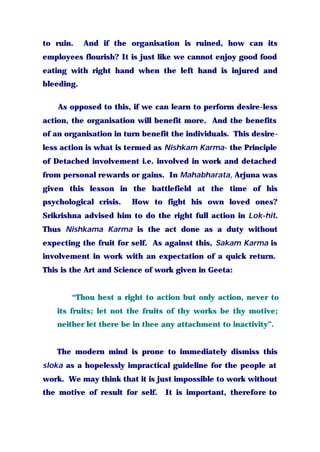
Outer
Manifestation:
Meanness Dignity
Fear Nobility
Smallness Magnanimity
THE LOWER SELF & THE HIGHER SELF
Thus as the lower self is deficit-driven, it is demanding.
The behaviour coming from this state is the one that tries to
grab and watch self-interest only. The Higher Self being
poorna gracefully allows others to gain and remains bliss-full.
Where as self (lower) of each individual is different from that
of the other, the Self (higher) in all is the same.
Naturally the qualities like team-spirit, collaboration, can
in real sense be driven from the higher-self which is poorna
and identical with the higher-self of all others and not the
lower self which is deficit-driven and cannot see a common
string in all human beings. Thus it can lead us to
interpersonal conflicts only.
Thus the need is to withdrawn for a time being from the
exterior world and to look within to establish a connection
with this true higher Self.
Socrates declared: ‘Know thyself’.
We know ourselves, only in the extremely narrow sense
of selfish desires and ambitions of our mento-physcial
existence. At the most some of us reflect the dimension of
social existence too. And it is this type of extremely limited
knowing, which underlies all the issues of human in-
effectiveness in organizations. The great problem seems to
be our inability even to diagnose this as the key issue.
Back to Unit Index
5.4 ILLUSTRATIONS
Let us try to understand the higher and the lower self
and their inter-relation more clearly through these
illustrations though they cannot fully signify the nature of
higher self in real sense:
(a) When air is pumped into a bladder, the football becomes
round and swollen. The air inside serves certain function for
a while. But when it is deflated or punctured, the football
loses its shape and the air in it returns to its original free
state. It returns to its source. The air in all different types of
shapes looks different but is actually the same air. On the
same analogy the higher self of each one of us is identical
and is a part of the same, all pervading divinity. Where as the
lower self is one identified with this Body, Mind & intellect
complex and which we normally call I and mine. Just like
the air inside a ball or a tube looses connection with the air
in the atmosphere and is seen as a ball or tube only, we start
recognizing ourselves with the body, mind & intellect
complex which are the exterior forms and which keep us
involve in the exterior world. We forget the real nature i.e.
the higher self within. Thus more the lower self remain
anchored to or connected to the inner source or higher self,
the more ethical will be the behaviour, and the personality.
As we have already seen that the source of Values is within,
that source is this higher self only, which in turn is a part or
reflection of the all-pervading Divinity.
(b) Similarly a close friendship between a blind man and a
lame one makes the two together a functional pair- the
mobility of the blind guided by the sight of the lame. This
metaphor is used to hint at the nature of the lower-self and
higher-self combination in every individual. We can say, in
each person there are two aspects: one, the active and
mobile but insentient part of the being; the other the witness
and still but sentient part of the being. The moment the blind
stops listening to the lame he stands danger of misleading
himself. In the same way if we stop paying attention to the
higher self within, we start following the path of disaster.
We call this higher self the Atman, which is a part of all
pervading Bliss - the Paramatman.
These working implications of Yoga-Vedanta psychology
underlie the mystic affirmation uttered by Christ:
‘O Lord! Let Thy will be done, not mine',
As Sri Aurobindo says:
By practice in concentrated silence, everyone can
develop a kind of dual consciousness- the one engaged in
surface-level activity, caught in obscurity and struggle;
the other, behind, remaining calm and strong with
effortless insight. After some sadhana the mobile but
erring prakriti (lower-self) becomes subject to the
guiding light and rectitude of the witness purusha
(higher-self). Then the individual achieves ever more
perfection as a worker. The revived poorna higher self
directs the executive lower self to perform wholesomely.
Thus by listening to that higher Self within, we are in fact
listening to the God. This paves the way for empowerment of
our consciousness, from a higher source, which leads to us to
perfection/ excellence. Thus, the whole of Indian civilization
and society, her systems and structures were in principle and
in practice aimed at ultimately helping each individual to
ascend to the higher self. This was provided for by a constant
and consistent weaving of the sacred into the secular, i.e.
adding human values to the day-to-day activities. As Enrich
Forman says:
We are aware of the existence of a Self, of a
core in our personality which is unchangeable and
which persists through out our life inspite of varying
circumstances and regardless of certain changes and
opinions and feelings. It is this core which is the
reality behind the word 'I' or Self and on which our
conviction of our own identity is based.
Here Forman’s 'I' corresponds to the Higher self of Indian
philosophy and is referred to as unchanging core.
For the ultimate truth in man is not in his Intellect or
in his material wealth: it is in his imagination of
sympathy, in his illumination of heart, in his activities of
self-sacrifice in his capacity of extending love far and
wide across all barriers of caste and colour, in his
realizing this world not as a storehouse of mechanical
power but as a habitation of man's soul with its eternal
music of beauty and its inner light of a divine presence.
RABINDRANATH TAGORE
Back to Unit Index
5.5 HIGHER SELF IN OPERATION
Can a model of man such as that outlined above provide
any solution to our problems in the contemporary world and
organizations?
1. We in our organizations feel embarrassed to talk about
the concept of Atma or higher Self. We talk of values because
we have learnt their importance from our own experiences
and from our deteriorating situation as it has turned out in
the absence of them. But we are hesitant to fully admit this
connection of values with the source- the Atma and try to
deal with them (the values) at a superficial level only. For
example we emphasize punctuality, devotion to duty,
integrity, team building, collaboration, fraternity and the like.
But the guiding light, the source from which all these flow
remains veiled. Such superficial treatment cannot lead to the
real transformation or the character building. It is necessary
to mention that the concept of higher Self is not meant for
the world renouncing rishies or sages only. Even among the
rishies we have complete householders like Vashistha who,
by his wife Arundhati, had many sons. More important, many
of these profound insights flowed from monarchs, the most
practical and the busiest of men of their times. Persons like
Janak, Krishna, Ram, Bhishma, Vidhur, Abraham and Akbar
and the like were not Brahmins or priests. These down to
earth, practical rulers/advisers of vast kingdoms had the time
and taste for contemplation and meditation. They had
discovered some of the profoundest secrets for wholesome
management of existence. This was why even some of the
renowned Brahmin sages used to send their sons or disciples
to such kings for the benefit of supreme knowledge. Gandhi
was also guided by this inner moral strength.
2. In India, this question regarding the 'essence of man'
has always remained in the forefront. It is probably this fact,
which, more than anything else, accounts for the survival of
the Indian civilization-despite its social and geographical
contradictions and diversity, and its subjugation to foreign
economic and political conquest for centuries. If we once
again readdress ourselves to this question, we would be
recouping our lost effectiveness and vitality-both at the
personal and organizational level.
Thus the need is to identify our-selves with this higher
self and not I, which we normally consider ourselves to be.
Ramana Maharshi said in reply to a question from Paul
Burnton
“If ‘I’ is gone, will a man not turn an idiot?”
“No, he will attain that consciousness which is immortal
and he will become truly wise when he is awakened to his
true Self, which is the real nature of man.”
3. In Organizational Behaviour, we always speak of Team
Building, emphasizing that the employees should have 'team
spirit'. The word 'spirit' is, however, devoid of any real
content when we utter it in this context. We have to try hard
to learn that this spirit is atman or the true Self. And it is this
Self, which is one in essence, that alone can constitute the
foundation of extension motivation, teamwork, collaboration
and the like. This indeed is what self-awareness means in
Indian psychology, wherein all can discover unity and
commonness too.
4. We, in Indian organizations should not overlook one of
the starkest realities facing us in managing our roles: the
highly differentiated Indian society, not in terms of caste
alone, but in terms of language, religion, social customs and
so on. Our ancient and modern Masters have been warning
us that 'matter divides, spirit unites'. It is this spirit, the
concept of Atman or the higher Self, which has always guided
us for centuries. That is how despite all disparities and
disputes, India still flourishes as one nation as against the
USSR, which had to disintegrate.
5. We can find many exemplary
functionaries in our administration
today also who could render
prestige to not so prestigious
postings. Kiran Bedi got
Megasyasay Award for the Jail
Reforms which none of her
predecessor could think of. (For an IPS Officer the charge of
jail was not considered to be a prestigious posting). She was
once asked by one of the participants in a Training course on
Values in Administration, “ Madam, many of the participants
appreciate the course, but they say it is difficult to follow this
path of serenity, and righteousness in today’s administration.
What is your message to them?” She simply said, “ I don’t
do anything. It is all that my Atma tells me to do, I kept on
doing. When I see expectations in the eyes of aggrieved
people standing before me, I feet that they are seeing a ray
of hope in me for removing their difficulties. My Atma then
tells me what to do. Once inspired from within, I know no
hindrances and no difficulties.” This clearly shows where the
driving force and the strength is, we may or may not accept
it. Thus it is not the post, which is prestigious, but it is up to
the person who holds it to make it prestigious.
6. The whole life of Mother Teresa is nothing but the
operation from this higher illuminated state. Her name as
mother is deep written in our hearts regardless to the fact
whether she possessed any worldly splendours or not. Such
inspiration or strength to serve humanity are the outer
manifestation of values like compassion, generosity and
affluence which have their source in the higher Self only.
V A. We normally come across such exemplary
functionaries among ourselves. Please narrate in
detail one such personality. Which you feel operates
from the higher Self.
_______________________________________________
_______________________________________________
_______________________________________________
_______________________________________________
Back to Unit Index
5.6 ORGANISATIONAL ILLUSTRATIONS
Let us have minute look at the situation prevailing in
most of our organization:
We often find; Inter personal
conflicts amongst colleagues who
function in a competitive climate.
Everyone tries to excel. To that
extent it is all right. But in a
healthy competition one should always acknowledge a
colleague if he or she happens to be excellent. In actual
practice, out of ego we do not hesitate in undermining others
by refusing small helps, depriving them the vital information
or documents or even the facilities needed thus making full
effort to ensure failures in the colleague’s achievements. To
this get added even the trivial benefits like phone connection,
fax facility, use of staff car, priority to avail such facility
becomes a matter of prestige and does not remain need
based. Over a period of time, formal organizational matters
get linked up with these issues and endless battles begin to
be fought - sometimes across individuals in a group, at other
times across groups. But we fail to understand that if only
one person or a few of them could manage the organization,
what was the need to employ all the others. Here we are
guided by ego-centric self demands driven from the lower
Self only.
However, if we are to think in
terms of performance of an
organization and want to see all of
us as a part of an organization, we
need the guidance of the Higher Self only which is same in all
and which when awaken through practice over a period of
time can help us withdraw from our ego and see that all
individuals are identical in the real scientific sense and
grounded in the Atma or Higher Self. This only can make us
realize the requirements and capabilities of others. Unless the
higher Self – the Poorna, illuminates deficit driven lower Self,
all efforts of team spirit and conflict management will remain
a lip service only.
Thus gradual establishment
in the understanding of higher
Self should be the most reliable
foundation for achieving
collaboration among the
employees in place of present
conflict. Conflicts will perhaps
not be totally eliminated, but costly collisions and
derailments could be minimized.
The idea of true Self or poorna enables
one to pursue excellence by complete
concentration on the task itself without the
burnout syndrome of competition-an
inexorable outcome of the unripe ego.
Slowly we begin to be liberated from the
burning effects of jealousy, the gnawing
effects of pride, the choking effects intrigue, the stifling
effects of attempts to outbid others the debasing effects of
greed, the intoxicating effects of power, the demoralizing
effects of a cherished reward not received, and the like. His
or her higher Self stands far above these turbid waters of
the lower-self. Unless and until we are not able to see
ourselves as a part of the whole, the holistic approach
cannot develop. Till that time we cannot replace the small
individual successes by the organizational achievements.
Mere intellectual understanding or willingness does not
lead one to the perception of the Self as being distinct from
the body. But as the regulated experiential effort goes on,
say twice a day, these imageries begin to take root slowly
yet surely. After several months, even years, one may
notice that one is able to view the administrative problem
or a conflict episode in an illuminated perspective, with a
greater detachment and objective clarity.
None will dispute that these are
indispensable requisites for
effectiveness. All managers will
continue to be in this world, but
not solely of it. It is, therefore, a
wholly unwarranted and evasive
inference that dwelling and reflecting on the meaning of Self
or atman is destructive of secular pursuits. The truth is that
sincere and intense inner practice of these ideas should hold
in check, in due course, the very threat of self-destruction.
In a public administration situation, competition would
fall in the domain of swadharma of an organisation and
therefore quite a legitimate activity. However, with the
higher self-concept as the regulating force, competition
should concentrate on good quality or reliable service, and
not on cornering materials or favours or discharging the
criteria “ show me the man I will show you the rule”,
restricting free flow of information, etc. The atman concept
should foster long-term success rather than short-term
gain. The means adopted to achieve the given ends will
tend become purer. Even certain chosen ends may be given
up if the means have to be compromised too often.
VB 1.Visualizing your job profile please indicate the
information/documents/facilities which you feel you
should share with your colleagues (at higher, lower
or same level)
_______________________________________________
_______________________________________________
_______________________________________________
_______________________________________________
_________________________________________
2. How for are you able to do so.
_______________________________________________
_______________________________________________
______________________________
3. (a) To the extent you are not able to do so, what are the
hindrances, (physical, mental or psychological) which you
feel from within
_______________________________________________
_______________________________________________
_______________________________________________
_______________________________________________
_______________________________________________
(b) Which of the hindrances are imposed by others
_______________________________________________
_______________________________________________
_______________________________________________
_______________________________________________
_______________________________________________
_______________________________________________
(c) How do you resolve to overcome them.
_______________________________________________
_______________________________________________
_______________________________________________
_______________________________________________
_____________________________________
Some of us may find the concept convincing but difficult
to operationalize. The very question may arise that if I start
sharing, supporting others while they do not, I stand all the
risk of loosing or lowering my prestige or why should I start
boosting others performance when in comparison my
performance will be seen lowered.
Here we need to think if we are already reaping enough
compared to the time, energy and attention that we
wastefully employ in conflicting matters. Further, how far is
this day to day prestige and applause essential for our
survival and existence in the organization. All such trivial
loss even is a short term only. The sure long-term gain first
of all is the freedom from these day to day worries and
energy dissipation (which is much more compared to the
amount we employ in peaceful constructive work) slowly and
surely the seniors are able to see your increased performance
(qualitative as well as quantitative) our positive contribution
can never go unnoticed for long. Slowly but surely, a positive
change will take place in the colleagues also.
(You may like to give another look to the above activity before you
really send it.)
Thus in order to ensure positive change in others, we
need to first improve our own attitude towards them. As has
already been mentioned, the world is a not in our control and
there are many things wrong going on around us. Unless we
accept this world the way it is, we cannot have a positive
attitude towards it. It is our good behaviour only, which can
start bringing a positive change around.
Experience shows that if we are able to control our
impulsivity we can save ourselves from reacting emotionally
towards the erring colleagues. This can save us from landing
in a situation of conflict with others. The following exercise
can help us control our impulsivity.
CONTROL YOUR IMPULSIVITY
This strategy helps us to rise above the situation instead
of reacting emotionally and becoming a part of the problem in
the situation of conflict. Often we find our self being swept
away by others’ emotions, if we react impulsively. In other
words, we unconsciously give our control to others. They can
upset us and when they are upset, unless we take charge of
our emotional state.
Taking charge of our own emotional state is not very
difficult. It only requires a little consciousness. Human
beings have been given the choice to decide their own way of
responding to a situation. If we are conscious we can always
decide whether to be angry in a particular situation or not.
Therefore, we should practice to pause for a moment before
reacting emotionally. We will then be able to prevent much
of the emotional distress by deliberately observing our
emotions and becoming conscious of our thoughts. We then
have the choice to deliberately altering our thoughts.
This strategy is particularly helpful if we tend to react to
stressful situations emotionally.
(You may attempt it at the link and save it in your folder)
V C. Make a list of things, which trigger of your
emotional responses:
--------------------------------------------------------------
--------------------------------------------------------------
--------------------------------------------------------------
2. Describe one such situation in as much detail as
you can. What specific emotions did you experience?
--------------------------------------------------------------
--------------------------------------------------------------
--------------------------------------------------------------
3. How could have you reacted more positively? Build
up a vision of yourselves. What would you be
thinking, feeling and doing?
--------------------------------------------------------------
------------------------------------------------------
You can use the finding of this exercise in the Mind
Stilling exercise for affirming yourself to inculcate the
required emotion and to shun the one that is not desirable.
Or else you can combine these findings with the exercise
suggested at the end of Unit I - CHARACTER
5.7 THE HIGHER SELF, SATTWA, DOCTRINE OF
KARMA & NISHKAM KARMA.
We can see a link in all the four concepts. A person
driven from higher self will be a contented (poorna) stable
and peaceful person, who can take a balanced view and
action in worldly affairs. He can save himself from ego trips
and act for the benevolence of others. Such person only can
reflect purity, serenity, honesty, compassion, and generosity,
as he does not have a grabbing tendency. This following of
Sattwa Guna further increase his inner strength. The higher
self shines further and so on. As this thinking is not ego-
oriented, but of a pure mind, his acts become spontaneous as
in Nishkam Karma. Such karma is going to bring him real
prosperity only as per the Doctrine of Karma.
Back to Unit Index
5.8 GROWTH TOWARDS HIGHER SELF
For the sake of self-growth, for attaining purity, clarity
and calmness of mind from stress, for making it more capable
of coping with, we can attain a stage of freedom from these
daily situations. Unless we grow out of the selfish lower self,
there will be little room in our psychic space for our
colleagues subordinates and superiors in the organizations.
Extension motivation (motivation to work for others benefit)
will continue to remain an exhortation and never become a
reality. We can feel concern with the woes and worries of
others only if we Stop identifying ourselves with our own self
oriented concerns. This is the spirit, which we require in our
leaders today. The leader of a team sees the whole group as
one and has respect for even a member in the lowest rank. He
looks at the other person as himself and is interested in
maximum benefit to all. He inspires them, encourages them
in their meaningful activities (even of less significance) out of
love for them. He himself works (on his own level and in his
own sphere) with enthusiasm and fortitude and maintains his
equilibrium in success and failure. One of the best historical
working models of this principle is the life of Buddha. True
leadership depends, in a large measure on one's capacity for
such dis- identification.
One should try to concentrate on a
steady, luminous spherical core in the
psychic heart center, Or, it could be
imagined as a steady, effulgent flame.
Alternately, for some it could be a
luminous personality like the Christ or
the Buddha or any chosen deity depending on one's mental
affinity. In each case it is not the object or individual which
is the real purpose of concentration but the pure
consciousness or atman, which it symbolizes. Through
practice, when our ability to visualize and rally around this
inner core of pure consciousness i.e., the true Self,
undisturbed by the turmoil of the body- mind-senses-intellect
quartet, becomes fairly stable, we may strive to see the same
core in others- our colleagues, or friends, and even our foes.
This progress can be achieved because the theory behind the
exercise offered above is that we are shifting our
identification from small, unripe, executive self' to the bigger,
ripe, 'Witness Self'. Such a balancing sadhana or effort is the
key to the reduction of pettiness in organizations, and to the
restoration of dignity in work life.
Usually, in the early phases of our efforts, we shall fail to
do this when we are in physical proximity to our colleagues.
So we may try the process when we are away from them. By
such trials we shall one day discover, to our pleasant
surprise, that we can indeed visualize the same pure
consciousness in others too, even in the midst of an
interaction with them. Of course, it goes without saying that
the first experiments should commence with our friends,
most ideally with our family members. The chances of
success in these spheres are much quicker and more certain.
Confidence thus acquired can then be transferred to the
organizational context.
To quote Enrich Forman in this context:
Today the idea of a human nature or of an essence
of man has fallen into disrepute, partly because one
has become more skeptical about metaphysical and
abstract terms like the 'essence of man', but partly
also because one has also lost the experience of
humanity which underlay the Buddhist, Judoka-
Christian, Spinozist and Enlightenment concepts.
Back to Unit Index
5.9 CASE-STUDY
A TRYST WITH TRUTH
In the XYZ Department, there was a rumor that Sh. S.
Ghosh, Deputy Secretary (General Administration Division)
had been found involved in financial irregularity and has
been charged with misappropriation of Government funds.
Some senior officers of the Department, who were not
particularly well disposed towards Ghosh, were openly
critical of his misdemeanour. Meanwhile, Ghosh was
advised by the Secretary to proceed on leave as an enquiry is
to be conducted against him on the basis of prima facie
evidence.
Sh. Ghosh had approved the purchase of a large
quantity of an item from AKW Company, a private sector
firm. Immediately before the purchase deal was struck,
Ghosh's son-in-law, who was also working in one of the
Government Departments, made out a case that Ghosh had
shown undue favour to AKW Company.
The case came up for examination by N. Gopal who was
Under Secretary (Vigilance) in the Department. On close
scrutiny Gopal found that Ghosh had not, in fact, flouted any
rule or norm in this case and that it was clean deal. Besides,
there was a precedent of the Department having purchased
similar items from AKW earlier also. It was fairly common
knowledge that AKW was a reputed company and in the
purchase penal of many Departments.
The personal equation between Gopal and Ghosh were,
however, far from cordial. The adverse report from Ghosh
had led Gopal to miss his well-deserved promotion the
previous year. For some reason, Ghosh's stance towards
Gopal was frequently hostile, and although the latter was
known to be an upright and trustworthy officer, his
detractors in the Department invariably found in Ghosh a
sympathetic ear. On one occasion, Sh. Ghosh had also made
a note that one of Gopal's tour Bills was rather inflated
although there was nothing in the bill to suggest this. It was
now time for Gopal to pay Ghosh back in his own coin.
In another development, the Deputy Secretary
(Vigilance), Sh. T. Prasad, to whom Gopal reported, wanted to
make use of this case and sent feelers to Gopal that his
promotion and posting would be taken care of if he
'manufactured' adverse comments on the Ghosh’s case. It
was true that Gopal's comments as Under Secretary
(Vigilance) were crucial in this case as any adverse remarks
by him would seal Ghosh's fate. Sh. N. Ramakumar, one of
Gopal's colleagues who also worked in the same Department,
whispered to him; 'Gopal you know the Vigilance’s subtle art
that can fix Ghosh. Let him lose sleep! After all you also lost
one promotion!
Gopal observed that the same Ramkumar had been
showing loyalty to Ghosh when the latter was his boss but
was now beginning to demonstrate his allegiance to T.
Prasad. Gopal sighed to himself. 'How things change!’ but
refused to be carried away by his colleague's blandness and
said: ' I am no coward to fight shadows. I trust professional
competence and integrity. I shall not stab Ghosh in the back.
Gopal’s examination of the case and conclusions were fair.
Proposing exoneration of Ghosh, he returned home that
evening happy and content in what he had done.
The case subsequently travelled through various stages,
and was sent to CVC also for advice. When the case came
back to the XYZ Department. Sh. T Prasad personally talked
to Gopal to ascertain his view on the basis of all the
developments on the case. Gopal stuck to his earlier ground
and said: ' I have already given my comment. I have no
doubt that Ghosh is innocent in this case.
Ultimately, the case got closed. Gopal's boss Prasad
was however furious at the his stubbornness and marred his
confidential report. As a result, Gopal lost promotion for yet
another year and in the throes of acute disappointment wrote
a letter to the Minister with an outburst: ' Is this the way you
reward your honest employees?’ The Office of Minister
acknowledged Gopal's letter but failed to respond.
A few months passed without any further development
in the Ghosh episode. Gopal continued to work as the under
Secretary. Sometimes, taking a break from his hectic
schedule, he would spend a few minutes on his own to reflect
on his life and career: ' I have never opted for any undue
advantage in my twenty years' of service. I cannot recall
having ever lied or having harboured any ill will against any
of my colleagues. I had to raise a family of three children,
look after my aging parents, and marry off two of my sisters,
and I managed to do all these by honest means......., he
muttered to himself and this train of thought lingered in his
mind.
' By God's grace all my three children have proved to be
brilliant. They have done very well in their professions and
each one of them has inherited the qualities of honesty and
hard work that my father and I stood for. In Pratibha I have
found a caring and supportive wife. What more could I have
asked for in this life? How much does the loss of promotion
for a couple of years matter in comparison to a life lived for
an ideal’.
As these words continued to reverberate in his mind,
Gopal's eyes fell on the glass top of his desk beneath which
he had inserted a piece of printed paper. It read:
'Success is not the aim of life. Perfection is'.
'That's what my father always told me' he whispered to
himself and proceeded to clear the next on his desk.
***
We see in Gopal a complete personality guided by higher
Self, acting through Sattwa and taking a holistic view of his
rewards in the life, not limiting his vision to promotions
alone. Apparently, he is a looser by two years, but how and
when will his reward for the honest reporting bestow on him
is not known. In any case the immediate reward is the peace
and sense of contentment within, which many of us are
deprived of. Many of us will agree that life is not
promotion only but the all round prosperity in the life.
Back to Unit Index
5.10 MIND STILLING EXERCISE
Sit comfortably. If you are wearing something, which is
tight on your body, you can loosen it, relax, close your
eyes............ feel from your toe to head that you are relaxed.
Your mind is relaxed and you do not feel like moving any part
of your body. Keep your attention on the fontanel area of
your head, i.e. above your brain. Relax your mind and body.
If thoughts come just let them go. You are relaxed.
Breath slowly. Inhale, stop and exhale, stop. Again
inhale, stop and exhale, stop. Follow it a few times.
There are no thoughts, or very less thoughts. Now just
prey:
Let the fontanel bone area of my head open up in the
form of a lotus. Let me be one with the all-pervading
Divine power. Let this power nourish me.
Let the petals of the open lotus absorb this divine love
into my brain, my central nervous system.
Imagine that you are breathing through this opening,
inhaling Sattwa guna, the positive energy and exhaling
out the vicious emotions, the negative energy.
Keep sitting and be receptive.
Now slowly take your attention to your heart. At the
core of your heart, imagine a golden flame or
illumination which is:
1. Eternally perfect
2. Constantly blissful
3. Completely autonomous
4. Truth and light in itself
5. Identical with the higher self of all
others.
This is my true self, the higher self, the source from
which flows all the magnanimity, generosity and nobility.
My true and permanent nature, which should reflect
outside in my deeds, my behaviour. Let me always be in
touch with this fineness of mine. Let me be enlightened by
my higher self.
(You may also like to follow other steps, which are
mentioned in the previous units. After sometime slowly
open your eyes.)
Back to Unit Index
5.11 LET US SUM UP
We have seen that in the inner core of our heart, there is
a part or image of Divinity, which we called higher Self
and which is the permanent and true identity of all of us.
If we are able to draw our attention to it we are guided
by this higher Self towards purity, severity, compassion,
generosity, contentment etc.
This higher Self only helps us to withdraw our attention
from the worldly ego pampering motives and to act in
the balanced Sattwic State.
While our ego-centric lower self is different and
individual to each one of us, the higher Self is identical
with the higher Self of others. The more we are nearer
to this higher Self with, the more are we at peace. We
then inculcate the feeling of compassion and love for
others. Such emotions only can act as binding force for
teambuilding, conflict management and collaboration in
the organizations.
Action from this higher state becomes spontaneous,
holistic and benevolent. They also save us lot of energy,
time and attention; which are otherwise wasted.
People who act from higher Self only contribute to clean
our administration and organizations with their actions
and by acting as role model to others.
Back to Unit Index
5.11.UNIT END ASSIGNMENT
? In your own life (personal as well as official) you
might have come across number of instances where you
were guided by your higher Self. Please narrate one or two
such striking instances for the benefit of other participants.
?
5.12.UNIT END ACTIVITY
Continue meditation, by adding one step as suggested
in this unit.
Please read the following articles:
‘A Prayer to God’
The Realization of the Inner Life
The Composed Soul
A PRAYER TO GOD
I asked God to make my handicapped child whole.
God said, No. His spirit is whole, his body is only temporary
I asked God to grant me patience.
God said, No. Patience is a byproduct of tribulations; it isn't
granted, it is learned.
I asked God to give me happiness.
God said, No. I give you blessings; Happiness is up to you.
I asked God to spare me pain.
God said, No. Suffering draws you apart from worldly cares
and brings you closer to me.
I asked God to make my spirit grow.
God said, No. You must grow on your own! , but I will prune
you to make you fruitful.
I asked God for all things that I might enjoy life.
God said, No. I will give you life, so that you may enjoy all
things.
I asked God to take away my bad habit.
God said, No. It is not for me to take away, but for you to
give it up.
I ask God to help me LOVE others, as much as He loves me.
God said...Ahhhh, finally you have the idea.
Back to Unit Index
The Realization of the Inner Life
(The Sufi Message of Hazrat Inayat Khan)
The principle of the one, who experiences the inner life,
is to become all things to all men throughout his life. In
every situation, in every capacity, he answers the demand of
the moment. Often people think that the spiritual person
must be a man with sad looks, with a long face, with a
serious __expression, and with a melancholy atmosphere.
Really speaking, that picture is the exact contrary of the real
spiritual person. In all capacities the one who lives the inner
life has to act outwardly as he ought in order to fit the
occasion; he must act according to the circumstances, and he
must speak to everyone in his own language, standing upon
the same level, and yet realizing the inner life. For the
knower of truth, the one who has attained spiritual
knowledge and who lives the inner life, there is no
occupation in life which is too difficult; as a business man, a
professional man, a king; as a ruler, a poor man, a worldly
man; as a priest or monk, in all aspects he is different from
what people know and see of him.
To the one who lives the inner life the world is a stage;
on this he is the actor who has to act a part in which he has
sometimes to be angry and sometimes loving, and in which
he has to take part both in tragedy and comedy. So also the
one who has realized the inner life acts constantly; and, like
the actor who does not feel the emotions he assumes, the
spiritual man has to fill fittingly the place in which life has
placed him. There he performs everything thoroughly and
rightly, in order to fulfill his outer commission in life. He is a
friend to his friend, a relative to his relatives. With all to
whom he is outwardly related he keeps the right relationship
with thought, with consideration; and yet in his realization
he is above all relationship. He is in the crowd and in the
solitude at the same time. He may be very much amused,
and at the same time he is very serious. He may seem very
sad, and yet there is joy welling up from his heart.
Therefore the one who has realized the inner life is a
mystery to everyone; no one can fathom the depth of that
person, except that he promises sincerity, he emits love, he
commands trust, he spreads goodness, and he gives an
impression of God and the truth. For the man who has
realized the inner life every act is his meditation; if he is
walking in the street it is his meditation; if he is working as a
carpenter, as a goldsmith or in any other trade or business,
that is his meditation. It does not matter if he is looking at
heaven or at the earth, he is looking at the object that he
worships. East or west or north or south, upon all sides is his
God. In form, in principle, nothing restricts him. He may
know things and yet may not speak; for if a man who lives
the inner life were to speak of his experiences it would
confuse many minds.
There are individuals in the world who from morning until
evening have their eyes and their ears focused on every dark
comer, wanting to listen, or to see what they can find out;
and they find out nothing. If someone were to tell such
people wonders, he would have a very good occupation, the
whole world would seek him. But such is not the work of the
self-realized man. He sees, and yet does not look; if he were
to look, how much he would see! There is so much to be seen
by one whose every glance, wherever it is cast, breaks
through every object and discovers its depth and its secret.
And if he were to look at things and find out their secrets
and depths, where would it end, and of what interest is it to
him? The inner life, therefore, is seeing all things and yet
not seeing them; feeling all things and not expressing them,
for they cannot be fully expressed; understanding all things
and not explaining. How far can such a man explain, and
how much can another understand? Each according to the
capacity he has, no more. The inner life is not lived by closing
the eyes; one need not close one's eyes from this world in
order to live it, one can just as well open them.
The exact meaning of the inner life is not only to the soul.
Why, then, does not the average man live an inner life when
he too has a heart and a soul? It is because he has a heart,
and yet is not conscious of it; he has a soul, and knows not
what it is. When he lives in the captivity of the body, limited
by that body, he can only feel a thing by touching it, he sees
only by looking through his eyes, he hears only by hearing
with his ears. How much can the ears hear and the eyes see?
All this experience obtained by the outer senses is limited.
When man lives in this limitation he does not know that
another part of his being exists, which is much higher, more
wonderful, more living, and more exalted. Once he begins to
know this, then the body becomes his tool, for he lives in his
heart. And then later he passes on and lives in his soul. He
experiences life independently of his body; and that is called
the inner life. Once mart has experienced the inner life, the
fear of death has expired; because he knows death comes to
the body, not to his inner being. When once he begins to
realize life in his heart and in his soul, then he looks upon his
body as a coat. If the coat is old he puts it away and takes a
new one, for his being does not depend upon his coat. The
fear of death lasts only so long as man has not realized that
his real being does not depend upon his body.
The joy, therefore, of the one who experiences the
inner life is beyond comparison greater than that of the
average man living only as a captive in his mortal body. Yet
the inner life does not necessitate man's adopting a certain
way of living, or living an ascetic or a religious life. Whatever
his outer occupation is, it does not matter; the man who lives
the inner life lives it through all. Man always looks for a
spiritual person in a religious person, or perhaps in what he
calls a good person, or in someone with a philosophical mind,
but that is not necessarily the case. A person may be
religious, even philosophical, he may be religious or good,
and yet he may not live the inner life.
There is no distinct outward appearance, which can
prove a person to be living the inner life, except one thing.
When a child grows towards youth, you can see in the
__expression of that child a light beaming out, a certain new
consciousness arising, a new knowledge coming which the
child has not known before. That is the sign of youth, yet the
child does not say so; he cannot say it, even if he wanted to,
he cannot explain it. And yet you can see it from every
movement that the child makes; from his every
__expression, you can find that he is realizing life now. And
so it is with the soul. When the soul begins to realize the life
above and beyond this life, it begins to show; and although
the man who realizes this may refrain from purposely
showing it, yet from his __expression, his movement, his
glance, his voice, from every action and from every attitude,
the wise can grasp and the others can feel that he is
conscious of some mystery.
The inner life is a birth of the soul; as Christ said, that
unless the soul is born again it cannot enter the kingdom of
heaven. Therefore the realization of the inner life is entering
the kingdom of heaven; and this consciousness when it
comes to the human being shows itself as a new birth, and
with this new birth there comes the assurance of everlasting
life."
http://murshid.net/the-inner-life/realization-of-inner-
life.html
Words of Martin Luther King Jr.:
“An individual has not started living until he can rise above
the narrow confines of his individualistic concerns to the
broader concerns of all humanity.”
“When I speak of love I am not speaking of some
sentimental and weak response. I am speaking of that
force which all of the great religions have seen as the
supreme unifying principle of life. Love is somehow the
key that unlocks the door which leads to ultimate reality.”
“Compassion and nonviolence help us to see the enemy’s
point of view, to hear his questions, to know his
assessment of ourselves. For from his view we may indeed
see the basic weaknesses of our own condition, and if we
are mature, we may learn and grow and profit from the
wisdom of the brothers who are called 'the opposition'.”
“I do not minimize the complexity of the problems that
need to be faced in achieving disarmament and peace. But
I am convinced that we shall not have the will, the courage
and the insight to deal with such matters unless in this
field we are prepared to undergo a mental and spiritual re-
evaluation, a change of focus which will enable us to see
that the things that seem most real and powerful are
indeed now unreal and have come under sentence of
death.”
“We must work unceasingly to lift this nation that we love
to a higher destiny, to a new plateau of compassion, to a
more noble expression of humaneness. I have tried to be
honest. To be honest is to confront the truth. However
unpleasant and inconvenient the truth may be, I believe
we must expose and face it if we are to achieve a better
quality of American life.”
Back to Unit Index
A human being is part of a whole, called by us the Universe,
a part limited in time and space. He experiences himself, his
thoughts and feelings, as something separated from the rest
a kind of optical delusion of his consciousness. This delusion
is a kind of prison for us, restricting us to our personal
desires and to affection for a few persons nearest us. Our
task must be to free ourselves from this prison by widening
our circles of compassion to embrace all living creatures and
the whole of nature in its beauty.
Albert Einstein
THE COMPOSED SOUL
This matter is being made unnecessarily complicated
through discussion. Yet it is this that is most natural for us.
It is absolutely the first work of the beginning and the last
word of the ending. We have found within ourselves a
oneness and it is the one that we are seeking everywhere
among the many, so much so that when the infant stretches
out its hands in all directions to know various objects by
touching, smelling, eating, even then it is searching for this
very one. We too, like infants, are touching many objects,
smelling, putting them into our mouths, hitting them, getting
hit by them, accumulating them and discarding them like
garbage. Through all these tests and endeavours in all
suffering, in all gain, it is that very one that we are wanting.
Our knowledge wants to reach unity; our love wants to
mingle in it. Other than this, there is no other concern.
Anandaddheva khalvimani bhutani jayante. Bliss is
manifesting itself in many forms in many times. We are
seeing only those various forms, but our soul seeks to see
through those many that original one bliss. As long as we do
not see any trace of that original bliss, till then we do not
find any joy in mere objects. Till then it is merely one object
after another, event after event, tiring us out, paining us,
exhausting us in endless roaming. Our science is searching
for one truth in all objects, our history is seeking one
purpose in all events, our love is seeking one bliss within all
beings. Otherwise, nowhere can it say OM, cannot say, “Yes,
it has found”.
When we hunt around for our desired object in a dark
room then we keep banging our head everywhere and
stumbling. Then we consider so many small things large,
regard so many trivial things as valuable. Clutching so many
things to ourselves we say, “Here, I have got it,” and later
find that within our very fists they have all crumbled into
dust.
The truth is that in this darkness I do not even know
what I am seeking. But, the moment a light is lit at once, in
an instant, everything becomes simple. Similarly after so
much seeking for so many days, so many knocks on the
head, just in a trice I get to know that all that had touched
my hand was not the object of my search. The mother who,
having arranged this entire room, was sitting silently, it is
she who is the true treasure sought by my desires. As the
light lit up, at once, discarding all things, I ran with both
hands outstretched to her.
Yet, immediately on finding mother all things were
found together along with her, no particular object appeared
separately to block me as an obstacle in my path. The very
moment I recognized mother this decorated room became
my very own. Then my movement amid all the furniture in
the room became unimpeded, then the proper function of
each thing came under my control, then the objects did not
master me, it is I who mastered them.
Hence, I keep saying, whether in knowledge, or in love
or in work, it is on obtaining that very one, that genuine
thing, that everything becomes easy, all the burden of things
vanishes in an instant. The moment I learn swimming at
once sporting even in unfathomable waters becomes as if
normal for me. Then even diving into bottomless waters I do
not sink to death, but float up automatically. It is if I do not
know this swimming that water obstructs me at every step,
wishes to kill me. The waters in which, if I know swimming,
moving about is sport and bliss for me, moving in those very
waters is suffering and death for me if I do not know
swimming, then even in shallow water I gasp, fling about
hands and legs, and get tired out.
The moment we gain the object which we have to know
truly and obtain, at once the multiplicity of this world can no
longer bind us down, impede us, kill us. Then what was
formerly a nightmare, now even that becomes natural; then
we can freely find joy in worldly life. Then the world does
not control us, it is we who govern the world. Then the grief
and distraction that was ours formerly at very step, that
waste of energy, disappears.
That is precisely why the Upanishad has stated: te
sarvagam sarvatah prapya dhira yuktatmanch
sarvamevavishanti. They who have obtained that all
pervading even from all sides, they being composed, being
joined to the soul, enter everywhere indeed. At first they
gain patience. And they do not roam ever distracted and
bewildered amid numerous matters and varied affairs. They
are taciturn, sober, and steady. They are yoked to the soul;
they are united in yoga with that Supreme One. They do not
independently separate themselves by any egotism, any
addiction. Mingling with the one joyously they enter into all
the world’s many. All the many then leave the path open for
them.
Saluting all those composed, united souls, it is verily
their path that we will follow. That is the path of linking
with the One, it is that which is the path of entering into all-
the path of the supreme fulfilment of knowledge, love and
action.
(By Rabindranath Tagore)
Back to Unit Index
Back to Course Content
UNIT-VI
THE GIVING MODEL OF INSPIRATION
6.1 Recapitulation
6.2 The Giving model of Inspiration
6.3 Giving Model and the Higher Self
6.4 Giving Model and the Gunas
6.5 Motivation and the Giving Model
6.6 Practising Giving Model of
Inspiration
6.7 Mind Stilling Exercise
6.8 Let us sum up
6.9 Unit End Assignment
6.10 Unit End Activity
6.1 RECAPITULATION
We are performing our journey towards developing
holistic competence by purification of mind and inculcating
values. We have seen that the mind stilling exercise is very
important for achievement of our goal. Side by side we are
supported by our Vedantic concepts, the five pillars that help
us to develop a clear understanding towards this goal. The
Guna Dynamics gives us an insight that out of the three
inseparable inherent attributes, Sattwa is the best for
developing pure mind. A consistent effort is required to
cultivate Sattwa Guna and to reduce Rajas and Tamas (which
reveal in greed, anger, envy, vanity etc.). The Nishkam
Karma theory gives an energy conserving and mind purifying
orientation to work, by linking it to the cause higher than go.
The theory of Karma casts full responsibility for present
effects on past causes (i.e. actions, choices, decisions). By
the same logic it promises future hope (i.e. good effects) if
the present causes are wholesome. This theory helps at
individual level to stand and support action towards higher
values and to withdraw from ethically questionable ends and
means. The forth pillar is the deepest concept which
distinguishes between imperfect, conventional, deficit-driven
self and the important stable, illumined and perfect higher
SELF. All the higher values are sourced in this SELF. Thus
lower self should function with the guiding light of awakened
higher Self. Side by side we have added vital components
from these concepts in our Mind Stilling Exercise/working on
self, which helps in inculcating values within.
The fifth pillar is: Giving model of inspiration, the
concept that modulates us to find a source of motivation
within ourselves.
Back to Unit Index
OBJECTIVES
After going through this Unit, you will be able to:
Explain how can Sattwic way of giving be a source
of fulfilment
Link Sattwic giving to Higher self.
Describe how Giving Model of inspiration can help
in organizational situations
Practise getting motivation through giving model.
6.2 THE GIVING MODEL OF INSPIRATION
Let us see what a philosopher, Khalil Gibran has to
say for giving:
There are those who give little of the much, which they have
and they give it for recognition
and their hidden desire makes their gifts unwholesome.
And there are those who have little and give it all.
There are those who give with joy,
and that joy is their reward.
And there are those, who give and know not pain in giving,
nor do they seek joy, nor give with mindfulness of virtue.
It is well to give when asked,
but it is better to give unasked, through understanding,
You often say, “I would give, but only to the deserving”-
The trees in your orchard say not so,
nor the flocks in your pasture-
They give that they may live, for to withhold is to perish.
The above concept of giving seems to be impractical in
the modern era. Not only that, most of times, such thinking
is rejected as not for a learned person. This is because
today’s world of science and technology believes in the
strength of intelligence only, which makes us very
calculative and selfish. This leads to the all round
atmosphere of demands, both for haves and have-nots alike.
Most of us think we give much more to society than we
receive. Psychologists call it self-serving Bias: we have an
unwitting capacity to forget our neighbour’s good deeds,
remember our good ones and forget our bad ones. Just a
little effort and reflection will ensure that the balance is not
always titled the other way.
Giving benefits our health. A 14 year study of 2700 people
in Michigan, US, revealed that those who did charity work
lived longer, were relatively free from heart disease, had
lower blood pressure and greater peace of mind. Fulfillment
comes from giving, not receiving. Though many people in the
world live in affluence, but are still disappointed, frustrated
and suffer from the feeling of unfulfilled because they have
only received, and do not know unconditional giving. The
real magic of giving lies in the way we give.
Giving is a natural Law of the Universe. We have already
discussed the performance and gifts of all the natural things
in Unit II. We often hear ancient stories of generosity and
Indians are still known for being generous at heart. With the
influence of the western culture, this generosity is
disappearing slowly. We get in lieu of what we give, though
we may not recognize it, because, the return may come
sooner or later than we expect it to or it could come in a
somewhat different guise. For example, when we exhale, we
give out carbon- dioxide. The plants and trees consume
carbon dioxide in the process of photosynthesis and release
oxygen. Without giving out carbon dioxide we cannot take
oxygen. Without getting carbon dioxide, the trees cannot
make food, which we human beings consume.
Even within our body the various organs support the
activities of the other organs so that the systems like blood
circulatory system, respiratory system, nervous system,
digestive system etc keep working properly for the benefit of
the whole body. The entire biological and ecological system
combined makes possible the sustenance of the fabulous and
intricate organic system/s, which we call ‘life’ on the earth.
There is no end to such give and take in the nature that keeps
going.
We do come across such simple people who believe in
giving in the same way as described by Khalil Gibran above.
The ancient Indian culture always taught us about our duties
towards others and not the rights as are frequently claimed in
the modern world. Such a giving model is based on a theory,
that there is a large network of interconnected forces, which
contribute to the existence and nurturance of us all. As a
good-human being I must think of all these forces and my
duty towards them. A classical Indian social theory classifies
all such sources in five segments. In Brihadarnyaka
Upnishad, these segments are seen as types of
obligations/debts (Hrin), which we owe. These are:
1. Deva Hrin
2. Rishi Hrin
3. Pitri Hrin
4. Nri Hrin
5. Bhuta Hrin
The entire social and cosmic setting of the human is
embraced in this five- fold scheme. This background
philosophy is wholesome to take into consideration the
contributions made by all the segments of the universe
towards the existence of the human life and helps us
inculcate qualities, of desire less giving to repay these
obligations or debts.
1. Deva Hrin:
Deva stands for various presiding deities of our
multifarious faculties like sight speech etc. Our owes are
towards all the universal forces or divine forces which are
beyond human’s control as Air, Water, Sun, Earth, Space.
Can we repay our debts towards these natural resources?
We cannot. Our History tells that the primitive people used
to worship all these invaluable resources. This basic value, if
inculcated, will always keep a check on us not to misuse or
waste these natural resources; which have become scarce
and polluted due to over consumption. The prayer, the
surrender to these universal forces helps value them; and to
lead our lives in harmony with the Natural Laws. Thus we
should feel owed to these natural forces and learn that like
divine giving we should also give as much as possible
without any prejudice for who the receiver is.
2. Rishi Hrin
As a human being is borne, he is bestowed with the vast
reservoir of knowledge and wisdom stored since thousands
of years by the great thinkers, Rishis and Gurus. Our present
wisdom of leading life and knowing the world around is
based on the contributions already made by these seers.
Man has evolved from sub-human specie. Thus he needs to
discipline himself to shun sub-human instincts so as to widen
his consciousness further and evolve himself spiritually. Thus
it is our duty to study (swadhaya) them and practise them
and also to enrich them for the coming generations.
3. Pitri Hrin
‘Pitri here stands for parents. Their contribution to our
being needs no description here. It is our moral duty to
serve them, to learn from their experience of life and to look
after them in their old age. Our ancient culture gives us a
concept of serving not only one’s own parents, but also all
those who are parentally to us.
4. Nri Hrin
Nri stands for humankind. We know that our existence,
fulfillment of our basic needs, development, education,
health, recreation, all these are attained in a social set-up and
each member of society, be it at family level, society, nation
or the world, contributes towards this attainment. Thus we
should be careful that whatever we do, it is for the well being
of the humankind. We should not indulge into means as are
detrimental to the humanity as a whole, though it may bring
direct benefit to us. Charity (danam) for the needful in the
society should also be made. Further, we should give a
sympathetic ear and a helping hand in times of need to the
people in distress. Thus it becomes our duty to work for the
benevolence of the humankind as a whole. There is thus no
place for personal conflicts, which we should try to resolve as
soon as possible.
5. Bhuta Hrin
Apart from all the above,
all sub-human species, i.e.
the whole flora and fauna of
the world fulfill all our
needs and requirements. Our duty towards them is to take
care of them with gratitude (sanrakshan). We should also
conserve our natural resources and maintain an eco-balance.
This attitude restrains us from perpetual proliferation of
external desires, wants and artefacts and earning for
physical possessions for the sake of self-enlargement. These
tendencies only have lead to imbalance in use of natural
resources and their degeneration thus leading to pollution
and depletion. The resultant scarcity further leads to
competitive struggles. The repayment of Bhuta-hrin cannot
again be made. It becomes our duty to conserve these
natural resources.
Story
With the western emphasis on rights of the individual,
people tend to look after their own interests only; the
practice which comes from deficit driven lower self. We
tend to see the world as a place where we are borne with the
rights to possess, gain and grab, never bothered to find out,
what all in this universe has contributed towards my
existence and sustenance as a human-being. As a response
to all these contributions, the Vedantic Philosophy reminds
us of our duties towards all the segments that have
contributed to our existence. Thus it takes us from our right
to duties. The natural concern is thus shifted from ‘what can
I grab’ to ‘what can I give’ to this world. Our duties are the
foundation of out Rights. In other words, if all of us become
conscious towards our duties and obligations and discharge
them religiously, we will automatically avail whatever we are
entitled to. Our Constitution also has listed the Fundamental
Duties of citizens of India. It is interesting to find how far it
agrees with the repaying of our Debts (Hrinas), as described
above.
Fundamental duties
In article 51-A of Constitution of India, the fundamental
duties of a citizen are given as follows:
It shall be the duty of every citizen of India-
(a) To abide by the Constitution and respect its
ideals and institutions, the National Flag
(b) And the National Anthem;
(c) To cherish and follow the noble ideals which
inspired our national struggle for freedom;
(d) To uphold and protect the sovereignty, unity and
integrity of India;
(e) To defend the country and render national service
when called upon to do so;
(f) To promote harmony and the spirit of common
brotherhood amongst all the people of India
transcending religious, linguistic and regional or
sectional diversities; to renounce practices
derogatory tot he dignity of women;
(g) To value and preserve the rich heritage of our
composite culture;
(h) To protect and improve the natural environment
including forests, lakes rivers and wild life, and to
have compassion for living creatures;
(i) To develop the scientific temper, humanism and the
spirit of inquiry and reform;
(j) To safeguard public property and to abjure
violence;
(k) To strive towards excellence in all spheres of
individual and collective activity so that the nation
constantly rises to higher levels of endeavour and
achievement.
This fifth pillar or concept thus gives us a new
motivational theory i.e. a giving model. It inspires us to
work for accomplishment of our duties and not for any
external incentive. If this emotion of gratitude can inspire us
in our work life, the sense of devotion to duty is the sure
outcome. Thus we can train our minds and mould our
dispositions to humbly do our duties in an upright manner.
Thus anger, jealousy, pride, falsehood, fear and greed will
have no place in such work-culture.
This takes us to the ethical virtue of ‘unselfishness’ so
significant to lead us from individual concerns to collective
concerns with the feeling of Oneness. It helps us grow from
self-nurturance (swarth sangraha) to world sustenance or
Lokasangraha. The virtues like kindness, sincerity, charity,
justice, truthfulness, humility, chastity etc. which are so
important for fostering fellow-feeling, the feeling of oneness,
can be appreciated once the concept of our duties towards
the five types of debts is understood.
Back to Unit Index
6.3 THE GIVING MODEL AND THE HIGHER SELF
Let us see the giving of a flower.
When a rose blossoms it does so
spontaneously, smelling sweet,
expressing all its joy of living, and it
does not think for whom it is
blossoming, it has nothing to gain out
of it: it does so spontaneously, in the joy of being a flower.
However, we human beings are motivated to do something
only if we will get some direct benefit out of it. We normally
think that our capabilities are our own achievements and we
should use them for our own benefit only. Consequently,
from the psychic point of view, the rose is better than the
human beings. The entire divine plan of the universe rests
on gifting out of joy: the sun, the air, the water, the trees are
all gifts of joy from the creator for the human beings. The
problem of immorality or un-ethicality, therefore, does not
exist in nature whose law-of-being is gifting. However, the
concept of the above Hrina theory can change our attitude
and bring our performance to the same level as that of the
rose.
Thus the fundamental principle of creation is gifting.
We have seen in the previous Unit that the higher Self,
which is poorna, inherently gives/gifts. We as parents
enjoy giving and doing everything for our children. But it is
not the same for other children. Thus in our case the law-
of-being gets tinted through reflective choice (with the
operation of ego and use of intellect) e.g. out of ego we
start differentiating amongst children as our child and their
child. As is said:
‘The ego Grabs; the Self Gives’
The grabber may not know, but he is forever insecure,
vulnerable, fragile and poor. This alone explains Alexander’s
lamentation, “Aren’t there any more lands to conquer?” The
grabber is deficit driven individual. The giver on the other
hand is rich within and can give out of joy. He gets
satisfaction by knowing that whatever was given was useful
to the receiver. Thus the need is to firmly manage the ego
and to manifest the universal gifting/giving law-of-being in
our day-to-day affairs also.
The world is not good or bad as such. Our selfishness is
the chief source of evil, of diminished morals and ethics.
Selfishness springs from the non-cultivation and non-
realization of the feeling of oneness with all. The feeling of
separated ness results in unethical actions. However,
renouncing bit by bit these impulses and doings of the lower
selfish self helps in realizing unity in the midst of
differentiation and unity feeling which is the basis of ethical
and moral dealings. This education in Unity, in Oneness, is
the real response to our concern for ethics. Gandhi and other
contemporary social and political leaders have described this
Oneness or Ek-atmanubhuti as equality, equity, and
egalitarianism. In words of Gandhi:
Equality depends on the state of mind, and until our
mind reaches that state, we shall remain backward------. If
the people in a democratic state are selfish, that state comes
to no good.
Our constitution in Directive
Principles for the States, speaks of
this Oneness. Equality at the level of
feelings can achieve natural
harmony amongst unequal, unique
individuals. In the country like India
with a wide variety of colour, caste, creed, customs,
religions, language and culture, this feeling of equality is
very important to bring about harmony-unity in diversity.
Such ‘state of mind’ can be reached by awakening the higher
self within and by managing the grabbing lower self.
Because, it is the awakened Higher Self only that can see the
Self to be identical with the Higher Self of all others. Thus
the need is to broaden our outlook and feel equitable joy in
giving to all. Let us read a story of an apple tree.
The western theories of motivation are invariably based
on the crucial assumption that it is the needs – the desires
and expectations of employees which supportive leadership
must try to meet. They implicitly consider an organization to
release different benefits towards its members, in the hope
of receiving productive responses. The use of carrot and
stick attitude is at the base of all such theories. As man is an
evolved being; such motivational theories do not lend any
dignity to man. The effects produced can also be short-term
only. This linkage of man to the society through his rights
and claims would be incomplete unless his duties and
obligations are also closely matched. Because, as soon as a
child is born, it starts crying out its needs. It does not need
to be taught and trained for its needs and claims. There is no
end to needs. However, if everyone performs his duties and
obligations well, our rights and claims will automatically be
taken care of.
Back to Unit Index
6.4 GIVING MODEL AND THE GUNAS
In Chapter 17 of the Geeta, three slokas connect the
modes of giving to the three gunas; they are:
Sloka 17.20: The good or Sattvic gift is one made for the
sake of righteousness, without expectation of anything in
return, and is bestowed in proper time and place on a
deserving person.
A GIFT (DANA) THAT IS PRESENTED to a worthy person
without thought of receiving for it any kind of compensation
is sattvic or virtuous in nature. The man who gives “ with no
string attached” to a deserving person is pure-hearted.
Paradoxically, such a gift brings the donor the greatest
spiritual benefit, precisely because he does not seek it.
Sloka 17.21: That gift is deemed rajasic, which is offered
with reluctance or in the thought of receiving a return or a
gaining merit.
THIS DEFECTIVE FORM OF GIVING is not wholly
reprehensible; it is better than practicing no charity at all
and may eventually lead to unselfish giving. To bestow
money or to share one’s intellectual or spiritual knowledge
with others in the expectation of obtaining future benefits in
return or in the hope of being rewarded by God is a
generosity tinged by rajas or worldly desires.
Sloka 17.22: A tamasic gift is one bestowed at a wrong time
and place, on an unworthy person, contemptuously or
without goodwill.
TAMASIC GIFTS INJURE BOTH THE GIVER AND THE
RECEIVER. The Bible says not to cast pearls before swine.
One should not offer money or gifts in kind in evil places or
to evil persons, for it would be used to spread trouble in the
world.
When one offers material aid to another, with malice or
insult, just to obtain the “name” of giver, it is a tamasic or
wrong type of gift; as it is a gift that arouses ill will because
it is given imprudently. To bestow presents on rich or
influential persons, not out of friendliness but as bribes to
win favor or advantage, is also a detrimental action.
All giving from parents to the errant child out of Moha
goes to spoil the child further and is a tamasic gift. Such a
child is going to bring more pain to the parents.
Let us visualize the following few situations in the light
of the above principles.
Back to Unit Index
ILLUSTRATIONS
(a) We offer donation to a hospital, through a cheque, do
not ask for a marble plaque, nor a newspaper or radio
announcement in our name - then it is sattwic giving. We
give out of a humble feeling of repaying a debt. A debtor,
when repaying a debt, does not expect gratitude in return.
(b) Let us assume we are Assistant Professors. We write a
treatise and dedicate it to the Principal of our Institution.
We are aware that cases for promotion, in the course of the
next few months, to professorship will be decided. The book,
with the dedication to the principal, is just the right thing at
right time so that it carries due weight in his mind. This is
rajasic giving.
(c) When we, as boss or as power-centre,
offer the topmost position in an enterprise or
in some other organization to a protégé of
ours, in utter disregard of his competence,
integrity and acceptability, that is a tamasic
giving. That is a giving to a wrong person.
(d) When we, as a subordinate,
indulge in sycophancy and our superior or
colleague clearly understands the game and
design behind it, and nurses a repulsive
feeling towards it, our persistence with such
giving is again tamasic, as it is not to a right
person and in right manner, though with
some expectations.
(e) When we sharply reprimand a junior of ours for sloppy
or irregular work, yet pray within and sincerely transmit
constructive thought waves for his growth and development,
that giving is sattwic albeit veiled under rajas.
The lesser a man needs, the happier he is. Freedom from
needs is the super ordinate goal, not freedom of. (We are
obviously not speaking of the hungry man on the street, but
of employees of organizations who constitute the top 30 per
cent of India’s population). And here too, it does not mean
that he should not accept what comes to him with natural
spontaneity and grace. This he should do with gratitude and
humility.
Our personality cannot become integrated if it is forever
hungry and abjectly dependent on externalities for all kinds
of recognition and satisfaction. It is in the nature of such
dependency to splinter our being and scatter it to the winds.
Thus, we must begin to look for processes and methods for
living and working which can counteract such dissipating
exteriorisation by integrating through interiorisation.
Integration demands a permanent, independent and pure
consciousness or awareness within an individual, which can
absorb or ride over the inevitable fluctuations or dwandwas
in the externals. The operational approach for this is
contained in the following supremely practical counsel of the
Geeta.
Yat karoshi, yadshnashi, yajjuhoshi, dadasi yat;
Yat tapsyasi kaunteya, tat kurushwa madrapanam.
The lord is counseling Arjuna that whatever you
perform, whatever you enjoy, whatever you sacrifice,
whatever you give, whatever willing and energy conversion
you do offer them all to Me, i.e., the Supreme Energy or
Universal Intelligence or the symbolic personal God. The
same applies to we workers and managers. It is the silent
pursuit of this inner convergence through our daily routine of
existence that gradually develops our psyche to become one
coherent whole. An inward journey through Meditation is
thus a must to bring integration and wisdom back into our
exteriorized personality.
Back to Unit Index
6.5 MOTIVATION AND THE GIVING MODEL
Let us compare the following motivational profiles.
(List A) gives the motivational profiles as are normally
considered important for growth of an organization. (List B)
gives the factors, which can be self-motivating in terms of
the “Giving Model of Inspiration” described above. If one is
able to appreciate the above concept, one will try to get the
desired motivation from within as given in list B, and will
hardly depend on the external factors given in list A, which
are beyond one’s control:
LIST A: Need Model of Motivational factors
Scope for autonomy at work
Scope for career advancement.
Scope to shoulder responsibility
Self actualization
Inter personal relations
Scope for challenges and variety at work
Good leadership by superiors
Consistent and sound company policy
Salary and perquisites
Good physical working conditions
Stability and security of job
List B: Giving Model of Inspiration
Meeting my own standard of self- respect for quality
and rate of work done
Performing any given task as a token of discharge of
my debt to society.
To enjoy the happiness from keeping promises made,
without giving excuses for failure
To be convinced that good work is bound to be
rewarded may be in ways quite other than my
expectation or later than sooner
Helping a co-employee, to the extent possible, without
calculating for expected advantage from him-sooner
or later.
Conserving every possible resource of the
organization.
To speak only of good things about a subordinate to
others, in the absence of the former.
To begin mentally attributing to co-employees the
credit – at least in part for success in my assignments
or work.
Abiding by discipline and boundaries is the only
effective way to transcend them.
To behave towards my subordinate in the same way as
I would like my boss to behave towards me.
To be genuine is more important than being skilled or
knowledgeable.
Earning the respect of co-employees as a gentleman.
Promoting the zeal and reputation of the organization.
You would appreciate that list B is both more relevant
and necessary for India today. Thus in our effort to bring
about change in our attitude we should see how we can shift
our thought from profiles in list A to those given in List B.
Back to Unit Index
A real organisational story
Ms. Anjali Singh Joined a training institute as a faculty
member. As she had a flair for teaching job and also a vast
experience of dealing with Parliament Matters, the
participants of all level very well took her inputs on the topic.
Though she had to toil hard for initial preparation of the
subject matter and her presentation, the high rated feedback
that she used to receive gave her lot of satisfaction. Looking
at the feedback of other faculty members also she could
judge that her performance is among the top few faculty
members. She started developing an expectation that with
her high performance she is going to come in the good books
of the seniors and thus she may get a change to get one of
the important assignments that the Academy is going to get
shortly.
For Shri L.Joshi, another faculty member on the same
subjects, it was a matter of constant disturbance, how a lady
who had joined the Training Institute a few months back
could be performing so well, when the participants never
rated his performance excellent.
As normally happens, working for special assignments
becomes a prestige issue and the senior faculty members
never allow such opportunity to the juniors, she was left out.
Then she came to know that Shri Joshi could mange to grab
one of the assignments, she had nothing against Shri L.Joshi,
and congratulated him for the important assignment.
However, she felt discouraged with the thought that it is not
the performance that is normally recognized. This event kept
lingering in her mind, while she continued with her normal
jobs at work. The institute had newly purchased LCD
Projectors and installed them in the classroom. All the
faculty members were requested to make use of power point
presentations also, in their deliberations. Ms. Anjali Singh
had also prepared a few slides. She decided that from next
week onwards she would deliver her topic on office layout
with the help of a power point presentation.
Not many faculty members had yet started using this
new technique she had also heard some passing remarks that
it is not so easy to switch over to power point show. Thus she
thought it would be safe to rehearse her input at least once
with the new aid before she really starts.
Coming Monday she was all prepared with her inputs
and delivered them successfully. It was a group of Section
Officers undergoing Refresher Course. She found the power
point to be very useful especially with this group where one
only has to recall the main points quickly and much details
were not required. The group was then put to group
discussion. Looking at the participants faces which were lit
with appreciation for the clarity with which the interaction
was going on, she was happy within herself for her success.
Back in her room she kept reflecting on her own
dejected mood during the last few days. Now she had a new
way of thinking, why should I need some external source of
motivation, or recognition by seniors to confirm that I am
doing very well. My source of inspiration is these trainees,
their understanding of the subject matter, that I am able to
give. Even the feedback is a later thing to come, and a
second level judgment. My performance is best judged by my
own self. I am working for the Institute. Now onwards I
shall have my own graded standards for my achievement and
self-satisfaction.
Back to Unit Index
6.6 Practicing Giving Model of Inspiration
?VI A
1. Pick up any one of the motivating factors from List A
above, which you consider is an important external
motivator.
2. Now choose one or more self-inspiring factors from list B
which you think can be a good replacement for the
above factor.
3. Build your thought process (similar to one given in
Character), which can help. Shift the motivation from
external factor chosen at 1 above to one of the self-
inspiring factors chosen in 2 above.
?
STORY
HIERARCHY: ORGANISATIONAL AND FAMILIAL
Mr. Karan had passed M.Com. (In Cost Accountancy)
examination of Mumbai University joined pharmaceuticals
MNC and worked there for over 30 years. He had throughout
been honest, sincere and hardworking. At the age of 56,
when he had only 4/5 years left for retirement, his
designation was Assistant (Costing) in the Accounts
Department.
At this juncture the parent body of the company decided
to introduce a highly sophisticated cost and management
accounting system in all its 200 and odd Affiliates all over the
World. As a part of this policy the Indian outfit created a new
position- second in the hierarchy in the accounts department-
namely, Manager-Management Accounting Division and
advertised it in several newspapers all over the country. Mr.
K applied for the position, but his application was rejected
forthwith, since he did not possess a professional
qualification in the field, neither the requisite knowledge of
the integrated accounting system proposed to be installed in
the company.
After a nationwide search and a series of
rigorous interviews, the company offered
the position to Mr. Amit, who hailed from
Kolkata. He was only 30 years old, but
had an enviable tract record in industry,
besides being a first rank holder on all-
India basis in the final examinations of
ICWAI.
Apart from these, Mr. Amit had a pleasant personality
and was very polite in nature. He paid respect to the seniors
by age, as if they were his elder brothers and showed love
and affection to all his juniors, as if they were his younger
brothers. On the very day Mr. Amit joined the company, his
Personnel Manager cautioned him that he might have to face
serious problems with Mr. Karan who, terribly depressed as
he was, would not cooperate with him. But the organisation
would support him if necessary, since in the hierarchy he was
the boss and Mr. Karan was only a subordinate.
The apprehension came true. Mr. Amit found it
extremely difficult to handle the huge volume of work with
total non-cooperation from Mr. Karan. But Mr. Amit accepted
all these with a positive attitude. In the day-to-day work
when he wanted some old data or files from Mr. Karan,
instead of getting them through a peon or by calling Mr.
Karan into his room, Mr. Amit would personally come down to
his desk and request for the same. This had started causing
some uneasiness in the mind of Mr. Karan.
Every month Mr. Amit was required to send to the US
corporate office an elaborate performance report of the
company, after collecting necessary input data from all
departments and functions, analysing the same and
completing the details in prescribed formats. The bulky
package had to be air freighted well in time so that it reached
the destination within the deadline. Any delay, even if the
reasons were uncontrollable, would have serious
consequences.
On one occasion the input data, particularly from the
marketing department, reached Mr. Amit's office very late
and lie was racing against time for 3/4 consecutive days '
working almost up to midnight. All these days Mr. Karan was
overstaying for a couple of hours, doing nothing but
'enjoying' the predicament of his boss. Mr. Amit managed the
situation well and the deadline was met. But Mr. Karan had a
lurking fear that Mr. Amit would lodge a serious complaint
against him and he might be asked to retire prematurely.
But Mr. Amit did not ever complain anything against Mr.
Karan to the CEO or anybody else. Mr. Karan was further
confused. Moreover, some of his colleagues started putting
peer pressure' upon him to cooperate with Mr. Amit, since he
was a nice man.
After a few days of passing sleepless
nights, brooding continuously over the
issue, one Monday morning Mr. Karan
came to Mr. Amit's office and said with tears in his eyes,"
Please forgive me for my behaviour. I have decided to do
henceforth whatever you want me to do. I also want to learn
from you." Mr. Amit consoled Mr. Karan while respecting him
as his elder brother. The tension in the relationship built up
over the previous few months was thus diffused.
After a couple of days, Mr. Karan told Mr. Amit, "You are
like my younger brother. I am happy that you have done so
well at an early age. You have a long way to go. But I have
only a few years left. I have only one wish, to be designated
as 'Assistant Manager', which will enhance my social status
before I retire from the company. I don't want any monetary
benefit since I am already well paid by this company". Mr.
Amit did not commit to him, but promised to make all efforts
to fulfill his expectation. Fortunately, the CEO accepted Mr.
Amit's recommendation and that made Mr. Karan very happy.
Back to Unit Index
6.7 MIND STILLING EXERCISE
Keep doing Meditation as given in the previous units, by
adding the learning points from this unit as follows:
Let my deeds be for the benevolence of all. Let me
follow the virtuous means in all my deeds.
We can also introspect on all the activities we are doing
at present to introspect for our own selves as to from where
is the driving force for such actions coming. Is it coming from
the Need Model motivational factors given in List A or from
Giving Model of Inspiration given in List B. We can then try
to mend them one by one.
As already mentioned the purpose of this exercise is to
help ourselves in developing Pure Mind so that values can be
inculcated. How far can Meditation help in this effort? The
following Research article will enlighten us and guide us to
the right path of meditation.
Researching Meditation
Back to Unit Index
6.8 LET US SUM UP
In the Giving Model of inspiration we find that the
motivational factor is not any exterior incentive but
the inspiration within.
Such inspiration arises from the value of gratitude for
everything that we have received. It comes by
realizing what are our duties and not the rights.
It is the higher Self that is generous and feel joy in
giving to others out of the feeling of belongingness
and compassion for all. Such motivation is long-term
and sustainable, it does not need any external
incentive to renew it.
Such motivation is not dependent on others and thus
provides freedom to the person inspired from within.
Work done under such inspiration brings self-
enrichment.
All inventions and great deeds in this world were
possible out of this inspiration within only and not
because of any outer incentive.
Work done under such inspiration becomes
wholesome, and benevolent for all; and inculcates
harmonious and congenial work culture. It is an
outcome of a Sattwic giving.
We need to shift our thought process from the Need
Model motivational factors (List A) to Giving Model of

Inspiration (List B). This thought process could be
linked with our introspection in Meditation for
inculcating sattwic giving.
Meditation done in right form through right method
can only help us in our endeavour of inculcating
values and developing holistic competence. It also
relieves us from stress and other physical, mental and
emotional health problems.
It is only in the state of thoughtless awareness that
we are living in the present moment, which we can
feel through Sahaja yoga Meditation.
Living in the moment is not, however, a regression to
immaturity. It is an evolutionary step in which we
return to our childlike innocence and simplicity but in
full awareness of ourselves, our place in society and
our moral role and responsibility.
Back to Unit Index
6.9 UNIT END ASSIGNMENT:
Given below are the motivational factors of Need Model.
As we no longer want to depend on these external factors
and want to get inspiration from within, please think how we
can change our thought process and beliefs to inspire
ourselves through the inspirational factors of the Giving
Model? Please refer to the steps given in the Article
CHARACTER and write your new thought, new belief and new
behaviour for each of them:
1. I should be empowered to ensure that my subordinates
respect me.
2. I do not find the job of this section/Branch interesting
3. I should get myself posted in a Section/Branch, where I
can earn recognition.
4. I have examined the claims and issued the necessary
sanction order, it is now for the Cash Section to get the
payments arranged in time to the foreign delegate.
5. I have problem in disposing this case. I should refer it to
my superior, after all what for is the hierarchy made.
Let him take decision on his own.
6. Mr. B is very good person. But he does not have
sufficient knowledge and skills to deal pension cases. I
better surrender him and get a competent Assistant. I
have ample time to dispose those cases and can get the
change done in the mean time.
?
Back to Unit Index
6.10 UNIT END ACTIVITY:
Please go through the following story.
MICHIKO-GANGA
Back to Unit Index
Back to course content

Values in administration

  • 1.
    Department of Personnel& Training Ministry of Personnel, Public Grievances & Pensions Government of India A Distance Learning Module On Values in Administration Sponsored by: UNDP & DEPARTMENT OF PERSONNEL & TRAINING Anchor Person Vinod Jindal Under Secretary DoPT Phone No: 011-26107957, Mob: 9818434112, Fax No: 011-26107962 PREFACE INTRODUCTION TO THE COURSE Course Content
  • 2.
    PREFACE Under the UNDPProject on ‘Strengthening the State ATIs’, one of the topics identified for training is Values in Administration. As the target group to be catered is supervisory level and below, the number is too large. Distance Learning Methodology is the only viable and practical way to reach a wider section of trainees, as their requirements cannot be met through the conventional method of classroom training. Inculcating Values rather than Ethics is becoming a global concern now a day. Real transformation as a human being can only bring about a sustainable impact towards Good-Governance. Human beings only are the real goal of all developmental activities. The physical amenities and prosperity achieved through various measures is meaningless if the human beings are not able to ascent from the primitive instincts. While Ethics can ensure outer desired behaviours, they create a mismatch and conflict within the doer, if his/her inner disposition is not consistent with the act. Thus can impose certain rules, codes of conduct superficially only; which will be followed under given compulsions, apparently meeting the requirements. But they may be broken the moment these compulsions are no
  • 3.
    more. However, ifsound values are inculcated within, the action outside becomes voluntary, spontaneous and self- motivated. Naturally, such actions will be much more effective, humane and wholesome in nature. In this module, consistent emphasis is laid on values of individual, as organizational values always derive from individual values. Individual is the foundation of a group, a society or a country as a whole. Our great modern thinkers like Tagore, Vivekanand and Gandhi have devoted their lives to the betterment of our society. They always emphasized purity and strength of human character. This training material deals with normative aspects of values based on Indian Insights of Human Values. Values transformation is an experiential process. The Indian concepts give intellectual clarity, while mind- stilling exercises offer a practical basis for right kind of emotional development, which is more critical for human values. The normal outgoing tendencies in a man, which tend to land him in a mess, is balanced with a harmonizing inward journey. Effort is also made to blend conceptual insights with the practical issues of value-based human response in organizations. This training module is an outcome of my learning and experience sharing in workshop on Management by Human Values, which I attended in the Management
  • 4.
    Centre for HumanValues at IIM-Kolkata. I sincerely acknowledge with gratitude Prof.(Dr) S.K.Chakraborty, the Convener of the Centre, for allowing me to make use of publications and invaluable materials on Human Values in preparation of this module. It is because of UNDP and DoPT, which have supported and guided the efforts of the trainers for development of these modules. I am grateful to Sh.O.P.Agarwal, Joint Secretary (Trg) for personally encouraging and monitoring the progress in developing modules through series of workshops, which provided opportunities to share ideas as well. My sincere thanks to Sh. S.Venkatesan, Joint Director (Trg), for giving patient listening to our problems and and suggesting ways out, to Sh.J.Minz for managing the things behind the scene. We are grateful to IGNOU for providing a two-weeks training input in Distance Learning Methodology, thereby giving insight into difficulties of Distance learner and ways and means to overcome them, so essential for preparing the module. Thanks are also due in no small measures, to Sh. Bhagwan Padhy for graciously typing and retyping numerous and messy handwritten drafts of the manuscript for over six months; and in all assistance provided in
  • 5.
    collecting graphics anddoing many other things that go into preparation of the module. Vinod Jindal Back to Title Page
  • 6.
    Introduction to thecourse When we talk about administration, we have in our mind the Public Administration only. Invariably it has to do everything with the whole Government set up and its variety of activities. All these activities are undertaken to provide all types of social, economical, and utility services to its citizens for the all round development of the people. Not only this, Administration is required to have capability of acquiring a sustained growth and to cope with new continuous change towards the achievement of progressive political, economical and social objectives, thus leading to National building. Can you think of an activity, which is outside the ambit of administration? We hardly find any activity, which does not fall within the sphere of administration. One word, which is now becoming increasingly popular, is Governance. Governance is what the Government does. Basically, good Public Administration can only lead to good governance. The success or failure of activities of the state depends upon the proper execution of national plans and programmes. No plan, howsoever, good it may be can be successful without clean efficient and impartial
  • 7.
    Administration. However, todaywe find ourselves to be a part of the administration, which is neither clean not impartial. We find corrupt practices, low morale, favoritism, culture of high consumerism, casteism, and nepotism all around us. To an extent, we are also part of it. That is why we could not progress in all walks of life, the way we should have. In the organisation, we are laying much stress on skills-development, which of course is required to keep pace with the changing technology and requirements. At the same time, efforts to some extent are also being made to develop positive attitude of the government officials towards the desired acts and behaviours. However, little is achieved through all the efforts made in this direction. Today, we find lot of gap between theory and practice, belief and action. This gap leads to hypocrisy. This contradiction leads to tensions and stress in the society. The contradiction between our thought and practice fetters us. We are able to realise what is ethically wrong and wish to remove it. But our own doings fail it. According to Gandhi, social development must aim at removing as far as possible this contradiction. Present day administration and politics widely acknowledge that corruption and power abuse weaken the
  • 8.
    nation. The obvioussolution is better, more transparent and accountable administration. Such an administration can be trustworthy only when it is based on deeply felt human values. Unless values are inculcated within human beings, their attitude and behaviour cannot be changed through superficial efforts. Our national leaders were conscious of this felt need and had been emphasising the human values. Shri Rajagopalchari, has thus observed: “National character is the keystone on which rests the fate and future of our public affairs, not this or that ism” “If the parched field of Indian policies and administration has to get fresh green life and grow, we need the monsoon of purity in national character. And the monsoon consists of little drops falling and uniting to make the rain. Individual purity of character alone can revive the parched field”. The need for inculcating values has also been emphasized in the Parliamentary Standing Committees and many other Committees. If sound, positive, noble human values are nurtured within the process of human development, ethical behaviour tends to become natural, spontaneous and almost instinctive. Quality of human values within the individual influence the cognitive rationality, which is reflected in their behaviour. Such
  • 9.
    values only canlead to Good governance. In this Training material we have dealt with ‘Values in Administration’ in six chapters. This module deals with theoretical aspects of values and ethics and links them with our personal life and day- to-day official activities, through the knowledge of Indian Insights. It deals with different aspects of Indian philosophy and its practice for self-growth towards Holistic Competence, so important for Good Governance as well as self-Governance. It also gives us an opportunity to understand the real nature of our being and have a feel of it in the Mind Stilling Exercise, which is built side by side for balanced personality development. OBJECTIVES After going through this course you will be able to: Explain concepts, need and significance of values in life. Describe how balanced personality can be developed. Apply values and ethics in good governance. Do mind stilling exercise for inculcating peace and harmony within.
  • 10.
    STUDY GUIDE In thisstudy material, we provide you the reading material in lucid form, giving you opportunities to get personal insights into the various aspects of values as well as administrative functions. We recommend that you Pace your learning from this module for 30 days Daily go through a part of it for say one hour or so Do all the exercises and activities as and when required in the hyperlinked file. You can save your work in a separate folder on your computer. You may improve revise your assignments/ activities later. Please send them to your tutor. Link your learning to your day-to-day experiences in life. You should keep on writing your comments, views and doubts in the side margin of the book. This will facilitate discussions during face-to-face sessions. Back to Title Page Course Content
  • 11.
    Values in Administration Contents UnitI: Values, Ethics and Holistic Competence. Unit II: Values and Indian insights-The Guna Dynamics. Unit III: Art and Science of Work-Theory of Nishkam Karma Unit IV: Moral Law of Cause and effect-Doctrine of Karma Unit V: The lower self and the Higher Self. Unit VI: The Giving Model of Inspiration Back to Title Page
  • 12.
    Unit I VALUES ETHICSand HOLISTIC COMPETENCE 1.1 Introduction 1.2 Objectives 1.3 Values 1.4 Ethics 1.5 Where to start? 1.6 Indian Insights 1.7 Holistic Competence 1.8 Values and Emotions 1.9 Power of Brain 1.10 Introspection 1.11 Mind Stilling exercise 1.12 Let us sum up 1.13 Unit end assignment 1.14 Unit end activity 1.15 Points for Discussion 1.16 Suggested readings 1.17 Speech 1.1 INTRODUCTION In the entire creations of God, human beings are the most highly evolved specie. They are capable of becoming glorious personalities, beautiful and peaceful angels. But in the modern era, there has been much degradation in the value system, leading to all round problems. Thus, it is high time to go to the root of the problems and breakaway the shackles, in order to evolve and ascend. There is no peace
  • 13.
    within the modernhuman beings. Everyone is groping for solutions. With our limited intellect we resolve certain problems. However, we are faced with newer ones soon after. Experience shows that the lasting solution lies not in the material circumstances outside, but within us. We have to emerge from within, through inner collective transformation. In this Unit, we shall discuss values and Ethics, and see how inculcating these values help us in developing Holistic Competence, which is the only solution to our problems both in Good Governance and self-governance. We shall also start our effort towards this new type of Self- development. 1.2 OBJECTIVES After working on this Unit, you will be able to: Explain Importance of Values for Good Governance. State need of self-development for Holistic Competence. Do mind stilling exercise.
  • 14.
    1.3 VALUES Values flowfrom the highest of our own self. For each one of us, there are values rooted in the finest part of the self from where we radiate outwards. These values are an inbuilt mechanism, which distinguishes the right from the wrong, the Do’s and Don’ts of any action, even when no one is looking. Values are concerned with character and conduct of a person and evaluate the voluntary and habitual actions of individuals with reference to their being right or wrong. They are moral principles or standards, which define what is right and good in human conduct. There is another view on the values, that this self- managing mechanism is not intuitive, but it is acquired from the environment by continuous teaching and the behaviour of others, especially the superior in age and statues, as perceived by an individual. We cannot deny the impact of environment, society and family on an individual for the values he imbibes. At the same time, we cannot deny the fact that the source of values is within, which guides one in making choice in acquisition of learning from the environment. We can say that there are uniform (Universal) values inbuilt in each one of us. They flow out of the highest of our own self, our ultimate holistic potential. They refer to
  • 15.
    our intrinsic humanness.Individual or personal values vary to the extent one is conscious towards this inner source and the extent to which one tends to compromise with it in the given cultural environment and other compulsions. Thus both the source within and the cultural environment are important for inculcation of values. Further some degree of variance is possible in value systems in different social environments, in which a person lives and acts- be it the family, the neighbourhood, the place of work, the community or the country at large. However, at the root of all the value systems, there are certain Universal Values, which are uniformly accepted. Such values lead to the betterment of the entire humanity. In the given culture, some deviations may come in the value-system due to the compulsions of the circumstances then prevailing. Such deviations hold good in those circumstances and time only, but do not hold good forever. For example wearing of five symbols of Sikhism were made compulsory during the wartime in eighteenth century. Marrying upto four women in Muslims was allowed when male population had reduced drastically due to war. Such customs are not relevant in the modern times, but due to conditioning, they keep following the same practices. Many
  • 16.
    social evils likeuntouchability, child marriage and caste- system also become part of a value system. Thus none of the value systems is perfect in absolute terms. The nearer a value system is to the Universal values, the better it is in terms of virtues and righteousness. The deviations in the value systems only lead to conflicts and wars and are against human development. I.A Can you spell out some Universal Values? Please try to list as many as possible in the space given below: There are certain qualities/emotions, which are accepted as Universal Human Values such as non-violence, gratitude, humbleness, forgiveness, integrity, honesty, patience, innocence etc. Personal values are those principles, which govern our perceptions and action. For example the terrorist attack on 11th September 2001 on the twin towers of the World Trade
  • 17.
    Center at NewYork and Pentagon at Washington has shocked the world. Majority of the people who value peaceful life and non-injury would condemn the action, which has resulted in so much of damage to life and property. But the people who were behind the hijacking of the plane leading to the tragedy apparently had values of a different type. Those who are condemning the terrorist attack probably value the peace in a society, respect for life, not causing harm to innocent people as important values so that a society can peacefully progress. On the other hand, those who wilfully caused the terrorist attack are derived by different set of values. Such values are condemned by humanity and are not desirable as they are purely destructive. I B. You may also have perceived certain qualities being useful, desirable and which are of value to you and which you try to follow, others not desirable. Please list them as many as possible. Useful/Desirable qualities Undesirable qualities _______________________________________________________________________ _________________________________________________________________
  • 18.
    Thus the setof traits as are not desirable are greed, anger, envy, arrogance, vindictiveness and vanity etc. Such qualities or traits, lead to destructive actions. When practiced over a period of time, they build into habits. Desirable values derive a person to use his capabilities for positive actions, i.e. actions useful to humanity (and not self alone), while the undesirable values derive them for negative actions, which may result in his own benefit or fulfilment of desire, but are in a long run harmful to both the society and the doer. Values guide us in deciding what is to be done and also the means that should be used for such action. THE VALUE OF VALUES Let us go into the analysis as done by Swami Dayananda to explain the impact of “Values vis-à-vis our actions” on development of our personality: ‘Most of us have a well-assimilated personal value for money; whereas, when it comes to speaking truth our value often is general and half assimilated. When this is the case, what happens if there is a conflict between the
  • 19.
    money–value and thetruth-value? What if a situation arises where by telling a lie I can make an extra Rs. 500? Perhaps someone has offered to pay me the same amount of money for an item that I had originally paid for it. I had paid Rs 1,000 but I easily can say that I paid Rs. 1500 for this small lie I will gain an extra Rs.500. I know what that extra Rs. 500 can do for me, what comforts I can buy with it. On the other hand, it is not very clear to me what benefit speaking truth in this situation will be to me. Should I tell the truth or should I lie? Which value will win? Very likely the assimilated value for money will be the victor. But, all the same, something goes on murmuring inside, “Speak truth, speak truth.” I may lie but I will not be comfortable, because I will not be able to avoid what happens when I tell a lie. What happens? First, there is conflict; then there is guilt. I can ignore conflict but I cannot avoid guilt because I cannot escape my half-value for truth. Guilt is a great irritant- greater than chillies! It is a very great irritant. Once I have guilt I cannot have a fully comfortable self. Fulfilling an immediate end at the expense of a general value may bring some passing comfort but in the long run adds to the discomfort for myself by increasing my accumulation of guilt, large and small.
  • 20.
    The Knower-Doer Split Doesanything else happen when I ignore general ethical standards? Yes. I create a “knower-doer” split in myself. For instance, when I lie, I become a speaker: speaking is an action, so as a speaker I am an actor-a doer. At the same time, I know what I am saying. I am aware that what I am saying is something contradictory to truth. Therefore, I, the knower, am in one position and I, the doer, am in another position. By my lie, I create a split, a division, between the knower-I and the doer-I. Everyone has a few lies like this. What is your age? What is your income? What are your qualifications? When I make a series of lies like this I create a split in myself, the knower being one and the doer another. I am not integrated. I have divided myself into an ‘ideal’ knower who values one course of action and the ‘actual’ doer who does something else. I have created a Dr. Jekyl- Mr.Hyde conflict within myself. Living with Jekyl and Hyde, one cannot get anything out of life. It is impossible. Even in small things, the knower-doer split does harm. The knower begins condemning me. I tell myself that I am useless, that I cannot do what I want to do, that I am not the person I want to be.
  • 21.
    When I am‘split’ I cannot fully enjoy anything…………… The quality of my life always suffers whenever I become ‘split’. To appreciate the beauty of life, to really be available to enjoy its comforts, I need to be ’together’. ‘Together’ is a good Western expression, which shows an intuitive appreciation of the problem of ’split’. When my universal values are only half values, they will always have the potential of destroying my ‘togetherness’ producing a ‘split’ in me, when they yield to some immediate situational value. The above analysis makes it clear that values are universal, absolute and beyond the situational, cultural, race and creed disparities. Our outer behaviour reflects how far we abide by this inner value-system. We can say that whatever our conduct ought to be when we are in tune with this inner source is what we term as Ethics. The more our conduct is in consonance with the inner values, the better composed and integrated our personality is. Back to Unit Index
  • 22.
    1.4 ETHICS ‘Do notdo unto others as you would not be done by’ (Atmani Pratikulani paresham na samachary), is the principle given in ‘Mahabharat’. The definition of Ethics is well concretized in this maxim. The same principle is repeated in Christianity-‘Do unto others as you would, they would do unto you.’ Thus we should behave with others in the same manner as we expect them to behave with us. We can say Ethics are a code of conduct that we expect of others and so logically from ourselves also. This means that we should not do anything, which is a deviation from our intrinsic humanness – Swabhav. If we are able to do this, our inner core will spontaneously manifest itself. Ethics is human conduct in the light of moral principles, which may be viewed as the individual’s standard of conduct or as a body of social obligations and duties. Our behaviour outside is a reflection of our values within, which we radiate outwards thorough our action and deeds. Thus if the Values guiding an action are positive the results are positive. One the other hand if the values guiding a particular action are negative the ultimate outcome will be negative only.
  • 23.
    Idealists such asPLATO have contented that there is an absolute good to which human activities aspire. Moral codes or ethics have frequently been based on religious absolves. The source of an ethical criterion has been variously equated with religion and the good of the individual or a group. Religion has its influence on a society. It ensures that the members follow the religious percepts. As already mentioned all religions originated in their times to guide us to the virtuous path for the well being of the humanity. They form the base of all values. The decline of religion in modern societies has led to erosion of values. Seen with reference to Administration, Ethics is the system of moral principles/ Code of conduct, acting in the manner consistent with which is upheld as virtuous. Ethics are reflected in such right actions or deeds. Our conduct Rules also give a general rule that the Government Servants should not do anything, which is unbecoming of a Government Servant. We have seen that ‘Ethics in practice’ derive and flow from values in the being. We can sum-up the values and ethics relationship as follows:
  • 24.
    Universal Values areabsolutes beyond the dimensions of time and space. They stand alone, self-validated in their immutability. They flow out of the highest of our own self, our ultimate holistic potential, the acme of our existential reality. Ethics is when we reflect this inner excellence in our attitudes decisions and action. The play of values in the world is Ethics. The effectiveness of a person depends on two factors. One is skills i.e. ability to do and the other is the values within that guide such action. In other words, however talented a person may be; his contribution to the society directly depends on the values he has imbibed. If the values are negative like anger, ego, greed jealousy, vindictiveness etc., the higher skill will result in higher negative contribution. Charles Sobharaj, Osama Bin Laden, Harshad Mehta and the like are examples of such high skill and low values. The following figure makes the position clear:
  • 25.
    +v HIGH VALUE LOW SKILL (CANIMPROVE) HIGH VALUE HIGH SKILLS (THE BEST) -s LOW VALUE LOW SKILL (DONOT MATTER MUCH) +s LOW VALUE HIGH SKILLS (THE WORST) -v In the modern era, we have very high skills in all the spheres. But the decline in value system all around is deteriorating the situation and resulting in overall unhappiness, insecurity and tensions. These in turn lead to all sort of health problems – physical, mental emotional and psychological. Now let us see why we feel so concerned for the values and ethics. I C. Why ethics matter? You may like to reflect on it in the space below:
  • 26.
    ‘Institute for GlobalEthics’: ( why ethics matter?) “….……because we will not survive the 21st century with the 20th century’s ethics. The immense power of modern technology extends globally. Many hands guide the controls and many decisions move those hands. A good decision can benefit millions, while an unethical one can cripple our future.” One hundred years ago, humanity had less power and less reach. Catastrophe meant natural disasters such as the Krakatau volcano, the potato famine, and the San Francisco earthquake. But in this century, poor ethical judgement has produced such devastation as the grounding of the Exxon Valdez, the meltdown of reactor # 4 at Chernobyl, and the failure of Barings Bank. Technology will advance exponentially into the 21st century. Imagine how much power we will have at our fingertips then! It’s not just national leaders who have us in their grip. Technology empowers people at many levels and in many locations. Do they understand that ethics has consequences, and that their actions can have enormous impact? Will they make ethical decisions based on their highest moral values? Or will they simply do what’s expedient for whatever serves their self-interest?
  • 27.
    While the abovesituation is true for the whole world around, let us have a look at the situation in our own country with reference to ethics. Our country is one of the oldest civilizations with a rich cultural and ethical heritage. However, there have been phases of degeneration of values in our history. At present, perhaps we are passing through one of the worst such phases. Our Constitution as well as all our religious books are full of codes and directives on high values and ethics to be followed by the state as well as the society. Notwithstanding these, there is perceptible change in the mind-set of the people towards achieving materialistic goals and prosperity irrespective of the “means” to be adopted. Ironically, the society also respects material prosperity only because of visible glamour attached with it with little regard to higher values of simplicity, honesty, hard-work, character building etc. When we go further into the situation prevailing all around, both at micro-level and macro-level, our heart and mind gets shattered with the dilemma and chaos all around. We have thousands and thousands of complains to make, situations to mourn, acts to condemn, deprivations to grieve upon …… there is no end. And we are surviving with a hope
  • 28.
    that one finemorning, one charismatic leader will come who will lead this country to the ethical state. But we are not able to find any such leader too. There is a saying that a country gets the kind of government it deserves’. This is truly reflected in our present day society and calls for a serious introspection and concerted effort towards change in the social mind-set. Values are formed, through a continuous process of interaction of individual with his environment. As we are born we are subject to the values and concepts of our parents, teachers and colleagues. But the institutions like home, school, elders, society etc. have also failed to a large extent in their duties to regenerate and rejuvenate the system to bring-up citizens with value system of the highest order. Back to Unit Index 1.5 Where to start now? The question thus arises from where should we start now? For understanding this important point, let us read a story told by Swamy Vivekananda in his book: The Vedanta
  • 29.
    THE WORLD ADOG’S CURLY TAIL There was a poor man who wanted some money. Somehow he had heard that if he could get hold of a ghost, he might command him to bring money or anything else he liked; so he was very anxious to get hold of a ghost. He went about searching for a man who would give him a ghost, and at last he found a sage, who could give him a ghost. When he requested for a ghost, the sage asked him what he would do with a ghost. “ I want a ghost to work for me. Teach me how to get hold of one, sir. I desire it very much”, replied the man. But the sage said:” Don’t disturb your-self. Go home”. The next day the man went again to the sage and began to weep and pray: “ Give me ghost. I must have a ghost, sir, to help me.” At last the sage was disgusted and said: “ Take this charm, repeat this magic word, and a ghost will come. And whatever you say to him he will do. But beware! They are terrible beings and must be kept continually busy. If you fail to give him work, he will take your life”. The man replied:” That is easy. I can give him work for his whole life”. Then he went to a forest and after long repetition of the magic word, a huge ghost appeared before him and said: ‘ I am a ghost. I have been conquered by your magic; but you must keep me constantly employed. The moment you fail to
  • 30.
    give me workI will kill you”. The man said, “ Build me a palace,” “Bring me money,” said the man. “ Here is your money,” said the ghost. “Cut this forest down and build a city in its place.” “That is done,” said the ghost. Anything more? Now the man began to be frightened and though he could give him nothing more to do. He did everything in a trice. The ghost said, “Give me something to do or I will eat you up.” The poor man could find no further occupation for him and was frightened. So he ran and ran and at last reached the sage and said, “Oh, sir, save my life!” The sage asked him what the matter was, and the man replied: “ I have nothing to give the ghost to do. Everything I tell him to do he does in a moment, and he threatens to eat me up if I do not give him work.” Just then the ghost arrived, saying, “ I will eat you up,” and he was about to swallow the man. The man began to shake, and begged the sage to save his life. The sage said: “ I will find you a way out. Look at that dog with a curly tail. Draw your sword quickly and cut the tail off and give it to the ghost to straighten out”. The man cut off the dog’s tail and gave it to the ghost, saying, “Straighten that out for me.” The ghost took it and slowly and carefully straightened it out, but as soon as he let it go, it instantly curled up again. Once more he laboriously straightened it out, only to find it again curled up as soon as
  • 31.
    he attempted tolet go of it. Again he patiently straightened it out, but as soon as he let it go it curled up again. So he went on for days and days, until he was exhausted and said:” I was never in such trouble before in my life. I am an old, veteran ghost, but never before was I in such trouble. I will make a compromise with you. You let me off and I will let you keep all I have given you and will promise not to harm you.” The man was much pleased and accepted the offer gladly. Swamy Vivekanand explains: This world is like a dog’s curly tail, and people have been striving to straighten it out for hundreds of years. But when they let it go, it curls up again. How could it be otherwise? So we should always remember the instance of the curly tail of the dog. We need not worry or make ourselves sleepless about the world. It will go on without each of us. Our worries will not help it. But when we stop worrying about the world, then alone will we be able to work well. It is the level-headed man, the calm man of good judgement and cool nerves, of great sympathy and love, who does good work and so does good to himself. The one who is complaining all the time is foolish and has no sympathy. He can never straighten out the world, nor can he improve himself. ***
  • 32.
    Zone of Discretion Letus again have a look at the whole gamut of happenings mentioned at page 14-15. All these spheres are such with which we feel concerned. The spontaneous reaction is what can I do for improving the things. Can you do something? Will there be any impact? What influence can you have? Many a times we do have the ideas for how the things can improve. But we are not really able to help them out, as everything is not in our control. Let us consider the situation through a small activity. In the space given below, draw a big circle, as big as you can and name it ‘ my area of concern’ I. D
  • 33.
    Now inside thisbig circle draw small circle, as small as possible. Name it ‘my area of influence’. The real world situation with every one of us is something like this only. We feel concerned with number of issues and happening all around us, but we have no control over them. This is what we call ‘area of concern’. Still there is a small area, be it very small, but this is the area, where we can really do something. We have an influence and it is in our individual control. That is our ‘area of influence’. This is the area where we can really make an impact. It may be too small and of little importance, when viewed with reference to the whole gamut, but this area alone is of utmost importance to each of us individually. How? If we put our energies to the area of concern the net result is not only zero but goes in minus, because nothing is achieved and we are left most dissatisfied. However, if we withdraw our energies from all this big ‘area of concern’ and apply them in our ‘area of influence’; definitely a positive impact will be made, giving satisfaction. While the energy wasted in ‘my area of concern’ has the impact of reducing ‘my area of influence’, the energy utilized in ‘my area of influence’ will result in increasing this area. Slowly and slowly, this area will grow, which means our influence will start increasing. This area of influence only is our respective Zone of Discretion.
  • 34.
    The message isvery clear. We can start from our own self only, without looking at what others around are doing and how. This may be coupled with a positive attitude towards the world, which is explained as a curly tail of dog. In other words we should not reject the world, but accept it the way it is. Thus in every situation where we are required to perform or act; we should not get upset by the various problems created by the systems and people around; but accept and visualize calmly the whole situations/conditions/problems around and think: ‘Given the situation what best can I do and how?’ The way a river that originates from a high mountain makes its path through all the barriers on the way; keeps gaining in volume and might; and ultimately reaches its destination in the peaceful arms of the vast ocean. We never find it grumbling. All its way, it gives pleasure to the beholders, sweat water to the thirsty and charming music to
  • 35.
    the passers-by. Infact, the whole nature of the Creator works without trouble, because of the total harmony. Let us also maintain this natural rhythm. As is well said by Marlyn Ferguson: No one can pursue another to change. Each of us guards a gate of change, that can only be opened from inside. We cannot open the gate of another, either by argument or by emotional appeal. Thus in this workbook we shall concentrate on developing our personal effectiveness and enhancement of personal capabilities ourselves. You may question, why should I as a person be interested in values? The basic answer to this is ' for my own personal development. Because, I want to become more peaceful and integrated person. For getting relief from day to day tensions. This is a kind of selfishness, which primarily helps me and in course of time, goes to help others in the family, society, organisation and the nation on the whole. Because it is the individuals who make a society, an organisation or a nation. Thus: ∑∑∑∑ individuals = Organisation.
  • 36.
    Values serve true,permanent, long-term self-interest. And at the same time, this journey of mine towards values will serve greater interests. Another thing, that is clearly to be borne in mind is that by my efforts to inculcate values in myself, I am not undergoing any sacrifice or doing any charity. It is my own interest. As is clear now, the source of values is within a human being, the need is to look within, work on self, by myself to improve the quality of my life. Some practice is also deliberately introduced, as an activity, which we normally do not perform. This will help in engaging with self and for withdrawing for some moments from the external situations, so that the mind can relax and recharge its energies. Back to Unit Index 1.6 INDIAN INSIGHTS In our work situations, the organisational behaviour theories of the west guide us. As is obvious, these theories and practices which deal with only one-ninth of the Indian population while the eight-ninth of the Indian population is traditional (normative). The men in the fields of India are guided by the insights embedded in the structure of Indian thoughts. Thus the western thoughts have not been able to lead us much ahead. It is important to look into our own
  • 37.
    Indian thought andfind solutions therein. The Indian philosophy has set the ultimate goals for humans and Indian psychology provides practical methods in graded steps to march towards these goals. Thus Indian psycho-philosophy deals with both of these aspects to bring in holistic development of the individual. Doubts may arise as to whether it is possible to progress and achieve the desired results by following the Indian thoughts and practices. Also whether it is possible to practically work on those principles in the today's scenario. Whether our indigenous thoughts are result oriented or not. For clarification we have to look into the Indian history and in the times when it was known as Golden Bird (sone ki chidia) for all its prosperity and richness. The credit goes to all the saintly kings, from king Janaka to Ashoka, Akbar, Harshabardhan and the like; who had put into practice human values ideology as given in Vedanta and the other ancient Indian thoughts. It is because of these values that we could sustain ourselves through all adversities and cruelties of the earlier invaders and the British Rule. Our leaders like Tagore and Gandhi have lived the human values like purity and holiness, non-violence and moral courage. Gandhi forcefully and convincingly demonstrated the power of spirit over material things. His greatest leverage was his
  • 38.
    command over theIndian masses. He gained such a command because the simple folk could understand that he was inspired from within. They called him ‘Mahatma’. Merely by his hunger strike, the Mahatma could control behaviour of millions of people. He firmly derived his political activities from dharmic principles and refused to compromise with what was wrong. Coming to the present times; we see all over the world that even the most developed countries as are at the top of materialism have started realising that material prosperity is not development of Human beings in true sense. A realization has now come that unless we are developed as better human beings, other forms of development have no meaning. From USA to UK, Indonesia and Malaysia to the Philippines, serious attention is being devoted to religion in order to revive human values. Even USA has realised the absurdity of the assumption that education can be carried out without a moral framework. American corporate management has begun to have managers learn various mind-centering exercises to cope with stress and have a clear mind. They have clearly recognised that a manager with a calmer mind and free from tension can handle problems with considerably greater lucidity and competence.
  • 39.
    In Indian organisations,both private and public, a realisation has come that value based management and administration only can save us from the adverse consequences of the present situation. Unless all the individuals who work for an organisation imbibe these values, both in theory and practice, the system cannot change. A systematic and successful effort in this direction has been made by Management Center of Human Values at Indian Institute of Management, Kolkata, since 1982-83. Professor S.K. Chakrabarthy the Convener of the Centre, has conducted workshops on Human Values/ value System for Managerial effectiveness for the Managers of Bhilwara Group of companies, IPCL, IOC, Bharat Electronics Ltd, Godrej and Boyce, TELCO, RBI, BEL, and the managers from abroad. These organisations have in turn conducted similar workshops for their officers and staff and have achieved both in terms of personal as well as organisational benefits. In these workshops, Prof Chakraborthy has spelt out the practicality of Indian spiritual traditions and philosophy with the realities of management practices. In the field of politics, Gandhi had also applied an insight and approach that the spiritual and the mundane are not separate
  • 40.
    spheres. According toProf. S.K. Chakrabarthy also, Value orientation is central for effectiveness as a Manager or an administrator. How can we inculcate the Human Values and how can they be put into practice in the organisational set up? Our Indian Insights have the answer to this in purification of mind. Values emerge spontaneously and effectively only from a purified mind. The basic Indian goal of self-transformation towards a more refined spiritual consciousness and purer mind with its many paths and practices are more pertinent to many of the issues and problems of Indian Administration than the current western models. To quote Shri C. Rajagopalchari again: "National character, again, depends on and in fact is individual rectitude. Movements for the encouragement of personal rectitude, for purifying individual character, are therefore not irrelevant in the context of politics but are vitally connected with our hopes in respect of national affairs”. Meditation provides us an opportunity to withdraw for a time being from the outer world and be with our inner source of values, the highest and the finest part of our own
  • 41.
    self. It alsogives us a chance to introspect our own acts and deeds and rectify them by changing our thought process, withdrawing our mind from the vicious thinking and applying it in accordance with this higher source of values. This leads to purification of mind. Thus the effort to apply right thought for right actions in the organisation can only slowly go to improve our administration. Such an effort then goes to have a multiplier effect. Back to Unit Index 1.7 HOLISTIC COMPETENCE This journey towards imbibing values (and not only discussing them) is based on ancient Indian classical work in the area of philosophy and psychology. Unlike in other countries where these two are dealt as separate subjects the Indian psycho-philosophy developed together. The deep philosophical outputs are dealt with psychological experiences, which help the seeker to internalise them. They enable the learner to learn how to put into practice these rich thoughts so as to enhance practical effectiveness. Such value based competence is much more efficient than the Professional competence. Professional competence
  • 42.
    is based onlyon development of skills and do not take care of means and thus the results are more visible and immediate, but are short lived as the approach is not holistic. As against these, when the skills combined with values are used in wholesome manner, they result in long-term gains, though for a short-term it may be painful or more demanding. Skills, which are not value-based may often be misused. Thus in a long-term they are the failure. One has to chose between 'short-term gain and long-term pain’ or short-term pain and 1ong-term gain’. In value based skill development, we expand the definition of success, making it long-term, sustainable and wholesome. Such value-based skill development leads to ‘Existential or Holistic Competence'. Thus: Skills Development leads to Professional competence. Skills &Values Development leads to Holistic competence. Value based actions also help in conservation of energy; where as the actions based on negative values dissipate our energy. The modem education and training both formal and informal, take care of professional competence only and there is no scope for development of existential competence. While about 50 years back, development of such existential
  • 43.
    competence was impartedin natural way in the family, society and educational institutions. With increase in materialism, we have started chasing the worldly things, thus withdrawing our attention from consideration if our actions are morally sound or not. Moral education has slowly been taken away. That is why today many of the successful persons are apparently successful, but are not real winners within themselves. Existential competence ensures both the success outside and survival within. [Let us read a Butterfly’s lesson] Read Thus one should hold on to the values even if they do not give the conventional pay off. We can see in the history also that the civilizations and cultures like Indian and Chinese, which have upheld values are able to survive, while those like Greece and Rome, which were high in skills but poor in values have vanished. The success of Japan is based on values similar to Indians, using seishin kyooiku (Spiritual education) to counter the evils of industrialization and integrating the family values into management of organisations. The goal of this workbook is to enhance existential competence and effectiveness by (a) developing sensitivity to human values and (b) imbibing those values. All our efforts towards clean administration and good governance can bring about the long term improvements
  • 44.
    only if theindividual functionaries are derived from within to take right actions. This goal can be achieved through all the effort on self (I) only. Back to Unit Index 1.8 VALUES AND EMOTIONS He is (feeling) jealous. I am (feeling) angry. My heart filled with (the feeling of) gratitude. We should have (the emotion of) universal brotherhood. In all the above sentences, we are talking about feelings, which are much more linked with heart than brain. Values have much to do with emotions. A computer, which is artificial intelligence, is devoid of all these feelings. Let us have a look at the following two domains of emotions: Domain A Compassion Gratitude Humanity Patience Selflessness Sincerity Honesty Integrity Domain B Greed Anger Arrogance Envy Jealousy Vanity Lust Vindictiveness
  • 45.
    We do havesense of the values in both of these domains. We feel comfortable in the ambience of emotions given in domain A and are uncomfortable in the atmosphere filled with emotions given in domain B. There is affluence in the quality of emotions in domain A. They have a sense of fulfillment and have positive vibrations. We call them positive values or Human-values. The domain B emotions have some sort of poverty in quality and have negative vibrations. They give a sense of deficiency and we feel uncomfortable and tend to derive away from people in that emotional state. We may call them dis-values or negative emotions. Thus for values-orientation (change/transformation), we have to work on emotions. Naturally the effort required is much more. On the one hand we have to develop/imbibe positive values and at the same time we should be aware of our negative emotions also, so that we can work them out. It is very difficult to see into one's own negative emotions. Because, one has some justification for everything that one does. Say if 'A' is angry, the rationale for being angry may be some one else has done something wrong; or everybody is angry, so what if 1 feel angry. Another factor is when negative emotions overpower us, we are not able to think properly and do proper reasoning. As is well said:
  • 46.
    "Greed (negative emotion)robs learned man of his wisdom” The Geeta also warns: “Desire, anger and greed are the gateways to the hell” The word ‘emotion’ tends to be commonly used in a pejorative, negative sense. ‘That person is emotional’ is a way of stigmatising him or her. On the other hand there is much emphasis on intellect or reason. We should however also ponder over the fact that impact of both emotions and intellect can be positive or negative. When an emotion has a virtuous basis, e.g. compassion or maitri for the unhappy, it can inspire the intellect to act usefully, but when an emotion is vicious, e.g. envy, it can drive the intellect to act destructively. Emotion is indeed the motive power behind intellect. This is what must have promoted: 1.Einstein to declare: ‘And certainly we should take care not to make intellect our God… The intellect has a sharp eye for methods and tools, but is blind to ends and values’.
  • 47.
    2.Russell to warn: ‘Scienceis no substitute for virtue…. If men were rational in their conduct… intelligence would be enough to make the world a paradise………. But men are actuated by passions which distort their view…That is why the heart is as important as the head… Where they (kindly impulses of the heart) are absent, science only makes man more cleverly diabolic.’ 3. Vivekananda to affirm: ‘But the professor is bout by his intellect, and he can be a devil and an intellectual at the same time; but the man of heart can never be a devil; no man with emotion was a devil.’ 4. Toynbee to detect: ‘The effect emotion exerts on human actions is as strong as-perhaps stronger than- that of reason. Consequently, emotion can get the upper hand and suppress theoretical knowledge, which is dependent on reason’. The unanimity amongst some of the best contemporary eastern and western minds about the heart or emotion not itself being the arch villain, and about the intellect or reason not by itself being the supreme hero is remarkable. Unless our emotions, our hearts are adequately
  • 48.
    cultured, intellect tendsto play havoc. As already explained, intellect applied with negative emotions like jealousy, ego, selfishness brings disasters. While the application of intellect cannot be ignored at all, the same need to be applied with balanced emotions. Thus for inculcation of values, a proper training for bringing emotional balance in a personality is required. Infect a proper integration of emotions and intellect can only result in right and holistic actions. Our Indian psychology lays emphasis on chitta- shuddhi, i.e. purification of heart or hridaya-vritti as the more important and prior requirement in human development. The edifice of intellect or buddhi-vritti can be safely mounted only on such a base of pure heart only. We are lately talking of emotional and spiritual intelligence because we are now able to realise their importance in the human development in real terms. Back to Unit Index 1.9 POWER OF BRAIN Man is endowed with organized, reflective consciousness and intelligence unlike the instinctive intelligence of a tiger or the underdeveloped mental system of a tree. Our brain keeps functioning even when we are sleeping. Even the thought process rarely stops. Neuropsychology in West today has rediscovered the truth
  • 49.
    that the humanbrain has two distinct but complementary powers. These are: I: Rational, Sequential, logical, Segmented, Inductive, Analytical. II: Emotional, Spatial, Synthetic, Impulsive, Intuitive, Holistic. The first set, according to them is confined to the left hemisphere of the brain, and the second to the right. Now, the modern knowledge-oriented educational system puts exclusive emphasis on the development of the left hemispheric powers of the brain. There is much more emphasis on development of analytical, logical and rational powers of the brain, while the development of emotional, intuitive and holistic powers of right hemisphere of brain is almost totally neglected. Many really creative persons or genuine entrepreneurs are usually found to be comparatively less formally educated, or have somehow been able to retain their natural intuitive capacity even in the face of awesome analytical atmosphere. In March 1985, a management student asked JRD Tata as to what he thought was the secret of his legendary success as India's foremost industrialist. The first
  • 50.
    confession he madewas that he had no formal, professional management education like the one the fortunate student was having. Yet it was quite apparent from the tone of his reply that he did not regret this too much. In the sphere of art and literature, the most towering figure in modem times like Rabindranath Tagore, Aristotle, Shakespeare and John Keats had negligible formal education. Pure intuition was their prime asset. The original ideas and hypothesis of the greatest scientists too are intuitive flashes of pure consciousness in the first place. As the values have much to do with emotions, the left hemisphere does not help in the transformation of values. While logic, intellect and reasoning can help us to see what is wrong and what is right, it does not give us capability to shun what is wrong and pursue/ follow that is right. As is well said by Albert Einstein: "The intellect has a sharp eye for methods and tools but it is blind to ends and values.” Further, even if the intellect tells us about what is right and what is wrong, it does not ensure one's propulsion towards the right and withdrawal from wrong. As in Mahabharata, Durayodhana tells Krishna:
  • 51.
    I know Dharma,but 1 am not inspired to purse it. I know Adharma, but I am not able to withdraw from it. All the factors in category-1 above are very important for skill development. (when we say skills, knowledge is part of it). The modern educational system has all its focus on developing the faculties of the left side of the brain - intellectual, rationale, logical thinking; while those of right side are almost ignored. This educational system can therefore, not help us in inculcating or transformation of values, which are emotions in nature. Unless the culture of noble values becomes part of educational system, values will remain a lip service only. Our brain and mind are two principle instruments, which are employed for doing work. If the mind is not pure and the brain is half developed, the results naturally are going to be poor. Thus the felt need is to develop the faculties of right hemisphere i.e. emotional, impulsive. When we say feelings we automatically link them with heart. Thus purification of heart is required for inculcating Human Values. As Christ Says: Blessed are those who are pure in heart. Transformation of emotions from negative to positive emotions based on values comes through purification of Heart (chitta-shuddhi). A consistent effort through introspection for transformation of emotions from present state to noble emotion is required. Mind-stilling exercise or
  • 52.
    meditation (Dhyana) helpsin self-introspection and transformation. This leads to purification of mind (chitta shuddhi). Sri Aurobindo: An unpurified heart, an unpurified senses, an unpurified life confuse the understanding, disturb its data, distort its conclusions, darken its seeing, misapply its knowledge. So the power of brain is pure heart, or pure character. Thus Chitta-shuddi is important for effectiveness. We thus have to see within, introspect our own self and discipline our selves. In the materialistic world, our attention has gone completely outwards, no attention is paid to the self within. The need is to interiorise our attention to our own fine self, the consciousness. As is well said: "Problem is not in the world, it is in our consciousness”. “There is only one sin - Lapse of consciousness”. How can we distinguish between mind and brain? We may commonly say our mind is depressed or restless, but we do not say this for the brain. Moreover, the brain is a part of our physiology, while mind is a psychological concept. The nervous system in the brain may be receiving many signals from outside, but unless the
  • 53.
    mind is linkedto them through the sense organs, they fail to make an impact. Finally, the surgeon can operate on the brain but not the mind. We shall discuss mind further in Unit II. Back to Unit Index 1.10 INTROSPECTION: Let us take an example of an emotion. Say ‘anger’. Is it harmful to be angry? Yes because when anger overpowers us, our consciousness lapses. We are not able to think and decide properly. As against becoming angry, there are wise and balanced people, who can use 'anger' as a tool. They show anger for minding the people or children, but they actually love them and want their benevolence, such balanced people know how far to show anger and in what manner. When anger is used as a tool, it does not overcome the consciousness. This balance can be achieved through inward and outward movement of the consciousness. Just as a child who is whirling a stone tied to his finger with a thread can keep it whirling because the outward force on the stone (centrifugal force) is balanced by the inward force (centripetal force) given by his finger. Movement of a satellite around the earth is also maintained in the balance of inward and outward force. The moment inward force of the finger (in case of child) or the
  • 54.
    gravitational force (incase of satellite) becomes less than outward force; the circular movement will get distorted and lost. In the same fashion, inward movement of consciousness or Introspection is very important for maintaining balance in life. When this inner connection is lost, we get swayed in the outward world. Thus what is required is to sit with one's own-self. And be one with our consciousness, the values within. The values do not erode. Only our capacity to live up to those values erodes. A great 'Introvert' will know at the same time how to be a great 'Extrovert' (here the example of Vivekananda seems to me to be conclusive). Interiorization has never led in principle to diminution of action. Arguments drawn from the supposed social passivity of mystic India are entirely erroneous. The physical and moral de-vitalization of India during several centuries is due to quite different factors of climate and social economy. But we shall see with our own eyes that her Interiorization, where the fires of her threatened life have taken refuge, is the principle of her national resurrection. --ROMAIN ROLLAND Thus Indian psycho-philosophy is a complete science of interiorisation practiced by highly disciplined and altruistic minds down the ages of human history. When such minds
  • 55.
    project themselves intothe network of human relationship, they can do nothing but good and only good. There are many ways to interiorise our consciousness. We need to withdraw our attention from the outer world and move it inside so that we can develop insight to realize our own drawbacks. Only then the effort can be made to overcome them. The introspection process involves the following three sequential steps, which lead to inculcation of values and thus developing Holistic Competence: 1. Anter Mukhita (Moving attention inside) 2. Anterdrishti (Developing insight.) 3. Anter Chit Suddhi (Purifying attention.) Anterdrishti (Developing insight.) Anter Mukhita Anter Chit Suddhi (Moving attention inside) (Purifying attention) In to-days world, there is lot of mental disturbance and agitation. For developing concentration of mind, it is Holistic Competenc e
  • 56.
    necessary to graduallycalm and still the mind. But the mind, which is constantly torn amid a riot of passion, emotions, ideas and desires, cannot become calm. This mind has to be made progressively clean and pure by consciously watching the thoughts, which are arising and up-lifting. We shall now under-go a process to make our mind calm and still. Back to Unit Index 1.11 MIND STILLING EXERCISE: Sit on a chair or on ground in a comfortable posture. If you are wearing something, which is tight on your body, you can loosen it, relax, close your eyes............ feel from your toe to head that you are relaxed. Your mind is relaxed and you do not feel like moving any part of your body. Keep your attention on the fontanel area of your head, i.e. on the top of the head where small children have soft bene. Relax your mind and body. If any thoughts come just let them go. Suggest to yourself that you are becoming calm and peaceful You may continue to sit so for 5-10minutes or still longer.
  • 57.
    I. E Howdid you feel? Please narrate below in few words: --------------------------------------------------------------- --------------------------------------------------------------- (You may attempt it at the link and save it in your folder) Let us read the following story from The Hitopadesa THE TRAVELLER AND THE TIGER Once upon a time in the southern forests there dwelt a certain old tiger. Everyday he would take a ceremonial bath and, gathering some sacred grass in his paw, he would call out to the passers-by as he sat at the edge of a pond: come travellers, come! Someone come and take this gold bracelet which I am giving away free! This attracted a traveller, but he felt some hesitation. He thought within himself, "bonanza here! But there may be a trap. Therefore, I must not be hasty where a risk is involved. People say, the result of getting a desirable
  • 58.
    object from anundesirable source is not good; indeed, even nectar, when tainted with poison, brings about one's 'death. But then, any enterprise involves risk. Playing, safe, you win nothing. To gain success you must take calculated risks. Let me examine this offer closely”. There upon he called aloud: "Where is your bracelet?" The tiger stretched out a paw and showed it to him, but the traveller said: How am I to trust someone with a murderous nature like Yours:"' the tiger replied: “My friend. Your doubts and fears are certainly justified I was killer once. In my youth I killed so many human beings and cattle that my sins destroyed my wife and children. And now. I am without heirs. Then, by Divine Grace, I met a holy man, who gave me wholesome advice. Obeying him, I repented all my sins, gave away all I had in charity. I am old, my teeth and claws are gone: no one need fear me. I spend my time in ritual baths and alms giving. The Holy Books prescribe the eightfold path of virtue - sacrifice, religious study, charity, penance, truthful-ness, patience, forgiveness, and lack of greed. Of these, the first four may be practiced merely for ostentation, but the last four belong to the truly great. And I, being, free from greed, wish to give away, somehow to someone this gold bracelet, my last possession. I admit it is difficult to refute the belief that
  • 59.
    tigers eat people.For the world never thinks for itself, but blindly does what has been done before. But I have studied the Holy Books diligently, and I follow their teachings. Let me remind you of them. It is said: 1. "As rain to a desert, as food to the hungry, so satisfying is a gift to the poor", 2. "As one's life is dear to oneself so is life dear to every creature. The good think of others as themselves, and show compassion". 3. "While giving or while refusing, in joy or in sorrow, in liking, or in disliking. A man should 'judge by placing himself in the other's position". You are a poor fellow, and so I would like you to have this bracelet". 4. "Give to the needy, do not add wealth to the rich. The sick man needs medicine. What use of it to one in health" 5. "The best charity is giving for giving’s sake, at the proper place and time, to one who deserves it, and from whom nothing is expected in return". Therefore, have a Holy bath in this lake, and then take this golden bracelet as a gift from me.
  • 60.
    The traveller feltconfidence at the tiger's words, but no sooner did he enter the pool in order to bathe than he found himself stuck fast in the mud and unable to run away. When the tiger saw him held deep in the mud he said: Oh! You have fallen into the mud; I will just lift you out of it. With these words he gently approached the traveller. As the tiger seized the traveller, he (the Traveller) thought to himself, “That a vile person reads moral texts, or studies the Holy Books, means nothing. Only his natural disposition counts, - as a cow always gives sweet milk. I was a fool to trust this killer. I did not do well in having faith in this murderous beast. So fate ordains it, and who can wipe out the decrees of fate?" With these and other thoughts passing through his mind, the traveller was killed by the tiger and eaten. (Translated by V. Balasubramanyan, IIM-Kolkata.) The above story proves how greed robs learned man of his wisdom. It also tells us that animals do not deviate from their instinctive behaviour – Swabhav. However, human beings have intellect and power of discretion, which when used in deviation of their value based instinctive behaviour
  • 61.
    (Swabhav), lead toall sort of problems. Further talking about values cannot improve the situation (as is done by the tiger). One has to live up to them, for which rigorous effort and consistent practice is required. Mind-stilling exercise helps us in this effort by withdrawing from the exterior, looking into the inner source of values to live up to them. Then only the effort to improve upon them can start, one by one. An affirmation is made to self to stop doing unwanted deeds and to do the noble ones. Back to Unit Index I F. 1. Can you recall any unwanted situation, which often arises in your workplace, and in which you are also involved directly or indirectly. If so, please narrate it shortly. 2. What normally is your contribution in it? 3. Apart from others’ short falls (not to be quoted), can you find any action on your part, which is also contributing to create that unwanted situation?
  • 62.
    4. Please analyseyour own roll critically and indicate the steps that you resolve to take to overcome your own shortfall Back to Unit Index 1.12 LET US SUM UP In this unit, we have seen that: all types of efforts being made to improve our administration or Governance are not able to bring the desired results because our actions are not based on human values. Our leaders had been conscious of the individual character building based on human values on which rest the fate of our public affairs. These values are instinctive to all human beings, but are ignored in order to meet immediate and personal ends. This leads to contradiction within our personality. The only way to inculcate these values again is to start with our own self only. Consistent effort is
  • 63.
    required to inculcateand apply these values in our own Zone of discretion (Area of influence). We resolve to undertake this effort (sadhana) for holistic self- development, which can lead us to inner peace and harmony, and improvement in both private and public affairs. These values lead us to development of a holistic personality, which is prepared to undertake short- term pains for achieving long-term gains. The Indian philosophy and Insights help us in getting conceptual clarity on human values and describes the means to inculcate this purity and strength of human character. Values and emotions are closely related and are linked with the development of right hemisphere of brain. However, our education system lays emphasis on development of the left hemisphere only and has almost no scope for inculcation of values. Our brain can function in an upright manner only when it is guided by the pure mind and pure heart. Self-introspection and mind stilling exercise help us to purify our mind (Chitta Shudhi) and for development of right kind of emotions. Back to Unit Index
  • 64.
    1.13 UNIT ENDASSIGNMENT 1. List the various activities, as many as possible that Public Administration has to undertake. 2. What are the different factors that lead to tension and stress in the society? 3. What is the importance of values for Governance? 4. How are Values related to Ethics? 5.What do you understand by Holistic Competence? 6. The effort to inculcate Values should start from Self only. Give two good reasons supporting this statement. 7. List some activities of the right hemisphere of the brain. How are they linked with values? (You may attempt it at the link and save it in your folder) Assignment 1 1.14 UNIT END ACTIVITIES You may practice mind-stilling exercise for 5-10 minutes daily, if you wish, do it twice a day - in the morning when you get up and at night just before you sleep. It is
  • 65.
    energising exercise evenif done for a few minutes any time. Please go through the President of India, Dr. Abdul Kalaam’s Speech given in the following pages. 1.15 POINTS FOR DISCUSSION In your friends group and your family, please discuss the concept of values and share your experience of Mind Stilling Exercise. 1.16 SUGGESTED READING: 1. Values & Ethics for Organisations-Theory & Practice by Prof.S.K. Chakrabarthy. 2. Vedenta: Voice of freedom by Swami Vivekananda. Back to Unit Index
  • 66.
    The President ofIndia DR. A. P. J. Abdul Kalaam's Speech in Hyderabad "I have three visions for India. In 3000 years of our history, people from all over the world have come and invaded us, captured our lands, conquered our minds. From Alexander onwards, the Greeks, the Turks, the Moguls, the Portuguese, the British, the French, the Dutch, all of them came and looted us, took over what was ours. Yet we have not done this to any other nation. We have not conquered anyone. We have not grabbed their land, their culture, and their history and not tried to enforce our way of life on them. Why? Because, we respect the freedom of others. That is why my first vision is that of FREEDOM. I believe that India got its first vision of this in 1857, when we started the war of independence. It is this freedom that we must protect and nurture and build on. If we are not free, no one will respect us. My second vision for India is DEVELOPMENT. For fifty years we have been a developing nation. It is time we see ourselves as a developed nation. We are among top 5 nations
  • 67.
    of the worldin terms of GDP. We have 10 percent growth rate in most areas. Our poverty levels are falling. Our achievements are being globally recognized today. Yet we lack the self-confidence to see ourselves as a developed nation, self- reliant and self-assured. Isn't this incorrect? I have a THIRD vision. India must stand up to the world. Because I believe that, unless India stands up to the world, no one will respect us. Only STRENGTH respects strength. We must be strong not only as a military power but also as an economic power. Both must go hand-in-hand. My good fortune was to have worked with three great minds. Dr. Vikram Sarabhai of the Dept. of Space, Professor Satish Dhawan, who succeeded him and Dr.Brahm Prakash, father of nuclear material. I was lucky to have worked with all three of them closely and consider this the great opportunity of my life. I see four milestones in my career: Twenty years I spent in ISRO. I was given the opportunity to be the project director for India's first satellite launch vehicle, SLV3. The one that launched Rohini. These years played a very important role in my life of Scientist.
  • 68.
    After my ISROyears, I joined DRDO and got a chance to be the part of India's guided missile program. It was my second bliss when Agni met its mission requirements in 1994. The Dept. of Atomic Energy and DRDO had this tremendous partnership in the recent nuclear tests, on May 11 and 13. This was the third bliss. The joy of participating with my team in these nuclear tests and proving to the world that India can make it, that we are no longer a developing nation but one of them. It made me feel very proud as an Indian. In fact, we have now developed for Agni a re-entry structure, for which we have developed this new material, a very light material called carbon-carbon. One day an orthopaedic surgeon from Nizam Institute of Medical Sciences visited my laboratory. He lifted the material and found it so light that he took me to his hospital and showed me his patients. There were these little girls and boys with heavy metallic callipers weighing over three Kg. each, dragging their feet around. He said to me: Please remove the pain of my patients. In three weeks, we made these Floor reaction Orthosis 300-gram callipers and took them to the orthopaedic centre. The children didn't believe their eyes. From dragging around a three kg. load on their legs, they could now move around!
  • 69.
    Their parents hadtears in their eyes. That was my fourth bliss! Why is the media here so negative? Why are we in India so embarrassed to recognize our own strengths, our achievements? We are such a great nation. We have so many amazing success stories but we refuse to acknowledge them. Why? We are the first in milk production. We are number one in Remote sensing satellites. We are the second largest producer of wheat. We are the second largest producer of rice. Look at Dr. Sudarshan, he has transferred the tribal village into a self-sustaining, self-driving unit. There are millions of such achievements but our media is only obsessed in the bad news and failures and disasters. I was in Tel Aviv once and I was reading the Israeli newspaper. It was the day after a lot of attacks and bombardments and deaths had taken place. The Hamas had struck. But the front page of the newspaper had the picture of a Jewish gentleman who in five years had transformed his desert land into an orchid and a granary. It was this inspiring picture that everyone woke up to. The gory details of killings,
  • 70.
    bombardments, deaths, wereinside in the newspaper, buried among other news. In India we only read about death, sickness, terrorism, crime. Why are we so NEGATIVE? Another question: Why are we, as a nation so obsessed with foreign things? We want foreign TVs. We want foreign shirts. We want foreign technology. Why this obsession with everything imported. Do we not realize that self-respect comes with self-reliance? I was in Hyderabad giving this lecture, when a 14-year- old girl asked me for my autograph. I asked her what her goal in life is. She replied: I want to live in a developed India. For her, you and I will have to build this developed India. You must proclaim. India is not an under-developed nation; it is a highly developed nation. Do you have 10 minutes? Allow me to come back with a vengeance. Got 10 minutes for your country? If yes, then read; otherwise, choice is yours. YOU say that our government is inefficient.
  • 71.
    YOU say thatour laws are too old. YOU say that the municipality does not pick up the garbage. YOU say that the phones don't work, the railways are a joke, The airline is the worst in the world, mails never reach their destination. YOU say that our country has been fed to the dogs and is the absolute pits. YOU say, say and say. What do YOU do about it? Take a person on his way to Singapore. Give him a name - YOURS. YOU walk out of the airport and you are at your International best. In Singapore you don't throw cigarette butts on the roads or eat in the stores. YOU are as proud of their Underground links as they are. You pay $5 (approx. Rs.60) to drive through Orchard Road (equivalent of Mahim Causeway or Pedder Road) between 5 PM and 8 PM. YOU come back to the parking lot to punch your parking ticket if you have over stayed in a restaurant or a shopping
  • 72.
    mall irrespective ofyour status identity. In Singapore you don't say anything, DO YOU? YOU wouldn't dare to eat in public during Ramadan, in Dubai. YOU would not dare to go out without your head covered in Jeddah. YOU would not dare to buy an employee of the telephone exchange in London at 10 pounds (Rs.650) a month to, "see to it that my STD and ISD calls are billed to someone else." YOU would not dare to speed beyond 55 mph (88 km/h) in Washington and then tell the traffic cop, "Jaanta hai main kaun hoon (Do you know who I am?). I am so and so's son. Take your two bucks and get lost." YOU wouldn't chuck an empty coconut shell anywhere other than the garbage pail on the beaches in Australia and New Zealand. Why don't YOU spit Paan on the streets of Tokyo? Why don't YOU use examination jockeys or buy fake certificates in Boston??? We are still talking of the same YOU.
  • 73.
    YOU who canrespect and conform to a foreign system in other countries but cannot in your own. You who will throw papers and cigarettes on the road the moment you touch Indian ground. If you can be an involved and appreciative citizen in an alien country, why cannot you be the same here in India? Once in an interview, the famous Ex-municipal commissioner of Bombay, Mr.Tinaikar, had a point to make. "Rich people's dogs are walked on the streets to leave their affluent droppings all over the place," he said. "And then the same people turn around to criticize and blame the authorities for inefficiency and dirty pavements. What do they expect the officers to do? Go down with a broom every time their dog feels the pressure in his bowels? In America every dog owner has to clean up after his pet has done the job. Same in Japan. Will the Indian citizen do that here?" He's right. We go to the polls to choose a government and after that forfeit all responsibility. We sit back wanting to be pampered and expect the government to do everything for us whilst our contribution is totally negative. We expect the government to clean up but we are not going to stop chucking garbage all over the place nor are we going to stop to pick a up a stray piece of paper and throw it in the bin. We
  • 74.
    expect the railwaysto provide clean bathrooms but we are not going to learn the proper use of bathrooms. We want Indian Airlines and Air India to provide the best of food and toiletries but we are not going to stop pilfering at the least opportunity. This applies even to the staff who is known not to pass on the service to the public. When it comes to burning social issues like those related to women, dowry, girl child and others, we make loud drawing room protestations and continue to do the reverse at home. Our excuse? "It's the whole system which has to change, how will it matter if I alone forego my sons' rights to a dowry." So who's going to change the system? What does a system consist of? Very conveniently for us it consists of our neighbours, other households, other cities, other communities and the government. But definitely not me and YOU. When it comes to us actually making a positive contribution to the system we lock ourselves along with our families into a safe cocoon and look into the distance at countries far away and wait for a Mr. Clean to come along & work miracles for us with a majestic sweep of his hand or we leave the country and run away. Like lazy cowards hounded by our fears we run to America to bask in their glory and praise their system. When
  • 75.
    New York becomesinsecure we run to England. When England experiences unemployment, we take the next flight out to the Gulf. When the Gulf is war struck, we demand to be rescued and brought home by the Indian government. Everybody is out to abuse and rape the country. Nobody thinks of feeding the system. Our conscience is mortgaged to money. Dear Indians, The article is highly thought inductive, calls for a great deal of introspection and pricks one's conscience too.... I am echoing J.F.Kennedy's words to his fellow Americans to relate to Indians..... "ASK WHAT WE CAN DO FOR INDIA AND DO WHAT HAS TO BE DONE TO MAKE INDIA WHAT AMERICA AND OTHER WESTERN COUNTRIES ARE TODAY" Lets do what India needs from us. Thank you, Dr. Abdul Kalaam (PRESIDENT OF INDIA) Back to Unit Index BACK TO COURSE CONTENT
  • 76.
    UNIT- II THE INDIANINSIGHTS - THE GUNA DYNAMICS 2.1 Introduction 2.2 Concept I –The Guna-Dynamics 2.3 The Rajas 2.4 Dynamism: Rajsic or Sattvic 2.5 Interplay of Gunas 2.6 The Gunas & Organisational effectiveness 2.7 Working on self 2.8 Case-Study 2.9 Mind is a Myth 2.10 Mind Stilling Exercise 2.11 Let us sum up 2.12 Unit End Assignment 2.13 Unit end activities 2.14 Suggested Reading 2.1 INTRODUCTION We are now pursuing our goal of attaining progressively purer mind for achieving effectiveness (Holistic Competence). The following concepts of Indian philosophy will help us understand ourselves in proper perspective. Simultaneously, we will step by step, develop our mind stilling exercise for developing pure mind or Quality Mind, based on these concepts. You will also come across quotes from western researches and thoughts; to validate the universality of these concepts. As the Vedic Ethics do not stem from a one-book one-prophet background, it is inherently safe from the danger of
  • 77.
    fragmentism and fundamentalism.So our concepts are mainly based on Vedantic Ethics. The 5 ConceptsThe 5 Concepts (SELF(SELF--GROWTH FOR HOLISTIC COMPETENCE)GROWTH FOR HOLISTIC COMPETENCE) PURE MINDPURE MIND 1.T1.Thehe GunaGuna DynamicsDynamics 2. Art and Science of Work2. Art and Science of Work-- ((NishkamNishkam--Karma)Karma) 3.3.Moral Law of CauseMoral Law of Cause and Effectand Effect-- Doctrine ofDoctrine of KarmaKarma 4.The lower &4.The lower & the Higher Selfthe Higher Self 5.The Giving Model of Inspiration5.The Giving Model of Inspiration UnitUnitUnitUnit----II :II :II :II : THE INDIAN INSIGHTS-THE GUNA DYNAMICS 2.2 Concept-I THE GUNA DYNAMICS We have already discussed that outer reflection or conduct of a person depends upon the values within. The personality or character of a person thus reflects his inner disposition or moods. Normally every person shows variations in his moods within a given range from time to time. This depends upon the type of values that guide his mind at the given point of time. The Guna Dynamics helps
  • 78.
    us to understandthe interplay of different types of values in a personality and gives us an insight how we can undertake an effort to improve our personality. OBJECTIVES: After working through this unit we shall be able to: Describe the interplay of the three Gunas. Analyse the day-to-day situations according to Guna Dynamics. Practice inculcating values for self- development. As explained in Bhagvad Gita and the various Upnishads, human nature is a combination of three types of Gunas. These are the Sattwa Guna, the Rajas Guna and the Tamas Guna. Sattwa(S) is purity, fineness, goodness, compassion, gratitude etc. Rajas(R) is restlessness, activity, passion and their derivatives like lust, greed, pride Tamas(T) is darkness, obstruction, implying laziness, procrastination,(delaying action) confusion etc. These gunas coexist and cohere. Human mind is also a synthesis of these three gunas. In general behaviour of a person or at a given point of time, any one of the Guna may be predominant compared to the other two.
  • 79.
    The following comparativepicture of Gunas is given in Srimad Bhagawatam: When Sattwa, which is pure and tranquil and which has the power to illumine, overcomes the other two gunas, then a man becomes endowed with happiness, virtue and knowledge. When Rajas, which leads, man to action, which rouses attachment, and causes the vision of multiplicity, overcomes Tamas and Sattwa, then a man becomes active, finds wealth and fame, and suffers misery. When Tamas, which is characterized by inertia, and which casts a veil of ignorance over one's mind and makes one lose the power of discrimination, overcomes Rajas and Sattwa, then man becomes stricken with grief and delusion; he lives in a dream of hope; he becomes cruel; he falls asleep spiritually. We can understand these Gunas and their relationship by realizing that personality of human beings evolve along the following three trends or moods: 1. The emotional people are sensitive, daydreaming, and sentimental and soft- hearted, the group to which most artists belong, be it in the field of music, painting, poetry or architect. They are creative emotional innocent and free from all defilements. They have pure desire and
  • 80.
    their artistic creationshave quality of divine joy. They tend to enjoy the natural harmony and rhythm. Normally we link these qualities with heart and moon. We have already seen in Unit I that these are the powers of the right hemisphere of brain. They represent the feminine aspects of a personality. These qualities are called Tamo Guna and are controlled by the left side of the Sympathetic Nervous system. However, these temperaments when pushed to extreme bring imbalance in the personality and such people can sink in lethargy and depression. They can develop into self-destructive tendencies – and we say that they have become Tamasic. Such persons then struggle in their world of emotions, the past and the psychological conditionings (super ego) that he/she has wrongly developed. They become very sensitive to feelings, questing for love, bemoaning their bad luck. They become victim to their inner tortures and are dominated by others. Thus they represent darkness. 2. The Active or Dynamic people are builders of civilization and committed to the common cause. They represent the masculine aspect and the Sun. They have search for action and projection into the future. These qualities are called Rajo Guna and are controlled by the right side of the Sympathetic nervous system. So long
  • 81.
    they act withfairness, firmness, constancy and moderation without overloading themselves with stress, they are in balance. But when they start going to extremes by neglecting others and becoming ego (self) centric – they run, rush, become impatient, are afraid of failure, turn pale, get stomach ache; they become Rajasic. Such people call upon jealousy or envy to carry out their actions successfully. Vanity, pride and arrogance stifle their success. They do not have patience to await victory till the end of the day. Their attention is shattered into thousand pieces as it is constantly exposed to the modern materialism. They dominate others and try to be the masters. The western nations, which are rajasic in nature, are the illustration of the negative effect of this Guna, which has brought them to the edge of disasters and this disaster, is now being gifted to our country also. The high technology and science has resulted in ozone layer, the depletion of natural environment and all perversions in human behaviour out of ego are the visible effects. 3. There are very few people with Moderate tendencies. They are able to control their actions and emotions, much better. They possess ability to watch with detachment, the ups and downs of life. They are peaceful, steady and have soothing influence on people
  • 82.
    around. They areseldom influenced by events. Their strength and discernment are such that they can play around with sticky situations and emerge victorious without great damage to themselves. They know how to withdraw from any excess in good time. They are balanced and unconsciously confident. Each one of us predominantly belongs to one of these three categories. We also reflect these three gunas in different proportions in our general behaviour. Further, such behaviour is not constant. While we come to the balanced state of Sattwa Guna also, our attention constantly keeps moving like pendulum from Rajasic to Tamasic. Thus our personality shows tendency for one of the two extreme behaviours- either sensitive emotional and dreamy one or the active, dynamic and dominating one. It is difficult to maintain balance between the two, i.e. to be in the Satwic state. The Manusmriti draws attention to the distinction between Gunas as follows: ♦ When man experiences in his soul a feeling full of bliss a deep calm as it were, and a pure light, then let him know that it is among those three the quality of Goodness (Sattwa).
  • 83.
    ♦ What ismixed with pain and does not give satisfaction of the soul one may know to be the quality of Activity, which is difficult to conquer and which ever draws embodied souls towards sensuous objects (Rajas). ♦ What is coupled with delusion, what has the character of an indiscernible mass, what cannot be fathomed by reasoning what cannot be fully known, one must consider as the quality of Darkness (Tamas). To put in simple words: Sattwa is Illumination, Good. Rajas is passionate, Activity and Tamas is Darkness and Obstruction. Sri Aurobindo has given Guna Theory in simple and clear words as follows: Sattwa is the force of equilibrium and translates in quality as good harmony and happiness and light, Rajas is the force of kinetics and translates in quality as struggle and effort, passion and action: Tamas is the force of in-conscience and inertia and translates" in quality as obscurity and incapacity and inaction. Ordinarily used for psychological self- analysis, these functions are valid also in physical nature.
  • 84.
    Rajas Sattwa Tamas RightBalance Left (Solar Channel) (Lunar channel) Unit-II :::: THE INDIAN INSIGHTS-THE GUNA DYNAMICS -Emotion -Pure Desire -Sensitivity -Creativity -Artistic -Submission -Lethargy -Depression -Darkness -Conditioned -inertia -Moderation -Balance between action & Emotion -Peace -Steadiness -Have Soothing influence on others -Generous -Compassionate -Calm -Unconsciously confidant -Action -Dynamism -Practical -Ego-Orientation -Aggression -Restlessness -Passion -Greed, Pride -Jealousy -Materialistic -consciously confident Thus Sattwic state is a balanced position between the two extremes the Rajasic state and the Tamasic State.
  • 85.
    Rajas Sattwa Tamas RightBalance Left (Solar Channel) (Lunar channel) Thus Sattwic state is a balanced position between the two extremes the Rajasic state and the Tamasic State. Unit-II :::: THE INDIAN INSIGHTS-THE GUNA DYNAMICS In fact the physical nature also displays manifestation of these three types of moods. When the sun rises in the morning, the nature looks cool calm and rejuvenated. The rising Sun illuminates the world. The nature of everything in the world also is in Sattwic mood. As the sun rises high everything gets into activity, thus manifesting the Rajsic Guna. In the evening with the sunset every activity slows down as if with tiredness and dissipation of energy and then becomes inactive (the state of inaction) thus showing the inertia or the Tamsic Guna. As is evident, every guna is important and we cannot do without any one of them e.g. without getting proper sleep, we cannot perform our
  • 86.
    activity properly inthe daytime. The nature keeps dwelling in these three states and is able to maintain the balance without going to extreme in Rajasic or Tamasic state. We human being also need to learn how to maintain this balance as Sattwa prevails/develops in this state. Back to Unit Index 2.3 THE RAJAS Vinoba Bhave has picked up the R-guna in particular, and given us a number of examples from the world around to clarify its nature. In his own words: The chief mark of Rajas is the desire to do all sorts of things, an overweening ambition to do superhuman deeds. Through Rajas we conceive a limitless desire for action, a consuming greed. The bird flies in the air. Why should 1 not fly too? The fish lives in the water why should I not make a submarine and live in water too? Thus, having got a human body we find satisfaction in competing the sub-human specie like birds and fish. Under its (Rajas) influence man burrows deep into earth, brings out from its bowels of a few stones and calls them rubies and diamonds. Possessed by the same agitation, he dives into the
  • 87.
    sea and bringsup the rubbish from the depths, calls it as pearl. Today a reception in Madras, tomorrow in Calcutta and the day after in Bombay or Nagpur. His ambition is to get civic addresses from every municipality in the land. He sees glory everywhere. To the modem mind, however, all the examples cited by Vinoba constitute the symbols of progress and achievement by mankind. But do such activities bring the real progress and achievement for the mankind? If it was so, we should have been happy and peaceful in the prevailing situation. When the Rajasic Guna dominates us, we forget that all human endeavours have to be for the benevolence of the humanity on the whole, and not for the individual self-interest disregarding implication on others. Such Rajasic achievements bring pain only to the achiever in the long run. 2.4 DYNAMISM: RAJSIC OR SATTVIC Can you make out the difference in the dynamism of Mahatma Gandhi and that of Hitler? Mahatma Gandhi's dynamism is driven from Sattwic forces of Purity, Simplicity, non-violence, compassion, whereas Rajsic Guna like anger, arrogance, dominance and selfishness drove the dynamism of Hitler.
  • 88.
    The decisions takenin the earlier case were wise decisions, which were painful for a short term but brought long-term gains for the whole nation. In the later case the decisions were egocentric and selfish, but destructive for the humanity. Even the self-interest achieved were which resulted in short- term gains and resulted in long-term pains. Thus Sattwa result in wise decisions and Rajas in clever decisions. Dynamism is very important and we need it. But if guided by Rajas qualities, it will be misguiding /blind dynamism. If it is guided by sattvic qualities, it will be constructive, productive not harming others. Sri Aurobindo Thus Dynamism under Sattwa is holistic. Sattwic Guna are qualities, which we term as Human Values. > Sattwic psycho-forces enlarge the perspective of gain as a whole - not my personal gain, but gain for all. Back to Unit Index 2.5 INTERPLAY OF GUNAS We can categorize the typical personality in real life as hybrids like Sattwo-rajasic or Rajo-tamasic and so on. In these hybrids it is the first guna, which is relatively stronger
  • 89.
    than the second.Thus, while in all phenomenal events and in mans empirical existence the presence of all the three gunas is inevitable, yet their formulation in a hierarchic order promises to be an important source for development and self- growth. The key problem is that because of predominance of Rajas and Tamas and because Sattwa is nearly dormant, the effect of the interplay of the gunas is seen in the form of anger, abuse in parliament, armories at places of worship, corruption in bureaucracy, mutual envy and distrust, the incidence of mutual diseases and suicides in society. As Sattwa is pure, fine and good, it helps the human beings in becoming aware of and sensitive to the inner higher self. Progress and achievement have to be turned towards the inner world of man also. The worth and value of so-called progress and achievement in the external world can be judged by the level of human development that it brings. In other words, it should help human beings in their emancipation and evolution towards a wider consciousness. Hiriyanna conveys the nature of the process of altering the balance or proportion of the three gunas, and its end-result in the following words: The strengthening of Sattwa hastens our approach towards a purer mind, taking it closer to the
  • 90.
    purusha or poornaor atman aspect or our being. Our idiosyncrasies and biases then begin to be reduced, for Sattwa is the substance of purity and light itself And thus we can move closer to understanding things as they are. This is the crux of our quest for personal organizational effectiveness, and the improvement of the quality of work-life. As already explained, we are faced with the bad effects of Rajas or Tamas only when we go to extremes in any of them. However if we are able to come out of these extremes we are in a balanced (middle) state on the pendulum of the three Gunas, i.e. Sattwa. Meditation or mind stilling exercise gives us an opportunity to withdraw from outer world for a time being and attain the balanced state of sattwa within. Our intuitive power also helps us in this balanced state of Sattwa only. Back to Unit Index 2.6 THE GUNAS AND ORGANISATIONAL EFFECTIVENESS Some of the essential characteristics given for achieving effectiveness in any organisation are:
  • 91.
    • Integrity • Intelligence •Innovativeness • Ability to inspire and motivate people and get along well with others. • Ability to take a decision • Possessing skills of planning and organizing • Being personally effective and efficient • Having emotional stability and self control As usual in all such enumeration, there is no reference to the cause or foundation on which such qualities can flourish. The theory of Guna dynamics (along with the law of Karma and concept of samskaras, which are discussed in later chapters) is a fool proof and comprehensive framework for understanding as well as developing human character, bearing the above qualities. In relation to the list of eight characteristics mentioned above, Rajas or Tamas dominated individuals can hardly manifest all or any of these qualities harmoniously or over long spells especially when we know that the essence of Rajas is passion and that of Tamas is moha. These leadership qualities are all rooted in and sustained in awakened Sattwa. In the modern times we as parents (under the influence of Rajasic guna) keep stressing on our children
  • 92.
    the only objectiveof better academic performance by drawing comparisons with their classmates. We tempt them with different kinds of incentives if they score better marks or grades than their friends. The notion of ‘survival of the fittest’ (as in the animal world), and individualistic competition is thus drilled into them. They are even advised not to share their notes or reference books with their colleagues. Thus, strong Rajasic samskaras of isolated, individualistic success are slowly built up in them over the years. It is therefore not surprising that in organisations there is little mutual trust, fragile teamwork constricted cooperation and so on. Various short-term courses on team- building, organisational development, conflict resolution and the like fail to make any noticeable impact, because of the negative competitive spirit is already inbuilt. If the foundation of an individual’s identity lies in the theory of differentiation then the differentiating conditionings (samskaras) will be so pronounced and active that our attempts to build team spirit, trust etc., are almost always likely to prove fruitless. Similarly, when a boss to a number of his subordinates delegates comparable authority limits, how is it that some use them with care to good results, while others misuse the same? Thus the way different persons internalize similar signals or messages in contrary and divergent ways depends on the values they have imbibed. It is Vritti or temperament by which a person is drawn to a particular action in a particular manner. This
  • 93.
    Vritti or temperamentdevelops through our state in the three Gunas. So mere intellectual learning is almost entirely incapable of coping with problems of attitudinal change. Thus, for developing effective leadership and wholesome teamwork, both so vital for high quality work- culture, we should be guided by the interplay of the Gunas. It is the activated Sattwa in managers and employees, which enhances the probability of wholesome reconciliation between discipline and obedience on the one hand, and self respect on the other. Similarly, integrity, personal effectiveness, emotional stability and so on are much more the result of Sattwa, rather than R or T. Thus for developing Sattwa Guna we have to develop purity of mind. Back to Unit Index 2.7 WORKING ON SELF The all-important question which thus arises in our mind is: can we increase the proportion of Sattwa, after being convinced that this is a necessary step for enhancing ones effectiveness in the broadest sense? The following suggestion, if put to practice can really help: 1. Looking at good in others: As explained earlier every person is a combination of all the three gunas in different
  • 94.
    proportions. We imbibein ourselves whatever we pay our attention to. Thus if we start observing their positive qualities (sattwic), we are likely to gain from them. On the other hand, if we keep condemning others, our attention is on negative qualities, which we are likely to imbibe. So we should sincerely try to find what is good in others. Let us start working on self for this purpose through the following activities: 2.I Think of the sattwic qualities of various great personalities, which made them great and indicate them in the space given below. Name Qualities ---------------------------- --------------------- ------------- ---------------------------- ----------------------------------- ---------------------------- ----------------------------------- ---------------------------- ----------------------------------- ----------------------------- ------------------------------------ It is a normal human tendency to find faults with others and to appreciate the good qualities of ones own-self or of those persons to whom we are emotionally attached. But how far are we able to see the truth is questionable on two grounds. One we have all justification for whatever we do. Out of ego we have a tendency to view it positively. Second such an attitude does not help us improve upon our
  • 95.
    own-self, as unlesswe are able to see what is Rajsic or Tamsic in me, we cannot get rid of it. However, if we see the sattwic qualities of others (however small they may appear to be) we tend to inculcate them. On the other hand, if we always try to find fault with others and look at their negative qualities, we are bound to imbibe those only. This tendency of looking at the negative aspects leads us to develop negative feeling for others. We cannot be positive to others unless we develop an attitude of seeing positive in others. For example a glass tumbler, which is half filled with water, may be seen by some people as half empty. Thus in our own interest it is important, not to look at negative points and to see positive in others. Let us start this effort right now. 2.II Please think of 5 members in your family and social circle, who are very close to you and try to list 5 good qualities in each of them. Name Qualities 1)---------------------------------------------------------------------------------- 2)---------------------------------------------------------------------------------- 3)---------------------------------------------------------------------------------- 4)---------------------------------------------------------------------------------- 5)----------------------------------------------------------------------------------
  • 96.
    It may seemdifficult, but it is not impossible, because, as already said every person does have some good qualities. Need is to look at those qualities. 2.III. Now think of 5 persons at your work place with whom you have to closely deal with in official matters and try to list 5 good qualities in each. Name Qualities ---------------------------------------------------------------------- ---------------------------------------------------------------------- ---------------------------------------------------------------------- ---------------------------------------------------------------------- ---------------------------------------------------------------------- ---------------------------------------------------------------------- ---------------------------------------------------------------------- ---------------------------------------------------------------------- ---------------------------------------------------------------------- ---------------------------------------------------------------------- --------------------------------------------------- Let us read a story.
  • 97.
    One evening amiddle-aged gentleman was slowly walking down a street pavement. He was carrying on his palms a largish closed cardboard box perforated on all sides. After a while a friend of his came up to the pavement from the opposite side. As he came close, he asked: ‘What is all this about? What on earth is this mongoose suppose to do? The gentleman replied seriously, ‘Look you know, after I drink my evening pegs I begin to get tipsy, and start seeing snakes all around me. And you know, how dead scared I am of snakes!’ The friend replied, ‘come on, you know they are all imaginary snakes. The gentleman retorted immediately, ‘but so is this mongoose also imaginary’. The moral of this story is that we all need the conscious cultivation of counter-thoughts to weed out perverse thoughts. The mongoose and the snake are known to be sworn enemies of each other. This is the symbolism underlying the psychological process in the realm of the human mind. Thus, if someone’s anger against a trusted colleague becomes a consuming fire within him, and he begins to realize that it is harming him much more than his colleague, how does he confront it? The samsakara of anger should not be allowed to express itself. Instead, such angry person should sit down quietly with a firm command to the mind that it should visualize his colleague, try to summon up instances of his
  • 98.
    friendliness and gooddeeds in the past, and direct a flow of gratitude towards him. This process should be repeated as often as possible. Gradually, even at the sight of his colleague, his mind will not flare up with anger. Another way is to forgive the colleague. Christ forgave all those who put him on the cross. Why can’t we forgive others? By not forgiving we are just harming ourselves only. Because, we are normally not in a position to teach lesson to others or set them right. We know we can control our own selves only and not others. So it is otherwise also of no use, if we do not forgive. Thus in our mind-stilling exercise also if we are not able to get rid of our thoughts, we should suggest to ourselves that I forgive all those who have hurt my feelings or me. Very often, to the pleasant surprise of those who pursue such experiments with sincerity, it is found that some time later the erring colleague comes round, unspoken and directly or indirectly apologizes for his earlier act. One such victory will lead to speedier assimilation of good samskaras and relief from the bad ones. In the same way, jealousy has to be neutralized by congratulation, egotism by humility and greed by charity all in the mind. New thought must precede new behaviour. Often we tend to blame the environment for lapse in our behaviour. It’s a common saying that nobody bothers
  • 99.
    for others andso why should we? But environment is only the effect the cause is our Rajasic and Tamasic substance constantly emitted by our personalities, which pollute the environment. So how can we helplessly resign to the environment, which is our own creation? So why not take upon ourselves the task of contributing our humble might in improving the environment, within our small Zone of Discretion. Such action can come through Sattwa Guna only. And as we all know whatever substance we emit in our environment, it has a multiplier effect (through an action and reaction chain). So why not make our contribution to that environment a cordial one. 2. Introspection: We need to see within ourselves to identify what shortfalls de we have, so that we can set ourselves on a task to improve. Introspection should not be confused with self-analysis. In self-analysis, we look at our actions to see how we feel about ourselves. Instead the emphasis should be on looking at what kind of effect do we or our actions have on other people. 2.IV. We know that there are some negative emotions in our own- self. Please indicate those. My negative Qualities Positive Qualities required
  • 100.
    -------------------------------------------------------------------------------- Often we indulgein the feeling of guilt when our faults come to notice. We try to escape our faults. But the falsehood of guilt does not help us in any way. Need is to face our faults boldly and to remove them one by one through our own consistent efforts. The above exercise will help us to get rid of our negative emotions through our affirmation in mind stilling exercise. After three days or so of practicing the mind stilling exercise as outlined in Unit I, it may be enriched in the following way: Breathing normally, while inhaling a strong conscious affirmation should be made within, that along with the intake, the sattwic, 'substances' or serenity, poise, patience, illumination etc., are entering and saturating the whole body mind complex. While breathing out, on the other hand, an equally strong affirmation should be made that all greed, anger, restlessness, pride, crookedness, is being thrown out of the system. Once we are able to introspect and identify our faults, it becomes easier to rectify them as we start watching them in our day-to-day activities and behaviour. There is no need to confess them before others but before one’s own self only, and to make an effort to rectify them. Of course we
  • 101.
    can ask forforgiveness from God Almighty, and pray for our own dignity and strength to witness our faults and overcome them. We need to be genuine to our own selves and should not deceive ourselves. We can pray for strength so that we can face and improve our mistakes. 3. Food habits: Food that we eat has a direct impact on the types of qualities that we acquire. The Geeta classifies various types of food in terms of the three gunas. Let us look at them: The foods, which promote life, vitality, strength, health, joy and cheerfulness, which are sweet, soft, nourishing and agreeable, are dear to the goods (Sattwic). The foods that are bitter, sour, saltish, very hot, pungent, harsh and burning, producing pain, grief and disease are liked by the passionate (Rajasic). That which is spoiled tasteless, putrid, stale, refuse and unclean is the food dear to the dull (Tamasic). It may be noted that the above classification does not make any distinction in terms of vegetarian and non-vegetarian food.
  • 102.
    4. The conceptof food needs to be widened to include what we hear, see, read and so on. Thus, if our children go on watching, high-pressure consumption advertisements, or gory violence, or indecent dance scenes, it will be no wonder if a huge stockpile of unwholesome samskaras or conditionings will permeate their highly impressionable minds. Similarly, if we adults try to relax by reading thrillers and saucy magazines, we cannot hope to combat unwanted tendencies. Sooner or later children also follow suit, often to the embarrassment of parents. These days, reasonably well-to-do homes decorate their parlours and bedrooms with shoddy prints of abstract art or curious western photographs. All this too ignores, in the name of cultural finesse or openness, the psychology of conditioning through Visual Food. Such matters small in themselves add up to a lot when judged in totality. In the traditional homes, the pictures of Gods and Goddesses, prophets and great personalities provide a better psychological atmosphere. The continuous association of a child’s mind with these images should generally produce better samskaras. Similarly, large coloured prints of the Buddha or Christ or Vivekananda or Nanak or Shankaracharya hanging on
  • 103.
    the walls ofthe bedroom would be more wholesome for parents as well as children. We can indeed visualize the all round effects of such portraits if hung in our offices, schools, parks and busy street corners. All the tempting and distracting, grossly romanticized advertisements of films and consumer goods could very well be replaced by them. National character comes first, business profits later. Similarly, before going to bed, instead of reading a book on crime, politics or sex, one might get into the habit of reading the biography or autobiography of a noble soul. It is true that the thoughts, which enter our mind before we sleep work in our subconscious throughout the night. Similar would be the effect of listening to soothing music and songs, which has a healing vibratory effect and charges the listener with positive vibrations. These are highly practical ways of gradually absorbing better quality samskaras. Back to Unit Index 2.8 CASE STUDY A suicide haunts Vaishali A recent autobiography stated, in a coldly confessional tone: 'but it was clear to me by now that Nirmal and the college must somehow be separated. My problem was one,
  • 104.
    which I feelcompelled to define with brutal candour: how to kill him without getting into trouble.' The words were from autobiography by Dr. P. Upendra, one of the world's most renowned Sanskrit classicists, and they describe a series of events that preceded the suicide of Nirmal, teacher in Sanatan College at Vaishali, ten years ago. How much responsibility-if any, Upendra bears for the death of Nirmal Sen, a brilliant but erratic historian, is a matter for public debate now that Dr Upendra's unconventional autobiography has reached the bookstores. The chapter, dealing with Nirmal’s suicide from pills and alcohol in October 1986 at the age of 50, constitutes a modern morality tale. Some see it as the story of Upendra who was the Principal of Sanatan College, Vaishali defending his ancient and beloved institution by dealing firmly with a teacher who had become unmanageable as a consequence of alcoholism and apparent mental illness. Nirmal, who began teaching there in 1969, showed promise of a distinguished career. He was college librarian, and also editor of the journal Present and Future.
  • 105.
    'He was acentral figure in the life of the college throughout the '70s and 80s', said Hemant. 'He didn't publish enough to be a great scholar, but he could match, any of them in conversation. He was a strong personality; a daunting figure. But then problems began with bouts of moodiness and with drinking. To Dr. Upendra, who was Principal of Sanatan College for 10 years beginning in 1979- and to others there-Nirmal was a pest and an embarrassment. There were squabbles over his housing, threats of lawsuits, disrupted meetings, and drunken scenes at the dinner table. 'We could not have him lurching around the hall in front of the students or using violent language, in the hearing of guests or visitors,' Upendra wrote. I am 100 per cent behind Upendra’, said Binod Das an anthropology teacher at the college. 'It's astonishing he bore it all those years. Even knowing that he was a manic- depressive, you can't hold up operations of a college with 700 people in it’. In his account of his attitude to Nirmal, Upendra uses the word 'conscience' only when he is fantasizing about what would happen if he rejected an appeal for help from Nirmal in the throes of an overdose and in wondering what he would tell the authorities. I had no qualms about causing
  • 106.
    the death ofa colleague from whose non-existence the College would benefit, but I hindered at the prospect of misleading the jury', he wrote. Dr. Upendra sent Nirmal a chiding letter and, in a final confrontation, informed him that a decision some time earlier to renew his seven-year contract was not unanimous but had squeaked through by a slim margin. Nirmal was upset and shouted: 'You are trying to push me out of the College!' Upendra wrote that he did not deny it. A few days later, on the night of 15th October Dr. Upendra was, telephoned by a friend who was concerned at Nirmal's behaviour and warned that he might be contemplating suicide. He telephoned Nirmal's doctor, but the two of them decided to take no action. In a telephone interview Dr Upendra contended that it was a notice of impending divorce proceedings from his second wife that drove Nirmal to suicide, not anything he had done. 'It wasn't I who resolved it', he insisted. 'What I said in the book was that I contemplated the possibility of causing his death by an act of omission. But that wasn't in fact how things turned out.' The moral, he said is that 'there is a dilemma when one is weighing the duty of compassion to an individual with the
  • 107.
    well being ofan institution. He added that he was surprised at 'all the fuss' his book had created. ‘The whole point of an autobiography is to tell the truth, as far as I'm concerned'. Others see it as a case in which the Principal, was fed up with all the problems and aware of the teacher's despondency and a recent suicide attempt pushed him to the brink by writing a letter expressing the collage’s disapproval of Nirmal’s conduct at a time when his marriage was collapsing and he was particularly vulnerable. Even those closely involved in the problems and Nirmal admit of being shocked by the icy detachment of the language and apparently, Dr Upendra's feeling; and this from a scholar whose works on ancient Magadha are read by students throughout India. 'The intellectual normally values reason above all, said Hemant Adhikari a lecturer in Kautilyan Studies. 'Upendra demonstrates that reason divorced from emotion becomes cold clinics and inhuman'. The author admits to being aware of Nirmal's long and troubled psychiatric history. He admits to fantasizing about Nirmal's death, consulting a lawyer to see if he would be legally at risk in ignoring a suicide call and failing to investigate Nirmal’s room at the College after a colleague
  • 108.
    expressed concern thenight Nirmal died. Dr Upendra also admits that he had a disturbing sense of elation the following day. Now let us analyse the case. a) When did Nirmal start teaching? --------------------------- b) What is the time period when Nirmal was a central figure in the college? -------------------------------------------- c) When did Dr. Upendra join as Principal of Sanatan College? ------------------- d) When did Nirmal die of suicide? --------------------------- 2. What were Nirmal’s positive points during 70s and 80s. ------------------------------------------------------------------------ 3.Did Dr. Upendra, as a Principal of the college, take any positive steps to deal with the deteriorating situation of Nirmal? --------------------------------------------------------------------- ------------------------------------------------------------------------ As already mentioned, every person is combination of the three types of Gunas already discussed. Here we find Dr. Upendra as a combination of Rajasic qualities like insecurity jealousy and pride against Nirmal who was a strong personality and a daunting figure, in the college. The Tamasic qualities like negligence and procrastination are also exhibited by Dr Upendra as he is fantasizing about
  • 109.
    Nirmal’s death Healso reflected dynamism guided by Rajas qualities, which misguided him to adopt inhuman behaviour towards Nirmal. Had he been guided by the sattvic guna, he could have elevated his own image among his colleagues in the same manner as Nirmal had done. He could take timely action with the feelings of compassion towards a suffering colleagues (Nirmal), he could channelise Nirmal’s potentials once again towards constructive and productive contributions instead of harming him. We have also discussed earlier that every person is able to find justification for his acts. Dr. Upendra also tries to justify his behaviour towards Nirmal under the cover of well being of an institution. The decisions taken by him were clever decisions and not wise ones. It is rightly pointed out by one of his colleagues 'Upendra demonstrates that reason divorced from emotion becomes cold, clinics and human’. Back to Unit Index 2.9 MIND IS A MYTH We have talked about pure mind and brain, and their relationship in Unit I. We have discussed three types of qualities above and their impact in our day to day life as well as in an organisation. We have also seen that Sattwa gives a balanced state which is attain by developing Pure Mind in Mind stilling Exercise. According to Indian philosophy, our mind takes us away from the real world into the Myth. Infect, mind itself is a myth, and gives a
  • 110.
    particular perception toour vision of the outer world. Thus our vision gets distorted. Whatever we received in our brain through our five senses from the exterior world; our mind reacts to it (a) on the basis of our past experiences and habits, which we may call as conditionings, and/or (b) out of Ego or our own desires, feelings of jealousy envy, pride etc. If the mind becomes still, it will not react to all these situations and we will be able to witness the things in thoughtlessness. In such thoughtless witness state only, we can be in the reality. In such a balanced state, our perception is not tinted through our pre-conditionings (Tamas) or our Ego (Rajas). Thus thoughts are there so long we mind the things. When there is no thought, we may call it a state of pure mind. Such a state is a Sattwic state. Does this mean that we are put to inaction in this state? No. Action in this state is not a reaction of mind but an automatic response in the given situation and thus a pure action. It is an unconscious action like all the activities of the nature. Naturally the dissipation of energy will be very low. We can compare such actions to the working of our involuntary nervous system, the working of all our internal systems, the blood circulatory system, the respiratory system etc. We do not think that we have to respire. The process continues automatically. If the lungs are not getting sufficient oxygen, or need more oxygen (during
  • 111.
    jogging or running),the respiration automatically becomes faster and deeper. Such spontaneous becomes the action, which are taken in the state of pure mind. We may call them actions in a Sattwic state, in a state of thoughtless awareness. We can thus perform in complete calmness without agitation, noise or rigorous thinking in mind. In today’s world where Ethical Governance is a global concern, different countries are making efforts in achieving clean government. An outright approach is towards developing service orientation in the public service. The government servants are expected to serve with the at your service attitude. Such a temprament can be an outcome of a Pure Mind only, which is neither influenced by the preconditions or the preconceived ideas, nor by the ego or the selfish interests: neither by the Tamasic guna nor by the Rajasic guna. The balanced state of Sattwa can only provide the public services without deviation of funds or interest in one’s own interest. Back to Unit Index
  • 112.
    2.10 MIND STILLINGEXERCISE Before we really start, choose one of the Rajasic or Tamasic guna, which you have already identified and the one, which you want to get rid of. Similarly, choose one of the Sawttic guna, which you feel you should inculcate in your self. Now sit comfortably. If you are wearing something, which is tight on your body, you can loosen it, relax, close your eyes............ feel from your toe to head that you are relaxed. Your mind is relaxed and you do not feel like moving any part of your body. Keep your attention on the fontanel area of your head, i.e. above your brain. Relax your mind and body. If thoughts come just let them go. You may continue to sit so for 5-10minutes. You are comparatively calm and peaceful now. If thoughts persist, suggest to yourself that I forget all those who have harmed me in any manner. Without thinking of any person or instance, take this affirmation again and again to forgive everyone
  • 113.
    without any condition.Try to feel so from your heart. Say “I forgive, I forgive..” When thoughts reduced to great extent, suggest to yourselves I abandon anger or …… (the negative quality chosen) OR You can say ‘ O God! Please keep me away from ego that gives me ideas that I am superior to others or in anyway that takes away my humility.’ You may repeat it a few times. In the same fashion suggest to your selves “ let my heart enrich with generosity, humility (whatever Sattwic guna you have chosen) repeat this for a while. You can also say O God please bless me with peace, patience……….. 2V How did you feel. You may like to note down your experience. Back to Unit Index
  • 114.
    2.11 LET USSUM UP In our pursuit to attain Holistic Competence through purification of mind, we are depending on Indian Insights, which give us conceptual clarity. In the first concept, the Guna Dynamics, we have seen that the personality of each individual is a combination of three types of moods – the Sattwa, Rajo and Tamo Guna. Tamo guna is qualified with Emotions, Desire, and Rest etc. Rajo Guna with Action, Dynamism and Sattwa Guna with moderation and purity. While Rajo and Tamo Guna are important ingredients of a personality, they develop into negative qualities when we get involved in either of them excessively, because of our ego, and are not able to maintain a balance between the two. Persons with balanced outlook can only keep themselves away from narrow self-interests and ego and act with pure desire- the Sattwic. The characteristics, which are identified as essential for development of a rich work-culture and a successful organization, can be constructed on the foundation of Sattwic Guna only. Without Sattwic Guna all efforts to bring about change in behaviour can have little effect.
  • 115.
    A consistent effortis required to be made to inculcate more and more Sattwic Guna and to get rid of the involvement in Rajasic and Tamasic Guna. Meditation gives us an opportunity to introspect and identify Rajasic and Tamasic trends in our own personality and to get rid of them. It also helps us in inculcating Sattwa and equilibrium. Our food and the general impressions that we gain from our environment i.e. from books, magazines, media etc also have a vital impact on the type of personality we develop. Back to Unit Index 2.12 UNIT END ASSIGNMENT 1. List five qualities of each of he three gunas. 2. Why do we need to attain a balanced state of Sattwa? 3. How can this state of Sattwa help us (a) In our personal life (b) In our work life 4. List some of the steps, which you resolve to take for self- improvement w.r.t. your family and your office. (You may attempt it at the link and save it in your folder) Assignment 2
  • 116.
    2.13. UNIT ENDACTIVITIES 1. In addition to the mind-stilling exercise, try in your routine life to gather the Satwic gunas of your family members, colleagues and others around. Also observe the negative qualities in self so that you can get rid of them. 2. Please go through the article “Character: A sense of Right and Wrong” by Lu Ann Pierce MSW, CMSW, given in the following pages. You may like to follow the practical tips given in the article. 3. Having understood the Guna Dynamics you will appreciate how beautifully has Rabindra Nath Tagore described the three Gunas in his article THE THIRD FLOOR. 4. A small story at the end – please read and enjoy. 1.14 SUGGESTED READING 1. Human Values – The Tagorean Panorama (Translated from Bengali by S.K.Chakraborty & Pradip Bhattacharya) Back to Unit Index
  • 117.
    CHARACTER: A SENSEOF RIGHT AND WRONG PART I by LuAnn Pierce, MSW, CMSW To be of good character is a lofty goal, but how do you define good character? Obviously there is no universally accepted answer to this question. Good character is defined by people differently based on their individual, cultural, social and familial beliefs. Our character is comprised of our moral and ethical decisions and behavior, based on our beliefs and values. Our values are determined by our character. Our feelings are determined by our thoughts; our thoughts are determined by our beliefs. When, where and how is character developed? Character development begins in early childhood. In those first years of life we are taught right from wrong, to feel empathy for others who are suffering and to feel guilt when we do something wrong or hurt others. We also develop our values during those early years. A child learns to value behaviors that are believed to be held in high regard by others around him or her. Those behaviors and beliefs that are thought to please others are repeated, and become an intricate part of who we are. We determine which beliefs and values are acceptable by mimicking the behavior and following the thinking of those who influence us. These are the outward manifestations and processes of their values and beliefs. Suppose you developed character traits that you no longer want to uphold? People who grew up in families and environments that upheld values to which we no longer choose to adhere may decide to adopt a new set of values. This is not easily done, as it requires a new way of thinking and changing the old beliefs that are not in line with the new value system one wants to implement. In order to do this, we must examine our
  • 118.
    current ways ofthinking and our current belief system, then make the necessary changes. Like this: Old thought: I should have whatever I want and will do what is necessary to get it. Old belief: My wants and needs are more important than anyone else's. Old behavior: Take credit for the work of others to get a raise or promotion. New thought: I may not always get what I want, but I usually get what I need without hurting myself or anyone else. I would like to have that promotion; but______ had more sales and deserves the job. I will get another chance in the future. New belief: I will not harm (emotionally or otherwise) myself or others to get what I want. New behavior: Give credit to co-worker for job well done. CHARACTER: A SENSE OF RIGHT AND WRONG PART II by LuAnn Pierce, MSW, CMSW A good way to learn these things about yourself is by following a structured program, such as a twelve-step program. In twelve-step programs members are encouraged to "take a searching and fearless moral inventory" of themselves, then make amends "whenever to do so would not harm others." You have to really want to make changes in your life to do this. It takes becoming so distressed with your old way of life that you are willing to go through the agony of dredging up old hurts, asking forgiveness and granting forgiveness for every wrong deed you can remember. The agony and pain of your old ways has to be worse than that associated with making these internal changes. It is hard, but it works if you really put your heart and soul into it and take the necessary time needed to work the
  • 119.
    program. Most changeslike these require that we become willing to face our greatest fears and become willing to accept whatever comes our way by removing our pre-conceived ideas, limitations and expectations. Twelve step programs are not the only ones who have a blueprint for making these changes. Other examples are usually found in literature or in work by cognitive therapists. Other obvious catalysts for change include church or other religious or spiritual programs that emphasize pro-social behavior and positive values. See the references at the end of the article for more information about those. How do you relearn right from wrong, good from bad? The concept of right and wrong, good and bad starts out being pretty clear and becomes less obvious as we get older. Indeed, many things are not black and white, right or wrong. In fact most things are not. However, we base most of our decisions and actions on our sense of right and wrong. If your internal guide, also known as your conscience, is fully developed you are presented with choices to make that are based on your ability to follow your inner guide. You may choose to do things that you know are not right for several reasons. It may seem that most of these choices are made because of selfishness, greed, lust, simplicity or convenience. However, as mentioned in the previous column about our underlying needs, we have unconscious needs that drive our choices and actions. Those unconscious needs are: To be capable and successful at something. To feel cared for and belong to a group. To have power and control.
  • 120.
    To give ofourselves and help others. To be stimulated and have fun. For example: Need: To be capable and successful. Old behavior: Take credit for the work of others to get a raise or promotion. Old underlying belief: I have to outshine everyone else to be successful at work. New behavior: Give credit to co-worker for job well done. New underlying belief: I am a talented and valuable worker who is a part of a team. When others succeed I am happy for them. Their success or failure does not affect my ability or success. Can you change your value system as an adult? Sometimes it is easier to make these changes by changing your behavior first, triggering a psychological change. This is known as "acting as if" in therapeutic terms. According to this theory, we imagine our selves as we wish to be and begin to implement changes in our life to reflect those traits we wish to incorporate. If you are limited in your point of reference, identify someone who has the qualities you wish to adopt and mimic those qualities. As you begin to act as if you already possess those traits, they become a reality. For example, if you want to adopt the value of personal integrity, identify someone whom you believe has integrity. Note the qualities that the person exhibits that you find most appealing. You may even want to talk to them about their beliefs and values. Ask them what they base their decisions on and what guiding forces or principles influence their decisions and actions. Note their responses and decide which of those you want to explore for yourself.
  • 121.
    Like this: Value: Integrity Traits:Honesty and fairness Beliefs: I treat everyone the way I want to be treated Behaviors: Treats others with respect, dignity and fairness Now, you try it! (You may attempt it at the link and save it in your folder) Character Back to Unit Index THE THIRD FLOOR Three states of ours can be observed. Human life is built up on three major strata- a natural, a religio- ethical, a spiritual. In the first stage it is nature that is our all. Then we remain only outside. Then it is nature that becomes the field of all our experiences. Then all our inclinations, all thoughts, all efforts are only outward. So much so that we cannot rest without concretizing externally whatever takes shape within our mind; even the working of our minds keep assuming external shapes in our imagination. We regard only that as true which can be
  • 122.
    seen and touched.That is why we imprison even the deity within some external substance or lend it some external form to equalise Him only with natural objects. This external deity we try to pacify through external practices. We perform sacrifices before it, offer it food, and make it wear clothes. Then the rules imposed by the deity are also an outer discipline. Bathing in which river earns merit, which incantation has to be uttered in what manner during which stellar conjunction at which instant then it is only all this that becomes the practice of dharma. In this manner through sight, smell, touch etc., through the mind imagination, fear, and devotion; by handling the external in various ways, hitting it in many ways and being hit by it, we reach the limits of knowing the external. Only then the external no longer appears as the sole thing as it did formerly. Then no longer do we know it alone as our only salvation, sole refuge, only possession. It is precisely because it had captured our entire attention by arousing all our hopes that, when we could perceive its limits, we were filled with total contempt for it. Then we began to abuse nature as illusory and the mind rebelled, denying the world absolutely and entirely. Then we began saying that which comprises only disease, decay and death, only an endless slavery like the ox yoked to the wheel, is it to
  • 123.
    this that wehad surrendered ourselves, regarding it as truth! Shame on that idiocy of ours! Then, rejecting the external totally, we tried to take refuge exclusively within. Defeating in strenuous battle that external which we had at one time hailed as king, it is the internal that we proclaim the victor. We engaged in the effort to eradicate totally, by imprisoning, impaling, and hanging them, those tendencies which, as henchmen of the external, had for so long been constantly harassing us at its behest. All the wants and problems which the external had used to scare and bind us in chains of slavery, all those issues we began to treat as wholly irrelevant. Performing the imperial sacrifice, the rajasuya yajna, defeating all the tremendously powerful kings to the north and south, east and west, we flew the victory flag from the high pinnacle of the palace of our inner capital. The feet of desire were shackled. Joy and sorrow were kept under strict watch. It is only after overturning the previous kingdom completely that we stopped. In this way, having thwarted the sole over lordship of the external, when we gained the inner domain, then what is this that we see within the innermost cave? This is hardly the arrogance of victory!
  • 124.
    This is notonly the fully organized set up of self- discipline. In place of the bonds of the external this is not only the bondage of the internal rules. In the calm, controlled, meditative, pure firmament of the consciousness I saw a radiance of bliss that is flooding with light both the internal and the external, whose auspicious rays are radiating from the profound inner centre towards the entire world. Then all the conflict between inner and outer vanished. Then it was no victory, rather bliss; no war, rather sport; no division, rather union; no “I”, rather only “all” then neither without nor within, only Brahman: tacchubhram joyotisham joytih, the purest light of lights. Then in the ultimate union of the soul with the Supreme Spirit the universe is included. Then it is compassion free of self-interest, forgiveness without arrogance, love without egotism; then there is an inseparable integral completeness in knowledge, devotion and action. DESIRE, WILL, WELFARE The responsibility for awakening all our endeavours to act is vested first of all in the external.
  • 125.
    From many directions,in different ways, it makes us alert and active. It will awaken, not overwhelm us, this was the understanding. We will awaken for experiencing our own authority consciously, not for bearing the burden of slavery. The King’s son has been put into the hands of the master. The master will drive away ignorance and laziness by teaching and moulding him to make him fit for holding full charge of the kingdom- this was the understanding with him. That the king is no one’s slave, it is this learning that is the acme of all his education. But often the master so bewilders his student in many ways, entangles him in the ignorant habit of total dependence only on the master, that on growing up he sits on the throne but in name it is that very master who rules over the kingdom. Similarly, when the external extends far beyond imparting education, when it seeks to overwhelm us, then the option of cutting thorough its net by dismissing it altogether is the way of salvation. Desire is the power by which the external draws our endeavours towards the outside. This desire makes us follow the multifarious in the external. Whatever
  • 126.
    presents itself tous at any time is what enchants our minds. In this way our mind gets dispersed among the many. This is the natural means of getting to know the many at first. If this desire does not stop at the proper place, if the very intensity of this desire assumes the greatest importance in life then our life is not able to discard the ignorant condition of blind attachment. We are unable to experience and prove our own authority. It is the external that remains the master; gaining any sort of authority becomes impossible for us. It is the immediate lack and present attraction that harasses us by making us go round and round from one pettiness to another. In such a situation man is unable to build up anything permanent. Where does this desire reach and stop? In will. As the goal of desire is external things, so is the aim of will the inner intentions. Intention is something internal. Will does not permit our desire to roam the path of the external randomly. It binds down all the restless desires around some internal intention. Then what happens? All those desires, which used to roam outside at the call of different masters rest quietly
  • 127.
    within under asingle lord's control. From many they turn towards one. Wealth has to be created-if this intention is kept within the mind, then it will not do to allow our desires to roam around as they will. Many types of greed have to be restrained, many attractions of luxury have to be discarded, constant vigil has to be maintained lest any external thing beguiles our desire away from pursuing this aim. However, if it is desire which is more intense than our will, if it does not want to obey the goal, then at once the authority of the external increases and reduces the authority of the internal and destroys the goal. Then man's work of creation does not progress. When desire spills over its inner banks, it destroys everything. Where the power of will is strong, where authority is well established within, there man, avoiding the attraction of the tamasic inertia, gains the excellence of the rajasic-disciplined action. There man gradually develops in knowledge, possessions, and prowess. However, just as the objects of desire are varied in the external world, similarly, the objects of will, too, are not one or two in the inner world. There is no count of
  • 128.
    how many intentionsarise in the mind. The will for knowledge, will for wealth, will for fame and so on, everyone wants to assume mastery itself. The chaotic disorder of that will is no less than the disorder of desire. Besides that another thing is noticed. When, obeying desire, I had made the thousand kings of the external my master, and then the available wages did not fill the stomach. That is why man has repeatedly complained that the servitude of desire is an extremely painful slavery. The food that I secure from this only increases hunger and, dragging me around in the wake of a thousand demands, it does not permit me to get peace anywhere. Again, obedient to will, when I run after each individual internal intention, then, too, many a time I get paid in false currency. Tiredness and depression and doubt come. Constantly there is need for the liquor of excitement, and there is lack of peace too. As desire makes us go round in the confusion of the external., similarly will harasses us in the confusion of the internal. Ultimately, while paying the wages, it escapes by cheating us.
  • 129.
    Therefore, as itis man's innermost need to unite all the desires under the governance of the will, and if that cannot be done he cannot enjoy any success, similarly bringing the various wills under the governance of some ruler is the subject of his fundamental prayer. If this is not done, he cannot live. when will gather the inner armies to defeat the external enemy, in the absence of a leader it faces death at the hands of those same unruly armies. A kingdom ruled by an army is undoubtedly better than a kingdom overrun by brigands, but even that is not a happy state. In the tamasic there is the dominance of desires, in the rajasic the dominance of power. Here it is martial rule. But the king needs a kingdom. When do we experience the supreme goodness of that monarchy? When 1 harmonise all my intentions with the world-will. It is that will which is the single intention of the world: the will for welfare. That is not only my wish, not only your wish that is the fundamental and eternal will of the universe. That Lord of all, in that one Lord's mighty empire when 1 marshal the armies of my will, that is when they stand in the right place. Then renunciation does not harm, in forgiveness there is no loss of prowess, in service there is no slavery. Then danger does not terrify, chastisement cannot punish,
  • 130.
    death abandons horror.One day everyone had seized hold of me. Ultimately when 1 found the King, then 1 found everyone. The world from which 1 had retreated into my inner fort for succour, depending on that same world 1 came out fearlessly. There everyone acknowledged the king's servant respectfully. SPONTANEOUS WORK It is regarding that single will which is at the foundation of the universe that the Upanishads have said: svabhaviki jnanabalakriya ca- “ the working of that One's knowledge and power is spontaneous." It is natural, it is independent; there is no external imposition on it. When our will is in harmony with that fundamental willwillwillwill to goodness, than all its actions, too, are natural. That is, all its work is not driven by some appetite. Egotism does not impel it, the emulating of human society does not create it, it is not just the approval of people that keeps it alive somehow, the enthusiasm of communal bodies does not strengthen it, censure does riot hurt it, oppression does not impede it, poverty of means does not stop it.
  • 131.
    History contains manyproofs that hey whose will has merged with the will-to-goodness gain that spontaneous force of action, which is the immortal power of the universe. When Lord Buddha, abandoning the comfort and wealth of Kapilavastu, had set out to preach welfare for the world, then where was his royal treasury, his army and soldiers! Then in external accoutrements lie was the equal of his ancestral kingdom's meanest and weakest subject. But, since he had united his will with the will for the world's welfare, therefore his will had won the natural action of that Supreme Power. That is why how many centuries have passed since his death but the natural action of his good will is continuing even now. Even today, visiting Buddhagaya's solitary temple, we see fishermen from far off Japan's sea-shore, tormented by the heat of worldly life, seated before the Bodhi tree in the darkness of midnight, surrendering to that universal welfare-working will, chant with folded hands: buddham sharanam gacchami, I seek refuge in the Buddha. Even today his life is kindling life in man, his words are bestowing fearlessness on man. That action of his will thousands of years ago has not been exhausted even today.
  • 132.
    Jesus had takenbirth in the corner of some unknown village in a stable- not in any scholar's home, not in any, king's palace, not in any highly prosperous capital, not in any highly venerated pilgrimage spot. Only some Jewish youth, who earned their living by catching fish, had become his disciples. That day when the representative of the Roman Empire had casually passed orders for him to be crucified, at that time there was no hint anywhere that this day would remain forever blessed. His enemies thought that everything was over; this tiny spark had been stamped out once and for all. But, who could put it out? For, Lord Jesus had united his will with his Father's will-there is no death for that will, there is no erosion of its natural action. That which had manifested itself in an extremely weak and humble way, has been conquering the world for two thousand years now. Repeated proof has been found in history that it is in the midst of obscure, unknown want and poverty that the supremely auspicious power has manifested its spontaneous action of knowledge and power. 0 unbeliever, 0 coward! 0 weak! take refuge in that power, obtain that action. Considering yourself powerless holding a begging bowl outwards, do not waste time fruitlessly in complaining. The little that is your resource will shame a king’s riches.
  • 133.
    A Water Bearerin India A water bearer in India had two large pots, each hung on the ends of a pole which he carried across his neck. One of the pots had a crack in it, while the other pot was perfect and always delivered a full portion of water. At the end of the long walk from the stream to the house, the cracked pot arrived only half full. For a full two years, this went on daily, with the bearer delivering only one and a half pots full of water to his house. Of course, the perfect pot was proud of its accomplishments, perfect for which it was made. But the poor cracked pot was ashamed of its own imperfection and miserable that it was able to accomplish only half of what it had been made to do. After two years of what it perceived to be a bitter failure, it spoke to the water-bearer one day by the stream. "I am ashamed of myself and I want to apologize to you. I have been able to deliver only half my load because this crack in my side causes water to leak out all the way back to your house. Because of my flaws, you have to do all of this work and you don't get full value from your efforts," the pot said. The bearer said to the pot, "Did you notice that there were flowers only on your side of the path, but not on the
  • 134.
    other pot's side?That's because I have always known about your flaw, and I planted flower seeds on your side of the path and every day while we walked back, you've watered them. "For two years I have been able to pick these beautiful flowers to decorate the table. Without you being just the way you are there would not be this beauty to grace the house. The moral of the story: each of us has our own unique flaws. We're all cracked pots, but it's the cracks and flaws we each have that make our lives together so very interesting and rewarding. You've just got to take each person for what they are and look for the good in them. Blessed are the flexible, for they shall not be bent out of shape. Remember to appreciate all the different people in your life. REMEMBERING TO FORGET Once labelled “timid as a mouse, but brave as a lion”, Clara Barton founded the American Red Cross at age fifty-one. A woman of commitment, she continued to fulfil her mission through her golden years. She did not let her age get in her way. Clara went wherever there was suffering to relieve-after battle, fire, flood, earthquake or yellow fever. At the age of seventy-seven,
  • 135.
    she was onthe battlefields of Cuba for the Spanish- American War. She continued her relief work until she died at age ninety-one. One day, someone reminded her about an offence that another person had committed against her years before. But she acted as if she had never heard of the cruel act. “Don’t you remember it?” her friend asked. “No,” came Clara’s reply. “I clearly remember forgetting it”. Back to Unit Index BACK TO COURSE CONTENT
  • 136.
    UNIT-III THE ART ANDSCIENCE OF WORK 3.1 Introduction 3.2 Working of Nature 3.3 Nishkam Karma (NK) 3.4 Detached involvement 3.5 Practicing Nishkam Karma 3.6 Work is worship 3.7 Nishkam Karma and the Gunas 3.8 Case study 3.9 A story 3.10 Mind Stilling Exercise 3.11 Let us sum up 3.12 Unit end Assignment 3.13 Suggested Reading 3.1 INTRODUCTION We are pursuing our goal of developing Purity of Mind in order to achieve Holistic Competence. We have seen in Unit II, that if we get involved in Tamasic and Rajasic Guna out of ego, they can lead to disaster both personal and organisational. We have also seen that a moderate life with a balance between these two gunas can only lead us to values – the Sattwa Guna, which is so essential and helpful in improving our own life and the work- culture in our orgaisations. We now come to concept II – the Art and Science of work. We will see in the following pages how the work done in the state of Detached involvement and without expecting result, one as to one, is helpful in making our
  • 137.
    achievements wholesome andat the same time keeping us calm, thus conserving our energy also. OBJECTIVES: After going through this Unit, you will be able to: Describe how Nishkam Karma is much more beneficial than Sakam Karma Explain benefits of detached involvement Analyse your own behaviour for self-improvement Enrich your Mind-stilling Exercise for self-improvement. SELF-EXPERIENCE Let us reflect on our own experience in day-to-day life. In our life, we undertake different types of jobs and expect a particular type of outcome or result. Let us recall one such instance. ?3.I Please think of any instance, be it in your office or personal life, where you had really worked hard for a particular achievement and you did not get the desired result. Briefly narrate it.
  • 138.
    ---------------------------------------------------------------- ------------------------------------------------------------------ 2. Why, inyour opinion, the desired result was not achieved? -------------------------------------------------------- --------------------------------------------------------------------- 3. How did you feel about the whole thing? --------------------------------------------------------------- --------------------------------------------------------------------- 4. Did this instance have any long term impact on you or your way of working? --------------------------------------------------------------- --------------------------------------------------------------------- -----------------------------------------------------------------? You may like to analyse all that you have mentioned above, at the end of this unit. Back to Unit Index 3.2 WORKING OF NATURE Now let us have a look at working of nature for a while. We have many things to learn from nature. Ancient Saints also had been learning from the
  • 139.
    nature. Nature isa part of grand cosmos. It is a master worker. Continuous action is going on in nature. The sun rises everyday in the morning offers its light, energy and power for sustenance of life on this earth. The river flowing all its way from the mountains gives water, so essential for our sustenance. The earth keeps revolving around its own axis to form day and night so essential for regularity of life on the earth. The flowers blossom in their own glory and give joy to all. The trees give their shade for comfort and fruits for food to all the living beings. Same way the breeze, the moon and stars, the clouds and rain, these entire objects keep on performing their own action. We know very well that if any of these natural objects fail to perform the way they are doing; the impact on our life is going to be direct and adverse. But we find that all of them keep offering to all the receivers, whatever they have to give. They are not bothered for who is the receiver and never expect anything in return. They keep on performing their own duty, the way they are supposed to perform. Through their action, they are unfolding or observing their own Dharma; the ‘Law of being’, or 'Swadharma'. They do not calculate or workout the out- comes.
  • 140.
    These natural things,however big or small they may be; however important or insignificant they may appear to be, are bound by the natural Laws. But we human beings have choice. We exercise our discretion to decide - what to do? How much to do? When to do? For whom they should perform etc. etc. Because we are different from the natural things, are at a higher footing as we have much developed brain, the intellect. With the excessive exercise of our power of intellect we have failed to maintain consonance with the cosmic consciousness, the Natural Harmony. The whole infrastructure of nature is so beautifully maid that each object of nature is fully taken care of by the ecosystems. In these systems each individual object is fulfilling its own Dharma (the law of its being), which is for the benevolence of all: and is in turn automatically getting everything that is required for its sustenance from the system.
  • 141.
    We have becomecalculative because of self-interest. We have deviated from swadharma, the law of (human) being to Swarthadharma (self interest). Consequently, all the public affairs in ‘Administration’, which is required to bring about social welfare, are resulting in 'Swarthdharma'. Not only this, we have gone to the extreme of self-interest and are exploiting the blessings of nature to the extent of ruining it. Such pursuance of self-interest also sets aside the benevolence of all i.e. Lok-hit. This self-interest only is the main cause of corruption, red-tapism, misuse of power. However, if we maintain the natural harmony in all our deeds and start working for the benevolence of all (Lok-hit), all the bigger and higher-interests will automatically be taken care of. And if there is benevolence prevailing all over, how can the self-interests remain unfulfilled? Back to Unit Index 3.3 NISHKAM KARMA Thus what is required is, to expand the notion of self- interest, to make it holistic. Because benefit of an organisation is inversely proportionate to the personal desires. The more personal desires of the individuals that make an organisation, the less will be the benefits to the organisation. If we get oriented to watch self-interest only, the organisation is bound
  • 142.
    to ruin. Andif the organisation is ruined, how can its employees flourish? It is just like we cannot enjoy good food eating with right hand when the left hand is injured and bleeding. As opposed to this, if we can learn to perform desire-less action, the organisation will benefit more. And the benefits of an organisation in turn benefit the individuals. This desire- less action is what is termed as Nishkam Karma- the Principle of Detached involvement i.e. involved in work and detached from personal rewards or gains. In Mahabharata, Arjuna was given this lesson in the battlefield at the time of his psychological crisis. How to fight his own loved ones? Srikrishna advised him to do the right full action in Lok-hit. Thus Nishkama Karma is the act done as a duty without expecting the fruit for self. As against this, Sakam Karma is involvement in work with an expectation of a quick return. This is the Art and Science of work given in Geeta: “Thou hest a right to action but only action, never to its fruits; let not the fruits of thy works be thy motive; neither let there be in thee any attachment to inactivity”. The modern mind is prone to immediately dismiss this sloka as a hopelessly impractical guideline for the people at work. We may think that it is just impossible to work without the motive of result for self. It is important, therefore to
  • 143.
    describe the importanceof the above sloka. The following explanation will help the readers: 1. In Sakam Karma we are constantly conscious of the desired results and the benefits to the self. Our concentration thus moves to the end result which is not present but the future. This takes our attention and energies away, from the present, i.e. the work, thus resulting in dissipation of energy. As the involvement is more with the result than the work, the best performance may not be ensured thereby giving a chance to failure in achievement. As the future expectation on the result was too high the failure to achieve leads to much more agony and dissatisfaction. 2. As against this, in case of Nishkam Karma, the emphasis is on the Karma and not the desired result. This reduction of concern for result psychologically leads to conservation of energy. How? Once the decision to act has been taken after due deliberation about the ends and the means, from that moment our entire energies are focussed on execution. If the result is not according to expectation; it will not make us feel completely beaten and hopeless. Neither will its fulfillment puff us up with euphoria and pride.
  • 144.
    3. The strengthof Nishkam Karma are the 'Satwic Guna' which give mental equilibrium i.e. 'Samatwa'- the state in which one accepts the positive results gracefully and does not get derailed in case of failure. One can take success and failure both as the two sides of the same coin, thus can handle both. The 'Sakam Karma' is driven by Rajasic forces of ego, greed and anger, which lead to inequilibrium and can prompt the doer to twist the meanness to ensure the desired result. As Mahatma Gandhi said: He who is ever brooding over result often loses nerve in the performance of his duty. He becomes impatient and then gives vent to anger and begins to do unworthy things; he jumps from action to action, never remaining faithful to any. He who broods over results is like a man given to objects of sense; he is ever distracted, he says good-bye to all scruples, everything is right in his estimation and he therefore resorts to means fair and foul to attain his end. 4. In the former case of Niskam Karma, work is worship of divine, whereas in the later case, work is worship of ego. Thus the former agrees with the cosmic order. In Sakam Karma the goals are ego- centric whereas in Niskam Karma they go beyond to socio-centric and Cosmo-centric causes. Here the work
  • 145.
    is performed ina natural way like the flower that gives fragrance, the sun that gives sunlight without asking for the rewards. Management of ego helps in becoming wholesome worker. 5. In Sakam Karma, success is the aim whereas in Nishkam Karma, perfection is the aim. The former is normally short-lived and temporary. When perfection is the aim the failures are accepted as stepping-stones and journey to perfection continues. Such performance only can lead to Sustenance of the World- 'Loksangraha'. 6. The modern concepts of success treat man as a rational animal. Work is performed in competitive spirit quoting the law of jungle - survival of the fittest. One tries to excel through competitive rivalries. As against this in Nishkama karma excellence is achieved through the principle of 'work is worship'. And when one is striving for perfection, who is the competitor? None else, but you yourself. As Dr. Radhakrishnan says: Work is man's homage to the Supreme. 7. One following Nishkam Karma is internally autonomous and self motivated. The Sakam karma
  • 146.
    worker is externallydependent and can attain job- enrichment only. As against this Nishkam Karma brings mind enrichment, which bring beauty to all jobs. Such desire less action can have no decisiveness, no effectiveness, no efficient motive, no large vigorous creative power? Not so. Action done in this spirit is not only the highest but the wisest, the most potent and efficient, even for the affairs of the world. ---- Sri Aurobindo Let us see in the story linked below how our worry of the result distracts us from real performance. Story Back to Unit Index
  • 147.
    3.4 DETACHED INVOLVEMENT Wehave mentioned about the detached involvement in the preceding pages. Let us perform a small activity here to understand its importance. ?3.II You are given 9 dots in the space below. All you are required to do is draw four straight lines without lifting your pencil once you start, so as to join these 9 points. ο ο ο ο ο ο ο ο ο There is no trickery and it is possible to join all the nine points with 4 straight lines, without lifting pen/pencil. Use pencil so that you can try again and again. Make sure that all the points are joined. Make sure that you draw only 4 straight lines. Make sure that you do not lift your pencil, once you start, until you complete drawing 4 straight lines. You may see the result on the next page.
  • 148.
    ο 1 ο2 ο 4 ο o o ο ο 3 ο What message does this exercise convey? If you had confined yourself to the space within the 9 points, you would not have succeeded in joining the points as desired. The same is true with our involvements in life. If we get attached to them, we are not able to solve the problems with which we are confronted, because we are involved. If we become detached and view the problem from outside, without involvement, we are able to get the solutions. In the above suggestion we are following the philosophy of Lord Krishna ‘Be detached; Let things work; let brain-centres work. Work incessantly but let not a ripple conquer the mind. Do not bind yourself. Bondage is terrible’.
  • 149.
    In this philosophyof detachment, we are not to run away from our battlefield. Thus we are not supposed to cling to our situations. At the same time, there is no escape also. We are required to be involved to the extent necessary for smooth performance of our duties. But should also know how far this involvement should be. Bernard Shaw has also said that the reasonable man looks at the world as it is and adjusts himself to the limitations. Here the adjustment to limitations does not mean to confine oneself within the limits but to be capable of working out alternatives to overcome the given constraints. This needs creativity which can work in an open-mind, not the one which is over-involved (stuck) in the situation. As already explained in unit I, we can work in constraints by accepting them, not by rejecting them. Michelangelo was once asked how he made beautiful status from pieces of marble, which had no shape. He said that the statue was in his mind and he went on removing from the marble whatever was not part of the statue and soon the statue emerged.
  • 150.
    Thus he didnot get involved in the shapeless stone. The shapeless stone did not disturb the statue in his mind. This detachment from the stone and involvement in the Job (the statue) alone was his strength. Thus the beauty of the inner world can manifest in the outer world through detached involvement only. Without detachment we get derailed and lost in the chaotic world. This inner beauty should be given a chance to manifest within the Zone of our Discretion. Let the other things around not disturb us. Back to Unit Index 3.5 PRACTICING NISHKAM KARMA A few doubts may arise in our minds, when it comes to practicing Nishkam Karma. One such doubt is: if I begin to follow this approach then I may soon confine myself to oblivion in the present day environment’. This very anxiety seems natural in today’s work environment. Indian thinkers have always stressed that such efforts cannot and should not be contingent upon whether others reciprocate the same attitude or not. Such a contingency approach will tend to act as an obstacle to the initiation of change because each one is waiting and guessing what the other(s) might or might not do. Let us initiate it even though all alone. Because we know if the cause, the intention, the motivation is right and pure, the effect, the result must also be wholesome. (Unit
  • 151.
    III explains thetheory of cause and effect – The Karma Theory). In the cosmic scheme, this law is just immutable. Men like Vivekananda, Tagore, Tilak, Gandhi, and Ramana have also proved this fundamental truth in contemporary times. And they were workers and achievers par excellence! But the real obstacle lies in our own mechanical mental assumptions and constructions. We have become conditioned to keep over-planning our actions for the desired outcomes. Most of us are concerned about success at each and every step of our life. The goals have become so short- lived that even the failure to get expected result in trivial matters is enough to upset us, when we are not even sure if the expected result only is really beneficial to us. The following story on Akbar and Birbal can help us understand why we need to come out of such conditionings. STORY Akbar the emperor is known for his generosity and Birbal, his minister, for his wisdom. That is why Akbar always consulted him on all issued and loved his company. Once they went to jungle for hunting. Following a deer, both of them went far into the jungle and lost their way. Their accompanies were left behind. The deer could not be caught and in turn Akbar got his thumb injured. With the
  • 152.
    result they couldnot continue hunting anymore. Leaving their horses, both started walking slowly. Akbar asked Birbal, ‘ Now you keep saying that God is great and he brings all the benevolence to us. Do you think so even now when my thumb is injured and I am not able to hunt anymore?’ Birbal answered humbly, ‘ Yes my Lord! I still feel so.’ The emperor got annoyed and pushed Birbal, who fell into a nearby pit. Birbal tried to come out but in vain. Akbar asked him again, ‘ Do you still hold the same opinion?’ To this again Birbal replied in affirmative. “O.K. then enjoy His grace.’ Saying so, the emperor walked ahead alone. Hardly had he gone half a furlong, a group of tribal soldiers came around him. They took him along to their tribe, gave him a bath and presented him before their leader, who was busy performing yagna with his people. The leader directed his soldiers to inspect the captive’s body. It was found that his thumb was injured. Realising that he was not fit for the ritual sacrifice, the soldiers were ordered to leave the captive. Akbar felt relieved and rushed back to Birbal. The whole situation was now clear to him. He pulled out Birbal from the pit and told him the tale. Then he said, ‘ Oh Birbal, now I understand how great He is! I am saved just because of this injury on my thumb.’ ‘Yes my Lord!’ said Birbal, ‘ that is why
  • 153.
    I am alwaysgrateful to him. Had you not thrown me in this pit, I could have lost my life in the sacrifice.’ The moral of this story is that even if the things do not move the way we desire them to, and for which we have made the required effort, we should not get frustrated. Here we have to understand that this whole universe is infinite and there are infinite cause and effect factors going around. We with our limited power of sense organs cannot know all of them. Also with our limited intellect, we cannot comprehend all of them. So if we have taken a particular action with reference to the limited factors known to us, we cannot be sure of the desired result. Because we do not know what is going to be the impact of all the factors not known to us. Further, even if we are able to achieve the desired result we cannot be sure that the desired outcome only is for my benevolence in the long run. The fact that the working of the all pervading Cosmic or Divine power is for the benevolence of all may not be so directly visible to us in our day to day life as in the above case of Akbar and Birbal. But definitely this endless act of well-being is going on and on. Thus while working with selfless pure desire, we have to cultivate an inner certitude that the effects of such work are bound to be wholesome in a total sense. And a sincere beginning does indeed produce evidence soon enough for the
  • 154.
    practitioner to proveits truth. For, our mind by then gets tuned to observe and interpret facts and events in an altogether new and integral light. We start perceiving meaningful cause and effect linkages in all the apparently random happenings around us. Back to Unit Index 3.6 WORK IS WORSHIP 'Work is worship': we have heard this phrase as much in western thought as in India. Its common usage in the West limits itself to emphasis disciplined dedication to the task at hand. This is highly desirable. But it stops there. The word worship is not taken to its full spiritual meaning. In the Indian thought we can understand the deep spiritual meaning of the phrase by practicing it in these sequential stages: a) Work and worship b) Work as worship, and c) Work is worship For those of us who go to churches only on Sundays, or to temples or gurudwaras or mosques on festive days alone, there is a complete demarcation between work and worship. Even for those who sit twice daily for prayers before their deities or god, as is still the practice in a dwindling number
  • 155.
    of Indian homes,such worship is often conceived in opposition to work. Of course during prayers, the mind is somewhat more pure and calm. But the effect is short-lived. This state of affairs is mentioned as work and worship. The next advanced stage is when we are able, in a conscious way, to offer our work also as a prayer to the Supreme Power, Universal Energy, conceived and understood either intellectually, or through a chosen deity (bhakti marga). This brings a touch of purity in the means employed, and some extra dedication and humility while doing, work. This is the stage of work as worship. The final stage is when all distinction vanishes between sitting down for prayers and formally worshipping on the one hand, and standing up to a machine, or sitting at a desk scanning through papers and files, or lecturing on a topic. Man's entire living and conduct then become an unending worship. In this state, no work remains higher or lower for us. Nature of work is not important, but the manner in which it is performed is important. The importance of work is the dedication with which it is done. A man like Gandhi, Tagore, Vivekananda, Ramana and Vinoba are some such examples of Work is worship. This is the climax, the crowning achievement of the ancient Indian method of work, which needs to be our work ethics. We can attain this method and art of work through Purification of Mind, which helps us keep
  • 156.
    aside ego-driven self-interests.This method and art of work can help us reach the culmination of Work is worship - the true basis of work ethics. This attitude towards work, if adopted, can nurture and give strength to the worker through all ups and downs, success and failures, and gradually stimulate him towards perfection and progress, even when the work being performed is apparently the meanest. This theory thus gives dignity to all jobs- the big and small. STORY A teacher had learnt about a wise-man who lived uphill. One day he decided to visit this man with his two students. On their way they had to pass through a meadow, where they found a shepherd with a flock of sheep. The shepherd seemed very angry and was seen time and again beating a sheep, which was limping slowly because of a wounded foreleg and was often left behind. At the same time there appeared an old man who was walking with a stick and was passing by the same flock. After some time the old man picked up the limping sheep, put it on his shoulders and kept walking. On the way he dropped the sheep at shepherds house and walked away calmly. Throughout the way this old man was seen to be walking patiently. The two students kept watching all this and started talking to each other.
  • 157.
    Student I: Whyshould this old man carry the sheep? It is difficult for him to walk. Student II: May be the sheep belong to him. Student I: But he is not talking to anyone. I don't think he knows the shepherd or the sheep. Student II: But even the shepherd could carry the sheep. He is quite young. Student I: He must be making fool of this old man. He is not bothered. Student II: (when the sheep was dropped) But the sheep seems to be thankful. Student I: What about the old-man, he does not look tired, even he does not seems to be expecting any thanks from the shepherd. Student II: Oh! The shepherd is a thankless person. Student I: But why could not you or I pick up the sheep. Student I: Come on, at least I am not interested in all this charity.
  • 158.
    Soon the teacherand the student were climbing the hill and they reached the place where, they were to see the wise man. To their astonishment, this wise man was none else but the same old man. The old man welcomed them and offered them seats. They asked him: ' Sir we saw you on our way. You were carrying a sheep. But we wondered why were you carrying the sheep all the way when we could see, it is difficult for you to walk? Even the shepherd could pick it. He even did not have any feeling of thankfulness.’ The old man did not reply and was quite and calm. The teacher took the students back. On their way he told them that the wise man was above all these small things to expect gratitude or something else in return. He showed you what is Nishkam Karma. It is the Sattwa Gunas like compassion and care which prompted him to pick-up the poor sheep. Even you or I could do that. We did feel concern for the sheep but did not have courage to carry it. This shows the wise man's ego-less state. He was not bothered what others might be feeling about him. Whatever job came his way he did it with full enrichment and thereafter just forget. Great men do not remember the good done by them. They just enjoy it. This state can be reached only when one performs his job as an offering to the divine. Thus
  • 159.
    Whatever work wedo, we should offer it to the supreme. This is a real mind enrichment formula in Nishkam Karma. Because when I do Niskam Karma, my heart will be pure, if I do Sakama Karma, my emotions will be involved. Thus the true skill in work, as given in our ancient Indian thoughts is the capacity to do work while being consciously in union of the supreme. The attention put outside on work is balanced by the inner anchor in the supreme intelligence or power. Such action done in yoga is not only the highest but the wisest also; the most potent and efficient even for the affairs of the world. Thusbefore you start the day's work, at your desk or work-place, silently invoke the Supreme Power and offer your effort to Him; sometime half-way through the day, repeat this, and close the working day too by a similar inner process. In fact, this also is what yoga in practice really boils down to. Practicising this with ardent faith does produce good results pretty soon. And, of course, by this means, the goal of the improvement of the quality of working life in organizations becomes attainable. Back to Unit Index
  • 160.
    3.7 NISHKAM KARMAAND THE GUNAS We have seen in Unit II that the active people reflect Rajo Guna when they become overactive to satisfy their ego. Such egoistical behaviour has all self-pampering objectives, where they neglect feelings and emotions of others. Similarly the emotional people become Tamoguni when they get involved in emotions and become oversensitive to others (moha). This brings imbalance in due to over dependence on the wrong conditionings (super-ego), which such people have developed over a period of time. Their action/inaction is then guided by such conditionings and not by the open- minded thinking. Thus in both the situations one is over involved and is devoid of detachment, so vital for open- minded and pure-minded thinking and action. However, in the balanced state of Sattwa, there is no such involvement. One becomes open-minded and detached. Thus the detached involvement of Nishkam Karma is attained through Sattwic Guna. Back to Unit Index
  • 161.
    3.8 CASE STUDY WAVESAND RIPPLES Senior Manager (Internal Audit): (Angrily) within these four walls let me tell you, Sir, that the internal audit department itself should share a large measure of responsibly for the Rs. 20 lakh scam you had sent me to investigate last week at one of four regional headquarters. General Manager (Internal Audit): (Startled) why do you say that? S.M: for the past two years our audit programmers for various plants and regions have been omitting the audit of payment vouchers without consulting us. Plant-level accountants and other related employees also know very well that neither statutory, nor government auditors will ever go to the length of auditing these vouchers. This allows ample scope for mala fide cash drainage from the organisation. GM: (Chuckles) Well, Well-perhaps you are not aware of the circumstances that led to the pruning of our audit programme. S.M: What were they? G.M: The present CEO, who assumed this position three years ago, felt that the Board was finding it very difficult to cope with our reports and therefore constituted an Audit
  • 162.
    Sub-Committee of theBoard. It, however, hardly meets to consider our reports. This suggested to me that our painstaking labour of voucher-auditing was a rather futile exercise, hence its cancellation. S.M.: What a sea change from the times of the previous CEO. Although both CEOs had grown from within the company, the former was a thoroughbred finance and accounting professional, while the present one is a technocrat. G.M: What difference does that make? S.M.: You should know better, Sir. During the regime of the former CEO, all the plants'/regional GMs were called before the full Board to explain internal audit queries, and had to commit themselves to remedial action within a specified time frame. At the end of this period they had to report back to the CEO about the actual status in the concerned problem areas. GM.: But are we not trying these days to move forward towards a trust-based organizational culture? We paid ten lakh rupees to an ace consultant only very recently, and he recommended restructuring our firm on terms of 'strategic business units'. Isn't trust a basic value that underpins the SBU system? S.M.: (Smile cynically) Sir, 1 had better not open my small mouth on this big subject! G.M.: (half-serious) Alright then. Let's get back to your on- site investigations over the last week. What's your overall judgment?
  • 163.
    S.M.: (pauses tocollect himself) in my opinion, Sir, both the Chief Accountant and the General Manager have been the key players in the scam. And even the Cashier has been persuaded to be an accomplice in the game. GM.: Tell me first how the Cashier was involved in aiding and abetting the scam. S.M.: On the very day of my arrival, following conventional audit practice, I checked the cash position and discovered a shortfall. On further probing the Cashier showed me quite a few IOUs signed by the Chief Accountant, a good number of which had been cancelled and a few others current, I could clearly see that a 'teeming and lading' process was merrily being carried on for about a year or so. As indicated by the Cashier, this was at the behest of and for personal ways and means advances to the Chief Accountant. GM: Why didn't the Cashier object to this practice? S.M.: I asked him the same question. He replied that being just an average B.Com. He would not be able to secure an identical job outside if he was thrown out by the Chief Accountant for not dancing to him tune. S.M: Could you now be a little more specific about the other irregularities? S.M.: Surely, notices from sales tax, excise and other Departments have been raised in an organized manner. Often the sum involved in each bill has been of the order of Rs 80,000 or more. On the plea of extreme urgency,
  • 164.
    cash payment voucherswere approved regularly for such payments. This was a clear violation of an existing rule that permits a maximum of Rs. 20,000 cash payment on a single transaction at the GM-level. G.M: But how could you be certain that the notices from the indirect tax authorities were false? Did you check whether he had to really pay such sums of money to the concerned authorities? as bribes to avoid any nuisance or harassment from them? S.M.: The answer to the second part of your question is No! As you will appreciate transactions of this nature are outside the scope of audit. But the plant GM should have given prior approval for any such payments, if made at all. Frankly I have not broached the subject with him. But I did privately visit the tax authorities with some of these so-called notices and got a confirmation from them that they were indeed false. GM.: Good Lord! I don’t understand why our internal audit boys on site did not carry out such checks and inform us about matters! S.M: I think this would be more an investigation and therefore outside the jurisdiction of the unit level internal audit. Moreover, they are too junior to have the courage to report such things to us in the head office. In fact, I was also not an appropriate choice for this investigation because the two concerned officers were of DGM and GM
  • 165.
    levels, and I'mnot even an AGM. Either you or an AGM from here should have gone. I fail to understand why you shirked this responsibility. Why should I be made to face the wolves all the time? Where is the recognition for my labour? GM.: (in a somewhat faltering voice) you know, the CEO wanted that a senior officer should handle this investigation. S.M: (snaps back) yes, indeed! I'm senior only by age, not by designation. In any case, I don’t think the CEO suggested me by name. GM.: (After short pause) well, what are your impressions about the Chief Accountant? S.M.: (hesitantly) Is it right for me to do so? G.M.: (patronizingly) Come on! It's between you and me. S.M.: (In a reminiscent mood) I think I had met him only once before at our annual accountants' conference. I didn't really get to know him closely. But I know then that he had acquired all the three professional qualifications in finance and accounting. Many spoke of him as 'a brilliant accountant'. GM.: But that's in the past. Are you being evasive? S.M.: Not altogether. After a number of direct discussions with him, I got yet more evidence to support mt hypothesis that the cleverer and more brilliant a person is, the more is he/she liable to be selfishly manipulative.
  • 166.
    G.M: (jocularly) Youseem to be wiser than your age! What else did you discover? S.M: Yes, I have also uncovered something far deeper, not from him directly though. On many occasions while I was at the Chief Accountant's Office, I could make out that a good number of phone calls to and from his office were in connection with stock market operations. I could clearly see the anguish and desperation writ large on his face and in his voice. I am therefore convinced that this man is a very active player in the stock market. Then I came to know something even more revealing. G. M: What is that? S.M: One evening a junior officer from the Plant took me for an evening stroll along the beach, and during the course of it revealed timely significant back-stage machinations. G.M.: Let's get on with it. S.M.: The official said: 'During 1990-91 when the Bombay stock market prices were shooting up, this brilliant accountant went out of his way to borrow money from all and sundry and invested in all kinds of shares. With rising share prices he thought nothing of repaying these borrowings. He dreamt up fantastic visions for his future. And then suddenly the scam broke, the stock market crashed and he met with colossal losses on his portfolio. Relatives and friends who had lent him money were now on his neck. So, with his brilliant mind and aided by the
  • 167.
    system's slackness, hewent on fleecing the company to repay his debts'. G.M.: But I remember you having said that you are unwilling to buy the system' slackness' thesis. S.M.: Yes, I reiterate my view. The 'system's slackness' itself was a result of a taking it easy attitude by the powers that be. G.M.: In that case, tell me how you would have modified the terms of reference given to you before leaving for the site? Now let us analyse the case: ?3.III List the values under the three types of guna that each of the following officers depict. General Manager Senior Manager Chief Accountants Sattwic Guna Rajsic Guna Tamasic Guna 2. Is any of them functioning on theory of Nishkam Karma. How? 3. What are the goals or objectives for those doing Sakam Karma? ?
  • 168.
    We find thatthe General Manager is well versed with the situation prevailing in the organisation, but is not bothered much. He concerns himself to the extent necessary to keep the show running and to ensure safety of his job. The traits of Moha and inaction are shown, making him Tamo- sattvic mix. He himself is easy going but at the same time can appreciate the contributions of the SM to the organisation. This shows that he is low on ego. He has no intentions to harm any one. The Senior Manager has age and rich experience of working in the organisation. We find that he is not egoistic at all as in a very natural way he takes care of hierarchy when spelling out the misdeeds. He is operating from higher self and is able to take a balanced view of the situation. He has taken right course of action with reference to his position in the organisation. He does not hesitate in revealing the truth and has courage to point out politely to his GM also that he (GM) was shirking his responsibility. He is rich in Sattvic- dynamism. A contented person within. He is working on the principle of Nishkam Karma. The Chief accountant is stated to be very high in skills, but his passion for quick and easy money-making compell him to act on Rajo-Tamasic ways. The high skills combined with low values makes him a dangerous person for an organisation. He wanted to make short-term gains and has
  • 169.
    landed into long-termpains, despite being highly competent (professionally). Back to Unit Index 3.9 STORY OF KINGLY DEMOCRATS I now know the difference between a visit and a pilgrimage. Most of us who go to Amarnath, Kailash Mansarovar, Mecca or Kashi, are visitors not pilgrims, if we really question ourselves. The true pilgrim seeks nothing, not even salvation; he is humble enough to realise his own limitations. The truth of this was brought home to me by a man who combines humility and wisdom effortlessly to convert his own life into a pilgrimage. A 40-minute meeting with Elayaraja Marthanda Varma, the surviving scion of the Travancore royal family, became the high point of my own "pilgrimage, of the past fortnight. Looking at him, not 'just seeing him, listening to him, not just hearing him, I could see why Kerala is the most literate, poor but graceful living State in the country. A succession of far-sighted, learned and self -less maharajahs of Travancore had ensured that every child born in the 'State was assured of minimum education to assure every grown-up a livelihood. Almost all the roads that inter-connect the areas of the former Trvancore-Cochin kingdom were built by the
  • 170.
    rulers of yore.Fifty years of alternating governance by the Congress and the Communists have contributed little to the industrial growth of Kerala but the royal initiative to provide the best human investment - education to all - has ensured that the peripatetic Keralite would find jobs anywhere in the world. As we, (self and colleague T.N. Nair) took off our chappals before entering the nondescript permanent residence of the Elayaraja - the palace in the adjoining hillock, had been gifted to a hospital bearing the name of his more famous elder brother - he was already there at the door to greet us. For a fleeting second my eyes lingered on the hawaii chappals that our royal host was wearing. I didn't know that the Elayaraja had noted my own ocular movement by reflex. He led us inside, made us sit and then said: "I must apologise for wearing chappals." In South India most people take off their footwear, not because of any ritualistic belief but on the solidly hygienic reasoning that shoes carry dirt dust and miscellaneous bacteria, which should not enter the places one visits. What followed was a tale which fortified my firm belief that our country and our people are still insulated in the greatness of our culture and tradition for us to abandon hope. The Elayaraja had suffered the growth of
  • 171.
    big corn onhis left foot, which needed surgery. Walking was painful even with bandage and painkillers. Before the wound had healed, he was faced with a problem- a temple festival, where traditionally the Raja had to walk barefooted in a procession for two kilometres to receive the deity. The doctors said no, he shouldn't walk. If he must, he should not be bare-footed, but walk with shoes. The over-70 former ruler insisted that keeping up the tradition would come above personal health. So, he would take part in the festival, walk, and walk bare-footed. The doctors said he wouldn't be able to. Finally he told them: "Why don't you cut the corn? Give me local anaesthesia and painkillers. Do that now, so that I do my duty to God and people”. He did what he wanted to do, with the Communist Government sheepishly joining in and the people who voted the Communists to power periodically and enthusiastically observing the religious rituals. He did damage the "corned" foot and hence had to move around with chappals inside the house. Isn't it a paradox, I asked him, that two states which are strongholds of Communism - Kerala and West Bengal - professing atheism by ideology and zealously promoting faith-based festivals. "The atheism of our Communists," he
  • 172.
    said, is bogus.This country has a rich tradition of spiritual atheism. The Charvalca philosophy is based on atheism. Their (Communists) atheism is politics; and their secularism is politics; they dare not tamper with people's faith, but they can pander to vote-based religious sentiments. Travancore's rulers, deeply religious were epitomes of secularism and social justice. More than six decades ago, Mahatma Gandhi sent G.D. Birla to Trivandrum to seek the - then King's support for the movement to let Harijans into the temple. The King unhesitatingly said that he would pass a law on temple-entry and would himself lead the first batch of Harijans. At a time when Kerala temples were steeped in rigid orthodoxy, it was truly evolutionary. Later, when the Mahatma was scheduled to visit Trivandrum, the Maharajah sent messages offering his help to make the visit successful and properly arranged. The Mahatma, said the Elayaraja, told the King and his (my) mother that it was not a visit but a pilgrimage. "For me, your palace is a temple and I have come here to worship". The young Marthanda Varma stood transfixed watching Mahatma Gandhi refusing to take a seat because he was inside a temple's sanctum sanctorum. After the death of his elder brother, the King, the Elayaraja became the ruler without being called Maharajah.
  • 173.
    Travancore Kings, whenthey ascend the throne, go to the Padmanabha temple, possibly the oldest of 108 Vaishnavite "divyakshetras" of the south, and prostrate themselves before the deity promising to rule as "the servant of the Lord" (Padmanabhadasa). Sometime in the seventies, at a conclave of former princes, any from the clan of expired eminence told him "They (the government) have taken away your throne, your kingdom, your purse your privileges, your palaces, well, your everything. You are loved by your people. Why don't you be in public life, fight for your rights". He said: "I have sworn to be Padmanabhadasa. I have been blessed with sufficient resources to be of service to the people and to him... that is public life, isn't it?" When Rajaji (C.Raja-gopalachari) started the Swatantra Party in the early sixties, he asked Elayaraja to join politics. He got the reply that politics was not exactly service. "I do not know whether people love me or respect me, but no one hates me. And I am content with that and the opportunity to get to serve the people who come to me". *** Thus we see here that the Royal family had gifted out their palace for the hospital even though they knew of the things going around but were not disturbed by them - A SIGN OF PEOPLE STABALISED IN THE SATTWA. The participation of Elayaraja in the festival walk barefooted with his wounded
  • 174.
    foot shows thathe keeps sentiments of the people above his personal requirement. Here we see a man who is no more a king but still continues to work for the benevolence of the general public with the spirit of Niskama Karma. He prefers to rule in the hearts of his people than to enjoy power and politics. He proves to be Padmanabhadasa (at the service of GOD) in the true sense. As is well said that The Service of mankind is the real service of God. He is a contented person, has affluence (Poornatva) and enlightenment within. Friends even today we have many such people amongst us. Need is to identify them and acknowledge them so that we can learn from them. For ourselves, we need to see what all resources the almighty has given us and should use them for others benevolence also. The story clearly shows the persons in position and power are not the only competent persons to serve the people. Capacity and power to serve others has to be inculcated within so that within our own Zone of Discretion, we can serve people in small measures though, but effectively. And such zeal is much more expected from us. As Government Servants, we are responsible in different capacities to serve the people. Need is to develop a helping attitude and to look into our files objectively and to work with a problem solving approach. Back to Unit Index
  • 175.
    3.10 MIND STILLINGEXERCISE Sit comfortably. If you are wearing something, which is tight on your body, you can loosen it, relax, close your eyes............ feel from your toe to head that you are relaxed. Your mind is relaxed and you do not feel like moving any part of your body. Keep your attention on the fontanel area of your head, i.e. above your brain. Relax your mind and body. If thoughts come just let them go. You are relaxed. Breath slowly. Inhale, stop and exhale, stop. Again inhale, stop and exhale, stop. Follow it a few times. There are no thoughts, or very less thoughts. Now just prey: Let the fontanel bone area of my head open up in the form of a lotus. Let me be one with the all-pervading Divine power. Let this power nourish me. Let the petals of the open lotus absorb this divine love into my brain, my central nervous system. Imagine that you are breathing through this opening, inhaling Sattwa guna, the positive energy and exhaling out the vicious emotions, the negative energy. Keep sitting and be receptive.
  • 176.
    You may alsolike to take some of the affirmations, which are mentioned in the previous units. After sometime slowly open your eyes. *** We are doing mind stilling exercise or Meditation by following certain steps. We are also adding some new steps as and as we learn the new concepts on values. You might have been doing some sort of meditation earlier or you might have heard of different methods. A genuine query may arise in your mind as to which method should be followed in the true sense. While majority of the methods have the same purpose, the following article by Dr. Ramesh Manocha discusses some important methods, for clinical importance. But it is a useful guide to us as well. [Original Article] Why meditation? Meditation is seen by a number of researchers as potentially one of the most effective forms of stress reduction. While stress reduction techniques have been cultivated and studied in the West for approximately 70 years, the data indicates that they are not consistently effective. Meditation however, has been developed in Eastern cultures and has a documented history of more than several
  • 177.
    thousand years. Easternmeditative techniques have been developed, trialed and refined over hundreds of generations with the specific intention of developing a method by which the layperson can regularly attain a state of mental peace and tranquillity i.e. relief from stress. It is a strategy that can easily be adapted to the needs of clinicians and their patients in the West. A US study for example, showed that a short course of behaviour modification strategies that included meditation led to significantly fewer visits to physicians during the six months that followed. The savings were estimated at over $200 per patient. A study of insurance statistics showed that use of medical care was significantly less for meditators compared to non-meditators. The growing emphasis on: Quality of life outcomes Concepts such as psycho-neuro-immunology or mind– body medicine, and Reducing healthcare costs suggest that stress reduction and improving mental health are becoming increasingly relevant to healthcare.
  • 178.
    The need foran evidence based approach A recent survey of Australian general practitioner showed that while GPs perceived meditation as an acceptable, even mainstream, health care strategy, it is paradoxically a poorly under stood discipline. In view of this, the authors concluded that well designed trials and education are urgently needed to inform GPs’ decision making. Meditation vs relaxation Implicit in the fact that the term ‘meditation’ exists separately from that of relaxation’ suggests that there should be clear differences between the two phenomena. However, there is as yet insufficient evidence to draw a clear distinction. Moreover, researchers have yet to systematically compare different techniques of meditation to determine whether or not these techniques use different or similar mechanisms or have differing effect profiles. Lack of quality research Despite the breadth of information available on meditation, a report of the US National Research Council (NRC) on meditation raised concerns about weak methodology and poor definition of the process. Examining the literature using evidence based criteria reveals that while
  • 179.
    meditation does appearto have therapeutic potential, there is a great need for further research before definitive conclusions can be made. The body of knowledge currently suggests that not all meditation techniques are t he same; most techniques are probably elaborate relaxation methods while there are others that may well involve physiological processes unique to meditation. What is meditation? There are many forms of meditation, ranging in complexity from strict, regulated practices to general recommendations. If practised regularly, meditation is thought to help develop habitual, unconscious micro behaviours that can potentially produce wide-spread positive effects on physical and psychological functioning. Meditation even for 15 minutes twice a day has been shown to bring beneficial results. How does meditation work? 1. Parasympathetic response Most theories are based on the assumption that meditation is a sophisticated form of relaxation involving a concept called the parasympathetic response. Psychological stress is associated with activation of the sympathetic
  • 180.
    component of theautonomic nervous system, which in its extreme, causes the ‘fight or flight response’. Meditation and any form of rest or relaxation acts to reduce sympathetic activation by reducing the release of catecholamines and other stress hormones such as cortisol, and promoting increased parasympathetic activity which in turn slows the heart rate and improves the flow of blood to the viscera and away from the periphery. 2. Other neurophysiological effects Other proponents claim that meditation involves unique neurophysiological effects; however, this remains to be proven. Research at the MRP suggests the limbic system may be involved in Sahaja yoga meditation (SYM) since significant effects involving mood state have been consistently observed. Defining what we mean by meditation The most important issue that must be addressed in this field of research is to clearly define meditation and then subject that definition to scientific testing. Meditation is popularly perceived to be any activity in which the individual’s attention is primarily focused on a repetitious cognitive activity. This very broad definition is, in the opinion of the
  • 181.
    MRP, the maincause for much of the inconsistent outcomes seen in meditation research. 1. ‘Thoughtless awareness’ If one closely examines the authentic tradition of meditation it is apparent that meditation is a discrete and well-defined experience of a state called ‘thought-less awareness’. This is a state in which the excessive and stress producing activity of the mind is neutralized without reducing alertness and effectiveness. Authentic meditation enables one to focus on the ‘present moment’ rather than dwell on the unchangeable past or undetermined future. It is this state of equipoise that is said to be therapeutic both psychologically and physically and which fundamentally distinguishes meditation from simple relaxation, physical rest or sleep. 2. Reducing ‘background mental noise’ According to this perspective, s tress is the inevitable by- product of an overactive mind. The unsilenced mind is responsible for almost continuous background mental noise’ the content of which is mostly unnecessary and unproductive. Yet it is this ‘mental noise’ that impinges on our otherwise natural tendency toward psychological, mental and spiritual health.
  • 182.
    Quasi-meditation Most commercialised meditationtechniques do not reliably give the key experience of mental silence or ‘thoughtless awareness’ hence they can more precisely be described as ‘quasi-meditative’. These include methods that use constant repetition of syllables (such as mantras), visualisations or other thought forms. This does not mean they may not be useful as they do encourage relaxation by reducing or simplifying mental activity or focusing attention. However, well-designed physiological and clinical trials have, on the whole, shown little difference between these techniques and physical rest or relaxation. Types of meditation There are many meditation techniques available to consumers. Three notable examples include transcendental meditation, mindfulness and Sahaja yoga. Transcendental meditation Transcendental meditation (TM) is the commonest form of mantra meditation. It aims to prevent distracting thoughts by use of a mantra. Students are instructed to be passive and, if thoughts other than the mantra come to mind, to notice them and return to the mantra. A TM student is asked to practise
  • 183.
    for 20 minutesin the morning and again in the evening. Transcendental meditation is said to be associated with clinical outcomes such as blood pressure r e d u c t ion and physiological changes such as lowered blood cortisol levels. Adverse effects There are however, a number of case reports in the mainstream medical literature describing occasional adverse psychological and physical effects that appear to be causally related to the technique. These adverse events range from mild to severe and warrant further systematic investigation. Cost issues The technique is taught using a commercial system in which one begins by purchasing a mantra. Further instruction entails an escalating system of fees that can be cost prohibitive. Moreover, the TM organisation has on occasion been implicated in unethical and cultic practices. In light of this information, medical practitioners have no choice but to recommend caution with regard to this method. Mindfulness and Vipassana meditation Mindfulness is a general method that serves as a basis for techniques such as Vipassana meditation. It aims to use focused attention (often by using a physical sensation such as the breath) to cultivate mental calmness. Regular practice
  • 184.
    enables one toobjectively observe one’s thoughts and therefore enhance one’s self-understanding. Mindfulness approaches have been shown to be effective in certain clinical applications such as chronic pain. Vipassana is both a general term referring to a specialised form of mindfulness meditation and also a specific brand name. The following information refers to the latter. Vipassana is taught in Australia via a number of Vipassana retreats and centres. The retreats involve up to 10 days of intensive meditation, several hours per day, and other strict observances such not talking and encouragement to maintain strict postures for long periods of time. There is no fee for these retreats but ‘recommended donations’ are described. These retreats are unsuitable for the average person, particularly those unfamiliar wit h meditation, due t o the extreme physical and psychological demands. Adverse events associated with Vipassana have been described although it is unclear as to which form these reports refer. Sahaja yoga meditation Sahaja yoga meditation (SYM) is the technique of choice in the MRP. Sahaja yoga meditation aims to promote the experience of ‘thoughtless awareness’ bas ed on t he original meditative tradition. Meditators in the MRP consistently describe the ability to achieve this experience. They are
  • 185.
    encouraged to practisetwice daily for approximately 15 minutes. Sahaja yoga meditation is well suited for the general population and for research, because it is easy to learn and is taught free of charge. Sahaja yoga meditation is currently used in three Sydney hospitals for patients, staff and public. Feedback from management teams and anecdotal reports from patients and carers are favourable. As yet no adverse effects have been reported in MRP’s trials, clinics or in the literature. The MRP has conducted a number of small and large trials on SYM, which have generated promising results in Australian conditions. A randomised controlled trial of meditation for moderate to severe asthma compared SYM to a relaxation control. SYM was more effective in a number of objective and subjective endpoints. A number of locally conducted pilot studies examining the effect of SYM suggest that it may have a beneficial role in menopausal hot flushes, severe migraine and psychological stress. Randomised controlled trials are underway in order to obtain definitive data. Studies in India suggest that SYM is more beneficial than mimicking exercises in the treatment of epilepsy and hypertension. Recommending meditation techniques to patients General practitioners must exercise commonsense and discrimination when recommending meditation to their
  • 186.
    patients as theyhave a duty of care to ensure the safety of their patients’ health and finances. Meditation is contraindicated in those suffering from psychosis and should only be applied with great caution in those with severe psychological problems. The medico legal implications of recommending a technique that leads to an adverse event have not been explored. A simple and effective rule of thumb when choosing or recommending a meditation technique is to assume that ‘the best things in life are free’. Organisations involved in the commercialization and marketing of often- costly ‘meditation’ techniques, courses and ‘master classes’ are least likely to be selling an authentic method. Unfortunately in these situations the welfare of the individual and the community usually become secondary to profit or fame. *** [Dr Ramesh Manocha graduated in medicine from the University of New South Wales. He is now Barry Wren Fellow at the Royal Hospital for Women, Sydney, where he initiated the Meditation Research Program. The Sydney University Medical Foundation recently bestowed Dr. Bernard Lake Memorial Award to Dr Ramesh Manocha for the best scientific research into alternative medicine titled “Sahaja Yoga in the Management of Moderate to Severe Asthma.”] Back to Unit Index
  • 187.
    3.11 LET USSUM UP We have seen that if we broaden our objective of performance from meeting self interests to the watching the interests and benevolence of all and make our approach holistic, our smaller self-interests will automatically be met. Such an approach i.e. working for good objectives but not just for immediate returns (short-term gains) helps us avoid unnecessary thinking about the result and planning for the future. Thus we concentrate on the job in hand and are able to conserve our energies and reduce stress. We work with co-operative spirit (instead of the competitive spirit), which builds a congenial atmosphere. Nishkam Karma can be performed in the state of Sattwa Guna. The state of equilibrium and working with the principle of Nishkam Karma keeps us in balance. When we are over concerned with results, we are not able to concentrate on the job in hand and keep jumping from one act to the other In the state of detached involvement, we can concentrate on the job fully without any deviation to the surroundings, i.e. not getting disturbed by the circumstances as we are not involved. Work enriched by values within becomes worship itself. It brings satisfaction the doer regardless to the obvious status of the job.
  • 188.
    We become realachievers if we have peace within like the Senior Manager of the case-study we can judge what actions we are required to take and can find out means to do them. Back to Unit Index 3.12 UNIT END ASSIGNMENT 1. Please state how is the work done in the state of Nishkama Karma more beneficial. 2. How is detached involvement linked to Nishkam karma? 3. Which of the three Gunas lead us to Nishkam Karma and how? 4. State your organisational situation where you find hindrance in functioning smoothly. Think what ways and means can you adopt to function smoothly within the given constraints. (You may attempt it at the link and save it in your folder) Assignment 3
  • 189.
    3.13 SUGGESTED READING 1.Please read a real life story from The Chicken Soup for the Pre-teenage Soul by Jack Canfield & others reproduced in the following pages. Trash Bags Are for Trash 2. Another Story Fire in the storm 2. Management by Values: Toward Cultural Congruence by S.K.Chakraborty. ………………………………………………………………… Back to Unit Index
  • 190.
    Trash Bags Arefor Trash I walked through the den on my way to get ready for bed and looked once again at the amazing mountain of duffel bags. Each bag had a stuffed animal, a luggage tag and a note from me inside of it. The pile of bags went from floor to ceiling, more than five thousand bags, enough for each and every foster-care kid in three states. My dream was coming true-big time. After I went to bed, right before I went to sleep, I closed my eyes and thought back to when it all started……when I got the idea for my dream…….. I had been in second grade when I went with my two brothers and my parents to Paris, France. My brothers, Brock and Cory, and I had entered an essay contest about what we were going to do to change the world to make it better place to live. We won and were chosen as three of ten kids who would represent the United States at the Children’s World Summit. Nine hundred kids from around the world were chosen to meet each other and talk about world issues. We exchanged ideas on solving the problems in our world today and had lots of fun during the days we were together. While I was there, I met two foster-care kids. They were two boys, and after getting to know them, I learned a lot
  • 191.
    about what foster-carekids go through. They told me that when kids go into the foster-care system, they don’t just lose their parents and their home, sometimes they are also separated from their brothers and sisters. Not every foster- care kids also lose most of their toys and clothes. They told me that when the kids are picked up from their home by a social worker, they are given only a trash bag to put their few belongings into. This trash bag is what foster-care kids carry with them when they are moved from home to home. I felt really sad when I heard this. I couldn’t even imagine what life would be like without my family and home- much less what it would be like to have to live out of a trash bag. Trash bags are for trash not for kids to carry their belongings in. After I came home from France, I saw an after-school movie that was about a girl living in foster care. It was just like what the boys had described to me at the Children’s World Summit, and it made me cry. Right then I decided that I wanted to help foster-care kids. These kids needed my help, because they were not being respected like they should be. My whole family is into volunteering. Brock and Cory had started a project after they saw a show on television about some kids who died in a fire. The kids had died because the fire department didn’t have this special camera that can
  • 192.
    see through smoketo find people in a burning house. My brothers began Project Rescue Vision in 1996 to raise needed money for our town’s fire department. Of course, I helped too. I was only four years old, and I was the President of the Art department. My job was to hand color all of the information envelopes that were given out I helped them until I was seven. Then I began my own project for foster-care kids. I started by asking my mom to stop at garage sales when I saw suitcases or duffel bags for sale. I would tell the person who was having the garage sale what I wanted to do with the bags and most of the time them gave me the bags for free. I tried to put myself into the mind of a foster-care kid and I decided that the kids should have a stuffed animal in the bag, too. I figured that if I was in that situation I would want a cuddly friend to hug when I was sad and felt lonely for my parents. People often gave those to me for free, too. In October 1998 I helped organize a luggage drive during our local ‘Make a Difference Day’. Some congress people and senators showed up to give their support, and I came up with this idea for everyone to get their hand painted and then put their handprint on a big banner to show that they had made a difference that day. I got all these kids to help paint people’s hands. It was really funny to watch these important people have their hands painted.
  • 193.
    The senators andcongress people went back to Washington and told other people about my project, and then a company named Freddie Mac set up a grant for me and donated fifteen thousand dollars. I am the youngest person they have ever granted money to. Because of this grant I had a story about my project and me on the cover of the Washington Post. Then the most amazing thing happened. President and Mrs. Clinton read about me and wanted to meet me. I was really excited! They were so nice, and I gave the president one of my bags with a Bennie Baby in it to give to any foster kid that he may meet. A few days later, he sent some bags to me from his own collection to give to foster-care kids, so I did. My project really started growing because of all the media attention. Radio stations called me for interviews about what I was doing and some TV shows had me on. More people then heard about me from the TV and radio interviews and from word-of-mouth, and they called me to offer help. Every week I called my friends and family to see if they wanted to come and put together bags. I always had help from many people. My class even helped, too. My teacher announced to my class what I was doing, and everybody started bringing stuffed animals and duffel bags to school.
  • 194.
    One of myfriends brought in ten big bags full of stuffed animals! On each bag, I put a luggage tag designed by me. On the front of each luggage tag is picture of a girl and suitcase with wheels on it. In each bag, I put a cuddly stuffed animal and a special note I wrote, letting them know that I love and care about them. My mom helped me type this note: Dear Friend, Hi, my name MacKenzie Snyder. I am nine years old, and I’m in the third grade. I collect suitcases and duffel bags as an act of kindness for those who are in need of them. God told me you could use a duffel bag and a cuddly friend so I sent this with love to you. I want you to always know that you are loved, especially by me. And, always remember to be positive, polite and never give up. Love, your Friend, Mackenzie Snyder After the bags are stuffed, I call social workers to gell them they can come and pick up the bags to hand out to the foster-care kids. I have had a lot of support from several big companies, schools, churches, organizations and individuals
  • 195.
    who have donatedmoney, or sent me bags and stuffed animals. I’ve even been sent out so far and right now I have five thousand more ready to go sitting in my den. Those bags will go to kids in Maryland, Washington, D.C, and Virginia. I have had a lot of help from a lot of people, but most importantly from my parents and my brothers. My brother Brock came up with the name for my project. He said I should call it ‘Children to Children’ since it was all about kids knowing what other kids want and helping them get it. My brothers have also given me good advice about always sending thank you notes to the people who help me. They told me I had to work hard, call tons of people and to never give up…and I haven’t. I know that this is just the beginning. There are 530,000 foster-care kids in the United States. My dream is for all the foster-care kids in the entire United States to receive a duffel bag and a cuddly friend. I know it can be done if everyone helps out. It is a lot of work but I never get tired of it. I remember the girl in the movie that I saw. If she had been given one of my duffel bas, she would have known that someone out there cared about what happened to her. I don’t want any kid, anywhere to go through what she or the two boys did kid to kid, Children to children-that’s what it’s all about. Mackenzie Snyder, nine. Back to Unit Index
  • 196.
    FIRE IN THESTORM It was a cold winter evening, and a violent storm was raging. The kids were jumping all over the household, wild and playful. Spanking and scolding by the elders simply didn't work when she came. Quiet and strong was she, carrying a book by Rabindranath Tagore, the Nobel Laureate poet from India. Amidst the storm rose her sonorous voice. And slowly the kids gathered around her, listening to 'The Poem Finale' as she recited: 'The footsteps of time are marching ahead. Can you hear, my dear?' I happen to know her from my childhood-consciously. Not a corporate prima Donna, but an archetypal Indian woman from a middle class joint family background, always struggling to strike a balance between the home and the world. A demanding mother-in-law, a working husband, his unemployed brothers, and budding son- that was her family Her 'world' was a kindergarten school with 500 children and 25 lady teachers, and there she was a leader and an entrepreneur. Conflicting demands from multiple directions at home and at work were part of her daily existence, and there were moments of crisis too. More so, because the running of the school was an economic compulsion for the family. Today the institution has emerged
  • 197.
    to become ahousehold name in the city. She has touched seventy by now. Often I would spend my time-sharing her experiences and insights. Here are some of the learning points: What are your 'critical success factors?’ "Attention to work, its details, and affection for the people with a deep sense of purpose and direction." You mean- a mission? "Yes but the mission has to be part of a bigger purpose of life. Otherwise, life suffers as business grows. Then, are profits not so important? "Who says? But you must build your own reputation first. Profits are bound to follow". But what about competition? "Try to exceed yourself in every possible way. Then your competitor becomes an extension of yourself-not your dreaded shadow". And this struggle for balance-doesn't it upset your natural disposition? "Until and unless you master the art of conducting your life and work with grace and elegance and achieve harmony in relationships." But how do you do this? "You must have a center, an anchor in life, a cardinal value. For me, it's been an unflinching faith in God, not as in rituals, but as seated in the hearts of all of us."
  • 198.
    That sound finefor you, but how does it work for others? "You must start with FAITH IN YOURSELF and REVERENCE FOR LIFE. Slowly the differences dissolve and convergence evolves on the basis of understanding and empathy. But such a leader must be an aggressive one? "Not quite. The power of silence and prayers can work wonders in crisis and confusion”. As, the tyranny of love for your only child! And you can't emerge as a clear winner! "I feel graceful in that defeat. But can you show me an all time winner? These win-win experts are going against the law of life- a play of opposites. They epitomize the pathology of imbalance. What is important is to handle both success and failure with a positive approach. And for that, in the darkest hours of night in silence, I still keep my lamp burning when I feel being in communion with mothers and sisters all over the world". *** Friends, in order to achieve this balance, we should be able to light this lamp-the fire within - the fire of love and sacrifice, and the lamp of wisdom in our administrative 'HEART-QUARTERS’ in times of turbulence. Back to Unit Index COURSE CONTENT
  • 199.
    Unit-IV MORAL LAW OFCAUSE AND EFFECT: Doctrine of Karma 4.1 Introduction 4.2 The Doctrine 4.3 The Doctrine of Karma & Nishkam Karma 4.4 The Guna Dynamics & DOK 4.5 Organisational Illustrations 4.6 Present is reality 4.7 Mind stilling Exercise 4.8 Let us sum up 4.9 Unit End Assignment 4.10 Unit End Activity 4.11 Suggested Reading 4.12 Case Study 4.1 INTRODUCTION We have so far covered two pillars or concepts which help us understand what steps we should take in our journey towards acquiring a pure mind because that is a key to acquiring existential/holistic competence. The Guna Dynamics gives us analysis of three types of qualities, so essential to understand our own-self to introspect and direct our mind towards satwic guna because Sattwa and purity of mind are twins-in-arms. The Sattwa guna lead to value-oriented behaviour for which the goal is much higher, that of perfection and excellence and not merely the success. The Theory of Niskam Karma tells us how we can
  • 200.
    perform our dutiesin an ego-less state, and make them holistic and long term. This ego-less state is driven from the Sattwic force. As opposed to this, Sakam karma of egocentric state towards success in short-term; are driven from Rajas and Tamas. We now bind in another pillar or concept: the moral Law of Cause and effect- the Doctrine of karma which has an important contribution towards attaining mental purity and in turn improves the ethical level of decision making and behaviour in all spheres. It also helps in the process of increasing Sattwa Guna, the positive emotions or what we call values. OBJECTIVES After working through this unit, you will be able to: State components of Doctrine of Karma Relate Doctrine of Karma to Guna Dunamics and Nishkam Karma Analyse the impact of Doctrine of Karma in day-to- day life. Introspect self in day to day behaviour
  • 201.
    4.2 THE DOCTRINE Weall are well versed with Law of conservation of Energy. According to this law the sum total of energy in this Universe is constant. It only changes from one form to another i.e. from light to heat or electricity etc. In the same fashion in the moral world, the Law of conservation of Moral Energy prevails. Every act good or' bad has its energy level that is never lost. It may remain stored for a shorter or longer period, but at some point of time it emerges and gets activated. Thus no act of ours, morally right or wrong gets lost. This principle if understood, can help us keep ourselves on track. We may understand it properly through the following components: 1. A cause at present must produce an effect in future. 2. An effect at present must have had a cause in the past. 3. The effect returns to the source of the cause. 4. Like cause, like effect. 5. Each cause produces its own effect; there is no mutual cancellation. Thus it is well said, "As shall you sow, so shall you reap". This gives us a higher motivational theory, encouraging to do right and discouraging to do wrong. A bonafide cause now brings a bonafide effect tomorrow. And an undesirable cause (doing) today is bound to bring an adverse effect tomorrow.
  • 202.
    Further, each causehas its own effect. A businessman using unfair means to earn more knows very well that he is doing wrong and tries to get rid of this burden by giving a portion of such earning in charity. But as there is no mutual cancellation, he has to face an adverse effect of wrong doing separately and a pleasant effect of the charity separately. This doctrine of Karma is also found operative for a group of individuals also. A collective cause brings a collective effect. We do see the impact of right or wrong doings at the level of family, society, organisation or the whole country. For the given right or wrong deeds practiced at individual, family, society or country level; the effect is also seen at individual, family, and society or country level respectively. For example, sons paying debts of father or inheriting property, innocent citizens suffering consequences of wars or prosperity of the country. 'Gahana karmo Gati' or dense are the ways of karma- what trait will they take, and when, is unknown. We may at times have a feeling that no one bothers for this law. Or the effect may come or may not. But we say so, with reference to the immediate surroundings. We tend to look at results in near future-least understanding that the effect is a net result of following factors:
  • 203.
    The above fivecomponents taken together, The time factor-the past, the present and the future (nearer or farther), thus the effect may come immediately or after a long time. The form or shape in which the effect may come. All these make a network of permutations and combinations, and so we may not many a times be able to witness the results of given cause or be able to relate an effect to a past cause. But when we say that effect may or may not come; we definitely acknowledge that effect is there though seen in some cases, not all. The Indian explanation of fate is Karma. We ourselves make our own fate through our actions, but the fate created by us binds us; for what we have sown, we must reap in this life or another. Still we are creating our fate for the future even while under going old fate from the past in the present. That gives a meaning to our will and action and does not, as European critics wrongly believe, constitute a rigid and sterilizing fatalism. --- Sri Aurobindo Back to Unit Index
  • 204.
    A REAL LIFESTORY Let us go through a real instance narrated by Prof. B.K.Chatterjee of MCHV, IIM- Calcutta. WHO SAYS KARMA THEORY IS SPECULATIVE, SUPERSTITIOUS? I have had direct experience of Karma in my own life and in the lives of other people whom I know at first or second hand. (Arnold Toynbee) I subscribe fully to this view. In my limited range of experience, I have observed how the inexorable law of Karma has operated on several occasions. Here is only one such example. Two of my friends, Sameer and Kunal who are self- employed but working independently in different fields. Sometime back Sameer, an intellectual and a management expert, was awarded an assignment of commissioned non- fiction TV serial on entrepreneurship management from Doordarshan authorities. He approached Kunal for hiring the facilities for video photography, studio, editing, etc. In fact
  • 205.
    Kunal 's businesswas letting out these expensive facilities, created in the recent past with substantial bank loans. The assignment went off well and twice Doordarshan telecast the serial. Although financially it was not so rewarding for Sameer, he nonetheless acquired rich experience in this new field and also understood the mode of production cost control so as to generate good financial return from such assignments. Sameer developed the concept and idea-script for another serial and was about to submit the same for consideration of Doordarshan authorities. As a coincidence at this juncture, around end- February, Doordarshan invited proposals for TV serials which would be approved by the end of the financial year on 31 " March, in order to utilize the budget surplus for the year lying with them. Sameer discussed the matter with Kunal. Kunal assured him that the job would come to him if Sameer sought his help, since he had very good contacts with the concerned approving authorities at Delhi. But Sameer would have to make some initial investment of about Rs. 5000 as the fees and processing charges. Since a friend of his was shortly going to Delhi, the application and the money should be handed over to him (Kunal) immediately so that these reach safely and on time. Further 5 since the said friend would be carrying two more such cases, his travel cost would have to
  • 206.
    be shared pro-rataby the applicants. This involved another Rs. 3,000/4,000. Thus in all Sameer spent Rs. 10,000 and was confidant that the job would come to him. Accordingly, he started developing the script and holding discussions on the same with the technical director who had rendered services to him in the previous assignment. Sameer kept on following up the matter with Kunal regularly and was told every time that the job would be definitely coming and he should complete his part of the work including meticulous planning so that the production could start immediately after the approval was obtained. The month of March ended and end of April was approaching, but Sameer did not get the assignment on his hand. Every time he asked Kunal about this, he got a vague or evasive reply and also a repetition of the promise that it would come. Even despite repeated requests, Kunal did not give Sameer, the duplicate copy of the proposal. As it so happened, due to some other assignment in his profession, Sameer had to make a short trip to Delhi around end April and during this period he visited the Doordarshan office. On enquiry he came to know that no application had been submitted in his name and that all application had been serially numbered, duly processed and assignments already
  • 207.
    awarded to theeligible applicants. Sameer realised that he had been taken for a ride by Kunal and all these days Kunal was only bluffing him in the matter. On return Sameer went to Kunal 's office cum residence one evening and found that a party was going on at one of the office rooms with Kunal and a few of his friends. Sameer did not broach the matter there; neither did he join the party, even though he was invited to do so. Next day when Sameer rang up Kunal and told him about his finding in Delhi, Kunal was fumbling but still continuing with the promise that the job would come and Sameer should not worry. Knowing fully well that the money had gone down the drain and more than that he had lost a good opportunity. Sameer tried to confront Kunal once or twice but without success. He decided to remove the whole episode from his mind and concentrate on his other professional work. After about two months M visited Sameer 's office to invite him to the religious rituals as a sequel to his father's death. Kunal had a brief talk with Sameer on this occasion. It transpired that his father suddenly fell ill and had to be transferred to a private Nursing Home. Even with a large number of tests and several medical specialists examining him the disease could not be diagnosed correctly and the man expired after two weeks. Kunal had two brothers working outside Kolkata, one in the northeastern and the other
  • 208.
    western region. Kunalhad thought that the three brothers would share the total expenses equally. Unfortunately when Kunal suggested this on their arrival to Kolkata, they flatly refused to do so. The reason put forward by them was that in their absence Kunal was using the entire house for his residence and office purposes. He was also generating substantial income from his business without bearing any cost for the office space in the fitness of things therefore, they should be relieved from this expense and Kunal should bear the amount fully. On further probing Sameer came to know that Kunal had cheated in the same manner two other applicants for almost identical amount. And now Kunal had realised that he had paid dearly for such unethical action or Bad Karma. On invitation from Kunal, I also visited his place on the occasion of the religious ceremony to offer my last respect to the departed soul. The puja was yet to start. Kunal took me aside, in one corner of the office. I knew fully Sameer's episode, but pretended that 1 didn't know anything. It was evident that Kunal had realised his folly and told me that he would pay back the amount to Sameer and two others at the earliest opportunity. The applications of all the cases, both original and duplicate copies, were still lying in a locked cupboard in his office. He requested me that I should assure
  • 209.
    Sameer that theamount would be refunded by Kunal. I told Kunal that it was a very good gesture on his part. But what was more important was that he had developed an awareness, a realisation to the existence of the ' Ethico-Moral Law of Cause and Effect' i.e. the Karma Theory. And this should dissuade him from engaging himself in such unethical action in future. *** Apart from the cause and effect relation of the Karma, we also go to learn from this story that if we forgive the wrong doers as Kunal has done in this case, and leave it for the Divine to work out the solutions, we are able to save our energy and put our attention to the useful things. And no doubt the Divine takes care of all such things, but only if we leave it to him. As already explained the reward always come, but in what manner and when is not known to us. It is thus useless to keep our attention engrossed on it. In our own life we keep getting good and bad results. Many events take place around us wherein we can clearly see the Doctrine of Karma working. All that is required is to develop our faculties of 'looking through the events' instead of looking at the events'.
  • 210.
    IV.A In yourwork-life you may have come across such instances where you could see the direct relation between the act done and the reward received. Please narrate: __________________________________________ __________________________________________ ____________________________ Back to Unit Index 4.3 Doctrine of Karma & Nishkam Karma Once we are able to appreciate the Doctrine of Karma we are in a better position to realize why Nishkam Karma is so important. Often we undertake a particular activity to achieve a specific result. Apart from this we also expect that all this hard work should bring me a desired personal benefit like promotion, increment, reward, recognition etc. However, if the end-result is not achieved; or the end result is achieved, but the desired personal benefit has not come; the whole effort becomes a source of dissatisfaction. We had decided what effect of a cause should come. Little do we realize that there are infinite factors that have their impact on a given situation. The net result of all the permutations and combinations only go to decide the outcome or the effect. In such a situation the limited factors which we can see through
  • 211.
    our limited intelligence(compared to the infinite or the supreme intelligence), on which we have control (Partial or full) may or may not be able to bring the desired result. Further how can we be sure that the result or benefit that we desire is really benevolent to us? Thus, it is always better to act in a manner which is most appropriate to a Pure Mind (which is not prejudiced by ego, desire or greed), and leave the result or effect to the all pervading cosmic power, because those results can take care of benevolence of all. Thus we should not waste our energies by putting our attention to the fruit or reward and concentrate on our job, duty or work. If the aims and objectives are higher, one acts in renunciation and the gains automatically come their way. Mahatma Gandhi: Renunciation means absence of hankering after fruit. As a matter of fact, he who renounces reaps a thousand fold. He who is ever brooding over results often loses nerve in performance of his duty. Back to Unit Index
  • 212.
    4.4 The GunaDynamics & Doctrine of Karma We may also try to understand the link of the S-R-T model (Guna Dynamics) with the Doctrine of Karma DOK. It is the dominantly rajaso-tamasic or tamaso-rajasic dispositions, which will tend to be short-term in their approach and hence likely to be less ethical. They may bend means up to any extent, to suit the ends. But the sattwo-rajasic or sattwa-tamasic predominance will tend inherently to produce a longer-term orientation. This will arrest means bending tendencies relatively quickly. Even the end chosen might be abandoned, if the means have to be compromised beyond a threshold level. There is, so to say a kind of diabolically injurious, pact between Rajas or Tamas, and karmas on one hand and a kind of whole- some wedlock between sattwa and karmas on the other hand. Thus the sway of Rajas will tend to stimulate more unethical action, which in turn will cause the effect to be injurious. To overcome them, even more rajas will probably be pressed into service. And consequently, even more unethical decisions might follow. But if Sattwa can somehow be invoked to pierce the vicious circle, wholesome actions could be set in motion.
  • 213.
    The whole seriesof (man's) actions and feelings in one life are determined by those of a previous and determine those of a subsequent life .... it is, 1 think, a really consoling idea that our present capacities are determined by our previous actions, and that our present actions again will determine our future character. It seems to liberate us from the bonds of an external fate and makes us the captains of our own destinies. (Lowes Dickinson, an English man-of-letters) Back to Unit Index 4.5 ORGANISATIONAL ILLUSTRATIONS In the Government organizations, the instance of delay in clearing the files or expediting clearance on being paid by the beneficiaries are well known. Even through the chances of being caught red-handed and prosecution are well known, sufficient discouragement is not found to curb such malpractices. However, if such functionaries are educated in Doctrine of Karma, and if its inevitability becomes alive in their consciousness, they might desist from the ethically reckless ventures. The law of the land may or may not catch them. But the Law of karma, coupled with the Guna Dynamics can do a preventive and surer job from within.
  • 214.
    Similarly When apurchase officer strikes a secret personal deal with a supplier of materials at the expense of the organisation, Or a boss deliberately gives a poor' rating to a subordinate belonging to a different linguistic, religious or caste group in the annual appraisal, Or a officer engineers scheme to denigrate a peer in the eyes of the powers- that-be, Or a boss removes the sub-ordinates note and reproduces the same with minor changes for submision to his boss Or the quality control and production departments of a consumer goods firm are in league to increase the percentage of seconds so that they could be bought off by them at heavily discounted prices, -These daily events in our organisations degrade the work-climate. Besides, they certainly do foul up the mental health of these actors, which is chosen to be ignored at their own risk.
  • 215.
    These illustrations alsoindicate what is meant by mental impurities. They are a positive hindrance to organisational effectiveness. Once again, sustained education in the DOK should prove to be an indispensable safeguard against their proliferation. It will be appreciated that all the commonplace examples cited in the previous paragraphs, fall within the Zone of discretion (ZOD) of the concerned individual or individuals. Thus the need is to introspect them and rectify our own actions, which we have wrongly chosen. There is another class of low deeds, which is also imposed on the employees e.g. clearing proposals under the wrong directions from superiors though the officials concerned know that personal favours are being made for some consideration in cash or kind. So long as an official is compelled to do such things, without any personal cut in the bribe or the dole, he is several
  • 216.
    degrees safer thanone who himself becomes an accomplice. But if his sensitivity and mental purity are sufficiently aroused, he may seek a change of posting or the job. In all such cases protection of the inner conscience, and the resultant peace and harmony within, is more than an ample reward for such ethical decisions taken by the officer. Thus, in such cases too the Zone of Discretion (ZOD) does not altogether vanish. The example of Shri N.Vittal former Secretary, D/Telecommunication is well known in Government sector. As narrated by him in one of his talks on “Management by Human Values”, he did not become party to the conspiracy in which the Minister was interested and the officer sub- ordinate to Sh. Vittal had also cooked a proposal that suited the whims of the Minister. The result was that both the Minister and the Joint Secretary were picked up for investigations while Sh. Vittal got a clean-chit. He knew very well what the Minister wanted him to write on the proposal. But he wrote what he was ethically required to write. He further went to state that in Government service, one of the best protections is that no one can be sacked without sufficient grounds and reasons. Further, in government of India, there are so many places and posting to work in. If one is not able to get along the system at a given place
  • 217.
    because of difficultieson ethical grounds, one can always seek transfer. This again falls within our Zone of Discretion. Back to Unit Index 4.6 PRESENT IS REALITY Thus the Doctrine of Karma acts as a psychological and moral thermostat. Even if the linkages do not become clear in many cases and memory connections may not be found or seen, the existence of the phenomenon cannot be denied. It is just like -if there is smoke, there must be fire. So if there is effect, there must be a cause, even if we cannot connect it. The Doctrine of Karma is linkage of past to present and the present to future. Past is gone, we have no control, so endure the effect. But the present is reality. So we must act for the effect in future. Thus constant self-check on our present karma can only help. Each type of guna create its characteristic thought pattern, e.g. Sattwa of patience and compassion, Rajas of greed and pride, Tamas of anger and indolence. These thought patterns create respective subtle impressions, which accumulate in our psyche. Given an appropriate stimulus, these stockpiles are ignited which manifest themselves in outward action. Each such action taken under the impulse of particular latent impressions, further reinforces those very impressions.
  • 218.
    Thus, the 'guna-impression-karma'cycle goes on repeating itself. The tendencies of a rajaso-tamasic mind, for instance, will go on reinforcing the stockpile of wrong conditionings-samskaras. Their invisible power will prevent improved behaviour or action, inspite of the best of intellectual learning. With DOK inspiring us to perform more ethical acts, the non-ethical latent samskaras will gradually be subdued. Steady striving towards more of Sattwa will create a more ample niche for purer samskaras or latent tendencies. And with better quality samskaras, more wholesome behaviour should follow, and the Sattwa Guna should be reinforced. Thus whatever had been past acts and effects we should forget them because we have no control on them. It is our present acts and deeds, which we can improve upon and make concerted effort to rectify them, regardless to what others around are doing. Thus the need is to focus on individuals, personal conduct which is within one's own control or ZOD. Let our intellectual predisposition not shun the practical merit of controlled fear via DOK in improving the purity of our mind, and its ethicality.
  • 219.
    4.7 MIND STILLINGEXERCISE As the subject matter of this workbook is I - the self, it is always useful to look through self, during the Mind Stilling Exercise. This is called self-introspection (atamanirikshan) just as the slow motion action replay in the match relay on Television, we should review our own actions and behaviour, weigh them on the scale of Gunas and make a consistent effort to improve upon. It is better to introspect during Mind Stilling Exercise or Meditation in the morning. We can add the steps for introspection to our Meditation process as given in Unit III as follows: Sit comfortably as advised in the previous Units. If you are wearing something, which is tight on your body, you can loosen it, relax, close your eyes............ feel from your toe to head that you are relaxed. Your mind is relaxed and you do not feel like moving any part of your body. Keep your attention on the fontanel area of your head, i.e. above your brain. Breath slowly. Inhale, stop and exhale, stop. Again inhale, stop and exhale, stop. Follow it a few times.
  • 220.
    There are nothoughts now, or very less thoughts. Now just prey: Let the fontanel bone area of my head open up in the form of a lotus. Let me be one with the all-pervading Divine power. Let this power nourish me. Let the petals of the open lotus absorb this divine love into my brain, my central nervous system. Imagine that you are breathing through this opening, inhaling Sattwa guna, the positive energy and exhaling out the vicious emotions, the negative energy. Keep sitting and be receptive. You are stable now. Start introspection while keeping attention at the top of the head only. Think, if my best friend or family member were speaking honestly about my faults, what would they say that need correction. What are the problems that keep occurring in my life? What positive change in my behaviour can improve the situation? Witness yourself and your actions in thoughtless awareness. Ask why do I do such wrong things? Are there any impure thoughts that keep coming to my mind? Do I allow them to continue? How can I stop them? How can I withdraw my attention from them? Do I get angry? How can I get over my anger? Am I truthful to myself? Am I honestly putting my attention to improve myself achieve self-asteem?
  • 221.
    Pray with yourheart for improvement of your qualities – specify them. Also pray for getting rid of the impure unwanted qualities. Prayer is a very powerful tool. These are the various steps suggested for daily meditation. It is not obligatory to follow them as stated, but you can take up as many of them as you feel convenient with. It does not matter if you omit some and add up some step later. Having seen in the previous Unit that Sahaja-yoga meditation is more effective, let us read the following article from ‘Times of India’, to know something more about this system of meditation. RAISING KUNDALINI WITH SAHAJA YOGA (By N.B.Salunke) The word ‘Yog’ is derived from the verb yuj which means to yoke, to join, to connect. The end of life is to yoke oneself to the Holy Spirit i.e., the Paramchaitanya. Hindu scriptures enlighten us on the various ways of margas of doing so. The union with the Holy Spirit is possible through Gyan Yog, Karma Yog, Bhakti Marg, Mantra Yog, Raj Yog, Sanyas Marg or Hath Yog. The rishi-munis have particularly adopted the Gyan Yog, which is possible only through Dhyan. For the householder, Karma Yog and Bhakti Marg are the most practical ways of
  • 222.
    attaining moksha. Asceticshave developed the knowledge of mantra-tantra. Hath Yogis have evolved various Aasanas, postures and occult practices for awakening the Kundalini. Shri Aadishakti Shri Mataji Nirmaladevi has advocated the Sahaj Yog for householders to attain Paramachaitanya through the raising of the Kundalini. Shri Markandeya Purana has prophesied the incarnation of the Adi Shakti for the salvation of human beings. In Devi Bhagvatam we find the description of Kundalini. Indian Jyotisha Acharya Kaka Bhujandar Tatvacharya noted in his renowned Nadi Grantha, some 2000 years ago, that a great yogi will appear on the earth and this yogi will have all the powers (shaktis) of the Adi Shakti. Shri Mataji rechristened awakening of Kundalini Yog as ‘Sahaj Yog’ and one can very easily practice it without renouncing one’s family life. It does not require any special knowledge (of scriptures). Kundalini- is the Shakti of Jagat
  • 223.
    Guru, Jagat PithaSadashiv. She is in the form of a serpent with 3-1/2 coils surrounding the Shiv linga and is in the dormant posture. After it’s awakening it traverses through the body (spinal cord)- cleansing the six charkas and uniting with Shiv in the 7th chakra, Sahasrar. She is situated in the sacrum bone of the spinal cord. Sacrum – a Latin word means sacred. It is the last bone of the spinal cord. It is a known fact that there are seven charkas in the spinal cord. Every chakra has its field of action. The modern- day medical science has proved that there are seven plexuses, which control the whole body. Kundalini while traversing to sahasrar cleanses the charkas, which are polluted by the shadripus. The Paramchaitanya is flowing incessantly throughout the universe in the form of vibrations- waves – very similar to various other waves we receive viz sound waves, light waves etc. kundalini facilitates our union with the Paramchaitanya by cleansing our charkas. Saint Gyaneshwar has very clearly described the whole process. He has written “ Tekundalini Jagdaruba, je chaitanya chakravartichi shobha…” Adishankaracharya in Saundarya Lahri has mentioned, “Salilam, Salilam etc”. These saints have expressed their own experiences of Kundalini. Unfortunately the knowledge of Kundalini and the experiences of these saints have gone into
  • 224.
    oblivion. Ascetics haveemployed mantra Shakti to raise the Kundalini. Tantrik literature has described in detail the process of raising the Kundalini for sexual prowess. Kundalini is trigunatmika. She is Mahalaxmi, Mahasaraswati and Mahakali. She sanctifies one, thereby making one eligible to enter the empire of the Lord Almighty. This is also known as salvation or moksha i.e., the union with the Paramchaitanya. Human body is controlled by the seven plexuses- chakras. When there are cleansed, their performance is improved to its maximum, protecting the human body from any disease or vice. This fact is medically verified. Research done on the practice of Sahaj Yog has found its conclusions to be consistent with the insights of modern medicine.
  • 225.
    It is possibleto awaken the Kundalini through Dhyan. But for this, one has to take Jagriti- if possible, directly from the holy mother, Shri Mataji – or from any other Sahaj Yogi. Controlling one’s mind seems to be a very difficult task but following the example of Shri Mataji makes it a ‘sahaj’ exercise. To begin with, one has to undertake dhyan regularly for 10-20 minutes everyday. The meanings of the various verses and the padas written by the great saints will then reveal to us their new meaning in the light of the Sahaj Yog practice. It is only then that one can submerge oneself in “thoughtless awareness”- with joy and peace. (This article appeared in the column ‘The Speaking Tree’ in the Times of India) Back to Unit Index 4.8 LET US SUM UP The Doctrine of Karma strengthens our efforts towards inculcating values and doing the right things. It also explains how many of the cause and effects are not seen or obvious. Thus we should have a discipline and control on our acts.
  • 226.
    Once we areassured by Doctrine of Karma that the effect (result) of any positive cause (act) is going to be positive only we are all the more strengthened in our belief in Niskama Karma i.e. not to keep our attention engrossed on the reward but to concentrate on performing the job righteously in an egoless state. Once we learn to balance ourselves between Rajo and Tamo Guna in the Sattwic Guna state we are in equilibrium and stop running after short term gains. Such sattwic acts only bring long-term rewards according to Doctrine of Karma. In our day-to-day work life as well as personnel life we can find number of situations, which fall, within the zone of our discretion and where we can easily resolve to act righteously and improve the situation. Need is to firmly resolve to improve ourselves. The two learning points can be taken for our personal consumption. 1. Means are also important, not only the end results. 2. A cricketer keeping an eye on the scoreboard cannot score well. Back to Unit Index
  • 227.
    4.9 UNIT ENDASSIGNMENT 1. Please state the components of the Doctrine of Karma. 2. How is Doctrine of Karma related to Guna Dynamics and Niskama Karma. 3. Think of some 4 to 5 task which you are required to perform in your organization and which fall within your zone of description. Analyze how well do you perform them. Can you find some aspects, which can be improved? Is there a scope for improvement? How do you resolve to improve them please indicate steps. > What will be the additional benefits? Assignment 4 Back to Unit Index 4.10 UNIT END ACTIVITIES 1. Visit the internet sight: www.sahajayoga.org
  • 228.
    4.11 SUGGESTED READING 1.Please go through the article given in the following pages: Science & God. 2. You may like to attempt the case study Word for Reward given next. Back to Unit Index
  • 229.
    *SCIENCE & GOD* Letme explain the problem science has with God." The atheist professor of philosophy pauses before his class and then asks one of his new students to stand. "You're a God believer, aren't you, son?” "Yes sir," the student says. *"So you believe in God? Absolutely. Is God good?" "Sure! God's good." "Is God all-powerful? Can God do anything?" "Yes." The student says. "Are you good or evil? The teachings say I'm evil." The professor grins knowingly. He pauses for a moment. "Here's one for you. Let's say there's a sick person over here and you can cure him. You can do it. Would you help them? Would you try?" "Yes sir, I would." "So you're good...!" "I wouldn't say that." "But why not say that? You'd help a sick and maimed person if you could. Most of us would if we could. But God doesn't."
  • 230.
    The student doesnot answer, so the professor continues. "He doesn't, does he? My brother was a God believer who died of cancer, even though he prayed to God to heal him. How is this God good? Hmmm? Can you answer that one?" The student remains silent. "No, you can't, can you?" the professor says. He takes a sip of water from a glass on his desk to give the student time to relax. *"Let's start again, young fella. Is God good?" "Er... Yes," the student says. "Is Satan good?" The student doesn't hesitate on this one. "No." "Then where does Satan come from?" The student falters. "From... God..." "That's right. God made Satan, didn't he? Tell me, son. Is there evil in this world?" "Yes, sir." "Evil's everywhere, isn't it? And God did make everything, correct? " "Yes." "So who created evil?" Again, the student has no answer. "Is there sickness? Immorality? Hatred? Ugliness. All these terrible things, do they exist in this world?"
  • 231.
    *The student squirmson his feet. "Yes." "So who created them?" The student does not answer again, so the professor repeats his question. "Who created them? There is still no answer. Suddenly the lecturer breaks away to pace in front of the classroom. The class is mesmerized. "Tell me," he continues. "Do you believe in God, son?" The student's voice betrays him and cracks. "Yes, professor. I do." The old man stops pacing. "Science says you have five senses you use to identify and observe the world around you. Have you ever seen God?" "No sir. I've never seen Him." "Then tell us if you've ever heard your God?" "No, sir. I have not." "Have you ever felt your God, tasted your God or smelt your God? Have you ever had any sensory perception of God? "No, sir, I'm afraid I haven't." "Yet you still believe in him?" thundered the professor "Yes."
  • 232.
    "According to therules of empirical, testable, demonstrable protocol, science says your God doesn't exist. What do you say to that, son? "Nothing," the student replies. "I only have my faith." "Yes, faith," the professor repeats. "And that is the problem science haswith God. There is no evidence, only faith." The student stands quietly for a moment, before asking a question of his own. "Professor, is there such thing as heat?" "Yes," the professor replies. "There's heat." "And is there such a thing as cold?" "Yes, son, there's cold too." "No sir, there isn't." The professor turns to face the student, obviously interested. The room suddenly becomes very quiet. The student begins to explain. "You can have lots of heat, even more heat, super-heat, mega-heat, white heat, a little heat or no heat, but we don't have anything called 'cold'. We can hit 458 degrees below zero, which is no heat,but we can't go any further after that. There is no such thing as cold; otherwise we would be able to go colder than -458 degrees. You see, sir, cold is only a word we use to describe the absence of heat. We cannot measure cold. Heat, we can measure in thermal units because heat is energy. Cold is not the opposite of heat, sir, just the absence of it.”
  • 233.
    Silence across theroom! A pen drops somewhere in the classroom, sounding like a hammer. "What about darkness, professor. Is there such a thing as darkness?" "Yes," the professor replies without hesitation. "What is night if it isn't darkness?" "You're wrong again, sir. Darkness is not something; it is the absence of something. You can have low light, normal light, bright light, flashing light. But if you have no light constantly you have nothing and it's called darkness, isn't it? That's the meaning we use to define the word. In reality, Darkness isn't. If it were, you would be able to make darkness darker, wouldn't you?" The professor begins to smile at the student in front of him. “This will be a good semester. So what point are you making, young man?" "Yes, professor. My point is, your philosophical premise is flawed to start with and so your conclusion must also be flawed." The professor's face cannot hide his surprise this time. "Flawed? Can you explain how?" "You are working on the premise of duality," the student explains. "You argue that there is life and then there's death; a good God and a bad God. You are viewing the concept of God as something finite, something we can measure.
  • 234.
    Sir, science can'teven explain a thought. Science uses electricity and magnetism, but has never seen, much less fully understood either one. To view death as the opposite of life is to be ignorant of the fact that death cannot exist as a substantive thing. Death is not the opposite of life, just the absence of it. Now tell me, professor. Do you teach your students that they evolved from a monkey?" "If you are referring to the natural evolutionary process, young man, yes, of course I do." "Have you ever observed evolution with your own eyes, sir?" The professor begins to shake his head, still smiling, as he realizes where the argument is going. “A very good semester indeed! “ "Since no one has ever observed the process of evolution at work and cannot even prove that this process is an on-going endeavors, are you not teaching your opinion, sir? Are you now not a scientist, but a preacher?" The class is in uproar. The student remains silent until the commotion has subsided. "To continue the point you were making earlier to the other students, let me give you an example of what I mean." The student looks around the
  • 235.
    room. "Is thereanyone in the class who has ever seen the professor's brain?" The class breaks out into laughter. "Is there anyone here who has ever heard the professor's brain, felt the professor's brain, touched or smelt the professor's brain? No one appears to have done so. So, according to the established rules of empirical, testable, demonstrable protocol, science says that you have no brain, with all due respect, sir. So if science says you have no brain, how can we trust your lectures, sir?" Now the room is silent. The professor just stares at the student, his face unreadable! Finally, after what seems an eternity, the old man answers. "I guess you'll have to take them on faith." The class breaks into a deadening applause. "Continuing further, Sir, when GOD created the universe he made a set of rules which governs every living organisms, categorized in his own way. For some like plants and animals, life is a predestined, well- programmed journey of life. For others, like humans, the rules of life are a direct results of their own actions, words, thoughts or/and conducts. So, Sir, happiness, sadness, good, bad, sickness, good health, poverty and abundance, is man's own doing unto
  • 236.
    himself? The wrongand bad happenings in man's life, is nothing but the lack of righteousness in his way of life." (DK Chawla, Manager(NC TECH), BHEL, Haridwar) Back to Unit Index
  • 237.
    CASE STUDY WORD FORREWARD GPL is one of the fastest growing and most profitable companies in the Indian pharmaceuticals industry. It is in the eleventh year of operation and currently holds about the fortieth rank in terms of turnover out of around 3000 units in the industry in India, which is largely dominated by multi-national corporations. In terms of profitability, it is one of the first ten in the industry. The company's very ambitious target is to become one of the first fifteen by turnover and first five by profitability by the turn of the current century. GPL has technical collaboration with several leading organizations in the USA and Europe in different fields. The principal strength of GPL is high-level marketing capability. The company is fortunate in having a very efficient field force, which is continuously motivated by an attractive and liberal reward system. Generally everyone receives a decent monetary reward in the form of sales incentive by achieving even 90 per cent of the target during the specified period. There is also an additional
  • 238.
    incentive for meetingat least 90 per cent of the annual target, and accelerated rates of incentives for higher levels of achievement. The entire reward system is individualized. GPL runs an all India operation, managed and controlled through four regional headquarters at Delhi, Calcutta, Madras, and Mumbai. The Company encourages 'healthy' competition among the four sets of the regional field force. The regional operations in the north (controlled by the headquarters in Delhi have undergone a lot of rough and tumble since inception. The head Sales Manager of the region had to be changed six times in ten years on grounds of ineffectiveness and or lack of integrity. The field force of this region has also been unable to earn any incentives in any of these years. Towards the beginning of the last financial year, Devendra Mathur joined as the new Sales Manager at Delhi. He came with an impressive tract-record of success in pharmaceutical marketing with another reputable Delhi- based company. During his very first interaction meeting with the field force Mathur learnt that their morale was very low primarily because they had been consistently denied incentives, while their counterparts in other regions had been receiving those more or less regularly. In an open discussion session many of the field
  • 239.
    staff were vociferousand very bluntly registered their grievances on this score. At this juncture Mathur promised: ‘ I give all of you my word that you will get reward this year. But you have to do whatever I ask you to do.’ Mathur immediately won the commitment of the staff and under his guidance the sales force started all out efforts to achieve 90 per cent of their targets and earn incentives that year for the first time in this region. Following the usual practice, a mid-year review of performance of the company on an all India basis was undertaken in October, this time at Madras, in the presence of MD, CEO, VP marketing, etc. Mathur and his next level managers along with their counterparts from the other regions attended the review meeting. It transpired, inter alia, that this financial year (ending on 31 march) too the northern region's performance would fall way below the targets and it was therefore unlikely that the field force would receive any incentive this year either. Back from Madras Mathur held a closed door meeting with three of his confidantes to explore ways and means of fulfilling the promise he had made to the field staff. A well-knit plan was chalked out and action followed. Mr. Mathur was an extremely people-oriented person. He
  • 240.
    wanted to fulfillhis promise to the sales force at any cost. When 'fair' means were not available, he had recourse to 'foul' means. He and his accomplices conspired to fabricate false orders even by forging signatures on customers' stationary, unethically obtained and delivered goods to fictitious customers at heavy discounts. These so-called orders were 'rationed' out to individual members of the field staff, depending on the magnitude of their respective shortfalls in performance, in order to qualify them for the incentives. The goods against such orders, meant for hospitals and institutions, found their way to unauthorized dealers and stockists. These unscrupulous people paid for the goods in cash- since payment by cheque would have disclosed their identities- and GPL's sales, accounts, and even administrative personnel, in blatant violation of the company's clear policy in this regard, carried huge amounts of cash to the banks and obtained bank drafts. Excise duty and sales tax laws and procedures were flouted and the company lost heavily in monetary terms. More importantly, the reputation and image of the company had to suffer a serious setback. A thorough investigation was made and the services of Mr. Mathur and his accomplices were terminated. *** Now, let us analyse the case.
  • 241.
    1. What typeof emotional forces (the gunas) are driving Mr. D. Mathur? Mention the quality (emotion) and the guna involved. 2. In your view what was the reasons of poor performance of Regional operations in the North region? (Controlled by the head quarters in Delhi)? 3. What prompted Mr. Mathur to follow all the unethical means? 4. What was the status of GPL in the market? 5. What was company's ambitious target? 6. In your view how does the above target reflect on the company's value-system? Is it functioning on the principle of Nishkam Karma? 7. Please comment on the company's monetary reward system? (You may attempt it at the link and save it in your folder) CS_4 We find that Mr. Mathur had done all this for the word given to his staff and not for his personal gain. But at a subtler level it was the ego, which prompted him to adopt all foul means to honour his word and maintain his popularity with his colleagues. The ambitious target of GPL and the monetary incentive scheme for the Sales Division clearly reveals that the company's basic temperament is Rajisic. They are doing Sakam-karma, which is 'short-term goals based, and oriented towards
  • 242.
    immediate returns bothfor self and in turn for its employees. Such Rajisic actions without Satwic guidance lead to wrong doings. The company never tried to build a value-based culture. The fact is that reputation of the company declined at the same speed at which it had grown. The foul means practiced for achieving the sales targets clearly show how dangerous can the consequences of the success-oriented action be. The above case has two learning point for our personal consumption: 1. Means are also important, not only the end result. 2. A cricketer keeping an eye on the scoreboard cannot score well. Back to Unit Index Back to Course Content
  • 243.
    UNIT-V THE LOWER SELFAND THE HIGHERSELF 5.1 Introduction 5.2 The gold within 5.3 Lower-self and the Higher-Self 5.4 Illustrations 5.5 Higher-self in operation 5.6 Orgnisational Illustrations 5.7 The Higher Self, Sattwa, Doctrine of Karma & Nishkam Karma 5.8 Growth towards Higher-Self 5.9 Case-study 5.10 Mind Stilling Exercise 5.11 Let us sum up 5.12 Unit End Assignment 5.12 Unit End Activity 5.1 INTRODUCTION: We have so far talked about the values as an excellence within. Mention was also made to an anchor within which can withdraw us for a while from the exterior and provide us strength and a balance, an equilibrium. Gandhiji often talked about the moral courage and was himself a model of it. Our ancient Indian philosophy has continuously reminded us of this strength within. So it is not something new to we Indians. Even for other countries of the world, this realisation had always been there.
  • 244.
    Bade Griffith isalso talking of this inner strength as the eternal reality as follows: MODERN MAN’S REAL ALIENATION Modern man has experienced this isolation, this alienation, more than any man in history. All the ancient cultures, the Egyptian and Babylonian, the Persian, the Indian and the Chinese, not to mention the African and Australian and American Indian, sought to preserve this integrity of man, to keep him in touch with the eternal Reality. The Greeks were the first to emancipate from this eternal Law, to develop a rational consciousness, which made man the measure of all things. It was only at the Renaissance that the movement towards the emancipation of man from the universal Law, from the sacred order of truth and morality, really took hold. Then the reflective consciousness turned away from the eternal light of Truth and began to concentrate on man and nature. The marvels of modern science and technology, the transformation of the world and of human society, which we have witnessed, are the fruits of this reflective consciousness centred on man and nature. But the cost of it has been the alienation of man from his true Self, from the Ground of being, of truth and morality, and now he is exposed to all the destructive forces, which this has released. Yet the reflective consciousness can always turn back. Instead of concentrating on man and nature and
  • 245.
    centring on theego, it can turn back to the other source and find the Self. This is conversion, the discovery of the real Self, of eternal life. In this modern era of extreme exteriorisation, we have somehow started ignoring this aspect as an outdated. But reality cannot be denied. Let us deal with this inner-self in some details. OBJECTIVES: After working through this Unit, you will be able to: Explain the concept of Higher-self and Lower-self Relate interplay of Gunas with this concept Practise dis-identifying self with lower-self and re-identifying with Higher-Self The story given below will help us understand the concept. Back to Unit Index
  • 246.
    5.2 THE GOLDWITHIN Once upon a time there was a king who was famous for his charity. People said, "To hungry he gives food to scholars he gives rewards; to noblemen he gives titles and honours. In fact he is never tired of giving." But he had already grown tired of giving. He thought, "all my life I have been giving alms and awards. Where is the end? Are the people really needy or they continue to come simply because I give? Don't I see the same faces coming to me again and again wearing a standard mask of gratitude?" He thought a lot and decided to stop the practice " If give I must, it should be only to those who are really needy. It is high time I know who are really needy and, to begin with, I must find out the poorest man in my kingdom, he decided. Accordingly he sent his minister to find out the poorest man. A week later the minister returned and announced in the tone of a successful explorer. "My lord, not far from here, inside the forest, there is a small mountain. Top of that sits the poorest man of our land- a mendicant. He has no roof on his head, nothing on his body except a yard of bark;
  • 247.
    he lives onwhatever fruits some wood-cutters care to leave beside him on their way home from the forest." "Is there really such a man in my kingdom? I must see him," said the king and rode into the forest and then climbed the mountain and found out the mendicant sitting still, his eyes closed. The king had to wait for a long time. When the mendicant opened his eyes, he said, "I am the king of this land. I am sad to see the miserable condition in which you are living. I want you to dress well; tell me, what kind of dress will you like? Dhoti or chapkan?" the mendicant smiled, but kept quite. The king said again, I will like to build a house for you; tell me, what kind of house will you like to own?" The mendicant smiled again; yet he did not speak. A little later the king again said, "I will arrange to send some food for you everyday. Tell me your preference in matters of food. " the mendicant smiled but still kept mum. The king began losing patience and cried out. "I appeal to you, do speak!"
  • 248.
    Slowly but sweetlythe mendicant said. "My dear king. You are mistaken I am not the poorest man. There is another man in the kingdom that is poorer than myself So far as I am concerned although I look poor. I am very rich, for I can change the earth into gold", The king gaped with amazement for some time and asked. "Will you kindly tell me who is poorer than you? And will you kindly reveal to me the secret of transforming the earth into gold? The mendicant said, "To know these things you have to follow a certain discipline." "I will follow, said the king enthusiastically. "For full one year, everyday, you must come here once before the sunrise and once again before the sunset and spend some time with me, " said the mendicant. "I will do so, " said the joyous king, bowing to the mendicant. And he came there twice everyday without fail. The mendicant seldom uttered any work, but his charming smile always spoke of his affection for the king. He made the king sit down and meditate for some time. For the king the discipline was a bit awkward experience for the first few weeks. But soon he realised that it was a most welcome change from the dry or anxious hours of the court where he was always surrounded by diplomats and flatterers and discontent people. After a few months he grew so fond of his
  • 249.
    visits to themendicant that he eagerly looked forward to the twilights. The silence of the mountain, the sunrise and sunset which coloured the landscape, the breeze which embraced him with the message of freedom, the songs of the birds in the wood and above all the quiet yet overwhelming presence of the mendicant slowly made the king a different man. The little time he spent there everyday had its sure effect on the rest of his time and routine. The king did not remember when a year passed. He even did not know when several years passed. At the end of the third year one day the mendicant suddenly asked the king, "well, it seems we have forgotten about the two things you wanted to know-about the man poorer than myself and about the secret of transforming the earth into gold. Would you not like to know about them?"
  • 250.
    The king smiledand replied. "But haven't I known them already? I was the poorer man because I was anxious to possess more gold and I was begging to know the secret of changing the earth into gold. And secondly, I believe, by now I have known the secret of changing the earth into gold. When I sit here and marvel at the splendour of nature all around at sunsets and sunrises when the colours of heaven are sprinkled on earth- at the diamond -fringed clouds - at all God's creation- all appear to me a thousand time more wonderful than gold”. The mendicant smiled and said. "You have got it- and that is because you have turned gold within." (Retold by Manoj Das, IIM-C) It is rightly said that the kingdom of heaven is within. And once this is understood we get an anchor to settle in peace and beauty instead of mentally and physically roaming around wildly like a wild musk dear in search of kasturi, which he does not know is Back to Unit Index
  • 251.
    5.3 LOWERSELF ANDTHE HIGHERSELF According to Indian psycho-philosophy, the gold within referred to in the story lies in the cave of the heart. We may symbolise it with golden flame or the Higher-self. Its characteristics are given as follows: 1. Eternally perfect 2. Constantly blissful 3. Completely autonomous 4. Truth and light in itself 5. Identical with the higher self of all others. When we say I, majority of the times we are not referring to the self-mentioned above. This reference to self in normal usage is toward the lower self through which we are connected to the exterior world. But when we refer to the self within or the interior world or the internal centrifugal force or source/within, we are referring to the Higher Self. Though, the higher and the lower self are very deeply connected, the awareness of this connection is lost in our day to day over involvement with the exterior world. While the lower self keeps jumping around, the higher self is watching silently. According to Vivekananda:
  • 252.
    ‘ Religion ismanifestation of divinity within you’. ‘Education is manifestation of perfection already in the man’. Thus divinity and perfection are not external objects, but internal bliss achieved through religion and real education. We may compare the Lower self and higher self as follows. Lower self Higher-Self State: Deficit driven Poorna (insecure, wanting) (Self-sustained) Outer Manifestation: Meanness Dignity Fear Nobility Smallness Magnanimity THE LOWER SELF & THE HIGHER SELF Thus as the lower self is deficit-driven, it is demanding. The behaviour coming from this state is the one that tries to grab and watch self-interest only. The Higher Self being poorna gracefully allows others to gain and remains bliss-full.
  • 253.
    Where as self(lower) of each individual is different from that of the other, the Self (higher) in all is the same. Naturally the qualities like team-spirit, collaboration, can in real sense be driven from the higher-self which is poorna and identical with the higher-self of all others and not the lower self which is deficit-driven and cannot see a common string in all human beings. Thus it can lead us to interpersonal conflicts only. Thus the need is to withdrawn for a time being from the exterior world and to look within to establish a connection with this true higher Self. Socrates declared: ‘Know thyself’. We know ourselves, only in the extremely narrow sense of selfish desires and ambitions of our mento-physcial existence. At the most some of us reflect the dimension of social existence too. And it is this type of extremely limited knowing, which underlies all the issues of human in- effectiveness in organizations. The great problem seems to be our inability even to diagnose this as the key issue. Back to Unit Index
  • 254.
    5.4 ILLUSTRATIONS Let ustry to understand the higher and the lower self and their inter-relation more clearly through these illustrations though they cannot fully signify the nature of higher self in real sense: (a) When air is pumped into a bladder, the football becomes round and swollen. The air inside serves certain function for a while. But when it is deflated or punctured, the football loses its shape and the air in it returns to its original free state. It returns to its source. The air in all different types of shapes looks different but is actually the same air. On the same analogy the higher self of each one of us is identical and is a part of the same, all pervading divinity. Where as the lower self is one identified with this Body, Mind & intellect complex and which we normally call I and mine. Just like the air inside a ball or a tube looses connection with the air in the atmosphere and is seen as a ball or tube only, we start recognizing ourselves with the body, mind & intellect complex which are the exterior forms and which keep us involve in the exterior world. We forget the real nature i.e. the higher self within. Thus more the lower self remain anchored to or connected to the inner source or higher self, the more ethical will be the behaviour, and the personality. As we have already seen that the source of Values is within,
  • 255.
    that source isthis higher self only, which in turn is a part or reflection of the all-pervading Divinity. (b) Similarly a close friendship between a blind man and a lame one makes the two together a functional pair- the mobility of the blind guided by the sight of the lame. This metaphor is used to hint at the nature of the lower-self and higher-self combination in every individual. We can say, in each person there are two aspects: one, the active and mobile but insentient part of the being; the other the witness and still but sentient part of the being. The moment the blind stops listening to the lame he stands danger of misleading himself. In the same way if we stop paying attention to the higher self within, we start following the path of disaster. We call this higher self the Atman, which is a part of all pervading Bliss - the Paramatman. These working implications of Yoga-Vedanta psychology underlie the mystic affirmation uttered by Christ: ‘O Lord! Let Thy will be done, not mine', As Sri Aurobindo says: By practice in concentrated silence, everyone can develop a kind of dual consciousness- the one engaged in surface-level activity, caught in obscurity and struggle; the other, behind, remaining calm and strong with effortless insight. After some sadhana the mobile but erring prakriti (lower-self) becomes subject to the
  • 256.
    guiding light andrectitude of the witness purusha (higher-self). Then the individual achieves ever more perfection as a worker. The revived poorna higher self directs the executive lower self to perform wholesomely. Thus by listening to that higher Self within, we are in fact listening to the God. This paves the way for empowerment of our consciousness, from a higher source, which leads to us to perfection/ excellence. Thus, the whole of Indian civilization and society, her systems and structures were in principle and in practice aimed at ultimately helping each individual to ascend to the higher self. This was provided for by a constant and consistent weaving of the sacred into the secular, i.e. adding human values to the day-to-day activities. As Enrich Forman says: We are aware of the existence of a Self, of a core in our personality which is unchangeable and which persists through out our life inspite of varying circumstances and regardless of certain changes and opinions and feelings. It is this core which is the reality behind the word 'I' or Self and on which our conviction of our own identity is based. Here Forman’s 'I' corresponds to the Higher self of Indian philosophy and is referred to as unchanging core.
  • 257.
    For the ultimatetruth in man is not in his Intellect or in his material wealth: it is in his imagination of sympathy, in his illumination of heart, in his activities of self-sacrifice in his capacity of extending love far and wide across all barriers of caste and colour, in his realizing this world not as a storehouse of mechanical power but as a habitation of man's soul with its eternal music of beauty and its inner light of a divine presence. RABINDRANATH TAGORE Back to Unit Index 5.5 HIGHER SELF IN OPERATION Can a model of man such as that outlined above provide any solution to our problems in the contemporary world and organizations? 1. We in our organizations feel embarrassed to talk about the concept of Atma or higher Self. We talk of values because we have learnt their importance from our own experiences and from our deteriorating situation as it has turned out in the absence of them. But we are hesitant to fully admit this connection of values with the source- the Atma and try to deal with them (the values) at a superficial level only. For example we emphasize punctuality, devotion to duty, integrity, team building, collaboration, fraternity and the like.
  • 258.
    But the guidinglight, the source from which all these flow remains veiled. Such superficial treatment cannot lead to the real transformation or the character building. It is necessary to mention that the concept of higher Self is not meant for the world renouncing rishies or sages only. Even among the rishies we have complete householders like Vashistha who, by his wife Arundhati, had many sons. More important, many of these profound insights flowed from monarchs, the most practical and the busiest of men of their times. Persons like Janak, Krishna, Ram, Bhishma, Vidhur, Abraham and Akbar and the like were not Brahmins or priests. These down to earth, practical rulers/advisers of vast kingdoms had the time and taste for contemplation and meditation. They had discovered some of the profoundest secrets for wholesome management of existence. This was why even some of the renowned Brahmin sages used to send their sons or disciples to such kings for the benefit of supreme knowledge. Gandhi was also guided by this inner moral strength. 2. In India, this question regarding the 'essence of man' has always remained in the forefront. It is probably this fact, which, more than anything else, accounts for the survival of the Indian civilization-despite its social and geographical contradictions and diversity, and its subjugation to foreign economic and political conquest for centuries. If we once again readdress ourselves to this question, we would be
  • 259.
    recouping our losteffectiveness and vitality-both at the personal and organizational level. Thus the need is to identify our-selves with this higher self and not I, which we normally consider ourselves to be. Ramana Maharshi said in reply to a question from Paul Burnton “If ‘I’ is gone, will a man not turn an idiot?” “No, he will attain that consciousness which is immortal and he will become truly wise when he is awakened to his true Self, which is the real nature of man.” 3. In Organizational Behaviour, we always speak of Team Building, emphasizing that the employees should have 'team spirit'. The word 'spirit' is, however, devoid of any real content when we utter it in this context. We have to try hard to learn that this spirit is atman or the true Self. And it is this Self, which is one in essence, that alone can constitute the foundation of extension motivation, teamwork, collaboration and the like. This indeed is what self-awareness means in Indian psychology, wherein all can discover unity and commonness too. 4. We, in Indian organizations should not overlook one of the starkest realities facing us in managing our roles: the highly differentiated Indian society, not in terms of caste alone, but in terms of language, religion, social customs and
  • 260.
    so on. Ourancient and modern Masters have been warning us that 'matter divides, spirit unites'. It is this spirit, the concept of Atman or the higher Self, which has always guided us for centuries. That is how despite all disparities and disputes, India still flourishes as one nation as against the USSR, which had to disintegrate. 5. We can find many exemplary functionaries in our administration today also who could render prestige to not so prestigious postings. Kiran Bedi got Megasyasay Award for the Jail Reforms which none of her predecessor could think of. (For an IPS Officer the charge of jail was not considered to be a prestigious posting). She was once asked by one of the participants in a Training course on Values in Administration, “ Madam, many of the participants appreciate the course, but they say it is difficult to follow this path of serenity, and righteousness in today’s administration. What is your message to them?” She simply said, “ I don’t do anything. It is all that my Atma tells me to do, I kept on doing. When I see expectations in the eyes of aggrieved people standing before me, I feet that they are seeing a ray of hope in me for removing their difficulties. My Atma then tells me what to do. Once inspired from within, I know no hindrances and no difficulties.” This clearly shows where the
  • 261.
    driving force andthe strength is, we may or may not accept it. Thus it is not the post, which is prestigious, but it is up to the person who holds it to make it prestigious. 6. The whole life of Mother Teresa is nothing but the operation from this higher illuminated state. Her name as mother is deep written in our hearts regardless to the fact whether she possessed any worldly splendours or not. Such inspiration or strength to serve humanity are the outer manifestation of values like compassion, generosity and affluence which have their source in the higher Self only. V A. We normally come across such exemplary functionaries among ourselves. Please narrate in detail one such personality. Which you feel operates from the higher Self. _______________________________________________ _______________________________________________ _______________________________________________ _______________________________________________ Back to Unit Index
  • 262.
    5.6 ORGANISATIONAL ILLUSTRATIONS Letus have minute look at the situation prevailing in most of our organization: We often find; Inter personal conflicts amongst colleagues who function in a competitive climate. Everyone tries to excel. To that extent it is all right. But in a healthy competition one should always acknowledge a colleague if he or she happens to be excellent. In actual practice, out of ego we do not hesitate in undermining others by refusing small helps, depriving them the vital information or documents or even the facilities needed thus making full effort to ensure failures in the colleague’s achievements. To this get added even the trivial benefits like phone connection, fax facility, use of staff car, priority to avail such facility becomes a matter of prestige and does not remain need based. Over a period of time, formal organizational matters get linked up with these issues and endless battles begin to be fought - sometimes across individuals in a group, at other times across groups. But we fail to understand that if only one person or a few of them could manage the organization, what was the need to employ all the others. Here we are guided by ego-centric self demands driven from the lower Self only.
  • 263.
    However, if weare to think in terms of performance of an organization and want to see all of us as a part of an organization, we need the guidance of the Higher Self only which is same in all and which when awaken through practice over a period of time can help us withdraw from our ego and see that all individuals are identical in the real scientific sense and grounded in the Atma or Higher Self. This only can make us realize the requirements and capabilities of others. Unless the higher Self – the Poorna, illuminates deficit driven lower Self, all efforts of team spirit and conflict management will remain a lip service only. Thus gradual establishment in the understanding of higher Self should be the most reliable foundation for achieving collaboration among the employees in place of present conflict. Conflicts will perhaps not be totally eliminated, but costly collisions and derailments could be minimized.
  • 264.
    The idea oftrue Self or poorna enables one to pursue excellence by complete concentration on the task itself without the burnout syndrome of competition-an inexorable outcome of the unripe ego. Slowly we begin to be liberated from the burning effects of jealousy, the gnawing effects of pride, the choking effects intrigue, the stifling effects of attempts to outbid others the debasing effects of greed, the intoxicating effects of power, the demoralizing effects of a cherished reward not received, and the like. His or her higher Self stands far above these turbid waters of the lower-self. Unless and until we are not able to see ourselves as a part of the whole, the holistic approach cannot develop. Till that time we cannot replace the small individual successes by the organizational achievements. Mere intellectual understanding or willingness does not lead one to the perception of the Self as being distinct from the body. But as the regulated experiential effort goes on, say twice a day, these imageries begin to take root slowly yet surely. After several months, even years, one may notice that one is able to view the administrative problem or a conflict episode in an illuminated perspective, with a greater detachment and objective clarity.
  • 265.
    None will disputethat these are indispensable requisites for effectiveness. All managers will continue to be in this world, but not solely of it. It is, therefore, a wholly unwarranted and evasive inference that dwelling and reflecting on the meaning of Self or atman is destructive of secular pursuits. The truth is that sincere and intense inner practice of these ideas should hold in check, in due course, the very threat of self-destruction. In a public administration situation, competition would fall in the domain of swadharma of an organisation and therefore quite a legitimate activity. However, with the higher self-concept as the regulating force, competition should concentrate on good quality or reliable service, and not on cornering materials or favours or discharging the criteria “ show me the man I will show you the rule”, restricting free flow of information, etc. The atman concept should foster long-term success rather than short-term gain. The means adopted to achieve the given ends will tend become purer. Even certain chosen ends may be given up if the means have to be compromised too often.
  • 266.
    VB 1.Visualizing yourjob profile please indicate the information/documents/facilities which you feel you should share with your colleagues (at higher, lower or same level) _______________________________________________ _______________________________________________ _______________________________________________ _______________________________________________ _________________________________________ 2. How for are you able to do so. _______________________________________________ _______________________________________________ ______________________________ 3. (a) To the extent you are not able to do so, what are the hindrances, (physical, mental or psychological) which you feel from within _______________________________________________ _______________________________________________ _______________________________________________ _______________________________________________ _______________________________________________ (b) Which of the hindrances are imposed by others _______________________________________________ _______________________________________________ _______________________________________________ _______________________________________________ _______________________________________________ _______________________________________________ (c) How do you resolve to overcome them. _______________________________________________ _______________________________________________ _______________________________________________ _______________________________________________ _____________________________________
  • 267.
    Some of usmay find the concept convincing but difficult to operationalize. The very question may arise that if I start sharing, supporting others while they do not, I stand all the risk of loosing or lowering my prestige or why should I start boosting others performance when in comparison my performance will be seen lowered. Here we need to think if we are already reaping enough compared to the time, energy and attention that we wastefully employ in conflicting matters. Further, how far is this day to day prestige and applause essential for our survival and existence in the organization. All such trivial loss even is a short term only. The sure long-term gain first of all is the freedom from these day to day worries and energy dissipation (which is much more compared to the amount we employ in peaceful constructive work) slowly and surely the seniors are able to see your increased performance (qualitative as well as quantitative) our positive contribution can never go unnoticed for long. Slowly but surely, a positive change will take place in the colleagues also. (You may like to give another look to the above activity before you really send it.) Thus in order to ensure positive change in others, we need to first improve our own attitude towards them. As has already been mentioned, the world is a not in our control and
  • 268.
    there are manythings wrong going on around us. Unless we accept this world the way it is, we cannot have a positive attitude towards it. It is our good behaviour only, which can start bringing a positive change around. Experience shows that if we are able to control our impulsivity we can save ourselves from reacting emotionally towards the erring colleagues. This can save us from landing in a situation of conflict with others. The following exercise can help us control our impulsivity. CONTROL YOUR IMPULSIVITY This strategy helps us to rise above the situation instead of reacting emotionally and becoming a part of the problem in the situation of conflict. Often we find our self being swept away by others’ emotions, if we react impulsively. In other words, we unconsciously give our control to others. They can upset us and when they are upset, unless we take charge of our emotional state. Taking charge of our own emotional state is not very difficult. It only requires a little consciousness. Human beings have been given the choice to decide their own way of responding to a situation. If we are conscious we can always decide whether to be angry in a particular situation or not. Therefore, we should practice to pause for a moment before
  • 269.
    reacting emotionally. Wewill then be able to prevent much of the emotional distress by deliberately observing our emotions and becoming conscious of our thoughts. We then have the choice to deliberately altering our thoughts. This strategy is particularly helpful if we tend to react to stressful situations emotionally. (You may attempt it at the link and save it in your folder) V C. Make a list of things, which trigger of your emotional responses: -------------------------------------------------------------- -------------------------------------------------------------- -------------------------------------------------------------- 2. Describe one such situation in as much detail as you can. What specific emotions did you experience? -------------------------------------------------------------- -------------------------------------------------------------- -------------------------------------------------------------- 3. How could have you reacted more positively? Build up a vision of yourselves. What would you be thinking, feeling and doing? -------------------------------------------------------------- ------------------------------------------------------
  • 270.
    You can usethe finding of this exercise in the Mind Stilling exercise for affirming yourself to inculcate the required emotion and to shun the one that is not desirable. Or else you can combine these findings with the exercise suggested at the end of Unit I - CHARACTER 5.7 THE HIGHER SELF, SATTWA, DOCTRINE OF KARMA & NISHKAM KARMA. We can see a link in all the four concepts. A person driven from higher self will be a contented (poorna) stable and peaceful person, who can take a balanced view and action in worldly affairs. He can save himself from ego trips and act for the benevolence of others. Such person only can reflect purity, serenity, honesty, compassion, and generosity, as he does not have a grabbing tendency. This following of Sattwa Guna further increase his inner strength. The higher self shines further and so on. As this thinking is not ego- oriented, but of a pure mind, his acts become spontaneous as in Nishkam Karma. Such karma is going to bring him real prosperity only as per the Doctrine of Karma. Back to Unit Index 5.8 GROWTH TOWARDS HIGHER SELF For the sake of self-growth, for attaining purity, clarity and calmness of mind from stress, for making it more capable
  • 271.
    of coping with,we can attain a stage of freedom from these daily situations. Unless we grow out of the selfish lower self, there will be little room in our psychic space for our colleagues subordinates and superiors in the organizations. Extension motivation (motivation to work for others benefit) will continue to remain an exhortation and never become a reality. We can feel concern with the woes and worries of others only if we Stop identifying ourselves with our own self oriented concerns. This is the spirit, which we require in our leaders today. The leader of a team sees the whole group as one and has respect for even a member in the lowest rank. He looks at the other person as himself and is interested in maximum benefit to all. He inspires them, encourages them in their meaningful activities (even of less significance) out of love for them. He himself works (on his own level and in his own sphere) with enthusiasm and fortitude and maintains his equilibrium in success and failure. One of the best historical working models of this principle is the life of Buddha. True leadership depends, in a large measure on one's capacity for such dis- identification. One should try to concentrate on a steady, luminous spherical core in the psychic heart center, Or, it could be imagined as a steady, effulgent flame. Alternately, for some it could be a luminous personality like the Christ or
  • 272.
    the Buddha orany chosen deity depending on one's mental affinity. In each case it is not the object or individual which is the real purpose of concentration but the pure consciousness or atman, which it symbolizes. Through practice, when our ability to visualize and rally around this inner core of pure consciousness i.e., the true Self, undisturbed by the turmoil of the body- mind-senses-intellect quartet, becomes fairly stable, we may strive to see the same core in others- our colleagues, or friends, and even our foes. This progress can be achieved because the theory behind the exercise offered above is that we are shifting our identification from small, unripe, executive self' to the bigger, ripe, 'Witness Self'. Such a balancing sadhana or effort is the key to the reduction of pettiness in organizations, and to the restoration of dignity in work life. Usually, in the early phases of our efforts, we shall fail to do this when we are in physical proximity to our colleagues. So we may try the process when we are away from them. By such trials we shall one day discover, to our pleasant surprise, that we can indeed visualize the same pure consciousness in others too, even in the midst of an interaction with them. Of course, it goes without saying that the first experiments should commence with our friends, most ideally with our family members. The chances of success in these spheres are much quicker and more certain.
  • 273.
    Confidence thus acquiredcan then be transferred to the organizational context. To quote Enrich Forman in this context: Today the idea of a human nature or of an essence of man has fallen into disrepute, partly because one has become more skeptical about metaphysical and abstract terms like the 'essence of man', but partly also because one has also lost the experience of humanity which underlay the Buddhist, Judoka- Christian, Spinozist and Enlightenment concepts. Back to Unit Index 5.9 CASE-STUDY A TRYST WITH TRUTH In the XYZ Department, there was a rumor that Sh. S. Ghosh, Deputy Secretary (General Administration Division) had been found involved in financial irregularity and has been charged with misappropriation of Government funds. Some senior officers of the Department, who were not particularly well disposed towards Ghosh, were openly
  • 274.
    critical of hismisdemeanour. Meanwhile, Ghosh was advised by the Secretary to proceed on leave as an enquiry is to be conducted against him on the basis of prima facie evidence. Sh. Ghosh had approved the purchase of a large quantity of an item from AKW Company, a private sector firm. Immediately before the purchase deal was struck, Ghosh's son-in-law, who was also working in one of the Government Departments, made out a case that Ghosh had shown undue favour to AKW Company. The case came up for examination by N. Gopal who was Under Secretary (Vigilance) in the Department. On close scrutiny Gopal found that Ghosh had not, in fact, flouted any rule or norm in this case and that it was clean deal. Besides, there was a precedent of the Department having purchased similar items from AKW earlier also. It was fairly common knowledge that AKW was a reputed company and in the purchase penal of many Departments. The personal equation between Gopal and Ghosh were, however, far from cordial. The adverse report from Ghosh had led Gopal to miss his well-deserved promotion the previous year. For some reason, Ghosh's stance towards Gopal was frequently hostile, and although the latter was known to be an upright and trustworthy officer, his
  • 275.
    detractors in theDepartment invariably found in Ghosh a sympathetic ear. On one occasion, Sh. Ghosh had also made a note that one of Gopal's tour Bills was rather inflated although there was nothing in the bill to suggest this. It was now time for Gopal to pay Ghosh back in his own coin. In another development, the Deputy Secretary (Vigilance), Sh. T. Prasad, to whom Gopal reported, wanted to make use of this case and sent feelers to Gopal that his promotion and posting would be taken care of if he 'manufactured' adverse comments on the Ghosh’s case. It was true that Gopal's comments as Under Secretary (Vigilance) were crucial in this case as any adverse remarks by him would seal Ghosh's fate. Sh. N. Ramakumar, one of Gopal's colleagues who also worked in the same Department, whispered to him; 'Gopal you know the Vigilance’s subtle art that can fix Ghosh. Let him lose sleep! After all you also lost one promotion! Gopal observed that the same Ramkumar had been showing loyalty to Ghosh when the latter was his boss but was now beginning to demonstrate his allegiance to T. Prasad. Gopal sighed to himself. 'How things change!’ but refused to be carried away by his colleague's blandness and said: ' I am no coward to fight shadows. I trust professional competence and integrity. I shall not stab Ghosh in the back. Gopal’s examination of the case and conclusions were fair.
  • 276.
    Proposing exoneration ofGhosh, he returned home that evening happy and content in what he had done. The case subsequently travelled through various stages, and was sent to CVC also for advice. When the case came back to the XYZ Department. Sh. T Prasad personally talked to Gopal to ascertain his view on the basis of all the developments on the case. Gopal stuck to his earlier ground and said: ' I have already given my comment. I have no doubt that Ghosh is innocent in this case. Ultimately, the case got closed. Gopal's boss Prasad was however furious at the his stubbornness and marred his confidential report. As a result, Gopal lost promotion for yet another year and in the throes of acute disappointment wrote a letter to the Minister with an outburst: ' Is this the way you reward your honest employees?’ The Office of Minister acknowledged Gopal's letter but failed to respond. A few months passed without any further development in the Ghosh episode. Gopal continued to work as the under Secretary. Sometimes, taking a break from his hectic schedule, he would spend a few minutes on his own to reflect on his life and career: ' I have never opted for any undue advantage in my twenty years' of service. I cannot recall having ever lied or having harboured any ill will against any of my colleagues. I had to raise a family of three children,
  • 277.
    look after myaging parents, and marry off two of my sisters, and I managed to do all these by honest means......., he muttered to himself and this train of thought lingered in his mind. ' By God's grace all my three children have proved to be brilliant. They have done very well in their professions and each one of them has inherited the qualities of honesty and hard work that my father and I stood for. In Pratibha I have found a caring and supportive wife. What more could I have asked for in this life? How much does the loss of promotion for a couple of years matter in comparison to a life lived for an ideal’.
  • 278.
    As these wordscontinued to reverberate in his mind, Gopal's eyes fell on the glass top of his desk beneath which he had inserted a piece of printed paper. It read: 'Success is not the aim of life. Perfection is'. 'That's what my father always told me' he whispered to himself and proceeded to clear the next on his desk. *** We see in Gopal a complete personality guided by higher Self, acting through Sattwa and taking a holistic view of his rewards in the life, not limiting his vision to promotions alone. Apparently, he is a looser by two years, but how and when will his reward for the honest reporting bestow on him is not known. In any case the immediate reward is the peace and sense of contentment within, which many of us are deprived of. Many of us will agree that life is not promotion only but the all round prosperity in the life. Back to Unit Index 5.10 MIND STILLING EXERCISE Sit comfortably. If you are wearing something, which is tight on your body, you can loosen it, relax, close your eyes............ feel from your toe to head that you are relaxed. Your mind is relaxed and you do not feel like moving any part
  • 279.
    of your body.Keep your attention on the fontanel area of your head, i.e. above your brain. Relax your mind and body. If thoughts come just let them go. You are relaxed. Breath slowly. Inhale, stop and exhale, stop. Again inhale, stop and exhale, stop. Follow it a few times. There are no thoughts, or very less thoughts. Now just prey: Let the fontanel bone area of my head open up in the form of a lotus. Let me be one with the all-pervading Divine power. Let this power nourish me. Let the petals of the open lotus absorb this divine love into my brain, my central nervous system. Imagine that you are breathing through this opening, inhaling Sattwa guna, the positive energy and exhaling out the vicious emotions, the negative energy. Keep sitting and be receptive. Now slowly take your attention to your heart. At the core of your heart, imagine a golden flame or illumination which is: 1. Eternally perfect 2. Constantly blissful 3. Completely autonomous 4. Truth and light in itself 5. Identical with the higher self of all others.
  • 280.
    This is mytrue self, the higher self, the source from which flows all the magnanimity, generosity and nobility. My true and permanent nature, which should reflect outside in my deeds, my behaviour. Let me always be in touch with this fineness of mine. Let me be enlightened by my higher self. (You may also like to follow other steps, which are mentioned in the previous units. After sometime slowly open your eyes.) Back to Unit Index 5.11 LET US SUM UP We have seen that in the inner core of our heart, there is a part or image of Divinity, which we called higher Self and which is the permanent and true identity of all of us. If we are able to draw our attention to it we are guided by this higher Self towards purity, severity, compassion, generosity, contentment etc.
  • 281.
    This higher Selfonly helps us to withdraw our attention from the worldly ego pampering motives and to act in the balanced Sattwic State. While our ego-centric lower self is different and individual to each one of us, the higher Self is identical with the higher Self of others. The more we are nearer to this higher Self with, the more are we at peace. We then inculcate the feeling of compassion and love for others. Such emotions only can act as binding force for teambuilding, conflict management and collaboration in the organizations. Action from this higher state becomes spontaneous, holistic and benevolent. They also save us lot of energy, time and attention; which are otherwise wasted. People who act from higher Self only contribute to clean our administration and organizations with their actions and by acting as role model to others. Back to Unit Index
  • 282.
    5.11.UNIT END ASSIGNMENT ?In your own life (personal as well as official) you might have come across number of instances where you were guided by your higher Self. Please narrate one or two such striking instances for the benefit of other participants. ? 5.12.UNIT END ACTIVITY Continue meditation, by adding one step as suggested in this unit. Please read the following articles: ‘A Prayer to God’ The Realization of the Inner Life The Composed Soul
  • 283.
    A PRAYER TOGOD I asked God to make my handicapped child whole. God said, No. His spirit is whole, his body is only temporary I asked God to grant me patience. God said, No. Patience is a byproduct of tribulations; it isn't granted, it is learned. I asked God to give me happiness. God said, No. I give you blessings; Happiness is up to you. I asked God to spare me pain. God said, No. Suffering draws you apart from worldly cares and brings you closer to me. I asked God to make my spirit grow. God said, No. You must grow on your own! , but I will prune you to make you fruitful. I asked God for all things that I might enjoy life. God said, No. I will give you life, so that you may enjoy all things. I asked God to take away my bad habit. God said, No. It is not for me to take away, but for you to give it up. I ask God to help me LOVE others, as much as He loves me. God said...Ahhhh, finally you have the idea. Back to Unit Index
  • 284.
    The Realization ofthe Inner Life (The Sufi Message of Hazrat Inayat Khan) The principle of the one, who experiences the inner life, is to become all things to all men throughout his life. In every situation, in every capacity, he answers the demand of the moment. Often people think that the spiritual person must be a man with sad looks, with a long face, with a serious __expression, and with a melancholy atmosphere. Really speaking, that picture is the exact contrary of the real spiritual person. In all capacities the one who lives the inner life has to act outwardly as he ought in order to fit the occasion; he must act according to the circumstances, and he must speak to everyone in his own language, standing upon the same level, and yet realizing the inner life. For the knower of truth, the one who has attained spiritual knowledge and who lives the inner life, there is no occupation in life which is too difficult; as a business man, a professional man, a king; as a ruler, a poor man, a worldly
  • 285.
    man; as apriest or monk, in all aspects he is different from what people know and see of him. To the one who lives the inner life the world is a stage; on this he is the actor who has to act a part in which he has sometimes to be angry and sometimes loving, and in which he has to take part both in tragedy and comedy. So also the one who has realized the inner life acts constantly; and, like the actor who does not feel the emotions he assumes, the spiritual man has to fill fittingly the place in which life has placed him. There he performs everything thoroughly and rightly, in order to fulfill his outer commission in life. He is a friend to his friend, a relative to his relatives. With all to whom he is outwardly related he keeps the right relationship with thought, with consideration; and yet in his realization he is above all relationship. He is in the crowd and in the solitude at the same time. He may be very much amused, and at the same time he is very serious. He may seem very sad, and yet there is joy welling up from his heart. Therefore the one who has realized the inner life is a mystery to everyone; no one can fathom the depth of that person, except that he promises sincerity, he emits love, he commands trust, he spreads goodness, and he gives an impression of God and the truth. For the man who has
  • 286.
    realized the innerlife every act is his meditation; if he is walking in the street it is his meditation; if he is working as a carpenter, as a goldsmith or in any other trade or business, that is his meditation. It does not matter if he is looking at heaven or at the earth, he is looking at the object that he worships. East or west or north or south, upon all sides is his God. In form, in principle, nothing restricts him. He may know things and yet may not speak; for if a man who lives the inner life were to speak of his experiences it would confuse many minds. There are individuals in the world who from morning until evening have their eyes and their ears focused on every dark comer, wanting to listen, or to see what they can find out; and they find out nothing. If someone were to tell such people wonders, he would have a very good occupation, the whole world would seek him. But such is not the work of the self-realized man. He sees, and yet does not look; if he were to look, how much he would see! There is so much to be seen by one whose every glance, wherever it is cast, breaks through every object and discovers its depth and its secret. And if he were to look at things and find out their secrets and depths, where would it end, and of what interest is it to him? The inner life, therefore, is seeing all things and yet not seeing them; feeling all things and not expressing them,
  • 287.
    for they cannotbe fully expressed; understanding all things and not explaining. How far can such a man explain, and how much can another understand? Each according to the capacity he has, no more. The inner life is not lived by closing the eyes; one need not close one's eyes from this world in order to live it, one can just as well open them. The exact meaning of the inner life is not only to the soul. Why, then, does not the average man live an inner life when he too has a heart and a soul? It is because he has a heart, and yet is not conscious of it; he has a soul, and knows not what it is. When he lives in the captivity of the body, limited by that body, he can only feel a thing by touching it, he sees only by looking through his eyes, he hears only by hearing with his ears. How much can the ears hear and the eyes see? All this experience obtained by the outer senses is limited. When man lives in this limitation he does not know that another part of his being exists, which is much higher, more wonderful, more living, and more exalted. Once he begins to know this, then the body becomes his tool, for he lives in his heart. And then later he passes on and lives in his soul. He experiences life independently of his body; and that is called the inner life. Once mart has experienced the inner life, the fear of death has expired; because he knows death comes to the body, not to his inner being. When once he begins to
  • 288.
    realize life inhis heart and in his soul, then he looks upon his body as a coat. If the coat is old he puts it away and takes a new one, for his being does not depend upon his coat. The fear of death lasts only so long as man has not realized that his real being does not depend upon his body. The joy, therefore, of the one who experiences the inner life is beyond comparison greater than that of the average man living only as a captive in his mortal body. Yet the inner life does not necessitate man's adopting a certain way of living, or living an ascetic or a religious life. Whatever his outer occupation is, it does not matter; the man who lives the inner life lives it through all. Man always looks for a spiritual person in a religious person, or perhaps in what he calls a good person, or in someone with a philosophical mind, but that is not necessarily the case. A person may be religious, even philosophical, he may be religious or good, and yet he may not live the inner life. There is no distinct outward appearance, which can prove a person to be living the inner life, except one thing. When a child grows towards youth, you can see in the __expression of that child a light beaming out, a certain new consciousness arising, a new knowledge coming which the child has not known before. That is the sign of youth, yet the
  • 289.
    child does notsay so; he cannot say it, even if he wanted to, he cannot explain it. And yet you can see it from every movement that the child makes; from his every __expression, you can find that he is realizing life now. And so it is with the soul. When the soul begins to realize the life above and beyond this life, it begins to show; and although the man who realizes this may refrain from purposely showing it, yet from his __expression, his movement, his glance, his voice, from every action and from every attitude, the wise can grasp and the others can feel that he is conscious of some mystery. The inner life is a birth of the soul; as Christ said, that unless the soul is born again it cannot enter the kingdom of heaven. Therefore the realization of the inner life is entering the kingdom of heaven; and this consciousness when it comes to the human being shows itself as a new birth, and with this new birth there comes the assurance of everlasting life." http://murshid.net/the-inner-life/realization-of-inner- life.html
  • 290.
    Words of MartinLuther King Jr.: “An individual has not started living until he can rise above the narrow confines of his individualistic concerns to the broader concerns of all humanity.” “When I speak of love I am not speaking of some sentimental and weak response. I am speaking of that force which all of the great religions have seen as the supreme unifying principle of life. Love is somehow the key that unlocks the door which leads to ultimate reality.” “Compassion and nonviolence help us to see the enemy’s point of view, to hear his questions, to know his assessment of ourselves. For from his view we may indeed see the basic weaknesses of our own condition, and if we are mature, we may learn and grow and profit from the wisdom of the brothers who are called 'the opposition'.” “I do not minimize the complexity of the problems that need to be faced in achieving disarmament and peace. But I am convinced that we shall not have the will, the courage and the insight to deal with such matters unless in this field we are prepared to undergo a mental and spiritual re- evaluation, a change of focus which will enable us to see
  • 291.
    that the thingsthat seem most real and powerful are indeed now unreal and have come under sentence of death.” “We must work unceasingly to lift this nation that we love to a higher destiny, to a new plateau of compassion, to a more noble expression of humaneness. I have tried to be honest. To be honest is to confront the truth. However unpleasant and inconvenient the truth may be, I believe we must expose and face it if we are to achieve a better quality of American life.” Back to Unit Index A human being is part of a whole, called by us the Universe, a part limited in time and space. He experiences himself, his thoughts and feelings, as something separated from the rest a kind of optical delusion of his consciousness. This delusion is a kind of prison for us, restricting us to our personal desires and to affection for a few persons nearest us. Our task must be to free ourselves from this prison by widening our circles of compassion to embrace all living creatures and the whole of nature in its beauty. Albert Einstein
  • 292.
    THE COMPOSED SOUL Thismatter is being made unnecessarily complicated through discussion. Yet it is this that is most natural for us. It is absolutely the first work of the beginning and the last word of the ending. We have found within ourselves a oneness and it is the one that we are seeking everywhere among the many, so much so that when the infant stretches out its hands in all directions to know various objects by touching, smelling, eating, even then it is searching for this very one. We too, like infants, are touching many objects, smelling, putting them into our mouths, hitting them, getting hit by them, accumulating them and discarding them like garbage. Through all these tests and endeavours in all suffering, in all gain, it is that very one that we are wanting. Our knowledge wants to reach unity; our love wants to mingle in it. Other than this, there is no other concern. Anandaddheva khalvimani bhutani jayante. Bliss is manifesting itself in many forms in many times. We are seeing only those various forms, but our soul seeks to see through those many that original one bliss. As long as we do not see any trace of that original bliss, till then we do not find any joy in mere objects. Till then it is merely one object after another, event after event, tiring us out, paining us,
  • 293.
    exhausting us inendless roaming. Our science is searching for one truth in all objects, our history is seeking one purpose in all events, our love is seeking one bliss within all beings. Otherwise, nowhere can it say OM, cannot say, “Yes, it has found”. When we hunt around for our desired object in a dark room then we keep banging our head everywhere and stumbling. Then we consider so many small things large, regard so many trivial things as valuable. Clutching so many things to ourselves we say, “Here, I have got it,” and later find that within our very fists they have all crumbled into dust. The truth is that in this darkness I do not even know what I am seeking. But, the moment a light is lit at once, in an instant, everything becomes simple. Similarly after so much seeking for so many days, so many knocks on the head, just in a trice I get to know that all that had touched my hand was not the object of my search. The mother who, having arranged this entire room, was sitting silently, it is she who is the true treasure sought by my desires. As the light lit up, at once, discarding all things, I ran with both hands outstretched to her.
  • 294.
    Yet, immediately onfinding mother all things were found together along with her, no particular object appeared separately to block me as an obstacle in my path. The very moment I recognized mother this decorated room became my very own. Then my movement amid all the furniture in the room became unimpeded, then the proper function of each thing came under my control, then the objects did not master me, it is I who mastered them. Hence, I keep saying, whether in knowledge, or in love or in work, it is on obtaining that very one, that genuine thing, that everything becomes easy, all the burden of things vanishes in an instant. The moment I learn swimming at once sporting even in unfathomable waters becomes as if normal for me. Then even diving into bottomless waters I do not sink to death, but float up automatically. It is if I do not know this swimming that water obstructs me at every step, wishes to kill me. The waters in which, if I know swimming, moving about is sport and bliss for me, moving in those very waters is suffering and death for me if I do not know swimming, then even in shallow water I gasp, fling about hands and legs, and get tired out. The moment we gain the object which we have to know truly and obtain, at once the multiplicity of this world can no
  • 295.
    longer bind usdown, impede us, kill us. Then what was formerly a nightmare, now even that becomes natural; then we can freely find joy in worldly life. Then the world does not control us, it is we who govern the world. Then the grief and distraction that was ours formerly at very step, that waste of energy, disappears. That is precisely why the Upanishad has stated: te sarvagam sarvatah prapya dhira yuktatmanch sarvamevavishanti. They who have obtained that all pervading even from all sides, they being composed, being joined to the soul, enter everywhere indeed. At first they gain patience. And they do not roam ever distracted and bewildered amid numerous matters and varied affairs. They are taciturn, sober, and steady. They are yoked to the soul; they are united in yoga with that Supreme One. They do not independently separate themselves by any egotism, any addiction. Mingling with the one joyously they enter into all the world’s many. All the many then leave the path open for them. Saluting all those composed, united souls, it is verily their path that we will follow. That is the path of linking with the One, it is that which is the path of entering into all-
  • 296.
    the path ofthe supreme fulfilment of knowledge, love and action. (By Rabindranath Tagore) Back to Unit Index Back to Course Content
  • 297.
    UNIT-VI THE GIVING MODELOF INSPIRATION 6.1 Recapitulation 6.2 The Giving model of Inspiration 6.3 Giving Model and the Higher Self 6.4 Giving Model and the Gunas 6.5 Motivation and the Giving Model 6.6 Practising Giving Model of Inspiration 6.7 Mind Stilling Exercise 6.8 Let us sum up 6.9 Unit End Assignment 6.10 Unit End Activity 6.1 RECAPITULATION We are performing our journey towards developing holistic competence by purification of mind and inculcating values. We have seen that the mind stilling exercise is very important for achievement of our goal. Side by side we are supported by our Vedantic concepts, the five pillars that help us to develop a clear understanding towards this goal. The Guna Dynamics gives us an insight that out of the three inseparable inherent attributes, Sattwa is the best for developing pure mind. A consistent effort is required to cultivate Sattwa Guna and to reduce Rajas and Tamas (which reveal in greed, anger, envy, vanity etc.). The Nishkam Karma theory gives an energy conserving and mind purifying orientation to work, by linking it to the cause higher than go. The theory of Karma casts full responsibility for present
  • 298.
    effects on pastcauses (i.e. actions, choices, decisions). By the same logic it promises future hope (i.e. good effects) if the present causes are wholesome. This theory helps at individual level to stand and support action towards higher values and to withdraw from ethically questionable ends and means. The forth pillar is the deepest concept which distinguishes between imperfect, conventional, deficit-driven self and the important stable, illumined and perfect higher SELF. All the higher values are sourced in this SELF. Thus lower self should function with the guiding light of awakened higher Self. Side by side we have added vital components from these concepts in our Mind Stilling Exercise/working on self, which helps in inculcating values within. The fifth pillar is: Giving model of inspiration, the concept that modulates us to find a source of motivation within ourselves. Back to Unit Index OBJECTIVES After going through this Unit, you will be able to: Explain how can Sattwic way of giving be a source of fulfilment Link Sattwic giving to Higher self. Describe how Giving Model of inspiration can help in organizational situations Practise getting motivation through giving model.
  • 299.
    6.2 THE GIVINGMODEL OF INSPIRATION Let us see what a philosopher, Khalil Gibran has to say for giving: There are those who give little of the much, which they have and they give it for recognition and their hidden desire makes their gifts unwholesome. And there are those who have little and give it all. There are those who give with joy, and that joy is their reward. And there are those, who give and know not pain in giving, nor do they seek joy, nor give with mindfulness of virtue. It is well to give when asked, but it is better to give unasked, through understanding, You often say, “I would give, but only to the deserving”- The trees in your orchard say not so, nor the flocks in your pasture- They give that they may live, for to withhold is to perish.
  • 300.
    The above conceptof giving seems to be impractical in the modern era. Not only that, most of times, such thinking is rejected as not for a learned person. This is because today’s world of science and technology believes in the strength of intelligence only, which makes us very calculative and selfish. This leads to the all round atmosphere of demands, both for haves and have-nots alike. Most of us think we give much more to society than we receive. Psychologists call it self-serving Bias: we have an unwitting capacity to forget our neighbour’s good deeds, remember our good ones and forget our bad ones. Just a little effort and reflection will ensure that the balance is not always titled the other way. Giving benefits our health. A 14 year study of 2700 people in Michigan, US, revealed that those who did charity work lived longer, were relatively free from heart disease, had lower blood pressure and greater peace of mind. Fulfillment comes from giving, not receiving. Though many people in the world live in affluence, but are still disappointed, frustrated and suffer from the feeling of unfulfilled because they have only received, and do not know unconditional giving. The real magic of giving lies in the way we give.
  • 301.
    Giving is anatural Law of the Universe. We have already discussed the performance and gifts of all the natural things in Unit II. We often hear ancient stories of generosity and Indians are still known for being generous at heart. With the influence of the western culture, this generosity is disappearing slowly. We get in lieu of what we give, though we may not recognize it, because, the return may come sooner or later than we expect it to or it could come in a somewhat different guise. For example, when we exhale, we give out carbon- dioxide. The plants and trees consume carbon dioxide in the process of photosynthesis and release oxygen. Without giving out carbon dioxide we cannot take oxygen. Without getting carbon dioxide, the trees cannot make food, which we human beings consume. Even within our body the various organs support the activities of the other organs so that the systems like blood circulatory system, respiratory system, nervous system, digestive system etc keep working properly for the benefit of the whole body. The entire biological and ecological system combined makes possible the sustenance of the fabulous and intricate organic system/s, which we call ‘life’ on the earth. There is no end to such give and take in the nature that keeps going.
  • 302.
    We do comeacross such simple people who believe in giving in the same way as described by Khalil Gibran above. The ancient Indian culture always taught us about our duties towards others and not the rights as are frequently claimed in the modern world. Such a giving model is based on a theory, that there is a large network of interconnected forces, which contribute to the existence and nurturance of us all. As a good-human being I must think of all these forces and my duty towards them. A classical Indian social theory classifies all such sources in five segments. In Brihadarnyaka Upnishad, these segments are seen as types of obligations/debts (Hrin), which we owe. These are: 1. Deva Hrin 2. Rishi Hrin 3. Pitri Hrin 4. Nri Hrin 5. Bhuta Hrin The entire social and cosmic setting of the human is embraced in this five- fold scheme. This background philosophy is wholesome to take into consideration the contributions made by all the segments of the universe towards the existence of the human life and helps us inculcate qualities, of desire less giving to repay these obligations or debts.
  • 303.
    1. Deva Hrin: Devastands for various presiding deities of our multifarious faculties like sight speech etc. Our owes are towards all the universal forces or divine forces which are beyond human’s control as Air, Water, Sun, Earth, Space. Can we repay our debts towards these natural resources? We cannot. Our History tells that the primitive people used to worship all these invaluable resources. This basic value, if inculcated, will always keep a check on us not to misuse or waste these natural resources; which have become scarce and polluted due to over consumption. The prayer, the surrender to these universal forces helps value them; and to lead our lives in harmony with the Natural Laws. Thus we should feel owed to these natural forces and learn that like divine giving we should also give as much as possible without any prejudice for who the receiver is. 2. Rishi Hrin As a human being is borne, he is bestowed with the vast reservoir of knowledge and wisdom stored since thousands of years by the great thinkers, Rishis and Gurus. Our present wisdom of leading life and knowing the world around is based on the contributions already made by these seers. Man has evolved from sub-human specie. Thus he needs to
  • 304.
    discipline himself toshun sub-human instincts so as to widen his consciousness further and evolve himself spiritually. Thus it is our duty to study (swadhaya) them and practise them and also to enrich them for the coming generations. 3. Pitri Hrin ‘Pitri here stands for parents. Their contribution to our being needs no description here. It is our moral duty to serve them, to learn from their experience of life and to look after them in their old age. Our ancient culture gives us a concept of serving not only one’s own parents, but also all those who are parentally to us. 4. Nri Hrin Nri stands for humankind. We know that our existence, fulfillment of our basic needs, development, education, health, recreation, all these are attained in a social set-up and each member of society, be it at family level, society, nation or the world, contributes towards this attainment. Thus we should be careful that whatever we do, it is for the well being of the humankind. We should not indulge into means as are detrimental to the humanity as a whole, though it may bring direct benefit to us. Charity (danam) for the needful in the society should also be made. Further, we should give a sympathetic ear and a helping hand in times of need to the
  • 305.
    people in distress.Thus it becomes our duty to work for the benevolence of the humankind as a whole. There is thus no place for personal conflicts, which we should try to resolve as soon as possible. 5. Bhuta Hrin Apart from all the above, all sub-human species, i.e. the whole flora and fauna of the world fulfill all our needs and requirements. Our duty towards them is to take care of them with gratitude (sanrakshan). We should also conserve our natural resources and maintain an eco-balance. This attitude restrains us from perpetual proliferation of external desires, wants and artefacts and earning for physical possessions for the sake of self-enlargement. These tendencies only have lead to imbalance in use of natural resources and their degeneration thus leading to pollution and depletion. The resultant scarcity further leads to competitive struggles. The repayment of Bhuta-hrin cannot again be made. It becomes our duty to conserve these natural resources. Story With the western emphasis on rights of the individual, people tend to look after their own interests only; the
  • 306.
    practice which comesfrom deficit driven lower self. We tend to see the world as a place where we are borne with the rights to possess, gain and grab, never bothered to find out, what all in this universe has contributed towards my existence and sustenance as a human-being. As a response to all these contributions, the Vedantic Philosophy reminds us of our duties towards all the segments that have contributed to our existence. Thus it takes us from our right to duties. The natural concern is thus shifted from ‘what can I grab’ to ‘what can I give’ to this world. Our duties are the foundation of out Rights. In other words, if all of us become conscious towards our duties and obligations and discharge them religiously, we will automatically avail whatever we are entitled to. Our Constitution also has listed the Fundamental Duties of citizens of India. It is interesting to find how far it agrees with the repaying of our Debts (Hrinas), as described above. Fundamental duties In article 51-A of Constitution of India, the fundamental duties of a citizen are given as follows: It shall be the duty of every citizen of India- (a) To abide by the Constitution and respect its ideals and institutions, the National Flag
  • 307.
    (b) And theNational Anthem; (c) To cherish and follow the noble ideals which inspired our national struggle for freedom; (d) To uphold and protect the sovereignty, unity and integrity of India; (e) To defend the country and render national service when called upon to do so; (f) To promote harmony and the spirit of common brotherhood amongst all the people of India transcending religious, linguistic and regional or sectional diversities; to renounce practices derogatory tot he dignity of women; (g) To value and preserve the rich heritage of our composite culture; (h) To protect and improve the natural environment including forests, lakes rivers and wild life, and to have compassion for living creatures; (i) To develop the scientific temper, humanism and the spirit of inquiry and reform; (j) To safeguard public property and to abjure violence; (k) To strive towards excellence in all spheres of individual and collective activity so that the nation constantly rises to higher levels of endeavour and achievement.
  • 308.
    This fifth pillaror concept thus gives us a new motivational theory i.e. a giving model. It inspires us to work for accomplishment of our duties and not for any external incentive. If this emotion of gratitude can inspire us in our work life, the sense of devotion to duty is the sure outcome. Thus we can train our minds and mould our dispositions to humbly do our duties in an upright manner. Thus anger, jealousy, pride, falsehood, fear and greed will have no place in such work-culture. This takes us to the ethical virtue of ‘unselfishness’ so significant to lead us from individual concerns to collective concerns with the feeling of Oneness. It helps us grow from self-nurturance (swarth sangraha) to world sustenance or Lokasangraha. The virtues like kindness, sincerity, charity, justice, truthfulness, humility, chastity etc. which are so important for fostering fellow-feeling, the feeling of oneness, can be appreciated once the concept of our duties towards the five types of debts is understood. Back to Unit Index
  • 309.
    6.3 THE GIVINGMODEL AND THE HIGHER SELF Let us see the giving of a flower. When a rose blossoms it does so spontaneously, smelling sweet, expressing all its joy of living, and it does not think for whom it is blossoming, it has nothing to gain out of it: it does so spontaneously, in the joy of being a flower. However, we human beings are motivated to do something only if we will get some direct benefit out of it. We normally think that our capabilities are our own achievements and we should use them for our own benefit only. Consequently, from the psychic point of view, the rose is better than the human beings. The entire divine plan of the universe rests on gifting out of joy: the sun, the air, the water, the trees are all gifts of joy from the creator for the human beings. The problem of immorality or un-ethicality, therefore, does not exist in nature whose law-of-being is gifting. However, the concept of the above Hrina theory can change our attitude and bring our performance to the same level as that of the rose. Thus the fundamental principle of creation is gifting. We have seen in the previous Unit that the higher Self, which is poorna, inherently gives/gifts. We as parents enjoy giving and doing everything for our children. But it is
  • 310.
    not the samefor other children. Thus in our case the law- of-being gets tinted through reflective choice (with the operation of ego and use of intellect) e.g. out of ego we start differentiating amongst children as our child and their child. As is said: ‘The ego Grabs; the Self Gives’ The grabber may not know, but he is forever insecure, vulnerable, fragile and poor. This alone explains Alexander’s lamentation, “Aren’t there any more lands to conquer?” The grabber is deficit driven individual. The giver on the other hand is rich within and can give out of joy. He gets satisfaction by knowing that whatever was given was useful to the receiver. Thus the need is to firmly manage the ego and to manifest the universal gifting/giving law-of-being in our day-to-day affairs also. The world is not good or bad as such. Our selfishness is the chief source of evil, of diminished morals and ethics. Selfishness springs from the non-cultivation and non- realization of the feeling of oneness with all. The feeling of separated ness results in unethical actions. However, renouncing bit by bit these impulses and doings of the lower selfish self helps in realizing unity in the midst of differentiation and unity feeling which is the basis of ethical and moral dealings. This education in Unity, in Oneness, is the real response to our concern for ethics. Gandhi and other
  • 311.
    contemporary social andpolitical leaders have described this Oneness or Ek-atmanubhuti as equality, equity, and egalitarianism. In words of Gandhi: Equality depends on the state of mind, and until our mind reaches that state, we shall remain backward------. If the people in a democratic state are selfish, that state comes to no good. Our constitution in Directive Principles for the States, speaks of this Oneness. Equality at the level of feelings can achieve natural harmony amongst unequal, unique individuals. In the country like India with a wide variety of colour, caste, creed, customs, religions, language and culture, this feeling of equality is very important to bring about harmony-unity in diversity. Such ‘state of mind’ can be reached by awakening the higher self within and by managing the grabbing lower self. Because, it is the awakened Higher Self only that can see the Self to be identical with the Higher Self of all others. Thus the need is to broaden our outlook and feel equitable joy in giving to all. Let us read a story of an apple tree. The western theories of motivation are invariably based on the crucial assumption that it is the needs – the desires
  • 312.
    and expectations ofemployees which supportive leadership must try to meet. They implicitly consider an organization to release different benefits towards its members, in the hope of receiving productive responses. The use of carrot and stick attitude is at the base of all such theories. As man is an evolved being; such motivational theories do not lend any dignity to man. The effects produced can also be short-term only. This linkage of man to the society through his rights and claims would be incomplete unless his duties and obligations are also closely matched. Because, as soon as a child is born, it starts crying out its needs. It does not need to be taught and trained for its needs and claims. There is no end to needs. However, if everyone performs his duties and obligations well, our rights and claims will automatically be taken care of. Back to Unit Index 6.4 GIVING MODEL AND THE GUNAS In Chapter 17 of the Geeta, three slokas connect the modes of giving to the three gunas; they are: Sloka 17.20: The good or Sattvic gift is one made for the sake of righteousness, without expectation of anything in return, and is bestowed in proper time and place on a deserving person.
  • 313.
    A GIFT (DANA)THAT IS PRESENTED to a worthy person without thought of receiving for it any kind of compensation is sattvic or virtuous in nature. The man who gives “ with no string attached” to a deserving person is pure-hearted. Paradoxically, such a gift brings the donor the greatest spiritual benefit, precisely because he does not seek it. Sloka 17.21: That gift is deemed rajasic, which is offered with reluctance or in the thought of receiving a return or a gaining merit. THIS DEFECTIVE FORM OF GIVING is not wholly reprehensible; it is better than practicing no charity at all and may eventually lead to unselfish giving. To bestow money or to share one’s intellectual or spiritual knowledge with others in the expectation of obtaining future benefits in return or in the hope of being rewarded by God is a generosity tinged by rajas or worldly desires. Sloka 17.22: A tamasic gift is one bestowed at a wrong time and place, on an unworthy person, contemptuously or without goodwill. TAMASIC GIFTS INJURE BOTH THE GIVER AND THE RECEIVER. The Bible says not to cast pearls before swine. One should not offer money or gifts in kind in evil places or
  • 314.
    to evil persons,for it would be used to spread trouble in the world. When one offers material aid to another, with malice or insult, just to obtain the “name” of giver, it is a tamasic or wrong type of gift; as it is a gift that arouses ill will because it is given imprudently. To bestow presents on rich or influential persons, not out of friendliness but as bribes to win favor or advantage, is also a detrimental action. All giving from parents to the errant child out of Moha goes to spoil the child further and is a tamasic gift. Such a child is going to bring more pain to the parents. Let us visualize the following few situations in the light of the above principles. Back to Unit Index ILLUSTRATIONS (a) We offer donation to a hospital, through a cheque, do not ask for a marble plaque, nor a newspaper or radio announcement in our name - then it is sattwic giving. We give out of a humble feeling of repaying a debt. A debtor, when repaying a debt, does not expect gratitude in return.
  • 315.
    (b) Let usassume we are Assistant Professors. We write a treatise and dedicate it to the Principal of our Institution. We are aware that cases for promotion, in the course of the next few months, to professorship will be decided. The book, with the dedication to the principal, is just the right thing at right time so that it carries due weight in his mind. This is rajasic giving. (c) When we, as boss or as power-centre, offer the topmost position in an enterprise or in some other organization to a protégé of ours, in utter disregard of his competence, integrity and acceptability, that is a tamasic giving. That is a giving to a wrong person. (d) When we, as a subordinate, indulge in sycophancy and our superior or colleague clearly understands the game and design behind it, and nurses a repulsive feeling towards it, our persistence with such giving is again tamasic, as it is not to a right person and in right manner, though with some expectations. (e) When we sharply reprimand a junior of ours for sloppy or irregular work, yet pray within and sincerely transmit constructive thought waves for his growth and development, that giving is sattwic albeit veiled under rajas.
  • 316.
    The lesser aman needs, the happier he is. Freedom from needs is the super ordinate goal, not freedom of. (We are obviously not speaking of the hungry man on the street, but of employees of organizations who constitute the top 30 per cent of India’s population). And here too, it does not mean that he should not accept what comes to him with natural spontaneity and grace. This he should do with gratitude and humility. Our personality cannot become integrated if it is forever hungry and abjectly dependent on externalities for all kinds of recognition and satisfaction. It is in the nature of such dependency to splinter our being and scatter it to the winds. Thus, we must begin to look for processes and methods for living and working which can counteract such dissipating exteriorisation by integrating through interiorisation. Integration demands a permanent, independent and pure consciousness or awareness within an individual, which can absorb or ride over the inevitable fluctuations or dwandwas in the externals. The operational approach for this is contained in the following supremely practical counsel of the Geeta. Yat karoshi, yadshnashi, yajjuhoshi, dadasi yat; Yat tapsyasi kaunteya, tat kurushwa madrapanam. The lord is counseling Arjuna that whatever you perform, whatever you enjoy, whatever you sacrifice, whatever you give, whatever willing and energy conversion
  • 317.
    you do offerthem all to Me, i.e., the Supreme Energy or Universal Intelligence or the symbolic personal God. The same applies to we workers and managers. It is the silent pursuit of this inner convergence through our daily routine of existence that gradually develops our psyche to become one coherent whole. An inward journey through Meditation is thus a must to bring integration and wisdom back into our exteriorized personality. Back to Unit Index 6.5 MOTIVATION AND THE GIVING MODEL Let us compare the following motivational profiles. (List A) gives the motivational profiles as are normally considered important for growth of an organization. (List B) gives the factors, which can be self-motivating in terms of the “Giving Model of Inspiration” described above. If one is able to appreciate the above concept, one will try to get the desired motivation from within as given in list B, and will hardly depend on the external factors given in list A, which are beyond one’s control: LIST A: Need Model of Motivational factors Scope for autonomy at work Scope for career advancement. Scope to shoulder responsibility Self actualization
  • 318.
    Inter personal relations Scopefor challenges and variety at work Good leadership by superiors Consistent and sound company policy Salary and perquisites Good physical working conditions Stability and security of job List B: Giving Model of Inspiration Meeting my own standard of self- respect for quality and rate of work done Performing any given task as a token of discharge of my debt to society. To enjoy the happiness from keeping promises made, without giving excuses for failure To be convinced that good work is bound to be rewarded may be in ways quite other than my expectation or later than sooner Helping a co-employee, to the extent possible, without calculating for expected advantage from him-sooner or later. Conserving every possible resource of the organization. To speak only of good things about a subordinate to others, in the absence of the former. To begin mentally attributing to co-employees the credit – at least in part for success in my assignments or work. Abiding by discipline and boundaries is the only effective way to transcend them. To behave towards my subordinate in the same way as I would like my boss to behave towards me. To be genuine is more important than being skilled or knowledgeable. Earning the respect of co-employees as a gentleman. Promoting the zeal and reputation of the organization.
  • 319.
    You would appreciatethat list B is both more relevant and necessary for India today. Thus in our effort to bring about change in our attitude we should see how we can shift our thought from profiles in list A to those given in List B. Back to Unit Index A real organisational story Ms. Anjali Singh Joined a training institute as a faculty member. As she had a flair for teaching job and also a vast experience of dealing with Parliament Matters, the participants of all level very well took her inputs on the topic. Though she had to toil hard for initial preparation of the subject matter and her presentation, the high rated feedback that she used to receive gave her lot of satisfaction. Looking at the feedback of other faculty members also she could judge that her performance is among the top few faculty members. She started developing an expectation that with her high performance she is going to come in the good books of the seniors and thus she may get a change to get one of
  • 320.
    the important assignmentsthat the Academy is going to get shortly. For Shri L.Joshi, another faculty member on the same subjects, it was a matter of constant disturbance, how a lady who had joined the Training Institute a few months back could be performing so well, when the participants never rated his performance excellent. As normally happens, working for special assignments becomes a prestige issue and the senior faculty members never allow such opportunity to the juniors, she was left out. Then she came to know that Shri Joshi could mange to grab one of the assignments, she had nothing against Shri L.Joshi, and congratulated him for the important assignment. However, she felt discouraged with the thought that it is not the performance that is normally recognized. This event kept lingering in her mind, while she continued with her normal jobs at work. The institute had newly purchased LCD Projectors and installed them in the classroom. All the faculty members were requested to make use of power point presentations also, in their deliberations. Ms. Anjali Singh had also prepared a few slides. She decided that from next week onwards she would deliver her topic on office layout with the help of a power point presentation.
  • 321.
    Not many facultymembers had yet started using this new technique she had also heard some passing remarks that it is not so easy to switch over to power point show. Thus she thought it would be safe to rehearse her input at least once with the new aid before she really starts. Coming Monday she was all prepared with her inputs and delivered them successfully. It was a group of Section Officers undergoing Refresher Course. She found the power point to be very useful especially with this group where one only has to recall the main points quickly and much details were not required. The group was then put to group discussion. Looking at the participants faces which were lit with appreciation for the clarity with which the interaction was going on, she was happy within herself for her success. Back in her room she kept reflecting on her own dejected mood during the last few days. Now she had a new way of thinking, why should I need some external source of motivation, or recognition by seniors to confirm that I am doing very well. My source of inspiration is these trainees, their understanding of the subject matter, that I am able to give. Even the feedback is a later thing to come, and a
  • 322.
    second level judgment.My performance is best judged by my own self. I am working for the Institute. Now onwards I shall have my own graded standards for my achievement and self-satisfaction. Back to Unit Index 6.6 Practicing Giving Model of Inspiration ?VI A 1. Pick up any one of the motivating factors from List A above, which you consider is an important external motivator. 2. Now choose one or more self-inspiring factors from list B which you think can be a good replacement for the above factor. 3. Build your thought process (similar to one given in Character), which can help. Shift the motivation from external factor chosen at 1 above to one of the self- inspiring factors chosen in 2 above. ?
  • 323.
    STORY HIERARCHY: ORGANISATIONAL ANDFAMILIAL Mr. Karan had passed M.Com. (In Cost Accountancy) examination of Mumbai University joined pharmaceuticals MNC and worked there for over 30 years. He had throughout been honest, sincere and hardworking. At the age of 56, when he had only 4/5 years left for retirement, his designation was Assistant (Costing) in the Accounts Department. At this juncture the parent body of the company decided to introduce a highly sophisticated cost and management accounting system in all its 200 and odd Affiliates all over the World. As a part of this policy the Indian outfit created a new position- second in the hierarchy in the accounts department- namely, Manager-Management Accounting Division and advertised it in several newspapers all over the country. Mr. K applied for the position, but his application was rejected forthwith, since he did not possess a professional qualification in the field, neither the requisite knowledge of the integrated accounting system proposed to be installed in the company.
  • 324.
    After a nationwidesearch and a series of rigorous interviews, the company offered the position to Mr. Amit, who hailed from Kolkata. He was only 30 years old, but had an enviable tract record in industry, besides being a first rank holder on all- India basis in the final examinations of ICWAI. Apart from these, Mr. Amit had a pleasant personality and was very polite in nature. He paid respect to the seniors by age, as if they were his elder brothers and showed love and affection to all his juniors, as if they were his younger brothers. On the very day Mr. Amit joined the company, his Personnel Manager cautioned him that he might have to face serious problems with Mr. Karan who, terribly depressed as he was, would not cooperate with him. But the organisation would support him if necessary, since in the hierarchy he was the boss and Mr. Karan was only a subordinate. The apprehension came true. Mr. Amit found it extremely difficult to handle the huge volume of work with total non-cooperation from Mr. Karan. But Mr. Amit accepted all these with a positive attitude. In the day-to-day work when he wanted some old data or files from Mr. Karan, instead of getting them through a peon or by calling Mr. Karan into his room, Mr. Amit would personally come down to
  • 325.
    his desk andrequest for the same. This had started causing some uneasiness in the mind of Mr. Karan. Every month Mr. Amit was required to send to the US corporate office an elaborate performance report of the company, after collecting necessary input data from all departments and functions, analysing the same and completing the details in prescribed formats. The bulky package had to be air freighted well in time so that it reached the destination within the deadline. Any delay, even if the reasons were uncontrollable, would have serious consequences. On one occasion the input data, particularly from the marketing department, reached Mr. Amit's office very late and lie was racing against time for 3/4 consecutive days ' working almost up to midnight. All these days Mr. Karan was overstaying for a couple of hours, doing nothing but 'enjoying' the predicament of his boss. Mr. Amit managed the situation well and the deadline was met. But Mr. Karan had a lurking fear that Mr. Amit would lodge a serious complaint against him and he might be asked to retire prematurely. But Mr. Amit did not ever complain anything against Mr. Karan to the CEO or anybody else. Mr. Karan was further confused. Moreover, some of his colleagues started putting
  • 326.
    peer pressure' uponhim to cooperate with Mr. Amit, since he was a nice man. After a few days of passing sleepless nights, brooding continuously over the issue, one Monday morning Mr. Karan came to Mr. Amit's office and said with tears in his eyes," Please forgive me for my behaviour. I have decided to do henceforth whatever you want me to do. I also want to learn from you." Mr. Amit consoled Mr. Karan while respecting him as his elder brother. The tension in the relationship built up over the previous few months was thus diffused. After a couple of days, Mr. Karan told Mr. Amit, "You are like my younger brother. I am happy that you have done so well at an early age. You have a long way to go. But I have only a few years left. I have only one wish, to be designated as 'Assistant Manager', which will enhance my social status before I retire from the company. I don't want any monetary benefit since I am already well paid by this company". Mr. Amit did not commit to him, but promised to make all efforts to fulfill his expectation. Fortunately, the CEO accepted Mr. Amit's recommendation and that made Mr. Karan very happy. Back to Unit Index
  • 327.
    6.7 MIND STILLINGEXERCISE Keep doing Meditation as given in the previous units, by adding the learning points from this unit as follows: Let my deeds be for the benevolence of all. Let me follow the virtuous means in all my deeds. We can also introspect on all the activities we are doing at present to introspect for our own selves as to from where is the driving force for such actions coming. Is it coming from the Need Model motivational factors given in List A or from Giving Model of Inspiration given in List B. We can then try to mend them one by one. As already mentioned the purpose of this exercise is to help ourselves in developing Pure Mind so that values can be inculcated. How far can Meditation help in this effort? The following Research article will enlighten us and guide us to the right path of meditation. Researching Meditation Back to Unit Index
  • 328.
    6.8 LET USSUM UP In the Giving Model of inspiration we find that the motivational factor is not any exterior incentive but the inspiration within. Such inspiration arises from the value of gratitude for everything that we have received. It comes by realizing what are our duties and not the rights. It is the higher Self that is generous and feel joy in giving to others out of the feeling of belongingness and compassion for all. Such motivation is long-term and sustainable, it does not need any external incentive to renew it. Such motivation is not dependent on others and thus provides freedom to the person inspired from within. Work done under such inspiration brings self- enrichment. All inventions and great deeds in this world were possible out of this inspiration within only and not because of any outer incentive. Work done under such inspiration becomes wholesome, and benevolent for all; and inculcates harmonious and congenial work culture. It is an outcome of a Sattwic giving.
  • 329.
    We need toshift our thought process from the Need Model motivational factors (List A) to Giving Model of Inspiration (List B). This thought process could be linked with our introspection in Meditation for inculcating sattwic giving. Meditation done in right form through right method can only help us in our endeavour of inculcating values and developing holistic competence. It also relieves us from stress and other physical, mental and emotional health problems. It is only in the state of thoughtless awareness that we are living in the present moment, which we can feel through Sahaja yoga Meditation. Living in the moment is not, however, a regression to immaturity. It is an evolutionary step in which we return to our childlike innocence and simplicity but in full awareness of ourselves, our place in society and our moral role and responsibility. Back to Unit Index 6.9 UNIT END ASSIGNMENT: Given below are the motivational factors of Need Model. As we no longer want to depend on these external factors and want to get inspiration from within, please think how we can change our thought process and beliefs to inspire ourselves through the inspirational factors of the Giving Model? Please refer to the steps given in the Article
  • 330.
    CHARACTER and writeyour new thought, new belief and new behaviour for each of them: 1. I should be empowered to ensure that my subordinates respect me. 2. I do not find the job of this section/Branch interesting 3. I should get myself posted in a Section/Branch, where I can earn recognition. 4. I have examined the claims and issued the necessary sanction order, it is now for the Cash Section to get the payments arranged in time to the foreign delegate. 5. I have problem in disposing this case. I should refer it to my superior, after all what for is the hierarchy made. Let him take decision on his own. 6. Mr. B is very good person. But he does not have sufficient knowledge and skills to deal pension cases. I better surrender him and get a competent Assistant. I have ample time to dispose those cases and can get the change done in the mean time. ? Back to Unit Index
  • 331.
    6.10 UNIT ENDACTIVITY: Please go through the following story. MICHIKO-GANGA Back to Unit Index Back to course content