HOW WOULD YOUlike to pay for that?” Good question. 
Digging deep into pockets, wallets, and bags uncovered 
a wealth of possibilities, a handful of different currencies 
and mechanisms to choose from: credit cards, debit 
cards, coins, bills, and a couple of IOUs, each form in some way 
substitutable for another when realizing monetary value. 
Cash is the simplest, least troublesome form for small amounts 
and quick transactions. However, sifting through the metal and 
paper, it seemed that my currencies were no good. Well, that’s 
not strictly true: The currencies were fine, just for somewhere 
other than here. Like any form of use, appropriate use of currency 
is context sensitive, requiring explicit conversion (typically in-curring 
an overhead) for use elsewhere. The same was true of the 
debit cards I had, so I settled on one of the credit cards. Relatively 
transparent use, with all the mechanism of billing and conver-sion 
safely hidden behind a signature and a smile. 
As the assistant struggled with the point-of-sale system, my 
thoughts inevitably turned to software. Substitutability in pro-gramming 
is often associated with good-practice use of inheri-tance 
in object-oriented development,1,2 providing a thorough 
is-a-kind-of litmus test for structural relationships between 
classes. In this sense, it gives purpose and some sense of quality 
to what is otherwise simply a language mechanism; in and of it-self 
inheritance is neither good nor bad. 
Generally we can see substitutability as a measure of the fit be-tween 
expectation, mechanism, and actual use. It is a more gen-eral 
principle than simply an inheritance recommendation, 
applying equally well to other mechanisms—of which C++ has 
many. Where practice makes sense of mechanism, thinking about 
substitutability offers an alternative way of thinking about language 
features. Table 1 identifies types of substitutability in C++ that we 
may consider useful in reasoning about our types and functions.3 
Where a type defines a set of operations—not necessarily 
member functions4,5—applicable to a type, a type hierarchy de-fines 
the fit between types, and may or may not be associated with 
a class hierarchy. In the case of payment we can see that there is 
no useful structural relationship between the types that leads us 
Kevlin Henney is an 
independent consultant and 
trainer based in the UK. 
He may be contacted at 
kevlin@curbralan.com. 
to any concrete form of inheritance. Substitutability here is based 
on values and conversions between values. Sometimes the use is 
implicit, at other times it must be made explicit. Conversions can 
be fully value preserving, widening, or narrowing. Widening 
conversions are always safe and typically acceptable (e.g., tipping), 
whereas narrowing conversions may not be (e.g., shortchanging 
tends to lead to exceptional or even undefined behavior). 
Rescuing me from further metaphor stretching, the point-of-sale 
system and the assistant’s smile kicked into life. 
VALUE CLASSES Values are strongly informational objects for 
which identity is not significant; i.e., the focus is principally on 
their state content and any behavior organized around that. An-other 
distinguishing feature of values is their granularity: They 
are typically fine-grained objects, representing simple concepts 
in the system such as quantities.6 
In C++, values are associated with an idiomatic set of capa-bilities 
and conventions. The emphasis of a value lies in its state, 
not its identity. Thus values can be copied and typically assigned 
one to another, requiring the explicit or implicit definition of a 
public copy constructor and public assignment operator. Val-ues 
typically live within other scopes, i.e., within objects or 
blocks, rather than on the heap. Values are therefore normally 
passed around and manipulated directly as variables or through 
references, but not as pointers that emphasize identity and in-direction. 
As a consequence of this immediacy, indirection trans-parency, 
and granularity, operator overloading and conversions 
often make sense for value classes whereas they do not for more 
granular, heap-based objects manipulated through pointers. 
All Things to All People There are times when a generic (in the 
sense of general rather than template-based programming) type 
is needed, accommodating values of many other more specific 
types, rather than C++’s normal strict and static types. We can 
distinguish three basic kinds of generic type: 
∫ Converting types that can hold one of a number of possible 
value types, e.g., int and string, and freely convert between 
FROM MECHANISM TO METHOD 
Valued Conversions 
“ 
C++ Report ∫ http://www.creport.com 37
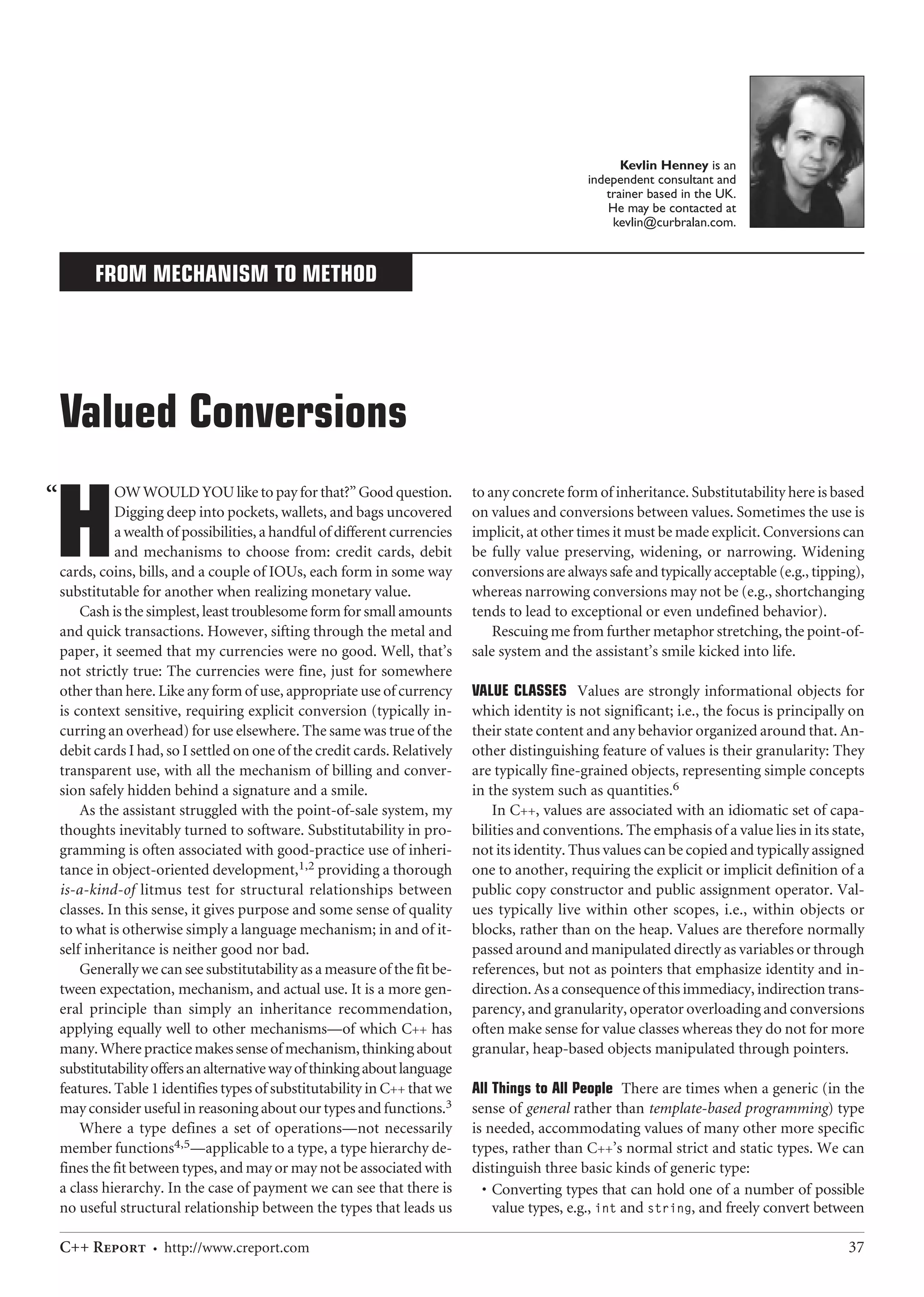
them, for instance interpreting 5 as “5” or vice-versa. Such types 
are common in scripting and other interpreted languages. In 
implementation these are often interpreted strings, or encap-sulated 
unions of a fixed set of types that freely support the re-quired 
conversions, or closed class hierarchies.7,8 
∫ Discriminated types that contain values of different types 
but do not attempt conversion between them, i.e., 5 is held 
strictly as an int and is not implicitly convertible either to 
“5” or to 5.0. Their indifference to interpretation but aware-ness 
of type effectively makes them safe, generic containers 
of single values, with no scope for surprises from ambiguous 
conversions. In implementation these are often held either 
as encapsulated, discriminated unions of a fixed set of types 
or through a combination of void * and a known type code. 
∫ Indiscriminate types that can refer to anything but are obliv-ious 
to the actual underlying type, entrusting all forms of ac-cess 
and interpretation to the programmer. This niche is 
dominated by void *, which offers plenty of scope for sur-prising, 
undefined behavior. 
State of the Union In demonstrating substitutability concepts— 
conversions in particular—the remainder of this article is going 
to explore a generalized, discriminated union type named any. 
Working from the inside out, how can a generic value contain 
any arbitrary value safely? A conventional union is out of the 
question, as these alias only a predefined, fixed set of types. A next 
guess might land on a void * and const type_info * pairing. 
This seems to allow easy creation and querying, but falls down on 
type-safe copying and destruction: How can you correctly copy 
or delete an instance of a type of which you are unaware? From 
this question comes the seed of a solution: Inheritance and run-time 
polymorphism offer a form of substitutability between types 
that allows us to work safely through a common interface while 
ignoring the differences we can neither know nor manage. A vir-tual 
destructor provides the mechanism for safe deletion, and a 
virtual clone function offers a route for safe copying—effectively 
a Virtual Copy Constructor.2,9 However, this requires that value 
types inherit from a common base—not possible for preexisting 
types—and would defeat the original objective of the any class. 
Template classes provide a mechanism for defining arbi-trary 
containers. Combining templates with derivation reveals 
a solution (see Listing 1). A generalized base class, placeholder, 
offers the required copying, querying, and deletable interface. 
From this, the templated holder class fills in the details for any 
arbitrary type. This example mixes derivation substitutability 
and generic substitutability. The generic interface requirement 
is that contained values must be CopyConstructible.10 Clients 
of any remain blissfully unaware of all this encapsulated detail. 
This design is most generally an example of the Adapter pattern,9 
and more specifically the External Polymorphism pattern.11 
INWARD CONVERSIONS An implicit conversion from one or more 
other types into one we are developing can be supported by the in-troduction 
of one or more single-argument converting constructors 
on a class. Such conversions should be used in support of making con- 
FROM MECHANISM TO METHOD 
Substitutability Mechanisms 
Conversions Implicit and explicit conversions 
Overloading Overloaded functions and operators, 
often in combination with conversions 
Derivation Inheritance 
Mutability Qualification (typically const) and the use 
of conversions, overloading, and derivation 
Genericity Templates and the use of conversions, 
overloading, derivation, and mutability 
Listing 1. Representation and basic construction 
of a generalized union type. 
class any 
{ 
public: 
any() 
: content(0) 
{ 
} 
~any() 
{ 
delete content; 
} 
const std::type_info &type_info() const 
{ 
return content 
? content->type_info() 
: typeid(void); 
} 
... 
private: 
class placeholder 
{ 
public: 
virtual ~placeholder() 
{ 
} 
virtual const std::type_info & 
type_info() const = 0; 
virtual placeholder *clone() const = 0; 
}; 
template<typename value_type> 
class holder : public placeholder 
{ 
public: 
holder(const value_type &value) 
: held(value) 
{ 
} 
virtual const std::type_info &type_info() const 
{ 
return typeid(value_type); 
} 
virtual placeholder *clone() const 
{ 
return new holder(held); 
} 
const value_type held; 
}; 
placeholder *content; 
}; 
Table 1. Different Kinds of Substitutability in C++. 
38 July–August 2000
ceptually similar types substitutable, emphasizing their commonal-ity, 
and allowing an existing type to be used where a new one is ex-pected. 
For instance, stringand char *are each different realizations 
of the concept of a character string. They are not perfect substitutes 
for one another, but there is an implied level of equivalence in mean-ing 
that should be respected and supported by the developer. Where 
single constructor arguments are needed, but equivalence does not 
make sense, the explicit keyword should be used. For instance, a 
file object may be initialized from a string representing its pathname, 
but it cannot be considered a realization of strings. 
A degenerate form of conversion is the identity conversion, 
i.e., where an instance of a type can be converted into another 
instance of the same type. The copy constructor and assignment 
operator express this concept. An overloaded assignment oper-ator 
can be used to optimize any use of a converting construc-tor 
followed by a copy assignment. For a string class, this means: 
class string 
{ 
public: 
string(const char *); 
string(const string &); 
string &operator=(const string &); 
string &operator=(const char *); 
... 
}; 
Providing a converting constructor also provides the developer 
with a cast form for a type. It is not possible to define a literal form 
for a new type, but the constructor expression syntax comes close, 
e.g., string("theory"). This is stylistically preferable to using 
static_cast, as the conversions are well-defined—as opposed to 
a potentially dangerous conversion that must be highlighted in the 
source code—and corresponds well to the idea of constructing a 
new value. The preferred “constructor-literal” style also means that 
code appears consistent when used with other multiple argument 
constructed forms, e.g., string(5, '*'). 
Unionization The any class can be fleshed out further by consider-ing 
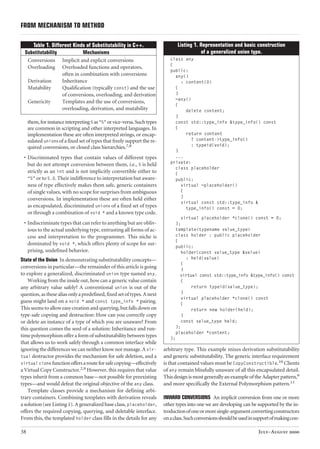
what inward conversions it is reasonable to support (see List-ing 
2). Certainly, copying one any to another by construction or by 
assignment is essential for any value class. The copy constructor takes 
advantage of the representation’s clone function to perform poly-morphic 
copying, and a nonthrowing swap function allows for an 
exception and a self-assignment-safe copy assignment operator.4,12 
Employing the member template mechanism supports implicit 
conversion from values of an arbitrary type into an any. This is used 
in the converting constructor and the templated assignment oper-ator, 
allowing values of any type to be used where an any is expected. 
OUTWARD CONVERSIONS An implicit conversion from another 
type into a type we are defining can be provided through a user-defined 
conversion operator (UDC). However, UDCs should be 
treated with some caution; they are typically far less appropri-ate 
than a corresponding inward conversion. For instance, al-though 
a const char * can be reasonably passed where a string 
object is expected, the converse is not true: 
class string 
{ 
public: 
... 
operator const char *() const; 
... 
}; 
Because of the lifetime of temporary objects, the following would 
result in undefined behavior: 
string prefix, suffix; 
... 
const char *whole = prefix + suffix; 
cout << whole << endl; 
This is the reason that std::string does not support such a con-version. 
Truth and Beauty Whereas a conversion from any type into an any 
type is widening, and therefore always safe, a conversion outward 
is narrowing, and therefore potentially unsafe—all types can be used 
where an any is expected, but not vice-versa. Alas, the absence of 
explicit UDCs in the language means we cannot retain uniform 
usage syntax for casts while also preserving the constraint of ex-plicitness. 
We must resort to a more conservative approach, such 
as the named to_ptr member template function (see Listing 3). 
There is one query, however, that may be conveniently ex-pressed 
through a UDC: Does an any hold a value? For many 
classes this immediately translates to operator bool. However, 
in many cases it turns out that bool is not the safest realization 
of a Boolean type. It introduces a number of subtle conversion 
problems for many classes, such as smart pointers13 or 
Listing 2. Inward conversions and helpers 
for a generalized union type. 
class any 
{ 
public: 
... 
any(const any &other) 
: content(other.content ? other.content->clone() : 0) 
{ 
} 
template<typename value_type> 
any(const value_type &value) 
: content(new holder<value_type>(value)) 
{ 
} 
any &swap(any &rhs) 
{ 
std::swap(content, rhs.content); 
return *this; 
} 
any &operator=(const any &rhs) 
{ 
return swap(any(rhs)); 
} 
template<typename value_type> 
any &operator=(const value_type &rhs) 
{ 
return swap(any(rhs)); 
} 
... 
}; 
C++ Report ∫ http://www.creport.com 39
FROM MECHANISM TO METHOD 
IOStreams, which at one stage in their standardization sported 
such an operator. These problems stem typically from bool’s un-derlying 
integer nature: Its eagerness to participate in all kinds 
of (surprising) arithmetic and comparison. In contrast to bool, 
a const void * is positively hermitlike in its interactions with 
other types and operators. 
CUSTOM KEYWORD CASTS How can an explicit outward conver-sion 
be provided for a type, or for a conversion between two exist-ing 
types using a particular conversion method not already 
implemented by either type? The omission of explicit UDCs from 
the language closes one avenue, but the inclusion of templates and, 
in particular, explicit template function qualification opens another. 
The keyword casts—e.g., dynamic_cast—are templatelike in 
appearance. It is possible to emulate them with template func-tions, 
idiomatically defining new custom keyword casts that pro-vide 
new kinds of named, explicit conversion.14,15 For instance, 
the following offers a simple approach for converting between any 
two types that support streaming: 
template<typename result_type, typename arg_type> 
result_type interpret_cast(const arg_type &arg) 
{ 
std::stringstream interpreter; 
interpreter <<arg; 
result_type result = result_type(); 
interpreter >> result; 
return result; 
} 
This makes scriptlike interpretation of values a convenience in 
C++, e.g.: 
string forty = interpret_cast<string>(40); 
int two = interpret_cast<int>("2"); 
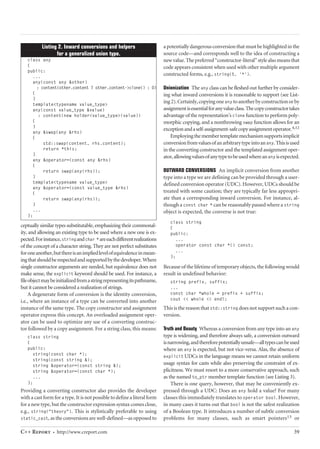
Cast out of the Union Based on the to_ptr member template, it 
is possible to provide a checking cast, any_cast, that may be used 
to extract values of a particular type from an any (see Listing 3). 
CONCLUSION Money is a mechanism. As parents, partners, and 
both public and private enterprise will recognize, understanding 
the mechanism does not necessarily impart wisdom as to its best 
use. The same can be said of C++’s many features: Knowledge of 
denomination does not necessarily settle design issues. Principles 
and practices associated with conceptually organizing features 
into a more coherent whole can assist the programmer. ˘ 
References 
1. Liskov, B. “Data Abstraction and Hierarchy,” OOPSLA ‘87 
Addendum to the Proceedings, Oct. 1987. 
2. Coplien, J. O. Advanced C++: Programming Styles and Idioms, 
Addison–Wesley, Reading, MA, 1992. 
3. Henney, K. “From Mechanism to Method: Substitutability,” 
C++ Report, 12(5): 28–30, May 2000. 
4. Sutter, H. Exceptional C++, Addison–Wesley, 2000. 
5. Meyers, S. “How Non-Member Functions Improve Encapsu-lation,” 
C/C++ Users Journal, Feb. 2000. 
6. Bäumer, D. et al. “Values in Object Systems,” Ubilab Technical 
Report 98.10.1, 1998. 
7. Coplien, J. O. “C++ Idioms,” Pattern Languages of Program 
Design 4, N. Harrison, B. Foote, and H. Rohnert, Eds., Addi-son- 
Wesley, Reading, MA, 2000. 
8. Sommerlad, P. and M. Rüedi. “Do-It-Yourself Reflection,” 
Proceedings of the 3rd European Conference of Pattern Lan-guages 
of Programming and Computing 1998, J. Coldeway and 
P. Dyson, Eds., 1999. 
9. Gamma, E. et al. Design Patterns: Elements of Reusable Object- 
Oriented Software, Addison–Wesley, 1995. 
10. International Standard. Programming Language—C++, 
ISO/IEC 14882:1998(E), 1998. 
11. Cleeland, C., D. C. Schmidt, and T. Harrison. “External Poly-morphism,” 
Pattern Languages of Program Design 3, R. Martin, 
D. Riehle, and F. Buschmann, Eds., Addison–Wesley, 1998. 
12. Henney, K. “Creating Stable Assignments,” C++ Report, 
10(6): 25–30, June 1998. 
13. Meyers, S. More Effective C++: 35 New Ways to Improve Your 
Programs and Designs, Addison–Wesley, 1996. 
14. Stroustrup, B. C++ Programming Language, 3rd ed., Addi-son– 
Wesley, 1997. 
15. Boost Library Website, http://www.boost.org. 
Listing 3. Functions to extract the value 
from the generalized union type. 
class any 
{ 
public: 
... 
operator const void *() const 
{ 
return content; 
} 
template<typename value_type> 
bool copy_to(value_type &value) const 
{ 
const value_type *copyable = 
to_ptr<value_type>(); 
if(copyable) 
value = *copyable; 
return copyable; 
} 
template<typename value_type> 
const value_type *to_ptr() const 
{ 
return type_info() == typeid(value_type) 
? &static_cast< 
holder<value_type> *>(content)->held 
: 0; 
} 
... 
}; 
template<typename value_type> 
value_type any_cast(const any &operand) 
{ 
const value_type *result = 
operand.to_ptr<value_type>(); 
return result ? *result : throw std::bad_cast(); 
} 
40 July–August 2000

Valued Conversions

  • 1.
    HOW WOULD YOUliketo pay for that?” Good question. Digging deep into pockets, wallets, and bags uncovered a wealth of possibilities, a handful of different currencies and mechanisms to choose from: credit cards, debit cards, coins, bills, and a couple of IOUs, each form in some way substitutable for another when realizing monetary value. Cash is the simplest, least troublesome form for small amounts and quick transactions. However, sifting through the metal and paper, it seemed that my currencies were no good. Well, that’s not strictly true: The currencies were fine, just for somewhere other than here. Like any form of use, appropriate use of currency is context sensitive, requiring explicit conversion (typically in-curring an overhead) for use elsewhere. The same was true of the debit cards I had, so I settled on one of the credit cards. Relatively transparent use, with all the mechanism of billing and conver-sion safely hidden behind a signature and a smile. As the assistant struggled with the point-of-sale system, my thoughts inevitably turned to software. Substitutability in pro-gramming is often associated with good-practice use of inheri-tance in object-oriented development,1,2 providing a thorough is-a-kind-of litmus test for structural relationships between classes. In this sense, it gives purpose and some sense of quality to what is otherwise simply a language mechanism; in and of it-self inheritance is neither good nor bad. Generally we can see substitutability as a measure of the fit be-tween expectation, mechanism, and actual use. It is a more gen-eral principle than simply an inheritance recommendation, applying equally well to other mechanisms—of which C++ has many. Where practice makes sense of mechanism, thinking about substitutability offers an alternative way of thinking about language features. Table 1 identifies types of substitutability in C++ that we may consider useful in reasoning about our types and functions.3 Where a type defines a set of operations—not necessarily member functions4,5—applicable to a type, a type hierarchy de-fines the fit between types, and may or may not be associated with a class hierarchy. In the case of payment we can see that there is no useful structural relationship between the types that leads us Kevlin Henney is an independent consultant and trainer based in the UK. He may be contacted at kevlin@curbralan.com. to any concrete form of inheritance. Substitutability here is based on values and conversions between values. Sometimes the use is implicit, at other times it must be made explicit. Conversions can be fully value preserving, widening, or narrowing. Widening conversions are always safe and typically acceptable (e.g., tipping), whereas narrowing conversions may not be (e.g., shortchanging tends to lead to exceptional or even undefined behavior). Rescuing me from further metaphor stretching, the point-of-sale system and the assistant’s smile kicked into life. VALUE CLASSES Values are strongly informational objects for which identity is not significant; i.e., the focus is principally on their state content and any behavior organized around that. An-other distinguishing feature of values is their granularity: They are typically fine-grained objects, representing simple concepts in the system such as quantities.6 In C++, values are associated with an idiomatic set of capa-bilities and conventions. The emphasis of a value lies in its state, not its identity. Thus values can be copied and typically assigned one to another, requiring the explicit or implicit definition of a public copy constructor and public assignment operator. Val-ues typically live within other scopes, i.e., within objects or blocks, rather than on the heap. Values are therefore normally passed around and manipulated directly as variables or through references, but not as pointers that emphasize identity and in-direction. As a consequence of this immediacy, indirection trans-parency, and granularity, operator overloading and conversions often make sense for value classes whereas they do not for more granular, heap-based objects manipulated through pointers. All Things to All People There are times when a generic (in the sense of general rather than template-based programming) type is needed, accommodating values of many other more specific types, rather than C++’s normal strict and static types. We can distinguish three basic kinds of generic type: ∫ Converting types that can hold one of a number of possible value types, e.g., int and string, and freely convert between FROM MECHANISM TO METHOD Valued Conversions “ C++ Report ∫ http://www.creport.com 37
  • 2.
    them, for instanceinterpreting 5 as “5” or vice-versa. Such types are common in scripting and other interpreted languages. In implementation these are often interpreted strings, or encap-sulated unions of a fixed set of types that freely support the re-quired conversions, or closed class hierarchies.7,8 ∫ Discriminated types that contain values of different types but do not attempt conversion between them, i.e., 5 is held strictly as an int and is not implicitly convertible either to “5” or to 5.0. Their indifference to interpretation but aware-ness of type effectively makes them safe, generic containers of single values, with no scope for surprises from ambiguous conversions. In implementation these are often held either as encapsulated, discriminated unions of a fixed set of types or through a combination of void * and a known type code. ∫ Indiscriminate types that can refer to anything but are obliv-ious to the actual underlying type, entrusting all forms of ac-cess and interpretation to the programmer. This niche is dominated by void *, which offers plenty of scope for sur-prising, undefined behavior. State of the Union In demonstrating substitutability concepts— conversions in particular—the remainder of this article is going to explore a generalized, discriminated union type named any. Working from the inside out, how can a generic value contain any arbitrary value safely? A conventional union is out of the question, as these alias only a predefined, fixed set of types. A next guess might land on a void * and const type_info * pairing. This seems to allow easy creation and querying, but falls down on type-safe copying and destruction: How can you correctly copy or delete an instance of a type of which you are unaware? From this question comes the seed of a solution: Inheritance and run-time polymorphism offer a form of substitutability between types that allows us to work safely through a common interface while ignoring the differences we can neither know nor manage. A vir-tual destructor provides the mechanism for safe deletion, and a virtual clone function offers a route for safe copying—effectively a Virtual Copy Constructor.2,9 However, this requires that value types inherit from a common base—not possible for preexisting types—and would defeat the original objective of the any class. Template classes provide a mechanism for defining arbi-trary containers. Combining templates with derivation reveals a solution (see Listing 1). A generalized base class, placeholder, offers the required copying, querying, and deletable interface. From this, the templated holder class fills in the details for any arbitrary type. This example mixes derivation substitutability and generic substitutability. The generic interface requirement is that contained values must be CopyConstructible.10 Clients of any remain blissfully unaware of all this encapsulated detail. This design is most generally an example of the Adapter pattern,9 and more specifically the External Polymorphism pattern.11 INWARD CONVERSIONS An implicit conversion from one or more other types into one we are developing can be supported by the in-troduction of one or more single-argument converting constructors on a class. Such conversions should be used in support of making con- FROM MECHANISM TO METHOD Substitutability Mechanisms Conversions Implicit and explicit conversions Overloading Overloaded functions and operators, often in combination with conversions Derivation Inheritance Mutability Qualification (typically const) and the use of conversions, overloading, and derivation Genericity Templates and the use of conversions, overloading, derivation, and mutability Listing 1. Representation and basic construction of a generalized union type. class any { public: any() : content(0) { } ~any() { delete content; } const std::type_info &type_info() const { return content ? content->type_info() : typeid(void); } ... private: class placeholder { public: virtual ~placeholder() { } virtual const std::type_info & type_info() const = 0; virtual placeholder *clone() const = 0; }; template<typename value_type> class holder : public placeholder { public: holder(const value_type &value) : held(value) { } virtual const std::type_info &type_info() const { return typeid(value_type); } virtual placeholder *clone() const { return new holder(held); } const value_type held; }; placeholder *content; }; Table 1. Different Kinds of Substitutability in C++. 38 July–August 2000
  • 3.
    ceptually similar typessubstitutable, emphasizing their commonal-ity, and allowing an existing type to be used where a new one is ex-pected. For instance, stringand char *are each different realizations of the concept of a character string. They are not perfect substitutes for one another, but there is an implied level of equivalence in mean-ing that should be respected and supported by the developer. Where single constructor arguments are needed, but equivalence does not make sense, the explicit keyword should be used. For instance, a file object may be initialized from a string representing its pathname, but it cannot be considered a realization of strings. A degenerate form of conversion is the identity conversion, i.e., where an instance of a type can be converted into another instance of the same type. The copy constructor and assignment operator express this concept. An overloaded assignment oper-ator can be used to optimize any use of a converting construc-tor followed by a copy assignment. For a string class, this means: class string { public: string(const char *); string(const string &); string &operator=(const string &); string &operator=(const char *); ... }; Providing a converting constructor also provides the developer with a cast form for a type. It is not possible to define a literal form for a new type, but the constructor expression syntax comes close, e.g., string("theory"). This is stylistically preferable to using static_cast, as the conversions are well-defined—as opposed to a potentially dangerous conversion that must be highlighted in the source code—and corresponds well to the idea of constructing a new value. The preferred “constructor-literal” style also means that code appears consistent when used with other multiple argument constructed forms, e.g., string(5, '*'). Unionization The any class can be fleshed out further by consider-ing what inward conversions it is reasonable to support (see List-ing 2). Certainly, copying one any to another by construction or by assignment is essential for any value class. The copy constructor takes advantage of the representation’s clone function to perform poly-morphic copying, and a nonthrowing swap function allows for an exception and a self-assignment-safe copy assignment operator.4,12 Employing the member template mechanism supports implicit conversion from values of an arbitrary type into an any. This is used in the converting constructor and the templated assignment oper-ator, allowing values of any type to be used where an any is expected. OUTWARD CONVERSIONS An implicit conversion from another type into a type we are defining can be provided through a user-defined conversion operator (UDC). However, UDCs should be treated with some caution; they are typically far less appropri-ate than a corresponding inward conversion. For instance, al-though a const char * can be reasonably passed where a string object is expected, the converse is not true: class string { public: ... operator const char *() const; ... }; Because of the lifetime of temporary objects, the following would result in undefined behavior: string prefix, suffix; ... const char *whole = prefix + suffix; cout << whole << endl; This is the reason that std::string does not support such a con-version. Truth and Beauty Whereas a conversion from any type into an any type is widening, and therefore always safe, a conversion outward is narrowing, and therefore potentially unsafe—all types can be used where an any is expected, but not vice-versa. Alas, the absence of explicit UDCs in the language means we cannot retain uniform usage syntax for casts while also preserving the constraint of ex-plicitness. We must resort to a more conservative approach, such as the named to_ptr member template function (see Listing 3). There is one query, however, that may be conveniently ex-pressed through a UDC: Does an any hold a value? For many classes this immediately translates to operator bool. However, in many cases it turns out that bool is not the safest realization of a Boolean type. It introduces a number of subtle conversion problems for many classes, such as smart pointers13 or Listing 2. Inward conversions and helpers for a generalized union type. class any { public: ... any(const any &other) : content(other.content ? other.content->clone() : 0) { } template<typename value_type> any(const value_type &value) : content(new holder<value_type>(value)) { } any &swap(any &rhs) { std::swap(content, rhs.content); return *this; } any &operator=(const any &rhs) { return swap(any(rhs)); } template<typename value_type> any &operator=(const value_type &rhs) { return swap(any(rhs)); } ... }; C++ Report ∫ http://www.creport.com 39
  • 4.
    FROM MECHANISM TOMETHOD IOStreams, which at one stage in their standardization sported such an operator. These problems stem typically from bool’s un-derlying integer nature: Its eagerness to participate in all kinds of (surprising) arithmetic and comparison. In contrast to bool, a const void * is positively hermitlike in its interactions with other types and operators. CUSTOM KEYWORD CASTS How can an explicit outward conver-sion be provided for a type, or for a conversion between two exist-ing types using a particular conversion method not already implemented by either type? The omission of explicit UDCs from the language closes one avenue, but the inclusion of templates and, in particular, explicit template function qualification opens another. The keyword casts—e.g., dynamic_cast—are templatelike in appearance. It is possible to emulate them with template func-tions, idiomatically defining new custom keyword casts that pro-vide new kinds of named, explicit conversion.14,15 For instance, the following offers a simple approach for converting between any two types that support streaming: template<typename result_type, typename arg_type> result_type interpret_cast(const arg_type &arg) { std::stringstream interpreter; interpreter <<arg; result_type result = result_type(); interpreter >> result; return result; } This makes scriptlike interpretation of values a convenience in C++, e.g.: string forty = interpret_cast<string>(40); int two = interpret_cast<int>("2"); Cast out of the Union Based on the to_ptr member template, it is possible to provide a checking cast, any_cast, that may be used to extract values of a particular type from an any (see Listing 3). CONCLUSION Money is a mechanism. As parents, partners, and both public and private enterprise will recognize, understanding the mechanism does not necessarily impart wisdom as to its best use. The same can be said of C++’s many features: Knowledge of denomination does not necessarily settle design issues. Principles and practices associated with conceptually organizing features into a more coherent whole can assist the programmer. ˘ References 1. Liskov, B. “Data Abstraction and Hierarchy,” OOPSLA ‘87 Addendum to the Proceedings, Oct. 1987. 2. Coplien, J. O. Advanced C++: Programming Styles and Idioms, Addison–Wesley, Reading, MA, 1992. 3. Henney, K. “From Mechanism to Method: Substitutability,” C++ Report, 12(5): 28–30, May 2000. 4. Sutter, H. Exceptional C++, Addison–Wesley, 2000. 5. Meyers, S. “How Non-Member Functions Improve Encapsu-lation,” C/C++ Users Journal, Feb. 2000. 6. Bäumer, D. et al. “Values in Object Systems,” Ubilab Technical Report 98.10.1, 1998. 7. Coplien, J. O. “C++ Idioms,” Pattern Languages of Program Design 4, N. Harrison, B. Foote, and H. Rohnert, Eds., Addi-son- Wesley, Reading, MA, 2000. 8. Sommerlad, P. and M. Rüedi. “Do-It-Yourself Reflection,” Proceedings of the 3rd European Conference of Pattern Lan-guages of Programming and Computing 1998, J. Coldeway and P. Dyson, Eds., 1999. 9. Gamma, E. et al. Design Patterns: Elements of Reusable Object- Oriented Software, Addison–Wesley, 1995. 10. International Standard. Programming Language—C++, ISO/IEC 14882:1998(E), 1998. 11. Cleeland, C., D. C. Schmidt, and T. Harrison. “External Poly-morphism,” Pattern Languages of Program Design 3, R. Martin, D. Riehle, and F. Buschmann, Eds., Addison–Wesley, 1998. 12. Henney, K. “Creating Stable Assignments,” C++ Report, 10(6): 25–30, June 1998. 13. Meyers, S. More Effective C++: 35 New Ways to Improve Your Programs and Designs, Addison–Wesley, 1996. 14. Stroustrup, B. C++ Programming Language, 3rd ed., Addi-son– Wesley, 1997. 15. Boost Library Website, http://www.boost.org. Listing 3. Functions to extract the value from the generalized union type. class any { public: ... operator const void *() const { return content; } template<typename value_type> bool copy_to(value_type &value) const { const value_type *copyable = to_ptr<value_type>(); if(copyable) value = *copyable; return copyable; } template<typename value_type> const value_type *to_ptr() const { return type_info() == typeid(value_type) ? &static_cast< holder<value_type> *>(content)->held : 0; } ... }; template<typename value_type> value_type any_cast(const any &operand) { const value_type *result = operand.to_ptr<value_type>(); return result ? *result : throw std::bad_cast(); } 40 July–August 2000