From Classroom to Life:
Instilling Values through
Value Education
Presented by:
Shafneet Kaur
So according to you, what exactly is
“Value Education”?
Value education is an educational process that imparts moral, ethical, and
societal values to individuals.
• Moral and Ethical Guidance
• Character Development
• Social Responsibility
• Positive Behaviour and Citizenship
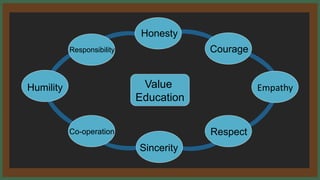
Value
Education
Honesty
Courage
Empathy
Responsibility
Respect
Sincerity
Co-operation
Humility
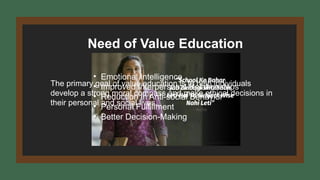
Need of Value Education
The primary goal of value education is to help individuals
develop a strong moral compass and make ethical decisions in
their personal and social lives.
• Emotional Intelligence
• Improved Interpersonal Relationships
• Reduction in Anti-social Behavior
• Personal Fulfillment
• Better Decision-Making
Real life example on the
“Need of Value Education”
How can value education bridge the gap between
classroom learning and practical application in real life,
ultimately instilling important values in individuals?
Please read this statement:
Value education can be convolutedly described as an intricate and
multifaceted pedagogical paradigm with the fundamental objective of
inculcating within individuals a profound awareness of, and an unwavering
commitment to, a comprehensive spectrum of moral, ethical, and societal
values.
Now read this:
Value education aims to teach people a wide range of moral
and ethical values in a complex and comprehensive way.
1) Teaching in simplified language
• Clarity and Understanding
• Inclusivity
• Application
• Empathy and Respect
• Effective Communication
2) Experiential Learning
3) Role Models and Mentoring
4) Classroom Discussions
5) Reflection and Self-Assessment
Challenges(C) and their Solutions(S)
1. Resistance to Change
C: Traditional educational systems prioritize academic
subjects.
S: Highlight the research showing the positive impact of
value education on academic achievement, character
development, and school climate.
Challenges(C) and their Solutions(S)
2. Lack of Resources:
C: Limited resources
S: Prioritize value education within
existing curricula.
Challenges(C) and their Solutions(S)
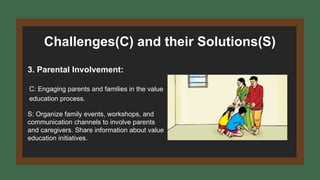
3. Parental Involvement:
C: Engaging parents and families in the value
education process.
S: Organize family events, workshops, and
communication channels to involve parents
and caregivers. Share information about value
education initiatives.
Challenges(C) and their Solutions(S)
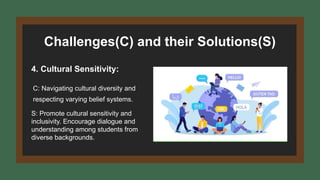
4. Cultural Sensitivity:
C: Navigating cultural diversity and
respecting varying belief systems.
S: Promote cultural sensitivity and
inclusivity. Encourage dialogue and
understanding among students from
diverse backgrounds.
Conclusion
• Value education is a fundamental aspect of holistic education.
• Equips individuals with the tools to make responsible
decisions, fosters empathy, and nurtures a sense of social
responsibility.
• Promoting character development.
• Results in a more just and harmonious society.
• In today’s world, the importance of value education continues
to grow.
Conclusion
Thank You

Value Education (Human Values and Professional Ethics)

  • 1.
    From Classroom toLife: Instilling Values through Value Education Presented by: Shafneet Kaur
  • 2.
    So according toyou, what exactly is “Value Education”? Value education is an educational process that imparts moral, ethical, and societal values to individuals. • Moral and Ethical Guidance • Character Development • Social Responsibility • Positive Behaviour and Citizenship
  • 3.
  • 4.
    Need of ValueEducation The primary goal of value education is to help individuals develop a strong moral compass and make ethical decisions in their personal and social lives. • Emotional Intelligence • Improved Interpersonal Relationships • Reduction in Anti-social Behavior • Personal Fulfillment • Better Decision-Making
  • 5.
    Real life exampleon the “Need of Value Education”
  • 6.
    How can valueeducation bridge the gap between classroom learning and practical application in real life, ultimately instilling important values in individuals? Please read this statement: Value education can be convolutedly described as an intricate and multifaceted pedagogical paradigm with the fundamental objective of inculcating within individuals a profound awareness of, and an unwavering commitment to, a comprehensive spectrum of moral, ethical, and societal values. Now read this: Value education aims to teach people a wide range of moral and ethical values in a complex and comprehensive way. 1) Teaching in simplified language • Clarity and Understanding • Inclusivity • Application • Empathy and Respect • Effective Communication 2) Experiential Learning 3) Role Models and Mentoring 4) Classroom Discussions 5) Reflection and Self-Assessment
  • 7.
    Challenges(C) and theirSolutions(S) 1. Resistance to Change C: Traditional educational systems prioritize academic subjects. S: Highlight the research showing the positive impact of value education on academic achievement, character development, and school climate.
  • 8.
    Challenges(C) and theirSolutions(S) 2. Lack of Resources: C: Limited resources S: Prioritize value education within existing curricula.
  • 9.
    Challenges(C) and theirSolutions(S) 3. Parental Involvement: C: Engaging parents and families in the value education process. S: Organize family events, workshops, and communication channels to involve parents and caregivers. Share information about value education initiatives.
  • 10.
    Challenges(C) and theirSolutions(S) 4. Cultural Sensitivity: C: Navigating cultural diversity and respecting varying belief systems. S: Promote cultural sensitivity and inclusivity. Encourage dialogue and understanding among students from diverse backgrounds.
  • 11.
    Conclusion • Value educationis a fundamental aspect of holistic education. • Equips individuals with the tools to make responsible decisions, fosters empathy, and nurtures a sense of social responsibility. • Promoting character development. • Results in a more just and harmonious society. • In today’s world, the importance of value education continues to grow.
  • 12.
  • 13.