February the 14th is one of the most popular
        festivals of the Western calendar.
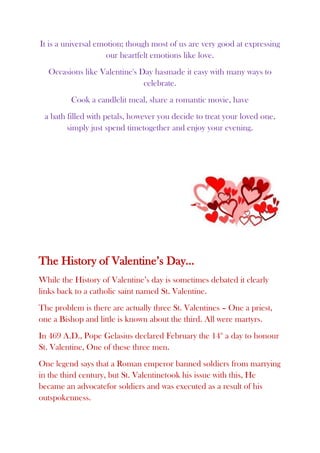
 It's the day when people show their affection for
another person or people by sending cards, flowers
         or chocolates with messages of love.


   Valentine's Day is a day that has always been recognised for its
                        association with love.
   One of the facts about life is that it is incomplete without love.
 Love is one of the most beautiful and sacred emotions known to us
                           human beings.
        It is an emotion that is prevalent throughout nature.
It is a universal emotion; though most of us are very good at expressing
                     our heartfelt emotions like love.
  Occasions like Valentine's Day hasmade it easy with many ways to
                              celebrate.
         Cook a candlelit meal, share a romantic movie, have
 a bath filled with petals, however you decide to treat your loved one,
        simply just spend timetogether and enjoy your evening.


The History of Valentine’s Day…
While the History of Valentine’s day is sometimes debated it clearly
links back to a catholic saint named St. Valentine.
The problem is there are actually three St. Valentines – One a priest,
one a Bishop and little is known about the third. All were martyrs.
In 469 A.D., Pope Gelasius declared February the 14th a day to honour
St. Valentine, One of these three men.
One legend says that a Roman emperor banned soldiers from marrying
in the third century, but St. Valentinetook his issue with this, He
became an advocatefor soldiers and was executed as a result of his
outspokenness.
Another legend St. Valentine was executed for his beliefs in Christianity
and just before he died, he left a farewell note for his loved one and
signed it “from your valentine”.
A conventional and widely accepted belief about the holiday itself is
that Valentine’s Day grew out of a middle ages tradition of celebrating
February the 14th as the day “the birds began to pair”.
February has long been associated with being a month of love, and
February the 15th was celebrated in ancient times as a fertility festival.
Whatever its origin, it took off, and the UK Greeting Cards Association
estimates Valentine’s day is the second – most popular card – giving
day of the year.


Interesting facts…
    Red hearts are a ubiquitous valentine symbol. Red is traditionally
     associated with the colour of blood. At one time, people thought
     that the heart, which pumps blood, was the part of the body that
     felt love. In fact when Egyptians mummified their dead for burial,
     they removed ever organ but the heart because they believed the
     heart was the only part of the body necessary for the trip through
     eternity.
 Nearly 10 new candy “conversation heart” sayings are introduced
  each year. Recent additions have included “Yeah Right” “puppy
  love” and “call home”


 Approximately one billion valentine’s cards are sent each year
  around the world!

 Teachers receive the most valentines’ cards, followed by children,
  mothers, and wives. Children between ages 6-10 exchange more
  than 650 million valentine’s cards a year!


 Richard Cadbury produced the first box of chocolates for
  Valentine’s Day in the late 1800s.

 A kiss on Valentine’s Day is considered to bring luck all year!


 Shakespeare mentions Valentine’s Day in A midsummer night’s
  dream and in Hamlet.

 On Valentine’s Day, many people buy flowers. Different
  coloured roses have different meanings. Red means love, Yellow
  means friendship, and Pink means friendship or sweetheart. Red
  carnations mean admiration, White carnations mean pure love,
  Chrysanthemum’s mean love, Forget-me-nots mean true love,
  primrose means young, and larkspur means an open heart.


 The first recorded Valentine was sent February 1415 by the
  English Duke of Orleans. He sent a love letter to his wife from
his jail cell in the Tower of London after the battle of Agincourt.
  It is currently on display in the British museum.

 In Germany, Girls would plant onions in a pot on Valentine’s
  Day, and next to the onions, they placed the name of a boy. They
  believed they would marry the boy whose name was nearest the
  first onion to grow!

Valentines day

  • 1.
    February the 14this one of the most popular festivals of the Western calendar. It's the day when people show their affection for another person or people by sending cards, flowers or chocolates with messages of love. Valentine's Day is a day that has always been recognised for its association with love. One of the facts about life is that it is incomplete without love. Love is one of the most beautiful and sacred emotions known to us human beings. It is an emotion that is prevalent throughout nature.
  • 2.
    It is auniversal emotion; though most of us are very good at expressing our heartfelt emotions like love. Occasions like Valentine's Day hasmade it easy with many ways to celebrate. Cook a candlelit meal, share a romantic movie, have a bath filled with petals, however you decide to treat your loved one, simply just spend timetogether and enjoy your evening. The History of Valentine’s Day… While the History of Valentine’s day is sometimes debated it clearly links back to a catholic saint named St. Valentine. The problem is there are actually three St. Valentines – One a priest, one a Bishop and little is known about the third. All were martyrs. In 469 A.D., Pope Gelasius declared February the 14th a day to honour St. Valentine, One of these three men. One legend says that a Roman emperor banned soldiers from marrying in the third century, but St. Valentinetook his issue with this, He became an advocatefor soldiers and was executed as a result of his outspokenness.
  • 3.
    Another legend St.Valentine was executed for his beliefs in Christianity and just before he died, he left a farewell note for his loved one and signed it “from your valentine”. A conventional and widely accepted belief about the holiday itself is that Valentine’s Day grew out of a middle ages tradition of celebrating February the 14th as the day “the birds began to pair”. February has long been associated with being a month of love, and February the 15th was celebrated in ancient times as a fertility festival. Whatever its origin, it took off, and the UK Greeting Cards Association estimates Valentine’s day is the second – most popular card – giving day of the year. Interesting facts…  Red hearts are a ubiquitous valentine symbol. Red is traditionally associated with the colour of blood. At one time, people thought that the heart, which pumps blood, was the part of the body that felt love. In fact when Egyptians mummified their dead for burial, they removed ever organ but the heart because they believed the heart was the only part of the body necessary for the trip through eternity.
  • 4.
     Nearly 10new candy “conversation heart” sayings are introduced each year. Recent additions have included “Yeah Right” “puppy love” and “call home”  Approximately one billion valentine’s cards are sent each year around the world!  Teachers receive the most valentines’ cards, followed by children, mothers, and wives. Children between ages 6-10 exchange more than 650 million valentine’s cards a year!  Richard Cadbury produced the first box of chocolates for Valentine’s Day in the late 1800s.  A kiss on Valentine’s Day is considered to bring luck all year!  Shakespeare mentions Valentine’s Day in A midsummer night’s dream and in Hamlet.  On Valentine’s Day, many people buy flowers. Different coloured roses have different meanings. Red means love, Yellow means friendship, and Pink means friendship or sweetheart. Red carnations mean admiration, White carnations mean pure love, Chrysanthemum’s mean love, Forget-me-nots mean true love, primrose means young, and larkspur means an open heart.  The first recorded Valentine was sent February 1415 by the English Duke of Orleans. He sent a love letter to his wife from
  • 5.
    his jail cellin the Tower of London after the battle of Agincourt. It is currently on display in the British museum.  In Germany, Girls would plant onions in a pot on Valentine’s Day, and next to the onions, they placed the name of a boy. They believed they would marry the boy whose name was nearest the first onion to grow!