January 22, 2020
PREPARED FOR EuFMD / FAO
IMPLICATION OF NAGOYA PROTOCOL ON USE OF
GENETIC MATERIAL IN VACCINE R&D AND
COMMERCIALISATION
Presented by: Josef Geoola, Chief Executive Officer
NAGOYA PROTOCOL IS A SUPPLEMENTARY
AGREEMENT TO CBD
• The Convention on Biological Diversity (CBD) was set up
conserve biodiversity and ensure sustainability and benefit
sharing arising from genetic resources
• Nagoya Protocol (2014) expands on CBD’s “access and
benefit sharing” (ABS) provision
OBJECTIVE: creating a transparent and global
framework (and tools) for the utilization and
benefit-sharing of genetic resource (and TK)
Copyright © 2020 Ingentium Limited
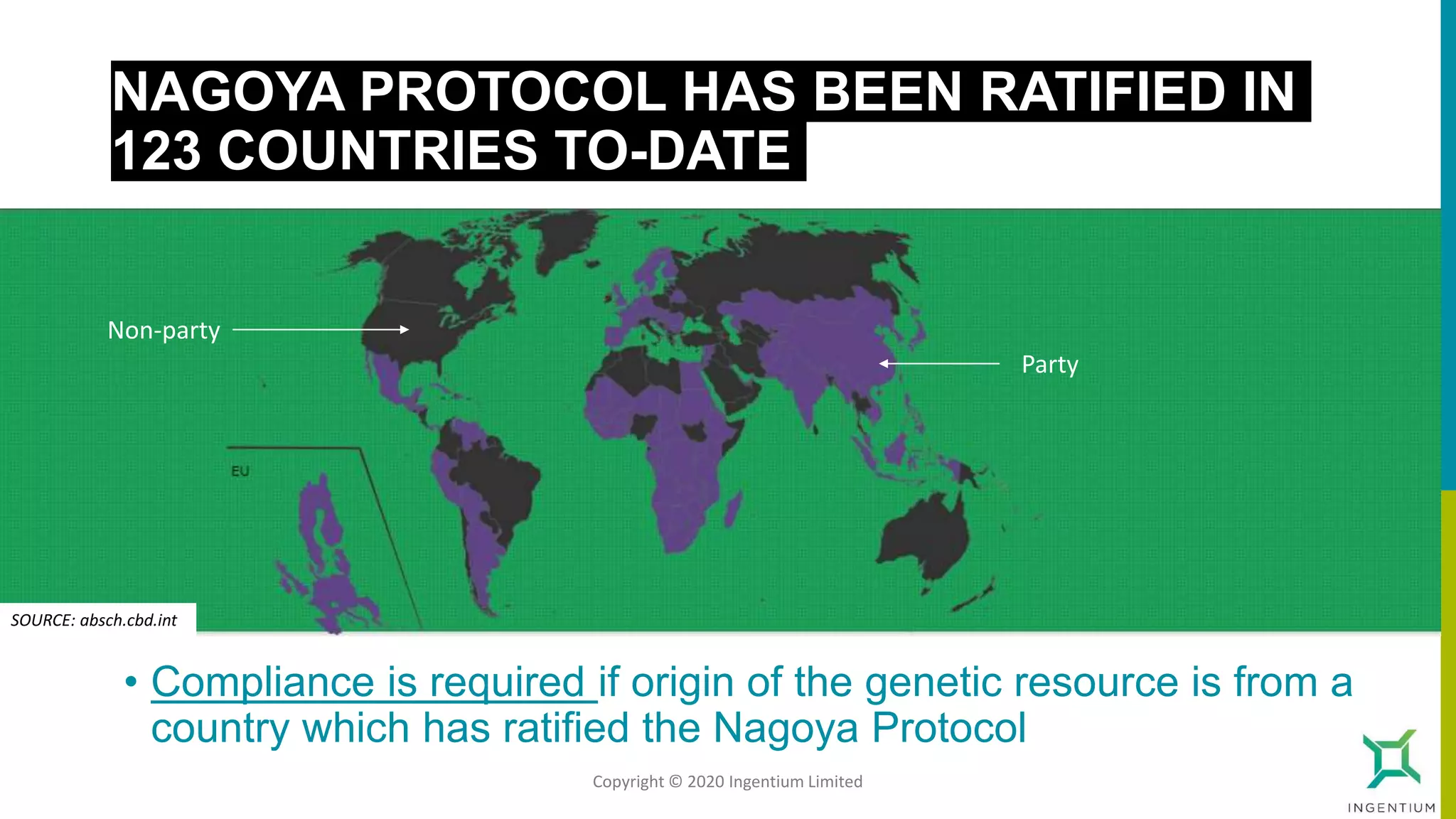
NAGOYA PROTOCOL HAS BEEN RATIFIED IN
123 COUNTRIES TO-DATE
• Compliance is required if origin of the genetic resource is from a
country which has ratified the Nagoya Protocol
SOURCE: absch.cbd.int
Party
Non-party
Copyright © 2020 Ingentium Limited
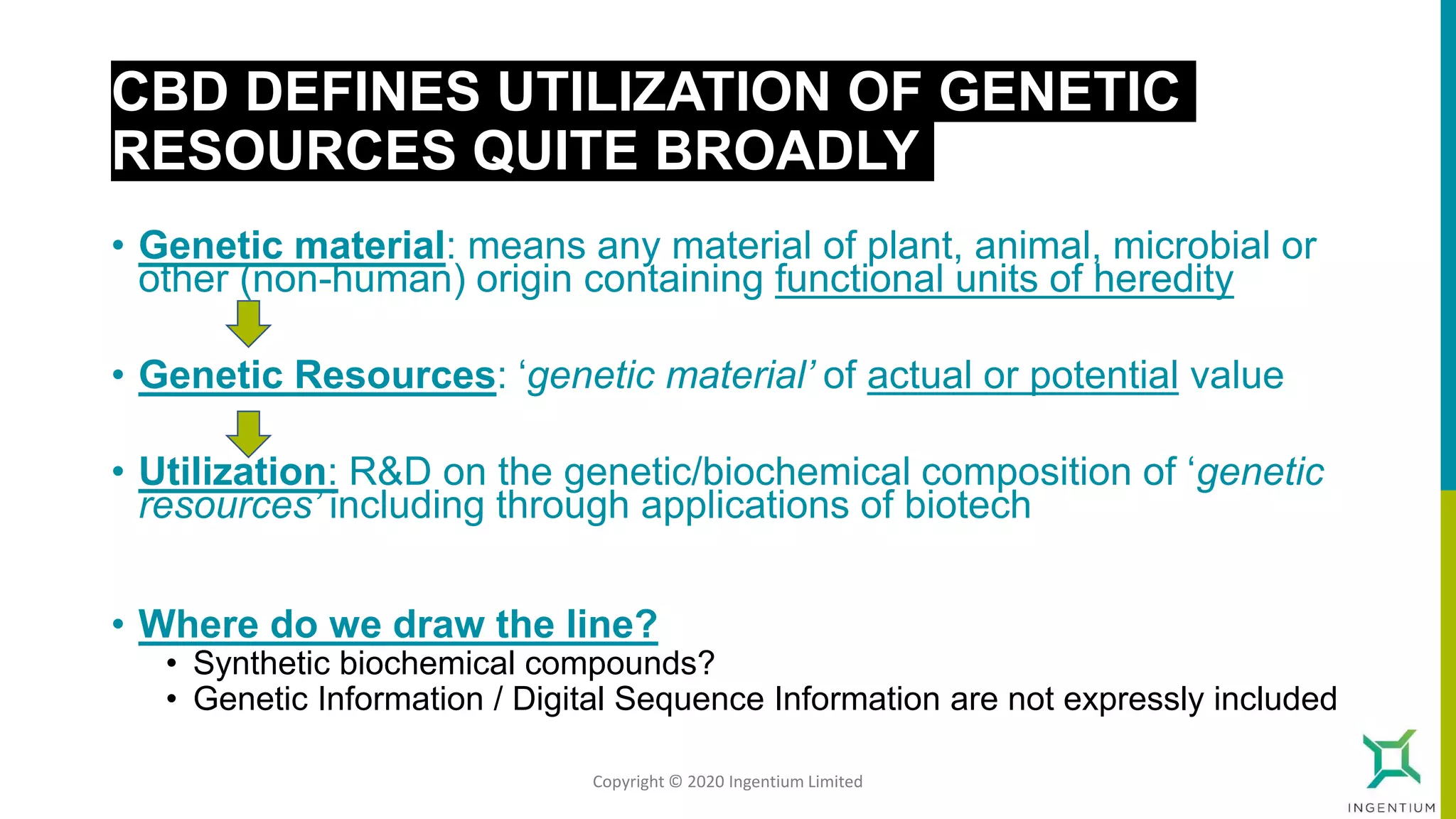
CBD DEFINES UTILIZATION OF GENETIC
RESOURCES QUITE BROADLY
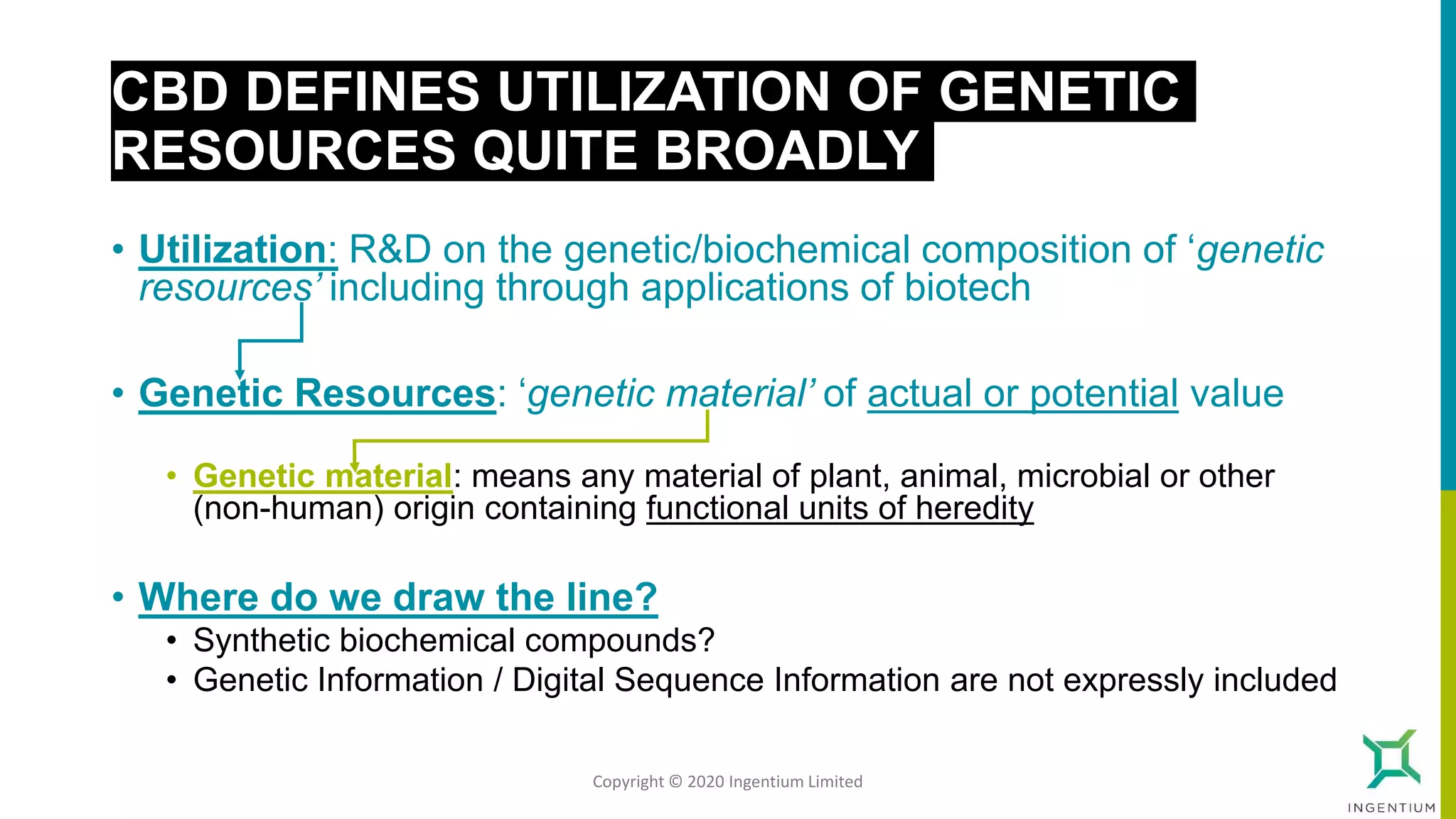
• Utilization: R&D on the genetic/biochemical composition of ‘genetic
resources’ including through applications of biotech
• Genetic Resources: ‘genetic material’ of actual or potential value
• Genetic material: means any material of plant, animal, microbial or other
(non-human) origin containing functional units of heredity
• Where do we draw the line?
• Synthetic biochemical compounds?
• Genetic Information / Digital Sequence Information are not expressly included
Copyright © 2020 Ingentium Limited
CBD DEFINES UTILIZATION OF GENETIC
RESOURCES QUITE BROADLY
• Genetic material: means any material of plant, animal, microbial or
other (non-human) origin containing functional units of heredity
• Genetic Resources: ‘genetic material’ of actual or potential value
• Utilization: R&D on the genetic/biochemical composition of ‘genetic
resources’ including through applications of biotech
• Where do we draw the line?
• Synthetic biochemical compounds?
• Genetic Information / Digital Sequence Information are not expressly included
Copyright © 2020 Ingentium Limited
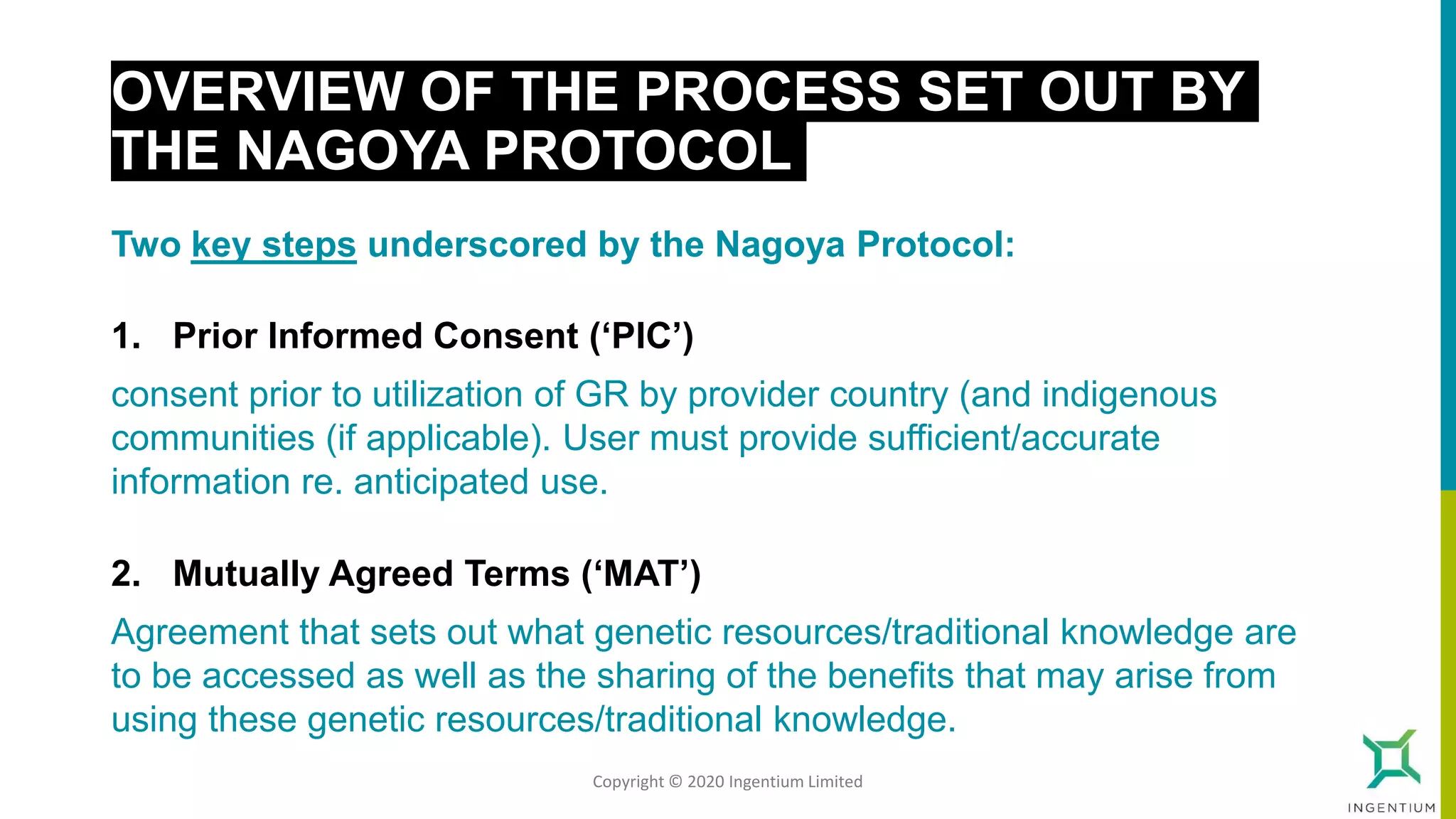
OVERVIEW OF THE PROCESS SET OUT BY
THE NAGOYA PROTOCOL
Two key steps underscored by the Nagoya Protocol:
1. Prior Informed Consent (‘PIC’)
consent prior to utilization of GR by provider country (and indigenous
communities (if applicable). User must provide sufficient/accurate
information re. anticipated use.
2. Mutually Agreed Terms (‘MAT’)
Agreement that sets out what genetic resources/traditional knowledge are
to be accessed as well as the sharing of the benefits that may arise from
using these genetic resources/traditional knowledge.
Copyright © 2020 Ingentium Limited
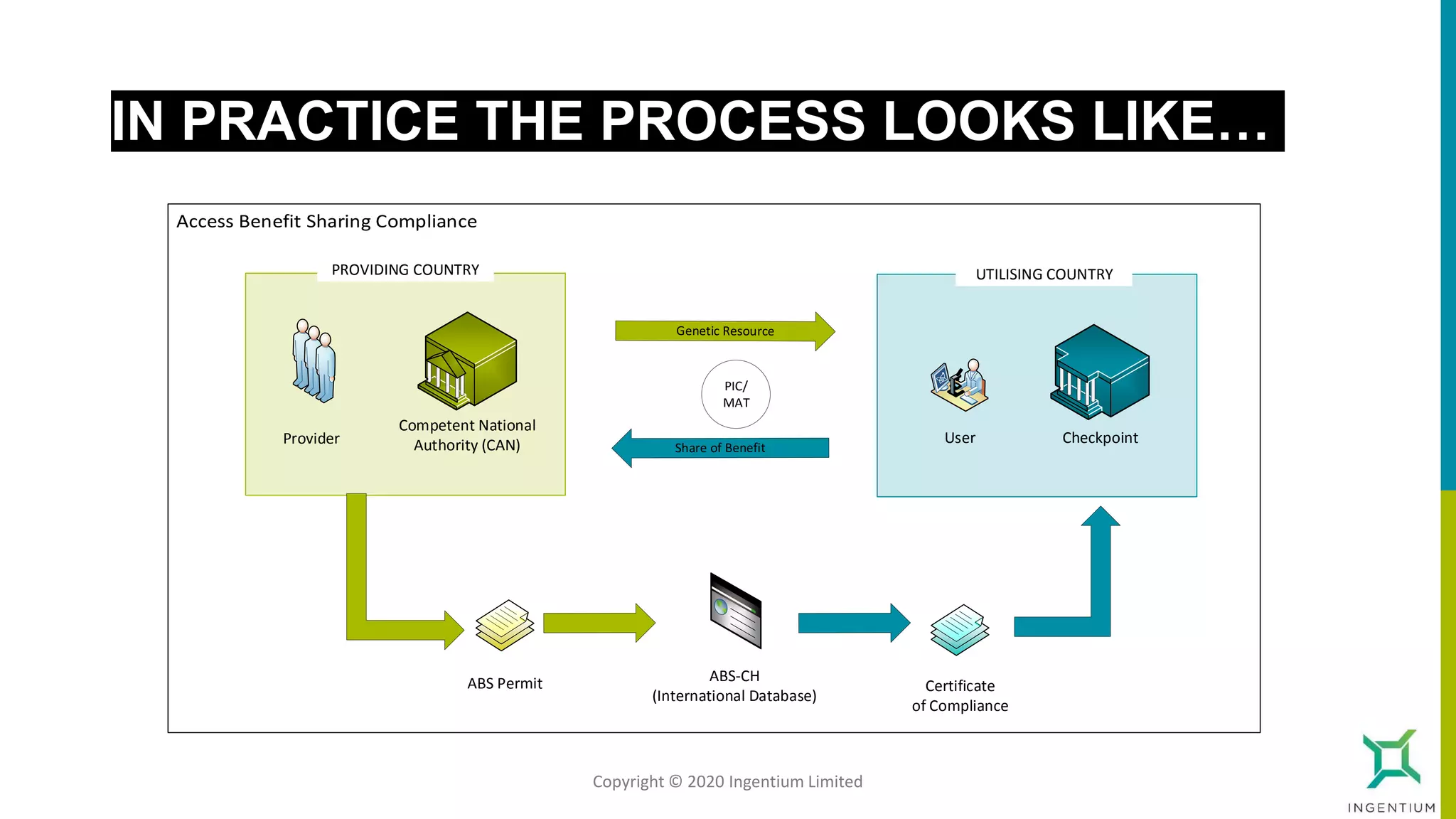
IN PRACTICE THE PROCESS LOOKS LIKE…
Competent National
Authority (CAN) CheckpointUser
ABS-CH
(International Database)
ABS Permit Certificate
of Compliance
PIC/
MAT
PROVIDING COUNTRY UTILISING COUNTRY
Provider
Copyright © 2020 Ingentium Limited
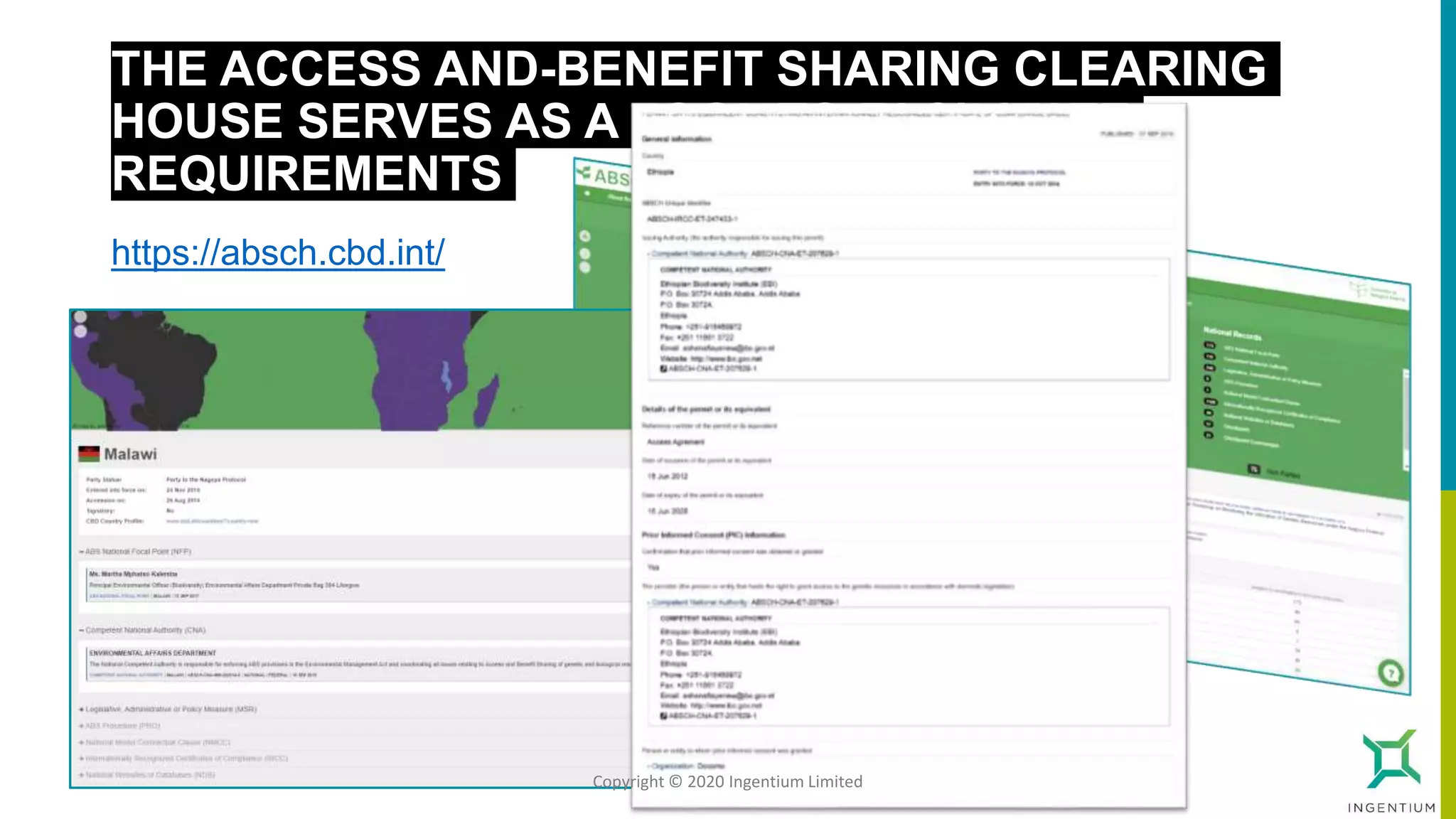
THE ACCESS AND-BENEFIT SHARING CLEARING
HOUSE SERVES AS A TOOL TO FACILITATE
REQUIREMENTS
https://absch.cbd.int/
Copyright © 2020 Ingentium Limited
LIMITATIONS AND EXEMPTIONS:
EMERGENCIES
• Delays in the overall PIC and MAT could be devastating in cases
of outbreaks/emergencies
• …but should it prejudice the sovereignty of LMICs rich in biodiversity?
• Case Study: The H5N1 Isolate from Indonesia (2006)1
• Baxter International obtained H5N1 isolates originating from Indonesia (through
WHO-GISRS)
• Modified version is patented for vaccine production
• No consent obtained, not financial remuneration given
• Indonesia would have limited access to the vaccine itself
1https://www.ncbi.nlm.nih.gov/pmc/articles/PMC2600156/Copyright © 2020 Ingentium Limited
LIMITATIONS AND EXEMPTIONS:
EMERGENCIES
• The Nagoya Protocol promotes utilization without PIC / MAT in
cases of emergency
• member countries should exercise leniency
• Europe has its own rules which intend to allow utilization to take place
(Art 4.8)
• Only applies with respect to present or imminent public health emergency of
international concern
• GR (i.e. pathogen) may be utilized without PIC / MAT
• User has 1 month following end of emergency / 3 months from utilization to negotiate
• Otherwise utilization must stop and no claim of ownership to tech-outputCopyright © 2020 Ingentium Limited
LIMITATIONS AND EXEMPTIONS:
DIGITAL SEQUENCE INFORMATION
• DSI is not defined as a GR by the CBD
• Very controversial issue with a lot of pro’s
and con’s
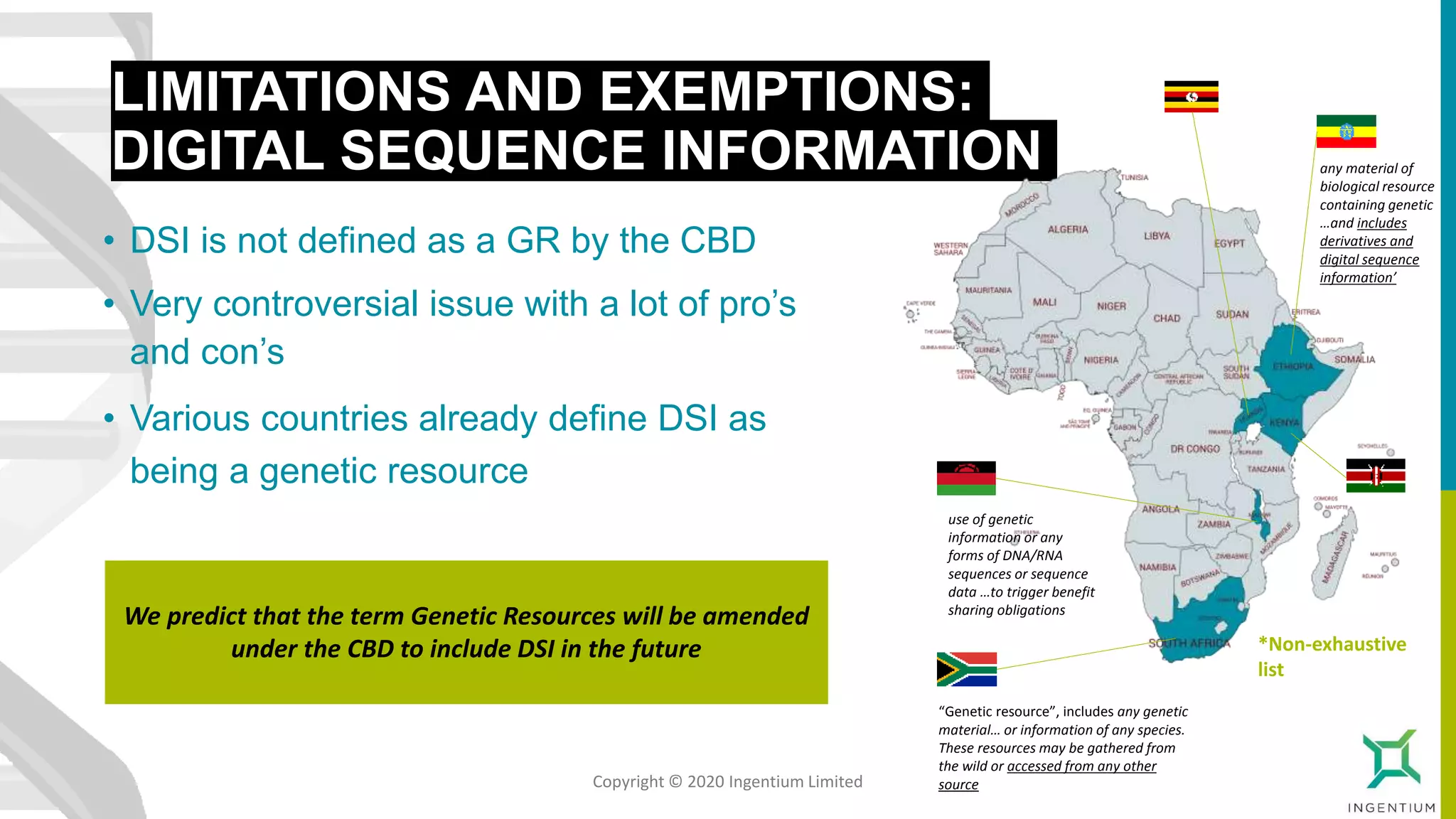
• Various countries already define DSI as
being a genetic resource
We predict that the term Genetic Resources will be amended
under the CBD to include DSI in the future
any material of
biological resource
containing genetic
…and includes
derivatives and
digital sequence
information’
use of genetic
information or any
forms of DNA/RNA
sequences or sequence
data …to trigger benefit
sharing obligations
“Genetic resource”, includes any genetic
material… or information of any species.
These resources may be gathered from
the wild or accessed from any other
source
*Non-exhaustive
list
Copyright © 2020 Ingentium Limited
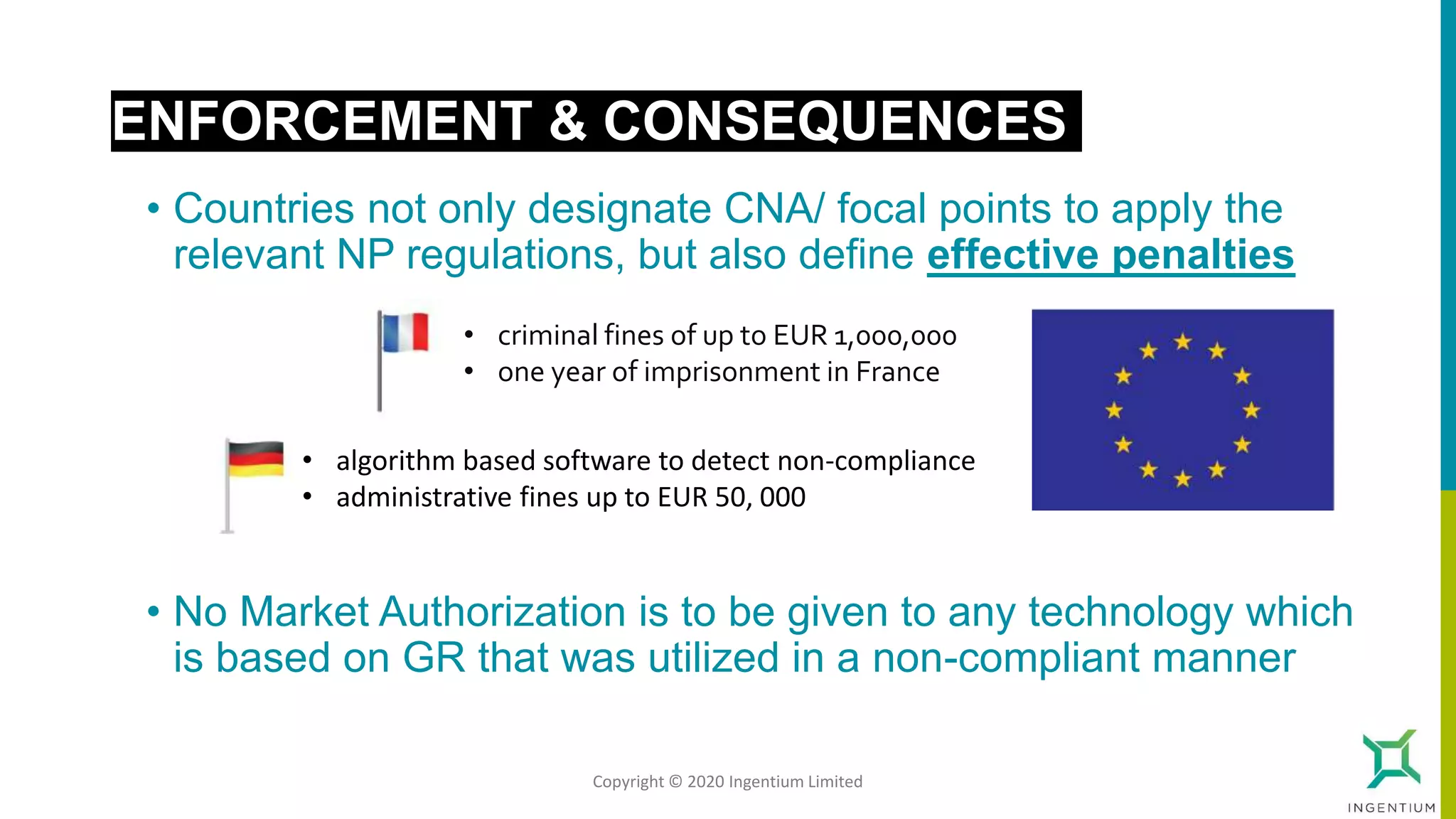
• Countries not only designate CNA/ focal points to apply the
relevant NP regulations, but also define effective penalties
ENFORCEMENT & CONSEQUENCES
• algorithm based software to detect non-compliance
• administrative fines up to EUR 50, 000
• criminal fines of up to EUR 1,000,000
• one year of imprisonment in France
• No Market Authorization is to be given to any technology which
is based on GR that was utilized in a non-compliant manner
Copyright © 2020 Ingentium Limited
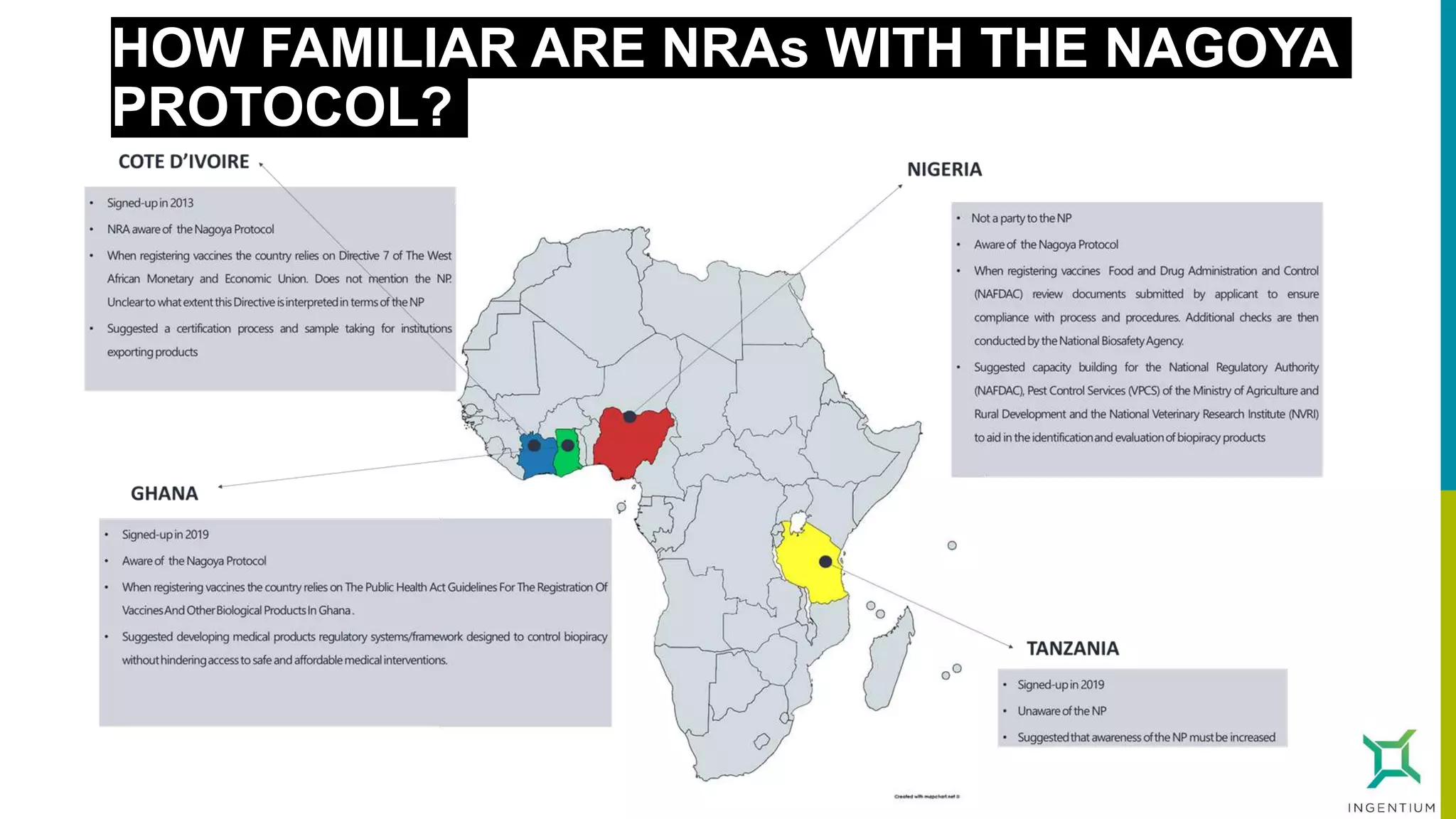
HOW FAMILIAR ARE NRAs WITH THE NAGOYA
PROTOCOL?
Copyright © 2020 Ingentium Limited
NAVIGATING NAGOYA PROTOCOL AND ITS
POTENTIAL IMPLICATIONS
• Utilization is indiscriminate of research / development / deployment
• Carry out due diligence ASAP
• Will you be utilizing Genetic Resources (err on the side of caution)
• Was the GR collected after October 2014
• Does the country of origin have any special stipulations on ABS
• Begin PIC / MAT process as quickly as possible and before starting
any work!
• Ensure confidentiality throughout the process
• Ensure compliance with your home nation legislation with regards to
maintaining permits/certificates
Copyright © 2020 Ingentium Limited
January 22, 2020
FURTHER READING: https://www.ingentium.co.uk/the-nagoya-protocol-101/
THANK YOU
CONTACT US: info@ingentium.co.uk

Vaccine security meeting - Implications of the nagoya protocol- J.Geeola

  • 1.
    January 22, 2020 PREPAREDFOR EuFMD / FAO IMPLICATION OF NAGOYA PROTOCOL ON USE OF GENETIC MATERIAL IN VACCINE R&D AND COMMERCIALISATION Presented by: Josef Geoola, Chief Executive Officer
  • 2.
    NAGOYA PROTOCOL ISA SUPPLEMENTARY AGREEMENT TO CBD • The Convention on Biological Diversity (CBD) was set up conserve biodiversity and ensure sustainability and benefit sharing arising from genetic resources • Nagoya Protocol (2014) expands on CBD’s “access and benefit sharing” (ABS) provision OBJECTIVE: creating a transparent and global framework (and tools) for the utilization and benefit-sharing of genetic resource (and TK) Copyright © 2020 Ingentium Limited
  • 3.
    NAGOYA PROTOCOL HASBEEN RATIFIED IN 123 COUNTRIES TO-DATE • Compliance is required if origin of the genetic resource is from a country which has ratified the Nagoya Protocol SOURCE: absch.cbd.int Party Non-party Copyright © 2020 Ingentium Limited
  • 4.
    CBD DEFINES UTILIZATIONOF GENETIC RESOURCES QUITE BROADLY • Utilization: R&D on the genetic/biochemical composition of ‘genetic resources’ including through applications of biotech • Genetic Resources: ‘genetic material’ of actual or potential value • Genetic material: means any material of plant, animal, microbial or other (non-human) origin containing functional units of heredity • Where do we draw the line? • Synthetic biochemical compounds? • Genetic Information / Digital Sequence Information are not expressly included Copyright © 2020 Ingentium Limited
  • 5.
    CBD DEFINES UTILIZATIONOF GENETIC RESOURCES QUITE BROADLY • Genetic material: means any material of plant, animal, microbial or other (non-human) origin containing functional units of heredity • Genetic Resources: ‘genetic material’ of actual or potential value • Utilization: R&D on the genetic/biochemical composition of ‘genetic resources’ including through applications of biotech • Where do we draw the line? • Synthetic biochemical compounds? • Genetic Information / Digital Sequence Information are not expressly included Copyright © 2020 Ingentium Limited
  • 6.
    OVERVIEW OF THEPROCESS SET OUT BY THE NAGOYA PROTOCOL Two key steps underscored by the Nagoya Protocol: 1. Prior Informed Consent (‘PIC’) consent prior to utilization of GR by provider country (and indigenous communities (if applicable). User must provide sufficient/accurate information re. anticipated use. 2. Mutually Agreed Terms (‘MAT’) Agreement that sets out what genetic resources/traditional knowledge are to be accessed as well as the sharing of the benefits that may arise from using these genetic resources/traditional knowledge. Copyright © 2020 Ingentium Limited
  • 7.
    IN PRACTICE THEPROCESS LOOKS LIKE… Competent National Authority (CAN) CheckpointUser ABS-CH (International Database) ABS Permit Certificate of Compliance PIC/ MAT PROVIDING COUNTRY UTILISING COUNTRY Provider Copyright © 2020 Ingentium Limited
  • 8.
    THE ACCESS AND-BENEFITSHARING CLEARING HOUSE SERVES AS A TOOL TO FACILITATE REQUIREMENTS https://absch.cbd.int/ Copyright © 2020 Ingentium Limited
  • 9.
    LIMITATIONS AND EXEMPTIONS: EMERGENCIES •Delays in the overall PIC and MAT could be devastating in cases of outbreaks/emergencies • …but should it prejudice the sovereignty of LMICs rich in biodiversity? • Case Study: The H5N1 Isolate from Indonesia (2006)1 • Baxter International obtained H5N1 isolates originating from Indonesia (through WHO-GISRS) • Modified version is patented for vaccine production • No consent obtained, not financial remuneration given • Indonesia would have limited access to the vaccine itself 1https://www.ncbi.nlm.nih.gov/pmc/articles/PMC2600156/Copyright © 2020 Ingentium Limited
  • 10.
    LIMITATIONS AND EXEMPTIONS: EMERGENCIES •The Nagoya Protocol promotes utilization without PIC / MAT in cases of emergency • member countries should exercise leniency • Europe has its own rules which intend to allow utilization to take place (Art 4.8) • Only applies with respect to present or imminent public health emergency of international concern • GR (i.e. pathogen) may be utilized without PIC / MAT • User has 1 month following end of emergency / 3 months from utilization to negotiate • Otherwise utilization must stop and no claim of ownership to tech-outputCopyright © 2020 Ingentium Limited
  • 11.
    LIMITATIONS AND EXEMPTIONS: DIGITALSEQUENCE INFORMATION • DSI is not defined as a GR by the CBD • Very controversial issue with a lot of pro’s and con’s • Various countries already define DSI as being a genetic resource We predict that the term Genetic Resources will be amended under the CBD to include DSI in the future any material of biological resource containing genetic …and includes derivatives and digital sequence information’ use of genetic information or any forms of DNA/RNA sequences or sequence data …to trigger benefit sharing obligations “Genetic resource”, includes any genetic material… or information of any species. These resources may be gathered from the wild or accessed from any other source *Non-exhaustive list Copyright © 2020 Ingentium Limited
  • 12.
    • Countries notonly designate CNA/ focal points to apply the relevant NP regulations, but also define effective penalties ENFORCEMENT & CONSEQUENCES • algorithm based software to detect non-compliance • administrative fines up to EUR 50, 000 • criminal fines of up to EUR 1,000,000 • one year of imprisonment in France • No Market Authorization is to be given to any technology which is based on GR that was utilized in a non-compliant manner Copyright © 2020 Ingentium Limited
  • 13.
    HOW FAMILIAR ARENRAs WITH THE NAGOYA PROTOCOL? Copyright © 2020 Ingentium Limited
  • 14.
    NAVIGATING NAGOYA PROTOCOLAND ITS POTENTIAL IMPLICATIONS • Utilization is indiscriminate of research / development / deployment • Carry out due diligence ASAP • Will you be utilizing Genetic Resources (err on the side of caution) • Was the GR collected after October 2014 • Does the country of origin have any special stipulations on ABS • Begin PIC / MAT process as quickly as possible and before starting any work! • Ensure confidentiality throughout the process • Ensure compliance with your home nation legislation with regards to maintaining permits/certificates Copyright © 2020 Ingentium Limited
  • 15.
    January 22, 2020 FURTHERREADING: https://www.ingentium.co.uk/the-nagoya-protocol-101/ THANK YOU CONTACT US: info@ingentium.co.uk

Editor's Notes

  • #3 Nagoya Protocol reaffirms each nation’s sovereignty with respect to its genetic resources More broadly it creates a framework to incentivize parties so that Objective 3 of the CBD may be achieved
  • #4 Solomon Islands became a party today, we have had discussions with authorities in Nigeria who state that it is to be ratified any day in Nigeria Grey is non-party (but may be a signatory), purple is a party (i.e. has ratified) Compliance is based on whether or not the country of origin has ratified the Nagoya Protocol Some notable absences include Thailand, Brazil and of-course, the US. Absences don’t always signify that there is apprehension around what NP stands for, it is sometimes down to complex political systems which make ratification difficult. In some cases, non-party countries have also setup analogous and/or complementary legislation to the provisions of NP. Countries domesticate NP in their own legislation and I have some examples of this coming up
  • #5 Understanding the scope of NP requires that we pay some heed to some of the original terminology proposed by the CBD in 1992 What does this definition mean in practicality? Are isolated surface proteins covered? Are peptides covered? What about sera?
  • #6 Understanding the scope of NP requires that we pay some heed to some of the original terminology proposed by the CBD in 1992 What does this definition mean in practicality? Are isolated surface proteins covered? Are peptides covered? What about sera?
  • #7 PIC -it is important to understand that informed consent means that the party providing consent is aware and fully understands how the user intends to make use of the GR. -Example of misleading e.g. carry out research, and then you decide to transfer to a private company for commercial development MAT -agree what/how and benefits (whether monetary or otherwise) -Member states are encouraged to always consider the purpose of use and potential value when arriving at MAT. This is a implied approach to ensure that there is reasonability when utilization is for research vs. commercialization
  • #11 No real rules set out by NP. Countries can determine “fast track” themselves EU Has its own rules Public Health emergency as defined by relevant WHO: (i) to constitute a public health risk to other States through the international spread of disease and (ii) to potentially require a coordinated international response; Very Human-centric, not animals It should be noted that failure to comply with the 1/3 month rule means that utilization must stop and that no claim of exclusivity can be made to the technology (i.e. there is great incentive to making an agreement happen) This is EU focused and it should be noted that EU law does not influence nations which are not part of the EU – therefore, it is difficult to ascertain how this may all play out IRL WHO is currently working on creating a way to deal with this limitation. This includes “code-of-conduct” for the use of genetic information during outbreaks and a access framework similar to that set out by the Pandemic Influenza Preparedness Framework
  • #12 E.g. UK should leave NP following Brexit as it is debilitating to research (Patent Attorney organizations) Pro vs. Cons
  • #13 - Few case studies of enforcement (mostly pre-NP) all triggered by patenting