Public Seminar :The Futures of Low-Carbon Society :
An Asia-Pacific Vision Beyond 2050
27 August 2010
Opening Remarks by
H.E. Dr. Virachai Virameteekul
Minister of Science and Technology
• Dr. Pichet Durongkaveroj,
• Distinguished Guests,
• Ladies and Gentlemen,
It is both an honour and a pleasure for me to be here at this
important international gathering. I am here to talk about what the Ministry
of Science and Technology is doing or not doing on the issue of climate
change.
110 ประมวลคํากล่าว คําบรรยาย
5.
Climate change posesa real threat to us and our future hangs in
the balance. As powerful storm becomes even more powerful, severe
flooding becomes even more severe; truth is, we are facing potential
disasters threatening us more and more. This is not fiction. This is fact.
This is real science.
Before it is too late, international co-operation, with strong will and
full determination, is needed to tackle the global issue of climate change.
So far – from Bali to Copenhagen, and recently in Bonn – the past two
years have witnessed some progress in certain areas, while in some other
areas, less progress have been made.
This is simply unacceptable. There is so much more work to be
done if we are to come up with a mechanism to implement this common
goal towards a “low-carbon” society. And there is also so much more
progress to be made if we are to save this planet for our future generation.
Ladies and gentlemen,
Thailand shares the vision with other ASEAN countries in driving
the ASEAN community resilient to climate change. We have incorporated
the agenda of climate change into the national development and planning
process since 2007. These plans aim to move our economy towards a low
carbon economy by restructuring the production sector towards being low
carbon/ promoting green transportation and logistics/ remodeling the
agricultural sector to promote sustainable and organic agriculture/
ประมวลคํากล่าว คําบรรยาย 111
6.
increasing the shareof alternative energy, particularly renewable energy
and perhaps most importantly : changing the pattern of public consumption
towards more environmental-friendly products.
In accordance with the national development plan, the Ministry of
Science and Technology is committed to moving Thailand towards a low-
carbon society. We are now conducting and providing supports for many
R&D projects and activities to mitigate and adapt to the impact of climate
change. They can be grouped into three main areas.
The first area is related to the preparation for the impact of climate
change and adaptation strategies, especially for the agricultural sector.
This area of work covers a wide range of R&D projects.
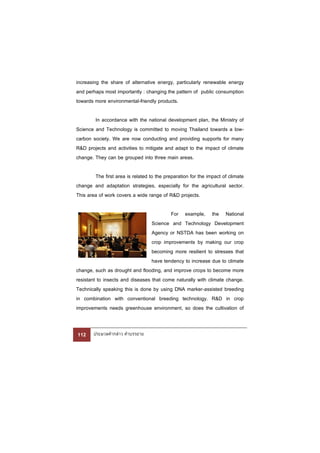
For example, the National
Science and Technology Development
Agency or NSTDA has been working on
crop improvements by making our crop
becoming more resilient to stresses that
have tendency to increase due to climate
change, such as drought and flooding, and improve crops to become more
resistant to insects and diseases that come naturally with climate change.
Technically speaking this is done by using DNA marker-assisted breeding
in combination with conventional breeding technology. R&D in crop
improvements needs greenhouse environment, so does the cultivation of
112 ประมวลคํากล่าว คําบรรยาย
7.
some crop plantsto give them suitable environment for optimal growth.
Therefore, NSTDA has conducted R&D on greenhouse materials,
greenhouse design for tropical plants, and environmental control system for
greenhouses.
Another good example is the work done by the Hydro and Agro
Informatics Institute or HAII. This Institute has developed a forecasting
model for flood and drought risk analysis for 25 basins in Thailand based
on irrigation infrastructure and rainfall. In addition, through the use
telemetry technology, the Institute has also developed a flood warning
system which can be used anywhere in Thailand.
Ladies and gentlemen,
The second area is concerned with mathematical modeling of
climate change. This work involves the development of climate change
models that use remote sensing data such as sea surface temperature,
and geographical information. These data are provided by the satellite of
the Geo-Informatics and Space Technology Development Agency or
GISTDA and fed into the model developed by the Climate Change
Knowledge Management Center or CCKM within our ministry.
Results from these models are very important in developing
adaptation strategies. For example, it can be used to identify “Hot Spot”
areas that are vulnerable due to high risk from climate change impact or
ประมวลคํากล่าว คําบรรยาย 113
8.
having low copingcapacity, or both. Identifying these areas is becoming
increasingly important because they need proper management of resources
and a certain level of investment. In the future, the models can also be
used for the planning of potential reduction of greenhouse gas emissions.
Again, HAII is currently involved in a research on wind map, and
together with the capability to trace the circulation of water in the region
using isotope hydrology research by the Thailand Institute of Nuclear
Technology or TINT, and the satellite data from GISTDA, we can make an
even more reliable prediction model of the whole system of rainfall, wind,
and temperature.
Apart from this, we are incorporating the use of satellite imaging to
directly monitor actual change in coastal erosion and the identification of
proper areas of plantation.
Now we come to the third area. This involves the development of
Life Cycle Assessment or LCA database, in which the Ministry of Science
and Technology, particularly NSTDA, is playing the leading role. As we all
know, LCA database can be used for many applications such as calculating
carbon footprint of a product or an organization. The LCA database also
provides a basis for further development of Life Cycle Inventory (LCI)
system or emission inventory (EI) system. The ultimate goal of this area of
work is to develop cross-cutting body of knowledge and information that are
essential for setting national target for greenhouse gases emission.
114 ประมวลคํากล่าว คําบรรยาย
9.
But ladies andgentlemen,
The Ministry of Science and Technology does not limit itself only
to these in-house activities. For I am a strong believer of collaboration and
alliance, I deem it of vital importance that we reach out to other agencies to
address this very issue. In this light, we also provide R&D groundwork and
support information to the National Climate Change Committee for the
development of the National Strategy for Climate Change for 2008 – 2012.
Equally substantial is our undertaking of R&D programs to acquire a better
understanding of the impact of climate change, including the development
and collection of important indicators for policy planning and management,
as well as adaptation, development and transfer of relevant technology.
As far as relevant technology
is concerned, the National Science
Technology and Innovation Policy
Office (STI) has been cooperating with
the Office of National Resources and
Environmental Policy and Planning
(ONEP) to establish a project on Technology Needs Assessment (TNA) for
Thailand. Assessing technology needs is the first step in making a practical
action plan in the context of the United Nations Framework Convention on
Climate Change process. In the end, we aim to have a national roadmap
for technology development and technology transfer using international
mechanisms such as Clean Technology Fund, among many others.
ประมวลคํากล่าว คําบรรยาย 115
10.
The ultimate goalis to accomplish Thailand’s technology
development priorities for climate change adaptation and mitigation in a
sustainable manner.
Ladies and Gentlemen,
Despite all these R&D programs within our ministry, there are still
many new areas to be explored and to expand on. In fact, with reference to
the report of the foresight work, capacity building at the very local level is
emphasized. This is why I have asked relevant agencies in our ministry to
seriously work closer with local leaders who are in fact our perfect and best
resource to reach out to the communities and their people. They are the
ones who will help make a difference… make a change. We should not
overlook their enormous potential in fostering innovation and adopting
appropriate technologies in order to enable the grass roots to be climate-
resilient.
To this end, the government must facilitate the design of
technology roadmaps at the national level to allocate resources with the
focus to induce private investment accordingly, and work with local
industries and local governments to make sure that such innovation takes
place and reaches local users in the right place at the right time. The
Ministry of Science and Technology has many examples in working with
the locals such as the community water resource management by HAII,
community biodiesel by NSTDA, community zero-waste rice mill by Office
116 ประมวลคํากล่าว คําบรรยาย
11.
of Technology Promotionand Transfer, and the Bioplastic Initiative by
National Innovation Agency.
I would like to specifically emphasize the work of NSTDA on
Industrial Technology Assistance Program or ITAP that has been very
successful in helping, by way of matching grants, small and medium
enterprises throughout the country to conserve energy in the local factory
production process. These are some examples that have been launched
and implemented along this strategic direction, in the spirit of Public-Private
Partnership, or PPP.
ประมวลคํากล่าว คําบรรยาย 117
12.
Ladies and Gentlemen,
We should not, however, let the effort of combating climate
change hinder the attainment of the effort to fight poverty and enhance
quality of life. The choice is not between climate change and Millennium
Development Goals. We are not asking any country whether or not they
want to grow their economy; but we are asking them to find ways and
means to grow the economy with more care and love for the environment.
There is no other way forward.
I regard this Low-Carbon Society initiative by the APEC Center for
Technology Foresight, hosted by the National Science Technology and
Innovation Policy Office, as an important joint vision statement that
responds to both the need to mitigate the impact of climate change, and to
achieve development goals at the same time. I reckon that this vision
together with its pathways to the futures of low-carbon society is
comprehensive and sustainable because it integrates, with foresight, all
imaginable aspects of life in the year 2050.
In conclusion, ladies and gentlemen, it is important that we
unleash the creative mind of our best scientists, for we do strongly believe
that science, technology and innovation will play a powerful role to
overcome the climate change challenges. They are key to moving towards
a low-carbon society.
Sawasdee krub.
เรียบรียงโดย : ทีมงานรัฐมนตรี
118 ประมวลคํากล่าว คําบรรยาย
Opening “InnoBioPlast 2010”
9September 2010
IMPACT Arena, Exhibition and Convention Center
Khun Piyabutr Cholvijarn (ปิยะบุตร ชลวิจารณ์), Former Deputy Minister of
Industry and Member of the National Innovation Board
Khun Payungsak Chartsutipol (พยุงศักดิ์ ชาติสุทธิผล), Chairman of the
Federation of Thai Industries and Member of the National
Innovation Board
Khun Supachai Lorlowhakarn (ศุภชัย หล่อโลหการ), Director of the
National Innovation Agency
Khun Somsak Borrisutthanakul (สมศักดิ์ บริสุทธนะกุล), Chairman of the
Thai Bioplastics Industry Association
Distinguished guests, participants, members of the media, ladies and
gentlemen;
Good morning to you all… Ladies and
gentlemen,
It is a great honor for me to be here
at the opening ceremony of InnoBioPlast
2010. This important gathering, it is hoped,
would be able to connect Thai research and
business communities with their international
ประมวลคํากล่าว คําบรรยาย 145
40.
counterparts, in orderto stimulate technology transfer and oversee
investment in the area of bioplastics. It should be emphasized that this is
already the third international conference and exhibition on bioplastics we
have hosted because we strongly believe that it is an initiative which will
not only benefit Thailand, but will also make a great contribution to our
common goals towards a green planet.
Ladies and gentlemen,
It is undeniable that we are facing enormous environmental issues,
particularly the climate change, as more and more greenhouse gases are
being emitted everyday into the air. Each year, the world produces at least
28 billion tons of carbondioxide - the major greenhouse gas. We cannot
continue this way forever, and there is a pressing need to look for a way
out. In our effort to reduce carbon emission, countries around the world
have encouraged “green”
industries as an alternative
to conventional ones. One of
the most prominent solutions
to an environmental-friendlier
alternative comes from the
area of material science.
146 ประมวลคํากล่าว คําบรรยาย
41.
Yes ladies andgentlemen, it cannot be anything else : this is all
about bioplastics. A preliminary calculation of the Life Cycle Assesment
shows that bioplastics could reduce greenhouse gases emission as much
as 25% in comparison to that of traditional petroleum-based plastics. While
petroleum is a resource that is depleting and cannot be renewed,
bioplastics are made from a renewable resource such as fully degradable
biomass feedstock. Moreover, the entire production process uses
biotechnology or fermentation combined with highly developed chemical
technology, which consumes lower energy than traditional petrochemical
method.
Apart from the positive environmental impact, and in response to
Prime Minister Abhisit Vejjajiva’s policy of attaching great importance
to the well-being of those in the agricultural sector, bioplastics help to
stabilize the agricultural prices by adding value to their products.
Thailand welcomes this challenging opportunity, and has therefore
prioritized the bioplastics industry through the “New Wave Industry”
program in order to accelerate the development of bioplastics, with a view
to become a regional hub in Asia. We have already approved and pledged
supports for such development under the National Roadmap, which will end
in 2012, with the National Innovation Agency, NIA, as the focal point.
ประมวลคํากล่าว คําบรรยาย 147
42.
This “National Roadmapfor the Development of Bioplastic
Industry” contains four key strategies:
First : to achieve sufficient supply of agricultural raw materials;
Second : to develop new technologies;
Third : to build up the
industry and innovative
business and;
Fourth : to establish
supportive infrastructure.
With the integration and close cooperation among the government,
the private sector, and the research community, this Roadmap is expected
to result in an economic value of at least 5.5 billion Baht.
Ladies and gentlemen,
Let me share with you some aspects of the Roadmap with
particular emphasis on our work; what the Ministry of Science and
Technology has been doing and what we aim to do in the future.
148 ประมวลคํากล่าว คําบรรยาย
43.
The first strategyof our national roadmap involves raw
materials. As a major agricultural country, Thailand has a high potential in
terms of biomass feedstock, which provides an important foundation for
bioplastics. To name a few, Thailand is one of the world’s leading
producers of cassava and sugar cane with production of 30 and 80
million tons in 2009, respectively. Not only do we have an abundant and
reliable supply of raw materials to feed into the upstream production, but
we also have over 3,000 well-established manufacturers to provide a solid
base for the downstream production.
In order to ensure sufficient supply of biomass feedstock, proper
management of biomaterial provisions as well as support on R&D
concerning enhancement of crop variety, cultivation, and harvest process
are needed.
This leads directly to the second strategy under our National Roadmap –
R&D and technology development.And in this regard, the Ministry of Science
and Technology takes a leading role.
Ladies and gentlemen,
In addition to our capabilities in raw materials, Thailand also has
a strong research base for developing new technology in bioplastics, and a
ประมวลคํากล่าว คําบรรยาย 149
44.
dynamic network ofresearchers and experts working in the entire cycle of
this emerging field. Through the NIA and MTEC, the National Metal and
Materials Technology Center, we have continued to support R&D in
bioplastics. For example, the “Research and Innovation Helix Programme”
is a research funding scheme, that we collaborate with the National
Research Council of Thailand, or NRCT. It is directed to support
fundamental research on innovative bioplastics products. To date, 40
projects were supported.
From 2009, 30 more research projects have been approved
through another special funding scheme managed by Kasertsart University.
This special program focuses on R&D projects related to the real needs of
the bioplastics industry.
There are now over 100 researchers actively working on R&D with
focuses on
- fermentation technology
- purification technology
- compounding technology
- polymerization technology
150 ประมวลคํากล่าว คําบรรยาย
45.
- degradability testing& compostable waste
- and the improvement of plant breeding, the enhancement of crop
productivity.
Needless to say, we have numerous universities and research
institutions as our counterparts on R&D.
I am pleased to share with you that a number of these projects
have achieved excellent results, such as the project on optimization of
lactic acid fermentation from local raw materials using a highly effective
bacterial strain. This may bring about the high technology for the
production of polylactic acid or PLA in Thailand.
With a reliable supply of raw materials and a strong R&D base
already in place, we now strive to encourage an investment in bioplastics
industry from the upstream,
midstream, right to the
downstream stages. In this
regard, the NIA plays a vital
role in fostering innovation,
linking up public-private cooperation
between groups of entrepreneurs
ประมวลคํากล่าว คําบรรยาย 151
46.
and enterprises aswell as supporting other necessary activities.
The establishment of the Thai Bioplastics Industry Associate, or
TBIA, is another crucial achievement that has been put in place to help
strengthening this industry. In collaboration with the TBIA, we have
supported local companies in more than 20 innovation projects. These
projects are directed to facilitate learning in the manufacture of bioplastics.
So as to foster and ensure continuous and sustainable
development of this bioplastics industry, a number of supportive
infrastructures must be provided. These include the establishment of
bioplastic standards, as well as the setting up of laboratory for testing and
certifying bioplastics products.
- In terms of biodegradability standards, the draft was prepared by
various competent agencies such as NIA, TBIA, PPC and MTEC. They are,
however, to be finalized by the Thai Industrial Standards Institute, or TISI.
- As far as testing facilities are concerned, the establishment of
laboratories for testing and certifying bioplastic products were put in place
by MTEC and TISTR, or the Thailand Institute of Scientific and
Technological Research, in cooperation with GTZ and TBIA.
152 ประมวลคํากล่าว คําบรรยาย
47.
Ladies and gentlemen,
we can have all the best researchers, the best technologies, and
the best support from all players, or even the best bioplastics; but if the
positive consumer attitude towards bioplastics and, as a result, their usage
are not promoted in the society, then all that I just mentioned would merely
mean nothing.
It is therefore equally
necessary to make sure that
public awareness towards bioplastics
usage and its environmental
benefits is raised.
In this regard, we have
initiated and successfully carried
out several pilot projects. For
example, we recently launched
a pilot project in which
bioplastics bags are used to
collect household organic waste
that can then be converted to organic fertilizer. During the initial stage, we
targeted tourist destination areas, such as Kra-dung-nga district and Samet
ประมวลคํากล่าว คําบรรยาย 153
48.
Island, where thereis an urgent need to reduce the plastic waste buildup in
the area.
Another good example is the potential application of bioplastics as
planting bags which would be compostable within one year. This initiative
was introduced just last month with the cooperation from the Forest
Department and eight local companies which are our key partners in this
project.
Last but not least, we cannot leave out the various forms of
incentives to create an investment-friendly atmosphere, including tax
incentives program offered by our Board of Investment, featuring corporate
income tax exemption up to 8 years and an additional 50% reduction of
corporate income tax for 5 years.
Ladies and gentlemen,
154 ประมวลคํากล่าว คําบรรยาย
49.
In order tobecome a global player and a regional hub, we do
recognize the need to forge an alliance. This is why we have taken steps
forward to generate international awareness of our favorable policy for
businesses which are based on renewable resources. In light of all these
advantages and supportive infrastructure that have been mentioned, I am
confident that overseas investors would find Thailand as one of the most
attractive places for bioplastics investment.
What we are now seeking is an investment in a bioplastics
resin production plant in Thailand, which would be the first on a
commercial scale in Asia. I, therefore, propose this last question to you
all, whether you would agree to partner with Thailand in our exciting
journey ahead.
Thank you very much and Sawasdee krub.
เรียบเรียงโดย : ทีมงานรัฐมนตรี
ดรุญณี แก้วสระแสน
ประมวลคํากล่าว คําบรรยาย 155




















![แผนกลยุทธ์ไปสู่การปฏิบัติ ปีงบประมาณ พ.ศ. 2553 [2]](https://cdn.slidesharecdn.com/ss_thumbnails/st-2-100114202548-phpapp01-thumbnail.jpg?width=640&height=640&fit=bounds)


![Cc parliament seminar[1]](https://cdn.slidesharecdn.com/ss_thumbnails/ccparliament-seminar1-100918021244-phpapp02-thumbnail.jpg?width=640&height=640&fit=bounds)


