








Utilizing Heat and 
Ceilometer to scale up 
nova instances 
Presented By – Kaustubh S. Dhokte
Agenda 
 Understanding the problem statement 
 Introduction to respective Openstack 
Services 
 Introduction to HOT 
 High level System Functioning 
 Low level System Working 
 Conclusion
Problem Statement: 
“Utilizing Heat and Ceilometer to scale 
up nova instances” 
 Scaling Up 
 Horizontally 
 Vertically
What are these Openstack Services? 
Heat – Orchestration Service 
Ceilometer – Telementary Service 
Nova – Compute Service
HOT 
 What is it? 
 HOT Structure – 
 Version 
 Parameters 
 Resources 
 Output 
 Intrinsic Functions
Intrinsic Functions - 
 get_attr 
 get_resource 
 get_param
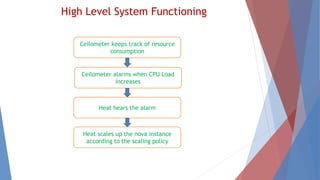
High Level System Functioning 
Ceilometer keeps track of resource 
consumption 
Ceilometer alarms when CPU Load 
increases 
Heat hears the alarm 
Heat scales up the nova instance 
according to the scaling policy
Required Resource Types 
 OS :: Ceilometer :: Alarm 
 OS :: Heat :: ScalingPolicy 
 OS :: Heat :: AutoScalingGroup 
 OS :: Nova :: Server
cpu_alarm_high: 
type: OS::Ceilometer::Alarm 
properties: 
description: scale up if average cpu>80% 
for 1 minute 
meter_name:cpu_util 
statistic:avg 
period: 60 
threshold: 80 
alarm_actions: 
- {get_attr: 
[nova_instance_scaling_policy, alarm_url]} 
comparison_operator:gt
nova_instance_scaling_policy: 
type: OS::Heat::ScalingPolicy 
properties: 
adjustment_type:change_in_policy 
auto_scaling_group_id: 
{get_resource:nova_instance_group} 
scaling_adjustment:1 
Attibute :- alarm_url(url to handle the alarm)
nova_instance_group: 
type: OS::Heat::AutoScalingGroup 
properties: 
min_size : 1 
max_size : 3 
resource : 
type : OS::Nova::Server 
properties: 
key_name : my_key 
image : F18_x64_cfntools 
flavour: m1.small
Conclusion
Utilizing heat and ceilometer to scale up nova

Utilizing heat and ceilometer to scale up nova

  • 1.
    Utilizing Heat and Ceilometer to scale up nova instances Presented By – Kaustubh S. Dhokte
  • 2.
    Agenda  Understandingthe problem statement  Introduction to respective Openstack Services  Introduction to HOT  High level System Functioning  Low level System Working  Conclusion
  • 3.
    Problem Statement: “UtilizingHeat and Ceilometer to scale up nova instances”  Scaling Up  Horizontally  Vertically
  • 4.
    What are theseOpenstack Services? Heat – Orchestration Service Ceilometer – Telementary Service Nova – Compute Service
  • 5.
    HOT  Whatis it?  HOT Structure –  Version  Parameters  Resources  Output  Intrinsic Functions
  • 7.
    Intrinsic Functions -  get_attr  get_resource  get_param
  • 8.
    High Level SystemFunctioning Ceilometer keeps track of resource consumption Ceilometer alarms when CPU Load increases Heat hears the alarm Heat scales up the nova instance according to the scaling policy
  • 9.
    Required Resource Types  OS :: Ceilometer :: Alarm  OS :: Heat :: ScalingPolicy  OS :: Heat :: AutoScalingGroup  OS :: Nova :: Server
  • 10.
    cpu_alarm_high: type: OS::Ceilometer::Alarm properties: description: scale up if average cpu>80% for 1 minute meter_name:cpu_util statistic:avg period: 60 threshold: 80 alarm_actions: - {get_attr: [nova_instance_scaling_policy, alarm_url]} comparison_operator:gt
  • 11.
    nova_instance_scaling_policy: type: OS::Heat::ScalingPolicy properties: adjustment_type:change_in_policy auto_scaling_group_id: {get_resource:nova_instance_group} scaling_adjustment:1 Attibute :- alarm_url(url to handle the alarm)
  • 12.
    nova_instance_group: type: OS::Heat::AutoScalingGroup properties: min_size : 1 max_size : 3 resource : type : OS::Nova::Server properties: key_name : my_key image : F18_x64_cfntools flavour: m1.small
  • 13.