Uterine pathologies
-by Dr. A. Sabith Meeran
EMBRYOLOGY OF UTERUS
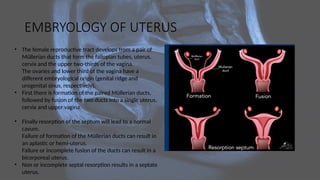
• The female reproductive tract develops from a pair of
Müllerian ducts that form the fallopian tubes, uterus,
cervix and the upper two-thirds of the vagina.
The ovaries and lower third of the vagina have a
different embryological origin (genital ridge and
urogenital sinus, respectively).
• First there is formation of the paired Müllerian ducts,
followed by fusion of the two ducts into a single uterus,
cervix and upper vagina.
• Finally resorption of the septum will lead to a normal
cavum.
Failure of formation of the Müllerian ducts can result in
an aplastic or hemi-uterus.
Failure or incomplete fusion of the ducts can result in a
bicorporeal uterus.
• Non or incomplete septal resorption results in a septate
uterus.
GROSS ANATOMY
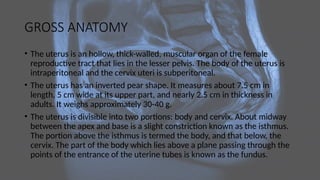
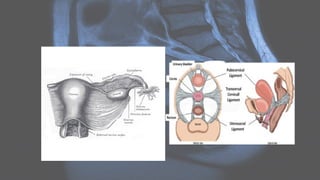
• The uterus is an hollow, thick-walled, muscular organ of the female
reproductive tract that lies in the lesser pelvis. The body of the uterus is
intraperitoneal and the cervix uteri is subperitoneal.
• The uterus has an inverted pear shape. It measures about 7.5 cm in
length, 5 cm wide at its upper part, and nearly 2.5 cm in thickness in
adults. It weighs approximately 30-40 g.
• The uterus is divisible into two portions: body and cervix. About midway
between the apex and base is a slight constriction known as the isthmus.
The portion above the isthmus is termed the body, and that below, the
cervix. The part of the body which lies above a plane passing through the
points of the entrance of the uterine tubes is known as the fundus.
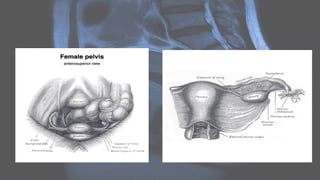
Relations
• anteriorly: bladder; uterovesical pouch
• posteriorly: rectum; pouch of Douglas
• laterally: broad ligament; round ligament; uterine vessels
• uterine tubes open into its upper part
• inferiorly: uterine cavity communicates with that of
the vagina.
ANTEVERSION AND ANTEFLEXION
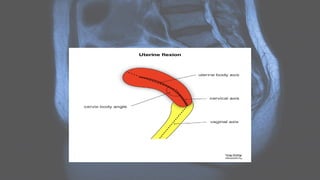
• The uterine position can be described in terms of version and flexion:
• uterine version: defined as the angle that the cervical axis makes with the vaginal
axis
• anteversion
• version angle <90°
• external os points posteriorly towards the rectum
• uterine flexion: defined as the angle that the uterine body axis makes with the
cervical axis
• anteflexion: flexion angle <180° and the apex is directed anteriorly
• retroflexion: flexion angle >180° and apeix is directed posteriorly
• This results in a number of uterine positions:
• anteverted anteflexed: cervix angles forward, body is flexed forward
Attachments
Musculotendinous and ligamentous attachments:
• Anterior: pubocervical ligament
• Lateral: transverse cervical ligaments (cardinal or Mackenrodt’s)
• Posterior: uterosacral ligaments
• Inferior: puborectalis and pubovaginalis parts of the levator ani
muscle.
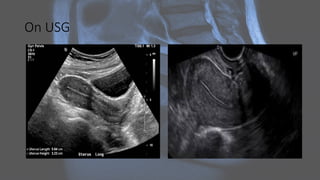
On USG
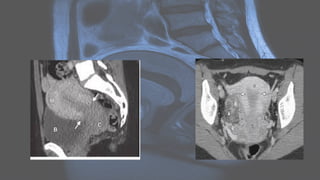
On CT
• The uterus appears as a homogeneous soft tissue mass posterior to the
bladder. The myometrium shows low density on unenhanced CT with the
endometrial canal showing even lower density than myometrium . It normally
enhances post intravenous contrast.
• There are generally three types of enhancement in a normal uterus :
• type 1: thick or thin sub-endometrial enhancement, most commonly found in
pre-menopausal women
• type 2: diffuse myometrial enhancement, found in both pre and post-
menopausal women
• type 3: faint diffuse myometrial enhancement, exclusively found in post-
menopausal women
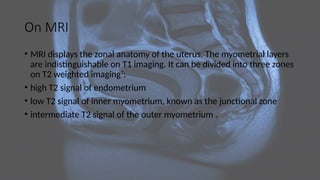
On MRI
• MRI displays the zonal anatomy of the uterus. The myometrial layers
are indistinguishable on T1 imaging. It can be divided into three zones
on T2 weighted imaging7
:
• high T2 signal of endometrium
• low T2 signal of inner myometrium, known as the junctional zone
• intermediate T2 signal of the outer myometrium .
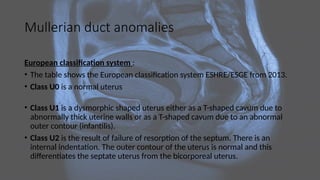
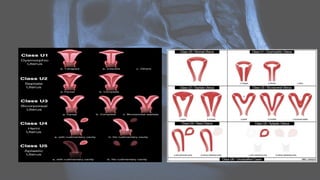
Mullerian duct anomalies
European classification system :
• The table shows the European classification system ESHRE/ESGE from 2013.
• Class U0 is a normal uterus
• Class U1 is a dysmorphic shaped uterus either as a T-shaped cavum due to
abnormally thick uterine walls or as a T-shaped cavum due to an abnormal
outer contour (infantilis).
• Class U2 is the result of failure of resorption of the septum. There is an
internal indentation. The outer contour of the uterus is normal and this
differentiates the septate uterus from the bicorporeal uterus.
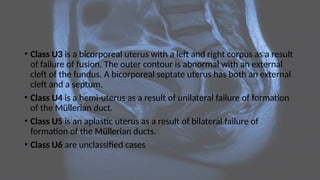
• Class U3 is a bicorporeal uterus with a left and right corpus as a result
of failure of fusion. The outer contour is abnormal with an external
cleft of the fundus. A bicorporeal septate uterus has both an external
cleft and a septum.
• Class U4 is a hemi-uterus as a result of unilateral failure of formation
of the Müllerian duct.
• Class U5 is an aplastic uterus as a result of bilateral failure of
formation of the Müllerian ducts.
• Class U6 are unclassified cases
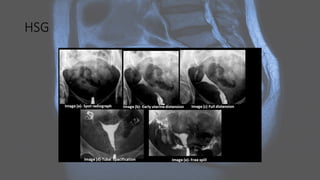
HSG
Radiographic features
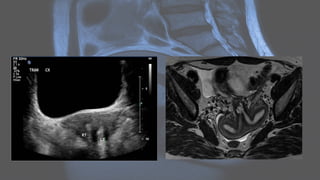
Ultrasound:
• should be performed initially
• confirms any structural abnormalities of the genital tract
• sometimes cannot help to identify the type of MDA (especially on 2D imaging
alone)
• 3D coronal transvaginal imaging has a high degree of diagnostic accuracy and
ideally should be performed in the secretory phase of the menstrual cycle
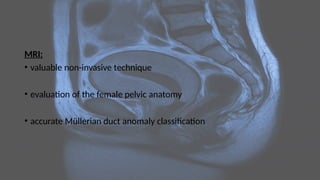
MRI:
• valuable non-invasive technique
• evaluation of the female pelvic anatomy
• accurate Müllerian duct anomaly classification
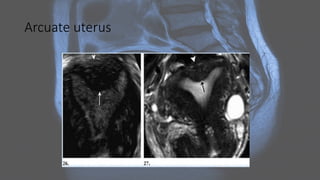
Arcuate uterus
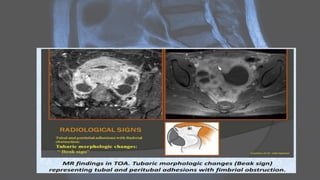
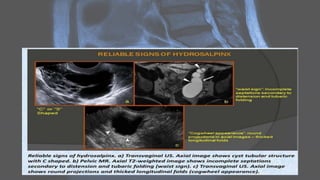
PELVIC INFLAMMATORY DISEASE
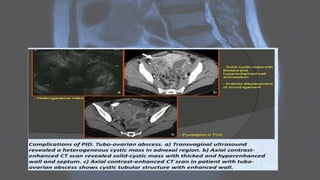
• Pelvic inflammatory disease (PID) is a broad term that encompasses a
spectrum of infection and inflammation of the upper female genital
tract, resulting in a range of abnormalities.
• PID is defined as an acute clinical syndrome associated with ascending
spread of micro-organisms, unrelated to pregnancy or surgery. The
infection generally ascends from the vagina or cervix (cervicitis) to the
endometrium (endometritis), then to the fallopian tubes (salpingitis,
hydrosalpinx, pyosalpinx), and then to and/or contiguous structures
(oophoritis, tubo-ovarian abscess, peritonitis).
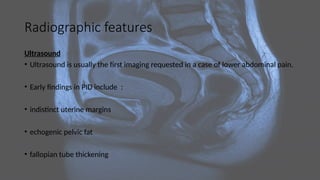
Radiographic features
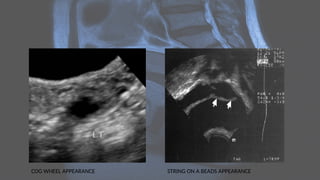
Ultrasound
• Ultrasound is usually the first imaging requested in a case of lower abdominal pain.
• Early findings in PID include :
• indistinct uterine margins
• echogenic pelvic fat
• fallopian tube thickening
COG WHEEL APPEARANCE STRING ON A BEADS APPEARANCE
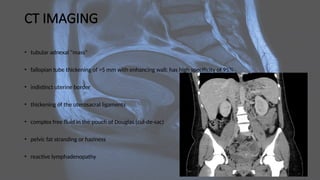
CT IMAGING
• tubular adnexal "mass"
• fallopian tube thickening of >5 mm with enhancing wall: has high specificity of 95%
• indistinct uterine border
• thickening of the uterosacral ligaments
• complex free fluid in the pouch of Douglas (cul-de-sac)
• pelvic fat stranding or haziness
• reactive lymphadenopathy
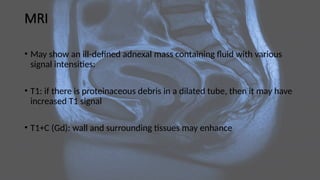
MRI
• May show an ill-defined adnexal mass containing fluid with various
signal intensities:
• T1: if there is proteinaceous debris in a dilated tube, then it may have
increased T1 signal
• T1+C (Gd): wall and surrounding tissues may enhance
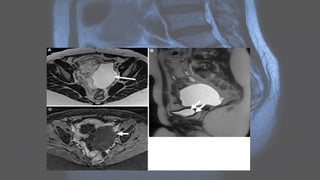
Uterine leiomyomas
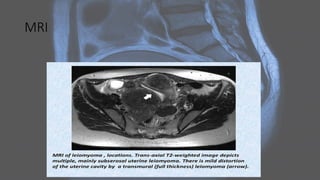
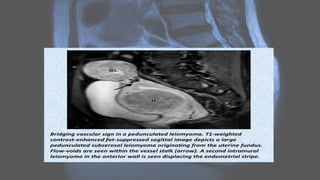
• Uterine leiomyomas, also known as uterine fibroids, are benign
tumors of myometrial origin and are the most common solid benign
uterine neoplasms. They are a common incidental finding on imaging
and rarely cause diagnostic dilemma.
Plain radiograph
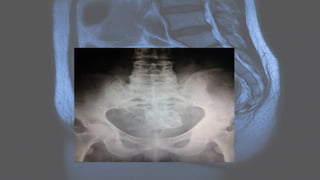
• Popcorn calcification within the pelvis may suggest the diagnosis.
Ultrasound
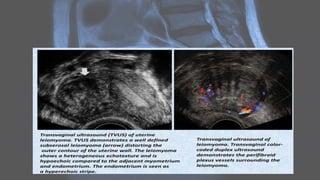
• Ultrasound is used to diagnose the presence and monitor the growth of fibroids:
• uncomplicated leiomyomas are usually hypoechoic, but can be isoechoic, or even
hyperechoic compared to normal myometrium
• calcification is seen as echogenic foci with shadowing
• cystic areas of necrosis or degeneration may be seen
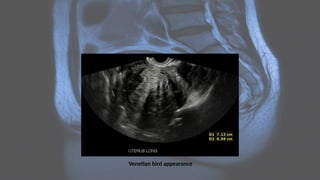
• Venetian blind artifact may be seen but edge shadowing +/- dense posterior
shadowing from calcification is also typically seen 17
Venetian bird appearance
CT
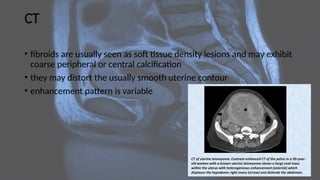
• fibroids are usually seen as soft tissue density lesions and may exhibit
coarse peripheral or central calcification
• they may distort the usually smooth uterine contour
• enhancement pattern is variable
MRI
Adenomyosis
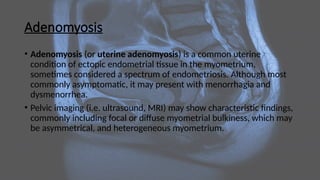
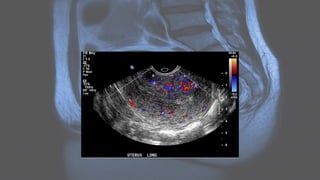
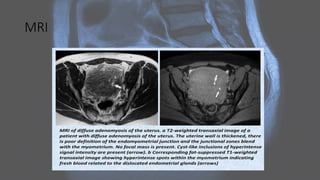
• Adenomyosis (or uterine adenomyosis) is a common uterine
condition of ectopic endometrial tissue in the myometrium,
sometimes considered a spectrum of endometriosis. Although most
commonly asymptomatic, it may present with menorrhagia and
dysmenorrhea.
• Pelvic imaging (i.e. ultrasound, MRI) may show characteristic findings,
commonly including focal or diffuse myometrial bulkiness, which may
be asymmetrical, and heterogeneous myometrium.
USG
• A "Venetian blind" or "rain shower" appearance (linear striations,
parallel shadowing) may be seen as a combination of the
aforementioned features: heterogeneous 1,2,20, coarsened
echotexture of the myometrium, and acoustic shadowing where
endometrial tissues cause a hyperplastic reaction. The combination of
this heterogeneity and the subendometrial echogenic nodular and
linear striations is not dissimilar to the appearance of chronic liver
parenchymal disease - hence, “cirrhosis of the uterus.”
MRI
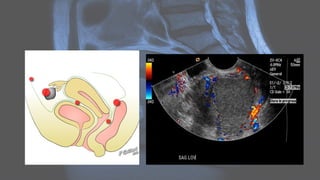
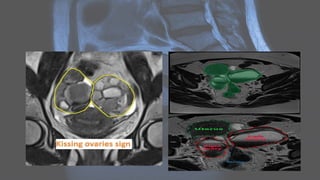
Endometriosis
• Endometriosis is a common, chronic gynecological condition defined
as the presence of functional endometrial glands and stroma-like
lesions outside the uterus. It manifests in three ways: superficial
(peritoneal) disease, ovarian disease (endometriomas), and deep
endometriosis.
• Endometriosis is highly associated with adenomyosis (in which
endometrial tissue is confined to the uterine musculature). Size
varies, ranging from microscopic endometriotic implants to large cysts
(endometriomas) and nodules. Deep infiltrating endometriosis is
complex and surgically challenging.
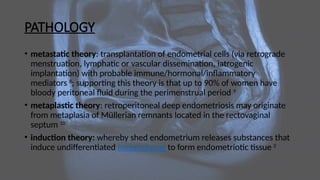
PATHOLOGY
• metastatic theory: transplantation of endometrial cells (via retrograde
menstruation, lymphatic or vascular dissemination, iatrogenic
implantation) with probable immune/hormonal/inflammatory
mediators 8
; supporting this theory is that up to 90% of women have
bloody peritoneal fluid during the perimenstrual period 9
• metaplastic theory: retroperitoneal deep endometriosis may originate
from metaplasia of Müllerian remnants located in the rectovaginal
septum 10
• induction theory: whereby shed endometrium releases substances that
induce undifferentiated mesenchyme to form endometriotic tissue 2
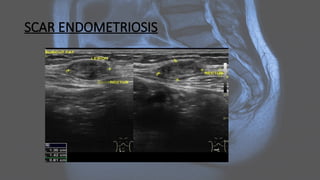
SCAR ENDOMETRIOSIS
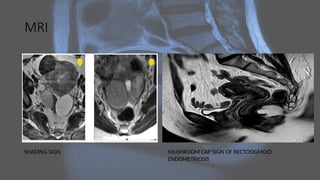
MRI
SHADING SIGN MUSHROOM CAP SIGN OF RECTOSIGMOID
ENDOMETRIOSIS
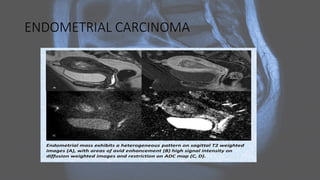
ENDOMETRIAL CARCINOMA
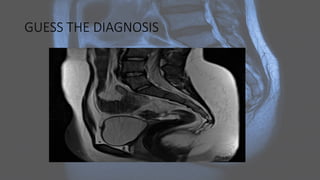
GUESS THE DIAGNOSIS

Uterine pathologies radiology slides.pptx

  • 1.
  • 2.
    EMBRYOLOGY OF UTERUS •The female reproductive tract develops from a pair of Müllerian ducts that form the fallopian tubes, uterus, cervix and the upper two-thirds of the vagina. The ovaries and lower third of the vagina have a different embryological origin (genital ridge and urogenital sinus, respectively). • First there is formation of the paired Müllerian ducts, followed by fusion of the two ducts into a single uterus, cervix and upper vagina. • Finally resorption of the septum will lead to a normal cavum. Failure of formation of the Müllerian ducts can result in an aplastic or hemi-uterus. Failure or incomplete fusion of the ducts can result in a bicorporeal uterus. • Non or incomplete septal resorption results in a septate uterus.
  • 3.
    GROSS ANATOMY • Theuterus is an hollow, thick-walled, muscular organ of the female reproductive tract that lies in the lesser pelvis. The body of the uterus is intraperitoneal and the cervix uteri is subperitoneal. • The uterus has an inverted pear shape. It measures about 7.5 cm in length, 5 cm wide at its upper part, and nearly 2.5 cm in thickness in adults. It weighs approximately 30-40 g. • The uterus is divisible into two portions: body and cervix. About midway between the apex and base is a slight constriction known as the isthmus. The portion above the isthmus is termed the body, and that below, the cervix. The part of the body which lies above a plane passing through the points of the entrance of the uterine tubes is known as the fundus.
  • 4.
    Relations • anteriorly: bladder;uterovesical pouch • posteriorly: rectum; pouch of Douglas • laterally: broad ligament; round ligament; uterine vessels • uterine tubes open into its upper part • inferiorly: uterine cavity communicates with that of the vagina.
  • 6.
    ANTEVERSION AND ANTEFLEXION •The uterine position can be described in terms of version and flexion: • uterine version: defined as the angle that the cervical axis makes with the vaginal axis • anteversion • version angle <90° • external os points posteriorly towards the rectum • uterine flexion: defined as the angle that the uterine body axis makes with the cervical axis • anteflexion: flexion angle <180° and the apex is directed anteriorly • retroflexion: flexion angle >180° and apeix is directed posteriorly • This results in a number of uterine positions: • anteverted anteflexed: cervix angles forward, body is flexed forward
  • 8.
    Attachments Musculotendinous and ligamentousattachments: • Anterior: pubocervical ligament • Lateral: transverse cervical ligaments (cardinal or Mackenrodt’s) • Posterior: uterosacral ligaments • Inferior: puborectalis and pubovaginalis parts of the levator ani muscle.
  • 10.
  • 11.
    On CT • Theuterus appears as a homogeneous soft tissue mass posterior to the bladder. The myometrium shows low density on unenhanced CT with the endometrial canal showing even lower density than myometrium . It normally enhances post intravenous contrast. • There are generally three types of enhancement in a normal uterus : • type 1: thick or thin sub-endometrial enhancement, most commonly found in pre-menopausal women • type 2: diffuse myometrial enhancement, found in both pre and post- menopausal women • type 3: faint diffuse myometrial enhancement, exclusively found in post- menopausal women
  • 13.
    On MRI • MRIdisplays the zonal anatomy of the uterus. The myometrial layers are indistinguishable on T1 imaging. It can be divided into three zones on T2 weighted imaging7 : • high T2 signal of endometrium • low T2 signal of inner myometrium, known as the junctional zone • intermediate T2 signal of the outer myometrium .
  • 15.
    Mullerian duct anomalies Europeanclassification system : • The table shows the European classification system ESHRE/ESGE from 2013. • Class U0 is a normal uterus • Class U1 is a dysmorphic shaped uterus either as a T-shaped cavum due to abnormally thick uterine walls or as a T-shaped cavum due to an abnormal outer contour (infantilis). • Class U2 is the result of failure of resorption of the septum. There is an internal indentation. The outer contour of the uterus is normal and this differentiates the septate uterus from the bicorporeal uterus.
  • 16.
    • Class U3is a bicorporeal uterus with a left and right corpus as a result of failure of fusion. The outer contour is abnormal with an external cleft of the fundus. A bicorporeal septate uterus has both an external cleft and a septum. • Class U4 is a hemi-uterus as a result of unilateral failure of formation of the Müllerian duct. • Class U5 is an aplastic uterus as a result of bilateral failure of formation of the Müllerian ducts. • Class U6 are unclassified cases
  • 18.
  • 20.
    Radiographic features Ultrasound: • shouldbe performed initially • confirms any structural abnormalities of the genital tract • sometimes cannot help to identify the type of MDA (especially on 2D imaging alone) • 3D coronal transvaginal imaging has a high degree of diagnostic accuracy and ideally should be performed in the secretory phase of the menstrual cycle
  • 21.
    MRI: • valuable non-invasivetechnique • evaluation of the female pelvic anatomy • accurate Müllerian duct anomaly classification
  • 22.
  • 24.
    PELVIC INFLAMMATORY DISEASE •Pelvic inflammatory disease (PID) is a broad term that encompasses a spectrum of infection and inflammation of the upper female genital tract, resulting in a range of abnormalities. • PID is defined as an acute clinical syndrome associated with ascending spread of micro-organisms, unrelated to pregnancy or surgery. The infection generally ascends from the vagina or cervix (cervicitis) to the endometrium (endometritis), then to the fallopian tubes (salpingitis, hydrosalpinx, pyosalpinx), and then to and/or contiguous structures (oophoritis, tubo-ovarian abscess, peritonitis).
  • 25.
    Radiographic features Ultrasound • Ultrasoundis usually the first imaging requested in a case of lower abdominal pain. • Early findings in PID include : • indistinct uterine margins • echogenic pelvic fat • fallopian tube thickening
  • 26.
    COG WHEEL APPEARANCESTRING ON A BEADS APPEARANCE
  • 27.
    CT IMAGING • tubularadnexal "mass" • fallopian tube thickening of >5 mm with enhancing wall: has high specificity of 95% • indistinct uterine border • thickening of the uterosacral ligaments • complex free fluid in the pouch of Douglas (cul-de-sac) • pelvic fat stranding or haziness • reactive lymphadenopathy
  • 29.
    MRI • May showan ill-defined adnexal mass containing fluid with various signal intensities: • T1: if there is proteinaceous debris in a dilated tube, then it may have increased T1 signal • T1+C (Gd): wall and surrounding tissues may enhance
  • 33.
    Uterine leiomyomas • Uterineleiomyomas, also known as uterine fibroids, are benign tumors of myometrial origin and are the most common solid benign uterine neoplasms. They are a common incidental finding on imaging and rarely cause diagnostic dilemma. Plain radiograph • Popcorn calcification within the pelvis may suggest the diagnosis.
  • 35.
    Ultrasound • Ultrasound isused to diagnose the presence and monitor the growth of fibroids: • uncomplicated leiomyomas are usually hypoechoic, but can be isoechoic, or even hyperechoic compared to normal myometrium • calcification is seen as echogenic foci with shadowing • cystic areas of necrosis or degeneration may be seen • Venetian blind artifact may be seen but edge shadowing +/- dense posterior shadowing from calcification is also typically seen 17
  • 36.
  • 38.
    CT • fibroids areusually seen as soft tissue density lesions and may exhibit coarse peripheral or central calcification • they may distort the usually smooth uterine contour • enhancement pattern is variable
  • 39.
  • 41.
    Adenomyosis • Adenomyosis (oruterine adenomyosis) is a common uterine condition of ectopic endometrial tissue in the myometrium, sometimes considered a spectrum of endometriosis. Although most commonly asymptomatic, it may present with menorrhagia and dysmenorrhea. • Pelvic imaging (i.e. ultrasound, MRI) may show characteristic findings, commonly including focal or diffuse myometrial bulkiness, which may be asymmetrical, and heterogeneous myometrium.
  • 42.
    USG • A "Venetianblind" or "rain shower" appearance (linear striations, parallel shadowing) may be seen as a combination of the aforementioned features: heterogeneous 1,2,20, coarsened echotexture of the myometrium, and acoustic shadowing where endometrial tissues cause a hyperplastic reaction. The combination of this heterogeneity and the subendometrial echogenic nodular and linear striations is not dissimilar to the appearance of chronic liver parenchymal disease - hence, “cirrhosis of the uterus.”
  • 44.
  • 46.
    Endometriosis • Endometriosis isa common, chronic gynecological condition defined as the presence of functional endometrial glands and stroma-like lesions outside the uterus. It manifests in three ways: superficial (peritoneal) disease, ovarian disease (endometriomas), and deep endometriosis. • Endometriosis is highly associated with adenomyosis (in which endometrial tissue is confined to the uterine musculature). Size varies, ranging from microscopic endometriotic implants to large cysts (endometriomas) and nodules. Deep infiltrating endometriosis is complex and surgically challenging.
  • 47.
    PATHOLOGY • metastatic theory:transplantation of endometrial cells (via retrograde menstruation, lymphatic or vascular dissemination, iatrogenic implantation) with probable immune/hormonal/inflammatory mediators 8 ; supporting this theory is that up to 90% of women have bloody peritoneal fluid during the perimenstrual period 9 • metaplastic theory: retroperitoneal deep endometriosis may originate from metaplasia of Müllerian remnants located in the rectovaginal septum 10 • induction theory: whereby shed endometrium releases substances that induce undifferentiated mesenchyme to form endometriotic tissue 2
  • 49.
  • 50.
    MRI SHADING SIGN MUSHROOMCAP SIGN OF RECTOSIGMOID ENDOMETRIOSIS
  • 52.
  • 53.