Country: FIJI
Laboratory name: The INSTITUTE OF APPLIED SCIENCES,
THE UNIVERSITY OF THE SOUTH PACIFIC (IAS-USP)
Name of the presenter: DR. VINCENT LAL
Soil analysis in your lab
What analysis do you perform?
• Total organic carbon, total nitrogen, TKN, particle
size, pH, chloride, heavy metals, pesticide residue,
etc
How many samples do you analyse each year?
• All samples ~8000 samples
• Soil/sediment ~ 300 samples
What instrument/equipment do you use?
• Furnace, GC, ICP-OES, AAS, GF-AAS, UV-Vis, etc
What projects do you support?
• MSc, PhD and commercial samples, ASPAC
proficiency samples
Are they ‘mobile’ laboratories?
• No (all testing done onsite)
• Conduct sampling offsite
Are soil test kits commonly used?
• No (not at the moment)
Soil analysis in your country
What do you think your lab is strong at?
• Track record of testing ASPAC soil with commercial
soil and sediment samples since 2010 – 2019
• Accredited to ISO17025:2017 for testing laboratory
• Strong emphasis and adherence to QAQC
• Dedicated staff and trained technicians
• Dedicated instrument and laboratory facilities
• Access to academic staff within the faculty of
Science, Technology and Engineering
• TOC, heavy metals and nutrients in soil/sediments
• Regional cooperation with a number of projects
Strengths and Weaknesses
What do you think it could be improved in your lab?
• Further capacity building for technicians in updated
methodologies and instrumentation for soil testing
• Availability of reference material (appropriate
soil/sediment samples)
• Reduced cost to take part in inter-laboratory studies
• Investment into a dedicated CHN analyser
Strengths and Weaknesses
What are your expectations out of this meeting and
GLOSOLAN?
• Better regional cooperation in soil analysis
• Establishment of a regional testing laboratory
• Continued support with Interlaboratory studies
• Accreditation of the TOC test
• Using a reference material for Loss by Ignition (LOI)
• Capacity building and more awareness through other
workshops or training on soil
Expectations
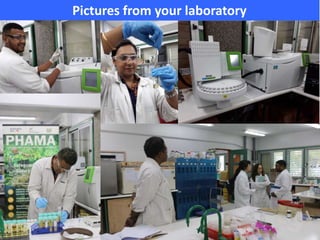
Pictures from your laboratory
Thanks for your attention

Item 6: Usp fiji laboratory presentation template

  • 1.
    Country: FIJI Laboratory name:The INSTITUTE OF APPLIED SCIENCES, THE UNIVERSITY OF THE SOUTH PACIFIC (IAS-USP) Name of the presenter: DR. VINCENT LAL
  • 2.
    Soil analysis inyour lab What analysis do you perform? • Total organic carbon, total nitrogen, TKN, particle size, pH, chloride, heavy metals, pesticide residue, etc How many samples do you analyse each year? • All samples ~8000 samples • Soil/sediment ~ 300 samples What instrument/equipment do you use? • Furnace, GC, ICP-OES, AAS, GF-AAS, UV-Vis, etc What projects do you support? • MSc, PhD and commercial samples, ASPAC proficiency samples
  • 3.
    Are they ‘mobile’laboratories? • No (all testing done onsite) • Conduct sampling offsite Are soil test kits commonly used? • No (not at the moment) Soil analysis in your country
  • 4.
    What do youthink your lab is strong at? • Track record of testing ASPAC soil with commercial soil and sediment samples since 2010 – 2019 • Accredited to ISO17025:2017 for testing laboratory • Strong emphasis and adherence to QAQC • Dedicated staff and trained technicians • Dedicated instrument and laboratory facilities • Access to academic staff within the faculty of Science, Technology and Engineering • TOC, heavy metals and nutrients in soil/sediments • Regional cooperation with a number of projects Strengths and Weaknesses
  • 5.
    What do youthink it could be improved in your lab? • Further capacity building for technicians in updated methodologies and instrumentation for soil testing • Availability of reference material (appropriate soil/sediment samples) • Reduced cost to take part in inter-laboratory studies • Investment into a dedicated CHN analyser Strengths and Weaknesses
  • 6.
    What are yourexpectations out of this meeting and GLOSOLAN? • Better regional cooperation in soil analysis • Establishment of a regional testing laboratory • Continued support with Interlaboratory studies • Accreditation of the TOC test • Using a reference material for Loss by Ignition (LOI) • Capacity building and more awareness through other workshops or training on soil Expectations
  • 7.
  • 8.
    Thanks for yourattention