Sardella, September 3, 2021
1
Using Original Pali Text in Buddhist
Economics
Abstract 1
Introduction 1
Claims from Economists and Buddhist Scholars 5
Canonical Relevance to the Modern World 9
Mental Suffering and Life’s Problems 9
Social (and Economic) Problems 14
Environmental Problems 17
Concluding Remarks 20
Works Cited 22
Abstract
Concerns about the applicability of Buddhist Ethics to modern economics continue to be
raised. Buddhist scholars lament that economists eschew canonical connections, while
“Buddhist Economists” evade the endeavor or declare it unnecessary. I argue that
original Pali texts elucidate modern economic concerns, and that exploring insights from
these primary sources strengthens the understanding of Buddhist Ethics (and related
ethical approaches) to modern economic theory and practice.
Introduction
The interdisciplinary concept of a Buddhist economic began with E.F. Schumacher’s
work in Burma as an economic consultant in the 1950’s, and was crystallized in his 1966 essay,
Sardella, September 3, 2021
2
Buddhist Economics.1
The essay asserts that Right Livelihood, part of the Buddha’s Noble
Eightfold Path, proves (emphasis mine) the existence of Buddhist economic ethics. Pursuing
these ethics is urgent because economists “suffer from a kind of metaphysical blindness,”2
deluded that they attain absolute truth without exploring needed presuppositions about human
nature, desire, and the kind of economic world we would create.
In Small is Beautiful, Schumacher exposed a “religion of economics” whose only goal is
for adherents to “act economically” no matter the externalities (such as labor exploitation or
“other despicable practices”).3
For Schumacher, these practices stem from a false belief that
“the problem of production has been solved,”4
an error he squarely places on the illusion that
natural resources, finite and irreplaceable as “capital which man has not made”5
is instead (and
catastrophically) treated as income, as though adjustable as a matter of business planning.
Schumacher’s activist economics are in the tradition of John Maynard Keynes; both
argued that a sought-after economic system should be the “result of insight into real human
needs and aspirations.”6
Keynes viewed economics as a moral science, and while he at times
embraced qualitative utilitarianism, he is arguably closest to virtue ethics.7
Schumacher,
addressing the question of whether his proposed economic strategies and methods needed to
be called “Buddhist” economics, wryly asserted that, “The choice of Buddhism...is purely
incidental; the teachings of Christianity, Islam, or Judaism could have been used just as well as
1 Schumacher, E.F., Buddhist Economics, 1966.
2 Ibid.
3 Schumacher, E.F., Small is Beautiful: Economics as if People Mattered, 2010 Edition, page 47.
4 Ibid., page 13
5 Ibid., page 14
6 Schumacher, E.F., Small is Beautiful: Economics as if People Mattered, 2010 Edition, page 54. The two
had a long professional relationship after Keynes published Schumacher’s Multilateral Clearing (1943).
7 Mitchell, Hadley T, The Ethics of Keynes, Journal of Markets and Morality, Vol. 20. No. 1, 2017.
Sardella, September 3, 2021
3
those of any other of the great Eastern traditions.”8
Schumacher also publicly quipped that he
“could have called it Christian Economics,” but that “no one would have read it.”9
Nevertheless, vigorous research on this multidisciplinary subject continues this half-
century later. From economists, work in the name of Buddhist Economics proceeds with only
tentative links to Buddhism (let alone Buddhist scripture), and often could in fact be tied equally
to any Abrahamic or Hindu religion, or to secular virtue ethics. He supports this assertion
forcefully: “economics is a derived science from what I call meta-economics.”10
And to
Schumacher, meta-economics “deals with man and his environment” and “derives its aims and
objects from a study of man, and at least part of its methodology from a study of nature.”11
Although Buddhist ethical values align quite easily to his definition, this description of the
“meta” does not require that it be Buddhist. But the concept and related ideas continued to
resonate. Inspired by Schumacher, Ven. P. A. Payutto added gravitas to the notion of Buddhist
Economics with interpretations and scriptural references.12
Peter Harvey has written at length
on the subject, both in textbook format13
and in the Journal of Buddhist Ethics.14
These bodies of work—from economists on the one hand and Buddhist scholars on the
other—take such different approaches that they are frequently not recognizable to each other.15
This leads to confusion and an unfortunate tendency to label more economic ideas as
“Buddhist” than is warranted. The intent here is to argue that a criterion for making the
8 Ibid., page 55.
9 He makes this joking claim in a short video clip, Schumacher on Buddhist Economics.
10 Small is Beautiful, page 54
11 Ibid., Page 49.
12 King, Matthew, Buddhist Economic: Scales of Value in Global Exchange, July 2016.
13 Harvey, Peter, An Introduction to Buddhist Ethics, Cambridge University Press, 2009. A chapter is
devoted to economic ethics.
14 Harvey, Peter, Buddhist Reflections on “Consumer” and “Consumerism”, JBE, Volume 20, 2013.
15 Clair Brown and Laszlo Zolnai are somewhat of a counterexample, although their synthesis of the
disciplines is largely based on tangential connections of high level Buddhist concepts (e.g.,
interdependence) without scriptural source.
Sardella, September 3, 2021
4
“Buddhist” connection should be based on scriptural analogues or evidence that the spirit of a
sutta (using source material where possible) matches a modern economic and ethical concern.
The original suttas are often so practical that meaningful lines can be drawn between the canon
and modern economic theory and practice. Source material solidifies the picture of human
nature that’s inherent in these scriptures, and at times clarifies overlapping concerns with
related ethical theories.
Payutto notes that Schumacher created the notion (if not the field) of Buddhist
Economics “in response to a crisis,”16
based largely on “the environmental repercussions of
rampant consumerism.”17
The ultimate goal, then, is to work our way out of this (now deeper)
crisis.18
The Pali texts, and their interpretations,19
offer an understanding of human nature and a
practical viewpoint to a worldly life.
Schumacher’s call for a meta-economic (prior to calling it “Buddhist”) and the relevance
of secular welfare ethics in economics,20
including distributed justice,21
indicate possibilities for
incorporating Buddhist ethics into a larger effort to address this ongoing and worsening crisis.
The ultimate aim is to foster sustainable economic behavior (not to win a nonexistent ethics
branding contest). Using more primary sources helps brings the audience closer to the actual
experience behind the creation of the ethic. This approach, when compared to basing all case
studies on high level terms such as interdependence, provides a better understanding of the
foundation for an economic (or any other) behavior.
16 Payutto, Ven. P.A., Buddhist Economics: A Middle Way for the Market Place, 1992, page 7.
17 Ibid., page 7.
18 See, for instance, Climate Change 2021: The Physical Science Basis, Intergovernmental Panel on
Climate Change, August 9, 2021.
19 And in fact later Buddhist manifestations such as Mahayana Buddhism
20 Economics and Ethics in Philosophy of Economics, Stanford Encyclopedia of Philosophy
21 Economics and Economic Justice, Stanford Encyclopedia of Philosophy.
Sardella, September 3, 2021
5
Claims from Economists and Buddhist Scholars
The integration of the “Buddhist” and the “Economic” studies in Buddhist Economics has
been uneven. Matthew King notes that Payutto, while adding relevant insights to Schumacher’s
original ideas, “makes no serious claim that his ideas could act pragmatically as a model for
actual economic policies on production, circulation, and consumption.”22
Furthermore, King
laments that the question of creating meaningful ties to economic problems, “seems to be
ignored by swaths of scholar-practitioners around the world keen to help construct an alternative
economic model to late capitalism based on, say, selective quotations from the Pāli Canon or
vague references to Buddhist virtues.”23
Citing Max Weber’s misinterpretation (due to having
limited texts), King calls for development of a “robust study of Buddhism and economy from
outside of Weber’s long shadow.”24
While making a salient point that there would generally
have to be some extrapolation to connect the canon to modern economics, King (as will be
shown in the next section) goes too far in dismissing the search for relevant economic ethics in
the Buddha’s teachings.
The economist Claire Browne provides a complete blueprint for economic change in a
society that is based on an interdependence that extends to nature and all beings.25
In Buddhist
Economics: An Enlightened Approach for the Dismal Science, she includes a chapter on
relevant techniques for achieving sustainability, green production and products, living wages
and reduced inequality, and effective social action.26
22 King, page 10.
23 Ibid., page 18.
24 Ibid., page 19.
25 Brown, Claire, Buddhist Economics: An Enlightened Approach for the Dismal Science, Bloomsbury
Press, 2017. Page 8.
26 Ibid., 132-133
Sardella, September 3, 2021
6
Each of these ideas is essential, and it is urgent to implement them, or at least facsimiles
of them. However, while compatible with much in Buddhism, they are not systematically
developed by the Buddha’s teachings.27
(Secular ecology, for instance, has a binding reliance
on interdependence.) Brown herself openly admits that she is not trying to provide sufficient
rigor for economists or sufficient dharma for Buddhists.”28
In a subsequent work by Brown and
Laszlo Zolnai, the authors positively assert that our modern economic problems are too different
from those in the ancient world and that “[t]he most important modern economic and business
phenomena, including the corporation, money without internal value, high leverage finance,
stock exchanges and so on, cannot be meaningfully approached on the basis of the ancient
knowledge of Buddhist teachers.29
Our economic problems—and their underlying constructs—are indeed quite different
from those in Nepal and Northern India (or anywhere else) in the sixth century BCE. The
Buddha certainly lived in a world without modern financial abstractions such as paper money
and stock exchanges, although many of the constituent parts of these constructs are indirectly
in the canon. These will be shown below in Mental Suffering and Life’s Problems.
Furthermore, the ethical teachings in the Pali Canon are specific and universal, and
holding overly fast to these differences of time and place foregoes an opportunity to identify
connections that would deepen our understanding of modern ills. Brown and Zolnai are correct
that Buddhist Economics is a strategy (as opposed to a system), but the strategy should
contribute meaningfully to the goal. For this to happen, practical codes based on meta-
economic and compassionate values should be the basis of, and built into, economic systems.
27 Drechsler, Wolfgang, Buddhist Economics for Pandemic Times, Journal of Global Buddhism, Volume
21, 2020. Page 106.
28 Brown, Page 6.
29 Brown, Claire and Zolnai, Laszlo, Buddhist Economics: An Overview, Society and Economy, December
2018. Page 510.
Sardella, September 3, 2021
7
Yet even Payutto questions the viability of making certain connections: “It is often asked
which economic or political system is most compatible with Buddhism. Buddhism does not
answer such a question directly…[E]conomic and political systems are a question of method,
and methods, according to Buddhism, should be attuned to time and place.”30
Still, when
Payutto also asserts that “a government’s wealth is for the purpose of supporting and organizing
its citizens' lives in the most efficient and beneficial way,”31
he offers strong hints at the shape of
that government (democratic republic?) and the economy (planned and socialistic?) it serves.
He is certainly not speaking of free-market, zero-sum capitalism,32
or the propagandic strictures
of mass-scale communism.33
Payutto offers further guidance as to how the canon provides ethical direction, first
stating that (compared to the scriptures of all other religions) it is “unique in that it teaches an
ethical system of self-development for human beings to be released from all sorts of
problem[s].”34
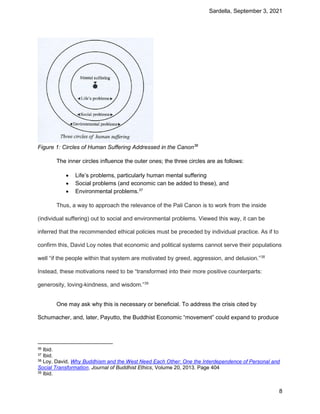
He offers a map of how the canon “holds the key to solving the three-tier
problems of human suffering, which can be represented as three circles (Figure 1).”35
30 Payutto, Ven. P.A., Page 48.
31 Ibid.
32 Harvey, Peter, An Introduction to Buddhist Ethics, Cambridge University Press, 2009. Pg 222.
33 Harvey, Peter, An Introduction to Buddhist Ethics, Cambridge University Press, 2009. Pg. 223
34 Payutto, Ven. P.A., What a True Buddhist Should Know about the Pali Canon, MANUSYA: Journal of
Humanities (Special Issue: No.4 2002), Page 109.
35 Ibid.
Sardella, September 3, 2021
8
Figure 1: Circles of Human Suffering Addressed in the Canon36
The inner circles influence the outer ones; the three circles are as follows:
 Life’s problems, particularly human mental suffering
 Social problems (and economic can be added to these), and
 Environmental problems.37
Thus, a way to approach the relevance of the Pali Canon is to work from the inside
(individual suffering) out to social and environmental problems. Viewed this way, it can be
inferred that the recommended ethical policies must be preceded by individual practice. As if to
confirm this, David Loy notes that economic and political systems cannot serve their populations
well “if the people within that system are motivated by greed, aggression, and delusion.”38
Instead, these motivations need to be “transformed into their more positive counterparts:
generosity, loving-kindness, and wisdom.”39
One may ask why this is necessary or beneficial. To address the crisis cited by
Schumacher, and, later, Payutto, the Buddhist Economic “movement” could expand to produce
36 Ibid.
37 Ibid.
38 Loy, David, Why Buddhism and the West Need Each Other: One the Interdependence of Personal and
Social Transformation, Journal of Buddhist Ethics, Volume 20, 2013. Page 404
39 Ibid.
Sardella, September 3, 2021
9
specific guidance for applied micro- and macroeconomics based partly on original canon suttas
and their interpretations. Suttas provide emotional appeals for the ethics they prescribe, which
can lead to an economics with a goal of alleviating suffering.40
The next section illustrates that certain connections between the Pali Canon and modern
economics can be made, and can profitably offer an exchange of Buddhist ethical principles to
address the original stated goals of Buddhist Economics. The adjustments for modernity are
varied, but often slight. For economists (and lawmakers) to have access to the canon (and
related virtue ethics) allows for sharper reasoning in the experimentation of economics as a way
to well-being (or, as Schumacher would put it, “as if people mattered”).41
Canonical Relevance to the Modern World
The following sections offer scriptural examples to Payutto’s circles of human suffering
as they relate to Buddhist Economics. The inner circle of mental suffering and life’s problems
often contains advice for the for the “four assemblies”: bhikkhus (monks), bhikkhunīs (nuns),
male lay disciples, and female lay disciples. Most of the Buddha’s financial teachings are
addressed to these groups, and the social circle is influenced by, and needs to support, the
“life’s problems” circle. A similar relationship exists, and is illustrated herein, between the social
and the environmental circles.
Mental Suffering and Life’s Problems
At the age of 29, the Buddha, when “confronted with the reality of life and the suffering of
mankind…decided to find the solution—the way out of this universal suffering.”42
This “way out”
was introduced in the Fourth Noble Truth as the Eightfold Path, and “ethical conduct (sila),
40 Miceli, Maria, and de Rossis, Fiorella, Emotional and Nonemotional Persuasion, 2007.
41 The quoted text is the subtitle to Small is Beautiful.
42 Rahula, Wapole, What the Buddha Taught, The Buddha.
Sardella, September 3, 2021
10
based on love and compassion, are included in three factors of this path: right speech, right
action, and right livelihood.”43
In Payutto’s preface to his Buddhist Economics, he establishes that “If the study of
economics is to play any part in the solution of our problems, it can no longer evade the subject
of ethics.”44
Harvey notes that Payutto “criticizes the tendency of modern economics to examine
economic transactions in isolation from ethical consideration,” and that Payutto “emphasizes the
economic impact of unethical behavior, such as reluctance to invest where there is social
disorder, customer dissatisfaction if shoddy good are sold, and medical costs and poor health
amongst workers.”45
This refutes King’s assertion (in Claims from Economists and Buddhist
Scholars) that Payutto has nothing to say about production and consumption.
The different ethical directions depend on two separate kinds of desire: tanha (craving
directed by ignorance) and chanda (reflection directed towards benefit).46
Many householder
admonishments center on controlling tanha.47
In Malavagga: Impurities (Dhp.186), a key verse
provides a timeless ethic:
There's no fire like passion,
no seizure like anger,
no snare like delusion,
no river like craving.48
This is a scriptural call for temperance: limit passion, control anger, don’t be deluded by
the separate self, and don’t drown in your craving.
43 Rahula, Wapole. What the Buddha Taught, The Fourth Noble Truth
44 Payutto, Ven. P.A., Buddhist Economics: A Middle Way for the Market Place, 1992, page 3.
45 Harvey, Buddhist Ethics, Page 217.
46 Payutto, Ven. P.A., Buddhist Economics: A Middle Way for the Market Place, 1992, page 17.
47 Ibid., page 15.
48 Malavagga: Impurities (Dhp.186), Access to Insight, Dhammapada
Sardella, September 3, 2021
11
And the Dhammapada states that “[t]here is no satisfying sensual desires, even with the
rain of gold coins. For sensual pleasures give little satisfaction and much pain.”49
As such, “[t]he
disciple of the Supreme Buddha delights in the destruction of craving.50
This allegory points to the root of unskilled householder economics: the destructive
results of craving and the emphasis on mindless consumption. Harvey identifies the results of
this, citing dictionary definitions of consume as “destroy” or “waste away.” 51
In this destruction and waste, our overconsumption and depletion of natural resources
threatens “the world’s biosphere, our shared home.”52
While creating such destruction, it leaves
individuals wholly unsatisfied:
“Now this, monks, for the spiritually ennobled, is the originating-
of-the-painful true reality. It is this craving, giving rise to rebirth,
accompanied by delight and attachment, finding delight now here,
now there . . .” (SN V. 421).53
On a more practical level, Buddha sought to specifically address home economic
matters for the householder. First, there are proscriptions on “dissipating wealth” in the Sigala
Sutta: taking intoxicants, loitering and idling day and night in the streets, unhealthy diversions
into hyper-entertainment, gambling, etc.”54
These sound prohibitions on wasteful or sickness-inducing spending are well augmented
by right livelihood advice on acquiring and using personal wealth:
The wise and virtuous shine like a blazing fire.
He who acquires his wealth in harmless ways
like to a bee that honey gathers,
49 Dhammapada 251. 186-7.
50 Dhammapada 251. 186-7.
51 Harvey, Peter, Buddhist Reflections on “Consumer” and “Consumerism”, JBE, Volume 20, 2013. Pg.2
52 Harvey, Peter, Buddhist Reflections on “Consumer” and “Consumerism”, JBE, Volume 20, 2013. Pg.3.
53 Harvey, Peter, Buddhist Reflections on “Consumer” and “Consumerism”, JBE, Volume 20, 2013. Pg.5.
54 Sigalovada Sutta: The Discourse to Sigala (The Layperson’s Discipline), Access to Insight
Sardella, September 3, 2021
12
riches mount up for him
like ant hill's rapid growth.
With wealth acquired this way,
a layman fit for household life,
in portions four divides his wealth:
thus will he friendship win.
One portion for his wants he uses,
two portions on his business spends,
the fourth for times of need he keeps.55
This not only includes instructions to acquire the wealth by doing no harm (“like a bee
that honey gathers”), but, in the last three lines, provides a very specific recommendation for
allocating it. Addressing these themes so closely together in verse expresses a holistic home
economic: how one acquires wealth in harmony with nature, followed by the most natural
possible use of the wealth. Notably, the Buddha insisted that economic happiness takes a
subordinate role to spiritual happiness: the following puts this in perspective:
A hundred elephants,
a hundred horses,
a hundred mule-drawn carts,
a hundred-thousand maidens
adorned with jewels & earrings
aren’t worth one-sixteenth
of one step forward.56
55 Sigalovada Sutta: The Discourse to Sigala (The Layperson’s Discipline), Access to Insight
56 About Sudatta (Anāthapiṇḍika) Sudatta Sutta (SN 10:8)
Sardella, September 3, 2021
13
This is an admonition not to stray far from the primary goals of ending suffering, getting outside
the cycle of life, and attaining Nirvāṇa.
For the individual householder, there is even more explicit business instruction and
ethical guidance in the Jatakas. Harvey points to a section of Cullaka-Seṭṭhi-Jātaka (J.I.120) that
“seems to support entrepreneurial energy directed to investment and reinvestment.”57
In the
parable, after hearing the words of a man he believes to be wise and deliberate, a young man
perceives the seeds of a business in acquiring a dead mouse, and “sells it to a tavern, for its
cat, and then goes on to become rich by a series of astute investments…”58
This outsized wealth gain proceeds in a series of shrewd (but honest and ethical)
transactions that are combined with assistance to groups of workers who in turn assist the
young man (a novice merchant) with his next leveraged arrangement. The timing of these
trades, which are sometimes on new introductions from people for whom he has done good
deeds (and other times on rumor!), are impeccable and his wealth and perceived skills grows to
such proportions that he becomes the treasurer in training.59
Taking on voluntary debt of this order, particularly to build a business, is risky enough
that it would likely involve interest. We can perhaps infer that the Buddha would not consider the
loan of money to be altogether different from the loan of, for instance, an ox. If there’s hardship
to the lender in either case, why would there not be a “fee” or collateral arrangement of some
sort?60
Then, once in the realm of interest and debt, the financial mechanics of buying in bulk
and deferring payments are involved, and this is a form of leverage.61
For an applied ethic at
this level, this is the answer to the objections from economists (see above in Claims from
57 Harvey, Peter, An Introduction to Buddhist Ethics, Cambridge University Press, 2009. Pg. 209
58 Ibid., page 209
59 Cullaka-Seṭṭhi-Jātaka, from Jataka Volume I (J.I.120-22).
60 Guide to Buddhism, Interest.
61 Cullaka-Seṭṭhi-Jātaka, from Jataka Volume I (J.I.120-22).
Sardella, September 3, 2021
14
Economists and Buddhist Scholars) that the modern world is too abstract to draw lessons from
these sources.
Finally, Harvey notes that the dependable and astute businessman in the story is
exhibiting “qualities for which there are spiritual parallels.”62
For instance:
With humblest start and trifling capital
A shrewd and able man will rise to wealth,
E'en as his breath can nurse a tiny flame.63
As the next section will discuss, this householder economics contributes to solutions to
socio-economic problems. Accordingly, the social structure must uphold the individual and
householder economics needs.
Social (and Economic) Problems
The Buddha taught on political and economic matters, albeit not in a single collection or
set of books. The social64
set of problems in the canon show a consistent bias again laissez-
faire economics or government. Before “Buddhist Economics” was conceived, Rahula (in 1958)
noted that, “[t]he Cakkavattisīhanāda-sutta65
of the Dīgha-nikāya (No.26) clearly states that
poverty (dāḷiddiya) is the cause of immorality and crimes such as theft, falsehood, violence,
hatred, cruelty, etc.”66
The universal monarch turning the dhamma wheel seeks a peaceful conquest of the
world. His message is that of a very activist and compassionate kingdom: “Let no crime prevail
62 Harvey, Peter, An Introduction to Buddhist Ethics, Cambridge University Press, 2009. Pg. 209
63 Cullaka-Seṭṭhi-Jātaka, from Jataka Volume I (J.I.120-22).
64 I add “economic” here.
65 The Lion’s Roar of the Wheel Turning Emperor (palicanon.org).
66 Rahula, Walpole, What the Buddha Taught, electronic edition. Text is from Chapter 8, What the
Buddha Taught and the World Today.
Sardella, September 3, 2021
15
in your kingdom, and to those who are in need, give property.”67
Along with this distribution of
property comes another message: the monarch should counsel as to “what is wholesome and
what is unwholesome, what is blameworthy and what is blameless, what is to be followed and
what is not to be followed, and what action will in the long run lead to harm and sorrow, and
what to welfare and happiness.”68
At a certain point the wheel disappears. The King, unfortunately, does not consult the
royal sage but instead “rules the people according to his own ideas, and, being so ruled, the
people did not prosper so well as they had done under the previous kings who had performed
the duties of a wheel-turning monarch.”69
After finally consulting his ministers, the King begins to
give property to some subjects accused of theft, but because he had not cared for the needy in
the first place, it did not stop the cycle of crime and violence:
Thus, from the not giving of property to the needy…the taking of life increased, and from
the taking of life, lying increased, from the increase in lying, people’s life-span
decreased, their beauty decreased…”70
This social view holds up over twenty-five centuries (though ways to address it vary
widely), and these sentiments today have their analogues in, for instance, calls for a universal
basic income, a social safety net, and a progressive income tax. It is in fact a recipe for a strong
welfare ethic, a compassionate socialism or a visionary commonwealth. What it is not, under
any circumstances, is a laissez-fair government. In economic terms, it is a movement towards
John Kenneth Galbraith’s Good Society. In a much less-remembered campaign of President
Lyndon Baines Johnson—the War on Poverty—Johnson noted that the causes of poverty lie "in
67 Cakkavattisīhanāda Sutta: The Lion’s Roar on the Turning of the Wheel
68 Ibid.
69 Ibid.
70 Ibid (15)
Sardella, September 3, 2021
16
a lack of education and training, in a lack of medical care and housing, in a lack of decent
communities in which to live."71
Johnson took an identical ethical position to that in the
Cakkavattisīhanāda-sutta when he added, "The richest nation on Earth can afford to win it. We
cannot afford to lose it."72
According to Harvey, the Kuttadanta Sutta (D.I.134-6) provides a related message.73
A
brahmin advisor counsels the King on how to get rid of the plague of crime and violence, telling
him that if he tried to “get rid of this plague of robbers by executions and imprisonment, or by
confiscation, threats and banishment, the plague would not be properly ended. Those who
survived would later harm Your Majesty's realm.74
Instead, to eliminate this plague, the king is instructed to: “distribute grain and fodder; to
those in trade, give capital; to those in government service assign proper living wages.”75
When
the people are thus content with their occupations and positions in life:
Your Majesty's revenues will be great, the land will be tranquil and not beset by thieves,
and the people, with joy in their hearts, will play with their children, and will dwell in open
houses."76
This is an even more specific treatise on the subsidization and the distribution of capital
comprehensively to varied groups: farmers, tradesmen, government workers, etc. The ethic
could apply equally well (with adjustments to scale that may or may not be necessary) to the
New Deal. It insists upon living wages. These connections are difficult to miss, and can be the
seeds of a more specific ethical protocol.
71 Lyndon Johnson’s First State of the Union Address, 1964.
72 Ibid.
73 Harvey, Peter, An Introduction to Buddhist Ethics, Cambridge University Press, 2009. Page 198.
74 Kuttadanta Sutta: A Bloodless Sacrifice
75 Ibid.
76 Ibid.
Sardella, September 3, 2021
17
Although Payutto avoids committing to a preferred Buddhist economic or political
system, he does allow that “a government’s wealth is for the purpose of supporting and
organizing its citizens’ lives in the most efficient and beneficial way possible.”77
He then also
explains how the Buddha was able to temper his message depending on the type of
government being addressed.
For instance, the Buddha gave separate teachings for monarchies (the
Cakkavattisīhanāda-sutta) as opposed to republican states, to which he taught the
aparihaniyadhamma,78
or “principles and methods for encouraging social harmony and
preventing decline.”79
These methods are recommendations for decorum and communication
that resonate today: meet often, meet in harmony, respect one another, do not submit to
(presumably tanha-based) cravings that arise, come well behaved and well intentioned: “As long
as the monks remain steadfast in these seven conditions…the monks' growth can be expected,
not their decline.”80
Though directed at monastics, these are lessons for any modern governing board or
legislative body: assemblies committed to compassionate policies. Again, Buddhism is not the
only code of ethics that addresses civility in civic procedure. But spelled-out references allow us
to see what’s essential in the policy process when addressing the modern economic crisis—and
as shown in the next section, the integrated ecological one as well.
Environmental Problems
As the suffering of the human mind causes social problems, social problems cause
environmental ones. Lily De Silva notes that, “[Since] Buddhism is a full-fledged philosophy of
77 Payutto, Ven. P.A., Buddhist Economics: A Middle Way for the Market Place, 1992, page 47.
78 AN 7.21: Bhikkhu-aparihaniya Sutta: Conditions for No Decline Among the Monks
79 Payutto, Ven. P.A., Buddhist Economics: A Middle Way for the Market Place, 1992, page 47.
80 AN 7.21: Bhikkhu-aparihaniya Sutta: Conditions for No Decline Among the Monks
Sardella, September 3, 2021
18
life reflecting all aspects of experience, it is possible to find enough material in the Pali canon to
delineate the Buddhist attitude towards nature.”81
In the canonical literature, there is very little to be found strictly on environmental
degradation, which is a much more recent phenomenon. Buddhist reverence for the beauty of
nature (and the low population, and the lack of polluting industrial machinery) kept this issue
minimized.
But not entirely: a sutta in the Anguttara Nikaya, Volume II shows environmental carnage
when kings (leaders) do not act righteously: “[T]he winds blow wrong, out of season. Thus the
gods are annoyed. This being so, the sky-god does not bestow sufficient rain.” (A. II.74-6) As
Harvey notes, this means that unrighteous actions of the king lead to poor crops and weak and
short-lived humans.82
Payutto applies this perspective to the present day, seeing that
“environmental problems have stemmed from the misguided view that humans are distinct from
nature.” But “nature is a system of relations of all phenomena—man included—that are
causally and conditionally interdependent.”
The Aggañña Sutta83
starts with the evolution of the world, and after a long expanding
and contracting of the cosmos, there was (in “Garden of Eden” style) the ability for self-luminous
beings to be supported by the gifts of the earth entirely, by (somewhat bizarrely) eating buttery
nectar that grows on it:
After a very long period had passed, solid nectar curdled in the water. It appeared just
like the curd on top of hot milk-rice as it cools. It was beautiful, fragrant, and delicious,
like ghee or butter. And it was as sweet as pure manuka honey. Now, one of those
beings was reckless. Thinking, ‘Oh my, what might this be?’ they tasted the solid nectar
with their finger. They enjoyed it, and craving was born in them. And other beings,
81 De Silva, Lily, The Buddhist Attitude Towards Nature, Access to Insight, 2005.
82 Harvey, Peter, An Introduction to Buddhist Ethics, Cambridge University Press, 2009. Page 115.
83 Aggañña Sutta, Bhikkhu Sujato, Long Discourse 27. Sutta Central.
Sardella, September 3, 2021
19
following that being’s example, tasted solid nectar with their fingers. They too enjoyed it,
and craving was born in them.84
This craving itself leads to environmental disaster. And as Lily De Silva notes, greed in
these beings caused them to “lose their radiance and ability to subsist on joy and to move about
in the sky.”85
As the greed increased, the bodies became solid and mortal, and infused with all
of the disadvantages of having to fend for ourselves. An environment that is at first bountiful
“becomes quickly less so, the more they greedily take from it.”86
There are more specific references to pollution. Harvey points out that “several Vinaya
rules prohibit monks from polluting green grass and water with saliva, urine, and feces. These
were the common agents of pollution known during the Buddha's day and rules were
promulgated against causing such pollution.”87
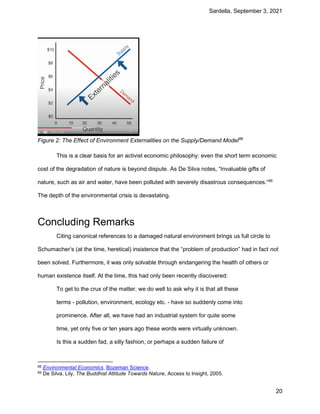
If this occurs in the manufacturing process, the result is a fundamental change in the
supply and demand model: it will carry an “externalities” penalty, which is key to fighting
environmental negligence. As shown in Figure 2, these externalities can, and should, drive up
price and dampen demand, leading to the inevitable and necessary incorporation of
environmental science into economics.
84 Ibid.
85 De Silva, Lily, The Buddhist Attitude Towards Nature, Access to Insight, 2005.
86 Harvey, Peter, An Introduction to Buddhist Ethics, Cambridge University Press, 2009. Page 153.
87 Harvey, Peter, An Introduction to Buddhist Ethics, Cambridge University Press, 2009. Page 153.
Sardella, September 3, 2021
20
Figure 2: The Effect of Environment Externalities on the Supply/Demand Model88
This is a clear basis for an activist economic philosophy: even the short term economic
cost of the degradation of nature is beyond dispute. As De Silva notes, “Invaluable gifts of
nature, such as air and water, have been polluted with severely disastrous consequences.“89
The depth of the environmental crisis is devastating.
Concluding Remarks
Citing canonical references to a damaged natural environment brings us full circle to
Schumacher’s (at the time, heretical) insistence that the “problem of production” had in fact not
been solved. Furthermore, it was only solvable through endangering the health of others or
human existence itself. At the time, this had only been recently discovered:
To get to the crux of the matter, we do well to ask why it is that all these
terms - pollution, environment, ecology etc. - have so suddenly come into
prominence. After all, we have had an industrial system for quite some
time, yet only five or ten years ago these words were virtually unknown.
Is this a sudden fad, a silly fashion, or perhaps a sudden failure of
88 Environmental Economics, Bozeman Science.
89 De Silva, Lily, The Buddhist Attitude Towards Nature, Access to Insight, 2005.
Sardella, September 3, 2021
21
nerve?90
He answered this himself, pointing out the Western economies had for some time been
“living on the capital of living nature…but at a fairly modest rate.”91
But this rate grew very
rapidly in the 1950’s and 1960’s, until by comparison, “all the industrial activities of mankind up
to, and including, World War II are as nothing. The next four or five years are likely to see more
industrial production…than all of mankind accomplished up to 1945.”92
Buddhist Economics has made progress as a modern ideal. Fundamentally, it calls for
an activist (decidedly not laissez-faire) economic. It has grown in popularity while staying
somewhat disjoint between the differing camps of religious scholars and economists. One way
to profitably bridge this gap is to use direct connections in the earliest Buddhist texts, the Pali
Canon. An understanding of the canon’s purpose and its original teachings bring an ancient and
practical view to modern concerns.
The canon provides a deep understanding of human nature, unchanged in twenty-five
centuries. It is a useful springboard to understanding the economic and environmental crises of
our times. Having shown these connections, the work is not done. It is clear that codification and
wisdom enhancement is of greater use than preaching without a foundation.
The question of measurement also still needs to be discussed. Further analysis would
be useful regarding the efficacy of concepts such as Gross National Happiness and the Gross
Progress Index. The former seems to be a propaganda tool (this is suspected in Bhutan, which
originated the concept but also does not score well) and the latter does not seem to have
“stuck” as an accepted economic measurement. Until accepted measures of well-being are
more widely ratified, they tend to be distractions, with results that are misleading at best.
90 Schumacher, E.F. Small is Beautiful, Page 18
91 Ibid. Pg 18
92 Ibid. Pg 18.
Sardella, September 3, 2021
22
Finally, there is also some unfinished work in distinguishing Buddhist Economics from actual
monastic practice, which has at times included rampant usury. 93
As noted throughout, a question remains as to whether a modern economic ethic to
address the crisis cited by Schumacher (and demonstrably more serious today) needs (or
ought) to be exclusively Buddhist. Many claims attributed to Buddhist Economics apply equally
well to other economic ethics such as the influences on welfare economics and the integration
of environmental studies into economic theory.94
To progress beyond its current state, Buddhist Economics needs to observe where each
“side” of it is not quite reaching the other. In that way, successful pursuit of these questions will
be found in more integrative work. The call to action is for each discipline to reach as far as it
can toward the other.
Works Cited
Aggañña Sutta, Bhikkhu Sujato, Long Discourse 27. Sutta Central.
About Sudatta (Anāthapiṇḍika) Sudatta Sutta (SN 10:8)
Bhikkhu-aparihaniya Sutta: Conditions for No Decline Among the Monks (AN 7.21)
Brown, Claire, Buddhist Economics: An Enlightened Approach for the Dismal Science, Bloomsbury Press,
2017
Brown, Claire and Zolnai, Laszlo, Buddhist Economics: An Overview, Society and Economy.
Cullaka-Seṭṭhi-Jātaka, from Jataka Volume I (J.I.120-22).
De Silva, Lily, The Buddhist Attitude Towards Nature, Access to Insight, 2005.
Cakkavattisīhanāda Sutta: The Lion’s Roar on the Turning of the Wheel (DN 26)
Drechsler, Wolfgang, Buddhist Economics for Pandemic Times, Journal of Global Buddhism, Volume
Harvey, Peter, An Introduction to Buddhist Ethics, Cambridge University Press, 2009.
93 Ornatowski, Gregory, Continuity and Change in the Economic Ethics of Buddhism, 1996.
94 Krugman, Paul: The Bad Economics of Fossil Fuel Defenders, New York Times, August 16, 2021.
Sardella, September 3, 2021
23
Harvey, Peter, Buddhist Reflections on “Consumer” and “Consumerism”, JBE, Volume 20, 2013.
King, Matthew, Buddhist Economics: Scales of Value in Global Exchange, July 2016.
Kuttadanta Sutta: A Bloodless Sacrifice
Loy, David, Why Buddhism and the West Need Each Other: One the Interdependence of Personal and
Social Transformation, Journal of Buddhist Ethics, Volume 20, 2013. Page 404
Maha-Assapura Sutta: The Greater Discourse at Assapura (MN 39) (Sutta Pitaka: Majjhima Nikaya)
Miceli, Maria, and de Rossis, Fiorella, Emotional and Nonemotional Persuasion, 2007.
Mitchell, Hadley T, The Ethics of Keynes, Journal of Markets and Morality, Vol. 20. No. 1, 2017.
Ornatowski, Gregory, Continuity and Change in the Economic Ethics of Buddhism, 1996.
Payutto, Ven. P.A., Buddhist Economics: A Middle Way for the Market Place, 1992, page 7.
Payutto, Ven. P.A., What a True Buddhist Should Know about the Pali Canon, MANUSYA: Journal of
Humanities (Special Issue: No.4 2002).
Rahula, Walpole, What the Buddha Taught, 1958
Schumacher, E.F., Small is Beautiful: Economics as if People Mattered, 2010 Edition.
Sigalovada Sutta: The Discourse to Sigala (The Layperson’s Discipline), Access to Insight

Using Pali Text in Buddhist Economics

  • 1.
    Sardella, September 3,2021 1 Using Original Pali Text in Buddhist Economics Abstract 1 Introduction 1 Claims from Economists and Buddhist Scholars 5 Canonical Relevance to the Modern World 9 Mental Suffering and Life’s Problems 9 Social (and Economic) Problems 14 Environmental Problems 17 Concluding Remarks 20 Works Cited 22 Abstract Concerns about the applicability of Buddhist Ethics to modern economics continue to be raised. Buddhist scholars lament that economists eschew canonical connections, while “Buddhist Economists” evade the endeavor or declare it unnecessary. I argue that original Pali texts elucidate modern economic concerns, and that exploring insights from these primary sources strengthens the understanding of Buddhist Ethics (and related ethical approaches) to modern economic theory and practice. Introduction The interdisciplinary concept of a Buddhist economic began with E.F. Schumacher’s work in Burma as an economic consultant in the 1950’s, and was crystallized in his 1966 essay,
  • 2.
    Sardella, September 3,2021 2 Buddhist Economics.1 The essay asserts that Right Livelihood, part of the Buddha’s Noble Eightfold Path, proves (emphasis mine) the existence of Buddhist economic ethics. Pursuing these ethics is urgent because economists “suffer from a kind of metaphysical blindness,”2 deluded that they attain absolute truth without exploring needed presuppositions about human nature, desire, and the kind of economic world we would create. In Small is Beautiful, Schumacher exposed a “religion of economics” whose only goal is for adherents to “act economically” no matter the externalities (such as labor exploitation or “other despicable practices”).3 For Schumacher, these practices stem from a false belief that “the problem of production has been solved,”4 an error he squarely places on the illusion that natural resources, finite and irreplaceable as “capital which man has not made”5 is instead (and catastrophically) treated as income, as though adjustable as a matter of business planning. Schumacher’s activist economics are in the tradition of John Maynard Keynes; both argued that a sought-after economic system should be the “result of insight into real human needs and aspirations.”6 Keynes viewed economics as a moral science, and while he at times embraced qualitative utilitarianism, he is arguably closest to virtue ethics.7 Schumacher, addressing the question of whether his proposed economic strategies and methods needed to be called “Buddhist” economics, wryly asserted that, “The choice of Buddhism...is purely incidental; the teachings of Christianity, Islam, or Judaism could have been used just as well as 1 Schumacher, E.F., Buddhist Economics, 1966. 2 Ibid. 3 Schumacher, E.F., Small is Beautiful: Economics as if People Mattered, 2010 Edition, page 47. 4 Ibid., page 13 5 Ibid., page 14 6 Schumacher, E.F., Small is Beautiful: Economics as if People Mattered, 2010 Edition, page 54. The two had a long professional relationship after Keynes published Schumacher’s Multilateral Clearing (1943). 7 Mitchell, Hadley T, The Ethics of Keynes, Journal of Markets and Morality, Vol. 20. No. 1, 2017.
  • 3.
    Sardella, September 3,2021 3 those of any other of the great Eastern traditions.”8 Schumacher also publicly quipped that he “could have called it Christian Economics,” but that “no one would have read it.”9 Nevertheless, vigorous research on this multidisciplinary subject continues this half- century later. From economists, work in the name of Buddhist Economics proceeds with only tentative links to Buddhism (let alone Buddhist scripture), and often could in fact be tied equally to any Abrahamic or Hindu religion, or to secular virtue ethics. He supports this assertion forcefully: “economics is a derived science from what I call meta-economics.”10 And to Schumacher, meta-economics “deals with man and his environment” and “derives its aims and objects from a study of man, and at least part of its methodology from a study of nature.”11 Although Buddhist ethical values align quite easily to his definition, this description of the “meta” does not require that it be Buddhist. But the concept and related ideas continued to resonate. Inspired by Schumacher, Ven. P. A. Payutto added gravitas to the notion of Buddhist Economics with interpretations and scriptural references.12 Peter Harvey has written at length on the subject, both in textbook format13 and in the Journal of Buddhist Ethics.14 These bodies of work—from economists on the one hand and Buddhist scholars on the other—take such different approaches that they are frequently not recognizable to each other.15 This leads to confusion and an unfortunate tendency to label more economic ideas as “Buddhist” than is warranted. The intent here is to argue that a criterion for making the 8 Ibid., page 55. 9 He makes this joking claim in a short video clip, Schumacher on Buddhist Economics. 10 Small is Beautiful, page 54 11 Ibid., Page 49. 12 King, Matthew, Buddhist Economic: Scales of Value in Global Exchange, July 2016. 13 Harvey, Peter, An Introduction to Buddhist Ethics, Cambridge University Press, 2009. A chapter is devoted to economic ethics. 14 Harvey, Peter, Buddhist Reflections on “Consumer” and “Consumerism”, JBE, Volume 20, 2013. 15 Clair Brown and Laszlo Zolnai are somewhat of a counterexample, although their synthesis of the disciplines is largely based on tangential connections of high level Buddhist concepts (e.g., interdependence) without scriptural source.
  • 4.
    Sardella, September 3,2021 4 “Buddhist” connection should be based on scriptural analogues or evidence that the spirit of a sutta (using source material where possible) matches a modern economic and ethical concern. The original suttas are often so practical that meaningful lines can be drawn between the canon and modern economic theory and practice. Source material solidifies the picture of human nature that’s inherent in these scriptures, and at times clarifies overlapping concerns with related ethical theories. Payutto notes that Schumacher created the notion (if not the field) of Buddhist Economics “in response to a crisis,”16 based largely on “the environmental repercussions of rampant consumerism.”17 The ultimate goal, then, is to work our way out of this (now deeper) crisis.18 The Pali texts, and their interpretations,19 offer an understanding of human nature and a practical viewpoint to a worldly life. Schumacher’s call for a meta-economic (prior to calling it “Buddhist”) and the relevance of secular welfare ethics in economics,20 including distributed justice,21 indicate possibilities for incorporating Buddhist ethics into a larger effort to address this ongoing and worsening crisis. The ultimate aim is to foster sustainable economic behavior (not to win a nonexistent ethics branding contest). Using more primary sources helps brings the audience closer to the actual experience behind the creation of the ethic. This approach, when compared to basing all case studies on high level terms such as interdependence, provides a better understanding of the foundation for an economic (or any other) behavior. 16 Payutto, Ven. P.A., Buddhist Economics: A Middle Way for the Market Place, 1992, page 7. 17 Ibid., page 7. 18 See, for instance, Climate Change 2021: The Physical Science Basis, Intergovernmental Panel on Climate Change, August 9, 2021. 19 And in fact later Buddhist manifestations such as Mahayana Buddhism 20 Economics and Ethics in Philosophy of Economics, Stanford Encyclopedia of Philosophy 21 Economics and Economic Justice, Stanford Encyclopedia of Philosophy.
  • 5.
    Sardella, September 3,2021 5 Claims from Economists and Buddhist Scholars The integration of the “Buddhist” and the “Economic” studies in Buddhist Economics has been uneven. Matthew King notes that Payutto, while adding relevant insights to Schumacher’s original ideas, “makes no serious claim that his ideas could act pragmatically as a model for actual economic policies on production, circulation, and consumption.”22 Furthermore, King laments that the question of creating meaningful ties to economic problems, “seems to be ignored by swaths of scholar-practitioners around the world keen to help construct an alternative economic model to late capitalism based on, say, selective quotations from the Pāli Canon or vague references to Buddhist virtues.”23 Citing Max Weber’s misinterpretation (due to having limited texts), King calls for development of a “robust study of Buddhism and economy from outside of Weber’s long shadow.”24 While making a salient point that there would generally have to be some extrapolation to connect the canon to modern economics, King (as will be shown in the next section) goes too far in dismissing the search for relevant economic ethics in the Buddha’s teachings. The economist Claire Browne provides a complete blueprint for economic change in a society that is based on an interdependence that extends to nature and all beings.25 In Buddhist Economics: An Enlightened Approach for the Dismal Science, she includes a chapter on relevant techniques for achieving sustainability, green production and products, living wages and reduced inequality, and effective social action.26 22 King, page 10. 23 Ibid., page 18. 24 Ibid., page 19. 25 Brown, Claire, Buddhist Economics: An Enlightened Approach for the Dismal Science, Bloomsbury Press, 2017. Page 8. 26 Ibid., 132-133
  • 6.
    Sardella, September 3,2021 6 Each of these ideas is essential, and it is urgent to implement them, or at least facsimiles of them. However, while compatible with much in Buddhism, they are not systematically developed by the Buddha’s teachings.27 (Secular ecology, for instance, has a binding reliance on interdependence.) Brown herself openly admits that she is not trying to provide sufficient rigor for economists or sufficient dharma for Buddhists.”28 In a subsequent work by Brown and Laszlo Zolnai, the authors positively assert that our modern economic problems are too different from those in the ancient world and that “[t]he most important modern economic and business phenomena, including the corporation, money without internal value, high leverage finance, stock exchanges and so on, cannot be meaningfully approached on the basis of the ancient knowledge of Buddhist teachers.29 Our economic problems—and their underlying constructs—are indeed quite different from those in Nepal and Northern India (or anywhere else) in the sixth century BCE. The Buddha certainly lived in a world without modern financial abstractions such as paper money and stock exchanges, although many of the constituent parts of these constructs are indirectly in the canon. These will be shown below in Mental Suffering and Life’s Problems. Furthermore, the ethical teachings in the Pali Canon are specific and universal, and holding overly fast to these differences of time and place foregoes an opportunity to identify connections that would deepen our understanding of modern ills. Brown and Zolnai are correct that Buddhist Economics is a strategy (as opposed to a system), but the strategy should contribute meaningfully to the goal. For this to happen, practical codes based on meta- economic and compassionate values should be the basis of, and built into, economic systems. 27 Drechsler, Wolfgang, Buddhist Economics for Pandemic Times, Journal of Global Buddhism, Volume 21, 2020. Page 106. 28 Brown, Page 6. 29 Brown, Claire and Zolnai, Laszlo, Buddhist Economics: An Overview, Society and Economy, December 2018. Page 510.
  • 7.
    Sardella, September 3,2021 7 Yet even Payutto questions the viability of making certain connections: “It is often asked which economic or political system is most compatible with Buddhism. Buddhism does not answer such a question directly…[E]conomic and political systems are a question of method, and methods, according to Buddhism, should be attuned to time and place.”30 Still, when Payutto also asserts that “a government’s wealth is for the purpose of supporting and organizing its citizens' lives in the most efficient and beneficial way,”31 he offers strong hints at the shape of that government (democratic republic?) and the economy (planned and socialistic?) it serves. He is certainly not speaking of free-market, zero-sum capitalism,32 or the propagandic strictures of mass-scale communism.33 Payutto offers further guidance as to how the canon provides ethical direction, first stating that (compared to the scriptures of all other religions) it is “unique in that it teaches an ethical system of self-development for human beings to be released from all sorts of problem[s].”34 He offers a map of how the canon “holds the key to solving the three-tier problems of human suffering, which can be represented as three circles (Figure 1).”35 30 Payutto, Ven. P.A., Page 48. 31 Ibid. 32 Harvey, Peter, An Introduction to Buddhist Ethics, Cambridge University Press, 2009. Pg 222. 33 Harvey, Peter, An Introduction to Buddhist Ethics, Cambridge University Press, 2009. Pg. 223 34 Payutto, Ven. P.A., What a True Buddhist Should Know about the Pali Canon, MANUSYA: Journal of Humanities (Special Issue: No.4 2002), Page 109. 35 Ibid.
  • 8.
    Sardella, September 3,2021 8 Figure 1: Circles of Human Suffering Addressed in the Canon36 The inner circles influence the outer ones; the three circles are as follows:  Life’s problems, particularly human mental suffering  Social problems (and economic can be added to these), and  Environmental problems.37 Thus, a way to approach the relevance of the Pali Canon is to work from the inside (individual suffering) out to social and environmental problems. Viewed this way, it can be inferred that the recommended ethical policies must be preceded by individual practice. As if to confirm this, David Loy notes that economic and political systems cannot serve their populations well “if the people within that system are motivated by greed, aggression, and delusion.”38 Instead, these motivations need to be “transformed into their more positive counterparts: generosity, loving-kindness, and wisdom.”39 One may ask why this is necessary or beneficial. To address the crisis cited by Schumacher, and, later, Payutto, the Buddhist Economic “movement” could expand to produce 36 Ibid. 37 Ibid. 38 Loy, David, Why Buddhism and the West Need Each Other: One the Interdependence of Personal and Social Transformation, Journal of Buddhist Ethics, Volume 20, 2013. Page 404 39 Ibid.
  • 9.
    Sardella, September 3,2021 9 specific guidance for applied micro- and macroeconomics based partly on original canon suttas and their interpretations. Suttas provide emotional appeals for the ethics they prescribe, which can lead to an economics with a goal of alleviating suffering.40 The next section illustrates that certain connections between the Pali Canon and modern economics can be made, and can profitably offer an exchange of Buddhist ethical principles to address the original stated goals of Buddhist Economics. The adjustments for modernity are varied, but often slight. For economists (and lawmakers) to have access to the canon (and related virtue ethics) allows for sharper reasoning in the experimentation of economics as a way to well-being (or, as Schumacher would put it, “as if people mattered”).41 Canonical Relevance to the Modern World The following sections offer scriptural examples to Payutto’s circles of human suffering as they relate to Buddhist Economics. The inner circle of mental suffering and life’s problems often contains advice for the for the “four assemblies”: bhikkhus (monks), bhikkhunīs (nuns), male lay disciples, and female lay disciples. Most of the Buddha’s financial teachings are addressed to these groups, and the social circle is influenced by, and needs to support, the “life’s problems” circle. A similar relationship exists, and is illustrated herein, between the social and the environmental circles. Mental Suffering and Life’s Problems At the age of 29, the Buddha, when “confronted with the reality of life and the suffering of mankind…decided to find the solution—the way out of this universal suffering.”42 This “way out” was introduced in the Fourth Noble Truth as the Eightfold Path, and “ethical conduct (sila), 40 Miceli, Maria, and de Rossis, Fiorella, Emotional and Nonemotional Persuasion, 2007. 41 The quoted text is the subtitle to Small is Beautiful. 42 Rahula, Wapole, What the Buddha Taught, The Buddha.
  • 10.
    Sardella, September 3,2021 10 based on love and compassion, are included in three factors of this path: right speech, right action, and right livelihood.”43 In Payutto’s preface to his Buddhist Economics, he establishes that “If the study of economics is to play any part in the solution of our problems, it can no longer evade the subject of ethics.”44 Harvey notes that Payutto “criticizes the tendency of modern economics to examine economic transactions in isolation from ethical consideration,” and that Payutto “emphasizes the economic impact of unethical behavior, such as reluctance to invest where there is social disorder, customer dissatisfaction if shoddy good are sold, and medical costs and poor health amongst workers.”45 This refutes King’s assertion (in Claims from Economists and Buddhist Scholars) that Payutto has nothing to say about production and consumption. The different ethical directions depend on two separate kinds of desire: tanha (craving directed by ignorance) and chanda (reflection directed towards benefit).46 Many householder admonishments center on controlling tanha.47 In Malavagga: Impurities (Dhp.186), a key verse provides a timeless ethic: There's no fire like passion, no seizure like anger, no snare like delusion, no river like craving.48 This is a scriptural call for temperance: limit passion, control anger, don’t be deluded by the separate self, and don’t drown in your craving. 43 Rahula, Wapole. What the Buddha Taught, The Fourth Noble Truth 44 Payutto, Ven. P.A., Buddhist Economics: A Middle Way for the Market Place, 1992, page 3. 45 Harvey, Buddhist Ethics, Page 217. 46 Payutto, Ven. P.A., Buddhist Economics: A Middle Way for the Market Place, 1992, page 17. 47 Ibid., page 15. 48 Malavagga: Impurities (Dhp.186), Access to Insight, Dhammapada
  • 11.
    Sardella, September 3,2021 11 And the Dhammapada states that “[t]here is no satisfying sensual desires, even with the rain of gold coins. For sensual pleasures give little satisfaction and much pain.”49 As such, “[t]he disciple of the Supreme Buddha delights in the destruction of craving.50 This allegory points to the root of unskilled householder economics: the destructive results of craving and the emphasis on mindless consumption. Harvey identifies the results of this, citing dictionary definitions of consume as “destroy” or “waste away.” 51 In this destruction and waste, our overconsumption and depletion of natural resources threatens “the world’s biosphere, our shared home.”52 While creating such destruction, it leaves individuals wholly unsatisfied: “Now this, monks, for the spiritually ennobled, is the originating- of-the-painful true reality. It is this craving, giving rise to rebirth, accompanied by delight and attachment, finding delight now here, now there . . .” (SN V. 421).53 On a more practical level, Buddha sought to specifically address home economic matters for the householder. First, there are proscriptions on “dissipating wealth” in the Sigala Sutta: taking intoxicants, loitering and idling day and night in the streets, unhealthy diversions into hyper-entertainment, gambling, etc.”54 These sound prohibitions on wasteful or sickness-inducing spending are well augmented by right livelihood advice on acquiring and using personal wealth: The wise and virtuous shine like a blazing fire. He who acquires his wealth in harmless ways like to a bee that honey gathers, 49 Dhammapada 251. 186-7. 50 Dhammapada 251. 186-7. 51 Harvey, Peter, Buddhist Reflections on “Consumer” and “Consumerism”, JBE, Volume 20, 2013. Pg.2 52 Harvey, Peter, Buddhist Reflections on “Consumer” and “Consumerism”, JBE, Volume 20, 2013. Pg.3. 53 Harvey, Peter, Buddhist Reflections on “Consumer” and “Consumerism”, JBE, Volume 20, 2013. Pg.5. 54 Sigalovada Sutta: The Discourse to Sigala (The Layperson’s Discipline), Access to Insight
  • 12.
    Sardella, September 3,2021 12 riches mount up for him like ant hill's rapid growth. With wealth acquired this way, a layman fit for household life, in portions four divides his wealth: thus will he friendship win. One portion for his wants he uses, two portions on his business spends, the fourth for times of need he keeps.55 This not only includes instructions to acquire the wealth by doing no harm (“like a bee that honey gathers”), but, in the last three lines, provides a very specific recommendation for allocating it. Addressing these themes so closely together in verse expresses a holistic home economic: how one acquires wealth in harmony with nature, followed by the most natural possible use of the wealth. Notably, the Buddha insisted that economic happiness takes a subordinate role to spiritual happiness: the following puts this in perspective: A hundred elephants, a hundred horses, a hundred mule-drawn carts, a hundred-thousand maidens adorned with jewels & earrings aren’t worth one-sixteenth of one step forward.56 55 Sigalovada Sutta: The Discourse to Sigala (The Layperson’s Discipline), Access to Insight 56 About Sudatta (Anāthapiṇḍika) Sudatta Sutta (SN 10:8)
  • 13.
    Sardella, September 3,2021 13 This is an admonition not to stray far from the primary goals of ending suffering, getting outside the cycle of life, and attaining Nirvāṇa. For the individual householder, there is even more explicit business instruction and ethical guidance in the Jatakas. Harvey points to a section of Cullaka-Seṭṭhi-Jātaka (J.I.120) that “seems to support entrepreneurial energy directed to investment and reinvestment.”57 In the parable, after hearing the words of a man he believes to be wise and deliberate, a young man perceives the seeds of a business in acquiring a dead mouse, and “sells it to a tavern, for its cat, and then goes on to become rich by a series of astute investments…”58 This outsized wealth gain proceeds in a series of shrewd (but honest and ethical) transactions that are combined with assistance to groups of workers who in turn assist the young man (a novice merchant) with his next leveraged arrangement. The timing of these trades, which are sometimes on new introductions from people for whom he has done good deeds (and other times on rumor!), are impeccable and his wealth and perceived skills grows to such proportions that he becomes the treasurer in training.59 Taking on voluntary debt of this order, particularly to build a business, is risky enough that it would likely involve interest. We can perhaps infer that the Buddha would not consider the loan of money to be altogether different from the loan of, for instance, an ox. If there’s hardship to the lender in either case, why would there not be a “fee” or collateral arrangement of some sort?60 Then, once in the realm of interest and debt, the financial mechanics of buying in bulk and deferring payments are involved, and this is a form of leverage.61 For an applied ethic at this level, this is the answer to the objections from economists (see above in Claims from 57 Harvey, Peter, An Introduction to Buddhist Ethics, Cambridge University Press, 2009. Pg. 209 58 Ibid., page 209 59 Cullaka-Seṭṭhi-Jātaka, from Jataka Volume I (J.I.120-22). 60 Guide to Buddhism, Interest. 61 Cullaka-Seṭṭhi-Jātaka, from Jataka Volume I (J.I.120-22).
  • 14.
    Sardella, September 3,2021 14 Economists and Buddhist Scholars) that the modern world is too abstract to draw lessons from these sources. Finally, Harvey notes that the dependable and astute businessman in the story is exhibiting “qualities for which there are spiritual parallels.”62 For instance: With humblest start and trifling capital A shrewd and able man will rise to wealth, E'en as his breath can nurse a tiny flame.63 As the next section will discuss, this householder economics contributes to solutions to socio-economic problems. Accordingly, the social structure must uphold the individual and householder economics needs. Social (and Economic) Problems The Buddha taught on political and economic matters, albeit not in a single collection or set of books. The social64 set of problems in the canon show a consistent bias again laissez- faire economics or government. Before “Buddhist Economics” was conceived, Rahula (in 1958) noted that, “[t]he Cakkavattisīhanāda-sutta65 of the Dīgha-nikāya (No.26) clearly states that poverty (dāḷiddiya) is the cause of immorality and crimes such as theft, falsehood, violence, hatred, cruelty, etc.”66 The universal monarch turning the dhamma wheel seeks a peaceful conquest of the world. His message is that of a very activist and compassionate kingdom: “Let no crime prevail 62 Harvey, Peter, An Introduction to Buddhist Ethics, Cambridge University Press, 2009. Pg. 209 63 Cullaka-Seṭṭhi-Jātaka, from Jataka Volume I (J.I.120-22). 64 I add “economic” here. 65 The Lion’s Roar of the Wheel Turning Emperor (palicanon.org). 66 Rahula, Walpole, What the Buddha Taught, electronic edition. Text is from Chapter 8, What the Buddha Taught and the World Today.
  • 15.
    Sardella, September 3,2021 15 in your kingdom, and to those who are in need, give property.”67 Along with this distribution of property comes another message: the monarch should counsel as to “what is wholesome and what is unwholesome, what is blameworthy and what is blameless, what is to be followed and what is not to be followed, and what action will in the long run lead to harm and sorrow, and what to welfare and happiness.”68 At a certain point the wheel disappears. The King, unfortunately, does not consult the royal sage but instead “rules the people according to his own ideas, and, being so ruled, the people did not prosper so well as they had done under the previous kings who had performed the duties of a wheel-turning monarch.”69 After finally consulting his ministers, the King begins to give property to some subjects accused of theft, but because he had not cared for the needy in the first place, it did not stop the cycle of crime and violence: Thus, from the not giving of property to the needy…the taking of life increased, and from the taking of life, lying increased, from the increase in lying, people’s life-span decreased, their beauty decreased…”70 This social view holds up over twenty-five centuries (though ways to address it vary widely), and these sentiments today have their analogues in, for instance, calls for a universal basic income, a social safety net, and a progressive income tax. It is in fact a recipe for a strong welfare ethic, a compassionate socialism or a visionary commonwealth. What it is not, under any circumstances, is a laissez-fair government. In economic terms, it is a movement towards John Kenneth Galbraith’s Good Society. In a much less-remembered campaign of President Lyndon Baines Johnson—the War on Poverty—Johnson noted that the causes of poverty lie "in 67 Cakkavattisīhanāda Sutta: The Lion’s Roar on the Turning of the Wheel 68 Ibid. 69 Ibid. 70 Ibid (15)
  • 16.
    Sardella, September 3,2021 16 a lack of education and training, in a lack of medical care and housing, in a lack of decent communities in which to live."71 Johnson took an identical ethical position to that in the Cakkavattisīhanāda-sutta when he added, "The richest nation on Earth can afford to win it. We cannot afford to lose it."72 According to Harvey, the Kuttadanta Sutta (D.I.134-6) provides a related message.73 A brahmin advisor counsels the King on how to get rid of the plague of crime and violence, telling him that if he tried to “get rid of this plague of robbers by executions and imprisonment, or by confiscation, threats and banishment, the plague would not be properly ended. Those who survived would later harm Your Majesty's realm.74 Instead, to eliminate this plague, the king is instructed to: “distribute grain and fodder; to those in trade, give capital; to those in government service assign proper living wages.”75 When the people are thus content with their occupations and positions in life: Your Majesty's revenues will be great, the land will be tranquil and not beset by thieves, and the people, with joy in their hearts, will play with their children, and will dwell in open houses."76 This is an even more specific treatise on the subsidization and the distribution of capital comprehensively to varied groups: farmers, tradesmen, government workers, etc. The ethic could apply equally well (with adjustments to scale that may or may not be necessary) to the New Deal. It insists upon living wages. These connections are difficult to miss, and can be the seeds of a more specific ethical protocol. 71 Lyndon Johnson’s First State of the Union Address, 1964. 72 Ibid. 73 Harvey, Peter, An Introduction to Buddhist Ethics, Cambridge University Press, 2009. Page 198. 74 Kuttadanta Sutta: A Bloodless Sacrifice 75 Ibid. 76 Ibid.
  • 17.
    Sardella, September 3,2021 17 Although Payutto avoids committing to a preferred Buddhist economic or political system, he does allow that “a government’s wealth is for the purpose of supporting and organizing its citizens’ lives in the most efficient and beneficial way possible.”77 He then also explains how the Buddha was able to temper his message depending on the type of government being addressed. For instance, the Buddha gave separate teachings for monarchies (the Cakkavattisīhanāda-sutta) as opposed to republican states, to which he taught the aparihaniyadhamma,78 or “principles and methods for encouraging social harmony and preventing decline.”79 These methods are recommendations for decorum and communication that resonate today: meet often, meet in harmony, respect one another, do not submit to (presumably tanha-based) cravings that arise, come well behaved and well intentioned: “As long as the monks remain steadfast in these seven conditions…the monks' growth can be expected, not their decline.”80 Though directed at monastics, these are lessons for any modern governing board or legislative body: assemblies committed to compassionate policies. Again, Buddhism is not the only code of ethics that addresses civility in civic procedure. But spelled-out references allow us to see what’s essential in the policy process when addressing the modern economic crisis—and as shown in the next section, the integrated ecological one as well. Environmental Problems As the suffering of the human mind causes social problems, social problems cause environmental ones. Lily De Silva notes that, “[Since] Buddhism is a full-fledged philosophy of 77 Payutto, Ven. P.A., Buddhist Economics: A Middle Way for the Market Place, 1992, page 47. 78 AN 7.21: Bhikkhu-aparihaniya Sutta: Conditions for No Decline Among the Monks 79 Payutto, Ven. P.A., Buddhist Economics: A Middle Way for the Market Place, 1992, page 47. 80 AN 7.21: Bhikkhu-aparihaniya Sutta: Conditions for No Decline Among the Monks
  • 18.
    Sardella, September 3,2021 18 life reflecting all aspects of experience, it is possible to find enough material in the Pali canon to delineate the Buddhist attitude towards nature.”81 In the canonical literature, there is very little to be found strictly on environmental degradation, which is a much more recent phenomenon. Buddhist reverence for the beauty of nature (and the low population, and the lack of polluting industrial machinery) kept this issue minimized. But not entirely: a sutta in the Anguttara Nikaya, Volume II shows environmental carnage when kings (leaders) do not act righteously: “[T]he winds blow wrong, out of season. Thus the gods are annoyed. This being so, the sky-god does not bestow sufficient rain.” (A. II.74-6) As Harvey notes, this means that unrighteous actions of the king lead to poor crops and weak and short-lived humans.82 Payutto applies this perspective to the present day, seeing that “environmental problems have stemmed from the misguided view that humans are distinct from nature.” But “nature is a system of relations of all phenomena—man included—that are causally and conditionally interdependent.” The Aggañña Sutta83 starts with the evolution of the world, and after a long expanding and contracting of the cosmos, there was (in “Garden of Eden” style) the ability for self-luminous beings to be supported by the gifts of the earth entirely, by (somewhat bizarrely) eating buttery nectar that grows on it: After a very long period had passed, solid nectar curdled in the water. It appeared just like the curd on top of hot milk-rice as it cools. It was beautiful, fragrant, and delicious, like ghee or butter. And it was as sweet as pure manuka honey. Now, one of those beings was reckless. Thinking, ‘Oh my, what might this be?’ they tasted the solid nectar with their finger. They enjoyed it, and craving was born in them. And other beings, 81 De Silva, Lily, The Buddhist Attitude Towards Nature, Access to Insight, 2005. 82 Harvey, Peter, An Introduction to Buddhist Ethics, Cambridge University Press, 2009. Page 115. 83 Aggañña Sutta, Bhikkhu Sujato, Long Discourse 27. Sutta Central.
  • 19.
    Sardella, September 3,2021 19 following that being’s example, tasted solid nectar with their fingers. They too enjoyed it, and craving was born in them.84 This craving itself leads to environmental disaster. And as Lily De Silva notes, greed in these beings caused them to “lose their radiance and ability to subsist on joy and to move about in the sky.”85 As the greed increased, the bodies became solid and mortal, and infused with all of the disadvantages of having to fend for ourselves. An environment that is at first bountiful “becomes quickly less so, the more they greedily take from it.”86 There are more specific references to pollution. Harvey points out that “several Vinaya rules prohibit monks from polluting green grass and water with saliva, urine, and feces. These were the common agents of pollution known during the Buddha's day and rules were promulgated against causing such pollution.”87 If this occurs in the manufacturing process, the result is a fundamental change in the supply and demand model: it will carry an “externalities” penalty, which is key to fighting environmental negligence. As shown in Figure 2, these externalities can, and should, drive up price and dampen demand, leading to the inevitable and necessary incorporation of environmental science into economics. 84 Ibid. 85 De Silva, Lily, The Buddhist Attitude Towards Nature, Access to Insight, 2005. 86 Harvey, Peter, An Introduction to Buddhist Ethics, Cambridge University Press, 2009. Page 153. 87 Harvey, Peter, An Introduction to Buddhist Ethics, Cambridge University Press, 2009. Page 153.
  • 20.
    Sardella, September 3,2021 20 Figure 2: The Effect of Environment Externalities on the Supply/Demand Model88 This is a clear basis for an activist economic philosophy: even the short term economic cost of the degradation of nature is beyond dispute. As De Silva notes, “Invaluable gifts of nature, such as air and water, have been polluted with severely disastrous consequences.“89 The depth of the environmental crisis is devastating. Concluding Remarks Citing canonical references to a damaged natural environment brings us full circle to Schumacher’s (at the time, heretical) insistence that the “problem of production” had in fact not been solved. Furthermore, it was only solvable through endangering the health of others or human existence itself. At the time, this had only been recently discovered: To get to the crux of the matter, we do well to ask why it is that all these terms - pollution, environment, ecology etc. - have so suddenly come into prominence. After all, we have had an industrial system for quite some time, yet only five or ten years ago these words were virtually unknown. Is this a sudden fad, a silly fashion, or perhaps a sudden failure of 88 Environmental Economics, Bozeman Science. 89 De Silva, Lily, The Buddhist Attitude Towards Nature, Access to Insight, 2005.
  • 21.
    Sardella, September 3,2021 21 nerve?90 He answered this himself, pointing out the Western economies had for some time been “living on the capital of living nature…but at a fairly modest rate.”91 But this rate grew very rapidly in the 1950’s and 1960’s, until by comparison, “all the industrial activities of mankind up to, and including, World War II are as nothing. The next four or five years are likely to see more industrial production…than all of mankind accomplished up to 1945.”92 Buddhist Economics has made progress as a modern ideal. Fundamentally, it calls for an activist (decidedly not laissez-faire) economic. It has grown in popularity while staying somewhat disjoint between the differing camps of religious scholars and economists. One way to profitably bridge this gap is to use direct connections in the earliest Buddhist texts, the Pali Canon. An understanding of the canon’s purpose and its original teachings bring an ancient and practical view to modern concerns. The canon provides a deep understanding of human nature, unchanged in twenty-five centuries. It is a useful springboard to understanding the economic and environmental crises of our times. Having shown these connections, the work is not done. It is clear that codification and wisdom enhancement is of greater use than preaching without a foundation. The question of measurement also still needs to be discussed. Further analysis would be useful regarding the efficacy of concepts such as Gross National Happiness and the Gross Progress Index. The former seems to be a propaganda tool (this is suspected in Bhutan, which originated the concept but also does not score well) and the latter does not seem to have “stuck” as an accepted economic measurement. Until accepted measures of well-being are more widely ratified, they tend to be distractions, with results that are misleading at best. 90 Schumacher, E.F. Small is Beautiful, Page 18 91 Ibid. Pg 18 92 Ibid. Pg 18.
  • 22.
    Sardella, September 3,2021 22 Finally, there is also some unfinished work in distinguishing Buddhist Economics from actual monastic practice, which has at times included rampant usury. 93 As noted throughout, a question remains as to whether a modern economic ethic to address the crisis cited by Schumacher (and demonstrably more serious today) needs (or ought) to be exclusively Buddhist. Many claims attributed to Buddhist Economics apply equally well to other economic ethics such as the influences on welfare economics and the integration of environmental studies into economic theory.94 To progress beyond its current state, Buddhist Economics needs to observe where each “side” of it is not quite reaching the other. In that way, successful pursuit of these questions will be found in more integrative work. The call to action is for each discipline to reach as far as it can toward the other. Works Cited Aggañña Sutta, Bhikkhu Sujato, Long Discourse 27. Sutta Central. About Sudatta (Anāthapiṇḍika) Sudatta Sutta (SN 10:8) Bhikkhu-aparihaniya Sutta: Conditions for No Decline Among the Monks (AN 7.21) Brown, Claire, Buddhist Economics: An Enlightened Approach for the Dismal Science, Bloomsbury Press, 2017 Brown, Claire and Zolnai, Laszlo, Buddhist Economics: An Overview, Society and Economy. Cullaka-Seṭṭhi-Jātaka, from Jataka Volume I (J.I.120-22). De Silva, Lily, The Buddhist Attitude Towards Nature, Access to Insight, 2005. Cakkavattisīhanāda Sutta: The Lion’s Roar on the Turning of the Wheel (DN 26) Drechsler, Wolfgang, Buddhist Economics for Pandemic Times, Journal of Global Buddhism, Volume Harvey, Peter, An Introduction to Buddhist Ethics, Cambridge University Press, 2009. 93 Ornatowski, Gregory, Continuity and Change in the Economic Ethics of Buddhism, 1996. 94 Krugman, Paul: The Bad Economics of Fossil Fuel Defenders, New York Times, August 16, 2021.
  • 23.
    Sardella, September 3,2021 23 Harvey, Peter, Buddhist Reflections on “Consumer” and “Consumerism”, JBE, Volume 20, 2013. King, Matthew, Buddhist Economics: Scales of Value in Global Exchange, July 2016. Kuttadanta Sutta: A Bloodless Sacrifice Loy, David, Why Buddhism and the West Need Each Other: One the Interdependence of Personal and Social Transformation, Journal of Buddhist Ethics, Volume 20, 2013. Page 404 Maha-Assapura Sutta: The Greater Discourse at Assapura (MN 39) (Sutta Pitaka: Majjhima Nikaya) Miceli, Maria, and de Rossis, Fiorella, Emotional and Nonemotional Persuasion, 2007. Mitchell, Hadley T, The Ethics of Keynes, Journal of Markets and Morality, Vol. 20. No. 1, 2017. Ornatowski, Gregory, Continuity and Change in the Economic Ethics of Buddhism, 1996. Payutto, Ven. P.A., Buddhist Economics: A Middle Way for the Market Place, 1992, page 7. Payutto, Ven. P.A., What a True Buddhist Should Know about the Pali Canon, MANUSYA: Journal of Humanities (Special Issue: No.4 2002). Rahula, Walpole, What the Buddha Taught, 1958 Schumacher, E.F., Small is Beautiful: Economics as if People Mattered, 2010 Edition. Sigalovada Sutta: The Discourse to Sigala (The Layperson’s Discipline), Access to Insight