BUDDHIST ECONOMICS
“Creating Meaningful Lives in Sustainable World”
CLAIR BROWN, University of California, Berkeley
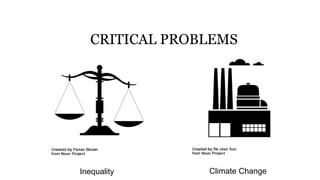
CRITICAL PROBLEMS
Inequality Climate Change
BUDDHIST ECONOMICS
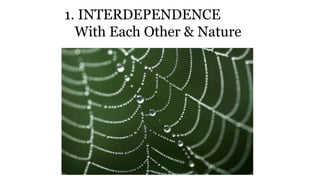
1. INTERDEPENDENCE
With Each Other & Nature
Barry Commoner
Founder of modern ecology
5
• Interdependence is one of the four laws of ecology:
“Everything is connected to everything else. There is
one ecosphere for all living organisms and what
affects one, affects all.”
Barry Commoner, The Closing Circle: Nature, Man, and Technology
(New York: Random House, 1971).
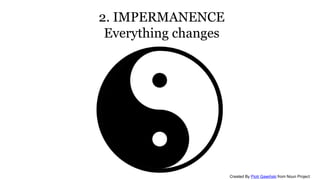
2. IMPERMANENCE
Everything changes
Created By Piotr Gawiński from Noun Project
3. COMPASSION
Reduce suffering
FREE MARKET ECONOMICS
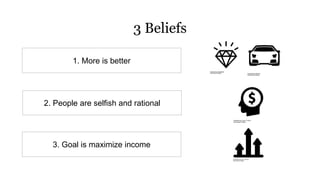
3 Beliefs
1. More is better
3. Goal is maximize income
2. People are selfish and rational
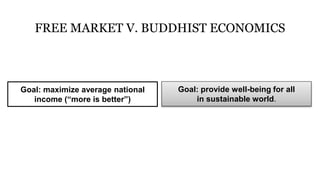
FREE MARKET V. BUDDHIST ECONOMICS
Goal: maximize average national
income (“more is better”)
Goal: provide well-being for all
in sustainable world.
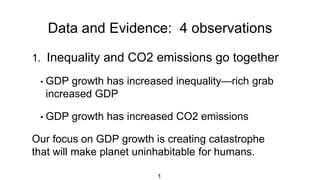
Data and Evidence: 4 observations
1
1. Inequality and CO2 emissions go together
• GDP growth has increased inequality—rich grab
increased GDP
• GDP growth has increased CO2 emissions
Our focus on GDP growth is creating catastrophe
that will make planet uninhabitable for humans.
1
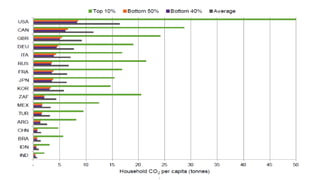
Overconsumption by Rich Countries
1
• UN benchmark: 2.1 tCO2e (metric tons of carbon)
per person per year by 2050
• US average 16.4 tCO2 per person
• Richest 10%: Avg 50 tCO2e per person
• Bottom 50% of income: Avg 8.5 tCO2e per person
• EU average 6.7 tCO2 per person.
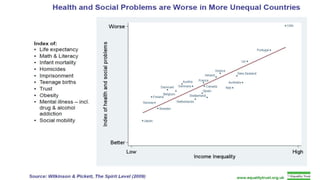
2. Inequality reduces well-being
1
• People feel worse off as inequality grows
• Invidious comparisons (relative income important)
• Well-being index worsens as income inequality
increases across rich countries
3. Global Subsidies to Fossil Fuel Industry
and to the Rich (direct payments, in-kind payments)
1
• Direct fossil fuel subsidies worldwide $333 billion
• Add social costs (indirect costs to human health &
environmental damage): subsidies are $5.3 trillion
(6.5% of global output).
• Source: IMF for 2015
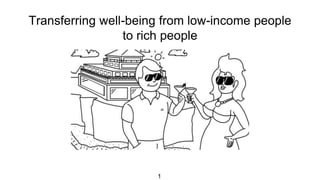
• Low-income families & regions indirectly (worse health
& pollution & climate crisis) subsidize rich people &
nation’s high-carbon, wasteful lifestyles.
Transferring well-being from low-income people
to rich people
1
Are People Altruistic or Selfish?
Interdependent or Individualistic?
Icon credits at the end
4. People are altruistic as well as self-regarding
1
• Psychologists & neuroscientists confirm: people act
with altruism as well as selfishness.
• Economists observe in lab games: people have
altruistic feelings.
• Altruism: unconditional caring about others with no
ulterior motive
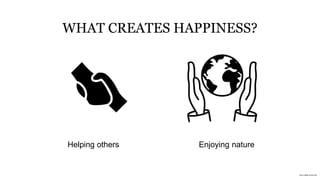
WHAT CREATES HAPPINESS?
Helping others Enjoying nature
Icon credits at the end
Psychologists:
What makes people happy?
2
• Being kind to others makes people happier.
• Eudaimonic happiness comes from helping others,
good relationships, contributing to community, and
enjoying surroundings.
• Hedonic happiness from buying stuff doesn’t last long.
Buddhist Economy can create a healthier,
happier world.
2
• Known government policies to reduce inequality,
provide economic security and opportunity for all people.
• Roadmaps show how to create sustainable economy
with carbon-free energy, regenerative agriculture, and
clean water.
• UN Millennium Development Goals demonstrated how
to reduce global hunger and poverty, and educate
women and girls.
Role of Government
• Rules, incentives to structure markets, along with
social programs to achieve social goals
• Transition to modern, low carbon, equitable
economy.
• Create an economy that supports meaningful life for
all people and cares for Mother Earth.
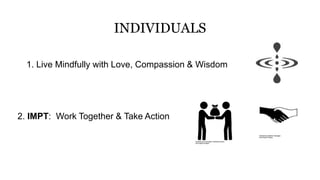
1. Live Mindfully with Love, Compassion & Wisdom
INDIVIDUALS
2. IMPT: Work Together & Take Action
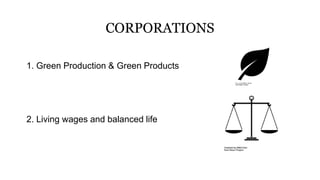
CORPORATIONS
2. Living wages and balanced life
1. Green Production & Green Products
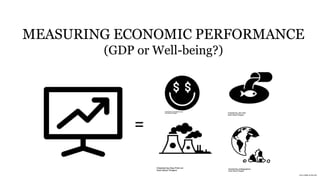
MEASURING ECONOMIC PERFORMANCE
(GDP or Well-being?)
=
Icon credits at the end
New measurement of economic performance
2
• Economic performance is no longer income growth
• Includes equity, sustainability, family and
community
• Measures well-being of people and the
environment
UK, France, OECD, UN have created economic performance
measures that include quality of life, distribution and
sustainability.
All countries
• Use clean energy and regenerative agriculture.
• Waste less food (30% wasted globally; 40% in US) and eat
less meat.
• Animals use 83% of farmland, cause 57% of food-related emissions,
provide 18% of calories.
Rich countries reduce wasteful consumption; fly less; support
sustainable development in poor countries.
Poor countries increase basic consumption; reduce population
growth.
Equitable Global Solution
CLOSING THOUGHTS
We need political will and courage to take action on behalf of people
and Mother Earth, over generations.
This is a lifetime commitment and process.
May we continue the journey together.
Gratitude to friends around the world for insight and support.
BUDDHIST ECONOMICS:
An enlightened approach to the dismal science
Clair Brown
Bloomsbury Press
Buddhisteconomics.net
• Need to stay under 1.5C to prevent catastrophic changes--
sea level rise, warm & acidic oceans, droughts, inadequate
water supplies, deaths from overheating & disease.
• Current pledges will cause temperatures to rise 2.9C by
2100.
• If countries do not act: temperatures rise 4.5C
• Top four emitters (China 27%, US 15%, EU 10%, India 7%)
cause 59% of GHGs.
Paris 2015 (COP21)-- Not Enough.
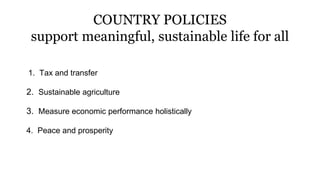
COUNTRY POLICIES
support meaningful, sustainable life for all
1. Tax and transfer
2. Sustainable agriculture
3. Measure economic performance holistically
4. Peace and prosperity
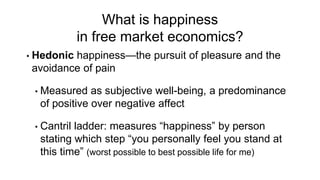
• Hedonic happiness—the pursuit of pleasure and the
avoidance of pain
• Measured as subjective well-being, a predominance
of positive over negative affect
• Cantril ladder: measures “happiness” by person
stating which step “you personally feel you stand at
this time” (worst possible to best possible life for me)
What is happiness
in free market economics?
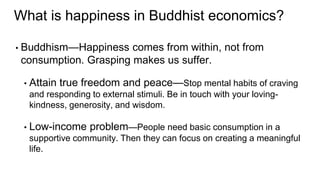
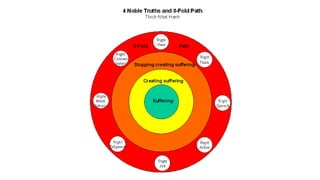
• Buddhism—Happiness comes from within, not from
consumption. Grasping makes us suffer.
• Attain true freedom and peace—Stop mental habits of craving
and responding to external stimuli. Be in touch with your loving-
kindness, generosity, and wisdom.
• Low-income problem—People need basic consumption in a
supportive community. Then they can focus on creating a meaningful
life.
What is happiness in Buddhist economics?
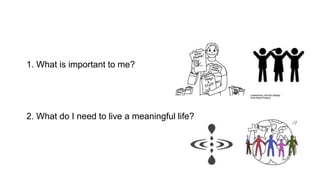
1. What is important to me?
2. What do I need to live a meaningful life?
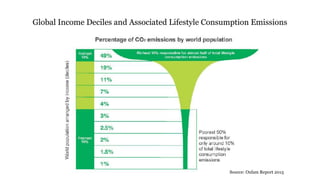
Global Income Deciles and Associated Lifestyle Consumption Emissions
Source: Oxfam Report 2015

Buddhist economics - Principles

  • 1.
    BUDDHIST ECONOMICS “Creating MeaningfulLives in Sustainable World” CLAIR BROWN, University of California, Berkeley
  • 2.
  • 3.
  • 4.
  • 5.
    Barry Commoner Founder ofmodern ecology 5 • Interdependence is one of the four laws of ecology: “Everything is connected to everything else. There is one ecosphere for all living organisms and what affects one, affects all.” Barry Commoner, The Closing Circle: Nature, Man, and Technology (New York: Random House, 1971).
  • 6.
    2. IMPERMANENCE Everything changes CreatedBy Piotr Gawiński from Noun Project
  • 7.
  • 8.
  • 9.
    3 Beliefs 1. Moreis better 3. Goal is maximize income 2. People are selfish and rational
  • 10.
    FREE MARKET V.BUDDHIST ECONOMICS Goal: maximize average national income (“more is better”) Goal: provide well-being for all in sustainable world.
  • 11.
    Data and Evidence:4 observations 1 1. Inequality and CO2 emissions go together • GDP growth has increased inequality—rich grab increased GDP • GDP growth has increased CO2 emissions Our focus on GDP growth is creating catastrophe that will make planet uninhabitable for humans.
  • 12.
  • 13.
    Overconsumption by RichCountries 1 • UN benchmark: 2.1 tCO2e (metric tons of carbon) per person per year by 2050 • US average 16.4 tCO2 per person • Richest 10%: Avg 50 tCO2e per person • Bottom 50% of income: Avg 8.5 tCO2e per person • EU average 6.7 tCO2 per person.
  • 14.
    2. Inequality reduceswell-being 1 • People feel worse off as inequality grows • Invidious comparisons (relative income important) • Well-being index worsens as income inequality increases across rich countries
  • 16.
    3. Global Subsidiesto Fossil Fuel Industry and to the Rich (direct payments, in-kind payments) 1 • Direct fossil fuel subsidies worldwide $333 billion • Add social costs (indirect costs to human health & environmental damage): subsidies are $5.3 trillion (6.5% of global output). • Source: IMF for 2015 • Low-income families & regions indirectly (worse health & pollution & climate crisis) subsidize rich people & nation’s high-carbon, wasteful lifestyles.
  • 17.
    Transferring well-being fromlow-income people to rich people 1
  • 18.
    Are People Altruisticor Selfish? Interdependent or Individualistic? Icon credits at the end
  • 19.
    4. People arealtruistic as well as self-regarding 1 • Psychologists & neuroscientists confirm: people act with altruism as well as selfishness. • Economists observe in lab games: people have altruistic feelings. • Altruism: unconditional caring about others with no ulterior motive
  • 20.
    WHAT CREATES HAPPINESS? Helpingothers Enjoying nature Icon credits at the end
  • 21.
    Psychologists: What makes peoplehappy? 2 • Being kind to others makes people happier. • Eudaimonic happiness comes from helping others, good relationships, contributing to community, and enjoying surroundings. • Hedonic happiness from buying stuff doesn’t last long.
  • 22.
    Buddhist Economy cancreate a healthier, happier world. 2 • Known government policies to reduce inequality, provide economic security and opportunity for all people. • Roadmaps show how to create sustainable economy with carbon-free energy, regenerative agriculture, and clean water. • UN Millennium Development Goals demonstrated how to reduce global hunger and poverty, and educate women and girls.
  • 23.
    Role of Government •Rules, incentives to structure markets, along with social programs to achieve social goals • Transition to modern, low carbon, equitable economy. • Create an economy that supports meaningful life for all people and cares for Mother Earth.
  • 24.
    1. Live Mindfullywith Love, Compassion & Wisdom INDIVIDUALS 2. IMPT: Work Together & Take Action
  • 25.
    CORPORATIONS 2. Living wagesand balanced life 1. Green Production & Green Products
  • 26.
    MEASURING ECONOMIC PERFORMANCE (GDPor Well-being?) = Icon credits at the end
  • 27.
    New measurement ofeconomic performance 2 • Economic performance is no longer income growth • Includes equity, sustainability, family and community • Measures well-being of people and the environment UK, France, OECD, UN have created economic performance measures that include quality of life, distribution and sustainability.
  • 28.
    All countries • Useclean energy and regenerative agriculture. • Waste less food (30% wasted globally; 40% in US) and eat less meat. • Animals use 83% of farmland, cause 57% of food-related emissions, provide 18% of calories. Rich countries reduce wasteful consumption; fly less; support sustainable development in poor countries. Poor countries increase basic consumption; reduce population growth. Equitable Global Solution
  • 30.
    CLOSING THOUGHTS We needpolitical will and courage to take action on behalf of people and Mother Earth, over generations. This is a lifetime commitment and process. May we continue the journey together.
  • 31.
    Gratitude to friendsaround the world for insight and support. BUDDHIST ECONOMICS: An enlightened approach to the dismal science Clair Brown Bloomsbury Press Buddhisteconomics.net
  • 32.
    • Need tostay under 1.5C to prevent catastrophic changes-- sea level rise, warm & acidic oceans, droughts, inadequate water supplies, deaths from overheating & disease. • Current pledges will cause temperatures to rise 2.9C by 2100. • If countries do not act: temperatures rise 4.5C • Top four emitters (China 27%, US 15%, EU 10%, India 7%) cause 59% of GHGs. Paris 2015 (COP21)-- Not Enough.
  • 33.
    COUNTRY POLICIES support meaningful,sustainable life for all 1. Tax and transfer 2. Sustainable agriculture 3. Measure economic performance holistically 4. Peace and prosperity
  • 34.
    • Hedonic happiness—thepursuit of pleasure and the avoidance of pain • Measured as subjective well-being, a predominance of positive over negative affect • Cantril ladder: measures “happiness” by person stating which step “you personally feel you stand at this time” (worst possible to best possible life for me) What is happiness in free market economics?
  • 35.
    • Buddhism—Happiness comesfrom within, not from consumption. Grasping makes us suffer. • Attain true freedom and peace—Stop mental habits of craving and responding to external stimuli. Be in touch with your loving- kindness, generosity, and wisdom. • Low-income problem—People need basic consumption in a supportive community. Then they can focus on creating a meaningful life. What is happiness in Buddhist economics?
  • 36.
    1. What isimportant to me? 2. What do I need to live a meaningful life?
  • 38.
    Global Income Decilesand Associated Lifestyle Consumption Emissions Source: Oxfam Report 2015