Open Source and Healthcare in Europe - Time to Put Leading Edge Ideas into Practice Peter J Murray, Graham Wright Thomas Karopka, Helen Betts, Andrej Orel
Open Source and Healthcare in Europe - Time to Put Leading Edge Ideas into Practice A workshop organised by the EFMI LIFOSS and IMIA OS Working groups
Helen Betts UK representative to EFMI; Director, CHIRAD Workshop Chair
Workshop outline: Main issues/messages of the 2004 Open Steps workshops and the EFMI STC 2008 -  Peter Murray Building the FLOSS-HC Community - A strategy for the advancement of FLOSS in health care - Thomas Karopka Open Source Business Rule Management System (BRMS) – A implementation in the breast cancer screening program DORA – Anze Droljc/Andrej Orel
Workshop outline: Discussion – Helen Betts chairing EFMI/IMIA WGs business meeting/discussion (builds on preceding presentations and discussion) -Thomas Karopka leading
Peter J. Murray Director, CHIRAD; Acting Executive Director, IMIA Open Steps  (2004) workshops and EFMI STC 2008
Peter J. Murray Founding member of: IMIA Open Source WG (2002) AMIA Open Source WG (2003) EFMI Libre/Free and Open Source WG (2005)
What was  Open Steps ? What were the outputs? What has happened since with WG activity?  What did the EFMI STC 2008 find?
Marwell  Open Steps  meeting Marwell Zoo Hotel, Winchester, UK – February 2004 - invited 24hour thinktank of 30 people; funded by BCSHIF - mostly UK; others Czech, Belgian, Dutch, North American - iterative discussions and electronic voting
Main purpose of  Open Steps : ...to identify key issues, opportunities, obstacles, areas of work and research ... around the potential for using open source software, solutions and approaches within health care, and in particular within health informatics, in the UK and Europe.
Three quarters of attendees described their 'ideal vision for the future use of software in healthcare' as containing at least a significant percentage of Free/Libre/Open Source Software (FLOSS), with nearly one third wanting to see it 'entirely open source'.
The emergence of a situation wherein FLOSS could interface with proprietary software within the healthcare domain was seen to be both achievable and desirable, and also likely if the right drivers were put in place and barriers addressed.
Participants rated the most important issues why people do and might use FLOSS within the health domain as: quality, stability and robustness of software and data, as well as long-term availability of important health data through not being locked up in proprietary systems that do not allow interoperability and data migration.
Participants felt that the strongest drivers (towards adoption/use of FLOSS in healthcare) were: -  adoption and use of the right standards (the strongest driver) - the development of an OS 'killer application' (the next strongest) - political mandate towards the use of OSS
Participants felt that the strongest drivers (towards adoption/use of FLOSS in healthcare) were: -  producing positive case studies comparing financial benefits of OSS budget reductions - sharing of learning and knowledge - promoting OSS best practice case studies
Strongest barriers: -  lack of understanding of cost of ownership - lack of an 'incubator' for OSS
They felt that the two most important areas for FLOSS activity by IMIA OSWG and other FLOSS groups were: -   'political' activity and  - work on raising awareness among healthcare workers and the wider public.
San Francisco (medinfo2004) meeting September 2004 - presentation and discussion of Marwell results - international audience (many from USA) - general validation of Marwell outputs plus: - modularity of software development (driver) - lack of interaction between FLOSS groups (barrier)
Focus of effort over the next 5 years 'political' activity ; inc. working within existing health informatics and other organisations and persuading them to support and commit to FLOSS approaches; working in local health communities; making available documents and speaking on the benefits of FLOSS; further Open Steps type meetings, possibly at European level and including more industry players; availability ; publicising the importance of health data being available across time and all kinds of boundaries between systems – and the role FLOSS can play.
Software development was NOT seen as a major priority by these groups WHY? - because most are not primarily programmers/developers? - because of health care backgrounds? - do they think there is enough software development projects already out there?
Full report available: http://www.peter-murray.net/chiradinfo/marwell04/marwellreportv01p01.htm http://bit.ly/bq0TZ
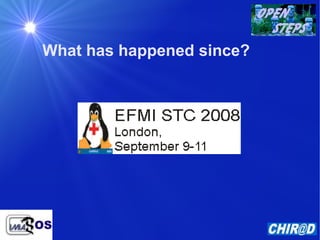
What has happened since?
EFMI STC 2008: Presentations and discussion on range of  FLOSS issues in health(care). Discussion of progress made (or not)  since 2004 meetings.
Conclusions of discussions: Many of the issues presented at the first Open Steps meetings four years ago.  Things have not really moved on much.  Why is this? Should the Open Source community be worried  about this?
Where do we go from here? We hope this workshop will provide some answers
Peter J. Murray [email_address] @peterjmurray on Twitter (#MIE09) http://www.slideshare.net/drpeter http://www.hi-blogs.info

Open source workshop, MIE2009

  • 1.
    Open Source andHealthcare in Europe - Time to Put Leading Edge Ideas into Practice Peter J Murray, Graham Wright Thomas Karopka, Helen Betts, Andrej Orel
  • 2.
    Open Source andHealthcare in Europe - Time to Put Leading Edge Ideas into Practice A workshop organised by the EFMI LIFOSS and IMIA OS Working groups
  • 3.
    Helen Betts UKrepresentative to EFMI; Director, CHIRAD Workshop Chair
  • 4.
    Workshop outline: Mainissues/messages of the 2004 Open Steps workshops and the EFMI STC 2008 - Peter Murray Building the FLOSS-HC Community - A strategy for the advancement of FLOSS in health care - Thomas Karopka Open Source Business Rule Management System (BRMS) – A implementation in the breast cancer screening program DORA – Anze Droljc/Andrej Orel
  • 5.
    Workshop outline: Discussion– Helen Betts chairing EFMI/IMIA WGs business meeting/discussion (builds on preceding presentations and discussion) -Thomas Karopka leading
  • 6.
    Peter J. MurrayDirector, CHIRAD; Acting Executive Director, IMIA Open Steps (2004) workshops and EFMI STC 2008
  • 7.
    Peter J. MurrayFounding member of: IMIA Open Source WG (2002) AMIA Open Source WG (2003) EFMI Libre/Free and Open Source WG (2005)
  • 8.
    What was Open Steps ? What were the outputs? What has happened since with WG activity? What did the EFMI STC 2008 find?
  • 9.
    Marwell OpenSteps meeting Marwell Zoo Hotel, Winchester, UK – February 2004 - invited 24hour thinktank of 30 people; funded by BCSHIF - mostly UK; others Czech, Belgian, Dutch, North American - iterative discussions and electronic voting
  • 10.
    Main purpose of Open Steps : ...to identify key issues, opportunities, obstacles, areas of work and research ... around the potential for using open source software, solutions and approaches within health care, and in particular within health informatics, in the UK and Europe.
  • 11.
    Three quarters ofattendees described their 'ideal vision for the future use of software in healthcare' as containing at least a significant percentage of Free/Libre/Open Source Software (FLOSS), with nearly one third wanting to see it 'entirely open source'.
  • 12.
    The emergence ofa situation wherein FLOSS could interface with proprietary software within the healthcare domain was seen to be both achievable and desirable, and also likely if the right drivers were put in place and barriers addressed.
  • 13.
    Participants rated themost important issues why people do and might use FLOSS within the health domain as: quality, stability and robustness of software and data, as well as long-term availability of important health data through not being locked up in proprietary systems that do not allow interoperability and data migration.
  • 14.
    Participants felt thatthe strongest drivers (towards adoption/use of FLOSS in healthcare) were: - adoption and use of the right standards (the strongest driver) - the development of an OS 'killer application' (the next strongest) - political mandate towards the use of OSS
  • 15.
    Participants felt thatthe strongest drivers (towards adoption/use of FLOSS in healthcare) were: - producing positive case studies comparing financial benefits of OSS budget reductions - sharing of learning and knowledge - promoting OSS best practice case studies
  • 16.
    Strongest barriers: - lack of understanding of cost of ownership - lack of an 'incubator' for OSS
  • 17.
    They felt thatthe two most important areas for FLOSS activity by IMIA OSWG and other FLOSS groups were: - 'political' activity and - work on raising awareness among healthcare workers and the wider public.
  • 18.
    San Francisco (medinfo2004)meeting September 2004 - presentation and discussion of Marwell results - international audience (many from USA) - general validation of Marwell outputs plus: - modularity of software development (driver) - lack of interaction between FLOSS groups (barrier)
  • 19.
    Focus of effortover the next 5 years 'political' activity ; inc. working within existing health informatics and other organisations and persuading them to support and commit to FLOSS approaches; working in local health communities; making available documents and speaking on the benefits of FLOSS; further Open Steps type meetings, possibly at European level and including more industry players; availability ; publicising the importance of health data being available across time and all kinds of boundaries between systems – and the role FLOSS can play.
  • 20.
    Software development wasNOT seen as a major priority by these groups WHY? - because most are not primarily programmers/developers? - because of health care backgrounds? - do they think there is enough software development projects already out there?
  • 21.
    Full report available:http://www.peter-murray.net/chiradinfo/marwell04/marwellreportv01p01.htm http://bit.ly/bq0TZ
  • 22.
  • 23.
    EFMI STC 2008:Presentations and discussion on range of FLOSS issues in health(care). Discussion of progress made (or not) since 2004 meetings.
  • 24.
    Conclusions of discussions:Many of the issues presented at the first Open Steps meetings four years ago. Things have not really moved on much. Why is this? Should the Open Source community be worried about this?
  • 25.
    Where do wego from here? We hope this workshop will provide some answers
  • 26.
    Peter J. Murray[email_address] @peterjmurray on Twitter (#MIE09) http://www.slideshare.net/drpeter http://www.hi-blogs.info