International Research Journal of Engineering and Technology (IRJET) e-ISSN: 2395-0056
Volume: 09 Issue: 05 | May 2022 www.irjet.net p-ISSN: 2395-0072
© 2022, IRJET | Impact Factor value: 7.529 | ISO 9001:2008 Certified Journal | Page 3875
USING LEAN TECHNIQUES TO REDUCE WASTE AND IMPROVE
PERFORMANCE IN MUNICIPAL CONSTRUCTION PROJECT
Author: Rahul Bhati1, Shubh Kant Yadav2
1Master of technology in Civil Engineering
2Professor in Civil Department
IEC College of Engineering & Technology Greater Noida
---------------------------------------------------------------------------***----------------------------------------------------------------------
ABSTRACT
The goal of lean techniques in construction is to reduce waste, improve communication, and create teamwork. The increasing
demand for public works projects needs a focus on efficient construction project services, hence focusing on municipal project
delivery is essential. The term “population works” refers to a broad spectrum of public-benefit infrastructure projects financed
and constructed by local governments. Municipal construction presents particular challenges when compared to other sorts of
projects. All around the metro area and the neighboring areas, these programmes are making a difference. The focus of this
thesis is on lean construction approaches, which attempt to bring new insights into how lean techniques might reduce non-
physical waste connected with the actual delivery of the project. In order to solve difficulties, speed up project development
and give recommendations for improved municipal building projects, only lean methodologies may be applied. To improve
and broaden the classification of non-physically controlled trash, this study employs the AHP. In this thesis, AHP is used to
identify the goal, classify the waste, and apply the necessary lean methodologies. Building professionals' experience was used
to determine the relative importance of a given set of alternatives. The AHP approach, which identified and prioritized issues,
reduced waste and improved performance.
Keywords: lean techniques, construction, Municipal construction, AHP, waste reduction
Introduction
A method to manufacturing that minimizes waste in materials, time and labor is known as lean construction. Improved
contractual arrangements, product design/method of selection, supply chain, and operational workflow reliability will benefit
all stakeholders if they are made in a methodical, synergistic, and continuous manner [1]. Due to a variety of challenges, the
building sector has been lagging behind the manufacturing industry for many years. A mixed strategy is preferable over a
divided one because of its adaptability and flexibility. The complexity of the building business necessitates a higher level of
technological innovation than does manufacturing [2].
Lean construction methods will cause a sea change in the construction industry. Companies in today's highly competitive
market have improved job efficiency and quality, cut waste and costs, and raised profits as a result of their efforts to stay
relevant [2]. Fewer resources are used while still satisfying customer needs in building that adheres to lean construction
principles. It is essential to understand the “Physics of Building” of production management in order to implement lean
construction. It's a radical departure from the way things are currently done. Any construction project can benefit from them,
but they are particularly well-suited to those that are both challenging and time-sensitive [2 & 3].
Cutting down on waste is one of the best ways for a business to increase revenues. In the construction of a building, materials
that are either created directly or indirectly are referred to as “construction trash.” If you want the most value for your money,
lean construction (LC) is all about eliminating errors and minimizing waste [3]. All of these elements can be reduced by
reducing the number of inputs that are used, including labor, machinery, space, and time. It is the goal of lean construction to
reduce waste while increasing quality and productivity. The goals of this document mention the integration of construction
facilities and procedures with concurrent design.
International Research Journal of Engineering and Technology (IRJET) e-ISSN: 2395-0056
Volume: 09 Issue: 05 | May 2022 www.irjet.net p-ISSN: 2395-0072
© 2022, IRJET | Impact Factor value: 7.529 | ISO 9001:2008 Certified Journal | Page 3876
Objectives
1. Investigate how lean construction approaches might boost the efficiency and effectiveness of municipal project
delivery.
2. To contribute to the corpus of knowledge on how waste might be reduced in municipal project delivery using lean
methodologies.
3. As a way to learn more about how construction companies and their clients communicate and exchange information.
Related work
Ankit Bhatla, et al. [1]. According to the findings of a life-cycle study, it is recommended that waste management for
construction and demolition be improved in order to maximize recycling and reduce construction waste disposal. It appears
that this index will be difficult to control because of the lack of precision with which it is calculated. Abdelrazig YE [2]. As per
his analysis, in recent years, a rising number of businesses have embraced lean and environmentally friendly building
practices with great success. For example, lean construction and green building concepts have shown this to be true on
numerous instances. Few studies have examined how to implement lean and green principles in real-world contexts, despite
the fact that they can be employed in a variety of ways. Being lean and being ecologically conscious are two principles that go
hand in hand, as we've seen time and time again. Aziz, R. F., and Hafez, S. M. [3]. His study goal of lean thinking to minimize
waste while simultaneously increasing value and improving on an ongoing basis. In order to lower the costs, time, and quality
of road construction, the overarching purpose of this research is to use a lean construction strategy throughout the
construction process. They conducted a number of interviews with specialists in order to have a better grasp of the advantages
and disadvantages of lean construction in road construction projects. First and first, in order to be successful in this industry,
one must be well informed of the issues and opportunities that exist.
RESEARCH METHODOLOGY
An AHP was utilized to organize the data for this investigation. The research discovered a collection of garbage from municipal
construction projects that may be managed. Julie Emerald Jiju, et al controlled waste categorization system by Mughees Aslam
et al., lean approaches are predicted to yield substantial gains if used in conjunction with it. In order to get additional
information on the implementation of lean techniques, a survey of industry experts was sent out and the decision criteria were
organized in a hierarchical framework. Using the AHP approach, these initiatives were prioritized and reviewed to see how
they fit into the larger goal of lean building practices [4].
DATA COLLECTION
In order to obtain information, the researchers had to examine secondary sources such as books and journal articles.
Databases such as ABI/Inform and the General Business files, among others, have made it feasible to have access to critical
information. It was one of the study's key aims to determine whether or not the findings had an impact on worldwide brand
trust.
DATA ANALYSIS
In quantitative research, data analysis is used to minimize, organize, and analyze the information acquired by the investigators
[4]. A statistician analysis used to analyze the research data. There are both visual and numerical representations of the data
to choose from. The aforementioned statistics were obtained by averaging, mediating, and summing the relevant variables [5].
To see if there was any correlation, the variables of interest were connected using Pearson's or Spearman's methodologies.
The confidence interval for this experiment was set at 95%.
RESULT AND DISCUSSION
The strategies and methodologies for doing research were thoroughly explored in above section. This chapter covers, among
other things, how the data was acquired, how it was analyzed, and how the results were validated [5]. This chapter discusses
the use of the AHP technique as well as the thesis' findings.
International Research Journal of Engineering and Technology (IRJET) e-ISSN: 2395-0056
Volume: 09 Issue: 05 | May 2022 www.irjet.net p-ISSN: 2395-0072
© 2022, IRJET | Impact Factor value: 7.529 | ISO 9001:2008 Certified Journal | Page 3877
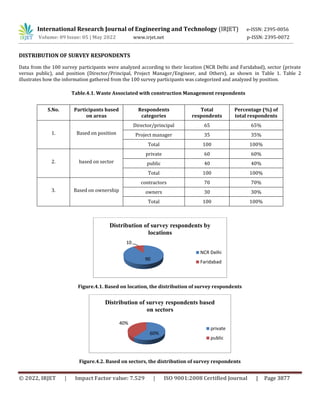
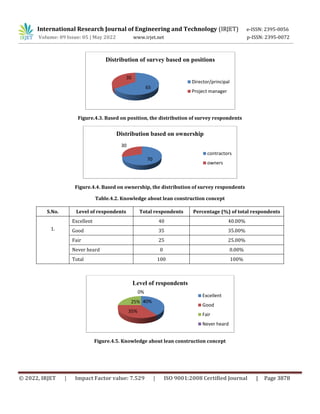
DISTRIBUTION OF SURVEY RESPONDENTS
Data from the 100 survey participants were analyzed according to their location (NCR Delhi and Faridabad), sector (private
versus public), and position (Director/Principal, Project Manager/Engineer, and Others), as shown in Table 1. Table 2
illustrates how the information gathered from the 100 survey participants was categorized and analyzed by position.
Table.4.1. Waste Associated with construction Management respondents
S.No. Participants based
on areas
Respondents
categories
Total
respondents
Percentage (%) of
total respondents
1. Based on position
Director/principal 65 65%
Project manager 35 35%
Total 100 100%
2. based on sector
private 60 60%
public 40 40%
Total 100 100%
3. Based on ownership
contractors 70 70%
owners 30 30%
Total 100 100%
Figure.4.1. Based on location, the distribution of survey respondents
Figure.4.2. Based on sectors, the distribution of survey respondents
90
10
Distribution of survey respondents by
locations
NCR Delhi
Faridabad
60%
40%
Distribution of survey respondents based
on sectors
private
public
International Research Journal of Engineering and Technology (IRJET) e-ISSN: 2395-0056
Volume: 09 Issue: 05 | May 2022 www.irjet.net p-ISSN: 2395-0072
© 2022, IRJET | Impact Factor value: 7.529 | ISO 9001:2008 Certified Journal | Page 3878
Figure.4.3. Based on position, the distribution of survey respondents
Figure.4.4. Based on ownership, the distribution of survey respondents
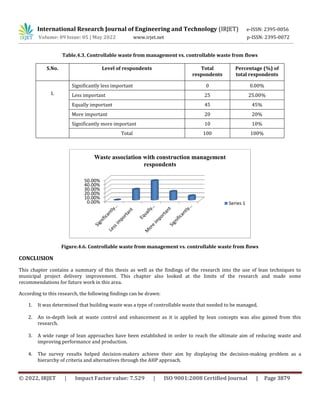
Table.4.2. Knowledge about lean construction concept
S.No. Level of respondents Total respondents Percentage (%) of total respondents
1.
Excellent 40 40.00%
Good 35 35.00%
Fair 25 25.00%
Never heard 0 0.00%
Total 100 100%
Figure.4.5. Knowledge about lean construction concept
65
35
Distribution of survey based on positions
Director/principal
Project manager
70
30
Distribution based on ownership
contractors
owners
40%
35%
25%
0%
Level of respondents
Excellent
Good
Fair
Never heard
International Research Journal of Engineering and Technology (IRJET) e-ISSN: 2395-0056
Volume: 09 Issue: 05 | May 2022 www.irjet.net p-ISSN: 2395-0072
© 2022, IRJET | Impact Factor value: 7.529 | ISO 9001:2008 Certified Journal | Page 3879
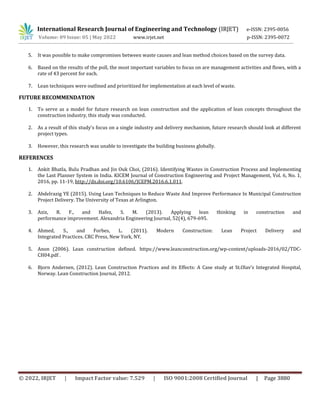
Table.4.3. Controllable waste from management vs. controllable waste from flows
S.No. Level of respondents Total
respondents
Percentage (%) of
total respondents
1.
Significantly less important 0 0.00%
Less important 25 25.00%
Equally important 45 45%
More important 20 20%
Significantly more important 10 10%
Total 100 100%
Figure.4.6. Controllable waste from management vs. controllable waste from flows
CONCLUSION
This chapter contains a summary of this thesis as well as the findings of the research into the use of lean techniques to
municipal project delivery improvement. This chapter also looked at the limits of the research and made some
recommendations for future work in this area.
According to this research, the following findings can be drawn:
1. It was determined that building waste was a type of controllable waste that needed to be managed.
2. An in-depth look at waste control and enhancement as it is applied by lean concepts was also gained from this
research.
3. A wide range of lean approaches have been established in order to reach the ultimate aim of reducing waste and
improving performance and production.
4. The survey results helped decision-makers achieve their aim by displaying the decision-making problem as a
hierarchy of criteria and alternatives through the AHP approach.
0.00%
10.00%
20.00%
30.00%
40.00%
50.00%
Waste association with construction management
respondents
Series 1
International Research Journal of Engineering and Technology (IRJET) e-ISSN: 2395-0056
Volume: 09 Issue: 05 | May 2022 www.irjet.net p-ISSN: 2395-0072
© 2022, IRJET | Impact Factor value: 7.529 | ISO 9001:2008 Certified Journal | Page 3880
5. It was possible to make compromises between waste causes and lean method choices based on the survey data.
6. Based on the results of the poll, the most important variables to focus on are management activities and flows, with a
rate of 43 percent for each.
7. Lean techniques were outlined and prioritized for implementation at each level of waste.
FUTURE RECOMMENDATION
1. To serve as a model for future research on lean construction and the application of lean concepts throughout the
construction industry, this study was conducted.
2. As a result of this study's focus on a single industry and delivery mechanism, future research should look at different
project types.
3. However, this research was unable to investigate the building business globally.
REFERENCES
1. Ankit Bhatla, Bulu Pradhan and Jin Ouk Choi, (2016). Identifying Wastes in Construction Process and Implementing
the Last Planner System in India. KICEM Journal of Construction Engineering and Project Management, Vol. 6, No. 1,
2016, pp. 11-19, http://dx.doi.org/10.6106/JCEPM.2016.6.1.011.
2. Abdelrazig YE (2015). Using Lean Techniques to Reduce Waste And Improve Performance In Municipal Construction
Project Delivery. The University of Texas at Arlington.
3. Aziz, R. F., and Hafez, S. M. (2013). Applying lean thinking in construction and
performance improvement. Alexandria Engineering Journal, 52(4), 679-695.
4. Ahmed, S., and Forbes, L. (2011). Modern Construction: Lean Project Delivery and
Integrated Practices. CRC Press, New York, NY.
5. Anon (2006). Lean construction defined. https://www.leanconstruction.org/wp-content/uploads-2016/02/TDC-
CH04.pdf .
6. Bjorn Andersen, (2012). Lean Construction Practices and its Effects: A Case study at St.Olav’s Integrated Hospital,
Norway. Lean Construction Journal, 2012.

USING LEAN TECHNIQUES TO REDUCE WASTE AND IMPROVE PERFORMANCE IN MUNICIPAL CONSTRUCTION PROJECT

  • 1.
    International Research Journalof Engineering and Technology (IRJET) e-ISSN: 2395-0056 Volume: 09 Issue: 05 | May 2022 www.irjet.net p-ISSN: 2395-0072 © 2022, IRJET | Impact Factor value: 7.529 | ISO 9001:2008 Certified Journal | Page 3875 USING LEAN TECHNIQUES TO REDUCE WASTE AND IMPROVE PERFORMANCE IN MUNICIPAL CONSTRUCTION PROJECT Author: Rahul Bhati1, Shubh Kant Yadav2 1Master of technology in Civil Engineering 2Professor in Civil Department IEC College of Engineering & Technology Greater Noida ---------------------------------------------------------------------------***---------------------------------------------------------------------- ABSTRACT The goal of lean techniques in construction is to reduce waste, improve communication, and create teamwork. The increasing demand for public works projects needs a focus on efficient construction project services, hence focusing on municipal project delivery is essential. The term “population works” refers to a broad spectrum of public-benefit infrastructure projects financed and constructed by local governments. Municipal construction presents particular challenges when compared to other sorts of projects. All around the metro area and the neighboring areas, these programmes are making a difference. The focus of this thesis is on lean construction approaches, which attempt to bring new insights into how lean techniques might reduce non- physical waste connected with the actual delivery of the project. In order to solve difficulties, speed up project development and give recommendations for improved municipal building projects, only lean methodologies may be applied. To improve and broaden the classification of non-physically controlled trash, this study employs the AHP. In this thesis, AHP is used to identify the goal, classify the waste, and apply the necessary lean methodologies. Building professionals' experience was used to determine the relative importance of a given set of alternatives. The AHP approach, which identified and prioritized issues, reduced waste and improved performance. Keywords: lean techniques, construction, Municipal construction, AHP, waste reduction Introduction A method to manufacturing that minimizes waste in materials, time and labor is known as lean construction. Improved contractual arrangements, product design/method of selection, supply chain, and operational workflow reliability will benefit all stakeholders if they are made in a methodical, synergistic, and continuous manner [1]. Due to a variety of challenges, the building sector has been lagging behind the manufacturing industry for many years. A mixed strategy is preferable over a divided one because of its adaptability and flexibility. The complexity of the building business necessitates a higher level of technological innovation than does manufacturing [2]. Lean construction methods will cause a sea change in the construction industry. Companies in today's highly competitive market have improved job efficiency and quality, cut waste and costs, and raised profits as a result of their efforts to stay relevant [2]. Fewer resources are used while still satisfying customer needs in building that adheres to lean construction principles. It is essential to understand the “Physics of Building” of production management in order to implement lean construction. It's a radical departure from the way things are currently done. Any construction project can benefit from them, but they are particularly well-suited to those that are both challenging and time-sensitive [2 & 3]. Cutting down on waste is one of the best ways for a business to increase revenues. In the construction of a building, materials that are either created directly or indirectly are referred to as “construction trash.” If you want the most value for your money, lean construction (LC) is all about eliminating errors and minimizing waste [3]. All of these elements can be reduced by reducing the number of inputs that are used, including labor, machinery, space, and time. It is the goal of lean construction to reduce waste while increasing quality and productivity. The goals of this document mention the integration of construction facilities and procedures with concurrent design.
  • 2.
    International Research Journalof Engineering and Technology (IRJET) e-ISSN: 2395-0056 Volume: 09 Issue: 05 | May 2022 www.irjet.net p-ISSN: 2395-0072 © 2022, IRJET | Impact Factor value: 7.529 | ISO 9001:2008 Certified Journal | Page 3876 Objectives 1. Investigate how lean construction approaches might boost the efficiency and effectiveness of municipal project delivery. 2. To contribute to the corpus of knowledge on how waste might be reduced in municipal project delivery using lean methodologies. 3. As a way to learn more about how construction companies and their clients communicate and exchange information. Related work Ankit Bhatla, et al. [1]. According to the findings of a life-cycle study, it is recommended that waste management for construction and demolition be improved in order to maximize recycling and reduce construction waste disposal. It appears that this index will be difficult to control because of the lack of precision with which it is calculated. Abdelrazig YE [2]. As per his analysis, in recent years, a rising number of businesses have embraced lean and environmentally friendly building practices with great success. For example, lean construction and green building concepts have shown this to be true on numerous instances. Few studies have examined how to implement lean and green principles in real-world contexts, despite the fact that they can be employed in a variety of ways. Being lean and being ecologically conscious are two principles that go hand in hand, as we've seen time and time again. Aziz, R. F., and Hafez, S. M. [3]. His study goal of lean thinking to minimize waste while simultaneously increasing value and improving on an ongoing basis. In order to lower the costs, time, and quality of road construction, the overarching purpose of this research is to use a lean construction strategy throughout the construction process. They conducted a number of interviews with specialists in order to have a better grasp of the advantages and disadvantages of lean construction in road construction projects. First and first, in order to be successful in this industry, one must be well informed of the issues and opportunities that exist. RESEARCH METHODOLOGY An AHP was utilized to organize the data for this investigation. The research discovered a collection of garbage from municipal construction projects that may be managed. Julie Emerald Jiju, et al controlled waste categorization system by Mughees Aslam et al., lean approaches are predicted to yield substantial gains if used in conjunction with it. In order to get additional information on the implementation of lean techniques, a survey of industry experts was sent out and the decision criteria were organized in a hierarchical framework. Using the AHP approach, these initiatives were prioritized and reviewed to see how they fit into the larger goal of lean building practices [4]. DATA COLLECTION In order to obtain information, the researchers had to examine secondary sources such as books and journal articles. Databases such as ABI/Inform and the General Business files, among others, have made it feasible to have access to critical information. It was one of the study's key aims to determine whether or not the findings had an impact on worldwide brand trust. DATA ANALYSIS In quantitative research, data analysis is used to minimize, organize, and analyze the information acquired by the investigators [4]. A statistician analysis used to analyze the research data. There are both visual and numerical representations of the data to choose from. The aforementioned statistics were obtained by averaging, mediating, and summing the relevant variables [5]. To see if there was any correlation, the variables of interest were connected using Pearson's or Spearman's methodologies. The confidence interval for this experiment was set at 95%. RESULT AND DISCUSSION The strategies and methodologies for doing research were thoroughly explored in above section. This chapter covers, among other things, how the data was acquired, how it was analyzed, and how the results were validated [5]. This chapter discusses the use of the AHP technique as well as the thesis' findings.
  • 3.
    International Research Journalof Engineering and Technology (IRJET) e-ISSN: 2395-0056 Volume: 09 Issue: 05 | May 2022 www.irjet.net p-ISSN: 2395-0072 © 2022, IRJET | Impact Factor value: 7.529 | ISO 9001:2008 Certified Journal | Page 3877 DISTRIBUTION OF SURVEY RESPONDENTS Data from the 100 survey participants were analyzed according to their location (NCR Delhi and Faridabad), sector (private versus public), and position (Director/Principal, Project Manager/Engineer, and Others), as shown in Table 1. Table 2 illustrates how the information gathered from the 100 survey participants was categorized and analyzed by position. Table.4.1. Waste Associated with construction Management respondents S.No. Participants based on areas Respondents categories Total respondents Percentage (%) of total respondents 1. Based on position Director/principal 65 65% Project manager 35 35% Total 100 100% 2. based on sector private 60 60% public 40 40% Total 100 100% 3. Based on ownership contractors 70 70% owners 30 30% Total 100 100% Figure.4.1. Based on location, the distribution of survey respondents Figure.4.2. Based on sectors, the distribution of survey respondents 90 10 Distribution of survey respondents by locations NCR Delhi Faridabad 60% 40% Distribution of survey respondents based on sectors private public
  • 4.
    International Research Journalof Engineering and Technology (IRJET) e-ISSN: 2395-0056 Volume: 09 Issue: 05 | May 2022 www.irjet.net p-ISSN: 2395-0072 © 2022, IRJET | Impact Factor value: 7.529 | ISO 9001:2008 Certified Journal | Page 3878 Figure.4.3. Based on position, the distribution of survey respondents Figure.4.4. Based on ownership, the distribution of survey respondents Table.4.2. Knowledge about lean construction concept S.No. Level of respondents Total respondents Percentage (%) of total respondents 1. Excellent 40 40.00% Good 35 35.00% Fair 25 25.00% Never heard 0 0.00% Total 100 100% Figure.4.5. Knowledge about lean construction concept 65 35 Distribution of survey based on positions Director/principal Project manager 70 30 Distribution based on ownership contractors owners 40% 35% 25% 0% Level of respondents Excellent Good Fair Never heard
  • 5.
    International Research Journalof Engineering and Technology (IRJET) e-ISSN: 2395-0056 Volume: 09 Issue: 05 | May 2022 www.irjet.net p-ISSN: 2395-0072 © 2022, IRJET | Impact Factor value: 7.529 | ISO 9001:2008 Certified Journal | Page 3879 Table.4.3. Controllable waste from management vs. controllable waste from flows S.No. Level of respondents Total respondents Percentage (%) of total respondents 1. Significantly less important 0 0.00% Less important 25 25.00% Equally important 45 45% More important 20 20% Significantly more important 10 10% Total 100 100% Figure.4.6. Controllable waste from management vs. controllable waste from flows CONCLUSION This chapter contains a summary of this thesis as well as the findings of the research into the use of lean techniques to municipal project delivery improvement. This chapter also looked at the limits of the research and made some recommendations for future work in this area. According to this research, the following findings can be drawn: 1. It was determined that building waste was a type of controllable waste that needed to be managed. 2. An in-depth look at waste control and enhancement as it is applied by lean concepts was also gained from this research. 3. A wide range of lean approaches have been established in order to reach the ultimate aim of reducing waste and improving performance and production. 4. The survey results helped decision-makers achieve their aim by displaying the decision-making problem as a hierarchy of criteria and alternatives through the AHP approach. 0.00% 10.00% 20.00% 30.00% 40.00% 50.00% Waste association with construction management respondents Series 1
  • 6.
    International Research Journalof Engineering and Technology (IRJET) e-ISSN: 2395-0056 Volume: 09 Issue: 05 | May 2022 www.irjet.net p-ISSN: 2395-0072 © 2022, IRJET | Impact Factor value: 7.529 | ISO 9001:2008 Certified Journal | Page 3880 5. It was possible to make compromises between waste causes and lean method choices based on the survey data. 6. Based on the results of the poll, the most important variables to focus on are management activities and flows, with a rate of 43 percent for each. 7. Lean techniques were outlined and prioritized for implementation at each level of waste. FUTURE RECOMMENDATION 1. To serve as a model for future research on lean construction and the application of lean concepts throughout the construction industry, this study was conducted. 2. As a result of this study's focus on a single industry and delivery mechanism, future research should look at different project types. 3. However, this research was unable to investigate the building business globally. REFERENCES 1. Ankit Bhatla, Bulu Pradhan and Jin Ouk Choi, (2016). Identifying Wastes in Construction Process and Implementing the Last Planner System in India. KICEM Journal of Construction Engineering and Project Management, Vol. 6, No. 1, 2016, pp. 11-19, http://dx.doi.org/10.6106/JCEPM.2016.6.1.011. 2. Abdelrazig YE (2015). Using Lean Techniques to Reduce Waste And Improve Performance In Municipal Construction Project Delivery. The University of Texas at Arlington. 3. Aziz, R. F., and Hafez, S. M. (2013). Applying lean thinking in construction and performance improvement. Alexandria Engineering Journal, 52(4), 679-695. 4. Ahmed, S., and Forbes, L. (2011). Modern Construction: Lean Project Delivery and Integrated Practices. CRC Press, New York, NY. 5. Anon (2006). Lean construction defined. https://www.leanconstruction.org/wp-content/uploads-2016/02/TDC- CH04.pdf . 6. Bjorn Andersen, (2012). Lean Construction Practices and its Effects: A Case study at St.Olav’s Integrated Hospital, Norway. Lean Construction Journal, 2012.