Maslow's Hierarchy
and
Bloom's Taxonomy
Center for Innovation in Teaching & Learning
Session Resources:
– Session will be recorded.
– Slide deck will be shared.
– Links to resources throughout
presentation.
– Book a consultation with your
instructional designer!
2
Mallory Matthews
College of Business
Interdisciplinary Studies
Agriculture & Human Ecology
Center for Innovation in Teaching & Learning
Instructional Designers
Taylor Chesson
College of
Engineering
Lacy Means
College of Arts &
Sciences
Heather Rippetoe
College of Education
Whitson-Hester School of Nursing
College of Fine Arts
4
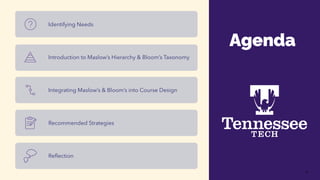
Identifying Needs
Introduction to Maslow’s Hierarchy & Bloom’s Taxonomy
Integrating Maslow’s & Bloom’s into Course Design
Recommended Strategies
Reflection
Agenda
Identifying Student Needs
What do students at our university need?
Please respond in the chat
Identifying Student Needs
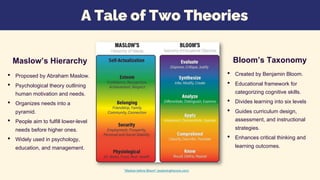
A Tale of Two Theories
• Proposed by Abraham Maslow.
• Psychological theory outlining
human motivation and needs.
• Organizes needs into a
pyramid.
• People aim to fulfill lower-level
needs before higher ones.
• Widely used in psychology,
education, and management.
• Created by Benjamin Bloom.
• Educational framework for
categorizing cognitive skills.
• Divides learning into six levels
• Guides curriculum design,
assessment, and instructional
strategies.
• Enhances critical thinking and
learning outcomes.
Maslow’s Hierarchy Bloom’s Taxonomy
"Maslow before Bloom" (exploringthecore.com)
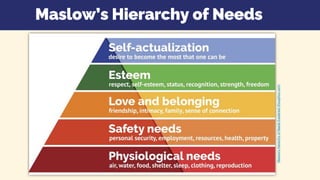
Maslow’s Hierarchy of Needs
Maslow's
Hierarchy
of
Needs
Explained
(thoughtco.com)
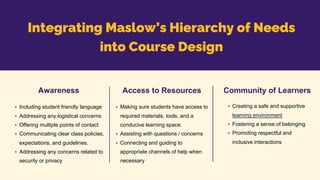
Integrating Maslow’s Hierarchy of Needs
into Course Design
• Including student friendly language
• Addressing any logistical concerns
• Offering multiple points of contact
• Communicating clear class policies,
expectations, and guidelines.
• Addressing any concerns related to
security or privacy
Awareness
• Making sure students have access to
required materials, tools, and a
conducive learning space.
• Assisting with questions / concerns
• Connecting and guiding to
appropriate channels of help when
necessary
Access to Resources
• Creating a safe and supportive
learning environment
• Fostering a sense of belonging
• Promoting respectful and
inclusive interactions
Community of Learners
Reflection: How can we
meet students’ needs in our
course design and college
classroom?
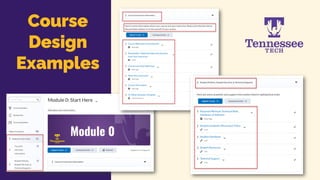
Course
Design
Examples
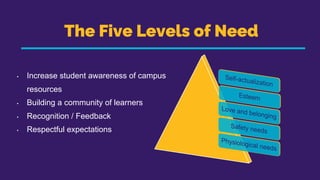
The Five Levels of Need
• Increase student awareness of campus
resources
• Building a community of learners
• Recognition / Feedback
• Respectful expectations
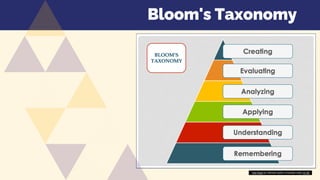
Bloom's Taxonomy
This Photo by Unknown author is licensed under CC BY.
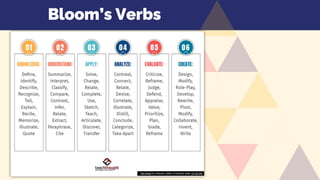
Bloom’s Verbs
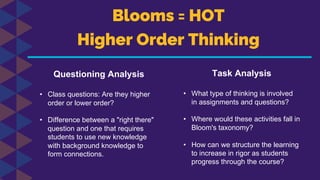
Blooms = HOT
Higher Order Thinking
Questioning Analysis
• Class questions: Are they higher
order or lower order?
• Difference between a "right there"
question and one that requires
students to use new knowledge
with background knowledge to
form connections.
Task Analysis
• What type of thinking is involved
in assignments and questions?
• Where would these activities fall in
Bloom's taxonomy?
• How can we structure the learning
to increase in rigor as students
progress through the course?
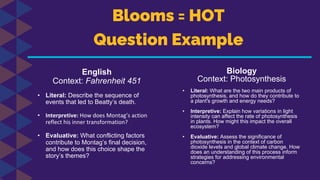
Blooms = HOT
Question Example
English
Context: Fahrenheit 451
• Literal: Describe the sequence of
events that led to Beatty’s death.
• Interpretive: How does Montag’s action
reflect his inner transformation?
• Evaluative: What conflicting factors
contribute to Montag’s final decision,
and how does this choice shape the
story’s themes?
Biology
Context: Photosynthesis
• Literal: What are the two main products of
photosynthesis, and how do they contribute to
a plant's growth and energy needs?
• Interpretive: Explain how variations in light
intensity can affect the rate of photosynthesis
in plants. How might this impact the overall
ecosystem?
• Evaluative: Assess the significance of
photosynthesis in the context of carbon
dioxide levels and global climate change. How
does an understanding of this process inform
strategies for addressing environmental
concerns?
Reflection: What level of
Blooms is currently present
in your course learning
objectives?
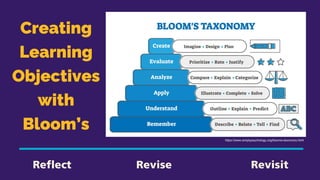
Creating
Learning
Objectives
with
Bloom’s
Reflect Revise Revisit
https://www.simplypsychology.org/blooms-taxonomy.html
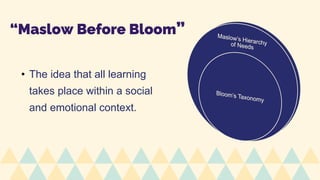
“Maslow Before Bloom”
• The idea that all learning
takes place within a social
and emotional context.
Student Supports
Learning Center
Resources IT Help Desk
Community Recognition
Reflection: What are ways
that you already combine
Maslow & Bloom?
Recommended Strategies
• Review course from a student
perspective
• Build a supportive environment
• Encourage personal growth
• Connect to future goals
• Open communication
• Student feedback: CITL Small
Group Instructional Diagnostic
• Task Analysis
• Relevance of content
Thank you! References:
Questions,
Comments,
Concerns?
Feedback Survey
Next Week’s Session:
SMART/ABCD Goals
Tuesday, September 5th
Resources:
https://www.exploringthecore.com/post/maslow-before-bloom
Verb Power (imiaweb.org)
Revised Bloom’s Taxonomy – Center for Excellence in Learning and Teaching (iastate.edu)
Student Resources - Golden Eagles Live Wings Up (tntech.edu)
Alam, S., & Karwowski, W. (2022). The Human Side of Service Engineering. New York, NY: Springer Nature.
Bloom, B. S. (1956). Taxonomy of educational objectives. Vol. 1: Cognitive domain. New York: McKay, 20, 24.
Hopper, E. (2020). Maslow’s Hierarchy of needs explained. ThoughtCo. https://www.thoughtco.com/maslows-
hierarchy-of-needs-4582571
Maslow, A. H. (1943). A theory of human motivation. Psychological Review, 50(4), 370–396.
https://doi.org/10.1037/h0054346
Maslow, A. H. (1970). Motivation and personality. New York: Harper & Row.
Ruhl, C. (2023). Bloom’s Taxonomy of learning. Simply Psychology. https://www.simplypsychology.org/blooms-
taxonomy.html

using Ibrahim Maslow Theory to support students to Bloom

  • 1.
    Maslow's Hierarchy and Bloom's Taxonomy Centerfor Innovation in Teaching & Learning
  • 2.
    Session Resources: – Sessionwill be recorded. – Slide deck will be shared. – Links to resources throughout presentation. – Book a consultation with your instructional designer! 2
  • 3.
    Mallory Matthews College ofBusiness Interdisciplinary Studies Agriculture & Human Ecology Center for Innovation in Teaching & Learning Instructional Designers Taylor Chesson College of Engineering Lacy Means College of Arts & Sciences Heather Rippetoe College of Education Whitson-Hester School of Nursing College of Fine Arts
  • 4.
    4 Identifying Needs Introduction toMaslow’s Hierarchy & Bloom’s Taxonomy Integrating Maslow’s & Bloom’s into Course Design Recommended Strategies Reflection Agenda
  • 5.
  • 6.
    What do studentsat our university need? Please respond in the chat
  • 7.
  • 8.
    A Tale ofTwo Theories • Proposed by Abraham Maslow. • Psychological theory outlining human motivation and needs. • Organizes needs into a pyramid. • People aim to fulfill lower-level needs before higher ones. • Widely used in psychology, education, and management. • Created by Benjamin Bloom. • Educational framework for categorizing cognitive skills. • Divides learning into six levels • Guides curriculum design, assessment, and instructional strategies. • Enhances critical thinking and learning outcomes. Maslow’s Hierarchy Bloom’s Taxonomy "Maslow before Bloom" (exploringthecore.com)
  • 9.
    Maslow’s Hierarchy ofNeeds Maslow's Hierarchy of Needs Explained (thoughtco.com)
  • 10.
    Integrating Maslow’s Hierarchyof Needs into Course Design • Including student friendly language • Addressing any logistical concerns • Offering multiple points of contact • Communicating clear class policies, expectations, and guidelines. • Addressing any concerns related to security or privacy Awareness • Making sure students have access to required materials, tools, and a conducive learning space. • Assisting with questions / concerns • Connecting and guiding to appropriate channels of help when necessary Access to Resources • Creating a safe and supportive learning environment • Fostering a sense of belonging • Promoting respectful and inclusive interactions Community of Learners
  • 11.
    Reflection: How canwe meet students’ needs in our course design and college classroom?
  • 12.
  • 13.
    The Five Levelsof Need • Increase student awareness of campus resources • Building a community of learners • Recognition / Feedback • Respectful expectations
  • 14.
    Bloom's Taxonomy This Photoby Unknown author is licensed under CC BY.
  • 15.
  • 16.
    Blooms = HOT HigherOrder Thinking Questioning Analysis • Class questions: Are they higher order or lower order? • Difference between a "right there" question and one that requires students to use new knowledge with background knowledge to form connections. Task Analysis • What type of thinking is involved in assignments and questions? • Where would these activities fall in Bloom's taxonomy? • How can we structure the learning to increase in rigor as students progress through the course?
  • 17.
    Blooms = HOT QuestionExample English Context: Fahrenheit 451 • Literal: Describe the sequence of events that led to Beatty’s death. • Interpretive: How does Montag’s action reflect his inner transformation? • Evaluative: What conflicting factors contribute to Montag’s final decision, and how does this choice shape the story’s themes? Biology Context: Photosynthesis • Literal: What are the two main products of photosynthesis, and how do they contribute to a plant's growth and energy needs? • Interpretive: Explain how variations in light intensity can affect the rate of photosynthesis in plants. How might this impact the overall ecosystem? • Evaluative: Assess the significance of photosynthesis in the context of carbon dioxide levels and global climate change. How does an understanding of this process inform strategies for addressing environmental concerns?
  • 18.
    Reflection: What levelof Blooms is currently present in your course learning objectives?
  • 19.
  • 20.
    “Maslow Before Bloom” •The idea that all learning takes place within a social and emotional context.
  • 21.
    Student Supports Learning Center ResourcesIT Help Desk Community Recognition
  • 22.
    Reflection: What areways that you already combine Maslow & Bloom?
  • 23.
    Recommended Strategies • Reviewcourse from a student perspective • Build a supportive environment • Encourage personal growth • Connect to future goals • Open communication • Student feedback: CITL Small Group Instructional Diagnostic • Task Analysis • Relevance of content
  • 24.
    Thank you! References: Questions, Comments, Concerns? FeedbackSurvey Next Week’s Session: SMART/ABCD Goals Tuesday, September 5th Resources: https://www.exploringthecore.com/post/maslow-before-bloom Verb Power (imiaweb.org) Revised Bloom’s Taxonomy – Center for Excellence in Learning and Teaching (iastate.edu) Student Resources - Golden Eagles Live Wings Up (tntech.edu) Alam, S., & Karwowski, W. (2022). The Human Side of Service Engineering. New York, NY: Springer Nature. Bloom, B. S. (1956). Taxonomy of educational objectives. Vol. 1: Cognitive domain. New York: McKay, 20, 24. Hopper, E. (2020). Maslow’s Hierarchy of needs explained. ThoughtCo. https://www.thoughtco.com/maslows- hierarchy-of-needs-4582571 Maslow, A. H. (1943). A theory of human motivation. Psychological Review, 50(4), 370–396. https://doi.org/10.1037/h0054346 Maslow, A. H. (1970). Motivation and personality. New York: Harper & Row. Ruhl, C. (2023). Bloom’s Taxonomy of learning. Simply Psychology. https://www.simplypsychology.org/blooms- taxonomy.html