Iacopo Vagliano, ZBW Kiel
Lukas Galke, University of Kiel
Florian May, University of Kiel
Ansgar Scherp, University of Stirling
Using Adversarial Autoencoders for
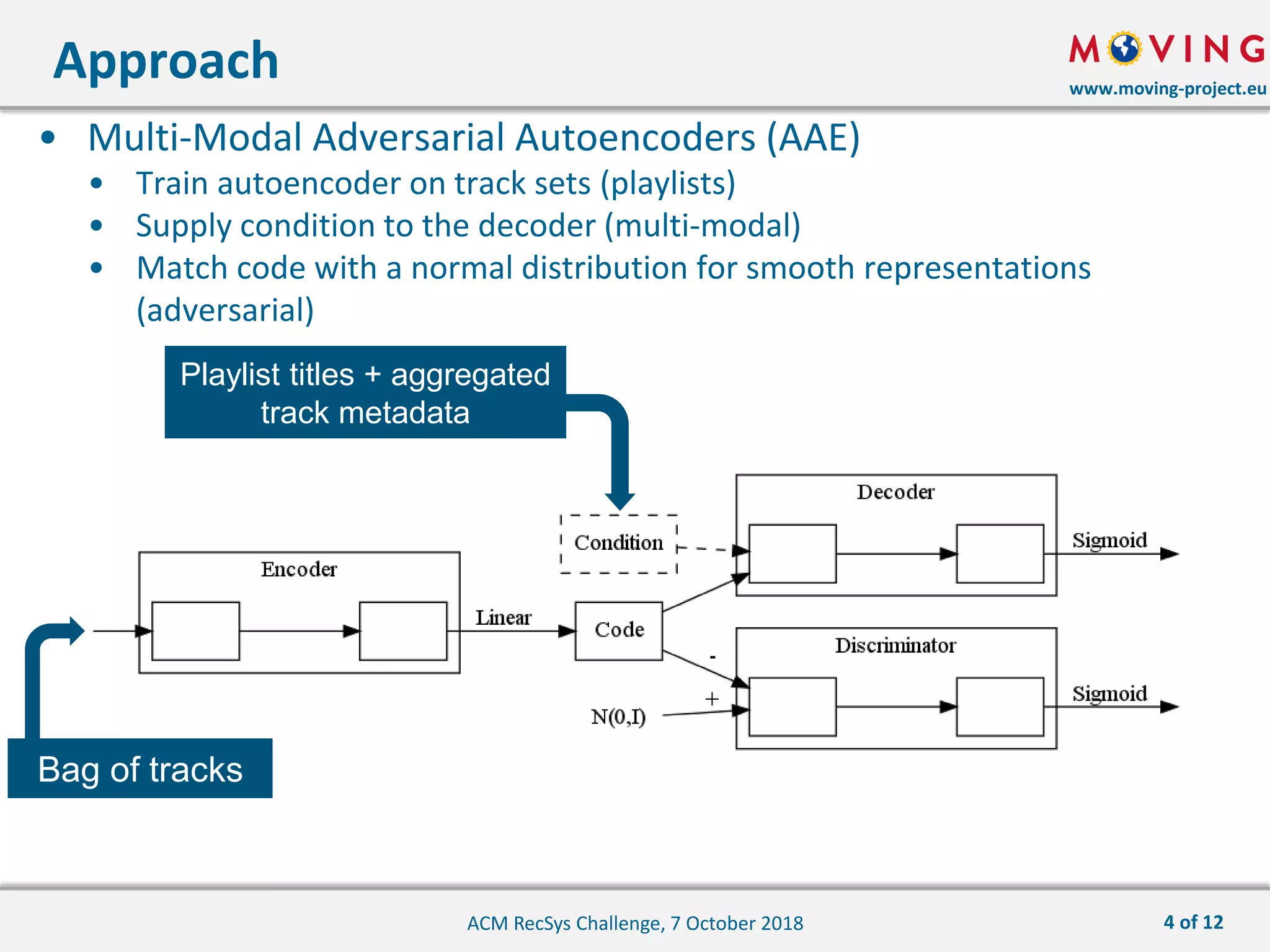
Multi-Modal
Automatic Playlist Continuation
ACM RecSys Challenge, 7 October 2018
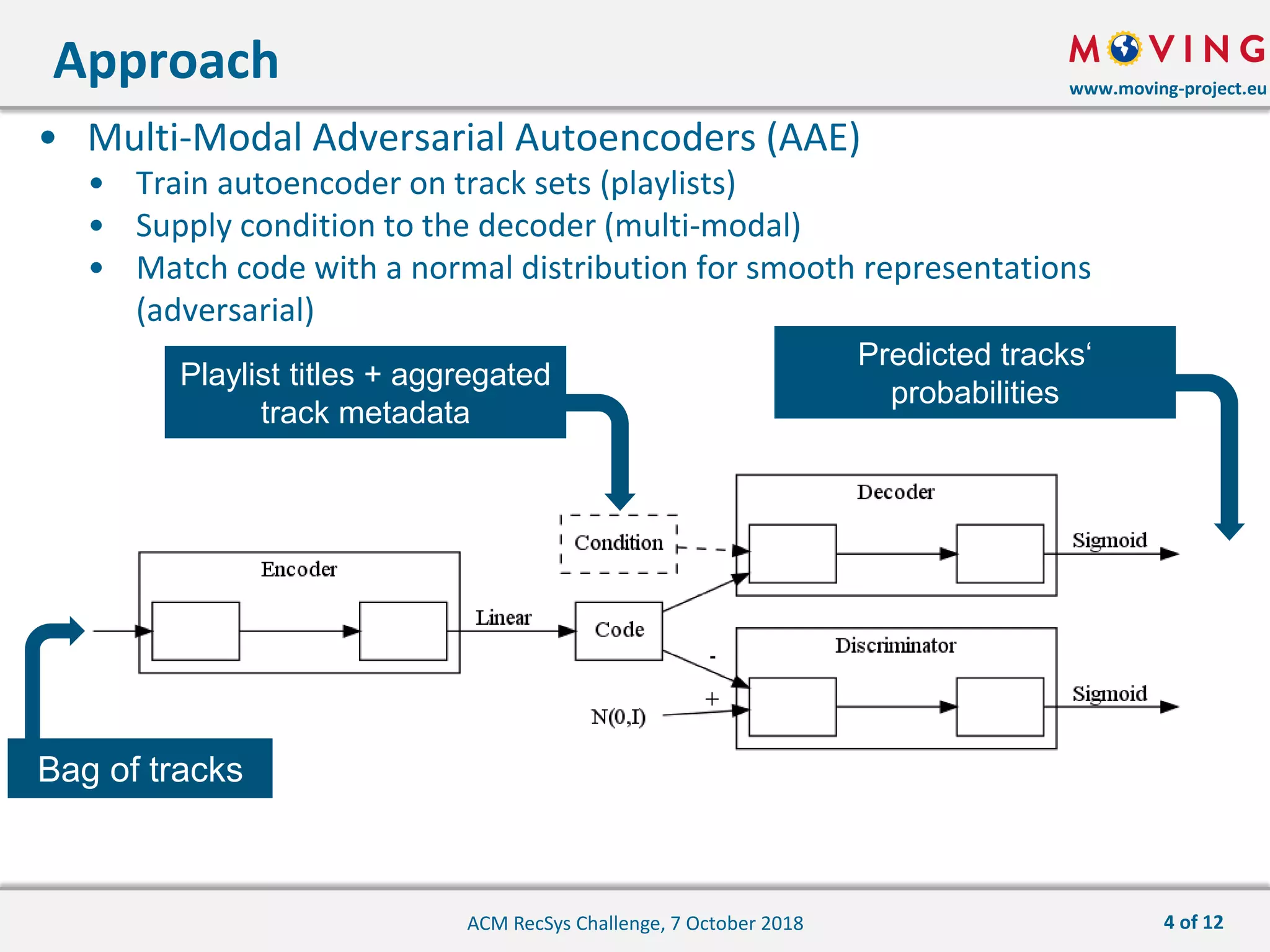
www.moving-project.eu
• Adversarial regularization improves autoencoders on images
(Makhzani et al. 2015)
• Adversarial autoencoders effective in recommendation tasks
(Galke et al. 2018)
• Smoothness on the code aids autoencoders to reconstruct highly sparse
item vectors
Motivation
ACM RecSys Challenge, 7 October 2018 2 of 12
Makhzani, A. et al. (2015). “Adversarial Autoencoders”. In: CoRR abs/1511.05644.
Galke, L. et al. (2018). Multi-Modal Adversarial Autoencoders for Recommendations of Citations and Subject Labels. ACM UMAP.
www.moving-project.eu
• Adversarial regularization improves autoencoders on images
(Makhzani et al. 2015)
• Adversarial autoencoders effective in recommendation tasks
(Galke et al. 2018)
• Smoothness on the code aids autoencoders to reconstruct highly sparse
item vectors
Motivation
ACM RecSys Challenge, 7 October 2018
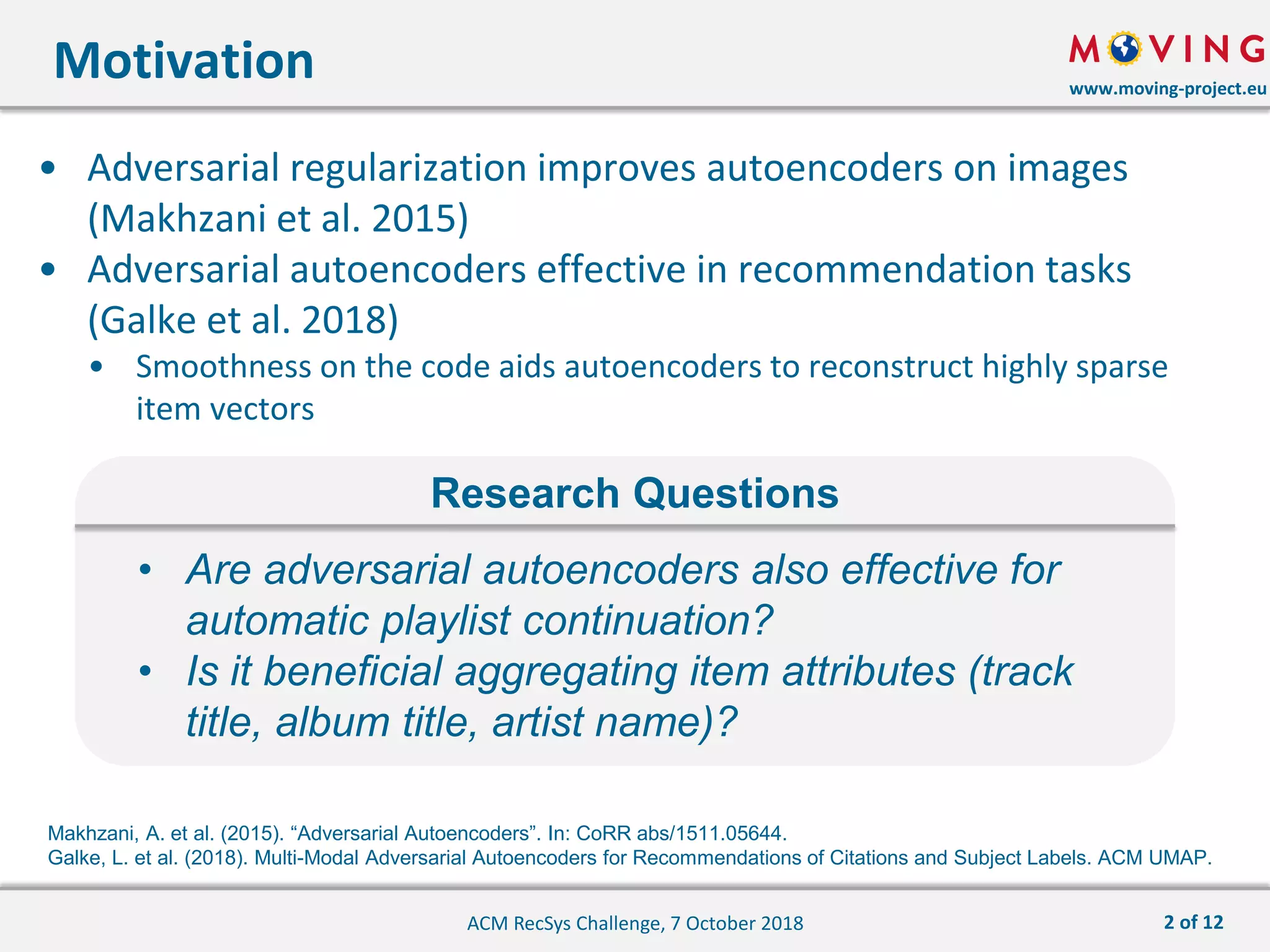
• Are adversarial autoencoders also effective for
automatic playlist continuation?
• Is it beneficial aggregating item attributes (track
title, album title, artist name)?
Research Questions
Makhzani, A. et al. (2015). “Adversarial Autoencoders”. In: CoRR abs/1511.05644.
Galke, L. et al. (2018). Multi-Modal Adversarial Autoencoders for Recommendations of Citations and Subject Labels. ACM UMAP.
2 of 12
www.moving-project.eu
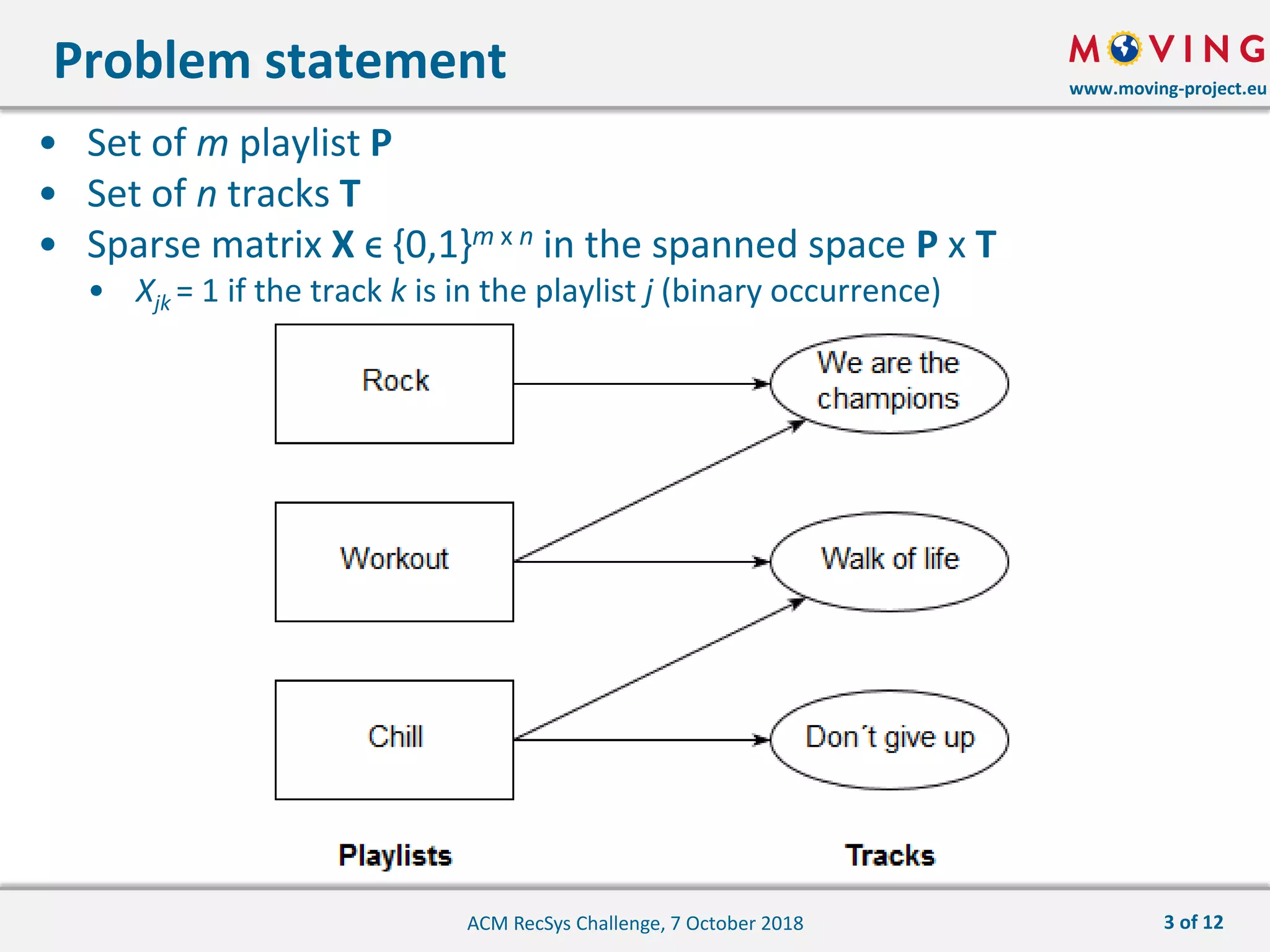
• Set of m playlist P
• Set of n tracks T
• Sparse matrix X ϵ {0,1}m x n in the spanned space P x T
• Xjk = 1 if the track k is in the playlist j (binary occurrence)
Problem statement
ACM RecSys Challenge, 7 October 2018 3 of 12
www.moving-project.eu
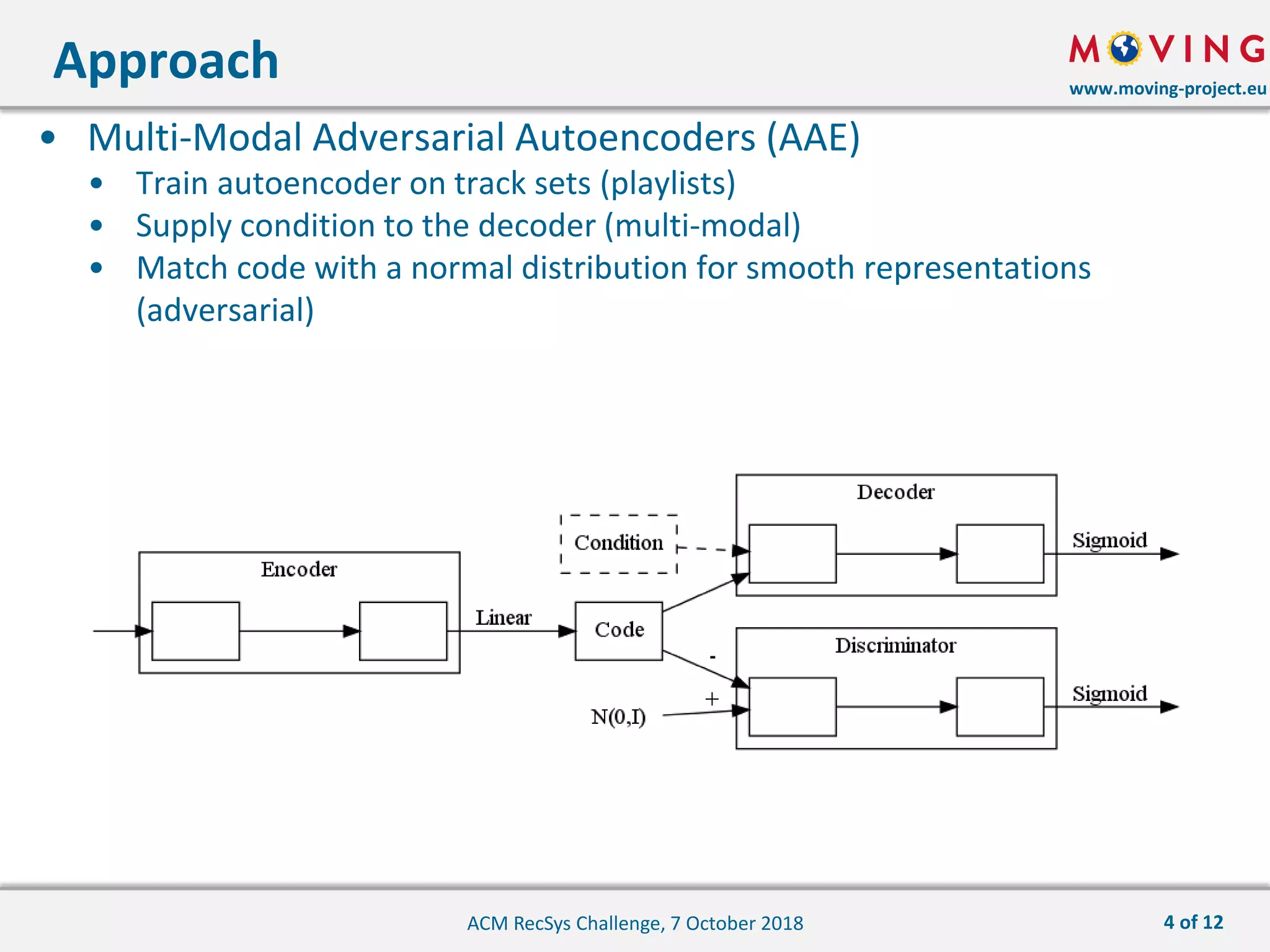
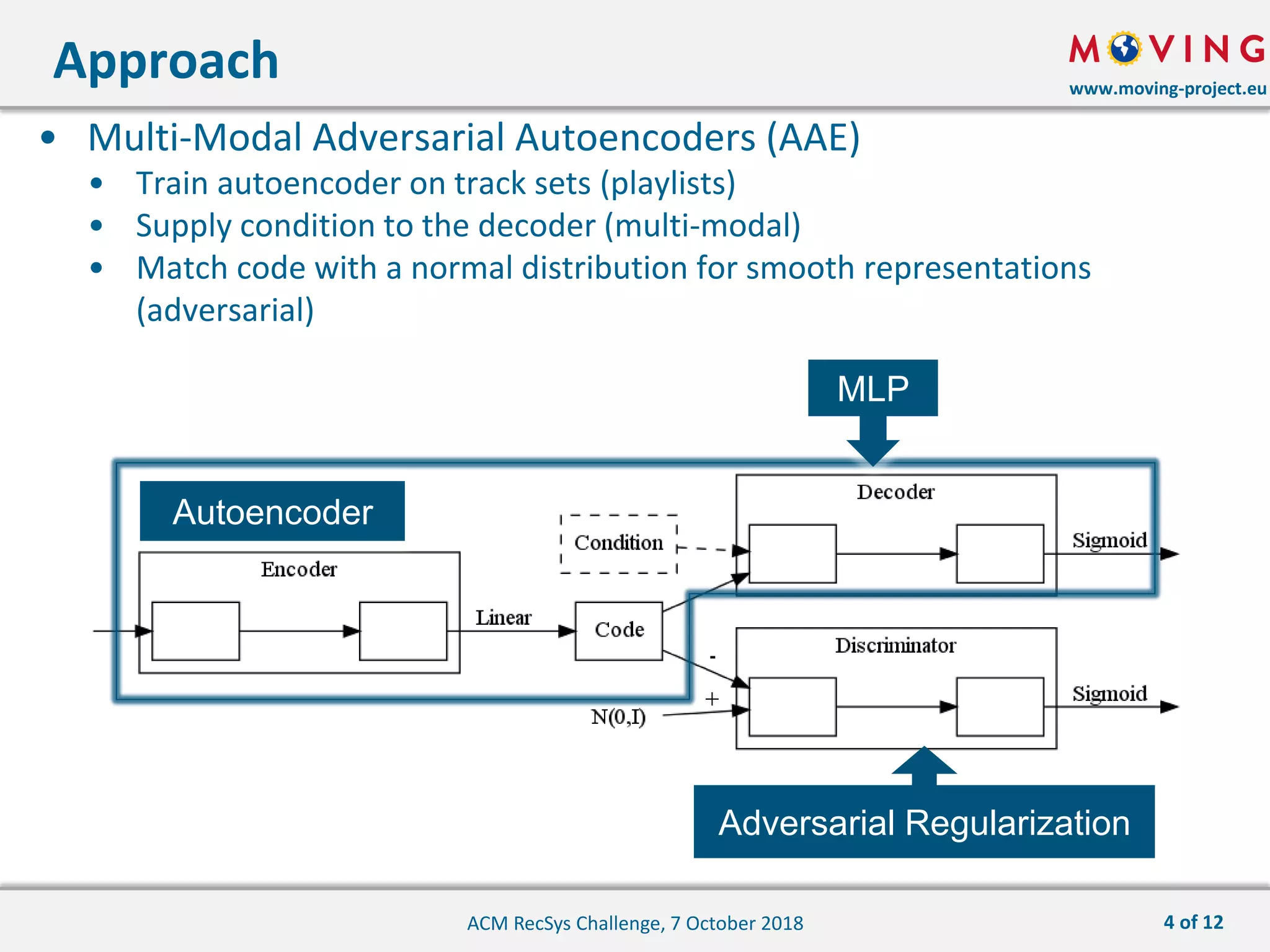
• Multi-Modal Adversarial Autoencoders (AAE)
• Train autoencoder on track sets (playlists)
• Supply condition to the decoder (multi-modal)
• Match code with a normal distribution for smooth representations
(adversarial)
Approach
ACM RecSys Challenge, 7 October 2018 4 of 12
www.moving-project.eu
• Multi-Modal Adversarial Autoencoders (AAE)
• Train autoencoder on track sets (playlists)
• Supply condition to the decoder (multi-modal)
• Match code with a normal distribution for smooth representations
(adversarial)
Approach
ACM RecSys Challenge, 7 October 2018
Bag of tracks
4 of 12
www.moving-project.eu
• Multi-Modal Adversarial Autoencoders (AAE)
• Train autoencoder on track sets (playlists)
• Supply condition to the decoder (multi-modal)
• Match code with a normal distribution for smooth representations
(adversarial)
Approach
ACM RecSys Challenge, 7 October 2018
Playlist titles + aggregated
track metadata
Bag of tracks
4 of 12
www.moving-project.eu
• Multi-Modal Adversarial Autoencoders (AAE)
• Train autoencoder on track sets (playlists)
• Supply condition to the decoder (multi-modal)
• Match code with a normal distribution for smooth representations
(adversarial)
Approach
ACM RecSys Challenge, 7 October 2018
Playlist titles + aggregated
track metadata
Bag of tracks
Predicted tracks‘
probabilities
4 of 12
www.moving-project.eu
• Multi-Modal Adversarial Autoencoders (AAE)
• Train autoencoder on track sets (playlists)
• Supply condition to the decoder (multi-modal)
• Match code with a normal distribution for smooth representations
(adversarial)
Approach
ACM RecSys Challenge, 7 October 2018
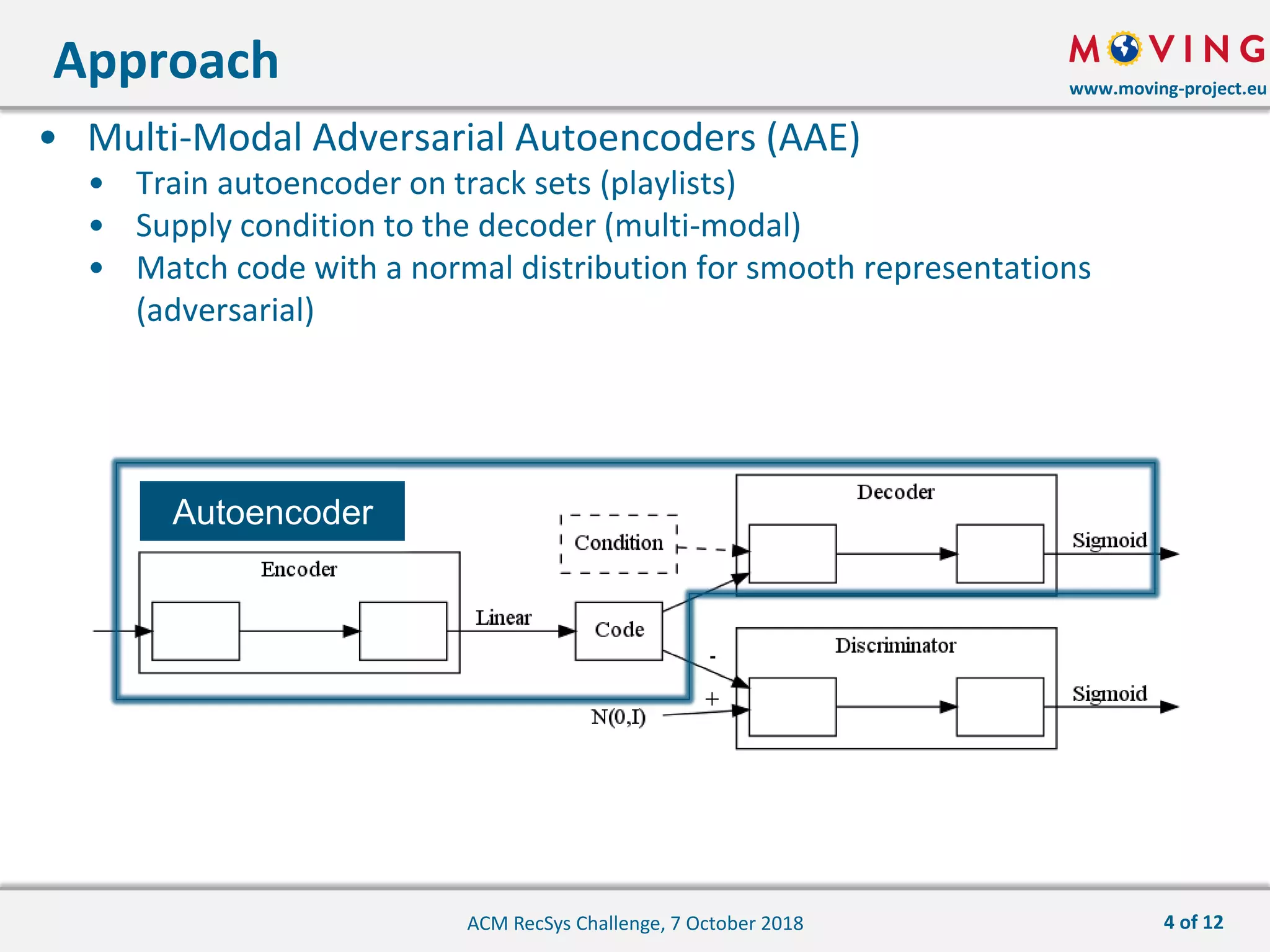
Autoencoder
4 of 12
www.moving-project.eu
• Multi-Modal Adversarial Autoencoders (AAE)
• Train autoencoder on track sets (playlists)
• Supply condition to the decoder (multi-modal)
• Match code with a normal distribution for smooth representations
(adversarial)
Approach
ACM RecSys Challenge, 7 October 2018
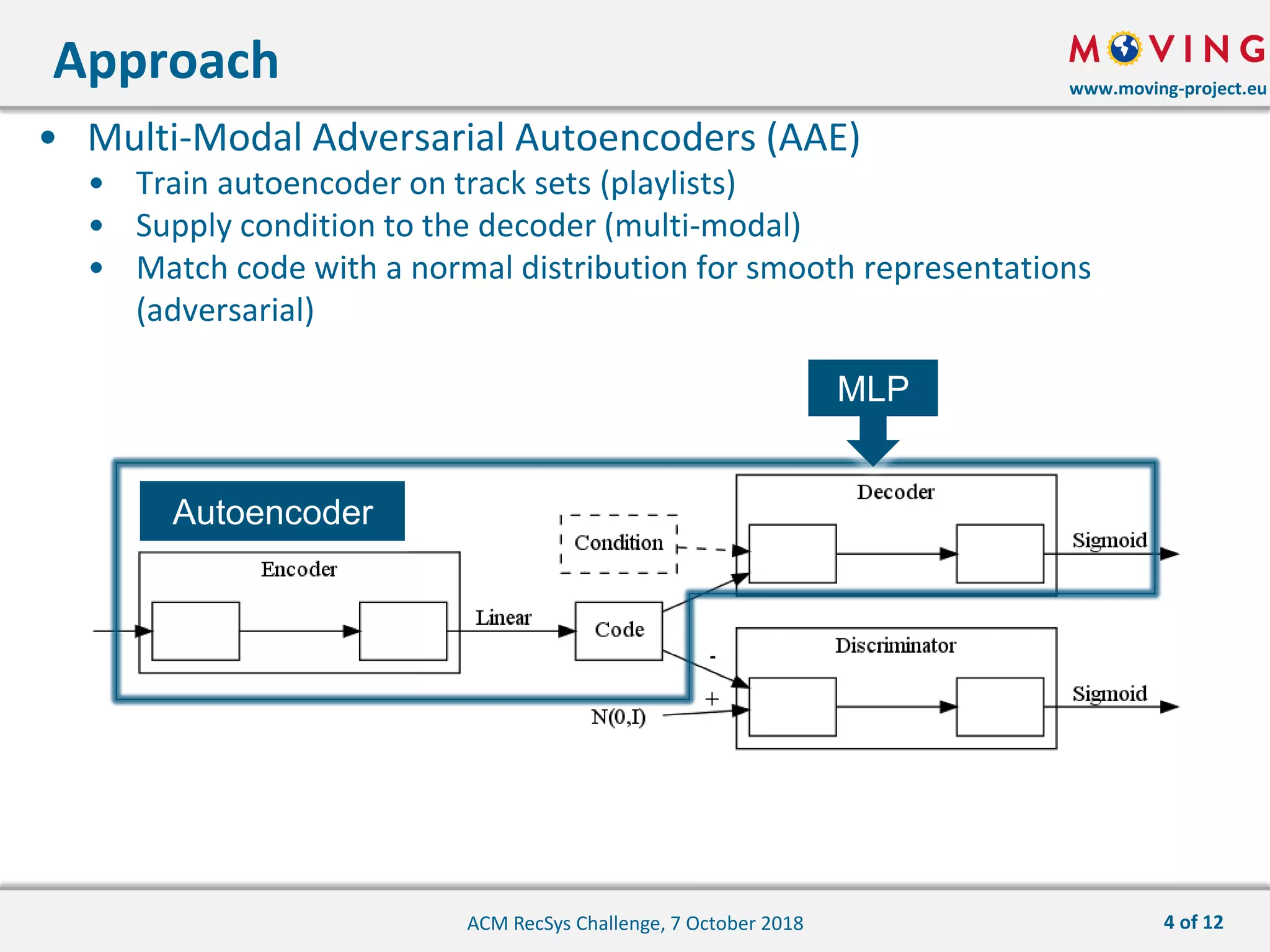
MLP
Autoencoder
4 of 12
www.moving-project.eu
• Multi-Modal Adversarial Autoencoders (AAE)
• Train autoencoder on track sets (playlists)
• Supply condition to the decoder (multi-modal)
• Match code with a normal distribution for smooth representations
(adversarial)
Approach
ACM RecSys Challenge, 7 October 2018
MLP
Autoencoder
Adversarial Regularization
4 of 12
www.moving-project.eu
0
1
0
Example
ACM RecSys Challenge, 7 October 2018
Workout
Rock
Chill
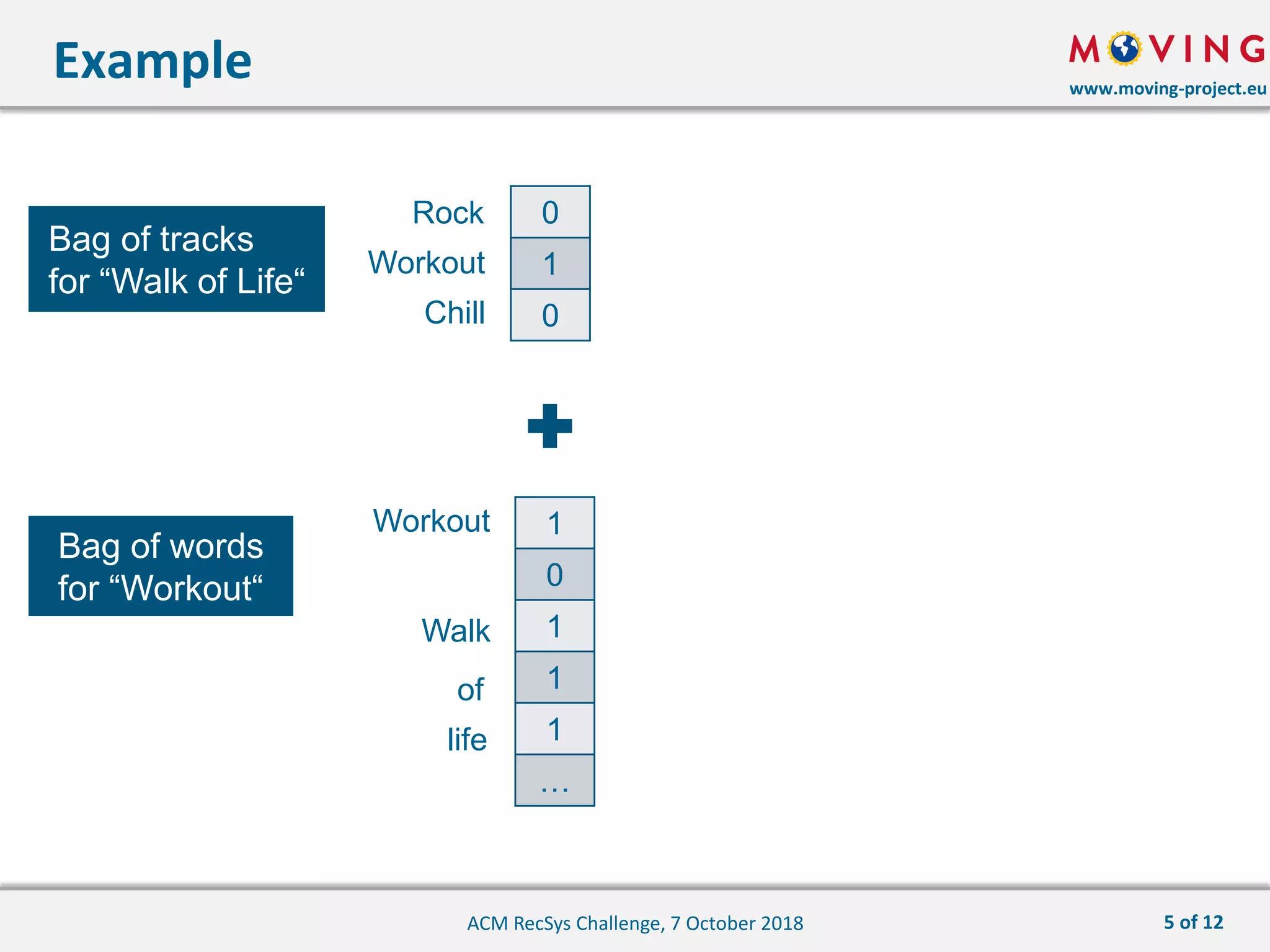
Bag of tracks
for “Walk of Life“
5 of 12
www.moving-project.eu
0
1
0
Example
ACM RecSys Challenge, 7 October 2018
Workout
Rock
Chill
1
0
1
1
1
…
Workout
Walk
of
life
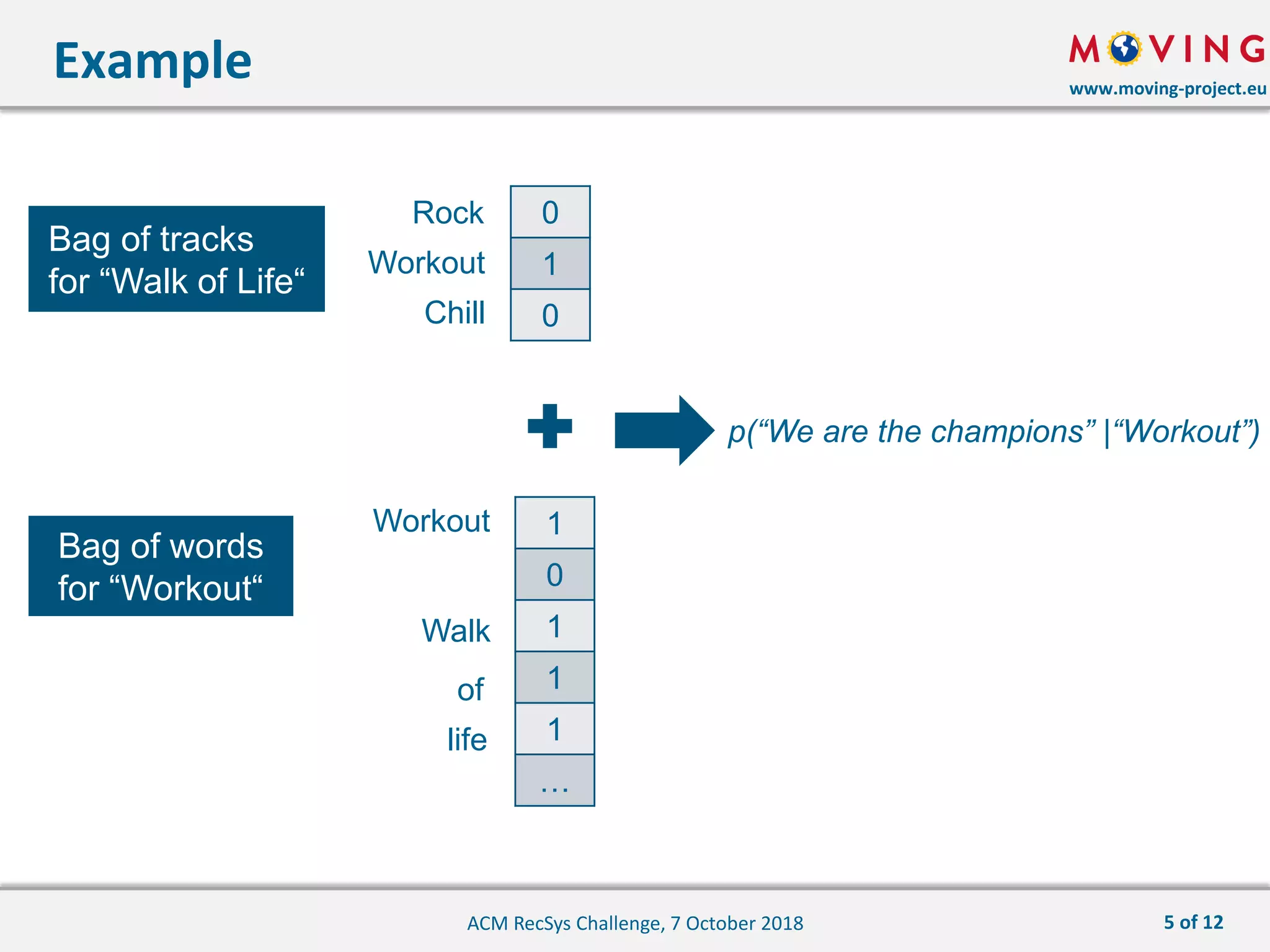
Bag of tracks
for “Walk of Life“
Bag of words
for “Workout“
5 of 12
www.moving-project.eu
0
1
0
Example
ACM RecSys Challenge, 7 October 2018
Workout
Rock
Chill
1
0
1
1
1
…
Workout
Walk
of
life
Bag of tracks
for “Walk of Life“
Bag of words
for “Workout“
p(“We are the champions” |“Workout”)
5 of 12
www.moving-project.eu
• Preliminary experiments
• AAE optimization on a development set
• Final experiments on the challenge set
Experimental Procedure
ACM RecSys Challenge, 7 October 2018 6 of 12
www.moving-project.eu
• Goals
• verify that the approach is effective
• check if using additional metadata is beneficial
• Comparison with 4 state-of-the-art methods
• Run every methods with and without playlist titles
• New user settings
Preliminary experiments
ACM RecSys Challenge, 7 October 2018 7 of 12
Test
Training
Usual split Our split
www.moving-project.eu
• Adversarial regularization consistently improves the performance
of autoencoders for automatic playlist continuation
• Using playlist titles is beneficial
Results of Preliminary Experiments
ACM RecSys Challenge, 7 October 2018
Method MRR
No Titles Titles
IC 0.0515 (0.1700) -
SVD 0.0658 (0.1946) 0.0662 (0.1953)
AE 0.0645 (0.1855) 0.0679 (0.1913)
AAE 0.0682 (0.1937) 0.0700 (0.1958)
MLP - 0.0300 (0.1310)
8 of 12
www.moving-project.eu
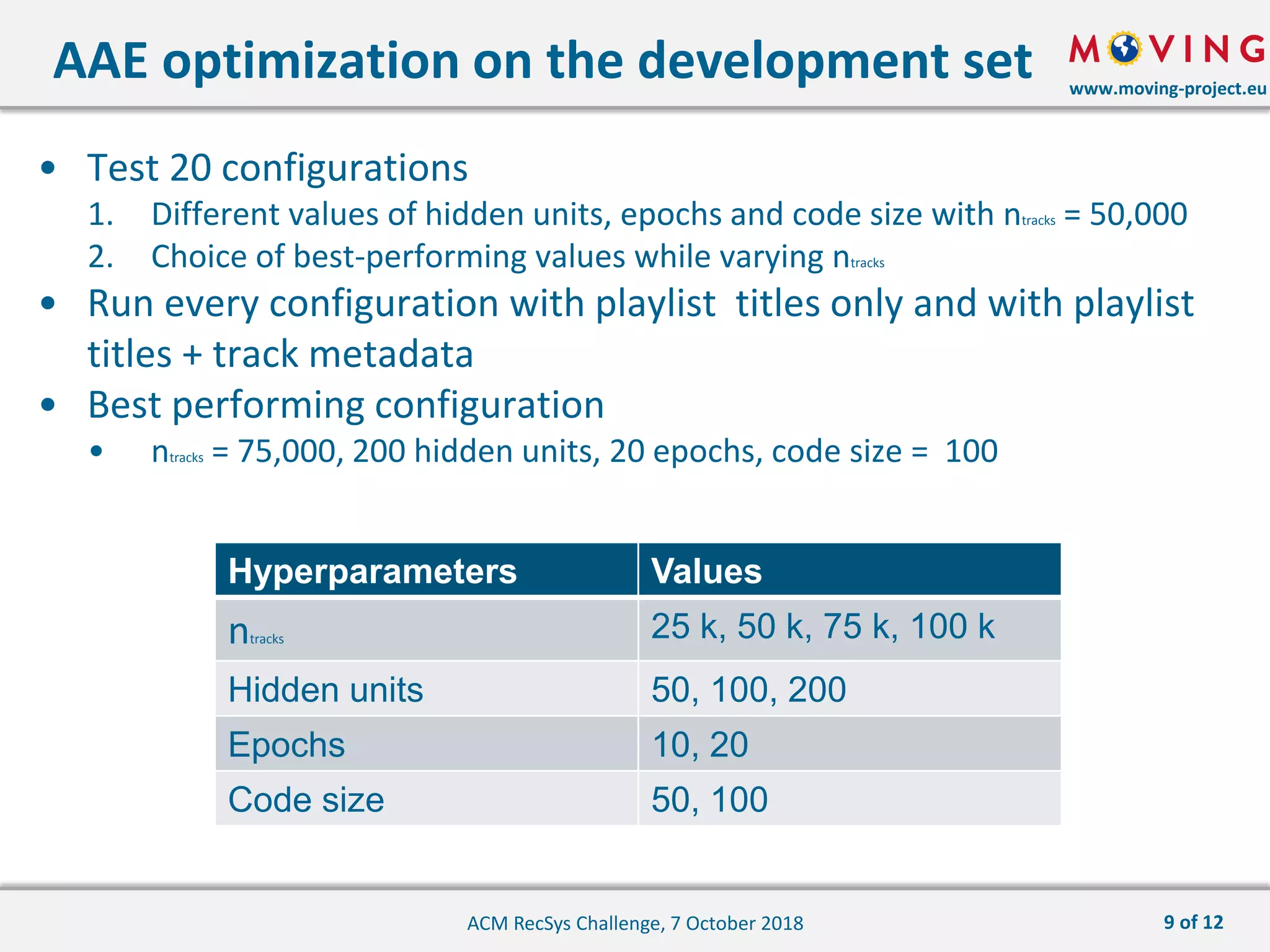
• Test 20 configurations
1. Different values of hidden units, epochs and code size with ntracks = 50,000
2. Choice of best-performing values while varying ntracks
• Run every configuration with playlist titles only and with playlist
titles + track metadata
• Best performing configuration
• ntracks = 75,000, 200 hidden units, 20 epochs, code size = 100
AAE optimization on the development set
ACM RecSys Challenge, 7 October 2018 9 of 12
Hyperparameters Values
ntracks 25 k, 50 k, 75 k, 100 k
Hidden units 50, 100, 200
Epochs 10, 20
Code size 50, 100
www.moving-project.eu
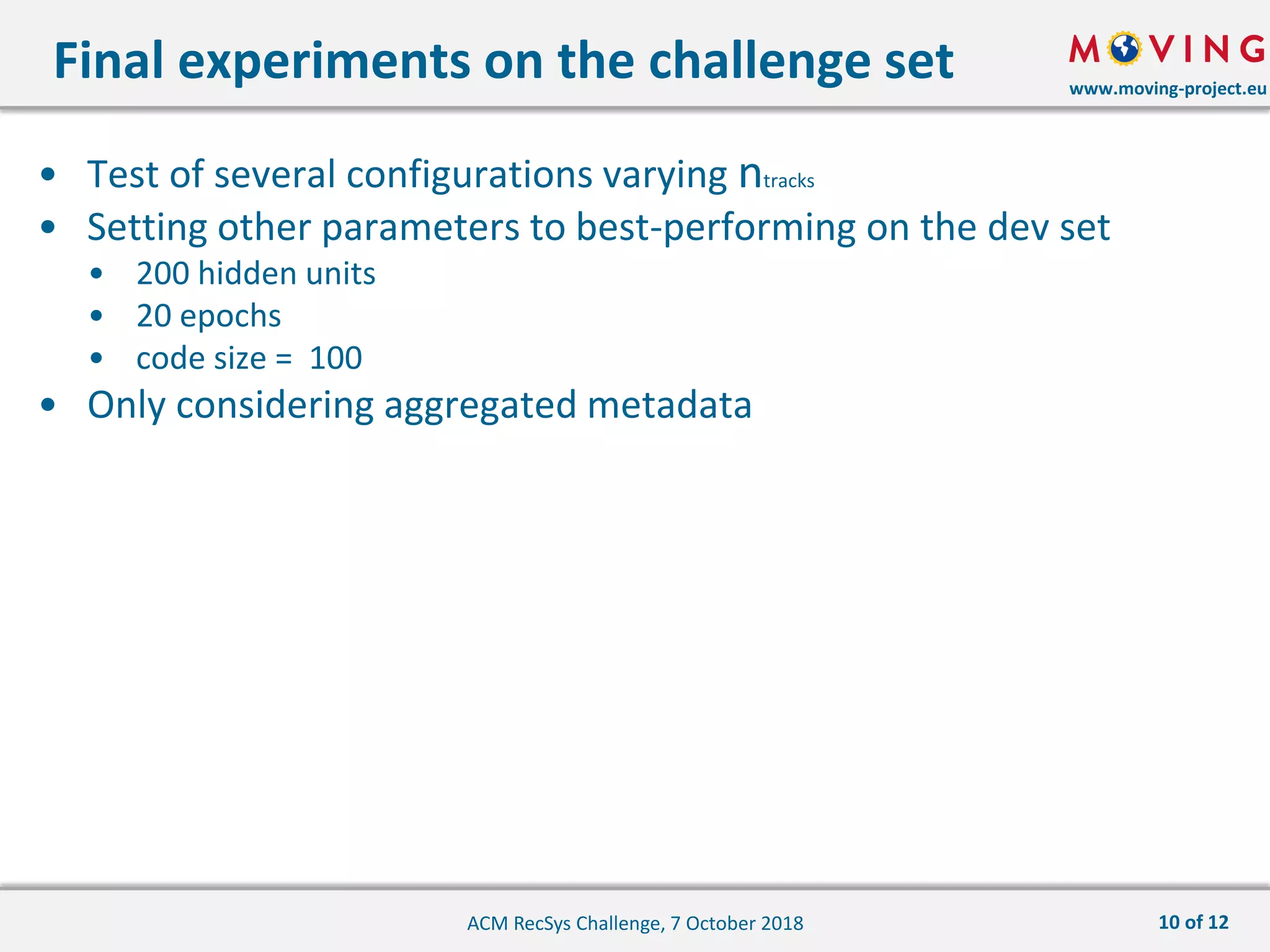
• Test of several configurations varying ntracks
• Setting other parameters to best-performing on the dev set
• 200 hidden units
• 20 epochs
• code size = 100
• Only considering aggregated metadata
Final experiments on the challenge set
ACM RecSys Challenge, 7 October 2018 10 of 12
www.moving-project.eu
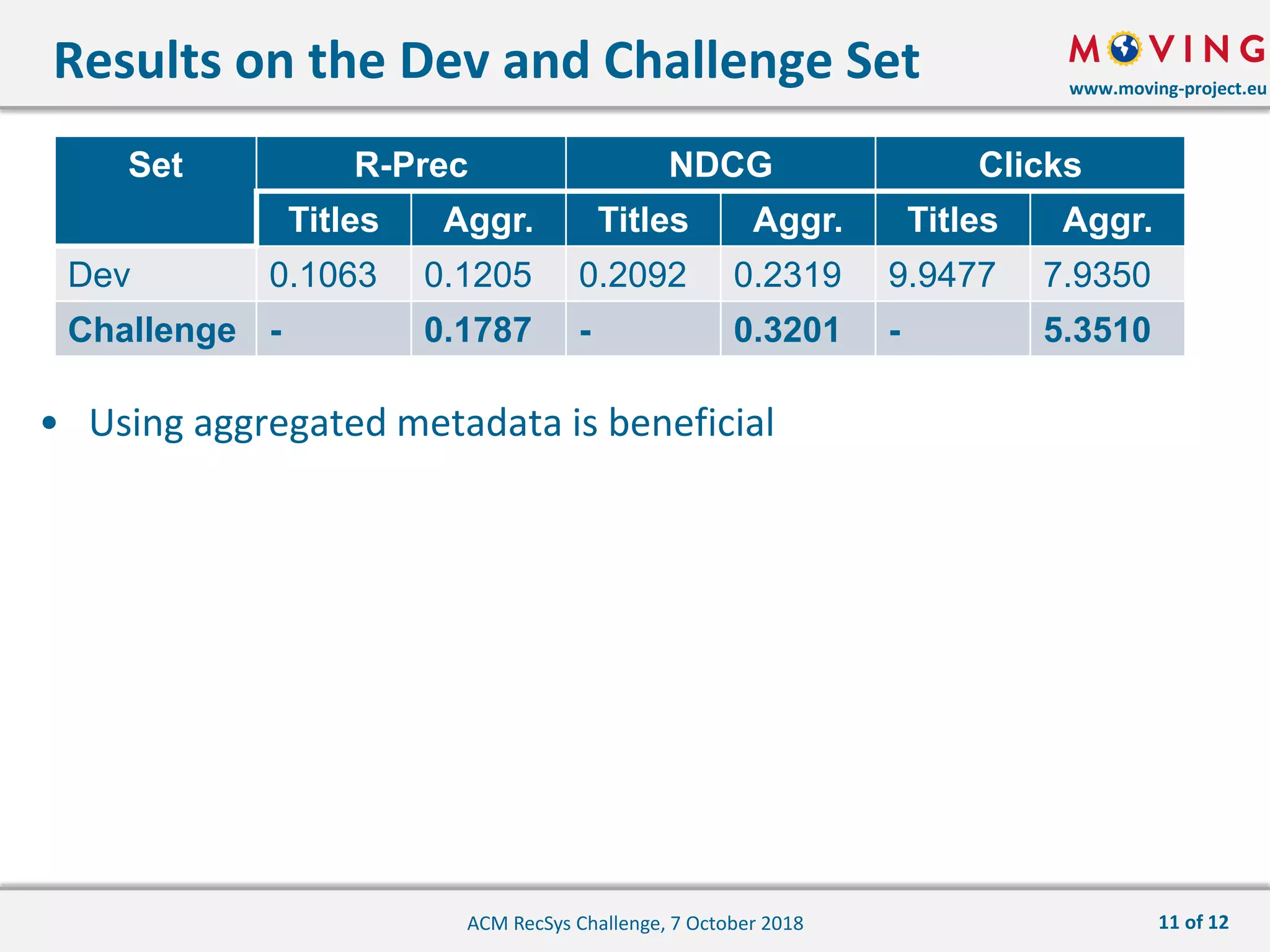
• Using aggregated metadata is beneficial
Results on the Dev and Challenge Set
ACM RecSys Challenge, 7 October 2018
Set R-Prec NDCG Clicks
Titles Aggr. Titles Aggr. Titles Aggr.
Dev 0.1063 0.1205 0.2092 0.2319 9.9477 7.9350
Challenge - 0.1787 - 0.3201 - 5.3510
11 of 12
www.moving-project.eu
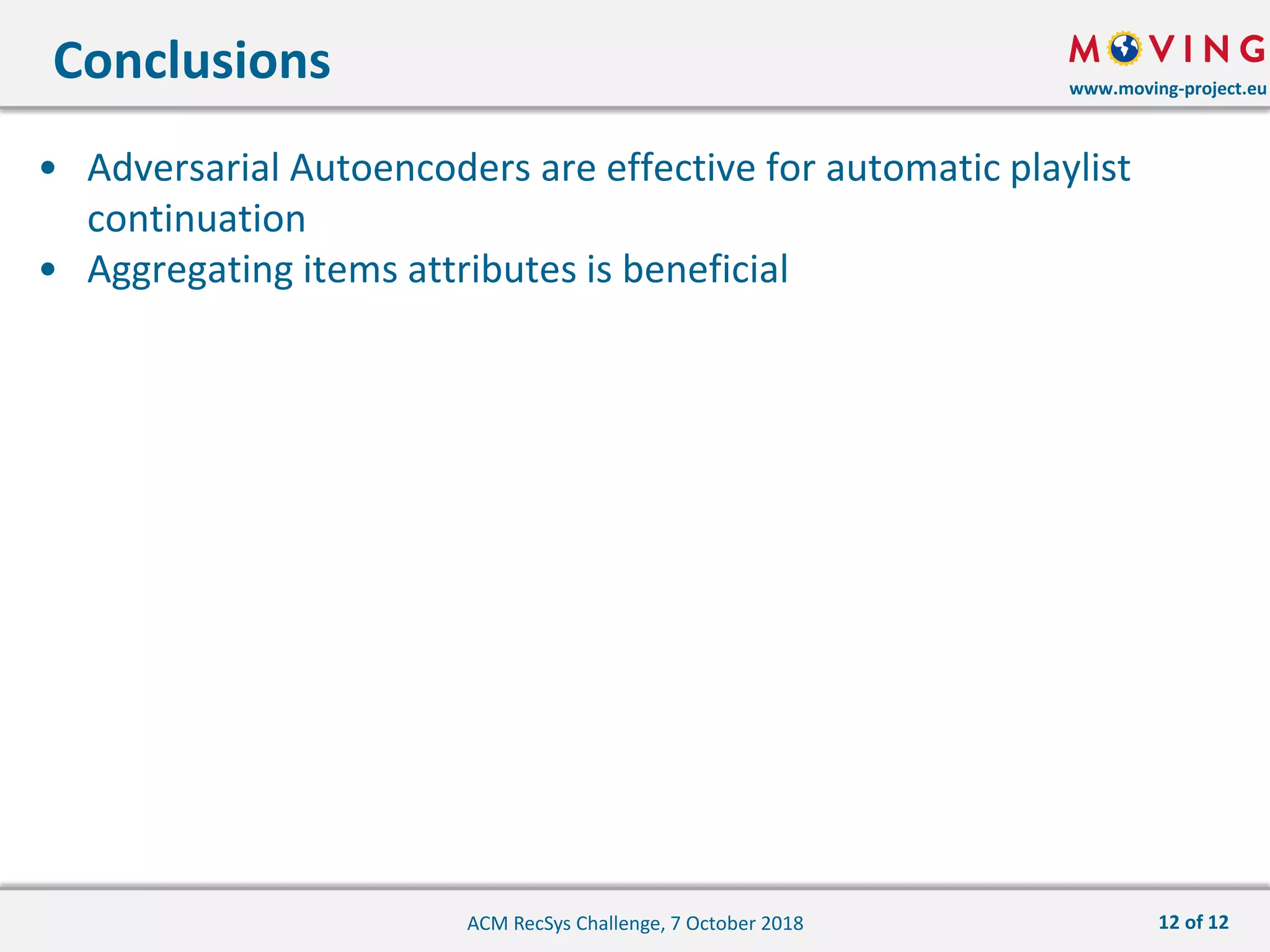
• Adversarial Autoencoders are effective for automatic playlist
continuation
• Aggregating items attributes is beneficial
Conclusions
ACM RecSys Challenge, 7 October 2018 12 of 12
www.moving-project.eu
• Adversarial Autoencoders are effective for automatic playlist
continuation
• Aggregating items attributes is beneficial
Conclusions
ACM RecSys Challenge, 7 October 2018
MOVING is funded by the EU Horizon 2020 Programme under the project number INSO-4-2015: 693092
i.vagliano@zbw.eu @maponaso
Code at https://github.com/lgalke/mpd-aae-recommender
12 of 12
www.moving-project.eu
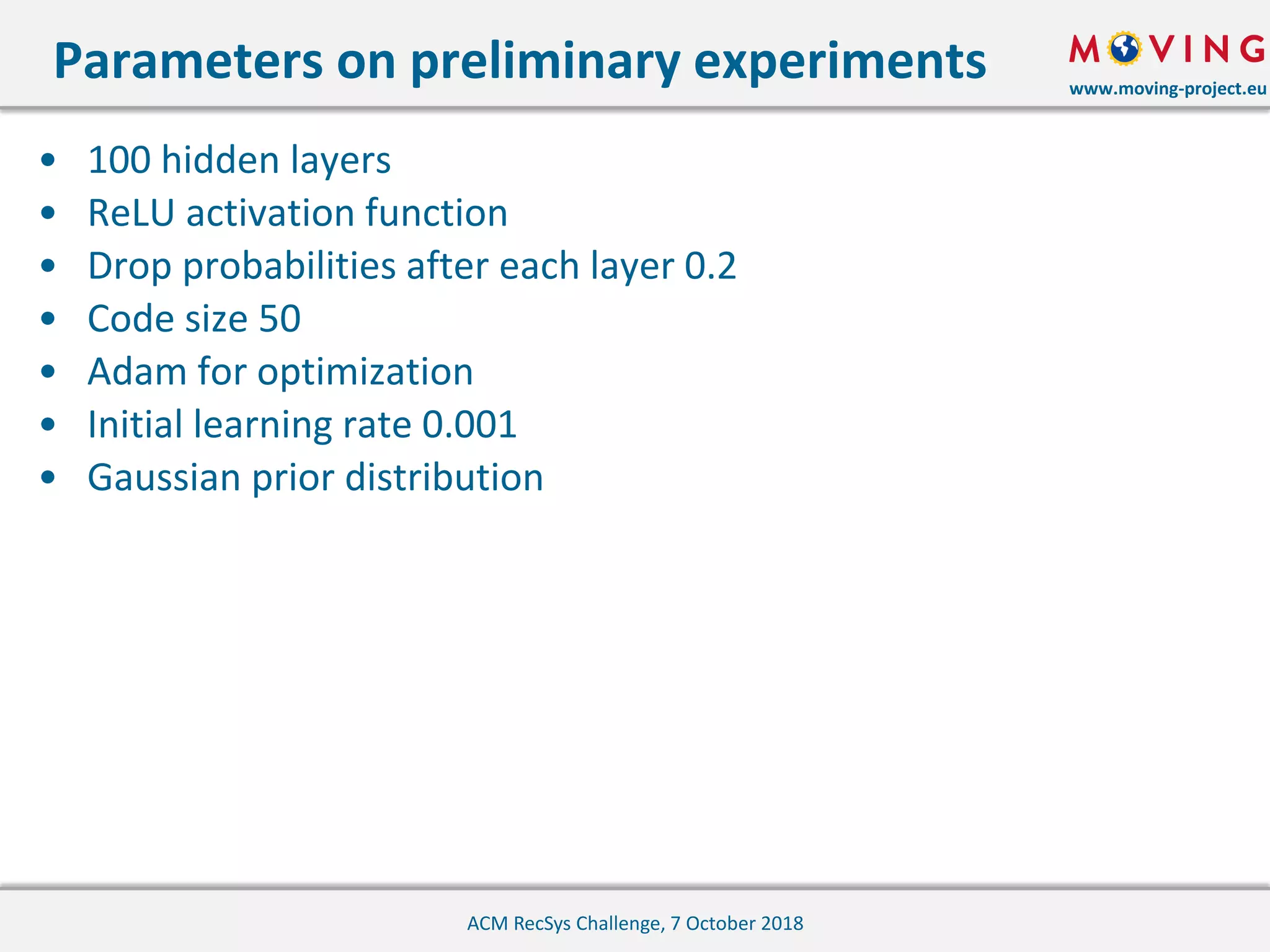
• 100 hidden layers
• ReLU activation function
• Drop probabilities after each layer 0.2
• Code size 50
• Adam for optimization
• Initial learning rate 0.001
• Gaussian prior distribution
Parameters on preliminary experiments
ACM RecSys Challenge, 7 October 2018
www.moving-project.eu
• 10,000 random playlists
• 2,000 without title and either five tracks or ten tracks retained at
random (0.5 probability)
• 8,000 with a randomly selected number of retained tracks
• either 100 or 25 tracks with a 0.2 probability each
• either zero, one, five, or ten tracks, with probability 0.1 each
• Random sampling approach
• resulting distribution of tracks slightly different from the challenge set
• Selection of tracks always random
• no distinction between selecting the first tracks or random tracks
• Naive approach for playlists with few tracks
• Cannot remove more tracks than available
• Negligible effects
Development set characteristics
ACM RecSys Challenge, 7 October 2018
www.moving-project.eu
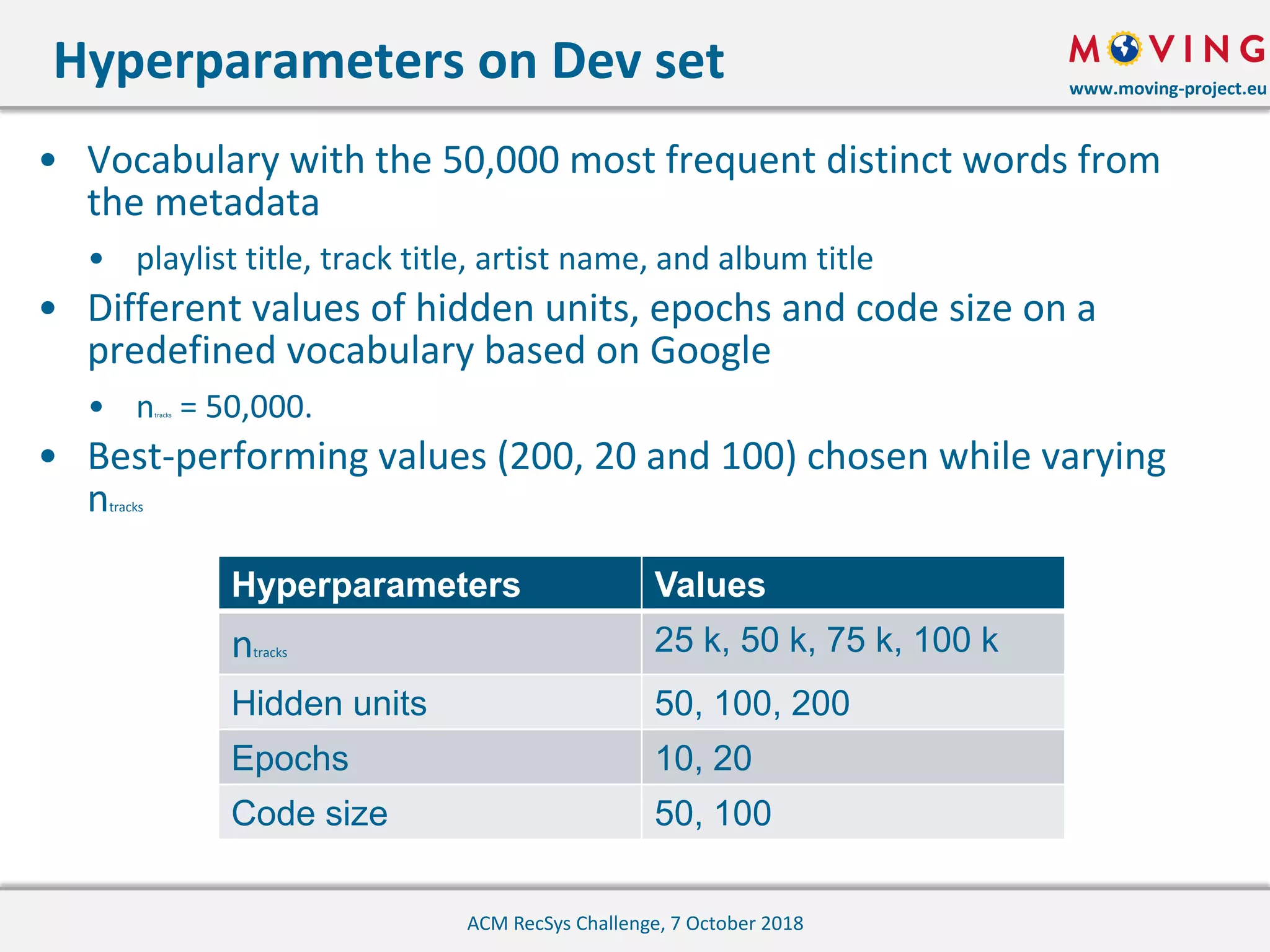
• Vocabulary with the 50,000 most frequent distinct words from
the metadata
• playlist title, track title, artist name, and album title
• Different values of hidden units, epochs and code size on a
predefined vocabulary based on Google
• ntracks = 50,000.
• Best-performing values (200, 20 and 100) chosen while varying
ntracks
Hyperparameters on Dev set
ACM RecSys Challenge, 7 October 2018
Hyperparameters Values
ntracks 25 k, 50 k, 75 k, 100 k
Hidden units 50, 100, 200
Epochs 10, 20
Code size 50, 100

Using Adversarial Autoencoders for Multi-Modal Automatic Playlist Continuation

  • 1.
    Iacopo Vagliano, ZBWKiel Lukas Galke, University of Kiel Florian May, University of Kiel Ansgar Scherp, University of Stirling Using Adversarial Autoencoders for Multi-Modal Automatic Playlist Continuation ACM RecSys Challenge, 7 October 2018
  • 2.
    www.moving-project.eu • Adversarial regularizationimproves autoencoders on images (Makhzani et al. 2015) • Adversarial autoencoders effective in recommendation tasks (Galke et al. 2018) • Smoothness on the code aids autoencoders to reconstruct highly sparse item vectors Motivation ACM RecSys Challenge, 7 October 2018 2 of 12 Makhzani, A. et al. (2015). “Adversarial Autoencoders”. In: CoRR abs/1511.05644. Galke, L. et al. (2018). Multi-Modal Adversarial Autoencoders for Recommendations of Citations and Subject Labels. ACM UMAP.
  • 3.
    www.moving-project.eu • Adversarial regularizationimproves autoencoders on images (Makhzani et al. 2015) • Adversarial autoencoders effective in recommendation tasks (Galke et al. 2018) • Smoothness on the code aids autoencoders to reconstruct highly sparse item vectors Motivation ACM RecSys Challenge, 7 October 2018 • Are adversarial autoencoders also effective for automatic playlist continuation? • Is it beneficial aggregating item attributes (track title, album title, artist name)? Research Questions Makhzani, A. et al. (2015). “Adversarial Autoencoders”. In: CoRR abs/1511.05644. Galke, L. et al. (2018). Multi-Modal Adversarial Autoencoders for Recommendations of Citations and Subject Labels. ACM UMAP. 2 of 12
  • 4.
    www.moving-project.eu • Set ofm playlist P • Set of n tracks T • Sparse matrix X ϵ {0,1}m x n in the spanned space P x T • Xjk = 1 if the track k is in the playlist j (binary occurrence) Problem statement ACM RecSys Challenge, 7 October 2018 3 of 12
  • 5.
    www.moving-project.eu • Multi-Modal AdversarialAutoencoders (AAE) • Train autoencoder on track sets (playlists) • Supply condition to the decoder (multi-modal) • Match code with a normal distribution for smooth representations (adversarial) Approach ACM RecSys Challenge, 7 October 2018 4 of 12
  • 6.
    www.moving-project.eu • Multi-Modal AdversarialAutoencoders (AAE) • Train autoencoder on track sets (playlists) • Supply condition to the decoder (multi-modal) • Match code with a normal distribution for smooth representations (adversarial) Approach ACM RecSys Challenge, 7 October 2018 Bag of tracks 4 of 12
  • 7.
    www.moving-project.eu • Multi-Modal AdversarialAutoencoders (AAE) • Train autoencoder on track sets (playlists) • Supply condition to the decoder (multi-modal) • Match code with a normal distribution for smooth representations (adversarial) Approach ACM RecSys Challenge, 7 October 2018 Playlist titles + aggregated track metadata Bag of tracks 4 of 12
  • 8.
    www.moving-project.eu • Multi-Modal AdversarialAutoencoders (AAE) • Train autoencoder on track sets (playlists) • Supply condition to the decoder (multi-modal) • Match code with a normal distribution for smooth representations (adversarial) Approach ACM RecSys Challenge, 7 October 2018 Playlist titles + aggregated track metadata Bag of tracks Predicted tracks‘ probabilities 4 of 12
  • 9.
    www.moving-project.eu • Multi-Modal AdversarialAutoencoders (AAE) • Train autoencoder on track sets (playlists) • Supply condition to the decoder (multi-modal) • Match code with a normal distribution for smooth representations (adversarial) Approach ACM RecSys Challenge, 7 October 2018 Autoencoder 4 of 12
  • 10.
    www.moving-project.eu • Multi-Modal AdversarialAutoencoders (AAE) • Train autoencoder on track sets (playlists) • Supply condition to the decoder (multi-modal) • Match code with a normal distribution for smooth representations (adversarial) Approach ACM RecSys Challenge, 7 October 2018 MLP Autoencoder 4 of 12
  • 11.
    www.moving-project.eu • Multi-Modal AdversarialAutoencoders (AAE) • Train autoencoder on track sets (playlists) • Supply condition to the decoder (multi-modal) • Match code with a normal distribution for smooth representations (adversarial) Approach ACM RecSys Challenge, 7 October 2018 MLP Autoencoder Adversarial Regularization 4 of 12
  • 12.
    www.moving-project.eu 0 1 0 Example ACM RecSys Challenge,7 October 2018 Workout Rock Chill Bag of tracks for “Walk of Life“ 5 of 12
  • 13.
    www.moving-project.eu 0 1 0 Example ACM RecSys Challenge,7 October 2018 Workout Rock Chill 1 0 1 1 1 … Workout Walk of life Bag of tracks for “Walk of Life“ Bag of words for “Workout“ 5 of 12
  • 14.
    www.moving-project.eu 0 1 0 Example ACM RecSys Challenge,7 October 2018 Workout Rock Chill 1 0 1 1 1 … Workout Walk of life Bag of tracks for “Walk of Life“ Bag of words for “Workout“ p(“We are the champions” |“Workout”) 5 of 12
  • 15.
    www.moving-project.eu • Preliminary experiments •AAE optimization on a development set • Final experiments on the challenge set Experimental Procedure ACM RecSys Challenge, 7 October 2018 6 of 12
  • 16.
    www.moving-project.eu • Goals • verifythat the approach is effective • check if using additional metadata is beneficial • Comparison with 4 state-of-the-art methods • Run every methods with and without playlist titles • New user settings Preliminary experiments ACM RecSys Challenge, 7 October 2018 7 of 12 Test Training Usual split Our split
  • 17.
    www.moving-project.eu • Adversarial regularizationconsistently improves the performance of autoencoders for automatic playlist continuation • Using playlist titles is beneficial Results of Preliminary Experiments ACM RecSys Challenge, 7 October 2018 Method MRR No Titles Titles IC 0.0515 (0.1700) - SVD 0.0658 (0.1946) 0.0662 (0.1953) AE 0.0645 (0.1855) 0.0679 (0.1913) AAE 0.0682 (0.1937) 0.0700 (0.1958) MLP - 0.0300 (0.1310) 8 of 12
  • 18.
    www.moving-project.eu • Test 20configurations 1. Different values of hidden units, epochs and code size with ntracks = 50,000 2. Choice of best-performing values while varying ntracks • Run every configuration with playlist titles only and with playlist titles + track metadata • Best performing configuration • ntracks = 75,000, 200 hidden units, 20 epochs, code size = 100 AAE optimization on the development set ACM RecSys Challenge, 7 October 2018 9 of 12 Hyperparameters Values ntracks 25 k, 50 k, 75 k, 100 k Hidden units 50, 100, 200 Epochs 10, 20 Code size 50, 100
  • 19.
    www.moving-project.eu • Test ofseveral configurations varying ntracks • Setting other parameters to best-performing on the dev set • 200 hidden units • 20 epochs • code size = 100 • Only considering aggregated metadata Final experiments on the challenge set ACM RecSys Challenge, 7 October 2018 10 of 12
  • 20.
    www.moving-project.eu • Using aggregatedmetadata is beneficial Results on the Dev and Challenge Set ACM RecSys Challenge, 7 October 2018 Set R-Prec NDCG Clicks Titles Aggr. Titles Aggr. Titles Aggr. Dev 0.1063 0.1205 0.2092 0.2319 9.9477 7.9350 Challenge - 0.1787 - 0.3201 - 5.3510 11 of 12
  • 21.
    www.moving-project.eu • Adversarial Autoencodersare effective for automatic playlist continuation • Aggregating items attributes is beneficial Conclusions ACM RecSys Challenge, 7 October 2018 12 of 12
  • 22.
    www.moving-project.eu • Adversarial Autoencodersare effective for automatic playlist continuation • Aggregating items attributes is beneficial Conclusions ACM RecSys Challenge, 7 October 2018 MOVING is funded by the EU Horizon 2020 Programme under the project number INSO-4-2015: 693092 i.vagliano@zbw.eu @maponaso Code at https://github.com/lgalke/mpd-aae-recommender 12 of 12
  • 23.
    www.moving-project.eu • 100 hiddenlayers • ReLU activation function • Drop probabilities after each layer 0.2 • Code size 50 • Adam for optimization • Initial learning rate 0.001 • Gaussian prior distribution Parameters on preliminary experiments ACM RecSys Challenge, 7 October 2018
  • 24.
    www.moving-project.eu • 10,000 randomplaylists • 2,000 without title and either five tracks or ten tracks retained at random (0.5 probability) • 8,000 with a randomly selected number of retained tracks • either 100 or 25 tracks with a 0.2 probability each • either zero, one, five, or ten tracks, with probability 0.1 each • Random sampling approach • resulting distribution of tracks slightly different from the challenge set • Selection of tracks always random • no distinction between selecting the first tracks or random tracks • Naive approach for playlists with few tracks • Cannot remove more tracks than available • Negligible effects Development set characteristics ACM RecSys Challenge, 7 October 2018
  • 25.
    www.moving-project.eu • Vocabulary withthe 50,000 most frequent distinct words from the metadata • playlist title, track title, artist name, and album title • Different values of hidden units, epochs and code size on a predefined vocabulary based on Google • ntracks = 50,000. • Best-performing values (200, 20 and 100) chosen while varying ntracks Hyperparameters on Dev set ACM RecSys Challenge, 7 October 2018 Hyperparameters Values ntracks 25 k, 50 k, 75 k, 100 k Hidden units 50, 100, 200 Epochs 10, 20 Code size 50, 100