User Behavior Modeling & 
Recommendation System Based On 
Social Networks 
Presented by Alam Shah 
Najeeb, Ahmad Taher 
Hossain MD. Shakawat 
American International University-Bangladesh (AIUB) 
Advisor: Md. Saddam Hossain, Assistant Professor, Department of 
Computer Science, American International University-Bangladesh.
Abstract 
 Our main approach is to suggest a person 
regarding the person’s specific interests 
which are anticipated based on the 
person’s public data analysis. These data 
can be used in further business analysis to 
recommend products or services of 
different companies depending on the 
consumer’s personal choice.
Slide Life: 
 Definition of Behaviour 
 BIG FIVE factors 
 Reality Demand 
 Applications 
 Scope of Implementation 
 Relative Works 
 Research Question 
 Research Methodology 
 Data Collection 
 Data Analysis 
 Results 
 Recommendation System 
 Conclusion
Applications 
 Behaviour is the way in which one acts or 
conducts oneself, especially towards others. 
 Psychologists believe that there are five basic 
dimensions of personality, often referred to as 
the “Big Five” personality traits [1]. The five 
broad personality traits described by the theory 
are extraversion, agreeableness, openness to 
experience, conscientiousness, and neuroticism. 
1 2 3 4 5 6 7 8 9 
1 
0 
1 
1 
1 
2 
1 
3 
1 
4 
1 
5 
1 
6 
1 
7 
1 
8 
1 
9 
2 
0 
2 
1 
2 
2 
2 
3 
2 
4 
2 
5 
2 
6 
2 
7 
2 
8 
2 
9 
Definition of Behavior Big Five Reality Demands Scope of Implementation 
3 
0 
Introduction Related Works Research Questions 
Research 
Methodology 
Conclusion 
Definition of Behaviour
Introduction Related Works Research Questions 
Definition of Behavior Big Five Reality Demands Scope of Implementation 
 Extraversion: refers to excitability, sociability, 
talkativeness, assertiveness and high amounts 
of emotional expressiveness towards others. 
 Agreeableness: refers to being helpful, 
cooperative and sympathetic towards others. 
 Conscientiousness: It concerns the way in 
which we control, regulate, and direct our 
impulses. 
1 2 3 4 5 6 7 8 9 
1 
0 
1 
1 
1 
2 
1 
3 
1 
4 
1 
5 
1 
6 
1 
7 
1 
8 
1 
9 
2 
0 
2 
1 
2 
2 
2 
3 
2 
4 
2 
5 
2 
6 
2 
7 
2 
8 
2 
9 
3 
0 
Big Five Factors [1] 
Research 
Methodology 
Conclusion 
Applications
Introduction Related Works Research Questions 
Research 
Methodology 
Conclusion 
Definition of Behavior Big Five (cont.) Reality Demands Applications 
Scope of Implementation 
Big Five Factors (cont.) 
1 2 3 4 5 6 7 8 9 
1 
0 
1 
1 
1 
2 
1 
3 
1 
4 
1 
5 
1 
6 
1 
7 
1 
8 
1 
9 
2 
0 
2 
1 
2 
2 
2 
3 
2 
4 
2 
5 
2 
6 
2 
7 
2 
8 
2 
9 
3 
0 
 Neuroticism: Is characterized by moodiness, 
worry, envy, frustration, jealousy, and loneliness. 
 Openness to experience: It involves with active 
imagination (fantasy), aesthetic sensitivity, 
attentiveness to inner feelings, preference for 
variety, and intellectual curiosity.
Introduction Related Works Research Questions 
Definition of Behavior Big Five Reality Demands Scope of Implementation 
 An employee needs a vacation and if 
his/her boss is listed as friend on 
OSN(online social networks) then the 
employee gets the chance to apply for his 
demand according to boss’s behavior 
generated by the system (Neuroticism 
indicates higher chances of disagree when 
Agreeableness indicates higher chances of 
agree). 
1 2 3 4 5 6 7 8 9 
1 
0 
1 
1 
1 
2 
1 
3 
1 
4 
1 
5 
1 
6 
1 
7 
1 
8 
1 
9 
2 
0 
2 
1 
2 
2 
2 
3 
2 
4 
2 
5 
2 
6 
2 
7 
2 
8 
2 
9 
3 
0 
Reality Demands 
Research 
Methodology 
Conclusion 
Applications
Introduction Related Works Research Questions 
Research 
Methodology 
Conclusion 
Definition of Behavior Big Five Reality Demands (cont.) Scope of Implementation 
1 2 3 4 5 6 7 8 9 
1 
0 
1 
1 
1 
2 
1 
3 
1 
4 
1 
5 
1 
6 
1 
7 
1 
8 
1 
9 
Applications 
2 
0 
2 
1 
2 
2 
2 
3 
2 
4 
2 
5 
2 
6 
2 
7 
2 
8 
2 
9 
3 
0 
Reality Demands (cont.) 
 A business company wants to attract new 
customers. If the company can know which 
types of people want to buy its products 
then it will be easier for the company to 
reach the right customers.
Introduction Related Works Research Questions 
Research 
Methodology 
Conclusion 
Definition of Behavior Big Five Reality Demands (cont.) Scope of Implementation 
1 2 3 4 5 6 7 8 9 
1 
0 
1 
1 
1 
2 
1 
3 
1 
4 
1 
5 
1 
6 
1 
7 
1 
8 
1 
9 
Applications 
2 
0 
2 
1 
2 
2 
2 
3 
2 
4 
2 
5 
2 
6 
2 
7 
2 
8 
2 
9 
3 
0 
Reality Demands (cont.) 
 A company manager needs to hire an 
employee, to hire the right guy for the right 
job the employer might want to analyze the 
employee’s behaviour.
Introduction Related Works Research Questions 
Research 
Methodology 
Conclusion 
Definition of Behavior Big Five Reality Demands (cont.) Scope of Implementation 
Reality Demands (cont.) 
1 2 3 4 5 6 7 8 9 
1 
0 
1 
1 
1 
2 
1 
3 
1 
4 
1 
5 
1 
6 
1 
7 
1 
8 
Applications 
1 
9 
2 
0 
2 
1 
2 
2 
2 
3 
2 
4 
2 
5 
2 
6 
2 
7 
2 
8 
2 
9 
3 
0 
 A political organisation wants to gain more 
popularity. If the party can determine which 
types of people are already its member 
and which types of people are eager to join 
their party then the party can recruit more 
efficiently.
Introduction Related Works Research Questions 
Research 
Methodology 
Conclusion 
Definition of Behavior Big Five Reality Demands Scope of Implementation 
Usefulness of this project 
1 2 3 4 5 6 7 8 9 
1 
0 
1 
1 
1 
2 
1 
3 
1 
4 
1 
5 
1 
6 
1 
7 
1 
8 
1 
9 
Applications 
2 
0 
2 
1 
2 
2 
2 
3 
2 
4 
2 
5 
2 
6 
2 
7 
2 
8 
2 
9 
3 
0 
 To help business companies to make the right 
marketing decisions by analyzing people’s 
behaviour and current trends. 
 To help an organisation to recruit the right 
person of the right job. 
 To help people know each other better. 
 To help social scientists to analyze people’s 
behaviour.
Introduction Related Works Research Questions 
Scope of Implementation 
1 2 3 4 5 6 7 8 9 
1 
0 
1 
1 
1 
2 
1 
3 
1 
4 
1 
5 
1 
6 
1 
7 
Research 
Methodology 
1 
8 
1 
9 
2 
0 
2 
1 
2 
2 
Conclusion 
2 
3 
2 
4 
2 
5 
2 
6 
2 
7 
2 
8 
2 
9 
3 
0 
Definition of Behavior Big Five Reality Demands Applications 
Scope of Implementation 
 In this era of internet social networks are 
very popular among people. Two third of 
the world population spent 10% of their 
time in internet in online social networks. 
[2]
Location Based Social Network Collaborative Recommendation Big Five Modeling 
Location Based Social Network [3] 
1 2 3 4 5 6 7 8 9 
1 
0 
1 
1 
1 
2 
1 
3 
1 
4 
1 
5 
1 
6 
1 
7 
1 
8 
1 
9 
2 
0 
2 
1 
2 
2 
2 
3 
2 
4 
2 
5 
2 
6 
2 
7 
2 
8 
2 
9 
3 
0 
Introduction Related Works Research Questions 
Research 
Methodology 
Conclusion 
Sentiment Analysis of Informal Text 
 People in an existing social network can 
expand their social structure with the new 
interdependency derived from their 
locations. As location is one of the most 
important components of user context, 
extensive knowledge about an individual’s 
interests and behaviour can be learned 
from the person’s location.
Introduction Related Works Research Questions 
Research 
Methodology 
Conclusion 
Location Based Social Network Collaborative Recommendation Sentiment Analysis of Informal Text 
Big Five Modeling 
Collaborative Recommendation Based 
Social Network [4] 
1 2 3 4 5 6 7 8 9 
1 
0 
1 
1 
1 
2 
1 
3 
1 
4 
1 
5 
1 
6 
1 
7 
1 
8 
1 
9 
2 
0 
2 
1 
2 
2 
2 
3 
2 
4 
2 
5 
2 
6 
2 
7 
2 
8 
2 
9 
3 
0 
 Recommendation systems can be based 
on user collaboration.
Introduction Related Works Research Questions 
Research 
Methodology 
Conclusion 
Location Based Social Network Collaborative Recommendation Sentiment Analysis of Informal Text 
Big Five Modeling 
Sentiment Intensity Analysis of Informal 
Texts [5] 
1 2 3 4 5 6 7 8 9 
1 
0 
1 
1 
1 
2 
1 
3 
1 
4 
1 
5 
1 
6 
1 
7 
1 
8 
1 
9 
2 
0 
2 
1 
2 
2 
2 
3 
2 
4 
2 
5 
2 
6 
2 
7 
2 
8 
2 
9 
3 
0 
 Sentiment Intensity Analysis of Informal 
texts: Sentiment analysis, also known as 
opinion mining, has known considerable 
interest recently.
Introduction Related Works Research Questions 
Research 
Methodology 
Conclusion 
Location Based Social Network Collaborative Recommendation Sentiment Analysis of Informal Text 
Big Five Modeling 
Big Five Modelling [1] 
1 2 3 4 5 6 7 8 9 
1 
0 
1 
1 
1 
2 
1 
3 
1 
4 
1 
5 
1 
6 
1 
7 
1 
8 
1 
9 
2 
0 
2 
1 
2 
2 
2 
3 
2 
4 
2 
5 
2 
6 
2 
7 
2 
8 
2 
9 
3 
0 
It is possible to create an automated system 
that can categorize users according to Big 
Five personality. 
1. Extraversion 
2. Agreeableness 
3. Conscientiousness 
4. Neuroticism 
5. Openness to experience
Introduction Related Works Research Questions 
Research 
Methodology 
Conclusion 
1 2 3 4 5 6 7 8 9 
1 
0 
1 
1 
1 
2 
1 
3 
1 
4 
1 
5 
1 
6 
1 
7 
1 
8 
1 
9 
2 
0 
2 
1 
2 
2 
2 
3 
2 
4 
2 
5 
2 
6 
2 
7 
2 
8 
2 
9 
3 
0 
Research Questions 
 How to categorize users of OSN according 
to Big Five factors from their behaviours in 
OSN? 
 Sub research Questions: 
1. How OSN represent one user? 
2. How can we analyze user behaviour ? 
3. How to categorize user behaviour in Big 
Five factors?
Introduction Related Works Research Questions 
Research 
Methodology 
Conclusion 
Methodology Data Collection Data Analysis 
Result 
1 2 3 4 5 6 7 8 9 
1 
0 
1 
1 
1 
2 
1 
3 
1 
4 
1 
5 
1 
6 
1 
7 
1 
8 
1 
9 
2 
0 
2 
1 
2 
2 
2 
3 
2 
4 
2 
5 
Recommendation 
2 
6 
System 
2 
7 
2 
8 
2 
9 
3 
0 
Research Methodology 
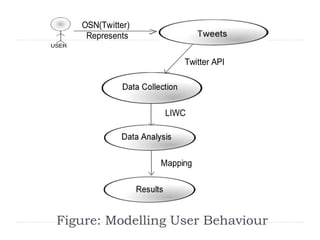
 We follow co-relational and exploratory 
methodology in this research. We use this 
methodology to make relationship among 
text corpus from social network with 
psychological theory of personality.
USER 
LIWC 
Mapping 
OSN(Twitter) 
Twitter API 
Represents 
Figure: Modelling User Behaviour
Introduction Related Works Research Questions 
Research 
Methodology 
Conclusion 
Methodology Data Collection Result 
Data Collection 
1 2 3 4 5 6 7 8 9 
1 
0 
1 
1 
1 
2 
1 
3 
1 
4 
1 
5 
Data Analysis 
1 
6 
1 
7 
1 
8 
1 
9 
2 
0 
2 
1 
2 
2 
2 
3 
2 
4 
2 
5 
Recommendation 
2 
6 
System 
2 
7 
2 
8 
2 
9 
3 
0 
 Twitter, a social network site, can be used for 
sentiment analysis as it has a very large 
number of short messages(tweets) created by 
its users [6]. So we used Twitter to collect 
users’ data. All the data collected are public 
data so there are no barriers to use these 
data. Using Twitter REST api 1.1, we 
collected users’ public tweets, re-tweets and 
followed pages in text files.
Introduction Related Works Research Questions 
Research 
Methodology 
Conclusion 
Methodology Data Collection(cont.) Data Analysis 
Result 
Recommendation 
System 
Ethical Issues regarding Data Collection 
1 2 3 4 5 6 7 8 9 
1 
0 
1 
1 
1 
2 
1 
3 
1 
4 
1 
5 
1 
6 
1 
7 
1 
8 
1 
9 
2 
0 
2 
1 
2 
2 
2 
3 
2 
4 
2 
5 
2 
6 
2 
7 
2 
8 
2 
9 
3 
0 
 We did not use Facebook(another social 
networking site) because most of the users 
of Facebook restrict their profile 
information and status updates to 'private'. 
So extracting or using private data will not 
be ethical. On the other hand many users 
of Twitter make their profile public. So 
there are no barriers to use these public 
data.
Introduction Related Works Research Questions 
Research 
Methodology 
Conclusion 
Methodology Data Collection Result 
Data Analysis 
1 2 3 4 5 6 7 8 9 
1 
0 
1 
1 
1 
2 
1 
3 
1 
4 
Data Analysis 
1 
5 
1 
6 
1 
7 
1 
8 
1 
9 
2 
0 
2 
1 
2 
2 
2 
3 
2 
4 
2 
5 
Recommendation 
2 
6 
System 
2 
7 
2 
8 
2 
9 
3 
0 
 We used Linguistic Inquiry and Word 
Count (LIWC) which is a text analysis 
software program designed by James W. 
Pennebaker, Roger J. Booth, and Martha 
E. Francis.
Introduction Related Works Research Questions 
Methodology Data Collection Result 
WHY LIWC 
Research 
Methodology 
Conclusion 
Data Analysis(cont.) 
Recommendation 
System
Introduction Related Works Research Questions 
LIWC features 
Research 
Methodology 
Conclusion 
 LIWC2007 is designed to accept written or 
transcribed verbal text which has been stored as a 
text or ASCII file using any of the popular 
word processing software packages. 
 LIWC2007 reads each designated text file, one 
target word at a time in a fraction of second. 
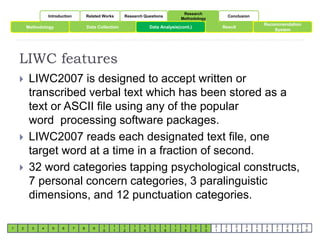
 32 word categories tapping psychological constructs, 
7 personal concern categories, 3 paralinguistic 
dimensions, and 12 punctuation categories. 
1 2 3 4 5 6 7 8 9 
1 
0 
1 
1 
1 
2 
1 
3 
1 
4 
1 
5 
1 
6 
1 
7 
1 
8 
1 
9 
2 
0 
2 
1 
2 
2 
2 
3 
2 
4 
2 
5 
2 
6 
2 
7 
2 
8 
2 
9 
3 
0 
Methodology Data Collection Data Analysis(cont.) 
Result 
Recommendation 
System
Introduction Related Works Research Questions 
Research 
Methodology 
Methodology Data Collection Result 
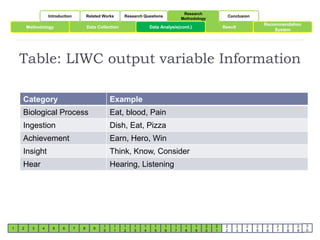
Table: LIWC output variable Information 
1 2 3 4 5 6 7 8 9 
1 
0 
1 
1 
1 
2 
1 
3 
1 
4 
1 
5 
1 
6 
1 
7 
1 
8 
1 
9 
2 
0 
2 
1 
2 
2 
2 
3 
2 
4 
2 
5 
2 
6 
2 
7 
2 
8 
2 
9 
3 
0 
Category Example 
Biological Process Eat, blood, Pain 
Ingestion Dish, Eat, Pizza 
Achievement Earn, Hero, Win 
Insight Think, Know, Consider 
Hear Hearing, Listening 
Conclusion 
Data Analysis(cont.) 
Recommendation 
System
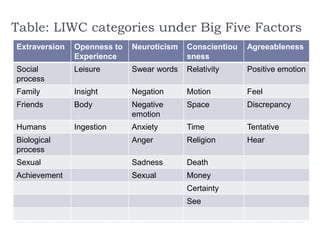
Table: LIWC categories under Big Five Factors 
Extraversion Openness to 
Experience 
Neuroticism Conscientiou 
sness 
Agreeableness 
Social 
process 
Leisure Swear words Relativity Positive emotion 
Family Insight Negation Motion Feel 
Friends Body Negative 
emotion 
Space Discrepancy 
Humans Ingestion Anxiety Time Tentative 
Biological 
Anger Religion Hear 
process 
Sexual Sadness Death 
Achievement Sexual Money 
Certainty 
See
Introduction Related Works Research Questions 
Research 
Methodology 
Conclusion 
Methodology Data Collection Result 
Results 
1 2 3 4 5 6 7 8 9 
1 
0 
1 
1 
1 
2 
1 
3 
1 
4 
Data Analysis 
1 
5 
1 
6 
1 
7 
1 
8 
1 
9 
2 
0 
2 
1 
2 
2 
2 
3 
2 
4 
2 
5 
Recommendation 
2 
6 
System 
2 
7 
2 
8 
2 
9 
3 
0 
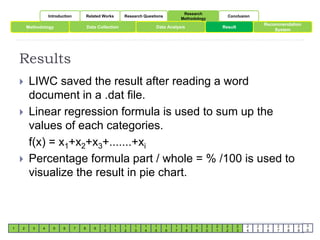
 LIWC saved the result after reading a word 
document in a .dat file. 
 Linear regression formula is used to sum up the 
values of each categories. 
f(x) = x1+x2+x3+.......+xi 
 Percentage formula part / whole = % /100 is used to 
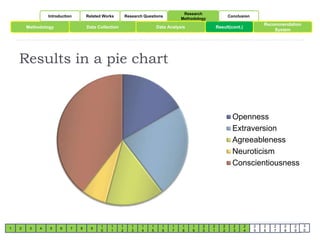
visualize the result in pie chart.
Methodology Data Collection Result(cont.) 
Results in a pie chart 
1 2 3 4 5 6 7 8 9 
1 
0 
1 
1 
1 
2 
1 
3 
1 
4 
1 
5 
1 
6 
1 
7 
1 
8 
1 
9 
2 
0 
2 
1 
2 
2 
2 
3 
2 
4 
2 
5 
2 
6 
2 
7 
2 
8 
2 
9 
3 
0 
Openness 
Extraversion 
Agreeableness 
Neuroticism 
Conscientiousness 
Introduction Related Works Research Questions 
Research 
Methodology 
Conclusion 
Data Analysis 
Recommendation 
System
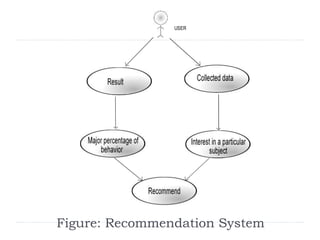
USER 
Figure: Recommendation System
Introduction Related Works Research Questions 
Research 
Methodology 
Conclusion 
Methodology Data Collection Data Analysis 
Result 
Recommendation System 
1 2 3 4 5 6 7 8 9 
1 
0 
1 
1 
1 
2 
1 
3 
1 
4 
1 
5 
1 
6 
1 
7 
1 
8 
1 
9 
2 
0 
2 
1 
2 
2 
2 
3 
2 
4 
2 
5 
Recommendation 
2 
6 
System 
2 
7 
2 
8 
2 
9 
3 
0 
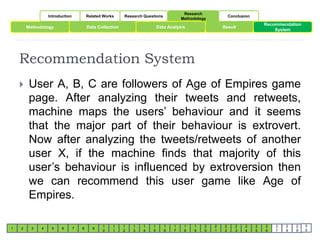
 User A, B, C are followers of Age of Empires game 
page. After analyzing their tweets and retweets, 
machine maps the users’ behaviour and it seems 
that the major part of their behaviour is extrovert. 
Now after analyzing the tweets/retweets of another 
user X, if the machine finds that majority of this 
user’s behaviour is influenced by extroversion then 
we can recommend this user game like Age of 
Empires.
Methodology Data Collection Result 
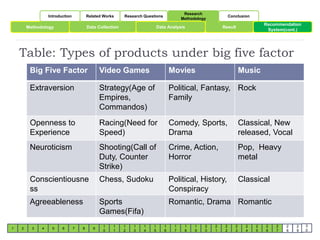
Big Five Factor Video Games Movies Music 
Extraversion Strategy(Age of 
Empires, 
Commandos) 
Political, Fantasy, 
Family 
Rock 
Openness to 
Experience 
Racing(Need for 
Speed) 
Comedy, Sports, 
Drama 
Classical, New 
released, Vocal 
Neuroticism Shooting(Call of 
Duty, Counter 
Strike) 
Crime, Action, 
Horror 
Pop, Heavy 
metal 
Conscientiousne 
ss 
Chess, Sudoku Political, History, 
Conspiracy 
Classical 
Agreeableness Sports 
Games(Fifa) 
Romantic, Drama Romantic 
Introduction Related Works Research Questions 
Research 
Methodology 
Conclusion 
Data Analysis 
Recommendation 
System(cont.) 
Table: Types of products under big five factor 
1 2 3 4 5 6 7 8 9 
1 
0 
1 
1 
1 
2 
1 
3 
1 
4 
1 
5 
1 
6 
1 
7 
1 
8 
1 
9 
2 
0 
2 
1 
2 
2 
2 
3 
2 
4 
2 
5 
2 
6 
2 
7 
2 
8 
2 
9 
3 
0
Conclusion 
 To the best of our knowledge this is the first 
recommendation system based on Big Five factors. 
In our thesis we proved that personality can be 
determined by analyzing language cues. 
 At this moment our system can only use text 
information, But in future our system will be able to 
mine data from shared links or videos. There is a big 
scope for analyzing exclamatory sentences or 
smileys. Our system can not understand sarcastic 
behaviour at this moment, it neither can understand 
double negation. 
2 3 4 5 6 7 8 9 
1 
0 
1 
1 
1 
2 
1 
3 
1 
4 
1 
5 
1 
6 
1 
7 
1 
8 
1 
9 
2 
0 
2 
1 
2 
2 
2 
3 
2 
4 
2 
5 
2 
6 
2 
7 
2 
8 
2 
9 
1 
3 
0 
Introduction Related Works Research Questions 
Research 
Methodology 
Conclusion
Thank You 

References 
1. Kendra Cherry. The big five personality dimensions, 2012. Accessed:2010- 
09-30. 
2. Nielsen Online Report. Social networks & blogs now 4th most popular 
online activity, 2009. 
3. Zheng, Yu. "Location-based social networks: Users." Computing with Spatial 
Trajectories. Springer New York, 2011. 243-276. 
4. Konstas, Ioannis, Vassilios Stathopoulos, and Joemon M. Jose. "On social 
networks and collaborative recommendation." Proceedings of the 32nd 
international ACM SIGIR conference on Research and development in 
information retrieval. ACM, 2009. 
5. Paltoglou, Georgios, et al. "Sentiment analysis of informal textual 
communication in cyberspace." Proc. Engage (2010): 13-25. 
6. A. Pak and P. Paroubek, “Twitter as a corpus for sentiment analysis and 
opinion mining.,” in LREC, 2010. 2 3 4 5 6 7 8 9 
1 
0 
1 
1 
1 
2 
1 
3 
1 
4 
1 
5 
1 
6 
1 
7 
1 
8 
1 
9 
2 
0 
2 
1 
2 
2 
2 
3 
2 
4 
2 
5 
2 
6 
2 
7 
2 
8 
2 
9 
1 
3 
0

User behavior modelling & recommendation system based on social networks

  • 1.
    User Behavior Modeling& Recommendation System Based On Social Networks Presented by Alam Shah Najeeb, Ahmad Taher Hossain MD. Shakawat American International University-Bangladesh (AIUB) Advisor: Md. Saddam Hossain, Assistant Professor, Department of Computer Science, American International University-Bangladesh.
  • 2.
    Abstract  Ourmain approach is to suggest a person regarding the person’s specific interests which are anticipated based on the person’s public data analysis. These data can be used in further business analysis to recommend products or services of different companies depending on the consumer’s personal choice.
  • 3.
    Slide Life: Definition of Behaviour  BIG FIVE factors  Reality Demand  Applications  Scope of Implementation  Relative Works  Research Question  Research Methodology  Data Collection  Data Analysis  Results  Recommendation System  Conclusion
  • 4.
    Applications  Behaviouris the way in which one acts or conducts oneself, especially towards others.  Psychologists believe that there are five basic dimensions of personality, often referred to as the “Big Five” personality traits [1]. The five broad personality traits described by the theory are extraversion, agreeableness, openness to experience, conscientiousness, and neuroticism. 1 2 3 4 5 6 7 8 9 1 0 1 1 1 2 1 3 1 4 1 5 1 6 1 7 1 8 1 9 2 0 2 1 2 2 2 3 2 4 2 5 2 6 2 7 2 8 2 9 Definition of Behavior Big Five Reality Demands Scope of Implementation 3 0 Introduction Related Works Research Questions Research Methodology Conclusion Definition of Behaviour
  • 5.
    Introduction Related WorksResearch Questions Definition of Behavior Big Five Reality Demands Scope of Implementation  Extraversion: refers to excitability, sociability, talkativeness, assertiveness and high amounts of emotional expressiveness towards others.  Agreeableness: refers to being helpful, cooperative and sympathetic towards others.  Conscientiousness: It concerns the way in which we control, regulate, and direct our impulses. 1 2 3 4 5 6 7 8 9 1 0 1 1 1 2 1 3 1 4 1 5 1 6 1 7 1 8 1 9 2 0 2 1 2 2 2 3 2 4 2 5 2 6 2 7 2 8 2 9 3 0 Big Five Factors [1] Research Methodology Conclusion Applications
  • 6.
    Introduction Related WorksResearch Questions Research Methodology Conclusion Definition of Behavior Big Five (cont.) Reality Demands Applications Scope of Implementation Big Five Factors (cont.) 1 2 3 4 5 6 7 8 9 1 0 1 1 1 2 1 3 1 4 1 5 1 6 1 7 1 8 1 9 2 0 2 1 2 2 2 3 2 4 2 5 2 6 2 7 2 8 2 9 3 0  Neuroticism: Is characterized by moodiness, worry, envy, frustration, jealousy, and loneliness.  Openness to experience: It involves with active imagination (fantasy), aesthetic sensitivity, attentiveness to inner feelings, preference for variety, and intellectual curiosity.
  • 7.
    Introduction Related WorksResearch Questions Definition of Behavior Big Five Reality Demands Scope of Implementation  An employee needs a vacation and if his/her boss is listed as friend on OSN(online social networks) then the employee gets the chance to apply for his demand according to boss’s behavior generated by the system (Neuroticism indicates higher chances of disagree when Agreeableness indicates higher chances of agree). 1 2 3 4 5 6 7 8 9 1 0 1 1 1 2 1 3 1 4 1 5 1 6 1 7 1 8 1 9 2 0 2 1 2 2 2 3 2 4 2 5 2 6 2 7 2 8 2 9 3 0 Reality Demands Research Methodology Conclusion Applications
  • 8.
    Introduction Related WorksResearch Questions Research Methodology Conclusion Definition of Behavior Big Five Reality Demands (cont.) Scope of Implementation 1 2 3 4 5 6 7 8 9 1 0 1 1 1 2 1 3 1 4 1 5 1 6 1 7 1 8 1 9 Applications 2 0 2 1 2 2 2 3 2 4 2 5 2 6 2 7 2 8 2 9 3 0 Reality Demands (cont.)  A business company wants to attract new customers. If the company can know which types of people want to buy its products then it will be easier for the company to reach the right customers.
  • 9.
    Introduction Related WorksResearch Questions Research Methodology Conclusion Definition of Behavior Big Five Reality Demands (cont.) Scope of Implementation 1 2 3 4 5 6 7 8 9 1 0 1 1 1 2 1 3 1 4 1 5 1 6 1 7 1 8 1 9 Applications 2 0 2 1 2 2 2 3 2 4 2 5 2 6 2 7 2 8 2 9 3 0 Reality Demands (cont.)  A company manager needs to hire an employee, to hire the right guy for the right job the employer might want to analyze the employee’s behaviour.
  • 10.
    Introduction Related WorksResearch Questions Research Methodology Conclusion Definition of Behavior Big Five Reality Demands (cont.) Scope of Implementation Reality Demands (cont.) 1 2 3 4 5 6 7 8 9 1 0 1 1 1 2 1 3 1 4 1 5 1 6 1 7 1 8 Applications 1 9 2 0 2 1 2 2 2 3 2 4 2 5 2 6 2 7 2 8 2 9 3 0  A political organisation wants to gain more popularity. If the party can determine which types of people are already its member and which types of people are eager to join their party then the party can recruit more efficiently.
  • 11.
    Introduction Related WorksResearch Questions Research Methodology Conclusion Definition of Behavior Big Five Reality Demands Scope of Implementation Usefulness of this project 1 2 3 4 5 6 7 8 9 1 0 1 1 1 2 1 3 1 4 1 5 1 6 1 7 1 8 1 9 Applications 2 0 2 1 2 2 2 3 2 4 2 5 2 6 2 7 2 8 2 9 3 0  To help business companies to make the right marketing decisions by analyzing people’s behaviour and current trends.  To help an organisation to recruit the right person of the right job.  To help people know each other better.  To help social scientists to analyze people’s behaviour.
  • 12.
    Introduction Related WorksResearch Questions Scope of Implementation 1 2 3 4 5 6 7 8 9 1 0 1 1 1 2 1 3 1 4 1 5 1 6 1 7 Research Methodology 1 8 1 9 2 0 2 1 2 2 Conclusion 2 3 2 4 2 5 2 6 2 7 2 8 2 9 3 0 Definition of Behavior Big Five Reality Demands Applications Scope of Implementation  In this era of internet social networks are very popular among people. Two third of the world population spent 10% of their time in internet in online social networks. [2]
  • 13.
    Location Based SocialNetwork Collaborative Recommendation Big Five Modeling Location Based Social Network [3] 1 2 3 4 5 6 7 8 9 1 0 1 1 1 2 1 3 1 4 1 5 1 6 1 7 1 8 1 9 2 0 2 1 2 2 2 3 2 4 2 5 2 6 2 7 2 8 2 9 3 0 Introduction Related Works Research Questions Research Methodology Conclusion Sentiment Analysis of Informal Text  People in an existing social network can expand their social structure with the new interdependency derived from their locations. As location is one of the most important components of user context, extensive knowledge about an individual’s interests and behaviour can be learned from the person’s location.
  • 14.
    Introduction Related WorksResearch Questions Research Methodology Conclusion Location Based Social Network Collaborative Recommendation Sentiment Analysis of Informal Text Big Five Modeling Collaborative Recommendation Based Social Network [4] 1 2 3 4 5 6 7 8 9 1 0 1 1 1 2 1 3 1 4 1 5 1 6 1 7 1 8 1 9 2 0 2 1 2 2 2 3 2 4 2 5 2 6 2 7 2 8 2 9 3 0  Recommendation systems can be based on user collaboration.
  • 15.
    Introduction Related WorksResearch Questions Research Methodology Conclusion Location Based Social Network Collaborative Recommendation Sentiment Analysis of Informal Text Big Five Modeling Sentiment Intensity Analysis of Informal Texts [5] 1 2 3 4 5 6 7 8 9 1 0 1 1 1 2 1 3 1 4 1 5 1 6 1 7 1 8 1 9 2 0 2 1 2 2 2 3 2 4 2 5 2 6 2 7 2 8 2 9 3 0  Sentiment Intensity Analysis of Informal texts: Sentiment analysis, also known as opinion mining, has known considerable interest recently.
  • 16.
    Introduction Related WorksResearch Questions Research Methodology Conclusion Location Based Social Network Collaborative Recommendation Sentiment Analysis of Informal Text Big Five Modeling Big Five Modelling [1] 1 2 3 4 5 6 7 8 9 1 0 1 1 1 2 1 3 1 4 1 5 1 6 1 7 1 8 1 9 2 0 2 1 2 2 2 3 2 4 2 5 2 6 2 7 2 8 2 9 3 0 It is possible to create an automated system that can categorize users according to Big Five personality. 1. Extraversion 2. Agreeableness 3. Conscientiousness 4. Neuroticism 5. Openness to experience
  • 17.
    Introduction Related WorksResearch Questions Research Methodology Conclusion 1 2 3 4 5 6 7 8 9 1 0 1 1 1 2 1 3 1 4 1 5 1 6 1 7 1 8 1 9 2 0 2 1 2 2 2 3 2 4 2 5 2 6 2 7 2 8 2 9 3 0 Research Questions  How to categorize users of OSN according to Big Five factors from their behaviours in OSN?  Sub research Questions: 1. How OSN represent one user? 2. How can we analyze user behaviour ? 3. How to categorize user behaviour in Big Five factors?
  • 18.
    Introduction Related WorksResearch Questions Research Methodology Conclusion Methodology Data Collection Data Analysis Result 1 2 3 4 5 6 7 8 9 1 0 1 1 1 2 1 3 1 4 1 5 1 6 1 7 1 8 1 9 2 0 2 1 2 2 2 3 2 4 2 5 Recommendation 2 6 System 2 7 2 8 2 9 3 0 Research Methodology  We follow co-relational and exploratory methodology in this research. We use this methodology to make relationship among text corpus from social network with psychological theory of personality.
  • 19.
    USER LIWC Mapping OSN(Twitter) Twitter API Represents Figure: Modelling User Behaviour
  • 20.
    Introduction Related WorksResearch Questions Research Methodology Conclusion Methodology Data Collection Result Data Collection 1 2 3 4 5 6 7 8 9 1 0 1 1 1 2 1 3 1 4 1 5 Data Analysis 1 6 1 7 1 8 1 9 2 0 2 1 2 2 2 3 2 4 2 5 Recommendation 2 6 System 2 7 2 8 2 9 3 0  Twitter, a social network site, can be used for sentiment analysis as it has a very large number of short messages(tweets) created by its users [6]. So we used Twitter to collect users’ data. All the data collected are public data so there are no barriers to use these data. Using Twitter REST api 1.1, we collected users’ public tweets, re-tweets and followed pages in text files.
  • 21.
    Introduction Related WorksResearch Questions Research Methodology Conclusion Methodology Data Collection(cont.) Data Analysis Result Recommendation System Ethical Issues regarding Data Collection 1 2 3 4 5 6 7 8 9 1 0 1 1 1 2 1 3 1 4 1 5 1 6 1 7 1 8 1 9 2 0 2 1 2 2 2 3 2 4 2 5 2 6 2 7 2 8 2 9 3 0  We did not use Facebook(another social networking site) because most of the users of Facebook restrict their profile information and status updates to 'private'. So extracting or using private data will not be ethical. On the other hand many users of Twitter make their profile public. So there are no barriers to use these public data.
  • 22.
    Introduction Related WorksResearch Questions Research Methodology Conclusion Methodology Data Collection Result Data Analysis 1 2 3 4 5 6 7 8 9 1 0 1 1 1 2 1 3 1 4 Data Analysis 1 5 1 6 1 7 1 8 1 9 2 0 2 1 2 2 2 3 2 4 2 5 Recommendation 2 6 System 2 7 2 8 2 9 3 0  We used Linguistic Inquiry and Word Count (LIWC) which is a text analysis software program designed by James W. Pennebaker, Roger J. Booth, and Martha E. Francis.
  • 23.
    Introduction Related WorksResearch Questions Methodology Data Collection Result WHY LIWC Research Methodology Conclusion Data Analysis(cont.) Recommendation System
  • 24.
    Introduction Related WorksResearch Questions LIWC features Research Methodology Conclusion  LIWC2007 is designed to accept written or transcribed verbal text which has been stored as a text or ASCII file using any of the popular word processing software packages.  LIWC2007 reads each designated text file, one target word at a time in a fraction of second.  32 word categories tapping psychological constructs, 7 personal concern categories, 3 paralinguistic dimensions, and 12 punctuation categories. 1 2 3 4 5 6 7 8 9 1 0 1 1 1 2 1 3 1 4 1 5 1 6 1 7 1 8 1 9 2 0 2 1 2 2 2 3 2 4 2 5 2 6 2 7 2 8 2 9 3 0 Methodology Data Collection Data Analysis(cont.) Result Recommendation System
  • 25.
    Introduction Related WorksResearch Questions Research Methodology Methodology Data Collection Result Table: LIWC output variable Information 1 2 3 4 5 6 7 8 9 1 0 1 1 1 2 1 3 1 4 1 5 1 6 1 7 1 8 1 9 2 0 2 1 2 2 2 3 2 4 2 5 2 6 2 7 2 8 2 9 3 0 Category Example Biological Process Eat, blood, Pain Ingestion Dish, Eat, Pizza Achievement Earn, Hero, Win Insight Think, Know, Consider Hear Hearing, Listening Conclusion Data Analysis(cont.) Recommendation System
  • 26.
    Table: LIWC categoriesunder Big Five Factors Extraversion Openness to Experience Neuroticism Conscientiou sness Agreeableness Social process Leisure Swear words Relativity Positive emotion Family Insight Negation Motion Feel Friends Body Negative emotion Space Discrepancy Humans Ingestion Anxiety Time Tentative Biological Anger Religion Hear process Sexual Sadness Death Achievement Sexual Money Certainty See
  • 27.
    Introduction Related WorksResearch Questions Research Methodology Conclusion Methodology Data Collection Result Results 1 2 3 4 5 6 7 8 9 1 0 1 1 1 2 1 3 1 4 Data Analysis 1 5 1 6 1 7 1 8 1 9 2 0 2 1 2 2 2 3 2 4 2 5 Recommendation 2 6 System 2 7 2 8 2 9 3 0  LIWC saved the result after reading a word document in a .dat file.  Linear regression formula is used to sum up the values of each categories. f(x) = x1+x2+x3+.......+xi  Percentage formula part / whole = % /100 is used to visualize the result in pie chart.
  • 28.
    Methodology Data CollectionResult(cont.) Results in a pie chart 1 2 3 4 5 6 7 8 9 1 0 1 1 1 2 1 3 1 4 1 5 1 6 1 7 1 8 1 9 2 0 2 1 2 2 2 3 2 4 2 5 2 6 2 7 2 8 2 9 3 0 Openness Extraversion Agreeableness Neuroticism Conscientiousness Introduction Related Works Research Questions Research Methodology Conclusion Data Analysis Recommendation System
  • 29.
  • 30.
    Introduction Related WorksResearch Questions Research Methodology Conclusion Methodology Data Collection Data Analysis Result Recommendation System 1 2 3 4 5 6 7 8 9 1 0 1 1 1 2 1 3 1 4 1 5 1 6 1 7 1 8 1 9 2 0 2 1 2 2 2 3 2 4 2 5 Recommendation 2 6 System 2 7 2 8 2 9 3 0  User A, B, C are followers of Age of Empires game page. After analyzing their tweets and retweets, machine maps the users’ behaviour and it seems that the major part of their behaviour is extrovert. Now after analyzing the tweets/retweets of another user X, if the machine finds that majority of this user’s behaviour is influenced by extroversion then we can recommend this user game like Age of Empires.
  • 31.
    Methodology Data CollectionResult Big Five Factor Video Games Movies Music Extraversion Strategy(Age of Empires, Commandos) Political, Fantasy, Family Rock Openness to Experience Racing(Need for Speed) Comedy, Sports, Drama Classical, New released, Vocal Neuroticism Shooting(Call of Duty, Counter Strike) Crime, Action, Horror Pop, Heavy metal Conscientiousne ss Chess, Sudoku Political, History, Conspiracy Classical Agreeableness Sports Games(Fifa) Romantic, Drama Romantic Introduction Related Works Research Questions Research Methodology Conclusion Data Analysis Recommendation System(cont.) Table: Types of products under big five factor 1 2 3 4 5 6 7 8 9 1 0 1 1 1 2 1 3 1 4 1 5 1 6 1 7 1 8 1 9 2 0 2 1 2 2 2 3 2 4 2 5 2 6 2 7 2 8 2 9 3 0
  • 32.
    Conclusion  Tothe best of our knowledge this is the first recommendation system based on Big Five factors. In our thesis we proved that personality can be determined by analyzing language cues.  At this moment our system can only use text information, But in future our system will be able to mine data from shared links or videos. There is a big scope for analyzing exclamatory sentences or smileys. Our system can not understand sarcastic behaviour at this moment, it neither can understand double negation. 2 3 4 5 6 7 8 9 1 0 1 1 1 2 1 3 1 4 1 5 1 6 1 7 1 8 1 9 2 0 2 1 2 2 2 3 2 4 2 5 2 6 2 7 2 8 2 9 1 3 0 Introduction Related Works Research Questions Research Methodology Conclusion
  • 33.
  • 34.
    References 1. KendraCherry. The big five personality dimensions, 2012. Accessed:2010- 09-30. 2. Nielsen Online Report. Social networks & blogs now 4th most popular online activity, 2009. 3. Zheng, Yu. "Location-based social networks: Users." Computing with Spatial Trajectories. Springer New York, 2011. 243-276. 4. Konstas, Ioannis, Vassilios Stathopoulos, and Joemon M. Jose. "On social networks and collaborative recommendation." Proceedings of the 32nd international ACM SIGIR conference on Research and development in information retrieval. ACM, 2009. 5. Paltoglou, Georgios, et al. "Sentiment analysis of informal textual communication in cyberspace." Proc. Engage (2010): 13-25. 6. A. Pak and P. Paroubek, “Twitter as a corpus for sentiment analysis and opinion mining.,” in LREC, 2010. 2 3 4 5 6 7 8 9 1 0 1 1 1 2 1 3 1 4 1 5 1 6 1 7 1 8 1 9 2 0 2 1 2 2 2 3 2 4 2 5 2 6 2 7 2 8 2 9 1 3 0

Editor's Notes

  • #2 The name of our thesis indicates that we try to model or characterize the behaviour of an OSN user. here we follow Big 5 modelling architecture to categorize OSN user behaviour.
  • #3 In this era of OSN where two third of world Population spend 10% of their time of whole internet in OSN. So there is a great opportunity to extracting ones public data (what he/she shares with friends/relatives & his/her expression over others thought) means extracting ones behavior. Understanding people's sentiments and trends can be very useful in business sector as well as in public relations or politics or research. analyzing people's emotion can give you an edge in any business sector. so our amin approach is to is suggesting one regarding his/her specific interests that anticipated based on his/her respective public data analysis which can be extended to further business analysis to suggest different companies products or services depend on consumer personal choice.
  • #4 we Divide our thesis in following parts:
  • #8 ??The rich knowledge that has accumulated in these social sites enables a variety of recommendation systems for new friends and media. To use such opportunity, it is possible to create automated system that can categorize users according to big 5 personality factor. To categorize users in such categorization system, it is needed to collect users data without interfering users daily activities. Thus the system will help others and user itself to know about himself or others.
  • #14 Geo-tagged-media-based Media Normal Poor Point-location-driven Point location Instant Normal Trajectory-centric Trajectory Relatively Slow Rich
  • #15 Product, music or movie choices can be linked between users because users of same category usually choose same type/brand of products, song tracks or movies. These links between users can be categorized as explicit collaborative relation(such as friendships) and implicit collaborative relation(same product choices)
  • #16 A very important part of a realistic and immersive 3D environment is to correctly identify the existence and polarity of emotion in informal and textual communication where people communicate with one another through avatars or with an automated system. In this section we can compare a number of approaches for detecting whether a textual utterance is of objective or subjective nature.
  • #17 The personality traits used in the big 5 factor model are Extraversion, Agreeableness, Conscientiousness, Neuroticism and Openness to experience. Extraversion:The act, state, or habit of being predominantly concerned with and obtaining gratification from what is outside the self. Agreeableness: refers to being helpful, cooperative and sympathetic towards others. Conscientiousness:It concerns the way in which we control, regulate, and direct our impulses. Neuroticism:It is a fundamental personality trait, characterized by anxiety, fear, moodiness, worry, envy, frustration, jealousy, and loneliness. Openness to experience:It involves six facets, or dimensions, including active imagination (fantasy), aesthetic sensitivity, attentiveness to inner feelings, preference for variety, and intellectual curiosity.
  • #19 In this paper our aim is to make relationship among text corpus from social network with psychological theory of personality. We will also try to implement a recommendation system based on behavior analysis. So correlational and exploratory methodologies are used in this paper where our concept is Behavior indicator is BIG 5 Modeling and variables are Extraversion, Neuroticism, Agreeableness, Openness and Conscientiousness
  • #21 Our twitter app requires users to authorize the app for extracting data from their profiles. The app will not collect data if users do not allow it to run. We made sure all data we extract from twitter is public data.
  • #23 1. LIWC calculates the degree to which people use different categories of words across a wide array of texts. 2. The LIWC program can analyze hundreds of standard ASCII text files or Microsoft Word documents in seconds. The LIWC2007 program also allows you to build your own dictionaries to analyze dimensions of language specifically relevant to your interests. 
  • #24 The ways that individuals talk and write provide windows into their emotional and cognitive worlds. Over the last three decades, researchers have provided evidence to suggest that people's physical and mental health can be predicted by the words they use (Gottschalk & Glaser, 1969; Rosenberg & Tucker, 1978; Stiles, 1992). More recently, a large number of studies have found that having individuals write or talk about deeply emotional experiences is associated with improvements in mental and physical health (e.g., Pennebaker, 1997; Smyth, 1997). LIWC2007 is designed to accept written or transcribed verbal text which has been stored as a text or ASCII file using any of the popular word processing software packages (e.g., WordPerfect or Word). LIWC2007 accesses a single file or group of files and analyses each sequentially, writing the output to a single file. Processing time for a page of single-spaced text is typically a fraction of a second on Pentium or PowerMacintosh computers. LIWC2007 reads each designated text file, one target word at a time. As each target word is processed, the dictionary file is searched, looking for a dictionary match with the current target word. If the target word matches the dictionary word, the appropriate word category scale (or scales) for that word is incremented. http://www.liwc.net/liwcdescription.php
  • #25 3. 32 word categories tapping psychological constructs (e.g., affect, cognition, biological processes), 7 personal concern categories (e.g., work, home, leisure activities), 3 paralinguistic dimensions (assents, fillers, nonfluencies), and 12 punctuation categories (periods, commas, etc).
  • #26 When liwc output is Biological process it means it has found words like eat,blood or pain etc. When liwc output is Insight it means it has found words like think, know ,consider etc.
  • #27 LIWC is a text analysis software which can categorize words, these categories indicate different traits of Big Five Factors. The data table is given below to show which category lies in which factor of Big Five Factor.
  • #28 LIWC gives us a percentage result on the ratio of categorical word and total number of words. We use linear regression method to sum up the same categorical percentage value. And the result is on a pie chart format.
  • #31 Depending on the behavior analysis some brands of products are suggested or recommended to users. Major percentage of behavior influence one to like such products brands. There are some examples given in table below which show majority of people having such behavior have interest on these brands or categories of product/services.