Use of the digitized relational database to
understand ferry safety accidents
Speaker: Siyu Xu
Date: May 12, 2017
目录 Contents
1 Background
2 Research Question
3 Methodology
4 Application
5 Conclusions & Suggestions
目录 Contents
1 Background
2 Research Question
3 Methodology
4 Application
5 Conclusions & Suggestions
4Page .
▪ Passenger vessels: cruises and ferries (Yip et al., 2015)
▪ Cruises: entertainment voyages
▪ Ferries: transportation services
▪ Ferry transportation
▪ An indispensable part of the public transportation system of many
archipelagic nations like Indonesia and river delta nations like
Bangladesh
▪ Allow direct transit between different points at a lower cost than
bridges or tunnels
Ferry Transportation
5Page .
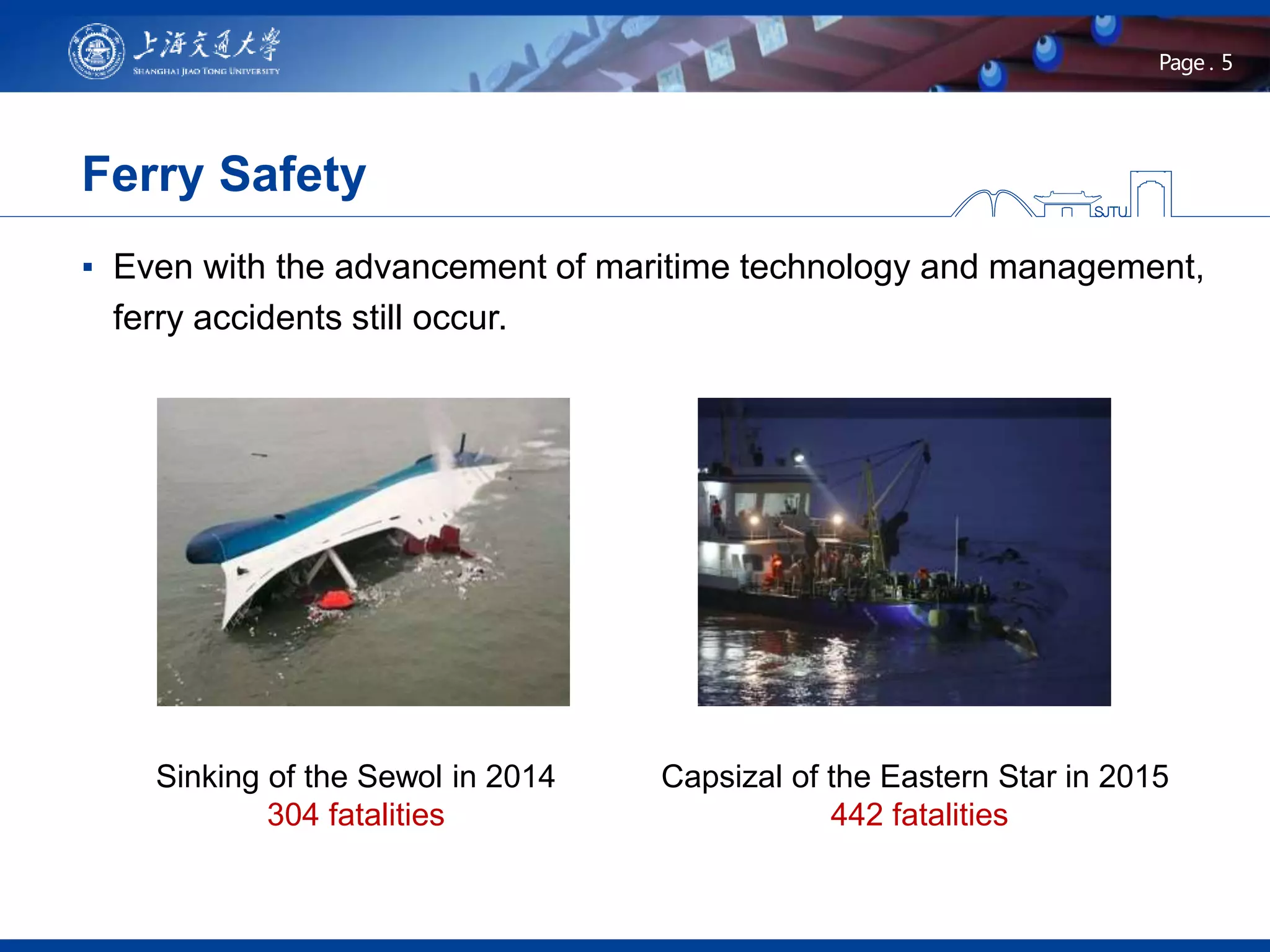
▪ Even with the advancement of maritime technology and management,
ferry accidents still occur.
Ferry Safety
Sinking of the Sewol in 2014
304 fatalities
Capsizal of the Eastern Star in 2015
442 fatalities
6Page .
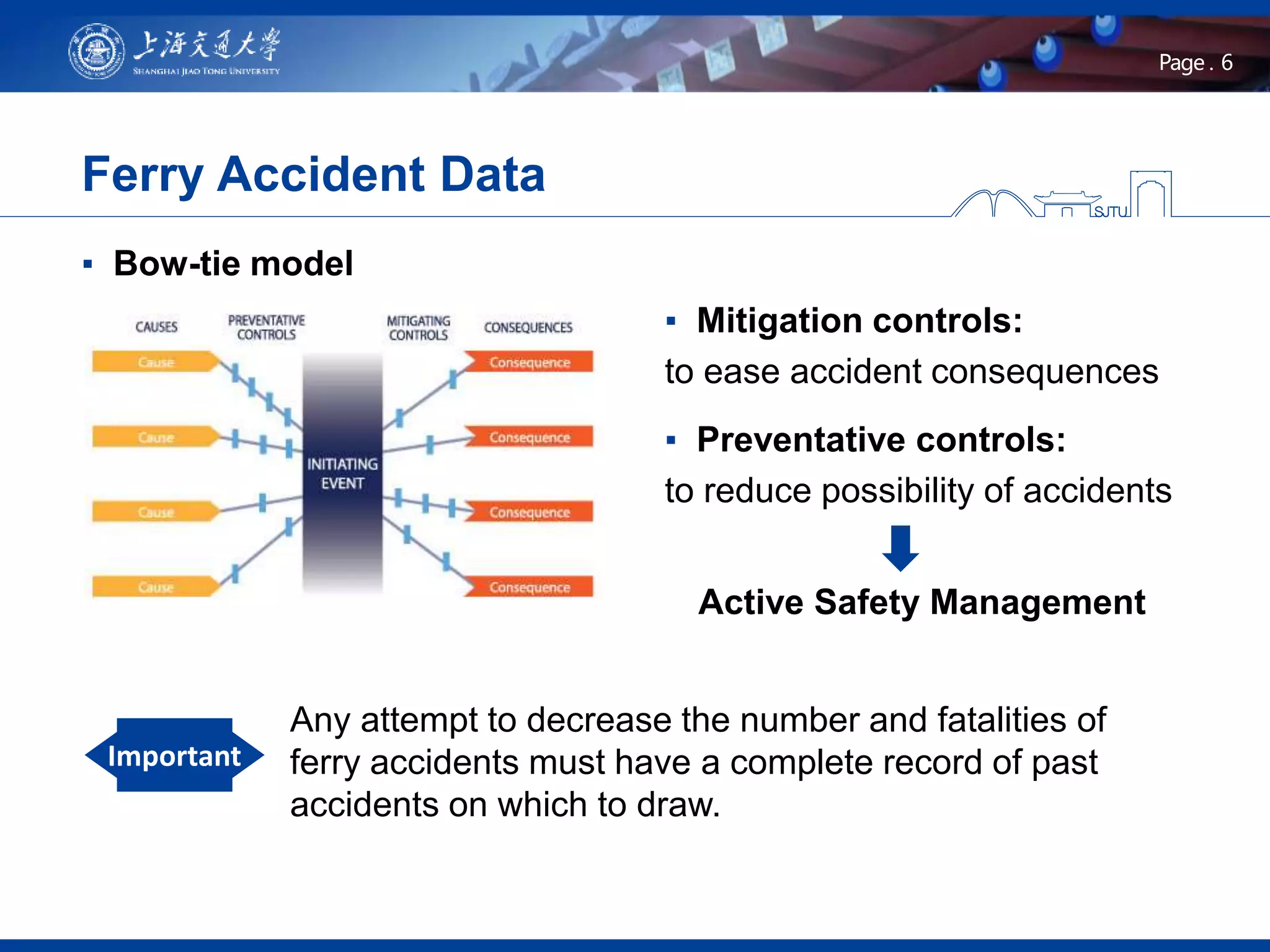
▪ Bow-tie model
Ferry Accident Data
▪ Mitigation controls:
to ease accident consequences
▪ Preventative controls:
to reduce possibility of accidents
Active Safety Management
Important
Any attempt to decrease the number and fatalities of
ferry accidents must have a complete record of past
accidents on which to draw.
目录 Contents
1 Background
2 Research Question
3 Methodology
4 Application
5 Conclusions & Suggestions
8Page .
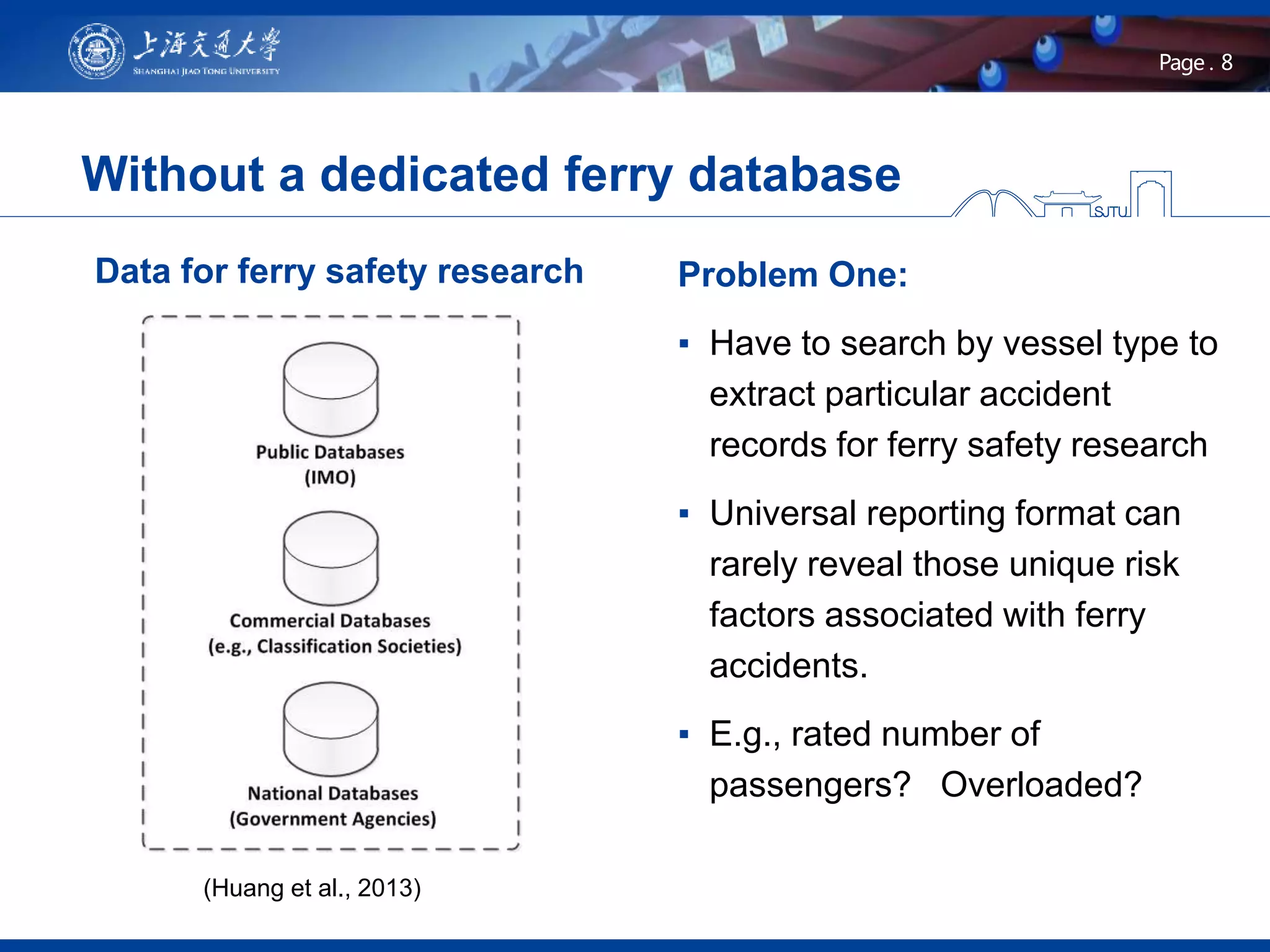
Without a dedicated ferry database
Data for ferry safety research Problem One:
▪ Have to search by vessel type to
extract particular accident
records for ferry safety research
▪ Universal reporting format can
rarely reveal those unique risk
factors associated with ferry
accidents.
▪ E.g., rated number of
passengers? Overloaded?
(Huang et al., 2013)
9Page .
Efforts of WFSA for ferry safety data
A review framework consisting of 25
data fields (Golden and Weisbrod, 2016),
including:
 date
 location
 vessel name
 total passenger load
 weather conditions
 causes
 consequences
 crew member response
 search and rescue efforts ……
Ferry accident data—Excel file
10Page .
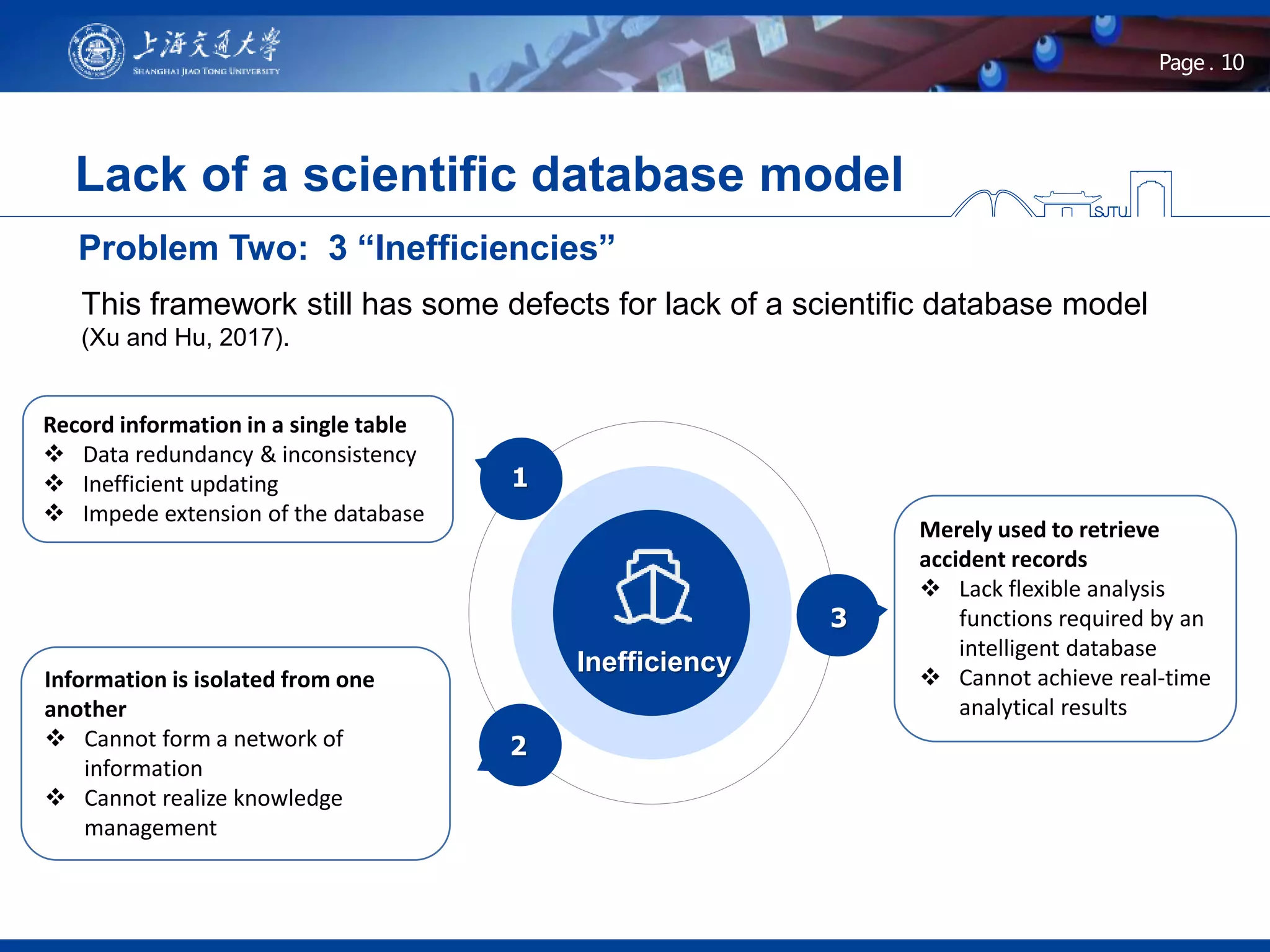
Lack of a scientific database model
Problem Two: 3 “Inefficiencies”
Inefficiency
3
1
2
Record information in a single table
 Data redundancy & inconsistency
 Inefficient updating
 Impede extension of the database
Information is isolated from one
another
 Cannot form a network of
information
 Cannot realize knowledge
management
Merely used to retrieve
accident records
 Lack flexible analysis
functions required by an
intelligent database
 Cannot achieve real-time
analytical results
This framework still has some defects for lack of a scientific database model
(Xu and Hu, 2017).
目录 Contents
1 Background
2 Research Question
3 Methodology
4 Application
5 Conclusions & Suggestions
12Page .
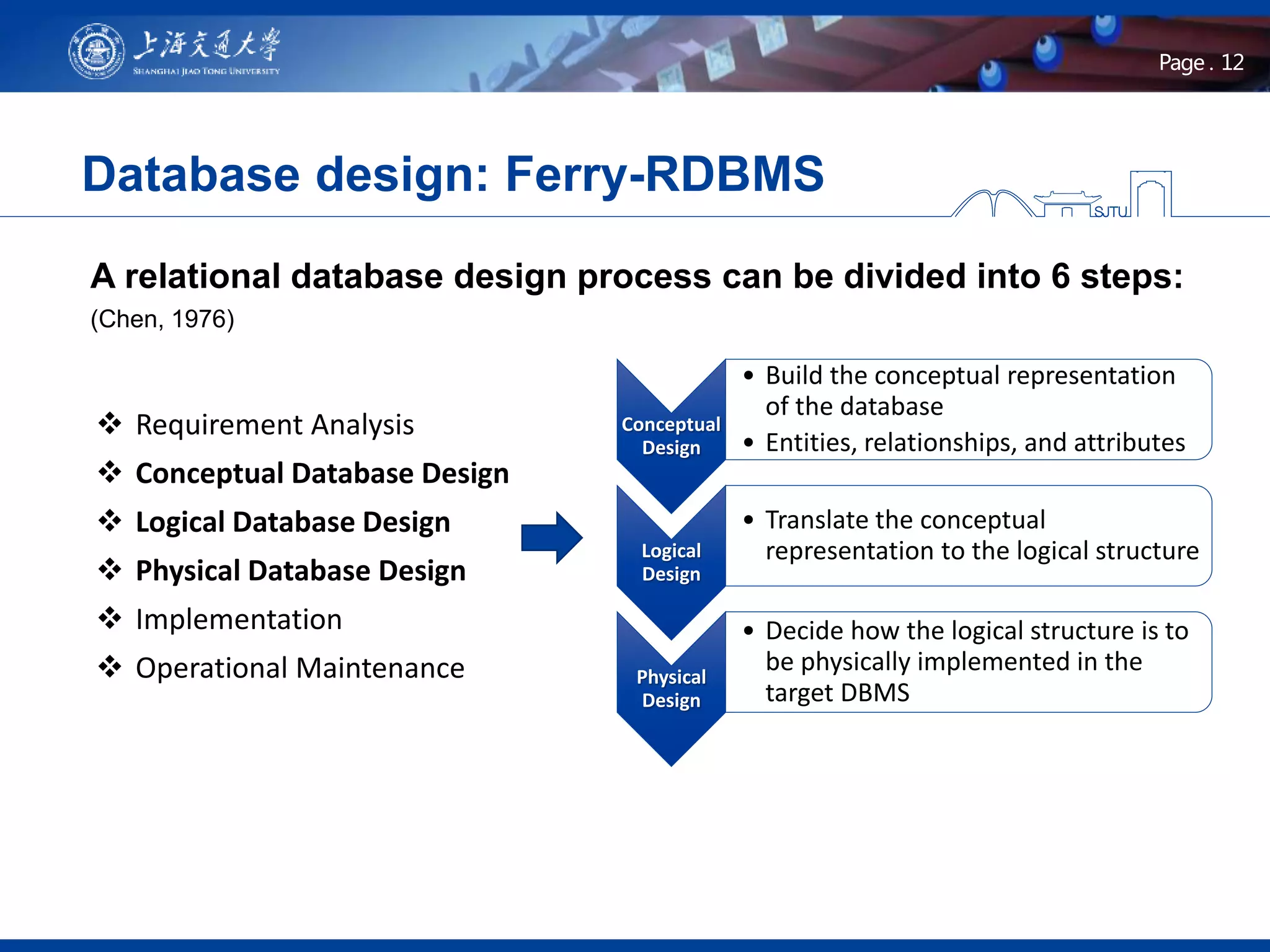
Database design: Ferry-RDBMS
A relational database design process can be divided into 6 steps:
(Chen, 1976)
 Requirement Analysis
 Conceptual Database Design
 Logical Database Design
 Physical Database Design
 Implementation
 Operational Maintenance
Conceptual
Design
• Build the conceptual representation
of the database
• Entities, relationships, and attributes
Logical
Design
• Translate the conceptual
representation to the logical structure
Physical
Design
• Decide how the logical structure is to
be physically implemented in the
target DBMS
13Page .
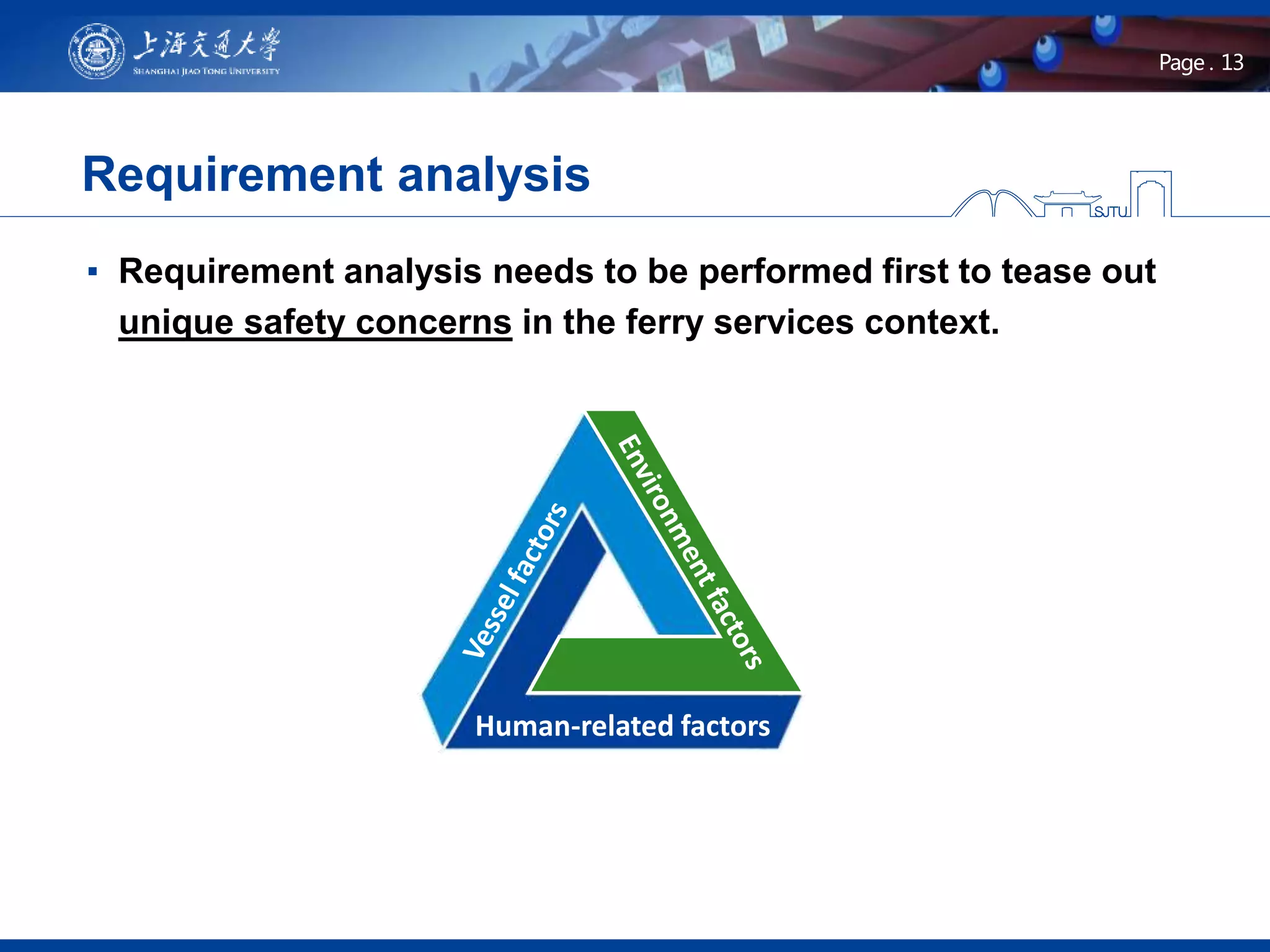
Requirement analysis
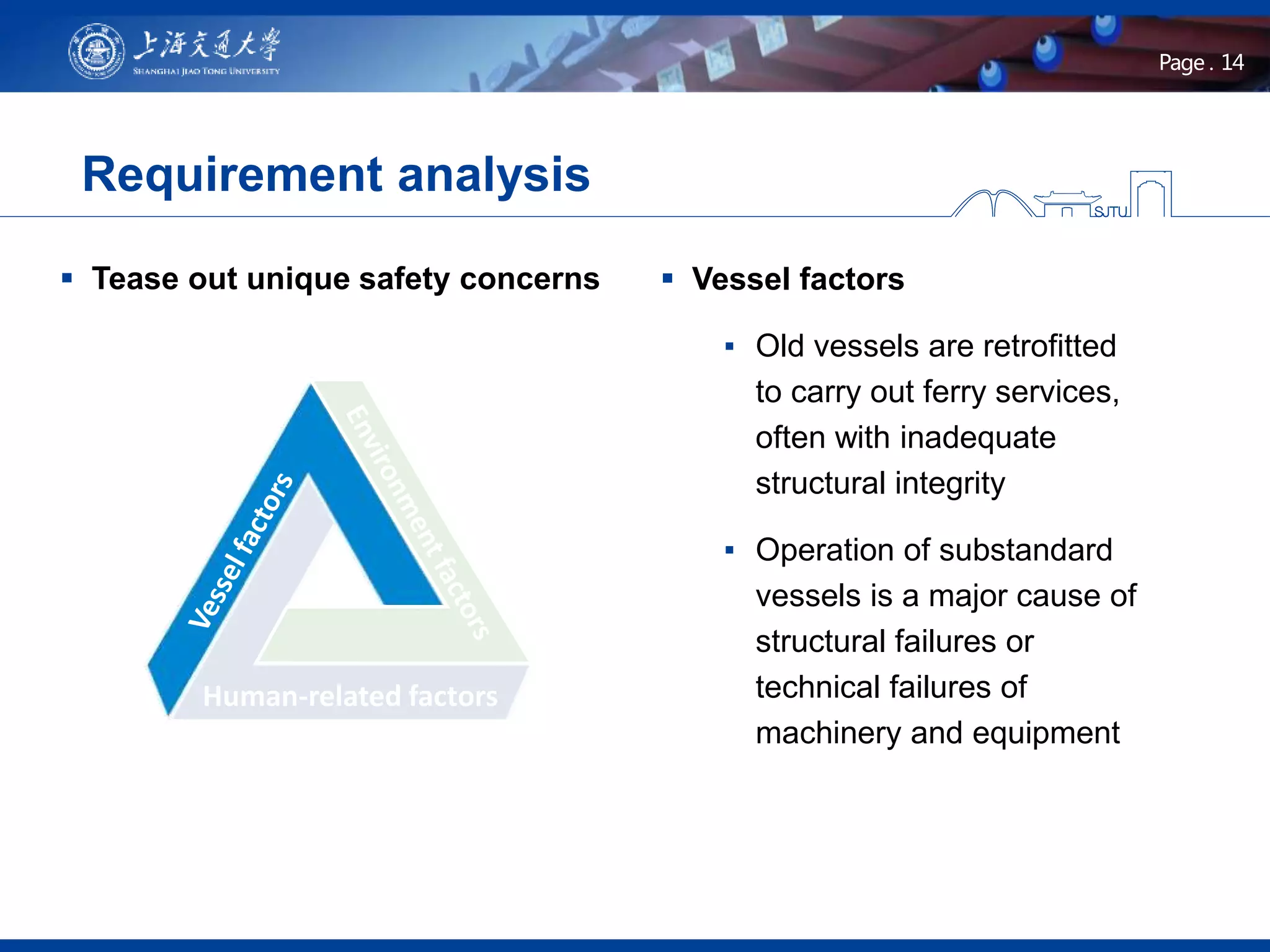
▪ Requirement analysis needs to be performed first to tease out
unique safety concerns in the ferry services context.
Human-related factors
14Page .
Requirement analysis
 Tease out unique safety concerns  Vessel factors
▪ Old vessels are retrofitted
to carry out ferry services,
often with inadequate
structural integrity
▪ Operation of substandard
vessels is a major cause of
structural failures or
technical failures of
machinery and equipment
Human-related factors
15Page .
Requirement analysis
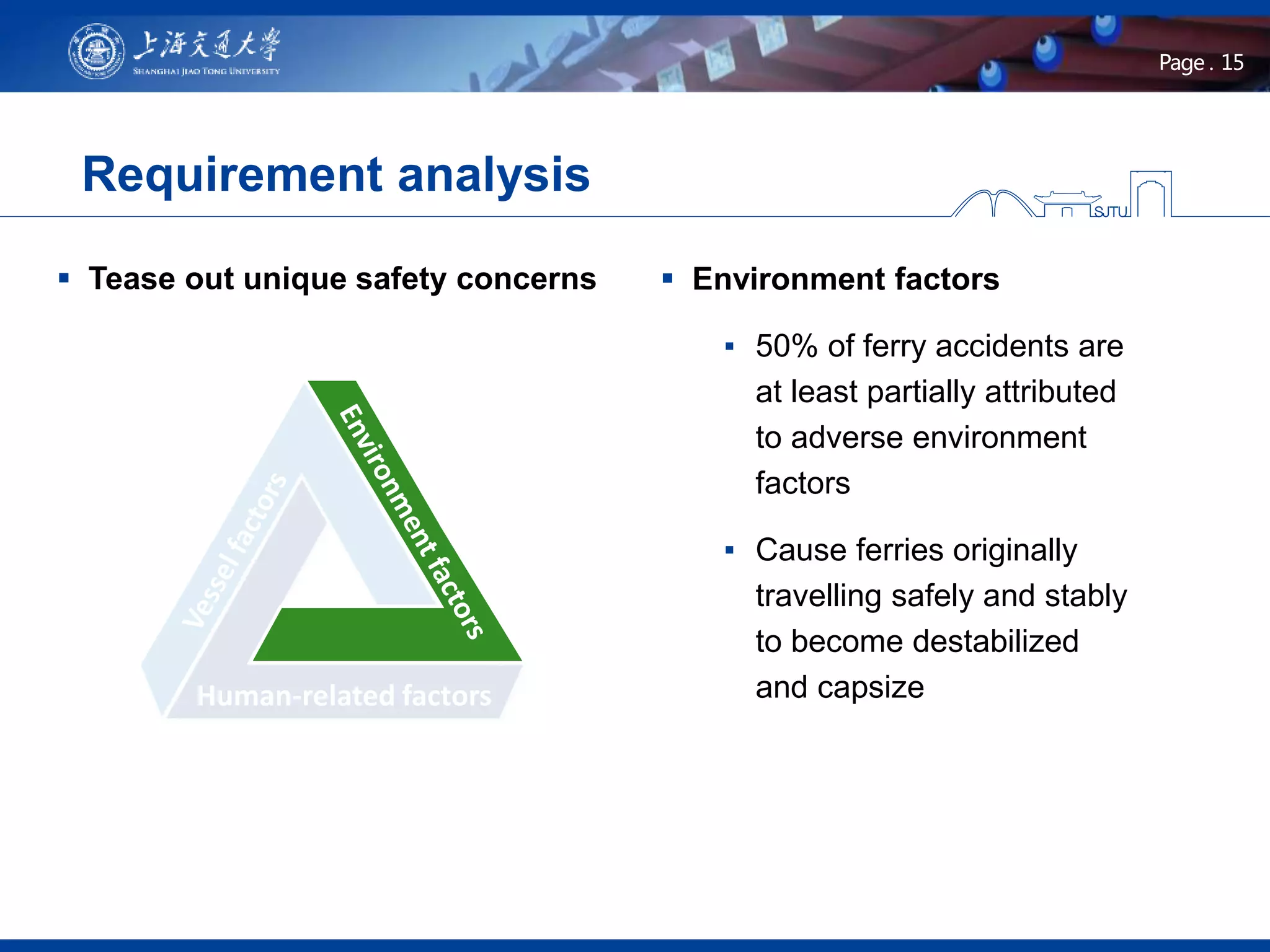
 Tease out unique safety concerns
Human-related factors
 Environment factors
▪ 50% of ferry accidents are
at least partially attributed
to adverse environment
factors
▪ Cause ferries originally
travelling safely and stably
to become destabilized
and capsize
16Page .
Requirement analysis
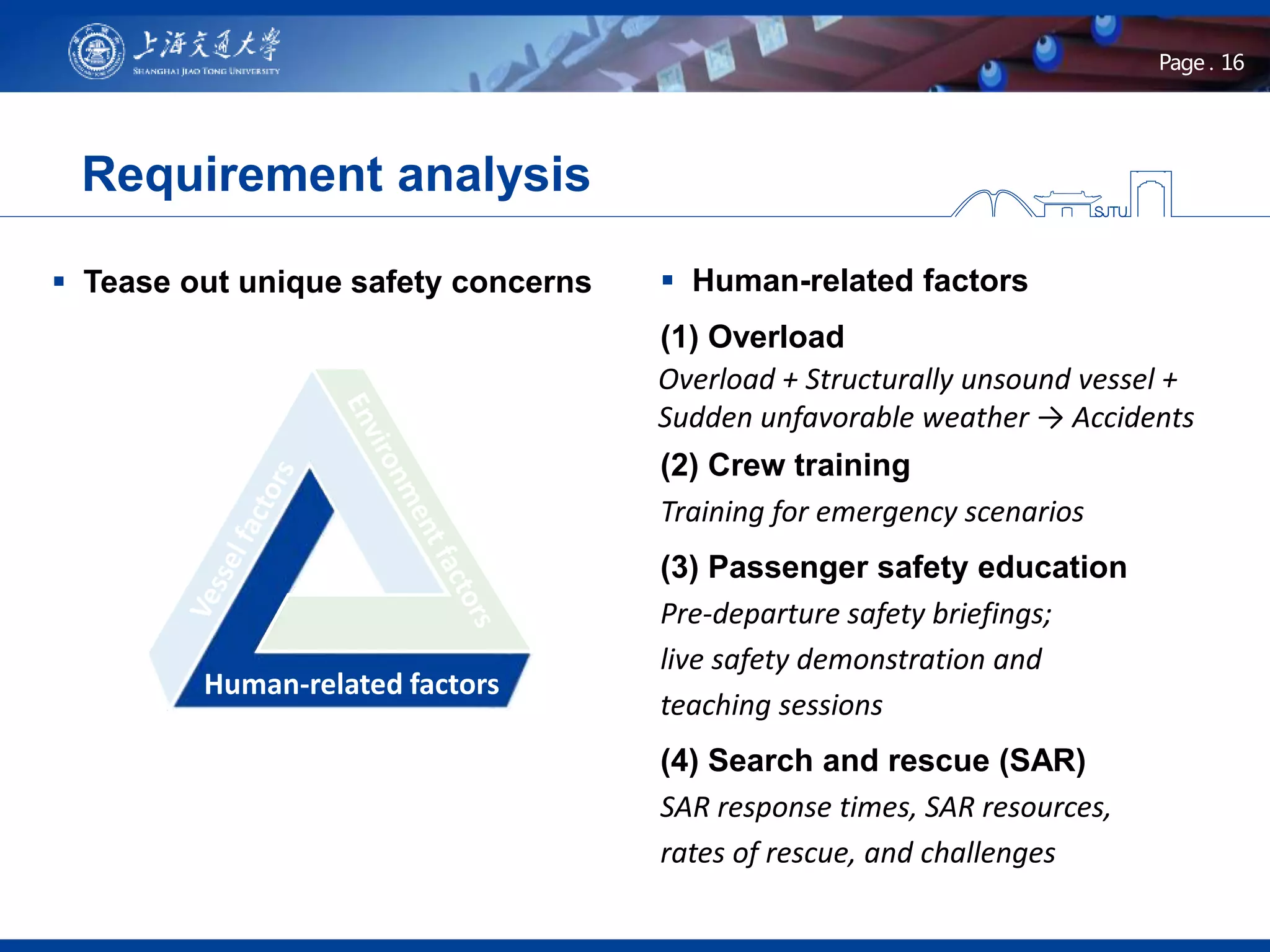
 Tease out unique safety concerns  Human-related factors
(1) Overload
(2) Crew training
Training for emergency scenarios
(3) Passenger safety education
Pre-departure safety briefings;
live safety demonstration and
teaching sessions
(4) Search and rescue (SAR)
SAR response times, SAR resources,
rates of rescue, and challenges
Human-related factors
Overload + Structurally unsound vessel +
Sudden unfavorable weather → Accidents
Page .Page. 17
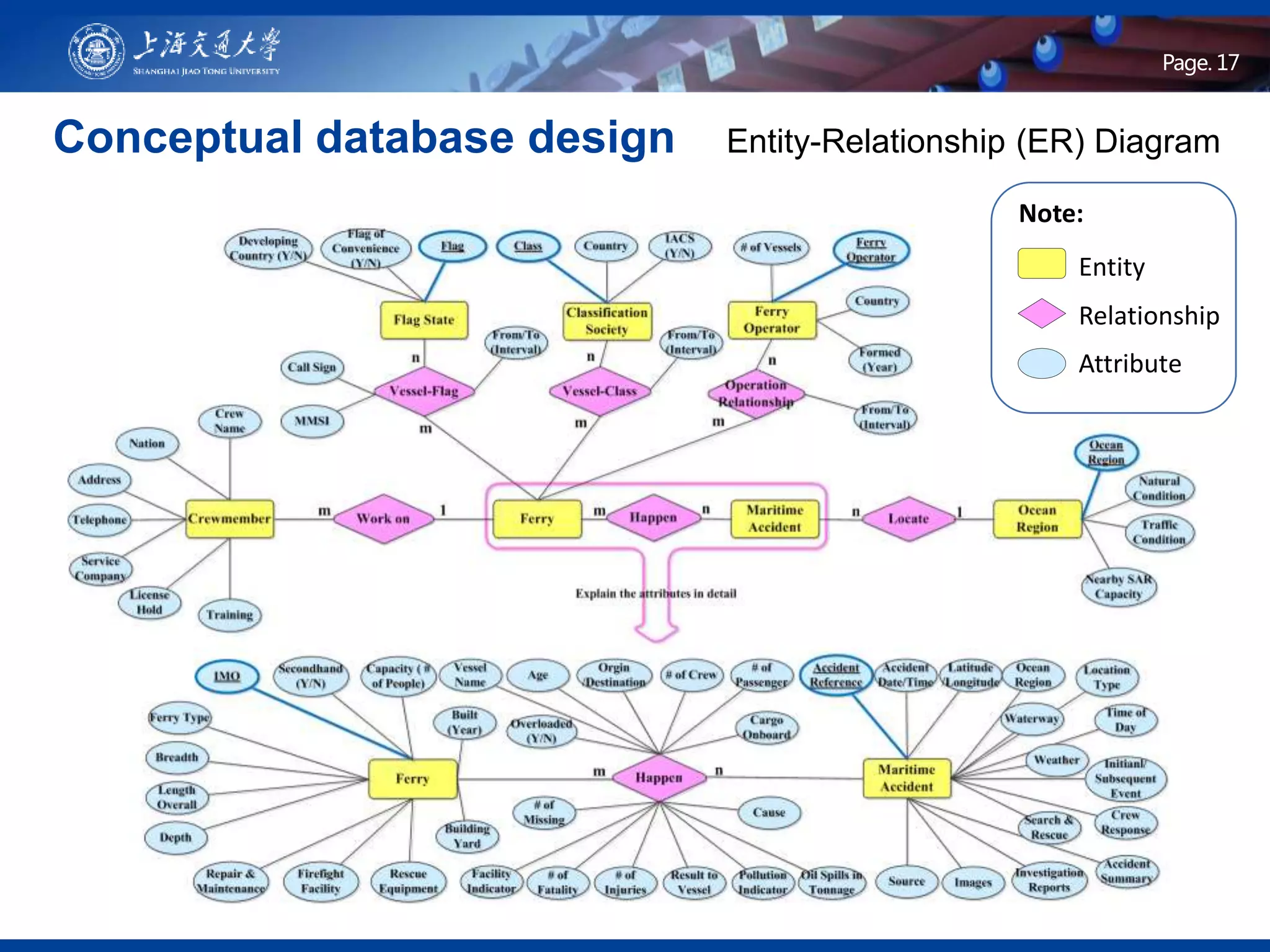
Conceptual database design Entity-Relationship (ER) Diagram
Entity
Relationship
Attribute
Note:
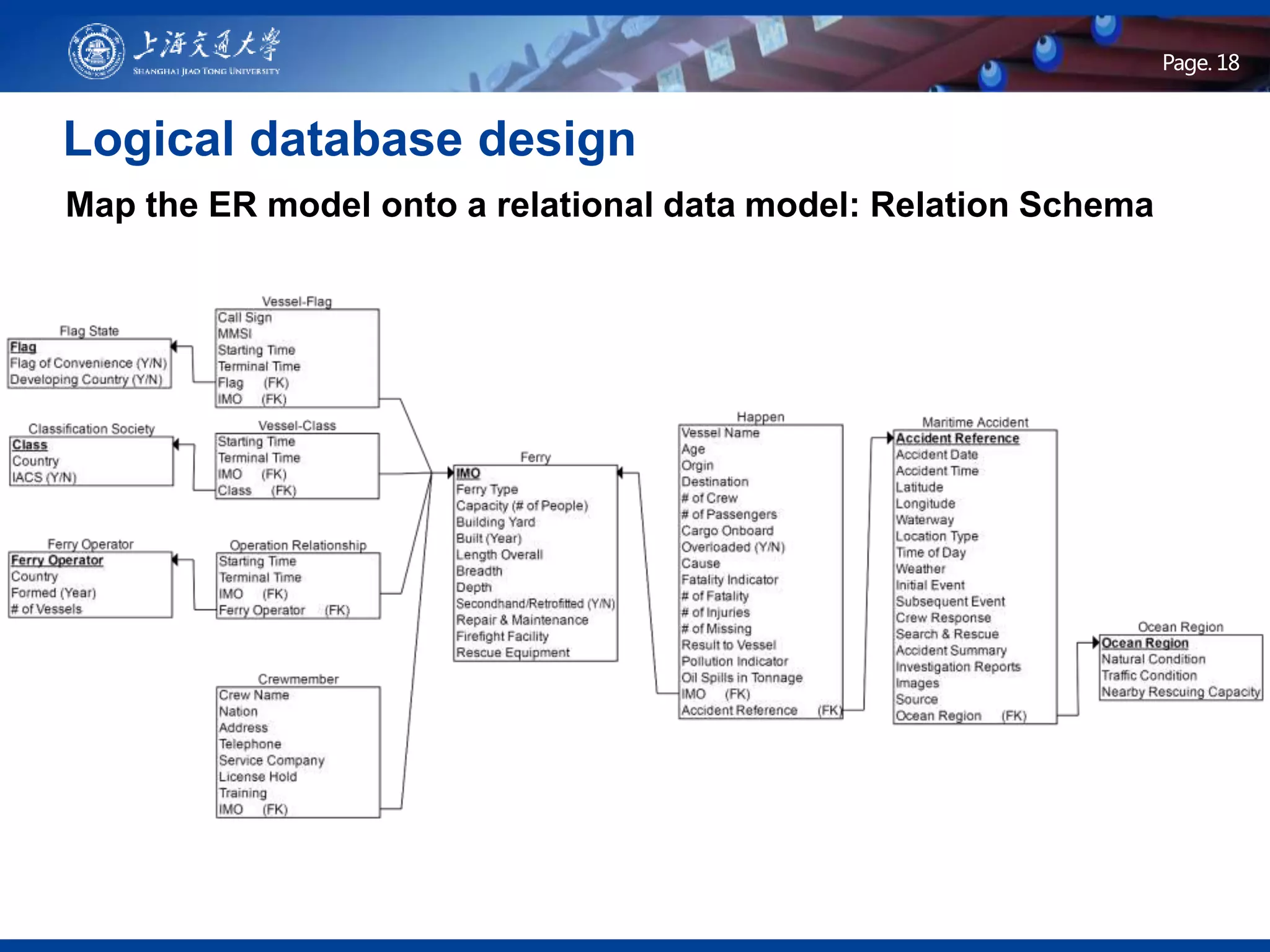
Page .Page. 18
Logical database design
Map the ER model onto a relational data model: Relation Schema
目录 Contents
1 Background
2 Research Question
3 Methodology
4 Application
5 Conclusions & Suggestions
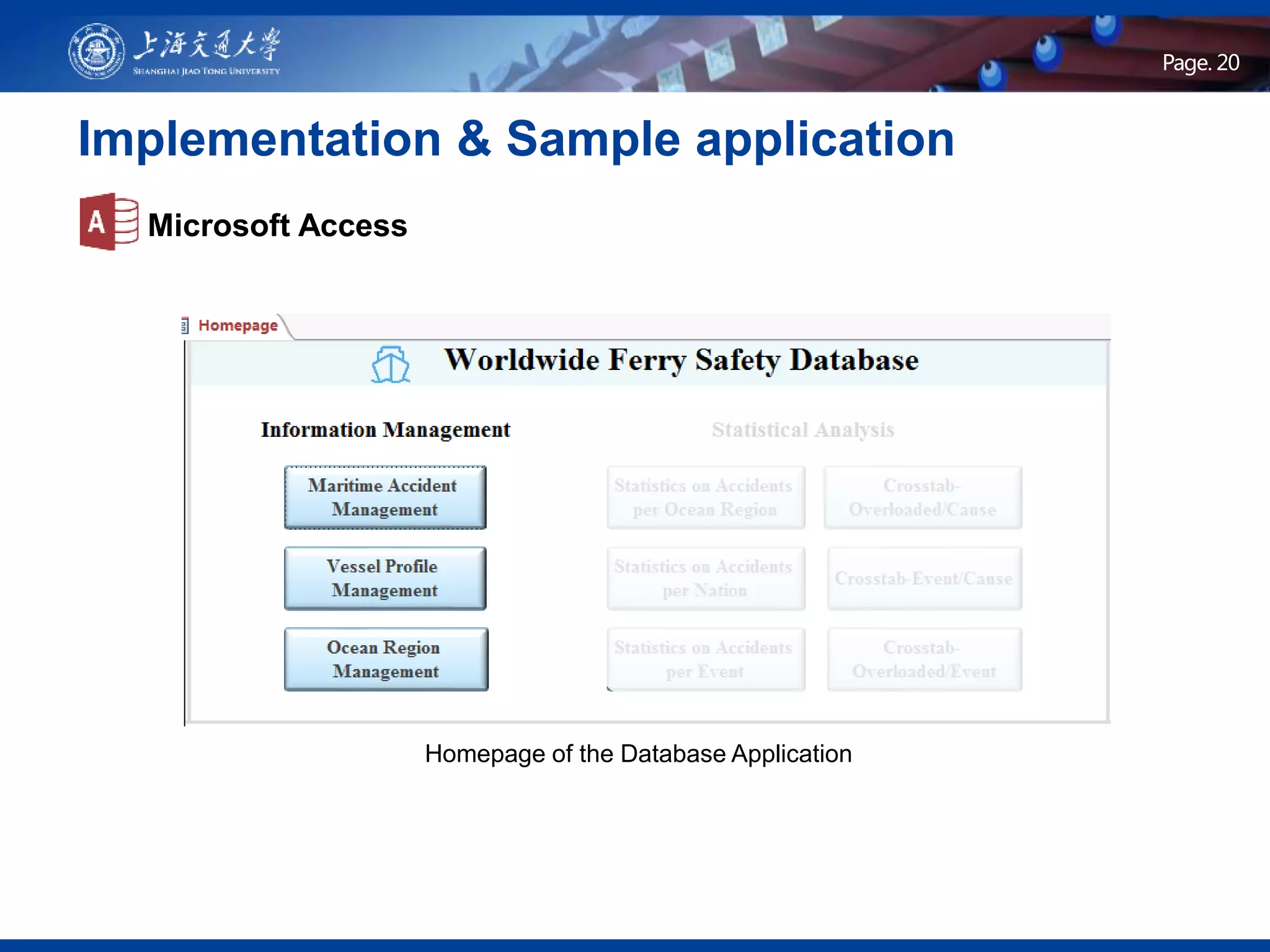
Page .Page. 20
Implementation & Sample application
Microsoft Access
Homepage of the Database Application
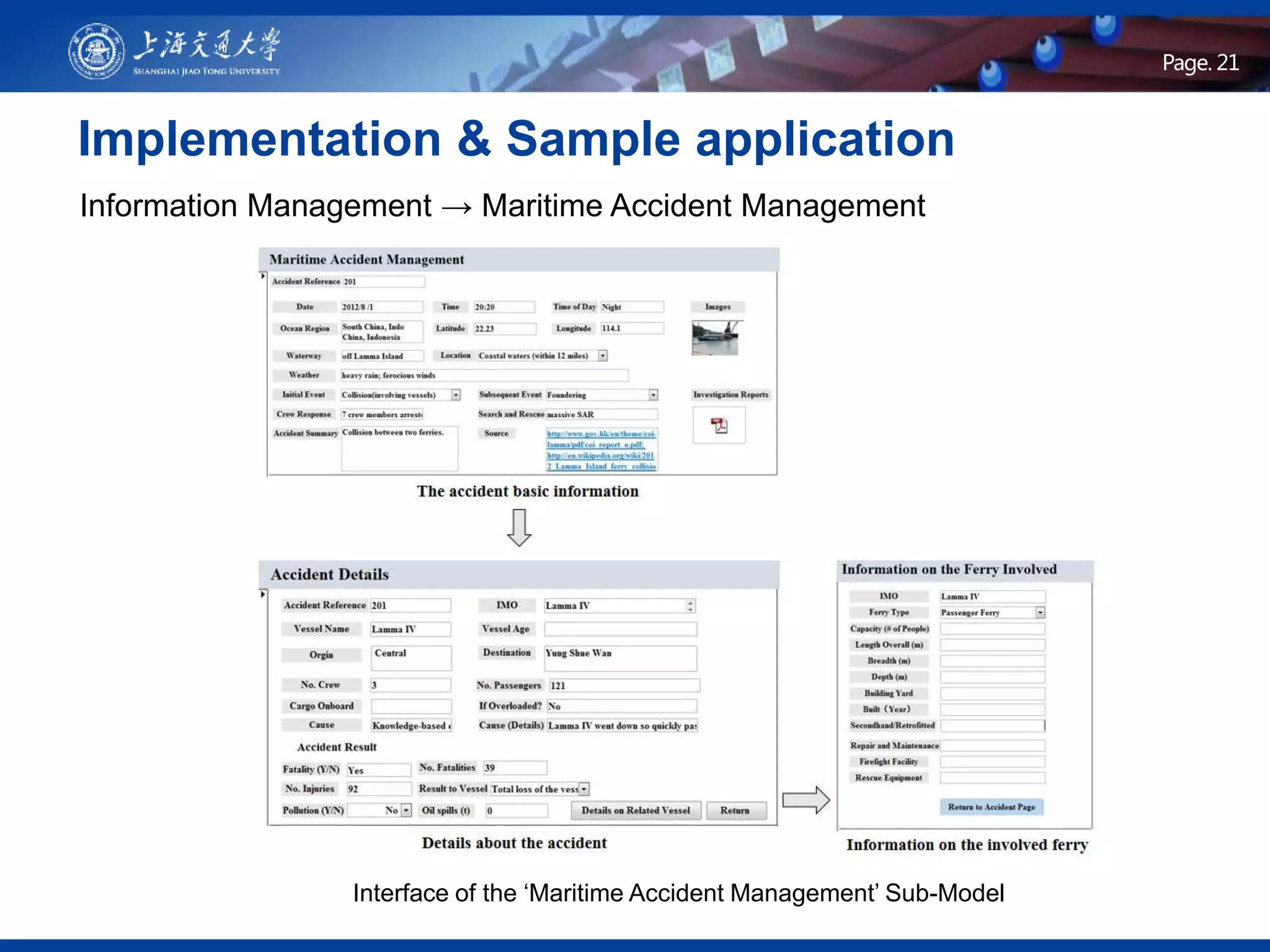
Page .Page. 21
Implementation & Sample application
Interface of the ‘Maritime Accident Management’ Sub-Model
Information Management → Maritime Accident Management
Page .Page. 22
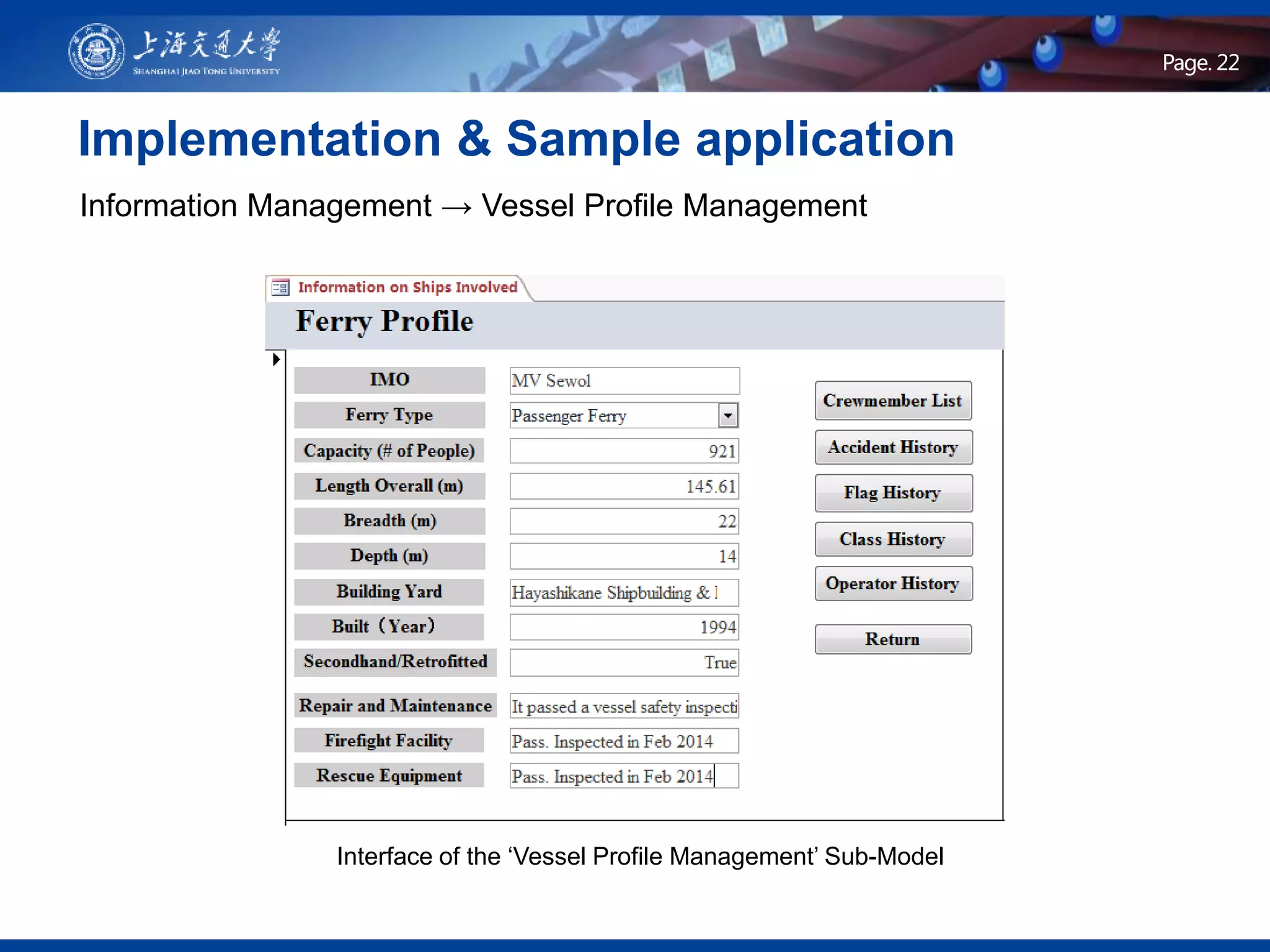
Implementation & Sample application
Interface of the ‘Vessel Profile Management’ Sub-Model
Information Management → Vessel Profile Management
Page .Page. 23
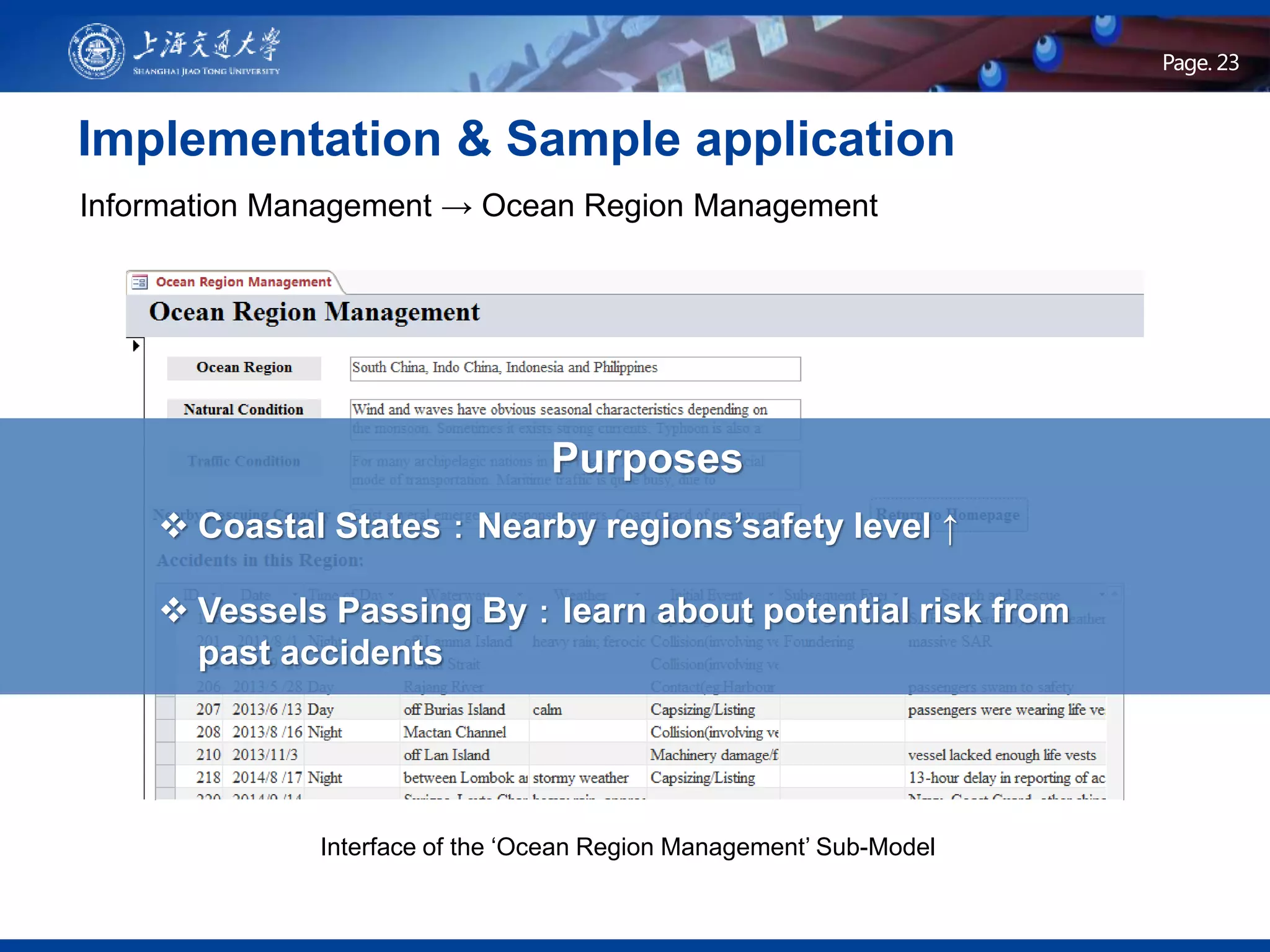
Implementation & Sample application
Interface of the ‘Ocean Region Management’ Sub-Model
Information Management → Ocean Region Management
Purposes
 Coastal States:Nearby regions’safety level ↑
 Vessels Passing By:learn about potential risk from
past accidents
Page .Page. 24
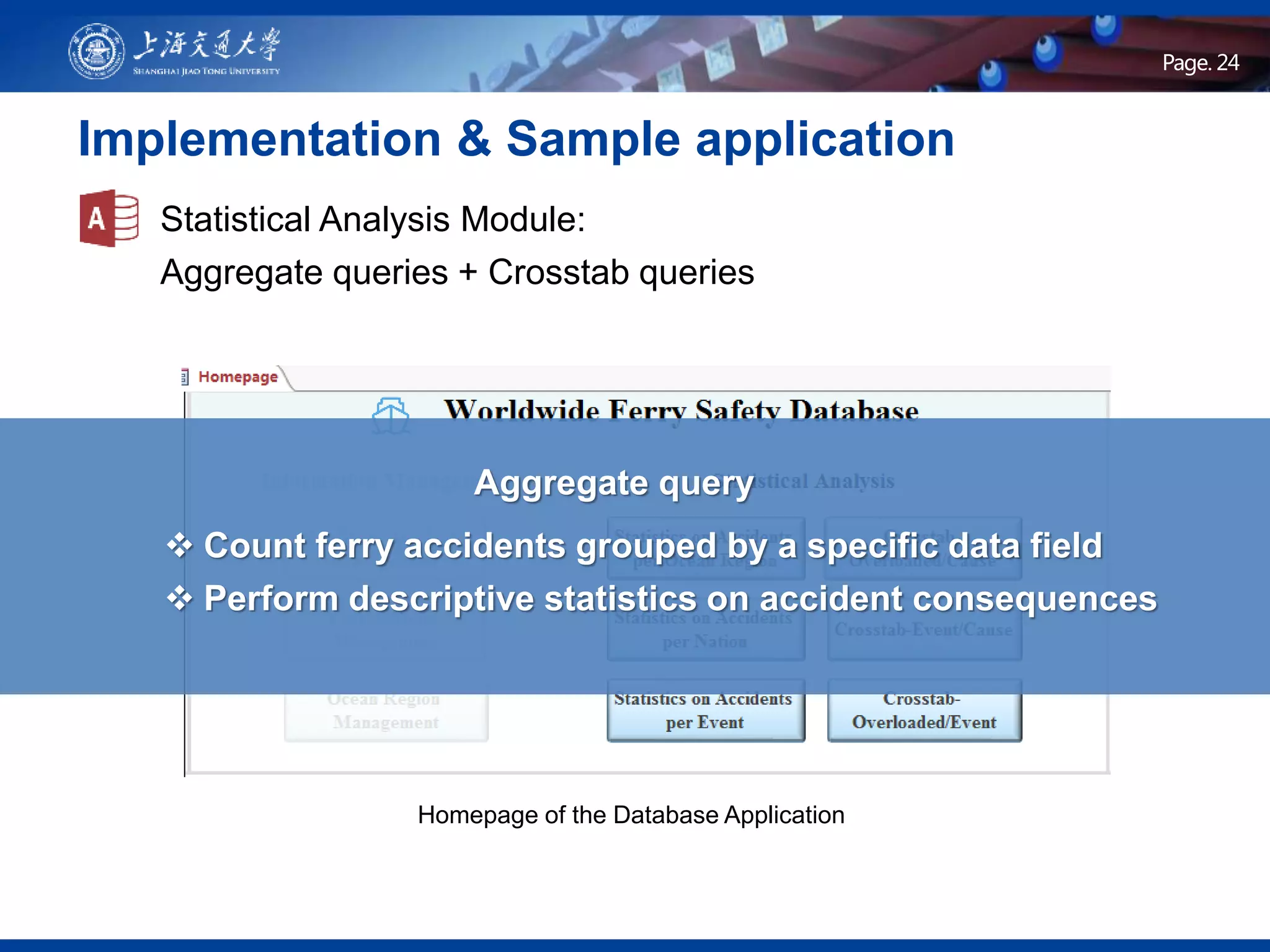
Implementation & Sample application
Homepage of the Database Application
Statistical Analysis Module:
Aggregate queries + Crosstab queries
 Count ferry accidents grouped by a specific data field
 Perform descriptive statistics on accident consequences
Aggregate query
Page .Page. 25
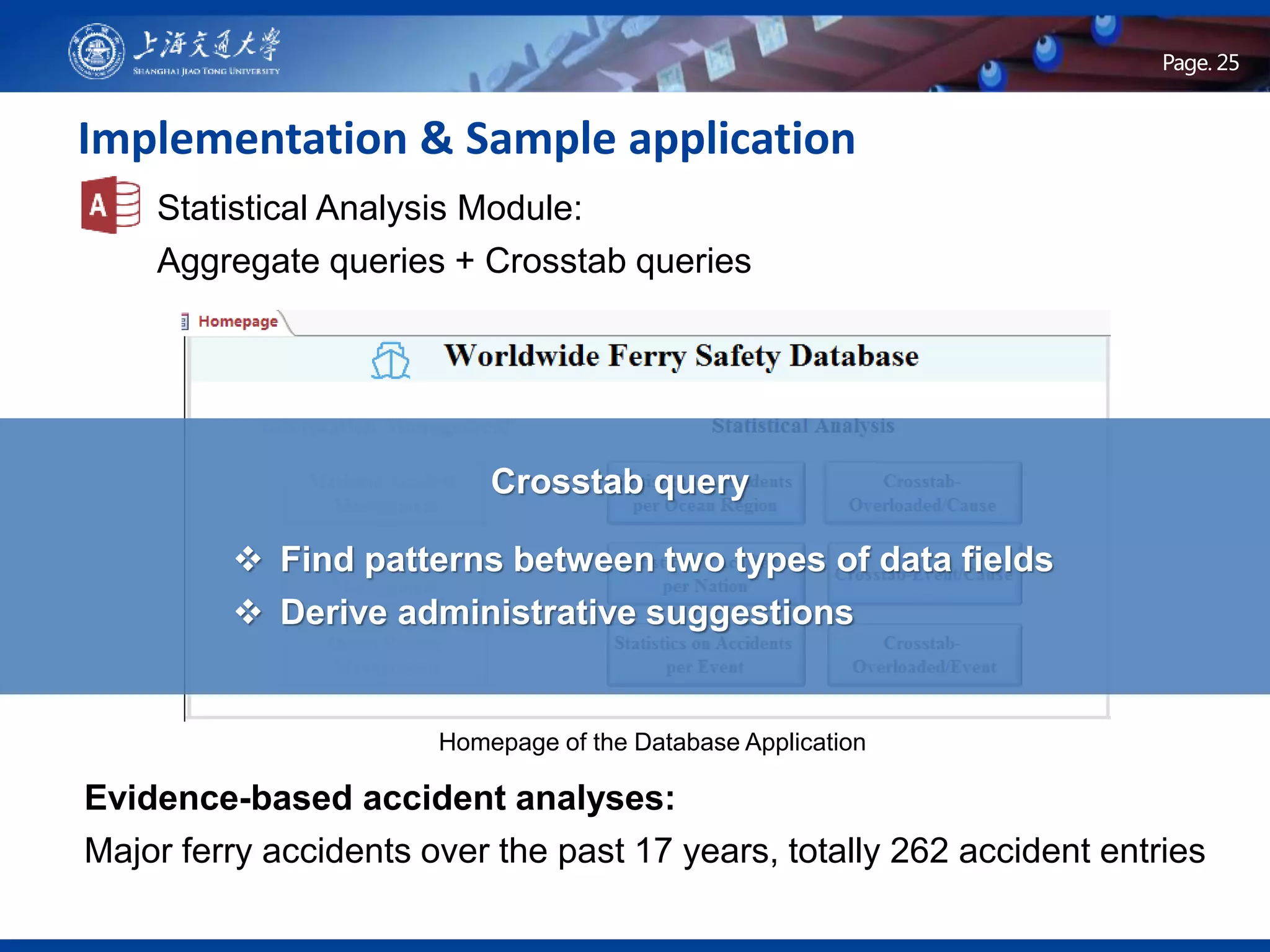
Implementation & Sample application
Statistical Analysis Module:
Aggregate queries + Crosstab queries
 Find patterns between two types of data fields
 Derive administrative suggestions
Evidence-based accident analyses:
Major ferry accidents over the past 17 years, totally 262 accident entries
Crosstab query
Homepage of the Database Application
目录 Contents
1 Background
2 Research Question
3 Methodology
4 Application
5 Conclusions & Suggestions
27Page .
Conclusions & Suggestions
Provide a sample database application
1
2
3
Explore existing maritime databases and highlight widespread limitations from
a safety management point of view for ferry transportation
Develop a worldwide ferry safety database using the relational database
approach
Conclusions
Suggestions
1 Learn about the relational database approach to test its efficiency in managing
ferry accidents.
2 Follow the pattern of the proposed database design to develop a dedicated
database for ferry safety efforts.
28Page .
Reference
• Chen, P. P. S. 1976. “The Entity-Relationship Model—Toward a Unified View of
Data.” ACM Transactions on Database Systems (TODS), 1 (1): 9-36.
• Golden, A., and R. Weisbrod. 2016. “Trends, Causal Analysis, and
Recommendations from 14 Years of Ferry Accidents.” Journal of Public
Transportation, 19(1): 17-27.
• Huang, D. Z., H. Hu, and Y. Z. Li. 2013. “Spatial Analysis of Maritime Accidents
Using the Geographic Information System.” Transportation Research Record:
Journal of the Transportation Research Board, No. 2326: 39-44.
• Xu, S. Y. and H. Hu. 2017. “Development of a Maritime Incident Database Using a
Relational Database Management System”. Paper presented at the 96th Annual
Meeting of Transportation Research Board (#17-3712), Washington D.C., January
8-12.
• Yip, T. L., D. Jin, and W. K. Talley. 2015. “Determinants of Injuries in Passenger
Vessel Accidents.” Accident Analysis & Prevention, 82: 112-117.
Thank you!

Use of the digitized relational database to understand ferry safety accidents siyu xu

  • 1.
    Use of thedigitized relational database to understand ferry safety accidents Speaker: Siyu Xu Date: May 12, 2017
  • 2.
    目录 Contents 1 Background 2Research Question 3 Methodology 4 Application 5 Conclusions & Suggestions
  • 3.
    目录 Contents 1 Background 2Research Question 3 Methodology 4 Application 5 Conclusions & Suggestions
  • 4.
    4Page . ▪ Passengervessels: cruises and ferries (Yip et al., 2015) ▪ Cruises: entertainment voyages ▪ Ferries: transportation services ▪ Ferry transportation ▪ An indispensable part of the public transportation system of many archipelagic nations like Indonesia and river delta nations like Bangladesh ▪ Allow direct transit between different points at a lower cost than bridges or tunnels Ferry Transportation
  • 5.
    5Page . ▪ Evenwith the advancement of maritime technology and management, ferry accidents still occur. Ferry Safety Sinking of the Sewol in 2014 304 fatalities Capsizal of the Eastern Star in 2015 442 fatalities
  • 6.
    6Page . ▪ Bow-tiemodel Ferry Accident Data ▪ Mitigation controls: to ease accident consequences ▪ Preventative controls: to reduce possibility of accidents Active Safety Management Important Any attempt to decrease the number and fatalities of ferry accidents must have a complete record of past accidents on which to draw.
  • 7.
    目录 Contents 1 Background 2Research Question 3 Methodology 4 Application 5 Conclusions & Suggestions
  • 8.
    8Page . Without adedicated ferry database Data for ferry safety research Problem One: ▪ Have to search by vessel type to extract particular accident records for ferry safety research ▪ Universal reporting format can rarely reveal those unique risk factors associated with ferry accidents. ▪ E.g., rated number of passengers? Overloaded? (Huang et al., 2013)
  • 9.
    9Page . Efforts ofWFSA for ferry safety data A review framework consisting of 25 data fields (Golden and Weisbrod, 2016), including:  date  location  vessel name  total passenger load  weather conditions  causes  consequences  crew member response  search and rescue efforts …… Ferry accident data—Excel file
  • 10.
    10Page . Lack ofa scientific database model Problem Two: 3 “Inefficiencies” Inefficiency 3 1 2 Record information in a single table  Data redundancy & inconsistency  Inefficient updating  Impede extension of the database Information is isolated from one another  Cannot form a network of information  Cannot realize knowledge management Merely used to retrieve accident records  Lack flexible analysis functions required by an intelligent database  Cannot achieve real-time analytical results This framework still has some defects for lack of a scientific database model (Xu and Hu, 2017).
  • 11.
    目录 Contents 1 Background 2Research Question 3 Methodology 4 Application 5 Conclusions & Suggestions
  • 12.
    12Page . Database design:Ferry-RDBMS A relational database design process can be divided into 6 steps: (Chen, 1976)  Requirement Analysis  Conceptual Database Design  Logical Database Design  Physical Database Design  Implementation  Operational Maintenance Conceptual Design • Build the conceptual representation of the database • Entities, relationships, and attributes Logical Design • Translate the conceptual representation to the logical structure Physical Design • Decide how the logical structure is to be physically implemented in the target DBMS
  • 13.
    13Page . Requirement analysis ▪Requirement analysis needs to be performed first to tease out unique safety concerns in the ferry services context. Human-related factors
  • 14.
    14Page . Requirement analysis Tease out unique safety concerns  Vessel factors ▪ Old vessels are retrofitted to carry out ferry services, often with inadequate structural integrity ▪ Operation of substandard vessels is a major cause of structural failures or technical failures of machinery and equipment Human-related factors
  • 15.
    15Page . Requirement analysis Tease out unique safety concerns Human-related factors  Environment factors ▪ 50% of ferry accidents are at least partially attributed to adverse environment factors ▪ Cause ferries originally travelling safely and stably to become destabilized and capsize
  • 16.
    16Page . Requirement analysis Tease out unique safety concerns  Human-related factors (1) Overload (2) Crew training Training for emergency scenarios (3) Passenger safety education Pre-departure safety briefings; live safety demonstration and teaching sessions (4) Search and rescue (SAR) SAR response times, SAR resources, rates of rescue, and challenges Human-related factors Overload + Structurally unsound vessel + Sudden unfavorable weather → Accidents
  • 17.
    Page .Page. 17 Conceptualdatabase design Entity-Relationship (ER) Diagram Entity Relationship Attribute Note:
  • 18.
    Page .Page. 18 Logicaldatabase design Map the ER model onto a relational data model: Relation Schema
  • 19.
    目录 Contents 1 Background 2Research Question 3 Methodology 4 Application 5 Conclusions & Suggestions
  • 20.
    Page .Page. 20 Implementation& Sample application Microsoft Access Homepage of the Database Application
  • 21.
    Page .Page. 21 Implementation& Sample application Interface of the ‘Maritime Accident Management’ Sub-Model Information Management → Maritime Accident Management
  • 22.
    Page .Page. 22 Implementation& Sample application Interface of the ‘Vessel Profile Management’ Sub-Model Information Management → Vessel Profile Management
  • 23.
    Page .Page. 23 Implementation& Sample application Interface of the ‘Ocean Region Management’ Sub-Model Information Management → Ocean Region Management Purposes  Coastal States:Nearby regions’safety level ↑  Vessels Passing By:learn about potential risk from past accidents
  • 24.
    Page .Page. 24 Implementation& Sample application Homepage of the Database Application Statistical Analysis Module: Aggregate queries + Crosstab queries  Count ferry accidents grouped by a specific data field  Perform descriptive statistics on accident consequences Aggregate query
  • 25.
    Page .Page. 25 Implementation& Sample application Statistical Analysis Module: Aggregate queries + Crosstab queries  Find patterns between two types of data fields  Derive administrative suggestions Evidence-based accident analyses: Major ferry accidents over the past 17 years, totally 262 accident entries Crosstab query Homepage of the Database Application
  • 26.
    目录 Contents 1 Background 2Research Question 3 Methodology 4 Application 5 Conclusions & Suggestions
  • 27.
    27Page . Conclusions &Suggestions Provide a sample database application 1 2 3 Explore existing maritime databases and highlight widespread limitations from a safety management point of view for ferry transportation Develop a worldwide ferry safety database using the relational database approach Conclusions Suggestions 1 Learn about the relational database approach to test its efficiency in managing ferry accidents. 2 Follow the pattern of the proposed database design to develop a dedicated database for ferry safety efforts.
  • 28.
    28Page . Reference • Chen,P. P. S. 1976. “The Entity-Relationship Model—Toward a Unified View of Data.” ACM Transactions on Database Systems (TODS), 1 (1): 9-36. • Golden, A., and R. Weisbrod. 2016. “Trends, Causal Analysis, and Recommendations from 14 Years of Ferry Accidents.” Journal of Public Transportation, 19(1): 17-27. • Huang, D. Z., H. Hu, and Y. Z. Li. 2013. “Spatial Analysis of Maritime Accidents Using the Geographic Information System.” Transportation Research Record: Journal of the Transportation Research Board, No. 2326: 39-44. • Xu, S. Y. and H. Hu. 2017. “Development of a Maritime Incident Database Using a Relational Database Management System”. Paper presented at the 96th Annual Meeting of Transportation Research Board (#17-3712), Washington D.C., January 8-12. • Yip, T. L., D. Jin, and W. K. Talley. 2015. “Determinants of Injuries in Passenger Vessel Accidents.” Accident Analysis & Prevention, 82: 112-117.
  • 29.