MBA 2016
www.usb.ac.za
ACCREDITED
w e l c o m e | 01
Welcome to USB
USB’s internationally accredited MBA
•	3 international accreditations:
AACSB, EQUIS and AMBA
•	Strong focus on leadership development
•	Global perspective with unique African input
•	International Study Module
•	International facilitators on elective courses
•	Personal support and engaging client service
•	Proud tradition of producing organisational leaders
since 1964
We stand for responsible leadership
The University of Stellenbosch Business School, located
in the Tyger Valley business district in the northern part
of Cape Town, offers an MBA focusing on a highly
personalised leadership development journey. USB is
recognised as a top school in the international business
school network. It was the first school from an African
university to receive all 3 international accreditations:
AACSB, EQUIS and AMBA. Overall, we strive to develop
responsible leaders through well-grounded business
education and research.
Welcome to USB .......................................................................................... 1
Messages ........................................................................................................ 2
•	 From the Director of USB
•	 From the Programme Head
Why study at USB? ..................................................................................... 4
Central location ........................................................................................... 6
USB’S new professional MBA ............................................................... 8
What can I do with a USB MBA? .......................................................... 9
More about the MBA ............................................................................... 10
•	 Leadership as a core theme
•	 Customising your MBA
•	 Two MBA formats:  full-time and modular
•	 Two language options
Programme contents ............................................................................... 13
•	 Compulsory MBA modules
•	 Electives
What else do you need to know? ...................................................... 15
•	 Admission requirements
•	 Selection tests
•	 Three essays
•	 Interview by an alumnus
•	 Credits for completed modules
•	 Transfer of credits from subjects completed elsewhere
•	 Assessment of MBA students’deliverables
•	 Assessment and recognition of prior learning
•	 Bridging measures for prospective students
•	 MBA Information Sessions
•	 Time management
•	 Groupwork and diversity
•	 Additional information for foreign students
Dates .............................................................................................................. 18
•	 MBA timetables for 2016
•	 Deadline for applications
How to apply ............................................................................................. 18
•	 Apply in 4 steps
    •   What happens next?
Programme fees and financing ........................................................ 19
•	 Programme fees for 2016
•	 Financing
What do USB students and alumni say? ..................................... 20
After your studies: Becoming a USB alumnus .......................... 21
More about USB and its students ................................................... 22
•	 MBA student profile
•	 Accreditation, memberships and acknowledgements
•	 Portfolio of academic programmes	
•	 Faculty
•	 World-class facilities, resources and services
Frequently asked questions .............................................................. 25
Contact details ......................................................................................... 27
Contents
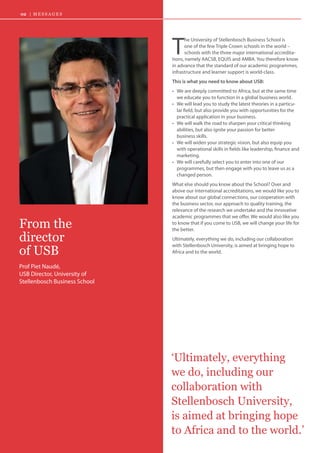
T
he University of Stellenbosch Business School is 	
one of the few Triple Crown schools in the world –
schools with the three major international accredita-
tions, namely AACSB, EQUIS and AMBA. You therefore know
in advance that the standard of our academic programmes,
infrastructure and learner support is world-class.
This is what you need to know about USB:
•	 We are deeply committed to Africa, but at the same time
we educate you to function in a global business world.
•	 We will lead you to study the latest theories in a particu-
lar field, but also provide you with opportunities for the
practical application in your business.
•	 We will walk the road to sharpen your critical thinking
abilities, but also ignite your passion for better 	
business skills.
•	 We will widen your strategic vision, but also equip you
with operational skills in fields like leadership, finance and
marketing.
•	 We will carefully select you to enter into one of our
programmes, but then engage with you to leave us as a
changed person.
What else should you know about the School? Over and
above our international accreditations, we would like you to
know about our global connections, our cooperation with
the business sector, our approach to quality training, the
relevance of the research we undertake and the innovative
academic programmes that we offer. We would also like you
to know that if you come to USB, we will change your life for
the better.
Ultimately, everything we do, including our collaboration
with Stellenbosch University, is aimed at bringing hope to
Africa and to the world.
From the
director
of USB
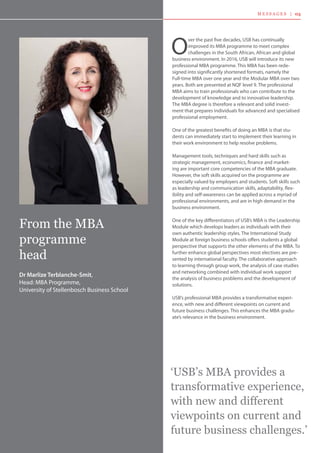
Prof Piet Naudé, 	
USB Director, University of 	
Stellenbosch Business School
‘Ultimately, everything
we do, including our
collaboration with
Stellenbosch University,
is aimed at bringing hope
to Africa and to the world.’
02 | messages
O
ver the past five decades, USB has continually
improved its MBA programme to meet complex
challenges in the South African, African and global
business environment. In 2016, USB will introduce its new
professional MBA programme. This MBA has been rede-
signed into significantly shortened formats, namely the
Full-time MBA over one year and the Modular MBA over two
years. Both are presented at NQF level 9. The professional
MBA aims to train professionals who can contribute to the
development of knowledge and to innovative leadership.
The MBA degree is therefore a relevant and solid invest-
ment that prepares individuals for advanced and specialised
professional employment.
One of the greatest benefits of doing an MBA is that stu-
dents can immediately start to implement their learning in
their work environment to help resolve problems.
Management tools, techniques and hard skills such as
strategic management, economics, finance and market-
ing are important core competencies of the MBA graduate.
However, the soft skills acquired on the programme are
especially valued by employers and students. Soft skills such
as leadership and communication skills, adaptability, flex-
ibility and self-awareness can be applied across a myriad of
professional environments, and are in high demand in the
business environment.
One of the key differentiators of USB’s MBA is the Leadership
Module which develops leaders as individuals with their
own authentic leadership styles. The International Study
Module at foreign business schools offers students a global
perspective that supports the other elements of the MBA. To
further enhance global perspectives most electives are pre-
sented by international faculty. The collaborative approach
to learning through group work, the analysis of case studies
and networking combined with individual work support
the analysis of business problems and the development of
solutions.
USB’s professional MBA provides a transformative experi-
ence, with new and different viewpoints on current and
future business challenges. This enhances the MBA gradu-
ate’s relevance in the business environment.
From the MBA
programme
head
Dr Marlize Terblanche-Smit,
Head: MBA Programme,
University of Stellenbosch Business School
‘USB’s MBA provides a
transformative experience,
with new and different
viewpoints on current and
future business challenges.’
M E S S A G E S | 03
The USB Advantage
04 | L ea d i n g  B usi n ess  S c h ool
The USB MBA comes
with quality guarantees
in the form of AACSB,
EQUIS and AMBA
accreditation. USB was
the first school from an
African university to
hold all three interna-
tional accreditations
for business schools.
International exposure
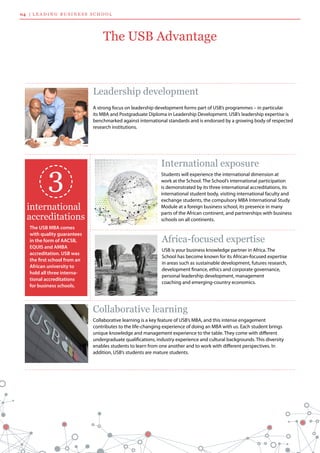
Students will experience the international dimension at
work at the School. The School’s international participation
is demonstrated by its three international accreditations, its
international student body, visiting international faculty and
exchange students, the compulsory MBA International Study
Module at a foreign business school, its presence in many
parts of the African continent, and partnerships with business
schools on all continents.
Africa-focused expertise
USB is your business knowledge partner in Africa. The 	
School has become known for its African-focused expertise 	
in areas such as sustainable development, futures research, 	
development finance, ethics and corporate governance, 	
personal leadership development, management 	
coaching and emerging-country economics.
Collaborative learning
Collaborative learning is a key feature of USB’s MBA, and this intense engagement 	
contributes to the life-changing experience of doing an MBA with us. Each student brings
unique knowledge and management experience to the table. They come with different 	
undergraduate qualifications, industry experience and cultural backgrounds. This diversity 	
enables students to learn from one another and to work with different perspectives. In 	
addition, USB’s students are mature students.
international
accreditations
A strong focus on leadership development forms part of USB’s programmes – in particular
its MBA and Postgraduate Diploma in Leadership Development. USB’s leadership expertise is
benchmarked against international standards and is endorsed by a growing body of respected
research institutions.
Leadership development
3
Career development
USB’s Career Services prepares students for their next
career moves. Services to students include career planning
and development, and exposure to career opportunities.
Workshops prepare students for job interviews, assist
them to prepare CVs and show them how to network
effectively, among other things. Companies do regular
on-campus presentations and students have access to
career-related resources.
Social engagement
USB engages with social issues in its research agenda,
academic programmes and as part of its societal engage-
ment programme. The school’s main social initiatives are
its Small Business Academy, its subsidised Management
Programme for Non-profit Organisations and its bursary
scheme. MBA students are exposed to social engagement
projects, helping them to understand the role of business
in society.
Networking and diversity
On your MBA journey, you will collaborate with people from a wide range of cultures and
countries. Students come from all over South Africa, the rest of Africa and the world. This
diversity will add depth to your learning experience and help you to build valuable 	
networks of business contacts and fellow students that will last you a lifetime. Upon
graduation, you become part of the USB Alumni Association with its more than 20 000 	
members, offering access to continued learning, networking and more.
Business connections
USB’s close cooperation with industry ensures an academic offering aligned with the needs of the world of work. Areas of 	
alliance and collaboration include representation by the local and international business community on the USB Advisory
Board and on the School’s academic programme advisory committees (Roundtables). Partnerships between USB and 	
industry include societal initiatives such as the USB Small Business Academy. It also includes the funding of students 	
and the involvement of alumni in the school’s activities (e.g. as mentors of new students).
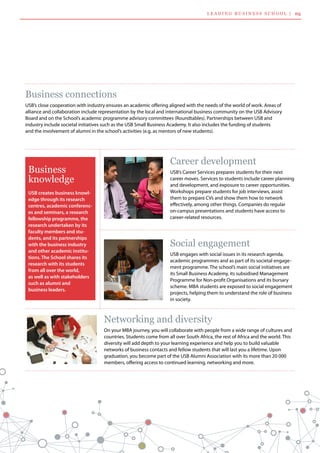
USB creates business knowl-
edge through its research
centres, academic conferenc-
es and seminars, a research
fellowship programme, the
research undertaken by its
faculty members and stu-
dents, and its partnerships
with the business industry
and other academic institu-
tions. The School shares its
research with its students
from all over the world,
as well as with stakeholders
such as alumni and
business leaders.
Business
knowledge
L ea d i n g  B usi n ess  S c h ool  | 05
School
with a view
As South Africa’s second main economic centre, Cape Town
offers a world of possibilities for business people. The city
has a thriving service-based metropolitan economy where
growth is often driven by innovation.
In 2014, World Travel Awards 	
rated Cape Town as Africa’s 	
leading travel destination.
Cape Town as top destination
Cape Town is 	
located in a biodiver-
sity hotspot called the Cape
Floral Kingdom which has
9 600 plant species, 70% of
which are not found any-
where else in the world.
9 600
South Africa has the
longest wine route in
the world some 800 km 	
in length.
800
06 | l o c a t i o n
Central location
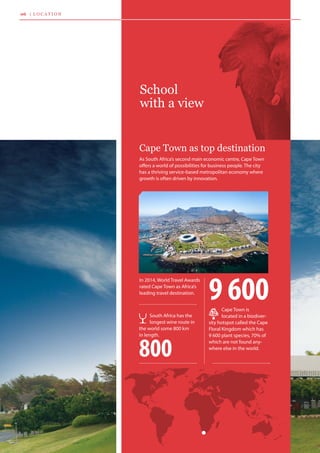
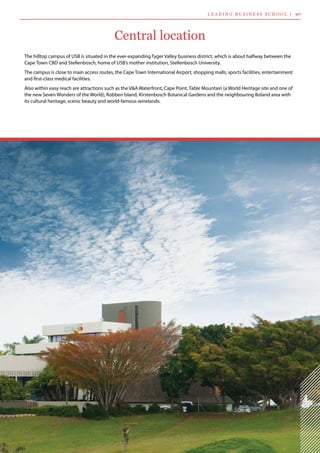
The hilltop campus of USB is situated in the ever-expanding Tyger Valley business district, which is about halfway between the
Cape Town CBD and Stellenbosch, home of USB’s mother institution, Stellenbosch University.
The campus is close to main access routes, the Cape Town International Airport, shopping malls, sports facilities, entertainment
and first-class medical facilities.
Also within easy reach are attractions such as the V&A Waterfront, Cape Point, Table Mountain (a World Heritage site and one of
the new Seven Wonders of the World), Robben Island, Kirstenbosch Botanical Gardens and the neighbouring Boland area with
its cultural heritage, scenic beauty and world-famous winelands.
L ea d i n g  B usi n ess  S c h ool  | 07
New, shorter MBA
USB’s MBA programme has been redesigned to better
fulfil the needs of today’s students. The previous (longer)
MBA, presented up till 2015, has now been restructured
into a 213 credit programme on NQF Level 9. All formats
of the  USB MBA have been shortened significantly and
this takes effect from 2016.
What does USB’s new
MBA look like?
•	 Full-time MBA: 1 year of full-time classes
•	 Modular MBA: 2 years of classes presented in 	
9 blocks of 1 week each
What needs to be in place
for the new MBA?
The redesign has partly been a result of the new require-
ments of the South African Council on Higher Education
that raised the entry requirements of the MBA pro-
gramme in South Africa. Prospective students are now
required to have one of the following qualifications before
they are allowed entry into the MBA:
•	 4-year Bachelor’s degree
•	 Honours degree
•	 3-year Bachelor’s degree + Postgraduate Diploma
Students applying for the 2016 MBA must therefore have
an appropriate NQF Level 8 qualification. USB introduced
a new 1-year Postgraduate Diploma in Business Manage-
ment and Administration (NQF level 8 with 120 credits)
in 2015 to prepare students for the MBA and make them
eligible for entry into the MBA.
USB’s NEW 1-year professional MBA
From 2016 onwards:
•	Full-time MBA: 1 year (2 years in the past)
•	Modular MBA: 2 years (3 years in the past)
You will be able to complete your class programme and research assignment
within 1 year on the Full-time MBA and within 2 years on the Modular MBA.
08 | impo r ta n t
Operate on senior management level
The USB MBA will give you an astute understanding of 	
all aspects of business, enabling you to operate on senior
management level in any industry. You will know how to
implement strategies, solve complex problems in an 	
increasingly competitive and volatile environment, 	
operate in a global environment and understand the 	
role of business in society. You will also be able to 	
interpret financial statements, assess operational 	
policies and develop marketing strategies.  
Function globally
The USB MBA curriculum is designed to
develop you as a leader who can function in
any position, anywhere in the world. You will attend an
International Study Module at a foreign business school
and touch base with global companies. You will meet
international lecturers in class. In addition, USB’s partner-
ship agreements with over 80 of the world’s top business
schools hold the potential of exchange studies, participa-
tion in international competitions for MBA 	
students, engagement and networking.
Lead with confidence
You will learn to lead in different contexts after you
have completed the Personal Leadership 	
Development Journey. USB’s MBA is strongly com-
mitted to your development as a leader, focusing
on personal leadership, relationship leadership and
organisational or strategic leadership, ultimately
delivering leadership performance and organisational
performance.
Think critically
Building and holding an 	
argument are competencies that will help to‘future-
proof’your career. Critical thinking skills will equip you
with the ability to think well and argue soundly. This,
combined with analytical and strategic skills, will help
you to recognise economic, social and other patterns,
and to create robust action plans to respond to the
unexpected.
Understand the interlinked roles of
organisational departments
USB’s MBA gives you a thorough understanding
of the interlinked roles of all the functional areas
of an organisation – including finances, operations, ICT,
marketing, people management and support services.
This will enable you to understand the impact of each
section’s work on the entire organisation and to manage
the alignment of efforts and resources towards moving
the business forward.
What can I do with
a USB MBA?
USB MBA is aimed at producing leaders who can be employed at senior management and higher levels in any industry
and in location. You will therefore gain a contextual understanding of business and improved self-awareness leading to
enhanced leadership abilities. This will strengthen your ability to communicate effectively, to sharpen your analytical
skills, to solve complex problems, to integrate environmental, social and governance (ESG) principles in your decision-
making, and to do research.
Looking a hea d | 09
‘When I applied for the USB MBA I sought exposure, leadership
training and personal growth. Having worked for government, 	
I was aware of the challenges and need for dynamic and 	
situational leadership as Kenya enters a phase of economic
prosperity. Thanks to USB I am now equipped 	
with relevant knowledge, skills and the right 	
attitude to make a difference in my country 	
both in the private and public sectors.’
– Collins Nzakala Sifuma,
2014 Full-time MBA,
Audit Associate, Office of the 	
Auditor General, Kenya
•	 Process: You utilise a range of self-led adult learning
and leadership development processes to strengthen
and grow yourself as a leader.
On this journey, students will acquaint themselves with
both the theory and practice of leadership through:
•	 Exploring and enhancing personal authentic 	
leadership
•	 Narrative learning
•	 Experiential learning
•	 Work-based and action learning
•	 Reflective learning and confronting“knowledge”that is
“not true”
•	 Leveraging strengths and development potential
•	 Addressing derailment risks.
Ultimately, this is what USB’s Leadership Development
Module promises you: You will leave USB being who you
need to be as a leader. In addition, you will leave USB with
what it takes to exercise leadership effectively.
More about the MBA
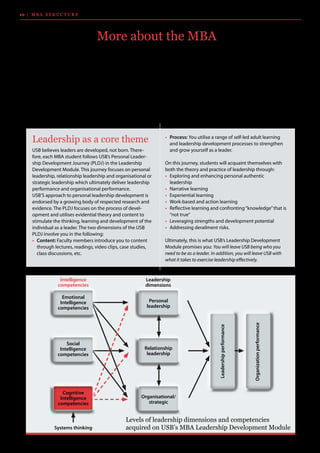
Leadership as a core theme
USB believes leaders are developed, not born. There-
fore, each MBA student follows USB’s Personal Leader-
ship Development Journey (PLDJ) in the Leadership
Development Module. This journey focuses on personal
leadership, relationship leadership and organisational or
strategic leadership which ultimately deliver leadership
performance and organisational performance.
USB’S approach to personal leadership development is
endorsed by a growing body of respected research and
evidence. The PLDJ focuses on the process of devel-
opment and utilises evidential theory and content to
stimulate the thinking, learning and development of the
individual as a leader. The two dimensions of the USB
PLDJ involve you in the following:
•	 Content: Faculty members introduce you to content
through lectures, readings, video clips, case studies,
class discussions, etc.
Levels of leadership dimensions and competencies
acquired on USB’s MBA Leadership Development Module
10 | M B A S T R U C T U R E
Organisational/
strategic
Relationship
leadership
Personal
leadership
Leadershipperformance
Organizationperformance
Intelligence
competencies
Leadership
dimensions
Systems thinking
Emotional
Intelligence
competencies
Social
Intelligence
competencies
Cognitive
Intelligence
competencies
The USB MBA aims to give you a clear understanding of how to manage a business responsibly in an African and global multicultural
environment. It’s about acquiring the intellectual ability to recognise social, economic and other patterns, to argue in a critical fash-
ion, to innovate, to embrace the complexities of today’s business and social environment, and to come up with solutions.
USB’s MBA is rigorous. It is underpinned by solid quantitative subjects and complemented by interpersonal and leadership skills.
Collaborative learning – where students learn from each other – is a key feature of the USB MBA. What makes this valuable is the
unique knowledge and managerial experience that each student brings to the table. USB’s students are mature people; 36% of them
have between 7 and 11 years of work experience while 43% have 12 or more years of work experience.
The people at USB are focused on delivering the best possible client service by engaging with students in and outside the classroom.
•	 France – Grenoble School of Management, Grenoble:
Technology Management and Innovation
•	 France – Kedge Business School, Marseilles: Driving
Sustainable Change within the Firm
•	 Canada – Laval University, Quebec: The Influence
of Culture on Business, illustrated in the contexts of
Québec and North America
•	 Netherlands – Maastricht University, Maastricht:
European Management Residency: Developing Talent
Together
•	 Brazil – Austral Group, Sao Paolo: Doing Business in
Brazil: Culture, Opportunities & Challenges
•	 USA – University of South Alabama, South Alabama:
Realizing Potential: The Integration of Port Facilities and
Manufacturing in Mobile
•	 Morocco – ESCA School of Business, Casablanca: Do-
ing Business in North Africa: Geopolitics and Strategy
•	 Germany – Mannheim Business School, Mannheim:
Entrepreneurship, Start-ups and Marketing
Do research to gain
business knowledge
Concurrent to the MBA and building on the content of the
MBA, students will write a Research Assignment of 50 to
70 pages on a business or management-related problem.
These assignments are practice-oriented and may be
based on the student’s working environment, thus ben-
efiting employer and student. Research approaches may
include case studies, feasibility/business plans, marketing
plans, strategic plans, econometric research, exploratory
studies and studies based on surveys and/or interviews.
The research assignment is expected to comprise original,
critical and insightful research to add depth to students’
learning experience and knowledge of real-life business.
Optional: Exchange
studies abroad
MBA students can choose to complete part of their 	
studies at one of USB’s overseas partner schools. This will
enable them to earn credits towards the USB MBA by 	
doing a module or summer school abroad. Exchange
studies are optional.
Choose electives to acquire
areas of specialisation
Students can choose two electives from an extensive list
of topics. The electives have been clustered into themes:
•	 Strategy
•	 Marketing
•	 Developing markets
•	 Leadership
•	 Finance
•	 Project management and
•	 Other / Management enhancement.
Choosing both electives from the same theme – 	
say Competitive Intelligence and Global Business Strategy
from the Strategy category – allows students to acquire
an area of specialisation.
Use the International Study
Module to grow a global
mind-set
All MBA students need to do the compulsory MBA Inter-
national Study Module at a foreign business school (one
of USB’s partner schools) to enhance their international
exposure. The cost of this module is included in the MBA
study fees.
The aim of this study tour is to develop managers with
global mind-sets. It is about preparing them to work in
a global environment, and helping them to understand
cultural differences in order to turn cultural competence
into a competitive advantage. It is also about develop-
ing leaders with an awareness of the ethics and values of
today’s business space.
All the study tours include company visits and cultural
activities. In 2015, for example, MBA study tours were 	
undertaken to France, Germany, the Netherlands, the
USA, Canada, Brazil, Morocco, Japan and China:
•	 Japan – Exeter Business School, Yokohama: Managing
around the World: International Roundtables for Practis-
ing Managers
•	 China – SKEMA Business School, Shanghai: Doing
Business in China
M B A S T R U C T U R E    |  11
Customise your MBA
The content of the MBA consists of 18 compulsory modules (which include the International Study Module at a foreign 	
business school and the flagship Leadership Development Module) and 2 electives.
Students can customise approximately 30% of their MBA, depending on which electives and International Study Module 	
they select and on the topic of their Research Assignment.
Reasons to choose our
Full-time MBA
•	 Increased international exposure: In
the Full-time MBA class, you will join
international students from all over the
world, allowing you to learn from their
experiences and cultural backgrounds.
•	 Single-minded focus: Immerse yourself
in your studies (11 months of classes)
without the demands of a job.
•	 Career change: Take a break from full-
time employment and prepare yourself
for a new career. Our MBA is aimed at
preparing you to manage up to board
level and to lead with confidence.
•	 Contact with business environment:
Make the most of the many speaker
and networking events in class and on
campus.
	
Reasons to choose our
Modular MBA
•	 Study while you work: This block
release programme is presented in
focused blocks of one week each (up
to four blocks per year), which will
enable you to attend lectures without
infringing too much upon your work
obligations. This arrangement will en-
able you to make the most of your time
on campus.
•	 Apply skills immediately: Implement
your new business skills at work imme-
diately while getting support from USB.
•	 Study at USB even if you live further
afield: Students from all over South
Africa and from various other African
countries choose this option because
they need to travel to USB only a few
times a year.
and group discussions, blended with course mate-
rial composed of comprehensive course outlines, text
books and journal articles. Students have to be 	
thoroughly prepared for all lectures so as to extract the
optimal benefit from contact sessions and collaborative
learning.
•	 Learning activities include lectures, guest lectures 	
by practitioners, tutorials, syndicate groups, practical
workplace experience and independent self-study.
•	 Students are assessed on a flexible assessment basis.
The final performance mark is based on, among others,
online assessments, class tests, group work, individual
and group assignments, class participation as well as
presentations. The flexible assessment system implies
that there are no supplementary tests or opportunities
for the resubmission of assignments to improve grades.  
•	 Students can choose between the Full-time MBA over
one year or the Modular MBA over two years. The Full-
time MBA is presented in English and starts in January.
The Modular MBA has three intakes: the Modular MBA
(English) starting in January, the Modular MBA (English)
starting in February and the Modular MBA (mainly in
Afrikaans) starting in February.
•	 All classes are presented at the USB Campus in the
Tyger Valley business district in northern Cape Town.
•	 Students in the Modular MBA class attend 9 blocks of
classes of 1 week each, spread over 2 years. During a
modular block, classes are presented from Monday to
Saturday. This format allows people from all over South
Africa, other African countries and further afield to 	
attend classes. The Modular MBA has various intakes.
•	 All classes are supplemented by web-based support.
The course content is embodied in a series of lectures
1 2 | M B A S T R U C T U R E
Full-time or Modular?
Two MBA formats: Full-time and Modular
speak Afrikaans. This makes USB the only business school
that offers contact sessions in Afrikaans. This allows Afri-
kaans-speaking students to do their MBA in their home
language. Participants on this programme must be fully
bilingual in English and Afrikaans. The curriculum and
textbooks are exactly the same as for the other groups.
Two language options
All the programmes are presented in English except the
one Modular MBA which is presented mainly in Afrikaans.
Classes on the Afrikaans Modular MBA are presented in
English only where lecturers (e.g. from abroad) do not
This section covers the compulsory modules and the electives. The compulsory modules include the Research
Assignment, which spans the entire MBA, and the International Study Module at a foreign business school.
Please note that USB reserves the right to modify the contents of subjects and to combine subject matter for
better integration of learning areas. This is in the interest of continuous improvement of the curriculum.
Programme contents
Contemporary
Decision-Making
This module covers systems thinking; complex problem
solving; problem structuring methods; multiple criteria
decision analysis; linear programming; and simulation
modelling.
Corporate Finance
This module focuses on the aims and functions of corpo-
rate finance, financial analysis; management of working
capital; financial markets; strategic investment and financ-
ing decisions; dividends; cost of capital, risk and required
rate of return; valuation and acquisitions; and an introduc-
tion to derivative instruments.
Digital Enterprise Management
This module covers operating models, customer value
propositions and the digital transformation; from busi-
ness strategy to IT architecture; IS investment decision,
competitive necessity, competitive advantage and rule
changing innovation; Technology Acceptance Model, the
technology hype cycles, the technology adoption curve,
change management; enterprise information systems
(ERP / CRM / ECS); systems configuration and customisa-
tion; decision making when faced by big data; human
computer interaction; data visualisation; buy vs. build
decision; systems development life cycle and iterative
development methods; IS impact on business risk from a
security and ethical perspective.
Economics for Managers
This module covers the meaning of economics and
economic systems, economics influences on society; the
meaning and challenges of globalisation and internation-
al economic integration, especially with regard to an open
developing economy; the African context; the application
of the principles of supply and demand in a market econ-
omy; the implications of the interaction between changes
in one or more of a wide range of macro-economic forces;
economic growth and development; inflation; unemploy-
ment; the balance of payments and exchange rates; the
reasoning behind economic policy decisions, and the
impact of such decisions on the managerial function.
The compulsory MBA modules
Accounting for Decision-Making (8 credits)
Business Communication Skills (4 credits)
Business in Society (8 credits)
Contemporary Decision-Making (12 credits)
Corporate Finance (12 credits)
Digital Enterprise Management (8 credits)
Economics for Managers (8 credits)
Human Capital Management (8 credits)
Integrated Case Studies (8 credits)
International Study Module (8 credits)
Operational Excellence (8 credits)
Perspectives on African Frontiers (8 credits)
Managerial Accounting (8 credits)
Managerial Statistics (8 credits)
Research Methodology and Assignment (45 credits)
Strategic Management (12 credits)
Strategic Marketing and Branding (8 credits)
Values-Based Leadership (16 credits)
Accounting for
Decision-Making
This module covers management and financial ac-
counting; internal financial information used in making
strategic decisions; external financial information; costing
systems; budgeting; and the interpretation and analysis
of financial statements and historical reviews in the South
African regulatory environment.
Business Communication
The module is about effective oral and written com-
munication in a connected global world; interactive and
practical approaches; the elements of persuasive writing
and the write-tight technique; reader-centred language,
style and structure; and presentation skills focusing on
engaging different audiences.
Business in Society
This module focuses on the capability of students to
exercise responsible leadership through sound decision
making in matters related to the environmental, social
and economic impact of an organisation’s activities. It
includes the conceptual, strategic, operational and regula-
tory aspects that leaders and managers have to consider
and incorporate in the process of optimising an organisa-
tion’s contribution to sustainable development in a local
and global context.
lea r n i n g co n te n ts | 13
14 | lea r n i n g co n te n ts
Perspectives on
African Frontiers
This module is aimed at helping students to develop
an awareness and understanding of the diversity of
African countries and the business opportunities this
provides; focuses on the main factors that impact on
doing business in and within Africa.
Research Assignment
The Research Assignment module (45 SAQA credits)
forms an integral part of the USB MBA. The module
comprises three distinct activities of learning. The
first activity comprises the teaching of an appropriate
research methodology foundation in class. The second
activity is a workshop-based phase to guide students
to develop a research proposal (with the assistance of
faculty members in the discipline of their interest). The
third activity is the actual research assignment in which
students work independently towards accomplish-
ing their research objectives, under the guidance of a
supervisor.
Strategic Management
The module is a capstone course on the MBA where the
knowledge and practices associated with the different
functional management areas is combined with the
thinking frames and practices of strategic management
to create an integrative perspective on a General Man-
ager level (Levels of work complexity 4/5). This module
is divided into six themes: The philosophy of strategy;
Strategy development; Strategy innovation; Strategy
execution; Entrepreneurship; and Managerial innova-
tion. The following overarching strategic themes from
the MBA will be reinforced in the content of this mod-
ule: Entrepreneurship, Innovation, Complex problem-
solving, Stewardship and the International context.
Strategic Marketing
and Branding
This module explores the strategic analysis of or-
ganisational activities from a marketing point of view;
marketing and brand strategy formulation; the func-
tional areas of marketing (4Ps & 7Ps) and their relevant
application to strategic marketing frameworks.
Values-based Leadership
This module is aimed at leveraging the student’s own
personal and authentic leadership style to develop
sustainable high-performance teams and organisations
within an ever-changing world of work. It also covers
the changing leadership context; authentic and per-
sonal leadership; EQ development; and organisational
change and transformation practices.
Human Capital Management
This module looks at high-performance people 	
management; approaches to organisational structure;
career development; and talent management.
Integrated Case Studies
This module serves as an introduction to the field of
strategic management, while simultaneously provid-
ing students with the opportunity to apply the contents
of multiple modules in integrated cases studies. Three
themes are covered: Introduction to strategic thinking;
Strategic direction and environmental analysis: strategic
awareness & agility; and An integrated case study analysis.
International Study Module
Students do this module at a foreign business school
(costs included in MBA fees; various options offered each
year). The module looks at how to business in the target
country; relevant models and frameworks of the theory
of management and related fields as applied in the target
country; the identification and exploiting of opportunities
for business; the cultural and societal framework of the
target country; challenges of globalisation; and geo-	
economic and geo-political frameworks.
Managerial Statistics
This module covers data description; probability; prob-
ability and sampling distributions; estimation; tests of
hypotheses; correlation; regression; contingency tables.
Managerial Accounting
This module explores the understanding of manage-
ment accounting and financial accounting; cost concepts
applied by managers in internal financial information;
financial information disclosed in the financial statements
(with specific focus on the cash flow statement and the
management of cash flows); sustainable growth rate; and
financial health.
Operational Excellence
This module unpacks the following: resources, capabilities
and the impact on operations strategy; the transformation
process design and value stream mapping; continuous
improvement and business process design; the Bullwhip
effect and global supply chains; SCORE model; measuring
operational excellence; Theory of Constraints; Six Sigma;
Lean Operations; quality control and the role of statistical
techniques in quality; the impact of technology on opera-
tions.
applicatio n |   15
What else do you
need to know?
OR
•	 An appropriate 3-year Bachelor’s degree (NQF level 7)
and a Postgraduate Diploma (NQF level 8), and at least 	
3 years of relevant working experience
Note: The working experience should preferably be on
managerial level.
Other requirements
•	 Mathematics at NNS (Grade 12) level or equivalent
•	 A comprehensive CV
•	 3 essays, showing the candidate’s level of motivation
and working experience
•	 An interview with an MBA alumnus
•	 Satisfactory selection test results
Admission requirements
USB’s stringent admission criteria result in higher reten-
tion and pass rates. From 2016 onwards, the Council on
Higher Education (CHE) in South Africa will, based on new
regulations, requires all MBA applicants to have a 4-year
degree, a 3-year Bachelor’s degree plus a postgraduate
diploma, or an honours degree. The minimum admission
requirements for USB’s MBA include:
Academic qualifications
•	 An appropriate 4-year Bachelor’s degree (NQF level 8)
and at least 3 years of relevant full-time working experi-
ence
OR
•	 An Honours degree (NQF level 8), plus 3 years of rel-
evant full-time working experience
Selection tests
USB accepts the SHL or GMAT selection test. Both tests are recognised internationally. Make an appointment with USB to do the
SHL selection test on the USB campus or elsewhere, or contact GMAT at www.gmat.com.
SHL
The SHL consists of the following parts:
•	 Verbal critical reasoning assessment
•	 Numerical critical reasoning assessment
•	 Inductive reasoning test
•	 The Occupational Personality Questionnaire (OPQ) 	
on behavioural preferences.
SHL selection test
1Verbal critical 	
reasoning assessment ....................
2Numerical critical 	
reasoning assessment ....................
3Inductive 	
reasoning test ....................................
4Occupational Personality 	
Questionnaire (OPQ) .......................
GMAT
The GMAT consists of three timed sections, namely an analytical writing assessment, a quantitative assessment and a verbal
assessment. A copy of the results will automatically be forwarded to USB. The test takes about 4 hours. This test is not admin-
istered by USB and bookings to take the test cannot be made with USB staff. Foreign students need to contact the Regional
Registration Centre in The Netherlands on 0931 320 239 593. SA students need to contact Pearson VUE Professional Centre in
Johannesburg on +27 (0)11 784 3093 or 0800 995 044 or at justin.jacobs@pearson.com. Cost: $250. Find more information at
www.gmat.org, www.gmac.com or www.mba.com.
Duration: The test takes about 3 hours to complete and no 	
preparation is required beforehand.
When and where: Applicants may do the SHL test on set 	
dates at USB (see USB website) or by appointment at USB 	
or other centres in the country.
Cost (2016 amounts): R2 800 (if taken at USB). Please note: You can
only take the SHL test once you have started your electronic MBA
application process, because you will need a provisional student
number for payments and for SHL reports (which will be linked to
your electronic application). The total therefore is R4 400 	
(R2 800 SHL test + R1 600 MBA application fee). 	
Please see bank details below and use your provisional 	
student number as reference.
Book: Contact USB on telephone 021 918 4239 	
or e-mail shl@USB.ac.za.
Additional information: Go to www.shl.co.za
Assessment of MBA
students’ deliverables
Assessment takes place on a continuous basis through
individual and group assignments, tests, discussions, pres-
entations, participation and the analysis of case studies.
All assessments take place on campus during scheduled
class times. Detailed regulations for the MBA degree are
included in the Calendar of Stellenbosch University.
Assessment and recognition
of prior learning
USB provides wider access to its programmes through
its Assessment and Recognition of Prior Learning (ARPL)
process. In line with the requirements of the Council for
Higher Education (CHE), USB may admit up to 10% of its
student body under ARPL.
In order to be admitted to a Master’s programme at USB,
candidates should be in possession of a relevant NQF 8
qualification, such as an Honours degree, 4-year in-depth
Bachelor’s degree or a postgraduate diploma.
Candidates who wish to be admitted under the ARPL
policy will firstly have to submit all the documentation
and tests as required for all prospective students. In ad-
dition, prospective MBA students have to adhere to the
following:
1Have at least an NQF 6 qualification.
1 6 | applicatio n
Three essays
Write an essay of approximately 250 words on each of the
following topics:
•	 Competencies: Your achievements, developed abilities
and significant learning to date, and areas of compe-
tence that you still need to develop.
•	 Career objectives: Where would you like to be five and
ten years after completing your MBA and how do you
intend getting there?
•	 Personal motivation: How do you deal with adversity
and stress, what keeps you motivated and focused, and
how do you intend coping with the additional stress
that the MBA will create?
Interview by an alumnus
USB alumni interview all qualifying applicants to deter-
mine their motivation levels, general knowledge of the
business world and ability to support their arguments.
These interviews are conducted by alumni in various
cities, local and internationally. In the event that we do
not have an interviewer close by, the interview will be
conducted telephonically.
Credits for
completed modules
Credits are awarded on a weighted basis per module. The
total number of SAQA credits granted on the USB MBA
programme is 213.
Transfer of credits from
subjects completed elsewhere
USB supports the principle of recognition of prior aca-
demic learning, although this is only applied in very selec-
tive instances at USB, because group work and collabora-
tive learning are cornerstones of the USB MBA. To obtain
an MBA degree at USB, a student must be registered at
Stellenbosch University for at least two years and at least
50% of the credits have to be obtained at this University.
A student who has been admitted to the MBA programme
may apply for accreditation of prior learning, provided
that it was obtained on another MBA programme.
Students wanting to apply for accreditation of credits
obtained elsewhere need to supply:
•	 An application which includes full course outlines,
number of SAQA credits, learning outcomes, number
of class contact hours, prescribed textbooks, method
and weights of assessment, and outcomes or topics per
class session.
•	 Additional work or assessments may be required.
2Have at least SIX years of working experience after
obtaining the qualification mentioned in 1, of which at
least THREE years should have been in a management or
related professional position.
3Submit a comprehensive CV, indicating detailed areas
of responsibility as well as information on activities
outside the work environment.
4Provide USB with at least two references (typically
current or former line heads) who can testify about the
candidate’s managerial or related professional abilities.
These references will be required to give a detailed per-
sonal reference about the candidate on forms provided
by USB.
5Next, USB’s Admissions Committee (head of the
programme and another academic) will conduct an
in-depth interview with the candidate.
6If the Committee is of the opinion that the candidate
has the abilities to cope with the demands of the MBA
programme, he/she may be admitted.
7A recommendation of admission is sent via USB’s Aca-
demic Planning Committee to the Board of the Faculty
of Economic and Management Sciences for notification.
MBA information sessions
Across the country, across borders
USB hosts on-campus, countrywide and cross-border information sessions from May to October each year.
Dates and times
See www.usb.ac.za/mba  or www.usb.ac.za/events for dates, venues, timeslots and booking details. Or e-mail mba@usb.
ac.za or call +27 (0)21 918 4246.
Time management
Students need to be aware of the time-consuming nature of MBA studies and they need to arrange study time with their
employers and families beforehand. Here is a rough guideline: for every 1 hour spent in class, students need to set aside
3 hours for self-study (reading, assignments, group work, etc.). The class programme of the USB MBA takes up around 426
hours. Prioritisation will therefore 	
be crucial.
Groupwork and diversity
Groupwork in a context of diversity is a characteristic of the USB MBA. People from diverse backgrounds and with different
strengths will be asked to work together on projects and to rotate leadership within such groups. This will allow students
to learn from one another and it will help to prepare them for real-life situations in the world of work.
applicatio n | 17
Study visa requirements for international students
All residential students who are non-South African citizens
and are studying at USB require a study visa. Prospec-
tive students should contact their nearest South African
Foreign Mission (South African Embassy, Consulate or
High Commission), normally in their country of origin, to
enquire about the requirements for study visas for South
Africa. Applicants are required to present themselves in
person so that biometric data may be captured.
Students from West Africa can also contact USB’s repre-
sentative for this region in Nigeria while students from
East Africa can contact USB’s representative for this region
in Kenya. (See contact details at the back of the brochure.)  
All international students can contact the USB Interna-
tional Office for assistance at international@usb.ac.za.
All international students must hold a valid visa for their
intended activity prior to entering South Africa.
Also note the following:
•	 Obtaining a study visa from the South African authori-
ties takes approximately 10 to 12 weeks from the date
of application. However, some missions may process
applications sooner. Sufficient time should be allowed
for study visa applications to be processed.
•	 Your study visa application should include a copy of the
letter offering a place on USB’s MBA (or other pro-
gramme). This letter will be provided by USB’s Academic
Administration once the application has been ap-
proved. A place on the programme must be confirmed
before a study visa application can be considered by the
South African Department of Home Affairs. Students
should not proceed to Stellenbosch University or USB
without a valid visa.
•	 Although applicants are expected to determine exactly
what they require to apply for a study visa, they can
expect to have to provide the following, among others:
a police clearance certificate, proof of medical insurance
recognised in South Africa, a radiological report, a medi-
cal certificate, proof of sufficient funds, and an admis-
sion letter from USB. Your nearest South African Foreign
Mission will be able to advise in this regard. The onus
falls on the student to make sure that he/she submits a
complete application pack.
•	 All documents should be certified and translated into
English before submission (in order not to delay the
outcome of the application).
Payment of programme fees
Foreign students need to pay a deposit of 50% of the
annual programme fees by acceptance to the programme
and the balance prior to, or upon registration.
Additional information for foreign students
1 8 | applicatio n
What happens next?
Your application can only be assessed by the selection panel if it is accompanied by the fully filled out online application
form and all the appropriate supporting documents. Each qualifying applicant will be interviewed (face-to-face or telephoni-
cally) by an alumnus of the School.  The outcome of the selection process will be made known within 30 days or as soon as
possible thereafter.
	
      Go to www.USB.ac.za/apply and complete the online MBA        	
      application form. You will be able to complete the form in 	
      steps without losing information. The application process 	
      is the same for South African and foreign students.
USB accepts the SHL or GMAT selection test. Both tests 	
      are recognised internationally. Make an appointment 	
      with USB to do the SHL selection test by sending e-mail 	
       to Joanne.Sleigh@usb.ac.za, or contact GMAT at 	
      www.gmat.com. See www.USB.ac.za/MBA for selection 	
       test fees and further information.
How to apply
        o  Proof of application fee payment
        o  Comprehensive CV
        o  3 essays of 250 words each on your competencies,     	
         career objectives and personal motivation
        o  Copies of degree certificates (please note that the 	
         original certificate must be shown on the first day, or 	
         shown together with a transcript of the subjects)
        o  Proof of school-leaving mathematics results
        o  SHL or GMAT selection test results 	
        (if these were not sent to USB directly)
        o  Copy of your ID (or passport for non-South 	
         African students);
        o  A marriage certificate (where the applicant’s 	
        new surname does not match that on the 	
        degree certificate).
1Apply online:
3Pay your application fee:
2Do a selection test:
4Upload the following documents online:
Bank: Standard Bank. Type of account: cheque account.  
Account number: 073003069. Branch name: Stellenbosch.
Branch code: 050610. SWIFT code: SBZAZAJJ. Proof of 	
payment of your application fee can also be e-mailed to
joanne.sleigh@USB.ac.za.
MBA timetables for 2016
Deadline for applications
•	 South African students: 30 November each year
•	 Foreign students from (visa-exempt) SADC countries: 	
30 October each year
•	 Foreign students from other African countries and 	
rest of world: 30 September each year
Important
•	 Dates for second year of registration: Will be announced
later.
•	 Study permits for foreign students at USB: Obtaining a
study permit (study visa) from the South African authorities
takes up to 12 weeks from the date of being offered a place
on a programme at USB – hence the early application dead-
line for foreign students.
•	 Multiple-entry visas: Students from non-SADC African
countries and other countries with visa requirements who
need to apply for study visas can obtain a letter from USB
confirming the duration of registration at USB. This will help
students to obtain multiple-entry study visas in case of
modular studies.
•	 Timetable changes: USB reserves the right to change dates
of the lecture schedule or subjects per term table. Students
will be informed of any changes in good time.
•	 Late applications: USB will do everything possible to 	
accommodate applications submitted after the closing date.
Full-time MBA 2016 (English)
Term 1: 13 January – 18 March
Term 2: 5 April – 24 June
Term 3: 18 July – 31 August
Term 4: 19 November - 26 November
Modular MBA 2016 (English) – Intake 1
Block 1: 25 – 30 January
Block 2: 14 – 19 March
Block 3: 16 – 21 May
Block 4: 1 – 6 August
Block 5: 3 – 8 October
Modular MBA 2016 (English) – Intake 2
Block 1: 29 February – 5 March
Block 2: 18 – 23 April
Block 3: 20 – 25 June
Block 4: 29 August – 3 September
Block 5: 24 – 29 October
Modular MBA 2016 (mainly Afrikaans)
Block 1: 15 – 20 February
Block 2: 4 – 9 April
Block 3: 6 – 11 June
Block 4: 22 – 27 August
Block 5: 17 – 22 October
Programme fees and financing
fi n a n ci n g |   19
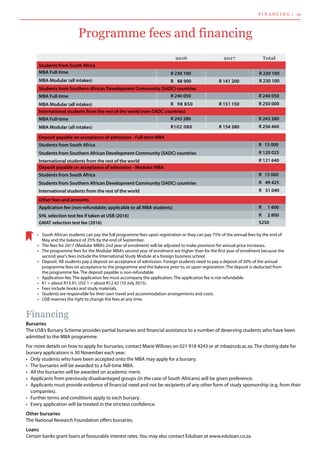
•	 South African students can pay the full programme fees upon registration or they can pay 75% of the annual fees by the end of
May and the balance of 25% by the end of September.
•	 The fees for 2017 (Modular MBA’s 2nd year of enrolment) will be adjusted to make provision for annual price increases.
•	 The programme fees for the Modular MBA’s second year of enrolment are higher than for the first year of enrolment because the
second year’s fees include the International Study Module at a foreign business school.
•	 Deposit: All students pay a deposit on acceptance of admission. Foreign students need to pay a deposit of 50% of the annual
programme fees on acceptance to the programme and the balance prior to, or upon registration. The deposit is deducted from
the programme fee. The deposit payable is non-refundable.
•	 Application fee: The application fee must accompany the application. The application fee is not refundable.
•	 €1 = about R13.91; US$ 1 = about R12.42 (10 July 2015).
•	 Fees include books and study materials.
•	 Students are responsible for their own travel and accommodation arrangements and costs.
•	 USB reserves the right to change the fees at any time.
Bursaries
The USB’s Bursary Scheme provides partial bursaries and financial assistance to a number of deserving students who have been
admitted to the MBA programme.
For more details on how to apply for bursaries, contact Marie Willows on 021 918 4243 or at mba@usb.ac.za. The closing date for
bursary applications is 30 November each year.
•	 Only students who have been accepted onto the MBA may apply for a bursary.
•	 The bursaries will be awarded to a full-time MBA.
•	 All the bursaries will be awarded on academic merit.
•	 Applicants from previously disadvantaged groups (in the case of South Africans) will be given preference.
•	 Applicants must provide evidence of financial need and not be recipients of any other form of study sponsorship (e.g. from their
companies).
•	 Further terms and conditions apply to each bursary.
•	 Every application will be treated in the strictest confidence.
Other bursaries
The National Research Foundation offers bursaries.
Loans
Certain banks grant loans at favourable interest rates. You may also contact Eduloan at www.eduloan.co.za.
Financing
MBA Modular (May intake)


Students from South Africa
MBA Full-time
MBA Full-time
MBA Full-time
Students from South Africa
Application fee (non-refundable; applicable to all MBA students)
GMAT selection test fee (2016)
MBA Modular (all intakes)
Students from Southern African Development Community (SADC) countries
SHL selection test fee if taken at USB (2016)
International students from the rest of the world
Students from Southern African Development Community (SADC) countries
International students from the rest of the world (non-SADC countries)
Deposit payable on acceptance of admission - Full-time MBA
Deposit payable on acceptance of admission - Modular MBA
Other fees and amounts
2016
R 230 100
R 240 050
R 243 280
R 88 900
R 98 850
R102 080
2017
R 141 200
R 151 150
R 154 380
Total
R 230 100
R 240 050
R 243 280
R 15 000
R 15 000
R 1 600
$250
R 230 100
R 250 000
R 256 460
R 120 025
R 49 425
R 2 800
R 121 640
R 51 040
20    |  a l u m n i
What do USB students and alumni say?
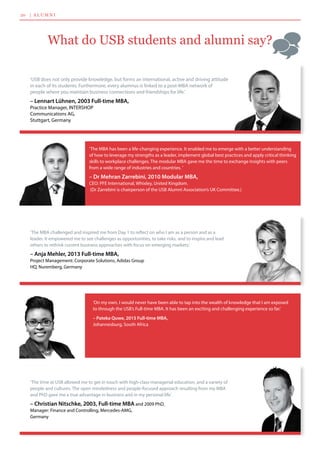
‘USB does not only provide knowledge, but forms an international, active and driving attitude
in each of its students. Furthermore, every alumnus is linked to a post-MBA network of 	
people where you maintain business connections and friendships for life.’
– Lennart Lühnen, 2003 Full-time MBA,
Practice Manager, INTERSHOP 	
Communications AG, 	
Stuttgart, Germany
‘The MBA has been a life-changing experience. It enabled me to emerge with a better understanding
of how to leverage my strengths as a leader, implement global best practices and apply critical thinking
skills to workplace challenges. The modular MBA gave me the time to exchange insights with peers
from a wide range of industries and countries. ’
– Dr Mehran Zarrebini, 2010 Modular MBA,
CEO: PFE International, Whixley, United Kingdom.	
(Dr Zarrebini is chairperson of the USB Alumni Association’s UK Committee.)
‘The MBA challenged and inspired me from Day 1 to reflect on who I am as a person and as a 	
leader. It empowered me to see challenges as opportunities, to take risks, and to inspire and lead
others to rethink current business approaches with focus on emerging markets.’
– Anja Mehler, 2013 Full-time MBA,
Project Management: Corporate Solutions, Adidas Group 	
HQ, Nuremberg, Germany
‘The time at USB allowed me to get in touch with high-class managerial education, and a variety of
people and cultures. The open mindedness and people-focused approach resulting from my MBA
and PhD gave me a true advantage in business and in my personal life.’
– Christian Nitschke, 2003, Full-time MBA and 2009 PhD, 	
Manager: Finance and Controlling, Mercedes-AMG, 	
Germany
‘On my own, I would never have been able to tap into the wealth of knowledge that I am exposed
to through the USB’s Full-time MBA. It has been an exciting and challenging experience so far.’
– Pateka Quwe, 2015 Full-time MBA,
Johannesburg, South Africa
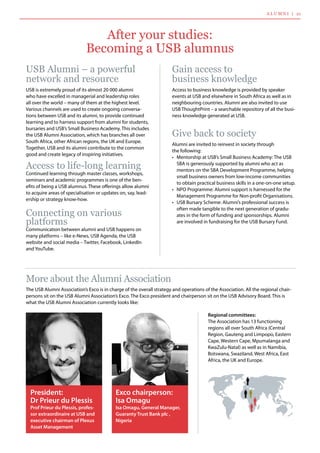
Regional committees:
The Association has 13 functioning
regions all over South Africa (Central
Region, Gauteng and Limpopo, Eastern
Cape, Western Cape, Mpumalanga and
KwaZulu-Natal) as well as in Namibia,
Botswana, Swaziland, West Africa, East
Africa, the UK and Europe.
More about the Alumni Association
President:
Dr Prieur du Plessis
Prof Prieur du Plessis, profes-
sor extraordinaire at USB and
executive chairman of Plexus
Asset Management
Exco chairperson:
Isa Omagu
Isa Omagu, General Manager,
Guaranty Trust Bank plc ,
Nigeria
After your studies:
Becoming a USB alumnus
USB Alumni – a powerful
network and resource
USB is extremely proud of its almost 20 000 alumni
who have excelled in managerial and leadership roles
all over the world – many of them at the highest level.
Various channels are used to create ongoing conversa-
tions between USB and its alumni, to provide continued
learning and to harness support from alumni for students,
bursaries and USB’s Small Business Academy. This includes
the USB Alumni Association, which has branches all over
South Africa, other African regions, the UK and Europe.
Together, USB and its alumni contribute to the common
good and create legacy of inspiring initiatives.
Access to life-long learning
Continued learning through master classes, workshops,
seminars and academic programmes is one of the ben-
efits of being a USB alumnus. These offerings allow alumni
to acquire areas of specialisation or updates on, say, lead-
ership or strategy know-how.
Connecting on various
platforms 	
Communication between alumni and USB happens on
many platforms – like e-News, USB Agenda, the USB
website and social media – Twitter, Facebook, LinkedIn
and YouTube.
The USB Alumni Association’s Exco is in charge of the overall strategy and operations of the Association. All the regional chair-
persons sit on the USB Alumni Association’s Exco. The Exco president and chairperson sit on the USB Advisory Board. This is
what the USB Alumni Association currently looks like:
Gain access to
business knowledge
Access to business knowledge is provided by speaker
events at USB and elsewhere in South Africa as well as in
neighbouring countries. Alumni are also invited to use
USB ThoughtPrint – a searchable repository of all the busi-
ness knowledge generated at USB.
Give back to society
Alumni are invited to reinvest in society through 	
the following:
•	 Mentorship at USB’s Small Business Academy: The USB
SBA is generously supported by alumni who act as
mentors on the SBA Development Programme, helping
small business owners from low-income communities
to obtain practical business skills in a one-on-one setup.
•	 NPO Programme: Alumni support is harnessed for the
Management Programme for Non-profit Organisations.
•	 USB Bursary Scheme: Alumni’s professional success is
often made tangible to the next generation of gradu-
ates in the form of funding and sponsorships. Alumni
are involved in fundraising for the USB Bursary Fund.
a l u m n i |   21
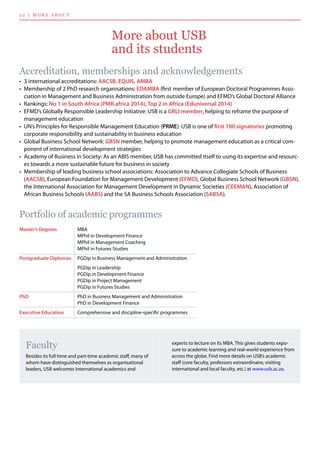
Master’s Degrees		 MBA
	 	 	 MPhil in Development Finance
	 	 	 MPhil in Management Coaching
	 	 	 MPhil in Futures Studies
Postgraduate Diplomas	 PGDip in Business Management and Administration
	 	 	 PGDip in Leadership
	 	 	 PGDip in Development Finance
	 	 	 PGDip in Project Management
	 	 	 PGDip in Futures Studies
PhD	 	 	 PhD in Business Management and Administration
	 	 	 PhD in Development Finance
Executive Education	 Comprehensive and discipline-specific programmes
	 	 	
More about USB
and its students
•	 3 international accreditations: AACSB, EQUIS, AMBA
•	 Membership of 2 PhD research organisations: EDAMBA (first member of European Doctoral Programmes Asso-
ciation in Management and Business Administration from outside Europe) and EFMD’s Global Doctoral Alliance
•	 Rankings: No 1 in South Africa (PMR.africa 2014), Top 2 in Africa (Eduniversal 2014)
•	 EFMD’s Globally Responsible Leadership Initiative: USB is a GRLI member, helping to reframe the purpose of
management education
•	 UN’s Principles for Responsible Management Education (PRME): USB is one of first 100 signatories promoting
corporate responsibility and sustainability in business education
•	 Global Business School Network: GBSN member, helping to promote management education as a critical com-
ponent of international development strategies
•	 Academy of Business in Society: As an ABIS member, USB has committed itself to using its expertise and resourc-
es towards a more sustainable future for business in society
•	 Membership of leading business school associations: Association to Advance Collegiate Schools of Business
(AACSB), European Foundation for Management Development (EFMD), Global Business School Network (GBSN),
the International Association for Management Development in Dynamic Societies (CEEMAN), Association of
African Business Schools (AABS) and the SA Business Schools Association (SABSA).
Accreditation, memberships and acknowledgements
Portfolio of academic programmes	
2 2 | mo r e about 
Faculty
Besides its full-time and part-time academic staff, many of
whom have distinguished themselves as organisational
leaders, USB welcomes international academics and
experts to lecture on its MBA. This gives students expo-
sure to academic learning and real-world experience from
across the globe. Find more details on USB’s academic
staff (core faculty, professors extraordinaire, visiting 	
international and local faculty, etc.) at www.usb.ac.za.
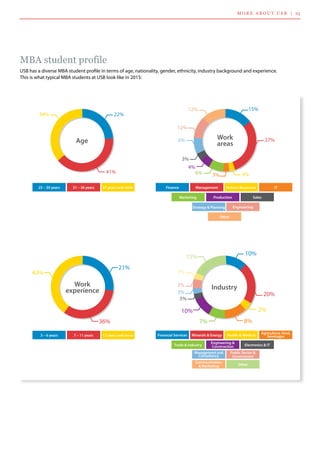
MBA student profile
USB has a diverse MBA student profile in terms of age, nationality, gender, ethnicity, industry background and experience. 	
This is what typical MBA students at USB look like in 2015:
Communication
& Marketing
Work
areas
Work
experience
15%
10%
10%
21%
27%
20%
36%
3%
2%
3%
8%
6%
7%
4%
3%
6%
12%
15%
43%
12%
Industry
Age
22%
41%
34%
Finance
Financial Services
25 – 30 years
3 – 6 years
Management
Minerals & Energy
31 – 36 years
7 – 11 years
Marketing
Trade & Industry
Human Resources
Health & Medical
37 years and older
12 years and more
Production
Engineering &
Construction
Strategy & Planning
Management and
Consultancy
IT
Agriculture, food,
beverages
Sales
Electronics & IT
Engineering
Public Sector &
Government
Other
Other
mo r e about  U S B |   23
5%
3%
3%
3%
Support services:
The Client Liaison and Sales Office, Admis-
sions Office and Academic Administration
provide advice and continuous support to pro-
spective and current students. The International
Affairs Office provides assistance to foreign and
exchange students, and the Alumni Relations 	
Office engages with USB alumni of all degree 	
programmes and postgraduate diplomas. The 	
Careers Office provides career planning and 	
development services.
Accommodation
and restaurants:
The Bellvista Lodge 	
(www.usb.ac.za/bellvista) on the 	
campus provides accommodation and a 	
restaurant. Two other restaurants offer 	
meals and refreshments.
ICT facilities:
These include wireless broadband
internet access campus-wide, an 	
e-learning platform, individual workstations
and break-away rooms, network connections
for notebooks and access to software 	
packages and databases.
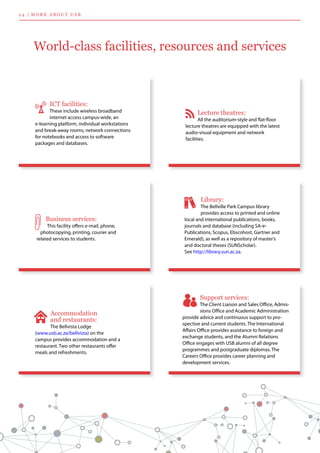
World-class facilities, resources and services
Business services:
This facility offers e-mail, phone, 	
photocopying, printing, courier and 	
related services to students.
Lecture theatres:
All the auditorium-style and flat-floor
lecture theatres are equipped with the latest
audio-visual equipment and network 	
facilities.
Library:
The Bellville Park Campus library
provides access to printed and online
local and international publications, books,
journals and database (including SA-e- 	
Publications, Scopus, Ebscohost, Gartner and
Emerald), as well as a repository of master’s
and doctoral theses (SUNScholar). 	
See http://library.sun.ac.za.
2 4 | mo r e about  U S B
Frequently asked questions
Selection tests
Which selection test should I take – the GMAT or SHL?
Both tests are recognised internationally and USB accepts
both. Both tests measure language skills, verbal reason-
ing, numerical reasoning and learning potential. However,
the SHL also includes an occupational personality test.
The SHL selection test is usually the preferred option for
most students who hold a degree recognised by Stellen-
bosch University. No preparation is required for the SHL.
The MBA programme
When are exams/tests held? How many tests/exams are
there?
Students are assessed on a continuous basis. Each module
has a minimum number of assessments based on the
number of credits for that module. The final performance
mark therefore includes, among others, online assess-
ments, class tests, group work, individual and group as-
signments, class participation and presentations.
Why do the MBA’s admission requirements include a
minimum number of years of work experience? Why is
this applied so stringently?
Firstly, relevant work experience is a requirement of USB’s
international EQUIS accreditation. Secondly, collaborative
learning – where students learn from each other – forms
an important part of USB’s MBA. The expertise, depth and
value that each participant brings to the class depend
largely on authentic work experience.
What is the format of an exam/test – e.g. multi-choice
questions (MCQs), essays, case studies? Will students
have access to past test/exam papers?
Tests focus primarily on the application of knowledge and
insight to business problems. Hence, most tests are open-
book and require the analysis of problems or cases. In
the assessment of pre-reading, closed-book tests may be
used. In web-based assessments of pre-reading multiple-
choice questions are frequently used, but this may not ex-
ceed 20% of the grade of a subject. Many lecturers make
past test papers available as a learning resource.
I have completed a Management Development Pro-
gramme with USB-ED / Postgraduate Diploma in Busi-
ness Management at XYZ. Will I be exempted from part
of the MBA programme?
The focus of the MBA programme is on collaborative
learning. Every participant brings certain expertise to the
class – some through formal learning, others through in-
formal learning. If the most knowledgeable persons were
to be exempted from classes, the learning experience
for the whole class will be impaired. Thus, as a general
principle, no exemption is granted. In a limited number
of special cases, for example where an MBA student
transfers from another university to USB, or the content
of a USB-ED programme is identical to the MBA content,
exemption could be considered. Applications will only be
considered after the applicant has registered for the MBA
programme.
Does USB assign mentors to students?
Yes, but on a volunteer basis only. USB alumni offer to
mentor students during their studies and to provide
career or industry advice. This service is offered in as-
sociation with USB’s Alumni Relations Office and Career
Services Office.
What facilities are available for academic assistance
besides the library?
Academic assistance is offered via a web-based learning
environment, a PC lab with various software and database
resources, syndicate groups (dedicated study groups),
informal learning groups and a bulletin board.
How do syndicates (dedicated study groups) function
in terms of discussions, assignments and other group
work? How much does syndicate work count towards
the final mark? Can syndicates communicate electroni-
cally to get work done or is it compulsory for syndicates
to meet physically between modular blocks?
This will depend on each lecturer and on the subject – as
some subjects require a substantial amount of group
work, while others require limited group work. The weight
varies from 0% (no group work) up to 40%. It is impera-
tive that MBA students can communicate electronically
to work on their assignments. There is no need to meet
physically between modular blocks.
When will we receive our books and course material for
the MBA programme?
Full-time MBA students will receive their first batch of
study material (books and course outlines) at the begin-
ning of the programme and thereafter at the end of every
term for the following term. Modular MBA students will
receive their first batch of study material at the begin-
ning of the programme and thereafter at the end of every
modular block for the following block.
Can I spread the payment of my fees over time?
Yes. For South African students, 75% of the annual fees are
payable by the end of May and the balance of 25% by the
FAQ | 25
end of September. (Foreign students, however, need to
pay the full programme fee prior to or upon registration.)
Application process and
closing date
When is the closing date for applications?
The closing date for the MBA for South African students
is 30 November. The closing date for the MBA for foreign
students is end of August each year due to visa require-
ments. However, we will do everything possible to accom-
modate applications submitted after the closing date.
Do I need to travel to USB for the MBA pre-selection
interview?
Interviews are conducted by alumni in various cities, lo-
cal and internationally. In the event that we do not have
an interviewer close by, the interview will be conducted
telephonically.
What if I don’t have a study permit yet?
Insert a dash ( – ) in the response area.
Bursaries
Are bursaries available?
A limited number of bursaries are available through USB,
the USB Alumni Association’s Future Fund Trust and the
National Research Foundation.
Campus
Is accommodation available on campus?
Yes, there is a comfortable lodge and restaurant on the
Bellville Park Campus, which is ideal for short-term accom-
modation. However, this will probably be too expensive
for longer stays. For other accommodation options, such
as rooms and flats, contact your course administrator.
Once you have been admitted on the MBA and your
deposit has been paid, the relevant course administrators
will give you guidance in finding accommodation.
26 | FAQ
ACCREDITED
www.usb.ac.za
PO Box 610, Bellville 7535, South Africa
Carl Cronjé Drive, Bellville 7530, Cape Town, South Africa
Tel: 0860 872 872; 021 918 4111;
international +27 21 918 4111
Email: mba@usb.ac.za
Website: www.usb.ac.za/mba
Master’s in Business Administration (MBA)
General MBA enquiries
Tel: 021 918 4246; international +27 21 918 4246;
Email: mba@usb.ac.za
Information sessions
Tel: 021 918 4246; international +27 21 918 4246;
Email: mba@usb.ac.za
Selection tests
Tel: 021 918 4239; international +27 21 918 4239;
Email: mba@usb.ac.za
Support services
USB Careers Office
Tel: 021 918 4187; international +27 21 918 4187;
Email: usb.Careers@usb.ac.za
International affairs
Tel: 021 918 4196; international +27 21 918 4196
Email: international@usb.ac.za
Campus accommodation
Tel: 021 918 4444; international +27 21 918 4444;
www.usb.ac.za/bellvista
USB Alumni Office
Tel: 021 918 4212; international +27 21 918 4483;
Email: usbalumni@usb.ac.za
West African Office
Prospective students from West Africa can contact USB’s
representative in that region directly. USB is represented
in West Africa by accelerated learning systems, Nigeria.
Contact person: Stephanie Bishop
Tel: 2348033136294, 018938818 +233233136294
E-mail: usb@alearningsystems.net
2rd floor, 84 Opebi Road, Opebi, Ikeja, Lagos, Nigeria
East African Office
Prospective students from East Africa can contact USB’s
representative in that region directly. USB is represented in
East Africa by Sports Masters Limited, Kenya
Contact person: Alex Matheri
Tel: +254 020 2188799 (office) or +254 (734) 606000 (mobile)
E-mail: info@sportsmasters.co.ke or alex.matheri@gmail.com
1st Floor Suite 108, Nanak House, Kimathi Street, Nairobi
PO Box 3285-00506, Nairobi, Kenya

USB MBA 2016 Brochure

  • 1.
  • 3.
    w e lc o m e | 01 Welcome to USB USB’s internationally accredited MBA • 3 international accreditations: AACSB, EQUIS and AMBA • Strong focus on leadership development • Global perspective with unique African input • International Study Module • International facilitators on elective courses • Personal support and engaging client service • Proud tradition of producing organisational leaders since 1964 We stand for responsible leadership The University of Stellenbosch Business School, located in the Tyger Valley business district in the northern part of Cape Town, offers an MBA focusing on a highly personalised leadership development journey. USB is recognised as a top school in the international business school network. It was the first school from an African university to receive all 3 international accreditations: AACSB, EQUIS and AMBA. Overall, we strive to develop responsible leaders through well-grounded business education and research. Welcome to USB .......................................................................................... 1 Messages ........................................................................................................ 2 • From the Director of USB • From the Programme Head Why study at USB? ..................................................................................... 4 Central location ........................................................................................... 6 USB’S new professional MBA ............................................................... 8 What can I do with a USB MBA? .......................................................... 9 More about the MBA ............................................................................... 10 • Leadership as a core theme • Customising your MBA • Two MBA formats: full-time and modular • Two language options Programme contents ............................................................................... 13 • Compulsory MBA modules • Electives What else do you need to know? ...................................................... 15 • Admission requirements • Selection tests • Three essays • Interview by an alumnus • Credits for completed modules • Transfer of credits from subjects completed elsewhere • Assessment of MBA students’deliverables • Assessment and recognition of prior learning • Bridging measures for prospective students • MBA Information Sessions • Time management • Groupwork and diversity • Additional information for foreign students Dates .............................................................................................................. 18 • MBA timetables for 2016 • Deadline for applications How to apply ............................................................................................. 18 • Apply in 4 steps • What happens next? Programme fees and financing ........................................................ 19 • Programme fees for 2016 • Financing What do USB students and alumni say? ..................................... 20 After your studies: Becoming a USB alumnus .......................... 21 More about USB and its students ................................................... 22 • MBA student profile • Accreditation, memberships and acknowledgements • Portfolio of academic programmes • Faculty • World-class facilities, resources and services Frequently asked questions .............................................................. 25 Contact details ......................................................................................... 27 Contents
  • 4.
    T he University ofStellenbosch Business School is one of the few Triple Crown schools in the world – schools with the three major international accredita- tions, namely AACSB, EQUIS and AMBA. You therefore know in advance that the standard of our academic programmes, infrastructure and learner support is world-class. This is what you need to know about USB: • We are deeply committed to Africa, but at the same time we educate you to function in a global business world. • We will lead you to study the latest theories in a particu- lar field, but also provide you with opportunities for the practical application in your business. • We will walk the road to sharpen your critical thinking abilities, but also ignite your passion for better business skills. • We will widen your strategic vision, but also equip you with operational skills in fields like leadership, finance and marketing. • We will carefully select you to enter into one of our programmes, but then engage with you to leave us as a changed person. What else should you know about the School? Over and above our international accreditations, we would like you to know about our global connections, our cooperation with the business sector, our approach to quality training, the relevance of the research we undertake and the innovative academic programmes that we offer. We would also like you to know that if you come to USB, we will change your life for the better. Ultimately, everything we do, including our collaboration with Stellenbosch University, is aimed at bringing hope to Africa and to the world. From the director of USB Prof Piet Naudé, USB Director, University of Stellenbosch Business School ‘Ultimately, everything we do, including our collaboration with Stellenbosch University, is aimed at bringing hope to Africa and to the world.’ 02 | messages
  • 5.
    O ver the pastfive decades, USB has continually improved its MBA programme to meet complex challenges in the South African, African and global business environment. In 2016, USB will introduce its new professional MBA programme. This MBA has been rede- signed into significantly shortened formats, namely the Full-time MBA over one year and the Modular MBA over two years. Both are presented at NQF level 9. The professional MBA aims to train professionals who can contribute to the development of knowledge and to innovative leadership. The MBA degree is therefore a relevant and solid invest- ment that prepares individuals for advanced and specialised professional employment. One of the greatest benefits of doing an MBA is that stu- dents can immediately start to implement their learning in their work environment to help resolve problems. Management tools, techniques and hard skills such as strategic management, economics, finance and market- ing are important core competencies of the MBA graduate. However, the soft skills acquired on the programme are especially valued by employers and students. Soft skills such as leadership and communication skills, adaptability, flex- ibility and self-awareness can be applied across a myriad of professional environments, and are in high demand in the business environment. One of the key differentiators of USB’s MBA is the Leadership Module which develops leaders as individuals with their own authentic leadership styles. The International Study Module at foreign business schools offers students a global perspective that supports the other elements of the MBA. To further enhance global perspectives most electives are pre- sented by international faculty. The collaborative approach to learning through group work, the analysis of case studies and networking combined with individual work support the analysis of business problems and the development of solutions. USB’s professional MBA provides a transformative experi- ence, with new and different viewpoints on current and future business challenges. This enhances the MBA gradu- ate’s relevance in the business environment. From the MBA programme head Dr Marlize Terblanche-Smit, Head: MBA Programme, University of Stellenbosch Business School ‘USB’s MBA provides a transformative experience, with new and different viewpoints on current and future business challenges.’ M E S S A G E S | 03
  • 6.
    The USB Advantage 04| L ea d i n g B usi n ess S c h ool The USB MBA comes with quality guarantees in the form of AACSB, EQUIS and AMBA accreditation. USB was the first school from an African university to hold all three interna- tional accreditations for business schools. International exposure Students will experience the international dimension at work at the School. The School’s international participation is demonstrated by its three international accreditations, its international student body, visiting international faculty and exchange students, the compulsory MBA International Study Module at a foreign business school, its presence in many parts of the African continent, and partnerships with business schools on all continents. Africa-focused expertise USB is your business knowledge partner in Africa. The School has become known for its African-focused expertise in areas such as sustainable development, futures research, development finance, ethics and corporate governance, personal leadership development, management coaching and emerging-country economics. Collaborative learning Collaborative learning is a key feature of USB’s MBA, and this intense engagement contributes to the life-changing experience of doing an MBA with us. Each student brings unique knowledge and management experience to the table. They come with different undergraduate qualifications, industry experience and cultural backgrounds. This diversity enables students to learn from one another and to work with different perspectives. In addition, USB’s students are mature students. international accreditations A strong focus on leadership development forms part of USB’s programmes – in particular its MBA and Postgraduate Diploma in Leadership Development. USB’s leadership expertise is benchmarked against international standards and is endorsed by a growing body of respected research institutions. Leadership development 3
  • 7.
    Career development USB’s CareerServices prepares students for their next career moves. Services to students include career planning and development, and exposure to career opportunities. Workshops prepare students for job interviews, assist them to prepare CVs and show them how to network effectively, among other things. Companies do regular on-campus presentations and students have access to career-related resources. Social engagement USB engages with social issues in its research agenda, academic programmes and as part of its societal engage- ment programme. The school’s main social initiatives are its Small Business Academy, its subsidised Management Programme for Non-profit Organisations and its bursary scheme. MBA students are exposed to social engagement projects, helping them to understand the role of business in society. Networking and diversity On your MBA journey, you will collaborate with people from a wide range of cultures and countries. Students come from all over South Africa, the rest of Africa and the world. This diversity will add depth to your learning experience and help you to build valuable networks of business contacts and fellow students that will last you a lifetime. Upon graduation, you become part of the USB Alumni Association with its more than 20 000 members, offering access to continued learning, networking and more. Business connections USB’s close cooperation with industry ensures an academic offering aligned with the needs of the world of work. Areas of alliance and collaboration include representation by the local and international business community on the USB Advisory Board and on the School’s academic programme advisory committees (Roundtables). Partnerships between USB and industry include societal initiatives such as the USB Small Business Academy. It also includes the funding of students and the involvement of alumni in the school’s activities (e.g. as mentors of new students). USB creates business knowl- edge through its research centres, academic conferenc- es and seminars, a research fellowship programme, the research undertaken by its faculty members and stu- dents, and its partnerships with the business industry and other academic institu- tions. The School shares its research with its students from all over the world, as well as with stakeholders such as alumni and business leaders. Business knowledge L ea d i n g B usi n ess S c h ool | 05
  • 8.
    School with a view AsSouth Africa’s second main economic centre, Cape Town offers a world of possibilities for business people. The city has a thriving service-based metropolitan economy where growth is often driven by innovation. In 2014, World Travel Awards rated Cape Town as Africa’s leading travel destination. Cape Town as top destination Cape Town is located in a biodiver- sity hotspot called the Cape Floral Kingdom which has 9 600 plant species, 70% of which are not found any- where else in the world. 9 600 South Africa has the longest wine route in the world some 800 km in length. 800 06 | l o c a t i o n
  • 9.
    Central location The hilltopcampus of USB is situated in the ever-expanding Tyger Valley business district, which is about halfway between the Cape Town CBD and Stellenbosch, home of USB’s mother institution, Stellenbosch University. The campus is close to main access routes, the Cape Town International Airport, shopping malls, sports facilities, entertainment and first-class medical facilities. Also within easy reach are attractions such as the V&A Waterfront, Cape Point, Table Mountain (a World Heritage site and one of the new Seven Wonders of the World), Robben Island, Kirstenbosch Botanical Gardens and the neighbouring Boland area with its cultural heritage, scenic beauty and world-famous winelands. L ea d i n g B usi n ess S c h ool | 07
  • 10.
    New, shorter MBA USB’sMBA programme has been redesigned to better fulfil the needs of today’s students. The previous (longer) MBA, presented up till 2015, has now been restructured into a 213 credit programme on NQF Level 9. All formats of the USB MBA have been shortened significantly and this takes effect from 2016. What does USB’s new MBA look like? • Full-time MBA: 1 year of full-time classes • Modular MBA: 2 years of classes presented in 9 blocks of 1 week each What needs to be in place for the new MBA? The redesign has partly been a result of the new require- ments of the South African Council on Higher Education that raised the entry requirements of the MBA pro- gramme in South Africa. Prospective students are now required to have one of the following qualifications before they are allowed entry into the MBA: • 4-year Bachelor’s degree • Honours degree • 3-year Bachelor’s degree + Postgraduate Diploma Students applying for the 2016 MBA must therefore have an appropriate NQF Level 8 qualification. USB introduced a new 1-year Postgraduate Diploma in Business Manage- ment and Administration (NQF level 8 with 120 credits) in 2015 to prepare students for the MBA and make them eligible for entry into the MBA. USB’s NEW 1-year professional MBA From 2016 onwards: • Full-time MBA: 1 year (2 years in the past) • Modular MBA: 2 years (3 years in the past) You will be able to complete your class programme and research assignment within 1 year on the Full-time MBA and within 2 years on the Modular MBA. 08 | impo r ta n t
  • 11.
    Operate on seniormanagement level The USB MBA will give you an astute understanding of all aspects of business, enabling you to operate on senior management level in any industry. You will know how to implement strategies, solve complex problems in an increasingly competitive and volatile environment, operate in a global environment and understand the role of business in society. You will also be able to interpret financial statements, assess operational policies and develop marketing strategies. Function globally The USB MBA curriculum is designed to develop you as a leader who can function in any position, anywhere in the world. You will attend an International Study Module at a foreign business school and touch base with global companies. You will meet international lecturers in class. In addition, USB’s partner- ship agreements with over 80 of the world’s top business schools hold the potential of exchange studies, participa- tion in international competitions for MBA students, engagement and networking. Lead with confidence You will learn to lead in different contexts after you have completed the Personal Leadership Development Journey. USB’s MBA is strongly com- mitted to your development as a leader, focusing on personal leadership, relationship leadership and organisational or strategic leadership, ultimately delivering leadership performance and organisational performance. Think critically Building and holding an argument are competencies that will help to‘future- proof’your career. Critical thinking skills will equip you with the ability to think well and argue soundly. This, combined with analytical and strategic skills, will help you to recognise economic, social and other patterns, and to create robust action plans to respond to the unexpected. Understand the interlinked roles of organisational departments USB’s MBA gives you a thorough understanding of the interlinked roles of all the functional areas of an organisation – including finances, operations, ICT, marketing, people management and support services. This will enable you to understand the impact of each section’s work on the entire organisation and to manage the alignment of efforts and resources towards moving the business forward. What can I do with a USB MBA? USB MBA is aimed at producing leaders who can be employed at senior management and higher levels in any industry and in location. You will therefore gain a contextual understanding of business and improved self-awareness leading to enhanced leadership abilities. This will strengthen your ability to communicate effectively, to sharpen your analytical skills, to solve complex problems, to integrate environmental, social and governance (ESG) principles in your decision- making, and to do research. Looking a hea d | 09 ‘When I applied for the USB MBA I sought exposure, leadership training and personal growth. Having worked for government, I was aware of the challenges and need for dynamic and situational leadership as Kenya enters a phase of economic prosperity. Thanks to USB I am now equipped with relevant knowledge, skills and the right attitude to make a difference in my country both in the private and public sectors.’ – Collins Nzakala Sifuma, 2014 Full-time MBA, Audit Associate, Office of the Auditor General, Kenya
  • 12.
    • Process: Youutilise a range of self-led adult learning and leadership development processes to strengthen and grow yourself as a leader. On this journey, students will acquaint themselves with both the theory and practice of leadership through: • Exploring and enhancing personal authentic leadership • Narrative learning • Experiential learning • Work-based and action learning • Reflective learning and confronting“knowledge”that is “not true” • Leveraging strengths and development potential • Addressing derailment risks. Ultimately, this is what USB’s Leadership Development Module promises you: You will leave USB being who you need to be as a leader. In addition, you will leave USB with what it takes to exercise leadership effectively. More about the MBA Leadership as a core theme USB believes leaders are developed, not born. There- fore, each MBA student follows USB’s Personal Leader- ship Development Journey (PLDJ) in the Leadership Development Module. This journey focuses on personal leadership, relationship leadership and organisational or strategic leadership which ultimately deliver leadership performance and organisational performance. USB’S approach to personal leadership development is endorsed by a growing body of respected research and evidence. The PLDJ focuses on the process of devel- opment and utilises evidential theory and content to stimulate the thinking, learning and development of the individual as a leader. The two dimensions of the USB PLDJ involve you in the following: • Content: Faculty members introduce you to content through lectures, readings, video clips, case studies, class discussions, etc. Levels of leadership dimensions and competencies acquired on USB’s MBA Leadership Development Module 10 | M B A S T R U C T U R E Organisational/ strategic Relationship leadership Personal leadership Leadershipperformance Organizationperformance Intelligence competencies Leadership dimensions Systems thinking Emotional Intelligence competencies Social Intelligence competencies Cognitive Intelligence competencies The USB MBA aims to give you a clear understanding of how to manage a business responsibly in an African and global multicultural environment. It’s about acquiring the intellectual ability to recognise social, economic and other patterns, to argue in a critical fash- ion, to innovate, to embrace the complexities of today’s business and social environment, and to come up with solutions. USB’s MBA is rigorous. It is underpinned by solid quantitative subjects and complemented by interpersonal and leadership skills. Collaborative learning – where students learn from each other – is a key feature of the USB MBA. What makes this valuable is the unique knowledge and managerial experience that each student brings to the table. USB’s students are mature people; 36% of them have between 7 and 11 years of work experience while 43% have 12 or more years of work experience. The people at USB are focused on delivering the best possible client service by engaging with students in and outside the classroom.
  • 13.
    • France –Grenoble School of Management, Grenoble: Technology Management and Innovation • France – Kedge Business School, Marseilles: Driving Sustainable Change within the Firm • Canada – Laval University, Quebec: The Influence of Culture on Business, illustrated in the contexts of Québec and North America • Netherlands – Maastricht University, Maastricht: European Management Residency: Developing Talent Together • Brazil – Austral Group, Sao Paolo: Doing Business in Brazil: Culture, Opportunities & Challenges • USA – University of South Alabama, South Alabama: Realizing Potential: The Integration of Port Facilities and Manufacturing in Mobile • Morocco – ESCA School of Business, Casablanca: Do- ing Business in North Africa: Geopolitics and Strategy • Germany – Mannheim Business School, Mannheim: Entrepreneurship, Start-ups and Marketing Do research to gain business knowledge Concurrent to the MBA and building on the content of the MBA, students will write a Research Assignment of 50 to 70 pages on a business or management-related problem. These assignments are practice-oriented and may be based on the student’s working environment, thus ben- efiting employer and student. Research approaches may include case studies, feasibility/business plans, marketing plans, strategic plans, econometric research, exploratory studies and studies based on surveys and/or interviews. The research assignment is expected to comprise original, critical and insightful research to add depth to students’ learning experience and knowledge of real-life business. Optional: Exchange studies abroad MBA students can choose to complete part of their studies at one of USB’s overseas partner schools. This will enable them to earn credits towards the USB MBA by doing a module or summer school abroad. Exchange studies are optional. Choose electives to acquire areas of specialisation Students can choose two electives from an extensive list of topics. The electives have been clustered into themes: • Strategy • Marketing • Developing markets • Leadership • Finance • Project management and • Other / Management enhancement. Choosing both electives from the same theme – say Competitive Intelligence and Global Business Strategy from the Strategy category – allows students to acquire an area of specialisation. Use the International Study Module to grow a global mind-set All MBA students need to do the compulsory MBA Inter- national Study Module at a foreign business school (one of USB’s partner schools) to enhance their international exposure. The cost of this module is included in the MBA study fees. The aim of this study tour is to develop managers with global mind-sets. It is about preparing them to work in a global environment, and helping them to understand cultural differences in order to turn cultural competence into a competitive advantage. It is also about develop- ing leaders with an awareness of the ethics and values of today’s business space. All the study tours include company visits and cultural activities. In 2015, for example, MBA study tours were undertaken to France, Germany, the Netherlands, the USA, Canada, Brazil, Morocco, Japan and China: • Japan – Exeter Business School, Yokohama: Managing around the World: International Roundtables for Practis- ing Managers • China – SKEMA Business School, Shanghai: Doing Business in China M B A S T R U C T U R E | 11 Customise your MBA The content of the MBA consists of 18 compulsory modules (which include the International Study Module at a foreign business school and the flagship Leadership Development Module) and 2 electives. Students can customise approximately 30% of their MBA, depending on which electives and International Study Module they select and on the topic of their Research Assignment.
  • 14.
    Reasons to chooseour Full-time MBA • Increased international exposure: In the Full-time MBA class, you will join international students from all over the world, allowing you to learn from their experiences and cultural backgrounds. • Single-minded focus: Immerse yourself in your studies (11 months of classes) without the demands of a job. • Career change: Take a break from full- time employment and prepare yourself for a new career. Our MBA is aimed at preparing you to manage up to board level and to lead with confidence. • Contact with business environment: Make the most of the many speaker and networking events in class and on campus. Reasons to choose our Modular MBA • Study while you work: This block release programme is presented in focused blocks of one week each (up to four blocks per year), which will enable you to attend lectures without infringing too much upon your work obligations. This arrangement will en- able you to make the most of your time on campus. • Apply skills immediately: Implement your new business skills at work imme- diately while getting support from USB. • Study at USB even if you live further afield: Students from all over South Africa and from various other African countries choose this option because they need to travel to USB only a few times a year. and group discussions, blended with course mate- rial composed of comprehensive course outlines, text books and journal articles. Students have to be thoroughly prepared for all lectures so as to extract the optimal benefit from contact sessions and collaborative learning. • Learning activities include lectures, guest lectures by practitioners, tutorials, syndicate groups, practical workplace experience and independent self-study. • Students are assessed on a flexible assessment basis. The final performance mark is based on, among others, online assessments, class tests, group work, individual and group assignments, class participation as well as presentations. The flexible assessment system implies that there are no supplementary tests or opportunities for the resubmission of assignments to improve grades. • Students can choose between the Full-time MBA over one year or the Modular MBA over two years. The Full- time MBA is presented in English and starts in January. The Modular MBA has three intakes: the Modular MBA (English) starting in January, the Modular MBA (English) starting in February and the Modular MBA (mainly in Afrikaans) starting in February. • All classes are presented at the USB Campus in the Tyger Valley business district in northern Cape Town. • Students in the Modular MBA class attend 9 blocks of classes of 1 week each, spread over 2 years. During a modular block, classes are presented from Monday to Saturday. This format allows people from all over South Africa, other African countries and further afield to attend classes. The Modular MBA has various intakes. • All classes are supplemented by web-based support. The course content is embodied in a series of lectures 1 2 | M B A S T R U C T U R E Full-time or Modular? Two MBA formats: Full-time and Modular speak Afrikaans. This makes USB the only business school that offers contact sessions in Afrikaans. This allows Afri- kaans-speaking students to do their MBA in their home language. Participants on this programme must be fully bilingual in English and Afrikaans. The curriculum and textbooks are exactly the same as for the other groups. Two language options All the programmes are presented in English except the one Modular MBA which is presented mainly in Afrikaans. Classes on the Afrikaans Modular MBA are presented in English only where lecturers (e.g. from abroad) do not
  • 15.
    This section coversthe compulsory modules and the electives. The compulsory modules include the Research Assignment, which spans the entire MBA, and the International Study Module at a foreign business school. Please note that USB reserves the right to modify the contents of subjects and to combine subject matter for better integration of learning areas. This is in the interest of continuous improvement of the curriculum. Programme contents Contemporary Decision-Making This module covers systems thinking; complex problem solving; problem structuring methods; multiple criteria decision analysis; linear programming; and simulation modelling. Corporate Finance This module focuses on the aims and functions of corpo- rate finance, financial analysis; management of working capital; financial markets; strategic investment and financ- ing decisions; dividends; cost of capital, risk and required rate of return; valuation and acquisitions; and an introduc- tion to derivative instruments. Digital Enterprise Management This module covers operating models, customer value propositions and the digital transformation; from busi- ness strategy to IT architecture; IS investment decision, competitive necessity, competitive advantage and rule changing innovation; Technology Acceptance Model, the technology hype cycles, the technology adoption curve, change management; enterprise information systems (ERP / CRM / ECS); systems configuration and customisa- tion; decision making when faced by big data; human computer interaction; data visualisation; buy vs. build decision; systems development life cycle and iterative development methods; IS impact on business risk from a security and ethical perspective. Economics for Managers This module covers the meaning of economics and economic systems, economics influences on society; the meaning and challenges of globalisation and internation- al economic integration, especially with regard to an open developing economy; the African context; the application of the principles of supply and demand in a market econ- omy; the implications of the interaction between changes in one or more of a wide range of macro-economic forces; economic growth and development; inflation; unemploy- ment; the balance of payments and exchange rates; the reasoning behind economic policy decisions, and the impact of such decisions on the managerial function. The compulsory MBA modules Accounting for Decision-Making (8 credits) Business Communication Skills (4 credits) Business in Society (8 credits) Contemporary Decision-Making (12 credits) Corporate Finance (12 credits) Digital Enterprise Management (8 credits) Economics for Managers (8 credits) Human Capital Management (8 credits) Integrated Case Studies (8 credits) International Study Module (8 credits) Operational Excellence (8 credits) Perspectives on African Frontiers (8 credits) Managerial Accounting (8 credits) Managerial Statistics (8 credits) Research Methodology and Assignment (45 credits) Strategic Management (12 credits) Strategic Marketing and Branding (8 credits) Values-Based Leadership (16 credits) Accounting for Decision-Making This module covers management and financial ac- counting; internal financial information used in making strategic decisions; external financial information; costing systems; budgeting; and the interpretation and analysis of financial statements and historical reviews in the South African regulatory environment. Business Communication The module is about effective oral and written com- munication in a connected global world; interactive and practical approaches; the elements of persuasive writing and the write-tight technique; reader-centred language, style and structure; and presentation skills focusing on engaging different audiences. Business in Society This module focuses on the capability of students to exercise responsible leadership through sound decision making in matters related to the environmental, social and economic impact of an organisation’s activities. It includes the conceptual, strategic, operational and regula- tory aspects that leaders and managers have to consider and incorporate in the process of optimising an organisa- tion’s contribution to sustainable development in a local and global context. lea r n i n g co n te n ts | 13
  • 16.
    14 | lear n i n g co n te n ts Perspectives on African Frontiers This module is aimed at helping students to develop an awareness and understanding of the diversity of African countries and the business opportunities this provides; focuses on the main factors that impact on doing business in and within Africa. Research Assignment The Research Assignment module (45 SAQA credits) forms an integral part of the USB MBA. The module comprises three distinct activities of learning. The first activity comprises the teaching of an appropriate research methodology foundation in class. The second activity is a workshop-based phase to guide students to develop a research proposal (with the assistance of faculty members in the discipline of their interest). The third activity is the actual research assignment in which students work independently towards accomplish- ing their research objectives, under the guidance of a supervisor. Strategic Management The module is a capstone course on the MBA where the knowledge and practices associated with the different functional management areas is combined with the thinking frames and practices of strategic management to create an integrative perspective on a General Man- ager level (Levels of work complexity 4/5). This module is divided into six themes: The philosophy of strategy; Strategy development; Strategy innovation; Strategy execution; Entrepreneurship; and Managerial innova- tion. The following overarching strategic themes from the MBA will be reinforced in the content of this mod- ule: Entrepreneurship, Innovation, Complex problem- solving, Stewardship and the International context. Strategic Marketing and Branding This module explores the strategic analysis of or- ganisational activities from a marketing point of view; marketing and brand strategy formulation; the func- tional areas of marketing (4Ps & 7Ps) and their relevant application to strategic marketing frameworks. Values-based Leadership This module is aimed at leveraging the student’s own personal and authentic leadership style to develop sustainable high-performance teams and organisations within an ever-changing world of work. It also covers the changing leadership context; authentic and per- sonal leadership; EQ development; and organisational change and transformation practices. Human Capital Management This module looks at high-performance people management; approaches to organisational structure; career development; and talent management. Integrated Case Studies This module serves as an introduction to the field of strategic management, while simultaneously provid- ing students with the opportunity to apply the contents of multiple modules in integrated cases studies. Three themes are covered: Introduction to strategic thinking; Strategic direction and environmental analysis: strategic awareness & agility; and An integrated case study analysis. International Study Module Students do this module at a foreign business school (costs included in MBA fees; various options offered each year). The module looks at how to business in the target country; relevant models and frameworks of the theory of management and related fields as applied in the target country; the identification and exploiting of opportunities for business; the cultural and societal framework of the target country; challenges of globalisation; and geo- economic and geo-political frameworks. Managerial Statistics This module covers data description; probability; prob- ability and sampling distributions; estimation; tests of hypotheses; correlation; regression; contingency tables. Managerial Accounting This module explores the understanding of manage- ment accounting and financial accounting; cost concepts applied by managers in internal financial information; financial information disclosed in the financial statements (with specific focus on the cash flow statement and the management of cash flows); sustainable growth rate; and financial health. Operational Excellence This module unpacks the following: resources, capabilities and the impact on operations strategy; the transformation process design and value stream mapping; continuous improvement and business process design; the Bullwhip effect and global supply chains; SCORE model; measuring operational excellence; Theory of Constraints; Six Sigma; Lean Operations; quality control and the role of statistical techniques in quality; the impact of technology on opera- tions.
  • 17.
    applicatio n | 15 What else do you need to know? OR • An appropriate 3-year Bachelor’s degree (NQF level 7) and a Postgraduate Diploma (NQF level 8), and at least 3 years of relevant working experience Note: The working experience should preferably be on managerial level. Other requirements • Mathematics at NNS (Grade 12) level or equivalent • A comprehensive CV • 3 essays, showing the candidate’s level of motivation and working experience • An interview with an MBA alumnus • Satisfactory selection test results Admission requirements USB’s stringent admission criteria result in higher reten- tion and pass rates. From 2016 onwards, the Council on Higher Education (CHE) in South Africa will, based on new regulations, requires all MBA applicants to have a 4-year degree, a 3-year Bachelor’s degree plus a postgraduate diploma, or an honours degree. The minimum admission requirements for USB’s MBA include: Academic qualifications • An appropriate 4-year Bachelor’s degree (NQF level 8) and at least 3 years of relevant full-time working experi- ence OR • An Honours degree (NQF level 8), plus 3 years of rel- evant full-time working experience Selection tests USB accepts the SHL or GMAT selection test. Both tests are recognised internationally. Make an appointment with USB to do the SHL selection test on the USB campus or elsewhere, or contact GMAT at www.gmat.com. SHL The SHL consists of the following parts: • Verbal critical reasoning assessment • Numerical critical reasoning assessment • Inductive reasoning test • The Occupational Personality Questionnaire (OPQ) on behavioural preferences. SHL selection test 1Verbal critical reasoning assessment .................... 2Numerical critical reasoning assessment .................... 3Inductive reasoning test .................................... 4Occupational Personality Questionnaire (OPQ) ....................... GMAT The GMAT consists of three timed sections, namely an analytical writing assessment, a quantitative assessment and a verbal assessment. A copy of the results will automatically be forwarded to USB. The test takes about 4 hours. This test is not admin- istered by USB and bookings to take the test cannot be made with USB staff. Foreign students need to contact the Regional Registration Centre in The Netherlands on 0931 320 239 593. SA students need to contact Pearson VUE Professional Centre in Johannesburg on +27 (0)11 784 3093 or 0800 995 044 or at justin.jacobs@pearson.com. Cost: $250. Find more information at www.gmat.org, www.gmac.com or www.mba.com. Duration: The test takes about 3 hours to complete and no preparation is required beforehand. When and where: Applicants may do the SHL test on set dates at USB (see USB website) or by appointment at USB or other centres in the country. Cost (2016 amounts): R2 800 (if taken at USB). Please note: You can only take the SHL test once you have started your electronic MBA application process, because you will need a provisional student number for payments and for SHL reports (which will be linked to your electronic application). The total therefore is R4 400 (R2 800 SHL test + R1 600 MBA application fee). Please see bank details below and use your provisional student number as reference. Book: Contact USB on telephone 021 918 4239 or e-mail shl@USB.ac.za. Additional information: Go to www.shl.co.za
  • 18.
    Assessment of MBA students’deliverables Assessment takes place on a continuous basis through individual and group assignments, tests, discussions, pres- entations, participation and the analysis of case studies. All assessments take place on campus during scheduled class times. Detailed regulations for the MBA degree are included in the Calendar of Stellenbosch University. Assessment and recognition of prior learning USB provides wider access to its programmes through its Assessment and Recognition of Prior Learning (ARPL) process. In line with the requirements of the Council for Higher Education (CHE), USB may admit up to 10% of its student body under ARPL. In order to be admitted to a Master’s programme at USB, candidates should be in possession of a relevant NQF 8 qualification, such as an Honours degree, 4-year in-depth Bachelor’s degree or a postgraduate diploma. Candidates who wish to be admitted under the ARPL policy will firstly have to submit all the documentation and tests as required for all prospective students. In ad- dition, prospective MBA students have to adhere to the following: 1Have at least an NQF 6 qualification. 1 6 | applicatio n Three essays Write an essay of approximately 250 words on each of the following topics: • Competencies: Your achievements, developed abilities and significant learning to date, and areas of compe- tence that you still need to develop. • Career objectives: Where would you like to be five and ten years after completing your MBA and how do you intend getting there? • Personal motivation: How do you deal with adversity and stress, what keeps you motivated and focused, and how do you intend coping with the additional stress that the MBA will create? Interview by an alumnus USB alumni interview all qualifying applicants to deter- mine their motivation levels, general knowledge of the business world and ability to support their arguments. These interviews are conducted by alumni in various cities, local and internationally. In the event that we do not have an interviewer close by, the interview will be conducted telephonically. Credits for completed modules Credits are awarded on a weighted basis per module. The total number of SAQA credits granted on the USB MBA programme is 213. Transfer of credits from subjects completed elsewhere USB supports the principle of recognition of prior aca- demic learning, although this is only applied in very selec- tive instances at USB, because group work and collabora- tive learning are cornerstones of the USB MBA. To obtain an MBA degree at USB, a student must be registered at Stellenbosch University for at least two years and at least 50% of the credits have to be obtained at this University. A student who has been admitted to the MBA programme may apply for accreditation of prior learning, provided that it was obtained on another MBA programme. Students wanting to apply for accreditation of credits obtained elsewhere need to supply: • An application which includes full course outlines, number of SAQA credits, learning outcomes, number of class contact hours, prescribed textbooks, method and weights of assessment, and outcomes or topics per class session. • Additional work or assessments may be required. 2Have at least SIX years of working experience after obtaining the qualification mentioned in 1, of which at least THREE years should have been in a management or related professional position. 3Submit a comprehensive CV, indicating detailed areas of responsibility as well as information on activities outside the work environment. 4Provide USB with at least two references (typically current or former line heads) who can testify about the candidate’s managerial or related professional abilities. These references will be required to give a detailed per- sonal reference about the candidate on forms provided by USB. 5Next, USB’s Admissions Committee (head of the programme and another academic) will conduct an in-depth interview with the candidate. 6If the Committee is of the opinion that the candidate has the abilities to cope with the demands of the MBA programme, he/she may be admitted. 7A recommendation of admission is sent via USB’s Aca- demic Planning Committee to the Board of the Faculty of Economic and Management Sciences for notification.
  • 19.
    MBA information sessions Acrossthe country, across borders USB hosts on-campus, countrywide and cross-border information sessions from May to October each year. Dates and times See www.usb.ac.za/mba or www.usb.ac.za/events for dates, venues, timeslots and booking details. Or e-mail mba@usb. ac.za or call +27 (0)21 918 4246. Time management Students need to be aware of the time-consuming nature of MBA studies and they need to arrange study time with their employers and families beforehand. Here is a rough guideline: for every 1 hour spent in class, students need to set aside 3 hours for self-study (reading, assignments, group work, etc.). The class programme of the USB MBA takes up around 426 hours. Prioritisation will therefore be crucial. Groupwork and diversity Groupwork in a context of diversity is a characteristic of the USB MBA. People from diverse backgrounds and with different strengths will be asked to work together on projects and to rotate leadership within such groups. This will allow students to learn from one another and it will help to prepare them for real-life situations in the world of work. applicatio n | 17 Study visa requirements for international students All residential students who are non-South African citizens and are studying at USB require a study visa. Prospec- tive students should contact their nearest South African Foreign Mission (South African Embassy, Consulate or High Commission), normally in their country of origin, to enquire about the requirements for study visas for South Africa. Applicants are required to present themselves in person so that biometric data may be captured. Students from West Africa can also contact USB’s repre- sentative for this region in Nigeria while students from East Africa can contact USB’s representative for this region in Kenya. (See contact details at the back of the brochure.) All international students can contact the USB Interna- tional Office for assistance at international@usb.ac.za. All international students must hold a valid visa for their intended activity prior to entering South Africa. Also note the following: • Obtaining a study visa from the South African authori- ties takes approximately 10 to 12 weeks from the date of application. However, some missions may process applications sooner. Sufficient time should be allowed for study visa applications to be processed. • Your study visa application should include a copy of the letter offering a place on USB’s MBA (or other pro- gramme). This letter will be provided by USB’s Academic Administration once the application has been ap- proved. A place on the programme must be confirmed before a study visa application can be considered by the South African Department of Home Affairs. Students should not proceed to Stellenbosch University or USB without a valid visa. • Although applicants are expected to determine exactly what they require to apply for a study visa, they can expect to have to provide the following, among others: a police clearance certificate, proof of medical insurance recognised in South Africa, a radiological report, a medi- cal certificate, proof of sufficient funds, and an admis- sion letter from USB. Your nearest South African Foreign Mission will be able to advise in this regard. The onus falls on the student to make sure that he/she submits a complete application pack. • All documents should be certified and translated into English before submission (in order not to delay the outcome of the application). Payment of programme fees Foreign students need to pay a deposit of 50% of the annual programme fees by acceptance to the programme and the balance prior to, or upon registration. Additional information for foreign students
  • 20.
    1 8 |applicatio n What happens next? Your application can only be assessed by the selection panel if it is accompanied by the fully filled out online application form and all the appropriate supporting documents. Each qualifying applicant will be interviewed (face-to-face or telephoni- cally) by an alumnus of the School. The outcome of the selection process will be made known within 30 days or as soon as possible thereafter. Go to www.USB.ac.za/apply and complete the online MBA application form. You will be able to complete the form in steps without losing information. The application process is the same for South African and foreign students. USB accepts the SHL or GMAT selection test. Both tests are recognised internationally. Make an appointment with USB to do the SHL selection test by sending e-mail to Joanne.Sleigh@usb.ac.za, or contact GMAT at www.gmat.com. See www.USB.ac.za/MBA for selection test fees and further information. How to apply o Proof of application fee payment o Comprehensive CV o 3 essays of 250 words each on your competencies, career objectives and personal motivation o Copies of degree certificates (please note that the original certificate must be shown on the first day, or shown together with a transcript of the subjects) o Proof of school-leaving mathematics results o SHL or GMAT selection test results (if these were not sent to USB directly) o Copy of your ID (or passport for non-South African students); o A marriage certificate (where the applicant’s new surname does not match that on the degree certificate). 1Apply online: 3Pay your application fee: 2Do a selection test: 4Upload the following documents online: Bank: Standard Bank. Type of account: cheque account. Account number: 073003069. Branch name: Stellenbosch. Branch code: 050610. SWIFT code: SBZAZAJJ. Proof of payment of your application fee can also be e-mailed to joanne.sleigh@USB.ac.za. MBA timetables for 2016 Deadline for applications • South African students: 30 November each year • Foreign students from (visa-exempt) SADC countries: 30 October each year • Foreign students from other African countries and rest of world: 30 September each year Important • Dates for second year of registration: Will be announced later. • Study permits for foreign students at USB: Obtaining a study permit (study visa) from the South African authorities takes up to 12 weeks from the date of being offered a place on a programme at USB – hence the early application dead- line for foreign students. • Multiple-entry visas: Students from non-SADC African countries and other countries with visa requirements who need to apply for study visas can obtain a letter from USB confirming the duration of registration at USB. This will help students to obtain multiple-entry study visas in case of modular studies. • Timetable changes: USB reserves the right to change dates of the lecture schedule or subjects per term table. Students will be informed of any changes in good time. • Late applications: USB will do everything possible to accommodate applications submitted after the closing date. Full-time MBA 2016 (English) Term 1: 13 January – 18 March Term 2: 5 April – 24 June Term 3: 18 July – 31 August Term 4: 19 November - 26 November Modular MBA 2016 (English) – Intake 1 Block 1: 25 – 30 January Block 2: 14 – 19 March Block 3: 16 – 21 May Block 4: 1 – 6 August Block 5: 3 – 8 October Modular MBA 2016 (English) – Intake 2 Block 1: 29 February – 5 March Block 2: 18 – 23 April Block 3: 20 – 25 June Block 4: 29 August – 3 September Block 5: 24 – 29 October Modular MBA 2016 (mainly Afrikaans) Block 1: 15 – 20 February Block 2: 4 – 9 April Block 3: 6 – 11 June Block 4: 22 – 27 August Block 5: 17 – 22 October
  • 21.
    Programme fees andfinancing fi n a n ci n g | 19 • South African students can pay the full programme fees upon registration or they can pay 75% of the annual fees by the end of May and the balance of 25% by the end of September. • The fees for 2017 (Modular MBA’s 2nd year of enrolment) will be adjusted to make provision for annual price increases. • The programme fees for the Modular MBA’s second year of enrolment are higher than for the first year of enrolment because the second year’s fees include the International Study Module at a foreign business school. • Deposit: All students pay a deposit on acceptance of admission. Foreign students need to pay a deposit of 50% of the annual programme fees on acceptance to the programme and the balance prior to, or upon registration. The deposit is deducted from the programme fee. The deposit payable is non-refundable. • Application fee: The application fee must accompany the application. The application fee is not refundable. • €1 = about R13.91; US$ 1 = about R12.42 (10 July 2015). • Fees include books and study materials. • Students are responsible for their own travel and accommodation arrangements and costs. • USB reserves the right to change the fees at any time. Bursaries The USB’s Bursary Scheme provides partial bursaries and financial assistance to a number of deserving students who have been admitted to the MBA programme. For more details on how to apply for bursaries, contact Marie Willows on 021 918 4243 or at mba@usb.ac.za. The closing date for bursary applications is 30 November each year. • Only students who have been accepted onto the MBA may apply for a bursary. • The bursaries will be awarded to a full-time MBA. • All the bursaries will be awarded on academic merit. • Applicants from previously disadvantaged groups (in the case of South Africans) will be given preference. • Applicants must provide evidence of financial need and not be recipients of any other form of study sponsorship (e.g. from their companies). • Further terms and conditions apply to each bursary. • Every application will be treated in the strictest confidence. Other bursaries The National Research Foundation offers bursaries. Loans Certain banks grant loans at favourable interest rates. You may also contact Eduloan at www.eduloan.co.za. Financing MBA Modular (May intake) MBA Modular (May intake) MBA Modular (May intake) MBA Modular (May intake) MBA Modular (May intake) MBA Modular (May intake) Students from South Africa MBA Full-time MBA Full-time MBA Full-time Students from South Africa Students from South Africa Application fee (non-refundable; applicable to all MBA students) GMAT selection test fee (2016) MBA Modular (all intakes) MBA Modular (all intakes) MBA Modular (all intakes) Students from Southern African Development Community (SADC) countries Students from Southern African Development Community (SADC) countries SHL selection test fee if taken at USB (2016) International students from the rest of the world International students from the rest of the world Students from Southern African Development Community (SADC) countries International students from the rest of the world (non-SADC countries) Deposit payable on acceptance of admission - Full-time MBA Deposit payable on acceptance of admission - Modular MBA Other fees and amounts 2016 R 230 100 R 240 050 R 243 280 R 88 900 R 98 850 R102 080 2017 R 141 200 R 151 150 R 154 380 Total R 230 100 R 240 050 R 243 280 R 15 000 R 15 000 R 1 600 $250 R 230 100 R 250 000 R 256 460 R 120 025 R 49 425 R 2 800 R 121 640 R 51 040
  • 22.
    20 | a l u m n i What do USB students and alumni say? ‘USB does not only provide knowledge, but forms an international, active and driving attitude in each of its students. Furthermore, every alumnus is linked to a post-MBA network of people where you maintain business connections and friendships for life.’ – Lennart Lühnen, 2003 Full-time MBA, Practice Manager, INTERSHOP Communications AG, Stuttgart, Germany ‘The MBA has been a life-changing experience. It enabled me to emerge with a better understanding of how to leverage my strengths as a leader, implement global best practices and apply critical thinking skills to workplace challenges. The modular MBA gave me the time to exchange insights with peers from a wide range of industries and countries. ’ – Dr Mehran Zarrebini, 2010 Modular MBA, CEO: PFE International, Whixley, United Kingdom. (Dr Zarrebini is chairperson of the USB Alumni Association’s UK Committee.) ‘The MBA challenged and inspired me from Day 1 to reflect on who I am as a person and as a leader. It empowered me to see challenges as opportunities, to take risks, and to inspire and lead others to rethink current business approaches with focus on emerging markets.’ – Anja Mehler, 2013 Full-time MBA, Project Management: Corporate Solutions, Adidas Group HQ, Nuremberg, Germany ‘The time at USB allowed me to get in touch with high-class managerial education, and a variety of people and cultures. The open mindedness and people-focused approach resulting from my MBA and PhD gave me a true advantage in business and in my personal life.’ – Christian Nitschke, 2003, Full-time MBA and 2009 PhD, Manager: Finance and Controlling, Mercedes-AMG, Germany ‘On my own, I would never have been able to tap into the wealth of knowledge that I am exposed to through the USB’s Full-time MBA. It has been an exciting and challenging experience so far.’ – Pateka Quwe, 2015 Full-time MBA, Johannesburg, South Africa
  • 23.
    Regional committees: The Associationhas 13 functioning regions all over South Africa (Central Region, Gauteng and Limpopo, Eastern Cape, Western Cape, Mpumalanga and KwaZulu-Natal) as well as in Namibia, Botswana, Swaziland, West Africa, East Africa, the UK and Europe. More about the Alumni Association President: Dr Prieur du Plessis Prof Prieur du Plessis, profes- sor extraordinaire at USB and executive chairman of Plexus Asset Management Exco chairperson: Isa Omagu Isa Omagu, General Manager, Guaranty Trust Bank plc , Nigeria After your studies: Becoming a USB alumnus USB Alumni – a powerful network and resource USB is extremely proud of its almost 20 000 alumni who have excelled in managerial and leadership roles all over the world – many of them at the highest level. Various channels are used to create ongoing conversa- tions between USB and its alumni, to provide continued learning and to harness support from alumni for students, bursaries and USB’s Small Business Academy. This includes the USB Alumni Association, which has branches all over South Africa, other African regions, the UK and Europe. Together, USB and its alumni contribute to the common good and create legacy of inspiring initiatives. Access to life-long learning Continued learning through master classes, workshops, seminars and academic programmes is one of the ben- efits of being a USB alumnus. These offerings allow alumni to acquire areas of specialisation or updates on, say, lead- ership or strategy know-how. Connecting on various platforms Communication between alumni and USB happens on many platforms – like e-News, USB Agenda, the USB website and social media – Twitter, Facebook, LinkedIn and YouTube. The USB Alumni Association’s Exco is in charge of the overall strategy and operations of the Association. All the regional chair- persons sit on the USB Alumni Association’s Exco. The Exco president and chairperson sit on the USB Advisory Board. This is what the USB Alumni Association currently looks like: Gain access to business knowledge Access to business knowledge is provided by speaker events at USB and elsewhere in South Africa as well as in neighbouring countries. Alumni are also invited to use USB ThoughtPrint – a searchable repository of all the busi- ness knowledge generated at USB. Give back to society Alumni are invited to reinvest in society through the following: • Mentorship at USB’s Small Business Academy: The USB SBA is generously supported by alumni who act as mentors on the SBA Development Programme, helping small business owners from low-income communities to obtain practical business skills in a one-on-one setup. • NPO Programme: Alumni support is harnessed for the Management Programme for Non-profit Organisations. • USB Bursary Scheme: Alumni’s professional success is often made tangible to the next generation of gradu- ates in the form of funding and sponsorships. Alumni are involved in fundraising for the USB Bursary Fund. a l u m n i | 21
  • 24.
    Master’s Degrees MBA MPhil in Development Finance MPhil in Management Coaching MPhil in Futures Studies Postgraduate Diplomas PGDip in Business Management and Administration PGDip in Leadership PGDip in Development Finance PGDip in Project Management PGDip in Futures Studies PhD PhD in Business Management and Administration PhD in Development Finance Executive Education Comprehensive and discipline-specific programmes More about USB and its students • 3 international accreditations: AACSB, EQUIS, AMBA • Membership of 2 PhD research organisations: EDAMBA (first member of European Doctoral Programmes Asso- ciation in Management and Business Administration from outside Europe) and EFMD’s Global Doctoral Alliance • Rankings: No 1 in South Africa (PMR.africa 2014), Top 2 in Africa (Eduniversal 2014) • EFMD’s Globally Responsible Leadership Initiative: USB is a GRLI member, helping to reframe the purpose of management education • UN’s Principles for Responsible Management Education (PRME): USB is one of first 100 signatories promoting corporate responsibility and sustainability in business education • Global Business School Network: GBSN member, helping to promote management education as a critical com- ponent of international development strategies • Academy of Business in Society: As an ABIS member, USB has committed itself to using its expertise and resourc- es towards a more sustainable future for business in society • Membership of leading business school associations: Association to Advance Collegiate Schools of Business (AACSB), European Foundation for Management Development (EFMD), Global Business School Network (GBSN), the International Association for Management Development in Dynamic Societies (CEEMAN), Association of African Business Schools (AABS) and the SA Business Schools Association (SABSA). Accreditation, memberships and acknowledgements Portfolio of academic programmes 2 2 | mo r e about Faculty Besides its full-time and part-time academic staff, many of whom have distinguished themselves as organisational leaders, USB welcomes international academics and experts to lecture on its MBA. This gives students expo- sure to academic learning and real-world experience from across the globe. Find more details on USB’s academic staff (core faculty, professors extraordinaire, visiting international and local faculty, etc.) at www.usb.ac.za.
  • 25.
    MBA student profile USBhas a diverse MBA student profile in terms of age, nationality, gender, ethnicity, industry background and experience. This is what typical MBA students at USB look like in 2015: Communication & Marketing Work areas Work experience 15% 10% 10% 21% 27% 20% 36% 3% 2% 3% 8% 6% 7% 4% 3% 6% 12% 15% 43% 12% Industry Age 22% 41% 34% Finance Financial Services 25 – 30 years 3 – 6 years Management Minerals & Energy 31 – 36 years 7 – 11 years Marketing Trade & Industry Human Resources Health & Medical 37 years and older 12 years and more Production Engineering & Construction Strategy & Planning Management and Consultancy IT Agriculture, food, beverages Sales Electronics & IT Engineering Public Sector & Government Other Other mo r e about U S B | 23 5% 3% 3% 3%
  • 26.
    Support services: The ClientLiaison and Sales Office, Admis- sions Office and Academic Administration provide advice and continuous support to pro- spective and current students. The International Affairs Office provides assistance to foreign and exchange students, and the Alumni Relations Office engages with USB alumni of all degree programmes and postgraduate diplomas. The Careers Office provides career planning and development services. Accommodation and restaurants: The Bellvista Lodge (www.usb.ac.za/bellvista) on the campus provides accommodation and a restaurant. Two other restaurants offer meals and refreshments. ICT facilities: These include wireless broadband internet access campus-wide, an e-learning platform, individual workstations and break-away rooms, network connections for notebooks and access to software packages and databases. World-class facilities, resources and services Business services: This facility offers e-mail, phone, photocopying, printing, courier and related services to students. Lecture theatres: All the auditorium-style and flat-floor lecture theatres are equipped with the latest audio-visual equipment and network facilities. Library: The Bellville Park Campus library provides access to printed and online local and international publications, books, journals and database (including SA-e- Publications, Scopus, Ebscohost, Gartner and Emerald), as well as a repository of master’s and doctoral theses (SUNScholar). See http://library.sun.ac.za. 2 4 | mo r e about U S B
  • 27.
    Frequently asked questions Selectiontests Which selection test should I take – the GMAT or SHL? Both tests are recognised internationally and USB accepts both. Both tests measure language skills, verbal reason- ing, numerical reasoning and learning potential. However, the SHL also includes an occupational personality test. The SHL selection test is usually the preferred option for most students who hold a degree recognised by Stellen- bosch University. No preparation is required for the SHL. The MBA programme When are exams/tests held? How many tests/exams are there? Students are assessed on a continuous basis. Each module has a minimum number of assessments based on the number of credits for that module. The final performance mark therefore includes, among others, online assess- ments, class tests, group work, individual and group as- signments, class participation and presentations. Why do the MBA’s admission requirements include a minimum number of years of work experience? Why is this applied so stringently? Firstly, relevant work experience is a requirement of USB’s international EQUIS accreditation. Secondly, collaborative learning – where students learn from each other – forms an important part of USB’s MBA. The expertise, depth and value that each participant brings to the class depend largely on authentic work experience. What is the format of an exam/test – e.g. multi-choice questions (MCQs), essays, case studies? Will students have access to past test/exam papers? Tests focus primarily on the application of knowledge and insight to business problems. Hence, most tests are open- book and require the analysis of problems or cases. In the assessment of pre-reading, closed-book tests may be used. In web-based assessments of pre-reading multiple- choice questions are frequently used, but this may not ex- ceed 20% of the grade of a subject. Many lecturers make past test papers available as a learning resource. I have completed a Management Development Pro- gramme with USB-ED / Postgraduate Diploma in Busi- ness Management at XYZ. Will I be exempted from part of the MBA programme? The focus of the MBA programme is on collaborative learning. Every participant brings certain expertise to the class – some through formal learning, others through in- formal learning. If the most knowledgeable persons were to be exempted from classes, the learning experience for the whole class will be impaired. Thus, as a general principle, no exemption is granted. In a limited number of special cases, for example where an MBA student transfers from another university to USB, or the content of a USB-ED programme is identical to the MBA content, exemption could be considered. Applications will only be considered after the applicant has registered for the MBA programme. Does USB assign mentors to students? Yes, but on a volunteer basis only. USB alumni offer to mentor students during their studies and to provide career or industry advice. This service is offered in as- sociation with USB’s Alumni Relations Office and Career Services Office. What facilities are available for academic assistance besides the library? Academic assistance is offered via a web-based learning environment, a PC lab with various software and database resources, syndicate groups (dedicated study groups), informal learning groups and a bulletin board. How do syndicates (dedicated study groups) function in terms of discussions, assignments and other group work? How much does syndicate work count towards the final mark? Can syndicates communicate electroni- cally to get work done or is it compulsory for syndicates to meet physically between modular blocks? This will depend on each lecturer and on the subject – as some subjects require a substantial amount of group work, while others require limited group work. The weight varies from 0% (no group work) up to 40%. It is impera- tive that MBA students can communicate electronically to work on their assignments. There is no need to meet physically between modular blocks. When will we receive our books and course material for the MBA programme? Full-time MBA students will receive their first batch of study material (books and course outlines) at the begin- ning of the programme and thereafter at the end of every term for the following term. Modular MBA students will receive their first batch of study material at the begin- ning of the programme and thereafter at the end of every modular block for the following block. Can I spread the payment of my fees over time? Yes. For South African students, 75% of the annual fees are payable by the end of May and the balance of 25% by the FAQ | 25
  • 28.
    end of September.(Foreign students, however, need to pay the full programme fee prior to or upon registration.) Application process and closing date When is the closing date for applications? The closing date for the MBA for South African students is 30 November. The closing date for the MBA for foreign students is end of August each year due to visa require- ments. However, we will do everything possible to accom- modate applications submitted after the closing date. Do I need to travel to USB for the MBA pre-selection interview? Interviews are conducted by alumni in various cities, lo- cal and internationally. In the event that we do not have an interviewer close by, the interview will be conducted telephonically. What if I don’t have a study permit yet? Insert a dash ( – ) in the response area. Bursaries Are bursaries available? A limited number of bursaries are available through USB, the USB Alumni Association’s Future Fund Trust and the National Research Foundation. Campus Is accommodation available on campus? Yes, there is a comfortable lodge and restaurant on the Bellville Park Campus, which is ideal for short-term accom- modation. However, this will probably be too expensive for longer stays. For other accommodation options, such as rooms and flats, contact your course administrator. Once you have been admitted on the MBA and your deposit has been paid, the relevant course administrators will give you guidance in finding accommodation. 26 | FAQ
  • 29.
    ACCREDITED www.usb.ac.za PO Box 610,Bellville 7535, South Africa Carl Cronjé Drive, Bellville 7530, Cape Town, South Africa Tel: 0860 872 872; 021 918 4111; international +27 21 918 4111 Email: mba@usb.ac.za Website: www.usb.ac.za/mba Master’s in Business Administration (MBA) General MBA enquiries Tel: 021 918 4246; international +27 21 918 4246; Email: mba@usb.ac.za Information sessions Tel: 021 918 4246; international +27 21 918 4246; Email: mba@usb.ac.za Selection tests Tel: 021 918 4239; international +27 21 918 4239; Email: mba@usb.ac.za Support services USB Careers Office Tel: 021 918 4187; international +27 21 918 4187; Email: usb.Careers@usb.ac.za International affairs Tel: 021 918 4196; international +27 21 918 4196 Email: international@usb.ac.za Campus accommodation Tel: 021 918 4444; international +27 21 918 4444; www.usb.ac.za/bellvista USB Alumni Office Tel: 021 918 4212; international +27 21 918 4483; Email: usbalumni@usb.ac.za West African Office Prospective students from West Africa can contact USB’s representative in that region directly. USB is represented in West Africa by accelerated learning systems, Nigeria. Contact person: Stephanie Bishop Tel: 2348033136294, 018938818 +233233136294 E-mail: usb@alearningsystems.net 2rd floor, 84 Opebi Road, Opebi, Ikeja, Lagos, Nigeria East African Office Prospective students from East Africa can contact USB’s representative in that region directly. USB is represented in East Africa by Sports Masters Limited, Kenya Contact person: Alex Matheri Tel: +254 020 2188799 (office) or +254 (734) 606000 (mobile) E-mail: info@sportsmasters.co.ke or alex.matheri@gmail.com 1st Floor Suite 108, Nanak House, Kimathi Street, Nairobi PO Box 3285-00506, Nairobi, Kenya