Marianna Kontolatou
Myrsini Zarda
“Changing the way information flows”
Founded: 2008
Founders: Ory Okolloh, Erik Hersman, David Kobia, Juliana Rotich
Management:
David Kobia (Director of Technology Development)
Erik Hersman (Director of Operations)
www.ushahidi.com
Ushahidi: Swahili for "testimony" or "witness"
The problem
Was developed to map reports of violence in Kenya after the post-
election violence in 2008.
•Ushahidi is a tool for collecting, managing, and visualizing data.
•Data can be collected from anyone, anytime, anywhere by SMS, email, web,
Twitter, and RSS.
•Posts can be managed and triaged with filters and workflows.
•Data can be viewed in many ways: on a map, in a list, or as a visualization.
What does Ushahidi Do
Ushahidi, is an open source platform for democratizing information,
increasing transparency and lowering the barriers for individuals to
share their stories.
Key innovation
Its open-source crowdsourcing tool overlays field reports on maps, providing critical
and often life-saving data during emergencies.
VALUE PROPOSITION
Business Model
• Users can submit reports by text message, e-mail, or Web postings
• The software aggregates and organizes the data into a map or timeline.
• The company has also launched a product called Swift River that uses machine-
learning algorithms to extract and organize accurate information from the flood
of e-mails, text messages, blog posts, and tweets that can seem overwhelming
in the first days of a crisis.
Market
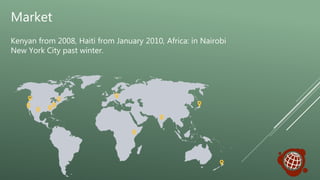
Kenyan from 2008, Haiti from January 2010, Africa: in Nairobi
New York City past winter.
Strategy
Ushahidi has never accepted government funds, instead relying on grants from
philanthropic organizations like Humanity United and the Omidyar Network to keep it
going.
Last year, it began generating revenues for the first time through custom deployments
of its software for clients.
“Our aim is to serve people with limited access in hard-to-reach places. In addition to
our other products, we are proud to be a key catalyst of an innovation ecosystem that
are leaders in East Africa and around the world. We strive to create technology that
solves global problems.”
Future prospects
The company recently launched a cloud-based version of its basic mapping platform that can be
deployed quickly and easily and is hosted on Ushahidi's servers. The basic service is free but the
company has developed plug-ins and upgrades that it will charge for.
A disruptive Company (MIT reviews 2015)
Why: Web tools can help people respond to crises such as earthquakes and political
protests
THANK YOU

Usahidi

  • 1.
  • 2.
    Founded: 2008 Founders: OryOkolloh, Erik Hersman, David Kobia, Juliana Rotich Management: David Kobia (Director of Technology Development) Erik Hersman (Director of Operations) www.ushahidi.com Ushahidi: Swahili for "testimony" or "witness"
  • 3.
    The problem Was developedto map reports of violence in Kenya after the post- election violence in 2008. •Ushahidi is a tool for collecting, managing, and visualizing data. •Data can be collected from anyone, anytime, anywhere by SMS, email, web, Twitter, and RSS. •Posts can be managed and triaged with filters and workflows. •Data can be viewed in many ways: on a map, in a list, or as a visualization. What does Ushahidi Do
  • 4.
    Ushahidi, is anopen source platform for democratizing information, increasing transparency and lowering the barriers for individuals to share their stories. Key innovation Its open-source crowdsourcing tool overlays field reports on maps, providing critical and often life-saving data during emergencies. VALUE PROPOSITION
  • 5.
    Business Model • Userscan submit reports by text message, e-mail, or Web postings • The software aggregates and organizes the data into a map or timeline. • The company has also launched a product called Swift River that uses machine- learning algorithms to extract and organize accurate information from the flood of e-mails, text messages, blog posts, and tweets that can seem overwhelming in the first days of a crisis.
  • 6.
    Market Kenyan from 2008,Haiti from January 2010, Africa: in Nairobi New York City past winter.
  • 7.
    Strategy Ushahidi has neveraccepted government funds, instead relying on grants from philanthropic organizations like Humanity United and the Omidyar Network to keep it going. Last year, it began generating revenues for the first time through custom deployments of its software for clients. “Our aim is to serve people with limited access in hard-to-reach places. In addition to our other products, we are proud to be a key catalyst of an innovation ecosystem that are leaders in East Africa and around the world. We strive to create technology that solves global problems.”
  • 8.
    Future prospects The companyrecently launched a cloud-based version of its basic mapping platform that can be deployed quickly and easily and is hosted on Ushahidi's servers. The basic service is free but the company has developed plug-ins and upgrades that it will charge for. A disruptive Company (MIT reviews 2015) Why: Web tools can help people respond to crises such as earthquakes and political protests
  • 9.