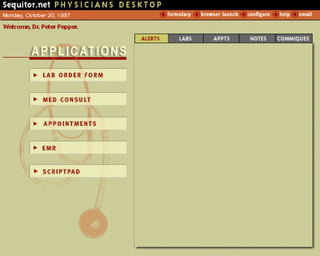
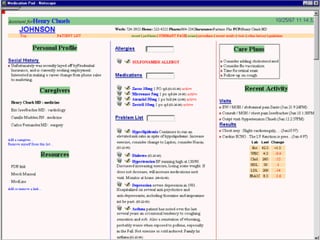
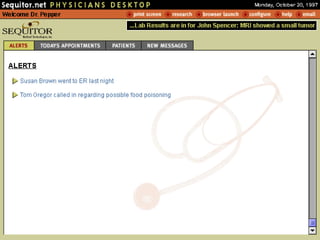
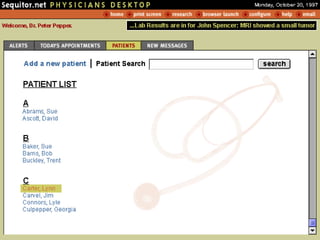
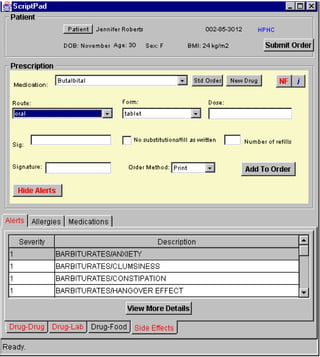
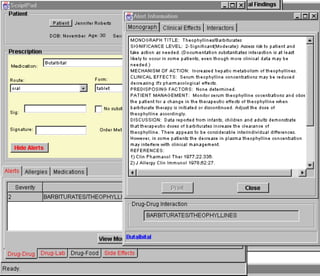
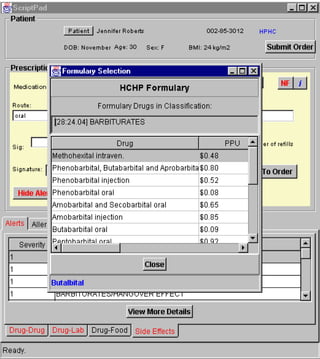
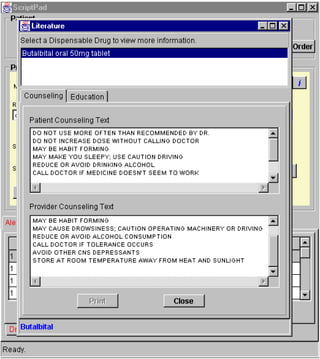
USHealthNet, LLC


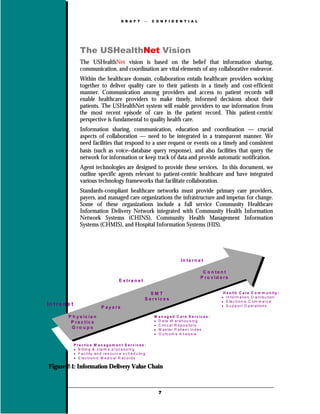
               1. Business Plan - Capsule………….

               2. Business Plan - Long Version……

               3. Conceptual Design Document…...

               4. DiagAssist - Point-of-Care tools…

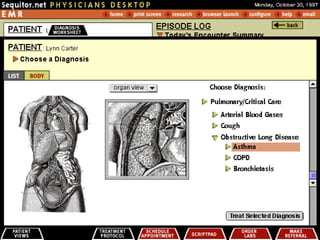
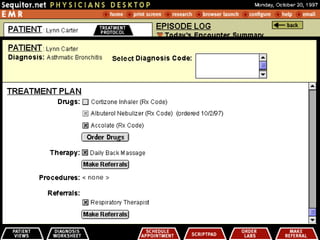
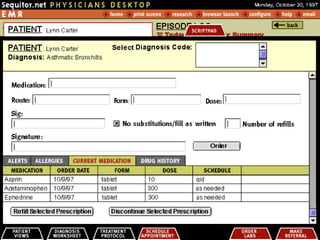
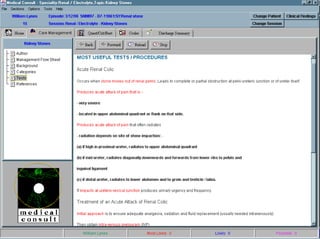
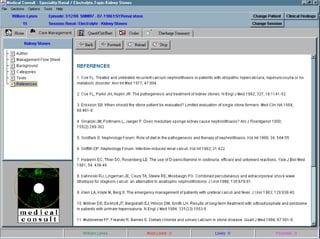
               5. Screen Shots of Prototype…….…

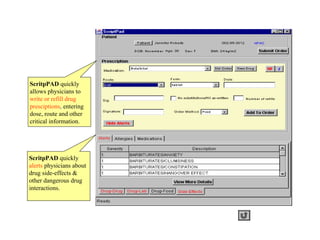
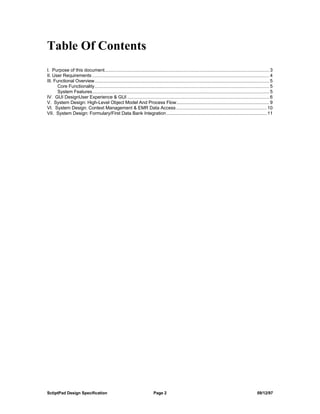
               6. ScriptPAD Specificaions…….…….
USHealthNet
Richard Lynes                                                  cto@mediaone.net                                            3 Acorn Street
Founder and Chief Technology Officer                                                                                       Scituate, MA 02066
USHealthNet, LLC                                                                                                           (781) 545 - 3938


                                        USHealthNet’s ‘Executive Summary'
1 Introduction
USHealthNet will provide a branded, integrated, Internet Application Service Platform (iASP) for the administrative, communications and
information needs of healthcare professionals and for the healthcare information needs of consumers. USHealthNet’s Web destination will
consist of two distinctly different linked Web sites—a subscription-based site for healthcare professionals and a free Health, Wellness and
self-service portal site for consumers. USHealthNet will be the single point of access to EDI services, enhanced communications services,
branded healthcare content, and other Web-based offerings. For healthcare professionals, USHealthNet is designed to simplify healthcare
practices by integrating multiple administrative, communications and research functions into a single, easy to use Web-based solution.
USHealthNet will deliver rich content and application services through its vertical healthcare portal. This portal will be segmented by
healthcare professionals, culled by specialty, and targets a consumer strategy leveraging physician patients. The consumer portal is based on
an AOL model building on the community theme. Through a strategic partnership with BroadVision USHealthNet will offer a
personalization engine allowing true 1-2-1 relationship management and InfoMediary services. USHealthNet plans to aggregate the largest
number of physicians and their patients through an aggressive Merger and Acquisition strategy.
In an effort to facilitate a plug-&-play e-commerce platform for third party products and services USHealthNet will develop joint ventures
and affiliate partnership alliances. This strategy will include various healthcare centric disciplines: content sourcing and publishing, Practice
Management Systems, Clinical Information Systems, Backend EDI services, and Integrated Delivery Networks. The trend to consolidate
these operational silos will take a focused and phased implementation plan. The basis for these M & A transactions is to reach critical mass in
Internet time, which will drive demand creation for both the B2B and B2C segments. Fueling the inertia created by USHealthNet’s channel
strategy will be the Company’s vision for deploying its iASP offering -- Point-of-Care Knowledge Delivery and Acquisition tools.
The value proposition for both the healthcare professional and consumer will be in the Company’s ability to lower physician operating costs,
increase revenues and enable quality care through measurable clinical outcome analysis, improving care delivery and disease management.
USHealthNet plans on building knowledge bridges that will forge improved relationships bonding physicians, patients and a fragmented
healthcare system. USHealthNet’s portal will become a trusted brand and premiere destination for brokering healthcare information,
products and services that differentiates and provides a sustainable competitive advantage ensuring future annuity business.


1.1 Market Overview
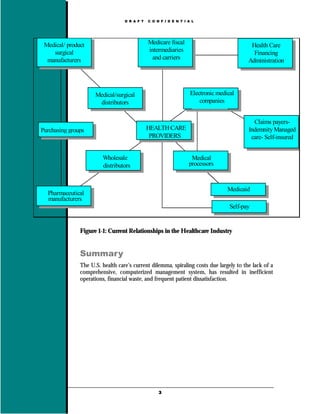
According to the Health Insurance Association of America, healthcare is the largest single sector of the U.S. economy, consuming
approximately $1 trillion annually, or 14% of the country’s gross domestic product. The healthcare industry consists of a complex mix of
participants, which includes:
•   ”Providers”—physicians, medical practice groups, hospitals and other organizations that deliver medical care;
•   ”Payers”—the government agencies, insurance companies, managed care organizations and other enterprises that pay the bills for
    healthcare, this includes PBMs and employers;
•   ”Suppliers”—clinical laboratories, pharmaceutical companies, and other groups that provide tests, drugs, x-rays and other services;
•   ”Consumers”—individual patients who receive medical care, and the government agencies, employers and other organizations that
    represent groups of individuals.

All healthcare participants rely heavily upon information to perform their roles in the industry.
Individuals compare medical plans, choose physicians and submit claims for reimbursement. Employers select health plans, determine
benefit levels, enroll employees and maintain employee eligibility data. Providers verify patient eligibility, collect patient histories, order
diagnostic tests and x-rays, receive and interpret test results, render diagnoses, make referrals and submit claims to payers. Payers manage
referrals, establish medical care protocols and reimbursement policies and process claims. Suppliers analyze and process patient samples or
tests, provide results, fill prescriptions and submit claims for reimbursement. These and many other healthcare transactions are also highly
dependent on information, and each participant is dependent on the others for parts of that information. In sum, the finance and delivery of
healthcare requires that consistent, accurate information be shared confidentially across a large and fragmented industry.
•   Physicians control 85% of the national expenditures for healthcare.
•   The administrative costs for providing healthcare have been estimated at between $198 billion and $250 billion per year.
•   The physician market size in the U. S. is over 800,000 today.
•   Those physicians providing outpatient care average 1647 patients per year; each with an annual per capita expenditure of $3875,
    representing an aggregate annual billing of $236 Billion for 735 million office visits per year.
Factors contributing to these exorbitant expenses are:
USHealthNet
Richard Lynes                                                   cto@mediaone.net                                            3 Acorn Street
Founder and Chief Technology Officer                                                                                        Scituate, MA 02066
USHealthNet, LLC                                                                                                            (781) 545 - 3938

•     =Inappropriate diagnosis and prescription drug use, resulting in a significant number of hospitalizations—between 5 and 25 percent. The
      costs of treatment for inappropriate drug therapies are staggering - estimated at $100 billion each year1
•     =The healthcare industry has become an information-intensive profession plagued by substandard methods of data collection, storage, and
      retrieval, propagating and reinforcing the dysfunctional characteristics of a fragmented healthcare system
•     With over two thousand information technology vendors and systems integrators competing for their share of the healthcare industry,
      incompatible operational and technology silos are making it difficult to exchange vital information and critical life-saving knowledge.
      This need strains the resources of the healthcare community since information must be gathered from disparate sources.
•     =A large part of healthcare waste is related to compliance red tape, paperwork and decentralized heterogeneous data sources.

1.2 The Problem
In providing care to those patients the physicians face similar basic challenges of people, process and technology:
•     =Management of patient data during the course of their relationship
•     =No access to patient data prior to their relationship
•     =Limited access to patient data throughout the extended healthcare enterprise
•     =Inconsistent processes and deteriorating relationships across providers, payers, and suppliers
•     =No communication and leverage of data beyond the practice walls and across the continuum of care
•     =The need to keep abreast of health findings, enable peer collaboration and review new treatment protocols
•     =Need to contain costs (administrative, compliance, fraud ) and expand revenue opportunities and measure quality of care and life

Several of the core applications needed by those physicians to manage their patients needs are currently not WEB enabled and less than 6%
of the office based physicians population use any combination of the following Point-of-Care (POC) tools:
•     =Electronic Medical Records (family and payer demographics, medication history, allergies, problem list, etc)
•     =New prescription orders and refills processing, with Internet fulfillment through Drugstore.com
•     =Lab Order Entry and Resource Scheduling (workflow processing)
•     =Diagnostic Decision Support (expert knowledge systems)
•     =Procurement applications (e-commerce and e-business and ERP)

Those core applications have not penetrated the undeserved portion of this market for the following reasons:
•     They are primarily client server applications that are both expensive to implement (software licensing, hardware, training and backend
      integration), but are also a large distraction to the practice staff and operations from a management perspective – Back Office versa Front
      Office - Practice Management versa Patient Management.
•     Managed Care has driven costs to the lowest level in history, leaving caregivers to question the quality of care and their ability to earn a
      living and compete in the growing Physician Provider Organization (PPO) space.
•     =Those practices that do invest in these applications generally only leverage a small percent of their value due largely to the fact that
      back-office-billing systems are complex data entry systems and do not extend themselves to support front-office POC functions.
•     =Since the applications are local to each practice, they do not receive the benefits of a consolidated patient treatment profile and
      outcomes data across practices

Studies show that 94% of this market is considered “under served” by the current applications on the market and unable to address the Point-
of-Care information needs. The Total-Cost-of-Ownership (TCO) on a per seat (single-user) basis would exceed $150,000 dollars over five
years. With more than 325,000 physicians working in physician group practices, it is easy to see why the turnkey systems integration services
market for this segment will double in revenue by the end of the decade. Its $10 billion mark today, according to leading analyst Mike
Knepper of Volpe, Welty & Co. The domestic market for digital clinical information networks has been estimated at $350 billion dollars,
international (including U.S.) at $1.2 - 1.3 trillion dollars yearly (the estimate based on data from the World Health Organization, the U.S.
Census Bureau).


1
    National Pharmaceutical Council.
USHealthNet
Richard Lynes                                                 cto@mediaone.net                                            3 Acorn Street
Founder and Chief Technology Officer                                                                                      Scituate, MA 02066
USHealthNet, LLC                                                                                                          (781) 545 - 3938

1.3 The Solution
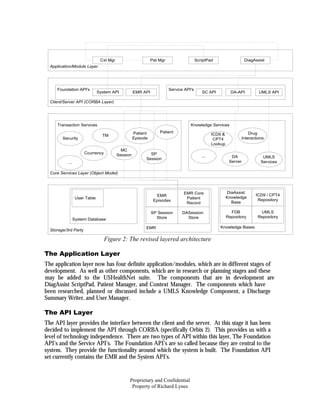
USHealthNet’s iASP offering consists of an N-tiered application service strategy, which connects physicians and patients to USHealthNet’s
portal through a single access point using a Web browser based Thin-Client interface. These services integrate critical Point-of-Care
Knowledge Tools allowing secure global access over the Internet. A patient has access to a read only EMR and a Java Smart card containing
vital healthcare data will be offered for free to consumers, and for healthcare professionals the full POC suite will be offered through the
Company’s premium subscription services. Extranet access is offered to branded affiliate partners, enabling local e-commerce transactions
maximizing site stickiness while ensuring a consistent user experience and ensuring patient privacy and physician confidence.
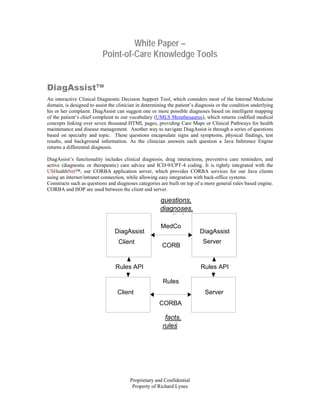
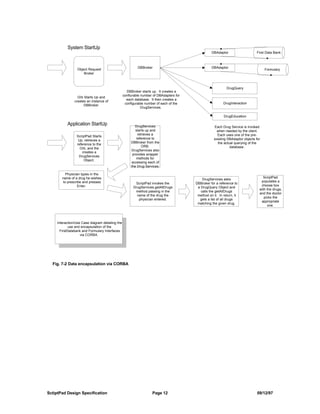
USHealthNet’s Java Enterprise Beans and Corba application component framework supporting the iASP subscription service offering will
consist of nine integrated applications:
1.   LifeTime (Longitudinal Electronic Medical Records)
2.   DiagAssist (Diagnostic Decision Support System)
3.   ScriptPad (Prescription and Drug Interaction Services)
4.   LabDirect (Lab Order and Results)
5.   Enterprise Workflow Engine and XFDL/XML based Forms Engine
6.   Enterprise Resource Planning (ERP)
7.   Enterprise Master Patient Index (EMPI)
8.   Clinical Data Repository and OLAP analytical reporting services
9.   Java and XML Search Engine, integrating (UMLS) Tools and semantic networks

The USHealthNet vision is to provide increased functionality to a broader cross-section of the physician’s market by breaking down the
current barriers to entry and providing the following benefits to the physician's practice, patients and consumers, and pharmaceutical industry:


1.3.1    Value Propositions – Physicians
•    Significantly lower cost of entry through a multi-tiered subscription model, effectively eliminating the Total-Cost-of-Ownership
•    More intuitive functionality, delivering a point and click information rich experience through Web based Thin-Client interface
•    Less intrusive infrastructure, remotely managed, eliminating hardware and software obsolescence (Outsourced to ASPs)
•    Guaranteed Quality of Service, by our national network operations center alliance partners
•    Clinical data repository management, providing analytical reporting services (InfoMediary service)
•    Leverage EMR database beyond the practice and across the continuum of care, location and technology independence
•    Reduced encounter documentation time (SOAP/Progress notes) enabling an increase in patient flow, as well as reduced liability

Additional benefits to the consumer and Pharmaceutical markets will be:


1.3.2    Value Propositions – Consumers
USHealthNet provides healthcare consumers with a single point of access to premium and proprietary health and wellness content.
Consumers can use the information to educate themselves on healthcare-related matters, allowing them to make better-informed healthcare
decisions. In addition, USHealthNet can e-mail updates based on a consumer’s profile and can search and retrieve member-specific
healthcare information from the Web. InfoMediary service affiliates will be marketing third party products and services using BoardVision
enabling a true 1-2-1 user experience. Affiliates target against high-level patient/consumer profiles, which do not compromise personal data,
only segment level profiling data is available and this is secured in a BroadVision database behind USHealthNet’s data center fire-walls.


1.3.3    Value Propositions - Pharmaceuticals
•    Access to clinical data repository, reducing new drug time-to-market expense and risk
•    Provide direct to physician and patient/consumer (DTC)2 marketing channel, influencing prescribing behavior
•    Access to patient base for clinical trails and analytical reporting services (Data Mining) 3
•    Direct link to Physicians Desktop for branded InfoMediary services
•    Access to patients and consumers of healthcare products through sponsorship programs on USHealthNet’s portal


2
 Predicted spending on DTC advertising for 1998 is close to $1.6 billion, a 60% increase over 1997
3
  All personal healthcare information is highly confidential and USHealthNet understands its commitments to patient privacy and will not
under any circumstances compromise a patient’s personal healthcare data.
USHealthNet
Richard Lynes                                                 cto@mediaone.net                                            3 Acorn Street
Founder and Chief Technology Officer                                                                                      Scituate, MA 02066
USHealthNet, LLC                                                                                                          (781) 545 - 3938
1.4 Revenue Models
The Company’s delivery strategy for this vision is to raise the management of these applications up into the network, delivering subscription-
based access to these applications for individual practices. The applications will be Internet based, providing the scale, security and ease of
use that has been the hall-mark and success of the WEB today.
Key sources of revenue from this business will be:
•     Subscript to Vertical Healthcare Portal (content and community only), targeting physicians, and segmented by specialty
•     Subscript services for Internet Application Service Platform (iASP – Point-of-Care Knowledge Delivery tools)
•     InfoMediary services allowing affiliate partners to participate in the Company’s e-Commerce platform and service offerings
•     Sponsorships, bounty and bundles (Up-sell and Cross-sell opportunities)
•     Transaction processing (EDI Claims, patient eligibility, transcription services and e-commerce)
•     Health Plan Auctions, giving PPOs and employers more control over contract negotiations with payer organizations
•     Advertising - using the Physicians Desktop the Company can use both a Push and a Pull model, supporting new off-line messaging

1.5 Capital requirements will be:
•     $10 - 30 million for sales, marketing and PR, operations, partnership acquisitions, technology licensing and development, and Merger &
      Acquisition opportunities.
•     Outsource portal development and content sourcing to Agency.com.
•     Outsource infrastructure deployment to NaviSite, a CMGi company, and USinternetworking
•     Affiliates pre-paid or underwriting physician subscriptions (General content subscription levels, not premium, which offers iASP
      services)4
•     To fuel the Company’s consumer e-Commerce and InfoMediary service strategies USHealthNet’s market capitalization projections are
      $500 million with 10 % market penetration are not unrealistic

1.5.1     Investment Opportunities
This is an early stage opportunity for investors:
•     The research has been done and the business case proven
•     Prototypes have been developed
•     Business plan has been drafted
•     Several key members of the management team have been identified, with an eager desire to identify additional members
•     Industry experts from both the medical and internet fields have committed to advisory roles
•     Technology partners have been identified and initial negotiations have begun
•     An initial venture partner has expressed a desire to participate if a second partner can be secured

1.6       Management
Richard Lynes - is the founder and CTO of USHealthNet and has a proven track record serving as CIO and CTO for several successful
companies. To his credit Mr. Lynes brings more then twenty-four years of industry experience in Information Systems, Tele-
communications, and business. His involvement with the Internet spans more then a decade and inspirers many of his visionary strategies,
bridging e-commerce/e-business, integrating ERP and SCM, and his Thought-Leadership in the areas of converging business models and
technologies is without question. Mr. Lynes is an experienced leader, mentor and team player, and understands the value of human capital.

1.7       Conclusion
USHealthNet ‘s charter and strategic vision is to provide e-commerce capabilities and service excellence for the healthcare industry by
developing Internet transport and Web-based clinical applications, management services, and a community healthcare information delivery
network. USHealthNet will be the premier provider of Point-of-Care knowledge tools and services for the healthcare industry.

USHealthNet’s strategy reflects the future state, vision and direction for the healthcare industry. This premise is based on the fact that all
roads lead to the patient and physician, therefore all investment decisions, including IT capital and human resources need to be aligned
strategically across all points of patient and physician interaction.


4
  The pre-paid or underwritten subscription services will be paid for in part from our shared revenue and joint marketing programs for
affiliate, and alliance partnerships
The healthcare industry sits on a vast body of medical knowledge that it has failed
to exploit. Practitioners and patients pay the price.

Dr. Know
By Regina E. Herzlinger, DBA & Russell J. Ricci, MD

Healthcare is one of the world's most knowledge-intensive
industries--yet the practitioners on its front lines are cut off from the
network connectivity tools that could deliver information to those who
need it. Every day, physicians rely on their wits, their training, their
past experiences with patients, and the information shared among
colleagues to make critical medical judgments. And yet few attempts
have been made to codify systematically physicians' experience in
treating patients so that the resulting body of knowledge could be more
efficiently shared among colleagues.
The healthcare industry, of
course, spews out "raw"
information by the ton, but useful,
meaningful information that could
influence patient outcomes
positively and point to medical
breakthroughs isn't shared
efficiently--if at all. While
medical bills are computerized,
diagnosis and treatment records
largely aren't. Likewise, little has
been done to track and study
patient outcomes methodically so
that physicians could identify the
most successful treatments.
The answer, many believe, lies in evidence-based medicine. This new
approach has already demonstrated that it can deliver better care at
lower cost--no mean feat in an industry plagued by escalating costs,
IBM Global Healthcare Industry News - Dr. Know

                                            and in many parts of the world, increasingly dissatisfied customers.
                                            But it is not without controversy. In fact, it may be one of the most
                                            hotly debated topics among medical practitioners today.
                                            The problem is well known. "What has been referred to as a double
                                            standard of truth in medicine persists," says Dr John Wennberg, an
                                            epidemiologist and director of The Dartmouth Atlas of Health Care in
                                            the United States, a 10-year study that has documented a wide
                                            variation in medical treatments. In the US, new drugs are tested to
                                            determine clinical efficacy, he points out, but "the outcomes of other
                                            treatment options...are not systematically subject to evaluation." The
                                            result, says Dr Wennberg, is unnecessary scientific uncertainty about
                                            medical treatments.
                                            For decades, practitioners have been concerned about wide variations
                                            in medical treatment documented the world over. Demography-based
                                            health patterns and differing health care systems contribute to these
                                            differences, but what troubles many is the extent to which incomplete
                                            information may cause disagreement among physicians about
                                            diagnoses and treatments.
                                            Enter evidence-based medicine. Here's how it works: Physicians, in
                                            concert with their colleagues, use data mining and relational databases
                                            to sift through patient histories and clinical research data in order to
                                            glean knowledge--to understand the risks and benefits of various
                                            medical treatments and how they affect different "classes" of patients.
                                            The best practices--or optimal outcomes--that emerge are then used to
                                            create treatment guidelines for subsequent patients. Ideally, computer
                                            networks could deliver these up-to-the-minute guidelines and
                                            decision-critical data directly to the point of service. It is an iterative
                                            process, with each new patient or clinical trial added so that constant
                                            learning is assured and new ways of doing things are never stifled.
                                            Some call this real-time medicine.
                                            "In the ideal world," says Dr Steve Shaha, a research director for the
                                            US-based Gartner Group, "practitioners would have the data right at
                                            their fingertips at the point of decision-making, like the heads-up
                                            display for a fighter pilot. To accomplish this, we'd need a lot of
                                            computerization to capture electronic patient records and feed back
                                            critical clinical data. These data repositories would be designed to
                                            allow people to make the best possible diagnoses and choose the best
                                            treatment path."
                                            Evidence in Practice
                                            The efficient sharing of medical knowledge is probably best
                                            promulgated through an organizational approach known as the focused
                                            factory. Toronto's Shouldice Hospital is one such facility. It performs
just one procedure--hernia operations--but through sheer repetition and
dedicated focus to the constant acquisition of knowledge, it appears to
perform them better than anyone else. At Shouldice, a hernia operation
takes half the time and costs half as much as at the average hospital.
What's more, it fails only 1 percent of the time, compared to a 10 to 15
percent failure rate elsewhere.
                                Capture in computer databases what
                                caregivers at Shouldice do right, and
                                that focused knowledge could become
                                treatment guidelines, exportable via
                                networks to support physicians at
                                facilities worldwide. That's the goal at
                                the M.D. Anderson Cancer Center in
                                Houston, Texas, a focused factory, and
                                perhaps the most advanced user of
                                evidence-based medicine in the US.
                                Using a network-based data program
                                enabled by the clinical evidence
collected, grouped, and deemed critical by its doctors, the center's
computer system currently tracks patients and suggests treatments
along 98 different treatment paths covering 8 diseases.
The results, according to Dr Mitchell Morris, associate vice president
for information services, are quality outcomes at lower cost. For
hysterectomies, Dr Morris cites a reduction of total hospital costs by
20 percent, length of stay by 33 percent, medication costs by 35
percent, and lab testing by 74 percent--all the while increasing patient
satisfaction. Comparable results have been achieved in lung resections,
with a 30 percent drop in overall hospital costs, and most importantly,
decreased readmissions, meaning the treatment was done right the first
time.
The practice of evidence-based medicine is not confined to focused
factories. It is being implemented at clinics and hospitals around the
world. At the Children's Hospital of Buffalo (CHOB) in New York, Dr
Linda Brodsky, director of CHOB's Center for Integrated Outcomes
Health Care, has led the institution's development of an outcome-based
approach to medicine predicated on patient data. "We started by
looking at patient data historically," says Brodsky, "and then we asked
ourselves what we would like to see happen to these patients
medically, and what would we like the outcome to be in terms of
patient satisfaction and cost." The results were more far-reaching than
expected, and from their initial 2 pilot programs, CHB is now
conducting over 20 studies.
"We saw a ripple effect," says Dr Brodsky. "We improved the
same-day surgery process and the use of anesthesia, we cut operating
IBM Global Healthcare Industry News - Dr. Know

                                            room time, drug use, etc. And we've seen a slow change in the method
                                            of practice--partly due to peer pressure and partly due to the fact that
                                            the results are compelling." For example, based on their training and
                                            experience, individual surgeons at CHOB tended to practice one of
                                            two methods for a specific type of eye surgery. By sharing patient data
                                            and studying outcomes, they learned that one method wasn't better
                                            than the other. Instead, different methods were warranted based on the
                                            patient profile--and doctors now apply both in a different way.
                                            Already, several large organizations in the US are convinced of the
                                            merits of evidence-based medicine. Among them are VHA, a
                                            cooperative of 1,600 hospitals and facilities serving 26 percent of US
                                            patients, and BJC Health System, the second-largest nonprofit
                                            healthcare system in the nation. VHA is building one of the country's
                                            largest healthcare extranets, which expedites the sharing of best
                                            practices and will include a knowledge database to develop treatment
                                            pathways for major conditions like pneumonia, asthma, and acute
                                            stroke. BJC has nearly finished its efforts to centralize information
                                            within a network, with an eye toward improving patient care and
                                            outcomes through computer-assisted treatment decisions.
                                            Despite the momentum, success is hardly assured. Tens of thousands
                                            of practitioners, clinics, pharmacies, and hospitals have amassed a
                                            cornucopia of information in treating patients but have left it to molder
                                            away in paper form. Moving it to databases will be a monumental task,
                                            requiring new outlays for IT. Second, the industry will have to push
                                            hard for standards so that data can be shared. Third, patient privacy
                                            concerns will have to be met through technology solutions (which do
                                            already exist) and stringent organizational procedures. But the biggest
                                            barrier could be the concerns raised by caregivers.
                                            Evidence on Trial
                                            Some doctors and patients protest that computer-driven medicine will
                                            never be accepted. Doctors may balk at surrendering some of their
                                            expensively acquired diagnostic and treatment skills to a computer,
                                            and patients may not want to see their physicians pecking away at
                                            keyboards like airline reservation clerks during consultations.
                                            Physician resistance to evidence-based medicine has many sources.
                                            One is the old debate of man versus machine. Here, the computer has
                                            some obvious advantages, including computational memory. At the
                                            Latter Day Saints Hospital in Salt Lake City, Utah, a computer
                                            determines which antibiotic should be administered to a patient by
                                            analyzing 45 variables. A doctor typically considers three to five. The
                                            computer-fed results have led to fewer complications and shorter
                                            hospital stays.
                                            A computer's "judgment" can't be clouded from a bad night's sleep,
imperfect recall, or nerves aggravated by
jangling phones. Of course, a computer
doesn't have judgment per se; it suggests
treatments based on algorithms and available
clinical data. Nor can computers take into
account the ineffable--a doctor's
understanding of how a patient's personality
or circumstances might affect treatment and
recovery, for example.
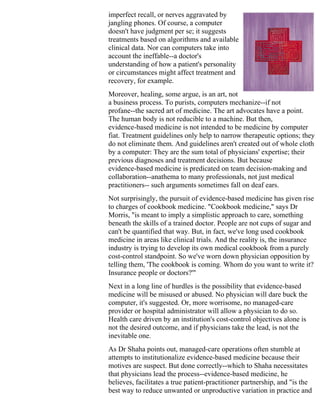
Moreover, healing, some argue, is an art, not
a business process. To purists, computers mechanize--if not
profane--the sacred art of medicine. The art advocates have a point.
The human body is not reducible to a machine. But then,
evidence-based medicine is not intended to be medicine by computer
fiat. Treatment guidelines only help to narrow therapeutic options; they
do not eliminate them. And guidelines aren't created out of whole cloth
by a computer: They are the sum total of physicians' expertise; their
previous diagnoses and treatment decisions. But because
evidence-based medicine is predicated on team decision-making and
collaboration--anathema to many professionals, not just medical
practitioners-- such arguments sometimes fall on deaf ears.
Not surprisingly, the pursuit of evidence-based medicine has given rise
to charges of cookbook medicine. "Cookbook medicine," says Dr
Morris, "is meant to imply a simplistic approach to care, something
beneath the skills of a trained doctor. People are not cups of sugar and
can't be quantified that way. But, in fact, we've long used cookbook
medicine in areas like clinical trials. And the reality is, the insurance
industry is trying to develop its own medical cookbook from a purely
cost-control standpoint. So we've worn down physician opposition by
telling them, 'The cookbook is coming. Whom do you want to write it?
Insurance people or doctors?'"
Next in a long line of hurdles is the possibility that evidence-based
medicine will be misused or abused. No physician will dare buck the
computer, it's suggested. Or, more worrisome, no managed-care
provider or hospital administrator will allow a physician to do so.
Health care driven by an institution's cost-control objectives alone is
not the desired outcome, and if physicians take the lead, is not the
inevitable one.
As Dr Shaha points out, managed-care operations often stumble at
attempts to institutionalize evidence-based medicine because their
motives are suspect. But done correctly--which to Shaha necessitates
that physicians lead the process--evidence-based medicine, he
believes, facilitates a true patient-practitioner partnership, and "is the
best way to reduce unwanted or unproductive variation in practice and
optimize cost and clinical satisfaction."
Ultimately, pressures to leverage information in order to glean new
medical knowledge and share it may come from several quarters.
Already, the Joint Commission on the Accreditation of Healthcare
Organizations, the predominant standards and accrediting body for
healthcare organizations in the US, has announced that assessing
patient outcomes will become part of the accreditation process by
1999. As standards and criteria evolve sufficiently to facilitate
comparison, the data will be made public. And people are turning to
the web in record numbers to find out more about their medical
conditions and explore new treatments--all of which they want to
discuss with their doctors. The information explosion via all media
means that paternalistic or arbitrary systems will be under increasing
assault. In other words, "we know best" policies just won't cut it.
Patients will be the judge of health care and they will demand
proof--evidence in the form of usable information. Some practitioners
will be ready to provide it.
Regina E. Herzlinger, DBA, is a professor at the Harvard Business School and is
the author of several critically acclaimed books, including Market-Driven Health
Care: Who Wins, Who Loses in the Transformation of America's Largest Service
Industry (Addison Wesley Longman, 1997).

Russell J. Ricci, MD, is IBM's General Manager of the global healthcare industry.
Prior to joining IBM, Dr Ricci was the president of New Health Ventures at Blue
Cross and Blue Shield of Massachusetts.


        Copyright (c) 1998 International Business Machines Corporation.
            Reprinted with permission from Think Leadership 1998
                              Volume 3 Number 2
                               All rights reserved

                         Illustrations by Sandra Dionisi

    Think Leadership magazine online edition: http://www.ibm.com/thinkmag
USHealthNet, LLC
                 Seeking: $10,000,000 -$30,000,000 , Already Invested: $200,000:


                  Company:                                        Contact:
                  USHealthNet, LLC                                Mr. Richard Lynes
                  3 Acorn Street                                  CTO and Founder
                  Scituate, MA 02066                              Phone: 781-545-3938
                  Web site: http://www.USHealthNet.com            Fax:
                                                                  Email:
                  Incorp: LLC, 7/15/99, DE                        cto@mediaone.net
                  Industry 1: Physician-Practice
                  Management                                      Referred by:
                  Industry 2: Internet Service Providers          Red Herring Magazine
                                                                  USHealthNet
                                                                  Boston, MA

                                           Table of Contents

                      s   Company Overview                 s   Marketing
                      s   Business Description             s   Management & Staffing
                      s   Product or Service               s   Capitalization
                      s   Sales                            s   Financial Data


Company Overview                       (return to top)

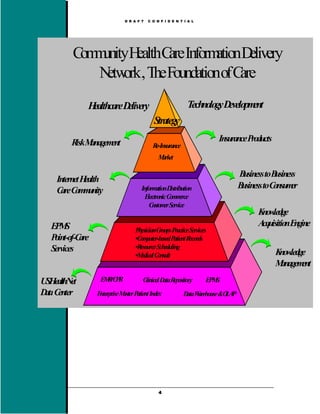
USHealthNet, a visionary Community Healthcare Information Delivery Network.
USHealthNet will provide a branded, integrated, internet Application Service Platform (iASP) for the
administrative, communications and information needs of healthcare professionals and for the healthcare
information needs of consumers. USHealthNet's Web destination will consist of two distinctly different
linked Web sites--a subscription-based site for healthcare professionals and a free Health, Wellness and
self-service portal site for consumers. USHealthNet is a single point of access to EDI services, enhanced
communications services, branded healthcare content, and other Web-based offerings. For healthcare
professionals, USHealthNet is designed to simplify healthcare practices by integrating multiple
administrative, communications and research functions into a single, easy to use Web-based solution
Application Review


Business Description                        (return to top)

Mission
USHealthNet 's charter and strategic vision is to provide e-commerce capabilities and service excellence
for the healthcare industry by developing Internet transport and Web-based clinical applications,
management services, and a community healthcare information delivery network. USHealthNet will be
the premier provider of Point-of-Care knowledge tools and services for the healthcare industry.
Key Goals
USHealthNet's strategy reflects the future state, vision and direction for the healthcare industry. This
premise is based on the fact that all roads lead to the patient and physician, therefore all investment
decisions, including IT, capital and human resources need to be aligned strategically across all points of
patient and physician interaction.

USHealthNet expects to accomplish the following by the end of Q-4 99:

- Secure the appropriate level of funding and high profile investment partners
- Develop strategic relationships with hosting companies, i.e. NaviSite, Digex and Usi in order to provide
  the data center infrastructure needed to support iASP services.
- Develop syndicated content relationships with healthcare publishers.
- Develop affiliate partners programs to support e-business and InfoMediary services.
- Achieve milestones for Physician downloads of PDA to support service subscriptions.
- Achieve milestones for Consumer B2C and B2ME InfoMediary services.
Stage: startup
Started working: October 1, 1996
Do you have a prototype or demo?
Search Keywords
iASP, IDN, CHIN, internet Application Service Platform, Point-of-Care Knowledge Delivery and
Aquisition Tools, Electronic Medical Records (EMR), InfoMediary Services, B2B, B2C and B2ME


Product or Service                     (return to top)

Problem Solved
All healthcare participants rely heavily upon information to perform their roles in the industry.
Individuals compare medical plans, choose physicians and submit claims for reimbursement. Employers
select health plans, determine benefit levels, enroll employees and maintain employee eligibility data.
Providers verify patient eligibility, collect patient histories, order diagnostic tests and x-rays, receive and
interpret test results, render diagnoses, make referrals and submit claims to payers. Payers manage
referrals, establish medical care protocols and reimbursement policies and process claims. Suppliers
analyze and process patient samples or tests, provide results, fill prescriptions and submit claims for
reimbursement. These and many other healthcare transactions are also highly dependent on information,
Application Review

and each participant is dependent on the others for parts of that information. In sum, the finance and
delivery of healthcare requires that consistent, accurate information be shared confidentially across a
large and fragmented industry.
Underlying Technology
USHealthNet's iASP offering consists of an N-tiered application service strategy, which connects
physicians and patients to USHealthNet's portal through a single access point using a Web browser based
Thin-Client interface. These services integrate critical Point-of-Care Knowledge Tools allowing secure
global access over the Internet. These POC tools will be offered for free to consumers and through the
Company's premium subscription services for healthcare professionals. Further access is offered to
branded affiliate products and services, maximizing site stickiness while ensuring a consistent user
experience.

USHealthNet's Java Enterprise Beans and Corba application component framework supporting the iASP
subscription service offering will consist of nine integrated applications:

1. LifeTime (Longitudinal Electronic Medical Records)
2. DiagAssist (Diagnostic Decision Support System)
3. ScriptPad (Prescription and Drug Interaction Services)
4. LabDirect (Lab Order and Results)
5. Enterprise Workflow Engine and XFDL/XML based Forms Engine
6. Enterprise Resource Planning (ERP)
7. Enterprise Master Patient Index (EMPI)
8. Clinical Data Repository and OLAP
9. Java XML Search Engine, integrating (UMLS) Tools and semantic networks
Intellectual Properties
Do to the nature of providing our outsourcing iASP offerings, several key technology partners have been
identified and will require license agreements.
Manufacturing Process
We have an outsourcing agreement in place for all custom development and integration services through
our strategic partnership with a local Boston based developer.


Sales           (return to top)

Unique selling proposition
The Value Proposition - Healthcare Professional

A Web-based Thin-Client front-end application provides a Single Point of Access for healthcare
professionals. This reduces the need for healthcare professionals to use multiple administrative,
communications and information services by integrating these applications and services via the Internet.
USHealthNet will enter into relationships to assist healthcare professionals in obtaining all hardware and
ancillary services necessary to use USHealthNet, including Internet access, computer hardware, training,
and support. USHealthNet's Premium subscription access to iASP and Knowledge Management Services
provides a suite of Point-of-Care (POC) tools, including backend EDI services for healthcare

 http://www.garage.com/garage/preview.shtml (3 of 15) [6/16/1999 2:46:37 AM]
Application Review

professionals', eligibility verification, and prescription processing. The Electronic Medical Record
manages patients across the continuum of care, ScritpPAD, Lab Order Entry and DiagAssist a Diagnostic
Decision Support tool, offer healthcare professionals unparalleled control throughout the life-cycle of
care.

The USHealthNet vision is to provide increased functionality to a broader cross-section of the physician's
market by breaking down the current barriers and providing the following benefits to the healthcare
professionals:

Value Propositions - Physicians

- Significantly lower cost of entry (Multi-tiered subscription models)
- More intuitive functionality (Web based Thin-Client)
- Less intrusive infrastructure (Outsourced to ASPs)
- Remotely managed through national network operations centers
- Clinical data management and analysis (InfoMediary service)
- Leverage of database beyond the practice and across the continuum of care
- Freedom from hardware and software obsolescence

Additional benefits to the consumer market will be:

Value Propositions - Consumers

USHealthNet provides healthcare consumers with a single point of access to premium and proprietary
health and wellness content. Consumers can use the information that is provided through USHealthNet
without charge to educate themselves on healthcare-related matters, allowing them to make better
informed healthcare decisions. In addition, USHealthNet can deliver personalized content and e-mail
updates based on a consumer's profile and can search and retrieve member-specific healthcare
information from the Web. InfoMediary service affiliates will be marketing products against high-level
patient/consumer profiles, which do not compromise personal data, only segment level profiling data is
available and this is secured in a BroadVision database behind USHealthNet's data center fire-walls.

Premium and Proprietary Content

Online Healthcare Communities.
Through planned acquisitions, USHealthNet will provide access to online communities that provide
consumers with personalized information about their health conditions and allow them to participate in
message boards, real-time chat rooms and support networks via the Web. In addition, online
communities provide member-generated content based on shared experiences.

Convenience and Reliability.
Through USHealthNet Web site, patients can obtain information regarding office hours, location and
other matters without having to place a telephone call to the physician's office. In addition, patients can
receive healthcare information that is reviewed and approved by medical professionals under their
physician's USHealthNet Web site -- a reliable and familiar source of information.
Application Review

Benefits to the pharmaceutical market will be:

Value Propositions - Pharmaceuticals

- Access to clinical data repository
- Reduced new drug R & D life cycle
- Improving Time-to-Market
- Access to patient base for clinical trails
- Direct link to Physicians Desktop for promotions and advertising
- Access to consumers of healthcare products (Direct to Consumers)

USHealthNet's Vertical Healthcare Portal is segmented by specialty for physicians and personalized on
the consumers' B2C portal. USHealthNet uses a 1-2-1-personalization engine for physician profiling and
patients -- only branded affiliate products and services are offered and transacted within the sites,
customized physician Intranets and knowledge delivery services are tailored based on a multi-tiered
subscription model. USHealthNet intends to add services and content in the future, including a
Web-enabled medical transcription service offering, hospital/physician referral services and insurance
benefits administration.

Ease of Use.
USHealthNet will offer a bundled Thin-Client Application Suite and Knowledge Management services
provided by a standards-based Java Physicians Desktop interface integrated with a Web browser.
Therefore, subscribers who use the USHealthNet 's services do not require training on multiple
proprietary devices and require no knowledge of the Internet and it's navigation issues.

Cost Savings.
USHealthNet will offer tiered InfoMediary services allowing affiliate partners to market products and
services targeted against confidential profiles achieving true personalization across all points of contact
insuring a consistent user experience. By aggregating physicians and reaching critical mass USHealthNet
will be uniquely positioned to offer procurement services, practice management service, and other third
party offerings through these affiliate partners. Physicians and patients will be offered financial incentive
awards for referring non-members and by participating in other marketing programs.

In-addition to the USHealthNet's POC tools a unified messaging platform, supporting chat, conferencing
and email service will be rolled-out. USHealthNet's Web sites and premium research and educational
content will be priced competitively and healthcare professionals will pay no more for these services than
if purchased individually.
Distribution plans
USHealthNet plans to evolve demand creation by launching creative advertising campaigns across
channels and through strategic partners, Internet search engines, banners ads and more traditional media
plays. The Company has started discussions with Omnicom subsidiaries that will lead to strong strategic
partnerships. These subsidiaries provide brand strategy, PR and media buys, campaigns, and
USHealthNet will partner with Agency.com for the development of the Company's Portal sites.
Application Review


Pricing strategy
The Company's delivery strategy for this vision is to raise the management of these applications up into
the network, delivering subscription access to these applications to individual practices. The applications
will be Internet based, providing the scale, security and ease of use that has been the hall-mark and
success of the WEB today.

Key sources of revenue from this business will be:

- Subscript to Vertical Healthcare Portal (Segmented based on specialty)
- Subscript service for Internet Application Service Platform (iASP - Point-of-Care tools)
- InfoMediary services allowing affiliate partners to participate in the Company's e-Commerce
- Sponsorships, bounty and bundles (Up-sell and Cross-sell opportunities)
- Transaction processing (EDI Claims, patient eligibility and e-commerce)
- Advertising (Using the PDA, the Company can us both a Push and a Pull model)
Margins
The annuity service based model supporting multi-tiered revenue streams can not be compared to the
more traditional product model companies, which report gross margins of only 30-60%.


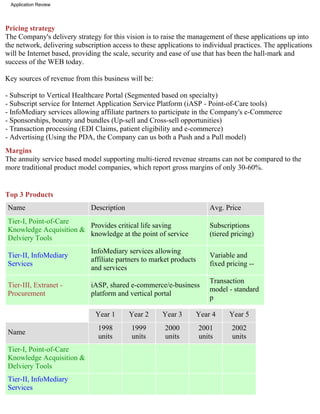
Top 3 Products
Name                         Description                                 Avg. Price
Tier-I, Point-of-Care
                        Provides critical life saving                    Subscriptions
Knowledge Acquisition &
                        knowledge at the point of service                (tiered pricing)
Delviery Tools
                             InfoMediary services allowing
Tier-II, InfoMediary                                                     Variable and
                             affiliate partners to market products
Services                                                                 fixed pricing --
                             and services
                                                                         Transaction
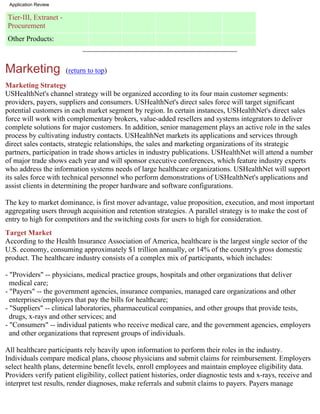
Tier-III, Extranet -         iASP, shared e-commerce/e-business
                                                                         model - standard
Procurement                  platform and vertical portal
                                                                         p

                               Year 1      Year 2     Year 3         Year 4     Year 5
                                1998        1999       2000          2001        2002
Name
                                units       units      units         units       units
Tier-I, Point-of-Care
Knowledge Acquisition &
Delviery Tools
Tier-II, InfoMediary
Services
Application Review

Tier-III, Extranet -
Procurement
Other Products:


Marketing              (return to top)

Marketing Strategy
USHealthNet's channel strategy will be organized according to its four main customer segments:
providers, payers, suppliers and consumers. USHealthNet's direct sales force will target significant
potential customers in each market segment by region. In certain instances, USHealthNet's direct sales
force will work with complementary brokers, value-added resellers and systems integrators to deliver
complete solutions for major customers. In addition, senior management plays an active role in the sales
process by cultivating industry contacts. USHealthNet markets its applications and services through
direct sales contacts, strategic relationships, the sales and marketing organizations of its strategic
partners, participation in trade shows articles in industry publications. USHealthNet will attend a number
of major trade shows each year and will sponsor executive conferences, which feature industry experts
who address the information systems needs of large healthcare organizations. USHealthNet will support
its sales force with technical personnel who perform demonstrations of USHealthNet's applications and
assist clients in determining the proper hardware and software configurations.

The key to market dominance, is first mover advantage, value proposition, execution, and most important
aggregating users through acquisition and retention strategies. A parallel strategy is to make the cost of
entry to high for competitors and the switching costs for users to high for consideration.
Target Market
According to the Health Insurance Association of America, healthcare is the largest single sector of the
U.S. economy, consuming approximately $1 trillion annually, or 14% of the country's gross domestic
product. The healthcare industry consists of a complex mix of participants, which includes:

- "Providers" -- physicians, medical practice groups, hospitals and other organizations that deliver
  medical care;
- "Payers" -- the government agencies, insurance companies, managed care organizations and other
  enterprises/employers that pay the bills for healthcare;
- "Suppliers" -- clinical laboratories, pharmaceutical companies, and other groups that provide tests,
  drugs, x-rays and other services; and
- "Consumers" -- individual patients who receive medical care, and the government agencies, employers
  and other organizations that represent groups of individuals.

All healthcare participants rely heavily upon information to perform their roles in the industry.
Individuals compare medical plans, choose physicians and submit claims for reimbursement. Employers
select health plans, determine benefit levels, enroll employees and maintain employee eligibility data.
Providers verify patient eligibility, collect patient histories, order diagnostic tests and x-rays, receive and
interpret test results, render diagnoses, make referrals and submit claims to payers. Payers manage
Application Review

referrals, establish medical care protocols and reimbursement policies and process claims. Suppliers
analyze and process patient samples or tests, provide results, fill prescriptions and submit claims for
reimbursement. These and many other healthcare transactions are also highly dependent on information,
and each participant is dependent on the others for parts of that information. In sum, the finance and
delivery of healthcare requires that consistent, accurate information be shared confidentially across a
large and fragmented industry.

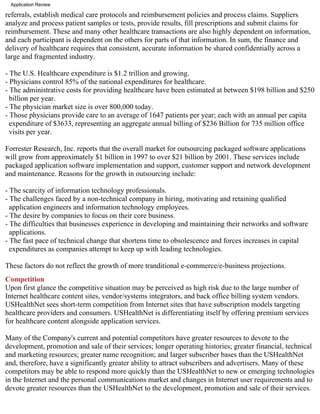
- The U.S. Healthcare expenditure is $1.2 trillion and growing.
- Physicians control 85% of the national expenditures for healthcare.
- The administrative costs for providing healthcare have been estimated at between $198 billion and $250
  billion per year.
- The physician market size is over 800,000 today.
- Those physicians provide care to an average of 1647 patients per year; each with an annual per capita
  expenditure of $3633, representing an aggregate annual billing of $236 Billion for 735 million office
  visits per year.

Forrester Research, Inc. reports that the overall market for outsourcing packaged software applications
will grow from approximately $1 billion in 1997 to over $21 billion by 2001. These services include
packaged application software implementation and support, customer support and network development
and maintenance. Reasons for the growth in outsourcing include:

- The scarcity of information technology professionals.
- The challenges faced by a non-technical company in hiring, motivating and retaining qualified
  application engineers and information technology employees.
- The desire by companies to focus on their core business.
- The difficulties that businesses experience in developing and maintaining their networks and software
  applications.
- The fast pace of technical change that shortens time to obsolescence and forces increases in capital
  expenditures as companies attempt to keep up with leading technologies.

These factors do not reflect the growth of more tranditional e-commerce/e-business projections.
Competition
Upon first glance the competitive situation may be perceived as high risk due to the large number of
Internet healthcare content sites, vendor/systems integrators, and back office billing system vendors.
USHealthNet sees short-term competition from Internet sites that have subscription models targeting
healthcare providers and consumers. USHealthNet is differentiating itself by offering premium services
for healthcare content alongside application services.

Many of the Company's current and potential competitors have greater resources to devote to the
development, promotion and sale of their services; longer operating histories; greater financial, technical
and marketing resources; greater name recognition; and larger subscriber bases than the USHealthNet
and, therefore, have a significantly greater ability to attract subscribers and advertisers. Many of these
competitors may be able to respond more quickly than the USHealthNet to new or emerging technologies
in the Internet and the personal communications market and changes in Internet user requirements and to
devote greater resources than the USHealthNet to the development, promotion and sale of their services.
Application Review

In addition, USHealthNet does not have contractual rights to prevent its strategic partners from entering
into competing businesses or directly competing with the USHealthNet. While these statements can be
positioned as a negative resulting in a high-risk investment, they represent the reality of market
conditions for every company today and well into the future.
Competitive Advantage
USHealthNet's integrated Web service delivery model (iASP) positions the true competitive situation
with a more focused strategic value proposition.

Many of the more sessioned players in the healthcare market have been traditional product companies,
which would prevent them from competing in the Internet service space in the short-term. These
companies are not the usual first-movers and early adopters. They have funded business plans build
around a product model company and operational structures to support them. Product development life
cycles constrain traditional product companies from the point of view that measures success by
time-to-market, mass customization, personalization, and elasticity to rapidly changing market dynamics.
Many of these companies will seek security in partnership strategies that include them in the markets
natural trends toward consolidation and disintermediation.


Management & Staffing                                        (return to top)

Full-time permanent employees: 1
Part-time employees: 0
Contractors: 7
Critical positions not yet filled
CEO, COO, Chief Marketing Officer, SVP Business Development, VP Research & Development
Personnel
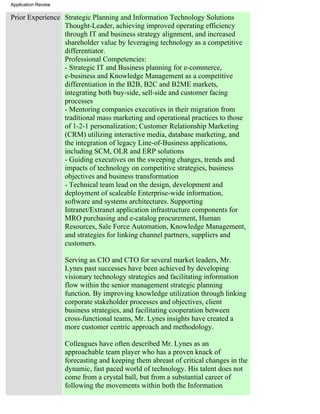
                          Richard Lynes
                 Role Founder
                 Title CTO
           Functions Provide IT vision and strategy alignment


 http://www.garage.com/garage/preview.shtml (9 of 15) [6/16/1999 2:46:37 AM]
Application Review

Prior Experience Strategic Planning and Information Technology Solutions
                 Thought-Leader, achieving improved operating efficiency
                 through IT and business strategy alignment, and increased
                 shareholder value by leveraging technology as a competitive
                 differentiator.
                 Professional Competencies:
                 - Strategic IT and Business planning for e-commerce,
                 e-business and Knowledge Management as a competitive
                 differentiation in the B2B, B2C and B2ME markets,
                 integrating both buy-side, sell-side and customer facing
                 processes
                 - Mentoring companies executives in their migration from
                 traditional mass marketing and operational practices to those
                 of 1-2-1 personalization; Customer Relationship Marketing
                 (CRM) utilizing interactive media, database marketing, and
                 the integration of legacy Line-of-Business applications,
                 including SCM, OLR and ERP solutions
                 - Guiding executives on the sweeping changes, trends and
                 impacts of technology on competitive strategies, business
                 objectives and business transformation
                 - Technical team lead on the design, development and
                 deployment of scaleable Enterprise-wide information,
                 software and systems architectures. Supporting
                 Intranet/Extranet application infrastructure components for
                 MRO purchasing and e-catalog procurement, Human
                 Resources, Sale Force Automation, Knowledge Management,
                 and strategies for linking channel partners, suppliers and
                 customers.

                     Serving as CIO and CTO for several market leaders, Mr.
                     Lynes past successes have been achieved by developing
                     visionary technology strategies and facilitating information
                     flow within the senior management strategic planning
                     function. By improving knowledge utilization through linking
                     corporate stakeholder processes and objectives, client
                     business strategies, and facilitating cooperation between
                     cross-functional teams, Mr. Lynes insights have created a
                     more customer centric approach and methodology.

                     Colleagues have often described Mr. Lynes as an
                     approachable team player who has a proven knack of
                     forecasting and keeping them abreast of critical changes in the
                     dynamic, fast paced world of technology. His talent does not
                     come from a crystal ball, but from a substantial career of
                     following the movements within both the Information
Application Review

                     Technologies and Tele-communications industries.
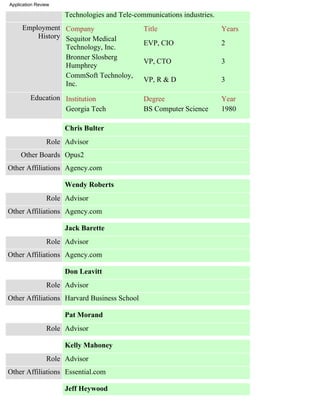
     Employment Company                       Title                     Years
         History Sequitor Medical
                                              EVP, CIO                  2
                 Technology, Inc.
                 Bronner Slosberg
                                              VP, CTO                   3
                 Humphrey
                 CommSoft Technoloy,
                                              VP, R & D                 3
                 Inc.
         Education Institution                Degree                    Year
                   Georgia Tech               BS Computer Science       1980

                     Chris Bulter
                Role Advisor
     Other Boards Opus2
Other Affiliations Agency.com

                     Wendy Roberts
                Role Advisor
Other Affiliations Agency.com

                     Jack Barette
                Role Advisor
Other Affiliations Agency.com

                     Don Leavitt
                Role Advisor
Other Affiliations Harvard Business School

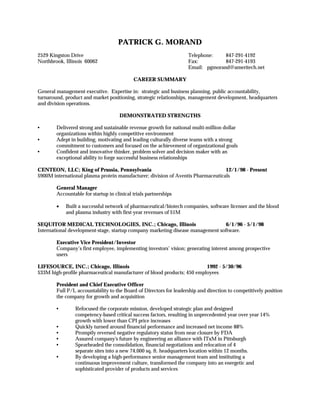
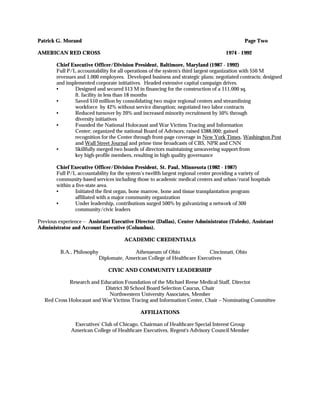
                     Pat Morand
                Role Advisor

                     Kelly Mahoney
                Role Advisor
Other Affiliations Essential.com

                     Jeff Heywood
Application Review


                 Role Advisor
                      Part-time Employee
                 Title Chief Financial Officer
      Other Boards StarQuest Software, Inc.
Other Affiliations Adobe Systems, Inc.
          Functions Responsible for Company's financal modeling, M & A
                    strategies, VC and partnership development.


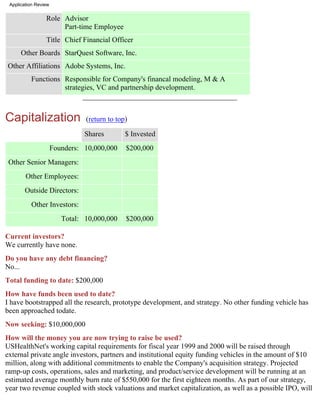
Capitalization                  (return to top)

                                Shares        $ Invested
                      Founders: 10,000,000    $200,000
 Other Senior Managers:
        Other Employees:
       Outside Directors:
          Other Investors:
                         Total: 10,000,000    $200,000

Current investors?
We currently have none.
Do you have any debt financing?
No...
Total funding to date: $200,000
How have funds been used to date?
I have bootstrapped all the research, prototype development, and strategy. No other funding vehicle has
been approached todate.
Now seeking: $10,000,000
How will the money you are now trying to raise be used?
USHealthNet's working capital requirements for fiscal year 1999 and 2000 will be raised through
external private angle investors, partners and institutional equity funding vehicles in the amount of $10
million, along with additional commitments to enable the Company's acquisition strategy. Projected
ramp-up costs, operations, sales and marketing, and product/service development will be running at an
estimated average monthly burn rate of $550,000 for the first eighteen months. As part of our strategy,
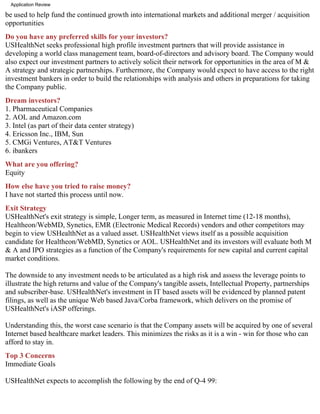
year two revenue coupled with stock valuations and market capitalization, as well as a possible IPO, will
Application Review

be used to help fund the continued growth into international markets and additional merger / acquisition
opportunities
Do you have any preferred skills for your investors?
USHealthNet seeks professional high profile investment partners that will provide assistance in
developing a world class management team, board-of-directors and advisory board. The Company would
also expect our investment partners to actively solicit their network for opportunities in the area of M &
A strategy and strategic partnerships. Furthermore, the Company would expect to have access to the right
investment bankers in order to build the relationships with analysis and others in preparations for taking
the Company public.
Dream investors?
1. Pharmaceutical Companies
2. AOL and Amazon.com
3. Intel (as part of their data center strategy)
4. Ericsson Inc., IBM, Sun
5. CMGi Ventures, AT&T Ventures
6. ibankers
What are you offering?
Equity
How else have you tried to raise money?
I have not started this process until now.
Exit Strategy
USHealthNet's exit strategy is simple, Longer term, as measured in Internet time (12-18 months),
Healtheon/WebMD, Synetics, EMR (Electronic Medical Records) vendors and other competitors may
begin to view USHealthNet as a valued asset. USHealthNet views itself as a possible acquisition
candidate for Healtheon/WebMD, Synetics or AOL. USHealthNet and its investors will evaluate both M
& A and IPO strategies as a function of the Company's requirements for new capital and current capital
market conditions.

The downside to any investment needs to be articulated as a high risk and assess the leverage points to
illustrate the high returns and value of the Company's tangible assets, Intellectual Property, partnerships
and subscriber-base. USHealthNet's investment in IT based assets will be evidenced by planned patent
filings, as well as the unique Web based Java/Corba framework, which delivers on the promise of
USHealthNet's iASP offerings.

Understanding this, the worst case scenario is that the Company assets will be acquired by one of several
Internet based healthcare market leaders. This minimizes the risks as it is a win - win for those who can
afford to stay in.
Top 3 Concerns
Immediate Goals

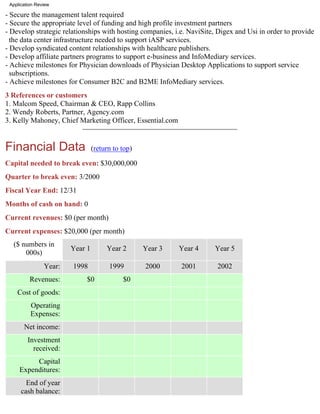
USHealthNet expects to accomplish the following by the end of Q-4 99:
Application Review

- Secure the management talent required
- Secure the appropriate level of funding and high profile investment partners
- Develop strategic relationships with hosting companies, i.e. NaviSite, Digex and Usi in order to provide
  the data center infrastructure needed to support iASP services.
- Develop syndicated content relationships with healthcare publishers.
- Develop affiliate partners programs to support e-business and InfoMediary services.
- Achieve milestones for Physician downloads of Physician Desktop Applications to support service
  subscriptions.
- Achieve milestones for Consumer B2C and B2ME InfoMediary services.
3 References or customers
1. Malcom Speed, Chairman & CEO, Rapp Collins
2. Wendy Roberts, Partner, Agency.com
3. Kelly Mahoney, Chief Marketing Officer, Essential.com


Financial Data                   (return to top)

Capital needed to break even: $30,000,000
Quarter to break even: 3/2000
Fiscal Year End: 12/31
Months of cash on hand: 0
Current revenues: $0 (per month)
Current expenses: $20,000 (per month)
  ($ numbers in
                        Year 1        Year 2       Year 3   Year 4     Year 5
      000s)
                Year:   1998           1999        2000     2001        2002
          Revenues:         $0              $0
    Cost of goods:
          Operating
          Expenses:
       Net income:
         Investment
           received:
          Capital
     Expenditures:
        End of year
      cash balance:
Application Review


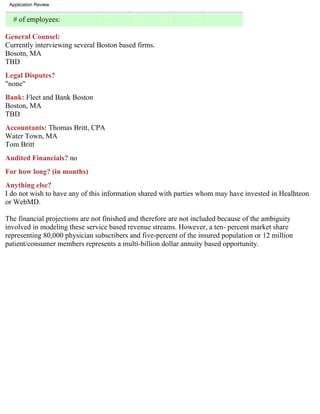
  # of employees:

General Counsel:
Currently interviewing several Boston based firms.
Bosotn, MA
TBD
Legal Disputes?
"none"
Bank: Fleet and Bank Boston
Boston, MA
TBD
Accountants: Thomas Britt, CPA
Water Town, MA
Tom Britt
Audited Financials? no
For how long? (in months)
Anything else?
I do not wish to have any of this information shared with parties whom may have invested in Healhteon
or WebMD.

The financial projections are not finished and therefore are not included because of the ambiguity
involved in modeling these service based revenue streams. However, a ten- percent market share
representing 80,000 physician subscribers and five-percent of the insured population or 12 million
patient/consumer members represents a multi-billion dollar annuity based opportunity.
USHealthNet


                   USHealthNet


                         Business Plan
                 for USHealthNet, a visionary
            Health Care Information Delivery System.


                           June 11, 1999

              Business Plan Copy Number [1 of 50 ]


This document contains confidential and proprietary information
           belonging exclusively to Richard Lynes


                          Richard Lynes
                    Chief Technology Officer
                          3 Acorn Street
                      Scituate, MA 02066
                         (781) 545-3938
                       cto@mediaone.net


This is a business plan. It does not imply an offering of Securities.

      Confidential & Proprietary Property of Richard Lynes
                   Draft Only – June 11, 1999
USHealthNet

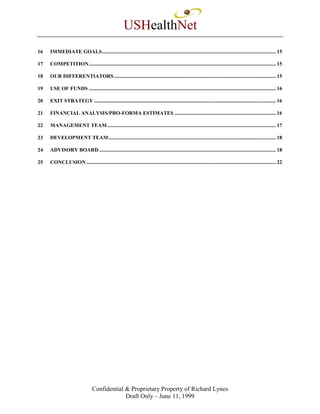
                                                         TABLE OF CONTENTS


USHEALTHNET’S ‘BUSINESS PLAN’ .................................................................................................................. 1

1        EXECUTIVE SUMMARY ............................................................................................................................... 1
     1.1 MARKET OVERVIEW........................................................................................................................................ 2
     1.2 THE PROBLEM ................................................................................................................................................. 3
     1.3 THE SOLUTION ................................................................................................................................................ 4
        1.3.1 Value Propositions – Physicians........................................................................................................... 4
        1.3.2 Value Propositions – Consumers .......................................................................................................... 5
        1.3.3 Value Propositions - Pharmaceuticals.................................................................................................. 5
     1.4 REVENUE MODELS .......................................................................................................................................... 5
     1.5 CAPITAL REQUIREMENTS WILL BE: .................................................................................................................. 6
        1.5.1 Investment Opportunities ...................................................................................................................... 6
2        INTRODUCTION ............................................................................................................................................. 7

3        THE BUSINESS ................................................................................................................................................ 9

4        THE STRATEGIC OPPORTUNITY.............................................................................................................. 9

5        THE MARKET POTENTIAL/MARKET SIZE/MARKET GROWTH RATES ....................................... 9

6        THE MARKET DRIVERS/KEY TRENDS .................................................................................................. 10

7        THE OPPORTUNITY .................................................................................................................................... 10

8        THE SOLUTION............................................................................................................................................. 11

9        THE PRODUCTS/OFFERINGS ................................................................................................................... 11

10       THE VALUE PROPOSITION — HEALTHCARE PROFESSIONAL..................................................... 12
     10.1        EASE OF USE............................................................................................................................................. 12
     10.2        COST SAVINGS.......................................................................................................................................... 12
11       THE VALUE PROPOSITION — CONSUMERS ....................................................................................... 13
     11.1     PREMIUM AND PROPRIETARY CONTENT ................................................................................................... 13
        11.1.1 Online Healthcare Communities ......................................................................................................... 13
        11.1.2 Convenience and Reliability................................................................................................................ 13
12       THE STRATEGIC GRIPPER: “THAT’S FANTASTIC” .......................................................................... 13

13       ADVERTISING AND PUBLIC RELATIONS............................................................................................. 14

14       THE BUSINESS MODEL .............................................................................................................................. 14

15       SALES AND MARKETING .......................................................................................................................... 14


                                     Confidential & Proprietary Property of Richard Lynes
                                                  Draft Only – June 11, 1999
USHealthNet
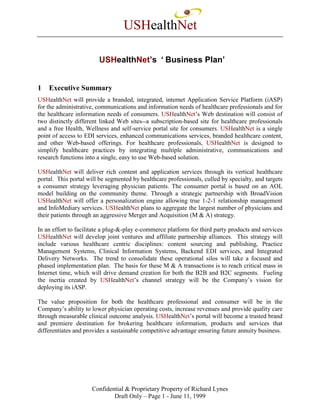
16   IMMEDIATE GOALS.................................................................................................................................... 15

17   COMPETITION.............................................................................................................................................. 15

18   OUR DIFFERENTIATORS........................................................................................................................... 15

19   USE OF FUNDS .............................................................................................................................................. 16

20   EXIT STRATEGY .......................................................................................................................................... 16

21   FINANCIAL ANALYSIS/PRO-FORMA ESTIMATES ............................................................................. 16

22   MANAGEMENT TEAM ................................................................................................................................ 17

23   DEVELOPMENT TEAM............................................................................................................................... 18

24   ADVISORY BOARD ...................................................................................................................................... 18

25   CONCLUSION ................................................................................................................................................ 22


                                 Confidential & Proprietary Property of Richard Lynes
                                              Draft Only – June 11, 1999
USHealthNet

                        USHealthNet’s ‘Business Plan’


1   Executive Summary
USHealthNet will provide a branded, integrated, internet Application Service Platform (iASP)
for the administrative, communications and information needs of healthcare professionals and for
the healthcare information needs of consumers. USHealthNet’s Web destination will consist of
two distinctly different linked Web sites--a subscription-based site for healthcare professionals
and a free Health, Wellness and self-service portal site for consumers. USHealthNet is a single
point of access to EDI services, enhanced communications services, branded healthcare content,
and other Web-based offerings. For healthcare professionals, USHealthNet is designed to
simplify healthcare practices by integrating multiple administrative, communications and
research functions into a single, easy to use Web-based solution.

USHealthNet will deliver rich content and application services through its vertical healthcare
portal. This portal will be segmented by healthcare professionals, culled by specialty, and targets
a consumer strategy leveraging physician patients. The consumer portal is based on an AOL
model building on the community theme. Through a strategic partnership with BroadVision
USHealthNet will offer a personalization engine allowing true 1-2-1 relationship management
and InfoMediary services. USHealthNet plans to aggregate the largest number of physicians and
their patients through an aggressive Merger and Acquisition (M & A) strategy.

In an effort to facilitate a plug-&-play e-commerce platform for third party products and services
USHealthNet will develop joint ventures and affiliate partnership alliances. This strategy will
include various healthcare centric disciplines: content sourcing and publishing, Practice
Management Systems, Clinical Information Systems, Backend EDI services, and Integrated
Delivery Networks. The trend to consolidate these operational silos will take a focused and
phased implementation plan. The basis for these M & A transactions is to reach critical mass in
Internet time, which will drive demand creation for both the B2B and B2C segments. Fueling
the inertia created by USHealthNet’s channel strategy will be the Company’s vision for
deploying its iASP.

The value proposition for both the healthcare professional and consumer will be in the
Company’s ability to lower physician operating costs, increase revenues and provide quality care
through measurable clinical outcome analysis. USHealthNet’s portal will become a trusted brand
and premiere destination for brokering healthcare information, products and services that
differentiates and provides a sustainable competitive advantage ensuring future annuity business.


                      Confidential & Proprietary Property of Richard Lynes
                              Draft Only – Page 1 - June 11, 1999
USHealthNet
1.1 Market Overview
According to the Health Insurance Association of America, healthcare is the largest single sector
of the U.S. economy, consuming approximately $1 trillion annually, or 14% of the country's
gross domestic product. The healthcare industry consists of a complex mix of participants, which
includes:

•   "Providers" -- physicians, medical practice groups, hospitals and other organizations that
    deliver medical care;
•   "Payers" -- the government agencies, insurance companies, managed care organizations and
    other enterprises that pay the bills for healthcare, this includes employers;
•   "Suppliers" -- clinical laboratories, pharmaceutical companies, and other groups that provide
    tests, drugs, x-rays and other services; and
•   "Consumers" -- individual patients who receive medical care, and the government agencies,
    employers and other organizations that represent groups of individuals.

All healthcare participants rely heavily upon information to perform their roles in the industry.
Individuals compare medical plans, choose physicians and submit claims for reimbursement.
Employers select health plans, determine benefit levels, enroll employees and maintain employee
eligibility data. Providers verify patient eligibility, collect patient histories, order diagnostic tests
and x-rays, receive and interpret test results, render diagnoses, make referrals and submit claims
to payers. Payers manage referrals, establish medical care protocols and reimbursement policies
and process claims. Suppliers analyze and process patient samples or tests, provide results, fill
prescriptions and submit claims for reimbursement. These and many other healthcare
transactions are also highly dependent on information, and each participant is dependent on the
others for parts of that information. In sum, the finance and delivery of healthcare requires that
consistent, accurate information be shared confidentially across a large and fragmented industry.

•   The U.S. Healthcare expenditure is $1.2 trillion and growing.
•   Physicians control 85% of the national expenditures for healthcare.
•   The administrative costs for providing healthcare have been estimated at between $198
    billion and $250 billion per year.
•   The physician market size is over 800,000 today.
•   Those physicians provide care to an average of 1647 patients per year; each with an annual
    per capita expenditure of $3633, representing an aggregate annual billing of $236 Billion for
    735 million office visits per year.

Factors contributing to these exorbitant expenses are:

•   Inappropriate diagnosis and prescription drug use, resulting in a significant number of
    hospitalizations -- between 5 and 25 percent. The costs of treatment for inappropriate drug
    therapy are staggering - estimated at $100 billion each year, National Pharmaceutical Council.
•   The healthcare industry has become an information-intensive profession plagued by
    substandard methods of data collection, storage, and retrieval.


                       Confidential & Proprietary Property of Richard Lynes
                               Draft Only – Page 2 - June 11, 1999
USHealthNet
•   With over two thousand information technology vendors competing for their share of the
    healthcare industry, incompatible operational and technology silos are making it difficult to
    exchange vital information and critical life-saving knowledge. This need strains the resources
    of the healthcare community since information must be gathered from disparate sources.
•   A large part of healthcare waste is related to red tape, paperwork and decentralized data
    sources.

1.2 The Problem
In providing care to those patients the physicians face similar basic challenges:

•   Management of patient data during the course of their relationship
•   Lack of access to patient data prior to their relationship
•   Lack of access to patient date throughout the extended healthcare enterprise
•   Inconsistent processes and deteriorating relationships across providers
•   No communication and leverage of data beyond the practice walls
•   Need to keep abreast of health findings and new treatments
•   Need to contain costs and expand revenue opportunities

Several of the core applications needed by those physicians to manage their practices needs are
currently not WEB enabled and less than 6% of office based physicians use any combination of
the following Point-of-Care (POC) tools:

•   Electronic Medical Records
•   New prescription orders and refills processing
•   Lab Order Entry and Results
•   Diagnostic Decision Support
•   Procurement applications

Those core applications have not penetrated the undeserved portion of this market for the
following reasons:

•   They are primarily client server applications that are both expensive to implement (software
    licensing, hardware, training), but are also a large distraction to the practice operation from a
    management perspective – Back Office versa Front Office.
•   Managed Care has driven the cost to new levels, leaving caregivers to question the quality of
    care and their ability to earn a living and compete in the growing PPO space.
•   Those practices that do invest in these applications generally only leverage a small precent of
    their value due largely to the fact that back-office billing systems are complex data entry
    systems and do not extend themselves to support front-office Point-of-Care services.
•   Since the applications are local to each practice, they do not receive the benefits of
    consolidated patient or treatment and outcome data across practices.


                      Confidential & Proprietary Property of Richard Lynes
                              Draft Only – Page 3 - June 11, 1999
USHealthNet
Studies show that 94% of this market is considered "under served" by the current applications on
the market and unable to address the Point-of-Care information needs. The Total-Cost-of-
Ownership1 on a per seat basis would be $150,000 dollars over five years. With more than
325,000 physicians working in physician group practices, it is easy to see why turnkey systems
integration services market segment will double in revenue by the end of the decade, from its
$10 billion mark today, according to leading analyst Mike Knepper of Volpe, Welty & Co.

The domestic market for digital clinical information networks has been estimated at $350 billion
dollars, international (including U.S.) at $1.2 - 1.3 trillion dollars yearly (the estimate based on
data from the World Health Organization, the U.S. Census Bureau).

1.3 The Solution
USHealthNet’s iASP offering consists of an N-tiered application service strategy, which
connects physicians and patients to USHealthNet’s portal through a single access point using a
Web browser based Thin-Client interface. These services integrate critical Point-of-Care
Knowledge Tools allowing secure global access over the Internet. These POC tools will be
offered for free to consumers and through the Company’s premium subscription services for
healthcare professionals. Further access is offered to branded affiliate products and services,
maximizing site stickiness while ensuring a consistent user experience.

USHealthNet’s Java Enterprise Beans and Corba application component framework supporting
the iASP subscription service offering will consist of nine integrated applications:

1.    LifeTime (Longitudinal Electronic Medical Records)
2.    DiagAssist (Diagnostic Decision Support System)
3.    ScriptPad (Prescription and Drug Interaction Services)
4.    LabDirect (Lab Order and Results)
5.    Enterprise Workflow Engine and XFDL/XML based Forms Engine
6.    Enterprise Resource Planning (ERP)
7.    Enterprise Master Patient Index (EMPI)
8.    Clinical Data Repository and OLAP
9.    Java XML Search Engine, integrating (UMLS) Tools and semantic networks

The USHealthNet vision is to provide increased functionality to a broader cross-section of the
physician's market by breaking down the current barriers and providing the following benefits to
the physician practice:

1.3.1     Value Propositions – Physicians

•     Significantly lower cost of entry (Multi-tiered subscription models)
•     More intuitive functionality (Web based Thin-Client)
•     Less intrusive infrastructure (Outsourced to ASPs)

1
    Review http://www.fujitsu-computers.com/coo/main.html and http://www.info-edge.com/55090301.htm


                          Confidential & Proprietary Property of Richard Lynes
                                  Draft Only – Page 4 - June 11, 1999
USHealthNet
•   Remotely managed through national network operations centers
•   Clinical data management and analysis (InfoMediary service)
•   Leverage of database beyond the practice and across the continuum of care

Additional benefits to the consumer market will be:

1.3.2   Value Propositions – Consumers

USHealthNet provides healthcare consumers with a single point of access to premium and
proprietary health and wellness content. Consumers can use the information that is provided
through USHealthNet without charge to educate themselves on healthcare-related matters,
allowing them to make better informed healthcare decisions. In addition, USHealthNet can
deliver personalized content and e-mail updates based on a consumer's profile and can search and
retrieve member-specific healthcare information from the Web. InfoMediary service affiliates
will be marketing products against high-level patient/consumer profiles, which do not
compromise personal data, only segment level profiling data is available and this is secured in a
BroadVision database behind USHealthNet’s data center fire-walls.2

Benefits to the pharmaceutical market will be:

1.3.3   Value Propositions - Pharmaceuticals

•   Access to clinical data repository
•   Reduced new drug time-to-market expense
•   Access to patient base for clinical trails3
•   Direct link to Physicians Desktop for promotions
•   Access to consumers of healthcare products

1.4 Revenue Models
The Company’s delivery strategy for this vision is to raise the management of these applications
up into the network, delivering subscription access to these applications to individual practices.
The applications will be Internet based, providing the scale, security and ease of use that has
been the hall-mark and success of the WEB today.

Key sources of revenue from this business will be:

•   Subscript to Vertical Healthcare Portal (Segmented based on specialty)
•   Subscript service for Internet Application Service Platform (iASP – Point-of-Care tools)
•   InfoMediary services allowing affiliate partners to participate in the Company’s e-Commerce
•   Sponsorships, bounty and bundles (Up-sell and Cross-sell opportunities)

2
  All personal healthcare information is highly confidential and USHealthNet understands its commitments to
patient privacy and will not under any circumstances compromise a patient’s personal healthcare data
3
  Ibid.


                         Confidential & Proprietary Property of Richard Lynes
                                 Draft Only – Page 5 - June 11, 1999
USHealthNet
•     Transaction processing (EDI Claims, patient eligibility and e-commerce)
•     Advertising (Using the PDA, the Company can us both a Push and a Pull model)

1.5     Capital requirements will be:
•     $10 - 30 million for sales, marketing and PR, operations, partnership acquisitions, technology
      licensing and development, and M & A opportunities.
•     Outsourced portal development to Agency.com.
•     Outsourced infrastructure deployment to NaviSite, a CMGi ISP, and USinternetworking
•     Affiliates pre-paid or underwriting the first 100,000 physician subscriptions (General content
      subscription levels, not premium, which offers iASP services)4
•     To fuel the Company’s consumer e-Commerce and InfoMediary services strategies

USHealthNet’s market capitalization projections are $500 million with 10 % market penetration
are not unrealistic. Anticipated revenue growth will be:

1.5.1    Investment Opportunities

This is an early stage opportunity for investors:

•     The research has been done and the business case proven
•      Prototypes have been developed
•      Business plan has been drafted
•     Several key members of the management team have been identified, with an eager desire to
      identify additional members
•      Industry experts from both the medical and internet fields have committed to advisory roles
•     Technology partners have been identified and initial negotiations have begun
•     An initial venture partner has expressed a desire to participate if a second partner can be
      secured

USHealthNet 's charter and strategic vision is to provide e-commerce capabilities and service
excellence for the healthcare industry by developing Internet transport and Web-based clinical
applications, management services, and a community healthcare information delivery network.
USHealthNet will be the premier provider of Point-of-Care knowledge tools and services for the
healthcare industry.

USHealthNet’s strategy reflects the future state, vision and direction for the healthcare industry.
This premise is based on the fact that all roads lead to the patient and physician, therefore all
investment decisions, including IT, capital and human resources need to be aligned strategically
across all points of patient and physician interaction.


4
 The pre-paid or underwritten subscription services will be paid for in part from our shared revenue and joint
marketing programs for affiliate, and alliance partnerships


                          Confidential & Proprietary Property of Richard Lynes
                                  Draft Only – Page 6 - June 11, 1999
USHealthNet

2   Introduction
USHealthNet will implement, operate, and support packaged Point-of-Care (POC) software
applications that automate the physician’s front-office processes, which can be accessed and
used over the Company’s internet Application Service Platform (iASP) and vertical healthcare
portal sites. The iASP services are based on packaged software applications from best-of-breed
software vendors. These iASP services will be deployed through USHealthNet, the Company’s
branded network operations center (NOC). The Company will target both single and a multi-
physician practices; and further segmented these groups by specialty. USHealthNet’s healthcare
portal has a consumer strategy reflecting trends in self-service, preventative care content and
applications.

USHealthNet’s service rollout strategy includes the following business functions in its initial
release, which are bundled with a multi-tiered subscription service model, providing healthcare
professionals a single point of access through USHealthNet and the World Wide Web:

•   Electronic Medical Records, (consumers will have read only access).
•   Online Prescription Processing, (next day delivery by FedEx and UPS).
•   Lab Order Entry and Results, (push technology will deliver result in real-time).
•   Diagnostic Decision Support, (real-time feedback and differential diagnostic engine).
•   Relationship Management, (targeting 1-2-1 personalized InfoMediary services).
•   E-commerce, aggregating procurement transactions (consumer transactions as well).

USHealthNet will deploy these application services through affiliate partner data centers.
USHealthNet will configure them to meet the needs of our clients, and package them with
security, Internet access, back-up and operational support. Our clients purchase these products as
part of a tiered subscription service model, paying us on a monthly basis as the services are
delivered.

The advantages our clients realize by subscribing to our iASP services rather than purchasing the
application software directly and implementing it them-selves include:

•   FASTER TIME TO BENEFIT. Because we have pre-configured our products and operate
    them in an established environment, we can reduce implementation time significantly.
•   REDUCED TECHNICAL AND INTEGRATION RISK. A single vendor, USHealthNet,
    takes full responsibility for delivering the service, including ongoing upgrades.
•   REDUCED RELIANCE ON EXTERNAL MULTI-VENDOR SOLUTIONS. USHealthNet
    employees implement and operate our applications and provide client support twenty-four
    hours a day, seven days a week, allowing a Single-Point of Access.
•   LOWER TOTAL-COST-OF-OWNERSHIP. USHealthNet offers its services at a lower cost
    than its clients would otherwise bear to implement these applications on a traditional basis,
    and we also reduce our clients' up-front investment.


                     Confidential & Proprietary Property of Richard Lynes
                             Draft Only – Page 7 - June 11, 1999
USHealthNet

To deliver its services, USHealthNet will built strategic relationships with the following key
network providers through the development of Co-Branded Community Healthcare Portals:

•   NaviSite
•   Digix
•   USInternetworking

Our secure network will incorporates a high level of redundancy, bypassing Internet congestion
points, and enabling real time back up of client sites across dispersed geographies. As a result,
we believe our clients benefit from superior response time, reliability and security.

Once an iASP contract is signed, we invest in the hardware, software and implementation needed
to deliver client service. This will require a substantial investment in the early years to build our
client base. We expect to benefit from rapidly growing annuity based revenue, which we believe
will generate substantial positive cash flow in later years.

We will make substantial investments to pursue our strategy. These investments include:

•   Building a global network of data center relationships
•   Allying with particular software providers
•   Investing to develop unique product features
•   Developing implementation resources around specific applications

Forrester Research, Inc. reports that the overall market for outsourcing packaged software
applications will grow from approximately $1 billion in 1997 to over $21 billion by 2001.
These services include packaged application software implementation and support, customer
support and network development and maintenance. Reasons for the growth in outsourcing
include:

•   The scarcity of information technology professionals.
•   The challenges faced by a non-technical company in hiring, motivating and retaining
    qualified application engineers and information technology employees.
•   The desire by companies to focus on their core business.
•   The difficulties that businesses experience in developing and maintaining their networks and
    software applications.
•   The fast pace of technical change that shortens time to obsolescence and forces increases in
    capital expenditures as companies attempt to keep up with leading technologies.


                      Confidential & Proprietary Property of Richard Lynes
                              Draft Only – Page 8 - June 11, 1999
USHealthNet

3   The Business
USHealthNet provides a branded, integrated, internet Application Service Platform (iASP) for
the administrative, communications and information needs of healthcare professionals and for
the healthcare information needs of consumers. The Company's Web destination consists of two
distinctly different linked Web sites--a subscription-based site for healthcare professionals and a
free Health, Wellness and self-service portal site for consumers. USHealthNet is a single point of
access to EDI services, enhanced communications services, branded healthcare content, and
other Web-based offerings. For healthcare professionals, USHealthNet is designed to simplify
healthcare practices by integrating multiple administrative, communications and research
functions into a single, easy to use Web-based solution.

For consumers, USHealthNet provides premium, branded content to assist consumers in making
informed healthcare decisions, personalized information about specific health conditions targeted
according to the medical profiles of individual consumers and content-specific online
communities that allow consumers to participate in real-time discussions and support networks
via the Web. The Company's objective is to become the Web's premium brand for healthcare-
related applications services, facilitating joint collaborative communications and knowledge
management services.


4   The Strategic Opportunity
The Company’s vision is to become the “Pre-eminent Leader” of information technology and
knowledge delivery to the healthcare industry by offering client/server software applications,
services, and relevant up to date information increasing productivity while managing risk.

This unique approach of mixing WEB hosted applications, services, and e-commerce capability
results in business opportunities forging new partnership models and marketing programs. These
models and programs will maximize and leverage distribution channel affiliate partners, enabling
joint revenue sharing, joint marketing/co-branding, InfoMediary and advertising for both
USHealthNet and its partners.

5   The Market Potential/Market Size/Market Growth Rates
USHealthNet’s iASP services allow physicians to automate their front office POC and back-
office billing processes. Outsourcing these application functions through iASP services reduces
the barriers to entry for physicians. Current per physicians costs are estimated $25,000 with $5-
10k for annual support just to implement Electronic Medical Records, the Total Cost of
Ownership (TCO) dilutes current ROI expectations. Estimates reveal that only 2-6% of the
nations 800,000 physicians currently use an EMR system in the daily practice and a recent
survey revealed that 67% of physicians currently use the Internet and 50% of all the Internet uses
currently search the net for up-to-date healthcare information.


                     Confidential & Proprietary Property of Richard Lynes
                             Draft Only – Page 9 - June 11, 1999
USHealthNet
6   The Market Drivers/Key Trends
In order to obtain service excellence, an integrated healthcare delivery system, similar to an
Integrated Delivery Network (IDN), must be developed encompassing Point-of-Care (POC)
knowledge management tools: virtual medical records, diagnostic decision support, lab and
diagnostic orders, clinical pathways for disease management, drug interactions, prescription
fulfillment, coding and billing.

We believe that the availability of Internet-enabled packaged software makes it possible, for the
first time, to implement these applications on the Internet in predictable time frames, with
predictable costs, and without writing custom code.

The need for an integrated approach to providing these services.

Forrester Research, Inc. reports that the overall market for outsourcing packaged software
applications will grow from approximately $1 billion in 1997 to over $21 billion by 2001.
Furthermore, according to Forrester Research, Inc., U.S. firms are now spending approximately a
quarter of their overall information technology budgets on outsourcing services. These services
include packaged application software implementation and support, customer support and
network development and maintenance.

Reasons for the growth in outsourcing include:

•   The scarcity of information technology professionals.
•   The challenges faced by a non-technical company in hiring, motivating and retaining
    qualified application engineers and information technology employees.
•   The desire by companies to focus on their core business.
•   The difficulties that businesses experience in developing and maintaining their networks and
     software applications.
•   The fast pace of technical change that shortens time to obsolescence and forces increases in
    capital expenditures as companies attempt to keep up with leading technologies.

7   The Opportunity
With healthcare expenditures in the U.S. totaling approximately $1 trillion each year and
growing; physicians, payers, providers, pharmaceutical companies, and patients are searching for
new healthcare models that strive to contain costs and liabilities, while improving the quality of
care through measurable outcomes, and new revenue opportunities.

Inefficiencies within the healthcare system consume enormous amounts of time, resources and
dollars. It is estimated that over $250 billion, or 25% of every healthcare dollar, are wasted
through the delivery of unnecessary care, performance of redundant tests and procedures, and
excessive administrative costs. USHealthNet believes much of this inefficiency and waste is a
direct result of poor information exchange among healthcare participants. Consumers do not


                     Confidential & Proprietary Property of Richard Lynes
                            Draft Only – Page 10 - June 11, 1999
USHealthNet
have easy access to the detailed information they need to compare health plans, select physicians,
or manage their own healthcare and benefits.

Providers often lack timely access to relevant patient information, and this lack of information
causes them to prescribe unnecessary tests or procedures and hinders their ability to diagnose and
treat patients. Providers and suppliers often rely on manual processes to share data, and errors
and information bottlenecks resulting from these manual processes cause delays in determining
eligibility, approving referrals, reporting test results and paying claims. These inefficiencies
contribute to the rising cost of healthcare. As a result, the government and other purchasers of
healthcare have increasingly placed pressure on the healthcare industry to improve the cost-
effectiveness of healthcare while maintaining the quality of care.

8   The Solution
USHealthNet believes a significant opportunity exists to leverage the power of the Internet to
provide secure, open, universally accessible network services that connect participants and
automate workflows throughout the healthcare delivery process. USHealthNet believes that such
a solution has the potential to create significant improvements in the way that information is used
by the healthcare system, enabling improved workflows, better decision-making and, ultimately,
higher quality care at a lower cost.

9   The Products/Offerings
These knowledge resources are provided and maintained, as part of USHealthNet’s syndicated
affiliate program. A suite of Point-of-Care knowledge tools described below will be offered
based of premium subscription services. USHealthNet will be the first Internet service to offer
these applications as a bundled service offering.

The three tiers of deployment for iASP services consist of the following:

1. Tier One is invaluable to a physician’s office. This Intranet tier integrates the front office
   POC with back office billing systems, provides a POC decision-support system for the
   physician, and automates all aspects of disease management, spanning the continuum of care
   and the extended healthcare enterprise. Tier One includes DiagAssist (Diagnostic Decision
   support system) and ScriptPad (Prescription and Drug Interaction Database), LifeTime
   (Longitudinal Electronic Medical Records), LabDirect (Lab Order and Results) Enterprise
   Workflow Engine and XFDL/XML based Forms Engine, and care plan eligibility and payer
   formulary authentication.

2. Tier Two maintains the Master Patient Index, clinical data repository and data warehouse
   application services accessed through a secure Extranet. Tier Two is the USHealthNet Service
   Center (NOC) which, in addition to providing the infrastructure to support practice management
   services (iASP), also handles billing, claims submission and benefits administration for each
   provider’s office transparently and automatically.


                      Confidential & Proprietary Property of Richard Lynes
                             Draft Only – Page 11 - June 11, 1999
USHealthNet
3. Tier Three is a shared e-commerce/e-business platform and vertical portal supporting virtual
   communities on the Internet. This illustrates USHealthNet’s goal of becoming the most
   efficient and comprehensive procurement and knowledge management service provider for
   third party products and services in the healthcare industry.

10 The Value Proposition — Healthcare Professional
A Web-based Thin-Client front-end application provides a Single Point of Access for healthcare
professionals. This reduces the need for healthcare professionals to use multiple administrative,
communications and information services by integrating these applications and services via the
Internet. USHealthNet will enter into relationships to assist healthcare professionals in obtaining
all hardware and ancillary services necessary to use USHealthNet, including Internet access and
computer hardware. USHealthNet’s Premium subscription access to iASP and Knowledge
Management Services provides a suite of Point-of-Care (POC) tools, including backend EDI
services for healthcare professionals', eligibility verification, prescription processing. The
Electronic Medical Record, which manages patients across the continuum of care, ScritpPAD,
Lab Order Entry and DiagAssist, a Diagnostic Decision Support tool, offer healthcare
professionals unparalleled control throughout the life-cycle of care.

USHealthNet’s Vertical Healthcare Portal is segmented by healthcare professional and
patients/consumers, and culled by specialty. USHealthNet uses a 1-2-1-personalization engine
for physician profiling -- only branded affiliate products and services are offered and transacted
within the site, customized physician intranets and knowledge delivery services are tailored
based on a multi-tiered subscription model. USHealthNet intends to add services and content in
the future, including a Web-enabled medical transcription service offering, hospital/physician
referral services and insurance benefits administration.

10.1 Ease of Use.
USHealthNet will offer a bundled Thin-Client Application Suite and Knowledge Management
services provided by a standards-based Java Physicians Desktop interface integrated with a Web
browser. Therefore, subscribers who use the USHealthNet 's services do not require training on
multiple proprietary devices and require no knowledge of the Internet and it’s navigation issues.

10.2 Cost Savings.
USHealthNet will offer tiered InfoMediary services allowing affiliate partners to market
products and services targeted against confidential profiles achieving true personalization across
all points of contact insuring a consistent user experience. By aggregating physicians and
reaching critical mass USHealthNet will be uniquely positioned to offer procurement services,
practice management service, and other third party offerings through these affiliate partners.
Physicians and patients will be offered financial incentive awards for referring non-members and
by participating in other marketing programs.


                     Confidential & Proprietary Property of Richard Lynes
                            Draft Only – Page 12 - June 11, 1999
USHealthNet
In-addition to the USHealthNet’s POC tools a unified messaging platform, supporting chat,
conferencing and email service will be rolled-out. USHealthNet’s Web sites and premium
research and educational content will be priced competitively and healthcare professionals will
pay no more for these services than if purchased individually.


11 The Value Proposition — Consumers
11.1 Premium and Proprietary Content
USHealthNet provides healthcare consumers with a single point of access to premium and
proprietary health and wellness content. Consumers can use the information that is provided
through USHealthNet without charge to educate themselves on healthcare-related matters,
allowing them to make better informed healthcare decisions. In addition, USHealthNet can
deliver personalized content and e-mail updates based on a consumer's profile and can search
and retrieve member-specific healthcare information from the Web.

11.1.1 Online Healthcare Communities

Through planned acquisitions, USHealthNet will provide access to online communities that
provide consumers with personalized information about their health conditions and allow them to
participate in message boards, real-time chat rooms and support networks via the Web. In
addition, online communities provide member-generated content based on shared experiences.

11.1.2 Convenience and Reliability

Through a physician's USHealthNet Web site, patients can obtain information regarding office
hours, location and other matters without having to place a telephone call to the physician's
office. In addition, patients can receive healthcare information that is reviewed and approved by
medical professionals under their physician's USHealthNet Web site--a reliable and familiar
source of information.


12 The Strategic Gripper: “That’s Fantastic”
Wall Street has placed market caps of 5-20 billion plus on similar business strategies in the same
industry segment for companies less than a year old with reported losses of more than $100
million. The market potential for the segment that USHealthNet intends on pursuing is estimated
to be over $250 billion in 2000. The recent merge between Healtheon and WebMD created an
800-pound guerilla with a market capitalization of $20 billion. Another one to watch is Synetics,
which just completed the acquisition of Medical Manager PMS for $1.4 billion. The cat is out of
the bag, the convergence of healthcare and the Internet will change the face of medicine forever,
and the real paradigm shift has only just begun.

The reality of a $1.2 trillion dollar healthcare market with over-burdened administrative
overhead and red tape provides a feeding frenzy for first-to-market movers and early adopters.


                     Confidential & Proprietary Property of Richard Lynes
                            Draft Only – Page 13 - June 11, 1999
USHealthNet
The administrative and decentralized functional silos that make up the extended healthcare
enterprise compound inefficiencies and are responsible for more than $250 billion in waist.


13 Advertising and Public Relations
USHealthNet plans to evolve demand creation by launching creative advertising campaigns
through strategic partners, Internet search engines, banners ads and more traditional media plays.
The Company has started discussions with Omnicom subsidiaries that will lead to strong
strategic partnerships. These subsidiaries provide brand strategy, PR and media buy campaigns,
and USHealthNet will partner with Agency.com for the development of the Company’s Portal
sites.

14 The Business Model
USHealthNet’s business model is based on the founding principle of establishing sustainable
sources of annuity based revenue while exploiting business opportunities for the Company and
its partners, as described.

USHealthNet offers network-based application services and information services on a transaction
and subscription fee basis. The outsourced iASP model reduces the initial investment required to
obtain the benefits of high-end information technology infrastructure, enabling physicians, small
organizations and individuals to gain access to these systems for the first time. By enabling the
shift from fixed information technology costs to variable costs and from a vendor/product
models to a tiered service model, USHealthNet believes that it will be able to achieve critical
mass and broad-based adoption of the USHealthNet Community Healthcare Delivery Network.

15 Sales and Marketing
USHealthNet’s channel strategy will be organized according to its four main customer segments:
providers, payers, suppliers and consumers. USHealthNet’s direct sales force will target
significant potential customers in each market segment by region. In certain instances,
USHealthNet’s direct sales force will work with complementary brokers, value-added resellers
and systems integrators to deliver complete solutions for major customers. In addition, senior
management plays an active role in the sales process by cultivating industry contacts.
USHealthNet markets its applications and services through direct sales contacts, strategic
relationships, the sales and marketing organizations of its strategic partners, participation in trade
shows articles in industry publications. USHealthNet will attend a number of major trade shows
each year and will sponsor executive conferences, which feature industry experts who address
the information systems needs of large healthcare organizations. USHealthNet will support its
sales force with technical personnel who perform demonstrations of USHealthNet’s applications
and assist clients in determining the proper hardware and software configurations.


                      Confidential & Proprietary Property of Richard Lynes
                             Draft Only – Page 14 - June 11, 1999
USHealthNet
16 Immediate Goals
USHealthNet expects to accomplish the following by the end of Q-4 99:

   Secure the appropriate level of funding and high profile investment partners
   Develop strategic relationships with hosting companies, i.e. NaviSite, Digex and Usi in order
   to provide the data center infrastructure needed to support iASP services.
   Develop syndicated content relationships with healthcare publishers.
   Develop affiliate partners programs to support e-business and InfoMediary services.
   Achieve milestones for Physician downloads of PDA to support service subscriptions.
   Achieve milestones for Consumer B2C and B2ME InfoMediary services.

17 Competition
Upon first glance the competitive situation may be perceived as high risk due to the large number
of Internet healthcare content sites, vendor/systems integrators, and back office billing system
vendors. However, understanding USHealthNet integrated Web service delivery model (iASP)
positions the true competitive situation with a more focused strategic value proposition.
USHealthNet sees short-term competition from Internet sites that have subscription models
targeting healthcare providers and consumers. USHealthNet is differentiating itself by offering
premium services for healthcare content alongside application services.

Many of the Company's current and potential competitors have greater resources to devote to the
development, promotion and sale of their services; longer operating histories; greater financial,
technical and marketing resources; greater name recognition; and larger subscriber bases than the
USHealthNet and, therefore, have a significantly greater ability to attract subscribers and
advertisers. Many of these competitors may be able to respond more quickly than the
USHealthNet to new or emerging technologies in the Internet and the personal communications
market and changes in Internet user requirements and to devote greater resources than the
USHealthNet to the development, promotion and sale of their services. In addition, USHealthNet
does not have contractual rights to prevent its strategic partners from entering into competing
businesses or directly competing with the USHealthNet. While these statements can be
positioned as a negative resulting in a high-risk investment, they represent the reality of market
conditions for every company today and well into the future.

18 Our Differentiators
USHealthNet’s value is not that it necessarily has a technological advantage, which provide a
sustainable differentiation. Although the USHealthNet plans on filing patents to protect its
technology and intellectual assets, more correctly it’s the assemble of the parts, along with
knowledge management services and the valuable Clinical Data resulting from the use of the
USHealthNet’s WEB Based applications at the Point-of-Care. The key strategic advantages for
USHealthNet will be its strong management team, board of Directors, advisory board, strategic
partners and the measured execution of the Company’s business plan.


                     Confidential & Proprietary Property of Richard Lynes
                            Draft Only – Page 15 - June 11, 1999
USHealthNet
19 Use of Funds
USHealthNet’s working capital requirements for fiscal year 1999 and 2000 will be raised
through external private angle investors, partners and institutional equity funding vehicles in the
amount of $10 million, along with additional commitments to enable the Company’s acquisition
strategy. Projected ramp-up costs, operations, sales and marketing, and product/service
development will be running at an estimated average monthly burn rate of $550,000 for the first
eighteen months. As part of our strategy, year two revenue coupled with stock valuations and
market capitalization, as well as a possible IPO, will be used to help fund the continued growth
into international markets and additional merger / acquisition opportunities


20 Exit Strategy
USHealthNet’s exit strategy is simple, Longer term, as measured in Internet time (12-18
months), Healtheon/WebMD, Synetics and EMR (Electronic Medical Records) vendors and
other competitors may begin to view USHealthNet as a valued asset. USHealthNet views itself
as a possible acquisition candidate for Healtheon/WebMD, Synetics or AOL. USHealthNet and
its investors will evaluate both M & A and IPO strategies as a function of the Company’s
requirements for new capital and current capital market conditions.

21 Financial Analysis/pro-forma estimates
The following Business section contains forward-looking statements, which involve risks and
uncertainties. The Company's actual results could differ materially from those anticipated in
these forward-looking statements as a result of certain factors, including those set forth under
"Risk Factors" and elsewhere in this prospectus.

USHealthNet’s projected P&L statement is outlined in the table below merely as a placeholder.
These projections are based on a revenue projection model and budget assumptions. Additional
assumptions are stated in the Detailed Financial Plan, available and accompanying the business
plan. This is available upon requested and upon signing a non-disclosure.

                               1999        2000          2001          2002          2003
                               Forecast    Forecast      Forecast      Forecast      Forecast
       Revenue                 3,000,000   25,000,000    36,000,000    78,000,000    160,000,000
       COGS
       Gross Margin
       Operating Exp.
       R&D
       % of Revenue
       M&S
       % of Revenue
       G&A
       % of Revenue
       Total Operating Exp.
       % of Revenue
       EBIT
       % of Revenue


                        Confidential & Proprietary Property of Richard Lynes
                               Draft Only – Page 16 - June 11, 1999
USHealthNet
If we fail to execute our strategy in a timely or effective manner, the Company’s competitors
may be able to seize the marketing opportunities we have identified. Our business strategy is
complex and requires that we successfully and simultaneously complete many tasks. In order to
be successful, we will need to:

•   Build and operate a highly reliable, complex global network.
•   Negotiate effective partnerships and develop economically attractive products.
•   Attract and retain iASP customers.
•   Attract and retain highly skilled employees.
•   Integrate acquired companies into our operations.
•   Evolve our business to gain advantages in an increasingly competitive environment.
•   Expand our international operations.

22 Management Team
Richard Lynes – Founder and Chief Technology Officer

Strategic Planning and Information Technology Solutions Thought-Leader, achieving
improved operating efficiency through IT and business strategy alignment, and increased
shareholder value by leveraging technology as a competitive differentiator.
Professional Competencies:
       Strategic IT and Business planning for e-commerce, e-business and Knowledge
       Management as a competitive differentiation in the B2B, B2C and B2ME markets,
       integrating both buy-side, sell-side and customer facing processes
       Mentoring companies executives in their migration from traditional mass marketing
       and operational practices to those of 1-2-1 personalization; Customer Relationship
       Marketing (CRM) utilizing interactive media, database marketing, and the integration
       of legacy Line-of-Business applications, including SCM, OLR and ERP solutions
       Guiding executives on the sweeping changes, trends and impacts of technology on
       competitive strategies, business objectives and business transformation
       Technical team lead on the design, development and deployment of scaleable
       Enterprise-wide information, software and systems architectures. Supporting
       Intranet/Extranet application infrastructure components for MRO purchasing and e-
       catalog procurement, Human Resources, Sale Force Automation, Knowledge
       Management, and strategies for linking channel partners, suppliers and customers.

Serving as CIO and CTO for several market leaders, Mr. Lynes past successes have been
achieved by developing visionary technology strategies and facilitating information flow within
the senior management strategic planning function. By improving knowledge utilization through
linking corporate stakeholder processes and objectives, client business strategies, and facilitating


                      Confidential & Proprietary Property of Richard Lynes
                             Draft Only – Page 17 - June 11, 1999
USHealthNet
cooperation between cross-functional teams, Mr. Lynes insights have created a more customer
centric approach and methodology.

Colleagues have often described Mr. Lynes as an approachable team player who has a proven
knack of forecasting and keeping them abreast of critical changes in the dynamic, fast paced
world of technology. His talent does not come from a crystal ball, but from a substantial career
of following the movements within both the Information Technologies and Tele-communications
industries.

23 Development Team
Worldmachine Technologies Corporation is a leading information technology consulting firm
that provides innovative solutions for your organization's business communication needs. Using
a structured process, we leverage best-of-breed Internet, intranet and extranet technologies to
offer you a variety of services and packaged systems. Our ultimate goal is to help you to better
manage information and improve the way you communicate.

Our team of professionals provides you with a wealth of experience in many important areas of
information technology. These include Internet, intranet and extranet development, web design,
database design, system administration, and system integration.

24 Advisory Board
Chris Bulter –
Mr. Butler was founder and President of Interactive Solutions, an interactive strategy, interactive
branding and web systems integration firm. Mr. Butler grew IS into a 150 person company with
$20m in revenue and recently sold it. Mr. Butler has 24 years experience in high technology (PC
applications, CASE tools, electronic publishing, networking). Mr. Butler is a graduate of
Harvard College (AB Computer Science 1976) and the Harvard Business School (MBA 1980).

Donald Leavitt -

Donald > Leavitt is the founder of Concord Associates, a firm devoted to the development and
nurturing of seed-stage venture investments. Mr. Leavitt is also President of Dynographics, Inc.,
an Internet-focused management and marketing consultancy specializing in the creation of
organizationally and strategically aligned:

   •   Customer acquisition, development, and retention plans,
   •   Internet-compliant strategic marketing plans,
   •   Internet-driven brand-building initiatives,
   •   Interactive marketing and sales scenarios,
   •   Strategic operating plans for new Internet-based e-commerce initiatives, and


                      Confidential & Proprietary Property of Richard Lynes
                             Draft Only – Page 18 - June 11, 1999
USHealthNet
   •   Resolution and workout plans for Internet-generated channel conflict widely considered
       the single most significant barrier to success for large legacy-driven enterprises
       transforming from traditional to electronic commerce channels.

Many of these issues are analyzed in depth in a case Mr. Leavitt co-authored on Bronner
Slosberg Humphrey for the Harvard Business School with David E. Bell, Royal Little
Professor of Business Administration at HBS. Most recently, Mr. Leavitt collaborated with
Professor Bell on an HBS case that focuses on donor acquisition and retention issues confronting
the United Way of Massachusetts Bay.

Both before and after the emergence of the Internet as the channel of choice for the new
millenium, Mr. Leavitt has been providing strategic product management, M&A analysis, market
assessment, and technology evaluation services to senior management at such marquee clients as
Fujitsu, Ltd., Merill Lynch, Lehman Brothers, Canon USA, Worldwide Volkswagen, CBS,
Eastman Kodak, Jones Day Reavis & Pogue, Ziff Davis, and the Government of the
People's Republic of China.

In 1987, Mr. Leavitt started Spectra Sciences, a designer and manufacturer of high value added,
internationally patented specialty chemicals. During his tenure as founder, CEO and CFO of the
company, he raised nearly $3 million in seed-stage venture capital financing. Today, Spectra
Science is redefining laser technology through its work with Nanocrystals.

An honors graduate of Brandeis University, Mr. Leavitt began an extensive involvement in the
advanced imaging technology at NASA's Photographic Research Laboratory in the late
1960's. At NASA, he co-designed the world's first digital image enhancement system for pictures
taken in space and on the lunar surface by Apollo astronauts.

After a number of successful R&D forays covering a variety of rapid access imaging systems,
Mr. Leavitt went on to become the Technology Editor of Popular Photography, and the
Advanced Technology consultant for Time Magazine.

Mr. Leavitt has also written and produced major stories for Time, New York Magazine, and
The New York Times, where he was one of the first to help chronicle the painstaking
restoration of the Leonardo da Vinci's The Last Supper. In the book publishing field, he was
publicity and marketing consultant for Ansel Adams' Yosemitt and the Range of Light, one of
the best selling big-ticket art books of all time; consulting editor for The NEw Ansel Adams
Photography Series; and creative consultant for The Great Ladies of Jazz.


                     Confidential & Proprietary Property of Richard Lynes
                            Draft Only – Page 19 - June 11, 1999
USHealthNet


Wendy Roberts -
Vice President of Business Development- AGENCY.COM


Wendy brings over 18 years of marketing experience to her work at AGENCY.COM. She has
focused for the past 8 years on the interactive medium and electronic commerce, working with
many Fortune 500 companies worldwide, including IBM, NCR/AT&T, Federal Express, and
General Motors.
As vice president of business development, Wendy directly manages the stimulation of new
client opportunities.


Prior to joining AGENCY.COM, Wendy served as the Vice President of Business Development
and Marketing at Tech 2000, the leading developer of interactive communities of interest in both
the Motor Sports and Energy industries on the Internet.


Wendy pioneered the Electronic Strategies Consulting capability at Bronner Slosberg Humphrey,
which was responsible for consulting both current and new clients on the impact of interactivity
on their business landscape. Wendy’s role focused on interactive marketing and database
initiatives as well as helping Fortune 1000 clients understand the impact of interactive supply
chain, distribution management, internal process and re-engineering their business plan as
competitive differentiators.


Additionally, Wendy also served as the co-founder and chief operating officer of CommSoft
Technologies, a company that developed client-server based electronic catalog applications even
before the Internet was a commercial platform. She developed a custom application for a
software catalog and fulfillment system for NCR’s finance group’s internal, worldwide network.


                        Confidential & Proprietary Property of Richard Lynes
                               Draft Only – Page 20 - June 11, 1999
USHealthNet


Jack Barrette -
Practice Leader


Health & Medical Practice

A seasoned management consulting professional, Jack has created total strategies from both
agency and client perspectives. He is an ardent proponent of integrated business interactive
strategy planning for healthcare and medical organizations worldwide, with over 18 years of
industry experience.

Jack heads the health and medical practice of AGENCY.COM, one of the nation's leading
interactive strategy, creative and technology firms. AGENCY.COM has provided Web strategy
consulting and developed interactive applications for Bard Surgical Products, Eli Lilly, Glaxo-
Wellcome, Novartis, Pfizer, Kaiser Permanente, SmithKline Beecham, Harvard Pilgrim Health
Care, Columbia/HCA and a host of other medical and health organizations.

Jack joined AGENCY.COM in 1997, after engineering its merger with ECHO Strategies Group,
which he founded in 1994. As a specialist in health and medical applications of interactivity,
Jack helped create the nationally-recognized Six Senses Healthcare & Medical Web Site Review
Program. He has also led the development of interactive programs, from CD-ROMs to laptop
and kiosk presentations to Web and intranet applications, on behalf of managed care,
pharmaceutical, medical device and health delivery organizations.

Prior to founding ECHO, he was Director of Marketing for a national rehabilitation company,
with responsibility for management of all aspects of marketing communications, as well as a
dedicated national sales force of over 200 professionals. Earlier, he developed the healthcare
division of Agnew, Carter, McCarthy, Inc., one of New England's leading marketing
communications agencies.

Jack has trained at Harvard University/M.I.T. School of Negotiation in facilitation and conflict
resolution. A graduate of Tufts University, he is an active member of the American Society for
Healthcare planning and Marketing, the Medical Marketing Association, and the AdClub of
Greater Boston and the New England Society for Healthcare Communications.


                     Confidential & Proprietary Property of Richard Lynes
                            Draft Only – Page 21 - June 11, 1999
USHealthNet

25 Conclusion
In an Innovative-Growth Paradigm, a company does something that is different from its
competitors and that its customers perceive to be of significantly superior value. By sharing part
of its superiority with its customers, generally in terms of better value, and by capturing the rest
as profitability, a successful company in the Innovative-Growth Paradigm simultaneously creates
rapid growth in revenue, profit and shareholder value. The "something different" at the heart of
the paradigm -- the growth engine -- can be either a strategic innovation or a stream of
product/service innovations, or both.

A strategic innovation engine involves a distinct approach to serving customers grounded in a
more efficient and effective way of doing business. The consolidation and convergence of
operational silos in the current healthcare market space is void of any real vision and substantive
strategy. USHealthNet has made clear its intentions and strategies for reaching its objectives.

In summary, USHealthNet’s Internet service strategy proposes to make healthcare in the U.S.
more affordable and effective by bridging information systems and telecommunications,
enabling the timely delivery of healthcare knowledge, while allowing authorized ubiquitous
access across the continuum of care. Marketing, selling and developing the USHealthNet
applications and services aggressively makes USHealthNet a potential player in a trillion-dollar
growth market.


                      Confidential & Proprietary Property of Richard Lynes
                             Draft Only – Page 22 - June 11, 1999
Filename:             USHealthNet Business Plan
Directory:            D:NewCoBusPlan
Template:             D:program filesmicrosoft officeTemplatesNormal.dot
Title:                Major Bullet Points for US Healthcare Business Plan
    presentation to CMGI
Subject:
Author:               Richard Lynes
Keywords:
Comments:
Creation Date:        06/07/99 12:55 AM
Change Number:        61
Last Saved On:        06/11/99 2:58 AM
Last Saved By:        cto
Total Editing Time: 932 Minutes
Last Printed On:      06/11/99 2:59 AM
As of Last Complete Printing
    Number of Pages: 25
    Number of Words:         7,928 (approx.)
    Number of Characters: 48,361 (approx.)
Yahoo Portal                        Destinations


USHealthcare, LLC   .


                                                                      al
                                                                    ort
                                                                                                     Amazon


                                                                  oP
                                                                ho
                                                              Ya
                              Judy                                                   Amex

                                           Erick


                                                                Internet       LL. Bean
                                     AOL                                                    MSN        CNN

                        Sam

                                             Bill
                                                                                                                 Cnet
                                                                                                                 Central
                              Dave


                                                                                            @home
                                                   Internet


                                                                            Confidential
                         March 21, 1999                                    Richard Lynes
USHealthNet InfoMediary Revenue Model

USHealthcare, LLC   .

                                           Personalization                                              Physician Provider
                                                                           Rx


                                                                                                                                Organization
                                           XML/Engine 1-1                                                     PPO

                                                                     Dx
                                                                                     Imaging
                                  Judy
                                                                                     Center
                            EMR

                                                  EMR
                                                                     Internet      CVS
                                                        Erick
                                         AOL                                                  RiteAid                    CHIN
                                                                     Push/Pull
                            Sam
                                                                     Channels
                        -
                            EMR                  Bill
                                                                                                                                      Pharma
                                                EMR


                                                                                                              Organization
                                  Dave                          Rx


                                                                                     Health
                                  EMR
                                                                           Dx                     HMO
                                                                                              Maintenance

                                               USHealthNet Portal
                                                        Portal                                          B2C Model
                                                                            Confidential
                             March 21, 1999                                Richard Lynes
USHealthNet InfoMediary Revenue Model
USHealthcare, LLC
                                              B2ME Model
                       .
• Rx - Over the                                                                                            Physician Provider
counter, and                                  Personalization                Rx


                                                                                                                                   Organization
Prescription drugs                            XML/Engine 1-1                                                     PPO
• Dx - Diagnosis &
 Disease                                                               Dx
Management                           Judy                                               Imaging
                                                                                        Center
Scenario:
                               EMR                        Erick
Patient’s EMR is
mined for patterns
and compared with                                   EMR
                                                                       Internet      CVS
their profile (based
on heuristics poles,                        AOL                                                  RiteAid                    CHIN
surveys,, and
                               Sam                                     Push/Pull
personality types).
                                                                       Channels
A patient that has         -
Kidney stones may              EMR                 Bill
receive information                                                                                                                      Pharma
on local resources                                 EMR


                                                                                                                 Organization
that specialize in                   Dave
                                                                  Rx


                                                                                        Health
the treatment of
this disorder. OTC                   EMR
& prescription                                                               Dx                      HMO
drugs may be
available or a                                                                                   Maintenance
pharma company
may be conducting                                 USHealthNet Portal                                       B2C Model
Clinical Trails.
                                                                               Confidential
                                March 21, 1999                                Richard Lynes
Worldmachine Technologies Corporation


http://www.worldmachine.com/ [6/11/1999 3:14:50 AM]
[Home] - Internet, intranet, extranet web development


                                                                            Welcome!
                                       Worldmachine Technologies is a leading consulting and
                                       engineering firm specializing in the development of
                                       highly-functional Internet, intranet, and extranet web sites.
                                       We provide businesses with innovative and effective ways to
                                       manage their information and improve their communications.
                                       Our web site provides current information about our company
                                       and the services and solutions that we offer, so please use
                                       the links to the left to navigate throughout our site. We
                                       suggest that you view the company overview as well as our
                                       series of online solution demonstrations.

                                       A full web site directory and search engine can also be found
                                       on our site map (to the upper right).
                                       Be sure to give us a call at (617) 357-4040, or email us at
                                       sales@worldmachine.com if you would like to learn more
                                       about what Worldmachine can do for you.


                                                  company | solutions | technology | resources | careers | contact | extranet

                                                             © 1999 · Worldmachine Technologies Corporation
                                                           44 Winter Street · Boston, MA 02108 · (617) 357-4040


http://www.worldmachine.com/index.html [6/11/1999 3:15:06 AM]
Fujitsu - Total Cost of Ownership Introduction


                                         Total Cost of Ownership
                           Fujitsu Ergo$ave - The first quantitative analysis

                                                        Introduction
              What are the real costs of owning your PC?
              It is a lot more than just the initial purchase price.
              According to the Gartner Group, the initial purchase price
              of a PC accounts for only 14% of the Total Cost of
              Ownership (TCO) over its average lifetime.


              This is a very significant figure and   Fujitsu aims to remove the jargon and
              one which has resulted in TCO being a explain what TCO really means for you.
              key agenda item for senior IT
              managers. Many PC vendors have tried What is Total Cost of Ownership?
              to market TCO as part of their product
              offering in a vague manner - Fujitsu is   What do the expert research
              the first company to actually quantify    consultants say?
              TCO for large companies.
                                                                        Fujitsu Ergo$ave, what is it ?
              By developing Fujitsu Ergo$ave,
              Fujitsu has taken TCO one stage                           Fujitsu Ergo$ave in practice
              further by developing a tool that
              clearly demonstrates the savings that                     Conclusion... I want an Ergo$ave demo
              can be made specifically for your
              organisation - a quantifiable audit of
              your PC strategy.


http://www.fujitsu-computers.com/coo/main.html [6/14/1999 4:09:48 PM]
Filename:             USHealthNet Business Plan
Directory:            D:NewCoBusPlan
Template:             D:program filesmicrosoft officeTemplatesNormal.dot
Title:                Major Bullet Points for US Healthcare Business Plan
    presentation to CMGI
Subject:
Author:               Richard Lynes
Keywords:
Comments:
Creation Date:        06/07/99 12:55 AM
Change Number:        31
Last Saved On:        06/09/99 11:54 AM
Last Saved By:        cto
Total Editing Time: 448 Minutes
Last Printed On:      06/09/99 12:20 PM
As of Last Complete Printing
    Number of Pages: 24
    Number of Words:         7,507 (approx.)
    Number of Characters: 45,798 (approx.)
Worldmachine Technologies Corporation


http://www.worldmachine.com/ [6/9/1999 12:55:05 PM]
[Home] - Internet, intranet, extranet web development


                                                                            Welcome!
                                       Worldmachine Technologies is a leading consulting and
                                       engineering firm specializing in the development of
                                       highly-functional Internet, intranet, and extranet web sites.
                                       We provide businesses with innovative and effective ways to
                                       manage their information and improve their communications.
                                       Our web site provides current information about our company
                                       and the services and solutions that we offer, so please use
                                       the links to the left to navigate throughout our site. We
                                       suggest that you view the company overview as well as our
                                       series of online solution demonstrations.

                                       A full web site directory and search engine can also be found
                                       on our site map (to the upper right).
                                       Be sure to give us a call at (617) 357-4040, or email us at
                                       sales@worldmachine.com if you would like to learn more
                                       about what Worldmachine can do for you.


                                                  company | solutions | technology | resources | careers | contact | extranet

                                                             © 1999 · Worldmachine Technologies Corporation
                                                           44 Winter Street · Boston, MA 02108 · (617) 357-4040


http://www.worldmachine.com/index.html [6/9/1999 12:55:15 PM]
Yahoo Portal                        Destinations


USHealthNet, LLC   .


                                                                     al
                                                                   ort
                                                                                                    Amazon


                                                                 oP
                                                               ho
                                                             Ya
                             Judy                                                   Amex

                                          Erick


                                                               Internet       LL. Bean
                                    AOL                                                    MSN        CNN

                       Sam

                                            Bill
                                                                                                                Cnet
                                                                                                                Central
                             Dave


                                                                                           @home
                                                  Internet


                                                                           Confidential
                        March 21, 1999                                    Richard Lynes
USHealthNet InfoMediary Revenue Model

USHealthNet, LLC   .

                                          Personalization                                              Physician Provider
                                                                          Rx


                                                                                                                               Organization
                                          XML/Engine 1-1                                                     PPO

                                                                    Dx
                                                                                    Imaging
                                 Judy
                                                                                    Center
                           EMR

                                                 EMR
                                                                    Internet      CVS
                                                       Erick
                                        AOL                                                  RiteAid                    CHIN
                                                                    Push/Pull
                           Sam
                                                                    Channels
                       -
                           EMR                  Bill
                                                                                                                                     Pharma
                                               EMR


                                                                                                             Organization
                                 Dave                          Rx


                                                                                    Health
                                 EMR
                                                                          Dx                     HMO
                                                                                             Maintenance

                                              USHealthNet Portal
                                                       Portal                                          B2C Model
                                                                           Confidential
                            March 21, 1999                                Richard Lynes
USHealthNet InfoMediary Revenue Model
USHealthcare, LLC
                                              B2ME Model
                       .
• Rx - Over the                                                                                            Physician Provider
counter, and                                  Personalization                Rx


                                                                                                                                   Organization
Prescription drugs                            XML/Engine 1-1                                                     PPO
• Dx - Diagnosis &
 Disease                                                               Dx
Management                           Judy                                               Imaging
                                                                                        Center
Scenario:
                               EMR                        Erick
Patient’s EMR is
mined for patterns
and compared with                                   EMR
                                                                       Internet      CVS
their profile (based
on heuristics poles,                        AOL                                                  RiteAid                    CHIN
surveys,, and
                               Sam                                     Push/Pull
personality types).
                                                                       Channels
A patient that has         -
Kidney stones may              EMR                 Bill
receive information                                                                                                                      Pharma
on local resources                                 EMR


                                                                                                                 Organization
that specialize in                   Dave
                                                                  Rx


                                                                                        Health
the treatment of
this disorder. OTC                   EMR
& prescription                                                               Dx                      HMO
drugs may be
available or a                                                                                   Maintenance
pharma company
may be conducting                                 USHealthNet Portal                                       B2C Model
Clinical Trails.
                                                                               Confidential
                                March 21, 1999                                Richard Lynes
USHealthNet


Confidential & Proprietary Property of Richard Lynes
       Draft Only - Page 13 - May 21, 1999
USHealth
USHealthNet,
USHealthNet, LLC
   ealthNet
USHealth
USHealthNet
Community Healthcare Information Delivery
Systems


                     Prepared by

                  Richard D. Lynes

               Executive Vice President
               Chief Technology Officer


      A Conceptual Design Document for
    USHealthcareNet, a visionary Healthcare
         Information Delivery System.
USHealth


AConceptual
Design
Document

                  USHealthcare, LLC 1999
                      3 Acorn Stree
                   Scituate, MA 02066
                  Phone 781-545-3938
                 Email cto@mediaone.net


 Community Healthcare Information Delivery Systems, DiagAssist
 MEDNET, and USHealthNet are trademarks of Richard Lynes.
USHealth
TABLE OF CONTENTS

FOREWORD ...........................................................................................................................VI
    PURPOSE ................................................................................................................................. VI
    WHAT IS USHEALTHNET?....................................................................................................... VI
    WHY USE USHEALTHNET?..................................................................................................... VI
    DOCUMENT STRUCTURE ......................................................................................................... VI
THE CURRENT DILEMMA IN HEALTH CARE................................................................ 1
    HEALTHCARE IN THE INFORMATION AGE ................................................................................. 1
    HEALTHCARE DELIVERY TRENDS ............................................................................................ 2
    SUMMARY................................................................................................................................ 3
THE USHEALTHNET SOLUTION........................................................................................ 5
    OVERVIEW OF USHEALTHNET................................................................................................. 5
    USHEALTHNET BENEFITS........................................................................................................ 6
    THE USHEALTHCARE VISION .................................................................................................. 7
    REALIZING THE VISION............................................................................................................. 8
      Outpatient Encounter Scenario .......................................................................................... 8
            Patient Registration ...................................................................................................................... 8
            Appointment Scheduling.............................................................................................................. 8
            The Office Visit............................................................................................................................ 9
            Billing Process.............................................................................................................................. 9
      Specialist Collaboration Scenario...................................................................................... 9
    ADOPTING A PATIENT-CENTRIC MODEL................................................................................. 11
    ELECTRONIC COMMERCE ....................................................................................................... 12
    SUMMARY.............................................................................................................................. 13
TIER 1: PHYSICIAN/PROVIDER GROUPS ...................................................................... 15
    OVERVIEW ............................................................................................................................. 15
    ELECTRONIC MEDICAL RECORDSSYSTEM (EMR).................................................................. 15
      Background ...................................................................................................................... 17
      Computer-Based Patient Record...................................................................................... 17
      Information Processing .................................................................................................... 18
            Compilation of a Comprehensive Record of Care ...................................................................... 18
            Patient Care Processes................................................................................................................ 19
      Information Presentation ................................................................................................. 20
      Related Data and Knowledge Bases ................................................................................ 20
      EMR Summary ................................................................................................................. 21
    DiagAssist™.................................................................................................................... 22
      Drug Dose Determination ................................................................................................ 22
      Preventive Care Reminders.............................................................................................. 23
      Active-Care Advice........................................................................................................... 23
      Health Maintenance Tracking.......................................................................................... 24
      Laboratory Data............................................................................................................... 24
      Medical Tracking with Drug Interaction Database ......................................................... 24
      Electronic Signatures ....................................................................................................... 25
      Managed Care and Outcomes Management .................................................................... 25
      Summary of Medical Consult ........................................................................................... 25
    PRACTICE MANAGEMENT SYSTEM......................................................................................... 25
      Billing and Accounts Receivable...................................................................................... 26
      Practice Management Reporting...................................................................................... 26
      Custom Templates ............................................................................................................ 26
      Electronic Claims............................................................................................................. 26
                                                                iii
USHealth
     .......................................................................................................................................... 27
     Appointment Scheduling................................................................................................... 27
     Financial Accounting ....................................................................................................... 27
     Document Processing....................................................................................................... 27
     Medical Practice Consulting............................................................................................ 28
     Individualized Charts ....................................................................................................... 28
     Tracking the Insurance Plan ............................................................................................ 28
     .......................................................................................................................................... 29
     Profitability Reporting ..................................................................................................... 29
     RBRVS Tracking and Analysis ......................................................................................... 29
     Diagnostic Coding Software ............................................................................................ 30
     Practice Management System Summary .......................................................................... 30
   SUMMARY.............................................................................................................................. 31
   WHAT’S NEXT?...................................................................................................................... 31
Tier 2: USHealthNet SERVICE CENTER PLATFORM .................................................... 32
   OVERVIEW ............................................................................................................................. 32
   TIER 2 FEATURES................................................................................................................... 32
   DATA STORAGE ..................................................................................................................... 33
      Data Warehouse............................................................................................................... 34
            On-line Analytical Processing (OLAP) ...................................................................................... 35
   ELECTRONIC MEDICAL RECORDSSYSTEM.............................................................................. 36
     Application Functions (EMR) .......................................................................................... 36
     Knowledge Acquisition Functions.................................................................................... 36
            Data Sources............................................................................................................................... 37
            Data Entry Devices..................................................................................................................... 37
            Data Import ................................................................................................................................ 38
            Data Definition ........................................................................................................................... 38
            Input Identification..................................................................................................................... 38
            Input Validation ......................................................................................................................... 39
       Storage Functions ............................................................................................................ 39
            Permanence ................................................................................................................................ 39
            Ongoing Maintenance ................................................................................................................ 39
            Backup and Recovery................................................................................................................. 40
            Durability ................................................................................................................................... 40
            Sabotage Precautions.................................................................................................................. 40
            Updating Obsolete Systems........................................................................................................ 40
            Administrative Processes............................................................................................................ 41
       Security Functions............................................................................................................ 41
            Access Control ........................................................................................................................... 41
            Data Protection........................................................................................................................... 42
            Integrity ...................................................................................................................................... 42
            Operational Processes................................................................................................................. 43
            Legal and Administrative Characteristics ................................................................................... 43
   PRACTICE MANAGEMENT SERVICES ...................................................................................... 44
     .......................................................................................................................................... 45
     Central Administration of Multiple Practices .................................................................. 45
   ENTERPRISE-WIDE INDEXING ................................................................................................. 45
            Enterprise Master Patient Index (EMPI) .................................................................................... 46
       Master Patient Index Requirements ................................................................................. 46
            Benefits of MPI .......................................................................................................................... 47
            Components of the EMPI ........................................................................................................... 47
       MPI Functional Modules ................................................................................................. 48
            MPI Data Base ........................................................................................................................... 48
            MPI Patient Identification .......................................................................................................... 48
            MPI Records Management ......................................................................................................... 48
   CLINICAL REPOSITORY ........................................................................................................... 49
   SUMMARY.............................................................................................................................. 50


                                                                  iv
USHealth
TIER 3: INTERNET HEALTHCARE COMMUNITY ....................................................... 51
    VIRTUAL ENTERPRISE ............................................................................................................ 52
    THE DIGITAL ECONOMY ........................................................................................................ 52
    MEDNET: THE USHEALTHCARE SOLUTION ......................................................................... 53
    SUMMARY.............................................................................................................................. 57
USHEALTHNET TECHNICAL DESCRIPTION................................................................ 58
    USHEALTHNET SYSTEM IMPLEMENTATION........................................................................... 58
    ENABLING TECHNOLOGIES FOR USHEALTHNET .................................................................... 59
      Information Sharing System ............................................................................................. 60
      Architecture for Information Sharing............................................................................... 60
            Interface or Event Manager ........................................................................................................ 60
            Session Manager......................................................................................................................... 60
        Gateways .......................................................................................................................... 60
        Models .............................................................................................................................. 61
        Meeting On the NET (MONET)........................................................................................ 61
        Future Extensions............................................................................................................. 61
        Value-added Agents for USHealthNet............................................................................ 61
            Monitoring Agents ..................................................................................................................... 62
            Prioritization Agents................................................................................................................... 62
            Scheduling Agents...................................................................................................................... 63
            Filing Agents .............................................................................................................................. 63
            Information Access Agents......................................................................................................... 63
            Agent Implementation ................................................................................................................ 64
            An Example of Agent Implementation ....................................................................................... 65
            Enhancements to Browsers......................................................................................................... 65
            High Performance Distributed Web Servers............................................................................... 65
            Logical URLs ............................................................................................................................. 65
            URL tables.................................................................................................................................. 66
            Virtual URLs .............................................................................................................................. 66
            Groupware Applications............................................................................................................. 67
            Smarter Servers, Smarter Clients................................................................................................ 67
            Prefetching Strategies................................................................................................................. 68
            Hot Directories ........................................................................................................................... 68
    DATA WAREHOUSING AND REAL-TIME ANALYTICAL PROCESSING........................................ 68
      Understanding Multi-dimensional Data .......................................................................... 68
      Real-time Analytical Processing (RAP) ........................................................................... 68
            Other considerations about RAP: ............................................................................................... 69
REFERENCES......................................................................................................................... 70

GLOSSARY ............................................................................................................................. 71


                                                                 v
USHealth

FOREWORD


Purpose
This paper introduces the concept of a unified healthcare delivery network,
USHealthNet™, a patient-centric healthcare information system for the 21st
century created by USHealthNet.


What is USHealthNet?
USHealthNet is a collaborative, fully distributed, Internet-based service for
physicians, group practices, patients, providers, payers and other members of the
healthcare community. USHealthNet will enable physicians to free themselves of
administrative duties and devote more time to patient care in the constantly
changing world of medicine.


Why use USHealthNet™?
The mandate for USHealthNet stems from the weaknesses of the current U.S.
healthcare system. This paper highlights the major shortcomings of the existing
healthcare system and describes the key factors that led to the need for
USHealthNet. The next phase in the development process is for USHealthNet to
finalize the details to progress from strategic concepts to the implementation of
USHealthNet.


Document Structure
This paper consists of the following chapters:
      Chapter 1 presents the background research that explains the evolution of
      USHealthNet and describes the flaws in the current healthcare delivery system
      from business and healthcare perspectives.
      Chapter 2 describes the features and benefits of USHealthNet and discusses the
      business vision and strategy.
      Chapters 3, 4, and 5 present the three tiers of service USHealthNet offers to
      physicians and group practices, healthcare networks and pharmacies, and other
      professionals in the healthcare community.
Appendixes are attached to this document. Appendix A is a technical description
of USHealthNet. Appendix B is a list of references, and Appendix C provides a
glossary of relevant abbreviations and concepts.


                                 vi
D R A F T   C O N F I D E N T I A L


                                                                   Chapter


THE CURRENT DILEMMA IN HEALTH
CARE


D
espite the superb skills of U. S. physicians and advanced medical technology, out-
of-control costs due largely to the lack of a comprehensive, computerized
management system present the healthcare industry with a serious dilemma.
Key factors driving these escalating costs include:
      Lack of easily retrievable data about operating expenses and real costs;
      Patient records still stored on paper, which precludes the simple electronic
      sharing of patient information; and,
      Inadequate or out-of-date financial systems.
Another component of the spiraling costs of healthcare is the dramatic increase in
malpractice suits. Patients sometimes perceive that they have been ignored or
mistreated, often because of poor record keeping and lack of time on the part of
the physician. This sometimes results in malpractice suits.
USHealthNet proposes solving these problems with a patient-centric healthcare
information system called USHealthNet. This system is a collaborative, fully
distributed, network-based hosting service for physicians, group practices,
patients, providers, payers, and other professionals within the healthcare
community.


Healthcare in the Information Age
The healthcare industry is an information-intensive profession plagued by
substandard methods of data collection, storage, and retrieval.               Sharing
information efficiently and effectively is critical to patient care. This need strains
the resources of the healthcare community since information must be gathered
from disparate sources. A large part of healthcare waste is related to red tape,
paperwork, and decentralized data sources. In addition to the need to share
patient-related information, physicians are required to routinely upgrade their
knowledge, usually from paper media, to remain abreast of developments in their
specialties.


                                     1
D R A F T   C O N F I D E N T I A L


      Many sectors of the U.S. economy have focused their operations around
      computerized systems for many years. Banks, airlines, stock markets, and even
      salvage yards use computers to communicate, maintain inventory control, allocate
      costs, bill, and manage major activities in an integrated, seamless manner. These
      industries have experienced enhanced operating efficiency, improved products and
      services, and, more importantly, increased customer satisfaction.
      In contrast, most hospitals and clinics have computers, but relegate them to
      performing isolated, administrative tasks. These tasks include billing and patient
      admission, discharge and transfer functions. However, few hospitals and clinics
      link caregivers over networks to facilitate electronic communication and the
      sharing of patient information and other clinical data.       For the healthcare
      community to benefit from the technology of the information age, they need to
      integrate a comprehensive, computerized enterprise management system into their
      organizations.


      Healthcare Delivery Trends
      The administrative costs for providing healthcare in 1991 have been estimated at
      between $108 billion and $135.1 billion per year.1 The rising cost of healthcare
      throughout the world has created an urgent need to improve healthcare
      productivity and quality. This sense of urgency has led to the development of new
      healthcare delivery models, organizational transformation and restructuring, and
      the redesign of healthcare businesses and clinical processes. Not only are these
      changes redefining the healthcare environment, they are also creating a demand
      for a new healthcare information delivery system: USHealthNet.
      The creation of this new healthcare information infrastructure requires the
      integration of new and existing systems and services. One core element of this
      infrastructure includes the Electronic Medical Record (EMR) system, which will
      enhance and encourage the continuity of patient care through the sharing of
      patient information across networks.
      Figure 1-1 illustrates current relationships between organizations within the
      healthcare industry.     Although electronic data sharing (Electronic Data
      Interchange-EDI) is a common practice in organizations that supply healthcare
      providers (i.e., pharmaceutical companies), physicians have been slow to embrace
      this technology.


1   Lewin-VHI, “Reducing Administrative Costs in a Pluralistic Delivery System Though Automation.”


                                                 2
D R A F T   C O N F I D E N T I A L


 Medical/ product                             Medicare fiscal                              Health Care
    surgical                                  intermediaries                                Financing
  manufacturers                                and carriers                               Administration


                     Medical/surgical                              Electronic medical
                      distributors                                     companies


                                                                                            Claims payers-
Purchasing groups                             HEALTH CARE                                 Indemnity Managed
                                               PROVIDERS                                   care- Self-insured


                        Wholesale                                  Medical
                        distributors                              processors


                                                                                  Medicaid
  Pharmaceutical
  manufacturers
                                                                                   Self-pay


               Figure 1-1: Current Relationships in the Healthcare Industry


               Summary
               The U.S. health care’s current dilemma, spiraling costs due largely to the lack of a
               comprehensive, computerized management system, has resulted in inefficient
               operations, financial waste, and frequent patient dissatisfaction.
         .


                                                   3
D R A F T   C O N F I D E N T I A L


          C m H C Inform D
           om unity ealth are   ation elivery
             N ork, TheFoundationof C
               etw                   are
               Healthcare Delivery                          TechnologyDevelopment
                                            Strategy

          R M
           isk anagement                                              InsuranceProducts
                                           Re-Insurance
                                              Market

                                                                              B usiness toBusiness
    Internet Health
                                    Inform D
                                           ation istribution                  Business toConsum  er
    C C m
     are om unity
                                      ElectronicC m
                                                 om erce
                                        C er Service
                                         ustom
                                                                                     K ledge
                                                                                      now
   E S
    PM                                                                               AcquisitionEngine
                                  PhysicianG roups PracticeServices
   Point-of-Care                  •C puter-basedP
                                    om             atient Records
   Services                       •ResourceScheduling
                                  •Medical Consult                                         K ledge
                                                                                            now
                                                                                           Management
USHealthNet         ER P
                    M /C R           Clinical D R
                                               ata epository       E S
                                                                    PM
Dt C
 aa enter          EnterpriseM Patient Index
                              aster                       D W
                                                           ata arehouse&O P
                                                                         LA


                                              4
D R A F T      C O N F I D E N T I A L


                                                              Chapter


The USHealthNET Solution


A
       s illustrated in Chapter 1, the healthcare industry needs to embrace a
       comprehensive, computerized management system to meet cost
       containment challenges.
Although most physicians and group providers believe they are using computer
technology to automate their practices, they are still frustrated by the number of
paper- and people-intensive transactions. These tasks include appointment
scheduling, patient record management, patient referrals and consults with other
specialists. Physicians may wish to consider how the Internet and World Wide
Web can be utilized to better manage costs and patient information within their
practices.
USHealthNet proposes a novel solution to these and other issues confronting
medical practitioners and the healthcare community: the USHealthNet system.
The basic premise of USHealthNet is that more affordable and effective
healthcare can be achieved by applying information systems and
telecommunications technologies and services to improve collaboration among
providers in the healthcare industry.
This chapter introduces the USHealthNet system--the vision, features, and
concepts fundamental to the development of the project: electronic commerce,
Internet-based infrastructure and patient-centric models.


Overview of USHealthNet
USHealthNet is a service that manages the information network for healthcare
providers, minimizing capital equipment purchases by local primary care
physicians. Data is collected and entered into the network through an intuitive,
point-of-care device that is either kept in the examination room or carried by the
physician. An On-line Transaction Processing (OLTP) system provides fault-
tolerant disaster recovery functions minimizing outdated error-prone data
management methods.


                                    5
D R A F T      C O N F I D E N T I A L


The USHealthNet system consists of three tiers:
     Tier One is invaluable to a physician’s office. This tier computerizes patient
     records, provides a decision-support system for the physician, and automates all
     aspects of practice management.
     Tier Two maintains the database and links with other physicians. Tier Two is the
     USHealthNet Service Center, which handles accounting, billing and claims
     submission for each provider’s office transparently and automatically.
     Tier Three is a virtual community on the Internet, USHealthNet’s Virtual
     Healthcare Portal. This illustrates USHealthNet’s goal of becoming the most
     efficient and comprehensive e-commerce, communications and information
     provider. Internet Application Service Platform ( iASP ) is a component based
     infrastructure for third party products and services in healthcare space.


USHealthNet Benefits
With USHealthNet, physicians can:
     Treat patients using Electronic Medical Records (EMR) and an expert system
     that provides treatment management, reminders, alerts, and feedback (such as
     protocols and clinical pathways and research findings) from distributed services
     and resources.
     Consult with remote specialists using telecommunications with enhancements
     and desktop conferencing technologies in areas such as radiology (i.e., the use of
     multimedia in tandem with x-rays, scans, and ultrasound with voice-annotations
     capability).
     Collaborate with groups of primary care and specialized-care providers to meet a
     community's healthcare needs through multimedia enabled healthcare delivery
     system.
Using USHealthNet, clinical administrators can:
     Schedule patient appointments, diagnostic testing and reminders.
     Track and evaluate patient outcomes.
     Interact with payers for billing, collection and formulary
Using USHealthNet, a patient can:
     Input the entire family’s medical history directly into the USHealthNet data
     repository.
     Make appointments for office visits electronically or via the telephone.
     Use an optical card containing longitudinal electronic medical record heuristics.


                                    6
D R A F T            C O N F I D E N T I A L


                     The USHealthNet Vision
                     The USHealthNet vision is based on the belief that information sharing,
                     communication, and coordination are vital elements of any collaborative endeavor.
                     Within the healthcare domain, collaboration entails healthcare providers working
                     together to deliver quality care to their patients in a timely and cost-efficient
                     manner. Communication among providers and access to patient records will
                     enable healthcare providers to make timely, informed decisions about their
                     patients. The USHealthNet system will enable providers to use information from
                     the most recent episode of care in the patient record. This patient-centric
                     perspective is fundamental to quality health care.
                     Information sharing, communication, education and coordination — crucial
                     aspects of collaboration — need to be integrated in a transparent manner. We
                     need facilities that respond to a user request or events on a timely and consistent
                     basis (such as voice−database query response), and also facilities that query the
                     network for information or keep track of data and provide automatic notification.
                     Agent technologies are designed to provide these services. In this document, we
                     outline specific agents relevant to patient-centric healthcare and have integrated
                     various technology frameworks that facilitate collaboration.
                     Standards-compliant healthcare networks must provide primary care providers,
                     payers, and managed care organizations the infrastructure and impetus for change.
                     Some of these organizations include a full service Community Healthcare
                     Information Delivery Network integrated with Community Health Information
                     Network Systems (CHINS), Community Health Management Information
                     Systems (CHMIS), and Hospital Information Systems (HIS).


                                                                                             In te rn e t

                                                                                                            C o n te n t
                                                                                                           P ro v id e rs
                                                  E x tra n e t

                                                                        SMT                                           H e a lt h C a r e C o m m u n it y :
                                                                                                                     • In f o r m a t io n D is tr ib u tio n
                                                                     S e rv ic e s
                                                                                                                     • E le c tr o n ic C o m m e r c e
In t r a n e t                                                                                                       • S u p p o r t O p e r a tio n s
                                     P a y e rs

           P h y s ic ia n                                                M   a n a g e d C a r e S e r v ic e s :
            P ra c tic e                                                  •   D a ta W a r e h o u s in g
                                                                          •   C lin c a l R e p o s ito r y
            G ro u p s                                                    •   M a s te r P a tie n t In d e x
                                                                          •   O u tc o m e A n a ly s is


                 P r a c t ic e M a n a g e m e n t S e r v i c e s :
                 • B illin g & c la im s p r o c e s s in g
                 • F a c ility a n d r e s o u r c e s c h e d u lin g
                 • E le c tr o n ic M e d ic a l R e c o r d s

Figure 2-1: Information Delivery Value Chain


                                                                              7
D R A F T      C O N F I D E N T I A L


A uniquely integrated expert system can operate behind the scenes, enforcing a
Quality Assurance Process for care/treatment management. This is achieved by
monitoring the Electronic Medical Records encounter form and other functional
areas.
At the point-of-care contact, the physician or medical staff can invoke
MediAssist , a Diagnostic Decision Support agent, by direct query or during
routine examinations. Attending caregivers may be prompted if standard
guidelines and Best Practices are being compromised. This could include
International Classification of Diseases (ICD-9/CPT) coding, formulary
compliance, cross-referenced insurance plans, drug interactions, disease treatment
protocols, and diagnostic test ordering.


Realizing the Vision
With the implementation of the USHealthNet vision, the following point-of-care
scenarios will become routine. These situations illustrate some of the features of
USHealthNet.

Outpatient Encounter Scenario
The following narrative will examine a typical outpatient encounter in the near
future using the USHealthNet system.

Patient Registration
Individuals may scan on-line physician referral listings, reading profiles of local
healthcare providers, through an Interactive-TV interface or personal computer.
After selecting a physician, they can interface with USHealthNet’s local Electronic
Medical Records Registry (EMRR) and provide their medical history. This model
allows all authenticated users, on local and national levels, to have access to
information that is appropriate for their function and role. The EMRR then
processes the information and issues intelligent optical cards containing a detailed
synopsis of the individual’s medical history.

Appointment Scheduling
When an individual becomes ill and needs to see his physician, he can interact with
USHealthNet’s Intelligent Scheduling Agent through the interactive-TV, PC or
IVR interface. The Scheduling Agent is linked to healthcare facilities through
USHealthNet’s secure Extranet (VPN). This software will trigger a programmed
event, which is queued with a workflow engine. Using business logic (rules) and
the expert systems agent services, the availability for the date, time and physician
requested will be determined. Reminders are sent electronically and they may be
received through interactive-TV interface, PC or phone mail box in either voice,
video or text formats, depending on the patient’s profile. Patient-physician
correspondence, from lab test results to pre-natal videos and video-conferencing
will also be accessed in this way.


                                    8
D R A F T      C O N F I D E N T I A L


The Office Visit
At the end of each business day, USHealthNet systems generate an electronic
chart pull list based on the following day’s scheduled patient appointments. The
workflow agent then queries the local Computer-based Patient Records Registry
and replicates a Java EMRR container to the NT-Intranet Server in the doctor’s
office. When the patient arrives for his scheduled appointment, his intelligent
optical card signals a small transceiver, in much the same way Caller-ID works.
This provides the front office staff with a screen-pop detailing encounter
information. This information is then queued and sent over a wireless LAN to a
point-of-care (POC) device in the examining room. The POC device collects and
transmits data in the Electronic Medical Records to USHealthNet’s EMRR data
center repository for processing. The caregiver now has the most current medical
record information possible on this patient.
During the office visit, the physician uses a Java-based pen tablet, NC or PDA
with voice and handwriting recognition to interact with a web browser to navigate
the encounter, billing slip, and Computer-based Patient Record. While reviewing
the patient’s medical history, lab test results and referral notes, the physician
formulates a working diagnosis. During this time, USHealthNet’s MediAssist can
diagnose and present the physician with approved procedures, treatment plans and
formularies based on scripted screen prompts and input from the physician.
Using the POC device the physician and authorized staff can schedule diagnostic
testing, prescribe medications, and send the prescription to any pharmacy or to
USHealthNet’s virtual druggist for next day delivery.

Billing Process
USHealthNet can trigger the billing process by printing or electronically
submitting UB-92 insurance forms and invoices. This can be viewed remotely by
patients from their home or on the road, as can most other private healthcare
information. The USHealthcare data center will process all receivables and
collections, as well as providing performance measurements and continuous
improvement to ensure quality healthcare delivery and efficient practice
management.
Another advantage is USHealthNet’s data warehouse repository, which uses On-
Line Analytical Processing (OLAP) tools to mine the data for patterns and
behaviors that can be used for clinical trials and outcomes, process improvements
and disease management.

Specialist Collaboration Scenario
USHealthNet allows/provides for computer-based collaboration of primary care
physicians with specialists. For example, the primary care physician is in a clinic
and the specialist is in a regional hospital.


                                    9
D R A F T                            C O N F I D E N T I A L


           The USHealthNet system will have the following capabilities:
                 A primary care physician can order an x-ray or an ultrasound scan via
                 multimedia mail by attaching a specialist’s required forms (i.e., when ordering an
                 ultrasound scan, the primary care physician typically includes the prenatal flow
                 sheets and the POPRAS form).
                 A specialist can respond to a test ordered by the primary care physician via
                 multimedia mail by including his evaluation with the test results. In the case of
                 an x-ray, the radiologist would respond with the x-ray image and his
                 interpretation.
                 A specialist and a primary care physician can discuss a case in real-time via
                 desktop conferencing. The MONET system has been customized for the
                 healthcare scenario. In this system, the physicians will be able to see each other,
                 talk to each other and share compound documents, type from the keyboard or
                 include portions of the patient record and other important documents for pear
                 feedback.

                 Physicians can share an application such as a x-ray viewer and jointly discuss the
                 data being observed. Physicians can mark up the x-ray during their discussion.
                 The conference minutes can be archived. Voice recognition, speech-to-text and
                 text-to-speech methods will enable digital transcribing of consultations with
                 automatic soap notes updates.


                                            U S H e a l t h N E T IN F R A S T R U C T U R E

                                 P r o v id e r E                                                        P a tie n ts

                                        P r o v id e r D
                                                                                                                                           In te r n e t B a c k b o n e
                                            P r o v id e r C

                                                 P r o v id e r B

                                                       P r o v id e r A

                                    C P R -D B                              In tr a n e tt
                                                                            I n tr a n e
                                   R e p lic a te                            S erv er
                                                                              S erver                                                                H e a lth C a re
                                                                                                              E x tr a n e t V P N -                C o m m u n itie s
                                                         W i r e le s s                                                                                 In te r n e t
                                                           LAN                                                   D a ta W A N                           In t e r n e t
                                                                                                                                                        F ir e w a ll
                                                                                                                                          PPO           F ir e w a ll
                                                                                                             F r a m e R e la y IP                                          IP A
                                                                              PEN
                                                                               P EN
                                                                            T a b le ts
                                                                            T a b le ts
                                                                                                                                                          W EB
                                                                                                                                                          W EB
                                            S t a ff                                                                                                     S e rv e r
                                                                                                                                                         S e rv e r      P h a rm a c y
                                                                                                                                          HMO

                                                                                                                A p p lic a tio n                         O LTP
                                                                                                                  S ervers
                                                                                                                  L A N /W A N
                    D B S e r v e r C lu s te r
                                                                                                               S M T D a ta
                                        M e d ic a l                                                             C e n te r
                  CPR DB
                                        C o n s u lt
                                                           S c h e d u lin g                                                                D a ta W a r e h o u s e
                           B i llin g             W o r k f lo w
                                                                                                                                          C lin ic a l R e p o s ito ry
                                                                                                                        S ta ff
                  O LAP            C o d in g                 X c la im s


                                                                                                  CC lin ic a l T a a ils /O u tc o m s
                                                                                                   lin ica l T r r ils /O u tc o m e es         M a s te r P a tie n t
                                                                                                                                                      In d e x


Figure 2-2: USHealthNet Infrastructure


                                                                                             10
D R A F T                        C O N F I D E N T I A L


           Adopting a Patient-Centric Model
           A Patient-Centric Model (PCM) describes how operations that affect the patient
           are perceived, and whether those functional areas are adding value, consistency,
           and resolution.
           The single most important feature of a patient-centric system is the ability to
           communicate seamlessly, at any time, any place, and in any way. The key to this is
           USHealthNet’s dynamic and fluid communications infrastructure, shown in Figure
           2-2.
           Developing USHealthNet’s™ infrastructure requires:
                 Defining the core elements (information, systems and application architecture);
                 Describing the functionality (information requirements);

                                                P L A N N E D “IT ” IN F R A S T R U C T U R E
                                                                                           In te rn e t/In tra n e t S tr a te g ie s

                                       PP R O V ID E RO FF F IC E
                                         R O V ID E R O F IC E                                                                                            In te r n e t C o m m u n ity H o s tin g S e r v ic e s

                                            In tra NN e tSS e rv e r                                                                                                        EE x te rn a lFF ire w a ll
                                                                                                                                                                             x te rn a l ire w a ll
                                             In tra e t e rv e r                                                      In te rn a t
                                                                                                                     Backbone
                                       FF ire w a ll/In tra n e tSS e rv e r
                                        ire w a ll/In tra n e t e rv e r                                                                           HH M O&&
                                                                                                                                                     MO                              In s s .
                                                                                                                                                                                      In .                         p h a rm a -
                                                                                                                                                                  PP ro v id e r
                                                                                                                                                                   ro v id e r                     HH o s p ita ls p h a rm a -
                                                                                                                                                                                                    o s p ita ls
                                                                               D ia l U p o r L e a s e d                                           PP P O
                                                                                                                                                      PO                            CC o m p .
                                                                                                                                                                                      om p.                        cc e u tic a ls
                                                                                                                                                                                                                    e u tic a ls
                                           PP o in too fc c a re(N CC )
                                            o in t f a re (N )                 L in e s
                                                                                                                                                                             In te rn aa lFF ire w a ll
                                                                                                                                                                              In te rn l ire w a ll
                                             O uu tp u tDD e v ic e s
                                              O tp u t e v ic e s
                                                                                                                                                                  VV P NG aa te w a y
                                                                                                                                                                    P N G te w a y                          B ra n c h
                                                                                                                                                                                                            O ffic e


                                                              C O R PP O R A T E
                                                               C OR O R ATE
                                                                                                                             U S HUSHealhtNet Inrtr e r e t S e rv e r
                                                                                                                                  t r In tr a n e t S e v a n
                                                           SS tra te g icPP la n n in g
                                                            tra te g ic la n n in g
                                                                                                                            D oo c u m e n tM aa n a g e m e n tW oo rk flo w
                                                                                                                             D c u m e n t M n a g e m e n t W rk flo w
                U S H e a l t h N e t C o rp .          FF in a n c e&&AA c c o u n tin g
                                                         in a n c e     c c o u n tin g                                                  aa n dPP u b lis h in g
                                                                                                                                            n d u b lis h in g

                                                               PP u b licre la tio nn
                                                                 u b lic re la tio                                                        H TT M L               PP D F
                                                                                                                                                                   DF
                                                                                                                         SS G M L
                                                                                                                            GML            H ML                                                               R e m o te
                                                                                                                       G r o uu p w a re                                                                      U s e rs
                                                               H R &&SS ta ffin g
                                                                HR    ta ffin g                                         G ro p w a re C o n fe r e n c in g N e w s F e e d s
                                                                                                                          &&ee m a il
                                                                                                                               m a il    C o n fe r e n c in g N e w s F e e d s

                                                                                                     D a ta W a re h o u s e
                                                                                        e tc . . .
                  P ra c tic e
                M anagem ent                            O PP E R A T IO N S
                                                         O E R A T IO N S                             E n te rp ris e M a s te r                                           E -C o m m e rc e
                                                                                                          P a tie n t In d e x
                      B illin g                            O uu ts o u rc in g                                                                   EE x tra N e t
                                                                                                                                                  x tra N e t
                                                            O ts o u rc in g                          C lin ic a l R e p o s ito ry                                     C o n te n t S o u rc in g
                  S c h e d u lin g
                                                            PP ro d u c tio n
                                                             ro d u c tio n
                                                                                                                                                                             P a rtn e r s h ip
                                                                                                            E M R /C P R                                                      M a rk e tin g
                      CPR
                                                             FF u lfillm e n t
                                                              u lfillm e n t                                                                                             P ro d u c t/S e rv ic e s
                                                                                                     A n a ly tic a l R e p o rtin g
                 M e d c o n s u lt.
                                                     PP ro je c tM aa n a g e m e n t
                                                      ro je c t M n a g e m e n t                                                                                         IT In fra s tru c tu re


Figure 2-3: Organizational Structures

                 Identifying environmental characteristics (operational, legal, administrative,
                 socio-political, etc.);
                 Applying the model to specific domains (health care); and,
                 Applying the model to a specific enterprise.


                                                                                         11
D R A F T      C O N F I D E N T I A L


The healthcare industry represents a model of communication, consultation and
collaboration. The USHealthNet vision is to work with the innovators in global
telecommunications to maximize the potential of these networks. Over time we
will develop a repository of data for an international audience, thus building a
Global Healthcare Community, cross-indexed by culture, language and geography.
This concept of communities will be replicated across our communications
backbone, first by focusing on an extensive Intranet strategy linking local
physician practices to an Extranet Virtual Private Network (VPN). This VPN will
insure confidentiality on the network by connecting to the Internet through a
secure gateway. The USHealthNet web site will consist of local, regional, and
national communities. USHealthNet’s™ partners in the telecommunications
industry will provide the content, products and services, and to be configured
similar to an N-tiered Electronic Commerce model. USHealthNet iASP data
centers will route transactions through intelligent electronic catalogs representing
suppliers wholesale merchants, distributors and retailers.
The transaction model illustrating the transition from the current distribution
channels and supply chain logistics to the New Media vehicles and channels of the
Internet is depicted below.
The Virtual Private Network will be the gateway for providing practice
management services to physicians, providers and payers. This includes the
following functional areas:
      Computer-based Patient Records;
      Billing, receivables and collections;
      Resource scheduling; and,
      Staffing and payroll.
USHealthNet will provide additional products and services in the area of
Informatics/Telemedicine. This will include video conferencing and imaging, and
workflow and document management.


Electronic Commerce
Electronic Commerce is the automation of business transactions and the direct
computer-to-computer exchange of information, business documents, and money.
Electronic commerce can free information from paper, allow it to be processed
and re-used with little human intervention for a multitude of purposes.


                                     12
D R A F T                     C O N F I D E N T I A L


                             The USHealthNet vision believes that electronic commerce can be used for the
                             communication between providers and payers. This includes interactions with
                             electronic medical claims companies, value-added networks, clearinghouses, and
                             other organizations.


                                                   USHealthNet Electronic Commerce
                                                                                                              Digital Content                                                                                        Channel Supplier Fulfillm ent and Logistics
                 D eskTop Client GUI          Electronic Vehicles             Content Object Server                                              Trans action & Workflow System s
                                                                                                                 Libraries                                                                                                           Interface


                                                                                                                                           Electronic
                                                                                                                                           M essage
                                                                                                                                              Electronic                         M ember/Prosp
                                                                                                                                            Delivery
                                                                                                                                              M essage                           ect Database
                                                                                                                                               Delivery


                   decryption -
                  decompressio                                                                                                                                                                      Order
                        n                                                         e- C atalog
                                                                                Product Library                                                                                                  C onfigurator
                                                                                                               Digital Content
                   Auto-Install                                                                                    Library                                                                      Encryption &
                                                                                                                                                             Material                           C ompressio
                                                                                                                                                              Mgt.                                   n
                           m ail                                                                                                               Logistics
                           box                                                  M edical Term-                                               M anagement                                         Schedule &
                                                                                inology Library                  D ocument                                                                        R outing
                                                  Online                                                                             Inventory               Accounting
                                                                                                                Management            Control                                                                                                          Supply-
                                                                                                                  System
                                                                                                                                                                 Third Party
                                                                                                                                                                                                                                                       Chain
                Desktop                                                                                                                                            Billing
                           GUI     metering                                                                                                                                                                                                                           M erchant
                 WS
                                                                                                                                                                                                                                                                      N etw ork
                                                                                Training Library
                                   Snooper                                                         Multi-                                                                 Electronic
                                                                                                                 Publishing                                                                     Product Library
                                                  Kiosk                                            Media                           Procedure &                             Secure
                                                                                                                 D atabase                                                 Payment
                                                                                                                                    Diagnosis
                                                                                                                                                                          Processing                                                           REMOTE
                                                                                                                                      C odes
                                                                                                                                                                                                                                            H EALTH CARE
                                                                                                                                                                                                                                            MAN AGEMENT           Content
                                                                                                                   SGML                                                                                                                                          Database
                                                                                 Univeral Mail                                                                                                                                                 C EN TER
                                                                                  Box Library      Multi-
                                                                                                                                                                                                                   Electronic
                                                  Screen                                           Media
                                                                                                                                                                                                                      D ata
                                                             Search Engine


                                                                                                                                       O rder                           Transaction                                                                                GUI
                                                  Phone
                                                                Metering


                                                                                                                                     Fulfillment                                                                  Interchange
                                                                                                                   HTML                                                  D atabase
                                                                                                                                                                                                                     Server

                                                                                  Advertising
                                                                                   Library         Multi-                                                                                                           Intranet
                                                                                                   Media                                                                                    Data                     Server
                                                                                                                    Text            Exception                                             Warehouse
                                                  PDA                                                                               Processing
                                                                                                                                                                                                                                                                  Internat
                                                                                                                                                                                                                           Secure               Secure
                                                                                                                                                                                                                                                                 Backbone
                                                                                    Second                                                                                                                                 Firewall             Firewall
                                                                                    Opinion
                Remote                                                                             Multi-           PDF
                           GUI                                                      Library
                 WS                                                                                Media                                                            R eport                                                    Internet
                                                                                                                                     C ontent                      Generation           SNMP M IB
                                                                                                                                                                                                                                S erver
                                                                                                                                     Sourcing
                                                 W WW                                                            V ideo/Audi
                                                                                   Patient                            o                                                                                                 Publisher         GUI
                                                                                   R ecords                                                                                             System s
                                                                                                                                                                                                                        Adm. WS
                                                                                    Library                                                                                            M anagment
                                                                                                                                                                                        Services
                                                                                                                                                    M IS
                                                                                                                                                   Reports                                                              Insurance         GUI
                                                                                                                                                                                                                           WS
                                                   ITV                             Provider
                                                                                   R eferral                      OODB
                                                                                                                                                    U ser
                                                                                    Library                                                                                                                           N ews Media GUI
                                                                                                                                                                                                                                                      Content
                                                                                                                                                                                                                       Adm. W S
                                                                                                                                                                                                                                                     D atabase
                Adm. WS     GUI
                                                                                                                                 License           Product                  H elpDesk     GUI
                                                                                                                                                                                                                       HMO/PPO


                                                                                                                                                                                                                          Electroni
                                                                                                                                                                                                                          c Funds
                                                                                                                                                                                                                          Transfer


Figure 2-4: Electronic Commerce Model

                             The USHealthNet system also links healthcare providers, medical/surgical
                             manufacturers and distributors, pharmacies, pharmaceutical distributors and
                             claims payers, electronically.


                             Summary
                             In summary, USHealthNet system proposes to make healthcare in the U.S. more
                             affordable and effective by bringing information systems and telecommunications
                             technologies to the healthcare industry through a three-tiered service patient-
                             centric model.


                                                                                                               13
D R A F T      C O N F I D E N T I A L


The patient-centric model reflects the future state vision for the high performance
enterprise and learning organization. It operates on the premise that all roads lead
to the patient and therefore all investment decisions, including capital and human
resources, need to be aligned strategically across all points of patient contact.


                                   14
D R A F T      C O N F I D E N T I A L


                                                                               Chapter


TIER 1: PHYSICIAN/PROVIDER GROUPS


T    he physician’s office will be the area most obviously affected by
     USHealthNet from the perspective of the patient and the staff. It is in this
     setting that USHealthNet will show its advantages most clearly.


Overview
From the time the patient enters the physician’s office, USHealthNet services
streamline the physician/patient encounter process, thereby invoking patient,
physician, and office staff satisfaction. With USHealthNet, patients and physicians
need no longer waste time using outdated methodologies or be concerned with
recalling diagnoses and prescription dosages.
Tier 1 of the USHealthNet hierarchy features three integrated services:
      Provides a migration path from a paper-based record keeping system to a
      Electronic Medical Record System (EMR);
      Provides a decision-support system to the physician (MediAssist); and,
      Automates all aspects of practice management using the Practice Management
      System.
Physicians and administrators access USHealthNet services through a workstation
connection to a wireless Intranet LAN and gateway to the USHealthNet Virtual
Private Network (VPN). A Point of Care (POC) device, located in the treatment
room or carried by the physician, provides information about the patient. All
patient information is stored in a Computer-Based Record System (EMR). The
EMR comes with an innovative Clinical Decision Support System, MediAssist.


Electronic Medical Records System
Current health information systems do not adequately reflect appropriateness of
patient care treatment decisions nor the ability to analyze the real costs associated
with that care. This lack of support is reflected in the incomplete capture of
patient data and the sometimes inaccurate coding of patient medical diagnoses for
reimbursement.


                                    15
D R A F T             C O N F I D E N T I A L


                       The USHealthNet Electronic Medical Records System (EMR):
                            Facilitates the capture, storage, processing, security, and presentation of
                            electronic medical records
                            Supports all healthcare provisioning and organizational processes
                            Provides a communications link to related data and knowledge systems
                            Meets all clinical, legal, and administrative requirements


Figure 3-1: EMR System Components

                                                                   CORBA Services
                                                                   CORBA Services


                             IIOP                                 Kerberos Authentication                               HTTP
                                                                                                                        HTTP


                                         Vertical                                                        Vertical
              Obstetrics                                               Pediatrics                                              Oncology
                                         Plug-In                                                         Plug-In


ScriptPAD      :                          Patient/Guarantor
                                                                                            Care Plans /Benefits
                                                                                                                               Care Management:
•Drug Query Services                          Information                                                                      •Problem List
•Drug - Interactions                                                                                                           •Episodes
•Drug Side Effects
                                       OODBMS                     Core EMR Engine                          RDBMS               •Encounters
•Drug Dosages                                                                                                                  •Clinical Pathways
                                    Primary Care                                                     Drug and Allergy
•Patient Information                                                 Family History                                            •Protocols
                                       Physician                                                           History
                                                                                                                               •Payor Formulary

                                                           (Rules Based) Workflow
                                                            (Rules Based) Workflow
                                                         & Forms // Template Engine
                                                         & Forms Template Engine
                                                                Care Map Editor
                                                                Care Map Editor


                                            Inference Engine & Natural Language Processor
                                             Inference Engine & Natural Language Processor


                                                    Knowledge Services UMLS:
                                            Medical Vocabulary- Lexicons- Ontology’s
                                                  Third Party Health Care Content


                       The EMR system provides for the collection, merging and processing of
                       information from multiple, diverse sources. For example, text, audio, video,
                       images, graphics, and digitized x-rays can all be stored as part of the patient
                       record.
                       The flexibility of the EMR system allows each department, service, specialty, or
                       caregiver to create views, reports, graphs, and other on-screen and hard-copy
                       output custom tailored to the individual or function.


                                                                      16
D R A F T      C O N F I D E N T I A L


Background
Current information systems merely describe the patient's ailments and the
treatment rendered. Data is stored in ways that hinder retrieval and making
comparisons between patient groups with similar complaints/symptoms difficult,
if not impossible. In many healthcare settings, patient information is stored on
paper because of “quill pen laws” that require handwritten signatures.
Another problem with the current state of medical record keeping is that, in many
cases, patients have insufficient information to make informed choices about the
health insurance plans, health institutions, and providers available to them.
Conversely, providers of care have insufficient means to keep abreast of all the
current information generated in their specialty fields. Moreover, they are often
unable to garner all relevant information on a patient when making medical
decisions. Health organization administrators are hampered in their ability to
merge administrative and clinical information to make rational choices concerning
resource allocations, quality of care, and product and service pricing. Payers have
insufficient information to determine which formularies and which providers yield
the best value and measured outcomes for their clients.
A Electronic Medical Records (EMR) system includes all the elements that
facilitate the capture, storage, processing, communication, security, and
presentation of patient information. The EMR system supports healthcare
provisions and organizational processes and provides communication links to
related data and knowledge systems.
Specific functions must be in place for Electronic Medical Record System to
support the provision of healthcare in any organizational context. The EMR
system provides these functions, as well as links to domain-specific operational
processes.

Electronic Medical Record
An EMR contains information about an individual's lifelong medical history, from
both structured and unstructured data. Three things characterize this information:
1. Content (categories of data from multiple sources for different uses by multiple
   users);
2. Representation (structure – natural language or an abstraction thereof, and form –
   text, voice, image, etc.); and,
3. Time continuum (providing a chronology of health information across an
   individual's life).
The EMR replaces the paper medical record as the primary record of care while
meeting clinical, legal, and administrative requirements. The EMR is also more
comprehensive than today's medical record because it integrates information from
multiple sources and provides decision support. The EMR is the primary source
of information for patient care.


                                    17
D R A F T      C O N F I D E N T I A L


Information technology now permits much more data to be captured, processed,
and integrated. The Electronic Medical Record is not a single repository of
information, but a collection of health information from disparate sources. For
example, x-ray images previously stored separately from the medical record can be
stored digitally with their interpretation in the computer-based patient record.
Likewise, technology may enable the digital storage of a videotaped consultation in
lieu of a separately compiled report; summarization can occur through the
abstraction of key elements.
The Electronic Medical Record integrates health information from external
knowledge bases to supply rules-based, logic-driven decision support. This
decision support illustrates the significant impact the EMR system has on
healthcare process and outcomes.
A Electronic Medical Record is most beneficial when users actively integrate it
with patient care. The EMR’s point-of-care, real-time use provides the most
complete and accurate data resource available, as well as the opportunity to
respond to reminders and alerts as they are generated. The EMR is also a resource
for use beyond direct patient care. Patient data contributes to healthcare by
promoting the evolution of data on the effectiveness and efficiency of clinical
processes, procedures, and technologies. The EMR contributes significantly to the
enhancement and management of the healthcare system’s discipline of data
collection and its subsequent use.

Information Processing
Application functions enable the effective processing of data from all sources into
useful information. This ensures the compilation of a comprehensive record of
care that may be used in patient care and administrative processes. These
functions include the planning of care, resource scheduling and deployment,
decision support, caregiver problem solving, rationales for clinical decisions, as
well as the continuity and completion of patient care processes.

Compilation of a Comprehensive Record of Care
A comprehensive record of care incorporates all types of patient care services and
provides information for patient care, business management, complying with
third-party requirements, and scientific advancement. Information is presented in
a systematic and uniform manner, which is also flexible for localization.
Information compiled through the EMR system is comprehensive. It includes
health data about illness and injuries, as well as genetic background,
immunizations, risk factors, behavioral data, environmental factors, and health
status. This information is drawn from an array of sources: administrative (patient
demographics), provider identification, financial data, and legal documentation
(i.e., consents, authorizations, and advanced directives). Information is integrated
logically from any unit in the healthcare organization that collects data: an
emergency department, inpatient/outpatient hospitalization, an ambulatory care
clinic, home health care, or a nursing home.


                                   18
D R A F T      C O N F I D E N T I A L


Patient Care Processes
The EMR system fosters the integration of clinical information with
administrative data to schedule events, assign responsibility, project resource
utilization and costs, initiate processes, and coordinate associated events.
Specifically, the EMR system enables:
  1. The use, monitoring, customization, and evaluation of care protocols.
  2. Problem lists development, maintenance, and updating in real-time.
  3. The integration of patient data with external data from knowledge sources
     to supply rules-based, decision-support for condition-predicated actions.
     These include notifications, alerts, prompts and reminders about duplicate
     services, conflicts, interactions, scheduled events, and required follow-up.
  4. The EMR system documents healthcare provided and the rationale for
     clinical decisions.
Retrospective data management is provided through the EMR system to conduct
productivity assessments, variance analyses, standards compliance, performance
reviews, epidemiological surveillance, ad hoc queries, and audit trails. The system
could also supply selected information for community, state, and regional
databases, third-party payers, communicable disease reporting, accreditation
requirements, as well as education and research.
The EMR system provides not only for the creation of an individual patient's
health record, but also the ability to link multiple patient populations where
appropriate. For example: mother and child, multiple births, next of kin, family
groups, guarantors, insured and subscriber, and emergency contacts.
Information processing displays quantitative data, as well as tabulating, arranging,
graphing, collating, comparing and contrasting, summarizing, and performing
other mathematical analyses. It would also index, code, classify, and format
qualitative data. As a multimedia record, it would integrate text, audio, video,
image/graphics, and waveforms.
Figure 3-2 shows how USHealthNet’s™ Electronic Medical Record links
information to users in the medical community, including the provider’s office.


                                   19
D R A F T            C O N F I D E N T I A L


                        PROCESS & INFORMATION LINKAGES
Figure 3-2: Process and Information Links
                         Provider Practice                                          USHealthNet Data Center
                     Patient Billing                        HMO/PPO                                    TSR
              Information Presentation
                      Patient Billing                        HMO/PPO                                    TSR

                                                            Insurance
                   Office Automation                          Insurance                          Service/Support
              The wealth of information available through the EMR system will be managed so
                     Office Automation    Providers
                                           Providers
                                                                                  Service/Support

              those authorized users receive the information they need in a format they prefer.
                       Scheduling         Hospitals                               Administrative
                         Scheduling
              Providers, for example, may Hospitals customized views of data by patient, source,
                                            desire                                 Administrative


              provider, encounter, problems, dates, or other variables. Data can be presented in
                     Medical Consult
                      Medical Consult
                                           Clinics
                                             Clinics
              detail or summary form. Graphical user interfaces and other emerging ease-of-use
              technologies can accommodate tables, graphs, narratives, and other formats for
                        Education
                          Education
              the display of information.                                          Information
                                                                                     Information
                                                                                     Suppliers
                                                                                                     Suppliers

              The EMR system will be sufficiently flexible so META each department, service,
                             Computer-Based                          that                 Product
                                                                                           Product
              specialty, or provider canRecord
                               Patient create customized views, personal order sets, patient-
                                                               DATA CATALOG              Suppliers
                                                                                          Suppliers

              centered care plans and critical paths, special notifications, and tailoredService lists.
                                                                                           work
                                                                                           Service
                                        Personal Details                                            Suppliers
                                         Personal Details                                            Suppliers
              Selective retrieval also helps maintain patient confidentiality. For example, some
              users may need toMedicalDetails
                                    know only of the presence or absence of certain data, not the
                                Medical
                                          Details
                                                                                      Marketing
                                                                                       Marketing
              nature of the data. Identifying information could be removed so that the data
              could be used Insuranceeducation or research. This is accomplished Care
                                  for Details
                                 Insurance Details
                                                                                     Health
                                                                                             through
                                                                                      Health Care

                USHealthNetNet’s™ clinical workstation which is the front-end to our
                                                                 SHARED
                                                               OPERATIONS
              repository.      Accounting Detais
                                Accounting Detais             DATA REPOSIT
                                                                                       Finance
                                                                                        Finance


                                           Outcomes                                               Management
                                            Outcomes                                               Management
              Related Data and Knowledge Bases


              Access to related data and knowledge bases which contain medical literature,
              clinical guidelines for diagnosis and treatment, outcomes studies, and medication
              alternatives is integral for the EMR to enhance the healthcare process and results.
              There is a continuum of sophistication in information processing regarding related
              data and knowledge bases. Specifically, this includes the ability to display
              aggregated data in multiple formats, accessing similar cases for comparative
              studies, as well as decision-support systems (comprehensive rules-based, logic-
              driven alerts, reminders, and forecasts).
              Basic use of data and knowledge bases can be found in an EMR system that plots
              laboratory test results over time in a table or graph. A more sophisticated process
              could integrate laboratory data with vital sign and medication information.
              The EMR system could also compile patient information characterized by similar
              diagnoses and treatment protocols. Data and knowledge bases could also display
              pricing information for medications, or instructional material for alternative
              treatments for common conditions (i.e., prostrate problems).
              The computer can integrate data from external sources and effectively display this
              information. Information from these resources can provide significant value to the
              user.
              Examples of useful external resources include:


                                                                   20
D R A F T      C O N F I D E N T I A L


      Procedure pricing database;
      Pharmaceutical formulary database;
      Physician referral database;
      Medline;
      Videotape resource library; and,
      Scheduling system.
Consumer health education may also be included in data and knowledge base
support. Access to the Internet and its forums, chat rooms, bulletin boards, lists,
and e-mail provide a growing and important source of information for patients.
Some patients may access Medline and other scientific information; however,
much of this information is "unfiltered." This means that there may not be a
scientifically recognized authority associated with the information. The influence
of this information could be significant.

EMR Summary
The USHealthNet Electronic Medical Records Management System is a vital tool
to augment the accuracy, efficiency, accessibility, and control of patient record
management.
Below is a summary of the main features:
      Allows for complete progress notes;
      Maintains problem lists;
      Provides user-definable patient medical , social and family histories;
      Tracks patient medications and allergies;
      Stores patient vital signs, immunization record and health maintenance status;
      Maintains complete laboratory data;
      Stores correspondence, including consultations and letters;
      Provides user-definable categories of patient information;
      Tracks patient prescriptions and identifies harmful interactions and
      contraindications;
      Prints patient records and summary sheets;
      Stores x-ray, EKG, pathology, special studies, and microbiology data;
      Contains highly selective progress note retrieval capabilities;
      Exports selected data for statistical analyses (useful for research or education);
      and,
      Allows remote access (i.e., from home, hospital, or clinic).


                                     21
D R A F T      C O N F I D E N T I A L


This comprehensive system allows the collection and storage of complete progress
notes, problem lists, past medical history, laboratory data, vital signs, medications,
and health maintenance status  without changing how medicine is practiced.
The EMR user interface is sophisticated, yet easy-to-use. Most patient data is
entered directly from progress notes; the EMR automatically updates new patient
information, entered directly or through transcriptions. This means that all patient
record data is the most current information available on the patient’s medical
status.
The EMR system maintains complete progress notes, allowing the user to decide
what information should be contained in the patient's medical, social and family
history and in what order it should be displayed. Problem lists, medications and
allergies are displayed on the chart summary screen for quick reference. Complete
health maintenance and immunization status is recorded using either standard or
customized templates, depending on each patient's requirements.
As rich as these requirements may appear, their impact is not fully realized without
the integration of other components, which are detailed in the following sections.


MediAssist™
MediAssist is a Clinical Decision Support System (CDSS) designed to assist the
clinician in determining the patient’s diagnosis or the condition underlying his or
her complaint. MediAssist can suggest one or more possible diagnoses based on
the patient’s medical records, signs and symptoms, physical findings, test results,
and background information.
MediAssist functionality includes patient diagnosis, drug dosage determination,
preventive care reminders, and active (diagnostic or therapeutic) care advice.
MediAssist may be invoked by direct query by any caregiver.        It is tightly
integrated with the USHealthNet EMR module.

Drug Dose Determination
The MediAssist system can assist the clinician in determining the proper dosage of
a specific drug, either as an exact quantity or as a recommended range, for a
particular diagnosis and patient, cross-referencing data points in medical records
with health plan/payer formularies. The algorithms in the knowledge base then
ascertain the proper dosage of the drug being prescribed. MediAssist also provides
a hyperlink to an on-line Physician’s Desk Reference (PDR) and drug-interactions
knowledge base.


                                    22
D R A F T      C O N F I D E N T I A L


Preventive Care Reminders
MediAssist is designed to remind the clinician to administer preventive health
maintenance services when necessary; examples include retinal examinations for
diabetic patients and routine immunizations. Computer-aided diagnosis and drug-
dose determination are usually designed to provide a single report on a specific set
of data on a patient; a preventive care reminder module, however, requires
repeated input of data on the patient over a period of time. This includes not only
the patient’s diagnoses and other clinical characteristics, but also the treatments
and tests administered and their dates.
Additional examples of preventive care reminders include blood pressure
monitoring and cervical cancer screening. MediAssist elicits background
information and risk factors from patients, then compares this information to
detailed preventive care guidelines, identifies potential problems, and recommends
appropriate interventions.

Active-Care Advice
 MediAssist is designed to assist the clinician with preventive diagnostic or
therapeutic procedures (including pharmaceutical treatments), particularly for
patients suffering from chronic health problems. MediAssist’s active-care
advisory module requires input from the EMR system on the patient’s health
problems, tests, and treatments over a period of time. MediAssist specifies
which diagnostic and therapeutic procedures should be performed at each stage
of the health problem presented. MediAssist computer-based clinical advice can
take five basic forms:
  1. TREATMENT RECOMMENDATIONS (including pharmaceuticals).
     MediAssist can provide diagnostic and treatment advice. For example, a
     DSS would recommend the appropriate antibiotic for patients with
     meningitis, based on any known allergies of the patient and the organism’s
     sensitivity. This information would be derived from an EMR.
  2. REMINDERS to perform specific diagnostic or therapeutic procedures for
     patients with chronic health problems, such as adult respiratory distress
     syndrome.
  3. ALERTS regarding potentially adverse events based on abnormal test
     results. An example might be a deterioration of the patient’s condition.
  4. FEEDBACK and PROMPTS regarding testing and treatment options,
     physician orders, and the entry of information on the patient’s medical
     history. Specific Feedback and Prompts include:
          Possibly injurious effects from drug and dietary supplement interactions;
          Possible conflict or redundancy between diagnostic tests ordered for a
          patient;
          Projected test results based on the patient’s history and current clinical
          condition. If the probability of an abnormal result is low, the provider can
          reconsider whether the test is appropriate at that time;


                                   23
D R A F T      C O N F I D E N T I A L


          Results of previous tests that are similar to the one being ordered; this allows
          the provider to reconsider whether the test needs to be repeated at that time;
          The cost of a test or treatment; this allows the provider to do a risk-benefit
          analysis and reconsider whether it is appropriate at that time; and,
          Alternative tests or treatments that would be less expensive than the one
          ordered.
  5. PROGNOSES of intensive-care unit patients. These prognoses are based
     on the severity of the illness (using vital signs and other physical measures)
     and physiological reserve (age and general health). MediAssist is also used to
     determine the severity of the illness and risk-adjusting outcome measures.
     An expanded prognostic model is designed to predict survival to 180 days
     (rather than to discharge); it includes patients who are not acutely ill.

Health Maintenance Tracking
The Health Maintenance module is invaluable for improving patient care.
Standard health maintenance templates, based on age and gender, comprise a
standard dataset within the system. These templates may be customized to track
healthcare requirements for groups of patients or individuals more closely. The
Health Maintenance Tracking system reminds the user about a patient's health
maintenance needs on each visit. It also generates patient reminder cards for pre-
and post-visit follow-up.

Laboratory Data
The USHealthcare Medical Records System stores complete laboratory data
including CBC, urinalyses, blood chemistries, microbiology, special studies, and
miscellaneous tests. Abnormal results are flagged and are easily distinguished from
results in the normal range. The system also records the results of diagnostic
procedures such as EKG, pathology, and x-ray reports.

Medical Tracking with Drug Interaction Database
This system tracks current and previous medications, presenting collected
information chronologically in a multi-date inquiry. Prescriptions are printed
quickly and accurately, enhancing patient relations and ensuring precise results.
Prescriptions are printed on standard prescription forms. They include refill
tracking, drug allergies, and contraindication information.
A complete drug interaction database is integrated with the Computer-based
Patient Records System; this feature allows the provider to maximize accuracy and
efficiency when prescribing medications. The system supports full Electronic Data
Interchange protocol standards for electronic transmission through the Internet
Healthcare Community’s virtual pharmacy (EDI. x.12 and x.435).


                                    24
D R A F T      C O N F I D E N T I A L


Electronic Signatures
Whether a progress note is entered directly by the physician or dictated and then
transcribed, the physician is required to sign the note electronically. This
electronic signature is password-protected as well as encrypted for complete
security. Digital certificates and authentication mechanisms enable additional
security levels to be implemented depending on the organization’s policies.

Managed Care and Outcomes Management
USHealthNet’s Managed Care System offers administrative functionality for
managing relationships with managed care carriers and for monitoring and
analyzing the profitability of individual contracts. This Managed Care System lets
office staff handle the requirements of participating in managed care without
disrupting the practice. This results in significantly enhanced information
management through more efficient data collection techniques.

Summary of MediAssist
Decision support provides interpretive information processing. It is based on
logical conditions or rules, but still displays practicable results for the provider and
patient to use when making healthcare decisions. For example, the medication
pricing display could be expanded to include providing alternative medications
based on a patient's profile. This provides the ability to make choices that are both
efficacious and cost effective.


Practice Management System
USHealthNet Practice Management System performs powerful billing and
accounts receivable functions that meet the requirements of solid financial
management. This service can meet a diverse array of requirements for all types of
medical practices: single physician offices as well as large multi-physician, multi-
specialty group practices.
The USHealthcare Practice Management System is integrated with the EMR
system and the MediAssist module to provide the following functions:
      CPT/ICD-9 reimbursement coding, billing, accounts receivable and collections;
      Electronic claims submission and EFT through factoring of receivables;
      Practice management reporting and clinical outcome analysis;
      Appointment, resource and facility scheduling;
      Medical records, treatment and disease management ;
      Financial and cost accounting;
      Document, image and workflow processing
      Medical practice management consulting;
      Managed care and outcomes management;


                                    25
D R A F T      C O N F I D E N T I A L


      Insurance tracking; and
      Process re-engineering.


Each of these features has been designed for simplicity of operation, ease of charge
entry, audit control, and on-demand reporting to provide the highest level of
functionality and operations.

Billing and Accounts Receivable
The USHealthNet billing and accounts receivable function includes open-item
processing, which is the most critical feature for maximum utilization of any
practice management system. It also features split billing capabilities for insurance
and self-pay services, automatic printing of third-party forms, account aging based
on billing dates, and report generation capabilities that include Collection Reports,
Unpaid Claims Reports, and Procedure Analysis.

Practice Management Reporting
The reporting function of practice management represents one of the most
comprehensive sets of management reports available to medical practices. It
provides a true analysis of a practice’s financial history, its current position, as well
as projections for the future. This practice analysis is available through reports that
monitor patient movement, physician productivity, collection ratio by payer, and
contractual receipt analysis.

Custom Templates
The USHealthNet Custom Templates function enables medical and clerical
personnel to record and analyze medications, treatments, test results, and other
data related to patient care.

Electronic Claims
The Practice Management System is designed to submit claims electronically and
directly to Medicare, Medicaid, Blue Cross, or an HMO. Electronically submitted
claims are paid more quickly, and the possibility of data entry errors is eliminated.
Sophisticated file transfer and error checking routines ensure data integrity; hard
copy reports maintain a clear audit trail.


                                    26
D R A F T        C O N F I D E N T I A L


                            Claim Transaction Flow
 Correspondence                                                    FROI
                                                        IW                       Provider           FROI
 ID Card
                                PBM
                                                FROI                                    Treatment
                                                                                        Plan
                                     148                      Managed                                278             MCO
         Data Center Facility                                 Care Facility                          148

                                                                    278                                   824, 997           FROI
                                                                           148     EDI
                                                                                  Mailbox           148
                    Gentran          824, 997
                                     148                                                              148                  Employer
                                     148                          816            824,
                                                                    148          997          148
           Claim                           Treatment                  Gentran      816
           Data     Claim   α/β/γ          Plan                                       Claim Data Performance
           Errors   Data                                                                         Tracking
                            date                                                      Errors
                                                                          API     Claim data
                                                          PARTNER                       α/β/γ=date
          Claim/              Claims                                   MCO
          Risk                                                   Claim Change
NSP                           Processing                         Data Claims
                                                                                                           Outcomes
          Data                                                                                               and
                                Claim Data                        Claim           MCO         Claim        Reporting
                                                                                              Data
                              MIIS


             Appointment Scheduling
             The USHealthNet Appointment Scheduling function is a fully integrated
             component that helps provide consistency and accuracy in scheduling patient
             appointments. It can be tailored to the requirements of individual providers and
             locations and is completely integrated with patient demographic information.

             Financial Accounting
             In order to meet the financial reporting requirements of medical practices,
             USHealthNet’s financial accounting functions include payroll, general ledger, and
             accounts payable. These sub-systems enable a practice to produce operating
             statements, balance sheets, payroll checks/registers, W-2 forms, and vendor
             analyses.

             Document Processing
             The USHealthcare approach to a practice’s word processing needs is
             WordPerfect. WordPerfect’s word processing, formatting features and user-
             friendly interface allows users to quickly and efficiently produce crisp,
             professional-looking letters and documents.


                                                         27
D R A F T       C O N F I D E N T I A L


Medical Practice Consulting
USHealthNet 's Practice Review Analysis contains a variety of graphs depicting
vital statistics culled from the practice's month-end reports. The presentation
report will contain analyses of both practice and individual provider totals. These
graphs and statistics provide analyses for the following:
Practice Totals
      Practice by provider;
      EM service levels against a bell curve;
      Payer mix of practice (pie chart);
      Aging by payer mix (pie chart);
      Aging of services and payments by payer mix;
      Chart comparison of the number of new patients in a given time period;
      Chart comparison of the number of patients seen in a given time period; and,
      Chart referral analysis information by dollar volume for the top 15 referring
      physicians.
Individual Provider Totals
      EM service levels against a bell curve;
      Payer mix of provider;
      Aging by payer mix; and,
      Aging of services and payments by payer mix.
Each physician would receive a copy of the practice totals report, as well as his or
her own totals. A master copy of all the analyses will also be included.

Individualized Charts
Each physician or user may enter progress notes in a way that works most
efficiently for him or her. Templates may be used to standardize or customize the
data entry process, or the entire note may be entered in free-form text. The
template process uses a building block methodology, where the user chooses the
order in which the data appears. This allows templates to be as simple or as
complex as the user prefers.

Tracking the Insurance Plan
The USHealthNet Managed Care System tracks critical information at the
insurance plan level. This allows the system to accurately track capitated, fee-for-
service, and non-covered services on a procedure basis for each benefit plan.
The system maintains eligibility dates for insurance coverage, alerting the operator
for non-covered services due to ineligibility. This allows the user to bill the patient
or a carrier to expedite reimbursement.


                                     28
D R A F T            C O N F I D E N T I A L


             A practice may develop and maintain custom screens and reports for entering,
             tracking and printing referral authorizations.


                               Provider T ransaction Flow
                                                       P rov A pp.
             P rov.                                                                                      P rovide r
             C orresp.                                     V erbal C ontract

                                                                  M anaged                      P rov.         A pproved            M CO
                                                                                                A pp.          P rov.
D ata C enter Facility                                            C are F acility                              A pp.


                                                                        996?         EDI
                         G entran                                                  M ailbox
  P rov.                                                                                                                      W eekly
  D ata                                                                             996?                                      P rovider
                                                                                                                              U pdates
                                      P rov.                                       G entran
                          P rov.      D ata
                          D ata
                                                                                    A PI
                                                                                                                 MCO                        W eb
                         P rov.                                                                                  P anel
                                      M IIS            D aily                                                                               S ite
                         D ata                                                       P rov.                      P roviders
             C laim s                                  P rov.                                                                             (future)
                                                                     CARE            D ata
                                                       F TP
                          C orresp.
                          D ata
                                                                               P rovider           MCO
 P aym ent    P rov. Da ta


                                                                                     Q uarterly Prov. L ist for N ew A pps
PBM             P rov. D ata                   Q uarterly Prov. L ist

                                                                P rov. D ata


             Profitability Reporting
             The USHealthNet Managed Care System also offers comprehensive management
             reporting for analyzing the profitability of health plan participation. Through detail
             or summary reporting, the system compares standard fee-for-service rates against
             capitated payments. Capitation methods include per member visit per month, per
             member per month, and flat fee per month. These reports provide administrators
             with concise management data on each individual plan.

             RBRVS Tracking and Analysis
             A complete RBVRS system is included with the USHealthNet Managed Care
             System. RBRVS fee schedules may be maintained in addition to standard fee-for-
             service fee schedules, with an RBRVS calculator for checking calculations. The
             system maintains historical payment information and allows RVS fee maintenance
             for any carrier.


                                                                29
D R A F T      C O N F I D E N T I A L


Diagnostic Coding Software
The keys to reimbursement are fully describing patient encounters with accurate
and medically specific diagnoses and coding bills correctly. The emergence of
RBRVS and the new Medicare coding regulations have made coding accurately
essential in order to avoid arbitrary down-coding and rejected claims.
Until recently, ICD-9 codes did not affect reimbursement; most practices thought
of their diagnostic coding as a simple "fill-in-the-blanks" process. In the ever-
changing coding game, however, Medicare and other carriers have linked
reimbursements to the ICD-9 codes submitted for reimbursement.
By avoiding not-otherwise-specified (NOS) codes and using the most accurate and
specific code available, a practice will maximize reimbursements from insurance
carriers build a more accurate practice profile and greatly reduce the chances of
having a Medicare audit. Previously, coding from a superbill was adequate for
diagnosis coding; however, with the new coding regulations, Medicare has
announced it will audit the inordinate use of NOS codes. Because of space
limitations, superbills traditionally have relied heavily on the use of NOS codes.
Physician’s practices now need to code more accurately and thoroughly in order to
properly document every patient encounter and maximize reimbursement.
USHealthNet’s ICD-9 codes use a Ranking System that assists in coding the
"Code Underlying Disease" and "Use Additional Code" schema as well as
accurately sequencing multiple diagnoses to the AHA guidelines. This results in
the most appropriate diagnosis for reimbursement being ranked first.
A few key strokes is all that is needed to specify codes for more than 55,000
diagnoses in a fraction of the time it takes to identify them in a book or a
computer file. A 4th or 5th digit menu is shown for any diagnosis code that must
have a digit or digits appended to the base code to achieve the highest level of
accuracy.
“E-Codes”, "Code Underlying Disease," "Use Additional Codes," and “AIDS
Codes” are pre-programmed to make the process of coding easier and less time
consuming for the coder. The automatic prompts save the coder time and energy
because the additional information needed is accessible with a single keystroke.
Integrating USHealthNet’s ICD-9 codes directly into the Practice Management
System maximizes the benefits of this system. This integration allows data entry
operators to code completely and accurately during the charge entry process; this
ensures that the correct codes are submitted for reimbursement.

Practice Management System Summary
For cost reduction and more efficient use of personnel and equipment, the
Practice Management System is an essential component of USHealthNet It is a
solid financial management tool with billing and accounting functions, electronic
claims submission, financial and cost accounting, and much more.


                                   30
D R A F T      C O N F I D E N T I A L


Summary
From increasing accuracy, efficiency, and accessibility, to controlling all aspects of
patient record management, USHealthNet Tier 1 services is a vital component in
the healthcare provider’s office.
The comprehensive Electronic Medical Records System allows storage of
complete progress notes, problem lists, past medical history, laboratory data, vital
signs, medications, and health maintenance status  without changing the way a
physician practices medicine.
The EMR system maintains complete progress notes, allowing the user to decide
what information should be contained in the patient's medical, social and family
history, and in what order it should be displayed. Problem lists, medications and
allergies are displayed on a chart summary screen for quick reference. Complete
health maintenance and immunization status are recorded, using either standard
templates or by customizing for an individual patient's unique requirements.
The MediAssist system provides true decision support, adding the dimension of
processing that offers treatment advice and recommendations based on logical
conditions or rules. This support system enhances the physician’s ability to make
choices that are both productive and cost effective.
The Practice Management System provides functions needed to manage an
efficient, cost-effective medical practice. For cost reduction and more efficient use
of personnel and equipment, the Practice Management System is a vital
component of the Tier 1 services at the provider office.


What’s Next?
Although physicians and administrative personnel access Tier 1 services from their
practice location, these services will be stored and managed at the USHealthNet
Service Center.
The USHealthNet Service Center forms the Tier 2 service offering in the
USHealthNet solution. USHealthNet’s Service Center will handle the accounting,
billing, and claims submission for each provider office transparently and
automatically.


                                    31
D R A F T   C O N F I D E N T I A L


                                                                Chapter


Tier 2: USHealthNet SERVICE CENTER
PLATFORM- (IASP)


T      he last five years have seen the shift to managed care drive healthcare
       providers from a hospital-centered focus to a patient-centered focus.


More than 80 percent of the 5,500 acute-care facilities in the United States are
now affiliated with some type of health-care network. This figure is expected to
increase to 100 percent by the year 2000, when experts predict the market will be
consolidated into just a few hundred large, affiliated, integrated-delivery systems
(IDS).


Overview
The shifts in the health-care market mean that potentially most providers will join
extended enterprises, which will seek to differentiate themselves in order to attract
physicians to their networks. To be successful, many enterprises will re-engineer
the healthcare process by emphasizing the sharing of clinical information.
Information systems, once limited to bill processing, will focus on patient-
centered computing to support the analysis and improvement of patient care and
to effect cost reductions.
To support the challenges of increasingly complex and heterogeneous computing
environments in the healthcare industry, enterprise information technology
infrastructures require higher levels of inter-operability between applications.
USHealthNet is meeting these challenges through the services of USHealthNet
Service Center, the second tier and the kernel of the USHealthNet infrastructure.


Tier 2 Features
The USHealthNet Service Center maintains the data and applications that support
the EMR system and the Practice Management system used by the provider
offices. It also maintains a data warehouse, clinical repository, Enterprise Master
Patient Index (EMPI), and a front-end/back-end electronic commerce system to
provide services across the Internet to the international medical community.


                                   32
D R A F T   C O N F I D E N T I A L


The data warehouse stores all patient information, both clinical and financial. Data
flows between the data warehouse, the Enterprise Master Patient Index, the EMR
and PMS databases as information is accumulated at the point-of-care. In addition,
USHealthcare extracts data from the data warehouse into a clinical repository for
analysis by various members of the healthcare community.
All members of the healthcare community, from providers to payers, will benefit
from these services through:
      More efficient clinical management;
      Increased quality control;
      Reduced costs;
      More accurate billing; and,
      Support for clinical and health services research.


Data Storage
The health sector has lagged far behind other sectors of the economy in applying
information and communication technologies. As a result, valuable patient
information is entered multiple times and it is not widely shared. Paper output is
manually filed into patient records.
Patient records stored on paper do not provide for efficient clinical management,
quality control, cost allocation, accurate billing, or easy access for clinical or health
services research. The paper record is often not available to the clinician when
needed.
The course of the patient through the health system is frequently obscured by the
lack of documentation on decisions, consultations and the sequence of
interventions the patient experiences. Thus, it is difficult to trace a patient’s
medical history and it is impossible to aggregate data across a large number of
similar patients. In addition, it is unlikely that all useful medical knowledge can be
extracted from the ongoing treatment of the patient.
Without reliable and comparative performance feedback to the healthcare
provider, it is unlikely that improvements in care can be effected. Reliable
feedback requires uniform vocabulary and coding standards for healthcare
conditions, diagnoses, and procedures.
Furthermore, without an active communications interface among providers, it is
difficult to bring the rapidly growing knowledge from biomedical research to
providers and patients, especially in under-served urban and rural areas.
The ultimate goals of data storage are to generate knowledge about the treatments
and technologies that work best for specific clinical conditions, to have this
knowledge available at the point of service, and to provide medical decision
support to providers and their patients.
USHealthNet can help attain these goals by:
      Supporting patient and administrative data analysis;


                                    33
D R A F T        C O N F I D E N T I A L


                            Assisting in data evaluation;
                            Disseminating data;
                            Converting data into useful knowledge; and,
                            Protecting data confidentiality.
                The geographical variations in medical practices regarding the best treatment for
                patients with similar conditions have elevated concern about the quality of care
                being delivered. Analyzing patient data from communities and providing feedback
                about these findings to providers and consumers can help improve the quality of
                care. It can also help promote life-long learning for healthcare providers who find
                it difficult and time-consuming to keep up with the flood of new information in
                biomedical research and clinical practice guidelines.

                Data Warehouse
                Today's competitive business environment combined with more affordable
                computing power has had a significant impact on business systems, creating a
                need for ever more complex analyses of increasing volumes of complex data.


                                    G LOBAL INFO RMATIO N W AREHOUSE
                                              ARCHITECTURE

                                                 Government, int’ l l
                                                 Government, int’                                       Tradi ng partners
                                                                                                        Tradi ng partners
                                                  locations, etc.
                                                   l ocations, etc.


                                                                                                                                           V A N or PDN
                                                                                                                                              M ulti ple
                                                                                                                                             enterpri se
                      External al iases                                                                                                      directory


               EC server/switch (access
                      controls)
                                                                                     Enterpri se
                                                                                 di rectory server

                                                                                 Standard fformats
                                                                                 Standard ormats

                                                                                     M apping
                                                                                     M apping

                    Document database                                            IInternal formats
                                                                                   nternal formats                                   E-mail directory


                                                                                      Updates


                                                                                 I nternal di rectory
                                                                                   synchronizati on

                                   Document database                                                                   E-mail di rectory


Figure 4-1: Data Warehouse Architecture


                                                                            34
D R A F T     C O N F I D E N T I A L


                On-line Analytical Processing (OLAP)
                One of the technologies resulting from the need to turn the vast amount of
                business data into meaningful business intelligence is data warehousing and on-
                line analytical processing (OLAP).
                OLAP data storage optimizes decision support and keeps this data separate from
                the operational data from which it is derived. This technology offers many
                advantages:
                     Data can be managed to support fast, parallel and multi-dimensional queries;
                     Derived metrics can be effectively computed; and,
                     Data integrity can be assured when loading the data into the warehouse as part
                     of an archival process.
                Figure 4-1 illustrates the data warehouse architecture. Figure 4-2 illustrates the
                application tools that create and access the data warehouse.


                                          DATA WAREHOUSE


                               Legacy                                              External
                              databases                                          data sources


                                              Data transformation products

                              Data Managers: RDBMS’s, multidimensional databases

                        Metadata catalog
                                                       Enterprise data


                                                 Data-access interfaces

                                          Transaction and messaging middleware

                          Access and OLAP tools                           Development tools

                                                New information systems


                         Decision Support           On-Line complex              Transaction
                             Systems               processing systems         processing systems


Figure 4-2: Data Warehouse Application Suite


                                                        35
D R A F T   C O N F I D E N T I A L


Retrieving data from a data warehouse often receives less attention than it merits
from warehouse architects. Fortunately, OLAP technology allows accessing
business data in a meaningful, intuitive way. In this respect, OLAP is a knowledge
management technology.


Understanding the significance of OLAP requires an understanding of the multi-
dimensional nature of today's healthcare data. One of the key features of OLAP is
that users can navigate through data in any way that makes sense to them, without
planning the navigation route.

OLAP tools should also be capable of embedding complex business logic in the
multi-dimensional model and be capable of responding to changing assumptions
in real time. This allows analysts to explore and interact with the data in a way that
exploits its multi-dimensional structure.


Electronic Medical Records System
At the USHealthNet Service Center tier, the EMR system consists of the
following:
      Electronic Medical Records;
      Application functions;
      Operational processes and workflows;
      Related data and knowledge bases; and,
      Legal and administrative characteristics

Application Functions (EMR)
The EMR system includes functions to capture, store, process, communicate, and
secure existing health information. To accomplish these inter-related functions,
the EMR system may be considered as a set of existing healthcare information
systems of various ages and capabilities, as well as new applications that drive its
full functionality.
The EMR system integrates all components across an enterprise, and requires
them to be interoperable with minimal connectivity. This permits authorized
access to specific information for legitimate purposes in disparate components
external to the organization.

Knowledge Acquisition Functions
Knowledge Acquisition refers to the end-point or process, data collection, and
data entry into a computer system. Knowledge Acquisition functions include:


                                    36
D R A F T   C O N F I D E N T I A L


      Data sources;
      Data entry devices;
      Data import;
      Data definition;
      Input identification; and,
      Input validation.

Data Sources
Data sources are many and varied. Caregivers have traditionally compiled medical
records by questioning the patient and others and entering the information in
progress notes; making and recording observations about the patient; and,
documenting the results of diagnostic tests and treatment procedures.
Each provider, and in some cases each caregiver within a provider setting,
compiled separate records that were not integrated with one another. The level of
integrity and redundant data collection was high as was the likelihood of not
having a comprehensive set of data about the patient. The EMR system affords
the ability to collect the data once and access it from disparate locations.
Healthcare recipients have become a direct source of information as well, by
maintaining electronic logs, responding to health surveys, or using patient
monitoring devices. Some patients may access their own EMR to verify the
accuracy of health information; supplement their understanding of care processes;
and, become better informed for consenting to the release of information for
dependents.
While the right to access one's own health information varies among the states,
many lawmakers are advocating increased rights to access, particularly for use by
non-providers. Increased access to health information brings the need for
increased commitment to proper documentation, patient education, and
adherence to the best healthcare practices.
Other less direct sources of information include schools, employers, public health
departments, family members and friends. They may contribute information such
as test scores, speech and hearing screening results, environmental data, and
compliance with safety requirements (i.e., the use of goggles or protective
clothing).

Data Entry Devices
Data entry devices include keyboards, point-and-click devices, touch screens,
pattern recognition (voice and handwriting) software, document imaging, bar
codes, and image scanners.
Monitoring devices that provide alarms based on changes in vital signs or other
processes are also frequently found in intensive care situations. These devices are
usually provided to patients who are connected to a monitor at home and use the
device to initiate an alarm, or create an alarm by virtue of the absence of a
specified signal.


                                      37
D R A F T   C O N F I D E N T I A L


Although regulations vary with respect to these monitoring systems, they should
be investigated thoroughly by the provider implementing them. Generally, devices
that provide support to caregivers without direct patient intervention are
considered information systems. Devices that act on behalf of a caregiver may be
considered drugs or medical devices and are strictly regulated.

Data Import
In addition to direct data entry, information is often electronically transferred
from various systems or entered through automated devices such as patient
monitors and laboratory instruments.
The provider may have multiple clinical and administrative systems that contribute
information. External data sources contribute data through electronic data
interchange (EDI). Data imported from other systems depends on standard
messaging protocols and data formats to ensure that it is accurately received and
able to be integrated.

Data Definition
Data entry entails more than the source and method of entering the data. Data
entry also encompasses the ability to capture the data in a meaningful way. Many
healthcare information systems are being initiated with data repositories that
merely store scanned documents with limited structured data.
To minimize non-redundant data collection that integrates data from multiple
sources, the EMR system uses a standard data dictionary. This dictionary is
designed according to uniform datasets with comprehensive standard
terminologies or vocabularies (ontologies). The EMR possesses common data
definitions, naming conventions, formats, and coding schemes.
There may also be an explicit data model that defines the objects, their attributes
and relationships among them. One uniform dataset may be an identifier set that
provides universal patient, provider, and location identification.
Data processing is affected by the way data is structured at the time it is entered.
Specifically, data that is highly structured facilitates processing. Text processing is
expected to enhance narrative entry, but is expected to take considerable time to
develop.

Input Identification
Data capture also encompasses identifying the source of the data. A unique
identifier provides the ability to attribute data to its source, whether the source is a
person, system, or device.
Input identification should also include the date, time, location, and role of the
source. The EMR system maintains the ability to identify all transactions by who,
what, when, and where such transactions were performed.


                                    38
D R A F T   C O N F I D E N T I A L


Input Validation
Validation refers to the ability to identify the person, system, or device making
input or having access to the data in the EMR system. There are different means
of validation for different types of data entry.

Storage Functions
Storage refers to the physical location and maintenance of the data. In the
ultimate form of the EMR system, patient data may be distributed across multiple
systems based on multiple encounters within the healthcare delivery system. This
makes it possible to compile a lifetime continuum of care record for an individual,
or to access any subset of that data.
These systems do not yet exist. There are still significant technological,
governmental, ownership, and privacy issues that have not been fully addressed or
resolved.
Because records of many businesses are computerized, courts have developed
standards for establishing their admissability as evidence in court.
The following are considerations in the storage of an EMR:
      Permanence;
      Ongoing maintenance;
      Backup and recovery;
      Durability;
      Sabotage precautions; and,
      Updating obsolete systems.

Permanence
Health information must be stored in a permanent and protected manner
regardless of its location. Retention schedules must afford maintenance of the
information, at least minimally, throughout a person's lifetime.
The extent to which information may be retained from conception through death
may depend on institutional policies or regulations. The extent to which
information is considered active or inactive also depends on institutional policies.
The ultimate EMR system requires continuous availability of data with a response
time adequate to support its use as the primary source of patient care information.

Ongoing Maintenance
Clearly, permanence requires ongoing maintenance. It is essential that system
software and hardware be properly maintained and thoroughly debugged.


                                    39
D R A F T   C O N F I D E N T I A L


Performance standards should be included in any lease or contract with a vendor,
as well as guarantees of reliability, maintenance, and support. Access to source
codes for software is vital to a provider's ability to support and maintain patient
record application software.

Backup and Recovery
Disaster prevention requires system and file backup and data archiving, as well as
policies, educational programs, and monitoring of all EMR system components.
Disaster recovery is the process whereby an enterprise restores data loss in the
event of fire, vandalism, natural disaster, or system failure. Parallel backup
systems, alternate power supplies and routine drills contribute to timely and
orderly recovery. Backup and recovery mechanisms are essential for maintaining a
permanent protected EMR.

Durability
EMR systems must be durable for a number of reasons. These include the need
to:
      Support the future care of the patient;
      Notify patients who have received treatment that creates health risks for them or
      their descendants;
      Meet regulatory and accrediting requirements;
      Provide evidence in a lawsuit; and,
      Support research efforts.
Durability may be difficult to assess with new technology so extra precautions
should be taken. Copying records from an old system to a new system may be
appropriate, but reliable evidence of the chronology of copying must be preserved
in the event the copied records are required as evidence in court.

Sabotage Precautions
Controlling sabotage contributes to permanence. This is a function of vigilance,
ongoing maintenance, security precautions, and taking swift and decisive action in
the event of any attacks.

Updating Obsolete Systems
EMR systems should be designed to support future expansion with regard to new
types of information, new features and capabilities, and new procedures.
The EMR system must be extendible and scaleable to meet the expanding needs
of the healthcare delivery system. As such, updating obsolete systems also
contributes to the permanence of health information. As with copying records for
archival purposes, changing to new systems must be done with a well-documented
chain of events and procedures.


                                    40
D R A F T   C O N F I D E N T I A L


Administrative Processes
Administrative operations and financial considerations are also included in the
EMR system design. For example, the EMR system performs:
      Quality assurance;
      Utilization review;
      Risk management;
      Workload allocation;
      Unedited information flagging; and,
      Claims support.
Other examples of communication possibilities include using electronic mail
systems and other Internet features for consultations, referrals, patient triage,
patient education, and patient follow-up.

Security Functions
Properly developed and monitored EMR systems provide better protection of
confidential health information than do paper-based systems. This is due largely to
EMR systems controls support and ensure that only authorized users with
legitimate uses have access to health information.
Security functions address confidentiality of private health information through
access control and protection and integrity of the data.

Access Control
Ownership of the patient record is established by statute in some states and by
regulation in others (i.e., hospital licensing regulation).
Generally, in the absence of statutory or regulatory authority, some courts have
held that a medical record is the property of the provider, subject to the limited
property interest of the patient.
Provider ownership of patient records, however, does not imply that the provider
has a right to use, disclose, or withhold data in the record at will.
Access to data in the EMR system should be properly controlled through policies
that explicitly state who may have access and under what authority.
For every access, the EMR system should:


                                    41
D R A F T   C O N F I D E N T I A L


 1. Certify     the   user's    identity,   role   and   authorization     level.
    Authentication provides assurance regarding the identity of a subject or
    object. Authentication may be accomplished through the use of multi-level
    password assignment and entry, biometric means of identification (e.g.,
    retinal scan, voice recognition), or sophisticated technology (e.g.,
    public/private key encryption). Once a user has been authenticated,
    ensuring that no other user may access the system under that authentication
    requires strictly enforced policies, automatic log-off after a period of
    inactivity, and other similar security methods and policies safety measures.

     Authorization provides that an authenticated user has access to the function,
     information, and privileges that the user is requesting the system provide.
     One method of authorization is based on global rules surrounding
     sensitivity and is applied to all users. Another method is identity-based. This
     considers the characteristics of a user, what they interact with, the content of
     those interactions, and the environment.
 2. Record the date, time, and location of the access.
 3. Record the nature of the access (i.e., view, create, amend, or copy to external
    media).
 4. Record the scope of the access.
The system should provide for periodic review of such accesses.

Data Protection
The EMR system requires the use of many source systems for capturing health
information and providing the information to many users. To accomplish this, the
EMR system should maximize the use of open technologies and architectures.
These architectures must be fault tolerant and the networking and
communications systems must support reliable data transport.
Data encryption should be considered when it is not possible to maintain control
of the physical storage media or the transmission network. Additionally, direct
connection to systems on non-dedicated networks (i.e., the Internet) require the
implementation of a "firewall" as a control point and filtering mechanism.

Integrity
Integrity refers to the property of an object that is in an unimpaired state and
relates to data (its accuracy and completeness), programs, systems, and the
network.
Data integrity requires data preservation so that any entry does not alter the
original data or its context. Mechanisms should ensure that the information put
into the EMR system is not irrevocably altered and does not carry unexplained
contradictions or conflicting data within the limits specified by the enterprise.


                                  42
D R A F T   C O N F I D E N T I A L


Data integrity also requires authentication that includes visual confirmation of the
data entered, including review of any data entered via automated means. When
corrections are necessary, the system should preserve both the original entry and
the correction, along with the identity of the person making the correction.

Operational Processes
Different organizations and different parts of organizations have distinct
operational processes for healthcare delivery. The EMR system must be
sufficiently flexible to address each of the processes that an organization needs.
For example, the processes used by a radiology department differ from those used
by a specimen laboratory or a counseling clinic. The integration of health
promotion and wellness activities adds new operational processes to organizations.
The EMR system must also be able to address future processes in order to capture
and disseminate appropriate information for the delivery of future health care.
Operational processes are sets of procedures established by an organization to
accomplish its goals. The procedures may include actions, communication
protocols, and related administrative policies. For example, operational processes
associated with a clinic visit for a new patient may include registration at the
facility’s central location to verify the patient's universal identifier and insurance
information. Other operational processes might include: accessing patient
information through a master patient index from another providers' Electronic
Medical Recordssystems and the patient's own direct entry log; conducting and
recording a physical exam; ordering laboratory tests; prescribing medications that
may be transmitted remotely to a retail pharmacy of the patient's choice;
maintaining a tickler file for lab work follow-up; or, initiating a call-back reminder.
Alternatively, the processes associated with a home healthcare visit may require
the caregiver to register at the home through telephone call-back, linking a
monitoring device from a hospital base to the patient; reporting specific
procedures performed and the results using a wireless data transmission device;
accessing an instructional videotape from a remote medical library that can be
transmitted directly to the patient's television; or scheduling a follow-up visit.

Legal and Administrative Characteristics
The EMR system should meet all legal, administrative, and clinical requirements.
Legal characteristics of the system include compliance with federal and local
regulations and adherence to accreditation mandates and professional guidelines.
Administrative characteristics include various aspects of developing,
implementing, and maintaining the system.
The EMR system brings into play laws of many kinds. For example, system
hardware may be patented and system software may be copyrighted. Medical
device laws may apply when decision support systems are used. Tort liability can
result in the event of system failure or when there are unauthorized accesses and
breaches of confidentiality. Criminal liability may be imposed on hackers. Various
privacy laws limit disclosure or re-disclosure of information stored in the EMR
system.


                                    43
D R A F T   C O N F I D E N T I A L


Other laws include licensing laws applicable to caregivers, reimbursement and
insurance laws, and public health laws that require reporting of vital statistics and
various injuries and diseases. Contract law and the Uniform Commercial Code
come into play in contracts for the EMR system. Bankruptcy laws may even be
involved if a vendor is unable to continue supporting an EMR system.
Likewise, each enterprise will have its own business and clinical practice rules;
clinical and operations processes; staging and continuity of process tasks; criteria
conditions and actions; resource management, cost management, data collection
and quality assurance requirements; concurrent surveillance, metrics, and analyses;
and master indexes for equipment, charges and medications.
As healthcare providers come closer to implementing a EMR system, managing
components within an application, across applications, within an enterprise, and
across enterprises will require close attention to the EMR environment,
application requirements for system architecture, and confidentiality and security
issues.
Today's mergers and acquisitions are just a hint of the large-scale efforts required.
Clearly, the healthcare delivery system will go through various stages of
implementation, ultimately resulting in a national health information infrastructure
that supports a fully integrated EMR system.
Although EMR systems are recognized requirements for building integrated
delivery systems, the cost of developing a EMR is still an issue for providers.
Improving the access and quality of care and reducing costs may require that the
EMR system be implemented in phases. A gradual implementation provides
varying returns on investment and should be considered a strategic cost of doing
business.


Practice Management Services
USHealthNet’s Practice Management Services are physically located at the
USHealthNet Service Center to provide for centralized billing, collections, and
reporting. This aspect of the USHealthNet solution isolates individual provider
offices from operational complexities and reduces costs by using economies of
scale.


                                   44
D R A F T    C O N F I D E N T I A L


                                  B illing T ransaction F low
                                                                          T rea tm ent
                                         PBM                    IW                              P rovid er             B ill


                      B ill
                                                                                                                                                    PBM
                      D ata     8 35
                                                                     M an ag ed                                                           M CO
                                                                                                                       837
          $   D ata C enter Facility                                 C are F acility                                               835
                                                                                    276
                                                                                                       EDI                                                   $
                                                  82 4                                               M ailbox                       824, 997
                                G entran
                                                                              824         837
 B a nk                                                                                                                                                       B a nk
                                                                                                             83 5        824
                                                                                                  27 6
                     EMP
                                                                                                                    B ill D a ta          P erform anc e
     E FT                          B ill                                                 G en tran                                                          E FT
                                                                                                                    E rrors               T rac kin g
                                   D ata

NACHA                                           A ck /Exc                                  A PI                                                             NACHA
                 M IIS                                                                                                         B ill D a ta
                                                                      PARTNER                                                  E rrors
                                 RA                                                  A ck/        B ill       B ill
                                                                                     Exp          D ata             RA                        O utc om es
                                                                                                              D ata
                P aym ent                                                                                                                        an d
                                       Pmt        N ew
                                                                         F in a ncials     E xc           M ed . B illing                     R ep orting
                                       D ata   P aym ent
                                                                                                                                     B ill
              E FT                                                                                                                   D ata
                           A ctuarials                                 E FT                  P m t T otals


                Central Administration of Multiple Practices
                Many providers have their own dataset. A multiple provider interface enables the
                service data center to easily access all provider and patient accounts. Since each
                provider has access to only their dataset, providers are guaranteed independence
                and complete security. In addition, USHealthcare automatically runs reports and
                calculates totals for each provider.


                Enterprise-wide Indexing
                Increasing demands to share data from multiple healthcare facilities has led
                USHealthcare to plan the development of a Master Patient Index (MPI). The MPI
                solution accommodates patient movement throughout the network while reducing
                record misidentification and duplication.
                As healthcare organizations form integrated delivery networks and large multi-
                faceted alliances, information systems infrastructures must adapt to meet the
                increased demands of data sharing between organizations.


                                                                45
D R A F T   C O N F I D E N T I A L


This new requirement for integration goes beyond the hospital walls and hospital
information systems and extends throughout the healthcare community.
USHealthcare will offer solutions that allow data sharing between organizations
and accommodate patient movement throughout the network.

Enterprise Master Patient Index (EMPI)
A key goal of the USHealthcare infrastructure design is to provide a single
member/patient identification for all applications on the network.
The Enterprise Master Patient Index (EMPI) system will support systems of
tomorrow, while adding value to inherited legacy systems.
EMPI correlates each patient's data from disparate application systems and
organizations. Because it is vendor neutral and legacy system independent, it
provides the flexibility to choose and interchange future systems and repositories.

Master Patient Index Requirements
This section describes the functional requirements of the Enterprise Master
Patient Index and a CORBAMed standard EMPI object interface.
The EMPI facility correlates and cross-references patient identifiers from multiple
identifier schemes, or “domains” by matching patient parameters such as name,
birth date, and SSN. Additionally, it will be configurable to handle new identifier
domains and to perform its matching function with high accuracy in an unattended
mode.
The healthcare industry is aggressively pursuing EMPI capabilities to correlate or
consolidate disparately keyed patient data in applications such as clinical data
repositories and analytical data warehouses. Since the EMPI must integrate
patient data among highly diverse and distributed environments, we expect that a
CORBA EMPI standard will provide the interface as effectively generalized
services.
Implementations of EMPI’s matching function range from “direct-hit” matching
using simple fixed criteria to statistical matching by weights and thresholds for any
number of parameters. Therefore, there will be some necessary variations in
configuration interfaces. The runtime EMPI interface for correlation, assignment,
and conversion, however, can be made to be both simple and generally applicable.
The requirements described below will reflect these interface characteristics.
Figure 4-3 provides a closer look at EMPI’s role. It shows how EMPI correlates
identifiers for John Doe and maintains its index (the real EMPI can use more than
name and birth-date for matching criteria).


                                   46
D R A F T   C O N F I D E N T I A L


                               Matching Process
Sequence of Messages Sent to                 EMPI            Contents of The Enterprise MPI
the EMPI by Source Systems                  Matching         Source    Source    Enterprise
                                            Process          System      ID         ID
                                                                 A       123        2601
              Patient 123 is John Doe,
              birth date 6/9/59              Have’nt             EMPI assigns a new
   System A                                   Seen
                                             Before
                                                                 Enterprise ID


              Patient 222 is Bob Smith,                          A       123        2601
              birth date 2/12/22             Have’nt             B       222        2602
   System B                                   Seen               EMPI assigns another
                                             Before
                                                                 new Enterprise ID

              Patient 223 is John Doe,                           A       123        2601
              birth date 6/9/59                                  B       222        2602
   System C                                  That’s              C       438        2601
                                             My 2601
                                                                 EMPI correlates John Doe
                                                                 across systems.


Figure 4-3: EMPI Index Processing

            Note that systems B and C might be the same “system.” However, they may be
            separate installations of that system, independently assigning patient IDs that are
            not comparable to each other. Therefore, it is more precise to say that the EMPI
            correlates identifiers among multiple “domains” of identifiers, rather than multiple
            “systems”.

            Benefits of MPI
                  Accurate member/patient identification
                  Correlates member/patient data from disparate sources
                  Provides accurate data routing for Clinical Data Repository solutions
                  Minimizes duplication of records through sophisticated search algorithms
                  Provides efficient functions for identifying and correcting duplicates
                  Supports heterogeneous application system environments

            Components of the EMPI
            USHealthNet’s EMPI is a server-based decision support system that provides
            enterprise-wide, on-line access to member/patient identification derived from and
            shared by various departmental or application systems. The EMPI data model
            incorporates key patient identifiers as well as other demographic data typically
            employed to help identify patients:


                                                47
D R A F T   C O N F I D E N T I A L


      Member/patient name;
      Date of birth, address, etc.;
      Social security number;
      Medical record number;
      Encounter numbers; and,
      Member number (managed care).
MPI permits rapid identification of patient information by supplying unique
identifiers, such as social security numbers. In addition, MPI provides expert
search algorithms that allow patient lookups based on limited or imprecise
identification information.

MPI Functional Modules

MPI Data Base
The MPI Data Base is a system of server-based functions that is typically pre-
loaded with data from member enrollment rosters and key registration systems
within the enterprise.
The data is analyzed to identify suspected duplicate records. Duplicates are
reported for user review and special user tools are provided for further analysis
and resolution. Once on-line, the MPI Data Base is maintained in synchrony with
information "feeder" systems through the MPI Interface, and duplicate review
tools are used for periodic data review and maintenance.

MPI Patient Identification
The MPI Patient Search module is the main desktop user interface for patient
lookup and identification.
The patient lookup is based on unique identifiers or other imprecise means of
identification such as patient name, date of birth, and phonetic matches. Suspected
duplicates are flagged. The Patient Search module may be executed in "stand-
alone" mode, or it may be integrated with legacy systems at the desktop.

MPI Records Management
MPI Records Management tools include an automatic duplicate-records detection
module and a desktop-based duplicate records review module for Medical Records
QA personnel. Suspected duplicate records are automatically marked and made
available for user review. User actions on the duplicates are reversible and can be
implemented without loss of data. Site-definable statistical reports and quality
assessments of MPI data are also available.


                                      48
D R A F T   C O N F I D E N T I A L


Clinical Repository
The value of data on patient treatment and outcomes (particularly data that is
automated, uniformly defined, linked, and anonymously aggregated) is increasingly
recognized and demanded throughout the healthcare sector.
This data is needed for clinical research, quality assurance, utilization review,
business planning, administrative, and public health purposes. For example,
computerized ambulatory patient care data is scarce and not uniform in definition,
coding, or content. Computerized hospital clinical care data is collected on
hospitalized patients in a small number of settings, but it is not often stored for
long in a retrievable form after the patient has been discharged.
The USHealthcare Clinical Repository contains a distillation of the information in
the data warehouse. It contains only medical data that has been abstracted from
patient records for use by clinicians and researchers.
With the repository, USHealthNet offers data to the world-wide medical
community that can be used to prepare studies such as:
      Demographics of patient populations;
      Patterns of disease outbreaks; and,
      Distributions of health-care users.
In addition, physicians, biologists, researchers, pharmaceutical companies, and
environmentalists can extract information for use in clinical trials and return their
findings to the repository.
Insurance companies can use the clinical repository for outcome analyses of
patient treatments and feed the information back to the repository to provide
continuous improvement in health care.
Public health officials will be able to more rapidly detect sharp increases in the
incidence of influenza, specific bacterial infections, and other public health
problems and to act quickly in health crises.
Public health policymakers often have insufficient information for offering
solutions to healthcare problems. As a result, public health decisions are made
without the advantage of timely, relevant information using technology that could
reduce the costs of healthcare and improve patient outcomes and the health status
of populations.
As valid methods for assessing the quality of care proliferate, so will the value of
community patient care data. When the benefits from this information are shown
to exceed the costs of producing it, society must find a way to pay for the
resources necessary to produce it.
Confidentiality and privacy are key concerns. Society must deal with perhaps its
most vital information issue, assuring the privacy, confidentiality, and security of
healthcare data about identifiable individuals. Even though patient care data can
lead to important information for healthcare providers and their patients, it also
has the potential for personal harm if it is disclosed inappropriately.


                                    49
D R A F T   C O N F I D E N T I A L


Clinical repositories aim to extract patient, provider, and service data from claims
and encounters and store them in a shared community data repository. The
repository may be enhanced to include condition-specific data and patient-
centered surveys.


Summary
The USHealthNet Service Center is the heart of the USHealthNet system. It
houses the data repository and the applications that are fundamental to the
USHealthcare vision.
The Service Center allows physicians and providers to access the computer-based
patient records vital to their work. Additionally, administrative personnel can
efficiently and cost effectively manage a busy practice with better and more timely
care for their patients and reporting and billing for the insurers and HMOs.
The entire healthcare community will also benefit from the services provided by
the USHealthNet Service Center by having ready access to data necessary for
research into new pharmaceuticals, medical protocols, disease trends, and other
data-intensive functions.


                                   50
D R A F T     C O N F I D E N T I A L


                                                                              Chapter


TIER 3: INTERNET HEALTHCARE
COMMUNITY


V      irtual Communities entail three concepts that are of tremendous
       significance to the Internet Healthcare Community. These are Virtual
       Enterprise, Electronic Commerce, and Customer Service Operations.
USHealthNet is the culmination of these three ideas. This chapter will discuss
USHealthNet and the components that gave it expression.


       EVOLVING ELECTRONIC ENVIRONMENTS


                                     Electronic Operations


                 Database & Information
                                                                  Teleservices
                       Marketing
                                                Communications
                                                   Services


                                                 Evolving
   Interactive             Satisfaction
                          Measurement           Electronic
                                                                  Purchase
                                                                  Advisory          Telecommunication
                            Services                              Services
    Systems                                    Environments
                                                   Marketing
                  Customer Tracking &              Services      On-line Services
                    Usage Metering


                                                 Media/
                                               Advertising


                                          51
D R A F T   C O N F I D E N T I A L


Virtual Enterprise
The Virtual Enterprise is a collection of individual enterprises that cooperate
("trade") in order to deliver an end product or service. These cooperating
enterprises are continuously knocking down the walls that obstruct the optimal
fulfillment of their collective goal. For the enlightened management driving these
changes in their own enterprises and industries, Electronic Commerce is clearly
assumed to be essential.
Virtual Enterprise is based on the following assumptions:
      Competition to satisfy the end consumer requirement for products and services
      will force a collection of diverse enterprises to cooperate in the delivery of those
      products and services.
      In order to meet customer demands in an increasingly competitive market,
      enterprises will explore new strategies for conducting business. Although the
      goals of these initiatives may sound familiar (reducing costs, increasing
      productivity, etc.), the tools will be new.
      Electronic Commerce is an integrated arrangement of business practices and
      processes, technical application configurations and organizational structures that
      utilize electronic information exchange. These exchanges occur inter- and intra-
      company, and are based on a variety of data exchange and communication
      standards and technologies.
      ASC X12 will continue to be the responsible body within the United States for
      developing, maintaining, and publishing national EDI standards and for
      representing the community of users in the United States in the development
      and maintenance of international EDI standards.
      ASC X12 will also be vitally involved with the rapid development, ease of
      implementation, and standards-compliance issues as essential dimensions of
      enabling EDI to realize its full potential.


The Digital Economy
Imagine a time in the future when routine business operations such as paying bills
and making reservations or purchases can be carried out with a minimum of
aggravation and customer involvement. Imagine a cooperative trading partnership
arrangement where the emphasis is on meeting a mutually beneficial goal, such as
inventory control, rather than the "implementation of technology."


                                    52
D R A F T   C O N F I D E N T I A L


Think about a time when a relationship is established in the morning and the
electronic support systems are executing that agreement by the end of the day.
Envision the most complex operation being completed with as much ease as
calling your pharmacy to place an order. Suppose that the information required to
meet a patient’s need, perhaps one not yet anticipated, can be unobtrusively
gathered and made available to an enterprise that can utilize it on the patient’s
behalf at some future point in time. This is the potential of Electronic Commerce,
pursuing cooperative advantage by sharing discernable information provided
through electronic channels.
The digital revolution has already started; the convergence of communications,
computing and content technologies will undoubtedly transform societies in
profound and unexpected ways. The global web of inter-dependencies in the
information age will facilitate new ways of doing business and spawn new
industries that will determine the future landscape of the digital economy.


MEDNET: The USHealthNet Solution
MEDNET, a Virtual Community based healthcare portal on the Internet, is the
top tier in USHealthNet’s strategy to become the most efficient and
comprehensive communications, information, application and procurement
delivery channel for third-party content, products and services in the healthcare
industry.
IPAs that aggregate procurement for economies of scale are targeting costs as a
means to improve the bottom-line ratio. These groups are excellent prospects for
digital commerce services over the Internet. Twenty percent of each dollar spent
on products and services is up for grabs. Dis-intermediation is a direct result of
economics that drive the supply-chain models.
USHealthNet will be a highly functional and high-profile aggregator of third-party
products, services and information, specifically designed to address the rapidly
changing needs within health care. As the aggregator, this community will deliver
layered services on the Internet for professionals involved in the delivery of health
care. This aggregation of services will deliver content to the medical professional’s
computer desktop, PDA, and hand-held communication appliances using
push/pull models.
This virtual community will be made available to the general public via the
Internet, and it will also feature secure private areas for the delivery of premium
fee-based services. This community will address the total informational, product
and service needs of the healthcare industry, while integrating its own membership
and profile repository to capture and store user preferences, usage behavior and
transaction heuristics. This information will be used for the personalization of
content, products and services. This knowledge acquisition capability will allow
USHealthNet to develop closer and more profitable relationships with its users,
partners and merchants by addressing needs on a personalized level. This level of
service will be the impetus for long-term customer loyalty.


                                   53
D R A F T   C O N F I D E N T I A L


USHealthNet couples this market demand for more comprehensive and richer
content with an increasing willingness to utilize new, more intelligent technologies.
It creatively brings these products, services, and information into one virtual
space. The USHealthNet infrastructure also provides increased levels of utility for
the user in Internet meeting rooms, discussion forums, and collaborative virtual
workspaces. This will allow many more healthcare professionals to take part in
group discussions.


                                   54
D R A F T      C O N F I D E N T I A L


                       Developing this virtual community will involve leveraging each of the four key
                       stakeholders: healthcare professional users, primary care provider groups, content-
                       providers and merchants of products and services. We will work directly with
                       each of these stakeholders to specify the most appropriate tactical and strategic
                       offerings to our primary target market: physicians and consumers. We will solicit
                       feedback and improve service and product strategies based on market data
                       through several planned in-market field tests and pilots. Throughout this ongoing
                       research, we will continue working toward the goal of delivering the most
                       appropriate third-party products, services and information mix to address this
                       market’s total healthcare needs.


                                          PROCUREMENT TRANSACTION
                                              TRADING NETWORK

                                                                               Stds.
                Document data                                               compliance
                                            Semantics DB                                        E-forms as
                                                                             checking
                                                                                                    user
                                                                                                 interface

              Business documents
                •Price lists
                •Advanced shipping
                 notices/purchase
                 orders
                •Technical manuals


              One-time setup                 Administrat                                  Application/database
                                                 or                            E-forms/
               •Standard                                                                                         Application
               •Mapping rules                workstation                        E-mail
               •Edits


                                                                                            VANs


                                                                             Assembly     Direct link
                                                           Create TP       /disassembly
                             Central EC                                                                           Trading
                             repository                     profiles
                                                                            Translator                            partner
                                                                                           Internet


Figure 5-1: Procurement Transaction Trading Network


                                                                 55
D R A F T    C O N F I D E N T I A L


    We will work closely with medical associations to understand their business
    objectives and to emulate them through our Internet community to develop the
    most exclusive relationships possible. Our strategy will leverage significant brand
    sponsorship, funding and joint revenue opportunities targeting premier healthcare
    associations. We will use this funding to develop complementary web and
    Internet sites for these associations; this will enable them to conduct their business
    exclusively on our network at no development or maintenance cost to them. With
    a long-term exclusive contract, we will effectively create significant barriers for any
    existing or emerging competition.
    When partnerships with these key brand sponsors and associations have been
    forged, we will pursue other third-party content providers, including medical
    journals and product and service marketeers. Leveraging these key strategic
    partnerships enables USHealthNet to create premium content areas, which are
    brand equity segment opportunities for the healthcare community advertisers.


                        PARTNER ENTERPRISE LINKAGES
                                            Your Partners’ Views of Your Data

     Packaged query
      Packaged query                  Query generators
                                       Query generators             Scheduled update
                                                                     Scheduled update            Request to update
                                                                                                  Request to update


                                 Shared (or standards-compliant) data dictionary (meaning)
                                  Shared (or standards-compliant) data dictionary (meaning)


                                                                                                            Direct access
                                                                                                             Direct access
               EC Clearinghouse                                                                              for specific
                                                                                                              for specific
                                                                              Public Data                       apps.
                                                                                                                 apps.
    ODBC or IDAPI                                                              Gateway
                                       Security
                                        Security
                                       Gateway                             Security Gateway
                                                                            Security Gateway
                                        Gateway
External data gateway


                 Integrity checker
                  Integrity checker                                         Integrity checker
                                                                             Integrity checker


                                               Enterprise Data Architecture
                                 Shared (or standards-compliant) data dictionary (meaning)


    ODBC or IDAPI                                                                                   ODBC or IDAPI
  Functional-specific                                                                             Functional-specific
         data                                                                                            data
 Business application                                                                            Business application
(e.g., inventory mgmt.)                                                                          (e.g., transportation)


                                                   56
D R A F T   C O N F I D E N T I A L


USHealthNet will develop community products and services that provide
marketeers and third-party product companies the tools to exploit this channel.
These products will form the basis for our revenue streams, which will be
discussed in the Product Strategy Document and also in the Business Plan.
These revenue models reflect opportunities for high margin sales in:
      Brand advertising and Sponsorship programs;
      Transaction Management Services for the sales of the third-party products;
      Paid For Access to high value content;
      Community Developed Products such as web sites and electronic catalogs; and,
      InfoMediary services, providing 1-2-1 personalization and dynamic content
      Affiliate alliance partnerships
      Custom Development.


Summary
USHealthNet is the third tier of the USHealthNet solution for a computerized
management system for the healthcare industry.
USHealthNet will be the most efficient, comprehensive communications,
information, application and procurement delivery channel for third-party content,
products and services in the healthcare industry. USHealthNet stems from the
concept of Virtual Enterprise, a collection of individual enterprises that will
cooperate in order to deliver a product or service to meet consumer requirements.


                                    57
D R A F T   C O N F I D E N T I A L


                                                                          Appendix


USHealthNET Technical Description


USHealthNet System Implementation

T
    he USHealthNet vision of a healthcare service system encompasses all areas
    of the healthcare community, from individual providers to national and
    world-wide medical users of the Internet. To realize this vision, USHealthNet
is exploring application-rich and service-oriented environment based on
networking that includes the Intranet in providers’ offices to the Internet serving
the world.
The initial conceptual design of the USHealthNet environment will continue to
evolve. It has the following distinguishing features:
      Adoption of the ‘HTTP’d’ and IIOP protocol for client-end interoperability.
      Adoption of the CORBA, ORB and IIOP specifications for server-end
      interoperability using Orbix.
      Gateways to a commercial relational database (Oracle or Informix) for
      transactions, heuristics and DSS/EIS.
      Back-end support for electronic publishing and digital content warehousing
      through the use of an OODBMS (GemStone).
      Adoption of the ‘Kerberos’ standard for authentication and secure certificates
      Model-based on wide-area access to patient records and update capabilities to
      structured and unstructured information through message-based middleware
      and replication.
      Federated access control mechanisms, where the information provider decides
      who can access information.
      Adoption of a hyper-media based document metaphor (Browser) to support
      ease of use.
      Desktop conferencing among healthcare providers using the MONET (Meeting
      on the Net) system.


                                   58
D R A F T      C O N F I D E N T I A L


                           Synchronous information sharing for patient information and images (for
                           example, x-rays).
                           Notification and asynchronous communication based on MIME-compliant
                           multi-media mail for ordering laboratory tests, prescriptions and referrals.

                                    OPEN ARCHITECTURE


     Presentation                                                                                          Data Access
       Services                                                                                              Services
                                         Component Development Frameworks

     User Interface                                OpenDoc & Java & ActiveX
      User Interface
                                                                                                                  Files
                                                                                                                   Files

       Print/View
        Print/View

                                                      Application Services                                  Database Digital
                                                                                                             Database Digital
                                                                                                                 Library
                                                                                                                  Library
      Multimedia
      Multimedia                   Transaction
                                    Transaction           Workflow Manager               Mail
                                     Monitor                                             Mail
                                      Monitor


          Communication Services                          Object Mgmt.                    Communication Services
     Conver-            Remote      Messaging               Services                 Directory X.500 /
                                                                                                          Security SET SSL
     sational          Procedure     Queuing                                               LDAP
      Model               Call         MPI                  CORBA/ORB                      Time          Transaction Manager


                                                  Common Transport Semantics

             SNA                                                                                          NETBIOS
                                             TCP/IP                            OSI
            APPN                                                                                            IPX

                LAN                           WAN                            Channel                     Emerging

                                                        Physical Network


Figure A-1: OSI 7-Layer Model


                 Enabling Technologies for USHealthNet
                 The core enabling technologies for the USHealthNet system consist of three
                 technologies. These are the Information Sharing System (ISS) for integrating
                 heterogeneous, distributed databases; the MONET desktop conferencing system;
                 and, the MIME-compliant multimedia mail system with a browser user-interface.
                 These systems are linked through an open architecture that combines the DCE,
                 OSI 7-Layer Model and the OMG CORBA ORB. These systems integrate Java
                 Beans, Jini and IIOP for interoperability.


                                                                 59
D R A F T   C O N F I D E N T I A L


Information Sharing System
Patient records may be stored in a variety of databases. These records are
accessed transparently and transported across systems using the CORBA standard
for object exchange. The information-sharing sub-component provides access to
information in diverse formats and systems. In order to effectively deal with
heterogeneous legacy environments, interoperability is required. Specifically, a
standardized method for communicating with these diverse repositories must be
devised. The CORBA specification has been adopted in the current model for
server level interoperability. We are also supporting the HTTP’d and IIOP-
protocols as a mechanism to support client-level interoperability.

Architecture for Information Sharing
The components associated with the information server for our healthcare
application. The components associated with this figure are explained below.

Interface or Event Manager
The Interface or Event Manager communicates with the browser-compliant client
on one side and the CORBA-compliant server on the other side. This module
handles log-ins and translates URL requests from browser clients to document
pages.
The module handles log-ins by validating the user name and password using
standard UNIX mechanisms. The URL translation processes are handled by a
combination of state information sent with the URL (i.e. session information), the
type of document requested (i.e. flowsheet, POPRAS form, referral form), the
layout page associated with the document type, and queries to information servers.
The Interface/Event Manager is a mechanism that can handle queries from
multiple users simultaneously.
We can also use digital certificates in an authentication process - one needs to
understand the ramification of this on all the servers of the system.

Session Manager
The Session Manager instantiates a new session thread for each user and event
within the system. This process involves instantiating a specific set of gateways
(such as Oracle gateway and file archiver), setting up sessions to these as the user
who has just logged on and instantiating models (see next section) that interface to
these gateways. The session manager is also responsible for closing these
connections at the time of closing or log-out using a time-out mechanism.

Gateways
The gateways are Corba ORB servers that interface to information repositories.
The gateways have standardized interfaces but their implementations vary
depending on the type of repository they are connected to.


                                   60
D R A F T   C O N F I D E N T I A L


Models
There are collections of user-defined models that specify the types of information
needed by the system. These models could be specific or generic. An example of
a specific model is a flow sheet. Generic examples include the gateways to Oracle
and File Repositories. Information Sharing System (ISS) will have to provide an
implementation of these models that function analogous to the mapping. That is,
in the case of the Flowsheet model, a C++ or Java implementation of how to
instantiate this flowsheet for a patient who is trying to access it must be provided.

Meeting On the NET (MONET)
MONET is a multimedia desktop conferencing system that facilitates
communication and cooperation among geographically dispersed individuals (the
virtual team) in a networked environment. This desktop conferencing system
utilizes effective communication media, including audio, video and graphics. In
addition, many application programs, such as x-rays and ultrasound viewers, can
be shared over the network using the Cooperative Multi-user Interface to X-
window (COMIX) component of MONET. Using these multicast protocols
enables efficient audio and video data communications.

Future Extensions
Future directions for the USHealthNet system include:
      Agent-based technologies for patient tracking;
      Workflow at the application level and at the message-based middleware level;
      and,
      Advanced User Interface technologies based on enhancements to browsers and
      support-rich VRML.

Value-added Agents for USHealthNet
We are investigating extensions to the USHealthNet environment based on agent
technologies. The healthcare domain presents a large number of interesting
operations that can be supported by these emerging technologies. Several agents
that provide value-added services for the USHealthNet environment have been
identified. They are described in the following section.
Agents are semi-autonomous, goal-directed software objects, components, or
applets. These agents may be modified by the end-user using a business logic layer
where the user defines business processes, functions and rules. Programs can also
dispatch their own agents when necessary. The primary difference between agents
for humans and agents for software lies in the nature of the agents’ public
interface. The key to this is the encapsulation of business objects and rules.
Embedded systems can provide enormous benefits when tightly integrated. Some
of the generic agents we have identified include:
      Monitoring and notification agent;


                                   61
D R A F T   C O N F I D E N T I A L


      Prioritization agent;
      Scheduling agent;
      Filing agent;
      Information access agents (authentication);
      Search and retrieval agents;
      Workflow and process agents;
      Middleware agents (for security and TP monitors); and,
      Clinical data mining and abstract agents.

Monitoring Agents
These agents generally monitor parameters and goals, as well as notifying someone
when appropriate. These parameters and goals will vary depending on the
monitoring agent. This monitoring is a fundamental aspect of any coordination
mechanism. For extending USHealthNet’s™ capabilities, four monitoring agents
have been identified:
      Referral and order management agents. These agents send referrals and orders
      for tests on patients. They also inform the provider when the results of the order
      or summaries of the referral consultations become available. Our current
      implementation of this agent manages orders for ultrasound tests and x-rays.
      The notification is provided and presented as an HTML document when the
      provider logs onto the system.
      Caseworker support agent for prenatal patients. This agent determines if prenatal
      patients miss scheduled appointments and notifies a caseworker when follow-up
      actions are required. Prenatal appointments are currently tracked manually.
      Missed appointments are followed through with patients since providers are
      legally responsible for ensuring that pregnant women follow prenatal care-
      guidelines. Follow-up of these situations is delegated to a caseworker.
      Home-monitoring agent. Under the authority of the provider, the home-
      monitoring agent checks with the patient at home (or at a nursing home) using
      physiological parameters such as blood glucose levels, blood pressure, pulse rate,
      compliance to treatment and the patient’s general well-being. The home-
      monitoring agent reports back to the provider with this patient information.
      Sign-off monitoring agent. This agent monitors whether providers have signed-
      off on patient data. All new information (for example, laboratory test results) has
      to be reviewed and signed-off by a provider before it can be included in a
      patient’s record. If providers do not sign-off on new patient information,
      corrective action is taken.

Prioritization Agents
Prioritization agents are responsible for sorting action items using a priority event
mechanism. Examples of these agents in USHealthNet are:


                                      62
D R A F T   C O N F I D E N T I A L


     Sign-off prioritization agents. Providers currently get new patient information in
     a stack on their desks. Not all of this information is of the same priority.
     Information with a higher priority may include abnormal test results. The
     patient’s clinical status could also affect the priority of new information.
     Contact prioritization agents. Although caseworkers follow-up with all patients
     on missed appointments, this agent prioritizes the calls to ensure that urgent
     cases are handled appropriately.

Scheduling Agents
Scheduling agents are one of the most studied agents in Distributed Artificial
Intelligence (DAI) literature. In USHealthNet, there are three agents to support
scheduling:
     Provider to provider consultation (or constraint-based) scheduling agent.
     USHealthNet supports synchronous desktop consultations between providers
     and specialists. This agent helps in scheduling these consultations and on-line
     patient education.
     Patient-visit scheduling agent. This agent--aware of the provider’s schedule-- can
     present itself in the home computer or network computer of a patient to arrange
     a follow-up office visit, lab work or diagnostic testing with the patient.
     Filing and reporting agent. This agent is a workflow knowledge mechanism,
     which facilitates the deadlines for filing and reporting authorities.

Filing Agents
New information is constantly presented to the USHealthNet system from
multiple, geographically distinct locations. In USHealthNet, this is currently
handled by browser-based HTML-forms that are designed to input specific types
of information. This information is stored transparently so that it is accessible
throughout the healthcare community network. Filing agents, however, could be
trained to properly route this information.
An extension of this Filing agent could provide automatic data collection from
multiple sources by building a multi-dimensional VRM model for viewing patient
care and provider performance and compliance to policies, procedures and
measurement guidelines.

Information Access Agents
When several autonomous organizations are combined into a single network,
information is dispersed throughout the network, possibly in different formats. Ad
hoc queries become difficult to manage. Information Access Agents can alleviate
this by interacting between users and information in the network. One abstraction
of this information is represented by a fully distributed knowledge layer at the
network level which provides seamless ease of access for human and non-human
systems.


                                   63
D R A F T   C O N F I D E N T I A L


Agent Implementation
We desire an array of agents for the USHealthNet system; this implementation
requires coordinating several different technologies in a distributed environment.
Legacy code and local host resources will be accessible through CORBA/IDL
interfaces. Distributed coordination and agents will be implemented in Java. User
interfaces and other structured information (such as multi-media mail) will be
specified using SGML, HTML, and PDF formats; the display, however, may
continue to use another technology, such as a browser. The Common Object
Request Broker Architecture (CORBA) is an industry standard for providing a
location- and language-independent method for invoking objects. Once an object
is registered with an Object Request Broker (ORB), other objects can access it,
even if those objects reside on another node of the network, or if they are
implemented in another language. The Interface Description Language (IDL)
provides a language-independent means of describing object interfaces.
     Java is a distributed programming language in which all first-class language
     objects are mobile in the network. A Java application can reconfigure itself or
     send new pieces to remote sites on the network. Java can support a variety of
     programming paradigms, including agents, client/server and peer-to-peer. In
     particular, Java can support applications that seamlessly combine agent and other
     types. For example, an application (such as a multimedia conference call) can
     embed parts of itself in smart agents that move around the network locating
     resources. After locating these resources, the distributed elements of the
     application function on those nodes in a more traditional manner. Mobile Java
     objects in the health-care network can communicate with local resources
     through IDL interfaces.
     A primary function of agents is the intelligent analysis of information so that it
     can be filtered, manipulated, or reformatted for the end user. Agents need access
     to the underlying structure of the information; if this is not provided, the agent
     must derive it. The SGML standard can be viewed as a meta-language to
     describe markup languages for specific types of information (normally called
     documents, but SGML can be applied to a much larger variety of structured bit
     vectors). HTML and HTML+, used by the World Wide Web (WWW), are
     examples of SGML-compliant languages.
     "Extensible Markup Language, abbreviated XML, describes a class of data
     objects called XML documents and partially describes the behavior of computer
     programs which process them. XML is an application profile or restricted form
     of SGML, the Standard Generalized Markup Language. By construction, XML
     documents are conforming SGML documents."
     A key insight from the development of SGML is that no single markup language
     is sufficient for all information. Information converted to a single markup
     language, such as HTML, has lost its original semantic structure. SGML
     provides a standard way both for describing the information that agents need to
     access and manipulating it, even though that information may be transformed
     into HTML or Postscript for display. The more the information is structured,
     the more we can relieve the burden of document analysis from the agent.


                                   64
D R A F T   C O N F I D E N T I A L


An Example of Agent Implementation
Consider the caseworker support agent that must undertake a complex series of
actions across the network.
A monitor agent sits and waits for a scheduled visit, or event object. As the
appointment approaches, the agent may contact the caseworker to schedule a
reminder telephone call. After the scheduled time passes, the agent examines the
sites in the network to determine if the appointment has been kept, and at which
clinic. Sending sub-agents to each of the clinics can do this. If no visit occurred, a
telephone call is arranged. The monitoring agent contacts the caseworker's
scheduling agent, as well as dispatching another agent to create a patient dossier.
Since the dossier will have a standard structure, the caseworker's scheduler can
analyze and prioritize it. Finally, a user interface agent, customized by the
caseworker, can convert the dossier to a personalized multimedia mail or
hypertext document. Part of the scheduler's function is to keep track of the
caseworker and send him or her necessary information at the correct site.
In this scenario, the agents are all programmed in Java; the databases, e-mail
systems and user interfaces are all accessed through CORBA interfaces. The
information to be displayed is defined in SGML to facilitate manipulation by
agents.

Enhancements to Browsers
Improvements being considered include:
        •   High-Performance                             •   Better Management    of     Hot
            Distributed Web Servers                          Directories
        •   Virtual URLs                                 •   URL tables
        •   Groupware Applications                       •   Smarter Servers
        •   Prefetching Strategies                       •   Logical URLs


High Performance Distributed Web Servers
In the near future, we will have to service large numbers of requests, including
large multi-media objects. To meet these anticipated requests, we are investigating
distributed and multi-threaded web server implementations with I/O
optimizations.

Logical URLs
Currently the URL is a specific reference to a particular object at a particular
server. This approach has scale-up and fault tolerance problems, particularly for
documents in great demand.


                                     65
D R A F T   C O N F I D E N T I A L


Attempts to access a document are routed to the server named in the URL,
forcing delays throughout the network. In addition, this may render the links in
the URL inaccessible to anyone who does not have them on their hotlist. These
problems will be particularly challenging to commercial ventures, since they
translate into lost business and inferior service; these problems might send
customers elsewhere.
Document replication is necessary to better balance network traffic and provide
continued access in the face of server and network failures, but the current URL
protocol provides no means of supporting this. We are considering two
approaches-- one short term and one long term--for resolving this problem, URL
tables and Virtual URLs.

URL tables
URL tables perform server to server translations. It is simple enough to place the
same document in several locations, but it is more complex to convey that
information to a client. Here, the URL designates a primary server that has sent
copies of a particular document to multiple mirror servers. The primary server
retains the list of secondary servers. When a request comes to a server, the server
responds with the list of mirror servers. The server may also send the document,
depending on its current load. If the document is not returned, then the client may
contact one of the mirror servers.
On the client side, a table of mirror servers is kept for frequently used URLs. If
the client wishes to access a mirrored URL, then the servers are contacted in a
random fashion until one responds or the request is canceled. Since all servers
return the list of mirror sites, the table can be updated automatically on each
request. Deleting the less frequently accessed URLs can control the size of this
table. An alternative to the table is to include the list of mirror servers in the URL,
as contained in other documents. This, however, would be difficult to update.

Virtual URLs
A logical URL names a set of servers that contain the desired document, but it
does not refer to a particular physical server. When a request is sent to a logical
URL, any server in the set may respond. The client is freed from any consideration
of the physical server responding to the request, and servers can enter and leave
the set without the client’s involvement. This kind of behavior is required in high-
availability transaction processing systems {reference ISIS and Teknekron
Information Bus}. To implement this on the Internet, we will be using the
Reliable Multicast Protocol (RMP) currently being developed. RMP creates a
virtual token ring in the network that allows members to communicate with each
other and it also allows outside processes to send messages to the ring. The set of
servers in the logical URL corresponds to the RMP token ring; the client is an
outside process communicating with it.


                                    66
D R A F T   C O N F I D E N T I A L


Both Virtual URLs and URL tables require that servers communicate updates to
each other "behind the scenes". This is a standard distributed database problem.
RMP provides a technology to support this on the network, although there are
many alternatives. Due to the growing volume of traffic and the initiation of
commercial ventures on the Web, we suspect that there will be a number of
methods proposed, not all of which will use the public network.

GroupWare Applications
The Web currently uses strict client/server architecture for object delivery (for
example, hypertext), with a stateless protocol between clients and servers. The
same approach is being used for current commercial applications. Distributed
hypertext and on-line catalogs are just part of the potential applications for the
Web. The Internet already supports a variety of interactive, multi-user
applications, from usenet newsgroups to multi-user dungeons (MUDs) to the
MBONE multi-user whiteboard. We are looking at ways of using or expanding the
current Web architecture to support GroupWare applications. Although a
graphical MUD communicating with browser-based users through a Web server
will probably be the first significant Web GroupWare application, fields such as
healthcare can also benefit.

Smarter Servers, Smarter Clients
The development of GroupWare, commercial services, and other applications to
be accessed through the Web represents a fundamental shift in the way the Web
will be traversed. The current hypertext-based traversal paradigm assumes that
users proceed in a random (or at least unpredictable) walk through the URL graph.
The current stateless protocol is perfectly acceptable in this scenario, as there is no
reason to retain state that is more likely to be thrown away than kept. With a shift
to applications, this will no longer be true. Traversal, if that is still the right term,
in an application is both far more predictable and far more stateful. Complex
applications, such as GroupWare, can be implemented using the current
architecture through scripts and forking child processes. This starts to become
awkward as the applications become more sophisticated. At the same time, the
purely fetch/display architecture of the clients severely limits the complexity that
can be placed into a single page.
We will attack this problem on the server side by placing intelligence directly in the
server. We will first wrap the server API in a C++ class library, and then to wrap
that in a Java interpreter. Java has mobile objects designed for distributed and
multi-user applications. Linking this with the server provides either an intelligent
server, or applications that use HTML as their GUI. Using a distributed language,
such as Java, will also simplify implementing the replicated server strategy
described above. On the client side we will add the ability to receive sets of forms
and pages, as opposed to just a single page at a time. As mentioned above,
traversing an application will be significantly more routine than traversing
hypertext. We can take advantage of this by downloading working sets of HTML,
based on knowledge of the application.


                                    67
D R A F T   C O N F I D E N T I A L


Prefetching/Caching Strategies
Since a page is the current focus of attention, all the hot-links visible in the current
page are possible candidates for prefetching. We are investigating other strategies
to reduce the size of this set.

Hot Directories
In the current implementation, management of hotlists may become unwieldy if
the hotlist becomes too large (since the hotlist is a linear structure). We will be
implementing hierarchical directories that can be organized and managed more
easily.


Data Warehousing and real-time
Analytical Processing
USHealthNet will use data warehousing to maintain the large amounts of
multidimensional data used throughout the system and real-time analytical
processing to support fast, multidimensional queries.

Understanding Multi-dimensional Data
Multidimensional data is accessed in fast, multi-dimensional queries. It is rarely
100% populated. That is, of all the theoretical cells in the database, only a small
percentage is populated. Even though a table could contain a theoretical 32
million cells, only 800,000 may actually be populated.
When dimensions are added to the hyper-cube, the sparsity is likely to increase.
This means that when we add more dimensions, each number does not break
down into a possible value for each member of the new dimension. If we add a
patient dimension containing 10,000 patients to a medical hyper-cube, we increase
the theoretical volume of the hyper-cube by a factor of 10,000. The actual
populated volume of the hyper-cube is unlikely to increase by more than a factor
of ten, where ten is the average number of patients who visit a medical facility in a
month. A fully calculated hyper-cube is dozens of times, and occasionally
thousands of times, larger than the raw input data. Although this would not
appear to be a problem since disk space is relatively cheap, a 200 MB source file
could expand to 10 GB.

Real-time Analytical Processing (RAP)
Real-time Analytical Processing has two main design objectives: linear access and
calculated results.


                                    68
D R A F T   C O N F I D E N T I A L


One of the design objectives of the server that handles multi-dimensional data is
to provide fast, linear access to the data regardless of the way the data is being
requested. The simplest request is a two-dimensional slice of data from the n-
dimensional hyper-cube. The objective is to retrieve the data equally fast,
regardless of the requested dimensions. In practice, simple slices are rare.
Generally, the requested data is a compound slice with two or more dimensions
nested in rows or columns. RAP seeks to provide linear response time, regardless
of the data’s retrieval location in the hyper-cube.
A second design objective of the server is to provide calculated results. The most
common calculation of RAP is aggregation, but more complex calculations such as
ratios and allocations are also required. The design goal offers complete algebraic
ability when any cell in the hype-rcube can be derived from any others, using all
standard business and statistical functions including conditional logic.

Other considerations about RAP:
RAP takes the approach that derived values should be calculated on demand. In
order to calculate and provide fast response, data must be stored in memory. This
greatly speeds calculation and results in very fast response to the vast majority of
requests.
Another refinement of this would be to calculate numbers when they are
requested but to retain the calculations (as long as they are still valid) to support
future requests. This has two compelling advantages. First, only the aggregations,
which are needed, are performed. In a database with a growth factor of 1,000 or
more, many of the possible aggregations may never be requested. Second, in a
dynamic, interactive update environment, (budgeting, for example), calculations
are always up to date. There is no waiting for a required pre-calculation after each
incremental data change.
A multi-dimensional application of any size can fit into memory because all multi-
dimensional databases store each number very efficiently, generally 10 to 15 bytes
per number. As the following chart of real applications shows, a server with 500
MB of memory can store about 45 million input numbers.
Since RAP does not pre-calculate, the RAP database is about 10% to 25% the size
of the data source. This is because the data source requires at least 50 to 100 bytes
per record. Generally, the data source stores one number per record that will be
input into the multi-dimensional database. Since RAP stores one number (plus
indexes) in approximately 12 bytes, the size ratio between RAP and the data
source is between 12 / 100 = 12% and 12 / 50 = 24%.
Another reason that applications generally fit into memory when using RAP
architecture is due to the very high sparsity previously mentioned. With sparsity
typically 99% or greater in models with 5 or more dimensions, the 45 million
actual values that a .5 GB server can accommodate represents a model with a
theoretical volume of more than 4 billion cells. Few financial multi-dimensional
models approach these data volumes. A few million populated cells is a large
financial model.


                                   69
D R A F T   C O N F I D E N T I A L


                                                                    Appendix


REFERENCES

   ASTM E1769-95, "Standard Guide for Properties of Electronic Health Records and
   Record Systems," Annual Book of ASTM Standards, Vol. 14.01, February, 1996.
   EMRI, Electronic Medical Record Concept Models, Draft Version 1.0. Schaumburg, IL:
   Computer- based Patient Record Institute, April, 1996.
   EMRI, Electronic Medical Record Description of Content. Schaumburg, IL: Electronic
   Medical Record Institute, May, 1996.
   EMRI, EMR Project Evaluation Criteria, Version 2.1. Schaumburg, IL: Electronic
   Medical Record Institute, March, 1996.
   EMRI, Description of the Electronic Medical Record and Electronic Medical Record
   System. Schaumburg, IL: Electronic Medical Record Institute, May, 1995.
   EMRI, Framework for Definition and Modeling of the EMR Environment. Draft
   Version 1.0. Schaumburg, IL: Electronic Medical Record Institute, May 27, 1996.
   EMRI, Glossary of Terms Related to Information Security for Electronic Medical
   Record Systems. Schaumburg, IL: Electronic Medical Record Institute, July, 1996.
   EMRI, Guidelines for Establishing Information Security Policies at Organizations Using
   Computer- based Patient Records. Schaumburg, IL: Electronic Medical Record Institute,
   February, 1995.
   EMRI, System/Application Functional Requirements Related to Security of Computer-
   based Patient Records, Draft Version 1.0. Schaumburg, IL: Electronic Medical Record
   Institute, July, 1996.
   Dick, R.S. and Steen, E.B. (Eds.). The Computer-based Patient Record: An Essential
   Technology for Health Care. Washington, DC: National Academy Press, 1991.
   Dickinson, G.L. EMR/EMR System Qualifying Characteristics. Comment Paper of
   Health Data Sciences Corporation, March 3, 1995.
   Schiller, A. and Andrew, W. "The EMR: A Patient Perspective," Healthcare Informatics.
   pp. 82-84, March, 1996.


                                           70
D R A F T   C O N F I D E N T I A L


                                                                                 Appendix


GLOSSARY


Administrative data
      Data used in the administration of a medical practice. This includes hospital discharge
      abstracts, health insurance claims, and enrollment records.

Administrative simplification
      Reduction of the cost and complexity of healthcare by standardizing and automating the
      administrative activities of healthcare providers and insurers.

ANSI
        American National Standards Institute.

ASC (Accredited Standards Committee)
      A committee chartered by ANSI to work on standards in a particular area of commerce.
      For example, ASC X12 is the committee working on standards for the insurance
      industry, including health insurance.

ASTM
        American Society for Testing and Materials.

Asymmetric encryption
     An encryption scheme in which information intended for an individual is encoded with
     his/her well-known, public encryption key. This data may only be decoded with his/her
     private key (generated from a guarded password).

ATM (Asynchronous Transfer Mode)
      A fast networking protocol based on small, uniform packets. ATM communications are
      suitable for the continuous transfer of large amounts of data, including video streams.


                                                 71
D R A F T   C O N F I D E N T I A L


Authenticator
      A device that provides an internally stored or calculated response to verify a user’s
      identity when logging onto a computer. Only authorized users are likely to know a
      unique piece of information (the password) and to be in possession of a unique piece of
      equipment (the authenticator).

Automated data collection
     Direct transfer of physiological data from monitoring instruments to a bedside display
     system or a computer-based patient record.

Backbone
     A high-capacity communications channel that carries data acquired from smaller
     branches of a computer or telecommunications network.

Bandwidth
     The amount of information an electronic connection can carry per unit of time, usually
     expressed in bits per second.

Biometrics identifier
      A retinal pattern, fingerprint, or other anatomical feature that can be used by a computer
      program (along with appropriate interface equipment) to positively identify a user.

Capitation
       A healthcare payment structure based on a set fee per health plan member per unit of
       time.

CBA (cost-benefit analysis)
      A comparison of the net costs of an intervention with the net savings.

CD-ROM
     Compact disk, read-only memory.

CDSS
        Clinical decision support system.

CEA (cost-effectiveness analysis)
      A structured, comparative evaluation of two or more healthcare interventions.

CHESS (Comprehensive Health Enhancement Support System)
     An interactive computer system developed at the University of Wisconsin that provides
     information, social support, and problem-solving tools for people living with AIDS and
     the HIV virus.

CHI (Consumer Health Informatics)
      The study, development, and implementation of computer and telecommunications
      applications and interfaces which are designed to be used by consumers of health
      services.


                                              72
D R A F T   C O N F I D E N T I A L


CHIN (Community Health Information Network)
      Electronic systems that facilitate a community-wide exchange of clinical and
      administrative information among providers, payers, banks, pharmacies, public health
      agencies, employers, and other participants in the healthcare system.

CHMIS (Community Health Management Information System)
     An electronic system similar to a CHIN which emphasizes the creation of a data
     repository to assess the performance of healthcare providers and insurance plans.

Clinical decision support
       An information tool to help a clinician diagnose and/or treat a patient’s health problem,
       including relevant diagnostic procedures and treatments.

Clinical information system
       A hospital-based information system which collects and organizes clinical, as opposed to
       administrative, data related to the care of a patient.

Clinical practice guideline
       An outline of broad parameters for the diagnosis, treatment, prevention, or rehabilitation
       of a particular health problem.

Coding standard
      A system for assigning alpha-numeric codes to specific words, concepts, or actions for
      the purpose of standardizing messages between computers and organizations.

Computer-based patient record
     A compilation of the clinical and administrative information related to the care of a
     single individual in digital form.

EMR
        Computer-based patient record.

CPT-4 (Current Procedural Terminology, Fourth Edition)
      A classification and coding system for health services maintained by the AMA. CPT-4 is
      used in billing by clinicians and other non-institutional providers.

CSN (Community Services Network)
      A project in Washington, DC that uses communication and computer technologies to
      support and coordinate health and human services at the community level.

Data distillation
       An informal label for analyzing raw data.

Data repository
       The component of an information system that accepts, files, and stores data from a
       variety of sources.


                                               73
D R A F T   C O N F I D E N T I A L


Decision support
       See Clinical decision support.

EDI (Electronic Data Interchange)
       The application-to-application interchange of business data between organizations using
       a standard data format.

Fault-tolerant computer systems
       Reliable computer systems which incorporate redundant processors, disk drives, and
       power supplies to ensure the full-time operation of a critical information network.

Firewall
      Computer hardware and software that block unauthorized communications between an
      institution’s computer network and external networks.

Frame relay
      A fast networking protocol in which data are packaged in variable-length frames for
      shuttling between computer networks.

HL7 (Health Level 7)
      An application-level interface specification for transmitting health-related data, usually
      within a single institution.

HMO
        Health maintenance organization.

ICD-9-CM (International Classification of Diseases, Ninth Revision, Clinical
Modification)
       A classification and coding system for health problems and services, maintained by
       NCHS and HCFA, and used for billing by inpatient hospitals and other institutional
       providers.

IDS (integrated delivery system)
       An organized system of healthcare providers spanning a range of healthcare services.

IPA (Independent Practice Association)
       An organization that contracts with a managed care plan to deliver health services at a
       single capitation rate.

ISDN (Integrated Services Digital Network)
       A digital telephony protocol that represents the next major jump in telecommunications
       technology. Standard modems restrict speeds to 28,800 bps with the analog phone
       system, but ISDN allows speeds of 64,000 bps and 128,000 bps.

Knowledge-based system
     A decision support system based on an automated, systematized application or sets of
     rules or heuristics for analysis of raw data.


                                              74
D R A F T   C O N F I D E N T I A L


LAN (Local Area Network)
      Communications lines linking a localized group of computers, printers, and servers.

Laser optical card
       A plastic device the size of a credit card that can hold large amounts of digital data. The
       data cannot usually be altered once it is written to the card.

Magnetic strip card
     A plastic card with a magnetic strip on the back. The card can store about 250 characters
     and it is used primarily for personal identification and verifying eligibility for insurance
     benefits.

Managed care (or managed health care)
     The various systems of healthcare delivery that attempt to manage the cost, quality, and
     accessibility of health care.

Managed care organization
     An organization, such as an HMO or PPO, that uses one or more techniques of managed
     care.

MBone
     MBone stands for the IP Multicast Backbone on the Internet. IP Multicast-based
     routing facilitates distributed applications to achieve time-critical "real-time"
     communications over wide-area IP networks through a lightweight, highly-threaded
     model of communication without congesting server nodes.

NCHS
        National Center for Health Statistics.

NCHSR
     National Center for Health Services Research.

NII
        National Information Infrastructure.

NIST
        National Institute for Standards and Technology.

NLM
        National Library of Medicine.

NUBC
        National Uniform Billing Committee.

OCR (optical character recognition)
      Automated scanning and conversion of printed characters to computer-based text.


                                                 75
D R A F T   C O N F I D E N T I A L


OLAP (On-Line Analytical Processing)
      A database architecture that supports querying of complex, multi-dimensional databases.

Patient record
       Information about a patient. Once stored exclusively on paper, this patient information is
       now available electronically in some health organizations.

Payer
        Insurance company, self-insured employer, administrator, or other entity responsible for
        paying for an individual’s health care.

PBM (pharmacy benefit management)
      A method of managing pharmaceutical benefits for insurers and employers. PBM uses
      disease management, pharmacy networks, negotiated discounts and rebates, lists of
      preferred drugs, and on-line utilization review. PBM also refers to organizations (such as
      pharmacy benefit managers) that perform PBM services.

PDQ (Physician Data Query)
      A system of on-line (Internet) information regarding various cancers, ongoing clinical
      trials, and individuals and organizations involved in cancer care, maintained by NCI.

PPO
        Preferred provider organization.

Primary data
      Data collected directly from individuals (e.g., survey, observation) or documents (e.g.,
      medical record review).

Privacy Act
      The Federal Privacy Act of 1974 (5 U.S.C. Section 552a, 1988), which protects
      individuals from non-consensual disclosure of confidential information by government
      agencies.

Provider (or healthcare provider)
      Any person (physician, nurse, etc.) or institution (hospital, nursing home, etc.) that
      provides healthcare services to patients.

Purchaser
      An organization (usually a large employer) that purchases health insurance (usually for
      its own employees).

Quality assessment
       Measurement and evaluation of the quality of health services delivered to patients,
       usually focusing on the processes and outcomes of those services.


                                               76
D R A F T   C O N F I D E N T I A L


RAID (redundant array of independent disks)
       Multiple computer disks configured as a single disk to provide either data redundancy or
       enhanced access speed.

Relational database
       A collection of computer-based information that is organized or accessed according to
       relationships between data items.

Reliability
       The reproducibility of a measure, or the extent to which the measure yields similar
       results each time it is used on similar samples, or the extent to which its components
       yield similar results for the same or similar samples.

Rule-based expert system
      A decision support system based on large numbers of heuristics, or rules of thumb, that is
      derived from the analysis of experts’ actions or from published literature.

Shared decision support systems
      A system which provides information to patients and providers regarding the prevention,
      diagnosis, management, and treatment of medical conditions.

Smart card
      A plastic device the size of a credit card with an embedded computer processor and
      memory.

SNOMED (Systematized Nomenclature of Medicine)
    A system for classifying and coding health problems, symptoms, and services.

Speech recognition
      The automated conversion of spoken words into computer-based text. Some speech
      recognition systems recognize only one person’s voice; others are speaker-independent
      but recognize a limited vocabulary. These devices may recognize continuous speech or,
      more commonly, require that slight pauses be inserted between words.

Structured data entry
       A data collection technique that constrains the language and format of clinical
       descriptions for the purpose of ensuring uniform, unambiguous, interchangeable
       messages.

TCP/IP (Transmission Control Protocol/Internet Protocol)
      A communications protocol governing data exchanged on the Internet.

Telemedicine
      The use of information technology to deliver medical services and information from one
      location to another.


                                              77
White Paper –
                          Point-of-Care Knowledge Tools


DiagAssist™
An interactive Clinical Diagnostic Decision Support Tool, which considers most of the Internal Medicine
domain, is designed to assist the clinician in determining the patient’s diagnosis or the condition underlying
his or her complaint. DiagAssist can suggest one or more possible diagnoses based on intelligent mapping
of the patient’s chief complaint to our vocabulary (UMLS Metathesaurus), which returns codified medical
concepts linking over seven thousand HTML pages, providing Care Maps or Clinical Pathways for health
maintenance and disease management. Another way to navigate DiagAssist is through a series of questions
based on specialty and topic. These questions encapsulate signs and symptoms, physical findings, test
results, and background information. As the clinician answers each question a Java Inference Engine
returns a differential diagnosis.

DiagAssist’s functionality includes clinical diagnosis, drug interactions, preventive care reminders, and
active (diagnostic or therapeutic) care advice and ICD-9/CPT-4 coding. It is tightly integrated with the
USHealthNet™, our CORBA application server, which provides CORBA services for our Java clients
using an internet/intranet connection, while allowing easy integration with back-office systems.
Constructs such as questions and diagnoses categories are built on top of a more general rules based engine.
CORBA and IIOP are used between the client and server.

                                                       questions,
                                                       diagnoses,
                                                           it i
                                                       MedCo
                                DiagAssist                                DiagAssist
                                  Client                                   Server
                                                        CORB


                                 Rules API                                Rules API

                                                        Rules
                                  Client                                    Server
                                                      CORBA

                                                         facts,
                                                            ti
                                                        rules


                                        Proprietary and Confidential
                                         Property of Richard Lynes
Preventive Care Reminders
DiagAssist is designed to remind the clinician to administer preventive health maintenance services when
necessary; examples include retinal examinations for diabetic patients and routine immunizations.
Computer-aided diagnosis and drug-dose determination are usually designed to provide a single report on a
specific set of data on a patient; a preventive care reminder module, however, requires repeated input of
data on the patient over a period of time, reflecting longitudinal care. This includes not only the patient’s
diagnoses and other clinical characteristics, but also the treatments and tests administered and their dates.
Additional examples of preventive care reminders include blood pressure monitoring and cervical cancer
screening. DiagAssist elicits background information and risk factors from patients, then compares this
information to detailed preventive care guidelines, identifies potential problems, and recommends
appropriate interventions.

Active-Care Advice
DiagAssist is designed to assist the clinician with preventive diagnostic or therapeutic procedures
(including pharmaceutical treatments), particularly for patients suffering from chronic health problems.
DiagAssist’s active-care advisory module requires input from an EMR module regarding the patient’s
health problems, tests, and treatments over a period of time. DiagAssist specifies which diagnostic and
therapeutic procedures should be performed at each stage of the health problem presented. DiagAssist’s
computer-based clinical advice can take five basic forms:

         1.   TREATMENT RECOMMENDATIONS (including pharmaceuticals). DiagAssist can
              provide diagnostic and treatment advice. For example, DiagAssist would recommend the
              appropriate antibiotic for patients with meningitis, based on any known allergies of the patient
              and the organism’s sensitivity. This information would be derived from an EMR.
         2.   REMINDERS to perform specific diagnostic or therapeutic procedures for patients with
              chronic health problems, such as adult respiratory distress syndrome.
         3.   ALERTS regarding potentially adverse events based on abnormal test results. An example
              might be a deterioration of the patient’s condition.
         4.   FEEDBACK and PROMPTS regarding testing and treatment options, physician orders, and
              the entry of information on the patient’s medical history. Specific Feedback and Prompts
              include:
                  Possible injurious effects from drug and dietary supplement interactions
                  Possible conflict or redundancy between diagnostic tests ordered for a patient
                  Projected test results based on the patient’s history and current clinical condition. If the
                  probability of an abnormal result is low, the provider can reconsider whether the test is
                  appropriate at that time
                  Results of previous tests that are similar to the one being ordered; allowing the provider to
                  reconsider whether the test needs to be repeated at that time
                  The cost of a test or treatment; allowing the provider to do a risk-benefit analysis and
                  reconsider whether it is appropriate at that time
                  Alternative tests or treatments that would be less expensive than the one ordered
         5.   PROGNOSES (Future) of intensive-care unit patients. These prognoses are based on the
              severity of the illness (using vital signs and other physical measures) and physiological
              reserve (age and general health). DiagAssist is also used to determine the severity of the
              illness and risk-adjusting outcome measures. An expanded prognostic model is designed to
              predict survival to 180 days (rather than to discharge); it includes patients who are not acutely
              ill.


                                         Proprietary and Confidential
                                          Property of Richard Lynes
Health Maintenance Tracking
The Health Maintenance module is invaluable for improving patient care. Standard health maintenance
templates, based on age and gender, comprise a standard data set within the system. These templates may
be customized to more closely track healthcare requirements for groups of patients or individuals. The
Health Maintenance Tracking system reminds the user about a patient's health maintenance needs at each
visit. It also generates patient reminder cards for pre- and post-visit follow-up.

Laboratory Data Integration
The EMR module stores complete laboratory data including CBC, urinalyses, blood chemistries,
microbiology, special studies, and miscellaneous tests. Abnormal results are flagged and are easily
distinguished from results in the normal range. The system also records the results of diagnostic procedures
such as EKG, pathology, and x-ray reports.

Drug Dose Determination
The ScriptPAD™ module can assist the clinician in determining the proper dosage of a specific drug, either
as an exact quantity or as a recommended range, for a particular diagnosis and patient, cross-referencing
data points in medical records with health plan/payer formularies. The algorithms in the knowledge base
then ascertain the proper dosage of the drug being prescribed. DiagAssist also provides a hyperlink to an
on-line Physician’s Desk Reference (PDR) and drug-interactions knowledge base.

Medical Tracking with Drug Interaction Database
This system tracks current and previous medications, presenting collected information chronologically in a
multi-date inquiry. Prescriptions are printed quickly and accurately, enhancing patient relations and
ensuring precise results. Prescriptions are printed on standard prescription forms. They include refill
tracking, drug allergies, and contraindication information.

A complete drug interaction database is integrated with the Electronic Medical Record module; this feature
allows the provider to maximize accuracy and efficiency when prescribing medications. The system
supports full Electronic Data Interchange protocol standards for electronic transmission through the
Internet Health Care Community’s virtual pharmacy (EDI/XML).

Electronic Signatures
Whether a progress note is entered directly by the physician or dictated and then transcribed, the physician
is required to sign the note electronically. This electronic signature is password-protected, as well as
encrypted for complete security. Digital certificates and authentication mechanisms enable additional
security levels to be implemented depending on the organization’s policies.

Summary of Medical Consult
Decision support provides interpretive information processing. It is based on logical conditions or rules,
but still displays practicable results for the provider and patient to use when making health care decisions.
For example, the medication pricing display could be expanded to include providing alternative
medications based on a patient's profile. This provides the ability to make choices that are both efficacious
and cost effective.


                                        Proprietary and Confidential
                                         Property of Richard Lynes
USHealthNet POC Architecture
Development Team
21 November1999

Purpose of this Section
This document is designed to show the current thinking on different aspects of the USHealthNet project.
Specifically it deals with architectural and implementation issues. It follows on from the USHealthNet
Server Architecture (Version 1) document (Development Team 24th October 1998) and the subsequent
discussions within management, particularly the conference call of the 8th November.

USHealthNet Architecture (Revised)
    Concurrency Control
                                                              Context
                                                              Manager


    Application /
    Module Layer
                               ...               ...               Script Pad      DiagAssist


    Application / Module API                     ...               SC - API         DA - API


    Core Services Layer (Object
    M d l)


                 ...                                     Patient
                                                                                                                   DaigAssist
                                                                                                                    Server
                                            Drug                                     DaigAssist
                         UMLS                                            Patient      Session        ICD9 & CPT4
                                        Interactions
                        Services                                         Episode                       Lookup


                       UMLS API
           ...                                            EMR Core
                                         FDB               Patient                                                   DiagAssist
                                                                                       DiagAssis     ICD9 / CPT4
                                       Repository          Record                                                    Knowledge
                                                                                     Session Store    Repository
                                                                         EMR                                           Base
                        UMLS                                            Episodes
    Storage /          Repository
                                                        EMR
    3rd Party


                                     Figure 1: The original layered architecture
Figure 1 shows the original layered diagram for the USHealthNet Architecture. Team USHealthNet has
subsequently elaborated upon this diagram so it now resembles Figure 2 (Note: For clarity purposes, not all
links between components are shown).


                                                       Proprietary and Confidential
                                                        Property of Richard Lynes
Cxt Mgr                       Pat Mgr                   ScriptPad                    DiagAssist
      Application/Module Layer


         Foundation API's                                                   Service API's
                                System API              EMR API                                SC API           MC API           UMLS API

      Client/Server API (CORBA Layer)


         Transaction Services                                                          Knowledge Services

                                                        Patient       Patient                                               Drug
                                    TM                                                               ICD9 &
            Security                                    Episode                                       CPT4              Interactions
                                                                                                     Lookup
                                                MC
                          Ccurrency           Session           SP
                                                                                               ...              MC                 UMLS
                                                              Session
               ...                                                                                             Server             Services

      Core Services Layer (Object Model)


                                                                                   EMR Core                   MedCons
                                                                     EMR                                                       ICD9 / CPT4
                       User Table                                                   Patient                   Knowledge
                                                                   Episodes                                                     Repository
                                                                                    Record                      Base

                                                                  SP Session       MC Session                   FDB              UMLS
                                                                    Store            Store                    Repository        Repository
                     System Database

                                                              EMR                                        Knowledge Bases
      Storage/3rd Party

                                         Figure 2: The revised layered architecture

  The Application Layer
  The application layer now has four definite application/modules, which are in different stages of
  development. As well as these there are other components, which are in research or planning stages and
  these may be added to the USHealthNet suite. The components that are in development are DiagAssist,
  ScriptPad, Patient Manager, and Context Manager. The components which have been researched, planned
  or discussed include a UMLS Knowledge Component, a Discharge Summary Writer, and User Manager.

  The API Layer
  The API layer provides the interface between the client and the server. At this stage it has been decided to
  implement the API through CORBA (specifically Orbix 2). This provides us with a level of technology
  independence. There are two types of API within this layer, The Foundation API’s and the Service API’s.
  The Foundation API’s are so called because they are central to the system. They provide the functionality
  around which the system is built. The Foundation API set currently contains the EMR and the System
  API’s.

1.1.1. The EMR API
  The EMR API provides the interface to patient details. It contains calls for interfacing with one or many
  patients. The EMR API has different layers of granularity. At the highest level there is the concept of
  dealing with several patients. This can then be brought down to the level of a single patient. For single
  patients there is the concept of an episode (or case), which is composed of several sessions. A session is a
  single interaction between a patient and a physician. For example there can be DiagAssist Sessions, which
                                                         Proprietary and Confidential
                                                          Property of Richard Lynes
are single question and answer sessions. There can be ScriptPad Sessions, which is essentially a single
   prescription. An episode usually spans all sessions relating to a single illness or complaint.

1.1.2. The System API
   The System API has three functions:
   • Security
   • Concurrency and multi-user issues
   • Transaction monitoring
   As can be seen the System API is concerned with the interactions between users and USHealthNet. In a
   senses it can be considered to be parasitic upon the system in that it has nothing to do with medical data,
   but at the same time the System API is vital for a fully functioning system. The security issues involved
   include user authentication, logging onto the system and measures to prevent unauthorized access to the
   system. The concurrency and multi-user issues have to be addressed to prevent data inconsistency. Finally
   transaction monitoring provides us with two functions. On the one hand it allows us to see how, when and
   where users make use of the system. We can use this to make the system more responsive and also to see
   what services users find most useful. Transaction monitoring also allows us to providing costing to users
   for their use of the system.

1.1.3. Service API’s
   The service API’s can be taken on a case by case basis. They provide an interface to services provided by
   USHealthNet. Currently two Service API’s exist, the ScriptPad API and the DiagAssist API. Other Service
   API’s will be formalized as the services are defined. The existing API’s will also undergo changes. The
   current DiagAssist API, for example, provides an interface to EMR functions that are inappropriate for this
   API. Our understanding of the ScriptPad API is that it provides an interface to a drug database and as such
   will possibly function as a more general API.

   The Core Services Layer
   This is the server side of USHealthNet. It is divided into two sections, the Transaction Services and the
   Knowledge Services. The Transaction Services are those which concern users of the system, or patients.
   These are services such as EMR services, Transaction Monitoring Services, Security Services and so on.
   The Knowledge Services are those which add value by virtue of the meaningful information they impart to
   the user. The Knowledge Services may include ‘smarts’ which more efficiently impart information. An
   example of this is the DiagAssist Service, which has ‘smarts’ that allows it to make best-fit diagnosis based
   on criteria.

   The Storage Layer
   The purpose of the Storage Layer is to provide persistence within the system. This is the layer at which the
   various databases reside. The databases as seen in the diagram may be actual DB’s or may be bridges to
   external DB’s. The connection between the Core Services Layer and the Storage Layer is via ODBC,
   which gives us some level of independence from the underlying DB technology.


                                          Proprietary and Confidential
                                           Property of Richard Lynes
Cxt Mgr                       Pat Mgr                   ScriptPad                    DiagAssist
 Application/Module Layer


    Foundation API's                                                   Service API's
                           System API              EMR API                                SC API           DA-API           UMLS API

 Client/Server API (CORBA Layer)


    Transaction Services                                                          Knowledge Services

                                                   Patient       Patient                                               Drug
                               TM                                                               ICD9 &
       Security                                    Episode                                       CPT4              Interactions
                                                                                                Lookup
                                           MC
                     Ccurrency           Session           SP
                                                                                          ...              DA                 UMLS
                                                         Session
          ...                                                                                             Server             Services

 Core Services Layer (Object Model)


                                                                              EMR Core                    DiagAssist
                                                               EMR                                                        ICD9 / CPT4
                  User Table                                                   Patient                   Knowledge
                                                              Episodes                                                     Repository
                                                                               Record                       Base

                                                             SP Session       DA Session                   FDB              UMLS
                                                               Store            Store                    Repository        Repository
                System Database

                                                         EMR                                        Knowledge Bases
 Storage/3rd Party


                    Figure 3: USHealthNet Architecture – Implementation Timeframes
Figure 3 above gives an indication of the dates when different components of USHealthNet come onstream.
The diagonal lines represent components that will be installed in Beaumont Hospital in December. The
vertical lines are ScriptPad components, which should be integrated early in the Q1-98. The horizontal
lines represent the system components of USHealthNet. USHealthNet Version 2 should be ready by end of
Quarter 1 ’99 which would have the system components integrated and possibly other application modules.


                                                       Proprietary and Confidential
                                                        Property of Richard Lynes
USHealthNet Architecture


Purpose of this document
This document is designed to show the current thinking on different aspects of the USHealthNet
project. Specifically it deals with architectural and implementation issues. It follows on from the
USHealthNet Server Architecture (Version 1) document (October 1998) and the subsequent
discussions within Team USHealthNet particularly the conference call of the 8th November.

USHealthNet Architecture (Revised)
    Concurrency Control
                                                                 Context
                                                                 Manager


    Application /
    Module Layer
                                ...                  ...              Script Pad
                                                                                      DiagAssist


    Application / Module API                                           SC API          DA API
                                                     ...


    Core Services Layer (Object Model)


                                                            Patient
                    ...                                                                                               DiagAssist
                                                                                                                       Server
                                                Drug                                      DiagAssist
                            UMLS                                            Patient       Session       ICD9 & CPT4
                                            Interactions
                           Services                                         Episode                        Lookup


                          UMLS API
           ...                                               EMR Core
                                             FDB              Patient                                                   DiagAssist
                                                                                          DiagAssist    ICD9 / CPT4
                                           Repository         Record                                                    Knowledge
                                                                                        Session Store    Repository
                                                                            EMR                                           Base
                           UMLS                                            Episodes
    Storage /             Repository
                                                           EMR
    3rd Party


                                      Figure 1: The original layered architecture

Figure 1 shows the original layered diagram for the USHealthNet Architecture. Team USHealthNet
has subsequently elaborated upon this diagram so it now resembles Figure 2 (Note: For clarity
purposes, not all links between components are shown).
                                                  Proprietary and Confidential
                                                   Property of Richard Lynes
Cxt Mgr                       Pat Mgr                   ScriptPad                    DiagAssist
  Application/Module Layer


     Foundation API's                                                   Service API's
                               System API           EMR API                                SC API           DA-API           UMLS API

  Client/Server API (CORBA Layer)


     Transaction Services                                                          Knowledge Services

                                                    Patient       Patient                                               Drug
                                 TM                                                              ICD9 &
        Security                                    Episode                                       CPT4              Interactions
                                                                                                 Lookup
                                            MC
                      Ccurrency           Session           SP
                                                                                           ...              DA                 UMLS
                                                          Session
           ...                                                                                             Server             Services

  Core Services Layer (Object Model)


                                                                               EMR Core                   DiaAssist
                                                                EMR                                                        ICD9 / CPT4
                  User Table                                                    Patient                   Knowledge
                                                               Episodes                                                     Repository
                                                                                Record                      Base

                                                              SP Session       DASession                    FDB              UMLS
                                                                Store            Store                    Repository        Repository
                 System Database

                                                          EMR                                        Knowledge Bases
  Storage/3rd Party

                                  Figure 2: The revised layered architecture

The Application Layer
The application layer now has four definite application/modules, which are in different stages of
development. As well as other components, which are in research or planning stages and these
may be added to the USHealthNet suite. The components that are in development are
DiagAssist ScriptPad, Patient Manager, and Context Manager. The components which have
been researched, planned or discussed include a UMLS Knowledge Component, a Discharge
Summary Writer, and User Manager.

The API Layer
The API layer provides the interface between the client and the server. At this stage it has been
decided to implement the API through CORBA (specifically Orbix 2). This provides us with a
level of technology independence. There are two types of API within this layer, The Foundation
API’s and the Service API’s. The Foundation API’s are so called because they are central to the
system. They provide the functionality around which the system is built. The Foundation API
set currently contains the EMR and the System API’s.


                                                Proprietary and Confidential
                                                 Property of Richard Lynes
The EMR API
 The EMR API provide the interface to patient details. It contains calls for interfacing with one
                         s
or many patients. The EMR API has different layers of granularity. At the highest level there is
the concept of dealing with several patients. This can then be brought down to the level of a
single patient. For single patients there is the concept of an episode (or case), which is
composed of several sessions. A session is a single interaction between a patient and a physician.
We well be implementing the CorbaMed Enterprise Master Patient Index specification and all
patient object requests will be filtered through this Interface. For example there can be
DiagAssist Sessions, which are single question and answer sessions. There can be ScriptPad
Sessions, which is essentially a single prescription. An episode usually spans all sessions relating
to a single illness or complaint.

The System API
The System API has three functions:

    Security
    Concurrency and multi-user issues
    Transaction monitoring

As can be seen the System API is concerned with the interactions between users and
USHealthNet. In some senses it can be considered to be parasitic upon the system in that it has
nothing to do with medical data, but at the same time the System API is vital for a fully
functioning system. The security issues involved include user authentication, logging onto the
system and measures to prevent unauthorized access to the system. The concurrency and multi-
user issues have to be addressed to prevent data inconsistency. Finally transaction monitoring
provides us with two functions. On the one hand it allows us to see how, when and where users
make use of the system. We can use this to make the system more responsive and also to see
what services users find most useful. Transaction monitoring also allows us to providing costing
to users for their use of the system.

Service API’s
The service API’s can be taken on a case by case basis. They provide an interface to services
provided by USHealthNet. Currently two Service API’s exist, the ScriptPad API and the
DiagAssist API. Other Service API’s will be formalised as the services are defined. The
ScriptPad API provides an interface to a drug database and as such will possibly function as a
more general API.

The Core Services Layer
This is the server side of USHealthNet. It is divided into two sections, the Transaction Services
and the Knowledge Services. The Transaction Services are those which concern users of the
system, or patients. These are services such as EMR services, Transaction Monitoring Services,
Security Services and so on. The Knowledge Services are those which add value by virtue of the
meaningful information they impart to the user. The Knowledge Services may include ‘smarts’
which more efficiently impart information. An example of this is the MedConsult Service,
which has ‘smarts’ that allows it to make best-fit diagnosis based on criteria.


                                    Proprietary and Confidential
                                     Property of Richard Lynes
The Storage Layer
The purpose of the Storage Layer is to provide persistence within the system. This is the layer at
which the various databases reside. The databases as seen in the diagram may be actual DB’s or
may be bridges to external DB’s. The connection between the Core Services Layer and the
Storage Layer is via ODBC, which gives us some level of independence from the underlying DB
technology.


                                    Proprietary and Confidential
                                     Property of Richard Lynes
Wendy Roberts
Vice President of Business Development- AGENCY.COM


Wendy brings over 18 years of marketing experience to her work at
AGENCY.COM. She has focused for the past 8 years on the interactive
medium and electronic commerce, working with many Fortune 500 companies
worldwide, including IBM, NCR/AT&T, Federal Express, and General
Motors.
As vice president of business development, Wendy directly manages the
stimulation of new client opportunities.


Prior to joining AGENCY.COM, Wendy served as the Vice President of
Business Development and Marketing at Tech 2000, the leading developer
of interactive communities of interest in both the Motor Sports and
Energy industries on the Internet.


Wendy pioneered the Electronic Strategies Consulting capability at
Bronner Slosberg Humphrey, which was responsible for consulting both
current and new clients on the impact of interactivity on their
business landscape. Wendy’s role focused on interactive marketing and
database initiatives as well as helping Fortune 1000 clients understand
the impact of interactive supply chain, distribution management,
internal process and re-engineering their business plan as competitive
differentiators.


Additionally, Wendy also served as the co-founder and chief operating
officer of CommSoft Technologies, a company that developed client-
server based electronic catalog applications even before the Internet
was a commercial platform.     She developed a custom application for a
software catalog and fulfillment system for NCR’s finance group’s
internal, worldwide network.
RICHARD LYNES
                                              Professional Resume
3 Acorn Street                                                                            (781) 545-3938
Scituate, MA 02066                                                                      cto@mediaone.net


PROFESSIONAL PROFILE:
Strategic Planning and Information Technology Solutions Thought-Leader, achieving improved
operating efficiency through IT and business strategy alignment, and increased shareholder value by
leveraging technology as a competitive differentiator.

Professional Competencies:

        Strategic IT and Business planning for e-commerce, e-business and Knowledge Management as a
        competitive differentiation in the B2B, B2C and B2ME markets, integrating both buy-side, sell-side
        and customer facing processes

        Mentoring companies executives in their migration from traditional mass marketing and operational
        practices to those of 1-2-1 personalization; Customer Relationship Marketing (CRM) utilizing
        interactive media, database marketing, and the integration of legacy Line-of-Business applications,
        including SCM, OLR and ERP solutions

        Guiding executives on the sweeping changes, trends and impacts of technology on competitive
        strategies, business objectives and business transformation

        Technical team lead on the design, development and deployment of scaleable Enterprise-wide
        information, software and systems architectures. Supporting Intranet/Extranet application
        infrastructure components for MRO purchasing and e-catalog procurement, Human Resources,
        Sale Force Automation, Knowledge Management, and strategies for linking channel partners,
        suppliers and customers.

Serving as CIO and CTO for several market leaders, my past successes have been achieved by developing
visionary technology strategies and facilitating information flow within the senior management strategic
planning function. By improving knowledge utilization through linking corporate stakeholder processes and
objectives, client business strategies, and facilitating cooperation between cross-functional teams, my insights
have created a more customer centric approach and methodology.

My colleagues have often described me as an approachable team player who has a proven knack of
forecasting and keeping them abreast of critical changes in the dynamic, fast paced world of technology. This
talent does not come from a crystal ball, but from a substantial career of following the movements within both
the Information Technologies and Tele-communications industries.
____________________________________________________________________________

EXPERIENCE:

Jan. 1997-      Sequitor Medical Technologies, Inc., Boston, MA.
Present         Executive Vice President, Chief Information Officer

Developed corporate IT strategy supporting business objectives, positioning Sequitor as a leader in the Point-
of-Care Knowledge Acquisition and Delivery tools market. Primary accomplishments have been:

•   Established strategic component-based architecture, network centric computing infrastructure, and
    development partnerships
•   Lead the company in the development of a Community Health Care Information Delivery Network strategy
•   Developed Internet/Intranet and Extranet based Electronic Medical Records solution, tapping into the
    Point-of-Care knowledge Delivery and Acquisition market, based on Java, CORBA, IIOP/HTTP,
    XML/DHTML, JavaScript and applications integrating AI inference Engines, NLP, Ontology’s, Domain
    specific lexicons and semantic network knowledge Services.
•   Recently competed a Java client-server three-tiered development project, producing an integrated
    prescription-writing module coupled with a Diagnostic Decision Support solution.
•   Directly oversaw development efforts spread across five out-sourced R & D firms from Boston to Dublin,
    Ireland.
RICHARD LYNES
                                              Professional Resume
3 Acorn Street                                                                             (781) 545-3938
Scituate, MA 02066                                                                       cto@mediaone.net


•   Managed multiple parallel projects with increased complexity do to the distributed nature of the remote
    development teams, which were completed on schedule and on budget, even when scope was increased.
    This was a multi-million dollar development effort and one of the first to fully implementing a three tiered
    client-server architecture integrating JavaBean components, Corba, IIOP/HTTP, WEB server and Sequel
    Server over the Internet/Intranet topology.
•   Playing the additional role of chief architect, designed the overall IT strategy, which lead to the design and
    development of a complete Corba API controlling all method invocations between the Java client and
    Corba applications server and WEB server.

June 1996-      Diversified Technologies Group, Hull, MA.
Jan. 1997       Managing Partner

As a principal, managed consulting engagements with fortune 500 clients. Projects involved creating corporate
vision and strategy leveraging new technologies and service models in support of measurable business
objectives. Each engagement was awarded as a result of proactively advising the clients of new business
opportunities that could be achieved through the application of technology.

•   Defined interactive advertising, marketing and commerce strategies for Internet development company
    through the identification of site tracking, measurement, RAD commerce tools and dynamic content
    development through personalization mechanisms.

•   Additional engagements led to the development of a WEB Based Enterprise Asset Management Model.
    The infrastructure supporting this model is an adaptive framework architecture supporting corporate IT
    procurement processes (ERP) and corporate wide asset management. The conceptual design integrates
    an Intranet based e-catalog coupled with auto discovery agents, which support a Total-Cost-Ownership
    (TCO) model enabling configuration management, license management, and ESD.

•   Other engagements involved the conceptual design of a visionary Network Centric Community Health Care
    Delivery System. The vision provides for a layered architecture enabling community health care delivery
    services. The design goal is to leverage the Internet/Intranet tools and architecture, and develop a
    community level Extranet (Frame Relay VPN) supporting Practice Management Services integrating other
    tele-medicine applications.

March 1994 -    Bronner Slosberg Humphrey, Boston, MA.
June 1996       Chief Technology Officer

Senior executive responsible for research and development, as well as guiding corporate technology strategy
and policy for the development of new interactive media capabilities. Consulted with Clients on the impact of
emerging technologies to their existing and new marketing practices. Developed the corporate technology
strategy for several key clients.

Client Projects Executed
• Assisted fortune 50 package shipping company in the development of a new business opportunity, which
    leveraged key database and electronic cataloging technologies, integrating with their core business of
    Logistics and Material Management, to that of digital information and content, leveraging merchant and
    other supply-chain relationships in a Global Business-Business Internet E-commerce Hub
• Conducted IT assessment and re-designed the software product strategy of a fortune 50 technology
    company, providing them with a greater potential market penetration
• Developed technology plan to support personalized interactive marketing strategy for top ranked direct mail
    catalog company
• Greatly enhanced the service offerings of a fortune 50 telecommunications company in the area of online
    services as a direct result of a technology assessment and requirements development engagement
• Lead a cross functional team in the development of functional specifications and technology strategy which
    enabled the virtual integration and consolidation of 175 corporate call centers
• Conducted IT assessments, infrastructure vision development and implementation plans in support of
    corporate business and marketing strategies
RICHARD LYNES
                                               Professional Resume
  3 Acorn Street                                                                           (781) 545-3938
  Scituate, MA 02066                                                                     cto@mediaone.net


Internal Corporate Development
   • Developed Advanced Technology Group, which identified requirements from all functional areas of the
       organization and identified technology standards for the execution of internal and external client
       engagements
   • Identified new technologies and alliance opportunities
   • Directed the technology strategy development of three agency capabilities, resulting in three integrated
       practice areas:

          -Electronic Strategy (E-commerce Consulting)
          -Tele-services (Call Center Consulting)
          -Customer Based Management Strategy (1-2-1 Relationship Management Consulting)

  April 1992 -    CommSoft Technology, Inc., Braintree, MA.
  March 1994      Co-Founder and Vice President of Research and Development

  •   Developed ESD product vision and directed development efforts for electronic catalog marketing
      applications supporting procurement of IT assets through the Internet
  •   Responsible for managing a multi-million dollar budget and all technology related development efforts in
      support of the organization’s business model
  •   Actively participated in strategic business planning and execution
  •   Key Clients Served:

      - Bell Laboratories                          -IBM
      -NCR/AT&T Brussels, Belgium                  -Boeing (BCAG)
      -Software Development Company (SDC)          -Microcomm
      -Digital Equipment Corporation               -Ungermann Bass

  June 1991 -     Ronlyn Information Technologies, Augusta, GA.
  April 1992      Technical Consultant

  •   Reviewed government bids for small business
  •   Assisted in the RFQ/RFP process, technical specifications and resource analysis

  June 1990 -     Diversified Technologies Group, Augusta, GA.
  April 1992      Senior Consultant/Systems Integrator

  •   Consulted on Electronic Software Distribution (ESD) for the following companies:
      -IBM        -DEC -SDC (Programmers Shop)              -Sprint
      -MCI        -NCR -North Point (NPSV)                  -Corporate Software
  •   Provided IT architecture design and integration services in the following market segments:

      Lite Manufacturing & MRP                     -Retail (POS)
      -Wholesale Distribution & JIT                -Imaging
      -Document Management                         -Health Care


  Dec 1988 -       Applied Solutions/Systems Integration Group, Augusta, GA.
  June 1990        Division Manager

  •   Developed a business plan targeting four primary vertical industry segments:
      -Medical Practice Management         -Integrated Office Automation
      -Retail Point-of-Sale               -Wholesale Distribution
  •   Managed sales, marketing, systems integration, and support operations
  •   Managed the transition and reorganization of a technology M&A transaction
  •   Established strategic business partnerships with IBM, AT&T, UNISYS
RICHARD LYNES
                                              Professional Resume
3 Acorn Street                                                                           (781) 545-3938
Scituate, MA 02066                                                                     cto@mediaone.net


March 1984 -    Automated Business Applications, Inc., Augusta, GA.
Dec 1988        Managing Principal

•   Founding Core Team member of new innovative technology start-up
•   Directly oversaw Finance, Operations, Sales & Marketing
•   Directed daily Systems Integration planning & implementation
•   Developed supply-chain-management consulting infrastructure practice
•   Designed & development practice methodology, process and tools selection

Nov. 1982 -     Technology Import Group, Augusta, GA.
March 1984      Senior Consultant

•   Provided research for business plan
•   Developed strategic technology partnership in Pacific Reign
•   Established vendor selection methodology and process
•   Conducted in-field product testing and selection

Sept 1981 -     Gould Simulated Systems Division, Augusta, GA.
Nov 1982        Senior Field Engineer

•   Maintained US Army Signal Corps. first interactive computer based training simulator. This was a 7 million
    multi-year project
•   Facilitated reorganization of existing support programs and streamlined maintenance processes and
    procedures
•   Briefed command staff on technical improvements for future simulators
•   Conducted circuit level diagnostics and troubleshooting
•   Maintained depot level repairs and local parts stock/inventory

May 1975 -      U. S. Army Strategic Communications Command
May 1981        Lead Communications Engineer

•   European and Pacific Theater of Operations, responsible for the engineering and deployment of the
    strategic communications backbone. This includes wireless RF Microwave facilities, fixed station Dial
    Central Office facilities, Satellite and tactical Digital Switching Systems. Managed a team of experts which
    were responsible for site assessment, engineering & network design, and implementation of world wide
    strategic communications systems
RICHARD LYNES
                                               Professional Resume
3 Acorn Street                                                                               (781) 545-3938
Scituate, MA 02066                                                                         cto@mediaone.net


____________________________________________________________________________

EDUCATION:

Continuing Education Areas:
-Object oriented design & analysis -Enterprise applications design & analysis
-Network: systems management-Electronic Software & Service Distribution

UNIVERSITY OF GEORGIA
GEORGIA INSTITUTE of TECHNOLOGY
-BS Computer Science     1982

3 years of advanced communications engineering DOD schools for the United States Armed Services

____________________________________________________________________________

WHITE PAPERS AUTHORED:

-Re-engineering enterprise work flow processes               -Enterprise Messaging
-Enterprise Information Systems                              -Electronic Software Distribution
-Electronic Catalogs                                         -Enterprise-Intranet Directions
-Virtual Call Centers                                        -Adaptive Infrastructures
-E-commerce                                                  -Learning Organizations

____________________________________________________________________________

Professional Associations:

-Institute of Electrical and Electronics Engineers (IEEE )
-Re-engineering International Association
-Workflow Management Coalition (WfMC)
-Object Management Group (CorbaMed)
Concord Associates
688 Concord Avenue, Belmont, MA 02478 617-489-3505 FAX 617-484-9354


Professional Biography of Donald Leavitt

Donald > Leavitt is the founder of Concord Associates, a firm devoted to the development and nurturing of seed-
stage venture investments. Mr. Leavitt is also President of Dynographics, Inc., an Internet-focused management and
marketing consultancy specializing in the creation of organizationally and strategically aligned:

    •    Customer acquisition, development, and retention plans,
    •    Internet-compliant strategic marketing plans,
    •    Internet-driven brand-building initiatives,
    •    Interactive marketing and sales scenarios,
    •    Strategic operating plans for new Internet-based e-commerce initiatives, and
    •    Resolution and workout plans for Internet-generated channel conflict widely considered the single most
         significant barrier to success for large legacy-driven enterprises transforming from traditional to electronic
         commerce channels.

Many of these issues are analyzed in depth in a case Mr. Leavitt co-authored on Bronner Slosberg Humphrey for
the Harvard Business School with David E. Bell, Royal Little Professor of Business Administration at HBS. Most
recently, Mr. Leavitt collaborated with Professor Bell on an HBS case that focuses on donor acquisition and
retention issues confronting the United Way of Massachusetts Bay.

Both before and after the emergence of the Internet as the channel of choice for the new millenium, Mr. Leavitt has
been providing strategic product management, M&A analysis, market assessment, and technology evaluation
services to senior management at such marquee clients as Fujitsu, Ltd., Merill Lynch, Lehman Brothers, Canon
USA, Worldwide Volkswagen, CBS, Eastman Kodak, Jones Day Reavis & Pogue, Ziff Davis, and the
Government of the People's Republic of China.

In 1987, Mr. Leavitt started Spectra Sciences, a designer and manufacturer of high value added, internationally
patented specialty chemicals. During his tenure as founder, CEO and CFO of the company, he raised nearly $3
million in seed-stage venture capital financing. Today, Spectra Science is redefining laser technology through its
work with Nanocrystals.

An honors graduate of Brandeis University, Mr. Leavitt began an extensive involvement in the advanced imaging
technology at NASA's Photographic Research Laboratory in the late 1960's. At NASA, he co-designed the
world's first digital image enhancement system for pictures taken in space and on the lunar surface by Apollo
astronauts.

After a number of successful R&D forays covering a variety of rapid access imaging systems, Mr. Leavitt went on
to become the Technology Editor of Popular Photography, and the Advanced Technology consultant for Time
Magazine.

Mr. Leavitt has also written and produced major stories for Time, New York Magazine, and The New York
Times, where he was one of the first to help chronicle the painstaking restoration of the Leonardo da Vinci's The
Last Supper. In the book publishing field, he was publicity and marketing consultant for Ansel Adams' Yosemitt
and the Range of Light, one of the best selling big-ticket art books of all time; consulting editor for The NEw
Ansel Adams Photography Series; and creative consultant for The Great Ladies of Jazz.
Jeff Heywood - Bio

Over the past 12 years held senior management positions at the following companies:

CFO, StarQuest Software, Inc. 12/98-current
-Middleware software company specializing in connectivity software for networks, routers, and
eCommerce solutions (web Servers, application servers) for large enterprises in all industry segments.
-Privately held, venture funded (Sierra Ventures).

Prior Management positions:
V.P. of Finance and Operations, Birmy Graphics Corporation June 98 – Dec 98
-Leading manufacturer of software applications for the color inkjet industry
-Privately held

Controller, Adobe Systems, Inc. 1990-1998
-currently ranked as the third largest application software company in the world
-publicly traded on NASDAQ

Director of Finance/Controller, Emerald City Software. 1988-1990
-graphic application software company
-venture funded
-sold to Adobe in 1990

Controller, Mountain View Golf Company 1986-1988
-A golf course management and development company
-privately held

Prior to the above from 1979-87:

I worked as in various accounting/finance and management roles at various high tech companies such as
Acuson, HP, Wiltron, Thomas Industries and I worked for a large metropolitan hospital San Jose Health
Center (as a lab tech & system administrator after I finished my Bio degree).

The following is my educational background:

BA -Bio Sciences
BS -Accounting
MBA -Finance & Management
California State University, San Jose, CA.

Personnel Statistics:
Age – 41
Single, with one son (attending USC), live in Los Altos, CA (heart of Silicon Valley)
PATRICK G. MORAND
2529 Kingston Drive                                                 Telephone:    847-291-4192
Northbrook, Illinois 60062                                          Fax:          847-291-4193
                                                                    Email: pgmorand@ameritech.net

                                            CAREER SUMMARY

General management executive. Expertise in: strategic and business planning, public accountability,
turnaround, product and market positioning, strategic relationships, management development, headquarters
and division operations.

                                      DEMONSTRATED STRENGTHS

•       Delivered strong and sustainable revenue growth for national multi-million dollar
        organizations within highly competitive environment
•       Adept in building, motivating and leading culturally diverse teams with a strong
        commitment to customers and focused on the achievement of organizational goals
•       Confident and innovative thinker, problem solver and decision maker with an
        exceptional ability to forge successful business relationships

CENTEON, LLC; King of Prussia, Pennsylvania                                       12/1/98 - Present
$900M international plasma protein manufacturer; division of Aventis Pharmaceuticals

        General Manager
        Accountable for startup in clinical trials partnerships

        •   Built a successful network of pharmaceutical/biotech companies, software licenser and the blood
            and plasma industry with first-year revenues of $1M

SEQUITOR MEDICAL TECHNOLOGIES, INC.; Chicago, Illinois                           6/1/96 - 5/1/98
International development-stage, startup company marketing disease management software.

        Executive Vice President/Investor
        Company’s first employee, implementing investors’ vision; generating interest among prospective
        users

LIFESOURCE, INC.; Chicago, Illinois                                      1992 - 5/30/96
$33M high-profile pharmaceutical manufacturer of blood products; 450 employees

        President and Chief Executive Officer
        Full P/L accountability to the Board of Directors for leadership and direction to competitively position
        the company for growth and acquisition

        •       Refocused the corporate mission, developed strategic plan and designed
                competency-based critical success factors, resulting in unprecedented year over year 14%
                growth with lower than CPI price increases
        •       Quickly turned around financial performance and increased net income 88%
        •       Promptly reversed negative regulatory status from near closure by FDA
        •       Assured company's future by engineering an alliance with ITxM in Pittsburgh
        •       Spearheaded the consolidation, financial negotiations and relocation of 4
                separate sites into a new 74,000 sq. ft. headquarters location within 12 months.
        •       By developing a high-performance senior management team and instituting a
                continuous improvement culture, transformed the company into an energetic and
                sophisticated provider of products and services
Patrick G. Morand                                                                          Page Two

AMERICAN RED CROSS                                                                 1974 - 1992

        Chief Executive Officer/Division President, Baltimore, Maryland (1987 - 1992)
        Full P/L accountability for all operations of the system's third largest organization with $50 M
        revenues and 1,000 employees. Developed business and strategic plans; negotiated contracts; designed
        and implemented corporate initiatives. Headed extensive capital campaign drives.
        •       Designed and secured $13 M in financing for the construction of a 111,000 sq.
                ft. facility in less than 18 months
        •       Saved $10 million by consolidating two major regional centers and streamlining
                workforce by 42% without service disruption; negotiated two labor contracts
        •       Reduced turnover by 20% and increased minority recruitment by 50% through
                diversity initiatives
        •       Founded the National Holocaust and War Victims Tracing and Information
                Center; organized the national Board of Advisors; raised $388,000; gained
                recognition for the Center through front-page coverage in New York Times, Washington Post
                and Wall Street Journal and prime time broadcasts of CBS, NPR and CNN
        •       Skillfully merged two boards of directors maintaining unwavering support from
                key high-profile members, resulting in high quality governance

        Chief Executive Officer/Division President, St. Paul, Minnesota (1982 - 1987)
        Full P/L accountability for the system’s twelfth largest regional center providing a variety of
        community-based services including those to academic medical centers and urban/rural hospitals
        within a five-state area.
        •        Initiated the first organ, bone marrow, bone and tissue transplantation program
                 affiliated with a major community organization
        •        Under leadership, contributions surged 500% by galvanizing a network of 300
                 community/civic leaders

Previous experience -- Assistant Executive Director (Dallas), Center Administrator (Toledo), Assistant
Administrator and Account Executive (Columbus).

                                      ACADEMIC CREDENTIALS

         B.A., Philosophy         ⋅       Athenaeum of Ohio        ⋅      Cincinnati, Ohio
                            Diplomate, American College of Healthcare Executives

                                CIVIC AND COMMUNITY LEADERSHIP

            Research and Education Foundation of the Michael Reese Medical Staff, Director
                           District 30 School Board Selection Caucus, Chair
                            Northwestern University Associates, Member
  Red Cross Holocaust and War Victims Tracing and Information Center, Chair – Nominating Committee

                                             AFFILIATIONS

               Executives' Club of Chicago, Chairman of Healthcare Special Interest Group
              American College of Healthcare Executives, Regent's Advisory Council Member
Filename:                 Pat's resume
Directory:                D:NewCoHR
Template:                 D:program filesmicrosoft officeTemplatesNormal.dot
Title:                    PATRICK G
Subject:
Author:                   Patrick Morand
Keywords:
Comments:
Creation Date:            06/15/99 12:39 PM
Change Number:            2
Last Saved On:            06/15/99 12:39 PM
Last Saved By:            cto
Total Editing Time:       0 Minutes
Last Printed On:          06/22/99 12:51 AM
As of Last Complete Printing
     Number of Pages:     2
     Number of Words: 678
     Number of Characters:          4,437
Filename:                 Jeff Heywood Biography
Directory:                D:NewCoHR
Template:                 D:program filesmicrosoft officeTemplatesNormal.dot
Title:                    Jeff Heywood Biography:
Subject:
Author:                   Craig Fixler
Keywords:
Comments:
Creation Date:            06/16/99 3:49 PM
Change Number:            3
Last Saved On:            06/22/99 12:53 AM
Last Saved By:            cto
Total Editing Time:       1 Minute
Last Printed On:          06/22/99 12:53 AM
As of Last Complete Printing
     Number of Pages:     1
     Number of Words: 225
     Number of Characters:         1,349
ScritpPAD quickly
allows physicians to
write or refill drug
presciptions, entering
dose, route and other
critical information.


ScritpPAD quickly
alerts physicians about
drug side-effects &
other dangerous drug
interactions.
USHealthNet
Design Specification for ScriptPad Component
Version 2.0 – September 11, 1997


SctiptPad Design Specification     Page 1      09/12/97
Table Of Contents
I. Purpose of this document................................................................................................................................... 3
II. User Requirements ............................................................................................................................................. 4
III. Functional Overview........................................................................................................................................... 5
       Core Functionality........................................................................................................................................... 5
       System Features............................................................................................................................................. 5
IV. GUI DesignUser Experience & GUI ................................................................................................................. 6
V. System Design: High-Level Object Model And Process Flow.......................................................................... 9
VI. System Design: Context Management & EMR Data Access ........................................................................ 10
VII. System Design: Formulary/First Data Bank Integration ................................................................................ 11


SctiptPad Design Specification                                                Page 2                                                                      09/12/97
I. Purpose of this document
This document details the functional/design specification for the ScriptPad component of the "USHealthNet
Virtual Physician Desktop". It will define the overall design of the application and its GUI interface, the
methods by which the application retrieves necessary data, and an initial specification of the CORBA
interfaces which will be used for the drug-interaction component with the First DataBank knowledge base
and third-party formularies.

Preliminary system requirements have been refined through interviews with practicing physicians, and
their comments have been integrated into this draft specification.


SctiptPad Design Specification                   Page 3                                           09/12/97
II. User Requirements
Our research with physician users and medical IS professionals has encouraged us to refocus our
development efforts on the prescription writing experience itself. In particular, we consistently heard the
following:

1) Physicians typically know which medications they are going to prescribe.
2) Drug cost and provider coverage is an important consideration when the physician writes a
   prescription.
3) Evaluating drug interactions is an “organic” part of the prescription writing process. That is, in
   choosing a medication, the physician is already considering what negative interactions must be
   avoided.
4) Knowing a patient’s drug history will often impact the decision making process.
5) Allergy information is critical, but not always provided in a consistent format. Many times,
   physicians rely on a patients memory of possible allergies.
6) Physicians were skeptical that an expert-system (such as MedConsult) would provide meaningful
   advice on medication. All of the physicians we spoke to indicated that “that’s my job.”
7) Physicians never want to be limited in their ability to make decisions.
8) An interactive prescription system should utilize organizational and interactive metaphors that
   correspond to a physician’s daily activities.
9) Physicians do not follow a linear decision making process in prescribing medications.

Both the functional and behavioral specifications for the ScriptPad component should integrate the user
observations/requirements above.


SctiptPad Design Specification                     Page 4                                           09/12/97
III. Functional Overview

The ScriptPad will be one component within the overall physician desktop currently consisting of the
MedConsult diagnosis expert system, and an HTML-based electronic medical record. The purpose of the
ScriptPad is to allow a physician to manage a patient’s medications.

Based on the user requirements outlined above, We have broken this primary functional requirement into
two categories: core functionality and system features.

Core Functionality
   1) Create a new prescription.
   2) Modify an existing prescription.
   3) View a patient’s current medication and medication history.

System Features
    1) Automatic verification and notification of drug allergies.
    2) Automatic verification and notification of drug interactions.
    3) Integration with 3rd party formularies.
    4) Automatic dosage calculation.
    5) Ability to select drugs from a drug database (i.e., First Data Bank).
    6) Some ability to enhance prescription writing with supplemental diagnosis information from
       MedConsult.


We propose that the ScriptPad should act primarily as an advisor during the drug selection process. At no
point should the ScriptPad limit physicians during the selction process. Instead, the ScriptPad should act
as an intelligent advisor, highlighting important information, but making it easy for the physician to
override its suggestions

The system will also have some level of integration with the MedConsult diagnosis application. Upon the
successful diagnosis of the patient through MedConsult, the ScriptPad will have access to the diagnosis
(ICD9) code (and all other patient information) through a standard set of defined API's. The ScriptPad
should retrieve the diagnosis code and construct a list of recommended drugs for that diagnosis.

After the physician has finished creating a prescription, he/she will digitally sign the order. This data will
then be persisted to the EMR. The actual mechanism for digitally signing has yet to be determined (the
FDA has outlined requirements for digital signatures). At some future point, integration with an outside
pharmacy system would be valuable. For the interim, printing out the script may be all that is required.

As mentioned previously, all patient information from outside sources (i.e. the EMR and MedConsult)
will be accessible through a standard set of API's. This set of API's will be a superset of the currently
existing ones in use by MedConsult. Upon creation, ScriptPad will have access to this object and utilize it
for all patient data needs. The design of the API set should be such that ScriptPad can also use standard
method calls to update any patient information.


SctiptPad Design Specification                     Page 5                                             09/12/97
IV. User Experience & GUI Design
Research completed since the preliminary draft of this design specification has led us to reevaluate the
linear, step-based approach to the prescription writing experience. Our preliminary design supported a
structured, multi-stepped prescription writing routine

Our new design presents a user experience that addresses all of the functionality of the previous design,
and also meets the following user requirements:

1) Works within an existing, familiar metaphor – writing a prescription. In this case, the script itself
   will encompass dense functionality, allowing the physician to use it as both a data entry tool and the
   primary vehicle for user interactions.
2) Recognizes that the physician probably knows which medication he/she wants.
3) Presents supplemental information (allergies, etc.) as soon as available, without requiring the
   physician to dismiss modal dialog boxes and alerts.
4) Supports a “drill down” approach to more detailed information without using multiple data screens
   that may disrupt the physician’s natural work flow.
5) Complements the physician’s natural, non-linear decision-making process.


Patient Information
The current patient's name and
associated information is
displayed for the physicians
reference. This information will
be pulled from the medical
record. If the user wants to
select a different patient they
can click on the Patient button
and a search dialog box will
appear allowing the doctor to
search on the patient's name. If
multiple patients match a list
will appear with additional
information that helps in
selecting the correct patient like
Date of Birth.

Medication Incremental
Searching
After a user has typed in a
predetermined number of
characters, the application will
query the FirstData drug
database and return to the drop
down list the drugs that start                Patient is allergic to             Special message here will
with the letters typed. As the                penicillin.                        provide details to whatever
user types more letters, the list                                                is highlighted on the left.
                                              Formulary does not cover
will scroll down to the next
closest match. The doctor can
also scroll through the list of
drugs and select the one they
want.


SctiptPad Design Specification                     Page 6                                            09/12/97
Out of Formulary Indication
If the selected drug is not in the formulary for the patient's insurance company, a red "NF" will appear
next to the selected drug. If a user clicks on the “NF”, a dialog box will appear with all drugs in that same
class that are in the formulary with their associated costs.

Literature Available Indication
If there is any literature or other related information available for the selected drug the “i” button will be
enabled. If a user wants a list of the literature they click on the “i” button and a dialog box is displayed
with the items listed in alphabetical order. Print and view buttons on this dialog will enable the doctor to
print and/or one or more of the items.

Medication Specific Route/Form/Dose
The Route/Form and Dose will display only the possible values for the currently selected drug. So if
Valium is only available for Oral consumption, then Oral will be the only choice and automatically
selected. Once a route is selected only the Forms for that route will be available. If no drug is selected,
these fields will be clear and the controls will be greyed out.

Sig
Specific instructions for a given prescription can be entered into the Sig field.

Signature
If the prescription is going to be sent electronically the doctor enters their electronic signature in the
Signature field.

Order Button
Once the prescription is complete the doctor can send it electronically or FAX it to the patient's pharmacy
of choice or print it out and sign it if their pharamcy does not accept electronic or FAXed prescriptions.

Alerts Tab
The Alerts tab displays any information related to the selected drug. The types of alerts available will
include Allergic Reactions, Drug Interactions, and Not in Formulary. The righthand section of that tab
will display a short description of the currently selected alert.

Allergies Tab
Lists any allergies recorded in the medical record. The allergies that coincide with the current drug will
be highlighted in a different color and detailed information for the selected item will be displayed to the
right.

Current Medications Tab
Lists any potential reactions and detailed information for the selected item will be displayed to the right.
The other drugs that the patient is currently taking will be highlighted in a different color. If the doctor
wants to refill a current medication they can select the refill button next to the drug to populate the
ScriptPad for a refill. If a doctor wishes to discontinue a drug, he or she selects the “discontinue” button
next to th drug listing.

Drug History Tab
Lists any drugs that the patient has taken before highlighting any matches with the current drug.

Status Bar
Displays any system messages or the current status of the application. An example would be to display
the progress of a database search.


SctiptPad Design Specification                       Page 7                                             09/12/97
SctiptPad Design Specification   Page 8   09/12/97
V. System Design: High-Level Object Model And Process Flow

The diagram below is the object model for the ScriptPad component.


SctiptPad Design Specification                  Page 9               09/12/97
VI. System Design: Context Management & EMR Data Access
Context Management is the means by which the ScriptPad is notified of changes external to the core
ScriptPad classes. These changes might include:

    •    Selection of a new patient at the desktop level
    •    Modifications and/or additions of diagnoses codes
    •    Any applicable data changes within the Electronic Medical Record application which are used by
         the ScriptPad when performing its duties.

The ScriptPad is also responsible for committing any data changes made within the component to the
persistent store.

One elegant mechanism by which these tasks can be accomplished is through the use of the
Model/View/Controller Design Pattern upon which the Java Developer's Kit 1.1 Event Handling
mechanism is based. Applying this model to the "Virtual Physician Desktop" is quite simple. Working
together with MGH and the other USHealthNet vendors, the ScriptPad will implement this design pattern to
maintain a consistent context with other system components.

A single ChartBean object (implemented as a JavaBean) will be instantiated for any single physician
session. This bean will serve two functions:
1) Present an interface that allows various components to access required patient data (i.e.,
     demographics, current medications, etc).
2) Provide registration services that will allow different components to “listen” for changes to the
     current patient context.

To implement this context management in a heterogeneous operating environment (i.e., HTML & Java),
all components must be launched from a single browser instance. Java and JavaScript – in conjunction
with either BeanConnect or LiveConnect – will be used to pass messages between different components.


SctiptPad Design Specification                   Page 10                                          09/12/97
VII. System Design: Formulary/First Data Bank Integration

One of the core requirements of the ScriptPad is integration with 3rd party formularies and the First
DataBank drug database and knowledge module system. When a physician is in the drug order process,
ScriptPad should cross-reference the formulary of the 3rd party payor. It is important to realize that the
formulary can be in any number of formats, relational database, hierarchical database, flat files, etc. A
mechanism which can be easily adapted to accommodate any of these formats must therefore be adopted.

The other requirement is integration with the set of logic modules contained in the First DataBank
product called "Drug Toolkit". There are a number of features provided through the toolkit for such
things as:

      1)   Drug-Drug interactions
      2)   Food-Drug interactions
      3)   Dosage Recommendations
      4)   and many more...

These are currently available only as a Windows .dll and are therefore severely limited in their uses.

Fortunately, CORBA should provide an ideal encapsulation method for both requirements. A set of
CORBA interfaces will be defined for accessing Formularies in a generic way with the appropriate remote
objects. Moving between the various types of formularies requires only the creation and implementation
of a set of "adapter" classes on the server side for each different type. Each adapter class is responsible for
the formulary specific access methods, they package results up in the standard interface objects, and the
client application only ever has to deal with these standard objects. FirstData Bank integration will occur
in the same way. The "Drug Toolkit" dll will be encapsulated within a CORBA interface. Server side
adapter methods will access the dll functions and package the results in the standard CORBA object.
These are then passed on for use by the client.

This mechanism will provide an easily extensible architecture which is very open to future changes. As
new proprietary formularies appear, the simple creation of a new adapter class is all that is required to
take advantage of it. It can be imagined that in the future a "wizard" can be created to allow this process
to occur in an automated fashion by a non-programmer.


           Applet                                     nService                             FDB
                     ORB           IIOP         ORB                interfaces
           (Java)                                      (Java)                              API


Fig. 7-1 Interfacing with the First Databank API.


SctiptPad Design Specification                        Page 11                                          09/12/97
System StartUp
                                                                                                   DBAdaptor                    First Data Bank


                                                           DBBroker                                DBAdaptor
                  Object Request                                                                                                      Formulary
                      Broker


                                                                                                             DrugQuery
                                                    DBBroker starts up. It creates a
                                                  confiurable number of DBAdapters for
                  Orb Starts Up and
                                                    each database. It then creates a
                creates an instance of
                                                   configurable number of each of the                      DrugInteraction
                      DBBroker
                                                              DrugServices.

                                                                                                           DrugEducation

           Application StartUp                            DrugServices                               Each Drug Service is invoked
                                                          starts up and                               when needed by the client.
                                                           retrieves a                                 Each uses one of the pre-
                 ScriptPad Starts
                                                          reference to                               existing DBAdaptor objects for
                  Up, retrieves a
                                                       DBBroker from the                               the actual querying of the
                 reference to the
                                                              ORB.                                             database.
                   Orb, and the
                                                       DrugServices also
                    creates a
                                                        provides wrapper
                  DrugServices
                                                          methods for
                     Object.
                                                       accessing each of
                                                       the Drug Services.

          Physician types in the
        name of a drug he wishes                                                                                                    ScriptPad
                                                                                             DrugServices asks
        to prescribe and presses                                                                                                   populates a
                                                         ScriptPad invokes the           DBBroker for a reference to
                  Enter.                                                                                                           choose box
                                                        DrugServices.getAllDrugs          a DrugQuery Object and
                                                                                                                                  with the drugs,
                                                         method passing in the              calls the getAllDrugs
                                                                                                                                  and the doctor
                                                          name of the drug the            method on it. In return, it
                                                                                                                                     picks the
                                                           physician entered.              gets a list of all drugs
                                                                                                                                   appropriate
                                                                                          matching the given drug.
                                                                                                                                       one.


     Interaction/Use Case diagram detailing the
             use and encapsulation of the
       FirstDatabank and Formulary Interfaces
                    via CORBA.


  Fig. 7-2 Data encapsulation via CORBA


SctiptPad Design Specification                                      Page 12                                                      09/12/97
UMLS Metathesaurus


                                 Fact Sheet
                                 UMLS ® Metathesaurus ®


The UMLS Metathesaurus is one of three knowledge sources developed and distributed by the National Library of Medicine
as part of the Unified Medical Language System® (UMLS®) project. The Metathesaurus contains information about
biomedical concepts and terms from many controlled vocabularies and classifications used in patient records, administrative
health data, bibliographic and full-text databases and expert systems. It preserves the names, meanings, hierarchical
contexts, attributes, and inter-term relationships present in its source vocabularies; adds certain basic information to each
concept; and establishes new relationships between terms from different source vocabularies.
The Metathesaurus supplies information that computer programs can use to interpret user inquiries, interact with users to
refine their questions, identify which databases contain information relevant to particular inquiries, and convert the users'
terms into the vocabulary used by relevant information sources. The scope of the Metathesaurus is determined by the
combined scope of its source vocabularies. The Metathesaurus is produced by automated processing of machine-readable
versions of its source vocabularies, followed by human review and editing by subject experts. The Metathesaurus is intended
primarily for use by system developers, but can also be a useful reference tool for database builders, librarians, and other
information professionals.
The Metathesaurus is organized by concept or meaning. Alternate names for the same concept (synonyms, lexical variants,
and translations) are linked together. Each Metathesaurus concept has attributes that help to define its meaning, e.g., the
semantic type(s) or categories to which it belongs, its position in the hierarchical contexts from various source vocabularies,
and, for many concepts, a definition. A number of relationships between different concepts are represented. Some of these
relationships are derived from the source vocabularies; others are created during the construction of the Metathesaurus. Most
inter-concept relationships in the Metathesaurus link concepts that are similar along some dimension. The Metathesaurus
also includes use information, including the names of selected databases in which the concept appears, and, for MeSH®
terms, information about the qualifiers that have been applied to the terms in MEDLINE®. Information on the
co-occurrence of concepts in MEDLINE and in some other information sources is also included.

Content of the Metathesaurus
The 1999 version of the Metathesaurus contains 626,893 biomedical concepts with 1,358,891 different concept names from
about 50 source vocabularies. Important additions for 1999 include the Beth Israel Clinical problem list vocabulary; the
Alcohol and Other Drug Thesaurus; clinical drug terminology derived from Micromedex; the Pharmacy Practice Activity
Classification; the Patient Care Data Set, which contains detailed nursing terminology; Alternative Billing Concepts, used to
bill for procedures by licensed practitioners of alternative therapies; a small initial set of valid values for segments of HL7
messages; and terminology used to characterize cancer research projects. Many existing source vocabularies have been
updated to more current versions, including SNOMED, the Read Codes, LOINC, and MeSH®. A complete list of the
UMLS Metathesaurus source vocabularies appears in the Appendix to the License Agreement for the Use of UMLS
Products. Statistics for the number of strings present from each source appear in the UMLS Documentation Appendix B.3.


Metathesaurus Applications
The Metathesaurus is used in a wide range of applications including: information retrieval from databases with human
assigned subject index terms and from free-text information sources; linking patient records to related information in
bibliographic, full-text, or factual databases; natural language processing and automated indexing research; and structured
data entry. In many cases, the utility of the Metathesaurus is enhanced when it is used in combination with the SPECIALIST


  http://www.nlm.nih.gov/pubs/factsheets/umlsmeta.html (1 of 2) [5/28/1999 10:19:22 PM]
UMLS Metathesaurus

Lexicon, the lexical programs, and the UMLS Semantic Network. To obtain coherent, comparable results in data creation
applications, such as patient data entry, it is necessary to define which Metathesaurus concepts and terms can be included in
the records being created. This may be done by selecting one or more of the many Metathesaurus source vocabularies which
provide the most appropriate concepts and terms for the specific data being created. Other Metathesaurus concepts and terms
will then provide synonyms and related terms which can help to lead users to the vocabularies selected for a particular data
creation application.
The 1999 edition of the UMLS Knowledge Sources includes Metamorphosys, software useful in producing customized
versions of the Metathesaurus.

Obtaining the UMLS Metathesaurus
NLM does not charge for the Metathesaurus (or other UMLS products) and it is available to both U.S. and international
users. Those who wish to obtain the UMLS Metathesaurus and the other UMLS Knowledge Sources must sign a License
Agreement for the Use of UMLS Products and send it to the address at the end of the agreement. Licensees are responsible
for complying with the restrictions on use of the contents of the UMLS Metathesaurus that are detailed in the agreement.
Some uses of some Metathesaurus source vocabularies require separate agreements, which may involve fees, with the
individual vocabulary producers.
The UMLS Metathesaurus is available to licensees via ftp, Web interface, and applications program interface (API) from the
UMLS Knowledge Source Server. It is also available on CD-ROM by explicit request. A complete description of the
Knowledge Sources and their distribution formats can be found in the UMLS Documentation.
Other Fact Sheets in the UMLS series: Unified Medical Language System, UMLS Semantic Network, SPECIALIST
Lexicon, and UMLS Knowledge Source Server.

For additional information contact: E-mail: custserv@nlm.nih.gov or 1-888-FINDNLM


U.S. National Library of Medicine (NLM)
http://www.nlm.nih.gov/
Last updated: 1 March 1999


 http://www.nlm.nih.gov/pubs/factsheets/umlsmeta.html (2 of 2) [5/28/1999 10:19:22 PM]
Unified Medical Language System


                                  Fact Sheet
                                  Unified Medical Language System


Background:
In 1986, the National Library of Medicine, (NLM) began a long-term research and development project to build a Unified
Medical Language System® (UMLS®). The purpose of the UMLS is to aid the development of systems that help health
professionals and researchers retrieve and integrate electronic biomedical information from a variety of sources and to make
it easy for users to link disparate information systems, including computer-based patient records, bibliographic databases,
factual databases, and expert systems. The UMLS project develops machine-readable "Knowledge Sources" that can be used
by a wide variety of applications programs to overcome retrieval problems caused by differences in terminology and the
scattering of relevant information across many databases.

UMLS Development Strategy:
The project is directed by a multi-disciplinary team of NLM staff. NLM encourages broad use of the UMLS products by
distributing annual editions free-of-charge under a license agreement. The Knowledge Sources are iteratively refined and
expanded based on feedback from those applying each successive version.

UMLS Knowledge Sources:
There are three UMLS knowledge sources:
   q UMLS Metathesaurus

    q   SPECIALIST Lexicon
    q   UMLS Semantic Network
The Metathesaurus provides a uniform, integrated distribution format from about 50 biomedical vocabularies and
classifications and links many different names for the same concepts. The Lexicon contains syntactic information for many
Metathesaurus terms, component words, and English words, including verbs, that do not appear in the Metathesaurus. The
Semantic Network contains information about the types or categories (e.g., "Disease or Syndrome," "Virus") to which all
Metathesaurus concepts have been assigned and the permissible relationships among these types (e.g., "Virus" causes
"Disease or Syndrome"). NLM also distributes associated lexical programs and software helpful in producing customized
versions of the UMLS Metathesaurus.

NLM has discontinued release of the UMLS Information Sources Map.

UMLS Applications:
NLM and many other institutions are applying the UMLS Knowledge Sources in a wide variety of Applications including
patient data creation, curriculum analysis, natural language processing, and information retrieval. NLM's own applications
include Internet Grateful Med® , and PubMed.
An issue of NLM's Current Bibliographies in Medicine series, Unified Medical Language System® (UMLS®), covers the
structure and semantics of the UMLS Knowledge Sources, their development and maintenance, and assessments of their
coverage and utility for particular purposes, and the full range of UMLS applications. It contains 280 citations covering the
period from January 1986 through December 1996. More recent references can be found by searching for Unified Medical


  http://www.nlm.nih.gov/pubs/factsheets/umls.html (1 of 2) [5/28/1999 10:19:31 PM]
Other Web-based EMR Projects

                         Web based EMR or Clinical Information Systems

           Project/Product                                         Organization                         Contact
Guardian Angel                                MIT                                                Peter Szolovitz PhD
W3 EMRS                                       Harvard University/Children's Hospital             I. Kohane MD, PhD
Web/Java based ICU monitoring                 Spacelabs Medical Corporation/Boston University    K. Wang PhD
ARTEMIS                                       West Virginia University's                         Juggy PhD
Web based CIS                                 Columbia University                                J.J. Cimino MD
Virtual EMR                                   Hewlett-Packard/Virginia Neurological Institutes   James Kazmer
Web access project.                           Massachusetts General Hospital
Web access project                            University of Missouri in Columbia
Primary Rheumatology Web                      Munich University Project                          W. Swobada
The GEODE-CM                                  Harvard Medical School                             Paul Eric Stoufflet MD
SPIDER                                        Medical College of Wisconsin                       C. Kahn MD
Java Interface to THE ELECTRONIC
                                              Duke University Medical Center                     D. Pollard MBA
MEDICAL RECORD

Affinity                                                                                         Marina L. Douglas RN
                                              CompuCare
                                                                                                 MS
ChartMax                                      MedPlus
Web based system                              Telemachus Inc/TMAC
Benefit Management                            Healtheon Corporation                              David Shnell MD
MediVault Service                             Emergency Medical Systems Inc.
                                              Oacis Healthcare Systems Inc.
Araxys Solution                               Araxys Inc.
Webpatient System                             Syracuse University
Intranet product                              Lawson Software
Webrad                                        Analogic Inc.                                      P. Keezer
ALI Webserver                                 ALI
Freeview (gateway for viewing
                                              Passport Technologies division of Elscint Inc.
DICOM-3 images)
Webrad                                        Radiology department at Georgetown University
                                              Hospital
Healthcare Online                             Daou Systems
                                              Dept. of Family Medicine and Pediatrics,
Java based CPR                                                                                   A.E Zuckerman MD
                                              Georgetown University School of Medicine
Virtual Medical Manager                       Secureware Inc./Emory University                   Charles Watt PhD
                                              Regenstrief Institute for Health Care, Indiana
Web interface to CIS                                                                             J.M. Overhage MD PhD
                                              University
Web access to ultrasound                      Indiana University School of Medicine              A.M. Golichowski MD


http://www.telemedical.com/webemr.htm (1 of 3) [5/28/1999 10:44:49 PM]
Other Web-based EMR Projects

Web interface to childhood
                                              LCS at MIT                                  E.M. Jordan SM
immunizations
                                              Section on Medial Informatics and Dept of
Webreport                                                                                 H.J. Lowe MD
                                              Pathology at University of Pittsburg
TeleMed                                       Los Alamos National Laboratory              D.W. Forslund PhD
Web version of the PIS and RxPad              PDX Inc.
RxMed
QSINET                                        Quality Systems Inc.
Avicenna Systems                              Synetic Corporation
EnVenture                                     Health Systems Integration Inc.
Care-Web                                      Institute for Interventional Informatics    Dave Warner MD
IDXtendR Outreach                             IDX                                         Cedric Priebe MD
CareNet                                       Praxis Corporation/Datahouse Inc.
ClinicalWare                                  CompuRad division of LumisysInc.
                                              Wang Inc.
                                              Integrated Healthcare Solutions
                                              Eclipsys Inc.
Internet Prescription Ordering                Physician's Online Inc.
Clinical Information System                   Kaiser Foundation                           John Maddison MD
                                              Axolotl Inc.
                                              HBOC Inc.
                                              Medicalogic Inc.
                                              Medica Computer Systems/MYSYS LTD
                                              Oceania
                                              Protocol Systems
                                              Health Systems Technologies Inc.
                                              HealthMagic Inc.
                                              Advanced Medical Systems Inc.
                                              UCSD/SAIC Project
                                              Medvision
                                              Healthdesk Inc.
                                              VitalWorks Inc.
                                              Healtheon Inc.
                                              Masterchart
                                              Lucent's HRM system
                                              SMS
                                              Cerner
                                              Object Products Inc.


http://www.telemedical.com/webemr.htm (2 of 3) [5/28/1999 10:44:49 PM]
Other Web-based EMR Projects

Websight                                      Dynamic Healthcare Technologies Inc.


This list is being researched and created by Foster P. Carr MD. and is the 1996-1997 copyright of Digital Med Inc., All
                                                    rights are reserved


http://www.telemedical.com/webemr.htm (3 of 3) [5/28/1999 10:44:49 PM]
Duke Medical Informatics Research


                        Duke Medical Informatics Research
            Research activities in the Division of Medical Informatics at Duke include:
            q computer-based patient record systems

            q decision support systems

            q hospital information systems

            q computer-assisted management protocol systems

            q standards development

            q security, confidentiality, and privacy

            q medical data mining

            Much of the current research in the division is centered around The Medical Record
            (TMR), a comprehensive longitudinal computer-based patient record system
            (CPRS) developed at Duke University over the last 25 years. TMR provides total
            administrative, financial, and medical management capabilities for the patient
            encounter.
            The TMR record focuses on the patient as an individual. Rather than storing
            information as a series of unrelated accounting transactions, TMR creates an
            integrated medical and accounting database which allows detailed reviews of both
            health and financial history.


                                                   TMR - The Medical Record
            q   Introduction
            q   Appointment Section
            q   The Patient Encounter: Check-in
            q   The Patient Encounter: Medical
            q   The Patient Encounter: Check-out


http://dmi-www.mc.duke.edu/dukemi/research/research.html (1 of 2) [5/28/1999 10:45:33 PM]
TITLE

Calendar of         Download          Become a                           OMG
                                                         Press Room                     OMG Store   Contact Us
Events              Specifications    Member                             Publications


The OMG
OMG Home
About the OMG                           CORBA Med Specification
Member Companies
Liaison Relationships                   by Chapter
OMG News & Info
How We're Organized
Staff Contacts & Partners

                                       For your convenience we have provided you with the discrete chapter
CORBA
CORBA for Beginners                    breakdown of formal/99-03-01: CORBA Med Specification to make it
Success Stories                        easy for you to copy/print the sections you are interested in. The full
CORBAnet
Products and Services Guide
                                       CORBA Meds document is also available as a single downloadable file
CORBA Academy Training                 here, for those who wish to copy/print the book in its entirety.
Free Stuff
                                       Copies of the CORBAMed book in the printed binder form will be
The OMA                                available for purchase on our website after April 1st, 1999. After this
IDL Text Files
CORBA/IIOP                             date you will be able to order through our Ordering Department using our
Domain Interfaces                      on-line Order From on the Web at /store/publications.html.
Common Facilities
CORBA Services
CORBA Telecoms
CORBA Finance
                                       Index
CORBA Med
MOF Documents
UML                                      Cover Page
                                         Table of Contents Page
Technology Process
Form for Reporting Issues                Chapter 1 - Overview
OMG Revision Issues
                                         Chapter 2 - Person ID specification
Technical Commitee Groups
Technology Process FAQ                   Chapter 3 - Lexicon Query
RFI FAQ
                                         Index
TC Home Pages
TC Work in Progress
TC Deadlines
TC Vote Status

Technical Library                      Cover
Library Index
Document Search
                                       99-03-02.pdf
About OMG Documentation                99-03-02.ps
Presentation Library
Listen to the Experts                  Return to Index
Whitepapers

Meeting Information
                                       Table of Contents
                                       99-03-03.pdf


http://www.omg.org/corba/cmchptr.html (1 of 2) [5/28/1999 10:57:31 PM]
Series 13, No. 129 [ Page 17

Table 9. Number, percent distribution, and annual rate of injury-related ambulatory care visits, according to intent, mechanism, and
ambulatory care setting: United States, 1995

                                                                 Combined settings

                                                               Number of
                                                                 visits in Percent                Physician Outpatient  Emergency                        Physician Outpatient  Emergency
                                           1
                Intent and mechanism                           thousands distribution    Total     offices  departments departments              Total    offices  departments departments

                                                                                                        Percent distribution                          Number of visits per 1,000 persons2

All injury visits . . . . . . . . . . . . . . . . . . . . .     126,129      100.0       100.0       64.7             5.8           29.5         481.6      311.7          27.7             142.1
Unintentional injuries . . . . . . . . . . . . . . . . .         90,639       71.9       100.0       63.1             5.3           31.7         346.1      218.5          18.4             109.6
   Falls . . . . . . . . . . . . . . . . . . . . . . . . . .     23,245       18.4       100.0       63.1             4.1           32.9          88.8       56.0           3.6              29.2
   Motor vehicle traffic accidents . . . . . . . . . .           13,118       10.4       100.0       63.5             4.5           32.0          50.1       31.8           2.2              16.0
   Striking against or struck accidentally by
    objects or persons . . . . . . . . . . . . . . . .            8,913         7.1      100.0       54.9             6.8           38.3          34.0       18.7            2.3             13.0
   Overexertion and strenuous movements . . . .                   8,946         7.1      100.0       77.2             5.0           17.8          34.2       26.4            1.7              6.1
   Cutting or piercing instruments or objects . . .               5,232         4.1      100.0       36.7             5.9           57.4          20.0        7.3            1.2             11.5
   Natural and environmental factors . . . . . . .                3,767         3.0      100.0       53.6            *5.4           41.1          14.4        7.7           *0.8              5.9
   Poisoning by drugs, medicinal substances,
    biologicals, other solid and liquid substances,
    gases, and vapors . . . . . . . . . . . . . . . .             1,354         1.1      100.0       43.3            *5.8           50.9           5.2         2.2          *0.3               2.6
   Fire and flames, hot substance or object,
    caustic or corrosive material, and steam . . .                1,296        1.0       100.0       40.9          *11.8            47.2           4.9        2.0           *0.6              2.3
   Machinery . . . . . . . . . . . . . . . . . . . . . .          1,129        0.9       100.0       59.5              *            34.5           4.3        2.6              *              1.5
   Pedal cycle, nontraffic, and other . . . . . . . .               993        0.8       100.0       52.0           *5.9            42.1           3.8        2.0           *0.2              1.6
   Motor vehicle, nontraffic . . . . . . . . . . . . . .            634        0.5       100.0          *              *            34.1           2.4          *              *              0.8
   Other transportation . . . . . . . . . . . . . . . .             449        0.4       100.0          *              *            28.8           1.7          *              *              0.5
   Firearm missile . . . . . . . . . . . . . . . . . . .            256        0.2       100.0          *          *28.8               *           1.0          *           *0.3                *
   Other and not elsewhere classified . . . . . . .                9,249        7.3       100.0       66.3            6.7            28.1          35.3       23.4            2.4              9.9
   Mechanism unspecified . . . . . . . . . . . . . .              12,059        9.6       100.0       76.9            5.0            18.0          46.0       35.4            2.3              8.3
Intentional injuries . . . . . . . . . . . . . . . . . . .        3,671        2.9       100.0       25.2            4.9            69.9          14.0        3.5            0.7              9.8
   Assault . . . . . . . . . . . . . . . . . . . . . . . .        3,320        2.6       100.0       26.8            5.1            68.1          12.7        3.4            0.6              8.6
   Self-inflicted . . . . . . . . . . . . . . . . . . . . .          299        0.2       100.0          *              *            96.0           1.1          *              *              1.1
   Other violence . . . . . . . . . . . . . . . . . . . .             *          *       100.0          *              *               *             *          *              *                *
Injuries of undetermined intent . . . . . . . . . . .                 *          *       100.0          *              *               *             *          *              *                *
Adverse effects . . . . . . . . . . . . . . . . . . . .           5,115        4.1       100.0       69.5            6.3            24.2          19.5       13.6            1.2              4.7
Blank cause . . . . . . . . . . . . . . . . . . . . . .          26,651       21.1       100.0       74.7            7.7            17.6         101.8       76.0            7.8             17.9

*Figure does not meet standard of reliability or precision.
1
  Intent and mechanism are based on the International Classification of Diseases, 9th Revision, Clinical Modification (ICD–9–CM), Supplementary Classification of External Causes of Injury and
Poisoning (5). A detailed description of the ICD–9–CM E-codes used to create the groupings in this table is provided in the Technical Notes.
2
 Based on U.S. Bureau of the Census estimates of the civilian noninstitutionalized population as of July 1, 1995. Figures used are monthly postcensal estimates and are consistent with Census reports
PE-10/PPL-41, Addendum 1 and have been adjusted for net underenumeration using the 1990 National Population Adjustment Matrix.
NOTE: Numbers may not add to totals because of rounding.


           Click here to view source document at
      http://www.cdc.gov/nchswww/data/sr13_129.pdf
Introduction,
                                                             Summary,
                                                                   and
                                                               Options
     nformation technologies are transforming the way health
     care is delivered. Innovations such as computer-based pa-
     tient records, hospital information systems, computer-based
     decision support tools, community health information net-
works, telemedicine, and new ways of distributing health in-
formation to consumers are beginning to affect the cost, quality,
and accessibility of health care. The technologies that support
these applications—relational databases, network communica-
tions, distributed processing architectures, optical disk storage,
and others—are used today by some health care providers and
payers. Yet information technology is often found in isolated
“islands of automation” in health care provider and payer institu-
tions. Despite the incorporation of high technology into almost
every other aspect of clinical practice, information technologies
have not been fully embraced.
   Meanwhile, transformations in the way health care is delivered
are creating new opportunities for innovative applications of in-
formation technologies. The health care delivery system is cur-
rently undergoing many changes, including the emergence of
managed health care and integrated delivery systems that are
breaking down the organizational barriers that have stood be-
tween care providers, insurers, medical researchers, and public
health professionals. These barriers have supported a clear de-
marcation between clinical health information and administrative
health information and reinforced a long-standing distinction be-
tween treatment of disease and preservation of health. These dis-
tinctions are gradually eroding as new health care delivery
patterns emerge that are supported by, and in some cases reliant
on, the widespread use of networked computers and telecommu-
nications.                                                                |1
2 | Bringing Health Care Online: The Role of Information Technologies


   This report discusses the synergy between in-                     primarily large health care institutions. As the
formation technologies and new trends in the                         figure indicates, almost 70 percent of those re-
health care delivery system as health care is                        sponding have introduced electronic systems for
brought online. It identifies some of the opportu-                   submitting insurance claims, and more are in the
nities to improve health care delivery through in-                   process of adopting them. Technologies that allow
creased use of information technology, and                           communication between computers at disparate
discusses some of the conceptual, organizational,                    locations, for example physician-hospital data
and technical barriers that have made its adoption                   networks or enterprise-wide networks, are being
so uneven. The report identifies key technologies                    adopted or planned by a substantial number of
and shows how they are being used to communi-                        these institutions as well. Computer-based patient
cate clinical information, simplify administration                   record (CPR) systems, which are difficult to im-
of health care delivery, assess the quality of health                plement because they require such close integra-
care, inform the decisionmaking of providers and                     tion between many different systems, are at least
administrators, and support delivery of health care                  in the planning process, according to 50 percent of
at a distance.                                                       responding CIOs, but so far only about 20 percent
                                                                     consider that they have CPRs operating at least
CHALLENGES AND OPPORTUNITIES FOR                                     at an experimental level. When asked which
INFORMATION TECHNOLOGIES                                             technologies they were currently evaluating con-
The technologies used for collecting, distilling,                    ceptually for future implementation, the two most
storing, protecting, and communicating data are                      frequently mentioned by CIOs were community
widely used throughout American industry. In the                     health information networks and telemedicine.1
health care industry, however, their application                         The health care delivery system has several
has been limited to scattered islands of automa-                     unique characteristics that discourage the spread
tion, usually limited to discrete departments with-                  of information technologies. Health professionals
in hospitals. Computers are widely deployed, but                     perform a wide variety of tasks including rapidly
not widely connected. Clinical and administrative                    changing combinations of “hands-on” care, in-
health information are rarely commingled. Both                       ductive and diagnostic thinking, detailed record-
types of health information are still stored and                     keeping, patient education, and communication
conveyed primarily in paper form. Health in-                         with colleagues. Most of the hardware and soft-
formation is rarely converted to digital form and                    ware approaches that address one of these aspects
shared among the clinics and primary care offices                    of medical practice intrude unacceptably on some
where most health care occurs, the hospitals and                     other aspect: computers are not yet as useful, ubiq-
critical care units where most health care dollars                   uitous, and handy as the stethoscope and other
are spent, or the population-based health services                   common medical technologies. In addition, medi-
that address community-wide health issues. Com-                      cal practice is extraordinarily complex and it
puters are typically used to organize and adminis-                   changes rapidly. Systematizing even the process
ter specific, limited types of health information,                   of performing medical procedures, much less ra-
but are not linked into an infrastructure that might                 tionalizing the language and scientific knowledge
allow broader efficiencies or higher quality health                  underlying those procedures, is an almost intrac-
care.                                                                table problem. Despite the ongoing efforts of stan-
   Figure 1-1 shows the level of adoption of some                    dards-setting bodies, no unified conceptual model
selected information technology applications as                      exists that is powerful enough to construct the
reported by chief information officers (CIOs) of                     mapping between the information that must be


  1   College of Healthcare Information Management, Telecommunications in Health Care Survey, 1994 (Ann Arbor, MI: 1994), pp. 20-21.
Chapter 1       Introduction, Summary, and Options | 3


                      FIGURE 1-1: Information Technology Applications Currently Being Adopted


SOURCE: Center for Healthcare Management Information, Telecommunications in Healthcare Survey, 1994 (Ann Arbor, MI: 1994).


stored in computer databases and medicine as it is                    petitive advantages and accumulated patient re-
practiced. In a sense, there is not yet a consensus                   cords as corporate assets.
about what information should be kept in comput-                          Information technologies tend to flatten orga-
er-based patient records or how it should be de-                      nizations and may not mesh well with the rigidly
scribed, organized, and indexed.                                      defined job roles and hierarchical structure of cur-
   Apart from the complexity of clinical knowl-                       rent medical practice (see box 1-1). Many types of
edge and practice, there are structural reasons that                  organizational changes will emerge throughout
discourage implementation of information                              the health care system if information technologies
technologies in health care settings. In addition,                    are widely adopted. In other industries, changes
many communities have only a few hospitals or                         associated with the introduction of information
major insurers. The cooperation necessary to in-                      technologies have included large reductions in the
terconnect medical information within a horizon-                      demand for some types of workers (e.g., mid-level
tal layer of the health care system may be seen as                    managers and bank tellers), increased responsibi-
anticompetitive and subject to antitrust regula-                      lities for workers in jobs that traditionally in-
tion, or it may be hindered by organizations that                     volved little decisionmaking (line workers in
regard their internal information systems as com-                     manufacturing industries), and an increase in
4 | Bringing Health Care Online: The Role of Information Technologies


                                     BOX 1-1: Effects on the Health Care Workforce

         Increased use of information technology will continue to affect the jobs of the 10 million Americans
     who work in health care. This workforce is currently growing at about 3.9 percent per year. Changes in
     the structure of health care delivery are affecting the composition of the workforce. For example, hospi
     tal employment, while it still represents half of people employed in health care, is the slowest growing
     sector at 1.7 percent per year. Home health care however, is growing at about 18 percent annually,
     although it still accounts for only a small portion of the workforce.1
         This report does not analyze the changes that information technology might bring to jobs in health
     care, or the effects that these changes might have on the quality of the work environment. These would
     be fruitful areas for future research. In general, it appears that information technology applications
     could reduce the need for some types of work and could redefine some job roles.
         For example, electronic data interchange (EDI), defined as the application to application exchange
     of business documents, is increasingly being used to carry out medical payments and other administra
     tive transactions between health care providers and insurance payers. Application to application
     means that computer programs at different firms exchange information and complete transactions di
     rectly, without human intervention. Physicians' office staffs, for example, often notice a decrease in the
     number of telephone calls they make and letters they write after being linked with insurers through on
     line systems. Much of the potential savings foreseen through administrative simplification" of the health
     care payments process comes from reduced personnel costs.2 The systems currently being implement
     ed do not totally eliminate human intervention, and within many provider and payer organizations some
     of the employee time saved by automated payment systems will be spent on other tasks. Nevertheless,
     a likely outcome of widespread use of electronic medical payments is the elimination of some jobs in
     both provider and payer organizations.
                                                                                                                    (continued)
     ______________
        1  U.S. Department of Commerce, U.S. Industrial Outlook, 1994 (Washington, DC: 1994), pp. 42 1 to 42 6.
        2  See, for example, Workgroup on Electronic Data Interchange, 1993 Report (Hartford, CT and Chicago, IL: October 1993),
     p. 7 30.


competition for local experts from nonlocal                          health care reflect the ability of computer net-
sources (discount stockbrokers, for instance).                       works and digital telecommunications to act as a
Similar changes are likely to occur for health pro-                  nervous system that can connect previously inde-
fessionals, along with a redistribution of status,                   pendent parts of the health care delivery and ad-
responsibilities, and remuneration associated                        ministrative systems, forming new bodies known
with the various health disciplines.                                 as integrated delivery systems. These new corpo-
   Information technologies not only redefine                        rate structures may pose antitrust questions as
jobs, but they may have more subtle ramifications                    they challenge traditional providers of health care
as well. The widespread adoption of integrated in-                   in isolated markets.
formation systems will challenge the legal sys-                         Information technologies diffuse decisionmak-
tem. Information technologies facilitate alliances                   ing and responsibility because they are developed,
between geographically separate parties. Thus,                       maintained, and employed by a variety of people.
they may challenge the existing structure of state                   Physicians—who have held unique positions of
medical licensing and malpractice laws, as well as                   status and compensation, as well as legal respon-
“pen and quill” laws that require paper-based                        sibility and risk, under the traditional systems of
medical recordkeeping. Consolidations and merg-                      licensure and malpractice law—may be put in the
ers among the many companies offering managed                        uncomfortable position of being solely responsi-
Chapter 1       Introduction, Summary, and Options | 5


                                   BOX 1-1: Effects on the Health Care Workforce (Cont’d.)

           Information technology also can change job roles. For example, when physicians place medication
       orders at a computer terminal, they take on a data entry task that might previously have been done by a
       ward clerk, a pharmacist, or a pharmacy clerk. With proper design, the technology can help integrate
       this task with others the physician performs retrieving information about the patient's condition, look
       ing up the proper dosage and use of medications, or making judgments and decisions about additional
       tests and treatments. Whether data entry is an additional burden, or an integral part of an improved and
       more efficient process for rendering care, depends on a wide variety of personal, institutional, hard
       ware, software, and interface design factors.
           In some cases, role changes are induced by other organizational changes in which information
       technology is a facilitator. For example, one way that health care organizations are reducing costs is by
       redesigning work so that tasks once done by high cost personnel are now done by lower cost person
       nel. For example, much primary health care previously done by physicians is now being done by physi
       cian extenders like physician assistants and nurse practitioners. In some hospitals, work previously
       done by licensed and registered nurses is now done by nursing aides sometimes labeled patient care
       technicians,3 while nurses take on the role of managing a team of caregivers.4 This trend is typical of a
       reengineering" movement in hospital management known as patient centered care or patient focused
       care as opposed to department focused care. Computer technologies including computer based
       decision support tools and treatment protocols, online patient information systems, patient monitoring
       devices, and teleconferencing systems can support and assist people giving care in these new ways.

       SOURCE: Office of Technology Assessment, 1995.


       ______________
           3Wall Street Journal, Feb. 10, 1995, p. B1.
           4M.L. Parsons and C.L. Murdaugh, Patient Centered Care: A Model for Restructuring (Gaithersburg, MD: Aspen Publishers,
       1994).


ble for implementing complex policies resulting                          ployment in an industry whose sophisticated tech-
from a mix of research findings, technical                               nological base is seen by some to be a driving
constraints, and business priorities. Networked                          force in making health care more expensive.
information technologies may pose new chal-
lenges to the traditional legal assumption that con-                     TRENDS IN THE HEALTH CARE SYSTEM
sumers are adequately protected against poor
quality of care through the ability to file lawsuits                     „ Aggressive Cost Management
against their providers, and alternate guarantees of                     A major concern for providers, payers, policy-
high-quality care may need to be designed to re-                         makers, and consumers alike is the rising costs of
place the current legal remedies.                                        delivering care. Health care expenditures in-
   Finally, information technologies are expen-                          creased from 5.9 percent of gross domestic prod-
sive to implement and their benefits may be diffi-                       uct in 1965 to 13.9 percent in 1993.2 Total
cult to directly measure, even when all parties are                      expenditures for health care in 1993 were $884.2
happy with the results. This may delay their de-                         billion. Government sources pay for about 43 per-


  2   Katharine R. Levit et al., “National Health Expenditures, 1993,” Health Care Financing Review, vol. 16, No. 1, fall 1994, pp. 247-294.
6 | Bringing Health Care Online: The Role of Information Technologies


cent of this total; the federal government alone                      care payments) are also using at least some care
pays nearly 32 percent. Health care is also a major                   management techniques to manage their costs.
segment of the economy, employing approxi-
mately 10 million people, about 2.6 million of                        „ Integration of Health Services
whom do primarily administrative work.3                               Health care has historically been a very frag-
   As the costs of health care have continued to                      mented industry. Routine medical care, crisis
rise, there have been concerns in government and                      medical care, medical insurance, medical re-
in the industry itself about how to contain and re-                   search, and management of public health typically
verse the increase. In the 1990s, particularly in the                 have been handled by entirely separate organiza-
103d Congress, a number of proposals were made                        tions in business, government, and universities,
for far-reaching reforms in the health care indus-                    and a large number of intermediary institutions as
try. At the same time, within the health care and                     well. There are more than 1.2 million health care
insurance industries, many initiatives to control                     providers—ranging from solo practitioners to
costs are already under way. In fact, perhaps due in                  1,000-bed hospitals—and they are often isolated
part to these efforts, the growth rate of health care                 in separate corporate entities from the more than
costs appears to have slowed during the 1990-93                       3,000 private insurance payers that distribute pay-
period.                                                               ments for health care services. The providers and
   One of the major influences in the health care                     insurance companies are further isolated from the
industry has been the growth of managed health                        medical research community, government health
care. “Managed care” is a somewhat nebulous                           care agencies, and public health organizations. A
term, but generally refers to a “system of manag-                     network of private-sector intermediaries has
ing and financing health care delivery to ensure                      formed to facilitate the complicated relationships
that services provided to managed care plan mem-                      between the various organizations. It is unlikely
bers are necessary, efficiently provided, and ap-                     that any of these entities will be willing to collect
propriately priced.”4 Managed care organizations                      or organize data that save money or effort for some
use a number of techniques to control access to                       other organization, but deliver the intermediary no
providers, contain costs, manage utilization of re-                   immediate benefit; systemic savings may be irrel-
sources, and ensure favorable outcomes for pa-                        evant in a vertically fractured industry.
tients.                                                                  Some of this fragmentation may be reduced
   The number of people enrolled in managed care                      with the current trend toward vertical and horizon-
plans has increased dramatically in the past 20                       tal integration of providers and payers into sys-
years. By 1992, enrollment had grown to over half                     tems that offer the full “continuum of care” to
of all employees covered by employer group                            covered populations. An integrated delivery sys-
health insurance.5 As shown in box 1-2, the con-                      tem is one that brings together hospitals, primary
cept of managed care has expanded to include                          care providers, nursing homes, home health care
many types of health plans and delivery systems.                      providers, pharmacies, and other services into a
Many traditional fee-for-service health insurance                     single system through purchase, merger, joint
plans (those that reimburse members for health                        venture, contract, or other means. As hospital ad-


   3 U.S. Congress, Office of Technology Assessment, International Comparisons of Administrative Costs in Health Care, OTA-BP-H-135

(Washington, DC: U.S. Government Printing Office), September 1994.
   4   Marrianne F. Fazen, Managed Care Desk Reference (Dallas, TX: HCS Publications, 1994), p. 149.
   5U.S. Congress, General Accounting Office, Managed Health Care: Effect on Employers’ Costs Difficult To Measure, GAO/HRD-94-3
(Washington, DC: U.S. Government Printing Office), October 1993.
Chapter 1        Introduction, Summary, and Options | 7


                                              BOX 1-2: Managed Care

    Managed care can refer to both the elements of managing care and the institutional structures within
which care is managed. To some, managed care means the use of management tools such as pread
mission certification (for ensuring that only members who need hospital care are admitted to the hospi
tal), concurrent review (ensuring that necessary and appropriate care is delivered during a hospitaliza
tion), or financial incentives or penalties for both providers and plan members. To others the term is
equated with alternative delivery systems that are variously known by names such as health mainte
nance organization (HMO) or preferred provider organization (PPO).
    In contrast to traditional fee for service or indemnity insurance plans where the insurer simply reim
burses the insured individual for incurred health expenses and has no direct relationship with the pro
viders of care, managed care organizations create a direct relationship between the insurer and the
provider of care. Whether physicians are salaried employees or contractors, they have a relationship
with the managed care plan wherein they give up some clinical and financial autonomy to that organiza
tion. The consumer who joins a managed care plan also surrenders some freedom of choice. The HMO
or PPO in turn takes on a managerial role with the hope of containing costs and enhancing the quality of
care.
    One concept used in certain forms of managed care is capitation. Under capitated payment sys
tems, providers receive a set payment per patient per period, regardless of the amount of services they
provide. Providers who exceed their budgets will suffer losses. A second concept common to managed
care is the limitation on the patients' choice of providers. Some plans only allow patients to choose from
a panel of providers associated with the plan (closed panel"). Others permit patients greater flexibility,
but require patients to pay a higher share of costs when using outside providers. While the concepts of
capitation and limitations on the patient's choice originated with early HMOs, they are now pervading
the whole health care industry, and many insurance plans, including traditional indemnity plans, may
include these features to some degree. Some managed care organizations have tighter controls both
over payments and over patient provider relationships; others maintain looser controls. Closed panel
HMOs are generally the most restrictive, while independent practice associations (IPAs) HMOs where
physicians work under nonexclusive contracts and may also have fee for service patients are less so,
as are PPOs.

Managed Care and Cost Savings
    According to recent studies, care management techniques reduce health care costs, primarily
through the reduced use of services. For example, the Congressional Budget Office (CBO) reports that,
compared to indemnity plans, closed panel HMOs reduce the use of medical services by about 19.6
percent and IPAs reduce use by about 0.8 percent. The combined average effect of all HMOs is a re
duction in services of 7.8 percent when compared with the current mix of indemnity plans.1 Less restric
tive types of managed care have not shown such significant reductions, according to CBO.

SOURCE: Adapted from U.S. Congress, Office of Technology Assessment, Understanding Estimates of National Health Expenditures
Under Health Reform, OTA H 594 (Washington DC: U.S. Government Printing Office, May 1994), p. 76.


______________
   1 U.S. Congress, Congressional Budget Office, The Effects of Managed Care and Managed Competition (Washington, DC: Con

gressional Budget Office, 1995).
8 | Bringing Health Care Online: The Role of Information Technologies


missions and inpatient days have declined be-                Finally, the government has a stake in helping
cause of cost control efforts begun in the 1980s,        to develop inexpensive, standardized approaches
many hospitals have entered these other lines of         to information exchange so it can effectively fund
business. Some integrated delivery systems are           medical research, manage widespread public
being organized by insurers or managed care orga-        health problems, reduce its administrative costs,
nizations.                                               and reduce the cost of the health care it purchases
                                                         and provides through Medicare, Medicaid, veter-
„ Increasing Value of Digital Information                ans’ care, and employee insurance programs. An
New patterns in health care delivery are enhancing       indication of the magnitude of this interest is the
the value of clinical health data and creating in-       designation of health care applications as a key
centives for collecting and disseminating health         component of the National Information Infra-
information electronically within and between or-        structure (NII) by the Administration’s Informa-
ganizations. As managed care organizations grow          tion Infrastructure Task Force (IITF). Appointed
and fee-for-service care wanes, doctors and other        by the President, the IITF is comprised of high-
practitioners have both a financial interest in de-      level representatives of the federal agencies that
livering low-cost care and incentives for docu-          play a role in developing and applying informa-
menting and analyzing their care practices.              tion and telecommunications technologies. The
Administrators in Health Maintenance Organiza-           IITF’s Committee on Applications and Technolo-
tions (HMOs) and integrated delivery systems             gy coordinates efforts to develop, demonstrate,
have long sought to reduce transaction costs (after      and promote applications of the NII and develops
an initial investment in equipment and software)         and recommends technology strategy and policy
by computerizing internal communications and             to accelerate its implementation. One part of this
automating communications with suppliers and             committee is the Health Information and Applica-
other business partners. In addition, they have a        tions Working Group. This group is again divided
vested interest in understanding the clinical de-        into subgroups in the categories of telemedicine,
tails of how care is delivered in order to efficiently   consumer health information, standards, and
manage resources.                                        emergency medicine.
   For example, it is possible to use administrative         These private and governmental interests in
records alone to limit overuse of optometry ser-         digitizing health information in order to manage
vices by approving eye examinations purely on            costs and integrate delivery of health services are
the basis of elapsed time since the last exam. How-      manifest in a slow but perceptible trend toward
ever, care can be more prudently and perhaps com-        standardization of health care information and op-
passionately managed by considering not only the         timization of care delivery. These processes are
time of the last billing, but also the clinical record   occurring on many levels. The medical and com-
of that visit and other health information about the     puting communities are slowly developing: a)
patient. Were the previous results normal, or did        lexicons for consistently describing medical care,
they indicate a problem? Does the patient have           b) consensus standards for exchanging medical
any other conditions that might warrant frequent         data between computers, and c) models for how to
eye examinations? Could the current complaint be         collect and organize medical information digital-
due to an adverse reaction to a prescribed medica-       ly. Protocols for standardizing delivery of care and
tion and, hence, warrant a visit to the prescribing      metrics for measuring the quality of health care
physician rather than an optometrist? This fine-         services are being developed, as well as decision
grained analysis of clinical records is contingent       support systems that may increase the efficacy of
on standardization and digitization of clinical re-      medical decisions. And throughout the health care
cords because paper records are generally inade-         delivery system, innovative applications of in-
quate for these purposes.
Chapter 1       Introduction, Summary, and Options | 9


formation technologies are being studied, tested,                          The bills call for standards for:
and implemented.                                                       1. defining common sets of data elements to be
                                                                          stored electronically in patient records,
CONGRESSIONAL INTEREST                                                 2. performing administrative transactions,
Recognizing the changes occurring in both health                       3. assigning uniform patient and provider identi-
care and telecommunication technology and their                           fication numbers,
relevance to the congressional agenda, the Chair-                      4. assigning codes to medical procedures and de-
man of the Senate Committee on Labor and Hu-                              scriptions,
man Resources asked the Office of Technology                           5. applying electronic signatures, and
Assessment (OTA) to conduct a study on the im-                         6. ensuring patient privacy and data security.
pacts of information technology on the health care                        Most bills specify the adoption of the standards
system. The request was supported by the Chair-                        by DHHS within two years or less, and, following
man of the House Committee on Energy and                               the adoption, provide various measures designed
Commerce.6                                                             to encourage rapid adoption of the standards by
   Recently, there have been numerous legislative                      nearly all health care providers. These measures
initiatives addressing aspects of incorporating in-                    may include direct incentives, such as require-
formation technologies into the delivery of health                     ments that all health plans implement the stan-
care. In the 103d Congress, several comprehen-                         dards for all transactions, or indirect incentives,
sive health care reform bills were introduced,7 and                    such as requirements that all transactions regard-
this pattern has continued in the 104th Congress.                      ing Medicare patients be filed electronically. The
These bills seek to restructure various aspects of                     incentives may also be provisional: they may di-
the payment and insurance framework of the                             rect the Secretary to assess whether sufficient
health care industry, but, in addition, they often                     numbers of health plans are utilizing the standards
specify procedures for simplifying administration                      and to require full participation, should it prove to
of health care delivery through the use of informa-                    be cost-effective. Most bills include exceptions
tion technologies. For example, several recent                         for small hospitals and those that can show they
bills direct the Secretary of the Department of                        are in the process of installing an adequate in-
Health and Human Services (DHHS) to adopt uni-                         formation system. Some of the bills override state
form standards for various medical data, based on                      laws requiring the maintenance of paper-based pa-
the work of standards committees accredited by                         tient records.
the American National Standards Institute and on                          Several bills seek to establish national or state
the advice of groups such as the Workgroup for                         databases of health information for quality assess-
Electronic Data Interchange and the Computer-                          ment purposes, control of fraud, or tracking dis-
Based Patient Records Institute.8                                      ease patterns.9 Other bills would authorize grants


   6   This committee is now known as the House Committee on Commerce.
   7 Two examples are U.S. Congress, Senate, S. 1757, Health Security Act, and S. 1494, Health Care Information Modernization and Security

Act of 1994 (Washington, DC: U.S. Government Printing Office, 1994).
   8 U.S. Congress, House of Representatives, H.R. 1200, American Health Security Act of 1995 and H.R. 1234, Basic Health Care Reform Act

of 1995 (Washington, DC: U.S. Government Printing Office, 1995); and U.S. Congress, Senate, S. 7, Family Health Insurance Protection Act
(Washington, DC: U.S. Government Printing Office, 1995).
   9 U.S. Congress, House of Representatives, H.R. 798, Veterans’ Benefits, Title 38 U.S.C., Amendment (Washington, DC: U.S. Government

Printing Office, 1995), and H.R. 1200 and S. 7, ibid.
10 | Bringing Health Care Online: The Role of Information Technologies


for rural telemedicine efforts10 or establish a tele-                  needs of those in rural or other underserved areas
medicine commission to formulate plans for                             through telemedicine.
widespread implementation of telemedicine.11                              Advanced information technologies offer an
   Finally, there have been efforts in both the 103d                   array of other possibilities for influencing deliv-
and 104th Congresses to reform and deregulate                          ery of health care services. It was impossible to ad-
telecommunications.12 Such reforms may affect                          dress all applications in this report. Those selected
the price of telecommunications services and,                          were viewed as having the most potential for de-
therefore, help determine the feasibility of incor-                    creasing costs and improving quality and access in
porating telecommunications into health care de-                       health care. Particular emphasis is placed on ad-
livery on a large scale. In addition, current bills                    ministrative simplification, quality assessment,
have certain direct influences on health care, in-                     and telemedicine, as specified by the congression-
cluding a requirement that prices for telecommu-                       al committee requesting the report. The report also
nications service to rural health care providers be                    briefly mentions the potential for telecommunica-
comparable to those for urban providers.13                             tions to assist consumers in becoming better in-
                                                                       formed and more involved in decisions affecting
REPORT SUMMARY                                                         their health care, and points to the need for addi-
                                                                       tional study. Emerging applications of informa-
„ Scope of the Analysis                                                tion technology, including remote surgery and
In chapters 2 through 5, this report discusses some                    virtual reality applications, were not considered,
of the challenges and opportunities for using in-                      nor were issues related to the reform of medical
formation technology to improve the health care                        education to include greater use of information
system. First, it addresses the potential impact of                    technology. These are, however, fertile areas for
information technologies on health care delivery                       future research.
and introduces a variety of technologies that are                         Before computers were introduced into the
being used to collect, organize, and share clinical                    health care delivery system, clinical and adminis-
information needed for providing patient care.                         trative records were kept separately in paper form,
The report then explores the exchange of health                        patient utilization of services was rarely scruti-
information for administrative purposes among                          nized systematically, and clinical information was
the many stakeholders including providers, payers,                     seldom exchanged between business organiza-
employers, consumers, and government agencies.                         tions (or even among the various clinicians an in-
It discusses how the quality of health care might                      dividual might see). Thus, paper-based technolo-
be improved by providing health care profession-                       gies and common organizational policies worked
als with high-quality information and decision                         along with various state laws to provide an ad hoc
support tools at the point of care. Finally, the re-                   level of protection for individual privacy that is
port explores the potential for addressing the                         clearly inadequate in the emerging world of com-


   10 U.S. Congress, House of Representatives, H.R. 851, Rural Telemedicine Act of 1995 (Washington, DC: U.S. Government Printing Office,

1995), and U.S. Congress, Senate, S. 7, op. cit., footnote 8.
   11 U.S. Congress, House of Representatives, H.R. 426, National Committee on Telemedicine Act (Washington, DC: U.S. Government Print-

ing Office, 1995).
    12 U.S. Congress, House of Representatives, H.R. 3626, Antitrust and Communications Reform Act of 1994; Antitrust Reform Act of 1994

(Washington, DC: U.S. Government Printing Office, 1994), and U.S. Congress, Senate, S. 1822, Communications Act of 1994; Telecommunica-
tions Equipment Research and Manufacturing Competition Act of 1994, and S. 2111, Telecommunications Services Enhancement Act of 1994
(Washington, DC: U.S. Government Printing Office, 1994).
   13  U.S. Congress, Senate, S. 652, Telecommunications Competition and Deregulation Act of 1995 (Washington, DC: U.S. Government
Printing Office, 1995).
Chapter 1       Introduction, Summary, and Options | 11


puterized patient records, integrated delivery ser-                    system, the magnitude of the savings is very diffi-
vices that operate on a nationwide basis, and                          cult to predict for several reasons.
instant electronic messaging. New combinations                            Most cost containment predictions maintain
of legislative protections and technical safeguards                    the traditional fault line between administrative
will be necessary to protect individual privacy as                     information and clinical information. Administra-
health care information is computerized and stan-                      tive processes include activities such as transmit-
dardized. These issues are discussed briefly                           ting and processing claims, utilization review,
throughout this report, but were discussed in de-                      purchasing supplies and tracking inventory, pay-
tail in the OTA report Protecting Privacy in Com-                      ing bills, managing internal finances, negotiating
puterized Medical Information.14                                       contracts, complying with regulations, and con-
   The issues and policy options that emerge from                      trolling quality. Administrative costs of providing
each chapter of this report are briefly summarized                     health care have been estimated at between $108
in the sections that follow. First, however, two key                   billion and $135.1 billion per year in 1991,15 or
themes are introduced that echo throughout the                         between 12 and 15 percent of the health care bill.
chapters. These are cost containment and stan-                         Estimates of annual savings that could be realized
dards development, and they reflect congressional                      through increased use of information technology
concerns about containing health care costs and                        in administrative functions have ranged from $5
enabling administrative simplification that are                        billion to $36 billion,16 or enough to reduce ad-
manifest in the bills of the 103d and 104th Con-                       ministrative costs between 0.5 and 3.6 percent.
gresses.                                                                  These estimates, discussed in more detail in
                                                                       chapter 3, may be somewhat optimistic because
„ Cost Containment                                                     they assume rapid adoption of electronic data in-
Reducing the cost of delivering health care is per-                    terchange and high rates of market penetration
haps the prime motivation for congressional inter-                     that do not appear to be materializing. The deeper
est in exploring the use of information technology.                    problem with such predictions is that they are
Anticipated cost savings are based on analogous                        often based on merely converting all transactions
reductions in transaction costs for industries such                    within the existing system of fee-for-service
as banking—which built information infrastruc-                         health care to electronic form. However, the shift-
tures supporting automated teller machines and                         ing landscape of health care delivery patterns can-
point-of-purchase credit card verification—and                         not be treated as a perturbation within a more rapid
on the increase in productivity and product quality                    process of digitizing health information. Such
in domestic manufacturing industries associated                        digitization did not happen over the past two de-
with just-in-time inventory control, continuous                        cades despite the availability of increasingly capa-
quality improvement, and other techniques that                         ble computer and telecommunication systems;
are highly dependent on information technolo-                          indeed, several organizational and technological
gies. Although similar efficiencies and improve-                       impediments (discussed in chapter 2) make it like-
ments may be possible within the health care                           ly that widespread digitization will happen only in


    14 U.S. Congress, Office of Technology Assessment, Protecting Privacy in Computerized Medical Information, OTA-TCT-576 (Washing-

ton, DC: U.S. Government Printing Office, September 1993).
   15 Allen Doubloon and Matthew Bergheiser, “Reducing Administrative Costs in a Pluralistic Delivery System Through Automation,” pre-

pared by Lewin-VHI for the Healthcare Financial Management Association, Apr. 30, 1993.
   16 Project HOPE, Center for Health Affairs, “Estimating the Cost-Effectiveness of Selected Information Technology Applications,” unpub-

lished contractor report prepared for the Office of Technology Assessment, March 1995.
12 | Bringing Health Care Online: The Role of Information Technologies


synergy with the progressive adoption of man-           quires that these effects be valued in monetary
aged health care practices and development of in-       terms. One of two techniques—the human capital
tegrated service delivery systems.                      approach or the willingness-to-pay approach—is
   A second class of economic considerations            generally used to measure benefits. The human
concerns the effectiveness of encouraging specific      capital approach considers the value of a human
information technology implementations. These           life by estimating an individual’s projected future
are of concern to Congress for purposes of guiding      earnings. The willingness-to-pay approach con-
procurement decisions and research priorities. In       siders how much individuals are willing to pay for
recent years, the field of economic evaluation of       a reduction in the risk of death or illness.
medical technologies has expanded rapidly. Ris-            Applying the formal techniques of CEA and
ing spending on health care has stimulated the use      CBA to information technology applications in
of formal techniques such as cost-effectiveness         health care is difficult for a number of reasons.
analysis and cost-benefit analysis to assess the        Some of the difficulties are general to all medical
cost and health effects of using particular medical     technologies: the competing alternatives for a
technologies.                                           technology are not always known; a technology
   Cost-effectiveness analysis (CEA) has emerged        may be cost-effective in some patient groups and
as the most popular technique for economic evalu-       not in others; technologies constantly undergo
ations. CEA involves a structured, comparative          change; there are no standards on how to define
evaluation of two or more health care interven-         costs (e.g., whether and how to consider indirect
tions. Analyses are designed to show the relation-      costs such as productivity losses, or intangible
ship between resources used (costs) and health          costs such as pain and suffering); there are no stan-
benefits achieved (effects) for given technologies      dards regarding the length of patient followup
or programs. In CEA, the cost per specified health      time to consider; analysts differ in their use of
effect, such as lives saved or quality-adjusted life-   methodologies by which to adjust health effects
years saved, is calculated for particular technolo-     for quality-of-life factors; and there are many un-
gies or programs. If the ratio is measured similarly    certainties underlying such analyses. A general
for different technologies or programs, the cost        problem with CBA involves trying to place a
per effect can be compared. Formal CEA involves         monetary value on reductions in mortality or mor-
a number of explicit steps, including:                  bidity.
1. identifying the perspective of the study,               Beyond these general difficulties, evaluating
2. identifying the competing interventions,             information technologies presents some unique
3. defining costs,                                      problems. It is difficult to conduct comparative
4. defining effects,                                    studies because system features and levels of ser-
5. discounting future costs and effects to their        vice vary widely across institutions and users. In
   present value,                                       addition, many applications have been in exis-
6. adjusting for quality-of-life factors,               tence only a short time. Information technologies
7. analyzing the incremental costs and conse-           and applications change frequently, making anal-
   quences of one option over another, and              yses difficult—and making even some well-con-
8. examining uncertainties underlying                   ducted analyses quickly obsolete. In general, it is
   the analysis.                                        difficult to identify and quantify appropriate
   In cost-benefit analysis (CBA), the net costs of     costs, savings, and health effects. For most evalu-
an intervention are compared with the net savings:      ations of information technology, direct costs
the benefits of a program or technology are ex-         would include equipment and operating costs, the
pressed entirely in monetary terms. Because the         value of the technician’s time, and the cost of
benefit of medical technology generally involves        maintaining equipment. However, it is hard to ac-
health effects such as life-years saved, CBA re-        curately identify and quantify indirect costs such
Chapter 1   Introduction, Summary, and Options | 13


as productivity gains or losses. In general, it is            OPTION 4: Establish baseline data for the costs of
very difficult to tie the use of information technol-        current information structures in the health care delivery
ogies to health consequences.                                system so that future implementations can be objec
   As a result of these limitations, most existing           tively evaluated.
economic evaluations do not constitute formal                   Given these possibilities for cost-benefit analy-
cost-effectiveness or cost-benefit analyses. Instead,        ses and systemic cost analyses, it should be noted
most have attempted to estimate savings in terms             that some stakeholders who contributed to this as-
of productivity gains to the system. Some have               sessment indicated that rigorous cost-benefit or
also speculated about how various applications               cost-effectiveness analyses would not play a ma-
will ultimately influence patient care. The design           jor role in their decisions to implement informa-
and scope of such analyses vary widely across                tion technologies. Rather, these technologies and
studies, as does the level of rigor.                         systems of technologies were considered by many
                                                             stakeholders to be as fundamental and as immune
Congressional Options                                        to cost-benefit analysis as the telephone: adoption
Recognizing that implementation of information               of the technologies would be necessary to remain
technologies will be an incremental process, Con-            competitive in the health care industry.
gress may wish to attempt to evaluate the possible
systemic savings associated with implementation              „ Standards Development
of information technologies in a way that recog-             The second major theme that recurs throughout
nizes the shifting patterns of health care delivery.         this report is the central role of standards develop-
Alternatively, Congress could evaluate, for ad-              ment for systematizing the compilation and ex-
ministrative purposes, the costs and benefits of             change of health care information. One value of
implementing various specific technologies or                digitized health information is that it can be ma-
sets of technologies. These are difficult chal-              nipulated quickly and accurately by computers
lenges. However, should Congress wish to pursue              without human intervention. The accuracy, speed,
such analyses, it could direct agencies or congres-          and cost of machine-processing are adversely af-
sional support services to implement one or more             fected by novelty, diversity, and frequent changes
of the following options:                                    in the rules. Until standards are in place and com-
                                                             pliance is widespread, costly activities—such as
 OPTION 1: Analyze systemic savings that might               maintaining multiple formats for health care in-
be associated with implementation of information             formation, dealing with exceptions, and develop-
technologies and related changes in health care deliv        ing new interface software as new proprietary
ery systems using realistic estimates for the pace of im     approaches to managing health information be-
plementation.                                                come fashionable—will continue to offset some
                                                             potential savings of processing health care records
OPTION 2: Conduct or fund research to evaluate               and transactions electronically.
the costs and effectiveness of individual information           Standards development is an ongoing process.
technologies, such as order entry systems, clinical pro      A number of organizations are working on stan-
tocols, and electronic interchange of claim and pay          dards for the content and format of electronic
ment information.                                            health information. Standards for the format of
                                                             billing and core insurance transactions are well
 OPTION 3: Evaluate the potential for synergies be           developed, and the Health Care Financing Ad-
tween information technologies by funding research in        ministration (HCFA) has adopted some of them.
the implementation of multiple simultaneous applica          Another area of standardization that could facili-
tions in test and control facilities.                        tate electronic transactions is a system of unique
14 | Bringing Health Care Online: The Role of Information Technologies


identifiers for individuals, providers, and sites of    ganizations as they grow larger and more
care. At present, each provider uses its own num-       complex. One approach to solving this problem is
bering system, which can create confusion when          to liberate health information from its traditional
health information is exchanged between differ-         paper medium by creating, transmitting, and proc-
ent institutions.                                       essing it through more flexible electronic means.
   The development of technical standards is pri-       Electronic information can be used again and
marily a private-sector activity. However, it could     again, in different forms for different purposes. It
be accelerated through federal participation in de-     can be reformatted easily and transmitted cheaply
veloping standards that would encourage in-             once the infrastructure to do so is in place.
formation exchange and protect the privacy of              Chapter 2 identifies the broad currents of in-
participants in the health care system, and through     formation flowing within the health care system,
expeditious implementation of such standards in         and then describes various approaches to comput-
all federal health care matters as a catalyst for       erizing clinical information within hospital and
their adoption by the private sector. This should       ambulatory care units. One portion of this clinical
not be construed as a call for federal agencies to      information is the patient’s medical record, which
independently establish standards for implement-        has conventionally been kept as a thick folder of
ing information technologies—such efforts would         paper forms and films. The chapter describes the
almost certainly fail to meet the needs of various      design of paper recordkeeping systems and the
stakeholders. Rather, federal agency participation      reasons they are inadequate for documenting care
in existing standards activities would preempt du-      in an integrated health care delivery organization.
plicative development of federal regulations and        It discusses ways that this information might be
requirements. Further discussion of standards ap-       digitized and then disseminated (with appropriate
pears in individual chapters of this report.            security measures) through standardized commu-
                                                        nications protocols.
„ Information Technologies for                             A diverse suite of key computer and commu-
                                                        nication technologies supports the digitization
  Transforming Health Care
                                                        and dissemination of clinical records. The chapter
The potential for new computing and telecommu-          describes technologies for: a) capturing data as
nications technologies to reduce the cost of deliv-     it is generated by caregivers and the machines
ering health care, while facilitating broad structur-   they use to monitor and treat the patient; b) com-
al changes in the health care industry, may presage     pressing, storing, securing, and retrieving data;
a rapid expansion in the application of informa-        c) networking and telecommunications technolo-
tion technologies to the health care system. Chap-      gies sharing information; and d) refining data and
ter 2 charts the technological and organizational       comparing data streams so computers can support
factors that will help guide the path of that expan-    medical decisionmaking. Insight and wisdom
sion should it occur.                                   must somehow be culled from an overwhelming
                                                        flood of bits and bytes.
Policy Issues                                              This suite of advanced information technolo-
Many of the practical frustrations encountered by       gies is also the context for discussions in subse-
participants in the health care system can be traced    quent chapters of the report that address
to the inability of current information systems to      administrative health data management, quality
provide accurate, timely information where it is        assessment and decision support, and delivering
needed in the health care process. Poor informa-        health care services and information at a distance.
tion mobility has become an impediment to effi-
cient delivery of high-quality health care. This        Congressional Options
impediment becomes more prominent, expen-               Many of these core technologies have been devel-
sive, and problematic for health care delivery or-      oped by the private sector for nonmedical pur-
Chapter 1       Introduction, Summary, and Options | 15


poses and will be adopted within the health care                     3. advise Congress on specific needs of the medi-
system as needed. Nonetheless, Congress may                             cal, technical, and consumer communities with
wish to consider certain policy options that could                      respect to legislation establishing regulations
encourage harmony in how that adoption pro-                             and policies pertinent to information technolo-
ceeds.                                                                  gies; and
                                                                     4. set national standards for patient and institu-
OPTION 1: Support standards setting activities.                         tional identification numbers and security pro-
                                                                        cedures to be used with patient records.
   Congress could direct relevant agencies to sup-
ply personnel to actively participate in standards-
                                                                     „ Networks for Health Administration
setting meetings. This would proactively obviate
any federal regulatory activity that might be at                     Chapter 3 explores the exchange of health
odds with consensus standards by making sure                         information among the many stakeholders—pro-
that government interests are represented within                     viders, payers, employers, consumers, and govern-
the standards-setting process. Congress could                        ment agencies—particularly for administrative
also provide financial support for the process, in-                  purposes.
cluding funding research support to help resolve
any technological roadblocks that impede stan-                       Policy Issues
dards development. Congress could also direct                        As part of a larger effort to reduce costs, improve
federal agencies to set aggressive schedules for                     quality of care, and improve access to health care,
implementation of consensus standards in their                       efforts to effect administrative efficiency through
own health care delivery and administrative acti-                    greater use of electronic commerce in health care
vities as a catalyst for similar private-sector ac-                  are an important component. Today, about 75 per-
tion.                                                                cent of hospital claims are submitted electronical-
                                                                     ly, the vast majority of these being Medicare
OPTION 2: Fund and coordinate research efforts to                    claims submitted to HCFA. Physicians submit
                                                                     some 47 percent of their Medicare claims elec-
overcome specific technological barriers.
                                                                     tronically, but only about 16 percent of total
   These efforts could include research into hu-                     claims.17 Between some payers and providers, the
man-computer interface technologies for use in                       process of billing and being paid has been totally
health care settings and research into large-scale,                  automated, with the organizations exchanging
open architecture implementations of information                     electronic claims, remittance advice (documents
technologies in health care settings.                                that explain how much of the claim is paid), and
                                                                     electronic funds transfers. However, such levels
OPTION 3: Coordinate federal efforts to implement                    of automation are still unusual. Electronic claim
health care information technologies.                                services help providers deal with the multitude of
                                                                     different formats and requirements of payers.
  The agencies or committees charged with this                       They offer software and services for translating
coordination could:                                                  and reformatting claims and other electronic
1. establish procedures for expediting approval                      transactions among the 400 or so different sys-
   and distribution of medical software;                             tems in use.
2. establish mechanisms (or support similar pri-                        Compared with a paper-based system, it ap-
   vate-sector efforts) for reviewing and dissemi-                   pears that electronic information reduces costs for
   nating clinical protocols;                                        some users. Most of the estimates for savings re-


  17   “Automated Medical Payments Statistical Overview,” Automated Medical Payments News, Feb. 8, 1993, p. 3.
16 | Bringing Health Care Online: The Role of Information Technologies


sulting from the use of information technology are    means, everything that is done for the patient dur-
based on cost reductions in payer-provider trans-     ing a stay or visit, and to document information
actions resulting from automation in a fee-for-ser-   about resource utilization and costs in order to
vice environment. Managed care organizations          prepare an appropriate bill. Electronic patient re-
can have equivalent transactions that presumably      cords are under development in many locations
will cost less using information technology. How-     throughout the country. In addition to technologi-
ever, the major savings that are expected to accrue   cal and organizational barriers, there are a number
from managed care come from better management         of regulatory and legal barriers to complete imple-
of both resources and patient and clinician behav-    mentation of electronic patient records, including
ior—for example, reduction of unnecessary ser-        conflicting state laws and regulations about how
vices. Information technology should assist in this   patient records must be maintained and the way
as well. For example, having up-to-date patient re-   privacy and confidentiality of records should be
cords available at the point of service should re-    protected.
duce duplicate testing or the provision of               Health information is not limited to the patient
nonallowed treatments. While it has been argued       record. Rights of patient access and procedures for
that information technology fosters better man-       protection of privacy and confidentiality are not
agement, actual evidence of its contributions to      clearly defined for secondary and tertiary users of
cost reduction in this area is difficult to find.     health information (e.g., payers, researchers, and
   Community health information networks              organizations maintaining health data reposito-
(CHINs) facilitate exchanges of clinical or admin-    ries) under federal or most state laws. While most
istrative data among providers and payers in a par-   health care is local, in that people usually see care-
ticular community or region. CHINs can help           givers in their own communities, health informa-
offset the lack of standardization by providing       tion often needs to cross state lines because the
translations and interfaces between incompatible      payer, provider, patient, and/or employer may be
computer systems used by different network sub-       in different states.
scribers. Some networks, often called CHMISs
(Community Health Management Information              Congressional Options
Systems), may also maintain a repository of ad-       Savings may be available to the health care system
ministrative information for use in performing        as a whole as a result of universal implementation
outcome research and quality assessments of pro-      of electronic medical payments. However, at cur-
viders and insurance plans in the community. At       rent implementation rates, universal compliance
this point it is not clear whether community net-     may not be achieved for some time, if ever. Get-
works, which offer service to competing providers     ting started with electronic commerce requires a
in the community, will survive as more vertically     solid organizational commitment and a signifi-
integrated health care organizations build propri-    cant investment in equipment, software, process
etary information networks.                           redesign, and education, but some organizations
   While exchanging health information electron-      have weak financial incentives to make the invest-
ically offers advantages, it also raises fears that   ments needed to institute electronic payments.
privacy and confidentiality of health information     Others are forging ahead, unwilling to wait for
may not be protected. Many consumers already          standards. The health care industry in the United
fear that too many people have access to their        States is not organized as a “system” with a central
health information. Most information needed for       focus or consensus on how to deal with system-
health care administrative transactions comes         wide problems. The different parts of the frag-
ultimately from the patient record. Clinical in-      mented system have diverse incentives, and
formation in coded, abstracted form becomes ad-       efforts by participants to control costs in their own
ministrative information. The provider attempts       area can tend to increase costs elsewhere. How-
to capture, either through manual or automated        ever, these shifted costs are so subtle and spread
Chapter 1   Introduction, Summary, and Options | 17


over so many participants in a complex system                    A national system of electronic commerce for
that they are difficult to quantify.                          health information will operate more smoothly if
   The federal government has provided some                   there is a better system for uniquely identifying
leadership in helping the health care industry                participants in that system, both to prevent du-
move toward greater use of electronic informa-                plication and loss of information and to facilitate
tion, and may wish to continue this leadership                coordination of benefits when multiple providers
role. There are three major areas in which govern-            and payers are involved in a patient’s care. Be-
ment action might be considered: 1) providing                 cause of its national reach, the federal government
leadership in the adoption of standards for elec-             may be in the best position to establish systems of
tronic medical payments and other transactions                identifiers.
and exchanges of health information; 2) establish-               In order to create a consistent legal and regula-
ing a system of unique identifiers for people, pro-           tory environment for electronic health informa-
viders, and payers; and 3) establishing a more                tion, Congress may wish to consider the following
consistent regulatory environment for interstate              options:
exchanges of health information.
                                                               OPTION 5: Encourage the passage of uniform
OPTION 1: Continue to influence the standardiza               state legislation with regard to privacy and confidential
tion of health care information primarily through the fed     ity, allowable storage media, and standards for health
eral government's role as a major insurer.                    information.

   The Health Care Financing Administration’s                    A number of industry groups have been work-
(HCFA’s) adoption of claims submission stan-                  ing with state governments to encourage adoption
dards, along with incentives such as faster pay-              of uniform legislation, and the Department of
ment of electronic claims, has already been                   Health and Human Services has been assigned the
instrumental in encouraging some payers and pro-              lead role in designing model state privacy laws.
viders to begin use of electronic payment systems.            An alternative or supplement to this option may
                                                              be:
 OPTION 2: Require the adoption of industry devel
oped standards for core electronic transactions, in            OPTION 6: Establish federal legislation and regula
cluding minimum and maximum data sets, and set                tion regarding privacy and confidentiality of medical in
timetables for their implementation.                          formation, storage media for patient records, and
   If it is believed that HCFA’s influence alone              standards for storage and transmission of medical in
                                                              formation.
will not ensure high enough levels of participation
in a standardized electronic health payment sys-                 Additional federal legislation may be neces-
tem, then a more active federal role may be con-              sary as a framework for state legislation, or to re-
sidered. A corollary to this option may be:                   place state laws, if the process of revising
                                                              legislation on a state-by-state basis is seen as inef-
 OPTION 3: Charge a government agency with re                 fective or too time-consuming.
sponsibility and authority to set standards and data def
initions for administrative transactions in consultation       OPTION 7: Charge a government agency with re
with industry groups, and to manage changes to stan           sponsibility to oversee the protection of health care
dards over time; alternatively, create an agency or com       data; provide ongoing review of privacy issues; keep
mission for this purpose.                                     abreast of developments in technology, security mea
                                                              sures, and information flow; and advise Congress
 OPTION 4: Establish a system of unique identifiers           about privacy matters in the area of health care informa
for patients, providers, and sites of care.                   tion.
18 | Bringing Health Care Online: The Role of Information Technologies


   Because of the importance of privacy and con-       cians, and more rapid and widespread dissemina-
fidentiality to the public, the continually changing   tion of the results of performance measures to
uses for health information, and the constantly        various parties.
changing nature of threats to privacy and confi-          Empirical evidence demonstrating the ability
dentiality, it may be necessary to establish one or-   of these technologies to achieve these goals is lim-
ganization as an ongoing locus of responsibility.      ited, mixed, or incomplete. Moreover, concerns
                                                       have been raised about possible adverse effects on
„ Improving the Quality of Health Care                 the quality of health care arising from these
                                                       technologies, including:
Chapter 4 finds that advanced information
technologies—computer-based patient records,           1. incorrect parameters or criteria, or omitted or
structured data entry, advanced human-computer            altered steps, in CDSSs that could lead to inap-
interface technologies, portable computers, auto-         propriate care;
mated data capture, online query, knowledge-           2. excessive reliance on monitoring equipment
based information systems, and computer                   and CDSSs, which could undermine the ability
networks—can potentially improve the quality of           of clinicians to exercise professional judgment
health care by enhancing clinical decision sup-           in nonroutine cases and reduce the interperson-
port, and by improving data for assessing both the        al aspects of patient care (the “quality of car-
effectiveness of health services and the perfor-          ing”); and
mance of health care providers and insurance           3. the temptation to use readily available adminis-
plans.                                                    trative data for assessing the effectiveness of
   Information technologies could facilitate faster       specific health services or the performance of
and easier collection of information about the pa-        providers or insurance plans.
tient and the health problem at hand. Portions of         If the data are incomplete or inaccurate, the re-
that information could be entered by clinicians at     sults could be misleading.
or near the point of care, captured directly from
diagnostic and monitoring equipment, or entered        Policy Issues
by the patient prior to care. Technologies such as     The private sector has been largely responsible for
relational databases with online query could sup-      the development and application of information
port faster and easier search and retrieval of pre-    technologies in clinical decision support and per-
viously collected information about the patient, as    formance assessment of health care providers and
well as information from local or remote knowl-        insurance plans. The federal government’s role
edge bases. Development of computer-based clin-        has mainly involved:
ical protocols and other forms of clinical decision
support systems (CDSSs) that apply decision            1. developing information systems and perfor-
rules and other knowledge-based approaches to             mance measures for its own health insurance
information about the patient and health problem          and health care delivery programs, most nota-
at hand could recommend diagnoses, tests, treat-          bly Medicare;
ments, and preventive care. They could also lead       2. funding of intramural and extramural research
to more rigorous construction and analysis of             and demonstration projects; and
measures of service effectiveness and perfor-          3. participating in voluntary standards-setting ac-
mance of providers and plans. Computer net-               tivities with private-sector organizations.
works, high capacity telecommunications,                  All of these activities in both the private and
advanced human-computer interface technolo-            public sectors are likely to continue, with some in-
gies, and improved graphics software could lead        creasing and others decreasing. In an era of bud-
to more flexible organization and display of this      getary and regulatory restraints, however, major
information as appropriate for individual clini-       new government initiatives, such as funding for
Chapter 1       Introduction, Summary, and Options | 19


technology development or mandated regulation                            G evaluate the effectiveness and safety of clinical
of clinical information systems, are unlikely. It                          information systems, including CDSSs.
can be argued that this is appropriate—in other
words, that the federal government should not in-                         OPTION 1b: Maintain or increase funding for HCFA
terfere in private market decisions regarding the                        to develop and evaluate performance assessment
selection of new technologies or their applica-                          methods and systems suitable for Medicare and Med
tions.                                                                   icaid enrollees, using intramural research and extramu
   On the other hand, the federal government—                            ral grants and contracts to private sector organizations
specifically HCFA—is responsible for ensuring                            for research and demonstration projects as needed.
tight the quality of health care rendered to Medi-
care and Medicaid beneficiaries.18 Recent efforts                         OPTION 1c: Assign the task of coordinating the de
to move more beneficiaries into managed care                             velopment and evaluation of performance assessment
                                                                         methods and systems and clinical information systems
have underscored quality concerns, given the ex-
                                                                         to a single federal agency.
pectation that capitation creates an incentive for
underservice.19 Several policy issues regarding
                                                                          OPTION 1d: Reduce funding for development and
the potential impact of information technology on
                                                                         evaluation of performance assessment methods and
the quality of care delivered to Medicare and Med-
                                                                         systems and clinical information systems, and direct
icaid beneficiaries deserve the attention of federal                     HCFA to employ performance assessment methods
policymakers.                                                            and systems developed and evaluated in the private
   The foremost issue is the extent to which clini-                      sector, with minimal adaptation.
cal information systems actually change clinical
practice patterns and patient outcomes, and wheth-                          Until more solid evidence is available regard-
er those changes are beneficial to providers and                         ing the effectiveness and safety of existing clinical
patients. Empirical research on this issue remains                       information systems and the reliability and validi-
limited, mixed, or incomplete, and more solid evi-                       ty of performance assessment systems, more dras-
dence regarding these impacts needs to be ob-                            tic action—such as mandating the testing and
tained. To pursue such research, Congress could                          certification of all such systems—is probably not
consider the following options.                                          justified. Legal questions regarding who should
                                                                         be held liable in situations in which such systems
                                                                         lead clinicians to make decisions that harm pa-
Congressional Options                                                    tients are probably best left to the courts to re-
                                                                         solve.
OPTION 1a: Maintain or increase funding for intra                           Assuming that clinical information systems are
mural research and extramural grants and contracts to                    found to be effective and safe in terms of their im-
private sector organizations for research and demon
                                                                         pacts on practice patterns and patient outcomes,
stration projects designed to:
                                                                         the next set of issues focuses on the most efficient
G develop and test the reliability and validity of                       means of developing and implementing those sys-
  various methods of measuring and assessing                             tems.
  (with risk adjustment) the performance of pro-                            One issue regarding government involvement
  viders and health plans;                                               in the development of standards and technology
G develop, implement, and evaluate specific sys-                         concerns the classification and coding of health
  tems of risk-adjusted performance indicators;                          services. Many major payers currently employ


    18   The state governments share responsibility for the Medicaid Program with the federal government.
    19 Given a fixed payment per plan member, providers may be tempted to minimize the volume and/or intensity of services rendered for each
patient.
20 | Bringing Health Care Online: The Role of Information Technologies


two separate systems for coding health services:                        could be applied to all health care services performed
ICD-9-CM20 for billing by inpatient hospitals and                       by all providers in all settings.
other institutional providers, and CPT-421 for
“professional” billing by clinicians and other non-                     OPTION 2b: Establish a new executive branch pro
institutional providers and suppliers.                                  gram to develop a unified service classification and
   For payment and other purposes, services ren-                        coding system.
dered by a clinician in an inpatient setting must be
coded using both of these systems, creating addi-                        OPTION 2c: Once a unified service classification
tional costs for providers. For many services,                          and coding system is developed, mandate that all fed
however, the codes in ICD-9-CM cannot be                                eral agencies that manage health insurance and health
equated (“crosswalked”) with those in CPT-4 be-                         care delivery programs use that system in those pro
                                                                        grams.
cause of substantial structural differences between
the two coding systems. Moreover, both
                                                                         OPTION 2d: Provide minimal funding for monitoring
ICD-9-CM (Vol. 3) and CPT-4 have serious tech-
                                                                        and facilitating private sector development of a unified
nical limitations, such as overlapping and duplica-
                                                                        service classification and coding system.
tive codes and inconsistent and noncurrent use of
terminology. Most importantly, neither has ade-
quate room for expansion, so both are running out                       „ Telemedicine: Remote Access to Health
of codes as new services are created or different                         Services and Information
uses of existing services are distinguished. In ad-                     Telemedicine can be broadly defined as the use of
dition, neither system provides sufficient clinical                     information technology to deliver medical ser-
detail to support the creation of the kinds of data-                    vices and information from one location to anoth-
bases required to accurately assess patient out-                        er. The use of telecommunications to deliver
comes using advanced information technologies.                          health care services and exchange information is
   Citing these and other problems, the National                        not new. Chapter 5 discusses how recent techno-
Committee on Vital and Health Statistics, an advi-                      logical advances—such as fiber optics, integrated
sory body to the Secretary of Health and Human                          services digital networks, and compressed video
Services, has recommended developing a unified                          —have eliminated or minimized some of the
classification and coding system for health care                        problems (e.g., poor quality images and slow
services.22 However, in 1994, even HCFA reaf-                           transmission speeds) that limited earlier applica-
firmed its intention to continue this dual coding                       tions.
system policy in its Medicare and Medicaid pro-                            Currently, there is much interest in the potential
grams, despite the substantial barriers this poses                      of telemedicine to lower costs, improve quality,
to efficient information processing and analysis.                       and increase access to health care, especially for
                                                                        those who live in remote or underserved areas. Pi-
 OPTION 2a: Provide additional funding for intramu                      lot tests are also under way to test the feasibility of
ral and extramural research on the feasibility of devel                 delivering a variety of services directly to con-
oping a single classification and coding system that                    sumers in their homes.


   20 Practice Management Information Corp., International Classification of Diseases, 9th Revision, Clinical Modification, Fourth Edition,

1993 (Los Angeles, CA: 1993).
   21   American Medical Association, Physicians’ Current Procedural Terminology, 1994 (Chicago, IL: September 1993).
   22 U.S. Department of Health and Human Services, Public Health Service, National Committee on Vital and Health Statistics, The National

Committee on Vital and Health Statistics, 1993 (Washington, DC: May 1994), pp. 8-10, 54-75.
Chapter 1   Introduction, Summary, and Options | 21


    Although there are no studies that prove the              Telemedicine appears to have the potential to
cost-effectiveness of telemedicine, in some cases          improve the quality of care, but this has not yet
it would seem to have the potential to reduce costs        been proven. It can provide faster, more conve-
for some participants. For example, telemedicine           nient treatment and minimize the disruption of the
can eliminate the time and wages lost at work and          patient’s life. By reducing the need for referrals,
traveling expenses incurred when specialists and/          the continuity of patient care is ensured. The qual-
or patients have to travel for consultations. In ad-       ity of care may be better for a patient who has the
dition, keeping patients in their own communities          benefit of family support in the local area. For pro-
can increase revenues for local hospitals and de-          viders, ready access to information to help them
crease the cost to patients. The cost of a bed in a        make more informed decisions will improve the
community hospital is considerably less than in a          quality of the care they deliver. Electronic access
large medical center. Costs might also be reduced          will help them stay up to date and enable them to
by staffing hospitals and clinics with allied health       receive continuing medical education credits
professionals, such as nurse practitioners and phy-        without leaving their communities. Some believe
sician assistants, who would deliver services              that the establishment of clinical practice guide-
where there is no resident physician. Overall costs
                                                           lines for telemedicine could help to provide a
also could be lower using telemedicine if it allows
                                                           more consistent level of care.
patients to be seen earlier, thus preventing the
                                                              While telemedicine has been practiced for 30
need for later, more costly care. Using telecom-
                                                           years, its current iteration is still in the early stages
munications to deliver services directly to the
                                                           of development. It will take a number of years be-
home would also reduce the costs of travel, as well
                                                           fore it is used widely enough and evaluated suffi-
as the pressures on clinics, emergency rooms, and
                                                           ciently in terms of its effectiveness and efficiency
doctors’ offices.
                                                           for definitive statements to be made about its
    In the short term, however, costs could in-
                                                           overall value and recommended uses. Like all new
crease. Telemedicine could add an extra step to the
                                                           technologies, there will be impacts that cannot be
process if the patient still requires referral to a
                                                           anticipated in advance. Rigorous evaluation stud-
larger medical center. If it improves access to care,
                                                           ies are needed to determine telemedicine’s poten-
there may be increased use of health services as
                                                           tial benefits, and such research is currently being
more people take advantage of their availability. If
                                                           supported by a number of federal agencies. The re-
reimbursement for telemedicine services becomes
                                                           sults should provide policymakers with the data
widespread, the system may be vulnerable to
                                                           they need to make decisions about the efficacy of
abuse through overuse or fraudulent claims. Cost
                                                           telemedicine. Proposed federal budget cuts, how-
is not the only criterion, however. It is important to
                                                           ever, are likely to have a negative impact on tele-
consider the “value” of delivering services to
                                                           medicine research efforts.
those who might otherwise not get them at all be-
cause of their physical location.
    Telemedicine can increase access to health care        Policy Issues
for populations in rural or inner city areas. It can       While the use of telecommunications in deliver-
do so by making these areas more attractive to             ing health services has great potential, it also
health care providers by giving them immediate             raises a number of issues that need to be resolved
electronic access to up-to-date information and re-        if telemedicine is to thrive. In general, patient con-
sources, specialists for consultative purposes,            sultations using telemedicine are not reimburs-
continuing medical education, and other col-               able (except for teleradiology and telepathology).
leagues. Enabling local hospitals to remain eco-           This will have a negative effect on its diffusion un-
nomically viable by keeping patients in their own          til HCFA promulgates a national policy. One of
communities is another benefit for access, as well         the reasons for HCFA’s reluctance is the fact that
as for the economic stability of the community.            there is a lack of research available to support the
22 | Bringing Health Care Online: The Role of Information Technologies


safety, efficacy, clinical utility, and cost-effective-   eling its separate path, will have an effect on tele-
ness of telemedicine.                                     medicine’s progress.
   Another issue is the cost of the telecommunica-           Implementation of telemedicine is likely to
tions links required for telemedicine. In many ru-        proceed with or without federal support as provid-
ral areas, the communication infrastructure is            ers recognize its benefits to their practices. How-
unable to support the bandwidth necessary to              ever, federal government support will be required
carry the signals for telemedicine using two-way          if it is to benefit those who need it the most—
interactive video. In addition, the costs of connec-      people living in rural and inner-city areas where
tions between local and long-distance telecom-            market forces are unlikely to provide the services
munication carriers can pose a significant barrier        needed. In a time of tight fiscal constraints and
to telemedicine projects. Under the existing tariff       shrinking research budgets, federal funding pro-
structures, telephone calls placed to locations in-       vided will need to be carefully monitored to en-
side the local access transport area boundaries are       sure it is being used wisely. If Congress wishes to
often more expensive than those placed outside            encourage the diffusion of telemedicine to help
the same service area.                                    solve the disparities in health care availability, it
   Telemedicine raises some difficult legal and           can have the most impact in the areas of research
regulatory issues as well. Remote diagnosis and           funding and reimbursement for telemedicine con-
treatment across state lines could bring different        sultations. The two are closely connected, in that
laws and regulations into play. A previous OTA            formulating a standard reimbursement policy is
report found that the present legal scheme does not       dependent on obtaining satisfactory answers to
provide consistent, comprehensive protection of           many of the questions raised about telemedicine’s
privacy in health care information, whether it ex-        efficacy and cost-effectiveness. Congress may
ists in a paper or computerized environment.              wish to:
Clearly the privacy implications for telemedicine
will continue to receive careful scrutiny. Physi-         OPTION 1: Continue to support demonstration and
cian licensing becomes an issue because telemedi-         evaluation projects.
cine facilitates consultations without respect to
                                                              The research currently under way is crucial to
state borders and could conceivably require con-
                                                          answering many of the questions about the bene-
sultants to be licensed in a number of states. This
                                                          fits of telemedicine. To ensure that projects are
would be impractical and is likely to constrain the
                                                          sustainable when funding ends, agencies need to
diffusion of telemedicine projects. Telemedicine
                                                          build in certain requirements. This is currently
may, in fact, decrease the threat of malpractice
                                                          achieved by requiring that grantees make a finan-
suits through improved recordkeeping and data-
                                                          cial investment in the project, often through
bases, and the fact that taping the consultations
                                                          matching funds. Many of the current funding op-
will automatically provide proof of the encounter.
                                                          portunities for telemedicine projects focus on ru-
However, it may also raise other liability issues,
                                                          ral areas. Telemedicine also offers potential for
such as the lack of a “hands-on” examination by
                                                          solving some of the problems of inner-city health
the consultant.
                                                          facilities. After assessing these needs, Congress
                                                          could target support for depressed areas where the
Congressional Options                                     needs are great and a limited investment might be
Responsibility for telemedicine policy is shared          highly leveraged.
among federal, state, and local lawmakers, and                Because the data that would support a uniform
many of the decisions affecting the diffusion of          reimbursement policy for telemedicine consulta-
telemedicine are influenced largely by the private        tions are not yet available, HCFA is moving slow-
sector. Federal efforts to reform both the health         ly and deliberately in accumulating the necessary
care and telecommunications systems, each trav-           information on which to base a sound decision.
Chapter 1   Introduction, Summary, and Options | 23


This seems a prudent strategy. Experimenting                 In many cases, those who might benefit most
with reimbursement in a small number of demon-            from telemedicine applications know very little
stration sites will provide valuable insights that        about them. While information dissemination is
will eventually enable the agency to craft a careful      increasing in a variety of formats, there is a need
policy based on actual results. Congress may wish         for a centralized, online database of telemedicine
to ensure that adequate funding is provided to            information. Such coordination might include
support those experiments. As the results become          creating an electronic clearinghouse that would
available, Congress may wish to provide oversight         provide a range of information about telemedicine
and conduct hearings to determine what further            projects, including funding opportunities, current
action may be warranted.                                  projects, and people to contact for assistance and
   Until recently, there was a lack of coordination       advice. Congress might wish to ensure that mech-
of federal efforts in research, policymaking, and         anisms exist, either in the public or private sectors,
implementation of distance care. This has been re-        to widely disseminate research results and other
medied considerably by the creation of the teleme-        information about telemedicine.
dicine working group of the Administration’s                 One of the goals of the IITF telemedicine work-
Information Infrastructure Task Force.                    ing group is to investigate the feasibility of setting
   The costs of implementing telemedicine can be          up an online database of telemedicine activities,
a barrier to its diffusion, especially for small com-     and work is continuing to determine the best way
munities and facilities. To address this barrier,         to achieve this. Such a clearinghouse could be es-
Congress may wish to:                                     tablished in a designated federal agency within
                                                          DHHS, such as the National Library of Medicine
OPTION 2: Create incentives for cooperative efforts       or the Office of Rural Health Policy. Alternatively,
and consortia.                                            Congress could provide support for a private-sec-
   In many small communities, it makes econom-            tor group, such as the Telemedicine Information
ic sense for groups to share the costs of imple-          Exchange network at the Telemedicine Research
menting, operating, and maintaining a                     Center, Oregon Health Sciences University. This
telecommunications network. For example,                  option would avoid duplication of effort and pro-
schools, medical clinics, libraries, social services,     vide a single site where telemedicine information
and others who would benefit from improved in-            could be maintained and obtained. However, it
formation services may need to join forces to get         would also require careful consideration concern-
started. The Department of Defense and the Na-            ing the content of the database and how informa-
tional Aeronautics and Space Administration               tion would be structured and formatted. Any
(NASA) have been leaders in research related to           telemedicine clearinghouse would only be useful
telemedicine applications, and the military has           if kept up to date, and support for qualified staff
health facilities in a number of locations. In some       would needed to be assured.
sites the military has cooperated with civilian
health care personnel to deliver services using           OTHER APPLICATIONS
telecommunications. Where possible, the exper-            The applications of information technology de-
tise that exists in the military and NASA should be       tailed in chapters 2 through 5 and summarized
shared with the civilian sector. Agencies such as         above were selected because of their potential to
the Department of Veterans Affairs could also be          improve access to health care, improve the quality
involved in cooperative efforts with the civilian         of care, and reduce the costs of delivering care.
sector.                                                   These were of particular interest to the study’s re-
                                                          questers. OTA was unable to undertake an in-
OPTION 3: Ensure that information about telemedi          depth analysis of a number of other applications
cine is widely disseminated.                              of information technology that also have potential
24 | Bringing Health Care Online: The Role of Information Technologies


for improving health care. Two are mentioned                             er-based systems as transforming the culture of
here—consumer health informatics and commu-                              the health care system to one in which patients,
nity networking.                                                         physicians, and other providers play equal roles in
                                                                         decisionmaking. 27
„ Consumer Health Informatics                                                Information technology also could play an im-
Consumer health informatics has been defined as                          portant role in reducing a consumer’s need for
“the study, development, and implementation of                           health care services. Demand management can be
computer and telecommunications applications                             defined as the “the support of individuals so that
and interfaces designed to be used by health con-                        they can make rational health and medical deci-
sumers.”23 The basic principle is that of empower-                       sions based on a consideration of the benefits and
ing people to play a greater role in their own health                    risks of the options available.”28 Current exam-
care and to be active participants in decisions af-                      ples include health risk appraisals, written and au-
fecting their health.24 Information technology can                       diovisual media, telephone counseling services,
be used to provide more health-related informa-                          and community resources. Although a compre-
tion to consumers, “the largest untapped resource                        hensive demand management system does not yet
for health care.”25 Taking measures to prevent ill-                      exist, information technologies can make inter-
ness and disease, by adjusting lifestyles or taking                      ventions more available and effective, and pro-
safety precautions, for example, could have a pos-                       vide a sophisticated, multipurpose information
itive impact on the health care delivery system and                      system based on a new concept of the individual
allow people to lead healthier lives.                                    health record. When developed, these comprehen-
    Shared decision support systems are designed                         sive services will allow consumers to understand,
to inform patient/provider decisions regarding                           choose, and evaluate health services in new ways,
prevention, diagnosis, management, and treat-                            and could have a positive impact on health care
ment, and ultimately to improve the quality of                           costs and quality.29
care and reduce costs. Choices are made collabo-                             Information technology also fosters commu-
ratively by patients and their caregivers. An exam-                      nication among people who can provide support
ple is the interactive video disk system developed                       and encouragement to those dealing with chronic
at Dartmouth Medical School that allows men                              illnesses or a medical crisis. There is a large and
with benign prostatic hyperplasia and early stage                        growing community of people using computers to
prostatic cancer to share in decisions on their                          provide help and support to one another to address
course of treatment.26 Some regard these comput-                         a variety of concerns. For example, as of early


   23 Tom Ferguson (ed.), “Consumer Health Informatics: Bringing the Patient Into the Loop,” Proceedings of the First National Conference

on Consumer Health Informatics, July 1993, p. 2. The Administration’s Information Infrastructure Task Force, Consumer Information Sub-
group, defines consumer health informatics as “any information that enables individuals to understand their health and make health-related
decisions for themselves or their families.”
    24 John Wennberg, “Shared Decision Making and Multimedia,” Health and the New Media: Technologies Transforming Personal and Pub-

lic Health, Linda M. Harris (ed.) (Hillsdale, NJ: Lawrence Erlbaum Associates, Inc., 1995).
    25 Vergil Slee and Deborah Deatrick, “Reengineering Health Care Decision Making,” Health Commons Update, vol. 2, winter 1995, p. 6.

    26   Wennberg, op. cit., footnote 24.
    27 Deborah Deatrick, Executive Director, Health Commons Institute, personal communication, June 9, 1995. See also Slee and Deatrick, op.

cit., footnote 25, p. 1.
    28   D.M. Vickery, “Demand Management, Self-Care, and the New Media,” Linda M. Harris (ed.), op. cit., footnote 24.
    29   Ibid.
Chapter 1       Introduction, Summary, and Options | 25


May 1995, America Online reported it had 148                           tions are needed to foster greater electronic health
scheduled self-help groups.30 Some of these                            resources for consumers. These included:
groups address health-related concerns, such as
                                                                        1. support research and development;
diabetes, stroke, AIDS, cancer, or disabilities.
                                                                        2. support wide access to the NII as it develops;
Others support the caregivers of people suffering
                                                                        3. insist on good needs assessment for consumer
from Alzheimer’s disease or other debilitating ill-
                                                                           applications;
nesses. Nonprofit groups, such as the American
                                                                        4. incorporate medical informatics into the med-
Self-Help Clearinghouse, provide assistance and
                                                                           ical education curriculum;
information to those wishing to set up an electron-
                                                                        5. support clinical trials of different ways of shar-
ic support group or find out about such groups.31
                                                                           ing health data;
Information on a variety of online health resources
                                                                        6. reduce the cost of telephone links to electronic
can be obtained from the National Health In-
                                                                           bulletin boards;
formation Center.32
                                                                        7. subsidize premarket development of tools that
   The CHESS system is an example of one that
                                                                           private corporations can use and resell;
allows consumers to access information about
                                                                        8. facilitate the use of technology by managed
their illnesses and to support one another using
                                                                           care organizations;
home terminals.33 Another is the Connect Sys-
                                                                        9. educate, support, and train users; and
tem, a computer and voice-mail system used to
                                                                       10. provide grassroots technology “set-asides.”
monitor inner city drug-using pregnant women in
Cleveland, Ohio. At Case Western Reserve Uni-                             The Administration’s Information Infrastruc-
versity, ComputerLink was a demonstration proj-                        ture Task Force has a subgroup of representatives
ect that supported the caregivers of persons with                      from federal agencies who are addressing con-
Alzheimer’s disease and AIDS by delivering in-                         sumer health information and the NII. This com-
formation, communication, and decision support,                        mittee has coordinated the development of a draft
accessed through home terminals.34 (See ch. 5 for                      white paper outlining key policy issues for the
more complete discussion of these systems.) Fu-                        federal government to consider as the public in-
ture systems geared to the needs of consumers are                      creasingly relies on electronic means of informa-
likely to include interactive video to the home.                       tion access and exchange.35 This paper was
   Participants in an OTA workshop in July 1994                        released for public comment at a federally spon-
had a number of suggestions regarding what ac-                         sored national conference on networked consum-


   30   Todd Woodward, Self-Help Information Center, America Online, personal communication, May 8, 1995.
   31 Barbara J. White and Edward J. Madara (eds.), The Self-Help Sourcebook: Finding and Forming Mutual Aid Self-Help Groups, 4th ed.

(Denville, NJ: St. Clares-Riverside Medical Center, 1992).
    32 NHIC’s home page on the World Wide Web is located at <URL: http://hic-nt.health.org/ >. NHIC is a service of the Office of Disease

Prevention and Health Promotion, Public Health Service, U.S. Department of Health and Human Services, and the George Washington Univer-
sity Himmelfarb Medical Library.
    33 F.M. McTavish et al., “CHESS: An Interactive Computer System for Women with Breast Cancer Piloted with an Under-Served Popula-
tion,” n.d.
   34 Patricia F. Brennan, “Differential Use of Computer Network Services,” American Medical Informatics Association, Proceedings,

Seventh Annual Symposium on Computer Applications in Medicine, Oct. 30-Nov. 3, 1993, Washington, DC, p. 27.
   35 Kevin Patrick and Shannah Koss, “Consumer Information ‘White Paper,’” Consumer Health Information Subgroup, Health Information
and Application Working Group, Committee on Applications and Technology, Information Infrastructure Task Force, working draft, May 15,
1995.
26 | Bringing Health Care Online: The Role of Information Technologies


er health information in May 1995. It will serve as                       formation and communicate with one another. An
the cornerstone for Administration policy in ap-                          earlier OTA report discussed the role of the local
plications technology development and use.                                community infrastructure—schools, libraries, se-
   Key policy issues for the federal government                           nior centers, and town halls—in delivering federal
identified in the paper include:                                          services to citizens electronically, especially those
G the need to coordinate federal consumer health                          in rural areas, small towns, inner cities, and people
  information dissemination efforts both within                           with special needs37 (see box 1-3). The difficulties
  the government (federal, state, and local) and                          of building an infrastructure can be a barrier, how-
  with private providers;                                                 ever. One group of researchers commented:
G assurance of privacy and confidentiality;                                     Although there is widespread endorsement of
G assurance of the availability of information                               such proposed efforts as managed care and one-
  critical for public health;                                                stop shop service delivery, the more difficult
                                                                             task in most communities is to build an infra-
G the need for research and evaluation of the im-
                                                                             structure that supports such coordination with a
  pact of consumer health information;                                       holistic approach to service and care.38
G the role of standards in vocabularies and data
  transmission;                                                              One example of a project using telecommu-
G information validity and integrity;                                     nication and computer technologies to support
G assurance of telecommunications infrastruc-                             and coordinate health and human services at the
  ture for adequate information delivery; and                             community level is the Community Services Net-
G education and training.                                                 work (CSN) in Washington, DC. This is a joint ef-
                                                                          fort of the U.S. Public Health Service, Howard
                                                                          University School of Social Work, Rice Universi-
„ Community Networking                                                    ty and Baylor College of Medicine, Macro
Human services, including health care, are often                          International, Inc., United Seniors Health Cooperati
delivered in a fragmented fashion, leading to du-                         ve, and Bell Atlantic Corp. Several communities
plication of effort on the part of providers and con-                     across the country are currently exploring the de-
sumers. Telecommunications could be used to                               velopment of CSNs. The Lawrence Livermore
coordinate and streamline these services through                          Lab in California is helping Macro and other part-
community networking,36 enabling the providers                            ners develop test-beds to move CSNs from pilot to
of a wide variety of social services to share in-                         early operational status.39


   36 For a discussion of the role of information technology in strengthening community action, see Nancy Milio, Engines of Empowerment

(Ann Arbor, MI: Health Administration Press, 1995).
   37 U.S. Congress, Office of Technology Assessment, Making Government Work: Electronic Delivery of Federal Services, OTA-TCT-578

(Washington, DC: Government Printing Office, September 1993), ch. 5. See also U.S. Congress, Office of Technology Assessment, Telecom-
munications Technology and Native Americans: Opportunities and Challenges, OTA-ITC-621 (Washington, DC: U.S. Government Printing
Office, August 1995).
   38   G.A. Gorry et al., “Health Care as Teamwork: The Internet Collaboratory,” in Health and the New Media, op. cit., footnote 24, p. 97.
   39   Kevin Patrick, Department of Health and Human Services, personal communication, May 10, 1995.
Chapter 1       Introduction, Summary, and Options | 27


                        BOX 1-3: Grassroots Computer Networking: Lessons Learned

    OTA commissioned two grassroots computer networks to conduct computer conferences on the topic of
electronic service delivery. Big Sky Telegraph (BST), headquartered in Dillon, MT, and the National Public Tele
computing Network (NPTN), headquartered in Cleveland, OH, conducted the conferences during late summer
and fall of 1992. Lessons learned include:
    1. The costs to users of grassroots computer networking can be minimized. Almost any personal computer
(PC) and modem will suffice; high end, high speed equipment is not necessary. Online telecommunication
charges can be reduced by copying messages to a PC and preparing responses with the telecommunications
line turned off, and by using fractional rates and bulk purchase discounts. Use of equipment that transmits
messages faster will reduce online charges further.
    2. Any local community can have a community computer bulletin board. BST has, in effect, created six
Little Skys" where people can dial in with a local call further reducing online costs. BST is a rural equivalent
of the NPTN's network of FreeNets." BST is a rural FreeNet. All you need is a PC, modem, telephone line, and
inexpensive bulletin board software. And to further reduce costs, the Little Sky" or FreeNet" can dial up a
host computer once a night at off peak rates to copy or add bulletin board items.
    3. Community computer bulletin boards really extend a sense of community. BST and NPTN, like Compu
Serve and Minitel, found that users participate as much for sociability as for content. Users seek a comfort
level and degree of intimacy that is not always prevalent in the community at large. Computer conferencing
also greatly reduces any biases due to sex, physique, disabilities, speaking ability, etc. It is a leveling technol
ogy in this sense.
    4. Community computer networks usually get only limited support from the established government and
business community. The BST and NPTN approach is low cost and decentralized; the state and federal bu
reaucracies tend to favor higher cost, more centralized, or at least more controllable, approaches. Also the
not invented here" syndrome is evident. Each organization has a tendency to invent its own solution or ap
proach.
    5. Grassroots computer network utilities like BST and NPTN can facilitate local access to national computer
networks that might not be otherwise technically feasible or affordable. If local residents find computer net
works such as the Internet expensive or difficult to access directly, computer utilities can provide low cost,
user friendly connections.
    6. Grassroots computer conferencing works for children. Children as young as the third grade can use
computer conferencing to learn keyboarding, e mail, and the concept of communicating among a group elec
tronically (even some first graders can handle it).
    7. Grassroots computer conferencing has significant potential for government service delivery. For exam
ple: a) agricultural extension services, b) small business assistance, c) international trade global trade net
works offer tremendous potential for locally based global entrepreneurial networking, d) Indian reservation ser
vices, especially for the Indian schools and hospitals, e) vocational education for displaced homemakers, f)
job opportunities potential for computerized catalogs of jobs and skill requirements, and g) public access to
the legislative process.
    8. Training is essential to computer conferencing success. It is important for first experiences to be positive
in order to develop self confidence. Help lines work, rather than forcing users to struggle through manuals. As
confidence builds, users can do more themselves and handle more complex functions. Initially many people
are not ready for searching databases; but eventually users will want to and can do searches.
    9. Federal programs largely miss the potential of grassroots computing. The government does not have
good mechanisms to support small, local innovators who lack a major institutional affiliation. Suggestions:
mini grants of up to $5,000 or so to local innovators; more flexibility in the National Science Foundation and
other federal grant programs to support individuals and small, grassroots organizations; inclusion of grass
roots representatives on federal advisory and peer review panels; technology showcases and demonstrations
(e.g., fiber to the school demonstrations in rural, economically disadvantaged areas).

SOURCE: Big Sky Telegraph, National Public Telecomputing Network, and Office of Technology Assessment, 1993.
The ASP Market


The ASP Market
ASP.
Unheard of even a year ago, the term 'ASP' is now used all over the industry. But what is an ASP?
ASP is an acronym for Application Service Provider. As outsourcers of enterprise applications, at the bare
minimum ASPs take on the hosting and application service needs of companies whose core competencies
are not in information technology (IT). A large draw for middle market customers is that ASPs can
essentially work with their IT departments to host complex applications for e-commerce, human resources,
and financial management solutions. ASPs offer them access to Fortune 500 applications to which they
were previously denied.
USi: A Superior ASP
But not every company using the term ASP can deliver the same service. Some outsourcers only offer
co-location or hosting, yet claim the ASP title. Any company considering an ASP to outsource their
enterprise solutions would do well to ask the ASP the following key questions.
How many software partners do they have? What are the capabilities of their network? How quickly can
they get your solution up and running? What kind of capital outlay will you have to provide up-front?
How large is their technical staff? How much expertise do they possess to implement and manage your
application, and respond to any emergency? Is their network secure? Is it redundant, failsafe, and
geographically mirrored? How fast is their connectivity?
Are regular software and network upgrades included in the service? Do they offer contracts with service
level agreements and project timeframes that include financial penalties when these promises are not met?
A top of the line ASP can offer all of this so its clients don't have to — and USi aspires to over-reach these
benchmarks. USi has partnerships with a number of best-of-breed software vendors, Cisco-Powered
Global Network, and a partnership with telco U S WEST. This ensures that our clients have multiple
outsourcing options, can leverage a world-class network, and have high-speed Internet access and
performance.


                 Info | News | Products | Technology | Sales | Careers | Events | Support | Contact

                                            Site Search - Enter Keywords Below
                                                                                         search


http://www.usinternetworking.com/news/features/99-05-24-asp.html [6/2/1999 2:34:01 PM]
Phrma: Publications: Industry Profile 1998, Chapter 4


  Value Brochure
     Biomedicine
 Leading the way
                         Return to Table of Contents
   Annual Report
    Health Guides
   Ind. Profile '99


                              q   Pharmaceutical Expenditures in Perspective
                              q   Cost-effectiveness of Pharmaceuticals
                              q   From the Manufacturer to the Patient
                              q   Compliance with Medication Regimens

                         Prescription drugs not only prolong life and improve the quality of life, they also
                         frequently reduce or replace more expensive forms of medical treatment such as
                         hospitalization, nursing care, and surgery. With the great potential for continued
                         pharmaceutical breakthroughs, prescription drugs will continue to play an important
                         role in containing costs, even as overall health-care expenditures increase.

                         PHARMACEUTICAL EXPENDITURES
                         IN PERSPECTIVE
                         Rising health-care costs can be attributed to several factors, notably demographic
                         shifts in the population and the explosion of life-prolonging innovation. In 1997, total
                         national health expenditures (NHE) in the United States amounted to 1.1 trillion
                         dollars—13.5 percent of gross domestic product (GDP)—according to the Health
                         Care Financing Administration. The share of GDP allocated to health has nearly
                         doubled since 1970, when it was just 7.4 percent.
                         Beyond 2010, the aging of the population will have a significant impact on
                         health-care spending. Those 65 and older are about 13 percent of the population
                         today and account for roughly 34 percent of health expenditures. As baby boomers
                         enter their 70s and 80s, the share of the population 65 and over will exceed 20
                         percent. Because the frequency and intensity of health-care utilization increase
                         sharply with age, this demographic shift will raise health expenditures.
                         The U.S. currently devotes a higher percentage of GDP to health expenditures than


http://www.phrma.org/publications/industry/profile99/chap4.html (1 of 9) [6/16/1999 1:15:41 PM]
Phrma: Publications: Industry Profile 1998, Chapter 4

                         any other major industrialized country [Figure 4-1]. Since 1980, the gap has widened
                         between the U.S. and other industrialized countries in the share of GDP allocated to
                         health. In contrast, the share of GDP devoted to pharmaceuticals in the U.S. is about
                         average for an industrialized country [Figure 4-2]. Since 1980, the share of GDP
                         allocated to pharmaceuticals also has increased in the U.S., although this has been at
                         a much slower rate than with other health-care components and is in line with
                         increases elsewhere. These data suggest that pharmaceutical expenditures do not
                         contribute to higher than average health expenditures in the U.S.
                         Overall, the proportion of health expenditures allocated to outpatient prescription
                         drugs in this country has declined from past levels, but has risen somewhat in recent
                         years [Figure 4-3]. In 1965, 9.0 percent of health expenditures was allocated to
                         prescription drugs. In 1997, the percentage was 7.2.
                         In relation to consumer spending on other items, expenditures on prescription drugs
                         are relatively small. According to the Department of Commerce, per capita personal
                         consumption expenditures on pharmaceuticals averaged 64 cents a day in 1997. This
                         compares to consumer expenditures of $8.45 a day on housing, $7.94 on food, $2.84
                         on clothing, and $1.07 on telephone services [Figure 4-4].


                         COST-EFFECTIVENESS OF
                         PHARMACEUTICALS
                         Prescription-drug therapy is highly cost-effective. Other interventions—such as
                         surgery, hospitalization, physician visits, and nursing care—are typically
                         time-consuming and expensive. Prescription-drug therapy often eliminates the need
                         for these costly interventions. Until cures are discovered, incremental advances in
                         drug therapies often reduce treatment costs by controlling symptoms and alleviating
                         pain.
                         Ulcer therapy illustrates the progression of drug innovation and its ability to lower
                         medical costs. Prior to the advent of H2 antagonist drug therapy in 1977, 97,000
                         operations were performed for ulcers each year.1 By 1987, the number of surgeries
                         had dropped to 18,926. In the early 1990s, the annual cost of drug therapy per person
                         amounted to about $900, compared to $28,000 for surgery.2 The discovery that the H.
                         pylori bacterium is the principal cause of ulcers has led to the use of antibiotics in
                         combination with H2 antagonists to treat duodenal ulcers. At a cost of about $140 per
                         patient, combination therapies now eradicate the bacterial cause of most ulcers. More
                         recent examples of the cost-effectiveness of prescription drugs include:
                              q   For asthma patients, increased drug spending keeps patients out of the hospital.
                                  Results from the Virginia Health Outcomes Partnership program for Medicaid
                                  asthma patients demonstrated an average 42 percent decline in the rate of
                                  emergency room and hospital urgent care visits. In a little more than one year
                                  after the program was implemented, it saved Medicaid about $285,000. Had
                                  the program been in effect throughout the state—rather than in just seven

http://www.phrma.org/publications/industry/profile99/chap4.html (2 of 9) [6/16/1999 1:15:41 PM]
Phrma: Publications: Industry Profile 1998, Chapter 4

                                  counties—it is estimated that the savings could have topped $2 million.
                              q   In a year-long disease-management program for about 1100 patients with
                                  congestive heart failure run by Humana Hospitals, pharmacy costs increased by
                                  60 percent, while hospital costs declined 78 percent. The net savings were $9.3
                                  million.3
                              q   Researchers at the National Bureau of Economic Research recently examined
                                  the overall costs of treating heart attacks and depression, two conditions for
                                  which drugs play an important role. They found that the total cost of restoring
                                  health for heart attack patients has fallen by about 1 percent annually from
                                  1984 through 1991.4 Similarly, researchers found that the aggregate price of
                                  treating acute major depression fell by 25 percent during 1991–1995.5 These
                                  trends highlight the cost-effectiveness of prescription drugs and the need for
                                  health-care plans to examine prescription drug costs comprehensively in the
                                  context of the overall costs of treating patients.
                              q   A recent study sponsored by NIH found that treating stroke patients promptly
                                  with a clot-busting drug not only reduces disability—it also saves health-care
                                  costs. The study showed that while it initially costs more to treat patients with
                                  the drug, the expense is more than offset by reduced rehabilitation and nursing
                                  home costs.6 Treatment with the clot-buster costs an additional $1.7 million per
                                  1,000 patients. But reduced rehabilitation and nursing-home costs result in net
                                  savings of more than $4 million for every 1,000 patients [Figure 4-5].
                                  According to NIH, use of the clot-busting drug in the tens of thousands of
                                  eligible stroke patients could amount to savings to the health-care system in
                                  excess of $100 million per year.7
                              q   A study published in the American Journal of Managed Care shows that a new
                                  drug for migraine headaches is lowering the total cost of caring for patients
                                  with this disease. Although drug expenditures for patients in the study
                                  increased, the total costs of treating these patients for migraine headaches
                                  declined 41 percent as a result of treatment with the new drug.8 Another study
                                  showed that the drug lowered lost-labor costs and reduced employees’ lost
                                  productivity due to migraines. The benefit to employers of this reduction in
                                  lost productivity was valued at $435 per month per employee [Figure 4-6]. In
                                  contrast, the cost of the drug was $43.78 per month. The benefit-to-cost ratio
                                  was 10 to 1.9
                              q   A study released by the Agency for Health Care Policy and Research in
                                  September 1995 concluded that increased use of a blood-thinning drug would
                                  prevent 40,000 strokes a year, saving $600 million. In economic terms, the
                                  lifetime cost of a stroke exceeds $100,000, while the average annual cost of
                                  drug therapy and monitoring is $1,025.10
                              q   In a 1993 study, cancer patients whose immune systems were weakened by
                                  high-dose chemotherapy were helped by a new pharmaceutical known as a
                                  colony-stimulating factor. The treatment saves $30,000 per patient in

http://www.phrma.org/publications/industry/profile99/chap4.html (3 of 9) [6/16/1999 1:15:41 PM]
Phrma: Publications: Industry Profile 1998, Chapter 4

                                  hospitalization costs for bone-marrow transplants [Figure 4-7].

                              q   A study published in the New England Journal of Medicine showed that
                                  patients on ACE inhibitors for congestive heart failure avoided nearly $9,000
                                  each in hospitalization costs over a three-year period—and that the drug
                                  reduced deaths by 16 percent. The potential savings for Americans with heart
                                  failure amounts to $2 billion a year.11
                              q   A drug for schizophrenia has enabled many patients to be treated outside the
                                  hospital, in less costly settings, according to a 1990 study. The annual cost of
                                  the drug therapy was $4,500, compared to more than $73,000 a year for
                                  treatment in a state mental institution. Between 133,000 and 189,000
                                  schizophrenia patients could potentially be helped by schizophrenia therapy.12
                              q   Patients with kidney disease who suffer anemia may be treated with drug
                                  therapy at an annual cost of $3,600 to $4,000 a patient. Drug therapy saves
                                  $6,540 a patient in the cost of medical care plus costs associated with reduced
                                  productivity, such as lost wages.13
                              q   Immunosuppressive drugs have dramatically improved the success rate of
                                  organ-transplant surgery by preventing patients’ immune systems from
                                  destroying the new tissue. One of these drugs was found to shorten average
                                  hospital stays by as much as 10 days and reduce rehospitalization after kidney
                                  transplants. The cost of postoperative hospitalization may be nearly $10,000
                                  less for patients treated with the drug.14
                              q   Combination drug therapy of three medicines—including a protease
                                  inhibitor— can reduce the AIDS virus in many patients to undetectable levels,
                                  enabling them to return to work and reducing the need for hospitalization. The
                                  annual cost of the three-medicine therapy ranges from $10,000 to $16,000. In
                                  contrast, the cost of treating advanced AIDS in a hospital is estimated at
                                  $100,000 a year [Figure 4-8; also see box on HIV/AIDS in Chapter 1].

                              q   A 1994 study published in the Journal of the American Medical Association
                                  estimated that a routine chicken pox vaccination program in the U.S. would
                                  save $391 million annually in work-loss costs [Figure 4-9]. Work-loss costs
                                  include the value of work missed by adults with chicken pox and the value of
                                  work parents miss when their children are sick.
                              q   Use of a cholesterol-lowering drug in patients with angina or who have had a
                                  heart attack increases life expectancy in men and women of various ages and
                                  varying cholesterol levels, according to a Scandinavian study. The
                                  Scandinavian researchers analyzed the direct costs saved by this therapy for
                                  people of different ages and cholesterol levels and found that savings ranged
                                  from $3,800 per year of life for 70-year-old men with cholesterol levels over
                                  300, to $27,400 per year of life for 35-year-old women with cholesterol levels
                                  in the lower 200s.15


http://www.phrma.org/publications/industry/profile99/chap4.html (4 of 9) [6/16/1999 1:15:41 PM]
Phrma: Publications: Industry Profile 1998, Chapter 4

                              q   The 6,595-patient "West of Scotland Coronary Prevention Study" found that a
                                  cholesterol-lowering drug reduced the risk of heart attack by 31 percent and the
                                  risk of death from all cardiovascular causes by 32 percent in individuals who
                                  have elevated cholesterol levels, but have never had a heart attack. These
                                  findings showed for the first time that cholesterol-lowering drugs could prevent
                                  heart disease and reduce the risk of death.16
                              q   The Centers for Disease Control estimates that every $1 spent on the vaccine
                                  for measles-mumps-rubella (MMR) saves the health system $21, every $1
                                  spent on the oral polio vaccine saves $6, and every $1 spent on the
                                  diphtheria-tetanus-pertussis vaccine saves $30.17 The introduction of the oral
                                  polio vaccine eliminated the need to build the national iron-lung centers
                                  envisioned by the government in the 1950s, saving billions of dollars.18
                              q   Cases of bacterial meningitis among young children dropped nearly 80 percent
                                  over 11 years after the introduction of a vaccine, saving $135 million a year in
                                  avoided hospital costs.19
                              q   Bronchial-mucolytic therapy for cystic fibrosis, when used in conjunction with
                                  standard therapies, was proven in clinical trials to reduce the risk of
                                  respiratory-tract infections requiring IV antibiotic therapy by 27 percent,
                                  reducing costly hospitalizations and other related medical costs.20
                              q   Estrogen-replacement therapy can help aging women avoid osteoporosis and
                                  crippling hip fractures, a major cause of nursing-home admissions.
                                  Estrogen-replacement therapy costs approximately $3,000 for 15 years of
                                  treatment, while a hip fracture costs an estimated $41,000.21


                         FROM THE MANUFACTURER
                         TO THE PATIENT
                         The cost-effectiveness of prescription drugs—combined with a steady stream of
                         new-product introductions—has contributed to healthy industry growth since 1970,
                         when sales amounted to $6.6 billion [Figure 4-10]. Sales by research-based
                         pharmaceutical companies are projected to reach $134.1 billion in 1999, a 7.6 percent
                         increase from $124.6 billion in 1998. Sales within the United States by both
                         U.S.-owned and foreign-owned research-based companies account for $91.8 billion
                         of the 1998 total. Sales abroad by U.S.-owned companies account for the remaining
                         $42.3 billion.
                         According to data published by the health- care information company IMS Health,
                         the main drivers of growth in the late 1990s have been non-price factors, including
                         increased volume of prescriptions, record sales of new products and new product
                         formulations, and the changing mix of available products being used.22 In 1998, 80
                         percent of industry growth was due to non-price factors [Figure 4-11]. IMS data
                         differ from the sales figures quoted above because they include all products on the


http://www.phrma.org/publications/industry/profile99/chap4.html (5 of 9) [6/16/1999 1:15:41 PM]
Phrma: Publications: Industry Profile 1998, Chapter 4

                         market as well as added costs from drug wholesalers.
                         In 1997, manufacturers’ net U.S. sales of human-use prescription pharmaceuticals
                         amounted to $71.8 billion and was dominated by five major product classes. In 1997,
                         the largest class was pharmaceuticals acting on the central nervous system, with
                         $14.4 billion or 21.9 percent of manufacturers’ U.S. sales [Figure 4-12]. Over the
                         same period, products acting on the digestive or genito-urinary system generated $9.0
                         billion or 13.6 percent of sales. Cardiovasculars accounted for $11.5 billion or 17.5
                         percent. Anti-infectives sales totaled $9.6 billion or 14.6 percent. Sales of
                         pharmaceuticals affecting neoplasms (cancers), the endocrine system, and metabolic
                         diseases amounted to $12.1 billion or 18.4 percent of U.S. sales. Smaller classes
                         included respiratory products with 10.9 percent of the market, dermatological
                         products with 2.1 percent, and vitamins and nutrients with less than 1 percent.
                         Pharmaceutical manufacturers’ sales are mainly to large drug wholesalers.
                         Wholesalers, in turn, distribute the products to retail pharmacies, hospitals, HMOs,
                         clinics, mail-order companies, and other organizations that fill prescriptions. In 1998,
                         78.4 percent of sales of human-use ethical pharmaceuticals flowed through
                         wholesalers, up from 71.8 percent in 1990, and 57.3 percent in 1980 [Figure 4-13].

                         In 1998, the retail sector—including independent, chain, food store, and mass-
                         merchandise pharmacies—dispensed more than 2.1 billion prescriptions, according to
                         IMS Health. In terms of dollar sales, retail channels account for over 64 percent of
                         dispensed prescription sales in the U.S. [Figure 4-14]. Sales by hospital pharmacies
                         account for 12.8 percent of the market, mail-order pharmacies comprise 10.8 percent,
                         clinics 6.1 percent, long-term care pharmacies 3.1 percent, and staff-model HMOs
                         1.5 percent. More than 90 percent of HMOs contract with retail pharmacies to fill
                         prescriptions.23


                         COMPLIANCE WITH
                         MEDICATION REGIMENS
                         Unless patients take their medicines according to physicians’ instructions and
                         systems are in place to guard against adverse drug interactions, prescription drugs
                         may not be used cost-effectively. It is estimated that only about half of prescribed
                         medicines are taken correctly.
                         Noncompliance is a costly problem—for employers, insurers, the health-care system
                         and, of course, patients. The National Pharmaceutical Council (NPC), an industry
                         research organization, estimates that noncompliance costs more than $100 billion a
                         year, due to increased hospital admissions, nursing-home admissions, lost
                         productivity, and premature deaths.24 Noncompliance results in more hospital
                         admissions, emergency-room care, physician visits, and, occasionally, surgeries.
                         There are also serious personal consequences. For example, failure to take
                         contraceptives can lead to unwanted pregnancies, failure to take
                         estrogen-replacement medication can cause osteoporosis, and failure to take

http://www.phrma.org/publications/industry/profile99/chap4.html (6 of 9) [6/16/1999 1:15:41 PM]
Phrma: Publications: Industry Profile 1998, Chapter 4

                         hypertension medicine can result in heart attack or stroke.
                         Compliance rates vary with the disease and setting of the patient group. According to
                         data reported in the Journal of Clinical Pharmacy and Therapeutics, patients in homes
                         for the aged had relatively high rates of compliance, as did patients in the first year of
                         antihypertensive treatment. In contrast, patients taking penicillin for rheumatic fever
                         had relatively low rates of compliance.
                         The National Council on Patient Information & Education (NCPIE) divides
                         noncompliance into two categories: acts of omission and acts of commission. Acts of
                         omission include never filling a prescription; taking less than a prescribed dosage;
                         taking a medicine less frequently than prescribed; taking medicine "holidays"; and
                         stopping a regime too soon. Acts of commission include overuse; sharing medicines:
                         and consuming food, drink, or other medicines that can interact with a prescribed
                         drug.
                         One way to improve compliance is to provide patients with easy-to-understand
                         information about their medicines. As a result of voluntary, private-sector programs,
                         more than 60 percent of patients now receive written information about their
                         medicines with their prescriptions. This percentage increases every year.

                         ENDNOTES
                              1. Boston Consulting Group, The Contribution of Pharmaceutical Companies:
                                 What’s at Stake for America, September 1993.
                              2. PhRMA, based on data supplied by the Health Care Financing Administration,
                                 1993.
                              3. "Provide Education about Congestive Heart Failure and Pump Up Your
                                 Savings," Managed Healthcare, April 1998, Vol. 8, No. 4, pp. 42–44.
                              4. Cutler, D., et al., "The Costs and Benefits of Intensive Treatment for
                                 Cardiovascular Disease," American Enterprise Institute/Brookings Institution,
                                 December 1997.
                              5. Frank, R.G., et al., "Price Indexes for the Treatment of Depression," American
                                 Enterprise Institute/Brookings Institution, December 1997.
                              6. Fagan, S.C., et al., "Cost-effectiveness of Tissue Plasminogen Activator for
                                 Acute Ischemic Stroke," Neurology, Vol. 50, pp. 883–889, 1998.
                              7. National Institutes of Health, National Institute of Neurological Disorders and
                                 Stroke, "New Stroke Treatment Likely to Decrease Health Care Costs and
                                 Increase Quality of Life," news release, April 22, 1998.
                              8. Legg, R.F., et al., "Cost-effectiveness of Sumatriptan in a Managed Care
                                 Population," The Journal of Managed Care, Vol. 3, No. 1, January 1997.
                              9. Legg, R.F., et al., "Cost Benefit of Sumatriptan to an Employer," Journal of

http://www.phrma.org/publications/industry/profile99/chap4.html (7 of 9) [6/16/1999 1:15:41 PM]
Phrma: Publications: Industry Profile 1998, Chapter 4

                                  Occupational and Environmental Medicine, Vol. 39, No. 7, July 1997.
                            10. Secondary and Tertiary Prevention of Stroke Patient Outcome Research Team:
                                9th Progress Report, March 1996.
                            11. "The SOLVD Investigators," New England Journal of Medicine, Vol. 325, No.
                                5, pp. 293-302, 1991; Walsh America/PDS.
                            12. Hospital and Community Psychiatry, Vol. 41, No. 8, 1990.
                            13. Levy, R.A., "What to Tell Patients About the Cost-Benefit of Medications,"
                                Wellcome Trends in Pharmacy, January 1993.
                            14. Showstack, J., et al., "The Effect of Cyclosporine on the Use of Hospital
                                Resources for Kidney Transplantation," The New England Journal of
                                Medicine, Vol. 321, No.16, 1989.
                            15. Johannesson, M., Jonnson, B., et al., "Cost Effectiveness of Simvastation
                                Treatment to Lower Cholesterol Levels in Patients with Coronary Heart
                                Disease," New England Journal of Medicine, Vol. 336, pp. 332–336, 1997.
                            16. Shepherd, J., et al., "Prevention of Coronary Heart Disease with Pravastatin in
                                Men with Hypercholesterolemia," The New England Journal of Medicine,
                                November 16, 1995.
                            17. Medicine and Health, "Vaccines for Children Program: Bad Policy or Start-up
                                Glitches?" August 15, 1994.
                            18. Boston Consulting Group, The Contribution of Pharmaceutical Companies:
                                What’s at Stake for America, September 1993.
                            19. Adams, W.G., et al., "Decline of Childhood Haemophilus Influenzae Type b
                                (Hib) Disease in the Hib Vaccine Era," Journal of the American Medical
                                Association, January 13, 1993, pp. 221–226.
                            20. Cystic Fibrosis Foundation, "Rationale for the Use of Human
                                Deoxyribonuclease 1 (rhDNase-Pulmozyme) in Patients with Cystic Fibrosis,"
                                Consensus Conferences, Volume IV, Section 1, September 22, 1993.
                            21. Clark, A.J., and Schuttinga, J.A., "Targeted Estrogen/Progestogen
                                Replacement Therapy for Osteoporosis: Calculation of Health Care Cost
                                Savings," Osteoporosis International, Vol. 1922, pp. 195–200.
                            22. IMS, IMS Retail and Provider Perspective, 1998.
                            23. Hoechst Marion Roussel Managed Care Digest Series: HMO-PPO/Medicaid
                                Digest, 1998.
                            24. National Pharmaceutical Council, Noncompliance with Medication Regimens:
                                An Economic Tragedy, June 1992.


http://www.phrma.org/publications/industry/profile99/chap4.html (8 of 9) [6/16/1999 1:15:41 PM]
Phrma: Publications: Industry Profile 1998, Chapter 4

                         Chapter Five: The Changing Pharmaceutical Marketplace


http://www.phrma.org/publications/industry/profile99/chap4.html (9 of 9) [6/16/1999 1:15:41 PM]
NaviSite, Inc.


                                                                                    NaviSite Breaks Ground for
                                                                                    Advanced Technology Data Center
                                                                                    Facility to Open January 2000 and
                                                                                    Launch Company Into the New
                                                                                    Millennium
                                                                                    NaviSite Announces Strategic
                                                                                    Alliances with Microsoft and Dell
                                                                                    for High Availability Application
                                                                                    Hosting and Management
                                                                                    Microsoft and Dell Raise Internet
                                                                                    Applications Stakes with Equity
                                                                                    Interest in NaviSite


                                                                                              Sign Up!   Clear


                                                  Copyright © 1998 NaviSite, Inc.


http://www.navisite.com/ [6/21/1999 1:27:58 AM]
Welcome to USi - The First and Leading Application Service Provider


                                                                                Go!


                                                                        Join!


                                         © 1998,1999 USinternetworking, Inc.
                                                                    |


http://www.usinternetworking.com/ (1 of 2) [6/21/1999 1:28:07 AM]
Start the Presentation

             (To view this you will need Netscape 4.0 or greater due to the use of layers)


http://www3.worldmachine.com/dev/sequitor/first.html [6/22/1999 1:05:59 AM]

Us Health Net Llc

  • 1.
    USHealthNet, LLC 1. Business Plan - Capsule…………. 2. Business Plan - Long Version…… 3. Conceptual Design Document…... 4. DiagAssist - Point-of-Care tools… 5. Screen Shots of Prototype…….… 6. ScriptPAD Specificaions…….…….
  • 2.
    USHealthNet Richard Lynes cto@mediaone.net 3 Acorn Street Founder and Chief Technology Officer Scituate, MA 02066 USHealthNet, LLC (781) 545 - 3938 USHealthNet’s ‘Executive Summary' 1 Introduction USHealthNet will provide a branded, integrated, Internet Application Service Platform (iASP) for the administrative, communications and information needs of healthcare professionals and for the healthcare information needs of consumers. USHealthNet’s Web destination will consist of two distinctly different linked Web sites—a subscription-based site for healthcare professionals and a free Health, Wellness and self-service portal site for consumers. USHealthNet will be the single point of access to EDI services, enhanced communications services, branded healthcare content, and other Web-based offerings. For healthcare professionals, USHealthNet is designed to simplify healthcare practices by integrating multiple administrative, communications and research functions into a single, easy to use Web-based solution. USHealthNet will deliver rich content and application services through its vertical healthcare portal. This portal will be segmented by healthcare professionals, culled by specialty, and targets a consumer strategy leveraging physician patients. The consumer portal is based on an AOL model building on the community theme. Through a strategic partnership with BroadVision USHealthNet will offer a personalization engine allowing true 1-2-1 relationship management and InfoMediary services. USHealthNet plans to aggregate the largest number of physicians and their patients through an aggressive Merger and Acquisition strategy. In an effort to facilitate a plug-&-play e-commerce platform for third party products and services USHealthNet will develop joint ventures and affiliate partnership alliances. This strategy will include various healthcare centric disciplines: content sourcing and publishing, Practice Management Systems, Clinical Information Systems, Backend EDI services, and Integrated Delivery Networks. The trend to consolidate these operational silos will take a focused and phased implementation plan. The basis for these M & A transactions is to reach critical mass in Internet time, which will drive demand creation for both the B2B and B2C segments. Fueling the inertia created by USHealthNet’s channel strategy will be the Company’s vision for deploying its iASP offering -- Point-of-Care Knowledge Delivery and Acquisition tools. The value proposition for both the healthcare professional and consumer will be in the Company’s ability to lower physician operating costs, increase revenues and enable quality care through measurable clinical outcome analysis, improving care delivery and disease management. USHealthNet plans on building knowledge bridges that will forge improved relationships bonding physicians, patients and a fragmented healthcare system. USHealthNet’s portal will become a trusted brand and premiere destination for brokering healthcare information, products and services that differentiates and provides a sustainable competitive advantage ensuring future annuity business. 1.1 Market Overview According to the Health Insurance Association of America, healthcare is the largest single sector of the U.S. economy, consuming approximately $1 trillion annually, or 14% of the country’s gross domestic product. The healthcare industry consists of a complex mix of participants, which includes: • ”Providers”—physicians, medical practice groups, hospitals and other organizations that deliver medical care; • ”Payers”—the government agencies, insurance companies, managed care organizations and other enterprises that pay the bills for healthcare, this includes PBMs and employers; • ”Suppliers”—clinical laboratories, pharmaceutical companies, and other groups that provide tests, drugs, x-rays and other services; • ”Consumers”—individual patients who receive medical care, and the government agencies, employers and other organizations that represent groups of individuals. All healthcare participants rely heavily upon information to perform their roles in the industry. Individuals compare medical plans, choose physicians and submit claims for reimbursement. Employers select health plans, determine benefit levels, enroll employees and maintain employee eligibility data. Providers verify patient eligibility, collect patient histories, order diagnostic tests and x-rays, receive and interpret test results, render diagnoses, make referrals and submit claims to payers. Payers manage referrals, establish medical care protocols and reimbursement policies and process claims. Suppliers analyze and process patient samples or tests, provide results, fill prescriptions and submit claims for reimbursement. These and many other healthcare transactions are also highly dependent on information, and each participant is dependent on the others for parts of that information. In sum, the finance and delivery of healthcare requires that consistent, accurate information be shared confidentially across a large and fragmented industry. • Physicians control 85% of the national expenditures for healthcare. • The administrative costs for providing healthcare have been estimated at between $198 billion and $250 billion per year. • The physician market size in the U. S. is over 800,000 today. • Those physicians providing outpatient care average 1647 patients per year; each with an annual per capita expenditure of $3875, representing an aggregate annual billing of $236 Billion for 735 million office visits per year. Factors contributing to these exorbitant expenses are:
  • 3.
    USHealthNet Richard Lynes cto@mediaone.net 3 Acorn Street Founder and Chief Technology Officer Scituate, MA 02066 USHealthNet, LLC (781) 545 - 3938 • =Inappropriate diagnosis and prescription drug use, resulting in a significant number of hospitalizations—between 5 and 25 percent. The costs of treatment for inappropriate drug therapies are staggering - estimated at $100 billion each year1 • =The healthcare industry has become an information-intensive profession plagued by substandard methods of data collection, storage, and retrieval, propagating and reinforcing the dysfunctional characteristics of a fragmented healthcare system • With over two thousand information technology vendors and systems integrators competing for their share of the healthcare industry, incompatible operational and technology silos are making it difficult to exchange vital information and critical life-saving knowledge. This need strains the resources of the healthcare community since information must be gathered from disparate sources. • =A large part of healthcare waste is related to compliance red tape, paperwork and decentralized heterogeneous data sources. 1.2 The Problem In providing care to those patients the physicians face similar basic challenges of people, process and technology: • =Management of patient data during the course of their relationship • =No access to patient data prior to their relationship • =Limited access to patient data throughout the extended healthcare enterprise • =Inconsistent processes and deteriorating relationships across providers, payers, and suppliers • =No communication and leverage of data beyond the practice walls and across the continuum of care • =The need to keep abreast of health findings, enable peer collaboration and review new treatment protocols • =Need to contain costs (administrative, compliance, fraud ) and expand revenue opportunities and measure quality of care and life Several of the core applications needed by those physicians to manage their patients needs are currently not WEB enabled and less than 6% of the office based physicians population use any combination of the following Point-of-Care (POC) tools: • =Electronic Medical Records (family and payer demographics, medication history, allergies, problem list, etc) • =New prescription orders and refills processing, with Internet fulfillment through Drugstore.com • =Lab Order Entry and Resource Scheduling (workflow processing) • =Diagnostic Decision Support (expert knowledge systems) • =Procurement applications (e-commerce and e-business and ERP) Those core applications have not penetrated the undeserved portion of this market for the following reasons: • They are primarily client server applications that are both expensive to implement (software licensing, hardware, training and backend integration), but are also a large distraction to the practice staff and operations from a management perspective – Back Office versa Front Office - Practice Management versa Patient Management. • Managed Care has driven costs to the lowest level in history, leaving caregivers to question the quality of care and their ability to earn a living and compete in the growing Physician Provider Organization (PPO) space. • =Those practices that do invest in these applications generally only leverage a small percent of their value due largely to the fact that back-office-billing systems are complex data entry systems and do not extend themselves to support front-office POC functions. • =Since the applications are local to each practice, they do not receive the benefits of a consolidated patient treatment profile and outcomes data across practices Studies show that 94% of this market is considered “under served” by the current applications on the market and unable to address the Point- of-Care information needs. The Total-Cost-of-Ownership (TCO) on a per seat (single-user) basis would exceed $150,000 dollars over five years. With more than 325,000 physicians working in physician group practices, it is easy to see why the turnkey systems integration services market for this segment will double in revenue by the end of the decade. Its $10 billion mark today, according to leading analyst Mike Knepper of Volpe, Welty & Co. The domestic market for digital clinical information networks has been estimated at $350 billion dollars, international (including U.S.) at $1.2 - 1.3 trillion dollars yearly (the estimate based on data from the World Health Organization, the U.S. Census Bureau). 1 National Pharmaceutical Council.
  • 4.
    USHealthNet Richard Lynes cto@mediaone.net 3 Acorn Street Founder and Chief Technology Officer Scituate, MA 02066 USHealthNet, LLC (781) 545 - 3938 1.3 The Solution USHealthNet’s iASP offering consists of an N-tiered application service strategy, which connects physicians and patients to USHealthNet’s portal through a single access point using a Web browser based Thin-Client interface. These services integrate critical Point-of-Care Knowledge Tools allowing secure global access over the Internet. A patient has access to a read only EMR and a Java Smart card containing vital healthcare data will be offered for free to consumers, and for healthcare professionals the full POC suite will be offered through the Company’s premium subscription services. Extranet access is offered to branded affiliate partners, enabling local e-commerce transactions maximizing site stickiness while ensuring a consistent user experience and ensuring patient privacy and physician confidence. USHealthNet’s Java Enterprise Beans and Corba application component framework supporting the iASP subscription service offering will consist of nine integrated applications: 1. LifeTime (Longitudinal Electronic Medical Records) 2. DiagAssist (Diagnostic Decision Support System) 3. ScriptPad (Prescription and Drug Interaction Services) 4. LabDirect (Lab Order and Results) 5. Enterprise Workflow Engine and XFDL/XML based Forms Engine 6. Enterprise Resource Planning (ERP) 7. Enterprise Master Patient Index (EMPI) 8. Clinical Data Repository and OLAP analytical reporting services 9. Java and XML Search Engine, integrating (UMLS) Tools and semantic networks The USHealthNet vision is to provide increased functionality to a broader cross-section of the physician’s market by breaking down the current barriers to entry and providing the following benefits to the physician's practice, patients and consumers, and pharmaceutical industry: 1.3.1 Value Propositions – Physicians • Significantly lower cost of entry through a multi-tiered subscription model, effectively eliminating the Total-Cost-of-Ownership • More intuitive functionality, delivering a point and click information rich experience through Web based Thin-Client interface • Less intrusive infrastructure, remotely managed, eliminating hardware and software obsolescence (Outsourced to ASPs) • Guaranteed Quality of Service, by our national network operations center alliance partners • Clinical data repository management, providing analytical reporting services (InfoMediary service) • Leverage EMR database beyond the practice and across the continuum of care, location and technology independence • Reduced encounter documentation time (SOAP/Progress notes) enabling an increase in patient flow, as well as reduced liability Additional benefits to the consumer and Pharmaceutical markets will be: 1.3.2 Value Propositions – Consumers USHealthNet provides healthcare consumers with a single point of access to premium and proprietary health and wellness content. Consumers can use the information to educate themselves on healthcare-related matters, allowing them to make better-informed healthcare decisions. In addition, USHealthNet can e-mail updates based on a consumer’s profile and can search and retrieve member-specific healthcare information from the Web. InfoMediary service affiliates will be marketing third party products and services using BoardVision enabling a true 1-2-1 user experience. Affiliates target against high-level patient/consumer profiles, which do not compromise personal data, only segment level profiling data is available and this is secured in a BroadVision database behind USHealthNet’s data center fire-walls. 1.3.3 Value Propositions - Pharmaceuticals • Access to clinical data repository, reducing new drug time-to-market expense and risk • Provide direct to physician and patient/consumer (DTC)2 marketing channel, influencing prescribing behavior • Access to patient base for clinical trails and analytical reporting services (Data Mining) 3 • Direct link to Physicians Desktop for branded InfoMediary services • Access to patients and consumers of healthcare products through sponsorship programs on USHealthNet’s portal 2 Predicted spending on DTC advertising for 1998 is close to $1.6 billion, a 60% increase over 1997 3 All personal healthcare information is highly confidential and USHealthNet understands its commitments to patient privacy and will not under any circumstances compromise a patient’s personal healthcare data.
  • 5.
    USHealthNet Richard Lynes cto@mediaone.net 3 Acorn Street Founder and Chief Technology Officer Scituate, MA 02066 USHealthNet, LLC (781) 545 - 3938 1.4 Revenue Models The Company’s delivery strategy for this vision is to raise the management of these applications up into the network, delivering subscription- based access to these applications for individual practices. The applications will be Internet based, providing the scale, security and ease of use that has been the hall-mark and success of the WEB today. Key sources of revenue from this business will be: • Subscript to Vertical Healthcare Portal (content and community only), targeting physicians, and segmented by specialty • Subscript services for Internet Application Service Platform (iASP – Point-of-Care Knowledge Delivery tools) • InfoMediary services allowing affiliate partners to participate in the Company’s e-Commerce platform and service offerings • Sponsorships, bounty and bundles (Up-sell and Cross-sell opportunities) • Transaction processing (EDI Claims, patient eligibility, transcription services and e-commerce) • Health Plan Auctions, giving PPOs and employers more control over contract negotiations with payer organizations • Advertising - using the Physicians Desktop the Company can use both a Push and a Pull model, supporting new off-line messaging 1.5 Capital requirements will be: • $10 - 30 million for sales, marketing and PR, operations, partnership acquisitions, technology licensing and development, and Merger & Acquisition opportunities. • Outsource portal development and content sourcing to Agency.com. • Outsource infrastructure deployment to NaviSite, a CMGi company, and USinternetworking • Affiliates pre-paid or underwriting physician subscriptions (General content subscription levels, not premium, which offers iASP services)4 • To fuel the Company’s consumer e-Commerce and InfoMediary service strategies USHealthNet’s market capitalization projections are $500 million with 10 % market penetration are not unrealistic 1.5.1 Investment Opportunities This is an early stage opportunity for investors: • The research has been done and the business case proven • Prototypes have been developed • Business plan has been drafted • Several key members of the management team have been identified, with an eager desire to identify additional members • Industry experts from both the medical and internet fields have committed to advisory roles • Technology partners have been identified and initial negotiations have begun • An initial venture partner has expressed a desire to participate if a second partner can be secured 1.6 Management Richard Lynes - is the founder and CTO of USHealthNet and has a proven track record serving as CIO and CTO for several successful companies. To his credit Mr. Lynes brings more then twenty-four years of industry experience in Information Systems, Tele- communications, and business. His involvement with the Internet spans more then a decade and inspirers many of his visionary strategies, bridging e-commerce/e-business, integrating ERP and SCM, and his Thought-Leadership in the areas of converging business models and technologies is without question. Mr. Lynes is an experienced leader, mentor and team player, and understands the value of human capital. 1.7 Conclusion USHealthNet ‘s charter and strategic vision is to provide e-commerce capabilities and service excellence for the healthcare industry by developing Internet transport and Web-based clinical applications, management services, and a community healthcare information delivery network. USHealthNet will be the premier provider of Point-of-Care knowledge tools and services for the healthcare industry. USHealthNet’s strategy reflects the future state, vision and direction for the healthcare industry. This premise is based on the fact that all roads lead to the patient and physician, therefore all investment decisions, including IT capital and human resources need to be aligned strategically across all points of patient and physician interaction. 4 The pre-paid or underwritten subscription services will be paid for in part from our shared revenue and joint marketing programs for affiliate, and alliance partnerships
  • 6.
    The healthcare industrysits on a vast body of medical knowledge that it has failed to exploit. Practitioners and patients pay the price. Dr. Know By Regina E. Herzlinger, DBA & Russell J. Ricci, MD Healthcare is one of the world's most knowledge-intensive industries--yet the practitioners on its front lines are cut off from the network connectivity tools that could deliver information to those who need it. Every day, physicians rely on their wits, their training, their past experiences with patients, and the information shared among colleagues to make critical medical judgments. And yet few attempts have been made to codify systematically physicians' experience in treating patients so that the resulting body of knowledge could be more efficiently shared among colleagues. The healthcare industry, of course, spews out "raw" information by the ton, but useful, meaningful information that could influence patient outcomes positively and point to medical breakthroughs isn't shared efficiently--if at all. While medical bills are computerized, diagnosis and treatment records largely aren't. Likewise, little has been done to track and study patient outcomes methodically so that physicians could identify the most successful treatments. The answer, many believe, lies in evidence-based medicine. This new approach has already demonstrated that it can deliver better care at lower cost--no mean feat in an industry plagued by escalating costs,
  • 7.
    IBM Global HealthcareIndustry News - Dr. Know and in many parts of the world, increasingly dissatisfied customers. But it is not without controversy. In fact, it may be one of the most hotly debated topics among medical practitioners today. The problem is well known. "What has been referred to as a double standard of truth in medicine persists," says Dr John Wennberg, an epidemiologist and director of The Dartmouth Atlas of Health Care in the United States, a 10-year study that has documented a wide variation in medical treatments. In the US, new drugs are tested to determine clinical efficacy, he points out, but "the outcomes of other treatment options...are not systematically subject to evaluation." The result, says Dr Wennberg, is unnecessary scientific uncertainty about medical treatments. For decades, practitioners have been concerned about wide variations in medical treatment documented the world over. Demography-based health patterns and differing health care systems contribute to these differences, but what troubles many is the extent to which incomplete information may cause disagreement among physicians about diagnoses and treatments. Enter evidence-based medicine. Here's how it works: Physicians, in concert with their colleagues, use data mining and relational databases to sift through patient histories and clinical research data in order to glean knowledge--to understand the risks and benefits of various medical treatments and how they affect different "classes" of patients. The best practices--or optimal outcomes--that emerge are then used to create treatment guidelines for subsequent patients. Ideally, computer networks could deliver these up-to-the-minute guidelines and decision-critical data directly to the point of service. It is an iterative process, with each new patient or clinical trial added so that constant learning is assured and new ways of doing things are never stifled. Some call this real-time medicine. "In the ideal world," says Dr Steve Shaha, a research director for the US-based Gartner Group, "practitioners would have the data right at their fingertips at the point of decision-making, like the heads-up display for a fighter pilot. To accomplish this, we'd need a lot of computerization to capture electronic patient records and feed back critical clinical data. These data repositories would be designed to allow people to make the best possible diagnoses and choose the best treatment path." Evidence in Practice The efficient sharing of medical knowledge is probably best promulgated through an organizational approach known as the focused factory. Toronto's Shouldice Hospital is one such facility. It performs
  • 8.
    just one procedure--herniaoperations--but through sheer repetition and dedicated focus to the constant acquisition of knowledge, it appears to perform them better than anyone else. At Shouldice, a hernia operation takes half the time and costs half as much as at the average hospital. What's more, it fails only 1 percent of the time, compared to a 10 to 15 percent failure rate elsewhere. Capture in computer databases what caregivers at Shouldice do right, and that focused knowledge could become treatment guidelines, exportable via networks to support physicians at facilities worldwide. That's the goal at the M.D. Anderson Cancer Center in Houston, Texas, a focused factory, and perhaps the most advanced user of evidence-based medicine in the US. Using a network-based data program enabled by the clinical evidence collected, grouped, and deemed critical by its doctors, the center's computer system currently tracks patients and suggests treatments along 98 different treatment paths covering 8 diseases. The results, according to Dr Mitchell Morris, associate vice president for information services, are quality outcomes at lower cost. For hysterectomies, Dr Morris cites a reduction of total hospital costs by 20 percent, length of stay by 33 percent, medication costs by 35 percent, and lab testing by 74 percent--all the while increasing patient satisfaction. Comparable results have been achieved in lung resections, with a 30 percent drop in overall hospital costs, and most importantly, decreased readmissions, meaning the treatment was done right the first time. The practice of evidence-based medicine is not confined to focused factories. It is being implemented at clinics and hospitals around the world. At the Children's Hospital of Buffalo (CHOB) in New York, Dr Linda Brodsky, director of CHOB's Center for Integrated Outcomes Health Care, has led the institution's development of an outcome-based approach to medicine predicated on patient data. "We started by looking at patient data historically," says Brodsky, "and then we asked ourselves what we would like to see happen to these patients medically, and what would we like the outcome to be in terms of patient satisfaction and cost." The results were more far-reaching than expected, and from their initial 2 pilot programs, CHB is now conducting over 20 studies. "We saw a ripple effect," says Dr Brodsky. "We improved the same-day surgery process and the use of anesthesia, we cut operating
  • 9.
    IBM Global HealthcareIndustry News - Dr. Know room time, drug use, etc. And we've seen a slow change in the method of practice--partly due to peer pressure and partly due to the fact that the results are compelling." For example, based on their training and experience, individual surgeons at CHOB tended to practice one of two methods for a specific type of eye surgery. By sharing patient data and studying outcomes, they learned that one method wasn't better than the other. Instead, different methods were warranted based on the patient profile--and doctors now apply both in a different way. Already, several large organizations in the US are convinced of the merits of evidence-based medicine. Among them are VHA, a cooperative of 1,600 hospitals and facilities serving 26 percent of US patients, and BJC Health System, the second-largest nonprofit healthcare system in the nation. VHA is building one of the country's largest healthcare extranets, which expedites the sharing of best practices and will include a knowledge database to develop treatment pathways for major conditions like pneumonia, asthma, and acute stroke. BJC has nearly finished its efforts to centralize information within a network, with an eye toward improving patient care and outcomes through computer-assisted treatment decisions. Despite the momentum, success is hardly assured. Tens of thousands of practitioners, clinics, pharmacies, and hospitals have amassed a cornucopia of information in treating patients but have left it to molder away in paper form. Moving it to databases will be a monumental task, requiring new outlays for IT. Second, the industry will have to push hard for standards so that data can be shared. Third, patient privacy concerns will have to be met through technology solutions (which do already exist) and stringent organizational procedures. But the biggest barrier could be the concerns raised by caregivers. Evidence on Trial Some doctors and patients protest that computer-driven medicine will never be accepted. Doctors may balk at surrendering some of their expensively acquired diagnostic and treatment skills to a computer, and patients may not want to see their physicians pecking away at keyboards like airline reservation clerks during consultations. Physician resistance to evidence-based medicine has many sources. One is the old debate of man versus machine. Here, the computer has some obvious advantages, including computational memory. At the Latter Day Saints Hospital in Salt Lake City, Utah, a computer determines which antibiotic should be administered to a patient by analyzing 45 variables. A doctor typically considers three to five. The computer-fed results have led to fewer complications and shorter hospital stays. A computer's "judgment" can't be clouded from a bad night's sleep,
  • 10.
    imperfect recall, ornerves aggravated by jangling phones. Of course, a computer doesn't have judgment per se; it suggests treatments based on algorithms and available clinical data. Nor can computers take into account the ineffable--a doctor's understanding of how a patient's personality or circumstances might affect treatment and recovery, for example. Moreover, healing, some argue, is an art, not a business process. To purists, computers mechanize--if not profane--the sacred art of medicine. The art advocates have a point. The human body is not reducible to a machine. But then, evidence-based medicine is not intended to be medicine by computer fiat. Treatment guidelines only help to narrow therapeutic options; they do not eliminate them. And guidelines aren't created out of whole cloth by a computer: They are the sum total of physicians' expertise; their previous diagnoses and treatment decisions. But because evidence-based medicine is predicated on team decision-making and collaboration--anathema to many professionals, not just medical practitioners-- such arguments sometimes fall on deaf ears. Not surprisingly, the pursuit of evidence-based medicine has given rise to charges of cookbook medicine. "Cookbook medicine," says Dr Morris, "is meant to imply a simplistic approach to care, something beneath the skills of a trained doctor. People are not cups of sugar and can't be quantified that way. But, in fact, we've long used cookbook medicine in areas like clinical trials. And the reality is, the insurance industry is trying to develop its own medical cookbook from a purely cost-control standpoint. So we've worn down physician opposition by telling them, 'The cookbook is coming. Whom do you want to write it? Insurance people or doctors?'" Next in a long line of hurdles is the possibility that evidence-based medicine will be misused or abused. No physician will dare buck the computer, it's suggested. Or, more worrisome, no managed-care provider or hospital administrator will allow a physician to do so. Health care driven by an institution's cost-control objectives alone is not the desired outcome, and if physicians take the lead, is not the inevitable one. As Dr Shaha points out, managed-care operations often stumble at attempts to institutionalize evidence-based medicine because their motives are suspect. But done correctly--which to Shaha necessitates that physicians lead the process--evidence-based medicine, he believes, facilitates a true patient-practitioner partnership, and "is the best way to reduce unwanted or unproductive variation in practice and
  • 11.
    optimize cost andclinical satisfaction." Ultimately, pressures to leverage information in order to glean new medical knowledge and share it may come from several quarters. Already, the Joint Commission on the Accreditation of Healthcare Organizations, the predominant standards and accrediting body for healthcare organizations in the US, has announced that assessing patient outcomes will become part of the accreditation process by 1999. As standards and criteria evolve sufficiently to facilitate comparison, the data will be made public. And people are turning to the web in record numbers to find out more about their medical conditions and explore new treatments--all of which they want to discuss with their doctors. The information explosion via all media means that paternalistic or arbitrary systems will be under increasing assault. In other words, "we know best" policies just won't cut it. Patients will be the judge of health care and they will demand proof--evidence in the form of usable information. Some practitioners will be ready to provide it. Regina E. Herzlinger, DBA, is a professor at the Harvard Business School and is the author of several critically acclaimed books, including Market-Driven Health Care: Who Wins, Who Loses in the Transformation of America's Largest Service Industry (Addison Wesley Longman, 1997). Russell J. Ricci, MD, is IBM's General Manager of the global healthcare industry. Prior to joining IBM, Dr Ricci was the president of New Health Ventures at Blue Cross and Blue Shield of Massachusetts. Copyright (c) 1998 International Business Machines Corporation. Reprinted with permission from Think Leadership 1998 Volume 3 Number 2 All rights reserved Illustrations by Sandra Dionisi Think Leadership magazine online edition: http://www.ibm.com/thinkmag
  • 12.
    USHealthNet, LLC Seeking: $10,000,000 -$30,000,000 , Already Invested: $200,000: Company: Contact: USHealthNet, LLC Mr. Richard Lynes 3 Acorn Street CTO and Founder Scituate, MA 02066 Phone: 781-545-3938 Web site: http://www.USHealthNet.com Fax: Email: Incorp: LLC, 7/15/99, DE cto@mediaone.net Industry 1: Physician-Practice Management Referred by: Industry 2: Internet Service Providers Red Herring Magazine USHealthNet Boston, MA Table of Contents s Company Overview s Marketing s Business Description s Management & Staffing s Product or Service s Capitalization s Sales s Financial Data Company Overview (return to top) USHealthNet, a visionary Community Healthcare Information Delivery Network. USHealthNet will provide a branded, integrated, internet Application Service Platform (iASP) for the administrative, communications and information needs of healthcare professionals and for the healthcare information needs of consumers. USHealthNet's Web destination will consist of two distinctly different linked Web sites--a subscription-based site for healthcare professionals and a free Health, Wellness and self-service portal site for consumers. USHealthNet is a single point of access to EDI services, enhanced communications services, branded healthcare content, and other Web-based offerings. For healthcare professionals, USHealthNet is designed to simplify healthcare practices by integrating multiple administrative, communications and research functions into a single, easy to use Web-based solution
  • 13.
    Application Review Business Description (return to top) Mission USHealthNet 's charter and strategic vision is to provide e-commerce capabilities and service excellence for the healthcare industry by developing Internet transport and Web-based clinical applications, management services, and a community healthcare information delivery network. USHealthNet will be the premier provider of Point-of-Care knowledge tools and services for the healthcare industry. Key Goals USHealthNet's strategy reflects the future state, vision and direction for the healthcare industry. This premise is based on the fact that all roads lead to the patient and physician, therefore all investment decisions, including IT, capital and human resources need to be aligned strategically across all points of patient and physician interaction. USHealthNet expects to accomplish the following by the end of Q-4 99: - Secure the appropriate level of funding and high profile investment partners - Develop strategic relationships with hosting companies, i.e. NaviSite, Digex and Usi in order to provide the data center infrastructure needed to support iASP services. - Develop syndicated content relationships with healthcare publishers. - Develop affiliate partners programs to support e-business and InfoMediary services. - Achieve milestones for Physician downloads of PDA to support service subscriptions. - Achieve milestones for Consumer B2C and B2ME InfoMediary services. Stage: startup Started working: October 1, 1996 Do you have a prototype or demo? Search Keywords iASP, IDN, CHIN, internet Application Service Platform, Point-of-Care Knowledge Delivery and Aquisition Tools, Electronic Medical Records (EMR), InfoMediary Services, B2B, B2C and B2ME Product or Service (return to top) Problem Solved All healthcare participants rely heavily upon information to perform their roles in the industry. Individuals compare medical plans, choose physicians and submit claims for reimbursement. Employers select health plans, determine benefit levels, enroll employees and maintain employee eligibility data. Providers verify patient eligibility, collect patient histories, order diagnostic tests and x-rays, receive and interpret test results, render diagnoses, make referrals and submit claims to payers. Payers manage referrals, establish medical care protocols and reimbursement policies and process claims. Suppliers analyze and process patient samples or tests, provide results, fill prescriptions and submit claims for reimbursement. These and many other healthcare transactions are also highly dependent on information,
  • 14.
    Application Review and eachparticipant is dependent on the others for parts of that information. In sum, the finance and delivery of healthcare requires that consistent, accurate information be shared confidentially across a large and fragmented industry. Underlying Technology USHealthNet's iASP offering consists of an N-tiered application service strategy, which connects physicians and patients to USHealthNet's portal through a single access point using a Web browser based Thin-Client interface. These services integrate critical Point-of-Care Knowledge Tools allowing secure global access over the Internet. These POC tools will be offered for free to consumers and through the Company's premium subscription services for healthcare professionals. Further access is offered to branded affiliate products and services, maximizing site stickiness while ensuring a consistent user experience. USHealthNet's Java Enterprise Beans and Corba application component framework supporting the iASP subscription service offering will consist of nine integrated applications: 1. LifeTime (Longitudinal Electronic Medical Records) 2. DiagAssist (Diagnostic Decision Support System) 3. ScriptPad (Prescription and Drug Interaction Services) 4. LabDirect (Lab Order and Results) 5. Enterprise Workflow Engine and XFDL/XML based Forms Engine 6. Enterprise Resource Planning (ERP) 7. Enterprise Master Patient Index (EMPI) 8. Clinical Data Repository and OLAP 9. Java XML Search Engine, integrating (UMLS) Tools and semantic networks Intellectual Properties Do to the nature of providing our outsourcing iASP offerings, several key technology partners have been identified and will require license agreements. Manufacturing Process We have an outsourcing agreement in place for all custom development and integration services through our strategic partnership with a local Boston based developer. Sales (return to top) Unique selling proposition The Value Proposition - Healthcare Professional A Web-based Thin-Client front-end application provides a Single Point of Access for healthcare professionals. This reduces the need for healthcare professionals to use multiple administrative, communications and information services by integrating these applications and services via the Internet. USHealthNet will enter into relationships to assist healthcare professionals in obtaining all hardware and ancillary services necessary to use USHealthNet, including Internet access, computer hardware, training, and support. USHealthNet's Premium subscription access to iASP and Knowledge Management Services provides a suite of Point-of-Care (POC) tools, including backend EDI services for healthcare http://www.garage.com/garage/preview.shtml (3 of 15) [6/16/1999 2:46:37 AM]
  • 15.
    Application Review professionals', eligibilityverification, and prescription processing. The Electronic Medical Record manages patients across the continuum of care, ScritpPAD, Lab Order Entry and DiagAssist a Diagnostic Decision Support tool, offer healthcare professionals unparalleled control throughout the life-cycle of care. The USHealthNet vision is to provide increased functionality to a broader cross-section of the physician's market by breaking down the current barriers and providing the following benefits to the healthcare professionals: Value Propositions - Physicians - Significantly lower cost of entry (Multi-tiered subscription models) - More intuitive functionality (Web based Thin-Client) - Less intrusive infrastructure (Outsourced to ASPs) - Remotely managed through national network operations centers - Clinical data management and analysis (InfoMediary service) - Leverage of database beyond the practice and across the continuum of care - Freedom from hardware and software obsolescence Additional benefits to the consumer market will be: Value Propositions - Consumers USHealthNet provides healthcare consumers with a single point of access to premium and proprietary health and wellness content. Consumers can use the information that is provided through USHealthNet without charge to educate themselves on healthcare-related matters, allowing them to make better informed healthcare decisions. In addition, USHealthNet can deliver personalized content and e-mail updates based on a consumer's profile and can search and retrieve member-specific healthcare information from the Web. InfoMediary service affiliates will be marketing products against high-level patient/consumer profiles, which do not compromise personal data, only segment level profiling data is available and this is secured in a BroadVision database behind USHealthNet's data center fire-walls. Premium and Proprietary Content Online Healthcare Communities. Through planned acquisitions, USHealthNet will provide access to online communities that provide consumers with personalized information about their health conditions and allow them to participate in message boards, real-time chat rooms and support networks via the Web. In addition, online communities provide member-generated content based on shared experiences. Convenience and Reliability. Through USHealthNet Web site, patients can obtain information regarding office hours, location and other matters without having to place a telephone call to the physician's office. In addition, patients can receive healthcare information that is reviewed and approved by medical professionals under their physician's USHealthNet Web site -- a reliable and familiar source of information.
  • 16.
    Application Review Benefits tothe pharmaceutical market will be: Value Propositions - Pharmaceuticals - Access to clinical data repository - Reduced new drug R & D life cycle - Improving Time-to-Market - Access to patient base for clinical trails - Direct link to Physicians Desktop for promotions and advertising - Access to consumers of healthcare products (Direct to Consumers) USHealthNet's Vertical Healthcare Portal is segmented by specialty for physicians and personalized on the consumers' B2C portal. USHealthNet uses a 1-2-1-personalization engine for physician profiling and patients -- only branded affiliate products and services are offered and transacted within the sites, customized physician Intranets and knowledge delivery services are tailored based on a multi-tiered subscription model. USHealthNet intends to add services and content in the future, including a Web-enabled medical transcription service offering, hospital/physician referral services and insurance benefits administration. Ease of Use. USHealthNet will offer a bundled Thin-Client Application Suite and Knowledge Management services provided by a standards-based Java Physicians Desktop interface integrated with a Web browser. Therefore, subscribers who use the USHealthNet 's services do not require training on multiple proprietary devices and require no knowledge of the Internet and it's navigation issues. Cost Savings. USHealthNet will offer tiered InfoMediary services allowing affiliate partners to market products and services targeted against confidential profiles achieving true personalization across all points of contact insuring a consistent user experience. By aggregating physicians and reaching critical mass USHealthNet will be uniquely positioned to offer procurement services, practice management service, and other third party offerings through these affiliate partners. Physicians and patients will be offered financial incentive awards for referring non-members and by participating in other marketing programs. In-addition to the USHealthNet's POC tools a unified messaging platform, supporting chat, conferencing and email service will be rolled-out. USHealthNet's Web sites and premium research and educational content will be priced competitively and healthcare professionals will pay no more for these services than if purchased individually. Distribution plans USHealthNet plans to evolve demand creation by launching creative advertising campaigns across channels and through strategic partners, Internet search engines, banners ads and more traditional media plays. The Company has started discussions with Omnicom subsidiaries that will lead to strong strategic partnerships. These subsidiaries provide brand strategy, PR and media buys, campaigns, and USHealthNet will partner with Agency.com for the development of the Company's Portal sites.
  • 17.
    Application Review Pricing strategy TheCompany's delivery strategy for this vision is to raise the management of these applications up into the network, delivering subscription access to these applications to individual practices. The applications will be Internet based, providing the scale, security and ease of use that has been the hall-mark and success of the WEB today. Key sources of revenue from this business will be: - Subscript to Vertical Healthcare Portal (Segmented based on specialty) - Subscript service for Internet Application Service Platform (iASP - Point-of-Care tools) - InfoMediary services allowing affiliate partners to participate in the Company's e-Commerce - Sponsorships, bounty and bundles (Up-sell and Cross-sell opportunities) - Transaction processing (EDI Claims, patient eligibility and e-commerce) - Advertising (Using the PDA, the Company can us both a Push and a Pull model) Margins The annuity service based model supporting multi-tiered revenue streams can not be compared to the more traditional product model companies, which report gross margins of only 30-60%. Top 3 Products Name Description Avg. Price Tier-I, Point-of-Care Provides critical life saving Subscriptions Knowledge Acquisition & knowledge at the point of service (tiered pricing) Delviery Tools InfoMediary services allowing Tier-II, InfoMediary Variable and affiliate partners to market products Services fixed pricing -- and services Transaction Tier-III, Extranet - iASP, shared e-commerce/e-business model - standard Procurement platform and vertical portal p Year 1 Year 2 Year 3 Year 4 Year 5 1998 1999 2000 2001 2002 Name units units units units units Tier-I, Point-of-Care Knowledge Acquisition & Delviery Tools Tier-II, InfoMediary Services
  • 18.
    Application Review Tier-III, Extranet- Procurement Other Products: Marketing (return to top) Marketing Strategy USHealthNet's channel strategy will be organized according to its four main customer segments: providers, payers, suppliers and consumers. USHealthNet's direct sales force will target significant potential customers in each market segment by region. In certain instances, USHealthNet's direct sales force will work with complementary brokers, value-added resellers and systems integrators to deliver complete solutions for major customers. In addition, senior management plays an active role in the sales process by cultivating industry contacts. USHealthNet markets its applications and services through direct sales contacts, strategic relationships, the sales and marketing organizations of its strategic partners, participation in trade shows articles in industry publications. USHealthNet will attend a number of major trade shows each year and will sponsor executive conferences, which feature industry experts who address the information systems needs of large healthcare organizations. USHealthNet will support its sales force with technical personnel who perform demonstrations of USHealthNet's applications and assist clients in determining the proper hardware and software configurations. The key to market dominance, is first mover advantage, value proposition, execution, and most important aggregating users through acquisition and retention strategies. A parallel strategy is to make the cost of entry to high for competitors and the switching costs for users to high for consideration. Target Market According to the Health Insurance Association of America, healthcare is the largest single sector of the U.S. economy, consuming approximately $1 trillion annually, or 14% of the country's gross domestic product. The healthcare industry consists of a complex mix of participants, which includes: - "Providers" -- physicians, medical practice groups, hospitals and other organizations that deliver medical care; - "Payers" -- the government agencies, insurance companies, managed care organizations and other enterprises/employers that pay the bills for healthcare; - "Suppliers" -- clinical laboratories, pharmaceutical companies, and other groups that provide tests, drugs, x-rays and other services; and - "Consumers" -- individual patients who receive medical care, and the government agencies, employers and other organizations that represent groups of individuals. All healthcare participants rely heavily upon information to perform their roles in the industry. Individuals compare medical plans, choose physicians and submit claims for reimbursement. Employers select health plans, determine benefit levels, enroll employees and maintain employee eligibility data. Providers verify patient eligibility, collect patient histories, order diagnostic tests and x-rays, receive and interpret test results, render diagnoses, make referrals and submit claims to payers. Payers manage
  • 19.
    Application Review referrals, establishmedical care protocols and reimbursement policies and process claims. Suppliers analyze and process patient samples or tests, provide results, fill prescriptions and submit claims for reimbursement. These and many other healthcare transactions are also highly dependent on information, and each participant is dependent on the others for parts of that information. In sum, the finance and delivery of healthcare requires that consistent, accurate information be shared confidentially across a large and fragmented industry. - The U.S. Healthcare expenditure is $1.2 trillion and growing. - Physicians control 85% of the national expenditures for healthcare. - The administrative costs for providing healthcare have been estimated at between $198 billion and $250 billion per year. - The physician market size is over 800,000 today. - Those physicians provide care to an average of 1647 patients per year; each with an annual per capita expenditure of $3633, representing an aggregate annual billing of $236 Billion for 735 million office visits per year. Forrester Research, Inc. reports that the overall market for outsourcing packaged software applications will grow from approximately $1 billion in 1997 to over $21 billion by 2001. These services include packaged application software implementation and support, customer support and network development and maintenance. Reasons for the growth in outsourcing include: - The scarcity of information technology professionals. - The challenges faced by a non-technical company in hiring, motivating and retaining qualified application engineers and information technology employees. - The desire by companies to focus on their core business. - The difficulties that businesses experience in developing and maintaining their networks and software applications. - The fast pace of technical change that shortens time to obsolescence and forces increases in capital expenditures as companies attempt to keep up with leading technologies. These factors do not reflect the growth of more tranditional e-commerce/e-business projections. Competition Upon first glance the competitive situation may be perceived as high risk due to the large number of Internet healthcare content sites, vendor/systems integrators, and back office billing system vendors. USHealthNet sees short-term competition from Internet sites that have subscription models targeting healthcare providers and consumers. USHealthNet is differentiating itself by offering premium services for healthcare content alongside application services. Many of the Company's current and potential competitors have greater resources to devote to the development, promotion and sale of their services; longer operating histories; greater financial, technical and marketing resources; greater name recognition; and larger subscriber bases than the USHealthNet and, therefore, have a significantly greater ability to attract subscribers and advertisers. Many of these competitors may be able to respond more quickly than the USHealthNet to new or emerging technologies in the Internet and the personal communications market and changes in Internet user requirements and to devote greater resources than the USHealthNet to the development, promotion and sale of their services.
  • 20.
    Application Review In addition,USHealthNet does not have contractual rights to prevent its strategic partners from entering into competing businesses or directly competing with the USHealthNet. While these statements can be positioned as a negative resulting in a high-risk investment, they represent the reality of market conditions for every company today and well into the future. Competitive Advantage USHealthNet's integrated Web service delivery model (iASP) positions the true competitive situation with a more focused strategic value proposition. Many of the more sessioned players in the healthcare market have been traditional product companies, which would prevent them from competing in the Internet service space in the short-term. These companies are not the usual first-movers and early adopters. They have funded business plans build around a product model company and operational structures to support them. Product development life cycles constrain traditional product companies from the point of view that measures success by time-to-market, mass customization, personalization, and elasticity to rapidly changing market dynamics. Many of these companies will seek security in partnership strategies that include them in the markets natural trends toward consolidation and disintermediation. Management & Staffing (return to top) Full-time permanent employees: 1 Part-time employees: 0 Contractors: 7 Critical positions not yet filled CEO, COO, Chief Marketing Officer, SVP Business Development, VP Research & Development Personnel Richard Lynes Role Founder Title CTO Functions Provide IT vision and strategy alignment http://www.garage.com/garage/preview.shtml (9 of 15) [6/16/1999 2:46:37 AM]
  • 21.
    Application Review Prior ExperienceStrategic Planning and Information Technology Solutions Thought-Leader, achieving improved operating efficiency through IT and business strategy alignment, and increased shareholder value by leveraging technology as a competitive differentiator. Professional Competencies: - Strategic IT and Business planning for e-commerce, e-business and Knowledge Management as a competitive differentiation in the B2B, B2C and B2ME markets, integrating both buy-side, sell-side and customer facing processes - Mentoring companies executives in their migration from traditional mass marketing and operational practices to those of 1-2-1 personalization; Customer Relationship Marketing (CRM) utilizing interactive media, database marketing, and the integration of legacy Line-of-Business applications, including SCM, OLR and ERP solutions - Guiding executives on the sweeping changes, trends and impacts of technology on competitive strategies, business objectives and business transformation - Technical team lead on the design, development and deployment of scaleable Enterprise-wide information, software and systems architectures. Supporting Intranet/Extranet application infrastructure components for MRO purchasing and e-catalog procurement, Human Resources, Sale Force Automation, Knowledge Management, and strategies for linking channel partners, suppliers and customers. Serving as CIO and CTO for several market leaders, Mr. Lynes past successes have been achieved by developing visionary technology strategies and facilitating information flow within the senior management strategic planning function. By improving knowledge utilization through linking corporate stakeholder processes and objectives, client business strategies, and facilitating cooperation between cross-functional teams, Mr. Lynes insights have created a more customer centric approach and methodology. Colleagues have often described Mr. Lynes as an approachable team player who has a proven knack of forecasting and keeping them abreast of critical changes in the dynamic, fast paced world of technology. His talent does not come from a crystal ball, but from a substantial career of following the movements within both the Information
  • 22.
    Application Review Technologies and Tele-communications industries. Employment Company Title Years History Sequitor Medical EVP, CIO 2 Technology, Inc. Bronner Slosberg VP, CTO 3 Humphrey CommSoft Technoloy, VP, R & D 3 Inc. Education Institution Degree Year Georgia Tech BS Computer Science 1980 Chris Bulter Role Advisor Other Boards Opus2 Other Affiliations Agency.com Wendy Roberts Role Advisor Other Affiliations Agency.com Jack Barette Role Advisor Other Affiliations Agency.com Don Leavitt Role Advisor Other Affiliations Harvard Business School Pat Morand Role Advisor Kelly Mahoney Role Advisor Other Affiliations Essential.com Jeff Heywood
  • 23.
    Application Review Role Advisor Part-time Employee Title Chief Financial Officer Other Boards StarQuest Software, Inc. Other Affiliations Adobe Systems, Inc. Functions Responsible for Company's financal modeling, M & A strategies, VC and partnership development. Capitalization (return to top) Shares $ Invested Founders: 10,000,000 $200,000 Other Senior Managers: Other Employees: Outside Directors: Other Investors: Total: 10,000,000 $200,000 Current investors? We currently have none. Do you have any debt financing? No... Total funding to date: $200,000 How have funds been used to date? I have bootstrapped all the research, prototype development, and strategy. No other funding vehicle has been approached todate. Now seeking: $10,000,000 How will the money you are now trying to raise be used? USHealthNet's working capital requirements for fiscal year 1999 and 2000 will be raised through external private angle investors, partners and institutional equity funding vehicles in the amount of $10 million, along with additional commitments to enable the Company's acquisition strategy. Projected ramp-up costs, operations, sales and marketing, and product/service development will be running at an estimated average monthly burn rate of $550,000 for the first eighteen months. As part of our strategy, year two revenue coupled with stock valuations and market capitalization, as well as a possible IPO, will
  • 24.
    Application Review be usedto help fund the continued growth into international markets and additional merger / acquisition opportunities Do you have any preferred skills for your investors? USHealthNet seeks professional high profile investment partners that will provide assistance in developing a world class management team, board-of-directors and advisory board. The Company would also expect our investment partners to actively solicit their network for opportunities in the area of M & A strategy and strategic partnerships. Furthermore, the Company would expect to have access to the right investment bankers in order to build the relationships with analysis and others in preparations for taking the Company public. Dream investors? 1. Pharmaceutical Companies 2. AOL and Amazon.com 3. Intel (as part of their data center strategy) 4. Ericsson Inc., IBM, Sun 5. CMGi Ventures, AT&T Ventures 6. ibankers What are you offering? Equity How else have you tried to raise money? I have not started this process until now. Exit Strategy USHealthNet's exit strategy is simple, Longer term, as measured in Internet time (12-18 months), Healtheon/WebMD, Synetics, EMR (Electronic Medical Records) vendors and other competitors may begin to view USHealthNet as a valued asset. USHealthNet views itself as a possible acquisition candidate for Healtheon/WebMD, Synetics or AOL. USHealthNet and its investors will evaluate both M & A and IPO strategies as a function of the Company's requirements for new capital and current capital market conditions. The downside to any investment needs to be articulated as a high risk and assess the leverage points to illustrate the high returns and value of the Company's tangible assets, Intellectual Property, partnerships and subscriber-base. USHealthNet's investment in IT based assets will be evidenced by planned patent filings, as well as the unique Web based Java/Corba framework, which delivers on the promise of USHealthNet's iASP offerings. Understanding this, the worst case scenario is that the Company assets will be acquired by one of several Internet based healthcare market leaders. This minimizes the risks as it is a win - win for those who can afford to stay in. Top 3 Concerns Immediate Goals USHealthNet expects to accomplish the following by the end of Q-4 99:
  • 25.
    Application Review - Securethe management talent required - Secure the appropriate level of funding and high profile investment partners - Develop strategic relationships with hosting companies, i.e. NaviSite, Digex and Usi in order to provide the data center infrastructure needed to support iASP services. - Develop syndicated content relationships with healthcare publishers. - Develop affiliate partners programs to support e-business and InfoMediary services. - Achieve milestones for Physician downloads of Physician Desktop Applications to support service subscriptions. - Achieve milestones for Consumer B2C and B2ME InfoMediary services. 3 References or customers 1. Malcom Speed, Chairman & CEO, Rapp Collins 2. Wendy Roberts, Partner, Agency.com 3. Kelly Mahoney, Chief Marketing Officer, Essential.com Financial Data (return to top) Capital needed to break even: $30,000,000 Quarter to break even: 3/2000 Fiscal Year End: 12/31 Months of cash on hand: 0 Current revenues: $0 (per month) Current expenses: $20,000 (per month) ($ numbers in Year 1 Year 2 Year 3 Year 4 Year 5 000s) Year: 1998 1999 2000 2001 2002 Revenues: $0 $0 Cost of goods: Operating Expenses: Net income: Investment received: Capital Expenditures: End of year cash balance:
  • 26.
    Application Review # of employees: General Counsel: Currently interviewing several Boston based firms. Bosotn, MA TBD Legal Disputes? "none" Bank: Fleet and Bank Boston Boston, MA TBD Accountants: Thomas Britt, CPA Water Town, MA Tom Britt Audited Financials? no For how long? (in months) Anything else? I do not wish to have any of this information shared with parties whom may have invested in Healhteon or WebMD. The financial projections are not finished and therefore are not included because of the ambiguity involved in modeling these service based revenue streams. However, a ten- percent market share representing 80,000 physician subscribers and five-percent of the insured population or 12 million patient/consumer members represents a multi-billion dollar annuity based opportunity.
  • 27.
    USHealthNet USHealthNet Business Plan for USHealthNet, a visionary Health Care Information Delivery System. June 11, 1999 Business Plan Copy Number [1 of 50 ] This document contains confidential and proprietary information belonging exclusively to Richard Lynes Richard Lynes Chief Technology Officer 3 Acorn Street Scituate, MA 02066 (781) 545-3938 cto@mediaone.net This is a business plan. It does not imply an offering of Securities. Confidential & Proprietary Property of Richard Lynes Draft Only – June 11, 1999
  • 28.
    USHealthNet TABLE OF CONTENTS USHEALTHNET’S ‘BUSINESS PLAN’ .................................................................................................................. 1 1 EXECUTIVE SUMMARY ............................................................................................................................... 1 1.1 MARKET OVERVIEW........................................................................................................................................ 2 1.2 THE PROBLEM ................................................................................................................................................. 3 1.3 THE SOLUTION ................................................................................................................................................ 4 1.3.1 Value Propositions – Physicians........................................................................................................... 4 1.3.2 Value Propositions – Consumers .......................................................................................................... 5 1.3.3 Value Propositions - Pharmaceuticals.................................................................................................. 5 1.4 REVENUE MODELS .......................................................................................................................................... 5 1.5 CAPITAL REQUIREMENTS WILL BE: .................................................................................................................. 6 1.5.1 Investment Opportunities ...................................................................................................................... 6 2 INTRODUCTION ............................................................................................................................................. 7 3 THE BUSINESS ................................................................................................................................................ 9 4 THE STRATEGIC OPPORTUNITY.............................................................................................................. 9 5 THE MARKET POTENTIAL/MARKET SIZE/MARKET GROWTH RATES ....................................... 9 6 THE MARKET DRIVERS/KEY TRENDS .................................................................................................. 10 7 THE OPPORTUNITY .................................................................................................................................... 10 8 THE SOLUTION............................................................................................................................................. 11 9 THE PRODUCTS/OFFERINGS ................................................................................................................... 11 10 THE VALUE PROPOSITION — HEALTHCARE PROFESSIONAL..................................................... 12 10.1 EASE OF USE............................................................................................................................................. 12 10.2 COST SAVINGS.......................................................................................................................................... 12 11 THE VALUE PROPOSITION — CONSUMERS ....................................................................................... 13 11.1 PREMIUM AND PROPRIETARY CONTENT ................................................................................................... 13 11.1.1 Online Healthcare Communities ......................................................................................................... 13 11.1.2 Convenience and Reliability................................................................................................................ 13 12 THE STRATEGIC GRIPPER: “THAT’S FANTASTIC” .......................................................................... 13 13 ADVERTISING AND PUBLIC RELATIONS............................................................................................. 14 14 THE BUSINESS MODEL .............................................................................................................................. 14 15 SALES AND MARKETING .......................................................................................................................... 14 Confidential & Proprietary Property of Richard Lynes Draft Only – June 11, 1999
  • 29.
    USHealthNet 16 IMMEDIATE GOALS.................................................................................................................................... 15 17 COMPETITION.............................................................................................................................................. 15 18 OUR DIFFERENTIATORS........................................................................................................................... 15 19 USE OF FUNDS .............................................................................................................................................. 16 20 EXIT STRATEGY .......................................................................................................................................... 16 21 FINANCIAL ANALYSIS/PRO-FORMA ESTIMATES ............................................................................. 16 22 MANAGEMENT TEAM ................................................................................................................................ 17 23 DEVELOPMENT TEAM............................................................................................................................... 18 24 ADVISORY BOARD ...................................................................................................................................... 18 25 CONCLUSION ................................................................................................................................................ 22 Confidential & Proprietary Property of Richard Lynes Draft Only – June 11, 1999
  • 30.
    USHealthNet USHealthNet’s ‘Business Plan’ 1 Executive Summary USHealthNet will provide a branded, integrated, internet Application Service Platform (iASP) for the administrative, communications and information needs of healthcare professionals and for the healthcare information needs of consumers. USHealthNet’s Web destination will consist of two distinctly different linked Web sites--a subscription-based site for healthcare professionals and a free Health, Wellness and self-service portal site for consumers. USHealthNet is a single point of access to EDI services, enhanced communications services, branded healthcare content, and other Web-based offerings. For healthcare professionals, USHealthNet is designed to simplify healthcare practices by integrating multiple administrative, communications and research functions into a single, easy to use Web-based solution. USHealthNet will deliver rich content and application services through its vertical healthcare portal. This portal will be segmented by healthcare professionals, culled by specialty, and targets a consumer strategy leveraging physician patients. The consumer portal is based on an AOL model building on the community theme. Through a strategic partnership with BroadVision USHealthNet will offer a personalization engine allowing true 1-2-1 relationship management and InfoMediary services. USHealthNet plans to aggregate the largest number of physicians and their patients through an aggressive Merger and Acquisition (M & A) strategy. In an effort to facilitate a plug-&-play e-commerce platform for third party products and services USHealthNet will develop joint ventures and affiliate partnership alliances. This strategy will include various healthcare centric disciplines: content sourcing and publishing, Practice Management Systems, Clinical Information Systems, Backend EDI services, and Integrated Delivery Networks. The trend to consolidate these operational silos will take a focused and phased implementation plan. The basis for these M & A transactions is to reach critical mass in Internet time, which will drive demand creation for both the B2B and B2C segments. Fueling the inertia created by USHealthNet’s channel strategy will be the Company’s vision for deploying its iASP. The value proposition for both the healthcare professional and consumer will be in the Company’s ability to lower physician operating costs, increase revenues and provide quality care through measurable clinical outcome analysis. USHealthNet’s portal will become a trusted brand and premiere destination for brokering healthcare information, products and services that differentiates and provides a sustainable competitive advantage ensuring future annuity business. Confidential & Proprietary Property of Richard Lynes Draft Only – Page 1 - June 11, 1999
  • 31.
    USHealthNet 1.1 Market Overview Accordingto the Health Insurance Association of America, healthcare is the largest single sector of the U.S. economy, consuming approximately $1 trillion annually, or 14% of the country's gross domestic product. The healthcare industry consists of a complex mix of participants, which includes: • "Providers" -- physicians, medical practice groups, hospitals and other organizations that deliver medical care; • "Payers" -- the government agencies, insurance companies, managed care organizations and other enterprises that pay the bills for healthcare, this includes employers; • "Suppliers" -- clinical laboratories, pharmaceutical companies, and other groups that provide tests, drugs, x-rays and other services; and • "Consumers" -- individual patients who receive medical care, and the government agencies, employers and other organizations that represent groups of individuals. All healthcare participants rely heavily upon information to perform their roles in the industry. Individuals compare medical plans, choose physicians and submit claims for reimbursement. Employers select health plans, determine benefit levels, enroll employees and maintain employee eligibility data. Providers verify patient eligibility, collect patient histories, order diagnostic tests and x-rays, receive and interpret test results, render diagnoses, make referrals and submit claims to payers. Payers manage referrals, establish medical care protocols and reimbursement policies and process claims. Suppliers analyze and process patient samples or tests, provide results, fill prescriptions and submit claims for reimbursement. These and many other healthcare transactions are also highly dependent on information, and each participant is dependent on the others for parts of that information. In sum, the finance and delivery of healthcare requires that consistent, accurate information be shared confidentially across a large and fragmented industry. • The U.S. Healthcare expenditure is $1.2 trillion and growing. • Physicians control 85% of the national expenditures for healthcare. • The administrative costs for providing healthcare have been estimated at between $198 billion and $250 billion per year. • The physician market size is over 800,000 today. • Those physicians provide care to an average of 1647 patients per year; each with an annual per capita expenditure of $3633, representing an aggregate annual billing of $236 Billion for 735 million office visits per year. Factors contributing to these exorbitant expenses are: • Inappropriate diagnosis and prescription drug use, resulting in a significant number of hospitalizations -- between 5 and 25 percent. The costs of treatment for inappropriate drug therapy are staggering - estimated at $100 billion each year, National Pharmaceutical Council. • The healthcare industry has become an information-intensive profession plagued by substandard methods of data collection, storage, and retrieval. Confidential & Proprietary Property of Richard Lynes Draft Only – Page 2 - June 11, 1999
  • 32.
    USHealthNet • With over two thousand information technology vendors competing for their share of the healthcare industry, incompatible operational and technology silos are making it difficult to exchange vital information and critical life-saving knowledge. This need strains the resources of the healthcare community since information must be gathered from disparate sources. • A large part of healthcare waste is related to red tape, paperwork and decentralized data sources. 1.2 The Problem In providing care to those patients the physicians face similar basic challenges: • Management of patient data during the course of their relationship • Lack of access to patient data prior to their relationship • Lack of access to patient date throughout the extended healthcare enterprise • Inconsistent processes and deteriorating relationships across providers • No communication and leverage of data beyond the practice walls • Need to keep abreast of health findings and new treatments • Need to contain costs and expand revenue opportunities Several of the core applications needed by those physicians to manage their practices needs are currently not WEB enabled and less than 6% of office based physicians use any combination of the following Point-of-Care (POC) tools: • Electronic Medical Records • New prescription orders and refills processing • Lab Order Entry and Results • Diagnostic Decision Support • Procurement applications Those core applications have not penetrated the undeserved portion of this market for the following reasons: • They are primarily client server applications that are both expensive to implement (software licensing, hardware, training), but are also a large distraction to the practice operation from a management perspective – Back Office versa Front Office. • Managed Care has driven the cost to new levels, leaving caregivers to question the quality of care and their ability to earn a living and compete in the growing PPO space. • Those practices that do invest in these applications generally only leverage a small precent of their value due largely to the fact that back-office billing systems are complex data entry systems and do not extend themselves to support front-office Point-of-Care services. • Since the applications are local to each practice, they do not receive the benefits of consolidated patient or treatment and outcome data across practices. Confidential & Proprietary Property of Richard Lynes Draft Only – Page 3 - June 11, 1999
  • 33.
    USHealthNet Studies show that94% of this market is considered "under served" by the current applications on the market and unable to address the Point-of-Care information needs. The Total-Cost-of- Ownership1 on a per seat basis would be $150,000 dollars over five years. With more than 325,000 physicians working in physician group practices, it is easy to see why turnkey systems integration services market segment will double in revenue by the end of the decade, from its $10 billion mark today, according to leading analyst Mike Knepper of Volpe, Welty & Co. The domestic market for digital clinical information networks has been estimated at $350 billion dollars, international (including U.S.) at $1.2 - 1.3 trillion dollars yearly (the estimate based on data from the World Health Organization, the U.S. Census Bureau). 1.3 The Solution USHealthNet’s iASP offering consists of an N-tiered application service strategy, which connects physicians and patients to USHealthNet’s portal through a single access point using a Web browser based Thin-Client interface. These services integrate critical Point-of-Care Knowledge Tools allowing secure global access over the Internet. These POC tools will be offered for free to consumers and through the Company’s premium subscription services for healthcare professionals. Further access is offered to branded affiliate products and services, maximizing site stickiness while ensuring a consistent user experience. USHealthNet’s Java Enterprise Beans and Corba application component framework supporting the iASP subscription service offering will consist of nine integrated applications: 1. LifeTime (Longitudinal Electronic Medical Records) 2. DiagAssist (Diagnostic Decision Support System) 3. ScriptPad (Prescription and Drug Interaction Services) 4. LabDirect (Lab Order and Results) 5. Enterprise Workflow Engine and XFDL/XML based Forms Engine 6. Enterprise Resource Planning (ERP) 7. Enterprise Master Patient Index (EMPI) 8. Clinical Data Repository and OLAP 9. Java XML Search Engine, integrating (UMLS) Tools and semantic networks The USHealthNet vision is to provide increased functionality to a broader cross-section of the physician's market by breaking down the current barriers and providing the following benefits to the physician practice: 1.3.1 Value Propositions – Physicians • Significantly lower cost of entry (Multi-tiered subscription models) • More intuitive functionality (Web based Thin-Client) • Less intrusive infrastructure (Outsourced to ASPs) 1 Review http://www.fujitsu-computers.com/coo/main.html and http://www.info-edge.com/55090301.htm Confidential & Proprietary Property of Richard Lynes Draft Only – Page 4 - June 11, 1999
  • 34.
    USHealthNet • Remotely managed through national network operations centers • Clinical data management and analysis (InfoMediary service) • Leverage of database beyond the practice and across the continuum of care Additional benefits to the consumer market will be: 1.3.2 Value Propositions – Consumers USHealthNet provides healthcare consumers with a single point of access to premium and proprietary health and wellness content. Consumers can use the information that is provided through USHealthNet without charge to educate themselves on healthcare-related matters, allowing them to make better informed healthcare decisions. In addition, USHealthNet can deliver personalized content and e-mail updates based on a consumer's profile and can search and retrieve member-specific healthcare information from the Web. InfoMediary service affiliates will be marketing products against high-level patient/consumer profiles, which do not compromise personal data, only segment level profiling data is available and this is secured in a BroadVision database behind USHealthNet’s data center fire-walls.2 Benefits to the pharmaceutical market will be: 1.3.3 Value Propositions - Pharmaceuticals • Access to clinical data repository • Reduced new drug time-to-market expense • Access to patient base for clinical trails3 • Direct link to Physicians Desktop for promotions • Access to consumers of healthcare products 1.4 Revenue Models The Company’s delivery strategy for this vision is to raise the management of these applications up into the network, delivering subscription access to these applications to individual practices. The applications will be Internet based, providing the scale, security and ease of use that has been the hall-mark and success of the WEB today. Key sources of revenue from this business will be: • Subscript to Vertical Healthcare Portal (Segmented based on specialty) • Subscript service for Internet Application Service Platform (iASP – Point-of-Care tools) • InfoMediary services allowing affiliate partners to participate in the Company’s e-Commerce • Sponsorships, bounty and bundles (Up-sell and Cross-sell opportunities) 2 All personal healthcare information is highly confidential and USHealthNet understands its commitments to patient privacy and will not under any circumstances compromise a patient’s personal healthcare data 3 Ibid. Confidential & Proprietary Property of Richard Lynes Draft Only – Page 5 - June 11, 1999
  • 35.
    USHealthNet • Transaction processing (EDI Claims, patient eligibility and e-commerce) • Advertising (Using the PDA, the Company can us both a Push and a Pull model) 1.5 Capital requirements will be: • $10 - 30 million for sales, marketing and PR, operations, partnership acquisitions, technology licensing and development, and M & A opportunities. • Outsourced portal development to Agency.com. • Outsourced infrastructure deployment to NaviSite, a CMGi ISP, and USinternetworking • Affiliates pre-paid or underwriting the first 100,000 physician subscriptions (General content subscription levels, not premium, which offers iASP services)4 • To fuel the Company’s consumer e-Commerce and InfoMediary services strategies USHealthNet’s market capitalization projections are $500 million with 10 % market penetration are not unrealistic. Anticipated revenue growth will be: 1.5.1 Investment Opportunities This is an early stage opportunity for investors: • The research has been done and the business case proven • Prototypes have been developed • Business plan has been drafted • Several key members of the management team have been identified, with an eager desire to identify additional members • Industry experts from both the medical and internet fields have committed to advisory roles • Technology partners have been identified and initial negotiations have begun • An initial venture partner has expressed a desire to participate if a second partner can be secured USHealthNet 's charter and strategic vision is to provide e-commerce capabilities and service excellence for the healthcare industry by developing Internet transport and Web-based clinical applications, management services, and a community healthcare information delivery network. USHealthNet will be the premier provider of Point-of-Care knowledge tools and services for the healthcare industry. USHealthNet’s strategy reflects the future state, vision and direction for the healthcare industry. This premise is based on the fact that all roads lead to the patient and physician, therefore all investment decisions, including IT, capital and human resources need to be aligned strategically across all points of patient and physician interaction. 4 The pre-paid or underwritten subscription services will be paid for in part from our shared revenue and joint marketing programs for affiliate, and alliance partnerships Confidential & Proprietary Property of Richard Lynes Draft Only – Page 6 - June 11, 1999
  • 36.
    USHealthNet 2 Introduction USHealthNet will implement, operate, and support packaged Point-of-Care (POC) software applications that automate the physician’s front-office processes, which can be accessed and used over the Company’s internet Application Service Platform (iASP) and vertical healthcare portal sites. The iASP services are based on packaged software applications from best-of-breed software vendors. These iASP services will be deployed through USHealthNet, the Company’s branded network operations center (NOC). The Company will target both single and a multi- physician practices; and further segmented these groups by specialty. USHealthNet’s healthcare portal has a consumer strategy reflecting trends in self-service, preventative care content and applications. USHealthNet’s service rollout strategy includes the following business functions in its initial release, which are bundled with a multi-tiered subscription service model, providing healthcare professionals a single point of access through USHealthNet and the World Wide Web: • Electronic Medical Records, (consumers will have read only access). • Online Prescription Processing, (next day delivery by FedEx and UPS). • Lab Order Entry and Results, (push technology will deliver result in real-time). • Diagnostic Decision Support, (real-time feedback and differential diagnostic engine). • Relationship Management, (targeting 1-2-1 personalized InfoMediary services). • E-commerce, aggregating procurement transactions (consumer transactions as well). USHealthNet will deploy these application services through affiliate partner data centers. USHealthNet will configure them to meet the needs of our clients, and package them with security, Internet access, back-up and operational support. Our clients purchase these products as part of a tiered subscription service model, paying us on a monthly basis as the services are delivered. The advantages our clients realize by subscribing to our iASP services rather than purchasing the application software directly and implementing it them-selves include: • FASTER TIME TO BENEFIT. Because we have pre-configured our products and operate them in an established environment, we can reduce implementation time significantly. • REDUCED TECHNICAL AND INTEGRATION RISK. A single vendor, USHealthNet, takes full responsibility for delivering the service, including ongoing upgrades. • REDUCED RELIANCE ON EXTERNAL MULTI-VENDOR SOLUTIONS. USHealthNet employees implement and operate our applications and provide client support twenty-four hours a day, seven days a week, allowing a Single-Point of Access. • LOWER TOTAL-COST-OF-OWNERSHIP. USHealthNet offers its services at a lower cost than its clients would otherwise bear to implement these applications on a traditional basis, and we also reduce our clients' up-front investment. Confidential & Proprietary Property of Richard Lynes Draft Only – Page 7 - June 11, 1999
  • 37.
    USHealthNet To deliver itsservices, USHealthNet will built strategic relationships with the following key network providers through the development of Co-Branded Community Healthcare Portals: • NaviSite • Digix • USInternetworking Our secure network will incorporates a high level of redundancy, bypassing Internet congestion points, and enabling real time back up of client sites across dispersed geographies. As a result, we believe our clients benefit from superior response time, reliability and security. Once an iASP contract is signed, we invest in the hardware, software and implementation needed to deliver client service. This will require a substantial investment in the early years to build our client base. We expect to benefit from rapidly growing annuity based revenue, which we believe will generate substantial positive cash flow in later years. We will make substantial investments to pursue our strategy. These investments include: • Building a global network of data center relationships • Allying with particular software providers • Investing to develop unique product features • Developing implementation resources around specific applications Forrester Research, Inc. reports that the overall market for outsourcing packaged software applications will grow from approximately $1 billion in 1997 to over $21 billion by 2001. These services include packaged application software implementation and support, customer support and network development and maintenance. Reasons for the growth in outsourcing include: • The scarcity of information technology professionals. • The challenges faced by a non-technical company in hiring, motivating and retaining qualified application engineers and information technology employees. • The desire by companies to focus on their core business. • The difficulties that businesses experience in developing and maintaining their networks and software applications. • The fast pace of technical change that shortens time to obsolescence and forces increases in capital expenditures as companies attempt to keep up with leading technologies. Confidential & Proprietary Property of Richard Lynes Draft Only – Page 8 - June 11, 1999
  • 38.
    USHealthNet 3 The Business USHealthNet provides a branded, integrated, internet Application Service Platform (iASP) for the administrative, communications and information needs of healthcare professionals and for the healthcare information needs of consumers. The Company's Web destination consists of two distinctly different linked Web sites--a subscription-based site for healthcare professionals and a free Health, Wellness and self-service portal site for consumers. USHealthNet is a single point of access to EDI services, enhanced communications services, branded healthcare content, and other Web-based offerings. For healthcare professionals, USHealthNet is designed to simplify healthcare practices by integrating multiple administrative, communications and research functions into a single, easy to use Web-based solution. For consumers, USHealthNet provides premium, branded content to assist consumers in making informed healthcare decisions, personalized information about specific health conditions targeted according to the medical profiles of individual consumers and content-specific online communities that allow consumers to participate in real-time discussions and support networks via the Web. The Company's objective is to become the Web's premium brand for healthcare- related applications services, facilitating joint collaborative communications and knowledge management services. 4 The Strategic Opportunity The Company’s vision is to become the “Pre-eminent Leader” of information technology and knowledge delivery to the healthcare industry by offering client/server software applications, services, and relevant up to date information increasing productivity while managing risk. This unique approach of mixing WEB hosted applications, services, and e-commerce capability results in business opportunities forging new partnership models and marketing programs. These models and programs will maximize and leverage distribution channel affiliate partners, enabling joint revenue sharing, joint marketing/co-branding, InfoMediary and advertising for both USHealthNet and its partners. 5 The Market Potential/Market Size/Market Growth Rates USHealthNet’s iASP services allow physicians to automate their front office POC and back- office billing processes. Outsourcing these application functions through iASP services reduces the barriers to entry for physicians. Current per physicians costs are estimated $25,000 with $5- 10k for annual support just to implement Electronic Medical Records, the Total Cost of Ownership (TCO) dilutes current ROI expectations. Estimates reveal that only 2-6% of the nations 800,000 physicians currently use an EMR system in the daily practice and a recent survey revealed that 67% of physicians currently use the Internet and 50% of all the Internet uses currently search the net for up-to-date healthcare information. Confidential & Proprietary Property of Richard Lynes Draft Only – Page 9 - June 11, 1999
  • 39.
    USHealthNet 6 The Market Drivers/Key Trends In order to obtain service excellence, an integrated healthcare delivery system, similar to an Integrated Delivery Network (IDN), must be developed encompassing Point-of-Care (POC) knowledge management tools: virtual medical records, diagnostic decision support, lab and diagnostic orders, clinical pathways for disease management, drug interactions, prescription fulfillment, coding and billing. We believe that the availability of Internet-enabled packaged software makes it possible, for the first time, to implement these applications on the Internet in predictable time frames, with predictable costs, and without writing custom code. The need for an integrated approach to providing these services. Forrester Research, Inc. reports that the overall market for outsourcing packaged software applications will grow from approximately $1 billion in 1997 to over $21 billion by 2001. Furthermore, according to Forrester Research, Inc., U.S. firms are now spending approximately a quarter of their overall information technology budgets on outsourcing services. These services include packaged application software implementation and support, customer support and network development and maintenance. Reasons for the growth in outsourcing include: • The scarcity of information technology professionals. • The challenges faced by a non-technical company in hiring, motivating and retaining qualified application engineers and information technology employees. • The desire by companies to focus on their core business. • The difficulties that businesses experience in developing and maintaining their networks and software applications. • The fast pace of technical change that shortens time to obsolescence and forces increases in capital expenditures as companies attempt to keep up with leading technologies. 7 The Opportunity With healthcare expenditures in the U.S. totaling approximately $1 trillion each year and growing; physicians, payers, providers, pharmaceutical companies, and patients are searching for new healthcare models that strive to contain costs and liabilities, while improving the quality of care through measurable outcomes, and new revenue opportunities. Inefficiencies within the healthcare system consume enormous amounts of time, resources and dollars. It is estimated that over $250 billion, or 25% of every healthcare dollar, are wasted through the delivery of unnecessary care, performance of redundant tests and procedures, and excessive administrative costs. USHealthNet believes much of this inefficiency and waste is a direct result of poor information exchange among healthcare participants. Consumers do not Confidential & Proprietary Property of Richard Lynes Draft Only – Page 10 - June 11, 1999
  • 40.
    USHealthNet have easy accessto the detailed information they need to compare health plans, select physicians, or manage their own healthcare and benefits. Providers often lack timely access to relevant patient information, and this lack of information causes them to prescribe unnecessary tests or procedures and hinders their ability to diagnose and treat patients. Providers and suppliers often rely on manual processes to share data, and errors and information bottlenecks resulting from these manual processes cause delays in determining eligibility, approving referrals, reporting test results and paying claims. These inefficiencies contribute to the rising cost of healthcare. As a result, the government and other purchasers of healthcare have increasingly placed pressure on the healthcare industry to improve the cost- effectiveness of healthcare while maintaining the quality of care. 8 The Solution USHealthNet believes a significant opportunity exists to leverage the power of the Internet to provide secure, open, universally accessible network services that connect participants and automate workflows throughout the healthcare delivery process. USHealthNet believes that such a solution has the potential to create significant improvements in the way that information is used by the healthcare system, enabling improved workflows, better decision-making and, ultimately, higher quality care at a lower cost. 9 The Products/Offerings These knowledge resources are provided and maintained, as part of USHealthNet’s syndicated affiliate program. A suite of Point-of-Care knowledge tools described below will be offered based of premium subscription services. USHealthNet will be the first Internet service to offer these applications as a bundled service offering. The three tiers of deployment for iASP services consist of the following: 1. Tier One is invaluable to a physician’s office. This Intranet tier integrates the front office POC with back office billing systems, provides a POC decision-support system for the physician, and automates all aspects of disease management, spanning the continuum of care and the extended healthcare enterprise. Tier One includes DiagAssist (Diagnostic Decision support system) and ScriptPad (Prescription and Drug Interaction Database), LifeTime (Longitudinal Electronic Medical Records), LabDirect (Lab Order and Results) Enterprise Workflow Engine and XFDL/XML based Forms Engine, and care plan eligibility and payer formulary authentication. 2. Tier Two maintains the Master Patient Index, clinical data repository and data warehouse application services accessed through a secure Extranet. Tier Two is the USHealthNet Service Center (NOC) which, in addition to providing the infrastructure to support practice management services (iASP), also handles billing, claims submission and benefits administration for each provider’s office transparently and automatically. Confidential & Proprietary Property of Richard Lynes Draft Only – Page 11 - June 11, 1999
  • 41.
    USHealthNet 3. Tier Threeis a shared e-commerce/e-business platform and vertical portal supporting virtual communities on the Internet. This illustrates USHealthNet’s goal of becoming the most efficient and comprehensive procurement and knowledge management service provider for third party products and services in the healthcare industry. 10 The Value Proposition — Healthcare Professional A Web-based Thin-Client front-end application provides a Single Point of Access for healthcare professionals. This reduces the need for healthcare professionals to use multiple administrative, communications and information services by integrating these applications and services via the Internet. USHealthNet will enter into relationships to assist healthcare professionals in obtaining all hardware and ancillary services necessary to use USHealthNet, including Internet access and computer hardware. USHealthNet’s Premium subscription access to iASP and Knowledge Management Services provides a suite of Point-of-Care (POC) tools, including backend EDI services for healthcare professionals', eligibility verification, prescription processing. The Electronic Medical Record, which manages patients across the continuum of care, ScritpPAD, Lab Order Entry and DiagAssist, a Diagnostic Decision Support tool, offer healthcare professionals unparalleled control throughout the life-cycle of care. USHealthNet’s Vertical Healthcare Portal is segmented by healthcare professional and patients/consumers, and culled by specialty. USHealthNet uses a 1-2-1-personalization engine for physician profiling -- only branded affiliate products and services are offered and transacted within the site, customized physician intranets and knowledge delivery services are tailored based on a multi-tiered subscription model. USHealthNet intends to add services and content in the future, including a Web-enabled medical transcription service offering, hospital/physician referral services and insurance benefits administration. 10.1 Ease of Use. USHealthNet will offer a bundled Thin-Client Application Suite and Knowledge Management services provided by a standards-based Java Physicians Desktop interface integrated with a Web browser. Therefore, subscribers who use the USHealthNet 's services do not require training on multiple proprietary devices and require no knowledge of the Internet and it’s navigation issues. 10.2 Cost Savings. USHealthNet will offer tiered InfoMediary services allowing affiliate partners to market products and services targeted against confidential profiles achieving true personalization across all points of contact insuring a consistent user experience. By aggregating physicians and reaching critical mass USHealthNet will be uniquely positioned to offer procurement services, practice management service, and other third party offerings through these affiliate partners. Physicians and patients will be offered financial incentive awards for referring non-members and by participating in other marketing programs. Confidential & Proprietary Property of Richard Lynes Draft Only – Page 12 - June 11, 1999
  • 42.
    USHealthNet In-addition to theUSHealthNet’s POC tools a unified messaging platform, supporting chat, conferencing and email service will be rolled-out. USHealthNet’s Web sites and premium research and educational content will be priced competitively and healthcare professionals will pay no more for these services than if purchased individually. 11 The Value Proposition — Consumers 11.1 Premium and Proprietary Content USHealthNet provides healthcare consumers with a single point of access to premium and proprietary health and wellness content. Consumers can use the information that is provided through USHealthNet without charge to educate themselves on healthcare-related matters, allowing them to make better informed healthcare decisions. In addition, USHealthNet can deliver personalized content and e-mail updates based on a consumer's profile and can search and retrieve member-specific healthcare information from the Web. 11.1.1 Online Healthcare Communities Through planned acquisitions, USHealthNet will provide access to online communities that provide consumers with personalized information about their health conditions and allow them to participate in message boards, real-time chat rooms and support networks via the Web. In addition, online communities provide member-generated content based on shared experiences. 11.1.2 Convenience and Reliability Through a physician's USHealthNet Web site, patients can obtain information regarding office hours, location and other matters without having to place a telephone call to the physician's office. In addition, patients can receive healthcare information that is reviewed and approved by medical professionals under their physician's USHealthNet Web site--a reliable and familiar source of information. 12 The Strategic Gripper: “That’s Fantastic” Wall Street has placed market caps of 5-20 billion plus on similar business strategies in the same industry segment for companies less than a year old with reported losses of more than $100 million. The market potential for the segment that USHealthNet intends on pursuing is estimated to be over $250 billion in 2000. The recent merge between Healtheon and WebMD created an 800-pound guerilla with a market capitalization of $20 billion. Another one to watch is Synetics, which just completed the acquisition of Medical Manager PMS for $1.4 billion. The cat is out of the bag, the convergence of healthcare and the Internet will change the face of medicine forever, and the real paradigm shift has only just begun. The reality of a $1.2 trillion dollar healthcare market with over-burdened administrative overhead and red tape provides a feeding frenzy for first-to-market movers and early adopters. Confidential & Proprietary Property of Richard Lynes Draft Only – Page 13 - June 11, 1999
  • 43.
    USHealthNet The administrative anddecentralized functional silos that make up the extended healthcare enterprise compound inefficiencies and are responsible for more than $250 billion in waist. 13 Advertising and Public Relations USHealthNet plans to evolve demand creation by launching creative advertising campaigns through strategic partners, Internet search engines, banners ads and more traditional media plays. The Company has started discussions with Omnicom subsidiaries that will lead to strong strategic partnerships. These subsidiaries provide brand strategy, PR and media buy campaigns, and USHealthNet will partner with Agency.com for the development of the Company’s Portal sites. 14 The Business Model USHealthNet’s business model is based on the founding principle of establishing sustainable sources of annuity based revenue while exploiting business opportunities for the Company and its partners, as described. USHealthNet offers network-based application services and information services on a transaction and subscription fee basis. The outsourced iASP model reduces the initial investment required to obtain the benefits of high-end information technology infrastructure, enabling physicians, small organizations and individuals to gain access to these systems for the first time. By enabling the shift from fixed information technology costs to variable costs and from a vendor/product models to a tiered service model, USHealthNet believes that it will be able to achieve critical mass and broad-based adoption of the USHealthNet Community Healthcare Delivery Network. 15 Sales and Marketing USHealthNet’s channel strategy will be organized according to its four main customer segments: providers, payers, suppliers and consumers. USHealthNet’s direct sales force will target significant potential customers in each market segment by region. In certain instances, USHealthNet’s direct sales force will work with complementary brokers, value-added resellers and systems integrators to deliver complete solutions for major customers. In addition, senior management plays an active role in the sales process by cultivating industry contacts. USHealthNet markets its applications and services through direct sales contacts, strategic relationships, the sales and marketing organizations of its strategic partners, participation in trade shows articles in industry publications. USHealthNet will attend a number of major trade shows each year and will sponsor executive conferences, which feature industry experts who address the information systems needs of large healthcare organizations. USHealthNet will support its sales force with technical personnel who perform demonstrations of USHealthNet’s applications and assist clients in determining the proper hardware and software configurations. Confidential & Proprietary Property of Richard Lynes Draft Only – Page 14 - June 11, 1999
  • 44.
    USHealthNet 16 Immediate Goals USHealthNetexpects to accomplish the following by the end of Q-4 99: Secure the appropriate level of funding and high profile investment partners Develop strategic relationships with hosting companies, i.e. NaviSite, Digex and Usi in order to provide the data center infrastructure needed to support iASP services. Develop syndicated content relationships with healthcare publishers. Develop affiliate partners programs to support e-business and InfoMediary services. Achieve milestones for Physician downloads of PDA to support service subscriptions. Achieve milestones for Consumer B2C and B2ME InfoMediary services. 17 Competition Upon first glance the competitive situation may be perceived as high risk due to the large number of Internet healthcare content sites, vendor/systems integrators, and back office billing system vendors. However, understanding USHealthNet integrated Web service delivery model (iASP) positions the true competitive situation with a more focused strategic value proposition. USHealthNet sees short-term competition from Internet sites that have subscription models targeting healthcare providers and consumers. USHealthNet is differentiating itself by offering premium services for healthcare content alongside application services. Many of the Company's current and potential competitors have greater resources to devote to the development, promotion and sale of their services; longer operating histories; greater financial, technical and marketing resources; greater name recognition; and larger subscriber bases than the USHealthNet and, therefore, have a significantly greater ability to attract subscribers and advertisers. Many of these competitors may be able to respond more quickly than the USHealthNet to new or emerging technologies in the Internet and the personal communications market and changes in Internet user requirements and to devote greater resources than the USHealthNet to the development, promotion and sale of their services. In addition, USHealthNet does not have contractual rights to prevent its strategic partners from entering into competing businesses or directly competing with the USHealthNet. While these statements can be positioned as a negative resulting in a high-risk investment, they represent the reality of market conditions for every company today and well into the future. 18 Our Differentiators USHealthNet’s value is not that it necessarily has a technological advantage, which provide a sustainable differentiation. Although the USHealthNet plans on filing patents to protect its technology and intellectual assets, more correctly it’s the assemble of the parts, along with knowledge management services and the valuable Clinical Data resulting from the use of the USHealthNet’s WEB Based applications at the Point-of-Care. The key strategic advantages for USHealthNet will be its strong management team, board of Directors, advisory board, strategic partners and the measured execution of the Company’s business plan. Confidential & Proprietary Property of Richard Lynes Draft Only – Page 15 - June 11, 1999
  • 45.
    USHealthNet 19 Use ofFunds USHealthNet’s working capital requirements for fiscal year 1999 and 2000 will be raised through external private angle investors, partners and institutional equity funding vehicles in the amount of $10 million, along with additional commitments to enable the Company’s acquisition strategy. Projected ramp-up costs, operations, sales and marketing, and product/service development will be running at an estimated average monthly burn rate of $550,000 for the first eighteen months. As part of our strategy, year two revenue coupled with stock valuations and market capitalization, as well as a possible IPO, will be used to help fund the continued growth into international markets and additional merger / acquisition opportunities 20 Exit Strategy USHealthNet’s exit strategy is simple, Longer term, as measured in Internet time (12-18 months), Healtheon/WebMD, Synetics and EMR (Electronic Medical Records) vendors and other competitors may begin to view USHealthNet as a valued asset. USHealthNet views itself as a possible acquisition candidate for Healtheon/WebMD, Synetics or AOL. USHealthNet and its investors will evaluate both M & A and IPO strategies as a function of the Company’s requirements for new capital and current capital market conditions. 21 Financial Analysis/pro-forma estimates The following Business section contains forward-looking statements, which involve risks and uncertainties. The Company's actual results could differ materially from those anticipated in these forward-looking statements as a result of certain factors, including those set forth under "Risk Factors" and elsewhere in this prospectus. USHealthNet’s projected P&L statement is outlined in the table below merely as a placeholder. These projections are based on a revenue projection model and budget assumptions. Additional assumptions are stated in the Detailed Financial Plan, available and accompanying the business plan. This is available upon requested and upon signing a non-disclosure. 1999 2000 2001 2002 2003 Forecast Forecast Forecast Forecast Forecast Revenue 3,000,000 25,000,000 36,000,000 78,000,000 160,000,000 COGS Gross Margin Operating Exp. R&D % of Revenue M&S % of Revenue G&A % of Revenue Total Operating Exp. % of Revenue EBIT % of Revenue Confidential & Proprietary Property of Richard Lynes Draft Only – Page 16 - June 11, 1999
  • 46.
    USHealthNet If we failto execute our strategy in a timely or effective manner, the Company’s competitors may be able to seize the marketing opportunities we have identified. Our business strategy is complex and requires that we successfully and simultaneously complete many tasks. In order to be successful, we will need to: • Build and operate a highly reliable, complex global network. • Negotiate effective partnerships and develop economically attractive products. • Attract and retain iASP customers. • Attract and retain highly skilled employees. • Integrate acquired companies into our operations. • Evolve our business to gain advantages in an increasingly competitive environment. • Expand our international operations. 22 Management Team Richard Lynes – Founder and Chief Technology Officer Strategic Planning and Information Technology Solutions Thought-Leader, achieving improved operating efficiency through IT and business strategy alignment, and increased shareholder value by leveraging technology as a competitive differentiator. Professional Competencies: Strategic IT and Business planning for e-commerce, e-business and Knowledge Management as a competitive differentiation in the B2B, B2C and B2ME markets, integrating both buy-side, sell-side and customer facing processes Mentoring companies executives in their migration from traditional mass marketing and operational practices to those of 1-2-1 personalization; Customer Relationship Marketing (CRM) utilizing interactive media, database marketing, and the integration of legacy Line-of-Business applications, including SCM, OLR and ERP solutions Guiding executives on the sweeping changes, trends and impacts of technology on competitive strategies, business objectives and business transformation Technical team lead on the design, development and deployment of scaleable Enterprise-wide information, software and systems architectures. Supporting Intranet/Extranet application infrastructure components for MRO purchasing and e- catalog procurement, Human Resources, Sale Force Automation, Knowledge Management, and strategies for linking channel partners, suppliers and customers. Serving as CIO and CTO for several market leaders, Mr. Lynes past successes have been achieved by developing visionary technology strategies and facilitating information flow within the senior management strategic planning function. By improving knowledge utilization through linking corporate stakeholder processes and objectives, client business strategies, and facilitating Confidential & Proprietary Property of Richard Lynes Draft Only – Page 17 - June 11, 1999
  • 47.
    USHealthNet cooperation between cross-functionalteams, Mr. Lynes insights have created a more customer centric approach and methodology. Colleagues have often described Mr. Lynes as an approachable team player who has a proven knack of forecasting and keeping them abreast of critical changes in the dynamic, fast paced world of technology. His talent does not come from a crystal ball, but from a substantial career of following the movements within both the Information Technologies and Tele-communications industries. 23 Development Team Worldmachine Technologies Corporation is a leading information technology consulting firm that provides innovative solutions for your organization's business communication needs. Using a structured process, we leverage best-of-breed Internet, intranet and extranet technologies to offer you a variety of services and packaged systems. Our ultimate goal is to help you to better manage information and improve the way you communicate. Our team of professionals provides you with a wealth of experience in many important areas of information technology. These include Internet, intranet and extranet development, web design, database design, system administration, and system integration. 24 Advisory Board Chris Bulter – Mr. Butler was founder and President of Interactive Solutions, an interactive strategy, interactive branding and web systems integration firm. Mr. Butler grew IS into a 150 person company with $20m in revenue and recently sold it. Mr. Butler has 24 years experience in high technology (PC applications, CASE tools, electronic publishing, networking). Mr. Butler is a graduate of Harvard College (AB Computer Science 1976) and the Harvard Business School (MBA 1980). Donald Leavitt - Donald > Leavitt is the founder of Concord Associates, a firm devoted to the development and nurturing of seed-stage venture investments. Mr. Leavitt is also President of Dynographics, Inc., an Internet-focused management and marketing consultancy specializing in the creation of organizationally and strategically aligned: • Customer acquisition, development, and retention plans, • Internet-compliant strategic marketing plans, • Internet-driven brand-building initiatives, • Interactive marketing and sales scenarios, • Strategic operating plans for new Internet-based e-commerce initiatives, and Confidential & Proprietary Property of Richard Lynes Draft Only – Page 18 - June 11, 1999
  • 48.
    USHealthNet • Resolution and workout plans for Internet-generated channel conflict widely considered the single most significant barrier to success for large legacy-driven enterprises transforming from traditional to electronic commerce channels. Many of these issues are analyzed in depth in a case Mr. Leavitt co-authored on Bronner Slosberg Humphrey for the Harvard Business School with David E. Bell, Royal Little Professor of Business Administration at HBS. Most recently, Mr. Leavitt collaborated with Professor Bell on an HBS case that focuses on donor acquisition and retention issues confronting the United Way of Massachusetts Bay. Both before and after the emergence of the Internet as the channel of choice for the new millenium, Mr. Leavitt has been providing strategic product management, M&A analysis, market assessment, and technology evaluation services to senior management at such marquee clients as Fujitsu, Ltd., Merill Lynch, Lehman Brothers, Canon USA, Worldwide Volkswagen, CBS, Eastman Kodak, Jones Day Reavis & Pogue, Ziff Davis, and the Government of the People's Republic of China. In 1987, Mr. Leavitt started Spectra Sciences, a designer and manufacturer of high value added, internationally patented specialty chemicals. During his tenure as founder, CEO and CFO of the company, he raised nearly $3 million in seed-stage venture capital financing. Today, Spectra Science is redefining laser technology through its work with Nanocrystals. An honors graduate of Brandeis University, Mr. Leavitt began an extensive involvement in the advanced imaging technology at NASA's Photographic Research Laboratory in the late 1960's. At NASA, he co-designed the world's first digital image enhancement system for pictures taken in space and on the lunar surface by Apollo astronauts. After a number of successful R&D forays covering a variety of rapid access imaging systems, Mr. Leavitt went on to become the Technology Editor of Popular Photography, and the Advanced Technology consultant for Time Magazine. Mr. Leavitt has also written and produced major stories for Time, New York Magazine, and The New York Times, where he was one of the first to help chronicle the painstaking restoration of the Leonardo da Vinci's The Last Supper. In the book publishing field, he was publicity and marketing consultant for Ansel Adams' Yosemitt and the Range of Light, one of the best selling big-ticket art books of all time; consulting editor for The NEw Ansel Adams Photography Series; and creative consultant for The Great Ladies of Jazz. Confidential & Proprietary Property of Richard Lynes Draft Only – Page 19 - June 11, 1999
  • 49.
    USHealthNet Wendy Roberts - VicePresident of Business Development- AGENCY.COM Wendy brings over 18 years of marketing experience to her work at AGENCY.COM. She has focused for the past 8 years on the interactive medium and electronic commerce, working with many Fortune 500 companies worldwide, including IBM, NCR/AT&T, Federal Express, and General Motors. As vice president of business development, Wendy directly manages the stimulation of new client opportunities. Prior to joining AGENCY.COM, Wendy served as the Vice President of Business Development and Marketing at Tech 2000, the leading developer of interactive communities of interest in both the Motor Sports and Energy industries on the Internet. Wendy pioneered the Electronic Strategies Consulting capability at Bronner Slosberg Humphrey, which was responsible for consulting both current and new clients on the impact of interactivity on their business landscape. Wendy’s role focused on interactive marketing and database initiatives as well as helping Fortune 1000 clients understand the impact of interactive supply chain, distribution management, internal process and re-engineering their business plan as competitive differentiators. Additionally, Wendy also served as the co-founder and chief operating officer of CommSoft Technologies, a company that developed client-server based electronic catalog applications even before the Internet was a commercial platform. She developed a custom application for a software catalog and fulfillment system for NCR’s finance group’s internal, worldwide network. Confidential & Proprietary Property of Richard Lynes Draft Only – Page 20 - June 11, 1999
  • 50.
    USHealthNet Jack Barrette - PracticeLeader Health & Medical Practice A seasoned management consulting professional, Jack has created total strategies from both agency and client perspectives. He is an ardent proponent of integrated business interactive strategy planning for healthcare and medical organizations worldwide, with over 18 years of industry experience. Jack heads the health and medical practice of AGENCY.COM, one of the nation's leading interactive strategy, creative and technology firms. AGENCY.COM has provided Web strategy consulting and developed interactive applications for Bard Surgical Products, Eli Lilly, Glaxo- Wellcome, Novartis, Pfizer, Kaiser Permanente, SmithKline Beecham, Harvard Pilgrim Health Care, Columbia/HCA and a host of other medical and health organizations. Jack joined AGENCY.COM in 1997, after engineering its merger with ECHO Strategies Group, which he founded in 1994. As a specialist in health and medical applications of interactivity, Jack helped create the nationally-recognized Six Senses Healthcare & Medical Web Site Review Program. He has also led the development of interactive programs, from CD-ROMs to laptop and kiosk presentations to Web and intranet applications, on behalf of managed care, pharmaceutical, medical device and health delivery organizations. Prior to founding ECHO, he was Director of Marketing for a national rehabilitation company, with responsibility for management of all aspects of marketing communications, as well as a dedicated national sales force of over 200 professionals. Earlier, he developed the healthcare division of Agnew, Carter, McCarthy, Inc., one of New England's leading marketing communications agencies. Jack has trained at Harvard University/M.I.T. School of Negotiation in facilitation and conflict resolution. A graduate of Tufts University, he is an active member of the American Society for Healthcare planning and Marketing, the Medical Marketing Association, and the AdClub of Greater Boston and the New England Society for Healthcare Communications. Confidential & Proprietary Property of Richard Lynes Draft Only – Page 21 - June 11, 1999
  • 51.
    USHealthNet 25 Conclusion In anInnovative-Growth Paradigm, a company does something that is different from its competitors and that its customers perceive to be of significantly superior value. By sharing part of its superiority with its customers, generally in terms of better value, and by capturing the rest as profitability, a successful company in the Innovative-Growth Paradigm simultaneously creates rapid growth in revenue, profit and shareholder value. The "something different" at the heart of the paradigm -- the growth engine -- can be either a strategic innovation or a stream of product/service innovations, or both. A strategic innovation engine involves a distinct approach to serving customers grounded in a more efficient and effective way of doing business. The consolidation and convergence of operational silos in the current healthcare market space is void of any real vision and substantive strategy. USHealthNet has made clear its intentions and strategies for reaching its objectives. In summary, USHealthNet’s Internet service strategy proposes to make healthcare in the U.S. more affordable and effective by bridging information systems and telecommunications, enabling the timely delivery of healthcare knowledge, while allowing authorized ubiquitous access across the continuum of care. Marketing, selling and developing the USHealthNet applications and services aggressively makes USHealthNet a potential player in a trillion-dollar growth market. Confidential & Proprietary Property of Richard Lynes Draft Only – Page 22 - June 11, 1999
  • 52.
    Filename: USHealthNet Business Plan Directory: D:NewCoBusPlan Template: D:program filesmicrosoft officeTemplatesNormal.dot Title: Major Bullet Points for US Healthcare Business Plan presentation to CMGI Subject: Author: Richard Lynes Keywords: Comments: Creation Date: 06/07/99 12:55 AM Change Number: 61 Last Saved On: 06/11/99 2:58 AM Last Saved By: cto Total Editing Time: 932 Minutes Last Printed On: 06/11/99 2:59 AM As of Last Complete Printing Number of Pages: 25 Number of Words: 7,928 (approx.) Number of Characters: 48,361 (approx.)
  • 53.
    Yahoo Portal Destinations USHealthcare, LLC . al ort Amazon oP ho Ya Judy Amex Erick Internet LL. Bean AOL MSN CNN Sam Bill Cnet Central Dave @home Internet Confidential March 21, 1999 Richard Lynes
  • 54.
    USHealthNet InfoMediary RevenueModel USHealthcare, LLC . Personalization Physician Provider Rx Organization XML/Engine 1-1 PPO Dx Imaging Judy Center EMR EMR Internet CVS Erick AOL RiteAid CHIN Push/Pull Sam Channels - EMR Bill Pharma EMR Organization Dave Rx Health EMR Dx HMO Maintenance USHealthNet Portal Portal B2C Model Confidential March 21, 1999 Richard Lynes
  • 55.
    USHealthNet InfoMediary RevenueModel USHealthcare, LLC B2ME Model . • Rx - Over the Physician Provider counter, and Personalization Rx Organization Prescription drugs XML/Engine 1-1 PPO • Dx - Diagnosis & Disease Dx Management Judy Imaging Center Scenario: EMR Erick Patient’s EMR is mined for patterns and compared with EMR Internet CVS their profile (based on heuristics poles, AOL RiteAid CHIN surveys,, and Sam Push/Pull personality types). Channels A patient that has - Kidney stones may EMR Bill receive information Pharma on local resources EMR Organization that specialize in Dave Rx Health the treatment of this disorder. OTC EMR & prescription Dx HMO drugs may be available or a Maintenance pharma company may be conducting USHealthNet Portal B2C Model Clinical Trails. Confidential March 21, 1999 Richard Lynes
  • 56.
  • 57.
    [Home] - Internet,intranet, extranet web development Welcome! Worldmachine Technologies is a leading consulting and engineering firm specializing in the development of highly-functional Internet, intranet, and extranet web sites. We provide businesses with innovative and effective ways to manage their information and improve their communications. Our web site provides current information about our company and the services and solutions that we offer, so please use the links to the left to navigate throughout our site. We suggest that you view the company overview as well as our series of online solution demonstrations. A full web site directory and search engine can also be found on our site map (to the upper right). Be sure to give us a call at (617) 357-4040, or email us at sales@worldmachine.com if you would like to learn more about what Worldmachine can do for you. company | solutions | technology | resources | careers | contact | extranet © 1999 · Worldmachine Technologies Corporation 44 Winter Street · Boston, MA 02108 · (617) 357-4040 http://www.worldmachine.com/index.html [6/11/1999 3:15:06 AM]
  • 58.
    Fujitsu - TotalCost of Ownership Introduction Total Cost of Ownership Fujitsu Ergo$ave - The first quantitative analysis Introduction What are the real costs of owning your PC? It is a lot more than just the initial purchase price. According to the Gartner Group, the initial purchase price of a PC accounts for only 14% of the Total Cost of Ownership (TCO) over its average lifetime. This is a very significant figure and Fujitsu aims to remove the jargon and one which has resulted in TCO being a explain what TCO really means for you. key agenda item for senior IT managers. Many PC vendors have tried What is Total Cost of Ownership? to market TCO as part of their product offering in a vague manner - Fujitsu is What do the expert research the first company to actually quantify consultants say? TCO for large companies. Fujitsu Ergo$ave, what is it ? By developing Fujitsu Ergo$ave, Fujitsu has taken TCO one stage Fujitsu Ergo$ave in practice further by developing a tool that clearly demonstrates the savings that Conclusion... I want an Ergo$ave demo can be made specifically for your organisation - a quantifiable audit of your PC strategy. http://www.fujitsu-computers.com/coo/main.html [6/14/1999 4:09:48 PM]
  • 59.
    Filename: USHealthNet Business Plan Directory: D:NewCoBusPlan Template: D:program filesmicrosoft officeTemplatesNormal.dot Title: Major Bullet Points for US Healthcare Business Plan presentation to CMGI Subject: Author: Richard Lynes Keywords: Comments: Creation Date: 06/07/99 12:55 AM Change Number: 31 Last Saved On: 06/09/99 11:54 AM Last Saved By: cto Total Editing Time: 448 Minutes Last Printed On: 06/09/99 12:20 PM As of Last Complete Printing Number of Pages: 24 Number of Words: 7,507 (approx.) Number of Characters: 45,798 (approx.)
  • 60.
  • 61.
    [Home] - Internet,intranet, extranet web development Welcome! Worldmachine Technologies is a leading consulting and engineering firm specializing in the development of highly-functional Internet, intranet, and extranet web sites. We provide businesses with innovative and effective ways to manage their information and improve their communications. Our web site provides current information about our company and the services and solutions that we offer, so please use the links to the left to navigate throughout our site. We suggest that you view the company overview as well as our series of online solution demonstrations. A full web site directory and search engine can also be found on our site map (to the upper right). Be sure to give us a call at (617) 357-4040, or email us at sales@worldmachine.com if you would like to learn more about what Worldmachine can do for you. company | solutions | technology | resources | careers | contact | extranet © 1999 · Worldmachine Technologies Corporation 44 Winter Street · Boston, MA 02108 · (617) 357-4040 http://www.worldmachine.com/index.html [6/9/1999 12:55:15 PM]
  • 62.
    Yahoo Portal Destinations USHealthNet, LLC . al ort Amazon oP ho Ya Judy Amex Erick Internet LL. Bean AOL MSN CNN Sam Bill Cnet Central Dave @home Internet Confidential March 21, 1999 Richard Lynes
  • 63.
    USHealthNet InfoMediary RevenueModel USHealthNet, LLC . Personalization Physician Provider Rx Organization XML/Engine 1-1 PPO Dx Imaging Judy Center EMR EMR Internet CVS Erick AOL RiteAid CHIN Push/Pull Sam Channels - EMR Bill Pharma EMR Organization Dave Rx Health EMR Dx HMO Maintenance USHealthNet Portal Portal B2C Model Confidential March 21, 1999 Richard Lynes
  • 64.
    USHealthNet InfoMediary RevenueModel USHealthcare, LLC B2ME Model . • Rx - Over the Physician Provider counter, and Personalization Rx Organization Prescription drugs XML/Engine 1-1 PPO • Dx - Diagnosis & Disease Dx Management Judy Imaging Center Scenario: EMR Erick Patient’s EMR is mined for patterns and compared with EMR Internet CVS their profile (based on heuristics poles, AOL RiteAid CHIN surveys,, and Sam Push/Pull personality types). Channels A patient that has - Kidney stones may EMR Bill receive information Pharma on local resources EMR Organization that specialize in Dave Rx Health the treatment of this disorder. OTC EMR & prescription Dx HMO drugs may be available or a Maintenance pharma company may be conducting USHealthNet Portal B2C Model Clinical Trails. Confidential March 21, 1999 Richard Lynes
  • 65.
    USHealthNet Confidential & ProprietaryProperty of Richard Lynes Draft Only - Page 13 - May 21, 1999
  • 66.
  • 67.
    USHealth USHealthNet Community Healthcare InformationDelivery Systems Prepared by Richard D. Lynes Executive Vice President Chief Technology Officer A Conceptual Design Document for USHealthcareNet, a visionary Healthcare Information Delivery System.
  • 68.
    USHealth AConceptual Design Document USHealthcare, LLC 1999 3 Acorn Stree Scituate, MA 02066 Phone 781-545-3938 Email cto@mediaone.net Community Healthcare Information Delivery Systems, DiagAssist MEDNET, and USHealthNet are trademarks of Richard Lynes.
  • 69.
    USHealth TABLE OF CONTENTS FOREWORD...........................................................................................................................VI PURPOSE ................................................................................................................................. VI WHAT IS USHEALTHNET?....................................................................................................... VI WHY USE USHEALTHNET?..................................................................................................... VI DOCUMENT STRUCTURE ......................................................................................................... VI THE CURRENT DILEMMA IN HEALTH CARE................................................................ 1 HEALTHCARE IN THE INFORMATION AGE ................................................................................. 1 HEALTHCARE DELIVERY TRENDS ............................................................................................ 2 SUMMARY................................................................................................................................ 3 THE USHEALTHNET SOLUTION........................................................................................ 5 OVERVIEW OF USHEALTHNET................................................................................................. 5 USHEALTHNET BENEFITS........................................................................................................ 6 THE USHEALTHCARE VISION .................................................................................................. 7 REALIZING THE VISION............................................................................................................. 8 Outpatient Encounter Scenario .......................................................................................... 8 Patient Registration ...................................................................................................................... 8 Appointment Scheduling.............................................................................................................. 8 The Office Visit............................................................................................................................ 9 Billing Process.............................................................................................................................. 9 Specialist Collaboration Scenario...................................................................................... 9 ADOPTING A PATIENT-CENTRIC MODEL................................................................................. 11 ELECTRONIC COMMERCE ....................................................................................................... 12 SUMMARY.............................................................................................................................. 13 TIER 1: PHYSICIAN/PROVIDER GROUPS ...................................................................... 15 OVERVIEW ............................................................................................................................. 15 ELECTRONIC MEDICAL RECORDSSYSTEM (EMR).................................................................. 15 Background ...................................................................................................................... 17 Computer-Based Patient Record...................................................................................... 17 Information Processing .................................................................................................... 18 Compilation of a Comprehensive Record of Care ...................................................................... 18 Patient Care Processes................................................................................................................ 19 Information Presentation ................................................................................................. 20 Related Data and Knowledge Bases ................................................................................ 20 EMR Summary ................................................................................................................. 21 DiagAssist™.................................................................................................................... 22 Drug Dose Determination ................................................................................................ 22 Preventive Care Reminders.............................................................................................. 23 Active-Care Advice........................................................................................................... 23 Health Maintenance Tracking.......................................................................................... 24 Laboratory Data............................................................................................................... 24 Medical Tracking with Drug Interaction Database ......................................................... 24 Electronic Signatures ....................................................................................................... 25 Managed Care and Outcomes Management .................................................................... 25 Summary of Medical Consult ........................................................................................... 25 PRACTICE MANAGEMENT SYSTEM......................................................................................... 25 Billing and Accounts Receivable...................................................................................... 26 Practice Management Reporting...................................................................................... 26 Custom Templates ............................................................................................................ 26 Electronic Claims............................................................................................................. 26 iii
  • 70.
    USHealth .......................................................................................................................................... 27 Appointment Scheduling................................................................................................... 27 Financial Accounting ....................................................................................................... 27 Document Processing....................................................................................................... 27 Medical Practice Consulting............................................................................................ 28 Individualized Charts ....................................................................................................... 28 Tracking the Insurance Plan ............................................................................................ 28 .......................................................................................................................................... 29 Profitability Reporting ..................................................................................................... 29 RBRVS Tracking and Analysis ......................................................................................... 29 Diagnostic Coding Software ............................................................................................ 30 Practice Management System Summary .......................................................................... 30 SUMMARY.............................................................................................................................. 31 WHAT’S NEXT?...................................................................................................................... 31 Tier 2: USHealthNet SERVICE CENTER PLATFORM .................................................... 32 OVERVIEW ............................................................................................................................. 32 TIER 2 FEATURES................................................................................................................... 32 DATA STORAGE ..................................................................................................................... 33 Data Warehouse............................................................................................................... 34 On-line Analytical Processing (OLAP) ...................................................................................... 35 ELECTRONIC MEDICAL RECORDSSYSTEM.............................................................................. 36 Application Functions (EMR) .......................................................................................... 36 Knowledge Acquisition Functions.................................................................................... 36 Data Sources............................................................................................................................... 37 Data Entry Devices..................................................................................................................... 37 Data Import ................................................................................................................................ 38 Data Definition ........................................................................................................................... 38 Input Identification..................................................................................................................... 38 Input Validation ......................................................................................................................... 39 Storage Functions ............................................................................................................ 39 Permanence ................................................................................................................................ 39 Ongoing Maintenance ................................................................................................................ 39 Backup and Recovery................................................................................................................. 40 Durability ................................................................................................................................... 40 Sabotage Precautions.................................................................................................................. 40 Updating Obsolete Systems........................................................................................................ 40 Administrative Processes............................................................................................................ 41 Security Functions............................................................................................................ 41 Access Control ........................................................................................................................... 41 Data Protection........................................................................................................................... 42 Integrity ...................................................................................................................................... 42 Operational Processes................................................................................................................. 43 Legal and Administrative Characteristics ................................................................................... 43 PRACTICE MANAGEMENT SERVICES ...................................................................................... 44 .......................................................................................................................................... 45 Central Administration of Multiple Practices .................................................................. 45 ENTERPRISE-WIDE INDEXING ................................................................................................. 45 Enterprise Master Patient Index (EMPI) .................................................................................... 46 Master Patient Index Requirements ................................................................................. 46 Benefits of MPI .......................................................................................................................... 47 Components of the EMPI ........................................................................................................... 47 MPI Functional Modules ................................................................................................. 48 MPI Data Base ........................................................................................................................... 48 MPI Patient Identification .......................................................................................................... 48 MPI Records Management ......................................................................................................... 48 CLINICAL REPOSITORY ........................................................................................................... 49 SUMMARY.............................................................................................................................. 50 iv
  • 71.
    USHealth TIER 3: INTERNETHEALTHCARE COMMUNITY ....................................................... 51 VIRTUAL ENTERPRISE ............................................................................................................ 52 THE DIGITAL ECONOMY ........................................................................................................ 52 MEDNET: THE USHEALTHCARE SOLUTION ......................................................................... 53 SUMMARY.............................................................................................................................. 57 USHEALTHNET TECHNICAL DESCRIPTION................................................................ 58 USHEALTHNET SYSTEM IMPLEMENTATION........................................................................... 58 ENABLING TECHNOLOGIES FOR USHEALTHNET .................................................................... 59 Information Sharing System ............................................................................................. 60 Architecture for Information Sharing............................................................................... 60 Interface or Event Manager ........................................................................................................ 60 Session Manager......................................................................................................................... 60 Gateways .......................................................................................................................... 60 Models .............................................................................................................................. 61 Meeting On the NET (MONET)........................................................................................ 61 Future Extensions............................................................................................................. 61 Value-added Agents for USHealthNet............................................................................ 61 Monitoring Agents ..................................................................................................................... 62 Prioritization Agents................................................................................................................... 62 Scheduling Agents...................................................................................................................... 63 Filing Agents .............................................................................................................................. 63 Information Access Agents......................................................................................................... 63 Agent Implementation ................................................................................................................ 64 An Example of Agent Implementation ....................................................................................... 65 Enhancements to Browsers......................................................................................................... 65 High Performance Distributed Web Servers............................................................................... 65 Logical URLs ............................................................................................................................. 65 URL tables.................................................................................................................................. 66 Virtual URLs .............................................................................................................................. 66 Groupware Applications............................................................................................................. 67 Smarter Servers, Smarter Clients................................................................................................ 67 Prefetching Strategies................................................................................................................. 68 Hot Directories ........................................................................................................................... 68 DATA WAREHOUSING AND REAL-TIME ANALYTICAL PROCESSING........................................ 68 Understanding Multi-dimensional Data .......................................................................... 68 Real-time Analytical Processing (RAP) ........................................................................... 68 Other considerations about RAP: ............................................................................................... 69 REFERENCES......................................................................................................................... 70 GLOSSARY ............................................................................................................................. 71 v
  • 72.
    USHealth FOREWORD Purpose This paper introducesthe concept of a unified healthcare delivery network, USHealthNet™, a patient-centric healthcare information system for the 21st century created by USHealthNet. What is USHealthNet? USHealthNet is a collaborative, fully distributed, Internet-based service for physicians, group practices, patients, providers, payers and other members of the healthcare community. USHealthNet will enable physicians to free themselves of administrative duties and devote more time to patient care in the constantly changing world of medicine. Why use USHealthNet™? The mandate for USHealthNet stems from the weaknesses of the current U.S. healthcare system. This paper highlights the major shortcomings of the existing healthcare system and describes the key factors that led to the need for USHealthNet. The next phase in the development process is for USHealthNet to finalize the details to progress from strategic concepts to the implementation of USHealthNet. Document Structure This paper consists of the following chapters: Chapter 1 presents the background research that explains the evolution of USHealthNet and describes the flaws in the current healthcare delivery system from business and healthcare perspectives. Chapter 2 describes the features and benefits of USHealthNet and discusses the business vision and strategy. Chapters 3, 4, and 5 present the three tiers of service USHealthNet offers to physicians and group practices, healthcare networks and pharmacies, and other professionals in the healthcare community. Appendixes are attached to this document. Appendix A is a technical description of USHealthNet. Appendix B is a list of references, and Appendix C provides a glossary of relevant abbreviations and concepts. vi
  • 73.
    D R AF T C O N F I D E N T I A L Chapter THE CURRENT DILEMMA IN HEALTH CARE D espite the superb skills of U. S. physicians and advanced medical technology, out- of-control costs due largely to the lack of a comprehensive, computerized management system present the healthcare industry with a serious dilemma. Key factors driving these escalating costs include: Lack of easily retrievable data about operating expenses and real costs; Patient records still stored on paper, which precludes the simple electronic sharing of patient information; and, Inadequate or out-of-date financial systems. Another component of the spiraling costs of healthcare is the dramatic increase in malpractice suits. Patients sometimes perceive that they have been ignored or mistreated, often because of poor record keeping and lack of time on the part of the physician. This sometimes results in malpractice suits. USHealthNet proposes solving these problems with a patient-centric healthcare information system called USHealthNet. This system is a collaborative, fully distributed, network-based hosting service for physicians, group practices, patients, providers, payers, and other professionals within the healthcare community. Healthcare in the Information Age The healthcare industry is an information-intensive profession plagued by substandard methods of data collection, storage, and retrieval. Sharing information efficiently and effectively is critical to patient care. This need strains the resources of the healthcare community since information must be gathered from disparate sources. A large part of healthcare waste is related to red tape, paperwork, and decentralized data sources. In addition to the need to share patient-related information, physicians are required to routinely upgrade their knowledge, usually from paper media, to remain abreast of developments in their specialties. 1
  • 74.
    D R AF T C O N F I D E N T I A L Many sectors of the U.S. economy have focused their operations around computerized systems for many years. Banks, airlines, stock markets, and even salvage yards use computers to communicate, maintain inventory control, allocate costs, bill, and manage major activities in an integrated, seamless manner. These industries have experienced enhanced operating efficiency, improved products and services, and, more importantly, increased customer satisfaction. In contrast, most hospitals and clinics have computers, but relegate them to performing isolated, administrative tasks. These tasks include billing and patient admission, discharge and transfer functions. However, few hospitals and clinics link caregivers over networks to facilitate electronic communication and the sharing of patient information and other clinical data. For the healthcare community to benefit from the technology of the information age, they need to integrate a comprehensive, computerized enterprise management system into their organizations. Healthcare Delivery Trends The administrative costs for providing healthcare in 1991 have been estimated at between $108 billion and $135.1 billion per year.1 The rising cost of healthcare throughout the world has created an urgent need to improve healthcare productivity and quality. This sense of urgency has led to the development of new healthcare delivery models, organizational transformation and restructuring, and the redesign of healthcare businesses and clinical processes. Not only are these changes redefining the healthcare environment, they are also creating a demand for a new healthcare information delivery system: USHealthNet. The creation of this new healthcare information infrastructure requires the integration of new and existing systems and services. One core element of this infrastructure includes the Electronic Medical Record (EMR) system, which will enhance and encourage the continuity of patient care through the sharing of patient information across networks. Figure 1-1 illustrates current relationships between organizations within the healthcare industry. Although electronic data sharing (Electronic Data Interchange-EDI) is a common practice in organizations that supply healthcare providers (i.e., pharmaceutical companies), physicians have been slow to embrace this technology. 1 Lewin-VHI, “Reducing Administrative Costs in a Pluralistic Delivery System Though Automation.” 2
  • 75.
    D R AF T C O N F I D E N T I A L Medical/ product Medicare fiscal Health Care surgical intermediaries Financing manufacturers and carriers Administration Medical/surgical Electronic medical distributors companies Claims payers- Purchasing groups HEALTH CARE Indemnity Managed PROVIDERS care- Self-insured Wholesale Medical distributors processors Medicaid Pharmaceutical manufacturers Self-pay Figure 1-1: Current Relationships in the Healthcare Industry Summary The U.S. health care’s current dilemma, spiraling costs due largely to the lack of a comprehensive, computerized management system, has resulted in inefficient operations, financial waste, and frequent patient dissatisfaction. . 3
  • 76.
    D R AF T C O N F I D E N T I A L C m H C Inform D om unity ealth are ation elivery N ork, TheFoundationof C etw are Healthcare Delivery TechnologyDevelopment Strategy R M isk anagement InsuranceProducts Re-Insurance Market B usiness toBusiness Internet Health Inform D ation istribution Business toConsum er C C m are om unity ElectronicC m om erce C er Service ustom K ledge now E S PM AcquisitionEngine PhysicianG roups PracticeServices Point-of-Care •C puter-basedP om atient Records Services •ResourceScheduling •Medical Consult K ledge now Management USHealthNet ER P M /C R Clinical D R ata epository E S PM Dt C aa enter EnterpriseM Patient Index aster D W ata arehouse&O P LA 4
  • 77.
    D R AF T  C O N F I D E N T I A L Chapter The USHealthNET Solution A s illustrated in Chapter 1, the healthcare industry needs to embrace a comprehensive, computerized management system to meet cost containment challenges. Although most physicians and group providers believe they are using computer technology to automate their practices, they are still frustrated by the number of paper- and people-intensive transactions. These tasks include appointment scheduling, patient record management, patient referrals and consults with other specialists. Physicians may wish to consider how the Internet and World Wide Web can be utilized to better manage costs and patient information within their practices. USHealthNet proposes a novel solution to these and other issues confronting medical practitioners and the healthcare community: the USHealthNet system. The basic premise of USHealthNet is that more affordable and effective healthcare can be achieved by applying information systems and telecommunications technologies and services to improve collaboration among providers in the healthcare industry. This chapter introduces the USHealthNet system--the vision, features, and concepts fundamental to the development of the project: electronic commerce, Internet-based infrastructure and patient-centric models. Overview of USHealthNet USHealthNet is a service that manages the information network for healthcare providers, minimizing capital equipment purchases by local primary care physicians. Data is collected and entered into the network through an intuitive, point-of-care device that is either kept in the examination room or carried by the physician. An On-line Transaction Processing (OLTP) system provides fault- tolerant disaster recovery functions minimizing outdated error-prone data management methods. 5
  • 78.
    D R AF T  C O N F I D E N T I A L The USHealthNet system consists of three tiers: Tier One is invaluable to a physician’s office. This tier computerizes patient records, provides a decision-support system for the physician, and automates all aspects of practice management. Tier Two maintains the database and links with other physicians. Tier Two is the USHealthNet Service Center, which handles accounting, billing and claims submission for each provider’s office transparently and automatically. Tier Three is a virtual community on the Internet, USHealthNet’s Virtual Healthcare Portal. This illustrates USHealthNet’s goal of becoming the most efficient and comprehensive e-commerce, communications and information provider. Internet Application Service Platform ( iASP ) is a component based infrastructure for third party products and services in healthcare space. USHealthNet Benefits With USHealthNet, physicians can: Treat patients using Electronic Medical Records (EMR) and an expert system that provides treatment management, reminders, alerts, and feedback (such as protocols and clinical pathways and research findings) from distributed services and resources. Consult with remote specialists using telecommunications with enhancements and desktop conferencing technologies in areas such as radiology (i.e., the use of multimedia in tandem with x-rays, scans, and ultrasound with voice-annotations capability). Collaborate with groups of primary care and specialized-care providers to meet a community's healthcare needs through multimedia enabled healthcare delivery system. Using USHealthNet, clinical administrators can: Schedule patient appointments, diagnostic testing and reminders. Track and evaluate patient outcomes. Interact with payers for billing, collection and formulary Using USHealthNet, a patient can: Input the entire family’s medical history directly into the USHealthNet data repository. Make appointments for office visits electronically or via the telephone. Use an optical card containing longitudinal electronic medical record heuristics. 6
  • 79.
    D R AF T  C O N F I D E N T I A L The USHealthNet Vision The USHealthNet vision is based on the belief that information sharing, communication, and coordination are vital elements of any collaborative endeavor. Within the healthcare domain, collaboration entails healthcare providers working together to deliver quality care to their patients in a timely and cost-efficient manner. Communication among providers and access to patient records will enable healthcare providers to make timely, informed decisions about their patients. The USHealthNet system will enable providers to use information from the most recent episode of care in the patient record. This patient-centric perspective is fundamental to quality health care. Information sharing, communication, education and coordination — crucial aspects of collaboration — need to be integrated in a transparent manner. We need facilities that respond to a user request or events on a timely and consistent basis (such as voice−database query response), and also facilities that query the network for information or keep track of data and provide automatic notification. Agent technologies are designed to provide these services. In this document, we outline specific agents relevant to patient-centric healthcare and have integrated various technology frameworks that facilitate collaboration. Standards-compliant healthcare networks must provide primary care providers, payers, and managed care organizations the infrastructure and impetus for change. Some of these organizations include a full service Community Healthcare Information Delivery Network integrated with Community Health Information Network Systems (CHINS), Community Health Management Information Systems (CHMIS), and Hospital Information Systems (HIS). In te rn e t C o n te n t P ro v id e rs E x tra n e t SMT H e a lt h C a r e C o m m u n it y : • In f o r m a t io n D is tr ib u tio n S e rv ic e s • E le c tr o n ic C o m m e r c e In t r a n e t • S u p p o r t O p e r a tio n s P a y e rs P h y s ic ia n M a n a g e d C a r e S e r v ic e s : P ra c tic e • D a ta W a r e h o u s in g • C lin c a l R e p o s ito r y G ro u p s • M a s te r P a tie n t In d e x • O u tc o m e A n a ly s is P r a c t ic e M a n a g e m e n t S e r v i c e s : • B illin g & c la im s p r o c e s s in g • F a c ility a n d r e s o u r c e s c h e d u lin g • E le c tr o n ic M e d ic a l R e c o r d s Figure 2-1: Information Delivery Value Chain 7
  • 80.
    D R AF T  C O N F I D E N T I A L A uniquely integrated expert system can operate behind the scenes, enforcing a Quality Assurance Process for care/treatment management. This is achieved by monitoring the Electronic Medical Records encounter form and other functional areas. At the point-of-care contact, the physician or medical staff can invoke MediAssist , a Diagnostic Decision Support agent, by direct query or during routine examinations. Attending caregivers may be prompted if standard guidelines and Best Practices are being compromised. This could include International Classification of Diseases (ICD-9/CPT) coding, formulary compliance, cross-referenced insurance plans, drug interactions, disease treatment protocols, and diagnostic test ordering. Realizing the Vision With the implementation of the USHealthNet vision, the following point-of-care scenarios will become routine. These situations illustrate some of the features of USHealthNet. Outpatient Encounter Scenario The following narrative will examine a typical outpatient encounter in the near future using the USHealthNet system. Patient Registration Individuals may scan on-line physician referral listings, reading profiles of local healthcare providers, through an Interactive-TV interface or personal computer. After selecting a physician, they can interface with USHealthNet’s local Electronic Medical Records Registry (EMRR) and provide their medical history. This model allows all authenticated users, on local and national levels, to have access to information that is appropriate for their function and role. The EMRR then processes the information and issues intelligent optical cards containing a detailed synopsis of the individual’s medical history. Appointment Scheduling When an individual becomes ill and needs to see his physician, he can interact with USHealthNet’s Intelligent Scheduling Agent through the interactive-TV, PC or IVR interface. The Scheduling Agent is linked to healthcare facilities through USHealthNet’s secure Extranet (VPN). This software will trigger a programmed event, which is queued with a workflow engine. Using business logic (rules) and the expert systems agent services, the availability for the date, time and physician requested will be determined. Reminders are sent electronically and they may be received through interactive-TV interface, PC or phone mail box in either voice, video or text formats, depending on the patient’s profile. Patient-physician correspondence, from lab test results to pre-natal videos and video-conferencing will also be accessed in this way. 8
  • 81.
    D R AF T  C O N F I D E N T I A L The Office Visit At the end of each business day, USHealthNet systems generate an electronic chart pull list based on the following day’s scheduled patient appointments. The workflow agent then queries the local Computer-based Patient Records Registry and replicates a Java EMRR container to the NT-Intranet Server in the doctor’s office. When the patient arrives for his scheduled appointment, his intelligent optical card signals a small transceiver, in much the same way Caller-ID works. This provides the front office staff with a screen-pop detailing encounter information. This information is then queued and sent over a wireless LAN to a point-of-care (POC) device in the examining room. The POC device collects and transmits data in the Electronic Medical Records to USHealthNet’s EMRR data center repository for processing. The caregiver now has the most current medical record information possible on this patient. During the office visit, the physician uses a Java-based pen tablet, NC or PDA with voice and handwriting recognition to interact with a web browser to navigate the encounter, billing slip, and Computer-based Patient Record. While reviewing the patient’s medical history, lab test results and referral notes, the physician formulates a working diagnosis. During this time, USHealthNet’s MediAssist can diagnose and present the physician with approved procedures, treatment plans and formularies based on scripted screen prompts and input from the physician. Using the POC device the physician and authorized staff can schedule diagnostic testing, prescribe medications, and send the prescription to any pharmacy or to USHealthNet’s virtual druggist for next day delivery. Billing Process USHealthNet can trigger the billing process by printing or electronically submitting UB-92 insurance forms and invoices. This can be viewed remotely by patients from their home or on the road, as can most other private healthcare information. The USHealthcare data center will process all receivables and collections, as well as providing performance measurements and continuous improvement to ensure quality healthcare delivery and efficient practice management. Another advantage is USHealthNet’s data warehouse repository, which uses On- Line Analytical Processing (OLAP) tools to mine the data for patterns and behaviors that can be used for clinical trials and outcomes, process improvements and disease management. Specialist Collaboration Scenario USHealthNet allows/provides for computer-based collaboration of primary care physicians with specialists. For example, the primary care physician is in a clinic and the specialist is in a regional hospital. 9
  • 82.
    D R AF T  C O N F I D E N T I A L The USHealthNet system will have the following capabilities: A primary care physician can order an x-ray or an ultrasound scan via multimedia mail by attaching a specialist’s required forms (i.e., when ordering an ultrasound scan, the primary care physician typically includes the prenatal flow sheets and the POPRAS form). A specialist can respond to a test ordered by the primary care physician via multimedia mail by including his evaluation with the test results. In the case of an x-ray, the radiologist would respond with the x-ray image and his interpretation. A specialist and a primary care physician can discuss a case in real-time via desktop conferencing. The MONET system has been customized for the healthcare scenario. In this system, the physicians will be able to see each other, talk to each other and share compound documents, type from the keyboard or include portions of the patient record and other important documents for pear feedback. Physicians can share an application such as a x-ray viewer and jointly discuss the data being observed. Physicians can mark up the x-ray during their discussion. The conference minutes can be archived. Voice recognition, speech-to-text and text-to-speech methods will enable digital transcribing of consultations with automatic soap notes updates. U S H e a l t h N E T IN F R A S T R U C T U R E P r o v id e r E P a tie n ts P r o v id e r D In te r n e t B a c k b o n e P r o v id e r C P r o v id e r B P r o v id e r A C P R -D B In tr a n e tt I n tr a n e R e p lic a te S erv er S erver H e a lth C a re E x tr a n e t V P N - C o m m u n itie s W i r e le s s In te r n e t LAN D a ta W A N In t e r n e t F ir e w a ll PPO F ir e w a ll F r a m e R e la y IP IP A PEN P EN T a b le ts T a b le ts W EB W EB S t a ff S e rv e r S e rv e r P h a rm a c y HMO A p p lic a tio n O LTP S ervers L A N /W A N D B S e r v e r C lu s te r S M T D a ta M e d ic a l C e n te r CPR DB C o n s u lt S c h e d u lin g D a ta W a r e h o u s e B i llin g W o r k f lo w C lin ic a l R e p o s ito ry S ta ff O LAP C o d in g X c la im s CC lin ic a l T a a ils /O u tc o m s lin ica l T r r ils /O u tc o m e es M a s te r P a tie n t In d e x Figure 2-2: USHealthNet Infrastructure 10
  • 83.
    D R AF T  C O N F I D E N T I A L Adopting a Patient-Centric Model A Patient-Centric Model (PCM) describes how operations that affect the patient are perceived, and whether those functional areas are adding value, consistency, and resolution. The single most important feature of a patient-centric system is the ability to communicate seamlessly, at any time, any place, and in any way. The key to this is USHealthNet’s dynamic and fluid communications infrastructure, shown in Figure 2-2. Developing USHealthNet’s™ infrastructure requires: Defining the core elements (information, systems and application architecture); Describing the functionality (information requirements); P L A N N E D “IT ” IN F R A S T R U C T U R E In te rn e t/In tra n e t S tr a te g ie s PP R O V ID E RO FF F IC E R O V ID E R O F IC E In te r n e t C o m m u n ity H o s tin g S e r v ic e s In tra NN e tSS e rv e r EE x te rn a lFF ire w a ll x te rn a l ire w a ll In tra e t e rv e r In te rn a t Backbone FF ire w a ll/In tra n e tSS e rv e r ire w a ll/In tra n e t e rv e r HH M O&& MO In s s . In . p h a rm a - PP ro v id e r ro v id e r HH o s p ita ls p h a rm a - o s p ita ls D ia l U p o r L e a s e d PP P O PO CC o m p . om p. cc e u tic a ls e u tic a ls PP o in too fc c a re(N CC ) o in t f a re (N ) L in e s In te rn aa lFF ire w a ll In te rn l ire w a ll O uu tp u tDD e v ic e s O tp u t e v ic e s VV P NG aa te w a y P N G te w a y B ra n c h O ffic e C O R PP O R A T E C OR O R ATE U S HUSHealhtNet Inrtr e r e t S e rv e r t r In tr a n e t S e v a n SS tra te g icPP la n n in g tra te g ic la n n in g D oo c u m e n tM aa n a g e m e n tW oo rk flo w D c u m e n t M n a g e m e n t W rk flo w U S H e a l t h N e t C o rp . FF in a n c e&&AA c c o u n tin g in a n c e c c o u n tin g aa n dPP u b lis h in g n d u b lis h in g PP u b licre la tio nn u b lic re la tio H TT M L PP D F DF SS G M L GML H ML R e m o te G r o uu p w a re U s e rs H R &&SS ta ffin g HR ta ffin g G ro p w a re C o n fe r e n c in g N e w s F e e d s &&ee m a il m a il C o n fe r e n c in g N e w s F e e d s D a ta W a re h o u s e e tc . . . P ra c tic e M anagem ent O PP E R A T IO N S O E R A T IO N S E n te rp ris e M a s te r E -C o m m e rc e P a tie n t In d e x B illin g O uu ts o u rc in g EE x tra N e t x tra N e t O ts o u rc in g C lin ic a l R e p o s ito ry C o n te n t S o u rc in g S c h e d u lin g PP ro d u c tio n ro d u c tio n P a rtn e r s h ip E M R /C P R M a rk e tin g CPR FF u lfillm e n t u lfillm e n t P ro d u c t/S e rv ic e s A n a ly tic a l R e p o rtin g M e d c o n s u lt. PP ro je c tM aa n a g e m e n t ro je c t M n a g e m e n t IT In fra s tru c tu re Figure 2-3: Organizational Structures Identifying environmental characteristics (operational, legal, administrative, socio-political, etc.); Applying the model to specific domains (health care); and, Applying the model to a specific enterprise. 11
  • 84.
    D R AF T  C O N F I D E N T I A L The healthcare industry represents a model of communication, consultation and collaboration. The USHealthNet vision is to work with the innovators in global telecommunications to maximize the potential of these networks. Over time we will develop a repository of data for an international audience, thus building a Global Healthcare Community, cross-indexed by culture, language and geography. This concept of communities will be replicated across our communications backbone, first by focusing on an extensive Intranet strategy linking local physician practices to an Extranet Virtual Private Network (VPN). This VPN will insure confidentiality on the network by connecting to the Internet through a secure gateway. The USHealthNet web site will consist of local, regional, and national communities. USHealthNet’s™ partners in the telecommunications industry will provide the content, products and services, and to be configured similar to an N-tiered Electronic Commerce model. USHealthNet iASP data centers will route transactions through intelligent electronic catalogs representing suppliers wholesale merchants, distributors and retailers. The transaction model illustrating the transition from the current distribution channels and supply chain logistics to the New Media vehicles and channels of the Internet is depicted below. The Virtual Private Network will be the gateway for providing practice management services to physicians, providers and payers. This includes the following functional areas: Computer-based Patient Records; Billing, receivables and collections; Resource scheduling; and, Staffing and payroll. USHealthNet will provide additional products and services in the area of Informatics/Telemedicine. This will include video conferencing and imaging, and workflow and document management. Electronic Commerce Electronic Commerce is the automation of business transactions and the direct computer-to-computer exchange of information, business documents, and money. Electronic commerce can free information from paper, allow it to be processed and re-used with little human intervention for a multitude of purposes. 12
  • 85.
    D R AF T  C O N F I D E N T I A L The USHealthNet vision believes that electronic commerce can be used for the communication between providers and payers. This includes interactions with electronic medical claims companies, value-added networks, clearinghouses, and other organizations. USHealthNet Electronic Commerce Digital Content Channel Supplier Fulfillm ent and Logistics D eskTop Client GUI Electronic Vehicles Content Object Server Trans action & Workflow System s Libraries Interface Electronic M essage Electronic M ember/Prosp Delivery M essage ect Database Delivery decryption - decompressio Order n e- C atalog Product Library C onfigurator Digital Content Auto-Install Library Encryption & Material C ompressio Mgt. n m ail Logistics box M edical Term- M anagement Schedule & inology Library D ocument R outing Online Inventory Accounting Management Control Supply- System Third Party Chain Desktop Billing GUI metering M erchant WS N etw ork Training Library Snooper Multi- Electronic Publishing Product Library Kiosk Media Procedure & Secure D atabase Payment Diagnosis Processing REMOTE C odes H EALTH CARE MAN AGEMENT Content SGML Database Univeral Mail C EN TER Box Library Multi- Electronic Screen Media D ata Search Engine O rder Transaction GUI Phone Metering Fulfillment Interchange HTML D atabase Server Advertising Library Multi- Intranet Media Data Server Text Exception Warehouse PDA Processing Internat Secure Secure Backbone Second Firewall Firewall Opinion Remote Multi- PDF GUI Library WS Media R eport Internet C ontent Generation SNMP M IB S erver Sourcing W WW V ideo/Audi Patient o Publisher GUI R ecords System s Adm. WS Library M anagment Services M IS Reports Insurance GUI WS ITV Provider R eferral OODB U ser Library N ews Media GUI Content Adm. W S D atabase Adm. WS GUI License Product H elpDesk GUI HMO/PPO Electroni c Funds Transfer Figure 2-4: Electronic Commerce Model The USHealthNet system also links healthcare providers, medical/surgical manufacturers and distributors, pharmacies, pharmaceutical distributors and claims payers, electronically. Summary In summary, USHealthNet system proposes to make healthcare in the U.S. more affordable and effective by bringing information systems and telecommunications technologies to the healthcare industry through a three-tiered service patient- centric model. 13
  • 86.
    D R AF T  C O N F I D E N T I A L The patient-centric model reflects the future state vision for the high performance enterprise and learning organization. It operates on the premise that all roads lead to the patient and therefore all investment decisions, including capital and human resources, need to be aligned strategically across all points of patient contact. 14
  • 87.
    D R AF T  C O N F I D E N T I A L Chapter TIER 1: PHYSICIAN/PROVIDER GROUPS T he physician’s office will be the area most obviously affected by USHealthNet from the perspective of the patient and the staff. It is in this setting that USHealthNet will show its advantages most clearly. Overview From the time the patient enters the physician’s office, USHealthNet services streamline the physician/patient encounter process, thereby invoking patient, physician, and office staff satisfaction. With USHealthNet, patients and physicians need no longer waste time using outdated methodologies or be concerned with recalling diagnoses and prescription dosages. Tier 1 of the USHealthNet hierarchy features three integrated services: Provides a migration path from a paper-based record keeping system to a Electronic Medical Record System (EMR); Provides a decision-support system to the physician (MediAssist); and, Automates all aspects of practice management using the Practice Management System. Physicians and administrators access USHealthNet services through a workstation connection to a wireless Intranet LAN and gateway to the USHealthNet Virtual Private Network (VPN). A Point of Care (POC) device, located in the treatment room or carried by the physician, provides information about the patient. All patient information is stored in a Computer-Based Record System (EMR). The EMR comes with an innovative Clinical Decision Support System, MediAssist. Electronic Medical Records System Current health information systems do not adequately reflect appropriateness of patient care treatment decisions nor the ability to analyze the real costs associated with that care. This lack of support is reflected in the incomplete capture of patient data and the sometimes inaccurate coding of patient medical diagnoses for reimbursement. 15
  • 88.
    D R AF T  C O N F I D E N T I A L The USHealthNet Electronic Medical Records System (EMR): Facilitates the capture, storage, processing, security, and presentation of electronic medical records Supports all healthcare provisioning and organizational processes Provides a communications link to related data and knowledge systems Meets all clinical, legal, and administrative requirements Figure 3-1: EMR System Components CORBA Services CORBA Services IIOP Kerberos Authentication HTTP HTTP Vertical Vertical Obstetrics Pediatrics Oncology Plug-In Plug-In ScriptPAD : Patient/Guarantor Care Plans /Benefits Care Management: •Drug Query Services Information •Problem List •Drug - Interactions •Episodes •Drug Side Effects OODBMS Core EMR Engine RDBMS •Encounters •Drug Dosages •Clinical Pathways Primary Care Drug and Allergy •Patient Information Family History •Protocols Physician History •Payor Formulary (Rules Based) Workflow (Rules Based) Workflow & Forms // Template Engine & Forms Template Engine Care Map Editor Care Map Editor Inference Engine & Natural Language Processor Inference Engine & Natural Language Processor Knowledge Services UMLS: Medical Vocabulary- Lexicons- Ontology’s Third Party Health Care Content The EMR system provides for the collection, merging and processing of information from multiple, diverse sources. For example, text, audio, video, images, graphics, and digitized x-rays can all be stored as part of the patient record. The flexibility of the EMR system allows each department, service, specialty, or caregiver to create views, reports, graphs, and other on-screen and hard-copy output custom tailored to the individual or function. 16
  • 89.
    D R AF T  C O N F I D E N T I A L Background Current information systems merely describe the patient's ailments and the treatment rendered. Data is stored in ways that hinder retrieval and making comparisons between patient groups with similar complaints/symptoms difficult, if not impossible. In many healthcare settings, patient information is stored on paper because of “quill pen laws” that require handwritten signatures. Another problem with the current state of medical record keeping is that, in many cases, patients have insufficient information to make informed choices about the health insurance plans, health institutions, and providers available to them. Conversely, providers of care have insufficient means to keep abreast of all the current information generated in their specialty fields. Moreover, they are often unable to garner all relevant information on a patient when making medical decisions. Health organization administrators are hampered in their ability to merge administrative and clinical information to make rational choices concerning resource allocations, quality of care, and product and service pricing. Payers have insufficient information to determine which formularies and which providers yield the best value and measured outcomes for their clients. A Electronic Medical Records (EMR) system includes all the elements that facilitate the capture, storage, processing, communication, security, and presentation of patient information. The EMR system supports healthcare provisions and organizational processes and provides communication links to related data and knowledge systems. Specific functions must be in place for Electronic Medical Record System to support the provision of healthcare in any organizational context. The EMR system provides these functions, as well as links to domain-specific operational processes. Electronic Medical Record An EMR contains information about an individual's lifelong medical history, from both structured and unstructured data. Three things characterize this information: 1. Content (categories of data from multiple sources for different uses by multiple users); 2. Representation (structure – natural language or an abstraction thereof, and form – text, voice, image, etc.); and, 3. Time continuum (providing a chronology of health information across an individual's life). The EMR replaces the paper medical record as the primary record of care while meeting clinical, legal, and administrative requirements. The EMR is also more comprehensive than today's medical record because it integrates information from multiple sources and provides decision support. The EMR is the primary source of information for patient care. 17
  • 90.
    D R AF T  C O N F I D E N T I A L Information technology now permits much more data to be captured, processed, and integrated. The Electronic Medical Record is not a single repository of information, but a collection of health information from disparate sources. For example, x-ray images previously stored separately from the medical record can be stored digitally with their interpretation in the computer-based patient record. Likewise, technology may enable the digital storage of a videotaped consultation in lieu of a separately compiled report; summarization can occur through the abstraction of key elements. The Electronic Medical Record integrates health information from external knowledge bases to supply rules-based, logic-driven decision support. This decision support illustrates the significant impact the EMR system has on healthcare process and outcomes. A Electronic Medical Record is most beneficial when users actively integrate it with patient care. The EMR’s point-of-care, real-time use provides the most complete and accurate data resource available, as well as the opportunity to respond to reminders and alerts as they are generated. The EMR is also a resource for use beyond direct patient care. Patient data contributes to healthcare by promoting the evolution of data on the effectiveness and efficiency of clinical processes, procedures, and technologies. The EMR contributes significantly to the enhancement and management of the healthcare system’s discipline of data collection and its subsequent use. Information Processing Application functions enable the effective processing of data from all sources into useful information. This ensures the compilation of a comprehensive record of care that may be used in patient care and administrative processes. These functions include the planning of care, resource scheduling and deployment, decision support, caregiver problem solving, rationales for clinical decisions, as well as the continuity and completion of patient care processes. Compilation of a Comprehensive Record of Care A comprehensive record of care incorporates all types of patient care services and provides information for patient care, business management, complying with third-party requirements, and scientific advancement. Information is presented in a systematic and uniform manner, which is also flexible for localization. Information compiled through the EMR system is comprehensive. It includes health data about illness and injuries, as well as genetic background, immunizations, risk factors, behavioral data, environmental factors, and health status. This information is drawn from an array of sources: administrative (patient demographics), provider identification, financial data, and legal documentation (i.e., consents, authorizations, and advanced directives). Information is integrated logically from any unit in the healthcare organization that collects data: an emergency department, inpatient/outpatient hospitalization, an ambulatory care clinic, home health care, or a nursing home. 18
  • 91.
    D R AF T  C O N F I D E N T I A L Patient Care Processes The EMR system fosters the integration of clinical information with administrative data to schedule events, assign responsibility, project resource utilization and costs, initiate processes, and coordinate associated events. Specifically, the EMR system enables: 1. The use, monitoring, customization, and evaluation of care protocols. 2. Problem lists development, maintenance, and updating in real-time. 3. The integration of patient data with external data from knowledge sources to supply rules-based, decision-support for condition-predicated actions. These include notifications, alerts, prompts and reminders about duplicate services, conflicts, interactions, scheduled events, and required follow-up. 4. The EMR system documents healthcare provided and the rationale for clinical decisions. Retrospective data management is provided through the EMR system to conduct productivity assessments, variance analyses, standards compliance, performance reviews, epidemiological surveillance, ad hoc queries, and audit trails. The system could also supply selected information for community, state, and regional databases, third-party payers, communicable disease reporting, accreditation requirements, as well as education and research. The EMR system provides not only for the creation of an individual patient's health record, but also the ability to link multiple patient populations where appropriate. For example: mother and child, multiple births, next of kin, family groups, guarantors, insured and subscriber, and emergency contacts. Information processing displays quantitative data, as well as tabulating, arranging, graphing, collating, comparing and contrasting, summarizing, and performing other mathematical analyses. It would also index, code, classify, and format qualitative data. As a multimedia record, it would integrate text, audio, video, image/graphics, and waveforms. Figure 3-2 shows how USHealthNet’s™ Electronic Medical Record links information to users in the medical community, including the provider’s office. 19
  • 92.
    D R AF T  C O N F I D E N T I A L PROCESS & INFORMATION LINKAGES Figure 3-2: Process and Information Links Provider Practice USHealthNet Data Center Patient Billing HMO/PPO TSR Information Presentation Patient Billing HMO/PPO TSR Insurance Office Automation Insurance Service/Support The wealth of information available through the EMR system will be managed so Office Automation Providers Providers Service/Support those authorized users receive the information they need in a format they prefer. Scheduling Hospitals Administrative Scheduling Providers, for example, may Hospitals customized views of data by patient, source, desire Administrative provider, encounter, problems, dates, or other variables. Data can be presented in Medical Consult Medical Consult Clinics Clinics detail or summary form. Graphical user interfaces and other emerging ease-of-use technologies can accommodate tables, graphs, narratives, and other formats for Education Education the display of information. Information Information Suppliers Suppliers The EMR system will be sufficiently flexible so META each department, service, Computer-Based that Product Product specialty, or provider canRecord Patient create customized views, personal order sets, patient- DATA CATALOG Suppliers Suppliers centered care plans and critical paths, special notifications, and tailoredService lists. work Service Personal Details Suppliers Personal Details Suppliers Selective retrieval also helps maintain patient confidentiality. For example, some users may need toMedicalDetails know only of the presence or absence of certain data, not the Medical Details Marketing Marketing nature of the data. Identifying information could be removed so that the data could be used Insuranceeducation or research. This is accomplished Care for Details Insurance Details Health through Health Care USHealthNetNet’s™ clinical workstation which is the front-end to our SHARED OPERATIONS repository. Accounting Detais Accounting Detais DATA REPOSIT Finance Finance Outcomes Management Outcomes Management Related Data and Knowledge Bases Access to related data and knowledge bases which contain medical literature, clinical guidelines for diagnosis and treatment, outcomes studies, and medication alternatives is integral for the EMR to enhance the healthcare process and results. There is a continuum of sophistication in information processing regarding related data and knowledge bases. Specifically, this includes the ability to display aggregated data in multiple formats, accessing similar cases for comparative studies, as well as decision-support systems (comprehensive rules-based, logic- driven alerts, reminders, and forecasts). Basic use of data and knowledge bases can be found in an EMR system that plots laboratory test results over time in a table or graph. A more sophisticated process could integrate laboratory data with vital sign and medication information. The EMR system could also compile patient information characterized by similar diagnoses and treatment protocols. Data and knowledge bases could also display pricing information for medications, or instructional material for alternative treatments for common conditions (i.e., prostrate problems). The computer can integrate data from external sources and effectively display this information. Information from these resources can provide significant value to the user. Examples of useful external resources include: 20
  • 93.
    D R AF T  C O N F I D E N T I A L Procedure pricing database; Pharmaceutical formulary database; Physician referral database; Medline; Videotape resource library; and, Scheduling system. Consumer health education may also be included in data and knowledge base support. Access to the Internet and its forums, chat rooms, bulletin boards, lists, and e-mail provide a growing and important source of information for patients. Some patients may access Medline and other scientific information; however, much of this information is "unfiltered." This means that there may not be a scientifically recognized authority associated with the information. The influence of this information could be significant. EMR Summary The USHealthNet Electronic Medical Records Management System is a vital tool to augment the accuracy, efficiency, accessibility, and control of patient record management. Below is a summary of the main features: Allows for complete progress notes; Maintains problem lists; Provides user-definable patient medical , social and family histories; Tracks patient medications and allergies; Stores patient vital signs, immunization record and health maintenance status; Maintains complete laboratory data; Stores correspondence, including consultations and letters; Provides user-definable categories of patient information; Tracks patient prescriptions and identifies harmful interactions and contraindications; Prints patient records and summary sheets; Stores x-ray, EKG, pathology, special studies, and microbiology data; Contains highly selective progress note retrieval capabilities; Exports selected data for statistical analyses (useful for research or education); and, Allows remote access (i.e., from home, hospital, or clinic). 21
  • 94.
    D R AF T  C O N F I D E N T I A L This comprehensive system allows the collection and storage of complete progress notes, problem lists, past medical history, laboratory data, vital signs, medications, and health maintenance status  without changing how medicine is practiced. The EMR user interface is sophisticated, yet easy-to-use. Most patient data is entered directly from progress notes; the EMR automatically updates new patient information, entered directly or through transcriptions. This means that all patient record data is the most current information available on the patient’s medical status. The EMR system maintains complete progress notes, allowing the user to decide what information should be contained in the patient's medical, social and family history and in what order it should be displayed. Problem lists, medications and allergies are displayed on the chart summary screen for quick reference. Complete health maintenance and immunization status is recorded using either standard or customized templates, depending on each patient's requirements. As rich as these requirements may appear, their impact is not fully realized without the integration of other components, which are detailed in the following sections. MediAssist™ MediAssist is a Clinical Decision Support System (CDSS) designed to assist the clinician in determining the patient’s diagnosis or the condition underlying his or her complaint. MediAssist can suggest one or more possible diagnoses based on the patient’s medical records, signs and symptoms, physical findings, test results, and background information. MediAssist functionality includes patient diagnosis, drug dosage determination, preventive care reminders, and active (diagnostic or therapeutic) care advice. MediAssist may be invoked by direct query by any caregiver. It is tightly integrated with the USHealthNet EMR module. Drug Dose Determination The MediAssist system can assist the clinician in determining the proper dosage of a specific drug, either as an exact quantity or as a recommended range, for a particular diagnosis and patient, cross-referencing data points in medical records with health plan/payer formularies. The algorithms in the knowledge base then ascertain the proper dosage of the drug being prescribed. MediAssist also provides a hyperlink to an on-line Physician’s Desk Reference (PDR) and drug-interactions knowledge base. 22
  • 95.
    D R AF T  C O N F I D E N T I A L Preventive Care Reminders MediAssist is designed to remind the clinician to administer preventive health maintenance services when necessary; examples include retinal examinations for diabetic patients and routine immunizations. Computer-aided diagnosis and drug- dose determination are usually designed to provide a single report on a specific set of data on a patient; a preventive care reminder module, however, requires repeated input of data on the patient over a period of time. This includes not only the patient’s diagnoses and other clinical characteristics, but also the treatments and tests administered and their dates. Additional examples of preventive care reminders include blood pressure monitoring and cervical cancer screening. MediAssist elicits background information and risk factors from patients, then compares this information to detailed preventive care guidelines, identifies potential problems, and recommends appropriate interventions. Active-Care Advice MediAssist is designed to assist the clinician with preventive diagnostic or therapeutic procedures (including pharmaceutical treatments), particularly for patients suffering from chronic health problems. MediAssist’s active-care advisory module requires input from the EMR system on the patient’s health problems, tests, and treatments over a period of time. MediAssist specifies which diagnostic and therapeutic procedures should be performed at each stage of the health problem presented. MediAssist computer-based clinical advice can take five basic forms: 1. TREATMENT RECOMMENDATIONS (including pharmaceuticals). MediAssist can provide diagnostic and treatment advice. For example, a DSS would recommend the appropriate antibiotic for patients with meningitis, based on any known allergies of the patient and the organism’s sensitivity. This information would be derived from an EMR. 2. REMINDERS to perform specific diagnostic or therapeutic procedures for patients with chronic health problems, such as adult respiratory distress syndrome. 3. ALERTS regarding potentially adverse events based on abnormal test results. An example might be a deterioration of the patient’s condition. 4. FEEDBACK and PROMPTS regarding testing and treatment options, physician orders, and the entry of information on the patient’s medical history. Specific Feedback and Prompts include: Possibly injurious effects from drug and dietary supplement interactions; Possible conflict or redundancy between diagnostic tests ordered for a patient; Projected test results based on the patient’s history and current clinical condition. If the probability of an abnormal result is low, the provider can reconsider whether the test is appropriate at that time; 23
  • 96.
    D R AF T  C O N F I D E N T I A L Results of previous tests that are similar to the one being ordered; this allows the provider to reconsider whether the test needs to be repeated at that time; The cost of a test or treatment; this allows the provider to do a risk-benefit analysis and reconsider whether it is appropriate at that time; and, Alternative tests or treatments that would be less expensive than the one ordered. 5. PROGNOSES of intensive-care unit patients. These prognoses are based on the severity of the illness (using vital signs and other physical measures) and physiological reserve (age and general health). MediAssist is also used to determine the severity of the illness and risk-adjusting outcome measures. An expanded prognostic model is designed to predict survival to 180 days (rather than to discharge); it includes patients who are not acutely ill. Health Maintenance Tracking The Health Maintenance module is invaluable for improving patient care. Standard health maintenance templates, based on age and gender, comprise a standard dataset within the system. These templates may be customized to track healthcare requirements for groups of patients or individuals more closely. The Health Maintenance Tracking system reminds the user about a patient's health maintenance needs on each visit. It also generates patient reminder cards for pre- and post-visit follow-up. Laboratory Data The USHealthcare Medical Records System stores complete laboratory data including CBC, urinalyses, blood chemistries, microbiology, special studies, and miscellaneous tests. Abnormal results are flagged and are easily distinguished from results in the normal range. The system also records the results of diagnostic procedures such as EKG, pathology, and x-ray reports. Medical Tracking with Drug Interaction Database This system tracks current and previous medications, presenting collected information chronologically in a multi-date inquiry. Prescriptions are printed quickly and accurately, enhancing patient relations and ensuring precise results. Prescriptions are printed on standard prescription forms. They include refill tracking, drug allergies, and contraindication information. A complete drug interaction database is integrated with the Computer-based Patient Records System; this feature allows the provider to maximize accuracy and efficiency when prescribing medications. The system supports full Electronic Data Interchange protocol standards for electronic transmission through the Internet Healthcare Community’s virtual pharmacy (EDI. x.12 and x.435). 24
  • 97.
    D R AF T  C O N F I D E N T I A L Electronic Signatures Whether a progress note is entered directly by the physician or dictated and then transcribed, the physician is required to sign the note electronically. This electronic signature is password-protected as well as encrypted for complete security. Digital certificates and authentication mechanisms enable additional security levels to be implemented depending on the organization’s policies. Managed Care and Outcomes Management USHealthNet’s Managed Care System offers administrative functionality for managing relationships with managed care carriers and for monitoring and analyzing the profitability of individual contracts. This Managed Care System lets office staff handle the requirements of participating in managed care without disrupting the practice. This results in significantly enhanced information management through more efficient data collection techniques. Summary of MediAssist Decision support provides interpretive information processing. It is based on logical conditions or rules, but still displays practicable results for the provider and patient to use when making healthcare decisions. For example, the medication pricing display could be expanded to include providing alternative medications based on a patient's profile. This provides the ability to make choices that are both efficacious and cost effective. Practice Management System USHealthNet Practice Management System performs powerful billing and accounts receivable functions that meet the requirements of solid financial management. This service can meet a diverse array of requirements for all types of medical practices: single physician offices as well as large multi-physician, multi- specialty group practices. The USHealthcare Practice Management System is integrated with the EMR system and the MediAssist module to provide the following functions: CPT/ICD-9 reimbursement coding, billing, accounts receivable and collections; Electronic claims submission and EFT through factoring of receivables; Practice management reporting and clinical outcome analysis; Appointment, resource and facility scheduling; Medical records, treatment and disease management ; Financial and cost accounting; Document, image and workflow processing Medical practice management consulting; Managed care and outcomes management; 25
  • 98.
    D R AF T  C O N F I D E N T I A L Insurance tracking; and Process re-engineering. Each of these features has been designed for simplicity of operation, ease of charge entry, audit control, and on-demand reporting to provide the highest level of functionality and operations. Billing and Accounts Receivable The USHealthNet billing and accounts receivable function includes open-item processing, which is the most critical feature for maximum utilization of any practice management system. It also features split billing capabilities for insurance and self-pay services, automatic printing of third-party forms, account aging based on billing dates, and report generation capabilities that include Collection Reports, Unpaid Claims Reports, and Procedure Analysis. Practice Management Reporting The reporting function of practice management represents one of the most comprehensive sets of management reports available to medical practices. It provides a true analysis of a practice’s financial history, its current position, as well as projections for the future. This practice analysis is available through reports that monitor patient movement, physician productivity, collection ratio by payer, and contractual receipt analysis. Custom Templates The USHealthNet Custom Templates function enables medical and clerical personnel to record and analyze medications, treatments, test results, and other data related to patient care. Electronic Claims The Practice Management System is designed to submit claims electronically and directly to Medicare, Medicaid, Blue Cross, or an HMO. Electronically submitted claims are paid more quickly, and the possibility of data entry errors is eliminated. Sophisticated file transfer and error checking routines ensure data integrity; hard copy reports maintain a clear audit trail. 26
  • 99.
    D R AF T  C O N F I D E N T I A L Claim Transaction Flow Correspondence FROI IW Provider FROI ID Card PBM FROI Treatment Plan 148 Managed 278 MCO Data Center Facility Care Facility 148 278 824, 997 FROI 148 EDI Mailbox 148 Gentran 824, 997 148 148 Employer 148 816 824, 148 997 148 Claim Treatment Gentran 816 Data Claim α/β/γ Plan Claim Data Performance Errors Data Tracking date Errors API Claim data PARTNER α/β/γ=date Claim/ Claims MCO Risk Claim Change NSP Processing Data Claims Outcomes Data and Claim Data Claim MCO Claim Reporting Data MIIS Appointment Scheduling The USHealthNet Appointment Scheduling function is a fully integrated component that helps provide consistency and accuracy in scheduling patient appointments. It can be tailored to the requirements of individual providers and locations and is completely integrated with patient demographic information. Financial Accounting In order to meet the financial reporting requirements of medical practices, USHealthNet’s financial accounting functions include payroll, general ledger, and accounts payable. These sub-systems enable a practice to produce operating statements, balance sheets, payroll checks/registers, W-2 forms, and vendor analyses. Document Processing The USHealthcare approach to a practice’s word processing needs is WordPerfect. WordPerfect’s word processing, formatting features and user- friendly interface allows users to quickly and efficiently produce crisp, professional-looking letters and documents. 27
  • 100.
    D R AF T  C O N F I D E N T I A L Medical Practice Consulting USHealthNet 's Practice Review Analysis contains a variety of graphs depicting vital statistics culled from the practice's month-end reports. The presentation report will contain analyses of both practice and individual provider totals. These graphs and statistics provide analyses for the following: Practice Totals Practice by provider; EM service levels against a bell curve; Payer mix of practice (pie chart); Aging by payer mix (pie chart); Aging of services and payments by payer mix; Chart comparison of the number of new patients in a given time period; Chart comparison of the number of patients seen in a given time period; and, Chart referral analysis information by dollar volume for the top 15 referring physicians. Individual Provider Totals EM service levels against a bell curve; Payer mix of provider; Aging by payer mix; and, Aging of services and payments by payer mix. Each physician would receive a copy of the practice totals report, as well as his or her own totals. A master copy of all the analyses will also be included. Individualized Charts Each physician or user may enter progress notes in a way that works most efficiently for him or her. Templates may be used to standardize or customize the data entry process, or the entire note may be entered in free-form text. The template process uses a building block methodology, where the user chooses the order in which the data appears. This allows templates to be as simple or as complex as the user prefers. Tracking the Insurance Plan The USHealthNet Managed Care System tracks critical information at the insurance plan level. This allows the system to accurately track capitated, fee-for- service, and non-covered services on a procedure basis for each benefit plan. The system maintains eligibility dates for insurance coverage, alerting the operator for non-covered services due to ineligibility. This allows the user to bill the patient or a carrier to expedite reimbursement. 28
  • 101.
    D R AF T  C O N F I D E N T I A L A practice may develop and maintain custom screens and reports for entering, tracking and printing referral authorizations. Provider T ransaction Flow P rov A pp. P rov. P rovide r C orresp. V erbal C ontract M anaged P rov. A pproved M CO A pp. P rov. D ata C enter Facility C are F acility A pp. 996? EDI G entran M ailbox P rov. W eekly D ata 996? P rovider U pdates P rov. G entran P rov. D ata D ata A PI MCO W eb P rov. P anel M IIS D aily S ite D ata P rov. P roviders C laim s P rov. (future) CARE D ata F TP C orresp. D ata P rovider MCO P aym ent P rov. Da ta Q uarterly Prov. L ist for N ew A pps PBM P rov. D ata Q uarterly Prov. L ist P rov. D ata Profitability Reporting The USHealthNet Managed Care System also offers comprehensive management reporting for analyzing the profitability of health plan participation. Through detail or summary reporting, the system compares standard fee-for-service rates against capitated payments. Capitation methods include per member visit per month, per member per month, and flat fee per month. These reports provide administrators with concise management data on each individual plan. RBRVS Tracking and Analysis A complete RBVRS system is included with the USHealthNet Managed Care System. RBRVS fee schedules may be maintained in addition to standard fee-for- service fee schedules, with an RBRVS calculator for checking calculations. The system maintains historical payment information and allows RVS fee maintenance for any carrier. 29
  • 102.
    D R AF T  C O N F I D E N T I A L Diagnostic Coding Software The keys to reimbursement are fully describing patient encounters with accurate and medically specific diagnoses and coding bills correctly. The emergence of RBRVS and the new Medicare coding regulations have made coding accurately essential in order to avoid arbitrary down-coding and rejected claims. Until recently, ICD-9 codes did not affect reimbursement; most practices thought of their diagnostic coding as a simple "fill-in-the-blanks" process. In the ever- changing coding game, however, Medicare and other carriers have linked reimbursements to the ICD-9 codes submitted for reimbursement. By avoiding not-otherwise-specified (NOS) codes and using the most accurate and specific code available, a practice will maximize reimbursements from insurance carriers build a more accurate practice profile and greatly reduce the chances of having a Medicare audit. Previously, coding from a superbill was adequate for diagnosis coding; however, with the new coding regulations, Medicare has announced it will audit the inordinate use of NOS codes. Because of space limitations, superbills traditionally have relied heavily on the use of NOS codes. Physician’s practices now need to code more accurately and thoroughly in order to properly document every patient encounter and maximize reimbursement. USHealthNet’s ICD-9 codes use a Ranking System that assists in coding the "Code Underlying Disease" and "Use Additional Code" schema as well as accurately sequencing multiple diagnoses to the AHA guidelines. This results in the most appropriate diagnosis for reimbursement being ranked first. A few key strokes is all that is needed to specify codes for more than 55,000 diagnoses in a fraction of the time it takes to identify them in a book or a computer file. A 4th or 5th digit menu is shown for any diagnosis code that must have a digit or digits appended to the base code to achieve the highest level of accuracy. “E-Codes”, "Code Underlying Disease," "Use Additional Codes," and “AIDS Codes” are pre-programmed to make the process of coding easier and less time consuming for the coder. The automatic prompts save the coder time and energy because the additional information needed is accessible with a single keystroke. Integrating USHealthNet’s ICD-9 codes directly into the Practice Management System maximizes the benefits of this system. This integration allows data entry operators to code completely and accurately during the charge entry process; this ensures that the correct codes are submitted for reimbursement. Practice Management System Summary For cost reduction and more efficient use of personnel and equipment, the Practice Management System is an essential component of USHealthNet It is a solid financial management tool with billing and accounting functions, electronic claims submission, financial and cost accounting, and much more. 30
  • 103.
    D R AF T  C O N F I D E N T I A L Summary From increasing accuracy, efficiency, and accessibility, to controlling all aspects of patient record management, USHealthNet Tier 1 services is a vital component in the healthcare provider’s office. The comprehensive Electronic Medical Records System allows storage of complete progress notes, problem lists, past medical history, laboratory data, vital signs, medications, and health maintenance status  without changing the way a physician practices medicine. The EMR system maintains complete progress notes, allowing the user to decide what information should be contained in the patient's medical, social and family history, and in what order it should be displayed. Problem lists, medications and allergies are displayed on a chart summary screen for quick reference. Complete health maintenance and immunization status are recorded, using either standard templates or by customizing for an individual patient's unique requirements. The MediAssist system provides true decision support, adding the dimension of processing that offers treatment advice and recommendations based on logical conditions or rules. This support system enhances the physician’s ability to make choices that are both productive and cost effective. The Practice Management System provides functions needed to manage an efficient, cost-effective medical practice. For cost reduction and more efficient use of personnel and equipment, the Practice Management System is a vital component of the Tier 1 services at the provider office. What’s Next? Although physicians and administrative personnel access Tier 1 services from their practice location, these services will be stored and managed at the USHealthNet Service Center. The USHealthNet Service Center forms the Tier 2 service offering in the USHealthNet solution. USHealthNet’s Service Center will handle the accounting, billing, and claims submission for each provider office transparently and automatically. 31
  • 104.
    D R AF T C O N F I D E N T I A L Chapter Tier 2: USHealthNet SERVICE CENTER PLATFORM- (IASP) T he last five years have seen the shift to managed care drive healthcare providers from a hospital-centered focus to a patient-centered focus. More than 80 percent of the 5,500 acute-care facilities in the United States are now affiliated with some type of health-care network. This figure is expected to increase to 100 percent by the year 2000, when experts predict the market will be consolidated into just a few hundred large, affiliated, integrated-delivery systems (IDS). Overview The shifts in the health-care market mean that potentially most providers will join extended enterprises, which will seek to differentiate themselves in order to attract physicians to their networks. To be successful, many enterprises will re-engineer the healthcare process by emphasizing the sharing of clinical information. Information systems, once limited to bill processing, will focus on patient- centered computing to support the analysis and improvement of patient care and to effect cost reductions. To support the challenges of increasingly complex and heterogeneous computing environments in the healthcare industry, enterprise information technology infrastructures require higher levels of inter-operability between applications. USHealthNet is meeting these challenges through the services of USHealthNet Service Center, the second tier and the kernel of the USHealthNet infrastructure. Tier 2 Features The USHealthNet Service Center maintains the data and applications that support the EMR system and the Practice Management system used by the provider offices. It also maintains a data warehouse, clinical repository, Enterprise Master Patient Index (EMPI), and a front-end/back-end electronic commerce system to provide services across the Internet to the international medical community. 32
  • 105.
    D R AF T C O N F I D E N T I A L The data warehouse stores all patient information, both clinical and financial. Data flows between the data warehouse, the Enterprise Master Patient Index, the EMR and PMS databases as information is accumulated at the point-of-care. In addition, USHealthcare extracts data from the data warehouse into a clinical repository for analysis by various members of the healthcare community. All members of the healthcare community, from providers to payers, will benefit from these services through: More efficient clinical management; Increased quality control; Reduced costs; More accurate billing; and, Support for clinical and health services research. Data Storage The health sector has lagged far behind other sectors of the economy in applying information and communication technologies. As a result, valuable patient information is entered multiple times and it is not widely shared. Paper output is manually filed into patient records. Patient records stored on paper do not provide for efficient clinical management, quality control, cost allocation, accurate billing, or easy access for clinical or health services research. The paper record is often not available to the clinician when needed. The course of the patient through the health system is frequently obscured by the lack of documentation on decisions, consultations and the sequence of interventions the patient experiences. Thus, it is difficult to trace a patient’s medical history and it is impossible to aggregate data across a large number of similar patients. In addition, it is unlikely that all useful medical knowledge can be extracted from the ongoing treatment of the patient. Without reliable and comparative performance feedback to the healthcare provider, it is unlikely that improvements in care can be effected. Reliable feedback requires uniform vocabulary and coding standards for healthcare conditions, diagnoses, and procedures. Furthermore, without an active communications interface among providers, it is difficult to bring the rapidly growing knowledge from biomedical research to providers and patients, especially in under-served urban and rural areas. The ultimate goals of data storage are to generate knowledge about the treatments and technologies that work best for specific clinical conditions, to have this knowledge available at the point of service, and to provide medical decision support to providers and their patients. USHealthNet can help attain these goals by: Supporting patient and administrative data analysis; 33
  • 106.
    D R AF T C O N F I D E N T I A L Assisting in data evaluation; Disseminating data; Converting data into useful knowledge; and, Protecting data confidentiality. The geographical variations in medical practices regarding the best treatment for patients with similar conditions have elevated concern about the quality of care being delivered. Analyzing patient data from communities and providing feedback about these findings to providers and consumers can help improve the quality of care. It can also help promote life-long learning for healthcare providers who find it difficult and time-consuming to keep up with the flood of new information in biomedical research and clinical practice guidelines. Data Warehouse Today's competitive business environment combined with more affordable computing power has had a significant impact on business systems, creating a need for ever more complex analyses of increasing volumes of complex data. G LOBAL INFO RMATIO N W AREHOUSE ARCHITECTURE Government, int’ l l Government, int’ Tradi ng partners Tradi ng partners locations, etc. l ocations, etc. V A N or PDN M ulti ple enterpri se External al iases directory EC server/switch (access controls) Enterpri se di rectory server Standard fformats Standard ormats M apping M apping Document database IInternal formats nternal formats E-mail directory Updates I nternal di rectory synchronizati on Document database E-mail di rectory Figure 4-1: Data Warehouse Architecture 34
  • 107.
    D R AF T C O N F I D E N T I A L On-line Analytical Processing (OLAP) One of the technologies resulting from the need to turn the vast amount of business data into meaningful business intelligence is data warehousing and on- line analytical processing (OLAP). OLAP data storage optimizes decision support and keeps this data separate from the operational data from which it is derived. This technology offers many advantages: Data can be managed to support fast, parallel and multi-dimensional queries; Derived metrics can be effectively computed; and, Data integrity can be assured when loading the data into the warehouse as part of an archival process. Figure 4-1 illustrates the data warehouse architecture. Figure 4-2 illustrates the application tools that create and access the data warehouse. DATA WAREHOUSE Legacy External databases data sources Data transformation products Data Managers: RDBMS’s, multidimensional databases Metadata catalog Enterprise data Data-access interfaces Transaction and messaging middleware Access and OLAP tools Development tools New information systems Decision Support On-Line complex Transaction Systems processing systems processing systems Figure 4-2: Data Warehouse Application Suite 35
  • 108.
    D R AF T C O N F I D E N T I A L Retrieving data from a data warehouse often receives less attention than it merits from warehouse architects. Fortunately, OLAP technology allows accessing business data in a meaningful, intuitive way. In this respect, OLAP is a knowledge management technology. Understanding the significance of OLAP requires an understanding of the multi- dimensional nature of today's healthcare data. One of the key features of OLAP is that users can navigate through data in any way that makes sense to them, without planning the navigation route. OLAP tools should also be capable of embedding complex business logic in the multi-dimensional model and be capable of responding to changing assumptions in real time. This allows analysts to explore and interact with the data in a way that exploits its multi-dimensional structure. Electronic Medical Records System At the USHealthNet Service Center tier, the EMR system consists of the following: Electronic Medical Records; Application functions; Operational processes and workflows; Related data and knowledge bases; and, Legal and administrative characteristics Application Functions (EMR) The EMR system includes functions to capture, store, process, communicate, and secure existing health information. To accomplish these inter-related functions, the EMR system may be considered as a set of existing healthcare information systems of various ages and capabilities, as well as new applications that drive its full functionality. The EMR system integrates all components across an enterprise, and requires them to be interoperable with minimal connectivity. This permits authorized access to specific information for legitimate purposes in disparate components external to the organization. Knowledge Acquisition Functions Knowledge Acquisition refers to the end-point or process, data collection, and data entry into a computer system. Knowledge Acquisition functions include: 36
  • 109.
    D R AF T C O N F I D E N T I A L Data sources; Data entry devices; Data import; Data definition; Input identification; and, Input validation. Data Sources Data sources are many and varied. Caregivers have traditionally compiled medical records by questioning the patient and others and entering the information in progress notes; making and recording observations about the patient; and, documenting the results of diagnostic tests and treatment procedures. Each provider, and in some cases each caregiver within a provider setting, compiled separate records that were not integrated with one another. The level of integrity and redundant data collection was high as was the likelihood of not having a comprehensive set of data about the patient. The EMR system affords the ability to collect the data once and access it from disparate locations. Healthcare recipients have become a direct source of information as well, by maintaining electronic logs, responding to health surveys, or using patient monitoring devices. Some patients may access their own EMR to verify the accuracy of health information; supplement their understanding of care processes; and, become better informed for consenting to the release of information for dependents. While the right to access one's own health information varies among the states, many lawmakers are advocating increased rights to access, particularly for use by non-providers. Increased access to health information brings the need for increased commitment to proper documentation, patient education, and adherence to the best healthcare practices. Other less direct sources of information include schools, employers, public health departments, family members and friends. They may contribute information such as test scores, speech and hearing screening results, environmental data, and compliance with safety requirements (i.e., the use of goggles or protective clothing). Data Entry Devices Data entry devices include keyboards, point-and-click devices, touch screens, pattern recognition (voice and handwriting) software, document imaging, bar codes, and image scanners. Monitoring devices that provide alarms based on changes in vital signs or other processes are also frequently found in intensive care situations. These devices are usually provided to patients who are connected to a monitor at home and use the device to initiate an alarm, or create an alarm by virtue of the absence of a specified signal. 37
  • 110.
    D R AF T C O N F I D E N T I A L Although regulations vary with respect to these monitoring systems, they should be investigated thoroughly by the provider implementing them. Generally, devices that provide support to caregivers without direct patient intervention are considered information systems. Devices that act on behalf of a caregiver may be considered drugs or medical devices and are strictly regulated. Data Import In addition to direct data entry, information is often electronically transferred from various systems or entered through automated devices such as patient monitors and laboratory instruments. The provider may have multiple clinical and administrative systems that contribute information. External data sources contribute data through electronic data interchange (EDI). Data imported from other systems depends on standard messaging protocols and data formats to ensure that it is accurately received and able to be integrated. Data Definition Data entry entails more than the source and method of entering the data. Data entry also encompasses the ability to capture the data in a meaningful way. Many healthcare information systems are being initiated with data repositories that merely store scanned documents with limited structured data. To minimize non-redundant data collection that integrates data from multiple sources, the EMR system uses a standard data dictionary. This dictionary is designed according to uniform datasets with comprehensive standard terminologies or vocabularies (ontologies). The EMR possesses common data definitions, naming conventions, formats, and coding schemes. There may also be an explicit data model that defines the objects, their attributes and relationships among them. One uniform dataset may be an identifier set that provides universal patient, provider, and location identification. Data processing is affected by the way data is structured at the time it is entered. Specifically, data that is highly structured facilitates processing. Text processing is expected to enhance narrative entry, but is expected to take considerable time to develop. Input Identification Data capture also encompasses identifying the source of the data. A unique identifier provides the ability to attribute data to its source, whether the source is a person, system, or device. Input identification should also include the date, time, location, and role of the source. The EMR system maintains the ability to identify all transactions by who, what, when, and where such transactions were performed. 38
  • 111.
    D R AF T C O N F I D E N T I A L Input Validation Validation refers to the ability to identify the person, system, or device making input or having access to the data in the EMR system. There are different means of validation for different types of data entry. Storage Functions Storage refers to the physical location and maintenance of the data. In the ultimate form of the EMR system, patient data may be distributed across multiple systems based on multiple encounters within the healthcare delivery system. This makes it possible to compile a lifetime continuum of care record for an individual, or to access any subset of that data. These systems do not yet exist. There are still significant technological, governmental, ownership, and privacy issues that have not been fully addressed or resolved. Because records of many businesses are computerized, courts have developed standards for establishing their admissability as evidence in court. The following are considerations in the storage of an EMR: Permanence; Ongoing maintenance; Backup and recovery; Durability; Sabotage precautions; and, Updating obsolete systems. Permanence Health information must be stored in a permanent and protected manner regardless of its location. Retention schedules must afford maintenance of the information, at least minimally, throughout a person's lifetime. The extent to which information may be retained from conception through death may depend on institutional policies or regulations. The extent to which information is considered active or inactive also depends on institutional policies. The ultimate EMR system requires continuous availability of data with a response time adequate to support its use as the primary source of patient care information. Ongoing Maintenance Clearly, permanence requires ongoing maintenance. It is essential that system software and hardware be properly maintained and thoroughly debugged. 39
  • 112.
    D R AF T C O N F I D E N T I A L Performance standards should be included in any lease or contract with a vendor, as well as guarantees of reliability, maintenance, and support. Access to source codes for software is vital to a provider's ability to support and maintain patient record application software. Backup and Recovery Disaster prevention requires system and file backup and data archiving, as well as policies, educational programs, and monitoring of all EMR system components. Disaster recovery is the process whereby an enterprise restores data loss in the event of fire, vandalism, natural disaster, or system failure. Parallel backup systems, alternate power supplies and routine drills contribute to timely and orderly recovery. Backup and recovery mechanisms are essential for maintaining a permanent protected EMR. Durability EMR systems must be durable for a number of reasons. These include the need to: Support the future care of the patient; Notify patients who have received treatment that creates health risks for them or their descendants; Meet regulatory and accrediting requirements; Provide evidence in a lawsuit; and, Support research efforts. Durability may be difficult to assess with new technology so extra precautions should be taken. Copying records from an old system to a new system may be appropriate, but reliable evidence of the chronology of copying must be preserved in the event the copied records are required as evidence in court. Sabotage Precautions Controlling sabotage contributes to permanence. This is a function of vigilance, ongoing maintenance, security precautions, and taking swift and decisive action in the event of any attacks. Updating Obsolete Systems EMR systems should be designed to support future expansion with regard to new types of information, new features and capabilities, and new procedures. The EMR system must be extendible and scaleable to meet the expanding needs of the healthcare delivery system. As such, updating obsolete systems also contributes to the permanence of health information. As with copying records for archival purposes, changing to new systems must be done with a well-documented chain of events and procedures. 40
  • 113.
    D R AF T C O N F I D E N T I A L Administrative Processes Administrative operations and financial considerations are also included in the EMR system design. For example, the EMR system performs: Quality assurance; Utilization review; Risk management; Workload allocation; Unedited information flagging; and, Claims support. Other examples of communication possibilities include using electronic mail systems and other Internet features for consultations, referrals, patient triage, patient education, and patient follow-up. Security Functions Properly developed and monitored EMR systems provide better protection of confidential health information than do paper-based systems. This is due largely to EMR systems controls support and ensure that only authorized users with legitimate uses have access to health information. Security functions address confidentiality of private health information through access control and protection and integrity of the data. Access Control Ownership of the patient record is established by statute in some states and by regulation in others (i.e., hospital licensing regulation). Generally, in the absence of statutory or regulatory authority, some courts have held that a medical record is the property of the provider, subject to the limited property interest of the patient. Provider ownership of patient records, however, does not imply that the provider has a right to use, disclose, or withhold data in the record at will. Access to data in the EMR system should be properly controlled through policies that explicitly state who may have access and under what authority. For every access, the EMR system should: 41
  • 114.
    D R AF T C O N F I D E N T I A L 1. Certify the user's identity, role and authorization level. Authentication provides assurance regarding the identity of a subject or object. Authentication may be accomplished through the use of multi-level password assignment and entry, biometric means of identification (e.g., retinal scan, voice recognition), or sophisticated technology (e.g., public/private key encryption). Once a user has been authenticated, ensuring that no other user may access the system under that authentication requires strictly enforced policies, automatic log-off after a period of inactivity, and other similar security methods and policies safety measures. Authorization provides that an authenticated user has access to the function, information, and privileges that the user is requesting the system provide. One method of authorization is based on global rules surrounding sensitivity and is applied to all users. Another method is identity-based. This considers the characteristics of a user, what they interact with, the content of those interactions, and the environment. 2. Record the date, time, and location of the access. 3. Record the nature of the access (i.e., view, create, amend, or copy to external media). 4. Record the scope of the access. The system should provide for periodic review of such accesses. Data Protection The EMR system requires the use of many source systems for capturing health information and providing the information to many users. To accomplish this, the EMR system should maximize the use of open technologies and architectures. These architectures must be fault tolerant and the networking and communications systems must support reliable data transport. Data encryption should be considered when it is not possible to maintain control of the physical storage media or the transmission network. Additionally, direct connection to systems on non-dedicated networks (i.e., the Internet) require the implementation of a "firewall" as a control point and filtering mechanism. Integrity Integrity refers to the property of an object that is in an unimpaired state and relates to data (its accuracy and completeness), programs, systems, and the network. Data integrity requires data preservation so that any entry does not alter the original data or its context. Mechanisms should ensure that the information put into the EMR system is not irrevocably altered and does not carry unexplained contradictions or conflicting data within the limits specified by the enterprise. 42
  • 115.
    D R AF T C O N F I D E N T I A L Data integrity also requires authentication that includes visual confirmation of the data entered, including review of any data entered via automated means. When corrections are necessary, the system should preserve both the original entry and the correction, along with the identity of the person making the correction. Operational Processes Different organizations and different parts of organizations have distinct operational processes for healthcare delivery. The EMR system must be sufficiently flexible to address each of the processes that an organization needs. For example, the processes used by a radiology department differ from those used by a specimen laboratory or a counseling clinic. The integration of health promotion and wellness activities adds new operational processes to organizations. The EMR system must also be able to address future processes in order to capture and disseminate appropriate information for the delivery of future health care. Operational processes are sets of procedures established by an organization to accomplish its goals. The procedures may include actions, communication protocols, and related administrative policies. For example, operational processes associated with a clinic visit for a new patient may include registration at the facility’s central location to verify the patient's universal identifier and insurance information. Other operational processes might include: accessing patient information through a master patient index from another providers' Electronic Medical Recordssystems and the patient's own direct entry log; conducting and recording a physical exam; ordering laboratory tests; prescribing medications that may be transmitted remotely to a retail pharmacy of the patient's choice; maintaining a tickler file for lab work follow-up; or, initiating a call-back reminder. Alternatively, the processes associated with a home healthcare visit may require the caregiver to register at the home through telephone call-back, linking a monitoring device from a hospital base to the patient; reporting specific procedures performed and the results using a wireless data transmission device; accessing an instructional videotape from a remote medical library that can be transmitted directly to the patient's television; or scheduling a follow-up visit. Legal and Administrative Characteristics The EMR system should meet all legal, administrative, and clinical requirements. Legal characteristics of the system include compliance with federal and local regulations and adherence to accreditation mandates and professional guidelines. Administrative characteristics include various aspects of developing, implementing, and maintaining the system. The EMR system brings into play laws of many kinds. For example, system hardware may be patented and system software may be copyrighted. Medical device laws may apply when decision support systems are used. Tort liability can result in the event of system failure or when there are unauthorized accesses and breaches of confidentiality. Criminal liability may be imposed on hackers. Various privacy laws limit disclosure or re-disclosure of information stored in the EMR system. 43
  • 116.
    D R AF T C O N F I D E N T I A L Other laws include licensing laws applicable to caregivers, reimbursement and insurance laws, and public health laws that require reporting of vital statistics and various injuries and diseases. Contract law and the Uniform Commercial Code come into play in contracts for the EMR system. Bankruptcy laws may even be involved if a vendor is unable to continue supporting an EMR system. Likewise, each enterprise will have its own business and clinical practice rules; clinical and operations processes; staging and continuity of process tasks; criteria conditions and actions; resource management, cost management, data collection and quality assurance requirements; concurrent surveillance, metrics, and analyses; and master indexes for equipment, charges and medications. As healthcare providers come closer to implementing a EMR system, managing components within an application, across applications, within an enterprise, and across enterprises will require close attention to the EMR environment, application requirements for system architecture, and confidentiality and security issues. Today's mergers and acquisitions are just a hint of the large-scale efforts required. Clearly, the healthcare delivery system will go through various stages of implementation, ultimately resulting in a national health information infrastructure that supports a fully integrated EMR system. Although EMR systems are recognized requirements for building integrated delivery systems, the cost of developing a EMR is still an issue for providers. Improving the access and quality of care and reducing costs may require that the EMR system be implemented in phases. A gradual implementation provides varying returns on investment and should be considered a strategic cost of doing business. Practice Management Services USHealthNet’s Practice Management Services are physically located at the USHealthNet Service Center to provide for centralized billing, collections, and reporting. This aspect of the USHealthNet solution isolates individual provider offices from operational complexities and reduces costs by using economies of scale. 44
  • 117.
    D R AF T C O N F I D E N T I A L B illing T ransaction F low T rea tm ent PBM IW P rovid er B ill B ill PBM D ata 8 35 M an ag ed M CO 837 $ D ata C enter Facility C are F acility 835 276 EDI $ 82 4 M ailbox 824, 997 G entran 824 837 B a nk B a nk 83 5 824 27 6 EMP B ill D a ta P erform anc e E FT B ill G en tran E FT E rrors T rac kin g D ata NACHA A ck /Exc A PI NACHA M IIS B ill D a ta PARTNER E rrors RA A ck/ B ill B ill Exp D ata RA O utc om es D ata P aym ent an d Pmt N ew F in a ncials E xc M ed . B illing R ep orting D ata P aym ent B ill E FT D ata A ctuarials E FT P m t T otals Central Administration of Multiple Practices Many providers have their own dataset. A multiple provider interface enables the service data center to easily access all provider and patient accounts. Since each provider has access to only their dataset, providers are guaranteed independence and complete security. In addition, USHealthcare automatically runs reports and calculates totals for each provider. Enterprise-wide Indexing Increasing demands to share data from multiple healthcare facilities has led USHealthcare to plan the development of a Master Patient Index (MPI). The MPI solution accommodates patient movement throughout the network while reducing record misidentification and duplication. As healthcare organizations form integrated delivery networks and large multi- faceted alliances, information systems infrastructures must adapt to meet the increased demands of data sharing between organizations. 45
  • 118.
    D R AF T C O N F I D E N T I A L This new requirement for integration goes beyond the hospital walls and hospital information systems and extends throughout the healthcare community. USHealthcare will offer solutions that allow data sharing between organizations and accommodate patient movement throughout the network. Enterprise Master Patient Index (EMPI) A key goal of the USHealthcare infrastructure design is to provide a single member/patient identification for all applications on the network. The Enterprise Master Patient Index (EMPI) system will support systems of tomorrow, while adding value to inherited legacy systems. EMPI correlates each patient's data from disparate application systems and organizations. Because it is vendor neutral and legacy system independent, it provides the flexibility to choose and interchange future systems and repositories. Master Patient Index Requirements This section describes the functional requirements of the Enterprise Master Patient Index and a CORBAMed standard EMPI object interface. The EMPI facility correlates and cross-references patient identifiers from multiple identifier schemes, or “domains” by matching patient parameters such as name, birth date, and SSN. Additionally, it will be configurable to handle new identifier domains and to perform its matching function with high accuracy in an unattended mode. The healthcare industry is aggressively pursuing EMPI capabilities to correlate or consolidate disparately keyed patient data in applications such as clinical data repositories and analytical data warehouses. Since the EMPI must integrate patient data among highly diverse and distributed environments, we expect that a CORBA EMPI standard will provide the interface as effectively generalized services. Implementations of EMPI’s matching function range from “direct-hit” matching using simple fixed criteria to statistical matching by weights and thresholds for any number of parameters. Therefore, there will be some necessary variations in configuration interfaces. The runtime EMPI interface for correlation, assignment, and conversion, however, can be made to be both simple and generally applicable. The requirements described below will reflect these interface characteristics. Figure 4-3 provides a closer look at EMPI’s role. It shows how EMPI correlates identifiers for John Doe and maintains its index (the real EMPI can use more than name and birth-date for matching criteria). 46
  • 119.
    D R AF T C O N F I D E N T I A L Matching Process Sequence of Messages Sent to EMPI Contents of The Enterprise MPI the EMPI by Source Systems Matching Source Source Enterprise Process System ID ID A 123 2601 Patient 123 is John Doe, birth date 6/9/59 Have’nt EMPI assigns a new System A Seen Before Enterprise ID Patient 222 is Bob Smith, A 123 2601 birth date 2/12/22 Have’nt B 222 2602 System B Seen EMPI assigns another Before new Enterprise ID Patient 223 is John Doe, A 123 2601 birth date 6/9/59 B 222 2602 System C That’s C 438 2601 My 2601 EMPI correlates John Doe across systems. Figure 4-3: EMPI Index Processing Note that systems B and C might be the same “system.” However, they may be separate installations of that system, independently assigning patient IDs that are not comparable to each other. Therefore, it is more precise to say that the EMPI correlates identifiers among multiple “domains” of identifiers, rather than multiple “systems”. Benefits of MPI Accurate member/patient identification Correlates member/patient data from disparate sources Provides accurate data routing for Clinical Data Repository solutions Minimizes duplication of records through sophisticated search algorithms Provides efficient functions for identifying and correcting duplicates Supports heterogeneous application system environments Components of the EMPI USHealthNet’s EMPI is a server-based decision support system that provides enterprise-wide, on-line access to member/patient identification derived from and shared by various departmental or application systems. The EMPI data model incorporates key patient identifiers as well as other demographic data typically employed to help identify patients: 47
  • 120.
    D R AF T C O N F I D E N T I A L Member/patient name; Date of birth, address, etc.; Social security number; Medical record number; Encounter numbers; and, Member number (managed care). MPI permits rapid identification of patient information by supplying unique identifiers, such as social security numbers. In addition, MPI provides expert search algorithms that allow patient lookups based on limited or imprecise identification information. MPI Functional Modules MPI Data Base The MPI Data Base is a system of server-based functions that is typically pre- loaded with data from member enrollment rosters and key registration systems within the enterprise. The data is analyzed to identify suspected duplicate records. Duplicates are reported for user review and special user tools are provided for further analysis and resolution. Once on-line, the MPI Data Base is maintained in synchrony with information "feeder" systems through the MPI Interface, and duplicate review tools are used for periodic data review and maintenance. MPI Patient Identification The MPI Patient Search module is the main desktop user interface for patient lookup and identification. The patient lookup is based on unique identifiers or other imprecise means of identification such as patient name, date of birth, and phonetic matches. Suspected duplicates are flagged. The Patient Search module may be executed in "stand- alone" mode, or it may be integrated with legacy systems at the desktop. MPI Records Management MPI Records Management tools include an automatic duplicate-records detection module and a desktop-based duplicate records review module for Medical Records QA personnel. Suspected duplicate records are automatically marked and made available for user review. User actions on the duplicates are reversible and can be implemented without loss of data. Site-definable statistical reports and quality assessments of MPI data are also available. 48
  • 121.
    D R AF T C O N F I D E N T I A L Clinical Repository The value of data on patient treatment and outcomes (particularly data that is automated, uniformly defined, linked, and anonymously aggregated) is increasingly recognized and demanded throughout the healthcare sector. This data is needed for clinical research, quality assurance, utilization review, business planning, administrative, and public health purposes. For example, computerized ambulatory patient care data is scarce and not uniform in definition, coding, or content. Computerized hospital clinical care data is collected on hospitalized patients in a small number of settings, but it is not often stored for long in a retrievable form after the patient has been discharged. The USHealthcare Clinical Repository contains a distillation of the information in the data warehouse. It contains only medical data that has been abstracted from patient records for use by clinicians and researchers. With the repository, USHealthNet offers data to the world-wide medical community that can be used to prepare studies such as: Demographics of patient populations; Patterns of disease outbreaks; and, Distributions of health-care users. In addition, physicians, biologists, researchers, pharmaceutical companies, and environmentalists can extract information for use in clinical trials and return their findings to the repository. Insurance companies can use the clinical repository for outcome analyses of patient treatments and feed the information back to the repository to provide continuous improvement in health care. Public health officials will be able to more rapidly detect sharp increases in the incidence of influenza, specific bacterial infections, and other public health problems and to act quickly in health crises. Public health policymakers often have insufficient information for offering solutions to healthcare problems. As a result, public health decisions are made without the advantage of timely, relevant information using technology that could reduce the costs of healthcare and improve patient outcomes and the health status of populations. As valid methods for assessing the quality of care proliferate, so will the value of community patient care data. When the benefits from this information are shown to exceed the costs of producing it, society must find a way to pay for the resources necessary to produce it. Confidentiality and privacy are key concerns. Society must deal with perhaps its most vital information issue, assuring the privacy, confidentiality, and security of healthcare data about identifiable individuals. Even though patient care data can lead to important information for healthcare providers and their patients, it also has the potential for personal harm if it is disclosed inappropriately. 49
  • 122.
    D R AF T C O N F I D E N T I A L Clinical repositories aim to extract patient, provider, and service data from claims and encounters and store them in a shared community data repository. The repository may be enhanced to include condition-specific data and patient- centered surveys. Summary The USHealthNet Service Center is the heart of the USHealthNet system. It houses the data repository and the applications that are fundamental to the USHealthcare vision. The Service Center allows physicians and providers to access the computer-based patient records vital to their work. Additionally, administrative personnel can efficiently and cost effectively manage a busy practice with better and more timely care for their patients and reporting and billing for the insurers and HMOs. The entire healthcare community will also benefit from the services provided by the USHealthNet Service Center by having ready access to data necessary for research into new pharmaceuticals, medical protocols, disease trends, and other data-intensive functions. 50
  • 123.
    D R AF T C O N F I D E N T I A L Chapter TIER 3: INTERNET HEALTHCARE COMMUNITY V irtual Communities entail three concepts that are of tremendous significance to the Internet Healthcare Community. These are Virtual Enterprise, Electronic Commerce, and Customer Service Operations. USHealthNet is the culmination of these three ideas. This chapter will discuss USHealthNet and the components that gave it expression. EVOLVING ELECTRONIC ENVIRONMENTS Electronic Operations Database & Information Teleservices Marketing Communications Services Evolving Interactive Satisfaction Measurement Electronic Purchase Advisory Telecommunication Services Services Systems Environments Marketing Customer Tracking & Services On-line Services Usage Metering Media/ Advertising 51
  • 124.
    D R AF T C O N F I D E N T I A L Virtual Enterprise The Virtual Enterprise is a collection of individual enterprises that cooperate ("trade") in order to deliver an end product or service. These cooperating enterprises are continuously knocking down the walls that obstruct the optimal fulfillment of their collective goal. For the enlightened management driving these changes in their own enterprises and industries, Electronic Commerce is clearly assumed to be essential. Virtual Enterprise is based on the following assumptions: Competition to satisfy the end consumer requirement for products and services will force a collection of diverse enterprises to cooperate in the delivery of those products and services. In order to meet customer demands in an increasingly competitive market, enterprises will explore new strategies for conducting business. Although the goals of these initiatives may sound familiar (reducing costs, increasing productivity, etc.), the tools will be new. Electronic Commerce is an integrated arrangement of business practices and processes, technical application configurations and organizational structures that utilize electronic information exchange. These exchanges occur inter- and intra- company, and are based on a variety of data exchange and communication standards and technologies. ASC X12 will continue to be the responsible body within the United States for developing, maintaining, and publishing national EDI standards and for representing the community of users in the United States in the development and maintenance of international EDI standards. ASC X12 will also be vitally involved with the rapid development, ease of implementation, and standards-compliance issues as essential dimensions of enabling EDI to realize its full potential. The Digital Economy Imagine a time in the future when routine business operations such as paying bills and making reservations or purchases can be carried out with a minimum of aggravation and customer involvement. Imagine a cooperative trading partnership arrangement where the emphasis is on meeting a mutually beneficial goal, such as inventory control, rather than the "implementation of technology." 52
  • 125.
    D R AF T C O N F I D E N T I A L Think about a time when a relationship is established in the morning and the electronic support systems are executing that agreement by the end of the day. Envision the most complex operation being completed with as much ease as calling your pharmacy to place an order. Suppose that the information required to meet a patient’s need, perhaps one not yet anticipated, can be unobtrusively gathered and made available to an enterprise that can utilize it on the patient’s behalf at some future point in time. This is the potential of Electronic Commerce, pursuing cooperative advantage by sharing discernable information provided through electronic channels. The digital revolution has already started; the convergence of communications, computing and content technologies will undoubtedly transform societies in profound and unexpected ways. The global web of inter-dependencies in the information age will facilitate new ways of doing business and spawn new industries that will determine the future landscape of the digital economy. MEDNET: The USHealthNet Solution MEDNET, a Virtual Community based healthcare portal on the Internet, is the top tier in USHealthNet’s strategy to become the most efficient and comprehensive communications, information, application and procurement delivery channel for third-party content, products and services in the healthcare industry. IPAs that aggregate procurement for economies of scale are targeting costs as a means to improve the bottom-line ratio. These groups are excellent prospects for digital commerce services over the Internet. Twenty percent of each dollar spent on products and services is up for grabs. Dis-intermediation is a direct result of economics that drive the supply-chain models. USHealthNet will be a highly functional and high-profile aggregator of third-party products, services and information, specifically designed to address the rapidly changing needs within health care. As the aggregator, this community will deliver layered services on the Internet for professionals involved in the delivery of health care. This aggregation of services will deliver content to the medical professional’s computer desktop, PDA, and hand-held communication appliances using push/pull models. This virtual community will be made available to the general public via the Internet, and it will also feature secure private areas for the delivery of premium fee-based services. This community will address the total informational, product and service needs of the healthcare industry, while integrating its own membership and profile repository to capture and store user preferences, usage behavior and transaction heuristics. This information will be used for the personalization of content, products and services. This knowledge acquisition capability will allow USHealthNet to develop closer and more profitable relationships with its users, partners and merchants by addressing needs on a personalized level. This level of service will be the impetus for long-term customer loyalty. 53
  • 126.
    D R AF T C O N F I D E N T I A L USHealthNet couples this market demand for more comprehensive and richer content with an increasing willingness to utilize new, more intelligent technologies. It creatively brings these products, services, and information into one virtual space. The USHealthNet infrastructure also provides increased levels of utility for the user in Internet meeting rooms, discussion forums, and collaborative virtual workspaces. This will allow many more healthcare professionals to take part in group discussions. 54
  • 127.
    D R AF T C O N F I D E N T I A L Developing this virtual community will involve leveraging each of the four key stakeholders: healthcare professional users, primary care provider groups, content- providers and merchants of products and services. We will work directly with each of these stakeholders to specify the most appropriate tactical and strategic offerings to our primary target market: physicians and consumers. We will solicit feedback and improve service and product strategies based on market data through several planned in-market field tests and pilots. Throughout this ongoing research, we will continue working toward the goal of delivering the most appropriate third-party products, services and information mix to address this market’s total healthcare needs. PROCUREMENT TRANSACTION TRADING NETWORK Stds. Document data compliance Semantics DB E-forms as checking user interface Business documents •Price lists •Advanced shipping notices/purchase orders •Technical manuals One-time setup Administrat Application/database or E-forms/ •Standard Application •Mapping rules workstation E-mail •Edits VANs Assembly Direct link Create TP /disassembly Central EC Trading repository profiles Translator partner Internet Figure 5-1: Procurement Transaction Trading Network 55
  • 128.
    D R AF T C O N F I D E N T I A L We will work closely with medical associations to understand their business objectives and to emulate them through our Internet community to develop the most exclusive relationships possible. Our strategy will leverage significant brand sponsorship, funding and joint revenue opportunities targeting premier healthcare associations. We will use this funding to develop complementary web and Internet sites for these associations; this will enable them to conduct their business exclusively on our network at no development or maintenance cost to them. With a long-term exclusive contract, we will effectively create significant barriers for any existing or emerging competition. When partnerships with these key brand sponsors and associations have been forged, we will pursue other third-party content providers, including medical journals and product and service marketeers. Leveraging these key strategic partnerships enables USHealthNet to create premium content areas, which are brand equity segment opportunities for the healthcare community advertisers. PARTNER ENTERPRISE LINKAGES Your Partners’ Views of Your Data Packaged query Packaged query Query generators Query generators Scheduled update Scheduled update Request to update Request to update Shared (or standards-compliant) data dictionary (meaning) Shared (or standards-compliant) data dictionary (meaning) Direct access Direct access EC Clearinghouse for specific for specific Public Data apps. apps. ODBC or IDAPI Gateway Security Security Gateway Security Gateway Security Gateway Gateway External data gateway Integrity checker Integrity checker Integrity checker Integrity checker Enterprise Data Architecture Shared (or standards-compliant) data dictionary (meaning) ODBC or IDAPI ODBC or IDAPI Functional-specific Functional-specific data data Business application Business application (e.g., inventory mgmt.) (e.g., transportation) 56
  • 129.
    D R AF T C O N F I D E N T I A L USHealthNet will develop community products and services that provide marketeers and third-party product companies the tools to exploit this channel. These products will form the basis for our revenue streams, which will be discussed in the Product Strategy Document and also in the Business Plan. These revenue models reflect opportunities for high margin sales in: Brand advertising and Sponsorship programs; Transaction Management Services for the sales of the third-party products; Paid For Access to high value content; Community Developed Products such as web sites and electronic catalogs; and, InfoMediary services, providing 1-2-1 personalization and dynamic content Affiliate alliance partnerships Custom Development. Summary USHealthNet is the third tier of the USHealthNet solution for a computerized management system for the healthcare industry. USHealthNet will be the most efficient, comprehensive communications, information, application and procurement delivery channel for third-party content, products and services in the healthcare industry. USHealthNet stems from the concept of Virtual Enterprise, a collection of individual enterprises that will cooperate in order to deliver a product or service to meet consumer requirements. 57
  • 130.
    D R AF T C O N F I D E N T I A L Appendix USHealthNET Technical Description USHealthNet System Implementation T he USHealthNet vision of a healthcare service system encompasses all areas of the healthcare community, from individual providers to national and world-wide medical users of the Internet. To realize this vision, USHealthNet is exploring application-rich and service-oriented environment based on networking that includes the Intranet in providers’ offices to the Internet serving the world. The initial conceptual design of the USHealthNet environment will continue to evolve. It has the following distinguishing features: Adoption of the ‘HTTP’d’ and IIOP protocol for client-end interoperability. Adoption of the CORBA, ORB and IIOP specifications for server-end interoperability using Orbix. Gateways to a commercial relational database (Oracle or Informix) for transactions, heuristics and DSS/EIS. Back-end support for electronic publishing and digital content warehousing through the use of an OODBMS (GemStone). Adoption of the ‘Kerberos’ standard for authentication and secure certificates Model-based on wide-area access to patient records and update capabilities to structured and unstructured information through message-based middleware and replication. Federated access control mechanisms, where the information provider decides who can access information. Adoption of a hyper-media based document metaphor (Browser) to support ease of use. Desktop conferencing among healthcare providers using the MONET (Meeting on the Net) system. 58
  • 131.
    D R AF T C O N F I D E N T I A L Synchronous information sharing for patient information and images (for example, x-rays). Notification and asynchronous communication based on MIME-compliant multi-media mail for ordering laboratory tests, prescriptions and referrals. OPEN ARCHITECTURE Presentation Data Access Services Services Component Development Frameworks User Interface OpenDoc & Java & ActiveX User Interface Files Files Print/View Print/View Application Services Database Digital Database Digital Library Library Multimedia Multimedia Transaction Transaction Workflow Manager Mail Monitor Mail Monitor Communication Services Object Mgmt. Communication Services Conver- Remote Messaging Services Directory X.500 / Security SET SSL sational Procedure Queuing LDAP Model Call MPI CORBA/ORB Time Transaction Manager Common Transport Semantics SNA NETBIOS TCP/IP OSI APPN IPX LAN WAN Channel Emerging Physical Network Figure A-1: OSI 7-Layer Model Enabling Technologies for USHealthNet The core enabling technologies for the USHealthNet system consist of three technologies. These are the Information Sharing System (ISS) for integrating heterogeneous, distributed databases; the MONET desktop conferencing system; and, the MIME-compliant multimedia mail system with a browser user-interface. These systems are linked through an open architecture that combines the DCE, OSI 7-Layer Model and the OMG CORBA ORB. These systems integrate Java Beans, Jini and IIOP for interoperability. 59
  • 132.
    D R AF T C O N F I D E N T I A L Information Sharing System Patient records may be stored in a variety of databases. These records are accessed transparently and transported across systems using the CORBA standard for object exchange. The information-sharing sub-component provides access to information in diverse formats and systems. In order to effectively deal with heterogeneous legacy environments, interoperability is required. Specifically, a standardized method for communicating with these diverse repositories must be devised. The CORBA specification has been adopted in the current model for server level interoperability. We are also supporting the HTTP’d and IIOP- protocols as a mechanism to support client-level interoperability. Architecture for Information Sharing The components associated with the information server for our healthcare application. The components associated with this figure are explained below. Interface or Event Manager The Interface or Event Manager communicates with the browser-compliant client on one side and the CORBA-compliant server on the other side. This module handles log-ins and translates URL requests from browser clients to document pages. The module handles log-ins by validating the user name and password using standard UNIX mechanisms. The URL translation processes are handled by a combination of state information sent with the URL (i.e. session information), the type of document requested (i.e. flowsheet, POPRAS form, referral form), the layout page associated with the document type, and queries to information servers. The Interface/Event Manager is a mechanism that can handle queries from multiple users simultaneously. We can also use digital certificates in an authentication process - one needs to understand the ramification of this on all the servers of the system. Session Manager The Session Manager instantiates a new session thread for each user and event within the system. This process involves instantiating a specific set of gateways (such as Oracle gateway and file archiver), setting up sessions to these as the user who has just logged on and instantiating models (see next section) that interface to these gateways. The session manager is also responsible for closing these connections at the time of closing or log-out using a time-out mechanism. Gateways The gateways are Corba ORB servers that interface to information repositories. The gateways have standardized interfaces but their implementations vary depending on the type of repository they are connected to. 60
  • 133.
    D R AF T C O N F I D E N T I A L Models There are collections of user-defined models that specify the types of information needed by the system. These models could be specific or generic. An example of a specific model is a flow sheet. Generic examples include the gateways to Oracle and File Repositories. Information Sharing System (ISS) will have to provide an implementation of these models that function analogous to the mapping. That is, in the case of the Flowsheet model, a C++ or Java implementation of how to instantiate this flowsheet for a patient who is trying to access it must be provided. Meeting On the NET (MONET) MONET is a multimedia desktop conferencing system that facilitates communication and cooperation among geographically dispersed individuals (the virtual team) in a networked environment. This desktop conferencing system utilizes effective communication media, including audio, video and graphics. In addition, many application programs, such as x-rays and ultrasound viewers, can be shared over the network using the Cooperative Multi-user Interface to X- window (COMIX) component of MONET. Using these multicast protocols enables efficient audio and video data communications. Future Extensions Future directions for the USHealthNet system include: Agent-based technologies for patient tracking; Workflow at the application level and at the message-based middleware level; and, Advanced User Interface technologies based on enhancements to browsers and support-rich VRML. Value-added Agents for USHealthNet We are investigating extensions to the USHealthNet environment based on agent technologies. The healthcare domain presents a large number of interesting operations that can be supported by these emerging technologies. Several agents that provide value-added services for the USHealthNet environment have been identified. They are described in the following section. Agents are semi-autonomous, goal-directed software objects, components, or applets. These agents may be modified by the end-user using a business logic layer where the user defines business processes, functions and rules. Programs can also dispatch their own agents when necessary. The primary difference between agents for humans and agents for software lies in the nature of the agents’ public interface. The key to this is the encapsulation of business objects and rules. Embedded systems can provide enormous benefits when tightly integrated. Some of the generic agents we have identified include: Monitoring and notification agent; 61
  • 134.
    D R AF T C O N F I D E N T I A L Prioritization agent; Scheduling agent; Filing agent; Information access agents (authentication); Search and retrieval agents; Workflow and process agents; Middleware agents (for security and TP monitors); and, Clinical data mining and abstract agents. Monitoring Agents These agents generally monitor parameters and goals, as well as notifying someone when appropriate. These parameters and goals will vary depending on the monitoring agent. This monitoring is a fundamental aspect of any coordination mechanism. For extending USHealthNet’s™ capabilities, four monitoring agents have been identified: Referral and order management agents. These agents send referrals and orders for tests on patients. They also inform the provider when the results of the order or summaries of the referral consultations become available. Our current implementation of this agent manages orders for ultrasound tests and x-rays. The notification is provided and presented as an HTML document when the provider logs onto the system. Caseworker support agent for prenatal patients. This agent determines if prenatal patients miss scheduled appointments and notifies a caseworker when follow-up actions are required. Prenatal appointments are currently tracked manually. Missed appointments are followed through with patients since providers are legally responsible for ensuring that pregnant women follow prenatal care- guidelines. Follow-up of these situations is delegated to a caseworker. Home-monitoring agent. Under the authority of the provider, the home- monitoring agent checks with the patient at home (or at a nursing home) using physiological parameters such as blood glucose levels, blood pressure, pulse rate, compliance to treatment and the patient’s general well-being. The home- monitoring agent reports back to the provider with this patient information. Sign-off monitoring agent. This agent monitors whether providers have signed- off on patient data. All new information (for example, laboratory test results) has to be reviewed and signed-off by a provider before it can be included in a patient’s record. If providers do not sign-off on new patient information, corrective action is taken. Prioritization Agents Prioritization agents are responsible for sorting action items using a priority event mechanism. Examples of these agents in USHealthNet are: 62
  • 135.
    D R AF T C O N F I D E N T I A L Sign-off prioritization agents. Providers currently get new patient information in a stack on their desks. Not all of this information is of the same priority. Information with a higher priority may include abnormal test results. The patient’s clinical status could also affect the priority of new information. Contact prioritization agents. Although caseworkers follow-up with all patients on missed appointments, this agent prioritizes the calls to ensure that urgent cases are handled appropriately. Scheduling Agents Scheduling agents are one of the most studied agents in Distributed Artificial Intelligence (DAI) literature. In USHealthNet, there are three agents to support scheduling: Provider to provider consultation (or constraint-based) scheduling agent. USHealthNet supports synchronous desktop consultations between providers and specialists. This agent helps in scheduling these consultations and on-line patient education. Patient-visit scheduling agent. This agent--aware of the provider’s schedule-- can present itself in the home computer or network computer of a patient to arrange a follow-up office visit, lab work or diagnostic testing with the patient. Filing and reporting agent. This agent is a workflow knowledge mechanism, which facilitates the deadlines for filing and reporting authorities. Filing Agents New information is constantly presented to the USHealthNet system from multiple, geographically distinct locations. In USHealthNet, this is currently handled by browser-based HTML-forms that are designed to input specific types of information. This information is stored transparently so that it is accessible throughout the healthcare community network. Filing agents, however, could be trained to properly route this information. An extension of this Filing agent could provide automatic data collection from multiple sources by building a multi-dimensional VRM model for viewing patient care and provider performance and compliance to policies, procedures and measurement guidelines. Information Access Agents When several autonomous organizations are combined into a single network, information is dispersed throughout the network, possibly in different formats. Ad hoc queries become difficult to manage. Information Access Agents can alleviate this by interacting between users and information in the network. One abstraction of this information is represented by a fully distributed knowledge layer at the network level which provides seamless ease of access for human and non-human systems. 63
  • 136.
    D R AF T C O N F I D E N T I A L Agent Implementation We desire an array of agents for the USHealthNet system; this implementation requires coordinating several different technologies in a distributed environment. Legacy code and local host resources will be accessible through CORBA/IDL interfaces. Distributed coordination and agents will be implemented in Java. User interfaces and other structured information (such as multi-media mail) will be specified using SGML, HTML, and PDF formats; the display, however, may continue to use another technology, such as a browser. The Common Object Request Broker Architecture (CORBA) is an industry standard for providing a location- and language-independent method for invoking objects. Once an object is registered with an Object Request Broker (ORB), other objects can access it, even if those objects reside on another node of the network, or if they are implemented in another language. The Interface Description Language (IDL) provides a language-independent means of describing object interfaces. Java is a distributed programming language in which all first-class language objects are mobile in the network. A Java application can reconfigure itself or send new pieces to remote sites on the network. Java can support a variety of programming paradigms, including agents, client/server and peer-to-peer. In particular, Java can support applications that seamlessly combine agent and other types. For example, an application (such as a multimedia conference call) can embed parts of itself in smart agents that move around the network locating resources. After locating these resources, the distributed elements of the application function on those nodes in a more traditional manner. Mobile Java objects in the health-care network can communicate with local resources through IDL interfaces. A primary function of agents is the intelligent analysis of information so that it can be filtered, manipulated, or reformatted for the end user. Agents need access to the underlying structure of the information; if this is not provided, the agent must derive it. The SGML standard can be viewed as a meta-language to describe markup languages for specific types of information (normally called documents, but SGML can be applied to a much larger variety of structured bit vectors). HTML and HTML+, used by the World Wide Web (WWW), are examples of SGML-compliant languages. "Extensible Markup Language, abbreviated XML, describes a class of data objects called XML documents and partially describes the behavior of computer programs which process them. XML is an application profile or restricted form of SGML, the Standard Generalized Markup Language. By construction, XML documents are conforming SGML documents." A key insight from the development of SGML is that no single markup language is sufficient for all information. Information converted to a single markup language, such as HTML, has lost its original semantic structure. SGML provides a standard way both for describing the information that agents need to access and manipulating it, even though that information may be transformed into HTML or Postscript for display. The more the information is structured, the more we can relieve the burden of document analysis from the agent. 64
  • 137.
    D R AF T C O N F I D E N T I A L An Example of Agent Implementation Consider the caseworker support agent that must undertake a complex series of actions across the network. A monitor agent sits and waits for a scheduled visit, or event object. As the appointment approaches, the agent may contact the caseworker to schedule a reminder telephone call. After the scheduled time passes, the agent examines the sites in the network to determine if the appointment has been kept, and at which clinic. Sending sub-agents to each of the clinics can do this. If no visit occurred, a telephone call is arranged. The monitoring agent contacts the caseworker's scheduling agent, as well as dispatching another agent to create a patient dossier. Since the dossier will have a standard structure, the caseworker's scheduler can analyze and prioritize it. Finally, a user interface agent, customized by the caseworker, can convert the dossier to a personalized multimedia mail or hypertext document. Part of the scheduler's function is to keep track of the caseworker and send him or her necessary information at the correct site. In this scenario, the agents are all programmed in Java; the databases, e-mail systems and user interfaces are all accessed through CORBA interfaces. The information to be displayed is defined in SGML to facilitate manipulation by agents. Enhancements to Browsers Improvements being considered include: • High-Performance • Better Management of Hot Distributed Web Servers Directories • Virtual URLs • URL tables • Groupware Applications • Smarter Servers • Prefetching Strategies • Logical URLs High Performance Distributed Web Servers In the near future, we will have to service large numbers of requests, including large multi-media objects. To meet these anticipated requests, we are investigating distributed and multi-threaded web server implementations with I/O optimizations. Logical URLs Currently the URL is a specific reference to a particular object at a particular server. This approach has scale-up and fault tolerance problems, particularly for documents in great demand. 65
  • 138.
    D R AF T C O N F I D E N T I A L Attempts to access a document are routed to the server named in the URL, forcing delays throughout the network. In addition, this may render the links in the URL inaccessible to anyone who does not have them on their hotlist. These problems will be particularly challenging to commercial ventures, since they translate into lost business and inferior service; these problems might send customers elsewhere. Document replication is necessary to better balance network traffic and provide continued access in the face of server and network failures, but the current URL protocol provides no means of supporting this. We are considering two approaches-- one short term and one long term--for resolving this problem, URL tables and Virtual URLs. URL tables URL tables perform server to server translations. It is simple enough to place the same document in several locations, but it is more complex to convey that information to a client. Here, the URL designates a primary server that has sent copies of a particular document to multiple mirror servers. The primary server retains the list of secondary servers. When a request comes to a server, the server responds with the list of mirror servers. The server may also send the document, depending on its current load. If the document is not returned, then the client may contact one of the mirror servers. On the client side, a table of mirror servers is kept for frequently used URLs. If the client wishes to access a mirrored URL, then the servers are contacted in a random fashion until one responds or the request is canceled. Since all servers return the list of mirror sites, the table can be updated automatically on each request. Deleting the less frequently accessed URLs can control the size of this table. An alternative to the table is to include the list of mirror servers in the URL, as contained in other documents. This, however, would be difficult to update. Virtual URLs A logical URL names a set of servers that contain the desired document, but it does not refer to a particular physical server. When a request is sent to a logical URL, any server in the set may respond. The client is freed from any consideration of the physical server responding to the request, and servers can enter and leave the set without the client’s involvement. This kind of behavior is required in high- availability transaction processing systems {reference ISIS and Teknekron Information Bus}. To implement this on the Internet, we will be using the Reliable Multicast Protocol (RMP) currently being developed. RMP creates a virtual token ring in the network that allows members to communicate with each other and it also allows outside processes to send messages to the ring. The set of servers in the logical URL corresponds to the RMP token ring; the client is an outside process communicating with it. 66
  • 139.
    D R AF T C O N F I D E N T I A L Both Virtual URLs and URL tables require that servers communicate updates to each other "behind the scenes". This is a standard distributed database problem. RMP provides a technology to support this on the network, although there are many alternatives. Due to the growing volume of traffic and the initiation of commercial ventures on the Web, we suspect that there will be a number of methods proposed, not all of which will use the public network. GroupWare Applications The Web currently uses strict client/server architecture for object delivery (for example, hypertext), with a stateless protocol between clients and servers. The same approach is being used for current commercial applications. Distributed hypertext and on-line catalogs are just part of the potential applications for the Web. The Internet already supports a variety of interactive, multi-user applications, from usenet newsgroups to multi-user dungeons (MUDs) to the MBONE multi-user whiteboard. We are looking at ways of using or expanding the current Web architecture to support GroupWare applications. Although a graphical MUD communicating with browser-based users through a Web server will probably be the first significant Web GroupWare application, fields such as healthcare can also benefit. Smarter Servers, Smarter Clients The development of GroupWare, commercial services, and other applications to be accessed through the Web represents a fundamental shift in the way the Web will be traversed. The current hypertext-based traversal paradigm assumes that users proceed in a random (or at least unpredictable) walk through the URL graph. The current stateless protocol is perfectly acceptable in this scenario, as there is no reason to retain state that is more likely to be thrown away than kept. With a shift to applications, this will no longer be true. Traversal, if that is still the right term, in an application is both far more predictable and far more stateful. Complex applications, such as GroupWare, can be implemented using the current architecture through scripts and forking child processes. This starts to become awkward as the applications become more sophisticated. At the same time, the purely fetch/display architecture of the clients severely limits the complexity that can be placed into a single page. We will attack this problem on the server side by placing intelligence directly in the server. We will first wrap the server API in a C++ class library, and then to wrap that in a Java interpreter. Java has mobile objects designed for distributed and multi-user applications. Linking this with the server provides either an intelligent server, or applications that use HTML as their GUI. Using a distributed language, such as Java, will also simplify implementing the replicated server strategy described above. On the client side we will add the ability to receive sets of forms and pages, as opposed to just a single page at a time. As mentioned above, traversing an application will be significantly more routine than traversing hypertext. We can take advantage of this by downloading working sets of HTML, based on knowledge of the application. 67
  • 140.
    D R AF T C O N F I D E N T I A L Prefetching/Caching Strategies Since a page is the current focus of attention, all the hot-links visible in the current page are possible candidates for prefetching. We are investigating other strategies to reduce the size of this set. Hot Directories In the current implementation, management of hotlists may become unwieldy if the hotlist becomes too large (since the hotlist is a linear structure). We will be implementing hierarchical directories that can be organized and managed more easily. Data Warehousing and real-time Analytical Processing USHealthNet will use data warehousing to maintain the large amounts of multidimensional data used throughout the system and real-time analytical processing to support fast, multidimensional queries. Understanding Multi-dimensional Data Multidimensional data is accessed in fast, multi-dimensional queries. It is rarely 100% populated. That is, of all the theoretical cells in the database, only a small percentage is populated. Even though a table could contain a theoretical 32 million cells, only 800,000 may actually be populated. When dimensions are added to the hyper-cube, the sparsity is likely to increase. This means that when we add more dimensions, each number does not break down into a possible value for each member of the new dimension. If we add a patient dimension containing 10,000 patients to a medical hyper-cube, we increase the theoretical volume of the hyper-cube by a factor of 10,000. The actual populated volume of the hyper-cube is unlikely to increase by more than a factor of ten, where ten is the average number of patients who visit a medical facility in a month. A fully calculated hyper-cube is dozens of times, and occasionally thousands of times, larger than the raw input data. Although this would not appear to be a problem since disk space is relatively cheap, a 200 MB source file could expand to 10 GB. Real-time Analytical Processing (RAP) Real-time Analytical Processing has two main design objectives: linear access and calculated results. 68
  • 141.
    D R AF T C O N F I D E N T I A L One of the design objectives of the server that handles multi-dimensional data is to provide fast, linear access to the data regardless of the way the data is being requested. The simplest request is a two-dimensional slice of data from the n- dimensional hyper-cube. The objective is to retrieve the data equally fast, regardless of the requested dimensions. In practice, simple slices are rare. Generally, the requested data is a compound slice with two or more dimensions nested in rows or columns. RAP seeks to provide linear response time, regardless of the data’s retrieval location in the hyper-cube. A second design objective of the server is to provide calculated results. The most common calculation of RAP is aggregation, but more complex calculations such as ratios and allocations are also required. The design goal offers complete algebraic ability when any cell in the hype-rcube can be derived from any others, using all standard business and statistical functions including conditional logic. Other considerations about RAP: RAP takes the approach that derived values should be calculated on demand. In order to calculate and provide fast response, data must be stored in memory. This greatly speeds calculation and results in very fast response to the vast majority of requests. Another refinement of this would be to calculate numbers when they are requested but to retain the calculations (as long as they are still valid) to support future requests. This has two compelling advantages. First, only the aggregations, which are needed, are performed. In a database with a growth factor of 1,000 or more, many of the possible aggregations may never be requested. Second, in a dynamic, interactive update environment, (budgeting, for example), calculations are always up to date. There is no waiting for a required pre-calculation after each incremental data change. A multi-dimensional application of any size can fit into memory because all multi- dimensional databases store each number very efficiently, generally 10 to 15 bytes per number. As the following chart of real applications shows, a server with 500 MB of memory can store about 45 million input numbers. Since RAP does not pre-calculate, the RAP database is about 10% to 25% the size of the data source. This is because the data source requires at least 50 to 100 bytes per record. Generally, the data source stores one number per record that will be input into the multi-dimensional database. Since RAP stores one number (plus indexes) in approximately 12 bytes, the size ratio between RAP and the data source is between 12 / 100 = 12% and 12 / 50 = 24%. Another reason that applications generally fit into memory when using RAP architecture is due to the very high sparsity previously mentioned. With sparsity typically 99% or greater in models with 5 or more dimensions, the 45 million actual values that a .5 GB server can accommodate represents a model with a theoretical volume of more than 4 billion cells. Few financial multi-dimensional models approach these data volumes. A few million populated cells is a large financial model. 69
  • 142.
    D R AF T C O N F I D E N T I A L Appendix REFERENCES ASTM E1769-95, "Standard Guide for Properties of Electronic Health Records and Record Systems," Annual Book of ASTM Standards, Vol. 14.01, February, 1996. EMRI, Electronic Medical Record Concept Models, Draft Version 1.0. Schaumburg, IL: Computer- based Patient Record Institute, April, 1996. EMRI, Electronic Medical Record Description of Content. Schaumburg, IL: Electronic Medical Record Institute, May, 1996. EMRI, EMR Project Evaluation Criteria, Version 2.1. Schaumburg, IL: Electronic Medical Record Institute, March, 1996. EMRI, Description of the Electronic Medical Record and Electronic Medical Record System. Schaumburg, IL: Electronic Medical Record Institute, May, 1995. EMRI, Framework for Definition and Modeling of the EMR Environment. Draft Version 1.0. Schaumburg, IL: Electronic Medical Record Institute, May 27, 1996. EMRI, Glossary of Terms Related to Information Security for Electronic Medical Record Systems. Schaumburg, IL: Electronic Medical Record Institute, July, 1996. EMRI, Guidelines for Establishing Information Security Policies at Organizations Using Computer- based Patient Records. Schaumburg, IL: Electronic Medical Record Institute, February, 1995. EMRI, System/Application Functional Requirements Related to Security of Computer- based Patient Records, Draft Version 1.0. Schaumburg, IL: Electronic Medical Record Institute, July, 1996. Dick, R.S. and Steen, E.B. (Eds.). The Computer-based Patient Record: An Essential Technology for Health Care. Washington, DC: National Academy Press, 1991. Dickinson, G.L. EMR/EMR System Qualifying Characteristics. Comment Paper of Health Data Sciences Corporation, March 3, 1995. Schiller, A. and Andrew, W. "The EMR: A Patient Perspective," Healthcare Informatics. pp. 82-84, March, 1996. 70
  • 143.
    D R AF T C O N F I D E N T I A L Appendix GLOSSARY Administrative data Data used in the administration of a medical practice. This includes hospital discharge abstracts, health insurance claims, and enrollment records. Administrative simplification Reduction of the cost and complexity of healthcare by standardizing and automating the administrative activities of healthcare providers and insurers. ANSI American National Standards Institute. ASC (Accredited Standards Committee) A committee chartered by ANSI to work on standards in a particular area of commerce. For example, ASC X12 is the committee working on standards for the insurance industry, including health insurance. ASTM American Society for Testing and Materials. Asymmetric encryption An encryption scheme in which information intended for an individual is encoded with his/her well-known, public encryption key. This data may only be decoded with his/her private key (generated from a guarded password). ATM (Asynchronous Transfer Mode) A fast networking protocol based on small, uniform packets. ATM communications are suitable for the continuous transfer of large amounts of data, including video streams. 71
  • 144.
    D R AF T C O N F I D E N T I A L Authenticator A device that provides an internally stored or calculated response to verify a user’s identity when logging onto a computer. Only authorized users are likely to know a unique piece of information (the password) and to be in possession of a unique piece of equipment (the authenticator). Automated data collection Direct transfer of physiological data from monitoring instruments to a bedside display system or a computer-based patient record. Backbone A high-capacity communications channel that carries data acquired from smaller branches of a computer or telecommunications network. Bandwidth The amount of information an electronic connection can carry per unit of time, usually expressed in bits per second. Biometrics identifier A retinal pattern, fingerprint, or other anatomical feature that can be used by a computer program (along with appropriate interface equipment) to positively identify a user. Capitation A healthcare payment structure based on a set fee per health plan member per unit of time. CBA (cost-benefit analysis) A comparison of the net costs of an intervention with the net savings. CD-ROM Compact disk, read-only memory. CDSS Clinical decision support system. CEA (cost-effectiveness analysis) A structured, comparative evaluation of two or more healthcare interventions. CHESS (Comprehensive Health Enhancement Support System) An interactive computer system developed at the University of Wisconsin that provides information, social support, and problem-solving tools for people living with AIDS and the HIV virus. CHI (Consumer Health Informatics) The study, development, and implementation of computer and telecommunications applications and interfaces which are designed to be used by consumers of health services. 72
  • 145.
    D R AF T C O N F I D E N T I A L CHIN (Community Health Information Network) Electronic systems that facilitate a community-wide exchange of clinical and administrative information among providers, payers, banks, pharmacies, public health agencies, employers, and other participants in the healthcare system. CHMIS (Community Health Management Information System) An electronic system similar to a CHIN which emphasizes the creation of a data repository to assess the performance of healthcare providers and insurance plans. Clinical decision support An information tool to help a clinician diagnose and/or treat a patient’s health problem, including relevant diagnostic procedures and treatments. Clinical information system A hospital-based information system which collects and organizes clinical, as opposed to administrative, data related to the care of a patient. Clinical practice guideline An outline of broad parameters for the diagnosis, treatment, prevention, or rehabilitation of a particular health problem. Coding standard A system for assigning alpha-numeric codes to specific words, concepts, or actions for the purpose of standardizing messages between computers and organizations. Computer-based patient record A compilation of the clinical and administrative information related to the care of a single individual in digital form. EMR Computer-based patient record. CPT-4 (Current Procedural Terminology, Fourth Edition) A classification and coding system for health services maintained by the AMA. CPT-4 is used in billing by clinicians and other non-institutional providers. CSN (Community Services Network) A project in Washington, DC that uses communication and computer technologies to support and coordinate health and human services at the community level. Data distillation An informal label for analyzing raw data. Data repository The component of an information system that accepts, files, and stores data from a variety of sources. 73
  • 146.
    D R AF T C O N F I D E N T I A L Decision support See Clinical decision support. EDI (Electronic Data Interchange) The application-to-application interchange of business data between organizations using a standard data format. Fault-tolerant computer systems Reliable computer systems which incorporate redundant processors, disk drives, and power supplies to ensure the full-time operation of a critical information network. Firewall Computer hardware and software that block unauthorized communications between an institution’s computer network and external networks. Frame relay A fast networking protocol in which data are packaged in variable-length frames for shuttling between computer networks. HL7 (Health Level 7) An application-level interface specification for transmitting health-related data, usually within a single institution. HMO Health maintenance organization. ICD-9-CM (International Classification of Diseases, Ninth Revision, Clinical Modification) A classification and coding system for health problems and services, maintained by NCHS and HCFA, and used for billing by inpatient hospitals and other institutional providers. IDS (integrated delivery system) An organized system of healthcare providers spanning a range of healthcare services. IPA (Independent Practice Association) An organization that contracts with a managed care plan to deliver health services at a single capitation rate. ISDN (Integrated Services Digital Network) A digital telephony protocol that represents the next major jump in telecommunications technology. Standard modems restrict speeds to 28,800 bps with the analog phone system, but ISDN allows speeds of 64,000 bps and 128,000 bps. Knowledge-based system A decision support system based on an automated, systematized application or sets of rules or heuristics for analysis of raw data. 74
  • 147.
    D R AF T C O N F I D E N T I A L LAN (Local Area Network) Communications lines linking a localized group of computers, printers, and servers. Laser optical card A plastic device the size of a credit card that can hold large amounts of digital data. The data cannot usually be altered once it is written to the card. Magnetic strip card A plastic card with a magnetic strip on the back. The card can store about 250 characters and it is used primarily for personal identification and verifying eligibility for insurance benefits. Managed care (or managed health care) The various systems of healthcare delivery that attempt to manage the cost, quality, and accessibility of health care. Managed care organization An organization, such as an HMO or PPO, that uses one or more techniques of managed care. MBone MBone stands for the IP Multicast Backbone on the Internet. IP Multicast-based routing facilitates distributed applications to achieve time-critical "real-time" communications over wide-area IP networks through a lightweight, highly-threaded model of communication without congesting server nodes. NCHS National Center for Health Statistics. NCHSR National Center for Health Services Research. NII National Information Infrastructure. NIST National Institute for Standards and Technology. NLM National Library of Medicine. NUBC National Uniform Billing Committee. OCR (optical character recognition) Automated scanning and conversion of printed characters to computer-based text. 75
  • 148.
    D R AF T C O N F I D E N T I A L OLAP (On-Line Analytical Processing) A database architecture that supports querying of complex, multi-dimensional databases. Patient record Information about a patient. Once stored exclusively on paper, this patient information is now available electronically in some health organizations. Payer Insurance company, self-insured employer, administrator, or other entity responsible for paying for an individual’s health care. PBM (pharmacy benefit management) A method of managing pharmaceutical benefits for insurers and employers. PBM uses disease management, pharmacy networks, negotiated discounts and rebates, lists of preferred drugs, and on-line utilization review. PBM also refers to organizations (such as pharmacy benefit managers) that perform PBM services. PDQ (Physician Data Query) A system of on-line (Internet) information regarding various cancers, ongoing clinical trials, and individuals and organizations involved in cancer care, maintained by NCI. PPO Preferred provider organization. Primary data Data collected directly from individuals (e.g., survey, observation) or documents (e.g., medical record review). Privacy Act The Federal Privacy Act of 1974 (5 U.S.C. Section 552a, 1988), which protects individuals from non-consensual disclosure of confidential information by government agencies. Provider (or healthcare provider) Any person (physician, nurse, etc.) or institution (hospital, nursing home, etc.) that provides healthcare services to patients. Purchaser An organization (usually a large employer) that purchases health insurance (usually for its own employees). Quality assessment Measurement and evaluation of the quality of health services delivered to patients, usually focusing on the processes and outcomes of those services. 76
  • 149.
    D R AF T C O N F I D E N T I A L RAID (redundant array of independent disks) Multiple computer disks configured as a single disk to provide either data redundancy or enhanced access speed. Relational database A collection of computer-based information that is organized or accessed according to relationships between data items. Reliability The reproducibility of a measure, or the extent to which the measure yields similar results each time it is used on similar samples, or the extent to which its components yield similar results for the same or similar samples. Rule-based expert system A decision support system based on large numbers of heuristics, or rules of thumb, that is derived from the analysis of experts’ actions or from published literature. Shared decision support systems A system which provides information to patients and providers regarding the prevention, diagnosis, management, and treatment of medical conditions. Smart card A plastic device the size of a credit card with an embedded computer processor and memory. SNOMED (Systematized Nomenclature of Medicine) A system for classifying and coding health problems, symptoms, and services. Speech recognition The automated conversion of spoken words into computer-based text. Some speech recognition systems recognize only one person’s voice; others are speaker-independent but recognize a limited vocabulary. These devices may recognize continuous speech or, more commonly, require that slight pauses be inserted between words. Structured data entry A data collection technique that constrains the language and format of clinical descriptions for the purpose of ensuring uniform, unambiguous, interchangeable messages. TCP/IP (Transmission Control Protocol/Internet Protocol) A communications protocol governing data exchanged on the Internet. Telemedicine The use of information technology to deliver medical services and information from one location to another. 77
  • 150.
    White Paper – Point-of-Care Knowledge Tools DiagAssist™ An interactive Clinical Diagnostic Decision Support Tool, which considers most of the Internal Medicine domain, is designed to assist the clinician in determining the patient’s diagnosis or the condition underlying his or her complaint. DiagAssist can suggest one or more possible diagnoses based on intelligent mapping of the patient’s chief complaint to our vocabulary (UMLS Metathesaurus), which returns codified medical concepts linking over seven thousand HTML pages, providing Care Maps or Clinical Pathways for health maintenance and disease management. Another way to navigate DiagAssist is through a series of questions based on specialty and topic. These questions encapsulate signs and symptoms, physical findings, test results, and background information. As the clinician answers each question a Java Inference Engine returns a differential diagnosis. DiagAssist’s functionality includes clinical diagnosis, drug interactions, preventive care reminders, and active (diagnostic or therapeutic) care advice and ICD-9/CPT-4 coding. It is tightly integrated with the USHealthNet™, our CORBA application server, which provides CORBA services for our Java clients using an internet/intranet connection, while allowing easy integration with back-office systems. Constructs such as questions and diagnoses categories are built on top of a more general rules based engine. CORBA and IIOP are used between the client and server. questions, diagnoses, it i MedCo DiagAssist DiagAssist Client Server CORB Rules API Rules API Rules Client Server CORBA facts, ti rules Proprietary and Confidential Property of Richard Lynes
  • 151.
    Preventive Care Reminders DiagAssistis designed to remind the clinician to administer preventive health maintenance services when necessary; examples include retinal examinations for diabetic patients and routine immunizations. Computer-aided diagnosis and drug-dose determination are usually designed to provide a single report on a specific set of data on a patient; a preventive care reminder module, however, requires repeated input of data on the patient over a period of time, reflecting longitudinal care. This includes not only the patient’s diagnoses and other clinical characteristics, but also the treatments and tests administered and their dates. Additional examples of preventive care reminders include blood pressure monitoring and cervical cancer screening. DiagAssist elicits background information and risk factors from patients, then compares this information to detailed preventive care guidelines, identifies potential problems, and recommends appropriate interventions. Active-Care Advice DiagAssist is designed to assist the clinician with preventive diagnostic or therapeutic procedures (including pharmaceutical treatments), particularly for patients suffering from chronic health problems. DiagAssist’s active-care advisory module requires input from an EMR module regarding the patient’s health problems, tests, and treatments over a period of time. DiagAssist specifies which diagnostic and therapeutic procedures should be performed at each stage of the health problem presented. DiagAssist’s computer-based clinical advice can take five basic forms: 1. TREATMENT RECOMMENDATIONS (including pharmaceuticals). DiagAssist can provide diagnostic and treatment advice. For example, DiagAssist would recommend the appropriate antibiotic for patients with meningitis, based on any known allergies of the patient and the organism’s sensitivity. This information would be derived from an EMR. 2. REMINDERS to perform specific diagnostic or therapeutic procedures for patients with chronic health problems, such as adult respiratory distress syndrome. 3. ALERTS regarding potentially adverse events based on abnormal test results. An example might be a deterioration of the patient’s condition. 4. FEEDBACK and PROMPTS regarding testing and treatment options, physician orders, and the entry of information on the patient’s medical history. Specific Feedback and Prompts include: Possible injurious effects from drug and dietary supplement interactions Possible conflict or redundancy between diagnostic tests ordered for a patient Projected test results based on the patient’s history and current clinical condition. If the probability of an abnormal result is low, the provider can reconsider whether the test is appropriate at that time Results of previous tests that are similar to the one being ordered; allowing the provider to reconsider whether the test needs to be repeated at that time The cost of a test or treatment; allowing the provider to do a risk-benefit analysis and reconsider whether it is appropriate at that time Alternative tests or treatments that would be less expensive than the one ordered 5. PROGNOSES (Future) of intensive-care unit patients. These prognoses are based on the severity of the illness (using vital signs and other physical measures) and physiological reserve (age and general health). DiagAssist is also used to determine the severity of the illness and risk-adjusting outcome measures. An expanded prognostic model is designed to predict survival to 180 days (rather than to discharge); it includes patients who are not acutely ill. Proprietary and Confidential Property of Richard Lynes
  • 152.
    Health Maintenance Tracking TheHealth Maintenance module is invaluable for improving patient care. Standard health maintenance templates, based on age and gender, comprise a standard data set within the system. These templates may be customized to more closely track healthcare requirements for groups of patients or individuals. The Health Maintenance Tracking system reminds the user about a patient's health maintenance needs at each visit. It also generates patient reminder cards for pre- and post-visit follow-up. Laboratory Data Integration The EMR module stores complete laboratory data including CBC, urinalyses, blood chemistries, microbiology, special studies, and miscellaneous tests. Abnormal results are flagged and are easily distinguished from results in the normal range. The system also records the results of diagnostic procedures such as EKG, pathology, and x-ray reports. Drug Dose Determination The ScriptPAD™ module can assist the clinician in determining the proper dosage of a specific drug, either as an exact quantity or as a recommended range, for a particular diagnosis and patient, cross-referencing data points in medical records with health plan/payer formularies. The algorithms in the knowledge base then ascertain the proper dosage of the drug being prescribed. DiagAssist also provides a hyperlink to an on-line Physician’s Desk Reference (PDR) and drug-interactions knowledge base. Medical Tracking with Drug Interaction Database This system tracks current and previous medications, presenting collected information chronologically in a multi-date inquiry. Prescriptions are printed quickly and accurately, enhancing patient relations and ensuring precise results. Prescriptions are printed on standard prescription forms. They include refill tracking, drug allergies, and contraindication information. A complete drug interaction database is integrated with the Electronic Medical Record module; this feature allows the provider to maximize accuracy and efficiency when prescribing medications. The system supports full Electronic Data Interchange protocol standards for electronic transmission through the Internet Health Care Community’s virtual pharmacy (EDI/XML). Electronic Signatures Whether a progress note is entered directly by the physician or dictated and then transcribed, the physician is required to sign the note electronically. This electronic signature is password-protected, as well as encrypted for complete security. Digital certificates and authentication mechanisms enable additional security levels to be implemented depending on the organization’s policies. Summary of Medical Consult Decision support provides interpretive information processing. It is based on logical conditions or rules, but still displays practicable results for the provider and patient to use when making health care decisions. For example, the medication pricing display could be expanded to include providing alternative medications based on a patient's profile. This provides the ability to make choices that are both efficacious and cost effective. Proprietary and Confidential Property of Richard Lynes
  • 153.
    USHealthNet POC Architecture DevelopmentTeam 21 November1999 Purpose of this Section This document is designed to show the current thinking on different aspects of the USHealthNet project. Specifically it deals with architectural and implementation issues. It follows on from the USHealthNet Server Architecture (Version 1) document (Development Team 24th October 1998) and the subsequent discussions within management, particularly the conference call of the 8th November. USHealthNet Architecture (Revised) Concurrency Control Context Manager Application / Module Layer ... ... Script Pad DiagAssist Application / Module API ... SC - API DA - API Core Services Layer (Object M d l) ... Patient DaigAssist Server Drug DaigAssist UMLS Patient Session ICD9 & CPT4 Interactions Services Episode Lookup UMLS API ... EMR Core FDB Patient DiagAssist DiagAssis ICD9 / CPT4 Repository Record Knowledge Session Store Repository EMR Base UMLS Episodes Storage / Repository EMR 3rd Party Figure 1: The original layered architecture Figure 1 shows the original layered diagram for the USHealthNet Architecture. Team USHealthNet has subsequently elaborated upon this diagram so it now resembles Figure 2 (Note: For clarity purposes, not all links between components are shown). Proprietary and Confidential Property of Richard Lynes
  • 154.
    Cxt Mgr Pat Mgr ScriptPad DiagAssist Application/Module Layer Foundation API's Service API's System API EMR API SC API MC API UMLS API Client/Server API (CORBA Layer) Transaction Services Knowledge Services Patient Patient Drug TM ICD9 & Security Episode CPT4 Interactions Lookup MC Ccurrency Session SP ... MC UMLS Session ... Server Services Core Services Layer (Object Model) EMR Core MedCons EMR ICD9 / CPT4 User Table Patient Knowledge Episodes Repository Record Base SP Session MC Session FDB UMLS Store Store Repository Repository System Database EMR Knowledge Bases Storage/3rd Party Figure 2: The revised layered architecture The Application Layer The application layer now has four definite application/modules, which are in different stages of development. As well as these there are other components, which are in research or planning stages and these may be added to the USHealthNet suite. The components that are in development are DiagAssist, ScriptPad, Patient Manager, and Context Manager. The components which have been researched, planned or discussed include a UMLS Knowledge Component, a Discharge Summary Writer, and User Manager. The API Layer The API layer provides the interface between the client and the server. At this stage it has been decided to implement the API through CORBA (specifically Orbix 2). This provides us with a level of technology independence. There are two types of API within this layer, The Foundation API’s and the Service API’s. The Foundation API’s are so called because they are central to the system. They provide the functionality around which the system is built. The Foundation API set currently contains the EMR and the System API’s. 1.1.1. The EMR API The EMR API provides the interface to patient details. It contains calls for interfacing with one or many patients. The EMR API has different layers of granularity. At the highest level there is the concept of dealing with several patients. This can then be brought down to the level of a single patient. For single patients there is the concept of an episode (or case), which is composed of several sessions. A session is a single interaction between a patient and a physician. For example there can be DiagAssist Sessions, which Proprietary and Confidential Property of Richard Lynes
  • 155.
    are single questionand answer sessions. There can be ScriptPad Sessions, which is essentially a single prescription. An episode usually spans all sessions relating to a single illness or complaint. 1.1.2. The System API The System API has three functions: • Security • Concurrency and multi-user issues • Transaction monitoring As can be seen the System API is concerned with the interactions between users and USHealthNet. In a senses it can be considered to be parasitic upon the system in that it has nothing to do with medical data, but at the same time the System API is vital for a fully functioning system. The security issues involved include user authentication, logging onto the system and measures to prevent unauthorized access to the system. The concurrency and multi-user issues have to be addressed to prevent data inconsistency. Finally transaction monitoring provides us with two functions. On the one hand it allows us to see how, when and where users make use of the system. We can use this to make the system more responsive and also to see what services users find most useful. Transaction monitoring also allows us to providing costing to users for their use of the system. 1.1.3. Service API’s The service API’s can be taken on a case by case basis. They provide an interface to services provided by USHealthNet. Currently two Service API’s exist, the ScriptPad API and the DiagAssist API. Other Service API’s will be formalized as the services are defined. The existing API’s will also undergo changes. The current DiagAssist API, for example, provides an interface to EMR functions that are inappropriate for this API. Our understanding of the ScriptPad API is that it provides an interface to a drug database and as such will possibly function as a more general API. The Core Services Layer This is the server side of USHealthNet. It is divided into two sections, the Transaction Services and the Knowledge Services. The Transaction Services are those which concern users of the system, or patients. These are services such as EMR services, Transaction Monitoring Services, Security Services and so on. The Knowledge Services are those which add value by virtue of the meaningful information they impart to the user. The Knowledge Services may include ‘smarts’ which more efficiently impart information. An example of this is the DiagAssist Service, which has ‘smarts’ that allows it to make best-fit diagnosis based on criteria. The Storage Layer The purpose of the Storage Layer is to provide persistence within the system. This is the layer at which the various databases reside. The databases as seen in the diagram may be actual DB’s or may be bridges to external DB’s. The connection between the Core Services Layer and the Storage Layer is via ODBC, which gives us some level of independence from the underlying DB technology. Proprietary and Confidential Property of Richard Lynes
  • 156.
    Cxt Mgr Pat Mgr ScriptPad DiagAssist Application/Module Layer Foundation API's Service API's System API EMR API SC API DA-API UMLS API Client/Server API (CORBA Layer) Transaction Services Knowledge Services Patient Patient Drug TM ICD9 & Security Episode CPT4 Interactions Lookup MC Ccurrency Session SP ... DA UMLS Session ... Server Services Core Services Layer (Object Model) EMR Core DiagAssist EMR ICD9 / CPT4 User Table Patient Knowledge Episodes Repository Record Base SP Session DA Session FDB UMLS Store Store Repository Repository System Database EMR Knowledge Bases Storage/3rd Party Figure 3: USHealthNet Architecture – Implementation Timeframes Figure 3 above gives an indication of the dates when different components of USHealthNet come onstream. The diagonal lines represent components that will be installed in Beaumont Hospital in December. The vertical lines are ScriptPad components, which should be integrated early in the Q1-98. The horizontal lines represent the system components of USHealthNet. USHealthNet Version 2 should be ready by end of Quarter 1 ’99 which would have the system components integrated and possibly other application modules. Proprietary and Confidential Property of Richard Lynes
  • 157.
    USHealthNet Architecture Purpose ofthis document This document is designed to show the current thinking on different aspects of the USHealthNet project. Specifically it deals with architectural and implementation issues. It follows on from the USHealthNet Server Architecture (Version 1) document (October 1998) and the subsequent discussions within Team USHealthNet particularly the conference call of the 8th November. USHealthNet Architecture (Revised) Concurrency Control Context Manager Application / Module Layer ... ... Script Pad DiagAssist Application / Module API SC API DA API ... Core Services Layer (Object Model) Patient ... DiagAssist Server Drug DiagAssist UMLS Patient Session ICD9 & CPT4 Interactions Services Episode Lookup UMLS API ... EMR Core FDB Patient DiagAssist DiagAssist ICD9 / CPT4 Repository Record Knowledge Session Store Repository EMR Base UMLS Episodes Storage / Repository EMR 3rd Party Figure 1: The original layered architecture Figure 1 shows the original layered diagram for the USHealthNet Architecture. Team USHealthNet has subsequently elaborated upon this diagram so it now resembles Figure 2 (Note: For clarity purposes, not all links between components are shown). Proprietary and Confidential Property of Richard Lynes
  • 158.
    Cxt Mgr Pat Mgr ScriptPad DiagAssist Application/Module Layer Foundation API's Service API's System API EMR API SC API DA-API UMLS API Client/Server API (CORBA Layer) Transaction Services Knowledge Services Patient Patient Drug TM ICD9 & Security Episode CPT4 Interactions Lookup MC Ccurrency Session SP ... DA UMLS Session ... Server Services Core Services Layer (Object Model) EMR Core DiaAssist EMR ICD9 / CPT4 User Table Patient Knowledge Episodes Repository Record Base SP Session DASession FDB UMLS Store Store Repository Repository System Database EMR Knowledge Bases Storage/3rd Party Figure 2: The revised layered architecture The Application Layer The application layer now has four definite application/modules, which are in different stages of development. As well as other components, which are in research or planning stages and these may be added to the USHealthNet suite. The components that are in development are DiagAssist ScriptPad, Patient Manager, and Context Manager. The components which have been researched, planned or discussed include a UMLS Knowledge Component, a Discharge Summary Writer, and User Manager. The API Layer The API layer provides the interface between the client and the server. At this stage it has been decided to implement the API through CORBA (specifically Orbix 2). This provides us with a level of technology independence. There are two types of API within this layer, The Foundation API’s and the Service API’s. The Foundation API’s are so called because they are central to the system. They provide the functionality around which the system is built. The Foundation API set currently contains the EMR and the System API’s. Proprietary and Confidential Property of Richard Lynes
  • 159.
    The EMR API The EMR API provide the interface to patient details. It contains calls for interfacing with one s or many patients. The EMR API has different layers of granularity. At the highest level there is the concept of dealing with several patients. This can then be brought down to the level of a single patient. For single patients there is the concept of an episode (or case), which is composed of several sessions. A session is a single interaction between a patient and a physician. We well be implementing the CorbaMed Enterprise Master Patient Index specification and all patient object requests will be filtered through this Interface. For example there can be DiagAssist Sessions, which are single question and answer sessions. There can be ScriptPad Sessions, which is essentially a single prescription. An episode usually spans all sessions relating to a single illness or complaint. The System API The System API has three functions: Security Concurrency and multi-user issues Transaction monitoring As can be seen the System API is concerned with the interactions between users and USHealthNet. In some senses it can be considered to be parasitic upon the system in that it has nothing to do with medical data, but at the same time the System API is vital for a fully functioning system. The security issues involved include user authentication, logging onto the system and measures to prevent unauthorized access to the system. The concurrency and multi- user issues have to be addressed to prevent data inconsistency. Finally transaction monitoring provides us with two functions. On the one hand it allows us to see how, when and where users make use of the system. We can use this to make the system more responsive and also to see what services users find most useful. Transaction monitoring also allows us to providing costing to users for their use of the system. Service API’s The service API’s can be taken on a case by case basis. They provide an interface to services provided by USHealthNet. Currently two Service API’s exist, the ScriptPad API and the DiagAssist API. Other Service API’s will be formalised as the services are defined. The ScriptPad API provides an interface to a drug database and as such will possibly function as a more general API. The Core Services Layer This is the server side of USHealthNet. It is divided into two sections, the Transaction Services and the Knowledge Services. The Transaction Services are those which concern users of the system, or patients. These are services such as EMR services, Transaction Monitoring Services, Security Services and so on. The Knowledge Services are those which add value by virtue of the meaningful information they impart to the user. The Knowledge Services may include ‘smarts’ which more efficiently impart information. An example of this is the MedConsult Service, which has ‘smarts’ that allows it to make best-fit diagnosis based on criteria. Proprietary and Confidential Property of Richard Lynes
  • 160.
    The Storage Layer Thepurpose of the Storage Layer is to provide persistence within the system. This is the layer at which the various databases reside. The databases as seen in the diagram may be actual DB’s or may be bridges to external DB’s. The connection between the Core Services Layer and the Storage Layer is via ODBC, which gives us some level of independence from the underlying DB technology. Proprietary and Confidential Property of Richard Lynes
  • 161.
    Wendy Roberts Vice Presidentof Business Development- AGENCY.COM Wendy brings over 18 years of marketing experience to her work at AGENCY.COM. She has focused for the past 8 years on the interactive medium and electronic commerce, working with many Fortune 500 companies worldwide, including IBM, NCR/AT&T, Federal Express, and General Motors. As vice president of business development, Wendy directly manages the stimulation of new client opportunities. Prior to joining AGENCY.COM, Wendy served as the Vice President of Business Development and Marketing at Tech 2000, the leading developer of interactive communities of interest in both the Motor Sports and Energy industries on the Internet. Wendy pioneered the Electronic Strategies Consulting capability at Bronner Slosberg Humphrey, which was responsible for consulting both current and new clients on the impact of interactivity on their business landscape. Wendy’s role focused on interactive marketing and database initiatives as well as helping Fortune 1000 clients understand the impact of interactive supply chain, distribution management, internal process and re-engineering their business plan as competitive differentiators. Additionally, Wendy also served as the co-founder and chief operating officer of CommSoft Technologies, a company that developed client- server based electronic catalog applications even before the Internet was a commercial platform. She developed a custom application for a software catalog and fulfillment system for NCR’s finance group’s internal, worldwide network.
  • 162.
    RICHARD LYNES Professional Resume 3 Acorn Street (781) 545-3938 Scituate, MA 02066 cto@mediaone.net PROFESSIONAL PROFILE: Strategic Planning and Information Technology Solutions Thought-Leader, achieving improved operating efficiency through IT and business strategy alignment, and increased shareholder value by leveraging technology as a competitive differentiator. Professional Competencies: Strategic IT and Business planning for e-commerce, e-business and Knowledge Management as a competitive differentiation in the B2B, B2C and B2ME markets, integrating both buy-side, sell-side and customer facing processes Mentoring companies executives in their migration from traditional mass marketing and operational practices to those of 1-2-1 personalization; Customer Relationship Marketing (CRM) utilizing interactive media, database marketing, and the integration of legacy Line-of-Business applications, including SCM, OLR and ERP solutions Guiding executives on the sweeping changes, trends and impacts of technology on competitive strategies, business objectives and business transformation Technical team lead on the design, development and deployment of scaleable Enterprise-wide information, software and systems architectures. Supporting Intranet/Extranet application infrastructure components for MRO purchasing and e-catalog procurement, Human Resources, Sale Force Automation, Knowledge Management, and strategies for linking channel partners, suppliers and customers. Serving as CIO and CTO for several market leaders, my past successes have been achieved by developing visionary technology strategies and facilitating information flow within the senior management strategic planning function. By improving knowledge utilization through linking corporate stakeholder processes and objectives, client business strategies, and facilitating cooperation between cross-functional teams, my insights have created a more customer centric approach and methodology. My colleagues have often described me as an approachable team player who has a proven knack of forecasting and keeping them abreast of critical changes in the dynamic, fast paced world of technology. This talent does not come from a crystal ball, but from a substantial career of following the movements within both the Information Technologies and Tele-communications industries. ____________________________________________________________________________ EXPERIENCE: Jan. 1997- Sequitor Medical Technologies, Inc., Boston, MA. Present Executive Vice President, Chief Information Officer Developed corporate IT strategy supporting business objectives, positioning Sequitor as a leader in the Point- of-Care Knowledge Acquisition and Delivery tools market. Primary accomplishments have been: • Established strategic component-based architecture, network centric computing infrastructure, and development partnerships • Lead the company in the development of a Community Health Care Information Delivery Network strategy • Developed Internet/Intranet and Extranet based Electronic Medical Records solution, tapping into the Point-of-Care knowledge Delivery and Acquisition market, based on Java, CORBA, IIOP/HTTP, XML/DHTML, JavaScript and applications integrating AI inference Engines, NLP, Ontology’s, Domain specific lexicons and semantic network knowledge Services. • Recently competed a Java client-server three-tiered development project, producing an integrated prescription-writing module coupled with a Diagnostic Decision Support solution. • Directly oversaw development efforts spread across five out-sourced R & D firms from Boston to Dublin, Ireland.
  • 163.
    RICHARD LYNES Professional Resume 3 Acorn Street (781) 545-3938 Scituate, MA 02066 cto@mediaone.net • Managed multiple parallel projects with increased complexity do to the distributed nature of the remote development teams, which were completed on schedule and on budget, even when scope was increased. This was a multi-million dollar development effort and one of the first to fully implementing a three tiered client-server architecture integrating JavaBean components, Corba, IIOP/HTTP, WEB server and Sequel Server over the Internet/Intranet topology. • Playing the additional role of chief architect, designed the overall IT strategy, which lead to the design and development of a complete Corba API controlling all method invocations between the Java client and Corba applications server and WEB server. June 1996- Diversified Technologies Group, Hull, MA. Jan. 1997 Managing Partner As a principal, managed consulting engagements with fortune 500 clients. Projects involved creating corporate vision and strategy leveraging new technologies and service models in support of measurable business objectives. Each engagement was awarded as a result of proactively advising the clients of new business opportunities that could be achieved through the application of technology. • Defined interactive advertising, marketing and commerce strategies for Internet development company through the identification of site tracking, measurement, RAD commerce tools and dynamic content development through personalization mechanisms. • Additional engagements led to the development of a WEB Based Enterprise Asset Management Model. The infrastructure supporting this model is an adaptive framework architecture supporting corporate IT procurement processes (ERP) and corporate wide asset management. The conceptual design integrates an Intranet based e-catalog coupled with auto discovery agents, which support a Total-Cost-Ownership (TCO) model enabling configuration management, license management, and ESD. • Other engagements involved the conceptual design of a visionary Network Centric Community Health Care Delivery System. The vision provides for a layered architecture enabling community health care delivery services. The design goal is to leverage the Internet/Intranet tools and architecture, and develop a community level Extranet (Frame Relay VPN) supporting Practice Management Services integrating other tele-medicine applications. March 1994 - Bronner Slosberg Humphrey, Boston, MA. June 1996 Chief Technology Officer Senior executive responsible for research and development, as well as guiding corporate technology strategy and policy for the development of new interactive media capabilities. Consulted with Clients on the impact of emerging technologies to their existing and new marketing practices. Developed the corporate technology strategy for several key clients. Client Projects Executed • Assisted fortune 50 package shipping company in the development of a new business opportunity, which leveraged key database and electronic cataloging technologies, integrating with their core business of Logistics and Material Management, to that of digital information and content, leveraging merchant and other supply-chain relationships in a Global Business-Business Internet E-commerce Hub • Conducted IT assessment and re-designed the software product strategy of a fortune 50 technology company, providing them with a greater potential market penetration • Developed technology plan to support personalized interactive marketing strategy for top ranked direct mail catalog company • Greatly enhanced the service offerings of a fortune 50 telecommunications company in the area of online services as a direct result of a technology assessment and requirements development engagement • Lead a cross functional team in the development of functional specifications and technology strategy which enabled the virtual integration and consolidation of 175 corporate call centers • Conducted IT assessments, infrastructure vision development and implementation plans in support of corporate business and marketing strategies
  • 164.
    RICHARD LYNES Professional Resume 3 Acorn Street (781) 545-3938 Scituate, MA 02066 cto@mediaone.net Internal Corporate Development • Developed Advanced Technology Group, which identified requirements from all functional areas of the organization and identified technology standards for the execution of internal and external client engagements • Identified new technologies and alliance opportunities • Directed the technology strategy development of three agency capabilities, resulting in three integrated practice areas: -Electronic Strategy (E-commerce Consulting) -Tele-services (Call Center Consulting) -Customer Based Management Strategy (1-2-1 Relationship Management Consulting) April 1992 - CommSoft Technology, Inc., Braintree, MA. March 1994 Co-Founder and Vice President of Research and Development • Developed ESD product vision and directed development efforts for electronic catalog marketing applications supporting procurement of IT assets through the Internet • Responsible for managing a multi-million dollar budget and all technology related development efforts in support of the organization’s business model • Actively participated in strategic business planning and execution • Key Clients Served: - Bell Laboratories -IBM -NCR/AT&T Brussels, Belgium -Boeing (BCAG) -Software Development Company (SDC) -Microcomm -Digital Equipment Corporation -Ungermann Bass June 1991 - Ronlyn Information Technologies, Augusta, GA. April 1992 Technical Consultant • Reviewed government bids for small business • Assisted in the RFQ/RFP process, technical specifications and resource analysis June 1990 - Diversified Technologies Group, Augusta, GA. April 1992 Senior Consultant/Systems Integrator • Consulted on Electronic Software Distribution (ESD) for the following companies: -IBM -DEC -SDC (Programmers Shop) -Sprint -MCI -NCR -North Point (NPSV) -Corporate Software • Provided IT architecture design and integration services in the following market segments: Lite Manufacturing & MRP -Retail (POS) -Wholesale Distribution & JIT -Imaging -Document Management -Health Care Dec 1988 - Applied Solutions/Systems Integration Group, Augusta, GA. June 1990 Division Manager • Developed a business plan targeting four primary vertical industry segments: -Medical Practice Management -Integrated Office Automation -Retail Point-of-Sale -Wholesale Distribution • Managed sales, marketing, systems integration, and support operations • Managed the transition and reorganization of a technology M&A transaction • Established strategic business partnerships with IBM, AT&T, UNISYS
  • 165.
    RICHARD LYNES Professional Resume 3 Acorn Street (781) 545-3938 Scituate, MA 02066 cto@mediaone.net March 1984 - Automated Business Applications, Inc., Augusta, GA. Dec 1988 Managing Principal • Founding Core Team member of new innovative technology start-up • Directly oversaw Finance, Operations, Sales & Marketing • Directed daily Systems Integration planning & implementation • Developed supply-chain-management consulting infrastructure practice • Designed & development practice methodology, process and tools selection Nov. 1982 - Technology Import Group, Augusta, GA. March 1984 Senior Consultant • Provided research for business plan • Developed strategic technology partnership in Pacific Reign • Established vendor selection methodology and process • Conducted in-field product testing and selection Sept 1981 - Gould Simulated Systems Division, Augusta, GA. Nov 1982 Senior Field Engineer • Maintained US Army Signal Corps. first interactive computer based training simulator. This was a 7 million multi-year project • Facilitated reorganization of existing support programs and streamlined maintenance processes and procedures • Briefed command staff on technical improvements for future simulators • Conducted circuit level diagnostics and troubleshooting • Maintained depot level repairs and local parts stock/inventory May 1975 - U. S. Army Strategic Communications Command May 1981 Lead Communications Engineer • European and Pacific Theater of Operations, responsible for the engineering and deployment of the strategic communications backbone. This includes wireless RF Microwave facilities, fixed station Dial Central Office facilities, Satellite and tactical Digital Switching Systems. Managed a team of experts which were responsible for site assessment, engineering & network design, and implementation of world wide strategic communications systems
  • 166.
    RICHARD LYNES Professional Resume 3 Acorn Street (781) 545-3938 Scituate, MA 02066 cto@mediaone.net ____________________________________________________________________________ EDUCATION: Continuing Education Areas: -Object oriented design & analysis -Enterprise applications design & analysis -Network: systems management-Electronic Software & Service Distribution UNIVERSITY OF GEORGIA GEORGIA INSTITUTE of TECHNOLOGY -BS Computer Science 1982 3 years of advanced communications engineering DOD schools for the United States Armed Services ____________________________________________________________________________ WHITE PAPERS AUTHORED: -Re-engineering enterprise work flow processes -Enterprise Messaging -Enterprise Information Systems -Electronic Software Distribution -Electronic Catalogs -Enterprise-Intranet Directions -Virtual Call Centers -Adaptive Infrastructures -E-commerce -Learning Organizations ____________________________________________________________________________ Professional Associations: -Institute of Electrical and Electronics Engineers (IEEE ) -Re-engineering International Association -Workflow Management Coalition (WfMC) -Object Management Group (CorbaMed)
  • 167.
    Concord Associates 688 ConcordAvenue, Belmont, MA 02478 617-489-3505 FAX 617-484-9354 Professional Biography of Donald Leavitt Donald > Leavitt is the founder of Concord Associates, a firm devoted to the development and nurturing of seed- stage venture investments. Mr. Leavitt is also President of Dynographics, Inc., an Internet-focused management and marketing consultancy specializing in the creation of organizationally and strategically aligned: • Customer acquisition, development, and retention plans, • Internet-compliant strategic marketing plans, • Internet-driven brand-building initiatives, • Interactive marketing and sales scenarios, • Strategic operating plans for new Internet-based e-commerce initiatives, and • Resolution and workout plans for Internet-generated channel conflict widely considered the single most significant barrier to success for large legacy-driven enterprises transforming from traditional to electronic commerce channels. Many of these issues are analyzed in depth in a case Mr. Leavitt co-authored on Bronner Slosberg Humphrey for the Harvard Business School with David E. Bell, Royal Little Professor of Business Administration at HBS. Most recently, Mr. Leavitt collaborated with Professor Bell on an HBS case that focuses on donor acquisition and retention issues confronting the United Way of Massachusetts Bay. Both before and after the emergence of the Internet as the channel of choice for the new millenium, Mr. Leavitt has been providing strategic product management, M&A analysis, market assessment, and technology evaluation services to senior management at such marquee clients as Fujitsu, Ltd., Merill Lynch, Lehman Brothers, Canon USA, Worldwide Volkswagen, CBS, Eastman Kodak, Jones Day Reavis & Pogue, Ziff Davis, and the Government of the People's Republic of China. In 1987, Mr. Leavitt started Spectra Sciences, a designer and manufacturer of high value added, internationally patented specialty chemicals. During his tenure as founder, CEO and CFO of the company, he raised nearly $3 million in seed-stage venture capital financing. Today, Spectra Science is redefining laser technology through its work with Nanocrystals. An honors graduate of Brandeis University, Mr. Leavitt began an extensive involvement in the advanced imaging technology at NASA's Photographic Research Laboratory in the late 1960's. At NASA, he co-designed the world's first digital image enhancement system for pictures taken in space and on the lunar surface by Apollo astronauts. After a number of successful R&D forays covering a variety of rapid access imaging systems, Mr. Leavitt went on to become the Technology Editor of Popular Photography, and the Advanced Technology consultant for Time Magazine. Mr. Leavitt has also written and produced major stories for Time, New York Magazine, and The New York Times, where he was one of the first to help chronicle the painstaking restoration of the Leonardo da Vinci's The Last Supper. In the book publishing field, he was publicity and marketing consultant for Ansel Adams' Yosemitt and the Range of Light, one of the best selling big-ticket art books of all time; consulting editor for The NEw Ansel Adams Photography Series; and creative consultant for The Great Ladies of Jazz.
  • 168.
    Jeff Heywood -Bio Over the past 12 years held senior management positions at the following companies: CFO, StarQuest Software, Inc. 12/98-current -Middleware software company specializing in connectivity software for networks, routers, and eCommerce solutions (web Servers, application servers) for large enterprises in all industry segments. -Privately held, venture funded (Sierra Ventures). Prior Management positions: V.P. of Finance and Operations, Birmy Graphics Corporation June 98 – Dec 98 -Leading manufacturer of software applications for the color inkjet industry -Privately held Controller, Adobe Systems, Inc. 1990-1998 -currently ranked as the third largest application software company in the world -publicly traded on NASDAQ Director of Finance/Controller, Emerald City Software. 1988-1990 -graphic application software company -venture funded -sold to Adobe in 1990 Controller, Mountain View Golf Company 1986-1988 -A golf course management and development company -privately held Prior to the above from 1979-87: I worked as in various accounting/finance and management roles at various high tech companies such as Acuson, HP, Wiltron, Thomas Industries and I worked for a large metropolitan hospital San Jose Health Center (as a lab tech & system administrator after I finished my Bio degree). The following is my educational background: BA -Bio Sciences BS -Accounting MBA -Finance & Management California State University, San Jose, CA. Personnel Statistics: Age – 41 Single, with one son (attending USC), live in Los Altos, CA (heart of Silicon Valley)
  • 169.
    PATRICK G. MORAND 2529Kingston Drive Telephone: 847-291-4192 Northbrook, Illinois 60062 Fax: 847-291-4193 Email: pgmorand@ameritech.net CAREER SUMMARY General management executive. Expertise in: strategic and business planning, public accountability, turnaround, product and market positioning, strategic relationships, management development, headquarters and division operations. DEMONSTRATED STRENGTHS • Delivered strong and sustainable revenue growth for national multi-million dollar organizations within highly competitive environment • Adept in building, motivating and leading culturally diverse teams with a strong commitment to customers and focused on the achievement of organizational goals • Confident and innovative thinker, problem solver and decision maker with an exceptional ability to forge successful business relationships CENTEON, LLC; King of Prussia, Pennsylvania 12/1/98 - Present $900M international plasma protein manufacturer; division of Aventis Pharmaceuticals General Manager Accountable for startup in clinical trials partnerships • Built a successful network of pharmaceutical/biotech companies, software licenser and the blood and plasma industry with first-year revenues of $1M SEQUITOR MEDICAL TECHNOLOGIES, INC.; Chicago, Illinois 6/1/96 - 5/1/98 International development-stage, startup company marketing disease management software. Executive Vice President/Investor Company’s first employee, implementing investors’ vision; generating interest among prospective users LIFESOURCE, INC.; Chicago, Illinois 1992 - 5/30/96 $33M high-profile pharmaceutical manufacturer of blood products; 450 employees President and Chief Executive Officer Full P/L accountability to the Board of Directors for leadership and direction to competitively position the company for growth and acquisition • Refocused the corporate mission, developed strategic plan and designed competency-based critical success factors, resulting in unprecedented year over year 14% growth with lower than CPI price increases • Quickly turned around financial performance and increased net income 88% • Promptly reversed negative regulatory status from near closure by FDA • Assured company's future by engineering an alliance with ITxM in Pittsburgh • Spearheaded the consolidation, financial negotiations and relocation of 4 separate sites into a new 74,000 sq. ft. headquarters location within 12 months. • By developing a high-performance senior management team and instituting a continuous improvement culture, transformed the company into an energetic and sophisticated provider of products and services
  • 170.
    Patrick G. Morand Page Two AMERICAN RED CROSS 1974 - 1992 Chief Executive Officer/Division President, Baltimore, Maryland (1987 - 1992) Full P/L accountability for all operations of the system's third largest organization with $50 M revenues and 1,000 employees. Developed business and strategic plans; negotiated contracts; designed and implemented corporate initiatives. Headed extensive capital campaign drives. • Designed and secured $13 M in financing for the construction of a 111,000 sq. ft. facility in less than 18 months • Saved $10 million by consolidating two major regional centers and streamlining workforce by 42% without service disruption; negotiated two labor contracts • Reduced turnover by 20% and increased minority recruitment by 50% through diversity initiatives • Founded the National Holocaust and War Victims Tracing and Information Center; organized the national Board of Advisors; raised $388,000; gained recognition for the Center through front-page coverage in New York Times, Washington Post and Wall Street Journal and prime time broadcasts of CBS, NPR and CNN • Skillfully merged two boards of directors maintaining unwavering support from key high-profile members, resulting in high quality governance Chief Executive Officer/Division President, St. Paul, Minnesota (1982 - 1987) Full P/L accountability for the system’s twelfth largest regional center providing a variety of community-based services including those to academic medical centers and urban/rural hospitals within a five-state area. • Initiated the first organ, bone marrow, bone and tissue transplantation program affiliated with a major community organization • Under leadership, contributions surged 500% by galvanizing a network of 300 community/civic leaders Previous experience -- Assistant Executive Director (Dallas), Center Administrator (Toledo), Assistant Administrator and Account Executive (Columbus). ACADEMIC CREDENTIALS B.A., Philosophy ⋅ Athenaeum of Ohio ⋅ Cincinnati, Ohio Diplomate, American College of Healthcare Executives CIVIC AND COMMUNITY LEADERSHIP Research and Education Foundation of the Michael Reese Medical Staff, Director District 30 School Board Selection Caucus, Chair Northwestern University Associates, Member Red Cross Holocaust and War Victims Tracing and Information Center, Chair – Nominating Committee AFFILIATIONS Executives' Club of Chicago, Chairman of Healthcare Special Interest Group American College of Healthcare Executives, Regent's Advisory Council Member
  • 171.
    Filename: Pat's resume Directory: D:NewCoHR Template: D:program filesmicrosoft officeTemplatesNormal.dot Title: PATRICK G Subject: Author: Patrick Morand Keywords: Comments: Creation Date: 06/15/99 12:39 PM Change Number: 2 Last Saved On: 06/15/99 12:39 PM Last Saved By: cto Total Editing Time: 0 Minutes Last Printed On: 06/22/99 12:51 AM As of Last Complete Printing Number of Pages: 2 Number of Words: 678 Number of Characters: 4,437
  • 172.
    Filename: Jeff Heywood Biography Directory: D:NewCoHR Template: D:program filesmicrosoft officeTemplatesNormal.dot Title: Jeff Heywood Biography: Subject: Author: Craig Fixler Keywords: Comments: Creation Date: 06/16/99 3:49 PM Change Number: 3 Last Saved On: 06/22/99 12:53 AM Last Saved By: cto Total Editing Time: 1 Minute Last Printed On: 06/22/99 12:53 AM As of Last Complete Printing Number of Pages: 1 Number of Words: 225 Number of Characters: 1,349
  • 188.
    ScritpPAD quickly allows physiciansto write or refill drug presciptions, entering dose, route and other critical information. ScritpPAD quickly alerts physicians about drug side-effects & other dangerous drug interactions.
  • 219.
    USHealthNet Design Specification forScriptPad Component Version 2.0 – September 11, 1997 SctiptPad Design Specification Page 1 09/12/97
  • 220.
    Table Of Contents I.Purpose of this document................................................................................................................................... 3 II. User Requirements ............................................................................................................................................. 4 III. Functional Overview........................................................................................................................................... 5 Core Functionality........................................................................................................................................... 5 System Features............................................................................................................................................. 5 IV. GUI DesignUser Experience & GUI ................................................................................................................. 6 V. System Design: High-Level Object Model And Process Flow.......................................................................... 9 VI. System Design: Context Management & EMR Data Access ........................................................................ 10 VII. System Design: Formulary/First Data Bank Integration ................................................................................ 11 SctiptPad Design Specification Page 2 09/12/97
  • 221.
    I. Purpose ofthis document This document details the functional/design specification for the ScriptPad component of the "USHealthNet Virtual Physician Desktop". It will define the overall design of the application and its GUI interface, the methods by which the application retrieves necessary data, and an initial specification of the CORBA interfaces which will be used for the drug-interaction component with the First DataBank knowledge base and third-party formularies. Preliminary system requirements have been refined through interviews with practicing physicians, and their comments have been integrated into this draft specification. SctiptPad Design Specification Page 3 09/12/97
  • 222.
    II. User Requirements Ourresearch with physician users and medical IS professionals has encouraged us to refocus our development efforts on the prescription writing experience itself. In particular, we consistently heard the following: 1) Physicians typically know which medications they are going to prescribe. 2) Drug cost and provider coverage is an important consideration when the physician writes a prescription. 3) Evaluating drug interactions is an “organic” part of the prescription writing process. That is, in choosing a medication, the physician is already considering what negative interactions must be avoided. 4) Knowing a patient’s drug history will often impact the decision making process. 5) Allergy information is critical, but not always provided in a consistent format. Many times, physicians rely on a patients memory of possible allergies. 6) Physicians were skeptical that an expert-system (such as MedConsult) would provide meaningful advice on medication. All of the physicians we spoke to indicated that “that’s my job.” 7) Physicians never want to be limited in their ability to make decisions. 8) An interactive prescription system should utilize organizational and interactive metaphors that correspond to a physician’s daily activities. 9) Physicians do not follow a linear decision making process in prescribing medications. Both the functional and behavioral specifications for the ScriptPad component should integrate the user observations/requirements above. SctiptPad Design Specification Page 4 09/12/97
  • 223.
    III. Functional Overview TheScriptPad will be one component within the overall physician desktop currently consisting of the MedConsult diagnosis expert system, and an HTML-based electronic medical record. The purpose of the ScriptPad is to allow a physician to manage a patient’s medications. Based on the user requirements outlined above, We have broken this primary functional requirement into two categories: core functionality and system features. Core Functionality 1) Create a new prescription. 2) Modify an existing prescription. 3) View a patient’s current medication and medication history. System Features 1) Automatic verification and notification of drug allergies. 2) Automatic verification and notification of drug interactions. 3) Integration with 3rd party formularies. 4) Automatic dosage calculation. 5) Ability to select drugs from a drug database (i.e., First Data Bank). 6) Some ability to enhance prescription writing with supplemental diagnosis information from MedConsult. We propose that the ScriptPad should act primarily as an advisor during the drug selection process. At no point should the ScriptPad limit physicians during the selction process. Instead, the ScriptPad should act as an intelligent advisor, highlighting important information, but making it easy for the physician to override its suggestions The system will also have some level of integration with the MedConsult diagnosis application. Upon the successful diagnosis of the patient through MedConsult, the ScriptPad will have access to the diagnosis (ICD9) code (and all other patient information) through a standard set of defined API's. The ScriptPad should retrieve the diagnosis code and construct a list of recommended drugs for that diagnosis. After the physician has finished creating a prescription, he/she will digitally sign the order. This data will then be persisted to the EMR. The actual mechanism for digitally signing has yet to be determined (the FDA has outlined requirements for digital signatures). At some future point, integration with an outside pharmacy system would be valuable. For the interim, printing out the script may be all that is required. As mentioned previously, all patient information from outside sources (i.e. the EMR and MedConsult) will be accessible through a standard set of API's. This set of API's will be a superset of the currently existing ones in use by MedConsult. Upon creation, ScriptPad will have access to this object and utilize it for all patient data needs. The design of the API set should be such that ScriptPad can also use standard method calls to update any patient information. SctiptPad Design Specification Page 5 09/12/97
  • 224.
    IV. User Experience& GUI Design Research completed since the preliminary draft of this design specification has led us to reevaluate the linear, step-based approach to the prescription writing experience. Our preliminary design supported a structured, multi-stepped prescription writing routine Our new design presents a user experience that addresses all of the functionality of the previous design, and also meets the following user requirements: 1) Works within an existing, familiar metaphor – writing a prescription. In this case, the script itself will encompass dense functionality, allowing the physician to use it as both a data entry tool and the primary vehicle for user interactions. 2) Recognizes that the physician probably knows which medication he/she wants. 3) Presents supplemental information (allergies, etc.) as soon as available, without requiring the physician to dismiss modal dialog boxes and alerts. 4) Supports a “drill down” approach to more detailed information without using multiple data screens that may disrupt the physician’s natural work flow. 5) Complements the physician’s natural, non-linear decision-making process. Patient Information The current patient's name and associated information is displayed for the physicians reference. This information will be pulled from the medical record. If the user wants to select a different patient they can click on the Patient button and a search dialog box will appear allowing the doctor to search on the patient's name. If multiple patients match a list will appear with additional information that helps in selecting the correct patient like Date of Birth. Medication Incremental Searching After a user has typed in a predetermined number of characters, the application will query the FirstData drug database and return to the drop down list the drugs that start Patient is allergic to Special message here will with the letters typed. As the penicillin. provide details to whatever user types more letters, the list is highlighted on the left. Formulary does not cover will scroll down to the next closest match. The doctor can also scroll through the list of drugs and select the one they want. SctiptPad Design Specification Page 6 09/12/97
  • 225.
    Out of FormularyIndication If the selected drug is not in the formulary for the patient's insurance company, a red "NF" will appear next to the selected drug. If a user clicks on the “NF”, a dialog box will appear with all drugs in that same class that are in the formulary with their associated costs. Literature Available Indication If there is any literature or other related information available for the selected drug the “i” button will be enabled. If a user wants a list of the literature they click on the “i” button and a dialog box is displayed with the items listed in alphabetical order. Print and view buttons on this dialog will enable the doctor to print and/or one or more of the items. Medication Specific Route/Form/Dose The Route/Form and Dose will display only the possible values for the currently selected drug. So if Valium is only available for Oral consumption, then Oral will be the only choice and automatically selected. Once a route is selected only the Forms for that route will be available. If no drug is selected, these fields will be clear and the controls will be greyed out. Sig Specific instructions for a given prescription can be entered into the Sig field. Signature If the prescription is going to be sent electronically the doctor enters their electronic signature in the Signature field. Order Button Once the prescription is complete the doctor can send it electronically or FAX it to the patient's pharmacy of choice or print it out and sign it if their pharamcy does not accept electronic or FAXed prescriptions. Alerts Tab The Alerts tab displays any information related to the selected drug. The types of alerts available will include Allergic Reactions, Drug Interactions, and Not in Formulary. The righthand section of that tab will display a short description of the currently selected alert. Allergies Tab Lists any allergies recorded in the medical record. The allergies that coincide with the current drug will be highlighted in a different color and detailed information for the selected item will be displayed to the right. Current Medications Tab Lists any potential reactions and detailed information for the selected item will be displayed to the right. The other drugs that the patient is currently taking will be highlighted in a different color. If the doctor wants to refill a current medication they can select the refill button next to the drug to populate the ScriptPad for a refill. If a doctor wishes to discontinue a drug, he or she selects the “discontinue” button next to th drug listing. Drug History Tab Lists any drugs that the patient has taken before highlighting any matches with the current drug. Status Bar Displays any system messages or the current status of the application. An example would be to display the progress of a database search. SctiptPad Design Specification Page 7 09/12/97
  • 226.
  • 227.
    V. System Design:High-Level Object Model And Process Flow The diagram below is the object model for the ScriptPad component. SctiptPad Design Specification Page 9 09/12/97
  • 228.
    VI. System Design:Context Management & EMR Data Access Context Management is the means by which the ScriptPad is notified of changes external to the core ScriptPad classes. These changes might include: • Selection of a new patient at the desktop level • Modifications and/or additions of diagnoses codes • Any applicable data changes within the Electronic Medical Record application which are used by the ScriptPad when performing its duties. The ScriptPad is also responsible for committing any data changes made within the component to the persistent store. One elegant mechanism by which these tasks can be accomplished is through the use of the Model/View/Controller Design Pattern upon which the Java Developer's Kit 1.1 Event Handling mechanism is based. Applying this model to the "Virtual Physician Desktop" is quite simple. Working together with MGH and the other USHealthNet vendors, the ScriptPad will implement this design pattern to maintain a consistent context with other system components. A single ChartBean object (implemented as a JavaBean) will be instantiated for any single physician session. This bean will serve two functions: 1) Present an interface that allows various components to access required patient data (i.e., demographics, current medications, etc). 2) Provide registration services that will allow different components to “listen” for changes to the current patient context. To implement this context management in a heterogeneous operating environment (i.e., HTML & Java), all components must be launched from a single browser instance. Java and JavaScript – in conjunction with either BeanConnect or LiveConnect – will be used to pass messages between different components. SctiptPad Design Specification Page 10 09/12/97
  • 229.
    VII. System Design:Formulary/First Data Bank Integration One of the core requirements of the ScriptPad is integration with 3rd party formularies and the First DataBank drug database and knowledge module system. When a physician is in the drug order process, ScriptPad should cross-reference the formulary of the 3rd party payor. It is important to realize that the formulary can be in any number of formats, relational database, hierarchical database, flat files, etc. A mechanism which can be easily adapted to accommodate any of these formats must therefore be adopted. The other requirement is integration with the set of logic modules contained in the First DataBank product called "Drug Toolkit". There are a number of features provided through the toolkit for such things as: 1) Drug-Drug interactions 2) Food-Drug interactions 3) Dosage Recommendations 4) and many more... These are currently available only as a Windows .dll and are therefore severely limited in their uses. Fortunately, CORBA should provide an ideal encapsulation method for both requirements. A set of CORBA interfaces will be defined for accessing Formularies in a generic way with the appropriate remote objects. Moving between the various types of formularies requires only the creation and implementation of a set of "adapter" classes on the server side for each different type. Each adapter class is responsible for the formulary specific access methods, they package results up in the standard interface objects, and the client application only ever has to deal with these standard objects. FirstData Bank integration will occur in the same way. The "Drug Toolkit" dll will be encapsulated within a CORBA interface. Server side adapter methods will access the dll functions and package the results in the standard CORBA object. These are then passed on for use by the client. This mechanism will provide an easily extensible architecture which is very open to future changes. As new proprietary formularies appear, the simple creation of a new adapter class is all that is required to take advantage of it. It can be imagined that in the future a "wizard" can be created to allow this process to occur in an automated fashion by a non-programmer. Applet nService FDB ORB IIOP ORB interfaces (Java) (Java) API Fig. 7-1 Interfacing with the First Databank API. SctiptPad Design Specification Page 11 09/12/97
  • 230.
    System StartUp DBAdaptor First Data Bank DBBroker DBAdaptor Object Request Formulary Broker DrugQuery DBBroker starts up. It creates a confiurable number of DBAdapters for Orb Starts Up and each database. It then creates a creates an instance of configurable number of each of the DrugInteraction DBBroker DrugServices. DrugEducation Application StartUp DrugServices Each Drug Service is invoked starts up and when needed by the client. retrieves a Each uses one of the pre- ScriptPad Starts reference to existing DBAdaptor objects for Up, retrieves a DBBroker from the the actual querying of the reference to the ORB. database. Orb, and the DrugServices also creates a provides wrapper DrugServices methods for Object. accessing each of the Drug Services. Physician types in the name of a drug he wishes ScriptPad DrugServices asks to prescribe and presses populates a ScriptPad invokes the DBBroker for a reference to Enter. choose box DrugServices.getAllDrugs a DrugQuery Object and with the drugs, method passing in the calls the getAllDrugs and the doctor name of the drug the method on it. In return, it picks the physician entered. gets a list of all drugs appropriate matching the given drug. one. Interaction/Use Case diagram detailing the use and encapsulation of the FirstDatabank and Formulary Interfaces via CORBA. Fig. 7-2 Data encapsulation via CORBA SctiptPad Design Specification Page 12 09/12/97
  • 231.
    UMLS Metathesaurus Fact Sheet UMLS ® Metathesaurus ® The UMLS Metathesaurus is one of three knowledge sources developed and distributed by the National Library of Medicine as part of the Unified Medical Language System® (UMLS®) project. The Metathesaurus contains information about biomedical concepts and terms from many controlled vocabularies and classifications used in patient records, administrative health data, bibliographic and full-text databases and expert systems. It preserves the names, meanings, hierarchical contexts, attributes, and inter-term relationships present in its source vocabularies; adds certain basic information to each concept; and establishes new relationships between terms from different source vocabularies. The Metathesaurus supplies information that computer programs can use to interpret user inquiries, interact with users to refine their questions, identify which databases contain information relevant to particular inquiries, and convert the users' terms into the vocabulary used by relevant information sources. The scope of the Metathesaurus is determined by the combined scope of its source vocabularies. The Metathesaurus is produced by automated processing of machine-readable versions of its source vocabularies, followed by human review and editing by subject experts. The Metathesaurus is intended primarily for use by system developers, but can also be a useful reference tool for database builders, librarians, and other information professionals. The Metathesaurus is organized by concept or meaning. Alternate names for the same concept (synonyms, lexical variants, and translations) are linked together. Each Metathesaurus concept has attributes that help to define its meaning, e.g., the semantic type(s) or categories to which it belongs, its position in the hierarchical contexts from various source vocabularies, and, for many concepts, a definition. A number of relationships between different concepts are represented. Some of these relationships are derived from the source vocabularies; others are created during the construction of the Metathesaurus. Most inter-concept relationships in the Metathesaurus link concepts that are similar along some dimension. The Metathesaurus also includes use information, including the names of selected databases in which the concept appears, and, for MeSH® terms, information about the qualifiers that have been applied to the terms in MEDLINE®. Information on the co-occurrence of concepts in MEDLINE and in some other information sources is also included. Content of the Metathesaurus The 1999 version of the Metathesaurus contains 626,893 biomedical concepts with 1,358,891 different concept names from about 50 source vocabularies. Important additions for 1999 include the Beth Israel Clinical problem list vocabulary; the Alcohol and Other Drug Thesaurus; clinical drug terminology derived from Micromedex; the Pharmacy Practice Activity Classification; the Patient Care Data Set, which contains detailed nursing terminology; Alternative Billing Concepts, used to bill for procedures by licensed practitioners of alternative therapies; a small initial set of valid values for segments of HL7 messages; and terminology used to characterize cancer research projects. Many existing source vocabularies have been updated to more current versions, including SNOMED, the Read Codes, LOINC, and MeSH®. A complete list of the UMLS Metathesaurus source vocabularies appears in the Appendix to the License Agreement for the Use of UMLS Products. Statistics for the number of strings present from each source appear in the UMLS Documentation Appendix B.3. Metathesaurus Applications The Metathesaurus is used in a wide range of applications including: information retrieval from databases with human assigned subject index terms and from free-text information sources; linking patient records to related information in bibliographic, full-text, or factual databases; natural language processing and automated indexing research; and structured data entry. In many cases, the utility of the Metathesaurus is enhanced when it is used in combination with the SPECIALIST http://www.nlm.nih.gov/pubs/factsheets/umlsmeta.html (1 of 2) [5/28/1999 10:19:22 PM]
  • 232.
    UMLS Metathesaurus Lexicon, thelexical programs, and the UMLS Semantic Network. To obtain coherent, comparable results in data creation applications, such as patient data entry, it is necessary to define which Metathesaurus concepts and terms can be included in the records being created. This may be done by selecting one or more of the many Metathesaurus source vocabularies which provide the most appropriate concepts and terms for the specific data being created. Other Metathesaurus concepts and terms will then provide synonyms and related terms which can help to lead users to the vocabularies selected for a particular data creation application. The 1999 edition of the UMLS Knowledge Sources includes Metamorphosys, software useful in producing customized versions of the Metathesaurus. Obtaining the UMLS Metathesaurus NLM does not charge for the Metathesaurus (or other UMLS products) and it is available to both U.S. and international users. Those who wish to obtain the UMLS Metathesaurus and the other UMLS Knowledge Sources must sign a License Agreement for the Use of UMLS Products and send it to the address at the end of the agreement. Licensees are responsible for complying with the restrictions on use of the contents of the UMLS Metathesaurus that are detailed in the agreement. Some uses of some Metathesaurus source vocabularies require separate agreements, which may involve fees, with the individual vocabulary producers. The UMLS Metathesaurus is available to licensees via ftp, Web interface, and applications program interface (API) from the UMLS Knowledge Source Server. It is also available on CD-ROM by explicit request. A complete description of the Knowledge Sources and their distribution formats can be found in the UMLS Documentation. Other Fact Sheets in the UMLS series: Unified Medical Language System, UMLS Semantic Network, SPECIALIST Lexicon, and UMLS Knowledge Source Server. For additional information contact: E-mail: custserv@nlm.nih.gov or 1-888-FINDNLM U.S. National Library of Medicine (NLM) http://www.nlm.nih.gov/ Last updated: 1 March 1999 http://www.nlm.nih.gov/pubs/factsheets/umlsmeta.html (2 of 2) [5/28/1999 10:19:22 PM]
  • 233.
    Unified Medical LanguageSystem Fact Sheet Unified Medical Language System Background: In 1986, the National Library of Medicine, (NLM) began a long-term research and development project to build a Unified Medical Language System® (UMLS®). The purpose of the UMLS is to aid the development of systems that help health professionals and researchers retrieve and integrate electronic biomedical information from a variety of sources and to make it easy for users to link disparate information systems, including computer-based patient records, bibliographic databases, factual databases, and expert systems. The UMLS project develops machine-readable "Knowledge Sources" that can be used by a wide variety of applications programs to overcome retrieval problems caused by differences in terminology and the scattering of relevant information across many databases. UMLS Development Strategy: The project is directed by a multi-disciplinary team of NLM staff. NLM encourages broad use of the UMLS products by distributing annual editions free-of-charge under a license agreement. The Knowledge Sources are iteratively refined and expanded based on feedback from those applying each successive version. UMLS Knowledge Sources: There are three UMLS knowledge sources: q UMLS Metathesaurus q SPECIALIST Lexicon q UMLS Semantic Network The Metathesaurus provides a uniform, integrated distribution format from about 50 biomedical vocabularies and classifications and links many different names for the same concepts. The Lexicon contains syntactic information for many Metathesaurus terms, component words, and English words, including verbs, that do not appear in the Metathesaurus. The Semantic Network contains information about the types or categories (e.g., "Disease or Syndrome," "Virus") to which all Metathesaurus concepts have been assigned and the permissible relationships among these types (e.g., "Virus" causes "Disease or Syndrome"). NLM also distributes associated lexical programs and software helpful in producing customized versions of the UMLS Metathesaurus. NLM has discontinued release of the UMLS Information Sources Map. UMLS Applications: NLM and many other institutions are applying the UMLS Knowledge Sources in a wide variety of Applications including patient data creation, curriculum analysis, natural language processing, and information retrieval. NLM's own applications include Internet Grateful Med® , and PubMed. An issue of NLM's Current Bibliographies in Medicine series, Unified Medical Language System® (UMLS®), covers the structure and semantics of the UMLS Knowledge Sources, their development and maintenance, and assessments of their coverage and utility for particular purposes, and the full range of UMLS applications. It contains 280 citations covering the period from January 1986 through December 1996. More recent references can be found by searching for Unified Medical http://www.nlm.nih.gov/pubs/factsheets/umls.html (1 of 2) [5/28/1999 10:19:31 PM]
  • 234.
    Other Web-based EMRProjects Web based EMR or Clinical Information Systems Project/Product Organization Contact Guardian Angel MIT Peter Szolovitz PhD W3 EMRS Harvard University/Children's Hospital I. Kohane MD, PhD Web/Java based ICU monitoring Spacelabs Medical Corporation/Boston University K. Wang PhD ARTEMIS West Virginia University's Juggy PhD Web based CIS Columbia University J.J. Cimino MD Virtual EMR Hewlett-Packard/Virginia Neurological Institutes James Kazmer Web access project. Massachusetts General Hospital Web access project University of Missouri in Columbia Primary Rheumatology Web Munich University Project W. Swobada The GEODE-CM Harvard Medical School Paul Eric Stoufflet MD SPIDER Medical College of Wisconsin C. Kahn MD Java Interface to THE ELECTRONIC Duke University Medical Center D. Pollard MBA MEDICAL RECORD Affinity Marina L. Douglas RN CompuCare MS ChartMax MedPlus Web based system Telemachus Inc/TMAC Benefit Management Healtheon Corporation David Shnell MD MediVault Service Emergency Medical Systems Inc. Oacis Healthcare Systems Inc. Araxys Solution Araxys Inc. Webpatient System Syracuse University Intranet product Lawson Software Webrad Analogic Inc. P. Keezer ALI Webserver ALI Freeview (gateway for viewing Passport Technologies division of Elscint Inc. DICOM-3 images) Webrad Radiology department at Georgetown University Hospital Healthcare Online Daou Systems Dept. of Family Medicine and Pediatrics, Java based CPR A.E Zuckerman MD Georgetown University School of Medicine Virtual Medical Manager Secureware Inc./Emory University Charles Watt PhD Regenstrief Institute for Health Care, Indiana Web interface to CIS J.M. Overhage MD PhD University Web access to ultrasound Indiana University School of Medicine A.M. Golichowski MD http://www.telemedical.com/webemr.htm (1 of 3) [5/28/1999 10:44:49 PM]
  • 235.
    Other Web-based EMRProjects Web interface to childhood LCS at MIT E.M. Jordan SM immunizations Section on Medial Informatics and Dept of Webreport H.J. Lowe MD Pathology at University of Pittsburg TeleMed Los Alamos National Laboratory D.W. Forslund PhD Web version of the PIS and RxPad PDX Inc. RxMed QSINET Quality Systems Inc. Avicenna Systems Synetic Corporation EnVenture Health Systems Integration Inc. Care-Web Institute for Interventional Informatics Dave Warner MD IDXtendR Outreach IDX Cedric Priebe MD CareNet Praxis Corporation/Datahouse Inc. ClinicalWare CompuRad division of LumisysInc. Wang Inc. Integrated Healthcare Solutions Eclipsys Inc. Internet Prescription Ordering Physician's Online Inc. Clinical Information System Kaiser Foundation John Maddison MD Axolotl Inc. HBOC Inc. Medicalogic Inc. Medica Computer Systems/MYSYS LTD Oceania Protocol Systems Health Systems Technologies Inc. HealthMagic Inc. Advanced Medical Systems Inc. UCSD/SAIC Project Medvision Healthdesk Inc. VitalWorks Inc. Healtheon Inc. Masterchart Lucent's HRM system SMS Cerner Object Products Inc. http://www.telemedical.com/webemr.htm (2 of 3) [5/28/1999 10:44:49 PM]
  • 236.
    Other Web-based EMRProjects Websight Dynamic Healthcare Technologies Inc. This list is being researched and created by Foster P. Carr MD. and is the 1996-1997 copyright of Digital Med Inc., All rights are reserved http://www.telemedical.com/webemr.htm (3 of 3) [5/28/1999 10:44:49 PM]
  • 237.
    Duke Medical InformaticsResearch Duke Medical Informatics Research Research activities in the Division of Medical Informatics at Duke include: q computer-based patient record systems q decision support systems q hospital information systems q computer-assisted management protocol systems q standards development q security, confidentiality, and privacy q medical data mining Much of the current research in the division is centered around The Medical Record (TMR), a comprehensive longitudinal computer-based patient record system (CPRS) developed at Duke University over the last 25 years. TMR provides total administrative, financial, and medical management capabilities for the patient encounter. The TMR record focuses on the patient as an individual. Rather than storing information as a series of unrelated accounting transactions, TMR creates an integrated medical and accounting database which allows detailed reviews of both health and financial history. TMR - The Medical Record q Introduction q Appointment Section q The Patient Encounter: Check-in q The Patient Encounter: Medical q The Patient Encounter: Check-out http://dmi-www.mc.duke.edu/dukemi/research/research.html (1 of 2) [5/28/1999 10:45:33 PM]
  • 238.
    TITLE Calendar of Download Become a OMG Press Room OMG Store Contact Us Events Specifications Member Publications The OMG OMG Home About the OMG CORBA Med Specification Member Companies Liaison Relationships by Chapter OMG News & Info How We're Organized Staff Contacts & Partners For your convenience we have provided you with the discrete chapter CORBA CORBA for Beginners breakdown of formal/99-03-01: CORBA Med Specification to make it Success Stories easy for you to copy/print the sections you are interested in. The full CORBAnet Products and Services Guide CORBA Meds document is also available as a single downloadable file CORBA Academy Training here, for those who wish to copy/print the book in its entirety. Free Stuff Copies of the CORBAMed book in the printed binder form will be The OMA available for purchase on our website after April 1st, 1999. After this IDL Text Files CORBA/IIOP date you will be able to order through our Ordering Department using our Domain Interfaces on-line Order From on the Web at /store/publications.html. Common Facilities CORBA Services CORBA Telecoms CORBA Finance Index CORBA Med MOF Documents UML Cover Page Table of Contents Page Technology Process Form for Reporting Issues Chapter 1 - Overview OMG Revision Issues Chapter 2 - Person ID specification Technical Commitee Groups Technology Process FAQ Chapter 3 - Lexicon Query RFI FAQ Index TC Home Pages TC Work in Progress TC Deadlines TC Vote Status Technical Library Cover Library Index Document Search 99-03-02.pdf About OMG Documentation 99-03-02.ps Presentation Library Listen to the Experts Return to Index Whitepapers Meeting Information Table of Contents 99-03-03.pdf http://www.omg.org/corba/cmchptr.html (1 of 2) [5/28/1999 10:57:31 PM]
  • 239.
    Series 13, No.129 [ Page 17 Table 9. Number, percent distribution, and annual rate of injury-related ambulatory care visits, according to intent, mechanism, and ambulatory care setting: United States, 1995 Combined settings Number of visits in Percent Physician Outpatient Emergency Physician Outpatient Emergency 1 Intent and mechanism thousands distribution Total offices departments departments Total offices departments departments Percent distribution Number of visits per 1,000 persons2 All injury visits . . . . . . . . . . . . . . . . . . . . . 126,129 100.0 100.0 64.7 5.8 29.5 481.6 311.7 27.7 142.1 Unintentional injuries . . . . . . . . . . . . . . . . . 90,639 71.9 100.0 63.1 5.3 31.7 346.1 218.5 18.4 109.6 Falls . . . . . . . . . . . . . . . . . . . . . . . . . . 23,245 18.4 100.0 63.1 4.1 32.9 88.8 56.0 3.6 29.2 Motor vehicle traffic accidents . . . . . . . . . . 13,118 10.4 100.0 63.5 4.5 32.0 50.1 31.8 2.2 16.0 Striking against or struck accidentally by objects or persons . . . . . . . . . . . . . . . . 8,913 7.1 100.0 54.9 6.8 38.3 34.0 18.7 2.3 13.0 Overexertion and strenuous movements . . . . 8,946 7.1 100.0 77.2 5.0 17.8 34.2 26.4 1.7 6.1 Cutting or piercing instruments or objects . . . 5,232 4.1 100.0 36.7 5.9 57.4 20.0 7.3 1.2 11.5 Natural and environmental factors . . . . . . . 3,767 3.0 100.0 53.6 *5.4 41.1 14.4 7.7 *0.8 5.9 Poisoning by drugs, medicinal substances, biologicals, other solid and liquid substances, gases, and vapors . . . . . . . . . . . . . . . . 1,354 1.1 100.0 43.3 *5.8 50.9 5.2 2.2 *0.3 2.6 Fire and flames, hot substance or object, caustic or corrosive material, and steam . . . 1,296 1.0 100.0 40.9 *11.8 47.2 4.9 2.0 *0.6 2.3 Machinery . . . . . . . . . . . . . . . . . . . . . . 1,129 0.9 100.0 59.5 * 34.5 4.3 2.6 * 1.5 Pedal cycle, nontraffic, and other . . . . . . . . 993 0.8 100.0 52.0 *5.9 42.1 3.8 2.0 *0.2 1.6 Motor vehicle, nontraffic . . . . . . . . . . . . . . 634 0.5 100.0 * * 34.1 2.4 * * 0.8 Other transportation . . . . . . . . . . . . . . . . 449 0.4 100.0 * * 28.8 1.7 * * 0.5 Firearm missile . . . . . . . . . . . . . . . . . . . 256 0.2 100.0 * *28.8 * 1.0 * *0.3 * Other and not elsewhere classified . . . . . . . 9,249 7.3 100.0 66.3 6.7 28.1 35.3 23.4 2.4 9.9 Mechanism unspecified . . . . . . . . . . . . . . 12,059 9.6 100.0 76.9 5.0 18.0 46.0 35.4 2.3 8.3 Intentional injuries . . . . . . . . . . . . . . . . . . . 3,671 2.9 100.0 25.2 4.9 69.9 14.0 3.5 0.7 9.8 Assault . . . . . . . . . . . . . . . . . . . . . . . . 3,320 2.6 100.0 26.8 5.1 68.1 12.7 3.4 0.6 8.6 Self-inflicted . . . . . . . . . . . . . . . . . . . . . 299 0.2 100.0 * * 96.0 1.1 * * 1.1 Other violence . . . . . . . . . . . . . . . . . . . . * * 100.0 * * * * * * * Injuries of undetermined intent . . . . . . . . . . . * * 100.0 * * * * * * * Adverse effects . . . . . . . . . . . . . . . . . . . . 5,115 4.1 100.0 69.5 6.3 24.2 19.5 13.6 1.2 4.7 Blank cause . . . . . . . . . . . . . . . . . . . . . . 26,651 21.1 100.0 74.7 7.7 17.6 101.8 76.0 7.8 17.9 *Figure does not meet standard of reliability or precision. 1 Intent and mechanism are based on the International Classification of Diseases, 9th Revision, Clinical Modification (ICD–9–CM), Supplementary Classification of External Causes of Injury and Poisoning (5). A detailed description of the ICD–9–CM E-codes used to create the groupings in this table is provided in the Technical Notes. 2 Based on U.S. Bureau of the Census estimates of the civilian noninstitutionalized population as of July 1, 1995. Figures used are monthly postcensal estimates and are consistent with Census reports PE-10/PPL-41, Addendum 1 and have been adjusted for net underenumeration using the 1990 National Population Adjustment Matrix. NOTE: Numbers may not add to totals because of rounding. Click here to view source document at http://www.cdc.gov/nchswww/data/sr13_129.pdf
  • 240.
    Introduction, Summary, and Options nformation technologies are transforming the way health care is delivered. Innovations such as computer-based pa- tient records, hospital information systems, computer-based decision support tools, community health information net- works, telemedicine, and new ways of distributing health in- formation to consumers are beginning to affect the cost, quality, and accessibility of health care. The technologies that support these applications—relational databases, network communica- tions, distributed processing architectures, optical disk storage, and others—are used today by some health care providers and payers. Yet information technology is often found in isolated “islands of automation” in health care provider and payer institu- tions. Despite the incorporation of high technology into almost every other aspect of clinical practice, information technologies have not been fully embraced. Meanwhile, transformations in the way health care is delivered are creating new opportunities for innovative applications of in- formation technologies. The health care delivery system is cur- rently undergoing many changes, including the emergence of managed health care and integrated delivery systems that are breaking down the organizational barriers that have stood be- tween care providers, insurers, medical researchers, and public health professionals. These barriers have supported a clear de- marcation between clinical health information and administrative health information and reinforced a long-standing distinction be- tween treatment of disease and preservation of health. These dis- tinctions are gradually eroding as new health care delivery patterns emerge that are supported by, and in some cases reliant on, the widespread use of networked computers and telecommu- nications. |1
  • 241.
    2 | BringingHealth Care Online: The Role of Information Technologies This report discusses the synergy between in- primarily large health care institutions. As the formation technologies and new trends in the figure indicates, almost 70 percent of those re- health care delivery system as health care is sponding have introduced electronic systems for brought online. It identifies some of the opportu- submitting insurance claims, and more are in the nities to improve health care delivery through in- process of adopting them. Technologies that allow creased use of information technology, and communication between computers at disparate discusses some of the conceptual, organizational, locations, for example physician-hospital data and technical barriers that have made its adoption networks or enterprise-wide networks, are being so uneven. The report identifies key technologies adopted or planned by a substantial number of and shows how they are being used to communi- these institutions as well. Computer-based patient cate clinical information, simplify administration record (CPR) systems, which are difficult to im- of health care delivery, assess the quality of health plement because they require such close integra- care, inform the decisionmaking of providers and tion between many different systems, are at least administrators, and support delivery of health care in the planning process, according to 50 percent of at a distance. responding CIOs, but so far only about 20 percent consider that they have CPRs operating at least CHALLENGES AND OPPORTUNITIES FOR at an experimental level. When asked which INFORMATION TECHNOLOGIES technologies they were currently evaluating con- The technologies used for collecting, distilling, ceptually for future implementation, the two most storing, protecting, and communicating data are frequently mentioned by CIOs were community widely used throughout American industry. In the health information networks and telemedicine.1 health care industry, however, their application The health care delivery system has several has been limited to scattered islands of automa- unique characteristics that discourage the spread tion, usually limited to discrete departments with- of information technologies. Health professionals in hospitals. Computers are widely deployed, but perform a wide variety of tasks including rapidly not widely connected. Clinical and administrative changing combinations of “hands-on” care, in- health information are rarely commingled. Both ductive and diagnostic thinking, detailed record- types of health information are still stored and keeping, patient education, and communication conveyed primarily in paper form. Health in- with colleagues. Most of the hardware and soft- formation is rarely converted to digital form and ware approaches that address one of these aspects shared among the clinics and primary care offices of medical practice intrude unacceptably on some where most health care occurs, the hospitals and other aspect: computers are not yet as useful, ubiq- critical care units where most health care dollars uitous, and handy as the stethoscope and other are spent, or the population-based health services common medical technologies. In addition, medi- that address community-wide health issues. Com- cal practice is extraordinarily complex and it puters are typically used to organize and adminis- changes rapidly. Systematizing even the process ter specific, limited types of health information, of performing medical procedures, much less ra- but are not linked into an infrastructure that might tionalizing the language and scientific knowledge allow broader efficiencies or higher quality health underlying those procedures, is an almost intrac- care. table problem. Despite the ongoing efforts of stan- Figure 1-1 shows the level of adoption of some dards-setting bodies, no unified conceptual model selected information technology applications as exists that is powerful enough to construct the reported by chief information officers (CIOs) of mapping between the information that must be 1 College of Healthcare Information Management, Telecommunications in Health Care Survey, 1994 (Ann Arbor, MI: 1994), pp. 20-21.
  • 242.
    Chapter 1 Introduction, Summary, and Options | 3 FIGURE 1-1: Information Technology Applications Currently Being Adopted SOURCE: Center for Healthcare Management Information, Telecommunications in Healthcare Survey, 1994 (Ann Arbor, MI: 1994). stored in computer databases and medicine as it is petitive advantages and accumulated patient re- practiced. In a sense, there is not yet a consensus cords as corporate assets. about what information should be kept in comput- Information technologies tend to flatten orga- er-based patient records or how it should be de- nizations and may not mesh well with the rigidly scribed, organized, and indexed. defined job roles and hierarchical structure of cur- Apart from the complexity of clinical knowl- rent medical practice (see box 1-1). Many types of edge and practice, there are structural reasons that organizational changes will emerge throughout discourage implementation of information the health care system if information technologies technologies in health care settings. In addition, are widely adopted. In other industries, changes many communities have only a few hospitals or associated with the introduction of information major insurers. The cooperation necessary to in- technologies have included large reductions in the terconnect medical information within a horizon- demand for some types of workers (e.g., mid-level tal layer of the health care system may be seen as managers and bank tellers), increased responsibi- anticompetitive and subject to antitrust regula- lities for workers in jobs that traditionally in- tion, or it may be hindered by organizations that volved little decisionmaking (line workers in regard their internal information systems as com- manufacturing industries), and an increase in
  • 243.
    4 | BringingHealth Care Online: The Role of Information Technologies BOX 1-1: Effects on the Health Care Workforce Increased use of information technology will continue to affect the jobs of the 10 million Americans who work in health care. This workforce is currently growing at about 3.9 percent per year. Changes in the structure of health care delivery are affecting the composition of the workforce. For example, hospi tal employment, while it still represents half of people employed in health care, is the slowest growing sector at 1.7 percent per year. Home health care however, is growing at about 18 percent annually, although it still accounts for only a small portion of the workforce.1 This report does not analyze the changes that information technology might bring to jobs in health care, or the effects that these changes might have on the quality of the work environment. These would be fruitful areas for future research. In general, it appears that information technology applications could reduce the need for some types of work and could redefine some job roles. For example, electronic data interchange (EDI), defined as the application to application exchange of business documents, is increasingly being used to carry out medical payments and other administra tive transactions between health care providers and insurance payers. Application to application means that computer programs at different firms exchange information and complete transactions di rectly, without human intervention. Physicians' office staffs, for example, often notice a decrease in the number of telephone calls they make and letters they write after being linked with insurers through on line systems. Much of the potential savings foreseen through administrative simplification" of the health care payments process comes from reduced personnel costs.2 The systems currently being implement ed do not totally eliminate human intervention, and within many provider and payer organizations some of the employee time saved by automated payment systems will be spent on other tasks. Nevertheless, a likely outcome of widespread use of electronic medical payments is the elimination of some jobs in both provider and payer organizations. (continued) ______________ 1 U.S. Department of Commerce, U.S. Industrial Outlook, 1994 (Washington, DC: 1994), pp. 42 1 to 42 6. 2 See, for example, Workgroup on Electronic Data Interchange, 1993 Report (Hartford, CT and Chicago, IL: October 1993), p. 7 30. competition for local experts from nonlocal health care reflect the ability of computer net- sources (discount stockbrokers, for instance). works and digital telecommunications to act as a Similar changes are likely to occur for health pro- nervous system that can connect previously inde- fessionals, along with a redistribution of status, pendent parts of the health care delivery and ad- responsibilities, and remuneration associated ministrative systems, forming new bodies known with the various health disciplines. as integrated delivery systems. These new corpo- Information technologies not only redefine rate structures may pose antitrust questions as jobs, but they may have more subtle ramifications they challenge traditional providers of health care as well. The widespread adoption of integrated in- in isolated markets. formation systems will challenge the legal sys- Information technologies diffuse decisionmak- tem. Information technologies facilitate alliances ing and responsibility because they are developed, between geographically separate parties. Thus, maintained, and employed by a variety of people. they may challenge the existing structure of state Physicians—who have held unique positions of medical licensing and malpractice laws, as well as status and compensation, as well as legal respon- “pen and quill” laws that require paper-based sibility and risk, under the traditional systems of medical recordkeeping. Consolidations and merg- licensure and malpractice law—may be put in the ers among the many companies offering managed uncomfortable position of being solely responsi-
  • 244.
    Chapter 1 Introduction, Summary, and Options | 5 BOX 1-1: Effects on the Health Care Workforce (Cont’d.) Information technology also can change job roles. For example, when physicians place medication orders at a computer terminal, they take on a data entry task that might previously have been done by a ward clerk, a pharmacist, or a pharmacy clerk. With proper design, the technology can help integrate this task with others the physician performs retrieving information about the patient's condition, look ing up the proper dosage and use of medications, or making judgments and decisions about additional tests and treatments. Whether data entry is an additional burden, or an integral part of an improved and more efficient process for rendering care, depends on a wide variety of personal, institutional, hard ware, software, and interface design factors. In some cases, role changes are induced by other organizational changes in which information technology is a facilitator. For example, one way that health care organizations are reducing costs is by redesigning work so that tasks once done by high cost personnel are now done by lower cost person nel. For example, much primary health care previously done by physicians is now being done by physi cian extenders like physician assistants and nurse practitioners. In some hospitals, work previously done by licensed and registered nurses is now done by nursing aides sometimes labeled patient care technicians,3 while nurses take on the role of managing a team of caregivers.4 This trend is typical of a reengineering" movement in hospital management known as patient centered care or patient focused care as opposed to department focused care. Computer technologies including computer based decision support tools and treatment protocols, online patient information systems, patient monitoring devices, and teleconferencing systems can support and assist people giving care in these new ways. SOURCE: Office of Technology Assessment, 1995. ______________ 3Wall Street Journal, Feb. 10, 1995, p. B1. 4M.L. Parsons and C.L. Murdaugh, Patient Centered Care: A Model for Restructuring (Gaithersburg, MD: Aspen Publishers, 1994). ble for implementing complex policies resulting ployment in an industry whose sophisticated tech- from a mix of research findings, technical nological base is seen by some to be a driving constraints, and business priorities. Networked force in making health care more expensive. information technologies may pose new chal- lenges to the traditional legal assumption that con- TRENDS IN THE HEALTH CARE SYSTEM sumers are adequately protected against poor quality of care through the ability to file lawsuits „ Aggressive Cost Management against their providers, and alternate guarantees of A major concern for providers, payers, policy- high-quality care may need to be designed to re- makers, and consumers alike is the rising costs of place the current legal remedies. delivering care. Health care expenditures in- Finally, information technologies are expen- creased from 5.9 percent of gross domestic prod- sive to implement and their benefits may be diffi- uct in 1965 to 13.9 percent in 1993.2 Total cult to directly measure, even when all parties are expenditures for health care in 1993 were $884.2 happy with the results. This may delay their de- billion. Government sources pay for about 43 per- 2 Katharine R. Levit et al., “National Health Expenditures, 1993,” Health Care Financing Review, vol. 16, No. 1, fall 1994, pp. 247-294.
  • 245.
    6 | BringingHealth Care Online: The Role of Information Technologies cent of this total; the federal government alone care payments) are also using at least some care pays nearly 32 percent. Health care is also a major management techniques to manage their costs. segment of the economy, employing approxi- mately 10 million people, about 2.6 million of „ Integration of Health Services whom do primarily administrative work.3 Health care has historically been a very frag- As the costs of health care have continued to mented industry. Routine medical care, crisis rise, there have been concerns in government and medical care, medical insurance, medical re- in the industry itself about how to contain and re- search, and management of public health typically verse the increase. In the 1990s, particularly in the have been handled by entirely separate organiza- 103d Congress, a number of proposals were made tions in business, government, and universities, for far-reaching reforms in the health care indus- and a large number of intermediary institutions as try. At the same time, within the health care and well. There are more than 1.2 million health care insurance industries, many initiatives to control providers—ranging from solo practitioners to costs are already under way. In fact, perhaps due in 1,000-bed hospitals—and they are often isolated part to these efforts, the growth rate of health care in separate corporate entities from the more than costs appears to have slowed during the 1990-93 3,000 private insurance payers that distribute pay- period. ments for health care services. The providers and One of the major influences in the health care insurance companies are further isolated from the industry has been the growth of managed health medical research community, government health care. “Managed care” is a somewhat nebulous care agencies, and public health organizations. A term, but generally refers to a “system of manag- network of private-sector intermediaries has ing and financing health care delivery to ensure formed to facilitate the complicated relationships that services provided to managed care plan mem- between the various organizations. It is unlikely bers are necessary, efficiently provided, and ap- that any of these entities will be willing to collect propriately priced.”4 Managed care organizations or organize data that save money or effort for some use a number of techniques to control access to other organization, but deliver the intermediary no providers, contain costs, manage utilization of re- immediate benefit; systemic savings may be irrel- sources, and ensure favorable outcomes for pa- evant in a vertically fractured industry. tients. Some of this fragmentation may be reduced The number of people enrolled in managed care with the current trend toward vertical and horizon- plans has increased dramatically in the past 20 tal integration of providers and payers into sys- years. By 1992, enrollment had grown to over half tems that offer the full “continuum of care” to of all employees covered by employer group covered populations. An integrated delivery sys- health insurance.5 As shown in box 1-2, the con- tem is one that brings together hospitals, primary cept of managed care has expanded to include care providers, nursing homes, home health care many types of health plans and delivery systems. providers, pharmacies, and other services into a Many traditional fee-for-service health insurance single system through purchase, merger, joint plans (those that reimburse members for health venture, contract, or other means. As hospital ad- 3 U.S. Congress, Office of Technology Assessment, International Comparisons of Administrative Costs in Health Care, OTA-BP-H-135 (Washington, DC: U.S. Government Printing Office), September 1994. 4 Marrianne F. Fazen, Managed Care Desk Reference (Dallas, TX: HCS Publications, 1994), p. 149. 5U.S. Congress, General Accounting Office, Managed Health Care: Effect on Employers’ Costs Difficult To Measure, GAO/HRD-94-3 (Washington, DC: U.S. Government Printing Office), October 1993.
  • 246.
    Chapter 1 Introduction, Summary, and Options | 7 BOX 1-2: Managed Care Managed care can refer to both the elements of managing care and the institutional structures within which care is managed. To some, managed care means the use of management tools such as pread mission certification (for ensuring that only members who need hospital care are admitted to the hospi tal), concurrent review (ensuring that necessary and appropriate care is delivered during a hospitaliza tion), or financial incentives or penalties for both providers and plan members. To others the term is equated with alternative delivery systems that are variously known by names such as health mainte nance organization (HMO) or preferred provider organization (PPO). In contrast to traditional fee for service or indemnity insurance plans where the insurer simply reim burses the insured individual for incurred health expenses and has no direct relationship with the pro viders of care, managed care organizations create a direct relationship between the insurer and the provider of care. Whether physicians are salaried employees or contractors, they have a relationship with the managed care plan wherein they give up some clinical and financial autonomy to that organiza tion. The consumer who joins a managed care plan also surrenders some freedom of choice. The HMO or PPO in turn takes on a managerial role with the hope of containing costs and enhancing the quality of care. One concept used in certain forms of managed care is capitation. Under capitated payment sys tems, providers receive a set payment per patient per period, regardless of the amount of services they provide. Providers who exceed their budgets will suffer losses. A second concept common to managed care is the limitation on the patients' choice of providers. Some plans only allow patients to choose from a panel of providers associated with the plan (closed panel"). Others permit patients greater flexibility, but require patients to pay a higher share of costs when using outside providers. While the concepts of capitation and limitations on the patient's choice originated with early HMOs, they are now pervading the whole health care industry, and many insurance plans, including traditional indemnity plans, may include these features to some degree. Some managed care organizations have tighter controls both over payments and over patient provider relationships; others maintain looser controls. Closed panel HMOs are generally the most restrictive, while independent practice associations (IPAs) HMOs where physicians work under nonexclusive contracts and may also have fee for service patients are less so, as are PPOs. Managed Care and Cost Savings According to recent studies, care management techniques reduce health care costs, primarily through the reduced use of services. For example, the Congressional Budget Office (CBO) reports that, compared to indemnity plans, closed panel HMOs reduce the use of medical services by about 19.6 percent and IPAs reduce use by about 0.8 percent. The combined average effect of all HMOs is a re duction in services of 7.8 percent when compared with the current mix of indemnity plans.1 Less restric tive types of managed care have not shown such significant reductions, according to CBO. SOURCE: Adapted from U.S. Congress, Office of Technology Assessment, Understanding Estimates of National Health Expenditures Under Health Reform, OTA H 594 (Washington DC: U.S. Government Printing Office, May 1994), p. 76. ______________ 1 U.S. Congress, Congressional Budget Office, The Effects of Managed Care and Managed Competition (Washington, DC: Con gressional Budget Office, 1995).
  • 247.
    8 | BringingHealth Care Online: The Role of Information Technologies missions and inpatient days have declined be- Finally, the government has a stake in helping cause of cost control efforts begun in the 1980s, to develop inexpensive, standardized approaches many hospitals have entered these other lines of to information exchange so it can effectively fund business. Some integrated delivery systems are medical research, manage widespread public being organized by insurers or managed care orga- health problems, reduce its administrative costs, nizations. and reduce the cost of the health care it purchases and provides through Medicare, Medicaid, veter- „ Increasing Value of Digital Information ans’ care, and employee insurance programs. An New patterns in health care delivery are enhancing indication of the magnitude of this interest is the the value of clinical health data and creating in- designation of health care applications as a key centives for collecting and disseminating health component of the National Information Infra- information electronically within and between or- structure (NII) by the Administration’s Informa- ganizations. As managed care organizations grow tion Infrastructure Task Force (IITF). Appointed and fee-for-service care wanes, doctors and other by the President, the IITF is comprised of high- practitioners have both a financial interest in de- level representatives of the federal agencies that livering low-cost care and incentives for docu- play a role in developing and applying informa- menting and analyzing their care practices. tion and telecommunications technologies. The Administrators in Health Maintenance Organiza- IITF’s Committee on Applications and Technolo- tions (HMOs) and integrated delivery systems gy coordinates efforts to develop, demonstrate, have long sought to reduce transaction costs (after and promote applications of the NII and develops an initial investment in equipment and software) and recommends technology strategy and policy by computerizing internal communications and to accelerate its implementation. One part of this automating communications with suppliers and committee is the Health Information and Applica- other business partners. In addition, they have a tions Working Group. This group is again divided vested interest in understanding the clinical de- into subgroups in the categories of telemedicine, tails of how care is delivered in order to efficiently consumer health information, standards, and manage resources. emergency medicine. For example, it is possible to use administrative These private and governmental interests in records alone to limit overuse of optometry ser- digitizing health information in order to manage vices by approving eye examinations purely on costs and integrate delivery of health services are the basis of elapsed time since the last exam. How- manifest in a slow but perceptible trend toward ever, care can be more prudently and perhaps com- standardization of health care information and op- passionately managed by considering not only the timization of care delivery. These processes are time of the last billing, but also the clinical record occurring on many levels. The medical and com- of that visit and other health information about the puting communities are slowly developing: a) patient. Were the previous results normal, or did lexicons for consistently describing medical care, they indicate a problem? Does the patient have b) consensus standards for exchanging medical any other conditions that might warrant frequent data between computers, and c) models for how to eye examinations? Could the current complaint be collect and organize medical information digital- due to an adverse reaction to a prescribed medica- ly. Protocols for standardizing delivery of care and tion and, hence, warrant a visit to the prescribing metrics for measuring the quality of health care physician rather than an optometrist? This fine- services are being developed, as well as decision grained analysis of clinical records is contingent support systems that may increase the efficacy of on standardization and digitization of clinical re- medical decisions. And throughout the health care cords because paper records are generally inade- delivery system, innovative applications of in- quate for these purposes.
  • 248.
    Chapter 1 Introduction, Summary, and Options | 9 formation technologies are being studied, tested, The bills call for standards for: and implemented. 1. defining common sets of data elements to be stored electronically in patient records, CONGRESSIONAL INTEREST 2. performing administrative transactions, Recognizing the changes occurring in both health 3. assigning uniform patient and provider identi- care and telecommunication technology and their fication numbers, relevance to the congressional agenda, the Chair- 4. assigning codes to medical procedures and de- man of the Senate Committee on Labor and Hu- scriptions, man Resources asked the Office of Technology 5. applying electronic signatures, and Assessment (OTA) to conduct a study on the im- 6. ensuring patient privacy and data security. pacts of information technology on the health care Most bills specify the adoption of the standards system. The request was supported by the Chair- by DHHS within two years or less, and, following man of the House Committee on Energy and the adoption, provide various measures designed Commerce.6 to encourage rapid adoption of the standards by Recently, there have been numerous legislative nearly all health care providers. These measures initiatives addressing aspects of incorporating in- may include direct incentives, such as require- formation technologies into the delivery of health ments that all health plans implement the stan- care. In the 103d Congress, several comprehen- dards for all transactions, or indirect incentives, sive health care reform bills were introduced,7 and such as requirements that all transactions regard- this pattern has continued in the 104th Congress. ing Medicare patients be filed electronically. The These bills seek to restructure various aspects of incentives may also be provisional: they may di- the payment and insurance framework of the rect the Secretary to assess whether sufficient health care industry, but, in addition, they often numbers of health plans are utilizing the standards specify procedures for simplifying administration and to require full participation, should it prove to of health care delivery through the use of informa- be cost-effective. Most bills include exceptions tion technologies. For example, several recent for small hospitals and those that can show they bills direct the Secretary of the Department of are in the process of installing an adequate in- Health and Human Services (DHHS) to adopt uni- formation system. Some of the bills override state form standards for various medical data, based on laws requiring the maintenance of paper-based pa- the work of standards committees accredited by tient records. the American National Standards Institute and on Several bills seek to establish national or state the advice of groups such as the Workgroup for databases of health information for quality assess- Electronic Data Interchange and the Computer- ment purposes, control of fraud, or tracking dis- Based Patient Records Institute.8 ease patterns.9 Other bills would authorize grants 6 This committee is now known as the House Committee on Commerce. 7 Two examples are U.S. Congress, Senate, S. 1757, Health Security Act, and S. 1494, Health Care Information Modernization and Security Act of 1994 (Washington, DC: U.S. Government Printing Office, 1994). 8 U.S. Congress, House of Representatives, H.R. 1200, American Health Security Act of 1995 and H.R. 1234, Basic Health Care Reform Act of 1995 (Washington, DC: U.S. Government Printing Office, 1995); and U.S. Congress, Senate, S. 7, Family Health Insurance Protection Act (Washington, DC: U.S. Government Printing Office, 1995). 9 U.S. Congress, House of Representatives, H.R. 798, Veterans’ Benefits, Title 38 U.S.C., Amendment (Washington, DC: U.S. Government Printing Office, 1995), and H.R. 1200 and S. 7, ibid.
  • 249.
    10 | BringingHealth Care Online: The Role of Information Technologies for rural telemedicine efforts10 or establish a tele- needs of those in rural or other underserved areas medicine commission to formulate plans for through telemedicine. widespread implementation of telemedicine.11 Advanced information technologies offer an Finally, there have been efforts in both the 103d array of other possibilities for influencing deliv- and 104th Congresses to reform and deregulate ery of health care services. It was impossible to ad- telecommunications.12 Such reforms may affect dress all applications in this report. Those selected the price of telecommunications services and, were viewed as having the most potential for de- therefore, help determine the feasibility of incor- creasing costs and improving quality and access in porating telecommunications into health care de- health care. Particular emphasis is placed on ad- livery on a large scale. In addition, current bills ministrative simplification, quality assessment, have certain direct influences on health care, in- and telemedicine, as specified by the congression- cluding a requirement that prices for telecommu- al committee requesting the report. The report also nications service to rural health care providers be briefly mentions the potential for telecommunica- comparable to those for urban providers.13 tions to assist consumers in becoming better in- formed and more involved in decisions affecting REPORT SUMMARY their health care, and points to the need for addi- tional study. Emerging applications of informa- „ Scope of the Analysis tion technology, including remote surgery and In chapters 2 through 5, this report discusses some virtual reality applications, were not considered, of the challenges and opportunities for using in- nor were issues related to the reform of medical formation technology to improve the health care education to include greater use of information system. First, it addresses the potential impact of technology. These are, however, fertile areas for information technologies on health care delivery future research. and introduces a variety of technologies that are Before computers were introduced into the being used to collect, organize, and share clinical health care delivery system, clinical and adminis- information needed for providing patient care. trative records were kept separately in paper form, The report then explores the exchange of health patient utilization of services was rarely scruti- information for administrative purposes among nized systematically, and clinical information was the many stakeholders including providers, payers, seldom exchanged between business organiza- employers, consumers, and government agencies. tions (or even among the various clinicians an in- It discusses how the quality of health care might dividual might see). Thus, paper-based technolo- be improved by providing health care profession- gies and common organizational policies worked als with high-quality information and decision along with various state laws to provide an ad hoc support tools at the point of care. Finally, the re- level of protection for individual privacy that is port explores the potential for addressing the clearly inadequate in the emerging world of com- 10 U.S. Congress, House of Representatives, H.R. 851, Rural Telemedicine Act of 1995 (Washington, DC: U.S. Government Printing Office, 1995), and U.S. Congress, Senate, S. 7, op. cit., footnote 8. 11 U.S. Congress, House of Representatives, H.R. 426, National Committee on Telemedicine Act (Washington, DC: U.S. Government Print- ing Office, 1995). 12 U.S. Congress, House of Representatives, H.R. 3626, Antitrust and Communications Reform Act of 1994; Antitrust Reform Act of 1994 (Washington, DC: U.S. Government Printing Office, 1994), and U.S. Congress, Senate, S. 1822, Communications Act of 1994; Telecommunica- tions Equipment Research and Manufacturing Competition Act of 1994, and S. 2111, Telecommunications Services Enhancement Act of 1994 (Washington, DC: U.S. Government Printing Office, 1994). 13 U.S. Congress, Senate, S. 652, Telecommunications Competition and Deregulation Act of 1995 (Washington, DC: U.S. Government Printing Office, 1995).
  • 250.
    Chapter 1 Introduction, Summary, and Options | 11 puterized patient records, integrated delivery ser- system, the magnitude of the savings is very diffi- vices that operate on a nationwide basis, and cult to predict for several reasons. instant electronic messaging. New combinations Most cost containment predictions maintain of legislative protections and technical safeguards the traditional fault line between administrative will be necessary to protect individual privacy as information and clinical information. Administra- health care information is computerized and stan- tive processes include activities such as transmit- dardized. These issues are discussed briefly ting and processing claims, utilization review, throughout this report, but were discussed in de- purchasing supplies and tracking inventory, pay- tail in the OTA report Protecting Privacy in Com- ing bills, managing internal finances, negotiating puterized Medical Information.14 contracts, complying with regulations, and con- The issues and policy options that emerge from trolling quality. Administrative costs of providing each chapter of this report are briefly summarized health care have been estimated at between $108 in the sections that follow. First, however, two key billion and $135.1 billion per year in 1991,15 or themes are introduced that echo throughout the between 12 and 15 percent of the health care bill. chapters. These are cost containment and stan- Estimates of annual savings that could be realized dards development, and they reflect congressional through increased use of information technology concerns about containing health care costs and in administrative functions have ranged from $5 enabling administrative simplification that are billion to $36 billion,16 or enough to reduce ad- manifest in the bills of the 103d and 104th Con- ministrative costs between 0.5 and 3.6 percent. gresses. These estimates, discussed in more detail in chapter 3, may be somewhat optimistic because „ Cost Containment they assume rapid adoption of electronic data in- Reducing the cost of delivering health care is per- terchange and high rates of market penetration haps the prime motivation for congressional inter- that do not appear to be materializing. The deeper est in exploring the use of information technology. problem with such predictions is that they are Anticipated cost savings are based on analogous often based on merely converting all transactions reductions in transaction costs for industries such within the existing system of fee-for-service as banking—which built information infrastruc- health care to electronic form. However, the shift- tures supporting automated teller machines and ing landscape of health care delivery patterns can- point-of-purchase credit card verification—and not be treated as a perturbation within a more rapid on the increase in productivity and product quality process of digitizing health information. Such in domestic manufacturing industries associated digitization did not happen over the past two de- with just-in-time inventory control, continuous cades despite the availability of increasingly capa- quality improvement, and other techniques that ble computer and telecommunication systems; are highly dependent on information technolo- indeed, several organizational and technological gies. Although similar efficiencies and improve- impediments (discussed in chapter 2) make it like- ments may be possible within the health care ly that widespread digitization will happen only in 14 U.S. Congress, Office of Technology Assessment, Protecting Privacy in Computerized Medical Information, OTA-TCT-576 (Washing- ton, DC: U.S. Government Printing Office, September 1993). 15 Allen Doubloon and Matthew Bergheiser, “Reducing Administrative Costs in a Pluralistic Delivery System Through Automation,” pre- pared by Lewin-VHI for the Healthcare Financial Management Association, Apr. 30, 1993. 16 Project HOPE, Center for Health Affairs, “Estimating the Cost-Effectiveness of Selected Information Technology Applications,” unpub- lished contractor report prepared for the Office of Technology Assessment, March 1995.
  • 251.
    12 | BringingHealth Care Online: The Role of Information Technologies synergy with the progressive adoption of man- quires that these effects be valued in monetary aged health care practices and development of in- terms. One of two techniques—the human capital tegrated service delivery systems. approach or the willingness-to-pay approach—is A second class of economic considerations generally used to measure benefits. The human concerns the effectiveness of encouraging specific capital approach considers the value of a human information technology implementations. These life by estimating an individual’s projected future are of concern to Congress for purposes of guiding earnings. The willingness-to-pay approach con- procurement decisions and research priorities. In siders how much individuals are willing to pay for recent years, the field of economic evaluation of a reduction in the risk of death or illness. medical technologies has expanded rapidly. Ris- Applying the formal techniques of CEA and ing spending on health care has stimulated the use CBA to information technology applications in of formal techniques such as cost-effectiveness health care is difficult for a number of reasons. analysis and cost-benefit analysis to assess the Some of the difficulties are general to all medical cost and health effects of using particular medical technologies: the competing alternatives for a technologies. technology are not always known; a technology Cost-effectiveness analysis (CEA) has emerged may be cost-effective in some patient groups and as the most popular technique for economic evalu- not in others; technologies constantly undergo ations. CEA involves a structured, comparative change; there are no standards on how to define evaluation of two or more health care interven- costs (e.g., whether and how to consider indirect tions. Analyses are designed to show the relation- costs such as productivity losses, or intangible ship between resources used (costs) and health costs such as pain and suffering); there are no stan- benefits achieved (effects) for given technologies dards regarding the length of patient followup or programs. In CEA, the cost per specified health time to consider; analysts differ in their use of effect, such as lives saved or quality-adjusted life- methodologies by which to adjust health effects years saved, is calculated for particular technolo- for quality-of-life factors; and there are many un- gies or programs. If the ratio is measured similarly certainties underlying such analyses. A general for different technologies or programs, the cost problem with CBA involves trying to place a per effect can be compared. Formal CEA involves monetary value on reductions in mortality or mor- a number of explicit steps, including: bidity. 1. identifying the perspective of the study, Beyond these general difficulties, evaluating 2. identifying the competing interventions, information technologies presents some unique 3. defining costs, problems. It is difficult to conduct comparative 4. defining effects, studies because system features and levels of ser- 5. discounting future costs and effects to their vice vary widely across institutions and users. In present value, addition, many applications have been in exis- 6. adjusting for quality-of-life factors, tence only a short time. Information technologies 7. analyzing the incremental costs and conse- and applications change frequently, making anal- quences of one option over another, and yses difficult—and making even some well-con- 8. examining uncertainties underlying ducted analyses quickly obsolete. In general, it is the analysis. difficult to identify and quantify appropriate In cost-benefit analysis (CBA), the net costs of costs, savings, and health effects. For most evalu- an intervention are compared with the net savings: ations of information technology, direct costs the benefits of a program or technology are ex- would include equipment and operating costs, the pressed entirely in monetary terms. Because the value of the technician’s time, and the cost of benefit of medical technology generally involves maintaining equipment. However, it is hard to ac- health effects such as life-years saved, CBA re- curately identify and quantify indirect costs such
  • 252.
    Chapter 1 Introduction, Summary, and Options | 13 as productivity gains or losses. In general, it is OPTION 4: Establish baseline data for the costs of very difficult to tie the use of information technol- current information structures in the health care delivery ogies to health consequences. system so that future implementations can be objec As a result of these limitations, most existing tively evaluated. economic evaluations do not constitute formal Given these possibilities for cost-benefit analy- cost-effectiveness or cost-benefit analyses. Instead, ses and systemic cost analyses, it should be noted most have attempted to estimate savings in terms that some stakeholders who contributed to this as- of productivity gains to the system. Some have sessment indicated that rigorous cost-benefit or also speculated about how various applications cost-effectiveness analyses would not play a ma- will ultimately influence patient care. The design jor role in their decisions to implement informa- and scope of such analyses vary widely across tion technologies. Rather, these technologies and studies, as does the level of rigor. systems of technologies were considered by many stakeholders to be as fundamental and as immune Congressional Options to cost-benefit analysis as the telephone: adoption Recognizing that implementation of information of the technologies would be necessary to remain technologies will be an incremental process, Con- competitive in the health care industry. gress may wish to attempt to evaluate the possible systemic savings associated with implementation „ Standards Development of information technologies in a way that recog- The second major theme that recurs throughout nizes the shifting patterns of health care delivery. this report is the central role of standards develop- Alternatively, Congress could evaluate, for ad- ment for systematizing the compilation and ex- ministrative purposes, the costs and benefits of change of health care information. One value of implementing various specific technologies or digitized health information is that it can be ma- sets of technologies. These are difficult chal- nipulated quickly and accurately by computers lenges. However, should Congress wish to pursue without human intervention. The accuracy, speed, such analyses, it could direct agencies or congres- and cost of machine-processing are adversely af- sional support services to implement one or more fected by novelty, diversity, and frequent changes of the following options: in the rules. Until standards are in place and com- pliance is widespread, costly activities—such as OPTION 1: Analyze systemic savings that might maintaining multiple formats for health care in- be associated with implementation of information formation, dealing with exceptions, and develop- technologies and related changes in health care deliv ing new interface software as new proprietary ery systems using realistic estimates for the pace of im approaches to managing health information be- plementation. come fashionable—will continue to offset some potential savings of processing health care records OPTION 2: Conduct or fund research to evaluate and transactions electronically. the costs and effectiveness of individual information Standards development is an ongoing process. technologies, such as order entry systems, clinical pro A number of organizations are working on stan- tocols, and electronic interchange of claim and pay dards for the content and format of electronic ment information. health information. Standards for the format of billing and core insurance transactions are well OPTION 3: Evaluate the potential for synergies be developed, and the Health Care Financing Ad- tween information technologies by funding research in ministration (HCFA) has adopted some of them. the implementation of multiple simultaneous applica Another area of standardization that could facili- tions in test and control facilities. tate electronic transactions is a system of unique
  • 253.
    14 | BringingHealth Care Online: The Role of Information Technologies identifiers for individuals, providers, and sites of ganizations as they grow larger and more care. At present, each provider uses its own num- complex. One approach to solving this problem is bering system, which can create confusion when to liberate health information from its traditional health information is exchanged between differ- paper medium by creating, transmitting, and proc- ent institutions. essing it through more flexible electronic means. The development of technical standards is pri- Electronic information can be used again and marily a private-sector activity. However, it could again, in different forms for different purposes. It be accelerated through federal participation in de- can be reformatted easily and transmitted cheaply veloping standards that would encourage in- once the infrastructure to do so is in place. formation exchange and protect the privacy of Chapter 2 identifies the broad currents of in- participants in the health care system, and through formation flowing within the health care system, expeditious implementation of such standards in and then describes various approaches to comput- all federal health care matters as a catalyst for erizing clinical information within hospital and their adoption by the private sector. This should ambulatory care units. One portion of this clinical not be construed as a call for federal agencies to information is the patient’s medical record, which independently establish standards for implement- has conventionally been kept as a thick folder of ing information technologies—such efforts would paper forms and films. The chapter describes the almost certainly fail to meet the needs of various design of paper recordkeeping systems and the stakeholders. Rather, federal agency participation reasons they are inadequate for documenting care in existing standards activities would preempt du- in an integrated health care delivery organization. plicative development of federal regulations and It discusses ways that this information might be requirements. Further discussion of standards ap- digitized and then disseminated (with appropriate pears in individual chapters of this report. security measures) through standardized commu- nications protocols. „ Information Technologies for A diverse suite of key computer and commu- nication technologies supports the digitization Transforming Health Care and dissemination of clinical records. The chapter The potential for new computing and telecommu- describes technologies for: a) capturing data as nications technologies to reduce the cost of deliv- it is generated by caregivers and the machines ering health care, while facilitating broad structur- they use to monitor and treat the patient; b) com- al changes in the health care industry, may presage pressing, storing, securing, and retrieving data; a rapid expansion in the application of informa- c) networking and telecommunications technolo- tion technologies to the health care system. Chap- gies sharing information; and d) refining data and ter 2 charts the technological and organizational comparing data streams so computers can support factors that will help guide the path of that expan- medical decisionmaking. Insight and wisdom sion should it occur. must somehow be culled from an overwhelming flood of bits and bytes. Policy Issues This suite of advanced information technolo- Many of the practical frustrations encountered by gies is also the context for discussions in subse- participants in the health care system can be traced quent chapters of the report that address to the inability of current information systems to administrative health data management, quality provide accurate, timely information where it is assessment and decision support, and delivering needed in the health care process. Poor informa- health care services and information at a distance. tion mobility has become an impediment to effi- cient delivery of high-quality health care. This Congressional Options impediment becomes more prominent, expen- Many of these core technologies have been devel- sive, and problematic for health care delivery or- oped by the private sector for nonmedical pur-
  • 254.
    Chapter 1 Introduction, Summary, and Options | 15 poses and will be adopted within the health care 3. advise Congress on specific needs of the medi- system as needed. Nonetheless, Congress may cal, technical, and consumer communities with wish to consider certain policy options that could respect to legislation establishing regulations encourage harmony in how that adoption pro- and policies pertinent to information technolo- ceeds. gies; and 4. set national standards for patient and institu- OPTION 1: Support standards setting activities. tional identification numbers and security pro- cedures to be used with patient records. Congress could direct relevant agencies to sup- ply personnel to actively participate in standards- „ Networks for Health Administration setting meetings. This would proactively obviate any federal regulatory activity that might be at Chapter 3 explores the exchange of health odds with consensus standards by making sure information among the many stakeholders—pro- that government interests are represented within viders, payers, employers, consumers, and govern- the standards-setting process. Congress could ment agencies—particularly for administrative also provide financial support for the process, in- purposes. cluding funding research support to help resolve any technological roadblocks that impede stan- Policy Issues dards development. Congress could also direct As part of a larger effort to reduce costs, improve federal agencies to set aggressive schedules for quality of care, and improve access to health care, implementation of consensus standards in their efforts to effect administrative efficiency through own health care delivery and administrative acti- greater use of electronic commerce in health care vities as a catalyst for similar private-sector ac- are an important component. Today, about 75 per- tion. cent of hospital claims are submitted electronical- ly, the vast majority of these being Medicare OPTION 2: Fund and coordinate research efforts to claims submitted to HCFA. Physicians submit some 47 percent of their Medicare claims elec- overcome specific technological barriers. tronically, but only about 16 percent of total These efforts could include research into hu- claims.17 Between some payers and providers, the man-computer interface technologies for use in process of billing and being paid has been totally health care settings and research into large-scale, automated, with the organizations exchanging open architecture implementations of information electronic claims, remittance advice (documents technologies in health care settings. that explain how much of the claim is paid), and electronic funds transfers. However, such levels OPTION 3: Coordinate federal efforts to implement of automation are still unusual. Electronic claim health care information technologies. services help providers deal with the multitude of different formats and requirements of payers. The agencies or committees charged with this They offer software and services for translating coordination could: and reformatting claims and other electronic 1. establish procedures for expediting approval transactions among the 400 or so different sys- and distribution of medical software; tems in use. 2. establish mechanisms (or support similar pri- Compared with a paper-based system, it ap- vate-sector efforts) for reviewing and dissemi- pears that electronic information reduces costs for nating clinical protocols; some users. Most of the estimates for savings re- 17 “Automated Medical Payments Statistical Overview,” Automated Medical Payments News, Feb. 8, 1993, p. 3.
  • 255.
    16 | BringingHealth Care Online: The Role of Information Technologies sulting from the use of information technology are means, everything that is done for the patient dur- based on cost reductions in payer-provider trans- ing a stay or visit, and to document information actions resulting from automation in a fee-for-ser- about resource utilization and costs in order to vice environment. Managed care organizations prepare an appropriate bill. Electronic patient re- can have equivalent transactions that presumably cords are under development in many locations will cost less using information technology. How- throughout the country. In addition to technologi- ever, the major savings that are expected to accrue cal and organizational barriers, there are a number from managed care come from better management of regulatory and legal barriers to complete imple- of both resources and patient and clinician behav- mentation of electronic patient records, including ior—for example, reduction of unnecessary ser- conflicting state laws and regulations about how vices. Information technology should assist in this patient records must be maintained and the way as well. For example, having up-to-date patient re- privacy and confidentiality of records should be cords available at the point of service should re- protected. duce duplicate testing or the provision of Health information is not limited to the patient nonallowed treatments. While it has been argued record. Rights of patient access and procedures for that information technology fosters better man- protection of privacy and confidentiality are not agement, actual evidence of its contributions to clearly defined for secondary and tertiary users of cost reduction in this area is difficult to find. health information (e.g., payers, researchers, and Community health information networks organizations maintaining health data reposito- (CHINs) facilitate exchanges of clinical or admin- ries) under federal or most state laws. While most istrative data among providers and payers in a par- health care is local, in that people usually see care- ticular community or region. CHINs can help givers in their own communities, health informa- offset the lack of standardization by providing tion often needs to cross state lines because the translations and interfaces between incompatible payer, provider, patient, and/or employer may be computer systems used by different network sub- in different states. scribers. Some networks, often called CHMISs (Community Health Management Information Congressional Options Systems), may also maintain a repository of ad- Savings may be available to the health care system ministrative information for use in performing as a whole as a result of universal implementation outcome research and quality assessments of pro- of electronic medical payments. However, at cur- viders and insurance plans in the community. At rent implementation rates, universal compliance this point it is not clear whether community net- may not be achieved for some time, if ever. Get- works, which offer service to competing providers ting started with electronic commerce requires a in the community, will survive as more vertically solid organizational commitment and a signifi- integrated health care organizations build propri- cant investment in equipment, software, process etary information networks. redesign, and education, but some organizations While exchanging health information electron- have weak financial incentives to make the invest- ically offers advantages, it also raises fears that ments needed to institute electronic payments. privacy and confidentiality of health information Others are forging ahead, unwilling to wait for may not be protected. Many consumers already standards. The health care industry in the United fear that too many people have access to their States is not organized as a “system” with a central health information. Most information needed for focus or consensus on how to deal with system- health care administrative transactions comes wide problems. The different parts of the frag- ultimately from the patient record. Clinical in- mented system have diverse incentives, and formation in coded, abstracted form becomes ad- efforts by participants to control costs in their own ministrative information. The provider attempts area can tend to increase costs elsewhere. How- to capture, either through manual or automated ever, these shifted costs are so subtle and spread
  • 256.
    Chapter 1 Introduction, Summary, and Options | 17 over so many participants in a complex system A national system of electronic commerce for that they are difficult to quantify. health information will operate more smoothly if The federal government has provided some there is a better system for uniquely identifying leadership in helping the health care industry participants in that system, both to prevent du- move toward greater use of electronic informa- plication and loss of information and to facilitate tion, and may wish to continue this leadership coordination of benefits when multiple providers role. There are three major areas in which govern- and payers are involved in a patient’s care. Be- ment action might be considered: 1) providing cause of its national reach, the federal government leadership in the adoption of standards for elec- may be in the best position to establish systems of tronic medical payments and other transactions identifiers. and exchanges of health information; 2) establish- In order to create a consistent legal and regula- ing a system of unique identifiers for people, pro- tory environment for electronic health informa- viders, and payers; and 3) establishing a more tion, Congress may wish to consider the following consistent regulatory environment for interstate options: exchanges of health information. OPTION 5: Encourage the passage of uniform OPTION 1: Continue to influence the standardiza state legislation with regard to privacy and confidential tion of health care information primarily through the fed ity, allowable storage media, and standards for health eral government's role as a major insurer. information. The Health Care Financing Administration’s A number of industry groups have been work- (HCFA’s) adoption of claims submission stan- ing with state governments to encourage adoption dards, along with incentives such as faster pay- of uniform legislation, and the Department of ment of electronic claims, has already been Health and Human Services has been assigned the instrumental in encouraging some payers and pro- lead role in designing model state privacy laws. viders to begin use of electronic payment systems. An alternative or supplement to this option may be: OPTION 2: Require the adoption of industry devel oped standards for core electronic transactions, in OPTION 6: Establish federal legislation and regula cluding minimum and maximum data sets, and set tion regarding privacy and confidentiality of medical in timetables for their implementation. formation, storage media for patient records, and If it is believed that HCFA’s influence alone standards for storage and transmission of medical in formation. will not ensure high enough levels of participation in a standardized electronic health payment sys- Additional federal legislation may be neces- tem, then a more active federal role may be con- sary as a framework for state legislation, or to re- sidered. A corollary to this option may be: place state laws, if the process of revising legislation on a state-by-state basis is seen as inef- OPTION 3: Charge a government agency with re fective or too time-consuming. sponsibility and authority to set standards and data def initions for administrative transactions in consultation OPTION 7: Charge a government agency with re with industry groups, and to manage changes to stan sponsibility to oversee the protection of health care dards over time; alternatively, create an agency or com data; provide ongoing review of privacy issues; keep mission for this purpose. abreast of developments in technology, security mea sures, and information flow; and advise Congress OPTION 4: Establish a system of unique identifiers about privacy matters in the area of health care informa for patients, providers, and sites of care. tion.
  • 257.
    18 | BringingHealth Care Online: The Role of Information Technologies Because of the importance of privacy and con- cians, and more rapid and widespread dissemina- fidentiality to the public, the continually changing tion of the results of performance measures to uses for health information, and the constantly various parties. changing nature of threats to privacy and confi- Empirical evidence demonstrating the ability dentiality, it may be necessary to establish one or- of these technologies to achieve these goals is lim- ganization as an ongoing locus of responsibility. ited, mixed, or incomplete. Moreover, concerns have been raised about possible adverse effects on „ Improving the Quality of Health Care the quality of health care arising from these technologies, including: Chapter 4 finds that advanced information technologies—computer-based patient records, 1. incorrect parameters or criteria, or omitted or structured data entry, advanced human-computer altered steps, in CDSSs that could lead to inap- interface technologies, portable computers, auto- propriate care; mated data capture, online query, knowledge- 2. excessive reliance on monitoring equipment based information systems, and computer and CDSSs, which could undermine the ability networks—can potentially improve the quality of of clinicians to exercise professional judgment health care by enhancing clinical decision sup- in nonroutine cases and reduce the interperson- port, and by improving data for assessing both the al aspects of patient care (the “quality of car- effectiveness of health services and the perfor- ing”); and mance of health care providers and insurance 3. the temptation to use readily available adminis- plans. trative data for assessing the effectiveness of Information technologies could facilitate faster specific health services or the performance of and easier collection of information about the pa- providers or insurance plans. tient and the health problem at hand. Portions of If the data are incomplete or inaccurate, the re- that information could be entered by clinicians at sults could be misleading. or near the point of care, captured directly from diagnostic and monitoring equipment, or entered Policy Issues by the patient prior to care. Technologies such as The private sector has been largely responsible for relational databases with online query could sup- the development and application of information port faster and easier search and retrieval of pre- technologies in clinical decision support and per- viously collected information about the patient, as formance assessment of health care providers and well as information from local or remote knowl- insurance plans. The federal government’s role edge bases. Development of computer-based clin- has mainly involved: ical protocols and other forms of clinical decision support systems (CDSSs) that apply decision 1. developing information systems and perfor- rules and other knowledge-based approaches to mance measures for its own health insurance information about the patient and health problem and health care delivery programs, most nota- at hand could recommend diagnoses, tests, treat- bly Medicare; ments, and preventive care. They could also lead 2. funding of intramural and extramural research to more rigorous construction and analysis of and demonstration projects; and measures of service effectiveness and perfor- 3. participating in voluntary standards-setting ac- mance of providers and plans. Computer net- tivities with private-sector organizations. works, high capacity telecommunications, All of these activities in both the private and advanced human-computer interface technolo- public sectors are likely to continue, with some in- gies, and improved graphics software could lead creasing and others decreasing. In an era of bud- to more flexible organization and display of this getary and regulatory restraints, however, major information as appropriate for individual clini- new government initiatives, such as funding for
  • 258.
    Chapter 1 Introduction, Summary, and Options | 19 technology development or mandated regulation G evaluate the effectiveness and safety of clinical of clinical information systems, are unlikely. It information systems, including CDSSs. can be argued that this is appropriate—in other words, that the federal government should not in- OPTION 1b: Maintain or increase funding for HCFA terfere in private market decisions regarding the to develop and evaluate performance assessment selection of new technologies or their applica- methods and systems suitable for Medicare and Med tions. icaid enrollees, using intramural research and extramu On the other hand, the federal government— ral grants and contracts to private sector organizations specifically HCFA—is responsible for ensuring for research and demonstration projects as needed. tight the quality of health care rendered to Medi- care and Medicaid beneficiaries.18 Recent efforts OPTION 1c: Assign the task of coordinating the de to move more beneficiaries into managed care velopment and evaluation of performance assessment methods and systems and clinical information systems have underscored quality concerns, given the ex- to a single federal agency. pectation that capitation creates an incentive for underservice.19 Several policy issues regarding OPTION 1d: Reduce funding for development and the potential impact of information technology on evaluation of performance assessment methods and the quality of care delivered to Medicare and Med- systems and clinical information systems, and direct icaid beneficiaries deserve the attention of federal HCFA to employ performance assessment methods policymakers. and systems developed and evaluated in the private The foremost issue is the extent to which clini- sector, with minimal adaptation. cal information systems actually change clinical practice patterns and patient outcomes, and wheth- Until more solid evidence is available regard- er those changes are beneficial to providers and ing the effectiveness and safety of existing clinical patients. Empirical research on this issue remains information systems and the reliability and validi- limited, mixed, or incomplete, and more solid evi- ty of performance assessment systems, more dras- dence regarding these impacts needs to be ob- tic action—such as mandating the testing and tained. To pursue such research, Congress could certification of all such systems—is probably not consider the following options. justified. Legal questions regarding who should be held liable in situations in which such systems lead clinicians to make decisions that harm pa- Congressional Options tients are probably best left to the courts to re- solve. OPTION 1a: Maintain or increase funding for intra Assuming that clinical information systems are mural research and extramural grants and contracts to found to be effective and safe in terms of their im- private sector organizations for research and demon pacts on practice patterns and patient outcomes, stration projects designed to: the next set of issues focuses on the most efficient G develop and test the reliability and validity of means of developing and implementing those sys- various methods of measuring and assessing tems. (with risk adjustment) the performance of pro- One issue regarding government involvement viders and health plans; in the development of standards and technology G develop, implement, and evaluate specific sys- concerns the classification and coding of health tems of risk-adjusted performance indicators; services. Many major payers currently employ 18 The state governments share responsibility for the Medicaid Program with the federal government. 19 Given a fixed payment per plan member, providers may be tempted to minimize the volume and/or intensity of services rendered for each patient.
  • 259.
    20 | BringingHealth Care Online: The Role of Information Technologies two separate systems for coding health services: could be applied to all health care services performed ICD-9-CM20 for billing by inpatient hospitals and by all providers in all settings. other institutional providers, and CPT-421 for “professional” billing by clinicians and other non- OPTION 2b: Establish a new executive branch pro institutional providers and suppliers. gram to develop a unified service classification and For payment and other purposes, services ren- coding system. dered by a clinician in an inpatient setting must be coded using both of these systems, creating addi- OPTION 2c: Once a unified service classification tional costs for providers. For many services, and coding system is developed, mandate that all fed however, the codes in ICD-9-CM cannot be eral agencies that manage health insurance and health equated (“crosswalked”) with those in CPT-4 be- care delivery programs use that system in those pro grams. cause of substantial structural differences between the two coding systems. Moreover, both OPTION 2d: Provide minimal funding for monitoring ICD-9-CM (Vol. 3) and CPT-4 have serious tech- and facilitating private sector development of a unified nical limitations, such as overlapping and duplica- service classification and coding system. tive codes and inconsistent and noncurrent use of terminology. Most importantly, neither has ade- quate room for expansion, so both are running out „ Telemedicine: Remote Access to Health of codes as new services are created or different Services and Information uses of existing services are distinguished. In ad- Telemedicine can be broadly defined as the use of dition, neither system provides sufficient clinical information technology to deliver medical ser- detail to support the creation of the kinds of data- vices and information from one location to anoth- bases required to accurately assess patient out- er. The use of telecommunications to deliver comes using advanced information technologies. health care services and exchange information is Citing these and other problems, the National not new. Chapter 5 discusses how recent techno- Committee on Vital and Health Statistics, an advi- logical advances—such as fiber optics, integrated sory body to the Secretary of Health and Human services digital networks, and compressed video Services, has recommended developing a unified —have eliminated or minimized some of the classification and coding system for health care problems (e.g., poor quality images and slow services.22 However, in 1994, even HCFA reaf- transmission speeds) that limited earlier applica- firmed its intention to continue this dual coding tions. system policy in its Medicare and Medicaid pro- Currently, there is much interest in the potential grams, despite the substantial barriers this poses of telemedicine to lower costs, improve quality, to efficient information processing and analysis. and increase access to health care, especially for those who live in remote or underserved areas. Pi- OPTION 2a: Provide additional funding for intramu lot tests are also under way to test the feasibility of ral and extramural research on the feasibility of devel delivering a variety of services directly to con- oping a single classification and coding system that sumers in their homes. 20 Practice Management Information Corp., International Classification of Diseases, 9th Revision, Clinical Modification, Fourth Edition, 1993 (Los Angeles, CA: 1993). 21 American Medical Association, Physicians’ Current Procedural Terminology, 1994 (Chicago, IL: September 1993). 22 U.S. Department of Health and Human Services, Public Health Service, National Committee on Vital and Health Statistics, The National Committee on Vital and Health Statistics, 1993 (Washington, DC: May 1994), pp. 8-10, 54-75.
  • 260.
    Chapter 1 Introduction, Summary, and Options | 21 Although there are no studies that prove the Telemedicine appears to have the potential to cost-effectiveness of telemedicine, in some cases improve the quality of care, but this has not yet it would seem to have the potential to reduce costs been proven. It can provide faster, more conve- for some participants. For example, telemedicine nient treatment and minimize the disruption of the can eliminate the time and wages lost at work and patient’s life. By reducing the need for referrals, traveling expenses incurred when specialists and/ the continuity of patient care is ensured. The qual- or patients have to travel for consultations. In ad- ity of care may be better for a patient who has the dition, keeping patients in their own communities benefit of family support in the local area. For pro- can increase revenues for local hospitals and de- viders, ready access to information to help them crease the cost to patients. The cost of a bed in a make more informed decisions will improve the community hospital is considerably less than in a quality of the care they deliver. Electronic access large medical center. Costs might also be reduced will help them stay up to date and enable them to by staffing hospitals and clinics with allied health receive continuing medical education credits professionals, such as nurse practitioners and phy- without leaving their communities. Some believe sician assistants, who would deliver services that the establishment of clinical practice guide- where there is no resident physician. Overall costs lines for telemedicine could help to provide a also could be lower using telemedicine if it allows more consistent level of care. patients to be seen earlier, thus preventing the While telemedicine has been practiced for 30 need for later, more costly care. Using telecom- years, its current iteration is still in the early stages munications to deliver services directly to the of development. It will take a number of years be- home would also reduce the costs of travel, as well fore it is used widely enough and evaluated suffi- as the pressures on clinics, emergency rooms, and ciently in terms of its effectiveness and efficiency doctors’ offices. for definitive statements to be made about its In the short term, however, costs could in- overall value and recommended uses. Like all new crease. Telemedicine could add an extra step to the technologies, there will be impacts that cannot be process if the patient still requires referral to a anticipated in advance. Rigorous evaluation stud- larger medical center. If it improves access to care, ies are needed to determine telemedicine’s poten- there may be increased use of health services as tial benefits, and such research is currently being more people take advantage of their availability. If supported by a number of federal agencies. The re- reimbursement for telemedicine services becomes sults should provide policymakers with the data widespread, the system may be vulnerable to they need to make decisions about the efficacy of abuse through overuse or fraudulent claims. Cost telemedicine. Proposed federal budget cuts, how- is not the only criterion, however. It is important to ever, are likely to have a negative impact on tele- consider the “value” of delivering services to medicine research efforts. those who might otherwise not get them at all be- cause of their physical location. Telemedicine can increase access to health care Policy Issues for populations in rural or inner city areas. It can While the use of telecommunications in deliver- do so by making these areas more attractive to ing health services has great potential, it also health care providers by giving them immediate raises a number of issues that need to be resolved electronic access to up-to-date information and re- if telemedicine is to thrive. In general, patient con- sources, specialists for consultative purposes, sultations using telemedicine are not reimburs- continuing medical education, and other col- able (except for teleradiology and telepathology). leagues. Enabling local hospitals to remain eco- This will have a negative effect on its diffusion un- nomically viable by keeping patients in their own til HCFA promulgates a national policy. One of communities is another benefit for access, as well the reasons for HCFA’s reluctance is the fact that as for the economic stability of the community. there is a lack of research available to support the
  • 261.
    22 | BringingHealth Care Online: The Role of Information Technologies safety, efficacy, clinical utility, and cost-effective- eling its separate path, will have an effect on tele- ness of telemedicine. medicine’s progress. Another issue is the cost of the telecommunica- Implementation of telemedicine is likely to tions links required for telemedicine. In many ru- proceed with or without federal support as provid- ral areas, the communication infrastructure is ers recognize its benefits to their practices. How- unable to support the bandwidth necessary to ever, federal government support will be required carry the signals for telemedicine using two-way if it is to benefit those who need it the most— interactive video. In addition, the costs of connec- people living in rural and inner-city areas where tions between local and long-distance telecom- market forces are unlikely to provide the services munication carriers can pose a significant barrier needed. In a time of tight fiscal constraints and to telemedicine projects. Under the existing tariff shrinking research budgets, federal funding pro- structures, telephone calls placed to locations in- vided will need to be carefully monitored to en- side the local access transport area boundaries are sure it is being used wisely. If Congress wishes to often more expensive than those placed outside encourage the diffusion of telemedicine to help the same service area. solve the disparities in health care availability, it Telemedicine raises some difficult legal and can have the most impact in the areas of research regulatory issues as well. Remote diagnosis and funding and reimbursement for telemedicine con- treatment across state lines could bring different sultations. The two are closely connected, in that laws and regulations into play. A previous OTA formulating a standard reimbursement policy is report found that the present legal scheme does not dependent on obtaining satisfactory answers to provide consistent, comprehensive protection of many of the questions raised about telemedicine’s privacy in health care information, whether it ex- efficacy and cost-effectiveness. Congress may ists in a paper or computerized environment. wish to: Clearly the privacy implications for telemedicine will continue to receive careful scrutiny. Physi- OPTION 1: Continue to support demonstration and cian licensing becomes an issue because telemedi- evaluation projects. cine facilitates consultations without respect to The research currently under way is crucial to state borders and could conceivably require con- answering many of the questions about the bene- sultants to be licensed in a number of states. This fits of telemedicine. To ensure that projects are would be impractical and is likely to constrain the sustainable when funding ends, agencies need to diffusion of telemedicine projects. Telemedicine build in certain requirements. This is currently may, in fact, decrease the threat of malpractice achieved by requiring that grantees make a finan- suits through improved recordkeeping and data- cial investment in the project, often through bases, and the fact that taping the consultations matching funds. Many of the current funding op- will automatically provide proof of the encounter. portunities for telemedicine projects focus on ru- However, it may also raise other liability issues, ral areas. Telemedicine also offers potential for such as the lack of a “hands-on” examination by solving some of the problems of inner-city health the consultant. facilities. After assessing these needs, Congress could target support for depressed areas where the Congressional Options needs are great and a limited investment might be Responsibility for telemedicine policy is shared highly leveraged. among federal, state, and local lawmakers, and Because the data that would support a uniform many of the decisions affecting the diffusion of reimbursement policy for telemedicine consulta- telemedicine are influenced largely by the private tions are not yet available, HCFA is moving slow- sector. Federal efforts to reform both the health ly and deliberately in accumulating the necessary care and telecommunications systems, each trav- information on which to base a sound decision.
  • 262.
    Chapter 1 Introduction, Summary, and Options | 23 This seems a prudent strategy. Experimenting In many cases, those who might benefit most with reimbursement in a small number of demon- from telemedicine applications know very little stration sites will provide valuable insights that about them. While information dissemination is will eventually enable the agency to craft a careful increasing in a variety of formats, there is a need policy based on actual results. Congress may wish for a centralized, online database of telemedicine to ensure that adequate funding is provided to information. Such coordination might include support those experiments. As the results become creating an electronic clearinghouse that would available, Congress may wish to provide oversight provide a range of information about telemedicine and conduct hearings to determine what further projects, including funding opportunities, current action may be warranted. projects, and people to contact for assistance and Until recently, there was a lack of coordination advice. Congress might wish to ensure that mech- of federal efforts in research, policymaking, and anisms exist, either in the public or private sectors, implementation of distance care. This has been re- to widely disseminate research results and other medied considerably by the creation of the teleme- information about telemedicine. dicine working group of the Administration’s One of the goals of the IITF telemedicine work- Information Infrastructure Task Force. ing group is to investigate the feasibility of setting The costs of implementing telemedicine can be up an online database of telemedicine activities, a barrier to its diffusion, especially for small com- and work is continuing to determine the best way munities and facilities. To address this barrier, to achieve this. Such a clearinghouse could be es- Congress may wish to: tablished in a designated federal agency within DHHS, such as the National Library of Medicine OPTION 2: Create incentives for cooperative efforts or the Office of Rural Health Policy. Alternatively, and consortia. Congress could provide support for a private-sec- In many small communities, it makes econom- tor group, such as the Telemedicine Information ic sense for groups to share the costs of imple- Exchange network at the Telemedicine Research menting, operating, and maintaining a Center, Oregon Health Sciences University. This telecommunications network. For example, option would avoid duplication of effort and pro- schools, medical clinics, libraries, social services, vide a single site where telemedicine information and others who would benefit from improved in- could be maintained and obtained. However, it formation services may need to join forces to get would also require careful consideration concern- started. The Department of Defense and the Na- ing the content of the database and how informa- tional Aeronautics and Space Administration tion would be structured and formatted. Any (NASA) have been leaders in research related to telemedicine clearinghouse would only be useful telemedicine applications, and the military has if kept up to date, and support for qualified staff health facilities in a number of locations. In some would needed to be assured. sites the military has cooperated with civilian health care personnel to deliver services using OTHER APPLICATIONS telecommunications. Where possible, the exper- The applications of information technology de- tise that exists in the military and NASA should be tailed in chapters 2 through 5 and summarized shared with the civilian sector. Agencies such as above were selected because of their potential to the Department of Veterans Affairs could also be improve access to health care, improve the quality involved in cooperative efforts with the civilian of care, and reduce the costs of delivering care. sector. These were of particular interest to the study’s re- questers. OTA was unable to undertake an in- OPTION 3: Ensure that information about telemedi depth analysis of a number of other applications cine is widely disseminated. of information technology that also have potential
  • 263.
    24 | BringingHealth Care Online: The Role of Information Technologies for improving health care. Two are mentioned er-based systems as transforming the culture of here—consumer health informatics and commu- the health care system to one in which patients, nity networking. physicians, and other providers play equal roles in decisionmaking. 27 „ Consumer Health Informatics Information technology also could play an im- Consumer health informatics has been defined as portant role in reducing a consumer’s need for “the study, development, and implementation of health care services. Demand management can be computer and telecommunications applications defined as the “the support of individuals so that and interfaces designed to be used by health con- they can make rational health and medical deci- sumers.”23 The basic principle is that of empower- sions based on a consideration of the benefits and ing people to play a greater role in their own health risks of the options available.”28 Current exam- care and to be active participants in decisions af- ples include health risk appraisals, written and au- fecting their health.24 Information technology can diovisual media, telephone counseling services, be used to provide more health-related informa- and community resources. Although a compre- tion to consumers, “the largest untapped resource hensive demand management system does not yet for health care.”25 Taking measures to prevent ill- exist, information technologies can make inter- ness and disease, by adjusting lifestyles or taking ventions more available and effective, and pro- safety precautions, for example, could have a pos- vide a sophisticated, multipurpose information itive impact on the health care delivery system and system based on a new concept of the individual allow people to lead healthier lives. health record. When developed, these comprehen- Shared decision support systems are designed sive services will allow consumers to understand, to inform patient/provider decisions regarding choose, and evaluate health services in new ways, prevention, diagnosis, management, and treat- and could have a positive impact on health care ment, and ultimately to improve the quality of costs and quality.29 care and reduce costs. Choices are made collabo- Information technology also fosters commu- ratively by patients and their caregivers. An exam- nication among people who can provide support ple is the interactive video disk system developed and encouragement to those dealing with chronic at Dartmouth Medical School that allows men illnesses or a medical crisis. There is a large and with benign prostatic hyperplasia and early stage growing community of people using computers to prostatic cancer to share in decisions on their provide help and support to one another to address course of treatment.26 Some regard these comput- a variety of concerns. For example, as of early 23 Tom Ferguson (ed.), “Consumer Health Informatics: Bringing the Patient Into the Loop,” Proceedings of the First National Conference on Consumer Health Informatics, July 1993, p. 2. The Administration’s Information Infrastructure Task Force, Consumer Information Sub- group, defines consumer health informatics as “any information that enables individuals to understand their health and make health-related decisions for themselves or their families.” 24 John Wennberg, “Shared Decision Making and Multimedia,” Health and the New Media: Technologies Transforming Personal and Pub- lic Health, Linda M. Harris (ed.) (Hillsdale, NJ: Lawrence Erlbaum Associates, Inc., 1995). 25 Vergil Slee and Deborah Deatrick, “Reengineering Health Care Decision Making,” Health Commons Update, vol. 2, winter 1995, p. 6. 26 Wennberg, op. cit., footnote 24. 27 Deborah Deatrick, Executive Director, Health Commons Institute, personal communication, June 9, 1995. See also Slee and Deatrick, op. cit., footnote 25, p. 1. 28 D.M. Vickery, “Demand Management, Self-Care, and the New Media,” Linda M. Harris (ed.), op. cit., footnote 24. 29 Ibid.
  • 264.
    Chapter 1 Introduction, Summary, and Options | 25 May 1995, America Online reported it had 148 tions are needed to foster greater electronic health scheduled self-help groups.30 Some of these resources for consumers. These included: groups address health-related concerns, such as 1. support research and development; diabetes, stroke, AIDS, cancer, or disabilities. 2. support wide access to the NII as it develops; Others support the caregivers of people suffering 3. insist on good needs assessment for consumer from Alzheimer’s disease or other debilitating ill- applications; nesses. Nonprofit groups, such as the American 4. incorporate medical informatics into the med- Self-Help Clearinghouse, provide assistance and ical education curriculum; information to those wishing to set up an electron- 5. support clinical trials of different ways of shar- ic support group or find out about such groups.31 ing health data; Information on a variety of online health resources 6. reduce the cost of telephone links to electronic can be obtained from the National Health In- bulletin boards; formation Center.32 7. subsidize premarket development of tools that The CHESS system is an example of one that private corporations can use and resell; allows consumers to access information about 8. facilitate the use of technology by managed their illnesses and to support one another using care organizations; home terminals.33 Another is the Connect Sys- 9. educate, support, and train users; and tem, a computer and voice-mail system used to 10. provide grassroots technology “set-asides.” monitor inner city drug-using pregnant women in Cleveland, Ohio. At Case Western Reserve Uni- The Administration’s Information Infrastruc- versity, ComputerLink was a demonstration proj- ture Task Force has a subgroup of representatives ect that supported the caregivers of persons with from federal agencies who are addressing con- Alzheimer’s disease and AIDS by delivering in- sumer health information and the NII. This com- formation, communication, and decision support, mittee has coordinated the development of a draft accessed through home terminals.34 (See ch. 5 for white paper outlining key policy issues for the more complete discussion of these systems.) Fu- federal government to consider as the public in- ture systems geared to the needs of consumers are creasingly relies on electronic means of informa- likely to include interactive video to the home. tion access and exchange.35 This paper was Participants in an OTA workshop in July 1994 released for public comment at a federally spon- had a number of suggestions regarding what ac- sored national conference on networked consum- 30 Todd Woodward, Self-Help Information Center, America Online, personal communication, May 8, 1995. 31 Barbara J. White and Edward J. Madara (eds.), The Self-Help Sourcebook: Finding and Forming Mutual Aid Self-Help Groups, 4th ed. (Denville, NJ: St. Clares-Riverside Medical Center, 1992). 32 NHIC’s home page on the World Wide Web is located at <URL: http://hic-nt.health.org/ >. NHIC is a service of the Office of Disease Prevention and Health Promotion, Public Health Service, U.S. Department of Health and Human Services, and the George Washington Univer- sity Himmelfarb Medical Library. 33 F.M. McTavish et al., “CHESS: An Interactive Computer System for Women with Breast Cancer Piloted with an Under-Served Popula- tion,” n.d. 34 Patricia F. Brennan, “Differential Use of Computer Network Services,” American Medical Informatics Association, Proceedings, Seventh Annual Symposium on Computer Applications in Medicine, Oct. 30-Nov. 3, 1993, Washington, DC, p. 27. 35 Kevin Patrick and Shannah Koss, “Consumer Information ‘White Paper,’” Consumer Health Information Subgroup, Health Information and Application Working Group, Committee on Applications and Technology, Information Infrastructure Task Force, working draft, May 15, 1995.
  • 265.
    26 | BringingHealth Care Online: The Role of Information Technologies er health information in May 1995. It will serve as formation and communicate with one another. An the cornerstone for Administration policy in ap- earlier OTA report discussed the role of the local plications technology development and use. community infrastructure—schools, libraries, se- Key policy issues for the federal government nior centers, and town halls—in delivering federal identified in the paper include: services to citizens electronically, especially those G the need to coordinate federal consumer health in rural areas, small towns, inner cities, and people information dissemination efforts both within with special needs37 (see box 1-3). The difficulties the government (federal, state, and local) and of building an infrastructure can be a barrier, how- with private providers; ever. One group of researchers commented: G assurance of privacy and confidentiality; Although there is widespread endorsement of G assurance of the availability of information such proposed efforts as managed care and one- critical for public health; stop shop service delivery, the more difficult task in most communities is to build an infra- G the need for research and evaluation of the im- structure that supports such coordination with a pact of consumer health information; holistic approach to service and care.38 G the role of standards in vocabularies and data transmission; One example of a project using telecommu- G information validity and integrity; nication and computer technologies to support G assurance of telecommunications infrastruc- and coordinate health and human services at the ture for adequate information delivery; and community level is the Community Services Net- G education and training. work (CSN) in Washington, DC. This is a joint ef- fort of the U.S. Public Health Service, Howard University School of Social Work, Rice Universi- „ Community Networking ty and Baylor College of Medicine, Macro Human services, including health care, are often International, Inc., United Seniors Health Cooperati delivered in a fragmented fashion, leading to du- ve, and Bell Atlantic Corp. Several communities plication of effort on the part of providers and con- across the country are currently exploring the de- sumers. Telecommunications could be used to velopment of CSNs. The Lawrence Livermore coordinate and streamline these services through Lab in California is helping Macro and other part- community networking,36 enabling the providers ners develop test-beds to move CSNs from pilot to of a wide variety of social services to share in- early operational status.39 36 For a discussion of the role of information technology in strengthening community action, see Nancy Milio, Engines of Empowerment (Ann Arbor, MI: Health Administration Press, 1995). 37 U.S. Congress, Office of Technology Assessment, Making Government Work: Electronic Delivery of Federal Services, OTA-TCT-578 (Washington, DC: Government Printing Office, September 1993), ch. 5. See also U.S. Congress, Office of Technology Assessment, Telecom- munications Technology and Native Americans: Opportunities and Challenges, OTA-ITC-621 (Washington, DC: U.S. Government Printing Office, August 1995). 38 G.A. Gorry et al., “Health Care as Teamwork: The Internet Collaboratory,” in Health and the New Media, op. cit., footnote 24, p. 97. 39 Kevin Patrick, Department of Health and Human Services, personal communication, May 10, 1995.
  • 266.
    Chapter 1 Introduction, Summary, and Options | 27 BOX 1-3: Grassroots Computer Networking: Lessons Learned OTA commissioned two grassroots computer networks to conduct computer conferences on the topic of electronic service delivery. Big Sky Telegraph (BST), headquartered in Dillon, MT, and the National Public Tele computing Network (NPTN), headquartered in Cleveland, OH, conducted the conferences during late summer and fall of 1992. Lessons learned include: 1. The costs to users of grassroots computer networking can be minimized. Almost any personal computer (PC) and modem will suffice; high end, high speed equipment is not necessary. Online telecommunication charges can be reduced by copying messages to a PC and preparing responses with the telecommunications line turned off, and by using fractional rates and bulk purchase discounts. Use of equipment that transmits messages faster will reduce online charges further. 2. Any local community can have a community computer bulletin board. BST has, in effect, created six Little Skys" where people can dial in with a local call further reducing online costs. BST is a rural equivalent of the NPTN's network of FreeNets." BST is a rural FreeNet. All you need is a PC, modem, telephone line, and inexpensive bulletin board software. And to further reduce costs, the Little Sky" or FreeNet" can dial up a host computer once a night at off peak rates to copy or add bulletin board items. 3. Community computer bulletin boards really extend a sense of community. BST and NPTN, like Compu Serve and Minitel, found that users participate as much for sociability as for content. Users seek a comfort level and degree of intimacy that is not always prevalent in the community at large. Computer conferencing also greatly reduces any biases due to sex, physique, disabilities, speaking ability, etc. It is a leveling technol ogy in this sense. 4. Community computer networks usually get only limited support from the established government and business community. The BST and NPTN approach is low cost and decentralized; the state and federal bu reaucracies tend to favor higher cost, more centralized, or at least more controllable, approaches. Also the not invented here" syndrome is evident. Each organization has a tendency to invent its own solution or ap proach. 5. Grassroots computer network utilities like BST and NPTN can facilitate local access to national computer networks that might not be otherwise technically feasible or affordable. If local residents find computer net works such as the Internet expensive or difficult to access directly, computer utilities can provide low cost, user friendly connections. 6. Grassroots computer conferencing works for children. Children as young as the third grade can use computer conferencing to learn keyboarding, e mail, and the concept of communicating among a group elec tronically (even some first graders can handle it). 7. Grassroots computer conferencing has significant potential for government service delivery. For exam ple: a) agricultural extension services, b) small business assistance, c) international trade global trade net works offer tremendous potential for locally based global entrepreneurial networking, d) Indian reservation ser vices, especially for the Indian schools and hospitals, e) vocational education for displaced homemakers, f) job opportunities potential for computerized catalogs of jobs and skill requirements, and g) public access to the legislative process. 8. Training is essential to computer conferencing success. It is important for first experiences to be positive in order to develop self confidence. Help lines work, rather than forcing users to struggle through manuals. As confidence builds, users can do more themselves and handle more complex functions. Initially many people are not ready for searching databases; but eventually users will want to and can do searches. 9. Federal programs largely miss the potential of grassroots computing. The government does not have good mechanisms to support small, local innovators who lack a major institutional affiliation. Suggestions: mini grants of up to $5,000 or so to local innovators; more flexibility in the National Science Foundation and other federal grant programs to support individuals and small, grassroots organizations; inclusion of grass roots representatives on federal advisory and peer review panels; technology showcases and demonstrations (e.g., fiber to the school demonstrations in rural, economically disadvantaged areas). SOURCE: Big Sky Telegraph, National Public Telecomputing Network, and Office of Technology Assessment, 1993.
  • 267.
    The ASP Market TheASP Market ASP. Unheard of even a year ago, the term 'ASP' is now used all over the industry. But what is an ASP? ASP is an acronym for Application Service Provider. As outsourcers of enterprise applications, at the bare minimum ASPs take on the hosting and application service needs of companies whose core competencies are not in information technology (IT). A large draw for middle market customers is that ASPs can essentially work with their IT departments to host complex applications for e-commerce, human resources, and financial management solutions. ASPs offer them access to Fortune 500 applications to which they were previously denied. USi: A Superior ASP But not every company using the term ASP can deliver the same service. Some outsourcers only offer co-location or hosting, yet claim the ASP title. Any company considering an ASP to outsource their enterprise solutions would do well to ask the ASP the following key questions. How many software partners do they have? What are the capabilities of their network? How quickly can they get your solution up and running? What kind of capital outlay will you have to provide up-front? How large is their technical staff? How much expertise do they possess to implement and manage your application, and respond to any emergency? Is their network secure? Is it redundant, failsafe, and geographically mirrored? How fast is their connectivity? Are regular software and network upgrades included in the service? Do they offer contracts with service level agreements and project timeframes that include financial penalties when these promises are not met? A top of the line ASP can offer all of this so its clients don't have to — and USi aspires to over-reach these benchmarks. USi has partnerships with a number of best-of-breed software vendors, Cisco-Powered Global Network, and a partnership with telco U S WEST. This ensures that our clients have multiple outsourcing options, can leverage a world-class network, and have high-speed Internet access and performance. Info | News | Products | Technology | Sales | Careers | Events | Support | Contact Site Search - Enter Keywords Below search http://www.usinternetworking.com/news/features/99-05-24-asp.html [6/2/1999 2:34:01 PM]
  • 268.
    Phrma: Publications: IndustryProfile 1998, Chapter 4 Value Brochure Biomedicine Leading the way Return to Table of Contents Annual Report Health Guides Ind. Profile '99 q Pharmaceutical Expenditures in Perspective q Cost-effectiveness of Pharmaceuticals q From the Manufacturer to the Patient q Compliance with Medication Regimens Prescription drugs not only prolong life and improve the quality of life, they also frequently reduce or replace more expensive forms of medical treatment such as hospitalization, nursing care, and surgery. With the great potential for continued pharmaceutical breakthroughs, prescription drugs will continue to play an important role in containing costs, even as overall health-care expenditures increase. PHARMACEUTICAL EXPENDITURES IN PERSPECTIVE Rising health-care costs can be attributed to several factors, notably demographic shifts in the population and the explosion of life-prolonging innovation. In 1997, total national health expenditures (NHE) in the United States amounted to 1.1 trillion dollars—13.5 percent of gross domestic product (GDP)—according to the Health Care Financing Administration. The share of GDP allocated to health has nearly doubled since 1970, when it was just 7.4 percent. Beyond 2010, the aging of the population will have a significant impact on health-care spending. Those 65 and older are about 13 percent of the population today and account for roughly 34 percent of health expenditures. As baby boomers enter their 70s and 80s, the share of the population 65 and over will exceed 20 percent. Because the frequency and intensity of health-care utilization increase sharply with age, this demographic shift will raise health expenditures. The U.S. currently devotes a higher percentage of GDP to health expenditures than http://www.phrma.org/publications/industry/profile99/chap4.html (1 of 9) [6/16/1999 1:15:41 PM]
  • 269.
    Phrma: Publications: IndustryProfile 1998, Chapter 4 any other major industrialized country [Figure 4-1]. Since 1980, the gap has widened between the U.S. and other industrialized countries in the share of GDP allocated to health. In contrast, the share of GDP devoted to pharmaceuticals in the U.S. is about average for an industrialized country [Figure 4-2]. Since 1980, the share of GDP allocated to pharmaceuticals also has increased in the U.S., although this has been at a much slower rate than with other health-care components and is in line with increases elsewhere. These data suggest that pharmaceutical expenditures do not contribute to higher than average health expenditures in the U.S. Overall, the proportion of health expenditures allocated to outpatient prescription drugs in this country has declined from past levels, but has risen somewhat in recent years [Figure 4-3]. In 1965, 9.0 percent of health expenditures was allocated to prescription drugs. In 1997, the percentage was 7.2. In relation to consumer spending on other items, expenditures on prescription drugs are relatively small. According to the Department of Commerce, per capita personal consumption expenditures on pharmaceuticals averaged 64 cents a day in 1997. This compares to consumer expenditures of $8.45 a day on housing, $7.94 on food, $2.84 on clothing, and $1.07 on telephone services [Figure 4-4]. COST-EFFECTIVENESS OF PHARMACEUTICALS Prescription-drug therapy is highly cost-effective. Other interventions—such as surgery, hospitalization, physician visits, and nursing care—are typically time-consuming and expensive. Prescription-drug therapy often eliminates the need for these costly interventions. Until cures are discovered, incremental advances in drug therapies often reduce treatment costs by controlling symptoms and alleviating pain. Ulcer therapy illustrates the progression of drug innovation and its ability to lower medical costs. Prior to the advent of H2 antagonist drug therapy in 1977, 97,000 operations were performed for ulcers each year.1 By 1987, the number of surgeries had dropped to 18,926. In the early 1990s, the annual cost of drug therapy per person amounted to about $900, compared to $28,000 for surgery.2 The discovery that the H. pylori bacterium is the principal cause of ulcers has led to the use of antibiotics in combination with H2 antagonists to treat duodenal ulcers. At a cost of about $140 per patient, combination therapies now eradicate the bacterial cause of most ulcers. More recent examples of the cost-effectiveness of prescription drugs include: q For asthma patients, increased drug spending keeps patients out of the hospital. Results from the Virginia Health Outcomes Partnership program for Medicaid asthma patients demonstrated an average 42 percent decline in the rate of emergency room and hospital urgent care visits. In a little more than one year after the program was implemented, it saved Medicaid about $285,000. Had the program been in effect throughout the state—rather than in just seven http://www.phrma.org/publications/industry/profile99/chap4.html (2 of 9) [6/16/1999 1:15:41 PM]
  • 270.
    Phrma: Publications: IndustryProfile 1998, Chapter 4 counties—it is estimated that the savings could have topped $2 million. q In a year-long disease-management program for about 1100 patients with congestive heart failure run by Humana Hospitals, pharmacy costs increased by 60 percent, while hospital costs declined 78 percent. The net savings were $9.3 million.3 q Researchers at the National Bureau of Economic Research recently examined the overall costs of treating heart attacks and depression, two conditions for which drugs play an important role. They found that the total cost of restoring health for heart attack patients has fallen by about 1 percent annually from 1984 through 1991.4 Similarly, researchers found that the aggregate price of treating acute major depression fell by 25 percent during 1991–1995.5 These trends highlight the cost-effectiveness of prescription drugs and the need for health-care plans to examine prescription drug costs comprehensively in the context of the overall costs of treating patients. q A recent study sponsored by NIH found that treating stroke patients promptly with a clot-busting drug not only reduces disability—it also saves health-care costs. The study showed that while it initially costs more to treat patients with the drug, the expense is more than offset by reduced rehabilitation and nursing home costs.6 Treatment with the clot-buster costs an additional $1.7 million per 1,000 patients. But reduced rehabilitation and nursing-home costs result in net savings of more than $4 million for every 1,000 patients [Figure 4-5]. According to NIH, use of the clot-busting drug in the tens of thousands of eligible stroke patients could amount to savings to the health-care system in excess of $100 million per year.7 q A study published in the American Journal of Managed Care shows that a new drug for migraine headaches is lowering the total cost of caring for patients with this disease. Although drug expenditures for patients in the study increased, the total costs of treating these patients for migraine headaches declined 41 percent as a result of treatment with the new drug.8 Another study showed that the drug lowered lost-labor costs and reduced employees’ lost productivity due to migraines. The benefit to employers of this reduction in lost productivity was valued at $435 per month per employee [Figure 4-6]. In contrast, the cost of the drug was $43.78 per month. The benefit-to-cost ratio was 10 to 1.9 q A study released by the Agency for Health Care Policy and Research in September 1995 concluded that increased use of a blood-thinning drug would prevent 40,000 strokes a year, saving $600 million. In economic terms, the lifetime cost of a stroke exceeds $100,000, while the average annual cost of drug therapy and monitoring is $1,025.10 q In a 1993 study, cancer patients whose immune systems were weakened by high-dose chemotherapy were helped by a new pharmaceutical known as a colony-stimulating factor. The treatment saves $30,000 per patient in http://www.phrma.org/publications/industry/profile99/chap4.html (3 of 9) [6/16/1999 1:15:41 PM]
  • 271.
    Phrma: Publications: IndustryProfile 1998, Chapter 4 hospitalization costs for bone-marrow transplants [Figure 4-7]. q A study published in the New England Journal of Medicine showed that patients on ACE inhibitors for congestive heart failure avoided nearly $9,000 each in hospitalization costs over a three-year period—and that the drug reduced deaths by 16 percent. The potential savings for Americans with heart failure amounts to $2 billion a year.11 q A drug for schizophrenia has enabled many patients to be treated outside the hospital, in less costly settings, according to a 1990 study. The annual cost of the drug therapy was $4,500, compared to more than $73,000 a year for treatment in a state mental institution. Between 133,000 and 189,000 schizophrenia patients could potentially be helped by schizophrenia therapy.12 q Patients with kidney disease who suffer anemia may be treated with drug therapy at an annual cost of $3,600 to $4,000 a patient. Drug therapy saves $6,540 a patient in the cost of medical care plus costs associated with reduced productivity, such as lost wages.13 q Immunosuppressive drugs have dramatically improved the success rate of organ-transplant surgery by preventing patients’ immune systems from destroying the new tissue. One of these drugs was found to shorten average hospital stays by as much as 10 days and reduce rehospitalization after kidney transplants. The cost of postoperative hospitalization may be nearly $10,000 less for patients treated with the drug.14 q Combination drug therapy of three medicines—including a protease inhibitor— can reduce the AIDS virus in many patients to undetectable levels, enabling them to return to work and reducing the need for hospitalization. The annual cost of the three-medicine therapy ranges from $10,000 to $16,000. In contrast, the cost of treating advanced AIDS in a hospital is estimated at $100,000 a year [Figure 4-8; also see box on HIV/AIDS in Chapter 1]. q A 1994 study published in the Journal of the American Medical Association estimated that a routine chicken pox vaccination program in the U.S. would save $391 million annually in work-loss costs [Figure 4-9]. Work-loss costs include the value of work missed by adults with chicken pox and the value of work parents miss when their children are sick. q Use of a cholesterol-lowering drug in patients with angina or who have had a heart attack increases life expectancy in men and women of various ages and varying cholesterol levels, according to a Scandinavian study. The Scandinavian researchers analyzed the direct costs saved by this therapy for people of different ages and cholesterol levels and found that savings ranged from $3,800 per year of life for 70-year-old men with cholesterol levels over 300, to $27,400 per year of life for 35-year-old women with cholesterol levels in the lower 200s.15 http://www.phrma.org/publications/industry/profile99/chap4.html (4 of 9) [6/16/1999 1:15:41 PM]
  • 272.
    Phrma: Publications: IndustryProfile 1998, Chapter 4 q The 6,595-patient "West of Scotland Coronary Prevention Study" found that a cholesterol-lowering drug reduced the risk of heart attack by 31 percent and the risk of death from all cardiovascular causes by 32 percent in individuals who have elevated cholesterol levels, but have never had a heart attack. These findings showed for the first time that cholesterol-lowering drugs could prevent heart disease and reduce the risk of death.16 q The Centers for Disease Control estimates that every $1 spent on the vaccine for measles-mumps-rubella (MMR) saves the health system $21, every $1 spent on the oral polio vaccine saves $6, and every $1 spent on the diphtheria-tetanus-pertussis vaccine saves $30.17 The introduction of the oral polio vaccine eliminated the need to build the national iron-lung centers envisioned by the government in the 1950s, saving billions of dollars.18 q Cases of bacterial meningitis among young children dropped nearly 80 percent over 11 years after the introduction of a vaccine, saving $135 million a year in avoided hospital costs.19 q Bronchial-mucolytic therapy for cystic fibrosis, when used in conjunction with standard therapies, was proven in clinical trials to reduce the risk of respiratory-tract infections requiring IV antibiotic therapy by 27 percent, reducing costly hospitalizations and other related medical costs.20 q Estrogen-replacement therapy can help aging women avoid osteoporosis and crippling hip fractures, a major cause of nursing-home admissions. Estrogen-replacement therapy costs approximately $3,000 for 15 years of treatment, while a hip fracture costs an estimated $41,000.21 FROM THE MANUFACTURER TO THE PATIENT The cost-effectiveness of prescription drugs—combined with a steady stream of new-product introductions—has contributed to healthy industry growth since 1970, when sales amounted to $6.6 billion [Figure 4-10]. Sales by research-based pharmaceutical companies are projected to reach $134.1 billion in 1999, a 7.6 percent increase from $124.6 billion in 1998. Sales within the United States by both U.S.-owned and foreign-owned research-based companies account for $91.8 billion of the 1998 total. Sales abroad by U.S.-owned companies account for the remaining $42.3 billion. According to data published by the health- care information company IMS Health, the main drivers of growth in the late 1990s have been non-price factors, including increased volume of prescriptions, record sales of new products and new product formulations, and the changing mix of available products being used.22 In 1998, 80 percent of industry growth was due to non-price factors [Figure 4-11]. IMS data differ from the sales figures quoted above because they include all products on the http://www.phrma.org/publications/industry/profile99/chap4.html (5 of 9) [6/16/1999 1:15:41 PM]
  • 273.
    Phrma: Publications: IndustryProfile 1998, Chapter 4 market as well as added costs from drug wholesalers. In 1997, manufacturers’ net U.S. sales of human-use prescription pharmaceuticals amounted to $71.8 billion and was dominated by five major product classes. In 1997, the largest class was pharmaceuticals acting on the central nervous system, with $14.4 billion or 21.9 percent of manufacturers’ U.S. sales [Figure 4-12]. Over the same period, products acting on the digestive or genito-urinary system generated $9.0 billion or 13.6 percent of sales. Cardiovasculars accounted for $11.5 billion or 17.5 percent. Anti-infectives sales totaled $9.6 billion or 14.6 percent. Sales of pharmaceuticals affecting neoplasms (cancers), the endocrine system, and metabolic diseases amounted to $12.1 billion or 18.4 percent of U.S. sales. Smaller classes included respiratory products with 10.9 percent of the market, dermatological products with 2.1 percent, and vitamins and nutrients with less than 1 percent. Pharmaceutical manufacturers’ sales are mainly to large drug wholesalers. Wholesalers, in turn, distribute the products to retail pharmacies, hospitals, HMOs, clinics, mail-order companies, and other organizations that fill prescriptions. In 1998, 78.4 percent of sales of human-use ethical pharmaceuticals flowed through wholesalers, up from 71.8 percent in 1990, and 57.3 percent in 1980 [Figure 4-13]. In 1998, the retail sector—including independent, chain, food store, and mass- merchandise pharmacies—dispensed more than 2.1 billion prescriptions, according to IMS Health. In terms of dollar sales, retail channels account for over 64 percent of dispensed prescription sales in the U.S. [Figure 4-14]. Sales by hospital pharmacies account for 12.8 percent of the market, mail-order pharmacies comprise 10.8 percent, clinics 6.1 percent, long-term care pharmacies 3.1 percent, and staff-model HMOs 1.5 percent. More than 90 percent of HMOs contract with retail pharmacies to fill prescriptions.23 COMPLIANCE WITH MEDICATION REGIMENS Unless patients take their medicines according to physicians’ instructions and systems are in place to guard against adverse drug interactions, prescription drugs may not be used cost-effectively. It is estimated that only about half of prescribed medicines are taken correctly. Noncompliance is a costly problem—for employers, insurers, the health-care system and, of course, patients. The National Pharmaceutical Council (NPC), an industry research organization, estimates that noncompliance costs more than $100 billion a year, due to increased hospital admissions, nursing-home admissions, lost productivity, and premature deaths.24 Noncompliance results in more hospital admissions, emergency-room care, physician visits, and, occasionally, surgeries. There are also serious personal consequences. For example, failure to take contraceptives can lead to unwanted pregnancies, failure to take estrogen-replacement medication can cause osteoporosis, and failure to take http://www.phrma.org/publications/industry/profile99/chap4.html (6 of 9) [6/16/1999 1:15:41 PM]
  • 274.
    Phrma: Publications: IndustryProfile 1998, Chapter 4 hypertension medicine can result in heart attack or stroke. Compliance rates vary with the disease and setting of the patient group. According to data reported in the Journal of Clinical Pharmacy and Therapeutics, patients in homes for the aged had relatively high rates of compliance, as did patients in the first year of antihypertensive treatment. In contrast, patients taking penicillin for rheumatic fever had relatively low rates of compliance. The National Council on Patient Information & Education (NCPIE) divides noncompliance into two categories: acts of omission and acts of commission. Acts of omission include never filling a prescription; taking less than a prescribed dosage; taking a medicine less frequently than prescribed; taking medicine "holidays"; and stopping a regime too soon. Acts of commission include overuse; sharing medicines: and consuming food, drink, or other medicines that can interact with a prescribed drug. One way to improve compliance is to provide patients with easy-to-understand information about their medicines. As a result of voluntary, private-sector programs, more than 60 percent of patients now receive written information about their medicines with their prescriptions. This percentage increases every year. ENDNOTES 1. Boston Consulting Group, The Contribution of Pharmaceutical Companies: What’s at Stake for America, September 1993. 2. PhRMA, based on data supplied by the Health Care Financing Administration, 1993. 3. "Provide Education about Congestive Heart Failure and Pump Up Your Savings," Managed Healthcare, April 1998, Vol. 8, No. 4, pp. 42–44. 4. Cutler, D., et al., "The Costs and Benefits of Intensive Treatment for Cardiovascular Disease," American Enterprise Institute/Brookings Institution, December 1997. 5. Frank, R.G., et al., "Price Indexes for the Treatment of Depression," American Enterprise Institute/Brookings Institution, December 1997. 6. Fagan, S.C., et al., "Cost-effectiveness of Tissue Plasminogen Activator for Acute Ischemic Stroke," Neurology, Vol. 50, pp. 883–889, 1998. 7. National Institutes of Health, National Institute of Neurological Disorders and Stroke, "New Stroke Treatment Likely to Decrease Health Care Costs and Increase Quality of Life," news release, April 22, 1998. 8. Legg, R.F., et al., "Cost-effectiveness of Sumatriptan in a Managed Care Population," The Journal of Managed Care, Vol. 3, No. 1, January 1997. 9. Legg, R.F., et al., "Cost Benefit of Sumatriptan to an Employer," Journal of http://www.phrma.org/publications/industry/profile99/chap4.html (7 of 9) [6/16/1999 1:15:41 PM]
  • 275.
    Phrma: Publications: IndustryProfile 1998, Chapter 4 Occupational and Environmental Medicine, Vol. 39, No. 7, July 1997. 10. Secondary and Tertiary Prevention of Stroke Patient Outcome Research Team: 9th Progress Report, March 1996. 11. "The SOLVD Investigators," New England Journal of Medicine, Vol. 325, No. 5, pp. 293-302, 1991; Walsh America/PDS. 12. Hospital and Community Psychiatry, Vol. 41, No. 8, 1990. 13. Levy, R.A., "What to Tell Patients About the Cost-Benefit of Medications," Wellcome Trends in Pharmacy, January 1993. 14. Showstack, J., et al., "The Effect of Cyclosporine on the Use of Hospital Resources for Kidney Transplantation," The New England Journal of Medicine, Vol. 321, No.16, 1989. 15. Johannesson, M., Jonnson, B., et al., "Cost Effectiveness of Simvastation Treatment to Lower Cholesterol Levels in Patients with Coronary Heart Disease," New England Journal of Medicine, Vol. 336, pp. 332–336, 1997. 16. Shepherd, J., et al., "Prevention of Coronary Heart Disease with Pravastatin in Men with Hypercholesterolemia," The New England Journal of Medicine, November 16, 1995. 17. Medicine and Health, "Vaccines for Children Program: Bad Policy or Start-up Glitches?" August 15, 1994. 18. Boston Consulting Group, The Contribution of Pharmaceutical Companies: What’s at Stake for America, September 1993. 19. Adams, W.G., et al., "Decline of Childhood Haemophilus Influenzae Type b (Hib) Disease in the Hib Vaccine Era," Journal of the American Medical Association, January 13, 1993, pp. 221–226. 20. Cystic Fibrosis Foundation, "Rationale for the Use of Human Deoxyribonuclease 1 (rhDNase-Pulmozyme) in Patients with Cystic Fibrosis," Consensus Conferences, Volume IV, Section 1, September 22, 1993. 21. Clark, A.J., and Schuttinga, J.A., "Targeted Estrogen/Progestogen Replacement Therapy for Osteoporosis: Calculation of Health Care Cost Savings," Osteoporosis International, Vol. 1922, pp. 195–200. 22. IMS, IMS Retail and Provider Perspective, 1998. 23. Hoechst Marion Roussel Managed Care Digest Series: HMO-PPO/Medicaid Digest, 1998. 24. National Pharmaceutical Council, Noncompliance with Medication Regimens: An Economic Tragedy, June 1992. http://www.phrma.org/publications/industry/profile99/chap4.html (8 of 9) [6/16/1999 1:15:41 PM]
  • 276.
    Phrma: Publications: IndustryProfile 1998, Chapter 4 Chapter Five: The Changing Pharmaceutical Marketplace http://www.phrma.org/publications/industry/profile99/chap4.html (9 of 9) [6/16/1999 1:15:41 PM]
  • 277.
    NaviSite, Inc. NaviSite Breaks Ground for Advanced Technology Data Center Facility to Open January 2000 and Launch Company Into the New Millennium NaviSite Announces Strategic Alliances with Microsoft and Dell for High Availability Application Hosting and Management Microsoft and Dell Raise Internet Applications Stakes with Equity Interest in NaviSite Sign Up! Clear Copyright © 1998 NaviSite, Inc. http://www.navisite.com/ [6/21/1999 1:27:58 AM]
  • 278.
    Welcome to USi- The First and Leading Application Service Provider Go! Join! © 1998,1999 USinternetworking, Inc. | http://www.usinternetworking.com/ (1 of 2) [6/21/1999 1:28:07 AM]
  • 279.
    Start the Presentation (To view this you will need Netscape 4.0 or greater due to the use of layers) http://www3.worldmachine.com/dev/sequitor/first.html [6/22/1999 1:05:59 AM]