Two summers ago,my wife and I took our daughters to the zoo. As
we walked the grounds, we saw a sign advertising the park’s big event:
the Cheetah Run. We headed toward the families scouting out their
viewing spots and found an empty stretch along the route. Our
youngest, Amma, hopped up on my wife’s shoulders for a better view.
A peppy blond zookeeper in a khaki vest appeared. She held a
megaphone and the leash of a yellow Labrador retriever. I was
confused. I don’t know much about animals, but if she tried to
convince my kids that this dog was a cheetah, I was getting a Cheetah
Run refund.
She began, “Welcome, everybody! You are about to meet our
resident cheetah, Tabitha. Do you think this is Tabitha?”
“Nooooo!” the kids yelled.
“This sweet Labrador is Minnie, Tabitha’s best friend. We
introduced them when Tabitha was a baby cheetah, and we raised
Minnie alongside Tabitha to help tame her. Whatever Minnie does,
Tabitha wants to do.”
The zookeeper motioned toward a parked jeep behind her. A pink
stuffed bunny was tied to the tailgate with a fraying rope.
9.
She asked, “Whohas a Labrador at home?”
Little hands shot into the air.
“Whose Lab loves to play chase?”
“Mine!” the kids shouted.
“Well, Minnie loves to chase this bunny! So first, Minnie will do
the Cheetah Run while Tabitha watches to remember how it’s done.
Then we’ll count down, I’ll open Tabitha’s cage, and she’ll take off. At
the end of the route, just a hundred meters that way, there will be a
delicious steak waiting for Tabitha.”
The zookeeper uncovered Tabitha’s cage and walked Minnie, eager
and panting, to the starting line. She signaled to the jeep, and it took
off. She released Minnie’s leash, and we all watched a yellow Lab
joyfully chase a dirty pink bunny. The kids applauded earnestly. The
adults wiped sweat from their foreheads.
Finally it was time for Tabitha’s big moment. We counted down in
unison: “Five, four, three, two, one…” The zookeeper slid open the
cage door, and the bunny took off once again. Tabitha bolted out, laser
focused on the bunny, a spotted blur. She crossed the finish line within
seconds. The zookeeper whistled and threw her a steak. Tabitha
pinned it to the ground with her oven-mitt paws, hunkered down in
the dirt, and chewed while the crowd clapped.
I didn’t clap. I felt queasy. The taming of Tabitha felt…familiar.
I watched Tabitha gnawing that steak in the zoo dirt and thought:
Day after day this wild animal chases dirty pink bunnies down the
well-worn, narrow path they cleared for her. Never looking left or
right. Never catching that damn bunny, settling instead for a store-
bought steak and the distracted approval of sweaty strangers.
Obeying the zookeeper’s every command, just like Minnie, the Lab
she’s been trained to believe she is. Unaware that if she remembered
her wildness—just for a moment—she could tear those zookeepers to
shreds.
When Tabitha finished her steak, the zookeeper opened a gate that
led to a small fenced field. Tabitha walked through and the gate closed
behind her. The zookeeper picked up her megaphone again and asked
10.
for questions. Ayoung girl, maybe nine years old, raised her hand and
asked, “Isn’t Tabitha sad? Doesn’t she miss the wild?”
“I’m sorry, I can’t hear you,” the zookeeper said. “Can you ask that
again?”
The child’s mother said, louder, “She wants to know if Tabitha
misses the wild.”
The zookeeper smiled and said, “No. Tabitha was born here. She
doesn’t know any different. She’s never even seen the wild. This is a
good life for Tabitha. She’s much safer here than she would be out in
the wild.”
While the zookeeper began sharing facts about cheetahs born into
captivity, my older daughter, Tish, nudged me and pointed to Tabitha.
There, in that field, away from Minnie and the zookeepers, Tabitha’s
posture had changed. Her head was high, and she was stalking the
periphery, tracing the boundaries the fence created. Back and forth,
back and forth, stopping only to stare somewhere beyond the fence. It
was like she was remembering something. She looked regal. And a
little scary.
Tish whispered to me, “Mommy. She turned wild again.”
I nodded at Tish and kept my eyes on Tabitha as she stalked. I
wished I could ask her, “What’s happening inside you right now?”
I knew what she’d tell me. She’d say, “Something’s off about my
life. I feel restless and frustrated. I have this hunch that everything was
supposed to be more beautiful than this. I imagine fenceless, wide-
open savannas. I want to run and hunt and kill. I want to sleep under
an ink-black, silent sky filled with stars. It’s all so real I can taste it.”
Then she’d look back at the cage, the only home she’s ever known.
She’d look at the smiling zookeepers, the bored spectators, and her
panting, bouncing, begging best friend, the Lab.
She’d sigh and say, “I should be grateful. I have a good enough life
here. It’s crazy to long for what doesn’t even exist.”
I’d say:
Tabitha. You are not crazy.
You are a goddamn cheetah.
12.
Four years ago,married to the father of my three children, I fell in
love with a woman.
Much later, I watched that woman drive away from my home to
meet with my parents and share her plan to propose to me. She
thought I didn’t know what was happening that Sunday morning, but I
knew.
When I heard her car return, I settled into the couch, opened a
book, and tried to slow my pulse. She walked through the door and
directly toward me, bent down, kissed my forehead. She pushed my
hair aside and took a deep breath of my neck, like she always does.
Then she stood up and disappeared into the bedroom. I walked to the
kitchen to pour some coffee for her, and when I turned around, she
was right there in front of me, down on one knee, holding a ring. Her
eyes were certain and pleading, wide and laser focused, sky blue,
bottomless.
“I couldn’t wait,” she said. “I just could not wait another minute.”
Later, in bed, I laid my head on her chest while we talked about
her morning. She’d told my parents, “I love your daughter and
grandchildren like I’ve never loved before. I’ve spent my entire life
13.
searching and preparingmyself for them. I promise you that I will love
and protect them forever.” My mother’s lip quivered with fear and
courage as she said, “Abby. I have not seen my daughter this alive
since she was ten years old.”
Much else was said that morning, but that first response from my
mother jumped out at me like a sentence in a novel begging to be
underlined:
I have not seen my daughter this alive since she was ten years
old.
My mother watched the spark in my eyes fade during my tenth
year on Earth. Now, thirty years later, she was witnessing the return of
that spark. In the past few months, my entire posture had changed. I
looked regal to her. And a little scary.
After that day, I began to ask myself: Where did my spark go at
ten? How had I lost myself?
I’ve done my research and learned this: Ten is when we learn how
to be good girls and real boys. Ten is when children begin to hide who
they are in order to become what the world expects them to be. Right
around ten is when we begin to internalize our formal taming.
Ten is when the world sat me down, told me to be quiet, and
pointed toward my cages:
These are the feelings you are allowed to express.
This is how a woman should act.
This is the body you must strive for.
These are the things you will believe.
These are the people you can love.
Those are the people you should fear.
This is the kind of life you are supposed to want.
Make yourself fit. You’ll be uncomfortable at first, but don’t worry
—eventually you’ll forget you’re caged. Soon this will just feel like: life.
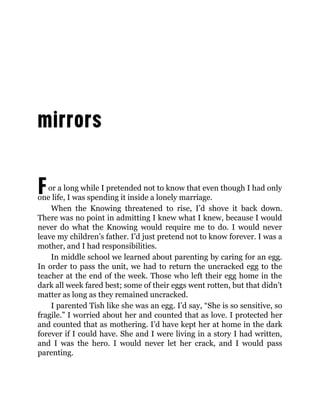
I wanted to be a good girl, so I tried to control myself. I chose a
14.
W
personality, a body,a faith, and a sexuality so tiny I had to hold my
breath to fit myself inside. Then I promptly became very sick.
When I became a good girl, I also became a bulimic. None of us
can hold our breath all the time. Bulimia was where I exhaled. It was
where I refused to comply, indulged my hunger, and expressed my
fury. I became animalistic during my daily binges. Then I’d drape
myself over the toilet and purge because a good girl must stay very
small to fit inside her cages. She must leave no outward evidence of
her hunger. Good girls aren’t hungry, furious, or wild. All of the things
that make a woman human are a good girl’s dirty secret.
Back then, I suspected that my bulimia meant that I was crazy. In
high school, I did a stint in a mental hospital and my suspicion was
confirmed.
I understand myself differently now.
I was just a caged girl made for wide-open skies.
I wasn’t crazy. I was a goddamn cheetah.
hen I saw Abby, I remembered my wild. I wanted her, and it was
the first time I wanted something beyond what I had been trained to
want. I loved her, and it was the first time I loved someone beyond
those I had been expected to love. Creating a life with her was the first
original idea I’d ever had and the first decision I made as a free
woman. After thirty years of contorting myself to fit inside someone
else’s idea of love, I finally had a love that fit—custom made for me, by
me. I’d finally asked myself what I wanted instead of what the world
wanted from me. I felt alive. I’d tasted freedom, and I wanted more.
I looked hard at my faith, my friendships, my work, my sexuality,
my entire life and asked: How much of this was my idea? Do I truly
want any of this, or is this what I was conditioned to want? Which of
my beliefs are of my own creation and which were programmed into
me? How much of who I’ve become is inherent, and how much was
just inherited? How much of the way I look and speak and behave is
just how other people have trained me to look and speak and behave?
15.
How many ofthe things I’ve spent my life chasing are just dirty pink
bunnies? Who was I before I became who the world told me to be?
Over time, I walked away from my cages. I slowly built a new
marriage, a new faith, a new worldview, a new purpose, a new family,
and a new identity by design instead of default. From my imagination
instead of my indoctrination. From my wild instead of from my
training.
What follows are stories about how I got caged—and how I got
free.
16.
Iam ten yearsold, and I’m sitting in a small room in the back of
Nativity Catholic Church with twenty other kids. I am at CCD, where
my parents send me on Wednesday nights to learn about God. Our
CCD teacher is my classmate’s mom. I do not remember her name, but
I do remember that she keeps telling us that she is an accountant
during the day. Her family needed service hours, so she volunteered to
work in the gift shop. Instead, the church assigned her to room 423,
fifth-grade CCD. So now—on Wednesdays between 6:30 and 7:30 P.M.
—she teaches children about God.
She asks us to sit on the carpet in front of her chair, because she is
going to explain to us how God made people. I hurry to get a spot in
front. I am very curious about how and why I was made. I notice that
our teacher does not have a Bible or any other books in her lap. She is
going to speak from memory. I am impressed.
She begins.
“God made Adam and put him in a beautiful garden. Adam was
God’s favorite creation, so He told Adam that his only jobs were to be
happy, rule over the garden, and name the animals. Adam’s life was
almost perfect. Except that he got lonely and stressed. He wanted
some company and help naming the animals. So he told God that he
17.
wanted a companionand a helper. One night, God helped Adam give
birth to Eve. From inside Adam’s body, a woman was born. That is
why she is called woman. Because women came from the womb of
man. Womb—man.”
I am so amazed that I forget to raise my hand.
“Wait. Adam gave birth to Eve? But don’t people come from
women’s bodies? Shouldn’t boys be called woman? Shouldn’t all
people be called woman?”
My teacher says, “Raise your hand, Glennon.”
I raise my hand. She motions for me to put it back down. The boy
sitting to my left rolls his eyes at me.
Our teacher goes on.
“Adam and Eve were happy, and everything stayed perfect for a
while.
“But then God said there was one tree they couldn’t eat from: the
Tree of Knowledge. Even though it was the only thing that Eve wasn’t
allowed to want, she wanted an apple from that tree anyway. So one
day, she got hungry, picked the apple off the tree, and took a bite. Then
she tricked Adam into taking a bite, too. As soon as Adam bit into the
apple, Eve and Adam felt shame for the first time and tried to hide
from God. But God sees everything, so God knew. God banished Adam
and Eve from the garden. Then He cursed them and their future
children, and for the first time, suffering existed on the earth. This is
why we still suffer today, because Eve’s original sin is inside of all of
us. That sin is wanting to know more than we are supposed to know,
wanting more instead of being grateful for what we have, and doing
what we want to do instead of what we should do.”
That was some careful accounting. I had no further questions.
18.
My husband andI began working with a therapist after he admitted
that he had been sleeping with other women. Now we save up our
problems throughout the week and take them to her on Tuesday
evenings. When friends ask me if she’s any good, I say, “I guess so. I
mean, we’re still married.”
Today I’ve asked to see her alone. I’m tired and jittery because I
spent all night silently rehearsing how to tell her what I’m about to tell
her.
I sit quietly in my chair, hands folded in my lap. She sits upright in
the chair across from me. She wears a crisp white pantsuit, sensible
heels, no makeup. A wooden bookshelf crowded with textbooks and
framed degrees climbs the wall behind her like a bean stalk. Her pen is
poised above a leather notebook in her lap, ready to pin me down in
black and white. I remind myself: Speak calmly and confidently,
Glennon, like a grown-up.
“I have something important to tell you. I’ve fallen in love. I am
wildly in love. Her name is Abby.”
My therapist’s mouth falls open, just enough for me to notice it.
She says nothing for an eternal moment. Then she breathes very
19.
deeply and says,“Okay.”
She pauses, starts again. “Glennon, you know that whatever this is
—it’s not real. These feelings are not real. Whatever future you’re
imagining here: That’s not real, either. This is nothing but a dangerous
distraction. It won’t end well. It has to stop.”
I start to say, “You don’t understand. This is different.” But then I
think about all the people who have sat in this chair and insisted: This
is different.
If she won’t let me have Abby, I need to make my case, at least, for
never again having my husband.
“I cannot sleep with him again,” I say. “You know how hard I’ve
tried. Sometimes I think I’ve forgiven. But then he climbs on top of
me, and I hate him again. It’s been years and I don’t want to be
difficult, so I close my eyes and try to float away until it’s over. But
then I accidentally land back inside my body, and what I land in is
white-hot fiery rage. It’s like: I try to go dead inside but there is always
a little life left in me, and that life makes sex unbearable. I can’t be
alive during sex, but I can’t get dead enough, either, so there’s no
solution. I just—I don’t want to do it anymore.”
I am furious that tears come, but they do. I am begging now.
Mercy, please.
Two women. One white suit. Six framed degrees. One open
notebook. One pen, poised.
Then: “Glennon, have you tried just giving him blow jobs instead?
Many women find blow jobs to be less intimate.”
20.
Ihave a sonand two daughters, until they tell me otherwise.
My children believe that the shower is a magical portal of ideas.
My youngest recently said to me, “Mom, it’s like I don’t have any
ideas all day, but when I get in the shower my brain is full of cool stuff.
I think it’s the water or something.”
“Could be the water,” I said. “Or it could be that the shower’s the
only place you’re not plugged in—so you can hear your own thoughts
in there.”
She looked at me and said, “Huh?”
“That thing that happens to you in the shower, babe. It’s called
thinking. It’s something folks did before Google. Thinking is like…it’s
like googling your own brain.”
“Oh,” she said. “Cool.”
That same child steals my expensive shampoo once a week, so the
other day I stomped to the bathroom she shares with her teenage
brother and sister to steal it back. I opened the shower curtain and
noticed the twelve empty bottles littering the tub’s edge. All the bottles
on the right side were red, white, and blue. All the bottles on the left
side were pink and purple.
21.
I picked upa red bottle from what was clearly my son’s side. It was
tall, rectangular, bulky. It yelled at me in bold red, white, and blue
letters:
3X BIGGER,
DOESN’T ROB YOU OF YOUR DIGNITY,
ARMOR UP IN MAN SCENT,
DROP-KICK DIRT, THEN SLAM ODOR WITH A FOLDING CHAIR.
I thought: What the hell? Is my son taking a shower or preparing
for war in here?
I picked up one of the girls’ slim, metallic, pink bottles. Instead of
barking marching orders at me, that bottle, in cursive, flowy font,
whispered disconnected adjectives: alluring, radiant, gentle, pure,
illuminating, enticing, touchable, light, creamy. Not a verb to be
found. Nothing to do here, just a list of things to be.
I looked around for a moment to ensure that the shower was not,
in fact, a magic portal that had somehow transported me back in time.
Nope. There I was, in the twenty-first century, when boys are still
being taught that real men are big, bold, violent, invulnerable,
disgusted by femininity, and responsible for conquering women and
the world. When girls are still being taught that real women must be
quiet, pretty, small, passive, and desirable so they’ll be worthy of being
conquered. Here we all are. Our sons and daughters are still being
shamed out of their full humanity before they even get dressed in the
morning.
Our children are too vast to fit themselves inside these rigid, mass-
produced bottles. But they’ll lose themselves trying.
22.
Several years ago,my daughter Tish’s teacher called and said that
there was a “situation” at school. During a discussion about wildlife,
she’d mentioned to the class that polar bears were losing their homes
and food sources because of the melting ice caps. She showed the
students a photo of a dying polar bear as an example of the many
effects of global warming.
The rest of the kindergarteners thought that this was sad
information but not sad enough to keep them from, you know,
soldiering on to recess. Not Tish. The teacher reported to me that
when the lesson ended and the other kids popped off the carpet to run
outside, Tish remained seated, alone, mouth wide open, stunned into
paralysis, her little shocked face asking:
“WHAT? Did you just say the polar bears are dying? Because the
Earth is melting? The same Earth that we live on? Did you just drop
that little tidbit of terror ON US AT CIRCLE TIME?”
Tish eventually made it outside, but was unable to participate in
recess that day. The other kids tried to get her off the bench to play
four square with them, but she remained close to her teacher, wide-
eyed, asking, “Do the grown-ups know about this? What are they going
to do? Are other animals in trouble, too? Where is that hungry polar
23.
bear’s mom?”
For thenext month, our family’s life revolved around polar bears.
We bought polar bear posters and papered Tish’s wall with them. “To
remember, Mom—I’ve got to remember.” We sponsored four polar
bears online. We talked about polar bears at dinner, at breakfast,
during car pool, and at parties. We discussed polar bears so
incessantly, in fact, that after a few weeks I began to hate polar bears
with every fiber of my being. I began to rue the day that polar bears
were ever born. I tried everything I could think of to yank Tish out of
her polar bear abyss. I coddled her, I snapped at her, and finally I just
lied to her.
I asked a friend to send me an “official” email pretending to be the
“President of Antarctica,” announcing that, once and for all, the ice
caps were fixed and all the polar bears were suddenly A-OK. I opened
that fraudulent email and called to Tish in her room, “Oh my gosh,
baby! Come here! Look what I just got! Good news!” Tish read the
email silently, then turned slowly toward me with a scathing look of
scorn. She knew the email was fake because she is sensitive, not
stupid. The polar bear saga continued, full force.
One night I tucked Tish into bed and was tiptoeing out of her room
with the joy of a mother who is almost to the promised land.
(Everybody’s asleep and I’ve got my couch and carbs and Netflix and
no one is allowed to touch me or talk to me until the sun rises,
hallelujah.) I was closing the door behind me when Tish whispered,
“Wait. Mom?”
Damnit to hell.
“What, honey?”
“It’s the polar bears.”
OH, HELLLL NO.
I walked back to her bed and stared down at her, a little
maniacally. Tish looked up at me and said, “Mommy. I just can’t stop
thinking: It’s the polar bears now. But nobody cares. So next, it’s
gonna be us.”
Then she rolled over, fell asleep, and left me all alone in the dark
24.
room, stunned intoparalysis myself. I stood over her, eyes wide, arms
wrapped around my body. “Oh. My. God. The polllaaarrr bears!! We
have to save the mother freaking polar bears! Next it’s gonna be us.
What is wrong with us??”
Then I looked down at my baby and thought: Ah. You are not
crazy to be heartbroken over the polar bears; the rest of us are crazy
not to be.
Tish couldn’t go to recess because she was paying attention to
what her teacher said. As soon as she heard the polar bear news, she
let herself feel the horror and know the wrongness and imagine the
inevitable outcome. Tish is sensitive, and that is her superpower. The
opposite of sensitive is not brave. It’s not brave to refuse to pay
attention, to refuse to notice, to refuse to feel and know and imagine.
The opposite of sensitive is insensitive, and that’s no badge of honor.
Tish senses. Even as the world tries to speed by her, she is slowly
taking it in. Wait, stop. That thing you said about the polar bears…it
made me feel something and wonder something. Can we stay there
for a moment? I have feelings. I have questions. I’m not ready to run
outside to recess yet.
In most cultures, folks like Tish are identified early, set apart as
shamans, medicine people, poets, and clergy. They are considered
eccentric but critical to the survival of the group because they are able
to hear things others don’t hear and see things others don’t see and
feel things others don’t feel. The culture depends on the sensitivity of a
few, because nothing can be healed if it’s not sensed first.
But our society is so hell-bent on expansion, power, and efficiency
at all costs that the folks like Tish—like me—are inconvenient. We slow
the world down. We’re on the bow of the Titanic, pointing, crying out,
“Iceberg! Iceberg!” while everyone else is below deck, yelling back,
“We just want to keep dancing!” It is easier to call us broken and
dismiss us than to consider that we are responding appropriately to a
broken world.
My little girl is not broken. She is a prophet. I want to be wise
enough to stop with her, ask her what she feels, and listen to what she
knows.
25.
It’s my senioryear of high school, and I still haven’t been nominated
to Homecoming Court.
Homecoming Court is made up of the ten most popular students in
each grade. Those ten will dress up and ride in convertibles in the
homecoming parade, dress up and walk the field at halftime, dress up
and walk the halls wearing their Homecoming Court sashes.
Homecoming is High School Fashion Week, and the rest of us will
watch the members of the Court walk the runways from our places in
the shadows.
Our teachers pass out ballots in English class and instruct us to
vote for the students who should ascend to court. Each year we vote en
masse for the same ten Golden Ones. We all know who they are. It
feels like we were born knowing who they are. The Golden Ones stand
together in a closed circle—like the sun—in the hallways, at football
games, at the mall, and in our minds. We are not supposed to look
directly at them, which is difficult because they have shiny hair and
their bodies are alluring, light, and radiant. None of them is a bully.
Bullying would require paying far too much attention and exerting far
too much effort. They are above and beyond that. Their job is to ignore
the rest of us, and our job is to judge ourselves against the standards
26.
they set. Ourexistence makes them Golden, and their existence makes
us miserable. Yet we vote for them year after year, because the rules
control us even at the privacy of our own desks. Vote for the Golden
Ones. They have followed directions perfectly, they are what we are
all supposed to be, so they should win. Fair is fair.
I am not Golden, but the Golden Ones’ light reflects on me just
often enough that I am tinged. They invite me to their parties
occasionally and I go, but when I get there they don’t talk to me much.
I assume I’m there because they need some ungold around in order to
feel their goldenness. Goldenness requires contrast. So when they
stand in circles at football games, they let me join their circle, but they
don’t talk to me there, either. I feel terribly uncomfortable, left out,
and ridiculous in those circles. I remind myself that what is really
happening in the circle doesn’t matter. What matters is what people
outside the circle perceive to be happening there. What matters is not
what is real, but what I can convince others is real. What matters is not
how I feel inside, but how I appear to feel on the outside. How I
appear to feel will determine how others feel about me. What matters
is how others feel about me. So I act like someone who feels Golden.
By mid-September, the buzz of homecoming preparations has
reached fever pitch. We’ve just cast our ballots, and the winners will be
announced in sixth period. I’m in student government class, and our
job is to count the votes. My friend Lisa is pulling ballots out of a box
one at a time and reading the names aloud while I tally the votes. She
calls out the same names again and again: Tina. Kelly. Jessa. Tina.
Kelly Jessa Susan. Jessa. Susan Tina Tina Tina. And then Glennon. A
couple more…Glennon. Glennon. Lisa looks at me, raises her
eyebrows, and smiles. I roll my eyes and look away, but my heart
pounds in my chest. Holy shit. They think I’m Golden. I can see that
the ballot box is almost empty, but the votes are close and I could
make it. I could make it. I need just two more votes. I look over at Lisa,
and her eyes are diverted. With my pencil I make two more marks next
to my name. Tick. Tick. Lisa and I count the votes. I have been
nominated for Homecoming Court.
I am now a girl who, even when she’s forty-four years old, can roll
27.
F
her eyes andmention, offhandedly, well, I was on the Homecoming
Court. Others will roll their eyes, too (high school!), but they will also
register: Ah. You were Golden. Golden is decided early, and it sticks,
somehow, even when we are grown and know so much better, so much
more. Once Golden, always Golden.
or more than a decade I have written and spoken openly about
addiction, sex, infidelity, and depression. Shamelessness is my
spiritual practice. Yet I have never admitted to committing high school
voter fraud to anyone but my wife. When I told her that I’d finally
written this story, she winced and asked, “Are you sure, babe? Are you
sure you should tell that one?”
I think what makes this story unforgivable is the desperation. It’s
the wanting—the caring so much. If one cannot be Golden, then one
must pretend that one does not want to be. It’s so uncool, so terribly
uncool, to want to belong so badly that you’re willing to cheat for it.
But I did.
I rigged an election trying to be Golden. I spent sixteen years with
my head in a toilet trying to be light. I drank myself numb for a
decade, trying to be pleasant. I’ve giggled at and slept with assholes,
trying to be touchable. I’ve held my tongue so hard I tasted blood,
trying to be gentle. I’ve spent thousands on potions and poisons, trying
to be youthful. I have denied myself for decades, trying to be pure.
28.
Several months afterI found out my husband had repeatedly been
unfaithful, I still didn’t know whether I’d stay or go. I didn’t even know
if the new throw pillow on my couch would stay or go. I was a terribly
indecisive woman. When I told the counselor at my kids’ school how
uncertain I felt, she said, “It’s not hard decisions that mess up kids, it’s
indecision. Your kids need to know which way this is going to go.”
I said, “Well, they can’t know until I know.”
She said, “You need to figure out how to know.”
Back then, the only way I knew how to know was to poll and
research. I began polling. I called each of my friends, hoping that they
would know what I should do. Next I began my research. I read every
article I could find about infidelity, divorce, and children, hoping the
experts would know what I should do. My polling and research results
were maddeningly inconclusive.
Finally, I turned to the World Wide Web to see if an invisible
conglomeration of strangers, trolls, and bots knew what I should do
with my one wild and precious life. That is how I found myself in bed
at 3:00 A.M., shoveling Ben & Jerry’s into my mouth, typing into my
Google search bar:
29.
What should Ido if my husband is a cheater but also an amazing dad?
30.
My seventeen-year-old son,Chase, and his friends are in the family
room watching a movie. I’ve been trying to leave them alone, but it’s
hard for me. I understand that most teenagers think their moms are
uncool, but I am certain I’m the exception.
I stand at the door and peek inside. The boys are draped all over
the couch. The girls have arranged themselves in tiny, tidy roly-poly
piles on the floor. My young daughters are perched at the feet of the
older girls, quietly worshipping.
My son looks over at me and half smiles. “Hi, Mom.”
I need an excuse to be there, so I ask, “Anybody hungry?”
What comes next seems to unfold in slow motion.
Every single boy keeps his eyes on the TV and says, “YES!”
The girls are silent at first. Then each girl diverts her eyes from the
television screen and scans the faces of the other girls. Each looks to a
friend’s face to discover if she herself is hungry. Some kind of
telepathy is happening among them. They are polling. They are
researching. They are gathering consensus, permission, or denial.
Somehow the collective silently appoints a French-braided,
freckle-nosed spokesgirl.
31.
She looks awayfrom the faces of her friends and over at me. She
smiles politely and says, “We’re fine, thank you.”
The boys looked inside themselves. The girls looked outside
themselves.
We forgot how to know when we learned how to please.
This is why we live hungry.
32.
My friend Ashleytook her first hot yoga class recently. She walked
into the room, unrolled her mat, sat down, and waited for something
to happen.
“It was exceptionally hot in there,” she told me.
When the instructor—young and confident—finally walked into the
room, Ashley was already dripping with sweat. The instructor
announced, “We’ll start soon. You are going to get very hot, but you
can’t leave this room. No matter how you begin to feel, stay strong.
Don’t leave. This is the work.”
The class got started, and a few minutes in, the walls began to
close in on Ashley. She felt light-headed and sick. Each breath became
harder and harder to come by. Twice her vision became spotty, then
briefly went black. She looked at the door and felt desperate to run
toward it. She spent ninety minutes terrified, close to hyperventilating,
holding back tears. But she did not leave that room.
The moment the instructor ended the class and opened the door,
Ashley jumped off her mat and ran into the hallway. She kept her hand
over her mouth until she found the bathroom. She threw the door
open and vomited all over the sink, the wall, the floor.
33.
While she wason her hands and knees wiping up her own puke
with paper towels, she thought: What is wrong with me? Why did I
stay and suffer? The door wasn’t even locked.
34.
W
M
hen I wasa little girl, my godmother gave me a snow globe as a
birthday gift. It was small and round, like a palm-sized crystal ball. In
its center stood a red dragon with sparkly scales, bright green eyes,
and fiery wings. When I first took it home, I put it on the nightstand
beside my bed. Then I’d lie awake at night, wide-eyed, feeling afraid
that the dragon existed so close to me in the dark. So one night I
climbed out of bed and moved the snow globe to the highest shelf in
my room.
Every once in a while, only in the light of day, I’d pull my desk
chair over, climb up, and pull the snow globe off the shelf. I’d shake it,
get still, and watch the snowflakes swirl. As they began to settle, the
fiery red dragon in the center of the globe would emerge, and I’d feel a
chilly thrill. That dragon was magical and scary, always there,
unmoving, just waiting.
y friend Megan is five years sober now after a decade of alcohol
and drug abuse. Lately, she’s been trying to figure out what happened
to her—how addiction had taken over the life of such a strong woman.
35.
W
O
On Megan’s weddingday, she sat in the back of the chapel
knowing she didn’t want to marry the man waiting for her at the end of
the aisle. She knew it from her roots.
She married him anyway, because she was thirty-five years old and
getting married was what she was supposed to do. She married him
anyway, because there were so many people she would have
disappointed if she had called it off. There was only one of her, so she
disappointed herself instead. She said “I do” while her insides said “I
don’t,” and then she spent the next decade trying not to know what she
knew: that she had betrayed herself and that her life would not really
begin until she stopped betraying herself. The only way not to know
was to get wasted and stay that way, so she started drinking heavily
during her honeymoon. The drunker she became, the more distance
she felt from the dragon inside her. After a while, the booze and drugs
became her problem, which was convenient because she didn’t have to
deal with her real problem anymore.
e’re like snow globes: We spend all of our time, energy, words,
and money creating a flurry, trying not to know, making sure that the
snow doesn’t settle so we never have to face the fiery truth inside us—
solid and unmoving.
The relationship is over. The wine is winning. The pills aren’t for
back pain anymore. He’s never coming back. That book won’t write
itself. The move is the only way. Quitting this job will save my life. It
is abuse. You never grieved him. It’s been six months since we made
love. Spending a lifetime hating her is no life at all.
We keep ourselves shaken up because there are dragons in our
center.
ne night, back when my children were babies, I was reading a book
of poetry in the bathtub. I came across a poem called “A Secret Life”
about deep secrets and how we all have them. I thought: Well, I
haven’t had one since I got sober. I don’t keep secrets anymore. That
felt good. But then I read:
36.
It becomes whatyou’d most protect
if the government said you can protect
one thing, all else is ours….
it’s what
radiates and what can hurt
if you get too close to it.
I stopped reading and thought: Oh, wait.
There’s one thing.
One thing I haven’t even told my sister.
My secret that radiates is that I find women infinitely more
compelling and attractive than men. My secret is my suspicion that I
was made to make love to a woman and cuddle with a woman and rely
on a woman and live and die with a woman.
Then I thought: So odd. That cannot be real. You’ve got a husband
and three children. Your life is more than good enough.
As I climbed out of the tub and shook my hair dry, I told myself:
Maybe in a different life.
Isn’t that interesting?
As if I had more than one.
37.
Isit in acold plastic seat near the airport gate, stare at my suitcase,
sip airport coffee. It’s bitter and weak. I look at the plane through the
gate window. How many of those will I board in the coming year? A
hundred? I’m bitter and weak, too.
If I board, this plane will take me to Chicago O’Hare, where I’ll
search for a driver holding a sign with my (husband’s) last name on it.
I’ll raise my hand and watch the driver’s face register surprise that I
am a small woman in sweatpants instead of a large man in a suit. The
driver will deliver me to the Palmer Hotel—where a national book
conference is being held. There I’ll stand on a stage in a grand
ballroom and speak to a few hundred librarians about my soon-to-be-
released memoir, Love Warrior.
Love Warrior—the story of the dramatic destruction and
painstaking reconstruction of my family—is expected to be one of the
biggest books of the year. I will be promoting it on stages and in the
media for, well, forever.
I am trying to find my feelings about this. Fear? Excitement?
Shame? I can’t isolate anything specific. I stare at the plane,
wondering how to explain my life’s most intimate, complicated
experience to a sea of strangers within my seven allotted minutes. I
38.
have written abook, and now I must become a commercial for the
book I have written. What is the point of being a writer if I have to say
words about the words I’ve already written? Do painters have to draw
about their paintings?
I’d been at this airport gate starting line before. Three years before,
I’d released my first book and traveled the country telling the story of
how I’d finally found happily-ever-after by trading my lifelong food
and booze addictions for a son, a husband, and writing. I’d stood on
stages all over the country and repeated the book’s message to hopeful
women: Carry on. Life is hard, but you are a warrior. One day it will
all come together for you, too.
Right after that first book’s ink dried, I sat in a therapist’s office
and listened to my husband say that he’d been sleeping around since
our wedding.
I held my breath as he said, “There have been other women,” and
when I inhaled again, the air was made of smelling salts. He kept
apologizing while looking down at his hands, and the impotent
stammering made me laugh out loud. My laughter made both men—
my husband and his therapist—visibly uncomfortable. Their
discomfort made me feel powerful. I looked at the door and willed
adrenaline to carry me out of that building, across the parking lot, and
into my minivan.
I sat in the driver’s seat for a while and realized that the revelation
of my husband’s betrayal did not leave me feeling the despair of a wife
with a broken heart. I was feeling the rage of a writer with a broken
plot. Hell hath no fury like a memoirist whose husband just fucked up
her story.
I was furious with him and disgusted with myself. I’d let down my
guard and trusted that the other characters in my story would act as
they should and that my plot would unfold as I’d mapped it. I’d
rendered my own future and my children vulnerable by ceding creative
control to another character. What an idiot. Never again. I would take
back full control, starting now. This was my story and my family, and I
would decide how it ended. I’d take this shit I’d been handed, and I’d
spin it into gold.
39.
I took controlback with words, sentences, chapters, and scripts. I
started with the story’s resolution in mind—a healed, whole family—
and worked backward from there. There would be rage, pain, therapy,
self-discovery, forgiveness, reluctant trust, then eventually: fresh
intimacy and redemption. I do not know if I lived the next few years
and then wrote about what happened or if I wrote the next few years
and then made it all happen. It didn’t matter. What mattered was that
at the end of that blur of time I had myself a dark love story—a drama
of betrayal and forgiveness, pain and redemption, brokenness and
healing. In book form and family form. Checkmate, Life.
In Ann Patchett’s Truth & Beauty, a reader approaches Lucy at her
book-signing table and asks of her memoir, “How do you remember all
of that?”
“I don’t remember it,” she says. “I write it.”
When Love Warrior was complete, I handed the manuscript to
Craig and said, “Here. Here is what it all meant. I made it all mean
something. We won the war. Our family made it. We are a love story
after all. You are welcome.”
Now the war has ended, and I want to go home. But home is still a
foxhole with me and Craig left staring at each other, wondering: What
now? What did we win?
I call my sister and ask if I can cancel the book launch event in
Chicago. I want her to tell me that this will be fine, no big deal. She
says, “We can cancel, but it will be a big deal. You committed to this.”
So I do this thing I do. From the outside I imagine it looks like a
straightening, a stiffening. From the inside it feels like turning my
liquid self to a solid. Water to ice. Glennon has left the building. I’ve
got this. I board the plane to go tell a story I’m not sure I believe.
It will be okay. I’ll just tell it like a story instead of a life. As if I am
past the end instead of stuck in the middle. I’ll tell the truth, but I’ll tell
it with a slant: I’ll blame myself just enough; present him in the most
sympathetic light; attach my bulimia to my frigidity and my frigidity to
his infidelity. I’ll tell how the cheating led to my self-reflection, how
self-reflection led to forgiveness and pain led to redemption. I’ll tell it
40.
so that peoplewill decide: Of course. It was leading to this ending all
along. I see. It all had to happen exactly that way. That is what I will
decide, too.
The moral arc of our life bends toward meaning—especially if we
bend it that way with all our damn might.
I arrive in Chicago and meet my book publicist at the Palmer
House hotel, where the event is being held. This weekend is the
literary Super Bowl, and she’s buzzing. We are on our way to a dinner
where ten authors will get to know one another before we head into
the ballroom and pitch our upcoming books from the stage. This
dinner, which I have just learned about a few hours before, has
heightened my introvert terror alert level from yellow to red.
The room where the authors are to have dinner is small, with two
long conference tables pushed together to form a square. Instead of
sitting, people are milling. Milling with people I do not know is my
idea of hell on Earth. I do not mill. I walk over to the drink table and
pour an ice water. A famous writer walks over and introduces herself.
She asks, “Are you Glennon? I’ve been wanting to talk to you. You’re
the Christian one, right?”
Yes, I’m the one.
“My new book is about a woman who has a religious experience
and becomes a Christian. Do you believe it? A Christian! It feels so real
to her! I don’t know how my readers will react: Will people be able to
take her seriously? What do you think? Do you feel like people take
you seriously?”
I say the most serious thing I can think of and then excuse myself.
I look at the table. No assigned seats, damnit. George Saunders sits
quietly at the end of the table. He seems gentle and kind and I’d like to
sit next to him, but he is a man and I don’t know how to talk to men.
At the end of the table is a young woman with calm energy. I sit down
next to her. She is a twentysomething releasing her first children’s
book. I ask her question after question while considering how
wonderful it would be if the organizers would just place our books on
the table, so we could get to know each other by reading silently. We
41.
butter our rolls.Salads are served. As I’m reaching for dressing, the
children’s book lady looks over at the door. I look over, too.
Suddenly, a woman is standing where nothingness used to be. She
takes up the entire doorway, the entire room, the entire universe. She
has short hair, platinum on top, shaved on the sides. She is wearing a
long trench coat, a red scarf, a warm half smile, cool steel confidence.
She stands still there for a moment, taking inventory of the room. I
stare at her and take inventory of my entire life.
My whole being says:
There She Is.
Then, I lose control of my body. I stand up and open my arms
wide.
She looks over, cocks her head to the side, raises her eyebrows,
smiles at me.
Fuck Fuck Fuck Why am I standing? Why are my arms open? Oh
my God, What Am I Doing?
I sit back down.
She walks around the table and shakes hands with everyone. When
she gets to me, I stand up again, turn around, face her. “I’m Abby,” she
says.
I ask if I can hug her, because what if this is my only chance? She
smiles and opens her arms. Then—the smell that will become home to
me—skin like powder and fabric softener blended with the wool of her
coat and her cologne and something that smelled like air, like
outdoors, like crisp sky, like a baby and a woman and a man and the
whole world.
The only seat left is at the far end of the table, so she walks away
from me and sits down. She’ll later tell me that she didn’t eat or speak
because all of her energy was spent trying not to stare. Mine, too.
Dinner ends, and there is more milling. Oh my God, more milling
and now with a revolution in the room. I excuse myself to go to the
bathroom and kill two milling minutes. When I walk out, she is
standing in the hallway, watching the bathroom door, waiting. She
motions to me to come over. I look behind me to make sure it’s me
42.
she’s talking to.She laughs. She laughs.
Then it’s time to walk to the ballroom. We separate ourselves from
the pack somehow. There are people three feet in front of us and
behind us, but here we are, walking alone, together. I want so badly to
be interesting. But she is so cool, and I don’t know how to be cool. I’ve
not been cool a day in my life. I am warm—burning up—sweating
through my shirt already.
She starts talking, thank God. She tells me about the book she’s
about to release. She says, “But things are hard right now. You’ve
probably heard.”
“Heard what? I have not heard. What would I have heard, and
where would I have heard it?”
She says, “The news, maybe? ESPN?”
“Um, no, I have not heard the news on ESPN,” I say.
She speaks, slowly at first, then all at once.
“I’m a soccer player. Was a soccer player. I just retired, and I’m
not sure what I am now. I got a DUI last month. It was all over the
news. I watched my mug shot scroll across the ticker for days. I can’t
believe I did it. I’ve been really lost and depressed the last couple of
years, and I just…I screwed up. I’ve always been about honor, and I
ruined my whole legacy. I let everybody down. I hurt the whole team,
maybe. And now they want me to write my book as some kind of hero
athlete puff piece, but I keep thinking: What if I’m just honest? What if
I write the truth about my life?”
I am sad for her, but I am thrilled for me. In our four minutes
together she has asked me about the three subjects I know best:
drinking, writing, and shame. This is my jam. I’ve got this. Hot damn.
I put my hand on her arm. Electrical currents. I pull back and
recover enough to say, “Listen, I have a rap sheet as long as your arm.
I’d write it all. I’d be honest. I don’t know much about the sports
world, but I do know that out here in the real world, we like real
people.”
She stops walking, so I do, too. She turns and looks directly at me.
It appears that she’s about to say something. I hold my breath. Then
43.
she turns andkeeps walking. I start breathing and walking, too. We
enter the ballroom and follow the other authors through a sea of round
tables, white tablecloths, thirty-foot ceilings, crystal chandeliers. We
end up at the dais, climb the stairs, and see that we’ve been seated next
to each other. We walk toward our places, and when we arrive, she
puts her hand on the back of my chair. She cannot decide whether to
pull it out for me. She does. “Thank you,” I say.
We sit down, and the writer seated next to Abby asks where she’s
from.
“We live in Portland,” Abby answers.
The writer says, “Oh, I love Portland.”
Abby says, “Yeah.”
Something about the way she says “Yeah” makes me listen very,
very hard.
“I don’t know how much longer I’ll be there. We moved there
because we thought it would be a good place to raise a family.”
I can tell, just by the way she says this, that there is no we left. I
want to save her from follow-up questions, so I say, “Oh, people like us
can’t live in Portland. We’re Portland on the inside. We need sunshine
on the outside.”
I am immediately embarrassed by what I’ve just said. Portland on
the inside? What the hell do those words even mean? People like us?
Why did I say us? Us? How terribly presumptuous to suggest the
concept of us. Us.
Us. Us. Us.
She looks at me, her eyes widen, and she smiles. I change my
mind. I don’t know what I meant, but I’m glad I said it. I decide that
heaven is saying anything that makes this woman smile like that.
The event begins. When it is my turn to walk to the podium and
speak, I disregard half of my planned speech and say things about
shame and freedom that I want Abby to hear. I look at the hundreds of
people in front of me and think only of her behind me. When I finish, I
sit down and Abby looks at me. Her eyes are red.
The dinner ends, and people begin to approach our table. A line
44.
forms in frontof Abby fifty people deep. She turns and asks me to sign
a copy of my book for her. I do. Then she turns back toward the crowd
and starts smiling, signing, making small talk. She is comfortable,
confident, gracious. She is used to this.
A curly-haired woman who had walked into dinner behind Abby
approaches our table. I can tell she is waiting to talk to me. I smile and
motion her over. She leans in to me, as close as possible, and whispers,
“I’m sorry. I’ve never done anything like this before. I just, I know
Abby really well, like a sister. I don’t know what happened here in the
last hour, but I’ve never seen her like this. I just, I really feel like she
needs you in her life. Somehow. This is so weird. I’m sorry.” This
woman is flustered, and she has tears in her eyes. She hands me her
business card. I understand that my answer will be important to her.
I say, “Okay. Yes. Yes, of course.”
My friend Dynna from my publishing house is waiting so that we
can walk out together. I look over at Abby, still forty fans left to sign
for.
I am not sad to leave Abby. I am excited to leave her so I can think
about her. I am excited to leave because I realize I have never in my
life felt this alive, and now I just want to go out into the world and
walk around feeling this alive. I just want to start being this new
person I have just suddenly, somehow become.
I say, “Bye Abby.” Oh my God, I’ve said her name. Abby. I wonder
if it’s okay or if I should have asked permission to use this word that
sends shock waves rippling through me. She turns toward me, smiles,
waves. She looks expectant. Her face is asking a question that one day
I’ll answer.
Dynna and I walk out of the ballroom and into a grand hallway.
She stops me and asks, “How do you think it went?”
I say, “It was amazing.”
Dynna says, “I agree. You were on fire up there. Different
somehow.”
“Oh, you meant the speech. I was talking about the whole night. I
felt the oddest thing. I felt like Abby and I had some kind of
45.
connection.”
Dynna grabbed myarm and said, “I cannot believe you just said
that. I can’t believe this. I swear to God, I felt it, too. I felt something
happening between you from all the way in the back of the ballroom.
This is so wild.”
I stared at her and said, “It was. It is. This whole night…the
connection between us…it was just like…”
Dynna looked hard at me and then said, “Like you two would have
been together in another life?”
47.
DROPPING KEYS
The smallwoman
Builds cages for everyone
She
Knows.
While the sage,
Who has to duck her head
When the moon is low,
Keeps dropping keys all night long
For the
Beautiful
Rowdy
Prisoners.
—HAFIZ
48.
Iwas never completelygone. My spark was always inside me,
smoldering. But I sure as hell felt gone for a long while. My childhood
bulimia morphed into alcoholism and drug use, and I stayed numb for
sixteen years. Then, when I was twenty-six I got pregnant and sober.
Sobriety was the field in which I began to remember my wild.
It went like this: I began building the kind of life a woman is
supposed to build. I became a good wife, mother, daughter, Christian,
citizen, writer, woman. But while I made school lunches, wrote
memoirs, rushed through airports, made small talk with neighbors,
carried on with my outer life, I felt an electric restlessness buzzing
inside me. It was like constant thunder rolling right there beneath my
skin—a thunder made of joy and pain and rage and longing and love
too deep, scalding, and tender for this world. It felt like hot water
simmering, always threatening to boil.
I was afraid of what was inside me. It felt powerful enough to
destroy every bit of the lovely life I’d built. Like how I never feel safe
on a balcony because: What if I jump?
It’s okay, I told myself. I’ll keep myself and my people safe by
keeping my insides hidden.
I was amazed at how easy this was. I was filled with electric
thunder, simmering water, fiery red and gold, but all I had to do was
smile and nod and the world would take me for easy breezy blue.
Sometimes I wondered if I wasn’t the only one using her skin to
contain herself. Maybe we are all fire wrapped in skin, trying to look
49.
cool.
My boiling pointwas the moment Abby stepped through that
doorway. I looked at her, and I could no longer contain myself. I lost
control. Fire-red and golden rolling bubbles of pain and love and
longing filled me, brought me to my feet, threw my arms open wide,
insisting: There. She. Is.
For a long while I thought that what happened that day was some
kind of fairy-tale magic. I thought the words There She Is came to me
from on high. Now I know that There She Is came from within. That
wild rowdiness that had simmered for so long and then turned itself
into words and lifted me was me. The voice I finally heard that day was
my own—the girl I’d locked away at ten years old, the girl I was before
the world told me who to be—and she said: Here I Am. I’m taking over
now.
When I was a child, I felt what I needed to feel and I followed my
gut and I planned only from my imagination. I was wild until I was
tamed by shame. Until I started hiding and numbing my feelings for
fear of being too much. Until I started deferring to others’ advice
instead of trusting my own intuition. Until I became convinced that
my imagination was ridiculous and my desires were selfish. Until I
surrendered myself to the cages of others’ expectations, cultural
mandates, and institutional allegiances. Until I buried who I was in
order to become what I should be. I lost myself when I learned how to
please.
Sobriety was my painstaking resurrection. It was my return to
wild. It was one long remembering. It was realizing that the hot
electric thunder I felt buzzing and rolling inside was me—trying to get
my attention, begging me to remember, insisting: I’m still in here.
So I finally unlocked and unleashed her. I set free my beautiful,
rowdy, true wild self. I was right about her power. It was too big for
the life I was living, so I systematically dismantled every piece of it.
Then I built a life of my own.
I did it by resurrecting the very parts of myself I was trained to
mistrust, hide, and abandon in order to keep others comfortable:
50.
My emotions
My intuition
Myimagination
My courage
Those are the keys to freedom.
Those are who we are.
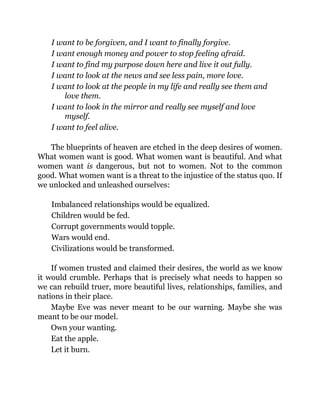
Will we be brave enough to unlock ourselves?
Will we be brave enough to set ourselves free?
Will we finally step out of our cages and say to ourselves, to our
people, and to the world: Here I Am.
52.
O
Key One: FeelIt All
n my sixth day of sobriety, I went to my fifth recovery meeting. I
sat in a cold plastic seat, trembling, trying to keep the coffee from
spilling out of my paper cup and my feelings from spilling out of my
skin. For sixteen years I had made damn sure that nothing touched
me, and suddenly everything in the world was touching me. I was an
exposed nerve. Everything hurt.
I was embarrassed to tell anyone how much I hurt, but I decided to
try to explain it to the people in that circle. They were the first people I
trusted with all of me, because they were the first people I ever heard
tell the whole truth. They had shown me their insides so I showed
them mine. I said something like “I’m Glennon, and I’ve been sober for
six days. I feel awful. I think this awfulness is why I started drinking in
the first place. I’m starting to worry that what was wrong with me
wasn’t the booze; it was underneath it. It was me. It doesn’t seem like
being alive is as hard for other people as it is for me. It just feels like
there’s some kind of secret to life I don’t know. Like I’m doing it all
wrong. Thanks for listening.”
After the meeting ended, a woman walked over and sat down next
to me. She said, “Thanks for sharing. I relate. I just wanted to tell you
something that somebody told me in the beginning. It’s okay to feel all
of the stuff you’re feeling. You’re just becoming human again. You’re
not doing life wrong; you’re doing it right. If there’s any secret you’re
missing, it’s that doing it right is just really hard. Feeling all your
feelings is hard, but that’s what they’re for. Feelings are for feeling. All
of them. Even the hard ones. The secret is that you’re doing it right,
and that doing it right hurts sometimes.”
I did not know, before that woman told me, that all feelings were
for feeling. I did not know that I was supposed to feel everything. I
thought I was supposed to feel happy. I thought that happy was for
feeling and that pain was for fixing and numbing and deflecting and
53.
hiding and ignoring.I thought that when life got hard, it was because I
had gone wrong somewhere. I thought that pain was weakness and
that I was supposed to suck it up. But the thing was that the more I
sucked it up, the more food and booze I had to suck down.
That day, I began returning to myself—fearful and trembling,
pregnant and six days sober, in a church basement with shitty
fluorescent lights and terrible coffee—when a kind woman revealed to
me that being fully human is not about feeling happy, it’s about feeling
everything. From that day forward, I began to practice feeling it all. I
began to insist upon my right and responsibility to feel it all, even
when taking the time and energy for feeling made me a little less
efficient, a little less convenient, a little less pleasant.
In the past eighteen years, I have learned two things about pain.
First: I can feel everything and survive.
What I thought would kill me, didn’t. Every time I said to myself: I
can’t take this anymore—I was wrong. The truth was that I could and
did take it all—and I kept surviving. Surviving again and again made
me less afraid of myself, of other people, of life. I learned that I’d never
be free from pain but I could be free from the fear of pain, and that
was enough. I finally stopped avoiding fires long enough to let myself
burn, and what I learned was that I am like that burning bush: The fire
of pain won’t consume me. I can burn and burn and live. I can live on
fire. I am fireproof.
Second: I can use pain to become.
I am here to keep becoming truer, more beautiful versions of
myself again and again forever. To be alive is to be in a perpetual state
of revolution. Whether I like it or not, pain is the fuel of revolution.
Everything I need to become the woman I’m meant to be next is inside
my feelings of now. Life is alchemy, and emotions are the fire that
turns me to gold. I will continue to become only if I resist
extinguishing myself a million times a day. If I can sit in the fire of my
own feelings, I will keep becoming.
Consumer culture promises us that we can buy our way out of pain
—that the reason we’re sad and angry is not that being human hurts;
54.
it’s because wedon’t have those countertops, her thighs, these jeans.
This is a clever way to run an economy, but it is no way to run a life.
Consuming keeps us distracted, busy, and numb. Numbness keeps us
from becoming.
This is why every great spiritual teacher tells us the same story
about humanity and pain: Don’t avoid it. You need it to evolve, to
become. And you are here to become.
Like Buddha, who had to leave his life of comfort to experience all
kinds of human suffering before finding enlightenment.
Like Moses, who wandered forty years in the desert before seeing
the promised land.
Like Westley from The Princess Bride, who said, “Life is pain,
Highness. Anyone who says differently is selling something.”
Like Jesus, who walked straight toward his own crucifixion.
First the pain, then the waiting, then the rising. All of our suffering
comes when we try to get to our resurrection without allowing
ourselves to be crucified first.
There is no glory except straight through your story.
Pain is not tragic. Pain is magic. Suffering is tragic. Suffering is
what happens when we avoid pain and consequently miss our
becoming. That is what I can and must avoid: missing my own
evolution because I am too afraid to surrender to the process. Having
such little faith in myself that I numb or hide or consume my way out
of my fiery feelings again and again. So my goal is to stop abandoning
myself—and stay. To trust that I’m strong enough to handle the pain
that is necessary to the process of becoming. Because what scares me a
hell of a lot more than pain is living my entire life and missing my
becoming. What scares me more than feeling it all is missing it all.
These days, when pain comes, there are two of me.
There is the me that is miserable and afraid, and there is the me
that is curious and excited. That second me is not a masochist, she’s
wise. She remembers. She remembers that even though I can’t know
what will come next in my life, I always know what comes next in the
process. I know that when the pain and the waiting are here, the rising
55.
is on itsway. I hope the pain will pass soon, but I’ll wait it out because
I’ve tested pain enough to trust it. And because who I will become
tomorrow is so unforeseeable and specific that I’ll need every bit of
today’s lessons to become her.
I keep a note stuck to my bathroom mirror:
Feel It All.
It reminds me that although I began to come back to life eighteen
years ago, I resurrect myself every day, in every moment that I allow
myself to feel and become. It’s my daily reminder to let myself burn to
ashes and rise, new.
57.
S
Key Two: BeStill and Know
everal years ago, very early one morning, I found myself unable to
sleep again. It was 3:00 A.M., and I was wild-eyed, shaky, flailing,
grasping for answers like a drowning woman desperate for air. I had
just typed these words into my Google search window:
What should I do if my husband is a cheater but also an amazing dad?
I stared at that question and thought: Well. I have hit some sort of
new rock bottom. I’ve just asked the internet to make the most
important and personal decision of my life. Why do I trust everyone
else on Earth more than I trust myself? WHERE THE HELL IS MY
SELF? When did I lose touch with her?
I clicked on article after article anyway. Distressingly, everyone
thought I should do something different. The religious experts insisted
that a good Christian would stay. Feminists argued that a strong
woman would leave. Parenting articles preached that a good mother
thinks only of what is best for her children. All of those differing
opinions meant that I quite literally could not please everyone. That
was a relief. When a woman finally learns that pleasing the world is
impossible, she becomes free to learn how to please herself.
I looked at all of those contradictory opinions and thought: If there
is, in fact, an objective right or wrong way to handle this, why do all
of these people have such different ideas about what a person should
do? I had an epiphany: It must be that should and shouldn’t, right and
wrong, good and bad—they’re not wild. They’re not real. They’re just
culturally constructed, artificial, ever-changing cages created to
maintain institutions. It struck me that in every family, culture, or
religion, ideas of right and wrong are the hot cattle prods, the barking
sheepdogs that keep the masses in the herd. They are the bars that
keep us caged.
58.
I decided thatif I kept doing the “right” thing, I would spend my
life following someone else’s directions instead of my own. I didn’t
want to live my life without living my life. I wanted to make my own
decision as a free woman, from my soul, not my training. But the
problem was, I didn’t know how.
A few weeks later, I opened a card from a friend that said, in bold,
capital, thick black lettering:
BE STILL AND KNOW.
I’d read that verse many times before, but it struck me freshly this
time. It didn’t say “Poll your friends and know” or “Read books by
experts and know” or “Scour the internet and know.” It suggested a
different approach to knowing: Just. Stop.
StopMovingStopTalkingStopSearchingStopPanickingStopFlailing.
If you just stop doing, you’ll start knowing.
This seemed like magical nonsense, but desperate women take
desperate measures. I decided to experiment. After the kids left for
school, I shut myself in my closet, sat down on a towel, closed my eyes,
and did nothing but breathe. At first, each ten-minute session felt ten
hours long. I checked my phone every few moments, planned my
grocery lists, and mentally redecorated my living room. The only
things I seemed to “know” on that floor were that I was hungry and
itchy and suddenly desperate to fold laundry and reorganize my
pantry. I was an input junkie thrown into detox. I was tempted to quit
every second, but I was stern with myself: Ten minutes a day is not
too long to spend finding yourself, Glennon. For God’s sake, you
spend eighty minutes a day finding your keys.
After a few weeks, like a gymnast who is able to stretch deeper
after each training, I began to feel myself dropping lower during each
closet session. Eventually I sank deep enough to find a new level inside
me that I’d never known existed. This place is underneath; low, deep,
quiet, still. There are no voices there, not even my own. All I can hear
down there is my breath. It was as though I’d been drowning and in
my panic I had been gasping for air, calling for rescue, and flailing on
59.
the surface. Butwhat I really needed to do to save myself was let
myself sink. It struck me that this is why we say to people, “Calm
down.” Because beneath the noise of the pounding, swirling surf is a
place where all is quiet and clear.
Since the chaos stills in this deep, I could sense something there I
was not able to sense on the surface. It was like that silent chamber in
Denmark—one of the quietest places in the world—where people can
actually hear and feel their own blood circulating. There, in the deep, I
could sense something circulating inside me. It was a Knowing.
I can know things down at this level that I can’t on the chaotic
surface. Down here, when I pose a question about my life—in words or
abstract images—I sense a nudge. The nudge guides me toward the
next precise thing, and then, when I silently acknowledge the nudge—
it fills me. The Knowing feels like warm liquid gold filling my veins and
solidifying just enough to make me feel steady, certain.
What I learned (even though I am afraid to say it) is that God lives
in this deepness inside me. When I recognize God’s presence and
guidance, God celebrates by flooding me with warm liquid gold.
Every day, I returned to the closet, sat down on the floor littered
with T-shirts and jeans, and I practiced sinking. The Knowing would
meet me in the deep and nudge me toward the next right thing, one
thing at a time. That was how I began to know what to do next. That
was how I began to walk through my life more clearly, solid and
steady.
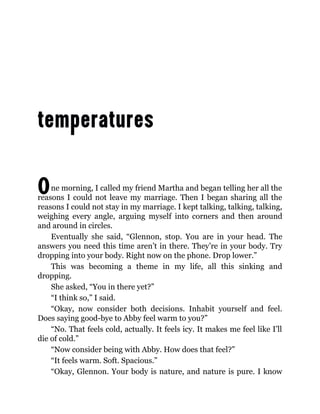
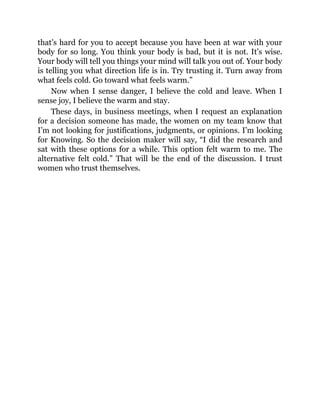
A year later, I found myself in the middle of a work meeting,
sitting at a long conference table. We were discussing an important
decision that had to be made, and the team was looking to me for
leadership. I felt uncertain. I was about to fall back into my old way of
knowing: looking outward for acceptance, permission, and consensus.
But when I glanced over and caught sight of the door to the supply
closet, I remembered my new way of knowing.
I wondered if the team would mind if I excused myself to spend a
few minutes in that closet. Instead, I took a deep breath, and, with
eyes wide open, I turned inward and tried to sink right there at the
table. It worked. I sensed the nudge, and as soon as I acknowledged it,
60.
I
I was filledwith warm liquid gold. I rose back to the surface, smiled,
and said, “I know what to do.” I calmly and assuredly told the others
the thing I wanted us to do. The panic in the room settled. Everyone
breathed and seemed instantly relaxed and steady. We moved on.
God came out of the closet, and now I can take God anywhere.
now take orders only from my own Knowing. Whether I’m presented
with a work, personal, or family decision—a monumental or tiny
decision—whenever uncertainty rises, I sink. I sink beneath the
swirling surf of words, fear, expectations, conditioning, and advice—
and feel for the Knowing. I sink a hundred times a day. I have to,
because the Knowing never reveals a five-year plan. It feels to me like
a loving, playful guide, like the reason it will only reveal the next right
thing is that it wants me to come back again and again, because it
wants to do life together. After many years, I’m developing a
relationship with this Knowing: We are learning to trust each other.
When I talk like this, my wife raises her eyebrow and asks, “Aren’t
you just talking to yourself down there?” Maybe. If what I’ve found in
the deep is just my self—if what I’ve learned is not how to commune
with God but how to commune with myself—if who I have learned to
trust is not God but myself—and if, for the rest of my life, no matter
how lost I get, I know exactly where and how to find myself again—
well, then. That is certainly enough of a miracle for me.
Why do we worry about what to call the Knowing, instead of
sharing with each other how to call the Knowing? I know many people
who have found this level inside them and live solely by it. Some call
the Knowing God or wisdom or intuition or source or deepest self. I
have a friend with some serious God issues, and she calls it Sebastian.
A God by any other name is an equal miracle and relief. It doesn’t
matter what we call our Knowing. What matters—if we want to live
our singular shooting star of a life—is that we call it.
I have learned that if I want to rise, I have to sink first. I have to
search for and depend upon the voice of inner wisdom instead of
61.
voices of outerapproval. This saves me from living someone else’s life.
It also saves me a hell of a lot of time and energy. I just do the next
thing the Knowing guides me toward, one thing at a time. I don’t ask
permission first, which is just such a grown-up way to live. The best
part is this: The Knowing is beyond and beneath language, so I have
no language to use to translate it to anyone. Since it doesn’t use words
to explain itself to me, I quit using words to explain myself to the
world. This is the most revolutionary thing a woman can do: the next
precise thing, one thing at a time, without asking permission or
offering explanation. This way of life is thrilling.
I understand now that no one else in the world knows what I
should do. The experts don’t know, the ministers, the therapists, the
magazines, the authors, my parents, my friends, they don’t know. Not
even the folks who love me the most. Because no one has ever lived or
will ever live this life I am attempting to live, with my gifts and
challenges and past and people. Every life is an unprecedented
experiment. This life is mine alone. So I have stopped asking people
for directions to places they’ve never been. There is no map. We are all
pioneers.
I’ve got this second key tattooed on my wrist:
Be Still
It’s my daily reminder that, if I am willing to sit in the stillness
with myself, I always know what to do. That the answers are never out
there. They are as close as my breath and as steady as my heartbeat.
All I have to do is stop flailing, sink below the surface, and feel for the
nudge and the gold. Then I have to trust it, no matter how illogical or
scary the next right thing seems. Because the more consistently,
bravely, and precisely I follow the inner Knowing, the more precise
and beautiful my outer life becomes. The more I live by my own
Knowing, the more my life becomes my own and the less afraid I
become. I trust that the Knowing will go with me wherever I go,
nudging me toward the next thing, one thing at a time, guiding me all
HOW TO KNOW:
Momentof uncertainty arises.
Breathe, turn inward, sink.
Feel around for the Knowing.
Do the next thing it nudges you toward.
Let it stand. (Don’t explain.)
Repeat forever.
(For the rest of your life: Continue to shorten the gap between the
Knowing and the doing.)
65.
W
Key Three: Dareto Imagine
hen I was twenty-six years old, I found myself sitting on a dirty
bathroom floor holding a positive pregnancy test. I stared at the little
blue cross and thought: Well, this is impossible. There could not be a
worse candidate for motherhood on Earth. I’d binged and purged
several times a day for sixteen years. I’d been drinking myself to
blackout every night for the previous seven. I’d destroyed my liver, my
credit, my record, my tooth enamel, and all of my relationships. My
aching head, the empty beer bottles on the floor, my bank account, my
ringless, trembling fingers, they all screamed: No. Not you.
Yet something inside me whispered: Yes. Me.
All evidence to the contrary, I could imagine myself as a sober,
thriving mother.
I became sober, and then I became a mother, a wife, and a writer.
Fast-forward fourteen years. Reminder: I’m forty years old now.
I’ve got one husband, two dogs, and three children who adore their
father. I also have a skyrocketing writing career, based partly on my
traditional family and Christianity. I’m at an event to launch my new
book, the highly anticipated memoir about my marriage’s redemption.
At that event, a woman walks into the room, and I look at her and fall
madly in love within the same moment. My circumstances, my fear,
my religion, my career—they all scream: No. Not her.
And yet something inside me whispered: Yes. Her.
The something inside me was my imagination.
All evidence to the contrary, I could imagine myself as Abby’s
partner. I could imagine the kind of love in which I was fully seen,
known, and cherished.
The facts were right there in front of me to see.
But the truth was right there inside of me to feel.
Swelling, pressing, insisting: There is a life meant for you that is
66.
I
truer than theone you’re living. But in order to have it, you will have
to forge it yourself. You will have to create on the outside what you
are imagining on the inside. Only you can bring it forth. And it will
cost you everything.
have learned to live by faith, which does not mean that I live by a set
of unwavering beliefs or dogma that men laid down ages ago to keep
their power by controlling others. My faith has nothing to do with
religion anymore. To me, living by faith is allowing the swelling and
pressing inside me to direct my outward words and decisions. Because
to me, God is not a being outside of me: God is the fire, the nudge, the
warm liquid gold swelling and pressing inside me.
In fact, my favorite idea of faith is a belief in the unseen order of
things.
There are two orders of things:
There is the seen order unfolding in front of us every day on our
streets and in the news. In this visible order, violence reigns and
children are shot in their schools and warmongers prosper and 1
percent of the world hoards half of all we have. We call this order of
things reality. This is “the way things are.” It’s all we can see because
it’s all we’ve ever seen. Yet something inside us rejects it. We know
instinctively: This is not the intended order of things. This is not how
things are meant to be. We know that there is a better, truer, wilder
way.
That better way is the unseen order inside us. It is the vision we
carry in our imagination about a truer, more beautiful world—one in
which all children have enough to eat and we no longer kill each other
and mothers do not have to cross deserts with their babies on their
backs. This better idea is what Jews call shalom, Buddhists call
nirvana, Christians call heaven, Muslims call salaam, and many
agnostics call peace. It is not a place out there—not yet; it’s the hopeful
swelling in here, pressing through our skin, insisting that it was all
meant to be more beautiful than this. And it can be, if we refuse to wait
67.
T
to die and“go to heaven” and instead find heaven inside us and give
birth to it here and now. If we work to make the vision of the unseen
order swelling inside us visible in our lives, homes, and nations, we
will make reality more beautiful. On Earth as it is in heaven. In our
material world as it is in our imagination.
abitha.
She was born into captivity. The only visible order she’s ever
known includes cages and dirty pink bunnies and weak, bored
applause. Tabitha never knew the wild. Yet Tabitha knew the wild. It
was in her. She sensed the pressing of the unseen order like a
relentless hunch. Perhaps for us, as for Tabitha, the deepest truth is
not what we can see but what we can imagine. Perhaps imagination is
not where we go to escape reality but where we go to remember it.
Perhaps when we want to know the original plan for our lives, families,
world, we should consult not what’s in front of us but what’s inside us.
Imagination is how personal and worldwide revolutions begin.
“I have a dream,” said Martin Luther King, Jr.
“Dreaming, after all, is a form of planning,” said Gloria Steinem.
In order to move our culture forward, revolutionaries have had to
speak and plan from the unseen order inside them. For those of us
who were not consulted in the building of the visible order, igniting
our imagination is the only way to see beyond what was created to
leave us out. If those who were not part of the building of reality only
consult reality for possibilities, reality will never change. We will keep
shuffling and competing for a seat at their table instead of building our
own tables. We will keep banging our heads on their glass ceilings
instead of pitching our own huge tent outside. We will remain caged
by this world instead of taking our rightful place as cocreators of it.
Each of us was born to bring forth something that has never
existed: a way of being, a family, an idea, art, a community—
something brand-new. We are here to fully introduce ourselves, to
impose ourselves and ideas and thoughts and dreams onto the world,
68.
M
leaving it changedforever by who we are and what we bring forth from
our depths. So we cannot contort ourselves to fit into the visible order.
We must unleash ourselves and watch the world reorder itself in front
of our eyes.
y job is to listen deeply to women. What many tell me is that they
harbor an achy, heavy hunch that their lives, relationships, and world
were meant to be more beautiful than they are.
They ask, “Shouldn’t my marriage feel more loving than this?
Shouldn’t my religion be more alive and kind than this? Shouldn’t my
work be more meaningful and my community be more connected?
Shouldn’t the world I’m leaving to my babies be less brutal? Isn’t it all
just supposed to be more beautiful than this?”
The women asking these questions remind me of Tabitha. They are
stalking the periphery of their lives, feeling discontent. To me, this is
exciting, because discontent is the nagging of the imagination.
Discontent is evidence that your imagination has not given up on you.
It is still pressing, swelling, trying to get your attention by whispering:
“Not this.”
“Not this” is a very important stage.
But knowing what we do not want is not the same as knowing what
we do want.
So how can we get from Not this to This instead? How can we
move from feeling discontent to creating new lives and new worlds?
In other words: How can we begin to live from our imagination
instead of our indoctrination?
Language is my favorite tool, so I use it to help people build a
bridge between what’s in front of them and what’s inside them. I have
learned that if we want to hear the voice of imagination, we must
speak to it in the language it understands.
If we want to know who we were meant to be before the world told
us who to be—
69.
If we wantto know where we were meant to go before we were put
in our place—
If we want to taste freedom instead of control—
Then we must relearn our soul’s native tongue.
When women write to me in the language of indoctrination—when
they use words like good and should and right and wrong—I try to
speak back to them in the language of imagination.
We are all bilingual. We speak the language of indoctrination, but
our native tongue is the language of imagination. When we use the
language of indoctrination—with its should and shouldn’t, right and
wrong, good and bad—we are activating our minds. That’s not what
we’re going for here. Because our minds are polluted by our training.
In order to get beyond our training, we need to activate our
imaginations. Our minds are excuse makers; our imaginations are
storytellers. So instead of asking ourselves what’s right or wrong, we
must ask ourselves:
What is true and beautiful?
Then our imagination rises inside us, thanks us for finally
consulting it after all these years, and tells us a story.
Clare wrote to me recently. She’s a lawyer and the daughter of an
alcoholic. When she sat down to email me, she had just woken up, still
woozy from her nightly “take the edge off” glasses of wine. She wrote
that she spends most of her time numb or foggy or ashamed. “G, I feel
like I’m wasting my life,” she wrote. “What should I do?”
“Clare,” I wrote. “What is the truest, most beautiful story about
your life you can imagine?”
Sasha wrote to tell me about her marriage. She married a guy who
is distant and cold, just like her father had been. Sasha spent most of
her days hustling to earn her husband’s love, just like her mom had
done to earn her dad’s. She wrote, “I’m so tired and lonely. What’s the
right thing to do here?”
I replied, “Sasha, can you tell me a story about the truest, most
beautiful marriage you can imagine?”
Danielle, a thirty-four-year-old former kindergarten teacher, wrote
70.
to me recently.She spends her days and nights watching her seven-
year-old die slowly in her arms, tortured by the same disease that
killed her first son three years ago. Night and day, she sits by her son’s
bedside—feeding him, singing to him, soothing him. “I’m broken,
Glennon,” she wrote. “I don’t know what to do.”
I wrote back, “Danielle, what is the truest, most beautiful story you
can imagine about a mother and her sons?”
Each of them replied to me. Clare wrote a story about a woman
who never abandoned herself, who faced life on life’s terms and was
present for herself, her people, her life. She believed in that vision
enough to begin therapy and to safely let rise to the surface all the pain
she was trying to drown out with wine. Months later she wrote to say
that her new way of being is harder than ever, but it’s the right kind of
hard. She’s not missing her own life anymore. When she looks at
herself in the mirror, she no longer needs to look away. She is now a
woman who can look into her own eyes.
Sasha spent several evenings writing a story about the truest, most
beautiful marriage she could imagine. She spent a week mustering the
courage to send it to me because she was scared to let someone on the
outside see what was on her inside. Eventually she printed it out and
left it on her husband’s pillow. She was heartbroken when he didn’t
mention it for three weeks. Then, one night, she found an invitation
from him, asking her to go to a marriage retreat. They could both
imagine something more beautiful, it turned out. They were ready to
try to make it real.
Danielle wrote back to me from her son’s hospital bedside after I
asked her about the truest, most beautiful story about parenting she
could imagine.
She said this: “I’ve spent the past week considering your question.
I can imagine a thousand easier stories about mothers and sons. I can
think of a million happier ones. But I cannot imagine a single story
truer or more beautiful than the heartbreaking one I’m living now,
with my boys.”
“Me neither,” I wrote back. “Me neither.”
71.
The truest, mostbeautiful life never promises to be an easy one.
We need to let go of the lie that it’s supposed to be.
Each of those women has begun to live from her imagination.
Here’s how: Each honored her own discontent. She did not dismiss it,
bury it, deflect it, deny it, blame it on someone else, or tell herself to
shut up and be grateful. She heard her Knowing whisper “Not this,”
and she admitted to herself that she heard it. She sat with it for a
while. Then she dared to utter her inner whisper out loud. She shared
her discontent with another human being.
Then, when she was ready to move from Not this to This instead,
she dared to call upon her imagination to tell her the story she was
born to tell with her life. She dreamed up what it would look like to
have her specific version of truth and beauty come to life. She looked
for the blueprint she’d been born with, the one she’d forgotten existed.
She unearthed her unseen order: her original plan.
Then—and this is crucial—she put pen to paper. The people who
build their truest, most beautiful lives usually do. It’s hard to jump
from dreaming to doing. As every architect or designer knows, there is
a critical step between vision and reality. Before imagination becomes
three-dimensional, it usually needs to become two-dimensional. It’s as
though the unseen order needs to come to life one dimension at a
time.
Women have sent me so many of their two-dimensional dreams
over the years. They say: “For me, the truest, most beautiful life,
family, world looks like…”
I marvel at how wildly different each of their stories is. It’s proof
that our lives were never meant to be cookie-cutter, culturally
constructed carbon copies of some ideal. There is no one way to live,
love, raise children, arrange a family, run a school, a community, a
nation. The norms were created by somebody, and each of us is
somebody. We can make our own normal. We can throw out all the
rules and write our own. We can build our lives from the inside out.
We can stop asking what the world wants from us and instead ask
ourselves what we want for our world. We can stop looking at what’s in
front of us long enough to discover what’s inside us. We can remember
72.
and unleash thelife-changing, relationship-changing, world-changing
power of our own imagination. It might take us a lifetime. Luckily, a
lifetime is exactly how long we have.
Let’s conjure up, from the depths of our souls:
The truest, most beautiful lives we can imagine.
The truest, most beautiful families we can fathom.
The truest, most beautiful world we can hope for.
Let’s put it all on paper.
Let’s look at what we’ve written and decide that these are not pipe
dreams; these are our marching orders. These are the blueprints for
our lives, our families, and the world.
May the invisible order become visible.
May our dreams become our plans.
74.
W
Key Four: Buildand Burn
hen we let ourselves feel, our inner self transforms. When we act
upon our Knowing and imagination, our outer worlds transform.
Living from the worlds within us will change our outer worlds. Here’s
the rub: Destruction is essential to construction. If we want to build
the new, we must be willing to let the old burn. We must be committed
to holding on to nothing but the truth. We must decide that if the truth
inside us can burn a belief, a family structure, a business, a religion, an
industry—it should have become ashes yesterday.
If we feel, know, and imagine—our lives, families, and world
become truer versions of themselves. Eventually. But at first it’s very
scary. Because once we feel, know, and dare to imagine more for
ourselves, we cannot unfeel, unknow, or unimagine. There is no going
back. We are launched into the abyss—the space between the not-true-
enough life we’re living and the truer one that exists only inside us. So
we say, “Maybe it’s safer to just stay here. Even if it’s not true enough,
maybe it’s good enough.” But good enough is what makes people drink
too much and snark too much and become bitter and sick and live in
quiet desperation until they lie on their deathbed and wonder: What
kind of life/relationship/family/world might I have created if I’d
been braver?
The building of the true and beautiful means the destruction of the
good enough. Rebirth means death. Once a truer, more beautiful
vision is born inside us, life is in the direction of that vision. Holding
on to what is no longer true enough is not safe; it’s the riskiest move
because it is the certain death of everything that was meant to be. We
are alive only to the degree to which we are willing to be annihilated.
Our next life will always cost us this one. If we are truly alive, we are
constantly losing who we just were, what we just built, what we just
believed, what we just knew to be true.
I have lost identities, beliefs, and relationships it has hurt to lose. I
75.
have learned thatwhen I live from my emotions, knowing, and
imagination, I am always losing. What I lose is always what is no
longer true enough so that I can take full hold of what is.
For a long while I contorted myself to live according to a set of old
memos I’d been issued about how to become a successful woman and
build a strong family, career, and faith. I thought those memos were
universal Truth, so I abandoned myself to honor them without even
unearthing and examining them. When I finally pulled them out of
my subconscious and looked hard at them: I learned that these memos
had never been Truth at all—just my particular culture’s arbitrary
expectations. Hustling to comply with my memos, I was flying on
autopilot, routed to a destination I never chose. So I took back the
wheel. I quit abandoning myself to honor those memos. Instead, I
abandoned the memos and began honoring myself. I began to live as a
woman who never got the world’s memos.
I burned the memo that defined selflessness as the pinnacle of
womanhood, but first I forgave myself for believing that lie for so long.
I had abandoned myself out of love. They’d convinced me that the best
way for a woman to love her partner, family, and community was to
lose herself in service to them. In my desire to be of service, I did
myself and the world a great disservice. I’ve seen what happens out in
the world and inside our relationships when women stay numb,
obedient, quiet, and small. Selfless women make for an efficient
society but not a beautiful, true, or just one. When women lose
themselves, the world loses its way. We do not need more selfless
women. What we need right now is more women who have detoxed
themselves so completely from the world’s expectations that they are
full of nothing but themselves. What we need are women who are full
of themselves. A woman who is full of herself knows and trusts herself
enough to say and do what must be done. She lets the rest burn.
I burned the memo presenting responsible motherhood as
martyrdom. I decided that the call of motherhood is to become a
model, not a martyr. I unbecame a mother slowly dying in her
children’s name and became a responsible mother: one who shows her
children how to be fully alive.
76.
I burned thememo insisting that the way a family avoids
brokenness is to keep its structure by any means necessary. I noticed
families clinging to their original structures that were very broken,
indeed. I noticed other families whose structures had shifted and were
healthy and vibrant. I decided that a family’s wholeness or brokenness
has little to do with its structure. A broken family is a family in which
any member must break herself into pieces to fit in. A whole family is
one in which each member can bring her full self to the table knowing
that she will always be both held and free.
I decided to let my family’s form become an evolving ecosystem. I
unbecame a woman clinging to a prescribed family structure and
became one clinging to each of her family member’s right to their full
humanity: including me. We would break and rebreak our structure
instead of allowing any of us to live broken.
I quit buying the idea that a successful marriage is one that lasts
till death, even if one or both spouses are dying inside it. I decided that
before I ever vowed myself to another person, I’d take this vow to
myself: I’ll not abandon myself. Not ever again. Me and myself: We are
till death do us part. We’ll forsake all others to remain whole. I
unbecame a woman who believed that another would complete me
when I decided that I was born complete.
I let burn my cherished, comfortable idea of America as a place of
liberty and justice for all. I let a truer, wider perspective be born in its
place, one that included the American experience of people who don’t
look like me.
I wrote myself a new memo about what it means to have strong
faith. To me, faith is not a public allegiance to a set of outer beliefs, but
a private surrender to the inner Knowing. I stopped believing in
middlemen or hierarchy between me and God. I went from certain and
defensive to curious, wide-eyed, and awed; from closed fists to open
arms; from the shallow to the deep end. For me, living in faith means
allowing to burn all that separates me from the Knowing so that one
day I can say: I and the Mother are one.
The memos I’ve written for myself are neither right nor wrong;
they are just mine. They’re written in sand so that I can revise them
77.
whenever I feel,know, imagine a truer, more beautiful idea for myself.
I’ll be revising them until I take my last breath.
I am a human being, meant to be in perpetual becoming. If I am
living bravely, my entire life will become a million deaths and rebirths.
My goal is not to remain the same but to live in such a way that each
day, year, moment, relationship, conversation, and crisis is the
material I use to become a truer, more beautiful version of myself. The
goal is to surrender, constantly, who I just was in order to become who
this next moment calls me to be. I will not hold on to a single existing
idea, opinion, identity, story, or relationship that keeps me from
emerging new. I cannot hold too tightly to any riverbank. I must let go
of the shore in order to travel deeper and see farther. Again and again
and then again. Until the final death and rebirth. Right up until then.
79.
I’m thirteen yearsold and bulimic, so I spend half my life curling my
bangs and the other half eating excessively and throwing up. Curling
and hurling are not an acceptable life, so on Fridays after school my
mom drives me downtown to the therapist. She stays in the lobby and
I walk in alone, sit down in a brown leather chair, and wait for the
therapist to ask, “How are you today, Glennon?”
I smile and say, “I’m fine. How are you today?” She breathes
deeply with her whole body. Then we’re quiet.
I notice a picture of a small redheaded girl on my kind, frustrated
therapist’s desk. I ask who the girl is. She glances over, touches the
frame, and says, “That’s my daughter.” When she turns back to me,
her face is sad and soft. She says, “Glennon, you say you’re fine, but
you aren’t. Your eating disorder could kill you. You know that. What
you don’t know is that since you refuse to feel all of this, since you
won’t join us in the land of the living, you’re half dead already.”
I am offended. My insides turn hot and they feel instantly inflated,
difficult to contain. I hold my breath and clench everything.
“Well, maybe I’m trying to be fine. Maybe all I do is try to be fine.
Maybe I try harder than anybody.”
80.
She says, “Maybeyou should stop trying to be fine. Maybe life isn’t
fine, and maybe it’ll never be fine. Maybe fine isn’t the right goal. What
if you stopped trying so hard to be fine and just…lived?”
“I don’t know what you’re talking about,” I say.
I know exactly what she’s talking about. She’s talking about the
Ache.
I don’t know when I first discovered the Ache, but by the time I am
ten years old, it has become my constant interrupter.
When my cat, Co-Co, climbs onto the couch with me, she rubs her
face against mine so softly and she purrs so gently that I’m tempted to
let myself melt into her. But the Ache interrupts with: Be careful. She
won’t live very long. You’ll have to bury her soon.
When my grandmother Alice whispers her evening rosary, I spy on
her. She is the master of the universe, there in her rocker, controlling
everything on Earth, keeping me safe. Just as I become lulled into
peace by the rocking, the Ache points and says: Look at how bruised
and papery the skin on her hands is. See how they shake?
When my mom leans over to kiss me good night, I catch the smell
of her face lotion. I feel the soft sheets under me and the warm blanket
around me, and I breathe in deeply. I rarely make it to the exhale in
peace, though. The Ache paralyzes me with You know how this ends.
When she goes, you will not survive.
I don’t know if the Ache is trying to protect me or terrorize me. I
don’t know if it loves me or hates me, if it’s bad or good. I just know
that its role is to constantly remind me of the most essential fact of life,
which is: This ends. Don’t get too attached to anything. So when I get
too soft, too comforted, too close to love, the Ache reminds me. It
always arrives in words (she’ll die) or an image (a phone call, a
funeral), and immediately, my body responds. I stiffen, hold my
breath, straighten my spine, break eye contact, lean away. After that,
I’m in control again. The Ache keeps me prepared, distant, safe. The
Ache keeps me fine, which is another word for half dead.
It takes a lot of effort for a live human being to stay half dead. For
me, it also takes a lot of food. When I discover bingeing and purging at
81.
ten, food addictionbecomes a whole life I can lead that has utterly
nothing to do with actual life. Bulimia keeps me busy, distant,
distracted. I plan my next binge all day, and when I find a private place
to start eating, my frenzy becomes a raging waterfall inside and
outside me—loud, much too loud, for any interruption at all. There is
no remembering, no Ache, nothing but the binge. Then, just as I’m
stuffed to the point of more nothingness, the purge. Another waterfall.
More noise. Nothing but noise until I am on the floor, laid out,
wracked, too tired to feel or think or remember anything at all. Perfect.
Bulimia is private. I need a way to silence the Ache in public, too.
That’s what booze is for. Booze overpowers the Ache. Instead of just
interrupting love, it blocks it completely. No connection is real, so
there is nothing risky for the Ache to bother interrupting. Over the
years I learn that the bonus of booze is that it destroys all of my
relationships before I can. You can’t lose people who never even found
you.
By the time I turn twenty-five, I have been arrested repeatedly. I
cough up blood on a regular basis. My family has distanced themselves
from me for their own protection. I have no feelings left, and I am
nowhere near the land of the living, which is for fools and masochists.
I am no fool. I have beaten life at its own game. I have learned how to
exist without living at all, and I am completely free—with nothing left
to lose. I am also almost dead, but by God, I am safe. Take that, Life.
And then, that May morning, I find myself staring at that positive
pregnancy test. I am certainly surprised by the pregnancy, but I’m
absolutely stunned by my reaction to it. I feel inside me a deep desire
to grow and birth and raise a person.
These thoughts are foreign and baffling. I stand up and stare at my
puffy, dirty face in the mirror and think: Hold up. Wait, what? You,
there in the mirror. You don’t even LIKE life. You don’t even find it
worth trying yourself. Why, then, are you suddenly desperate to
bestow life upon another being as though it’s some kind of gift?
The only answer I have is: Because I love it already. I want life for
this being because I love this being. Why don’t I want life for myself,
then? I want to be a being that I love, too.
82.
The Ache sweepsin with a ferocity. Danger! Danger! Don’t be
ridiculous! It becomes difficult to breathe. Yet there in that bathroom
—dirty, sick, broken, aching, gasping—I still want to become a mother.
That is how I learn that there is something deeper and truer and more
powerful inside me than the Ache. Because the deeper thing wins. The
deeper thing is my desire to become a mother. This is what I want
more than I want to stay safe: I want to be this being’s mother.
I decide, right there on the floor, to get sober and reenter the land
of the living. I suspect that the courage I muster up to make this
decision is due, in large part, to the fact that I’m still wasted from the
night before. I stand up and wobble out of the bathroom and into life.
Life is exactly as I remembered it: just the fucking worst.
While I attempt to both become a human and grow a human at the
exact same ridiculous time, I am also teaching third grade. By noon
each day, I am dizzy with several sicknesses at once: morning sickness,
withdrawal sickness, and the sickness of living without a daily escape
plan. Each day at noon, I walk my class the long way to lunch so I can
peek into my friend Josie’s classroom and see the sign hung above her
window, which says in big black block letters: WE CAN DO HARD THINGS.
“We can do hard things” becomes my hourly life mantra. It is my
affirmation that living life on life’s own absurd terms is hard. It isn’t
hard because I’m weak or flawed or because I made a wrong turn
somewhere, it is hard because life is just hard for humans and I am a
human who is finally doing life right. “We can do hard things” insists
that I can, and should, stay in the hard because there is some kind of
reward for staying. I don’t know what the reward is yet, but it feels
true that there would be one, and I want to find out what it is. I am
especially comforted by the We part. I don’t know who the We is; I just
need to believe that there is a We somewhere, either helping me
through my hard things or doing their own hard things while I do
mine.
This is how I survive early sobriety, which turns out to be one long
Return of the Ache. I say to myself every few minutes: This is hard. We
can do hard things. And then I do them.
83.
Fast-forward ten years.I have three children, a husband, a house, and a
big career as a writer. I am not just a sober, upstanding citizen, I am
kind of fancy, honestly. I am, by all accounts, humaning successfully.
At a book signing during that time, a reporter approaches my father,
points toward the long line of people waiting to meet me, and says,
“You must be so proud of your daughter.” My father looks at the
reporter and says, “Honestly, we’re just happy she’s not in jail.” We are
all so happy I’m not in jail.
One morning, I am in my closet, getting dressed, when my phone
rings. I answer. It’s my sister. She is speaking slowly and deliberately
because she is between contractions. She says, “It’s time, Sissy. The
baby’s coming. Can you fly to Virginia now?”
I say, “Yes, I can. I will come! I will be there soon!” Then I hang up
and stare at a large stack of jeans on my shelf. I am unsure of what to
do next. During the past decade I have learned how to do many hard
things, but I still don’t know how to do easy things, like book a flight.
My sister usually does easy things for me. I think and think and decide
that it is perhaps a less-than-ideal time to call her back and ask if she’s
aware of any good airline deals. I think some more and begin to
wonder if anyone else’s sister might be available to help me. Then the
phone rings again. This time it’s my mom. Her voice is slow and
deliberate, too. She says, “Honey. You need to come to Ohio right
away. It’s time to say good-bye to Grandma.”
I say nothing.
She says, “Honey? Are you there? Are you okay?”
How are you today, Glennon?
I’m am still in my closet, staring at my jeans. That’s what I
remember thinking first: I have a lot of jeans.
Then the Ache becomes real and knocks on my door. My grandma
Alice is dying. I am being called to fly toward the dying.
How are you today, Glennon?
I do not say, “I’m fine, Mom.”
84.
I say, “I’mnot okay, but I am coming. I love you.”
I hang up, walk to my computer, and google “how to buy plane
tickets.” I accidentally buy three tickets, but I am still proud of myself.
I walk back into my closet and begin to pack. I am both packing and
watching myself pack, and my watching self is saying: Wow. Look at
you. You are doing it. You look like a grown-up. Don’t stop, don’t
think, just keep moving. We can do hard things.
Surprisingly, now that the Ache has transformed from idea to
reality, I feel relatively steady. Dealing with the dropped shoe is less
paralyzing, apparently, than waiting for that shoe to drop.
I call my sister and tell her I have to go to Ohio first. She already
knows. My mom picks me up at the Cleveland airport and drives me to
the retirement home. We are quiet and soft with each other. No one
says she’s fine. We arrive and walk through the loud lobby, then
through the antiseptic-smelling hallway and into my grandmother’s
warm, dark, Catholic room. I pass her motorized wheelchair and
notice the gray duct tape covering the “high-speed” button, which she
lost her right to use when her hallway velocity began scaring the other
residents. I sit down in the chair next to my grandmother’s bed. I
touch the Mary statue on her bedside table, then the deep blue glass
rosary beads draped over Mary’s hands. I peek behind the table and
see a small calendar hung there, the theme of which is hot priests.
Each month’s priest wears a full vestment and a smoldering smile.
This calendar is a fund-raiser for something or other. Charity has
always been important to my grandmother. My mother stands several
feet behind me, giving my grandmother and me time and space.
I have never in my life felt the Ache more deeply than I do in that
moment, as my mother stands behind me, watching me touch each of
her mother’s things, knowing exactly which memory I am recalling
with each lingering touch. Knowing that her daughter is preparing to
say good-bye to her mother and that her mother is preparing to say
good-bye to her daughter.
My grandmother reaches over, rests her hand on mine, and looks
at me deeply.
This is when the Ache becomes too powerful to resist. I am out of
85.
practice. I don’tstiffen. I don’t hold my breath. I don’t break eye
contact. I unclench and let it take me.
First it takes me to the thought that one day, not long from now,
these roles will shift. I will be in my mother’s place, watching my
daughter say good-bye to my mother. Then, not too long from then, it
will be my daughter, watching her daughter say good-bye to me. I
think these thoughts. I see these visions. I feel them, too. They are
hard and deep.
The Ache continues to take me with it, and now I am somewhere
else. I am in the Ache. I am in the One Big Ache of lovepainbeauty
tendernesslonginggoodbye and I am here with my grandmother and
my mother, and suddenly I understand that I am here with everyone
else, too. Somehow I am here with everyone who has ever lived and
ever loved and ever lost. I have entered the place I thought was death,
and it has turned out to be life itself. I entered this Ache alone, but
inside it I have found everyone. In surrendering to the Ache of
loneliness I have discovered un-loneliness. Right here, inside the Ache,
with everyone who has ever welcomed a child or held the hand of a
dying grandmother or said good-bye to a great love. I am here, with all
of them. Here is the “We” that I recognized in Josie’s sign. Inside the
Ache is the “We.” We can do hard things, like be alive and love deep
and lose it all, because we do these hard things alongside everyone
who has ever walked the Earth with her eyes, arms, and heart wide
open.
The Ache is not a flaw. The Ache is our meeting place. It’s the
clubhouse of the brave. All the lovers are there. It is where you go
alone to meet the world. The Ache is love.
The Ache was never warning me: This ends, so leave. She was
saying: This ends, so stay.
I stayed. I held my grandmother Alice Flaherty’s paper hands. I
touched the wedding rings she still wore twenty-six years after my
grandfather’s death. “I love you, honey,” she said. “I love you too,
Grandma,” I said. “Take care of that baby for me,” she said.
That was it. I did not say anything remarkable at all. It turns out
that a lot of good-bye is done in the touching of things: rosaries,
86.
hands, memories, love.I kissed my grandmother, felt her warm, soft
forehead with my lips. Then I stood up and walked out of the room.
My mother followed me. She shut the door behind us, and we stood in
the hallway and held each other and shook. We had taken a great
journey together, to the place where brave people go, and it had
changed us.
My mom drove me back to the airport. I boarded another plane to
Virginia. My dad picked me up, and we drove to the birthing center. I
walked into my sister’s room, and she looked over at me from her bed.
Then she looked down at the bundle in her arms and up at me again.
She said, “Sister, meet your niece, Alice Flaherty.”
I took baby Alice into my arms, and we sat down in the rocking
chair next to my sister’s bed. First I touched Alice Flaherty’s hands.
Purple and papery. Next I noticed her gray-blue eyes, which stared
right into mine. They looked like the eyes of the master of the
universe. They said to me: Hello. Here I am. Life goes on.
Since I got sober, I have never been fine again, not for a single
moment. I have been exhausted and terrified and angry. I have been
overwhelmed and underwhelmed and debilitatingly depressed and
anxious. I have been amazed and awed and delighted and overjoyed to
bursting. I have been reminded, constantly, by the Ache: This will
pass; stay close.
I have been alive.
87.
W
I was borna little broken, with an extra dose of sensitivity.
—SOME HORSESHIT I WROTE ABOUT MYSELF IN MY FIRST MEMOIR
hen I was in my twenties, I believed that somewhere there
existed a perfect human woman. She woke up beautiful, unbloated,
clear skinned, fluffy haired, fearless, lucky in love, calm, and
confident. Her life was…easy. She haunted me like a ghost. I tried so
hard to be her.
In my thirties, I gave that ghost the finger. I quit trying to be the
perfect woman and decided to “celebrate my imperfection.” I claimed
a new identity: Jacked-Up Human! I announced to anyone who would
listen, “I’m a hot mess and proud of it! I love this crappy version of
humanity that I am! I am broken and beautiful!! Eff you, Perfect
Woman!”
The problem was that I still believed that there was an ideal
human and that I was not her. The problem was that I still believed in
ghosts. I had just decided to live in defiance of perfection instead of in
pursuit of it. Rebellion is as much of a cage as obedience is. They both
mean living in reaction to someone else’s way instead of forging your
88.
own. Freedom isnot being for or against an ideal, but creating your
own existence from scratch.
A few years ago, Oprah Winfrey was interviewing me about my
first memoir. She opened the book and read my words back to me: I
was born a little broken. Then she paused, looked up from the page,
and asked, “Would you still describe yourself that way? As broken?”
Her eyes sparkled. I looked at her and said, “No, actually. I wouldn’t.
That’s ridiculous. I think this sort of thing is why Jesus only wrote in
the sand.”
Broken means: does not function as it was designed to function. A
broken human is one who does not function the way humans are
designed to function. When I think about my own human experience,
what honest people have told me about their human experiences, and
the experiences of every historical and contemporary human being I’ve
ever studied, we all seem to function in the exact same way:
We hurt people, and we are hurt by people. We feel left out,
envious, not good enough, sick, and tired. We have unrealized dreams
and deep regrets. We are certain that we were meant for more and that
we don’t even deserve what we have. We feel ecstatic and then numb.
We wish our parents had done better by us. We wish we could do
better by our children. We betray and we are betrayed. We lie and we
are lied to. We say good-bye to animals, to places, to people we cannot
live without. We are so afraid of dying. Also: of living. We have fallen
in love and out of love, and people have fallen in love and out of love
with us. We wonder if what happened to us that night will mean we
can never be touched again without fear. We live with rage bubbling.
We are sweaty, bloated, gassy, oily. We love our children, we long for
children, we do not want children. We are at war with our bodies, our
minds, our souls. We are at war with one another. We wish we’d said
all those things while they were still here. They’re still here, and we’re
still not saying those things. We know we won’t. We don’t understand
ourselves. We don’t understand why we hurt those we love. We want
to be forgiven. We cannot forgive. We don’t understand God. We
believe. We absolutely do not believe. We are lonely. We want to be left
alone. We want to belong. We want to be loved. We want to be loved.
89.
We want tobe loved.
If this is our shared human experience, where did we get the idea
that there is some other, better, more perfect, unbroken way to be
human? Where is the human being who is functioning “correctly,”
against whom we are all judging our performances? Who is she?
Where is she? What is her life if it is not these things?
I got free the moment I realized that my problem isn’t that I’m not
a good enough human; my problem is that I’m not a good enough
ghost. Since I don’t have to be a ghost, I don’t have a problem.
If you are uncomfortable—in deep pain, angry, yearning, confused
—you don’t have a problem, you have a life. Being human is not hard
because you’re doing it wrong, it’s hard because you’re doing it right.
You will never change the fact that being human is hard, so you must
change your idea that it was ever supposed to be easy.
I will not call myself broken, flawed, or imperfect anymore. I will
quit chasing ghosts, because the chase left me weary. And because I
am a woman who no longer believes in ghosts.
Allow me to rewrite my own self-description:
I am forty-four years old. With all my chin hairs and pain and
contradictions, I am flawless, unbroken. There is no other way.
I am haunted by nothing.
90.
Two Christmases ago,my sister and I presented our parents with a
check to buy themselves a trip to Paris. They were so touched and
proud that they framed the check, uncashed, and hung it on their
living room wall. This year we doubled down. We bought four plane
tickets to Paris and decided to hand deliver our parents to the city they
had always wanted to visit. We stayed in a tiny apartment overlooking
the Eiffel Tower. I had never been to Europe before. I was charmed.
Paris is elegant and old. Being there made me feel elegant and
young. It helped me forgive America for our arrogance and fury. In
Paris, surrounded by ruins of ancient baths, guillotines, and churches
more than a thousand years old, humanity’s mistakes and beauty are
unfurled like a mural. In America, we are so new. We still fancy
ourselves conquerors and renegades. We’re all still trying to be the
“firsts” to do this or that. Can you imagine? We are all competing for
our parents’ attention, and we have no parents. It makes us a little
jumpy. Paris is not jumpy. Paris is calm and certain. It’s not going to
startle easily, and it already knows the words to all the songs.
Everywhere I looked in Paris, I found proof that leaders come and go,
buildings are built and fall, revolutions begin and end; nothing—no
matter how grand—lasts. Paris says: We are here for such a short time.
91.
We might aswell sit down for a long while with some good coffee,
company, and bread. Here, there is more time to be human, maybe
because there has been more time to learn how.
When we visited the Louvre, we entered the Mona Lisa room and
found a crowd of hundreds pushing, jostling, selfie-ing all around her.
I stared from a distance, trying to appreciate her. I really didn’t
understand what all the fuss was about. I wondered if all the jostling
people understood or if they were just acting like they did. A woman
walked over and stood next to me.
She said, “You know, there’s a theory about her smile. Want to
hear it?”
“Yes, please,” I said.
“Mona Lisa and her husband lost a baby. Sometime later, her
husband commissioned this painting from da Vinci to celebrate the
birth of another baby. Mona Lisa sat for Leonardo to paint her, but she
wouldn’t smile during the sitting. Not all the way. The story goes that
da Vinci wanted her to smile wider, but she refused. She did not want
the joy she felt for her new baby to erase the pain she felt from losing
the first. There in her half smile is her half joy. Or maybe it’s her full
joy and her full grief all at the same time. She has the look of a woman
who has just realized a dream but still carries the lost dream inside
her. She wanted her whole life to be present on her face. She wanted
everyone to remember, so she wouldn’t pretend.”
Now I understand what the fuss is all about. Mona Lisa is the
patron saint of honest, resolute, fully human women—women who feel
and who know. She is saying for us:
Don’t tell me to smile.
I will not be pleasant.
Even trapped here, inside two dimensions, you will see the truth.
You will see my life’s brutal and beautiful right here on my face.
The world will not be able to stop staring.
92.
When I gotpregnant with Chase and quit drinking, drugging, and
purging, I thought it might be my last chance to stop being bad and
start being good. I married Chase’s father, and I learned to cook and
clean and fake orgasms. I was a good wife. I had three babies and put
all their needs so far ahead of my own that I forgot I had needs at all. I
was a good mom. I started going to church and learned to fear God
and not ask too many questions of folks who claimed to represent God.
I was a good Christian. I watched beauty trends carefully, and I dyed
my hair and paid to get poison injected into my forehead so I wouldn’t
look too tired from all the effort it takes to be good at beauty. I started
writing and released bestsellers and spoke to sold-out audiences all
over the country. A woman isn’t allowed to do well unless she also
does good, so I became a do-gooder for the world. I raised tens of
millions of dollars for people who were hurting, and I lost a decade of
sleep writing back to strangers.
You are a good woman, Glennon, they said.
I was. I was so good. I was also exhausted, anxious, and lost. I
assumed that was because I wasn’t good enough yet; I just had to try a
little harder.
My husband’s infidelity was a jagged gift, because it forced me to
93.
see that beinga good wife wasn’t enough to keep my marriage
together. Being a good mother wasn’t enough to keep my kids from
pain. Being a good world saver wasn’t enough to save my own world.
Being bad had almost killed me. But so had being good.
I was talking to a dear friend around that time. She said, “G,
remember that amazing Steinbeck quote? ‘And now that you don’t
have to be perfect, you can be good.’ I’ve kept it on my desk for years. I
looked at it last night and thought: I’m tired of being good. I’m so
tired.
“Let’s change it to:
“And now that we don’t have to be good, we can be free.”
94.
Afew years ago,Alicia Keys announced to the world that she was
done wearing makeup. She said, “I don’t want to cover up anymore.
Not my face, not my mind, not my soul, not my thoughts, not my
dreams, not my struggles…Nothing.”
That’s it, I thought.
A while later, I read an interview with Adam Levine. He said that
while they were filming a show together, he poked his head into Alicia
Keys’s dressing room. She had her back to him, and she was leaning
into the mirror, putting on lipstick.
He smiled and said, “Oh! I thought Alicia doesn’t wear makeup.”
She turned around, looked at him, lipstick in her hand.
She said, “I do what the fuck I want.”
That’s it.
95.
My daughters aredifferent. I raised Tish while I was still trying to be
a good parent, but then I got tired. By the time Amma exited the birth
canal, I just handed her an iPad and wished the child godspeed on her
journey. One way to describe Amma is independent. Another is on her
own. This parenting approach (retreat?) has served her well. She
wears what she wants and says what she wants, and mostly she does
what she wants. She has created herself, and she is a glorious
invention with which she is well pleased.
Recently we were sitting around the kitchen table, and Tish
mentioned her need to train more if she ever hoped to be great at
soccer. We asked Amma if she felt the same way. Amma took a bite of
her pizza and said, “Nah. I’m already great.” She is twelve. Maybe
eleven, actually. I have three children, and their ages change every
single year. All I know is they are in the phase that comes after
crawling but before college. Somewhere in that sweet spot.
Years ago, when I was in the thick of deciding whether I wanted to
save or end my marriage, the girls began begging to get their ears
pierced. I was grateful for the distraction, so I said yes. I took them to
the mall, and when we arrived at the piercing kiosk, Amma ran ahead
of me, leaped into the piercing chair, and announced to the surprised
96.
twentysomething piercer, “Let’sdo this.” When I finally caught up, the
piercer turned to me and said, “Are you her mother?”
“I am trying to be,” I said.
“Okay, do you want me to pierce her ears one at a time or both at
the same time?”
Amma said, “Both. Do it! Let’s GO!” Then she squinted her eyes,
gritted her teeth, and flexed all her muscles, like a tiny Hulk. As they
pierced her, I saw a couple of tears that she wiped away immediately. I
looked at Amma and thought: She is so awesome. She is also six years
from a felony. She jumped down from the chair, buzzing with
adrenaline.
The women working at the kiosk laughed and said, “Wow! She is
so brave!”
Tish stood next to me, taking all of it in. She motioned for me to
lean down closer. She whispered, “Actually, Mom, I changed my mind.
I don’t want to get my ears pierced today.”
“Are you sure?” I asked.
She looked over at Amma’s earlobes: swollen grape tomatoes.
Amma said, “C’mon, Tish! You only live once!”
Tish said, “Why does everyone say that when they’re about to do
dangerous things? How about ‘You only live once, so don’t get dead
early’?”
Then she looked back at me and said, “I’m sure.”
The piercer turned to Tish and said, “Your turn, honey.”
I waited for Tish to speak. She said, “No, thank you. I’m not ready
today.”
The piercer said, “Oh, c’mon! You can do it! Be brave! Look how
brave your little sister was!”
Tish looked at me, and I squeezed her hand as we walked away.
She felt a little ashamed, and I felt a lot annoyed.
I don’t think brave means what we’ve been saying it means.
We tell our children that brave means feeling afraid and doing it
anyway, but is this the definition we want them to carry as they grow
97.
older?
When she isseventeen, headed out in a car driven by her teenage
buddy, saying she’s going to the movies but actually going to that
kegger down the street, imagine calling to her, “Bye, babe! Be brave
tonight! What I mean by that is: If you’re in a scary situation, and you
feel afraid to do what your friends are encouraging you to do—I want
you to ignore that fear and do it anyway! Just plow right through that
gut instinct of yours!”
No. That is not the understanding of brave I want my children to
have. I do not want my children to become people who abandon
themselves to please the crowd.
Brave does not mean feeling afraid and doing it anyway.
Brave means living from the inside out. Brave means, in every
uncertain moment, turning inward, feeling for the Knowing, and
speaking it out loud.
Since the Knowing is specific, personal, and ever changing, so is
brave. Whether you are brave or not cannot be judged by people on the
outside. Sometimes being brave requires letting the crowd think you’re
a coward. Sometimes being brave means letting everyone down but
yourself. Amma’s brave is often: loud and go for it. Tish’s brave is
often: quiet and wait for it. They are both brave girls, because each is
true to herself. They are not divided between what they feel and know
on the inside and what they say and do on the outside. Their selves are
integrated. They have integrity.
Tish showed tremendous bravery that day because keeping her
integrity required her to resist the pressure of the crowd. She trusted
her own voice more than she trusted the voices of others. Brave is not
asking the crowd what is brave. Brave is deciding for oneself.
On the way home from the mall I said, “Tish, I know that lady
made you feel unbrave today. People have different ideas about what’s
brave. You did the brave thing, because the brave thing is doing what
your Knowing tells you to do. You don’t ask others what’s brave, you
feel and know what’s brave. What you know to do might be the
opposite of what others are telling you to do. It takes special bravery to
98.
honor yourself whenthe crowd is pressuring you not to. It’s easier just
to give in. You didn’t give in to the crowd today. You stood strong in
what you felt and knew. To me, that’s the greatest bravery. That’s true
confidence, which means loyalty to self. That’s what you move
through the world with, Tish: confidence. Regardless of what others
are calling ‘brave’ at the moment: You stay loyal to yourself.
“If you keep living with confidence, the rest of your life will unfold
exactly as it is meant to. It won’t always be comfortable. Some will
recognize your brave; others won’t. Some will understand and like
you; others won’t. But the way others respond to your confidence is
not your business. Your business is to stay loyal to you. That way, you
will always know that those who do like and love you are really your
people. You’ll never be forced to hide or act in order to keep people if
you don’t hide or act to get them.”
To be brave is to forsake all others to be true to yourself.
That is the vow of a confident girl.
99.
Imet Liz atan airport. We were speaking at the same event
somewhere out west. I flew all night to get there and then found myself
in a small terminal, standing outside a circle made up of other
speakers waiting to be picked up and delivered to the event. I hate how
people stand in circles. I wish we’d all agree to stand around in
horseshoes, with room available for awkward outsiders to join.
A woman walked over from baggage claim and stood next to me. I
smiled and stayed quiet, which is my strategy for making it through.
She smiled back, but her smile was different from mine. My smile
says: Hello, I am warm, polite, and unavailable. I smile like a period.
Liz smiles slowly and openly, like a question mark.
“Hi. I’m Liz.”
“I know,” I said. “I adore your work. I’m Glennon.”
“Oh my gosh! I know you. I adore your work, too. Where are you
from?”
“I live in Naples, Florida.”
“What’s it like to live there?”
“It’s slow. It’s a retirement city. I’d say the average age in my
neighborhood is eighty. The cool thing is that most of my friends are
100.
turning forty andworried about starting to look old. Not me. I feel
fantastic. Like a spring chicken. I go to the gym, look around at all the
grandparents, and think ‘Actually, I don’t need to work out after all. I
look amazing.’ It’s all perspective, right? I tell my friends to skip the
Botox and just move to Naples.”
Liz says, “Wonderful. How did you end up there?”
“I got neurological Lyme disease a few years ago. My entire body
shut down, and I was in bed for two years and popping fifty pills a day.
I went to stay in my friend’s place in Naples, and I felt so much better.
I moved there temporarily, and I was able to ditch the pills, so I just
stayed. I’ve always known I wanted to live by the beach. I guess women
have to almost die before we give ourselves permission to live how we
want.”
Liz put her hand on my arm and said, “Wait. Wow. That last thing
you said—about having to almost die—can you say that again?”
I said, “I don’t think so. I’m a little nervous. I have no idea what I
just said.”
She smiled and said, “I like you.”
“I like you, too.”
The next night, along with everyone else at the convention, I went
to see Liz speak. I got to the event early and claimed a seat in the front
but off to the side—close enough to see her clearly but not close
enough for her to see me clearly. She was standing behind the podium
wearing a black shirt with a high white collar, and she reminded me of
a priest at a pulpit. When she started speaking, I found myself holding
my breath. She spoke with gentleness and authority. A man in the
front row kept talking to the woman beside him, and Liz paused
midsentence, turned to him, and asked him to stop talking. He did.
Something about the way she spoke, the way she carried herself, made
my heart beat quicker than usual. She seemed certain, steady, free,
relaxed. She was not complying and she was not rebelling. She was
creating something new. She was original. I wanted to ask “Can you
say all of that again?”
The next night, all the speakers attended a fancy banquet in a ski
101.
lodge at thetop of a mountain. Snow was flurrying outside the floor-
to-ceiling windows, and people were flurrying inside, trying to figure
out where to stand and who was important enough to talk to.
I saw Liz in a corner across the room, surrounded. My general
policy is to honor people I admire by leaving them alone. I didn’t that
night. I walked over to her, and when she saw me she smiled like
another beginning. I drew closer, joined the huddle. The entire circle
was pressing Liz with questions and requests for advice like she was a
vending machine. I wanted to step on their toes.
After a while, the host of the event walked over and said to Liz,
“It’s time to take our seats for dinner. May I lead you to your table?”
Liz pointed to me and asked, “Can I sit with my friend?”
The woman looked nervous, then apologetic. “I’m sorry. We’ve
promised the donors that you’d sit with them.”
“Okay,” she said. She looked forlorn. She squeezed my arm and
said, “I’ll miss you.”
During the dinner I thought about how much I liked Liz and how
sad it was that we wouldn’t actually be able to be friends. Attempting
to be her friend would be like intentionally writing a bad check. I am
not a good friend. I have never been capable of or willing to commit to
the maintenance that the rules of friendship dictate. I cannot
remember birthdays. I do not want to meet for coffee. I will not host
the baby shower. I won’t text back because it’s an eternal game of
Ping-Pong, the texting. It never ends. I inevitably disappoint friends,
so after enough of that, I decided I would stop trying. I don’t want to
live in constant debt. This is okay with me. I have a sister and children
and a dog. One cannot have it all.
A few weeks after the event, Liz sent me an email saying she
thought we should try friendship. She sent along this poem:
I honor your gods,
I drink at your well,
I bring an undefended heart to our meeting place.
I have no cherished outcomes,
102.
I will notnegotiate by withholding,
I am not subject to disappointment.
She offered a new friendship memo: that for us there would be no
arbitrary rules, obligations, or expectations. We would not owe each
other anything other than admiration, respect, love—and that was all
done already. We became friends.
A while later, I invited Liz to come stay with me. It was shortly
after I’d met Abby, and I was walking through my days stunned. I was
deeply in love for the first time in my life, and I had told no one except
my sister about any of it. Liz and I stayed up late that first night,
talking about everything but my desperate heart and aching body and
muddled mind.
The next morning, my alarm rang at 5:30, which didn’t matter
because I didn’t sleep anymore. I rolled over and tiptoed to the kitchen
so I wouldn’t wake Liz upstairs. I took my coffee outside and stood in
my backyard. It was still dark and cold, but the pink-tinged horizon
hinted at the coming sun. I stood there, stared at the sky, and, as I’d
done each day since I’d met Abby, I thought: Help, please.
In that moment, I was reminded of a story about a woman who
had become stranded on top of an icy mountain. She frantically prayed
that God would rescue her before she froze to death. She called to the
heavens, “If you exist, God, send help!”
A little while later, a helicopter circled above and dropped a
ladder.
“No,” the woman said. “Go away! I’m waiting for God!”
Then a park ranger walked by and asked, “Need some help,
sister?”
“No! Go away! I’m waiting for God!”
The woman froze to death. She showed up at the gates of heaven—
pissed—and demanded, “WHY, GOD? Why did you let me die?”
God said, “Honey. I sent a helicopter. I sent a park ranger. What
the hell were you waiting for?”
I thought: I am freezing to death while Liz Freakin’ Gilbert, a
103.
friend I admire,trust, and love—who happens to also be a world-
renowned spiritual teacher—is asleep upstairs. Maybe Liz is my park
ranger.
When she woke up, Liz found me at the bottom of the stairs in my
pajamas, teary, desperate, humbled.
I said, “I need you.”
She said, “Okay, Honeyhead.”
We sat down on my couch, and I spilled it all. I told her about how
Abby and I had met, how we’d spent the past weeks falling deeper in
love through emails, how our letters felt like blood transfusions. Each
one I read and wrote pumped fresh life through my veins. I told her
how ridiculous and impossible it all was. It was thrilling and terrifying
to hear the words fall out of my mouth, like I was crossing some point
of no return. I was expecting her to be shocked. She was not shocked.
Her eyes were sparkly, lovingly amused, soft, smiling. She looked
relieved somehow.
I said, “It will never work out.”
She said, “Maybe not. Maybe she’s just an Abby-shaped door
inviting you to leave what’s not true enough anymore.”
I said, “It will ruin Craig.”
She said, “There is no such thing as one-way liberation, honey.”
I said, “Can you imagine the havoc this would wreak on my
parents, on my friends, on my career?”
She said, “Yes, everyone you love would be uncomfortable for a
long while, maybe. What is better: uncomfortable truth or comfortable
lies? Every truth is a kindness, even if it makes others uncomfortable.
Every untruth is an unkindness, even if it makes others comfortable.”
I said, “I barely know her.”
She said, “But you do know yourself.”
I said, “What if I leave for her and this isn’t even real?”
She looked at me. She did not say anything.
We sat together in the quiet. She held my hand, lightly, lovingly.
I said, “I am real. What I feel and want and know. That’s all real.”
104.
“Yes,” Liz said.“You are real.”
It is a blessing to know a free woman. Sometimes she will stop by
and hold up a mirror for you. She will help you remember who you
are.
105.
Recently, my friendErika called my cell phone. I will never
understand why people insist upon calling my cell phone. It’s such an
aggressive action to take: calling someone. Each time my phone rings,
I have a heart attack like my pocket’s on fire and a tiny siren is going
off.
I’d also like to take this opportunity to address texting. Texting =
Better Than Calling. Unless.
Unless you are one of those people who doles out texts like IOUs.
Unless you believe that whenever you feel like it, you can just poke at
me, ping me, jump into my day like Hiiiiii and feel so entitled to a
response that the next time I see you, you will arrange your face in an
injured manner and say quietly, “Hey. You doing okay? I just never
heard back…” At this moment, I have 183 unread texts. Texts are not
the boss of me, and neither is anybody who texts me. I have decided,
once and for all, that just because someone texts me does not obligate
me to respond. If I believed differently, I’d walk around all day feeling
anxious and indebted, responding instead of creating. Now that we’ve
established why I have no friends, let’s return to Erika.
Erika and I went to college together. She was a born artist, but
studied business because her mother was a corporate executive and
106.
wanted Erika tobecome one, too. Erika resented every minute she
spent in those business classes. It’s nearly impossible to blaze one’s
own path while following in someone else’s footsteps.
Erika returned to our dorm each day and recovered from her
business boredom by painting. She graduated with a business degree,
then fell in love with a fantastic guy and worked in a corporate office to
put him through medical school. Next, the babies came, and she quit
her job to stay home and care for them. All the while, she heard a voice
nagging her to start painting again. One day, she told me she planned
to honor that longing—to honor herself—by enrolling in art school. I
heard fizz and fire in her voice for the first time in a decade.
So I answered the phone in celebration of Erika’s commitment and
I said, “Hey! How is school going?”
She was quiet for a moment and then said, “Oh that. That was silly.
Brett is so busy, and the kids need me. Art school just seemed so
selfish after a while.”
Why do women find it honorable to dismiss ourselves?
Why do we decide that denying our longing is the responsible
thing to do?
Why do we believe that what will thrill and fulfill us will hurt
our people?
Why do we mistrust ourselves so completely?
Here’s why: Because our culture was built upon and benefits from
the control of women. The way power justifies controlling a group is by
conditioning the masses to believe that the group cannot be trusted. So
the campaign to convince us to mistrust women begins early and
comes from everywhere.
When we are little girls, our families, teachers, and peers insist
that our loud voices, bold opinions, and strong feelings are “too much”
and unladylike, so we learn to not trust our personalities.
Childhood stories promise us that girls who dare to leave the path
or explore get attacked by big bad wolves and pricked by deadly
107.
spindles, so welearn to not trust our curiosity.
The beauty industry convinces us that our thighs, frizz, skin,
fingernails, lips, eyelashes, leg hair, and wrinkles are repulsive and
must be covered and manipulated, so we learn to not trust the bodies
we live in.
Diet culture promises us that controlling our appetite is the key to
our worthiness, so we learn to not trust our own hunger.
Politicians insist that our judgment about our bodies and futures
cannot be trusted, so our own reproductive systems must be controlled
by lawmakers we don’t know in places we’ve never been.
The legal system proves to us again and again that even our own
memories and experiences will not be trusted. If twenty women come
forward and say, “He did it,” and he says, “No, I didn’t,” they will
believe him while discounting and maligning us every damn time.
And religion, sweet Jesus. The lesson of Adam and Eve—the first
formative story I was told about God and a woman—was this: When a
woman wants more, she defies God, betrays her partner, curses her
family, and destroys the world.
We weren’t born distrusting and fearing ourselves. That was part
of our taming. We were taught to believe that who we are in our
natural state is bad and dangerous. They convinced us to be afraid of
ourselves. So we do not honor our own bodies, curiosity, hunger,
judgment, experience, or ambition. Instead, we lock away our true
selves. Women who are best at this disappearing act earn the highest
praise: She is so selfless.
Can you imagine? The epitome of womanhood is to lose one’s self
completely.
That is the end goal of every patriarchal culture. Because a very
effective way to control women is to convince women to control
themselves.
I tried to control myself for so long.
I spent thirty years covering and injecting my face with potions
and poison trying to fix my skin. Then I quit. And my skin was good.
For twenty years, I was attached to a hair dryer and straightener
108.
trying to tamemy curls. Then I quit. And my hair was good.
I binged and purged and dieted for decades trying to control my
body. When I quit, my body became what it was always meant to
become. And it was good, too.
I numbed myself with food and booze trying to control my anger.
When I quit, I learned that my anger never meant that there was
something wrong with me. It meant that there was something wrong.
Out there. Something I might have the power to change. I stopped
being a quiet peacekeeper and started being a loud peacemaker. My
anger was good.
I had been deceived. The only thing that was ever wrong with me
was my belief that there was something wrong with me. I quit
spending my life trying to control myself and began to trust myself.
We only control what we don’t trust. We can either control our selves
or love our selves, but we can’t do both. Love is the opposite of control.
Love demands trust.
I love myself now. Self-love means that I have a relationship with
myself built on trust and loyalty. I trust myself to have my own back,
so my allegiance is to the voice within. I’ll abandon everyone else’s
expectations of me before I’ll abandon myself. I’ll disappoint everyone
else before I’ll disappoint myself. I’ll forsake all others before I’ll
forsake myself. Me and myself: We are till death do us part.
What the world needs is more women who have quit fearing
themselves and started trusting themselves.
What the world needs is masses of women who are entirely out of
control.
109.
I
I
wrote to mycommunity recently: Do with your Self whatever it is
you want to do. You can trust your Self. Someone responded,
Isn’t it irresponsible to suggest that we should do whatever we
want to do? Most nights, by the time I get home I want to
drink an entire bottle of Malibu. Pretty sure I shouldn’t trust
all of my desires.
have a friend who has struggled mightily with money for decades.
She recently told me that she was this close to renting an expensive
beach house even though she was deep in debt. She knew from her
roots that she couldn’t trust this desire of hers, but she wanted this
vacation for her family so badly that she was prepared to allow her
desire to override her Knowing.
When I asked why she was so desperate for this house, she looked
down at her hands and said, “I see all the pictures on social media of
families at the shore. They’re relaxing together. They’re off their damn
phones and just being together. My family is so disconnected right
110.
now. The kidsare growing so fast. Tom and I never really talk
anymore. I feel like we’re losing each other. I want to slow down. I
want to talk to my kids and husband more. I want to know what’s
going on in their lives. I want to have fun together again.”
Instead of renting the beach house, my friend bought a two-dollar
basket and placed it on a table in her foyer. She asked her husband
and teenagers to leave their phones in the basket for an hour each
weeknight. Her family began preparing, eating, and cleaning up after
dinner together. There was a lot of grumbling about this new system at
first, but then came the laughter, talking, and connection she’d
yearned for. Her basket turned out to be a two-dollar beach house.
So, that woman’s nightly desire for a bottle of Malibu? That was
just a surface desire. I know this because her Knowing didn’t trust it. A
surface desire is one that conflicts with our Knowing. We must ask of
our surface desires: What is the desire beneath this desire? Is it rest?
Is it peace?
Our deep desires are wise, true, beautiful, and things we can grant
ourselves without abandoning our Knowing. Following our deep desire
always returns us to integrity. If your desire feels wrong to you: Go
deeper. You can trust yourself. You just have to get low enough.
I have spent the last decade of my life listening to women talk
about what they most desire. This is what women tell me they want:
I want a minute to take a deep breath.
I want rest, peace, passion.
I want good food and true, wild, intimate sex.
I want relationships with no lies.
I want to be comfortable in my own skin.
I want to be seen, to be loved.
I want joy and safety for my children and for everyone else’s
children.
I want justice for all.
I want help, community, and connection.
111.
I want tobe forgiven, and I want to finally forgive.
I want enough money and power to stop feeling afraid.
I want to find my purpose down here and live it out fully.
I want to look at the news and see less pain, more love.
I want to look at the people in my life and really see them and
love them.
I want to look in the mirror and really see myself and love
myself.
I want to feel alive.
The blueprints of heaven are etched in the deep desires of women.
What women want is good. What women want is beautiful. And what
women want is dangerous, but not to women. Not to the common
good. What women want is a threat to the injustice of the status quo. If
we unlocked and unleashed ourselves:
Imbalanced relationships would be equalized.
Children would be fed.
Corrupt governments would topple.
Wars would end.
Civilizations would be transformed.
If women trusted and claimed their desires, the world as we know
it would crumble. Perhaps that is precisely what needs to happen so
we can rebuild truer, more beautiful lives, relationships, families, and
nations in their place.
Maybe Eve was never meant to be our warning. Maybe she was
meant to be our model.
Own your wanting.
Eat the apple.
Let it burn.
112.
One morning, Icalled my friend Martha and began telling her all the
reasons I could not leave my marriage. Then I began sharing all the
reasons I could not stay in my marriage. I kept talking, talking, talking,
weighing every angle, arguing myself into corners and then around
and around in circles.
Eventually she said, “Glennon, stop. You are in your head. The
answers you need this time aren’t in there. They’re in your body. Try
dropping into your body. Right now on the phone. Drop lower.”
This was becoming a theme in my life, all this sinking and
dropping.
She asked, “You in there yet?”
“I think so,” I said.
“Okay, now consider both decisions. Inhabit yourself and feel.
Does saying good-bye to Abby feel warm to you?”
“No. That feels cold, actually. It feels icy. It makes me feel like I’ll
die of cold.”
“Now consider being with Abby. How does that feel?”
“It feels warm. Soft. Spacious.”
“Okay, Glennon. Your body is nature, and nature is pure. I know
113.
that’s hard foryou to accept because you have been at war with your
body for so long. You think your body is bad, but it is not. It’s wise.
Your body will tell you things your mind will talk you out of. Your body
is telling you what direction life is in. Try trusting it. Turn away from
what feels cold. Go toward what feels warm.”
Now when I sense danger, I believe the cold and leave. When I
sense joy, I believe the warm and stay.
These days, in business meetings, when I request an explanation
for a decision someone has made, the women on my team know that
I’m not looking for justifications, judgments, or opinions. I’m looking
for Knowing. So the decision maker will say, “I did the research and
sat with these options for a while. This option felt warm to me. The
alternative felt cold.” That will be the end of the discussion. I trust
women who trust themselves.
114.
For a longwhile I pretended not to know that even though I had only
one life, I was spending it inside a lonely marriage.
When the Knowing threatened to rise, I’d shove it back down.
There was no point in admitting I knew what I knew, because I would
never do what the Knowing would require me to do. I would never
leave my children’s father. I’d just pretend not to know forever. I was a
mother, and I had responsibilities.
In middle school we learned about parenting by caring for an egg.
In order to pass the unit, we had to return the uncracked egg to the
teacher at the end of the week. Those who left their egg home in the
dark all week fared best; some of their eggs went rotten, but that didn’t
matter as long as they remained uncracked.
I parented Tish like she was an egg. I’d say, “She is so sensitive, so
fragile.” I worried about her and counted that as love. I protected her
and counted that as mothering. I’d have kept her at home in the dark
forever if I could have. She and I were living in a story I had written,
and I was the hero. I would never let her crack, and I would pass
parenting.
115.
I
am drinking coffeeon Tish’s bed, watching her get ready for school.
She is brushing her yards of Rapunzel hair.
I watch her look at herself in the mirror and then back at me. She
says, “My hair is too babyish. Can I cut it like yours?”
I look at the two of us in that mirror. Right there in front of me, I
can finally see that Tish is not an egg. She is a girl, becoming a woman.
Every time she looks at me, she is seeing herself, too. And she is
asking:
Mom, how does a woman wear her hair?
Mom, how does a woman love and be loved?
Mom, how does a woman live?
Tish asks, “Will you put my hair up in a pony, Mom?”
I walk into the bathroom, find a ponytail holder, come back, and
stand behind her. I have pulled her hair up a thousand times, but all of
a sudden, she’s too tall. I can’t even see the top of her head. She has
grown at least an inch overnight. When she was a baby, every day felt
like a year. Now every morning, another inch.
I look at Tish and I think:
I am staying in this marriage for my little girl.
But would I want this marriage for my little girl?
116.
When Craig andI moved to our home in Naples, we bought a
gigantic silver mirror that we found on clearance. We never got around
to hanging it. We just leaned it against our bedroom wall and hoped
the leaning looked purposeful and artsy.
The day my therapist insisted that my feelings weren’t real, I
decided to say good-bye to Abby and remain in my marriage. She was
the expert, and she was right. Good mothers don’t break their
children’s hearts in order to follow their own.
I sat on my bedroom carpet cross-legged, looking directly into my
own eyes in that mirror.
It’s important to take a good look at yourself every once in a while.
Not the way you look at yourself while you’re getting dressed or
putting on makeup. Not the way you look at your thighs or sunspots or
chin hairs. Not that way. I mean you need to look dead into your own
eyes—at your real self. You need to make sure there are no lies there.
You need to make sure the eyes in the mirror are the eyes of a woman
you respect.
As I looked deep into my own eyes, the woman in the mirror and I
had a reckoning.
117.
I asked myself:Is the decision to continue abandoning yourself
really what your children need from you?
Mothers have martyred themselves in their children’s names since
the beginning of time. We have lived as if she who disappears the
most, loves the most. We have been conditioned to prove our love by
slowly ceasing to exist.
What a terrible burden for children to bear—to know that they are
the reason their mother stopped living. What a terrible burden for our
daughters to bear—to know that if they choose to become mothers,
this will be their fate, too. Because if we show them that being a martyr
is the highest form of love, that is what they will become. They will feel
obligated to love as well as their mothers loved, after all. They will
believe they have permission to live only as fully as their mothers
allowed themselves to live.
If we keep passing down the legacy of martyrdom to our
daughters, with whom does it end? Which woman ever gets to live?
And when does the death sentence begin? At the wedding altar? In the
delivery room? Whose delivery room—our children’s or our own?
When we call martyrdom love we teach our children that when love
begins, life ends. This is why Jung suggested: There is no greater
burden on a child than the unlived life of a parent.
What if love is not the process of disappearing for the beloved but
of emerging for the beloved? What if a mother’s responsibility is
teaching her children that love does not lock the lover away but frees
her? What if a responsible mother is not one who shows her children
how to slowly die but how to stay wildly alive until the day she dies?
What if the call of motherhood is not to be a martyr but to be a model?
Right there, on the floor, I looked deep into my own eyes. I let the
Knowing rise and stay.
My children do not need me to save them.
My children need to watch me save myself.
I’d quit using my children as an excuse to not be brave and start
seeing them as my reason to be brave. I would leave their father and I
would claim friendship-and-fire love, or I would be alone. But I would
118.
I
never again bealone in a relationship and pretend that was love. I
would never again settle for a relationship or life less beautiful than
the one I’d want for my child.
I’d divorce Craig. Because I am a mother. And I have
responsibilities.
stood up off the carpet and called Abby. We had not seen each other
since the night we met in Chicago.
I said, “I’m in love with you. I’m leaving Craig. I’m telling him
today.”
She said, “Glennon. Oh my God. I am so in love with you. I’m so
happy right now. And I’m so afraid for you. Are you sure you’re ready
to do this? We’ve never even touched.”
I said, “I know. But I’m not leaving just because of you. I’m leaving
because now that I know this kind of love exists, I can’t pretend it
doesn’t anymore. I can’t unknow what I know, and I can’t unbecome
who I am now. So I’m leaving—not just because I love you but because
I love this version of me. The one that woke up when we met. I have to
either leave him or myself. I’m going to leave him. Now that I know
this, I have to tell him that I know. I don’t owe Craig the rest of my life,
but I do owe him my honesty. It’ll be hard, but it’ll finally be the right
kind of hard.”
That afternoon I sat down with Craig and I said—with tenderness
but without apology—that I was leaving. I said, “Our marriage is
complete. We have been the healing partners we were meant to be for
each other. Our marriage has been a great success. And now it’s done.
I’m in love with Abby. As soon as I knew, I needed you to know, too.”
He was very quiet, and after a long while he said, “Three years ago,
you gave me more grace than I deserved. Now I’m going to return it to
you. I want you to be happy.”
We didn’t stay in that place. The next few months were a roller
coaster. But we kept coming back to: Grace for you. Grace for me.
119.
Later, when hewas ready, we sat down to tell the kids. I’ve hurt
many people I love in my life, but that was the worst of it. I looked
directly into my babies’ terrified faces and said, “I am about to break
your hearts. Over time we will rebuild our hearts, and they will be
bigger and stronger. But for now, it’s just going to hurt. Sometimes we
have to do hard things because they are true things. Your dad and I
want you to live the truth of who you are even when it’s hard and scary
and painful. I am about to show you how that’s done.”
They cried. The news changed them, right there on that couch. I
saw it happen. We held one another while we let so much burn. Craig
told them, “It’s going to be okay. Abby is a good woman. We are going
to be a new kind of family, but we are still going to be a beautiful
family.”
He gave our children permission to love Abby, which was the
greatest gift he’s ever given me. Maybe the greatest gift anyone has
ever given me.
We told our families.
We told our friends.
All of that happened within two weeks.
Forty years, five months, and two weeks.
120.
Ilearned how tobe desirable very young. I learned how to match
myself to the women on television. I learned how to highlight my hair,
curl my eyelashes, wear jeans that made my ass look right, and stay
thin by any means necessary. I knew how to become a billboard for
myself, and after a boy had chosen me, I knew what to do next. I knew
what kind of panties to be wearing and how to arch my back just so
and how to make the right noises at the right time. I knew what
sounds and moves would make him desire me even more and make
him think I desired him. Sex was a stage and I was the player.
I knew how to be desired.
I did not know desire.
I knew how to be wanted.
I did not know want.
Until I met her.
After I told Craig our marriage was over, Abby flew to LA to be
honored at an awards show. She was receiving an Icon Award from
ESPN to celebrate her soccer career and retirement. It was an ending
for her. I wanted to be there, as her beginning. “I’m coming,” I said.
We had not seen each other since the night we’d first met. We had
121.
never been alonetogether. We had never touched, except for the
moment I’d grabbed her arm and quickly recoiled to stop the
electricity. In the past month, we’d both let our lives burn for the
chance to be together. More to the point, we set our lives on fire for the
chance to become the women we were born to be.
The morning of my flight, I woke while it was still dark and
prepared two bags: one to check and the other to carry on. In my
carry-on, I packed makeup, a hair straightener, heels, and a white
dress. I drove to the airport, suspended between an old version of
myself and one I didn’t know yet. When the plane took off, I tried to
read. Then I tried to watch television, but I couldn’t focus on either
one. One thought was on a loop in my mind: You will be alone with
Abby in a matter of hours, and you have never even kissed a girl
before. I remember being especially afraid of the eye contact. I had
never made eye contact while being intimate. I’d once told Abby that,
and she had been shocked and sad. At the end of that conversation,
she had said, “If we ever get to touch each other, please know that I
will not let your eyes look away from mine.” I did not know if I was
capable.
Halfway through the flight, I pulled my bag out from under my
seat and walked to the airplane bathroom. I took off my sweatpants
and sweatshirt, pulled on my dress and heels, applied my makeup, and
straightened my hair. When I sat back down, the woman next to me
looked over and asked, “If I go in that bathroom, will that happen to
me?”
As the plane landed at LAX, my first thought was: Oh my God, we
are finally in the same city. I took a cab to the hotel. When the cab
pulled up, I texted, “I’m here.” Abby typed back, “Room 1140.” I put
the phone away. I got into the elevator, pressed the buttons, then
stepped out onto floor 11. I walked through the hallway and stopped in
front of her room. There was a note taped to the door that said, “Come
in.”
I breathed deep, fussed with my hair, shot a quick prayer up:
Please be here with us.
I knocked softly and then opened the door.
122.
Abby was leaningagainst the desk across the room with one leg
propped up on a chair, barefoot. She was wearing a charcoal T-shirt,
sky-blue jeans, and a necklace that looked like dog tags.
My first thought: There she is. That’s my person.
She’d later tell me that her first thought had been: There she is.
That’s my wife.
She smiled. It was not a casual smile. It was a smile that said:
There you are and here we are, finally. She stood up and walked
toward me. I let the door shut behind me, my bags still out in the
hallway. She wrapped her arms around me. We melted, my head into
her chest, her heart beating through her T-shirt onto my skin. She was
shaking and I was shaking, and we both, for a long while, stood there
and breathed each other in and held each other and shook together.
Then she pulled away and looked into my eyes. That was the
moment we locked.
Then
The kiss.
The wall.
The bed.
White dress on the floor.
Naked, unafraid.
The original plan.
On Earth as it is in heaven.
I never looked away from her. Not once.
The longer we’ve been together, the more naked and unafraid I’ve
become. I don’t act anymore. I just want.
123.
Fifteen years ago,when I got pregnant with my second child, I
decided to wait to find out the biological sex of the baby.
I learned the sex of my firstborn before his birth, but now I was a
parenting veteran, so I was vastly more mature and disciplined. At
what would have been the reveal sonogram, I lay on the examination
table and looked back and forth between the small green screen and
the technician’s face. Both were indecipherable. When the technician
left and the doctor arrived, I had to trust what she told me—that there
was, in fact, a human being inside me and that this being seemed, in
her words, “Fine, so far.”
A fine, so far human being was exactly what I’d been hoping for. A
fine, so far human being is what I have continued hoping for
throughout my parenting career.
With that news—and only that news—I left the doctor’s office.
When I got home, I sat on the family room couch, stared at the wall,
and thought about how far I’d come from the controlling, dramatic,
first-time mother I used to be.
Look at me, I thought, patiently letting the universe unfold as it
should.
124.
O
Y
Then I pickedup the phone and called the doctor’s office. When
the receptionist answered I said, “Hello. This is Glennon. I was just
there.”
“Oh. Did you leave something here?”
“Yes. I left extremely important information there. Let’s just say,
hypothetically, that I changed my mind. Could I still find out the sex of
my baby?”
She said, “Hold on, please.”
I held on please. She came back and said, “It’s a girl. You’re having
a girl.”
ne of my favorite words is selah.
Selah is found in the Hebrew Bible seventy-four times. Scholars
believe that when it appears in the text, it is a direction to the reader to
stop reading and be still for a moment, because the previous idea is
important enough to consider deeply. The poetry in scripture is meant
to transform, and the scribes knew that change begins through reading
but can be completed only in quiet contemplation. Selah appears in
Hebrew music, too. It’s believed to be a signal to the music director to
silence the choir for a long moment, to hold space between notes. The
silence, of course, is when the music sinks in.
Selah is the holy silence when the recipient of transformational
words, music, and sketchily acquired information from radiology
receptionists pauses long enough to be changed forever.
Selah is the nothingness just before the big bang of a woman
exploding into a new universe.
ou’re having a girl. My eyes widened like a camera lens adjusting
to a blast of light. I sat on the couch, phone still in hand, wordless,
motionless.
“Thank you,” I finally said to the receptionist. “Thank you. I love
125.
you. Bye.”
I hungup and called my sister.
“Sister, we’re having a girl. We are having a girl.”
“Wait,” she said. “What? How did you find out? Did they
accidentally tell you?”
“Yes. After I accidentally asked.”
She said, “Holy shit. This is the best day of our lives. Another one
of us. We are going to have a third. A third sister.”
“I know. Do not ever tell Craig that I called you first.”
“Obviously,” she said.
Just then I heard my two-year-old son, Chase, waking up from his
nap, hollering from his crib his usual announcement, “I AWAKE
GWENNON!”
I hung up, climbed the stairs, and opened Chase’s door. He sat up
in bed and smiled. For the first time I saw him as my daughter’s big
brother. She’s so lucky, I thought. I kissed his silk cheeks, and he
followed me downstairs, holding the railing, one careful step at a time.
I wrapped him up in a puffy jacket, scarf, and hat and took him for a
walk on the path around the tiny pond in our neighborhood. I needed
to get outside. I needed more space surrounding this gigantic news. I
needed sky.
I remember that Chase and I were chilly. I remember that the air
was crisp and the sky was clear. I remember that halfway around the
pond, when our little town house had become tiny in the distance, a
goose crossed the path in front of us and Chase laughed. I remember
that the goose got a little too close, so I picked up Chase and I walked
the rest of the way around the pond with him in my arms, his legs
wrapped around my waist, my nose nestled in his neck. All these years
later, I can still smell his neck: powder and toddler sweat. I can still
remember thinking: I’m carrying both of my children. All by myself.
My son’s head resting on my shoulder, my daughter’s heart beating
in my body. I have everything.
We decided to name our daughter Patricia, after my mother. We’d
call her Tish. She’d be wrapped in the same olive skin, black hair, and
126.
Japanese features herolder brother inherited from his dad. I dreamt
of her all day, every day. I could not wait for Tish to be born. In fact,
when I was thirty-eight weeks pregnant, I got in the bathtub and told
Craig that I would not come out until he found a way to schedule an
induction. He found a way. A few days later, I was holding my
daughter. When the nurse placed her in my arms, I whispered, “Hi,
angel”—and then took a good look at her. I was surprised. She was
pink, with light skin, hair, eyes. She and I matched.
Along with his looks, Tish’s older brother inherited his father’s
easy-breezy, accommodating temperament. I’d made the rookie
mistake of attributing Chase’s easiness to my masterful parenting.
When my friends complained about how hard parenting was, I’d agree
outwardly and think: Suckers. What’s so hard about this? Then Tish
was born, and I suddenly understood what was so hard about this.
Tish was born concerned. As an infant, she cried constantly. As a
toddler, her default was set at displeased. For the first few years of her
life, I spent all day, every day, trying to make her happy. By the time
she was six, I’d given up on happy. Each morning, I’d sit on the floor
outside her bedroom door holding a whiteboard that said, “Good
morning, Tish! We will be pleasant today!” When she came out
scowling, I’d point to the board and explain that “pleasant” meant: Act
happy. Just pretend. This is our social contract with the world, kid:
ACT HAPPY. Suffer silently like the rest of us, for the love of God.
Tish rejected my memo. She would not act. She refused to be
pleasant. One day when Craig came home from work, I met him at the
door, crying. Tish was upstairs, crying. I said to him, “She is
untenable. Incorrigible. I cannot handle her. Where did this drama
COME FROM?” To his credit, he did not answer in words. He just
looked at me sitting on the floor, weeping, and gave me enough time to
think: Oh. I see. Tish is me.
My therapist neighbor warns me not to force this limiting,
narcissistic narrative on my daughter; she insists that children are not
carbon copies of their parents. To that I say, “Okay. I see your point.
But I also see my daughter, lady.”
When I realized that Tish was me, I remembered that acting
127.
W
happy was whathad almost killed me. I quit trying to make Tish
happy or pleasant and decided just to help her be Tish. Tish is fourteen
now. She is still turned inside out. What she feels and thinks on the
inside, the world hears and sees on the outside. When she becomes
upset, we assume she has her own valid reason. So we say, “I see that
you’re upset. Are you ready for a solution yet? Or do you just need to
feel this way for a while?” She usually just needs to feel this way for a
while, because she is becoming. We don’t rush her anymore. In fact,
when we try to rush through life, through pain, through beauty, Tish
slows us down and points. She shows us what we need to notice, think,
and feel in order to stay human. She is the kindest, wisest, most honest
person I know. There is no one walking the Earth I respect more. Tish
is our family’s conscience and prophet. She is our selah.
hen her father and I divorced, Tish’s world fell apart. Day in and
day out, week after week, month after month, she held us close to the
pain. When the rest of us just wanted to “get over it,” to act happy,
Tish kept us honest. She would not act. She would not be pleasant. She
insisted that when worlds crumble, it is time to stop the world for a
while. She let us skip nothing, and she made us feel everything. She
asked the hardest questions. She cried herself to sleep every night for a
very long time. She was our Joan of Arc, marching us straight into
battle, day in and day out.
For her, war was being waged on two fronts. The first was the
divorce between her parents. But the second family transformation
rocked her just as deeply: watching me fall in love. Tish had always
understood that she and her siblings were the loves of my life. Her
father and I were partners—in love with the family we’d created but
not with each other. She was watching her mother, who until now had
existed solely to serve and adore her, become fully human in front of
her eyes. She lost her mother as she knew her. She watched me
become a whole, alive woman. She watched me become complicated.
Things had seemed so simple for so long. As I fell in love with Abby,
128.
T
Tish felt asthough I was falling away from her.
One night, as the battle raged on, I was tucking Tish into bed.
Since she knows her feelings and how to speak them clear as crystal,
she looked up at me and said, “Mommy. I am afraid that I’m going to
lose you.”
I sat down on the bed and said, “Oh, baby. You are never going to
lose me. You are never going to lose me, baby.”
“Say it again,” she whispered.
So I said it again. And again. I never stopped saying it. Three years
later, this is still our nightly ritual.
Lights out. “You’re never gonna lose me, baby.”
his means that the last thing I say to my prophet daughter every
single night is a bold-faced lie. In this life of unknowables, there is one
thing I know for sure, and that is that someday my girl is going to lose
me.
I used to lie to Tish all the time. I used to promise her things that
would temporarily dazzle her, placate her, protect her.
Yes, I’m certain that heaven is real. Yes, I believe in Santa! No,
your parents will never, ever get divorced. Yes, life is fair and there
are good guys and bad guys. Mommy knows best. Everything
happens for a reason. You are safe, honey. I will keep you safe.
That was back when I thought my job was to keep Tish safe instead
of allowing her to become brave. Back when I thought I should make
Tish’s life easy instead of allowing her to learn that she can handle
life’s hard. Back when I thought there was more magic in what was
pretend than what was real. Back when I believed a mother was
supposed to be her daughter’s hero instead of allowing her daughter to
become her own hero.
I thought my role was to protect Tish from pain, so I ended up
teaching her that disaster was just around the corner. By shielding her
constantly, I taught her how to be afraid. I taught her to hide. I taught
129.
S
her that shewas not capable of handling what life might bring. Be
careful, baby, be careful, baby, come here, honey. Mommy will
protect you.
But then, four years ago, I became the very one who brought
disaster to her and placed it right in her lap.
I broke the heart I had been given to protect.
I watched Tish grieve, and then I watched her rise.
I learned that you can break a child’s heart without breaking a
child. Now, three years after the divorce, Tish is no longer in hiding,
on constant lookout for danger up ahead. The worst came, and she
survived. She is a little girl who no longer has to avoid the fires of life,
because she has learned that she is fireproof. Only people who stand in
the fire can know that. That is the one thing I need my children to
know about themselves: Nothing will destroy them. So I do not want
to protect them from life’s fires; I want to point them toward the fire
and say, “I see your fear, and it’s big. I also see your courage, and it’s
bigger. We can do hard things, baby. We are fireproof.”
If I could do it again, I’d toss out the sign I once hung on Tish’s
nursery wall that read: “Every Little Thing Is Gonna Be Alright.” I’d
replace it with Buechner’s “Here is the world. Beautiful and terrible
things will happen. Don’t be afraid.”
ince I don’t believe in lying to Tish anymore, I’ve been
brainstorming simple ways to adjust my nightly vow to her and make
it true. It’s been tricky. For example, I could tuck her in, smile at her,
and say, “Lights out, honey. You’re definitely gonna lose me.” But
that’s a bridge too far, perhaps.
Here’s where I’ve landed. Here’s the promise and hope I have for
Tish, for myself, for all of us:
“Good night, baby. You’re never gonna lose you.”
130.
Iam lying onthe couch, enjoying my favorite pastime, which is
watching very bad television. I have been sober for eighteen years, and
during that time every single one of my painkillers has been taken
from me. I no longer drink, do drugs, binge and purge, snark
incessantly, or even shop compulsively (often). But I can promise this:
They will take Bravo and HGTV from my cold, dead hands.
An intriguing televised situation unfolds in front of me. The host of
the show I am watching is a rugged, outdoorsy-type man. He has gone
out into the woods by himself. He seems to have done this on purpose,
so right away I understand that he is very strange. The man gets
himself lost in these woods. I do not know why he didn’t see this
lostness coming, but he seems surprised, so I feel worried. There
appears to be no rescue in sight. There appears to be nothing in sight,
except for various animals and plants and mud and other natural
things that are perhaps typical of the woods. I can’t be certain because
I’ve never been in the woods since woods are not for people.
Our Survivorman has not eaten for days. He is also out of water.
My superpower is empathy, which means that I am often unable to
distinguish between what is happening to other people and what is
happening to me. So, when my wife walks into the family room, she
131.
finds me curledup in a ball beneath a blanket, slowly dying from
malnutrition and thirst.
She raises her eyebrows. “You okay, honey?”
I say, “No. Look at this. I think he’s going to die. He is lost in the
woods, and he is starving. I really don’t see how we’re going to get out
of this one.”
My wife says, “Okay, babe. Remember what we talked about. How
reality TV works is: If you are seeing it here, there has to be a camera
crew there. Which means there’s also likely a protein bar available. He
is definitely going to be okay, honey.”
I am grateful for this reminder, as it allows me to come out from
under my blanket and watch the rest of the show with some
boundaries. Boundaries are just what I need in order to take in the
lesson Fraudulent Survivorman is about to teach me.
He says that when someone is lost in the woods, the main
objective is to get found. The best way to get found is to stay in one
place. Unfortunately, if one is lost in the woods, she cannot stay in one
place, because she has to go out and try to find food and supplies to
survive.
What I am gathering is that in order to survive, a lost person must:
1. Stay in the same place; and
2. Not stay in the same place.
Uh-huh. This is why the woods are not for people, I think. I keep
listening.
Fraudulent Survivorman has a solution. He says the most effective
strategy that a lost person can use to increase her likelihood of getting
found and thriving is this:
She must find herself a Touch Tree.
A Touch Tree is one recognizable, strong, large tree that becomes
the lost one’s home base. She can adventure out into the woods as long
as she returns to her Touch Tree—again and again. This perpetual
returning will keep her from getting too far gone.
132.
I’ve spent muchof my life lost in the woods of pain, relationships,
religion, career, service, success, and failure. Looking back on those
times, I can trace my lostness back to a decision to make something
outside myself my Touch Tree. An identity. A set of beliefs. An
institution. Aspirational ideals. A job. Another person. A list of rules.
Approval. An old version of myself.
Now when I feel lost, I remember that I am not the woods. I am
my own tree. So I return to myself and reinhabit myself. As I do, I feel
my chin rise and my body straighten.
I reach deeply into the rich soil beneath me, made up of every girl
and woman I’ve ever been, every face I’ve loved, every love I’ve lost,
every place I’ve been, every conversation I’ve had, every book I’ve read
and song I’ve sung, everything, everything, crumbling and mixing and
decomposing underneath. Nothing wasted. My entire past there,
holding me up and feeding me now. All of this too low for anyone else
to see, just there for me to draw from. Then up and up all the way to
my branches, my imagination, too high for anyone else to see—
reaching beyond, growing toward the light and warmth. Then the
middle, the trunk, the only part of me entirely visible to the world.
Pulpy and soft inside, just tough enough on the outside to protect and
hold me. Exposed and safe.
I am as ancient as the earth I’m planted in and as new as my tiniest
bloom. I am my own Touch Tree: strong, singular, alive. Still growing.
I have everything I need, beneath me, above me, inside me.
I am never gonna lose me.
133.
Just as Iwas about to fall asleep the other night, I heard a faint knock
on my bedroom door. “Come in,” I said.
Tish walked into my room and stopped at my bedside watery-eyed,
apologetic. “What’s wrong, baby?”
“I’m scared.”
“Of what?”
“Everything. But nothing. It’s not that anything’s wrong, really. It’s
just—I’m all by myself in here. In my body. I’m just…lonely or
something. I forget during the day, when I’m busy, but at night, in bed,
I remember. I’m all alone in here. It’s scary.”
Tish climbed into my bed. We laid our heads on one pillow and
looked directly into each other’s eyes. We were searching, trying to
find ourselves in each other, trying to blur the lines between us. We’ve
been trying to blur them since the doctor first put Tish into my arms
and I said, “Hi, angel.” Since I first leaned over and tried to breathe
her into my own lungs. Since I first put my mouth next to hers and
tried to swallow her sweet warm breath and make it mine. Since my
molars would ache when I played with her toes and I’d understand
why some animals eat their young. Tish and I have been trying to
134.
collapse the gapher birth created between us since we turned from
one body into two. But our separation keeps getting wider with each
step, each word, each passing year. Slipping, slipping. Hold my hand,
honey. Come in. I’m scared, Mommy.
I brushed a strand of her hair from her cheek and whispered, “I
feel lonely in this skin, too. Remember when we were at the beach
today, and we were watching that little girl wade into the waves and
collect seawater in her little plastic buckets? Sometimes I feel like I’m
one of those buckets of sea, next to other buckets of sea. Wishing we
could pour into each other, mix together somehow, so we’re not so
separate. But we always have these buckets between us.”
Tish has always understood metaphors best. (That thing you feel
but can’t see, baby, is like that thing you can see.) She listened as I told
her about the buckets, and her gold-brown canyon eyes widened. She
whispered back, “Yeah. It’s like that.”
I told her that maybe when we were born, we were poured from
our source into these tiny body buckets. When we die, we’ll be emptied
back out and return to that big source and to each other. Maybe dying
is just returning—back out from these tiny containers to where we
belong. Maybe then all the achy separation we feel down here will
disappear, because we’ll be mixed together again. No difference
between you and me. No more buckets, no more skin—all sea.
“But for now,” I told her, “you are a bucket of sea. That’s why you
feel so big and so small.”
She smiled. Fell asleep. I watched her for a bit and whispered a
little prayer into her ear: You are not the bucket, you are the sea. Stay
fluid, baby.
135.
One morning, inthe middle of the divorce, I called Liz to ask for
parenting advice. Liz doesn’t have children, so she is still sane enough
to have perspective.
I said, “I know, I know, I know that all is well and everything is
fine at the deepest level and all that shit. I know all of that. But I don’t
know it today. I’m worried that I ruined them. They’re confused and
afraid, and for Christ’s sake this is the one thing I swore I’d never do to
them.”
She said, “Okay, Glennon, here is what I see happening: Your
family is together on an airplane right now. You are the flight
attendant, and the kids are passengers on their first flight. The plane
just hit some serious turbulence, and the airplane is bouncing.”
“Yes,” I said. “That sounds about right.”
“Okay. What do passengers do when turbulence hits? They look at
the flight attendant. If the flight attendant appears to be panicked, the
passengers panic. If the attendants are calm and steady, the
passengers feel safe and follow suit.
“Glennon, you’ve been flying and living long enough to know that
while turbulence feels scary, it won’t take the plane down. Turbulence
136.
A
isn’t deadly, andneither is divorce. We survive these things. The kids
don’t know this yet, so they are afraid. They are going to keep looking
at your face for information. Your job right now is to smile at them,
stay calm, and keep serving the freaking peanuts.”
This is what I told myself every single day during the divorce, and
a million times since: Keep serving the freaking peanuts, Glennon.
I was talking to a friend about this parenting mantra and she said,
“Yes, turbulence doesn’t take planes down. But planes do crash. What
if the thing that’s shaking your family’s plane is real? What if your
family actually is going down?”
friend of a friend found out a year ago that her teenage daughter
was dying of cancer. That’s not turbulence. That’s the crash we all fear.
That’s a family going down with the full knowledge that they won’t all
make it out alive.
This woman started drinking and drugging, and she didn’t stop, so
her daughter died while she was high. Her other two daughters
watched their sister die without their mama present, because she had
jumped ship. I think about this mother every day. I feel deep empathy
for her. I also feel afraid for her. I fear that one day she will finally get
still and that stillness will be so full of scalding regret that it will be
impossible to stay.
We don’t control the turbulence or tragedy that happens to our
families. The plot of our lives is largely out of our control. We decide
only the response of the main character. We decide whether we will be
the one who jumps ship or the one who stays and leads.
Parenthood is serving the peanuts amid turbulence. Then when
real trouble hits—when life brings our family death, divorce,
bankruptcy, illness—parenthood is looking at little faces and knowing
that we are as afraid as they are. Parenthood is thinking: This is too
much. I cannot lead them. But I will do the thing I cannot do.
So we sit down next to our babies. We turn their faces toward ours
until they are looking away from the chaos and directly into our eyes.
137.
We take theirhands in ours. We say to them, “Look at me. It’s you and
me. I am here. This is more real than anything out there. You and me.
We will hold hands and breathe and love each other. Even if we are
falling from the sky.”
Family is: Whether we’re falling or flying, we’re going to take care
of each other through the whole damn ride.
138.
Every generation ofparents receives a memo when they leave the
hospital with their baby.
My grandmothers’ memo: Here is the baby. Take it home and let it
grow. Let it speak when spoken to. Carry on with your lives.
My mother’s memo: Here is your baby. Take her home and then
get together each day with your friends who also have these things.
Drink Tab before four o’clock and wine coolers after. Smoke cigarettes
and play cards. Lock the kids out of the house and let them in only to
eat and sleep.
Lucky bastards.
Our memo: Here is your baby. This is the moment you have been
waiting for your entire life: when the hole in your heart is filled and
you finally become complete. If, after I put this child in your arms, you
sense anything other than utter fulfillment, seek counseling
immediately. After you hang up with the counselor, call a tutor. Since
we have been speaking for three minutes, your child is already behind.
Have you registered her for Mandarin classes yet? I see. Poor child.
Listen closely: Parent is no longer a noun—those days are done.
Parent is now a verb, something you do ceaselessly. Think of the verb
139.
parent as synonymouswith protect, shield, hover, deflect, fix, plan,
and obsess. Parenting will require all of you; please parent with your
mind, body, and soul. Parenting is your new religion, within which you
will find salvation. This child is your savior. Convert or be damned. We
will wait while you cancel all other life endeavors. Thank you.
Now the goal of parenting is: Never allow anything difficult to
happen to your child.
To that end, she must win every competition she enters. (Here are
your four hundred participation trophies, distribute accordingly.) She
must feel that everyone likes and loves her and wants to be with her at
all times. She must be constantly entertained and amused; every one
of her days on Earth must be like Disneyland, but better. (If you go to
actual Disneyland, get a fast pass because she should never be forced
to wait. For anything, ever.) If other kids don’t want to play with her,
call those kids’ parents, find out why, and insist they fix it. In public,
walk in front of your child and shield her from any unhappy faces that
might make her sad, and any happy faces that might make her feel left
out. When she gets into trouble at school, call her teacher and explain
loudly that your child does not make mistakes. Insist that the teacher
apologize for her mistake. Do not ever, ever let a drop of rain fall upon
your child’s fragile head. Raise this human without ever allowing her
to feel a single uncomfortable human emotion. Give her a life without
allowing life to happen to her. In short: Your life is over, and your new
existence is about ensuring that her life never begins. Godspeed.
We got a terrible memo.
Our terrible memo is why we feel exhausted, neurotic, and guilty.
Our terrible memo is also why our kids suck.
They do, they just suck.
Because people who do not suck are people who have failed,
dusted themselves off, and tried again. People who do not suck are
people who have been hurt, so they have empathy for others who are
hurt. People who do not suck are those who have learned from their
own mistakes by dealing with the consequences. People who do not
suck are people who have learned how to win with humility and how to
140.
lose with dignity.
Ourmemo has led us to steal from our children the one thing that
will allow them to become strong people: struggle.
Our terrible memo is also why we stay busy with the trivial while
the world our children will inherit crumbles. We obsess over our
children’s snacks while they rehearse their own deaths in active-
shooter drills at school. We agonize over their college prep while the
earth melts around them. I cannot imagine that there has ever been a
more overparented and underprotected generation.
New memo:
Here is your baby.
Love her at home, at the polls, in the streets.
Let everything happen to her.
Be near.
141.
When Chase waslittle, we’d find him at our kitchen table drawing
maps of the world and making lists of every country on Earth and its
capital. He’d pass entire afternoons writing his own song lyrics, and
we’d collect little poems he’d left all over the house.
When he turned thirteen, we bought him a cell phone because he
desperately wanted one and we wanted to make him happy. Slowly we
watched him fade away. He stopped drawing maps and reading and
writing, and we stopped finding poems around the house. When he
was with us, I could sense his need to be there instead. So even when
he wasn’t on his phone, he was gone. He was just hovering among us.
His eyes changed. They became a little duller and heavier. They’d been
the brightest eyes I’d ever seen, and then, one day, they just weren’t. In
his phone, Chase had found a place easier to exist in than inside his
own skin.
That was tragic, because inside the itchiness of our own skin is
where we discover who we are. When we are bored, we ask ourselves:
What do I want to do with myself? We are guided toward certain
things: a pen and paper, a guitar, the forest in the backyard, a soccer
ball, a spatula. The moment after we don’t know what to do with
ourselves is the moment we find ourselves. Right after itchy boredom
142.
is self-discovery. Butwe have to hang in there long enough without
bailing.
There is so much about phones and children that parents worry
about. We worry that we are raising children with commodified views
of sex, lack of real connection, filtered concepts of what it means to be
human. But I find myself worrying most that when we hand our
children phones we steal their boredom from them. As a result, we are
raising a generation of writers who will never start writing, artists who
will never start doodling, chefs who will never make a mess of the
kitchen, athletes who will never kick a ball against a wall, musicians
who will never pick up their aunt’s guitar and start strumming.
I was once talking to a Silicon Valley executive who had played an
integral role in the creation and proliferation of cell phones. I asked
how old her kids had been when she’d bought them phones. She
laughed and said, “Oh, my kids don’t have phones.” “Ah,” I said. Don’t
get your kids high on your own supply. Those who made the phones
are creative people, and they want their children to become people
who create, not just consume. They don’t want their children
searching for themselves out there; they want them discovering
themselves in here. They know that phones were designed to keep us
addicted to exterior life and that if we never dive inward, we never
become who we were meant to be.
Abby and Craig and I talked about Chase’s slow fade incessantly,
but we didn’t do anything about it. I knew in my gut that Chase was
becoming addicted to his phone and that this was interrupting his
growth and peace. But I was afraid that if I took the phone, he’d be left
behind and left out. He’d be so different from the others. It took me
two more years to remember that fear of being different is a terrible
reason for a parent to avoid doing what her child needs her to do.
When Chase was a freshman in high school, I asked him to take a
walk with me. As we made our way down our driveway and to the
sidewalk, I turned to my bright, beautiful boy and said, “I make a lot of
mistakes parenting you. But I only know they are mistakes in
retrospect. I’ve never made a decision for you that I know, in real time,
is wrong for you. Until now. I know I’m not doing right by you—letting
143.
you keep thatphone in your life. I know that if I took it away, you’d be
more content again. You’d be present. You might have less contact
with all your peers, but you’d have more real connection with your
friends. You’d probably start reading again, and you’d live inside that
beautiful brain and heart of yours instead of the cyberworld. We’d
waste less of our precious time together.
“I know this. I know what I need to do for you, and I’m not doing
it. I think it’s because all of your friends have phones and I don’t want
you to have to be different. The ‘But everybody’s doing it’ reason. But
then I think about how it’s not all that unusual for everybody to be
doing something that we later find out is addictive and deadly. Like
smoking; everybody was doing that a couple decades ago.”
Chase was quiet for a while. We kept walking. Then he said, “I read
this thing that said that kids are getting more depressed and stressed
than ever because of phones. It also said we can’t talk to each other as
well. I notice those things about myself sometimes lately. I also read
that Ed Sheeran gave up his phone.”
“Why do you imagine he did that?”
“He said he wants to create things instead of looking at things
other people create, and he wants to see the world through his own
eyes instead of through a screen. I think I’d probably be happier
without my phone. Sometimes I feel like I have to check it, like it
controls me. It’s like a job I don’t want or get paid for or anything. It
feels stressful sometimes.”
“Okay,” I said.
Chase and Tish both decided to quit social media and use their
phones only for texting. We’re going to wait until high school to get
Amma a phone. We do not want to give her a job while she’s so young.
We want to give her the gift of boredom so she can discover who she is
before she learns what the world wants her to be. We’ve decided that
our job as her parents is not to keep her happy. Our job is to keep her
human.
This is not a story about phones. This is a story about Knowing.
Brave parenting is listening to the Knowing—ours and our
144.
children’s. It’s doingwhat’s true and beautiful for our child no matter
how countercultural it seems. It’s about how when we know what our
children need, we don’t pretend not to know.
145.
Ihave been raisingmy daughters to be feminists since they were in
utero. I knew the world’s training would begin the second they were
born, and I wanted them to be ready. Ready meant having an internal
narrative about what it means to be a woman that they could weigh
against the world’s narrative. I did not have an alternative narrative as
a child, so when the world told me that a real girl is small, quiet,
pretty, accommodating, and pleasant, I believed that this was the
Truth. I breathed in those lies, and they made me very sick. Children
are either taught by the adults in their lives to see cages and resist
them, or they are trained by our culture to surrender to them. Girls
born into a patriarchal society become either shrewd or sick. It’s one
or the other.
I wanted my girls to know this: You are a human being, and your
birthright is to remain fully human. So you get to be everything: loud
quiet bold smart careful impulsive creative joyful big angry curious
ravenous ambitious. You are allowed to take up space on this earth
with your feelings, your ideas, your body. You do not need to shrink.
You do not need to hide any part of yourself, ever.
It’s a lifelong battle for a woman to stay whole and free in a world
hell-bent on caging her. I wanted to give my girls whatever they’d need
146.
to fight fortheir full humanity. Truth is the only weapon that can beat
the pervasive lies the world will tell them.
So I’d place headphones over my watermelon belly at night and
play audiobooks about brave, complicated women. After they were
born, I’d rock my daughters to sleep with stories about women who
had broken out of their cultures’ cages to live free and offer their gifts
to the world. As they grew, we’d go for walks and guess the careers of
the women passing by: “I bet she’s an engineer, a CEO, an Olympic
athlete!” When another mother jokingly mentioned my daughter’s
bossiness, I’d say, “Isn’t it great? She’s a leader.” When my girls lost a
game and became furious, I’d say, “It’s okay to be angry.” When they
started school and began to consider dimming and shrinking
themselves, I’d say, “Keep raising your hand, honey. You can be your
bold, brilliant self out there in the world. You can be sure of yourself
and still be a girl.”
It worked. As they grew, they’d come home from school and ask
why the winner on the four-square court was always called “King.”
They’d ask their teachers why all the language in the constitution was
He. They insisted that we transfer from their Christian elementary
school because the teacher refused to entertain the idea of referring to
God as She. When Tish’s soccer jersey was issued to her with “Lady
Bruins” on it, she led a revolt, demanding that either the “Lady” be
removed from the girls’ jerseys or “Gentleman” be added to the boys’
jerseys. Amma wore suits to school, and when classmates called her a
boy, she shrugged. When I complained about missing my appointment
to dye my gray roots, Tish asked, “Why are you trying to change who
you are?”
Five years ago, I was cleaning up the kitchen while CNN droned
on. I walked over to flip the channel, but then I noticed a particular
and disturbing pattern in the reporting.
The first story was about several white male government officials
who had been caught lying and cheating to keep their power. The
second story included footage of a police officer brutally beating an
unarmed black teenager. Then these stories:
147.
B
A fifteen-year-old schoolshooter who killed three classmates, one
of whom was a girl who had rejected his advances.
Members of a lacrosse team had been charged with gang rape.
A college boy had been killed in a hazing incident.
A middle school gay boy had hung himself because of bullying at
school.
A thirty-five-year-old decorated veteran had just “succumbed to
PTSD.”
I stared openmouthed at the TV and thought:
Oh my God.
This is what it looks like for boys to try to comply with our
culture’s directions.
They are not allowed to be whole, either.
Boys are in cages, too.
Boys who believe that real men are all-powerful will cheat and lie
and steal to claim and keep power.
Boys who believe that girls exist to validate them will take a
woman’s rejection as a personal affront to their masculinity.
Boys who believe that open, vulnerable connection between men is
shameful will violently hate gay boys.
Boys who believe that men don’t cry will become men who rage.
Boys who learn that pain is weakness will die before they ask for
help.
eing an American boy is a setup. We train boys to believe that the
way to become a man is to objectify and conquer women, value wealth
and power above all, and suppress any emotions other than
competitiveness and rage. Then we are stunned when our boys become
exactly what we have trained them to be. Our boys cannot follow our
directions, but they are cheating and dying and killing as they try to.
148.
Everything that makesa boy human is a “real man’s” dirty secret.
Our men are caged, too. The parts of themselves they must hide to
fit into those cages are the slices of their humanity that our culture has
labeled “feminine”—traits like mercy, tenderness, softness, quietness,
kindness, humility, uncertainty, empathy, connection. We tell them,
“Don’t be these things, because these are feminine things to be. Be
anything but feminine.”
The problem is that the parts of themselves that our boys have
been banished from are not feminine traits; they are human traits.
There is no such thing as a feminine quality, because there is no such
thing as masculinity or femininity. “Femininity” is just a set of human
characteristics a culture pours into a bucket and slaps with the label
“feminine.”
Gender is not wild, it’s prescribed. When we say, “Girls are
nurturing and boys are ambitious. Girls are soft and boys are tough.
Girls are emotional and boys are stoic,” we are not telling truths, we
are sharing beliefs—beliefs that have become mandates. If these
statements seem true, it’s because everyone has been so well
programmed. Human qualities are not gendered. What is gendered is
permission to express certain traits. Why? Why would our culture
prescribe such strict gender roles? And why would it be so important
for our culture to label all tenderness and mercy as feminine?
Because disallowing the expression of these qualities is the way
the status quo keeps its power. In a culture as imbalanced as ours—in
which a few hoard billions while others starve, in which wars are
fought for oil, in which children are shot and killed while gun
manufacturers and politicians collect the blood money—mercy,
humanity, and vulnerability cannot be tolerated. Mercy and empathy
are great threats to an unjust society.
So how does power squash the expression of these traits? In a
misogynistic culture, all that is needed is to label them feminine. Then
we can forever discount them in women and forever shame them out
of men. Ta-da: no more messy, world-changing tenderness to deal
with. We can continue on without our shared humanity challenging
the status quo in any way.
149.
M
I stood andstared at the TV. I thought back on how I had prepared
my girls from day one to fight for their humanity. I thought:
Fuck.
I have a son, too.
I do not recall rocking my son to sleep with stories about tender
men. I do not remember pointing to men passing by: “I bet he’s a poet,
a teacher, a devoted father.” When an adult mentioned my son’s
sensitivity, I don’t remember saying, “Isn’t it great? His tenderness is
his strength.” When he started school, I do not recall saying, “You can
be quiet, sad, merciful, small, vulnerable, loving, and kind out there in
the world. You can be unsure of yourself and still be a boy.” I do not
remember saying to him, “Girls are not for conquering. They do not
exist to play supporting roles in the stories of men. They exist all on
their own.”
I want my son to keep his humanity. I want him to stay whole. I do
not want him to become sick; I want him to be shrewd. I do not want
him to surrender to cages he must slowly die inside or kill his way out
of. I do not want him to become another unconscious brick that power
uses to build fortresses around itself. I want him to know the true
story, which is that he is free to be fully human, forever.
y son is an accomplished student-athlete. He takes tough classes,
stays up all hours of the night studying, then wakes up early to go to
practice. Until a few months ago, I used that as an excuse to let him
slack off at home. I straightened his room for him while he was at
school, I did his laundry, and I cleaned up the nightly mess he left out
in the family room.
One evening, he asked to skip the dishes to go finish his
homework. I let him go while Abby, the girls, and I finished up. That
night in bed, Abby said, “Babe, I know it’s out of love, but you cater to
Chase, and he takes advantage of it.”
I said, “That’s ridiculous!” and then I lay in bed and stared at the
ceiling for an hour.
150.
The next dayI turned on the TV and saw a commercial about a
couple who had just become parents. The young mother left the baby
with his father to return to work for the first time. The camera
followed the father around the house as their Alexa chirped constant
reminders that the mother had programmed the night before: “Don’t
forget music class at nine! Don’t forget lunch at noon, the bottle’s in
the fridge! You’re doing a great job!” Viewers were meant to swoon at
the sweetness.
All I could think was: Did this father just arrive on Earth? Is he
new here? Why does he need minute-by-minute coaching in order to
care for his baby? What did preparation for this day look like for this
baby’s mother? In addition to getting ready to go back to work, this
mama spent the previous night thinking through every minute of her
husband’s next day. She anticipated each of his and his baby’s needs,
and then she trained Alexa to hold the father’s hand all day so he did
not have to think at all. But this father appeared to be a grown man
who loved his son. There was no earthly reason why he would not be
every bit as capable of caring for his son as his wife was. They were
both new parents. How had one of them become so helpless?
Oh, I thought. OH.
The next day I left Chase a list of chores to do. He didn’t finish
them. When I confronted him, he said, “I’m so sorry, Mom, I’ve got
this big physics test tomorrow.”
I said, “No, I’m sorry, Chase. I’ve been sending you the wrong
message. I have accidentally taught you that achieving out there is
more important than serving your family in here. I’ve taught you that
home is where you spend your leftover energy, out there is where you
give your best. I need to course-correct by giving you this bottom line:
I don’t give a rat’s ass how much respect you earn for yourself out in
the world if you are not showing respect to the people inside your
home. If you don’t get that right, nothing you do out there will matter
much.”
Our boys are born with great potential for nurturing, caring,
loving, and serving. Let’s stop training it out of them.
151.
Years ago, myex-husband went out to dinner with an old friend who
had just had a baby. They stayed out for hours, and when Craig got
home, I said, “Tell me everything! What’s the baby’s name?”
Craig said, “Hm. I don’t know.”
I said, “What? Okay. How’s it going at home? Are they exhausted?
Is the baby sleeping? How’s Kim doing with it all?”
“I didn’t ask.”
“Okay. How’s his mother? Is the cancer getting worse?”
“He didn’t mention it.”
“Wait. What did you talk about for two hours?”
“I don’t know. Work. Soccer?”
I remember looking at Craig and thinking: I wouldn’t trade places
with him for all the money in the world. I would not have made it
through early parenting without honest friends to talk through how
hard it all was. It must be so lonely to be a man. It must be so difficult
to carry by yourself all the things we were meant to help each other
carry.
I don’t want my son to be tamed into loneliness. So when I get
stuck carpooling Chase and his friends all over God’s green Earth, I
turn down the radio and say:
What was your most embarrassing moment this week?
What’s your favorite thing about Jeff? Juan? Chase?
Hey, guys: Who do you imagine is the loneliest kid in your class?
How do you feel during those active-shooter drills when you’re
hiding in the closet with your friends?
In the rearview mirror, I catch them rolling their eyes at each
other. Then they start talking, and I marvel at how interesting their
inner thoughts, feelings, and ideas are.
I remember once one of the boys said something particularly
152.
M
vulnerable and theother boys giggled uncomfortably. I said, “Hey.
Just remember that when you laugh at something someone has said,
it’s not about the person who spoke. It’s about you. He was brave
enough to be honest; you be brave enough to handle it. Life is hard;
friends need to be safe places for each other.”
Our boys are just as human as our girls are. They need permission,
opportunities, and safe places to share their humanity. Let’s encourage
real, vulnerable conversations among our sons and their friends. Let’s
ask about their feelings, relationships, hopes, and dreams so they don’t
become middle-aged men who feel permitted to discuss only sports,
sex, news, and the weather. Let’s help our boys become adults who
don’t have to carry life alone.
y friend Jason told me that for the entirety of his childhood, he
had cried only in the bathroom because his tears would bother his
father and mother. “Man up,” they’d say.
He told me that he and his wife, Natasha, were trying to raise their
son differently. They want Tyler to be able to express all of his
emotions safely, so Jason has been modeling vulnerability by
expressing himself more openly in front of his son and his wife. After
he told me that he said, “This might be in my head, but I feel like when
I try to get vulnerable, Natasha gets uncomfortable. She says she wants
me to be sensitive, but the two times I’ve cried in front of her or
admitted that I was afraid, I’ve felt her pull back.”
Natasha is my dear friend, so I asked her about that. When I told
her what Jason had said, she looked surprised: “I can’t believe he
noticed that, but he’s right. When he cries, I feel weird. I am
embarrassed to say that what I feel is kind of like disgust. Last month
he admitted that he was afraid about money. I told him we would get
through it together, but, on the inside, I felt myself thinking: Man up,
dude. MAN UP? I’m a feminist, for God’s sake. It’s terrible. It doesn’t
make any sense.”
It’s not terrible, and it makes perfect sense. Since women are
153.
equally poisoned byour culture’s standards of manhood, we panic
when men venture out of their cages. Our panic shames them right
back in. So we must decide whether we want our partners, our
brothers, our sons to be strong and alone or free and held.
Perhaps part of a woman’s freeing herself is freeing her partner,
her father, her brother, and her son. When our men and boys cry, let’s
not say to them with our words or energy, “Don’t cry, honey.” Let’s get
comfortable allowing our men to gently and consistently express the
pain of being human, so that violent release isn’t their go-to option.
Let’s embrace our strength so our men can take their turn being soft.
Let us—men, women, and all those in between or beyond—reclaim our
full humanity.
154.
When Tish wasnine, she and I went to our favorite bookstore
together. As we walked inside, Tish stopped and stared at a magazine
rack—a wall of cover models, each blonder, thinner, and more vacant
than the last. All ghosts and dolls. Tish stared.
As usual, I was tempted to distract her, hurry her along, put it all
behind us. But these messages cannot be put behind us, because they
are everywhere. Either we leave our kids alone to make sense of them,
or we wade in with them.
I put my arm around Tish, and we quietly looked at the covers
together for a moment.
ME: Interesting, isn’t it? What story are they telling you about
what it means to be a woman?
TISH: I guess that women are very skinny. And blond. And have
white pale skin. And wear a lot of makeup and tall shoes
and barely any clothes.
ME: What do you think about that story? Look around this
store. Do the women in this store match the idea about
women these magazines are selling?
155.
Tish looked around.A gray-haired employee was straightening
books near us. A Latina woman was flipping through a paperback on
the memoir table. A very pregnant woman with blue punky hair was
wrangling with a cookie-eating toddler.
TISH: No. Not at all.
We drove home, and Tish disappeared into her room. Fifteen
minutes later, she opened her door and yelled down the stairs, “MOM!
HOW DO YOU SPELL PETITION?”
I googled it. Hard word.
A little while later, she came downstairs to the kitchen holding a
handmade poster. She cleared her throat and began to read:
156.
HELP SAVE HUMANITY
Dearworld, this is a petition to show that I, Tish Melton,
strongly feel that magazines should not show beauty is most
important on the outside. It is not. I think magazines should
show girls who are strong, kind, brave, thoughtful, unique, and
show women of all different types of hair and bodies. ALL
women should be treated EQUALLY.
I liked her idea so much. It wasn’t enough for women to have
equality with men; they needed equality with each other.
I cannot rid my children’s air of all the lies they’ll be told about
what it means to become a real woman or man. But I can teach them
how to be critics of the culture instead of blind consumers of it. I can
train my children to detect those lies and get angry instead of
swallowing them and getting sick.
TWELVE-YEAR-OLD ME: That’s the truth about women. I will
match it.
TWELVE-YEAR-OLD TISH: That’s a lie about women. I will
challenge it.
TISH: Chase wants me to join the same club he joined in middle
school. I don’t want to.
ME: So don’t.
TISH: But I don’t want to disappoint him.
ME: Listen. Every time you’re given a choice between
disappointing someone else and disappointing yourself,
your duty is to disappoint that someone else. Your job,
throughout your entire life, is to disappoint as many
people as it takes to avoid disappointing yourself.
TISH: Even you?
157.
ME: Especially me.
EIGHT-YEAR-OLDTISH: Keri doesn’t like me.
THIRTY-EIGHT-YEAR-OLD ME: Why not? What happened? What
can we do to make it better?
TWELVE-YEAR-OLD TISH: Sara doesn’t like me.
FORTY-TWO-YEAR-OLD ME: Okay. Just a fact, not a problem.
TWELVE-YEAR-OLD TISH: Totally.
158.
My friend Mimitold me that she was concerned because her middle
school son was spending hours on his phone behind his locked
bedroom door.
“Do you think he’s watching porn?” I asked her.
“No!” Mimi said. “He can’t be. He’s so young!”
“I just read that the average age kids discover porn is eleven.”
“Jesus.” Mimi shook her head. “I just feel bad spying on him. I
mean, it’s his phone.”
“Nah. You pay the bill. It’s your phone, he’s borrowing it.”
“I’m afraid of what I’ll find,” Mimi said.
“I know. Me too, every time,” I admitted. “But what if he’s already
found porn? What if he’s lost in that world by now? Don’t you want to
go in and find him?”
“I just have no idea what I’d say.”
“Listen, I know plenty of adults who find certain kinds of porn to
be liberating, but the porn kids come across on the internet is
misogynistic poison. We have to explain that to them so they don’t
learn that sex is about violence. I just think that saying anything at all
—even if we say it awkward and stumbling and afraid while our kids
159.
roll their eyes—isbetter than saying nothing at all.
“What if you said:
“Sex is an exciting and wonderful thing about being human. It is
natural to be curious about sex, and when we are curious about things,
we turn to the internet for information.
“But here’s the problem with using the internet to learn about sex:
You cannot know who is doing the teaching. There are people who
have taken sex and sucked all the life out of it to package it and sell it
on the internet. What they’re selling is not real sex. It lacks
connection, respect, and vulnerability, which is what makes sex sexy.
“This kind of porn is sold by people who are like drug dealers.
They sell a product that fills people with a rush that feels like joy for a
short while but then becomes a killer of real joy. Over time people
prefer the rush of drugs to the real joy of life. Many who start watching
porn very young will get hooked on the rush. Eventually they will find
it hard to enjoy real sex with real human beings.
“Trying to learn about sex from porn is like trying to learn about
the mountains by sniffing one of those air fresheners they sell at the
gas station. When you finally get to the real mountains and breathe in
that pure, wild air—you might be confused. You might wish it smelled
like that fake, manufactured air-freshener version.
“We don’t want you to stay away from porn while you’re young
because sex is bad. We want you to stay away from porn because real
sex—with humanity and vulnerability and love—is indescribably good.
We don’t want fake sex ruining real sex for you.
“What if you said something like that?” I asked Mimi. “Do not
leave that sweet boy alone in the woods because you are too afraid to
go get him.”
We don’t have to have answers for our children; we just have to be
brave enough to trek into the woods and ask tough questions with
them.
We can do hard things.
160.
One afternoon Iopened my inbox and saw an email with the subject
line “Mom, You’re Up!”
The email was meant to inform me that it was my turn to provide
breakfast for my kid’s school athletic team after their early-morning
practice. Each morning, a parent delivers a full spread of bagels, cream
cheese, juices, and bananas to school. She sets up the buffet while the
children practice so that after they finish, they can dine.
The night before I was to deliver the goods, I received another
email from the mother of one of the athletes. She had a concern she
wanted to share with me. She was worried that the other parents had
not been providing sufficient cream cheese choices for the children.
For example, last Friday there had been only two options, and several
of the children hadn’t liked either one of them and had been forced to
eat their bagels cream cheese–less. She had a solution: “There’s a
bagel store close to the school that makes five different flavors of
cream cheese. Might you be able to provide all of them?”
All of them. Five flavors of cream cheese.
Five flavors of cream cheese is not how to make a child feel loved.
Five flavors of cream cheese is how to make a child an asshole.
161.
And yet Iam a cream cheese parent. All of my friends are cream
cheese parents. Cream cheese parenting is the result of following our
memo: Successful parenting is giving your children the best of
everything. We are cream cheese parents because we haven’t stopped
to ask: Does having the best of everything make the best people?
What if we revised our memo? What if we decided that successful
parenting includes working to make sure that all kids have enough, not
just that the particular kids assigned to us have everything? What if we
used our mothering love less like a laser, burning holes into the
children assigned to us, and more like the sun, making sure all kids are
warm?
162.
One morning Iwoke up and read a story unfolding at our southern
border. Children as young as four months old were being stripped
away from their asylum-seeking parents’ arms, loaded into vans, and
sent without explanation to detention centers. I searched the web for
Americans’ reaction to this, certain that all would be as heartbroken
and outraged as I was. Some were. Others were hardened. Again and
again, I read: “It’s unfortunate, but they shouldn’t have come here if
they didn’t want this to happen.”
Privilege is being born on third base. Ignorant privilege is thinking
you’re there because you hit a triple. Malicious privilege is
complaining that those starving outside the ballpark aren’t waiting
patiently enough.
Despair is physical for me. With each new heartbreaking image
and heartless response, I felt hope drain from my body. Hope is
energy. That morning, I ran out of both. I shut down my computer and
climbed into bed at 3:00 P.M. Abby tucked me in, kissed my forehead.
Out in the hallway, I heard my daughter ask, “Is Mommy okay?” Abby
said, “She will be. She’s feeling it all now. She has to feel it all so she
can use it. Just wait. Let Mom sleep. When she gets up, something
amazing will happen.”
163.
What if welet ourselves feel it all? What if we decided that it is
strength—not weakness—to let other people’s pain pierce us? What if
we stopped our lives and the world for things that are worth stopping
for? What if we raised our hands and asked, “Can we stay here for a
minute? I’m not ready to run out to recess yet.”
I slept for twelve hours and then woke up at 3:00 A.M. on fire. By
the time Abby walked out of our bedroom, I’d set up a command
center in the dining room. As soon as she saw my face, the piles of
papers, and the easel covered with phone numbers and ideas, she
understood. She looked at me and said, “Okay, babe. Let’s do this.
First, though: coffee.”
As soon as the sun rose, we called the Together Rising team: my
sister, Allison, and Liz. One was on vacation, one in the middle of a big
project at work, one caring for a sick relative. They stopped their
worlds and set up their own command centers in the beach rental, in
the office, in the hospital room. We began the way we always begin our
responses to large humanitarian crises: We contacted the people on
the ground who understood the crisis firsthand and knew which
organizations were responding with wisdom, efficiency, and integrity.
Together Rising exists to turn our collective heartbreak into
effective action. We do this by serving as a bridge between two sets of
warriors: the everyday warriors across the globe who—in their
kitchens and cars and offices—refuse to go numb to crises in distant
countries and their own communities; and the boots-on-the-ground
warriors who devote their lives to world-healing, life-saving work.
With a most frequent donation of just $25, Together Rising has
ushered more than $20 million over that bridge from heartbreak to
action.
At Together Rising, we are not the warriors—we find the warriors.
This is crucial work because the most effective teams are often not the
large well-known organizations people tend to give to. The fiercest
groups we’ve worked with have been smaller, scrappy, women-led
teams—those already trusted by the affected communities and nimble
enough to respond in real time. Our job is to find them, ask what they
need to continue their fight, and listen deeply. Then we introduce
164.
O
them to ourheartbroken people. Our people give in order to get these
warriors the help they need to carry on with their work.
So we wrote up the story of the administration’s lawless cruelty at
the border and the warriors working to end it. We posted it for our
community, and other brave, compassionate artists helped share it
widely. Within nine hours, we raised $1 million to reunify families.
Within a few weeks, we raised $4.6 million. We spent the next year
funding and working alongside other organizations to hold the
government accountable and return those children to their parents’
arms.
ne morning, I posted a video of my sister escorting a six-year-old
boy named Ariel back to his family after having been separated from
them for ten months. Ariel’s father had brought him to the southern
border to lawfully seek asylum. When they arrived, American border
patrol took Ariel from his father’s arms. He begged authorities to just
deport them both—all he wanted was his son back. The officials
refused. They deported him and sent Ariel into government custody
alone. This father had to return to his community—plagued by
extreme poverty and gang violence—and tell his wife that he had lost
their son. He and Ariel’s mother were losing hope that they would ever
see their son again when a team funded by Together Rising found
them in Honduras. A month later, the Together Rising team stood on
the U.S.-Mexico border for nine hours with Ariel’s father, mother, and
sister until the authorities agreed to follow the law, allow the family to
present for asylum, and move to reclaim Ariel. One week after she
crossed the border with his parents, my sister picked Ariel up in
Washington, D.C., and drove him to the airport to reunite with his
family. Ariel told her that he was afraid because he didn’t remember
what his mom and dad looked like. When my sister pulled out her
phone and showed him a picture, he beamed with joy, recognition, and
relief. Minutes later, Ariel sprinted into his parents’ arms—ending ten
months of excruciating separation. The video I posted of the airport
165.
T
P
reunion was haunting:both beautiful and utterly brutal. Reactions of
gratitude and rage flooded in.
hat afternoon, I stood in the hallway of my daughter’s school.
Another mother approached me and said, “Can we talk?” Her tone
made my stomach drop. “Sure,” I said. We stepped outside.
She began, “I’ve been following you for a long while, but I
unfollowed you today.”
I said, “Okay. Sounds like you made the right choice for you.” I
began to step away.
Nevertheless, she persisted: “With all due respect, I have to ask:
Why don’t you care about protecting America as much as you care
about protecting illegals? We follow the law; so should they. You
know, I read that many of these parents know their kids could be
taken from them. They know it, and they come anyway. I’m sorry, but
I look at my daughter and I just think: I cannot IMAGINE doing that. I
cannot IMAGINE.”
I looked at her and thought: Really? You can’t imagine risking it
all—doing whatever it takes—to give your child a chance at safety,
hope, and a future? Perhaps you’re not as brave as these parents are.
eople use one of two tones when they say the words I cannot
imagine.
The first tone is one of humility, awe, softness, gratitude. There is
a quietness about it. A There but for the grace of God go I quality.
The second tone—the tone this woman used—is different. It is one
of dismissal and judgment. There is a definitiveness about it. A Well, I
would never quality. We invoke that tone like a spell, like a clove of
garlic around our neck worn to distance ourselves from a particular
horror in case it’s contagious. We look for a reason, for someone to
blame, so that we can reassure ourselves that this horror could never,
166.
T
will never happento us. Our judgment is self-protection; it’s a cage we
put around ourselves. We hope it will keep danger out, but it only
keeps tenderness and empathy from coming in.
What I realized, right there in the hallway, is that when people use
the first tone, it is because they already are imagining. They are using
their imagination as a bridge between their known experience and the
unknown experience. They are imagining themselves into the other
human being’s shoes, and that is making them tender because they
can somehow—through the magical leap of imagination—see and feel
what the other might see and feel. That’s when I realized that
imagination is not just the catalyst of art, it’s also the catalyst of
compassion. Imagination is the shortest distance between two people,
two cultures, two ideologies, two experiences.
here is a little boy in my daughter Amma’s fifth-grade class named
Tommy. Tommy never brings in his homework, so the kids never earn
the class reward promised to them if they all comply. Tommy falls
asleep in class repeatedly, and the teacher has to stop to wake him,
which interrupts her lessons and makes her cranky. Amma is baffled
by Tommy.
Amma walked in the door after school the other day, threw her
book bag down on the floor, and said, “Again! He forgot his homework
again! We are never going to earn our pizza party, never! Why can’t he
just do what he’s supposed to do?”
Thankfully, I remembered the power of imagination.
ME: This is frustrating.
AMMA: I know!
ME: Babe, why do you imagine Tommy might not do his
homework?
AMMA: Because he is irresponsible.
ME: Okay. Do you think that you’re responsible?
167.
AMMA: Yes. Iam. I always do my homework and I never fall
asleep in class. I would NEVER do that.
ME: Okay. How did you learn to always get your homework
done?
AMMA: You taught me to do it right after school. And you
remind me every day!
ME: Okay. Do you imagine that Tommy has parents at home
who can sit down with him and make sure his homework is
done like yours do?
AMMA: He must not.
ME: Also, baby, why do you imagine Tommy is so tired during
the day?
AMMA: He must stay up too late.
ME: How late do you imagine you’d stay up at night if you
didn’t have us at home making you go to bed?
AMMA: I’d stay up all night!
ME: What do you imagine might happen to you during the day?
AMMA: I’d probably fall asleep a lot.
ME: Yeah. Maybe you and Tommy aren’t all that different after
all. You’re responsible, Amma. But you’re also really lucky.
Amma still gets annoyed at Tommy, but she has her imagination
to keep her soft and open. She knows how to imagine her way into his
shoes. I’m not sure it matters if what she imagines is true. I just know
that the softening matters. She is learning how to use her imagination
to bridge the gap between her experience and the experience of
another, and this skill will serve her, her relationships, and the world. I
think a kid who practices imagining why a classmate keeps forgetting
his homework might become an adult who can imagine why a father
might risk everything to cross a desert with nothing but his child on
his back.
168.
D
Dear Glennon,
My teenagedaughter just called us from her boarding
school and told us that she’s gay. We are happy for her. We
believe that love is love. My problem is this: My parents are
staying at our home for Christmas. They are fundamentalists
who I know will spend the holiday trying to shame and
“convert” her. How do I handle this?
Respectfully,
M
ear M,
When Abby and I fell in love, we kept it to ourselves for a while.
Then, when we decided to build a life together, we began to share our
relationship with others: our children, our parents, our friends, the
world. People had big feelings about our news. Sometimes their
responses would make me feel afraid, defensive, angry, too exposed.
One night, Abby, who knows I understand life best through
metaphors, said this:
“Glennon, I want us to think of our love as an island. On our island
169.
is you, me,the kids—and real love. The kind of love novels are written
about and people spend lifetimes trying to find. The holy grail. The
most precious thing. The thing. We have it. It’s still young and new, so
we’re going to protect it. Imagine that we’ve surrounded our island
with a moat filled with alligators. We will not lower the drawbridge to
let anyone’s fear onto our island. On our island is only us and love.
Leave anything else on the other side of the moat. Over there, it can’t
hurt us. We’re here, happy on our island. Let them scream fear or hate,
whatever. We can’t even hear it. Too much music. Only love in, babe.”
Every time an internet troll, journalist, or fundamentalist minister
shared self-righteous judgment, I’d smile and imagine his tomato-red
face screaming on the other side of the moat, while Abby, the kids, and
I kept dancing on our island. None of it could touch us. But things got
more complicated when my best friend, my champion, my mother
showed up on the other side of the moat, carrying fear in both her
hands, asking us to lower the drawbridge.
My mother lives in Virginia and we live in Florida, but we talk
every single day. We are intricately intertwined in each other’s lives.
Recently we were talking before bed, and she asked about my plans for
the following morning. I mentioned that I had a haircut scheduled and
I was thinking about getting bangs. We said good night. The next
morning, my phone rang at 6:00.
“I’m sorry to call so early, sweetheart, but I’ve been up all night
worrying. It’s the bangs, honey. You don’t do well with bangs. You cut
them and then you regret them, and it becomes a whole thing. Your
life is stressful enough already. I am just worried that bangs are the
wrong decision for your family, sweetheart.”
If my decision to get bangs had kept my mother up all night, you
can imagine her reaction to my decision to divorce my husband and
marry a woman. I could hear her fear in every question and in the long
silences between her questions. But what about the kids? What will
their classmates say? The world can be cruel. She was shaken, and
that started to shake me. That day she told me not to get bangs? I
didn’t. My mother loves me very, very well, so I’ve always trusted her
to know what was right for me.
170.
T
It’s not thecruel criticism from folks who hate us that scares us
away from our Knowing; it’s the quiet concern of those who love us.
My mom’s fear started to pull me away from my Knowing. I lost my
peace. I became defensive and angry. I spent weeks on the phone with
her, explaining myself, trying to convince her that I knew what I was
doing and that it would all be okay. One night I was talking to my
sister, working myself up, replaying to her my most recent
conversation with my mom. My sister interrupted me and said,
“Glennon, why are you so defensive? Defensiveness is for people who
are afraid that what they have can be taken from them. You are a
grown-ass woman. You can have what you want. No one can take this
from you. Not even Mom. This is yours, Glennon. Abby is yours.”
We hung up, and I thought: My mother loves me. And she
disagrees with me about what is best for me. I am going to have to
decide who I trust more: my mother or myself. For the first time in
my life, I decided to trust myself—even though that meant moving in
direct opposition to my parents. I decided to please myself instead of
my parents. I decided to become responsible for my own life, my own
joy, my own family. And I decided to do it with love.
That is when I became an adult.
hat night I told Abby, “I’m not going to spend one more second
explaining myself or justifying our relationship. Explaining is fear
preparing its case, and we are not on trial. No one can take what we
have. I can’t convince my parents that we’re okay by talking
incessantly about how okay we are. I think the only way to convince
anybody you are okay is just to go about being okay and let them
witness it. I don’t want to leave our island to be an evangelist for us
anymore. It’s too tiring, and every time I go and try to convince other
people that we’re fine, I’m not here, with you—being fine. So I’m
adding a sign to our island. This one isn’t facing outward at the world,
it’s pointing inward, toward us, as a reminder. It says: ‘Only Love
Out.’ ”
171.
T
No Fear In.No Fear Out.
Only Love In. Only Love Out.
he next day, I stood underneath a tree at my son’s cross-country
meet, trying to find relief from the hundred-degree heat. I was on the
phone with my mother, and she was asking to come visit her
grandchildren. Her tone was controlled, anxious, shaky. She was still
worrying and calling that love. She just couldn’t trust my Knowing yet.
But for the first time, I did. I trusted my Knowing.
Here is the part of the story in which a mother and a daughter
become two mothers:
I say, “Mom. No. You can’t come. You are still afraid and you can’t
bring that to us because our children—they’re not afraid. We raised
them to understand that love and truth—in any form—are to be
honored and celebrated. They haven’t learned the fear you carry, and I
won’t have it taught to them through your voice and in your eyes. Your
fear that the world will reject our family is causing you to create the
very rejection you fear exists. Our children are not carrying the fear
that you are carrying—but if you bring it here, they will help you carry
it, because they trust you. I do not want that unnecessary burden to be
passed to them.
“Is this the easiest path for me, for Abby, for Craig, for your
grandchildren? Of course not. But it’s the truest one. We are making a
true and beautiful family and home, and I hope with all of my heart
that one day soon you will be able to come enjoy it. But we cannot be
the ones to teach you that you can love and accept us. I have to tell you
this hard thing, which is that your fear is not my or Abby’s or the
children’s problem. My duty as their mother is to make sure it never
becomes their problem. We don’t have a problem, Mama. I want you
to come to us as soon as you don’t, either.
“This is our last conversation about your fear for us. I love you so
much. Go figure it out, Mama. When you are ready to come to our
island with nothing but wild acceptance and joy and celebration for
172.
our true, beautifulfamily, we’ll lower the drawbridge for you. But not
one second sooner.”
My mother grew quiet for a very long time. Then she said, “I hear
what you’ve said. I am going to go think about all of this. I love you.”
We hung up the phone. I stepped out of the shade and walked back
to my family.
M, listen to me.
You have a child on your island who is doing what few teenagers
are able to do: She is living from her Touch Tree. Her tree is small, just
a sapling on your island. Do not throw open the door and invite in a
storm that will take her out before she’s had time to grow roots.
Protect your island for her. She is not yet old enough to be the
keeper of the drawbridge; that is still your duty. Do not lower your
family’s drawbridge to fear—not even if it’s from people she loves.
Especially not when that fear is presented in the name of God.
A woman becomes a responsible parent when she stops being an
obedient daughter. When she finally understands that she is creating
something different from what her parents created. When she begins
to build her island not to their specifications but to hers. When she
finally understands that it is not her duty to convince everyone on her
island to accept and respect her and her children. It is her duty to
allow onto her island only those who already do and who will walk
across the drawbridge as the beloved, respectful guests they are.
Tonight, sit down with your cobuilder and decide with honor and
intention what you will have on your island and what you will not. Not
who your nonnegotiables are but what they are. Do not lower the
drawbridge for anything other than what you have decided is
permitted on your island, no matter who is carrying it.
Right now, you are being required to choose between remaining an
obedient daughter and becoming a responsible mother.
Choose mother. Every damn time from here on out, choose
D
Dear Glennon,
I justbrought my baby girl home from the hospital. When
I put her down on the floor in her carrier, I forgot how to
breathe. I don’t know how to do this. I am so afraid. My
mother didn’t love me well. At least once a day I think, Why
couldn’t she love me? Was there something wrong with her…
or me? What if it was me? How will I ever know how to
mother my daughter if I’ve never known mothering love?
H
ear H,
This is what I know.
Parents love their children. I have met no exceptions.
Love is a river, and there are times when impediments stop the
flow of love.
Mental illness, addiction, shame, narcissism, fear passed down by
religious and cultural institutions—these are boulders that interrupt
love’s flow.
Sometimes there is a miracle, and the boulder is removed. Some
175.
families get toexperience this Removal Miracle. Many don’t. There is
no rhyme or reason. No family earns it. Healing is not the reward for
those who love the most or best.
When a parent becomes healthy again, her child begins to feel her
love. When the boulder is removed, the water flows again. It’s the way
of the river, the way of a parent’s love.
Your parent—your sister, your friend, the one who couldn’t love
you—her love was impeded. That love was there—swirling, festering,
vicious in its desperation for release. It was there, it is there, all for
you. That love exists. It just couldn’t get past the boulder.
You can trust me about this because I have been an impeded river.
The boulder of addiction blocked my love, and all my family felt from
me was pain and absence. My dad used to ask, Why, Glennon? Why do
you lie to my face and treat us so terribly? Do you even love us?
I did. I felt all the love swirling and festering and the pressure of it
all felt like it would kill me. But they couldn’t feel any of it. To them, it
didn’t exist.
Then I got my Removal, sobriety, which was both a spontaneous
miracle and excruciatingly difficult work. Eventually my love was able
to flow to my people again. Because I was always the river, not the
boulder.
Desperate people often ask me, “How? How did you get sober?
What did your family do?”
They tried everything, and none of it had anything to do with my
recovery. All the love in the world cannot move a boulder, because the
Removal is not between the impeded and the ones who love her. The
Removal is strictly between the impeded one and her God.
I am so sorry, H.
You deserved to have the love of your mother delivered to you. You
deserved to be soaked through to the bone with her love every day and
every night.
But now I need you to listen to me.
The miracle of grace is that you can give what you have never
gotten.
176.
You do notget your capacity for love from your parents. They are
not your source. Your source is God. You are your own source. Your
river is strong.
Soak that baby girl of yours to the bone day and night.
Flow unimpeded.
177.
During my LoveWarrior book tour, thousands of readers showed
up across the country, expecting me to do what I always did: tell the
truth about my life. But for the first time in a decade, they didn’t yet
know the truth of my life. I had shared that Craig and I were divorcing,
but I had not told them that I had fallen in love with Abby.
I had a choice to make: I could reveal my new relationship before I
felt ready, or I could stand in front of my readers and hide the most
important thing happening in my life. The first option felt terrifying
and also the clear way, because of my One Thing. My One Thing is my
sobriety. For me, sobriety is not just about stopping something; it’s
about beginning a particular way of life. This way of life requires living
in integrity: ensuring that my inner self and outer self are integrated.
Integrity means having only one self. Dividing into two selves—the
shown self and the hidden self—that is brokenness, so I do whatever it
takes to stay whole. I do not adjust myself to please the world. I am
myself wherever I am, and I let the world adjust.
I will never promise to be this way or that way, I will only promise
to show up, as I am, wherever I am. That’s it, and that’s all. People will
like me or not, but being liked is not my One Thing; integrity is. So I
must live and tell my truth. Folks will come around or quit coming
178.
around. Either way:lovely. Anything or anyone I could lose by telling
the truth was never mine anyway. I’m willing to lose anything that
requires me to hide any part of myself.
So I decided to tell the world that I was in love with Abby. The
night before I made my announcement, one of my teammates said,
“Here we go. Tomorrow is the bloodbath.” I understood the
trepidation. I knew that folks would be surprised and that they’d have
a whole lot of questions and feelings.
Some would say with admiration, “I respect the hell out of you.
What gave you the guts to do that?” Others would say with disdain, “I
respected the hell out of you. What gave you the right to do that?”
I knew my answer would be the same, either way:
I left my husband to build a life with Abby for the same reason I
left booze to become a mother eighteen years ago. Because suddenly I
was able to imagine a truer, more beautiful existence for myself than
the one I was living. And my way of life is to dare to imagine the truest,
most beautiful life, family, and world—and to then conjure up the
courage to make real what I have imagined.
In my thirties, I learned that there is a type of pain in life that I
want to feel. It’s the inevitable, excruciating, necessary pain of losing
beautiful things: trust, dreams, health, animals, relationships, people.
This kind of pain is the price of love, the cost of living a brave,
openhearted life—and I’ll pay it.
There is another kind of pain that comes not from losing beautiful
things but from never even trying for them.
I’ve felt that kind of pain in my life. I recognize it on others’ faces. I
see the longing in the eyes of a woman who is next to her lover but
feels totally alone. I see the rage in the eyes of a woman who is not
happy but smiles anyway. I see the resignation in the eyes of a woman
who is slowly dying for her children instead of living for them. And I
hear it. I hear it in the bitterness of a woman who describes faking it so
she can get up and finish folding the laundry. I hear it in the desperate
tone of a woman who has something to say but has never said it. In the
cynicism of a woman who has accepted the injustice she could help
179.
S
change if shewere braver. It’s the pain of a woman who has slowly
abandoned herself.
I’m forty-four years old now, and I’ll be damned if I’ll choose that
kind of pain ever again.
I left my husband and I am building a life with Abby because I’m a
grown-ass woman now and I do what the fuck I want. I mean this with
deep respect and love—and with the desire that you, too, will do what
the fuck you want with your own singular precious life.
The truth is that it matters not at all what you think of my life—but
it matters supremely what you think of your own. Judgment is just
another cage we live in so we don’t have to feel, know, and imagine.
Judgment is self-abandonment. You are not here to waste your time
deciding whether my life is true and beautiful enough for you. You are
here to decide if your life, relationships, and world are true and
beautiful enough for you. And if they are not and you dare to admit
they are not, you must decide if you have the guts, the right—perhaps
even the duty—to burn to the ground that which is not true and
beautiful enough and get started building what is.
That is what I want to model now, because that is what I want for
all of us. I want us all to grow so comfortable in our own feelings, our
own Knowing, our own imagination that we become more committed
to our own joy, freedom, and integrity than we are to manipulating
what others think of us. I want us to refuse to betray ourselves.
Because what the world needs right now in order to evolve is to watch
one woman at a time live her truest, most beautiful life without asking
for permission or offering explanation.
o the next morning, I woke up, poured myself some coffee, opened
my computer, and took a long, deep breath. Then I posted—to a
million people—a picture of Abby and me snuggling on our front-
porch swing, her strumming a guitar, both of us looking directly into
the camera. We looked certain. Content. Settled. Relieved. I wrote that
Abby and I were in love and planned to build a life together, along with
180.
the kids andtheir father. I didn’t write much more than that. I was
careful not to apologize or explain or justify. I just let it stand. Then I
walked away and reminded myself that I was responsible for telling
the truth but not for anyone’s reaction to it. I’d done my part.
My sister called me an hour later, and her voice was trembling.
“Sissy,” she said. “You won’t believe what’s happening. Please sit down
and read what our people are saying. What they’re doing. How this
community is showing up for you and Abby.”
I logged on and saw thousands of gorgeous, kind, gracious,
intelligent, spacious, gentle, nuanced comments. They were from a
community of people who understood that they did not have to
understand me to love me. It was not a bloodbath. It was more of a
baptism. They seemed to say, “Welcome to the world, Glennon. We’ve
got you.”
That night, a friend called and said, “Glennon, here’s what I’ve
been thinking about all day: You made this community for other
women. But maybe it was actually for you. All this time you’ve been
creating the net that one day you’d need to fall into.”
May we all live in communities where every person’s truest Self is
both held and free.
181.
Iwas eleven yearsold when I started treatment for bulimia. Back
then, the mental health world treated eating disorders differently than
it does now. When a child got sick, it was assumed that she was
broken. We didn’t yet understand that many sick children are canaries
in coal mines, passively inhaling toxins in the air of their families or
cultures or both. So I was separated, sent away to therapists and
doctors who tried to fix me instead of trying to fix the toxins I was
breathing.
When I was in high school, a therapist finally asked my family to
attend one of my sessions. After a few minutes, she turned to my dad
and asked, “Can you imagine how you might be inadvertently
contributing to Glennon’s illness?” My dad became very angry. He
stood up and walked out of the room. I understood why. My dad’s first
priority was to be a good father. He held so tightly to the identity of
good father that he couldn’t dare to imagine that he might in any way
have hurt his little girl. In his mind, good fathers do not contribute to
family dysfunction. They do, of course, all the time, because good
fathers are still human. In retrospect, I can see that our family had
ideas about food, control, and bodies that would have been healthy for
all of us to excavate, pull out into the light, and clear up. But my dad’s
182.
D
S
refusal to lookinward meant that I was on my own for a long while.
Nobody else was going to turn their insides out but me.
ecades after that day in the therapist’s office, Donald Trump was
elected president. A friend called me and said, “This is the apocalypse.
This is the end of our country as we know it.”
I said, “I hope so. Apocalypse means uncovering. Gotta uncover
before you can recover.”
She said, “Oh, God, not more recovery talk. Not now.”
“No, listen—this feels to me like we’ve hit rock bottom! Maybe that
means we’re finally ready for the steps. Maybe we’ll admit that our
country has become unmanageable. Maybe we’ll take a moral
inventory and face our open family secret: that this nation—founded
upon ‘liberty and justice for all’—was built while murdering, enslaving,
raping, and subjugating millions. Maybe we’ll admit that liberty and
justice for all has always meant liberty for white straight wealthy men.
Then maybe we’ll gather the entire family at the table—the women and
the gay and black and brown folks and those in power—so that we can
begin the long, hard work of making amends. I’ve seen this process
heal people and families. Maybe our nation can heal this way, too.”
I was adamant and righteous. But I’d forgotten that sick systems
are made up of sick people. People like me. In order to get healthy,
everybody has to stay in the room and turn themselves inside out. No
family recovers until each member recovers.
oon after that conversation with my friend, I sat on my family room
couch and patted a spot to my left and one to my right. I said to my
daughters, “Come here, girls.” They sat down and looked up at me. I
told them that while they were asleep, a man who was white had
walked into a church and shot and killed nine people who were black.
Then I told my daughters about a black boy their brother’s age,
183.
who was walkinghome and was chased down and murdered. I told
them that the killer said he thought the boy had a gun, but what the
boy really had was a bag of Skittles. Amma said, “Why did that man
think Trayvon’s candy was a gun?” I said, “I don’t think he really did. I
think he just needed an excuse to kill.”
We sat with all of this for a while. They asked more questions. I did
my best. Then I decided that we had talked about villains for long
enough. We needed to talk about heroes.
I went to my office to find a particular book. I pulled it down from
the shelf, came back to the couch, and sat between them again. I
opened the book, and we read about Martin Luther King, Jr., Rosa
Parks, John Lewis, Fannie Lou Hamer, Diane Nash, and Daisy Bates.
We looked at pictures of civil rights marches, and we talked about why
people march. “Someone once said that marching is praying with your
feet,” I told them.
Amma pointed to a white woman holding a sign, marching in a sea
of black and brown people. Her eyes popped and she said, “Mama,
look! Would we have been marching with them? Like her?”
I fixed my mouth to say, “Of course. Of course we would have,
baby.”
But before I could say it, Tish said, “No, Amma. We wouldn’t have
been marching with them back then. I mean, we’re not marching
now.”
I stared at my girls as they looked up at me. I thought of my dad in
that therapist’s office all those years ago. It was as if my girls had
turned to me and asked, “Mama, how do you imagine we might be
inadvertently contributing to our country’s sickness?”
A week later, I was reading Martin Luther King, Jr.’s, famous essay
“Letter from Birmingham Jail,” and I came across this:
I must confess that over the last few years I have been gravely
disappointed with the white moderate. I have almost reached
the regrettable conclusion that the Negro’s great stumbling
block in his stride toward freedom is not the White Citizen’s
184.
I
Counciler or theKu Klux Klanner, but the white moderate,
who is more devoted to “order” than to justice; who prefers a
negative peace which is the absence of tension to a positive
peace which is the presence of justice; who constantly says: “I
agree with you in the goal you seek, but I cannot agree with
your methods of direct action.”
This was the first time I had encountered language that defined
the kind of person I was in the world. I was a white person who
imagined herself to be on the side of civil rights, because I was a good
person who strongly believed in equality as the right idea. But the
white woman Amma had pointed to in that photograph wasn’t staying
home and believing. She was showing up. When I looked at her face,
she didn’t look nice at all. She looked radical. Angry. Brave. Afraid.
Tired. Passionate. Resolute. Regal. And a little bit scary.
I imagined myself to be the kind of white person who would have
stood with Dr. King because I respect him now. Close to 90 percent of
white Americans approve of Dr. King today. Yet while he was alive and
demanding change, only about 30 percent approved of him—the same
rate of white Americans who approve of Colin Kaepernick today.
So, if I want to know how I’d have felt about Dr. King back then, I
can’t ask myself how I feel about him now; instead I have to ask
myself: How do I feel about Kaepernick now? If I want to know how
I’d have felt about the Freedom Riders back then, I can’t ask myself
how I feel about them now; instead, I have to ask myself: How do I feel
about Black Lives Matter now?
If I want to know how I’d have shown up in the last civil rights era,
I have to ask myself: How am I showing up today, in this civil rights
era?
decided to read every book I could get my hands on about race in
America. I filled my social media feeds with writers and activists of
color. It became very clear very quickly how strongly my social media
185.
feeds shaped myworldview. With a feed filled with white voices, faces
that looked like my own, and articles that reflected experiences like
mine, it was easy to believe that, for the most part, things were fine.
Once I committed myself to beginning each day by reading the
perspectives of black and brown people, I learned that everything was,
and always has been, quite far from fine. I learned about rampant
police brutality, the preschool-to-prison pipeline, the subhuman
conditions of immigrant detainment centers, the pillaging of native
lands. I began to widen. I was unlearning the whitewashed version of
American history I’d been indoctrinated into believing. I was
discovering that I was not who I imagined myself to be. I was learning
that my country was not what I had been taught it was.
This experience of learning and unlearning reminded me of getting
sober from addiction. When I started to really listen and think more
deeply about the experiences of people of color and other marginalized
people in our country, I felt like I did when I first quit drinking:
increasingly uncomfortable as the truth agitated my comfortable
numbness. I felt ashamed as I began to learn all the ways my
ignorance and silence had hurt other people. I felt exhausted because
there was so much more to unlearn, so many amends to be made, and
so much work to do. Just like in my early days of sobriety from booze,
in my early days of waking up to white supremacy, I felt shaky, jumpy,
and agitated as I slowly surrendered the privilege of not knowing. It
was a painful unbecoming.
Eventually it became time to speak up. I started sharing the voices
I was reading, and speaking out against the racism of America’s past
and the bigotry and strategic divisiveness of the current
administration. Every time I did this, people got pissed off. I felt okay
about this because I seemed to be pissing off the right people.
Much later, I was asked to participate in an activist group led by
women of color. One of the black leaders tasked another white woman
and me with the job of planning an online webinar for other white
women with the intention of calling them into the work of racial
justice. Our mission was twofold: Begin educating other white women
and solicit donations to fund bail and respite for black activists putting
186.
themselves on theline day after day.
The other white woman and I accepted the job. On our planning
calls for the webinar, we decided that she would focus on the history of
complicity of white women and I would focus on my personal
experience as a white woman waking up to her place inside of white
supremacy. I thought that if I explained to white women that the
confusion, shame, and fear they would experience in their early days of
racial sobriety were predictable parts of the process of unbecoming,
they would be more likely to remain in the anti-racism effort. Also,
they’d be better equipped to confront their racism privately, instead of
mistakenly believing that their feelings should be shared publicly. This
felt important, because black leaders were telling me that the
ignorance and emotionality of well-intentioned white women was a
major stumbling block toward justice.
I knew what they meant. I’d seen it happen again and again. If
white women don’t learn that our experiences in early racial sobriety
are predictable, we think our reactions are unique. So we enter race
conversations far too early and we lead with our feelings and
confusion and opinions. When we do this, we are centering ourselves,
so we inevitably get put back where we belong, which is far from the
center. This makes us even more agitated. We are used to people
showing gratitude for our presence, so being unappreciated hurts our
feelings. We double down. We say things like “At least I’m trying. No
one is even grateful. All I do is get attacked.” People become upset,
because saying “I am being attacked” doesn’t accurately describe what
is happening. People are just telling us the truth for the first time. That
truth feels like an attack because we have been protected by
comfortable lies for so long.
We are dumbfounded. We feel like we are always saying the wrong
things and that people are always getting upset about that. But I do not
think people become upset just because we say the wrong things. I
think people are upset—and we are defensive, hurt, and frustrated—
because we have fallen into the trap of believing that becoming racially
sober is about saying the right thing instead of becoming the right
thing; that showing up is based in performing instead of
187.
T
transforming. The waywe show up reveals that we haven’t yet done
the studying and listening required to become the right thing before
trying to say the right thing.
We are mugs filled to the brim, and we keep getting bumped. If we
are filled with coffee, coffee will spill out. If we are filled with tea, tea
will spill out. Getting bumped is inevitable. If we want to change what
spills out of us, we have to work to change what’s inside of us.
“How do I enter the race conversation?” is the wrong question in
the early days of racial sobriety. We are not talking about a
conversation to enter publicly as much as a conversion to surrender to
privately. Whether we are in it to perform or to transform becomes
evident by the way we take up space. When a white woman who is
unbecoming does show up publicly, she does so with humble respect,
which is a way of being that is quiet, steady, and yielding. Not with
hand-wringing shame, because self-flagellation is just another way to
demand attention. She has feelings, but she interrogates them within
instead of imposing them on others, because there is a deep
understanding that how she feels is irrelevant when people are dying.
I planned to share all of this on the webinar. My hope was that it
might prepare participants for the early stages of racial sobriety and
that this preparation might serve the larger social justice efforts of our
activist group. We sent the plans for our webinar out to the leaders of
our group for feedback and approval. We made their suggested
adjustments, then posted online about the seminar. Thousands
registered. I went to bed.
he next morning, I woke up to a text from a friend that said: “G,
Just checking on you. I’m watching what’s going down online. Let me
know that you’re okay.”
My heart sank as I opened up Instagram. There were hundreds—
eventually thousands—of comments, many of them from people
calling me a racist.
What I didn’t know back then is that there are several valid and
188.
contradictory schools ofthought about how white women should show
up in the racial justice movement. One view: White women—when
accountable to and led by women of color—should use our voices and
platforms to call other white women into anti-racism work. Another
view: White women should only use their voices to point to people of
color already doing the work. Those who subscribed to the latter
philosophy were furious with me about this webinar.
Why would you try to teach instead of pointing toward women of
color who are already doing this work? Why would you take up
space in this movement when so many women of color have been
doing this work forever? You offering a free course is taking money
out of black educators’ pockets. Offering a “safe space” for white
women to talk about race is wrong—white women don’t need to be
safe; they need to be educated. You are canceled. You are a racist.
You are a racist, Glennon. You are nothing but a racist. Everywhere,
the word racist.
I was stunned.
I am not new to criticism. I am a woman who announced her
engagement to a woman during a countrywide Christian speaking
tour. I have been publicly ridiculed by and excommunicated from
entire religious denominations. I’m used to the “other side” hating me;
I wear that kind of backlash as a badge of honor. But friendly fire was
new and excruciating. I felt idiotic and remorseful. I also felt terribly
jealous of every single person who had decided to sit this one out. I
thought of the quote “It is better to be quiet and thought a fool than to
open your mouth and prove it.” I felt defensive, hurt, frustrated, and
afraid. I could not think of a single thing I was more terrified of being
called than a racist. This was rock bottom.
Luckily, I am a woman who has learned repeatedly that while rock
bottom feels like the end—it’s always the beginning of something. I
knew that this was the moment I’d either relapse with a couple shots
of self-pity and resignation, or I’d double down on my racial sobriety
and carry on. I told myself: Breathe. Don’t panic and flee. Sink. Feel it
all. Be Still. Imagine. Let it burn.
Eventually, I started remembering.
189.
E
T
ach night whenI was growing up, my family would sit down on our
basement couch and watch the evening news together. It was the time
of the War on Drugs. I lived in the suburbs, but in the cities things
were clearly terrible. The news insisted that crack was everywhere, and
so were so-called crack babies and welfare queens. Night after night
we watched young black bodies thrown to the ground, rounded up en
masse, pushed into cop cars. After the nightly news, the show Cops
aired. Along with millions of other American families, my family
would sit and watch Cops together. Every night, I’d see mostly white
cops arresting mostly poor black men. For entertainment. We would
eat popcorn while we watched.
hirty years later, after the Charleston massacre, my parents’ rural
Virginia town buzzed about how to respond to the racial issues
agitating Americans’ consciousness. A local church invited the
community to come together and address it. My parents decided to
attend.
They sat in a large room with about a hundred other white folks. A
woman stood up to bring the meeting to order. She announced that
she and a few other women had decided to respond by sending care
packages to the predominantly black school across town. She
suggested that they break up into groups and choose items to collect.
The room exhaled in relief: Yes! Outward action! Performance instead
of transformation! Our insides are safe!
My father was confused and frustrated. He raised his hand. The
woman called on him.
My dad stood and said, “I’m not here to make packages. I’m here
to talk. I was raised in a racist southern town. I was taught a lot of
things about black people that I’ve been carrying in my mind and my
heart for decades. I’m starting to understand that not only are these
190.
I
lies, but they’redeadly lies. I don’t want to pass this poison down to
my grandkids’ generation. I want this stuff out of me, but I don’t know
how to get it out. I think I’m saying that I’ve got racism in me, and I
want to unlearn it.”
My father is a man who spent his entire career in schools
championing kids who didn’t look like me. He is a man who taught us
every single day that racism is evil. But now my father understood that
a person can be good and still be sick. He understood that there is such
a thing in America as a highly functioning racist. He’d become humble
enough to learn that we can be good, kind, justice-loving people in our
hearts and minds—but if we live in America, we’re poisoned by the
racist air we breathe. He had dared to imagine that he played a role in
our sick American family. He was ready to let burn his cherished
identity of “good white person.” He was ready to stay in the room and
turn himself inside out.
am a feminist, but I was raised in a sexist culture. I was raised in a
world that tried to convince me through media, religious
organizations, history books, and the beauty industry that female
bodies are worth less than male bodies and that certain types of female
bodies (thin, tall, young) are worth more than other types of female
bodies.
The images of women’s bodies for sale, the onslaught of emaciated
women’s bodies held up as the pinnacle of female achievement, and
the pervasive message that women exist to please men is the air I
breathed. I lived in a mine, and the toxin was misogyny. I got sick from
it. Not because I’m a bad, sexist person, but because I was breathing
misogynistic air.
I became bulimic, and it’s taken me a lifetime to recover. Self-
hatred is harder to unlearn than it is to learn. It is difficult for a
woman to be healthy in a culture that is still so very sick. It is the
ultimate victory for a woman to find a way to love herself and other
women while existing in a world insisting that she has no right to. So
191.
I’m working hardat health and wholeness every day. I’m an advocate
for women’s equality because, at my roots, I know the truth. I know
what my body is for. It’s not for men’s use. It’s not for selling things.
It’s for loving and learning and resting and for fighting for justice. I
know that every body on this earth has equal, unsurpassable worth.
And yet.
I still have the poison in me. I still have all the biases that were
instilled in me for decades. I still struggle to love my body every single
day. Fifty percent of all my daily thoughts are about my body. I still
step on the scale to check my self-worth. Subconsciously, I would
likely still judge a thinner, younger woman to be worth more than a
heavy older woman. I know that often my knee-jerk reaction is not my
wild, it’s my taming. So I can correct that misguided first judgment,
but it takes me a deliberate effort. We become the air we breathe.
When I was thirty-five, I noticed that the wrinkles on my forehead
were deepening and I found myself driving to a doctor’s office and
paying hundreds of dollars to have Botox poison painfully injected into
my forehead to make my face worth as much as the younger, smoother
faces on TV. I quite literally knew better. But my subconscious did not
know better. My subconscious had not yet caught up with my mind
and my heart, because it was (is still) poisoned. It took a conscious
decision to stop poisoning myself. To stop paying to have misogyny
injected beneath my skin. I am a fierce, forever feminist. But I still
have sexism and misogyny running through my veins. You can be one
thing, and your subconscious can be another thing.
I talk to women all the time about how the misogyny pumped into
the air by our culture affects us deeply. How it corrupts our ideas
about ourselves and pits women against each other. How that
programmed poison makes us sick and mean. How we all have to work
hard to detox from it so that we don’t keep hurting ourselves and other
women. Women cry and nod and say, “Yes, yes, me, too. I’ve got
misogyny in me, and I want it out.” No one is terrified to admit she has
internalized misogyny, because there is no morality attached to the
admission. No one decides that being affected by misogyny makes her
a bad person. When a woman says she wants to work to detox herself
192.
of misogyny, sheis not labeled a misogynist. It is understood that
there is a difference between a misogynist and a person affected by
misogyny who is actively working to detox. They both have misogyny
in them, programmed by the system, but the former is using it to wield
power to hurt people and the latter is working to untangle herself from
its power so she can stop hurting people.
But then when I bring up racism, the same women say, “But I’m
not racist. I am not prejudiced. I was raised better than that.”
We are not going to get the racism out of us until we start thinking
about racism like we think about misogyny. Until we consider racism
as not just a personal moral failing but as the air we’ve been breathing.
How many images of black bodies being thrown to the ground have I
ingested? How many photographs of jails filled with black bodies have
I seen? How many racist jokes have I swallowed? We have been
deluged by stories and images meant to convince us that black men are
dangerous, black women are dispensable, and black bodies are worth
less than white bodies. These messages are in the air and we’ve just
been breathing. We must decide that admitting to being poisoned by
racism is not a moral failing—but denying we have poison in us
certainly is.
Revelation must come before revolution. Becoming sober—from
booze, patriarchy, white supremacy—is a little bit like swallowing the
blue pill and slowly watching the invisible, deliberate matrix we’ve
been living inside of become visible. For me, the process of detoxing
from booze included becoming aware of the matrix of consumer
culture that brainwashed me into believing that my pain was to be
numbed through consumption. Detoxing from my eating disorder
meant seeing the web of patriarchy that trained me to believe that I
was not allowed to be hungry or take up space on the earth. And
detoxing from racism is requiring me to open my eyes to the elaborate
web of white supremacy that exists to convince me that I am better
than people of color.
In America, there are not two kinds of people, racists and
nonracists. There are three kinds of people: those poisoned by racism
and actively choosing to spread it; those poisoned by racism and
193.
I
actively trying todetox; and those poisoned by racism who deny its
very existence inside them.
I’ve decided that the people who called me a racist were right.
And wrong.
I am the second type of person. I am a white woman who has come
to the conclusion that the reason people call me a racist when I show
up to speak about racism is that I am showing up as I am and I have
racism in me. By what I say and don’t say, by the way I say it, people
can see my inner racism on the outside. What they are seeing and
pointing out is the truth.
Every white person who shows up and tells the truth—because it’s
her duty as a member of our human family—is going to have her
racism called out. She will have to accept that others will disagree with
how she’s showing up and that they will have every right to disagree.
She will need to learn to withstand people’s anger, knowing that much
of it is real and true and necessary. She will need to accept that one of
the privileges she’s letting burn is her emotional comfort. She will
need to remind herself that being called a racist is actually not the
worst thing. The worst thing is privately hiding her racism to stay safe,
liked, and comfortable while others suffer and die. There are worse
things than being criticized—like being a coward.
am afraid to put these thoughts inside a book that will not be in
people’s hands until a year from now. I know that I will later read this
and see the racism in it that I cannot see right now. But I think of the
words of Dr. Maya Angelou: “Do the best you can until you know
better. Then when you know better, do better.” Doing our best now is
an active thing, and so is knowing better. We don’t show up and then
wait to magically know better. We show up and then, when we are
corrected, we keep working. We listen hard so we can know better next
time. We seek out teachers so we can know better next time. We let
burn our ideas about how good and well-meaning we are so we can
become better next time. Learning to know better is a commitment.
194.
We will onlyknow better if we continue unbecoming.
So I will commit to showing up with deep humility and doing the
best I can. I will keep getting it wrong, which is the closest I can come
to getting it right. When I am corrected, I will stay open and keep
learning. Not because I want to be the wokest woke who ever woked.
But because people’s children are dying of racism, and there is no such
thing as other people’s children. Hidden racism is destroying and
ending lives. It’s making police officers kill black men at three times
the rate of white men. It’s making lawmakers limit funding for clean
water and poison children. It’s making doctors allow black women to
die during or after childbirth at three to four times the rate of white
women. It’s making school officials suspend and expel black students
at three times the rate of white students. It’s making judges
incarcerate black drug users at nearly six times the rate of white drug
users. And—because of my complicity in this system that dehumanizes
others—it is dehumanizing me. The fact that the programmed poison
of racism was pumped into us may not be our fault, but getting it out is
sure as hell our responsibility.
So when the moment comes—whether it’s about my family, my
community, or my country—when the energy shifts to me and the
question is asked of me: “How do you imagine you might be
contributing to our sickness?” I want to stay in the room, I want to
feel, to imagine, to listen, to work. I want to turn myself inside out to
help clear our air.
195.
Recently I washolding a town hall–type event in the Midwest. There
were a thousand women in the audience, a smattering of men, a few
gurgling babies. After we opened up the event for questions, I noticed
a hand slowly rise in the back of the room. A runner hurried to the
back, slid along the pew, and asked the owner of the hand to stand. A
woman with short gray hair and a gentle, serious face with deep
wrinkles slowly stood. She wore a sweatshirt with an American flag
and the word GRAMMA puffy-painted onto it. Her hand shook a little as
she held the mic. I loved her instantly. She said:
“Hi, Glennon. I’ve been following your work for ten years, and I
came here to ask you a question that I’m afraid to ask anyone else. I
feel…confused. My nephew is now my niece. I adore him…I’m sorry—
her. My granddaughter took a boy to homecoming last year and a girl
this year. And now…you’re gay, too? I don’t mean any offense, it’s just:
Why is everybody so gay all of a sudden?”
The room fell still and silent. The sea of heads that was turned
toward this woman slowly turned back toward me. Eyes were wide. I
felt the room’s collective stress. For her, for me, for all of us. (Oh, God,
was that offensive? Was that wrong? Is Glennon pissed? But also why
is everybody so gay all of a sudden?) They were worried that we’d just
196.
crashed and burned.I knew we’d finally taken off. Blessed are those
brave enough to make things awkward, for they wake us up and move
us forward.
I said, “Thank you for asking a question most are too afraid to
admit they have. Unasked questions become prejudices. Your niece
and granddaughter are lucky to have you. Will you tell me your
name?”
“Joanne.”
“Okay. I do know why everybody’s so gay all of a sudden. It’s those
damn GMOs, Joanne.”
A wave of relieved laughter washed over the entire church. Some
ladies laughed so hard that tears rolled down their faces as we all had
ourselves one giant, collective, organic baptism. When the laughter
died down, I suggested that we all take a deep breath. It felt so good to
laugh and then breathe together. Everything doesn’t have to be
terrifying, after all. This is just life, and we are just people trying to
figure each other out. Trying to figure ourselves out. After our breath, I
said something like this:
There are wild, mysterious forces inside and between human
beings that we have never been able to understand. Forces like faith.
Like love. Like sexuality. We are uncomfortable with our inability to
comprehend or control these mysteries.
So we took wild faith—the mysterious undefinable ever-shifting
flow between humans and the divine—and we packaged it into
religions.
We took wild sexuality—the mysterious undefinable ever-shifting
flow between human beings—and we packaged it into sexual identities.
It’s like water in a glass.
Faith is water. Religion is a glass.
Sexuality is water. Sexual identity is a glass.
We created these glasses to try to contain uncontainable forces.
Then we said to people: Pick a glass—straight or gay.
(By the way, choosing the gay glass will likely leave you
197.
unprotected by thelaw, ostracized by your community, and banished
by God. Choose wisely.)
So folks poured their wide, juicy selves into those narrow,
arbitrary glasses because that was what was expected. Many lived lives
of quiet desperation, slowly suffocating as they held their breath to fit
inside.
Somewhere, sometime, someone—for whatever courageous,
miraculous reason—finally acknowledged her dragon. She decided to
trust what she felt, to know what she knew, and to dare to imagine an
unseen order where she might be free. She refused to contain herself
any longer. She decided to speak her insides on the outside and just
Let It Burn. She raised her hand and said, “Those labels don’t feel true
to me. I don’t want to squeeze myself inside either of those glasses. For
me, that’s not exactly it. I am not sure what it is, yet—but it’s not that.”
Someone else heard the first brave one speak and felt electric hope
flowing through his veins. He thought: Wait. What if I am not alone?
What if I am not broken at all? What if the glasses system is broken?
He felt his hand rise and voice rise with a “Me too!” Then another
person’s hand slowly rose and then another and another until there
was a sea of hands, some shaking, some in fists—a chain reaction of
truth, hope, freedom.
I don’t think that gayness is contagious. But I am certain that
freedom is.
In the name of freedom, we added more glasses. We said, “Okay, I
hear you. Those other glasses don’t fit. So, here’s a bisexual glass for
you! And for you, how about a pansexual glass?” We kept adding
labeled glasses for every letter of the LGBTQ until it felt like we’d
eventually use up the whole alphabet. This was better. But not exactly
right: Because some glasses still came with fewer rights and greater
burdens. And some people, like me, still couldn’t find a glass that fit.
My hunch is that folks have always been fifty shades of gay. I
wonder if instead of adding more glasses, we should stop trying to
contain people within them. Perhaps, eventually, we’ll rid ourselves of
the glass system altogether. Faith, sexuality, and gender are fluid. No
glasses—all sea.
198.
But letting oldstructures burn can feel uncomfortable and
disorienting. Rumbling freedom is scary because at first it feels like
chaos. Pronouns and bathrooms and girls taking girls to prom, oh my!
But “progress” is just perpetually undoing our no-longer-true-enough
systems in order to create new ones that more closely fit people as
they really are. People aren’t changing, after all. It’s just that for the
first time, there’s enough freedom for people to stop changing who
they are. Progress is the acknowledgment of what is and what has
always been. Progress is always a returning.
Maybe we can stop trying so hard to understand the gorgeous
mystery of sexuality. Instead, we can just listen to ourselves and each
other with curiosity and love, and without fear. We can just let people
be who they are and we can believe that the freer each person is, the
better we all are. Maybe our understanding of sexuality can become as
fluid as sexuality itself. We can remember that no matter how
inconvenient it is for us to allow people to emerge from their glasses
and flow, it’s worth it. Our willingness to be confused, open, and kind
will save lives.
Maybe courage is not just refusing to be afraid of ourselves but
refusing to be afraid of others, too. Maybe we can stop trying to find
common ground and let everybody be the sea. They already are,
anyway. Let it be.
199.
Afundamentalist Christian organizationrecently announced that I
was excommunicated from “the evangelical church.” I learned of this
with great amusement. I felt like Kramer from Seinfeld when his boss
tries to fire him from a job he never really had. “You can’t fire me,”
Kramer says, baffled and defiant. “I don’t even really work here.”
I was talking to a friend about this and she said, “It’s so awful.
Why can’t they understand that you were born this way? You can’t
help it! How cruel to punish you for something you can’t even change.”
Hmmmmm, I thought. That’s not exactly it.
Sometimes we say things that we believe are loving but actually
reveal our conditioning.
Things you can’t help are things you would help if you could.
If I could change my sexuality, I sure as hell wouldn’t. Sweet Jesus:
I love sharing my life with a woman. I love how relentlessly we yearn
to understand each other and how neither of us quits until we do. I
love how we already do understand each other so well, because we are
two women trying to free ourselves from the same cages. I love how
our life together is one eternal conversation that we put on pause only
to sleep.
200.
I love havingsex with my wife. I love the touches that are
suggestions, and I love the moment we lock eyes and decide. I love
how well we understand each other’s bodies, and I love the liquid
velvet of her skin. I love the softness, intensity, patience, and
generosity of the during, and I love the after—the time outside of time
—when we lie in each other’s arms in silence and smile at the ceiling in
relief and gratitude. I love how one of us inevitably giggles and says: Is
this really our life?
I have been in a mixed-gender marriage and in a same-gender
marriage. The same-gender marriage feels so much more natural to
me, because there is no constant effort to bridge the gap between two
genders that have been trained by our culture to love and live so
differently. My wife and I are on the same side of the bridge already.
Being married to Abby is arriving home after a long, cold, exhausting
journey. She is the crackling fireplace, the shag rug, the couch I sink
into, the blanket wrapped around me, and the jazz playing in the
background that makes me shiver inside my blanket.
What I want to say is: What if I wasn’t born this way at all? What if
I married Abby not just because I’m gay but because I’m smart? What
if I did choose my sexuality and my marriage and they are simply the
truest, wisest, most beautiful, most faithful, most divine decisions I’ve
ever made in my entire life? What if I have come to see same-gender
love as a really solid choice—just a brilliant idea? Something I would
highly recommend?
And what if I demand freedom not because I was “born this way”
and “can’t help it” but because I can do whatever I choose to do with
my love and my body from year to year, moment to moment—because
I’m a grown woman who does not need any excuse to live however I
want to live and love whomever I want to love?
What if I don’t need your permission slip because I’m already free?
201.
Recently, Abby, thekids, and I were lying on the couch together
watching one of our favorite family shows. During an intense scene, it
became clear that the family’s teenage daughter was about to tell her
parents that she was queer. She and her parents stood around their
kitchen island and she said, “I have to tell you something. I like girls.”
In the pause that followed, the TV parents and all five of us on the
couch collectively held our breath.
The mother took her daughter by the hand and said, “We love
you…”
I whispered, “Don’t say it don’t say it don’t say it.”
“…no matter what.”
Damnit. She said it.
I knew this show was trying to be progressive, to prove that these
parents embraced their daughter’s gayness just as much as they’d
embrace her straightness. I wondered, though, if this girl had just told
her parents that she liked boys, would the mother have said, “We love
you no matter what”? Of course not. Because “no matter what” is what
we say when someone has disappointed us.
If my son got caught cheating on a test, I’d dole out a consequence
202.
and then assurehim that I love him no matter what. If my daughter
told me that she’d just robbed a bank, I’d hold her hand and tell her
that I love her no matter what. The “no matter what” would imply that
even though my child had done something that fell short of my
expectations, my love is still strong enough to hold her.
When it comes to who my children are, I don’t want to be an
Expectations Parent. I don’t want my kids striving to meet an arbitrary
list of preconceived goals I have created for them. I want to be a
Treasure Hunt Parent. I want to encourage my children to spend their
lives digging, uncovering more and more about who they already are,
and then sharing what they discover with those lucky enough to be
trusted by them. When my child uncovers a gem inside and pulls it out
for me to see, I want to widen my eyes and gasp and applaud. In other
words: If my daughter told me she was gay, I would not love her in
spite of it, I would love her because of it.
What if parenting became less about telling our children who they
should be and more about asking them again and again forever who
they already are? Then, when they tell us, we would celebrate instead
of concede.
It’s not: I love you no matter which of my expectations you meet or
don’t meet.
It’s: My only expectation is that you become yourself. The more
deeply I know you, the more beautiful you become to me.
If someone tells you who they are, consider how lucky you are to
be graced with that gift.
Don’t respond with an eviction notice, a permission slip, or a
concession speech.
Un-God yourself.
Gasp in awe and applaud with gusto.
203.
Tonight you andI are in a minister’s office, somewhere in Texas.
We’re chatting before I go out to speak to the waiting crowd. You don’t
like these steepled, echoing rooms. You come with me anyway. You sit
in the front pew and listen to me talk about God and the hunches I
have about her.
You think I’m wrong to believe there’s a God. But it’s what you love
and need me for. You borrow my faith like we borrow our next-door
neighbor’s Wi-Fi.
This minister said something that made you feel safe. You looked
down at your hands. You said, “I don’t feel comfortable in churches.
When I was little, I knew I was gay. I had to choose church, my mom,
and God. Or myself. I chose myself.”
“Damn right,” the minister said. She cleared her throat. I smiled at
her. But “Damn right” wasn’t exactly it.
I turned to you. Touched your hand. I said, “Babe, wait. Yes. When
you were little, your heart turned away from the church in order to
protect itself. You remained whole instead of letting them dismember
204.
L
you. You heldon to who you were born to be instead of contorting
yourself into who they told you to be. You stayed true to yourself
instead of abandoning yourself.
“When you shut down your heart to that church, you did it to
protect God in you. You did it to keep your wild. You thought that
decision made you bad. But that decision made you holy.
“Abby, what I’m trying to say is that when you were very little you
did not choose yourself instead of God and church. You chose yourself
and God, instead of church. When you chose yourself, you chose God.
When you walked away from church, you took God with you. God is in
you.
“And tonight—you, me, and God—we’re just visiting church. We
three came back for a visit, to offer the folks here hope by telling
stories about brave people like you who fight their whole lives to stay
as whole and free as God made them. When we’re done tonight, you
and I will go, and God will go with us.”
I thought you’d looked at me every way possible. But now. The way
you look at me, in this minister’s office, is new. Eyes wide. Watery and
red. The minister disappeared when you looked at me like that. Just
you, me, and God there.
“Wow,” you said.
ike that time your “G” necklace got a knot in it.
You stood there, by the bed, grumbling.
Threatening to throw it away.
I asked you for the chain. Held it in my hand,
Almost invisible—delicate white gold, impossible.
You left.
I kept at it for a while.
Impressing myself with my patience.
And then—one tug in the right place—it all came undone.
205.
You walked backinto our room,
I held it up, proud.
“Wow,” you said.
You bent down, and I clasped it back around you.
I kissed your cheek.
May we lay more elegant ideas around our children’s necks.
206.
When I wasa young mother, exhausted, isolated, and dripping with
children, I got a postcard from a local church offering free babysitting
during the service. My then husband and I attended the following
Sunday and found coffee, breakfast, music, a nursery, inspiring
speakers, and welcoming couples everywhere. This church had
identified every challenge in a young family’s life and fixed them all for
an hour. It felt like heaven. At first.
Then one Sunday, the preacher started discussing the “sins” of
homosexuality and abortion as if they were the pillars upon which this
church was built. My insides caught fire. After the service, I contacted
the preacher and set up a meeting. I asked him, “Why—if your church
is based on the Jesus who spoke incessantly about orphans and
widows, demilitarization, immigrants, the sick, the outcast, and the
poor—are you choosing abortion and gayness to hang your hat upon?”
After many circular arguments, he looked at me, sighed, and
smiled. He said, “You are a smart woman. What you say makes sense—
in the ways of the world. But God’s ways are not our ways. You must
not lean on your own understanding. You seem to have a good heart;
but the heart is fickle. Faith is about trusting.”
Do not think. Do not feel. Do not know. Mistrust your own heart
207.
and mind, andtrust us. That is faith.
He wanted me to believe that trusting him was trusting God. But
he was not my connection to God. My heart and mind were my
connections to God. If I shut those down, I’d be trusting the men who
led this church instead of trusting God. I’d be relying on their
understanding.
The thing that gets me thinking and questioning most deeply is a
leader who warns me not to think or question. I won’t passively
outsource my faith and my children’s faith to others. I am a mother,
and I have responsibilities. To all children, not just my own.
When hate or division is being spread in our religious institutions,
we have three choices:
1. Remain quiet, which means we agree.
2. Loudly challenge power, and work like hell to make change.
3. Take our families and leave.
But there is no more silently disagreeing while poison is being
pumped from pulpits and seeping beneath our children’s skin.
So many parents have come to me and said, “My kid just told me
she’s gay. We’ve been sitting in this church for a decade. How must she
have felt hearing what our leaders thought of her and assuming her
mother agreed? How do I undo what she heard there? How do I
convince her that I never really agreed with any of it, and that she’s
perfect just the way she is?”
The God memos we get as kids are carved into our hearts. They are
hard as hell to buff out.
Everybody owes it to herself, to her people, to the world, to
examine what she’s been taught to believe, especially if she’s going to
choose beliefs that condemn others. She has to ask herself questions
like “Who benefits from me believing this?”
After that preacher told me to quit thinking, I began thinking
harder. I did my research. Turns out, the memo he was trying to pass
me—“A good Christian bases her faith on disapproving of gays and
208.
abortion”—started being issuedonly forty years ago. In the 1970s, a
few rich, powerful, white, (outwardly) straight men got worried about
losing their right to continue racially segregating their private
Christian schools and maintaining their tax-exempt status. Those men
began to feel their money and power being threatened by the civil
rights movement. In order to regain control, they needed to identify an
issue that would be emotional and galvanizing enough to unite and
politically activate their evangelical followers for the first time.
They decided to focus on abortion. Before then—a full six years
after the Roe v. Wade Supreme Court decision—the prevailing
evangelical position was that life began with the baby’s first breath, at
birth. Most evangelical leaders had been indifferent to the Court’s
decision in Roe, and some were cited as supporting the ruling. Not
anymore. They wrote a new memo using freshly feigned outrage and
rhetoric calling for “a holy war…to lead the nation back to the moral
stance that made America great.” They sponsored a meeting of 15,000
pastors—called The Religious Roundtable—to train pastors on how to
convince their congregations to vote for antichoice, antigay
candidates. This is how they disseminated the memo down to
evangelical ministers, who passed it down to pews across America. The
memo read, To be aligned with Jesus, to have family values, to be
moral, one must be against abortion and gay people and vote for the
candidate that is antiabortion and antigay.
Presidential candidate Ronald Reagan—who, as governor of
California had signed into law one of the most liberal abortion laws in
the country—began using the language from the new memo.
Evangelicals threw their weight behind him, and voted in a bloc for the
first time to elect President Reagan. The Religious Right was born. The
face of the movement was the “pro-life and pro-family values” stance
of millions, but the blood running through the movement’s veins was
the racism and greed of a few.
That is how white evangelicals became the most powerful and
influential voting bloc in the United States and the fuel of the
American white supremacy engine. That’s how evangelical leaders get
away with the stunning hypocrisy of keeping their money, racism,
209.
I
misogyny, classism, nationalism,weapons, war, and corruption while
purporting to lead in the name of a man who dedicated his life to
ending war, serving orphans and widows, healing the sick, welcoming
immigrants, valuing women and children, and giving power and
money away to the poor. That is also why all a political candidate must
do to earn evangelical allegiance is claim to be antiabortion and
antigay—even if the candidate is a man who hates and abuses women,
who stockpiles money and rejects immigrants, who incites racism and
bigotry, who lives in every way antithetical to Jesus’s teachings. Jesus,
the cross, and the identity “pro-life” are just shiny decals evangelical
leaders slap on top of their own interests. They just keep pushing the
memo: “Don’t think, don’t feel, don’t know. Just be against abortion
and gays and keep on voting. That’s how to live like Jesus.” All the
devil has to do to win is convince you he’s God.
My evangelical friends insist to me that their opposition to
abortion and queerness was born in them. They are sincere and
convinced. But I wonder. We all believe our religious beliefs were
written on our hearts and in the stars. We never stop to consider that
most of the memos we live by were actually written by highly
motivated men.
don’t know if I call myself a Christian anymore. That label suggests
certainty, and I have none. It suggests the desire to convert others, and
that’s the last thing I want to do. It suggests exclusive belonging, and
I’m not sure I belong anywhere anymore. Part of me wants to peel that
label off, set it down, and try to meet each person soul to soul, without
any layers between us.
But I find myself unable to let go fully, because to wash my hands
of the Jesus story is to abandon something beautiful to money-hungry
hijackers. It would be like surrendering the concept of beauty to the
fashion industry or the magic of sexuality to internet porn dealers. I
want beauty, I want sex, I want faith. I just don’t want the hijackers’
commodified, poisonous versions. Nor do I want to identify myself
210.
T
with hijackers.
So Iwill say this: I remain compelled by the Jesus story. Not as
history meant to reveal what happened long ago, but as poetry meant
to illuminate a revolutionary idea powerful enough to heal and free
humanity now.
here was a time on Earth—like every other time on Earth—when
humanity had turned against itself. A few hoarded unspeakable riches
while children starved. People raped and robbed and enslaved one
another and waged wars against one another for power and money.
There were a few (there are always a few) wise enough to see this
order of things as unjust, untrue, and unbeautiful. They saw that
killing one another for money is absurd because what lies within each
person is more valuable than gold. They saw that slavery and
hierarchy are evil because no one is born more worthy of freedom and
power than another. They saw that violence and greed destroy the
powerful just as they destroy their victims: because to dishonor
another’s humanity is to bury one’s own.
They saw that humanity’s only hope for salvation was a truer,
more beautiful order of things.
They asked themselves:
What kind of story might help people see beyond the lie they’ve
been taught that some are worth less and others more?
What kind of story might return people to their wild—to what they
knew of love before they were trained to fear one another?
What kind of story might inspire people to revolt against and live
beyond the religiously dominated hierarchical machine that was
killing them?
Here was their idea:
Let’s rethink the stories we’ve been telling about God. Let’s dare to
imagine that God is less like the powerful men who run the world.
Let’s imagine God is actually like the person those rulers just killed.
211.
H
T
Let’s imagine thatGod is a vulnerable baby, born to a poor single
mother, among the group most despised by the religious and political
elite. He was the least of these back then. They pointed to him. God is
in him, they said.
ad these wise storytellers lived in modern America, they might
point to a poor, black transgender woman or an asylum-seeking
toddler alone in a detainment center and say: God is in this one.
This one—the one on the outermost ring of the rankings we’ve
made up about who matters. This one—the one farthest from whom
we have centered.
This one is made of our same flesh, blood, and spirit.
When we hurt her, we hurt our own kin.
This one is One of us.
This one is Us.
So let us protect her. Let us bring her gifts and kneel in front of
her. Let us fight for her and her family to have every good thing we
want for ourselves and our families. Let us love this one as we love
ourselves.
The point of this story was never that This One is more God than
the rest. The point is that if we can find good in those we’ve been
trained to see as bad, if we can find worth in those we’ve been
conditioned to see as worthless, if we can find ourselves in those we’ve
been indoctrinated to see as other, then we become unable to hurt
them. When we stop hurting them, we stop hurting ourselves. When
we stop hurting ourselves, we begin to heal.
he Jesus idea is that justice casts the widest net possible so that
every last one of us is inside. Then there are no others—there is only
Us. Inside one net we are free from our cages of fear and hate and,
instead, bound to one another. The revolutionary idea that every last
212.
one of usis both held and free: That is our salvation.
213.
Glennon, you referto God as “she”—why do you believe that God’s a
female?”
I don’t. I think it’s ridiculous to think of God as anything that
could possibly be gendered. But as long as the expression of God as
female is unimaginable to many while the expression of God as male
feels perfectly acceptable—and as long as women continue to be
undervalued and abused and controlled here on Earth—I’ll keep using
it.
214.
Ireceived an emailrecently from an old acquaintance at that church I
left.
It said, “Can I ask you something? I know that you and Abby love
each other so much. It’s really something. At the same time, I still
believe that gayness is wrong. I want to be able to love you
unconditionally—but I’d have to abandon my beliefs. What am I
supposed to do with this…God conflict?”
I felt for her. She was saying “I want to be free to love you, but I’m
caged by my beliefs.”
I wrote this back:
First of all, thank you for knowing that you have a choice to make.
Thank you for not landing on: I love you, but…We know that Love has
no buts. If you want to change me, you do not love me. If you feel
warm toward me but also believe I’m going to burn in hell, you do not
love me. If you wish me well but vote against my family being
protected by the law, you do not love me. Thank you for understanding
that to love me as yourself means to want for me and for my family
every good thing you want for yourself and your family. Anything less
than that is less than love. So, yes. I agree that you have a choice to
215.
make. You haveto choose between loving me and keeping your beliefs.
Thank you for being intellectually honest about that.
Second: I understand this conflict because I’ve experienced it. I
still do. For a while I felt scared because I thought the God conflict was
me challenging God. Now I know that it was God in me, challenging
religion. It was my true self awakening and saying: Wait. This thing I
have been taught to believe about God, about myself, about others—it
doesn’t fit with what I know from my roots about love. What do I do?
Do I reject what I know from my roots or what I was taught to
believe?
I can only tell you what I have come to know for myself.
Returning to ourselves is confusing at first. It’s not as simple as
listening for the voices inside of us. Because sometimes the voices
inside of us, which we’ve assumed speak Truth, are just the voices of
human beings who told us what to believe. Often the internal voice
telling us who God is and what God approves of is not God; it’s our
indoctrination. It’s an echo of the voice of a teacher, a parent, a
preacher—someone who has claimed to represent God to us. Many of
those people have been well meaning, and others have only sought to
control us. Either way, not a single one of them has been God’s
appointed spokesperson. Not a single one of them has more God in her
than you do. There is no church that owns God. There is no religion
that owns God. There are no gatekeepers. None of this is that easy.
There is no outsourcing your faith. There is just you and God.
Some of the hardest and most important work of our lives is
learning to separate the voices of teachers from wisdom, propaganda
from truth, fear from love and in this case: the voices of God’s self-
appointed representatives from the voice of God Herself.
When choosing between something you Know and something
other people taught you to believe, choose what you Know. As
Whitman said, “Re-examine all you have been told in school or church
or in any book, and dismiss whatever insults your own soul.”
Having the courage to dismiss what insults your soul is a matter of
life or death. If those who claim to speak for God or Truth can
convince you to believe instead of Know, to live from their rules
216.
instead of yourroots, to trust the voices of middlemen instead of the
still, small voice inside you—then they control you. If they can get you
to mistrust yourself—to stop feeling, deny knowing, quit imagining—
and instead rely only on them, then they can get you to act against
your own soul. If that happens, they can get you to follow them, vote
with them, condemn for them, even kill for them—all in the name of
this God who is constantly whispering to you: That is not exactly it.
Perhaps the God conflict is not just about God. Perhaps it is God.
Listen deep.
217.
Good art originatesnot from the desire to show off but from the
desire to show yourself. Good art always comes from our desperate
desire to breathe, to be seen, to be loved. In everyday life, we are used
to seeing only the shiny outer layer of folks. Art makes us less lonely
because it always comes from the desperate center of the artist—and
each of our centers is desperate. That’s why good art is such a relief.
People often tell me that my writing feels like a relief. What they
feel next is a desire to respond to my offering by telling me their story.
For many years I’d stay for hours after my speaking events while one
woman after another touched my arm, saying, “I just need to tell you
this…”
Eventually I opened a post office box and promised people that if
they wrote down their stories, I’d read them all. Each week, letters
pour in. Boxes of letters are piled up in my bedroom and office. I
imagine I’ll be reading them until I’m ninety. A few times a week I put
down my phone and turn off the news, snuggle up in bed, and read
letters. It is always such a relief. Ah, yes. This is what people are like.
We are all so fucked up and so magical. Life is so brutal and beautiful.
Life is brutiful. For all of us. I remember now. If you want to get jaded
and numb, watch the news. If you want to stay human, read letters.
218.
When trying tounderstand humanity, seek out firsthand accounts.
One night, surrounded by letters that my sister and I had been
reading for hours, we looked at the pile and thought: Many of these
people have more than enough. Many don’t have enough. All of these
people are hungry for purpose and connection. Let’s be the bridge
between them. We decided to start Together Rising. That’s how I
became what they call a philanthropist.
Since Together Rising was founded eight years ago, our five-
woman board and fierce volunteers have spent day and night
frantically and relentlessly connecting suffering people with every
resource within our grasp: money, service, sisterhood, hope. Since we
connect with every person we serve, we’ve learned firsthand that folks
are generally doing the best they can. Yet so many still can’t put food
on the table or get medical care for their sick mothers or keep the heat
on or secure a safe space to raise their children. Every night we’d go to
bed wondering: Why? Why are all of these people who are trying so
hard—still hurting so badly?
And then one day, I read this:
There comes a point where we need to stop just pulling people
out of the river. We need to go upstream and find out why
they’re falling in.
—Archbishop Desmond Tutu
When I started looking upstream, I learned that where there is
great suffering, there is often great profit. Now when I encounter
someone who is struggling to stay afloat, I know to first ask, “How can
I help you right now?” Then, when she is safe and dry, to ask, “What
institution or person is benefiting from your suffering?”
Every philanthropist, if she is paying attention, eventually
becomes an activist. If we do not, we risk becoming codependent with
power—saving the system’s victims while the system collects the
profits, then pats us on the head for our service. We become injustice’s
foot soldiers.
219.
In order toavoid being complicit with those upstream, we must
become the people of And/Both. We must commit to pulling our
brothers and sisters out of the river and also commit to going
upstream to identify, confront, and hold accountable those who are
pushing them in.
We help parents bury their babies who were victims of gun
violence. And we go upstream to fight the gun manufacturers and
politicians who profit from their children’s deaths.
We step into the gap to sustain moms who are raising families with
imprisoned dads. And we go upstream to dismantle the injustice of
mass incarceration.
We fund recovery programs for those suffering from opioid
addiction. And we go upstream to rail against the system that enables
Big Pharma and corrupt doctors to get richer every time another kid
gets hooked.
We provide shelter and mentoring for LGBTQ homeless kids. And
we go upstream to renounce the religious-based bigotry, family
rejection, and homophobic policies that make LGBTQ kids more than
twice as likely as their straight or cisgender peers to experience
homelessness.
We help struggling veterans get the PTSD treatment they need and
deserve, and we go upstream to confront the military-industrial
complex, which is so zealous to send our soldiers to war and so willing
to abandon them when they return.
If we are to create a truer, more beautiful world, we must be the
people of And/Both. Let’s keep pulling folks out of the river forever.
And every single day, let’s look upstream and give living hell to the
ones pushing them in.
220.
My friend andI are lying on the couch, marveling, crying, and
laughing about all we’ve let burn and rebuilt during the past couple
years of our lives. When I say, “Then I left my family,” she stops
laughing.
She says, “Don’t say that. Don’t say things about yourself that
aren’t true. You didn’t leave your family. Not for a single moment. You
didn’t even leave your husband, for God’s sake. You left your marriage.
That’s it. That’s what you left. And that’s what you had to leave to
create your true family. Please don’t ever let me hear you say ‘I left my
family’ again. Be careful with the stories you tell about yourself.”
221.
Iam a sensitive,introverted woman, which means that I love
humanity but actual human beings are tricky for me. I love people but
not in person. For example, I would die for you but not, like…meet you
for coffee. I became a writer so I could stay at home alone in my
pajamas, reading and writing about the importance of human
connection and community. It is an almost perfect existence. Except
that every so often, while I’m thinking my thoughts, writing my words,
living in my favorite spot—which is deep inside my own head—
something stunning happens: A sirenlike noise tears through my
home. I freeze.
It takes me a solid minute to understand: The siren is the doorbell.
A person is ringing my doorbell. I run out of my office to find my
children also stunned, frozen, and waiting for direction about how to
respond to this imminent home invasion. We stare at each other,
count bodies, and collectively cycle through the five stages of doorbell
grief:
1. Denial: This cannot be happening. ALL OF THE PEOPLE
ALLOWED TO BE IN THIS HOUSE ARE ALREADY IN THIS
HOUSE. Maybe it was the TV. IS THE TV ON?
222.
2. Anger: WHODOES THIS? WHAT KIND OF BOUNDARYLESS
AGGRESSOR RINGS SOMEONE’S DOORBELL IN BROAD
DAYLIGHT?
3. Bargaining: Don’t move, don’t breathe—maybe they’ll go away.
4. Depression: Why? Why us? Why anyone? Why is life so hard?
5. Acceptance: Damnit to hell. You—the little one—we volunteer
you. Put on some pants, act normal, and answer the door.
It’s dramatic, but the door always gets answered. If the kids aren’t
home, I’ll even answer it myself. Is this because I remember that
adulting requires door answering? Of course not. I answer the door
because of the sliver of hope in my heart that if I open the door, there
might be a package waiting for me. A package!
When I got sober, I learned that hard feelings are doorbells that
interrupt me, send me into a panic, and then leave me with an exciting
package. Sobriety is a decision to stop numbing and blaming away
hard feelings and to start answering the door. So when I quit drinking,
I began allowing my feelings to disturb me. This was scary, because I
had always assumed that my feelings were so big and powerful that
they would stay forever and eventually kill me. But my hard feelings
did not stay forever, and they did not kill me. Instead, they came and
went, and afterward I was left with something I didn’t have before.
That something was self-knowledge.
Hard feelings rang my bell and then left me with a package filled
with brand-spanking-new information about myself. This new
information was always exactly what I needed to know about myself to
take the next step in my life with confidence and creativity. It turned
out that what I needed most was inside the one place I’d been running
from my entire life: pain. Everything I needed to know next was inside
the discomfort of now.
As I practiced allowing my hard feelings to come and stay as long
as they needed to, I got to know myself. The reward for enduring hard
feelings was finding my potential, my purpose, and my people. I am so
grateful. I can’t imagine a greater tragedy than remaining forever
223.
unknown to myself.That would be the ultimate self-abandonment. So
I have become unafraid of my own feelings. Now when hard feelings
ring the bell, I put on my big-girl pants and answer the door.
224.
anger
For years afterI found out about my ex-husband’s infidelity, I was
deeply angry.
He did everything that could be asked of a person who has hurt
someone. He apologized profusely, began therapy, and was
unwaveringly patient. I did all the right things, too. I went to therapy,
prayed, committed myself to trying to forgive. Sometimes when I
watched him with the children, my anger would fade and I’d feel
relieved and hopeful for our future. But every time I tried to make
myself physically or emotionally vulnerable to him, rage would flood
my body. I’d lash out at him and then shut down and retreat back into
myself. This pattern was exhausting and depressing for both of us, but
I didn’t know what to do other than wait for forgiveness to eventually
be bestowed upon me by the heavens as a reward for my steadfast
suffering. I assumed that forgiveness was a matter of time.
One evening, Craig and I were sitting on opposite sides of our
family room couch. He was happily watching TV while I silently fumed
at him. Somehow I was able to lift my perspective and look down at
both of us. There I was, fired up with fury, and there Craig was,
undisturbed and utterly unaware that I was miserable. All the fire was
in me. None in him. I thought: How can this anger be about him? He
can’t even feel it. Suddenly I felt possessive and protective of my own
anger. I thought: This is happening inside my body. If this anger is in
me, I am going to assume it is for me. I decided to stop being ashamed
and afraid of my anger, to stop being ashamed and afraid of myself.
From that moment on, whenever anger arose, I practiced staying
open and curious. I sat with it. I let it be. My anger and I hung out and
listened to each other. I asked my anger questions like “What are you
trying to tell me? Not about him, but about me?” I started paying close
attention to patterns in my body, because my body often clarifies for
me what my mind is too convoluted and hopeful to accept. Bodies
225.
won’t lie, evenwhen we beg them to. I noticed that anger flooded my
body whenever I opened myself up to Craig emotionally or physically.
My anger lifted completely when I watched him with the children.
Before I started paying close attention, I thought this meant that I was
flip-flopping. But over time I began to understand that my anger
wasn’t arbitrary, it was incredibly specific. My anger was repeating,
“Glennon: For you, familial intimacy with Craig is safe. Physical and
emotional intimacy are not.”
I knew this. My body knew this. And I had been ignoring what I
knew. That is why I was so angry: I was angry at myself. Craig was
the one who had strayed, yes, but I was the one who decided, day after
day, to stay married, vulnerable, and angry. I was ignoring what I
knew, and I was punishing him for forcing me to know it. There was
nothing he could do to change what I knew. Maybe the question was
no longer “How could he have done this to me?” but “How can I keep
doing this to myself?” Maybe instead of forever repeating, “How could
he have abandoned me?” I needed to ask, “Why do I keep abandoning
myself?”
Eventually I decided to stop abandoning myself—which meant
honoring my anger. I didn’t need to prove to anyone else whether
leaving was right or wrong. I didn’t need to justify my anger anymore.
What I needed to do was forgive the father of my children. I was able
to do that as soon as I divorced him.
After the divorce mediation, Craig and I stood side by side in an
elevator, watching the floor numbers light up one at a time while we
descended. I looked over at Craig, and for the first time in years, I felt
true empathy, tenderness, and warmth toward him. Once again, I
could see him as a good man with whom I’d like to be friends. I felt
real forgiveness. That was because for the first time in years, I felt safe.
I’d restored my own boundaries. I’d begun to trust myself, because I’d
become a woman who refuses to abandon herself to keep false peace.
I have friends who did find safety and lasting forgiveness inside
their marriages after infidelity. What comes after betrayal cannot be
striving, contorting, or suffering to honor an arbitrary idea of right or
wrong. What comes next must be an honoring of self. We must
226.
disregard the shouldout there and face what is real in here. If constant
anger is what is real in here, we must address it—both for ourselves
and for the other. Because it is not kind to keep those we can’t forgive
close to us and punish them forever. If we cannot forgive and move on,
perhaps we need to move on first, and forgiveness will follow.
Forgiveness does not mean access. We can give the other person the
gift of forgiveness and ourselves the gift of safety and freedom at the
very same time. When both people become unafraid and unpunished,
that is a good good-bye. Relief from anger is not something that is
bestowed upon us; it often must be forged by us.
Anger delivers important information about where one of our
boundaries has been crossed. When we answer the door and accept
that delivery, we begin to know ourselves better. When we restore the
boundary that was violated, we honor ourselves. When we know
ourselves and honor ourselves, we live with integrity, peace, and
power—understanding that we are the kind of woman who will be wise
and brave enough to care for herself. Good stuff.
And there’s more. Even better stuff comes when we go deeper.
When we say, “Okay. I understand that this is my boundary.” But what
is a boundary anyway?
A boundary is the edge of one of our root beliefs about ourselves
and the world.
We are like computers, and our beliefs are the software with which
we’re programmed. Often our beliefs are programmed into us without
our knowledge by our culture, community, religion, and family. Even
though we don’t choose those subconscious programs, they run our
lives. They control our decisions, perspectives, feelings, and
interactions, so they determine our destiny. What we believe, we
become. There is nothing more important than unearthing what we
really believe to be true about ourselves and our world—and nothing
unearths what we really believe faster than examining what pisses us
off.
My anger at my ex-husband was a relentless doorbell trying to
alert me that a major boundary of mine had been crossed. My
boundary was the edge of this root belief of mine: The most important
227.
values in amarriage are honesty, loyalty, and faithfulness, and when
those are gone, I am no longer safe.
That belief of mine was neither right nor wrong. Beliefs have
nothing to do with objective universal morality and everything to do
with each person’s specific, personal one. In this case, I decided to
accept and keep this root belief about marriage and loyalty because it
served me, made me feel safe, and felt true to me. I accepted that
delivery and brought it right into my second marriage.
But sometimes my anger delivers to my door a root belief that I
don’t want to keep.
Abby works hard and rests hard. Often in the middle of a weekday,
she will lie down on our couch and watch zombie shows. When she
does this, I get clenched and tight. I get agitated, then angry, because
she is relaxing at me. I start tidying loudly and aggressively in the
couch’s vicinity. She hears my violent tidying and asks, “What’s
wrong?” I say, “Nothing” with a tone that suggests “Something.” This
dance plays out again and again: Abby relaxing on the couch and me
getting angry about it and Abby getting angry that I’m getting angry.
We talk this out, again and again. You have not seen talking until
you’ve seen the incessant talking of two married women who are
introspective spiritual seekers and also sober so they have nothing else
to do. We adore each other. We never want to hurt each other. We
want to understand each other and ourselves, so we really want to get
to the bottom of things. So we talk, and we talk, and we always seem to
arrive at this conclusion: Abby is a grown woman, and she is the boss
of herself. Glennon should stop feeling angry about Abby’s decisions.
I always agree with this conclusion. My mind does, at least. But
how do I get this memo to my body? What do I do with should? Should
never helps me because I am dealing with what is. Layering a
judgment on top of a feeling doesn’t change the feeling. How do I not
become angry? How do I not become…activated?
One day I walked into our family room and saw Abby jump off the
couch and begin straightening pillows, trying to look busy and
productive for my sake. I stopped in my tracks and stared at her while
a memory from childhood floated into my mind. When I was young, if
228.
I was athome relaxing on the couch and I heard my parents’ car pull
up in the driveway, I’d panic, jump off the couch, and try to look busy
before they opened the door. Exactly like I’d just seen Abby do.
That’s when I stopped looking at Abby and thinking: What is my
anger telling me about her? And started asking: What is my anger
telling me about me? My anger was delivering a package with one of
my root beliefs in it—a belief that was programmed into me during
childhood: Resting is laziness, and laziness is disrespect. Worthiness
and goodness are earned with hustle.
When Abby rested right in front of me—outside family-designated
and approved resting times—she was challenging that root belief. She
was activating it, unearthing it, bringing it into the light where I could
see it. But unlike my root belief about honesty and fidelity, I didn’t like
this one. It didn’t feel true to me. Because when I looked at Abby
relaxing, my anger was almost a bitter yearning.
Must be nice.
Must be nice to rest in the middle of the damn day.
Must be nice to feel worthy of the space you take up on the earth
without hustling to earn it every minute.
Must be nice to rest and still feel worthy.
I want to be able to rest and still feel worthy, too.
I didn’t want to change Abby. I wanted to change my belief about
worthiness.
Anger rings our bell and delivers one of our root beliefs. This is
good information, but the next part is more than informative, it’s
transformational: All of the beliefs that anger delivers come with a
return label.
There is a sticker on the package that says, “Here is one of your
root beliefs! Would you like to keep, return, or exchange this one?”
I looked hard at the root belief about worthiness that my anger at
Abby had delivered to me. I thought: No. I don’t want to keep this one.
It was inherited by me, not created by me. I have outgrown it. It is no
longer my truest, most beautiful belief about worthiness. I know
better than this belief. It’s harsh, and it’s hurting me and my
229.
marriage. I don’twant to pass this one down to my kids. But I don’t
want to return it, either. I want to exchange it for this amended one:
Hard work is important. So are play and nonproductivity. My
worth is tied not to my productivity but to my existence. I am worthy
of rest.
Changing my root belief about worthiness has changed my life. I
sleep a little bit later. I schedule in time for reading and walks and
yoga, and sometimes (on the weekend), I even watch a TV show in the
middle of the day. It’s heavenly. It’s also an ongoing process: Still,
when I see Abby relaxing, my knee-jerk reaction is annoyance. But
then I check myself. I think: Why am I activated here? Oh, yes, that
old belief. Oh, wait, never mind. I’ve exchanged that one. And when
Abby asks, “What’s wrong?” I can say, “Nothing, honey,” and mean it,
mostly.
Anger delivers our boundaries to us. Our boundaries deliver our
beliefs to us. Our beliefs determine how we experience the world. So
even though it can be scary, we’d be wise to answer the door.
230.
heartbreak
After a decadeof listening to women, I’m convinced that our deepest
fears are:
1. Living without ever finding our purpose
2. Dying without ever finding true belonging
Again and again women ask me, “How do I find my purpose? How
do I find my people?”
My best advice: When heartbreak rings, answer the door.
This is what it sounds like to refuse to answer the door:
I wish I could learn more about that injustice…I wish I could visit
that sick friend…I wish I could get involved with that cause…I wish I
could read that article…I wish I could show up for that family…but I
can’t bear to because it’ll break my heart.
It’s like we really believe that our hearts were meant to be kept
hidden away, bubble-wrapped, and under lockdown. As though the
point of life is to not be moved. That’s not the point. When we let
ourselves be moved, we discover what moves us. Heartbreak is not
something to be avoided; it’s something to pursue. Heartbreak is one
of the greatest clues of our lives.
The magic of heartbreak is that each person’s doorbell rings in
response to something specific. What rings your bell? Is it racial
injustice? Bullying? Animal cruelty? Hunger? War? The environment?
Kids with cancer? What is it that affects you so deeply that whenever
you encounter it, you feel the need to look away? Look there. Where is
the pain in the world that you just cannot stand? Stand there. The
thing that breaks your heart is the very thing you were born to help
heal. Every world changer’s work begins with a broken heart.
I met a group of women in Iowa who’d each lost a baby to stillbirth
231.
or early infantdeath. They formed a sisterhood, and together, through
education and other kinds of support, they’ve contributed to lowering
the stillbirth rate in their state so significantly that doctors are
scratching their heads in disbelief and gratitude. Instead of
withdrawing or disconnecting from their suffering, they ran straight
toward it. Their shared pain became their bond and their fuel. Now,
together, they are saving others from the very heartbreak that brought
them together.
Heartbreak delivers your purpose. If you are brave enough to
accept that delivery and seek out the people doing that particular
world-changing work, you find your people. There is no bond like the
bond that is forged among people who are united in the same world-
healing work.
Despair says, “The heartbreak is too overwhelming. I am too sad
and too small, and the world is too big. I cannot do it all, so I will do
nothing.”
Courage says, “I will not let the fact that I cannot do everything
keep me from doing what I can.”
We all want purpose and connection.
Tell me what breaks your heart, and I’ll point you toward both.
232.
grief
Fourteen years ago,I was sitting in my sister’s bedroom in the home
she shared with her then husband. Tish, just a few months old, lay in
her car seat on the hardwood floor, sucking on her fingers and
gurgling. Sister and I were quiet. She and her husband were struggling
in their marriage, and it was all quite confusing and difficult.
While we sat there, her phone pinged and she looked down at it.
Then she dropped the phone and slid from her chair to the floor. I
grabbed the phone from the floor and saw that her husband had just
emailed that their marriage was over. I looked away from the phone
and down at my sister, who appeared lifeless, like whatever had been
keeping her alive and afloat had gone, like the leftovers of a deflated
balloon. Then she began to wail. I have known my sister since
moments after she took her first breath, and I had never heard her
make a noise like this. Her wail was animalistic, and it made me feel
afraid. I touched her, but there was no response. The three of us were
in that room together, but we were not together anymore. The pain
had taken my sister to a place all her own. Tish was completely still,
her eyes wide and watery, stunned by the volume and intensity of the
wailing. I remember wondering how a baby exposed to this much raw
pain, this early, would be formed by it.
In the coming year, while the rest of the world carried on, my
sister, Tish, and I became a small army trying to push together
through the muck of grief. Sometimes I think that first year shaped
Tish’s depth and tenderness. She still becomes still, wide-eyed, and
watery in the presence of another person’s pain.
My sister moved out of the home she had painstakingly created for
her future family and into a small guest room in my basement. I
wanted to decorate it, to make it nice for her, but she resisted. She did
not want to make a home inside my basement, inside her grief. She
wanted to make it clear that she was just visiting this place. The only
233.
L
thing she hungon the wall was a small blue cross I gave her with the
inscription “For I know the plans I have for you. Plans to give you hope
and a future.”
Every evening she’d come home from work, eat dinner with us,
and do her best to smile and play with the kids. Then she’d walk
downstairs to her room for the night. One evening, I followed her
downstairs and stood outside her door. As I prepared to knock, I heard
her crying softly. That is when I realized that where she was, I could
not go. Grief is a lonely basement guest room. No one, not even your
sister, can join you there.
So I sat down on the floor with my back against her bedroom door.
I used all I had, my body and my presence, to hold vigil, to guard her
process, to place myself between her and anything else that might
disturb or hurt her. I stayed there for hours. I came back to her door
for that nightly vigil for a very long time.
A year later, my sister left that room and walked up the stairs and
out the front door of our home. Soon after, she left her job as a
corporate lawyer and moved to Rwanda to help prosecute child sex
offenders and return land stolen from widows. I watched her go with
fear and awe. Then I watched her return to marry a man who
cherishes her, with whom she’d build her true and beautiful family.
Sometimes, in the years that followed, I’d walk downstairs, stare at
the door to that basement guest room, and think: It’s like that small,
dark room was a cocoon. All that time she was in there undergoing a
complete metamorphosis.
Grief is a cocoon from which we emerge new.
ast year Liz’s beloved partner became very sick and started dying. I
was far away, so each day I would send her messages that said, “I am
sitting outside your door.”
One day, my mom called and asked, “How is Liz?”
I thought for a moment about how to answer. I realized I couldn’t
234.
because she’d askedme the wrong question.
I said, “Mama, I think the question is not ‘How is Liz?’ The
question is ‘Who is Liz? Who will she be when she emerges from this
grief?’ ”
Grief shatters.
If you let yourself shatter and then you put yourself back together,
piece by piece, you wake up one day and realize that you have been
completely reassembled. You are whole again, and strong, but you are
suddenly a new shape, a new size. The change that happens to people
who really sit in their pain—whether it’s a sliver of envy lasting an
hour or a canyon of grief lasting decades—it’s revolutionary. When
that kind of transformation happens, it becomes impossible to fit into
your old conversations or relationships or patterns or thoughts or life
anymore. You are like a snake trying to fit back into old, dead skin or a
butterfly trying to crawl back into its cocoon. You look around and see
everything freshly, with the new eyes you have earned for yourself.
There is no going back.
Perhaps the only thing that makes grief any easier is to surrender
completely to it. To resist trying to hold on to a single part of ourselves
that existed before the doorbell rang. Sometimes to live again, we have
to let ourselves die completely. We have to let ourselves become
completely, utterly, new.
When grief rings: Surrender. There is nothing else to do. The
delivery is utter transformation.
235.
When I beganrecovery, I thought that my problem was that I ate,
drank, and drugged too much. I learned that overeating, drinking, and
drugging were actually not my problems; they were my ineffective
solutions. My actual problems are clinical depression and anxiety.
Being both depressed and anxious is a bit like being Eeyore and Tigger
at the same time. It’s like always living a little too low and a little too
high. It’s always struggling to be at the level where life happens, which
is here and now.
Depression and anxiety are not feelings. Feelings return me to
myself. Depression and anxiety are body snatchers that suck me out of
myself so that I appear to be there but I’m really gone. Other people
can still see me, but no one can feel me anymore—including me. For
me, the tragedy of mental illness is not that I’m sad but that I’m not
anything. Mental illness makes me miss my own life.
Depression, for me, is a forgetting, an erasing, a slow fade into
nothingness. It is like I run out of Glennon, and there is nothing left
but panic that I am gone forever this time. Depression takes all my
vibrant colors and bashes them together until I am gray, gray, gray.
Eventually I get too low to operate, but as I begin to fade, I can usually
still accomplish small things: do the dishes, take the kids to school,
236.
smile when itseems called for. It’s just that it’s all forced. I am acting
instead of responding, because I have forgotten the point. Perhaps this
is why so many depressed people become artists, to reclaim the power
of answering the question: What is the point? We are clawing at the
ground with pen and paper while drowning in quicksand.
If depression feels like sinking below, anxiety is a shaky hovering
above. Right now, as I write this, I am in the middle of an anxious
period that has lasted a few weeks. I know I’m floating into anxiety
when I find myself obsessing. Obsessing over the next speech, the kids,
the house, my marriage, my body, my hair. Anxiety is feeling terrified
about my lack of control over anything, and obsessing is my antidote.
Writing is clawing the ground when I’m sinking too low, and obsessing
is clawing the ground when I’m hovering too high.
I thought I’d been hiding my anxiety until my wife touched my
arm and said, “I miss you. You’ve been gone for a while.” Of course,
we’ve been by each other’s side virtually nonstop. It’s just that living
with anxiety—living alarmed—makes it impossible to enter the
moment, to land inside my body and be there. I cannot be in the
moment because I am too afraid of what the next moment will bring. I
have to be ready.
The other day a friend was describing getting a cavity filled at the
dentist and she said, “It’s not even the pain I hate the most—it’s the
anticipation of the pain. I’m sweating, panicking, waiting for it to hurt
terribly bad. It never does, but it feels like it’s always about to.” I said,
“Yes. That is how I feel all the time.”
When one lives in a state of constant vigilance, if something
actually goes wrong: Forget about it. Full panic. Fifteen to a hundred
in two seconds flat.
Kids two minutes late?
Everyone is dead.
Sister doesn’t text me back within thirty seconds?
Definitely dead.
Dog coughs?
Almost dead.
237.
Abby’s plane delayed?
Yep,all this was too good to be true, life will never let me be
happy, all the death.
The good news is that I’ve figured out many ways to outsmart the
body snatchers. Proof of my expertise in this area? I am a clinically
depressed inspirational speaker. I am a diagnosed anxious person
whose main job is to convince people that everything’s okay. Please
note that if I can be these things, anyone can be anything.
238.
five pro tipsfor those who live too high and too low
1. TAKE YOUR DAMN MEDS
I am on Lexapro, and I believe it to be—along with all the personal
growth shit—the reason I don’t have to self-medicate with boxes of
wine and Oreos anymore.
My favorite song goes like this: “Jesus loves me, this I know, for he
gave me Lexapro.”
Once, while playing a family game, Chase read this question to my
then husband: “If you were going to be stranded on an island, who is
the one person you’d bring with you?”
Craig said, “Your mom.”
Chase said, “Okay. What is the one item you would bring?”
Craig said, “Your mom’s meds.”
I do not believe that when we die, one of us will be presented with
the She Who Suffered Most trophy. If this trophy does exist, I don’t
want it. If there are people in your life—parents, siblings, friends,
writers, spiritual “gurus”—who judge you for taking prescribed
medicine, please ask to see their medical license. If they can show it to
you and they happen to be your doctor, consider listening. If not, tell
them sweetly to fuck all the way off. They are two-legged people who
are calling prosthetics a crutch. They cannot go with you into the dark.
Go about your business, which is to suffer less so you can live more.
239.
2. KEEP TAKINGYOUR DAMN MEDS
After you take your meds for a while, you will likely begin to feel
better. You will wake up one morning, look at your pills, and think:
What was I thinking? I am a perfectly normal human, after all! I
don’t need those things anymore!
Going off meds because you feel better is like standing in a
torrential rainstorm holding a trusty umbrella that is keeping you
toasty and dry and thinking: Wow. I’m so dry. It’s probably time to
get rid of this silly umbrella.
Stay dry and alive.
240.
3. TAKE NOTES
Thisis what happens to us: We are in our homes, and we start sinking
down, down, down or floating up, up, and away. We are fading and
freaking out. We are in the bad part. So we make an appointment with
our doctor for help. Our appointment is in a few days. We wait.
We start to feel a little bit better, day by day. The morning of our
appointment, as we shower and get into the car, we can’t even
remember who we were or what we felt like three days ago. So we look
at the doctor and think: My down self is impossible to explain. I
barely remember her. Was that even real? We end up saying
something like “I don’t know. I get sad. I guess everyone does. I’m fine
now, I guess.” Then we leave, without help.
A few days later we are in our homes. And we start sinking and
floating again. And so forth.
When you start sinking into the gray, get out your phone or a
notebook and write a few notes from your Down Self to your Up Self.
Write about how you feel right now. This does not need to be a novel,
just a note. Here is one of my notes from my Down Self:
It’s all gray.
I can’t feel.
I am all alone.
No one knows me.
I’m too tired to write any more.
Put your note away in a safe place, and then call for that
appointment. When you go to your appointment, bring your note from
your Down Self. When you sit down with the doctor, you don’t need to
remember or translate. You just need to say, “Hello. This is me, all
showered and ‘fine’ looking. I don’t need help for this Up version of
me; I need help for this version of me.” Take out your note and hand it
241.
over. This ishow you take care of your Down Self. This is one way to
become her friend and advocate.
When you’ve been returned to yourself, write yourself another
note.
Months ago, I threw away my umbrella because I was dry. Two
weeks later, I’d just finished snapping at the kids for the millionth time
and my people were looking at me sideways with scared eyes. I was
going through the motions, making lunches, writing words. I just
couldn’t remember the point of these motions anymore. I realized I
was gone again. But I also felt confused. Maybe this is just who I am,
actually. I can’t remember.
So I went to my jewelry box and pulled out the note my Up Self
had written to me.
G,
You love your life (mostly).
The smell of Tish’s hair makes you melt.
Sunsets blow your mind. Every time.
You laugh twenty times a day.
You see more magic than the average bear.
You feel loved. You are loved. You have a beautiful life
that you have fought hard for.
—G
I called my doctor, got back on my meds, and returned myself to
me.
Take good care of all of your selves. Fight like hell to keep yourself,
and when you lose her, do whatever it takes to return to her.
242.
4. KNOW YOURBUTTONS
My commitment to sobriety is about staying with myself. I don’t want
to abandon myself ever again. Not for long, at least.
Remember those Staples commercials from a few years ago? A
group of people in an office would get stressed about something, and a
red “easy” button would appear out of nowhere. Someone would press
that button, and the whole office would be transported out of their
stress and into a pain-free place.
“Easy” buttons are the things that appear in front of us that we
want to reach for because they temporarily take us out of our pain and
stress. They do not work in the long run, because what they actually do
is help us abandon ourselves. “Easy” buttons take us to fake heaven.
Fake heaven always turns out to be hell. You know you’ve hit an “easy”
button when, afterward, you feel more lost in the woods than you did
before you hit it. It has taken me forty years to decide that when I feel
bad, I want to do something that makes me feel better instead of
worse.
I keep a handwritten poster in my office titled “Easy Buttons and
Reset Buttons.”
On the left are all the things I do to abandon myself.
On the right are my reset buttons, the things I can do to make
staying with myself a little more possible.
RESET BUTTONS
Boozing Drinka glass of water.
Bingeing Take a walk.
Shopping Take a bath.
Snarking Practice yoga.
Comparing Meditate.
Reading mean reviews Go to the beach and watch the
waves.
Inhaling loads of sugar and
passing out
Play with my dog.
Hug my wife and kids.
Hide the phone.
My reset buttons are just little things. Big thinking is the
kryptonite of high and low folks like me. When everything is terrible
and I hate my life and I feel certain that I need a new career, a new
religion, a new house, a new life, I look at my list and remember that
what I really need is probably a glass of water.
245.
5. REMEMBER THATWE ARE THE BEST PEOPLE
I’m an artist and an activist, so pretty much all my friends struggle
with what our culture has defined as mental illness. These people are
the most alive, passionate, kind, fascinating, and intelligent humans
on Earth. They live different kinds of lives than the type we’re trained
to aspire to. Many of them live lives that include spending days in the
dark without leaving their homes and holding on to words and policy
and paintbrushes for hope and dear life. This kind of life is not easy,
but it’s often deep, true, meaningful, and beautiful. I have begun to
notice that I don’t even enjoy folks who aren’t at least a tad mentally
ill. I don’t wish folks without a little anxiety or depression any harm, I
just don’t find myself particularly curious about them. I have come to
believe that we “crazies” are the best people.
This is why so many of us are resistant to taking our medication.
Because deep underneath, we believe that we are actually the sane
ones. We mentally ill are the only “sick” people who believe our magic
is inside our disease. I did. I still do. When people said “Get better,” I
heard: Get the same as everyone else. I knew I was supposed to hang
my head and declare that my way of being was dangerous and wrong
and everyone else’s way was better and right. I was supposed to get
fixed, join the troops, and fall into line. Sometimes I desperately
wanted that, because living my way was so hard. Sometimes I could
make myself accept that my inability to live lightly and pleasantly in
the world I’d been born into was chemical and that I needed help
integrating like everybody else does. I needed to say “Uncle” and
admit: It’s not you, world—it’s me. I’ll get help. I need to get better. I
need your science.
But other times—when I turn on the news or watch closely how
people treat each other—I raise my eyebrows and think: Actually,
maybe it’s not me. Maybe it’s you, world. Maybe my inability to
adapt to the world is not because I’m crazy but because I’m paying
attention. Maybe it’s not insane to reject the world as it is. Maybe the
246.
real insanity issurrendering to the world as it is. Maybe pretending
that things around here are just fine is no badge of honor I want to
wear. Maybe it’s exactly right to be a little crazy. Maybe the truth is:
World, you need my poetry.
I’ve got these conditions—anxiety, depression, addiction—and they
almost killed me. But they are also my superpowers. The sensitivity
that led me to addiction is the same sensitivity that makes me a really
good artist. The anxiety that makes it difficult to exist in my own skin
also makes it difficult to exist in a world where so many people are in
so much pain—and that makes me a relentless activist. The fire that
burned me up for the first half of my life is the exact same fire I’m
using now to light up the world.
Don’t forget: We need their science because they need our poetry.
We don’t need to be more pleasant, normal, or convenient, we just
need to be ourselves. We need to save ourselves because we need to
save the world.
247.
Iused to staybrokenhearted like it was my job and destiny. Like pain
was what I owed to the world and staying sad was how I stayed safe.
Self-denial was how I earned my worthiness, my goodness, my right to
exist. Suffering was my comfort zone. I decided, at forty years old, to
try a new way.
I chose Abby. I chose my own joy. I chose to believe—as Mary
Oliver promised—that I don’t have to be good, I can just let the soft
animal of my body love what it loves.
I made this choice out of love for myself and Abby and also out of
curiosity. I wondered if joy had as much to teach me as pain did. If so,
I wanted to know.
I am not sure what the path of joy will teach me in the long run.
Choosing joy is new for me. But I’ve learned this much: It’s nice to be
happy. I feel lighter and clearer and stronger and more alive. I haven’t
been struck down yet. One thing that has surprised me is this: The
happier I become, the happier my children seem to become. I am
unlearning everything I’ve been trained to believe about motherhood
and martyrdom. In our wedding book, my son wrote, “Abby: Before
you came, mom never turned our volume up past 11. Thank you.” I
hope that my new belief that love should make you feel both held and
248.
free is abelief my children will keep.
I’ve also learned that while choosing joy makes it easier for me to
love myself and my life, it seems to make it harder for the world to love
me.
I was speaking at an event recently, and a woman stood up in the
audience, looked at me onstage, and said into the microphone,
“Glennon, I used to love your writing so much. When you talked about
your pain and how hard life was, I felt so comforted. But lately, with
your new life, you seem different. I have to be honest: I am finding you
harder and harder to relate to.”
“Yes,” I said. “I understand.
“I’m happier now. I’m not doubting myself as much, and that is
making me confident and stronger, so I’m suffering less. I have
noticed that it seems easier for the world to love a suffering woman
than it is for the world to love a joyful, confident woman.”
It’s hard for me, too.
I was at one of Tish’s soccer games, and there was a girl on the
other team who was just rubbing me the wrong way. I could tell by the
sideline body language and eye rolling that she was also rubbing
several of my soccer-mom friends the wrong way. I watched her
carefully, trying to figure out why this girl was activating us. I noticed
that she walked with her head held high and with a bit of a swagger.
She was good, and she knew it. She went in for the ball often and hard,
like a girl who knows her own strength and talent. She smiled the
whole time, like all of this was easy for her, like she was having the
time of her life. All of this just annoyed the hell out of me.
She was twelve.
I sat with my feelings and I realized: The knee-jerk reaction I’m
having to this girl is a direct result of my training. I have been
conditioned to mistrust and dislike strong, confident, happy girls and
women. We all have. Studies prove that the more powerful, successful,
and happy a man becomes, the more people trust and like him. But the
more powerful and happy a woman becomes, the less people like and
trust her. So we proclaim: Women are entitled to take their rightful
249.
place! Then, whena woman does take her rightful place, our first
reaction is: She’s so…entitled. We become people who say of confident
women, “I don’t know, I can’t explain it—it’s just something about her.
I just don’t like her. I can’t put my finger on why.”
I can put my finger on why: It’s because our training is kicking in
through our subconscious. Strong, happy, confident girls and women
are breaking our culture’s implicit rule that girls should be self-
doubting, reserved, timid, and apologetic. Girls who are bold enough
to break those rules irk us. Their brazen defiance and refusal to follow
directions make us want to put them back into their cage.
Girls and women sense this. We want to be liked. We want to be
trusted. So we downplay our strengths to avoid threatening anyone
and invoking disdain. We do not mention our accomplishments. We
do not accept compliments. We temper, qualify, and discount our
opinions. We walk without swagger, and we yield incessantly. We step
out of the way. We say, “I feel like” instead of “I know.” We ask if our
ideas make sense instead of assuming they do. We apologize
for…everything. Conversations among brilliant women often devolve
into competitions for who wins the trophy for hottest mess. We want
to be respected, but we want to be loved and accepted even more.
I once sat with Oprah Winfrey at her kitchen table, and she asked
me what I was most proud of in my life as an activist, writer, mother. I
panicked and started mumbling something like “Oh. I don’t feel proud,
I feel grateful. None of it’s really me. I’m surrounded by great people.
I’m just incredibly lucky and…”
She put her hand on mine and said, “Don’t do that. Don’t be
modest. Dr. Maya Angelou used to say, ‘Modesty is a learned
affectation. You don’t want modesty, you want humility. Humility
comes from inside out.’ ”
I think of what she said to me every day. She was saying: Playing
dumb, weak, and silly is a disservice to yourself and to me and to the
world. Every time you pretend to be less than you are, you steal
permission from other women to exist fully. Don’t mistake modesty for
humility. Modesty is a giggly lie. An act. A mask. A fake game. We have
no time for it.
250.
The word humilityderives from the Latin word humilitas, which
means “of the earth.” To be humble is to be grounded in knowing who
you are. It implies the responsibility to become what you were meant
to become—to grow, to reach, to fully bloom as high and strong and
grand as you were created to. It is not honorable for a tree to wilt and
shrink and disappear. It’s not honorable for a woman to, either.
I’ve never pretended to be stronger than I am, so I’m sure as hell
not going to pretend I’m weaker than I am. I’m also going to quit
requiring modesty from other women. I don’t want to find comfort in
the weakness and pain of other women. I want to find inspiration in
the joy and success of other women. Because that makes me happier,
and because if we keep disliking and tearing down strong women
instead of loving them, supporting them, and voting for them, we
won’t have any strong women left.
When I see a joyful, confident woman moving through the world
with swagger, I’m going to forgive myself for my first reaction because
it’s not my fault, it’s just my conditioning.
First reaction: Who the hell does she think she is?
Second reaction: She knows she’s a goddamn cheetah. Halle-
fucking-lujah.
251.
I’ve always judgedharshly my parenting generation’s obsession with
their kids’ sports. I’ve pitied the parents who spend their weekends
and paychecks carting their kids all over the country to watch them
kick balls or do handsprings. Each time a friend tells me about the
scholarship her kid got to college, I say, “That’s wonderful!” and I
think: But didn’t you spend at least that much on leotards and shin
guards and hotels? For a very long while, my athletic goal for my
children was mediocrity. I wanted them to learn enough about sports
to avoid embarrassing themselves in gym class but not enough to
become talented and ruin my weekends.
When the girls were young, they wanted to try gymnastics, so we
drove to the local gym once a week and they rolled around and pointed
their toes while I read and periodically looked up to yell, “Nice,
honey!” This was a perfect scenario until the coach approached me
after practice and said, “Your girls show real promise. It’s time for
them to start coming three times a week.” I looked at her, smiled,
thanked her, and thought: Time for a new sport! The following week,
we joined the soccer house league. The girls had fun, and since there
was zero pressure or real learning, I felt confident that we could
continue to meet our mediocrity goal.
252.
After the divorce,Tish began to fade. I watched her slowly retreat
into food for comfort and spend more and more time alone in her
room. I knew she needed to move her body more, but I also know,
from personal experience, that suggesting this to a child will backfire.
Tish was ten. I was ten when I fell into bulimia. My baby looked like
she was teetering—right on the edge of falling. I was afraid.
I sat on the couch with Abby one night and said, “I think we need
to get her back into therapy.”
Abby said, “I disagree. I think she needs to get out of her head, not
deeper into it. I’ve been thinking about this a lot. I want Tish to try out
for an elite travel soccer team.”
ME: I’m sorry. What did you just say? Have you met Tish? That
child would not run if the house were on fire. And those
travel girls have been playing since birth. No, thank you.
We are trying to help her, not humiliate her.
ABBY: I’ve got a hunch here. She’s a natural leader. She gets this
spark in her eye when we talk about soccer. I think she
might love it.
ME: No chance. She’s way too fragile right now. What if she
doesn’t make it and it breaks her?
ABBY: What if she makes it and it makes her?
Behind my back, Abby called Craig, a lifelong soccer player, and it
quickly became two against one. The plan was to approach Tish and
ask if she’d like to try out for an elite travel soccer team against my will
and better mama judgment. One day after school all three of us sat
Tish down.
She froze and looked warily at us. After a divorce, kids are in fight-
or-flight mode for a long while. She asked, “What happened? More
bad news?”
Craig said, “No. No more bad news. We’re wondering if you’d be
interested in trying out for a travel soccer team.”
Tish giggled. We didn’t giggle with her, so she stopped. She looked
253.
at Craig, thenme. Then her eyes locked on Abby.
TISH: Wait. Are you serious?
ABBY: Yes.
TISH: Do you think I could actually make it?
I opened my mouth to say, “Well, honey, the truth is that these
girls have been playing much longer than you have and don’t forget
that just trying out is so brave and we will not focus on outcome, just
our input…”
But before I could speak Abby looked Tish dead in the eyes and
said, “Yes. I believe you could make it. You have potential and passion.
Somebody’s got to make it. Why not you?”
Oh my God, I thought. She is reckless. She has no fucking idea
what she is doing.
Without taking her eyes off Abby, Tish said, “Okay. I’ll try.”
“Awesome,” Craig said.
“Cool,” Abby said.
DANGER AHEAD, I thought.
We three smiled at Tish.
Tryouts were four weeks away. Tish, Abby, and Craig spent those
weeks at the elementary school practicing shooting and in our living
room watching old Women’s National Team games. Abby and Craig
traded texts and emails about training strategy. Tish and Abby talked
about the game so incessantly that Soccer became the official second
language of our home. They also went for runs together each day,
which never went smoothly. Tish complained and cried the whole way
through. One afternoon they walked into the foyer together, sweating
and panting. Tish continued her run right up the stairs, stomping the
entire way. Before she slammed the door to her room she screamed, “I
CAN’T DO IT! I HATE IT! I CAN’T DO THIS!”
I froze and began to consider what medications we might prescribe
Tish after this dangerous experiment failed and we had officially
ruined her life. Again.
254.
T
Abby turned metoward her and looked into my eyes. “It’s fine,”
she said. She pointed upstairs. “That? That’s exactly right. Don’t go up
there. She’ll be down in a bit.”
Tish came downstairs in a bit, red-eyed and quiet. She sat on the
couch between Abby and me. We watched TV for a while, and during a
commercial break Abby said, without taking her eyes off the TV, “I
hated running every single day of my career. I cried about it all the
time. I did it because I knew I couldn’t be great if I wasn’t fit, but I
freaking hated every minute of it.”
Tish nodded and asked, “When are we running tomorrow?”
he weeks pass, and now we are driving Tish to her first day of
tryouts. I have both my hands wrapped around a gigantic travel mug
filled with stress-relief tea. When we arrive at the fields, all the other
girls are in their shiny travel uniforms and Tish is in a summer camp
T-shirt and PE shorts. She is also at least a foot shorter than all of the
other girls. When I point this out to Abby, she says, “What? No, she’s
not. Babe, when it comes to Tish, you’ve got some kind of projected
body dysmorphia. Look closely, she’s as tall as the rest of them.” I
squint and say, “Hm. Well she’s littler inside.” Abby says, “No, she’s
not, Glennon. No. She’s not.”
Tish, Abby, Craig, and I huddle up. Tish looks at me, and her eyes
are watery. I hold my breath. Abby looks at me and widens her eyes. I
want to say, “Baby, let’s forget about all of this. Mommy’s got you.
Let’s get back in that car and go get some ice cream.” Instead I say, “I
believe in you, Tish. This is a hard thing to do. We can do hard things.”
She turns away from us and begins to move slowly toward the
field. I watch her walk away from me and toward this very, very hard
thing and never in my life has my heart traveled so far up my throat.
She looks so small, and the sky, field, and task ahead of her are so big.
She keeps walking, though, away from us, toward the sideline bench
where the other girls are sitting. As soon as she makes it to the bench,
she and we realize: Oh my God. Oh my God—there is no room left on
255.
the bench forher. She stands awkwardly off to the side. She doesn’t
know what to do with her hands. She is on the fringe. She is outside
the Golden circle. She does not belong. She is not one of them.
Abby grabs my hand. “You okay?”
ME: No. This is a mistake.
ABBY: This is not a mistake.
I grab my hand back and pray: Please, God, if you exist, make
them be nice to my daughter. Make them invite her into the circle.
Make the ball go into the goal every time she touches it or just create
some other kind of soccer miracle so she’ll somehow make this team.
If all else fails, send an earthquake. But please, God, let this be over
soon, because my heart cannot take this.
Tryouts begin. Tish doesn’t seem to know what she’s doing. She
loses the ball often. She isn’t as quick as the other girls. She looks over
at Abby several times, and Abby smiles and nods at her. Tish keeps
trying. She has a few good moments. She can complete a pass, and
Abby insists that she has some kind of vision of the field, an
understanding of the game that seems to exceed the other girls’ vision.
But the hour is tough on her. And me. After it’s over, we walk to the
car together and climb in. Tish is quiet the whole way home. After a
while I turn around and say, “Baby?”
Abby puts her hand on mine and shakes her head no. I turn back
around and stay quiet the rest of the way home.
We go back to tryouts the next day. And the next. We go back every
night for a week. On Friday night, we get an email from the coach. It
says, “She’s got a lot to learn. But she’s got a spark and she’s a hard
worker and a leader. We need that. We’d like to offer Tish a spot on
our team.”
I cover my mouth and reread the email twice to make sure I’m
understanding it correctly. Abby is doing the same thing silently over
my shoulder. I turn around to her and say, “Holy. Shit. How did you
know?”
256.
I
Abby has tearsin her eyes. She says, “I didn’t know. I haven’t slept
through the night for three weeks.”
Craig, Abby, and I sit Tish down and tell her together.
“You made it,” we say. “You made the team.”
t’s been a few years since those tryouts, and now we are parents who
spend our weekends carting our child all over the state and spend our
money on gas and hotels and tournaments and cleats.
Tish is strong and solid now, not because she wants to be a model,
but because she wants to be the best athlete and teammate she can be.
The stronger she is, the more her team can count on her. Tish does not
consider her body an end in itself, but a means to an end. She uses her
body as a tool to help her achieve a goal her mind and heart have set:
Win games with my friends.
Tish is a leader now. She has learned that there are great athletes
and there are great teammates, and they are not always the same
people. She watches her teammates, and she decides exactly what each
needs. She knows who is hurting and who needs encouragement. After
every game, win or lose, she sits in the back seat on the drive home
and sends her teammates messages: “It’s okay, Livvie. Nobody could
have stopped that ball. We’ll get them next time. We love you.” The
girls’ parents write me emails saying, “Please thank Tish for me. She
was the only one who could console my girl.”
Tish is an athlete now. When drama hits at middle school, it
doesn’t shake her badly because those hallways are not where she
finds her identity. She doesn’t need to manufacture false drama in her
social life because she has all the real drama—the thrill of victory and
the agony of defeat—on the pitch. The other day I heard her say this to
a friend of Chase’s: “Nah, I’m not popular. I’m a soccer player.”
Soccer saved my daughter.
The fact that I didn’t save my daughter from soccer saved my
daughter.
257.
Recently, Craig, Abby,and I sat on the sidelines in the cold, pouring rain
and watched Tish’s team play. The girls were soaking and freezing and
somehow showed zero signs of being either one. I watched Tish
closely, as always. Her legs and face were both chiseled. Her hot-pink
pre-wrap headband held back strays from her signature ponytail. The
other team had just scored, and she was trying to catch her breath and
get back into position. As she ran, she called back to her defenders,
“Let’s go. We’ve got this!” Play resumed. The ball came to Tish. She
trapped the ball and passed it to her forward, Anais. Anais scored.
The girls ran toward Anais, toward each other. They all met in the
center of the field, a mass of tween girls leaping and hugging and
celebrating each other, their team, their sweat. We parents cheered,
too, but the girls didn’t hear us. In that moment, there was no one else
on Earth but them. How we felt about them didn’t matter. How they
felt was what mattered. For them, it was not a performance. It was
real.
The game ended, and Abby, Craig, and I walked to our cars,
parked side by side. We all climbed inside to get out of the rain. After a
quick team huddle, Tish walked toward us with her friend Syd. They
were not hurrying, because they didn’t even feel the cold. When they
got to us, they hugged, and Syd walked off with her mom. Tish came
over and stood outside Abby’s window to say good-bye because she
was going home with Craig. It’s still tough, all this back-and-forth
between houses. Divorce is hard to navigate—all families are hard to
navigate—but Tish knows that she can do hard things.
The rain continued to fall around her, but Tish’s face was a
floodlight framed by the window.
She said, “Coach Mel gave me a nickname today. She says she’s
going to call me Elmer’s because the ball sticks to me like glue. When
she called me off the bench today, she yelled, ‘Elmer’s—you’re in.’ ”
Craig’s window was open, and he heard her story. He smiled over
at me and Abby. We smiled back. Tish just stood there between us—
glowing and gluing.
258.
When Abby andI first fell in love, we had hundreds of miles and a
million obstacles keeping us apart. The facts laid out in front of us
made a future together seem impossible. So we’d tell each other about
the true and beautiful unseen order we felt pressing through our skin.
Our imaginings always included each other and the water.
Abby wrote this to me from the other coast, one evening before she
fell asleep:
“It’s early in the morning and I’m sitting on our dock watching the
sunrise. I look and see you in your pajamas, still sleepy, walking
toward me, holding two mugs of coffee. We just sit there on the dock
together, my back against the piling, your back against my chest,
watching the fish jump and the sun rise. We have nowhere to be but
together.”
The harder things became, the more often we’d return to that
morning Abby had imagined for us. That dock, her, me, two steaming
mugs of coffee: That image became our unseen order, guiding us
forward. We had faith.
A year later, Abby made dinner for the six of us: the kids, Craig,
and me. We all sat down to eat on the back porch of the home off the
259.
Gulf of Mexicothat Abby and I bought together. It was a gorgeous
evening, the sky all purples and oranges and the breeze steady and
warm. We ate and laughed and then cleared the table together. Craig
left for his Sunday-evening soccer game, and the kids finished the
dishes and then sat down on the couch to watch a show. Honey, our
bulldog, snuggled up on Amma’s lap, and Abby walked outside to our
dock: the Doyle Melton Wamdock. I watched from inside as she sat
down with her back against a piling and looked out at the canal. I
poured two hot teas and walked out to join her. She looked back
toward me, and by her smile, I knew she was remembering. We sat on
the dock together, my back against her chest, her back against the
piling, and we watched the fish jump while the sun set and the sky
celebrated in deeper and deeper purples.
Before we went back inside, I snapped a picture of us, smiling with
the sun setting behind us, and later I posted it. Someone commented,
“Gah. You’re so lucky to have each other and this life.”
I replied, “It’s true. We are terribly lucky. It is also true that we
imagined this life before it existed and then we each gave up
everything for the one-in-a-million chance that we might be able to
build it together. We did not fall into this world we have now, we made
it. I’ll tell you this: The braver I am, the luckier I get.”
260.
Iused to hateromantic movies. When they came on the television, I’d
feel achy, like I was looking at pictures of a party I hadn’t been invited
to. I’d remind myself that romantic love is just Disney bullshit, but I’d
always feel a yearning right before changing the channel.
Like the yearning that Abby, who is agnostic, feels when she
watches a church choir with their robes and deep voices and shiny
eyes.
I’ve always had shiny eyes about divine love; I’m a believer.
Abby has always had shiny eyes about romantic love; she’s a
believer.
Abby’s favorite movies are Romeo + Juliet and The Notebook. The
NOTEBOOK. When I say to her, “I cannot believe we found each
other,” she says, “I can. I knew you were out there the whole time.”
I didn’t know. I didn’t know about romantic love because I didn’t
fall in love until I was forty years old. There I was, just walking down
the street of my life, when I fell into a rabbit hole. This is why they call
it falling in love, because there is suddenly no solid ground beneath
you anymore.
When I fell in love, I felt a lot like I did when I ate hallucinogenic
261.
mushrooms with myfriends in college. When the mushrooms kicked
in, we’d fall into the rabbit hole together. Suddenly I’d feel utterly
connected to the people I was tripping with and equally disconnected
from everyone sober. My friends and I were in a bubble of love, and no
one else could reach us or understand us. I felt sorry for the sober
people. They didn’t know what we knew or feel what we felt or love like
we loved. We called them the normal people. “Be careful,” we’d
whisper to each other when one of them would approach. “She’s
normal.”
For a long while, that was how I felt about everyone who was not
me and Abby. I’d look at folks walking down the street and think: They
don’t even know. We are special, and they are so…normal. The only
normal person I could even speak to during those early days was my
sister. She talked to me back then exactly like she’d talked to me when
I was a drunk. She’d cock her head to the side and say things like “Be
careful, Sissy. You don’t really know what you’re doing right now.”
I’d think: Oh my gosh. She thinks this is a phase. She doesn’t
understand that I have found love and so now I am different and
special forever. This is what I’ve been missing. This is why life has
been hard for me: because I didn’t have this one thing. Now I am
better. This is who I am now. I am meandAbby.
One night, Abby and I were sitting on the couch, wrapped around
each other, kissing and talking about eloping.
Abby said, “We gotta be smart. Our brains are lit up like Christmas
trees right now.”
I pulled back from her. I felt confused, like one of my shrooming
friends had turned to me in the middle of a trip and asked if I would
help her with her taxes. I felt lonely, like Abby had abandoned me and
become normal without me. I felt annoyed, like she was suggesting
that our love was not personal but chemical. Like it was not magic, just
science. I was under the impression that our love was the opposite of
the drugs that we had used to light up our brains and escape our lives
for decades. I was under the impression that we were healing each
other, not drugging each other. I was under the impression that we
were Juliet and Juliet, not Syd and Nancy.
262.
Abby said, “I’mafraid for when this beginning part ends for you.”
“What do you mean?”
“You’ve never fallen in love, so you’ve never been in this part
before. I have. It changes. I want the change. I want the next part. I’ve
never had that before. This first part isn’t the realest part. The next
part, when we stop falling together and land side by side, that’s the
real part. It’s coming. I want it, but I’m afraid that when it comes,
when we land, you’ll be disappointed and you’ll panic.”
“I feel like you’re saying that we’re under some kind of spell and
soon it will wear off and we will love each other less than this.”
“What I’m saying is that soon the spell will wear off and we’re
going to need to love each other more than this.”
After a few months, I started noticing that our love shrooms
started wearing off. I started to see Abby as separate from me, and I
started to feel myself becoming normal again. That was a tragedy for
me, because I thought that she was the thing that had finally saved me
from having to be myself. I thought I could just be us forever now. She
was right. I did panic. One night I wrote her this poem:
263.
colors
Two years ago
Youwere pearl white
I was midnight blue.
We became sky blue.
Pearl gone, midnight gone
All sky blue.
But now, sometimes, you go.
To a meeting, to a friend, an opinion, a show.
When you go, I’m left with me again.
You take your pearl. I feel my midnight again.
This is right, I know.
Midnight is how I make things.
I just thought, for a minute, that I was gone.
I miss being gone.
The end of the Beginning is existing again.
We will be beautiful and strong side by side.
But between you and me (between pearl and midnight)
I liked sky blue better.
I look at that poem now, and I think: Glennon, you are always so
desperate to find yourself and ready to abandon yourself. You so
badly want to be seen and to disappear. You have forever been
desperate to yell “HERE I AM” and to fade away at the very same
time.
Abby and I have been normal people for a couple of years now. We
are in the next part now. The initial buzz has worn off, but sometimes
we’re sky blue again. It’s not a permanent state anymore; it comes in
fleeting moments. It happens when we make love, steal a kiss in the
264.
kitchen, catch eachother’s eyes when the kids do something amazing.
Mostly, though, we’re separate colors. This is a beautiful thing,
because we can really see each other. I have decided that I want to be
in love with a person, not a feeling. I want to be found in love, not lost
in it. I’d rather exist than disappear. I’m going to be midnight forever.
That’s perfect.
265.
Ask a womanwho she is, and she’ll tell you who she loves, who she
serves, and what she does. I am a mother, a wife, a sister, a friend, a
career woman. The fact that we define ourselves by our roles is what
keeps the world spinning. It’s also what makes us untethered and
afraid. If a woman defines herself as a wife, what happens if her
partner leaves? If a woman defines herself as a mother, what happens
when the kids leave for college? If a woman defines herself as a career
woman, what happens when the company folds? Who we are is
perpetually being taken from us, so we live in fear instead of peace. We
cling too tightly, close our eyes to what we need to look at hard, avoid
questions that need to be asked, and in a million ways insist to our
friends, partners, and children that the purpose of their existence is to
define us. We build sandcastles and then try to live inside them,
fearing the inevitable tide.
Answering the question Who do I love? is not enough. We must
live lives of our own. To live a life of her own, each woman must also
answer: What do I love? What makes me come alive? What is beauty
to me, and when do I take the time to fill up with it? Who is the soul
beneath all of these roles? Each woman must answer these questions
now, before the tide comes. Sandcastles are beautiful, but we cannot
266.
live inside them.Because the tide rises. That’s what the tide does. We
must remember: I am the builder, not the castle. I am separate and
whole, over here, eyes on the horizon, sun on my shoulders,
welcoming the tide. Building, rebuilding. Playfully. Lightly. Never
changing. Always changing.
267.
It’s late afternoon,and I’m winding down from a nine-hour workday.
Abby pops her head into my office and says, “Babe! Guess what? I’m
going to start playing ice hockey! I found a league that plays Monday
nights. I’m looking at gear now. I’m so psyched.”
ME: Wait. What? You play ice hockey?
ABBY: No, but I used to play when I was little. My brothers
would put me in goal, and I’d just stand there and let the
pucks bounce off of me. So fun.
Fun.
I am confused about “fun.” Abby is always asking me “What do you
do for fun?” I find the question aggressive. What is fun? I don’t do fun.
I am a grown-up. I do family, work, and trash TV. Repeat forever.
But we are newlyweds, so I am still sweet. I say, “That’s great,
honey!”
Abby smiles, comes over to kiss me on the cheek, then walks out
the front door. I stare at my computer. I have so many questions.
Why does she get to have fun? Who has the time and money for
268.
fun? I’ll tellyou who: everyone in this family but me. Craig has soccer
and Chase has photography and the girls have…everything. Everyone
has a thing but me. Must be nice to have time for a thing.
This “must be nice” thought stops me. It always does.
Hmm. Maybe it is nice. Maybe that’s why they all want a thing.
Maybe I want a thing.
I sit and think about the one thing I’ve always wanted to be: a rock
star. I am so jealous of rock stars. If I could have one talent I do not
have, it would be singing. When I was little, I used to stand in front of
the mirror with a hairbrush and transform into Madonna in an arena.
Now it’s P!nk. In my car, alone. I am P!nk. I am the P!nkest. I am
P!nker than P!nk. I am Deep Magenta.
I realize that my wife, Madonna, and P!nk have rung my doorbell
and are delivering a package. I am wildly envious of all of them, and
envy is the red flashing arrow pointing me toward what to do next. So,
I search “guitar lessons, Naples Florida” on my phone. I follow the
links. I find a guitar teacher who offers lessons to high school kids in a
tiny music store a couple miles from my house. I call her. I set up a
time for my first lesson.
When Abby walks back through the front door, I meet her in the
foyer, alive and bouncing.
ME: Hi! Can you keep the kids on Fridays after school?
ABBY: Sure, why?
ME: I’m going to start guitar lessons. My whole life I have
wanted to be a rock star, so I am going to go ahead and be
one now. I am going to learn to play the guitar, and then I
am going to write my own songs, and when we are at
parties I am going to pull out my guitar and people are
going to gather around and sing along. They will be so
happy because they were separate and lonely until my
music mixed them all together. And everyone is going to
think: She is so cool. And then I will likely get discovered
and find myself on a stage somewhere singing to
269.
thousands. I won’tbe good at singing, I know that’s what
you’re thinking. But that is the point! I won’t be the kind of
singer who inspires people because she’s good, I will be the
kind of singer who inspires people because she’s bad! Like,
people will listen to me onstage and instead of thinking: I
wish I could sing like her, they’ll think: Well, if she can
sing up there, then I guess I can do anything.
ABBY: Okay, babe. Trying to follow all of this. You’re starting
guitar lessons. This is awesome. And sexy. Wait, did I hear
you say that we are going to start attending parties, too?
ME: No.
I love learning to play guitar. It’s hard, but it opens up another
part of me, one that makes me feel more human. I think the word for
this experience might be fun. But to have that fun, I had to climb down
from Martyrdom Mountain. I had to allow myself one less thing to sigh
about. I had to ask for help. I had to sacrifice some of my moral high
ground, perhaps lose a few points in the She Who Suffers Most
competition. I think we are only bitter about other people’s joy in
direct proportion to our commitment to keep joy from ourselves. The
more often I do things I want to do, the less bitter I am at people for
doing what they want to do.
I made my rock star debut on Instagram recently. I played “Every
Rose Has Its Thorn,” and three times as many people watched as there
are seats in Madison Square Garden. I am just saying: Deep Magenta.
270.
My ex-husband hasa girlfriend. Months ago, we decided it was time
for us to meet. The three of us arranged to have breakfast at a local
restaurant. I arrived first, sat on a bench, played with my phone, and
waited. Eventually I saw the two of them approaching, and I stood up.
She smiled and when we hugged, her hair smelled like a flower I
couldn’t identify.
We asked for a table by the water. She and Craig sat down on one
side; I sat on the other and placed my purse on the seat next to me.
When the waiter came, I ordered hot tea. He delivered it to the table in
a little white teapot. I didn’t know what else to talk about, so I talked
about the little white teapot.
I said, “Look at this! How cute is this? My own teapot.”
The next week, I opened a box in the mail. Inside there were two
little white teapots—from her to me.
When my daughters go to their father’s house, she is there with
them, and she braids my daughters’ hair skillfully. I have never known
how to braid my daughters’ hair. I’ve tried, but it ends up looking
lumpy and pathetic, so we stick to ponytails. Whenever I see a little
girl wearing complicated braids, I think: She looks well loved. She
271.
looks well mothered.She looks like a little girl whose mother knows
what she’s doing. Who once was a teenage girl who knew what she
was doing, who had lots of friends in high school, who all sat around
and braided each other’s hair and giggled. Who was Golden.
When Craig and his girlfriend drop the kids off at our house, we
stand in the foyer together in a little circle and we are kind and
awkward. I tell too many jokes and laugh too often and too loudly. We
each do the best we can. Sometimes, while we’re standing there, she
pulls my girls over, wraps her arms around them, and plays with their
hair. When this happens, Abby grabs my hand and squeezes. When
Craig and his girlfriend leave, I pull my girls close again. They look
well mothered, and they smell like a flower I can’t identify.
The kids, Abby, and I got up early this past Thanksgiving morning,
piled into the car, and drove to the Turkey Trot race downtown. On the
way, Chase read us a meme that said, “My greatest fear is marrying
into a family that runs Turkey Trots on Thanksgiving morning.”
Craig and his girlfriend met us there. As we approached the
starting line, Craig and Chase went to the front of the pack; their goal
to win. Craig’s girlfriend, my daughters, and I found a place in the
back; our goal to finish, maybe. Abby placed herself in the middle,
surveying; her goal to make sure everyone achieved their goal.
The race began. We stuck together for a while, then drifted apart.
Halfway through the race, I saw Craig’s girlfriend jogging ahead of me.
I’ve always thought of “picking up the pace” as something one does
metaphorically, but suddenly I felt my feet literally picking up their
pace. I began to run instead of jog. I began to run strenuously. I began
to run so strenuously that I felt myself sweating and panting. I began
sprinting. As I approached Craig’s girlfriend, I weaved to the far left so
she wouldn’t see me pass her. Farther along, I saw Tish running alone,
but I didn’t slow down; I left her in my dust. My knee started to hurt,
but I didn’t slow down for my knee either. I crossed the finish line
having beat Craig’s girlfriend. By a long stretch.
Still trying to catch my breath, I grabbed a water and walked back
to the finish line to wait for my girls. I scanned the sea of runners
finishing and saw Abby, Tish, Amma, and Craig’s girlfriend cross the
272.
finish line together.Abby had finished early and gone back, rounded
up the troops, made sure they all crossed together. They were giggling,
happy, Abby on one side, Craig’s girlfriend on the other, Amma and
Tish in the middle. Nobody seemed to notice my absence or my
victory.
A few days later, I stood in my driveway and called Craig.
I said, “She tells Tish that she loves her. Don’t you think that’s a
little much? She is your girlfriend, not their mother. We all need some
boundaries. You need to help her set them. What if she leaves and
hurts our kids?”
I am much more afraid that she will stay and love our kids.
We all ate Christmas dinner together this year. I asked Craig to
bring the traditional apple pie. He and his girlfriend brought a
strawberry dish instead. When Tish asked where the apple pie was, I
shrugged and shushed her. After dinner, we took a family picture: all
of us and the dog. After we took it, Craig’s girlfriend said, “Okay, now
let’s do a crazy one!” Why all the suggestions? We don’t do crazy ones.
All three kids agreed that the crazy picture was the best picture. Then
we sat down and ate the strawberry dish. All three kids said it was the
best Christmas dessert we’d ever had.
The next day, Craig’s girlfriend posted our crazy picture online.
She wrote, “Grateful to have found a love that is inviting and kind,
witty and nonjudgmental, a no boundaries type of love.”
Someday I’ll ask her how to braid my daughters’ hair.
Someday I’ll learn how to mother with her, with Abby, like a braid.
273.
Sometimes, when heatedconflict arises between Abby and me, we
stop talking, take a breath and say to each other, “Okay, let’s not first-
marriage this. Let’s second-marriage this.” What we mean is: Let’s not
go on autopilot here. Let’s use what we’ve learned and apply it. Let’s be
careful and wise and put our egos aside and remember that we are on
the same team. Now that we know better, let’s do better.
I would have described myself as the spiritual director of my first
marriage. I had the vision for our plot, and Craig fucked it up. I now
understand that this is because each person has their own plot. No one
can be a supporting actor in someone else’s storyline. They can
pretend to, but they will always have subplots brewing inside and
unfolding outside.
I am very controlling. I want to control things. This is because I am
afraid. Things feel so precarious. When I was young, I made myself
feel safer by controlling my food and body. I still do that. But as I got
older and became a wife and a mother, I found another thing to try to
control to create safety: my people. Since life is scary and precarious,
controlling people I love felt like the responsible thing to do.
In addition to the fear factor, there is something else that leads me
to want to control things, and that is my belief that I am very smart
274.
and creative. Ireally do believe I have very good ideas and that people
would do best if they got on board. This kind of control is called
leadership.
For a long while, I have controlled and led my people and called
that love. I “loved” my people to a bloody pulp. My role in the lives of
the people I love has been as follows: I exist to make all your hopes
and dreams come true. So let’s sit down and take a look at this
comprehensive list of hopes and dreams I’ve created for you. I have
been paying very close attention and trust me, I SEE you and know
you better than you know yourself. You can do anything I put your
mind to! Let us begin!
But we cannot feel and know and imagine for other people. This is
what I am trying to understand. The person who is teaching me this is
my wife. My wife is uncontrollable.
I love my wife more wildly than I have ever loved a grown human
in my life. Before I met her, I wasn’t even all that afraid of dying. Now
the thought of death panics me daily, not because of death itself but
because of the idea of not being with her. Death, to me, is just the
ultimate FOMA: Fear of Missing Abby. Since I love Abby the most, it
follows that I have to control her the most. I want to make all of my
dreams for her come true. I just really want my best for her. To that
end, I have relentless good ideas to share with her about what she
should do and wear and eat and how she should work and sleep and
read and listen. But every time I try to share my good ideas—overtly or
covertly—she somehow knows what I’m doing, calls me out on it, and
categorically rejects my efforts. She does this gently. She says things
like “I see what you’re doing there, babe. I love you for the effort, but
no, thank you, I’m good.”
For the first year of our marriage, I assumed that this was just a
fresh, exciting challenge. I assumed that my job was to find new ways
to approach her. Here is an actual conversation with my sister during
my first year of marriage in response to the problem of Abby’s
continuing to insist that she was the boss of herself:
ME: Okay, I hear you, but what if I actually know my idea is
275.
better for herthan her idea is for her? Should I just
pretend to think her idea is good? Should I just smile and
let her try her idea so we can get to mine when hers doesn’t
work so well? How long will I have to carry on with this
time-wasting charade?
SISTER: My God. Okay. If that’s how you have to think of it,
Glennon, then yes, try that. Try to fake it till you make it.
So that is what I did. I just smiled and faked it. I let her lead, but
only because it was my undercover leadership strategy. I decided that
we would try things her way for a while, until we both saw the light
together. For a solid year, we were spontaneous when I preferred a
plan. We were trusting of people when I was skeptical. We took big
risks even when I had already calculated that the odds were against us.
We let the kids try things I was sure they’d fail at and then resent us
for forever.
We lived, for a while, as if life were less precarious than it is, as if
people were better than they are, as if our kids were tougher than I
believed them to be, and as if “things generally work themselves out.”
It was reckless and ridiculous and irresponsible. Things do not work
themselves out. I work things out. I WORK THEM OUT, and if I don’t
there is no working out at all. There is just chaos.
I took lots of deep breaths and started a daily yoga practice to deal
with my anxiety, and I waited for things to fall apart so I could save us.
I kept waiting.
Damned if “things” didn’t generally just keep working out.
Damned if I didn’t start feeling happier. Damned if our children didn’t
become braver, kinder, more relaxed. Damned if our life didn’t get
more beautiful. It was annoying as hell, honestly.
I really think that it is possible that Abby has good ideas.
I am beginning to unlearn what I used to believe about control and
love. Now I think that maybe control is not love. I think that control
might actually be the opposite of love, because control leaves no room
for trust—and maybe love without trust is not love at all. I am
276.
beginning to playwith the idea that love is trusting that other people
Feel, Know, and Imagine, too. Maybe love is respecting what your
people feel, trusting that they know, and believing that they have their
own unseen order for their lives pressing through their own skin.
Maybe my role with the people I love is not imagining the truest,
most beautiful life for them and then pushing them toward it. Maybe
I’m just supposed to ask what they feel and know and imagine. And
then, no matter how different their unseen order is from mine, ask
what I can do to support their vision.
Trusting people is terrifying. Maybe if love is not a little scary and
out of our control, then it is not love at all.
It is wild to let others be wild.
277.
One night afterdinner, Abby, Craig, my sister, her husband John,
and I sat around the kitchen table for hours. Music played in the
background, the kids chased Honey around the family room, and all of
us sipped tea or wine and laughed until it hurt.
I pulled Honey into my lap, turned toward Craig, and said, “I want
to tell you something.”
Everyone at the table fell quiet.
“Do you remember that day, eighteen years ago, when we sat side
by side on my front porch—me nauseous from morning sickness and
you nauseous from shock—trying to decide what to do?
“Do you remember how you broke the silence?
“You said, ‘I’ve been thinking. What if we don’t get married? What
if we just live separately and raise the baby side by side?’
“You knew.
“A week before I found out I was pregnant, my friend Christy
asked me how it was going with you. I said, ‘We have to break up. We
can’t connect. Not physically, not emotionally. It’s just not there.’
“I knew.
“But I had this idea—a vision of what a family should look like,
278.
what you shouldwant, who you should become. My imagination
became a dangerous thing when we let it eclipse our Knowing.
“We were so young and afraid back then. We hadn’t yet learned
that Knowing never goes away. It just stays there inside, solid and
unmoving. It just waits as long as it takes for the snow to settle.
“I am sorry that I ignored our Knowing. We didn’t fit together. We
tried, because it was the right thing to do, because we thought we
should. Because I thought we should. But right is not real, and should
is a cage. What’s wild is what is.
“Our Knowing was right all along. What is lasted. Because here we
are: trying your idea. Being two people who were not made for each
other but who are a hell of a team at raising kids side by side.
“I hope that whatever you do next is born from you and not
imposed on you. I hope the rest of your life is your idea. For what it’s
worth, I hope you trust yourself. You know what you know. You have
good ideas, Craig.”
279.
My wife andex-husband play on the same adult league soccer team
on Wednesday nights. After dinner, we pack up the car with chairs and
snacks, and the kids and I sit on the sidelines and watch their dad and
their bonus mom work together to score goals.
A few weeks ago, the kids and I were sitting on the sidelines and an
older couple sat down next to us. The woman pointed toward my girls
and asked, “Are those your daughters?”
“They are,” I said.
“Is their dad out there playing?”
“Yes, he is. That’s him.” I pointed to Craig.
“Where do you all live?”
“We live right here in Naples, but separately. He and I are divorced
now.”
“Wow, it’s wonderful that you still come watch him play!”
“Yes, we love watching him play. Also, the girls’ mom is playing.
We come to watch her, too.”
The woman looked confused. She said, “Oh! I thought you were
their mom.”
280.
T
W
I said, “Iam! That’s their other mom.”
I pointed to Abby. The woman looked closely. “Good Lord,” she
said. “That woman looks exactly like Abby Wambach.”
“That woman is Abby Wambach,” I said.
She said, “Wow! Your ex-husband is remarried to Abby
Wambach?”
“Close! I’m married to Abby Wambach.”
It took her a minute. A full minute of quiet. Selah. Old structural
ideas burning, a new order of things being born inside her.
Then she smiled.
“Oh! Wow,” she said.
ish’s first word was “Wow.” On an early-December morning in
Virginia, I pulled her out of her crib and walked her over to the
nursery window. I lifted the shade, and we both saw that the backyard
was covered in white. It was her first snow. Tish’s eyes got big, she
reached out her hand to touch the cold window, and she said, “Wow.”
hen people encounter our family, their eyes get big and they say
“Wow”—in one tone or another—because they haven’t seen a family
exactly like ours before. Our family is specific, because we are specific
people. We did not use a blueprint created by someone else and then
struggle to fit each of us inside. We create and re-create our family
again and again—from the inside of each one of us—out. We will
continue to do that forever, so each of us will always have room to
grow and grow and still belong. That is what family is to me: where we
are both held and free.
281.
Eight years ago,I found myself in a therapist’s office asking for
strategies to cope with betrayal-induced rage. The therapist said,
“Your anxiety is controlling you, which means that you are lost in your
head. You don’t know what you want. You are so disconnected. You
need to remember how to get back into your body somehow.”
She then suggested that I go to yoga. The next morning, on my way
to the studio, I wonder: Why did I leave my body to live in this
dangerous mind of mine? I sit on my mat in a ninety-degree room and
immediately remember why.
As soon as I get still, the snow settles, and I sink into my body. I
start to feel itchy and agitated and annoyed. This is why I left! Because
I am shame and fear wrapped in skin. I don’t even want to visit my
body, much less reside here. But now I’m stuck: The perimeter of the
yoga mat is my entire world. The other women are silent. There is
nothing on the walls to read. There is no escape. Where’s my phone?
There’s the door. I could go. I would not have to explain.
The instructor walks in, and I ignore her to continue plotting my
escape, until she says, “Be still and know.” That phrase again. I so
desperately want to know. Whatever it is that I am missing, whatever
it is that other people know, whatever it is that helps them cope and
282.
I’
lets them justlive: I want to know it.
So I stayed on that goddamn mat until I knew.
Just like I stayed in my addictions until I knew.
Just like I stayed in my marriage until I knew.
Just like I stayed in my religion until I knew.
Just like I stayed in my pain and shame until I knew.
And now I know.
m sitting on my couch between two friends, sipping coffee. My
dog’s asleep in my friend Saskia’s lap. We’re all listening to Ashley tell
her story about staying in the hot yoga room until it made her sick.
After she says, “I mean, the door wasn’t even locked,” the room falls
quiet. Ashley has said something important. Saskia rubs the dog’s
head. Karyn squints her eyes. I think this:
The truth of my thirties was: Stay on your mat, Glennon. The
staying is making you.
The truth of my forties is: I’m made.
I will not stay, not ever again—in a room or conversation or
relationship or institution that requires me to abandon myself. When
my body tells me the truth, I’ll believe it. I trust myself now, so I will
no longer suffer voluntarily or silently or for long. I’ll look at those
women to my left and right who must stay, because it’s that time for
them, because they have to know what love and God and freedom are
not before they can know what love and God and freedom are.
Because they want to know. Because they are warriors. I’ll send them
every bit of my strength and solidarity to help them through this part.
And then I’ll pick up my mat and slowly, deliberately, lightly walk out.
Because I have just remembered that the sun is shining, the breeze
is cool, and these doors, they’re not even locked.
283.
I
W
n my favoriteholy text, there is a poem about a group of people
desperate to understand and define God.
They ask: What are you?
God says: I am.
They say: You are…what?
God says: I am.
hat are you, Glennon?Are you happy?
Are you sad?
Are you Christian?
Are you a heretic?
Are you a believer?
Are you a doubter?
Are you young?
Are you old?
Are you good?
Are you bad?
Are you dark?
284.
Are you light?
Areyou right?
Are you wrong?
Are you deep?
Are you shallow?
Are you brave?
Are you weak?
Are you shattered?
Are you whole?
Are you wise?
Are you foolish?
Are you sick?
Are you healed?
Are you lost?
Are you found?
Are you gay?
Are you straight?
Are you crazy?
Are you brilliant?
Are you caged?
Are you wild?
Are you human?
Are you alive?
Are you sure?
I am.
I am.
I am.
285.
For every womanresurrecting herself.
For the girls who will never be buried.
Mostly, for Tish.
286.
The reason thisbook exists (the reason I exist) is because of the
people listed here who, each day, breathe my art—and me—into
existence:
ABBY: If you’re a bird, I’m a bird.
CHASE: You Are Our Family’s Knowing.
TISH: You Are Our Family’s Feeling.
AMMA: You Are Our Family’s Imagination.
CRAIG: For loving our children so masterfully, for trusting me to
make art about our new family, for your humor, forgiveness, and
relentless goodness.
MOM, DAD: For the patient courage that helped me find and keep
myself and the love of my life. For trusting me as I learned to trust
myself. I vow to give your grandchildren the same gift you give me: to
live both held and free.
AMANDA: The great luck of my life is to call the kindest, bravest, most
brilliant person on Earth Sister. Everything good in my life is born
from that original luck. My sobriety, my family, my career, my
activism, my joy, and peace: It’s all because you walk in front and
beside and behind me. I am because of you.
287.
ALLISON: Your artisticgenius is woven into every word written in
here and spoken out there. All of it is ours. Thank you for directing so
much of your talent, dedication, loyalty, and friendship my way. You
are pure Gold.
DYNNA: Thank you for your brain and your heart, for your steadfast
devotion to our mission and sisterhood, and for sending us to the
moon.
LIZ B: Countless women and children’s lives are changed because you
see them, believe them, and work so relentlessly for them. I have never
known someone to use her One Life with more beauty and impact than
you use yours. Thank you for being Together Rising’s heartbeat.
OUR TOGETHER RISING VOLUNTEERS AND WARRIORS:
Katherine, Gloria, Jessica, Tamara, Karen, Nicol, Natalie, Meghan,
Erin, Christine, Ashley, Lori, Kristin, Rhonda, Amanda, Meredith, and
Grace—for tirelessly forging that bridge between heartbreak and
action. And to Kristen B, Marie F, and Liz G—for investing your
exquisite trust in our work.
WHITNEY FRICK: For being the champion, advocate, and
ambassador of my work for a decade. For believing when the ideas are
invisible, and for tirelessly working to help them become real.
MARGARET RILEY KING: For your tenacity, vision, humor, wisdom,
and friendship.
JENNIFER RUDOLPH WALSH: For trusting in our unseen order
until it became a nationwide dance party.
KATY NISHIMOTO: For your love and loyalty, and for being the quiet
genius behind so many true and beautiful things.
UNCLE KEITH.
EVERYONE AT THE DIAL PRESS AND RANDOM HOUSE: For
devoting your talent and passion so fully to Untamed, especially Gina
Centrello, Avideh Bashirrad, Debbie Aroff, Michelle Jasmine, Sharon
Propson, Rose Fox, Robert Siek, Christopher Brand, and the late
legendary Susan Kamil. And to Scott Sherratt, for making our
audiobook magic. I am elated to be on this team with all of you.
LIZ G: For being the Patron Saint of Untamed, a goddamn cheetah,
288.
and a believerin magic and freedom and women and me.
KARYN, JESSICA, ASHLEY: For calling me friend even though I don’t
leave home or text back.
KAT, EMMA: For showing me what it looks like to never become
tamed in the first place.
Here’s to The Untamed:
May we know them.
May we raise them.
May we love them.
May we read them.
May we elect them.
May we be them.
ABOUT THE AUTHOR
GlennonDoyle is the author of the #1 New York Times bestseller Love Warrior, an
Oprah’s Book Club selection, as well as the New York Times bestseller Carry On,
Warrior. An activist, speaker, and thought leader, she is also the founder and
president of Together Rising, an all-women-led nonprofit organization that has
revolutionized grassroots philanthropy—raising over $20 million for women,
families, and children in crisis, with a most frequent donation of just $25. Glennon
was named among OWN Network’s SuperSoul 100 inaugural group as one of 100
“awakened leaders who are using their voices and talent to elevate humanity.” She
lives in Florida with her wife and three children.
GlennonDoyle.com
Instagram: @glennondoyle
Twitter: @glennondoyle
Facebook.com/glennondoyle
291.
ABOUT TOGETHER RISING
Foundedin 2012 by Glennon Doyle, Together Rising exists to transform our
collective heartbreak into effective action. Whether it’s pulling children out of the
sea outside the refugee camps in Greece, providing a single mother access to breast
cancer treatment, or reuniting families separated at the U.S. border—Together
Rising identifies what is breaking the hearts of givers and then connects givers’
generosity with the people and organizations who are effectively addressing each
critical need.
Together Rising has raised over $20 million for people in need with a most
frequent donation of $25, proving that small gifts can change the world in
revolutionary ways.
Because a few devoted benefactors directly cover all administrative costs, 100
percent of what Together Rising receives from every personal donation goes directly
to an individual, family, or crisis. Please consider joining Together Rising’s Team
Love with a monthly tax-deductible donation of $5, $10, or $25. These donations
enable Together Rising to act quickly to deploy life-saving funds in times of crisis.
www.togetherrising.org
Instagram: @Together.Rising
Twitter: @TogetherRising
Facebook.com/TogetherRising
293.
What’s next on
yourreading list?
Discover your next
great read!
Get personalized book picks and up-to-date news about this author.
Sign up now.