U N L O C K Y O U R I N T U I T O N
WORKBOOK
A GUIDE TO HARNESSING INNER WISDOM
B Y A N I N A
@
Anina
Welcome to the Unlocking Your Intuition Workbook, where we will explore the
depths of your inner wisdom and learn to tap into the power of intuition.
This workbook is designed to help you differentiate intuition from other
sensations, such as anxiety or instinct, and provide you with practical
techniques to strengthen and trust your intuitive abilities.
Intuition is more than just a gut feeling; it is an ancient, instinctual knowledge
residing deep within us. Often obscured by the noise of everyday life, this
inner compass has the extraordinary ability to guide us toward our true
purpose and authentic self, not only in everyday life but also business.
It transcends logic and taps into a realm beyond the tangible, offering a unique
perspective that can shape our decisions, relationships, and overall life
experience.
Hi There!
W E L C O M E
ABOUT ME
I’m Anina, dog mum, former lawyer turned HR
professional, turned consultant, coach, and passionate
movement enthusiast for 15 + years.
I am learning to call myself a multi-potentialite with a
deep love for inspiring others to embrace an attuned,
holistic, healthy and active lifestyle.
W H Y E X P L O R E I N T U I T I O N ? 3
U N D E R S T A N D I N G I N T U I T I O N 4
D E V E L O P I N G I N T U I T I V E A W A R E N E S S 1 0
T A P P I N G I N T O I N T U I T I O N 1 7
C O R E V A L U E S 1 8
V A L U E S E T T I N G A N D D E C I S I O N M A T R I X 1 9
S T R E N G T H E N I N G Y O U R I N T U I T I O N 2 3
C O N C L U S I O N 2 5
THE
CONTENT
P A G E 1
Enhanced decision making
Intuition serves as a compass in the expansive sea of choices,
helping us make decisions aligned with our core values and
aspirations.
W H Y E X P L O R E I N T U T I T O N ?
Creative insight
Unleashing intuition opens the gates of creativity, allowing
us to see possibilities and solutions that might otherwise
remain hidden.
Heightened self-awareness
By understanding and trusting our intuitive nudges, we gain
a deeper understanding of ourselves, our desires, and our
unique purpose.
Stress reduction
Intuition acts as a reassuring guide, alleviating the anxiety
often associated with uncertainty and decision-making.
P A G E 3
01 Write down three to five words that you assocuate with intuition
02 Write down three to five words that you associate with anxiety
03 Write down three to five words that you associate with instinct
U N D E R S T A N D I N G I N T U I T I O N
As we embark on this exploration, it is essential to distinguish intuition from
other sensations, such as anxiety or instinct.
So, let's begin this adventure of self-discovery and empowerment.
P A G E 4
U N D E R S T A N D I N G I N T U I T I O N
P A G E 5
DEFINING INTUITION
Intuition involves subconscious decision-making by rapidly processing
information. Scientifically, intuition is closely linked to the brain's dual
processing system. The two key components involved are:
System 1 (Fast, Intuitive): Quick, heuristic-based judgments.
System 2 (Slow, Analytical): Deliberate, logical reasoning.
The dual processing system
Research suggests that intuition involves complex interactions within
neural networks. These networks connect various brain regions, including
the prefrontal cortex, amygdala, and insula. The intricate dance of
neurotransmitters and neuronal pathways contributes to the rapid
processing of information that characterizes intuitive insights.
Neural Networks
EMOTIONAL INTELIGENCE & INTUITION
Intuition is closely tied to emotional intelligence—the ability to recognize
and understand emotions in oneself and others. Emotions serve as a vital
source of information that informs intuitive decision-making. When we tap
into our emotional responses, we access a rich reservoir of data that can
guide us in navigating complex situations.
Connection with emotions
The term "gut feeling" isn't merely metaphorical. The enteric nervous
system, often referred to as the second brain, is a complex network of
neurons lining the digestive tract. This system communicates with the
central nervous system and is thought to play a role in our visceral,
intuitive responses, explaining the sensation of a ‘gut feeling’.
Gut Feeling Phenomenon
U N D E R S T A N D I N G I N T U I T I O N
P A G E 6
INTUITION & PATTERN RECOGNITION
One of the fascinating aspects of intuition is its reliance on pattern
recognition. The brain excels at identifying patterns and associations
based on prior experiences. Intuition leverages this ability, allowing us to
recognize subtle cues and make connections that may elude conscious
analysis.
Pattern Recognition in the Brain
Intuition often thrives on the information processed unconsciously. The
brain sifts through a vast array of data, drawing on learned patterns and
non-verbal cues. Insights gained through intuition may surface as sudden
realisations or a deep sense of knowing. Your brain is smart - to survive it
has learned to scan through what it has already experienced and draw
conclusive steps from what worked and what didn’t.
Unconscious Information Processing
Understanding intuition involves unraveling the intricate web of
cognitive processes, emotional intelligence, and pattern
recognition within the brain. As we explore the scientific
underpinnings of intuition, we gain a deeper appreciation for its
role in rapid decision-making and problem-solving. In the
following sections, we will delve into practical techniques to tap
into this remarkable cognitive function and harness its power in
our everyday lives.
Share a personal experience where intuition played a role.
Defining intuition
Explore the differences between intuition and anxiety. List physical sensations
that you associate with each.
Intuition vs anxiety
Differentiate intuition from instinct. Provide examples of instinctual reactions
versus intuitive insights.
Intuition vs instinct
U N D E R S T A N D I N G I N T U I T I O N
P A G E 7
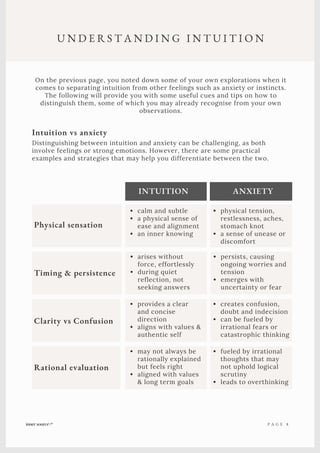
On the previous page, you noted down some of your own explorations when it
comes to separating intuition from other feelings such as anxiety or instincts.
The following will provide you with some useful cues and tips on how to
distinguish them, some of which you may already recognise from your own
observations.
U N D E R S T A N D I N G I N T U I T I O N
P A G E 8
Distinguishing between intuition and anxiety can be challenging, as both
involve feelings or strong emotions. However, there are some practical
examples and strategies that may help you differentiate between the two.
Intuition vs anxiety
INTUITION ANXIETY
Physical sensation
calm and subtle
a physical sense of
ease and alignment
an inner knowing
physical tension,
restlessness, aches,
stomach knot
a sense of unease or
discomfort
Timing & persistence
Clarity vs Confusion
Rational evaluation
arises without
force, effortlessly
during quiet
reflection, not
seeking answers
persists, causing
ongoing worries and
tension
emerges with
uncertainty or fear
provides a clear
and concise
direction
aligns with values &
authentic self
creates confusion,
doubt and indecision
can be fueled by
irrational fears or
catastrophic thinking
may not always be
rationally explained
but feels right
aligned with values
& long term goals
fueled by irrational
thoughts that may
not uphold logical
scrutiny
leads to overthinking
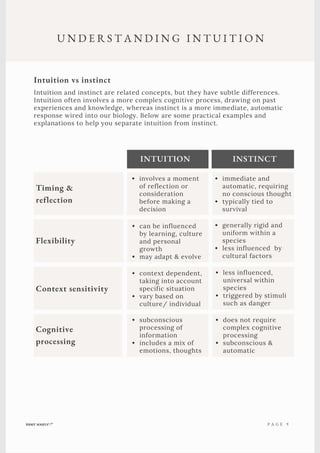
Intuition and instinct are related concepts, but they have subtle differences.
Intuition often involves a more complex cognitive process, drawing on past
experiences and knowledge, whereas instinct is a more immediate, automatic
response wired into our biology. Below are some practical examples and
explanations to help you separate intuition from instinct.
Intuition vs instinct
U N D E R S T A N D I N G I N T U I T I O N
P A G E 9
INTUITION INSTINCT
Timing &
reflection
involves a moment
of reflection or
consideration
before making a
decision
immediate and
automatic, requiring
no conscious thought
typically tied to
survival
Flexibility
Context sensitivity
Cognitive
processing
can be influenced
by learning, culture
and personal
growth
may adapt & evolve
generally rigid and
uniform within a
species
less influenced by
cultural factors
context dependent,
taking into account
specific situation
vary based on
culture/ individual
less influenced,
universal within
species
triggered by stimuli
such as danger
subconscious
processing of
information
includes a mix of
emotions, thoughts
does not require
complex cognitive
processing
subconscious &
automatic
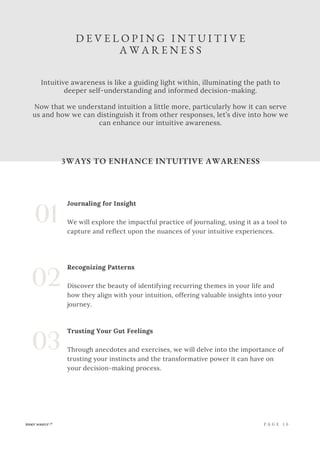
01
Journaling for Insight
We will explore the impactful practice of journaling, using it as a tool to
capture and reflect upon the nuances of your intuitive experiences.
02
Recognizing Patterns
Discover the beauty of identifying recurring themes in your life and
how they align with your intuition, offering valuable insights into your
journey.
03
Trusting Your Gut Feelings
Through anecdotes and exercises, we will delve into the importance of
trusting your instincts and the transformative power it can have on
your decision-making process.
D E V E L O P I N G I N T U I T I V E
A W A R E N E S S
Intuitive awareness is like a guiding light within, illuminating the path to
deeper self-understanding and informed decision-making.
Now that we understand intuition a little more, particularly how it can serve
us and how we can distinguish it from other responses, let’s dive into how we
can enhance our intuitive awareness.
P A G E 1 0
3WAYS TO ENHANCE INTUITIVE AWARENESS
Journaling is a powerful and accessible tool for tapping into your intuition. By
putting pen to paper, you create a tangible record of your thoughts, emotions, and
experiences, providing a canvas for the often subtle and nuanced messages of your
intuition to emerge.
The process of articulating your thoughts also engages both analytical and
intuitive aspects of your mind, bringing clarity to your inner dialogue. Over time,
as you review and reflect upon your entries, you'll likely uncover a tapestry of
insights that can guide your decisions and illuminate the pathways to personal
growth and self-discovery.
D E V E L O P I N G I N T U I T I V E
A W A R E N E S S
P A G E 1 1
Journaling for insight
Morning Intuitive Check-In:
What is your predominant emotion this morning, and what intuitive
messages might be associated with it?
Daily Intentions:
How do your intentions align with your core values, and what intuitive
guidance can support you in fulfilling them?
Gut Feeling Moments:
Describe a specific situation today where you felt a strong intuitive
response. What insights or messages did you receive?
Evening Reflection:
What were the highlights and challenges of your day, and how did your
intuitive insights contribute to your experiences?
Daily Journaling prompts
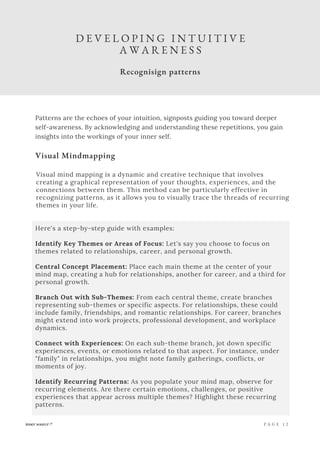
Patterns are the echoes of your intuition, signposts guiding you toward deeper
self-awareness. By acknowledging and understanding these repetitions, you gain
insights into the workings of your inner self.
D E V E L O P I N G I N T U I T I V E
A W A R E N E S S
P A G E 1 2
Recognisign patterns
Visual Mindmapping
Here's a step-by-step guide with examples:
Identify Key Themes or Areas of Focus: Let's say you choose to focus on
themes related to relationships, career, and personal growth.
Central Concept Placement: Place each main theme at the center of your
mind map, creating a hub for relationships, another for career, and a third for
personal growth.
Branch Out with Sub-Themes: From each central theme, create branches
representing sub-themes or specific aspects. For relationships, these could
include family, friendships, and romantic relationships. For career, branches
might extend into work projects, professional development, and workplace
dynamics.
Connect with Experiences: On each sub-theme branch, jot down specific
experiences, events, or emotions related to that aspect. For instance, under
"family" in relationships, you might note family gatherings, conflicts, or
moments of joy.
Identify Recurring Patterns: As you populate your mind map, observe for
recurring elements. Are there certain emotions, challenges, or positive
experiences that appear across multiple themes? Highlight these recurring
patterns.
Visual mind mapping is a dynamic and creative technique that involves
creating a graphical representation of your thoughts, experiences, and the
connections between them. This method can be particularly effective in
recognizing patterns, as it allows you to visually trace the threads of recurring
themes in your life.
D E V E L O P I N G I N T U I T I V E
A W A R E N E S S
P A G E 1 3
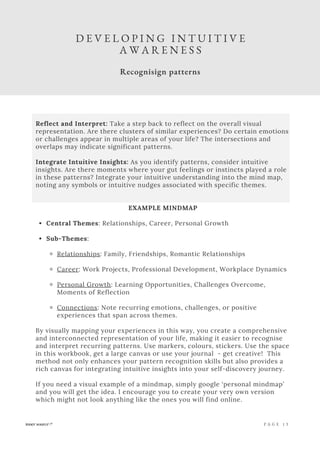
Recognisign patterns
Reflect and Interpret: Take a step back to reflect on the overall visual
representation. Are there clusters of similar experiences? Do certain emotions
or challenges appear in multiple areas of your life? The intersections and
overlaps may indicate significant patterns.
Integrate Intuitive Insights: As you identify patterns, consider intuitive
insights. Are there moments where your gut feelings or instincts played a role
in these patterns? Integrate your intuitive understanding into the mind map,
noting any symbols or intuitive nudges associated with specific themes.
EXAMPLE MINDMAP
Central Themes: Relationships, Career, Personal Growth
Sub-Themes:
Relationships: Family, Friendships, Romantic Relationships
Career: Work Projects, Professional Development, Workplace Dynamics
Personal Growth: Learning Opportunities, Challenges Overcome,
Moments of Reflection
Connections: Note recurring emotions, challenges, or positive
experiences that span across themes.
By visually mapping your experiences in this way, you create a comprehensive
and interconnected representation of your life, making it easier to recognise
and interpret recurring patterns. Use markers, colours, stickers. Use the space
in this workbook, get a large canvas or use your journal - get creative! This
method not only enhances your pattern recognition skills but also provides a
rich canvas for integrating intuitive insights into your self-discovery journey.
If you need a visual example of a mindmap, simply google ‘personal mindmap’
and you will get the idea. I encourage you to create your very own version
which might not look anything like the ones you will find online.
D E V E L O P I N G I N T U I T I V E
A W A R E N E S S
P A G E 1 4
Recognisign patterns
Your mind map
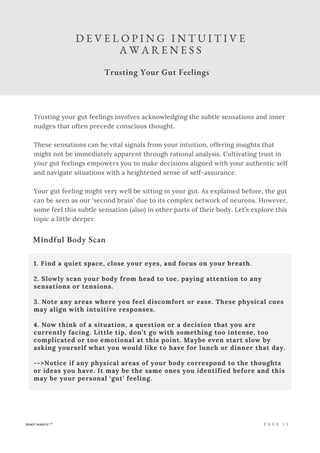
Trusting your gut feelings involves acknowledging the subtle sensations and inner
nudges that often precede conscious thought.
These sensations can be vital signals from your intuition, offering insights that
might not be immediately apparent through rational analysis. Cultivating trust in
your gut feelings empowers you to make decisions aligned with your authentic self
and navigate situations with a heightened sense of self-assurance.
Your gut feeling might very well be sitting in your gut. As explained before, the gut
can be seen as our ‘second brain’ due to its complex network of neurons. However,
some feel this subtle sensation (also) in other parts of their body. Let’s explore this
topic a little deeper.
D E V E L O P I N G I N T U I T I V E
A W A R E N E S S
P A G E 1 5
Trusting Your Gut Feelings
1. Find a quiet space, close your eyes, and focus on your breath.
2. Slowly scan your body from head to toe, paying attention to any
sensations or tensions.
3. Note any areas where you feel discomfort or ease. These physical cues
may align with intuitive responses.
4. Now think of a situation, a question or a decision that you are
currently facing. Little tip, don’t go with something too intense, too
complicated or too emotional at this point. Maybe even start slow by
asking yourself what you would like to have for lunch or dinner that day.
-->Notice if any physical areas of your body correspond to the thoughts
or ideas you have. It may be the same ones you identified before and this
may be your personal ‘gut’ feeling.
Mindful Body Scan
Consistently practicing these exercises gradually builds your confidence in
trusting your gut feelings. Integrate these techniques into your daily routine,
especially during moments of decision-making or uncertainty. As you develop a
deeper connection with your gut instincts, you'll find that trusting your intuition
becomes a natural and empowering aspect of navigating life's journey.
D E V E L O P I N G I N T U I T I V E
A W A R E N E S S
P A G E 1 6
Trusting Your Gut Feelings
Enhance your ability to trust your gut feelings by incorporating a real-time
exercise into your daily activities.
Choose a Routine Activity:
Select a routine activity from your day, such as going for a walk, cooking,
or making a simple decision like choosing what to wear.
Pause and Breathe:
Before starting the activity, take a moment to pause and take a few deep
breaths. Clear your mind and become present in the moment.
Check-In with Your Gut:
Place your hand over your stomach area, or the center of your gut feeling.
Close your eyes and focus on the sensations. Note any subtle feelings or
reactions.
Engage in the Activity:
Proceed with the chosen activity while staying mindful of the sensations in
your gut. Pay attention to any shifts or intensifications in these feelings as
you engage in the activity.
Reflect Afterwards:
Once the activity is complete, reflect on the initial gut feelings you noted
before and during the task. Consider how these feelings may have
influenced your experience or decision-making during the activity.
Real-Time Gut Check
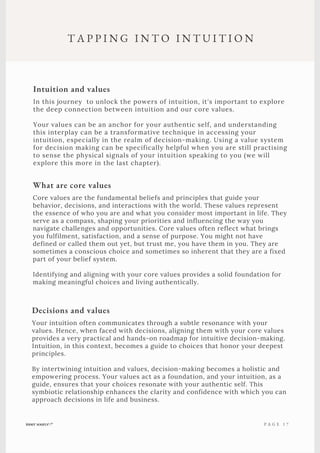
In this journey to unlock the powers of intuition, it's important to explore
the deep connection between intuition and our core values.
Your values can be an anchor for your authentic self, and understanding
this interplay can be a transformative technique in accessing your
intuition, especially in the realm of decision-making. Using a value system
for decision making can be specifically helpful when you are still practising
to sense the physical signals of your intuition speaking to you (we will
explore this more in the last chapter).
Intuition and values
Core values are the fundamental beliefs and principles that guide your
behavior, decisions, and interactions with the world. These values represent
the essence of who you are and what you consider most important in life. They
serve as a compass, shaping your priorities and influencing the way you
navigate challenges and opportunities. Core values often reflect what brings
you fulfilment, satisfaction, and a sense of purpose. You might not have
defined or called them out yet, but trust me, you have them in you. They are
sometimes a conscious choice and sometimes so inherent that they are a fixed
part of your belief system.
Identifying and aligning with your core values provides a solid foundation for
making meaningful choices and living authentically.
What are core values
T A P P I N G I N T O I N T U I T I O N
P A G E 1 7
Your intuition often communicates through a subtle resonance with your
values. Hence, when faced with decisions, aligning them with your core values
provides a very practical and hands-on roadmap for intuitive decision-making.
Intuition, in this context, becomes a guide to choices that honor your deepest
principles.
By intertwining intuition and values, decision-making becomes a holistic and
empowering process. Your values act as a foundation, and your intuition, as a
guide, ensures that your choices resonate with your authentic self. This
symbiotic relationship enhances the clarity and confidence with which you can
approach decisions in life and business.
Decisions and values
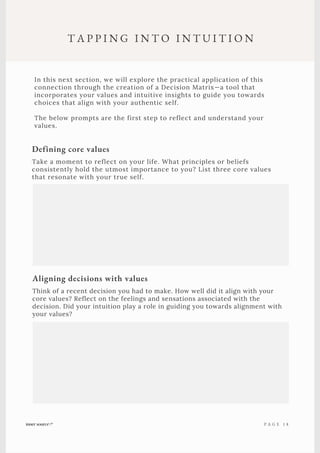
Take a moment to reflect on your life. What principles or beliefs
consistently hold the utmost importance to you? List three core values
that resonate with your true self.
Defining core values
Think of a recent decision you had to make. How well did it align with your
core values? Reflect on the feelings and sensations associated with the
decision. Did your intuition play a role in guiding you towards alignment with
your values?
Aligning decisions with values
T A P P I N G I N T O I N T U I T I O N
P A G E 1 8
In this next section, we will explore the practical application of this
connection through the creation of a Decision Matrix—a tool that
incorporates your values and intuitive insights to guide you towards
choices that align with your authentic self.
The below prompts are the first step to reflect and understand your
values.
Aligning decisions with values
P A G E 1 9
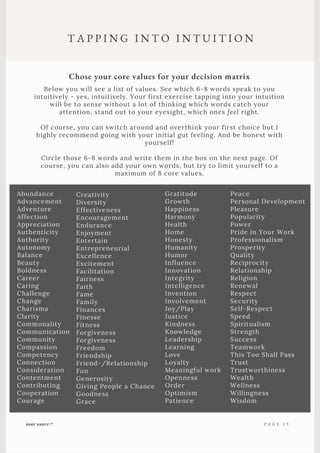
Below you will see a list of values. See which 6-8 words speak to you
intuitively - yes, intuitively. Your first exercise tapping into your intuition
will be to sense without a lot of thinking which words catch your
attention, stand out to your eyesight, which ones feel right.
Of course, you can switch around and overthink your first choice but I
highly recommend going with your initial gut feeling. And be honest with
yourself!
Circle those 6-8 words and write them in the box on the next page. Of
course, you can also add your own words, but try to limit yourself to a
maximum of 8 core values.
Chose your core values for your decision matrix
T A P P I N G I N T O I N T U I T I O N
Creativity
Diversity
Effectiveness
Encouragement
Endurance
Enjoyment
Entertain
Entrepreneurial
Excellence
Excitement
Facilitation
Fairness
Faith
Fame
Family
Finances
Finesse
Fitness
Forgiveness
Forgiveness
Freedom
Friendship
Friend-/Relationship
Fun
Generosity
Giving People a Chance
Goodness
Grace
Abundance
Advancement
Adventure
Affection
Appreciation
Authenticity
Authority
Autonomy
Balance
Beauty
Boldness
Career
Caring
Challenge
Change
Charisma
Clarity
Commonality
Communication
Community
Compassion
Competency
Connection
Consideration
Contentment
Contributing
Cooperation
Courage
Gratitude
Growth
Happiness
Harmony
Health
Home
Honesty
Humanity
Humor
Influence
Innovation
Integrity
Intelligence
Invention
Involvement
Joy/Play
Justice
Kindness
Knowledge
Leadership
Learning
Love
Loyalty
Meaningful work
Openness
Order
Optimism
Patience
Peace
Personal Development
Pleasure
Popularity
Power
Pride in Your Work
Professionalism
Prosperity
Quality
Reciprocity
Relationship
Religion
Renewal
Respect
Security
Self-Respect
Speed
Spiritualism
Strength
Success
Teamwork
This Too Shall Pass
Trust
Trustworthiness
Wealth
Wellness
Willingness
Wisdom
P A G E 2 0
T A P P I N G I N T O I N T U I T I O N
YOUR CORE VALUES
THE DECISION MAKING MATRIX
Now that our have defined your core values, it is time to get to know the
principles of the decision making matrix. It is quite simple really, but on the
next page, you will also find a form that serves as an example at that you can at
the same time use as a template for future decision making.
A decision-making matrix is a structured tool designed to help you evaluate
and compare different options when faced with a decision. It involves creating
a matrix with your values and assigning weights to those values based on how
much each option aligns with them. Each option will have a final score.
This systematic approach provides clarity by breaking down complex decisions
into measurable components, usually aiding in a more informed and objective
decision-making process. However, in our case working with your value
system, it will provide a valuable tool to access your intuition. As you are using
this tool, try and still sense if your body is reacting, your gut is speaking or
your subconscious leading. The decision-making matrix is particularly useful
when choices involve multiple factors, allowing you to prioritise and assess
options based on their unique needs and preferences.
Often, the different criteria (here your core values) are given different weights
according to their importance. We are going to skip this part, as each value
carries equal importance. This does not mean that some values will not
automatically carry more weight for certain decisions and this will surely
reflect in your rating and overall score.
P A G E 2 1
D E C I S I O N M A K I N G M A T R I X
Note down the decision you are facing in a few sentences or with a few words
DECISION TO BE MADE
Option 1
rate how this option aligns with each of your values on a scale from 1-8, 1 being
not aligned at all and 8 being perfectly aligned
1 2 3 4 5 6 7 8
1 2 3 4 5 6 7 8
1 2 3 4 5 6 7 8
1 2 3 4 5 6 7 8
1 2 3 4 5 6 7 8
1 2 3 4 5 6 7 8
1 2 3 4 5 6 7 8
1 2 3 4 5 6 7 8
SCORE
P A G E 2 2
D E C I S I O N M A K I N G M A T R I X
Option 2
rate how this option aligns with each of your values on a scale from 1-8, 1 being
not aligned at all and 8 being perfectly aligned
1 2 3 4 5 6 7 8
1 2 3 4 5 6 7 8
1 2 3 4 5 6 7 8
1 2 3 4 5 6 7 8
1 2 3 4 5 6 7 8
1 2 3 4 5 6 7 8
1 2 3 4 5 6 7 8
1 2 3 4 5 6 7 8
SCORE
Add as many options as needed and evaluate the final scores.
Of course, you will still use rhyme and reason and your body to sense
whether the highest score sits well with you. And yes, you may even have to
every now and then pick an option that does not 100% match your core
values. But you will do so well informed as to where the option aligns or
misaligns with your core values.
P A G E 1
AFFIRMATIONS
Develop positive affirmations to boost intuitive confidence and use it
often. This could look something like this:
“My intuition is a powerful guide, and I trust its wisdom in every
decision I make”
Your affirmation
S T R E N G T H E N I N G Y O U R
I N T U I T I O N
As you now embark on this journey with a few tools up your slevee
consider the benefits: heightened self-awareness, improved decision-
making, and a deeper connection to your authentic self. And practice.
By dedicating time and energy to strengthen your intuition, you're
investing in a powerful skill that can bring clarity to life's complexities
and guide you towards a more fulfilling and purpose-driven existence.
Here are a few simple ways how you can continue to strengthen your
intuition.
P A G E 2 3
P A G E 1
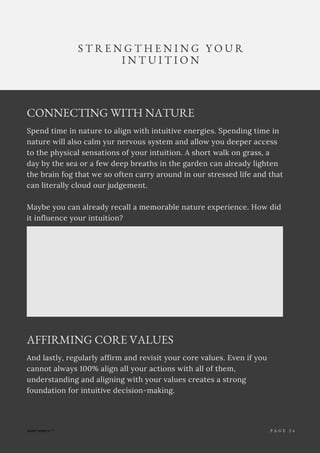
CONNECTING WITH NATURE
Spend time in nature to align with intuitive energies. Spending time in
nature will also calm yur nervous system and allow you deeper access
to the physical sensations of your intuition. A short walk on grass, a
day by the sea or a few deep breaths in the garden can already lighten
the brain fog that we so often carry around in our stressed life and that
can literally cloud our judgement.
Maybe you can already recall a memorable nature experience. How did
it influence your intuition?
S T R E N G T H E N I N G Y O U R
I N T U I T I O N
P A G E 2 4
AFFIRMING CORE VALUES
And lastly, regularly affirm and revisit your core values. Even if you
cannot always 100% align all your actions with all of them,
understanding and aligning with your values creates a strong
foundation for intuitive decision-making.
You completed the "Unlocking Your Intuition Workbook." Thank
you for allowing me to guide your first steps on this journey.
I hope above all that you are taking away that you already have
access to your intuition, you might simply need a few tools and a
little practice to use it in your day to day life.
Trust that your intuition is a powerful guide, always ready to
provide insights into your life's journey.
By continuing these practices, you'll develop a profound
connection with your inner wisdom, leading to more informed and
fulfilling decisions.
Embrace the journey of self-discovery and intuitive empowerment!
P A G E 2 5
Congratulations!
GET IN TOUCH
W A N T T O D I V E
D E E P E R ?
To find out how we can work together, to dive deeper into your
intuition, to find a path that works for your unique situation, or to
simply have a chat about your life click on the button below and
get in touch for a free consultation.

Unlock your Intuition.pdf

  • 1.
    U N LO C K Y O U R I N T U I T O N WORKBOOK A GUIDE TO HARNESSING INNER WISDOM B Y A N I N A @
  • 2.
    Anina Welcome to theUnlocking Your Intuition Workbook, where we will explore the depths of your inner wisdom and learn to tap into the power of intuition. This workbook is designed to help you differentiate intuition from other sensations, such as anxiety or instinct, and provide you with practical techniques to strengthen and trust your intuitive abilities. Intuition is more than just a gut feeling; it is an ancient, instinctual knowledge residing deep within us. Often obscured by the noise of everyday life, this inner compass has the extraordinary ability to guide us toward our true purpose and authentic self, not only in everyday life but also business. It transcends logic and taps into a realm beyond the tangible, offering a unique perspective that can shape our decisions, relationships, and overall life experience. Hi There! W E L C O M E ABOUT ME I’m Anina, dog mum, former lawyer turned HR professional, turned consultant, coach, and passionate movement enthusiast for 15 + years. I am learning to call myself a multi-potentialite with a deep love for inspiring others to embrace an attuned, holistic, healthy and active lifestyle.
  • 3.
    W H YE X P L O R E I N T U I T I O N ? 3 U N D E R S T A N D I N G I N T U I T I O N 4 D E V E L O P I N G I N T U I T I V E A W A R E N E S S 1 0 T A P P I N G I N T O I N T U I T I O N 1 7 C O R E V A L U E S 1 8 V A L U E S E T T I N G A N D D E C I S I O N M A T R I X 1 9 S T R E N G T H E N I N G Y O U R I N T U I T I O N 2 3 C O N C L U S I O N 2 5 THE CONTENT
  • 4.
    P A GE 1 Enhanced decision making Intuition serves as a compass in the expansive sea of choices, helping us make decisions aligned with our core values and aspirations. W H Y E X P L O R E I N T U T I T O N ? Creative insight Unleashing intuition opens the gates of creativity, allowing us to see possibilities and solutions that might otherwise remain hidden. Heightened self-awareness By understanding and trusting our intuitive nudges, we gain a deeper understanding of ourselves, our desires, and our unique purpose. Stress reduction Intuition acts as a reassuring guide, alleviating the anxiety often associated with uncertainty and decision-making. P A G E 3
  • 5.
    01 Write downthree to five words that you assocuate with intuition 02 Write down three to five words that you associate with anxiety 03 Write down three to five words that you associate with instinct U N D E R S T A N D I N G I N T U I T I O N As we embark on this exploration, it is essential to distinguish intuition from other sensations, such as anxiety or instinct. So, let's begin this adventure of self-discovery and empowerment. P A G E 4
  • 6.
    U N DE R S T A N D I N G I N T U I T I O N P A G E 5 DEFINING INTUITION Intuition involves subconscious decision-making by rapidly processing information. Scientifically, intuition is closely linked to the brain's dual processing system. The two key components involved are: System 1 (Fast, Intuitive): Quick, heuristic-based judgments. System 2 (Slow, Analytical): Deliberate, logical reasoning. The dual processing system Research suggests that intuition involves complex interactions within neural networks. These networks connect various brain regions, including the prefrontal cortex, amygdala, and insula. The intricate dance of neurotransmitters and neuronal pathways contributes to the rapid processing of information that characterizes intuitive insights. Neural Networks EMOTIONAL INTELIGENCE & INTUITION Intuition is closely tied to emotional intelligence—the ability to recognize and understand emotions in oneself and others. Emotions serve as a vital source of information that informs intuitive decision-making. When we tap into our emotional responses, we access a rich reservoir of data that can guide us in navigating complex situations. Connection with emotions The term "gut feeling" isn't merely metaphorical. The enteric nervous system, often referred to as the second brain, is a complex network of neurons lining the digestive tract. This system communicates with the central nervous system and is thought to play a role in our visceral, intuitive responses, explaining the sensation of a ‘gut feeling’. Gut Feeling Phenomenon
  • 7.
    U N DE R S T A N D I N G I N T U I T I O N P A G E 6 INTUITION & PATTERN RECOGNITION One of the fascinating aspects of intuition is its reliance on pattern recognition. The brain excels at identifying patterns and associations based on prior experiences. Intuition leverages this ability, allowing us to recognize subtle cues and make connections that may elude conscious analysis. Pattern Recognition in the Brain Intuition often thrives on the information processed unconsciously. The brain sifts through a vast array of data, drawing on learned patterns and non-verbal cues. Insights gained through intuition may surface as sudden realisations or a deep sense of knowing. Your brain is smart - to survive it has learned to scan through what it has already experienced and draw conclusive steps from what worked and what didn’t. Unconscious Information Processing Understanding intuition involves unraveling the intricate web of cognitive processes, emotional intelligence, and pattern recognition within the brain. As we explore the scientific underpinnings of intuition, we gain a deeper appreciation for its role in rapid decision-making and problem-solving. In the following sections, we will delve into practical techniques to tap into this remarkable cognitive function and harness its power in our everyday lives.
  • 8.
    Share a personalexperience where intuition played a role. Defining intuition Explore the differences between intuition and anxiety. List physical sensations that you associate with each. Intuition vs anxiety Differentiate intuition from instinct. Provide examples of instinctual reactions versus intuitive insights. Intuition vs instinct U N D E R S T A N D I N G I N T U I T I O N P A G E 7
  • 9.
    On the previouspage, you noted down some of your own explorations when it comes to separating intuition from other feelings such as anxiety or instincts. The following will provide you with some useful cues and tips on how to distinguish them, some of which you may already recognise from your own observations. U N D E R S T A N D I N G I N T U I T I O N P A G E 8 Distinguishing between intuition and anxiety can be challenging, as both involve feelings or strong emotions. However, there are some practical examples and strategies that may help you differentiate between the two. Intuition vs anxiety INTUITION ANXIETY Physical sensation calm and subtle a physical sense of ease and alignment an inner knowing physical tension, restlessness, aches, stomach knot a sense of unease or discomfort Timing & persistence Clarity vs Confusion Rational evaluation arises without force, effortlessly during quiet reflection, not seeking answers persists, causing ongoing worries and tension emerges with uncertainty or fear provides a clear and concise direction aligns with values & authentic self creates confusion, doubt and indecision can be fueled by irrational fears or catastrophic thinking may not always be rationally explained but feels right aligned with values & long term goals fueled by irrational thoughts that may not uphold logical scrutiny leads to overthinking
  • 10.
    Intuition and instinctare related concepts, but they have subtle differences. Intuition often involves a more complex cognitive process, drawing on past experiences and knowledge, whereas instinct is a more immediate, automatic response wired into our biology. Below are some practical examples and explanations to help you separate intuition from instinct. Intuition vs instinct U N D E R S T A N D I N G I N T U I T I O N P A G E 9 INTUITION INSTINCT Timing & reflection involves a moment of reflection or consideration before making a decision immediate and automatic, requiring no conscious thought typically tied to survival Flexibility Context sensitivity Cognitive processing can be influenced by learning, culture and personal growth may adapt & evolve generally rigid and uniform within a species less influenced by cultural factors context dependent, taking into account specific situation vary based on culture/ individual less influenced, universal within species triggered by stimuli such as danger subconscious processing of information includes a mix of emotions, thoughts does not require complex cognitive processing subconscious & automatic
  • 11.
    01 Journaling for Insight Wewill explore the impactful practice of journaling, using it as a tool to capture and reflect upon the nuances of your intuitive experiences. 02 Recognizing Patterns Discover the beauty of identifying recurring themes in your life and how they align with your intuition, offering valuable insights into your journey. 03 Trusting Your Gut Feelings Through anecdotes and exercises, we will delve into the importance of trusting your instincts and the transformative power it can have on your decision-making process. D E V E L O P I N G I N T U I T I V E A W A R E N E S S Intuitive awareness is like a guiding light within, illuminating the path to deeper self-understanding and informed decision-making. Now that we understand intuition a little more, particularly how it can serve us and how we can distinguish it from other responses, let’s dive into how we can enhance our intuitive awareness. P A G E 1 0 3WAYS TO ENHANCE INTUITIVE AWARENESS
  • 12.
    Journaling is apowerful and accessible tool for tapping into your intuition. By putting pen to paper, you create a tangible record of your thoughts, emotions, and experiences, providing a canvas for the often subtle and nuanced messages of your intuition to emerge. The process of articulating your thoughts also engages both analytical and intuitive aspects of your mind, bringing clarity to your inner dialogue. Over time, as you review and reflect upon your entries, you'll likely uncover a tapestry of insights that can guide your decisions and illuminate the pathways to personal growth and self-discovery. D E V E L O P I N G I N T U I T I V E A W A R E N E S S P A G E 1 1 Journaling for insight Morning Intuitive Check-In: What is your predominant emotion this morning, and what intuitive messages might be associated with it? Daily Intentions: How do your intentions align with your core values, and what intuitive guidance can support you in fulfilling them? Gut Feeling Moments: Describe a specific situation today where you felt a strong intuitive response. What insights or messages did you receive? Evening Reflection: What were the highlights and challenges of your day, and how did your intuitive insights contribute to your experiences? Daily Journaling prompts
  • 13.
    Patterns are theechoes of your intuition, signposts guiding you toward deeper self-awareness. By acknowledging and understanding these repetitions, you gain insights into the workings of your inner self. D E V E L O P I N G I N T U I T I V E A W A R E N E S S P A G E 1 2 Recognisign patterns Visual Mindmapping Here's a step-by-step guide with examples: Identify Key Themes or Areas of Focus: Let's say you choose to focus on themes related to relationships, career, and personal growth. Central Concept Placement: Place each main theme at the center of your mind map, creating a hub for relationships, another for career, and a third for personal growth. Branch Out with Sub-Themes: From each central theme, create branches representing sub-themes or specific aspects. For relationships, these could include family, friendships, and romantic relationships. For career, branches might extend into work projects, professional development, and workplace dynamics. Connect with Experiences: On each sub-theme branch, jot down specific experiences, events, or emotions related to that aspect. For instance, under "family" in relationships, you might note family gatherings, conflicts, or moments of joy. Identify Recurring Patterns: As you populate your mind map, observe for recurring elements. Are there certain emotions, challenges, or positive experiences that appear across multiple themes? Highlight these recurring patterns. Visual mind mapping is a dynamic and creative technique that involves creating a graphical representation of your thoughts, experiences, and the connections between them. This method can be particularly effective in recognizing patterns, as it allows you to visually trace the threads of recurring themes in your life.
  • 14.
    D E VE L O P I N G I N T U I T I V E A W A R E N E S S P A G E 1 3 Recognisign patterns Reflect and Interpret: Take a step back to reflect on the overall visual representation. Are there clusters of similar experiences? Do certain emotions or challenges appear in multiple areas of your life? The intersections and overlaps may indicate significant patterns. Integrate Intuitive Insights: As you identify patterns, consider intuitive insights. Are there moments where your gut feelings or instincts played a role in these patterns? Integrate your intuitive understanding into the mind map, noting any symbols or intuitive nudges associated with specific themes. EXAMPLE MINDMAP Central Themes: Relationships, Career, Personal Growth Sub-Themes: Relationships: Family, Friendships, Romantic Relationships Career: Work Projects, Professional Development, Workplace Dynamics Personal Growth: Learning Opportunities, Challenges Overcome, Moments of Reflection Connections: Note recurring emotions, challenges, or positive experiences that span across themes. By visually mapping your experiences in this way, you create a comprehensive and interconnected representation of your life, making it easier to recognise and interpret recurring patterns. Use markers, colours, stickers. Use the space in this workbook, get a large canvas or use your journal - get creative! This method not only enhances your pattern recognition skills but also provides a rich canvas for integrating intuitive insights into your self-discovery journey. If you need a visual example of a mindmap, simply google ‘personal mindmap’ and you will get the idea. I encourage you to create your very own version which might not look anything like the ones you will find online.
  • 15.
    D E VE L O P I N G I N T U I T I V E A W A R E N E S S P A G E 1 4 Recognisign patterns Your mind map
  • 16.
    Trusting your gutfeelings involves acknowledging the subtle sensations and inner nudges that often precede conscious thought. These sensations can be vital signals from your intuition, offering insights that might not be immediately apparent through rational analysis. Cultivating trust in your gut feelings empowers you to make decisions aligned with your authentic self and navigate situations with a heightened sense of self-assurance. Your gut feeling might very well be sitting in your gut. As explained before, the gut can be seen as our ‘second brain’ due to its complex network of neurons. However, some feel this subtle sensation (also) in other parts of their body. Let’s explore this topic a little deeper. D E V E L O P I N G I N T U I T I V E A W A R E N E S S P A G E 1 5 Trusting Your Gut Feelings 1. Find a quiet space, close your eyes, and focus on your breath. 2. Slowly scan your body from head to toe, paying attention to any sensations or tensions. 3. Note any areas where you feel discomfort or ease. These physical cues may align with intuitive responses. 4. Now think of a situation, a question or a decision that you are currently facing. Little tip, don’t go with something too intense, too complicated or too emotional at this point. Maybe even start slow by asking yourself what you would like to have for lunch or dinner that day. -->Notice if any physical areas of your body correspond to the thoughts or ideas you have. It may be the same ones you identified before and this may be your personal ‘gut’ feeling. Mindful Body Scan
  • 17.
    Consistently practicing theseexercises gradually builds your confidence in trusting your gut feelings. Integrate these techniques into your daily routine, especially during moments of decision-making or uncertainty. As you develop a deeper connection with your gut instincts, you'll find that trusting your intuition becomes a natural and empowering aspect of navigating life's journey. D E V E L O P I N G I N T U I T I V E A W A R E N E S S P A G E 1 6 Trusting Your Gut Feelings Enhance your ability to trust your gut feelings by incorporating a real-time exercise into your daily activities. Choose a Routine Activity: Select a routine activity from your day, such as going for a walk, cooking, or making a simple decision like choosing what to wear. Pause and Breathe: Before starting the activity, take a moment to pause and take a few deep breaths. Clear your mind and become present in the moment. Check-In with Your Gut: Place your hand over your stomach area, or the center of your gut feeling. Close your eyes and focus on the sensations. Note any subtle feelings or reactions. Engage in the Activity: Proceed with the chosen activity while staying mindful of the sensations in your gut. Pay attention to any shifts or intensifications in these feelings as you engage in the activity. Reflect Afterwards: Once the activity is complete, reflect on the initial gut feelings you noted before and during the task. Consider how these feelings may have influenced your experience or decision-making during the activity. Real-Time Gut Check
  • 18.
    In this journeyto unlock the powers of intuition, it's important to explore the deep connection between intuition and our core values. Your values can be an anchor for your authentic self, and understanding this interplay can be a transformative technique in accessing your intuition, especially in the realm of decision-making. Using a value system for decision making can be specifically helpful when you are still practising to sense the physical signals of your intuition speaking to you (we will explore this more in the last chapter). Intuition and values Core values are the fundamental beliefs and principles that guide your behavior, decisions, and interactions with the world. These values represent the essence of who you are and what you consider most important in life. They serve as a compass, shaping your priorities and influencing the way you navigate challenges and opportunities. Core values often reflect what brings you fulfilment, satisfaction, and a sense of purpose. You might not have defined or called them out yet, but trust me, you have them in you. They are sometimes a conscious choice and sometimes so inherent that they are a fixed part of your belief system. Identifying and aligning with your core values provides a solid foundation for making meaningful choices and living authentically. What are core values T A P P I N G I N T O I N T U I T I O N P A G E 1 7 Your intuition often communicates through a subtle resonance with your values. Hence, when faced with decisions, aligning them with your core values provides a very practical and hands-on roadmap for intuitive decision-making. Intuition, in this context, becomes a guide to choices that honor your deepest principles. By intertwining intuition and values, decision-making becomes a holistic and empowering process. Your values act as a foundation, and your intuition, as a guide, ensures that your choices resonate with your authentic self. This symbiotic relationship enhances the clarity and confidence with which you can approach decisions in life and business. Decisions and values
  • 19.
    Take a momentto reflect on your life. What principles or beliefs consistently hold the utmost importance to you? List three core values that resonate with your true self. Defining core values Think of a recent decision you had to make. How well did it align with your core values? Reflect on the feelings and sensations associated with the decision. Did your intuition play a role in guiding you towards alignment with your values? Aligning decisions with values T A P P I N G I N T O I N T U I T I O N P A G E 1 8 In this next section, we will explore the practical application of this connection through the creation of a Decision Matrix—a tool that incorporates your values and intuitive insights to guide you towards choices that align with your authentic self. The below prompts are the first step to reflect and understand your values.
  • 20.
    Aligning decisions withvalues P A G E 1 9 Below you will see a list of values. See which 6-8 words speak to you intuitively - yes, intuitively. Your first exercise tapping into your intuition will be to sense without a lot of thinking which words catch your attention, stand out to your eyesight, which ones feel right. Of course, you can switch around and overthink your first choice but I highly recommend going with your initial gut feeling. And be honest with yourself! Circle those 6-8 words and write them in the box on the next page. Of course, you can also add your own words, but try to limit yourself to a maximum of 8 core values. Chose your core values for your decision matrix T A P P I N G I N T O I N T U I T I O N Creativity Diversity Effectiveness Encouragement Endurance Enjoyment Entertain Entrepreneurial Excellence Excitement Facilitation Fairness Faith Fame Family Finances Finesse Fitness Forgiveness Forgiveness Freedom Friendship Friend-/Relationship Fun Generosity Giving People a Chance Goodness Grace Abundance Advancement Adventure Affection Appreciation Authenticity Authority Autonomy Balance Beauty Boldness Career Caring Challenge Change Charisma Clarity Commonality Communication Community Compassion Competency Connection Consideration Contentment Contributing Cooperation Courage Gratitude Growth Happiness Harmony Health Home Honesty Humanity Humor Influence Innovation Integrity Intelligence Invention Involvement Joy/Play Justice Kindness Knowledge Leadership Learning Love Loyalty Meaningful work Openness Order Optimism Patience Peace Personal Development Pleasure Popularity Power Pride in Your Work Professionalism Prosperity Quality Reciprocity Relationship Religion Renewal Respect Security Self-Respect Speed Spiritualism Strength Success Teamwork This Too Shall Pass Trust Trustworthiness Wealth Wellness Willingness Wisdom
  • 21.
    P A GE 2 0 T A P P I N G I N T O I N T U I T I O N YOUR CORE VALUES THE DECISION MAKING MATRIX Now that our have defined your core values, it is time to get to know the principles of the decision making matrix. It is quite simple really, but on the next page, you will also find a form that serves as an example at that you can at the same time use as a template for future decision making. A decision-making matrix is a structured tool designed to help you evaluate and compare different options when faced with a decision. It involves creating a matrix with your values and assigning weights to those values based on how much each option aligns with them. Each option will have a final score. This systematic approach provides clarity by breaking down complex decisions into measurable components, usually aiding in a more informed and objective decision-making process. However, in our case working with your value system, it will provide a valuable tool to access your intuition. As you are using this tool, try and still sense if your body is reacting, your gut is speaking or your subconscious leading. The decision-making matrix is particularly useful when choices involve multiple factors, allowing you to prioritise and assess options based on their unique needs and preferences. Often, the different criteria (here your core values) are given different weights according to their importance. We are going to skip this part, as each value carries equal importance. This does not mean that some values will not automatically carry more weight for certain decisions and this will surely reflect in your rating and overall score.
  • 22.
    P A GE 2 1 D E C I S I O N M A K I N G M A T R I X Note down the decision you are facing in a few sentences or with a few words DECISION TO BE MADE Option 1 rate how this option aligns with each of your values on a scale from 1-8, 1 being not aligned at all and 8 being perfectly aligned 1 2 3 4 5 6 7 8 1 2 3 4 5 6 7 8 1 2 3 4 5 6 7 8 1 2 3 4 5 6 7 8 1 2 3 4 5 6 7 8 1 2 3 4 5 6 7 8 1 2 3 4 5 6 7 8 1 2 3 4 5 6 7 8 SCORE
  • 23.
    P A GE 2 2 D E C I S I O N M A K I N G M A T R I X Option 2 rate how this option aligns with each of your values on a scale from 1-8, 1 being not aligned at all and 8 being perfectly aligned 1 2 3 4 5 6 7 8 1 2 3 4 5 6 7 8 1 2 3 4 5 6 7 8 1 2 3 4 5 6 7 8 1 2 3 4 5 6 7 8 1 2 3 4 5 6 7 8 1 2 3 4 5 6 7 8 1 2 3 4 5 6 7 8 SCORE Add as many options as needed and evaluate the final scores. Of course, you will still use rhyme and reason and your body to sense whether the highest score sits well with you. And yes, you may even have to every now and then pick an option that does not 100% match your core values. But you will do so well informed as to where the option aligns or misaligns with your core values.
  • 24.
    P A GE 1 AFFIRMATIONS Develop positive affirmations to boost intuitive confidence and use it often. This could look something like this: “My intuition is a powerful guide, and I trust its wisdom in every decision I make” Your affirmation S T R E N G T H E N I N G Y O U R I N T U I T I O N As you now embark on this journey with a few tools up your slevee consider the benefits: heightened self-awareness, improved decision- making, and a deeper connection to your authentic self. And practice. By dedicating time and energy to strengthen your intuition, you're investing in a powerful skill that can bring clarity to life's complexities and guide you towards a more fulfilling and purpose-driven existence. Here are a few simple ways how you can continue to strengthen your intuition. P A G E 2 3
  • 25.
    P A GE 1 CONNECTING WITH NATURE Spend time in nature to align with intuitive energies. Spending time in nature will also calm yur nervous system and allow you deeper access to the physical sensations of your intuition. A short walk on grass, a day by the sea or a few deep breaths in the garden can already lighten the brain fog that we so often carry around in our stressed life and that can literally cloud our judgement. Maybe you can already recall a memorable nature experience. How did it influence your intuition? S T R E N G T H E N I N G Y O U R I N T U I T I O N P A G E 2 4 AFFIRMING CORE VALUES And lastly, regularly affirm and revisit your core values. Even if you cannot always 100% align all your actions with all of them, understanding and aligning with your values creates a strong foundation for intuitive decision-making.
  • 26.
    You completed the"Unlocking Your Intuition Workbook." Thank you for allowing me to guide your first steps on this journey. I hope above all that you are taking away that you already have access to your intuition, you might simply need a few tools and a little practice to use it in your day to day life. Trust that your intuition is a powerful guide, always ready to provide insights into your life's journey. By continuing these practices, you'll develop a profound connection with your inner wisdom, leading to more informed and fulfilling decisions. Embrace the journey of self-discovery and intuitive empowerment! P A G E 2 5 Congratulations!
  • 27.
    GET IN TOUCH WA N T T O D I V E D E E P E R ? To find out how we can work together, to dive deeper into your intuition, to find a path that works for your unique situation, or to simply have a chat about your life click on the button below and get in touch for a free consultation.