TABLE OF CONTENTS
Introduction ............................................................................... 1
Certification Goals and Learning Outcomes ...................... 2
The Impact of AI on Modern Business Practices ............... 2
What is Next for AI? ................................................................. 3
How AI Transforms Educational Practices .......................... 3
How AI Addresses Challenges in Education ....................... 4
How Educational Industries are Adopting AI ..................... 5
How to Integrate AI in Educational Practices .................... 5
Module 1: Foundations of AI in Education ........................... 6
Module 2: AI in Classroom Teaching and Learning ........... 7
Module 3: Ethical, Bias, and Sustainability Issues in AI .... 7
Module 4: AI and Curriculum Integration ............................ 8
Module 5: Enhancing Administrative Efficiency with AI .. 8
Module 6: Data Literacy and AI .............................................. 8
Module 7: AI-Enhanced Assessment and Feedback .......... 8
Module 8: AI Tools and Hands-on Experience .................... 9
How Can AI CERTs Help Build an AI-Ready Culture? ........ 9
Copyright© 2024. All rights reserved
AI+
Finance
Introduction
The AI+ Educator Certification equips educators to effectively integrate Artificial
Intelligence (AI) into their teaching. This program covers AI fundamentals, types,
and their transformative applications in education. Educators will learn to use AI for
personalized learning, student monitoring, and adaptive assessments, enhancing
their instructional strategies.
The certification emphasizes ethical considerations, including bias prevention,
transparency, and inclusive AI tool development. It further addresses AI’s
environmental sustainability and its role in curriculum planning and student
evaluations. Upon completion, educators will be prepared to lead innovative AI
projects, design AI-enhanced curricula, and make data-driven decisions, ultimately
preparing students for a future shaped by AI.
Within this certification, you will explore the following topics to help you understand
the incorporation of AI in the educational sector:
Foundations of Artificial Intelligence (AI) in
Education AI in Classroom Teaching and Learning
Ethical, Bias, and Sustainability Issues in
AI AI and Curriculum Integration
AI for Administrative
Efficiency Data Literacy and AI
AI-Enhanced Assessment and Feedback
AI Tools and Hands-on Experience
Certification Prerequisites
Educational Background: Basic understanding of educational theories and
practices.
Technology Engagement: Familiarity with digital tools and educational
technology.
Curriculum Development: Some experience in lesson planning and curriculum
design.
AI Curiosity: Interest in the potential and application of AI in education.
Who Should Enroll?
Educators: Enhance digital and AI integration skills to innovate in teaching
methods and curriculum development.
Teachers: Learn to leverage AI for personalized student engagement and
improved learning outcomes.
Copyright© 2024. All rights reserved
AI+
Educator
School Administrators: Acquire knowledge to implement and manage AI-driven
educational technologies effectively.
Instructors: Discover how AI can support diverse instructional strategies and
student assessment.
Learning and Development Leaders: Understand AI's role in designing and
delivering impactful educational programs.
Certification Goals and Learning Outcomes
Become a certified educator adept at enhancing learning experiences with AI.
Explore and use AI-driven personalized learning solutions to customize student
learning.
Develop and use AI to improve student engagement, evaluation, and feedback.
Consider ethics and prejudice mitigation when developing and using AI in
education.
Create and modify AI-enhanced curricula and interactive learning modules for
creative teaching and learning.
The Impact of AI on Modern Business Practices
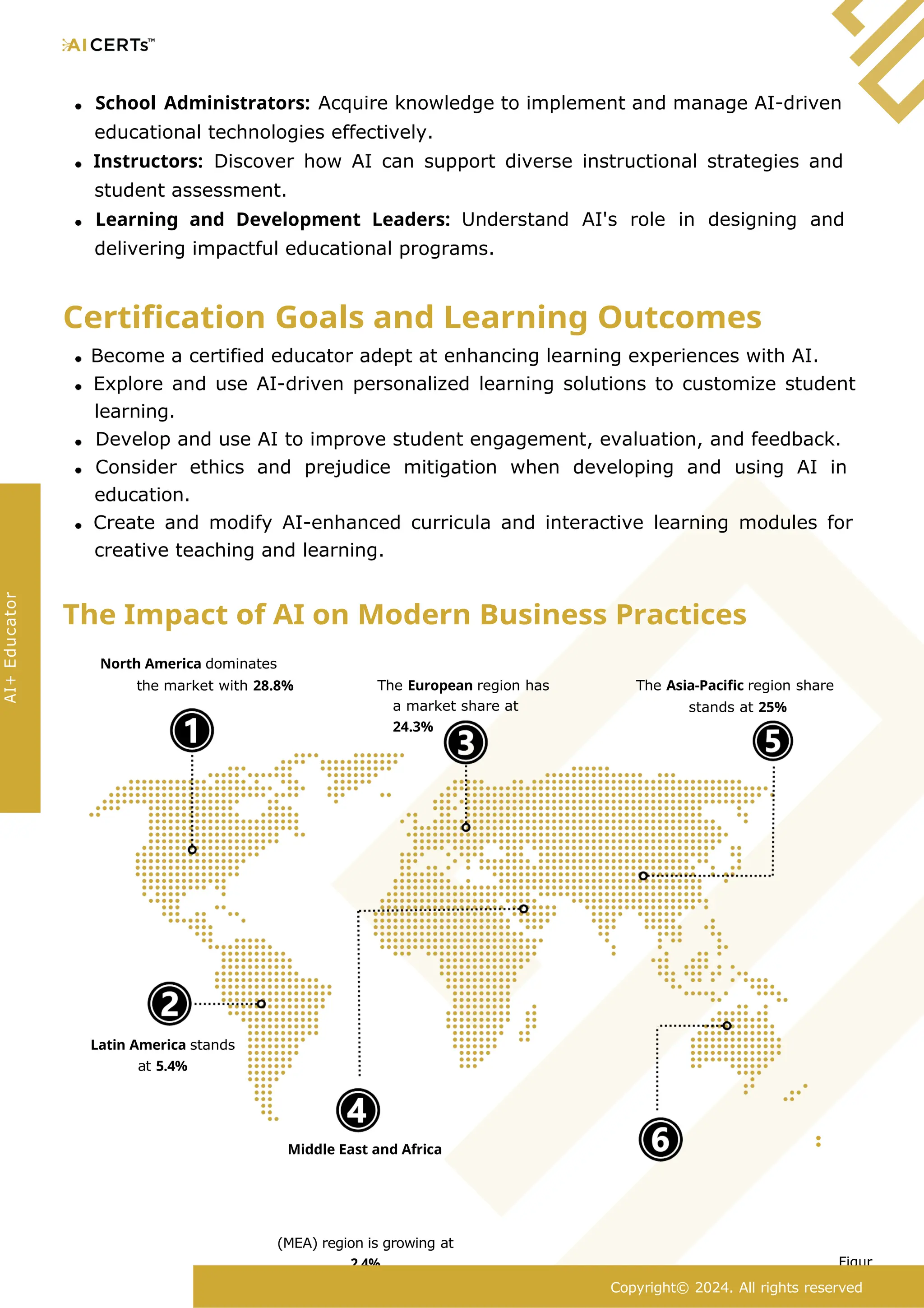
North America dominates
the market with 28.8% The European region has
a market share at
24.3%
The Asia-Pacific region share
stands at 25%
(MEA) region is growing at
2.4% Figur
Copyright© 2024. All rights reserved
AI+
Educator
Middle East and Africa
Latin America stands
at 5.4%
e 1: Global Market Share of AI
Source: Forbes, IBM, PWC
Australia is growing at
14.1%
AI has accelerated technical and economic advancements during the past decade. AI
technology will revolutionize educational processes, enhancing creativity and
efficiency. AI's transformational potential brings optimism to the future of education.
The widespread application of AI in banking, healthcare, manufacturing, and retail
serves as a model for its expansive growth and integration in the educational sector.
The potential of AI to transform the global economy is significant. North America
leads with a 28.8% market share, followed by the Asia-Pacific region at 25%.
Europe has 24.3% of the market, while Australia is expanding at 14.1%. Latin
America and the Middle East and Africa (MEA) region each hold 5.4%, reflecting the
regional growth of AI.
In other words, predictive tools that are powered by AI can identify knowledge gaps,
improve educational outcomes and optimize resource allocation. Teaching methods
have been revolutionized with rapid and precise data analytics done by AI leading to
improved satisfaction among students. The global effect of AI is anticipated to yield
substantial growth and transformation in the education sector.
What is Next for AI?
In the next phase of AI in education, adaptive learning systems are set to
revolutionize the personalization of learning by aligning with individual student
needs and learning styles. Teachers will leverage AI-driven analytics to enhance
instruction and boost student engagement, allowing for more tailored educational
experiences. AI-powered tools will offer real-time feedback and support, making the
learning process more dynamic and efficient.
These advancements aim to bridge educational gaps and ensure that high-quality
education is accessible to all students. By integrating such technologies, educational
institutions aspire to foster more personalized, engaging, and effective learning
environments, ultimately enhancing educational outcomes across diverse student
populations.
How AI Transforms Educational Practices
AI transforms businesses in all sectors with unrivaled growth, efficiency, and
creativity. Businesses using AI for education services report a 30% increase in
customer satisfaction due to faster response times and more personalized
interactions. AI offers numerous solutions to educational business problems,
enhancing the efficiency and effectiveness of educational institutions. Let's explore
the following points to better understand them with the provided figure as a
reference.
3
Copyright© 2024. All rights reserved
AI+
Educator
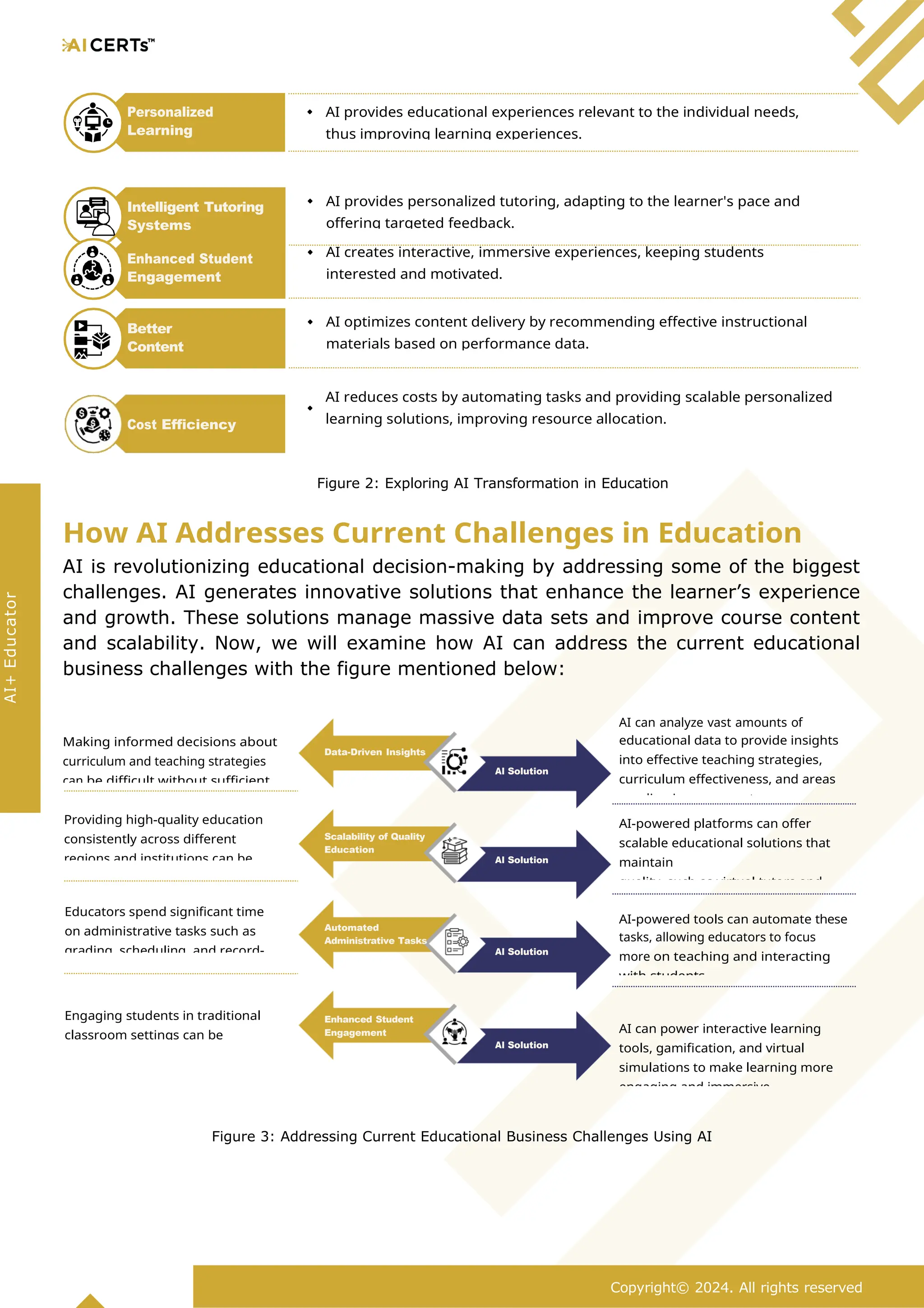
Making informed decisions about
curriculum and teaching strategies
can be difficult without sufficient
AI can analyze vast amounts of
educational data to provide insights
into effective teaching strategies,
curriculum effectiveness, and areas
needing improvement.
Providing high-quality education
consistently across different
regions and institutions can be
AI-powered platforms can offer
scalable educational solutions that
maintain
quality, such as virtual tutors and
Educators spend significant time
on administrative tasks such as
grading, scheduling, and record-
AI-powered tools can automate these
tasks, allowing educators to focus
more on teaching and interacting
with students.
Engaging students in traditional
classroom settings can be
AI can power interactive learning
tools, gamification, and virtual
simulations to make learning more
engaging and immersive.
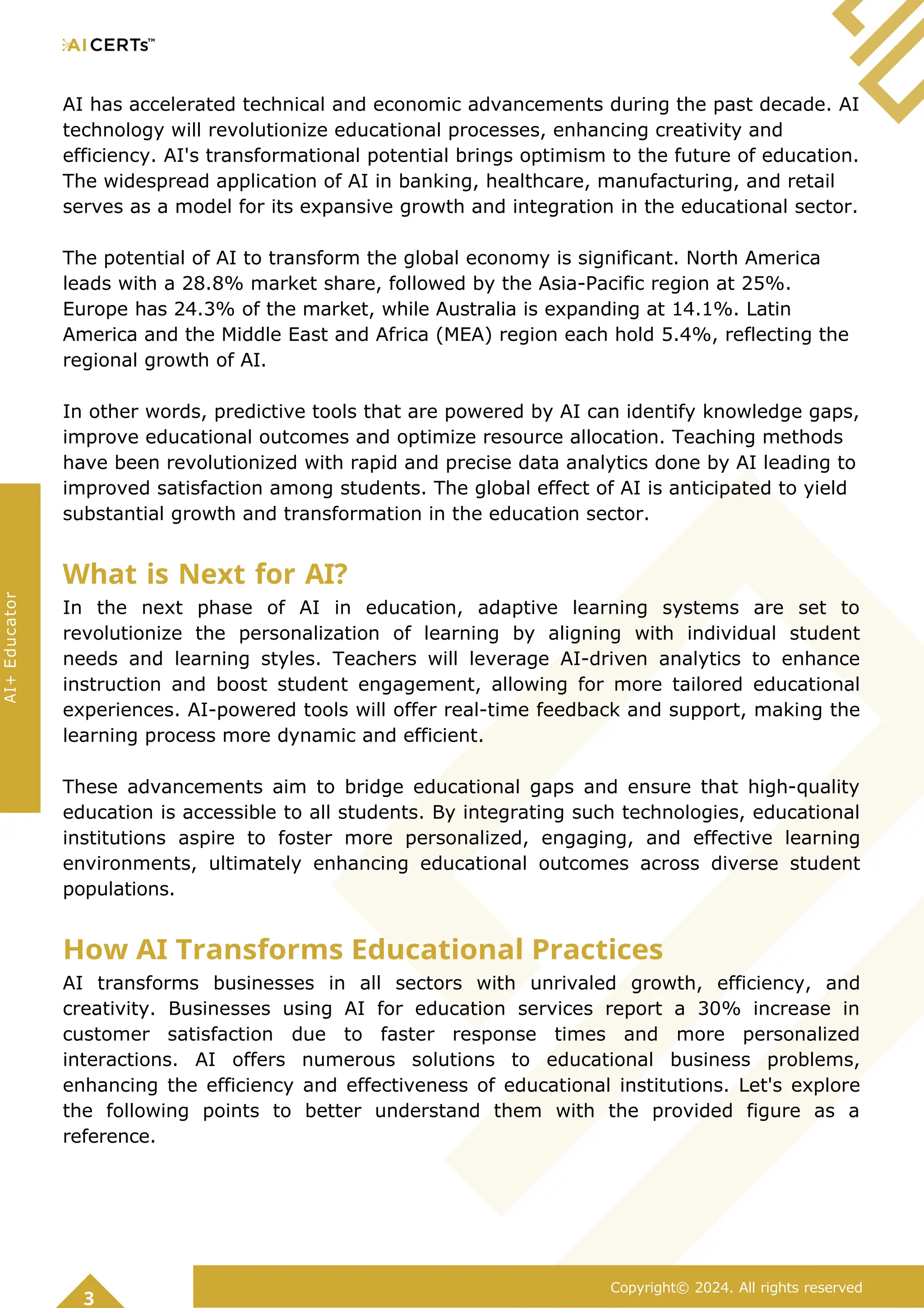
AI reduces costs by automating tasks and providing scalable personalized
learning solutions, improving resource allocation.
Figure 2: Exploring AI Transformation in Education
How AI Addresses Current Challenges in Education
AI is revolutionizing educational decision-making by addressing some of the biggest
challenges. AI generates innovative solutions that enhance the learner’s experience
and growth. These solutions manage massive data sets and improve course content
and scalability. Now, we will examine how AI can address the current educational
business challenges with the figure mentioned below:
Figure 3: Addressing Current Educational Business Challenges Using AI
AI creates interactive, immersive experiences, keeping students
interested and motivated.
Enhanced Student
Engagement
Copyright© 2024. All rights reserved
AI provides educational experiences relevant to the individual needs,
thus improving learning experiences.
Personalized
Learning
Cost Efficiency
AI+
Educator
AI provides personalized tutoring, adapting to the learner's pace and
offering targeted feedback.
Intelligent Tutoring
Systems
AI Solution
Enhanced Student
Engagement
AI Solution
Automated
Administrative Tasks
AI Solution
Scalability of Quality
Education
AI Solution
Data-Driven Insights
AI optimizes content delivery by recommending effective instructional
materials based on performance data.
Better
Content
Delivery
A Brief Overview of AI+ Educator Certification
How Educational Industries are Adopting AI
The educational industry is increasingly adopting AI to enhance various aspects of
teaching, learning, and administration. This industrial adoption impacts the
workforce within the sector, including educators, administrative staff, and other
stakeholders. Educators are transitioning from traditional teaching methods to
becoming facilitators and mentors. AI-powered learning routes let professors focus
on individual students.
AI-powered chatbots can instantly answer student questions regarding courses,
deadlines, and university services, freeing up support professionals to handle more
complex concerns. AI can help support personnel identify students at danger of
falling behind and intervene quickly. Therefore, AI in education is changing the
workforce and asking professionals to take on new duties by saving time and
increasing productivity.
How to Integrate AI in Educational Practices
The incorporation of AI into your education brings a number of advantages and
improves your academic performance. Begin by incorporating AI into student
learning through solutions like intelligent tutoring systems or learning applications
that adjust to your preferences and learning path.
Integrate AI applications such as NLP tools to analyze text, AI algorithms for data
analysis and visualization into their research. AI can be utilized for developing skills
that involve coding and operation of tools, in platforms that create real-world
scenarios.
Maintain a current knowledge of AI by enrolling in relevant online courses, webinars,
and workshops, encouraging a culture of lifelong learning. Moreover, participate in
projects and cooperative actions that use AI, so you may use the obtained
theoretical knowledge within practice. So, when using AI technology, you can build
an exciting and efficient learning process that will help you become prepared for the
future.
5 Copyright© 2024. All rights reserved
AI+
Educator
At AI CERTs, we help organizations leverage the power of AI with our top-tier, role-
specific certifications.
The modules AI+ Educator cover essential aspects required to gain the knowledge
needed to effectively implement AI in educational practices
Module 1: Foundations of AI in Education
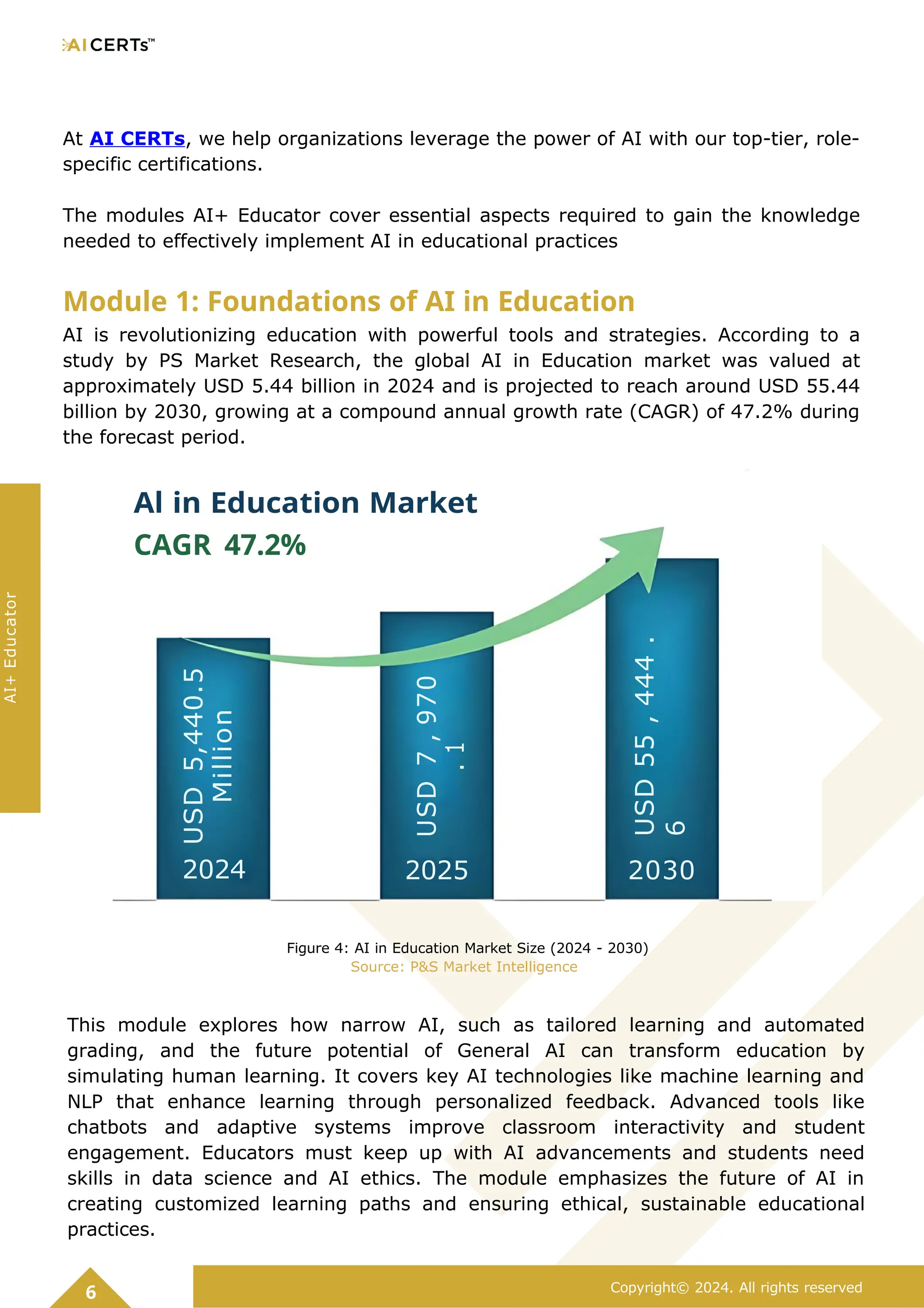
AI is revolutionizing education with powerful tools and strategies. According to a
study by PS Market Research, the global AI in Education market was valued at
approximately USD 5.44 billion in 2024 and is projected to reach around USD 55.44
billion by 2030, growing at a compound annual growth rate (CAGR) of 47.2% during
the forecast period.
Figure 4: AI in Education Market Size (2024 - 2030)
Source: P&S Market Intelligence
This module explores how narrow AI, such as tailored learning and automated
grading, and the future potential of General AI can transform education by
simulating human learning. It covers key AI technologies like machine learning and
NLP that enhance learning through personalized feedback. Advanced tools like
chatbots and adaptive systems improve classroom interactivity and student
engagement. Educators must keep up with AI advancements and students need
skills in data science and AI ethics. The module emphasizes the future of AI in
creating customized learning paths and ensuring ethical, sustainable educational
practices.
6 Copyright© 2024. All rights reserved
2030
2025
2024
Al in Education Market
CAGR 47.2%
AI+
Educator
USD
5,440.5
Million
USD
7
,
970
.
1
Million
USD
55
,
444
.
6
Million
A Brief Overview of AI+ Educator Certification
Module 2: AI in Classroom Teaching and Learning
AI in the classroom will revolutionize education by enabling tailored learning and
student involvement. A study conducted by Research and Markets found that the
global AI in the Classroom market size was valued at $3.68 billion in 2023 and is
projected to reach around $173.39 billion by 2033. AI-driven personalized learning
is leading this shift, allowing instructors to customize information for each student.
Figure 5: Global AI In the Classroom Market (2023-2024)
Source: Research and Markets
In this module you will explore AI's impact on education, highlighting real-time
progress tracking and personalized feedback for better comprehension and
retention. You will understand how AI enhances engagement through gamification
and collaborative tools, making learning interactive. In this module, you will learn
how AI integrates into education with blended learning, flipped classrooms, and
training for educators. You'll explore methods to measure AI's impact and see how it
personalizes learning and fosters innovation in educational environments.
Module 3: Ethical, Bias, and Sustainability Issues in AI
Responsible AI use in education requires addressing ethical, prejudice, and
environmental challenges. Moral frameworks for AI ethics in education emphasize
justice, openness, and accountability. AI technology must be ethically integrated
and used to improve learning environments.
This module focuses on addressing ethical AI in education by balancing AI benefits
with student privacy through transparency and accountability. It highlights the need
to tackle algorithmic bias for fair and inclusive decision-making and manage AI's
environmental impact with energy-efficient and sustainable practices. The goal is to
help educators use AI systems that promote fairness, inclusivity, and environmental
responsibility.
7
Copyright© 2024. All rights reserved
AI+
Educator
Integrating AI into curriculum planning and development allows educators to
transform teaching and learning. Incorporating AI concepts into studies can help
educators find synergies across fields and improve interdisciplinary research.
Dynamic, future-focused courses that include AI prepare students for changing
technology landscapes and provide them with the skills to succeed in a fast-
changing society.
This module does a deep dive into AI-based teaching methods and platforms that
boost student engagement and learning. It shows how interactive AI modules
personalize education and how feedback enhances flexibility and effectiveness. The
module also covers AI’s role in accurate grading, automated evaluations, and
personalized feedback, along with using AI analytics to refine teaching methods and
improve student performance.
Module 5: Enhancing Administrative Efficiency with AI
AI is playing a crucial role in the administration of educational facilities and
management by automating workflows and improving resource utilization. Major
areas of focus for the application of AI are in the clerical and administrative
functions, like automatic scheduling, and tracking participation or attendance of
students.
This module focuses on how AI reduces administrative burdens, optimizes
resources, and enhances operational efficiency. It covers AI’s role in student
services, including chatbots for support, career counseling, and wellness programs.
The module also highlights AI’s effectiveness in data management and decision-
making, improving productivity and outcomes for students and staff.
Module 6: Data Literacy and AI
Data literacy and AI are essential for good decision-making and better learning in
education. Understanding varied data types and sources provides critical insights
into the complicated data world.
In this module, the focus is on building skills in statistical methods, data
visualization, and interpretation to boost analytical proficiency in education. It
emphasizes the role of data literacy in enhancing AI effectiveness and shows how
data analysis transforms decision-making and instructional strategies. The module
also covers data-driven decision-making and continuous improvement to ensure
educational practices meet evolving needs.
Module 7: AI-Enhanced Assessment and Feedback
AI is transforming school assessments into more dynamic and individualized ones.
AI can adapt questions based on student responses to provide each student a skill-
level-appropriate exam.
Copyright© 2024. All rights reserved
AI+
Educator
Module 4: AI and Curriculum Integration
By adapting to each student, this tailored method improves learning and outcomes.
This module navigates through the role of AI role in real-time test evaluation and
feedback, enhancing efficiency and responsiveness. It also covers AI-powered
grading systems for accurate and unbiased assessments. Additionally, the module
explores AI-driven personalized learning, which tailors’ education to individual
needs, improving engagement and outcomes.
Module 8: AI Tools and Hands-on Experience
Exploring AI tools is essential for educators aiming to enhance the learning
experience through technology. Selecting the right AI tools tailored for education
involves understanding the unique features and functions each tool offers, from
advanced applications in machine learning to data analysis capabilities.
This module focuses on evaluating and selecting AI tools to enhance teaching and
learning. It includes practical exercises and simulations for hands-on experience,
with continuous evaluation and feedback to ensure the tools remain effective and
relevant. This approach helps educators maximize the potential of AI in their
teaching practices.
How Can AI CERTs Help Build an AI-Ready Culture?
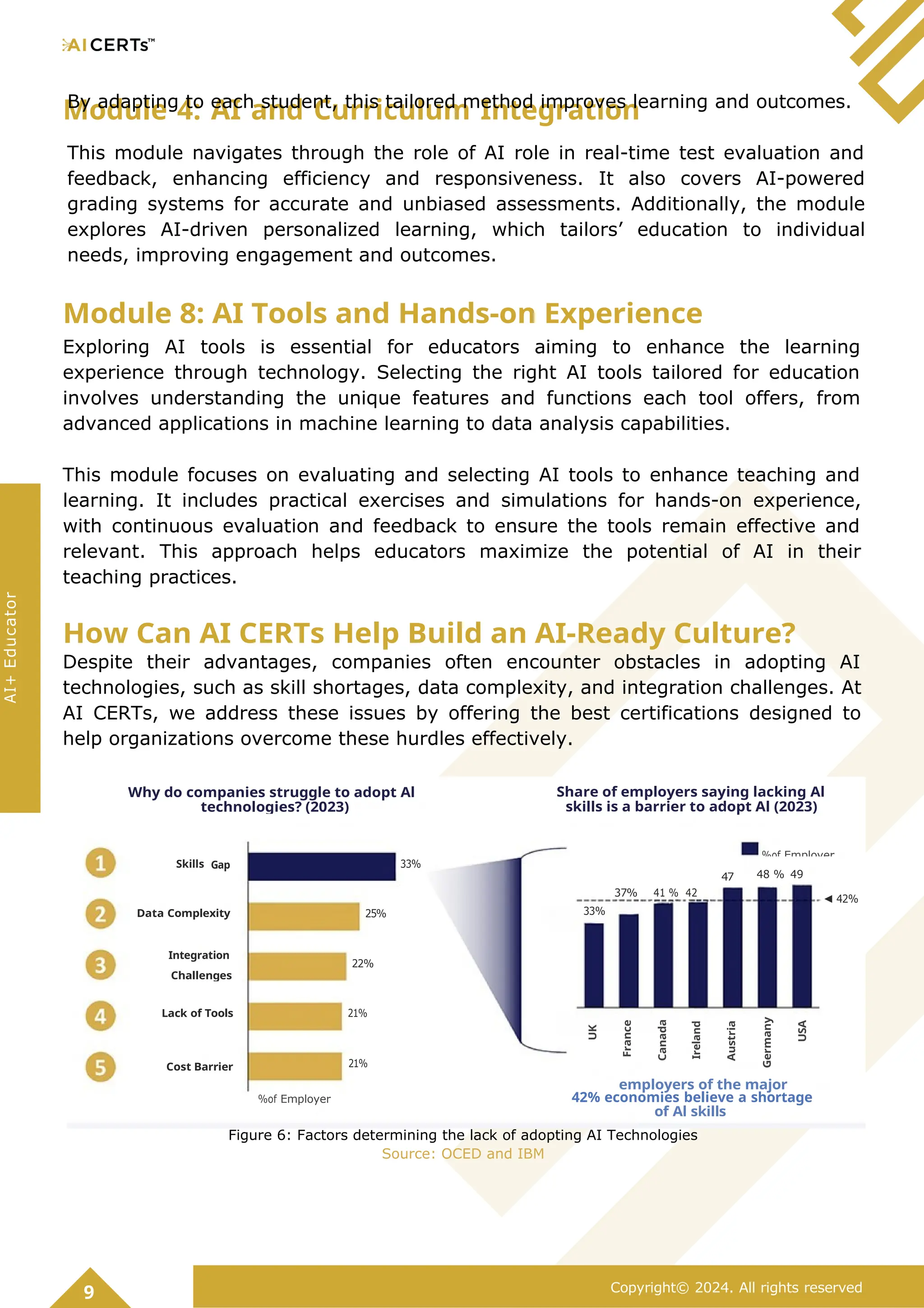
Despite their advantages, companies often encounter obstacles in adopting AI
technologies, such as skill shortages, data complexity, and integration challenges. At
AI CERTs, we address these issues by offering the best certifications designed to
help organizations overcome these hurdles effectively.
Figure 6: Factors determining the lack of adopting AI Technologies
Source: OCED and IBM
8
9 Copyright© 2024. All rights reserved
employers of the major
42% economies believe a shortage
of Al skills
%of Employer
21%
Cost Barrier
21%
Lack of Tools
22%
Integration
Challenges
33%
25%
Data Complexity
◄ 42%
37% 41 % 42
%
48 % 49
%
47
%
Skills Gap 33%
Share of employers saying lacking Al
skills is a barrier to adopt Al (2023)
%of Employer
Why do companies struggle to adopt Al
technologies? (2023)
AI+
Educator
UK
France
Canada
Ireland
Austria
Germany
USA
Challenge: A shortage of educators skilled in AI limits its integration into
education. They lack technical knowledge needed to integrate AI into their
practices effectively.
Solution: AI CERTs provide individuals with comprehensive knowledge on AI
educational practices, enhancing their careers.
Benefit: This training equips educators with the knowledge to effectively teach
and implement AI, addressing the critical skills gap in education.
Empowering Every Educator with AI Skills
Challenge: Many educators lack access to up-to-date AI tools, platforms, and
training materials needed for skill development.
Solution: AI CERTs deliver specialized training that includes the latest AI tools
and platforms, ensuring educators stay current with advancements.
Benefit: With access to AI tools and platforms, educators can offer more relevant
and innovative learning experiences, potentially leading to better student
engagement and outcomes.
At AI CERTs, we offer a strategic solution, fostering a culture primed for AI
integration and innovation. Our premium AI certification programs provide the
comprehensive training and industry-recognized credentials needed to empower
your workforce and propel your organization towards an AI-driven future.
AI CERTs Cultivate AI Culture in Several Ways:
Our structured certification deepens AI principles and applications, making AI
more approachable.
Lifelong learning keeps your workforce up to date on AI trends, giving you a
competitive edge.
AI CERTs certification promotes knowledge sharing and breaks down
departmental silos through teamwork and cross-functional projects, which are
essential for AI implementation.
AI CERTs: Your Pathway to Becoming AI-Ready
The future of business belongs to those who harness the power of AI.
Tailored for Success: Our certifications are customized to meet the specific needs of
your team, providing expert training to equip them with the precise skills required
for key AI roles.
Actionable Expertise: We emphasize hands-on learning through projects and case
studies. This assures your team graduates with the skills and confidence to integrate
and use AI technology successfully, creating innovation and business benefits.
Copyright© 2024. All rights reserved
AI+
Educator
Bridging the AI Skill Gap
Become an AI Leader: Lead the AI revolution, not just follow. Invest in your
workforce with AI CERTs. Join us in creating an AI-inclusive culture where your team
can unleash AI's transformative power and lead your organization.
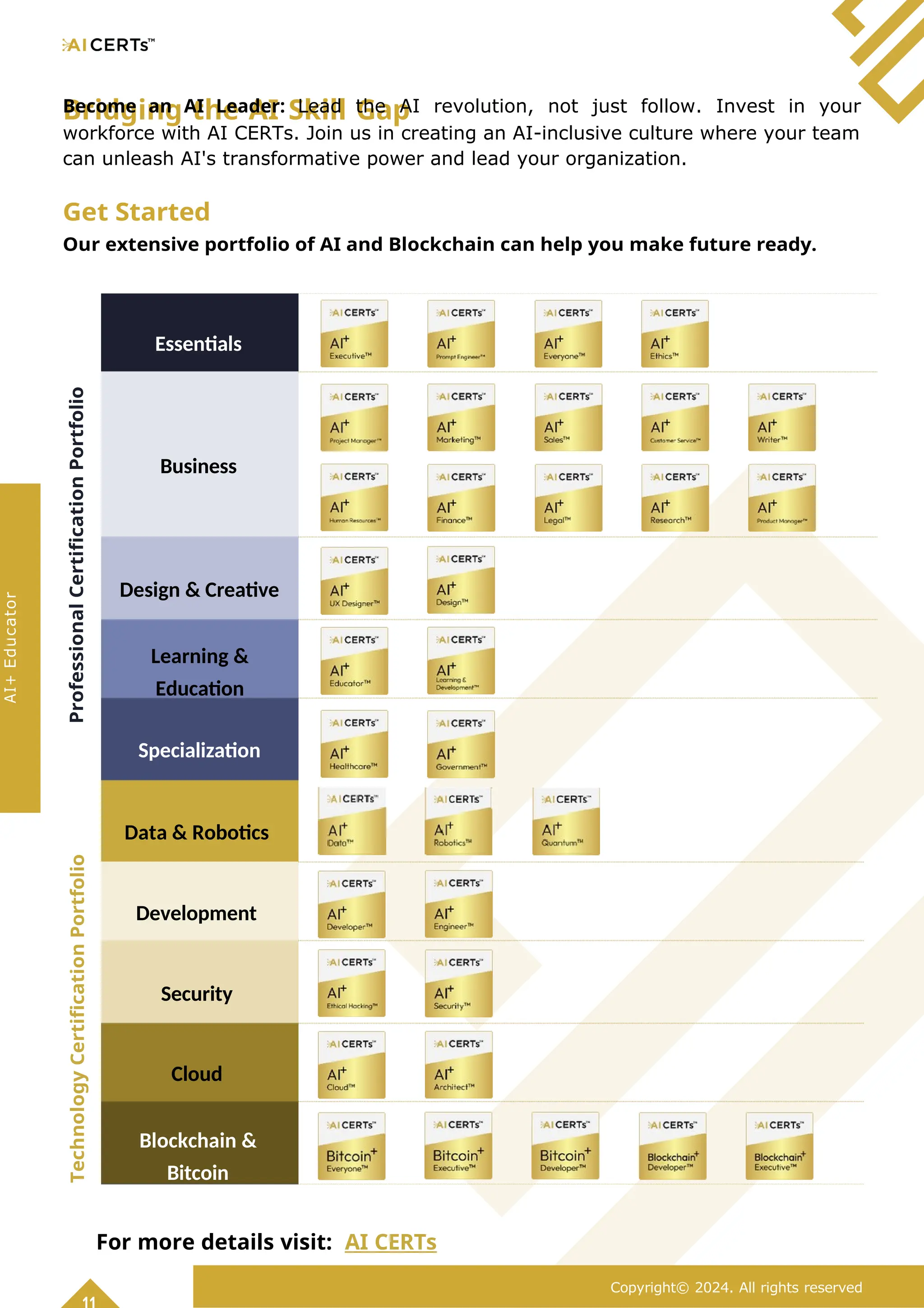
Get Started
Our extensive portfolio of AI and Blockchain can help you make future ready.
Essentials
Business
Design & Creative
Learning &
Education
Specialization
Data & Robotics
Development
Security
Cloud
Blockchain &
Bitcoin
For more details visit: AI CERTs
Copyright© 2024. All rights reserved
AI+
Educator
Professional
Certification
Portfolio
Technology
Certification
Portfolio
www.aicerts.io
Contact
252 West 37th St., Suite 1200W
New York, NY 10018

Unlock AI Educator Certification – Transform Your Teaching Career.

  • 2.
    TABLE OF CONTENTS Introduction............................................................................... 1 Certification Goals and Learning Outcomes ...................... 2 The Impact of AI on Modern Business Practices ............... 2 What is Next for AI? ................................................................. 3 How AI Transforms Educational Practices .......................... 3 How AI Addresses Challenges in Education ....................... 4 How Educational Industries are Adopting AI ..................... 5 How to Integrate AI in Educational Practices .................... 5 Module 1: Foundations of AI in Education ........................... 6 Module 2: AI in Classroom Teaching and Learning ........... 7 Module 3: Ethical, Bias, and Sustainability Issues in AI .... 7 Module 4: AI and Curriculum Integration ............................ 8 Module 5: Enhancing Administrative Efficiency with AI .. 8 Module 6: Data Literacy and AI .............................................. 8 Module 7: AI-Enhanced Assessment and Feedback .......... 8 Module 8: AI Tools and Hands-on Experience .................... 9 How Can AI CERTs Help Build an AI-Ready Culture? ........ 9 Copyright© 2024. All rights reserved AI+ Finance
  • 3.
    Introduction The AI+ EducatorCertification equips educators to effectively integrate Artificial Intelligence (AI) into their teaching. This program covers AI fundamentals, types, and their transformative applications in education. Educators will learn to use AI for personalized learning, student monitoring, and adaptive assessments, enhancing their instructional strategies. The certification emphasizes ethical considerations, including bias prevention, transparency, and inclusive AI tool development. It further addresses AI’s environmental sustainability and its role in curriculum planning and student evaluations. Upon completion, educators will be prepared to lead innovative AI projects, design AI-enhanced curricula, and make data-driven decisions, ultimately preparing students for a future shaped by AI. Within this certification, you will explore the following topics to help you understand the incorporation of AI in the educational sector: Foundations of Artificial Intelligence (AI) in Education AI in Classroom Teaching and Learning Ethical, Bias, and Sustainability Issues in AI AI and Curriculum Integration AI for Administrative Efficiency Data Literacy and AI AI-Enhanced Assessment and Feedback AI Tools and Hands-on Experience Certification Prerequisites Educational Background: Basic understanding of educational theories and practices. Technology Engagement: Familiarity with digital tools and educational technology. Curriculum Development: Some experience in lesson planning and curriculum design. AI Curiosity: Interest in the potential and application of AI in education. Who Should Enroll? Educators: Enhance digital and AI integration skills to innovate in teaching methods and curriculum development. Teachers: Learn to leverage AI for personalized student engagement and improved learning outcomes. Copyright© 2024. All rights reserved AI+ Educator
  • 4.
    School Administrators: Acquireknowledge to implement and manage AI-driven educational technologies effectively. Instructors: Discover how AI can support diverse instructional strategies and student assessment. Learning and Development Leaders: Understand AI's role in designing and delivering impactful educational programs. Certification Goals and Learning Outcomes Become a certified educator adept at enhancing learning experiences with AI. Explore and use AI-driven personalized learning solutions to customize student learning. Develop and use AI to improve student engagement, evaluation, and feedback. Consider ethics and prejudice mitigation when developing and using AI in education. Create and modify AI-enhanced curricula and interactive learning modules for creative teaching and learning. The Impact of AI on Modern Business Practices North America dominates the market with 28.8% The European region has a market share at 24.3% The Asia-Pacific region share stands at 25% (MEA) region is growing at 2.4% Figur Copyright© 2024. All rights reserved AI+ Educator Middle East and Africa Latin America stands at 5.4%
  • 5.
    e 1: GlobalMarket Share of AI Source: Forbes, IBM, PWC Australia is growing at 14.1%
  • 6.
    AI has acceleratedtechnical and economic advancements during the past decade. AI technology will revolutionize educational processes, enhancing creativity and efficiency. AI's transformational potential brings optimism to the future of education. The widespread application of AI in banking, healthcare, manufacturing, and retail serves as a model for its expansive growth and integration in the educational sector. The potential of AI to transform the global economy is significant. North America leads with a 28.8% market share, followed by the Asia-Pacific region at 25%. Europe has 24.3% of the market, while Australia is expanding at 14.1%. Latin America and the Middle East and Africa (MEA) region each hold 5.4%, reflecting the regional growth of AI. In other words, predictive tools that are powered by AI can identify knowledge gaps, improve educational outcomes and optimize resource allocation. Teaching methods have been revolutionized with rapid and precise data analytics done by AI leading to improved satisfaction among students. The global effect of AI is anticipated to yield substantial growth and transformation in the education sector. What is Next for AI? In the next phase of AI in education, adaptive learning systems are set to revolutionize the personalization of learning by aligning with individual student needs and learning styles. Teachers will leverage AI-driven analytics to enhance instruction and boost student engagement, allowing for more tailored educational experiences. AI-powered tools will offer real-time feedback and support, making the learning process more dynamic and efficient. These advancements aim to bridge educational gaps and ensure that high-quality education is accessible to all students. By integrating such technologies, educational institutions aspire to foster more personalized, engaging, and effective learning environments, ultimately enhancing educational outcomes across diverse student populations. How AI Transforms Educational Practices AI transforms businesses in all sectors with unrivaled growth, efficiency, and creativity. Businesses using AI for education services report a 30% increase in customer satisfaction due to faster response times and more personalized interactions. AI offers numerous solutions to educational business problems, enhancing the efficiency and effectiveness of educational institutions. Let's explore the following points to better understand them with the provided figure as a reference. 3 Copyright© 2024. All rights reserved AI+ Educator
  • 7.
    Making informed decisionsabout curriculum and teaching strategies can be difficult without sufficient AI can analyze vast amounts of educational data to provide insights into effective teaching strategies, curriculum effectiveness, and areas needing improvement. Providing high-quality education consistently across different regions and institutions can be AI-powered platforms can offer scalable educational solutions that maintain quality, such as virtual tutors and Educators spend significant time on administrative tasks such as grading, scheduling, and record- AI-powered tools can automate these tasks, allowing educators to focus more on teaching and interacting with students. Engaging students in traditional classroom settings can be AI can power interactive learning tools, gamification, and virtual simulations to make learning more engaging and immersive. AI reduces costs by automating tasks and providing scalable personalized learning solutions, improving resource allocation. Figure 2: Exploring AI Transformation in Education How AI Addresses Current Challenges in Education AI is revolutionizing educational decision-making by addressing some of the biggest challenges. AI generates innovative solutions that enhance the learner’s experience and growth. These solutions manage massive data sets and improve course content and scalability. Now, we will examine how AI can address the current educational business challenges with the figure mentioned below: Figure 3: Addressing Current Educational Business Challenges Using AI AI creates interactive, immersive experiences, keeping students interested and motivated. Enhanced Student Engagement Copyright© 2024. All rights reserved AI provides educational experiences relevant to the individual needs, thus improving learning experiences. Personalized Learning Cost Efficiency AI+ Educator AI provides personalized tutoring, adapting to the learner's pace and offering targeted feedback. Intelligent Tutoring Systems AI Solution Enhanced Student Engagement AI Solution Automated Administrative Tasks AI Solution Scalability of Quality Education AI Solution Data-Driven Insights AI optimizes content delivery by recommending effective instructional materials based on performance data. Better Content Delivery
  • 8.
    A Brief Overviewof AI+ Educator Certification How Educational Industries are Adopting AI The educational industry is increasingly adopting AI to enhance various aspects of teaching, learning, and administration. This industrial adoption impacts the workforce within the sector, including educators, administrative staff, and other stakeholders. Educators are transitioning from traditional teaching methods to becoming facilitators and mentors. AI-powered learning routes let professors focus on individual students. AI-powered chatbots can instantly answer student questions regarding courses, deadlines, and university services, freeing up support professionals to handle more complex concerns. AI can help support personnel identify students at danger of falling behind and intervene quickly. Therefore, AI in education is changing the workforce and asking professionals to take on new duties by saving time and increasing productivity. How to Integrate AI in Educational Practices The incorporation of AI into your education brings a number of advantages and improves your academic performance. Begin by incorporating AI into student learning through solutions like intelligent tutoring systems or learning applications that adjust to your preferences and learning path. Integrate AI applications such as NLP tools to analyze text, AI algorithms for data analysis and visualization into their research. AI can be utilized for developing skills that involve coding and operation of tools, in platforms that create real-world scenarios. Maintain a current knowledge of AI by enrolling in relevant online courses, webinars, and workshops, encouraging a culture of lifelong learning. Moreover, participate in projects and cooperative actions that use AI, so you may use the obtained theoretical knowledge within practice. So, when using AI technology, you can build an exciting and efficient learning process that will help you become prepared for the future. 5 Copyright© 2024. All rights reserved AI+ Educator
  • 9.
    At AI CERTs,we help organizations leverage the power of AI with our top-tier, role- specific certifications. The modules AI+ Educator cover essential aspects required to gain the knowledge needed to effectively implement AI in educational practices Module 1: Foundations of AI in Education AI is revolutionizing education with powerful tools and strategies. According to a study by PS Market Research, the global AI in Education market was valued at approximately USD 5.44 billion in 2024 and is projected to reach around USD 55.44 billion by 2030, growing at a compound annual growth rate (CAGR) of 47.2% during the forecast period. Figure 4: AI in Education Market Size (2024 - 2030) Source: P&S Market Intelligence This module explores how narrow AI, such as tailored learning and automated grading, and the future potential of General AI can transform education by simulating human learning. It covers key AI technologies like machine learning and NLP that enhance learning through personalized feedback. Advanced tools like chatbots and adaptive systems improve classroom interactivity and student engagement. Educators must keep up with AI advancements and students need skills in data science and AI ethics. The module emphasizes the future of AI in creating customized learning paths and ensuring ethical, sustainable educational practices. 6 Copyright© 2024. All rights reserved 2030 2025 2024 Al in Education Market CAGR 47.2% AI+ Educator USD 5,440.5 Million USD 7 , 970 . 1 Million USD 55 , 444 . 6 Million
  • 10.
    A Brief Overviewof AI+ Educator Certification Module 2: AI in Classroom Teaching and Learning AI in the classroom will revolutionize education by enabling tailored learning and student involvement. A study conducted by Research and Markets found that the global AI in the Classroom market size was valued at $3.68 billion in 2023 and is projected to reach around $173.39 billion by 2033. AI-driven personalized learning is leading this shift, allowing instructors to customize information for each student. Figure 5: Global AI In the Classroom Market (2023-2024) Source: Research and Markets In this module you will explore AI's impact on education, highlighting real-time progress tracking and personalized feedback for better comprehension and retention. You will understand how AI enhances engagement through gamification and collaborative tools, making learning interactive. In this module, you will learn how AI integrates into education with blended learning, flipped classrooms, and training for educators. You'll explore methods to measure AI's impact and see how it personalizes learning and fosters innovation in educational environments. Module 3: Ethical, Bias, and Sustainability Issues in AI Responsible AI use in education requires addressing ethical, prejudice, and environmental challenges. Moral frameworks for AI ethics in education emphasize justice, openness, and accountability. AI technology must be ethically integrated and used to improve learning environments. This module focuses on addressing ethical AI in education by balancing AI benefits with student privacy through transparency and accountability. It highlights the need to tackle algorithmic bias for fair and inclusive decision-making and manage AI's environmental impact with energy-efficient and sustainable practices. The goal is to help educators use AI systems that promote fairness, inclusivity, and environmental responsibility. 7 Copyright© 2024. All rights reserved AI+ Educator
  • 11.
    Integrating AI intocurriculum planning and development allows educators to transform teaching and learning. Incorporating AI concepts into studies can help educators find synergies across fields and improve interdisciplinary research. Dynamic, future-focused courses that include AI prepare students for changing technology landscapes and provide them with the skills to succeed in a fast- changing society. This module does a deep dive into AI-based teaching methods and platforms that boost student engagement and learning. It shows how interactive AI modules personalize education and how feedback enhances flexibility and effectiveness. The module also covers AI’s role in accurate grading, automated evaluations, and personalized feedback, along with using AI analytics to refine teaching methods and improve student performance. Module 5: Enhancing Administrative Efficiency with AI AI is playing a crucial role in the administration of educational facilities and management by automating workflows and improving resource utilization. Major areas of focus for the application of AI are in the clerical and administrative functions, like automatic scheduling, and tracking participation or attendance of students. This module focuses on how AI reduces administrative burdens, optimizes resources, and enhances operational efficiency. It covers AI’s role in student services, including chatbots for support, career counseling, and wellness programs. The module also highlights AI’s effectiveness in data management and decision- making, improving productivity and outcomes for students and staff. Module 6: Data Literacy and AI Data literacy and AI are essential for good decision-making and better learning in education. Understanding varied data types and sources provides critical insights into the complicated data world. In this module, the focus is on building skills in statistical methods, data visualization, and interpretation to boost analytical proficiency in education. It emphasizes the role of data literacy in enhancing AI effectiveness and shows how data analysis transforms decision-making and instructional strategies. The module also covers data-driven decision-making and continuous improvement to ensure educational practices meet evolving needs. Module 7: AI-Enhanced Assessment and Feedback AI is transforming school assessments into more dynamic and individualized ones. AI can adapt questions based on student responses to provide each student a skill- level-appropriate exam. Copyright© 2024. All rights reserved AI+ Educator
  • 12.
    Module 4: AIand Curriculum Integration By adapting to each student, this tailored method improves learning and outcomes. This module navigates through the role of AI role in real-time test evaluation and feedback, enhancing efficiency and responsiveness. It also covers AI-powered grading systems for accurate and unbiased assessments. Additionally, the module explores AI-driven personalized learning, which tailors’ education to individual needs, improving engagement and outcomes. Module 8: AI Tools and Hands-on Experience Exploring AI tools is essential for educators aiming to enhance the learning experience through technology. Selecting the right AI tools tailored for education involves understanding the unique features and functions each tool offers, from advanced applications in machine learning to data analysis capabilities. This module focuses on evaluating and selecting AI tools to enhance teaching and learning. It includes practical exercises and simulations for hands-on experience, with continuous evaluation and feedback to ensure the tools remain effective and relevant. This approach helps educators maximize the potential of AI in their teaching practices. How Can AI CERTs Help Build an AI-Ready Culture? Despite their advantages, companies often encounter obstacles in adopting AI technologies, such as skill shortages, data complexity, and integration challenges. At AI CERTs, we address these issues by offering the best certifications designed to help organizations overcome these hurdles effectively. Figure 6: Factors determining the lack of adopting AI Technologies Source: OCED and IBM 8 9 Copyright© 2024. All rights reserved employers of the major 42% economies believe a shortage of Al skills %of Employer 21% Cost Barrier 21% Lack of Tools 22% Integration Challenges 33% 25% Data Complexity ◄ 42% 37% 41 % 42 % 48 % 49 % 47 % Skills Gap 33% Share of employers saying lacking Al skills is a barrier to adopt Al (2023) %of Employer Why do companies struggle to adopt Al technologies? (2023) AI+ Educator UK France Canada Ireland Austria Germany USA
  • 13.
    Challenge: A shortageof educators skilled in AI limits its integration into education. They lack technical knowledge needed to integrate AI into their practices effectively. Solution: AI CERTs provide individuals with comprehensive knowledge on AI educational practices, enhancing their careers. Benefit: This training equips educators with the knowledge to effectively teach and implement AI, addressing the critical skills gap in education. Empowering Every Educator with AI Skills Challenge: Many educators lack access to up-to-date AI tools, platforms, and training materials needed for skill development. Solution: AI CERTs deliver specialized training that includes the latest AI tools and platforms, ensuring educators stay current with advancements. Benefit: With access to AI tools and platforms, educators can offer more relevant and innovative learning experiences, potentially leading to better student engagement and outcomes. At AI CERTs, we offer a strategic solution, fostering a culture primed for AI integration and innovation. Our premium AI certification programs provide the comprehensive training and industry-recognized credentials needed to empower your workforce and propel your organization towards an AI-driven future. AI CERTs Cultivate AI Culture in Several Ways: Our structured certification deepens AI principles and applications, making AI more approachable. Lifelong learning keeps your workforce up to date on AI trends, giving you a competitive edge. AI CERTs certification promotes knowledge sharing and breaks down departmental silos through teamwork and cross-functional projects, which are essential for AI implementation. AI CERTs: Your Pathway to Becoming AI-Ready The future of business belongs to those who harness the power of AI. Tailored for Success: Our certifications are customized to meet the specific needs of your team, providing expert training to equip them with the precise skills required for key AI roles. Actionable Expertise: We emphasize hands-on learning through projects and case studies. This assures your team graduates with the skills and confidence to integrate and use AI technology successfully, creating innovation and business benefits. Copyright© 2024. All rights reserved AI+ Educator
  • 14.
    Bridging the AISkill Gap Become an AI Leader: Lead the AI revolution, not just follow. Invest in your workforce with AI CERTs. Join us in creating an AI-inclusive culture where your team can unleash AI's transformative power and lead your organization. Get Started Our extensive portfolio of AI and Blockchain can help you make future ready. Essentials Business Design & Creative Learning & Education Specialization Data & Robotics Development Security Cloud Blockchain & Bitcoin For more details visit: AI CERTs Copyright© 2024. All rights reserved AI+ Educator Professional Certification Portfolio Technology Certification Portfolio
  • 15.
    www.aicerts.io Contact 252 West 37thSt., Suite 1200W New York, NY 10018