TABLE OF CONTENTS
Introduction...............................................................................................................................................1
Certification Goals and Learning Outcomes..........................................................................2
The Impact of AI on Modern Business Practices..................................................................2
What is Next for AI?.............................................................................................................................3
How AI Transforms Robotics Industry......................................................................................3
How AI Addresses Current Challenges in Robotics............................................................4
How Robotics Industries are Adopting AI.............................................................................4
How to Integrate AI in Robotics....................................................................................................4
Module 1: Overview of AI and Robotics.....................................................................................6
Module 2: Key Components and ML Integration with Robotics................................6
Module 3: Autonomous Systems and Intelligent Agents..............................................6
Module 4: AI and Robotics Development Frameworks.....................................................7
Module 5: Deep Learning Algorithms in Robotics.............................................................7
Module 6: Reinforcement Learning in Robotics...................................................................7
Module 7: Generative AI for Robotic Creativity.....................................................................8
Module 8: NLP for Human-Robot Interaction.......................................................................8
Module 9: Practical Activities and Use-Cases.......................................................................8
Module 10: Emerging Technologies and Innovation in Robotics...............................9
Module 11: Exploring AI with Robotic Process Automation...........................................9
Module 12: AI Ethics, Safety, and Policy....................................................................................9
Module 13: Innovations and Future Trends in AI and Robotics...................................9
How Can AI CERTs Help Build an AI-Ready Culture?.......................................................10
AI+
Robotics
Copyright© 2024. All rights reserved
Introduction
The AI+ Robotics Certification offers a transformative journey into the rapidly
evolving field where Artificial Intelligence (AI) meets Robotics. Designed for
professionals seeking to excel in this domain, the certification covers foundational
concepts, advanced Deep Learning (DL) algorithms, and Reinforcement Learning
(RL), all customized to Robotics applications.
This certification highlights a balanced understanding of autonomous systems,
intelligent agents, and generative AI, enriched with hands-on activities and real-
world case studies. Ethical considerations and policy frameworks are integrated to
ensure responsible AI practices. By completing this certification, you will gain the
theoretical knowledge and practical expertise needed to lead innovation while
navigating the ethical complexities of AI in Robotics.
You will cover the following topics to better understand the incorporation of AI in
Robotic field.
Introduction to Robotics and AI
Understanding AI and Robotics Mechanics
Autonomous Systems and Intelligent Agents
AI and Robotics Development Frameworks
Deep Learning Algorithms in Robotics
Reinforcement Learning in Robotics
Generative AI for Robotic
Creativity NLP for Human-Robot
Interaction Practical Activities and
Use-Cases
Emerging Technologies and Innovation in Robotics
Exploring AI with Robotic Process Automation
AI Ethics, Safety, and Policy
Innovations and Future Trends in AI and Robotics
Certification Prerequisites
Fundamental Knowledge: Basic understanding of AI, Science, Technology,
Engineering, or Mathematics (STEM), computer programming languages,
mathematics, and physics.
Enthusiasm for Utilizing AI Tools: Willingness to generate innovative ideas by
effectively leveraging AI tools.
Capability to Evaluate AI and Robotics Implications: Ability to analyze
information critically and evaluate the implications of AI and Robotics
technologies.
Preparedness for Problem-Solving and Real-World Application: Ready to engage
in problem-solving activities and apply AI techniques to real-world scenarios.
AI+
Robotics
Copyright© 2024. All rights reserved
1
Who Should Enroll?
Robotics Engineers: Professionals looking to enhance their expertise by
integrating AI into robotics applications.
AI Enthusiasts: Individuals with a keen interest in exploring the intersection of AI
and robotics.
Technology Professionals: Engineers, developers, and technologists seeking to
advance their careers by gaining specialized knowledge in AI-driven robotics.
Business Leaders and Innovators: Executives and entrepreneurs aiming to
leverage AI and robotics for innovation and business growth.
Certification Goals and Learning Outcomes
Comprehensive understanding of the symbiotic relationship between AI and
Robotics.
Proficiency in foundational Robotics and AI mechanics.
Advanced knowledge in DL algorithms and RL for Robotics applications.
Expertise in autonomous systems, intelligent agents, and generative
AI.
Comprehensive grasp of ethical considerations and policy frameworks in AI.
Empowerment to drive responsible innovation in the evolving AI and Robotics
landscape.
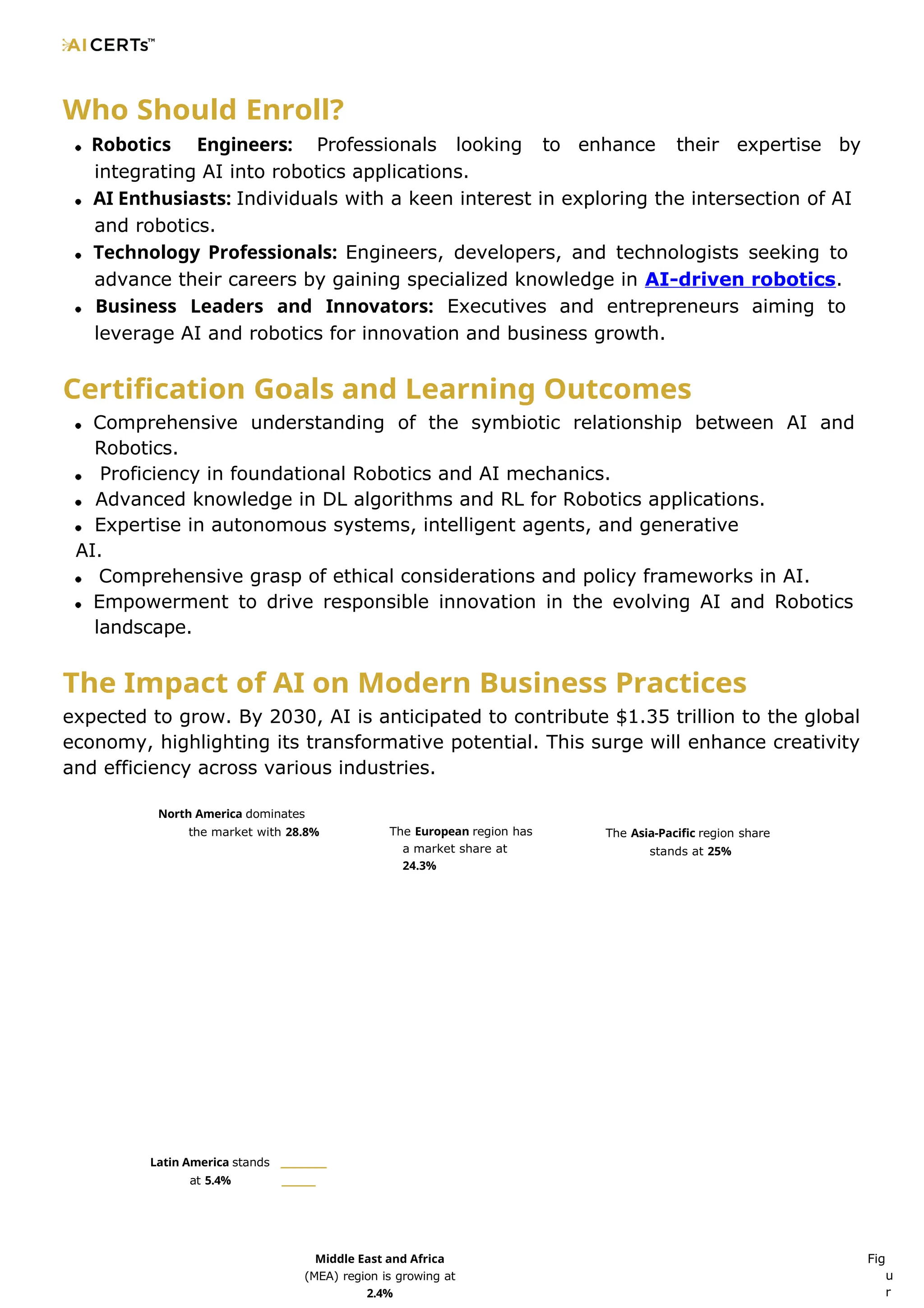
The Impact of AI on Modern Business Practices
expected to grow. By 2030, AI is anticipated to contribute $1.35 trillion to the global
economy, highlighting its transformative potential. This surge will enhance creativity
and efficiency across various industries.
North America dominates
the market with 28.8%
Latin America stands
at 5.4%
The European region has
a market share at
24.3%
The Asia-Pacific region share
stands at 25%
Middle East and Africa
(MEA) region is growing at
2.4%
Fig
u
r
e 1: AI Global Contribution
Source: PWC,I BM, Forbes
Australia is growing at
14.1%
Copyright© 2024. All rights reserved
2
AI+
Robotics
AI technologies in robotics have rapidly advanced from automating basic tasks to
enabling complex, autonomous operations. Through ML, Computer Vision, and NLP,
robots now adapt to dynamic environments and collaborate with humans.
Innovations in DL and RL have further enhanced autonomous systems, positioning
AI-driven robotics as a transformative force across industries.
What is Next for AI?
The future of AI in robotics will see significant advances in autonomy and human-
robot collaboration. Enhanced AI algorithms will improve robot’s ability to
understand and interact with complex environments. Innovations in RL will drive
more sophisticated decision-making and adaptability. AI-driven analytics will enable
robots to perform predictive maintenance and self-optimization. These
developments will lead to smarter, more efficient robotic systems across industries.
How AI Transforms Robotics Industry
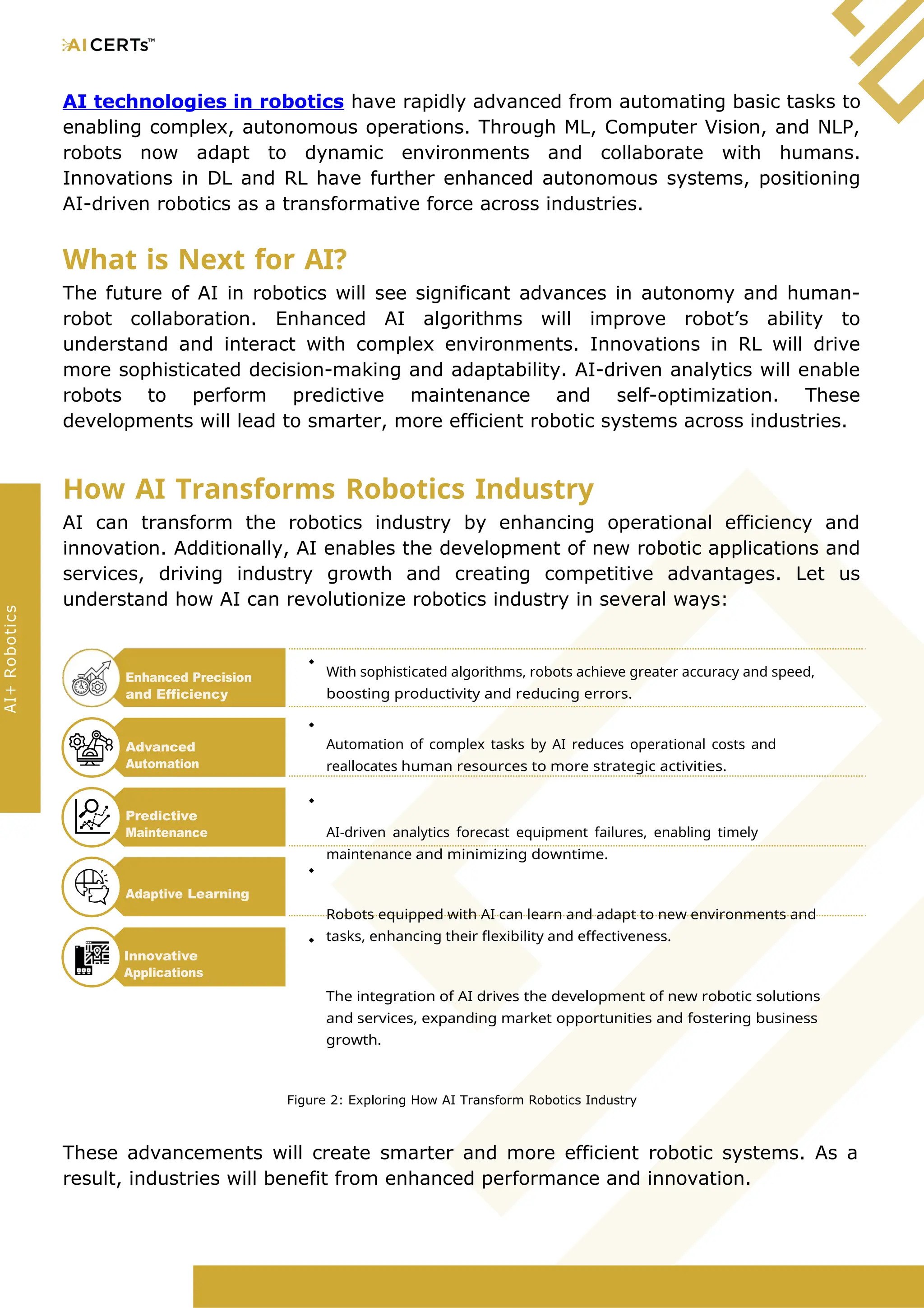
AI can transform the robotics industry by enhancing operational efficiency and
innovation. Additionally, AI enables the development of new robotic applications and
services, driving industry growth and creating competitive advantages. Let us
understand how AI can revolutionize robotics industry in several ways:
Enhanced Precision
and Efficiency
Advanced
Automation
Predictive
Maintenance
Adaptive Learning
Innovative
Applications
With sophisticated algorithms, robots achieve greater accuracy and speed,
boosting productivity and reducing errors.
Automation of complex tasks by AI reduces operational costs and
reallocates human resources to more strategic activities.
AI-driven analytics forecast equipment failures, enabling timely
maintenance and minimizing downtime.
Robots equipped with AI can learn and adapt to new environments and
tasks, enhancing their flexibility and effectiveness.
The integration of AI drives the development of new robotic solutions
and services, expanding market opportunities and fostering business
growth.
Figure 2: Exploring How AI Transform Robotics Industry
These advancements will create smarter and more efficient robotic systems. As a
result, industries will benefit from enhanced performance and innovation.
AI+
Robotics
Copyright© 2024. All rights reserved
3
How AI Addresses Current Challenges in Robotics
AI is transforming the robotics industry by addressing critical challenges and
enhancing operational efficiency. Through advanced algorithms and machine
learning, AI enables robots to perform complex tasks with precision, adaptability,
and speed, reducing human error and operational costs. It also facilitates real-time
decision-making, allowing robotics professionals to innovate faster and more
effectively. By improving task automation, AI not only streamlines processes but
also opens new possibilities for innovation in robotics, from autonomous navigation
to collaborative robots, ultimately pushing the boundaries of what robots can
achieve in various industries.
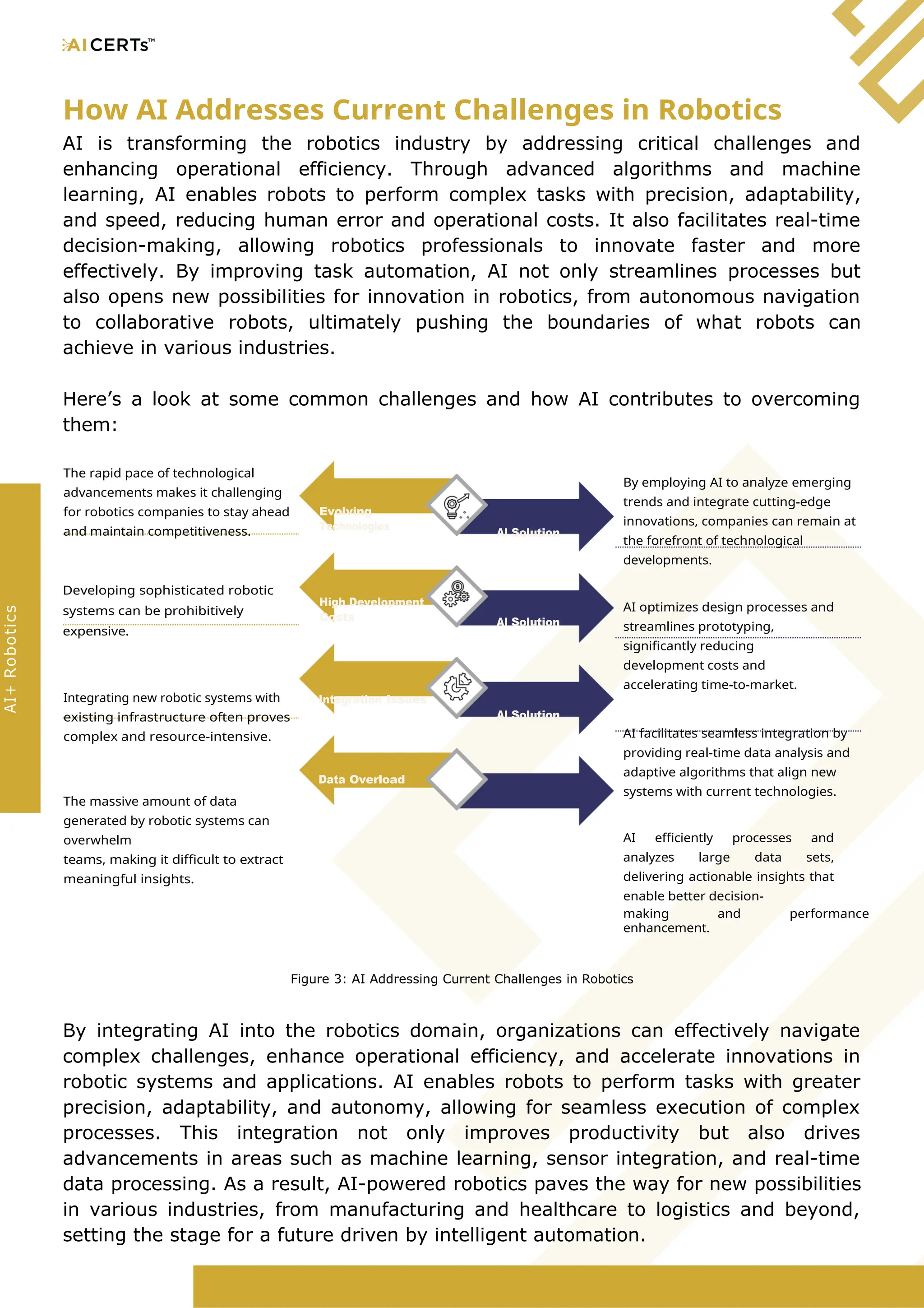
Here’s a look at some common challenges and how AI contributes to overcoming
them:
The rapid pace of technological
advancements makes it challenging
for robotics companies to stay ahead
and maintain competitiveness.
Developing sophisticated robotic
systems can be prohibitively
expensive.
Integrating new robotic systems with
existing infrastructure often proves
complex and resource-intensive.
The massive amount of data
generated by robotic systems can
overwhelm
teams, making it difficult to extract
meaningful insights.
Evolving
Technologies
High Development
Costs
Integration Issues
Data Overload
AI Solution
AI Solution
AI Solution
By employing AI to analyze emerging
trends and integrate cutting-edge
innovations, companies can remain at
the forefront of technological
developments.
AI optimizes design processes and
streamlines prototyping,
significantly reducing
development costs and
accelerating time-to-market.
AI facilitates seamless integration by
providing real-time data analysis and
adaptive algorithms that align new
systems with current technologies.
AI efficiently processes and
analyzes large data sets,
delivering actionable insights that
enable better decision-
making and performance
enhancement.
Figure 3: AI Addressing Current Challenges in Robotics
By integrating AI into the robotics domain, organizations can effectively navigate
complex challenges, enhance operational efficiency, and accelerate innovations in
robotic systems and applications. AI enables robots to perform tasks with greater
precision, adaptability, and autonomy, allowing for seamless execution of complex
processes. This integration not only improves productivity but also drives
advancements in areas such as machine learning, sensor integration, and real-time
data processing. As a result, AI-powered robotics paves the way for new possibilities
in various industries, from manufacturing and healthcare to logistics and beyond,
setting the stage for a future driven by intelligent automation.
AI+
Robotics
Copyright© 2024. All rights reserved
4
How Robotics Industries are Adopting AI
The robotics industry is increasingly leveraging AI to revolutionize workforce
dynamics and optimize employee roles. AI-driven automation takes over repetitive
and mundane tasks, freeing up employees to concentrate on more complex,
strategic, and creative challenges. This transformation not only enhances overall
productivity but also cultivates a more innovative work environment where human
expertise and robotic capabilities work in harmony. Moreover, AI tools are
instrumental in providing advanced training and development opportunities,
enabling employees to stay current with emerging technologies. This continuous
upskilling supports their growth and adaptability within the rapidly evolving robotics
sector, ensuring that the workforce remains competitive and well-prepared for
future advancements.
How to Integrate AI in Robotics
Incorporating AI into robotics can greatly boost performance and versatility. Here’s
how you can integrate AI into your robotics practices effectively:
Identify key areas where AI can enhance robotic functions
Choose suitable AI tools for tasks like perception or decision-making
Gather and prepare relevant data for training AI models
Train models to improve robotic
capabilities Embed AI models into robotic
systems
Evaluate performance and make necessary adjustments
Continuously improve AI models based on real-world performance
Figure 4: Keys Steps to Integrate AI in Robotics
These steps will help ensure a successful integration of AI into robotics practices,
leading to more intelligent and capable robotic systems.
AI+
Robotics
Copyright© 2024. All rights reserved
5
A Brief Summary of AI+ Robotics Certification
At AI CERTs, we empower organizations to unlock the potential of AI with our
industry-leading suite of role-based certifications.
Our AI+ Robotics Certification provides a thorough exploration of crucial aspects of
AI-driven robotics. Engage with the following modules to develop the skills
necessary to design, deploy, and optimize advanced robotic systems, driving
innovation and efficiency across different industries.
Module 1: Overview of AI and Robotics
Introduction to Robotics and AI includes fundamental concepts, historical
milestones, and technological developments. According to Statista, the AI robotics
market is set to reach $17.03 billion by 2024. With an annual growth rate (CAGR
2024- 2030) of 24.80%, it is projected to grow to $64.35 billion by 2030.
In this module, you will explore the fundamentals of robotics and AI, including their
historical milestones and technological advancements. Learn about AI types that
enhance robotic functions, such as reactive and theory of mind, and the role of
Machine Learning (ML) and DL in robotics. Discover how AI-driven robots are
transforming industries like manufacturing and healthcare, and understand the
importance of ongoing research in expanding their capabilities.
Module 2: Key Components and ML Integration with
Robotics
Understanding key components and ML integration with robotics is essential for
developing advanced, intelligent systems. Key components like sensors, actuators,
and controllers enable robots to interact with and perceive their environment.
Integrating ML allows robots to learn from data, adapt to new situations, and
improve their performance.
Within this module, you will explore the core components of AI and robotics,
including sensors, actuators, and control systems essential for automation. Learn
how ML types such as supervised, unsupervised, and RL enhance robotic
capabilities. Discover how neural networks improve robot’s perception and decision-
making. This overview covers essential elements for developing advanced,
intelligent robotic systems.
Module 3: Autonomous Systems and Intelligent
Agents
Autonomous systems and intelligent agents are essential for improving efficiency,
safety, and scalability across various sectors. They enable tasks to be performed
independently with minimal human input, enhancing precision and decision-making.
AI+
Robotics
Copyright© 2024. All rights reserved
6
The module covers the role of autonomous systems and intelligent agents in
enhancing efficiency and safety across industries. It includes case studies on self-
driving cars and industrial robots, highlighting their benefits and implementation
challenges. The module also explores the Robot Operating System (ROS), which
simplifies robotic development with its flexible and robust framework. Understanding
ROS and these technologies is crucial for advancing autonomous systems and
intelligent agents.
Module 4: AI and Robotics Development Frameworks
AI and robotics development frameworks are essential for creating sophisticated,
efficient systems by providing the necessary tools and libraries to handle complex
tasks. These frameworks, such as TensorFlow, PyTorch, OpenCV, and ROS,
streamline the integration of AI algorithms, enhance ML capabilities, and support
advanced robotic functions.
The module deep dives into Python's role in robotics and M, highlighting its
simplicity and versatility. It covers key AI libraries like TensorFlow and PyTorch,
focusing on their distinct features for AI model development. The module also
explores frameworks such as OpenCV and ROS, essential for computer vision and
robotic software development. Understanding these tools and their applications
enhances the efficiency and performance of AI and robotics projects.
Module 5: Deep Learning Algorithms in Robotics
DL algorithms are crucial in robotics for their ability to handle complex data and
make intelligent decisions. These algorithms enhance a robot's perception, allowing
it to recognize objects, navigate environments, and adapt to new situations with
high accuracy.
The module highlights how DL, especially Convolutional Neural Networks (CNNs),
boosts robotic perception and decision-making. CNNs excel in image recognition,
crucial for precise navigation and manipulation. Integrating DL with computer vision
enhances robot’s ability to interpret visual data and perform complex tasks. Practical
training and case studies show how these technologies improve accuracy and
efficiency in robotics, driving innovation across industries.
Module 6: Reinforcement Learning in Robotics
RL is crucial in robotics because it enables robots to autonomously learn and adapt
to complex environments through trial and error. By leveraging RL, robots can
optimize their actions to achieve desired outcomes, improve decision-making, and
handle dynamic tasks without explicit programming.
Copyright© 2024. All rights reserved
7
AI+
Robotics
In this module, you will explore how RL boosts robotic systems by enabling
autonomous adaptation. Key RL concepts—agents, states, actions, and rewards—are
fundamental for teaching robots optimal behaviors. The module covers RL
algorithms like Q-learning and Deep Q-networks (DQN) for decision-making and
handling complex environments. Hands-on training includes developing RL models
in simulations and applications such as warehouse optimization, showcasing RL's
role in enhancing efficiency and innovation.
Module 7: Generative AI for Robotic Creativity
Generative AI is bringing creativity and innovation to robotics. As per Market.us
research, the global Generative AI in Robotics market size is projected to reach
$23.3 billion by 2033, growing at a CAGR of 35% during the forecast period from
2024 to 2033.
The module explores the concept of Generative AI in robotics, focusing on how GANs
(Generative Adversarial Networks) enhance creativity and innovation. It covers
significant market growth, the role of GANs in generating realistic data and designs,
and their impact on robotic capabilities. The module includes hands-on sessions for
designing robotic components with generative AI, highlighting its transformative
potential in custom manufacturing and overall robotic creativity.
Module 8: NLP for Human-Robot Interaction
NLP revolutionizes human-robot interaction by enabling robots to comprehend
and respond to human language. By integrating fundamental NLP concepts into
robotic systems, communication becomes more seamless and natural, allowing
robots to interpret, process, and respond to human commands more effectively.
This advancement enhances the intuitiveness and efficiency of interactions, bridging
the gap between human intent and robotic execution.
Within this module, you will explore how NLP enhances human-robot interactions by
enabling robots to understand and respond to human language. Key topics include
speech recognition and language understanding for voice-activated control. Hands-
on projects will involve developing voice-command systems. A case study on
healthcare robots demonstrates NLP's impact on patient care and communication.
Module 9: Practical Activities and Use Cases
In this module, you will gain hands-on experience with AI and robotics by
developing Python-based object recognition models, implementing path planning
with algorithms like A*, and programming PID controllers for precise robotic control.
Practical sessions will cover visual recognition, obstacle avoidance, and localization
techniques, including Monte Carlo Localization. Real-world applications in precision
agriculture and automated assembly lines will illustrate how AI and robotics enhance
efficiency and productivity.
Copyright© 2024. All rights reserved
8
AI+
Robotics
Module 10: Emerging Technologies and Innovation in
Robotics
The module explores how blockchain and quantum computing are revolutionizing
robotics. Blockchain enhances security and transparency in robotic operations, while
quantum computing boosts speed and problem-solving capabilities. These
technologies advance robotics by improving security, efficiency, and sustainability,
leading to innovative applications and solutions.
Module 11: Exploring AI with Robotic Process
Automation
Exploring AI with Robotic Process Automation (RPA) enhances business operations
by automating repetitive tasks and increasing efficiency. Integrating AI with RPA
enables handling complex tasks such as predictive maintenance and automated
customer support, improving accuracy and decision-making.
In this module, you'll learn how AI enhances Robotic Process Automation (RPA) to
improve efficiency and reduce costs. Explore practical RPA applications like data
entry and customer support, and compare popular tools such as UiPath and
Automation Anywhere. Discover how AI technologies, including ML and NLP,
optimize RPA for complex tasks. Case studies will show the impact of AI-driven RPA
on productivity and innovation across different industries.
Module 12: Artificial Intelligence Ethics, Safety, and
Policies
Understanding AI ethics, safety, and policies in robotics is vital to ensure fair,
responsible, and secure technology use. It helps prevent bias in AI systems, ensures
accountability for robotic decisions, and establishes safety standards to protect
users and maintain public trust.
The module describes the need for managing ethics and safety in AI-driven robotics.
It covers addressing bias, ensuring accountability, and designing robots to meet
safety standards for reliable operation. Understanding AI regulations is crucial for
compliance and fostering innovation while upholding ethical standards.
Module 13: Innovations and Future Trends in AI and
Robotics
In this last module, you will explore how AI and robotics innovations are reshaping
technology, from autonomous systems navigating complex environments to AI-
powered surgical robots and social robots for eldercare.
AI+
Robotics
Copyright© 2024. All rights reserved
9
These advancements highlight robotics’ adaptability and potential in fields like
manufacturing and healthcare. The module also addresses the broader impact on
work and society, including changes in job roles, ethical concerns, and the need for
harmonizing technology with societal impacts.
How Can AI CERTs Help Build an AI-Ready Culture?
Although AI brings substantial benefits, businesses often face obstacles like skill
gaps, complex data management, and integration issues during implementation. At
AI CERTs, we address these challenges by providing the best certifications designed
to help organizations effectively manage and overcome these hurdles.
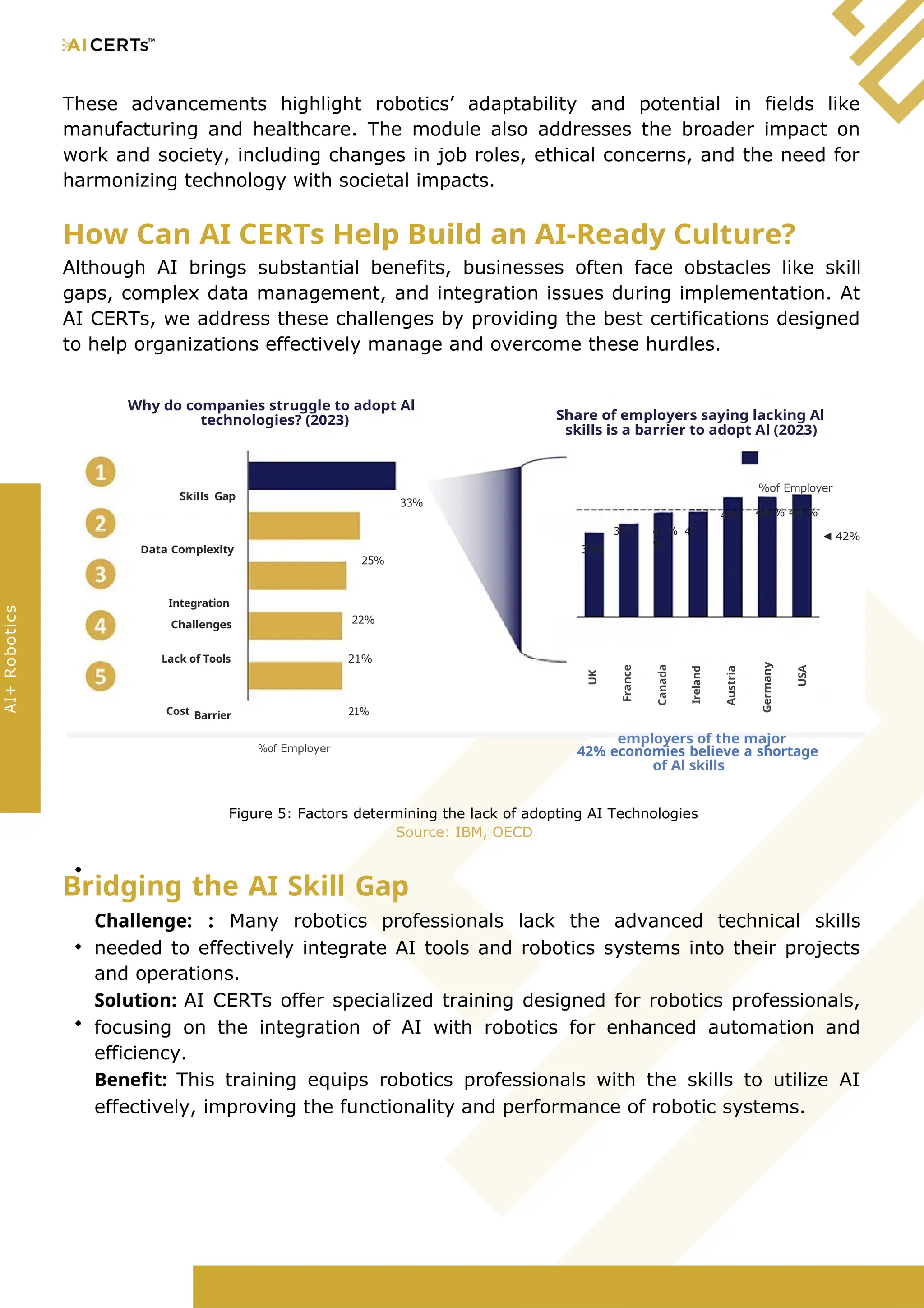
Why do companies struggle to adopt Al
technologies? (2023) Share of employers saying lacking Al
skills is a barrier to adopt Al (2023)
Skills Gap
Data Complexity
25%
33%
33%
37% 41 % 42
%
47%
%of Employer
48 % 49 %
◄ 42%
Integration
Challenges 22%
Lack of Tools 21%
Cost Barrier 21%
%of Employer
employers of the major
42% economies believe a shortage
of Al skills
Figure 5: Factors determining the lack of adopting AI Technologies
Source: IBM, OECD
Bridging the AI Skill Gap
Challenge: : Many robotics professionals lack the advanced technical skills
needed to effectively integrate AI tools and robotics systems into their projects
and operations.
Solution: AI CERTs offer specialized training designed for robotics professionals,
focusing on the integration of AI with robotics for enhanced automation and
efficiency.
Benefit: This training equips robotics professionals with the skills to utilize AI
effectively, improving the functionality and performance of robotic systems.
AI+
Robotics
UK
France
Canada
Ireland
Austria
Germany
USA
Copyright© 2024. All rights reserved
10
Empowering Robotics Professionals with AI Skills
Challenge: Robotics professionals often lack access to the latest AI tools,
platforms, and training resources required for skill development and staying
updated with technological advancements.
Solution: AI CERTs provide comprehensive, current training on the newest AI
tools and platforms specifically for robotics applications.
Benefit: With access to cutting-edge tools and training, robotics professionals can
better integrate AI into their systems, advancing automation capabilities and
improving operational outcomes.
At AI CERTs, we offer a strategic solution, fostering a culture primed for AI integration
and innovation. Our premium AI certification programs provide the
comprehensive training and industry-recognized credentials needed to empower
your workforce and propel your organization towards an AI-driven future.
AI CERTs Cultivate AI Culture in Several Ways:
Our certification offers a clear and comprehensive exploration of AI fundamentals
and applications, making learning straightforward.
We provide ongoing education to ensure your team stays current with the latest
AI advancements, keeping your company at the forefront.
AI CERTs also encourage knowledge exchange and teamwork, crucial for effective
AI implementation.
AI CERTs: Your Pathway to Becoming AI-Ready
The future of business belongs to those who harness the power of AI.
Tailored for Success: Our certifications are customized to meet your team's unique
needs, providing specialized training that develops the essential skills for key AI
positions.
Actionable Expertise: We focus on experiential learning with real-world projects and
case studies, helping your team build expertise and effectively apply AI for
innovation and advancement.
Become an AI Leader: Advance with AI CERTs. Invest in your team's growth to
cultivate an AI-driven environment and drive your organization’s success with
cutting-edge technology.
AI+
Robotics
Copyright© 2024. All rights reserved
11
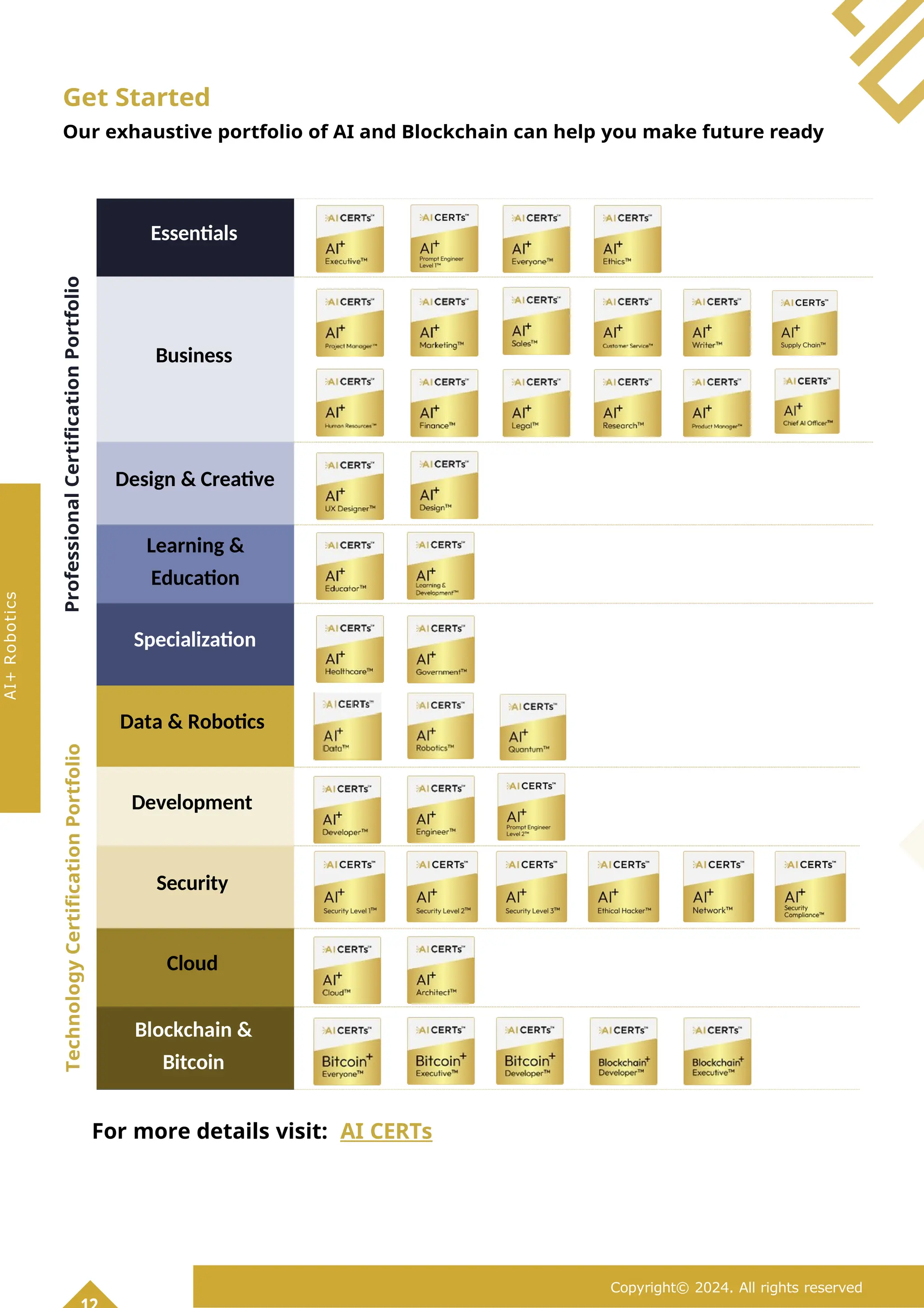
Get Started
Our exhaustive portfolio of AI and Blockchain can help you make future ready
Essentials
Business
Design & Creative
Learning &
Education
Specialization
Data & Robotics
Development
Security
Cloud
Blockchain &
Bitcoin
For more details visit: AI CERTs
Copyright© 2024. All rights reserved
AI+
Robotics
Professional
Certification
Portfolio
Technology
Certification
Portfolio
www.aicerts.ai
Contact
252 West 37th St., Suite 1200W
New York, NY 10018

AI Robotics Certification Advance Your Career with Expert Training

  • 2.
    TABLE OF CONTENTS Introduction...............................................................................................................................................1 CertificationGoals and Learning Outcomes..........................................................................2 The Impact of AI on Modern Business Practices..................................................................2 What is Next for AI?.............................................................................................................................3 How AI Transforms Robotics Industry......................................................................................3 How AI Addresses Current Challenges in Robotics............................................................4 How Robotics Industries are Adopting AI.............................................................................4 How to Integrate AI in Robotics....................................................................................................4 Module 1: Overview of AI and Robotics.....................................................................................6 Module 2: Key Components and ML Integration with Robotics................................6 Module 3: Autonomous Systems and Intelligent Agents..............................................6 Module 4: AI and Robotics Development Frameworks.....................................................7 Module 5: Deep Learning Algorithms in Robotics.............................................................7 Module 6: Reinforcement Learning in Robotics...................................................................7 Module 7: Generative AI for Robotic Creativity.....................................................................8 Module 8: NLP for Human-Robot Interaction.......................................................................8 Module 9: Practical Activities and Use-Cases.......................................................................8 Module 10: Emerging Technologies and Innovation in Robotics...............................9 Module 11: Exploring AI with Robotic Process Automation...........................................9 Module 12: AI Ethics, Safety, and Policy....................................................................................9 Module 13: Innovations and Future Trends in AI and Robotics...................................9 How Can AI CERTs Help Build an AI-Ready Culture?.......................................................10 AI+ Robotics
  • 3.
    Copyright© 2024. Allrights reserved
  • 4.
    Introduction The AI+ RoboticsCertification offers a transformative journey into the rapidly evolving field where Artificial Intelligence (AI) meets Robotics. Designed for professionals seeking to excel in this domain, the certification covers foundational concepts, advanced Deep Learning (DL) algorithms, and Reinforcement Learning (RL), all customized to Robotics applications. This certification highlights a balanced understanding of autonomous systems, intelligent agents, and generative AI, enriched with hands-on activities and real- world case studies. Ethical considerations and policy frameworks are integrated to ensure responsible AI practices. By completing this certification, you will gain the theoretical knowledge and practical expertise needed to lead innovation while navigating the ethical complexities of AI in Robotics. You will cover the following topics to better understand the incorporation of AI in Robotic field. Introduction to Robotics and AI Understanding AI and Robotics Mechanics Autonomous Systems and Intelligent Agents AI and Robotics Development Frameworks Deep Learning Algorithms in Robotics Reinforcement Learning in Robotics Generative AI for Robotic Creativity NLP for Human-Robot Interaction Practical Activities and Use-Cases Emerging Technologies and Innovation in Robotics Exploring AI with Robotic Process Automation AI Ethics, Safety, and Policy Innovations and Future Trends in AI and Robotics Certification Prerequisites Fundamental Knowledge: Basic understanding of AI, Science, Technology, Engineering, or Mathematics (STEM), computer programming languages, mathematics, and physics. Enthusiasm for Utilizing AI Tools: Willingness to generate innovative ideas by effectively leveraging AI tools. Capability to Evaluate AI and Robotics Implications: Ability to analyze information critically and evaluate the implications of AI and Robotics technologies. Preparedness for Problem-Solving and Real-World Application: Ready to engage in problem-solving activities and apply AI techniques to real-world scenarios. AI+ Robotics
  • 5.
    Copyright© 2024. Allrights reserved 1
  • 6.
    Who Should Enroll? RoboticsEngineers: Professionals looking to enhance their expertise by integrating AI into robotics applications. AI Enthusiasts: Individuals with a keen interest in exploring the intersection of AI and robotics. Technology Professionals: Engineers, developers, and technologists seeking to advance their careers by gaining specialized knowledge in AI-driven robotics. Business Leaders and Innovators: Executives and entrepreneurs aiming to leverage AI and robotics for innovation and business growth. Certification Goals and Learning Outcomes Comprehensive understanding of the symbiotic relationship between AI and Robotics. Proficiency in foundational Robotics and AI mechanics. Advanced knowledge in DL algorithms and RL for Robotics applications. Expertise in autonomous systems, intelligent agents, and generative AI. Comprehensive grasp of ethical considerations and policy frameworks in AI. Empowerment to drive responsible innovation in the evolving AI and Robotics landscape. The Impact of AI on Modern Business Practices expected to grow. By 2030, AI is anticipated to contribute $1.35 trillion to the global economy, highlighting its transformative potential. This surge will enhance creativity and efficiency across various industries. North America dominates the market with 28.8% Latin America stands at 5.4% The European region has a market share at 24.3% The Asia-Pacific region share stands at 25% Middle East and Africa (MEA) region is growing at 2.4% Fig u r
  • 7.
    e 1: AIGlobal Contribution Source: PWC,I BM, Forbes Australia is growing at 14.1% Copyright© 2024. All rights reserved 2 AI+ Robotics
  • 8.
    AI technologies inrobotics have rapidly advanced from automating basic tasks to enabling complex, autonomous operations. Through ML, Computer Vision, and NLP, robots now adapt to dynamic environments and collaborate with humans. Innovations in DL and RL have further enhanced autonomous systems, positioning AI-driven robotics as a transformative force across industries. What is Next for AI? The future of AI in robotics will see significant advances in autonomy and human- robot collaboration. Enhanced AI algorithms will improve robot’s ability to understand and interact with complex environments. Innovations in RL will drive more sophisticated decision-making and adaptability. AI-driven analytics will enable robots to perform predictive maintenance and self-optimization. These developments will lead to smarter, more efficient robotic systems across industries. How AI Transforms Robotics Industry AI can transform the robotics industry by enhancing operational efficiency and innovation. Additionally, AI enables the development of new robotic applications and services, driving industry growth and creating competitive advantages. Let us understand how AI can revolutionize robotics industry in several ways: Enhanced Precision and Efficiency Advanced Automation Predictive Maintenance Adaptive Learning Innovative Applications With sophisticated algorithms, robots achieve greater accuracy and speed, boosting productivity and reducing errors. Automation of complex tasks by AI reduces operational costs and reallocates human resources to more strategic activities. AI-driven analytics forecast equipment failures, enabling timely maintenance and minimizing downtime. Robots equipped with AI can learn and adapt to new environments and tasks, enhancing their flexibility and effectiveness. The integration of AI drives the development of new robotic solutions and services, expanding market opportunities and fostering business growth. Figure 2: Exploring How AI Transform Robotics Industry These advancements will create smarter and more efficient robotic systems. As a result, industries will benefit from enhanced performance and innovation. AI+ Robotics
  • 9.
    Copyright© 2024. Allrights reserved 3
  • 10.
    How AI AddressesCurrent Challenges in Robotics AI is transforming the robotics industry by addressing critical challenges and enhancing operational efficiency. Through advanced algorithms and machine learning, AI enables robots to perform complex tasks with precision, adaptability, and speed, reducing human error and operational costs. It also facilitates real-time decision-making, allowing robotics professionals to innovate faster and more effectively. By improving task automation, AI not only streamlines processes but also opens new possibilities for innovation in robotics, from autonomous navigation to collaborative robots, ultimately pushing the boundaries of what robots can achieve in various industries. Here’s a look at some common challenges and how AI contributes to overcoming them: The rapid pace of technological advancements makes it challenging for robotics companies to stay ahead and maintain competitiveness. Developing sophisticated robotic systems can be prohibitively expensive. Integrating new robotic systems with existing infrastructure often proves complex and resource-intensive. The massive amount of data generated by robotic systems can overwhelm teams, making it difficult to extract meaningful insights. Evolving Technologies High Development Costs Integration Issues Data Overload AI Solution AI Solution AI Solution By employing AI to analyze emerging trends and integrate cutting-edge innovations, companies can remain at the forefront of technological developments. AI optimizes design processes and streamlines prototyping, significantly reducing development costs and accelerating time-to-market. AI facilitates seamless integration by providing real-time data analysis and adaptive algorithms that align new systems with current technologies. AI efficiently processes and analyzes large data sets, delivering actionable insights that enable better decision- making and performance enhancement. Figure 3: AI Addressing Current Challenges in Robotics By integrating AI into the robotics domain, organizations can effectively navigate complex challenges, enhance operational efficiency, and accelerate innovations in robotic systems and applications. AI enables robots to perform tasks with greater precision, adaptability, and autonomy, allowing for seamless execution of complex processes. This integration not only improves productivity but also drives advancements in areas such as machine learning, sensor integration, and real-time data processing. As a result, AI-powered robotics paves the way for new possibilities in various industries, from manufacturing and healthcare to logistics and beyond, setting the stage for a future driven by intelligent automation. AI+ Robotics
  • 11.
    Copyright© 2024. Allrights reserved 4
  • 12.
    How Robotics Industriesare Adopting AI The robotics industry is increasingly leveraging AI to revolutionize workforce dynamics and optimize employee roles. AI-driven automation takes over repetitive and mundane tasks, freeing up employees to concentrate on more complex, strategic, and creative challenges. This transformation not only enhances overall productivity but also cultivates a more innovative work environment where human expertise and robotic capabilities work in harmony. Moreover, AI tools are instrumental in providing advanced training and development opportunities, enabling employees to stay current with emerging technologies. This continuous upskilling supports their growth and adaptability within the rapidly evolving robotics sector, ensuring that the workforce remains competitive and well-prepared for future advancements. How to Integrate AI in Robotics Incorporating AI into robotics can greatly boost performance and versatility. Here’s how you can integrate AI into your robotics practices effectively: Identify key areas where AI can enhance robotic functions Choose suitable AI tools for tasks like perception or decision-making Gather and prepare relevant data for training AI models Train models to improve robotic capabilities Embed AI models into robotic systems Evaluate performance and make necessary adjustments Continuously improve AI models based on real-world performance Figure 4: Keys Steps to Integrate AI in Robotics These steps will help ensure a successful integration of AI into robotics practices, leading to more intelligent and capable robotic systems. AI+ Robotics
  • 13.
    Copyright© 2024. Allrights reserved 5
  • 14.
    A Brief Summaryof AI+ Robotics Certification At AI CERTs, we empower organizations to unlock the potential of AI with our industry-leading suite of role-based certifications. Our AI+ Robotics Certification provides a thorough exploration of crucial aspects of AI-driven robotics. Engage with the following modules to develop the skills necessary to design, deploy, and optimize advanced robotic systems, driving innovation and efficiency across different industries. Module 1: Overview of AI and Robotics Introduction to Robotics and AI includes fundamental concepts, historical milestones, and technological developments. According to Statista, the AI robotics market is set to reach $17.03 billion by 2024. With an annual growth rate (CAGR 2024- 2030) of 24.80%, it is projected to grow to $64.35 billion by 2030. In this module, you will explore the fundamentals of robotics and AI, including their historical milestones and technological advancements. Learn about AI types that enhance robotic functions, such as reactive and theory of mind, and the role of Machine Learning (ML) and DL in robotics. Discover how AI-driven robots are transforming industries like manufacturing and healthcare, and understand the importance of ongoing research in expanding their capabilities. Module 2: Key Components and ML Integration with Robotics Understanding key components and ML integration with robotics is essential for developing advanced, intelligent systems. Key components like sensors, actuators, and controllers enable robots to interact with and perceive their environment. Integrating ML allows robots to learn from data, adapt to new situations, and improve their performance. Within this module, you will explore the core components of AI and robotics, including sensors, actuators, and control systems essential for automation. Learn how ML types such as supervised, unsupervised, and RL enhance robotic capabilities. Discover how neural networks improve robot’s perception and decision- making. This overview covers essential elements for developing advanced, intelligent robotic systems. Module 3: Autonomous Systems and Intelligent Agents Autonomous systems and intelligent agents are essential for improving efficiency, safety, and scalability across various sectors. They enable tasks to be performed independently with minimal human input, enhancing precision and decision-making. AI+ Robotics
  • 15.
    Copyright© 2024. Allrights reserved 6
  • 16.
    The module coversthe role of autonomous systems and intelligent agents in enhancing efficiency and safety across industries. It includes case studies on self- driving cars and industrial robots, highlighting their benefits and implementation challenges. The module also explores the Robot Operating System (ROS), which simplifies robotic development with its flexible and robust framework. Understanding ROS and these technologies is crucial for advancing autonomous systems and intelligent agents. Module 4: AI and Robotics Development Frameworks AI and robotics development frameworks are essential for creating sophisticated, efficient systems by providing the necessary tools and libraries to handle complex tasks. These frameworks, such as TensorFlow, PyTorch, OpenCV, and ROS, streamline the integration of AI algorithms, enhance ML capabilities, and support advanced robotic functions. The module deep dives into Python's role in robotics and M, highlighting its simplicity and versatility. It covers key AI libraries like TensorFlow and PyTorch, focusing on their distinct features for AI model development. The module also explores frameworks such as OpenCV and ROS, essential for computer vision and robotic software development. Understanding these tools and their applications enhances the efficiency and performance of AI and robotics projects. Module 5: Deep Learning Algorithms in Robotics DL algorithms are crucial in robotics for their ability to handle complex data and make intelligent decisions. These algorithms enhance a robot's perception, allowing it to recognize objects, navigate environments, and adapt to new situations with high accuracy. The module highlights how DL, especially Convolutional Neural Networks (CNNs), boosts robotic perception and decision-making. CNNs excel in image recognition, crucial for precise navigation and manipulation. Integrating DL with computer vision enhances robot’s ability to interpret visual data and perform complex tasks. Practical training and case studies show how these technologies improve accuracy and efficiency in robotics, driving innovation across industries. Module 6: Reinforcement Learning in Robotics RL is crucial in robotics because it enables robots to autonomously learn and adapt to complex environments through trial and error. By leveraging RL, robots can optimize their actions to achieve desired outcomes, improve decision-making, and handle dynamic tasks without explicit programming. Copyright© 2024. All rights reserved 7 AI+ Robotics
  • 17.
    In this module,you will explore how RL boosts robotic systems by enabling autonomous adaptation. Key RL concepts—agents, states, actions, and rewards—are fundamental for teaching robots optimal behaviors. The module covers RL algorithms like Q-learning and Deep Q-networks (DQN) for decision-making and handling complex environments. Hands-on training includes developing RL models in simulations and applications such as warehouse optimization, showcasing RL's role in enhancing efficiency and innovation. Module 7: Generative AI for Robotic Creativity Generative AI is bringing creativity and innovation to robotics. As per Market.us research, the global Generative AI in Robotics market size is projected to reach $23.3 billion by 2033, growing at a CAGR of 35% during the forecast period from 2024 to 2033. The module explores the concept of Generative AI in robotics, focusing on how GANs (Generative Adversarial Networks) enhance creativity and innovation. It covers significant market growth, the role of GANs in generating realistic data and designs, and their impact on robotic capabilities. The module includes hands-on sessions for designing robotic components with generative AI, highlighting its transformative potential in custom manufacturing and overall robotic creativity. Module 8: NLP for Human-Robot Interaction NLP revolutionizes human-robot interaction by enabling robots to comprehend and respond to human language. By integrating fundamental NLP concepts into robotic systems, communication becomes more seamless and natural, allowing robots to interpret, process, and respond to human commands more effectively. This advancement enhances the intuitiveness and efficiency of interactions, bridging the gap between human intent and robotic execution. Within this module, you will explore how NLP enhances human-robot interactions by enabling robots to understand and respond to human language. Key topics include speech recognition and language understanding for voice-activated control. Hands- on projects will involve developing voice-command systems. A case study on healthcare robots demonstrates NLP's impact on patient care and communication. Module 9: Practical Activities and Use Cases In this module, you will gain hands-on experience with AI and robotics by developing Python-based object recognition models, implementing path planning with algorithms like A*, and programming PID controllers for precise robotic control. Practical sessions will cover visual recognition, obstacle avoidance, and localization techniques, including Monte Carlo Localization. Real-world applications in precision agriculture and automated assembly lines will illustrate how AI and robotics enhance efficiency and productivity. Copyright© 2024. All rights reserved 8 AI+ Robotics
  • 18.
    Module 10: EmergingTechnologies and Innovation in Robotics The module explores how blockchain and quantum computing are revolutionizing robotics. Blockchain enhances security and transparency in robotic operations, while quantum computing boosts speed and problem-solving capabilities. These technologies advance robotics by improving security, efficiency, and sustainability, leading to innovative applications and solutions. Module 11: Exploring AI with Robotic Process Automation Exploring AI with Robotic Process Automation (RPA) enhances business operations by automating repetitive tasks and increasing efficiency. Integrating AI with RPA enables handling complex tasks such as predictive maintenance and automated customer support, improving accuracy and decision-making. In this module, you'll learn how AI enhances Robotic Process Automation (RPA) to improve efficiency and reduce costs. Explore practical RPA applications like data entry and customer support, and compare popular tools such as UiPath and Automation Anywhere. Discover how AI technologies, including ML and NLP, optimize RPA for complex tasks. Case studies will show the impact of AI-driven RPA on productivity and innovation across different industries. Module 12: Artificial Intelligence Ethics, Safety, and Policies Understanding AI ethics, safety, and policies in robotics is vital to ensure fair, responsible, and secure technology use. It helps prevent bias in AI systems, ensures accountability for robotic decisions, and establishes safety standards to protect users and maintain public trust. The module describes the need for managing ethics and safety in AI-driven robotics. It covers addressing bias, ensuring accountability, and designing robots to meet safety standards for reliable operation. Understanding AI regulations is crucial for compliance and fostering innovation while upholding ethical standards. Module 13: Innovations and Future Trends in AI and Robotics In this last module, you will explore how AI and robotics innovations are reshaping technology, from autonomous systems navigating complex environments to AI- powered surgical robots and social robots for eldercare. AI+ Robotics
  • 19.
    Copyright© 2024. Allrights reserved 9
  • 20.
    These advancements highlightrobotics’ adaptability and potential in fields like manufacturing and healthcare. The module also addresses the broader impact on work and society, including changes in job roles, ethical concerns, and the need for harmonizing technology with societal impacts. How Can AI CERTs Help Build an AI-Ready Culture? Although AI brings substantial benefits, businesses often face obstacles like skill gaps, complex data management, and integration issues during implementation. At AI CERTs, we address these challenges by providing the best certifications designed to help organizations effectively manage and overcome these hurdles. Why do companies struggle to adopt Al technologies? (2023) Share of employers saying lacking Al skills is a barrier to adopt Al (2023) Skills Gap Data Complexity 25% 33% 33% 37% 41 % 42 % 47% %of Employer 48 % 49 % ◄ 42% Integration Challenges 22% Lack of Tools 21% Cost Barrier 21% %of Employer employers of the major 42% economies believe a shortage of Al skills Figure 5: Factors determining the lack of adopting AI Technologies Source: IBM, OECD Bridging the AI Skill Gap Challenge: : Many robotics professionals lack the advanced technical skills needed to effectively integrate AI tools and robotics systems into their projects and operations. Solution: AI CERTs offer specialized training designed for robotics professionals, focusing on the integration of AI with robotics for enhanced automation and efficiency. Benefit: This training equips robotics professionals with the skills to utilize AI effectively, improving the functionality and performance of robotic systems. AI+ Robotics UK France Canada Ireland Austria Germany USA
  • 21.
    Copyright© 2024. Allrights reserved 10
  • 22.
    Empowering Robotics Professionalswith AI Skills Challenge: Robotics professionals often lack access to the latest AI tools, platforms, and training resources required for skill development and staying updated with technological advancements. Solution: AI CERTs provide comprehensive, current training on the newest AI tools and platforms specifically for robotics applications. Benefit: With access to cutting-edge tools and training, robotics professionals can better integrate AI into their systems, advancing automation capabilities and improving operational outcomes. At AI CERTs, we offer a strategic solution, fostering a culture primed for AI integration and innovation. Our premium AI certification programs provide the comprehensive training and industry-recognized credentials needed to empower your workforce and propel your organization towards an AI-driven future. AI CERTs Cultivate AI Culture in Several Ways: Our certification offers a clear and comprehensive exploration of AI fundamentals and applications, making learning straightforward. We provide ongoing education to ensure your team stays current with the latest AI advancements, keeping your company at the forefront. AI CERTs also encourage knowledge exchange and teamwork, crucial for effective AI implementation. AI CERTs: Your Pathway to Becoming AI-Ready The future of business belongs to those who harness the power of AI. Tailored for Success: Our certifications are customized to meet your team's unique needs, providing specialized training that develops the essential skills for key AI positions. Actionable Expertise: We focus on experiential learning with real-world projects and case studies, helping your team build expertise and effectively apply AI for innovation and advancement. Become an AI Leader: Advance with AI CERTs. Invest in your team's growth to cultivate an AI-driven environment and drive your organization’s success with cutting-edge technology. AI+ Robotics
  • 23.
    Copyright© 2024. Allrights reserved 11
  • 24.
    Get Started Our exhaustiveportfolio of AI and Blockchain can help you make future ready Essentials Business Design & Creative Learning & Education Specialization Data & Robotics Development Security Cloud Blockchain & Bitcoin For more details visit: AI CERTs Copyright© 2024. All rights reserved AI+ Robotics Professional Certification Portfolio Technology Certification Portfolio
  • 25.
    www.aicerts.ai Contact 252 West 37thSt., Suite 1200W New York, NY 10018