TABLE OF CONTENTS
Introduction................................................................................ 1
Certification Goals and Learning Outcomes ....................... 2
The Impact of AI on Modern Business Practices ................ 2
What is Next in AI? ................................................................... 3
How Ethics in AI Transform Businesses ............................... 4
How Ethics in AI Address Current Business Challenges .. 4
How Industries are Adopting Ethics in AI ............................ 5
How to Integrate Ethical AI in Business Practices ............ 5
Module 1: Overview of AI Ethics & Societal Impact ............ 6
Module 2: Bias and Fairness in AI .......................................... 6
Module 3: Transparency and Explainable AI ....................... 6
Module 4: Privacy and Security Issues in AI ........................ 7
Module 5: Accountability and Responsibility ...................... 8
Module 6: Legal and Regulatory Issues ................................ 8
Module 7: Ethical Decision-Making Frameworks ............... 9
Module 8: AI Governance and Best Practices ..................... 9
Module 9: Global AI Ethics Standards ................................... 9
How Can AI CERTs Help Build an AI-Ready Culture? ........ 9
Copyright© 2024. All rights reserved
AI+
Ethics
Introduction
The AI+ Ethics Certification is designed to provide a comprehensive overview of
ethical considerations in Artificial Intelligence (AI). It is structured to deliver detailed
knowledge on ethics associated with AI and their societal impact. It also provides a
solid framework for comprehending the broader consequences of AI by introducing
detailed social and ethical impact assessments. Further, it highlights data and
algorithm biases, offering practical strategies for reducing them and creating more
fair and nondiscriminatory AI systems. Guided projects and real-world case
evaluations demonstrate how to explain AI models to varied stakeholders,
emphasizing the necessity for AI transparency.
All our certifications provide a high-level understanding of AI ethics; however, this
certification offers a much deeper dive into the subject. It goes beyond surface-level
concepts, enabling learners to engage with complex ethical dilemmas and to
develop a understanding of AI’s societal implications. This course is ideal for those
looking to explore the complexities of AI ethics more thoroughly and to gain
practical skills in addressing ethical challenges in AI development and deployment.
he curriculum of the certification addresses privacy and data security in Artificial
Intelligence (AI), covering accountability, ethical duties of developers, organizational
practices, and solutions for protecting sensitive information. Additionally, it includes
an in-depth examination of the European Union (EU) AI Act, exploring how it
intersects with global challenges like General Data Protection Regulation (GDPR)
compliance. Participants also learn ethical decision-making frameworks from
computer science, philosophy, and sociology to guide AI development and
deployment. The course also covers AI governance risks, ethical policy best
practices, and global standards like the Institute of Electrical and Electronics
Engineers (IEEE)’s Ethically Aligned Design, equipping learners with the knowledge
needed to navigate the evolving landscape of AI ethics.
We will cover the following topics in detail to help you understand the incorporation
of AI into Ethics:
Overview of AI Ethics & Societal
Impact Bias and Fairness in AI
Transparency and Explainable
AI Privacy and Security Issues
in AI
Accountability and Responsibility
Legal and Regulatory Issues
Ethical Decision-Making Frameworks
AI Governance and Best Practices
Global AI Ethics Standards
Copyright© 2024. All rights reserved
AI+
Ethics
Certification Prerequisites
Basic Understanding of AI Concepts: A fundamental understanding of AI and its
practical applications in business, no technical expertise required.
Awareness of Ethical Principles: Understanding the ethical and societal impacts
of technology in everyday life.
Curiosity and Openness to Learning: A strong willingness to learn potential
biases and ethical implications associated with AI and strategies to mitigate
them.
Who Should Enroll?
All Business Managers: Those responsible for strategic decisions and ethical
considerations in business operations.
CXOs: Senior executives ensuring ethical AI practices and governance within their
organizations.
Frontline Workers: Employees directly interacting with AI systems who need to
understand ethical implications.
Certification Goals and Learning Outcomes
Equip participants with a thorough understanding of the fundamental ethical
principles applicable to AI and digital technologies.
Familiarize participants with existing ethical frameworks, guidelines, and best
practices in AI.
Understand and articulate key ethical principles such as fairness, accountability,
transparency, and privacy in the context of AI.
Demonstrate ethical leadership in the development, deployment, and
management of AI technologies.
The Impact of AI on Modern Business Practices
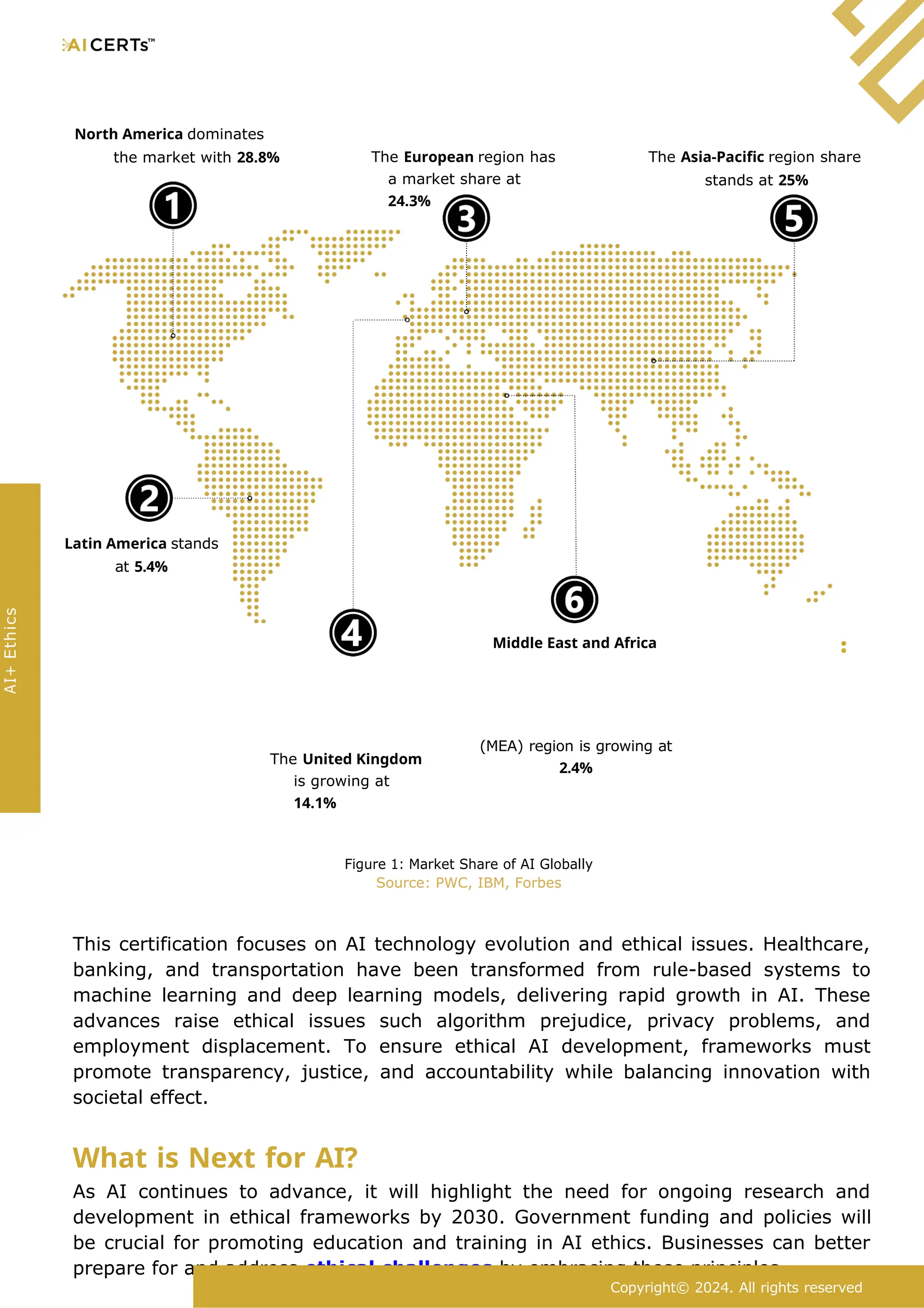
The field of AI is progressing rapidly, and technology and the economy have risen
over the last ten years. It could potentially add $15.7 trillion to the world economy
by 2030. The global economy stands to gain significantly from AI's transformative
power. North America leads with a 28.8% market share, followed by Asia-Pacific at
25%. Europe holds a 24.3% share, while the United Kingdom is growing at 14.1%.
Latin America and the Middle East and Africa (MEA) region each have 5.4%,
highlighting the regional evolution of AI.
2 Copyright© 2024. All rights reserved
AI+
Ethics
North America dominates
the market with 28.8% The European region has
a market share at
24.3%
The Asia-Pacific region share
stands at 25%
The United Kingdom
is growing at
14.1%
(MEA) region is growing at
2.4%
Figure 1: Market Share of AI Globally
Source: PWC, IBM, Forbes
This certification focuses on AI technology evolution and ethical issues. Healthcare,
banking, and transportation have been transformed from rule-based systems to
machine learning and deep learning models, delivering rapid growth in AI. These
advances raise ethical issues such algorithm prejudice, privacy problems, and
employment displacement. To ensure ethical AI development, frameworks must
promote transparency, justice, and accountability while balancing innovation with
societal effect.
What is Next for AI?
As AI continues to advance, it will highlight the need for ongoing research and
development in ethical frameworks by 2030. Government funding and policies will
be crucial for promoting education and training in AI ethics. Businesses can better
prepare for and address ethical challenges by embracing these principles.
Copyright© 2024. All rights reserved
AI+
Ethics
Middle East and Africa
Latin America stands
at 5.4%
The ethical transformation of AI is underway. The rapid growth and widespread
adoption of AI will necessitate robust ethical guidelines to solve complex societal
issues. Investing in AI ethics will boost trust, transparency, and accountability,
ensuring responsible innovation and industry transformation.
How Ethics in AI Transform Businesses
AI is revolutionizing business ethics with groundbreaking developments, enhancing
accountability, transparency, and decision-making. Companies utilizing AI for ethical
compliance report a 30% improvement in adherence to regulatory standards due to
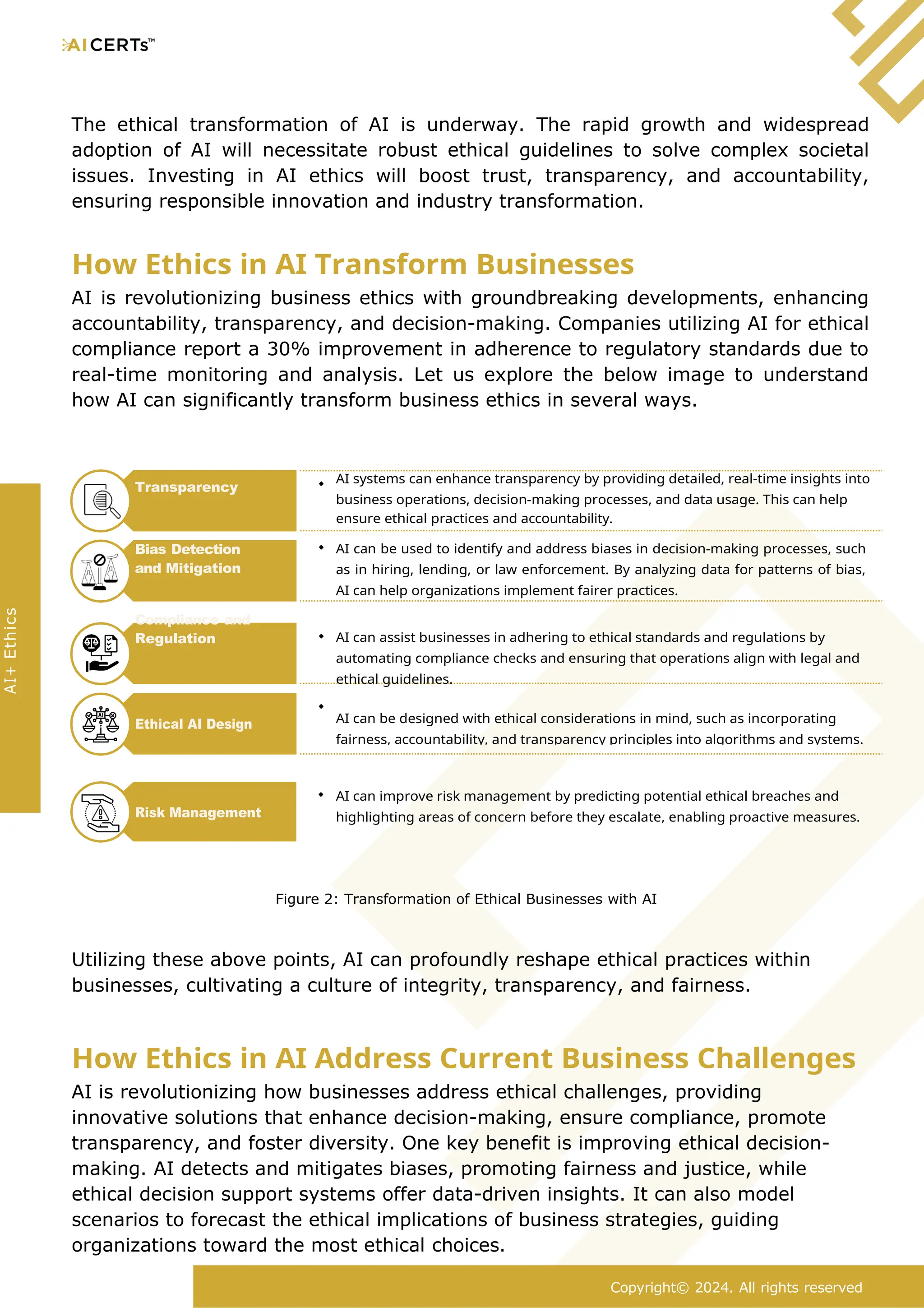
real-time monitoring and analysis. Let us explore the below image to understand
how AI can significantly transform business ethics in several ways.
Transparency
Bias Detection
and Mitigation
Compliance and
Regulation
AI systems can enhance transparency by providing detailed, real-time insights into
business operations, decision-making processes, and data usage. This can help
ensure ethical practices and accountability.
AI can be used to identify and address biases in decision-making processes, such
as in hiring, lending, or law enforcement. By analyzing data for patterns of bias,
AI can help organizations implement fairer practices.
AI can assist businesses in adhering to ethical standards and regulations by
automating compliance checks and ensuring that operations align with legal and
ethical guidelines.
AI can improve risk management by predicting potential ethical breaches and
highlighting areas of concern before they escalate, enabling proactive measures.
Figure 2: Transformation of Ethical Businesses with AI
Utilizing these above points, AI can profoundly reshape ethical practices within
businesses, cultivating a culture of integrity, transparency, and fairness.
How Ethics in AI Address Current Business Challenges
AI is revolutionizing how businesses address ethical challenges, providing
innovative solutions that enhance decision-making, ensure compliance, promote
transparency, and foster diversity. One key benefit is improving ethical decision-
making. AI detects and mitigates biases, promoting fairness and justice, while
ethical decision support systems offer data-driven insights. It can also model
scenarios to forecast the ethical implications of business strategies, guiding
organizations toward the most ethical choices.
AI can be designed with ethical considerations in mind, such as incorporating
fairness, accountability, and transparency principles into algorithms and systems.
Copyright© 2024. All rights reserved
Risk Management
AI+
Ethics
Ethical AI Design
AI simplifies and enhances regulatory compliance by constantly monitoring business
activities, reducing the risk of infractions. It strengthens policy enforcement by
ensuring consistent adherence across all levels and automates auditing, providing
real-time compliance reports and identifying potential areas of non-compliance.
Transparency, crucial for trust-building, is also boosted by AI. AI-driven systems
enable dynamic reporting and supply chain visibility, ensuring ethical practices in
sourcing and labor. Additionally, AI promotes open data platforms, allowing
organizations to share information about their ethical practices openly.
How Industries are Adopting Ethics in AI
The industries are rapidly adopting AI to improve various facets of operations,
decision-making, and compliance. This adoption influences the workforce within the
sector, encompassing professionals such as ethicists, compliance officers, and legal
advisors. These professionals are shifting from traditional methods of ethical
analysis and compliance monitoring to leveraging AI tools that provide deeper
insights and efficiency.
AI-driven analytics allow ethicists to analyze large datasets for patterns indicating
potential ethical breaches or areas of concern, enabling more proactive and precise
interventions. Compliance officers use AI to automate routine monitoring tasks,
ensuring adherence to regulations and identifying non-compliance issues swiftly,
thereby focusing on more complex ethical dilemmas and strategic decision-making.
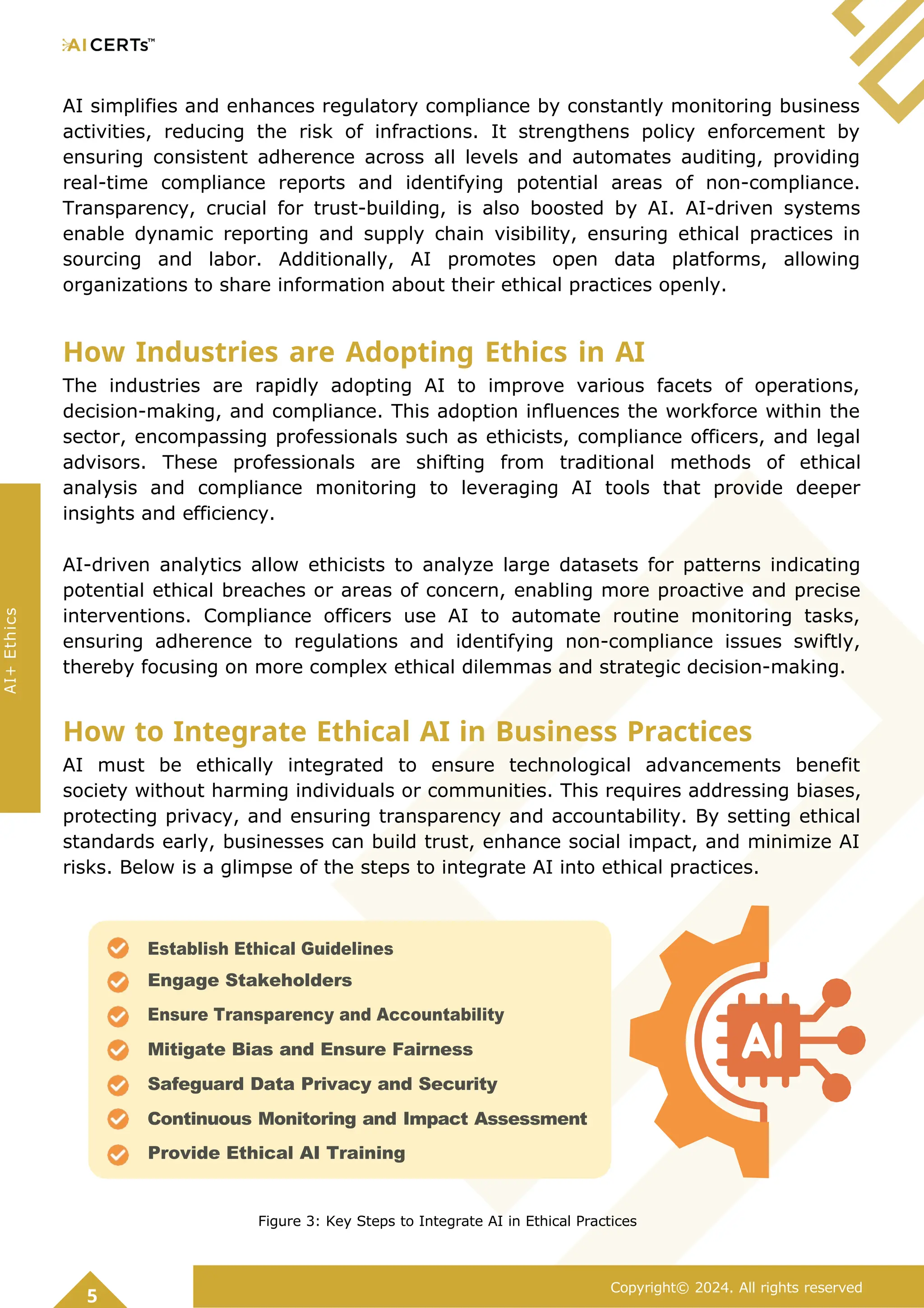
How to Integrate Ethical AI in Business Practices
AI must be ethically integrated to ensure technological advancements benefit
society without harming individuals or communities. This requires addressing biases,
protecting privacy, and ensuring transparency and accountability. By setting ethical
standards early, businesses can build trust, enhance social impact, and minimize AI
risks. Below is a glimpse of the steps to integrate AI into ethical practices.
Figure 3: Key Steps to Integrate AI in Ethical Practices
5
Copyright© 2024. All rights reserved
AI+
Ethics
Establish Ethical Guidelines
Engage Stakeholders
Ensure Transparency and Accountability
Mitigate Bias and Ensure Fairness
Safeguard Data Privacy and Security
Continuous Monitoring and Impact Assessment
Provide Ethical AI Training
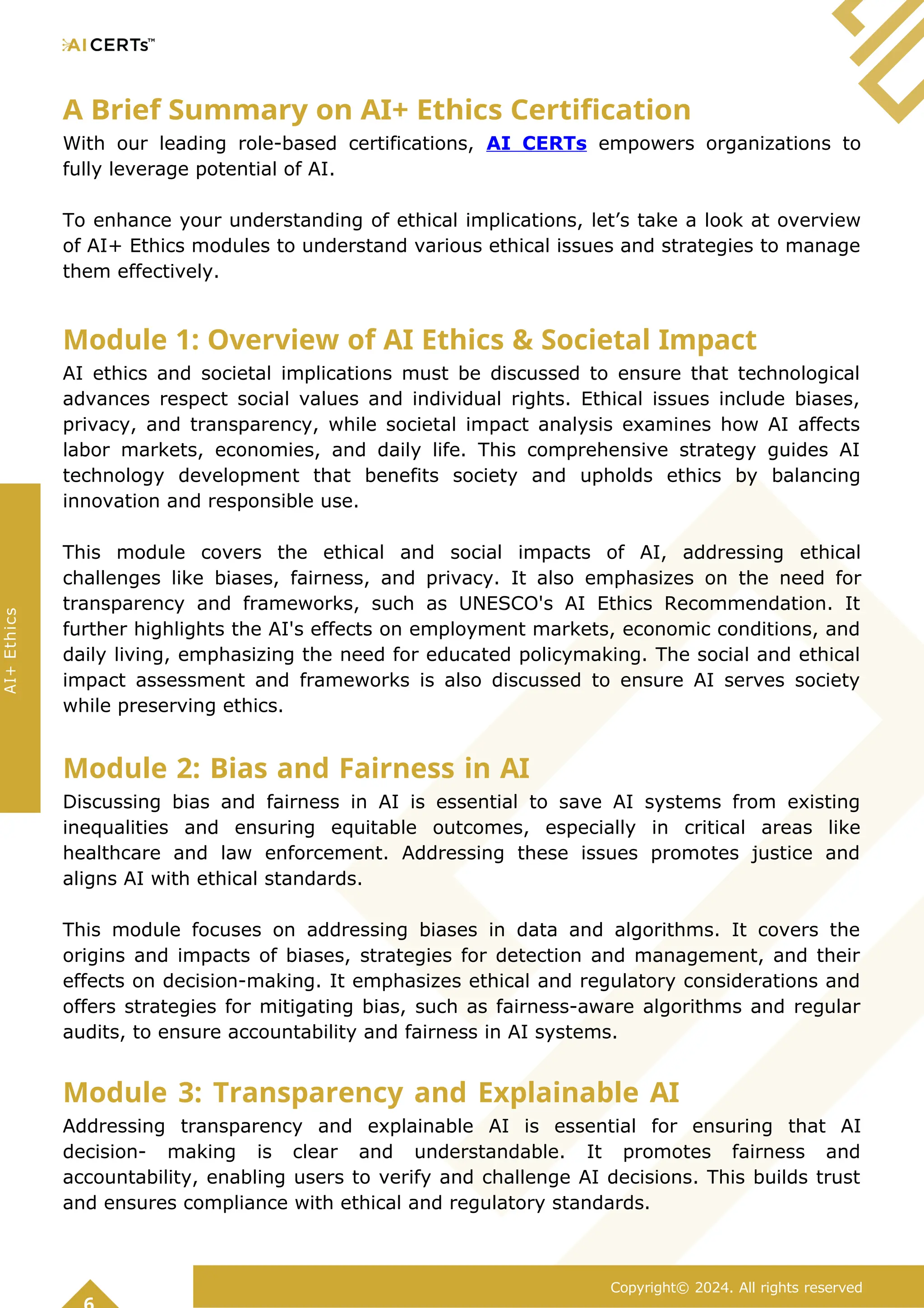
A Brief Summary on AI+ Ethics Certification
With our leading role-based certifications, AI CERTs empowers organizations to
fully leverage potential of AI.
To enhance your understanding of ethical implications, let’s take a look at overview
of AI+ Ethics modules to understand various ethical issues and strategies to manage
them effectively.
Module 1: Overview of AI Ethics & Societal Impact
AI ethics and societal implications must be discussed to ensure that technological
advances respect social values and individual rights. Ethical issues include biases,
privacy, and transparency, while societal impact analysis examines how AI affects
labor markets, economies, and daily life. This comprehensive strategy guides AI
technology development that benefits society and upholds ethics by balancing
innovation and responsible use.
This module covers the ethical and social impacts of AI, addressing ethical
challenges like biases, fairness, and privacy. It also emphasizes on the need for
transparency and frameworks, such as UNESCO's AI Ethics Recommendation. It
further highlights the AI's effects on employment markets, economic conditions, and
daily living, emphasizing the need for educated policymaking. The social and ethical
impact assessment and frameworks is also discussed to ensure AI serves society
while preserving ethics.
Module 2: Bias and Fairness in AI
Discussing bias and fairness in AI is essential to save AI systems from existing
inequalities and ensuring equitable outcomes, especially in critical areas like
healthcare and law enforcement. Addressing these issues promotes justice and
aligns AI with ethical standards.
This module focuses on addressing biases in data and algorithms. It covers the
origins and impacts of biases, strategies for detection and management, and their
effects on decision-making. It emphasizes ethical and regulatory considerations and
offers strategies for mitigating bias, such as fairness-aware algorithms and regular
audits, to ensure accountability and fairness in AI systems.
Module 3: Transparency and Explainable AI
Addressing transparency and explainable AI is essential for ensuring that AI
decision- making is clear and understandable. It promotes fairness and
accountability, enabling users to verify and challenge AI decisions. This builds trust
and ensures compliance with ethical and regulatory standards.
Copyright© 2024. All rights reserved
AI+
Ethics
This module does a deep dive into the importance of transparency and accountability
in AI systems to build trust and ensure ethical use. It covers methods for explaining
AI models, such as visualizations and interactive demos, and highlights practical
applications of ethical principles through guided projects. Tools like the AI Ethics
Simulator and risk management frameworks are showcased to maintain
transparency, fairness, and reliability in AI.
Module 4: Privacy and Security Issues in AI
Privacy and security are critical in AI since AI systems handle sensitive data and are
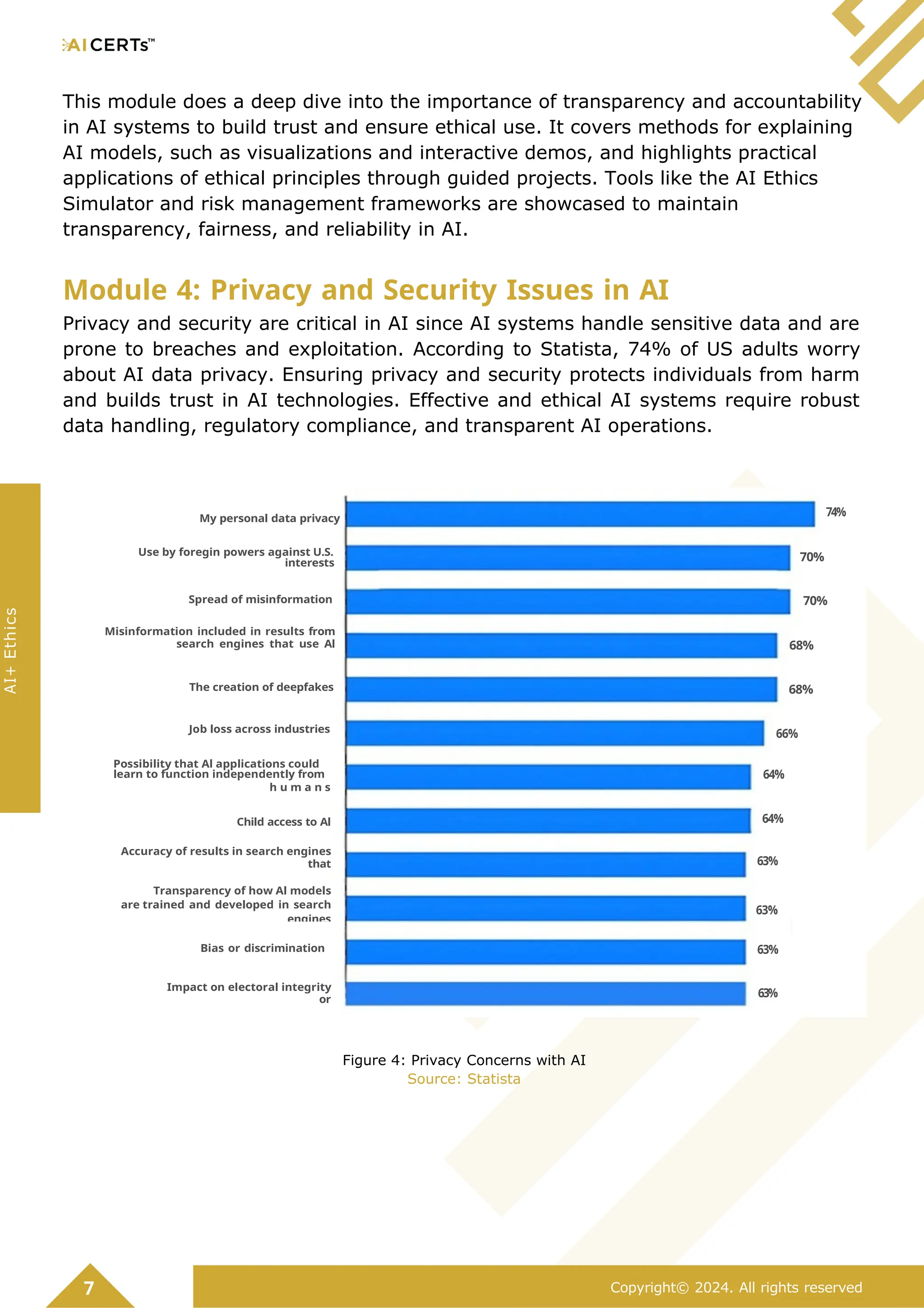
prone to breaches and exploitation. According to Statista, 74% of US adults worry
about AI data privacy. Ensuring privacy and security protects individuals from harm
and builds trust in AI technologies. Effective and ethical AI systems require robust
data handling, regulatory compliance, and transparent AI operations.
Use by foregin powers against U.S.
interests 70%
Spread of misinformation 70%
Misinformation included in results from
search engines that use Al 68%
The creation of deepfakes 68%
Figure 4: Privacy Concerns with AI
Source: Statista
7 Copyright© 2024. All rights reserved
AI+
Ethics
63%
Impact on electoral integrity
or
democracy generally
63%
Bias or discrimination
63%
Transparency of how Al models
are trained and developed in search
engines
63%
Accuracy of results in search engines
that
use Al
64%
Child access to Al
64%
Possibility that Al applications could
learn to function independently from
h u m a n s
66%
Job loss across industries
74%
My personal data privacy
This module covers AI privacy and security. Data exposure in healthcare and
banking, GDPR compliance, and AI surveillance are covered. Security measures for
AI systems include encryption, access restriction, and real-time threat detection. It
also emphasizes on transparent and responsible use of AI.
Module 5: Accountability and Responsibility
Exploring accountability and responsibility in AI is vital for ensuring that AI systems
operate transparently and ethically. It ensures decisions are clear and fair while
addressing potential biases or errors. Holding developers and organizations
accountable fosters ethical practices and protects user rights, helping to build public
trust and comply with regulations. This focus on responsibility is key to the
responsible and effective deployment of AI technologies.
In this module, you will learn about accountability in AI development, highlighting
the need for transparency, thorough documentation, and adherence to legal and
ethical guidelines. Case studies, like IBM Watson Health, reveal the challenges of
these principles. The content also covers the responsibilities of AI practitioners,
including secure data handling, monitoring, and stakeholder engagement. It further
discusses the importance of robust governance and continuous improvement for
accountable and ethical AI systems.
Module 6: Legal and Regulatory Issues
Tackling legal and regulatory issues in AI is essential for responsible practice. It
protects user rights, upholds ethical standards, and ensures adherence to laws,
while addressing risks like privacy and intellectual property. This balance promotes
trust and transparency, aligning innovation with regulatory requirements.
The focus of this module is on global AI regulations, including the EU's AI Act, U.S.
sector-specific rules, the UK's approach, and China's government-controlled
framework. It addresses global issues such as data privacy, ethical AI practices, and
IP rights, and reviews GDPR compliance through anonymization and transparency.
Additionally, the module highlights tools like IBM Watson OpenScale and Salesforce
Einstein that support legal and ethical AI practices, emphasizing the need for
international cooperation and robust governance in AI development.
8 Copyright© 2024. All rights reserved
AI+
Ethics
Module 7: Ethical Decision-Making Frameworks
Ethical decision-making frameworks are important in AI to align technology with
societal values and ethical standards. They guide responsible development, prevent
biases, and ensure fairness and transparency, helping to address complex moral
dilemmas and foster beneficial innovations.
This module aims to explore ethical AI frameworks and their applications. It covers
guidelines such as IEEE Ethically Aligned Design and Google’s AI Principles,
examines case studies from IBM Watson Health and Microsoft, and uses simulation
platforms like OpenAI Gym to test AI ethics. The focus is on balancing innovation
with ethical responsibility to ensure AI benefits society.
Module 8: AI Governance and Best Practices
Exploring AI governance and best practices is crucial for ensuring ethical AI
development and use. It helps establish standards that balance innovation with
accountability, protect privacy, and ensure fair benefits, fostering trust and aligning
AI with human values.
In this module, you will learn about international AI governance and best practices
for ethical AI integration. It also covers transparency, accountability, and inclusivity,
highlighting the need for global cooperation. Case studies like Google’s AI Principles
and the EU’s GDPR illustrate the practical application of these principles,
emphasizing the need for responsible governance.
Module 9: Global AI Ethics Standards
Global AI ethics standards reveals how various regions address key issues such as
privacy and accountability, helping us uncover effective practices and challenges.
This ensures that AI development aligns with international values, promoting
fairness and transparency across the globe.This module highlights the frameworks
like IEEE's Ethically Aligned Design, which promotes human rights, transparency,
and accountability in AI. It also compares global AI ethics standards across regions,
noting differences in privacy, innovation, and state control. Tools such as IBM AI
Fairness 360 and Google Model Cards help ensure AI systems meet ethical and
global standards.
How Can AI CERTs Help Build an AI-Ready Culture?
Although companies can benefit greatly from AI technologies, they often encounter
challenges such as skill shortages, data complexity, and integration issues. At AI
CERTs, we address these problems by offering top-notch certifications designed to
help organizations effectively overcome these hurdles.
Copyright© 2024. All rights reserved
AI+
Ethics
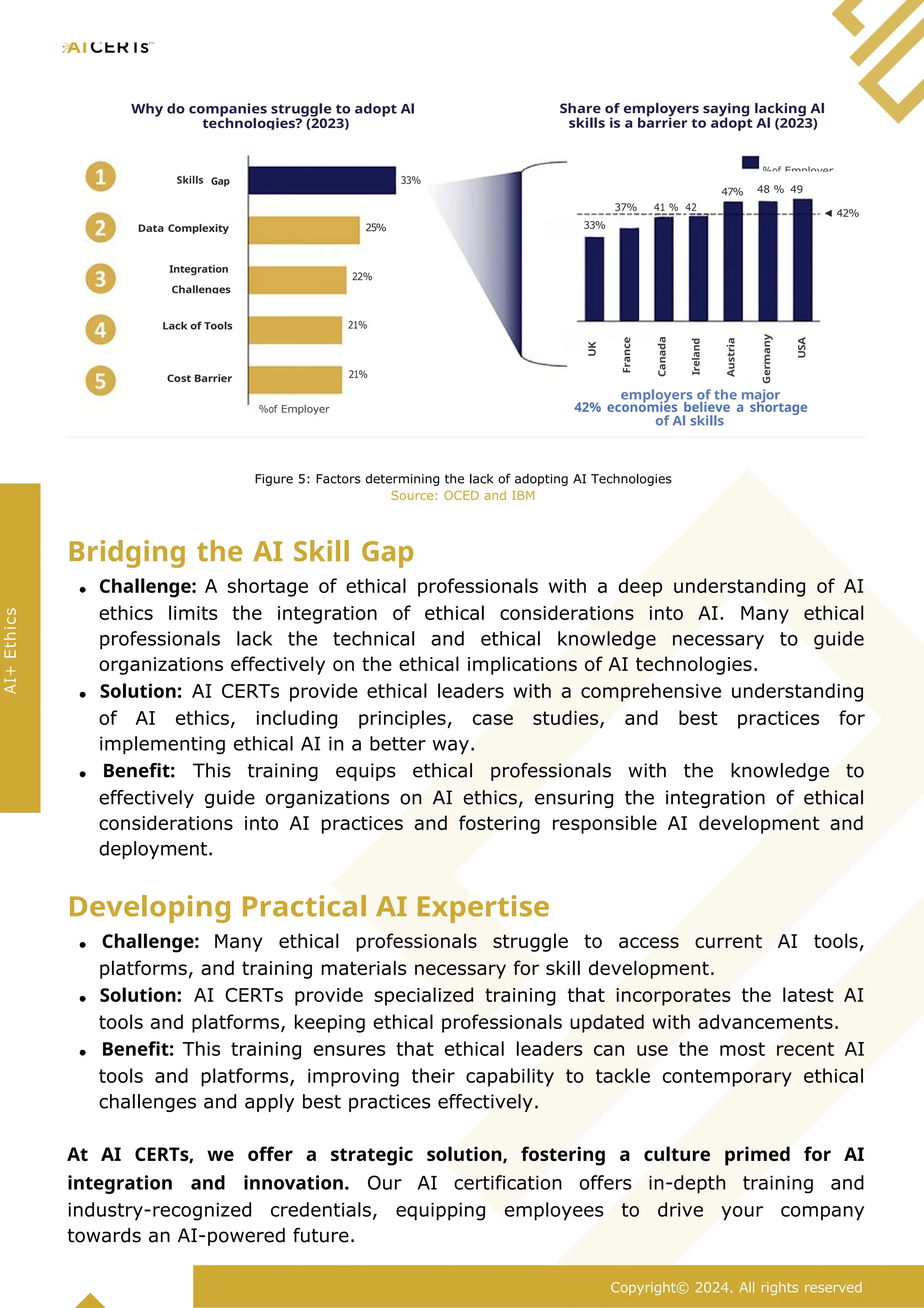
Figure 5: Factors determining the lack of adopting AI Technologies
Source: OCED and IBM
Bridging the AI Skill Gap
Challenge: A shortage of ethical professionals with a deep understanding of AI
ethics limits the integration of ethical considerations into AI. Many ethical
professionals lack the technical and ethical knowledge necessary to guide
organizations effectively on the ethical implications of AI technologies.
Solution: AI CERTs provide ethical leaders with a comprehensive understanding
of AI ethics, including principles, case studies, and best practices for
implementing ethical AI in a better way.
Benefit: This training equips ethical professionals with the knowledge to
effectively guide organizations on AI ethics, ensuring the integration of ethical
considerations into AI practices and fostering responsible AI development and
deployment.
Developing Practical AI Expertise
Challenge: Many ethical professionals struggle to access current AI tools,
platforms, and training materials necessary for skill development.
Solution: AI CERTs provide specialized training that incorporates the latest AI
tools and platforms, keeping ethical professionals updated with advancements.
Benefit: This training ensures that ethical leaders can use the most recent AI
tools and platforms, improving their capability to tackle contemporary ethical
challenges and apply best practices effectively.
At AI CERTs, we offer a strategic solution, fostering a culture primed for AI
integration and innovation. Our AI certification offers in-depth training and
industry-recognized credentials, equipping employees to drive your company
towards an AI-powered future.
9
Copyright© 2024. All rights reserved
AI+
Ethics
UK
France
Canada
Ireland
Austria
Germany
USA
employers of the major
42% economies believe a shortage
of Al skills
%of Employer
21%
Cost Barrier
21%
Lack of Tools
22%
Integration
Challenges
33%
25%
Data Complexity
◄ 42%
37% 41 % 42
%
48 % 49
%
47%
Skills Gap 33%
Share of employers saying lacking Al
skills is a barrier to adopt Al (2023)
%of Employer
Why do companies struggle to adopt Al
technologies? (2023)
AI CERTs Cultivate AI Culture in Several Ways:
Our structured program enhances understanding of AI principles and
applications, making AI more accessible.
Ongoing learning ensures your workforce stays current with AI trends, providing a
competitive advantage.
AI CERTs programs promote teamwork and cross-departmental projects, helping
to break down silos and support successful AI implementation.
AI CERTs: Your Pathway to Becoming AI-Ready
The future of business belongs to those who harness the power of AI.
Tailored for Success: Our programs aren't one-size-fits-all. We offer specialized
training designed by industry experts to equip your workforce with the specific skills
and knowledge needed for critical AI roles.
Actionable Expertise: Forget theory alone. We focus on practical, hands-on learning
through real-world projects and case studies. This ensures your team graduates with
the skills and confidence to implement and utilize AI technologies effectively, driving
innovation and tangible results for your organization.
Become an AI Leader: Do not just keep pace with the AI revolution, lead it. Partner
with AI CERTs and invest in your workforce's future. Let us build an AI-inclusive
culture together, where your team is equipped to unlock the transformative
potential of AI and propel your organization to the forefront.
11 Copyright© 2024. All rights reserved
AI+
Ethics
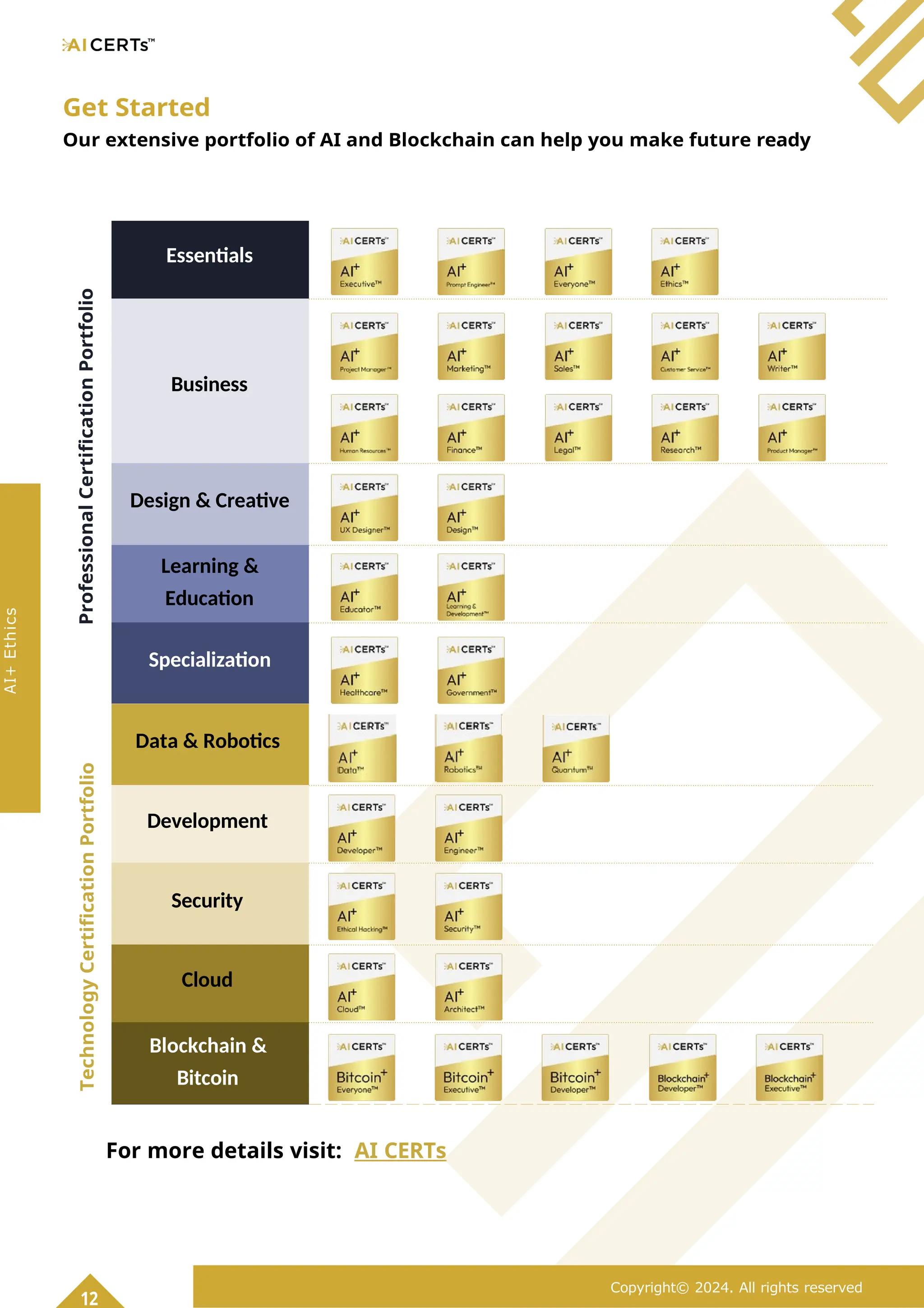
Get Started
Our extensive portfolio of AI and Blockchain can help you make future ready
Essentials
Business
Design & Creative
Learning &
Education
Specialization
Data & Robotics
Development
Security
Cloud
Blockchain &
Bitcoin
For more details visit: AI CERTs
12
Copyright© 2024. All rights reserved
AI+
Ethics
Professional
Certification
Portfolio
Technology
Certification
Portfolio
www.aicerts.io
Contact
252 West 37th St., Suite 1200W
New York, NY 10018

Learn AI Ethical Practices to Future-Proof Your Career

  • 2.
    TABLE OF CONTENTS Introduction................................................................................1 Certification Goals and Learning Outcomes ....................... 2 The Impact of AI on Modern Business Practices ................ 2 What is Next in AI? ................................................................... 3 How Ethics in AI Transform Businesses ............................... 4 How Ethics in AI Address Current Business Challenges .. 4 How Industries are Adopting Ethics in AI ............................ 5 How to Integrate Ethical AI in Business Practices ............ 5 Module 1: Overview of AI Ethics & Societal Impact ............ 6 Module 2: Bias and Fairness in AI .......................................... 6 Module 3: Transparency and Explainable AI ....................... 6 Module 4: Privacy and Security Issues in AI ........................ 7 Module 5: Accountability and Responsibility ...................... 8 Module 6: Legal and Regulatory Issues ................................ 8 Module 7: Ethical Decision-Making Frameworks ............... 9 Module 8: AI Governance and Best Practices ..................... 9 Module 9: Global AI Ethics Standards ................................... 9 How Can AI CERTs Help Build an AI-Ready Culture? ........ 9 Copyright© 2024. All rights reserved AI+ Ethics
  • 3.
    Introduction The AI+ EthicsCertification is designed to provide a comprehensive overview of ethical considerations in Artificial Intelligence (AI). It is structured to deliver detailed knowledge on ethics associated with AI and their societal impact. It also provides a solid framework for comprehending the broader consequences of AI by introducing detailed social and ethical impact assessments. Further, it highlights data and algorithm biases, offering practical strategies for reducing them and creating more fair and nondiscriminatory AI systems. Guided projects and real-world case evaluations demonstrate how to explain AI models to varied stakeholders, emphasizing the necessity for AI transparency. All our certifications provide a high-level understanding of AI ethics; however, this certification offers a much deeper dive into the subject. It goes beyond surface-level concepts, enabling learners to engage with complex ethical dilemmas and to develop a understanding of AI’s societal implications. This course is ideal for those looking to explore the complexities of AI ethics more thoroughly and to gain practical skills in addressing ethical challenges in AI development and deployment. he curriculum of the certification addresses privacy and data security in Artificial Intelligence (AI), covering accountability, ethical duties of developers, organizational practices, and solutions for protecting sensitive information. Additionally, it includes an in-depth examination of the European Union (EU) AI Act, exploring how it intersects with global challenges like General Data Protection Regulation (GDPR) compliance. Participants also learn ethical decision-making frameworks from computer science, philosophy, and sociology to guide AI development and deployment. The course also covers AI governance risks, ethical policy best practices, and global standards like the Institute of Electrical and Electronics Engineers (IEEE)’s Ethically Aligned Design, equipping learners with the knowledge needed to navigate the evolving landscape of AI ethics. We will cover the following topics in detail to help you understand the incorporation of AI into Ethics: Overview of AI Ethics & Societal Impact Bias and Fairness in AI Transparency and Explainable AI Privacy and Security Issues in AI Accountability and Responsibility Legal and Regulatory Issues Ethical Decision-Making Frameworks AI Governance and Best Practices Global AI Ethics Standards Copyright© 2024. All rights reserved AI+ Ethics
  • 4.
    Certification Prerequisites Basic Understandingof AI Concepts: A fundamental understanding of AI and its practical applications in business, no technical expertise required. Awareness of Ethical Principles: Understanding the ethical and societal impacts of technology in everyday life. Curiosity and Openness to Learning: A strong willingness to learn potential biases and ethical implications associated with AI and strategies to mitigate them. Who Should Enroll? All Business Managers: Those responsible for strategic decisions and ethical considerations in business operations. CXOs: Senior executives ensuring ethical AI practices and governance within their organizations. Frontline Workers: Employees directly interacting with AI systems who need to understand ethical implications. Certification Goals and Learning Outcomes Equip participants with a thorough understanding of the fundamental ethical principles applicable to AI and digital technologies. Familiarize participants with existing ethical frameworks, guidelines, and best practices in AI. Understand and articulate key ethical principles such as fairness, accountability, transparency, and privacy in the context of AI. Demonstrate ethical leadership in the development, deployment, and management of AI technologies. The Impact of AI on Modern Business Practices The field of AI is progressing rapidly, and technology and the economy have risen over the last ten years. It could potentially add $15.7 trillion to the world economy by 2030. The global economy stands to gain significantly from AI's transformative power. North America leads with a 28.8% market share, followed by Asia-Pacific at 25%. Europe holds a 24.3% share, while the United Kingdom is growing at 14.1%. Latin America and the Middle East and Africa (MEA) region each have 5.4%, highlighting the regional evolution of AI. 2 Copyright© 2024. All rights reserved AI+ Ethics
  • 5.
    North America dominates themarket with 28.8% The European region has a market share at 24.3% The Asia-Pacific region share stands at 25% The United Kingdom is growing at 14.1% (MEA) region is growing at 2.4% Figure 1: Market Share of AI Globally Source: PWC, IBM, Forbes This certification focuses on AI technology evolution and ethical issues. Healthcare, banking, and transportation have been transformed from rule-based systems to machine learning and deep learning models, delivering rapid growth in AI. These advances raise ethical issues such algorithm prejudice, privacy problems, and employment displacement. To ensure ethical AI development, frameworks must promote transparency, justice, and accountability while balancing innovation with societal effect. What is Next for AI? As AI continues to advance, it will highlight the need for ongoing research and development in ethical frameworks by 2030. Government funding and policies will be crucial for promoting education and training in AI ethics. Businesses can better prepare for and address ethical challenges by embracing these principles. Copyright© 2024. All rights reserved AI+ Ethics Middle East and Africa Latin America stands at 5.4%
  • 6.
    The ethical transformationof AI is underway. The rapid growth and widespread adoption of AI will necessitate robust ethical guidelines to solve complex societal issues. Investing in AI ethics will boost trust, transparency, and accountability, ensuring responsible innovation and industry transformation. How Ethics in AI Transform Businesses AI is revolutionizing business ethics with groundbreaking developments, enhancing accountability, transparency, and decision-making. Companies utilizing AI for ethical compliance report a 30% improvement in adherence to regulatory standards due to real-time monitoring and analysis. Let us explore the below image to understand how AI can significantly transform business ethics in several ways. Transparency Bias Detection and Mitigation Compliance and Regulation AI systems can enhance transparency by providing detailed, real-time insights into business operations, decision-making processes, and data usage. This can help ensure ethical practices and accountability. AI can be used to identify and address biases in decision-making processes, such as in hiring, lending, or law enforcement. By analyzing data for patterns of bias, AI can help organizations implement fairer practices. AI can assist businesses in adhering to ethical standards and regulations by automating compliance checks and ensuring that operations align with legal and ethical guidelines. AI can improve risk management by predicting potential ethical breaches and highlighting areas of concern before they escalate, enabling proactive measures. Figure 2: Transformation of Ethical Businesses with AI Utilizing these above points, AI can profoundly reshape ethical practices within businesses, cultivating a culture of integrity, transparency, and fairness. How Ethics in AI Address Current Business Challenges AI is revolutionizing how businesses address ethical challenges, providing innovative solutions that enhance decision-making, ensure compliance, promote transparency, and foster diversity. One key benefit is improving ethical decision- making. AI detects and mitigates biases, promoting fairness and justice, while ethical decision support systems offer data-driven insights. It can also model scenarios to forecast the ethical implications of business strategies, guiding organizations toward the most ethical choices. AI can be designed with ethical considerations in mind, such as incorporating fairness, accountability, and transparency principles into algorithms and systems. Copyright© 2024. All rights reserved Risk Management AI+ Ethics Ethical AI Design
  • 7.
    AI simplifies andenhances regulatory compliance by constantly monitoring business activities, reducing the risk of infractions. It strengthens policy enforcement by ensuring consistent adherence across all levels and automates auditing, providing real-time compliance reports and identifying potential areas of non-compliance. Transparency, crucial for trust-building, is also boosted by AI. AI-driven systems enable dynamic reporting and supply chain visibility, ensuring ethical practices in sourcing and labor. Additionally, AI promotes open data platforms, allowing organizations to share information about their ethical practices openly. How Industries are Adopting Ethics in AI The industries are rapidly adopting AI to improve various facets of operations, decision-making, and compliance. This adoption influences the workforce within the sector, encompassing professionals such as ethicists, compliance officers, and legal advisors. These professionals are shifting from traditional methods of ethical analysis and compliance monitoring to leveraging AI tools that provide deeper insights and efficiency. AI-driven analytics allow ethicists to analyze large datasets for patterns indicating potential ethical breaches or areas of concern, enabling more proactive and precise interventions. Compliance officers use AI to automate routine monitoring tasks, ensuring adherence to regulations and identifying non-compliance issues swiftly, thereby focusing on more complex ethical dilemmas and strategic decision-making. How to Integrate Ethical AI in Business Practices AI must be ethically integrated to ensure technological advancements benefit society without harming individuals or communities. This requires addressing biases, protecting privacy, and ensuring transparency and accountability. By setting ethical standards early, businesses can build trust, enhance social impact, and minimize AI risks. Below is a glimpse of the steps to integrate AI into ethical practices. Figure 3: Key Steps to Integrate AI in Ethical Practices 5 Copyright© 2024. All rights reserved AI+ Ethics Establish Ethical Guidelines Engage Stakeholders Ensure Transparency and Accountability Mitigate Bias and Ensure Fairness Safeguard Data Privacy and Security Continuous Monitoring and Impact Assessment Provide Ethical AI Training
  • 8.
    A Brief Summaryon AI+ Ethics Certification With our leading role-based certifications, AI CERTs empowers organizations to fully leverage potential of AI. To enhance your understanding of ethical implications, let’s take a look at overview of AI+ Ethics modules to understand various ethical issues and strategies to manage them effectively. Module 1: Overview of AI Ethics & Societal Impact AI ethics and societal implications must be discussed to ensure that technological advances respect social values and individual rights. Ethical issues include biases, privacy, and transparency, while societal impact analysis examines how AI affects labor markets, economies, and daily life. This comprehensive strategy guides AI technology development that benefits society and upholds ethics by balancing innovation and responsible use. This module covers the ethical and social impacts of AI, addressing ethical challenges like biases, fairness, and privacy. It also emphasizes on the need for transparency and frameworks, such as UNESCO's AI Ethics Recommendation. It further highlights the AI's effects on employment markets, economic conditions, and daily living, emphasizing the need for educated policymaking. The social and ethical impact assessment and frameworks is also discussed to ensure AI serves society while preserving ethics. Module 2: Bias and Fairness in AI Discussing bias and fairness in AI is essential to save AI systems from existing inequalities and ensuring equitable outcomes, especially in critical areas like healthcare and law enforcement. Addressing these issues promotes justice and aligns AI with ethical standards. This module focuses on addressing biases in data and algorithms. It covers the origins and impacts of biases, strategies for detection and management, and their effects on decision-making. It emphasizes ethical and regulatory considerations and offers strategies for mitigating bias, such as fairness-aware algorithms and regular audits, to ensure accountability and fairness in AI systems. Module 3: Transparency and Explainable AI Addressing transparency and explainable AI is essential for ensuring that AI decision- making is clear and understandable. It promotes fairness and accountability, enabling users to verify and challenge AI decisions. This builds trust and ensures compliance with ethical and regulatory standards. Copyright© 2024. All rights reserved AI+ Ethics
  • 9.
    This module doesa deep dive into the importance of transparency and accountability in AI systems to build trust and ensure ethical use. It covers methods for explaining AI models, such as visualizations and interactive demos, and highlights practical applications of ethical principles through guided projects. Tools like the AI Ethics Simulator and risk management frameworks are showcased to maintain transparency, fairness, and reliability in AI. Module 4: Privacy and Security Issues in AI Privacy and security are critical in AI since AI systems handle sensitive data and are prone to breaches and exploitation. According to Statista, 74% of US adults worry about AI data privacy. Ensuring privacy and security protects individuals from harm and builds trust in AI technologies. Effective and ethical AI systems require robust data handling, regulatory compliance, and transparent AI operations. Use by foregin powers against U.S. interests 70% Spread of misinformation 70% Misinformation included in results from search engines that use Al 68% The creation of deepfakes 68% Figure 4: Privacy Concerns with AI Source: Statista 7 Copyright© 2024. All rights reserved AI+ Ethics 63% Impact on electoral integrity or democracy generally 63% Bias or discrimination 63% Transparency of how Al models are trained and developed in search engines 63% Accuracy of results in search engines that use Al 64% Child access to Al 64% Possibility that Al applications could learn to function independently from h u m a n s 66% Job loss across industries 74% My personal data privacy
  • 10.
    This module coversAI privacy and security. Data exposure in healthcare and banking, GDPR compliance, and AI surveillance are covered. Security measures for AI systems include encryption, access restriction, and real-time threat detection. It also emphasizes on transparent and responsible use of AI. Module 5: Accountability and Responsibility Exploring accountability and responsibility in AI is vital for ensuring that AI systems operate transparently and ethically. It ensures decisions are clear and fair while addressing potential biases or errors. Holding developers and organizations accountable fosters ethical practices and protects user rights, helping to build public trust and comply with regulations. This focus on responsibility is key to the responsible and effective deployment of AI technologies. In this module, you will learn about accountability in AI development, highlighting the need for transparency, thorough documentation, and adherence to legal and ethical guidelines. Case studies, like IBM Watson Health, reveal the challenges of these principles. The content also covers the responsibilities of AI practitioners, including secure data handling, monitoring, and stakeholder engagement. It further discusses the importance of robust governance and continuous improvement for accountable and ethical AI systems. Module 6: Legal and Regulatory Issues Tackling legal and regulatory issues in AI is essential for responsible practice. It protects user rights, upholds ethical standards, and ensures adherence to laws, while addressing risks like privacy and intellectual property. This balance promotes trust and transparency, aligning innovation with regulatory requirements. The focus of this module is on global AI regulations, including the EU's AI Act, U.S. sector-specific rules, the UK's approach, and China's government-controlled framework. It addresses global issues such as data privacy, ethical AI practices, and IP rights, and reviews GDPR compliance through anonymization and transparency. Additionally, the module highlights tools like IBM Watson OpenScale and Salesforce Einstein that support legal and ethical AI practices, emphasizing the need for international cooperation and robust governance in AI development. 8 Copyright© 2024. All rights reserved AI+ Ethics
  • 11.
    Module 7: EthicalDecision-Making Frameworks Ethical decision-making frameworks are important in AI to align technology with societal values and ethical standards. They guide responsible development, prevent biases, and ensure fairness and transparency, helping to address complex moral dilemmas and foster beneficial innovations. This module aims to explore ethical AI frameworks and their applications. It covers guidelines such as IEEE Ethically Aligned Design and Google’s AI Principles, examines case studies from IBM Watson Health and Microsoft, and uses simulation platforms like OpenAI Gym to test AI ethics. The focus is on balancing innovation with ethical responsibility to ensure AI benefits society. Module 8: AI Governance and Best Practices Exploring AI governance and best practices is crucial for ensuring ethical AI development and use. It helps establish standards that balance innovation with accountability, protect privacy, and ensure fair benefits, fostering trust and aligning AI with human values. In this module, you will learn about international AI governance and best practices for ethical AI integration. It also covers transparency, accountability, and inclusivity, highlighting the need for global cooperation. Case studies like Google’s AI Principles and the EU’s GDPR illustrate the practical application of these principles, emphasizing the need for responsible governance. Module 9: Global AI Ethics Standards Global AI ethics standards reveals how various regions address key issues such as privacy and accountability, helping us uncover effective practices and challenges. This ensures that AI development aligns with international values, promoting fairness and transparency across the globe.This module highlights the frameworks like IEEE's Ethically Aligned Design, which promotes human rights, transparency, and accountability in AI. It also compares global AI ethics standards across regions, noting differences in privacy, innovation, and state control. Tools such as IBM AI Fairness 360 and Google Model Cards help ensure AI systems meet ethical and global standards. How Can AI CERTs Help Build an AI-Ready Culture? Although companies can benefit greatly from AI technologies, they often encounter challenges such as skill shortages, data complexity, and integration issues. At AI CERTs, we address these problems by offering top-notch certifications designed to help organizations effectively overcome these hurdles. Copyright© 2024. All rights reserved AI+ Ethics
  • 12.
    Figure 5: Factorsdetermining the lack of adopting AI Technologies Source: OCED and IBM Bridging the AI Skill Gap Challenge: A shortage of ethical professionals with a deep understanding of AI ethics limits the integration of ethical considerations into AI. Many ethical professionals lack the technical and ethical knowledge necessary to guide organizations effectively on the ethical implications of AI technologies. Solution: AI CERTs provide ethical leaders with a comprehensive understanding of AI ethics, including principles, case studies, and best practices for implementing ethical AI in a better way. Benefit: This training equips ethical professionals with the knowledge to effectively guide organizations on AI ethics, ensuring the integration of ethical considerations into AI practices and fostering responsible AI development and deployment. Developing Practical AI Expertise Challenge: Many ethical professionals struggle to access current AI tools, platforms, and training materials necessary for skill development. Solution: AI CERTs provide specialized training that incorporates the latest AI tools and platforms, keeping ethical professionals updated with advancements. Benefit: This training ensures that ethical leaders can use the most recent AI tools and platforms, improving their capability to tackle contemporary ethical challenges and apply best practices effectively. At AI CERTs, we offer a strategic solution, fostering a culture primed for AI integration and innovation. Our AI certification offers in-depth training and industry-recognized credentials, equipping employees to drive your company towards an AI-powered future. 9 Copyright© 2024. All rights reserved AI+ Ethics UK France Canada Ireland Austria Germany USA employers of the major 42% economies believe a shortage of Al skills %of Employer 21% Cost Barrier 21% Lack of Tools 22% Integration Challenges 33% 25% Data Complexity ◄ 42% 37% 41 % 42 % 48 % 49 % 47% Skills Gap 33% Share of employers saying lacking Al skills is a barrier to adopt Al (2023) %of Employer Why do companies struggle to adopt Al technologies? (2023)
  • 13.
    AI CERTs CultivateAI Culture in Several Ways: Our structured program enhances understanding of AI principles and applications, making AI more accessible. Ongoing learning ensures your workforce stays current with AI trends, providing a competitive advantage. AI CERTs programs promote teamwork and cross-departmental projects, helping to break down silos and support successful AI implementation. AI CERTs: Your Pathway to Becoming AI-Ready The future of business belongs to those who harness the power of AI. Tailored for Success: Our programs aren't one-size-fits-all. We offer specialized training designed by industry experts to equip your workforce with the specific skills and knowledge needed for critical AI roles. Actionable Expertise: Forget theory alone. We focus on practical, hands-on learning through real-world projects and case studies. This ensures your team graduates with the skills and confidence to implement and utilize AI technologies effectively, driving innovation and tangible results for your organization. Become an AI Leader: Do not just keep pace with the AI revolution, lead it. Partner with AI CERTs and invest in your workforce's future. Let us build an AI-inclusive culture together, where your team is equipped to unlock the transformative potential of AI and propel your organization to the forefront. 11 Copyright© 2024. All rights reserved AI+ Ethics
  • 14.
    Get Started Our extensiveportfolio of AI and Blockchain can help you make future ready Essentials Business Design & Creative Learning & Education Specialization Data & Robotics Development Security Cloud Blockchain & Bitcoin For more details visit: AI CERTs 12 Copyright© 2024. All rights reserved AI+ Ethics Professional Certification Portfolio Technology Certification Portfolio
  • 15.
    www.aicerts.io Contact 252 West 37thSt., Suite 1200W New York, NY 10018