COMMUNITY COLLEGE TO
UNIVERSITY TRANSFER
Executive Summary
This policy brief outlines the community college-to-university transfer landscape and assesses how
well North Carolina is positioned to improve experiences and outcomes for transfer students. Key
factors to consider when developing strategies for improving these experiences and outcomes
include:
•	 Educational attainment for community college students who transfer to public and private
universities is imperative for meeting state workforce needs at the certificate, associate degree,
and baccalaureate levels.
•	 The state has significant traction for increasing the number of transfer students, especially for
those with transfer-focused associate degrees (A.A./A.S.) and workforce preparation-focused
degrees (A.A.S.). Every student—regardless of program—should have a pathway to additional
education. While North Carolina falls behind the national average on some benchmarks, the
growth in transfer shows there is promise in this area.
•	 Transfer students too often have lower completion rates and follow inefficient pathways to the
baccalaureate. While North Carolina has statewide articulation agreements, in order for students
to have a seamless transition from the community college to the university, they need to know
both their major and destination university early in the community college experience.
No single initiative is likely to improve outcomes on its own; however, the state should consider
leveraging a host of strategies, including:
•	 Statewide transfer pathways in key program areas,
•	 Universal course numbering for public higher education,
•	 Emphasis on articulation of credit to universities for students completing a workforce
preparation-focused associate degree,
•	 Improved data quality and sharing,
•	 Incentives for pre-transfer associate degrees, and
•	 Communication during secondary education.
Combined, these initiatives would demonstrate an enhanced commitment to transfer students,
lessen uncertainty, and clarify a way forward for future community college transfer policy
improvements.
Importance of Transfer to North Carolina
Summary: Approximately 31% of UNC System students are transfer students upon entry, but
North Carolina is behind national figures in some key community college transfer indicators. This
has significant workforce implications since 67% of jobs in North Carolina by 2020 will require
at least some college, and the state does not meet projected needs at the baccalaureate degree
POLICY BRIEF
AUTHOR
Mark D’Amico
Associate Professor of
Educational Leadership;
The University of North
Carolina at Charlotte
AUTHOR
Lisa Chapman
Senior Vice President/
Chief Academic
Officer; North
Carolina Community
College System
P-12 POST-SECONDARY WORKFORCE
COMMUNITY COLLEGE TO
UNIVERSITY TRANSFER 1
Designbywww.AdrialDesigns.com
level. Community college transfer leading to baccalaureate degree attainment is also important
considering that community colleges enroll significant numbers of low-income students, adults,
and students of color.
Transfer is an important part of the fabric of North Carolina’s higher education system. This is
evidenced by the fact that 56,000 students (31%) in the University of North Carolina System
in Fall 2016 were transfer students upon entry, the majority of whom transferred from North
Carolina community colleges. While the number of transfers—and community college transfers
specifically—is significant, North Carolina lags in key community college transfer indicators.
One is the “transfer-out rate,” which measures the percent of community college students
who successfully transfer within a six-year period. North Carolina is at 24% compared to 33%
nationally. Another is “transfer out bachelor’s completion,” which is the percent of students
who transferred successfully and earned a bachelor’s degree within six years of starting at the
community college. North Carolina is much closer to the national average at 40% compared with
42% nationally (Jenkins & Fink, 2016).1
The Transfer System in North Carolina
North Carolina has had a Comprehensive Articulation Agreement (CAA) since 1997. The CAA
provides assured admission with junior status to one of the 16 public universities for transfer
associate degree completers, who have an overall GPA of at least 2.0 on a 4.0 scale, as well
as guaranteed course equivalency transfer for 30 semester hours credit of general education
courses for students who transfer prior to associate degree completion. One shortcoming of the
1997 CAA was its limited guidance in response to changes over time in the various baccalaureate
degree requirements. In 2014, the CAA was revised to effectively support student transfer
patterns and to respond to changes in baccalaureate degree requirements with the intent
of ensuring that students and advisors know, upon first consideration, all coursework that is
necessary for students’ proposed baccalaureate and the specific credits that can be earned while
at the community college. However, it requires effective communication among all partners as
well as active engagement and vigilance on the part of the community colleges and the four-
year institutions. In addition, “uniform articulation agreements” have been established in specific
program areas, such as nursing, engineering, and fine arts.
An Independent Comprehensive Articulation Agreement (ICAA) similar to the CAA also exists
with the North Carolina Independent Colleges and Universities (NCICU), based on signatory
participation, that is virtually identical to the UNC System CAA.
Meeting Workforce Needs
According to data from the U.S. Census Bureau’s 2016 American Community Survey, the
percent of North Carolinians with a baccalaureate degree or higher is 29% as compared with
30% nationally. While North Carolina is nearly on par with national figures, the state falls short
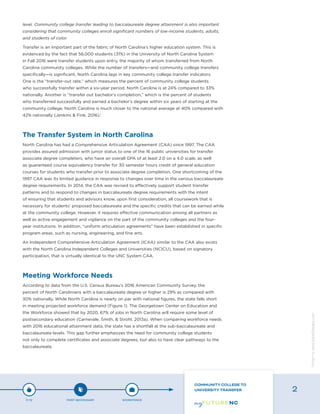
in meeting projected workforce demand (Figure 1). The Georgetown Center on Education and
the Workforce showed that by 2020, 67% of jobs in North Carolina will require some level of
postsecondary education (Carnevale, Smith, & Strohl, 2013a). When comparing workforce needs
with 2016 educational attainment data, the state has a shortfall at the sub-baccalaureate and
baccalaureate levels. This gap further emphasizes the need for community college students
not only to complete certificates and associate degrees, but also to have clear pathways to the
baccalaureate.
P-12 POST-SECONDARY WORKFORCE
COMMUNITY COLLEGE TO
UNIVERSITY TRANSFER 2
Designbywww.AdrialDesigns.com
From a standpoint of economic mobility, some
of North Carolina’s educational attainment
figures are particularly troubling. Only 19.4%
of the black subgroup in North Carolina
holds a baccalaureate degree or higher and
only 13.5% of the Hispanic/Latinx subgroup
reaches that level, compared to 31.7% of
the white subpopulation. These four-year
degree attainment discrepancies point to the
importance of the community college-to-
university transfer pathway, since community
colleges enroll a disproportionate number
of low-income students, older students, and
students of color (AACC, 2018; Ma & Baum,
2016). Currently, however, students of color are
less likely to transfer from community colleges
to universities, which represents a “racial
transfer gap” (Crisp & Nuñez, 2014).
Transfer Indicators in North
Carolina
2
Summary: The following are key indicators for
North Carolina community college-to-university
transfer:
•	 The number of community college transfers
to public and private four-year universities has grown from 3,400 in Fall 1986 to more than
12,000 in Fall 2016.
•	 The most significant growth in transfers from 2007 to 2016 is among those with Associate
degrees—118% growth among those with an Associate in Arts (A.A.) or Associate in Science
(A.S.) and 134% among those with another associate degree (e.g., Associate in Applied Science).3
•	 Community college transfers to UNC institutions who have the highest graduation rates in the
four years following transfer are students with an A.A. or A.S.
•	 Community college transfer students at UNC institutions graduate at lower rates than non-
transfer UNC System students, but comparably to those with other transfer origins, especially
when transferring in the sophomore or junior years.
•	 UNC baccalaureate degree completers who transferred from community colleges often earn
more “excess credits” than UNC System non-transfers—this does not account for any additional
credits lost in transfer.
Transfer Enrollment and Patterns
Transfer Destinations. More than 4 out of 5 North Carolina community college transfer students
are transferring “vertically” (i.e., from community college to a public or private university), while just
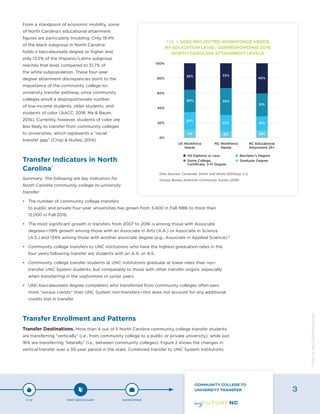
16% are transferring “laterally” (i.e., between community colleges). Figure 2 shows the changes in
vertical transfer over a 30-year period in the state. Combined transfer to UNC System institutions
FIG. 1: 2020 PROJECTED WORKFORCE NEEDS
BY EDUCATION LEVEL; CORRESPONDING 2016
NORTH CAROLINA ATTAINMENT LEVELS
Data Sources: Carnevale, Smith, and Strohl (2013a,b); U.S.
Census Bureau American Community Survey (2016)
P-12 POST-SECONDARY WORKFORCE
COMMUNITY COLLEGE TO
UNIVERSITY TRANSFER 3
Designbywww.AdrialDesigns.com
and private universities shows growth from
approximately 3,400 in Fall 1986 to more than
12,000 in Fall 2016.
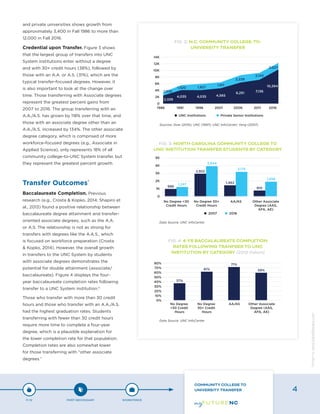
Credential upon Transfer. Figure 3 shows
that the largest group of transfers into UNC
System institutions enter without a degree
and with 30+ credit hours (38%), followed by
those with an A.A. or A.S. (31%), which are the
typical transfer-focused degrees. However, it
is also important to look at the change over
time. Those transferring with Associate degrees
represent the greatest percent gains from
2007 to 2016. The group transferring with an
A.A./A.S. has grown by 118% over that time, and
those with an associate degree other than an
A.A./A.S. increased by 134%. The other associate
degree category, which is comprised of more
workforce-focused degrees (e.g., Associate in
Applied Science), only represents 18% of all
community college-to-UNC System transfer, but
they represent the greatest percent growth.
Transfer Outcomes
4
Baccalaureate Completion. Previous
research (e.g., Crosta & Kopko, 2014; Shapiro et
al., 2013) found a positive relationship between
baccalaureate degree attainment and transfer-
oriented associate degrees, such as the A.A.
or A.S. The relationship is not as strong for
transfers with degrees like the A.A.S., which
is focused on workforce preparation (Crosta
& Kopko, 2014). However, the overall growth
in transfers to the UNC System by students
with associate degrees demonstrates the
potential for double attainment (associate/
baccalaureate). Figure 4 displays the four-
year baccalaureate completion rates following
transfer to a UNC System institution.5
Those who transfer with more than 30 credit
hours and those who transfer with an A.A./A.S.
had the highest graduation rates. Students
transferring with fewer than 30 credit hours
require more time to complete a four-year
degree, which is a plausible explanation for
the lower completion rate for that population.
Completion rates are also somewhat lower
for those transferring with “other associate
degrees.”
FIG. 2: N.C. COMMUNITY COLLEGE-TO-
UNIVERSITY TRANSFER
FIG. 3: NORTH CAROLINA COMMUNITY COLLEGE TO
UNC INSTITUTION TRANSFER STUDENTS BY CATEGORY
FIG. 4: 4-YR BACCALAUREATE COMPLETION
RATES FOLLOWING TRANFSER TO UNC
INSTITUTION BY CATEGORY (2012 Cohort)
Sources: Dow (2015); UNC (1997); UNC InfoCenter; Yang (2007)
Data Source: UNC InfoCenter
P-12 POST-SECONDARY WORKFORCE
COMMUNITY COLLEGE TO
UNIVERSITY TRANSFER 4
Designbywww.AdrialDesigns.com
A final useful point of comparison is between community college transfers and non-transfer
students (i.e., those who started their academic journeys in the UNC setting). Previous literature
shows that transfers and non-transfers often perform similarly (see e.g., Carlan & Byxbe, 2000;
Glass & Harrington, 2002). Recent North Carolina data may indicate some differences in retention
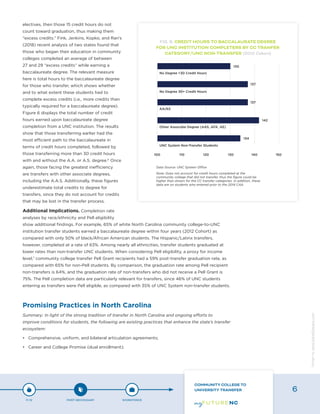
and graduation rates. Figure 5 shows a comparison of North Carolina community college transfers
with other transfers and UNC System non-transfer students. NCCCS transfer students have lower
completion rates than UNC institution non-transfer students at every level, but their completion
rates are in line with transfers from other sectors, especially for those transferring as sophomores
and juniors (the two largest groups).
This lower completion is not necessarily due to poor academic performance. When comparing
Fall 2015 GPAs of community college transfer and non-transfer UNC institution students at the
two most populous levels, sophomore transfers earned an average GPA of 2.8, compared with 3.0
for non-transfer sophomores, and junior transfers earned an average 3.04 compared with 3.06
among non-transfer juniors. While additional analysis is needed, these comparisons show that the
issues of non-completion may be attributable to factors other than students’ abilities, such as the
transfer process.
Credit Loss/Excess Credits. For community college transfers in particular, a prevalent theme is
transfer inefficiency related to credits lost and/or excess credits required to earn a baccalaureate
degree. The Government Accountability Office (2017) found that students transferring from a two-
year to a four-year college lose an average of 26% of their credits during the transfer process. This
translates into lost tuition, lost Pell Grant eligibility, and additional time to leave higher education
altogether. In an analysis of North Carolina, Giani (2018) found that students lost an average
of 5 credit hours and more than 70% of students did not lose any credits at all. However, those
transferring with a workforce associate, the A.A.S., lost an average of 13 credit hours, since A.A.S.
programs are not typically set up to transfer into a baccalaureate degree program.
Credit loss describes one element of transfer inefficiency, but it does not capture how transfer
credits are applied to a particular degree. For example, a student could successfully transfer 45
credit hours, but if 15 credit hours transfer as “electives” and their chosen major does not require
FIG. 5: 4-YR BACCALAUREATE COMPLETION RATES FOLLOWING TRANSFER BY ORIGIN (2012 Cohort)
Data Source: UNC InfoCenter
P-12 POST-SECONDARY WORKFORCE
COMMUNITY COLLEGE TO
UNIVERSITY TRANSFER 5
Designbywww.AdrialDesigns.com
electives, then those 15 credit hours do not
count toward graduation, thus making them
“excess credits.” Fink, Jenkins, Kopko, and Ran’s
(2018) recent analysis of two states found that
those who began their education in community
colleges completed an average of between
27 and 29 “excess credits” while earning a
baccalaureate degree. The relevant measure
here is total hours to the baccalaureate degree
for those who transfer, which shows whether
and to what extent these students had to
complete excess credits (i.e., more credits than
typically required for a baccalaureate degree).
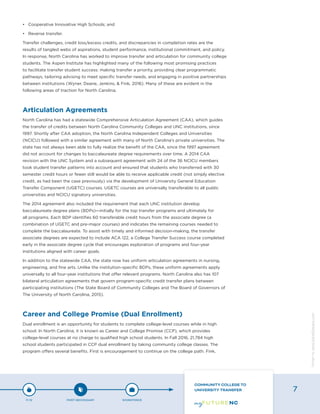
Figure 6 displays the total number of credit
hours earned upon baccalaureate degree
completion from a UNC institution. The results
show that those transferring earlier had the
most efficient path to the baccalaureate in
terms of credit hours completed, followed by
those transferring more than 30 credit hours
with and without the A.A. or A.S. degree.6
Once
again, those facing the greatest inefficiency
are transfers with other associate degrees,
including the A.A.S. Additionally, these figures
underestimate total credits to degree for
transfers, since they do not account for credits
that may be lost in the transfer process.
Additional Implications. Completion rate
analyses by race/ethnicity and Pell eligibility
show additional findings. For example, 65% of white North Carolina community college-to-UNC
institution transfer students earned a baccalaureate degree within four years (2012 Cohort) as
compared with only 50% of black/African American students. The Hispanic/Latinx transfers,
however, completed at a rate of 63%. Among nearly all ethnicities, transfer students graduated at
lower rates than non-transfer UNC students. When considering Pell eligibility, a proxy for income
level,7
community college transfer Pell Grant recipients had a 59% post-transfer graduation rate, as
compared with 65% for non-Pell students. By comparison, the graduation rate among Pell recipient
non-transfers is 64%, and the graduation rate of non-transfers who did not receive a Pell Grant is
75%. The Pell completion data are particularly relevant for transfers, since 46% of UNC students
entering as transfers were Pell eligible, as compared with 35% of UNC System non-transfer students.
Promising Practices in North Carolina
Summary: In light of the strong tradition of transfer in North Carolina and ongoing efforts to
improve conditions for students, the following are existing practices that enhance the state’s transfer
ecosystem:
•	 Comprehensive, uniform, and bilateral articulation agreements;
•	 Career and College Promise (dual enrollment);
FIG. 6: CREDIT HOURS TO BACCALAURATE DEGREE
FOR UNC INSTITUTION COMPLETERS BY CC TRANFER
CATEGORY/UNC NON-TRANSFER (2012 Cohort)
Data Source: UNC System Office
Note: Does not account for credit hours completed at the
community college that did not transfer, thus the figure could be
higher than shown for the CC transfer categories. In addition, these
data are on students who entered prior to the 2014 CAA.
P-12 POST-SECONDARY WORKFORCE
COMMUNITY COLLEGE TO
UNIVERSITY TRANSFER 6
Designbywww.AdrialDesigns.com
•	 Cooperative Innovative High Schools; and
•	 Reverse transfer.
Transfer challenges, credit loss/excess credits, and discrepancies in completion rates are the
results of tangled webs of aspirations, student performance, institutional commitment, and policy.
In response, North Carolina has worked to improve transfer and articulation for community college
students. The Aspen Institute has highlighted many of the following most promising practices
to facilitate transfer student success: making transfer a priority, providing clear programmatic
pathways, tailoring advising to meet specific transfer needs, and engaging in positive partnerships
between institutions (Wyner, Deane, Jenkins, & Fink, 2016). Many of these are evident in the
following areas of traction for North Carolina.
Articulation Agreements
North Carolina has had a statewide Comprehensive Articulation Agreement (CAA), which guides
the transfer of credits between North Carolina Community Colleges and UNC institutions, since
1997. Shortly after CAA adoption, the North Carolina Independent Colleges and Universities
(NCICU) followed with a similar agreement with many of North Carolina’s private universities. The
state has not always been able to fully realize the benefit of the CAA, since the 1997 agreement
did not account for changes to baccalaureate degree requirements over time. A 2014 CAA
revision with the UNC System and a subsequent agreement with 24 of the 36 NCICU members
took student transfer patterns into account and ensured that students who transferred with 30
semester credit hours or fewer still would be able to receive applicable credit (not simply elective
credit, as had been the case previously) via the development of University General Education
Transfer Component (UGETC) courses. UGETC courses are universally transferable to all public
universities and NCICU signatory universities.
The 2014 agreement also included the requirement that each UNC institution develop
baccalaureate degree plans (BDPs)—initially for the top transfer programs and ultimately for
all programs. Each BDP identifies 60 transferable credit hours from the associate degree (a
combination of UGETC and pre-major courses) and indicates the remaining courses needed to
complete the baccalaureate. To assist with timely and informed decision-making, the transfer
associate degrees are expected to include ACA 122, a College Transfer Success course completed
early in the associate degree cycle that encourages exploration of programs and four-year
institutions aligned with career goals.
In addition to the statewide CAA, the state now has uniform articulation agreements in nursing,
engineering, and fine arts. Unlike the institution-specific BDPs, these uniform agreements apply
universally to all four-year institutions that offer relevant programs. North Carolina also has 107
bilateral articulation agreements that govern program-specific credit transfer plans between
participating institutions (The State Board of Community Colleges and The Board of Governors of
The University of North Carolina, 2015).
Career and College Promise (Dual Enrollment)
Dual enrollment is an opportunity for students to complete college-level courses while in high
school. In North Carolina, it is known as Career and College Promise (CCP), which provides
college-level courses at no charge to qualified high school students. In Fall 2016, 21,784 high
school students participated in CCP dual enrollment by taking community college classes. The
program offers several benefits. First is encouragement to continue on the college path. Fink,
P-12 POST-SECONDARY WORKFORCE
COMMUNITY COLLEGE TO
UNIVERSITY TRANSFER 7
Designbywww.AdrialDesigns.com
Jenkins, and Yanagiura (2017) found that 83% of dually enrolled students in North Carolina go on
to college following high school graduation with more than half of continuing students doing so
in a community college. CCP courses can be available at any North Carolina high school through
partnership with the local community college. Second is a head start on the earning of college credits,
which may accelerate time to degree. In North Carolina, students can enroll in a CCP College Transfer
Pathway to ensure they are completing classes that will transfer into their major. Third is a captive
audience for early advising with students and families about specific program pathways and transfer.
Cooperative Innovative High Schools
CIHSs are early and middle college high schools as well as those focused on career and technical
education. In Fall 2016, 15,930 Cooperative Innovative High School (CIHS) students took community
college classes in North Carolina. CIHSs are typically located on the campus of a higher education
institution. Including schools scheduled to open in Fall 2018, there are 133 CIHSs in North Carolina
with 118 of those partnered with a community college. The majority of these CIHSs are early college
high schools where students begin attending in the ninth grade and can concurrently complete
their high school diploma and their associate degree within five years. Students in early college
high schools have the opportunity to complete a transfer associate degree one to two years early
and enter a four-year institution with the protection of the CAA one to two years early as well. The
majority of North Carolina early college high schools serve students reflective of local community
demographics, with particular emphasis on meeting needs of first-generation students. These
students have the opportunity to accelerate their time to degree while receiving the first two years at
no cost, which can be a driver of economic mobility. CIHS students, however, are still subject to the
same curriculum alignment challenges that other transfer students may face on the path toward the
baccalaureate. These challenges are not uniformly managed among the UNC constituent institutions.
Reverse Transfer
Just over half of community college-to-UNC transfer students make the transition before completing
a credential. Reverse transfer allows for students enrolled at a four-year institution to transfer general
education courses taken at the university back to the community college to earn an associate degree.
This provides a point of momentum as well as credential attainment in the event that circumstances
result in a disrupted educational experience at the university. The university works with the
community college where the transfer student last completed courses prior to transfer to assess when
associate degree requirements are met. The student does not have to apply for reverse transfer of
coursework, but must indicate interest in an associate degree award for the process to be completed.
From Spring 2014 to Spring 2017, 2,278 associate degrees were awarded through reverse transfer at
51 of North Carolina’s 58 community colleges.
Work to Be Done in North Carolina
Summary: Potential considerations to improve transfer policy and practice in North Carolina include:
•	 Improved statewide transfer pathways,
•	 A universal course numbering strategy,
•	 Increased emphasis on Associate in Applied Science articulation,
•	 Enhanced data quality and sharing,
P-12 POST-SECONDARY WORKFORCE
COMMUNITY COLLEGE TO
UNIVERSITY TRANSFER 8
Designbywww.AdrialDesigns.com
•	 Incentivized pre-transfer associate degrees, and
•	 Increased communication during secondary education.
The areas of traction described in the previous section offer students in North Carolina
opportunities for successful transfer, degree attainment, and positive labor market outcomes. In
an effort to improve transfer access, success, and efficiency, however, there are many potential
avenues to improve transfer in the state. The following are ways to enhance an already robust
transfer ecosystem in North Carolina.
Statewide Pathways
Even with the CAA in place, inefficiency still occurs due to excess transfer of elective credits,
credits in courses that do not meet pre-major requirements, changes in major, late decision-making
about major or college choice, and poor advising. Hodara, Martinez-Wenzl, Stevens, and Mazzeo
(2017) introduced a transfer policy framework that seeks to enhance credit mobility, or the ease
of movement of credit from community colleges to universities that applies to degrees effectively.
In their framework, they currently classify North Carolina as an institution-driven system, which
means that community college students need to know their major and destination university very
early in their college career in order to prevent the loss of credit and time. While the CAA offers
statewide benefits (e.g., guaranteed transfer to a UNC institution with an A.A./A.S., meeting general
education requirements, University General Education Transfer Component (UGETC) courses
ensuring the seamless transfer of the first 30 credit hours), the transfer of pre-major courses is
defined by university-specific Baccalaureate Degree Plans (BDPs), leaving opportunities for credit
loss if students do not know both the major and destination university early. The ideal in the
Hodara et al. (2017) model is a true 2 + 2 system like those in Florida, Tennessee,8
and the California
State University System,9
where statewide agreements are established to transfer lower division
coursework for a significant number of majors.
In North Carolina, priority areas could be identified, articulated statewide, and built upon over time.
Also, universities would not be obligated to offer programs in all pathways, allowing four-year
institutions to identify programs appropriate to demand in their regions.
Course Numbering
The Education Commission of the States (2016) reports that many states (including North Carolina)
have common course numbering within their community college systems, but 16 states have
common course numbering across public community colleges and universities. Florida, an early
adopter, also has an option for private universities to join the numbering system. Common course
numbering does not cure all transfer woes, however. Even states with extensive common numbering
like Florida have institution-to-institution challenges with transferring credit (Bailey, Jenkins, Fink,
Cullinane, & Schudde, 2017; Padrón, 2016). In addition, unifying course numbering systems can be
costly and disruptive.
As a result, some states are employing other ways to address consistency, such as California’s
“supra-numbering system,” the Course Identification Numbering System (C-ID).10
Institutions
decide which of their local courses align with a course ID in the system. Students are then able to
see which courses at California Community Colleges correspond with each C-ID, and then which
California State University campus accepts those courses. Essentially, the systems are addressing
common course numbering without institutions having to change course numbers. If North Carolina
were to consider common course numbering or an equivalent system, it should not be viewed as
P-12 POST-SECONDARY WORKFORCE
COMMUNITY COLLEGE TO
UNIVERSITY TRANSFER 9
Designbywww.AdrialDesigns.com
the goal, but rather a contributor to a broader strategy that unifies institutions around statewide
program-specific transfer pathways.
Associate in Applied Science (A.A.S.) Articulation
UNC transfer students with “other Associate degrees” have increased by 134% in the past 10
years, and account for nearly 1 in 5 community college students making the transition. However,
compared to A.A./A.S. earners, those with other associate degrees, often geared toward North
Carolina’s workforce needs, are less likely to earn baccalaureate degrees in the four years
after transfer and more likely to lose credits. In a state that is not currently meeting projected
workforce needs for sub-baccalaureate credentials (Carnevale et al., 2013a), these students
and the colleges that serve them are filling an important role, and the state should consider
additional ways to facilitate transfer for A.A.S. earners, as well.
The good news is that there is already momentum in this area with existing bilateral articulation
agreements in existence between UNC institutions and North Carolina community colleges.
However, North Carolina does not currently maintain a repository of information about such
agreements. There is an enormous opportunity to share information about these agreements
to assist A.A.S. students in making an informed choice about baccalaureate options. Kujawa
(2013) showed that the mere presence of an applied baccalaureate (the type of program to
which an A.A.S. may articulate) at a four-year institution “heated up” community college student
aspirations. Incorporating universally transferable UGETC courses into A.A.S. degrees—thus
guaranteeing the smooth transfer of at least half of the associate degree—could add to that
heat. Cataloging existing agreements and incorporating transfer courses into applied programs
should encourage completion, potentially expand transfer enrollment, and present options for
other universities, public and private, to adopt similar agreements.
Data Quality and Data Sharing
Successful transfer is best facilitated when the student’s progress is consistently monitored
by both partner institutions. Data-sharing agreements supported by technology that reaches
across institutions could facilitate much more effective student advising. This allows the
integration of supports and needed interventions when they are most effective, potentially
reducing time-to-degree.
Incentivized Pre-Transfer Associate Degrees
North Carolina’s data clearly show that transfer students who complete an A.A. or A.S. prior to
transfer are the most successful in completing their baccalaureate within four years following
transfer. Significant increases in the percentage of degreed transfers could be stimulated
through providing student and institution incentives. Possible considerations include student
scholarships and support for institutional infrastructure that directly targets transfer or four-
year institution performance measures that reward on-time transfer baccalaureate degree
completion.
Increased Communication During Secondary Education
Successful transfer requires that students and parents understand the opportunities, process,
and challenges. Student and parent awareness of CCP transfer pathways (and the rights and
P-12 POST-SECONDARY WORKFORCE
COMMUNITY COLLEGE TO
UNIVERSITY TRANSFER 10
Designbywww.AdrialDesigns.com
privileges afforded through the CAA) is a key factor in reducing potential student-loan debt and
time-to-degree. However, just as critical is understanding the impact of choice. Student interests
and aptitudes should be matched to an appropriate pathway. In addition, just as students who
are set on the pathway of direct entry into selective four-year institutions upon high school
graduation must engage in targeted academic preparation, students who enter their baccalaureate
pathway through dual enrollment and/or open admission of the community colleges must also
plan accordingly to avoid unnecessary detours. High school counselors and career coaches must
understand and value transfer as a viable option for students in order to guide students effectively
in their preparation and choices. In addition, communication of these opportunities must reach a
broader audience. Sixty-eight percent of Fall 2016 CCP enrollments were white students, whereas
there were only 12% black/African American, 8% Hispanic/Latinx, 1% American Indian/Alaskan
Native, 1% Asian, 2% multiple, and 7% unknown. More effective, comprehensive communication
beginning as early as middle school is an essential component to enable students to make informed
decisions about career opportunities and the requisite education necessary and available.
1.	 It is important to note that these figures do not account for intent. Nearly
half (48%) of the enrollment in the North Carolina Community College
System (2017) is in career and technical education programs, which are not
on the traditional path to transfer. In addition, these findings were based
on data pre-dating the 2014 revision to the Comprehensive Articulation
Agreement, as well as 8 additional transfer-related agreements.
2.	 In this section, we include data on transfer destinations of N.C.
community college students to both public and private four-year
institutions in North Carolina (Figure 2). The data in Figures 3-6 are
specific to N.C. community college to UNC System transfer based on
data being readily available primarily through the UNC InfoCenter.
3.	 The Associate in Arts (A.A.) and Associate in Science (A.S.) are the typical
degrees one pursues at a community college when intending to transfer
to a university. The Associate in Applied Science (A.A.S) is a degree,
typically in a Career and Technical Education field, offered at community
colleges and intended for more immediate workforce preparation.
4.	 All transfer outcomes in this section are for transfers
who began their community college education prior to
the 2014 Comprehensive Articulation Agreement (CAA),
which sought to ease transfer access and efficiency.
5.	 Completion figures are for the first destination UNC institution,
and do not account for those who may have subsequently
transferred and earned a degree from another university.
6.	 It is important to note that these data, and all baccalaureate completion
data in this report, are on the 2012 cohort of community college transfer
students, none of whom would have completed courses under the 2014
revised Comprehensive Articulation Agreement (CAA) that sought
to improve the transferability and applicability of credit. Thus, earlier
transfer may indeed have been slightly more efficient (the following
section will describe the CAA revisions in greater depth). Additional
analysis on subsequent cohorts will be necessary to determine if the
2012 cohort findings differ with findings from subsequent cohorts that
completed community college coursework under the revised agreement.
7.	 Grant receipt is not an ideal measure of income, since Pell
eligibility requires the added step of completing the Free
Application for Federal Student Aid (a hurdle that sometimes
discourages otherwise-eligible students from applying), but it is
often the best approximation we have for transfer students.
8.	 http://www.tntransferpathway.org
9.	 http://www.calstate.edu/transfer/adt-search/search.shtml; The
California State University system has articulated pathways
from community colleges in more than 30 program areas.
10.	 https://www.c-id.net
Endnotes
P-12 POST-SECONDARY WORKFORCE
COMMUNITY COLLEGE TO
UNIVERSITY TRANSFER 11
Designbywww.AdrialDesigns.com
•	 American Association of Community
Colleges (AACC). (2018). Fast facts 2018.
Washington, DC: Author. Retrieved from
https://www.aacc.nche.edu/wp-content/
uploads/2018/04/2018-Fast-Facts.pdf
•	 Bailey, T., Jenkins, D., Fink, J., Cullinane,
J., & Schudde, L. (2017). Policy levers to
strengthen community college transfer
student success in Texas. Bryan, TX: Greater
Texas Foundation. Retrieved from https://
ccrc.tc.columbia.edu/media/k2/attachments/
policy-levers-to-strengthen-community-
college-transfer-student-success-in-texas.pdf
•	 Carlan, P. E., & Byxbe, F. R. (2000).
Community colleges under the microscope:
An analysis of performance predictors
for native and transfer students.
Community College Review, 28, 27–42.
doi:10.1177/009155210002800202
•	 Carnevale, A. P., Smith, N., & Strohl, J.
(2013a). Recovery: Job growth and education
requirements through 2020, state report.
Washington, DC: Georgetown Center on
Education and the Workforce. Retrieved from
https://cew-7632.kxcdn.com/wp-content/
uploads/StateProjections_6.1.15_agc_v2.pdf
•	 Carnevale, A. P., Smith, N., & Strohl, J.
(2013b). Recovery: Job growth and education
requirements through 2020. Washington, DC:
Georgetown Center on Education and the
Workforce. Retrieved from https://cew-7632.
kxcdn.com/wp-content/uploads/2014/11/
Recovery2020.FR_.Web_.pdf
•	 Crisp, G., & Nuñez, A. (2014). Understanding
the racial transfer gap: Modeling
underrepresented minority and nonminority
students’ pathways from two-to four-year
institutions. The Review of Higher Education,
37, 291-320. doi:10.1353/rhe.2014.0017
•	 Crosta, P. M., & Kopko, E. M. (2014). Should
community college students earn an
associate degree before transferring to
a four-year institution? (CCRC Working
Paper No. 70). New York, NY: Community
College Research Center, Teachers College,
Columbia University. Retrieved from
https://ccrc.tc.columbia.edu/publications/
associate-degree-before-transfer.html
•	 Dow, D. (2015). Statistical abstract of
higher education in North Carolina 2014-
2015 (Research Report 1-14). Chapel Hill,
NC: The University of North Carolina.
Retrieved from http://www.northcarolina.
edu/apps/stat_abstract/index.php
•	 Education Commission of the States.
(2016). Transfer and articulation: Statewide
common course numbering. Denver, CO:
Author. Retrieved from http://ecs.force.
com/mbdata/MBquest3RTA?Rep=TR1602
•	 Fink, J., Jenkins, D., Kopko, E., & Ran, F.
X. (2018). Using data mining to explore
why community college transfer students
earn bachelor’s degrees with excess
credits. New York, NY: Community College
Research Center, Teachers College,
Columbia University. Retrieved from
https://ccrc.tc.columbia.edu/media/k2/
attachments/using-data-mining-explore-
why-community-college-transfer-students-
earn-bachelors-degrees-excess-credits.pdf
•	 Fink, J., Jenkins, D., & Yanagiura, T. (2017).
What happens to students who take
community college “dual enrollment” courses
in high school? New York, NY: Community
College Research Center, Teachers College,
Columbia University. Retrieved from
https://ccrc.tc.columbia.edu/media/k2/
attachments/what-happens-community-
college-dual-enrollment-students.pdf
•	 Giani, M. (2018, February). What factors
predict credit loss for transfer students?
Paper presented at the National Institute
for the Study of Transfer Students 16th
Annual Conference, Atlanta, GA.
•	 Glass, J. C., Jr., & Harrington, A. R. (2002).
Academic performance of community college
transfer students and “native” students at
a large state university. Community College
Journal of Research and Practice, 26,
415–430. doi:10.1080/02776770290041774
•	 Government Accountability Office. (2017).
Higher education: Students need more
information to help reduce challenges in
transferring college credits. Washington,
DC: Author. Retrieved from https://www.
gao.gov/assets/690/686530.pdf
•	 Hodara, M., Martinez-Wenzl, M., Stevens,
D., & Mazzeo, C. (2017). Exploring credit
mobility and major-specific pathways: A
policy analysis and student perspective
on community college to university
transfer. Community College Review, 45,
331-349. doi: 10.1177/0091552117724197
•	 Jenkins, D., & Fink, J. (2016). Tracking transfer
new measures of institutional and state
effectiveness in helping community college
students attain bachelor’s degrees. New York,
NY: Community College Research Center,
Teachers College, Columbia University.
Retrieved from https://ccrc.tc.columbia.edu/
media/k2/attachments/tracking-transfer-
institutional-state-effectiveness.pdf
•	 Kujawa, T. A. (2013). The AAS to BAS
pathway: Heating up the educational
aspirations of CTE students. Community
College Journal of Research and Practice, 37,
356-364. doi:10.1080/10668926.2012.755648
•	 Ma, J., & Baum, S. (2016). Trends in
community colleges: Enrollment, prices,
student debt, and completion. New
York, NY: The College Board. Retrieved
from https://trends.collegeboard.org/
sites/default/files/trends-in-community-
colleges-research-brief.pdf
•	 North Carolina Community College System
(NCCCS). (2017). Statistical reports, Volume
52. Raleigh, NC: Author. Retrieved from
http://www.nccommunitycolleges.edu/
analytics/statistical-reports/volume-52
•	 Padrón, E. (2016, July 18). Understanding and
overcoming common barriers to transfer.
The EvoLLLution. Retrieved from https://
evolllution.com/managing-institution/
government_legislation/understanding-and-
overcoming-common-barriers-to-transfer
•	 Shapiro, D., Dundar, A., Ziskin, M., Chiang,
Y.-C., Chen, J., Torres, V., & Harrell, A. (2013).
Baccalaureate attainment: A national view
of the postsecondary outcomes of students
who transfer from two-year to four-year
institutions (Signature Report No. 5).
Herndon, VA: National Student Clearinghouse
Research Center. Retrieved from https://
nscresearchcenter.org/signaturereport5
•	 State Board of Community Colleges & the
Board of Governors of the University of North
Carolina. (2015). Report on study of bilateral
agreements and partnerships that exist
between constituent institutions of the North
Carolina Community Colleges and constituent
institutions of the University of North
Carolina. Raleigh and Chapel Hill, NC: Author.
Retrieved from https://www.northcarolina.
edu/sites/default/files/final_report_sb_744_
bilateral_agreements_1-29-15-3.pdf
•	 United States Census Bureau. (2016). 2012-
2016 American community survey 5-year
estimates. Washington, DC: Author. Retrieved
from https://factfinder.census.gov/faces/
nav/jsf/pages/community_facts.xhtml
•	 University of North Carolina (UNC).
(1997). Statistical abstract of higher
education in North Carolina, 1996-
1997. Chapel Hill, NC: Author. Retrieved
from http://www.northcarolina.edu/
apps/stat_abstract/index.php
•	 Wyner, J., Deane, K. C., Jenkins, D., & Fink,
J. (2016). The transfer playbook: Essential
practices for two- and four-year colleges.
Washington, DC: The Aspen Institute.
Retrieved from https://www.aspeninstitute.
org/publications/transfer-playbook
•	 Yang, X. (2007). Statistical abstract
of higher education in North Carolina,
2006-2007. Chapel Hill, NC: The
University of North Carolina. Retrieved
from http://www.northcarolina.edu/
apps/stat_abstract/index.php
References
P-12 POST-SECONDARY WORKFORCE
COMMUNITY COLLEGE TO
UNIVERSITY TRANSFER 12
Designbywww.AdrialDesigns.com

University Transfer

  • 1.
    COMMUNITY COLLEGE TO UNIVERSITYTRANSFER Executive Summary This policy brief outlines the community college-to-university transfer landscape and assesses how well North Carolina is positioned to improve experiences and outcomes for transfer students. Key factors to consider when developing strategies for improving these experiences and outcomes include: • Educational attainment for community college students who transfer to public and private universities is imperative for meeting state workforce needs at the certificate, associate degree, and baccalaureate levels. • The state has significant traction for increasing the number of transfer students, especially for those with transfer-focused associate degrees (A.A./A.S.) and workforce preparation-focused degrees (A.A.S.). Every student—regardless of program—should have a pathway to additional education. While North Carolina falls behind the national average on some benchmarks, the growth in transfer shows there is promise in this area. • Transfer students too often have lower completion rates and follow inefficient pathways to the baccalaureate. While North Carolina has statewide articulation agreements, in order for students to have a seamless transition from the community college to the university, they need to know both their major and destination university early in the community college experience. No single initiative is likely to improve outcomes on its own; however, the state should consider leveraging a host of strategies, including: • Statewide transfer pathways in key program areas, • Universal course numbering for public higher education, • Emphasis on articulation of credit to universities for students completing a workforce preparation-focused associate degree, • Improved data quality and sharing, • Incentives for pre-transfer associate degrees, and • Communication during secondary education. Combined, these initiatives would demonstrate an enhanced commitment to transfer students, lessen uncertainty, and clarify a way forward for future community college transfer policy improvements. Importance of Transfer to North Carolina Summary: Approximately 31% of UNC System students are transfer students upon entry, but North Carolina is behind national figures in some key community college transfer indicators. This has significant workforce implications since 67% of jobs in North Carolina by 2020 will require at least some college, and the state does not meet projected needs at the baccalaureate degree POLICY BRIEF AUTHOR Mark D’Amico Associate Professor of Educational Leadership; The University of North Carolina at Charlotte AUTHOR Lisa Chapman Senior Vice President/ Chief Academic Officer; North Carolina Community College System P-12 POST-SECONDARY WORKFORCE COMMUNITY COLLEGE TO UNIVERSITY TRANSFER 1 Designbywww.AdrialDesigns.com
  • 2.
    level. Community collegetransfer leading to baccalaureate degree attainment is also important considering that community colleges enroll significant numbers of low-income students, adults, and students of color. Transfer is an important part of the fabric of North Carolina’s higher education system. This is evidenced by the fact that 56,000 students (31%) in the University of North Carolina System in Fall 2016 were transfer students upon entry, the majority of whom transferred from North Carolina community colleges. While the number of transfers—and community college transfers specifically—is significant, North Carolina lags in key community college transfer indicators. One is the “transfer-out rate,” which measures the percent of community college students who successfully transfer within a six-year period. North Carolina is at 24% compared to 33% nationally. Another is “transfer out bachelor’s completion,” which is the percent of students who transferred successfully and earned a bachelor’s degree within six years of starting at the community college. North Carolina is much closer to the national average at 40% compared with 42% nationally (Jenkins & Fink, 2016).1 The Transfer System in North Carolina North Carolina has had a Comprehensive Articulation Agreement (CAA) since 1997. The CAA provides assured admission with junior status to one of the 16 public universities for transfer associate degree completers, who have an overall GPA of at least 2.0 on a 4.0 scale, as well as guaranteed course equivalency transfer for 30 semester hours credit of general education courses for students who transfer prior to associate degree completion. One shortcoming of the 1997 CAA was its limited guidance in response to changes over time in the various baccalaureate degree requirements. In 2014, the CAA was revised to effectively support student transfer patterns and to respond to changes in baccalaureate degree requirements with the intent of ensuring that students and advisors know, upon first consideration, all coursework that is necessary for students’ proposed baccalaureate and the specific credits that can be earned while at the community college. However, it requires effective communication among all partners as well as active engagement and vigilance on the part of the community colleges and the four- year institutions. In addition, “uniform articulation agreements” have been established in specific program areas, such as nursing, engineering, and fine arts. An Independent Comprehensive Articulation Agreement (ICAA) similar to the CAA also exists with the North Carolina Independent Colleges and Universities (NCICU), based on signatory participation, that is virtually identical to the UNC System CAA. Meeting Workforce Needs According to data from the U.S. Census Bureau’s 2016 American Community Survey, the percent of North Carolinians with a baccalaureate degree or higher is 29% as compared with 30% nationally. While North Carolina is nearly on par with national figures, the state falls short in meeting projected workforce demand (Figure 1). The Georgetown Center on Education and the Workforce showed that by 2020, 67% of jobs in North Carolina will require some level of postsecondary education (Carnevale, Smith, & Strohl, 2013a). When comparing workforce needs with 2016 educational attainment data, the state has a shortfall at the sub-baccalaureate and baccalaureate levels. This gap further emphasizes the need for community college students not only to complete certificates and associate degrees, but also to have clear pathways to the baccalaureate. P-12 POST-SECONDARY WORKFORCE COMMUNITY COLLEGE TO UNIVERSITY TRANSFER 2 Designbywww.AdrialDesigns.com
  • 3.
    From a standpointof economic mobility, some of North Carolina’s educational attainment figures are particularly troubling. Only 19.4% of the black subgroup in North Carolina holds a baccalaureate degree or higher and only 13.5% of the Hispanic/Latinx subgroup reaches that level, compared to 31.7% of the white subpopulation. These four-year degree attainment discrepancies point to the importance of the community college-to- university transfer pathway, since community colleges enroll a disproportionate number of low-income students, older students, and students of color (AACC, 2018; Ma & Baum, 2016). Currently, however, students of color are less likely to transfer from community colleges to universities, which represents a “racial transfer gap” (Crisp & Nuñez, 2014). Transfer Indicators in North Carolina 2 Summary: The following are key indicators for North Carolina community college-to-university transfer: • The number of community college transfers to public and private four-year universities has grown from 3,400 in Fall 1986 to more than 12,000 in Fall 2016. • The most significant growth in transfers from 2007 to 2016 is among those with Associate degrees—118% growth among those with an Associate in Arts (A.A.) or Associate in Science (A.S.) and 134% among those with another associate degree (e.g., Associate in Applied Science).3 • Community college transfers to UNC institutions who have the highest graduation rates in the four years following transfer are students with an A.A. or A.S. • Community college transfer students at UNC institutions graduate at lower rates than non- transfer UNC System students, but comparably to those with other transfer origins, especially when transferring in the sophomore or junior years. • UNC baccalaureate degree completers who transferred from community colleges often earn more “excess credits” than UNC System non-transfers—this does not account for any additional credits lost in transfer. Transfer Enrollment and Patterns Transfer Destinations. More than 4 out of 5 North Carolina community college transfer students are transferring “vertically” (i.e., from community college to a public or private university), while just 16% are transferring “laterally” (i.e., between community colleges). Figure 2 shows the changes in vertical transfer over a 30-year period in the state. Combined transfer to UNC System institutions FIG. 1: 2020 PROJECTED WORKFORCE NEEDS BY EDUCATION LEVEL; CORRESPONDING 2016 NORTH CAROLINA ATTAINMENT LEVELS Data Sources: Carnevale, Smith, and Strohl (2013a,b); U.S. Census Bureau American Community Survey (2016) P-12 POST-SECONDARY WORKFORCE COMMUNITY COLLEGE TO UNIVERSITY TRANSFER 3 Designbywww.AdrialDesigns.com
  • 4.
    and private universitiesshows growth from approximately 3,400 in Fall 1986 to more than 12,000 in Fall 2016. Credential upon Transfer. Figure 3 shows that the largest group of transfers into UNC System institutions enter without a degree and with 30+ credit hours (38%), followed by those with an A.A. or A.S. (31%), which are the typical transfer-focused degrees. However, it is also important to look at the change over time. Those transferring with Associate degrees represent the greatest percent gains from 2007 to 2016. The group transferring with an A.A./A.S. has grown by 118% over that time, and those with an associate degree other than an A.A./A.S. increased by 134%. The other associate degree category, which is comprised of more workforce-focused degrees (e.g., Associate in Applied Science), only represents 18% of all community college-to-UNC System transfer, but they represent the greatest percent growth. Transfer Outcomes 4 Baccalaureate Completion. Previous research (e.g., Crosta & Kopko, 2014; Shapiro et al., 2013) found a positive relationship between baccalaureate degree attainment and transfer- oriented associate degrees, such as the A.A. or A.S. The relationship is not as strong for transfers with degrees like the A.A.S., which is focused on workforce preparation (Crosta & Kopko, 2014). However, the overall growth in transfers to the UNC System by students with associate degrees demonstrates the potential for double attainment (associate/ baccalaureate). Figure 4 displays the four- year baccalaureate completion rates following transfer to a UNC System institution.5 Those who transfer with more than 30 credit hours and those who transfer with an A.A./A.S. had the highest graduation rates. Students transferring with fewer than 30 credit hours require more time to complete a four-year degree, which is a plausible explanation for the lower completion rate for that population. Completion rates are also somewhat lower for those transferring with “other associate degrees.” FIG. 2: N.C. COMMUNITY COLLEGE-TO- UNIVERSITY TRANSFER FIG. 3: NORTH CAROLINA COMMUNITY COLLEGE TO UNC INSTITUTION TRANSFER STUDENTS BY CATEGORY FIG. 4: 4-YR BACCALAUREATE COMPLETION RATES FOLLOWING TRANFSER TO UNC INSTITUTION BY CATEGORY (2012 Cohort) Sources: Dow (2015); UNC (1997); UNC InfoCenter; Yang (2007) Data Source: UNC InfoCenter Data Source: UNC InfoCenter P-12 POST-SECONDARY WORKFORCE COMMUNITY COLLEGE TO UNIVERSITY TRANSFER 4 Designbywww.AdrialDesigns.com
  • 5.
    A final usefulpoint of comparison is between community college transfers and non-transfer students (i.e., those who started their academic journeys in the UNC setting). Previous literature shows that transfers and non-transfers often perform similarly (see e.g., Carlan & Byxbe, 2000; Glass & Harrington, 2002). Recent North Carolina data may indicate some differences in retention and graduation rates. Figure 5 shows a comparison of North Carolina community college transfers with other transfers and UNC System non-transfer students. NCCCS transfer students have lower completion rates than UNC institution non-transfer students at every level, but their completion rates are in line with transfers from other sectors, especially for those transferring as sophomores and juniors (the two largest groups). This lower completion is not necessarily due to poor academic performance. When comparing Fall 2015 GPAs of community college transfer and non-transfer UNC institution students at the two most populous levels, sophomore transfers earned an average GPA of 2.8, compared with 3.0 for non-transfer sophomores, and junior transfers earned an average 3.04 compared with 3.06 among non-transfer juniors. While additional analysis is needed, these comparisons show that the issues of non-completion may be attributable to factors other than students’ abilities, such as the transfer process. Credit Loss/Excess Credits. For community college transfers in particular, a prevalent theme is transfer inefficiency related to credits lost and/or excess credits required to earn a baccalaureate degree. The Government Accountability Office (2017) found that students transferring from a two- year to a four-year college lose an average of 26% of their credits during the transfer process. This translates into lost tuition, lost Pell Grant eligibility, and additional time to leave higher education altogether. In an analysis of North Carolina, Giani (2018) found that students lost an average of 5 credit hours and more than 70% of students did not lose any credits at all. However, those transferring with a workforce associate, the A.A.S., lost an average of 13 credit hours, since A.A.S. programs are not typically set up to transfer into a baccalaureate degree program. Credit loss describes one element of transfer inefficiency, but it does not capture how transfer credits are applied to a particular degree. For example, a student could successfully transfer 45 credit hours, but if 15 credit hours transfer as “electives” and their chosen major does not require FIG. 5: 4-YR BACCALAUREATE COMPLETION RATES FOLLOWING TRANSFER BY ORIGIN (2012 Cohort) Data Source: UNC InfoCenter P-12 POST-SECONDARY WORKFORCE COMMUNITY COLLEGE TO UNIVERSITY TRANSFER 5 Designbywww.AdrialDesigns.com
  • 6.
    electives, then those15 credit hours do not count toward graduation, thus making them “excess credits.” Fink, Jenkins, Kopko, and Ran’s (2018) recent analysis of two states found that those who began their education in community colleges completed an average of between 27 and 29 “excess credits” while earning a baccalaureate degree. The relevant measure here is total hours to the baccalaureate degree for those who transfer, which shows whether and to what extent these students had to complete excess credits (i.e., more credits than typically required for a baccalaureate degree). Figure 6 displays the total number of credit hours earned upon baccalaureate degree completion from a UNC institution. The results show that those transferring earlier had the most efficient path to the baccalaureate in terms of credit hours completed, followed by those transferring more than 30 credit hours with and without the A.A. or A.S. degree.6 Once again, those facing the greatest inefficiency are transfers with other associate degrees, including the A.A.S. Additionally, these figures underestimate total credits to degree for transfers, since they do not account for credits that may be lost in the transfer process. Additional Implications. Completion rate analyses by race/ethnicity and Pell eligibility show additional findings. For example, 65% of white North Carolina community college-to-UNC institution transfer students earned a baccalaureate degree within four years (2012 Cohort) as compared with only 50% of black/African American students. The Hispanic/Latinx transfers, however, completed at a rate of 63%. Among nearly all ethnicities, transfer students graduated at lower rates than non-transfer UNC students. When considering Pell eligibility, a proxy for income level,7 community college transfer Pell Grant recipients had a 59% post-transfer graduation rate, as compared with 65% for non-Pell students. By comparison, the graduation rate among Pell recipient non-transfers is 64%, and the graduation rate of non-transfers who did not receive a Pell Grant is 75%. The Pell completion data are particularly relevant for transfers, since 46% of UNC students entering as transfers were Pell eligible, as compared with 35% of UNC System non-transfer students. Promising Practices in North Carolina Summary: In light of the strong tradition of transfer in North Carolina and ongoing efforts to improve conditions for students, the following are existing practices that enhance the state’s transfer ecosystem: • Comprehensive, uniform, and bilateral articulation agreements; • Career and College Promise (dual enrollment); FIG. 6: CREDIT HOURS TO BACCALAURATE DEGREE FOR UNC INSTITUTION COMPLETERS BY CC TRANFER CATEGORY/UNC NON-TRANSFER (2012 Cohort) Data Source: UNC System Office Note: Does not account for credit hours completed at the community college that did not transfer, thus the figure could be higher than shown for the CC transfer categories. In addition, these data are on students who entered prior to the 2014 CAA. P-12 POST-SECONDARY WORKFORCE COMMUNITY COLLEGE TO UNIVERSITY TRANSFER 6 Designbywww.AdrialDesigns.com
  • 7.
    • Cooperative InnovativeHigh Schools; and • Reverse transfer. Transfer challenges, credit loss/excess credits, and discrepancies in completion rates are the results of tangled webs of aspirations, student performance, institutional commitment, and policy. In response, North Carolina has worked to improve transfer and articulation for community college students. The Aspen Institute has highlighted many of the following most promising practices to facilitate transfer student success: making transfer a priority, providing clear programmatic pathways, tailoring advising to meet specific transfer needs, and engaging in positive partnerships between institutions (Wyner, Deane, Jenkins, & Fink, 2016). Many of these are evident in the following areas of traction for North Carolina. Articulation Agreements North Carolina has had a statewide Comprehensive Articulation Agreement (CAA), which guides the transfer of credits between North Carolina Community Colleges and UNC institutions, since 1997. Shortly after CAA adoption, the North Carolina Independent Colleges and Universities (NCICU) followed with a similar agreement with many of North Carolina’s private universities. The state has not always been able to fully realize the benefit of the CAA, since the 1997 agreement did not account for changes to baccalaureate degree requirements over time. A 2014 CAA revision with the UNC System and a subsequent agreement with 24 of the 36 NCICU members took student transfer patterns into account and ensured that students who transferred with 30 semester credit hours or fewer still would be able to receive applicable credit (not simply elective credit, as had been the case previously) via the development of University General Education Transfer Component (UGETC) courses. UGETC courses are universally transferable to all public universities and NCICU signatory universities. The 2014 agreement also included the requirement that each UNC institution develop baccalaureate degree plans (BDPs)—initially for the top transfer programs and ultimately for all programs. Each BDP identifies 60 transferable credit hours from the associate degree (a combination of UGETC and pre-major courses) and indicates the remaining courses needed to complete the baccalaureate. To assist with timely and informed decision-making, the transfer associate degrees are expected to include ACA 122, a College Transfer Success course completed early in the associate degree cycle that encourages exploration of programs and four-year institutions aligned with career goals. In addition to the statewide CAA, the state now has uniform articulation agreements in nursing, engineering, and fine arts. Unlike the institution-specific BDPs, these uniform agreements apply universally to all four-year institutions that offer relevant programs. North Carolina also has 107 bilateral articulation agreements that govern program-specific credit transfer plans between participating institutions (The State Board of Community Colleges and The Board of Governors of The University of North Carolina, 2015). Career and College Promise (Dual Enrollment) Dual enrollment is an opportunity for students to complete college-level courses while in high school. In North Carolina, it is known as Career and College Promise (CCP), which provides college-level courses at no charge to qualified high school students. In Fall 2016, 21,784 high school students participated in CCP dual enrollment by taking community college classes. The program offers several benefits. First is encouragement to continue on the college path. Fink, P-12 POST-SECONDARY WORKFORCE COMMUNITY COLLEGE TO UNIVERSITY TRANSFER 7 Designbywww.AdrialDesigns.com
  • 8.
    Jenkins, and Yanagiura(2017) found that 83% of dually enrolled students in North Carolina go on to college following high school graduation with more than half of continuing students doing so in a community college. CCP courses can be available at any North Carolina high school through partnership with the local community college. Second is a head start on the earning of college credits, which may accelerate time to degree. In North Carolina, students can enroll in a CCP College Transfer Pathway to ensure they are completing classes that will transfer into their major. Third is a captive audience for early advising with students and families about specific program pathways and transfer. Cooperative Innovative High Schools CIHSs are early and middle college high schools as well as those focused on career and technical education. In Fall 2016, 15,930 Cooperative Innovative High School (CIHS) students took community college classes in North Carolina. CIHSs are typically located on the campus of a higher education institution. Including schools scheduled to open in Fall 2018, there are 133 CIHSs in North Carolina with 118 of those partnered with a community college. The majority of these CIHSs are early college high schools where students begin attending in the ninth grade and can concurrently complete their high school diploma and their associate degree within five years. Students in early college high schools have the opportunity to complete a transfer associate degree one to two years early and enter a four-year institution with the protection of the CAA one to two years early as well. The majority of North Carolina early college high schools serve students reflective of local community demographics, with particular emphasis on meeting needs of first-generation students. These students have the opportunity to accelerate their time to degree while receiving the first two years at no cost, which can be a driver of economic mobility. CIHS students, however, are still subject to the same curriculum alignment challenges that other transfer students may face on the path toward the baccalaureate. These challenges are not uniformly managed among the UNC constituent institutions. Reverse Transfer Just over half of community college-to-UNC transfer students make the transition before completing a credential. Reverse transfer allows for students enrolled at a four-year institution to transfer general education courses taken at the university back to the community college to earn an associate degree. This provides a point of momentum as well as credential attainment in the event that circumstances result in a disrupted educational experience at the university. The university works with the community college where the transfer student last completed courses prior to transfer to assess when associate degree requirements are met. The student does not have to apply for reverse transfer of coursework, but must indicate interest in an associate degree award for the process to be completed. From Spring 2014 to Spring 2017, 2,278 associate degrees were awarded through reverse transfer at 51 of North Carolina’s 58 community colleges. Work to Be Done in North Carolina Summary: Potential considerations to improve transfer policy and practice in North Carolina include: • Improved statewide transfer pathways, • A universal course numbering strategy, • Increased emphasis on Associate in Applied Science articulation, • Enhanced data quality and sharing, P-12 POST-SECONDARY WORKFORCE COMMUNITY COLLEGE TO UNIVERSITY TRANSFER 8 Designbywww.AdrialDesigns.com
  • 9.
    • Incentivized pre-transferassociate degrees, and • Increased communication during secondary education. The areas of traction described in the previous section offer students in North Carolina opportunities for successful transfer, degree attainment, and positive labor market outcomes. In an effort to improve transfer access, success, and efficiency, however, there are many potential avenues to improve transfer in the state. The following are ways to enhance an already robust transfer ecosystem in North Carolina. Statewide Pathways Even with the CAA in place, inefficiency still occurs due to excess transfer of elective credits, credits in courses that do not meet pre-major requirements, changes in major, late decision-making about major or college choice, and poor advising. Hodara, Martinez-Wenzl, Stevens, and Mazzeo (2017) introduced a transfer policy framework that seeks to enhance credit mobility, or the ease of movement of credit from community colleges to universities that applies to degrees effectively. In their framework, they currently classify North Carolina as an institution-driven system, which means that community college students need to know their major and destination university very early in their college career in order to prevent the loss of credit and time. While the CAA offers statewide benefits (e.g., guaranteed transfer to a UNC institution with an A.A./A.S., meeting general education requirements, University General Education Transfer Component (UGETC) courses ensuring the seamless transfer of the first 30 credit hours), the transfer of pre-major courses is defined by university-specific Baccalaureate Degree Plans (BDPs), leaving opportunities for credit loss if students do not know both the major and destination university early. The ideal in the Hodara et al. (2017) model is a true 2 + 2 system like those in Florida, Tennessee,8 and the California State University System,9 where statewide agreements are established to transfer lower division coursework for a significant number of majors. In North Carolina, priority areas could be identified, articulated statewide, and built upon over time. Also, universities would not be obligated to offer programs in all pathways, allowing four-year institutions to identify programs appropriate to demand in their regions. Course Numbering The Education Commission of the States (2016) reports that many states (including North Carolina) have common course numbering within their community college systems, but 16 states have common course numbering across public community colleges and universities. Florida, an early adopter, also has an option for private universities to join the numbering system. Common course numbering does not cure all transfer woes, however. Even states with extensive common numbering like Florida have institution-to-institution challenges with transferring credit (Bailey, Jenkins, Fink, Cullinane, & Schudde, 2017; Padrón, 2016). In addition, unifying course numbering systems can be costly and disruptive. As a result, some states are employing other ways to address consistency, such as California’s “supra-numbering system,” the Course Identification Numbering System (C-ID).10 Institutions decide which of their local courses align with a course ID in the system. Students are then able to see which courses at California Community Colleges correspond with each C-ID, and then which California State University campus accepts those courses. Essentially, the systems are addressing common course numbering without institutions having to change course numbers. If North Carolina were to consider common course numbering or an equivalent system, it should not be viewed as P-12 POST-SECONDARY WORKFORCE COMMUNITY COLLEGE TO UNIVERSITY TRANSFER 9 Designbywww.AdrialDesigns.com
  • 10.
    the goal, butrather a contributor to a broader strategy that unifies institutions around statewide program-specific transfer pathways. Associate in Applied Science (A.A.S.) Articulation UNC transfer students with “other Associate degrees” have increased by 134% in the past 10 years, and account for nearly 1 in 5 community college students making the transition. However, compared to A.A./A.S. earners, those with other associate degrees, often geared toward North Carolina’s workforce needs, are less likely to earn baccalaureate degrees in the four years after transfer and more likely to lose credits. In a state that is not currently meeting projected workforce needs for sub-baccalaureate credentials (Carnevale et al., 2013a), these students and the colleges that serve them are filling an important role, and the state should consider additional ways to facilitate transfer for A.A.S. earners, as well. The good news is that there is already momentum in this area with existing bilateral articulation agreements in existence between UNC institutions and North Carolina community colleges. However, North Carolina does not currently maintain a repository of information about such agreements. There is an enormous opportunity to share information about these agreements to assist A.A.S. students in making an informed choice about baccalaureate options. Kujawa (2013) showed that the mere presence of an applied baccalaureate (the type of program to which an A.A.S. may articulate) at a four-year institution “heated up” community college student aspirations. Incorporating universally transferable UGETC courses into A.A.S. degrees—thus guaranteeing the smooth transfer of at least half of the associate degree—could add to that heat. Cataloging existing agreements and incorporating transfer courses into applied programs should encourage completion, potentially expand transfer enrollment, and present options for other universities, public and private, to adopt similar agreements. Data Quality and Data Sharing Successful transfer is best facilitated when the student’s progress is consistently monitored by both partner institutions. Data-sharing agreements supported by technology that reaches across institutions could facilitate much more effective student advising. This allows the integration of supports and needed interventions when they are most effective, potentially reducing time-to-degree. Incentivized Pre-Transfer Associate Degrees North Carolina’s data clearly show that transfer students who complete an A.A. or A.S. prior to transfer are the most successful in completing their baccalaureate within four years following transfer. Significant increases in the percentage of degreed transfers could be stimulated through providing student and institution incentives. Possible considerations include student scholarships and support for institutional infrastructure that directly targets transfer or four- year institution performance measures that reward on-time transfer baccalaureate degree completion. Increased Communication During Secondary Education Successful transfer requires that students and parents understand the opportunities, process, and challenges. Student and parent awareness of CCP transfer pathways (and the rights and P-12 POST-SECONDARY WORKFORCE COMMUNITY COLLEGE TO UNIVERSITY TRANSFER 10 Designbywww.AdrialDesigns.com
  • 11.
    privileges afforded throughthe CAA) is a key factor in reducing potential student-loan debt and time-to-degree. However, just as critical is understanding the impact of choice. Student interests and aptitudes should be matched to an appropriate pathway. In addition, just as students who are set on the pathway of direct entry into selective four-year institutions upon high school graduation must engage in targeted academic preparation, students who enter their baccalaureate pathway through dual enrollment and/or open admission of the community colleges must also plan accordingly to avoid unnecessary detours. High school counselors and career coaches must understand and value transfer as a viable option for students in order to guide students effectively in their preparation and choices. In addition, communication of these opportunities must reach a broader audience. Sixty-eight percent of Fall 2016 CCP enrollments were white students, whereas there were only 12% black/African American, 8% Hispanic/Latinx, 1% American Indian/Alaskan Native, 1% Asian, 2% multiple, and 7% unknown. More effective, comprehensive communication beginning as early as middle school is an essential component to enable students to make informed decisions about career opportunities and the requisite education necessary and available. 1. It is important to note that these figures do not account for intent. Nearly half (48%) of the enrollment in the North Carolina Community College System (2017) is in career and technical education programs, which are not on the traditional path to transfer. In addition, these findings were based on data pre-dating the 2014 revision to the Comprehensive Articulation Agreement, as well as 8 additional transfer-related agreements. 2. In this section, we include data on transfer destinations of N.C. community college students to both public and private four-year institutions in North Carolina (Figure 2). The data in Figures 3-6 are specific to N.C. community college to UNC System transfer based on data being readily available primarily through the UNC InfoCenter. 3. The Associate in Arts (A.A.) and Associate in Science (A.S.) are the typical degrees one pursues at a community college when intending to transfer to a university. The Associate in Applied Science (A.A.S) is a degree, typically in a Career and Technical Education field, offered at community colleges and intended for more immediate workforce preparation. 4. All transfer outcomes in this section are for transfers who began their community college education prior to the 2014 Comprehensive Articulation Agreement (CAA), which sought to ease transfer access and efficiency. 5. Completion figures are for the first destination UNC institution, and do not account for those who may have subsequently transferred and earned a degree from another university. 6. It is important to note that these data, and all baccalaureate completion data in this report, are on the 2012 cohort of community college transfer students, none of whom would have completed courses under the 2014 revised Comprehensive Articulation Agreement (CAA) that sought to improve the transferability and applicability of credit. Thus, earlier transfer may indeed have been slightly more efficient (the following section will describe the CAA revisions in greater depth). Additional analysis on subsequent cohorts will be necessary to determine if the 2012 cohort findings differ with findings from subsequent cohorts that completed community college coursework under the revised agreement. 7. Grant receipt is not an ideal measure of income, since Pell eligibility requires the added step of completing the Free Application for Federal Student Aid (a hurdle that sometimes discourages otherwise-eligible students from applying), but it is often the best approximation we have for transfer students. 8. http://www.tntransferpathway.org 9. http://www.calstate.edu/transfer/adt-search/search.shtml; The California State University system has articulated pathways from community colleges in more than 30 program areas. 10. https://www.c-id.net Endnotes P-12 POST-SECONDARY WORKFORCE COMMUNITY COLLEGE TO UNIVERSITY TRANSFER 11 Designbywww.AdrialDesigns.com
  • 12.
    • American Associationof Community Colleges (AACC). (2018). Fast facts 2018. Washington, DC: Author. Retrieved from https://www.aacc.nche.edu/wp-content/ uploads/2018/04/2018-Fast-Facts.pdf • Bailey, T., Jenkins, D., Fink, J., Cullinane, J., & Schudde, L. (2017). Policy levers to strengthen community college transfer student success in Texas. Bryan, TX: Greater Texas Foundation. Retrieved from https:// ccrc.tc.columbia.edu/media/k2/attachments/ policy-levers-to-strengthen-community- college-transfer-student-success-in-texas.pdf • Carlan, P. E., & Byxbe, F. R. (2000). Community colleges under the microscope: An analysis of performance predictors for native and transfer students. Community College Review, 28, 27–42. doi:10.1177/009155210002800202 • Carnevale, A. P., Smith, N., & Strohl, J. (2013a). Recovery: Job growth and education requirements through 2020, state report. Washington, DC: Georgetown Center on Education and the Workforce. Retrieved from https://cew-7632.kxcdn.com/wp-content/ uploads/StateProjections_6.1.15_agc_v2.pdf • Carnevale, A. P., Smith, N., & Strohl, J. (2013b). Recovery: Job growth and education requirements through 2020. Washington, DC: Georgetown Center on Education and the Workforce. Retrieved from https://cew-7632. kxcdn.com/wp-content/uploads/2014/11/ Recovery2020.FR_.Web_.pdf • Crisp, G., & Nuñez, A. (2014). Understanding the racial transfer gap: Modeling underrepresented minority and nonminority students’ pathways from two-to four-year institutions. The Review of Higher Education, 37, 291-320. doi:10.1353/rhe.2014.0017 • Crosta, P. M., & Kopko, E. M. (2014). Should community college students earn an associate degree before transferring to a four-year institution? (CCRC Working Paper No. 70). New York, NY: Community College Research Center, Teachers College, Columbia University. Retrieved from https://ccrc.tc.columbia.edu/publications/ associate-degree-before-transfer.html • Dow, D. (2015). Statistical abstract of higher education in North Carolina 2014- 2015 (Research Report 1-14). Chapel Hill, NC: The University of North Carolina. Retrieved from http://www.northcarolina. edu/apps/stat_abstract/index.php • Education Commission of the States. (2016). Transfer and articulation: Statewide common course numbering. Denver, CO: Author. Retrieved from http://ecs.force. com/mbdata/MBquest3RTA?Rep=TR1602 • Fink, J., Jenkins, D., Kopko, E., & Ran, F. X. (2018). Using data mining to explore why community college transfer students earn bachelor’s degrees with excess credits. New York, NY: Community College Research Center, Teachers College, Columbia University. Retrieved from https://ccrc.tc.columbia.edu/media/k2/ attachments/using-data-mining-explore- why-community-college-transfer-students- earn-bachelors-degrees-excess-credits.pdf • Fink, J., Jenkins, D., & Yanagiura, T. (2017). What happens to students who take community college “dual enrollment” courses in high school? New York, NY: Community College Research Center, Teachers College, Columbia University. Retrieved from https://ccrc.tc.columbia.edu/media/k2/ attachments/what-happens-community- college-dual-enrollment-students.pdf • Giani, M. (2018, February). What factors predict credit loss for transfer students? Paper presented at the National Institute for the Study of Transfer Students 16th Annual Conference, Atlanta, GA. • Glass, J. C., Jr., & Harrington, A. R. (2002). Academic performance of community college transfer students and “native” students at a large state university. Community College Journal of Research and Practice, 26, 415–430. doi:10.1080/02776770290041774 • Government Accountability Office. (2017). Higher education: Students need more information to help reduce challenges in transferring college credits. Washington, DC: Author. Retrieved from https://www. gao.gov/assets/690/686530.pdf • Hodara, M., Martinez-Wenzl, M., Stevens, D., & Mazzeo, C. (2017). Exploring credit mobility and major-specific pathways: A policy analysis and student perspective on community college to university transfer. Community College Review, 45, 331-349. doi: 10.1177/0091552117724197 • Jenkins, D., & Fink, J. (2016). Tracking transfer new measures of institutional and state effectiveness in helping community college students attain bachelor’s degrees. New York, NY: Community College Research Center, Teachers College, Columbia University. Retrieved from https://ccrc.tc.columbia.edu/ media/k2/attachments/tracking-transfer- institutional-state-effectiveness.pdf • Kujawa, T. A. (2013). The AAS to BAS pathway: Heating up the educational aspirations of CTE students. Community College Journal of Research and Practice, 37, 356-364. doi:10.1080/10668926.2012.755648 • Ma, J., & Baum, S. (2016). Trends in community colleges: Enrollment, prices, student debt, and completion. New York, NY: The College Board. Retrieved from https://trends.collegeboard.org/ sites/default/files/trends-in-community- colleges-research-brief.pdf • North Carolina Community College System (NCCCS). (2017). Statistical reports, Volume 52. Raleigh, NC: Author. Retrieved from http://www.nccommunitycolleges.edu/ analytics/statistical-reports/volume-52 • Padrón, E. (2016, July 18). Understanding and overcoming common barriers to transfer. The EvoLLLution. Retrieved from https:// evolllution.com/managing-institution/ government_legislation/understanding-and- overcoming-common-barriers-to-transfer • Shapiro, D., Dundar, A., Ziskin, M., Chiang, Y.-C., Chen, J., Torres, V., & Harrell, A. (2013). Baccalaureate attainment: A national view of the postsecondary outcomes of students who transfer from two-year to four-year institutions (Signature Report No. 5). Herndon, VA: National Student Clearinghouse Research Center. Retrieved from https:// nscresearchcenter.org/signaturereport5 • State Board of Community Colleges & the Board of Governors of the University of North Carolina. (2015). Report on study of bilateral agreements and partnerships that exist between constituent institutions of the North Carolina Community Colleges and constituent institutions of the University of North Carolina. Raleigh and Chapel Hill, NC: Author. Retrieved from https://www.northcarolina. edu/sites/default/files/final_report_sb_744_ bilateral_agreements_1-29-15-3.pdf • United States Census Bureau. (2016). 2012- 2016 American community survey 5-year estimates. Washington, DC: Author. Retrieved from https://factfinder.census.gov/faces/ nav/jsf/pages/community_facts.xhtml • University of North Carolina (UNC). (1997). Statistical abstract of higher education in North Carolina, 1996- 1997. Chapel Hill, NC: Author. Retrieved from http://www.northcarolina.edu/ apps/stat_abstract/index.php • Wyner, J., Deane, K. C., Jenkins, D., & Fink, J. (2016). The transfer playbook: Essential practices for two- and four-year colleges. Washington, DC: The Aspen Institute. Retrieved from https://www.aspeninstitute. org/publications/transfer-playbook • Yang, X. (2007). Statistical abstract of higher education in North Carolina, 2006-2007. Chapel Hill, NC: The University of North Carolina. Retrieved from http://www.northcarolina.edu/ apps/stat_abstract/index.php References P-12 POST-SECONDARY WORKFORCE COMMUNITY COLLEGE TO UNIVERSITY TRANSFER 12 Designbywww.AdrialDesigns.com