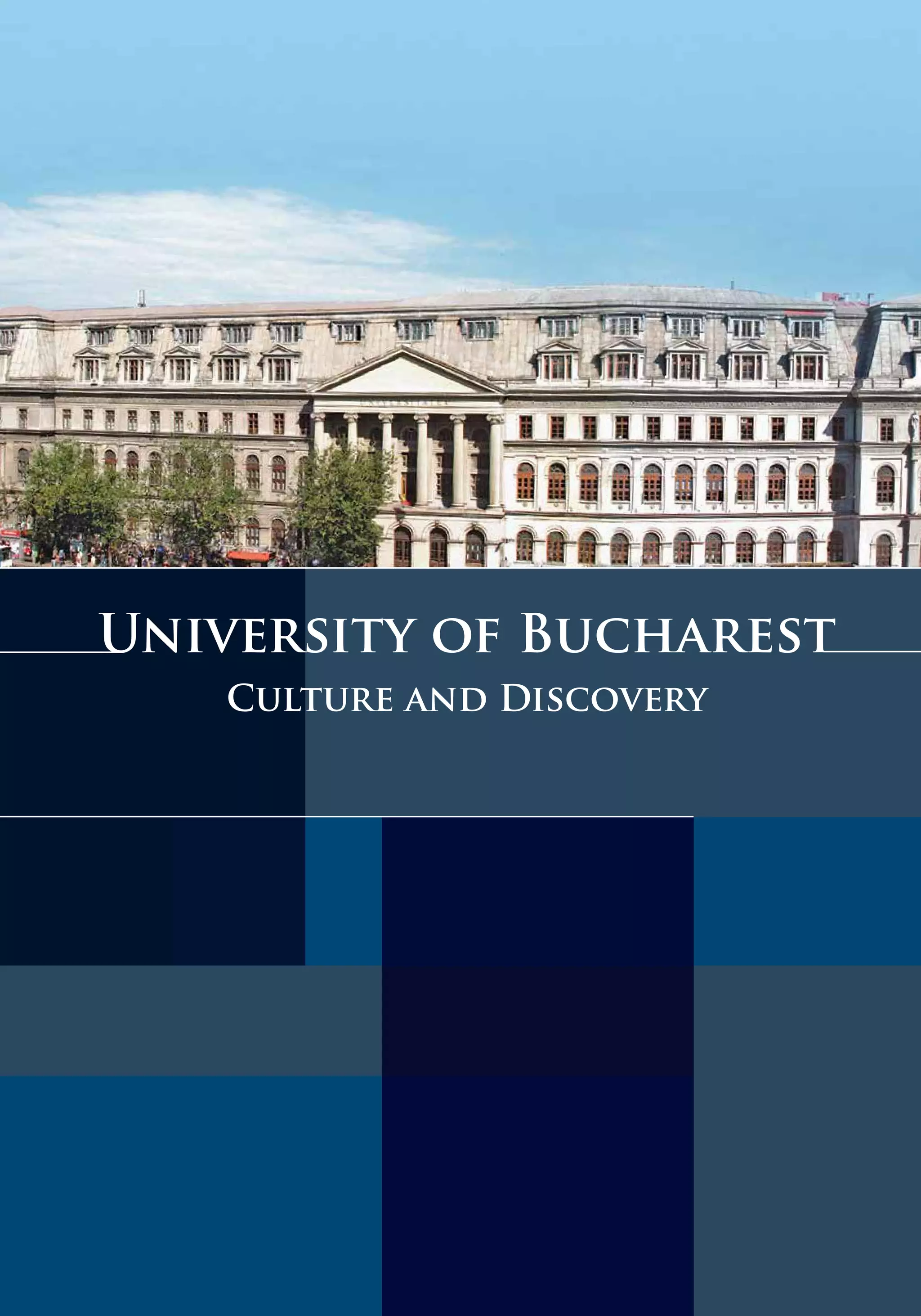
University of Bucharest
Culture and Discovery
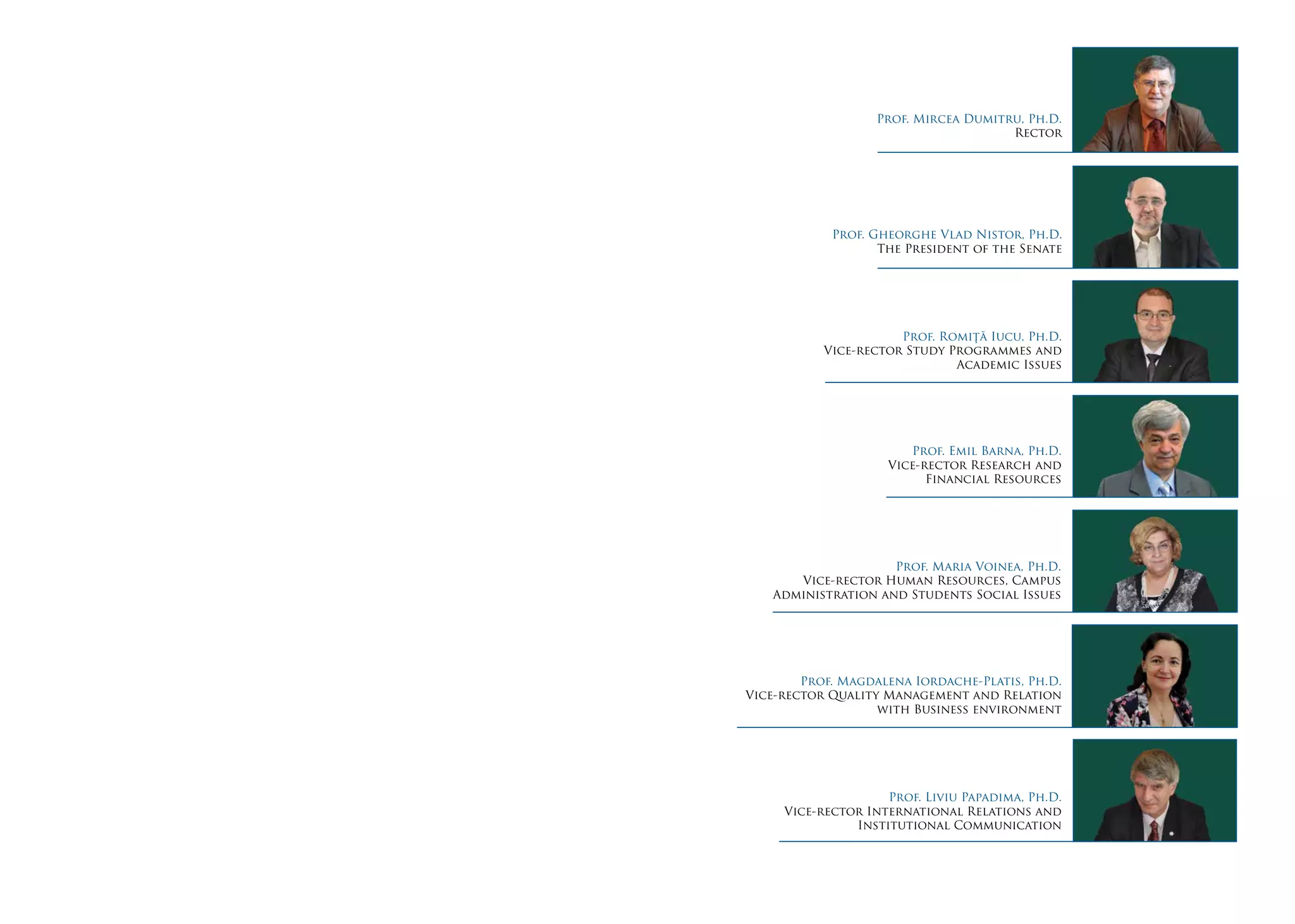
Prof. Mircea Dumitru, Ph.D.
Rector
Prof. Romiţă Iucu, Ph.D.
Vice-rector Study Programmes and
Academic Issues
Prof. Emil Barna, Ph.D.
Vice-rector Research and
Financial Resources
Prof. Maria Voinea, Ph.D.
Vice-rector Human Resources, Campus
Administration and Students Social Issues
Prof. Magdalena Iordache-Platis, Ph.D.
Vice-rector Quality Management and Relation
with Business environment
Prof. Liviu Papadima, Ph.D.
Vice-rector International Relations and
Institutional Communication
Prof. Gheorghe Vlad Nistor, Ph.D.
The President of the Senate
University of Bucharest
4 5
University of Bucharest
Young people are constantly faced with truly important decisions, whose influence
reverberates throughout their careers. Choosing a university is one of these decisions.
Why would someone opt for the University of Bucharest? One might choose it due
to the wish to train in a competitive environment, to be in touch with the world’s
universities, to build a solid base for one’s professional training or to gain access to
important positions in Romanian society − in short to obtain a true education.
Over time, the academic community at the University of Bucharest has actively sought
to ensure excellent higher education, to provide high-quality educational services
and to maintain its research activity at the highest international standards − all these
things making the University of Bucharest stand out as one of the most important
educational, research and cultural institutions in Romania.
At the University of Bucharest, there is a competitive environment, if we consider the
more than 30 000 candidates fighting for the 8 500 subsidised places. There are over 28
fields of study leading to the Bachelor’s Degree, with a total of nearly 109 majors. The
degree granted by the University of Bucharest after final examinations is recognised all
over the world and recommends graduates as being thoroughly trained in the field of
study of their choice.
The Bachelor’s Degree may be followed by a Master’s, characterized by in-depth study,
undertaken in a critical spirit, and leading to openings in research or leadership in
various organizations. Master’s studies may be either vocational or academic.
Doctoral and postdoctoral studies benefit from significant financing. Participation
in mobility periods and conferences is encouraged, offering opportunities to young
researchers, who thus align the Romanian higher education with European trends.
The doctoral schools’ criteria are demanding and Ph.D. students enjoy exceptional
conditions for their research, which lead to a high percentage of successful theses.
Researchers who have been trained at the University of Bucharest have a good
reputation throughout the world.
The international relations of the University of Bucharest are based, primarily, on 330
Erasmus agreements, thanks to which 286 students have gone to study abroad for one
or two semesters, while 131 have come here, during the academic year 2012−2013.
Moreover, around 200 bilateral cooperation agreements with foreign universities
result in conferences, lectures held by invited professors, research courses and joint
supervision agreements.
TheUniversityofBucharesthasgrantedthetitleofDoctorHonorisCausatoimportant
international figures. Exceptional intellectuals and friends of Romanian culture have
been proud to become members of our academic community: Rolf-Dieter Heuer,
General Manager of the European Organization for Nuclear Research (CERN); Jean
Delumeau, the greatest French historian of Christianity; Saul Kripke, a genius in logic;
Amos Oz, the most beloved and famous contemporary Israeli writer; Hélène Carrère
D’Encausse, Permanent Secretary of the French Academy; Philip Kotler, the father of
contemporary marketing − to name just a few.
The University of Bucharest provides a serious, solid education. An exciting tempo of
life is created at the University by such things as its laboratories equipped in line with
international standards, a large number of research centres, magazines, student debating
societies, foreign lecteurs, events organized by the Students’ Association and the
Information and Orientation Centre, exhibitions and concerts. We are lucky that there is
stilltimefortennis,basketball,football,body-building,aerobicsandsportsdance,which
are practised in the sports halls and playing fields of the University of Bucharest.
I wish all young people who choose the University of Bucharest the enjoyment of
enthusiastic college years, full of hopes and ambitions!
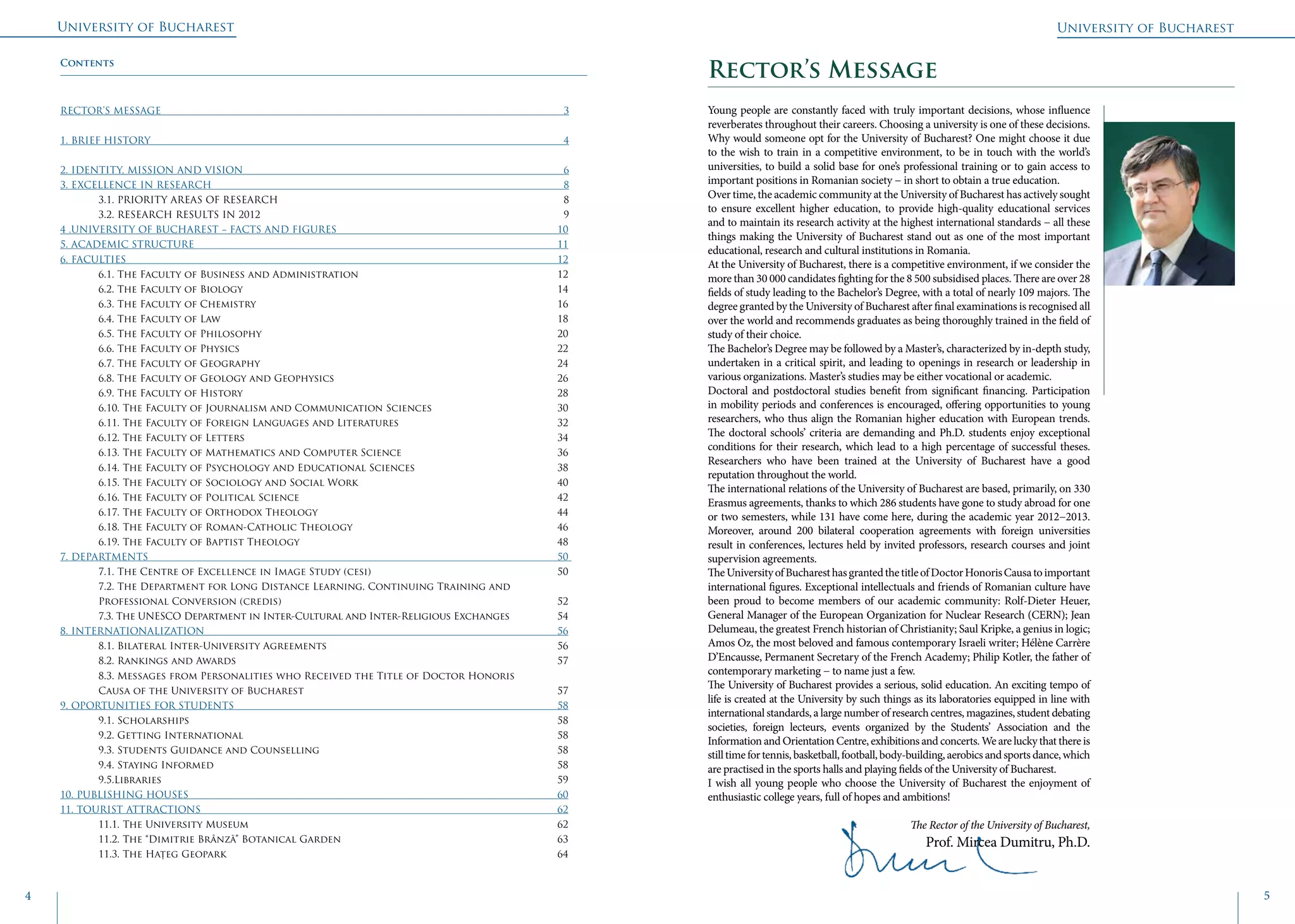
The Rector of the University of Bucharest,
Prof. Mircea Dumitru, Ph.D.
Rector’s MessageContents
RECTOR’S MESSAGE											 3
1. Brief history											 4
2. Identity, Mission and Vision									 6
3. EXCELLENCE IN RESEARCH										 8
	3.1. PRIORITY AREAS OF RESEARCH								 8
	3.2. RESEARCH RESULTS IN 2012								 9
4 .UNIVERSITY OF BUCHAREST − FACTS AND FIGURES						 10
5. ACADEMIC STRUCTURE										11
6. Faculties 												12
	 6.1. The Faculty of Business and Administration						 12
	6.2. The Faculty of Biology									14
	6.3. The Faculty of Chemistry								16
	6.4. The Faculty of Law									18
	6.5. The Faculty of Philosophy 								20
	6.6. The Faculty of Physics									22
	6.7. The Faculty of Geography								24
	 6.8. The Faculty of Geology and Geophysics						 26
	6.9. The Faculty of History									28
	 6.10. The Faculty of Journalism and Communication Sciences				 30
	 6.11. The Faculty of Foreign Languages and Literatures					 32
	6.12. The Faculty of Letters									34
	 6.13. The Faculty of Mathematics and Computer Science					 36
	 6.14. The Faculty of Psychology and Educational Sciences				 38
	 6.15. The Faculty of Sociology and Social Work						 40
	6.16. The Faculty of Political Science							42
	6.17. The Faculty of Orthodox Theology							44
	6.18. The Faculty of Roman-Catholic Theology						46
	6.19. The Faculty of Baptist Theology							48
7. Departments 									 		50
	 7.1. The Centre of Excellence in Image Study (cesi)					 50
	 7.2. The Department for Long Distance Learning, Continuing Training and 			
	Professional Conversion (credis)								52
	 7.3. The UNESCO Department in Inter-Cultural and Inter-Religious Exchanges		 54
8. Internationalization										56
	8.1. Bilateral Inter-University Agreements							56
	8.2. Rankings and Awards									57
	 8.3. Messages from Personalities who Received the Title of Doctor Honoris 			
	Causa of the University of Bucharest							57	
9. OPORTUNITIES FOR STUDENTS									58
	9.1. Scholarships										58
	9.2. Getting International									58
	9.3. Students Guidance and Counselling							58
	9.4. Staying Informed									58
	9.5.Libraries											59
10. PUBLISHING HOUSES										60
11. Tourist Attractions										62
	11.1. The University Museum									62
	 11.2. The “Dimitrie Brânză” Botanical Garden					 	 63
	11.3. The Hațeg Geopark									64
University of Bucharest
6 7
Brief History
	
1. Brief History
1857
1990
1996
2000
2004
1859
1863
1864
4/16 July
1884
1944
1948
1989
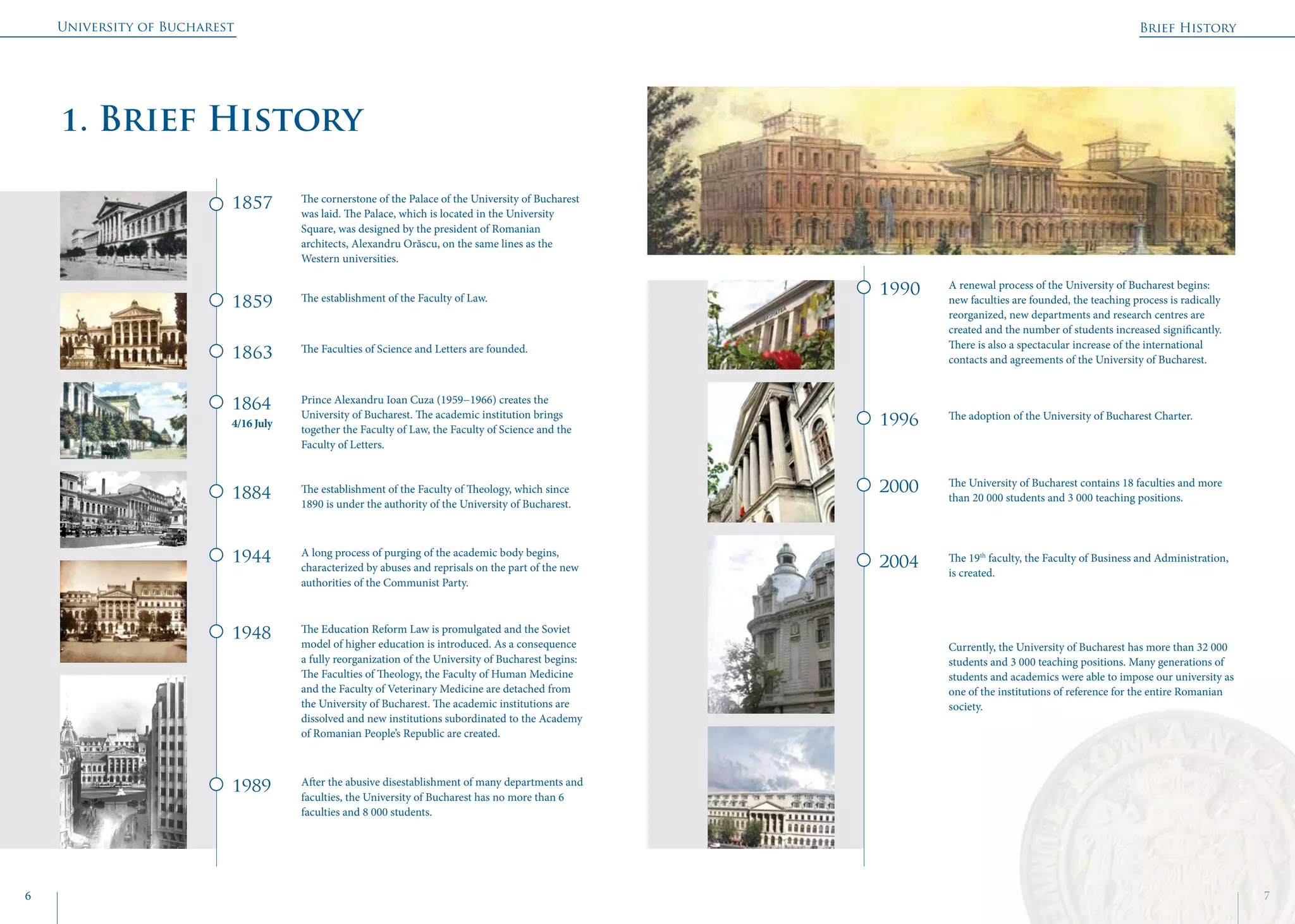
The cornerstone of the Palace of the University of Bucharest
was laid. The Palace, which is located in the University
Square, was designed by the president of Romanian
architects, Alexandru Orăscu, on the same lines as the
Western universities.
A renewal process of the University of Bucharest begins:
new faculties are founded, the teaching process is radically
reorganized, new departments and research centres are
created and the number of students increased significantly.
There is also a spectacular increase of the international
contacts and agreements of the University of Bucharest.
The adoption of the University of Bucharest Charter.
The University of Bucharest contains 18 faculties and more
than 20 000 students and 3 000 teaching positions.
The 19th
faculty, the Faculty of Business and Administration,
is created.
Currently, the University of Bucharest has more than 32 000
students and 3 000 teaching positions. Many generations of
students and academics were able to impose our university as
one of the institutions of reference for the entire Romanian
society.
The establishment of the Faculty of Law.
The Faculties of Science and Letters are founded.
Prince Alexandru Ioan Cuza (1959−1966) creates the
University of Bucharest. The academic institution brings
together the Faculty of Law, the Faculty of Science and the
Faculty of Letters.
The establishment of the Faculty of Theology, which since
1890 is under the authority of the University of Bucharest.
A long process of purging of the academic body begins,
characterized by abuses and reprisals on the part of the new
authorities of the Communist Party.
The Education Reform Law is promulgated and the Soviet
model of higher education is introduced. As a consequence
a fully reorganization of the University of Bucharest begins:
The Faculties of Theology, the Faculty of Human Medicine
and the Faculty of Veterinary Medicine are detached from
the University of Bucharest. The academic institutions are
dissolved and new institutions subordinated to the Academy
of Romanian People’s Republic are created.
After the abusive disestablishment of many departments and
faculties, the University of Bucharest has no more than 6
faculties and 8 000 students.
University of Bucharest
8 9
Identity, Mission and Vision
2. Identity, Mission and
Vision
2.2. Mission
The University of Bucharest
contributes through research
and higher-education to the
development and use of knowledge,
at both national and international
level. UB is a university with
academic integrity and a concern
for critical thinking, a significant
point of reference in society.
The institution is in the top rank
for scientific research in the
country, and it contributes to the
development of human knowledge
through its research centres. The
University of Bucharest forms
students capable of critically
examining social and natural
phenomena, of seeking solutions
to problems they face, of imagining
alternatives to existing solutions,
young people prepared to accept
other cultures’ visions of life and to
assume a leading role in tomorrow’s
Romania. The University of
Bucharest cultivates and supports
the values of academic freedom and
university autonomy, of academic
integrity and responsibility for a
lasting evolution.
The University of Bucharest
supports the innovation of
higher education, working on
the European integration of our
country, on the consolidation of
the European Higher Education
Area and the European Research
Area. The UB students are educated
in the spirit of civic responsibility,
tolerance, equality of opportunity,
2.1. Identity
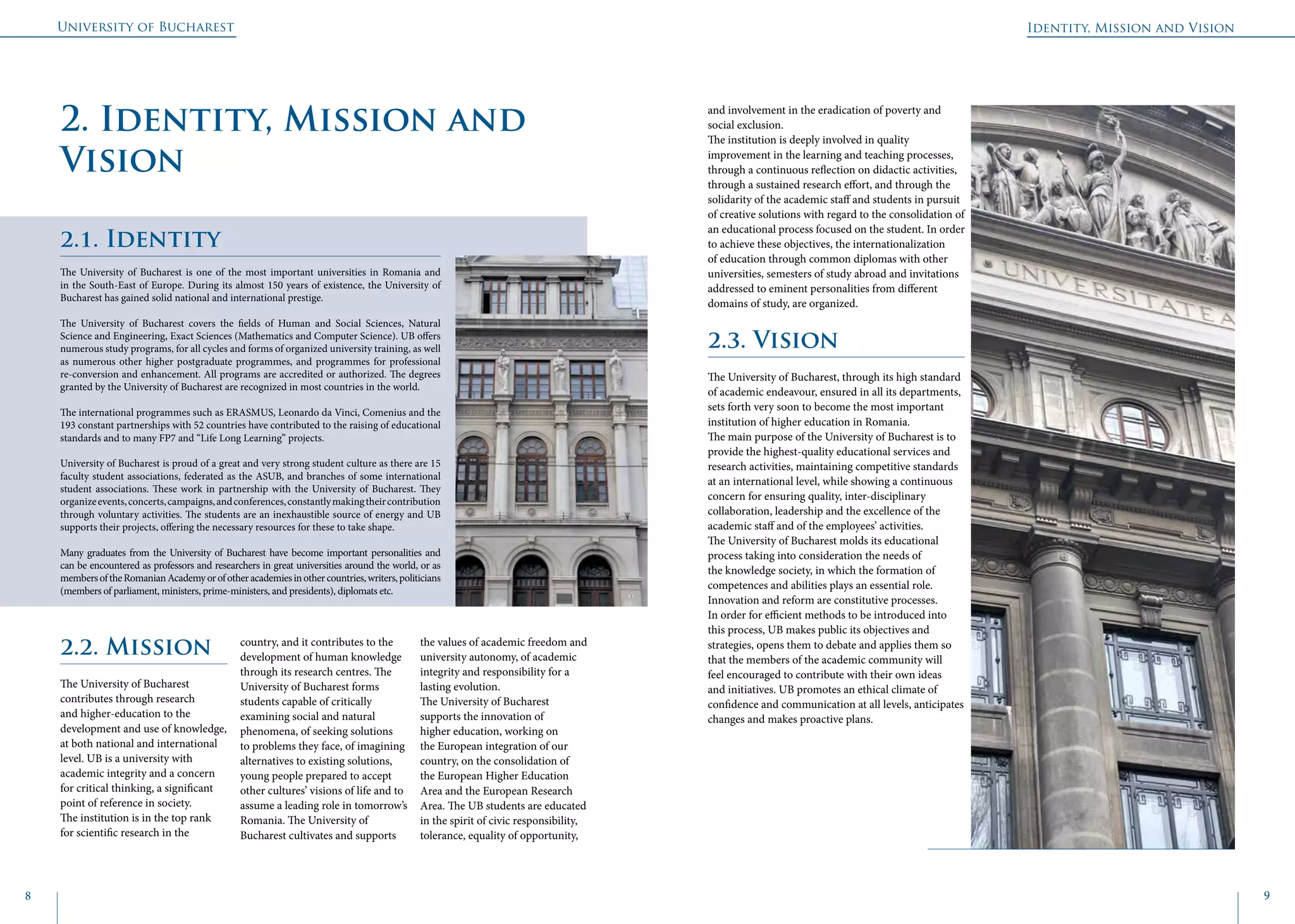
The University of Bucharest is one of the most important universities in Romania and
in the South-East of Europe. During its almost 150 years of existence, the University of
Bucharest has gained solid national and international prestige.
The University of Bucharest covers the fields of Human and Social Sciences, Natural
Science and Engineering, Exact Sciences (Mathematics and Computer Science). UB offers
numerous study programs, for all cycles and forms of organized university training, as well
as numerous other higher postgraduate programmes, and programmes for professional
re-conversion and enhancement. All programs are accredited or authorized. The degrees
granted by the University of Bucharest are recognized in most countries in the world.
The international programmes such as ERASMUS, Leonardo da Vinci, Comenius and the
193 constant partnerships with 52 countries have contributed to the raising of educational
standards and to many FP7 and “Life Long Learning” projects.
University of Bucharest is proud of a great and very strong student culture as there are 15
faculty student associations, federated as the ASUB, and branches of some international
student associations. These work in partnership with the University of Bucharest. They
organizeevents,concerts,campaigns,andconferences,constantlymakingtheircontribution
through voluntary activities. The students are an inexhaustible source of energy and UB
supports their projects, offering the necessary resources for these to take shape.
Many graduates from the University of Bucharest have become important personalities and
can be encountered as professors and researchers in great universities around the world, or as
membersoftheRomanianAcademyorofotheracademiesinothercountries,writers,politicians
(members of parliament, ministers, prime-ministers, and presidents), diplomats etc.
and involvement in the eradication of poverty and
social exclusion.
The institution is deeply involved in quality
improvement in the learning and teaching processes,
through a continuous reflection on didactic activities,
through a sustained research effort, and through the
solidarity of the academic staff and students in pursuit
of creative solutions with regard to the consolidation of
an educational process focused on the student. In order
to achieve these objectives, the internationalization
of education through common diplomas with other
universities, semesters of study abroad and invitations
addressed to eminent personalities from different
domains of study, are organized.
2.3. Vision
The University of Bucharest, through its high standard
of academic endeavour, ensured in all its departments,
sets forth very soon to become the most important
institution of higher education in Romania.
The main purpose of the University of Bucharest is to
provide the highest-quality educational services and
research activities, maintaining competitive standards
at an international level, while showing a continuous
concern for ensuring quality, inter-disciplinary
collaboration, leadership and the excellence of the
academic staff and of the employees’ activities.
The University of Bucharest molds its educational
process taking into consideration the needs of
the knowledge society, in which the formation of
competences and abilities plays an essential role.
Innovation and reform are constitutive processes.
In order for efficient methods to be introduced into
this process, UB makes public its objectives and
strategies, opens them to debate and applies them so
that the members of the academic community will
feel encouraged to contribute with their own ideas
and initiatives. UB promotes an ethical climate of
confidence and communication at all levels, anticipates
changes and makes proactive plans.
University of Bucharest
10 11
Exellence in research
3. Excellence in research
An essential parameter of the academic activity that
defines the quality of the educational approach of
the academics − the scientific research − is both the
reference element common to all the national and
international university rankings and the essential
benchmark that contributes to the ranking of higher
education institutions.
The University of Bucharest is acknowledged
nationally and internationally for the experience
in research of its specialists. The most eloquent
evidence of appreciation of research at the University
of Bucharest came from the Ad-Astra Society which
placed our university at the top on the Scientific
Research Map of Romania but also from the Times
Higher Education Supplement which has placed our
university among the first 600 universities in the
world for three years, quality of teaching and research
being among the evaluation criteria.
In 2011, the University of Bucharest was declared the
first university in advanced research and education in
Romania, according to the classification of the Ministry
of Education, Youth and Sports conducted with experts
from the European University Association (EUA).
The second stage of the classification process was the
classification of the study programmes. The majority
of the indicators used in the classification of the
universities and of the study programmes coincided.
However, the evaluation of the study programmes
emphasized the teaching and learning components.
3.1. Priority areas
of research
The most important areas in research are related
to the current trends and opportunities in science
at national and international level. Thus, the three
main research directions of the University of
Bucharest are:
The environment
New materials
Cognitive sciences
There is also great interest for socio-human research
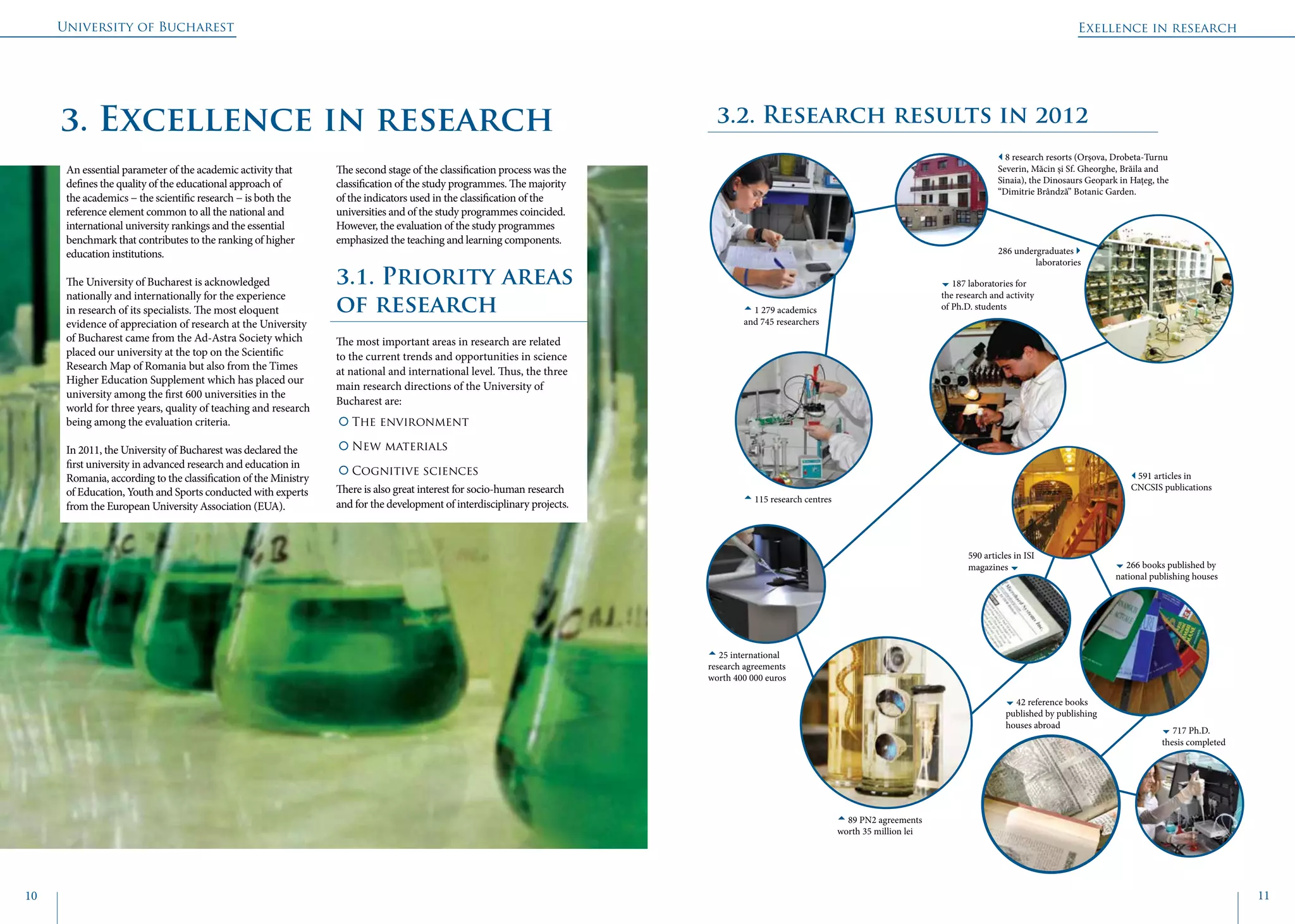
and for the development of interdisciplinary projects. ~ 115 research centres
~ 1 279 academics
and 745 researchers
| 8 research resorts (Orșova, Drobeta-Turnu
Severin, Măcin și Sf. Gheorghe, Brăila and
Sinaia), the Dinosaurs Geopark in Hațeg, the
“Dimitrie Brândză” Botanic Garden.
286 undergraduates }
laboratories
€ 187 laboratories for
the research and activity
of Ph.D. students
590 articles in ISI
magazines €
| 591 articles in
CNCSIS publications
€ 266 books published by
national publishing houses
€ 717 Ph.D.
thesis completed
€ 42 reference books
published by publishing
houses abroad
~ 89 PN2 agreements
worth 35 million lei
~ 25 international
research agreements
worth 400 000 euros
3.2. Research results in 2012
University of Bucharest
12 13
Facts and figures
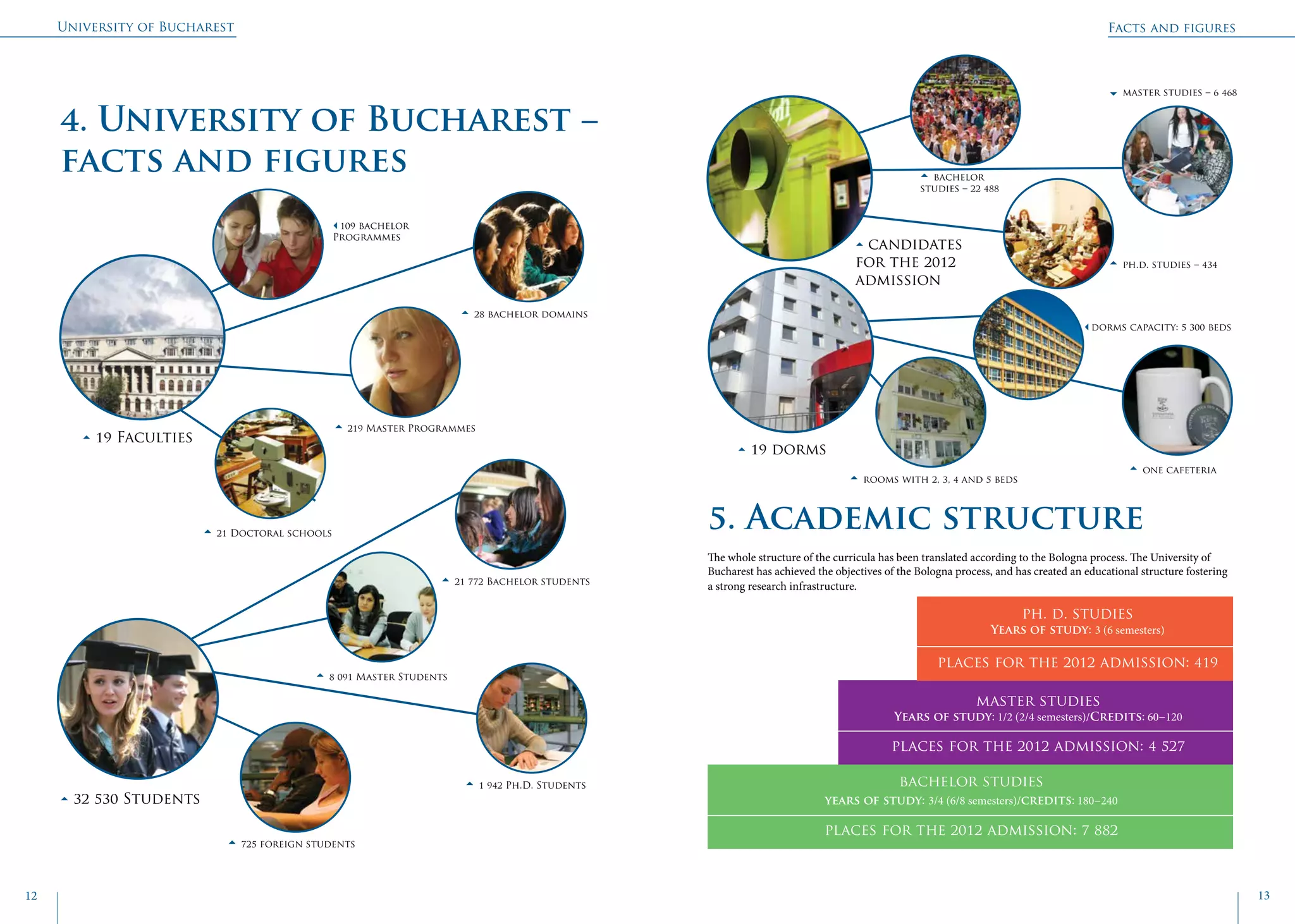
4. University of Bucharest −
facts and figures
~ 19 Faculties
~ 32 530 Students
~ 21 772 Bachelor students
~ bachelor
studies – 22 488
€ master studies – 6 468
~ ph.d. studies – 434
| dorms capacity: 5 300 beds
~ rooms with 2, 3, 4 and 5 beds
~ one cafeteria
~ 28 bachelor domains
| 109 bachelor
Programmes
~ 21 Doctoral schools
~ 219 Master Programmes
~ 8 091 Master Students
~ 1 942 Ph.D. Students
~ 725 foreign students
5. Academic structure
The whole structure of the curricula has been translated according to the Bologna process. The University of
Bucharest has achieved the objectives of the Bologna process, and has created an educational structure fostering
a strong research infrastructure.
bachelor studies
years of study: 3/4 (6/8 semesters)/credits: 180−240
places for the 2012 admission: 7 882
master studies
Years of study: 1/2 (2/4 semesters)/Credits: 60−120
places for the 2012 admission: 4 527
ph. d. studies
Years of study: 3 (6 semesters)
places for the 2012 admission: 419
~ candidates
for the 2012
admission
~ 19 dorms
University of Bucharest
14 15
Faculties
	
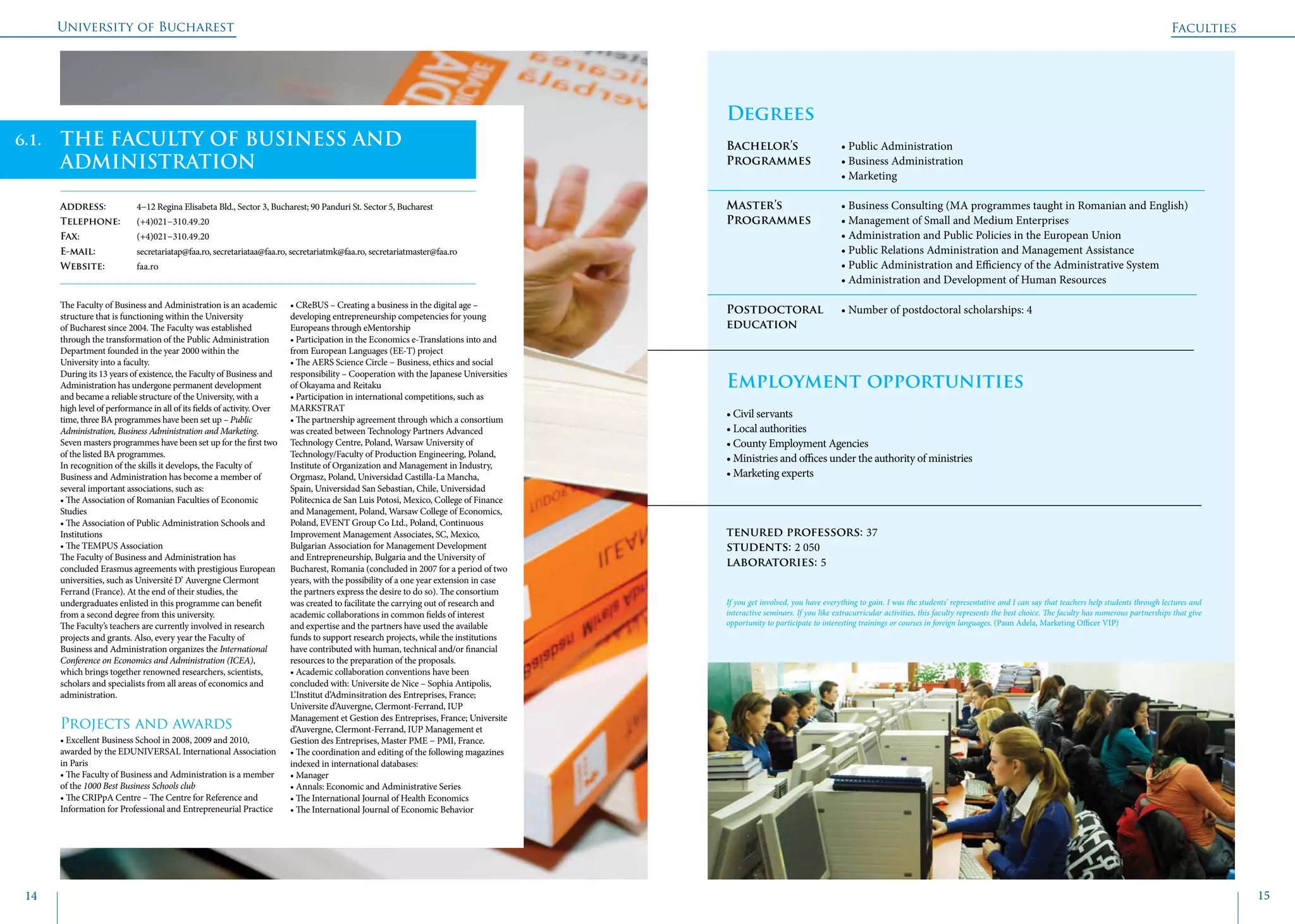
Degrees
Bachelor’s 		 • Public Administration
Programmes	 • Business Administration
			 • Marketing
Master’s 		 • Business Consulting (MA programmes taught in Romanian and English)
Programmes	 • Management of Small and Medium Enterprises
			 • Administration and Public Policies in the European Union
			 • Public Relations Administration and Management Assistance
			 • Public Administration and Efficiency of the Administrative System
			 • Administration and Development of Human Resources
Postdoctoral 	 • Number of postdoctoral scholarships: 4
education 	
Employment opportunities	
• Civil servants
• Local authorities
• County Employment Agencies
• Ministries and offices under the authority of ministries
• Marketing experts
tenured professors: 37
students: 2 050
laboratories: 5
THE FACULTY OF BUSINESS AND
ADMINISTRATION
Address: 	 4−12 Regina Elisabeta Bld., Sector 3, Bucharest; 90 Panduri St. Sector 5, Bucharest
Telephone: 	 (+4)021−310.49.20
Fax: 		 (+4)021−310.49.20
E-mail: 		 secretariatap@faa.ro, secretariataa@faa.ro, secretariatmk@faa.ro, secretariatmaster@faa.ro
Website: 	 faa.ro
The Faculty of Business and Administration is an academic
structure that is functioning within the University
of Bucharest since 2004. The Faculty was established
through the transformation of the Public Administration
Department founded in the year 2000 within the
University into a faculty.
During its 13 years of existence, the Faculty of Business and
Administration has undergone permanent development
and became a reliable structure of the University, with a
high level of performance in all of its fields of activity. Over
time, three BA programmes have been set up – Public
Administration, Business Administration and Marketing.
Seven masters programmes have been set up for the first two
of the listed BA programmes.
In recognition of the skills it develops, the Faculty of
Business and Administration has become a member of
several important associations, such as:
• The Association of Romanian Faculties of Economic 	
Studies
• The Association of Public Administration Schools and
Institutions
• The TEMPUS Association
The Faculty of Business and Administration has
concluded Erasmus agreements with prestigious European
universities, such as Université D’ Auvergne Clermont
Ferrand (France). At the end of their studies, the
undergraduates enlisted in this programme can benefit
from a second degree from this university.
The Faculty’s teachers are currently involved in research
projects and grants. Also, every year the Faculty of
Business and Administration organizes the International
Conference on Economics and Administration (ICEA),
which brings together renowned researchers, scientists,
scholars and specialists from all areas of economics and
administration.
Projects and awards
• Excellent Business School in 2008, 2009 and 2010,
awarded by the EDUNIVERSAL International Association
in Paris
• The Faculty of Business and Administration is a member
of the 1000 Best Business Schools club
• The CRIPpA Centre – The Centre for Reference and
Information for Professional and Entrepreneurial Practice
• CReBUS – Creating a business in the digital age –
developing entrepreneurship competencies for young
Europeans through eMentorship
• Participation in the Economics e-Translations into and
from European Languages (EE-T) project
• The AERS Science Circle − Business, ethics and social
responsibility – Cooperation with the Japanese Universities
of Okayama and Reitaku
• Participation in international competitions, such as
MARKSTRAT
• The partnership agreement through which a consortium
was created between Technology Partners Advanced
Technology Centre, Poland, Warsaw University of
Technology/Faculty of Production Engineering, Poland,
Institute of Organization and Management in Industry,
Orgmasz, Poland, Universidad Castilla-La Mancha,
Spain, Universidad San Sebastian, Chile, Universidad
Politecnica de San Luis Potosi, Mexico, College of Finance
and Management, Poland, Warsaw College of Economics,
Poland, EVENT Group Co Ltd., Poland, Continuous
Improvement Management Associates, SC, Mexico,
Bulgarian Association for Management Development
and Entrepreneurship, Bulgaria and the University of
Bucharest, Romania (concluded in 2007 for a period of two
years, with the possibility of a one year extension in case
the partners express the desire to do so). The consortium
was created to facilitate the carrying out of research and
academic collaborations in common fields of interest
and expertise and the partners have used the available
funds to support research projects, while the institutions
have contributed with human, technical and/or financial
resources to the preparation of the proposals.
• Academic collaboration conventions have been
concluded with: Universite de Nice – Sophia Antipolis,
L’Institut d’Adminsitration des Entreprises, France;
Universite d’Auvergne, Clermont-Ferrand, IUP
Management et Gestion des Entreprises, France; Universite
d’Auvergne, Clermont-Ferrand, IUP Management et
Gestion des Entreprises, Master PME − PMI, France.
• The coordination and editing of the following magazines
indexed in international databases:
• Manager
• Annals: Economic and Administrative Series
• The International Journal of Health Economics
• The International Journal of Economic Behavior
If you get involved, you have everything to gain. I was the students’ representative and I can say that teachers help students through lectures and
interactive seminars. If you like extracurricular activities, this faculty represents the best choice. The faculty has numerous partnerships that give
opportunity to participate to interesting trainings or courses in foreign languages. (Paun Adela, Marketing Officer VIP)
6.1.
University of Bucharest
16 17
	
				
Degrees
Bachelor’s 		 • Biology
Programmes	 • Biochemistry
			 • Ecology and Environmental Protection
Master’s 		 • Medical Biology
Programmes	 • Microbial and Genetic Biology
			 • The Integrated Management of Natural Capital
			 • Neurobiology
			 • Taxonomy
Doctoral 		 • Biology
Schools 		 • Environmental Science
Employment opportunities
Academic path
		 • Higher education and research
		 • Fundamental and applied research laboratories
		 • Human medicine, veterinary medicine and environmental quality control
		 • Biotechnological laboratories in the food, medicine and cosmetics industries
		 • Laboratories for the control and inspection of agro-food products
Administrative path
		 • Central administration (ministries)
		 • Local administration (city halls, city councils)
		 • Decentralized regional units (agricultural departments, environmental agencies, 		
		 forestry departments, water resources management departments, land registries, 		
		 territorial organization offices, management of national environmental network, 		
		 the implementation of ecological reconstruction projects; the implementation of rural 	
		 development projects, the administration of nature parks, zoological and botanical 	
		 parks, positions in the staff of protected areas and of economic agencies)
Business path 	
		• Consultancy
		 • Private companies
		 • Laboratory equipment
tenured professors: 64
students: 793
laboratories: 79
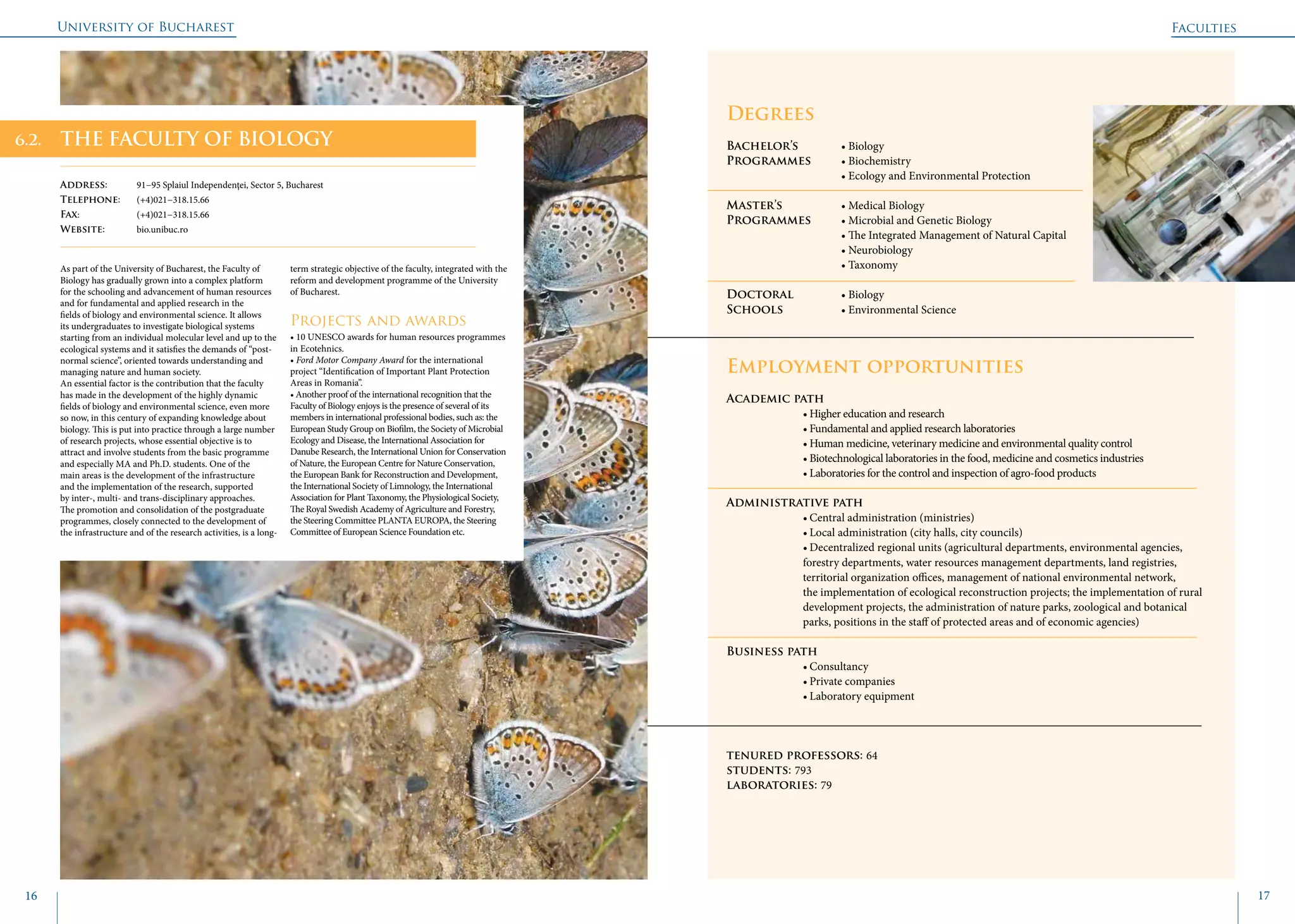
THE FACULTY OF BIOLOGY
Address: 	 91−95 Splaiul Independenţei, Sector 5, Bucharest
Telephone: 	 (+4)021−318.15.66
Fax: 		 (+4)021−318.15.66
Website: 	 bio.unibuc.ro
As part of the University of Bucharest, the Faculty of
Biology has gradually grown into a complex platform
for the schooling and advancement of human resources
and for fundamental and applied research in the
fields of biology and environmental science. It allows
its undergraduates to investigate biological systems
starting from an individual molecular level and up to the
ecological systems and it satisfies the demands of “post-
normal science”, oriented towards understanding and
managing nature and human society.
An essential factor is the contribution that the faculty
has made in the development of the highly dynamic
fields of biology and environmental science, even more
so now, in this century of expanding knowledge about
biology. This is put into practice through a large number
of research projects, whose essential objective is to
attract and involve students from the basic programme
and especially MA and Ph.D. students. One of the
main areas is the development of the infrastructure
and the implementation of the research, supported
by inter-, multi- and trans-disciplinary approaches.
The promotion and consolidation of the postgraduate
programmes, closely connected to the development of
the infrastructure and of the research activities, is a long-
term strategic objective of the faculty, integrated with the
reform and development programme of the University
of Bucharest.
Projects and awards
• 10 UNESCO awards for human resources programmes
in Ecotehnics.
• Ford Motor Company Award for the international
project “Identification of Important Plant Protection
Areas in Romania”.
• Another proof of the international recognition that the
Faculty of Biology enjoys is the presence of several of its
members in international professional bodies, such as: the
European Study Group on Biofilm, the Society of Microbial
Ecology and Disease, the International Association for
Danube Research, the International Union for Conservation
of Nature, the European Centre for Nature Conservation,
the European Bank for Reconstruction and Development,
the International Society of Limnology, the International
Association for Plant Taxonomy, the Physiological Society,
The Royal Swedish Academy of Agriculture and Forestry,
the Steering Committee PLANTA EUROPA, the Steering
Committee of European Science Foundation etc.
Faculties
6.2.
University of Bucharest
18 19
	
				
Degrees
Bachelor’s 		 • Chemistry
Programmes	 • Technological Biochemistry
			 • Radiochemistry
			 • Environmental Chemistry
Master’s 		 • Chemistry of Medicine and of Cosmetics
Programmes	 • Chemistry of Advanced Materials
			 • Chemistry of Advanced Materials (in English)
			 • Chemical Pollution of the Environment
			 • Biomolecules
			 • Chemistry Didactics
			 • Supermolecular Chemistry
			 • Quality Management in Chemistry
			 • Measuring Techniques in Chemistry
			 • Integrated Approach of Natural Sciences
Doctoral 		 • Inorganic Chemistry
Schools 		 • Organic Chemistry
			 • Catalysis and Technological Chemistry
			 • Physical Chemistry and Radiochemistry
			 • Analytic Chemistry
Employment opportunities
• Chemists and biochemists, experts in the fields of environmental chemistry, food industry,
pharmaceuticals, cosmetics and detergent industry
• Pre-university and university teachers (after graduating from Master’s and Doctoral Schools)
• Researchers in research institutes
• Chemists in environmental quality analysis and control, medicine, food industry and public health
laboratories
• Chemists in specialized anti-doping control laboratories
tenured professors: 93
students: 550
laboratories: 68
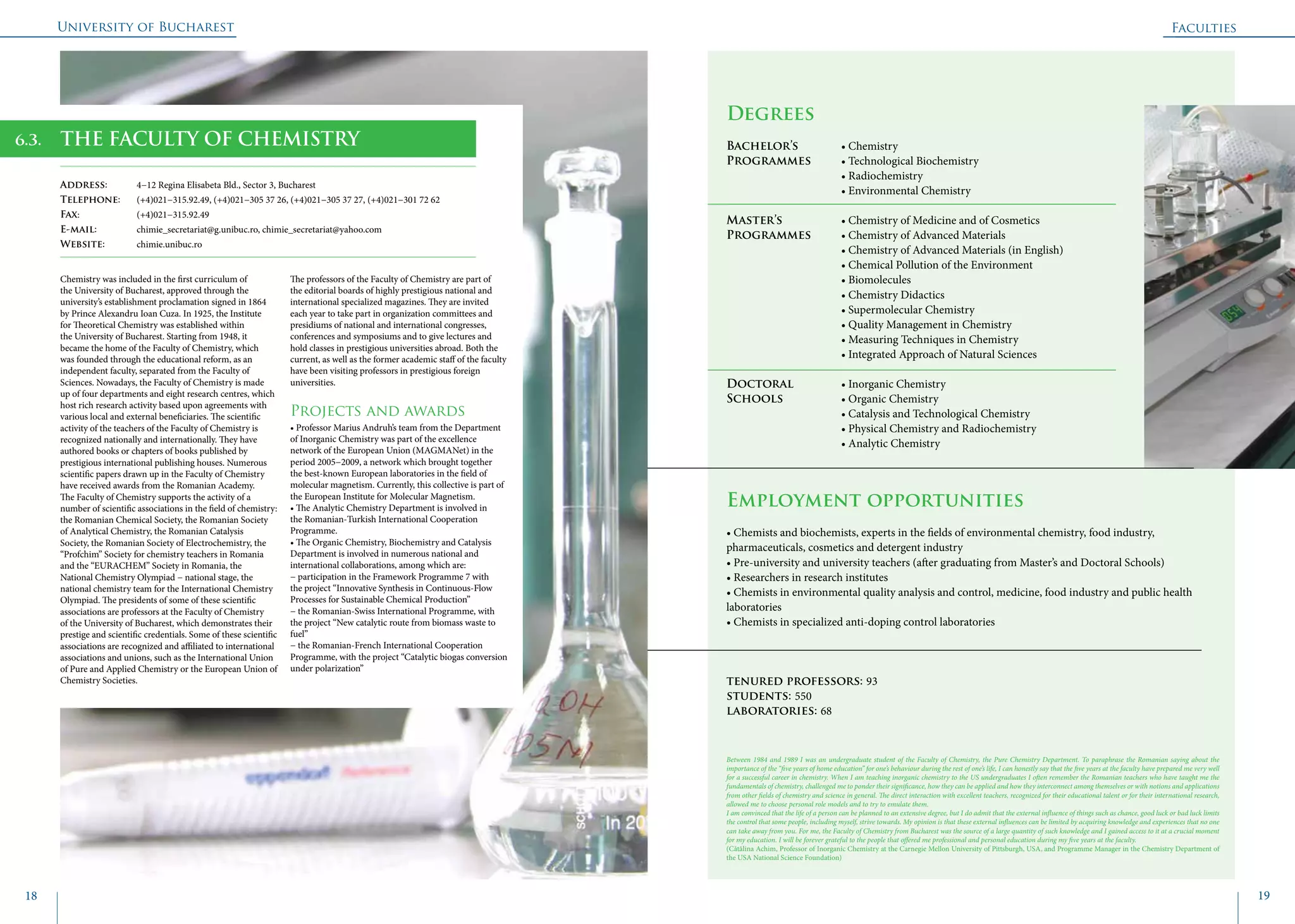
THE FACULTY OF CHEMISTRY
Address: 	 4−12 Regina Elisabeta Bld., Sector 3, Bucharest
Telephone: 	 (+4)021−315.92.49, (+4)021−305 37 26, (+4)021−305 37 27, (+4)021−301 72 62
Fax: 		 (+4)021−315.92.49
E-mail: 	 chimie_secretariat@g.unibuc.ro, chimie_secretariat@yahoo.com
Website: 	 chimie.unibuc.ro
Chemistry was included in the first curriculum of
the University of Bucharest, approved through the
university’s establishment proclamation signed in 1864
by Prince Alexandru Ioan Cuza. In 1925, the Institute
for Theoretical Chemistry was established within
the University of Bucharest. Starting from 1948, it
became the home of the Faculty of Chemistry, which
was founded through the educational reform, as an
independent faculty, separated from the Faculty of
Sciences. Nowadays, the Faculty of Chemistry is made
up of four departments and eight research centres, which
host rich research activity based upon agreements with
various local and external beneficiaries. The scientific
activity of the teachers of the Faculty of Chemistry is
recognized nationally and internationally. They have
authored books or chapters of books published by
prestigious international publishing houses. Numerous
scientific papers drawn up in the Faculty of Chemistry
have received awards from the Romanian Academy.
The Faculty of Chemistry supports the activity of a
number of scientific associations in the field of chemistry:
the Romanian Chemical Society, the Romanian Society
of Analytical Chemistry, the Romanian Catalysis
Society, the Romanian Society of Electrochemistry, the
“Profchim” Society for chemistry teachers in Romania
and the “EURACHEM” Society in Romania, the
National Chemistry Olympiad − national stage, the
national chemistry team for the International Chemistry
Olympiad. The presidents of some of these scientific
associations are professors at the Faculty of Chemistry
of the University of Bucharest, which demonstrates their
prestige and scientific credentials. Some of these scientific
associations are recognized and affiliated to international
associations and unions, such as the International Union
of Pure and Applied Chemistry or the European Union of
Chemistry Societies.
The professors of the Faculty of Chemistry are part of
the editorial boards of highly prestigious national and
international specialized magazines. They are invited
each year to take part in organization committees and
presidiums of national and international congresses,
conferences and symposiums and to give lectures and
hold classes in prestigious universities abroad. Both the
current, as well as the former academic staff of the faculty
have been visiting professors in prestigious foreign
universities.
Projects and awards
• Professor Marius Andruh’s team from the Department
of Inorganic Chemistry was part of the excellence
network of the European Union (MAGMANet) in the
period 2005−2009, a network which brought together
the best-known European laboratories in the field of
molecular magnetism. Currently, this collective is part of
the European Institute for Molecular Magnetism.
• The Analytic Chemistry Department is involved in
the Romanian-Turkish International Cooperation
Programme.
• The Organic Chemistry, Biochemistry and Catalysis
Department is involved in numerous national and
international collaborations, among which are:
− participation in the Framework Programme 7 with
the project “Innovative Synthesis in Continuous-Flow
Processes for Sustainable Chemical Production”
− the Romanian-Swiss International Programme, with
the project “New catalytic route from biomass waste to
fuel”
− the Romanian-French International Cooperation
Programme, with the project “Catalytic biogas conversion
under polarization”
Between 1984 and 1989 I was an undergraduate student of the Faculty of Chemistry, the Pure Chemistry Department. To paraphrase the Romanian saying about the
importance of the “five years of home education” for one’s behaviour during the rest of one’s life, I can honestly say that the five years at the faculty have prepared me very well
for a successful career in chemistry. When I am teaching inorganic chemistry to the US undergraduates I often remember the Romanian teachers who have taught me the
fundamentals of chemistry, challenged me to ponder their significance, how they can be applied and how they interconnect among themselves or with notions and applications
from other fields of chemistry and science in general. The direct interaction with excellent teachers, recognized for their educational talent or for their international research,
allowed me to choose personal role models and to try to emulate them.
I am convinced that the life of a person can be planned to an extensive degree, but I do admit that the external influence of things such as chance, good luck or bad luck limits
the control that some people, including myself, strive towards. My opinion is that these external influences can be limited by acquiring knowledge and experiences that no one
can take away from you. For me, the Faculty of Chemistry from Bucharest was the source of a large quantity of such knowledge and I gained access to it at a crucial moment
for my education. I will be forever grateful to the people that offered me professional and personal education during my five years at the faculty.
(Cătălina Achim, Professor of Inorganic Chemistry at the Carnegie Mellon University of Pittsburgh, USA, and Programme Manager in the Chemistry Department of
the USA National Science Foundation)
Faculties
6.3.
University of Bucharest
20 21
	
				
Degrees
Bachelor’s 		 • Law
Programmes	
Master’s 		 • Business law
Programmes	 • Judiciary Career
			 • Private Law
			 • Labour Law, Working and Industrial Relations
			 • Public Law Institutions and Procedures
			 • Public Law and Policies
			 • International Public Law
			 • European Union Law
			 • Criminal Law
			 • Fiscal Law
			 • Professional European and International Business Law 	
			 MA Programme (in French)
Doctoral 		 • Law
School 		
Employment opportunities
• Magistrates – judges and prosecutors
• Lawyers
• Notaries
• Legal counselors
• European business counselors
• Counselors within the evidence service
• Judicial executives
• Insolvency practitioners
• Court clerks
• Professors and researchers in university education
tenured professors: 70
students: 3 748
laboratories: 5
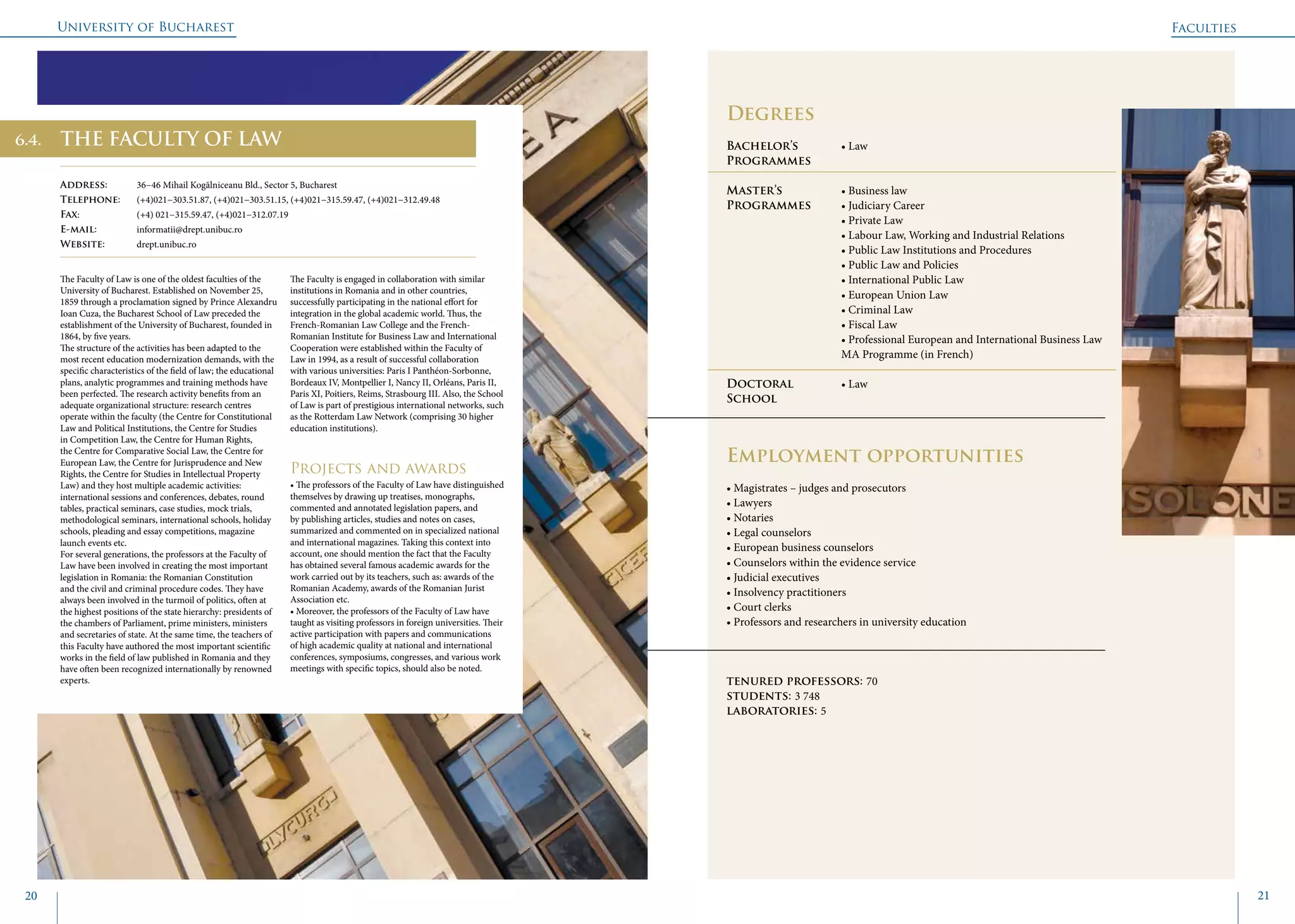
THE FACULTY OF LAW
Address: 	 36−46 Mihail Kogălniceanu Bld., Sector 5, Bucharest
Telephone: 	 (+4)021−303.51.87, (+4)021−303.51.15, (+4)021−315.59.47, (+4)021−312.49.48
Fax: 		 (+4) 021−315.59.47, (+4)021−312.07.19
E-mail: 	informatii@drept.unibuc.ro
Website: 	 drept.unibuc.ro
The Faculty of Law is one of the oldest faculties of the
University of Bucharest. Established on November 25,
1859 through a proclamation signed by Prince Alexandru
Ioan Cuza, the Bucharest School of Law preceded the
establishment of the University of Bucharest, founded in
1864, by five years.
The structure of the activities has been adapted to the
most recent education modernization demands, with the
specific characteristics of the field of law; the educational
plans, analytic programmes and training methods have
been perfected. The research activity benefits from an
adequate organizational structure: research centres
operate within the faculty (the Centre for Constitutional
Law and Political Institutions, the Centre for Studies
in Competition Law, the Centre for Human Rights,
the Centre for Comparative Social Law, the Centre for
European Law, the Centre for Jurisprudence and New
Rights, the Centre for Studies in Intellectual Property
Law) and they host multiple academic activities:
international sessions and conferences, debates, round
tables, practical seminars, case studies, mock trials,
methodological seminars, international schools, holiday
schools, pleading and essay competitions, magazine
launch events etc.
For several generations, the professors at the Faculty of
Law have been involved in creating the most important
legislation in Romania: the Romanian Constitution
and the civil and criminal procedure codes. They have
always been involved in the turmoil of politics, often at
the highest positions of the state hierarchy: presidents of
the chambers of Parliament, prime ministers, ministers
and secretaries of state. At the same time, the teachers of
this Faculty have authored the most important scientific
works in the field of law published in Romania and they
have often been recognized internationally by renowned
experts.
The Faculty is engaged in collaboration with similar
institutions in Romania and in other countries,
successfully participating in the national effort for
integration in the global academic world. Thus, the
French-Romanian Law College and the French-
Romanian Institute for Business Law and International
Cooperation were established within the Faculty of
Law in 1994, as a result of successful collaboration
with various universities: Paris I Panthéon-Sorbonne,
Bordeaux IV, Montpellier I, Nancy II, Orléans, Paris II,
Paris XI, Poitiers, Reims, Strasbourg III. Also, the School
of Law is part of prestigious international networks, such
as the Rotterdam Law Network (comprising 30 higher
education institutions).
Projects and awards
• The professors of the Faculty of Law have distinguished
themselves by drawing up treatises, monographs,
commented and annotated legislation papers, and
by publishing articles, studies and notes on cases,
summarized and commented on in specialized national
and international magazines. Taking this context into
account, one should mention the fact that the Faculty
has obtained several famous academic awards for the
work carried out by its teachers, such as: awards of the
Romanian Academy, awards of the Romanian Jurist
Association etc.
• Moreover, the professors of the Faculty of Law have
taught as visiting professors in foreign universities. Their
active participation with papers and communications
of high academic quality at national and international
conferences, symposiums, congresses, and various work
meetings with specific topics, should also be noted.
Faculties
6.4.
University of Bucharest
22 23
	
				
Degrees
Bachelor’s 		 • History of Philosophy and Philosophy of Culture
Programmes	 • Political and Moral Philosophy
			 • Theoretical Philosophy
			 • Philosophy and European Studies
Master’s 		 • History and Circulation of Philosophical Ideas
Programmes	 • International Development Studies and Ethics of 		
			International Relations
			 • Ethics Applied to Society, Business and Organizations
			 • European Studies and Ethics of International Relations
			 • History and Philosophy of Sciences
			 • Analytic Philosophy (in English)
			 • Open Mind (in English)
Doctoral 		 • Philosophy
School 		
Employment opportunities
• Research: philosopher, logician, researcher in the fields of philosophy and logic, manager
• Teaching and education: teacher of philosophy and adjacent fields of interest in university and pre-
university education, educational counsellor, trainer, personal development specialist, manager
• Companies and public institutions: expert, public policies specialist, manager, clerk, ethics officer,
ethical auditing and corporate culture expert, trainer, training practitioner, knowledge management
expert, specialist in analysis, research and development departments, public relations specialist
• International organizations: international relations ethics expert, international development expert,
high official, specialist in the fields of analysis, research and development, manager
• Non-governmental organizations: expert in analysis, research and development activities, trainer,
training practitioner, manager
• Publishing houses: editor, manager
• Mass-media: political analyst, science journalist, cultural journalist, journalist, reporter, moderator,
media analyst
• Independent activities: philosophical counsellor, training practitioner, trainer, personal
development counsellor
tenured professors: 24
students: 701
laboratories: 5
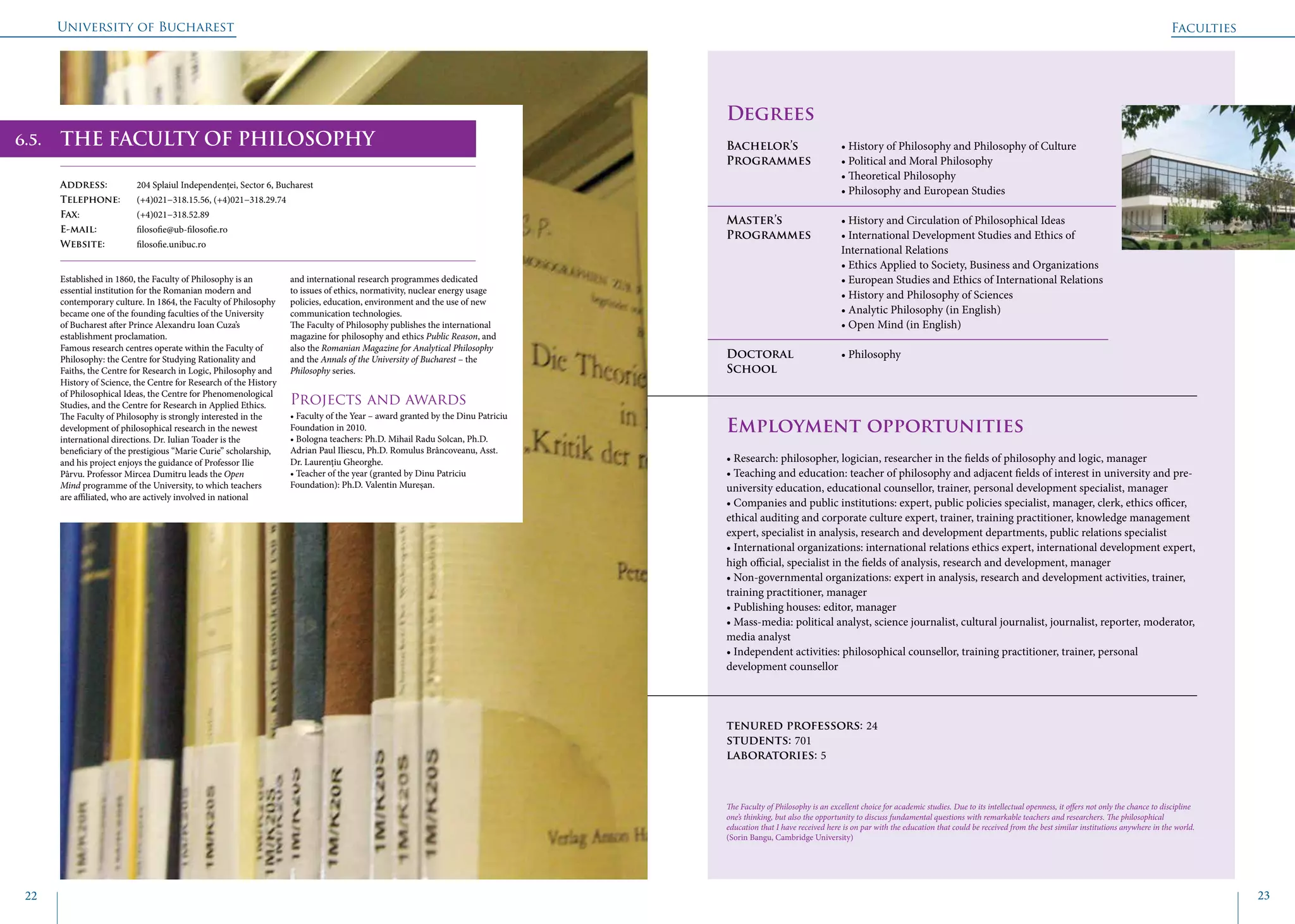
THE FACULTY OF PHILOSOPHY
Address: 	 204 Splaiul Independenței, Sector 6, Bucharest
Telephone: 	 (+4)021−318.15.56, (+4)021−318.29.74
Fax: 		 (+4)021−318.52.89
E-mail: 	filosofie@ub-filosofie.ro
Website: 	 filosofie.unibuc.ro
Established in 1860, the Faculty of Philosophy is an
essential institution for the Romanian modern and
contemporary culture. In 1864, the Faculty of Philosophy
became one of the founding faculties of the University
of Bucharest after Prince Alexandru Ioan Cuza’s
establishment proclamation.
Famous research centres operate within the Faculty of
Philosophy: the Centre for Studying Rationality and
Faiths, the Centre for Research in Logic, Philosophy and
History of Science, the Centre for Research of the History
of Philosophical Ideas, the Centre for Phenomenological
Studies, and the Centre for Research in Applied Ethics.
The Faculty of Philosophy is strongly interested in the
development of philosophical research in the newest
international directions. Dr. Iulian Toader is the
beneficiary of the prestigious “Marie Curie” scholarship,
and his project enjoys the guidance of Professor Ilie
Pârvu. Professor Mircea Dumitru leads the Open
Mind programme of the University, to which teachers
are affiliated, who are actively involved in national
and international research programmes dedicated
to issues of ethics, normativity, nuclear energy usage
policies, education, environment and the use of new
communication technologies.
The Faculty of Philosophy publishes the international
magazine for philosophy and ethics Public Reason, and
also the Romanian Magazine for Analytical Philosophy
and the Annals of the University of Bucharest – the
Philosophy series.
Projects and awards
• Faculty of the Year – award granted by the Dinu Patriciu
Foundation in 2010.
• Bologna teachers: Ph.D. Mihail Radu Solcan, Ph.D.
Adrian Paul Iliescu, Ph.D. Romulus Brâncoveanu, Asst.
Dr. Laurențiu Gheorghe.
• Teacher of the year (granted by Dinu Patriciu
Foundation): Ph.D. Valentin Mureșan.
The Faculty of Philosophy is an excellent choice for academic studies. Due to its intellectual openness, it offers not only the chance to discipline
one’s thinking, but also the opportunity to discuss fundamental questions with remarkable teachers and researchers. The philosophical
education that I have received here is on par with the education that could be received from the best similar institutions anywhere in the world.
(Sorin Bangu, Cambridge University)
Faculties
6.5.
University of Bucharest
24 25
Degrees
Bachelor’s 		 • Physics (in Romanian)
Programmes	 • Physics (in English)
			 • Medical Physics
			 • Biophysics
			 • Computational Physics
			 • Technological Physics
Master’s 		 • Advanced Materials and Nanostructures for Electronics and Optoelectronics 		
Programmes	 • Polymer Physics
			 • Medical Biophysics
			 • Atomic, Nuclear Interactions, Elementary Particles, Astrophysics, Applications
			 • Atmosphere and Ground Physics. Environmental Protection
			 • Photonics, Spectroscopy, Plasma, Lasers
			 • Electronic Physics and Metrology
			 • Computational Physics
			 • Theoretical Physics
			 • Interaction of Radiation with Matter (in English)
			 • Advanced Applied Physics
Master’s 		 • Nanoscience
Programmes 	 • Interdisciplinary master’s programme: Integrated Approach of Natural Sciences		
(interdisciplinary	 • Advanced Materials with Applications in Dental Medicine
programmes)		 • Renewable and Alternative Energy Sources
			 • The Science of Preserving/Restoring Heritage Items through Advanced 			
			 Physical and Chemical Methods
Doctoral 		 • Condensed Matter Physics
Schools 		 • Atomic and Nuclear Physics
			 • Physics of the Atmosphere and of the Ground – Renewable Energy Sources
			 • Biophysics and Medical Physics
			 •Theoretical Physics
			 • Optics, Spectroscopy, Plasma and Lasers
			 • Educational Physics
		
Employment opportunities
• Physicists and researchers in scientific research institutes
• Professors and researchers in pre-university and university education
• IT technologies experts
• Physicists in the fields of biotechnology and nuclear technology
• Experts in the field of communication
• Archaeological physicists
• Experts in the field of medicine
• Biophysicists
• Experts in the field of environmental protection
• Physicists in the field of unconventional energy sources
tenured professors: 83
students: 481
laboratories: 11
THE FACULTY OF PHYSICS
Address: 	 Măgurele Platform, 405 Atomiștilor St., Bucharest Măgurele
Telephone: 	 (+4)021−457.44.21
Fax: 		 (+4)021−457.45.21
E-mail: 	secretariat@fizica.unibuc.ro
Website: 	 fizica.unibuc.ro
The discipline of Physics has been taught at the
University of Bucharest ever since its establishment
in 1864. Initially, it was part of the Faculty of Science,
then, starting from 1948, of the Faculty of Mathematics
and Physics. This Faculty was divided into the Faculty
of Mathematics and Mechanics and the Faculty of
Physics in 1962. In 1974, The Faculty of Physics moved
to the new campus in Măgurele, together with the
Central Institute for Physics, which brought together
at the time the National Institutes for Research and
Development of today’s Măgurele Platform. Thus, the
student training opportunities are enhanced by direct
involvement in research programmes and the research
possibilities offered by the two largest Physics libraries
in the country, the National Physics Library of the
Horia Hulubei Physics and Engineering Institute and
the library of the Faculty of Physics.
All of the training-specialization and scientific research
activities take place within the four departments of
the faculty, which benefit from an extremely talented
teaching staff − both from an academic standpoint, as
well as from a scientific one – that is involved, together
with many of the students, in prestigious national
and international research programmes. Besides the
teaching activity, the research and academic staff carry
out important research programmes in the nine research
centres that operate within the faculty, all of them
benefiting of an adequate infrastructure for research in
their specific areas.
Projects and awards
• Tuning educational structures in Europe I 2007−2008
• Stakeholders Tune European Physics Studies
• Stakeholders Tune European Physics Studies TWO
(STEPS TWO)
• CoRe stands for Competences in Education and
Recognition (CoRe2)
• The Goliath Project
• CERN − European Organization for Nuclear Research
• JINR − Joint Institute for Nuclear Research
• Pier Auger Observatory − studying the Universe’s
highest energy particles
• DESY − Deutsches Elektronen-Synchrotron
Studying physics is an amazing experience, which prepares you for the future. The choice I made meant everything. Such an environment, within which
questions get answered and you are encouraged to express your own opinions, is the necessary support structure for every student who desires to get
the best training possible. This Faculty allowed me to become the president of an international society of physics students (International Association of
Physics Students − IAPS). I also studied abroad through an ERASMUS scholarship offered by the university and I had an eye-opening experience that
every student should have. You only need to take advantage of the opportunities that arise at every step and you can be more successful than you have
ever imagined. (Camelia-Florina Florica)	
Faculties
6.6.
University of Bucharest
26 27
	
					
Degrees
Bachelor’s 		 • Geography
Programmes	 • Cartography
			 • Meteorology-Hydrology
			 • Territorial Planning
			 • Tourism Geography
			 • Environmental Geography
Master’s 		 • Resource and Tourist Activities Management
Programmes	 • Climatology and Hydrology
			 • Territorial Planning and the Management of Urban and Rural Localities
			 • Geomorphology and Cartography with Elements of Surveying
			 • Advanced Geography Studies
			 • The Management of Tourist Spaces
			 • Air Environment Risks and Health Response (in English)
			 • Geographical Informational Systems
			 • Integrated Evaluation of the Status of the Environment
Doctoral 		 • Physical Geography
Schools		 • Human Geography
			 • Environmental Geography
Employment opportunities
Geography
• Schools, high schools, higher education institutions
• The Institute of Geography
• Ministries
• Private cartography, topography and surveying institutions and companies
• Tourism companies and agencies
• Hotel complexes
• Town planning and landscaping companies
• Regional development and territorial planning agencies
• City Halls
• Institutions specialized in geopolitics and world economy issues
• The National Meteorological Administration
• Weather stations
• The National Institute for Hydrology and Water Management
• Hydrological stations
Environmental Science
• The Ministry of the Environment and Sustainable Development
• National and Regional Environmental Protection Agencies
• Research and development institutes active in the field of environmental protection
• Environment consultancy and audit companies
• Administrative bodies of biosphere reserves, national parks, natural parks and protected areas
• Non-governmental organizations
tenured professors: 82
students: 2 500
laboratories: 10
THE FACULTY OF GEOGRAPHY
Address: 	 1 Nicolae Bălcescu Bld., Sector 1, Bucharest
Telephone: 	 (+4)021−314.35.08
Fax: 		 (+4)021−315.30.74
E-mail: 	 geografie@geo.unibuc.ro, secretariat@geo.unibuc.ro
Website: 	 geo.unibuc.ro
The law enacted on November 4, 1938 included two
geography departments in the Faculty of Science
and changed their names to Physical Geography of
Romania, and General and Human Geography. The
educational reform of 1948 led to the establishment
of new structures, and geography was associated with
history until 1950, when it became a department
of the Faculty of Geology and Geography of the
University of Bucharest. In 1986, through merging
with the Faculty of Biology, the Faculty of Biology,
Geography and Geology was established. In 1990,
The Faculty of Geography registered a dramatic
leap forward through the establishment of the
independent Faculty of Geography, which was meant
to ensure the diversification, modernization and
expansion of teaching and research activities in the
field of geography.
The Faculty of Geography is structured in
four departments: Geomorphology-Pedology-
Geomathics, Human and Economic Geography,
Meteorology-Hydrology and Regional and
Environmental Geography.
The undergraduates also take part in practical
activities in the research stations in Călimănești,
Drobeta Turnu Severin and Sf. Gheorghe (the
Danube Delta).
Projects and awards
• Participation in the education project Integrated
environmental management and sustainable
development, carried out through a partnership with
the Willy Brandt Foundation and with La Tuscia
University (Italy)
• Participation in the NaviNature project, developed
by SCHUBZ Centre for Environmental Education,
Luneburg, Germany
• Participation in the ERASMUS programme
• The Gaudeamus award for the Tourism Geography
bachelor’s programme
Faculties
My studies in the field of Environmental Science at the Faculty of Geography have granted me a lot of opportunities that later became milestones
in my career. I met wonderful people among my teachers and colleagues, willing to share their experience, passion and curiosity. I also had the
opportunity to work with environmental professionals, who tried to impart their knowledge, despite the fact that they were not teachers, or maybe
precisely because of that. I volunteered for the activities of the Carpathian-Danube Centre for Geoecology and of the Centre for Environmental
Research and Impact Studies and to discover the joys of teamwork. I enjoy reminiscing about such wonderful moments as the workshops in geology
and pedology, the annual meetings at the Symposium of the Students of Geography, the information centre in Berzasca (the Iron Gates), the
Eco-School programme, the noise measurements on Pallady Boulevard for the Impact Study for the Motorway of the Sun (which has since been
built), the practical courses in England and Wales, in Orșova, Călimănești and Breaza. The interesting activities I experienced during my studies
led me to seek interesting programmes after I graduated, to become involved and to travel with the same state of mind I had while I was carrying
out my practical courses (constantly trying to understand the world and the shapes around me). (Cristina Brăilescu, the European Commission,
Directorate General for Humanitarian Aid and Civil Protection)
6.7.
University of Bucharest
28 29
	
				
Degrees
Bachelor’s 		 • Geological Engineering
Programmes	 • Geophysics
			 • Geology
Master’s 		 • Evaluation of Sediment Basins and Mineral Resources
Programmes	 •Ambient Geological and Geotechnical Engineering
			 • Geophysics
			 • Applied Geophysics
			 • Geo-Biology Applied for the Conservation of the 	
			 Natural and Cultural Heritage (interdisciplinary master’s 	
			programme)
Doctoral 		 • Geology
Schools 		
Employment opportunities
• Geological engineers
• Geophysicists
• Geologists
• Teachers and researchers in university education
• Researchers in research institutes
• Researchers in oil geology
• Researchers in mineralogy, petrography and geochemistry
• Researchers in palaeontology
• Geo-service stations experts
• Specialists in waste and chemical substances management
• Environmental inspectors
• Environmental auditors
• Expert hydro-geologists
• Analysts in the fields of resources and world economy
• Natural hazards management experts
• Mineral resources handling and management experts
• Museum curators
• Gemmologists
• In large oil companies
• In mining companies that prospect and explore for hydrocarbons and ores
• In natural gas exploration and exploitation companies
• On marine drilling platforms
• In institutes and companies specialized in environmental protection,
geotechnical, hydro-technical and construction works
tenured professors: 41
students: 650
laboratories: 40
The Faculty of Geology and Geophysics, the only one of
its kind in Romania, originates in three faculties with a
geology and geophysics profile established through the
1948 educational reform. Today, it continues the traditions
of Romanian geology at a high scientific and educational
standard, through permanent modernization and updating.
The current organization of the faculty dates back to 1990
and it shows a dynamic approach, offering its graduates
opportunities for a professional career in the industrial field,
as well as in the scientific and academic field.
Very intense research activity takes place in numerous
research centres: the Centre for Ambient Tectonics and
Geology, the LYTHOS Centre, the Geomedia Centre, the
Expertise and Consulting Office, the Ambient Geology and
Geophysics Research Department, the Research Collective
for the Geology of Hydrocarbon Deposits, the Geological
Exploration, Valorisation and Marketing Research
Collective, the Research Centre for Coal Deposit Geology
and Environmental Protection and the Mineral Resources
and Environmental Management Research Centre. These
centres carry out many research agreements with important
institutions and organizations, such as CNCSIS, CNFIS
and specialized units such as Prospecțiuni SA, PETROM,
GEOECOMAR, GEOTEC, the Geodynamics Institute of
the Academy and many others, projects that also involve
many undergraduates. Geology, the fundamental field in
the large spectrum of Earth sciences, is inseparable from
the applied domain of data and sample collection in the
field. Therefore, the specialized geological practical courses
represent an essential component in the solid training of the
undergraduates. Students carry out field practice in areas
such as Rucăr-Buzău, Lopătari, Olăneşti, Orșova, Dobrogea,
Baia Mare, Hațeg and Leaota.
The Bucharest Student Chapter (BSC) distinguishes itself
among the professional student associations. This is a
scientific student body affiliated to the Faculty of Geology
and Geophysics of the University of Bucharest, with a 12
year history.
Projects and awards
• RCMNS (Regional Committee on Mediterranean Neogene
Stratigraphy) Interim Colloquium Bucharest, with the topic
Paratethys-Mediterranean Interactions: Environmental Crises
during the Neogene
• Eighth International Symposium on Economic Geology,
with the topic Mineral Resources and the Environment in
the Carpathian Area and its Surroundings (partnership with
the Economic Geology Society of Romania, the Apuseni
Mountains Professional Association and the Ludovic
Mrazec Society)
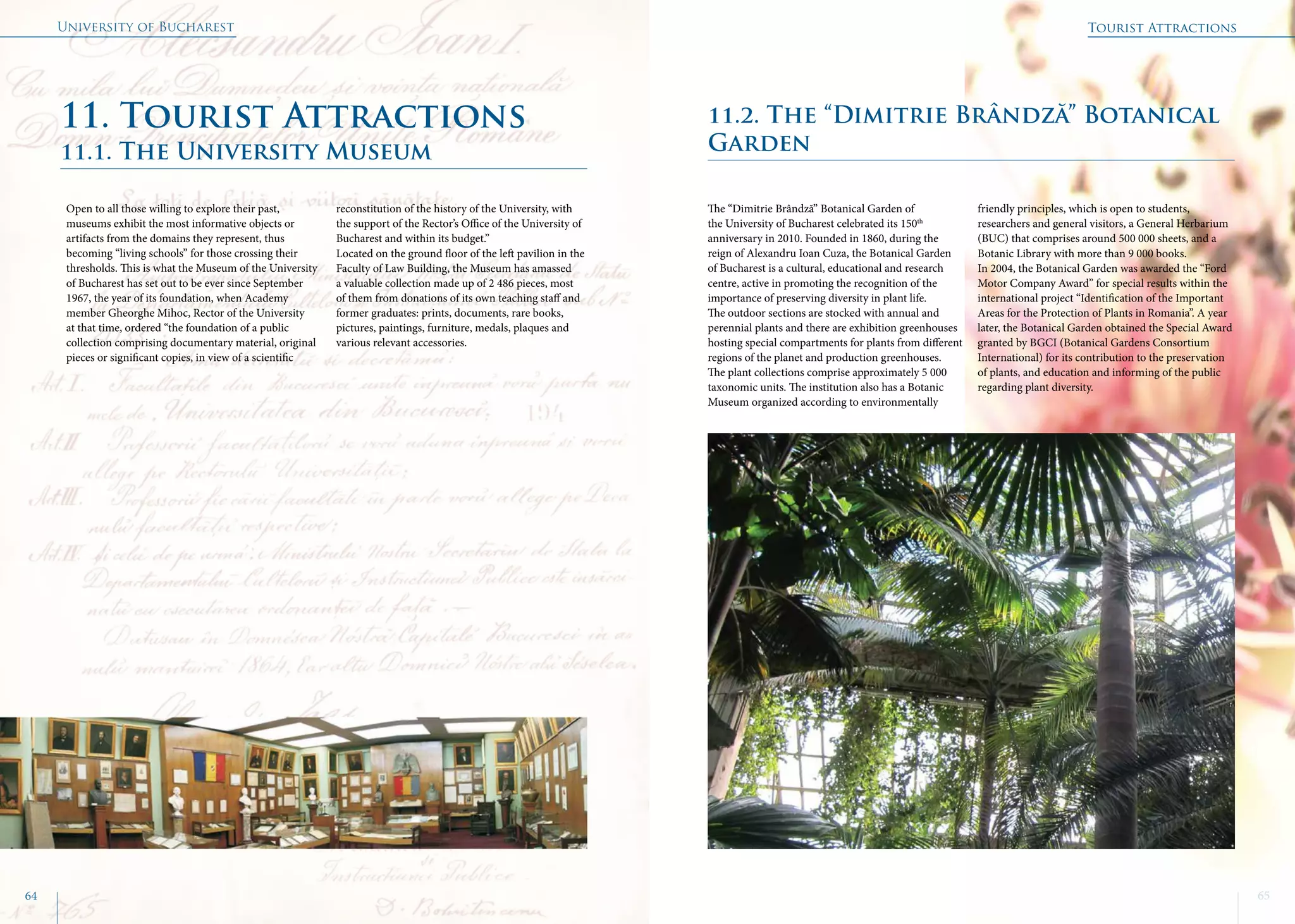
• The International Seminar Recherches croisées en Dobrogea,
with the topic L’empreinte du temps et des hommes (in
partnership with the Embassy of France in Romania and
Agence Universitaire de la Francophonie)
• European Seminar in Sustainable Development (partnership
with seven European universities)
• The projects “Memory: The Dialogue of Man with the
Ground”, “Sîntămăria Orlea – European Self Portrait: Nature
and Culture in Ţara Haţegului” (a project financed by the
Ministry for Culture and Religious Affairs, in partnership
with the Museum of the Romanian Peasant, the “Sîntămăria
Orlea” Primary and Middle School, the Sîntămăria Orlea
Municipality and Local Counsel, Hunedoara County)
• The scientific substantiation study for the creation of the
Ţinutul Buzăului Geological Park.
• The teaching staff and many of the students are part
of research programmes carried out in universities and
research institutes from Germany, France, the Netherlands,
Switzerland, Austria, Greece, the United Kingdom, USA,
Italy, Ukraine and Hungary.
Faculties
THE FACULTY OF GEOLOGY
AND GEOPHYSICS
Address: 	 6 Traian Vuia St., Sector 2, Bucharest
Telephone: 	 (+4)021−318.15.57
Fax: 		 (+4)021−318.15.57
E-mail: 	secretariatgg@gmail.com
Website: 	 unibuc.ro/facultati/geologie-geofizica
The choice I made 10 years ago, through which I was going to enroll in the undergraduate program of the Faculty of Geology and Geophysics at the
University of Bucharest was a great moment of inspiration and a lucky twinkle, leading my life to a fascinating universe, very active, full of opportunities,
where passion is a basic element of a universe at the interface between science, art and philosophy: the universe of geosciences. My college years were
incredible, full of special moments and personal achievements, with major effects on my progress. I had the opportunity to travel all over the world
through various projects, experiencing Europe far and wide, with its mountains, lakes, plains, seas, its great history and cultural variety. I climbed
the Rocky Mountains with geophysical equipment in my backpack, I crossed legendary places like Death Valley in California, and I lived the unique
experience of working with African students from Kenya to solve problems of drinking water resources using geophysical methods. As soon as I graduated,
new opportunities have appeared quickly. Geology and Geophysics are basic branches of industries such as those dealing with environmental issues,
construction, natural hazards, resource industry, including oil, gas, mineral deposits and water. This job is not easy, but it offers significant personal and
financial rewards. Currently, I work for the company Prospectiuni SA, a leading Romanian company operating all over the world, using the most cutting-
edge technology in a wide range of operations. I can only be glad that I chose this field and this faculty and look enthusiastically to the challenges of a
fascinating job, supporting as much as possible the institution that formed me in the secrets of geosciences. (Cezar Iacob, Ph.D., Business Development
Manager at S.C. Prospectiuni S.A.)
6.8.
University of Bucharest
30 31
THE FACULTY OF HISTORY
Address: 	 4−12 Regina Elisabeta Bld., Sector 5, Bucharest
Telephone: 	 (+4)021−314.53.89
Fax: 		 (+4)021−310.06.80
E-mail: 	 secretariat@istorie.unibuc.ro, decanat.istorie@gmail.com
Website: 	 istorie.unibuc.ro
History studies at the University of Bucharest date back
to its creation as a higher education institution through
the 1864 proclamation of Prince Alexandru Ioan Cuza.
The topics of the first classes, organized by the Faculty
of Letters, Law and Philosophy, were the study of
antiquities and of archaeological heritage. The number
of topics grew over time and the historical sciences
were represented for over a century in the University of
Bucharest by major personalities in Romanian culture.
The BA and MA programmes of the faculty were
diversified after 1990. Art History and International
Relations and European Studies Bachelor’s Programmes
were added to the traditional History programme.
The Master’s Programmes underwent continuous
development and, in 2008, nine MA programmes were
accredited in the Bologna system. The third cycle studies
are organized within the Doctoral School.
Currently, the Faculty of History includes the highest
number of programmes it has ever had and some
of the classes are very original in the context of the
Romanian university environment. The emphasis is
on the interdisciplinary approach: from the Greek,
Roman, Oriental and Egyptian antiquity to the history
of communism; from Byzantine and archaeological
studies to the history of the modern world and of the
EU/NATO integration. History is approached from
several perspectives: politics, anthropology, military,
history of religions, history of mentalities, history of the
imaginary, economic, intellectual and diplomatic history.
Research is carried out in the Faculty of History within
the specialized centres, through specific projects and
national and international collaboration: the Centre for
Turkish Studies, the Centre for Comparative History
of Ancient Societies, the Centre for Church History,
the Centre for History of the Imaginary, the “Dimitrie
Onciul” Seminar for Methodology of History, the Centre
for Research in 20th
Century History, the “Vasile Pârvan”
Seminar in Archaeology, the “Gheorghe Brătianu” Centre
for Byzantine and South-Eastern European Studies, the
Centre for Roma Studies.
The Faculty of History is involved, through the members
of the Ancient History, Archaeology and Art History
Departments and also those of the “Vasile Pârvan”
Seminar for Archaeology, in many projects of cultural
valorisation of archaeological areas. The research was
distributed after 1990 in several directions, systematically
covering archaeological dig sites representative for
Romanian archaeology (Adamclisi-Tropaeum Traiani,
Capidava, Câmpulung-Jidava, Cârlomăneşti-Cetăţuia
and Arman, Giurgiu-Malu Roşu, Histria, Isaccea-
Noviodunum, Vităneşti, Bistreţ, Popeşti, Năeni,
Zimnicea, Târgşor), as well as carrying out preventive
and salvaging digs, archaeological supervision, periegesis,
archaeological evaluations, and protection of the sites
and of archaeological monuments. The Archaeology
Seminar especially takes care of the promotion of the
scientific activity of the students, MA students and Ph.D.
candidates, both in the field, as well as in the office. These
programmes (BA, MA, Ph.D.) concentrate on topics that
target major and current issues of Romanian archaeology.
Efforts are made to ensure the continuity of long-term
archeological digs (teaching digs), in representative sites,
relevant for the priority research themes.
Projects and awards
• The University of Bucharest archeological mission to the
island of Thasos, Greece (2013−2016), in collaboration
with the French School of Archeology in Athens
• The International ISHA Seminar, with the topic Symbols
and Figures of Power, Bucharest, organized by the Dacia
Students of History Association, member of ISHA
(International Students of History Association)
	
				
Degrees
Bachelor’s 		 • History
Programmes	 • International Relations and European Studies	
			 • Art History
Master’s 		 • History and Civilization
Programmes	 • The History and Practice of International Relations
			 • Politics and Society
			 • Diplomatic Techniques
			 • History of Arts and Philosophy of Culture
			 • Medieval Studies
Doctoral 		 • History
School 		
Employment opportunities
• Education
• Scientific research – research institutes
• Archaeology
• Archives
• Museums
• Libraries
• State administration institutions
• Public administration
• Diplomacy
• International political consultancy
• Specialists in international relations for state institutions and non-
governmental organizations
• Mass-media and publishing houses
• Other cultural institutions
tenured professors: 42
students: 1 006
laboratories: 1
The foundations of my professional success in the United States have been laid during my undergraduate studies
in History of the University of Bucharest. What I have learned from my professors at that time has remained
the basis of my career and life. In four years of undergraduate studies, they were able to open my mind to a new
mode of thinking about the world, which I came to appreciate only now, at a much later date in my life. The
values at the root of the education I received from my professors are also those that I now strive to instil in my
own students: high level of professionalism, intellectual honesty, scholarly rigor. The notes I have taken in the
special courses 25 years ago are still of great use in preparing my own courses. During my undergraduate studies
at the University of Bucharest, I have met a number of remarkable people, some of whom have become lifetime
friends. If I had to start over, I would do it with the same classmates. I am proud to have graduated from the
University of Bucharest. (Florin Curta, Professor of History and Medieval Archaeology, University of Florida,
Gainesville, United States)
Faculties
6.9.
University of Bucharest
32 33
	
				
Degrees
Bachelor’s 		 • Journalism
Programmes	 • Communication and Public Relations
			 • Advertising
Master’s 		 • Communication Campaigns in Advertising and 	
Programmes	 Public Relations
			• Corporate Communication
			 • Political Journalism
			 • Thematic Journalism
			 • The Management of Mass-Media Institutes
			 • Mass Media, Development, Society (in French)
			 • Multimedia and Audio-Video Production
			 • Research Theory and Methods in Communication 	
			Science
Doctoral 		 • Communication Sciences
School 		
Employment opportunities
• Editor
• Reporter
• Producer
• Publisher
• Radio/TV programme coordinator
• Designer
• Correspondent
• Copywriter
• Art director
• Media planner
• PR specialist
• Press office coordinator
• Book editor
• Translator, proof-reader
• Cultural projects manager
• Illustrator
• Account manager
•Traffic manager
tenured professors: 38
students: 1 385
laboratories: 6
As the first school of journalism and communication
science to be established after the 1989 Revolution, the
Faculty of Journalism and Communication Studies is
nationally and internationally known as an institution that
offers professional training of the highest quality.
The Faculty of Journalism and Communication Studies
has gained professional prestige among the other schools
and academic institutions of this kind in Romania
and abroad. The Faculty is the president of the Eastern
and Central European Association of Journalism
Schools and it is an associated member of the European
Journalism Training Association (EJTA) of Maastricht,
of the Theophraste Renaudot Network of Francophile
Journalism Schools, of the European Centre for Research
in Mass Communications of ORBICOM-UNESCO (the
international network of communication departments).
Students and teachers of the Faculty of Journalism and
Communication Studies take part in European journalism
programmes and exchange programmes for imparting
academic and journalistic experience with other
countries in Eastern and Western Europe. We engage in
academic and research relations with prestigious foreign
institutions, such as: Ecole Supérieure de Journalisme
of Lille, Université du Quebec of Montréal, Mid Sweden
University in Sweden, Université de Grenoble in France,
Université Paul Valéry-Montpellier in France, etc.
The Faculty of Journalism and Communication Studies
has established the Centre for Researching the Role of Mass
Communication in the Development of the Public Space, for
reception analysis and for advanced technologies – SPARTA.
The Faculty of Journalism and Communication Studies,
together with the Journalism and Communication
Trainers’ Association, publishes the most prestigious
specialized periodical, The Romanian Journalism &
Communication Journal, established 11 years ago.
Projects and awards
• The Leonardo da Vinci “Euromedia Standards −
Eumesta” project (partnership with representatives of
the educational institutions from EU countries: Austria,
Germany, the United Kingdom, Spain, Estonia and
Romania)
• The “Enhancement and development of the professional
expertise of the Romanian audio-visual sector” project,
2007−2009
• The “Improving Gender Mainstream within Trade
Union Organizations in Bulgaria, Romania and Turkey”
ISCOS (Instituto Sindicale per la Cooperazione allo
Sviluppo, Italia) project, 2007−2008
• The “Mass media and Democratic Citizenship” project,
2010
• The “Adaptation of the educational offer to the demands
of the professional environment in the field of public
relations” project, 2010
• The “Research regarding blogging practices in Romanian
journalism” project, 2010
• The “Corporate Responsibility Education and Training:
Innovative Operative Notions” project
• The “Today’s practitioners, tomorrow’s television
professionals” project
• The “Tous journalistes? Le défi de la formation des
étudiantes au profesionnalisme journalistique” CNRS
France project
• The “Dialogue – Cultural Bridge – Digital Bridge”
project
• The Global Media Monitoring Project 2010
• The “Gender relations in education policy and practice
in the Danube Region” project
• In 2010, on the occasion of its 20 year anniversary, the
Faculty of Journalism and Communication Studies was
awarded the Order of Cultural Merit, with the grade of
Knight, by the Presidency of Romania, while its dean
received the Order of Faithfull Service with the grade of
Knight.
• In January 2010, after the evaluation carried out by
the experts of Reseaux THEOPHRASTE des Ecoles
Francophones de Journalisme, the Faculty of Journalism
and Communication Studies received their recognition
and the qualification “sans reserve” (equivalent to “a high
degree of trust”).
Faculties
THE FACULTY OF JOURNALISM AND
COMMUNICATION STUDIES
Address: 	 1−3 Iuliu Maniu Bld., Leu Complex, Building A, 6th
floor, Sector 6, Bucharest
Telephone: 	 (+4)021−318.15.55, (+4)0724.390.038
Fax: 		 (+4)021−318.15.55
E-mail: 	secretariat@fjsc.ro
Website: 	 fjsc.unibuc.ro
Now, as I am writing these lines at the beginning of 2013 and while I am watching the contemporary Romanian mass media from the outside, my first urge is to ask those
that want to become journalists and to study at the Faculty of Journalism to take the time to think about whether this is really what they want.
During the first classes I attended in this faculty, most of the teachers were trying to destroy the myths about this profession, and to open our eyes, as it were, to the media’s
dirty secrets. The road can begin for you in the Faculty of Journalism, which can provide you with some of the important and necessary tools for the job. But be warned: the
road requires that you also study on your own. Look things up, check them, read, test yourselves. Of course, the teachers are there to make sure you are well equipped for the
journey, but they will travel will you for a short time, because they have chosen another path, and because they have different parts to play and they all play them as best
they can, some with extraordinary skill. And most importantly, you should always keep your integrity, and write and speak Romanian correctly. (Oana Dan, redactor at The
Bucharest Daily News, Europa Liberă, NewsIn, Evenimentul Zilei and TVR)
6.10.
University of Bucharest
34 35
	
				
Degrees
Bachelor’s 		 •Foreign language and literature A and Foreign language 	
Programmes	 and literature B/Romanian language and literature
			A languages: English, German, Dutch, French, Spanish, 	
			 Portuguese, Latin, Greek, Arabic, Chinese, Japanese, 		
			 Turkish, Russian, Bulgarian, Serbian, Croatian, Polish, 		
			 Slovak, Ukrainian, Hungarian, Romany
			B languages: English, German, Swedish, French, Italian, 	
			 Spanish, Portuguese, Catalan, Latin, Greek, Korean, 		
			Persian, Russian
			• Cultural Studies: American Studies, Jewish Studies
			 • Translators, Interpreters, Terminologists: English, French, 	
			 German, Italian, Spanish, Russian
			 • Applied Modern Languages: English/French, German, 		
			 Italian, Russian, Spanish, Czech
Master’s 		 • British Studies	
Programmes	 • American Studies
			 • English Linguistics
			 • French and Francophile Studies
			 • Literary and Linguistic Intercultural Communication 		
			Strategies
			 • East Asia Studies
			 • Islamic Space: Societies, Cultures, Mentalities
			 • Russian Culture Studies and Russian for Business
			 • Conference Interpreters Training
			 • Translation of Contemporary Literary Texts
			 • Specialized Translations and Terminology Studies
			 • Religious Studies
			 • The Culture and Language of European Organizations
			 • Balkan Cultural Studies
Doctoral 		 • Philology (Languages and Cultural Identities, Literary and
School 		 Cultural Studies)
Employment opportunities
• Teachers in pre-university and university education
• Researchers
• Editors at publishing houses and newspapers
• Producers at radio/television stations
• Translators and terminologists
• Conference interpreters
• Specialized readers
tenured professors: 227
students: 3 870
laboratories: 12 (phonetics, informational, conference interpreting)
The 149 year history of the University of Bucharest is
also the ever growing history of education in foreign
languages and literatures. The first languages that were
taught, at the establishment of the University in 1864,
were, naturally, Latin and Ancient Greek, followed by
French, in 1877. Ten years later, in 1874, the University
joined the European mainstream due to the great B.
P. Hasdeu, who began his class of Comparative Indo-
European Philology. New philological programmes
were established in the following years: Italian (1878),
Slavic languages (1891), German (1905), Spanish (1930),
Russian (1934), and English (1936). The second half
of the century, up until present times, has seen the
greatest development of foreign language education
at the University of Bucharest. The teaching of foreign
languages has become a major preoccupation in the
University, an essential condition for the self-affirmation
of young people. An inventory of all the languages that
have been taught, to different degrees and at different
periods, puts their total number at an impressive 42.
33 of these are taught nowadays, among which Greek,
Turkish, Catalan, Romany, Slovene, Macedonian,
Armenian, Croatian, Bulgarian, Korean, Japanese
and Swedish are not present in the curricula of other
faculties. The 17 centres of the faculty are host to
impressive research activity, each of them publishing
its own journal and collaborating with national and
international organizations. The Faculty of Foreign
Languages and Literatures has developed multiple useful
applications in the field of foreign language studies,
carrying out dynamic teaching activities for its students:
the French essay writing competition, the Online School
Portal (the French language department, the Slovak
language department etc.).
Projects and awards
• The European pRo − Contemporary poetry translation
project
• The Nippon Foundation Fund for Japanese Language
Education programme
• The Culture 2007−2013 – Meeting Cultures between the
Lines project
Faculties
THE FACULTY OF FOREIGN
LANGUAGES AND LITERATURES
Address: 	 5−7 Edgar Quinet St., Sector 1, Bucharest; 7−13 Pitar Moş St., Sector 1, Bucharest
Telephone: 	 (+4)021−314.89.65
Fax: 		 (+4)021−312.13.13
E-mail: 	office@limbi-straine.ro
Website: 	 limbi-straine.ro
Being a student of the Faculty of Foreign Languages and Literatures means being open towards the entire world, having the curiosity
and the desire to discover something that exists beyond the borders. It means having passion not only for a certain foreign language,
but also for art, history, economy, politics, for every building block of a nation. I enrolled in the English-French Philology programme
of the Faculty of Foreign Languages and Literatures because I had a passion for communication, for anything involving the exchange
of information and messages and the medium the exchange takes place in, but also to further my French studies that I began when
I was only 6 years old. I wanted to find out more about the French culture, as well as about the British culture, about their origins
and evolution and I ended up finding out more about myself. I was lucky to have some wonderful colleagues and to learn from true
educators that cultivated and encouraged our curiosity, that imbued us with passion for language and literature, that developed our
critical and analytical thinking, that encouraged us to ask questions of them and of each other and to desire to find out more. (Mihaela
Drăghici, Marketing Manager at Central-Eastern Europe QS, London, the United Kingdom)
6.11.
University of Bucharest
36 37
THE FACULTY OF LETTERS
Address: 	 5−7 Edgar Quinet St., Sector 1, Bucharest
Telephone: 	 (+4)021−313.43.36, (+4)021−313.88.74, (+4)021−313.88.75
Fax: 		 (+4)021−313.43.36
E-mail: 	pr@litere.ro
Website: 	 unibuc.ro/facultati/litere/, litere.ro
The tradition of the Faculty of Letters coincides with the
tradition of modern higher education in Bucharest. The
Superior School of Letters was established on November
2, 1863 and it became a part of the University of
Bucharest a year later, under the name Faculty of Letters
and Philosophy. Ever since its beginning, the Faculty of
Letters has been an academic benchmark for Romanian
society, with exceptional cultural personalities among its
professors.
The ties of the Faculty of Letters to Romanian academic
and cultural life have always been tight and especially
productive. In the inter-war period, several institution
were established in the Faculty of Letters: the Institute for
Literary History and Folklore, founded by D. Caracostea
in 1933, the Institute for Linguistics, founded by A.
Rosetti in 1937, the Institute for Latin Studies, founded
by Nicolae Herescu in 1938 etc. and several prestigious
specialized publication were edited: “Grai și suflet”
(Speech and Soul), 1923 (Ovid Densusianu), “Revista de
filosofie” (The Philosophical Journal), 1923 (Constantin
Rădulescu − Motru), “Dacia”, 1924 (Vasile Pârvan),
“Revista istorică română” (The Romanian History
Journal), 1931 (C. C. Giurescu), “Bulletin linguistique”,
1933 (A. Rosetti), “Cercetări literare” (Literary Research),
1933 (N. Cartojan), “Sociologie românească” (Romanian
sociology), 1938 (D. Gusti) etc. While maintaining
tradition and understanding the importance of the
relationship between higher education and research,
the Faculty of Letters today has common projects with
the Iorgu Iordan-Al. Rosetti Institute for Linguistics of
the Academy, with the Central University Library and
with the National Library, with the “Dimitrie Gusti”
National Museum of the Village, with the Institute for
Ethnography and Folklore, etc.
The Faculty of Letters is also the academic institution
which has the most representatives of the Romanian
language, culture and civilization abroad. The lectorates
of Padua, Calabria, Heidelberg, Regensburg, Brussels,
Oxford, Toronto, Seoul, etc., are covered by teachers
from our Faculty. Constant exchange programmes for
students and teachers have been concluded with similar
universities in Europe, hundreds of foreign students
benefit from classes given by our colleagues during the
preparation year, and our participations in national and
international congresses and conferences are numerous
and of high academic quality. This is why the Faculty of
Letters is a top philological university faculty in Romania.
A monument to philological culture, the Faculty of
Letters is simultaneously an architectural monument,
placed in the University building in the centre of
Bucharest. The impressive Marble Hall has recently
been restored and is one of the symbols of the original
building, together with the Faculty’s Reading Room,
another architectural jewel.
Projects and awards
• Conference of the Faculty of Letters Alumni
• “Our Values” conferences
• The publishing of student magazines
• The staging of plays by the student theatre companies of
the Faculty
• The organization of student academic circles
• Erasmus agreements with numerous European
universities, including Cambridge University
• Collaboration project with the Romanian Academy’s
“Iorgu Iordan – Al. Rosetti” Institute for Linguistics of
Bucharest
	
				
Degrees
Bachelor’s 		 • Romanian Language and Literature – Foreign
Programmes 	 Language and Literature
			• European Studies
			 • Ethnology
			 • Universal and Comparative Literature – Foreign 		
			Language and Literature
			 • Communication and Public Relations
			 • Information and Documentation Science
			 • Managerial Assistance and Secretariat
Master’s 		 • Romanian Literature Studies
Programmes	 • Advanced Linguistic Studies
			 • The Theory and Practice of Editing
			 • Literary Theory and Comparative Literature
			 • Ethnology, Cultural Anthropology and Folklore
			 • Teaching Philology Disciplines
			 • Communication and Public Relations Models
			 • Advertising Consultancy and Expertise
			 • Information Management in Contemporary Society
			 • Culture and Politics in an European and International Context
			 • Information and Document Management
			 • Jewish Culture and Civilization
Doctoral 		 • Philology (Linguistics, Literary Studies)
School 		
Employment opportunities
• All levels of education (with double specialization for the graduates of Romanian Language and
Literature – Foreign Language and Literature programmes), written and audio-visual media (editors,
press officers)
• Publishing houses and editorial offices, central and regional, national and international cultural
institutes (cultural officers, event planners, cultural managers, translators, interpreters etc.)
• Governmental integration departments (European counselors)
• Private or European institutions (counselors, European policies experts, cultural managers)
• Museums, national centres, institutes for research in the fields of linguistics, literature and literary
theory, information management and promotion, preservation and promotion of traditional culture, etc.
• Public relations and advertising agents
• Institutional information and public relations departments
• Libraries, information and documentation centres, info-documentation structure and systems (experts
in information transfer, specialized advisers, librarians in higher education)
• Human resource and secretariat departments (assistant managers, higher education secretaries,
information and documentation counselor, specialized inspectors, etc.)
tenured professors: 111
students: 2 791
laboratories: 7
I chose to study at the Faculty of Letters in Bucharest because of its professors. While I was a high school student in the province I used to
watch the TV show Culture, My Job, which was moderated by the critic Nicolae Manolescu on Pro TV. Someone had lent me Eugen Negrici’s
book Figura spiritului creator. That moment I knew that I wouldn’t choose another faculty. I had to pass the entrance exam at the Faculty of
Letters in Bucharest so that Nicolae Manolescu and Eugen Negrici would be my professors! And it wasn’t easy. I had attended a small, modest
high school and specialized, on top of it all, in natural sciences and maths; so I passed the entrance exam at the university on a second attempt.
But I never regretted that wasted year because everything that I’ve learned and all the encounters I had during my university years have deeply
influenced and helped me. Without the courses in Literary Theory and the trust that Ms Antoaneta Tănăsescu had in me, I wouldn’t probably
have continued to write literature or I would’ve written conventional stuff. More than that, she provoked me to translate, after several years,
from Lewis Carroll. Who knows whether I would have become a literary critic if I hadn’t taken Ioanei Pârvulescu’s advice? She appreciated
my activity during her seminar and invited me to write articles for România literară, where what I would call today my literary career started.
At the literary club chaired by Mircea Cărtărescu I found out dozens of names of Romanian and foreign writers, who influenced me and are
now among my personal favorites (for instance, it was there that I heard of Mircea Horia Simionescu or Ernesto Sábato for the first time).
Mircea Vasilescu hired me at Dilema veche while I was still an M.A. student. A year later we were publishing Dilemateca together. And,
generally speaking, I could never appreciate enough how much I owe to several professors such as Paul Cornea and others that unfortunately
passed away (Th. Hristea, D. H. Mazilu, or Cornel Mihai Ionescu). Not only that they has taught me so many, but they also offered me
perspectives and opportunities. Together with Nicolae Manolescu I had come to edit an anthology of Mihail Sadoveanu’s best short stories...
We were an outstanding generation, and this is also due to our teachers at the Faculty of Letters. I am proud to have been a student here.
(Marius Chivu, Editor, Dilema veche @ Dilemateca)
Faculties
6.12.
University of Bucharest
38 39
	
					
Degrees
Bachelor’s 		 • Mathematics
Programmes	 • Mathematics-Computer Science
			 • Applied Mathematics
			 • Computer Science
			 • Computing and Information Technology
Master’s 		 • Algebra
Programmes	 • Mathematical Analysis
			 • Geometry
			 • Cryptography and Coding Theory
			 • Applied Mathematics in Finance, the Actuarial 		
			Profession and Biostatistics
			 • Mathematical Modeling in Natural Sciences and 	
			Materials Science
			 • Algorithms and Bioinformatics
			 • Databases and WEB Technologies
			 • Software Engineering
			 • Artificial Intelligence
			 • Declarative Programming and Distributed Systems
Doctoral 		 • Mathematics
Schools 		 • Computer Science
Employment opportunities
• Teachers and researchers in pre-university and university education
• Computer experts
• Systems engineers
• Banking specialists
• Insurers, actuaries
• Financial analysts
• Specialists in software development management
• Researchers
• Statisticians
• Specialists in marketing and market research
• Programmers and web designers
tenured professors: 141
students: 2 101
laboratories: 20
When the University of Bucharest was founded in
1864, it consisted of three faculties, among them
the Faculty of Physics, Mathematics and Natural
Sciences (later renamed to The Faculty of Sciences).
In 1866, the faculty was divided into two separate
departments, namely Physics and Mathematics, and
Physics and Natural Sciences. The curriculum consisted
of: Introduction to calculus, Advanced Algebra and
Differential and Integral Calculus, Basic and Rational
Mechanics, Descriptive Geometry, Analytic Geometry,
Theoretical Geodesy and Astronomy, and Linear
Design and Topography. Alexandru Orăscu, one of the
first professors employed by the faculty, was not only
a mathematician, but also the accomplished architect
who designed the landmark University Building.
The first major turning point in the evolution of the
faculty was the employment as professors of the first
Romanian mathematicians who had defended their
Ph.D. theses at the Sorbonne University in Paris,
namely: Spiru Haret, David Emmanuel, Constantin
Gogu and Nicolae Coculescu. Spiru Haret taught
Rational Mechanics at the University of Bucharest for
more than 30 years. The majority of Romania’s leading
mathematicians of the following generations, (such
as Ţiţeica, Lalescu, and Stoilow), were, or considered
themselves, among his students.
The next stage in the evolution of the mathematical
sciences in Bucharest is that of the great scientists,
who not only successfully defended brilliant Ph.D.
theses in Paris, but also went on to create an impressive
amount of scientific work. The most prominent among
them were geometrist Gheorghe Ţiţeica and analysts
Dimitrie Pompeiu and Traian Lalescu, who stand out
among the ranks of our faculty during the first four
decades of the twentieth century. The Ţiţeica curves,
surfaces and systems are discussed in numerous
treaties on differential geometry, Pompeiu’s functions
had an important part to play in the evolution of
functions theory, real-time analysis, topology and
differential equations, and Lalescu is the author of the
first monograph on integral equations theory. Pompeiu
succeeded Haret as head of the Mechanics Department,
but also taught functions theory, thus serving as
successor to David Emmanuel as well. The last 50
years have been primarily a period of growth and
consolidation for the mathematical school of Bucharest,
during which Romanian mathematics has achieved
world-wide recognition. G. C. Moisil created a school
for mathematical logic and laid the foundations of
Romanian informatics, and Miron Nicolescu founded
a prestigious school of mathematical analysis. C.
Drâmba and Călin Popovici were leading researchers
who continued the tradition of astronomical studies
in Romania. Ştefan Gheorghiţă is a standout scientist
formed at the school of mechanics.
Projects and awards
The Faculty of Mathematics and Computer Science will
represent the University of Bucharest at this year’s grand
finals of the ACM-ICPC contest to be held in June 2013 in
Saint Petersburg. The contest is the biggest international
competition for programmers at university level, and it has
seen the representatives of the best universities in the world
compete for the top spot for more than 40 years.
Faculties
THE FACULTY OF MATHEMATICS
AND COMPUTER SCIENCE
Address: 	 14 Academiei St., Sector 1, Bucharest
Telephone: 	 (+4)021−314.35.08
Fax: 		 (+4)021−315.69.90
E-mail: 	secretariat@fmi.unibuc.ro
Website: 	 fmi.unibuc.ro
My chosen field of research, Bioinformatics and Systems Biology, is profoundly interdisciplinary, using mathematical and
computational methods to further the understanding of complex biological phenomena. The Computer Science Bachelor’s at the
University of Bucharest was essential in my development as a researcher. The well-rounded curriculum including continuous
and discrete mathematics, logic, algebra and geometry, combined with courses on numerical methods, computational techniques
and computer programming, have provided me with a solid foundation for my professional career. (Ion Petre, professor in the
Department of Information Technologies, Åbo Academi University, Turku, Finland)
6.13.
University of Bucharest
40 41
	
				
Degrees
Bachelor’s 		 • Psychology
Programmes	 • Pedagogy
			 • Special Psychopedagogy
			 • The Pedagogy of Pre-Secondary Education
			 (in Bucharest, Buzău and Focșani)
Master’s 		 • Psychodiagnostics, Unification Experiential Psychotherapy
Programmes 	 (UEP), Personal Development
			 • Evaluation, Counselling and Psychotherapy of the Child, Couple, 	
			and Family
			 • Clinical Psychology − Evaluation and Therapeutic Intervention
			 • Management of Psychologists’ Training in the Psychology of the 	
			 Work Environment, Transportation, and Customer Services
			 • Educational Psychology
			 • Organizational Psychology and Human Resources
			 • Applied Psychology in National Security
			 • Occupational Health and Performance in Organizations
			 • Training of Professional Trainers
			 • Management and Evaluation of Organizations and Educational 		
			Programmes
			 • School Counselling and Career Development
			 • New Learning Techniques. Masters in Didactics
			 • Psychopedagogy of Inclusive Education
			 • Logopedic Therapy in Communication Processes
			 • Information and Communication Technologies in Education
Doctoral 		 • Psychology
Schools 		 • Education Sciences
Employment opportunities
The founding of the Faculty of Sociology, Psychology,
Pedagogy, and Social Work in 1990 meant reinstating
a type of traditional education with brilliant
representatives in the fields of social sciences,
psychology and pedagogy.
The Faculty of Psychology and Education Sciences
is a modern educational and research institution. It
is the leading faculty in Romania in several areas of
professional and scientific development. Our mission
is to contribute, by means of our degree programmes
and our research and development, as well as social
responsibility projects, to the basic and continuing
training of highly qualified specialists, the advancement
of scientific research in the fields of psychology and
education sciences, and to social and community
development.
This goal-oriented outlook requires concentrated
efforts towards providing a high standard of training
for students, supplying expertise and counselling
services, developing research projects, as well as
rendering personalized professional services of
the highest quality, according to the principles of a
dynamic society based on the acquisition of knowledge
and competitiveness.
The Faculty has a complex institutional structure
consisting of the four main departments of Psychology,
Education Sciences, Special Psychopedagogy and the
Department of Professional Training for Teachers,
as well as three affiliated teaching colleges located
in Bucharest, Buzău and Focşani, and a formidable
doctoral school.
Through the activities associated with our degree
programmes, and because of the nature of our
ongoing projects, as well as the area of expertise
of our teaching staff and alumni, the faculty is
actively pursuing an increase in the visibility of our
institution and is making efforts to bring a larger
contribution to Romanian society. This is achieved
by means of recruiting teaching staff and students
for projects with high-impact social goals, such as:
providing expert consultancy for state organizations
and NGOs on projects for the assistance of various
social groups, providing socio-educational assistance
to underprivileged groups, initiating programs for
psychological recovery, social reintegration, urban
education, and more.
Also noteworthy is the contribution of our experts to
the drafting, research, and implementation of public
policies and regional strategies at both international
and national levels in our area of expertise (e.g.
educational policies). The expertise of our staff has
been instrumental in developing a variety of such
documents and initiatives; we have made important
contributions to the development of the framework
of the national curriculum, to the training policies for
teaching staff across the country, to national strategies
for the socio-educational integration of individuals
with special educational needs, to name a few areas.
Projects and awards
• The Pedagogy Bachelor’s Programme double-degree, in
partnership with Via University College in Denmark
• The cross-department master’s programme in Early
Childhood Education and Development (ECED)
Faculties
THE FACULTY OF PSYCHOLOGY AND
EDUCATION SCIENCES
Address: 	 90 Panduri St., Sector 5, Bucharest
Telephone: 	 (+4)031−425.34.45
Fax: 		 (+4)031−425.34.46
E-mail: 	secretariat@fpse.unibuc.ro
Website: 	 fpse.unibuc. ro
I graduated fron the Faculty of Psycology and Education Sciences in 1996 in the second generation of graduates after the reopening of the faculty in 1990. I
still have the feeling that I had the privilege to belong to a generation of professionals. I am talking about professionals in their work, with their mind, their
body and people’s soul. My teachers inspired me not only with the sciences of education but also with the guide of interpersonal relations and with the flame
of the professional curiosity which mustn’t blow out.
In the years that have passed since my graduation, I noticed with interest and I proudly recognize not only the varied directions of professional employment
of graduates of our faculty but also their perseverance in changing their sorrounding communities. And I think that the merit of this faculty is to train
EDUCATORS, people who have vocation and intellectual training to teach, to promote education in school and especially out of it and to encourage
through their work and personal example.
We live hasty times marked by economic and political conflicts and especially by social and cultural ones. Uneducated people are more than ever exposed to
abuses, marginalization and handling. Education has been loosing ground in the list of international and national budget priorities. Paradoxically, at the
same time education, understood as an expression and synthesis of the abilities to identify, process and use the information, becomes a tool of social reform,
a stimulus of cultural and political revolutions.
In such a context our faculty has to accept more than ever the challenge to form EDUCATORS: professionals with intellectual training and especially with
vision and vocation to educate, professionals who have the courage to question and to rebel and to encourage changes as a constant. (Raluca Verweijen-
Slamnescu, organizer of training workshops for children’s rights advocacy)
• Teachers at collegiate and university levels
• Researchers for public and private
institutions
• Career and school counsellors
• Criminalists
• Psychological evaluators in transportation
• Counselors and psychotherapists (personal,
family, group, etc.)
• Psychology assistants in healthcare and social
services institutions
• Human resource managers in organizations
• Psychological consultants in private and
governmental organizations and NGOs
• Advertisers and publicists
• Social phenomena analysts (politics, culture,
religion)
• Psychology assistants in sports
• Psychology experts in military institutions
• Managers and administrators of educational
institutions
• Educational marketing
• Permanent education programmes
coordinators
• Experts in creating and implementing
curriculums
• Social and psychopedagogical assistants
• Logopedic therapists
• Handicap recovery therapists
tenured professors: 71
students: 3 072
laboratories: 6
6.14.
University of Bucharest
42 43
	
				
Degrees
Bachelor’s 		 • Sociology
Programmes	 • Human Resources
			 • Anthropology
			 • Social Work
Master’s 		 • Human Resources Management
Programmes	 • Advanced Sociologic Research
			 • Security Studies
			 • Sociology − Security Studies
			 • Anthropology and Community and Regional Development
			 • Opinion Polls, Marketing and Advertising
			 • Public Policies and Public Administration
			 • Social Deviance and Criminality
			 • Sociology of Consumption and Marketing
			 • Master of Research in Sociology (MoRiS) (in English)
			 • Communication, Médias et Société (in French)
			 • Counseling in Social Work
			 • The Management of Social and Health Services
			 • European Social Policies
			 • Evaluation in Social Work
			 • Public Policies and Public Administration
			 • Drug Consumption Prevention and Probation
			 • Risk Groups and Social Support Services
			 • Case Management in Social Work
Doctoral 		 • Sociology
School 	
Employment opportunities
In 1906 sociology was being taught at the Faculty
of Letters and Philosophy, but by 1910 the subject
matter was organized in the form of an independent
faculty, part of the University of Bucharest. The interim
period between the World Wars was the golden age of
Romanian sociological education and research, as it saw
its greatest growth and became firmly established in
the academic world through the Sociological School of
Bucharest, which was founded by scholar Dimitrie Gusti.
Sociological study was abolished in 1947, reinstated in
1966, and again abolished in 1978.
Between 1929 and 1952 education in the field of social
assistance was conducted as a university department
within the Princess Ileana Higher School of Social
Work, under the supervision of sociologist Henri H.
Stahl. Between 1925 and 1969, the four year curriculum
was reduced to three years, and in the year 1969 social
work education was abolished, as the government of the
time decided that social issues could be addressed by
administrative-bureaucratic and political mechanisms
based on the ideology of the communist regime.
After 1989, there was a revitalization of education in
the fields of Sociology and Social Work. Today, our
faculty trains specialists in social sciences through its
four core departments: Sociology, Human Resources,
Anthropology and Social Work. The Faculty of Sociology
and Social Work has grown immensely over the past
few years, particularly because of the development of
Master’s and Doctoral programmes. Logistically, this
continued growth has been supported by an increase
in the number of classrooms, which has been achieved
through the construction of an expansion to the main
building of the faculty. Following the completion of this
construction, the space allocated to teaching facilities
and classrooms has doubled.
Applied research at the faculty is conducted in eight
research centers: the Centre of European Studies on
Employment and Social Policies, the Research Centre
for Social Structures and Processes, the Centre for
Geopolitics and Visual Anthropology, the Centre for
the Elderly, the Centre for Studies in Media and New
Communication Techniques, the Centre for Regional
Security Policies, the Centre for the Prevention and
Combat of Drugs and Delinquency, the Centre for
Human Resources Research, the Centre for Management
and Marketing, and the Centre for Research and
Innovation in Social Work.
Projects and awards
At any given time, the faculty hosts several ongoing
international projects, conducted by young researchers
and students.
• The Faculty is involved in European projects
concerning large research infrastructures (ESFRI); for
example, the ongoing projects FP6 CESSDA – PPP and
FP7, “Data without Boundaries”.
• Partnership in the running the FP7 EUCROSS project
– “Crossing borders making Europe”.
• Partnership in the international HOUWEL project –
“Housing markets and welfare state transformations:
How family housing property is reshaping welfare
regimes”.
• The Faculty is part of the Korea Foundation Global
E-School in Eurasia Project (2012−2017).
• EU Kids Online III and Net Children Go Mobile – two
projects on the influence of the internet on children,
coordinated by members of the teaching staff.
• Partnership in several research projects in the field of
justice financed by the European Union (e.g.: ISTEP;
ERASMUS – Criminal Justice Social Work).
• The Faculty of Sociology and Social Work also
organizes summer schools open to international
students, such as “Summer School on R”.
• The editorial output of the faculty includes four
scientific journals written in English, which are
circulated internationally: International Review of
Social Research (http://www.irsr.eu), Compaso –
Journal of Comparative Research in Anthropology
and Sociology (http://compaso.eu), European Journal
of Probation (http://www.ejprob.ro), Revista de
Asistență Socială/Social Work Review (http://www.
revistadeasistentasociala.ro/). The Ph.D. candidates of
the doctoral school also contribute to the Romanian
edition of the journal of the International Sociology
Association “Global Dialogue” (http://www.isa-
sociology.org/global-dialogue/).
Faculties
THE FACULTY OF SOCIOLOGY
AND SOCIAL WORK
Address: 	 9 Schitu Măgureanu St., Sector 5, Bucharest
Telephone: 	 (+4)021−311.21.68, (+4)021−314.03.26
Fax: 		 (+4)021−315.83.91
E-mail: 	admiteresas@sas.unibuc.ro
Website: 	 sas.unibuc.ro
When I signed up for the admission exam at the Faculty of Sociology, I didn’t know much about it really. In high school I had taken a
sociology class in the eleventh grade, and the teacher’s clear-minded and focused discourse on today’s society left a lasting impression
on me. Now, being a fourth year student in the faculty, I can honestly say that studying here has radically changed my outlook on the
world, and it has changed my perception, and consequently my ability to assess situations properly and develop an informed opinion,
and I owe this primarily to the teachers, who are very open and truly listen to what you have to say. (Virgil Brumaru, alumnus of the
class of 2008, Bachelor’s in Sociology, employed by the UEFISCDI)
Sociology Degrees
• Public survey institutions
• Human resources departments
• Political counseling
• Public administration and policies
• NGOs
• College and undergraduate education
• Agencies for European development projects
• Public relations
• Marketing
• Urbanism and demography
• Academic research
• Mass-media and advertising
• Information services
Social Work Degrees
• Public administration (agencies for social
work and special services, schools, hospitals,
penitentiaries, ministries etc.)
• Child and family protection services
• Assistance for endangered groups
• Counseling for victims
• School counseling, psycho-social counseling
• Project management in specialized institutions
• Social policy departments within government
institutions
• Social Work NGOs, social policies, probation,
social and socio-medical projects
• Supervision in social assistance
tenured professors: 57
students: 2 393
laboratories: 5
6.15.
University of Bucharest
44 45
Faculties
THE FACULTY OF POLITICAL SCIENCE
Address: 	 24 Sf. Ștefan St., Sector 2, Bucharest
Telephone: 	 (+4)021−313.90.07, (+4)021−310.08.94
Fax: 		 (+4)021−312.53.78
E-mail: 	 fspub@fspub.unibuc.ro, admitere@fspub.unibuc.ro
Website: 	 fspub.unibuc.ro
The Faculty of Political Science of the University of
Bucharest, founded in 1991 in explicit break with the
traditional principles of the former communist regime’s
political education, is the country’s premier specialized
educational institution. The faculty has the most
extensive network of partnerships and collaboration with
international institutions, and offers the most complete
educational curriculum of any similar institution in
Romania.
The Faculty focuses on multilingualism and
multiculturalism, offering complete programmes taught
in foreign languages (English, French).
Young teaching staff are trained in prestigious Western
universities: (e.g.: Ecole des Hautes Etudes en Sciences
Sociales, Institut d’Etudes Politiques Paris, Oxford
University, University of Bologna, ULB-Brussels, Central
European University).
An important aspect is that both Romanian and foreign
students actively participate in organizing events and
developing research projects.
A special importance is granted to national and
international partnerships. The Faculty established
partnerships with more than 50 leading universities
across the world, with international governmental
institutions and NGOs and with the leading
governmental and non-governmental institutions
in Romania (e.g.: the Ministry of Foreign Affairs –
The Romanian Diplomatic Institute, The Romanian
Presidency, The European Institute of Romania).
It is worth mentioning that this Faculty is the first
Romanian faculty in the field of Political Science to offer
complete Political Science programmes taught in foreign
languages.
The Faculty of Political Science was the first in Romania
to adopt the European Credit Transfer and Accumulation
System (ECTS), starting with the academic year of
1996/1997, providing us with international recognition
of all our programmes, and creating mobility for our
students.
The results of the academic research that is being
conducted by the majority of the teaching staff are
frequently published in national and international
academic journals, and by the most important Romanian,
and some of the most prestigious international,
publishing houses (e.g.: Princeton University Press,
l’Harmattan, Ashgate).
Part of the teaching staff has extensive experience
working outside the academic field, especially on
an international level, having held the positions of
ambassadors, judges at international courts or experts in
international government agencies, non-governmental
organizations, programmes and projects.
Projects and awards
• Between 2009 and 2012, the faculty hosted, through its
“Profesioniști în Relații Internaționale și Studii Europene
– ProRISE (Professional in International Relations and
European Studies)” project, the Ryszard Kapuscinki
series of lectures on international cooperation for mutual
development, held by a number of leading figures from
global politics such as Crown Prince Haakon of Norway
and Professor Paul Collier of the University of Oxford.
• In 2012, the faculty initiated a project for the
establishment of a Francophone Centre for advanced
social studies, which earned the University of Bucharest
the prestigious award Louis D. from the French Academy.
	
				
Degrees
Bachelor’s 		 • Political Science (in Romanian, English, or French)
Programmes	 • Security Studies (in Romanian, English, or French)
Master’s 		 • Comparative Politics: Central and Eastern Europe 	
Programmes	 Politics and Societies (in English)
			 • European Politics: Nations, Borders, Societies (in French)
			 • Equal Opportunity Policies in Romania and Europe
			 (in Romanian and French)
			 • International Relations
			 • European and Romanian Politics
			 • European Studies
Doctoral 		 • Political Science
School 		
Employment opportunities
• European institutions
• Diplomacy and international institutions
• Government institutions
• Media
• Political parties
• Private companies
• Academic research
tenured professors: 46
students: 1 300
laboratories: 4
The Faculty of Political Science is the go-to institution for any students-to-be who are seriously considering
a career in research. As far as I’m concerned, being a student here helped me understand how a professional
academic environment works, and it gave me a different perspective on academic communities outside
Romania. The intellectual finesse of the teaching staff, the enthusiasm of the students, the emphasis put on
the originality of ideas: these are just some of the strengths of the Faculty of Political Science at the University
of Bucharest. I owe a great deal to the professors here and I hope one day to be able to join their ranks.
(Andrei Poamă is currently studying at the University of Oxford Law School, Centre for Criminology, MSc
Criminology and Criminal Justice, Research Methods)
Faculties
6.16.
University of Bucharest
46 47
	
				
Degrees
Bachelor’s 		 • Pastoral Orthodox Theology
Programmes	 • Didactic Orthodox Theology
			 • Social Work − Orthodox Theology
			 • Sacred Art
Master’s 		 • Sacred Art in the Contemporary World
Programmes	 • Ecclesiastic Communication and Communion 		
			 within the Orthodox Space
			 • Christian Culture and Doctrine
			 • Biblical Exegesis and Hermeneutics
			 • Christian History and Tradition
			 • Pastoral and Liturgical Life
			 • Religious Studies and Christian Education
			 • Theology and the Social Mission of the Church
Doctoral 		 • Theology
School 		
Employment opportunities
• Priests, representatives of the orthodox Church, specializing in fields such as
Pastoral Orthodox Theology, Didactic Orthodox Theology, Social Orthodox
Theology and Sacred Art
• Teaching assistants in higher education
• Graduates of the Pastoral Orthodox Theology programme may be ordained
as priests for parishes and chapels (in hospitals, asylums, military outfits,
penitentiaries), or may choose to pursue research projects
• Graduates of the Didactic Orthodox Theology programme can become religion
teachers in primary and secondary education
• Graduates of the Social Orthodox Theology programme can become social
workers attached to parishes, presbyteriums, dioceses, asylums, foundations,
child protection centres under the patronage of the Church and selected
associations
• Graduates of the Sacred Art programme can become church and religious art
painters and restorers
tenured professors: 68
students: 1 551
THE FACULTY OF ORTHODOX THEOLOGY
Address: 	 2 Sf. Ecaterina St., Sector 4, Bucharest
Telephone: 	 (+4)021−335.61.17
Fax: 		 (+4)021−335.41.83
E-mail: 	contact@ftoub.ro
Website: 	 ftoub.ro
Following the Union of the Romanian Principalities
under Alexandru Ioan Cuza, there were several attempts
by individual Church leaders and the Holy Synod of
the Romanian Orthodox Church to found a faculty of
theology; they were successful in their efforts, and the
grand opening of the Faculty of Theology took place on
November 12th
1881. The Faculty’s courses were taught in
the University Building, and the teaching staff comprised
seven professors who were employed without pay and
held lectures to approximately 50 students. Because of
financial difficulties, the Faculty was closed in 1883, to
be reopened on November 4th
1884. The Faculty was
officially acknowledged in the Law Regarding the Faculty
of Theology in Bucharest, published in the Official
Journal, no. 74, on Tuesday, July 15th
1890.
The political changes of 1948 entailed significant changes
to the legal status and the institutional structure of the
Faculty of Theology. On August 4th
1948, the Faculty was
reorganized into the Theological Institute which opened
its doors on January 30th
1949. It was headquartered in
the building of the former Central Seminar, and later,
starting with October 1949, in the building of the former
Elementary School on 2 St. Catherine Street.
Starting with the academic year of 1991−1992, the
Institute returned to its initial status as a Faculty of
the University of Bucharest. In the academic year
of 2005−2006, the structure of Romanian higher
education in the field of theology was altered in line
with the provisions of the Bologna Charter, which
Romania adhered to as part of its integration process
in the European Union. Consequently, all educational
programmes were brought together under the umbrella
domain of Orthodox Theology, with four specializations:
Pastoral Theology, Didactic Theology, Social Theology
and Sacred Art, with Bachelor’s programmes of three
years, Master’s programmes of two years, and Doctoral
school of three years. The protocol specified, under
Article 4, that the number of students for the Pastoral
Theology specialization would be determined by the
Romanian Patriarchate, and for the double specialization,
by the Patriarchate in agreement with the Faculty. The
new protocol also stipulated that: “The participation of
students in the liturgical program set by the Church for
Faculties of Theology continues to be an indispensable
component of theological training, and as such, is
mandatory.”
At the present time, the Faculty of Orthodox Theology
operates under the University of Bucharest and functions
under the supervision of the Romanian Orthodox
Church and the Ministry of Education.
His Beatitude Daniel, Patriarch of the Romanian
Orthodox Church, as Archbishop of Bucharest, is the
religious head of the Faculty of Orthodox Theology. The
leadership of the Faculty, as well as the teaching staff, act
with the Patriarch’s blessing.
Faculties
6.17.
University of Bucharest
48 49
Faculties
THE FACULTY OF ROMAN CATHOLIC THEOLOGY
Address: 	 19 General Berthelot St., Sector 1, Bucharest
Telephone: 	 (+4)021−314.86.10
Fax: 		 (+4)021−314.86.10
E-mail: 	secretariat@ftcub.ro
Website: 	 ftcub.ro
The Faculty of Roman Catholic Theology and Social
Work was founded in 1992, providing the following fields
of specialization: Roman Catholic Theology and Social
Work.
Since the academic year 1994−1995, it has become part of
the University of Bucharest.
The Faculty of Roman Catholic Theology trains teachers
of religion for primary and secondary education,
researchers in the field of theology, and social workers.
The curriculum has been structured in view of the
requirements of training teaching staff, combining
theological and pedagogic subject matters.
The training of students for social work is conducted
by means of a variety of theoretical and applied
social subject matters: psychology, sociology, social
psychology, human development, social work theories
and methodologies, as well as specialty practical work,
which guarantee that students develop the necessary
skills required by social work and the use of humanistic
and Christian values in the assistance of underprivileged
citizens.
Some of the alumni of the faculty pursue careers in fields
demanding a broad generalist education and means of
expression specific to Christian life, such as the Christian
written press and tourism agencies for pilgrims.
The majority of the alumni pursue careers in social
services in a variety of institutions: local parishes,
penitentiaries, retirement homes, orphanages,
government agencies and non-governmental
organizations for social work.
Projects and awards
• A group of Faculty’s professors will collaborate on the
research project Church and People: Disjunctions in a
Secular Age, for the publishing of the next volume in the
series in 2014
• The faculty is engaged in collaboration with the
International Thomas Aquinas Society for organizing
annual conferences and publishing the lecturers’ papers
• The faculty also have internationally renowned visiting
professors holding lectures, which are open to the public
– to name a few: Virgil Nemoianu (Catholic University
of America, Washington, D. C.), Adrian Dancă (Vatican
Radio), Michel Kubler (the Augustinians of the
Assumption)
	
				
Degrees
Bachelor’s 		 • Roman Catholic Theology and Social Work
Programmes	
Master’s 		 • Church Social Work
Programmes	 • Biblical and Ecclesiastic Communication
Doctoral 		 • Theology
School 		
Employment opportunities
• Priests, representatives of the Roman Catholic Church, experts in Roman
Catholic Social Theology
• Workers in the social assistance programmes of Churches, assistant researchers,
researchers in education
• Teachers
• Various positions in social work organizations
• NGOs (as employees or project managers)
• Social workers in medical institutions
• Social workers in parishes
• Human resources managers in private companies
• Various positions in PR (public relations)
• Various positions in advertising
• Writers on social issues for newspapers, radio stations or television
• Researchers in social sciences
• Counselors in work force placement
tenured professors: 7
students: 94
My name is Ciubotaru Cristina and I graduated the Faculty of Roman-Catholic Theology, Theology and Social
Work specialization, class of 2007.
I have heard about this faculty by chance from an academic who teaches here. I wanted to attend a Faculty of
Social Work but I didn’t know what university to choose. Having clear answers to my doubts and overcoming my
fears, I decided to prepare thoroughly for the entrance examination at the Faculty of Theology and Social Work
and I succeeded.
During my undergraduate studies I achieved useful information about the profession that I basically do now.
Thanks to the fact that I get trained in different areas, from civil law and social welfare law in sociology,
psychology, management and medicine, I have been able to do my job with professionalism. My theological
training has a special role in the activities that I successfully carry out because it gives me the ability to see the
human side of each beneficiary.
I am thankful to all the academics from the Faculty of Roman-Catholic Theology and Social Work for all the
knowledge I gained. (Cristina Ciubotaru, President of the Association of Protected Workshops)
Faculties
6.3.
6.18.
University of Bucharest
50 51
	
				
To me, studying at the Faculty of Baptist Theology meant taking a new direction in life. It meant having a new outlook
on life and being aware of the needs of my fellow men – and doing something about it! It meant working with love and
compassion for the greater good of society, and for the social, emotional and spiritual well-being of my peers.
During my years studying at the faculty I learned methodologies, theories, and principles, and I saw my teachers as role-
models worthy of admiration. However, facing the realities of life was an entirely different matter. Confronting the real needs
of people, and facing the inability to solve everything, made me realize that it is only together that we can bring about true
change. (Mihail Ciopasiu, CEO, Providence Foundation)
Faculties
Degrees
Bachelor’s 		 • Baptist Theology-Social Work
Programmes	 • Didactic Baptist Theology
Master’s 		 • Baptist Theology
Programmes	
Doctoral 		 • Theology (under the Doctoral School of Roman 	
School		 Catholic and Baptist Theology)
		
Employment opportunities
• Theology
• Christian missions
• Teaching
• Counseling
• Social work
• Organizational management
• Administration
• Mass-media
• Public relations
• Research
tenured professors: 7
students: 108
laboratories: 1
THE FACULTY OF BAPTIST THEOLOGY
Address: 	 29 Berzei St., Sector 1, Bucharest
Telephone: 	 (+4)021−318.15.93
Fax: 		 (+4)021−318.15.93
E-mail: 	teologiebaptista@yahoo.com
Website: 	 unibuc.ro/facultati/teologie-baptista
The Faculty of Baptist Theology was founded in 1991,
and it offered the specializations of Didactic Baptist
Theology and Social Baptist Theology. The Faculty now
also offers Master’s programmes of two years, as well
as a doctoral school in theology. The Faculty of Baptist
Theology operates under the University of Bucharest and
its purpose is to train young men and women in the spirit
of the Christian evangelical faith for work in Churches,
Church affiliated organizations, and a variety of fields in
contemporary society.
The faculty’s modern facilities are an indispensable part
of the teaching and research activities; our laboratories
and library are equipped with advanced electronics, as
well as laptops and video projectors. This means that
our educational curriculum can be more dynamic, and
gives our institution greater credibility on the educational
services market.
The Faculty of Baptist Theology actively supports
students who are motivated to enter the field of academic
research, and we produce a significant number of
theoretical and applied studies dealing with social
and religious subjects. The main goal of the faculty is
consistently to offer creative contributions to the cultural,
social and ethical, as well as spiritual, consolidation
of Romanian society as part of the European Union,
promoting cultural diversity and the values of Christian
civilization, particularly those of the protestant,
evangelical faith.
Projects and awards
• Every year, the faculty organizes in association with the
Baptist Theological Institute of Bucharest one or more
academic paper sessions, which are attended by both
Romanian and international invitees from countries such
as England, Czech Republic, Austria, Holland, USA,
Republic of Moldova, and more. Our scientific sessions
have consistently grown each year, both in the variety of
subjects and in the number of participants.
• The Faculty of Baptist Theology takes an active
interest in collaborating with institutions abroad, having
partnered with universities and research institutions from
Great Britain, USA, Belgium, the Czech Republic, and
the Republic of Moldova. Here are some of the projects
that thw faculty is involved in:
− Cooperation with TCMII of Indianapolis, USA, and
TCMII of Vienna, Austria
− Joint research with Regent’s Park College, University of
Oxford, England
− Collaboration for a series of scientific paper sessions
with the Pedagogic Theology College of Chişinău,
Republic of Moldova, and the Providence Foundation,
Bucharest, Romania
Faculties
6.19.
University of Bucharest
52 53
	
				
Degrees
Master’s 		 • The Theory and Practice of Image (field of study:
Programmes 	 Arts and Humanistic Sciences – Cultural Studies)
	 		 • Society, Multimedia, Entertainment (field of study: 		
			 Arts and Humanistic Sciences – Cultural Studies)
Doctoral 		 • “Space, Image, Text, Territory” Doctoral School; 		
School		 (field of study: Arts and Humanistic Sciences – Philology)
		 		
Post-doctoral 	 • The post-doctoral cluster “Civilization, Visual Imagery,
Studies		 Writing” (CIVIS)
Employment opportunities
CESI is the first post-doctoral research centre in
Romania in the field of socio-humanistic studies and the
only one operating under the University of Bucharest to
have been awarded with the status of EXCELLENCE by
the National Board of Scientific Research, by a decision
of the Ministry of Education in 2011.
CESI is part of the Consortium between the University
of Bucharest and the “Ion Mincu” University of
Architecture and Urbanism, Bucharest, since December
2003.
CESI is an interdisciplinary research centre dedicated to
the study of the image from the varied perspectives of
visual communication, philosophy, semiotics, history,
theories of art and literature, as well as architecture.
The subdomains of research in image studies are: visual
culture; modernity, pre- and post-modernity; the
relationship between brain activity, visual object and
text; the policies of imagery in the public space; self-
image and the image of others; image, history and the
imaginary; image, power and society.
These domains provide the subject matter of the research
projects of the faculty staff and collaborators on visual
arts, spectacle arts, film and advertising, architecture,
public speech, television, as well as literary and
philosophical texts, as relevant to the study of image.
Since its inception, CESI has promoted new scientific
research projects, as well as master’s, doctoral and post-
doctoral programmes in partnerships with prestigious
Romanian and international universities.
Projects and awards
• PhotoGraphic Heritage e-learning PHOTHEREL
• “Visualization in modern and post-modern society”,
MEC, 2006
• “Multicultural regional identity: Local and
international in Hateg County, between the 13th
and 16th
centuries”, (HAŢEG), CEEX, 2006−2008
• The project for doctoral scholarships “EDUCATI
– Doctoral Excellence in Humanistic Research:
Applications and Interdisciplinary Theories”
• The project for doctoral scholarships “EDUCATI
2 – Doctoral Excellence in Humanistic Research:
Applications and Interdisciplinary Theories 2”
• The doctoral studies cluster “Civilization, Visual
Imagery and Writing” (CIVIS), the post-doctoral
research project “Post-doctoral programme for training
scientific researchers”
Departments
THE CENTRE OF EXCELLENCE IN
IMAGE STUDY (CESI)
Address: 	 5 Mihail Moxa St., Sector 1, Bucharest
Telephone: 	 (+4)021−212.50.28
Fax: 		 (+4)021−212.50.28
E-mail: 	simona_chiaburu@yahoo.com
Website: 	 cesi.ro
• Teachers
• Researchers, research assistants
• Historians and critics of film, theatre, choreography and visual arts
• Scenographers and interior design architects
• Experts in culturally-oriented mass-media
• Museographers and documentarists
• Spectacle managers
• Editorial secretaries
• Culture editors
tenured professors: 2
associated teaching staff: 30
students: 97
laboratories: 1 (Multimedia laboratory)
In the year 2002, upon graduating from the Faculty of Letters at the University of Bucharest, the master’s programme
offered by the Centre of Excellence in Image Study was a real opportunity to continue studying in my chosen area
of expertise through interdisciplinary research into the notion of ‘image’, a subject that had interested me for a long
time. The devotion to the highest international academic standards, the partnerships with European universities
resulting in some of their most internationally renowned professors and researchers holding lectures and conferences
as visiting professors, the professional delivery of the academic discourse, as well as the level of challenge provided by
the doctoral programme, were all factors that convinced me that I had made the right choice. Last but not least, the
interdisciplinary studies and the focus placed on research subjects that are popular in the international academic world
today were a close fit with my conception of how the training of a Ph.D. candidate should be performed. (Andreea
Răsuceanu, alumnus of the “Theory and practice of image” master’s programme, Ph.D. in human sciences, SD-
SITT, and currently enrolled in the CIVIS post-doctoral studies cluster)
7.1.
University of Bucharest
54 55
	
				
Degrees
Bachelor’s 		 • The Pedagogy of Primary and Pre-Primary Education
Programmes 	 	
Master’s 		 • Educational Management, School Counseling and
Programmes 	 Information and Communications Technology in Education
Employment opportunities
The Department of Distance Learning of the University
of Bucharest was founded on May 31st
, 1999, by decision
of its founding committee. The department organizes
and supervizes the distance learning and low attendance
programmes offered by the University of Bucharest.
At the present time, the department’s curriculum
includes the following study programmes: Pedagogy
of primary and pre-primary education (Bachelor’s
programme) and Educational management, School
Counseling, and Information and Communication
Technology in Education (Master’s programmes),
accredited by ARACIS for low attendance study. The
teaching staff comprises mostly tenured university
professors employed by the University of Bucharest.
Our department also runs continuing education
programmes: CISCO, Microsoft, ECDL, entry-level
computer operation courses, and the continuing
education programme for training teachers at pre-
university level.
Since 2002, students enrolled in distance education
programmes have access to our Virtual Campus, which
offers the course packages and other materials in digital
formats, personalized methodical counseling, as well
as guidance for career development and personal
improvement.
The CREDIS publishing house is focused on publishing
course material packages in both printed and digital
formats for students in distance and low attendance
education. Since its establishment in 1999, it has
published more than 250 titles: university text books,
academic works, monographs, and anthologies of
lectures from a number of national and international
conferences and scientific sessions.
Projects and awards
• The founding of the University College of Computer-
Assisted Technologies (TACO, starting with the
academic year 1999−2000), with both normal attendance
and distance learning programmes;
• The founding, in 2005, of the Department of
Technology with the specialization “Information
Technology”, in partnership with the Carinthia Tech
Institute, Austria, and the University of Craiova
(transferred in 2011 to the Faculty of Mathematics)
• The founding and accreditation of the master’s
programme Information and Communication
Technology in Education (TICE, starting 2003)
• The development of the ECDL course package in
eLearning format (in 2003)
• The holding the first National Conference on
E-Learning, titled “eLearning – Education and Internet”
(July 2003)
• The development and implementation of the Virtual
Campus platform of original design created for the use
of the students, teaching and administrative staff (June
2002)
• CREDIS also developed, in partnership with a group
of professors from the Faculty of Foreign Languages
and Literatures, the programme entitled Schoolmasters
– Romany language. Since 2003, over 180 students have
graduated from this programme, with funding from
UNICEF, CEDU 2000+ and a variety of sponsors.
• The Microsoft Academy programme was implemented
in 2003, and the first Microsoft Academy in Romania
was opened on May 15th
2003.
• The ECDL CREDIS Centre was awarded with the
Certificate of Excellence (First Prize) for the University
Education category during the Forum of accredited
ECDL Centres, which was held for the first time in
Romania in October 2003, as well as the Certificate of
Excellence for Promotion in 2005. The entirety of the
University of Bucharest’s secretarial staff was trained by
CREDIS in the use of the University’s Intranet Network
upon implementation (approximately 80 individuals, of
which 41 received training for ECDL certification).
• The CISCO Academy, part of CNAP – Cisco
Networking Academy Program, was awarded the title of
“Best Local Academy of the Year 2007” in competition
with 4 000 other academies from 130 countries; it was
also awarded the “Diploma of Merit from the Ministry of
Education, Research and Youth”.
THE DEPARTMENT FOR LONG DISTANCE
LEARNING, CONTINUING TRAINING
AND PROFESSIONAL CONVERSION
(CREDIS)
Address: 	 36−46 Mihail Kogălniceanu Bld., Building Block C, 1st
floor, Sector 5, Bucharest
Telephone: 	 (+4)021−315.80.95, (+4)021−311.09.37
Fax: 		 (+4)021−315.80.96
E-mail: 	credis@credis.ro
Website: 	 credis.ro
• Educational institutions (public and private schools)
• Management of schools
• Coordination of the methodological committee and of other working groups which are dealing
with educational management activities
• Inspector/specialist inspector, inspector responsible for the activities assessment/inspector
coordinator
• Committees responsible for the elaboration of materials, projects and extracurricular activities
• Quality committees in secondary education
• Coordination functions in MedC structures (CCD, children’s home etc.) and in other educational
insitutions (houses of culture, libraries etc.)
• Centres for psycho-pedagogical assistance (only for graduates with a Bachelor’s degree in
Psychology and Education Sciences)
• Interscholastic centers for assistance and guidance (only for graduates with a Bachelor’s degree in
Psychology and Education Sciences)
• Counseling and school guidance offices (only for graduates with a Bachelor’s degree in Psychology
and Education Sciences)
• Non-governmental organizations/fundations (NGO)
• In foster care institutions
• In various ministries
• Agencies for the prevention and control of drug abuse
students: 700
laboratories: 7
During my studies, I had access to modern teaching methods, structured course material
packages in digital formats, counseling, as well as the goodwill, open-mindedness and
professionalism of the teaching and administrative staff. The University of Bucharest
hasn’t awarded me with a hollow piece of paper entitled “Diploma” to add to my CV,
but with an internationally recognized Certification of Studies. In 2007, my degree was
validated in Spain. (Ana Maria Ion, Colegio Mater Dei – Castellon De La Plana)
7.2.
Departments
University of Bucharest
56 57
	
				
Degrees
Master’s 		 • Inter-Cultural Communication (in French and English)
Programmes	 • Inter-Cultural Management (in French and English)
			 • Business Administration (MBA) (in English)
			 • Religion, Culture, Economy (in French and English)
Employment opportunities
• Socio-politics, religion and culture, legislation and management
• Graduates can be employed as managers and supervisors in Romanian and European
institutions
• In economic, political, governmental and non-governmental organizations
• In higher education and academic research
tenured professors: 2
associated teaching staff: 30
students: 140
The UNESCO Department in Inter-cultural and
Inter-religious Exchanges is the result of an agreement
between UNESCO Paris and the University of Bucharest,
and it operates as an autonomous department in the
University.
The Department’s primary activities include the master’s
programmes and research projects in the field of inter-
cultural and inter-religious dialogue. It is important to
note that the majority of the Department’s activities are
part of an international network of similar programmes,
ensuring the free flow of know-how by having a
large number of visiting professors from abroad (e.g.
Switzerland, Germany) hold lectures for the students.
This is made possible by bilateral and multilateral
agreements (Socrates, Erasmus) with a number of
European universities and academic institutions in the
Black Sea and Central Asia area.
Through its activities, the Department has a deep impact
on both Romanian society and at a regional level,
bridging Western Europe and central Asia culturally.
This is particularly significant because the Department
reaches out to both humanists and to the business
environment through its interdisciplinary approach to
education.
Projects and awards
• “Are there essential differences between East and West?
South-Eastern and Western Europe in a comparative
framework” (between 2005−2008; funded by Fonds
national suisse – FNS).
• “Welfare and Values in Europe: Transitions related to
Religion, Minorities and Gender” (between 2006 and
2009; funded by the European Commission).
• “Violence and repression as discourse and practice
in South-Eastern Europe: a historical and comparative
perspective” (between 2009 and 2012: funded by Fonds
national Suisse – FNS).
• “Translating God(s): Intercultural Theology and
Interreligious Studies” (started 2010 and projected to
end in 2014: funded by the European Commission).
• The first Congress of UNESCO Chairs engaged in
inter-cultural and inter-religious dialogue, September 1st
through 5th
2001, Bucharest, Romania.
• “Droits à l’éducation et à l’information interculturelles”,
the second congress of the UNESCO Chairs engaged
in inter-cultural and inter-religious dialogue, October
28−30th
, 2004, CEPES, Bucharest, Romania.
• “Méthodologie du dialogue interculturel et
interreligieux au regard des droits culturels”, the third
congress of the UNESCO Chairs engaged in inter-
cultural and inter-religious dialogue, December 12−13th
2005, Fribourg, Switzerland.
• “Globalisation et identité culturelle”, the fourth
congress of the UNESCO Chairs engaged in inter-
cultural and inter-religious dialogue, December 7−8th
2006, Chișinău, Republic of Moldova.
• “La Violence dans le Sud-Est européen: discours,
pratique et message. Société. Politique. Culture.
Religion”, December 14−15th
2012, Chișinău, Republic of
Moldova.
• The UNESCO department in Inter-cultural and Inter-
religious Exchanges initiated and coordinated, between
2001 and 2009, the worldwide network of the UNESCO
Chairs of inter-religious dialogue for intellectual
comprehension.
• The UNESCO department in Inter-cultural and Inter-
religious Exchanges is a member of the international
initiatives Academic Impact and Alliance of
Civilizations, which seek to promote and work towards a
better understanding of cultural diversity.
THE UNESCO DEPARTMENT IN
INTER-CULTURAL AND
INTER-RELIGIOUS EXCHANGES
Address: 	 1 Schitu Măgureanu Bld., Bureau no. 14, Sector 5, Bucharest
Telephone: 	 (+4)021−310.84.08, (+4)0744.481.326
Fax: 		 (+4)031−810.58.32
E-mail: 	office@interculturel.org
Website: 	 interculturel.org
What are the differences between these particular masters programmes and others?
There are similarities with other European masters programmes, but the programmes offered by the UNESCO Department at
the University of Bucharest remain unique for the following reasons:
Firstly, the basic approach of its programs is “historical” – in order to understand or manage other cultures or intercultural
relations, one must know and understand one’s own history. In addition, the Romanian example constitutes the starting point
for discussion on the connections between Eastern and Western Europe.
Secondly, the courses being taught give the students very solid background knowledge, not only in one or two fields, but in a
number of areas, exploring subjects related to sociology, gender studies, religion, history, anthropology, economy, etc. Because
the professors come from a variety of countries, this offers the student the opportunity to get in touch with different cultures
and to practice intercultural communication. (Maria-Daniela Pomohaci, currently enrolled in the Master’s programme in
inter-cultural communication)
7.3.
Departments
University of Bucharest
58 59
Internationalization
8. Internationalization
One of the main objectives the University pays great
attention to is international academic cooperation.
Its intense international activity makes the University
of Bucharest increasingly well-known in Europe and
worldwide.
The University has 130 bilateral agreements for joint
supervision of Ph.D. studies and a strong cooperation
within many community programmes – Erasmus,
Leonardo da Vinci, and Grundtvig. The number of
Erasmus students who come to study with us is close
to 100 per year, and many choose to remain also for
the second semester, because they find the learning
environment advantageous. The number of students
coming from African and Asian countries has also
risen. The University has programmes in foreign
languages that are offered to 1 000 foreign students on
a yearly basis.
The University is also a member of several European
and international academic organizations: the
European Universities Association (EUA), the Agence
Universitaire pour la Francophonie (AUF), the Network
of Universities from the Capitals of Europe (UNICA),
and the Black Sea University Network (BSUN). The
University has established partnerships with other
governmental or non-governmental organizations
such as DAAD, USIA, the Humboldt Foundations,
Volkswagen, Fulbright, Nippon and Onassis.
The university education market has become a global market:
students are travelling without borders, universities fron all the
countries of the world attract students from all the meridians
through attractive offers, the number of international
students has increased to two million worldwide and it will
increase further, thus the competition for human capital has
become stronger. The University of Bucharest has a notable
initiative that of attempting to acceed to the elite international
universities through a visible presence in world rankings. It
is a feasible objective that involves efforts from all staff and
students, but that is commensurate with the size, quality and
the aspirations of the university.
• 2007 − The famous publication “The Times Higher
Education Supplement” placed the University of Bucharest
among the top 500 in the world, being the only university in
the country present in this prestigious international top.
• 2012 − The University of Bucharest appeared in group
151−200 in two of the 29 major subjects investigated: English
Language and Literature, Communication and Media Studies,
according to the overall ranking of universities by Quacquarelli
Symonds Limited achieved. The most important factor that
influenced this position is the very strong reputation that the
two areas have among employers of graduates, especially the
Communication and Media Studies.
• 2012 − After a long, difficult and very tough competition,
the innovative project for South-East and the establishment
of Francophone Regional Centre of Advanced Studies in Social
Sciences brought to the University of Bucharest an award of
excellence from the Institut de France, the Louis D. Grand
Prix of the French Academy. Thanks to the involvement of
numerous academic entities and the importance of this project
for the development of la Francophonie, the University of
Bucharest will become a centre of excellence in research for the
francophone researchers in Central and South Eastern Europe.
8.2. Rankings and awards
8.3. Messages from personalities who
received the title of Doctor Honoris
Causa of the University of Bucharest
Thomas Nagel
Professor of Philosophy at New York University, U.S.A.
It is a great honor and pleasure to be here and to receive the recognition
of a University whose dedication and excellence in philosophy is so well
known. A wonderful ceremony and an honor I will cherish.
José Manuel Durão Barroso
President of the European Commission
First of all, I want to say what an honour is to receive the title of Doctor
Honoris Causa from the University of Bucharest. I am very honored, and
it is a pleasure to share this moment.
Hermenegildo Garcia
Professor at the Technical University of Valencia – Spain
I feel very honoured and proud to receive this nomination from the
University of Bucharest. This moment will certainly be one of the
proudest and satisfying of my entire life. This award will serve, even
more, to reinforce the links between our group and the University of
Bucharest and I will commit to increase visibility of recognition of this
prestigious institutions. with you. Thank you very much and my best
wishes to the future of the University of Bucharest!
Jean Delumeau
Membre de l’Institut de France et professeur au Collège de France
Je tiens à exprimer ici ma très vive gratitude à l’Université de Bucarest et
à mes collègues de cette université. Les Roumains ont été, hors de France,
les premiers et les plus fidèles lecteurs de mes livres. J’espère contribuer
encore à l’avenir ou resserrement des livres entre nos deux pays.
Pat Roger
The Distinguished University Professor and DeBartolo Chair in the
Liberal Arts, University of South Florida
It is a tremendous honor to be invited to this distinguished university
and to become a member, however insignificant, of your community.
I am deeply grateful and will always seek to preserve and extend the
reputation of the University throughout the world.
Amos Oz
Professor of literature at Ben-Gurion University in Be’er Sheva
To my dear friends at the University of Bucharest – Thank you for
warming my heart. From now on, I will regard myself as one of the
family. Shalom!
Cédric Villani
Professeur à l’Université de Lyon
C’est pour moi un immense honneur de recevoir ce Diplôme Honoris
Causa de l’Université de Bucarest, cadre magnifique s’il en est, appelé à
un grand avenir – Vive la France, vive la Roumanie, vive l’amitié franco-
roumaine et vive la mathématique – A Bucarest, le 28 août 2012.
Neagu Djuvara
Historian, diplomat, philosopher, journalist and Romanian novelist
It is extremely emotional for the old man Djuvara, at the age of 96,
to receive such an exceptional distinction. I wholeheartedly thank the
esteemed university forum for granting me this latter appreciation.
8.1. Bilateral inter-university agreements
53 countries on continents
Foreign students (2005−2013)
Bachelor students – 4 816
Master students − 715
Ph.D. students – 781
48% (25)
9,5% (5)
9,5% (5)6% (3)
25% (13)
2% (2)
University of Bucharest
60 61
Oportunities for students
9.1. Scholarships
For outstanding professional and scientific achievements
students may be granted the following:
• Scholarship for scientific achievements (Master studies);
• Scholarship for scientific activity
• Achievement scholarship
• Merit scholarship
• Study scholarship
• Scholarship for students residing in rural areas
• Scholarships for students belonging to poor families
• Scholarship for cultural and artistic activities
• Scholarship for activities in campus
Likewise, the faculties of the University of Bucharest
grant students scholarships for extracurricular activities.
Beginning with the academic year 2010−2011, University
of Bucharest established a new programme of postdoctoral
scholarships for foreign citizens, each scholarship to the
value of 10 000 Euros.
9.2. Getting
International
EU Programmes Office
Telephone: (+4)021−307.73.23
E-mail: intcoop@unibuc.ro
The EU Programmes Office is a division of the University
of Bucharest for the implementation and coordination of
programs funded by the European Commission in the
field of education and training in the “Lifelong Learning
Programme 2007−2013 (LLP)”.
International Relations
Office
Telephone: (+4)021−307.73.21, (+4)021−307.73.22
E-mail: externe@unibuc.eu
The International Relations Office participates in
coordinating the intense internationalization supported and
promoted by the University of Bucharest. One of the most
important solutions in this regard is the management of
academic and research exchanges with foreign universities
partners. In this context the main responsibilities include:
advising and monitoring foreign students, foreign lecturers
who teach at the University of Bucharest and Romanian
students and teachers studying or conducting activities
abroad.
9.3. Students
Guidance and
Counselling
Department of Services for
Students
Telephone: (+4)021−315.80.93
Fax: (+4)021−317.05.27
E-mail: ciocp@yahoo.com
Website: www.ciocp.ro
The Department of Student Services was designed
to assist Romanian and foreign students, currently
consisting of four offices.
1. The Information and Counselling Guidance Centre
provides work guidance and counselling;
2. The Educational Marketing and Production Design Office
produces presentation materials for the University of
Bucharest and its faculties and departments;
3. The Services for Students Office runs programs of interest
for Romanian students and for the Erasmus programs and
gives assistance for alternative accommodation;
4. The Placement Office was established due to the
need for the implementation of national and European
policies related to employment and supports students by
creating a placement site for students and graduates of
the University of Bucharest.
9.4. Staying
informed
Public Relations Office
Telephone: (+ 4)021−307.73.26, (+4)021−307.73.25
E-mail: pr@unibuc.ro
The Public Relations Office of University of Bucharest
manages the flow of information between the University
and the general public, communicates the goals, values
and needs of the University of Bucharest and takes in
consideration the audience’s feedback.
Public Relations Office helps primarily to maintain a
positive image of the University of Bucharest through
effective communication strategies. Dimensions of
communication developed by The Public Relations Office
of the University of Bucharest are internal communication,
external communication (media relations and online
communications) and branding (event management,
identity management components).
9.5. Libraries
“Carol I” Central University
Library
Students have free access to the branches and main
buildings of the “Carol I” Central University Library
(Biblioteca Centrală Universitară “Carol I”), which is
the first large university library in Romania to have
introduced an integrated computerized system. The
ongoing expansion and increasing performance of
the computerized infrastructure offer the opportunity
for rapid and creative use of documentary resources
to its beneficiaries. “Carol I” University Central
Library was inaugurated on March 14th
1865 as a
Royal Foundation, and offers a dynamic continuity in
cultural and educational traditions, which has defined
it since the beginning.
The Central University Library is an integrated library
structure, comprising the Central Unit, with an
encyclopaedic profile, and fourteen libraries organized
as specialized branches, which function within the
faculties of the University of Bucharest.
Consequently, the current holdings have a similar
encyclopedic structure, the library owning a total
of over 1 900 000 volumes from different domains:
literature, philosophy, law, psychology, history,
geography-geology, management, economics,
mathematics etc.
Here, students, teachers, as well as other categories
(school teaching staff, high school students in
their senior years, researchers, etc) can obtain the
information they need from the largest university
centre in the country. The Central University Library
offers free access to international academic databases:
PROQUEST, EBSCO, and SPRINGER. Here, one
can find 20 000 periodicals that can be accessed, in
full text, with automatic translation from French into
English or vice versa.
Through the Internet services, the network of the
Central University Library is integrated into the
dynamics of the world circuit of information. The
connection with national and international databases
at an academic level ensures the possibility of keeping
up with contemporary developments in knowledge,
offering users a remarkable potential for study and
research. The university also has a virtual library
(eBooks) which is made up of reference sites existing
on the Internet. Furthermore, the site of the University,
“Unibuc Classica”, hosts seminal works by several
famous professors of the institution.
9. Oportunities for Students
University of Bucharest
62 63
10. Publishing houses
1. The Publishing House of the University
of Bucharest
Address: 90−92 Panduri St., Sector 5, Bucharest
Telephone/Fax: (+4)021−410.23.84
Website: editura.unibuc.ro
E-mail: editura_unibuc@yahoo.com,
	 editura_unibuc@gmail.com
Bookstore
Address: 4−12 Regina Elisabeta Bld., Sector 1,
Bucharest (the hall of the Faculty of History)
Telephone: (+4)021−314.35.08, interior 2125
2. Ars Docendi Publishing House
Address: 90−92 Panduri St., Sector 5, Bucharest
Telephone/Fax: (+4)021−410.25.75
E-mail: office@arsdocendi.ro, arsdocendi@yahoo.com
The Publishing House of the University of Bucharest was
founded in 1994. It publishes over 200 titles annually
with an average circulation of 25 000 samples per year.
The Publishing House of the University of Bucharest
publishes treaties, monographs, collections of studies,
scientific papers used in the teaching process − both
for Romanian students and foreigners −, specialized
dictionaries, national and international scientific
periodicals related to the study programmes offered by
the University of Bucharest.
The Publishing House of the University of Bucharest is
authorized by the National Research Council.
Ars Docendi is a publishing house of academic and
cultural profile within the University of Bucharest and
it has functional autonomy and distinct statute. Ars
Docendi press has been acknowledged by the National
Council for Scientific Research in Higher Education and
it is member of the Romanian Association of Publishers.
Since 1998, Ars Docendi press has published over
500 books, periodicals, as well as multiple materials
concerning various national and international events.
The books proposed by the publishing house are
addressed to a wide audience, covering many domains:
socio-human sciences, exact sciences, literature,
monographs and albums.
Among the authors who sign books published by Ars
Docendi we can mention various personalities from the
University of Bucharest and from other higher education
institutions in Romania, and professionals from the
Romanian Academy, Romanian Peasant Museum, École
Nationale Superieure de Chimie (Montpellier, France),
Université Marseille (France), Centre Nationale de la
Recherche Scientifique (France).
Ars Docendi is appreciated by the institutions with
which it has collaborated: the Romanian Presidency, the
National Commission for UNESCO, “Save the Children”
Organization, “Caţavencu” Press Monitoring Agency
the Socrates National Agency, the France Embassy in
Romania, the Italian Institute in Bucharest, the National
Theatre of Bucharest, the Notora Theatre of Bucharest etc.
3. Contemporary Literature Press
Address: 7−13 Pitar Moş St., Sector 1, CLP office, ground
floor, Bucharest
Telephone/Fax: (+4)021−250.14.43
E-mail: lidia.vianu@g.unibuc.ro
The Contemporary Literature Press functions under
the auspices of the following forums: the University
of Bucharest, the British Council, the Romanian
Cultural Institute and the Embassy of Ireland. The
publishing house specializes in “learning English
through literature”: it publishes books of specialized
research (Finnegans Wake lexicons), Romanian
literature translated into English (parallel texts),
English literature translated into Romanian (parallel
texts), books for learning English, linguistic and
literary research books and dictionaries.
Publishing Houses
University of Bucharest
64 65
11.1. The University Museum
Open to all those willing to explore their past,
museums exhibit the most informative objects or
artifacts from the domains they represent, thus
becoming “living schools” for those crossing their
thresholds. This is what the Museum of the University
of Bucharest has set out to be ever since September
1967, the year of its foundation, when Academy
member Gheorghe Mihoc, Rector of the University
at that time, ordered “the foundation of a public
collection comprising documentary material, original
pieces or significant copies, in view of a scientific
reconstitution of the history of the University, with
the support of the Rector’s Office of the University of
Bucharest and within its budget.”
Located on the ground floor of the left pavilion in the
Faculty of Law Building, the Museum has amassed
a valuable collection made up of 2 486 pieces, most
of them from donations of its own teaching staff and
former graduates: prints, documents, rare books,
pictures, paintings, furniture, medals, plaques and
various relevant accessories.
11. Tourist Attractions 11.2. The “Dimitrie Brândză” Botanical
Garden
The “Dimitrie Brândză” Botanical Garden of
the University of Bucharest celebrated its 150th
anniversary in 2010. Founded in 1860, during the
reign of Alexandru Ioan Cuza, the Botanical Garden
of Bucharest is a cultural, educational and research
centre, active in promoting the recognition of the
importance of preserving diversity in plant life.
The outdoor sections are stocked with annual and
perennial plants and there are exhibition greenhouses
hosting special compartments for plants from different
regions of the planet and production greenhouses.
The plant collections comprise approximately 5 000
taxonomic units. The institution also has a Botanic
Museum organized according to environmentally
friendly principles, which is open to students,
researchers and general visitors, a General Herbarium
(BUC) that comprises around 500 000 sheets, and a
Botanic Library with more than 9 000 books.
In 2004, the Botanical Garden was awarded the “Ford
Motor Company Award” for special results within the
international project “Identification of the Important
Areas for the Protection of Plants in Romania”. A year
later, the Botanical Garden obtained the Special Award
granted by BGCI (Botanical Gardens Consortium
International) for its contribution to the preservation
of plants, and education and informing of the public
regarding plant diversity.
Tourist Attractions
University of Bucharest
66
The Haţeg Geopark is administered by the University of
Bucharest and it is very well known for a unique reason:
here were discovered the fossils of dwarf dinosaurs. Even
today, the sedimentary rocks still provide proofs to our
paleontologists that ancient animals populated the area
70−76 million years ago.
The Dinosaur Geopark “Ţara Haţegului” covers an area
of 102 392 hectares, including a community partnership
with eleven villages. Each village brings to Geopark its
own special feature: Haţeg has its reservation of bisons,
Clopotiva its traditional country houses, Sălaşul de Sus
its cuisine, and Sarmizegetusa its Roman ruins. The
Geopark hosts a very rich and diverse natural and cultural
patrimony that is unique in the world. It ensures the
protection of the sites containing the only existing dwarf
dinosaur fossils in the world.
During the latest research carried out in the Haţeg area,
four species of herbivorous dinosaurs, four species of
carnivorous dinosaurs as well as fragments of bones
thought to have belonged to crocodiles, turtles and
other vertebrates (fish, amphibians, and mammals)
have been discovered. One of the most important
paleontological discoveries from Haţeg are the remains
of a large pterosaur (a group of reptiles that lived at the
same time as the dinosaurs) that lived approximately 70
million years ago and measured around twelve metres in
wingspan.
During a summer camp organized by Prof. Dan
Grigorescu with students from the University of
Bucharest, many nests with fossilized eggs of the duck-
bill dinosaur have been discovered in the Tuştea area,
near Haţeg. This discovery is particularly interesting as in
some eggs the fossils hatchlings were found. Because the
eggs did not hatch or break, the researchers concluded
that the dinosaurs used to cover them with leaves and
thus, from the point of view of their behaviour, dinosaurs
are more like mammals than like reptiles. This discovery
reaffirms the importance of this region as an area of
global palaeontological reference, which conserves unique
treasures.
The Geopark plans to found a museum to exhibit
outdoors life-size representations of dinosaurs. Models of
other animals that lived up till the end of the Cretaceous
period, 67−68 million years ago, in the area of Haţeg, will
also be presented.
11.3. The Haţeg
Geopark
university of bucharest
virtute et sapientia
Project Team
Project Leader:
Loredana Ghimfus
Editors:
Loredana Ghimfus
Mircea Sava
Alina Mesaroș
Carolina Rudinschi
Graphic Design/DTP:
Silvia Olteanu
Translation
Cosmin Maricari
Șerban Dudău
Martin Potter
Photo:
Luminița Buciuleac
University of Bucharest
68
University of Bucharest
36-46, Bvd Mihail Kogalniceanu
Bucharest, Romania
Tel : +4021 307 73 00
Fax : +4021 313 17 60
E-mail: pr@unibuc.eu
Website: www.unibuc.ro

University of Bucharest

  • 1.
  • 2.
    Prof. Mircea Dumitru,Ph.D. Rector Prof. Romiţă Iucu, Ph.D. Vice-rector Study Programmes and Academic Issues Prof. Emil Barna, Ph.D. Vice-rector Research and Financial Resources Prof. Maria Voinea, Ph.D. Vice-rector Human Resources, Campus Administration and Students Social Issues Prof. Magdalena Iordache-Platis, Ph.D. Vice-rector Quality Management and Relation with Business environment Prof. Liviu Papadima, Ph.D. Vice-rector International Relations and Institutional Communication Prof. Gheorghe Vlad Nistor, Ph.D. The President of the Senate
  • 3.
    University of Bucharest 45 University of Bucharest Young people are constantly faced with truly important decisions, whose influence reverberates throughout their careers. Choosing a university is one of these decisions. Why would someone opt for the University of Bucharest? One might choose it due to the wish to train in a competitive environment, to be in touch with the world’s universities, to build a solid base for one’s professional training or to gain access to important positions in Romanian society − in short to obtain a true education. Over time, the academic community at the University of Bucharest has actively sought to ensure excellent higher education, to provide high-quality educational services and to maintain its research activity at the highest international standards − all these things making the University of Bucharest stand out as one of the most important educational, research and cultural institutions in Romania. At the University of Bucharest, there is a competitive environment, if we consider the more than 30 000 candidates fighting for the 8 500 subsidised places. There are over 28 fields of study leading to the Bachelor’s Degree, with a total of nearly 109 majors. The degree granted by the University of Bucharest after final examinations is recognised all over the world and recommends graduates as being thoroughly trained in the field of study of their choice. The Bachelor’s Degree may be followed by a Master’s, characterized by in-depth study, undertaken in a critical spirit, and leading to openings in research or leadership in various organizations. Master’s studies may be either vocational or academic. Doctoral and postdoctoral studies benefit from significant financing. Participation in mobility periods and conferences is encouraged, offering opportunities to young researchers, who thus align the Romanian higher education with European trends. The doctoral schools’ criteria are demanding and Ph.D. students enjoy exceptional conditions for their research, which lead to a high percentage of successful theses. Researchers who have been trained at the University of Bucharest have a good reputation throughout the world. The international relations of the University of Bucharest are based, primarily, on 330 Erasmus agreements, thanks to which 286 students have gone to study abroad for one or two semesters, while 131 have come here, during the academic year 2012−2013. Moreover, around 200 bilateral cooperation agreements with foreign universities result in conferences, lectures held by invited professors, research courses and joint supervision agreements. TheUniversityofBucharesthasgrantedthetitleofDoctorHonorisCausatoimportant international figures. Exceptional intellectuals and friends of Romanian culture have been proud to become members of our academic community: Rolf-Dieter Heuer, General Manager of the European Organization for Nuclear Research (CERN); Jean Delumeau, the greatest French historian of Christianity; Saul Kripke, a genius in logic; Amos Oz, the most beloved and famous contemporary Israeli writer; Hélène Carrère D’Encausse, Permanent Secretary of the French Academy; Philip Kotler, the father of contemporary marketing − to name just a few. The University of Bucharest provides a serious, solid education. An exciting tempo of life is created at the University by such things as its laboratories equipped in line with international standards, a large number of research centres, magazines, student debating societies, foreign lecteurs, events organized by the Students’ Association and the Information and Orientation Centre, exhibitions and concerts. We are lucky that there is stilltimefortennis,basketball,football,body-building,aerobicsandsportsdance,which are practised in the sports halls and playing fields of the University of Bucharest. I wish all young people who choose the University of Bucharest the enjoyment of enthusiastic college years, full of hopes and ambitions! The Rector of the University of Bucharest, Prof. Mircea Dumitru, Ph.D. Rector’s MessageContents RECTOR’S MESSAGE 3 1. Brief history 4 2. Identity, Mission and Vision 6 3. EXCELLENCE IN RESEARCH 8 3.1. PRIORITY AREAS OF RESEARCH 8 3.2. RESEARCH RESULTS IN 2012 9 4 .UNIVERSITY OF BUCHAREST − FACTS AND FIGURES 10 5. ACADEMIC STRUCTURE 11 6. Faculties 12 6.1. The Faculty of Business and Administration 12 6.2. The Faculty of Biology 14 6.3. The Faculty of Chemistry 16 6.4. The Faculty of Law 18 6.5. The Faculty of Philosophy 20 6.6. The Faculty of Physics 22 6.7. The Faculty of Geography 24 6.8. The Faculty of Geology and Geophysics 26 6.9. The Faculty of History 28 6.10. The Faculty of Journalism and Communication Sciences 30 6.11. The Faculty of Foreign Languages and Literatures 32 6.12. The Faculty of Letters 34 6.13. The Faculty of Mathematics and Computer Science 36 6.14. The Faculty of Psychology and Educational Sciences 38 6.15. The Faculty of Sociology and Social Work 40 6.16. The Faculty of Political Science 42 6.17. The Faculty of Orthodox Theology 44 6.18. The Faculty of Roman-Catholic Theology 46 6.19. The Faculty of Baptist Theology 48 7. Departments 50 7.1. The Centre of Excellence in Image Study (cesi) 50 7.2. The Department for Long Distance Learning, Continuing Training and Professional Conversion (credis) 52 7.3. The UNESCO Department in Inter-Cultural and Inter-Religious Exchanges 54 8. Internationalization 56 8.1. Bilateral Inter-University Agreements 56 8.2. Rankings and Awards 57 8.3. Messages from Personalities who Received the Title of Doctor Honoris Causa of the University of Bucharest 57 9. OPORTUNITIES FOR STUDENTS 58 9.1. Scholarships 58 9.2. Getting International 58 9.3. Students Guidance and Counselling 58 9.4. Staying Informed 58 9.5.Libraries 59 10. PUBLISHING HOUSES 60 11. Tourist Attractions 62 11.1. The University Museum 62 11.2. The “Dimitrie Brânză” Botanical Garden 63 11.3. The Hațeg Geopark 64
  • 4.
    University of Bucharest 67 Brief History 1. Brief History 1857 1990 1996 2000 2004 1859 1863 1864 4/16 July 1884 1944 1948 1989 The cornerstone of the Palace of the University of Bucharest was laid. The Palace, which is located in the University Square, was designed by the president of Romanian architects, Alexandru Orăscu, on the same lines as the Western universities. A renewal process of the University of Bucharest begins: new faculties are founded, the teaching process is radically reorganized, new departments and research centres are created and the number of students increased significantly. There is also a spectacular increase of the international contacts and agreements of the University of Bucharest. The adoption of the University of Bucharest Charter. The University of Bucharest contains 18 faculties and more than 20 000 students and 3 000 teaching positions. The 19th faculty, the Faculty of Business and Administration, is created. Currently, the University of Bucharest has more than 32 000 students and 3 000 teaching positions. Many generations of students and academics were able to impose our university as one of the institutions of reference for the entire Romanian society. The establishment of the Faculty of Law. The Faculties of Science and Letters are founded. Prince Alexandru Ioan Cuza (1959−1966) creates the University of Bucharest. The academic institution brings together the Faculty of Law, the Faculty of Science and the Faculty of Letters. The establishment of the Faculty of Theology, which since 1890 is under the authority of the University of Bucharest. A long process of purging of the academic body begins, characterized by abuses and reprisals on the part of the new authorities of the Communist Party. The Education Reform Law is promulgated and the Soviet model of higher education is introduced. As a consequence a fully reorganization of the University of Bucharest begins: The Faculties of Theology, the Faculty of Human Medicine and the Faculty of Veterinary Medicine are detached from the University of Bucharest. The academic institutions are dissolved and new institutions subordinated to the Academy of Romanian People’s Republic are created. After the abusive disestablishment of many departments and faculties, the University of Bucharest has no more than 6 faculties and 8 000 students.
  • 5.
    University of Bucharest 89 Identity, Mission and Vision 2. Identity, Mission and Vision 2.2. Mission The University of Bucharest contributes through research and higher-education to the development and use of knowledge, at both national and international level. UB is a university with academic integrity and a concern for critical thinking, a significant point of reference in society. The institution is in the top rank for scientific research in the country, and it contributes to the development of human knowledge through its research centres. The University of Bucharest forms students capable of critically examining social and natural phenomena, of seeking solutions to problems they face, of imagining alternatives to existing solutions, young people prepared to accept other cultures’ visions of life and to assume a leading role in tomorrow’s Romania. The University of Bucharest cultivates and supports the values of academic freedom and university autonomy, of academic integrity and responsibility for a lasting evolution. The University of Bucharest supports the innovation of higher education, working on the European integration of our country, on the consolidation of the European Higher Education Area and the European Research Area. The UB students are educated in the spirit of civic responsibility, tolerance, equality of opportunity, 2.1. Identity The University of Bucharest is one of the most important universities in Romania and in the South-East of Europe. During its almost 150 years of existence, the University of Bucharest has gained solid national and international prestige. The University of Bucharest covers the fields of Human and Social Sciences, Natural Science and Engineering, Exact Sciences (Mathematics and Computer Science). UB offers numerous study programs, for all cycles and forms of organized university training, as well as numerous other higher postgraduate programmes, and programmes for professional re-conversion and enhancement. All programs are accredited or authorized. The degrees granted by the University of Bucharest are recognized in most countries in the world. The international programmes such as ERASMUS, Leonardo da Vinci, Comenius and the 193 constant partnerships with 52 countries have contributed to the raising of educational standards and to many FP7 and “Life Long Learning” projects. University of Bucharest is proud of a great and very strong student culture as there are 15 faculty student associations, federated as the ASUB, and branches of some international student associations. These work in partnership with the University of Bucharest. They organizeevents,concerts,campaigns,andconferences,constantlymakingtheircontribution through voluntary activities. The students are an inexhaustible source of energy and UB supports their projects, offering the necessary resources for these to take shape. Many graduates from the University of Bucharest have become important personalities and can be encountered as professors and researchers in great universities around the world, or as membersoftheRomanianAcademyorofotheracademiesinothercountries,writers,politicians (members of parliament, ministers, prime-ministers, and presidents), diplomats etc. and involvement in the eradication of poverty and social exclusion. The institution is deeply involved in quality improvement in the learning and teaching processes, through a continuous reflection on didactic activities, through a sustained research effort, and through the solidarity of the academic staff and students in pursuit of creative solutions with regard to the consolidation of an educational process focused on the student. In order to achieve these objectives, the internationalization of education through common diplomas with other universities, semesters of study abroad and invitations addressed to eminent personalities from different domains of study, are organized. 2.3. Vision The University of Bucharest, through its high standard of academic endeavour, ensured in all its departments, sets forth very soon to become the most important institution of higher education in Romania. The main purpose of the University of Bucharest is to provide the highest-quality educational services and research activities, maintaining competitive standards at an international level, while showing a continuous concern for ensuring quality, inter-disciplinary collaboration, leadership and the excellence of the academic staff and of the employees’ activities. The University of Bucharest molds its educational process taking into consideration the needs of the knowledge society, in which the formation of competences and abilities plays an essential role. Innovation and reform are constitutive processes. In order for efficient methods to be introduced into this process, UB makes public its objectives and strategies, opens them to debate and applies them so that the members of the academic community will feel encouraged to contribute with their own ideas and initiatives. UB promotes an ethical climate of confidence and communication at all levels, anticipates changes and makes proactive plans.
  • 6.
    University of Bucharest 1011 Exellence in research 3. Excellence in research An essential parameter of the academic activity that defines the quality of the educational approach of the academics − the scientific research − is both the reference element common to all the national and international university rankings and the essential benchmark that contributes to the ranking of higher education institutions. The University of Bucharest is acknowledged nationally and internationally for the experience in research of its specialists. The most eloquent evidence of appreciation of research at the University of Bucharest came from the Ad-Astra Society which placed our university at the top on the Scientific Research Map of Romania but also from the Times Higher Education Supplement which has placed our university among the first 600 universities in the world for three years, quality of teaching and research being among the evaluation criteria. In 2011, the University of Bucharest was declared the first university in advanced research and education in Romania, according to the classification of the Ministry of Education, Youth and Sports conducted with experts from the European University Association (EUA). The second stage of the classification process was the classification of the study programmes. The majority of the indicators used in the classification of the universities and of the study programmes coincided. However, the evaluation of the study programmes emphasized the teaching and learning components. 3.1. Priority areas of research The most important areas in research are related to the current trends and opportunities in science at national and international level. Thus, the three main research directions of the University of Bucharest are: The environment New materials Cognitive sciences There is also great interest for socio-human research and for the development of interdisciplinary projects. ~ 115 research centres ~ 1 279 academics and 745 researchers | 8 research resorts (Orșova, Drobeta-Turnu Severin, Măcin și Sf. Gheorghe, Brăila and Sinaia), the Dinosaurs Geopark in Hațeg, the “Dimitrie Brândză” Botanic Garden. 286 undergraduates } laboratories € 187 laboratories for the research and activity of Ph.D. students 590 articles in ISI magazines € | 591 articles in CNCSIS publications € 266 books published by national publishing houses € 717 Ph.D. thesis completed € 42 reference books published by publishing houses abroad ~ 89 PN2 agreements worth 35 million lei ~ 25 international research agreements worth 400 000 euros 3.2. Research results in 2012
  • 7.
    University of Bucharest 1213 Facts and figures 4. University of Bucharest − facts and figures ~ 19 Faculties ~ 32 530 Students ~ 21 772 Bachelor students ~ bachelor studies – 22 488 € master studies – 6 468 ~ ph.d. studies – 434 | dorms capacity: 5 300 beds ~ rooms with 2, 3, 4 and 5 beds ~ one cafeteria ~ 28 bachelor domains | 109 bachelor Programmes ~ 21 Doctoral schools ~ 219 Master Programmes ~ 8 091 Master Students ~ 1 942 Ph.D. Students ~ 725 foreign students 5. Academic structure The whole structure of the curricula has been translated according to the Bologna process. The University of Bucharest has achieved the objectives of the Bologna process, and has created an educational structure fostering a strong research infrastructure. bachelor studies years of study: 3/4 (6/8 semesters)/credits: 180−240 places for the 2012 admission: 7 882 master studies Years of study: 1/2 (2/4 semesters)/Credits: 60−120 places for the 2012 admission: 4 527 ph. d. studies Years of study: 3 (6 semesters) places for the 2012 admission: 419 ~ candidates for the 2012 admission ~ 19 dorms
  • 8.
    University of Bucharest 1415 Faculties Degrees Bachelor’s • Public Administration Programmes • Business Administration • Marketing Master’s • Business Consulting (MA programmes taught in Romanian and English) Programmes • Management of Small and Medium Enterprises • Administration and Public Policies in the European Union • Public Relations Administration and Management Assistance • Public Administration and Efficiency of the Administrative System • Administration and Development of Human Resources Postdoctoral • Number of postdoctoral scholarships: 4 education Employment opportunities • Civil servants • Local authorities • County Employment Agencies • Ministries and offices under the authority of ministries • Marketing experts tenured professors: 37 students: 2 050 laboratories: 5 THE FACULTY OF BUSINESS AND ADMINISTRATION Address: 4−12 Regina Elisabeta Bld., Sector 3, Bucharest; 90 Panduri St. Sector 5, Bucharest Telephone: (+4)021−310.49.20 Fax: (+4)021−310.49.20 E-mail: secretariatap@faa.ro, secretariataa@faa.ro, secretariatmk@faa.ro, secretariatmaster@faa.ro Website: faa.ro The Faculty of Business and Administration is an academic structure that is functioning within the University of Bucharest since 2004. The Faculty was established through the transformation of the Public Administration Department founded in the year 2000 within the University into a faculty. During its 13 years of existence, the Faculty of Business and Administration has undergone permanent development and became a reliable structure of the University, with a high level of performance in all of its fields of activity. Over time, three BA programmes have been set up – Public Administration, Business Administration and Marketing. Seven masters programmes have been set up for the first two of the listed BA programmes. In recognition of the skills it develops, the Faculty of Business and Administration has become a member of several important associations, such as: • The Association of Romanian Faculties of Economic Studies • The Association of Public Administration Schools and Institutions • The TEMPUS Association The Faculty of Business and Administration has concluded Erasmus agreements with prestigious European universities, such as Université D’ Auvergne Clermont Ferrand (France). At the end of their studies, the undergraduates enlisted in this programme can benefit from a second degree from this university. The Faculty’s teachers are currently involved in research projects and grants. Also, every year the Faculty of Business and Administration organizes the International Conference on Economics and Administration (ICEA), which brings together renowned researchers, scientists, scholars and specialists from all areas of economics and administration. Projects and awards • Excellent Business School in 2008, 2009 and 2010, awarded by the EDUNIVERSAL International Association in Paris • The Faculty of Business and Administration is a member of the 1000 Best Business Schools club • The CRIPpA Centre – The Centre for Reference and Information for Professional and Entrepreneurial Practice • CReBUS – Creating a business in the digital age – developing entrepreneurship competencies for young Europeans through eMentorship • Participation in the Economics e-Translations into and from European Languages (EE-T) project • The AERS Science Circle − Business, ethics and social responsibility – Cooperation with the Japanese Universities of Okayama and Reitaku • Participation in international competitions, such as MARKSTRAT • The partnership agreement through which a consortium was created between Technology Partners Advanced Technology Centre, Poland, Warsaw University of Technology/Faculty of Production Engineering, Poland, Institute of Organization and Management in Industry, Orgmasz, Poland, Universidad Castilla-La Mancha, Spain, Universidad San Sebastian, Chile, Universidad Politecnica de San Luis Potosi, Mexico, College of Finance and Management, Poland, Warsaw College of Economics, Poland, EVENT Group Co Ltd., Poland, Continuous Improvement Management Associates, SC, Mexico, Bulgarian Association for Management Development and Entrepreneurship, Bulgaria and the University of Bucharest, Romania (concluded in 2007 for a period of two years, with the possibility of a one year extension in case the partners express the desire to do so). The consortium was created to facilitate the carrying out of research and academic collaborations in common fields of interest and expertise and the partners have used the available funds to support research projects, while the institutions have contributed with human, technical and/or financial resources to the preparation of the proposals. • Academic collaboration conventions have been concluded with: Universite de Nice – Sophia Antipolis, L’Institut d’Adminsitration des Entreprises, France; Universite d’Auvergne, Clermont-Ferrand, IUP Management et Gestion des Entreprises, France; Universite d’Auvergne, Clermont-Ferrand, IUP Management et Gestion des Entreprises, Master PME − PMI, France. • The coordination and editing of the following magazines indexed in international databases: • Manager • Annals: Economic and Administrative Series • The International Journal of Health Economics • The International Journal of Economic Behavior If you get involved, you have everything to gain. I was the students’ representative and I can say that teachers help students through lectures and interactive seminars. If you like extracurricular activities, this faculty represents the best choice. The faculty has numerous partnerships that give opportunity to participate to interesting trainings or courses in foreign languages. (Paun Adela, Marketing Officer VIP) 6.1.
  • 9.
    University of Bucharest 1617 Degrees Bachelor’s • Biology Programmes • Biochemistry • Ecology and Environmental Protection Master’s • Medical Biology Programmes • Microbial and Genetic Biology • The Integrated Management of Natural Capital • Neurobiology • Taxonomy Doctoral • Biology Schools • Environmental Science Employment opportunities Academic path • Higher education and research • Fundamental and applied research laboratories • Human medicine, veterinary medicine and environmental quality control • Biotechnological laboratories in the food, medicine and cosmetics industries • Laboratories for the control and inspection of agro-food products Administrative path • Central administration (ministries) • Local administration (city halls, city councils) • Decentralized regional units (agricultural departments, environmental agencies, forestry departments, water resources management departments, land registries, territorial organization offices, management of national environmental network, the implementation of ecological reconstruction projects; the implementation of rural development projects, the administration of nature parks, zoological and botanical parks, positions in the staff of protected areas and of economic agencies) Business path • Consultancy • Private companies • Laboratory equipment tenured professors: 64 students: 793 laboratories: 79 THE FACULTY OF BIOLOGY Address: 91−95 Splaiul Independenţei, Sector 5, Bucharest Telephone: (+4)021−318.15.66 Fax: (+4)021−318.15.66 Website: bio.unibuc.ro As part of the University of Bucharest, the Faculty of Biology has gradually grown into a complex platform for the schooling and advancement of human resources and for fundamental and applied research in the fields of biology and environmental science. It allows its undergraduates to investigate biological systems starting from an individual molecular level and up to the ecological systems and it satisfies the demands of “post- normal science”, oriented towards understanding and managing nature and human society. An essential factor is the contribution that the faculty has made in the development of the highly dynamic fields of biology and environmental science, even more so now, in this century of expanding knowledge about biology. This is put into practice through a large number of research projects, whose essential objective is to attract and involve students from the basic programme and especially MA and Ph.D. students. One of the main areas is the development of the infrastructure and the implementation of the research, supported by inter-, multi- and trans-disciplinary approaches. The promotion and consolidation of the postgraduate programmes, closely connected to the development of the infrastructure and of the research activities, is a long- term strategic objective of the faculty, integrated with the reform and development programme of the University of Bucharest. Projects and awards • 10 UNESCO awards for human resources programmes in Ecotehnics. • Ford Motor Company Award for the international project “Identification of Important Plant Protection Areas in Romania”. • Another proof of the international recognition that the Faculty of Biology enjoys is the presence of several of its members in international professional bodies, such as: the European Study Group on Biofilm, the Society of Microbial Ecology and Disease, the International Association for Danube Research, the International Union for Conservation of Nature, the European Centre for Nature Conservation, the European Bank for Reconstruction and Development, the International Society of Limnology, the International Association for Plant Taxonomy, the Physiological Society, The Royal Swedish Academy of Agriculture and Forestry, the Steering Committee PLANTA EUROPA, the Steering Committee of European Science Foundation etc. Faculties 6.2.
  • 10.
    University of Bucharest 1819 Degrees Bachelor’s • Chemistry Programmes • Technological Biochemistry • Radiochemistry • Environmental Chemistry Master’s • Chemistry of Medicine and of Cosmetics Programmes • Chemistry of Advanced Materials • Chemistry of Advanced Materials (in English) • Chemical Pollution of the Environment • Biomolecules • Chemistry Didactics • Supermolecular Chemistry • Quality Management in Chemistry • Measuring Techniques in Chemistry • Integrated Approach of Natural Sciences Doctoral • Inorganic Chemistry Schools • Organic Chemistry • Catalysis and Technological Chemistry • Physical Chemistry and Radiochemistry • Analytic Chemistry Employment opportunities • Chemists and biochemists, experts in the fields of environmental chemistry, food industry, pharmaceuticals, cosmetics and detergent industry • Pre-university and university teachers (after graduating from Master’s and Doctoral Schools) • Researchers in research institutes • Chemists in environmental quality analysis and control, medicine, food industry and public health laboratories • Chemists in specialized anti-doping control laboratories tenured professors: 93 students: 550 laboratories: 68 THE FACULTY OF CHEMISTRY Address: 4−12 Regina Elisabeta Bld., Sector 3, Bucharest Telephone: (+4)021−315.92.49, (+4)021−305 37 26, (+4)021−305 37 27, (+4)021−301 72 62 Fax: (+4)021−315.92.49 E-mail: chimie_secretariat@g.unibuc.ro, chimie_secretariat@yahoo.com Website: chimie.unibuc.ro Chemistry was included in the first curriculum of the University of Bucharest, approved through the university’s establishment proclamation signed in 1864 by Prince Alexandru Ioan Cuza. In 1925, the Institute for Theoretical Chemistry was established within the University of Bucharest. Starting from 1948, it became the home of the Faculty of Chemistry, which was founded through the educational reform, as an independent faculty, separated from the Faculty of Sciences. Nowadays, the Faculty of Chemistry is made up of four departments and eight research centres, which host rich research activity based upon agreements with various local and external beneficiaries. The scientific activity of the teachers of the Faculty of Chemistry is recognized nationally and internationally. They have authored books or chapters of books published by prestigious international publishing houses. Numerous scientific papers drawn up in the Faculty of Chemistry have received awards from the Romanian Academy. The Faculty of Chemistry supports the activity of a number of scientific associations in the field of chemistry: the Romanian Chemical Society, the Romanian Society of Analytical Chemistry, the Romanian Catalysis Society, the Romanian Society of Electrochemistry, the “Profchim” Society for chemistry teachers in Romania and the “EURACHEM” Society in Romania, the National Chemistry Olympiad − national stage, the national chemistry team for the International Chemistry Olympiad. The presidents of some of these scientific associations are professors at the Faculty of Chemistry of the University of Bucharest, which demonstrates their prestige and scientific credentials. Some of these scientific associations are recognized and affiliated to international associations and unions, such as the International Union of Pure and Applied Chemistry or the European Union of Chemistry Societies. The professors of the Faculty of Chemistry are part of the editorial boards of highly prestigious national and international specialized magazines. They are invited each year to take part in organization committees and presidiums of national and international congresses, conferences and symposiums and to give lectures and hold classes in prestigious universities abroad. Both the current, as well as the former academic staff of the faculty have been visiting professors in prestigious foreign universities. Projects and awards • Professor Marius Andruh’s team from the Department of Inorganic Chemistry was part of the excellence network of the European Union (MAGMANet) in the period 2005−2009, a network which brought together the best-known European laboratories in the field of molecular magnetism. Currently, this collective is part of the European Institute for Molecular Magnetism. • The Analytic Chemistry Department is involved in the Romanian-Turkish International Cooperation Programme. • The Organic Chemistry, Biochemistry and Catalysis Department is involved in numerous national and international collaborations, among which are: − participation in the Framework Programme 7 with the project “Innovative Synthesis in Continuous-Flow Processes for Sustainable Chemical Production” − the Romanian-Swiss International Programme, with the project “New catalytic route from biomass waste to fuel” − the Romanian-French International Cooperation Programme, with the project “Catalytic biogas conversion under polarization” Between 1984 and 1989 I was an undergraduate student of the Faculty of Chemistry, the Pure Chemistry Department. To paraphrase the Romanian saying about the importance of the “five years of home education” for one’s behaviour during the rest of one’s life, I can honestly say that the five years at the faculty have prepared me very well for a successful career in chemistry. When I am teaching inorganic chemistry to the US undergraduates I often remember the Romanian teachers who have taught me the fundamentals of chemistry, challenged me to ponder their significance, how they can be applied and how they interconnect among themselves or with notions and applications from other fields of chemistry and science in general. The direct interaction with excellent teachers, recognized for their educational talent or for their international research, allowed me to choose personal role models and to try to emulate them. I am convinced that the life of a person can be planned to an extensive degree, but I do admit that the external influence of things such as chance, good luck or bad luck limits the control that some people, including myself, strive towards. My opinion is that these external influences can be limited by acquiring knowledge and experiences that no one can take away from you. For me, the Faculty of Chemistry from Bucharest was the source of a large quantity of such knowledge and I gained access to it at a crucial moment for my education. I will be forever grateful to the people that offered me professional and personal education during my five years at the faculty. (Cătălina Achim, Professor of Inorganic Chemistry at the Carnegie Mellon University of Pittsburgh, USA, and Programme Manager in the Chemistry Department of the USA National Science Foundation) Faculties 6.3.
  • 11.
    University of Bucharest 2021 Degrees Bachelor’s • Law Programmes Master’s • Business law Programmes • Judiciary Career • Private Law • Labour Law, Working and Industrial Relations • Public Law Institutions and Procedures • Public Law and Policies • International Public Law • European Union Law • Criminal Law • Fiscal Law • Professional European and International Business Law MA Programme (in French) Doctoral • Law School Employment opportunities • Magistrates – judges and prosecutors • Lawyers • Notaries • Legal counselors • European business counselors • Counselors within the evidence service • Judicial executives • Insolvency practitioners • Court clerks • Professors and researchers in university education tenured professors: 70 students: 3 748 laboratories: 5 THE FACULTY OF LAW Address: 36−46 Mihail Kogălniceanu Bld., Sector 5, Bucharest Telephone: (+4)021−303.51.87, (+4)021−303.51.15, (+4)021−315.59.47, (+4)021−312.49.48 Fax: (+4) 021−315.59.47, (+4)021−312.07.19 E-mail: informatii@drept.unibuc.ro Website: drept.unibuc.ro The Faculty of Law is one of the oldest faculties of the University of Bucharest. Established on November 25, 1859 through a proclamation signed by Prince Alexandru Ioan Cuza, the Bucharest School of Law preceded the establishment of the University of Bucharest, founded in 1864, by five years. The structure of the activities has been adapted to the most recent education modernization demands, with the specific characteristics of the field of law; the educational plans, analytic programmes and training methods have been perfected. The research activity benefits from an adequate organizational structure: research centres operate within the faculty (the Centre for Constitutional Law and Political Institutions, the Centre for Studies in Competition Law, the Centre for Human Rights, the Centre for Comparative Social Law, the Centre for European Law, the Centre for Jurisprudence and New Rights, the Centre for Studies in Intellectual Property Law) and they host multiple academic activities: international sessions and conferences, debates, round tables, practical seminars, case studies, mock trials, methodological seminars, international schools, holiday schools, pleading and essay competitions, magazine launch events etc. For several generations, the professors at the Faculty of Law have been involved in creating the most important legislation in Romania: the Romanian Constitution and the civil and criminal procedure codes. They have always been involved in the turmoil of politics, often at the highest positions of the state hierarchy: presidents of the chambers of Parliament, prime ministers, ministers and secretaries of state. At the same time, the teachers of this Faculty have authored the most important scientific works in the field of law published in Romania and they have often been recognized internationally by renowned experts. The Faculty is engaged in collaboration with similar institutions in Romania and in other countries, successfully participating in the national effort for integration in the global academic world. Thus, the French-Romanian Law College and the French- Romanian Institute for Business Law and International Cooperation were established within the Faculty of Law in 1994, as a result of successful collaboration with various universities: Paris I Panthéon-Sorbonne, Bordeaux IV, Montpellier I, Nancy II, Orléans, Paris II, Paris XI, Poitiers, Reims, Strasbourg III. Also, the School of Law is part of prestigious international networks, such as the Rotterdam Law Network (comprising 30 higher education institutions). Projects and awards • The professors of the Faculty of Law have distinguished themselves by drawing up treatises, monographs, commented and annotated legislation papers, and by publishing articles, studies and notes on cases, summarized and commented on in specialized national and international magazines. Taking this context into account, one should mention the fact that the Faculty has obtained several famous academic awards for the work carried out by its teachers, such as: awards of the Romanian Academy, awards of the Romanian Jurist Association etc. • Moreover, the professors of the Faculty of Law have taught as visiting professors in foreign universities. Their active participation with papers and communications of high academic quality at national and international conferences, symposiums, congresses, and various work meetings with specific topics, should also be noted. Faculties 6.4.
  • 12.
    University of Bucharest 2223 Degrees Bachelor’s • History of Philosophy and Philosophy of Culture Programmes • Political and Moral Philosophy • Theoretical Philosophy • Philosophy and European Studies Master’s • History and Circulation of Philosophical Ideas Programmes • International Development Studies and Ethics of International Relations • Ethics Applied to Society, Business and Organizations • European Studies and Ethics of International Relations • History and Philosophy of Sciences • Analytic Philosophy (in English) • Open Mind (in English) Doctoral • Philosophy School Employment opportunities • Research: philosopher, logician, researcher in the fields of philosophy and logic, manager • Teaching and education: teacher of philosophy and adjacent fields of interest in university and pre- university education, educational counsellor, trainer, personal development specialist, manager • Companies and public institutions: expert, public policies specialist, manager, clerk, ethics officer, ethical auditing and corporate culture expert, trainer, training practitioner, knowledge management expert, specialist in analysis, research and development departments, public relations specialist • International organizations: international relations ethics expert, international development expert, high official, specialist in the fields of analysis, research and development, manager • Non-governmental organizations: expert in analysis, research and development activities, trainer, training practitioner, manager • Publishing houses: editor, manager • Mass-media: political analyst, science journalist, cultural journalist, journalist, reporter, moderator, media analyst • Independent activities: philosophical counsellor, training practitioner, trainer, personal development counsellor tenured professors: 24 students: 701 laboratories: 5 THE FACULTY OF PHILOSOPHY Address: 204 Splaiul Independenței, Sector 6, Bucharest Telephone: (+4)021−318.15.56, (+4)021−318.29.74 Fax: (+4)021−318.52.89 E-mail: filosofie@ub-filosofie.ro Website: filosofie.unibuc.ro Established in 1860, the Faculty of Philosophy is an essential institution for the Romanian modern and contemporary culture. In 1864, the Faculty of Philosophy became one of the founding faculties of the University of Bucharest after Prince Alexandru Ioan Cuza’s establishment proclamation. Famous research centres operate within the Faculty of Philosophy: the Centre for Studying Rationality and Faiths, the Centre for Research in Logic, Philosophy and History of Science, the Centre for Research of the History of Philosophical Ideas, the Centre for Phenomenological Studies, and the Centre for Research in Applied Ethics. The Faculty of Philosophy is strongly interested in the development of philosophical research in the newest international directions. Dr. Iulian Toader is the beneficiary of the prestigious “Marie Curie” scholarship, and his project enjoys the guidance of Professor Ilie Pârvu. Professor Mircea Dumitru leads the Open Mind programme of the University, to which teachers are affiliated, who are actively involved in national and international research programmes dedicated to issues of ethics, normativity, nuclear energy usage policies, education, environment and the use of new communication technologies. The Faculty of Philosophy publishes the international magazine for philosophy and ethics Public Reason, and also the Romanian Magazine for Analytical Philosophy and the Annals of the University of Bucharest – the Philosophy series. Projects and awards • Faculty of the Year – award granted by the Dinu Patriciu Foundation in 2010. • Bologna teachers: Ph.D. Mihail Radu Solcan, Ph.D. Adrian Paul Iliescu, Ph.D. Romulus Brâncoveanu, Asst. Dr. Laurențiu Gheorghe. • Teacher of the year (granted by Dinu Patriciu Foundation): Ph.D. Valentin Mureșan. The Faculty of Philosophy is an excellent choice for academic studies. Due to its intellectual openness, it offers not only the chance to discipline one’s thinking, but also the opportunity to discuss fundamental questions with remarkable teachers and researchers. The philosophical education that I have received here is on par with the education that could be received from the best similar institutions anywhere in the world. (Sorin Bangu, Cambridge University) Faculties 6.5.
  • 13.
    University of Bucharest 2425 Degrees Bachelor’s • Physics (in Romanian) Programmes • Physics (in English) • Medical Physics • Biophysics • Computational Physics • Technological Physics Master’s • Advanced Materials and Nanostructures for Electronics and Optoelectronics Programmes • Polymer Physics • Medical Biophysics • Atomic, Nuclear Interactions, Elementary Particles, Astrophysics, Applications • Atmosphere and Ground Physics. Environmental Protection • Photonics, Spectroscopy, Plasma, Lasers • Electronic Physics and Metrology • Computational Physics • Theoretical Physics • Interaction of Radiation with Matter (in English) • Advanced Applied Physics Master’s • Nanoscience Programmes • Interdisciplinary master’s programme: Integrated Approach of Natural Sciences (interdisciplinary • Advanced Materials with Applications in Dental Medicine programmes) • Renewable and Alternative Energy Sources • The Science of Preserving/Restoring Heritage Items through Advanced Physical and Chemical Methods Doctoral • Condensed Matter Physics Schools • Atomic and Nuclear Physics • Physics of the Atmosphere and of the Ground – Renewable Energy Sources • Biophysics and Medical Physics •Theoretical Physics • Optics, Spectroscopy, Plasma and Lasers • Educational Physics Employment opportunities • Physicists and researchers in scientific research institutes • Professors and researchers in pre-university and university education • IT technologies experts • Physicists in the fields of biotechnology and nuclear technology • Experts in the field of communication • Archaeological physicists • Experts in the field of medicine • Biophysicists • Experts in the field of environmental protection • Physicists in the field of unconventional energy sources tenured professors: 83 students: 481 laboratories: 11 THE FACULTY OF PHYSICS Address: Măgurele Platform, 405 Atomiștilor St., Bucharest Măgurele Telephone: (+4)021−457.44.21 Fax: (+4)021−457.45.21 E-mail: secretariat@fizica.unibuc.ro Website: fizica.unibuc.ro The discipline of Physics has been taught at the University of Bucharest ever since its establishment in 1864. Initially, it was part of the Faculty of Science, then, starting from 1948, of the Faculty of Mathematics and Physics. This Faculty was divided into the Faculty of Mathematics and Mechanics and the Faculty of Physics in 1962. In 1974, The Faculty of Physics moved to the new campus in Măgurele, together with the Central Institute for Physics, which brought together at the time the National Institutes for Research and Development of today’s Măgurele Platform. Thus, the student training opportunities are enhanced by direct involvement in research programmes and the research possibilities offered by the two largest Physics libraries in the country, the National Physics Library of the Horia Hulubei Physics and Engineering Institute and the library of the Faculty of Physics. All of the training-specialization and scientific research activities take place within the four departments of the faculty, which benefit from an extremely talented teaching staff − both from an academic standpoint, as well as from a scientific one – that is involved, together with many of the students, in prestigious national and international research programmes. Besides the teaching activity, the research and academic staff carry out important research programmes in the nine research centres that operate within the faculty, all of them benefiting of an adequate infrastructure for research in their specific areas. Projects and awards • Tuning educational structures in Europe I 2007−2008 • Stakeholders Tune European Physics Studies • Stakeholders Tune European Physics Studies TWO (STEPS TWO) • CoRe stands for Competences in Education and Recognition (CoRe2) • The Goliath Project • CERN − European Organization for Nuclear Research • JINR − Joint Institute for Nuclear Research • Pier Auger Observatory − studying the Universe’s highest energy particles • DESY − Deutsches Elektronen-Synchrotron Studying physics is an amazing experience, which prepares you for the future. The choice I made meant everything. Such an environment, within which questions get answered and you are encouraged to express your own opinions, is the necessary support structure for every student who desires to get the best training possible. This Faculty allowed me to become the president of an international society of physics students (International Association of Physics Students − IAPS). I also studied abroad through an ERASMUS scholarship offered by the university and I had an eye-opening experience that every student should have. You only need to take advantage of the opportunities that arise at every step and you can be more successful than you have ever imagined. (Camelia-Florina Florica) Faculties 6.6.
  • 14.
    University of Bucharest 2627 Degrees Bachelor’s • Geography Programmes • Cartography • Meteorology-Hydrology • Territorial Planning • Tourism Geography • Environmental Geography Master’s • Resource and Tourist Activities Management Programmes • Climatology and Hydrology • Territorial Planning and the Management of Urban and Rural Localities • Geomorphology and Cartography with Elements of Surveying • Advanced Geography Studies • The Management of Tourist Spaces • Air Environment Risks and Health Response (in English) • Geographical Informational Systems • Integrated Evaluation of the Status of the Environment Doctoral • Physical Geography Schools • Human Geography • Environmental Geography Employment opportunities Geography • Schools, high schools, higher education institutions • The Institute of Geography • Ministries • Private cartography, topography and surveying institutions and companies • Tourism companies and agencies • Hotel complexes • Town planning and landscaping companies • Regional development and territorial planning agencies • City Halls • Institutions specialized in geopolitics and world economy issues • The National Meteorological Administration • Weather stations • The National Institute for Hydrology and Water Management • Hydrological stations Environmental Science • The Ministry of the Environment and Sustainable Development • National and Regional Environmental Protection Agencies • Research and development institutes active in the field of environmental protection • Environment consultancy and audit companies • Administrative bodies of biosphere reserves, national parks, natural parks and protected areas • Non-governmental organizations tenured professors: 82 students: 2 500 laboratories: 10 THE FACULTY OF GEOGRAPHY Address: 1 Nicolae Bălcescu Bld., Sector 1, Bucharest Telephone: (+4)021−314.35.08 Fax: (+4)021−315.30.74 E-mail: geografie@geo.unibuc.ro, secretariat@geo.unibuc.ro Website: geo.unibuc.ro The law enacted on November 4, 1938 included two geography departments in the Faculty of Science and changed their names to Physical Geography of Romania, and General and Human Geography. The educational reform of 1948 led to the establishment of new structures, and geography was associated with history until 1950, when it became a department of the Faculty of Geology and Geography of the University of Bucharest. In 1986, through merging with the Faculty of Biology, the Faculty of Biology, Geography and Geology was established. In 1990, The Faculty of Geography registered a dramatic leap forward through the establishment of the independent Faculty of Geography, which was meant to ensure the diversification, modernization and expansion of teaching and research activities in the field of geography. The Faculty of Geography is structured in four departments: Geomorphology-Pedology- Geomathics, Human and Economic Geography, Meteorology-Hydrology and Regional and Environmental Geography. The undergraduates also take part in practical activities in the research stations in Călimănești, Drobeta Turnu Severin and Sf. Gheorghe (the Danube Delta). Projects and awards • Participation in the education project Integrated environmental management and sustainable development, carried out through a partnership with the Willy Brandt Foundation and with La Tuscia University (Italy) • Participation in the NaviNature project, developed by SCHUBZ Centre for Environmental Education, Luneburg, Germany • Participation in the ERASMUS programme • The Gaudeamus award for the Tourism Geography bachelor’s programme Faculties My studies in the field of Environmental Science at the Faculty of Geography have granted me a lot of opportunities that later became milestones in my career. I met wonderful people among my teachers and colleagues, willing to share their experience, passion and curiosity. I also had the opportunity to work with environmental professionals, who tried to impart their knowledge, despite the fact that they were not teachers, or maybe precisely because of that. I volunteered for the activities of the Carpathian-Danube Centre for Geoecology and of the Centre for Environmental Research and Impact Studies and to discover the joys of teamwork. I enjoy reminiscing about such wonderful moments as the workshops in geology and pedology, the annual meetings at the Symposium of the Students of Geography, the information centre in Berzasca (the Iron Gates), the Eco-School programme, the noise measurements on Pallady Boulevard for the Impact Study for the Motorway of the Sun (which has since been built), the practical courses in England and Wales, in Orșova, Călimănești and Breaza. The interesting activities I experienced during my studies led me to seek interesting programmes after I graduated, to become involved and to travel with the same state of mind I had while I was carrying out my practical courses (constantly trying to understand the world and the shapes around me). (Cristina Brăilescu, the European Commission, Directorate General for Humanitarian Aid and Civil Protection) 6.7.
  • 15.
    University of Bucharest 2829 Degrees Bachelor’s • Geological Engineering Programmes • Geophysics • Geology Master’s • Evaluation of Sediment Basins and Mineral Resources Programmes •Ambient Geological and Geotechnical Engineering • Geophysics • Applied Geophysics • Geo-Biology Applied for the Conservation of the Natural and Cultural Heritage (interdisciplinary master’s programme) Doctoral • Geology Schools Employment opportunities • Geological engineers • Geophysicists • Geologists • Teachers and researchers in university education • Researchers in research institutes • Researchers in oil geology • Researchers in mineralogy, petrography and geochemistry • Researchers in palaeontology • Geo-service stations experts • Specialists in waste and chemical substances management • Environmental inspectors • Environmental auditors • Expert hydro-geologists • Analysts in the fields of resources and world economy • Natural hazards management experts • Mineral resources handling and management experts • Museum curators • Gemmologists • In large oil companies • In mining companies that prospect and explore for hydrocarbons and ores • In natural gas exploration and exploitation companies • On marine drilling platforms • In institutes and companies specialized in environmental protection, geotechnical, hydro-technical and construction works tenured professors: 41 students: 650 laboratories: 40 The Faculty of Geology and Geophysics, the only one of its kind in Romania, originates in three faculties with a geology and geophysics profile established through the 1948 educational reform. Today, it continues the traditions of Romanian geology at a high scientific and educational standard, through permanent modernization and updating. The current organization of the faculty dates back to 1990 and it shows a dynamic approach, offering its graduates opportunities for a professional career in the industrial field, as well as in the scientific and academic field. Very intense research activity takes place in numerous research centres: the Centre for Ambient Tectonics and Geology, the LYTHOS Centre, the Geomedia Centre, the Expertise and Consulting Office, the Ambient Geology and Geophysics Research Department, the Research Collective for the Geology of Hydrocarbon Deposits, the Geological Exploration, Valorisation and Marketing Research Collective, the Research Centre for Coal Deposit Geology and Environmental Protection and the Mineral Resources and Environmental Management Research Centre. These centres carry out many research agreements with important institutions and organizations, such as CNCSIS, CNFIS and specialized units such as Prospecțiuni SA, PETROM, GEOECOMAR, GEOTEC, the Geodynamics Institute of the Academy and many others, projects that also involve many undergraduates. Geology, the fundamental field in the large spectrum of Earth sciences, is inseparable from the applied domain of data and sample collection in the field. Therefore, the specialized geological practical courses represent an essential component in the solid training of the undergraduates. Students carry out field practice in areas such as Rucăr-Buzău, Lopătari, Olăneşti, Orșova, Dobrogea, Baia Mare, Hațeg and Leaota. The Bucharest Student Chapter (BSC) distinguishes itself among the professional student associations. This is a scientific student body affiliated to the Faculty of Geology and Geophysics of the University of Bucharest, with a 12 year history. Projects and awards • RCMNS (Regional Committee on Mediterranean Neogene Stratigraphy) Interim Colloquium Bucharest, with the topic Paratethys-Mediterranean Interactions: Environmental Crises during the Neogene • Eighth International Symposium on Economic Geology, with the topic Mineral Resources and the Environment in the Carpathian Area and its Surroundings (partnership with the Economic Geology Society of Romania, the Apuseni Mountains Professional Association and the Ludovic Mrazec Society) • The International Seminar Recherches croisées en Dobrogea, with the topic L’empreinte du temps et des hommes (in partnership with the Embassy of France in Romania and Agence Universitaire de la Francophonie) • European Seminar in Sustainable Development (partnership with seven European universities) • The projects “Memory: The Dialogue of Man with the Ground”, “Sîntămăria Orlea – European Self Portrait: Nature and Culture in Ţara Haţegului” (a project financed by the Ministry for Culture and Religious Affairs, in partnership with the Museum of the Romanian Peasant, the “Sîntămăria Orlea” Primary and Middle School, the Sîntămăria Orlea Municipality and Local Counsel, Hunedoara County) • The scientific substantiation study for the creation of the Ţinutul Buzăului Geological Park. • The teaching staff and many of the students are part of research programmes carried out in universities and research institutes from Germany, France, the Netherlands, Switzerland, Austria, Greece, the United Kingdom, USA, Italy, Ukraine and Hungary. Faculties THE FACULTY OF GEOLOGY AND GEOPHYSICS Address: 6 Traian Vuia St., Sector 2, Bucharest Telephone: (+4)021−318.15.57 Fax: (+4)021−318.15.57 E-mail: secretariatgg@gmail.com Website: unibuc.ro/facultati/geologie-geofizica The choice I made 10 years ago, through which I was going to enroll in the undergraduate program of the Faculty of Geology and Geophysics at the University of Bucharest was a great moment of inspiration and a lucky twinkle, leading my life to a fascinating universe, very active, full of opportunities, where passion is a basic element of a universe at the interface between science, art and philosophy: the universe of geosciences. My college years were incredible, full of special moments and personal achievements, with major effects on my progress. I had the opportunity to travel all over the world through various projects, experiencing Europe far and wide, with its mountains, lakes, plains, seas, its great history and cultural variety. I climbed the Rocky Mountains with geophysical equipment in my backpack, I crossed legendary places like Death Valley in California, and I lived the unique experience of working with African students from Kenya to solve problems of drinking water resources using geophysical methods. As soon as I graduated, new opportunities have appeared quickly. Geology and Geophysics are basic branches of industries such as those dealing with environmental issues, construction, natural hazards, resource industry, including oil, gas, mineral deposits and water. This job is not easy, but it offers significant personal and financial rewards. Currently, I work for the company Prospectiuni SA, a leading Romanian company operating all over the world, using the most cutting- edge technology in a wide range of operations. I can only be glad that I chose this field and this faculty and look enthusiastically to the challenges of a fascinating job, supporting as much as possible the institution that formed me in the secrets of geosciences. (Cezar Iacob, Ph.D., Business Development Manager at S.C. Prospectiuni S.A.) 6.8.
  • 16.
    University of Bucharest 3031 THE FACULTY OF HISTORY Address: 4−12 Regina Elisabeta Bld., Sector 5, Bucharest Telephone: (+4)021−314.53.89 Fax: (+4)021−310.06.80 E-mail: secretariat@istorie.unibuc.ro, decanat.istorie@gmail.com Website: istorie.unibuc.ro History studies at the University of Bucharest date back to its creation as a higher education institution through the 1864 proclamation of Prince Alexandru Ioan Cuza. The topics of the first classes, organized by the Faculty of Letters, Law and Philosophy, were the study of antiquities and of archaeological heritage. The number of topics grew over time and the historical sciences were represented for over a century in the University of Bucharest by major personalities in Romanian culture. The BA and MA programmes of the faculty were diversified after 1990. Art History and International Relations and European Studies Bachelor’s Programmes were added to the traditional History programme. The Master’s Programmes underwent continuous development and, in 2008, nine MA programmes were accredited in the Bologna system. The third cycle studies are organized within the Doctoral School. Currently, the Faculty of History includes the highest number of programmes it has ever had and some of the classes are very original in the context of the Romanian university environment. The emphasis is on the interdisciplinary approach: from the Greek, Roman, Oriental and Egyptian antiquity to the history of communism; from Byzantine and archaeological studies to the history of the modern world and of the EU/NATO integration. History is approached from several perspectives: politics, anthropology, military, history of religions, history of mentalities, history of the imaginary, economic, intellectual and diplomatic history. Research is carried out in the Faculty of History within the specialized centres, through specific projects and national and international collaboration: the Centre for Turkish Studies, the Centre for Comparative History of Ancient Societies, the Centre for Church History, the Centre for History of the Imaginary, the “Dimitrie Onciul” Seminar for Methodology of History, the Centre for Research in 20th Century History, the “Vasile Pârvan” Seminar in Archaeology, the “Gheorghe Brătianu” Centre for Byzantine and South-Eastern European Studies, the Centre for Roma Studies. The Faculty of History is involved, through the members of the Ancient History, Archaeology and Art History Departments and also those of the “Vasile Pârvan” Seminar for Archaeology, in many projects of cultural valorisation of archaeological areas. The research was distributed after 1990 in several directions, systematically covering archaeological dig sites representative for Romanian archaeology (Adamclisi-Tropaeum Traiani, Capidava, Câmpulung-Jidava, Cârlomăneşti-Cetăţuia and Arman, Giurgiu-Malu Roşu, Histria, Isaccea- Noviodunum, Vităneşti, Bistreţ, Popeşti, Năeni, Zimnicea, Târgşor), as well as carrying out preventive and salvaging digs, archaeological supervision, periegesis, archaeological evaluations, and protection of the sites and of archaeological monuments. The Archaeology Seminar especially takes care of the promotion of the scientific activity of the students, MA students and Ph.D. candidates, both in the field, as well as in the office. These programmes (BA, MA, Ph.D.) concentrate on topics that target major and current issues of Romanian archaeology. Efforts are made to ensure the continuity of long-term archeological digs (teaching digs), in representative sites, relevant for the priority research themes. Projects and awards • The University of Bucharest archeological mission to the island of Thasos, Greece (2013−2016), in collaboration with the French School of Archeology in Athens • The International ISHA Seminar, with the topic Symbols and Figures of Power, Bucharest, organized by the Dacia Students of History Association, member of ISHA (International Students of History Association) Degrees Bachelor’s • History Programmes • International Relations and European Studies • Art History Master’s • History and Civilization Programmes • The History and Practice of International Relations • Politics and Society • Diplomatic Techniques • History of Arts and Philosophy of Culture • Medieval Studies Doctoral • History School Employment opportunities • Education • Scientific research – research institutes • Archaeology • Archives • Museums • Libraries • State administration institutions • Public administration • Diplomacy • International political consultancy • Specialists in international relations for state institutions and non- governmental organizations • Mass-media and publishing houses • Other cultural institutions tenured professors: 42 students: 1 006 laboratories: 1 The foundations of my professional success in the United States have been laid during my undergraduate studies in History of the University of Bucharest. What I have learned from my professors at that time has remained the basis of my career and life. In four years of undergraduate studies, they were able to open my mind to a new mode of thinking about the world, which I came to appreciate only now, at a much later date in my life. The values at the root of the education I received from my professors are also those that I now strive to instil in my own students: high level of professionalism, intellectual honesty, scholarly rigor. The notes I have taken in the special courses 25 years ago are still of great use in preparing my own courses. During my undergraduate studies at the University of Bucharest, I have met a number of remarkable people, some of whom have become lifetime friends. If I had to start over, I would do it with the same classmates. I am proud to have graduated from the University of Bucharest. (Florin Curta, Professor of History and Medieval Archaeology, University of Florida, Gainesville, United States) Faculties 6.9.
  • 17.
    University of Bucharest 3233 Degrees Bachelor’s • Journalism Programmes • Communication and Public Relations • Advertising Master’s • Communication Campaigns in Advertising and Programmes Public Relations • Corporate Communication • Political Journalism • Thematic Journalism • The Management of Mass-Media Institutes • Mass Media, Development, Society (in French) • Multimedia and Audio-Video Production • Research Theory and Methods in Communication Science Doctoral • Communication Sciences School Employment opportunities • Editor • Reporter • Producer • Publisher • Radio/TV programme coordinator • Designer • Correspondent • Copywriter • Art director • Media planner • PR specialist • Press office coordinator • Book editor • Translator, proof-reader • Cultural projects manager • Illustrator • Account manager •Traffic manager tenured professors: 38 students: 1 385 laboratories: 6 As the first school of journalism and communication science to be established after the 1989 Revolution, the Faculty of Journalism and Communication Studies is nationally and internationally known as an institution that offers professional training of the highest quality. The Faculty of Journalism and Communication Studies has gained professional prestige among the other schools and academic institutions of this kind in Romania and abroad. The Faculty is the president of the Eastern and Central European Association of Journalism Schools and it is an associated member of the European Journalism Training Association (EJTA) of Maastricht, of the Theophraste Renaudot Network of Francophile Journalism Schools, of the European Centre for Research in Mass Communications of ORBICOM-UNESCO (the international network of communication departments). Students and teachers of the Faculty of Journalism and Communication Studies take part in European journalism programmes and exchange programmes for imparting academic and journalistic experience with other countries in Eastern and Western Europe. We engage in academic and research relations with prestigious foreign institutions, such as: Ecole Supérieure de Journalisme of Lille, Université du Quebec of Montréal, Mid Sweden University in Sweden, Université de Grenoble in France, Université Paul Valéry-Montpellier in France, etc. The Faculty of Journalism and Communication Studies has established the Centre for Researching the Role of Mass Communication in the Development of the Public Space, for reception analysis and for advanced technologies – SPARTA. The Faculty of Journalism and Communication Studies, together with the Journalism and Communication Trainers’ Association, publishes the most prestigious specialized periodical, The Romanian Journalism & Communication Journal, established 11 years ago. Projects and awards • The Leonardo da Vinci “Euromedia Standards − Eumesta” project (partnership with representatives of the educational institutions from EU countries: Austria, Germany, the United Kingdom, Spain, Estonia and Romania) • The “Enhancement and development of the professional expertise of the Romanian audio-visual sector” project, 2007−2009 • The “Improving Gender Mainstream within Trade Union Organizations in Bulgaria, Romania and Turkey” ISCOS (Instituto Sindicale per la Cooperazione allo Sviluppo, Italia) project, 2007−2008 • The “Mass media and Democratic Citizenship” project, 2010 • The “Adaptation of the educational offer to the demands of the professional environment in the field of public relations” project, 2010 • The “Research regarding blogging practices in Romanian journalism” project, 2010 • The “Corporate Responsibility Education and Training: Innovative Operative Notions” project • The “Today’s practitioners, tomorrow’s television professionals” project • The “Tous journalistes? Le défi de la formation des étudiantes au profesionnalisme journalistique” CNRS France project • The “Dialogue – Cultural Bridge – Digital Bridge” project • The Global Media Monitoring Project 2010 • The “Gender relations in education policy and practice in the Danube Region” project • In 2010, on the occasion of its 20 year anniversary, the Faculty of Journalism and Communication Studies was awarded the Order of Cultural Merit, with the grade of Knight, by the Presidency of Romania, while its dean received the Order of Faithfull Service with the grade of Knight. • In January 2010, after the evaluation carried out by the experts of Reseaux THEOPHRASTE des Ecoles Francophones de Journalisme, the Faculty of Journalism and Communication Studies received their recognition and the qualification “sans reserve” (equivalent to “a high degree of trust”). Faculties THE FACULTY OF JOURNALISM AND COMMUNICATION STUDIES Address: 1−3 Iuliu Maniu Bld., Leu Complex, Building A, 6th floor, Sector 6, Bucharest Telephone: (+4)021−318.15.55, (+4)0724.390.038 Fax: (+4)021−318.15.55 E-mail: secretariat@fjsc.ro Website: fjsc.unibuc.ro Now, as I am writing these lines at the beginning of 2013 and while I am watching the contemporary Romanian mass media from the outside, my first urge is to ask those that want to become journalists and to study at the Faculty of Journalism to take the time to think about whether this is really what they want. During the first classes I attended in this faculty, most of the teachers were trying to destroy the myths about this profession, and to open our eyes, as it were, to the media’s dirty secrets. The road can begin for you in the Faculty of Journalism, which can provide you with some of the important and necessary tools for the job. But be warned: the road requires that you also study on your own. Look things up, check them, read, test yourselves. Of course, the teachers are there to make sure you are well equipped for the journey, but they will travel will you for a short time, because they have chosen another path, and because they have different parts to play and they all play them as best they can, some with extraordinary skill. And most importantly, you should always keep your integrity, and write and speak Romanian correctly. (Oana Dan, redactor at The Bucharest Daily News, Europa Liberă, NewsIn, Evenimentul Zilei and TVR) 6.10.
  • 18.
    University of Bucharest 3435 Degrees Bachelor’s •Foreign language and literature A and Foreign language Programmes and literature B/Romanian language and literature A languages: English, German, Dutch, French, Spanish, Portuguese, Latin, Greek, Arabic, Chinese, Japanese, Turkish, Russian, Bulgarian, Serbian, Croatian, Polish, Slovak, Ukrainian, Hungarian, Romany B languages: English, German, Swedish, French, Italian, Spanish, Portuguese, Catalan, Latin, Greek, Korean, Persian, Russian • Cultural Studies: American Studies, Jewish Studies • Translators, Interpreters, Terminologists: English, French, German, Italian, Spanish, Russian • Applied Modern Languages: English/French, German, Italian, Russian, Spanish, Czech Master’s • British Studies Programmes • American Studies • English Linguistics • French and Francophile Studies • Literary and Linguistic Intercultural Communication Strategies • East Asia Studies • Islamic Space: Societies, Cultures, Mentalities • Russian Culture Studies and Russian for Business • Conference Interpreters Training • Translation of Contemporary Literary Texts • Specialized Translations and Terminology Studies • Religious Studies • The Culture and Language of European Organizations • Balkan Cultural Studies Doctoral • Philology (Languages and Cultural Identities, Literary and School Cultural Studies) Employment opportunities • Teachers in pre-university and university education • Researchers • Editors at publishing houses and newspapers • Producers at radio/television stations • Translators and terminologists • Conference interpreters • Specialized readers tenured professors: 227 students: 3 870 laboratories: 12 (phonetics, informational, conference interpreting) The 149 year history of the University of Bucharest is also the ever growing history of education in foreign languages and literatures. The first languages that were taught, at the establishment of the University in 1864, were, naturally, Latin and Ancient Greek, followed by French, in 1877. Ten years later, in 1874, the University joined the European mainstream due to the great B. P. Hasdeu, who began his class of Comparative Indo- European Philology. New philological programmes were established in the following years: Italian (1878), Slavic languages (1891), German (1905), Spanish (1930), Russian (1934), and English (1936). The second half of the century, up until present times, has seen the greatest development of foreign language education at the University of Bucharest. The teaching of foreign languages has become a major preoccupation in the University, an essential condition for the self-affirmation of young people. An inventory of all the languages that have been taught, to different degrees and at different periods, puts their total number at an impressive 42. 33 of these are taught nowadays, among which Greek, Turkish, Catalan, Romany, Slovene, Macedonian, Armenian, Croatian, Bulgarian, Korean, Japanese and Swedish are not present in the curricula of other faculties. The 17 centres of the faculty are host to impressive research activity, each of them publishing its own journal and collaborating with national and international organizations. The Faculty of Foreign Languages and Literatures has developed multiple useful applications in the field of foreign language studies, carrying out dynamic teaching activities for its students: the French essay writing competition, the Online School Portal (the French language department, the Slovak language department etc.). Projects and awards • The European pRo − Contemporary poetry translation project • The Nippon Foundation Fund for Japanese Language Education programme • The Culture 2007−2013 – Meeting Cultures between the Lines project Faculties THE FACULTY OF FOREIGN LANGUAGES AND LITERATURES Address: 5−7 Edgar Quinet St., Sector 1, Bucharest; 7−13 Pitar Moş St., Sector 1, Bucharest Telephone: (+4)021−314.89.65 Fax: (+4)021−312.13.13 E-mail: office@limbi-straine.ro Website: limbi-straine.ro Being a student of the Faculty of Foreign Languages and Literatures means being open towards the entire world, having the curiosity and the desire to discover something that exists beyond the borders. It means having passion not only for a certain foreign language, but also for art, history, economy, politics, for every building block of a nation. I enrolled in the English-French Philology programme of the Faculty of Foreign Languages and Literatures because I had a passion for communication, for anything involving the exchange of information and messages and the medium the exchange takes place in, but also to further my French studies that I began when I was only 6 years old. I wanted to find out more about the French culture, as well as about the British culture, about their origins and evolution and I ended up finding out more about myself. I was lucky to have some wonderful colleagues and to learn from true educators that cultivated and encouraged our curiosity, that imbued us with passion for language and literature, that developed our critical and analytical thinking, that encouraged us to ask questions of them and of each other and to desire to find out more. (Mihaela Drăghici, Marketing Manager at Central-Eastern Europe QS, London, the United Kingdom) 6.11.
  • 19.
    University of Bucharest 3637 THE FACULTY OF LETTERS Address: 5−7 Edgar Quinet St., Sector 1, Bucharest Telephone: (+4)021−313.43.36, (+4)021−313.88.74, (+4)021−313.88.75 Fax: (+4)021−313.43.36 E-mail: pr@litere.ro Website: unibuc.ro/facultati/litere/, litere.ro The tradition of the Faculty of Letters coincides with the tradition of modern higher education in Bucharest. The Superior School of Letters was established on November 2, 1863 and it became a part of the University of Bucharest a year later, under the name Faculty of Letters and Philosophy. Ever since its beginning, the Faculty of Letters has been an academic benchmark for Romanian society, with exceptional cultural personalities among its professors. The ties of the Faculty of Letters to Romanian academic and cultural life have always been tight and especially productive. In the inter-war period, several institution were established in the Faculty of Letters: the Institute for Literary History and Folklore, founded by D. Caracostea in 1933, the Institute for Linguistics, founded by A. Rosetti in 1937, the Institute for Latin Studies, founded by Nicolae Herescu in 1938 etc. and several prestigious specialized publication were edited: “Grai și suflet” (Speech and Soul), 1923 (Ovid Densusianu), “Revista de filosofie” (The Philosophical Journal), 1923 (Constantin Rădulescu − Motru), “Dacia”, 1924 (Vasile Pârvan), “Revista istorică română” (The Romanian History Journal), 1931 (C. C. Giurescu), “Bulletin linguistique”, 1933 (A. Rosetti), “Cercetări literare” (Literary Research), 1933 (N. Cartojan), “Sociologie românească” (Romanian sociology), 1938 (D. Gusti) etc. While maintaining tradition and understanding the importance of the relationship between higher education and research, the Faculty of Letters today has common projects with the Iorgu Iordan-Al. Rosetti Institute for Linguistics of the Academy, with the Central University Library and with the National Library, with the “Dimitrie Gusti” National Museum of the Village, with the Institute for Ethnography and Folklore, etc. The Faculty of Letters is also the academic institution which has the most representatives of the Romanian language, culture and civilization abroad. The lectorates of Padua, Calabria, Heidelberg, Regensburg, Brussels, Oxford, Toronto, Seoul, etc., are covered by teachers from our Faculty. Constant exchange programmes for students and teachers have been concluded with similar universities in Europe, hundreds of foreign students benefit from classes given by our colleagues during the preparation year, and our participations in national and international congresses and conferences are numerous and of high academic quality. This is why the Faculty of Letters is a top philological university faculty in Romania. A monument to philological culture, the Faculty of Letters is simultaneously an architectural monument, placed in the University building in the centre of Bucharest. The impressive Marble Hall has recently been restored and is one of the symbols of the original building, together with the Faculty’s Reading Room, another architectural jewel. Projects and awards • Conference of the Faculty of Letters Alumni • “Our Values” conferences • The publishing of student magazines • The staging of plays by the student theatre companies of the Faculty • The organization of student academic circles • Erasmus agreements with numerous European universities, including Cambridge University • Collaboration project with the Romanian Academy’s “Iorgu Iordan – Al. Rosetti” Institute for Linguistics of Bucharest Degrees Bachelor’s • Romanian Language and Literature – Foreign Programmes Language and Literature • European Studies • Ethnology • Universal and Comparative Literature – Foreign Language and Literature • Communication and Public Relations • Information and Documentation Science • Managerial Assistance and Secretariat Master’s • Romanian Literature Studies Programmes • Advanced Linguistic Studies • The Theory and Practice of Editing • Literary Theory and Comparative Literature • Ethnology, Cultural Anthropology and Folklore • Teaching Philology Disciplines • Communication and Public Relations Models • Advertising Consultancy and Expertise • Information Management in Contemporary Society • Culture and Politics in an European and International Context • Information and Document Management • Jewish Culture and Civilization Doctoral • Philology (Linguistics, Literary Studies) School Employment opportunities • All levels of education (with double specialization for the graduates of Romanian Language and Literature – Foreign Language and Literature programmes), written and audio-visual media (editors, press officers) • Publishing houses and editorial offices, central and regional, national and international cultural institutes (cultural officers, event planners, cultural managers, translators, interpreters etc.) • Governmental integration departments (European counselors) • Private or European institutions (counselors, European policies experts, cultural managers) • Museums, national centres, institutes for research in the fields of linguistics, literature and literary theory, information management and promotion, preservation and promotion of traditional culture, etc. • Public relations and advertising agents • Institutional information and public relations departments • Libraries, information and documentation centres, info-documentation structure and systems (experts in information transfer, specialized advisers, librarians in higher education) • Human resource and secretariat departments (assistant managers, higher education secretaries, information and documentation counselor, specialized inspectors, etc.) tenured professors: 111 students: 2 791 laboratories: 7 I chose to study at the Faculty of Letters in Bucharest because of its professors. While I was a high school student in the province I used to watch the TV show Culture, My Job, which was moderated by the critic Nicolae Manolescu on Pro TV. Someone had lent me Eugen Negrici’s book Figura spiritului creator. That moment I knew that I wouldn’t choose another faculty. I had to pass the entrance exam at the Faculty of Letters in Bucharest so that Nicolae Manolescu and Eugen Negrici would be my professors! And it wasn’t easy. I had attended a small, modest high school and specialized, on top of it all, in natural sciences and maths; so I passed the entrance exam at the university on a second attempt. But I never regretted that wasted year because everything that I’ve learned and all the encounters I had during my university years have deeply influenced and helped me. Without the courses in Literary Theory and the trust that Ms Antoaneta Tănăsescu had in me, I wouldn’t probably have continued to write literature or I would’ve written conventional stuff. More than that, she provoked me to translate, after several years, from Lewis Carroll. Who knows whether I would have become a literary critic if I hadn’t taken Ioanei Pârvulescu’s advice? She appreciated my activity during her seminar and invited me to write articles for România literară, where what I would call today my literary career started. At the literary club chaired by Mircea Cărtărescu I found out dozens of names of Romanian and foreign writers, who influenced me and are now among my personal favorites (for instance, it was there that I heard of Mircea Horia Simionescu or Ernesto Sábato for the first time). Mircea Vasilescu hired me at Dilema veche while I was still an M.A. student. A year later we were publishing Dilemateca together. And, generally speaking, I could never appreciate enough how much I owe to several professors such as Paul Cornea and others that unfortunately passed away (Th. Hristea, D. H. Mazilu, or Cornel Mihai Ionescu). Not only that they has taught me so many, but they also offered me perspectives and opportunities. Together with Nicolae Manolescu I had come to edit an anthology of Mihail Sadoveanu’s best short stories... We were an outstanding generation, and this is also due to our teachers at the Faculty of Letters. I am proud to have been a student here. (Marius Chivu, Editor, Dilema veche @ Dilemateca) Faculties 6.12.
  • 20.
    University of Bucharest 3839 Degrees Bachelor’s • Mathematics Programmes • Mathematics-Computer Science • Applied Mathematics • Computer Science • Computing and Information Technology Master’s • Algebra Programmes • Mathematical Analysis • Geometry • Cryptography and Coding Theory • Applied Mathematics in Finance, the Actuarial Profession and Biostatistics • Mathematical Modeling in Natural Sciences and Materials Science • Algorithms and Bioinformatics • Databases and WEB Technologies • Software Engineering • Artificial Intelligence • Declarative Programming and Distributed Systems Doctoral • Mathematics Schools • Computer Science Employment opportunities • Teachers and researchers in pre-university and university education • Computer experts • Systems engineers • Banking specialists • Insurers, actuaries • Financial analysts • Specialists in software development management • Researchers • Statisticians • Specialists in marketing and market research • Programmers and web designers tenured professors: 141 students: 2 101 laboratories: 20 When the University of Bucharest was founded in 1864, it consisted of three faculties, among them the Faculty of Physics, Mathematics and Natural Sciences (later renamed to The Faculty of Sciences). In 1866, the faculty was divided into two separate departments, namely Physics and Mathematics, and Physics and Natural Sciences. The curriculum consisted of: Introduction to calculus, Advanced Algebra and Differential and Integral Calculus, Basic and Rational Mechanics, Descriptive Geometry, Analytic Geometry, Theoretical Geodesy and Astronomy, and Linear Design and Topography. Alexandru Orăscu, one of the first professors employed by the faculty, was not only a mathematician, but also the accomplished architect who designed the landmark University Building. The first major turning point in the evolution of the faculty was the employment as professors of the first Romanian mathematicians who had defended their Ph.D. theses at the Sorbonne University in Paris, namely: Spiru Haret, David Emmanuel, Constantin Gogu and Nicolae Coculescu. Spiru Haret taught Rational Mechanics at the University of Bucharest for more than 30 years. The majority of Romania’s leading mathematicians of the following generations, (such as Ţiţeica, Lalescu, and Stoilow), were, or considered themselves, among his students. The next stage in the evolution of the mathematical sciences in Bucharest is that of the great scientists, who not only successfully defended brilliant Ph.D. theses in Paris, but also went on to create an impressive amount of scientific work. The most prominent among them were geometrist Gheorghe Ţiţeica and analysts Dimitrie Pompeiu and Traian Lalescu, who stand out among the ranks of our faculty during the first four decades of the twentieth century. The Ţiţeica curves, surfaces and systems are discussed in numerous treaties on differential geometry, Pompeiu’s functions had an important part to play in the evolution of functions theory, real-time analysis, topology and differential equations, and Lalescu is the author of the first monograph on integral equations theory. Pompeiu succeeded Haret as head of the Mechanics Department, but also taught functions theory, thus serving as successor to David Emmanuel as well. The last 50 years have been primarily a period of growth and consolidation for the mathematical school of Bucharest, during which Romanian mathematics has achieved world-wide recognition. G. C. Moisil created a school for mathematical logic and laid the foundations of Romanian informatics, and Miron Nicolescu founded a prestigious school of mathematical analysis. C. Drâmba and Călin Popovici were leading researchers who continued the tradition of astronomical studies in Romania. Ştefan Gheorghiţă is a standout scientist formed at the school of mechanics. Projects and awards The Faculty of Mathematics and Computer Science will represent the University of Bucharest at this year’s grand finals of the ACM-ICPC contest to be held in June 2013 in Saint Petersburg. The contest is the biggest international competition for programmers at university level, and it has seen the representatives of the best universities in the world compete for the top spot for more than 40 years. Faculties THE FACULTY OF MATHEMATICS AND COMPUTER SCIENCE Address: 14 Academiei St., Sector 1, Bucharest Telephone: (+4)021−314.35.08 Fax: (+4)021−315.69.90 E-mail: secretariat@fmi.unibuc.ro Website: fmi.unibuc.ro My chosen field of research, Bioinformatics and Systems Biology, is profoundly interdisciplinary, using mathematical and computational methods to further the understanding of complex biological phenomena. The Computer Science Bachelor’s at the University of Bucharest was essential in my development as a researcher. The well-rounded curriculum including continuous and discrete mathematics, logic, algebra and geometry, combined with courses on numerical methods, computational techniques and computer programming, have provided me with a solid foundation for my professional career. (Ion Petre, professor in the Department of Information Technologies, Åbo Academi University, Turku, Finland) 6.13.
  • 21.
    University of Bucharest 4041 Degrees Bachelor’s • Psychology Programmes • Pedagogy • Special Psychopedagogy • The Pedagogy of Pre-Secondary Education (in Bucharest, Buzău and Focșani) Master’s • Psychodiagnostics, Unification Experiential Psychotherapy Programmes (UEP), Personal Development • Evaluation, Counselling and Psychotherapy of the Child, Couple, and Family • Clinical Psychology − Evaluation and Therapeutic Intervention • Management of Psychologists’ Training in the Psychology of the Work Environment, Transportation, and Customer Services • Educational Psychology • Organizational Psychology and Human Resources • Applied Psychology in National Security • Occupational Health and Performance in Organizations • Training of Professional Trainers • Management and Evaluation of Organizations and Educational Programmes • School Counselling and Career Development • New Learning Techniques. Masters in Didactics • Psychopedagogy of Inclusive Education • Logopedic Therapy in Communication Processes • Information and Communication Technologies in Education Doctoral • Psychology Schools • Education Sciences Employment opportunities The founding of the Faculty of Sociology, Psychology, Pedagogy, and Social Work in 1990 meant reinstating a type of traditional education with brilliant representatives in the fields of social sciences, psychology and pedagogy. The Faculty of Psychology and Education Sciences is a modern educational and research institution. It is the leading faculty in Romania in several areas of professional and scientific development. Our mission is to contribute, by means of our degree programmes and our research and development, as well as social responsibility projects, to the basic and continuing training of highly qualified specialists, the advancement of scientific research in the fields of psychology and education sciences, and to social and community development. This goal-oriented outlook requires concentrated efforts towards providing a high standard of training for students, supplying expertise and counselling services, developing research projects, as well as rendering personalized professional services of the highest quality, according to the principles of a dynamic society based on the acquisition of knowledge and competitiveness. The Faculty has a complex institutional structure consisting of the four main departments of Psychology, Education Sciences, Special Psychopedagogy and the Department of Professional Training for Teachers, as well as three affiliated teaching colleges located in Bucharest, Buzău and Focşani, and a formidable doctoral school. Through the activities associated with our degree programmes, and because of the nature of our ongoing projects, as well as the area of expertise of our teaching staff and alumni, the faculty is actively pursuing an increase in the visibility of our institution and is making efforts to bring a larger contribution to Romanian society. This is achieved by means of recruiting teaching staff and students for projects with high-impact social goals, such as: providing expert consultancy for state organizations and NGOs on projects for the assistance of various social groups, providing socio-educational assistance to underprivileged groups, initiating programs for psychological recovery, social reintegration, urban education, and more. Also noteworthy is the contribution of our experts to the drafting, research, and implementation of public policies and regional strategies at both international and national levels in our area of expertise (e.g. educational policies). The expertise of our staff has been instrumental in developing a variety of such documents and initiatives; we have made important contributions to the development of the framework of the national curriculum, to the training policies for teaching staff across the country, to national strategies for the socio-educational integration of individuals with special educational needs, to name a few areas. Projects and awards • The Pedagogy Bachelor’s Programme double-degree, in partnership with Via University College in Denmark • The cross-department master’s programme in Early Childhood Education and Development (ECED) Faculties THE FACULTY OF PSYCHOLOGY AND EDUCATION SCIENCES Address: 90 Panduri St., Sector 5, Bucharest Telephone: (+4)031−425.34.45 Fax: (+4)031−425.34.46 E-mail: secretariat@fpse.unibuc.ro Website: fpse.unibuc. ro I graduated fron the Faculty of Psycology and Education Sciences in 1996 in the second generation of graduates after the reopening of the faculty in 1990. I still have the feeling that I had the privilege to belong to a generation of professionals. I am talking about professionals in their work, with their mind, their body and people’s soul. My teachers inspired me not only with the sciences of education but also with the guide of interpersonal relations and with the flame of the professional curiosity which mustn’t blow out. In the years that have passed since my graduation, I noticed with interest and I proudly recognize not only the varied directions of professional employment of graduates of our faculty but also their perseverance in changing their sorrounding communities. And I think that the merit of this faculty is to train EDUCATORS, people who have vocation and intellectual training to teach, to promote education in school and especially out of it and to encourage through their work and personal example. We live hasty times marked by economic and political conflicts and especially by social and cultural ones. Uneducated people are more than ever exposed to abuses, marginalization and handling. Education has been loosing ground in the list of international and national budget priorities. Paradoxically, at the same time education, understood as an expression and synthesis of the abilities to identify, process and use the information, becomes a tool of social reform, a stimulus of cultural and political revolutions. In such a context our faculty has to accept more than ever the challenge to form EDUCATORS: professionals with intellectual training and especially with vision and vocation to educate, professionals who have the courage to question and to rebel and to encourage changes as a constant. (Raluca Verweijen- Slamnescu, organizer of training workshops for children’s rights advocacy) • Teachers at collegiate and university levels • Researchers for public and private institutions • Career and school counsellors • Criminalists • Psychological evaluators in transportation • Counselors and psychotherapists (personal, family, group, etc.) • Psychology assistants in healthcare and social services institutions • Human resource managers in organizations • Psychological consultants in private and governmental organizations and NGOs • Advertisers and publicists • Social phenomena analysts (politics, culture, religion) • Psychology assistants in sports • Psychology experts in military institutions • Managers and administrators of educational institutions • Educational marketing • Permanent education programmes coordinators • Experts in creating and implementing curriculums • Social and psychopedagogical assistants • Logopedic therapists • Handicap recovery therapists tenured professors: 71 students: 3 072 laboratories: 6 6.14.
  • 22.
    University of Bucharest 4243 Degrees Bachelor’s • Sociology Programmes • Human Resources • Anthropology • Social Work Master’s • Human Resources Management Programmes • Advanced Sociologic Research • Security Studies • Sociology − Security Studies • Anthropology and Community and Regional Development • Opinion Polls, Marketing and Advertising • Public Policies and Public Administration • Social Deviance and Criminality • Sociology of Consumption and Marketing • Master of Research in Sociology (MoRiS) (in English) • Communication, Médias et Société (in French) • Counseling in Social Work • The Management of Social and Health Services • European Social Policies • Evaluation in Social Work • Public Policies and Public Administration • Drug Consumption Prevention and Probation • Risk Groups and Social Support Services • Case Management in Social Work Doctoral • Sociology School Employment opportunities In 1906 sociology was being taught at the Faculty of Letters and Philosophy, but by 1910 the subject matter was organized in the form of an independent faculty, part of the University of Bucharest. The interim period between the World Wars was the golden age of Romanian sociological education and research, as it saw its greatest growth and became firmly established in the academic world through the Sociological School of Bucharest, which was founded by scholar Dimitrie Gusti. Sociological study was abolished in 1947, reinstated in 1966, and again abolished in 1978. Between 1929 and 1952 education in the field of social assistance was conducted as a university department within the Princess Ileana Higher School of Social Work, under the supervision of sociologist Henri H. Stahl. Between 1925 and 1969, the four year curriculum was reduced to three years, and in the year 1969 social work education was abolished, as the government of the time decided that social issues could be addressed by administrative-bureaucratic and political mechanisms based on the ideology of the communist regime. After 1989, there was a revitalization of education in the fields of Sociology and Social Work. Today, our faculty trains specialists in social sciences through its four core departments: Sociology, Human Resources, Anthropology and Social Work. The Faculty of Sociology and Social Work has grown immensely over the past few years, particularly because of the development of Master’s and Doctoral programmes. Logistically, this continued growth has been supported by an increase in the number of classrooms, which has been achieved through the construction of an expansion to the main building of the faculty. Following the completion of this construction, the space allocated to teaching facilities and classrooms has doubled. Applied research at the faculty is conducted in eight research centers: the Centre of European Studies on Employment and Social Policies, the Research Centre for Social Structures and Processes, the Centre for Geopolitics and Visual Anthropology, the Centre for the Elderly, the Centre for Studies in Media and New Communication Techniques, the Centre for Regional Security Policies, the Centre for the Prevention and Combat of Drugs and Delinquency, the Centre for Human Resources Research, the Centre for Management and Marketing, and the Centre for Research and Innovation in Social Work. Projects and awards At any given time, the faculty hosts several ongoing international projects, conducted by young researchers and students. • The Faculty is involved in European projects concerning large research infrastructures (ESFRI); for example, the ongoing projects FP6 CESSDA – PPP and FP7, “Data without Boundaries”. • Partnership in the running the FP7 EUCROSS project – “Crossing borders making Europe”. • Partnership in the international HOUWEL project – “Housing markets and welfare state transformations: How family housing property is reshaping welfare regimes”. • The Faculty is part of the Korea Foundation Global E-School in Eurasia Project (2012−2017). • EU Kids Online III and Net Children Go Mobile – two projects on the influence of the internet on children, coordinated by members of the teaching staff. • Partnership in several research projects in the field of justice financed by the European Union (e.g.: ISTEP; ERASMUS – Criminal Justice Social Work). • The Faculty of Sociology and Social Work also organizes summer schools open to international students, such as “Summer School on R”. • The editorial output of the faculty includes four scientific journals written in English, which are circulated internationally: International Review of Social Research (http://www.irsr.eu), Compaso – Journal of Comparative Research in Anthropology and Sociology (http://compaso.eu), European Journal of Probation (http://www.ejprob.ro), Revista de Asistență Socială/Social Work Review (http://www. revistadeasistentasociala.ro/). The Ph.D. candidates of the doctoral school also contribute to the Romanian edition of the journal of the International Sociology Association “Global Dialogue” (http://www.isa- sociology.org/global-dialogue/). Faculties THE FACULTY OF SOCIOLOGY AND SOCIAL WORK Address: 9 Schitu Măgureanu St., Sector 5, Bucharest Telephone: (+4)021−311.21.68, (+4)021−314.03.26 Fax: (+4)021−315.83.91 E-mail: admiteresas@sas.unibuc.ro Website: sas.unibuc.ro When I signed up for the admission exam at the Faculty of Sociology, I didn’t know much about it really. In high school I had taken a sociology class in the eleventh grade, and the teacher’s clear-minded and focused discourse on today’s society left a lasting impression on me. Now, being a fourth year student in the faculty, I can honestly say that studying here has radically changed my outlook on the world, and it has changed my perception, and consequently my ability to assess situations properly and develop an informed opinion, and I owe this primarily to the teachers, who are very open and truly listen to what you have to say. (Virgil Brumaru, alumnus of the class of 2008, Bachelor’s in Sociology, employed by the UEFISCDI) Sociology Degrees • Public survey institutions • Human resources departments • Political counseling • Public administration and policies • NGOs • College and undergraduate education • Agencies for European development projects • Public relations • Marketing • Urbanism and demography • Academic research • Mass-media and advertising • Information services Social Work Degrees • Public administration (agencies for social work and special services, schools, hospitals, penitentiaries, ministries etc.) • Child and family protection services • Assistance for endangered groups • Counseling for victims • School counseling, psycho-social counseling • Project management in specialized institutions • Social policy departments within government institutions • Social Work NGOs, social policies, probation, social and socio-medical projects • Supervision in social assistance tenured professors: 57 students: 2 393 laboratories: 5 6.15.
  • 23.
    University of Bucharest 4445 Faculties THE FACULTY OF POLITICAL SCIENCE Address: 24 Sf. Ștefan St., Sector 2, Bucharest Telephone: (+4)021−313.90.07, (+4)021−310.08.94 Fax: (+4)021−312.53.78 E-mail: fspub@fspub.unibuc.ro, admitere@fspub.unibuc.ro Website: fspub.unibuc.ro The Faculty of Political Science of the University of Bucharest, founded in 1991 in explicit break with the traditional principles of the former communist regime’s political education, is the country’s premier specialized educational institution. The faculty has the most extensive network of partnerships and collaboration with international institutions, and offers the most complete educational curriculum of any similar institution in Romania. The Faculty focuses on multilingualism and multiculturalism, offering complete programmes taught in foreign languages (English, French). Young teaching staff are trained in prestigious Western universities: (e.g.: Ecole des Hautes Etudes en Sciences Sociales, Institut d’Etudes Politiques Paris, Oxford University, University of Bologna, ULB-Brussels, Central European University). An important aspect is that both Romanian and foreign students actively participate in organizing events and developing research projects. A special importance is granted to national and international partnerships. The Faculty established partnerships with more than 50 leading universities across the world, with international governmental institutions and NGOs and with the leading governmental and non-governmental institutions in Romania (e.g.: the Ministry of Foreign Affairs – The Romanian Diplomatic Institute, The Romanian Presidency, The European Institute of Romania). It is worth mentioning that this Faculty is the first Romanian faculty in the field of Political Science to offer complete Political Science programmes taught in foreign languages. The Faculty of Political Science was the first in Romania to adopt the European Credit Transfer and Accumulation System (ECTS), starting with the academic year of 1996/1997, providing us with international recognition of all our programmes, and creating mobility for our students. The results of the academic research that is being conducted by the majority of the teaching staff are frequently published in national and international academic journals, and by the most important Romanian, and some of the most prestigious international, publishing houses (e.g.: Princeton University Press, l’Harmattan, Ashgate). Part of the teaching staff has extensive experience working outside the academic field, especially on an international level, having held the positions of ambassadors, judges at international courts or experts in international government agencies, non-governmental organizations, programmes and projects. Projects and awards • Between 2009 and 2012, the faculty hosted, through its “Profesioniști în Relații Internaționale și Studii Europene – ProRISE (Professional in International Relations and European Studies)” project, the Ryszard Kapuscinki series of lectures on international cooperation for mutual development, held by a number of leading figures from global politics such as Crown Prince Haakon of Norway and Professor Paul Collier of the University of Oxford. • In 2012, the faculty initiated a project for the establishment of a Francophone Centre for advanced social studies, which earned the University of Bucharest the prestigious award Louis D. from the French Academy. Degrees Bachelor’s • Political Science (in Romanian, English, or French) Programmes • Security Studies (in Romanian, English, or French) Master’s • Comparative Politics: Central and Eastern Europe Programmes Politics and Societies (in English) • European Politics: Nations, Borders, Societies (in French) • Equal Opportunity Policies in Romania and Europe (in Romanian and French) • International Relations • European and Romanian Politics • European Studies Doctoral • Political Science School Employment opportunities • European institutions • Diplomacy and international institutions • Government institutions • Media • Political parties • Private companies • Academic research tenured professors: 46 students: 1 300 laboratories: 4 The Faculty of Political Science is the go-to institution for any students-to-be who are seriously considering a career in research. As far as I’m concerned, being a student here helped me understand how a professional academic environment works, and it gave me a different perspective on academic communities outside Romania. The intellectual finesse of the teaching staff, the enthusiasm of the students, the emphasis put on the originality of ideas: these are just some of the strengths of the Faculty of Political Science at the University of Bucharest. I owe a great deal to the professors here and I hope one day to be able to join their ranks. (Andrei Poamă is currently studying at the University of Oxford Law School, Centre for Criminology, MSc Criminology and Criminal Justice, Research Methods) Faculties 6.16.
  • 24.
    University of Bucharest 4647 Degrees Bachelor’s • Pastoral Orthodox Theology Programmes • Didactic Orthodox Theology • Social Work − Orthodox Theology • Sacred Art Master’s • Sacred Art in the Contemporary World Programmes • Ecclesiastic Communication and Communion within the Orthodox Space • Christian Culture and Doctrine • Biblical Exegesis and Hermeneutics • Christian History and Tradition • Pastoral and Liturgical Life • Religious Studies and Christian Education • Theology and the Social Mission of the Church Doctoral • Theology School Employment opportunities • Priests, representatives of the orthodox Church, specializing in fields such as Pastoral Orthodox Theology, Didactic Orthodox Theology, Social Orthodox Theology and Sacred Art • Teaching assistants in higher education • Graduates of the Pastoral Orthodox Theology programme may be ordained as priests for parishes and chapels (in hospitals, asylums, military outfits, penitentiaries), or may choose to pursue research projects • Graduates of the Didactic Orthodox Theology programme can become religion teachers in primary and secondary education • Graduates of the Social Orthodox Theology programme can become social workers attached to parishes, presbyteriums, dioceses, asylums, foundations, child protection centres under the patronage of the Church and selected associations • Graduates of the Sacred Art programme can become church and religious art painters and restorers tenured professors: 68 students: 1 551 THE FACULTY OF ORTHODOX THEOLOGY Address: 2 Sf. Ecaterina St., Sector 4, Bucharest Telephone: (+4)021−335.61.17 Fax: (+4)021−335.41.83 E-mail: contact@ftoub.ro Website: ftoub.ro Following the Union of the Romanian Principalities under Alexandru Ioan Cuza, there were several attempts by individual Church leaders and the Holy Synod of the Romanian Orthodox Church to found a faculty of theology; they were successful in their efforts, and the grand opening of the Faculty of Theology took place on November 12th 1881. The Faculty’s courses were taught in the University Building, and the teaching staff comprised seven professors who were employed without pay and held lectures to approximately 50 students. Because of financial difficulties, the Faculty was closed in 1883, to be reopened on November 4th 1884. The Faculty was officially acknowledged in the Law Regarding the Faculty of Theology in Bucharest, published in the Official Journal, no. 74, on Tuesday, July 15th 1890. The political changes of 1948 entailed significant changes to the legal status and the institutional structure of the Faculty of Theology. On August 4th 1948, the Faculty was reorganized into the Theological Institute which opened its doors on January 30th 1949. It was headquartered in the building of the former Central Seminar, and later, starting with October 1949, in the building of the former Elementary School on 2 St. Catherine Street. Starting with the academic year of 1991−1992, the Institute returned to its initial status as a Faculty of the University of Bucharest. In the academic year of 2005−2006, the structure of Romanian higher education in the field of theology was altered in line with the provisions of the Bologna Charter, which Romania adhered to as part of its integration process in the European Union. Consequently, all educational programmes were brought together under the umbrella domain of Orthodox Theology, with four specializations: Pastoral Theology, Didactic Theology, Social Theology and Sacred Art, with Bachelor’s programmes of three years, Master’s programmes of two years, and Doctoral school of three years. The protocol specified, under Article 4, that the number of students for the Pastoral Theology specialization would be determined by the Romanian Patriarchate, and for the double specialization, by the Patriarchate in agreement with the Faculty. The new protocol also stipulated that: “The participation of students in the liturgical program set by the Church for Faculties of Theology continues to be an indispensable component of theological training, and as such, is mandatory.” At the present time, the Faculty of Orthodox Theology operates under the University of Bucharest and functions under the supervision of the Romanian Orthodox Church and the Ministry of Education. His Beatitude Daniel, Patriarch of the Romanian Orthodox Church, as Archbishop of Bucharest, is the religious head of the Faculty of Orthodox Theology. The leadership of the Faculty, as well as the teaching staff, act with the Patriarch’s blessing. Faculties 6.17.
  • 25.
    University of Bucharest 4849 Faculties THE FACULTY OF ROMAN CATHOLIC THEOLOGY Address: 19 General Berthelot St., Sector 1, Bucharest Telephone: (+4)021−314.86.10 Fax: (+4)021−314.86.10 E-mail: secretariat@ftcub.ro Website: ftcub.ro The Faculty of Roman Catholic Theology and Social Work was founded in 1992, providing the following fields of specialization: Roman Catholic Theology and Social Work. Since the academic year 1994−1995, it has become part of the University of Bucharest. The Faculty of Roman Catholic Theology trains teachers of religion for primary and secondary education, researchers in the field of theology, and social workers. The curriculum has been structured in view of the requirements of training teaching staff, combining theological and pedagogic subject matters. The training of students for social work is conducted by means of a variety of theoretical and applied social subject matters: psychology, sociology, social psychology, human development, social work theories and methodologies, as well as specialty practical work, which guarantee that students develop the necessary skills required by social work and the use of humanistic and Christian values in the assistance of underprivileged citizens. Some of the alumni of the faculty pursue careers in fields demanding a broad generalist education and means of expression specific to Christian life, such as the Christian written press and tourism agencies for pilgrims. The majority of the alumni pursue careers in social services in a variety of institutions: local parishes, penitentiaries, retirement homes, orphanages, government agencies and non-governmental organizations for social work. Projects and awards • A group of Faculty’s professors will collaborate on the research project Church and People: Disjunctions in a Secular Age, for the publishing of the next volume in the series in 2014 • The faculty is engaged in collaboration with the International Thomas Aquinas Society for organizing annual conferences and publishing the lecturers’ papers • The faculty also have internationally renowned visiting professors holding lectures, which are open to the public – to name a few: Virgil Nemoianu (Catholic University of America, Washington, D. C.), Adrian Dancă (Vatican Radio), Michel Kubler (the Augustinians of the Assumption) Degrees Bachelor’s • Roman Catholic Theology and Social Work Programmes Master’s • Church Social Work Programmes • Biblical and Ecclesiastic Communication Doctoral • Theology School Employment opportunities • Priests, representatives of the Roman Catholic Church, experts in Roman Catholic Social Theology • Workers in the social assistance programmes of Churches, assistant researchers, researchers in education • Teachers • Various positions in social work organizations • NGOs (as employees or project managers) • Social workers in medical institutions • Social workers in parishes • Human resources managers in private companies • Various positions in PR (public relations) • Various positions in advertising • Writers on social issues for newspapers, radio stations or television • Researchers in social sciences • Counselors in work force placement tenured professors: 7 students: 94 My name is Ciubotaru Cristina and I graduated the Faculty of Roman-Catholic Theology, Theology and Social Work specialization, class of 2007. I have heard about this faculty by chance from an academic who teaches here. I wanted to attend a Faculty of Social Work but I didn’t know what university to choose. Having clear answers to my doubts and overcoming my fears, I decided to prepare thoroughly for the entrance examination at the Faculty of Theology and Social Work and I succeeded. During my undergraduate studies I achieved useful information about the profession that I basically do now. Thanks to the fact that I get trained in different areas, from civil law and social welfare law in sociology, psychology, management and medicine, I have been able to do my job with professionalism. My theological training has a special role in the activities that I successfully carry out because it gives me the ability to see the human side of each beneficiary. I am thankful to all the academics from the Faculty of Roman-Catholic Theology and Social Work for all the knowledge I gained. (Cristina Ciubotaru, President of the Association of Protected Workshops) Faculties 6.3. 6.18.
  • 26.
    University of Bucharest 5051 To me, studying at the Faculty of Baptist Theology meant taking a new direction in life. It meant having a new outlook on life and being aware of the needs of my fellow men – and doing something about it! It meant working with love and compassion for the greater good of society, and for the social, emotional and spiritual well-being of my peers. During my years studying at the faculty I learned methodologies, theories, and principles, and I saw my teachers as role- models worthy of admiration. However, facing the realities of life was an entirely different matter. Confronting the real needs of people, and facing the inability to solve everything, made me realize that it is only together that we can bring about true change. (Mihail Ciopasiu, CEO, Providence Foundation) Faculties Degrees Bachelor’s • Baptist Theology-Social Work Programmes • Didactic Baptist Theology Master’s • Baptist Theology Programmes Doctoral • Theology (under the Doctoral School of Roman School Catholic and Baptist Theology) Employment opportunities • Theology • Christian missions • Teaching • Counseling • Social work • Organizational management • Administration • Mass-media • Public relations • Research tenured professors: 7 students: 108 laboratories: 1 THE FACULTY OF BAPTIST THEOLOGY Address: 29 Berzei St., Sector 1, Bucharest Telephone: (+4)021−318.15.93 Fax: (+4)021−318.15.93 E-mail: teologiebaptista@yahoo.com Website: unibuc.ro/facultati/teologie-baptista The Faculty of Baptist Theology was founded in 1991, and it offered the specializations of Didactic Baptist Theology and Social Baptist Theology. The Faculty now also offers Master’s programmes of two years, as well as a doctoral school in theology. The Faculty of Baptist Theology operates under the University of Bucharest and its purpose is to train young men and women in the spirit of the Christian evangelical faith for work in Churches, Church affiliated organizations, and a variety of fields in contemporary society. The faculty’s modern facilities are an indispensable part of the teaching and research activities; our laboratories and library are equipped with advanced electronics, as well as laptops and video projectors. This means that our educational curriculum can be more dynamic, and gives our institution greater credibility on the educational services market. The Faculty of Baptist Theology actively supports students who are motivated to enter the field of academic research, and we produce a significant number of theoretical and applied studies dealing with social and religious subjects. The main goal of the faculty is consistently to offer creative contributions to the cultural, social and ethical, as well as spiritual, consolidation of Romanian society as part of the European Union, promoting cultural diversity and the values of Christian civilization, particularly those of the protestant, evangelical faith. Projects and awards • Every year, the faculty organizes in association with the Baptist Theological Institute of Bucharest one or more academic paper sessions, which are attended by both Romanian and international invitees from countries such as England, Czech Republic, Austria, Holland, USA, Republic of Moldova, and more. Our scientific sessions have consistently grown each year, both in the variety of subjects and in the number of participants. • The Faculty of Baptist Theology takes an active interest in collaborating with institutions abroad, having partnered with universities and research institutions from Great Britain, USA, Belgium, the Czech Republic, and the Republic of Moldova. Here are some of the projects that thw faculty is involved in: − Cooperation with TCMII of Indianapolis, USA, and TCMII of Vienna, Austria − Joint research with Regent’s Park College, University of Oxford, England − Collaboration for a series of scientific paper sessions with the Pedagogic Theology College of Chişinău, Republic of Moldova, and the Providence Foundation, Bucharest, Romania Faculties 6.19.
  • 27.
    University of Bucharest 5253 Degrees Master’s • The Theory and Practice of Image (field of study: Programmes Arts and Humanistic Sciences – Cultural Studies) • Society, Multimedia, Entertainment (field of study: Arts and Humanistic Sciences – Cultural Studies) Doctoral • “Space, Image, Text, Territory” Doctoral School; School (field of study: Arts and Humanistic Sciences – Philology) Post-doctoral • The post-doctoral cluster “Civilization, Visual Imagery, Studies Writing” (CIVIS) Employment opportunities CESI is the first post-doctoral research centre in Romania in the field of socio-humanistic studies and the only one operating under the University of Bucharest to have been awarded with the status of EXCELLENCE by the National Board of Scientific Research, by a decision of the Ministry of Education in 2011. CESI is part of the Consortium between the University of Bucharest and the “Ion Mincu” University of Architecture and Urbanism, Bucharest, since December 2003. CESI is an interdisciplinary research centre dedicated to the study of the image from the varied perspectives of visual communication, philosophy, semiotics, history, theories of art and literature, as well as architecture. The subdomains of research in image studies are: visual culture; modernity, pre- and post-modernity; the relationship between brain activity, visual object and text; the policies of imagery in the public space; self- image and the image of others; image, history and the imaginary; image, power and society. These domains provide the subject matter of the research projects of the faculty staff and collaborators on visual arts, spectacle arts, film and advertising, architecture, public speech, television, as well as literary and philosophical texts, as relevant to the study of image. Since its inception, CESI has promoted new scientific research projects, as well as master’s, doctoral and post- doctoral programmes in partnerships with prestigious Romanian and international universities. Projects and awards • PhotoGraphic Heritage e-learning PHOTHEREL • “Visualization in modern and post-modern society”, MEC, 2006 • “Multicultural regional identity: Local and international in Hateg County, between the 13th and 16th centuries”, (HAŢEG), CEEX, 2006−2008 • The project for doctoral scholarships “EDUCATI – Doctoral Excellence in Humanistic Research: Applications and Interdisciplinary Theories” • The project for doctoral scholarships “EDUCATI 2 – Doctoral Excellence in Humanistic Research: Applications and Interdisciplinary Theories 2” • The doctoral studies cluster “Civilization, Visual Imagery and Writing” (CIVIS), the post-doctoral research project “Post-doctoral programme for training scientific researchers” Departments THE CENTRE OF EXCELLENCE IN IMAGE STUDY (CESI) Address: 5 Mihail Moxa St., Sector 1, Bucharest Telephone: (+4)021−212.50.28 Fax: (+4)021−212.50.28 E-mail: simona_chiaburu@yahoo.com Website: cesi.ro • Teachers • Researchers, research assistants • Historians and critics of film, theatre, choreography and visual arts • Scenographers and interior design architects • Experts in culturally-oriented mass-media • Museographers and documentarists • Spectacle managers • Editorial secretaries • Culture editors tenured professors: 2 associated teaching staff: 30 students: 97 laboratories: 1 (Multimedia laboratory) In the year 2002, upon graduating from the Faculty of Letters at the University of Bucharest, the master’s programme offered by the Centre of Excellence in Image Study was a real opportunity to continue studying in my chosen area of expertise through interdisciplinary research into the notion of ‘image’, a subject that had interested me for a long time. The devotion to the highest international academic standards, the partnerships with European universities resulting in some of their most internationally renowned professors and researchers holding lectures and conferences as visiting professors, the professional delivery of the academic discourse, as well as the level of challenge provided by the doctoral programme, were all factors that convinced me that I had made the right choice. Last but not least, the interdisciplinary studies and the focus placed on research subjects that are popular in the international academic world today were a close fit with my conception of how the training of a Ph.D. candidate should be performed. (Andreea Răsuceanu, alumnus of the “Theory and practice of image” master’s programme, Ph.D. in human sciences, SD- SITT, and currently enrolled in the CIVIS post-doctoral studies cluster) 7.1.
  • 28.
    University of Bucharest 5455 Degrees Bachelor’s • The Pedagogy of Primary and Pre-Primary Education Programmes Master’s • Educational Management, School Counseling and Programmes Information and Communications Technology in Education Employment opportunities The Department of Distance Learning of the University of Bucharest was founded on May 31st , 1999, by decision of its founding committee. The department organizes and supervizes the distance learning and low attendance programmes offered by the University of Bucharest. At the present time, the department’s curriculum includes the following study programmes: Pedagogy of primary and pre-primary education (Bachelor’s programme) and Educational management, School Counseling, and Information and Communication Technology in Education (Master’s programmes), accredited by ARACIS for low attendance study. The teaching staff comprises mostly tenured university professors employed by the University of Bucharest. Our department also runs continuing education programmes: CISCO, Microsoft, ECDL, entry-level computer operation courses, and the continuing education programme for training teachers at pre- university level. Since 2002, students enrolled in distance education programmes have access to our Virtual Campus, which offers the course packages and other materials in digital formats, personalized methodical counseling, as well as guidance for career development and personal improvement. The CREDIS publishing house is focused on publishing course material packages in both printed and digital formats for students in distance and low attendance education. Since its establishment in 1999, it has published more than 250 titles: university text books, academic works, monographs, and anthologies of lectures from a number of national and international conferences and scientific sessions. Projects and awards • The founding of the University College of Computer- Assisted Technologies (TACO, starting with the academic year 1999−2000), with both normal attendance and distance learning programmes; • The founding, in 2005, of the Department of Technology with the specialization “Information Technology”, in partnership with the Carinthia Tech Institute, Austria, and the University of Craiova (transferred in 2011 to the Faculty of Mathematics) • The founding and accreditation of the master’s programme Information and Communication Technology in Education (TICE, starting 2003) • The development of the ECDL course package in eLearning format (in 2003) • The holding the first National Conference on E-Learning, titled “eLearning – Education and Internet” (July 2003) • The development and implementation of the Virtual Campus platform of original design created for the use of the students, teaching and administrative staff (June 2002) • CREDIS also developed, in partnership with a group of professors from the Faculty of Foreign Languages and Literatures, the programme entitled Schoolmasters – Romany language. Since 2003, over 180 students have graduated from this programme, with funding from UNICEF, CEDU 2000+ and a variety of sponsors. • The Microsoft Academy programme was implemented in 2003, and the first Microsoft Academy in Romania was opened on May 15th 2003. • The ECDL CREDIS Centre was awarded with the Certificate of Excellence (First Prize) for the University Education category during the Forum of accredited ECDL Centres, which was held for the first time in Romania in October 2003, as well as the Certificate of Excellence for Promotion in 2005. The entirety of the University of Bucharest’s secretarial staff was trained by CREDIS in the use of the University’s Intranet Network upon implementation (approximately 80 individuals, of which 41 received training for ECDL certification). • The CISCO Academy, part of CNAP – Cisco Networking Academy Program, was awarded the title of “Best Local Academy of the Year 2007” in competition with 4 000 other academies from 130 countries; it was also awarded the “Diploma of Merit from the Ministry of Education, Research and Youth”. THE DEPARTMENT FOR LONG DISTANCE LEARNING, CONTINUING TRAINING AND PROFESSIONAL CONVERSION (CREDIS) Address: 36−46 Mihail Kogălniceanu Bld., Building Block C, 1st floor, Sector 5, Bucharest Telephone: (+4)021−315.80.95, (+4)021−311.09.37 Fax: (+4)021−315.80.96 E-mail: credis@credis.ro Website: credis.ro • Educational institutions (public and private schools) • Management of schools • Coordination of the methodological committee and of other working groups which are dealing with educational management activities • Inspector/specialist inspector, inspector responsible for the activities assessment/inspector coordinator • Committees responsible for the elaboration of materials, projects and extracurricular activities • Quality committees in secondary education • Coordination functions in MedC structures (CCD, children’s home etc.) and in other educational insitutions (houses of culture, libraries etc.) • Centres for psycho-pedagogical assistance (only for graduates with a Bachelor’s degree in Psychology and Education Sciences) • Interscholastic centers for assistance and guidance (only for graduates with a Bachelor’s degree in Psychology and Education Sciences) • Counseling and school guidance offices (only for graduates with a Bachelor’s degree in Psychology and Education Sciences) • Non-governmental organizations/fundations (NGO) • In foster care institutions • In various ministries • Agencies for the prevention and control of drug abuse students: 700 laboratories: 7 During my studies, I had access to modern teaching methods, structured course material packages in digital formats, counseling, as well as the goodwill, open-mindedness and professionalism of the teaching and administrative staff. The University of Bucharest hasn’t awarded me with a hollow piece of paper entitled “Diploma” to add to my CV, but with an internationally recognized Certification of Studies. In 2007, my degree was validated in Spain. (Ana Maria Ion, Colegio Mater Dei – Castellon De La Plana) 7.2. Departments
  • 29.
    University of Bucharest 5657 Degrees Master’s • Inter-Cultural Communication (in French and English) Programmes • Inter-Cultural Management (in French and English) • Business Administration (MBA) (in English) • Religion, Culture, Economy (in French and English) Employment opportunities • Socio-politics, religion and culture, legislation and management • Graduates can be employed as managers and supervisors in Romanian and European institutions • In economic, political, governmental and non-governmental organizations • In higher education and academic research tenured professors: 2 associated teaching staff: 30 students: 140 The UNESCO Department in Inter-cultural and Inter-religious Exchanges is the result of an agreement between UNESCO Paris and the University of Bucharest, and it operates as an autonomous department in the University. The Department’s primary activities include the master’s programmes and research projects in the field of inter- cultural and inter-religious dialogue. It is important to note that the majority of the Department’s activities are part of an international network of similar programmes, ensuring the free flow of know-how by having a large number of visiting professors from abroad (e.g. Switzerland, Germany) hold lectures for the students. This is made possible by bilateral and multilateral agreements (Socrates, Erasmus) with a number of European universities and academic institutions in the Black Sea and Central Asia area. Through its activities, the Department has a deep impact on both Romanian society and at a regional level, bridging Western Europe and central Asia culturally. This is particularly significant because the Department reaches out to both humanists and to the business environment through its interdisciplinary approach to education. Projects and awards • “Are there essential differences between East and West? South-Eastern and Western Europe in a comparative framework” (between 2005−2008; funded by Fonds national suisse – FNS). • “Welfare and Values in Europe: Transitions related to Religion, Minorities and Gender” (between 2006 and 2009; funded by the European Commission). • “Violence and repression as discourse and practice in South-Eastern Europe: a historical and comparative perspective” (between 2009 and 2012: funded by Fonds national Suisse – FNS). • “Translating God(s): Intercultural Theology and Interreligious Studies” (started 2010 and projected to end in 2014: funded by the European Commission). • The first Congress of UNESCO Chairs engaged in inter-cultural and inter-religious dialogue, September 1st through 5th 2001, Bucharest, Romania. • “Droits à l’éducation et à l’information interculturelles”, the second congress of the UNESCO Chairs engaged in inter-cultural and inter-religious dialogue, October 28−30th , 2004, CEPES, Bucharest, Romania. • “Méthodologie du dialogue interculturel et interreligieux au regard des droits culturels”, the third congress of the UNESCO Chairs engaged in inter- cultural and inter-religious dialogue, December 12−13th 2005, Fribourg, Switzerland. • “Globalisation et identité culturelle”, the fourth congress of the UNESCO Chairs engaged in inter- cultural and inter-religious dialogue, December 7−8th 2006, Chișinău, Republic of Moldova. • “La Violence dans le Sud-Est européen: discours, pratique et message. Société. Politique. Culture. Religion”, December 14−15th 2012, Chișinău, Republic of Moldova. • The UNESCO department in Inter-cultural and Inter- religious Exchanges initiated and coordinated, between 2001 and 2009, the worldwide network of the UNESCO Chairs of inter-religious dialogue for intellectual comprehension. • The UNESCO department in Inter-cultural and Inter- religious Exchanges is a member of the international initiatives Academic Impact and Alliance of Civilizations, which seek to promote and work towards a better understanding of cultural diversity. THE UNESCO DEPARTMENT IN INTER-CULTURAL AND INTER-RELIGIOUS EXCHANGES Address: 1 Schitu Măgureanu Bld., Bureau no. 14, Sector 5, Bucharest Telephone: (+4)021−310.84.08, (+4)0744.481.326 Fax: (+4)031−810.58.32 E-mail: office@interculturel.org Website: interculturel.org What are the differences between these particular masters programmes and others? There are similarities with other European masters programmes, but the programmes offered by the UNESCO Department at the University of Bucharest remain unique for the following reasons: Firstly, the basic approach of its programs is “historical” – in order to understand or manage other cultures or intercultural relations, one must know and understand one’s own history. In addition, the Romanian example constitutes the starting point for discussion on the connections between Eastern and Western Europe. Secondly, the courses being taught give the students very solid background knowledge, not only in one or two fields, but in a number of areas, exploring subjects related to sociology, gender studies, religion, history, anthropology, economy, etc. Because the professors come from a variety of countries, this offers the student the opportunity to get in touch with different cultures and to practice intercultural communication. (Maria-Daniela Pomohaci, currently enrolled in the Master’s programme in inter-cultural communication) 7.3. Departments
  • 30.
    University of Bucharest 5859 Internationalization 8. Internationalization One of the main objectives the University pays great attention to is international academic cooperation. Its intense international activity makes the University of Bucharest increasingly well-known in Europe and worldwide. The University has 130 bilateral agreements for joint supervision of Ph.D. studies and a strong cooperation within many community programmes – Erasmus, Leonardo da Vinci, and Grundtvig. The number of Erasmus students who come to study with us is close to 100 per year, and many choose to remain also for the second semester, because they find the learning environment advantageous. The number of students coming from African and Asian countries has also risen. The University has programmes in foreign languages that are offered to 1 000 foreign students on a yearly basis. The University is also a member of several European and international academic organizations: the European Universities Association (EUA), the Agence Universitaire pour la Francophonie (AUF), the Network of Universities from the Capitals of Europe (UNICA), and the Black Sea University Network (BSUN). The University has established partnerships with other governmental or non-governmental organizations such as DAAD, USIA, the Humboldt Foundations, Volkswagen, Fulbright, Nippon and Onassis. The university education market has become a global market: students are travelling without borders, universities fron all the countries of the world attract students from all the meridians through attractive offers, the number of international students has increased to two million worldwide and it will increase further, thus the competition for human capital has become stronger. The University of Bucharest has a notable initiative that of attempting to acceed to the elite international universities through a visible presence in world rankings. It is a feasible objective that involves efforts from all staff and students, but that is commensurate with the size, quality and the aspirations of the university. • 2007 − The famous publication “The Times Higher Education Supplement” placed the University of Bucharest among the top 500 in the world, being the only university in the country present in this prestigious international top. • 2012 − The University of Bucharest appeared in group 151−200 in two of the 29 major subjects investigated: English Language and Literature, Communication and Media Studies, according to the overall ranking of universities by Quacquarelli Symonds Limited achieved. The most important factor that influenced this position is the very strong reputation that the two areas have among employers of graduates, especially the Communication and Media Studies. • 2012 − After a long, difficult and very tough competition, the innovative project for South-East and the establishment of Francophone Regional Centre of Advanced Studies in Social Sciences brought to the University of Bucharest an award of excellence from the Institut de France, the Louis D. Grand Prix of the French Academy. Thanks to the involvement of numerous academic entities and the importance of this project for the development of la Francophonie, the University of Bucharest will become a centre of excellence in research for the francophone researchers in Central and South Eastern Europe. 8.2. Rankings and awards 8.3. Messages from personalities who received the title of Doctor Honoris Causa of the University of Bucharest Thomas Nagel Professor of Philosophy at New York University, U.S.A. It is a great honor and pleasure to be here and to receive the recognition of a University whose dedication and excellence in philosophy is so well known. A wonderful ceremony and an honor I will cherish. José Manuel Durão Barroso President of the European Commission First of all, I want to say what an honour is to receive the title of Doctor Honoris Causa from the University of Bucharest. I am very honored, and it is a pleasure to share this moment. Hermenegildo Garcia Professor at the Technical University of Valencia – Spain I feel very honoured and proud to receive this nomination from the University of Bucharest. This moment will certainly be one of the proudest and satisfying of my entire life. This award will serve, even more, to reinforce the links between our group and the University of Bucharest and I will commit to increase visibility of recognition of this prestigious institutions. with you. Thank you very much and my best wishes to the future of the University of Bucharest! Jean Delumeau Membre de l’Institut de France et professeur au Collège de France Je tiens à exprimer ici ma très vive gratitude à l’Université de Bucarest et à mes collègues de cette université. Les Roumains ont été, hors de France, les premiers et les plus fidèles lecteurs de mes livres. J’espère contribuer encore à l’avenir ou resserrement des livres entre nos deux pays. Pat Roger The Distinguished University Professor and DeBartolo Chair in the Liberal Arts, University of South Florida It is a tremendous honor to be invited to this distinguished university and to become a member, however insignificant, of your community. I am deeply grateful and will always seek to preserve and extend the reputation of the University throughout the world. Amos Oz Professor of literature at Ben-Gurion University in Be’er Sheva To my dear friends at the University of Bucharest – Thank you for warming my heart. From now on, I will regard myself as one of the family. Shalom! Cédric Villani Professeur à l’Université de Lyon C’est pour moi un immense honneur de recevoir ce Diplôme Honoris Causa de l’Université de Bucarest, cadre magnifique s’il en est, appelé à un grand avenir – Vive la France, vive la Roumanie, vive l’amitié franco- roumaine et vive la mathématique – A Bucarest, le 28 août 2012. Neagu Djuvara Historian, diplomat, philosopher, journalist and Romanian novelist It is extremely emotional for the old man Djuvara, at the age of 96, to receive such an exceptional distinction. I wholeheartedly thank the esteemed university forum for granting me this latter appreciation. 8.1. Bilateral inter-university agreements 53 countries on continents Foreign students (2005−2013) Bachelor students – 4 816 Master students − 715 Ph.D. students – 781 48% (25) 9,5% (5) 9,5% (5)6% (3) 25% (13) 2% (2)
  • 31.
    University of Bucharest 6061 Oportunities for students 9.1. Scholarships For outstanding professional and scientific achievements students may be granted the following: • Scholarship for scientific achievements (Master studies); • Scholarship for scientific activity • Achievement scholarship • Merit scholarship • Study scholarship • Scholarship for students residing in rural areas • Scholarships for students belonging to poor families • Scholarship for cultural and artistic activities • Scholarship for activities in campus Likewise, the faculties of the University of Bucharest grant students scholarships for extracurricular activities. Beginning with the academic year 2010−2011, University of Bucharest established a new programme of postdoctoral scholarships for foreign citizens, each scholarship to the value of 10 000 Euros. 9.2. Getting International EU Programmes Office Telephone: (+4)021−307.73.23 E-mail: intcoop@unibuc.ro The EU Programmes Office is a division of the University of Bucharest for the implementation and coordination of programs funded by the European Commission in the field of education and training in the “Lifelong Learning Programme 2007−2013 (LLP)”. International Relations Office Telephone: (+4)021−307.73.21, (+4)021−307.73.22 E-mail: externe@unibuc.eu The International Relations Office participates in coordinating the intense internationalization supported and promoted by the University of Bucharest. One of the most important solutions in this regard is the management of academic and research exchanges with foreign universities partners. In this context the main responsibilities include: advising and monitoring foreign students, foreign lecturers who teach at the University of Bucharest and Romanian students and teachers studying or conducting activities abroad. 9.3. Students Guidance and Counselling Department of Services for Students Telephone: (+4)021−315.80.93 Fax: (+4)021−317.05.27 E-mail: ciocp@yahoo.com Website: www.ciocp.ro The Department of Student Services was designed to assist Romanian and foreign students, currently consisting of four offices. 1. The Information and Counselling Guidance Centre provides work guidance and counselling; 2. The Educational Marketing and Production Design Office produces presentation materials for the University of Bucharest and its faculties and departments; 3. The Services for Students Office runs programs of interest for Romanian students and for the Erasmus programs and gives assistance for alternative accommodation; 4. The Placement Office was established due to the need for the implementation of national and European policies related to employment and supports students by creating a placement site for students and graduates of the University of Bucharest. 9.4. Staying informed Public Relations Office Telephone: (+ 4)021−307.73.26, (+4)021−307.73.25 E-mail: pr@unibuc.ro The Public Relations Office of University of Bucharest manages the flow of information between the University and the general public, communicates the goals, values and needs of the University of Bucharest and takes in consideration the audience’s feedback. Public Relations Office helps primarily to maintain a positive image of the University of Bucharest through effective communication strategies. Dimensions of communication developed by The Public Relations Office of the University of Bucharest are internal communication, external communication (media relations and online communications) and branding (event management, identity management components). 9.5. Libraries “Carol I” Central University Library Students have free access to the branches and main buildings of the “Carol I” Central University Library (Biblioteca Centrală Universitară “Carol I”), which is the first large university library in Romania to have introduced an integrated computerized system. The ongoing expansion and increasing performance of the computerized infrastructure offer the opportunity for rapid and creative use of documentary resources to its beneficiaries. “Carol I” University Central Library was inaugurated on March 14th 1865 as a Royal Foundation, and offers a dynamic continuity in cultural and educational traditions, which has defined it since the beginning. The Central University Library is an integrated library structure, comprising the Central Unit, with an encyclopaedic profile, and fourteen libraries organized as specialized branches, which function within the faculties of the University of Bucharest. Consequently, the current holdings have a similar encyclopedic structure, the library owning a total of over 1 900 000 volumes from different domains: literature, philosophy, law, psychology, history, geography-geology, management, economics, mathematics etc. Here, students, teachers, as well as other categories (school teaching staff, high school students in their senior years, researchers, etc) can obtain the information they need from the largest university centre in the country. The Central University Library offers free access to international academic databases: PROQUEST, EBSCO, and SPRINGER. Here, one can find 20 000 periodicals that can be accessed, in full text, with automatic translation from French into English or vice versa. Through the Internet services, the network of the Central University Library is integrated into the dynamics of the world circuit of information. The connection with national and international databases at an academic level ensures the possibility of keeping up with contemporary developments in knowledge, offering users a remarkable potential for study and research. The university also has a virtual library (eBooks) which is made up of reference sites existing on the Internet. Furthermore, the site of the University, “Unibuc Classica”, hosts seminal works by several famous professors of the institution. 9. Oportunities for Students
  • 32.
    University of Bucharest 6263 10. Publishing houses 1. The Publishing House of the University of Bucharest Address: 90−92 Panduri St., Sector 5, Bucharest Telephone/Fax: (+4)021−410.23.84 Website: editura.unibuc.ro E-mail: editura_unibuc@yahoo.com, editura_unibuc@gmail.com Bookstore Address: 4−12 Regina Elisabeta Bld., Sector 1, Bucharest (the hall of the Faculty of History) Telephone: (+4)021−314.35.08, interior 2125 2. Ars Docendi Publishing House Address: 90−92 Panduri St., Sector 5, Bucharest Telephone/Fax: (+4)021−410.25.75 E-mail: office@arsdocendi.ro, arsdocendi@yahoo.com The Publishing House of the University of Bucharest was founded in 1994. It publishes over 200 titles annually with an average circulation of 25 000 samples per year. The Publishing House of the University of Bucharest publishes treaties, monographs, collections of studies, scientific papers used in the teaching process − both for Romanian students and foreigners −, specialized dictionaries, national and international scientific periodicals related to the study programmes offered by the University of Bucharest. The Publishing House of the University of Bucharest is authorized by the National Research Council. Ars Docendi is a publishing house of academic and cultural profile within the University of Bucharest and it has functional autonomy and distinct statute. Ars Docendi press has been acknowledged by the National Council for Scientific Research in Higher Education and it is member of the Romanian Association of Publishers. Since 1998, Ars Docendi press has published over 500 books, periodicals, as well as multiple materials concerning various national and international events. The books proposed by the publishing house are addressed to a wide audience, covering many domains: socio-human sciences, exact sciences, literature, monographs and albums. Among the authors who sign books published by Ars Docendi we can mention various personalities from the University of Bucharest and from other higher education institutions in Romania, and professionals from the Romanian Academy, Romanian Peasant Museum, École Nationale Superieure de Chimie (Montpellier, France), Université Marseille (France), Centre Nationale de la Recherche Scientifique (France). Ars Docendi is appreciated by the institutions with which it has collaborated: the Romanian Presidency, the National Commission for UNESCO, “Save the Children” Organization, “Caţavencu” Press Monitoring Agency the Socrates National Agency, the France Embassy in Romania, the Italian Institute in Bucharest, the National Theatre of Bucharest, the Notora Theatre of Bucharest etc. 3. Contemporary Literature Press Address: 7−13 Pitar Moş St., Sector 1, CLP office, ground floor, Bucharest Telephone/Fax: (+4)021−250.14.43 E-mail: lidia.vianu@g.unibuc.ro The Contemporary Literature Press functions under the auspices of the following forums: the University of Bucharest, the British Council, the Romanian Cultural Institute and the Embassy of Ireland. The publishing house specializes in “learning English through literature”: it publishes books of specialized research (Finnegans Wake lexicons), Romanian literature translated into English (parallel texts), English literature translated into Romanian (parallel texts), books for learning English, linguistic and literary research books and dictionaries. Publishing Houses
  • 33.
    University of Bucharest 6465 11.1. The University Museum Open to all those willing to explore their past, museums exhibit the most informative objects or artifacts from the domains they represent, thus becoming “living schools” for those crossing their thresholds. This is what the Museum of the University of Bucharest has set out to be ever since September 1967, the year of its foundation, when Academy member Gheorghe Mihoc, Rector of the University at that time, ordered “the foundation of a public collection comprising documentary material, original pieces or significant copies, in view of a scientific reconstitution of the history of the University, with the support of the Rector’s Office of the University of Bucharest and within its budget.” Located on the ground floor of the left pavilion in the Faculty of Law Building, the Museum has amassed a valuable collection made up of 2 486 pieces, most of them from donations of its own teaching staff and former graduates: prints, documents, rare books, pictures, paintings, furniture, medals, plaques and various relevant accessories. 11. Tourist Attractions 11.2. The “Dimitrie Brândză” Botanical Garden The “Dimitrie Brândză” Botanical Garden of the University of Bucharest celebrated its 150th anniversary in 2010. Founded in 1860, during the reign of Alexandru Ioan Cuza, the Botanical Garden of Bucharest is a cultural, educational and research centre, active in promoting the recognition of the importance of preserving diversity in plant life. The outdoor sections are stocked with annual and perennial plants and there are exhibition greenhouses hosting special compartments for plants from different regions of the planet and production greenhouses. The plant collections comprise approximately 5 000 taxonomic units. The institution also has a Botanic Museum organized according to environmentally friendly principles, which is open to students, researchers and general visitors, a General Herbarium (BUC) that comprises around 500 000 sheets, and a Botanic Library with more than 9 000 books. In 2004, the Botanical Garden was awarded the “Ford Motor Company Award” for special results within the international project “Identification of the Important Areas for the Protection of Plants in Romania”. A year later, the Botanical Garden obtained the Special Award granted by BGCI (Botanical Gardens Consortium International) for its contribution to the preservation of plants, and education and informing of the public regarding plant diversity. Tourist Attractions
  • 34.
    University of Bucharest 66 TheHaţeg Geopark is administered by the University of Bucharest and it is very well known for a unique reason: here were discovered the fossils of dwarf dinosaurs. Even today, the sedimentary rocks still provide proofs to our paleontologists that ancient animals populated the area 70−76 million years ago. The Dinosaur Geopark “Ţara Haţegului” covers an area of 102 392 hectares, including a community partnership with eleven villages. Each village brings to Geopark its own special feature: Haţeg has its reservation of bisons, Clopotiva its traditional country houses, Sălaşul de Sus its cuisine, and Sarmizegetusa its Roman ruins. The Geopark hosts a very rich and diverse natural and cultural patrimony that is unique in the world. It ensures the protection of the sites containing the only existing dwarf dinosaur fossils in the world. During the latest research carried out in the Haţeg area, four species of herbivorous dinosaurs, four species of carnivorous dinosaurs as well as fragments of bones thought to have belonged to crocodiles, turtles and other vertebrates (fish, amphibians, and mammals) have been discovered. One of the most important paleontological discoveries from Haţeg are the remains of a large pterosaur (a group of reptiles that lived at the same time as the dinosaurs) that lived approximately 70 million years ago and measured around twelve metres in wingspan. During a summer camp organized by Prof. Dan Grigorescu with students from the University of Bucharest, many nests with fossilized eggs of the duck- bill dinosaur have been discovered in the Tuştea area, near Haţeg. This discovery is particularly interesting as in some eggs the fossils hatchlings were found. Because the eggs did not hatch or break, the researchers concluded that the dinosaurs used to cover them with leaves and thus, from the point of view of their behaviour, dinosaurs are more like mammals than like reptiles. This discovery reaffirms the importance of this region as an area of global palaeontological reference, which conserves unique treasures. The Geopark plans to found a museum to exhibit outdoors life-size representations of dinosaurs. Models of other animals that lived up till the end of the Cretaceous period, 67−68 million years ago, in the area of Haţeg, will also be presented. 11.3. The Haţeg Geopark university of bucharest virtute et sapientia Project Team Project Leader: Loredana Ghimfus Editors: Loredana Ghimfus Mircea Sava Alina Mesaroș Carolina Rudinschi Graphic Design/DTP: Silvia Olteanu Translation Cosmin Maricari Șerban Dudău Martin Potter Photo: Luminița Buciuleac
  • 35.
    University of Bucharest 68 Universityof Bucharest 36-46, Bvd Mihail Kogalniceanu Bucharest, Romania Tel : +4021 307 73 00 Fax : +4021 313 17 60 E-mail: pr@unibuc.eu Website: www.unibuc.ro