1. Water Tube & Fire Tube
2. Natural and forced convection
3. Horizontal, vertical and inclined
4. Single/multiple tube
5. Stationary/mobile
6. Externally / internally fired
7. Source of fuel
15-01-2023
15-01-2023
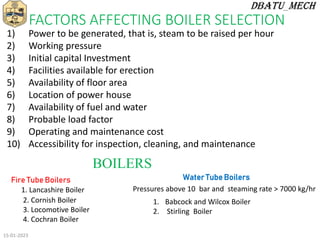
FACTORS AFFECTING BOILER SELECTION
1) Power to be generated, that is, steam to be raised per hour
2) Working pressure
3) Initial capital Investment
4) Facilities available for erection
5) Availability of floor area
6) Location of power house
7) Availability of fuel and water
8) Probable load factor
9) Operating and maintenance cost
10) Accessibility for inspection, cleaning, and maintenance
BOILERS
Fire Tube Boilers
1. Lancashire Boiler
2. Cornish Boiler
3. Locomotive Boiler
4. Cochran Boiler
Water Tube Boilers
Pressures above 10 bar and steaming rate > 7000 kg/hr
1. Babcock and Wilcox Boiler
2. Stirling Boiler
15-01-2023
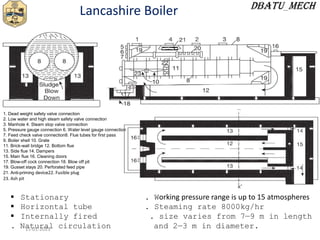
Lancashire Boiler
1. Dead weight safety valve connection
2. Low water and high steam safety valve connection
3. Manhole 4. Steam stop valve connection
5. Pressure gauge connection 6. Water level gauge connection
7. Feed check valve connection8. Flue tubes for first pass
9. Boiler shell 10. Grate
11. Brick-wall bridge 12. Bottom flue
13. Side flue 14. Dampers
15. Main flue 16. Cleaning doors
17. Blow-off cock connection 18. Blow off pit
19. Gusset stays 20. Perforated feed pipe
21. Anti-priming device22. Fusible plug
23. Ash pit
 Stationary . Working pressure range is up to 15 atmospheres
 Horizontal tube . Steaming rate 8000kg/hr
 Internally fired . size varies from 7—9 m in length
. Natural circulation and 2—3 m in diameter.
15-01-2023
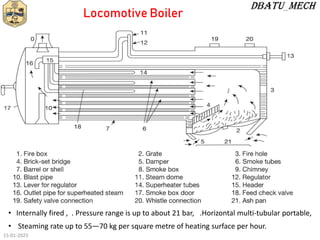
• Internally fired , . Pressure range is up to about 21 bar, .Horizontal multi-tubular portable,
• Steaming rate up to 55—70 kg per square metre of heating surface per hour.
Locomotive Boiler
15-01-2023
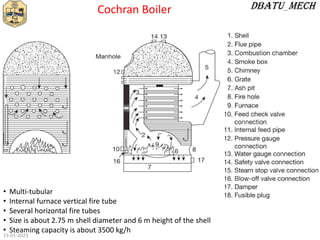
• Multi-tubular
• Internal furnace vertical fire tube
• Several horizontal fire tubes
• Size is about 2.75 m shell diameter and 6 m height of the shell
• Steaming capacity is about 3500 kg/h
Cochran Boiler
15-01-2023
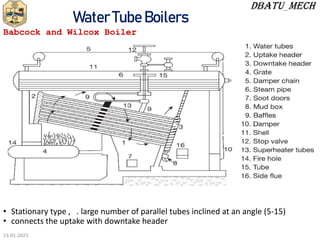
Water Tube Boilers
• Stationary type , . large number of parallel tubes inclined at an angle (5-15)
• connects the uptake with downtake header
Babcock and Wilcox Boiler
15-01-2023
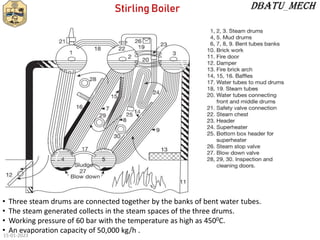
Stirling Boiler
• Three steam drums are connected together by the banks of bent water tubes.
• The steam generated collects in the steam spaces of the three drums.
• Working pressure of 60 bar with the temperature as high as 4500C.
• An evaporation capacity of 50,000 kg/h .
15-01-2023
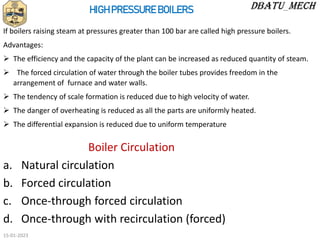
Boiler Circulation
a. Natural circulation
b. Forced circulation
c. Once-through forced circulation
d. Once-through with recirculation (forced)
HIGH PRESSURE BOILERS
If boilers raising steam at pressures greater than 100 bar are called high pressure boilers.
Advantages:
 The efficiency and the capacity of the plant can be increased as reduced quantity of steam.
 The forced circulation of water through the boiler tubes provides freedom in the
arrangement of furnace and water walls.
 The tendency of scale formation is reduced due to high velocity of water.
 The danger of overheating is reduced as all the parts are uniformly heated.
 The differential expansion is reduced due to uniform temperature
15-01-2023
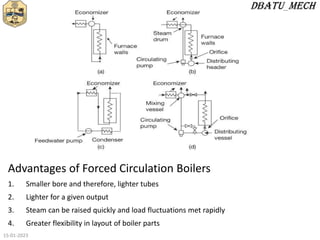
Advantages of Forced Circulation Boilers
1. Smaller bore and therefore, lighter tubes
2. Lighter for a given output
3. Steam can be raised quickly and load fluctuations met rapidly
4. Greater flexibility in layout of boiler parts
15-01-2023
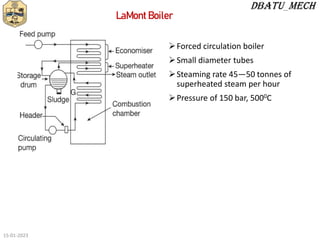
Forced circulation boiler
Small diameter tubes
Steaming rate 45—50 tonnes of
superheated steam per hour
Pressure of 150 bar, 5000C
LaMont Boiler
15-01-2023
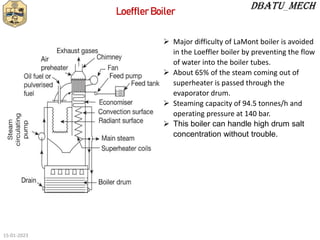
Loeffler Boiler
 Major difficulty of LaMont boiler is avoided
in the Loeffler boiler by preventing the flow
of water into the boiler tubes.
 About 65% of the steam coming out of
superheater is passed through the
evaporator drum.
 Steaming capacity of 94.5 tonnes/h and
operating pressure at 140 bar.
 This boiler can handle high drum salt
concentration without trouble.
15-01-2023
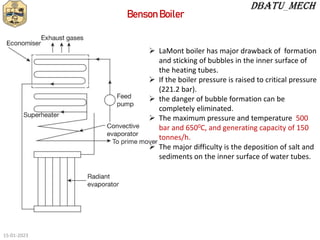
 LaMont boiler has major drawback of formation
and sticking of bubbles in the inner surface of
the heating tubes.
 If the boiler pressure is raised to critical pressure
(221.2 bar).
 the danger of bubble formation can be
completely eliminated.
 The maximum pressure and temperature 500
bar and 6500C, and generating capacity of 150
tonnes/h.
 The major difficulty is the deposition of salt and
sediments on the inner surface of water tubes.
Benson Boiler
15-01-2023
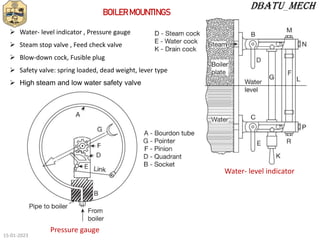
BOILERMOUNTINGS
 Water- level indicator , Pressure gauge
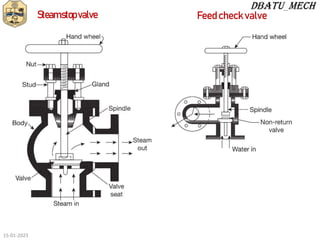
 Steam stop valve , Feed check valve
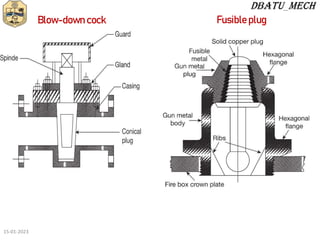
 Blow-down cock, Fusible plug
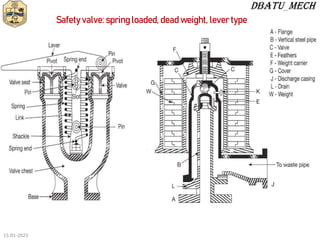
 Safety valve: spring loaded, dead weight, lever type
 High steam and low water safety valve
Water- level indicator
Pressure gauge
15-01-2023
Steamstopvalve Feedcheckvalve
15-01-2023
Blow-down cock Fusible plug
15-01-2023
Safety valve: spring loaded, dead weight, lever type
15-01-2023
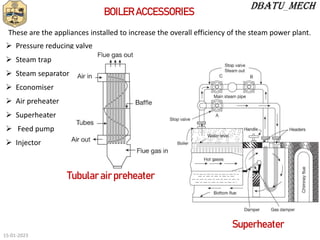
BOILER ACCESSORIES
 Pressure reducing valve
 Steam trap
 Steam separator
 Economiser
 Air preheater
 Superheater
 Feed pump
 Injector
These are the appliances installed to increase the overall efficiency of the steam power plant.
Tubular air preheater
Superheater
15-01-2023
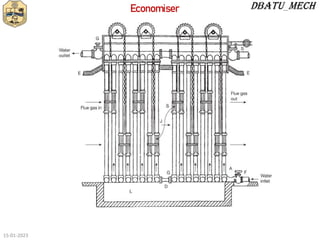
Economiser
15-01-2023
15-01-2023
PERFORMANCE OF STEAM GENERATOR
 Evaporation Rate: The quantity of water evaporated into steam per hour.
It expressed as > kg of steam/h
> kg of steam/h/m2 of heating surface
> kg of steam/h/m3 of furnace volume
> kg of steam/kg of fuel fired
 Equivalent Evaporation : The evaporation of 1kg of water at 1000C to steam at 1000C. It
requires 2257 kJ.
 Factor of Evaporation: The ratio of actual heat absorption above feed-water
temperature for transformation to steam (wet, dry, or superheated) to the latent heat
of steam at atmospheric pressure (l .01325 bar ).
h = specific enthalpy of steam actually produced
hf = specific enthalpy of feed water
hf(atm)= specific enthalpy of evaporation at standard atmospheric
pressure
ms = actual evaporation expressed in kg/kg of fuel or kg/h of
steam
15-01-2023
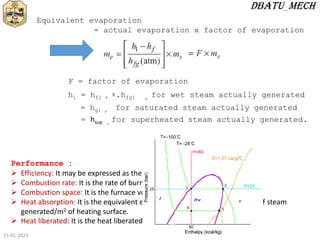
Equivalent evaporation
= actual evaporation x factor of evaporation
h1 = hf1 + ᵡ.hfg1 , for wet steam actually generated
F = factor of evaporation
= hg1 , for saturated steam actually generated
= hsup , for superheated steam actually generated.
Performance :
 Efficiency: It may be expressed as the ratio of heat output to heat input.
 Combustion rate: It is the rate of burning of fuel in kg/m3 of grate area/h.
 Combustion space: It is the furnace volume in m3/kg of fuel fired/h.
 Heat absorption: It is the equivalent evaporation from and at 1000C in kg of steam
generated/m2 of heating surface.
 Heat liberated: It is the heat liberated/m3 of furnace volume/h.
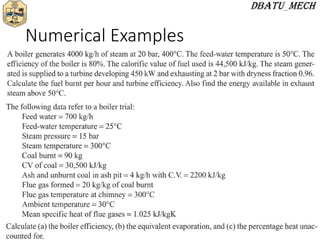
Numerical Examples
15-01-2023
15-01-2023

Unit-II- Steam Generators.pptx

  • 1.
    1. Water Tube& Fire Tube 2. Natural and forced convection 3. Horizontal, vertical and inclined 4. Single/multiple tube 5. Stationary/mobile 6. Externally / internally fired 7. Source of fuel 15-01-2023
  • 2.
  • 3.
    FACTORS AFFECTING BOILERSELECTION 1) Power to be generated, that is, steam to be raised per hour 2) Working pressure 3) Initial capital Investment 4) Facilities available for erection 5) Availability of floor area 6) Location of power house 7) Availability of fuel and water 8) Probable load factor 9) Operating and maintenance cost 10) Accessibility for inspection, cleaning, and maintenance BOILERS Fire Tube Boilers 1. Lancashire Boiler 2. Cornish Boiler 3. Locomotive Boiler 4. Cochran Boiler Water Tube Boilers Pressures above 10 bar and steaming rate > 7000 kg/hr 1. Babcock and Wilcox Boiler 2. Stirling Boiler 15-01-2023
  • 4.
    Lancashire Boiler 1. Deadweight safety valve connection 2. Low water and high steam safety valve connection 3. Manhole 4. Steam stop valve connection 5. Pressure gauge connection 6. Water level gauge connection 7. Feed check valve connection8. Flue tubes for first pass 9. Boiler shell 10. Grate 11. Brick-wall bridge 12. Bottom flue 13. Side flue 14. Dampers 15. Main flue 16. Cleaning doors 17. Blow-off cock connection 18. Blow off pit 19. Gusset stays 20. Perforated feed pipe 21. Anti-priming device22. Fusible plug 23. Ash pit  Stationary . Working pressure range is up to 15 atmospheres  Horizontal tube . Steaming rate 8000kg/hr  Internally fired . size varies from 7—9 m in length . Natural circulation and 2—3 m in diameter. 15-01-2023
  • 5.
    • Internally fired, . Pressure range is up to about 21 bar, .Horizontal multi-tubular portable, • Steaming rate up to 55—70 kg per square metre of heating surface per hour. Locomotive Boiler 15-01-2023
  • 6.
    • Multi-tubular • Internalfurnace vertical fire tube • Several horizontal fire tubes • Size is about 2.75 m shell diameter and 6 m height of the shell • Steaming capacity is about 3500 kg/h Cochran Boiler 15-01-2023
  • 7.
    Water Tube Boilers •Stationary type , . large number of parallel tubes inclined at an angle (5-15) • connects the uptake with downtake header Babcock and Wilcox Boiler 15-01-2023
  • 8.
    Stirling Boiler • Threesteam drums are connected together by the banks of bent water tubes. • The steam generated collects in the steam spaces of the three drums. • Working pressure of 60 bar with the temperature as high as 4500C. • An evaporation capacity of 50,000 kg/h . 15-01-2023
  • 9.
    Boiler Circulation a. Naturalcirculation b. Forced circulation c. Once-through forced circulation d. Once-through with recirculation (forced) HIGH PRESSURE BOILERS If boilers raising steam at pressures greater than 100 bar are called high pressure boilers. Advantages:  The efficiency and the capacity of the plant can be increased as reduced quantity of steam.  The forced circulation of water through the boiler tubes provides freedom in the arrangement of furnace and water walls.  The tendency of scale formation is reduced due to high velocity of water.  The danger of overheating is reduced as all the parts are uniformly heated.  The differential expansion is reduced due to uniform temperature 15-01-2023
  • 10.
    Advantages of ForcedCirculation Boilers 1. Smaller bore and therefore, lighter tubes 2. Lighter for a given output 3. Steam can be raised quickly and load fluctuations met rapidly 4. Greater flexibility in layout of boiler parts 15-01-2023
  • 11.
    Forced circulation boiler Smalldiameter tubes Steaming rate 45—50 tonnes of superheated steam per hour Pressure of 150 bar, 5000C LaMont Boiler 15-01-2023
  • 12.
    Loeffler Boiler  Majordifficulty of LaMont boiler is avoided in the Loeffler boiler by preventing the flow of water into the boiler tubes.  About 65% of the steam coming out of superheater is passed through the evaporator drum.  Steaming capacity of 94.5 tonnes/h and operating pressure at 140 bar.  This boiler can handle high drum salt concentration without trouble. 15-01-2023
  • 13.
     LaMont boilerhas major drawback of formation and sticking of bubbles in the inner surface of the heating tubes.  If the boiler pressure is raised to critical pressure (221.2 bar).  the danger of bubble formation can be completely eliminated.  The maximum pressure and temperature 500 bar and 6500C, and generating capacity of 150 tonnes/h.  The major difficulty is the deposition of salt and sediments on the inner surface of water tubes. Benson Boiler 15-01-2023
  • 14.
    BOILERMOUNTINGS  Water- levelindicator , Pressure gauge  Steam stop valve , Feed check valve  Blow-down cock, Fusible plug  Safety valve: spring loaded, dead weight, lever type  High steam and low water safety valve Water- level indicator Pressure gauge 15-01-2023
  • 15.
  • 16.
    Blow-down cock Fusibleplug 15-01-2023
  • 17.
    Safety valve: springloaded, dead weight, lever type 15-01-2023
  • 18.
    BOILER ACCESSORIES  Pressurereducing valve  Steam trap  Steam separator  Economiser  Air preheater  Superheater  Feed pump  Injector These are the appliances installed to increase the overall efficiency of the steam power plant. Tubular air preheater Superheater 15-01-2023
  • 19.
  • 20.
    15-01-2023 PERFORMANCE OF STEAMGENERATOR  Evaporation Rate: The quantity of water evaporated into steam per hour. It expressed as > kg of steam/h > kg of steam/h/m2 of heating surface > kg of steam/h/m2 of heating surface > kg of steam/h/m3 of furnace volume > kg of steam/kg of fuel fired  Equivalent Evaporation : The evaporation of 1kg of water at 1000C to steam at 1000C. It requires 2257 kJ.  Factor of Evaporation: The ratio of actual heat absorption above feed-water temperature for transformation to steam (wet, dry, or superheated) to the latent heat of steam at atmospheric pressure (l .01325 bar ). h = specific enthalpy of steam actually produced hf = specific enthalpy of feed water hf(atm)= specific enthalpy of evaporation at standard atmospheric pressure ms = actual evaporation expressed in kg/kg of fuel or kg/h of steam
  • 21.
    15-01-2023 Equivalent evaporation = actualevaporation x factor of evaporation h1 = hf1 + ᵡ.hfg1 , for wet steam actually generated F = factor of evaporation = hg1 , for saturated steam actually generated = hsup , for superheated steam actually generated. Performance :  Efficiency: It may be expressed as the ratio of heat output to heat input.  Combustion rate: It is the rate of burning of fuel in kg/m3 of grate area/h.  Combustion space: It is the furnace volume in m3/kg of fuel fired/h.  Heat absorption: It is the equivalent evaporation from and at 1000C in kg of steam generated/m2 of heating surface.  Heat liberated: It is the heat liberated/m3 of furnace volume/h.
  • 22.
  • 23.