A. Designing andManaging Customer Value
What Is a Product?
Anything that can be offered to a market for attention,
acquisition, use, or consumption that might satisfy a want or
need. This includes physical objects, services, places,
organizations, and ideas.
Planned vs. Unplanned Components:
o Planned: The intended offering (e.g., a hotel room, a meal).
o Unplanned: Unexpected elements (e.g., a dead roach in a
menu) that highlight the importance of meticulous service
delivery, especially in hospitality where experiences are often
heterogeneous.
Creating Experiences: In today's commoditized market,
companies differentiate by creating and managing customer
experiences with their brands (e.g., Marriott's Moxy and Edition,
Starwood's W, Aloft, Element).
4.
B. Product Levels(The Four Levels)
Hospitality managers must consider products on four levels to
build customer value:
Core Product:
The most basic level; answers "What is the buyer really buying?"
It's the fundamental problem-solving service or benefit.
Examples: For a hotel, it's a "good night's sleep"; for a casino
resort, "entertainment"; for a holiday, "cultural enrichment" or
"safe adventure." Marketers sell benefits, not just features.
Facilitating Products:
Definition: Services or goods that must be present for the guest to
use the core product. Without them, the core product cannot
be consumed.
Examples: For a hotel: check-in/checkout, business center,
restaurant, valet service. For an economy hotel, it might only be
check-in/checkout. These depend on the target market's
requirements.
5.
Product: Product Levels(The Four Levels)
Supporting Products:
Extra products offered to add value to the core product and help
differentiate it from the competition. They are not essential for the
core product's use.
Examples: In-room iPad, full-service health spa, bathroom amenities
Key Consideration: Must be properly planned and implemented to
meet or exceed expectations; unprofessional delivery can harm
image. Successful supporting products should be hard for
competitors to match.
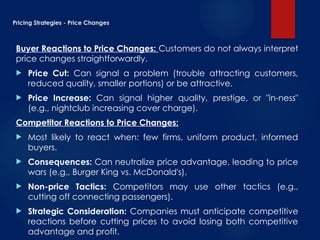
Augmented Product:
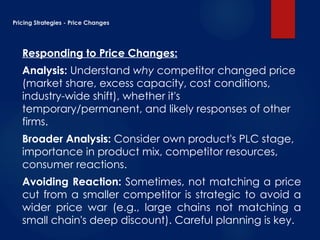
Encompasses aspects related to how the core, facilitating, and
supporting products are delivered and experienced. It includes
accessibility, atmosphere, customer interaction with the service
organization, customer participation, and customers' interaction
with each other. This is crucial as hospitality services often involve
customer coproduction and interaction with the service delivery
system.
6.
Product: Product Levels(The Four Levels)
Elements of the Augmented Product:
Accessibility: How easily the product can be accessed
(location, hours of operation). Barriers like inconvenient
hours or lack of knowledge reduce value. Example: 24-
hour checkout policy.
Atmosphere (The Physical Environment): A critical element,
appreciated through the senses (visual, aural, olfactory,
tactile). It sets expectations, creates messages, affects
purchase behavior (attention, message, effect, mood),
and can be a reason for choice. Example: Casa Bonita's
experiential design, Aloft's "social lobby" vibe, Starbucks'
consistent scent setting taste expectations.
Customer Interaction with the Service Delivery System:
How customers engage with the service (employees,
physical facilities).
7.
Product: Product Levels(The Four Levels)
Customer Interaction with the Service Delivery System: This involves 3 phases:
Joining Stage: Initial inquiry/contact. Must be easy to learn about the
product (e.g., separate cash registers for take-out orders).
Consumption Phase: When the service is being used (e.g., dining in a
restaurant, staying in a hotel). Employees, other customers, and facilities
are all part of the product experience.
Detachment Phase: When the customer is done and departs (e.g.,
checking out, needing assistance with luggage). Smooth, efficient
departure processes are vital.
Customer Interaction with Other Customers: Managing how customers
interact to prevent negative experiences (e.g., mixing business travelers
with noisy families, managing different cultural groups at a resort,
snowboarders vs. skiers). Hotels often design spaces or use separate
properties to manage this.
Customers as Employees (Coproduction): Involving guests in service
delivery to increase capacity, improve satisfaction, and reduce costs
(e.g., self-service check-in kiosks, self-service drink dispensers, tabletop
ordering screens).
8.
C. Product Differentiationand Positioning
Differentiation: Creating unique aspects for a product that set it
apart from competitors.
Positioning: Establishing a clear place for the product in the minds
of target consumers relative to competing products.
Levels of Positioning:
Attributes: Least desirable, easily copied (e.g., "uses only
Angus beef").
Benefits: Better, as customers care about what attributes do
for them (e.g., "great wine, food, and service").
Beliefs and Values: Strongest, engaging customers on an
emotional level (e.g., Amtrak's "journey begins" experience,
Las Vegas's "adult freedom").
Brand Promise: The marketer’s vision of what the brand must be
and do for consumers; it must be simple and honest (e.g., Motel 6:
clean rooms, low prices; Ritz-Carlton: luxury, memorable
experience).
9.
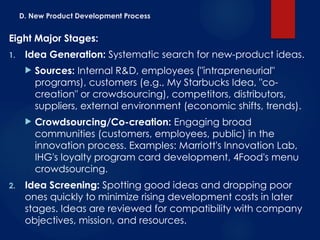
D. New ProductDevelopment Process
Eight Major Stages:
1. Idea Generation: Systematic search for new-product ideas.
Sources: Internal R&D, employees ("intrapreneurial"
programs), customers (e.g., My Starbucks Idea, "co-
creation" or crowdsourcing), competitors, distributors,
suppliers, external environment (economic shifts, trends).
Crowdsourcing/Co-creation: Engaging broad
communities (customers, employees, public) in the
innovation process. Examples: Marriott's Innovation Lab,
IHG's loyalty program card development, 4Food's menu
crowdsourcing.
2. Idea Screening: Spotting good ideas and dropping poor
ones quickly to minimize rising development costs in later
stages. Ideas are reviewed for compatibility with company
objectives, mission, and resources.
10.
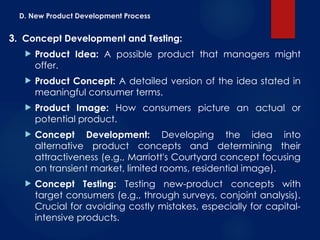
D. New ProductDevelopment Process
3. Concept Development and Testing:
Product Idea: A possible product that managers might
offer.
Product Concept: A detailed version of the idea stated in
meaningful consumer terms.
Product Image: How consumers picture an actual or
potential product.
Concept Development: Developing the idea into
alternative product concepts and determining their
attractiveness (e.g., Marriott's Courtyard concept focusing
on transient market, limited rooms, residential image).
Concept Testing: Testing new-product concepts with
target consumers (e.g., through surveys, conjoint analysis).
Crucial for avoiding costly mistakes, especially for capital-
intensive products.
11.
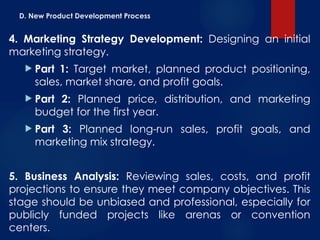
D. New ProductDevelopment Process
4. Marketing Strategy Development: Designing an initial
marketing strategy.
Part 1: Target market, planned product positioning,
sales, market share, and profit goals.
Part 2: Planned price, distribution, and marketing
budget for the first year.
Part 3: Planned long-run sales, profit goals, and
marketing mix strategy.
5. Business Analysis: Reviewing sales, costs, and profit
projections to ensure they meet company objectives. This
stage should be unbiased and professional, especially for
publicly funded projects like arenas or convention
centers.
12.
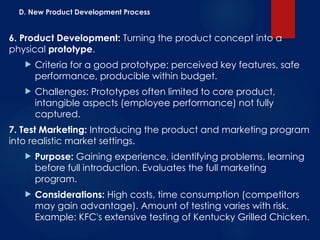
D. New ProductDevelopment Process
6. Product Development: Turning the product concept into a
physical prototype.
Criteria for a good prototype: perceived key features, safe
performance, producible within budget.
Challenges: Prototypes often limited to core product,
intangible aspects (employee performance) not fully
captured.
7. Test Marketing: Introducing the product and marketing program
into realistic market settings.
Purpose: Gaining experience, identifying problems, learning
before full introduction. Evaluates the full marketing
program.
Considerations: High costs, time consumption (competitors
may gain advantage). Amount of testing varies with risk.
Example: KFC's extensive testing of Kentucky Grilled Chicken.
13.
D. New ProductDevelopment Process
8. Commercialization: Launching the new product into the
marketplace. Involves high costs (e.g., advertising blitz).
Key Decisions:
When? Is it the right time (e.g., high test market
occupancy)?
Where? Single location, region, national, or
international (planned rollout).
To Whom? Targeting prime prospect groups (early
adopters, heavy users, opinion leaders).
How? Developing an action plan and marketing mix
spending.
14.
E. Product LifeCycle (PLC)
The PLC describes the stages a product typically passes
through, influencing its marketing strategy.
Product Development Stage:
Characteristics: Begins when a company finds and
develops a new-product idea.
Sales/Profits: Sales are zero; investment costs
accumulate.
Introduction Stage:
Characteristics: Slow sales growth as the product is new
to the market. Few competitors. Prices tend to be high.
Sales/Profits: Profits are negative/low due to heavy
introduction expenses (e.g., high promotion spending to
inform and encourage trial).
Strategy: Focus on pioneers/early adopters.
15.
E. Product LifeCycle (PLC)
Growth Stage:
Characteristics: Rapid market acceptance and increasing
sales/profits. Early adopters continue to buy, later buyers follow.
Competitors enter, expanding the market with new features.
Sales/Profits: Sales climb quickly; profits increase as costs spread over
larger volume.
Strategy: Improve quality, add features/models, enter new segments,
shift advertising to conviction/purchase, potentially lower prices
slightly to attract more buyers. Trade-off: market share vs. current
profit.
Maturity Stage:
Characteristics: Sales growth slows or levels off. Achieved
acceptance by most potential buyers. Supply exceeds demand,
leading to increased competition, price battles, and heavy
advertising. Weaker competitors exit.
Sales/Profits: Sales peak then level off or decline; profits level off or
decline due to increased marketing outlays.
16.
E. Product LifeCycle (PLC)
Strategy (To extend life):
Market Modification: Look for new users, new
market segments, or ways to increase usage
among present customers (e.g., McDonald's
adding breakfast/salads). Repositioning the
brand.
Product Modification: Change product
characteristics (quality, features, style) to attract
new users/stimulate usage (e.g., Wendy's
remodels, McDonald's custom burger program).
Marketing Mix Modification: Change one or more
marketing mix elements (e.g., cut prices, new
advertising campaign, new/improved services,
complete rebranding like The Linq Hotel).
17.
E. Product LifeCycle (PLC)
Decline Stage:
Characteristics: Sales fall off quickly; profits drop. Caused by technological
advances, shifts in consumer tastes, increased competition.
Sales/Profits: Sales decline, can plunge to zero or a low level. Profits are low.
Strategy: Manage aging products carefully. Decide whether to:
Maintain: Continue product, possibly with reduced costs.
Harvest: Reduce various costs (e.g., marketing, R&D) to increase short-
run profits (milking the brand).
Drop (Deletion): Remove the product.
o Phase-out: Orderly removal (e.g., replace menu item on next
revision). Ideal.
o Run-out: Deplete existing stock when sales are low and costs exceed
revenues.
o Immediate Drop: When product causes harm or significant
complaints.
Challenges in Hospitality: Contracts, sentimental attachments, community
impact, difficulty finding buyers for properties.
18.
F. Managing Brandsand Brand Equity
Brand: A name, term, sign, symbol, design, or combination identifying
goods/services and differentiating them from competitors. Brands are seen
as major enduring assets.
Branding: The process of endowing products/services with the power of a
brand, creating differences between products.
1. Brand Equity: The added value endowed on products and services.
Reflected in how consumers think, feel, and act toward the brand, and its
prices, market share, and profitability.
o Positive Brand Equity: Consumers react more favourably than to an
unbranded version.
o Dimensions (Young & Rubicam's Brand Asset Valuator): Differentiation,
Relevance, Knowledge, Esteem. Strong brands rate high on all four.
o Competitive Advantages of High Brand Equity: High awareness/loyalty,
bargaining leverage, easier launch of line/brand extensions, defense
against price competition.
o Customer Equity: The fundamental asset underlying brand equity; the
value of customer relationships the brand creates. Focus of marketing
should be building customer equity.
19.
F. Managing Brandsand Brand Equity
2. Brand Name Selection:
Desirable Qualities:
Suggests benefits/qualities (Luxury Collection, Sleep Inn).
Easy to pronounce, recognize, remember (Motel 6, Four
Seasons).
Distinctive (Aloft, Moxy).
Extendable (Marriott).
Translates easily into foreign languages.
Capable of registration and legal protection.
20.
F. Managing Brandsand Brand Equity
3. Branding Strategies:
o Individual Brand Names: Different names for different products; shields
company reputation if a product fails (e.g., Starwood, Choice Hotels).
o Corporate Umbrella (Family) or Sub-branding: Using the corporate
brand across products or combining corporate/family names with
individual product names (e.g., Courtyard by Marriott, AC Hotels by
Marriott). Marriott's shift to leverage corporate brand with individual
concept names like Moxy.
o Leveraging Brands:
o Co-branding (Dual Branding): Combining complementary strengths
of two brands (e.g., Tim Hortons-Cold Stone Creamery, Taco Bell-
Doritos, Nobu Hotel at Caesars Palace). Enhances credibility,
generates sales, reduces introduction costs.
o Ingredient Branding: Using well-known brands as components within
a product (e.g., hotels using specific amenity brands). Special case:
self-branded ingredients (e.g., Westin's "Heavenly Bed").
21.
F. Managing Brandsand Brand Equity
Brand Portfolios: The set of all brands in a particular
category/market segment. Needed to target multiple
segments.
Goal: Maximize market coverage while minimizing
brand overlap/cannibalization. Each brand should
be differentiated and appeal to a sizable
segment.
Management: Periodically audit
strengths/weaknesses, drop unprofitable brands,
rebrand/reposition as needed.
22.
F. Managing Brandsand Brand Equity
4. Managing Brands:
Continuous Communication: Brand positioning must be
continuously communicated through advertising and all
customer touch points.
Customer Experience: Brands are maintained by actual
customer experiences across all touch points (personal
experience, word-of-mouth, social media, company
websites). "Managing each customer's experience is perhaps
the most important ingredient in building loyalty."
Internal Brand Building: Training employees to understand
and be enthusiastic about the brand promise.
Brand Audits: Periodically assess brand strengths/weaknesses,
positioning, touch point support, and management
understanding. Identify brands needing more support,
dropping, rebranding, or repositioning.
A. Meaning andSignificance of Price
Price: The amount of money charged for a good or service;
more broadly, the sum of values consumers exchange for the
benefits of having or using the product/service.
Significance:
The only marketing mix element that produces revenue (all
others are costs).
Often seen as the #1 problem facing marketing
executives.
Least understood, yet controllable in unregulated markets.
Common mistakes: cost-oriented pricing, not revising
prices, not considering full marketing mix, insufficient
variation for different segments.
Crucial for profitability and long-term survival.
25.
B. Factors InfluencingPricing Decisions
Pricing decisions are influenced by internal and external factors.
Internal Factors:
a. Marketing Objectives:
o Survival: Used during slumps/recessions to cover variable costs
and create cash flow (e.g., hotels cutting rates during recession).
o Current Profit Maximization: Setting prices to maximize immediate
profit, cash flow, or ROI, often for short-term gains or proving
concept viability.
o Market-Share Leadership: Setting low prices to gain dominant
share, believing this leads to lower costs and high long-run profit
(e.g., Marriott's aggressive opening rates).
o Product-Quality Leadership: Charging high prices to support a
luxury position and continuous reinvestment in quality (e.g., Ritz-
Carlton, Groen equipment).
o Other Objectives: Preventing competition, stabilizing markets,
creating excitement for new products, drawing customers.
26.
B. Factors InfluencingPricing Decisions
b. Marketing Mix Strategy: Price must be coordinated with product
design, distribution, and promotion. Decisions in other areas impact
pricing (e.g., high wholesaler discounts require built-in margin; future
renovations require price coverage).
c. Costs: Set the floor for pricing. Companies aim to cover
production, distribution, promotion costs, and provide a fair ROI.
Fixed Costs (Overhead): Do not vary with production/sales level
(e.g., rent, salaries).
Variable Costs: Vary directly with production level (e.g., food
ingredients, linen per guest).
Total Costs: Sum of fixed and variable costs.
Customer Perception: Customers are not concerned with
operating costs; they seek value. Companies must manage costs
to remain competitive.
Cost Subsidization: Partners (e.g., ski resorts, towns) may subsidize
costs (e.g., airline revenue guarantees) to ensure availability of a
product (e.g., flights).
27.
B. Factors InfluencingPricing Decisions
d. Organizational Considerations: Who sets
prices.
Small companies: Top management.
Large hospitality companies: Revenue
management departments, under corporate
guidelines, coordinating with other departments.
Revenue Management: Forecasting demand to
optimize profit by adjusting price; aims to maximize
yield/contribution margin. Highly profitable when
done professionally.
28.
B. Factors InfluencingPricing Decisions
External Factors:
a. Market and Demand: Set the upper limit for prices. Marketers must
understand the price-demand relationship.
o Demand Curve: Illustrates the inverse relationship between price
and demand (higher price, lower demand). For prestige goods,
can slope upward at certain price points (higher price, more
demand due to perceived luxury).
o Price Elasticity of Demand: How responsive demand is to a
change in price.
Inelastic Demand: Demand hardly varies with a small price
change (product unique, high quality/prestige/exclusiveness,
hard-to-find substitutes). Less elastic means higher prices may
be charged.
Elastic Demand: Demand changes greatly with a small price
change. Lowering prices may increase total revenue if extra
costs don't exceed extra revenue.
29.
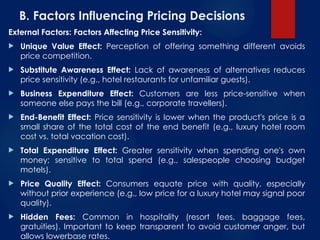
B. Factors InfluencingPricing Decisions
External Factors: Factors Affecting Price Sensitivity:
Unique Value Effect: Perception of offering something different avoids
price competition.
Substitute Awareness Effect: Lack of awareness of alternatives reduces
price sensitivity (e.g., hotel restaurants for unfamiliar guests).
Business Expenditure Effect: Customers are less price-sensitive when
someone else pays the bill (e.g., corporate travellers).
End-Benefit Effect: Price sensitivity is lower when the product's price is a
small share of the total cost of the end benefit (e.g., luxury hotel room
cost vs. total vacation cost).
Total Expenditure Effect: Greater sensitivity when spending one's own
money; sensitive to total spend (e.g., salespeople choosing budget
motels).
Price Quality Effect: Consumers equate price with quality, especially
without prior experience (e.g., low price for a luxury hotel may signal poor
quality).
Hidden Fees: Common in hospitality (resort fees, baggage fees,
gratuities). Important to keep transparent to avoid customer anger, but
allows lowerbase rates.
30.
B. Factors InfluencingPricing Decisions
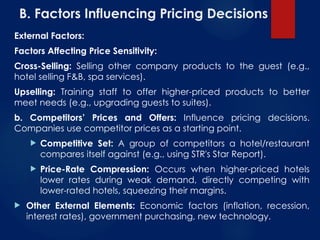
External Factors:
Factors Affecting Price Sensitivity:
Cross-Selling: Selling other company products to the guest (e.g.,
hotel selling F&B, spa services).
Upselling: Training staff to offer higher-priced products to better
meet needs (e.g., upgrading guests to suites).
b. Competitors’ Prices and Offers: Influence pricing decisions.
Companies use competitor prices as a starting point.
Competitive Set: A group of competitors a hotel/restaurant
compares itself against (e.g., using STR's Star Report).
Price-Rate Compression: Occurs when higher-priced hotels
lower rates during weak demand, directly competing with
lower-rated hotels, squeezing their margins.
Other External Elements: Economic factors (inflation, recession,
interest rates), government purchasing, new technology.
31.
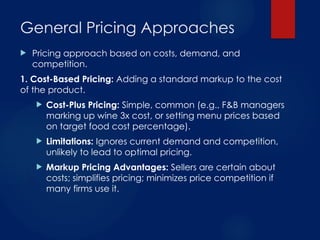
General Pricing Approaches
Pricing approach based on costs, demand, and
competition.
1. Cost-Based Pricing: Adding a standard markup to the cost
of the product.
Cost-Plus Pricing: Simple, common (e.g., F&B managers
marking up wine 3x cost, or setting menu prices based
on target food cost percentage).
Limitations: Ignores current demand and competition,
unlikely to lead to optimal pricing.
Markup Pricing Advantages: Sellers are certain about
costs; simplifies pricing; minimizes price competition if
many firms use it.
32.
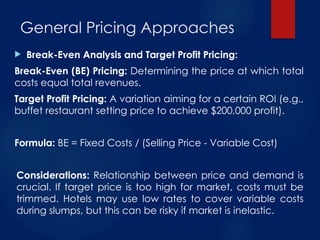
Break-Even Analysisand Target Profit Pricing:
Break-Even (BE) Pricing: Determining the price at which total
costs equal total revenues.
Target Profit Pricing: A variation aiming for a certain ROI (e.g.,
buffet restaurant setting price to achieve $200,000 profit).
Formula: BE = Fixed Costs / (Selling Price - Variable Cost)
Considerations: Relationship between price and demand is
crucial. If target price is too high for market, costs must be
trimmed. Hotels may use low rates to cover variable costs
during slumps, but this can be risky if market is inelastic.
General Pricing Approaches
33.
General Pricing Approaches
2.Value-Based Pricing
Uses buyers' perceptions of value, not seller's cost, as the key to
pricing. Price is considered before the marketing program is set.
Approach: Build perceived value through non-price marketing
mix variables, then set price to match. Requires understanding
how much buyers would pay for benefits.
Application: Companies offer different product features at
different prices for varying segments (e.g., McDonald's vs. fine-
dining hamburger). Successful value pricing offers right
quality/service at a fair price.
Price Mix: Hotels develop a mix of customers (business, corporate
group, association) at different rates to achieve target average
rates. Business travelers - inelastic, leisure - elastic.
34.
General Pricing
Approaches
3. Competition-BasedPricing (Going-Rate Pricing):
Setting price based largely on competitors' prices, with less
attention to costs or demand. Firm might charge same, more,
or less than competitors, often maintaining a consistent
difference.
Popular, especially in markets with clear competitive sets.
NOTE: Pricing strategies often change throughout the product life
cycle.
35.
Pricing Strategies
1. New-ProductPricing Strategies (for introductory
stage):
Prestige Pricing: Setting a high price to establish a
luxurious and elegant position (e.g., high-end hotels,
exclusive nightclubs). Lowering price would damage
position.
Price Skimming: Setting a high initial price to "skim"
maximum revenue from price-insensitive segments
(e.g., motel in a remote hunting area with high
demand. Ex-Kruger). Effective short-term, but attracts
competition easily in hospitality.
Market-Penetration Pricing: Setting a low initial price to
penetrate the market quickly and deeply, attracting
many buyers and winning a large market share (e.g.,
36.
Pricing Strategies
2. Existing-ProductPricing Strategies:
a. Product-Bundle Pricing: Combining several
products and offering the bundle at a reduced price
(e.g., hotel weekend packages with room, meals,
entertainment; cruise line fly-cruise packages).
Benefits:
Captures different customer "reservation prices" for
components, transferring surplus from one to
another.
Hides core product price, avoiding price wars or
perception of low quality (e.g., hotels selling deeply
discounted rooms to airlines for bundles).
Dynamic Packaging: Buyers create custom
packages (flights, lodging, car rental) on a single
37.
Pricing Strategies
b. Price-AdjustmentStrategies: Adjusting basic prices for customer
differences or changing situations.
Volume Discounts: Special rates for customers purchasing large quantities
(e.g., MICEw).
Discounts Based on Time of Purchase (Seasonal Discounts): Price
reductions for off-season purchases or non-peak times/days (e.g., airline
off-peak prices, hotel weekend packages, early-bird restaurant specials).
Discriminatory Pricing: Selling product/service at two or more prices,
where price difference is not based on cost difference, but on price
elasticity of different segments. Legally targets price-sensitive customers
without lowering prices for others.
Mechanism: Using "fences" (restrictions) to allow self-selection (e.g.,
advance purchase, minimum stay requirements for airline
supersaver fares; weekend packages for business hotels).
Criteria for Success: Different price responses from segments,
identifiable segments, no arbitrage, segment size, cost-
effectiveness of strategy, no customer confusion.
38.
Pricing Strategies -RevenueManagement
Revenue Management - A systematic application of
discriminatory pricing to maximize a hospitality company's yield or
contribution margin by managing revenue and inventory based
on demand elasticity for selected customer segments.
Key Metrics: RevPAR (Revenue Per Available Room), GopPAR
(Gross Operating Profit Per Available Room), RevPASH
(Revenue Per Available Seat Hour).
Process: Projects occupancy, opens/closes rate classes based
on demand (lower rates for low occupancy, higher for high).
Benefits: Increased revenue/profit, better utilization of
capacity.
Challenges: Requires good data/forecasting, potential for
customer perception of unfairness (if not transparent), risk of
losing long-term customer relationships if solely short-term
focused.
39.
Pricing Strategies -RevenueManagement
Dynamic Pricing: Continuously adjusts prices
based on real-time demand and capacity
(e.g., Uber's surge pricing, airline/hotel daily
rate adjustments). Differs from discriminatory
pricing by not always having "fences" but
often used together.
BAR Pricing (Best Available Rate): Charges
different rates for each night of a multi-night
stay, determined by revenue management.
Often includes price guarantees.
Rate Parity: Agreement where hotels ensure
prices offered by OTAs are not lower than the
hotel's own BAR for public rates.
40.
Pricing Strategies
3. PsychologicalPricing: Considers the psychology of
prices beyond economics.
Price-Quality Effect: Consumers equate price with
quality, especially without prior experience (high price
= high quality/prestige).
Reference Prices: Prices buyers carry in their minds for
products (formed by current/past prices, buying
situation). Companies may use "loss leaders" or
strategically price certain items to establish a low
reference price.
Price Endings: Impact of numerical endings (e.g., $X.99
vs. $X.00). Odd endings (e.g., $X.95) often signal value,
while round endings ($X.00, $X.50) signal quality.
A loss leader is a pricing strategy where a company temporarily prices a product below its cost or
normal markup to attract customers, with the expectation that these customers will then purchase
41.
Pricing Strategies
4. PromotionalPricing: Temporarily pricing products below list
price or even below cost.
Forms: Loss leaders (attract customers for other
purchases), special promotional rates for slow
periods, bundles for special events (e.g.,
Valentine's package).
Purpose: Increase immediate business, create
positive image (compared to straight
discounting).
Opaque Pricing: Form of promotional pricing
(e.g., Priceline, Hotwire) where supplier name is
not revealed until booking is complete, offering
attractive prices.
42.
Pricing Strategies
ValuePricing (Everyday Low Prices - EDLP)
Offering a price permanently below competitors, differing from
temporary promotional pricing.
Risks: Can start price wars, requires significant cost cutting or
productivity increases to sustain profitability.
Suitability: Best for companies with inherently low costs or those
aiming for strong market share/niche position.
43.
Pricing Strategies -Price Changes
Companies may cut or raise prices, affecting
buyers, competitors, distributors, suppliers, and
potentially government.
Initiating Price Cuts:
Reasons: Excess capacity, inability to increase
business through other means, drive to dominate
market/increase share through lower costs.
Consequences: Can lead to price wars, especially
in industries with excess capacity. Often increases
occupancy but decreases RevPAR in mature
markets. Exceptions: casino hotels (non-room
expenditures offset).
44.
Pricing Strategies -Price Changes
Initiating Price Increases:
Reasons: Cost inflation (to maintain profit margins), excess
demand (company cannot meet all customer needs).
Consequences: May be resented by customers/channel
members. Can significantly increase profits if sales volume
is unaffected.
Hospitality Specifics: Price increases can be dangerous
due to demand elasticity. Business travel can be
postponed or replaced by electronic means.
Strategy: Best when customers perceive justification (e.g.,
raw material cost increase, minimum wage increase).
Support with communication programs.
45.
Pricing Strategies -Price Changes
Buyer Reactions to Price Changes: Customers do not always interpret
price changes straightforwardly.
Price Cut: Can signal a problem (trouble attracting customers,
reduced quality, smaller portions) or be attractive.
Price Increase: Can signal higher quality, prestige, or "in-ness"
(e.g., nightclub increasing cover charge).
Competitor Reactions to Price Changes:
Most likely to react when: few firms, uniform product, informed
buyers.
Consequences: Can neutralize price advantage, leading to price
wars (e.g., Burger King vs. McDonald's).
Non-price Tactics: Competitors may use other tactics (e.g.,
cutting off connecting passengers).
Strategic Consideration: Companies must anticipate competitive
reactions before cutting prices to avoid losing both competitive
advantage and profit.
46.
Pricing Strategies -Price Changes
Responding to Price Changes:
Analysis: Understand why competitor changed price
(market share, excess capacity, cost conditions,
industry-wide shift), whether it's
temporary/permanent, and likely responses of other
firms.
Broader Analysis: Consider own product's PLC stage,
importance in product mix, competitor resources,
consumer reactions.
Avoiding Reaction: Sometimes, not matching a price
cut from a smaller competitor is strategic to avoid a
wider price war (e.g., large chains not matching a
small chain's deep discount). Careful planning is key.
#40 A loss leader is a pricing strategy where a company temporarily prices a product below its cost or normal markup to attract customers, with the expectation that these customers will then purchase other, more profitable items.
Example: A donut shop selling coffee at a very low price to encourage customers to also buy donuts.
#41 A loss leader is a pricing strategy where a company temporarily prices a product below its cost or normal markup to attract customers, with the expectation that these customers will then purchase other, more profitable items.
Example: A donut shop selling coffee at a very low price to encourage customers to also buy donuts.
#42 A loss leader is a pricing strategy where a company temporarily prices a product below its cost or normal markup to attract customers, with the expectation that these customers will then purchase other, more profitable items.
Example: A donut shop selling coffee at a very low price to encourage customers to also buy donuts.
#43 A loss leader is a pricing strategy where a company temporarily prices a product below its cost or normal markup to attract customers, with the expectation that these customers will then purchase other, more profitable items.
Example: A donut shop selling coffee at a very low price to encourage customers to also buy donuts.
#44 A loss leader is a pricing strategy where a company temporarily prices a product below its cost or normal markup to attract customers, with the expectation that these customers will then purchase other, more profitable items.
Example: A donut shop selling coffee at a very low price to encourage customers to also buy donuts.
#45 A loss leader is a pricing strategy where a company temporarily prices a product below its cost or normal markup to attract customers, with the expectation that these customers will then purchase other, more profitable items.
Example: A donut shop selling coffee at a very low price to encourage customers to also buy donuts.
#46 A loss leader is a pricing strategy where a company temporarily prices a product below its cost or normal markup to attract customers, with the expectation that these customers will then purchase other, more profitable items.
Example: A donut shop selling coffee at a very low price to encourage customers to also buy donuts.





![MARKETING FOR HOSPITALITY AND TOURISM [Autosaved].pptx](https://cdn.slidesharecdn.com/ss_thumbnails/marketingforhospitalityandtourismautosaved-250326043929-506b351c-thumbnail.jpg?width=640&height=640&fit=bounds)


