Maxwell’s Equations
© Oxford University Press 2015. All rights reserved.
© Oxford University Press 2015. All rights
reserved.
Outline
© Oxford University Press 2015. All rights reserved.
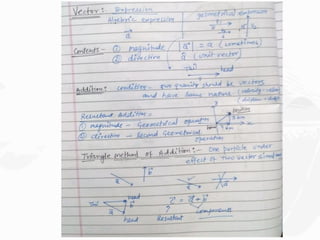
• Scalars and vectors
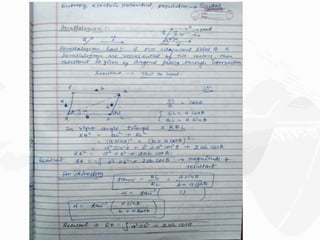
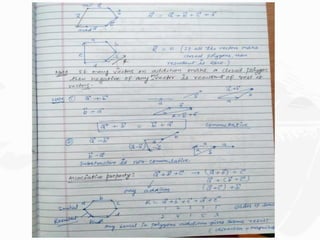
• Vector addition and subtraction
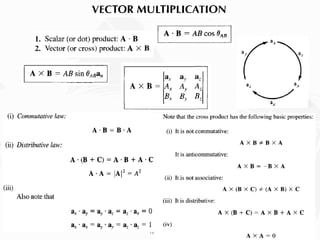
• Vector Product
• Faraday’s law
• Transformer and motional electromotive forces
• Displacement current
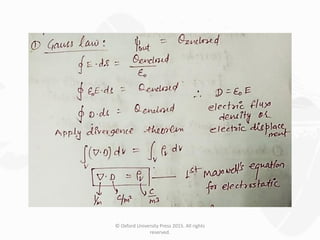
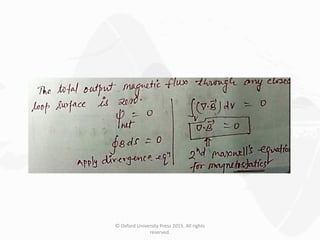
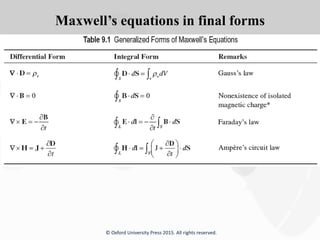
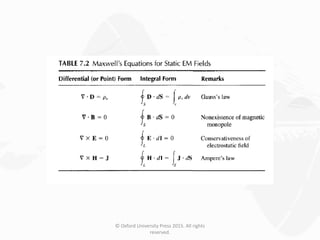
• Maxwell’s equations in final forms
• Time-varying potentials
© Oxford University Press 2015. All rights
reserved.
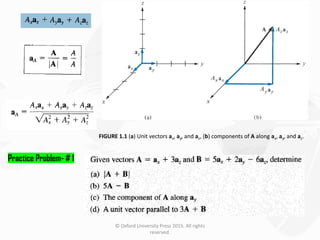
FIGURE 1.1 (a) Unit vectors ax, ay, and az, (b) components of A along ax, ay, and az.
Practice Problem- # 1
© Oxford University Press 2015. All rights
reserved.
© Oxford University Press 2015. All rights
reserved.
© Oxford University Press 2015. All rights
reserved.
© Oxford University Press 2015. All rights
reserved.
© Oxford University Press 2015. All rights
reserved.
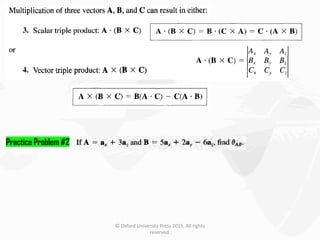
Practice Problem #2
© Oxford University Press 2015. All rights
reserved.
© Oxford University Press 2015. All rights
reserved.
© Oxford University Press 2015. All rights
reserved.
© Oxford University Press 2015. All rights
reserved.
© Oxford University Press 2015. All rights
reserved.
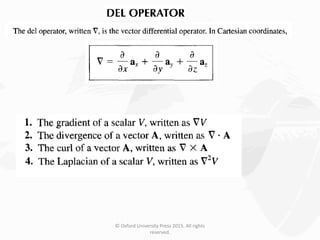
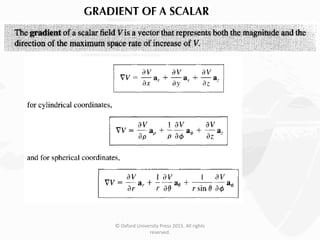
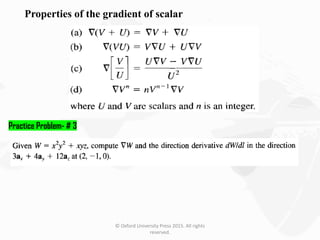
Properties of the gradient of scalar
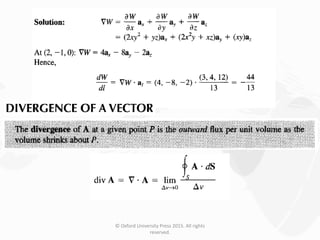
Practice Problem- # 3
© Oxford University Press 2015. All rights
reserved.
© Oxford University Press 2015. All rights
reserved.
© Oxford University Press 2015. All rights
reserved.
© Oxford University Press 2015. All rights
reserved.
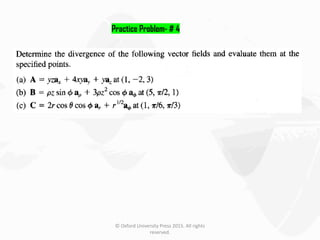
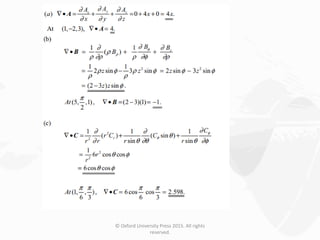
Practice Problem- # 4
© Oxford University Press 2015. All rights
reserved.
© Oxford University Press 2015. All rights
reserved.
© Oxford University Press 2015. All rights
reserved.
© Oxford University Press 2015. All rights
reserved.
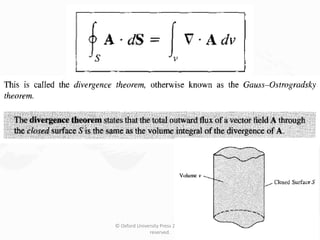
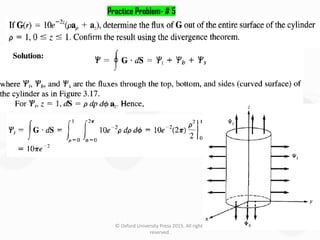
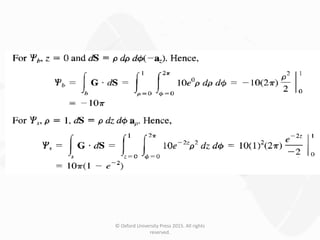
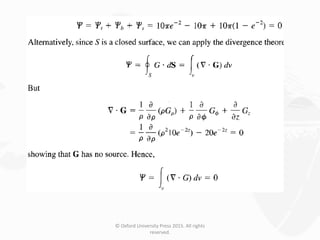
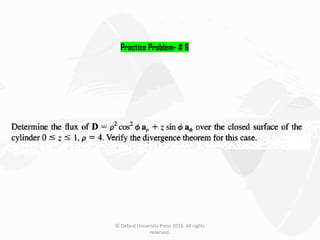
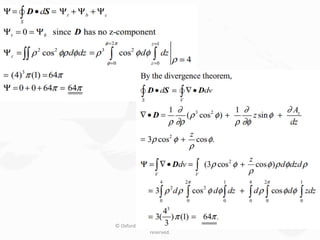
Practice Problem- # 5
© Oxford University Press 2015. All rights
reserved.
© Oxford University Press 2015. All rights
reserved.
© Oxford University Press 2015. All rights
reserved.
Practice Problem- # 6
© Oxford University Press 2015. All rights
reserved.
© Oxford University Press 2015. All rights
reserved.
© Oxford University Press 2015. All rights
reserved.
© Oxford University Press 2015. All rights
reserved.
© Oxford University Press 2015. All rights
reserved.
© Oxford University Press 2015. All rights
reserved.
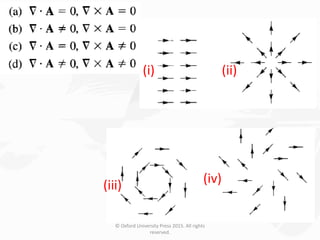
(i) (ii)
(iii) (iv)
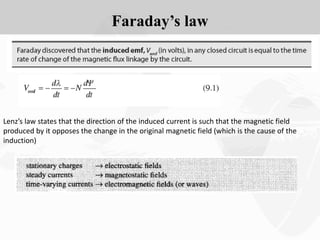
Faraday’s law
Lenz’s law states that the direction of the induced current is such that the magnetic field
produced by it opposes the change in the original magnetic field (which is the cause of the
induction)
Transformer and motional electromotive forces
© Oxford University Press 2015. All rights reserved.
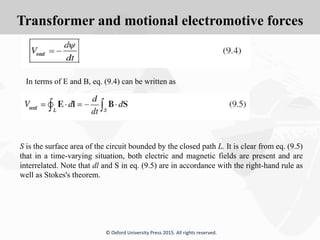
In terms of E and B, eq. (9.4) can be written as
S is the surface area of the circuit bounded by the closed path L. It is clear from eq. (9.5)
that in a time-varying situation, both electric and magnetic fields are present and are
interrelated. Note that dl and S in eq. (9.5) are in accordance with the right-hand rule as
well as Stokes's theorem.
© Oxford University Press 2015. All rights
reserved.
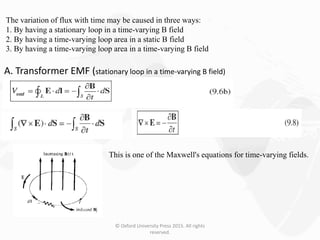
The variation of flux with time may be caused in three ways:
1. By having a stationary loop in a time-varying B field
2. By having a time-varying loop area in a static B field
3. By having a time-varying loop area in a time-varying B field
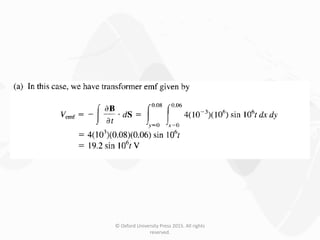
A. Transformer EMF (stationary loop in a time-varying B field)
This is one of the Maxwell's equations for time-varying fields.
Transformer and motional electromotive forces
© Oxford University Press 2015. All rights reserved.
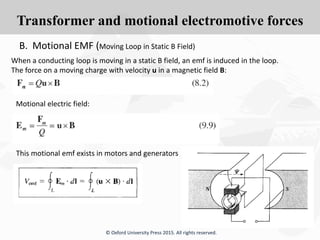
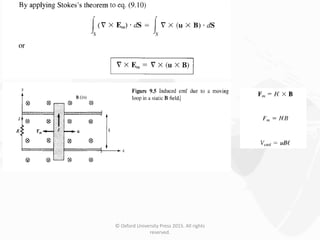
B. Motional EMF (Moving Loop in Static B Field)
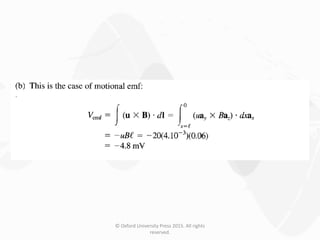
When a conducting loop is moving in a static B field, an emf is induced in the loop.
The force on a moving charge with velocity u in a magnetic field B:
Motional electric field:
This motional emf exists in motors and generators
© Oxford University Press 2015. All rights
reserved.
Transformer and motional electromotive forces
© Oxford University Press 2015. All rights reserved.
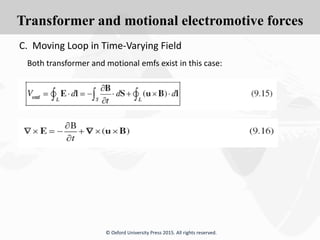
C. Moving Loop in Time-Varying Field
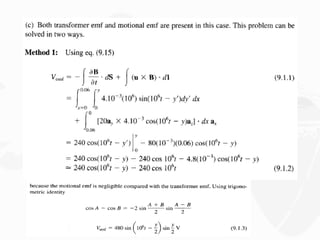
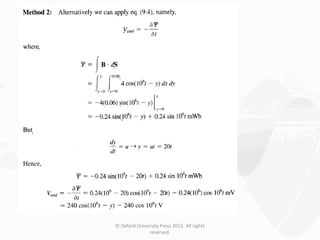
Both transformer and motional emfs exist in this case:
© Oxford University Press 2015. All rights
reserved.
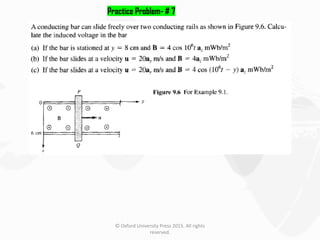
Practice Problem- # 7
© Oxford University Press 2015. All rights
reserved.
© Oxford University Press 2015. All rights
reserved.
© Oxford University Press 2015. All rights
reserved.
© Oxford University Press 2015. All rights
reserved.
© Oxford University Press 2015. All rights
reserved.
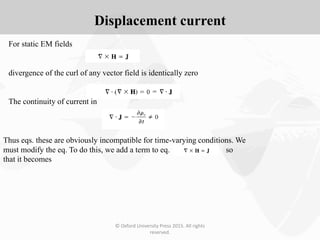
Displacement current
For static EM fields
divergence of the curl of any vector field is identically zero
The continuity of current in
Thus eqs. these are obviously incompatible for time-varying conditions. We
must modify the eq. To do this, we add a term to eq. so
that it becomes
© Oxford University Press 2015. All rights
reserved.
© Oxford University Press 2015. All rights
reserved.
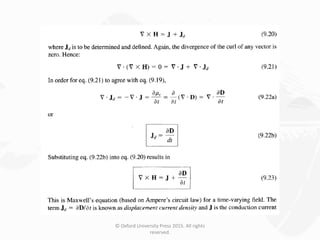
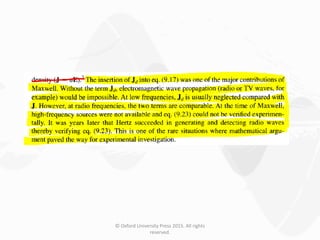
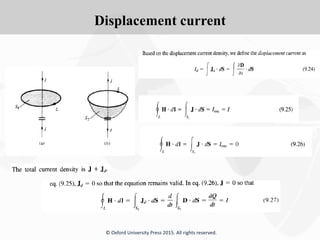
Displacement current
© Oxford University Press 2015. All rights reserved.
© Oxford University Press 2015. All rights
reserved.
© Oxford University Press 2015. All rights
reserved.
Maxwell’s equations in final forms
© Oxford University Press 2015. All rights reserved.
© Oxford University Press 2015. All rights
reserved.
Boundary conditions
© Oxford University Press 2015. All rights reserved.
If the field exists in a region consisting of two different media, the conditions that
the field must satisfy at the interface separating the media are called boundary
conditions.
These conditions are helpful in determining the field on one side of the boundary if
the field on the other side is known.
Obviously, the conditions will be dictated by the types of material the media are
made of. We shall consider the boundary conditions at an interface separating
• dielectric (er1) and dielectric (er2)
• conductor and dielectric
• conductor and free space
© Oxford University Press 2015. All rights
reserved.
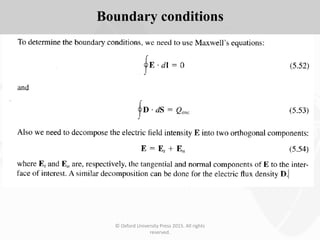
Boundary conditions
© Oxford University Press 2015. All rights
reserved.
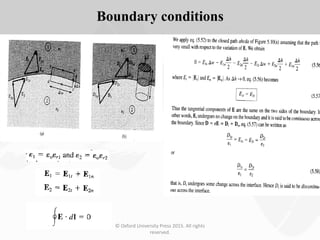
Boundary conditions
© Oxford University Press 2015. All rights
reserved.
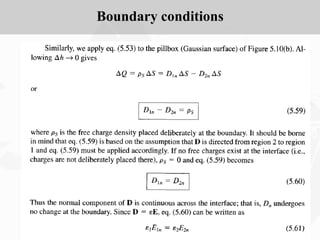
Boundary conditions
© Oxford University Press 2015. All rights
reserved.
Boundary conditions
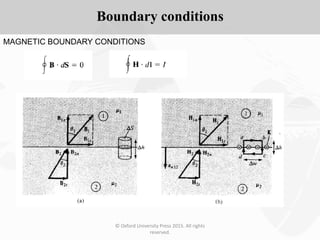
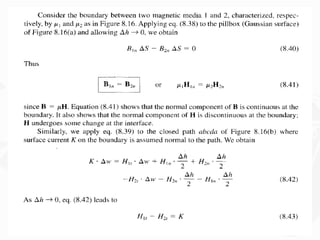
MAGNETIC BOUNDARY CONDITIONS
© Oxford University Press 2015. All rights
reserved.
© Oxford University Press 2015. All rights
reserved.
Coordinate systems
© Oxford University Press 2015. All rights
reserved.
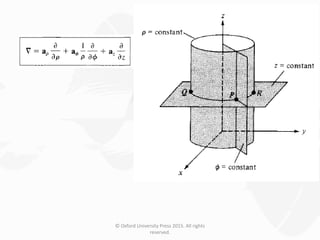
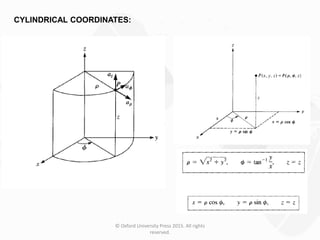
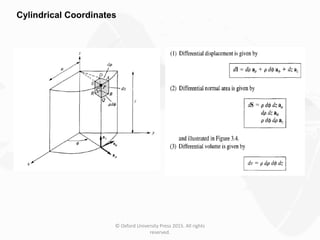
CYLINDRICAL COORDINATES:
© Oxford University Press 2015. All rights
reserved.
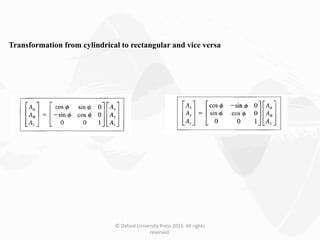
Transformation from cylindrical to rectangular and vice versa
© Oxford University Press 2015. All rights
reserved.
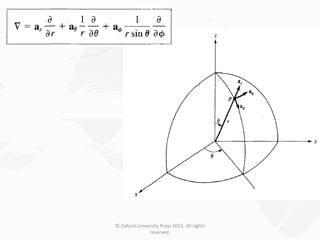
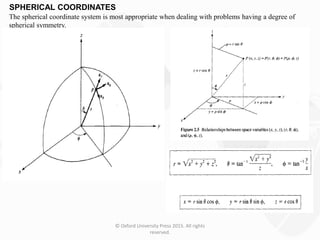
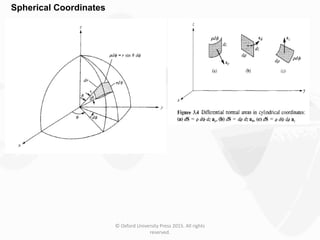
SPHERICAL COORDINATES
The spherical coordinate system is most appropriate when dealing with problems having a degree of
spherical symmetry.
© Oxford University Press 2015. All rights
reserved.
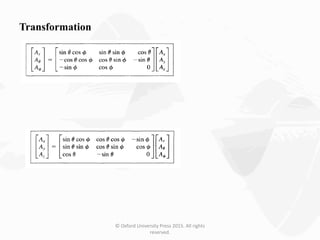
Transformation
© Oxford University Press 2015. All rights
reserved.
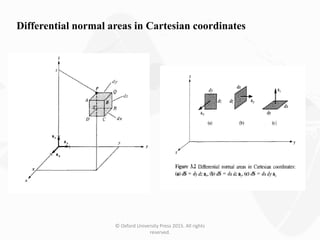
Differential normal areas in Cartesian coordinates
© Oxford University Press 2015. All rights
reserved.
Cylindrical Coordinates
© Oxford University Press 2015. All rights
reserved.
Spherical Coordinates

unit2_maxwell_equation.pdf

  • 1.
    Maxwell’s Equations © OxfordUniversity Press 2015. All rights reserved.
  • 2.
    © Oxford UniversityPress 2015. All rights reserved.
  • 3.
    Outline © Oxford UniversityPress 2015. All rights reserved. • Scalars and vectors • Vector addition and subtraction • Vector Product • Faraday’s law • Transformer and motional electromotive forces • Displacement current • Maxwell’s equations in final forms • Time-varying potentials
  • 4.
    © Oxford UniversityPress 2015. All rights reserved. FIGURE 1.1 (a) Unit vectors ax, ay, and az, (b) components of A along ax, ay, and az. Practice Problem- # 1
  • 5.
    © Oxford UniversityPress 2015. All rights reserved.
  • 6.
    © Oxford UniversityPress 2015. All rights reserved.
  • 7.
    © Oxford UniversityPress 2015. All rights reserved.
  • 8.
    © Oxford UniversityPress 2015. All rights reserved.
  • 9.
    © Oxford UniversityPress 2015. All rights reserved. Practice Problem #2
  • 10.
    © Oxford UniversityPress 2015. All rights reserved.
  • 11.
    © Oxford UniversityPress 2015. All rights reserved.
  • 12.
    © Oxford UniversityPress 2015. All rights reserved.
  • 13.
    © Oxford UniversityPress 2015. All rights reserved.
  • 14.
    © Oxford UniversityPress 2015. All rights reserved. Properties of the gradient of scalar Practice Problem- # 3
  • 15.
    © Oxford UniversityPress 2015. All rights reserved.
  • 16.
    © Oxford UniversityPress 2015. All rights reserved.
  • 17.
    © Oxford UniversityPress 2015. All rights reserved.
  • 18.
    © Oxford UniversityPress 2015. All rights reserved. Practice Problem- # 4
  • 19.
    © Oxford UniversityPress 2015. All rights reserved.
  • 20.
    © Oxford UniversityPress 2015. All rights reserved.
  • 21.
    © Oxford UniversityPress 2015. All rights reserved.
  • 22.
    © Oxford UniversityPress 2015. All rights reserved. Practice Problem- # 5
  • 23.
    © Oxford UniversityPress 2015. All rights reserved.
  • 24.
    © Oxford UniversityPress 2015. All rights reserved.
  • 25.
    © Oxford UniversityPress 2015. All rights reserved. Practice Problem- # 6
  • 26.
    © Oxford UniversityPress 2015. All rights reserved.
  • 27.
    © Oxford UniversityPress 2015. All rights reserved.
  • 28.
    © Oxford UniversityPress 2015. All rights reserved.
  • 29.
    © Oxford UniversityPress 2015. All rights reserved.
  • 30.
    © Oxford UniversityPress 2015. All rights reserved.
  • 31.
    © Oxford UniversityPress 2015. All rights reserved. (i) (ii) (iii) (iv)
  • 32.
    Faraday’s law Lenz’s lawstates that the direction of the induced current is such that the magnetic field produced by it opposes the change in the original magnetic field (which is the cause of the induction)
  • 33.
    Transformer and motionalelectromotive forces © Oxford University Press 2015. All rights reserved. In terms of E and B, eq. (9.4) can be written as S is the surface area of the circuit bounded by the closed path L. It is clear from eq. (9.5) that in a time-varying situation, both electric and magnetic fields are present and are interrelated. Note that dl and S in eq. (9.5) are in accordance with the right-hand rule as well as Stokes's theorem.
  • 34.
    © Oxford UniversityPress 2015. All rights reserved. The variation of flux with time may be caused in three ways: 1. By having a stationary loop in a time-varying B field 2. By having a time-varying loop area in a static B field 3. By having a time-varying loop area in a time-varying B field A. Transformer EMF (stationary loop in a time-varying B field) This is one of the Maxwell's equations for time-varying fields.
  • 35.
    Transformer and motionalelectromotive forces © Oxford University Press 2015. All rights reserved. B. Motional EMF (Moving Loop in Static B Field) When a conducting loop is moving in a static B field, an emf is induced in the loop. The force on a moving charge with velocity u in a magnetic field B: Motional electric field: This motional emf exists in motors and generators
  • 36.
    © Oxford UniversityPress 2015. All rights reserved.
  • 37.
    Transformer and motionalelectromotive forces © Oxford University Press 2015. All rights reserved. C. Moving Loop in Time-Varying Field Both transformer and motional emfs exist in this case:
  • 38.
    © Oxford UniversityPress 2015. All rights reserved. Practice Problem- # 7
  • 39.
    © Oxford UniversityPress 2015. All rights reserved.
  • 40.
    © Oxford UniversityPress 2015. All rights reserved.
  • 41.
    © Oxford UniversityPress 2015. All rights reserved.
  • 42.
    © Oxford UniversityPress 2015. All rights reserved.
  • 43.
    © Oxford UniversityPress 2015. All rights reserved. Displacement current For static EM fields divergence of the curl of any vector field is identically zero The continuity of current in Thus eqs. these are obviously incompatible for time-varying conditions. We must modify the eq. To do this, we add a term to eq. so that it becomes
  • 44.
    © Oxford UniversityPress 2015. All rights reserved.
  • 45.
    © Oxford UniversityPress 2015. All rights reserved.
  • 46.
    Displacement current © OxfordUniversity Press 2015. All rights reserved.
  • 47.
    © Oxford UniversityPress 2015. All rights reserved.
  • 48.
    © Oxford UniversityPress 2015. All rights reserved.
  • 49.
    Maxwell’s equations infinal forms © Oxford University Press 2015. All rights reserved.
  • 50.
    © Oxford UniversityPress 2015. All rights reserved.
  • 51.
    Boundary conditions © OxfordUniversity Press 2015. All rights reserved. If the field exists in a region consisting of two different media, the conditions that the field must satisfy at the interface separating the media are called boundary conditions. These conditions are helpful in determining the field on one side of the boundary if the field on the other side is known. Obviously, the conditions will be dictated by the types of material the media are made of. We shall consider the boundary conditions at an interface separating • dielectric (er1) and dielectric (er2) • conductor and dielectric • conductor and free space
  • 52.
    © Oxford UniversityPress 2015. All rights reserved. Boundary conditions
  • 53.
    © Oxford UniversityPress 2015. All rights reserved. Boundary conditions
  • 54.
    © Oxford UniversityPress 2015. All rights reserved. Boundary conditions
  • 55.
    © Oxford UniversityPress 2015. All rights reserved. Boundary conditions MAGNETIC BOUNDARY CONDITIONS
  • 56.
    © Oxford UniversityPress 2015. All rights reserved.
  • 57.
    © Oxford UniversityPress 2015. All rights reserved. Coordinate systems
  • 58.
    © Oxford UniversityPress 2015. All rights reserved. CYLINDRICAL COORDINATES:
  • 59.
    © Oxford UniversityPress 2015. All rights reserved. Transformation from cylindrical to rectangular and vice versa
  • 60.
    © Oxford UniversityPress 2015. All rights reserved. SPHERICAL COORDINATES The spherical coordinate system is most appropriate when dealing with problems having a degree of spherical symmetry.
  • 61.
    © Oxford UniversityPress 2015. All rights reserved. Transformation
  • 62.
    © Oxford UniversityPress 2015. All rights reserved. Differential normal areas in Cartesian coordinates
  • 63.
    © Oxford UniversityPress 2015. All rights reserved. Cylindrical Coordinates
  • 64.
    © Oxford UniversityPress 2015. All rights reserved. Spherical Coordinates