Bus
I/O device 1I/O device n
Processor Memory
•Multiple I/O devices may be connected to the processor and the memory via a bus.
•Bus consists of three sets of lines to carry address, data and control signals.
•Each I/O device is assigned an unique address.
•To access an I/O device, the processor places the address on the address lines.
•The device recognizes the address, and responds to the control signals.
4.
I/O
interface
decoder
Address Data and
statusregisters
Control
circuits
Input device
Bus
Address lines
Data lines
Control lines
•I/O device is connected to the bus using an I/O interface circuit which has:
- Address decoder, control circuit, and data and status registers.
•Address decoder decodes the address placed on the address lines thus enabling the
device to recognize its address.
•Data register holds the data being transferred to or from the processor.
•Status register holds information necessary for the operation of the I/O device.
•Data and status registers are connected to the data lines, and have unique addresses.
•I/O interface circuit coordinates I/O transfers.
5.
5
Accessing I/O devices(contd..)
I/O devices and the memory may share the same address
space:
Memory-mapped I/O.
Any machine instruction that can access memory can be used to transfer
data to or from an I/O device.
Simpler software.
I/O devices and the memory may have different address
spaces:
Special instructions to transfer data to and from I/O devices.
I/O devices may have to deal with fewer address lines.
I/O address lines need not be physically separate from memory address
lines.
In fact, address lines may be shared between I/O devices and memory, with
a control signal to indicate whether it is a memory address or an I/O address.
7.
Accessing I/O devices(contd..)
Recall that the rate of transfer to and from I/O
devices is slower than the speed of the processor.
This creates the need for mechanisms to
synchronize data transfers between them.
Program-controlled I/O:
Processor repeatedly monitors a status flag to achieve the necessary
synchronization.
Processor polls the I/O device.
Two other mechanisms used for synchronizing
data transfers between the processor and memory:
Interrupts.
Direct Memory Access.
9.
Interrupts
In program-controlledI/O, when the processor
continuously monitors the status of the device, it
does not perform any useful tasks.
An alternate approach would be for the I/O device
to alert the processor when it becomes ready.
Do so by sending a hardware signal called an interrupt to the
processor.
At least one of the bus control lines, called an interrupt-request line is
dedicated for this purpose.
Processor can perform other useful tasks while it
is waiting for the device to be ready.
10.
Interrupt Service routine
Program1
here
Interrupt
occurs
M
i
2
1
i 1
+
•Processor is executing the instruction located at address i when an interrupt occurs.
•Routine executed in response to an interrupt request is called the interrupt-service routine.
•When an interrupt occurs, control must be transferred to the interrupt service routine.
•But before transferring control, the current contents of the PC (i+1), must be saved in a known
location.
•This will enable the return-from-interrupt instruction to resume execution at i+1.
•Return address, or the contents of the PC are usually stored on the processor stack.
11.
Interrupts (contd..)
Treatmentof an interrupt-service routine is very
similar to that of a subroutine.
However there are significant differences:
A subroutine performs a task that is required by the calling program.
Interrupt-service routine may not have anything in common with the
program it interrupts.
Interrupt-service routine and the program that it interrupts may
belong to different users.
As a result, before branching to the interrupt-service routine, not
only the PC, but other information such as condition code flags, and
processor registers used by both the interrupted program and the
interrupt service routine must be stored.
This will enable the interrupted program to resume execution upon
return from interrupt service routine.
12.
Interrupts (contd..)
Savingand restoring information can be done
automatically by the processor or explicitly by program
instructions.
Saving and restoring registers involves memory
transfers:
Increases the total execution time.
Increases the delay between the time an interrupt request is received, and
the start of execution of the interrupt-service routine. This delay is called
interrupt latency.
In order to reduce the interrupt latency, most processors
save only the minimal amount of information:
This minimal amount of information includes Program Counter and
processor status registers.
Any additional information that must be saved, must be
saved explicitly by the program instructions at the
beginning of the interrupt service routine.
13.
Interrupts (contd..)
Whena processor receives an interrupt-request,
it must branch to the interrupt service routine.
It must also inform the device that it has
recognized the interrupt request.
This can be accomplished in two ways:
Some processors have an explicit interrupt-acknowledge control
signal for this purpose.
In other cases, the data transfer that takes place between the device
and the processor can be used to inform the device.
14.
Interrupts (contd..)
Interrupt-requestsinterrupt the execution of a
program, and may alter the intended sequence of
events:
Sometimes such alterations may be undesirable, and must not be
allowed.
For example, the processor may not want to be interrupted by the same
device while executing its interrupt-service routine.
Processors generally provide the ability to enable and
disable such interruptions as desired.
One simple way is to provide machine instructions
such as Interrupt-enable and Interrupt-disable for this
purpose.
To avoid interruption by the same device during the
execution of an interrupt service routine:
First instruction of an interrupt service routine can be Interrupt-disable.
Last instruction of an interrupt service routine can be Interrupt-enable.
15.
Interrupts (contd..)
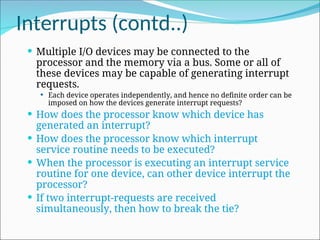
MultipleI/O devices may be connected to the
processor and the memory via a bus. Some or all of
these devices may be capable of generating interrupt
requests.
Each device operates independently, and hence no definite order can be
imposed on how the devices generate interrupt requests?
How does the processor know which device has
generated an interrupt?
How does the processor know which interrupt
service routine needs to be executed?
When the processor is executing an interrupt service
routine for one device, can other device interrupt the
processor?
If two interrupt-requests are received
simultaneously, then how to break the tie?
16.
Interrupts (contd..)
Considera simple arrangement where all devices send
their interrupt-requests over a single control line in the
bus.
When the processor receives an interrupt request over
this control line, how does it know which device is
requesting an interrupt?
This information is available in the status register of the
device requesting an interrupt:
The status register of each device has an IRQ bit which it sets to 1 when it
requests an interrupt.
Interrupt service routine can poll the I/O devices
connected to the bus. The first device with IRQ equal to 1
is the one that is serviced.
Polling mechanism is easy, but time consuming to query
the status bits of all the I/O devices connected to the bus.
17.
Interrupts (contd..)
Thedevice requesting an interrupt may identify
itself directly to the processor.
Device can do so by sending a special code (4 to 8 bits) the
processor over the bus.
Code supplied by the device may represent a part of the starting
address of the interrupt-service routine.
The remainder of the starting address is obtained by the processor
based on other information such as the range of memory addresses
where interrupt service routines are located.
Usually the location pointed to by the
interrupting device is used to store the starting
address of the interrupt-service routine.
18.
Interrupts (contd..)
MultipleI/O devices may be connected to the
processor and the memory via a bus. Some or all of
these devices may be capable of generating interrupt
requests.
Each device operates independently, and hence no definite order can be
imposed on how the devices generate interrupt requests?
How does the processor know which device has
generated an interrupt?
How does the processor know which interrupt
service routine needs to be executed?
When the processor is executing an interrupt service
routine for one device, can other device interrupt the
processor?
If two interrupt-requests are received
simultaneously, then how to break the tie?
19.
Interrupts (contd..)
Considera simple arrangement where all devices send
their interrupt-requests over a single control line in the
bus.
When the processor receives an interrupt request over
this control line, how does it know which device is
requesting an interrupt?
This information is available in the status register of the
device requesting an interrupt:
The status register of each device has an IRQ bit which it sets to 1 when it
requests an interrupt.
Interrupt service routine can poll the I/O devices
connected to the bus. The first device with IRQ equal to 1
is the one that is serviced.
Polling mechanism is easy, but time consuming to query
the status bits of all the I/O devices connected to the bus.
20.
Interrupts (contd..)
Thedevice requesting an interrupt may identify
itself directly to the processor.
Device can do so by sending a special code (4 to 8 bits) the
processor over the bus.
Code supplied by the device may represent a part of the starting
address of the interrupt-service routine.
The remainder of the starting address is obtained by the processor
based on other information such as the range of memory addresses
where interrupt service routines are located.
Usually the location pointed to by the
interrupting device is used to store the starting
address of the interrupt-service routine.
21.
Interrupts (contd..)
Previously,before the processor started executing
the interrupt service routine for a device, it disabled
the interrupts from the device.
In general, same arrangement is used when multiple
devices can send interrupt requests to the processor.
During the execution of an interrupt service routine of device, the
processor does not accept interrupt requests from any other device.
Since the interrupt service routines are usually short, the delay that this
causes is generally acceptable.
However, for certain devices this delay may not be
acceptable.
Which devices can be allowed to interrupt a processor when it is
executing an interrupt service routine of another device?
22.
Interrupts (contd..)
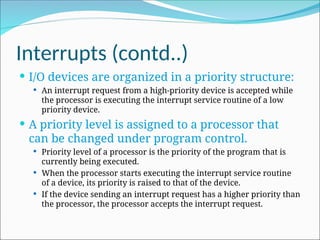
I/Odevices are organized in a priority structure:
An interrupt request from a high-priority device is accepted while
the processor is executing the interrupt service routine of a low
priority device.
A priority level is assigned to a processor that
can be changed under program control.
Priority level of a processor is the priority of the program that is
currently being executed.
When the processor starts executing the interrupt service routine
of a device, its priority is raised to that of the device.
If the device sending an interrupt request has a higher priority than
the processor, the processor accepts the interrupt request.
23.
Interrupts (contd..)
Processor’spriority is encoded in a few bits of
the processor status register.
Priority can be changed by instructions that write into the
processor status register.
Usually, these are privileged instructions, or instructions that can
be executed only in the supervisor mode.
Privileged instructions cannot be executed in the user mode.
Prevents a user program from accidentally or intentionally
changing the priority of the processor.
If there is an attempt to execute a privileged
instruction in the user mode, it causes a special
type of interrupt called as privilege exception.
24.
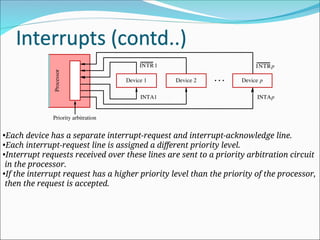
Priority arbitration
Device 1Device 2 Device p
Processor
INTA1
INTR1 INTRp
INTAp
•Each device has a separate interrupt-request and interrupt-acknowledge line.
•Each interrupt-request line is assigned a different priority level.
•Interrupt requests received over these lines are sent to a priority arbitration circuit
in the processor.
•If the interrupt request has a higher priority level than the priority of the processor,
then the request is accepted.
25.
Interrupts (contd..)
Whichinterrupt request does the processor accept
if it receives interrupt requests from two or more
devices simultaneously?.
If the I/O devices are organized in a priority
structure, the processor accepts the interrupt
request from a device with higher priority.
Each device has its own interrupt request and interrupt acknowledge
line.
A different priority level is assigned to the interrupt request line of
each device.
However, if the devices share an interrupt request
line, then how does the processor decide which
interrupt request to accept?
26.
Processor
Device 2
INTR
INTA
Device n
Device1
Polling scheme:
•If the processor uses a polling mechanism to poll the status registers of I/O devices
to determine which device is requesting an interrupt.
•In this case the priority is determined by the order in which the devices are polled.
•The first device with status bit set to 1 is the device whose interrupt request is
accepted.
Daisy chain scheme:
•Devices are connected to form a daisy chain.
•Devices share the interrupt-request line, and interrupt-acknowledge line is connected
to form a daisy chain.
•When devices raise an interrupt request, the interrupt-request line is activated.
•The processor in response activates interrupt-acknowledge.
•Received by device 1, if device 1 does not need service, it passes the signal to device 2
•Device that is electrically closest to the processor has the highest priority.
27.
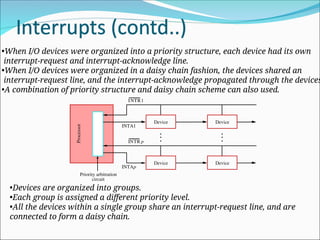
•When I/O deviceswere organized into a priority structure, each device had its own
interrupt-request and interrupt-acknowledge line.
•When I/O devices were organized in a daisy chain fashion, the devices shared an
interrupt-request line, and the interrupt-acknowledge propagated through the devices
•A combination of priority structure and daisy chain scheme can also used.
Device Device
circuit
Priority arbitration
Processor
Device Device
INTR1
INTR p
INTA1
INTAp
•Devices are organized into groups.
•Each group is assigned a different priority level.
•All the devices within a single group share an interrupt-request line, and are
connected to form a daisy chain.
28.
Interrupts (contd..)
Onlythose devices that are being used in a program
should be allowed to generate interrupt requests.
To control which devices are allowed to generate
interrupt requests, the interface circuit of each I/O
device has an interrupt-enable bit.
If the interrupt-enable bit in the device interface is set to 1, then the
device is allowed to generate an interrupt-request.
Interrupt-enable bit in the device’s interface circuit
determines whether the device is allowed to generate
an interrupt request.
Interrupt-enable bit in the processor status register
or the priority structure of the interrupts determines
whether a given interrupt will be accepted.
29.
Exceptions
Interrupts causedby interrupt-requests sent by I/O
devices.
Interrupts could be used in many other situations
where the execution of one program needs to be
suspended and execution of another program needs to
be started.
In general, the term exception is used to refer to any
event that causes an interruption.
Interrupt-requests from I/O devices is one type of an exception.
Other types of exceptions are:
Recovery from errors
Debugging
Privilege exception
30.
Exceptions (contd..)
Manysources of errors in a processor. For
example:
Error in the data stored.
Error during the execution of an instruction.
When such errors are detected, exception
processing is initiated.
Processor takes the same steps as in the case of I/O interrupt-request.
It suspends the execution of the current program, and starts
executing an exception-service routine.
Difference between handling I/O interrupt-
request and handling exceptions due to errors:
In case of I/O interrupt-request, the processor usually completes the
execution of an instruction in progress before branching to the
interrupt-service routine.
In case of exception processing however, the execution of an
instruction in progress usually cannot be completed.
31.
Exceptions (contd..)
Debuggeruses exceptions to provide important
features:
Trace,
Breakpoints.
Trace mode:
Exception occurs after the execution of every instruction.
Debugging program is used as the exception-service routine.
Breakpoints:
Exception occurs only at specific points selected by the user.
Debugging program is used as the exception-service routine.
32.
Exceptions (contd..)
Certaininstructions can be executed only when
the processor is in the supervisor mode. These
are called privileged instructions.
If an attempt is made to execute a privileged
instruction in the user mode, a privilege
exception occurs.
Privilege exception causes:
Processor to switch to the supervisor mode,
Execution of an appropriate exception-servicing routine.
34.
Direct Memory Access(contd..)
Direct Memory Access (DMA):
A special control unit may be provided to transfer a block of data
directly between an I/O device and the main memory, without
continuous intervention by the processor.
Control unit which performs these transfers is a
part of the I/O device’s interface circuit. This
control unit is called as a DMA controller.
DMA controller performs functions that would
be normally carried out by the processor:
For each word, it provides the memory address and all the control
signals.
To transfer a block of data, it increments the memory addresses
and keeps track of the number of transfers.
35.
Direct Memory Access(contd..)
DMA controller can transfer a block of data from an
external device to the processor, without any
intervention from the processor.
However, the operation of the DMA controller must be under the control
of a program executed by the processor. That is, the processor must
initiate the DMA transfer.
To initiate the DMA transfer, the processor informs the
DMA controller of:
Starting address,
Number of words in the block.
Direction of transfer (I/O device to the memory, or memory to the I/O
device).
Once the DMA controller completes the DMA transfer,
it informs the processor by raising an interrupt signal.
36.
memory
Processor
System bus
Main
Keyboard
Disk/DMA
controller Printer
DMA
controller
Disk
Disk
•DMAcontroller connects a high-speed network to the computer bus.
•Disk controller, which controls two disks also has DMA capability. It provides two
DMA channels.
•It can perform two independent DMA operations, as if each disk has its own DMA
controller. The registers to store the memory address, word count and status and
control information are duplicated.
Network
Interface
37.
Direct Memory Access(contd..)
Processor and DMA controllers have to use the bus in an
interwoven fashion to access the memory.
DMA devices are given higher priority than the processor to access the bus.
Among different DMA devices, high priority is given to high-speed
peripherals such as a disk or a graphics display device.
Processor originates most memory access cycles on the
bus.
DMA controller can be said to “steal” memory access cycles from the bus.
This interweaving technique is called as “cycle stealing”.
An alternate approach is the provide a DMA controller
an exclusive capability to initiate transfers on the bus,
and hence exclusive access to the main memory. This is
known as the block or burst mode.
39.
Bus arbitration
Processorand DMA controllers both need to initiate
data transfers on the bus and access main memory.
The device that is allowed to initiate transfers on the
bus at any given time is called the bus master.
When the current bus master relinquishes its status
as the bus master, another device can acquire this
status.
The process by which the next device to become the bus master is
selected and bus mastership is transferred to it is called bus arbitration.
Centralized arbitration:
A single bus arbiter performs the arbitration.
Distributed arbitration:
All devices participate in the selection of the next bus master.
Centralized Bus Arbitration(cont.,)
•Bus arbiter may be the processor or a separate unit connected
to the bus.
• Normally, the processor is the bus master, unless it grants bus
membership to one of the DMA controllers.
• DMA controller requests the control of the bus by asserting the
Bus Request (BR) line.
• In response, the processor activates the Bus-Grant1 (BG1) line,
indicating that the controller may use the bus when it is free.
• BG1 signal is connected to all DMA controllers in a daisy chain
fashion.
• BBSY signal is 0, it indicates that the bus is busy. When BBSY
becomes 1, the DMA controller which asserted BR can acquire
control of the bus.
42.
BBSY
BG1
BG2
Bus
master
BR
Processor DMA controller2 Processor
Time
DMA controller 2
asserts the BR signal.
Processor asserts
the BG1 signal
BG1 signal propagates
to DMA#2.
Processor relinquishes control
of the bus by setting BBSY to 1.
43.
Distributed arbitration
Alldevices waiting to use the bus share the
responsibility of carrying out the arbitration process.
Arbitration process does not depend on a central arbiter and hence
distributed arbitration has higher reliability.
Each device is assigned a 4-bit ID number.
All the devices are connected using 5 lines, 4
arbitration lines to transmit the ID, and one line for
the Start-Arbitration signal.
To request the bus a device:
Asserts the Start-Arbitration signal.
Places its 4-bit ID number on the arbitration lines.
The pattern that appears on the arbitration lines is
the logical-OR of all the 4-bit device IDs placed on the
arbitration lines.
Distributed arbitration(Contd.,)
Arbitrationprocess:
Each device compares the pattern that appears on
the arbitration lines to its own ID, starting with
MSB.
If it detects a difference, it transmits 0s on the
arbitration lines for that and all lower bit positions.
The pattern that appears on the arbitration lines is
the logical-OR of all the 4-bit device IDs placed on
the arbitration lines.
46.
•Device A hasthe ID 5 and wants to request the bus:
- Transmits the pattern 0101 on the arbitration lines.
•Device B has the ID 6 and wants to request the bus:
- Transmits the pattern 0110 on the arbitration lines.
•Pattern that appears on the arbitration lines is the logical OR of the patterns:
- Pattern 0111 appears on the arbitration lines.
Arbitration process:
•Each device compares the pattern that appears on the arbitration lines to its own
ID, starting with MSB.
•If it detects a difference, it transmits 0s on the arbitration lines for that and all lower
bit positions.
•Device A compares its ID 5 with a pattern 0101 to pattern 0111.
•It detects a difference at bit position 0, as a result, it transmits a pattern 0100 on the
arbitration lines.
•The pattern that appears on the arbitration lines is the logical-OR of 0100 and 0110,
which is 0110.
•This pattern is the same as the device ID of B, and hence B has won the arbitration.
48.
Buses
Processor, mainmemory, and I/O devices are
interconnected by means of a bus.
Bus provides a communication path for the
transfer of data.
Bus also includes lines to support interrupts and arbitration.
A bus protocol is the set of rules that govern the
behavior of various devices connected to the bus,
as to when to place information on the bus,
when to assert control signals, etc.
49.
Buses (contd..)
Buslines may be grouped into three types:
Data
Address
Control
Control signals specify:
Whether it is a read or a write operation.
Required size of the data, when several operand sizes (byte, word, long
word) are possible.
Timing information to indicate when the processor and I/O devices may
place data or receive data from the bus.
Schemes for timing of data transfers over a bus can
be classified into:
Synchronous,
Asynchronous.
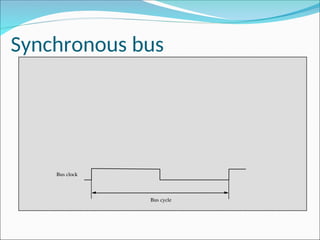
Bus cycle
Data
Bus clock
command
Addressand
t0 t1 t2
Time
Master places the
device address and
command on the bus,
and indicates that
it is a Read operation.
Addressed slave places
data on the data lines Master “strobes” the data
on the data lines into its
input buffer, for a Read
operation.
•In case of a Write operation, the master places the data on the bus along with the
address and commands at time t0.
•The slave strobes the data into its input buffer at time t2.
52.
Synchronous bus (contd..)
Once the master places the device address and
command on the bus, it takes time for this
information to propagate to the devices:
This time depends on the physical and electrical characteristics of the
bus.
Also, all the devices have to be given enough time to
decode the address and control signals, so that the
addressed slave can place data on the bus.
Width of the pulse t1 - t0 depends on:
Maximum propagation delay between two devices connected to the bus.
Time taken by all the devices to decode the address and control signals,
so that the addressed slave can respond at time t1.
53.
Synchronous bus (contd..)
At the end of the clock cycle, at time t2, the master
strobes the data on the data lines into its input
buffer if it’s a Read operation.
“Strobe” means to capture the values of the data and store them into
a buffer.
When data are to be loaded into a storage buffer
register, the data should be available for a period
longer than the setup time of the device.
Width of the pulse t2 - t1 should be longer than:
Maximum propagation time of the bus plus
Set up time of the input buffer register of the master.
54.
Data
Bus clock
command
Address and
t
0
t1t
2
command
Address and
Data
Seen by
master
Seen by slave
tAM
tAS
tDS
tDM
Time
•Signals do not appear on the bus as soon as they are placed on the bus, due to the
propagation delay in the interface circuits.
•Signals reach the devices after a propagation delay which depends on the
characteristics of the bus.
•Data must remain on the bus for some time after t2 equal to the hold time of the buffer.
Address &
command
appear on the
bus.
Address &
command reach
the slave.
Data appears
on the bus.
Data reaches
the master.
55.
Synchronous bus (contd..)
Data transfer has to be completed within one
clock cycle.
Clock period t2 - t0 must be such that the longest propagation delay
on the bus and the slowest device interface must be accommodated.
Forces all the devices to operate at the speed of the slowest device.
Processor just assumes that the data are
available at t2 in case of a Read operation, or are
read by the device in case of a Write operation.
What if the device is actually failed, and never really responded?
56.
Synchronous bus (contd..)
Most buses have control signals to represent a
response from the slave.
Control signals serve two purposes:
Inform the master that the slave has recognized the address, and is
ready to participate in a data transfer operation.
Enable to adjust the duration of the data transfer operation based
on the speed of the participating slaves.
High-frequency bus clock is used:
Data transfer spans several clock cycles instead of just one clock
cycle as in the earlier case.
57.
1 2 34
Clock
Address
Command
Data
Slave-ready
Time
Address & command
requesting a Read
operation appear on
the bus.
Slave places the data on the bus,
and asserts Slave-ready signal.
Master strobes data
into the input buffer.
Clock changes are seen by all the devices
at the same time.
58.
Asynchronous bus
Datatransfers on the bus is controlled by a handshake
between the master and the slave.
Common clock in the synchronous bus case is replaced
by two timing control lines:
Master-ready,
Slave-ready.
Master-ready signal is asserted by the master to
indicate to the slave that it is ready to participate in a
data transfer.
Slave-ready signal is asserted by the slave in response
to the master-ready from the master, and it indicates to
the master that the slave is ready to participate in a
data transfer.
59.
Asynchronous bus (contd..)
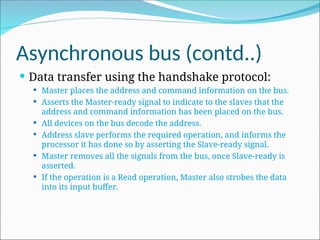
Data transfer using the handshake protocol:
Master places the address and command information on the bus.
Asserts the Master-ready signal to indicate to the slaves that the
address and command information has been placed on the bus.
All devices on the bus decode the address.
Address slave performs the required operation, and informs the
processor it has done so by asserting the Slave-ready signal.
Master removes all the signals from the bus, once Slave-ready is
asserted.
If the operation is a Read operation, Master also strobes the data
into its input buffer.
60.
Slave-ready
Data
Master-ready
and command
Address
Bus cycle
t1t2 t3 t4 t5
t0
Time
t0 - Master places the address and command information on the bus.
t1 - Master asserts the Master-ready signal. Master-ready signal is asserted at t1
instead of t0
t2 - Addressed slave places the data on the bus and asserts the Slave-ready signal.
t3 - Slave-ready signal arrives at the master.
t4 - Master removes the address and command information.
t5 - Slave receives the transition of the Master-ready signal from 1 to 0. It removes
61.
Asynchronous vs. Synchronousbus
Advantages of asynchronous bus:
Eliminates the need for synchronization between the sender and
the receiver.
Can accommodate varying delays automatically, using the Slave-
ready signal.
Disadvantages of asynchronous bus:
Data transfer rate with full handshake is limited by two-round trip
delays.
Data transfers using a synchronous bus involves only one round
trip delay, and hence a synchronous bus can achieve faster rates.
63.
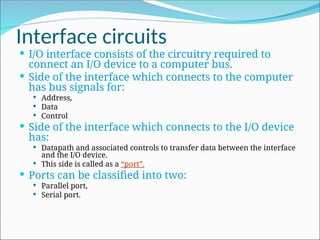
Interface circuits
I/Ointerface consists of the circuitry required to
connect an I/O device to a computer bus.
Side of the interface which connects to the computer
has bus signals for:
Address,
Data
Control
Side of the interface which connects to the I/O device
has:
Datapath and associated controls to transfer data between the interface
and the I/O device.
This side is called as a “port”.
Ports can be classified into two:
Parallel port,
Serial port.
64.
Interface circuits (contd..)
Parallel port transfers data in the form of a
number of bits, normally 8 or 16 to or from the
device.
Serial port transfers and receives data one bit at
a time.
Processor communicates with the bus in the
same way, whether it is a parallel port or a serial
port.
Conversion from the parallel to serial and vice versa takes place
inside the interface circuit.
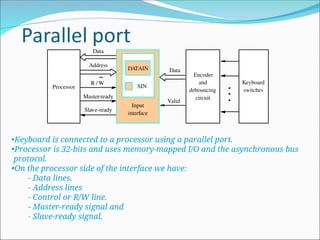
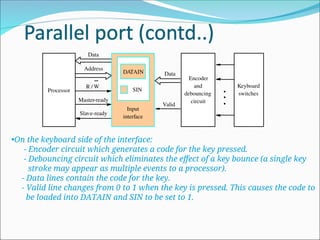
•On the keyboardside of the interface:
- Encoder circuit which generates a code for the key pressed.
- Debouncing circuit which eliminates the effect of a key bounce (a single key
stroke may appear as multiple events to a processor).
- Data lines contain the code for the key.
- Valid line changes from 0 to 1 when the key is pressed. This causes the code to
be loaded into DATAIN and SIN to be set to 1.
Valid
Data
Keyboard
switches
Encoder
and
debouncing
circuit
SIN
Input
interface
Data
Address
R /
Master-ready
Slave-ready
W
DATAIN
Processor
67.
•Output lines ofDATAIN are
are connected to the data lines of
the bus by means of 3 state drivers
•Drivers are turned on when the
processor issues a read signal and
the address selects this register.
•SIN signal is generated using a status flag circuit.
•It is connected to line D0 of the processor bus
using a three-state driver.
•Address decoder selects the input interface based
on bits A1 through A31.
•Bit A0 determines whether the status or data
register is to be read, when Master-ready is
active.
•In response, the processor activates the Slave-ready
signal, when either the Read-status or Read-data
is equal to 1, which depends on line A0.
•Data lines ofthe processor bus
are connected to the DATAOUT
register of the interface.
•The status flag SOUT is connected
to the data line D1 using a three-state
driver.
•The three-state driver is turned on,
when the control Read-status line is
1.
•Address decoder selects the output
interface using address lines A1
through A31.
•Address line A0 determines whether
the data is to be loaded into the
DATAOUT register or status flag is
to be read.
•If the Load-data line is 1, then the
Valid line is set to 1.
•If the Idle line is 1, then the status
flag SOUT is set to 1.
71.
DATAIN
1
SIN
Ready
A31
A1
A0
Address
decoder
D7
D0
R/ W
A2
DATAOUT
Input
status
Bus
PA7
PA0
CA
PB7
PB0
CB1
CB2
SOUT
D1
RS1
RS0
My-address
Handshake
control
Master-
Ready
Slave-
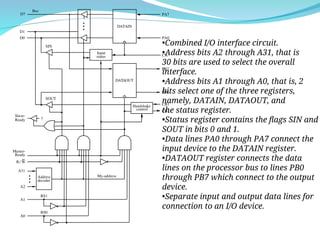
•Combined I/Ointerface circuit.
•Address bits A2 through A31, that is
30 bits are used to select the overall
interface.
•Address bits A1 through A0, that is, 2
bits select one of the three registers,
namely, DATAIN, DATAOUT, and
the status register.
•Status register contains the flags SIN and
SOUT in bits 0 and 1.
•Data lines PA0 through PA7 connect the
input device to the DATAIN register.
•DATAOUT register connects the data
lines on the processor bus to lines PB0
through PB7 which connect to the output
device.
•Separate input and output data lines for
connection to an I/O device.
72.
DATAIN
DATAOUT
Data
Direction
Register
Register
select
Status
and
control
Accept
Ready
R/W
RS0
RS1
RS2
My-address
INTR
C1
C2
P7
P0
D7
D0
•Data lines toI/O device are bidirectional.
•Data lines P7 through P0 can be used for
both input, and output.
•In fact, some lines can be used for input &
some for output depending on the pattern
in the Data Direction Register (DDR).
•Processor places an 8-bit pattern into a DDR
•If a given bit position in the DDR is 1, the
corresponding data line acts as an output
line, otherwise it acts as an input line.
•C1 and C2 control the interaction between
the interface circuit and the I/O devices.
•Ready and Accept lines are the handshake
control lines on the processor bus side, and
are connected to Master-ready & Slave-read
•Input signal My-address is connected to the
output of an address decoder.
•Three register select lines that allow up to 8
registers to be selected.
73.
Serial port
Serialport is used to connect the processor to I/O
devices that require transmission of data one bit
at a time.
Serial port communicates in a bit-serial fashion
on the device side and bit parallel fashion on the
bus side.
Transformation between the parallel and serial formats is achieved
with shift registers that have parallel access capability.
74.
INTR
Chip and
register
select
Status
and
control
Accept
Ready
R/W
RS0
RS1
My-address
Receiving clock
T
ransmissionclock
D7
D0
Output shift re gister
DATAOUT
DATAIN
Input shift register
Serial
Serial
input
•Input shift register accepts input one bi
at a time from the I/O device.
•Once all the 8 bits are received, the
contents of the input shift register are
loaded in parallel into DATAIN register.
•Output data in the DATAOUT register
are loaded into the output shift register.
•Bits are shifted out of the output shift
register and sent out to the I/O device on
bit at a time.
•As soon as data from the input shift reg
are loaded into DATAIN, it can start
accepting another 8 bits of data.
•Input shift register and DATAIN registe
are both used at input so that the input
shift register can start receiving another
set of 8 bits from the input device after
loading the contents to DATAIN, before
the processor reads the contents of
DATAIN. This is called as double-
buffering.
75.
Serial port (contd..)
Serial interfaces require fewer wires, and hence serial
transmission is convenient for connecting devices that
are physically distant from the computer.
Speed of transmission of the data over a serial interface
is known as the “bit rate”.
Bit rate depends on the nature of the devices connected.
In order to accommodate devices with a range of
speeds, a serial interface must be able to use a range of
clock speeds.
Several standard serial interfaces have been developed:
Universal Asynchronous Receiver Transmitter (UART) for low-speed serial
devices.
RS-232-C for connection to communication links.
76.
Standard I/O interfaces
I/O device is connected to a computer using an
interface circuit.
Do we have to design a different interface for every
combination of an I/O device and a computer?
A practical approach is to develop standard
interfaces and protocols.
A personal computer has:
A motherboard which houses the processor chip, main memory and
some I/O interfaces.
A few connectors into which additional interfaces can be plugged.
Processor bus is defined by the signals on the
processor chip.
Devices which require high-speed connection to the processor are
connected directly to this bus.
77.
Standard I/O interfaces(contd..)
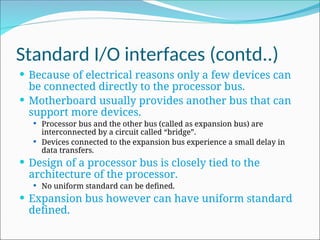
Because of electrical reasons only a few devices can
be connected directly to the processor bus.
Motherboard usually provides another bus that can
support more devices.
Processor bus and the other bus (called as expansion bus) are
interconnected by a circuit called “bridge”.
Devices connected to the expansion bus experience a small delay in
data transfers.
Design of a processor bus is closely tied to the
architecture of the processor.
No uniform standard can be defined.
Expansion bus however can have uniform standard
defined.
78.
78
Standard I/O interfaces(contd..)
A number of standards have been developed for
the expansion bus.
Some have evolved by default.
For example, IBM’s Industry Standard Architecture.
Three widely used bus standards:
PCI (Peripheral Component Interconnect)
SCSI (Small Computer System Interface)
USB (Universal Serial Bus)
PCI Bus
PeripheralComponent Interconnect
Introduced in 1992
Low-cost bus
Processor independent
Plug-and-play capability
In today’s computers, most memory transfers involve a burst of data rather
than just one word. The PCI is designed primarily to support this mode of
operation.
The bus supports three independent address spaces: memory, I/O, and
configuration.
we assumed that the master maintains the address information on the bus
until data transfer is completed. But, the address is needed only long enough
for the slave to be selected. Thus, the address is needed on the bus for one
clock cycle only, freeing the address lines to be used for sending data in
subsequent clock cycles. The result is a significant cost reduction.
A master is called an initiator in PCI terminology. The addressed device that
responds to read and write commands is called a target.
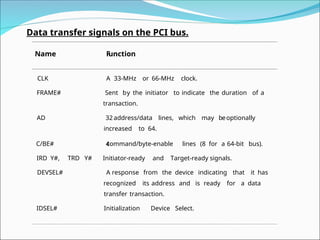
Data transfer signalson the PCI bus.
Name F
unction
CLK A 33-MHz or 66-MHz clock.
FRAME# Sent by the initiator to indicate the duration of a
transaction.
AD 32 address/data lines, which may beoptionally
increased to 64.
C/BE# 4
command/byte-enable lines (8 for a 64-bit bus).
IRD Y#, TRD Y# Initiator-ready and Target-ready signals.
DEVSEL# A response from the device indicating that it has
recognized its address and is ready for a data
transfer transaction.
IDSEL# Initialization Device Select.
83.
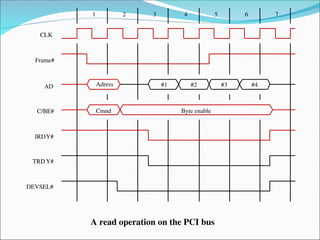
1 2 34 5 6 7
CLK
Frame#
AD
C/BE#
IRDY#
TRDY#
DEVSEL#
Adress #1 #4
Cmnd Byte enable
A read operation on the PCI bus
#2 #3
84.
Device Configuration
Whenan I/O device is connected to a computer, several actions
are needed to configure both the device and the software that
communicates with it.
PCI incorporates in each I/O device interface a small configuration
ROM memory that stores information about that device.
The configuration ROMs of all devices are accessible in the
configuration address space. The PCI initialization software reads
these ROMs and determines whether the device is a printer, a
keyboard, an Ethernet interface, or a disk controller. It can
further learn bout various device options and characteristics.
Devices are assigned addresses during the initialization process.
This means that during the bus configuration operation, devices
cannot be accessed based on their address, as they have not yet
been assigned one.
Hence, the configuration address space uses a different
mechanism. Each device has an input signal called Initialization
Device Select, IDSEL#
Electrical characteristics:
PCI bus has been defined for operation with either a 5 or 3.3 V
power supply
85.
SCSI Bus
Theacronym SCSI stands for Small Computer System
Interface.
It refers to a standard bus defined by the American National
Standards Institute (ANSI) under the designation X3.131 .
In the original specifications of the standard, devices such as
disks are connected to a computer via a 50-wire cable, which
can be up to 25 meters in length and can transfer data at rates
up to 5 megabytes/s.
The SCSI bus standard has undergone many revisions, and its
data transfer capability has increased very rapidly, almost
doubling every two years.
SCSI-2 and SCSI-3 have been defined, and each has several
options.
Because of various options SCSI connector may have 50, 68 or
80 pins.
SCSI Bus (Contd.,)
Devices connected to the SCSI bus are not part of the address space of the
processor
The SCSI bus is connected to the processor bus through a SCSI controller. This
controller uses DMA to transfer data packets from the main memory to the
device, or vice versa.
A packet may contain a block of data, commands from the processor to the
device, or status information about the device.
A controller connected to a SCSI bus is one of two types – an initiator or a
target.
An initiator has the ability to select a particular target and to send commands
specifying the operations to be performed. The disk controller operates as a
target. It carries out the commands it receives from the initiator.
The initiator establishes a logical connection with the intended target.
Once this connection has been established, it can be suspended and restored
as needed to transfer commands and bursts of data.
While a particular connection is suspended, other device can use the bus to
transfer information.
This ability to overlap data transfer requests is one of the key features of the
SCSI bus that leads to its high performance.
88.
SCSI Bus (Contd.,)
Data transfers on the SCSI bus are always
controlled by the target controller.
To send a command to a target, an initiator
requests control of the bus and, after winning
arbitration, selects the controller it wants to
communicate with and hands control of the bus
over to it.
Then the controller starts a data transfer
operation to receive a command from the
initiator.
89.
SCSI Bus (Contd.,)
Assume that processor needs to read block of data from a disk drive
and that data are stored in disk sectors that are not contiguous.
The processor sends a command to the SCSI controller, which causes
the following sequence of events to take place:
1. The SCSI controller, acting as an initiator, contends for control of the
bus.
2. When the initiator wins the arbitration process, it selects the target
controller and hands over control of the bus to it.
3. The target starts an output operation (from initiator to target); in
response to this, the initiator sends a command specifying the
required read operation.
4. The target, realizing that it first needs to perform a disk seek
operation, sends a message to the initiator indicating that it will
temporarily suspend the connection between them. Then it releases
the bus.
5. The target controller sends a command to the disk drive to move the
read head to the first sector involved in the requested read
operation. Then, it reads the data stored in that sector and stores
them in a data buffer. When it is ready to begin transferring data to
the initiator, the target requests control of the bus. After it wins
arbitration, it reselects the initiator controller, thus restoring the
suspended connection.
90.
SCSI Bus (Contd.,)
6.The target transfers the contents of the data buffer to the
initiator and then suspends the connection again
7. The target controller sends a command to the disk drive to
perform another seek operation. Then, it transfers the
contents of the second disk sector to the initiator as
before. At the end of this transfers, the logical connection
between the two controllers is terminated.
8. As the initiator controller receives the data, it stores them
into the main memory using the DMA approach.
9. The SCSI controller sends as interrupt to the processor to
inform it that the requested operation has been completed
91.
Table 4. TheSCSI bus signals.
Category Name F
unction
Data DB(0) to
DB(7)
Datalines:Carry onebyte ofinformation
duringthe
information
transferphase and
identify deviceduring
arbitration,
selection and
reselection phases
DB(P) Paritybitforthedatabus
Phase BSY Busy:Asserted whenthebus isnotfree
SEL Selection:Assertedduring
selection and
reselection
Information
type
C/D Con
trol/Data:Asserted during
transfer of
control information(command,
status or
message)
–
–
–
–
–
–
MSG Message:indicates thatthe
information being
transferred is amessage
–
Operation of SCSI bus from H/W point of
view
92.
Handshake REQ Request:Assertedbya
targettorequesta data
transfercycle
ACK Ackno
wledge: Asserted bytheinitiatorwhen it
has
completed adatatransfer operation
Direction of
transfer
I/O Input/Output:
Assertedtoindicateaninput
op
eration(relativ
e to theinitiator)
Other ATN Atten
tion: Asserted by aninitiatorwhen it
wishestosendamessageto atarget
RST Reset: Causes alldevice con
trols todisconnect
fromthebus andassumetheirstart-up
state
–
–
–
–
–
Category Name F
unction
Table 4. The SCSI bus signals.(cont.)
93.
Main Phases involved
Arbitration
A controller requests the bus by asserting BSY and by
asserting it’s associated data line
When BSY becomes active, all controllers that are requesting
bus examine data lines
Selection
Controller that won arbitration selects target by asserting SEL
and data line of target. After that initiator releases BSY line.
Target responds by asserting BSY line
Target controller will have control on the bus from then
Information Transfer
Handshaking signals are used between initiator and target
At the end target releases BSY line
Reselection
94.
Free Arbitration Selection
Targetsexamine ID
DB 2
DB 5
DB 6
BS Y
SEL
Figure 42. Arbitration and selection on the SCSI bus.
Device 6 wins arbitration and selects device 2.
95.
USB
Universal SerialBus (USB) is an industry standard
developed through a collaborative effort of several
computer and communication companies,
including Compaq, Hewlett-Packard, Intel, Lucent,
Microsoft, Nortel Networks, and Philips.
Speed
Low-speed(1.5 Mb/s)
Full-speed(12 Mb/s)
High-speed(480 Mb/s)
Port Limitation
Device Characteristics
Plug-and-play
Universal Serial Bustree structure
To accommodate a large number of devices that can be added or
removed at any time, the USB has the tree structure as shown in
the figure.
Each node of the tree has a device called a hub, which acts as an
intermediate control point between the host and the I/O devices. At
the root of the tree, a root hub connects the entire tree to the host
computer. The leaves of the tree are the I/O devices being served
(for example, keyboard, Internet connection, speaker, or digital TV)
In normal operation, a hub copies a message that it receives from
its upstream connection to all its downstream ports. As a result, a
message sent by the host computer is broadcast to all I/O devices,
but only the addressed device will respond to that message.
However, a message from an I/O device is sent only upstream
towards the root of the tree and is not seen by other devices.
Hence, the USB enables the host to communicate with the I/O
devices, but it does not enable these devices to communicate with
each other.
98.
Addressing
When aUSB is connected to a host computer, its root hub is attached to the
processor bus, where it appears as a single device. The host software
communicates with individual devices attached to the USB by sending
packets of information, which the root hub forwards to the appropriate
device in the USB tree.
Each device on the USB, whether it is a hub or an I/O device, is assigned a
7-bit address. This address is local to the USB tree and is not related in any
way to the addresses used on the processor bus.
A hub may have any number of devices or other hubs connected to it, and
addresses are assigned arbitrarily. When a device is first connected to a
hub, or when it is powered on, it has the address 0. The hardware of the
hub to which this device is connected is capable of detecting that the
device has been connected, and it records this fact as part of its own status
information. Periodically, the host polls each hub to collect status
information and learn about new devices that may have been added or
disconnected.
When the host is informed that a new device has been connected, it uses a
sequence of commands to send a reset signal on the corresponding hub
port, read information from the device about its capabilities, send
configuration information to the device, and assign the device a unique
USB address. Once this sequence is completed the device begins normal
operation and responds only to the new address.
99.
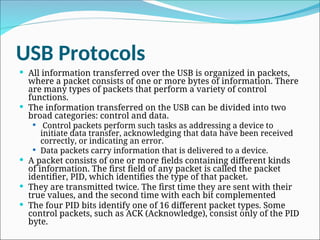
USB Protocols
Allinformation transferred over the USB is organized in packets,
where a packet consists of one or more bytes of information. There
are many types of packets that perform a variety of control
functions.
The information transferred on the USB can be divided into two
broad categories: control and data.
Control packets perform such tasks as addressing a device to
initiate data transfer, acknowledging that data have been received
correctly, or indicating an error.
Data packets carry information that is delivered to a device.
A packet consists of one or more fields containing different kinds
of information. The first field of any packet is called the packet
identifier, PID, which identifies the type of that packet.
They are transmitted twice. The first time they are sent with their
true values, and the second time with each bit complemented
The four PID bits identify one of 16 different packet types. Some
control packets, such as ACK (Acknowledge), consist only of the PID
byte.
100.
PID0 PID1 PID2PID3 PID0
PID0 PID1 PID2 PID3
(a) Packet identifier field
PID ADDR ENDP CRC16
8 7 4 5
Bits
(b) Token packet, IN or OUT
PID DATA CRC16
8 0 to 8192 16
Bits
(c) Data packet
Figure 45. USB packet format.
Control packets used for
controlling data transfer
operations are called
token packets.
Isochronous Traffic onUSB
One of the key objectives of the USB is to support the transfer of
isochronous data.
Devices that generates or receives isochronous data require a time
reference to control the sampling process.
To provide this reference. Transmission over the USB is divided
into frames of equal length.
A frame is 1ms long for low-and full-speed data.
The root hub generates a Start of Frame control packet (SOF)
precisely once every 1 ms to mark the beginning of a new frame.
The arrival of an SOF packet at any device constitutes a regular
clock signal that the device can use for its own purposes.
To assist devices that may need longer periods of time, the SOF
packet carries an 11-bit frame number.
Following each SOF packet, the host carries out input and output
transfers for isochronous devices.
This means that each device will have an opportunity for an input
or output transfer once every 1 ms.
103.
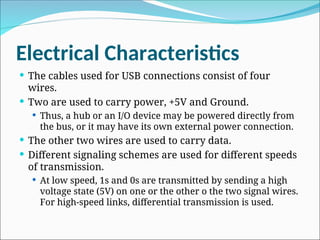
Electrical Characteristics
Thecables used for USB connections consist of four
wires.
Two are used to carry power, +5V and Ground.
Thus, a hub or an I/O device may be powered directly from
the bus, or it may have its own external power connection.
The other two wires are used to carry data.
Different signaling schemes are used for different speeds
of transmission.
At low speed, 1s and 0s are transmitted by sending a high
voltage state (5V) on one or the other o the two signal wires.
For high-speed links, differential transmission is used.
Editor's Notes
#18 We have seen how one device can alert the processor using an interrupt to indicate that it is ready for data transfer. Repeat the operation of the interrupt.
Usually, there are multiple devices that may be connected to the processor and the memory via a bus. When any one of these devices become ready for data transfer they can generate interrupt requests. Now, each device is capable of generating its own interrupt request, and each one of these devices operate independently. That is, they do not consider what the other devices are doing before generating an interrupt request. As a result, there can be no definite order imposed on how the devices generate interrupt requests. When multiple devices are connected to the processor and the memory as is usually the case, and some or all of these devices are capable of generating interrupt requests, there are several questions that need to be answered.
How does the processor know which device has generated the interrupt? The next question is how does the processor know which ISR needs to be executed?
The other question is that when the processor is servicing the ISR for one device, can it be interrupted by another device?
If two or more interrupt requests are received simultaneously, then how does the processor break the tie between which ISR it is going to execute?
#19 Let us consider a simple arrangement where all devices send their interrupt requests using a single control line. Recall that one control line of the bus may be dedicated to send interrupt requests.
When the processor receives an interrupt request over the this control, it needs to determine which device actually sent the interrupt.
When a device sends an interrupt, it sets a bit in its status register. This bit is called as IRQ bit.
So, when the processor receives an interrupt and branches to the ISR, it can poll the IRQ bit of the devices which are connected to the bus. Whenever it comes across an I/O device with an IRQ bit set to 1, then it concludes that that is the device which requested an interrupt.
Polling mechanism is easy, but one again, any type of polling is expensive. Here polling is being carried out to query the status bits of all the I/O devices connected to the bus.
#20 Repeat polling.
An alternative approach may be for the device which is requesting an interrupt to identify itself to the processor. This will avoid the overhead incurred by the polling itself.
The device may identify itself to the processor by sending a special code to the processor over the bus. This special code may be 4 to 8 bits. This special code used by the device to identify itself to the processor may also represent a part of the starting address of the ISR.
The remainder of the starting address could be obtained in a variety of ways such as the ISRs may reside in a particular section of the memory and hence may use memory addresses in a given range.
The code supplied by the device plus other information provides the starting address of the ISR. This starting address actually provides the actual starting address of the ISR.
#21 Repeat, that the processor did not want to be interrupted by the same device while it was executing its ISR, it disabled the interrupt at the beginning of the ISR, and it then enabled the interrupts before returning from the ISR.
In case of multiple devices, the same arrangement is used. That is, when the processor is executing the ISR of one device, it disables the interrupts not only from that device but also from all the other devices. That is, it does not accept interrupt requests from any other device.
Since ISRs are usually short, it takes very little time for their execution, as a result, the delay caused by not accepting interrupts from other devices while servicing an ISR is usually acceptable.
However, for some time critical devices this delay that may be caused may be unacceptable. So, that leads us to the question of which devices can interrupt a processor when it is executing an ISR of another device?
#22 Repeat that multiple I/O devices may be connected to the processor. These multiple I/O devices may be organized according a certain priority. When the processor is servicing an interrupt from a device, only devices which have higher priority can interrupt the processor. That is, only devices which have higher priority can interrupt the processing of the ISR of the device of lower priority.
In order to implement this scheme, a priority level is assigned to a processor. This priority level can be changed under program control or it depends on which program is currently being executed by the processor. That is, the priority of the processor is the priority of the program that the processor is currently executing. When the processor receives an interrupt request from a device, and starts executing the ISR of that device, its priority is raised to that of the device. Now, if another device wants to interrupt the processor, then it is allowed to do so, only if its priority is higher than the priority of the processor which is set to the priority of the ISR of the device.
#30 Exceptions occur when a processor is trying to recover from errors. Exceptions occur when the processing of one program needs to be suspended and the other one needs to be resumed. When an error occurs while executing a program, the execution of that program needs to be suspended and appropriate error handling needs to be initiated. There are various sources of error in a processor. For example, an error could be present in the data or instruction that is stored. The machine language code of the instruction may be wrong. Also, errors could occur during the execution of an instruction, for example dividing a number by zero causes an exception. When such errors are detected, exception processing is initiated by the processor. In order to initiate exception processing, same steps are taken as in the case of I/O interrupt request. The execution of the present program is suspended, and we start execution an exception service routine.
Although exception processing and interrupt request processing is similar, there are subtle differences between handling I/O requests and handling exceptions due to errors. When a processor receives I/O interrupt requests, the processor usually completes the execution of an instruction in progress before branching to the interrupt service routine. In case of exception processing however, an error occurs during the execution of the instruction in progress, and hence the execution of the instruction that caused an exception cannot be completed.
#31 The other scenario where exceptions are used is in the case of debuggers. Debuggers use exceptions to provide important features such as tracing and breakpoints. When the debugger is used in the trace mode, the execution of the program needs to be stopped after every instruction so that the contents of the variables can be examined. The way the trace mode is implemented is that exception occurs after the execution of every instruction, and the debugging program is used as the exception service routine. The debugging program enables you to examine the contents of the variables that you like.
In case of breakpoints program execution is halted only at specific points selected by the user. Once again, the debugging program is used as the exception service routine.
#32 Recall privilege mode and supervisor mode. Certain instructions can only be executed in the supervisor mode. If an attempt is made to execute the instruction in the user mode, then an privilege exception occurs. Privilege exception causes the processor to switch to the supervisor mode, and execution of an appropriate service routine.
#34 This alternative approach is called as direct memory access. DMA consists of a special control unit which is provided to transfer a block of data directly between an I/O device and the main memory without continuous intervention by the processor.
A control unit which performs these transfers without the intervention of the processor is a part of the I/O device’s interface circuit, and this controller is called as the DMA controller.
DMA controller performs functions that would be normally be performed by the processor. The processor will have to provide a memory address and all the control signals. So, the DMA controller will also provide with the memory address where the data is going to be stored along with the necessary control signals. When a block of data needs to be transferred, the DMA controller will also have to increment the memory addresses and keep track of the number of words that have been transferred.
#35 Repeat DMA controller.
DMA controller can be used to transfer a block of data from an external device to the processor, without requiring any help from the processor. As a result the processor is free to execute other programs. However, the DMA controller should perform the task of transferring data to or from an I/O device for a program that is being executed by a processor. That is, the DMA controller does not and should not have the capability to determine when a data transfer operation should take place. The processor must initiate DMA transfer of data, when it is indicated or required by the program that is being executed by the processor.
When the processor determines that the program that is being executed requires a DMA transfer, it informs the DMA controller which sits in the interface circuit of the device of three things, namely, the starting address of the memory location, the number of words that needs to be transferred, and the direction of transfer that is, whether the data needs to be transferred from the I/O device to the memory or from the memory to the I/O device.
After initiating the DMA transfer, the processor suspends the program that initiated the transfer, and continues with the execution of some other program. The program whose execution is suspended is said to be in the blocked state.
#36 Let us consider a memory organization with two DMA controllers. In this memory organization, a DMA controller is used to connect a high speed network to the computer bus. In addition, disk controller which also controls two disks may have DMA capability. The disk controller controls two disks and it also has DMA capability. The disk controller provides two DMA channels. The disk controller can two independent DMA operations, as if each disk has its own DMA controller. Each DMA controller has three registers, one to store the memory address, one to store the word count, and the last to store the status and control information. There are two copies of these three registers in order to perform independent DMA operations. That is, these registers are duplicated.
#37 Processor also has to transfer data to and from the main memory. Also, the DMA controller is responsible for transferring data to and from the I/O device to the main memory. Both the processor and the DMA controller have to use the external bus to talk to the main memory. Usually, DMA controllers are given higher priority than the processor to access the bus. Now, we also need to decide the priority among different DMA devices that may need to use the bus. Among these different DMA devices, high priority is given to high speed peripherals such as a disk or a graphics display device.
Usually, the processor originates most cycles on the bus. The DMA controller can be said to steal memory access cycles on from the bus. Thus, the processor and the DMA controller use the bus in an interwoven fashion. This interweaving technique is called as cycle stealing.
An alternate approach would be to provide DMA controllers exclusive capability to initiate transfers on the bus, and hence exclusive access to the main memory. This is known as the block mode or the burst mode of operation.
#39 Processor and DMA controllers both need to initiate data transfers on the bus and access main memory. The process of using the bus to perform a data transfer operation is called as the initiation of a transfer operation. At any point in time only one device is allowed to initiate transfers on the bus. The device that is allowed to initiate transfers on the bus at any given time is called the bus master. When the current bus master releases control of the bus, another device can acquire the status of the bus master. How does one determine which is the next device which will acquire the status of the bus master. Note that there may be several DMA controllers plus the processor which requires access to the bus. The process by which the next device to become the bus master is selected and bus mastership is transferred to it is called bus arbitration. There are two types of bus arbitration processes. Centralized arbitration and distributed arbitration. In case of centralized arbitration, a single bus arbiter performs the arbitration. Whereas in case of distributed arbitration all devices which need to initiate data transfers on the bus participate or are involved in the selection of the next bus master.
#49 Recall that one device plays the role of a master. The device that initiates the data transfer on the bus by issuing read or write control signals is called as a master. The device that is being addressed by the master is called a slave or a target.
#57 Slave-ready signal is an acknowledgement from the slave to the master to confirm that the valid data has been sent. Depending on when the slave-ready signal is asserted, the duration of the data transfer can change.