KIT – KALAIGNARKARUNANIDHI INSTITUTE OF TECHNOLOGY
UNIT OPERATION IN AGRICULTURE
PROCESSING
LECTURE BY
Ms SOWMIYA
ASSISTANT PROFESSOR
B E AGRICULTURE ENGINEERING DEPARTMENT
EVAPORATION:
Evaporation is an important unit operation commonly employed to remove water from dilute liquid
foods to obtain concentrated liquid products (for e.g. manufacture of tomato puree from juice). Removal
of water from foods provides microbiological stability and assists in reducing packaging, transportation
and storage costs. Evaporation is also a necessary step before drying and crystallization process.
Evaporation differs from dehydration, since the final product of evaporation process remains in liquid
state. The evaporator in which the vapour produced are discarded without further utilizing its inherent
heat is called a single effect evaporator, whereas the evaporator in which the inherent heat of the
vapour is reused again as heating medium is called a multiple effect evaporator. The evaporation process
is largely dependent on the principle of heat transfer and the factors, which hamper heat transfer, are
the major impediments for the process. Some of these factors are: (1) Boiling point rise, (2) Heat
sensitivity of the liquid, (3) Fouling & foaming properties of the food, etc.
Boiling Point Elevation
Boiling point elevation of a solution (liquid food) is defined as the increase
in boiling point over that of pure water, at a given pressure. A simple
method to estimate boiling point elevation is the use of Duhring’s rule. The
Duhring’s rule states that a linear relationship exists between the boiling
point temperature of a solution and the boiling point temperature of water
at the same pressure.
Types of Evaporators
Several types of evaporators are used in the food industry. In the following paragraphs
we would discuss some of the most commonly used evaporators.
Batch Type Pan Evaporator
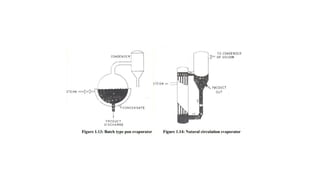
One of the simplest and perhaps oldest types of evaporators used in food industry is the batch-type pan
evaporator (Figure 1.13). The product is heated in a steam jacketed spherical vessel. The heating vessel is
either open to atmosphere or connected to a condenser and vacuum system. Heating of the product
occurs mainly due to natural convection, resulting in smaller convective heat transfer coefficients. The
poor heat transfer coefficients substantially increase the residence time of the product and reduce the
processing capacities of these evaporators.
Natural Circulation Evaporators
In natural circulation evaporators ,short vertical tubes are arranged inside a steam chest. The whole calendria (tubes
and steam chest) is located at the bottom of the vessel. The product when heated rises through these tubes by
natural circulation while steam condenses outside the tubes. Evaporation takes place inside the tubes and the
product is concentrated. The concentrated liquid falls back to the base of the vessel through a central annular
section.
Rising Film Evaporator
In a rising film evaporator, a low viscosity liquid food is allowed to boil inside 10-15 m long vertical tubes. The tubes
are heated from outside with steam. The liquid rises inside these tubes by vapours formed near the bottom of the
heating tubes. The upward movement of vapour causes a thin liquid film to move rapidly upward. A temperature
differential of at least 14°C between the product and the heating medium is necessary to obtain a welldeveloped
film. High convective heat-transfer coefficients achieved in these evaporators mostly makes the operation once
through. However, liquid can be recirculated to obtain the required solid concentration.
Falling Film Evaporator
In contrast to the rising film evaporator, the falling film evaporator has a thin liquid film moving downward under
gravity on the inside of the vertical tubes (Figure 1.16). The distribution of liquid in a uniform film flowing
downward is accomplished by the use of specially designed distributors or spray nozzles. The falling film
evaporator can handle more viscous liquids than the rising film type. These evaporators are best suited for highly
heat sensitive products. Typical residence time in a falling film evaporator is 20-30 seconds, compared with
residence time of 3-4 minutes in a rising film evaporator.
Rising / Falling Film Evaporator
In the rising / falling film evaporator, the product is concentrated by circulation through a rising film section
followed by a falling film section of the evaporator. As shown in Figure 1.17, the product is first partially
concentrated as it ascends through a rising tube section, followed by the pre-concentrated product descending
through a falling film section; there it attains its final concentration.
Forced Circulation Evaporators
The forced circulation evaporator involves a non contact heat exchanger where liquid food is circulated at high rates (Figure 1.18).
A hydrostatic head, above the top of the tubes, eliminates any boiling of the liquid. Inside the separator, absolute pressure is kept
slightly lower than that in the tube bundle. Thus, the liquid entering the separator flashes to form a vapour. The temperature
difference across the heating surface in the heat exchanger is usually 3-5°C. Axial flow pumps are generally used to maintain high
circulation rates with linear velocities of 2-6 m/s, compared with a linear velocity of 0.3 – 1 m/s in natural convection
evaporators. Both capital and operating costs of these evaporators are very low in comparison to other types of evaporators.

UNIT OPERATION IN AGRICULTURE PROCESSING.pptx

  • 1.
    KIT – KALAIGNARKARUNANIDHIINSTITUTE OF TECHNOLOGY UNIT OPERATION IN AGRICULTURE PROCESSING LECTURE BY Ms SOWMIYA ASSISTANT PROFESSOR B E AGRICULTURE ENGINEERING DEPARTMENT
  • 2.
    EVAPORATION: Evaporation is animportant unit operation commonly employed to remove water from dilute liquid foods to obtain concentrated liquid products (for e.g. manufacture of tomato puree from juice). Removal of water from foods provides microbiological stability and assists in reducing packaging, transportation and storage costs. Evaporation is also a necessary step before drying and crystallization process. Evaporation differs from dehydration, since the final product of evaporation process remains in liquid state. The evaporator in which the vapour produced are discarded without further utilizing its inherent heat is called a single effect evaporator, whereas the evaporator in which the inherent heat of the vapour is reused again as heating medium is called a multiple effect evaporator. The evaporation process is largely dependent on the principle of heat transfer and the factors, which hamper heat transfer, are the major impediments for the process. Some of these factors are: (1) Boiling point rise, (2) Heat sensitivity of the liquid, (3) Fouling & foaming properties of the food, etc.
  • 3.
    Boiling Point Elevation Boilingpoint elevation of a solution (liquid food) is defined as the increase in boiling point over that of pure water, at a given pressure. A simple method to estimate boiling point elevation is the use of Duhring’s rule. The Duhring’s rule states that a linear relationship exists between the boiling point temperature of a solution and the boiling point temperature of water at the same pressure.
  • 4.
    Types of Evaporators Severaltypes of evaporators are used in the food industry. In the following paragraphs we would discuss some of the most commonly used evaporators. Batch Type Pan Evaporator One of the simplest and perhaps oldest types of evaporators used in food industry is the batch-type pan evaporator (Figure 1.13). The product is heated in a steam jacketed spherical vessel. The heating vessel is either open to atmosphere or connected to a condenser and vacuum system. Heating of the product occurs mainly due to natural convection, resulting in smaller convective heat transfer coefficients. The poor heat transfer coefficients substantially increase the residence time of the product and reduce the processing capacities of these evaporators.
  • 5.
    Natural Circulation Evaporators Innatural circulation evaporators ,short vertical tubes are arranged inside a steam chest. The whole calendria (tubes and steam chest) is located at the bottom of the vessel. The product when heated rises through these tubes by natural circulation while steam condenses outside the tubes. Evaporation takes place inside the tubes and the product is concentrated. The concentrated liquid falls back to the base of the vessel through a central annular section. Rising Film Evaporator In a rising film evaporator, a low viscosity liquid food is allowed to boil inside 10-15 m long vertical tubes. The tubes are heated from outside with steam. The liquid rises inside these tubes by vapours formed near the bottom of the heating tubes. The upward movement of vapour causes a thin liquid film to move rapidly upward. A temperature differential of at least 14°C between the product and the heating medium is necessary to obtain a welldeveloped film. High convective heat-transfer coefficients achieved in these evaporators mostly makes the operation once through. However, liquid can be recirculated to obtain the required solid concentration.
  • 8.
    Falling Film Evaporator Incontrast to the rising film evaporator, the falling film evaporator has a thin liquid film moving downward under gravity on the inside of the vertical tubes (Figure 1.16). The distribution of liquid in a uniform film flowing downward is accomplished by the use of specially designed distributors or spray nozzles. The falling film evaporator can handle more viscous liquids than the rising film type. These evaporators are best suited for highly heat sensitive products. Typical residence time in a falling film evaporator is 20-30 seconds, compared with residence time of 3-4 minutes in a rising film evaporator. Rising / Falling Film Evaporator In the rising / falling film evaporator, the product is concentrated by circulation through a rising film section followed by a falling film section of the evaporator. As shown in Figure 1.17, the product is first partially concentrated as it ascends through a rising tube section, followed by the pre-concentrated product descending through a falling film section; there it attains its final concentration.
  • 9.
    Forced Circulation Evaporators Theforced circulation evaporator involves a non contact heat exchanger where liquid food is circulated at high rates (Figure 1.18). A hydrostatic head, above the top of the tubes, eliminates any boiling of the liquid. Inside the separator, absolute pressure is kept slightly lower than that in the tube bundle. Thus, the liquid entering the separator flashes to form a vapour. The temperature difference across the heating surface in the heat exchanger is usually 3-5°C. Axial flow pumps are generally used to maintain high circulation rates with linear velocities of 2-6 m/s, compared with a linear velocity of 0.3 – 1 m/s in natural convection evaporators. Both capital and operating costs of these evaporators are very low in comparison to other types of evaporators.