BUSINESS
1. Business isthe act of providing goods or services to
customers in exchange for money.
2. The main aim of business is to earn a profit by
satisfying the needs and wants of customers.
3. It can be a small enterprise, such as a local shop or a
large organization like a multinational corporation.
4. To run a successful business, requires careful planning,
management, and investment in order to achieve its
goals.
3.
BUSINESS IDEA
•A businessidea is a creative or innovative concept that
can be turned into a profitable business venture.
•It's something that identifies a problem or gap in the
market and has the potential to meet the needs of a
specific target audience.
• A successful business idea can lead to the creation of a
new product, service, or business model that can
generate revenue and profit.
4.
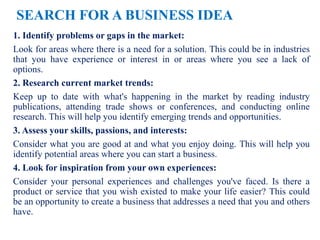
SEARCH FOR ABUSINESS IDEA
Some steps you can follow to search for a business idea-
1.Identify problems or gaps in the market
2.Research current market trends
3.Assess your skills, passions, and interests
4.Look for inspiration from your own experiences
5.Identify emerging technologies
6.Evaluate your resources
7.Evaluate potential ideas
8.Test your ideas
5.
SEARCH FOR ABUSINESS IDEA
1. Identify problems or gaps in the market:
Look for areas where there is a need for a solution. This could be in industries
that you have experience or interest in or areas where you see a lack of
options.
2. Research current market trends:
Keep up to date with what's happening in the market by reading industry
publications, attending trade shows or conferences, and conducting online
research. This will help you identify emerging trends and opportunities.
3. Assess your skills, passions, and interests:
Consider what you are good at and what you enjoy doing. This will help you
identify potential areas where you can start a business.
4. Look for inspiration from your own experiences:
Consider your personal experiences and challenges you've faced. Is there a
product or service that you wish existed to make your life easier? This could
be an opportunity to create a business that addresses a need that you and others
have.
6.
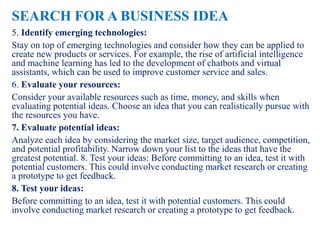
SEARCH FOR ABUSINESS IDEA
5. Identify emerging technologies:
Stay on top of emerging technologies and consider how they can be applied to
create new products or services. For example, the rise of artificial intelligence
and machine learning has led to the development of chatbots and virtual
assistants, which can be used to improve customer service and sales.
6. Evaluate your resources:
Consider your available resources such as time, money, and skills when
evaluating potential ideas. Choose an idea that you can realistically pursue with
the resources you have.
7. Evaluate potential ideas:
Analyze each idea by considering the market size, target audience, competition,
and potential profitability. Narrow down your list to the ideas that have the
greatest potential. 8. Test your ideas: Before committing to an idea, test it with
potential customers. This could involve conducting market research or creating
a prototype to get feedback.
8. Test your ideas:
Before committing to an idea, test it with potential customers. This could
involve conducting market research or creating a prototype to get feedback.
7.
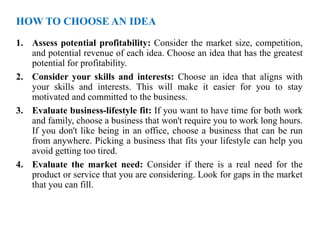
HOW TO CHOOSEAN IDEA
1. Assess potential profitability: Consider the market size, competition,
and potential revenue of each idea. Choose an idea that has the greatest
potential for profitability.
2. Consider your skills and interests: Choose an idea that aligns with
your skills and interests. This will make it easier for you to stay
motivated and committed to the business.
3. Evaluate business-lifestyle fit: If you want to have time for both work
and family, choose a business that won't require you to work long hours.
If you don't like being in an office, choose a business that can be run
from anywhere. Picking a business that fits your lifestyle can help you
avoid getting too tired.
4. Evaluate the market need: Consider if there is a real need for the
product or service that you are considering. Look for gaps in the market
that you can fill.
8.
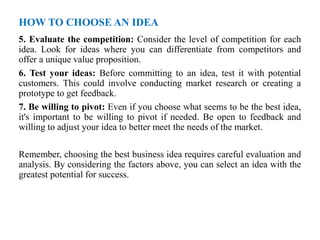
HOW TO CHOOSEAN IDEA
5. Evaluate the competition: Consider the level of competition for each
idea. Look for ideas where you can differentiate from competitors and
offer a unique value proposition.
6. Test your ideas: Before committing to an idea, test it with potential
customers. This could involve conducting market research or creating a
prototype to get feedback.
7. Be willing to pivot: Even if you choose what seems to be the best idea,
it's important to be willing to pivot if needed. Be open to feedback and
willing to adjust your idea to better meet the needs of the market.
Remember, choosing the best business idea requires careful evaluation and
analysis. By considering the factors above, you can select an idea with the
greatest potential for success.
9.
PRODUCT
• A productis something that is made or created to be sold or used by
customers.
• It can be a physical item, such as a toy or a piece of clothing, or a
digital item, such as software or an app.
• Products can be designed for different purposes, such as
entertainment, education, or productivity.
• They are typically created to meet a specific need or solve a particular
problem for the customer.
10.
SELECTION OF PRODUCT
Productselection is the process of identifying, evaluating, and choosing
the best product ideas to bring to market. It is a crucial step in the
product development process as it determines the success of a product
in the market. Here are some important notes on product selection:
1. Simple and Affordable to Develop: When selecting a product, it
is important to consider its development cost. Choosing a product
that is simple and affordable to develop can save time and money
in the long run. This could mean selecting a product with a basic
design, fewer components, or a shorter development timeline.
2. Evaluate the feasibility: Consider the technical, financial, and
operational feasibility of bringing your product to market.
3. Consider your expertise and interests: Choose a product that
aligns with your expertise and interests. It will help you in creating
a product that meets the market need, and you will enjoy working
on it.
11.
SELECTION OF PRODUCT
4.Analyze the competition: Analyze the existing competition to
understand their product offerings, pricing, and marketing strategies.
This analysis will help you create a product that is unique and better
than your competitors.
5. Determine your budget: Determine the budget you have for product
development, manufacturing, and marketing. This will help you choose
a product that fits within your budget.
6. Consider the scalability: Choose a product that can be easily scaled
up or down according to the market demand. This will help you in
managing the production and distribution of the product effectively.
7. Determine the cost and potential profit: Calculate the cost of
producing and marketing your product and determine the potential
profit. Make sure the profit is worth the investment.
12.
SELECTION OF PRODUCT
8.Consider the regulatory and legal requirements: Make sure your
product meets regulatory and legal requirements before bringing it to
market.
9. Recurring Revenue: Another important factor in product selection
is its potential for generating recurring revenue. This could involve
selecting a product that requires consumables or ongoing maintenance,
or a product that has a subscription based revenue model. Recurring
revenue can help ensure a stable cash flow and sustained growth for the
business
10. Test the product: Before launching the product, test it with a
sample group of your target market to gather feedback and improve the
product.
11. Keep the future in mind: Select a product that has long-term
potential and can stay relevant in the market for years to come. This
will help you in generating consistent revenue and creating a
sustainable business.
13.
THE ADOPTION PROCESS
Theadoption process is a marketing concept that describes the stages a
consumer goes through in accepting and purchasing a new product or
service. This process can be broken down into five stages:
1. Awareness: In this stage, the consumer becomes aware of the new
product or service. This can happen through advertising, word of
mouth, or other marketing efforts.
2. Interest: Once the consumer becomes aware of the product or
service, they may start to show interest. This can happen if the product
or service meets a need or solves a problem for the consumer.
3. Evaluation: In this stage, the consumer starts to evaluate the product
or service. They may research it, read reviews, or compare it to other
products or services.
4. Trial: If the consumer is satisfied with the evaluation, they may try
the product or service. This can happen through a free trial, a demo, or
a small purchase.
14.
THE ADOPTION PROCESS
5.Adoption: If the trial is successful, the consumer may adopt the
product or service and continue to use it. This can lead to repeat
purchases and positive word of mouth.
It's important for marketers to understand the adoption process so they
can tailor their marketing efforts to each stage. For example, in the
awareness stage, the focus may be on increasing brand awareness
through advertising. In the evaluation stage, the focus may be on
providing detailed information and answering questions to help the
consumer make an informed decision
15.
PRODUCT INNOVATION
• Productinnovation refers to the process of creating new products or
improving existing ones with the goal of meeting customer needs,
improving the quality and performance of existing products, and
enhancing the overall customer experience.
• It may involve the integration of new technologies, materials, or
processes to enhance product performance, functionality, and
usability. Product innovation may also involve the development of
new features, designs, packaging, or marketing strategies to
differentiate products from those of competitors and capture the
attention of customers.
• Innovation in products is required for several reasons:
1. Competitive Advantage: With constantly evolving markets and
changing consumer needs, businesses need to innovate their products to
stay ahead of their competition and gain a competitive advantage.
16.
PRODUCT INNOVATION
2. CustomerSatisfaction: Innovation can lead to the creation of
products that better meet the needs and preferences of customers,
ultimately resulting in higher customer satisfaction.
3. Increased Revenue: Innovative products have the potential to attract
new customers, retain existing ones, and increase revenue through the
introduction of new and improved features.
4. Brand Image: Innovation in products can help build a positive brand
image for a company, positioning it as a leader in its industry and
driving customer loyalty.
5. Cost Reduction: Innovations in products can also lead to cost
reductions through increased efficiency, reduced waste, and improved
supply chain management.
17.
PRODUCTION, PLANNING, ANDDEVELOPMENT
STRATEGY
• Production, planning, and development strategy refers to the process
of creating a plan for the manufacturing of products that meets the
needs of the market while also being cost-effective and efficient.
• It involves a series of steps that start with identifying the demand for
the product and end with the delivery of the finished product to
customers.
• Here are the 7 steps in production, planning, and development
strategy:
1. Idea generation: This is the first step in the process where the idea
for a new product is generated. This can be done through various
methods such as brainstorming, customer feedback, competitor
analysis, and market research.
2. 2. Idea screening: The second step is to screen the generated ideas
and choose the most feasible and viable one. The idea should align
with the company's goals, objectives, and capabilities.
18.
PRODUCTION, PLANNING, ANDDEVELOPMENT
STRATEGY
3. Concept development and testing: The third step is to develop the
concept of the product and test it with a sample group of target
customers to evaluate its feasibility and effectiveness.
4. Business analysis: The fourth step is to conduct a thorough analysis
of the product's potential profitability, target market, production costs,
and pricing strategies. This analysis helps in determining the financial
feasibility of the product.
5. Product development: The fifth step is to develop the actual
product, design its packaging, and create a prototype.
6. Market testing: The sixth step is to test the product in the market
with a small group of target customers to gather feedback on the
product's performance, features, and packaging.
7. Commercialization: The final step is to launch the product in the
market. This involves creating a marketing plan, setting up a
distribution network, and training sales staff to promote the product.
19.
NEW PRODUCT IDEA
Thereare several ways to get new product ideas, including:
1. Use social media: Use social media platforms to monitor
conversations about your industry and products. This can give you
insights into what people are looking for and what they're not
happy with.
2. Identify gaps in the market: Look for gaps in the market where
there are no existing products or where current products are not
meeting customer needs.
3. Industry trends: Keep up-to-date with industry news and trends to
identify gaps in the market that your business could fill.
4. Research and development: Invest in research and development
to come up with new ideas and products.
20.
NEW PRODUCT IDEA
5.Crowd-sourcing: Use online platforms to gather ideas from a large
group of people.
6. Customer feedback: Conduct surveys, focus groups, or social media
listening to gather feedback from customers about what products they
would like to see in the market.
7. Personal experience: Pay attention to your own experiences and
identify products that you wish existed or problems that you would like
to solve.
8. Competitor analysis: Analyze your competitors' products and
identify areas where you can improve or create a better product.