TAXATION OF HEALTHCARE
INSURANCE
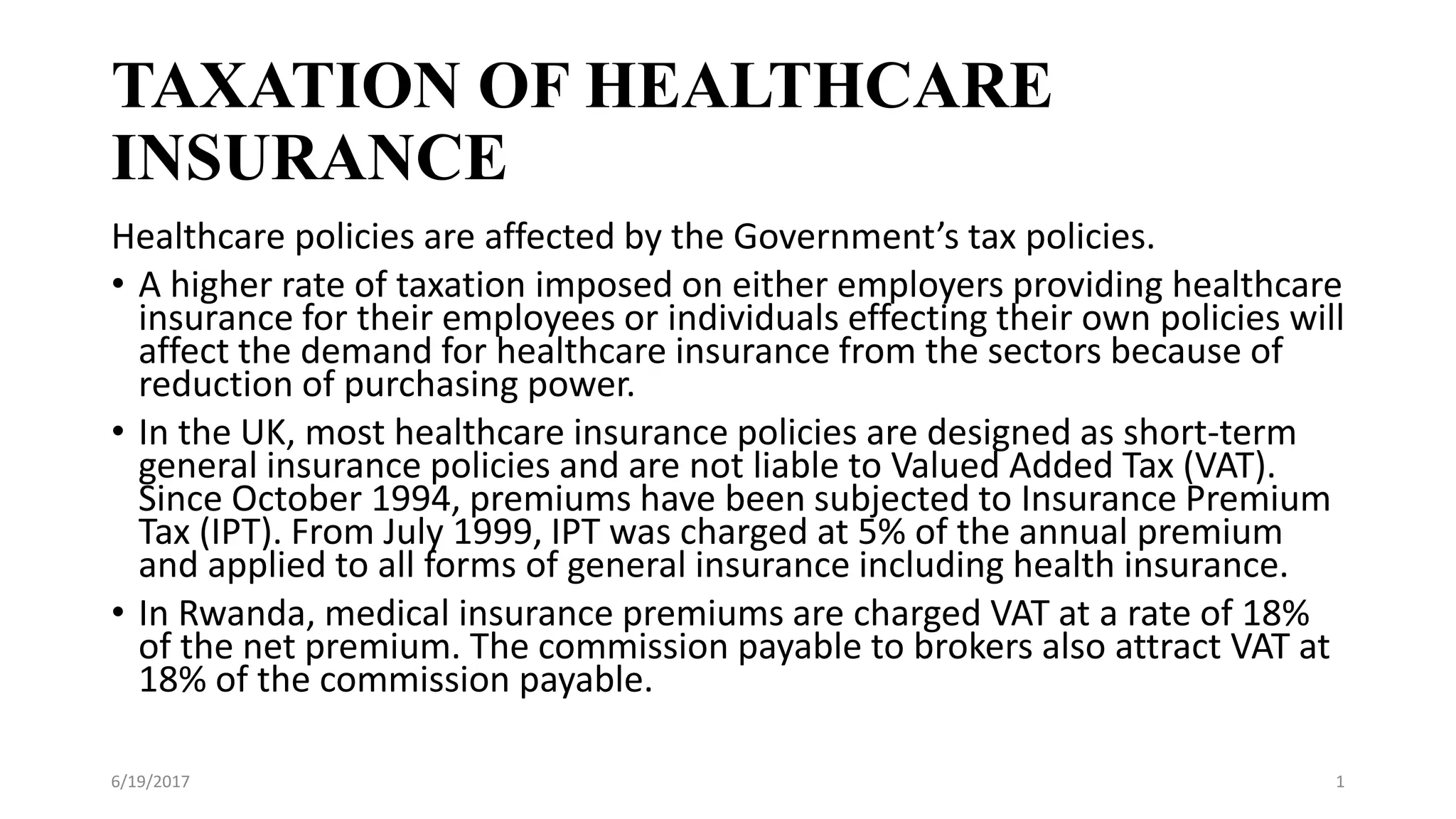
Healthcare policies are affected by the Government’s tax policies.
• A higher rate of taxation imposed on either employers providing healthcare
insurance for their employees or individuals effecting their own policies will
affect the demand for healthcare insurance from the sectors because of
reduction of purchasing power.
• In the UK, most healthcare insurance policies are designed as short-term
general insurance policies and are not liable to Valued Added Tax (VAT).
Since October 1994, premiums have been subjected to Insurance Premium
Tax (IPT). From July 1999, IPT was charged at 5% of the annual premium
and applied to all forms of general insurance including health insurance.
• In Rwanda, medical insurance premiums are charged VAT at a rate of 18%
of the net premium. The commission payable to brokers also attract VAT at
18% of the commission payable.
6/19/2017 1
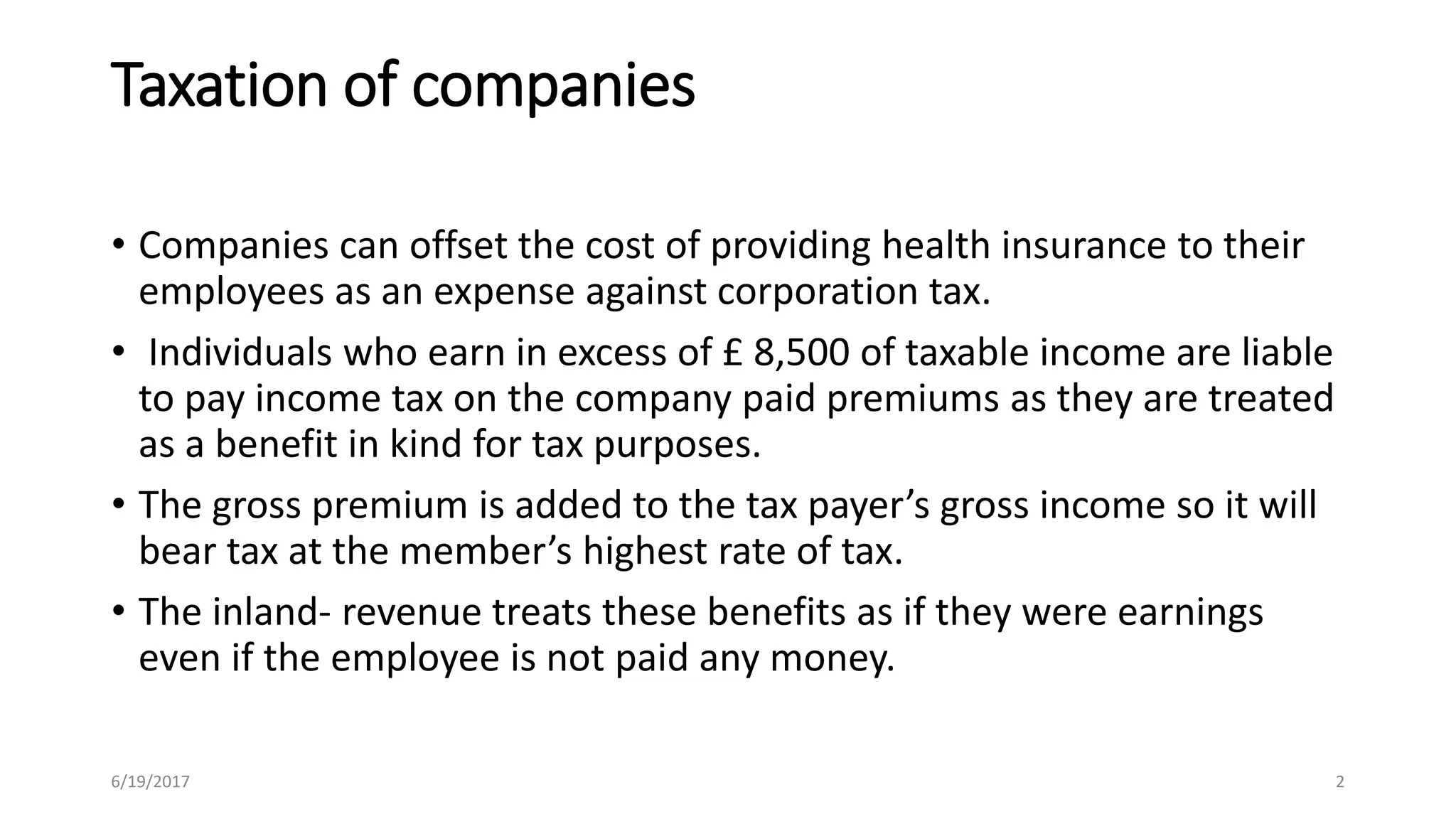
Taxation of companies
• Companies can offset the cost of providing health insurance to their
employees as an expense against corporation tax.
• Individuals who earn in excess of £ 8,500 of taxable income are liable
to pay income tax on the company paid premiums as they are treated
as a benefit in kind for tax purposes.
• The gross premium is added to the tax payer’s gross income so it will
bear tax at the member’s highest rate of tax.
• The inland- revenue treats these benefits as if they were earnings
even if the employee is not paid any money.
6/19/2017 2
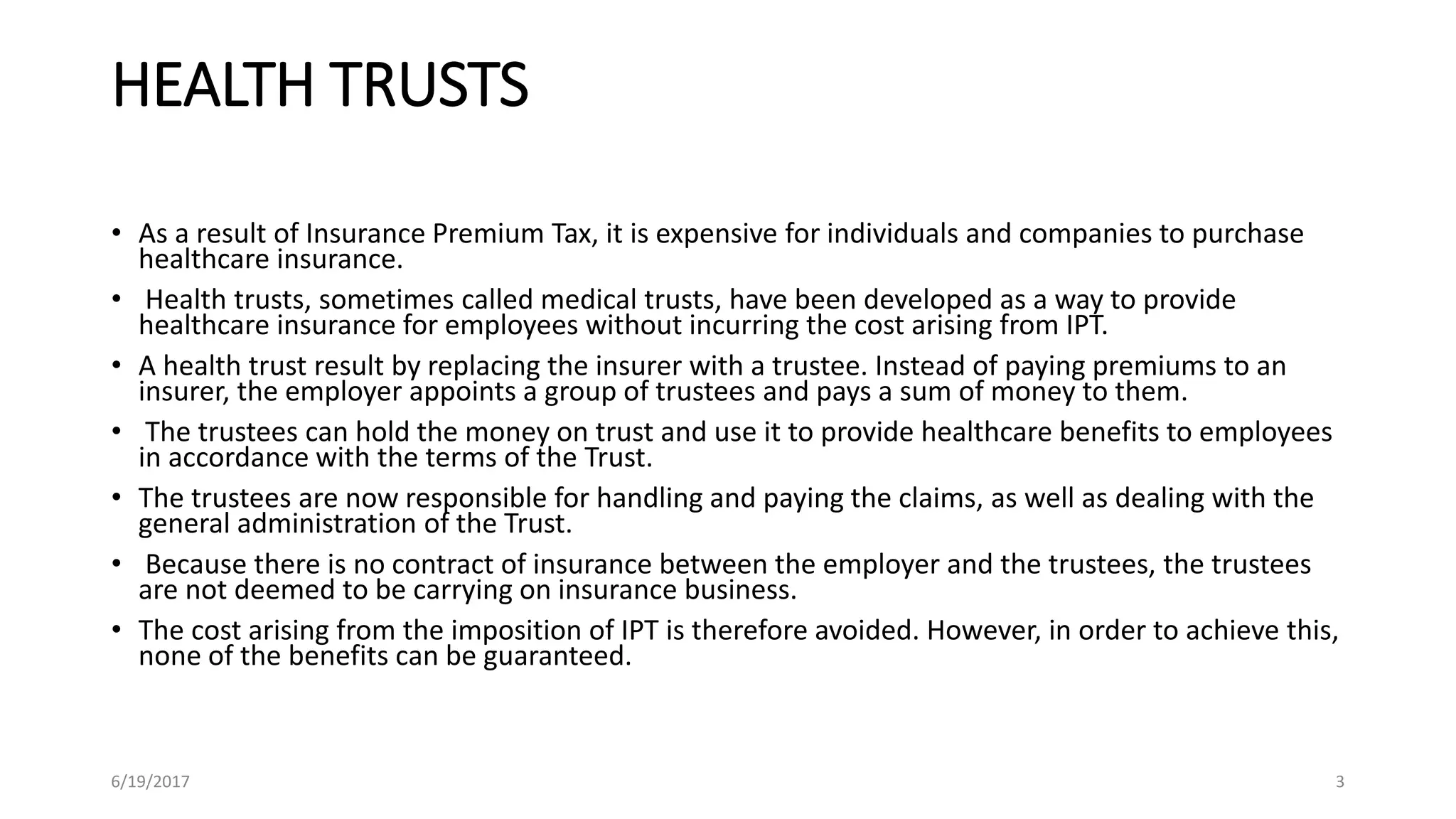
HEALTH TRUSTS
• As a result of Insurance Premium Tax, it is expensive for individuals and companies to purchase
healthcare insurance.
• Health trusts, sometimes called medical trusts, have been developed as a way to provide
healthcare insurance for employees without incurring the cost arising from IPT.
• A health trust result by replacing the insurer with a trustee. Instead of paying premiums to an
insurer, the employer appoints a group of trustees and pays a sum of money to them.
• The trustees can hold the money on trust and use it to provide healthcare benefits to employees
in accordance with the terms of the Trust.
• The trustees are now responsible for handling and paying the claims, as well as dealing with the
general administration of the Trust.
• Because there is no contract of insurance between the employer and the trustees, the trustees
are not deemed to be carrying on insurance business.
• The cost arising from the imposition of IPT is therefore avoided. However, in order to achieve this,
none of the benefits can be guaranteed.
6/19/2017 3
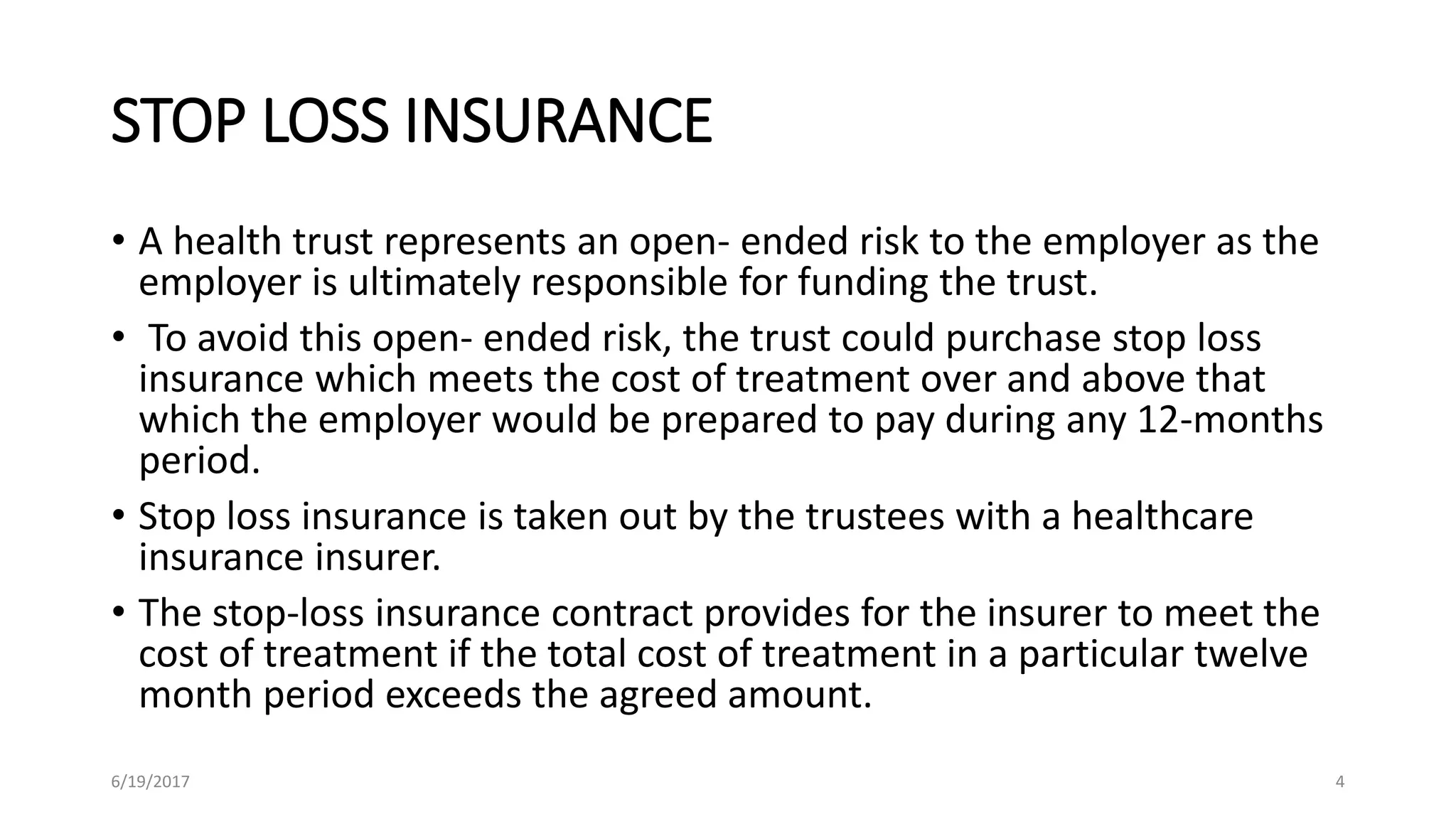
STOP LOSS INSURANCE
• A health trust represents an open- ended risk to the employer as the
employer is ultimately responsible for funding the trust.
• To avoid this open- ended risk, the trust could purchase stop loss
insurance which meets the cost of treatment over and above that
which the employer would be prepared to pay during any 12-months
period.
• Stop loss insurance is taken out by the trustees with a healthcare
insurance insurer.
• The stop-loss insurance contract provides for the insurer to meet the
cost of treatment if the total cost of treatment in a particular twelve
month period exceeds the agreed amount.
6/19/2017 4
STOP LOSS INSURANCE (Cont..d)
• IPT would be payable on the stop-loss premium.
• For an employer with a large number of employees, the premiums would
be relatively small and therefore the amount of tax would be minimal.
• Setting up a health trust is complicated especially in terms of
documentation required.
• The trust deed needs to be carefully drafted in order to ensure that IPT
does not become payable.
• Because of the costs and administrative burden associated with health
trusts, there is a general view that they will not become popular providing
IPT remains at the current rate (5%).
6/19/2017 5
BENEFIT LIMITS
• Most healthcare insurance policies are supported by a table of limits which
is a schedule of the type of medical services that are covered under the
policy and the total benefits that may be claimed daily, weekly, annually or
per procedure.
• The purpose of the table is to clarify to the member the scale of cover
provided under the contract.
WHY IMPOSE BENEFIT LIMITS
• To limit the exposure of the insurer;
• To avoid the costs associated with chronic conditions.
6/19/2017 6
ALTERNATIVES TO HEALTHCARE INSURANCE
These include the following:
Self –Insurance
Self-insurance exists where an individual or employer decides not to
take out healthcare insurance but is prepared to meet the cost of
private treatment from their own resources.
This is partly due to the growing cost of private medical insurance.
6/19/2017 7
Health Cash Policies.
• These policies provide a cash benefit for each day spent in hospital. They
tend to be marketed as offering useful cash for additional costs associated
with hospitalization, for example travel expenses, child minding and loss of
earnings. The policies are offered on individual, family or corporate basis.
• Cash policies may provide benefits for items which are normally not
covered by healthcare insurance.
Health Trust Policies/Plans (Already Discussed).
• Spending from Savings and Borrowings
6/19/2017 8

Unit 517 lecture notes no 4

  • 1.
    TAXATION OF HEALTHCARE INSURANCE Healthcarepolicies are affected by the Government’s tax policies. • A higher rate of taxation imposed on either employers providing healthcare insurance for their employees or individuals effecting their own policies will affect the demand for healthcare insurance from the sectors because of reduction of purchasing power. • In the UK, most healthcare insurance policies are designed as short-term general insurance policies and are not liable to Valued Added Tax (VAT). Since October 1994, premiums have been subjected to Insurance Premium Tax (IPT). From July 1999, IPT was charged at 5% of the annual premium and applied to all forms of general insurance including health insurance. • In Rwanda, medical insurance premiums are charged VAT at a rate of 18% of the net premium. The commission payable to brokers also attract VAT at 18% of the commission payable. 6/19/2017 1
  • 2.
    Taxation of companies •Companies can offset the cost of providing health insurance to their employees as an expense against corporation tax. • Individuals who earn in excess of £ 8,500 of taxable income are liable to pay income tax on the company paid premiums as they are treated as a benefit in kind for tax purposes. • The gross premium is added to the tax payer’s gross income so it will bear tax at the member’s highest rate of tax. • The inland- revenue treats these benefits as if they were earnings even if the employee is not paid any money. 6/19/2017 2
  • 3.
    HEALTH TRUSTS • Asa result of Insurance Premium Tax, it is expensive for individuals and companies to purchase healthcare insurance. • Health trusts, sometimes called medical trusts, have been developed as a way to provide healthcare insurance for employees without incurring the cost arising from IPT. • A health trust result by replacing the insurer with a trustee. Instead of paying premiums to an insurer, the employer appoints a group of trustees and pays a sum of money to them. • The trustees can hold the money on trust and use it to provide healthcare benefits to employees in accordance with the terms of the Trust. • The trustees are now responsible for handling and paying the claims, as well as dealing with the general administration of the Trust. • Because there is no contract of insurance between the employer and the trustees, the trustees are not deemed to be carrying on insurance business. • The cost arising from the imposition of IPT is therefore avoided. However, in order to achieve this, none of the benefits can be guaranteed. 6/19/2017 3
  • 4.
    STOP LOSS INSURANCE •A health trust represents an open- ended risk to the employer as the employer is ultimately responsible for funding the trust. • To avoid this open- ended risk, the trust could purchase stop loss insurance which meets the cost of treatment over and above that which the employer would be prepared to pay during any 12-months period. • Stop loss insurance is taken out by the trustees with a healthcare insurance insurer. • The stop-loss insurance contract provides for the insurer to meet the cost of treatment if the total cost of treatment in a particular twelve month period exceeds the agreed amount. 6/19/2017 4
  • 5.
    STOP LOSS INSURANCE(Cont..d) • IPT would be payable on the stop-loss premium. • For an employer with a large number of employees, the premiums would be relatively small and therefore the amount of tax would be minimal. • Setting up a health trust is complicated especially in terms of documentation required. • The trust deed needs to be carefully drafted in order to ensure that IPT does not become payable. • Because of the costs and administrative burden associated with health trusts, there is a general view that they will not become popular providing IPT remains at the current rate (5%). 6/19/2017 5
  • 6.
    BENEFIT LIMITS • Mosthealthcare insurance policies are supported by a table of limits which is a schedule of the type of medical services that are covered under the policy and the total benefits that may be claimed daily, weekly, annually or per procedure. • The purpose of the table is to clarify to the member the scale of cover provided under the contract. WHY IMPOSE BENEFIT LIMITS • To limit the exposure of the insurer; • To avoid the costs associated with chronic conditions. 6/19/2017 6
  • 7.
    ALTERNATIVES TO HEALTHCAREINSURANCE These include the following: Self –Insurance Self-insurance exists where an individual or employer decides not to take out healthcare insurance but is prepared to meet the cost of private treatment from their own resources. This is partly due to the growing cost of private medical insurance. 6/19/2017 7
  • 8.
    Health Cash Policies. •These policies provide a cash benefit for each day spent in hospital. They tend to be marketed as offering useful cash for additional costs associated with hospitalization, for example travel expenses, child minding and loss of earnings. The policies are offered on individual, family or corporate basis. • Cash policies may provide benefits for items which are normally not covered by healthcare insurance. Health Trust Policies/Plans (Already Discussed). • Spending from Savings and Borrowings 6/19/2017 8