Transportation Planning
Unit 3: Transport Models
Dr. Sitesh Kumar Singh
Assistant Professor
Department of Civil Engineering
Wollega University, Ethiopia
3.1. Modal split models
• The stage of modal split analysis was identified as occurring after the trip distribution analysis
phase.
• The purpose of choice modal split analysis phase is to estimate the probable split of choice
transit riders between public transport and car travel given measures of generalized cost of
travel by two modes.
• The ratio of choice trip makers using a public transport system varies from 9 to 1 in small cities
with poorly developed public transport systems to as high as 3 to 1 in well-developed cities.
• The modal split models, which have been used before the trip distribution phase, are usually
referred to as trip end modal split models.
• Modal split that has followed the trip distribution phase are normally termed trip interchange
modal spit models.
• Trip end modal split models are used today in medium and small sized cities.
3.2. Behavioural models
This model will give answers of certain questions as follows:
• How many commuters will be diverted from automobiles onto transit as the result of a given fare
reduction?
• How many commuters will be diverted from automobiles onto transit as the result of a given increase in
transit speed?
• What combination of system characteristics will yield the maximum diversion effect (change in mode of
transport)?
• The model also produces estimates of the value of saved travel time to commuters and thus allows direct
calculation of the benefits of system improvements.
• It is more flexible than conventional, aggregate modal split models and should yield more accurate
forecasts.
3.3. Probabilistic models
• Probabilistic models describe the derivation of a probability model of travel mode choice for the work journey in
terms of the differences in costs and times between the modes available for each individual's journey.
• Regression techniques were used to establish simple linear relationships between the probability of using a car and
the cost and time differences between a car and the best available public transport route.
3.4. Utility functions
• The aim of utility function is to analyze the modal shift of passengers by analyzing
their preferences.
• If the preferences of passengers are known it is possible to build up mathematically
their utility function.
• This is the statistically correct way to simulate the modal shift of the investigated area.
• To capture the preferences of passengers stated preference method can be used in
questionnaire.
• Five key factors were identified (from the point of passengers): travel cost, travel time,
comfort, safety and environmental efficiency.
3.5. Logit models
See class notes
3.6. Two stage model split model
• A simple two stage model have been developed which recognizes explicitly the existence of both captive and of
choice transit riders.
• Captive transit riders: lower-income people who must use transit because they don’t own cars.
• Choice transit riders: higher-income people with cars
• The model first identifies both the production and attraction trip ends of transit captives and choice transit riders
separately.
• The two groups of trip makers are then distributed from origin to destinations.
• The choice transit riders are then split between transit and car according to a choice modal split model, which reflects
the relative characteristics of the trip by transit and the trip by car.
• In most cities, the transit captive is severely restricted in the choice of both household and employment locations.
• Studies in a number of cities have shown that the trip ends of the transit captives tend to be clustered in zones that
are well served by public transport.
3.7.Traffic assignment
• The process of allocating given set of trip interchanges to the specified transportation system is usually
referred to as traffic assignment.
• The fundamental aim of the traffic assignment process is to reproduce on the transportation system, the
pattern of vehicular movements which would be observed when the travel demand represented by the trip
matrix, or matrices, to be assigned is satisfied.
• The major aims of traffic assignment procedures are:
 To estimate the volume of traffic on the links of the network and obtain aggregate network measures.
 To estimate inter zonal travel cost.
 To analyze the travel pattern of each origin to destination(O-D) pair.
 To identify congested links and to collect traffic data useful for the design of future junctions.
3.8.Assignment methods
i. All-or-nothing assignment
• In this method the trips from any origin zone to any destination zone are loaded onto a single, minimum cost, path
between them.
• This model is unrealistic as only one path between every O-D pair is utilized even if there is another path with the same
or nearly same travel cost.
• Also, traffic on links is assigned without consideration of whether or not there is adequate capacity or heavy congestion;
travel time is a fixed input and does not vary depending on the congestion on a link.
• However, this model may be reasonable in sparse and uncongested networks where there are few alternative routes and
they have a large difference in travel cost.
• This model may also be used to identify the desired path: the path which the drivers would like to travel in the absence of
congestion.
• In fact, this model's most important practical application is that it acts as a building block for other types of assignment
techniques.
• It has a limitation that it ignores the fact that link travel time is a function of link volume and when there is congestion or
that multiple paths are used to carry traffic.
ii. System Optimum Assignment (SO)
• The system optimum assignment is based on Wardrop's second principle, which states that
drivers cooperate with one another in order to minimize total system travel time.
• This assignment can be thought of as a model in which congestion is minimized when drivers
are told which routes to use.
• Obviously, this is not a behaviorally realistic model, but it can be useful to transport planners
and engineers, trying to manage the traffic to minimize travel costs and therefore achieve an
optimum social equilibrium.
iii. Incremental assignment
• Incremental assignment is a process in which fractions of traffic volumes are assigned in steps.
• In each step, a fixed proportion of total demand is assigned, based on all-or-nothing assignment.
• After each step, link travel times are recalculated based on link volumes.
• Also, incremental assignment is influenced by the order in which volumes for O-D pairs are
assigned, raising the possibility of additional bias in results.
iv. Capacity restraint assignment
• Capacity restraint assignment attempts to approximate an equilibrium solution by
iterating between all-or-nothing traffic loadings and recalculating link travel times based
on a congestion function that reflects link capacity.
v. Stochastic user equilibrium assignment
• User equilibrium assignment procedures based on Wardrop's principle assume that all
drivers perceive costs in an identical manner.
• A solution to assignment problem on this basis is an assignment such that no driver can
reduce his journey cost by unilaterally changing route.
• Van Vilet considered as stochastic assignment models, all those models which explicitly
allows non minimum cost routes to be selected.
• Virtually all such models assume that driver’s perception of costs on any given route are
not identical and that the trips between each O-D pair are divided among the routes with
the cheapest route attracting most trips.
vi. Dynamic Assignment
• Dynamic user equilibrium, expressed as an extension of Wardrop's user equilibrium principle, may be defined as the
state of equilibrium which arises when no driver can reduce his disutility of travel by choosing a new route or departure
time, where disutility includes, schedule delay in addition in to costs generally considered.
• Dynamic stochastic equilibrium may be similarly defined in terms of perceived utility of travel.
3.9.Route-choice behaviour
• The behaviour of driver to choose the route of his trip is route choice behaviour.
• Factors affecting route choice behaviour:
 Travel Time
 Travel cost
 Road condition
 Traffic condition
 Enforcement conditions
3.10. Network analysis
• Network Analysis aims at finding solutions to routing problems related to traversibility, rate of
flow, and network connectivity.
• A network is a collection of nodes, and a collection of links which connect the nodes.
• A network is denoted G = (N, A), where N is the set of nodes and A is the set of links.
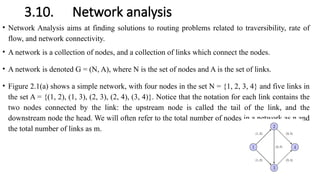
• Figure 2.1(a) shows a simple network, with four nodes in the set N = {1, 2, 3, 4} and five links in
the set A = {(1, 2), (1, 3), (2, 3), (2, 4), (3, 4)}. Notice that the notation for each link contains the
two nodes connected by the link: the upstream node is called the tail of the link, and the
downstream node the head. We will often refer to the total number of nodes in a network as n and
the total number of links as m.
Figure 2: Networks which are (a) strongly connected; (b) connected, but not strongly connected; (c) disconnected.

Unit 3.pptx for civil engineering second year

  • 1.
    Transportation Planning Unit 3:Transport Models Dr. Sitesh Kumar Singh Assistant Professor Department of Civil Engineering Wollega University, Ethiopia
  • 2.
    3.1. Modal splitmodels • The stage of modal split analysis was identified as occurring after the trip distribution analysis phase. • The purpose of choice modal split analysis phase is to estimate the probable split of choice transit riders between public transport and car travel given measures of generalized cost of travel by two modes. • The ratio of choice trip makers using a public transport system varies from 9 to 1 in small cities with poorly developed public transport systems to as high as 3 to 1 in well-developed cities. • The modal split models, which have been used before the trip distribution phase, are usually referred to as trip end modal split models. • Modal split that has followed the trip distribution phase are normally termed trip interchange modal spit models. • Trip end modal split models are used today in medium and small sized cities.
  • 3.
    3.2. Behavioural models Thismodel will give answers of certain questions as follows: • How many commuters will be diverted from automobiles onto transit as the result of a given fare reduction? • How many commuters will be diverted from automobiles onto transit as the result of a given increase in transit speed? • What combination of system characteristics will yield the maximum diversion effect (change in mode of transport)? • The model also produces estimates of the value of saved travel time to commuters and thus allows direct calculation of the benefits of system improvements. • It is more flexible than conventional, aggregate modal split models and should yield more accurate forecasts.
  • 4.
    3.3. Probabilistic models •Probabilistic models describe the derivation of a probability model of travel mode choice for the work journey in terms of the differences in costs and times between the modes available for each individual's journey. • Regression techniques were used to establish simple linear relationships between the probability of using a car and the cost and time differences between a car and the best available public transport route.
  • 5.
    3.4. Utility functions •The aim of utility function is to analyze the modal shift of passengers by analyzing their preferences. • If the preferences of passengers are known it is possible to build up mathematically their utility function. • This is the statistically correct way to simulate the modal shift of the investigated area. • To capture the preferences of passengers stated preference method can be used in questionnaire. • Five key factors were identified (from the point of passengers): travel cost, travel time, comfort, safety and environmental efficiency.
  • 6.
  • 7.
    3.6. Two stagemodel split model • A simple two stage model have been developed which recognizes explicitly the existence of both captive and of choice transit riders. • Captive transit riders: lower-income people who must use transit because they don’t own cars. • Choice transit riders: higher-income people with cars • The model first identifies both the production and attraction trip ends of transit captives and choice transit riders separately. • The two groups of trip makers are then distributed from origin to destinations. • The choice transit riders are then split between transit and car according to a choice modal split model, which reflects the relative characteristics of the trip by transit and the trip by car. • In most cities, the transit captive is severely restricted in the choice of both household and employment locations. • Studies in a number of cities have shown that the trip ends of the transit captives tend to be clustered in zones that are well served by public transport.
  • 8.
    3.7.Traffic assignment • Theprocess of allocating given set of trip interchanges to the specified transportation system is usually referred to as traffic assignment. • The fundamental aim of the traffic assignment process is to reproduce on the transportation system, the pattern of vehicular movements which would be observed when the travel demand represented by the trip matrix, or matrices, to be assigned is satisfied. • The major aims of traffic assignment procedures are:  To estimate the volume of traffic on the links of the network and obtain aggregate network measures.  To estimate inter zonal travel cost.  To analyze the travel pattern of each origin to destination(O-D) pair.  To identify congested links and to collect traffic data useful for the design of future junctions.
  • 9.
    3.8.Assignment methods i. All-or-nothingassignment • In this method the trips from any origin zone to any destination zone are loaded onto a single, minimum cost, path between them. • This model is unrealistic as only one path between every O-D pair is utilized even if there is another path with the same or nearly same travel cost. • Also, traffic on links is assigned without consideration of whether or not there is adequate capacity or heavy congestion; travel time is a fixed input and does not vary depending on the congestion on a link. • However, this model may be reasonable in sparse and uncongested networks where there are few alternative routes and they have a large difference in travel cost. • This model may also be used to identify the desired path: the path which the drivers would like to travel in the absence of congestion. • In fact, this model's most important practical application is that it acts as a building block for other types of assignment techniques. • It has a limitation that it ignores the fact that link travel time is a function of link volume and when there is congestion or that multiple paths are used to carry traffic.
  • 10.
    ii. System OptimumAssignment (SO) • The system optimum assignment is based on Wardrop's second principle, which states that drivers cooperate with one another in order to minimize total system travel time. • This assignment can be thought of as a model in which congestion is minimized when drivers are told which routes to use. • Obviously, this is not a behaviorally realistic model, but it can be useful to transport planners and engineers, trying to manage the traffic to minimize travel costs and therefore achieve an optimum social equilibrium. iii. Incremental assignment • Incremental assignment is a process in which fractions of traffic volumes are assigned in steps. • In each step, a fixed proportion of total demand is assigned, based on all-or-nothing assignment. • After each step, link travel times are recalculated based on link volumes. • Also, incremental assignment is influenced by the order in which volumes for O-D pairs are assigned, raising the possibility of additional bias in results.
  • 11.
    iv. Capacity restraintassignment • Capacity restraint assignment attempts to approximate an equilibrium solution by iterating between all-or-nothing traffic loadings and recalculating link travel times based on a congestion function that reflects link capacity. v. Stochastic user equilibrium assignment • User equilibrium assignment procedures based on Wardrop's principle assume that all drivers perceive costs in an identical manner. • A solution to assignment problem on this basis is an assignment such that no driver can reduce his journey cost by unilaterally changing route. • Van Vilet considered as stochastic assignment models, all those models which explicitly allows non minimum cost routes to be selected. • Virtually all such models assume that driver’s perception of costs on any given route are not identical and that the trips between each O-D pair are divided among the routes with the cheapest route attracting most trips.
  • 12.
    vi. Dynamic Assignment •Dynamic user equilibrium, expressed as an extension of Wardrop's user equilibrium principle, may be defined as the state of equilibrium which arises when no driver can reduce his disutility of travel by choosing a new route or departure time, where disutility includes, schedule delay in addition in to costs generally considered. • Dynamic stochastic equilibrium may be similarly defined in terms of perceived utility of travel.
  • 13.
    3.9.Route-choice behaviour • Thebehaviour of driver to choose the route of his trip is route choice behaviour. • Factors affecting route choice behaviour:  Travel Time  Travel cost  Road condition  Traffic condition  Enforcement conditions
  • 14.
    3.10. Network analysis •Network Analysis aims at finding solutions to routing problems related to traversibility, rate of flow, and network connectivity. • A network is a collection of nodes, and a collection of links which connect the nodes. • A network is denoted G = (N, A), where N is the set of nodes and A is the set of links. • Figure 2.1(a) shows a simple network, with four nodes in the set N = {1, 2, 3, 4} and five links in the set A = {(1, 2), (1, 3), (2, 3), (2, 4), (3, 4)}. Notice that the notation for each link contains the two nodes connected by the link: the upstream node is called the tail of the link, and the downstream node the head. We will often refer to the total number of nodes in a network as n and the total number of links as m.
  • 15.
    Figure 2: Networkswhich are (a) strongly connected; (b) connected, but not strongly connected; (c) disconnected.