Presented By:
Bhawna Kol
Assistant Professor
UIT-RGPV, Bhopal
NOTES BY BHAWNA KOL
MODULAR PROGRAMMING
In C
What is modular programming
• Modular programming is the process of
subdividing a computer program into separate
sub-programs.
• A module is a separate software component.
• We can divide c program in smaller modules.
• Module once created, can be reused in other
programs.
NOTES BY BHAWNA KOL
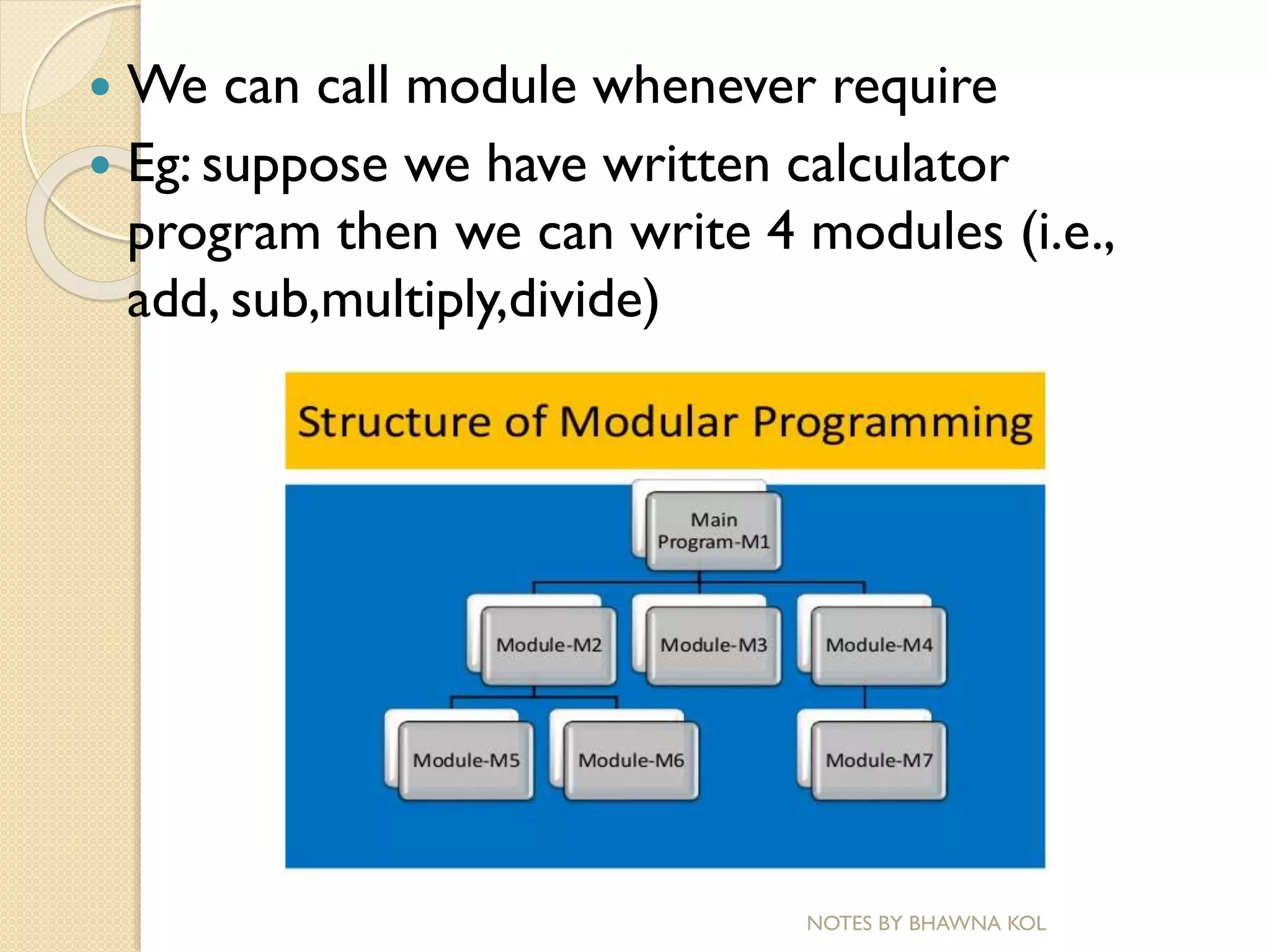
 We can call module whenever require
 Eg: suppose we have written calculator
program then we can write 4 modules (i.e.,
add, sub,multiply,divide)
NOTES BY BHAWNA KOL
• Some programs might have thousands or millions of lines and to
manage such programs it becomes quite difficult as there might be
too many of syntax errors or logical errors present in the program,
so to manage such type of programs concept
of modular programming approached.
• Each sub-module contains something necessary to execute only
one aspect of the desired functionality.
• Modular programming emphasis on breaking of large programs
into small problems to increase the maintainability, readability of
the code and to make the program handy to make any changes in
future or to correct the errors.
NOTES BY BHAWNA KOL
Advantages of Using Modular
Programming Approach
• Ease of Use :This approach allows simplicity, as rather
than focusing on the entire thousands and millions of
lines code in one go we can access it in the form of
modules. This allows ease in debugging the code and
prone to less error.
• Reusability :It allows the user to reuse the
functionality with a different interface without typing
the whole program again.
• Ease of Maintenance : It helps in less collision at the
time of working on modules, helping a team to work
with proper collaboration while working on a large
application.
NOTES BY BHAWNA KOL
Functions in C
A function is a set of statements that take inputs, do some
specific computation and produces output.
The idea is to put some commonly or repeatedly done task
together and make a function so that instead of writing the
same code again and again for different inputs, we can call
the function.
The general form of a function is:
return_type function_name([ arg1_type arg1_name, ... ])
{ code }
NOTES BY BHAWNA KOL
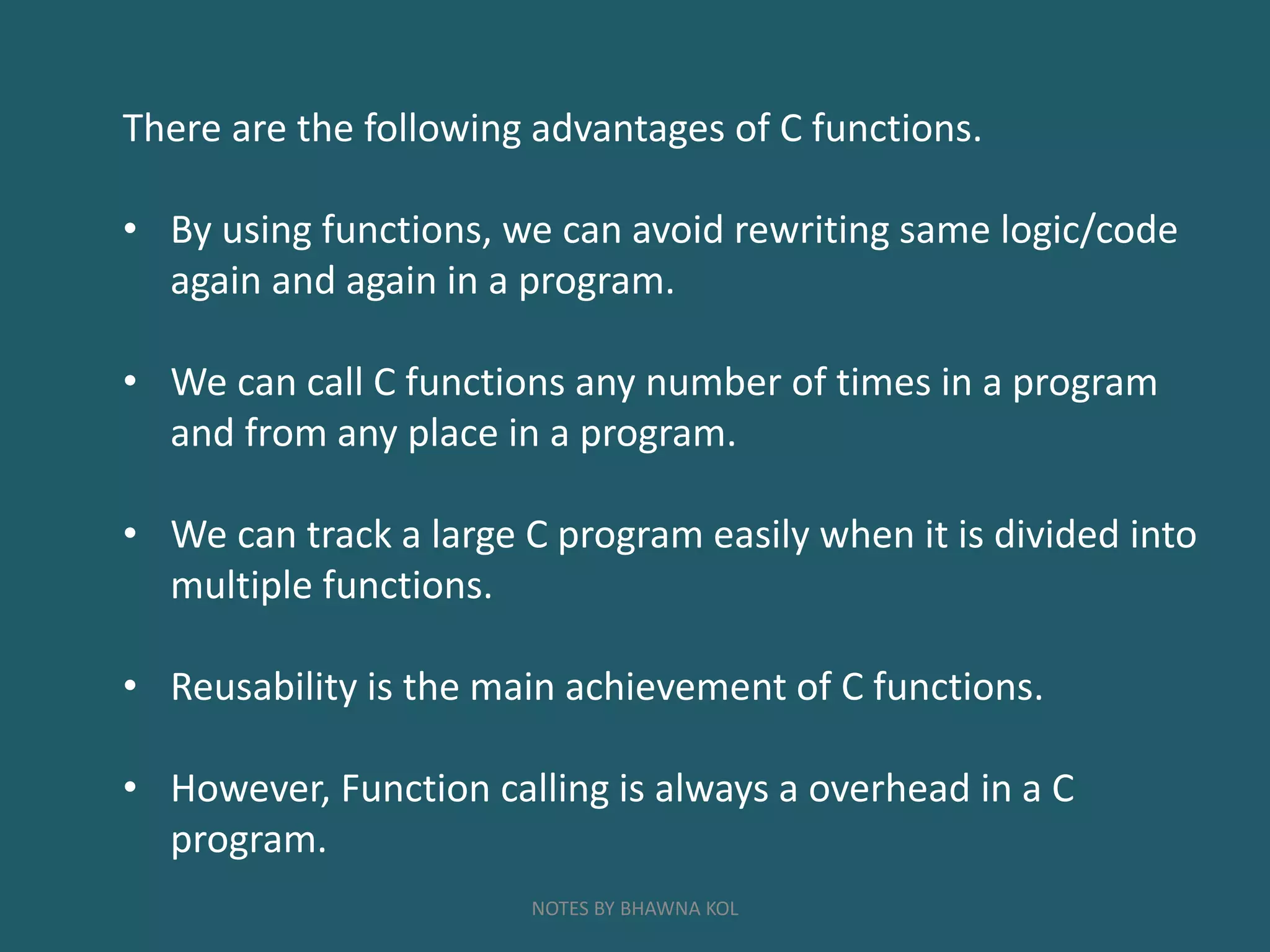
There are the following advantages of C functions.
• By using functions, we can avoid rewriting same logic/code
again and again in a program.
• We can call C functions any number of times in a program
and from any place in a program.
• We can track a large C program easily when it is divided into
multiple functions.
• Reusability is the main achievement of C functions.
• However, Function calling is always a overhead in a C
program.
NOTES BY BHAWNA KOL
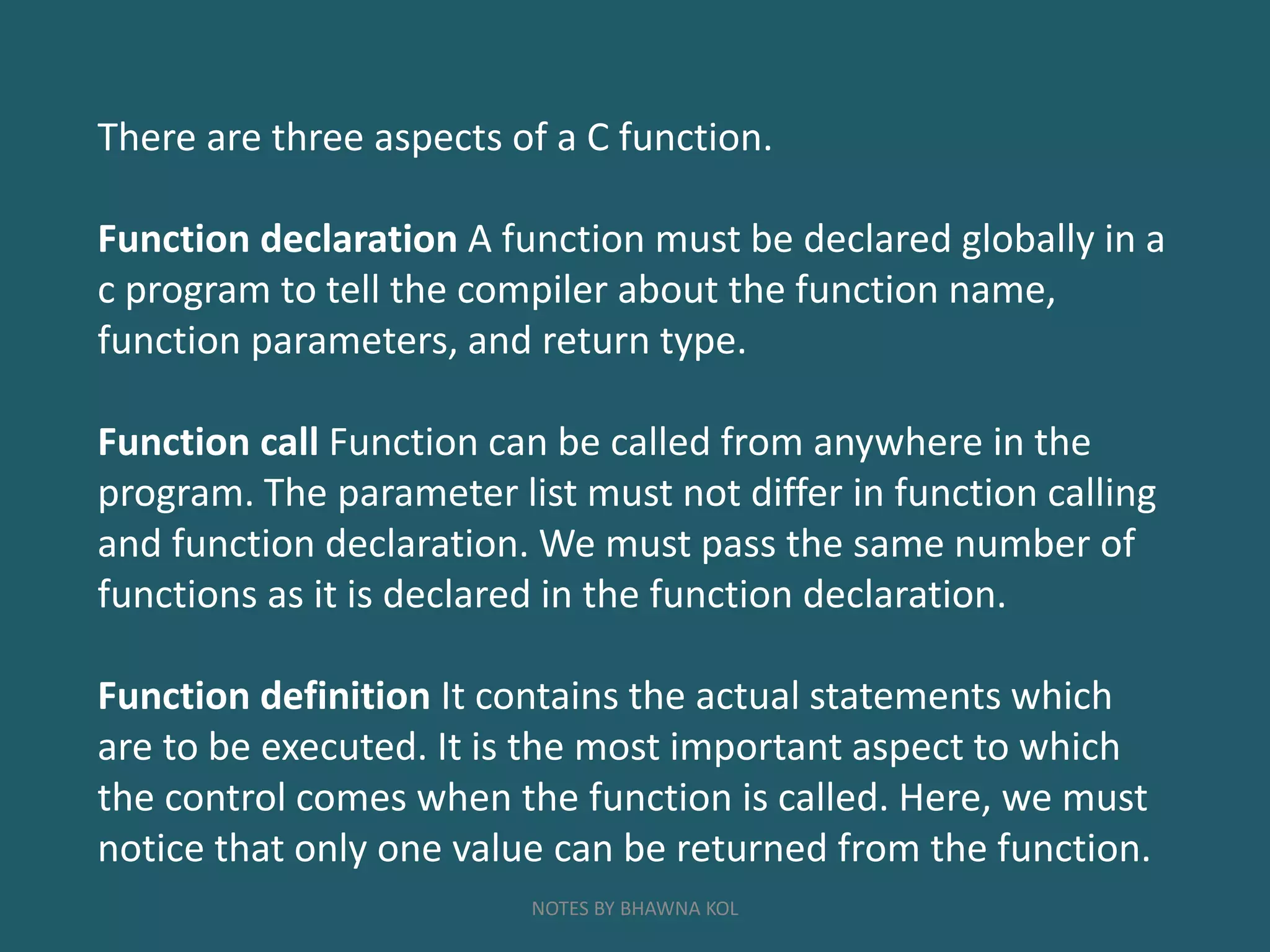
There are three aspects of a C function.
Function declaration A function must be declared globally in a
c program to tell the compiler about the function name,
function parameters, and return type.
Function call Function can be called from anywhere in the
program. The parameter list must not differ in function calling
and function declaration. We must pass the same number of
functions as it is declared in the function declaration.
Function definition It contains the actual statements which
are to be executed. It is the most important aspect to which
the control comes when the function is called. Here, we must
notice that only one value can be returned from the function.
NOTES BY BHAWNA KOL
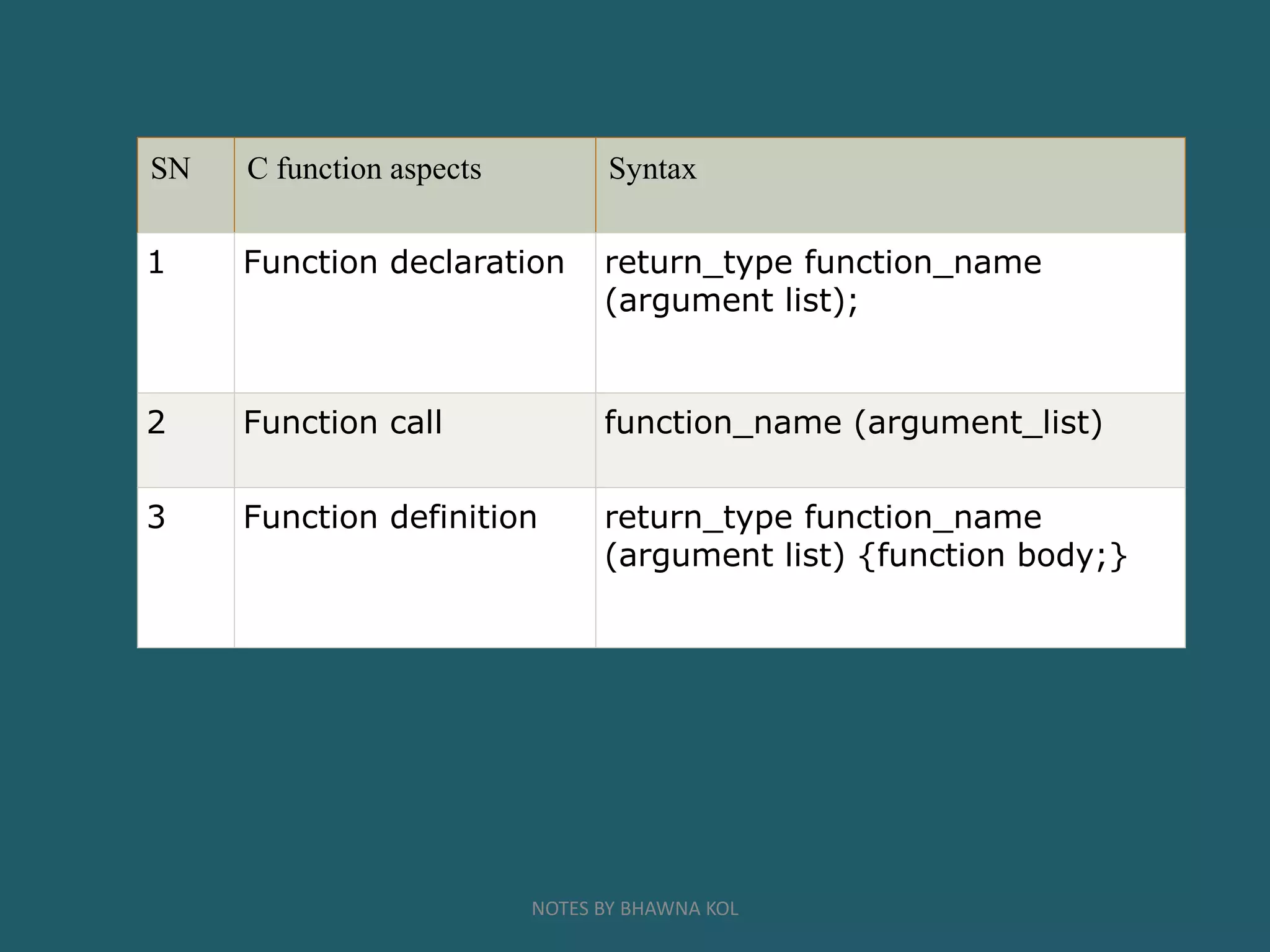
SN C function aspects Syntax
1 Function declaration return_type function_name
(argument list);
2 Function call function_name (argument_list)
3 Function definition return_type function_name
(argument list) {function body;}
NOTES BY BHAWNA KOL
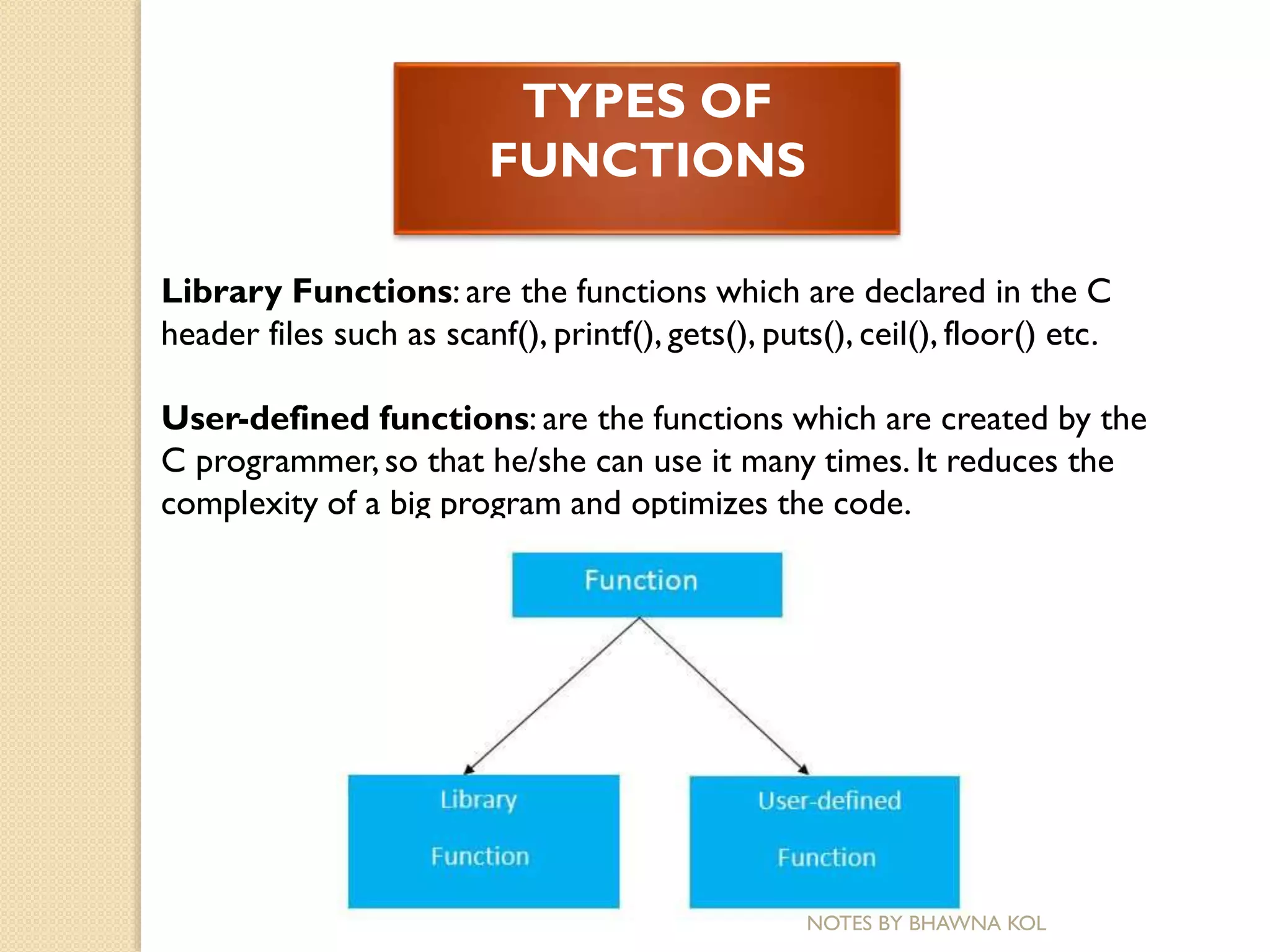
Library Functions: are the functions which are declared in the C
header files such as scanf(), printf(), gets(), puts(), ceil(), floor() etc.
User-defined functions: are the functions which are created by the
C programmer, so that he/she can use it many times. It reduces the
complexity of a big program and optimizes the code.
TYPES OF
FUNCTIONS
NOTES BY BHAWNA KOL
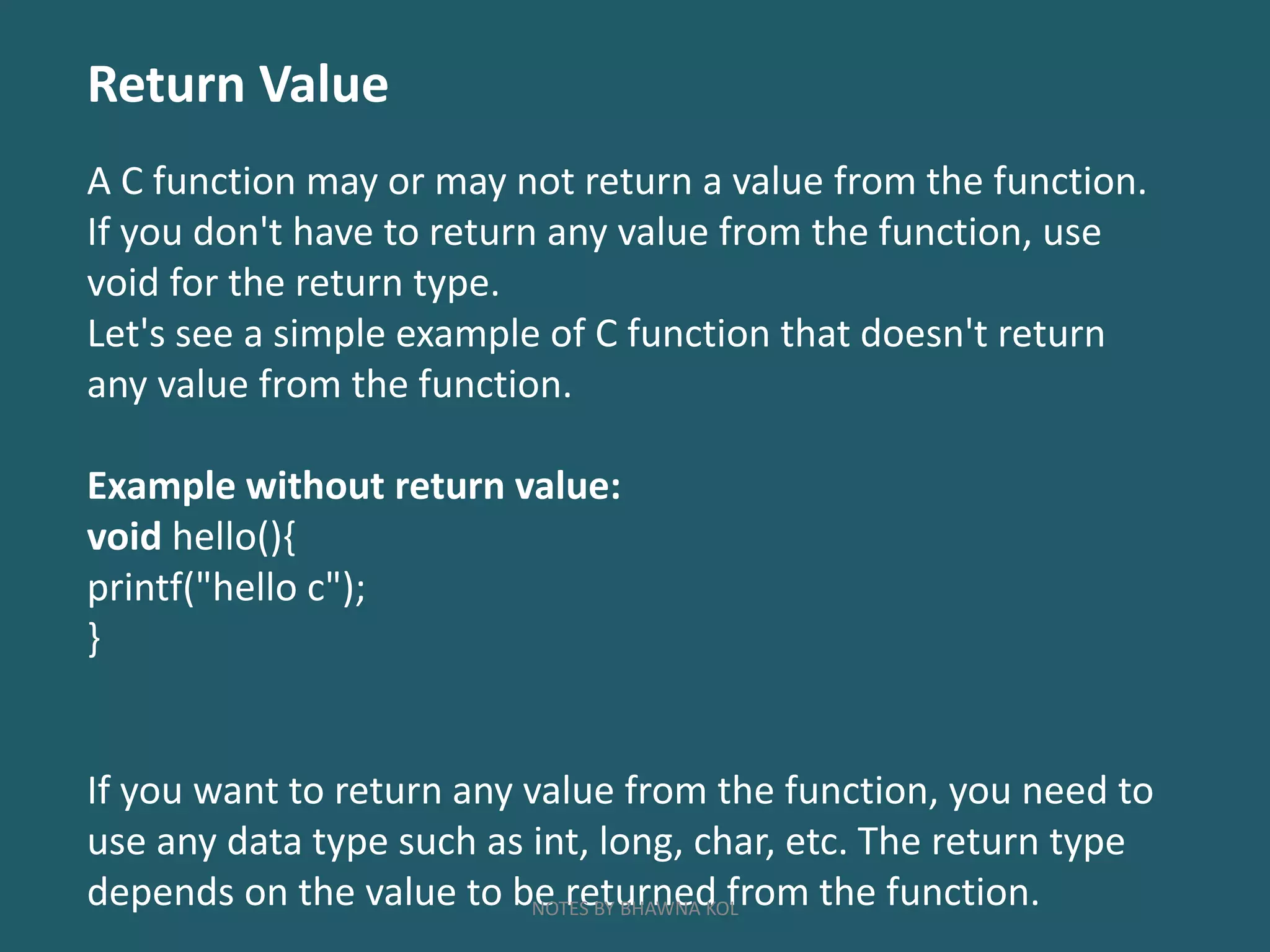
Return Value
A C function may or may not return a value from the function.
If you don't have to return any value from the function, use
void for the return type.
Let's see a simple example of C function that doesn't return
any value from the function.
Example without return value:
void hello(){
printf("hello c");
}
If you want to return any value from the function, you need to
use any data type such as int, long, char, etc. The return type
depends on the value to be returned from the function.
NOTES BY BHAWNA KOL
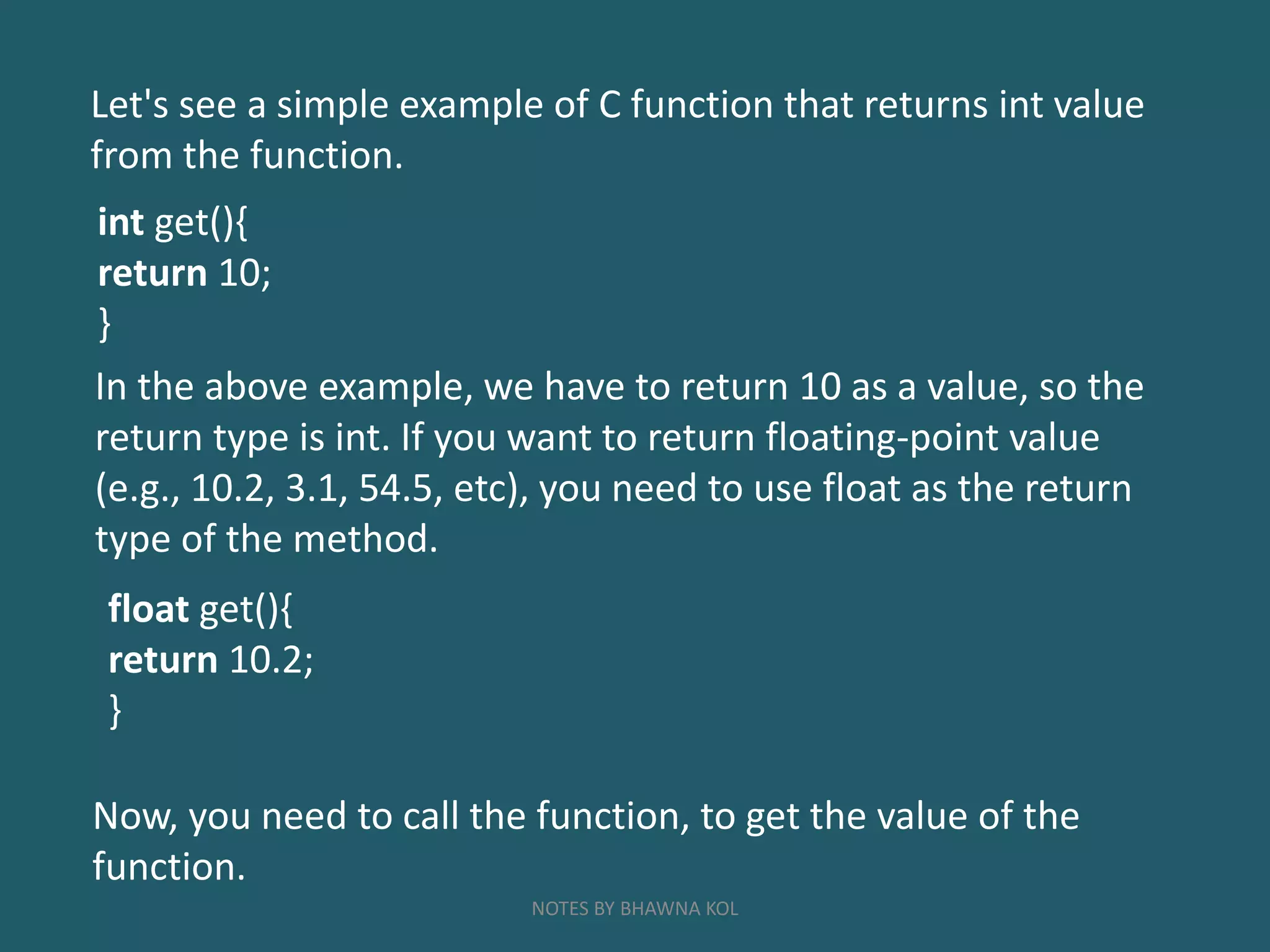
Let's see a simple example of C function that returns int value
from the function.
int get(){
return 10;
}
In the above example, we have to return 10 as a value, so the
return type is int. If you want to return floating-point value
(e.g., 10.2, 3.1, 54.5, etc), you need to use float as the return
type of the method.
float get(){
return 10.2;
}
Now, you need to call the function, to get the value of the
function.
NOTES BY BHAWNA KOL
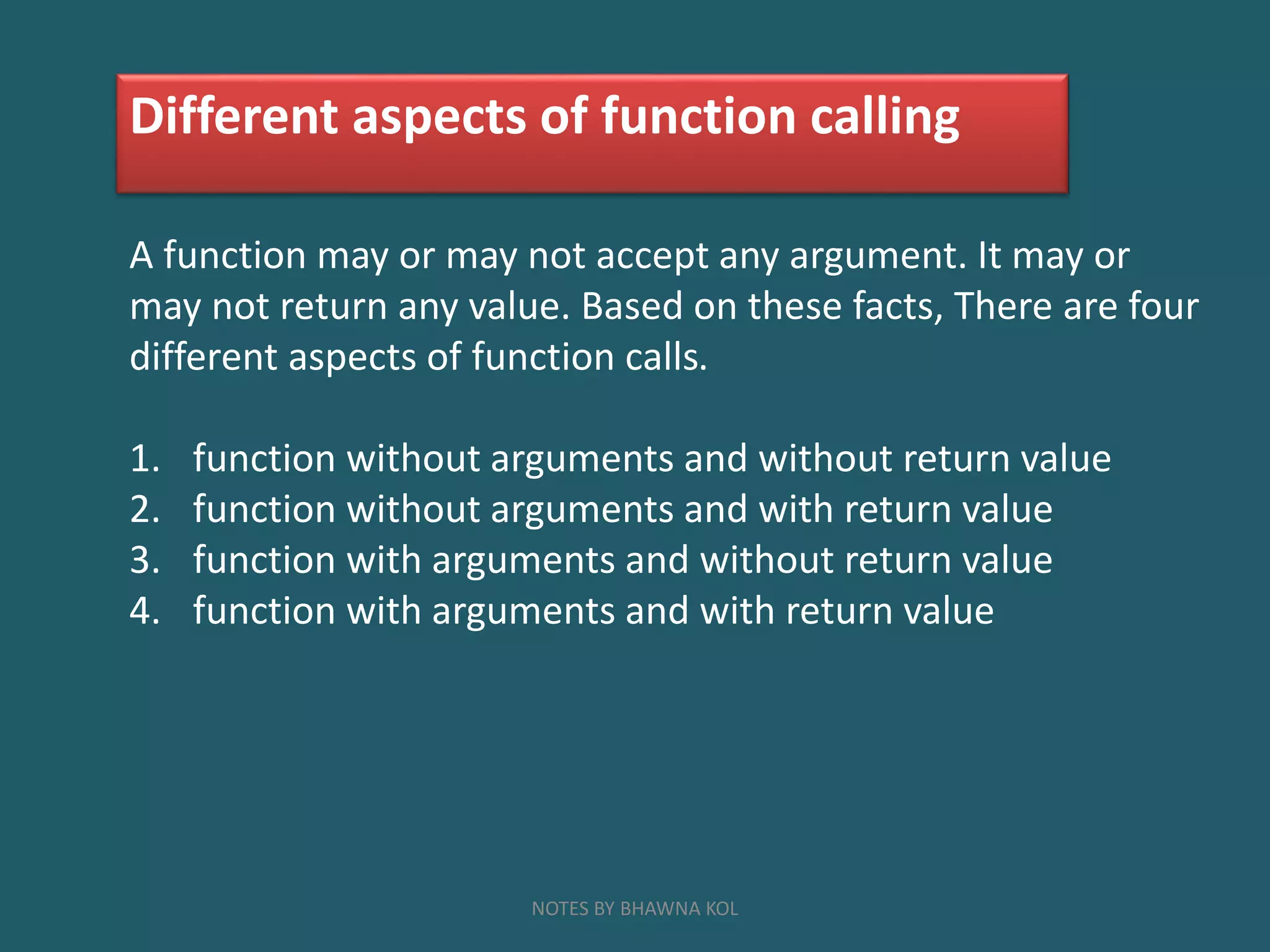
A function may or may not accept any argument. It may or
may not return any value. Based on these facts, There are four
different aspects of function calls.
1. function without arguments and without return value
2. function without arguments and with return value
3. function with arguments and without return value
4. function with arguments and with return value
Different aspects of function calling
NOTES BY BHAWNA KOL
#include<stdio.h>
void sum();
void main()
{
printf("nGoing to calculate the sum of two numbers:");
sum();
}
void sum()
{
int a,b;
printf("nEnter two numbers");
scanf("%d %d",&a,&b);
printf("The sum is %d",a+b);
}
Example for Function without argument and return value
NOTES BY BHAWNA KOL
#include<stdio.h>
int sum();
void main()
{
printf("Going to calculate the area of the squaren");
float area = square();
printf("The area of the square: %fn",area);
}
int square()
{
float side;
printf("Enter the length of the side in meters: ");
scanf("%f",&side);
return side * side;
}
Example for Function without argument and with return
value
NOTES BY BHAWNA KOL
#include<stdio.h>
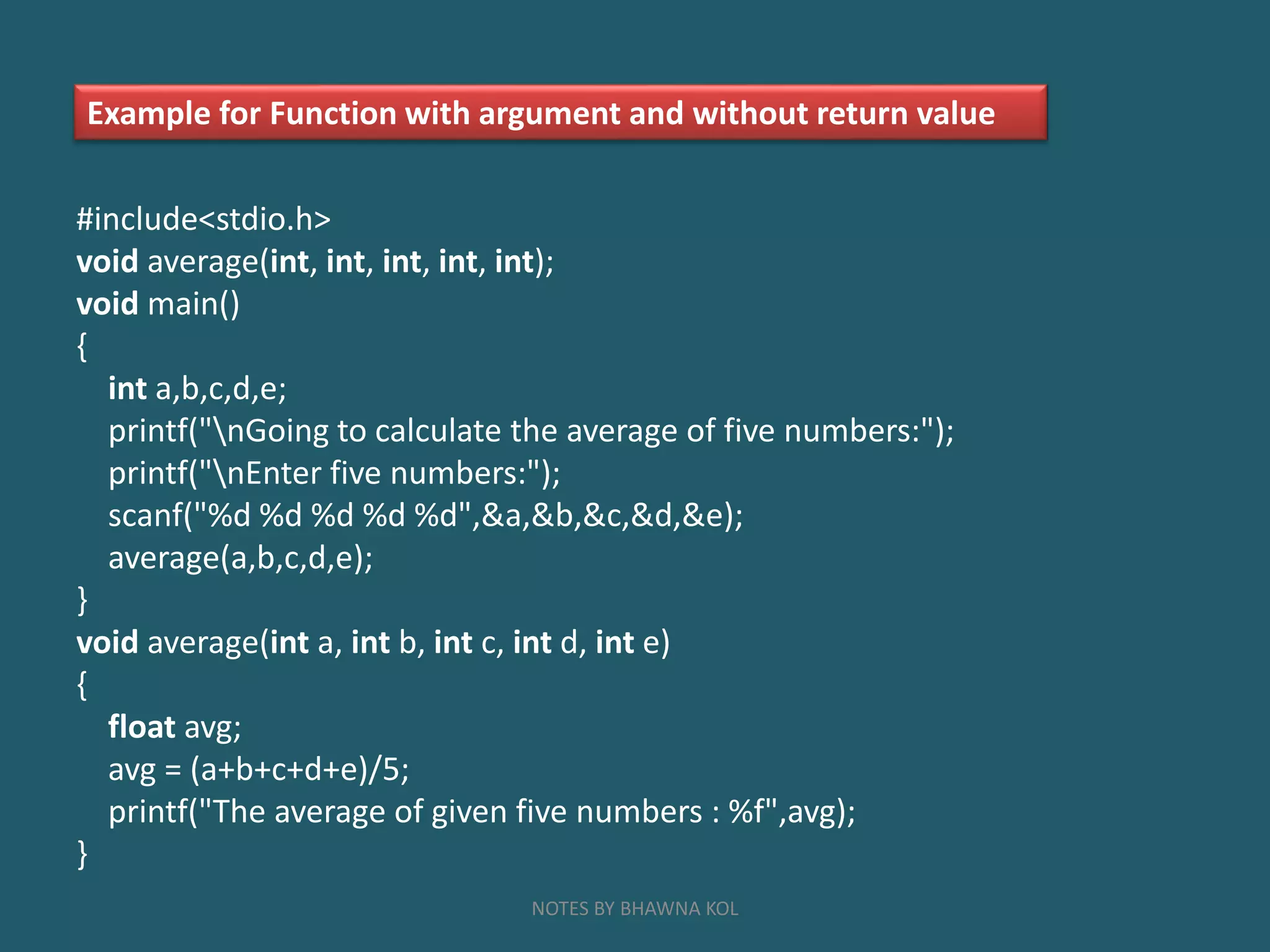
void average(int, int, int, int, int);
void main()
{
int a,b,c,d,e;
printf("nGoing to calculate the average of five numbers:");
printf("nEnter five numbers:");
scanf("%d %d %d %d %d",&a,&b,&c,&d,&e);
average(a,b,c,d,e);
}
void average(int a, int b, int c, int d, int e)
{
float avg;
avg = (a+b+c+d+e)/5;
printf("The average of given five numbers : %f",avg);
}
Example for Function with argument and without return value
NOTES BY BHAWNA KOL
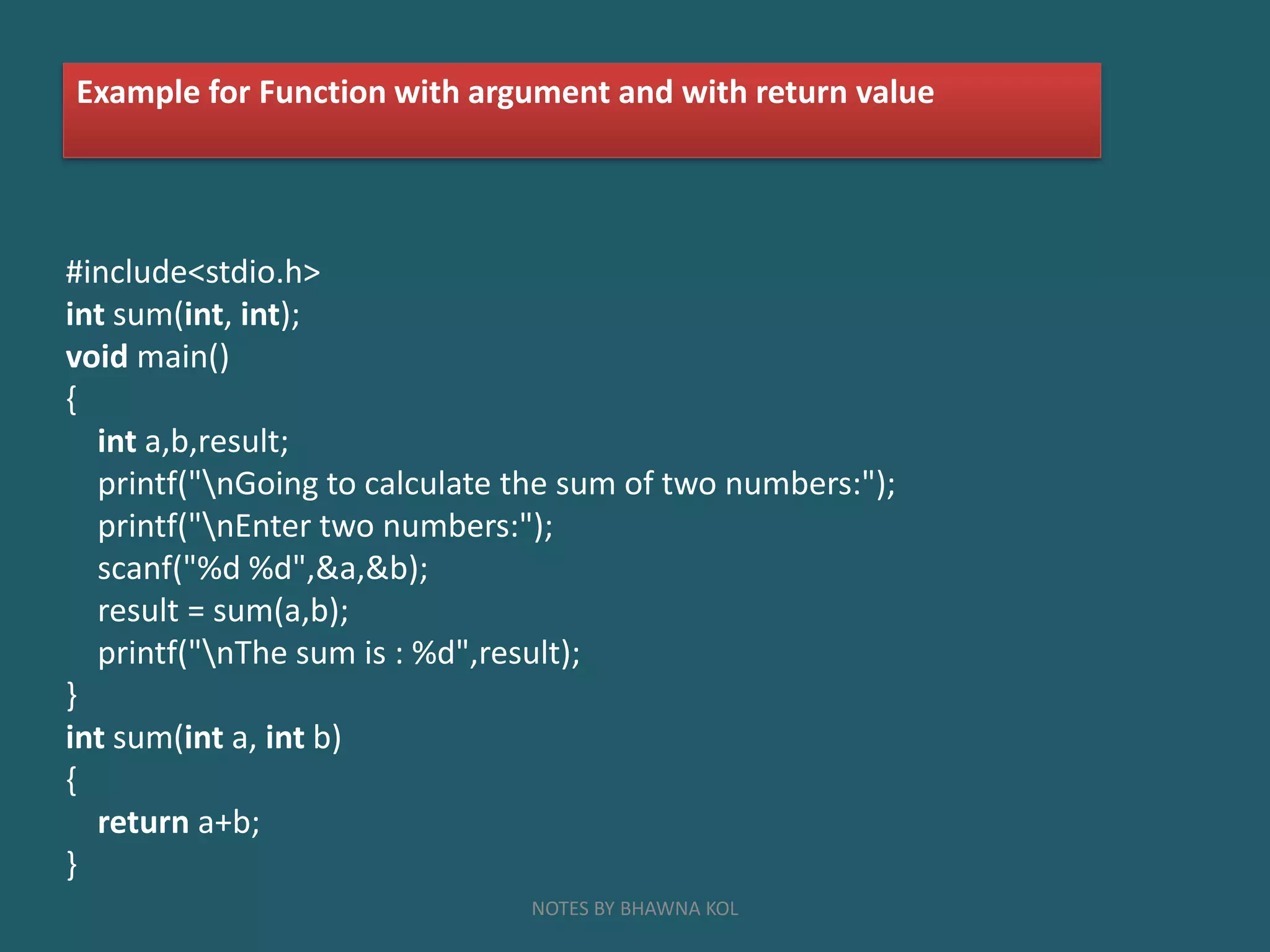
#include<stdio.h>
int sum(int, int);
void main()
{
int a,b,result;
printf("nGoing to calculate the sum of two numbers:");
printf("nEnter two numbers:");
scanf("%d %d",&a,&b);
result = sum(a,b);
printf("nThe sum is : %d",result);
}
int sum(int a, int b)
{
return a+b;
}
Example for Function with argument and with return value
NOTES BY BHAWNA KOL
C Library Functions
Library functions are the inbuilt function in C that are grouped and placed at a
common place called the library. Such functions are used to perform some
specific operations. For example, printf is a library function used to print on the
console. The library functions are created by the designers of compilers.
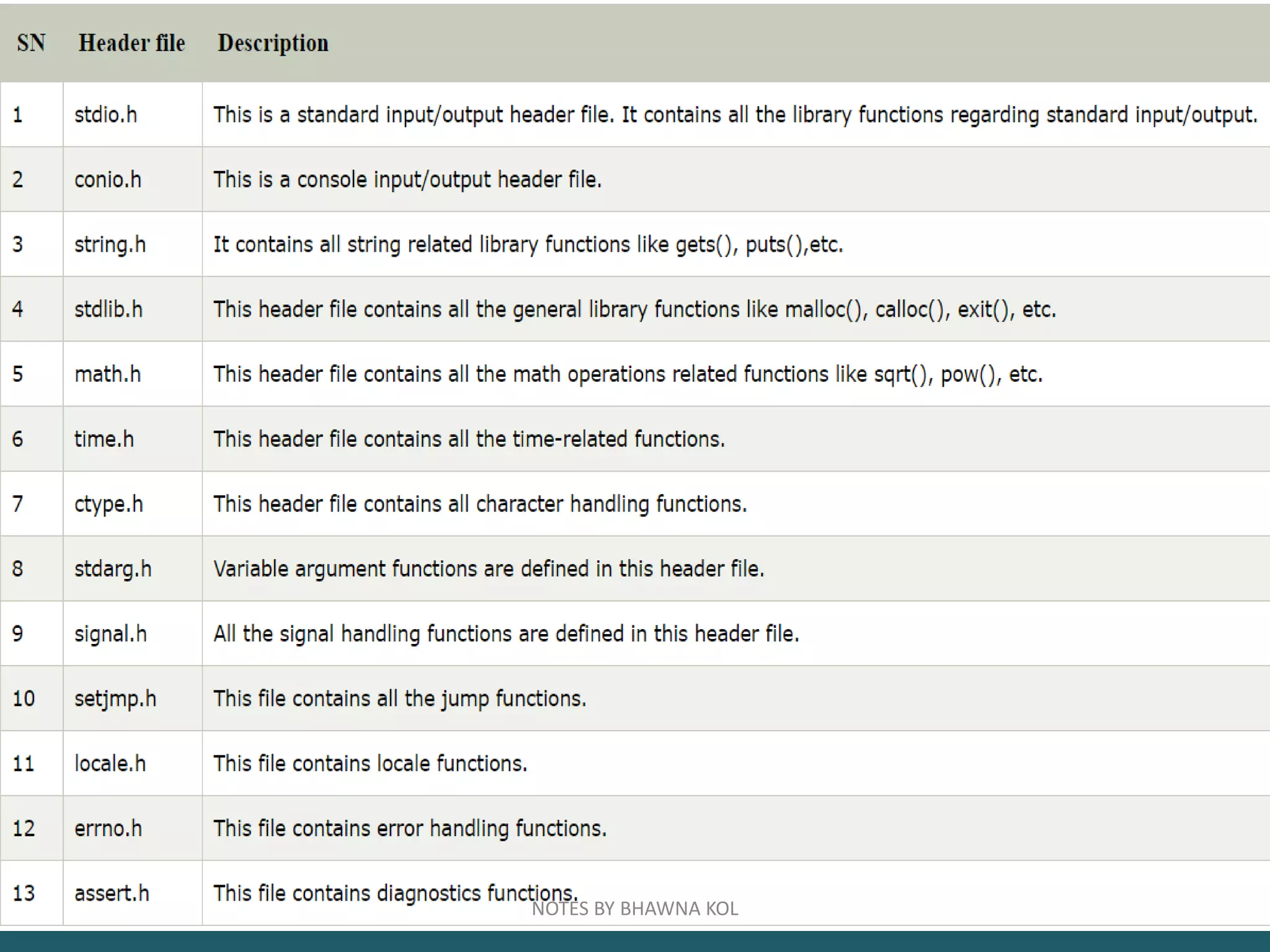
All C standard library functions are defined inside the different header files saved
with the extension .h. We need to include these header files in our program to
make use of the library functions defined in such header files. For example, To
use the library functions such as printf/scanf we need to include stdio.h in our
program which is a header file that contains all the library functions regarding
standard input/output.
NOTES BY BHAWNA KOL
NOTES BY BHAWNA KOL
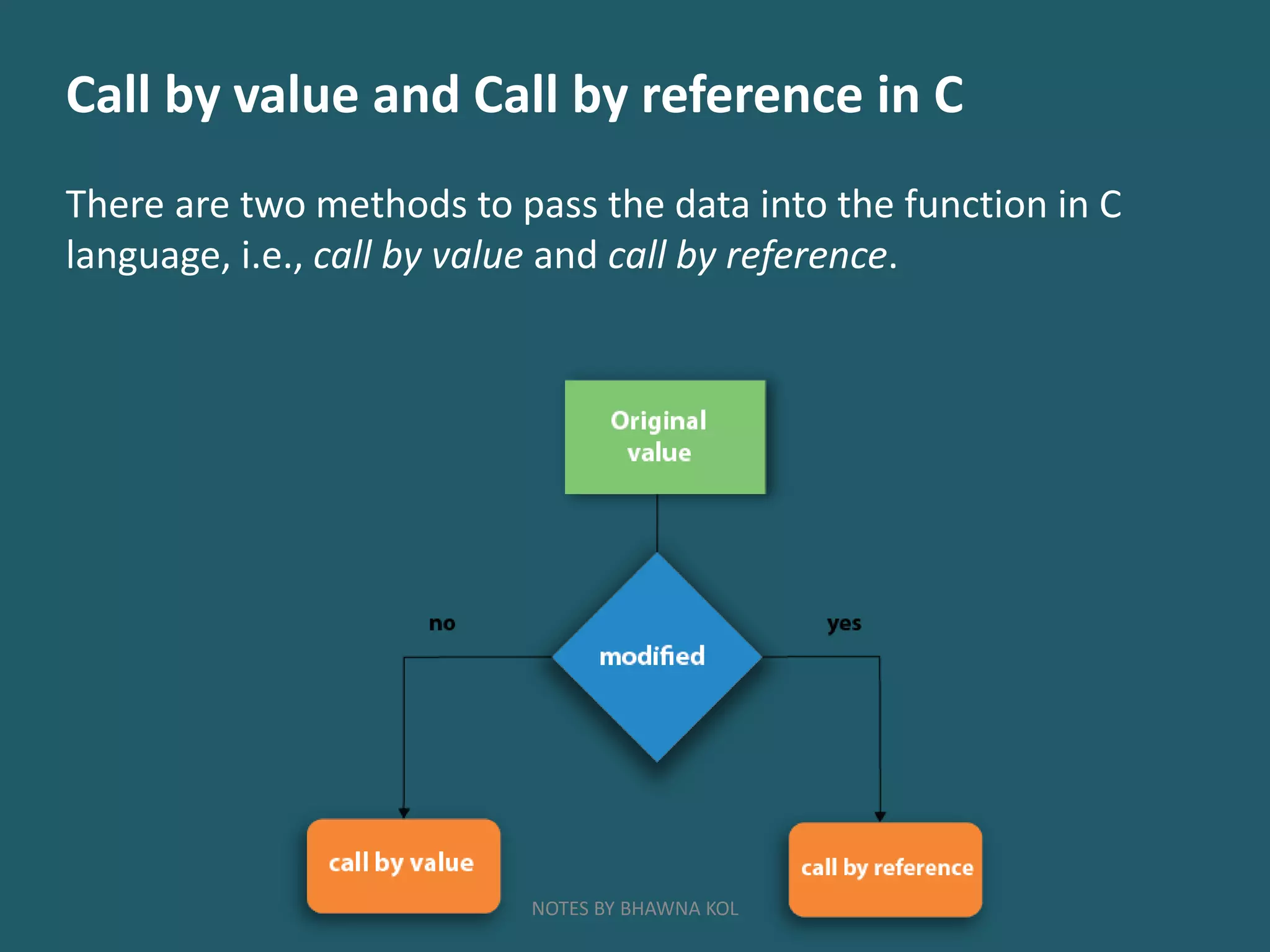
Call by value and Call by reference in C
There are two methods to pass the data into the function in C
language, i.e., call by value and call by reference.
NOTES BY BHAWNA KOL
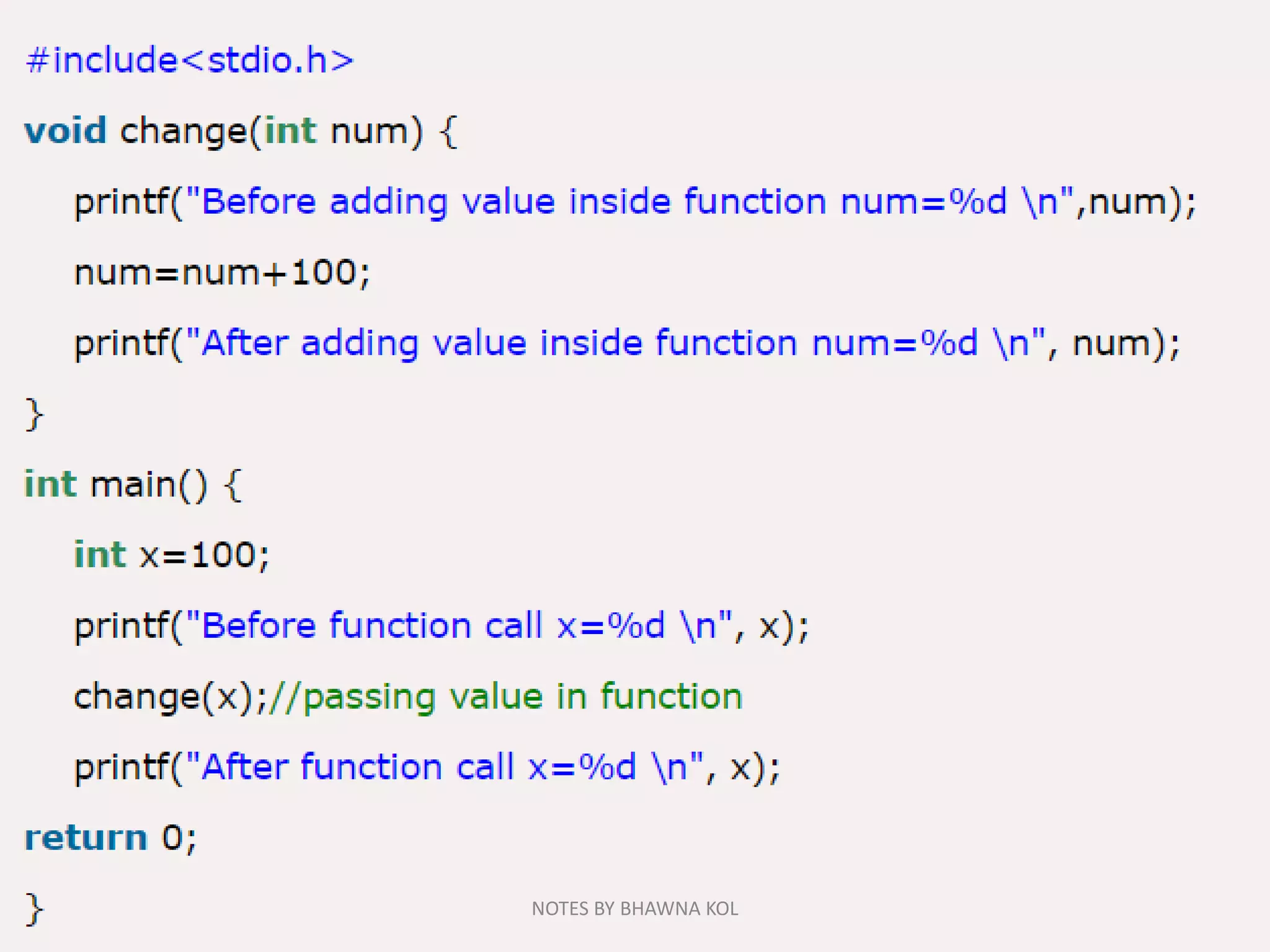
Call by value in C
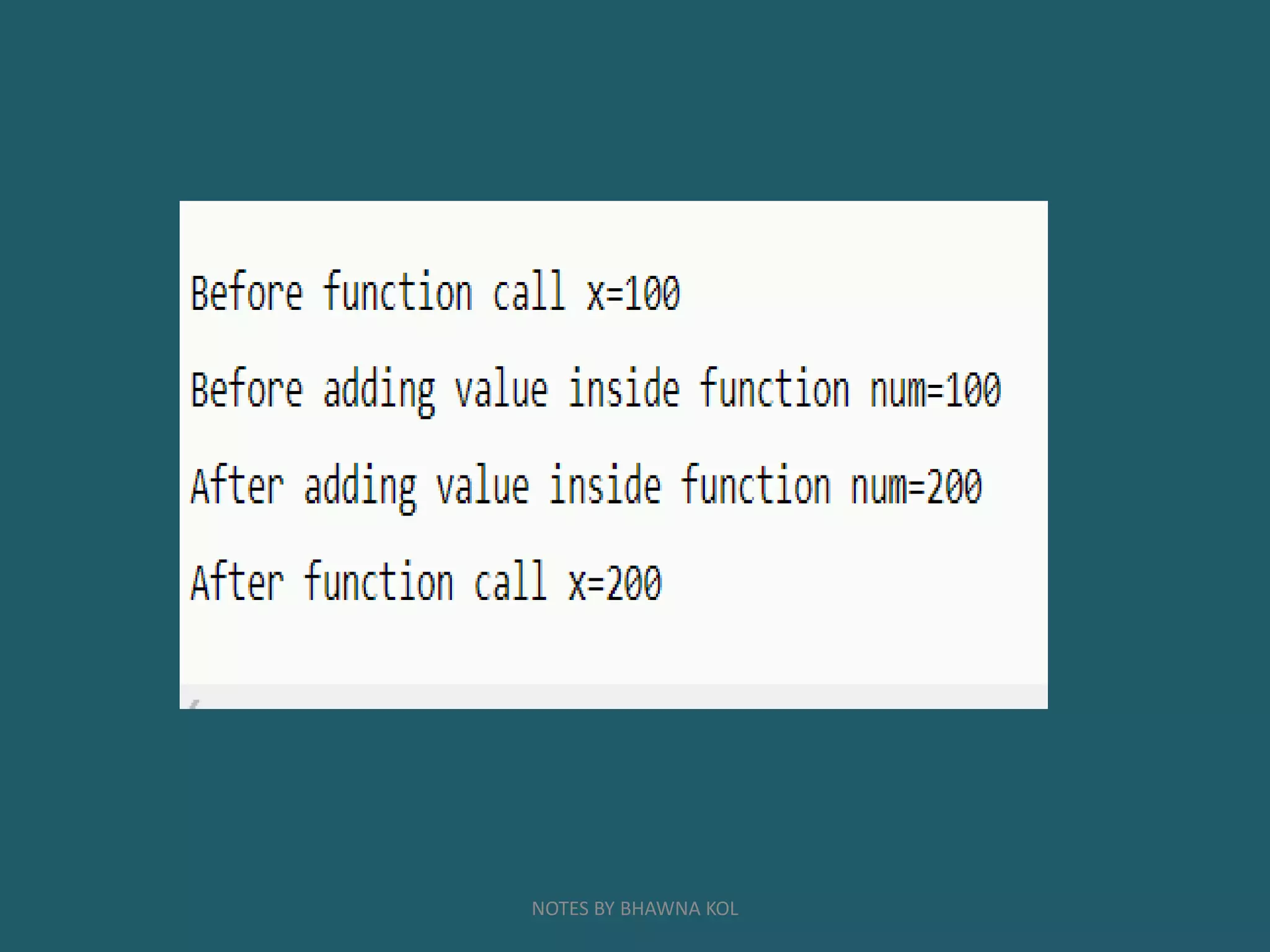
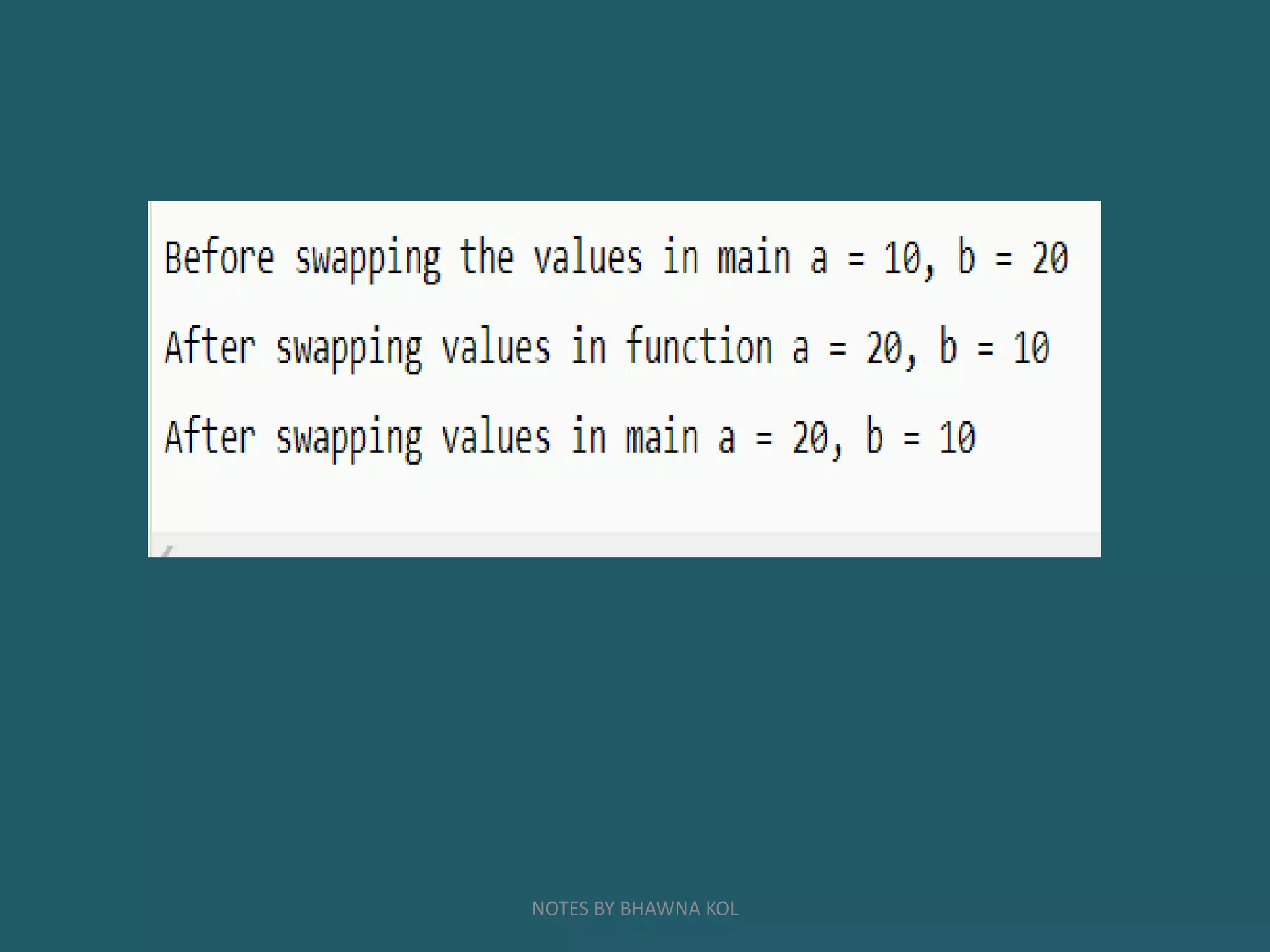
In call by value method, the value of the actual parameters is copied into the
formal parameters. In other words, we can say that the value of the variable is
used in the function call in the call by value method.
In call by value method, we can not modify the value of the actual parameter
by the formal parameter.
In call by value, different memory is allocated for actual and formal parameters
since the value of the actual parameter is copied into the formal parameter.
The actual parameter is the argument which is used in the function call
whereas formal parameter is the argument which is used in the function
definition.
NOTES BY BHAWNA KOL
NOTES BY BHAWNA KOL
NOTES BY BHAWNA KOL
Swapping the values of the two variables
NOTES BY BHAWNA KOL
NOTES BY BHAWNA KOL
Call by reference in C
In call by reference, the address of the variable is passed into
the function call as the actual parameter.
The value of the actual parameters can be modified by
changing the formal parameters since the address of the
actual parameters is passed.
In call by reference, the memory allocation is similar for both
formal parameters and actual parameters.
All the operations in the function are performed on the value
stored at the address of the actual parameters, and the
modified value gets stored at the same address.
NOTES BY BHAWNA KOL
NOTES BY BHAWNA KOL
NOTES BY BHAWNA KOL
Swapping the values of the two variables
NOTES BY BHAWNA KOL
NOTES BY BHAWNA KOL
THANK YOU
NOTES BY BHAWNA KOL

Modular Programming in C

  • 1.
    Presented By: Bhawna Kol AssistantProfessor UIT-RGPV, Bhopal NOTES BY BHAWNA KOL MODULAR PROGRAMMING In C
  • 2.
    What is modularprogramming • Modular programming is the process of subdividing a computer program into separate sub-programs. • A module is a separate software component. • We can divide c program in smaller modules. • Module once created, can be reused in other programs. NOTES BY BHAWNA KOL
  • 3.
     We cancall module whenever require  Eg: suppose we have written calculator program then we can write 4 modules (i.e., add, sub,multiply,divide) NOTES BY BHAWNA KOL
  • 4.
    • Some programsmight have thousands or millions of lines and to manage such programs it becomes quite difficult as there might be too many of syntax errors or logical errors present in the program, so to manage such type of programs concept of modular programming approached. • Each sub-module contains something necessary to execute only one aspect of the desired functionality. • Modular programming emphasis on breaking of large programs into small problems to increase the maintainability, readability of the code and to make the program handy to make any changes in future or to correct the errors. NOTES BY BHAWNA KOL
  • 5.
    Advantages of UsingModular Programming Approach • Ease of Use :This approach allows simplicity, as rather than focusing on the entire thousands and millions of lines code in one go we can access it in the form of modules. This allows ease in debugging the code and prone to less error. • Reusability :It allows the user to reuse the functionality with a different interface without typing the whole program again. • Ease of Maintenance : It helps in less collision at the time of working on modules, helping a team to work with proper collaboration while working on a large application. NOTES BY BHAWNA KOL
  • 6.
    Functions in C Afunction is a set of statements that take inputs, do some specific computation and produces output. The idea is to put some commonly or repeatedly done task together and make a function so that instead of writing the same code again and again for different inputs, we can call the function. The general form of a function is: return_type function_name([ arg1_type arg1_name, ... ]) { code } NOTES BY BHAWNA KOL
  • 7.
    There are thefollowing advantages of C functions. • By using functions, we can avoid rewriting same logic/code again and again in a program. • We can call C functions any number of times in a program and from any place in a program. • We can track a large C program easily when it is divided into multiple functions. • Reusability is the main achievement of C functions. • However, Function calling is always a overhead in a C program. NOTES BY BHAWNA KOL
  • 8.
    There are threeaspects of a C function. Function declaration A function must be declared globally in a c program to tell the compiler about the function name, function parameters, and return type. Function call Function can be called from anywhere in the program. The parameter list must not differ in function calling and function declaration. We must pass the same number of functions as it is declared in the function declaration. Function definition It contains the actual statements which are to be executed. It is the most important aspect to which the control comes when the function is called. Here, we must notice that only one value can be returned from the function. NOTES BY BHAWNA KOL
  • 9.
    SN C functionaspects Syntax 1 Function declaration return_type function_name (argument list); 2 Function call function_name (argument_list) 3 Function definition return_type function_name (argument list) {function body;} NOTES BY BHAWNA KOL
  • 10.
    Library Functions: arethe functions which are declared in the C header files such as scanf(), printf(), gets(), puts(), ceil(), floor() etc. User-defined functions: are the functions which are created by the C programmer, so that he/she can use it many times. It reduces the complexity of a big program and optimizes the code. TYPES OF FUNCTIONS NOTES BY BHAWNA KOL
  • 11.
    Return Value A Cfunction may or may not return a value from the function. If you don't have to return any value from the function, use void for the return type. Let's see a simple example of C function that doesn't return any value from the function. Example without return value: void hello(){ printf("hello c"); } If you want to return any value from the function, you need to use any data type such as int, long, char, etc. The return type depends on the value to be returned from the function. NOTES BY BHAWNA KOL
  • 12.
    Let's see asimple example of C function that returns int value from the function. int get(){ return 10; } In the above example, we have to return 10 as a value, so the return type is int. If you want to return floating-point value (e.g., 10.2, 3.1, 54.5, etc), you need to use float as the return type of the method. float get(){ return 10.2; } Now, you need to call the function, to get the value of the function. NOTES BY BHAWNA KOL
  • 13.
    A function mayor may not accept any argument. It may or may not return any value. Based on these facts, There are four different aspects of function calls. 1. function without arguments and without return value 2. function without arguments and with return value 3. function with arguments and without return value 4. function with arguments and with return value Different aspects of function calling NOTES BY BHAWNA KOL
  • 14.
    #include<stdio.h> void sum(); void main() { printf("nGoingto calculate the sum of two numbers:"); sum(); } void sum() { int a,b; printf("nEnter two numbers"); scanf("%d %d",&a,&b); printf("The sum is %d",a+b); } Example for Function without argument and return value NOTES BY BHAWNA KOL
  • 15.
    #include<stdio.h> int sum(); void main() { printf("Goingto calculate the area of the squaren"); float area = square(); printf("The area of the square: %fn",area); } int square() { float side; printf("Enter the length of the side in meters: "); scanf("%f",&side); return side * side; } Example for Function without argument and with return value NOTES BY BHAWNA KOL
  • 16.
    #include<stdio.h> void average(int, int,int, int, int); void main() { int a,b,c,d,e; printf("nGoing to calculate the average of five numbers:"); printf("nEnter five numbers:"); scanf("%d %d %d %d %d",&a,&b,&c,&d,&e); average(a,b,c,d,e); } void average(int a, int b, int c, int d, int e) { float avg; avg = (a+b+c+d+e)/5; printf("The average of given five numbers : %f",avg); } Example for Function with argument and without return value NOTES BY BHAWNA KOL
  • 17.
    #include<stdio.h> int sum(int, int); voidmain() { int a,b,result; printf("nGoing to calculate the sum of two numbers:"); printf("nEnter two numbers:"); scanf("%d %d",&a,&b); result = sum(a,b); printf("nThe sum is : %d",result); } int sum(int a, int b) { return a+b; } Example for Function with argument and with return value NOTES BY BHAWNA KOL
  • 18.
    C Library Functions Libraryfunctions are the inbuilt function in C that are grouped and placed at a common place called the library. Such functions are used to perform some specific operations. For example, printf is a library function used to print on the console. The library functions are created by the designers of compilers. All C standard library functions are defined inside the different header files saved with the extension .h. We need to include these header files in our program to make use of the library functions defined in such header files. For example, To use the library functions such as printf/scanf we need to include stdio.h in our program which is a header file that contains all the library functions regarding standard input/output. NOTES BY BHAWNA KOL
  • 19.
  • 20.
    Call by valueand Call by reference in C There are two methods to pass the data into the function in C language, i.e., call by value and call by reference. NOTES BY BHAWNA KOL
  • 21.
    Call by valuein C In call by value method, the value of the actual parameters is copied into the formal parameters. In other words, we can say that the value of the variable is used in the function call in the call by value method. In call by value method, we can not modify the value of the actual parameter by the formal parameter. In call by value, different memory is allocated for actual and formal parameters since the value of the actual parameter is copied into the formal parameter. The actual parameter is the argument which is used in the function call whereas formal parameter is the argument which is used in the function definition. NOTES BY BHAWNA KOL
  • 22.
  • 23.
  • 24.
    Swapping the valuesof the two variables NOTES BY BHAWNA KOL
  • 25.
  • 26.
    Call by referencein C In call by reference, the address of the variable is passed into the function call as the actual parameter. The value of the actual parameters can be modified by changing the formal parameters since the address of the actual parameters is passed. In call by reference, the memory allocation is similar for both formal parameters and actual parameters. All the operations in the function are performed on the value stored at the address of the actual parameters, and the modified value gets stored at the same address. NOTES BY BHAWNA KOL
  • 27.
  • 28.
  • 29.
    Swapping the valuesof the two variables NOTES BY BHAWNA KOL
  • 30.
  • 31.