Photosynthesis
● Autotrophs - capable of
producing their own food.
● Photoautotrophs - depend
on light in order to produce
food.
● Heterotrophs - depend on
other organisms for food.
TYPES OF ORGANISMS
A horse (heterotroph) feeding on
grass (autotroph)
• It is a series of complex
processes that allows plant to
produce their own food in the
form of glucose.
• It primarily occurs in the
leaves but can also occur in
areas where there is
chlorophyll.
PHOTOSYNTHESIS
Leaves need sunlight for
photosynthesis.
It occurs when carbon dioxide and water, in the presence of
sunlight, are converted into glucose and oxygen.
PHOTOSYNTHESIS
Chemical reaction for photosynthesis
● Chloroplasts are plastids
that contain the green
pigment chlorophyll.
● These organelles are
responsible for the
production of food of
plants through
photosynthesis.
PARTS INVOLVED IN
PHOTOSYNTHESIS
Chloroplasts in thyme moss
● Chloroplasts have two
membranes which
protect the structures of
the chloroplast.
○ Inner membrane
○ Outer membrane
PARTS INVOLVED IN
PHOTOSYNTHESIS
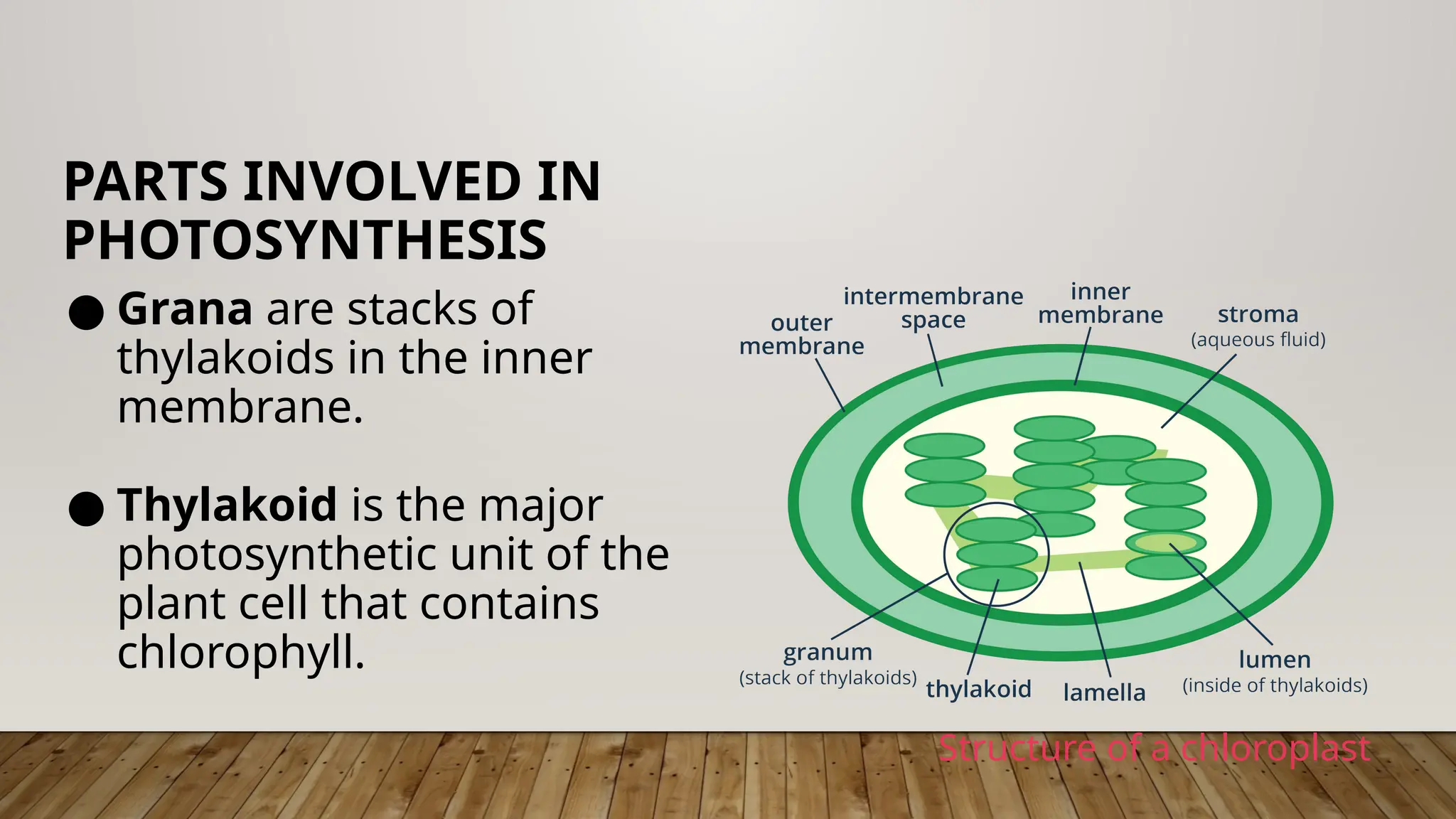
Structure of a chloroplast
● Grana are stacks of
thylakoids in the inner
membrane.
● Thylakoid is the major
photosynthetic unit of the
plant cell that contains
chlorophyll.
PARTS INVOLVED IN
PHOTOSYNTHESIS
Structure of a chloroplast
● Chlorophyll is the green
pigment of the leaf that
captures light energy.
● Stroma is the space
between the membrane
and the grana, where the
aqueous fluid is filled.
PARTS INVOLVED IN
PHOTOSYNTHESIS
Structure of a chloroplast
Photosynthesis is not exclusive
to plants alone.
● Organisms that can
photosynthesize:
○ Algae
○ Cyanobacteria
ORGANISMS THAT UNDERGO
PHOTOSYNTHESIS
Cyanobacteria, a non-plant
organism that can photosynthesize
Photosynthesis is divided into
two major stages:
● The light-reaction phase
(light-dependent phase)
● The Calvin cycle (light-
independent phase)
STAGE OF PHOTOSYNTHESIS
Light-dependent phase requires
light to start its process.
● It is a process that
requires the presence of
light energy from the
sun and converts it to
adenosine triphosphate
(ATP) and nicotinamide
adenine dinucleotide
phosphate (NADPH).
THE LIGHT-DEPENDENT PHASE
Overview of the light-dependent phase
● It occurs in the grana.
● Photosystems I and II
are proteins that
capture and utilize the
photons from the sun
to power the light-
dependent phase.
THE LIGHT-DEPENDENT PHASE
Overview of the light-dependent phase
● This process results
in the production of
O₂, which is released
into the atmosphere,
and organic energy
molecules such as
ATP and NADPH.
THE LIGHT-DEPENDENT PHASE
Overview of the light-dependent phase
1. Light absorption and splitting of water
2. Electron transport chain
3. Production of ATP
4. Hydrogen pump powered by electron acceptors
5. Production of NADPH by re-energizing electrons
FIVE STEPS OF THE LIGHT-DEPENDENT PHASE
1. Light absorption and splitting of
water
● Light enters the chloroplast and
strikes the chlorophyll, which
transfers light to the
photosystems.
● An enzyme, with the light energy,
splits water (H2O) into protons (H+
ions), electrons, and oxygen (O2).
FIVE STEPS OF THE LIGHT-DEPENDENT PHASE
Photosystem II
2. Electron transport chain
● Several electron carriers relay the electrons through an
electron transport chain.
● This movement results in the gain and loss of energy,
but the net energy allows H+ ions to be actively
pumped against a concentration gradient.
FIVE STEPS OF THE LIGHT-DEPENDENT PHASE
3. Production of ATP
● ATP synthase accepts
energy from H+ ions to
produce ATP.
FIVE STEPS OF THE LIGHT-DEPENDENT PHASE
Production of ATP
4. Hydrogen pump powered
by electron acceptors
● Electrons pass through
the proton pump, and
the energy from the
electrons pumps H+
ions back to the
thylakoids.
FIVE STEPS OF THE LIGHT-DEPENDENT PHASE
Production of ATP
5. Production of NADPH by re-
energizing electrons
● Light strikes again, the
chlorophyll and electrons get re-
energized.
● The last electron acceptor moves
electrons to nicotinamide adenine
dinucleotide phosphate (NADP+)
and H+ ions to produce NADPH.
FIVE STEPS OF THE LIGHT-DEPENDENT PHASE
Photosystem I
The light-dependent reaction of photosynthesis
THE LIGHT-DEPENDENT PHASE
● It is also known as the
Calvin cycle.
● It does not need solar
energy in order to
proceed.
● It utilizes the ATP and
NADPH produced by the
light-dependent reaction.
THE LIGHT-INDEPENDENT PHASE
Overview of the light-independent
phase
● The ATP serves as a source
of energy to power this
reaction, and it uses CO2
to form sugar by using
NADPH as a reducing
agent.
● It takes place in the
stroma.
THE LIGHT-INDEPENDENT PHASE
Overview of the light-independent
phase
1. Fixation of carbon
2. Reduction of 3-PGA
3. Regeneration of RuBP
from G3P
THREE STEPS OF THE LIGHT-
INDEPENDENT PHASE
Overview of the light-independent
phase
1. Fixation of carbon
● Ribulose bisphosphate
carboxylase (RuBisCo)
catalyzes the reaction
between CO2 and a five-
carbon sugar known as
ribulose-1,5-bisphosphate
(RuBP).
THREE STEPS OF THE LIGHT-INDEPENDENT
PHASE
Fixation of carbon
1. Fixation of carbon
● The reaction results in an
unstable 6-carbon
molecule that splits into
two molecules of 3-
phosphoglycerate (3-
PGA).
THREE STEPS OF THE LIGHT-INDEPENDENT
PHASE
Fixation of carbon
2. Reduction of 3-PGA
● The energy from ATP and
hydrogens from NADPH are
used to convert the 3-PGA
molecules into
glyceraldehyde-3-phosphate
(G3P).
THREE STEPS OF THE LIGHT-INDEPENDENT
PHASE
Reduction of 3-PGA
3. Regeneration of RuBP
from G3P
● Some G3P molecules are
used to make glucose.
● Others are used to
regenerate the 5-carbon
RuBP acceptor.
THREE STEPS OF THE LIGHT-INDEPENDENT
PHASE
Regeneration of RuBP from G3P
The light-independent reaction of photosynthesis
THE LIGHT-
INDEPENDENT PHASE
Plants are organisms known as autotrophs, which are
organisms that are capable of producing their own food.
1
Photosynthesis is the process by which plants produce their
own food. It is a series of complex processes that convert
light energy, carbon dioxide, and water into glucose and
oxygen.
2
The process of photosynthesis is not exclusive to plants
alone. Other organisms, such as some groups of bacteria,
may contain chloroplasts. There are also species of non-plant
algae capable of photosynthesis.
3
Photosynthesis is divided into two major stages: the light-
reaction phase (light-dependent phase) and the Calvin cycle
(light-independent phase).
● The light-dependent phase is a process that requires the
presence of light energy from the sun. It produces ATP
and NADPH.
● The light-independent phase is a process that utilizes
the products of the previous phase to produce glucose.
4
IDENTIFY THE ITEM BEING DESCRIBED IN EACH
ITEM.
1. THIS IS A TERM REFERRING TO ORGANISMS WHICH ARE
CAPABLE OF PRODUCING THEIR OWN FOOD SUCH AS
PLANTS.
2. THIS IS A SERIES OF COMPLEX PROCESSES THAT CONVERT
LIGHT ENERGY, CARBON DIOXIDE, AND WATER INTO
GLUCOSE AND OXYGEN.
3. THIS IS A PLANT’S ORGANELLE THAT CONTAINS THE GREEN
PIGMENT CHLOROPHYLL.
4. THIS IS THE ORGANELLE WHERE THE LIGHT-DEPENDENT
PHASE OCCURS.
WHAT IS THE
SIGNIFICANCE OF
PHOTONS IN THE
LIGHT-DEPENDENT
REACTION?

Unit 29 Metabolic Processes in Plants 1.pptx

  • 1.
  • 2.
    ● Autotrophs -capable of producing their own food. ● Photoautotrophs - depend on light in order to produce food. ● Heterotrophs - depend on other organisms for food. TYPES OF ORGANISMS A horse (heterotroph) feeding on grass (autotroph)
  • 3.
    • It isa series of complex processes that allows plant to produce their own food in the form of glucose. • It primarily occurs in the leaves but can also occur in areas where there is chlorophyll. PHOTOSYNTHESIS Leaves need sunlight for photosynthesis.
  • 4.
    It occurs whencarbon dioxide and water, in the presence of sunlight, are converted into glucose and oxygen. PHOTOSYNTHESIS Chemical reaction for photosynthesis
  • 5.
    ● Chloroplasts areplastids that contain the green pigment chlorophyll. ● These organelles are responsible for the production of food of plants through photosynthesis. PARTS INVOLVED IN PHOTOSYNTHESIS Chloroplasts in thyme moss
  • 6.
    ● Chloroplasts havetwo membranes which protect the structures of the chloroplast. ○ Inner membrane ○ Outer membrane PARTS INVOLVED IN PHOTOSYNTHESIS Structure of a chloroplast
  • 7.
    ● Grana arestacks of thylakoids in the inner membrane. ● Thylakoid is the major photosynthetic unit of the plant cell that contains chlorophyll. PARTS INVOLVED IN PHOTOSYNTHESIS Structure of a chloroplast
  • 8.
    ● Chlorophyll isthe green pigment of the leaf that captures light energy. ● Stroma is the space between the membrane and the grana, where the aqueous fluid is filled. PARTS INVOLVED IN PHOTOSYNTHESIS Structure of a chloroplast
  • 9.
    Photosynthesis is notexclusive to plants alone. ● Organisms that can photosynthesize: ○ Algae ○ Cyanobacteria ORGANISMS THAT UNDERGO PHOTOSYNTHESIS Cyanobacteria, a non-plant organism that can photosynthesize
  • 10.
    Photosynthesis is dividedinto two major stages: ● The light-reaction phase (light-dependent phase) ● The Calvin cycle (light- independent phase) STAGE OF PHOTOSYNTHESIS Light-dependent phase requires light to start its process.
  • 11.
    ● It isa process that requires the presence of light energy from the sun and converts it to adenosine triphosphate (ATP) and nicotinamide adenine dinucleotide phosphate (NADPH). THE LIGHT-DEPENDENT PHASE Overview of the light-dependent phase
  • 12.
    ● It occursin the grana. ● Photosystems I and II are proteins that capture and utilize the photons from the sun to power the light- dependent phase. THE LIGHT-DEPENDENT PHASE Overview of the light-dependent phase
  • 13.
    ● This processresults in the production of O₂, which is released into the atmosphere, and organic energy molecules such as ATP and NADPH. THE LIGHT-DEPENDENT PHASE Overview of the light-dependent phase
  • 14.
    1. Light absorptionand splitting of water 2. Electron transport chain 3. Production of ATP 4. Hydrogen pump powered by electron acceptors 5. Production of NADPH by re-energizing electrons FIVE STEPS OF THE LIGHT-DEPENDENT PHASE
  • 15.
    1. Light absorptionand splitting of water ● Light enters the chloroplast and strikes the chlorophyll, which transfers light to the photosystems. ● An enzyme, with the light energy, splits water (H2O) into protons (H+ ions), electrons, and oxygen (O2). FIVE STEPS OF THE LIGHT-DEPENDENT PHASE Photosystem II
  • 16.
    2. Electron transportchain ● Several electron carriers relay the electrons through an electron transport chain. ● This movement results in the gain and loss of energy, but the net energy allows H+ ions to be actively pumped against a concentration gradient. FIVE STEPS OF THE LIGHT-DEPENDENT PHASE
  • 17.
    3. Production ofATP ● ATP synthase accepts energy from H+ ions to produce ATP. FIVE STEPS OF THE LIGHT-DEPENDENT PHASE Production of ATP
  • 18.
    4. Hydrogen pumppowered by electron acceptors ● Electrons pass through the proton pump, and the energy from the electrons pumps H+ ions back to the thylakoids. FIVE STEPS OF THE LIGHT-DEPENDENT PHASE Production of ATP
  • 19.
    5. Production ofNADPH by re- energizing electrons ● Light strikes again, the chlorophyll and electrons get re- energized. ● The last electron acceptor moves electrons to nicotinamide adenine dinucleotide phosphate (NADP+) and H+ ions to produce NADPH. FIVE STEPS OF THE LIGHT-DEPENDENT PHASE Photosystem I
  • 20.
    The light-dependent reactionof photosynthesis THE LIGHT-DEPENDENT PHASE
  • 21.
    ● It isalso known as the Calvin cycle. ● It does not need solar energy in order to proceed. ● It utilizes the ATP and NADPH produced by the light-dependent reaction. THE LIGHT-INDEPENDENT PHASE Overview of the light-independent phase
  • 22.
    ● The ATPserves as a source of energy to power this reaction, and it uses CO2 to form sugar by using NADPH as a reducing agent. ● It takes place in the stroma. THE LIGHT-INDEPENDENT PHASE Overview of the light-independent phase
  • 23.
    1. Fixation ofcarbon 2. Reduction of 3-PGA 3. Regeneration of RuBP from G3P THREE STEPS OF THE LIGHT- INDEPENDENT PHASE Overview of the light-independent phase
  • 24.
    1. Fixation ofcarbon ● Ribulose bisphosphate carboxylase (RuBisCo) catalyzes the reaction between CO2 and a five- carbon sugar known as ribulose-1,5-bisphosphate (RuBP). THREE STEPS OF THE LIGHT-INDEPENDENT PHASE Fixation of carbon
  • 25.
    1. Fixation ofcarbon ● The reaction results in an unstable 6-carbon molecule that splits into two molecules of 3- phosphoglycerate (3- PGA). THREE STEPS OF THE LIGHT-INDEPENDENT PHASE Fixation of carbon
  • 26.
    2. Reduction of3-PGA ● The energy from ATP and hydrogens from NADPH are used to convert the 3-PGA molecules into glyceraldehyde-3-phosphate (G3P). THREE STEPS OF THE LIGHT-INDEPENDENT PHASE Reduction of 3-PGA
  • 27.
    3. Regeneration ofRuBP from G3P ● Some G3P molecules are used to make glucose. ● Others are used to regenerate the 5-carbon RuBP acceptor. THREE STEPS OF THE LIGHT-INDEPENDENT PHASE Regeneration of RuBP from G3P
  • 28.
    The light-independent reactionof photosynthesis THE LIGHT- INDEPENDENT PHASE
  • 29.
    Plants are organismsknown as autotrophs, which are organisms that are capable of producing their own food. 1 Photosynthesis is the process by which plants produce their own food. It is a series of complex processes that convert light energy, carbon dioxide, and water into glucose and oxygen. 2 The process of photosynthesis is not exclusive to plants alone. Other organisms, such as some groups of bacteria, may contain chloroplasts. There are also species of non-plant algae capable of photosynthesis. 3
  • 30.
    Photosynthesis is dividedinto two major stages: the light- reaction phase (light-dependent phase) and the Calvin cycle (light-independent phase). ● The light-dependent phase is a process that requires the presence of light energy from the sun. It produces ATP and NADPH. ● The light-independent phase is a process that utilizes the products of the previous phase to produce glucose. 4
  • 31.
    IDENTIFY THE ITEMBEING DESCRIBED IN EACH ITEM. 1. THIS IS A TERM REFERRING TO ORGANISMS WHICH ARE CAPABLE OF PRODUCING THEIR OWN FOOD SUCH AS PLANTS. 2. THIS IS A SERIES OF COMPLEX PROCESSES THAT CONVERT LIGHT ENERGY, CARBON DIOXIDE, AND WATER INTO GLUCOSE AND OXYGEN. 3. THIS IS A PLANT’S ORGANELLE THAT CONTAINS THE GREEN PIGMENT CHLOROPHYLL. 4. THIS IS THE ORGANELLE WHERE THE LIGHT-DEPENDENT PHASE OCCURS.
  • 32.
    WHAT IS THE SIGNIFICANCEOF PHOTONS IN THE LIGHT-DEPENDENT REACTION?