UNIT-2
RESONANCE CIRCUITS
1.selectivity
2.sensitivity
3.fidelity
D V S Ramanjaneyulu
Asst.professor
Department ofECE,
Ace engineering college.
2
Content
 Series Resonance
 Parallel Resonance
 Important Parameters
 Resonance Frequency, ω0
 Half-power frequencies, ω1 and ω2
 Bandwidth, β
 Quality Factor, Q
 Application
3
Introduction
 Resonance is a condition in an RLC
circuit in which the capacitive and
reactive reactance are equal in
magnitude, thereby resulting in a purely
resistive impedance.
 Resonance circuits are useful for
constructing filters and used in many
application.
4
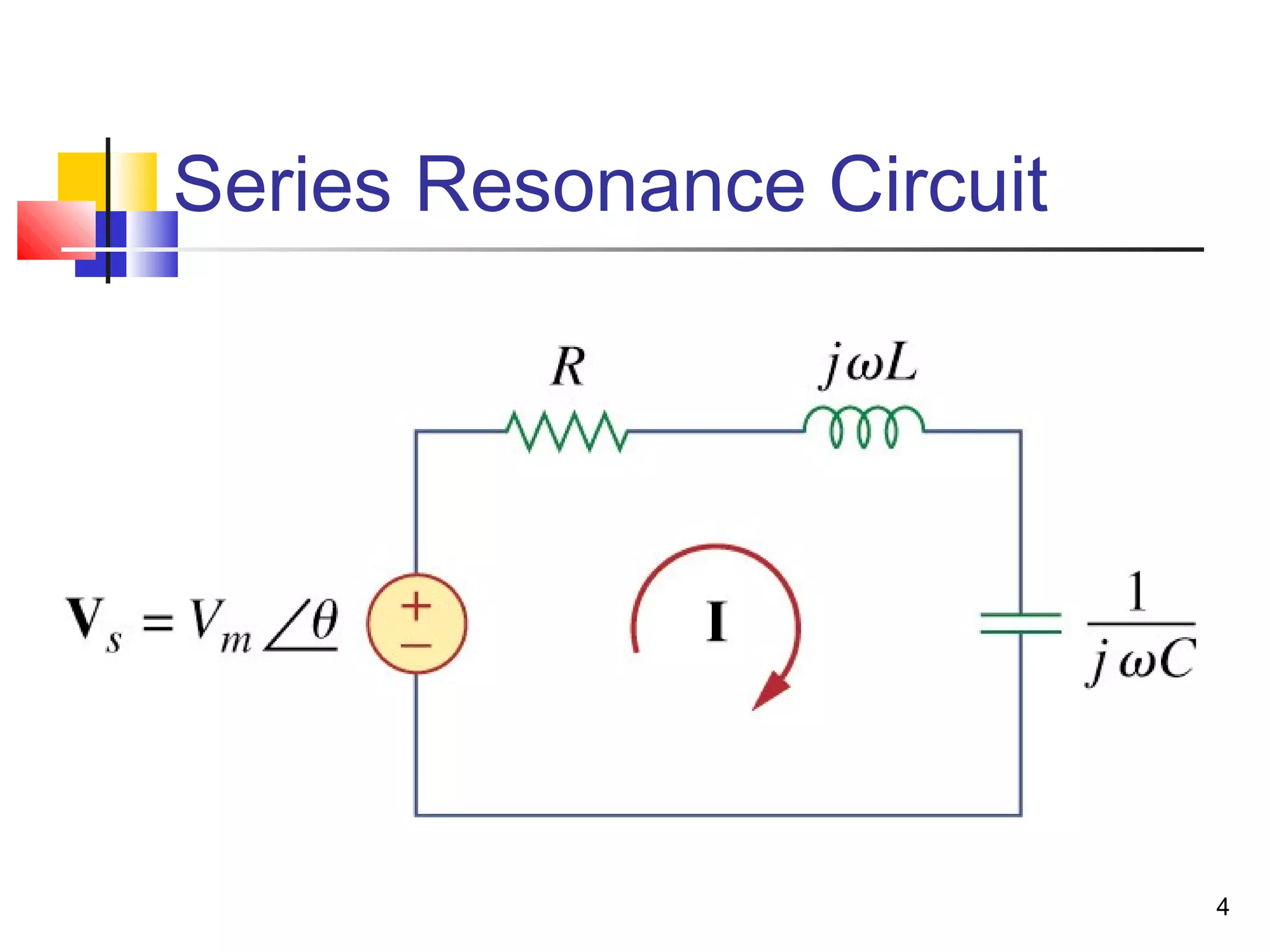
Series Resonance Circuit
5
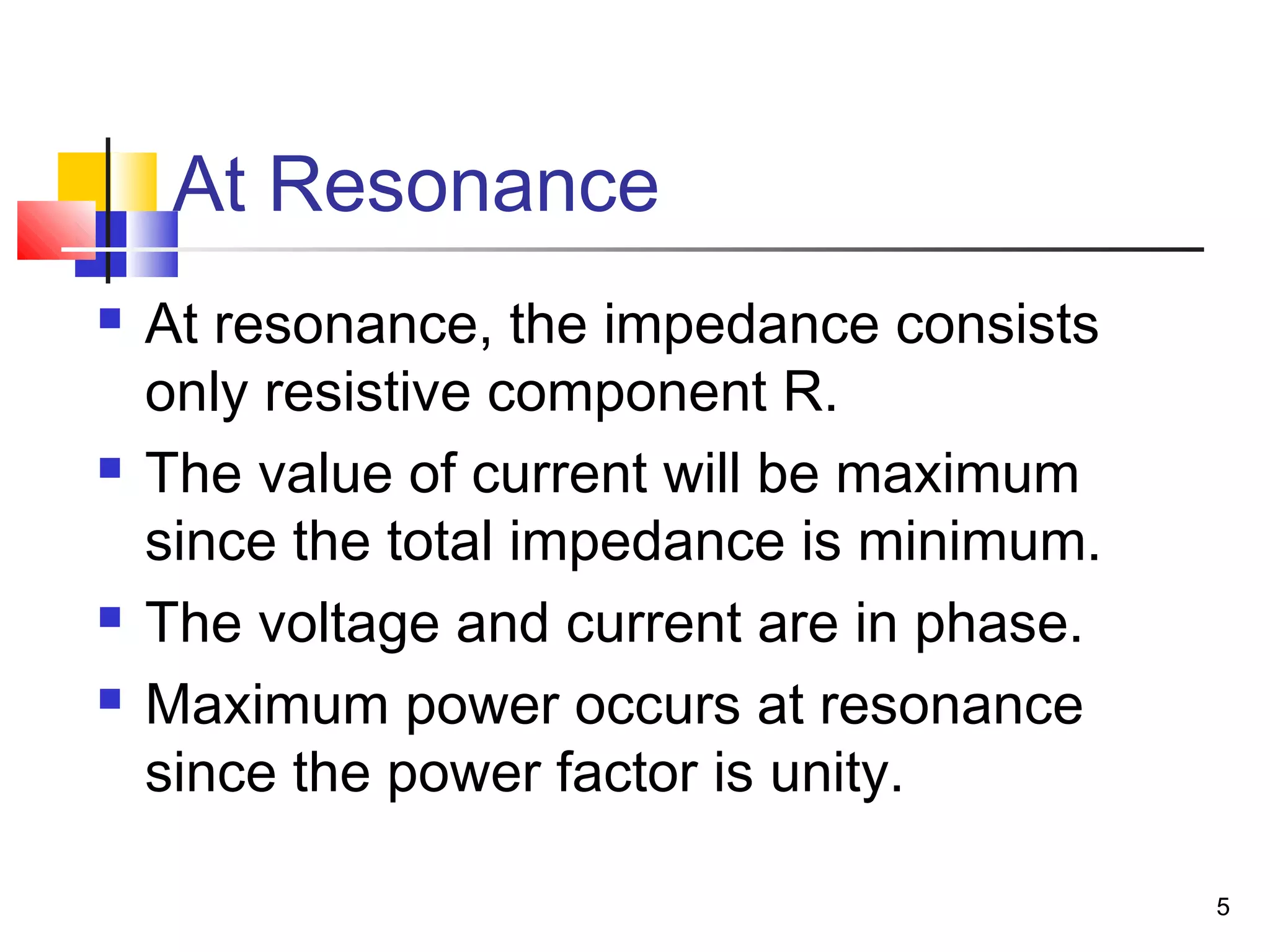
At Resonance
 At resonance, the impedance consists
only resistive component R.
 The value of current will be maximum
since the total impedance is minimum.
 The voltage and current are in phase.
 Maximum power occurs at resonance
since the power factor is unity.
6
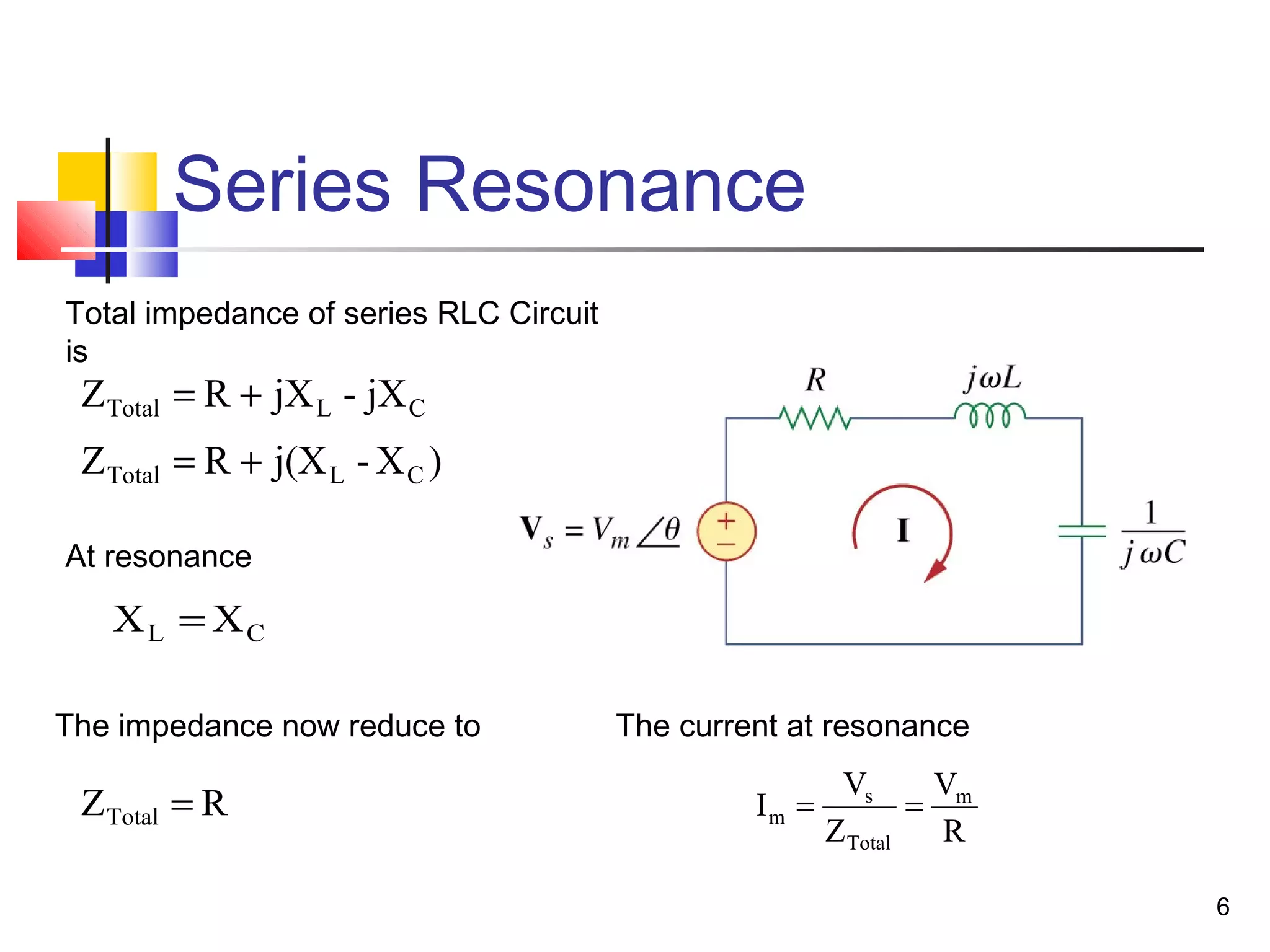
Series Resonance
CLTotal jX-jXRZ +=
R
V
Z
V
I m
Total
s
m ==
Total impedance of series RLC Circuit
is
At resonance
The impedance now reduce to
CL XX =
RZTotal =
)X-j(XRZ CLTotal +=
The current at resonance
7
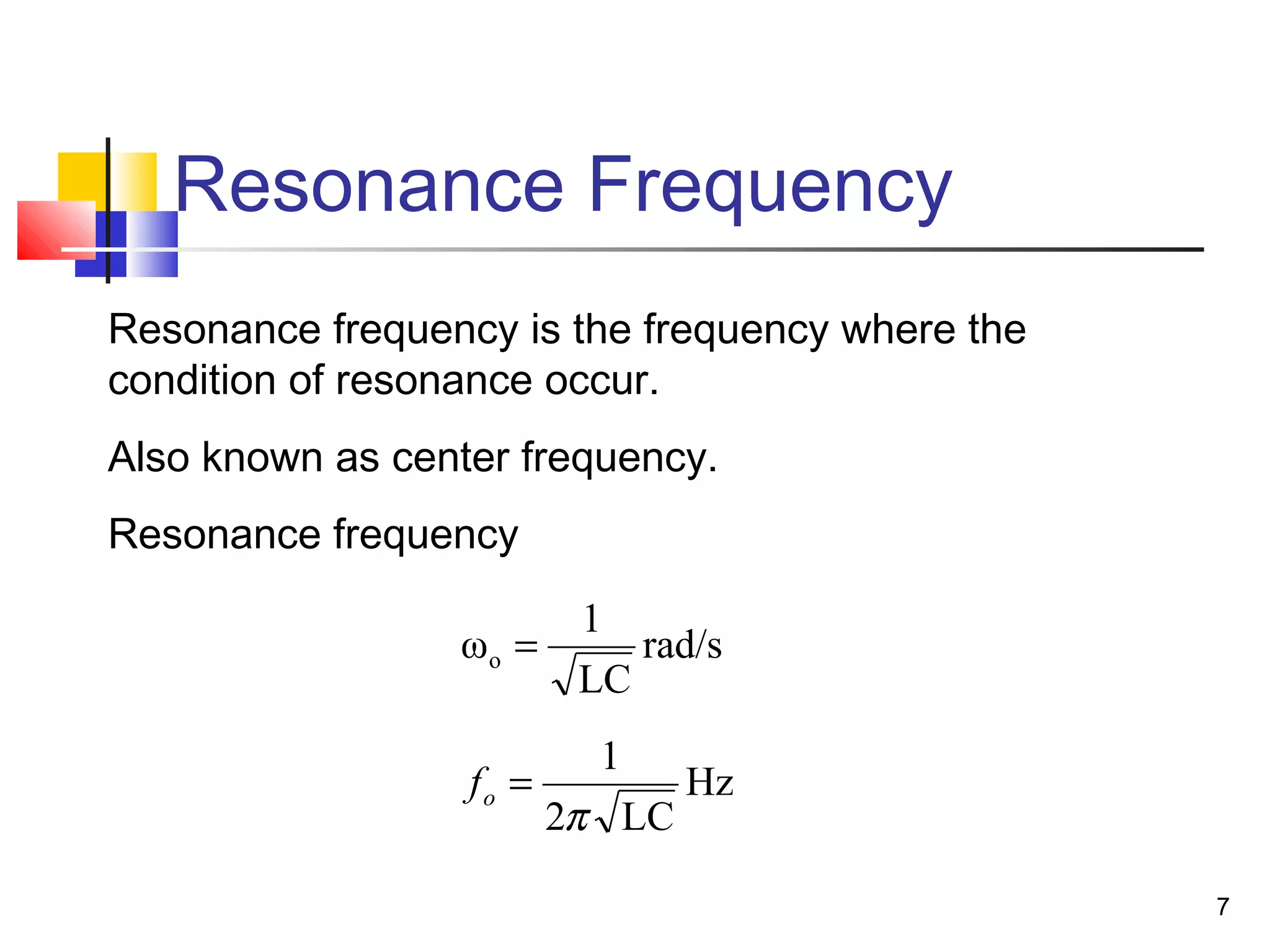
Resonance Frequency
Resonance frequency is the frequency where the
condition of resonance occur.
Also known as center frequency.
Resonance frequency
rad/s
LC
1
ωo =
Hz
LC2
1
π
=of
8
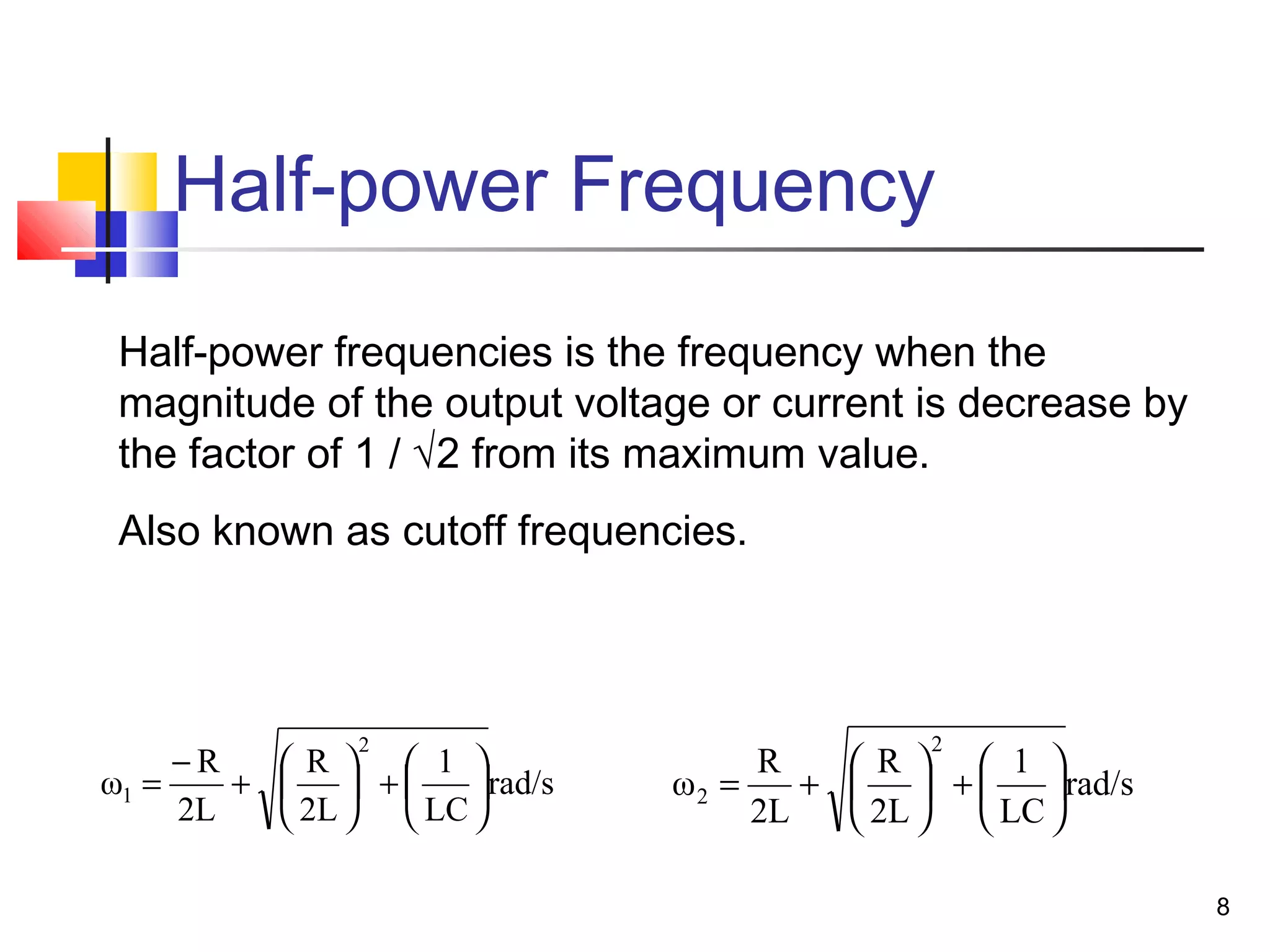
Half-power Frequency
rad/s
LC
1
2L
R
2L
R
ω
2
2 





+





+=
Half-power frequencies is the frequency when the
magnitude of the output voltage or current is decrease by
the factor of 1 / √2 from its maximum value.
Also known as cutoff frequencies.
rad/s
LC
1
2L
R
2L
R
ω
2
1 





+





+
−
=
9
Bandwidth, β
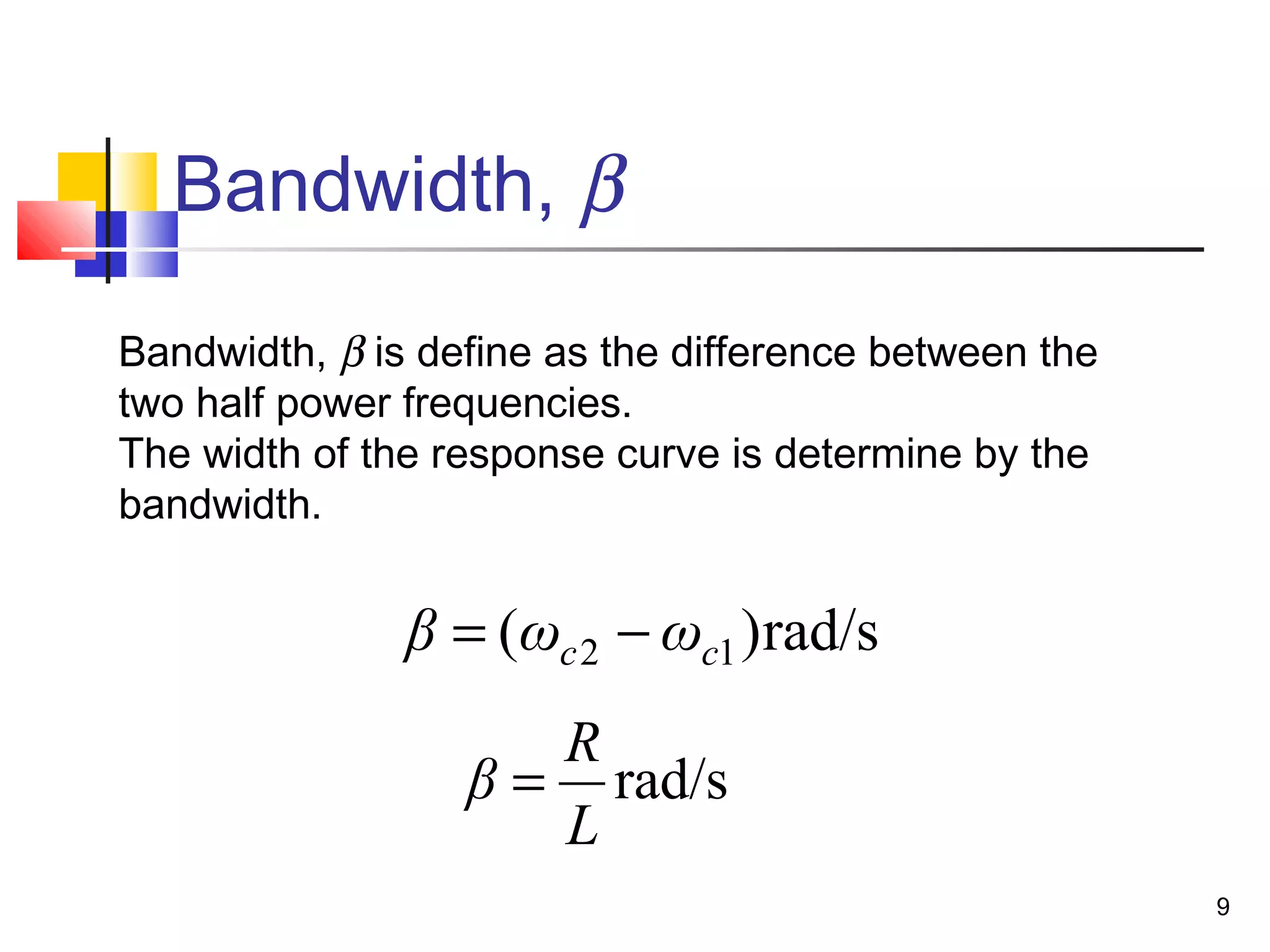
rad/s)( 12 cc ωωβ −=
Bandwidth, β is define as the difference between the
two half power frequencies.
The width of the response curve is determine by the
bandwidth.
rad/s
L
R
β =
10
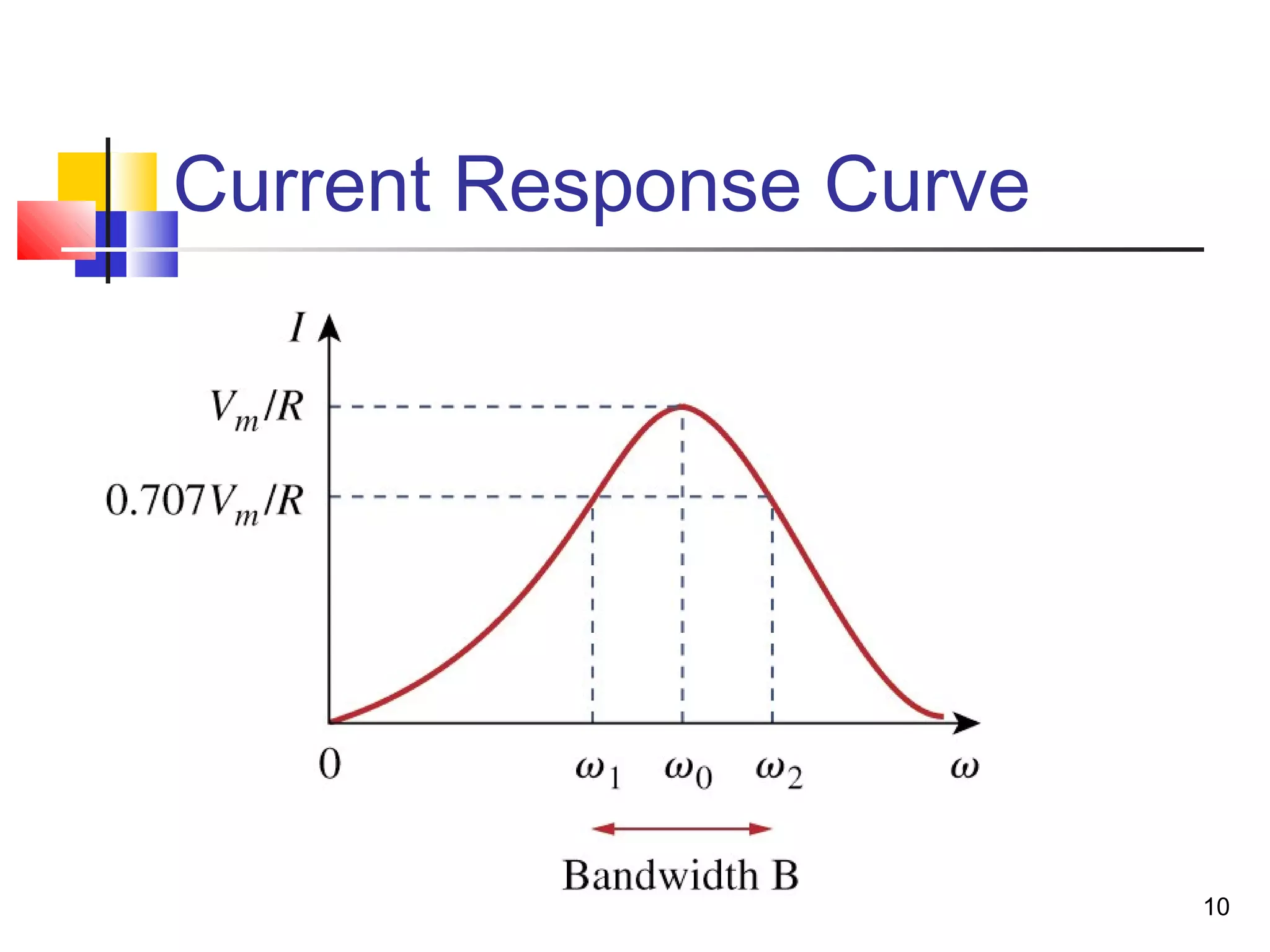
Current Response Curve
11
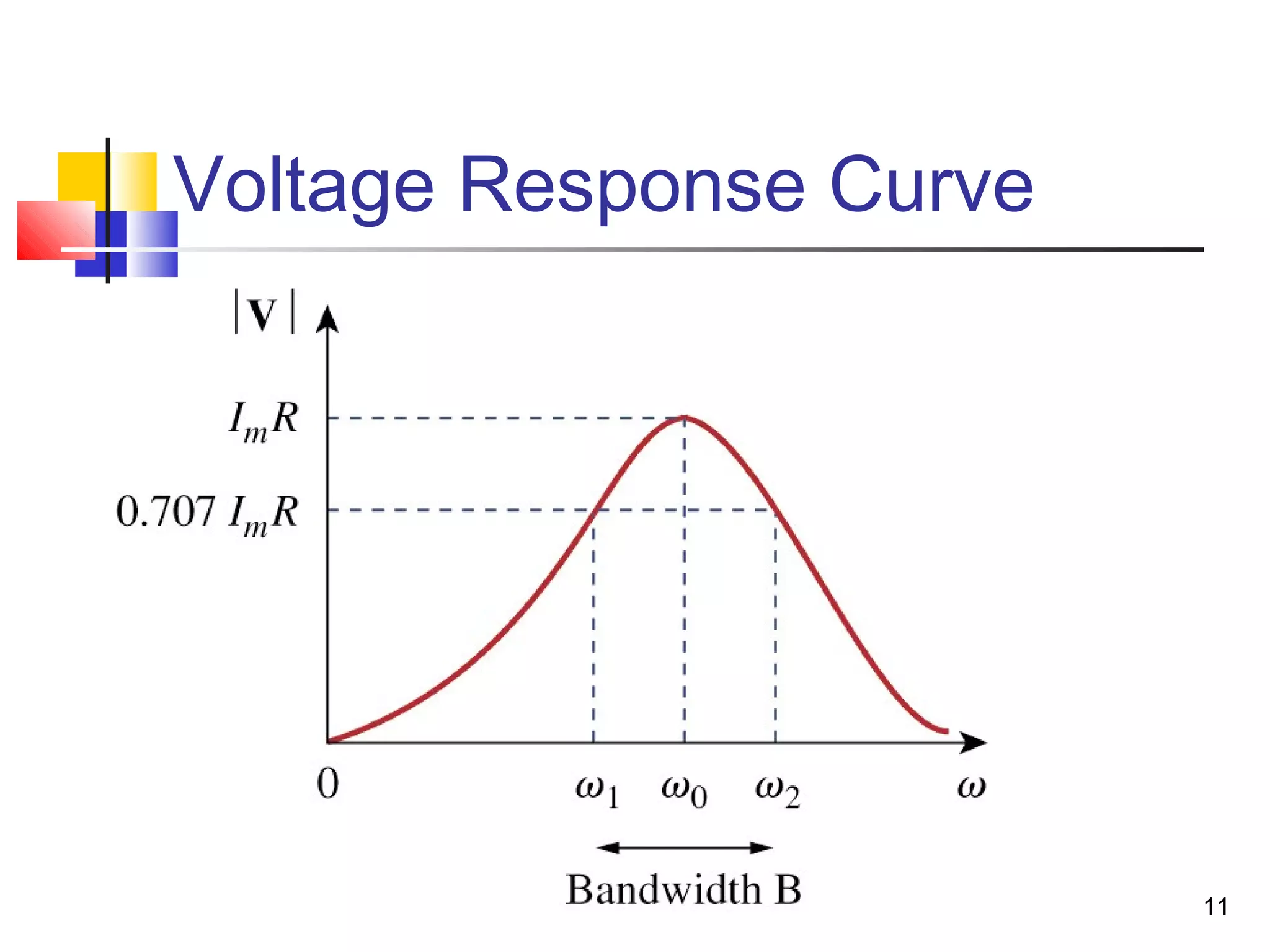
Voltage Response Curve
12
Quality Factor (Q-Factor)
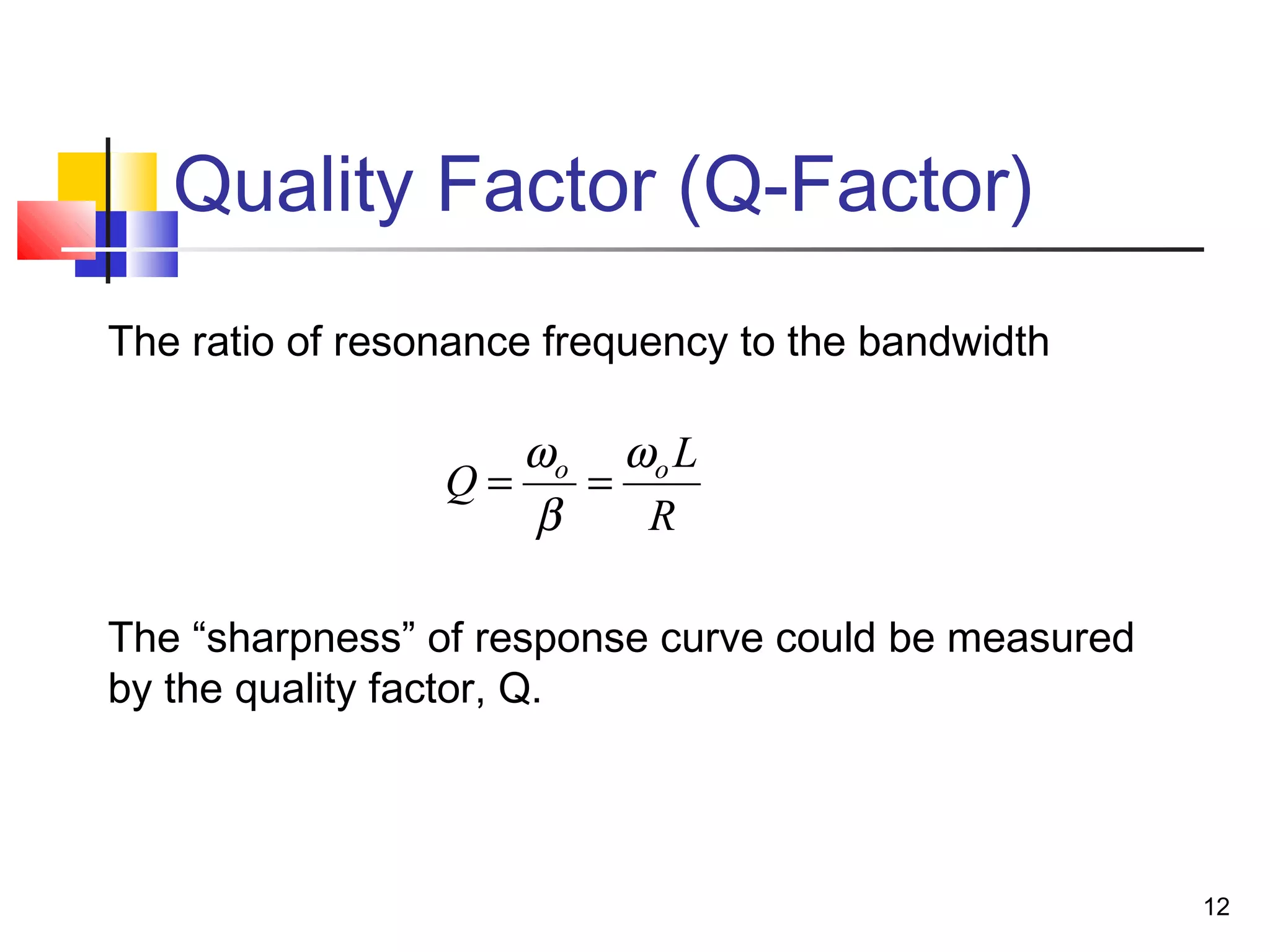
The ratio of resonance frequency to the bandwidth
The “sharpness” of response curve could be measured
by the quality factor, Q.
R
L
Q oo ω
β
ω
==
13
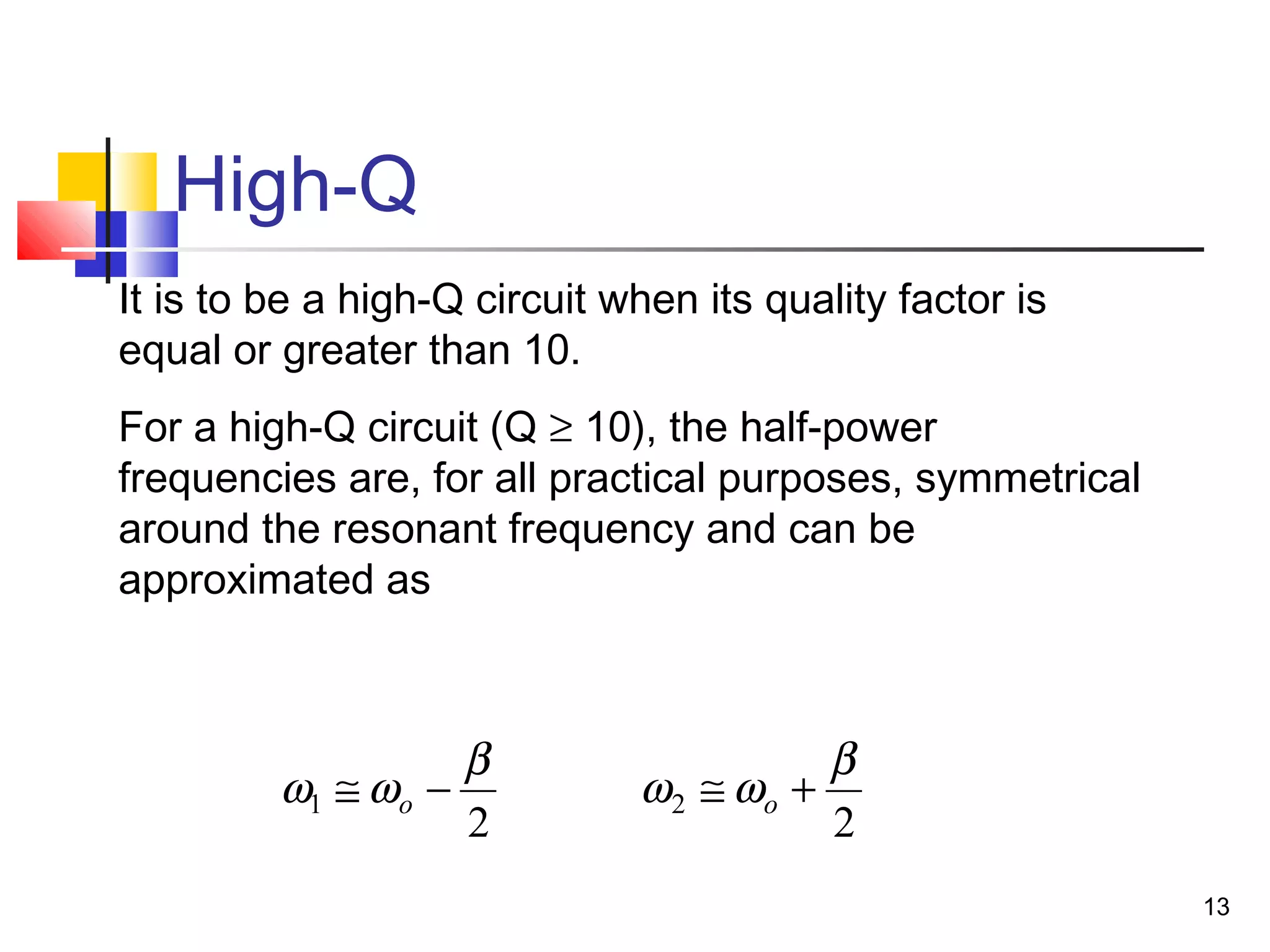
High-Q
It is to be a high-Q circuit when its quality factor is
equal or greater than 10.
For a high-Q circuit (Q ≥ 10), the half-power
frequencies are, for all practical purposes, symmetrical
around the resonant frequency and can be
approximated as
2
1
β
ωω −≅ o
2
2
β
ωω +≅ o
14
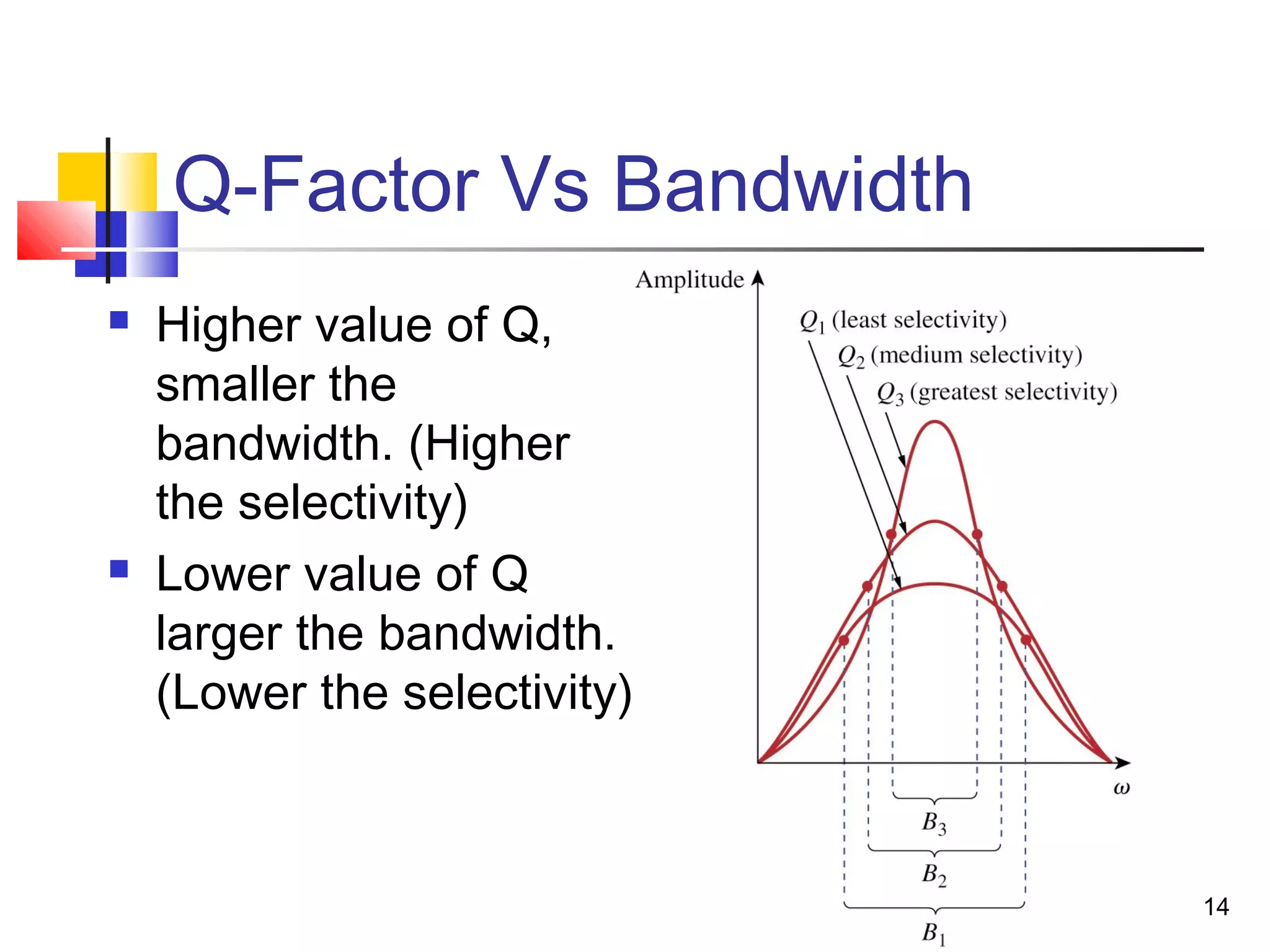
Q-Factor Vs Bandwidth
 Higher value of Q,
smaller the
bandwidth. (Higher
the selectivity)
 Lower value of Q
larger the bandwidth.
(Lower the selectivity)
15
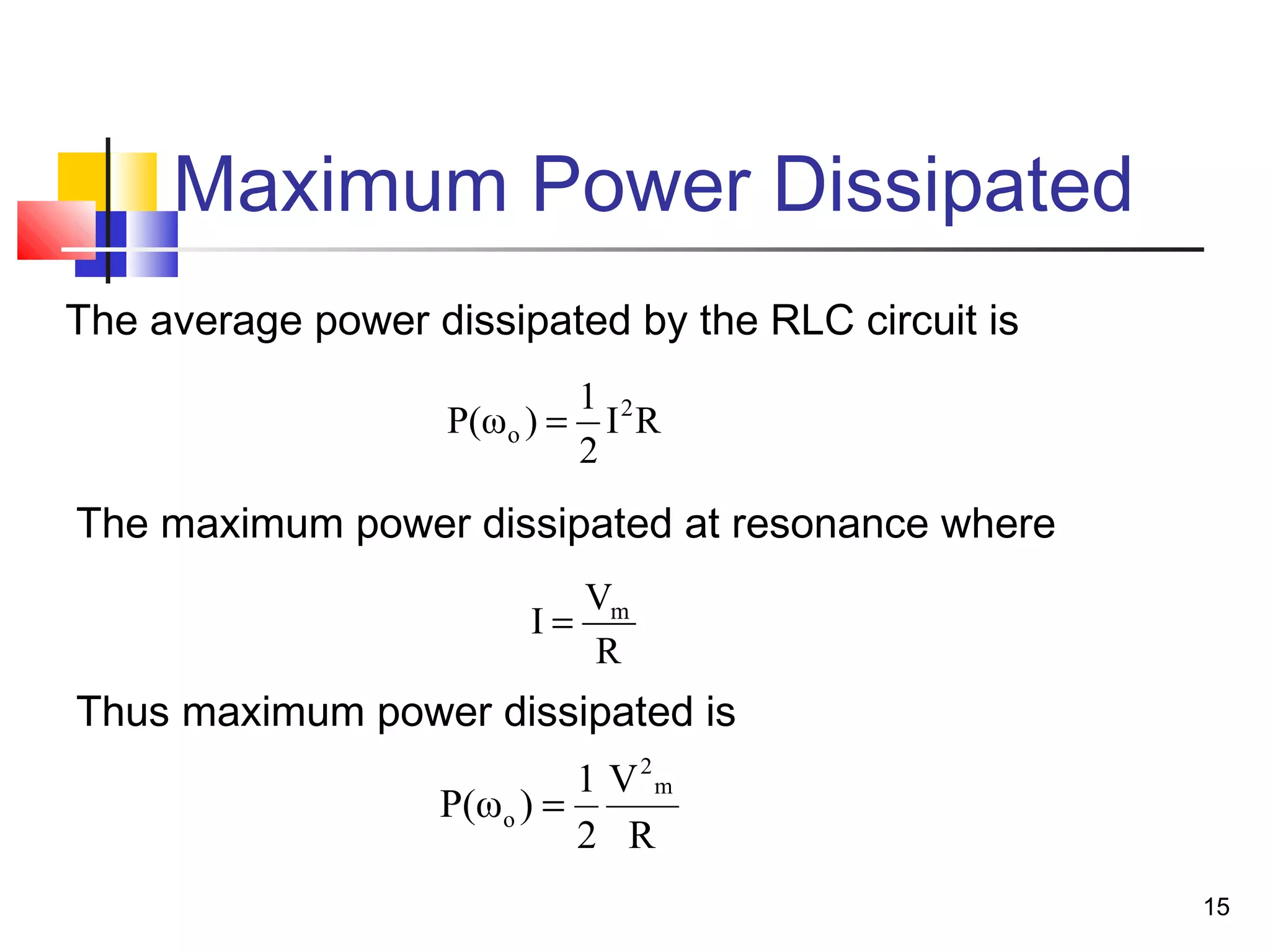
Maximum Power Dissipated
The average power dissipated by the RLC circuit is
The maximum power dissipated at resonance where
R
V
2
1
)P(ω
m
2
o =
R
V
I m
=
RI
2
1
)P(ω 2
o =
Thus maximum power dissipated is
16
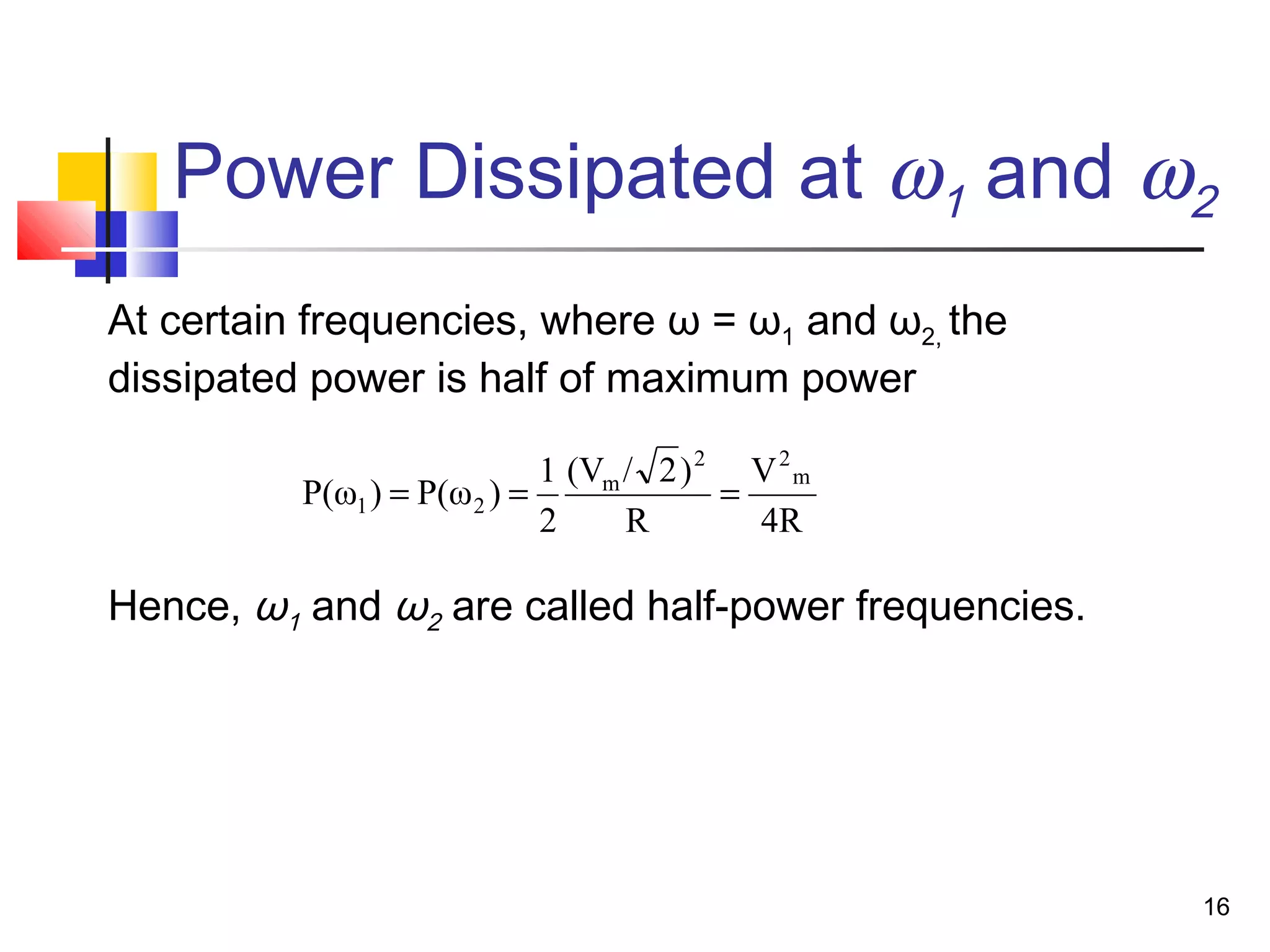
Power Dissipated at ω1 and ω2
At certain frequencies, where ω = ω1 and ω2, the
dissipated power is half of maximum power
Hence, ω1 and ω2 are called half-power frequencies.
4R
V
R
)2/(V
2
1
)P(ω)P(ω
m
22
m
21 ===
17
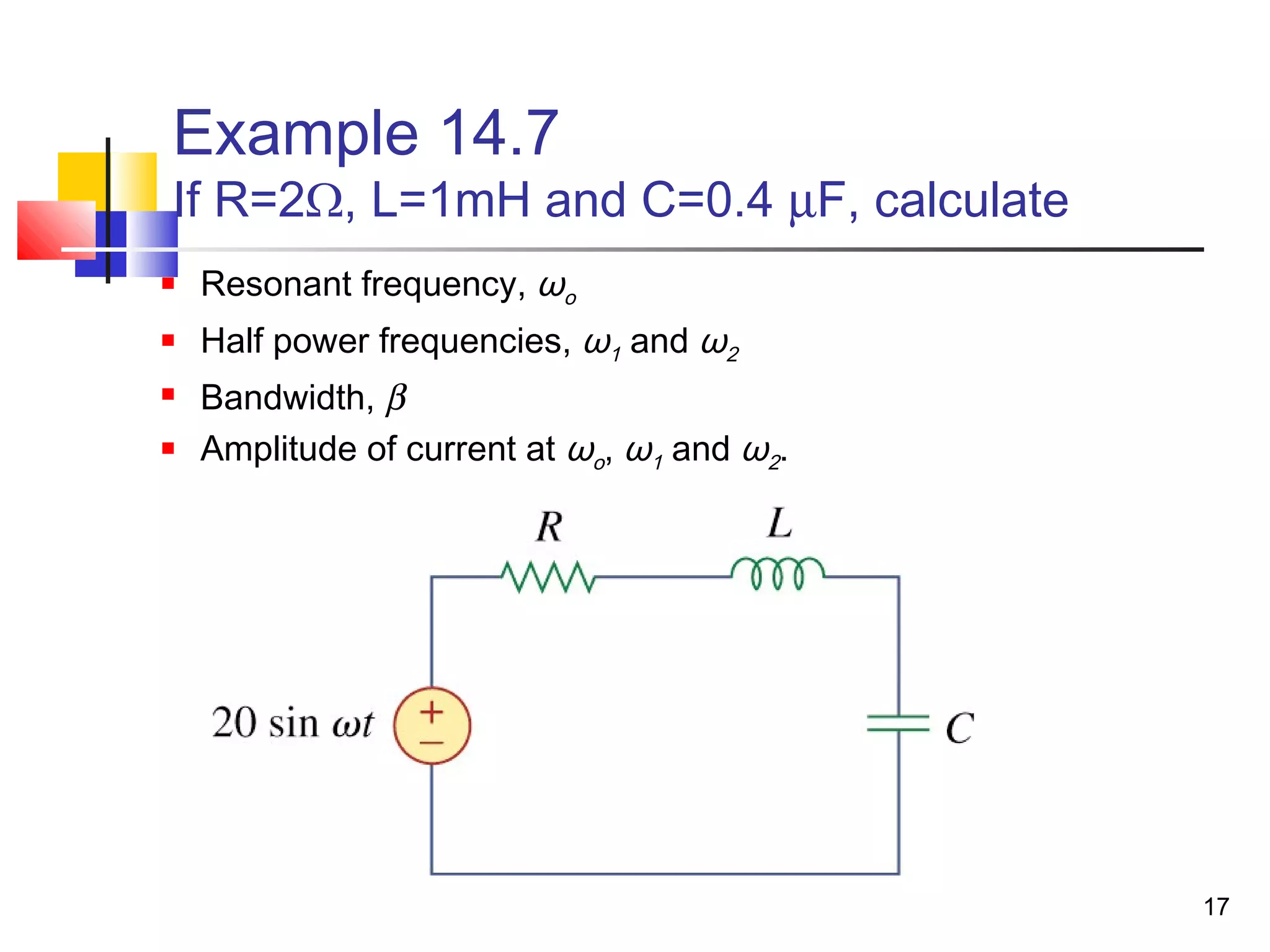
Example 14.7
If R=2Ω, L=1mH and C=0.4 µF, calculate
 Resonant frequency, ωo
 Half power frequencies, ω1 and ω2
 Bandwidth, β
 Amplitude of current at ωo, ω1 and ω2.
18
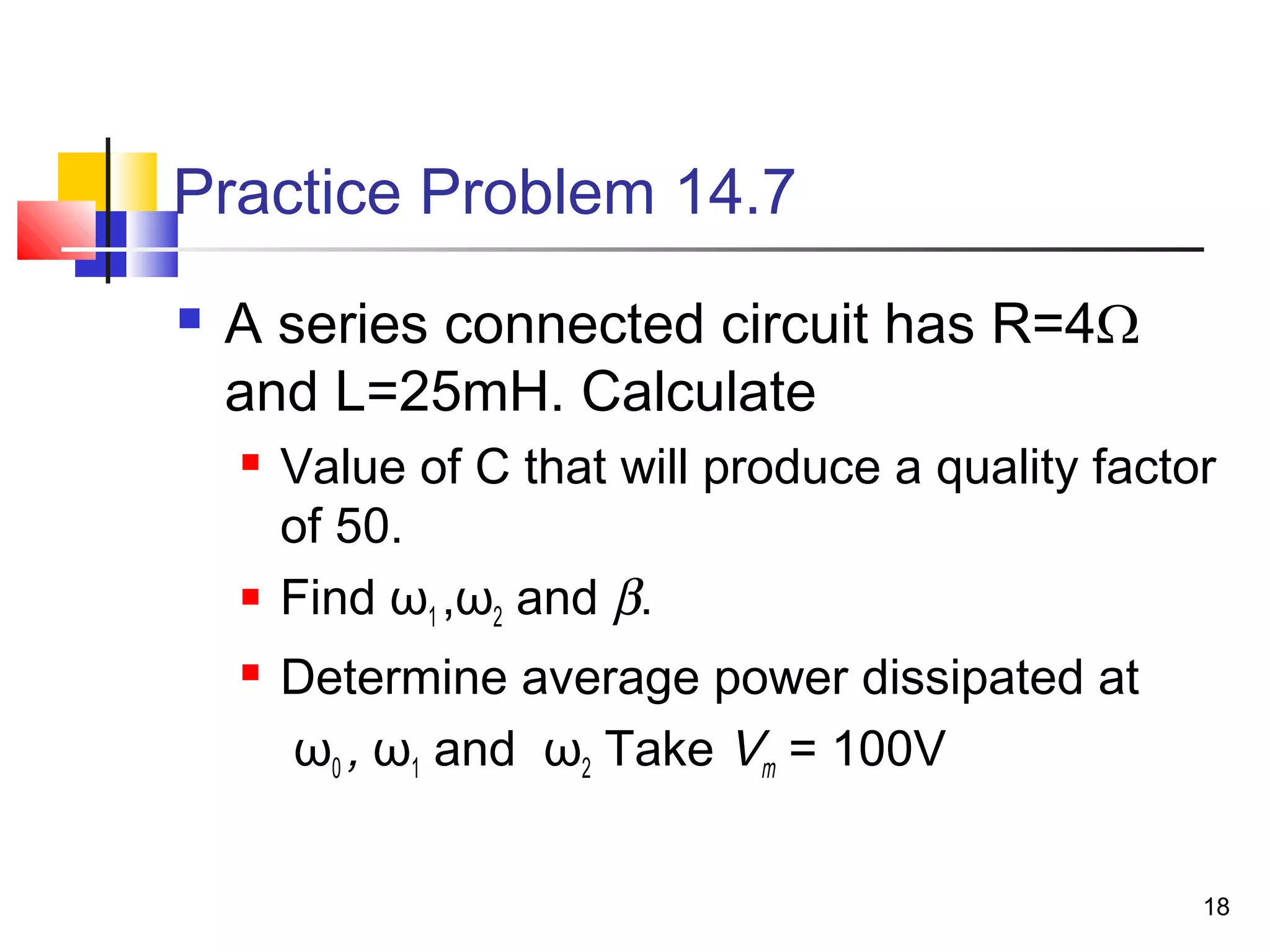
Practice Problem 14.7
 A series connected circuit has R=4Ω
and L=25mH. Calculate
 Value of C that will produce a quality factor
of 50.
 Find ω1 ,ω2 and β.
 Determine average power dissipated at
ω0 , ω1 and ω2 Take Vm = 100V
19
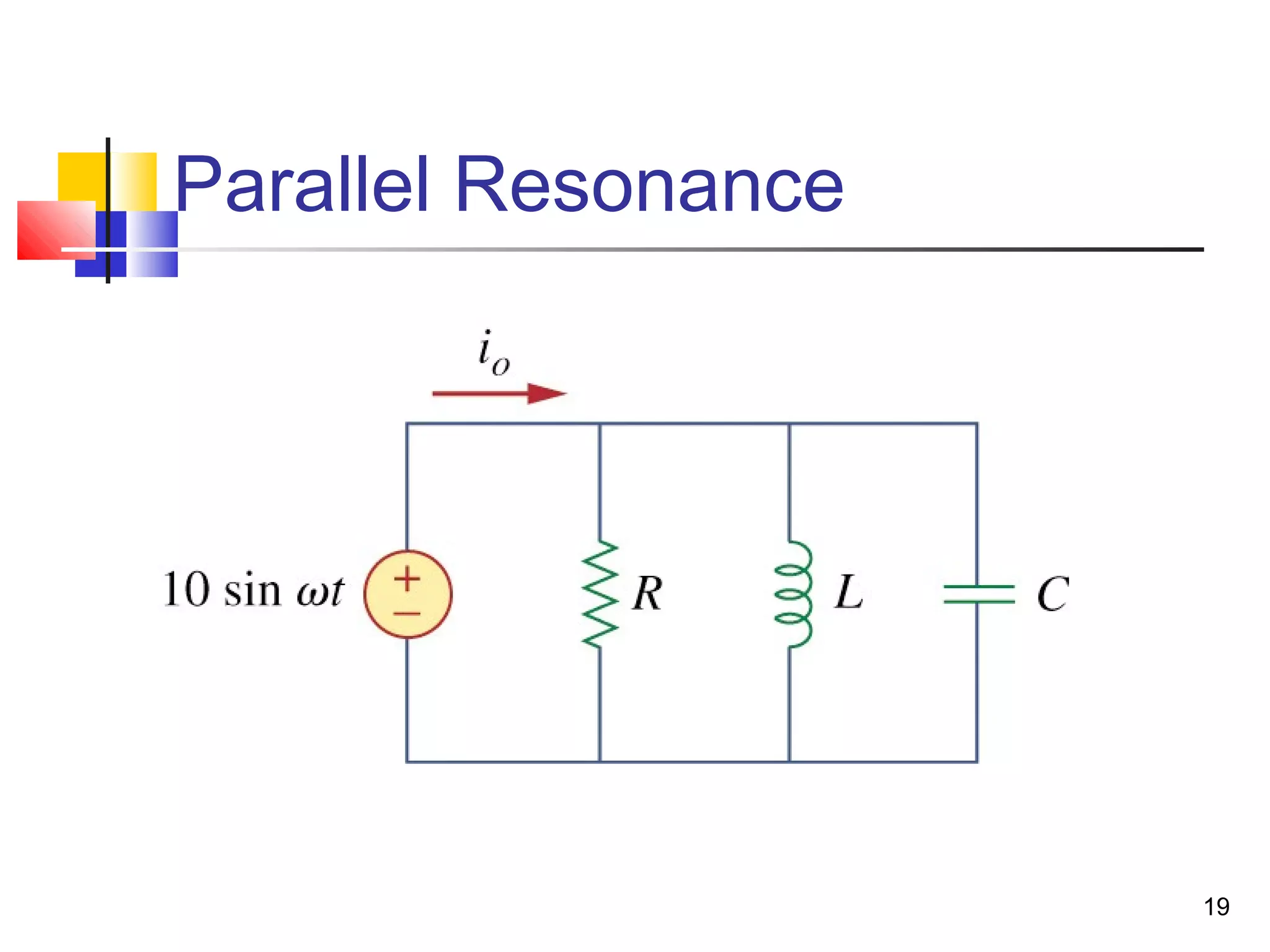
Parallel Resonance
20
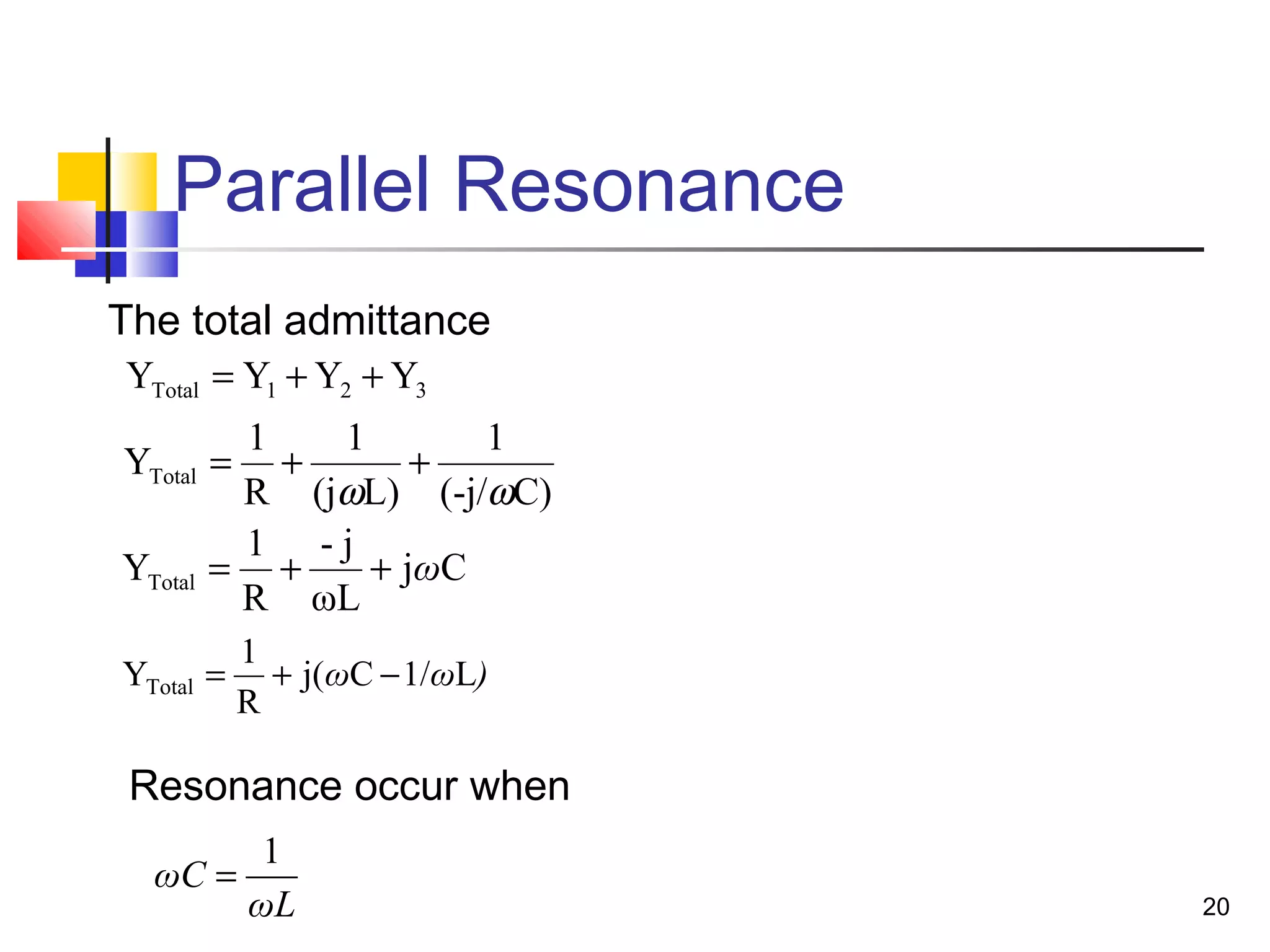
Parallel Resonance
The total admittance
ωL
ωC
1
=
Resonance occur when
)ωω L1/Cj(
R
1
YTotal −+=
321Total YYYY ++=
C)(-j/
1
L)(j
1
R
1
YTotal
ωω
++=
Cj
ωL
j-
R
1
YTotal ω++=
21
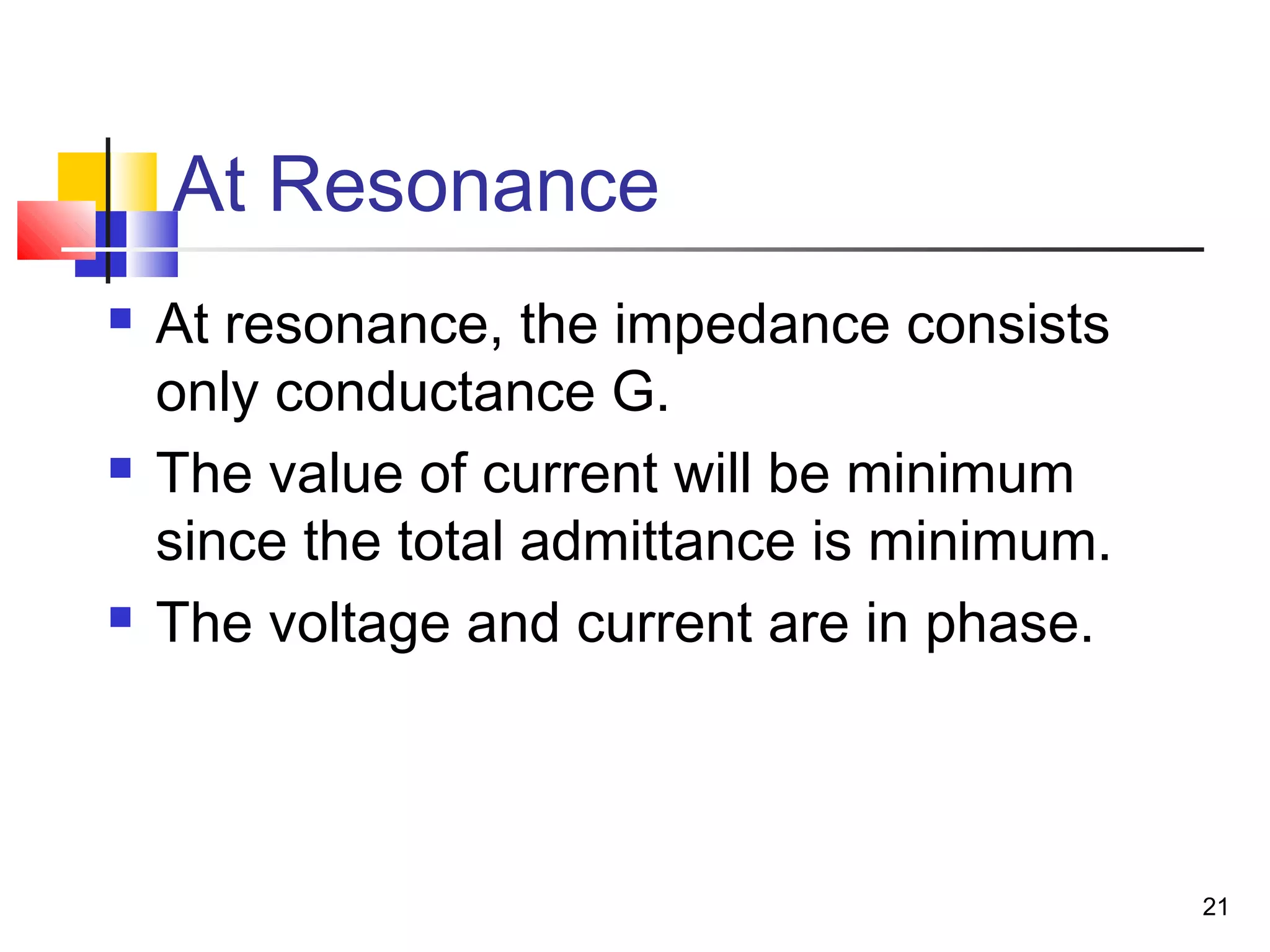
At Resonance
 At resonance, the impedance consists
only conductance G.
 The value of current will be minimum
since the total admittance is minimum.
 The voltage and current are in phase.
22
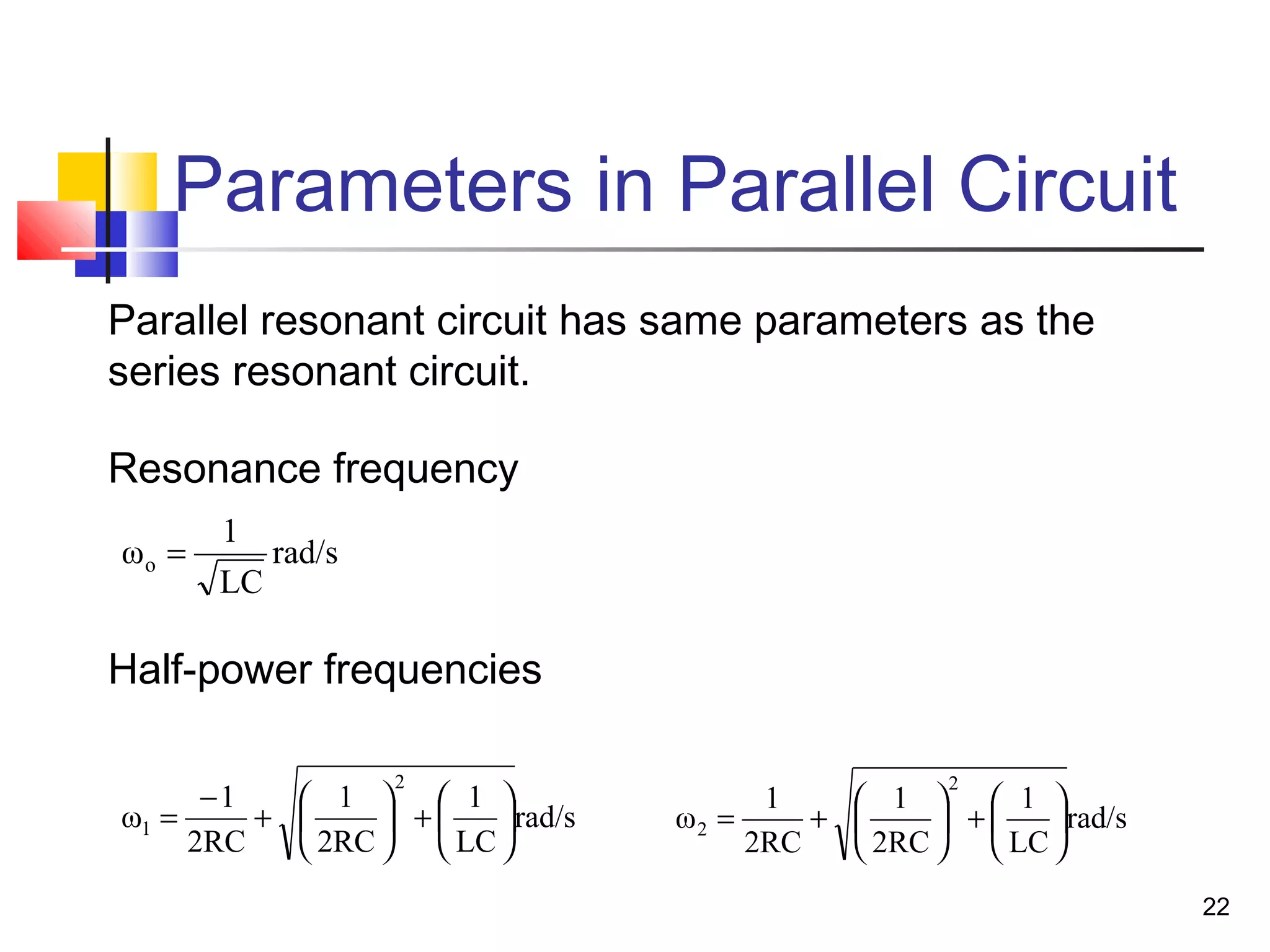
Parameters in Parallel Circuit
rad/s
LC
1
2RC
1
2RC
1
ω
2
1 





+





+
−
=
Parallel resonant circuit has same parameters as the
series resonant circuit.
rad/s
LC
1
ωo =
rad/s
LC
1
2RC
1
2RC
1
ω
2
2 





+





+=
Resonance frequency
Half-power frequencies
23
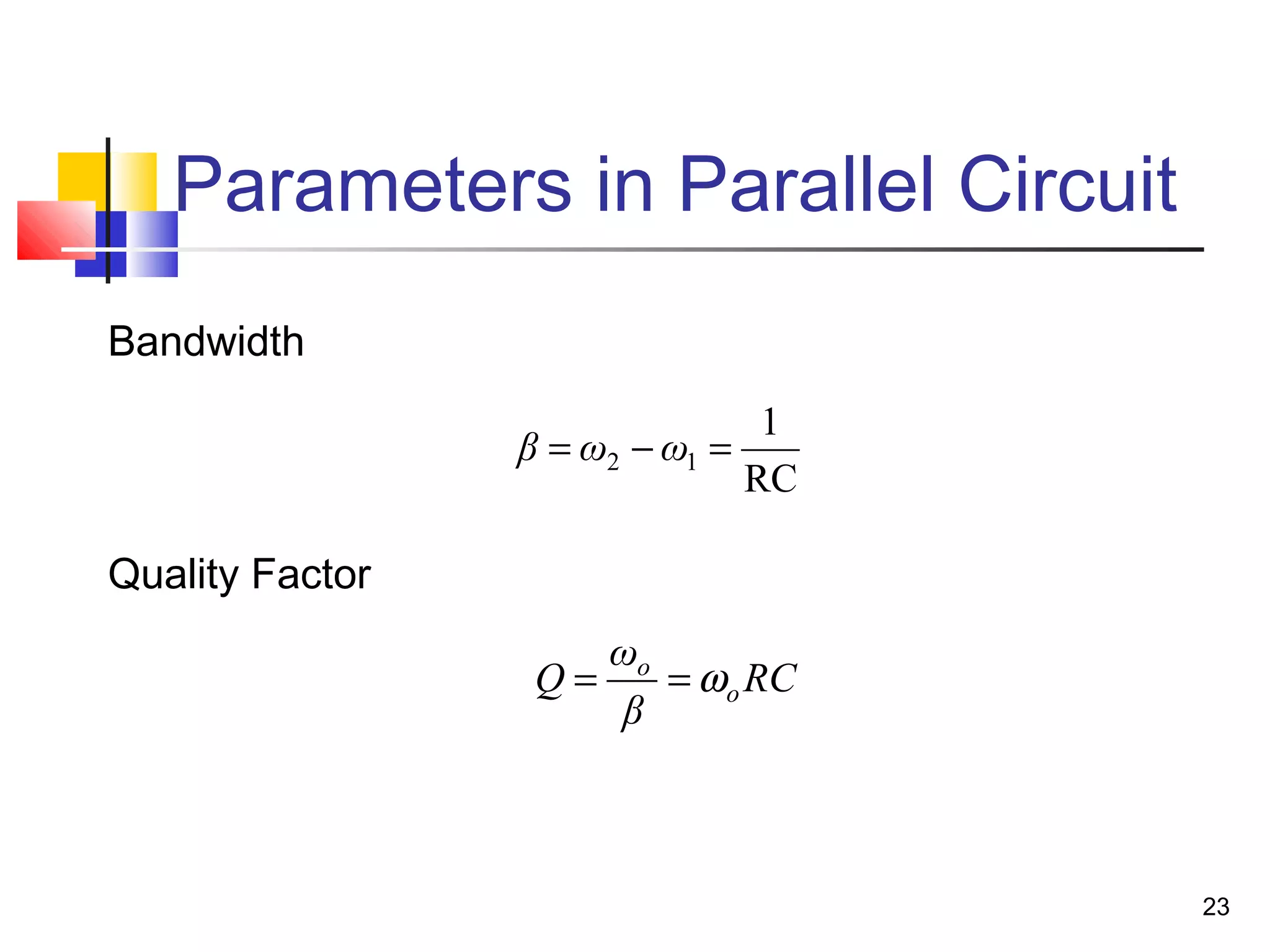
Parameters in Parallel Circuit
RC
β
ω
Q o
o
ω==
RC
1
12 =−= ωωβ
Bandwidth
Quality Factor
24
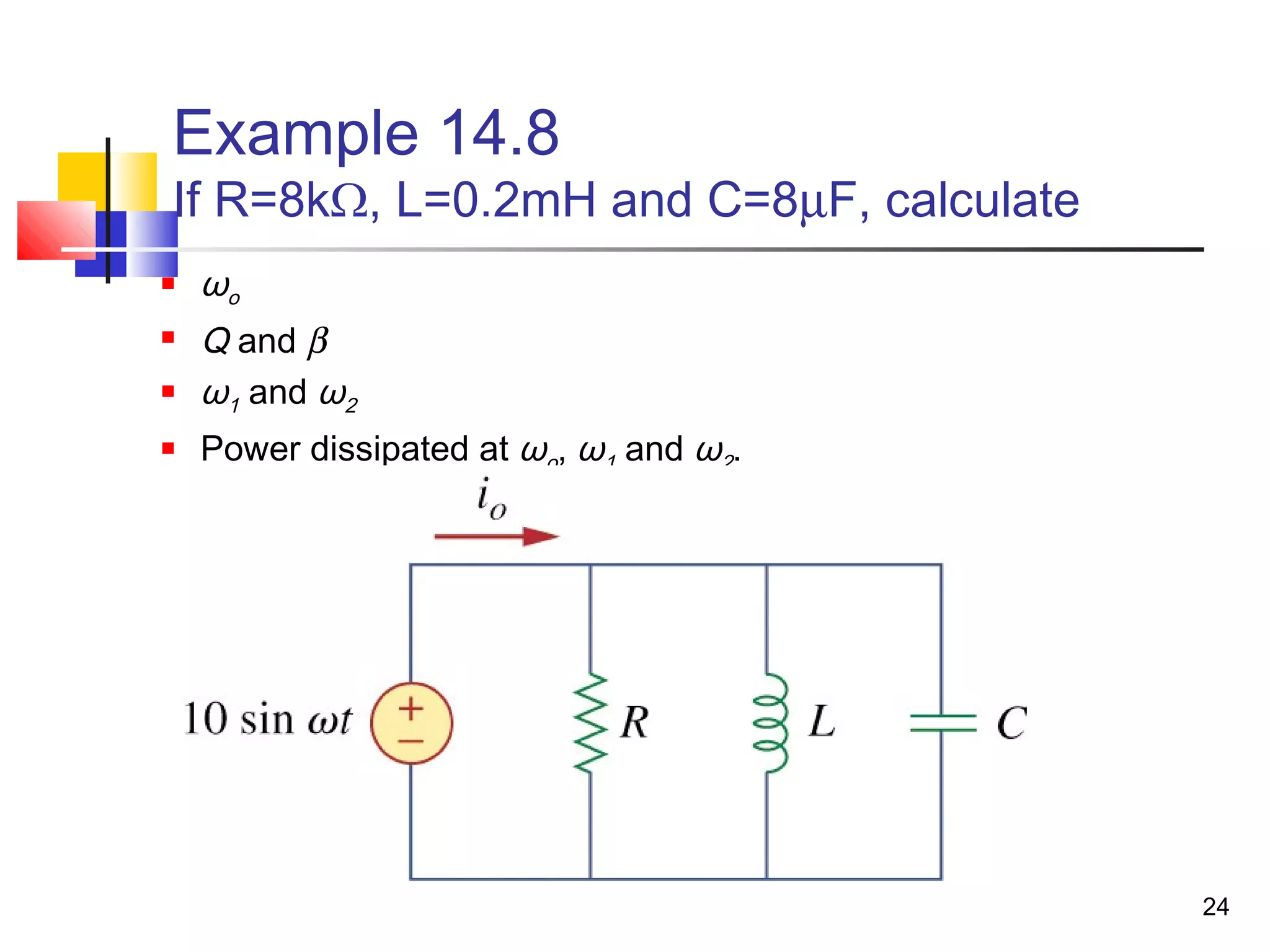
Example 14.8
If R=8kΩ, L=0.2mH and C=8µF, calculate
 ωo
 Q and β
 ω1 and ω2
 Power dissipated at ωo, ω1 and ω2.
25
Practice Problem 14.8
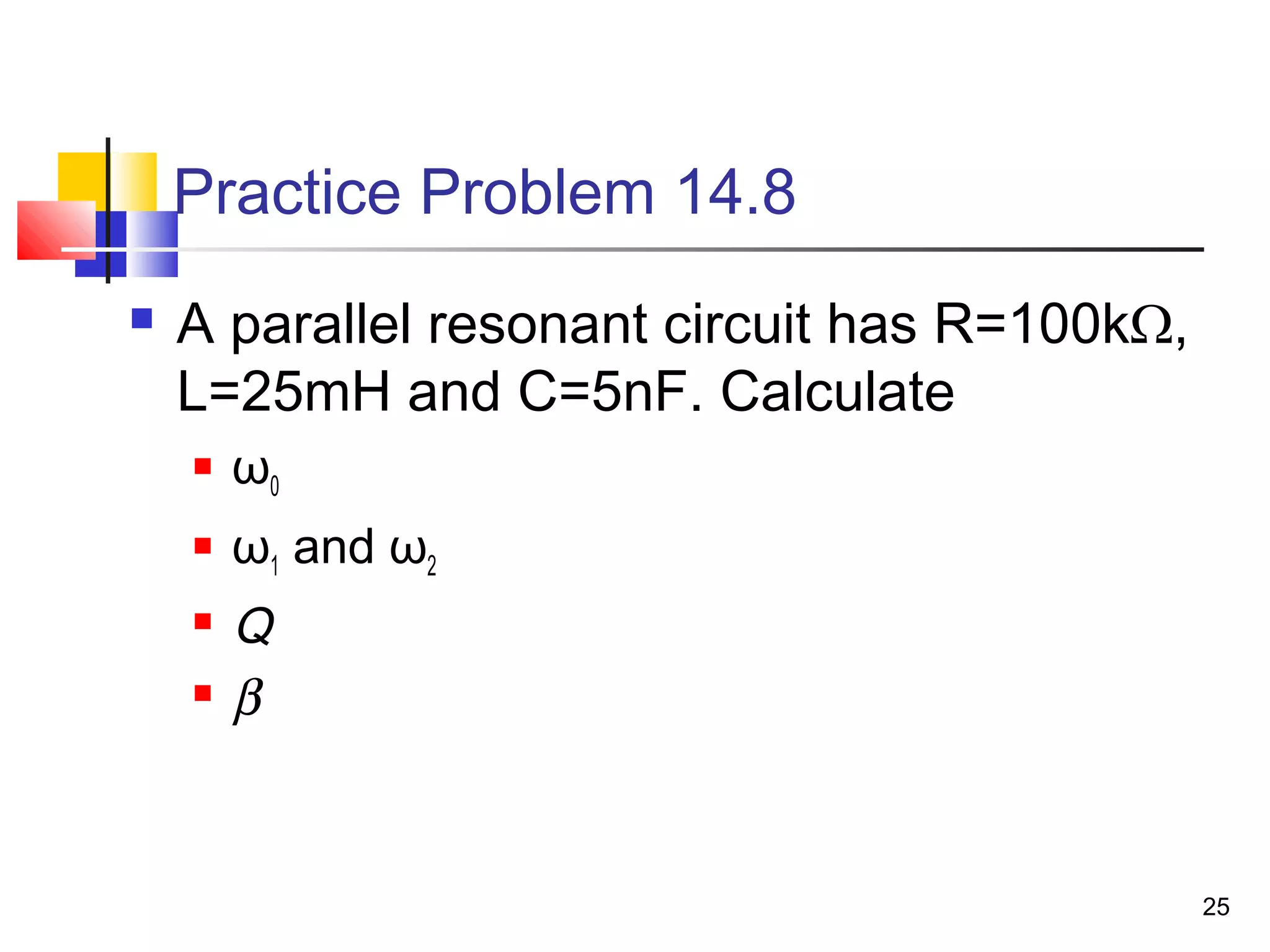
 A parallel resonant circuit has R=100kΩ,
L=25mH and C=5nF. Calculate
 ω0
 ω1 and ω2
 Q
 β
APPLICATION
27
PASSIVE FILTERS
 A filter is a circuit that is designed to pass
signals with desired frequencies and
reject or attenuates others
 A filter is a Passive Filters if it consists
only passive elements which is R, L and
C.
 Filters that used resonant circuit
 Bandpass Filter
 Bandstop Filter
28
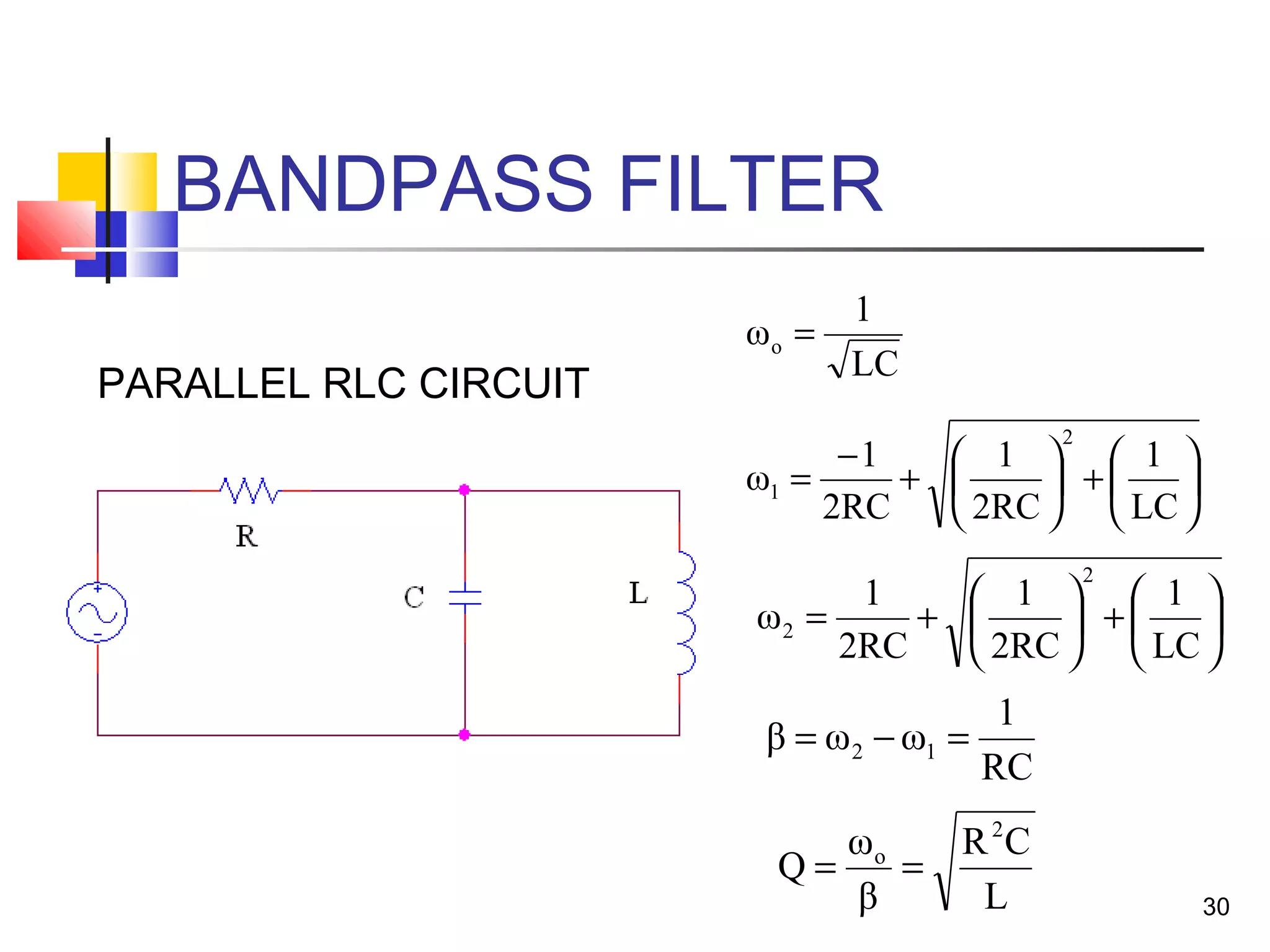
BANDPASS FILTER
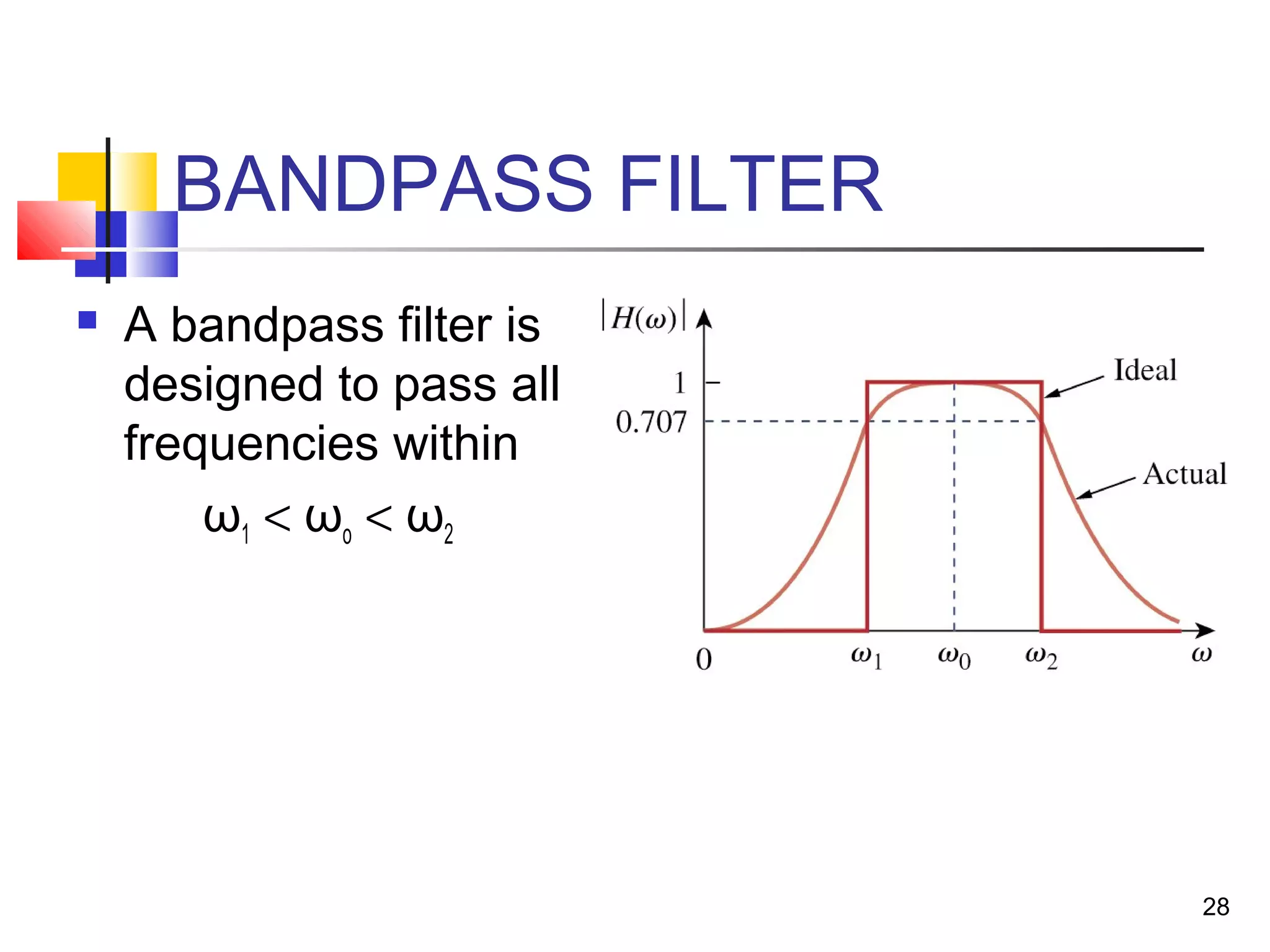
 A bandpass filter is
designed to pass all
frequencies within
ω1 < ωo < ω2
29
BANDPASS FILTER






+





+
−
=
LC
1
2L
R
2L
R
ω
2
1
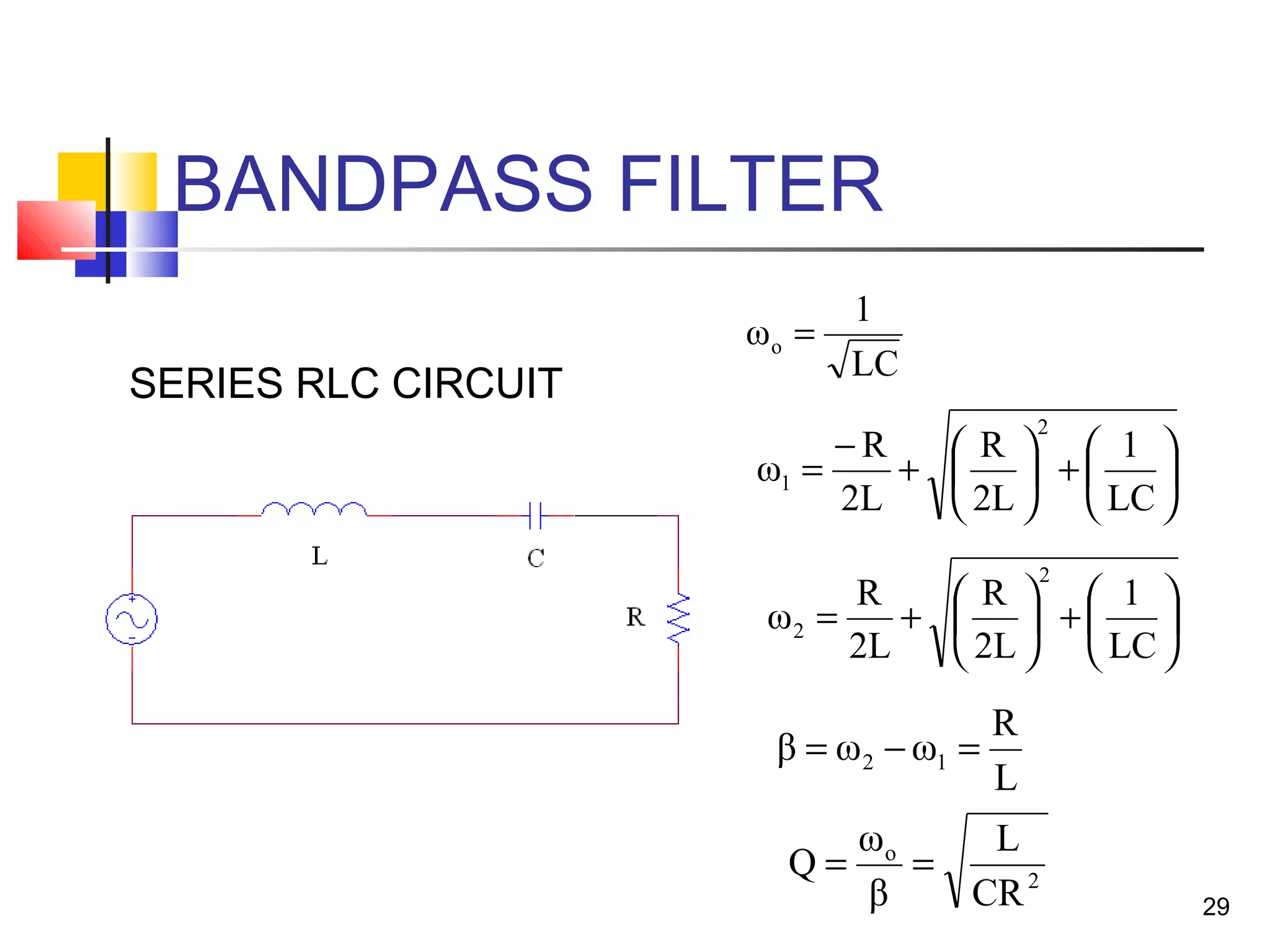
SERIES RLC CIRCUIT
LC
1
ωo =
2
o
CR
L
β
ω
Q ==
L
R
ωωβ 12 =−=






+





+=
LC
1
2L
R
2L
R
ω
2
2
30
BANDPASS FILTER






+





+
−
=
LC
1
2RC
1
2RC
1
ω
2
1
PARALLEL RLC CIRCUIT
LC
1
ωo =
L
CR
β
ω
Q
2
o
==
RC
1
ωωβ 12 =−=






+





+=
LC
1
2RC
1
2RC
1
ω
2
2
31
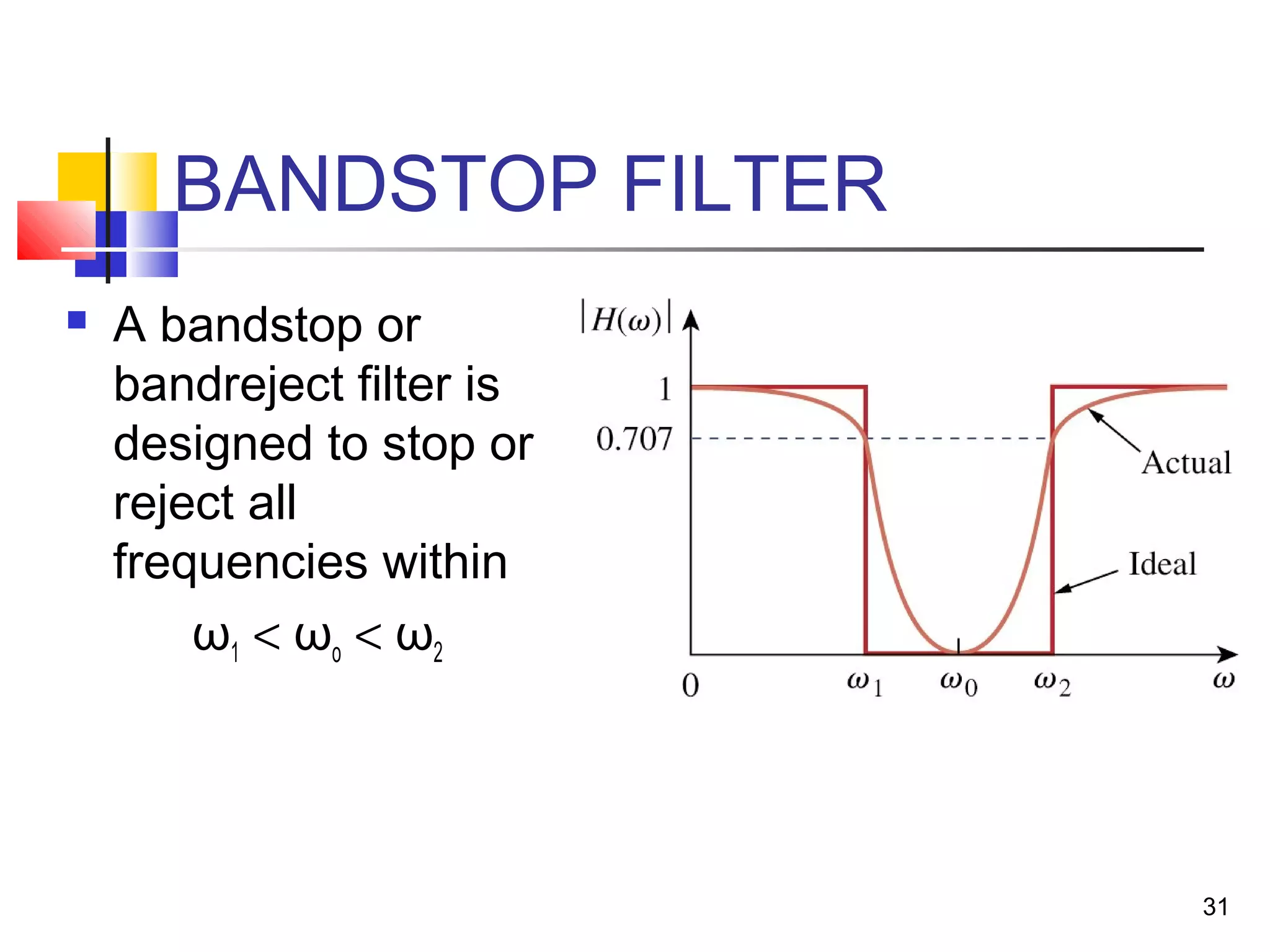
BANDSTOP FILTER
 A bandstop or
bandreject filter is
designed to stop or
reject all
frequencies within
ω1 < ωo < ω2
32
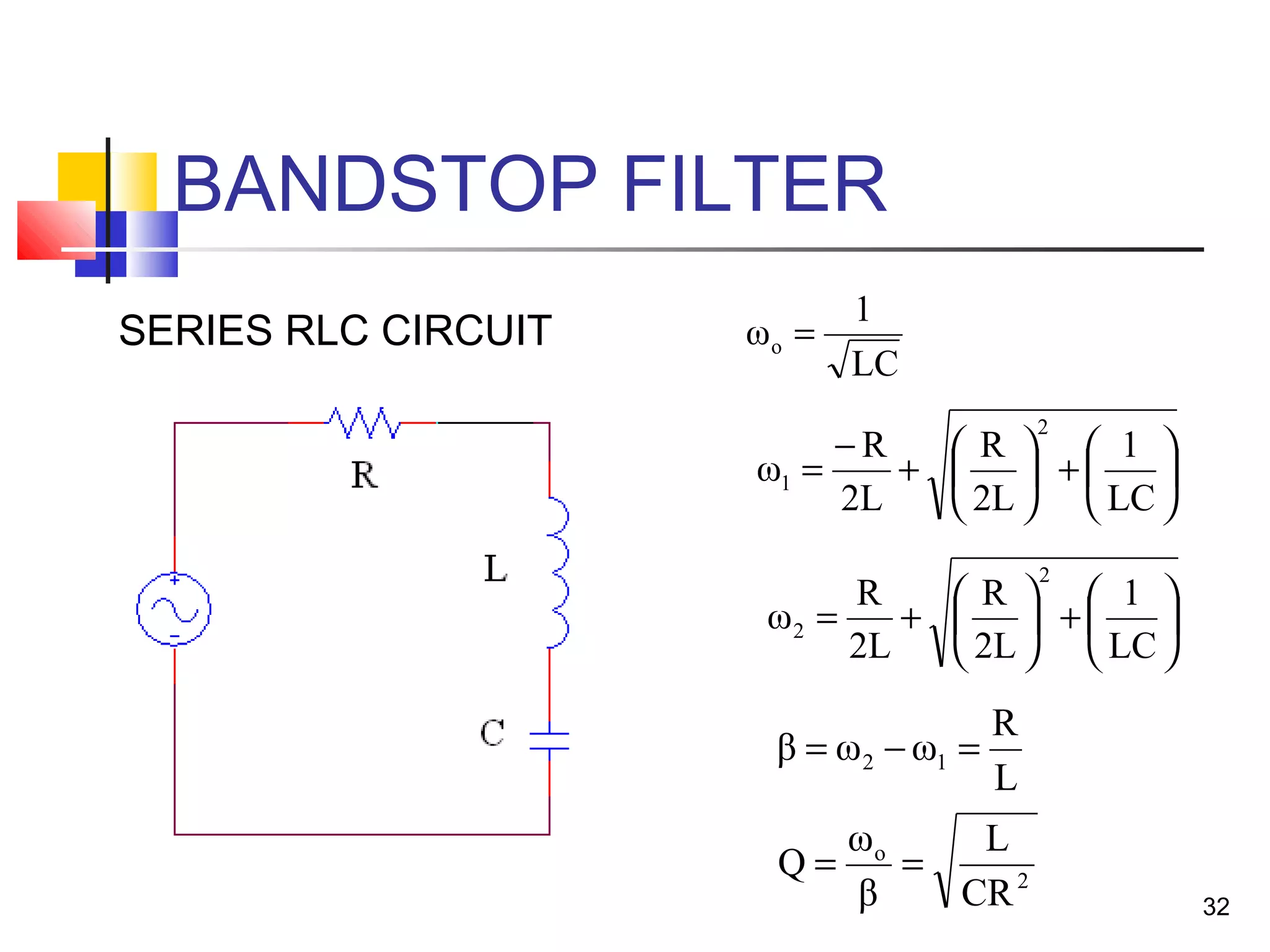
BANDSTOP FILTER






+





+
−
=
LC
1
2L
R
2L
R
ω
2
1
SERIES RLC CIRCUIT
LC
1
ωo =
2
o
CR
L
β
ω
Q ==
L
R
ωωβ 12 =−=






+





+=
LC
1
2L
R
2L
R
ω
2
2
33
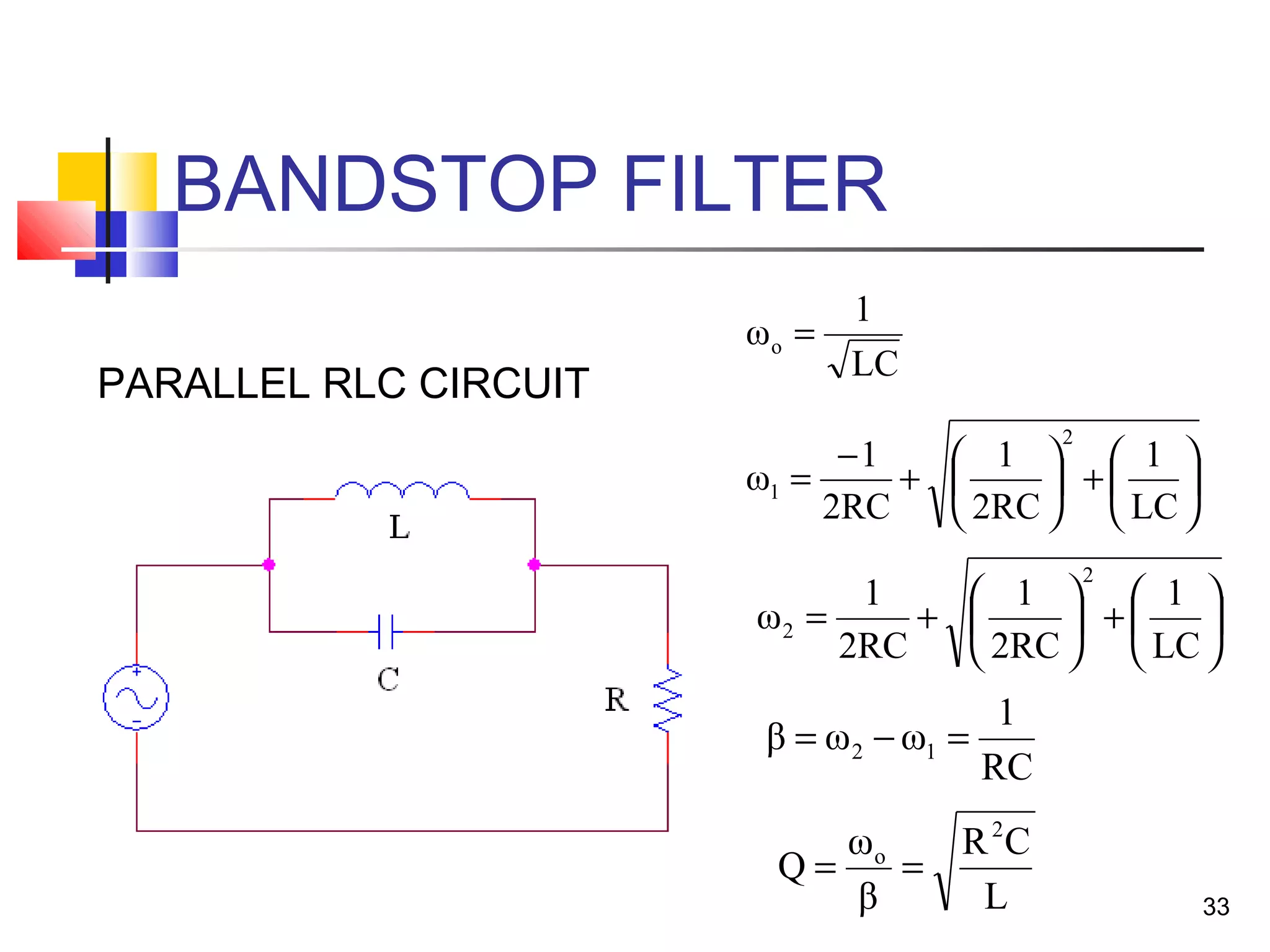
BANDSTOP FILTER






+





+
−
=
LC
1
2RC
1
2RC
1
ω
2
1
PARALLEL RLC CIRCUIT
LC
1
ωo =
L
CR
β
ω
Q
2
o
==
RC
1
ωωβ 12 =−=






+





+=
LC
1
2RC
1
2RC
1
ω
2
2

Unit 2 resonance circuit