 Resonance in Series RLC Circuit
 Quality Factor (Q)
 Bandwidth and Half-Power Frequencies
 Resonance in Parallel RLC Circuit
 Parallel LC Circuit (Tank Circuit)
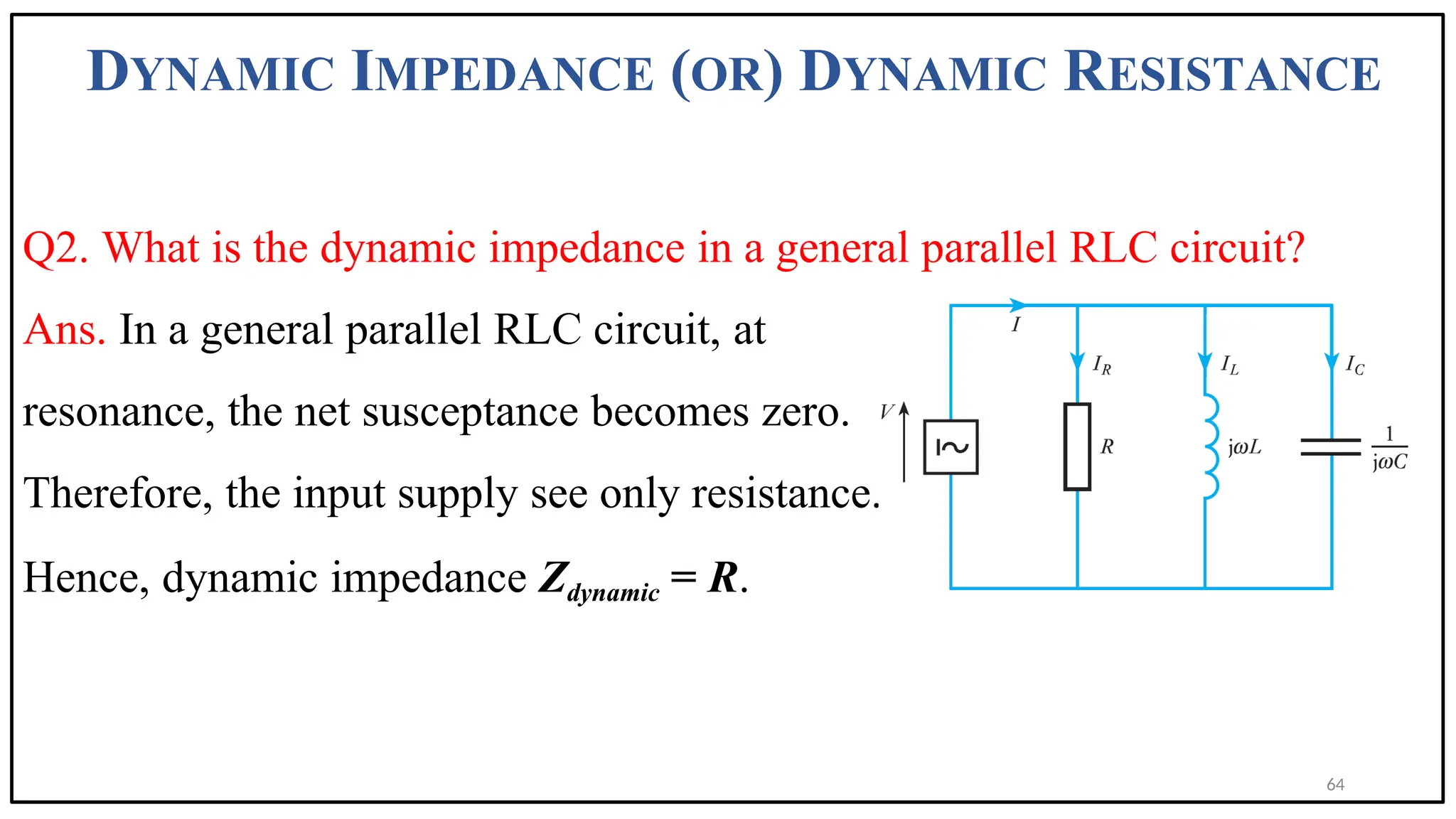
 Dynamic Impedance (or) Dynamic Resistance
2
Outline
PHENOMENON OF RESONANCE IN VARIOUS DOMAINS
Induction Heater
3
Courtesy: https://www.youtube.com/watch?v=2Xqfz-zywJo/ (Available Online: 06 Dec.
PHENOMENON OF RESONANCE IN VARIOUS DOMAINS
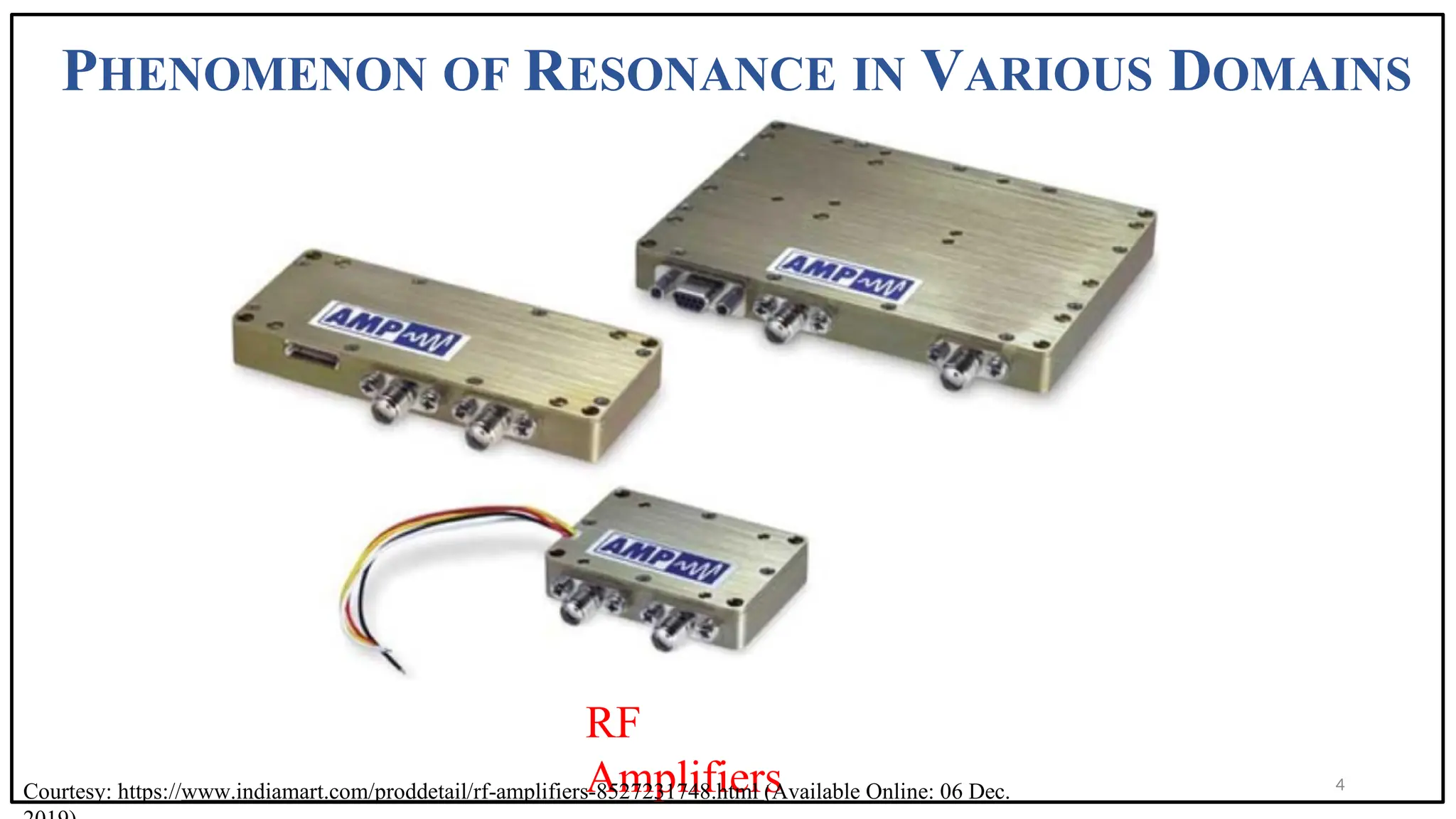
RF
Amplifiers 4
Courtesy: https://www.indiamart.com/proddetail/rf-amplifiers-8527231748.html (Available Online: 06 Dec.
PHENOMENON OF RESONANCE IN VARIOUS DOMAINS
TV Receivers
5
Courtesy: https://www.indiamart.com/technical-ajfarul-ji/tv-receivers.html (Available Online: 06 Dec.
PHENOMENON OF RESONANCE IN VARIOUS DOMAINS
Radio
5
Courtesy: https://studiousguy.com/everyday-examples-of-resonance/ (Available Online: 25 Nov.
PHENOMENON OF RESONANCE IN VARIOUS DOMAINS
Guitar
6
Courtesy: https://studiousguy.com/everyday-examples-of-resonance/ (Available Online: 25 Nov.
PHENOMENON OF RESONANCE IN VARIOUS DOMAINS
Pendulum
7
Courtesy: https://studiousguy.com/everyday-examples-of-resonance/ (Available Online: 25 Nov.
PHENOMENON OF RESONANCE IN VARIOUS DOMAINS
Swing
8
Courtesy: https://studiousguy.com/everyday-examples-of-resonance/ (Available Online: 25 Nov.
PHENOMENON OF RESONANCE IN VARIOUS DOMAINS
Singer Breaking the Glass
9
Courtesy: https://studiousguy.com/everyday-examples-of-resonance/ (Available Online: 25 Nov.
PHENOMENON OF RESONANCE IN VARIOUS DOMAINS
Bridge Collapse
10
Courtesy: https://studiousguy.com/everyday-examples-of-resonance/ (Available Online: 25 Nov.
PHENOMENON OF RESONANCE IN VARIOUS DOMAINS
Microwave Oven
11
Courtesy: https://studiousguy.com/everyday-examples-of-resonance/ (Available Online: 25 Nov.
WHY STUDY RESONANCE?
• Resonance is the frequency response of a circuit or network when
it is
operating at its natural frequency called “ Resonance Frequency”.
• For many applications, the supply (defined by its voltage and frequency)
is constant. e.g. The supply to residential homes is 230 V, 50 Hz.
• However, many communication systems involve circuits in which
the
supply voltage operates with a varying frequency.
• To understand communication systems, one requires a knowledge of
how circuits are affected by a variation of the frequency. Examples
of such communication systems are,
Radio, television, telephones, and machine control systems. 12
WHEN RESONANCE OCCURS? AND WHAT IT
RESULTS?
• Resonance occurs in any circuit that has energy storage elements, at least
one inductor and one capacitor.
• Under resonance, the total impedance is equal to the resistance only and
maximum power is drawn from the supply by the circuit.
• Under resonance, the total supply voltage and supply current are in phase.
So, the power factor (PF) becomes unity.
• At resonance, L and C elements exchange energy freely as a function of
time, which results in sinusoidal oscillations either across L or C.
TYPES OF RESONANCE
• Series resonance.
• Parallel resonance. L 13
C
APPLICATIONS OF RESONANCE
• Resonant circuits (series or parallel) are used in many
applications such as selecting the desired stations in radio and TV
receivers.
• Most common applications of resonance are based on the
frequency dependent response. (“tuning” into a particular
frequency/channel)
• A series resonant circuit is used as voltage amplifier.
• A parallel resonant circuit is used as current amplifier.
• A resonant circuit is also used as a filter.
14
RESONANCE IN SERIES RLC CIRCUIT
represent resonant frequency in rad/s and in Hz,
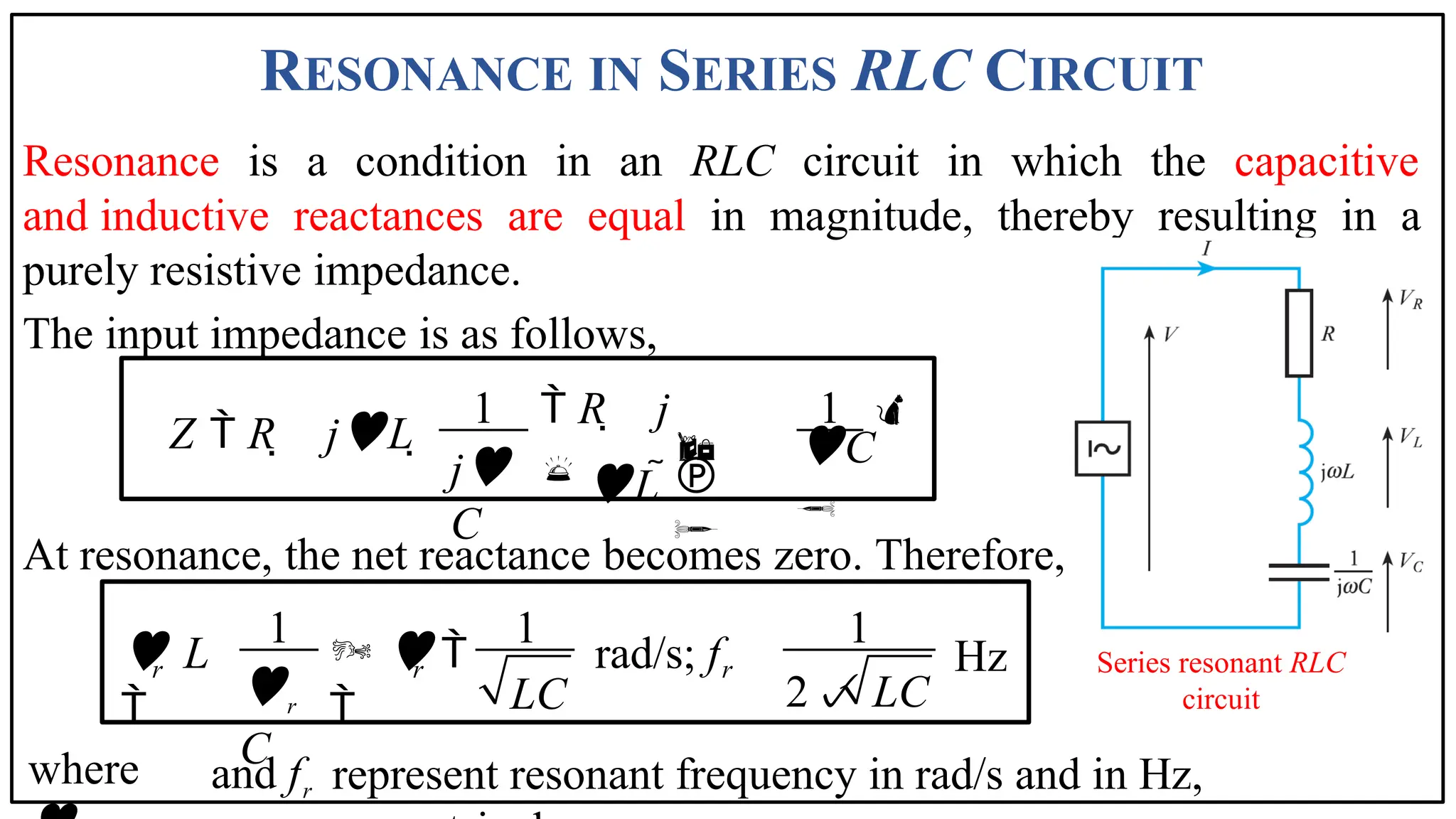
Resonance is a condition in an RLC circuit in which the capacitive
and inductive reactances are equal in magnitude, thereby resulting in a
purely resistive impedance.
The input impedance is as follows,
At resonance, the net reactance becomes zero. Therefore,
Series resonant RLC
circuit
1 1
Z  R  jL 
 R  j

L 
j
C
C





1 1 1
  rad/s; f

Hz
2 LC
r r r
r
C
 L
 LC
where and fr
REACTANCE (XL, XC) VS FREQUENCY PLOTS
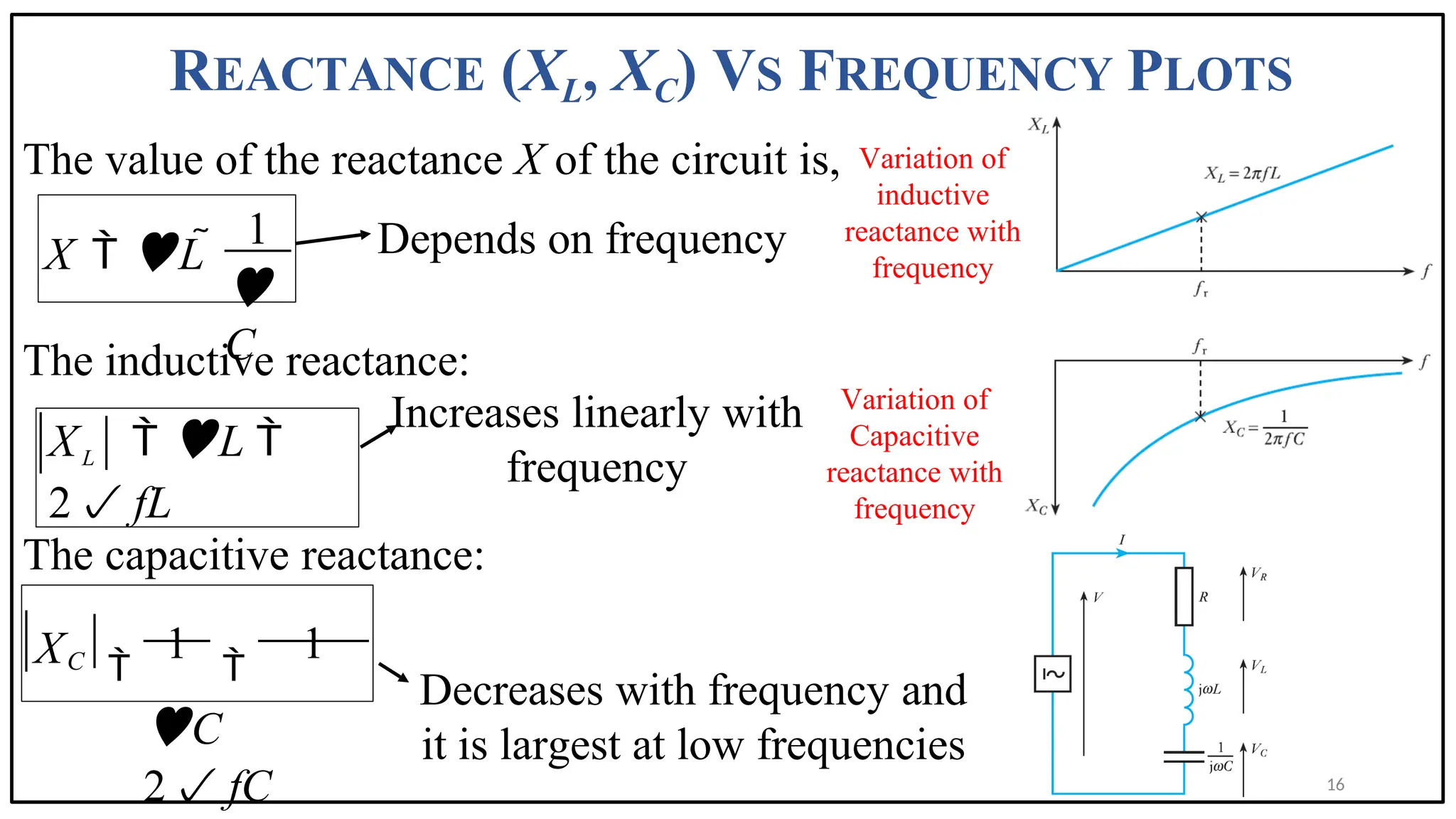
The value of the reactance X of the circuit is,
The inductive reactance:
The capacitive reactance:
1
X  L 

C
Variation of
inductive
reactance with
frequency
Variation of
Capacitive
reactance with
frequency
Depends on frequency
XL  L 
2 fL
Increases linearly with
frequency

1

1
C
2 fC
C
X
Decreases with frequency and
it is largest at low frequencies
16
VARIATION OF REACTANCE AND IMPEDANCE
WITH
FREQUENCY
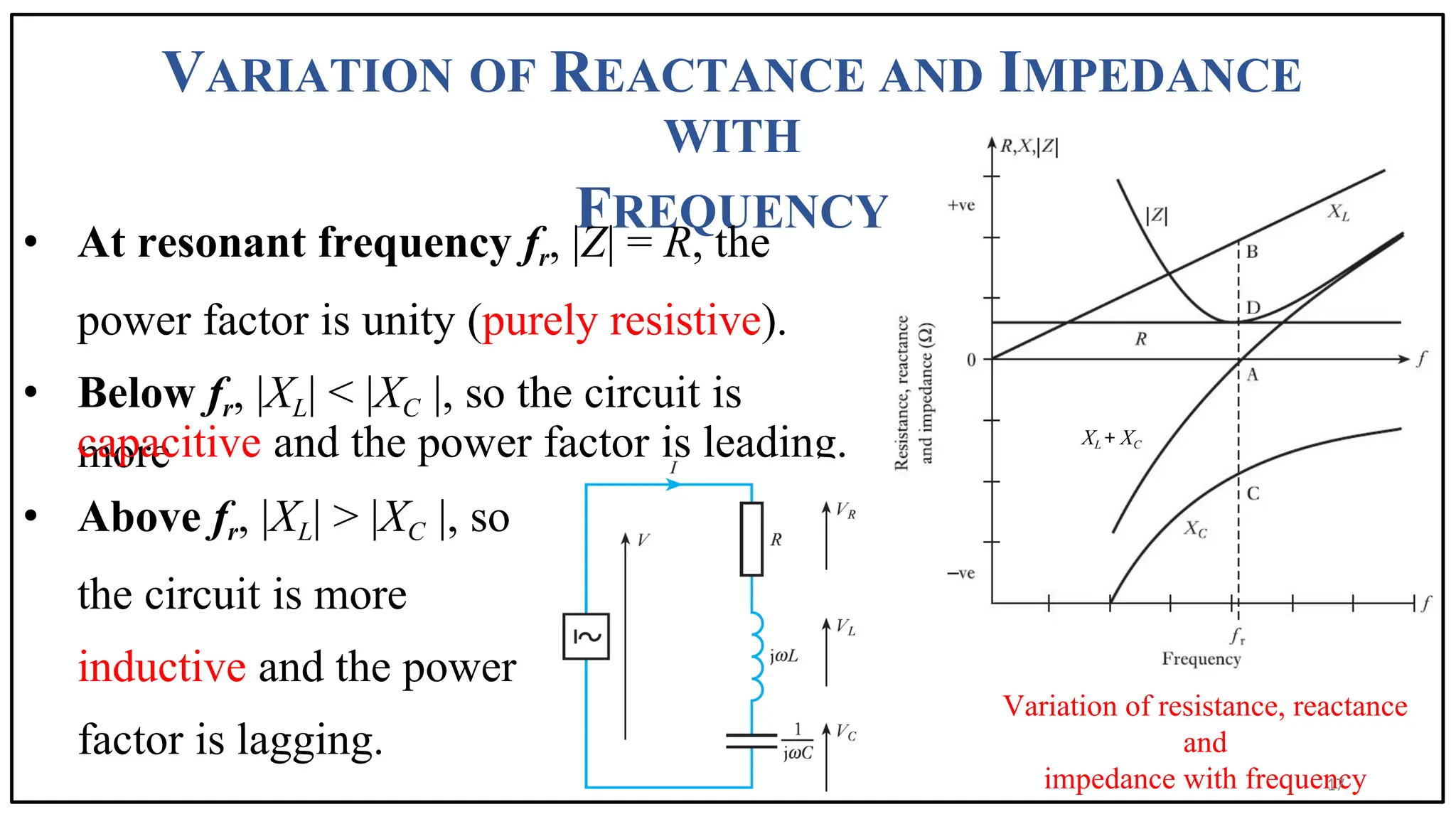
• At resonant frequency fr, |Z| = R, the
power factor is unity (purely resistive).
• Below fr, |XL| < |XC |, so the circuit is
more
capacitive and the power factor is leading.
• Above fr, |XL| > |XC |, so
the circuit is more
inductive and the power
factor is lagging.
Variation of resistance, reactance
and
impedance with frequency
XL + XC
17
IMPEDANCE PHASOR DIAGRAMS
The phase of the circuit impedance
is given by
Below fr, XC > XL
At fr, XC = XL, Z = R
Above fr, XL > XC
• Below fr , XL < XC,  is negative, the circuit is capacitive.
1  XL  XC 
 
tan R
18
THE CURRENT IN A SERIES RLC CIRCUIT
The circuit current is given by
The current is maximum when ωL = 1/(ωC),
when the circuit is resistive (  = 0).
Therefore,
I 
V
Z


V  

Z
1
2



R2

L 
1
  tan
1

L 
V C

I
 R
C 



 












m 
V
I
R
19
VARIATION OF MAGNITUDE AND PHASE
OF
CURRENT WITH FREQUENCY
21
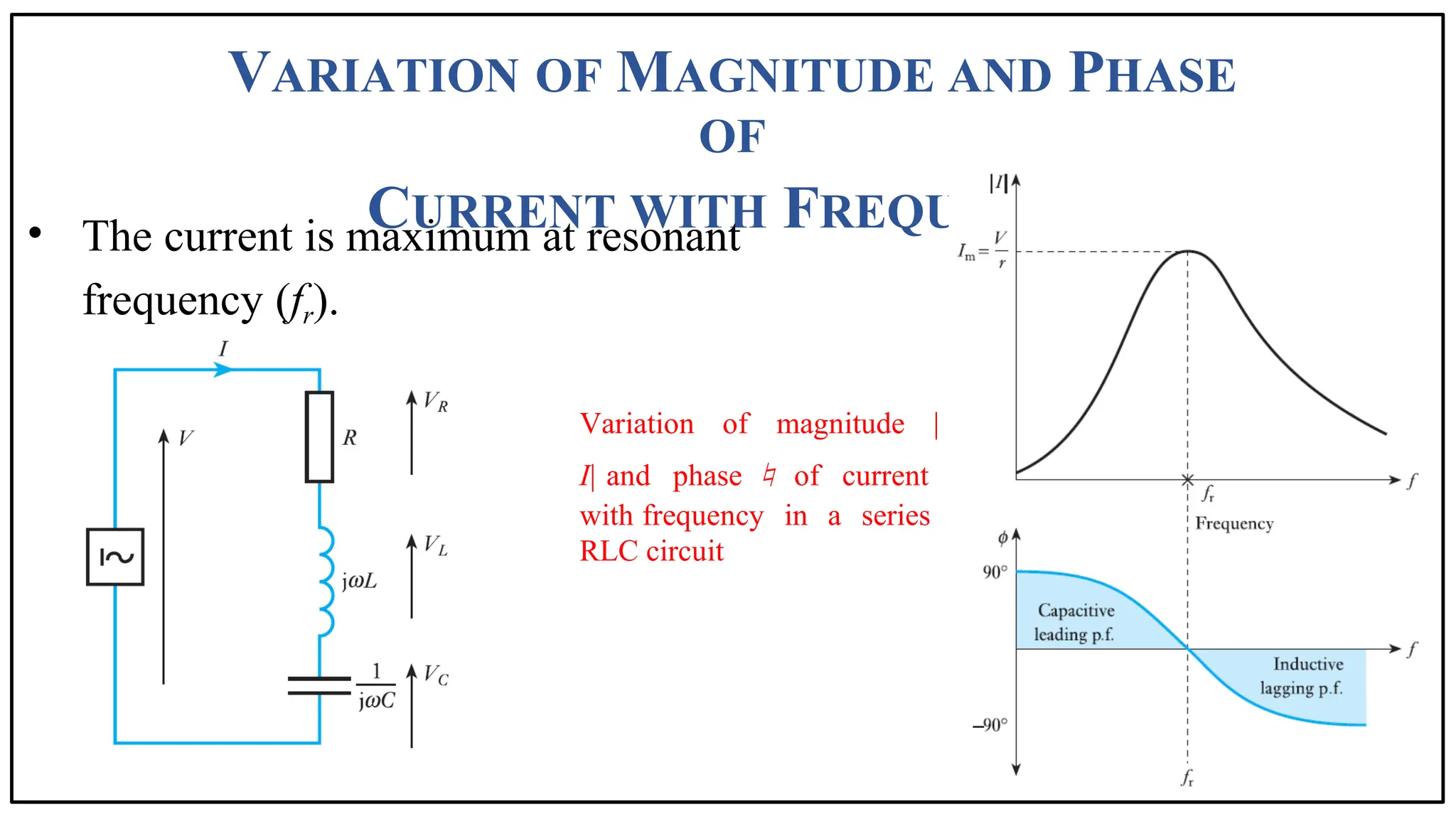
• The current is maximum at resonant
frequency (fr).
Variation of magnitude |
I| and phase  of current
with frequency in a series
RLC circuit
QUALITY FACTOR (Q)
• The “sharpness” of the resonance in a resonant circuit is
measured quantitatively by the quality factor Q.
• The quality factor relates the maximum or peak energy stored to
the
energy dissipated in the circuit per cycle of oscillation:
• It is also regarded as a measure of the energy storage property of a circuit
in relation to its energy dissipation property.
Q  2
 Peak energy stored in the circuit

 Energy dissipated by the circuit in one period at
resonance 


21
QUALITY FACTOR (Q)
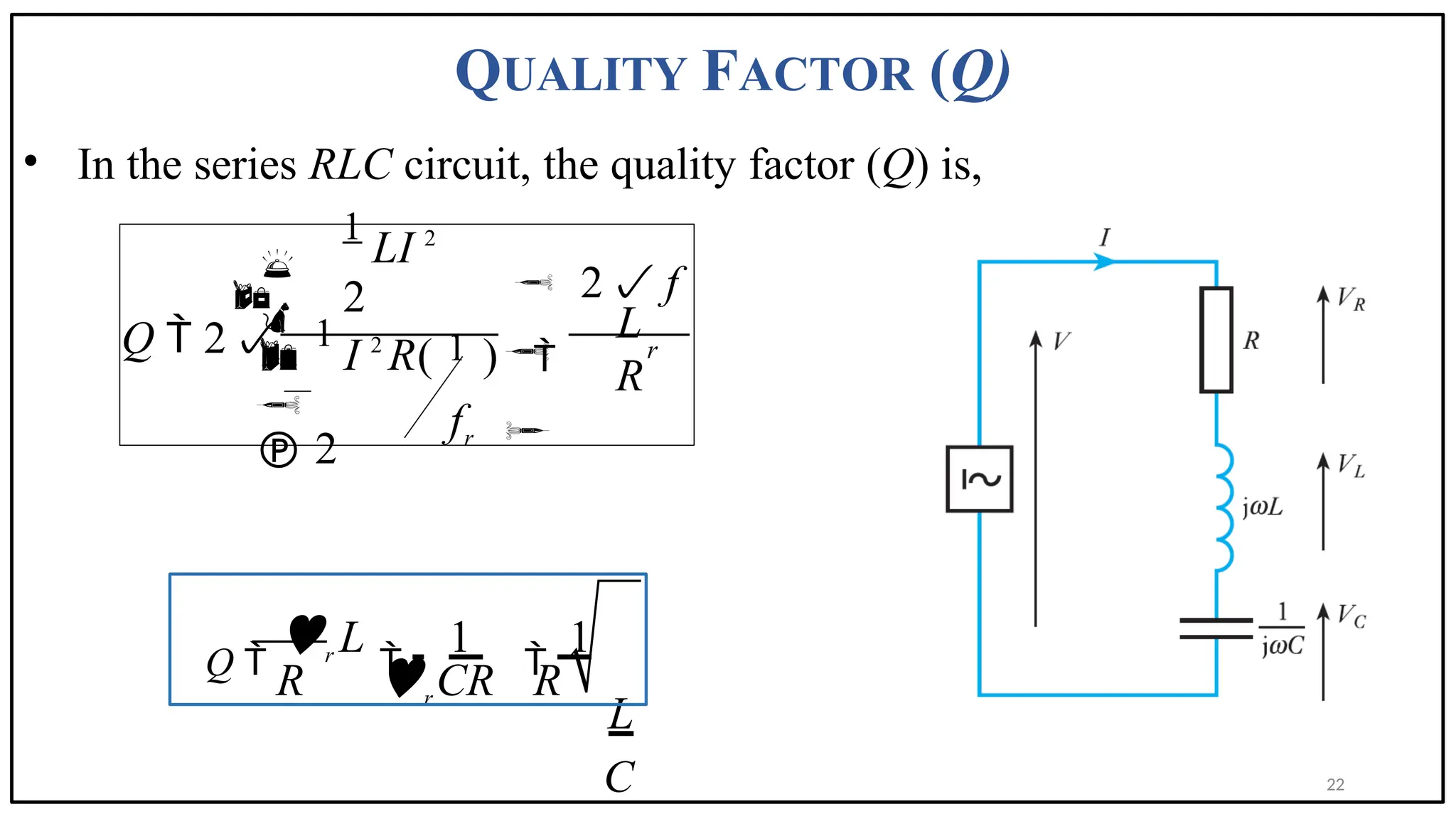
• In the series RLC circuit, the quality factor (Q) is,
1
LI 2
2

1
I 2
R( 1 )

 2
 2 f
L
 r

Q  2
fr
R


 

Q 
r L

1

1
L
C
R r CR R
22
QUALITY FACTOR (Q)
• The Q factor is also defined as the ratio of the reactive power, of either
thecapacitor or the inductor to the average power of the resistor
at
resonance:
• For inductive reactance XL at resonance:
• For capacitive reactance XL at resonance:
 Reactive power

 Average power

Q 


 Reactive power I 2
X 
L
 Average power  I 2
R R
L r
Q 




 Reactive power I 2
X I 2
R 
1
Average
C
r
Q   

  23
VOLTAGES IN A SERIES RLC CIRCUIT
(a) f < fr
24
Capacitive,
I leads V
(c) f > fr
Inductive,
I lags V
(b) f = fr
Resistive,
V and I in
phase
VOLTAGES ACROSS RLC ELEMENTS AT RESONANCE
26
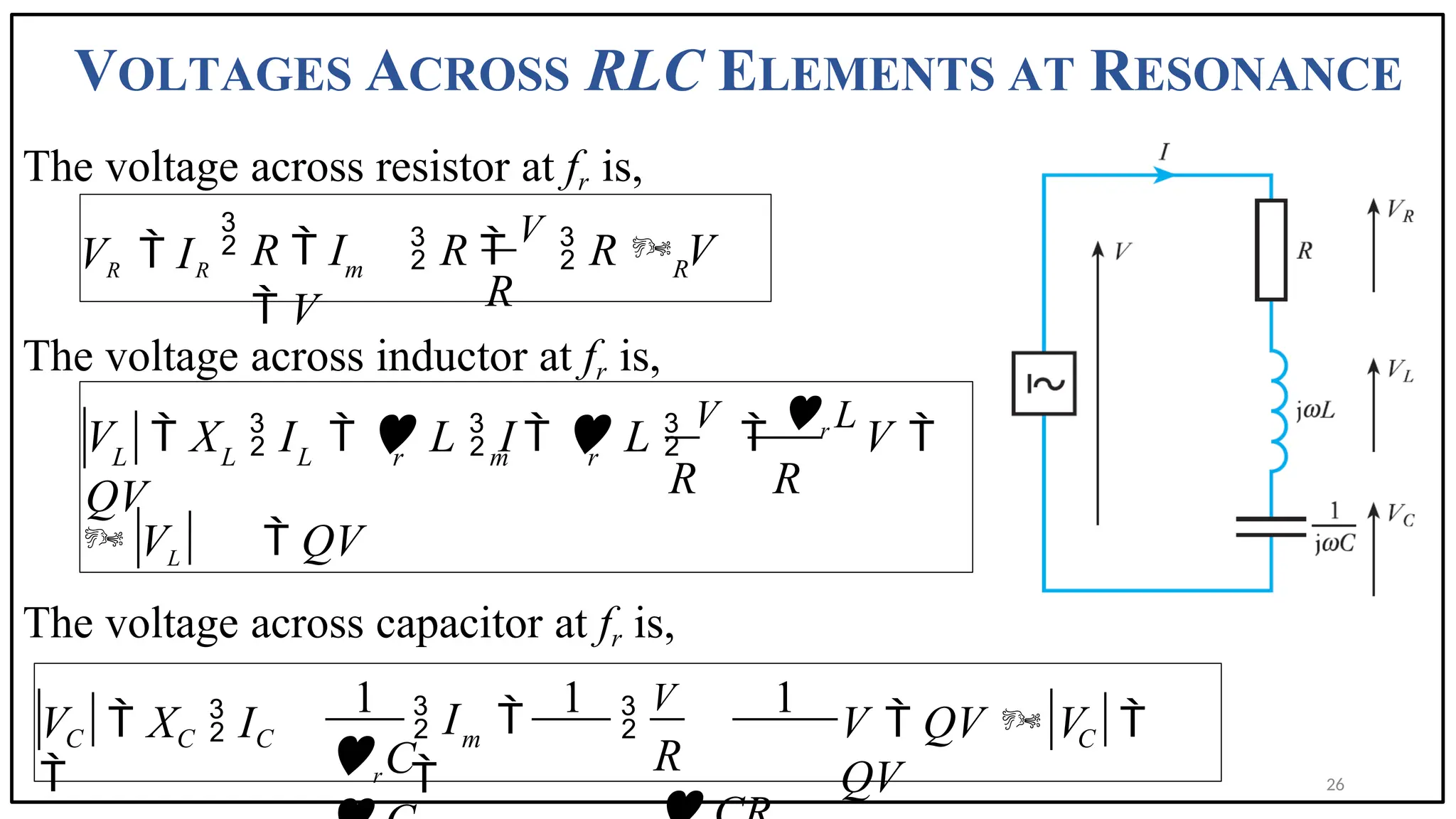
The voltage across resistor at fr is,
The voltage across inductor at fr is,
 VL  QV
The voltage across capacitor at fr is,
VR  IR m R
 R  I  R 
V
 R  V
 V R
V  X  I   L  I   L 
V

r L
V 
QV
L L L r m r
R R
1 1 1
C C C m C
rC R
 I  
V

V  X  I

V  QV  V 
QV
VOLTAGES ACROSS RLC ELEMENTS AT RESONANCE
27
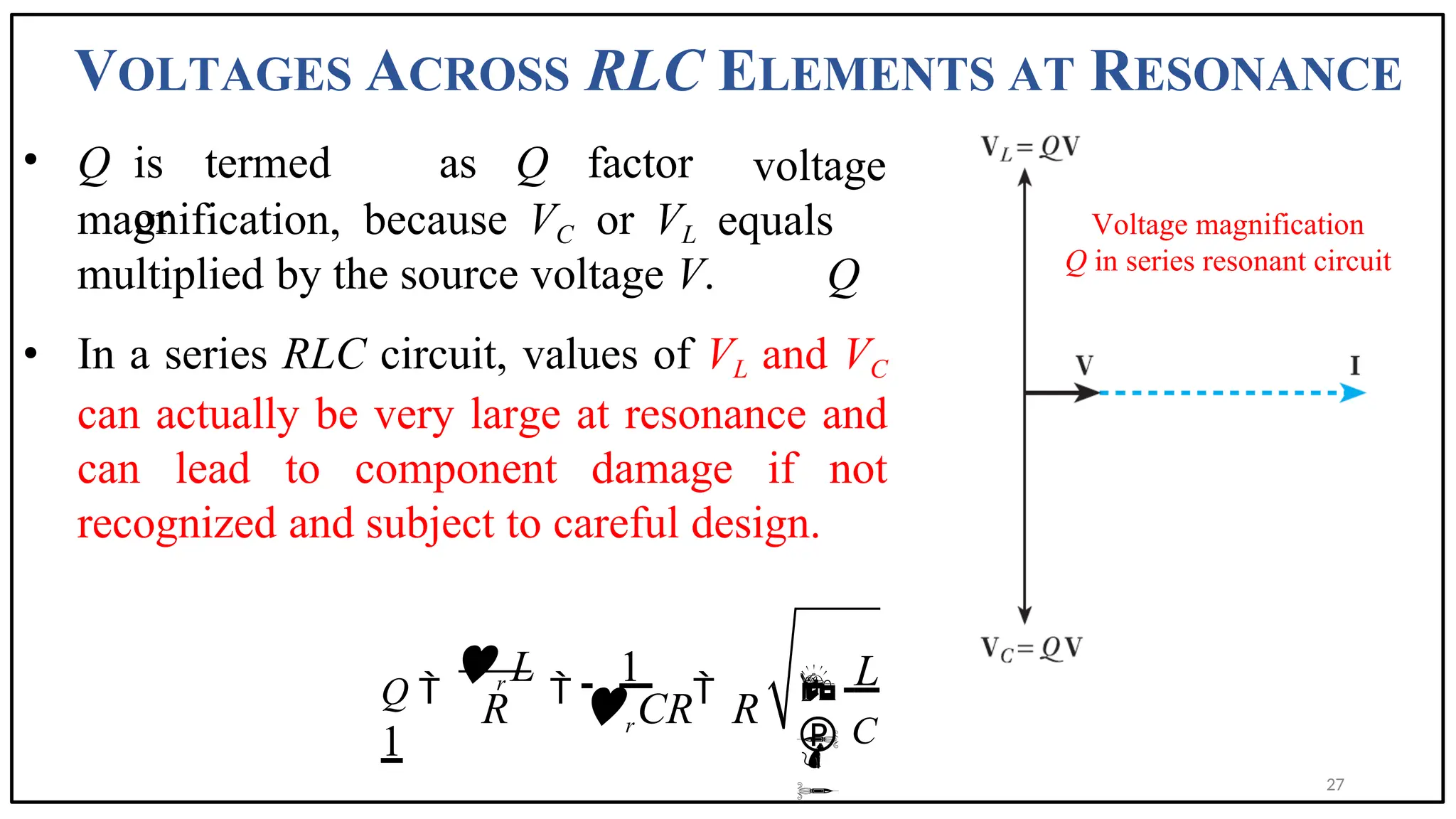
• Q is termed as Q factor
or
voltage
equals
Q
magnification, because VC or VL
multiplied by the source voltage V.
• In a series RLC circuit, values of VL and VC
can actually be very large at resonance and
can lead to component damage if not
recognized and subject to careful design.
Q 
r L

1

1
R rCR R
 L

 C



Voltage magnification
Q in series resonant circuit
VOLTAGES ACROSS RLC ELEMENTS
28
Effect of frequency variation on voltages across R, L and
BANDWIDTH AND HALF POWER FREQUENCIES
29
• In a series RLC circuit, at resonance, maximum power is drawn. i.e.,
• Bandwidth represents the range of frequencies for which the power level
in the signal is at least half of the maximum power.
• The bandwidth of a circuit is also defined as
the frequency range between the half-power
points when I = Imax/√2.
2
 Imax  R; where Imax  at
resonance
R
P
r
V
2
2

Imax
max
2 2  2

P
r
 R I  R




BANDWIDTH AND HALF POWER FREQUENCIES
• Thus, the condition for half-power is given when
• The vertical lines either side of |I | indicate
that only the magnitude of the current is
under consideration – but the phase angle
will not be neglected.
• The impedance corresponding to half
power-points including phase angle is
I 
Imax
2 R 2
V

Z (1,2 )  R 2 
45
The resonance peak,
bandwidth and half-power
frequencies
29
BANDWIDTH AND HALF POWER FREQUENCIES
• The impedance in the complex form
Z (1,2 )  R 1
j1
• Thus for half power,
• At the half-power points, the phase angle of the current is 45°. Below the
resonant frequency, at ω1, the circuit is capacitive and Z(ω1) = R(1 − j1).
• Above the resonant frequency, at ω2, the circuit is inductive and
Z(ω2) = R(1 + j1).
and Z  R 1
j1
I 
V
R 1
j1
30
BANDWIDTH AND HALF POWER FREQUENCIES
32
• Now, the circuit impedance is given
by,
• At half power points,
• By comparison of above two equations, resulting in
• As we
know,
Z  R 1
j1
1 1
 

 R

1 j 
L

Z  R  j

L 
C


R
CR
 
 
   


L

1 
1
R
CR
Q 
r L

1
R
BANDWIDTH AND HALF POWER FREQUENCIES
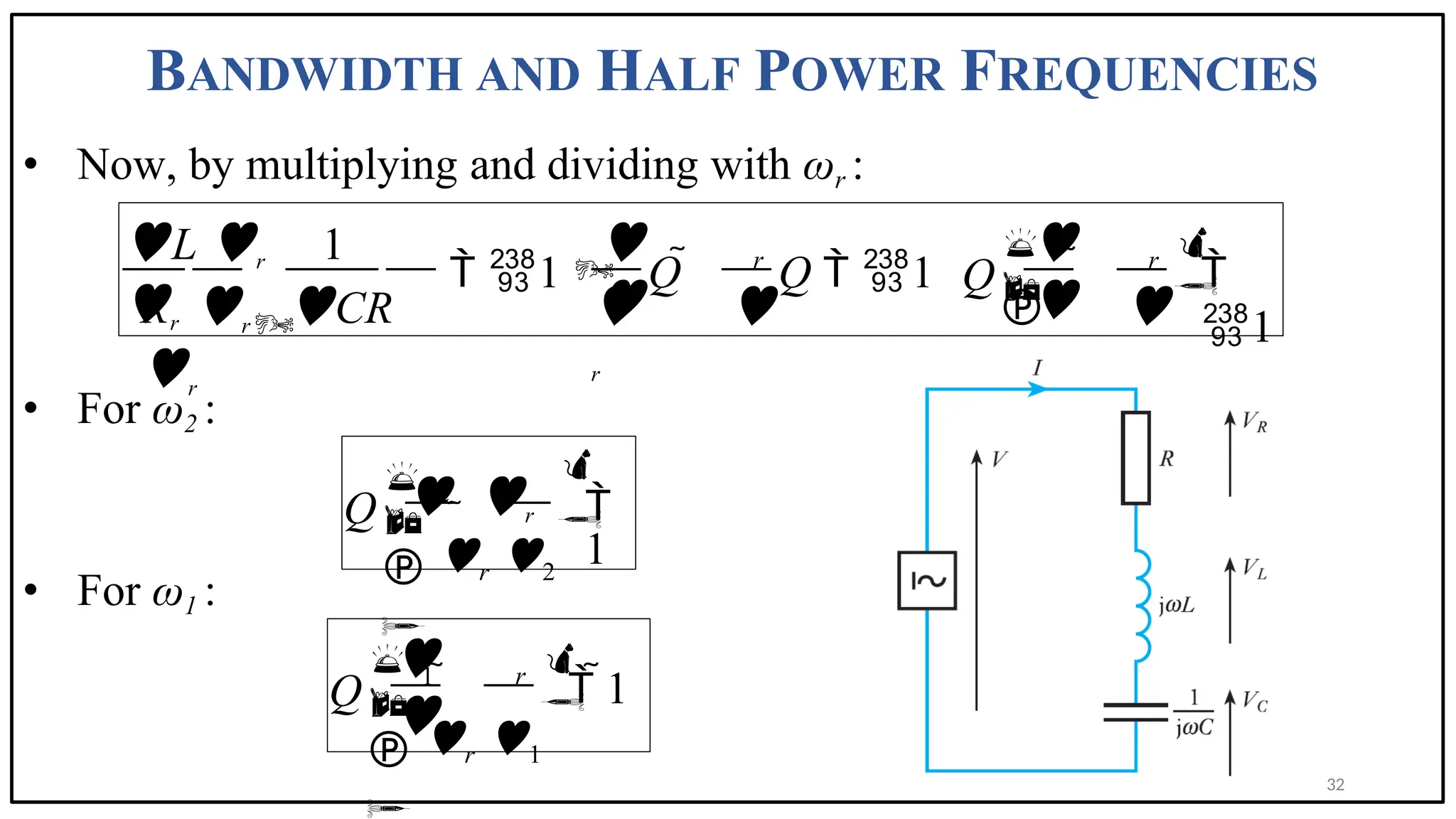
• Now, by multiplying and dividing with ωr :
• For ω2 :
• For ω1 :
L r 1
r
  1  Q  Q  1


1
r r
R r CR
r

r

r
Q




 

 

 
2
 r 2



1
 
r
Q

 
1
 r 1
 1
r
Q


 

 
32
BANDWIDTH AND HALF POWER FREQUENCIES
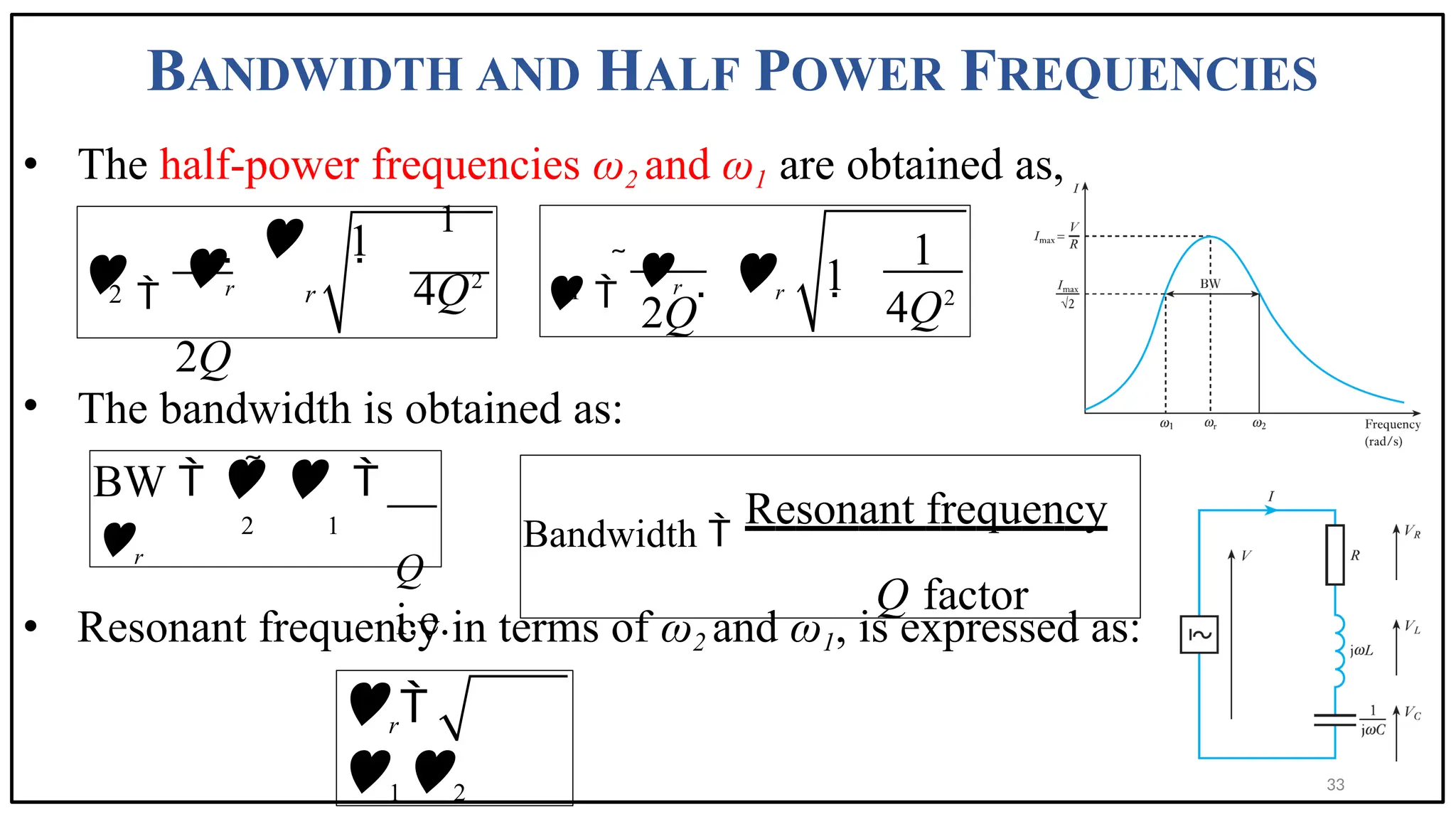
• The half-power frequencies ω2 and ω1 are obtained as,
• The bandwidth is obtained as:
Q
i.e.
• Resonant frequency in terms of ω2 and ω1, is expressed as:
2
  1
1
4Q2

r
 
r
2Q
r
 1
4Q2
1
 r 1
2Q
2 1
BW    
r
Bandwidth 
Resonant frequency
Q factor
r
12 33
BANDWIDTH AND HALF POWER FREQUENCIES
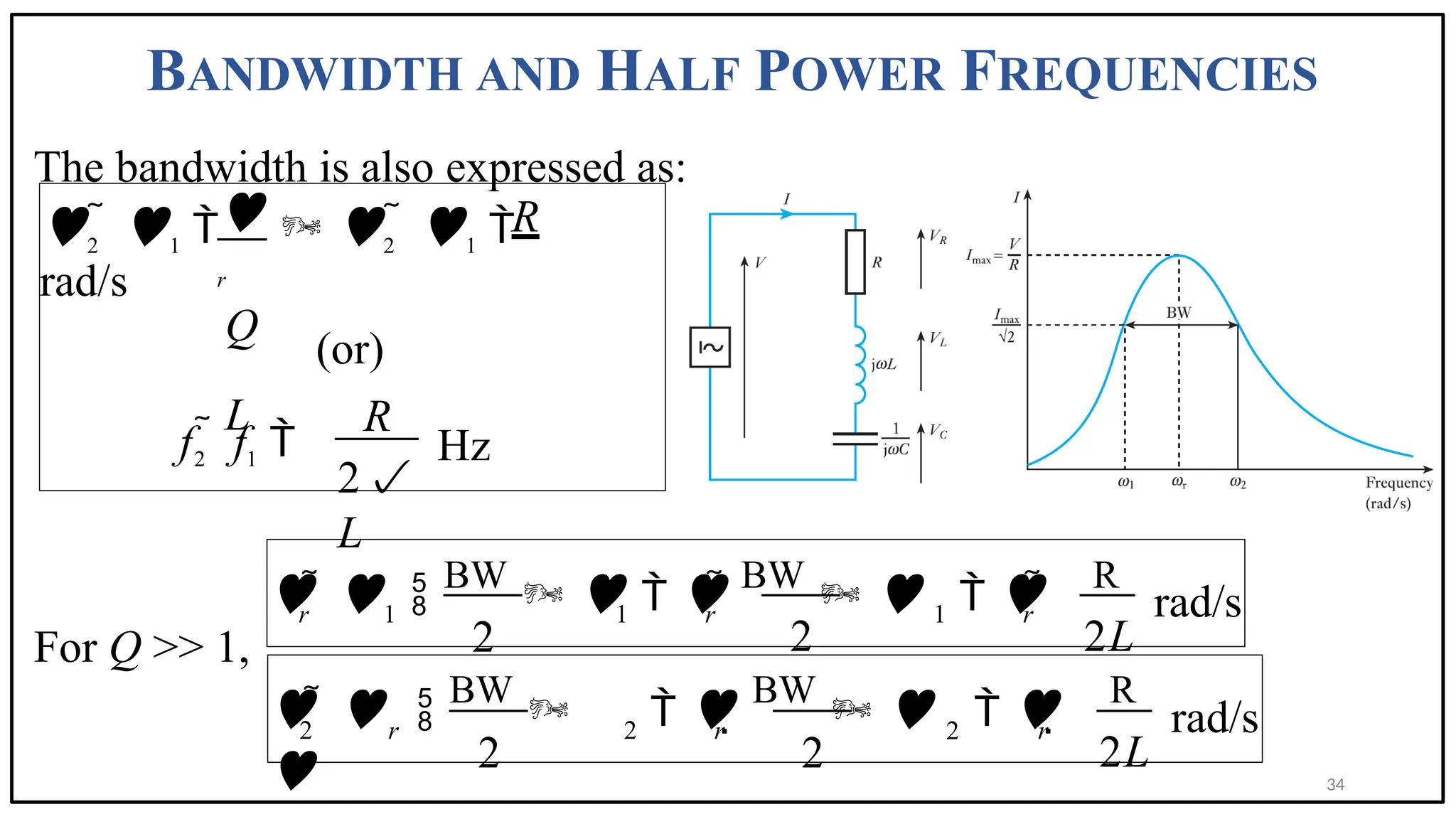
The bandwidth is also expressed as:
For Q >> 1,
2  1   2  1 
rad/s
Q
L
f2  f1 
(or)
Hz
2
L

r
R
R
r 1 1 r 1 r
   
BW
   
BW
   
R
rad/s
2 2 2L
2 r 2 2
   
BW


 
BW
   
R
rad/s
2 2 2L
r r
34
CONCLUSIONS
Resonance in series RLC circuit:
• The voltages which appear across the reactive
components can be many times greater than that of the
supply. The factor of magnification, the
voltage magnification in the series circuit, is called the
Q factor.
• An RLC series circuit accepts maximum current
from the source at resonance and for that reason is
called an acceptor circuit.
35
PROBLEMS ON SERIES RLC CIRCUIT
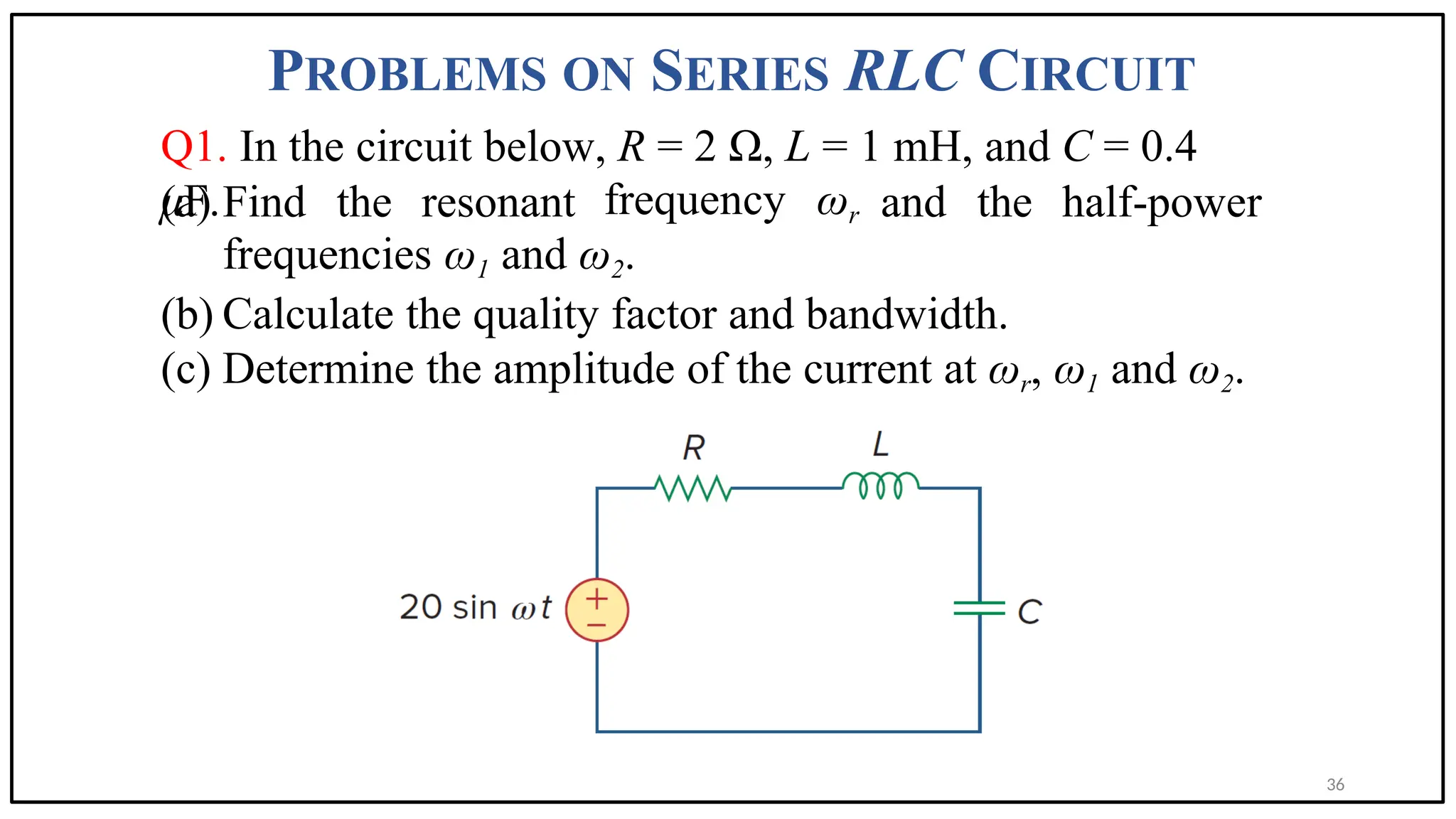
Q1. In the circuit below, R = 2 Ω, L = 1 mH, and C = 0.4
μF.
(a) Find the resonant frequency ωr and the half-power
frequencies ω1 and ω2.
(b) Calculate the quality factor and bandwidth.
(c) Determine the amplitude of the current at ωr, ω1 and ω2.
36
PROBLEMS ON SERIES RLC CIRCUIT
Similarly, the upper half-power frequency
is
Ans:
(a) The resonant frequency is r

The lower half-power frequency is
103
 0.4 106
1 1
 50
krad/s
LC

 103

2
 50 103

2
2
1
LC 2 103
1 2
 49
krad/s
2L  2L

  
R
  R
 
 


  103

2
 50 103

2
 51
krad/s 37
2
2
LC 2 103
1 2
2L  2L

 
R
  R
 


PROBLEMS ON SERIES RLC CIRCUIT
(b) The bandwidth is BW  2  1  2
krad/s
The quality factor is Q 
r

50
 25
BW
2
(c) At ω = ωr: I

At ω = ω1, ω2: I 
20
 10 A
R 2
m
V
20
38
7.071 A
2R 2 
2
m
V

PROBLEMS ON SERIES RLC CIRCUIT
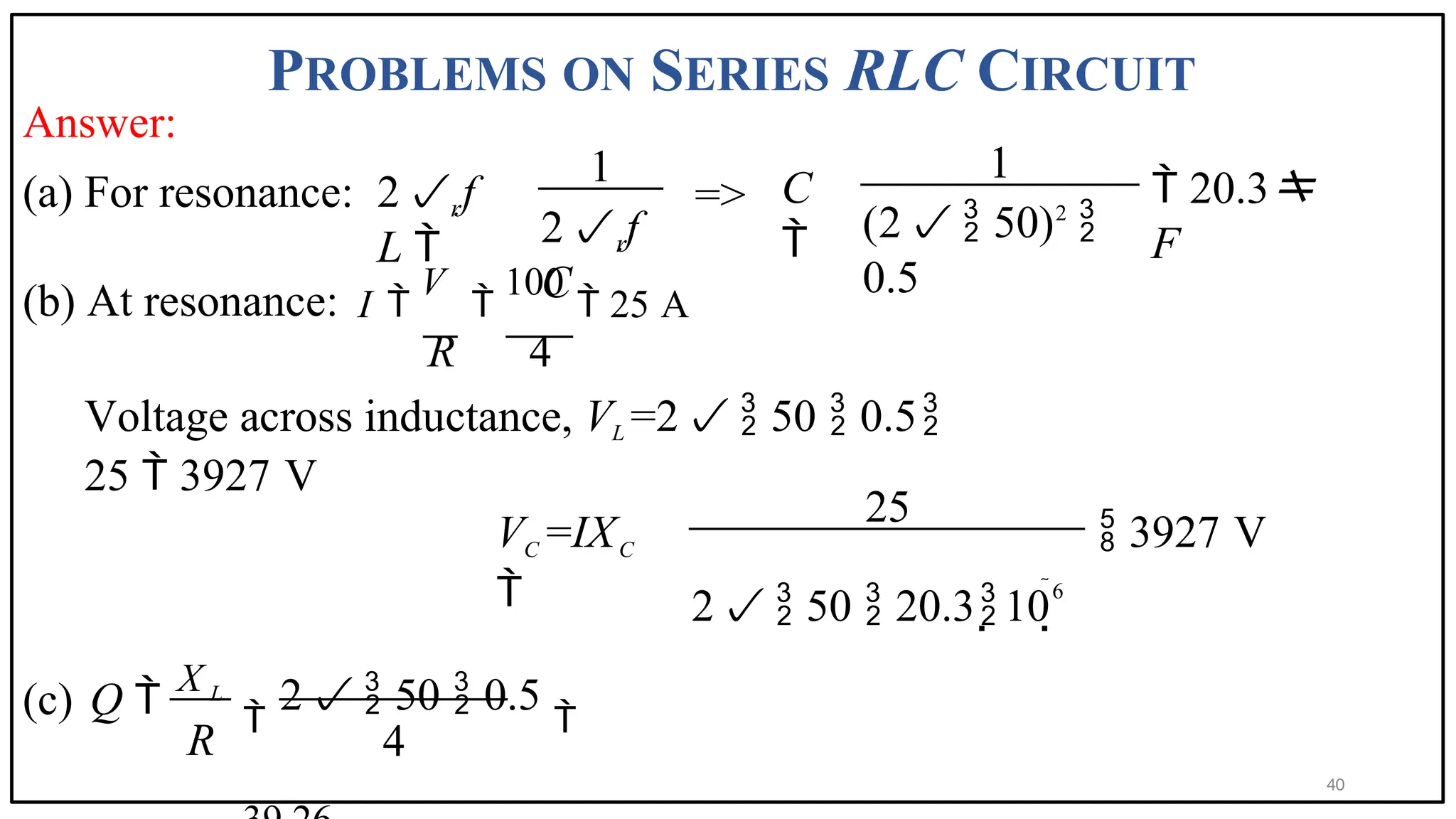
Q2. A circuit, having a resistance of 4.0 Ω with an inductance of 0.5 H
and a variable capacitance in series, is connected across a 100 V, 50
Hz supply. Calculate:
(a) the capacitance required to attain resonance;
(b) voltages across the inductance and the capacitance at resonance;
(c) the Q factor of the circuit.
39
PROBLEMS ON SERIES RLC CIRCUIT
Answer:
(a) For resonance: 2 f
L 
=>
(b) At resonance: I 
V

100
 25 A
R 4
Voltage across inductance, VL =2  50  0.5
25  3927 V
(c) Q 
X L
1
2 f
C
r
r
(2  50)2

0.5
1
 20.3
F
C

2  50  20.3106
25
VC =IXC

 3927 V

2  50  0.5

40
4
R
PROBLEMS ON SERIES RLC CIRCUIT
Q3. The bandwidth of a series resonant circuit is 500 Hz.
If the resonant frequency is 6000 Hz, what is the Q-factor?
If R = 10 Ω, what is the value of the inductive reactance at
resonance? Calculate the inductance and capacitance
of the circuit.
41
PROBLEMS ON SERIES RLC CIRCUIT
Answer:
Bandwidth=
resonant frequency
Q factor
fr

6000

12
BW 500
Hence,Q=
 Q  R  12 10  120

Q 
X L

X
L
R
120
and XL  2 fr L  L

 3.18
mH
2 f 2 
6000
XL
r

and |X L | |XC | 120

1
 0.22
μF
2  6000
120
C

1
42
X   120
 2 f
C
C
r
RESONANCE IN PARALLEL RLC CIRCUIT
• The supply voltage: V  IZ where
Z is the net impedance of the
three parallel branches.
• In parallel circuits, it is simpler
to
consider the total admittance Y of the
three branches. Thus,
where
I
V  IZ
 Y
1 1

j
Y  G   jC  G 
 jC  G  j

C 
j
L

L
L


 
43
RESONANCE IN PARALLEL RLC CIRCUIT
• At resonance (ω = ωr), the net susceptance is zero.
i.e.
• Therefore, the resonant frequency (ωr) :
• At the resonant frequency, Y = G = 1/R,
the
conductance of the parallel resistance, and I = VG.

C 
1 

0
L




1
rad/s
r
LC


44
CURRENT THROUGH RESISTANCE
46
• The supply voltage magnitude:
• At resonance, ω = ωr,
• Current through the resistance at ωr: I

The three-branch
parallel resonant circuit
2
R2
1
 
C 
1

I
V

L


 
1
 02
R2
| V || I |
R
I
V

R
R R
V V I 
R
 I 
I
R R R


CURRENT MAGNIFICATION
• Magnitude of current through inductor at ωr :
• Magnitude of current through capacitor at ωr :
where Q is the current magnification i.e.,
| IL |

XL r
L
 r
L 
V I 
R
R
  I  Q
 I





I  R
  CR I  Q  I
| I |
V
1
C r
C
r
X

C
 
 r
R
Q 


 The three-branch parallel resonant
circuit 46
CURRENT MAGNIFICATION
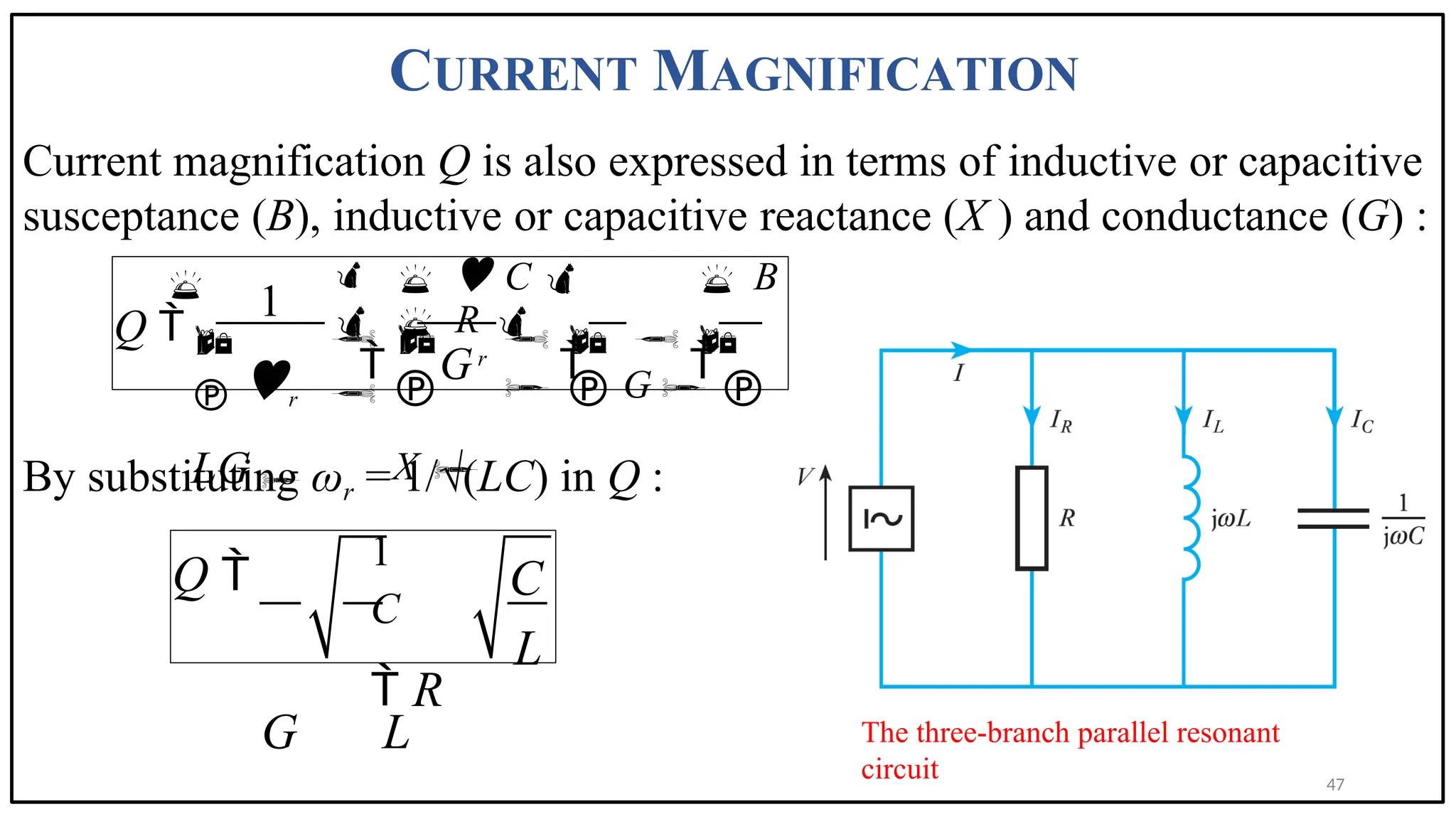
Current magnification Q is also expressed in terms of inductive or capacitive
susceptance (B), inductive or capacitive reactance (X ) and conductance (G) :
By substituting ωr = 1/√(LC) in Q :
Q 
1
C
 R
G L
C
L
1
   C   B
  R 
 r
 
 r
LG 

Q 
G
   G  
X 
     


The three-branch parallel resonant
circuit 47
BANDWIDTH AND HALF POWER FREQUENCIES
The parallel RLC circuit is the dual of the series RLC circuit. Therefore, by
replacing R, L, and C in the expressions for the series circuit with 1∕R, C, and
L respectively, we obtain for the parallel circuit, the Ymin/21/2 frequencies:
2 2
 
1  1  1
 
1  1


1
1     2   
2RC  2RC  LC 2RC  2RC  LC
• Bandwidth: BW     
1
2 1
RC
• Relation between BW and Q: Q 
r
  RC 
R
BW r
 L
r
49
BANDWIDTH AND HALF POWER FREQUENCIES
The half-power frequencies in terms of quality factor:
For Q >> 1,


2 2
1 
r
 1 

1  r
 2Q

2Q
2 
r
 1 

1  r
 2Q

2Q


r 1
   
BW
2
2 r
   
BW
2
The three-branch parallel resonant
circuit
49
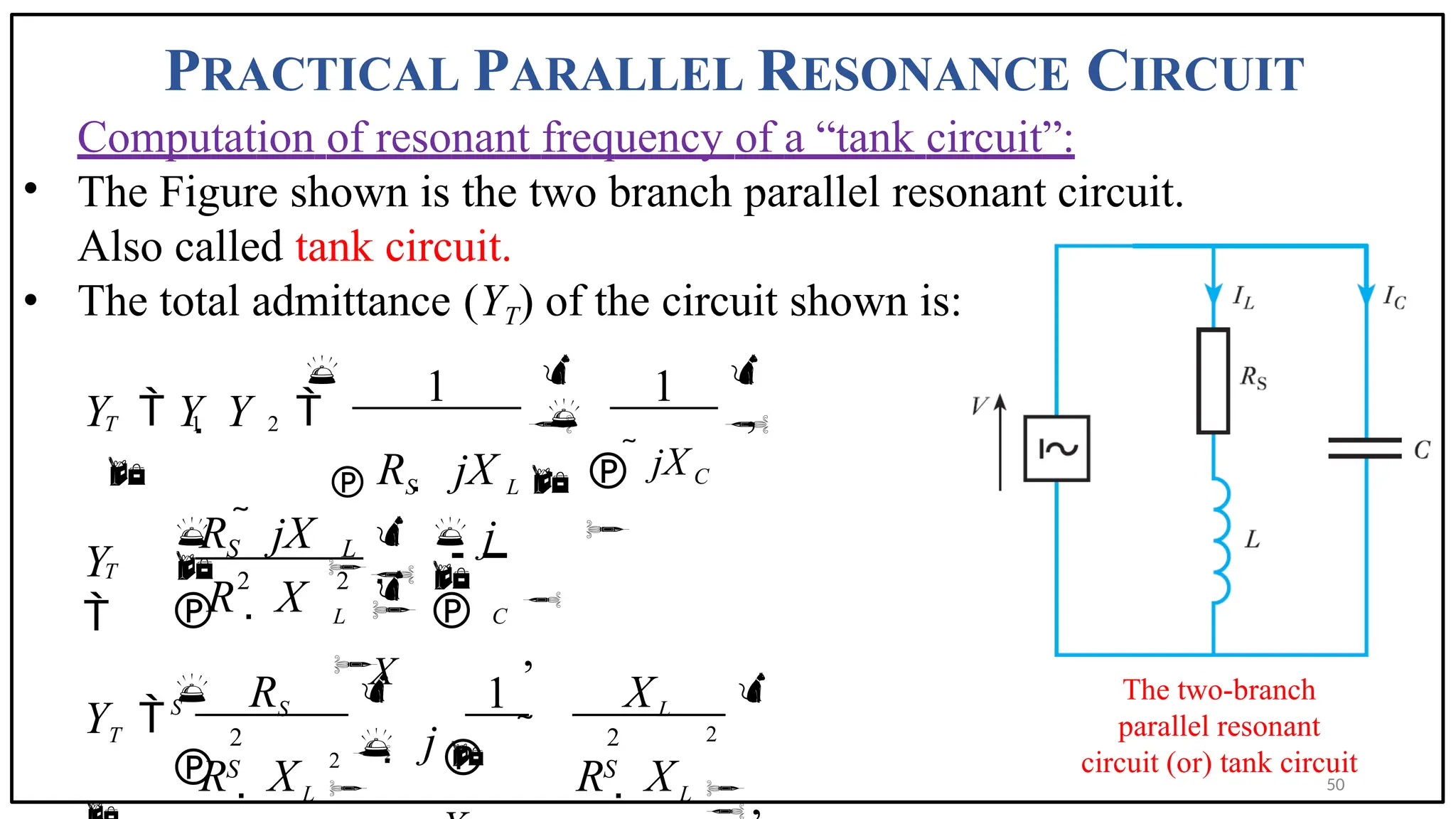
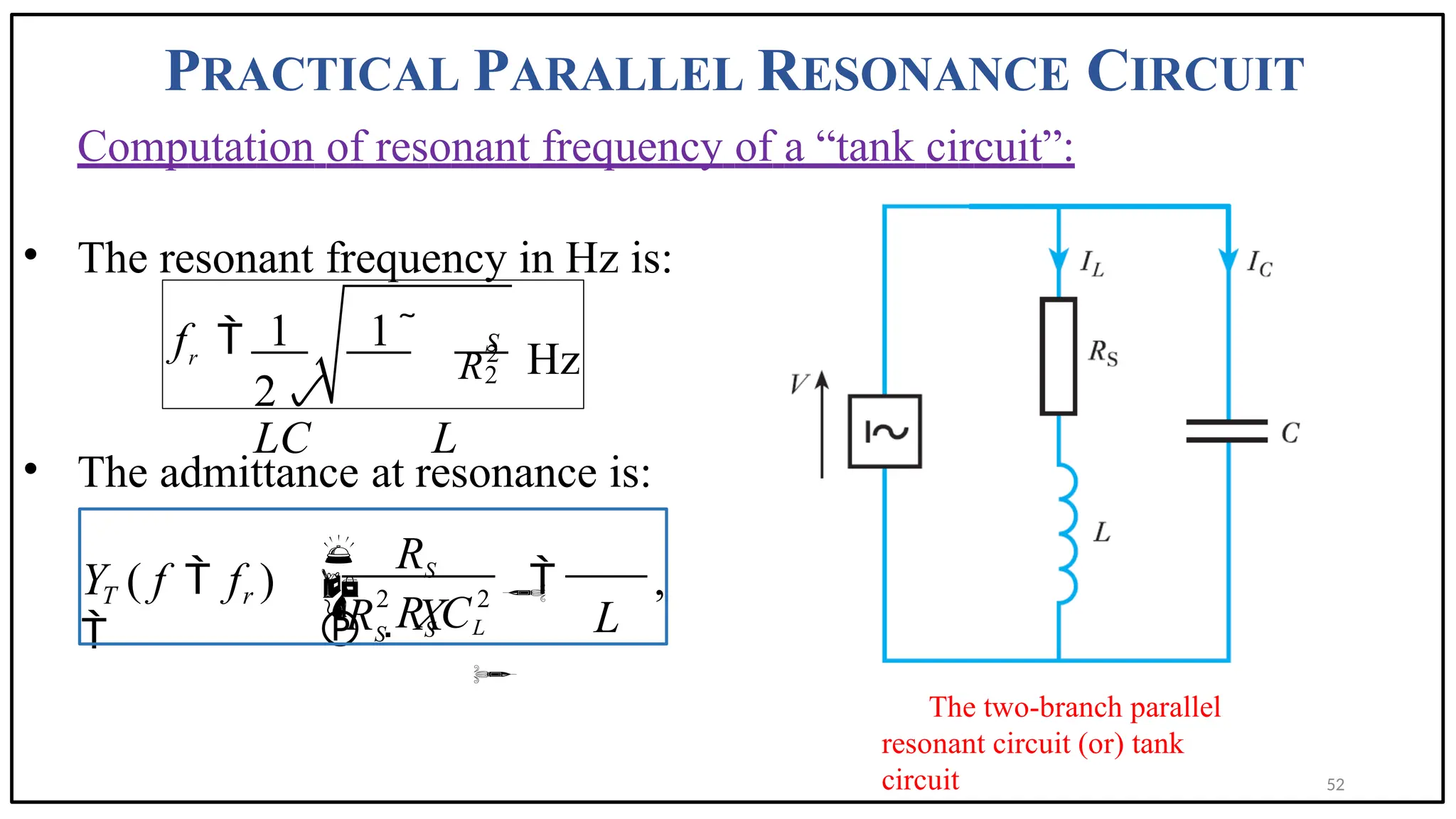
PRACTICAL PARALLEL RESONANCE CIRCUIT
Computation of resonant frequency of a “tank circuit”:
• The Figure shown is the two branch parallel resonant circuit.
Also called tank circuit.
• The total admittance (YT) of the circuit shown is:
The two-branch
parallel resonant
circuit (or) tank circuit
T 1 2

1 1 
,
 RS  jX L

  jX C


Y  Y  Y 






2 2

,
S L
T 

S
L   C

R  jX j
Y
 R  X
 
X
  


2
2   j   2 2
,
1
RS XL
YT 
S
R  XL 
 S
R  XL 
 


 50
PRACTICAL PARALLEL RESONANCE CIRCUIT
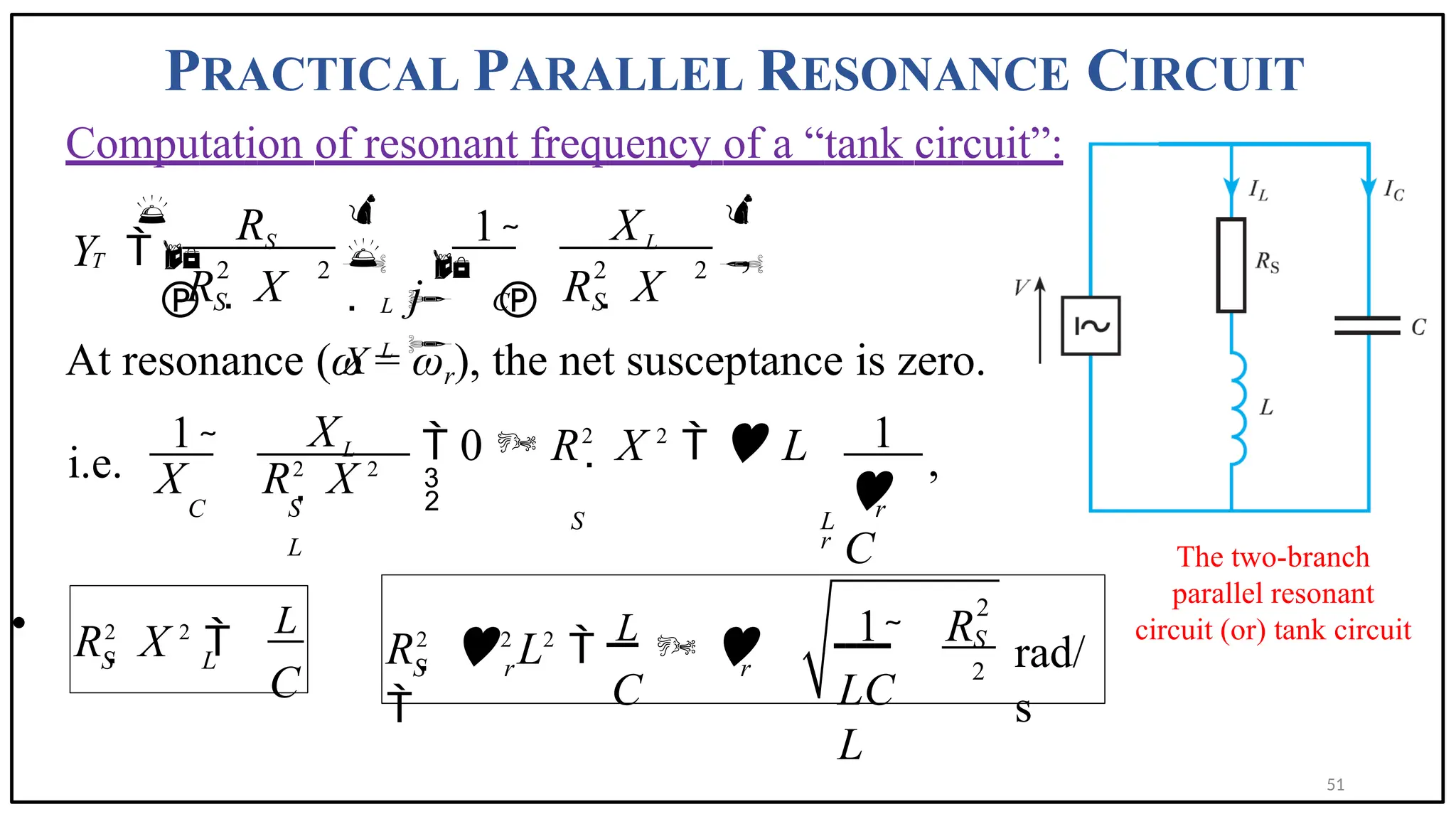
Computation of resonant frequency of a “tank circuit”:
At resonance (ω = ωr), the net susceptance is zero.
i.e.
•
The two-branch
parallel resonant
circuit (or) tank circuit
2 2 2 2
1 
,
RS XL
T 
 L  
L 
S C S

Y 


 j
R  X
 
X
R  X
 
 0  R2
 X 2
  L

S L
r
X R2
 X 2
S
L
1 1
,
XL
C r

C

R2
 X 2

L
S L
C
2
R2
 2
L2

L
 

2
1 R
 rad/
s
S
S r r
C LC
L
51
PRACTICAL PARALLEL RESONANCE CIRCUIT
Computation of resonant frequency of a “tank circuit”:
• The resonant frequency in Hz is:
• The admittance at resonance is:
The two-branch parallel
resonant circuit (or) tank
circuit
R2
2
1 1
Hz
fr  
2
LC L
S
2 2
Y ( f  f )

 ,
RS
RS C
T r 
 S L

R  X L

 
52
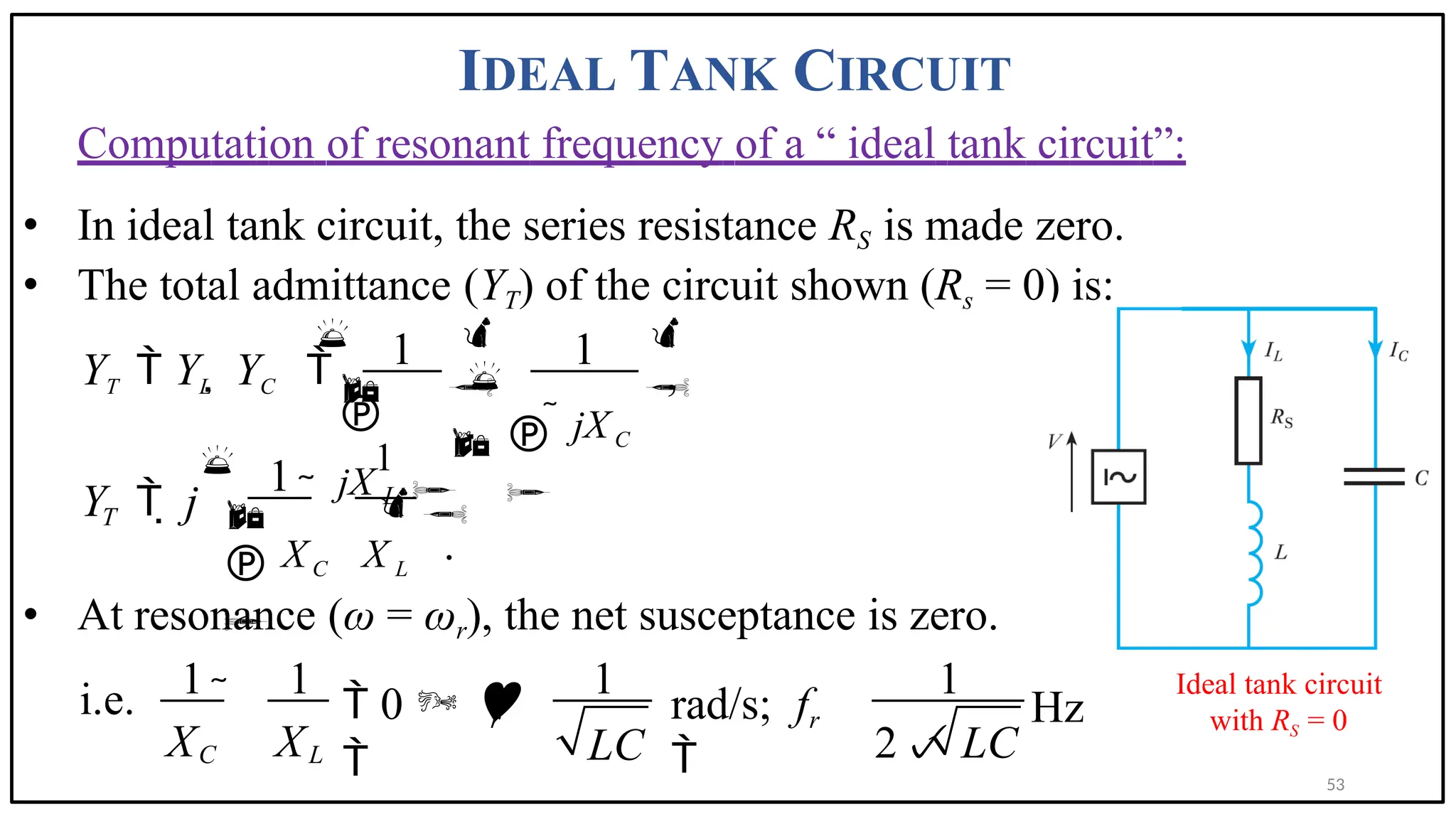
IDEAL TANK CIRCUIT
Computation of resonant frequency of a “ ideal tank circuit”:
• In ideal tank circuit, the series resistance RS is made zero.
• The total admittance (YT) of the circuit shown (Rs = 0) is:
• At resonance (ω = ωr), the net susceptance is zero.
i.e. Ideal tank circuit
with RS = 0
1 1 
,

YT  YL  YC 

jX L 
  jX C








1 1

.
T
 X C X L


Y   j 
 
1 1 1 1
  0  

rad/s; f

Hz
2 LC
r r
C L
X X LC
53
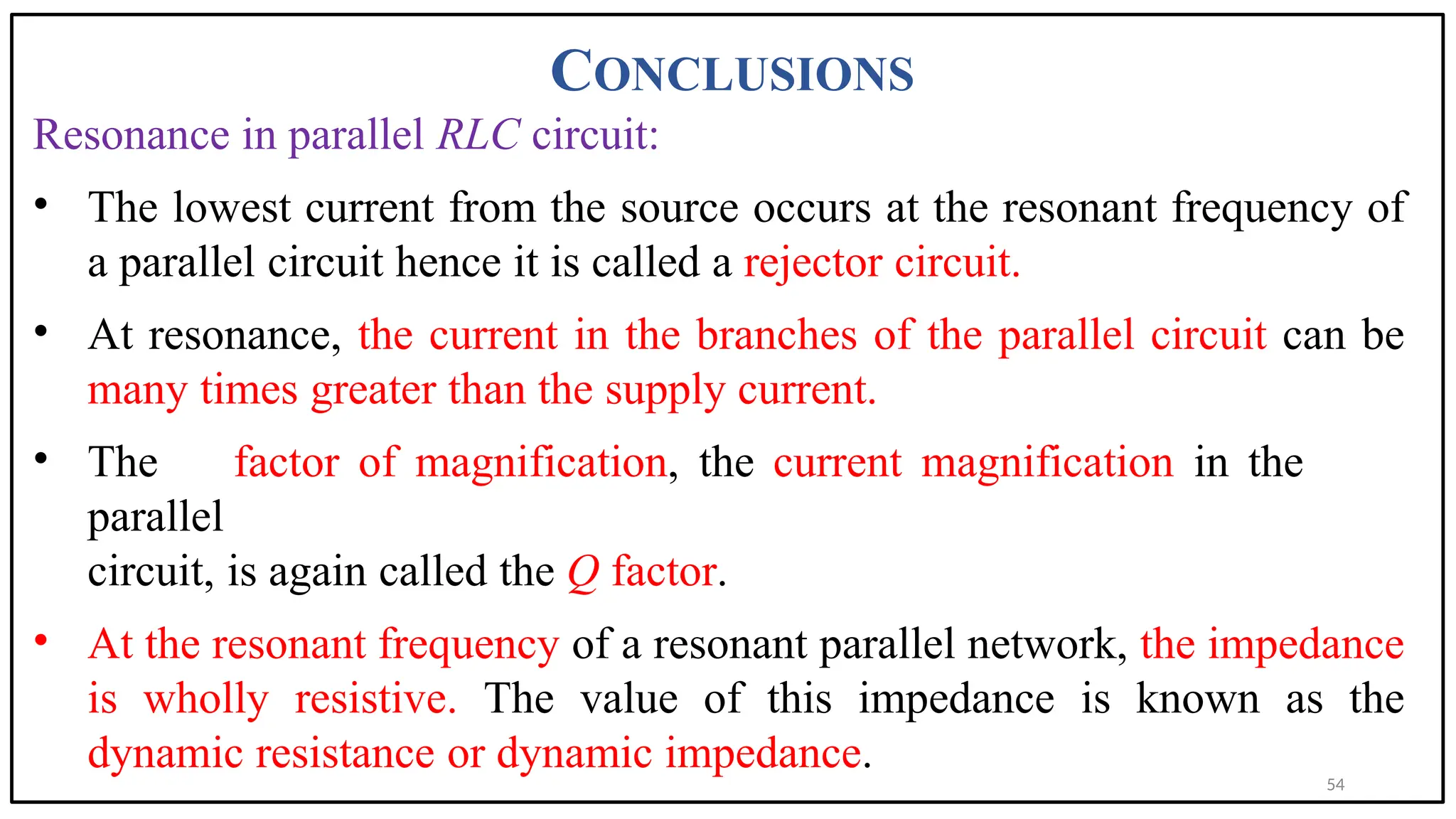
CONCLUSIONS
Resonance in parallel RLC circuit:
• The lowest current from the source occurs at the resonant frequency of
a parallel circuit hence it is called a rejector circuit.
• At resonance, the current in the branches of the parallel circuit can be
many times greater than the supply current.
• The factor of magnification, the current magnification in the
parallel
circuit, is again called the Q factor.
• At the resonant frequency of a resonant parallel network, the impedance
is wholly resistive. The value of this impedance is known as the
dynamic resistance or dynamic impedance.
54
SUMMARY OF THE CHARACTERISTICS OF RESONANT
RLC CIRCUITS
Characteristics Series circuit Parallel
circuit
Resonant frequency,
ωr
Quality factor,
Q
Bandwidth, BW
Half-power frequencies, ω1 , ω2
For high circuits, (Q ≥ 10), ω1, ω2
1 1
LC LC
r L
or
1
r
R 
CR
or r
CR
r
L
R
r
Q
r
Q
2
 1
 1 
r
 2Q

2Q
r


2
 
r
1 
1
  2Q 
2Q
r

BW
2

r
BW
2
r

55
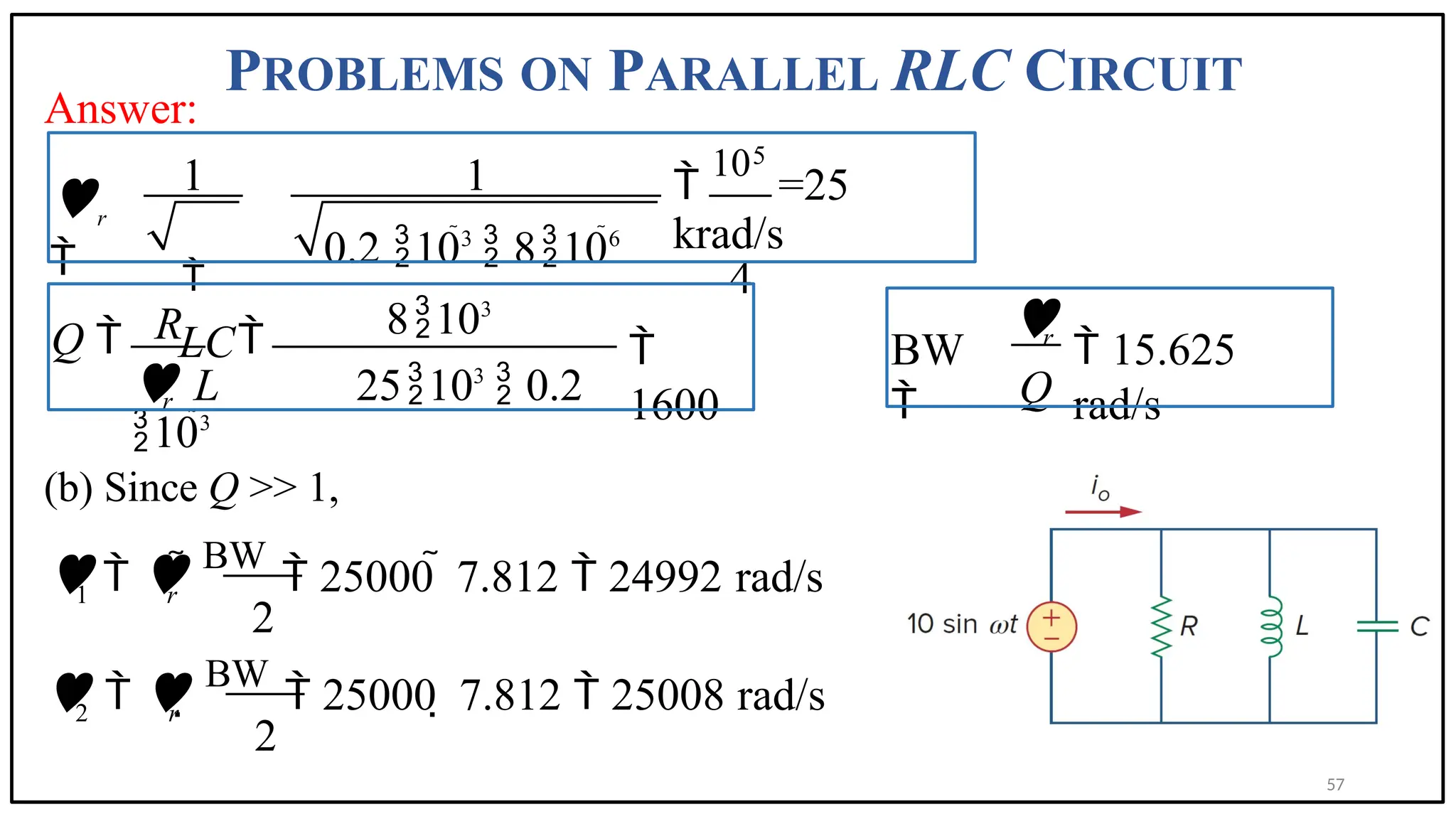
PROBLEMS ON PARALLEL RLC CIRCUIT
Q1. In the parallel RLC circuit below, R = 8 kΩ, L = 0.2 mH, and C = 8
μF.
(a) Calculate ωr, Q, and BW.
(b) Find ω1 and ω2.
(c) Determine the power dissipated at ωr, ω1, and ω2.
56
PROBLEMS ON PARALLEL RLC CIRCUIT
Answer:
5

10
=25
krad/s
4
1
0.2 103
 8106
1

LC
r

8103
Q  
 L 25103
 0.2
103

1600
r
R
BW

 15.625
rad/s
r
Q

(b) Since Q >> 1,
1 r
  
BW
 25000  7.812  24992 rad/s
2
2 r
  
BW
 25000  7.812  25008 rad/s
2
57
PROBLEMS ON PARALLEL RLC CIRCUIT
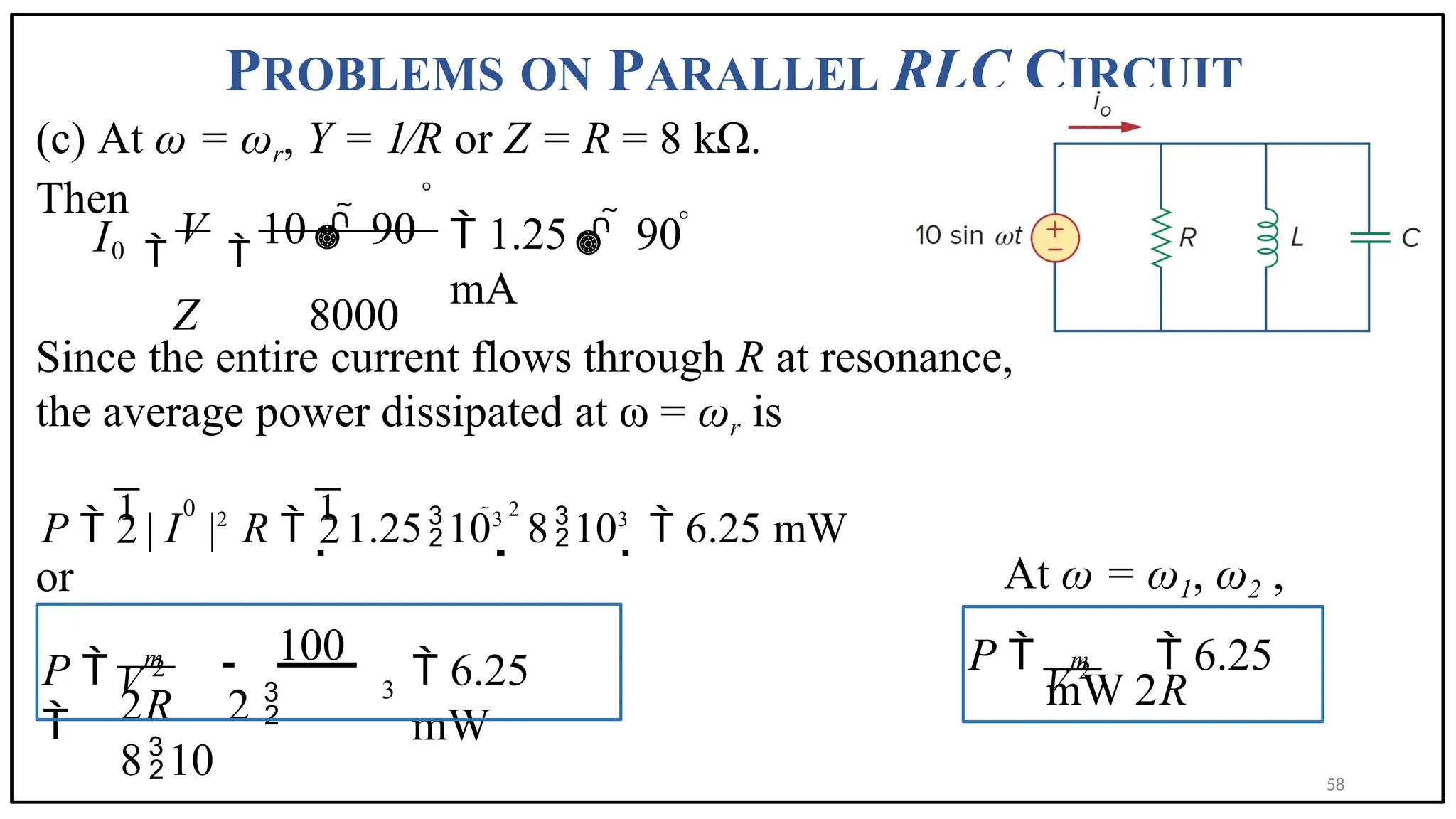
(c) At ω = ωr, Y = 1∕R or Z = R = 8 kΩ.
Then
Since the entire current flows through R at resonance,
the average power dissipated at ω = ωr is
or At ω = ω1, ω2 ,
0 
V

10  90
Z 8000
 1.25  90
mA
I
P 
1
| I |2
R 
1
1.25103

2
8103
  6.25 mW
0
2 2
V 2
3
100
 6.25
mW
2R 2 
810
m
P 

V 2
P   6.25
mW 2R
m
58
PROBLEMS ON PARALLEL RLC CIRCUIT
60
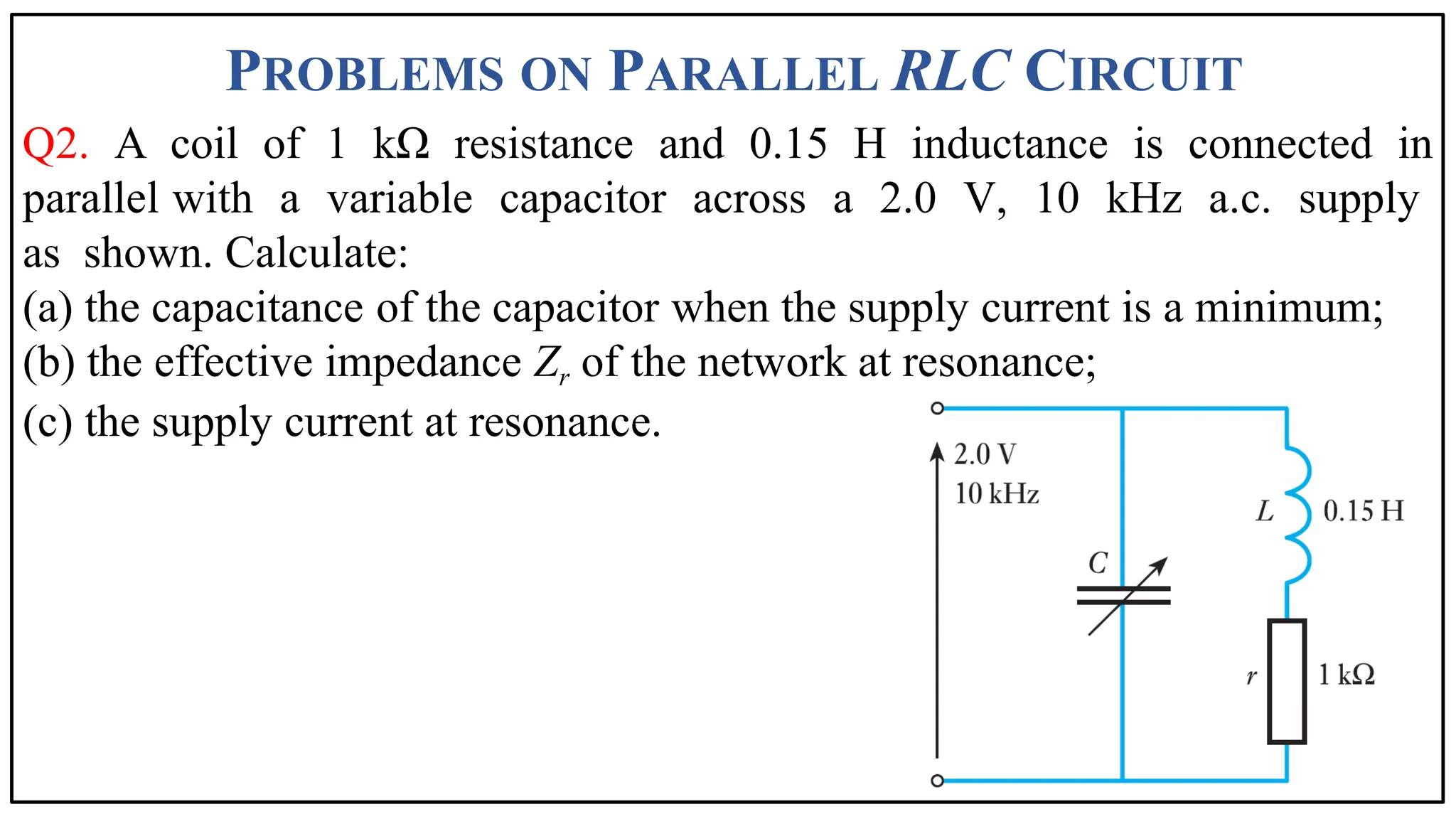
Q2. A coil of 1 kΩ resistance and 0.15 H inductance is connected in
parallel with a variable capacitor across a 2.0 V, 10 kHz a.c. supply
as shown. Calculate:
(a) the capacitance of the capacitor when the supply current is a minimum;
(b) the effective impedance Zr of the network at resonance;
(c) the supply current at resonance.
PROBLEMS ON PARALLEL RLC CIRCUIT
61
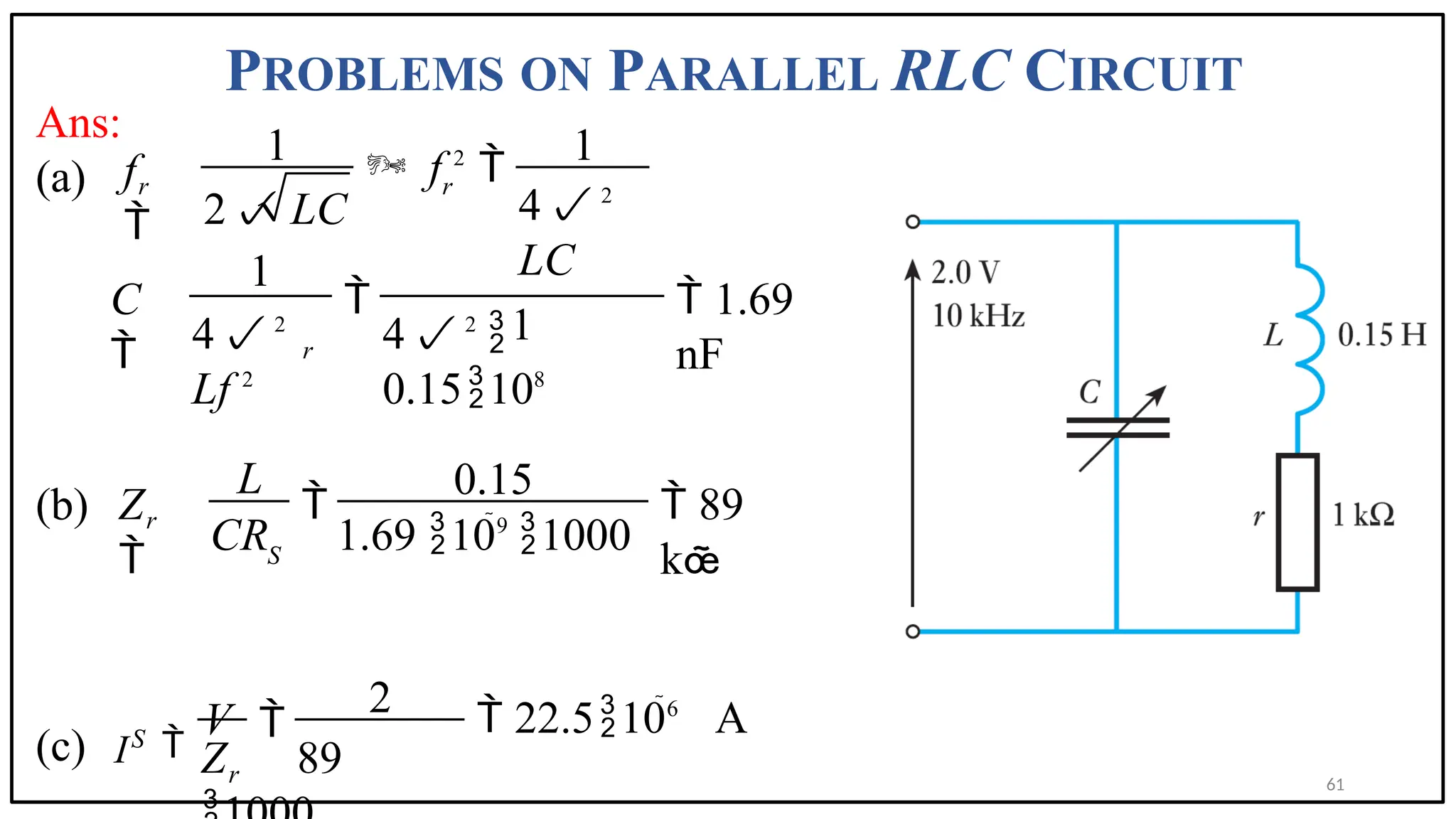
Ans:
(a)
(b)
(c) I
 f 2

4 2
LC
1
4 2
Lf 2
4 2

0.15108
1 1
2 LC
1
 1.69
nF
r r
r
f

C


CR 1.69 109
1000
0.15
 89
k
r
S
L
Z


 22.5106
A
2
Z 89
S
r

V 
PROBLEMS ON PARALLEL RLC CIRCUIT
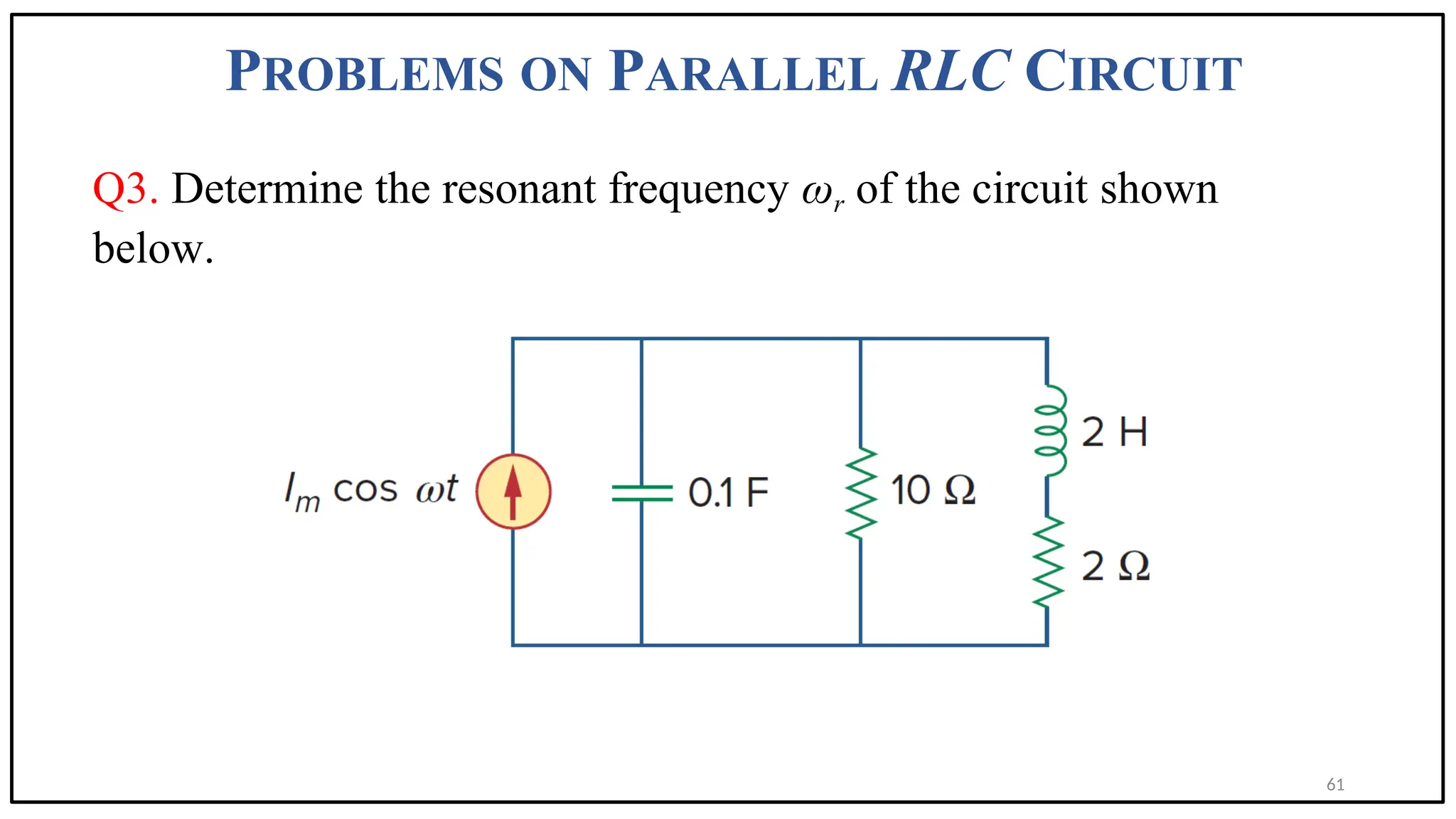
Q3. Determine the resonant frequency ωr of the circuit shown
below.
61
PROBLEMS ON PARALLEL RLC CIRCUIT
Ans: The input admittance is
At resonance, ω = ωr , the net susceptance is
zero. i.e.,
Fig. 3. For Q3.
10 2  j2 4  42
2
2 2
Y  j0.1
1
 1  0.1 j0.1
2  j2
2

Y  
0.1

 j 
0.1 
4  4 4 
4

  

  

4  42
2
r
0.1  0   2
rad/s.
r r
r
62
DYNAMIC IMPEDANCE (OR) DYNAMIC RESISTANCE
• The dynamic impedance (dynamic resistance) is the resistance offered by
the circuit to the input signal under resonance condition.
Q1. What is the dynamic impedance in a standard series RLC circuit?
Ans. In a standard series RLC circuit, at resonance the
net reactance becomes zero. Therefore, the input supply
see only resistance. Hence,
dynamic impedance Zdynamic = R.
63
DYNAMIC IMPEDANCE (OR) DYNAMIC RESISTANCE
Q2. What is the dynamic impedance in a general parallel RLC circuit?
Ans. In a general parallel RLC circuit, at
resonance, the net susceptance becomes zero.
Therefore, the input supply see only resistance.
Hence, dynamic impedance Zdynamic = R.
64
DYNAMIC IMPEDANCE (OR) DYNAMIC RESISTANCE
Q3. What is the dynamic impedance in a ideal tank circuit?
Ans. In ideal tank circuit, at resonance, the
circuit acts like a open circuit. Because, in ideal
tank circuit, the RS = 0. Therefore, the
dynamic impedance
Ideal tank circuit with RS =
0
Zdynamic  
65
DYNAMIC IMPEDANCE (OR) DYNAMIC RESISTANCE
Q4. Determine the dynamic impedance of a practical tank circuit?
Ans.
Practical tank circuit
Zdynamic 
RS C
L
66
MISCELLANEOUS PROBLEMS FOR PRACTICE
Q1. Two practical coils with internal resistances of R1, R2 has quality factors
of Q1, Q2, respectively. If these two coils are connected in series then
resultant quality factor is…..
Ans.
Q1R1  Q2 R2
R1  R2
67
MISCELLANEOUS PROBLEMS FOR PRACTICE
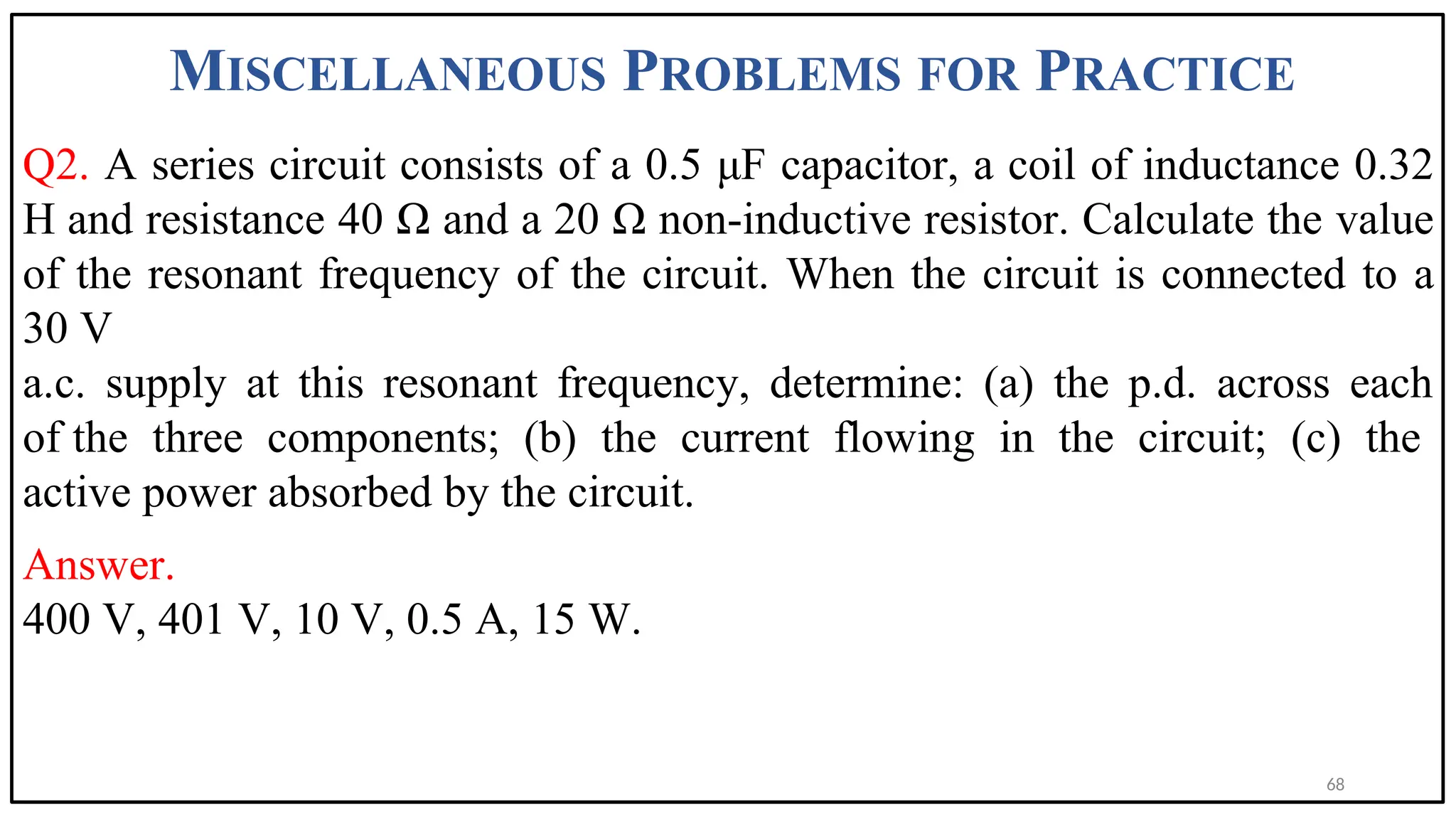
Q2. A series circuit consists of a 0.5 μF capacitor, a coil of inductance 0.32
H and resistance 40 Ω and a 20 Ω non-inductive resistor. Calculate the value
of the resonant frequency of the circuit. When the circuit is connected to a
30 V
a.c. supply at this resonant frequency, determine: (a) the p.d. across each
of the three components; (b) the current flowing in the circuit; (c) the
active power absorbed by the circuit.
Answer.
400 V, 401 V, 10 V, 0.5 A, 15 W.
68
MISCELLANEOUS PROBLEMS FOR PRACTICE
Q3. A circuit consists of a 10 Ω resistor, a 30 mH inductor and a 1 μF
capacitor, and is supplied from a 10 V variable-frequency source. Find the
69
frequency for which the voltage developed across
maximum and calculate the magnitude of this voltage.
Answer. 920 Hz, 173 V.
the capacitor is a
MISCELLANEOUS PROBLEMS FOR PRACTICE
Q4. A series circuit comprises an inductor, of resistance 10 Ω and
inductance 159 μH, and a variable capacitor connected to a 50 mV
sinusoidal supply of frequency 1 MHz. What value of capacitance
will result in resonant conditions and what will then be the current? For
what values of capacitance will the current at this frequency be reduced
to 10 per cent of its value at resonance?
Answer.
159 pF, 5 mA; 145 pF, 177 pF.
70
MISCELLANEOUS PROBLEMS FOR PRACTICE
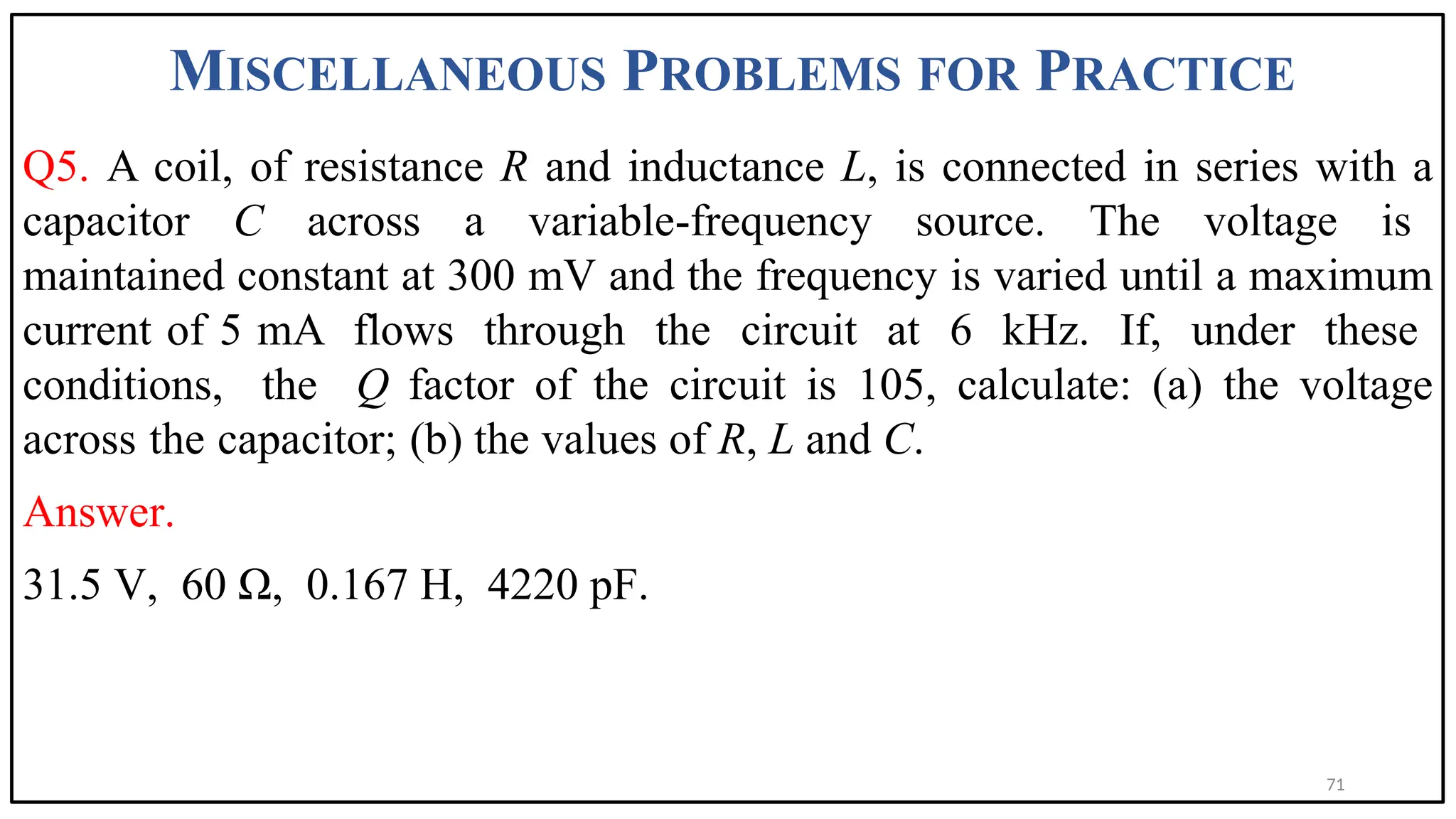
Q5. A coil, of resistance R and inductance L, is connected in series with a
capacitor C across a variable-frequency source. The voltage is
maintained constant at 300 mV and the frequency is varied until a maximum
current of 5 mA flows through the circuit at 6 kHz. If, under these
conditions, the Q factor of the circuit is 105, calculate: (a) the voltage
across the capacitor; (b) the values of R, L and C.
Answer.
31.5 V, 60 Ω, 0.167 H, 4220 pF.
71
MISCELLANEOUS PROBLEMS FOR PRACTICE
Q6. Calculate the resonant frequency of the circuit in Fig.
Answer. 173.21 rad/s.
Fig. For Q6.
72
PRACTICE PROBLEM ON SERIES RLC CIRCUIT
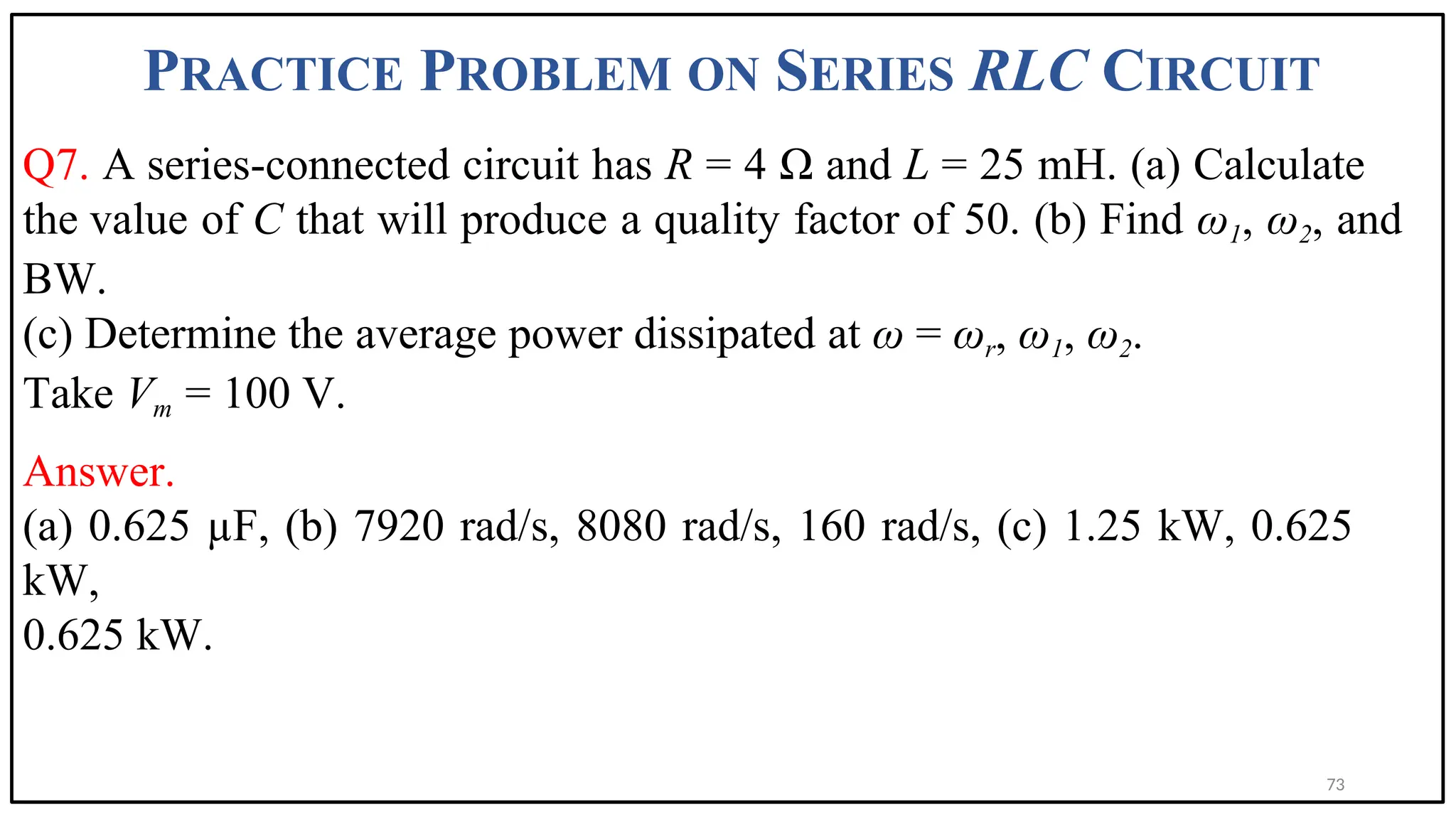
Q7. A series-connected circuit has R = 4 Ω and L = 25 mH. (a) Calculate
the value of C that will produce a quality factor of 50. (b) Find ω1, ω2, and
BW.
(c) Determine the average power dissipated at ω = ωr, ω1, ω2.
Take Vm = 100 V.
Answer.
(a) 0.625 µF, (b) 7920 rad/s, 8080 rad/s, 160 rad/s, (c) 1.25 kW, 0.625
kW,
0.625 kW.
73
REFERENCES
[1]
74
Edward Hughes (revised by John Hiley, Keith Brown and Ian McKenzie
Electronic Technology. Pearson Education Limited, Edinburgh
Gate,
Smith), Electrical
And
Harlow, Essex CM20
2JE,
England:10th Edition, 2008.
Charles K. Alexander, Matthew N. O. Sadiku, Fundamentals of Electric Circuits. 2 Penn Plaza, New
York, NY, USA: McGraw-Hill Education, 6th Edition, 2017.
[2]
[3] John Bird, Electrical Circuit Theory and Technology. Elsevier Science, Linacre House, Jordan
Hill, Oxford OX2 8DP, UK: Third Edition 2007.
Adrian Waygood, An Introduction to Electrical Science. Routledge (Taylor & Francis Group), 711
Third Avenue, New York, NY: Second Edition 2019.
Allan R. Hambley, Electrical Engineering Principles and Applications. Pearson Higher Education, 1
Lake
Street, Upper Saddle River, NJ 07458: Sixth Edition 2014.
William H. Hayt, Jr., Jack E. Kemmerly, and Steven M. Durbin , Engineering Circuit Analysis.
The McGraw-Hill Companies, New York, NY: Eighth Edition 2012.
[4]
[5]
[6]

the RESONANCE IN AC CIRCUITS Quality Factor

  • 1.
     Resonance inSeries RLC Circuit  Quality Factor (Q)  Bandwidth and Half-Power Frequencies  Resonance in Parallel RLC Circuit  Parallel LC Circuit (Tank Circuit)  Dynamic Impedance (or) Dynamic Resistance 2 Outline
  • 2.
    PHENOMENON OF RESONANCEIN VARIOUS DOMAINS Induction Heater 3 Courtesy: https://www.youtube.com/watch?v=2Xqfz-zywJo/ (Available Online: 06 Dec.
  • 3.
    PHENOMENON OF RESONANCEIN VARIOUS DOMAINS RF Amplifiers 4 Courtesy: https://www.indiamart.com/proddetail/rf-amplifiers-8527231748.html (Available Online: 06 Dec.
  • 4.
    PHENOMENON OF RESONANCEIN VARIOUS DOMAINS TV Receivers 5 Courtesy: https://www.indiamart.com/technical-ajfarul-ji/tv-receivers.html (Available Online: 06 Dec.
  • 5.
    PHENOMENON OF RESONANCEIN VARIOUS DOMAINS Radio 5 Courtesy: https://studiousguy.com/everyday-examples-of-resonance/ (Available Online: 25 Nov.
  • 6.
    PHENOMENON OF RESONANCEIN VARIOUS DOMAINS Guitar 6 Courtesy: https://studiousguy.com/everyday-examples-of-resonance/ (Available Online: 25 Nov.
  • 7.
    PHENOMENON OF RESONANCEIN VARIOUS DOMAINS Pendulum 7 Courtesy: https://studiousguy.com/everyday-examples-of-resonance/ (Available Online: 25 Nov.
  • 8.
    PHENOMENON OF RESONANCEIN VARIOUS DOMAINS Swing 8 Courtesy: https://studiousguy.com/everyday-examples-of-resonance/ (Available Online: 25 Nov.
  • 9.
    PHENOMENON OF RESONANCEIN VARIOUS DOMAINS Singer Breaking the Glass 9 Courtesy: https://studiousguy.com/everyday-examples-of-resonance/ (Available Online: 25 Nov.
  • 10.
    PHENOMENON OF RESONANCEIN VARIOUS DOMAINS Bridge Collapse 10 Courtesy: https://studiousguy.com/everyday-examples-of-resonance/ (Available Online: 25 Nov.
  • 11.
    PHENOMENON OF RESONANCEIN VARIOUS DOMAINS Microwave Oven 11 Courtesy: https://studiousguy.com/everyday-examples-of-resonance/ (Available Online: 25 Nov.
  • 12.
    WHY STUDY RESONANCE? •Resonance is the frequency response of a circuit or network when it is operating at its natural frequency called “ Resonance Frequency”. • For many applications, the supply (defined by its voltage and frequency) is constant. e.g. The supply to residential homes is 230 V, 50 Hz. • However, many communication systems involve circuits in which the supply voltage operates with a varying frequency. • To understand communication systems, one requires a knowledge of how circuits are affected by a variation of the frequency. Examples of such communication systems are, Radio, television, telephones, and machine control systems. 12
  • 13.
    WHEN RESONANCE OCCURS?AND WHAT IT RESULTS? • Resonance occurs in any circuit that has energy storage elements, at least one inductor and one capacitor. • Under resonance, the total impedance is equal to the resistance only and maximum power is drawn from the supply by the circuit. • Under resonance, the total supply voltage and supply current are in phase. So, the power factor (PF) becomes unity. • At resonance, L and C elements exchange energy freely as a function of time, which results in sinusoidal oscillations either across L or C. TYPES OF RESONANCE • Series resonance. • Parallel resonance. L 13 C
  • 14.
    APPLICATIONS OF RESONANCE •Resonant circuits (series or parallel) are used in many applications such as selecting the desired stations in radio and TV receivers. • Most common applications of resonance are based on the frequency dependent response. (“tuning” into a particular frequency/channel) • A series resonant circuit is used as voltage amplifier. • A parallel resonant circuit is used as current amplifier. • A resonant circuit is also used as a filter. 14
  • 15.
    RESONANCE IN SERIESRLC CIRCUIT represent resonant frequency in rad/s and in Hz, Resonance is a condition in an RLC circuit in which the capacitive and inductive reactances are equal in magnitude, thereby resulting in a purely resistive impedance. The input impedance is as follows, At resonance, the net reactance becomes zero. Therefore, Series resonant RLC circuit 1 1 Z  R  jL   R  j  L  j C C      1 1 1   rad/s; f  Hz 2 LC r r r r C  L  LC where and fr
  • 16.
    REACTANCE (XL, XC)VS FREQUENCY PLOTS The value of the reactance X of the circuit is, The inductive reactance: The capacitive reactance: 1 X  L   C Variation of inductive reactance with frequency Variation of Capacitive reactance with frequency Depends on frequency XL  L  2 fL Increases linearly with frequency  1  1 C 2 fC C X Decreases with frequency and it is largest at low frequencies 16
  • 17.
    VARIATION OF REACTANCEAND IMPEDANCE WITH FREQUENCY • At resonant frequency fr, |Z| = R, the power factor is unity (purely resistive). • Below fr, |XL| < |XC |, so the circuit is more capacitive and the power factor is leading. • Above fr, |XL| > |XC |, so the circuit is more inductive and the power factor is lagging. Variation of resistance, reactance and impedance with frequency XL + XC 17
  • 18.
    IMPEDANCE PHASOR DIAGRAMS Thephase of the circuit impedance is given by Below fr, XC > XL At fr, XC = XL, Z = R Above fr, XL > XC • Below fr , XL < XC,  is negative, the circuit is capacitive. 1  XL  XC    tan R 18
  • 19.
    THE CURRENT INA SERIES RLC CIRCUIT The circuit current is given by The current is maximum when ωL = 1/(ωC), when the circuit is resistive (  = 0). Therefore, I  V Z   V    Z 1 2    R2  L  1   tan 1  L  V C  I  R C                   m  V I R 19
  • 20.
    VARIATION OF MAGNITUDEAND PHASE OF CURRENT WITH FREQUENCY 21 • The current is maximum at resonant frequency (fr). Variation of magnitude | I| and phase  of current with frequency in a series RLC circuit
  • 21.
    QUALITY FACTOR (Q) •The “sharpness” of the resonance in a resonant circuit is measured quantitatively by the quality factor Q. • The quality factor relates the maximum or peak energy stored to the energy dissipated in the circuit per cycle of oscillation: • It is also regarded as a measure of the energy storage property of a circuit in relation to its energy dissipation property. Q  2  Peak energy stored in the circuit   Energy dissipated by the circuit in one period at resonance    21
  • 22.
    QUALITY FACTOR (Q) •In the series RLC circuit, the quality factor (Q) is, 1 LI 2 2  1 I 2 R( 1 )   2  2 f L  r  Q  2 fr R      Q  r L  1  1 L C R r CR R 22
  • 23.
    QUALITY FACTOR (Q) •The Q factor is also defined as the ratio of the reactive power, of either thecapacitor or the inductor to the average power of the resistor at resonance: • For inductive reactance XL at resonance: • For capacitive reactance XL at resonance:  Reactive power   Average power  Q     Reactive power I 2 X  L  Average power  I 2 R R L r Q       Reactive power I 2 X I 2 R  1 Average C r Q       23
  • 24.
    VOLTAGES IN ASERIES RLC CIRCUIT (a) f < fr 24 Capacitive, I leads V (c) f > fr Inductive, I lags V (b) f = fr Resistive, V and I in phase
  • 25.
    VOLTAGES ACROSS RLCELEMENTS AT RESONANCE 26 The voltage across resistor at fr is, The voltage across inductor at fr is,  VL  QV The voltage across capacitor at fr is, VR  IR m R  R  I  R  V  R  V  V R V  X  I   L  I   L  V  r L V  QV L L L r m r R R 1 1 1 C C C m C rC R  I   V  V  X  I  V  QV  V  QV
  • 26.
    VOLTAGES ACROSS RLCELEMENTS AT RESONANCE 27 • Q is termed as Q factor or voltage equals Q magnification, because VC or VL multiplied by the source voltage V. • In a series RLC circuit, values of VL and VC can actually be very large at resonance and can lead to component damage if not recognized and subject to careful design. Q  r L  1  1 R rCR R  L   C    Voltage magnification Q in series resonant circuit
  • 27.
    VOLTAGES ACROSS RLCELEMENTS 28 Effect of frequency variation on voltages across R, L and
  • 28.
    BANDWIDTH AND HALFPOWER FREQUENCIES 29 • In a series RLC circuit, at resonance, maximum power is drawn. i.e., • Bandwidth represents the range of frequencies for which the power level in the signal is at least half of the maximum power. • The bandwidth of a circuit is also defined as the frequency range between the half-power points when I = Imax/√2. 2  Imax  R; where Imax  at resonance R P r V 2 2  Imax max 2 2  2  P r  R I  R    
  • 29.
    BANDWIDTH AND HALFPOWER FREQUENCIES • Thus, the condition for half-power is given when • The vertical lines either side of |I | indicate that only the magnitude of the current is under consideration – but the phase angle will not be neglected. • The impedance corresponding to half power-points including phase angle is I  Imax 2 R 2 V  Z (1,2 )  R 2  45 The resonance peak, bandwidth and half-power frequencies 29
  • 30.
    BANDWIDTH AND HALFPOWER FREQUENCIES • The impedance in the complex form Z (1,2 )  R 1 j1 • Thus for half power, • At the half-power points, the phase angle of the current is 45°. Below the resonant frequency, at ω1, the circuit is capacitive and Z(ω1) = R(1 − j1). • Above the resonant frequency, at ω2, the circuit is inductive and Z(ω2) = R(1 + j1). and Z  R 1 j1 I  V R 1 j1 30
  • 31.
    BANDWIDTH AND HALFPOWER FREQUENCIES 32 • Now, the circuit impedance is given by, • At half power points, • By comparison of above two equations, resulting in • As we know, Z  R 1 j1 1 1     R  1 j  L  Z  R  j  L  C   R CR           L  1  1 R CR Q  r L  1 R
  • 32.
    BANDWIDTH AND HALFPOWER FREQUENCIES • Now, by multiplying and dividing with ωr : • For ω2 : • For ω1 : L r 1 r   1  Q  Q  1   1 r r R r CR r  r  r Q             2  r 2    1   r Q    1  r 1  1 r Q        32
  • 33.
    BANDWIDTH AND HALFPOWER FREQUENCIES • The half-power frequencies ω2 and ω1 are obtained as, • The bandwidth is obtained as: Q i.e. • Resonant frequency in terms of ω2 and ω1, is expressed as: 2   1 1 4Q2  r   r 2Q r  1 4Q2 1  r 1 2Q 2 1 BW     r Bandwidth  Resonant frequency Q factor r 12 33
  • 34.
    BANDWIDTH AND HALFPOWER FREQUENCIES The bandwidth is also expressed as: For Q >> 1, 2  1   2  1  rad/s Q L f2  f1  (or) Hz 2 L  r R R r 1 1 r 1 r     BW     BW     R rad/s 2 2 2L 2 r 2 2     BW     BW     R rad/s 2 2 2L r r 34
  • 35.
    CONCLUSIONS Resonance in seriesRLC circuit: • The voltages which appear across the reactive components can be many times greater than that of the supply. The factor of magnification, the voltage magnification in the series circuit, is called the Q factor. • An RLC series circuit accepts maximum current from the source at resonance and for that reason is called an acceptor circuit. 35
  • 36.
    PROBLEMS ON SERIESRLC CIRCUIT Q1. In the circuit below, R = 2 Ω, L = 1 mH, and C = 0.4 μF. (a) Find the resonant frequency ωr and the half-power frequencies ω1 and ω2. (b) Calculate the quality factor and bandwidth. (c) Determine the amplitude of the current at ωr, ω1 and ω2. 36
  • 37.
    PROBLEMS ON SERIESRLC CIRCUIT Similarly, the upper half-power frequency is Ans: (a) The resonant frequency is r  The lower half-power frequency is 103  0.4 106 1 1  50 krad/s LC   103  2  50 103  2 2 1 LC 2 103 1 2  49 krad/s 2L  2L     R   R         103  2  50 103  2  51 krad/s 37 2 2 LC 2 103 1 2 2L  2L    R   R    
  • 38.
    PROBLEMS ON SERIESRLC CIRCUIT (b) The bandwidth is BW  2  1  2 krad/s The quality factor is Q  r  50  25 BW 2 (c) At ω = ωr: I  At ω = ω1, ω2: I  20  10 A R 2 m V 20 38 7.071 A 2R 2  2 m V 
  • 39.
    PROBLEMS ON SERIESRLC CIRCUIT Q2. A circuit, having a resistance of 4.0 Ω with an inductance of 0.5 H and a variable capacitance in series, is connected across a 100 V, 50 Hz supply. Calculate: (a) the capacitance required to attain resonance; (b) voltages across the inductance and the capacitance at resonance; (c) the Q factor of the circuit. 39
  • 40.
    PROBLEMS ON SERIESRLC CIRCUIT Answer: (a) For resonance: 2 f L  => (b) At resonance: I  V  100  25 A R 4 Voltage across inductance, VL =2  50  0.5 25  3927 V (c) Q  X L 1 2 f C r r (2  50)2  0.5 1  20.3 F C  2  50  20.3106 25 VC =IXC   3927 V  2  50  0.5  40 4 R
  • 41.
    PROBLEMS ON SERIESRLC CIRCUIT Q3. The bandwidth of a series resonant circuit is 500 Hz. If the resonant frequency is 6000 Hz, what is the Q-factor? If R = 10 Ω, what is the value of the inductive reactance at resonance? Calculate the inductance and capacitance of the circuit. 41
  • 42.
    PROBLEMS ON SERIESRLC CIRCUIT Answer: Bandwidth= resonant frequency Q factor fr  6000  12 BW 500 Hence,Q=  Q  R  12 10  120  Q  X L  X L R 120 and XL  2 fr L  L   3.18 mH 2 f 2  6000 XL r  and |X L | |XC | 120  1  0.22 μF 2  6000 120 C  1 42 X   120  2 f C C r
  • 43.
    RESONANCE IN PARALLELRLC CIRCUIT • The supply voltage: V  IZ where Z is the net impedance of the three parallel branches. • In parallel circuits, it is simpler to consider the total admittance Y of the three branches. Thus, where I V  IZ  Y 1 1  j Y  G   jC  G   jC  G  j  C  j L  L L     43
  • 44.
    RESONANCE IN PARALLELRLC CIRCUIT • At resonance (ω = ωr), the net susceptance is zero. i.e. • Therefore, the resonant frequency (ωr) : • At the resonant frequency, Y = G = 1/R, the conductance of the parallel resistance, and I = VG.  C  1   0 L     1 rad/s r LC   44
  • 45.
    CURRENT THROUGH RESISTANCE 46 •The supply voltage magnitude: • At resonance, ω = ωr, • Current through the resistance at ωr: I  The three-branch parallel resonant circuit 2 R2 1   C  1  I V  L     1  02 R2 | V || I | R I V  R R R V V I  R  I  I R R R  
  • 46.
    CURRENT MAGNIFICATION • Magnitudeof current through inductor at ωr : • Magnitude of current through capacitor at ωr : where Q is the current magnification i.e., | IL |  XL r L  r L  V I  R R   I  Q  I      I  R   CR I  Q  I | I | V 1 C r C r X  C    r R Q     The three-branch parallel resonant circuit 46
  • 47.
    CURRENT MAGNIFICATION Current magnificationQ is also expressed in terms of inductive or capacitive susceptance (B), inductive or capacitive reactance (X ) and conductance (G) : By substituting ωr = 1/√(LC) in Q : Q  1 C  R G L C L 1    C   B   R   r    r LG   Q  G    G   X          The three-branch parallel resonant circuit 47
  • 48.
    BANDWIDTH AND HALFPOWER FREQUENCIES The parallel RLC circuit is the dual of the series RLC circuit. Therefore, by replacing R, L, and C in the expressions for the series circuit with 1∕R, C, and L respectively, we obtain for the parallel circuit, the Ymin/21/2 frequencies: 2 2   1  1  1   1  1   1 1     2    2RC  2RC  LC 2RC  2RC  LC • Bandwidth: BW      1 2 1 RC • Relation between BW and Q: Q  r   RC  R BW r  L r 49
  • 49.
    BANDWIDTH AND HALFPOWER FREQUENCIES The half-power frequencies in terms of quality factor: For Q >> 1,   2 2 1  r  1   1  r  2Q  2Q 2  r  1   1  r  2Q  2Q   r 1     BW 2 2 r     BW 2 The three-branch parallel resonant circuit 49
  • 50.
    PRACTICAL PARALLEL RESONANCECIRCUIT Computation of resonant frequency of a “tank circuit”: • The Figure shown is the two branch parallel resonant circuit. Also called tank circuit. • The total admittance (YT) of the circuit shown is: The two-branch parallel resonant circuit (or) tank circuit T 1 2  1 1  ,  RS  jX L    jX C   Y  Y  Y        2 2  , S L T   S L   C  R  jX j Y  R  X   X      2 2   j   2 2 , 1 RS XL YT  S R  XL   S R  XL       50
  • 51.
    PRACTICAL PARALLEL RESONANCECIRCUIT Computation of resonant frequency of a “tank circuit”: At resonance (ω = ωr), the net susceptance is zero. i.e. • The two-branch parallel resonant circuit (or) tank circuit 2 2 2 2 1  , RS XL T   L   L  S C S  Y     j R  X   X R  X    0  R2  X 2   L  S L r X R2  X 2 S L 1 1 , XL C r  C  R2  X 2  L S L C 2 R2  2 L2  L    2 1 R  rad/ s S S r r C LC L 51
  • 52.
    PRACTICAL PARALLEL RESONANCECIRCUIT Computation of resonant frequency of a “tank circuit”: • The resonant frequency in Hz is: • The admittance at resonance is: The two-branch parallel resonant circuit (or) tank circuit R2 2 1 1 Hz fr   2 LC L S 2 2 Y ( f  f )   , RS RS C T r   S L  R  X L    52
  • 53.
    IDEAL TANK CIRCUIT Computationof resonant frequency of a “ ideal tank circuit”: • In ideal tank circuit, the series resistance RS is made zero. • The total admittance (YT) of the circuit shown (Rs = 0) is: • At resonance (ω = ωr), the net susceptance is zero. i.e. Ideal tank circuit with RS = 0 1 1  ,  YT  YL  YC   jX L    jX C         1 1  . T  X C X L   Y   j    1 1 1 1   0    rad/s; f  Hz 2 LC r r C L X X LC 53
  • 54.
    CONCLUSIONS Resonance in parallelRLC circuit: • The lowest current from the source occurs at the resonant frequency of a parallel circuit hence it is called a rejector circuit. • At resonance, the current in the branches of the parallel circuit can be many times greater than the supply current. • The factor of magnification, the current magnification in the parallel circuit, is again called the Q factor. • At the resonant frequency of a resonant parallel network, the impedance is wholly resistive. The value of this impedance is known as the dynamic resistance or dynamic impedance. 54
  • 55.
    SUMMARY OF THECHARACTERISTICS OF RESONANT RLC CIRCUITS Characteristics Series circuit Parallel circuit Resonant frequency, ωr Quality factor, Q Bandwidth, BW Half-power frequencies, ω1 , ω2 For high circuits, (Q ≥ 10), ω1, ω2 1 1 LC LC r L or 1 r R  CR or r CR r L R r Q r Q 2  1  1  r  2Q  2Q r   2   r 1  1   2Q  2Q r  BW 2  r BW 2 r  55
  • 56.
    PROBLEMS ON PARALLELRLC CIRCUIT Q1. In the parallel RLC circuit below, R = 8 kΩ, L = 0.2 mH, and C = 8 μF. (a) Calculate ωr, Q, and BW. (b) Find ω1 and ω2. (c) Determine the power dissipated at ωr, ω1, and ω2. 56
  • 57.
    PROBLEMS ON PARALLELRLC CIRCUIT Answer: 5  10 =25 krad/s 4 1 0.2 103  8106 1  LC r  8103 Q    L 25103  0.2 103  1600 r R BW   15.625 rad/s r Q  (b) Since Q >> 1, 1 r    BW  25000  7.812  24992 rad/s 2 2 r    BW  25000  7.812  25008 rad/s 2 57
  • 58.
    PROBLEMS ON PARALLELRLC CIRCUIT (c) At ω = ωr, Y = 1∕R or Z = R = 8 kΩ. Then Since the entire current flows through R at resonance, the average power dissipated at ω = ωr is or At ω = ω1, ω2 , 0  V  10  90 Z 8000  1.25  90 mA I P  1 | I |2 R  1 1.25103  2 8103   6.25 mW 0 2 2 V 2 3 100  6.25 mW 2R 2  810 m P   V 2 P   6.25 mW 2R m 58
  • 59.
    PROBLEMS ON PARALLELRLC CIRCUIT 60 Q2. A coil of 1 kΩ resistance and 0.15 H inductance is connected in parallel with a variable capacitor across a 2.0 V, 10 kHz a.c. supply as shown. Calculate: (a) the capacitance of the capacitor when the supply current is a minimum; (b) the effective impedance Zr of the network at resonance; (c) the supply current at resonance.
  • 60.
    PROBLEMS ON PARALLELRLC CIRCUIT 61 Ans: (a) (b) (c) I  f 2  4 2 LC 1 4 2 Lf 2 4 2  0.15108 1 1 2 LC 1  1.69 nF r r r f  C   CR 1.69 109 1000 0.15  89 k r S L Z    22.5106 A 2 Z 89 S r  V 
  • 61.
    PROBLEMS ON PARALLELRLC CIRCUIT Q3. Determine the resonant frequency ωr of the circuit shown below. 61
  • 62.
    PROBLEMS ON PARALLELRLC CIRCUIT Ans: The input admittance is At resonance, ω = ωr , the net susceptance is zero. i.e., Fig. 3. For Q3. 10 2  j2 4  42 2 2 2 Y  j0.1 1  1  0.1 j0.1 2  j2 2  Y   0.1   j  0.1  4  4 4  4          4  42 2 r 0.1  0   2 rad/s. r r r 62
  • 63.
    DYNAMIC IMPEDANCE (OR)DYNAMIC RESISTANCE • The dynamic impedance (dynamic resistance) is the resistance offered by the circuit to the input signal under resonance condition. Q1. What is the dynamic impedance in a standard series RLC circuit? Ans. In a standard series RLC circuit, at resonance the net reactance becomes zero. Therefore, the input supply see only resistance. Hence, dynamic impedance Zdynamic = R. 63
  • 64.
    DYNAMIC IMPEDANCE (OR)DYNAMIC RESISTANCE Q2. What is the dynamic impedance in a general parallel RLC circuit? Ans. In a general parallel RLC circuit, at resonance, the net susceptance becomes zero. Therefore, the input supply see only resistance. Hence, dynamic impedance Zdynamic = R. 64
  • 65.
    DYNAMIC IMPEDANCE (OR)DYNAMIC RESISTANCE Q3. What is the dynamic impedance in a ideal tank circuit? Ans. In ideal tank circuit, at resonance, the circuit acts like a open circuit. Because, in ideal tank circuit, the RS = 0. Therefore, the dynamic impedance Ideal tank circuit with RS = 0 Zdynamic   65
  • 66.
    DYNAMIC IMPEDANCE (OR)DYNAMIC RESISTANCE Q4. Determine the dynamic impedance of a practical tank circuit? Ans. Practical tank circuit Zdynamic  RS C L 66
  • 67.
    MISCELLANEOUS PROBLEMS FORPRACTICE Q1. Two practical coils with internal resistances of R1, R2 has quality factors of Q1, Q2, respectively. If these two coils are connected in series then resultant quality factor is….. Ans. Q1R1  Q2 R2 R1  R2 67
  • 68.
    MISCELLANEOUS PROBLEMS FORPRACTICE Q2. A series circuit consists of a 0.5 μF capacitor, a coil of inductance 0.32 H and resistance 40 Ω and a 20 Ω non-inductive resistor. Calculate the value of the resonant frequency of the circuit. When the circuit is connected to a 30 V a.c. supply at this resonant frequency, determine: (a) the p.d. across each of the three components; (b) the current flowing in the circuit; (c) the active power absorbed by the circuit. Answer. 400 V, 401 V, 10 V, 0.5 A, 15 W. 68
  • 69.
    MISCELLANEOUS PROBLEMS FORPRACTICE Q3. A circuit consists of a 10 Ω resistor, a 30 mH inductor and a 1 μF capacitor, and is supplied from a 10 V variable-frequency source. Find the 69 frequency for which the voltage developed across maximum and calculate the magnitude of this voltage. Answer. 920 Hz, 173 V. the capacitor is a
  • 70.
    MISCELLANEOUS PROBLEMS FORPRACTICE Q4. A series circuit comprises an inductor, of resistance 10 Ω and inductance 159 μH, and a variable capacitor connected to a 50 mV sinusoidal supply of frequency 1 MHz. What value of capacitance will result in resonant conditions and what will then be the current? For what values of capacitance will the current at this frequency be reduced to 10 per cent of its value at resonance? Answer. 159 pF, 5 mA; 145 pF, 177 pF. 70
  • 71.
    MISCELLANEOUS PROBLEMS FORPRACTICE Q5. A coil, of resistance R and inductance L, is connected in series with a capacitor C across a variable-frequency source. The voltage is maintained constant at 300 mV and the frequency is varied until a maximum current of 5 mA flows through the circuit at 6 kHz. If, under these conditions, the Q factor of the circuit is 105, calculate: (a) the voltage across the capacitor; (b) the values of R, L and C. Answer. 31.5 V, 60 Ω, 0.167 H, 4220 pF. 71
  • 72.
    MISCELLANEOUS PROBLEMS FORPRACTICE Q6. Calculate the resonant frequency of the circuit in Fig. Answer. 173.21 rad/s. Fig. For Q6. 72
  • 73.
    PRACTICE PROBLEM ONSERIES RLC CIRCUIT Q7. A series-connected circuit has R = 4 Ω and L = 25 mH. (a) Calculate the value of C that will produce a quality factor of 50. (b) Find ω1, ω2, and BW. (c) Determine the average power dissipated at ω = ωr, ω1, ω2. Take Vm = 100 V. Answer. (a) 0.625 µF, (b) 7920 rad/s, 8080 rad/s, 160 rad/s, (c) 1.25 kW, 0.625 kW, 0.625 kW. 73
  • 74.
    REFERENCES [1] 74 Edward Hughes (revisedby John Hiley, Keith Brown and Ian McKenzie Electronic Technology. Pearson Education Limited, Edinburgh Gate, Smith), Electrical And Harlow, Essex CM20 2JE, England:10th Edition, 2008. Charles K. Alexander, Matthew N. O. Sadiku, Fundamentals of Electric Circuits. 2 Penn Plaza, New York, NY, USA: McGraw-Hill Education, 6th Edition, 2017. [2] [3] John Bird, Electrical Circuit Theory and Technology. Elsevier Science, Linacre House, Jordan Hill, Oxford OX2 8DP, UK: Third Edition 2007. Adrian Waygood, An Introduction to Electrical Science. Routledge (Taylor & Francis Group), 711 Third Avenue, New York, NY: Second Edition 2019. Allan R. Hambley, Electrical Engineering Principles and Applications. Pearson Higher Education, 1 Lake Street, Upper Saddle River, NJ 07458: Sixth Edition 2014. William H. Hayt, Jr., Jack E. Kemmerly, and Steven M. Durbin , Engineering Circuit Analysis. The McGraw-Hill Companies, New York, NY: Eighth Edition 2012. [4] [5] [6]