1
Series and Parallel ResonatorsSeries and Parallel Resonators
Resonators
2
What is a Resonator ?
 A resonator is a device or system that
exhibits resonance or resonant behavior,
i.e., it naturally oscillates at some
frequencies, called its resonant
frequencies, with greater amplitude than
at others.
3
Series RLC Circuits
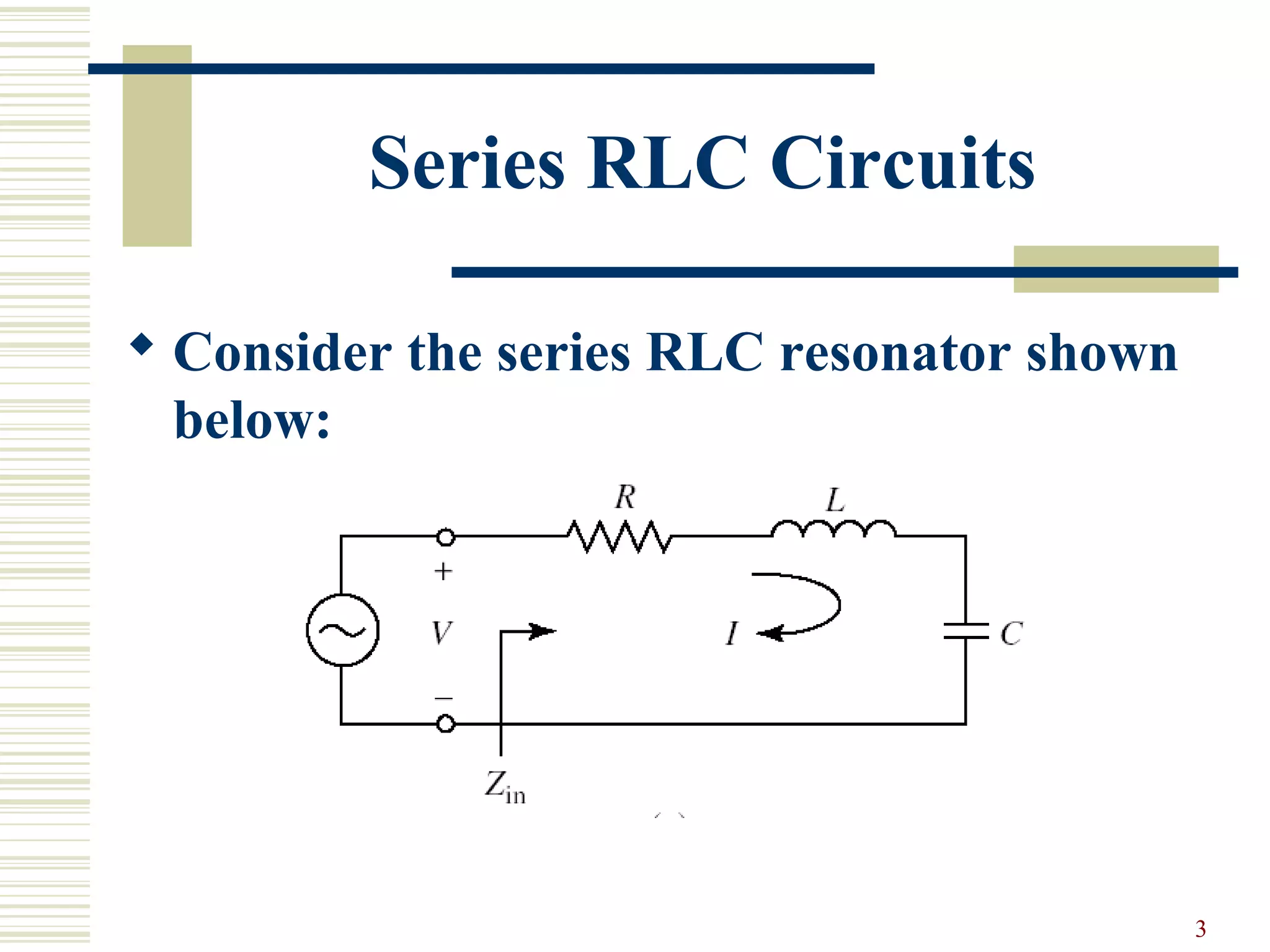
 Consider the series RLC resonator shown
below:
4
Series RLC Circuits
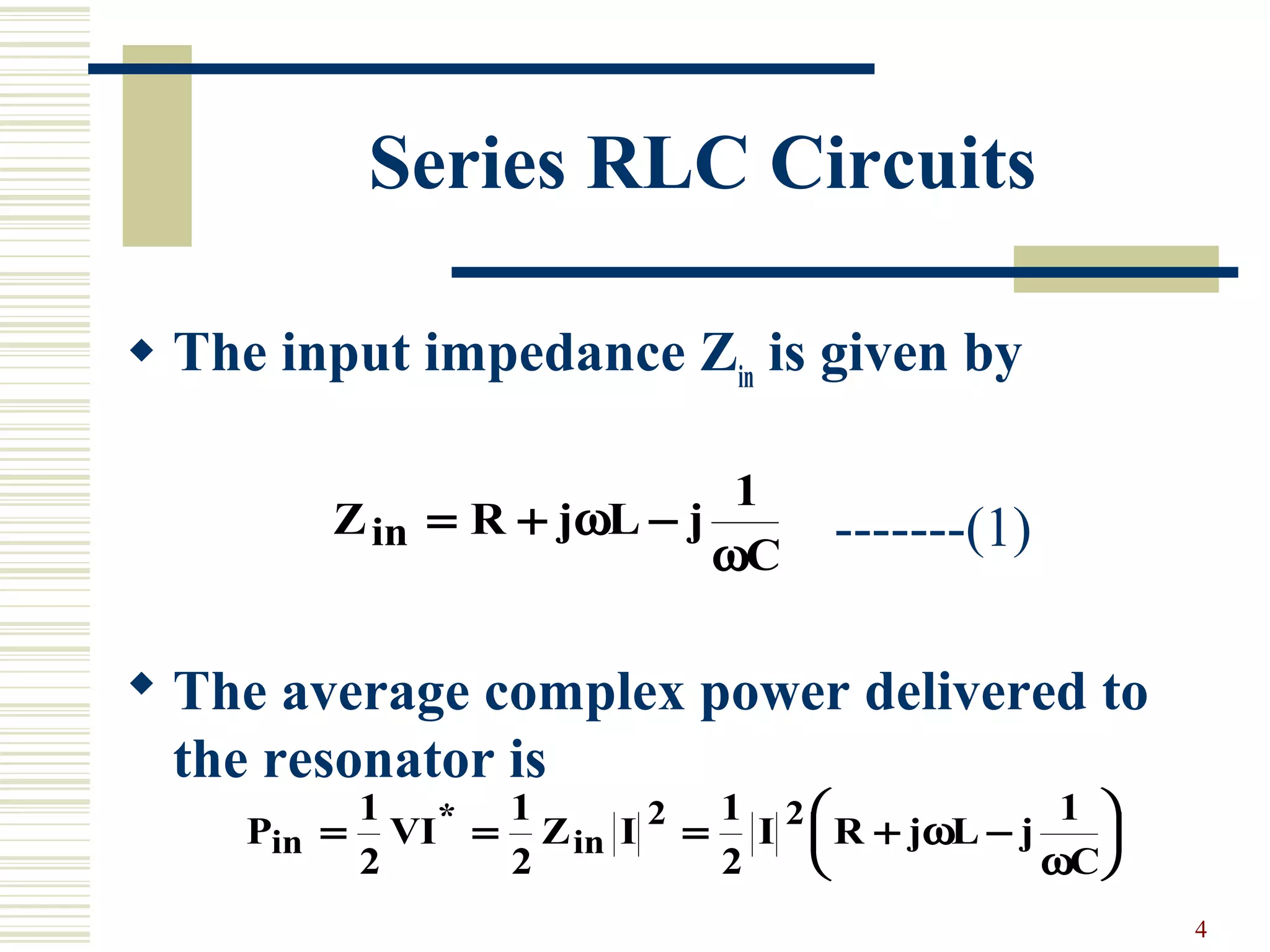
 The input impedance Zin
is given by
-------(1)
 The average complex power delivered to
the resonator is
Z R j L j
C
in = + −ω
ω
1
P VI Z I I R j L j
C
in in= = = + −






1
2
1
2
1
2
12 2* ω
ω
5
Series RLC Circuits
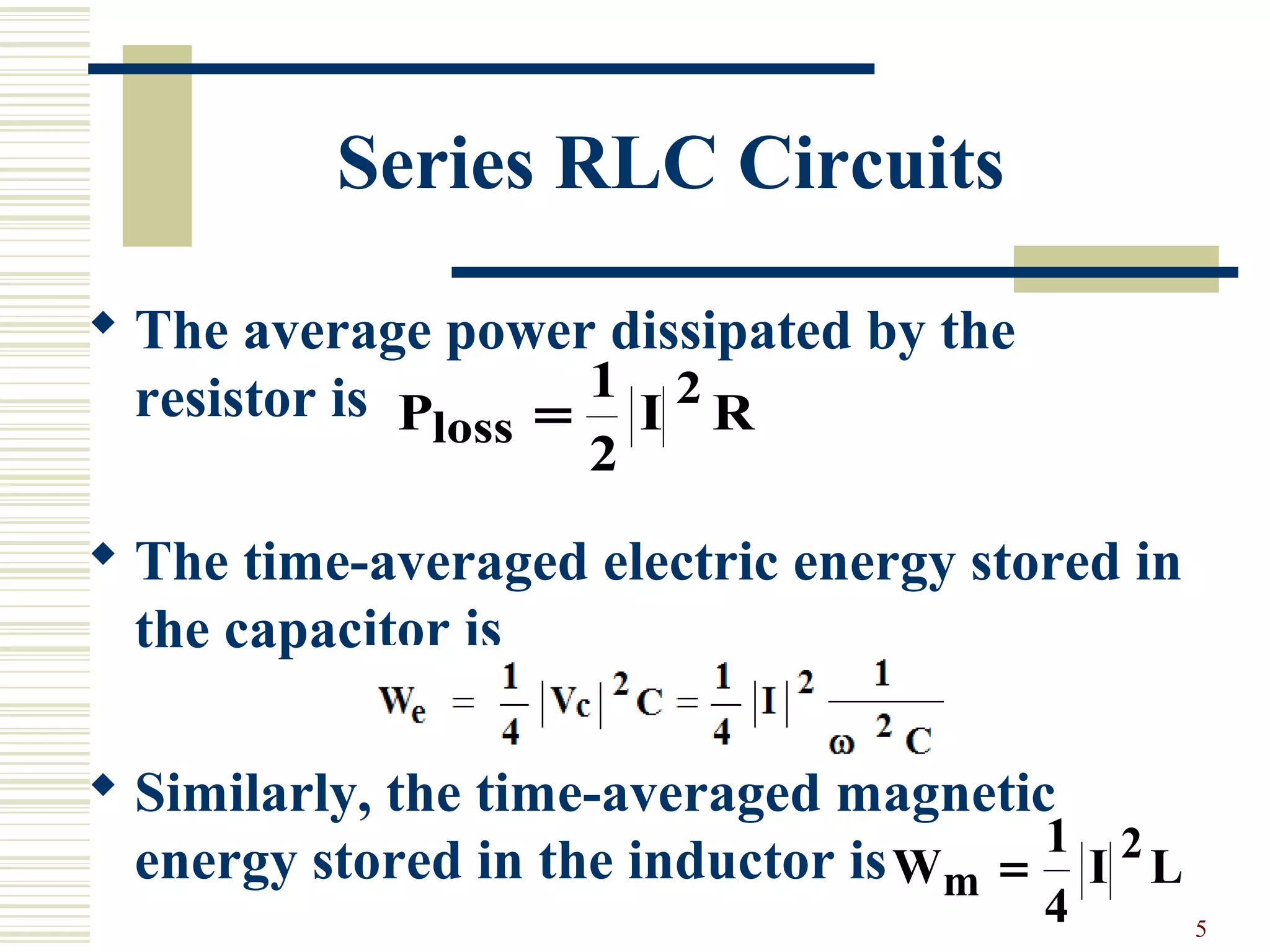
 The average power dissipated by the
resistor is
 The time-averaged electric energy stored in
the capacitor is
 Similarly, the time-averaged magnetic
energy stored in the inductor is
P I Rloss =
1
2
2
W I Lm =
1
4
2
6
Series RLC Circuits
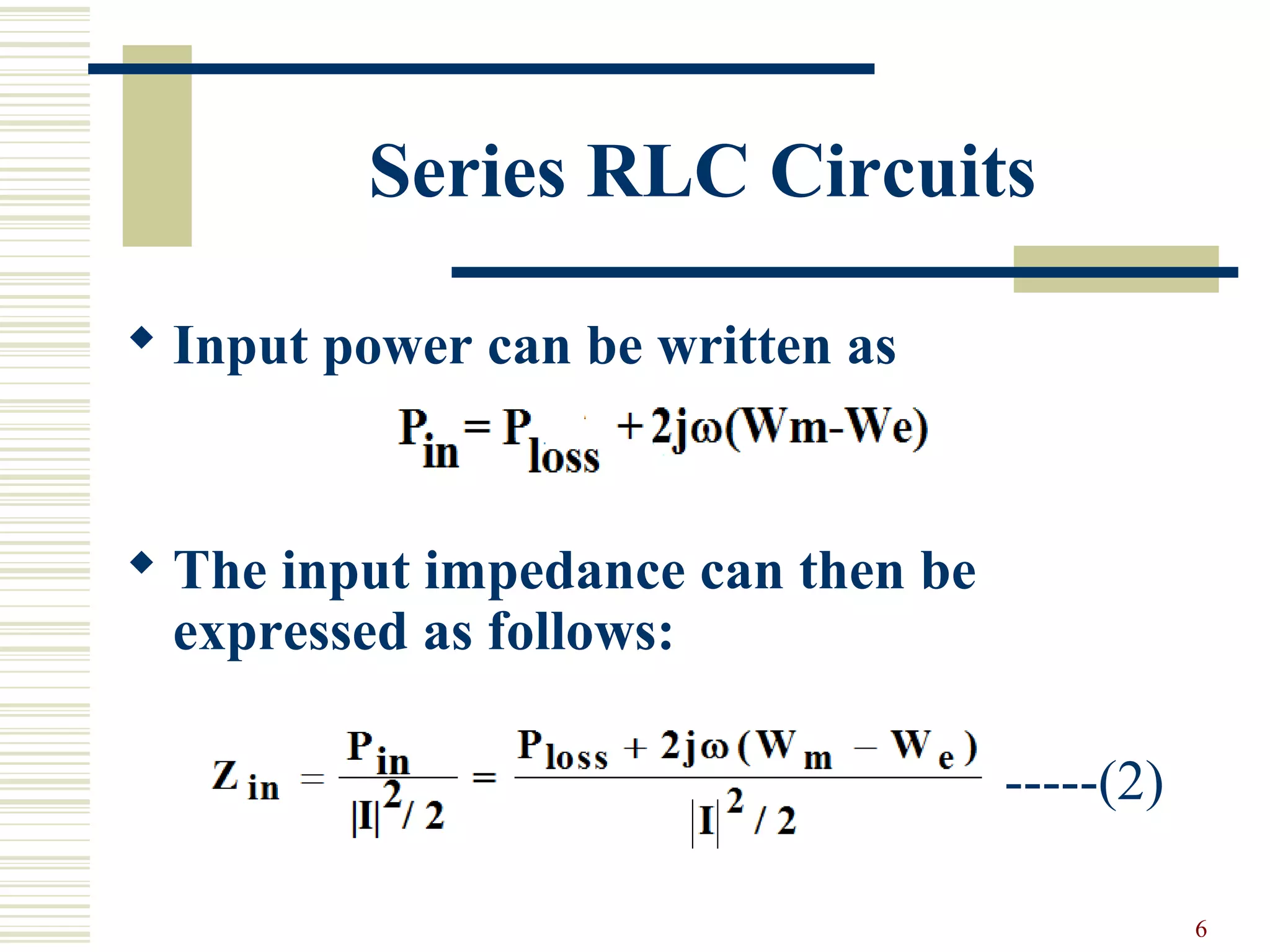
 Input power can be written as
 The input impedance can then be
expressed as follows:
-----(2)
7
Series RLC Circuits
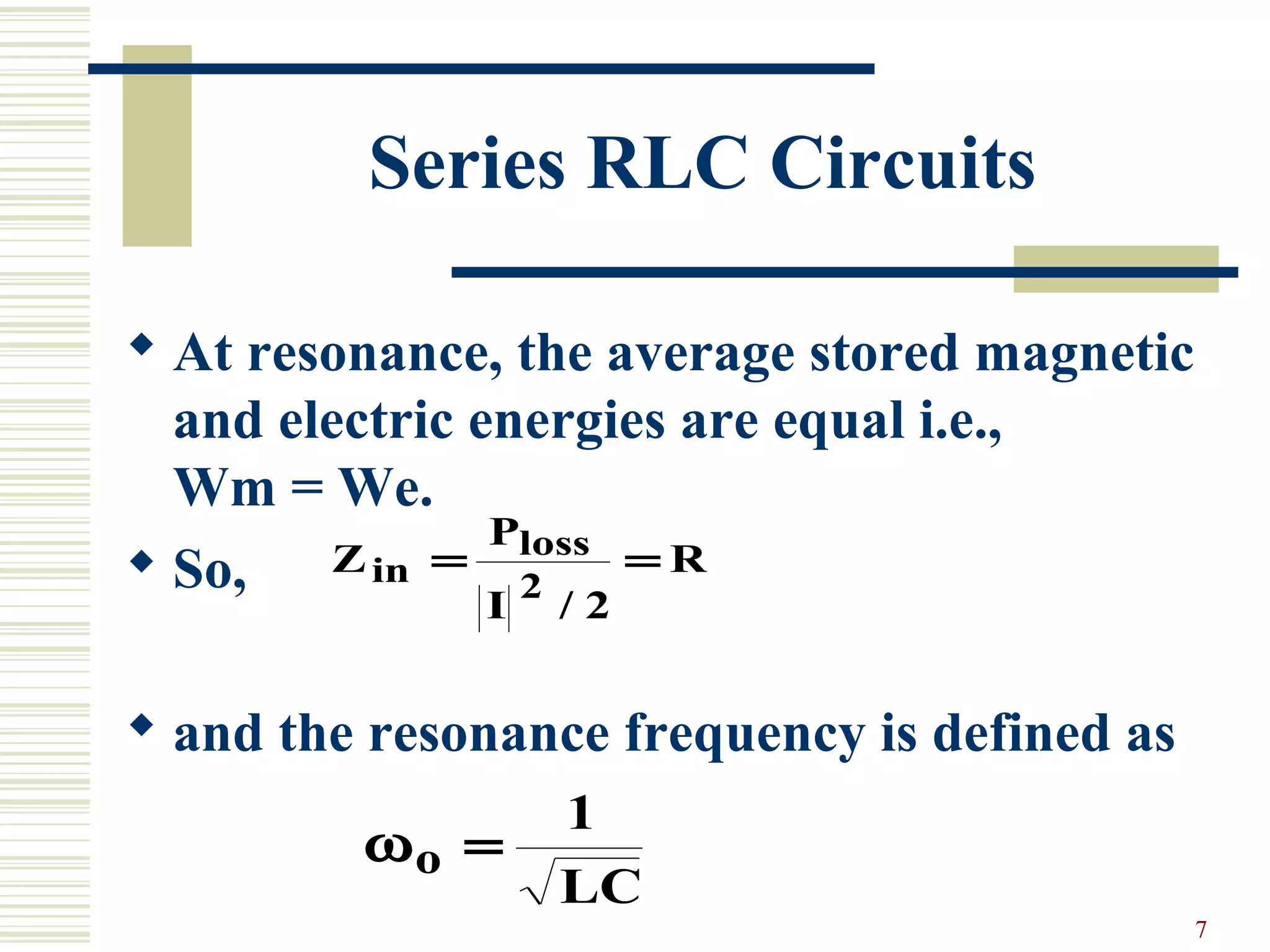
 At resonance, the average stored magnetic
and electric energies are equal i.e.,
Wm = We.
 So,
 and the resonance frequency is defined as
Z
P
I
Rin
loss= =
2
2/
ωo
LC
=
1
8
Series RLC Circuits
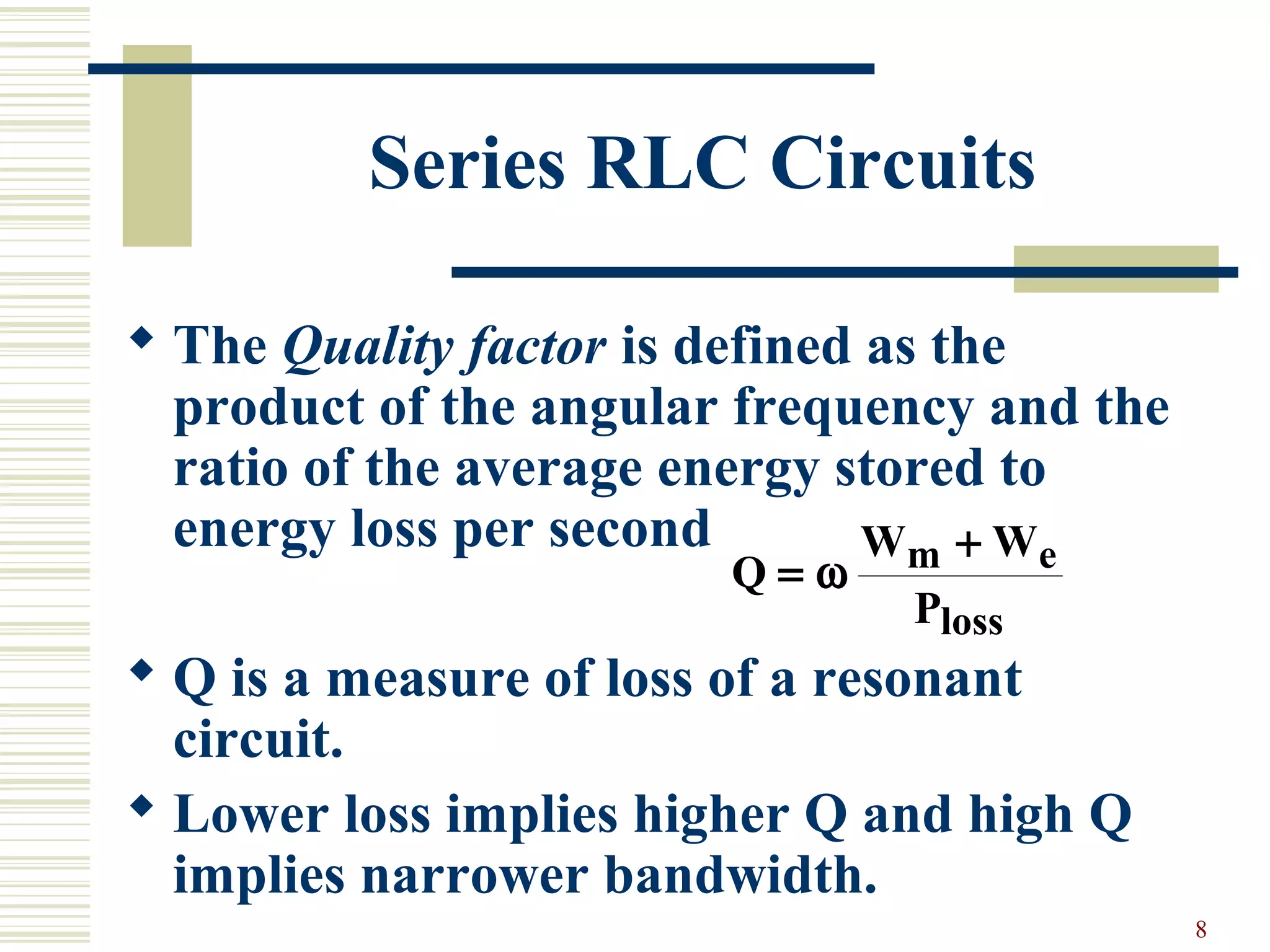
 The Quality factor is defined as the
product of the angular frequency and the
ratio of the average energy stored to
energy loss per second
 Q is a measure of loss of a resonant
circuit.
 Lower loss implies higher Q and high Q
implies narrower bandwidth.
Q
W W
P
m e
loss
=
+
ω
9
Series RLC Circuits
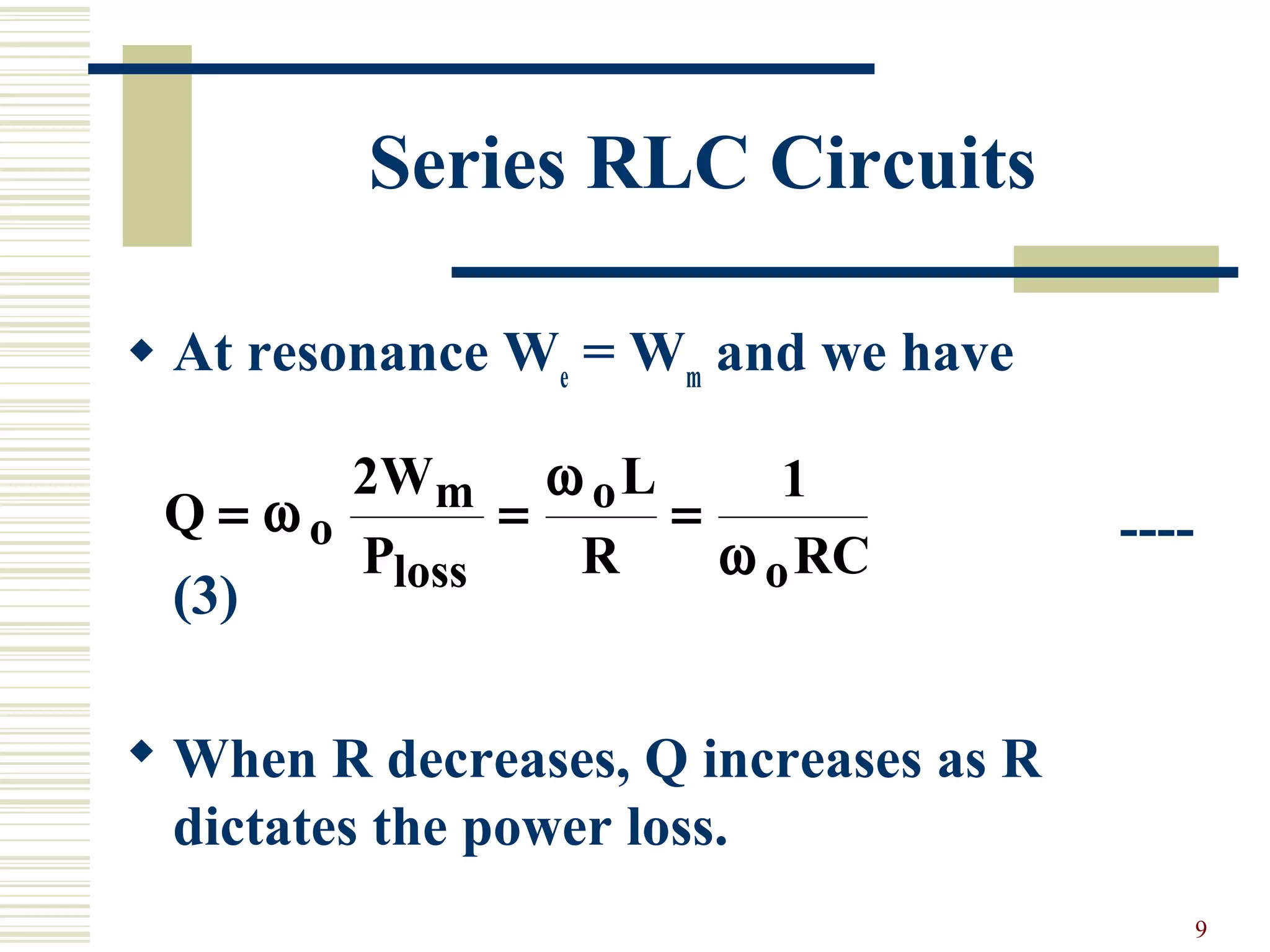
 At resonance We
= Wm
and we have
----
(3)
 When R decreases, Q increases as R
dictates the power loss.
Q
W
P
L
R RC
o
m
loss
o
o
= = =ω
ω
ω
2 1
10
Series RLC Circuits
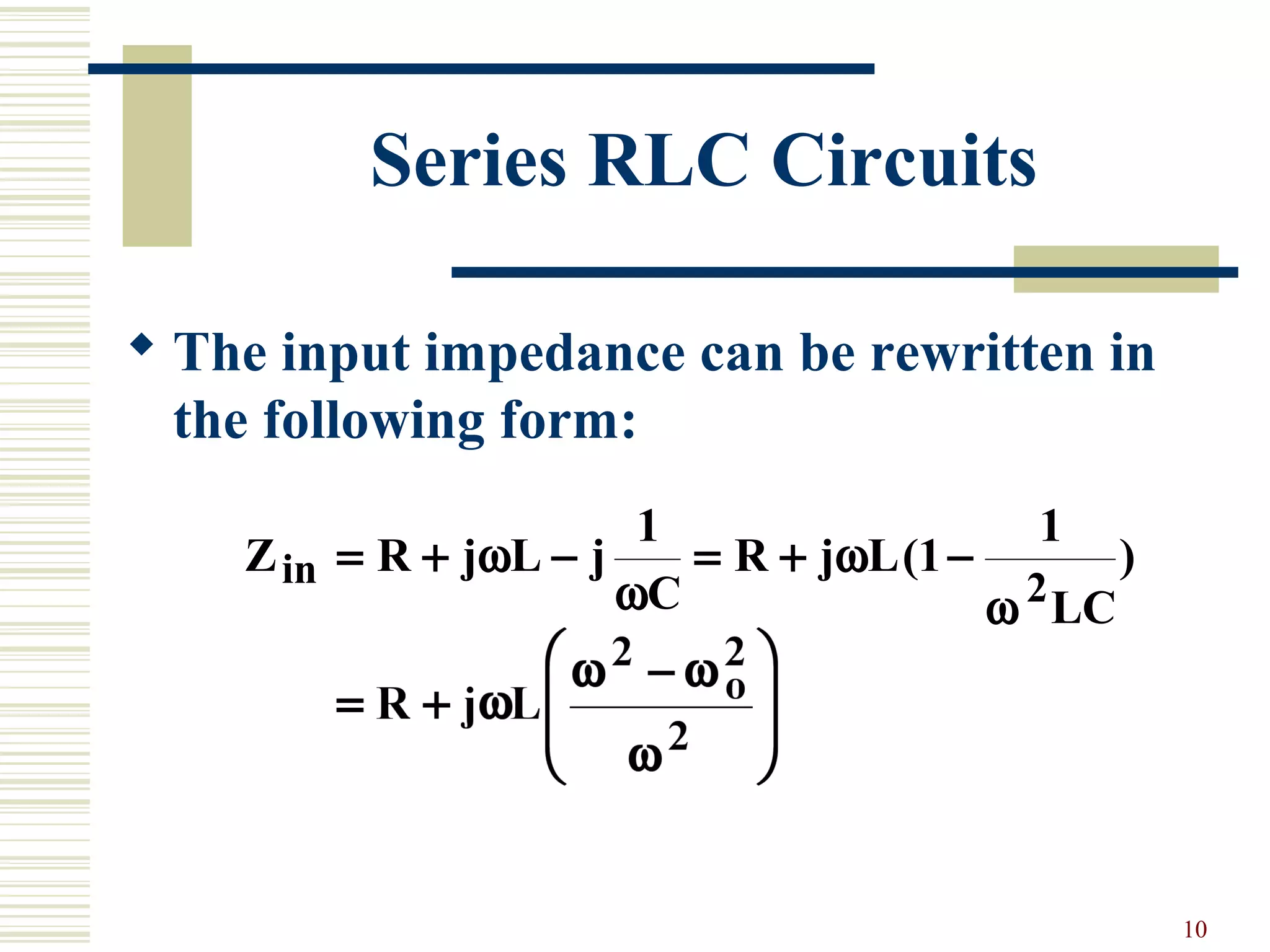
 The input impedance can be rewritten in
the following form:
Z R j L j
C
R j L
LC
Rin = + − = + − = +ω
ω
ω
ω
1
1
1
2
( )
11
Series RLC Circuits
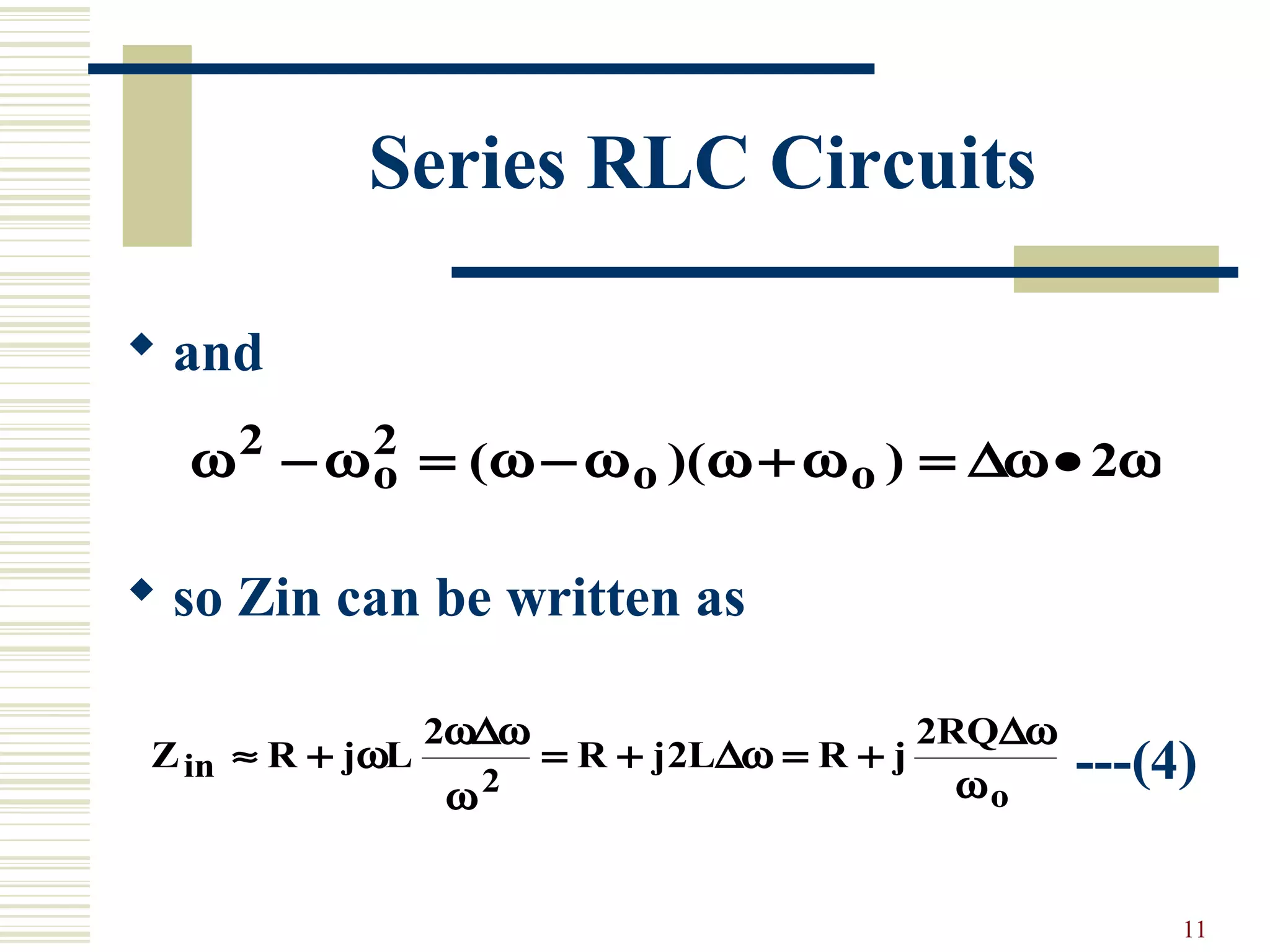
 and
 so Zin can be written as
---(4)
ω ω ω ω ω ω ω2 2
2− = − + = •o o o( )( ) ∆ω
Z R j L R j L R j
RQ
in
o
≈ + = + = +ω
ω∆ω
ω ω
2
2
2
2
∆ω
∆ω
13
Series RLC Circuits
 Consider the equation
 As
---(5)
Z R j L
L
Q
j Lin
o
o≈ + = + −2 2∆ω
ω
ω ω( )
Q
L
R
o=
ω
Z j L
j Q
j L j
Q
in o
o
o≈ − + = − +2
2
2 1
1
2
( ) [ ( )]ω ω
ω
ω ω
14
Series RLC Circuits
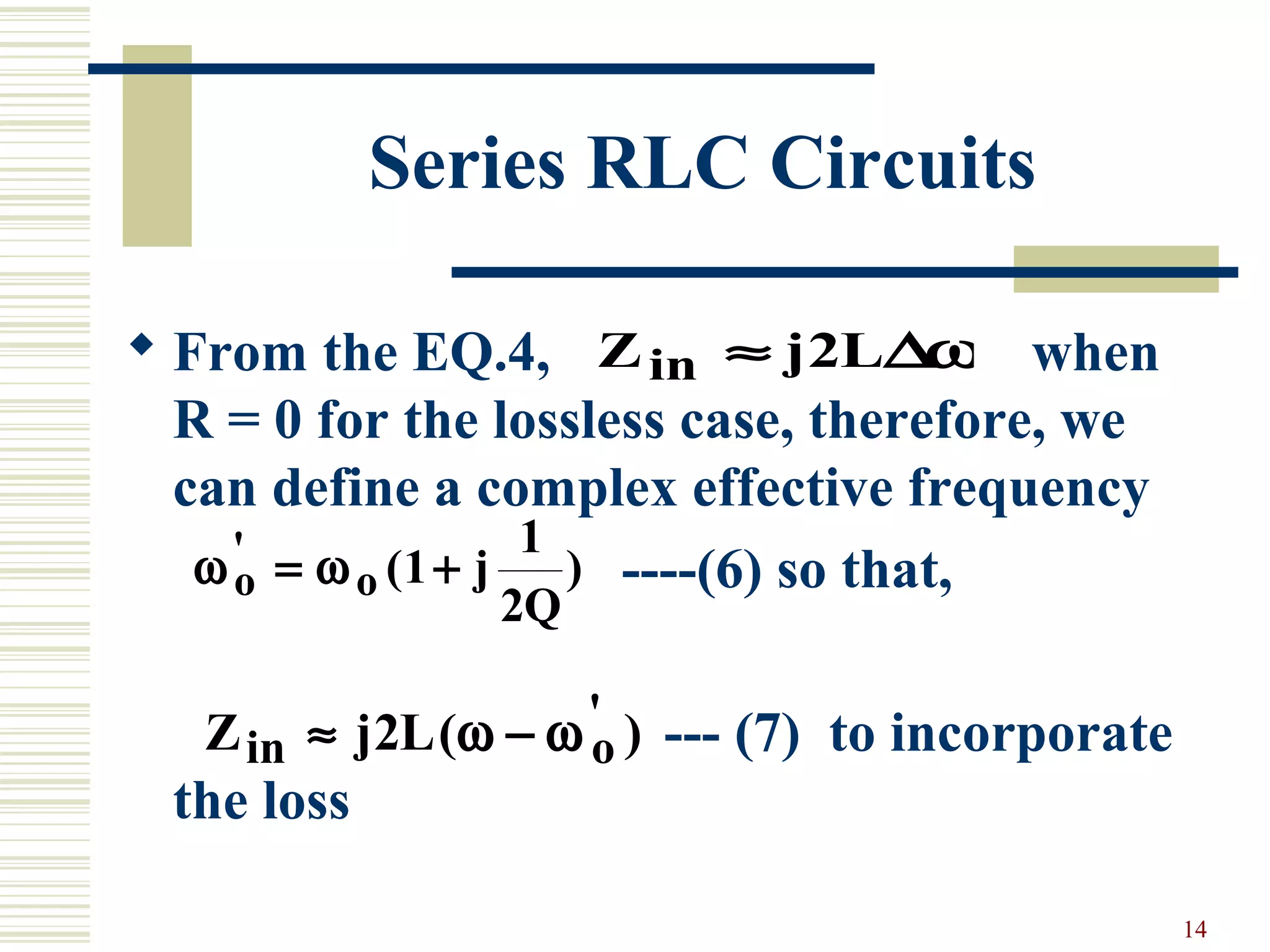
 From the EQ.4, when
R = 0 for the lossless case, therefore, we
can define a complex effective frequency
----(6) so that,
--- (7) to incorporate
the loss
Z j Lin ≈ 2 ∆ω
ω ωo o j
Q
' ( )= +1
1
2
Z j Lin o≈ −2 ( )'
ω ω
15
Series RLC Circuits
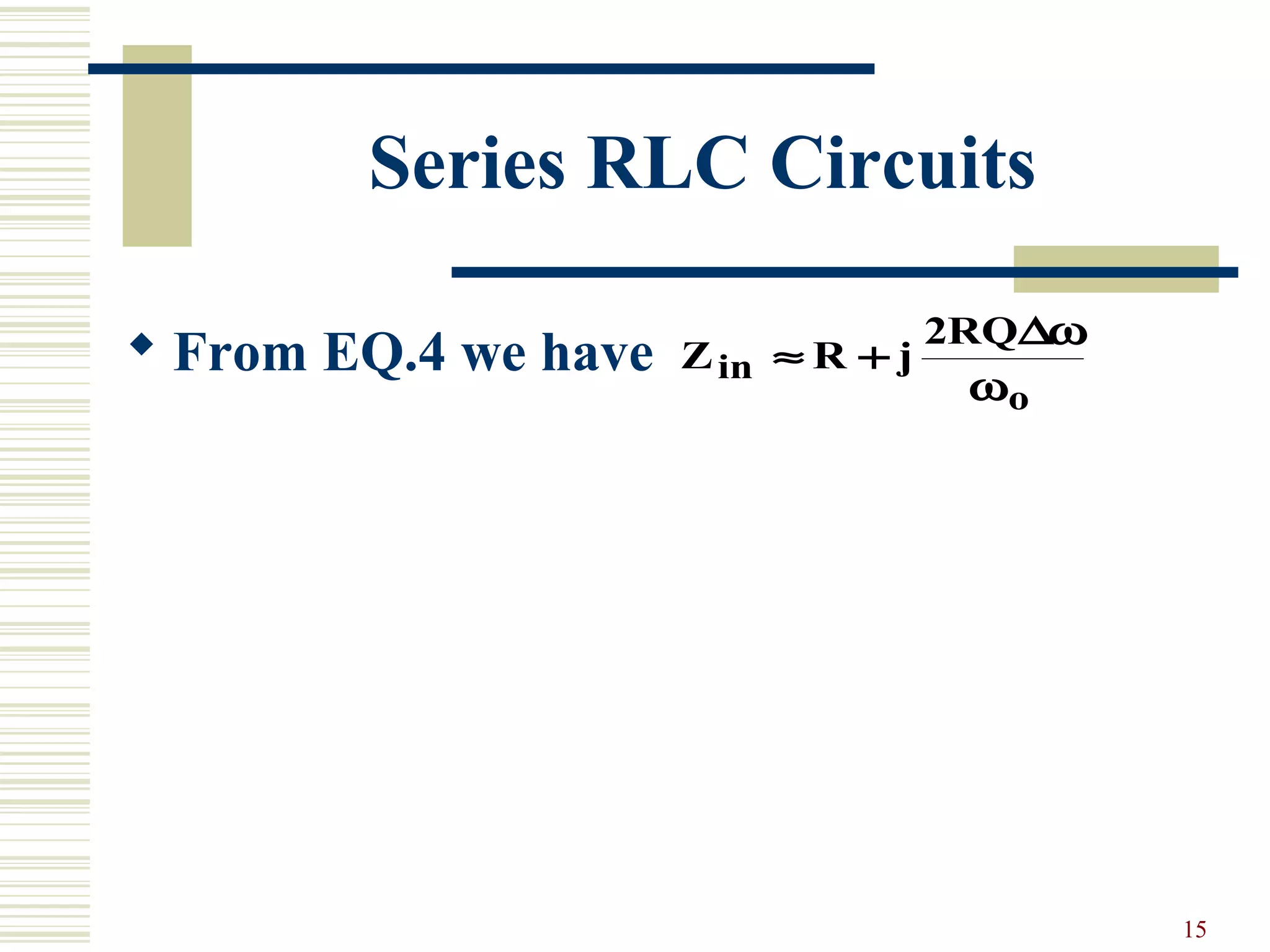
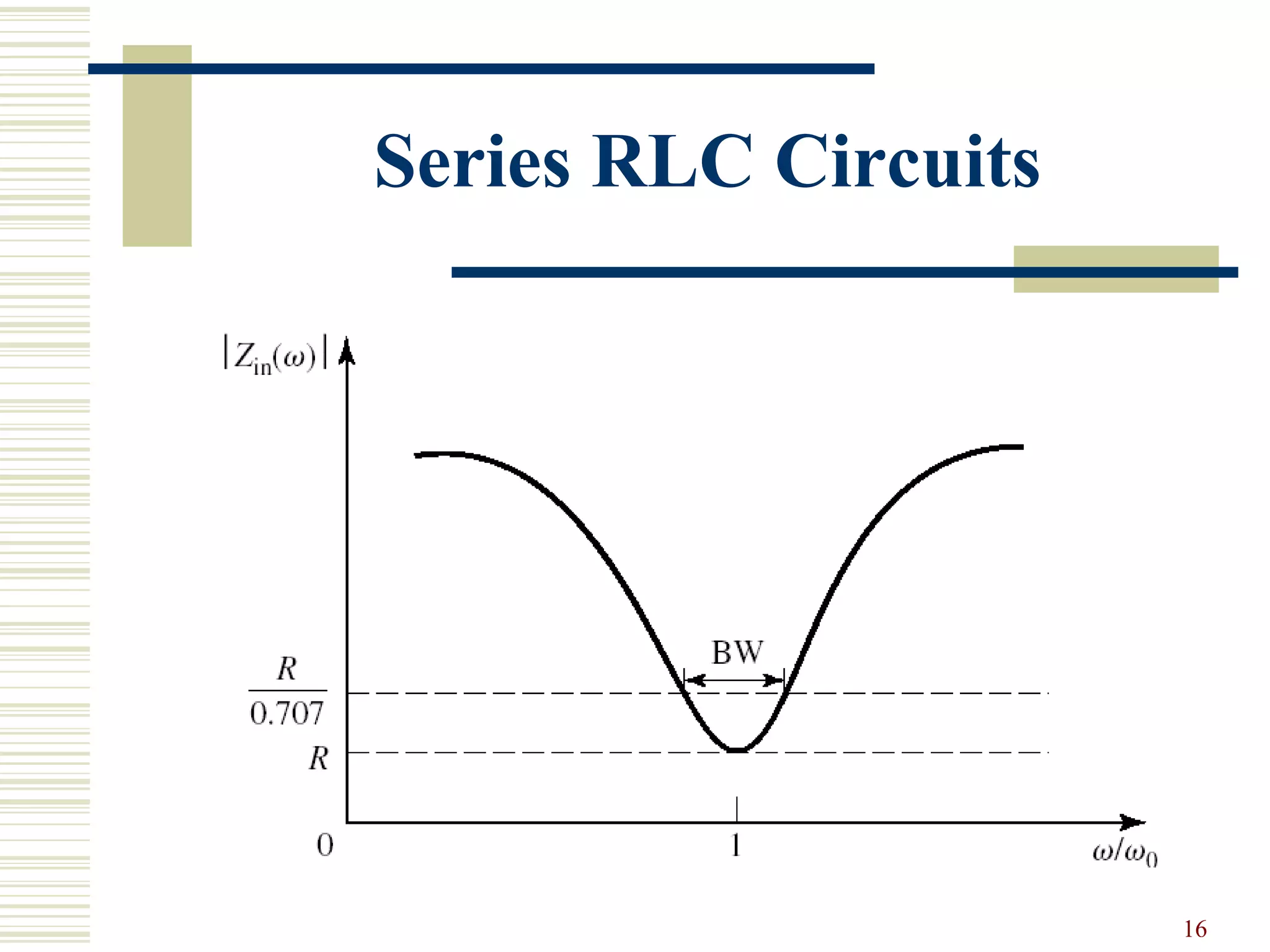
 From EQ.4 we have Z R j
RQ
in
o
≈ +
2 ∆ω
ω
Series RLC Circuits
16
17
Parallel RLC Circuits
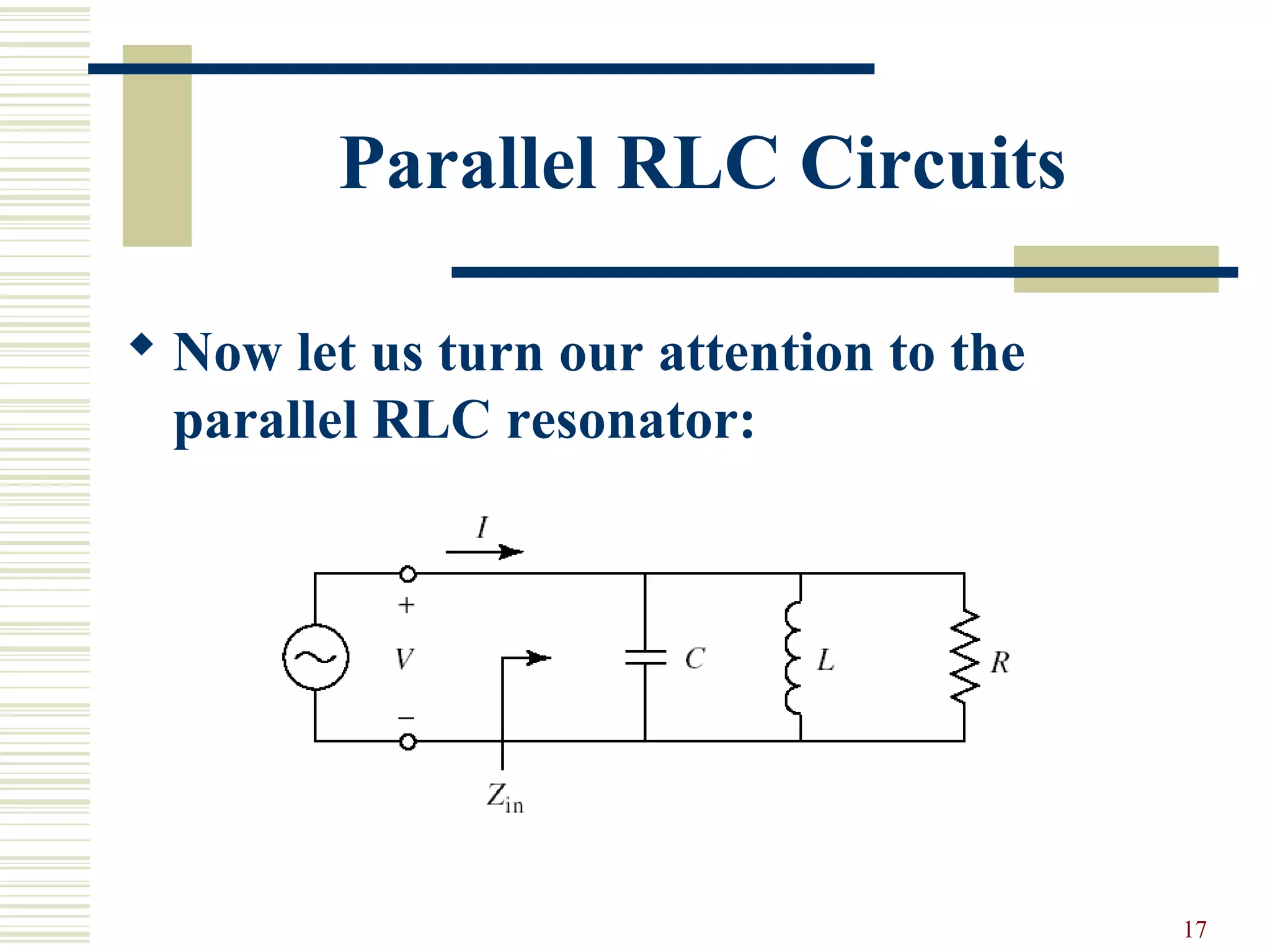
 Now let us turn our attention to the
parallel RLC resonator:
18
Parallel RLC Circuits
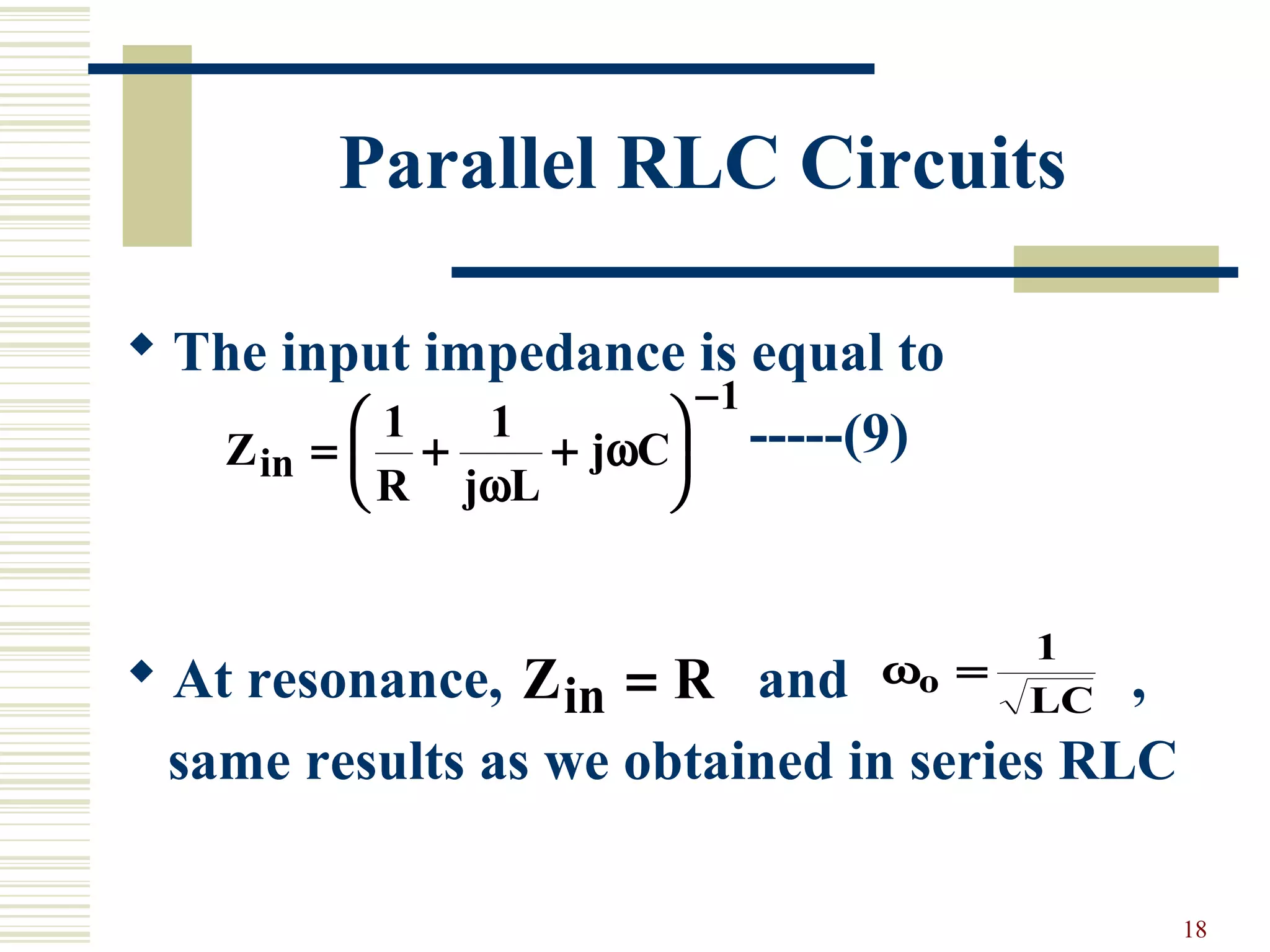
 The input impedance is equal to
-----(9)
 At resonance, and ,
same results as we obtained in series RLC
Z
R j L
j Cin = + +






−
1 1
1
ω
ω
Z Rin = ωo
LC
=
1
19
Parallel RLC Circuits
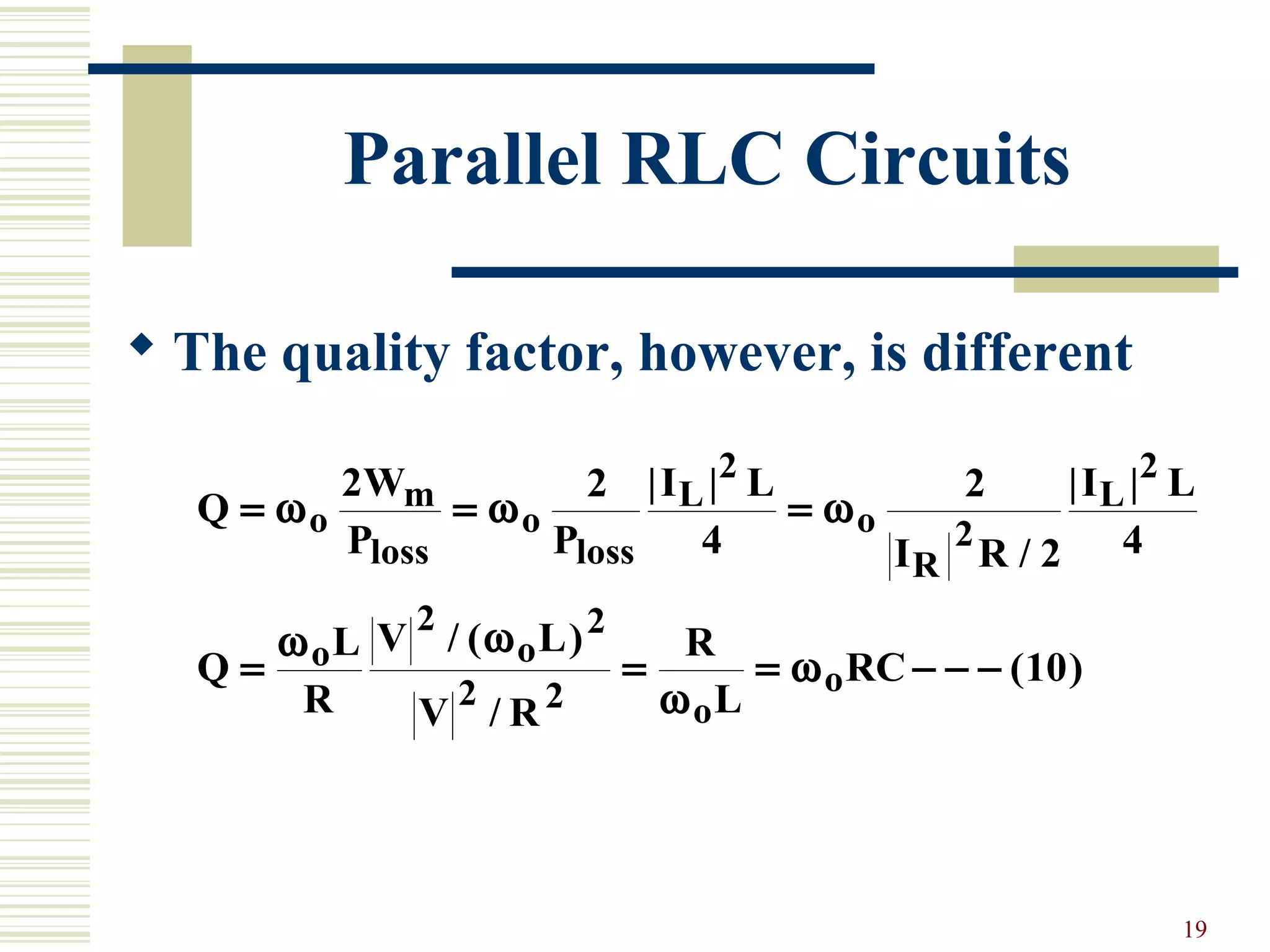
 The quality factor, however, is different
Q
W
P P
I L
I R
I L
Q
L
R
V L
V R
R
L
RC
o
m
loss
o
loss
L
o
R
L
o o
o
o
= = =
= = = − − −
ω ω ω
ω ω
ω
ω
2 2
4
2
2 4
10
2
2
2
2 2
2 2
| |
/
| |
/ ( )
/
( )
20
Parallel RLC Circuits
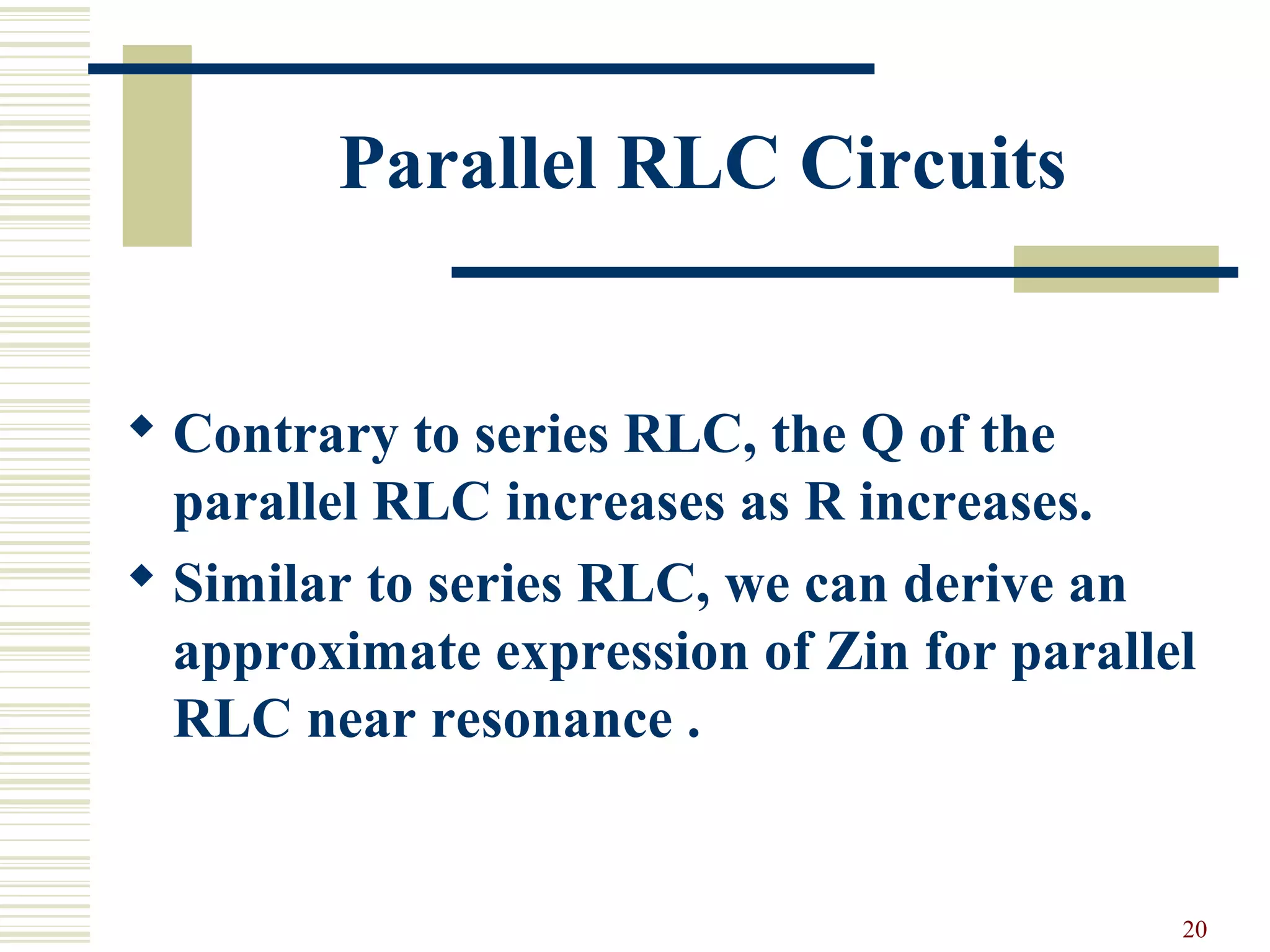
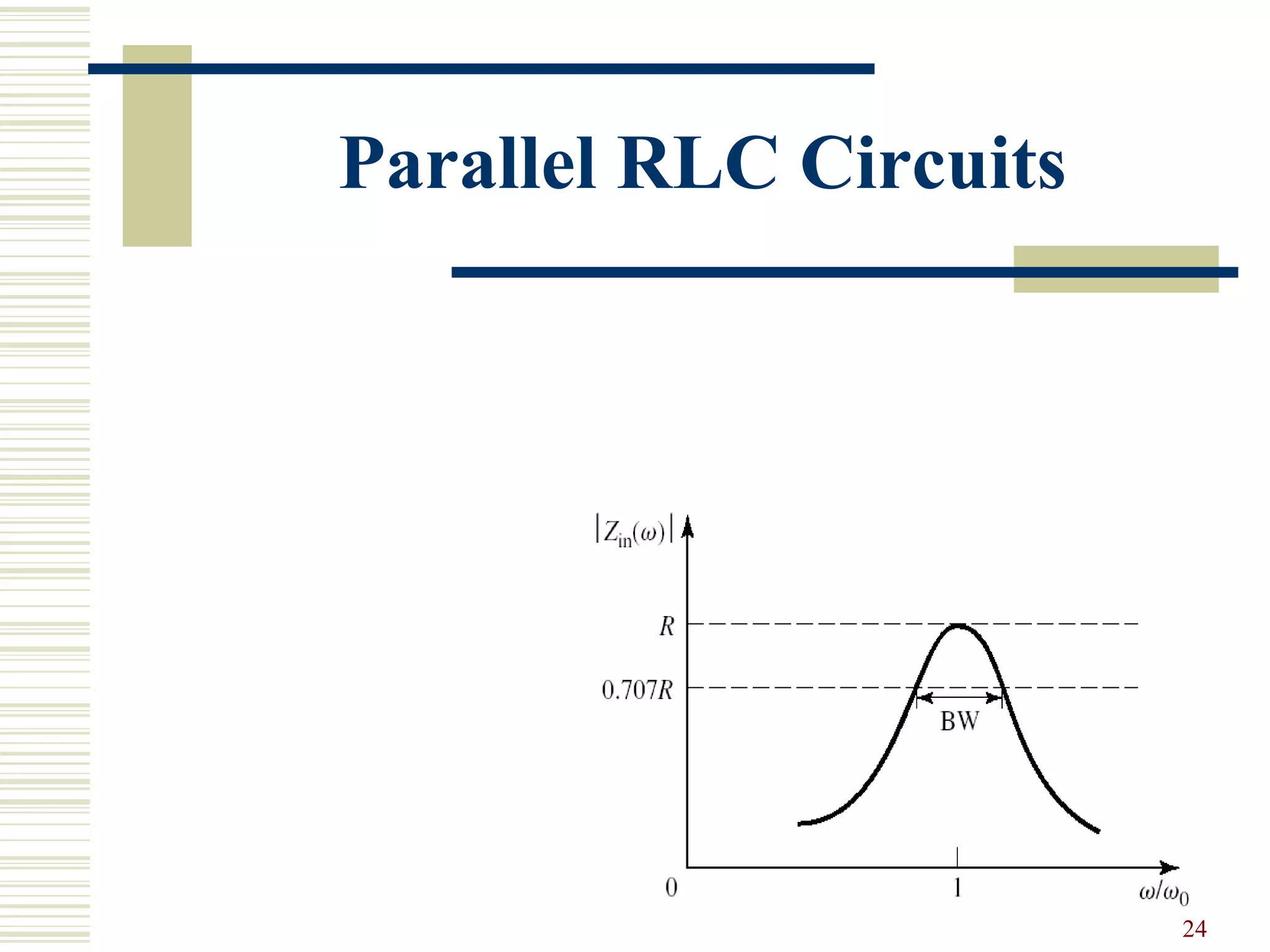
 Contrary to series RLC, the Q of the
parallel RLC increases as R increases.
 Similar to series RLC, we can derive an
approximate expression of Zin for parallel
RLC near resonance .
21
Parallel RLC Circuits
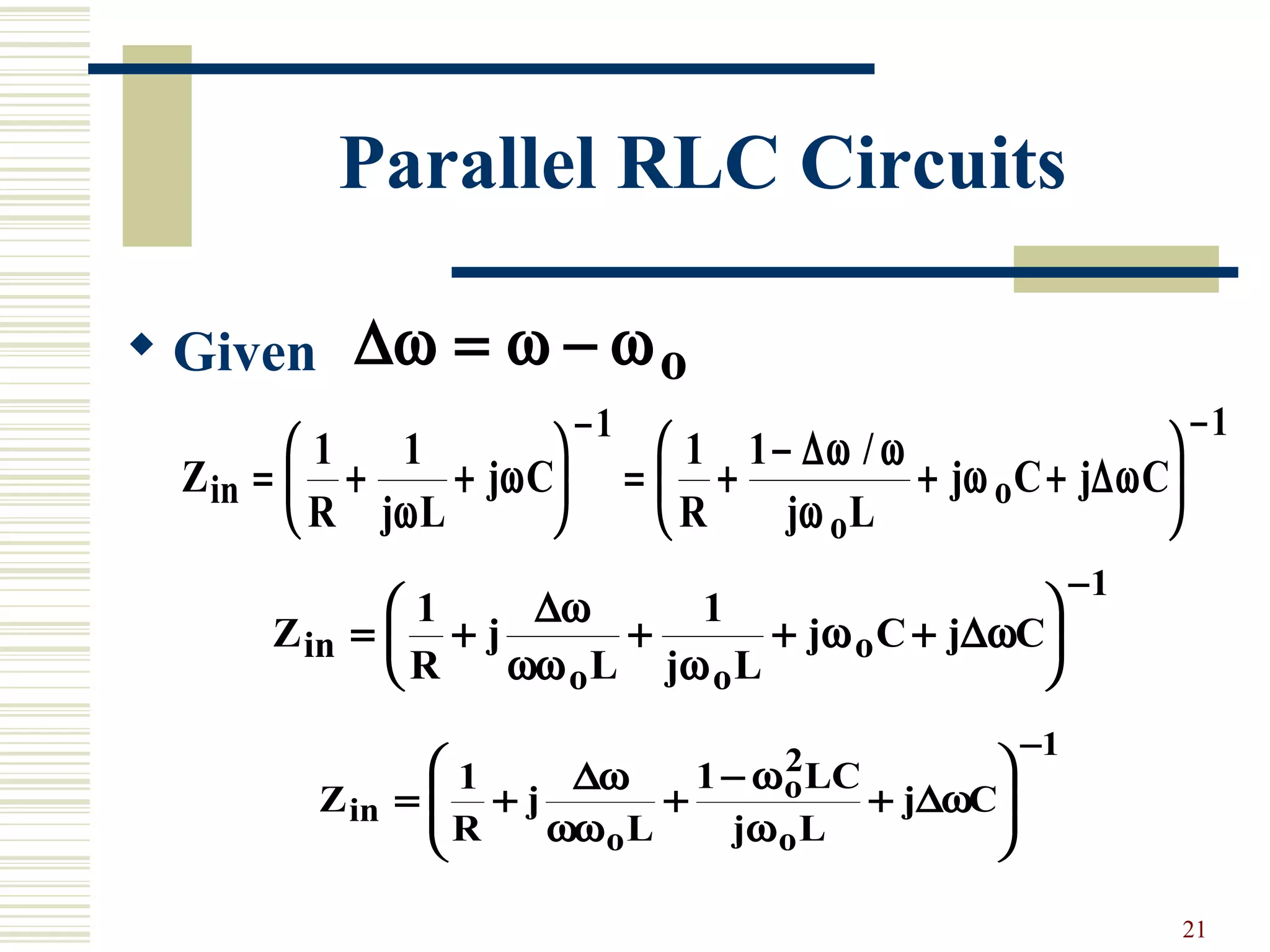
 Given ∆ω = −ω ωo
Z
R j L
j C
R j L
j C j Cin
o
o= + +





 = +
−
+ +






− −
1 1 1 1
1 1
ω
ω
ω
ω
ω
∆ω
∆ω
/
Z
R
j
L j L
j C j Cin
o o
o= + + + +






−
1 1
1
∆ω
∆ω
ωω ω
ω
Z
R
j
L
LC
j L
j Cin
o
o
o
= + +
−
+








−
1 1 2 1
∆ω
∆ω
ωω
ω
ω
22
Parallel RLC Circuits
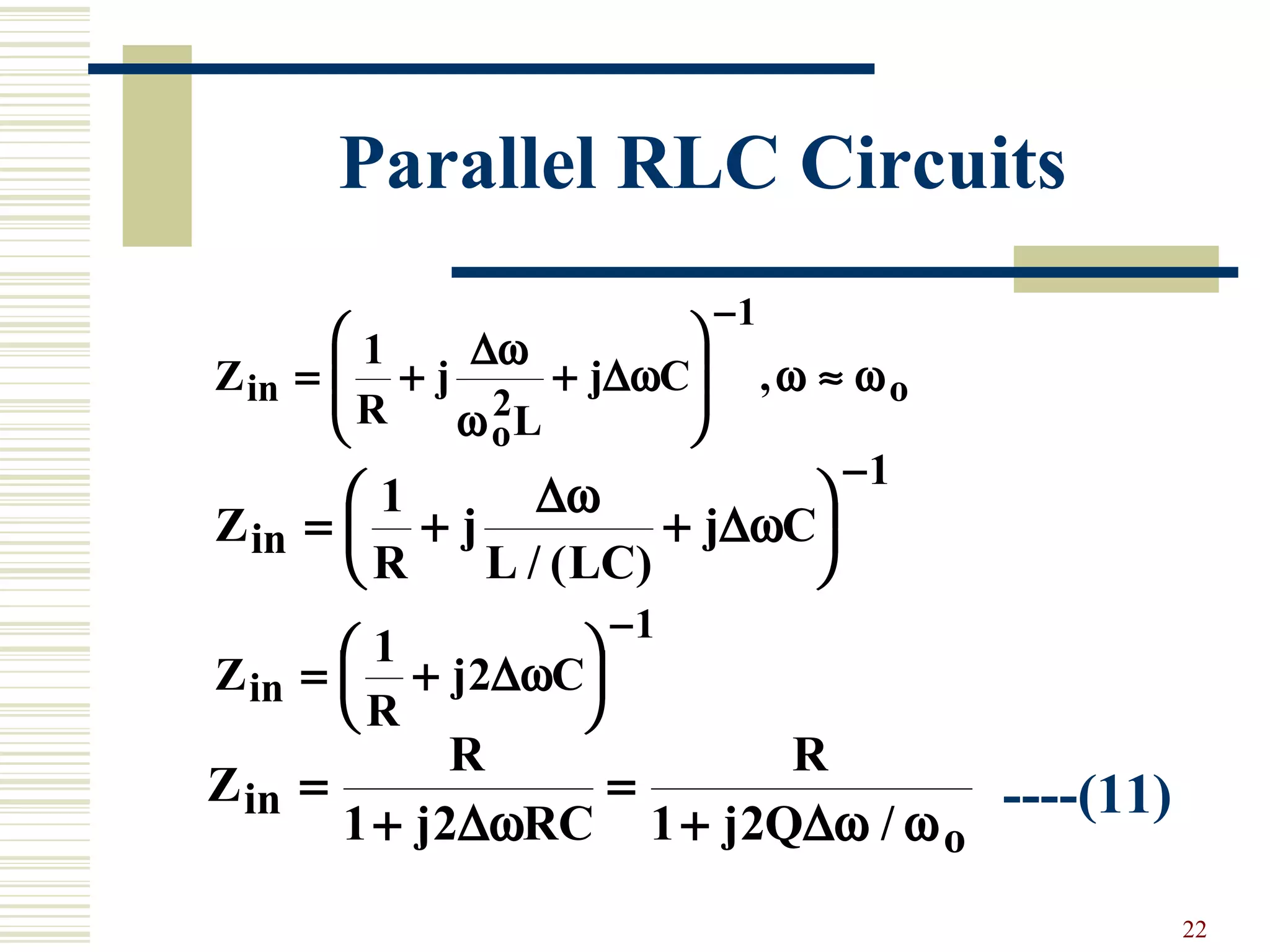
----(11)
Z
R
j
L
j Cin
o
o= + +







 ≈
−
1
2
1
∆ω
∆ω
ω
ω ω,
Z
R
j
L LC
j Cin = + +






−
1
1
∆ω
∆ω
/ ( )
Z
R
j Cin = +






−
1
2
1
∆ω
Z
R
j RC
R
j Q
in
o
=
+
=
+1 2 1 2∆ω ∆ω / ω
23
Parallel RLC Circuits
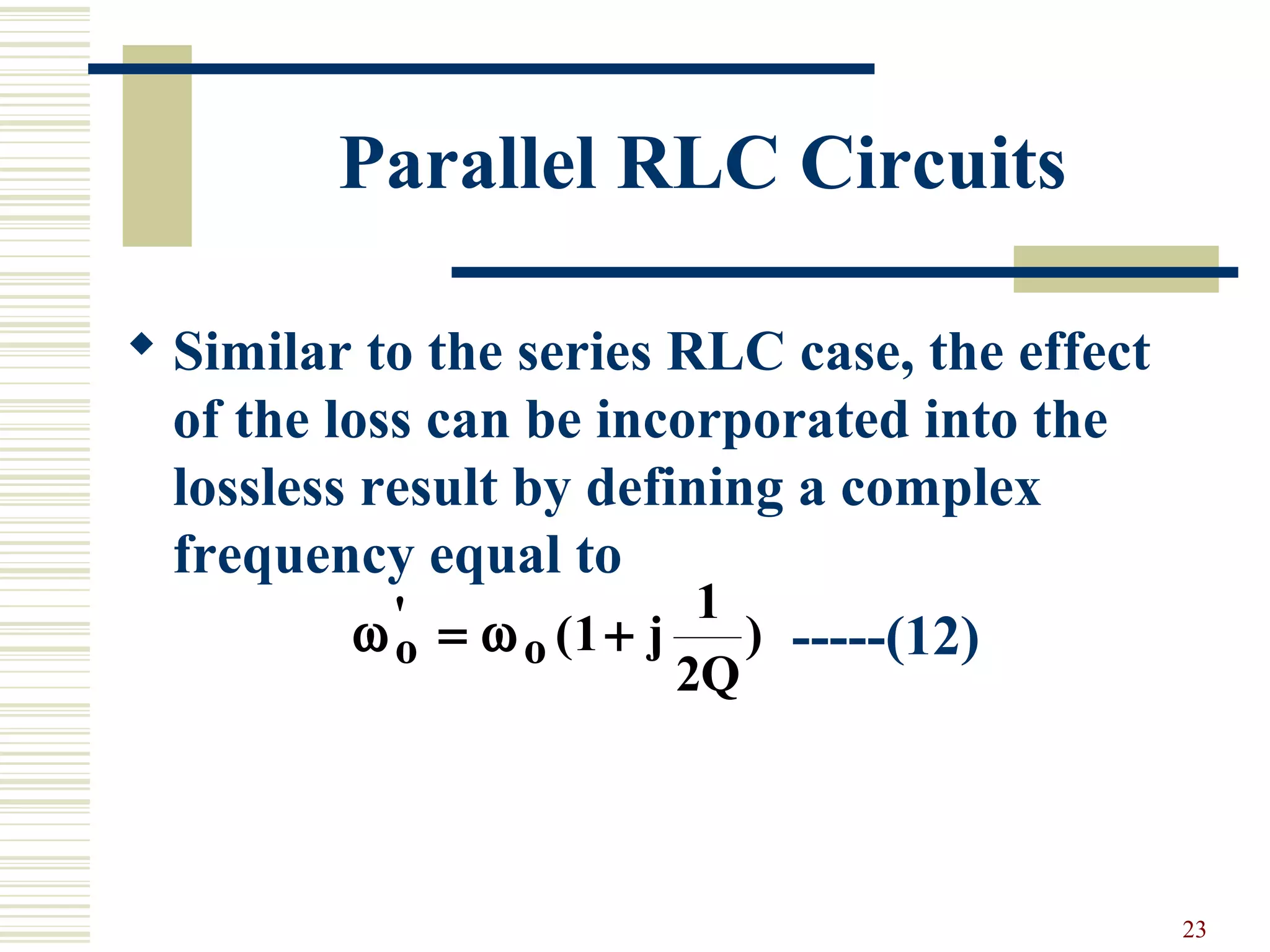
 Similar to the series RLC case, the effect
of the loss can be incorporated into the
lossless result by defining a complex
frequency equal to
-----(12)ω ωo o j
Q
'
( )= +1
1
2
Parallel RLC Circuits
24
25
Loaded and Unloaded Q
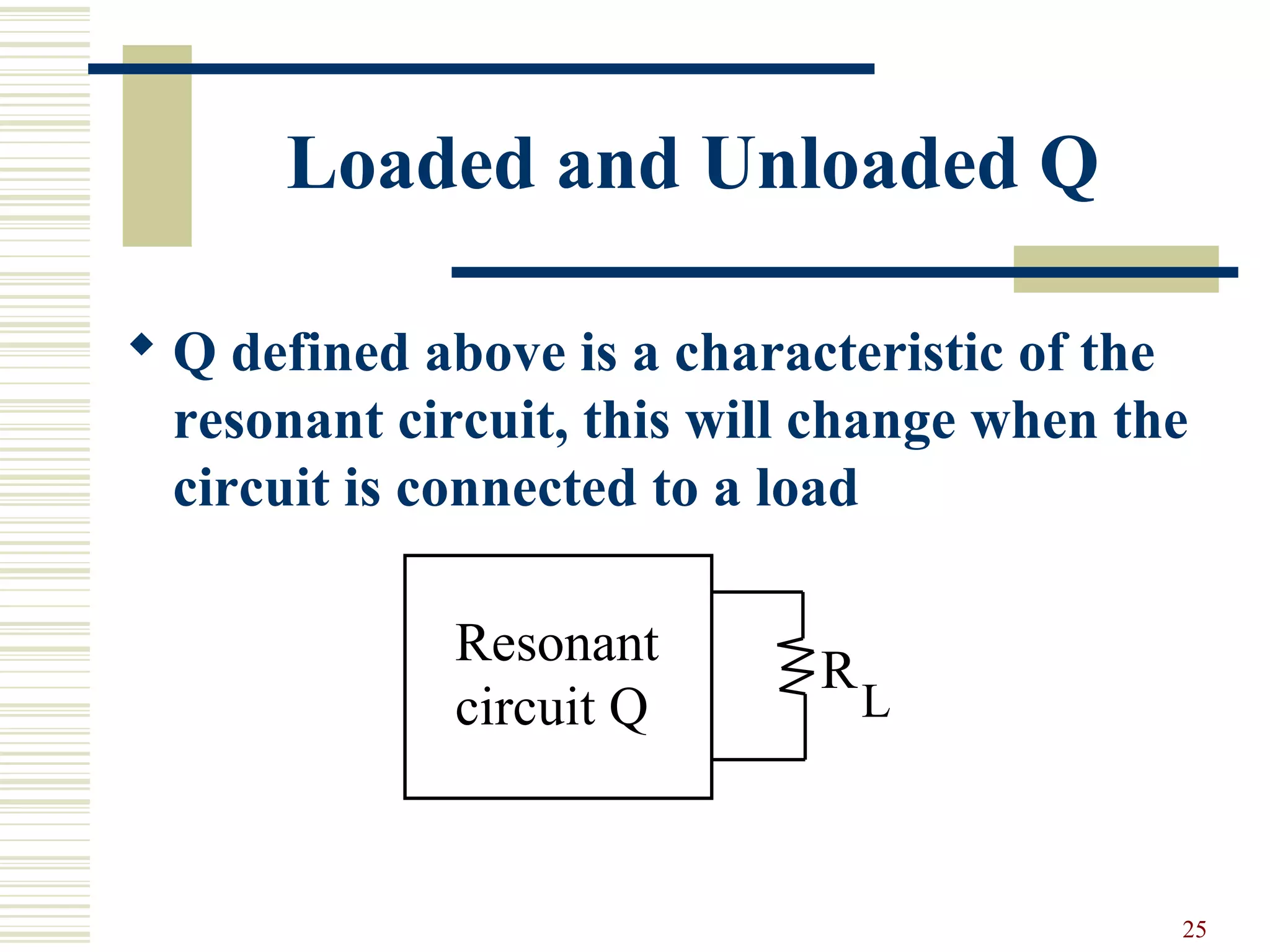
 Q defined above is a characteristic of the
resonant circuit, this will change when the
circuit is connected to a load
Resonant
circuit Q
R
L
26
Loaded and Unloaded Q
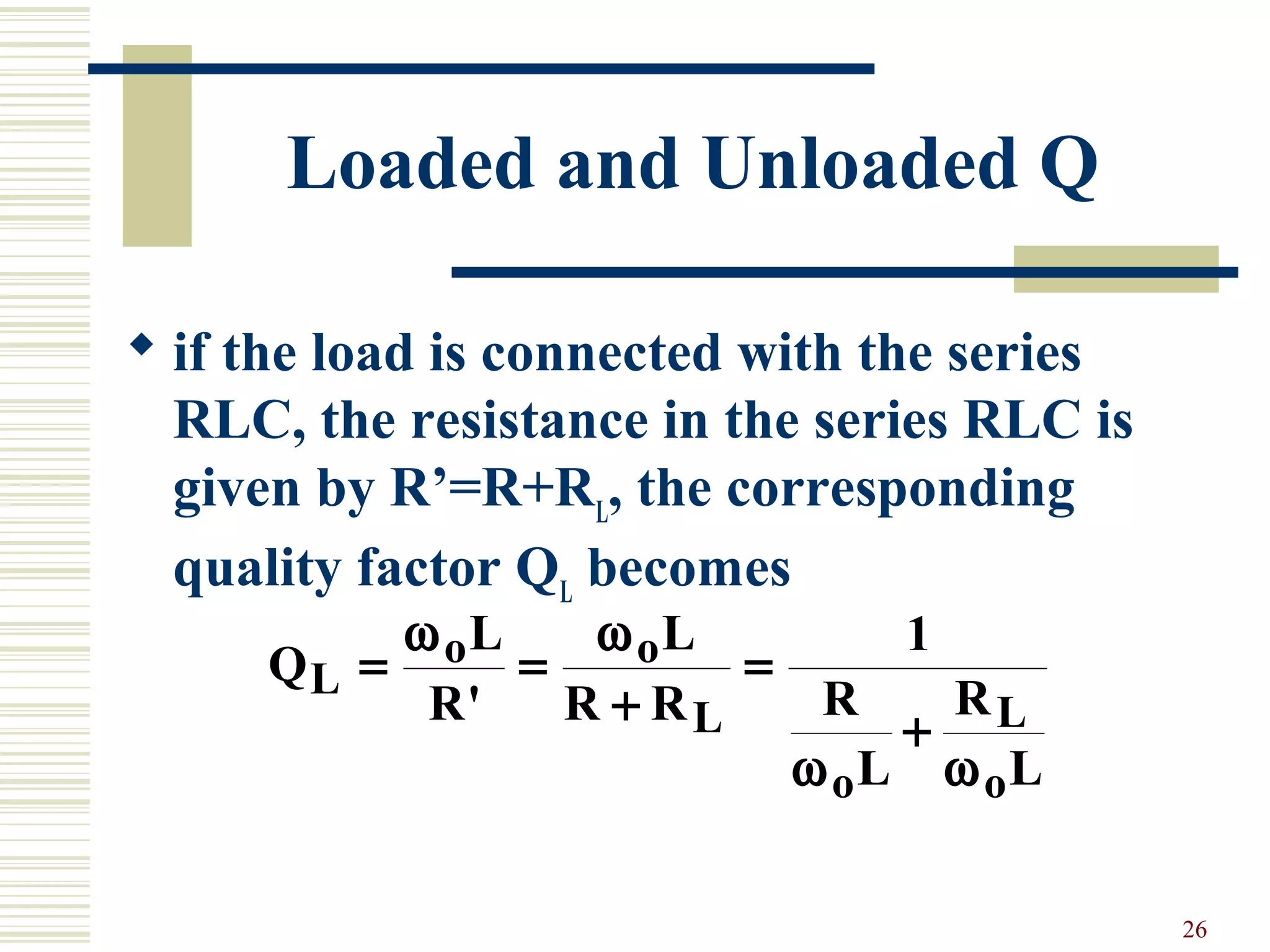
 if the load is connected with the series
RLC, the resistance in the series RLC is
given by R’=R+RL
, the corresponding
quality factor QL
becomes
Q
L
R
L
R R R
L
R
L
L
o o
L
o
L
o
= =
+
=
+
ω ω
ω ω
'
1
27
Loaded and Unloaded Q
--- (13)
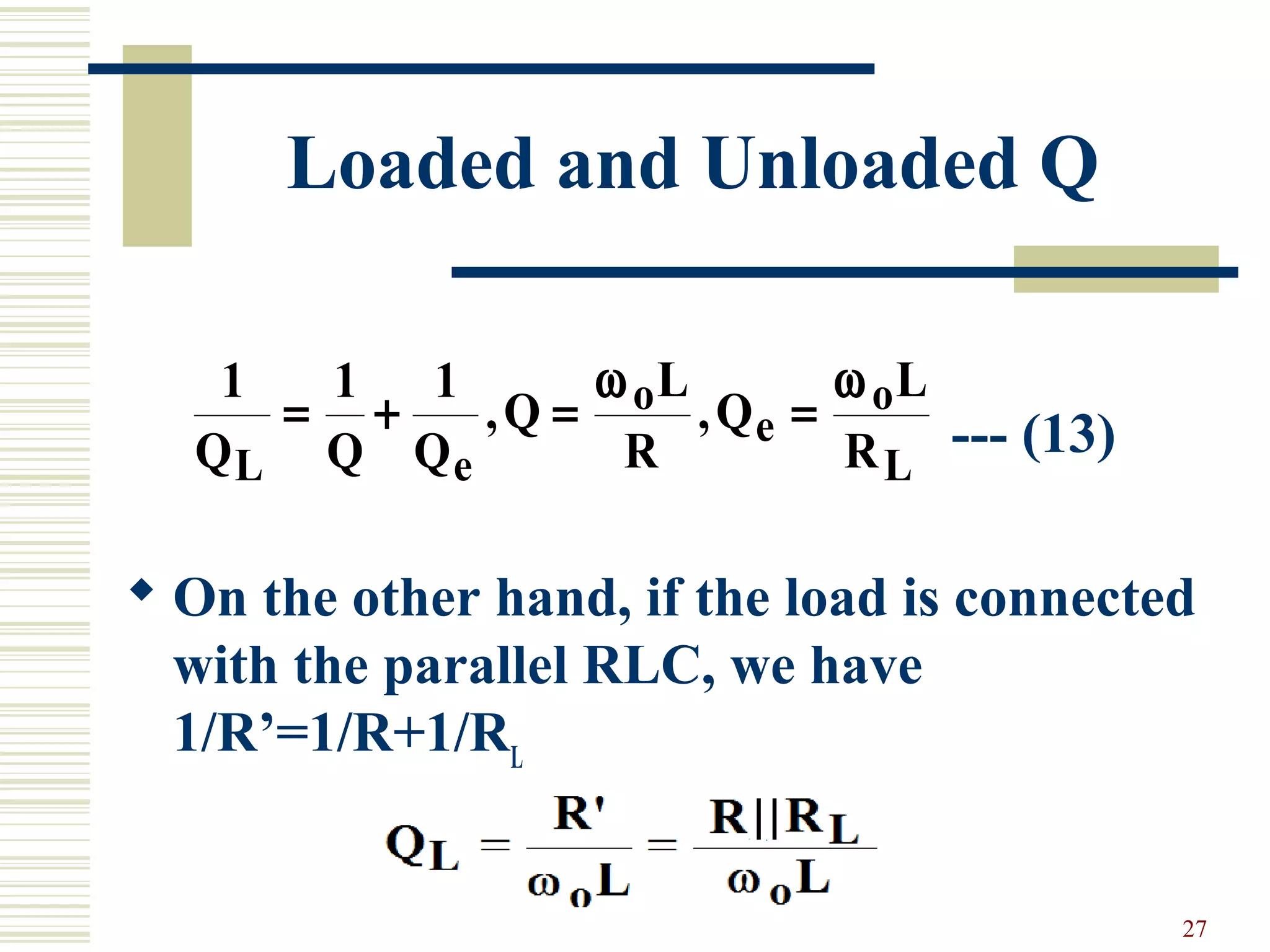
 On the other hand, if the load is connected
with the parallel RLC, we have
1/R’=1/R+1/RL
1 1 1
Q Q Q
Q
L
R
Q
L
RL e
o
e
o
L
= + = =, ,
ω ω
28
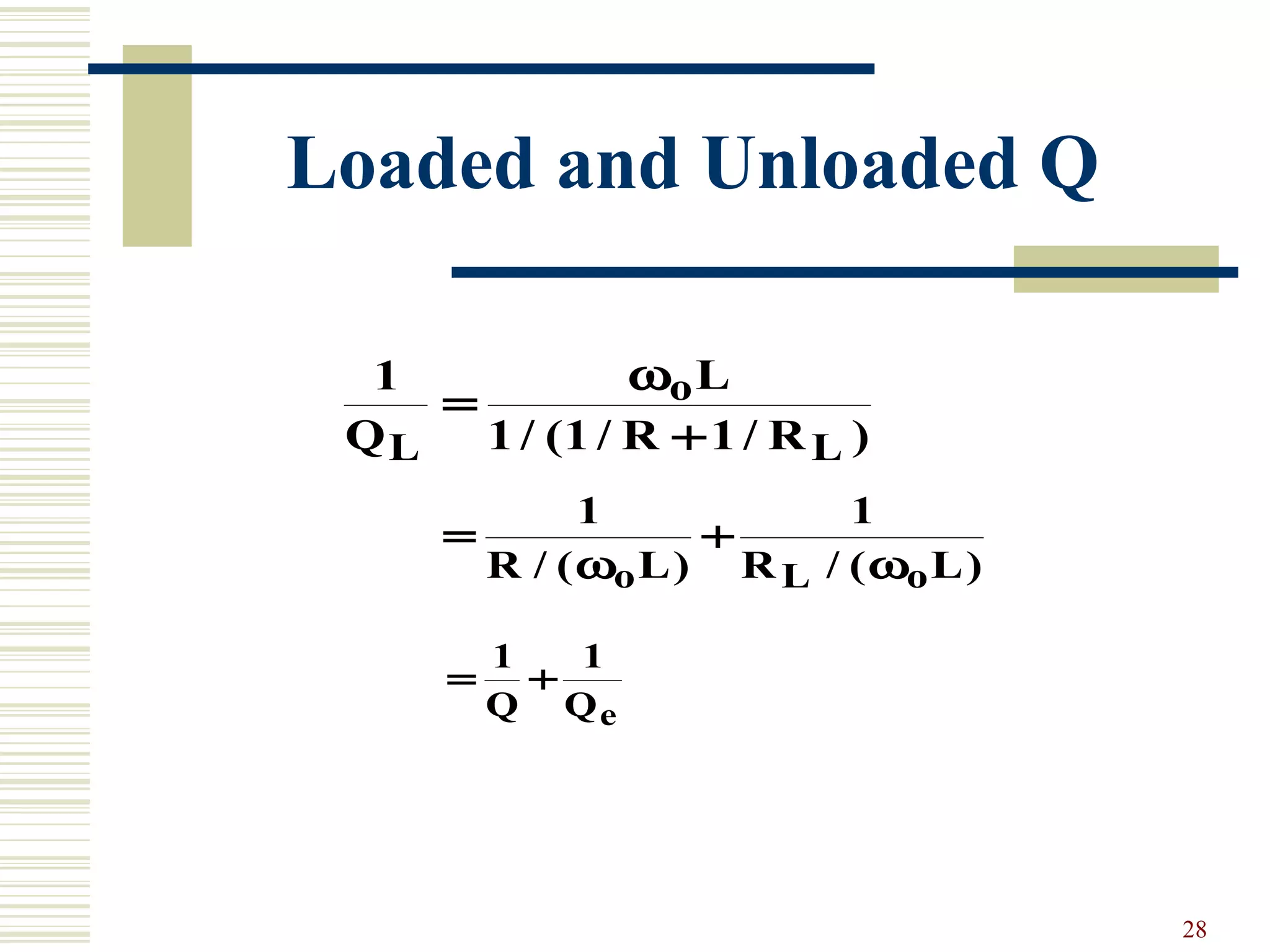
Loaded and Unloaded Q
1
1 1 1
1
Q
L
R R R L RL
o
L o L
=
+
= +
ω
ω/ ( / / ) / ( )
1 1 1
1 1 1 1L
R R R L R L Q QL
o
L o L o e
=
+
= + = +
ω
ω ω/ ( / / ) / ( ) / ( )
1 1 1 1
R L R L Q Qo L o e
+ = +
ω ω/ ( ) / ( )
Series and Parallel Resonators
29
30

Series and parallel resonators

  • 1.
    1 Series and ParallelResonatorsSeries and Parallel Resonators Resonators
  • 2.
    2 What is aResonator ?  A resonator is a device or system that exhibits resonance or resonant behavior, i.e., it naturally oscillates at some frequencies, called its resonant frequencies, with greater amplitude than at others.
  • 3.
    3 Series RLC Circuits Consider the series RLC resonator shown below:
  • 4.
    4 Series RLC Circuits The input impedance Zin is given by -------(1)  The average complex power delivered to the resonator is Z R j L j C in = + −ω ω 1 P VI Z I I R j L j C in in= = = + −       1 2 1 2 1 2 12 2* ω ω
  • 5.
    5 Series RLC Circuits The average power dissipated by the resistor is  The time-averaged electric energy stored in the capacitor is  Similarly, the time-averaged magnetic energy stored in the inductor is P I Rloss = 1 2 2 W I Lm = 1 4 2
  • 6.
    6 Series RLC Circuits Input power can be written as  The input impedance can then be expressed as follows: -----(2)
  • 7.
    7 Series RLC Circuits At resonance, the average stored magnetic and electric energies are equal i.e., Wm = We.  So,  and the resonance frequency is defined as Z P I Rin loss= = 2 2/ ωo LC = 1
  • 8.
    8 Series RLC Circuits The Quality factor is defined as the product of the angular frequency and the ratio of the average energy stored to energy loss per second  Q is a measure of loss of a resonant circuit.  Lower loss implies higher Q and high Q implies narrower bandwidth. Q W W P m e loss = + ω
  • 9.
    9 Series RLC Circuits At resonance We = Wm and we have ---- (3)  When R decreases, Q increases as R dictates the power loss. Q W P L R RC o m loss o o = = =ω ω ω 2 1
  • 10.
    10 Series RLC Circuits The input impedance can be rewritten in the following form: Z R j L j C R j L LC Rin = + − = + − = +ω ω ω ω 1 1 1 2 ( )
  • 11.
    11 Series RLC Circuits and  so Zin can be written as ---(4) ω ω ω ω ω ω ω2 2 2− = − + = •o o o( )( ) ∆ω Z R j L R j L R j RQ in o ≈ + = + = +ω ω∆ω ω ω 2 2 2 2 ∆ω ∆ω
  • 12.
    13 Series RLC Circuits Consider the equation  As ---(5) Z R j L L Q j Lin o o≈ + = + −2 2∆ω ω ω ω( ) Q L R o= ω Z j L j Q j L j Q in o o o≈ − + = − +2 2 2 1 1 2 ( ) [ ( )]ω ω ω ω ω
  • 13.
    14 Series RLC Circuits From the EQ.4, when R = 0 for the lossless case, therefore, we can define a complex effective frequency ----(6) so that, --- (7) to incorporate the loss Z j Lin ≈ 2 ∆ω ω ωo o j Q ' ( )= +1 1 2 Z j Lin o≈ −2 ( )' ω ω
  • 14.
    15 Series RLC Circuits From EQ.4 we have Z R j RQ in o ≈ + 2 ∆ω ω
  • 15.
  • 16.
    17 Parallel RLC Circuits Now let us turn our attention to the parallel RLC resonator:
  • 17.
    18 Parallel RLC Circuits The input impedance is equal to -----(9)  At resonance, and , same results as we obtained in series RLC Z R j L j Cin = + +       − 1 1 1 ω ω Z Rin = ωo LC = 1
  • 18.
    19 Parallel RLC Circuits The quality factor, however, is different Q W P P I L I R I L Q L R V L V R R L RC o m loss o loss L o R L o o o o = = = = = = − − − ω ω ω ω ω ω ω 2 2 4 2 2 4 10 2 2 2 2 2 2 2 | | / | | / ( ) / ( )
  • 19.
    20 Parallel RLC Circuits Contrary to series RLC, the Q of the parallel RLC increases as R increases.  Similar to series RLC, we can derive an approximate expression of Zin for parallel RLC near resonance .
  • 20.
    21 Parallel RLC Circuits Given ∆ω = −ω ωo Z R j L j C R j L j C j Cin o o= + +       = + − + +       − − 1 1 1 1 1 1 ω ω ω ω ω ∆ω ∆ω / Z R j L j L j C j Cin o o o= + + + +       − 1 1 1 ∆ω ∆ω ωω ω ω Z R j L LC j L j Cin o o o = + + − +         − 1 1 2 1 ∆ω ∆ω ωω ω ω
  • 21.
    22 Parallel RLC Circuits ----(11) Z R j L jCin o o= + +         ≈ − 1 2 1 ∆ω ∆ω ω ω ω, Z R j L LC j Cin = + +       − 1 1 ∆ω ∆ω / ( ) Z R j Cin = +       − 1 2 1 ∆ω Z R j RC R j Q in o = + = +1 2 1 2∆ω ∆ω / ω
  • 22.
    23 Parallel RLC Circuits Similar to the series RLC case, the effect of the loss can be incorporated into the lossless result by defining a complex frequency equal to -----(12)ω ωo o j Q ' ( )= +1 1 2
  • 23.
  • 24.
    25 Loaded and UnloadedQ  Q defined above is a characteristic of the resonant circuit, this will change when the circuit is connected to a load Resonant circuit Q R L
  • 25.
    26 Loaded and UnloadedQ  if the load is connected with the series RLC, the resistance in the series RLC is given by R’=R+RL , the corresponding quality factor QL becomes Q L R L R R R L R L L o o L o L o = = + = + ω ω ω ω ' 1
  • 26.
    27 Loaded and UnloadedQ --- (13)  On the other hand, if the load is connected with the parallel RLC, we have 1/R’=1/R+1/RL 1 1 1 Q Q Q Q L R Q L RL e o e o L = + = =, , ω ω
  • 27.
    28 Loaded and UnloadedQ 1 1 1 1 1 Q L R R R L RL o L o L = + = + ω ω/ ( / / ) / ( ) 1 1 1 1 1 1 1L R R R L R L Q QL o L o L o e = + = + = + ω ω ω/ ( / / ) / ( ) / ( ) 1 1 1 1 R L R L Q Qo L o e + = + ω ω/ ( ) / ( )
  • 28.
    Series and ParallelResonators 29
  • 29.