1.1.1. Meaning and Definition of Finance
Finance is the backbone of any business. The business would not be able to run
without finance and may get decease. Finance is basically the art and science of
managing monetary resources of a business concern and is extremely crucial for
the survival of a business entity. Finance plays an important role, right from the
generation of the business idea to its day-to-day functioning and upto the
liquidation stage of a business. Finance aids in procurement of various resources
such as raw materials, machinery and equipment, human resources etc. and helps
to maintain the smooth flow of business operations. Thus, an efficient and healthy
financial management system in an organisation is essential.
According to F.W. Paisb, "Finance may be defined as the position of money
at the time it is wanted".
According to John J. Hampton, 'The term finance can be defined as the
management of the flows of money through an organisation, wliether it will be
a corporation, school, bank or government agency".
~ording to Howard and Upton, "~inance may be defined ~ _that
administrative area or set of administrative functions in an organisation which
---
relates with the arrang.emenLof each debiwmp credit so thaLthe organisation
may have the means-to carry out the objectives as satisfactorily as possible".
,--
~ .j,(2. Nature of Finance Function
Finance can be broadly classified into three decision areas, namely investment
~CifilQn, financing decjs_wn""and dividend decision. Investment decision mostly
relates to ~fficient allocation and utilisation of .company's funds to invest in
selected investment proposals after proper appraisal~ depending upon the
nature, type and scale of business, to maximise the company's profitability and
returns in the long-term. Financing decision revolves around the acquisition of
funds from various sources of finances available to the company. Whereas,
dividend decision relates to the company's dividend policy in order to
maximise shareholders' wealth. Thus, finance function revolves around all
other functions and activities of an organisation.
Few salient features of the finance function are mentioned below:
1) Finance function is mostly integrated and c~ntralised in every business
organisation, as it brings forth cost advantages to the company.
-- - ... --
16
(Unit-I) MBA Second Semester (Financial Management) Al)
2) I Prlive of si7e natnre, legal status, ev_ery organisation has a finance
rt.esp::,; ~ ~•..n:.ii!.)16.
--............_ _ _ _ f I th · · ·
function,--as it [>_l!ts across certain a"!ount o _contro on o er acttv1t1es and
- ..
functions of the orgamsauon. . . .
3) Ftnance and its reTated activitie~pla~ a _very s1gmficant role 10 the long.
t~rID¥Jll and survival of the org~1sat10~.. .
4) Finance function helps in managenal dec1s1on-making, through analysis
'iitdfu~etation of financial data.
5) Finance function is interrelated to other primary functions of business as
~:-SU-ch as ~keting, production planning. human resources, etc. These
functions are very much depenoent on finance and get affected by external
factors of environment.
6) Basically, "Valuation of a Firm" is one of the important aspects of the
finance function.
~1.3. Meaning & Definition ofFinancial Management
The term 'Financial Management' consists of two words - 'Financial' and
'Management'. In order to fully grasp the meaning of this term, one needs to
understand the meaning of two words. "Financial" denotes the process of
identifybl& obtaining and allocating sources of money. ''Management" is the
proce8s of planning, organising, coordinating and controlling various resources
for the accomplishment of organisational goal. Therefore, Financial
Management is that branch of business management process which deals with
management of financial resources of the enterprise. Financial management is
the skilful and proper management of financial resources.
According to Solomon, "Financial management is concerned with the efficient
use of an important economic resource, namely, Capital Funds".
According to J.F. Bradley, "Financial management is the area of business
management ~evo_ted to the judicious use of capital and careful selection of
sources of ~ap1tal m order to enable a spending unit to move in the direction of
reaching its goals".
Acco~ ~ ~eston _and Brigham, "Financial management is an area of
flnancial decision m~g, hannonising, individual motives and enterprise
• goals0
•
~1.4. Scope/Approaches of Financial Management
~e scope of rmancial management has ~wn over the years. In this respect,
different schools of thought/approaches have 01 th · ·
o&ven err views:
Scope/Approaches ofFinancial
Management
I Traditional School ofThought :t--◄1
Modem School of Thought ]
Jntn,duetion to Financial Management (Chapter I) 17
1) Tradido~al School of Thought: Under this school of thought, the scope
of financial management was restricted to obtaining of funds. The finance
maiua~er .was s~pposed to ~rovide funds as and when required by the
0rgamsatton. Fmance function excluded the utilisation of funds. The
decision regarding the application of funds were left to others.
Under this school of thought, the scope of financial management was
limited to the following functions: _
i) Assessment of fund requirements.
ii) Procurement of required funds from financial institutions.
iii) Acquiring funds through the issuance of financial products like shares,
bonds, debentures and loans.
iv) Managing accounting and legal framework of such transactions.
Limitations ofTraditional School of Thought
The traditional school of thought developed during 1920 and it evolved
through forties and early fifties. By the end of the fifth decade, the
popularity of this school of thought started to vanish. The main reasons for
the decline in its influence are given below:
i) Outsider-Looking-In Approach: The traditional school of thought
was mainly concerned with the acquisition and management of funds.
It looked at the finance function through an outsider's point of view.
These outsiders were generally bankers, suppliers and investors, etc.
Due to this, the scope of finance function was restricted. It completely
overlooked the importance of internal finance decision-making.
ii) Overlooked Regular I~ues: This school of thought primarily dealt
with the procurement of funds for big ticket events such as mergers,
acquisitions and incorporations. However, it did not dealt with day-to-
day financial issues such as acquisition of working capital, accounts
receivable management and cash management.
iii) Overlooked Non-Corporate Enterprises: Traditional school of
thought only dealt with financial issues faced by corporate entities.
The financial problems faced by non-incorporated businesses such as
partnership and sole proprietorship were not given much importance.
iv) Overlooked Working Capital Financing: The traditional school of
thought dealt with long-term financing decisions. It did not dealt with
short-tenn financing problems such as working capital management.
v) Ignored Allocation of Funds: This approach did not deal with the
distribution of funds. It only dealt with identification of sources of
funds and acquisition of funds. The scope of financial management
was described by Solomon as follo~s: . ?
a) Should a business pursue a particular proJect· . ed f
b) d turn with reqmf rate o
Making a comparison of expecte re s
return. . ' iequired benchmarks.
c) Determining cost of capital and setting up
d) De
. . . f financing resources.
tenmrung the proper ID1X o 1
18 (Unit-I) MBA Second Semester (Financial Management) AU
2) rtfodem School of Thought: Modern school of'thought takes a wid
view of scope of financial management. According to this school e;
thought, financial management conceptualises and analyses the process
O
f
financial decision-making. The finance function deals not only with ~
attainment of funds. but it also deals with the utilisation of fund e
Therefore, the modem school of thought is more comprehensive than ths.
traditional school of thought. e
Financial management deals with solving three main finance-related
problems faced by a firm. These three problems are investment, financing
and dividend. According to the modem definition, following are the main
functions performed by modem financial management:
i) Investment decision,
ii) Financing decision,
iii) Dividend policy decision, and
iv) Liquidity decision.
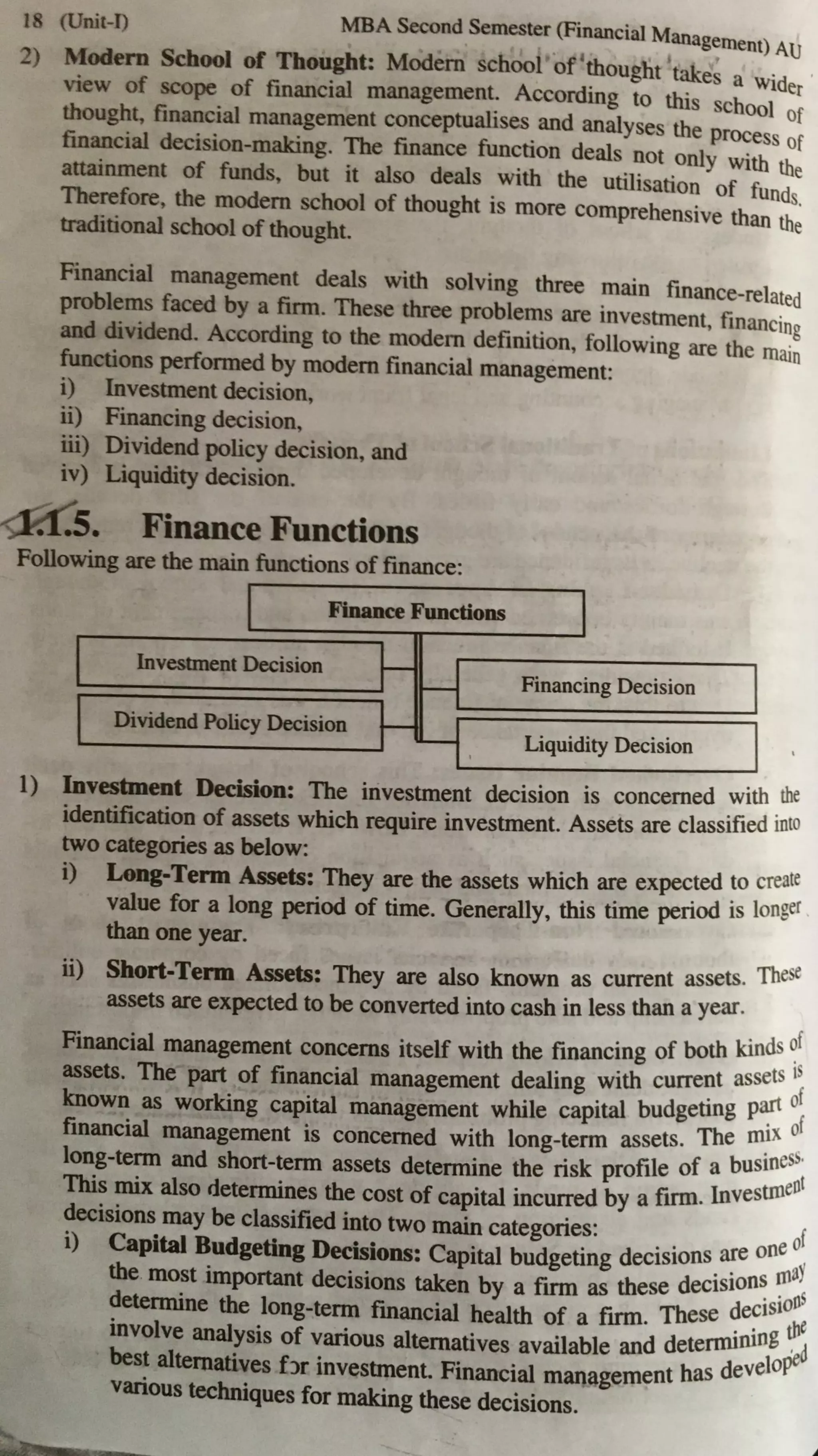
Finance Functions
Following are the main functions of finance:
I Finance Functions
Investment Decision i---
-
Dividend Policy Decision i---
...._
I
Financing Decision
Liquidity Decision
1) Investment Decision: The investment decision is concerned with the
identification of assets which require investment. Assets are classified into
two categories as below:
i) Long-Term ~ts: They are the assets which are expected to create
value for a long period of time. Generally, this time period is longer
than one year.
ii) Short-Term ~ts: They are also known as current assets. These
assets are expected to be converted into cash in less than a year.
Financial management concerns itself with the financing of both kiods ~f
assets. The part of financial management dealing with current assets
1
~
known as working capital management while capital budgeting P~
0
f
financial management is concerned with long-term assets. The mix 0
· ess,
lo°:g-te?D and short-~rm assets determine the risk profile of a busin ent
This llllX also detenmnes the cost of capital incurred by a firm. Invesun
decisions may be classified into two main categories: of
i) Capital Budgeting Decisions: Capital budgeting decisions.~e one aY
the mo~t important decisions taken by a firm as these decision~:ns
~eternune the long-term financial health of a firm. These ~e~is we
involve analysis of various alternatives available and detennuung ~oil
best altematives f)r investment. Financial management has develOP"p
various techniques for malcing these decisions.
Introduction to Financial Management (Chapter 1) 19

ii) Working Capital Decisions: Working capital decisions are short-
tenn in nature. A business needs to properly manage its short-term
working capital requirements in order to remain profitable and
liquid. An efficient firm maintains an optimal mix of profitability
and liquidity. However, profitability and liquidity are inversely
related.
Shortage of working capital may increase the risk profile of the
business as it will not be able to meet its current liabilities
appropriately. At the very same time, if more assets are held than
required, it will negatively impact the profitability of the concern. The
process of optimising working capital is called working capital
management. For maintaining proper capital managemen~ account
receivables and inventory should be managed properly. Financial
managers are also required to take non-recurring investment decisions.
Main examples of these decisions are re-organisations, liquidations
and mergers.
2) Financing Decision: The second most important decision that needs to be
taken by a finance manager is a financial decision. This decision entails
determining proper asset mix for the firm. Under this category, decisions
regarding the capital structure and financing of the business are taken. The
tenn "capital structure" may be defined as the mix of debt and equity
capital. A debt is a fixed interest bearing source of financing whereas
equity refers to variable interest or dividend payment. While taking a
financing decision, a finance manager needs to determine the proportion of
debt and equity to be used.
3) Dividend Policy Decision: Dividend policy decision is another important
decision that needs to be taken by a finance manager. These decisions are
closely related to financing decisions. A finance manager can either choose
to retain the business profits for future or may decide to distribute them
, among various stakeholders. Thus, a finance manager needs to decide
whether to retain or distribute the firm's profits.
4) Liquidity Decision: These decisions deal with the proper administration of
current assets of a firm. In this way, liquidity decisions are closely related
tQ working capital decisions. Working capital management is also
concerned with the proper utilisation of current assets. It is important for
short-tenn existence of a firm. These decisions also determine the course
of long-tenn existence of a firm.
1~current assets are more than required, then it ensures a firm'~ better
liquidity. This means that the firm will be able to honour its commitme~ts
on regular basis. This also denotes that a firm is not likely to default on its
repayments and hence it can avoid the risk of insolvency· However, the
· and thus
excess funds tied up in current assets can have alternative us~ .
have cost of utilisation. These unutilised funds can have ne_gative~:;1!:C:
on a fum•s profitability. A finance manager needs to stnke a
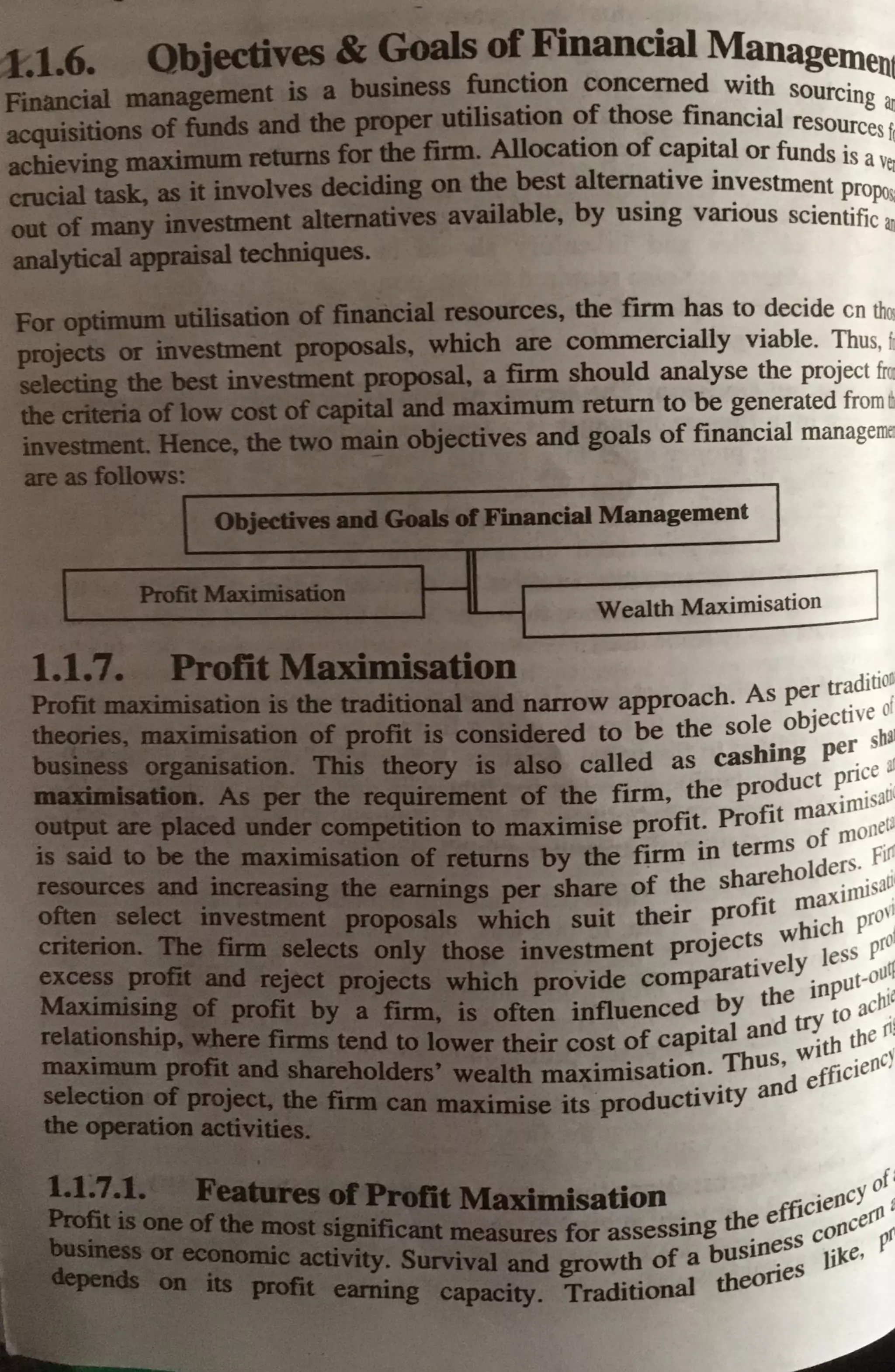
.....-6. Qbjectives& Goals ofFinancial Managel'h
bus. fun · •uen1
Fmanrial ...-nt is a mess ction concerned with sourc·
acquisilions of funds ud the proper utilisation of those financial reso:g ~
acbieviDg · 1e1111os for the fum. Allocation of capital or funds isces fi
· olv ..a--:~ th best alt · · avei
CDJCia1 tuk, alt b:w es ~ng on e emattve mvestment pro ,
. ail bl b . · ~
oat of ~ illtestment alternatives av a e, Y usmg vanous scientific
iBal
.._..___~
31
analytical.... ~ -
FOJ GtM: u•tlllilisalicJll of financial resources, the firm has to decide en th<.
projtctii or mvestmeot proposals, which are commercially viable. Thus, h
•• • _:f ii • • I
• f' .. ~ - ; : ~ -
· iavestn t proposal, a firm should analyse the project fra
,._ ,.. ....
cost ofcapital and maximum return to be generated from a
twb main objectives and goals of financial managelllel
-6,Financial Management
Wealth Maximisation
~-l Masin1isation
die traditional1md narrow approach. As per tr~ditio~
· t ve 01
• • • ~fit is considered to be the sole obJeC
1
b~
• ~ is also called as cashing pe~ s ~
. of the firm, the product ~n:e 0(
Pr fit maxurusa
to maximise profit. 0 1 f 00
etJ
~~,~!!"'M....,
· ...,."fM s by the firm in terms O m fi~
PM
=
•
.,~••
~-.~• per share of the shareholde~~sal'
;.- ftlllljj~~~ hich suit their profit rn_~ pro''
_ _ investment project~ wht~ess prol
P!t;tJ.Wch provide comparauvely_ put-ollq
often influenced by the
10
10
ach1
e
their cost of capital aod ~th w
ertl
th
. . . TbUS Wl . ,,
maxumsat10?- . deffic1en '
RMJIIQl:ilnise its product1v1ty an
• ofl
,a•:aib1111dlsation fficieocY ,
• autres for assessing th~ e s cooce~r
growth of a bus1n~ss tiJce,
. Traditional theorie
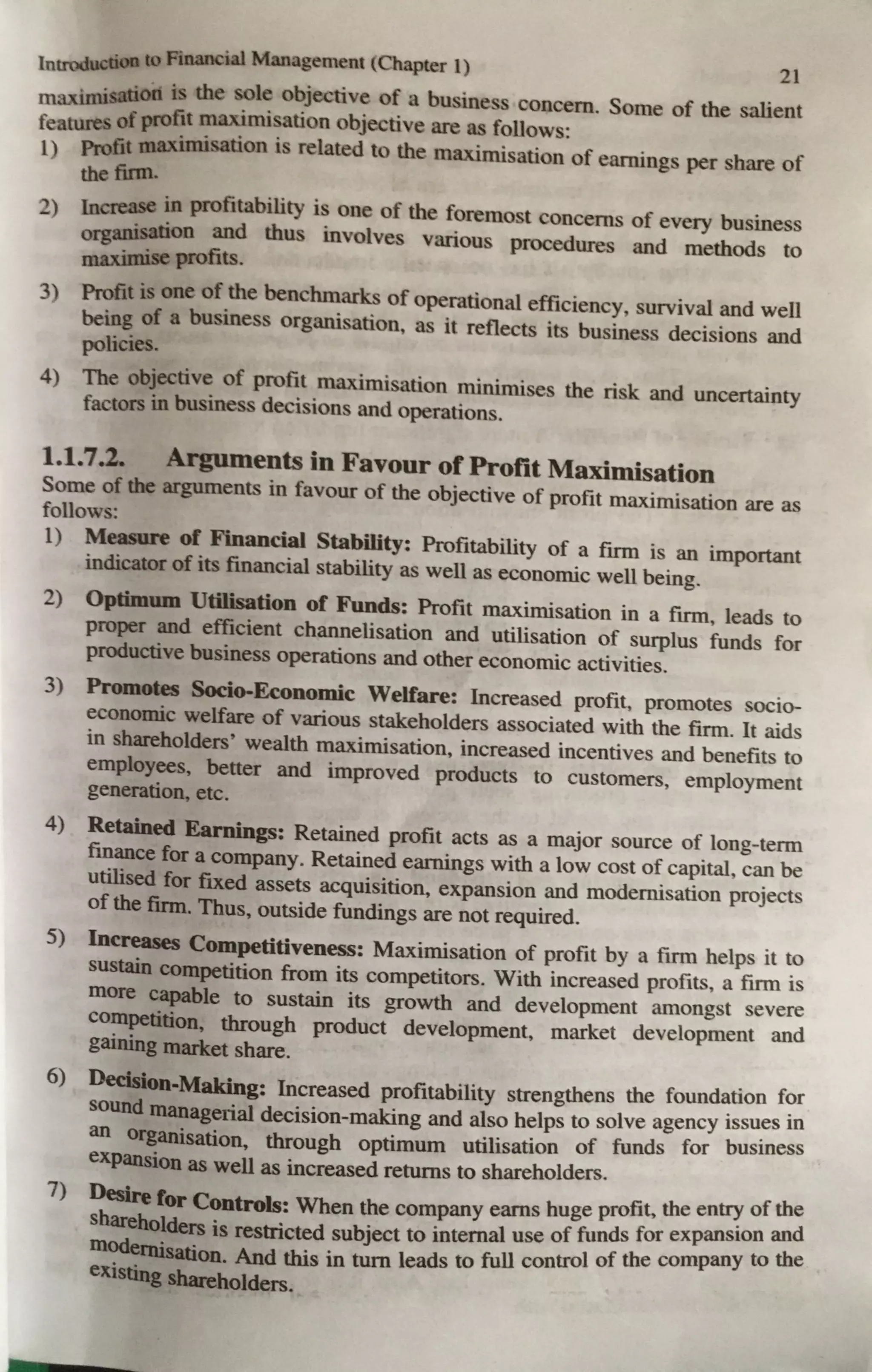
Introduction to Financial Management (Chapter l) 21
maximisatiod is the sole objective of a business concern. Some of the salient
features of profit maximisation objective are as follows:
1) Profit maximisation is related to the maximisation of earnings per share of
the firm.
:!) Increase in profitability is one of the fore1nost concerns of every business
organisation and thus involves various procedures and methods to
maximise profits.
3) Profit is one of the benchmarks of operational efficiency, survival and well
being of a business organisation, as it reflects its business decisions and
policies.
4) The objective of profit maximisation rninimises the risk and uncertainty
factors in business decisions and operations.
1.1.7.2. Arguments in Favour of Profit Maximisation
Some of the arguments in favour of the objective of profit maximisation are as
follows:
1) Measure of Financial Stability: Profitability of a firm is an important
indicator of its financial stability as well as economic well being.
2) Optimum Utilisation of Funds: Profit maximisation in a firm, leads to
proper and efficient channelisation and utilisation of surplus funds for
productive business operations and other economic activities.
3) Promotes Socio-Economic Welfare: Increased profit, promotes socio-
economic welfare of various stakeholders associated with the firm. It aids
in shareholders' wealth maximisation, increased incentives and benefits to
employees, better and improved products to customers, employment
generation, etc.
4) Retained Earnings: Retained profit acts as a major source of long-term
finance for a company. Retained earnings with a low cost of capital, can be
utilised for fixed assets acquisition, expansion and modernisation projects
of the firm. Thus, outside fundings are not required.
S) Increases Competitiveness: Maximisation of profit by a firm helps it to
sustain competition from its competitors. With increased profits, a firm is
more capable to sustain its growth and development amongst severe
competition, through product development, market development and
gaining market share.
6) Decision-Making: Increased profitability strengthens the foundation for
sound managerial decision-making and also helps to solve agency issues in
an organisation, through optimum utilisation of funds for business
expansion as well as increased returns to shareholders.
7) Desire for Controls: When the company earns huge profit~ the en~ of the
shareholders is restricted subject to internal use of funds for expanSmn and
modernisation. And this in tum leads to full control of the company to tbe
existing shareholders.
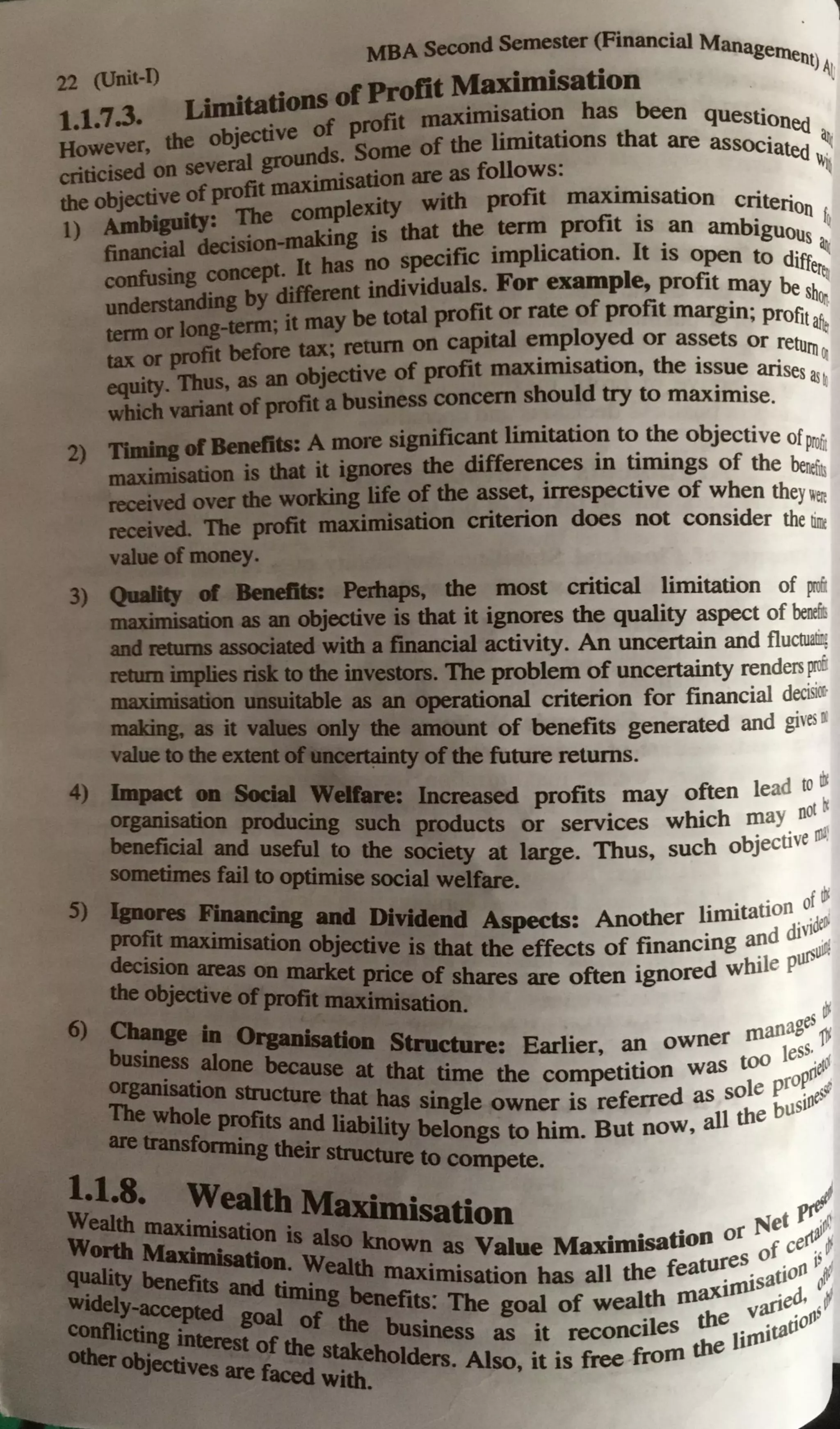
MBA Second Semester (Financial Manag
22 (Unit-0 ••--'--IQati elllent)A
l
ml doDS ofProfit i • ~ on
t.t.7.3. Lf:t&. of profit maximisation has been questioned
H~~ver, the
:'1~-Some of the limitations that are associatect ~
en~ ~ of tit maximiS8UOD are as follows: . . . ~
the objedive ~
The complexity with profit maxurusation criterio
1) AJnl~ ~aJdng is that the term profit is an ambiguou
O
f~
fi~ ~ - It bas 00 ~J>_Cclfic implication. It is open to d~ ~
=:..by ditfllmt individuals. For example, profit ?1ay be 8~
1a'ID orI08I enn: it may be total profi~ or rate of profit margin; profit~
-Jat before tax; rewrn on capital employed or assets or return
faXOl'pvaa, fl • • . th • ~
equity.. 11111s, as 18 objective of pro t maximtsatton, e issue arisesas
wtaidl variantofprofit a business concern should try to maximise. •
2) n bl1ffBcaeilts: A more significant limitation to the objective ofP
rofit
ma:rimiserioo is tbat it ignores the differences in timings of the be~~
~ over the woodng life of the asset, irrespective of when theywen
received. The pofit ma:rimisation criterion does not consider thetirri
value ofmoney.
3) 1
Q lb fll Be■ Pew: Pabaps, the most critical limitation of ~
• · · as an objective is that it ignores the quality aspect of benef!
111d"""8 associaled with a financial activity. An uncertain and fluctua!Q
mumiq,tics dsk to the investom. The problem of uncertainty rendersJXofl
· · · umuitable as an operational criterion for financial deciskt-
f I. • If I ...... '' • I
11 , 11, .• J I I
malring. • it v t es only the amount of benefits generated and gi,·es"
vaJueID dieexteat~ty ofthe future returns.
4) • ~ ~ 8..a ~ : Increased profits may often lead to dr
orpmsatkm pmducmg such products or services which may not ~
b !Ii ·a1 and . . . tll,11
alfv_CI useful to the SOClety at large. Thus, such obJecnve ·
Mld;ues fail to optimise social welfare.
S) JJarsna l'k:•wi"I and Dnldend Aspects· Another limitation o: ~
profit • • • • di 1dell-
~XllDJsation ob,iecti~e is that the effects of financing ~d ~uir4
theo1,· ~
on ID8lbt pnce of shares are often ignored while P
!Je(:tive wpioftt Olfttfmisation.
6) Oram • at es ~
=::-• 7Wk ._ Stncture· Earlier an owner manag 1Y
~-- •lone beca · ' Jess,
«aarilltion ~se at that.time the competition was too roP~etd
'lbewbole ~ ~-~ smgle owner is referred as sole ~usioeS-~
•traraafoa • =liability belongs to him. But now, all the
Daug strucbuc to compete.
l.l.8. Wea1t1a M11vmi · .J
Weadtl,. maxbnisation . --sation . Net ft"."f.
.... Mui fr ,._•.:-known as Value Maximisation or f ce~;
~-~ and tqp· "1lll maximisation has all the fea~~:auofl
1
~~
. le(;1d 80ll i48f...-fi~: The goal of weal~h 111~ vari~• ,~
ol,jec:uvea are .-_~
... "!beholders. Also, it is free from the
1
&...-.:QVitb.
1
Introduction to Financial Management (Chapter 1)
23
Accordin& to Ezra Solomon; wealth maximisation goal is "The gross present
worth of a course of action is equal to the capitalised value of the flow of future
expected benefits, discounted (or capitalised) at a rate which reflects the
uncertainty or certainty. Wealth or net present worth is the difference between
gross present worth and the amount of capital investment required to achieve
the benefits."
Shareholders being the true owners of the firm are entitled to the residual profit
only. After meeting the commitment to all other stakeholders they get the
remaining. Shareholders' claim cannot precede that of any other stakeholders.
Thus, by maximisation of residual as the objective of the firm, it can safely be
stated that all preceding commitments have been adequately satisfied. Pursuit
of this all encompassing goals by the firm ensures that the interest of all the
different stakeholders is taken care of in the process as this wealth
maximisation as a goal is in congruence with the objectives of the varied
stakeholders.
No firm can bring about sustained increase in the wealth of its owners without
taking care of the interest of its other stakeholders. For example, deteriorating
liquidity position of a firm makes the lenders, current and prospective, worried
about its creditworthiness, which eventually gets reflected in its share prices
and consequently the wealth of the shareholders. Similarly, a firm that cannot
retain its existing customers will witness a decline in its sales and consequently
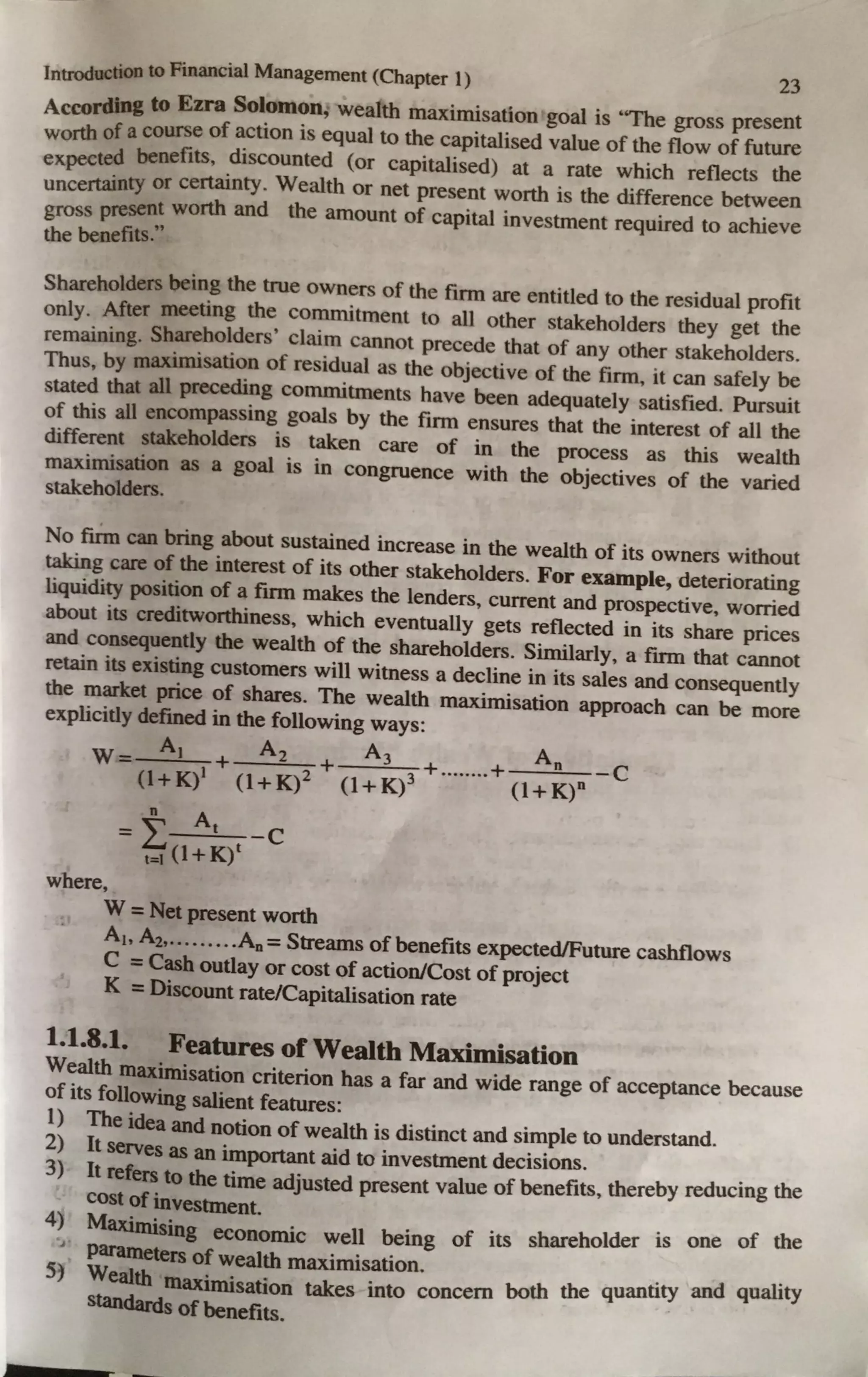
the market price of shares. The wealth maximisation approach can be more
explicitly defined in the following ways:
- A1 A2 A3 An
W- (l+K)1 + (l+K)2 + (l+K)3 + ........+ (l+K)n -C
= t At -C
t=I (1+K)t
where,
W = Net present worth
Ai, A2, ••••.••.•A0 = Streams of benefits expected/Future cashflows
C =Cash outlay or cost of action/Cost of project
K =Discount rate/Capitalisation rate
1.1.8.1. Features of Wealth Maximisation
Wealth maximisation criterion has a far and wide range of acceptance because
of its following salient features:
1) The idea and notion of wealth is distinct and simple to understand.
2) It serves as an important aid to investment decisions.
3) It refers to the time adjusted present value of benefits, thereby reducing the
cost of investment.
4) Maximising economic well being of its shareholder is one of the
...,
Parameters of wealth maximisation.
5) Wealth maximisation takes into concern both the quantity and quality
standards ofbenefits.
24
(Unit-I) MBA Second Semester (Financial Managemeqt) A~
6) It also integrates the time value of money, risk and uncertainty factors.
7) It considers that the shareholder's wealth is maximised only when tli
market price per share is maximised. e
S) It also avoids agency issues in an organis~~on, as it encompasses the
personal goals of executives, such as recogrut1on, power, status, personai
wealth, etc.
9) It eliminates the associated limitations of the profit maximisation objectiv,
of financial management.
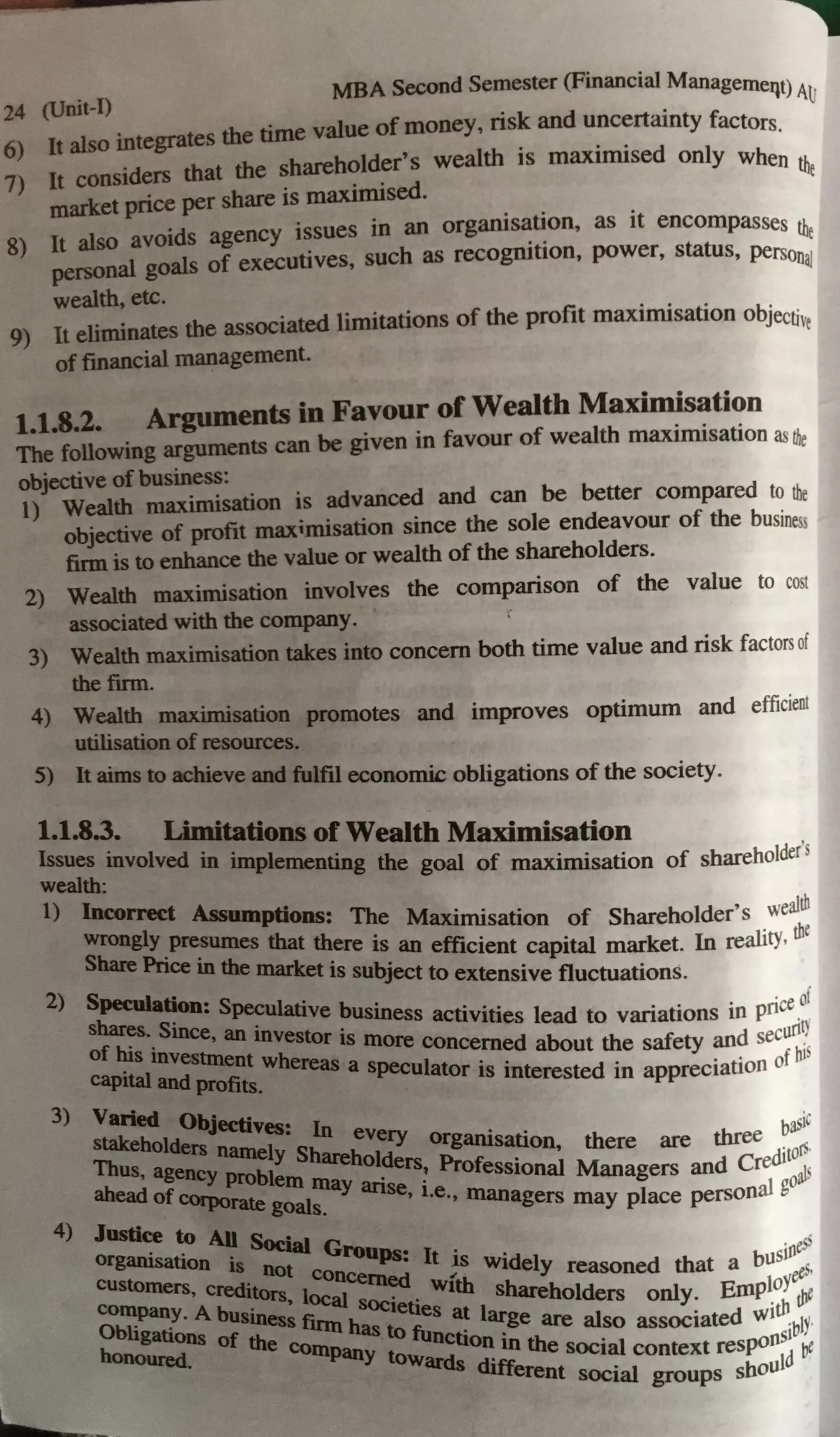
1.1.8.2. Arguments in Favour of Wealth Maximisation
'The following arguments can be given in favour of wealth maximisation asthe
objective of business:
1) Wealth maximisation is advanced and can be better compared to the
objective of profit maximisation since the sole endeavour of the business
firm is to enhance the value or wealth of the shareholders.
2) Wealth maximisation involves the comparison of the value to cost
associated with the company.
3) Wealth maximisation takes into concern both time value and risk factors of
the firm.
4) Wealth maximisation promotes and improves optimum and efficient
utilisation of resources.
5) It aims to achieve and fulfil economic obligations of the society.
1.1.8~. Limitations of Wealth Maximisation
Issues mvolved in implementing the goal of maximisation of shareholder's
wealth:
l) Inco~ Assumptions: The Maximisation of Shareholder's wealth
=~:C~U:s that ~ere is_ an efficient capital market. In reality, th~
market 18 subJCCt to extensive fluctuations.
2) Speculation• Specuiati b · f
shares. s~ . ve usmess activities lead to variations in price 0
, an mvestor is more uriQ
of his investment h concerned about the safety and sec .
· w ereas a speculat · · • · · f hJS
capital and profits. or 1s interested 1n apprec1atton o
3) Varied ObJ
take ectives: In eve basic
8
holders namely Shareh ry organisation, there are three . .
Thus, agency problem may ::rs! Professional Managers and Cred1t
0
;
5
aheado f ~ goals. ' i.e., managers may place personal go
4) Justiee to All ~--
organisation · ~ Gl"Ollps• It · · · eS5
customers ~ Dot concerned w~ widely reasoned that a bU51
~ 5
•
company. 'A ~ l<>caI societies at shareholders only. Erop~oY t1te
Obligations of the finn has to functio
1
81:ge are also associated wit1
y-
honourcd. company towards ~ 10 the social context resp<>f151 i,e
different social groups should
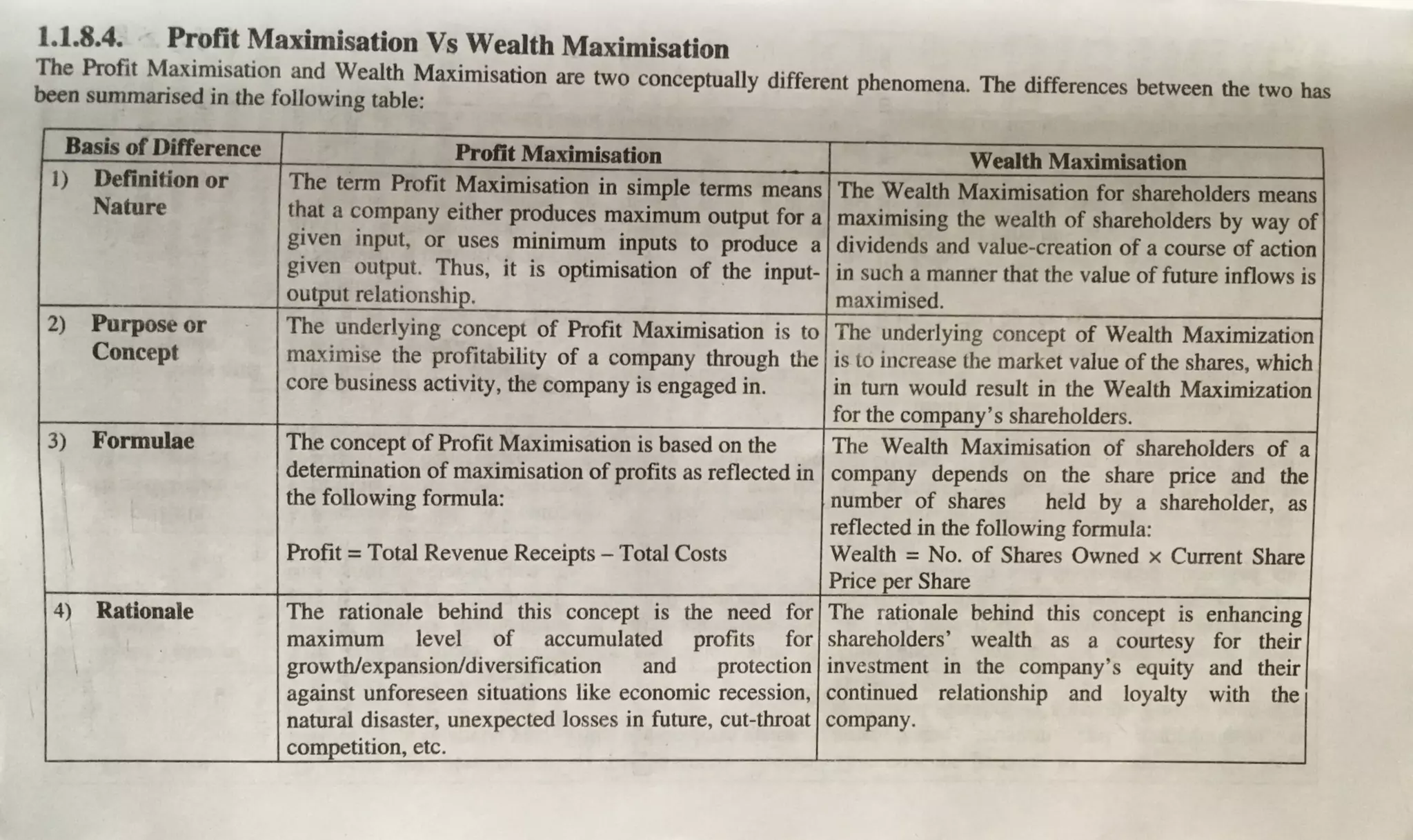
1.1.8.4. Profit Maximisation Vs Wealth Maximisation
The Profit Maximisation and Wealth Maximisation are two conceptually different phenomena. The differences between the two has
been summarised in the following table:
Basis ofDifference
l) Definition or
Nature
2) Purpose or
Concept
3) Formulae
4) Rationale
Profit Maximisation
The tenn Profit Maximisation in simple terms means
that a company either produces maximum output for a
given input, or uses minimum inputs to produce a
given output. Thus, it is optimisation of the input-
output relationship.
The underlying concept of Profit Maximisation is to
ma'<imise the profitability of a company through the
core business activity, the company is engaged in.
The concept of Profit Maximisation is based on the
determination of maximisation of profits as reflected in
the following formula:
Profit = Total Revenue Receipts - Total Costs
The rationale behind this concept is the need for
maximum level of accumulated profits for
growth/expansion/diversification and protection
against unforeseen situations like economic recession,
natural disaster, unexpected losses in future, cut-throat
competition, etc.
Wealth Maximisation
The Wealth Maximisation for shareholders means
maximising the wealth of shareholders by way of
dividends and value-creation of a course of action
in such a manner that the value of future inflows is
maximised.
The underlying concept of Wealth Maximization
is to increase the market value of the shares, which
in tum would result in the Wealth Maximization
for the company's shareholders.
The Wealth Maximisation of shareholders of a
company depends on the share price and the
number of shares held by a shareholder, as
reflected in the following formula:
Wealth = No. of Shares Owned x Current Share
Price per Share
The rationale behind this concept is enhancing
shareholders' wealth as a courtesy for their
investment in the company's equity and their
continued relationship and loyalty with the
company.
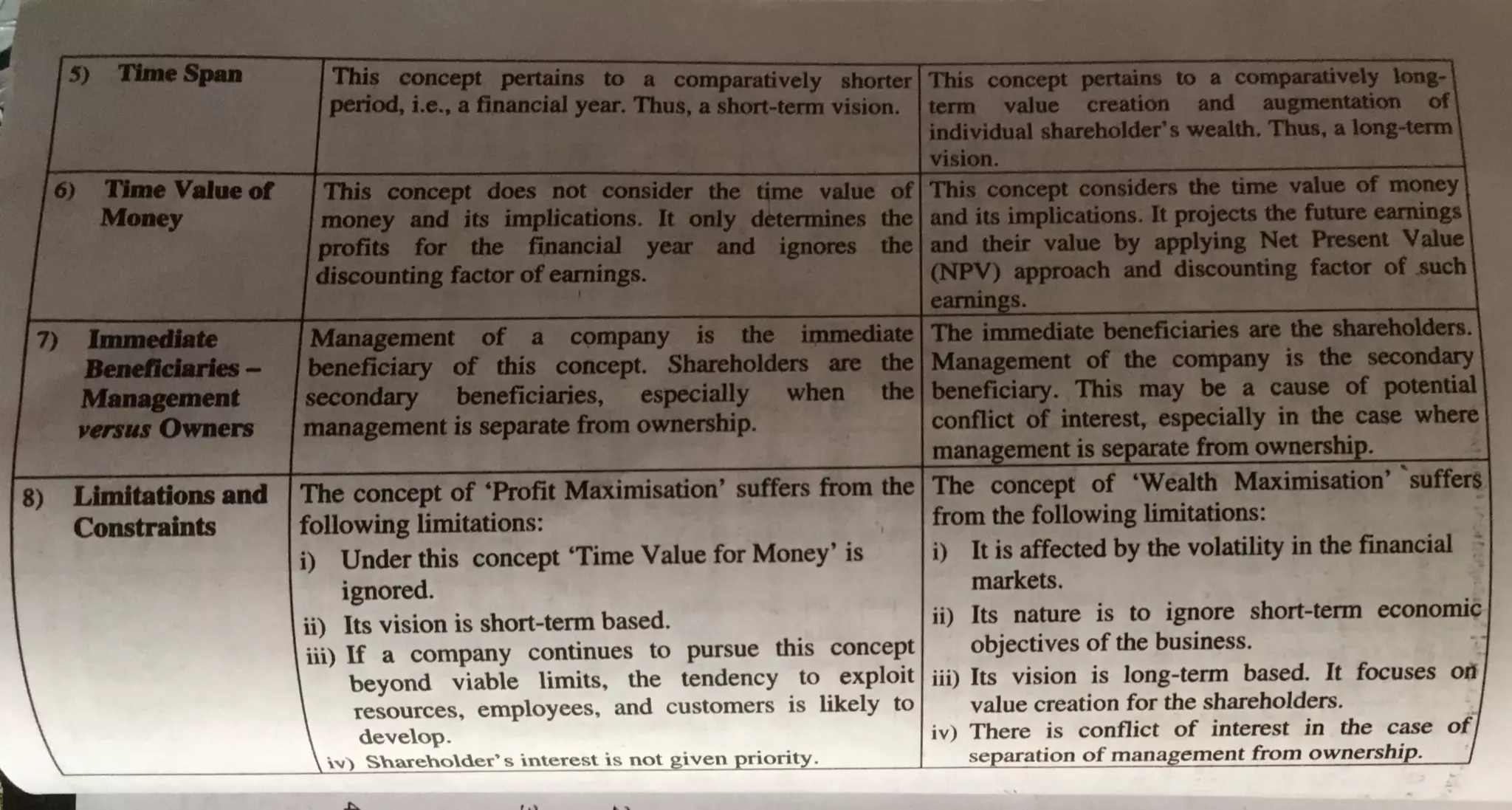
8) Ltmltatlom and
Constraints
The concept of 'Profit Maximisation' suffers from the
following limitations:
i) Under this concept 'Time Value for Money' is
ignored.
ii) Its vision is short-term based.
iii) If a company continues to pursue this concept
beyond viable limits, the tendency to exploit
resources, employees, and customers is likely to
develop.
,v) Snarehoder• s interest is not
is from .
1be concept of 'Wealth Maximisation' 'sufferi
from the following limitations:
i) It is affected by the volatility in the financial ·
markets.
ii) Its nature is to ignore short-tenn economic
objectives of the business.
iii) Its vision is long-term based. It focuses olf
value creation for the shareholders.
iv) There is conflict of interest in the case
se aration of mana em en t fro m ownershi .
Introduction to Financial Management (Chapter 1) 27
1.1.9. Finance Manager
The post of a 'finance manager' in a company is a key position. He/she is the
person solely responsible for carrying out the finance functions of a company.
He/she is part of the 'Top Management' team and his/her role is to the
extremely efficient in solving complicated fund management issues and also
acting as the financial advisor to the top management.
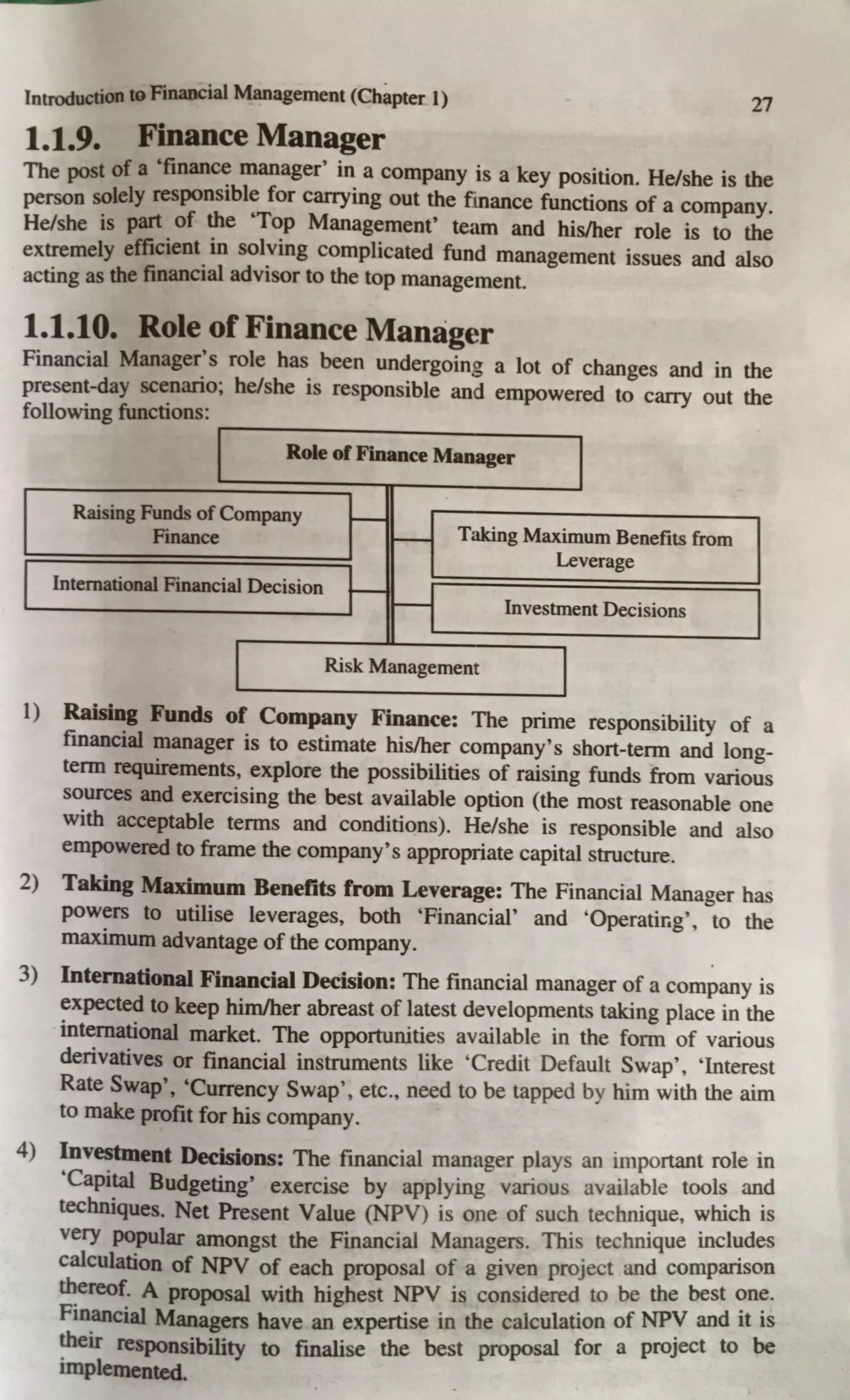
1.1.10. Role of Finance Manager
Financial Manager's role has been undergoing a lot of changes and in the
present-day scenario; he/she is responsible and empowered to carry out the
following functions:
Role of Finance Manager
Raising Funds of Company
-
Finance
- Taking Maximum Benefits from
Leverage
International Financial Decision
- - Investment Decisions
Risk Management
I) Raising Funds of Company Finance: The prime responsibility of a
financial manager is to estimate his/her company's short-term and long-
term requirements, explore the possibilities of raising funds from various
sources and exercising the best available option (the most reasonable one
with acceptable terms and conditions). He/she is responsible and also
empowered to frame the company's appropriate capital structure.
2) Taking Maximum Benefits from Leverage: The Financial Manager has
powers to utilise leverages, both 'Financial' and 'Operatir.g', to the
maximum advantage of the company.
3) International Financial Decision: The financial manager of a company is
expected to keep him/her abreast of latest developments taking place in the
international market. The opportunities available in the form of various
derivatives or financial instruments like 'Credit Default Swap', 'Interest
Rate Swap', 'Currency Swap', etc., need to be tapped by him with the aim
to make profit for his company.
4) Investment Decisions: The financial manager plays an important role in
'Capital Budgeting' exercise by applying various available tools and
techniques. Net Present Value (NPV) is one of such technique, which is
very popular amongst the Financial Managers. This technique incl~des
calculation of NPV of each proposal of a given project and companson
thereof. A proposal with highest NPV is considered to be the best ~n~.
Financial Managers have an expertise in the calculation of NPY and it 1s
their responsibility to finalise the best proposal for a proJect to be
implemented.
28 (Unit-I) MBA secona ~emester r1Jlilll,;1W 1viwu1bc11t~nr, AU
5) Risk Management: Risk is the part and parcel of a project or vent1.1re
undertaken by a company, although at times it is clearly visible and
sometimes it is hidden. Avoidance of risks altogether during the conduct of
a business is next to impossible. What is required is its identification and
efficient management (mitigation and control) of risk, which is the
responsibility of financial managers. They are free to delegate
responsibilities, in this regard, down the line, but they are the one
answerable to the top management in the areas of risk ·management. The,
are also responsible, in this connection, for the coordination with th;
institutions like insurance companies and rating agencies, who have
specialised knowledge in the field of risk management.

unit 1.pdf

  • 1.
    1.1.1. Meaning andDefinition of Finance Finance is the backbone of any business. The business would not be able to run without finance and may get decease. Finance is basically the art and science of managing monetary resources of a business concern and is extremely crucial for the survival of a business entity. Finance plays an important role, right from the generation of the business idea to its day-to-day functioning and upto the liquidation stage of a business. Finance aids in procurement of various resources such as raw materials, machinery and equipment, human resources etc. and helps to maintain the smooth flow of business operations. Thus, an efficient and healthy financial management system in an organisation is essential. According to F.W. Paisb, "Finance may be defined as the position of money at the time it is wanted". According to John J. Hampton, 'The term finance can be defined as the management of the flows of money through an organisation, wliether it will be a corporation, school, bank or government agency". ~ording to Howard and Upton, "~inance may be defined ~ _that administrative area or set of administrative functions in an organisation which --- relates with the arrang.emenLof each debiwmp credit so thaLthe organisation may have the means-to carry out the objectives as satisfactorily as possible". ,-- ~ .j,(2. Nature of Finance Function Finance can be broadly classified into three decision areas, namely investment ~CifilQn, financing decjs_wn""and dividend decision. Investment decision mostly relates to ~fficient allocation and utilisation of .company's funds to invest in selected investment proposals after proper appraisal~ depending upon the nature, type and scale of business, to maximise the company's profitability and returns in the long-term. Financing decision revolves around the acquisition of funds from various sources of finances available to the company. Whereas, dividend decision relates to the company's dividend policy in order to maximise shareholders' wealth. Thus, finance function revolves around all other functions and activities of an organisation. Few salient features of the finance function are mentioned below: 1) Finance function is mostly integrated and c~ntralised in every business organisation, as it brings forth cost advantages to the company. -- - ... --
  • 2.
    16 (Unit-I) MBA SecondSemester (Financial Management) Al) 2) I Prlive of si7e natnre, legal status, ev_ery organisation has a finance rt.esp::,; ~ ~•..n:.ii!.)16. --............_ _ _ _ f I th · · · function,--as it [>_l!ts across certain a"!ount o _contro on o er acttv1t1es and - .. functions of the orgamsauon. . . . 3) Ftnance and its reTated activitie~pla~ a _very s1gmficant role 10 the long. t~rID¥Jll and survival of the org~1sat10~.. . 4) Finance function helps in managenal dec1s1on-making, through analysis 'iitdfu~etation of financial data. 5) Finance function is interrelated to other primary functions of business as ~:-SU-ch as ~keting, production planning. human resources, etc. These functions are very much depenoent on finance and get affected by external factors of environment. 6) Basically, "Valuation of a Firm" is one of the important aspects of the finance function. ~1.3. Meaning & Definition ofFinancial Management The term 'Financial Management' consists of two words - 'Financial' and 'Management'. In order to fully grasp the meaning of this term, one needs to understand the meaning of two words. "Financial" denotes the process of identifybl& obtaining and allocating sources of money. ''Management" is the proce8s of planning, organising, coordinating and controlling various resources for the accomplishment of organisational goal. Therefore, Financial Management is that branch of business management process which deals with management of financial resources of the enterprise. Financial management is the skilful and proper management of financial resources. According to Solomon, "Financial management is concerned with the efficient use of an important economic resource, namely, Capital Funds". According to J.F. Bradley, "Financial management is the area of business management ~evo_ted to the judicious use of capital and careful selection of sources of ~ap1tal m order to enable a spending unit to move in the direction of reaching its goals". Acco~ ~ ~eston _and Brigham, "Financial management is an area of flnancial decision m~g, hannonising, individual motives and enterprise • goals0 • ~1.4. Scope/Approaches of Financial Management ~e scope of rmancial management has ~wn over the years. In this respect, different schools of thought/approaches have 01 th · · o&ven err views: Scope/Approaches ofFinancial Management I Traditional School ofThought :t--◄1 Modem School of Thought ]
  • 3.
    Jntn,duetion to FinancialManagement (Chapter I) 17 1) Tradido~al School of Thought: Under this school of thought, the scope of financial management was restricted to obtaining of funds. The finance maiua~er .was s~pposed to ~rovide funds as and when required by the 0rgamsatton. Fmance function excluded the utilisation of funds. The decision regarding the application of funds were left to others. Under this school of thought, the scope of financial management was limited to the following functions: _ i) Assessment of fund requirements. ii) Procurement of required funds from financial institutions. iii) Acquiring funds through the issuance of financial products like shares, bonds, debentures and loans. iv) Managing accounting and legal framework of such transactions. Limitations ofTraditional School of Thought The traditional school of thought developed during 1920 and it evolved through forties and early fifties. By the end of the fifth decade, the popularity of this school of thought started to vanish. The main reasons for the decline in its influence are given below: i) Outsider-Looking-In Approach: The traditional school of thought was mainly concerned with the acquisition and management of funds. It looked at the finance function through an outsider's point of view. These outsiders were generally bankers, suppliers and investors, etc. Due to this, the scope of finance function was restricted. It completely overlooked the importance of internal finance decision-making. ii) Overlooked Regular I~ues: This school of thought primarily dealt with the procurement of funds for big ticket events such as mergers, acquisitions and incorporations. However, it did not dealt with day-to- day financial issues such as acquisition of working capital, accounts receivable management and cash management. iii) Overlooked Non-Corporate Enterprises: Traditional school of thought only dealt with financial issues faced by corporate entities. The financial problems faced by non-incorporated businesses such as partnership and sole proprietorship were not given much importance. iv) Overlooked Working Capital Financing: The traditional school of thought dealt with long-term financing decisions. It did not dealt with short-tenn financing problems such as working capital management. v) Ignored Allocation of Funds: This approach did not deal with the distribution of funds. It only dealt with identification of sources of funds and acquisition of funds. The scope of financial management was described by Solomon as follo~s: . ? a) Should a business pursue a particular proJect· . ed f b) d turn with reqmf rate o Making a comparison of expecte re s return. . ' iequired benchmarks. c) Determining cost of capital and setting up d) De . . . f financing resources. tenmrung the proper ID1X o 1
  • 4.
    18 (Unit-I) MBASecond Semester (Financial Management) AU 2) rtfodem School of Thought: Modern school of'thought takes a wid view of scope of financial management. According to this school e; thought, financial management conceptualises and analyses the process O f financial decision-making. The finance function deals not only with ~ attainment of funds. but it also deals with the utilisation of fund e Therefore, the modem school of thought is more comprehensive than ths. traditional school of thought. e Financial management deals with solving three main finance-related problems faced by a firm. These three problems are investment, financing and dividend. According to the modem definition, following are the main functions performed by modem financial management: i) Investment decision, ii) Financing decision, iii) Dividend policy decision, and iv) Liquidity decision. Finance Functions Following are the main functions of finance: I Finance Functions Investment Decision i--- - Dividend Policy Decision i--- ...._ I Financing Decision Liquidity Decision 1) Investment Decision: The investment decision is concerned with the identification of assets which require investment. Assets are classified into two categories as below: i) Long-Term ~ts: They are the assets which are expected to create value for a long period of time. Generally, this time period is longer than one year. ii) Short-Term ~ts: They are also known as current assets. These assets are expected to be converted into cash in less than a year. Financial management concerns itself with the financing of both kiods ~f assets. The part of financial management dealing with current assets 1 ~ known as working capital management while capital budgeting P~ 0 f financial management is concerned with long-term assets. The mix 0 · ess, lo°:g-te?D and short-~rm assets determine the risk profile of a busin ent This llllX also detenmnes the cost of capital incurred by a firm. Invesun decisions may be classified into two main categories: of i) Capital Budgeting Decisions: Capital budgeting decisions.~e one aY the mo~t important decisions taken by a firm as these decision~:ns ~eternune the long-term financial health of a firm. These ~e~is we involve analysis of various alternatives available and detennuung ~oil best altematives f)r investment. Financial management has develOP"p various techniques for malcing these decisions.
  • 5.
    Introduction to FinancialManagement (Chapter 1) 19 ii) Working Capital Decisions: Working capital decisions are short- tenn in nature. A business needs to properly manage its short-term working capital requirements in order to remain profitable and liquid. An efficient firm maintains an optimal mix of profitability and liquidity. However, profitability and liquidity are inversely related. Shortage of working capital may increase the risk profile of the business as it will not be able to meet its current liabilities appropriately. At the very same time, if more assets are held than required, it will negatively impact the profitability of the concern. The process of optimising working capital is called working capital management. For maintaining proper capital managemen~ account receivables and inventory should be managed properly. Financial managers are also required to take non-recurring investment decisions. Main examples of these decisions are re-organisations, liquidations and mergers. 2) Financing Decision: The second most important decision that needs to be taken by a finance manager is a financial decision. This decision entails determining proper asset mix for the firm. Under this category, decisions regarding the capital structure and financing of the business are taken. The tenn "capital structure" may be defined as the mix of debt and equity capital. A debt is a fixed interest bearing source of financing whereas equity refers to variable interest or dividend payment. While taking a financing decision, a finance manager needs to determine the proportion of debt and equity to be used. 3) Dividend Policy Decision: Dividend policy decision is another important decision that needs to be taken by a finance manager. These decisions are closely related to financing decisions. A finance manager can either choose to retain the business profits for future or may decide to distribute them , among various stakeholders. Thus, a finance manager needs to decide whether to retain or distribute the firm's profits. 4) Liquidity Decision: These decisions deal with the proper administration of current assets of a firm. In this way, liquidity decisions are closely related tQ working capital decisions. Working capital management is also concerned with the proper utilisation of current assets. It is important for short-tenn existence of a firm. These decisions also determine the course of long-tenn existence of a firm. 1~current assets are more than required, then it ensures a firm'~ better liquidity. This means that the firm will be able to honour its commitme~ts on regular basis. This also denotes that a firm is not likely to default on its repayments and hence it can avoid the risk of insolvency· However, the · and thus excess funds tied up in current assets can have alternative us~ . have cost of utilisation. These unutilised funds can have ne_gative~:;1!:C: on a fum•s profitability. A finance manager needs to stnke a
  • 6.
    .....-6. Qbjectives& GoalsofFinancial Managel'h bus. fun · •uen1 Fmanrial ...-nt is a mess ction concerned with sourc· acquisilions of funds ud the proper utilisation of those financial reso:g ~ acbieviDg · 1e1111os for the fum. Allocation of capital or funds isces fi · olv ..a--:~ th best alt · · avei CDJCia1 tuk, alt b:w es ~ng on e emattve mvestment pro , . ail bl b . · ~ oat of ~ illtestment alternatives av a e, Y usmg vanous scientific iBal .._..___~ 31 analytical.... ~ - FOJ GtM: u•tlllilisalicJll of financial resources, the firm has to decide en th<. projtctii or mvestmeot proposals, which are commercially viable. Thus, h •• • _:f ii • • I • f' .. ~ - ; : ~ - · iavestn t proposal, a firm should analyse the project fra ,._ ,.. .... cost ofcapital and maximum return to be generated from a twb main objectives and goals of financial managelllel -6,Financial Management Wealth Maximisation ~-l Masin1isation die traditional1md narrow approach. As per tr~ditio~ · t ve 01 • • • ~fit is considered to be the sole obJeC 1 b~ • ~ is also called as cashing pe~ s ~ . of the firm, the product ~n:e 0( Pr fit maxurusa to maximise profit. 0 1 f 00 etJ ~~,~!!"'M...., · ...,."fM s by the firm in terms O m fi~ PM = • .,~•• ~-.~• per share of the shareholde~~sal' ;.- ftlllljj~~~ hich suit their profit rn_~ pro'' _ _ investment project~ wht~ess prol P!t;tJ.Wch provide comparauvely_ put-ollq often influenced by the 10 10 ach1 e their cost of capital aod ~th w ertl th . . . TbUS Wl . ,, maxumsat10?- . deffic1en ' RMJIIQl:ilnise its product1v1ty an • ofl ,a•:aib1111dlsation fficieocY , • autres for assessing th~ e s cooce~r growth of a bus1n~ss tiJce, . Traditional theorie
  • 7.
    Introduction to FinancialManagement (Chapter l) 21 maximisatiod is the sole objective of a business concern. Some of the salient features of profit maximisation objective are as follows: 1) Profit maximisation is related to the maximisation of earnings per share of the firm. :!) Increase in profitability is one of the fore1nost concerns of every business organisation and thus involves various procedures and methods to maximise profits. 3) Profit is one of the benchmarks of operational efficiency, survival and well being of a business organisation, as it reflects its business decisions and policies. 4) The objective of profit maximisation rninimises the risk and uncertainty factors in business decisions and operations. 1.1.7.2. Arguments in Favour of Profit Maximisation Some of the arguments in favour of the objective of profit maximisation are as follows: 1) Measure of Financial Stability: Profitability of a firm is an important indicator of its financial stability as well as economic well being. 2) Optimum Utilisation of Funds: Profit maximisation in a firm, leads to proper and efficient channelisation and utilisation of surplus funds for productive business operations and other economic activities. 3) Promotes Socio-Economic Welfare: Increased profit, promotes socio- economic welfare of various stakeholders associated with the firm. It aids in shareholders' wealth maximisation, increased incentives and benefits to employees, better and improved products to customers, employment generation, etc. 4) Retained Earnings: Retained profit acts as a major source of long-term finance for a company. Retained earnings with a low cost of capital, can be utilised for fixed assets acquisition, expansion and modernisation projects of the firm. Thus, outside fundings are not required. S) Increases Competitiveness: Maximisation of profit by a firm helps it to sustain competition from its competitors. With increased profits, a firm is more capable to sustain its growth and development amongst severe competition, through product development, market development and gaining market share. 6) Decision-Making: Increased profitability strengthens the foundation for sound managerial decision-making and also helps to solve agency issues in an organisation, through optimum utilisation of funds for business expansion as well as increased returns to shareholders. 7) Desire for Controls: When the company earns huge profit~ the en~ of the shareholders is restricted subject to internal use of funds for expanSmn and modernisation. And this in tum leads to full control of the company to tbe existing shareholders.
  • 8.
    MBA Second Semester(Financial Manag 22 (Unit-0 ••--'--IQati elllent)A l ml doDS ofProfit i • ~ on t.t.7.3. Lf:t&. of profit maximisation has been questioned H~~ver, the :'1~-Some of the limitations that are associatect ~ en~ ~ of tit maximiS8UOD are as follows: . . . ~ the objedive ~ The complexity with profit maxurusation criterio 1) AJnl~ ~aJdng is that the term profit is an ambiguou O f~ fi~ ~ - It bas 00 ~J>_Cclfic implication. It is open to d~ ~ =:..by ditfllmt individuals. For example, profit ?1ay be 8~ 1a'ID orI08I enn: it may be total profi~ or rate of profit margin; profit~ -Jat before tax; rewrn on capital employed or assets or return faXOl'pvaa, fl • • . th • ~ equity.. 11111s, as 18 objective of pro t maximtsatton, e issue arisesas wtaidl variantofprofit a business concern should try to maximise. • 2) n bl1ffBcaeilts: A more significant limitation to the objective ofP rofit ma:rimiserioo is tbat it ignores the differences in timings of the be~~ ~ over the woodng life of the asset, irrespective of when theywen received. The pofit ma:rimisation criterion does not consider thetirri value ofmoney. 3) 1 Q lb fll Be■ Pew: Pabaps, the most critical limitation of ~ • · · as an objective is that it ignores the quality aspect of benef! 111d"""8 associaled with a financial activity. An uncertain and fluctua!Q mumiq,tics dsk to the investom. The problem of uncertainty rendersJXofl · · · umuitable as an operational criterion for financial deciskt- f I. • If I ...... '' • I 11 , 11, .• J I I malring. • it v t es only the amount of benefits generated and gi,·es" vaJueID dieexteat~ty ofthe future returns. 4) • ~ ~ 8..a ~ : Increased profits may often lead to dr orpmsatkm pmducmg such products or services which may not ~ b !Ii ·a1 and . . . tll,11 alfv_CI useful to the SOClety at large. Thus, such obJecnve · Mld;ues fail to optimise social welfare. S) JJarsna l'k:•wi"I and Dnldend Aspects· Another limitation o: ~ profit • • • • di 1dell- ~XllDJsation ob,iecti~e is that the effects of financing ~d ~uir4 theo1,· ~ on ID8lbt pnce of shares are often ignored while P !Je(:tive wpioftt Olfttfmisation. 6) Oram • at es ~ =::-• 7Wk ._ Stncture· Earlier an owner manag 1Y ~-- •lone beca · ' Jess, «aarilltion ~se at that.time the competition was too roP~etd 'lbewbole ~ ~-~ smgle owner is referred as sole ~usioeS-~ •traraafoa • =liability belongs to him. But now, all the Daug strucbuc to compete. l.l.8. Wea1t1a M11vmi · .J Weadtl,. maxbnisation . --sation . Net ft"."f. .... Mui fr ,._•.:-known as Value Maximisation or f ce~; ~-~ and tqp· "1lll maximisation has all the fea~~:auofl 1 ~~ . le(;1d 80ll i48f...-fi~: The goal of weal~h 111~ vari~• ,~ ol,jec:uvea are .-_~ ... "!beholders. Also, it is free from the 1 &...-.:QVitb. 1
  • 9.
    Introduction to FinancialManagement (Chapter 1) 23 Accordin& to Ezra Solomon; wealth maximisation goal is "The gross present worth of a course of action is equal to the capitalised value of the flow of future expected benefits, discounted (or capitalised) at a rate which reflects the uncertainty or certainty. Wealth or net present worth is the difference between gross present worth and the amount of capital investment required to achieve the benefits." Shareholders being the true owners of the firm are entitled to the residual profit only. After meeting the commitment to all other stakeholders they get the remaining. Shareholders' claim cannot precede that of any other stakeholders. Thus, by maximisation of residual as the objective of the firm, it can safely be stated that all preceding commitments have been adequately satisfied. Pursuit of this all encompassing goals by the firm ensures that the interest of all the different stakeholders is taken care of in the process as this wealth maximisation as a goal is in congruence with the objectives of the varied stakeholders. No firm can bring about sustained increase in the wealth of its owners without taking care of the interest of its other stakeholders. For example, deteriorating liquidity position of a firm makes the lenders, current and prospective, worried about its creditworthiness, which eventually gets reflected in its share prices and consequently the wealth of the shareholders. Similarly, a firm that cannot retain its existing customers will witness a decline in its sales and consequently the market price of shares. The wealth maximisation approach can be more explicitly defined in the following ways: - A1 A2 A3 An W- (l+K)1 + (l+K)2 + (l+K)3 + ........+ (l+K)n -C = t At -C t=I (1+K)t where, W = Net present worth Ai, A2, ••••.••.•A0 = Streams of benefits expected/Future cashflows C =Cash outlay or cost of action/Cost of project K =Discount rate/Capitalisation rate 1.1.8.1. Features of Wealth Maximisation Wealth maximisation criterion has a far and wide range of acceptance because of its following salient features: 1) The idea and notion of wealth is distinct and simple to understand. 2) It serves as an important aid to investment decisions. 3) It refers to the time adjusted present value of benefits, thereby reducing the cost of investment. 4) Maximising economic well being of its shareholder is one of the ..., Parameters of wealth maximisation. 5) Wealth maximisation takes into concern both the quantity and quality standards ofbenefits.
  • 10.
    24 (Unit-I) MBA SecondSemester (Financial Managemeqt) A~ 6) It also integrates the time value of money, risk and uncertainty factors. 7) It considers that the shareholder's wealth is maximised only when tli market price per share is maximised. e S) It also avoids agency issues in an organis~~on, as it encompasses the personal goals of executives, such as recogrut1on, power, status, personai wealth, etc. 9) It eliminates the associated limitations of the profit maximisation objectiv, of financial management. 1.1.8.2. Arguments in Favour of Wealth Maximisation 'The following arguments can be given in favour of wealth maximisation asthe objective of business: 1) Wealth maximisation is advanced and can be better compared to the objective of profit maximisation since the sole endeavour of the business firm is to enhance the value or wealth of the shareholders. 2) Wealth maximisation involves the comparison of the value to cost associated with the company. 3) Wealth maximisation takes into concern both time value and risk factors of the firm. 4) Wealth maximisation promotes and improves optimum and efficient utilisation of resources. 5) It aims to achieve and fulfil economic obligations of the society. 1.1.8~. Limitations of Wealth Maximisation Issues mvolved in implementing the goal of maximisation of shareholder's wealth: l) Inco~ Assumptions: The Maximisation of Shareholder's wealth =~:C~U:s that ~ere is_ an efficient capital market. In reality, th~ market 18 subJCCt to extensive fluctuations. 2) Speculation• Specuiati b · f shares. s~ . ve usmess activities lead to variations in price 0 , an mvestor is more uriQ of his investment h concerned about the safety and sec . · w ereas a speculat · · • · · f hJS capital and profits. or 1s interested 1n apprec1atton o 3) Varied ObJ take ectives: In eve basic 8 holders namely Shareh ry organisation, there are three . . Thus, agency problem may ::rs! Professional Managers and Cred1t 0 ; 5 aheado f ~ goals. ' i.e., managers may place personal go 4) Justiee to All ~-- organisation · ~ Gl"Ollps• It · · · eS5 customers ~ Dot concerned w~ widely reasoned that a bU51 ~ 5 • company. 'A ~ l<>caI societies at shareholders only. Erop~oY t1te Obligations of the finn has to functio 1 81:ge are also associated wit1 y- honourcd. company towards ~ 10 the social context resp<>f151 i,e different social groups should
  • 11.
    1.1.8.4. Profit MaximisationVs Wealth Maximisation The Profit Maximisation and Wealth Maximisation are two conceptually different phenomena. The differences between the two has been summarised in the following table: Basis ofDifference l) Definition or Nature 2) Purpose or Concept 3) Formulae 4) Rationale Profit Maximisation The tenn Profit Maximisation in simple terms means that a company either produces maximum output for a given input, or uses minimum inputs to produce a given output. Thus, it is optimisation of the input- output relationship. The underlying concept of Profit Maximisation is to ma'<imise the profitability of a company through the core business activity, the company is engaged in. The concept of Profit Maximisation is based on the determination of maximisation of profits as reflected in the following formula: Profit = Total Revenue Receipts - Total Costs The rationale behind this concept is the need for maximum level of accumulated profits for growth/expansion/diversification and protection against unforeseen situations like economic recession, natural disaster, unexpected losses in future, cut-throat competition, etc. Wealth Maximisation The Wealth Maximisation for shareholders means maximising the wealth of shareholders by way of dividends and value-creation of a course of action in such a manner that the value of future inflows is maximised. The underlying concept of Wealth Maximization is to increase the market value of the shares, which in tum would result in the Wealth Maximization for the company's shareholders. The Wealth Maximisation of shareholders of a company depends on the share price and the number of shares held by a shareholder, as reflected in the following formula: Wealth = No. of Shares Owned x Current Share Price per Share The rationale behind this concept is enhancing shareholders' wealth as a courtesy for their investment in the company's equity and their continued relationship and loyalty with the company.
  • 12.
    8) Ltmltatlom and Constraints Theconcept of 'Profit Maximisation' suffers from the following limitations: i) Under this concept 'Time Value for Money' is ignored. ii) Its vision is short-term based. iii) If a company continues to pursue this concept beyond viable limits, the tendency to exploit resources, employees, and customers is likely to develop. ,v) Snarehoder• s interest is not is from . 1be concept of 'Wealth Maximisation' 'sufferi from the following limitations: i) It is affected by the volatility in the financial · markets. ii) Its nature is to ignore short-tenn economic objectives of the business. iii) Its vision is long-term based. It focuses olf value creation for the shareholders. iv) There is conflict of interest in the case se aration of mana em en t fro m ownershi .
  • 13.
    Introduction to FinancialManagement (Chapter 1) 27 1.1.9. Finance Manager The post of a 'finance manager' in a company is a key position. He/she is the person solely responsible for carrying out the finance functions of a company. He/she is part of the 'Top Management' team and his/her role is to the extremely efficient in solving complicated fund management issues and also acting as the financial advisor to the top management. 1.1.10. Role of Finance Manager Financial Manager's role has been undergoing a lot of changes and in the present-day scenario; he/she is responsible and empowered to carry out the following functions: Role of Finance Manager Raising Funds of Company - Finance - Taking Maximum Benefits from Leverage International Financial Decision - - Investment Decisions Risk Management I) Raising Funds of Company Finance: The prime responsibility of a financial manager is to estimate his/her company's short-term and long- term requirements, explore the possibilities of raising funds from various sources and exercising the best available option (the most reasonable one with acceptable terms and conditions). He/she is responsible and also empowered to frame the company's appropriate capital structure. 2) Taking Maximum Benefits from Leverage: The Financial Manager has powers to utilise leverages, both 'Financial' and 'Operatir.g', to the maximum advantage of the company. 3) International Financial Decision: The financial manager of a company is expected to keep him/her abreast of latest developments taking place in the international market. The opportunities available in the form of various derivatives or financial instruments like 'Credit Default Swap', 'Interest Rate Swap', 'Currency Swap', etc., need to be tapped by him with the aim to make profit for his company. 4) Investment Decisions: The financial manager plays an important role in 'Capital Budgeting' exercise by applying various available tools and techniques. Net Present Value (NPV) is one of such technique, which is very popular amongst the Financial Managers. This technique incl~des calculation of NPV of each proposal of a given project and companson thereof. A proposal with highest NPV is considered to be the best ~n~. Financial Managers have an expertise in the calculation of NPY and it 1s their responsibility to finalise the best proposal for a proJect to be implemented.
  • 14.
    28 (Unit-I) MBAsecona ~emester r1Jlilll,;1W 1viwu1bc11t~nr, AU 5) Risk Management: Risk is the part and parcel of a project or vent1.1re undertaken by a company, although at times it is clearly visible and sometimes it is hidden. Avoidance of risks altogether during the conduct of a business is next to impossible. What is required is its identification and efficient management (mitigation and control) of risk, which is the responsibility of financial managers. They are free to delegate responsibilities, in this regard, down the line, but they are the one answerable to the top management in the areas of risk ·management. The, are also responsible, in this connection, for the coordination with th; institutions like insurance companies and rating agencies, who have specialised knowledge in the field of risk management.