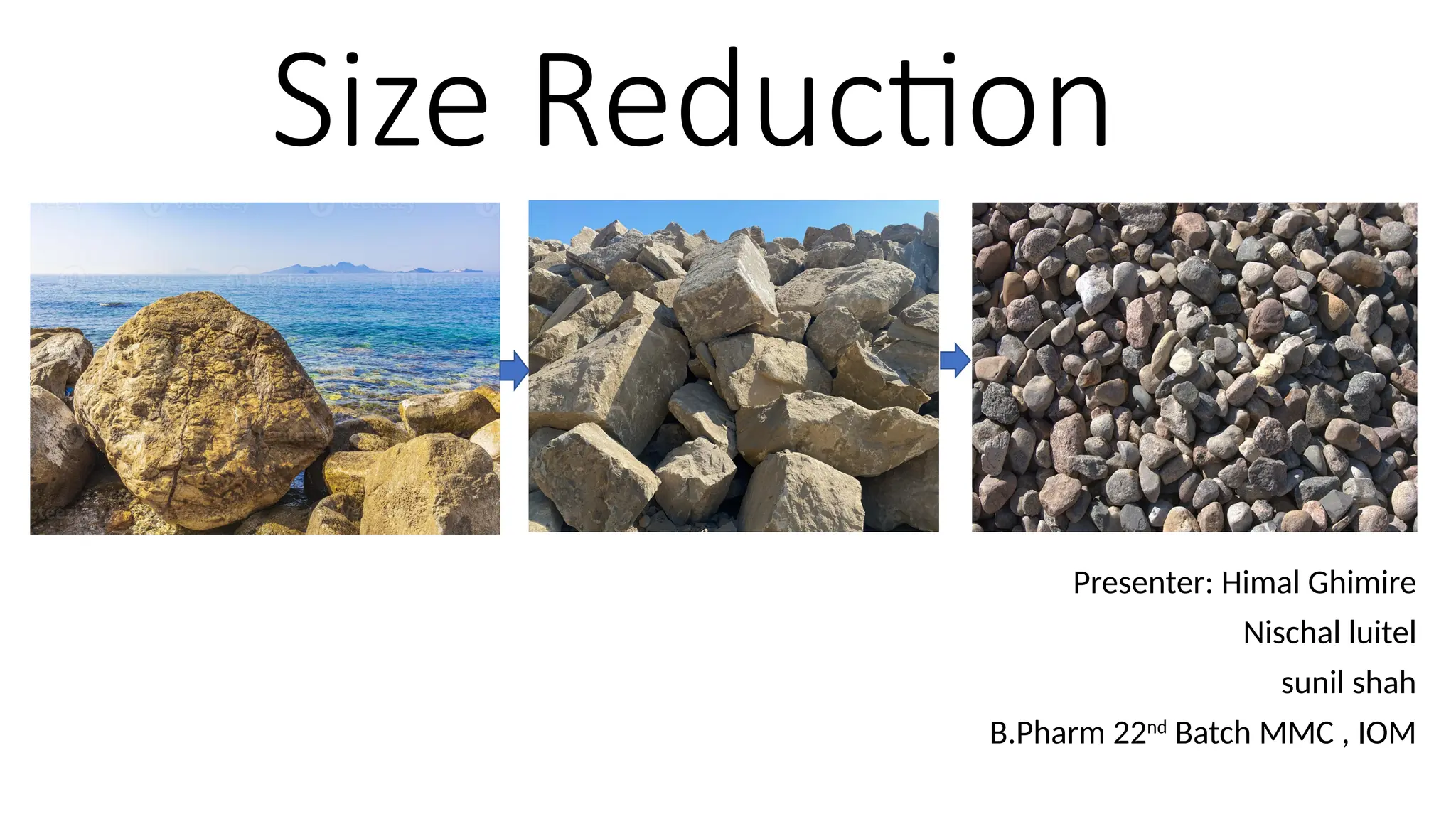
SIZE REDUCTION PHARMACEUTICAL ENGINEERING BY MR.HIMAL GHIMIRE
PRINCIPLES,CONSTRUCTIONS & WORKING OF VARIOUS SIZE REDUCTIONS EQUIPMENTS,OBJECTIVES ,MECHANISMS ,ENERGIES AND THEORIES AND CLASSIFICATIONS OF SIZE REDUCTION EQUIPMENTS.
outline
• Definition
• Objectivesof size reduction
• Mechanism of size reduction
• Theories & energies of comminution.
• Classification of Size reduction equipments.
• Principle ,construction & working of equipments.
3.
Size reduction ormilling or comminution
or diminution or pulverization
• Size reduction is a unit operation in which large solid unit masses (vegetables or
chemical substances) are reduced to smaller unit masses, i.e coarse particles or
fine powders.
• Size reduction is generally achieved by precipitation method & mechanical
process.
Objectives of Size reduction
In the materials processing industry, size reduction is usually carried out in order to:
Increase the surface area because in most reactions involving solid particles, the
rate of reactions is directly proportional to the area of contact with a second
phase.
Break a material into very small particles in order to separate the valuable
amongst the two constituents.
4.
To promoteuniform flow, content uniformity and achieve uniform mixing.
To Improve physical stability & dissolution rate.
To improve rate of absorption.
To ensure effective drying.
Mechanism of size reduction
The mechanism of size reduction may vary with the nature of material.
Therefore
Each drug requires a separate treatment which are as follows.
1.Cutting : The material is cut by means of sharp blades. It is useful for
comminution of fibrous or waxy solids. Eg. Cutter Mill
5.
2. Compression :In this mechanism the size reduction is achieved by crushing the
material by application of pressure. Eg . Roller Mill
3.Impact : It involves the operation of hammers or bars at high speeds. When a
lump of materials strikes the rotating hammers, the materials splits apart. It also
occurs when moving particles strike against a stationary surface. Eg . Hammer mill
4.Attrition : This process involves the breaking down of the material by rubbing
action between the surfaces. Eg . Fluid energy Mill
Classification of size reduction equipment
A. Crushers: Edge runner mill, end runner mill
B. Grinders: Hammer mill ,Ball mill ,fluid energy mill.
6.
1. Impact mills:eg .hammer mill
2.Rolling-compression mills: construction eg. roller mill
3.Attrition mills: eg. Fluid energy mill.
4.Tumbling mills: eg. Ball mill.
C. Ultrafine grinders: eg. Fluid energy mills.
D. Cutting machines: eg. Cutter mill.
1) Rotary Cutter Mill:
Principle: Rotary cutter mill works on the principle of cutting & shearing the feed
material with the help of sharp knives.
Construction : construction of cutter mill involves milling chamber which consists of two
types of knives, namely rotating knives and stationary knives. A horizontally mounted
rotor disc consists knives of 2 to 12 knives spaced uniformly.The casing also has several
stationary knives. The hopper is placed above it.
7.
• The bottomof the casing holds a screen that controls the size of the
material. Discharge chute is attached at the bottom of the mill.
8.
Working: The rotordisc is allowed to rotate at speeds from 200 to 900 rotation per
minute. The feed material is loaded into the hopper , which flows down by the force of
gravity. During the rotation of disc ,the materials comes very close between the
stationary and rotation knives ,thereby the material is cut into small pieces. Smaller
particles pass through the screen .The knives lift the coarser particles up while rotating
and promote further size reduction.The product is collected into a receiver.
2) ROLLER MILL
Principle: the material is crushed (compressed) by the application of stress, though
attrition also influences. Stress is applied by rotating heavy wheels , mullers or rollers.
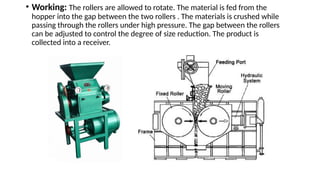
Construction: it consists of two cylindrical rollers made of stone or metal ,mounted
horizontally . Rollers can have a diameter ranging from a few mm upto a m. Rollers are
capable of rotating on their longitudinal axes. One roll is rotated directly and the other
rotates freely. The gap between the rollers can be controlled to obtain the desired
particle size.
9.
• Working: Therollers are allowed to rotate. The material is fed from the
hopper into the gap between the two rollers . The materials is crushed while
passing through the rollers under high pressure. The gap between the rollers
can be adjusted to control the degree of size reduction. The product is
collected into a receiver.
10.
3) Hammer mill
Principle: The hammer mill operates on the principle of impact between rapidly
moving hammers mounted on a rotor and the powder material.
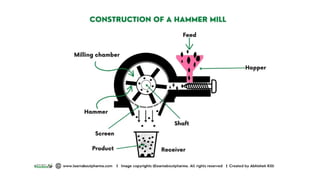
Construction : The hammer mill can be either the horizontal or the vertical shaft
type. Hammers are usually made of hardened steel , stainless steel with impact
surface made of an extremely abrasive resistant materials such as haystellite and
carbaloy. The hammer blades can be with flat .
Working : A hammer mill works by using rotating hammers to impact and crush
materials, reducing them to smaller sizes, which then pass through screens or grates,
with larger particles remaining for further grinding
12.
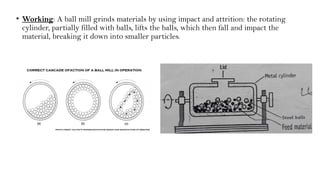
4) Ball Mill
Principle:A ball mill operates on the principle of impact and attrition, where
grinding media (typically steel balls) collide with the material being ground inside
a rotating cylindrical drum, reducing particle size through both impact and
friction.
Construction: A ball mill consists of a hollow, cylindrical shell that rotates,
containing grinding media (like steel balls) to crush materials through impact and
attrition. The shell is lined with abrasion-resistant material, and the axis of
rotation can be horizontal or slightly angled.
13.
• Working: Aball mill grinds materials by using impact and attrition: the rotating
cylinder, partially filled with balls, lifts the balls, which then fall and impact the
material, breaking it down into smaller particles.
14.
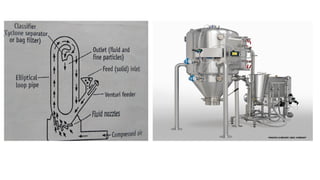
• 5) FluidEnergy Mill
Principle: Fluid mills, also known as jet mills or fluid energy mills, work by reducing
particle size through high-velocity collisions between particles suspended in a fluid
stream, typically air or gas.
Construction: A fluid energy mill, or jet mill, uses high-velocity air or gas streams to
grind and reduce particles through impact and attrition, consisting of a grinding
chamber, nozzles for high-pressure air, a feed mechanism, and a classifier.
Working: A fluid energy mill, or jet mill, works by using high-velocity fluid jets to cause
particles to collide and break down into smaller sizes, typically in the micron range,
through a process of impact and attrition
16.
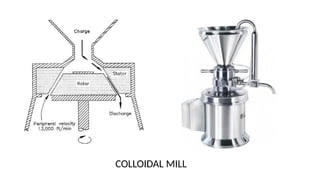
• 6) ColloidalMill
Principle: Colloid mills, also known as colloid mill mixers, operate on the rotor-stator
principle, using a high-speed rotating rotor and a stationary stator to generate intense
shearing forces that reduce particle size and improve dispersion in liquids
Construction: A colloid mill, used for reducing particle size in suspensions or emulsions,
is constructed with a rotor and stator assembly, a motor, a hopper for material input, and
a discharge outlet. The rotor and stator, often made of toughened steel or corundum,
create a narrow gap where high shear forces break down particles.
Working: A colloid mill uses a rotor-stator system to create high shear forces, reducing
particle size in suspensions and emulsions by forcing materials through a narrow gap
between a rotating rotor and a stationary stator.
• Theories ofcomminution
2) Rittinger’s law: The energy required for reduction in particle size of a solid is
directly proportional to the increase in surface area.
3) Bond’s theory: Bond's theory of size reduction proposes that the energy required for
particle size reduction is proportional to the square root of the change in surface area, a
concept useful for predicting energy consumption in crushing and grinding processes.