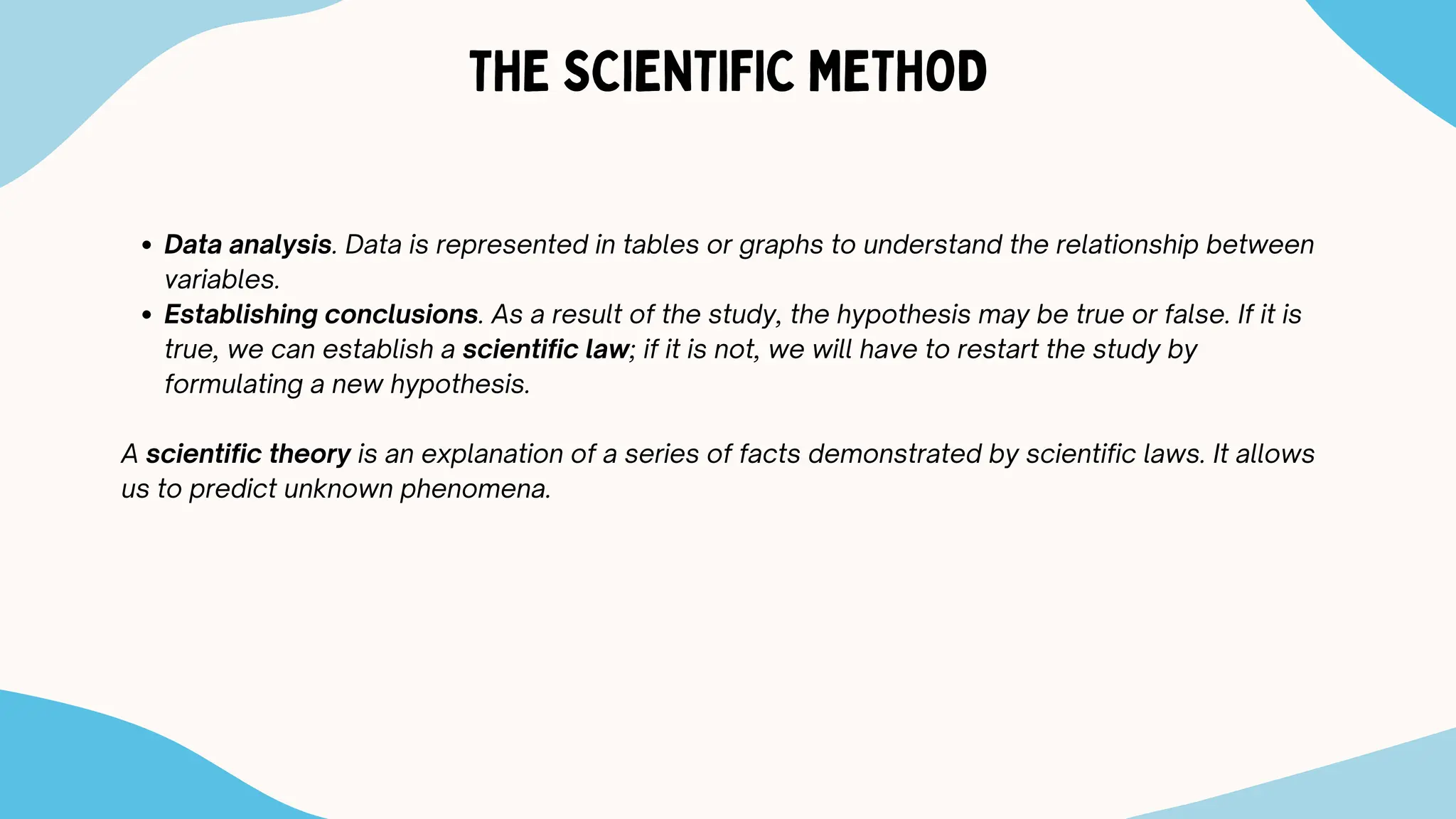
METHOD
THE SCIENTIFIC
Contents of
the unit
01
03 The Laboratory
02
The scientific
method
Physical magnitudes
and their measurement
Lab instruments
Safety Standars
International System of Units
Multiples and submultiples of the
unit
Scientific notation
Conversion factos
THE SCIENTIFIC METHOD
The scientific method is the procedure followed in
science to study problems and establish
conclusions.
THE SCIENTIFIC METHOD
A scientific study comprises a series of steps:
Observation of a phenomenon using our senses. Allows us to identify the problem.
Hypothesis. After observation, we make an assumption about the problem. We must express it
in a concrete way in order to be able to test it.
Experimentation. We design an experiment that allows us to repeat the phenomenon in a
controlled manner and measure the variables involved. When a phenomenon is influenced by
several variables, several experiments are designed to study the relationship between each
two variables, keeping the rest constant. There are two types of variables:
Independent variable: one whose value we modify at will.
Dependent variable: one whose value is determined by the value of the independent
variable.
THE SCIENTIFIC METHOD
Data analysis. Data is represented in tables or graphs to understand the relationship between
variables.
Establishing conclusions. As a result of the study, the hypothesis may be true or false. If it is
true, we can establish a scientific law; if it is not, we will have to restart the study by
formulating a new hypothesis.
A scientific theory is an explanation of a series of facts demonstrated by scientific laws. It allows
us to predict unknown phenomena.
PHYSICAL MAGNITUDES AND THEIR
MEASUREMENT
A magnitude is any measurable characteristic of an element, that is, it is any observable property
of bodies that we can objectively quantify through the process of measuring.
To measure a physical magnitude is to compare its value with another reference or pattern that
we call a unit.
The unit of measurement is the quantity with which we compare a measurement to measure,
that is, the measurement standard. It is an arbitrarily chosen quantity that serves as an element
of comparison.
The result of the measuring process is a measurement, which represents the number of times
the unit is contained in the magnitude being measured.
To make unit changes we use conversion factors (fundamental rule: the numerator is equivalent
to the denominator).
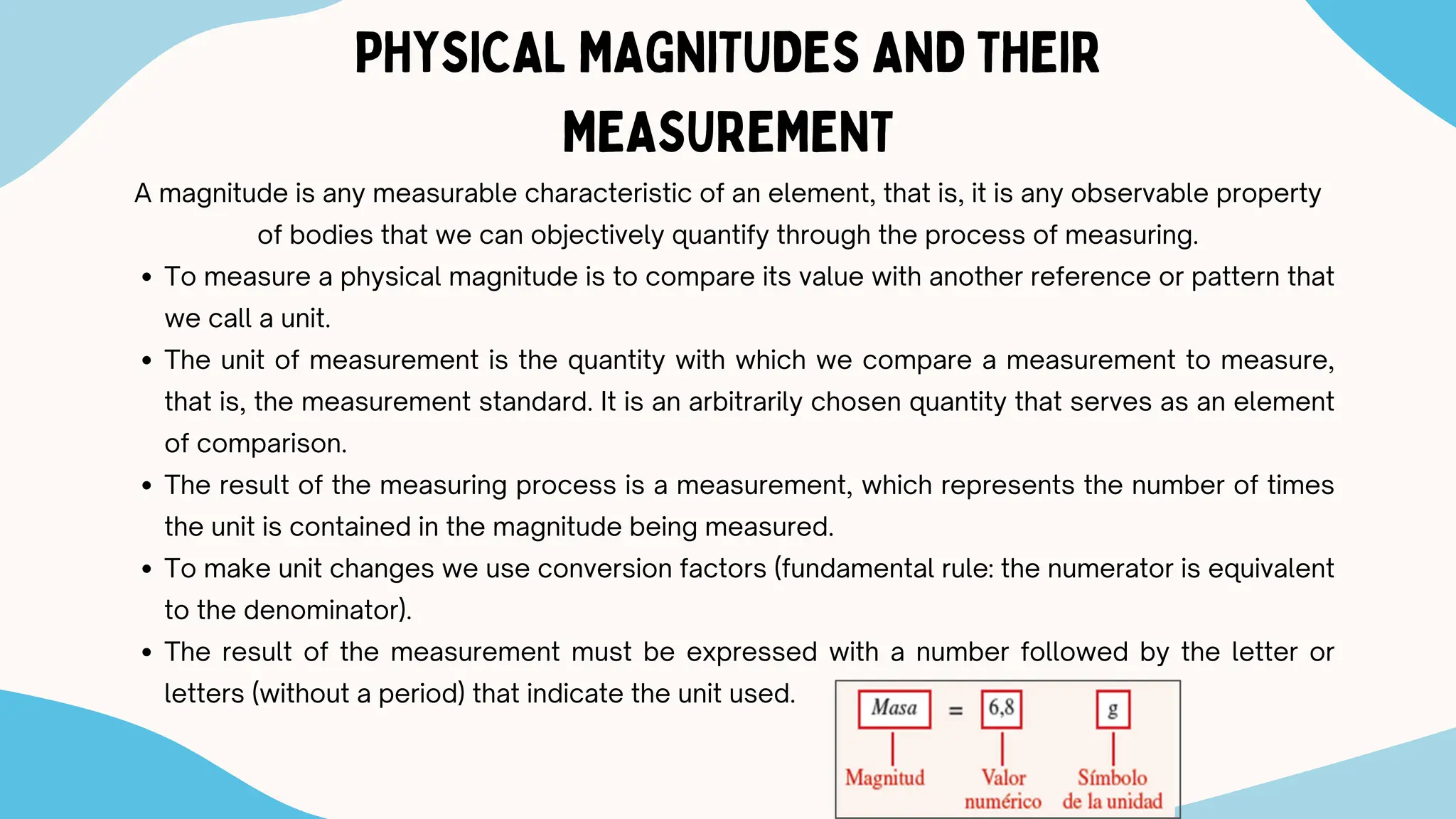
The result of the measurement must be expressed with a number followed by the letter or
letters (without a period) that indicate the unit used.
international system of units
In order for the process of obtaining a measurement to be possible, it is necessary to previously
define the unit in which each magnitude is measured, as well as design the corresponding
measuring devices.
With the International System of Units (SI), established in 1960, the different systems of units used
in each country were unified. The SI is organized into:
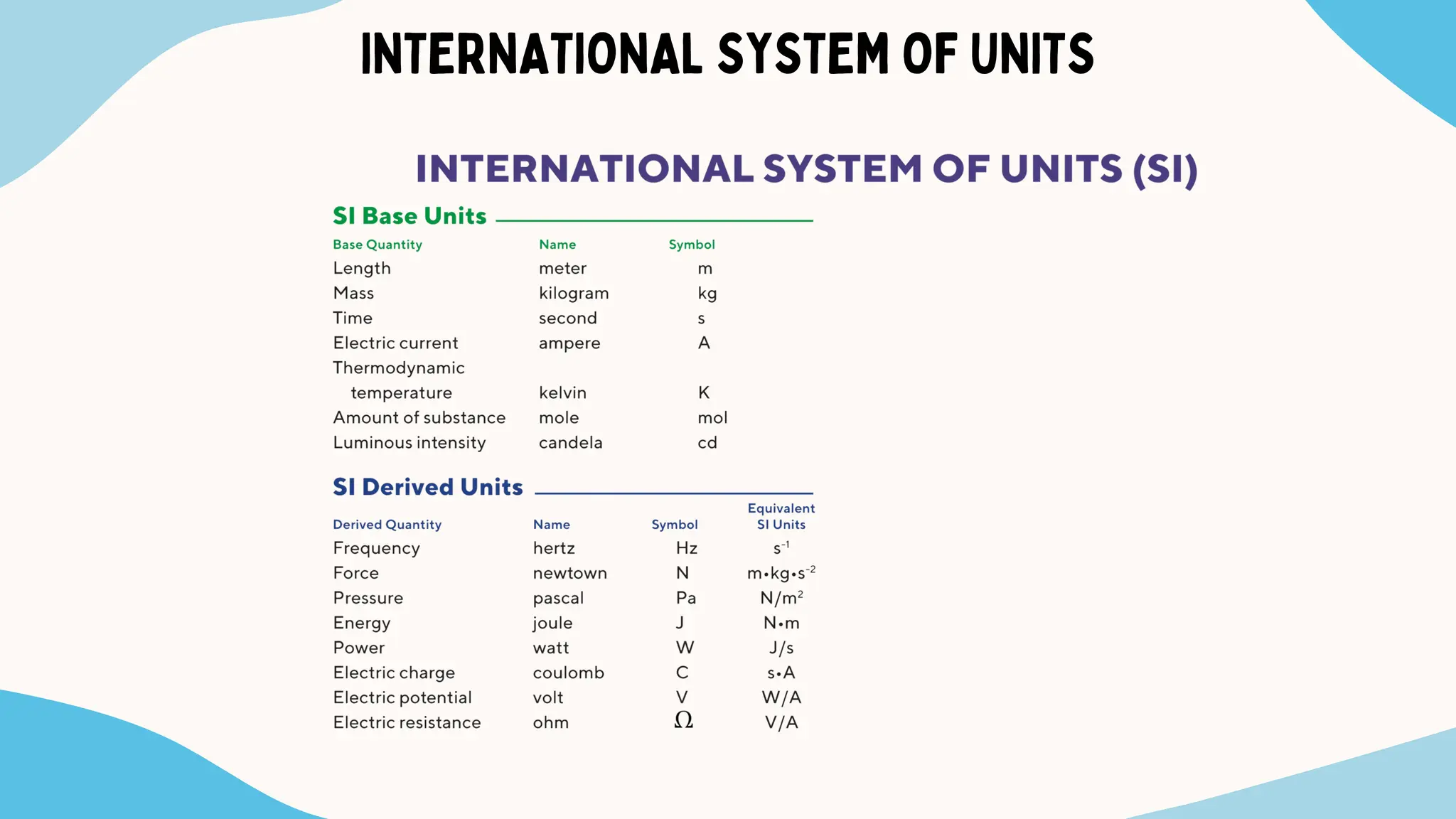
Fundamental magnitudes: they are defined by themselves. There are seven: mass, length, time,
temperature, intensity of electric current, luminous intensity and quantity of substance.
Derived magnitudes: are obtained through mathematical expressions that combine the
fundamental magnitudes. Examples: surface, density, speed
INTERNATIONAL SYSTEM OF UNITS
MULTIPLES AND SUB-MULTIPLE OF THE UNIT
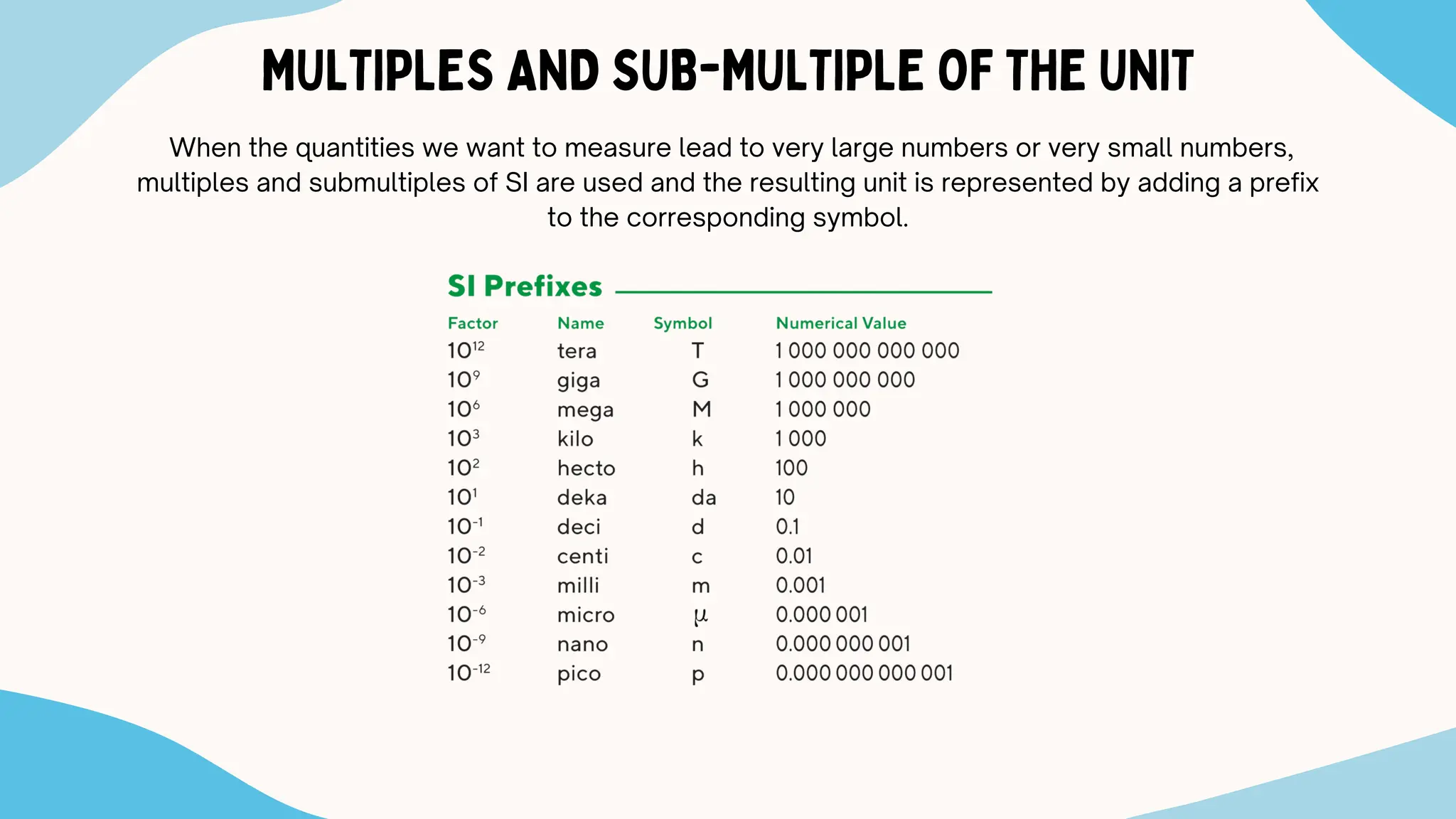
When the quantities we want to measure lead to very large numbers or very small numbers,
multiples and submultiples of SI are used and the resulting unit is represented by adding a prefix
to the corresponding symbol.
scientific notation
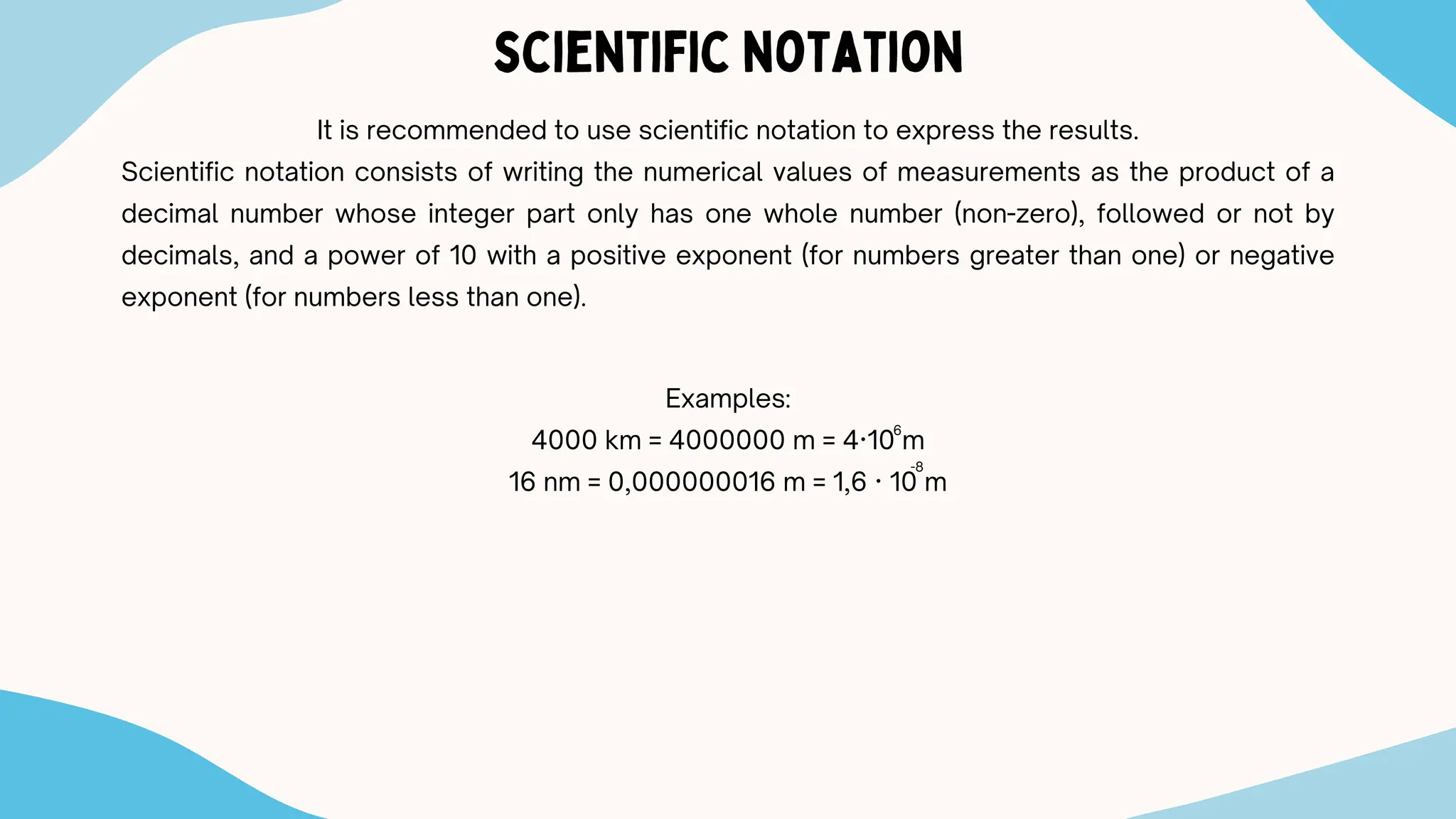
It is recommended to use scientific notation to express the results.
Scientific notation consists of writing the numerical values ​
​
of measurements as the product of a
decimal number whose integer part only has one whole number (non-zero), followed or not by
decimals, and a power of 10 with a positive exponent (for numbers greater than one) or negative
exponent (for numbers less than one).
Examples:
4000 km = 4000000 m = 4·10 m
16 nm = 0,000000016 m = 1,6 · 10 m
6
-8
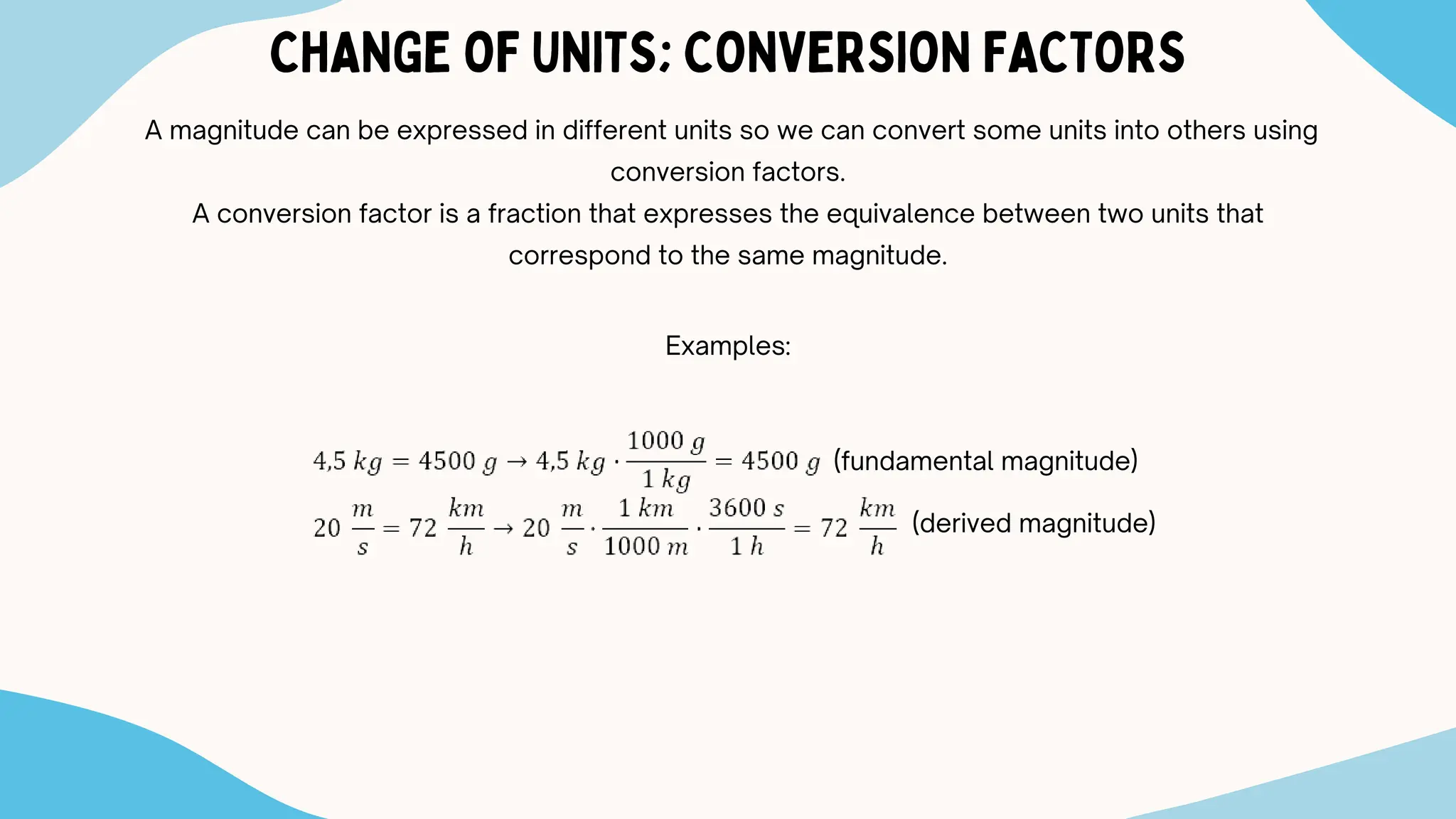
CHANGE OF UNITS; CONVERSION FACTORS
A magnitude can be expressed in different units so we can convert some units into others using
conversion factors.
A conversion factor is a fraction that expresses the equivalence between two units that
correspond to the same magnitude.
Examples:
(fundamental magnitude)
(derived magnitude)
THE LABORATORY: lAB INSTRUMENTS
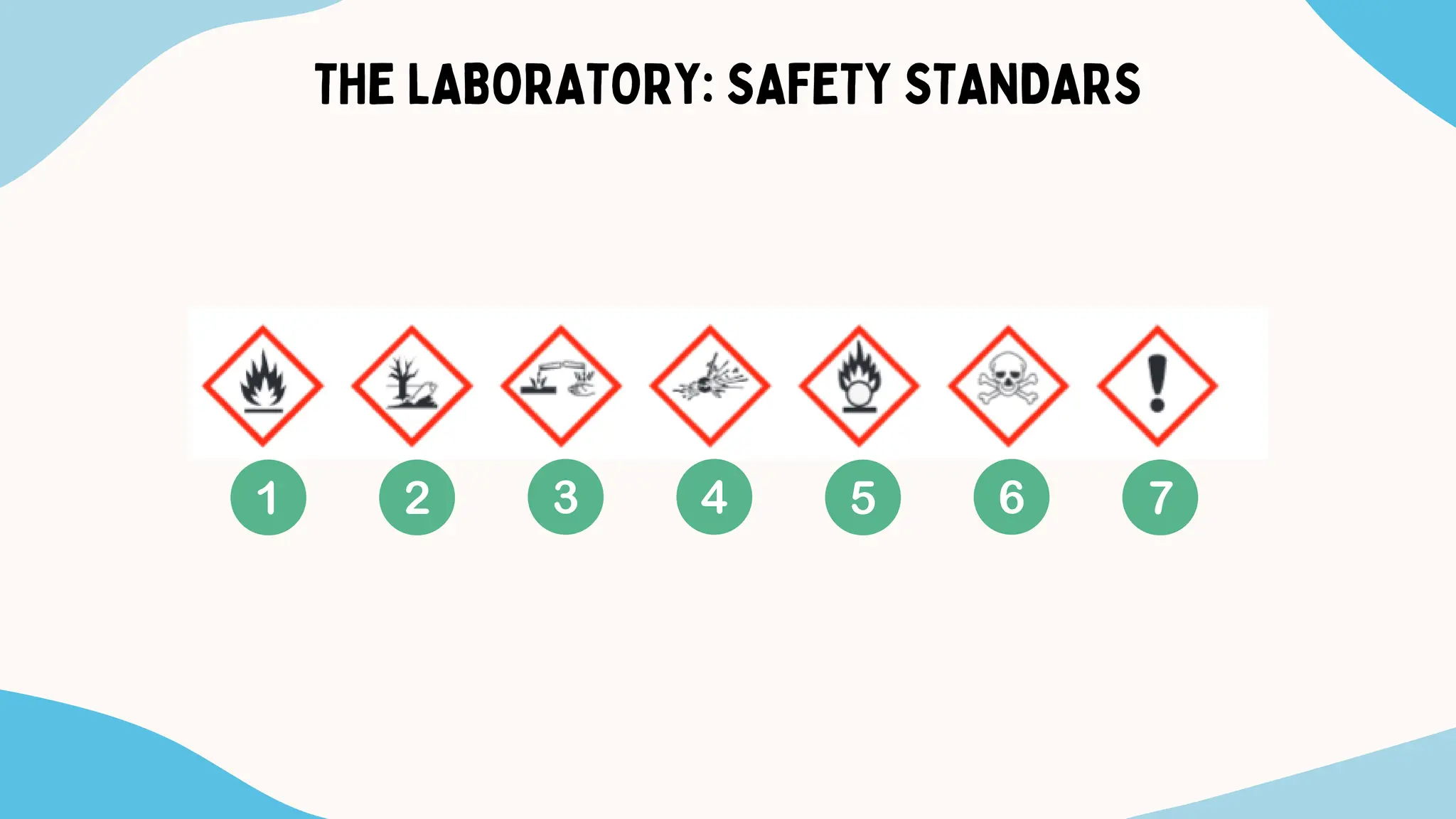
THE LABORATORY: SAFETY STANDARS

Unit 1 - Scientific Method.pdf Physics and Chemistry

  • 1.
  • 2.
    Contents of the unit 01 03The Laboratory 02 The scientific method Physical magnitudes and their measurement Lab instruments Safety Standars International System of Units Multiples and submultiples of the unit Scientific notation Conversion factos
  • 3.
    THE SCIENTIFIC METHOD Thescientific method is the procedure followed in science to study problems and establish conclusions.
  • 4.
    THE SCIENTIFIC METHOD Ascientific study comprises a series of steps: Observation of a phenomenon using our senses. Allows us to identify the problem. Hypothesis. After observation, we make an assumption about the problem. We must express it in a concrete way in order to be able to test it. Experimentation. We design an experiment that allows us to repeat the phenomenon in a controlled manner and measure the variables involved. When a phenomenon is influenced by several variables, several experiments are designed to study the relationship between each two variables, keeping the rest constant. There are two types of variables: Independent variable: one whose value we modify at will. Dependent variable: one whose value is determined by the value of the independent variable.
  • 5.
    THE SCIENTIFIC METHOD Dataanalysis. Data is represented in tables or graphs to understand the relationship between variables. Establishing conclusions. As a result of the study, the hypothesis may be true or false. If it is true, we can establish a scientific law; if it is not, we will have to restart the study by formulating a new hypothesis. A scientific theory is an explanation of a series of facts demonstrated by scientific laws. It allows us to predict unknown phenomena.
  • 6.
    PHYSICAL MAGNITUDES ANDTHEIR MEASUREMENT A magnitude is any measurable characteristic of an element, that is, it is any observable property of bodies that we can objectively quantify through the process of measuring. To measure a physical magnitude is to compare its value with another reference or pattern that we call a unit. The unit of measurement is the quantity with which we compare a measurement to measure, that is, the measurement standard. It is an arbitrarily chosen quantity that serves as an element of comparison. The result of the measuring process is a measurement, which represents the number of times the unit is contained in the magnitude being measured. To make unit changes we use conversion factors (fundamental rule: the numerator is equivalent to the denominator). The result of the measurement must be expressed with a number followed by the letter or letters (without a period) that indicate the unit used.
  • 7.
    international system ofunits In order for the process of obtaining a measurement to be possible, it is necessary to previously define the unit in which each magnitude is measured, as well as design the corresponding measuring devices. With the International System of Units (SI), established in 1960, the different systems of units used in each country were unified. The SI is organized into: Fundamental magnitudes: they are defined by themselves. There are seven: mass, length, time, temperature, intensity of electric current, luminous intensity and quantity of substance. Derived magnitudes: are obtained through mathematical expressions that combine the fundamental magnitudes. Examples: surface, density, speed
  • 8.
  • 9.
    MULTIPLES AND SUB-MULTIPLEOF THE UNIT When the quantities we want to measure lead to very large numbers or very small numbers, multiples and submultiples of SI are used and the resulting unit is represented by adding a prefix to the corresponding symbol.
  • 10.
    scientific notation It isrecommended to use scientific notation to express the results. Scientific notation consists of writing the numerical values ​ ​ of measurements as the product of a decimal number whose integer part only has one whole number (non-zero), followed or not by decimals, and a power of 10 with a positive exponent (for numbers greater than one) or negative exponent (for numbers less than one). Examples: 4000 km = 4000000 m = 4·10 m 16 nm = 0,000000016 m = 1,6 · 10 m 6 -8
  • 11.
    CHANGE OF UNITS;CONVERSION FACTORS A magnitude can be expressed in different units so we can convert some units into others using conversion factors. A conversion factor is a fraction that expresses the equivalence between two units that correspond to the same magnitude. Examples: (fundamental magnitude) (derived magnitude)
  • 12.
  • 13.