SANJIVANI K. B. P. POLYTECHNIC, KOPARGAON
With NBA ACCREDIATED programs , Approved by AICTE, New Delhi,
Recognized by Govt. of Maharashtra, Affiliated to Maharashtra State Board of Technical Education, Mumbai,
ISO 9001:2015 Certified Institute
Department:- Computer Technology Class:- CM3I
Name of Subject:- Data Structures Using 'C‘ MSBTE Subject Code:- 22317
Name of Faculty: Prof. Vaibhav A. Parjane
Introduction to Data
Structures
Unit Outcome
After going through this unit, the student will be able to:
1a. Classify the given type of Data Structures based on their characteristics.
1b. Explain complexity of the given algorithm in terms of time and space.
1c. Explain the given operations to be performed on the given type of data
Data Structure: Concept
In computer science, a data structure
• is a particular way of storing and organizing data in a computer so that it
can be used efficiently.
• is a particular way of storing and organizing information in a computer so
that it can be retrieved and used most productively.
• is about collection of data values, the relationships among them, and the
functions or operations that can be applied to the data.
• is the structural representation of logical relationships between elements
of data.
Data Structure: Concept
A data structure is made of:
• A set of data values
• A set of functions specifying the operations permitted on the data
values.
• A set of axioms describing how these operations work.
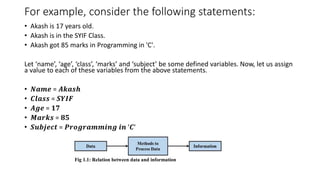
• Akash is 17 years old.
• Akash is in the SYIF Class.
• Akash got 85 marks in Programming in 'C'.
Let ‘name’, ‘age’, ‘class’, ‘marks’ and ‘subject’ be some defined variables. Now, let us assign
a value to each of these variables from the above statements.
• 𝑵𝒂𝒎𝒆 = 𝑨𝒌𝒂𝒔𝒉
• 𝑪𝒍𝒂𝒔𝒔 = 𝑺𝒀𝑰𝑭
• 𝑨𝒈𝒆 = 𝟏𝟕
• 𝑴𝒂𝒓𝒌𝒔 = 𝟖𝟓
• 𝑺𝒖𝒃𝒋𝒆𝒄𝒕 = 𝑷𝒓𝒐𝒈𝒓𝒂𝒎𝒎𝒊𝒏𝒈 𝒊𝒏 ′𝑪′
For example, consider the following statements:
Fig 1.1: Relation between data and information
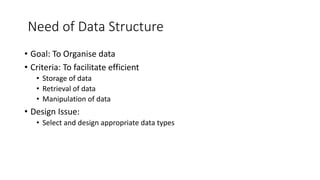
Need of Data Structure
• Goal: To Organise data
• Criteria: To facilitate efficient
• Storage of data
• Retrieval of data
• Manipulation of data
• Design Issue:
• Select and design appropriate data types
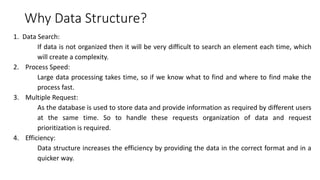
Why Data Structure?
1. Data Search:
If data is not organized then it will be very difficult to search an element each time, which
will create a complexity.
2. Process Speed:
Large data processing takes time, so if we know what to find and where to find make the
process fast.
3. Multiple Request:
As the database is used to store data and provide information as required by different users
at the same time. So to handle these requests organization of data and request
prioritization is required.
4. Efficiency:
Data structure increases the efficiency by providing the data in the correct format and in a
quicker way.
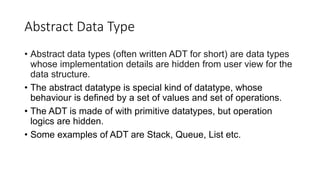
Abstract Data Type
• Abstract data types (often written ADT for short) are data types
whose implementation details are hidden from user view for the
data structure.
• The abstract datatype is special kind of datatype, whose
behaviour is defined by a set of values and set of operations.
• The ADT is made of with primitive datatypes, but operation
logics are hidden.
• Some examples of ADT are Stack, Queue, List etc.

Unit 1 Introduction to Data Structures(1).pptx

  • 1.
    SANJIVANI K. B.P. POLYTECHNIC, KOPARGAON With NBA ACCREDIATED programs , Approved by AICTE, New Delhi, Recognized by Govt. of Maharashtra, Affiliated to Maharashtra State Board of Technical Education, Mumbai, ISO 9001:2015 Certified Institute Department:- Computer Technology Class:- CM3I Name of Subject:- Data Structures Using 'C‘ MSBTE Subject Code:- 22317 Name of Faculty: Prof. Vaibhav A. Parjane
  • 2.
  • 3.
    Unit Outcome After goingthrough this unit, the student will be able to: 1a. Classify the given type of Data Structures based on their characteristics. 1b. Explain complexity of the given algorithm in terms of time and space. 1c. Explain the given operations to be performed on the given type of data
  • 4.
    Data Structure: Concept Incomputer science, a data structure • is a particular way of storing and organizing data in a computer so that it can be used efficiently. • is a particular way of storing and organizing information in a computer so that it can be retrieved and used most productively. • is about collection of data values, the relationships among them, and the functions or operations that can be applied to the data. • is the structural representation of logical relationships between elements of data.
  • 5.
    Data Structure: Concept Adata structure is made of: • A set of data values • A set of functions specifying the operations permitted on the data values. • A set of axioms describing how these operations work.
  • 6.
    • Akash is17 years old. • Akash is in the SYIF Class. • Akash got 85 marks in Programming in 'C'. Let ‘name’, ‘age’, ‘class’, ‘marks’ and ‘subject’ be some defined variables. Now, let us assign a value to each of these variables from the above statements. • 𝑵𝒂𝒎𝒆 = 𝑨𝒌𝒂𝒔𝒉 • 𝑪𝒍𝒂𝒔𝒔 = 𝑺𝒀𝑰𝑭 • 𝑨𝒈𝒆 = 𝟏𝟕 • 𝑴𝒂𝒓𝒌𝒔 = 𝟖𝟓 • 𝑺𝒖𝒃𝒋𝒆𝒄𝒕 = 𝑷𝒓𝒐𝒈𝒓𝒂𝒎𝒎𝒊𝒏𝒈 𝒊𝒏 ′𝑪′ For example, consider the following statements: Fig 1.1: Relation between data and information
  • 7.
    Need of DataStructure • Goal: To Organise data • Criteria: To facilitate efficient • Storage of data • Retrieval of data • Manipulation of data • Design Issue: • Select and design appropriate data types
  • 8.
    Why Data Structure? 1.Data Search: If data is not organized then it will be very difficult to search an element each time, which will create a complexity. 2. Process Speed: Large data processing takes time, so if we know what to find and where to find make the process fast. 3. Multiple Request: As the database is used to store data and provide information as required by different users at the same time. So to handle these requests organization of data and request prioritization is required. 4. Efficiency: Data structure increases the efficiency by providing the data in the correct format and in a quicker way.
  • 9.
    Abstract Data Type •Abstract data types (often written ADT for short) are data types whose implementation details are hidden from user view for the data structure. • The abstract datatype is special kind of datatype, whose behaviour is defined by a set of values and set of operations. • The ADT is made of with primitive datatypes, but operation logics are hidden. • Some examples of ADT are Stack, Queue, List etc.