Unit I – IoT Introduction
Icons
Router Switch Cloud File/ Application Server
Introduction to IoT
 Objects that are not currently joined to a computer network, namely the Internet,
will be connected so that they can communicate and interact with people and
other objects.
 IoT is a technology transition in which devices will allow us to sense and control
the physical world by making objects smarter and connecting them through an
intelligent network.
 The basic premise and goal of IoT is to “connect the unconnected.”
 When objects and machines can be sensed and controlled remotely across a
network, atighter integration between the physical world and computers is enabled
which allows for improvements in the areas of efficiency, accuracy, automation,
and the enablement of advanced applications.
Genesis of IoT
 The IoT have been started between the years 2008 and 2009.
 During this time period, the number of devices connected to the Internet over
shadowed the world’s population.
 While working for Procter & Gamble in 1999, Kevin Ashton used “Internet of
Things” to explain a new idea related to linking the company’s supply chain to
the Internet.
 According to Kevin IoT add senses to computers.
 Kevin quoted: “In the twentieth century, computers were brains without senses—
they only knew what we told them.”
 Earlier Computers depended on humans to input data and knowledge through
typing, bar codes, and so on.
 The first phase, Connectivity, began in the mid-1990s. In the beginning, people
and organization got familiar with email and getting on the Internet.
Intelligent Connections
Fig: Evolutionary Phases of the Internet
Internet Phase Definition
Connectivity (Digitize access) Phase consist connected people to email, web
services, andsearch so that information is
easily accessed.
Networked Economy (Digitize business) Phase enabled e-commerce and supply chain
enhancements along with collaborative
engagement to drive increased efficiency in
business processes.
Immersive Experiences(Digitize
interactions)
Phase extended the Internet experience to
encompass widespread video and social
media while always being connected
through mobility. More and more
applications are moved into the cloud.
Internet of Things (Digitize the world) Phase is adding connectivity to objects and
machines in the world around us to enable
new services and experiences. It is
connecting the unconnected.
 Getting the average person online involved dial-up modems, and even basic
connectivity was considered like a small miracle.
 Even though connectivity and its speed continued to improve, a saturation point
was reached where connectivity was no longer the major challenge.
 The focus was now on leveraging connectivity for efficiency and profit.
Connectivity
Email
Search
Networked
Economy
E-commerce
Chain
Collaboration
Immersive
Experiences
Social
Mobility
Cloud
Video
Internet of
Things
Connecting:
People
Process
Data
Things
 This inflection point marked the beginning of the second phase of the Internet
evolution, called the Networked Economy.
 In second phase vendors and suppliers became closely interlinked with
producers, and online shopping experienced incredible growth. The victims were
traditional brick-and-mortar retailers.
 The economy itself became more digitally intertwined as suppliers, vendors, and
consumers all became more directly connected.
 The third phase, connectivity is now pervasive, using multiple platforms from
mobile phones to tablets to laptops and desktop computers.
 It enables communication and collaboration as well as social media across
multiple channels, via email, texting, voice, and video. In essence, person-to-
person interactions have become digitized.
 The latest phase is the Internet of Things.
 Machines and objects are connected with other machines and objects, along with
humans.
 Business and society are experiencing huge increases in data and knowledge.
 It is leading to previously unrecognized insights, along with increased
automation and new process efficiencies.
IoT and Digitization
 At a high level, IoT focuses on connecting “things,” such as objects and
machines, to a computer network, such as the Internet.
 Digitization can mean different things to different people but generally
encompasses the connection of “things” with the data they generate and the
business insights that result. Example: In a shopping mall where Wi-Fi location
tracking has been deployed, the “things” are the Wi-Fi devices.
 Wi-Fi location tracking is simply the capability of knowing where a consumer is
in a retail environment through his or her smart phone’s connection to the
retailer’s Wi-Fi network.
 Tracking real-time location of Wi-Fi clients provide a specific business benefit to
the mall and shop owners.
 It helps the business understand where shoppers tend to congregate and how
much time they spend in different parts of a mall or store.
 Analysis of this data can lead to significant changes to the locations of product
displays and advertising, where to place certain types of shops, how much rent to
charge, and even where to station security guards.
 Digitization is the conversion of information into a digital format.
 Digitization has been happening in one form or another for several decades.
Example,
1) Photography industry has been digitized. Everyone has digital cameras into
their mobile phones.
2) Video industry has been digitized. Everyone can view video and movies on
mobile or digital device instead of purchasing videotapes or DVDs of movies.
3) Transportation Industry has been digitized. People can book taxi and car such
as Ola and Uber through their mobile Application instead of going to taxi
stops.
 Digitization and smart objects are acting like differentiator for companies and
governments hence they are embracing this growing trend.
IoT Impact
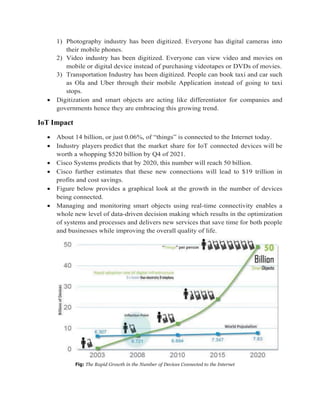
 About 14 billion, or just 0.06%, of “things” is connected to the Internet today.
 Industry players predict that the market share for IoT connected devices will be
worth a whopping $520 billion by Q4 of 2021.
 Cisco Systems predicts that by 2020, this number will reach 50 billion.
 Cisco further estimates that these new connections will lead to $19 trillion in
profits and cost savings.
 Figure below provides a graphical look at the growth in the number of devices
being connected.
 Managing and monitoring smart objects using real-time connectivity enables a
whole new level of data-driven decision making which results in the optimization
of systems and processes and delivers new services that save time for both people
and businesses while improving the overall quality of life.
Fig: The Rapid Growth in the Number of Devices Connected to the Internet
Convergence of IT and IoT
 IT supports connections to the Internet along with related data and technology
systems and is focused on the secure flow of data across an organization.
 OT monitors and controls devices and processes on physical operational systems
which include assembly lines, utility distribution networks, production facilities,
roadway systems, and many more.
 Typically, IT did not get involved with the production and logistics of OT
environments.
 IT organization is responsible for the information systems of a business, such as
email, file and print services, databases, and so on.
 OT is responsible for the devices and processes acting on industrial equipment,
such as factory machines, meters, actuators, electrical distribution automation
devices, SCADA (supervisory control and data acquisition) systems, and so on.
 Traditionally, OT has used dedicated networks with specialized communications
protocols to connect these devices, and these networks have run completely
separately from the IT networks.
Table: Comparing Operational Technology (OT) and Information Technology (IT)
Criterion Industrial OT Network Enterprise IT Network
Operational focus Keep the business operating
24x7
Manage the computers,
data, and employee
communication system in a
secure way
Priorities 1. Availability
2. Integrity
3. Security
1. Security
2. Integrity
3. Availability
Types of data Monitoring, control, and
supervisory data
Voice, video, transactional,
and bulk data
Security Controlled physical access
to devices
Devices and users
authenticated to the
network
Implication of failure OT network disruption
directly impacts business
Can be business impacting,
depending on industry, but
workarounds may be
possible
Network upgrades
(software orhardware)
Only during operational
maintenance windows
Often requires an outage
window when workers are
not onsite; impact can be
mitigated
Security vulnerability Low: OT networks are
isolated and often use
proprietary protocols
High: continual patching of
hosts is required, and the
network is connected to
Internet and requires
vigilant protection
 Management of OT is tied to the lifeblood of a company. For example, if the
network connecting the machines in a factory fails, the machines cannot function,
and production may come to a standstill, negatively impacting business on the
order of millions of dollars. On the other hand, if the email server (run by the IT
department) fails for a few hours, it may irritate people, but it is unlikely to
impact business at anywhere near the same level.
 With the rise of IoT and standards-based protocols, such as IPv6, the IT and OT
worlds are converging or, more accurately, OT is beginning to adopt the network
protocols, technology, transport, and methods of the IT organization, and the IT
organization is beginning to support the operational requirements used by OT.
 When IT and OT begin using the same networks, protocols, and processes, there
are clear economies of scale.
 Not only does convergence reduce the amount of capital infrastructure needed
but networks become easier to operate, and the flexibility of open standards
allows faster growth and adaptability to new technologies.
 But if we look at the table, the convergence of IT and OT to a single consolidated
network poses several challenges.
 There are fundamental cultural and priority differences between these two
organizations.
 IoT is forcing these groups to work together, when in the past they have operated
rather autonomously.
 For example, the OT organization is baffled when IT schedules a weekend
shutdown to update software without regard to production requirements. On the
other hand, the IT group does not understand the prevalence of proprietary or
specialized systems and solutions deployed by OT.
 Take the case of deploying quality of service (QoS) in a network. When the IT
team deploys QoS, voice and video traffic are almost universally treated with the
highest level of service.
 However, when the OT system shares the same network, a very strong argument
can be made that the real-time OT traffic should be given a higher priority than
even voice because any disruption in the OT network could impact the business.
 With the merging of OT and IT, improvements are being made to both systems.
OT is looking more toward IT technologies with open standards, such as Ethernet
and IP. At the same time, IT is becoming more of a business partner with OT by
better understanding business outcomes and operational requirements.
 The overall benefit of IT and OT working together is a more efficient and
profitable business due to reduced downtime, lower costs through economy of
scale, reduced inventory, and improved delivery times.
 When IT/OT convergence is managed correctly, IoT becomes fully supported by
both groups. This provides a “best of both worlds” scenario, where solid
industrial control systems reside on an open, integrated, and secure technology
foundation.
IoT Challenges
Table below highlights a few of the most significant challenges and problems that IoT is
currently facing.
Challenge Description
Scale While the scale of IT networks can be large, the scale of OT can be
several orders of magnitude larger. For example, one large electrical
utility in Asia recently began deploying IPv6-based smart meters on
its electrical grid.
While this utility company has tens of thousands of employees
(which can be considered IP nodes in the network), the number of
meters in theservice area is tens of millions. This means the scale of
the network theutility is managing has increased by more than 1,000-
fold!
Security With more “things” becoming connected with other “things” and
people, security is an increasingly complex issue for IoT. Your threat
surface is now greatly expanded, and if a device gets hacked, its
connectivity is a major concern. A compromised device can serve as
a launching point to attack other devices and systems. IoT security is
also pervasive across just about every facet of IoT.
Privacy As sensors become more prolific in our everyday lives, much of the
data they gather will be specific to individuals and their activities.
This data can range from health information to shopping patterns and
transactions at a retail establishment. For businesses, this data has
monetary value. Organizations are now discussing who owns this data
and how individualscan control whether it is shared and with whom
Big data and
data analytics
Interoperability
IoT and its large number of sensors are going to trigger a deluge of
data that must be handled. This data will provide critical information
and insights if it can be processed in an efficient manner. The
challenge, however, is evaluating massive amounts of data arriving
from different sources in various forms and doing so in a timely
manner.
Interoperability As with any other nascent technology, various protocols and
architectures are jockeying for market share and standardization
within IoT. Some of these protocols and architectures are based on
proprietary elements, and others are open. Recent IoT standards are
helping minimize this problem, but there are often various protocols
and implementations available for IoT networks.
IoT Network Architecture and Design
 Most CIOs and CTOs understand that the network runs the business. If the
network fails, company operations can be seriously impaired.
 The problem for network fail can be distributed denial of service (DDoS) attacks,
future growth requirements, network outages, and even human error.
 The discipline of IoT network architecture is new and requires a fresh
perspective.
 IoT networks are often under the umbrella of OT, which is responsible for the
management and state of operational systems.
 In contrast, IT networks are primarily concerned with the infrastructure that
transports flows of data, regardless of the data type.
Drivers Behind New Network Architectures
 The key difference between IT and IoT is the data.
 IT systems are mostly concerned with reliable and continuous support of
business applications such as email, web, databases, CRM systems, etc.
 IoT is all about the data generated by sensors and how that data is used.
 The essence of IoT architectures thus involves how the data is transported,
collected, analyzed, and ultimately acted upon.
 Table below shows the differences between IT and IoT networks:
Challenge Description IoT Architectural Change
Required
Scale The massive scale of IoT
end-points (sensors) is far
beyond that of typical IT
networks.
The IPv4 address space
has reached exhaustion
and is unable to meet
IoT’s scalability
requirements. Scale can
be met only by using
IPv6. IT networks
continue to use IPv4
through features like
Network Address
Translation (NAT).
Security IoT devices, especially
those on wireless sensor
networks (WSNs), are
often physically exposed
to the world.
Security is required at
every level of the IoT
network. Every IoT
endpoint node on the
network must be part of
the overall security
strategy and must support
device-level
authentication and link
encryption. It must also
be easy to deploy with
some type of a zero-touch
deployment model.
Devices and networks
constrained by power,
CPU, memory, and link
speed
Due to the massive scale
and longer distances, the
networks are often
constrained, lossy, and
capable of supporting
only minimal data rates
(tens of bps to hundreds
of Kbps).
New last-mile wireless
technologies are needed
to support constrained
IoT devices over long
distances. The network is
also constrained, meaning
modifications need to be
made to traditional
network-layer transport
mechanisms.
The massive volume of
data generated
The sensors generate a
massive amount of data
on a daily basis, causing
network bottlenecks and
slow analytics in the
cloud.
Data analytics
capabilities need to be
distributed throughout
the IoT network, from
the edge to the cloud. In
traditional IT networks,
analytics and
applications typically
run only in the cloud.
Support for legacy
devices
An IoT network often
comprises a collection
of modern, IP-capable
endpoints as well as
legacy, non-IP devices
that rely on serial or
proprietary protocols.
Digital transformation is
a long process that may
take many years, and
IoT networks need to
support protocol
translation and/or
tunneling mechanisms to
support legacy protocols
over standards-based
protocols, such as
Ethernet and IP.
The need for data to be
analyzed in real time
Whereas traditional IT
networks perform
scheduled batch
processing of data, IoT
data needs to be
analyzed and responded
to in real-time.
Analytics software
needs to be positioned
closer to the edge and
should support real-time
streaming analytics.
Traditional IT analytics
software (such as
relational better suited to
batch-level analytics that
databases or even
Hadoop), are occur after
the fact.
 The following sections expand on the requirements driving specific architectural
changes for IoT:
1. Scale
 The scale of a typical IT network is on the order of several thousand
devices—typically printers, mobile wireless devices, laptops, servers.
 The traditional three-layer campus networking model, supporting access,
distribution, and core (with sub architectures for WAN, Wi-Fi, data center,
etc.).
 The problem arises when the scale of a network goes from a few thousand
endpoints to a few million.
 For the above reason IoT introduces a model where an average-sized
utility, factory, transportation system, or city could easily be asked to
support a network of this scale.
 Based on scale requirements of this order, IPv6 is the natural foundation
for the IoT network layer.
2. Security
 Cyber-attack is the most common problem. We have already seen
evidence of targeted malicious attacks using vulnerabilities in networked
machines, such as the outbreak of the Stuxnet worm, which specifically
affected Siemens programmable logic controller (PLC) systems.
 The frequency and impact of cyber-attacks in recent years has increased
dramatically.
 Protecting corporate data from intrusion and theft is one of the main
functions of the IT department.
 IT departments go to great lengths to protect servers, applications, and the
network, setting up defense-in-depth models with layers of security
designed to protect the cyber crown jewels of the corporation.
 However, despite all the efforts mustered to protect networks and data,
hackers still find ways to penetrate trusted networks.
 In IT networks, the first line of defense is often the perimeter firewall. It
would be unthinkable to position critical IT endpoints outside the firewall,
visible to anyone.
 IoT endpoints are often located in wireless sensor networks that use
unlicensed spectrum and are not only visible to the world through a
spectrum analyzer but often physically accessible and widely distributed
in the field.
 As more OT systems become connected to IP networks, their capabilities
increase, but so does their potential vulnerability.
 For example, at 3:30 p.m. on December 23, 2015, the Ukrainian power
grid experienced an unprecedented cyber-attack that affected
approximately 225,000 customers. This attack was a sophisticated, well-
planned assault on the Ukrainian power grid that targeted the SCADA
(supervisory control and data acquisition) system, which governs
communication to grid automation devices.
 Traditional models of IT security are simply not designed for the new
attack vectors introduced by highly dispersed IoT systems.
 IoT systems require consistent mechanisms of authentication, encryption,
and intrusion prevention techniques that understand the behavior of
industrial protocols and can respond to attacks on critical infrastructure.
 For optimum security, IoT systems must:
1. Be able to identify and authenticate all entities involved in the IoT
service (that is, gateways, endpoint devices, home networks, roaming
networks, service platforms)
2. Ensure that all user data shared between the endpoint device and back-
end applications is encrypted.
3. Comply with local data protection legislation so that all data is
protected and stored correctly
4. Utilize an IoT connectivity management platform and establish rules-
based security policies so immediate action can be taken if anomalous
behavior is detected from connected devices.
5. Take a holistic, network-level approach to security.
3. Constrained Devices and Networks
 Most IoT sensors are designed for a single job, and they are typically
small and inexpensive, means they often have limited power, CPU, and
memory, and they transmit only when there is something important.
 Because of the massive scale of these devices and the large, uncontrolled
environments where they are usually deployed, the networks that provide
connectivity also tend to be very lossy and support very low data rates.
 This is a completely different situation from IT networks, which enjoy
multi-gigabit connection speeds and endpoints with powerful CPUs.
 If an IT network has performance constraints, the solution is simple:
Upgrade to a faster network.
 If too many devices are on one VLAN and are impacting performance,
you can simply carve out a new VLAN and continue to scale as much as
you need.
 However, this approach cannot meet the constrained nature of IoT
systems.
 IoT requires a new breed of connectivity technologies that meet both the
scale and constraint limitations.
4. Data
 IoT devices generate a huge amount of data.
 Most IT doesn’t care about unstructured chatty data generated by devices
on the network.
 However, in IoT the data is like gold, as it is what enables businesses to
deliver new IoT services that enhance the customer experience, reduce
cost, and deliver new revenue opportunities.
 Although most IoT-generated data is unstructured, the insights it provides
through analytics can revolutionize processes and create new business
models.
 Example: Imagine a smart city with a few hundred thousand smart
streetlights, all connected through an IoT network. Although most of the
information communicated between the lighting network modules and the
control center is of little interest to anyone, patterns in this data can yield
extremely useful insights that can help predict when lights need to be
replaced or whether they can be turned on or off at certain times, thus
saving operational expense. However, when all this data is combined, it
can become difficult to manage and analyze effectively.
 Therefore, unlike IT networks, IoT systems are designed to stagger data
consumption throughout the architecture, both to filter and reduce
unnecessary data going upstream and to provide the fastest possible
response to devices when necessary.
5. Legacy Device Support
 Legacy devices in an IT organization are supported.
 Example: If someone’s computer or operating system is outdated, she
simply upgrades. If someone is using a mobile device with an outdated
Wi-Fi standard, such as 802.11b or 802.11g, you can simply deny him
access to the wireless network, and he will be forced to upgrade.
 In OT systems, end devices are likely to be on the network for a very long
time, sometimes decades.
 As IoT networks are deployed, they need to support the older devices
already present on the network, as well as devices with new capabilities.
 In many cases, legacy devices are so old that they don’t even support IP.
 For example, a factory may replace machines only once every 20 years or
perhaps even longer. It does not want to upgrade multi-million-dollar
machines just so it can connect them to a network for better visibility and
control. However, many of these legacy machines might support older
protocols, such as serial interfaces, and use RS-232. In this case, the IoT
network must either be capable of some type of protocol translation or use
a gateway device to connect these legacy endpoints to the IoT network.
Comparing IoT Architectures
 Two of the best-known architectures are discussed in the following sections.
1) The oneM2M IoT Standardized Architecture
 In an effort to standardize the rapidly growing field of machine-to-machine
(M2M) communications, the European Telecommunications Standards
Institute (ETSI) created the M2M Technical Committee in 2008.
 The goal of this committee was to create a common architecture that would
help accelerate the adoption of M2M applications and devices.
 Over time, the scope has expanded to include the Internet of Things.
Fig: The Main Elements of the oneM2M IoT Architecture
 Other related bodies also began to create similar M2M architectures, and a
common standard for M2M became necessary.
 Recognizing this need, in 2012 ETSI and 13 other founding members
launched oneM2M as a global initiative designed to promote efficient
M2M communication systems and IoT.
 The goal of oneM2M is to create a common services layer, which can be
readily embedded in field devices to allow communication with application
servers.
 oneM2M’s framework focuses on IoT services, applications, and
platforms, which include smart metering applications, smart grid, smart
city automation, e-health, and connected vehicles.
 By developing horizontal platform architecture, oneM2M is developing
standards that allow interoperability at all levels of the IoT stack.
 For example, you might want to automate your HVAC system by
connecting it with wireless temperature sensors spread throughout your
office. You decide to deploy sensors that use LoRaWAN technology. The
problem is that the LoRaWAN network and the BACnet system that your
HVAC and BMS run on are completely different systems and have no
natural connection point. This is where the oneM2M common services
architecture comes in.
 oneM2M’s horizontal framework and RESTful APIs allow the LoRaWAN
system to interface with the building management system over an IoT
network, thus promoting end-to-end IoT communications in a consistent
way, no matter how heterogeneous the networks.
 The oneM2M architecture divides IoT functions into three major domains:
the application layer, the services layer, and the network layer.
 While this architecture may seem simple and somewhat generic at first
glance, it is very rich and promotes interoperability through IT-friendly
APIs and supports a wide range of IoT technologies.
 Let’s examine each of these domains in turn:
a) Applications layer: It includes the application-layer protocols and
attempts to standardize northbound API definitions for interaction with
business intelligence (BI) systems. Applications tend to be industry-
specific and have their own sets of data models, and thus they are shown
as vertical entities.
b) Services layer: This layer is shown as a horizontal framework across the
vertical industry applications. At this layer, horizontal modules include
the physical network that the IoT applications run on, the underlying
management protocols, and the hardware. Examples: backhaul
communications via cellular, MPLS networks, VPNs, etc.
This conceptual layer adds APIs and middleware supporting third-party
services and applications. One of the stated goals of oneM2M is to
“develop technical specifications which address the need for a common
M2M Service Layer that can be readily embedded within various
hardware and software nodes, and rely upon connecting the myriad of
devices in the field area network to M2M application servers, which
typically reside in a cloud or data center.”
A critical objective of oneM2M is to attract and actively involve
organizations from M2M related business domains, including telematics
and intelligent transportation, healthcare, utility, industrial automation,
and smart home applications, to name just a few.
c) Network layer: This is the communication domain for the IoT devices
and end-points. It includes the devices and the communications network
that links them. Embodiments of this communications infrastructure
include wireless mesh technologies, such as IEEE 802.15.4, wireless
point-to-multipoint systems, such as IEEE 801.11ah and wired device
connections, such as IEEE 1901 power line communications.
In many cases, the smart or little smart devices communicate with each
other. In other cases, machine-to-machine communication is not
necessary, and the devices simply communicate through a field area
network (FAN) to use-case-specific apps in the IoT application domain.
Therefore, the device domain also includes the gateway device, which
provides communications up into the core network and acts as a
demarcation point between the device and network domains.
2) The IoT World Forum (IoTWF) Standardized Architecture
 In 2014 the IoTWF architectural committee (led by Cisco, IBM, Rockwell
Automation, and others) published a seven-layer IoT architectural
reference model.















Fig: IoT Reference Model Published by the IoT World Forum
 IoT World Forum offers a clean, simplified perspective on IoT and
includes edge computing, data storage, and access.
 It provides a succinct way of visualizing IoT from a technical perspective.
 Each of the seven layers is broken down into specific functions, and
security encompasses the entire model.
 As shown in above figure the IoT Reference Model defines a set of levels
with control flowing from the center (either a cloud service or a dedicated
data center), to the edge, which includes sensors, devices, machines, and
other types of intelligent end nodes.
 In general, data travels up the stack, originating from the edge, and goes
northbound to the center.
 Using this reference model, we are able to achieve the following:
 Decompose the IoT problem into smaller parts
 Identify different technologies at each layer and how they relate to one
another
 Define a system in which different parts can be provided by different
vendors
 Have a process of defining interfaces that leads to interoperability
 Define a tiered security model that is enforced at the transition points
between levels
 Seven layers of the IoT Reference Model:
Layer 1: Physical Devices and Controllers Layer
 The first layer of the IoT Reference Model is the physical devices and
controllers layer.
 This layer is home to the “things” in the Internet of Things, including
the various endpoint devices and sensors that send and receive
information.
 The size of these “things” can range from almost microscopic sensors
to giant machines in a factory.
 Their primary function is generating data and being capable of being
queried and/or controlled over a network.
Layer 2: Connectivity Layer
 In the second layer of the IoT Reference Model, the focus is on
connectivity.
 It function is to provide reliable and timely transmission of data.
 It includes transmissions between Layer 1 devices and the network and
between the network and information processing that occurs at Layer 3
(the edge computing layer).
 As you may notice, the connectivity layer encompasses all networking
elements of IoT and doesn’t really distinguish between the last-mile
network (the network between the sensor/endpoint and the IoT
gateway), gateway, and backhaul networks.
Layer 3: Edge Computing Layer
 Edge computing often referred to as the “fog” layer is the role of Layer
3.
 At this layer, the emphasis is on data reduction and converting network
data flows into information that is ready for storage and processing by
higher layers.
 One of the basic principles of this reference model is that information
processing is initiated as early and as close to the edge of the network
as possible.
 Figure below highlights the functions handled by Layer 3 of the IoT
Reference Model.
 Another important function that occurs at Layer 3 is the evaluation of
data to see if it can be filtered or aggregated before being sent to a
higher layer.
 This also allows for data to be reformatted or decoded, making
additional processing by other systems easier.
 Thus, a critical function is assessing the data to see if predefined
thresholds are crossed and any action or alerts need to be sent.
IoT Fig: Reference Model Layer 3 Functions
Upper Layers: Layers 4–7
 The upper layers deal with handling and processing the IoT data
generated by the bottom layer.
 For the sake of completeness, Layers 4–7 of the IoT Reference Model
are summarized in Table 2-2.
IoT Reference Model Layer Functions
Layer 4: Data accumulation layer Captures data and stores it so it is usable by
applications when necessary. Converts event-based
data to query-based processing.
Layer 5: Data abstraction layer Reconciles multiple data formats and ensures
consistent semantics from various sources. Confirms
that the data set is complete and consolidates data
into one place or multiple data stores using
virtualization.
Layer 6: Applications layer Interprets data using software applications.
Applications may monitor, control, and provide
reports based on the analysis of the data.
Layer 7: Collaboration and processes
layer
Consumes and shares the application information.
Collaborating on and communicating IoT
information often requires multiple steps, and it is
what makes IoT useful. This layer can change
business processes and delivers the benefits of IoT.
A Simplified IoT Architecture
 Each framework approach IoT from a layered perspective, allowing development
of technology and standards somewhat independently at each level or domain.
 The commonality between these frameworks is that they all recognize the
interconnection of the IoT endpoint devices to a network that transports the data
where it is ultimately used by applications, whether at the data center, in the
cloud, or at various management points throughout the stack.
 IoT architectures may differ somewhat depending on the industry use case or
technology being deployed.
 The left side of Figure below, includes “things,” a communications network, and
applications.
 However, unlike other models, the framework presented here separates the core
IoT and data management into parallel and aligned stacks, allowing you to
carefully examine the functions of both the network and the applications at each
stage of a complex IoT system.
 This separation gives you better visibility into the functions of each layer.
Fig: Simplified IoT Architecture
 The network communications layer of the IoT stack itself involves a significant
amount of detail and incorporates a vast array of technologies.
 Due to heterogeneity of sensor the network communications layer needs to
consolidate these together, offer gateway and backhaul technologies, and
ultimately bring the data back to a central location for analysis and processing.
 Many of the last-mile technologies used in IoT are chosen to meet the specific
requirements of the endpoints and are unlikely to ever be seen in the IT domain.
 However, the network between the gateway and the data center is composed
mostly of traditional technologies such as tunneling and VPN technologies, IP-
based quality of service (QoS), conventional Layer 3 routing protocols such as
BGP and IP-PIM, and security capabilities such as encryption, access control
lists (ACLs), and firewalls.
 Unlike with most IT networks, the applications and analytics layer of IoT doesn't
necessarily exist only in the data center or in the cloud.
 Due to the unique challenges and requirements of IoT, it is often necessary to
deploy applications and data management throughout the architecture in a tiered
approach, allowing data collection, analytics, and intelligent controls at multiple
points in the IoT system.
 Data management is aligned with each of the three layers of the Core IoT
Functional Stack.
 The three data management layers are the edge layer (data management within
the sensors themselves), the fog layer (data management in the gateways and
transit network), and the cloud layer (data management in the cloud or central
data center).
 As shown in Figure below, the Core IoT Functional Stack can be expanded into
sublayers containing greater detail and specific network functions. For example,
the communications layer is broken down into four separate sublayers: the access
network, gateways and backhaul, IP transport, and operations and management
sublayers.
Fig: Expanded View of the Simplified IoT Architecture
 The applications layer of IoT networks is quite different from the application
layer of a typical enterprise network.
 Instead of simply using business applications, IoT often involves a strong big
data analytics component.
 IoT is not just about the control of IoT devices but, rather, the useful insights
gained from the data generated by those devices.
 Thus, the applications layer typically has both analytics and industry-specific IoT
control system components.
 Security is central to the entire architecture, both from network connectivity and
data management perspectives.
The Core IoT Functional Stack
 IoT networks are built around the concept of “things,” or smart objects
performing functions and delivering new connected services.
 These objects are “smart” because they use a combination of contextual
information and configured goals to perform actions.
 These actions can be self-contained (the smart object does not rely on external
systems for its actions); however, in most cases, the “thing” interacts with an
external system to report information that the smart object collects, to exchange
with other objects, or to interact with a management platform.
 The management platform can be used to process data collected from the smart
object and also guide the behavior of the smart object.
 From an architectural standpoint, several components have to work together for
an IoT network to be operational:
a) Layer 1: Things: Sensors and Actuators Layer
 At this layer, the physical devices need to fit the constraints of the
environment in which they are deployed while still being able to provide
the information needed. There are myriad ways to classify smart objects.
One architectural classification could be:
1. Battery-powered or power-connected: This classification is based on
whether the object carries its own energy supply or receives continuous power
from an external power source. Battery-powered things can be moved more
easily than line-powered objects. However, batteries limit the lifetime and
amount of energy that the object is allowed to consume, thus driving
transmission range and frequency.
2. Mobile or Static: This classification is based on whether the “thing” should
move or always stay at the same location. A sensor may be mobile because it
is moved from one object to another (for example, a viscosity sensor moved
from batch to batch in a chemical plant) or because it is attached to a moving
object (for example, a location sensor on moving goods in a warehouse or
factory floor). The frequency of the movement may also vary, from
occasional to permanent. The range of mobility (from a few inches to miles
away) often drives the possible power source.
3. Low or high reporting frequency: This classification is based on how often
the object should report monitored parameters. A rust sensor may report
values once a month. A motion sensor may report acceleration several
hundred times per second. Higher frequencies drive higher energy
consumption, which may create constraints on the possible power source (and
therefore the object mobility) and the transmission range.
4. Simple or rich data: This classification is based on the quantity of data
exchanged at each report cycle. A humidity sensor in a field may report a
simple daily index value (on a binary scale from 0 to 255), while an engine
sensor may report hundreds of parameters, from temperature to pressure, gas
velocity, compression speed, carbon index, and many others. Richer data
typically drives higher power consumption. This classification is often
combined with the previous to determine the object data throughput (low
throughput to high throughput). Throughput is a combined metric. A medium-
throughput object may send simple data at rather high frequency (in which
case the flow structure looks continuous), or may send rich data at rather low
frequency (in which case the flow structure looks bursty).
5. Report range: This classification is based on the distance at which the
gateway is located. For example, for your fitness band to communicate with
your phone, it needs to be located a few meters away at most. The assumption
is that your phone needs to be at visual distance for you to consult the
reported data on the phone screen. If the phone is far away, you typically do
not use it, and reporting data from the band to the phone is not necessary. By
contrast, a moisture sensor in the asphalt of a road may need to communicate
with its reader several hundred meters or even kilometers away.
6. Object density per cell: This classification is based on the number of smart
objects (with a similar need to communicate) over a given area, connected to
the same gateway. An oil pipeline may utilize a single sensor at key locations
every few miles. By contrast, telescopes like the SETI Colossus telescope at
the Whipple Observatory deploy hundreds, and sometimes thousands, of
mirrors over a small area, each with multiple gyroscopes, gravity, and
vibration sensors.
 From a network architectural standpoint, your initial task is to determine which
technology should be used to allow smart objects to communicate depending on
which “things” are classified.
 However, some industries (such as manufacturing and utilities) may include
objects in various categories, matching different needs.
 Figure below provides some examples of applications matching the combination
of mobility and throughput requirements.
 The categories used to classify things can influence other parameters and can also
influence one another. For example, a battery-operated highly mobile object (like
a heart rate monitor, for example) likely has a small form factor. A small sensor
is easier to move or integrate into its environment. At the same time, a small and
highly mobile smart object is unlikely to require a large antenna and a powerful
power source. This constraint will limit the transmission range and, therefore, the
type of network protocol available for its connections.
 The criticality of data may also influence the form factor and, therefore, the
architecture. For example, a missing monthly report from an asphalt moisture
sensor may simply flag an indicator for sensor (or battery) replacement. A multi-
mirror gyroscope report missing for more than 100 ms may render the entire
system unstable or unusable. These sensors either need to have a constant source
of power (resulting in limited mobility) or need to be easily accessible for battery
replacement (resulting in limited transmission range).
 A first step in designing an IoT network is to examine the requirements in terms
of mobility and data transmission (how much data, how often).
Fig: Example of Sensor Applications Based on Mobility and Throughput
 The categories used to classify things can influence other parameters and can also
influence one another. For example, a battery-operated highly mobile object (like
a heart rate monitor, for example) likely has a small form factor. A small sensor
is easier to move or integrate into its environment. At the same time, a small and
highly mobile smart object is unlikely to require a large antenna and a powerful
power source. This constraint will limit the transmission range and, therefore, the
type of network protocol available for its connections.
 The criticality of data may also influence the form factor and, therefore, the
architecture. For example, a missing monthly report from an asphalt moisture
sensor may simply flag an indicator for sensor (or battery) replacement. A multi-
mirror gyroscope report missing for more than 100 ms may render the entire
system unstable or unusable. These sensors either need to have a constant source
of power (resulting in limited mobility) or need to be easily accessible for battery
replacement (resulting in limited transmission range).
 A first step in designing an IoT network is to examine the requirements in terms
of mobility and data transmission (how much data, how often).
Layer 2: Communications Network Layer
 When smart objects are not self-contained, they need to communicate with an
external system.
 Once you have determined the influence of the smart object form factor over its
transmission capabilities (transmission range, data volume and frequency, sensor
density and mobility), you are ready to connect the object and communicate.
 Compute and network assets used in IoT can be very different from those in IT
environments.
 Physical environment is considered in which the devices are to be deployed.
 The operational differences must be understood in order to apply the correct
handling to secure the target assets.
 Temperature variances are an easily understood metric. The cause for the
variance is easily attributed to external weather forces and internal operating
conditions.
 Remote external locations, such as those associated with mineral extraction or
pipeline equipment can span from the heat of the Arabian Gulf to the cold of the
Alaskan North Slope. Controls near the furnaces of a steel mill obviously require
heat tolerance, and controls for cold food storage require the opposite.
 There can be extreme fluctuations which can be seen within a single deployment.
For example, portions of the Tehachapi, California, and wind farms are located in
the Mojave Desert, while others are at an altitude of 1800 m in the surrounding
mountains. As you can imagine, the wide variance in temperature takes a special
piece of hardware that is capable of withstanding such harsh environments.
 Humidity fluctuations can impact the long-term success of a system as well. Well
heads residing in the delta of the Niger River will see very different conditions
from those in the middle of the Arabian Desert. In some conditions, the systems
could be exposed to direct liquid contact such as may be found with outdoor
wireless devices or marine condition deployments.
 Operating in extremes condition related to kinetic forces is another issue.
 Shock and vibration needs vary based on the deployment scenario. In some cases,
the focus is on low-amplitude but constant vibrations, as may be expected on a
bushing-mounted manufacturing system. In other cases, it could be a sudden
acceleration or deceleration, such as may be experienced in peak ground
acceleration of an earthquake or an impact on a mobile system such as high-
speed rail or heavy-duty earth moving equipment.
 Solid particulates can also impact the gear. Most IT environments must contend
with dust build-up that can become highly concentrated due to the effect of
cooling fans.
 In less-controlled IT environments, that phenomenon can be accelerated due to
higher concentrations of particulates. A deterrent to particulate build-up is to use
fan less cooling, which necessitates a higher surface area, as is the case with heat
transfer fins.
 Hazardous location design may also cause corrosive impact to the equipment.
Caustic materials can impact connections over which power or communications
travel. Furthermore, they can result in reduced thermal efficiency by potentially
coating the heat transfer surfaces.
 In some scenarios, the concern is not how the environment can impact the
equipment but how the equipment can impact the environment. For example, in a
scenario in which volatile gases may be present, spark suppression is a critical
design criterion
 There is another class of device differentiators related to the external connectivity
of the device for mounting or industrial function.
 Device mounting is one obvious difference between OT and IT environments.
While there are rack mount environments in some industrial spaces, they are
more frequently found among IT type assets. Within industrial environments,
many computer and communication assets are placed within an enclosed space,
such as a control cabinet where they will be vertically mounted on a DIN
(Deutsches Institut für Normung) rail inside. In other scenarios, the devices
might be mounted horizontally directly on a wall or on a fence.
 In contrast to most IT-based systems, industrial compute systems often transmit
their state or receive inputs from external devices through an alarm channel.
These may drive an indicator light (stack lights) to display the status of a process
element from afar. This same element can also receive inputs to initiate actions
within the system itself.
 Power supplies in OT systems are also frequently different from those commonly
seen on standard IT equipment. A wider range of power variations are common
attributes of industrial compute components. DC power sources are also common
in many environments. Given the criticality of many systems, it is often required
that redundant power supplies are built into the device itself. Extraneous power
supplies, especially those not inherently mounted, are frowned upon, given the
potential for accidental unplugging. In some utility cases, the system must be
able to handle brief power outages and still continue to operate.
 In many cases, this communication uses a wireless technology. This layer has
four sublayers:
a) Access network sublayer
 The last mile of the IoT network is the access network. This is typically made
up of wireless technologies such as 802.11ah, 802.15.4g, and LoRa.
 The sensors connected to the access network may also be wired.
 IoT network technology and type of connectivity topology are directly
connected.
 Each technology was designed with a certain number of use cases in mind
(what to connect, where to connect, how much data to transport at what
interval and over what distance).
 These use cases determined the frequency band that was expected to be most
suitable, the frame structure matching the expected data pattern (packet size
and communication intervals), and the possible topologies that these use cases
illustrate.
 Access technology will required according to scenario.
 IoT sometimes reuses existing access technologies whose characteristics
match more or less closely the IoT use case requirements. Whereas some
access technologies were developed specifically for IoT use cases, others were
not.
 One key parameter determining the choice of access technology is the range
between the smart object and the information collector.
 Figure below lists some access technologies you may encounter in the IoT
world and the expected transmission distances.
Fig: Access Technologies and Distances
 Ranges in above figure are inclusive. For example, cellular is indicated for
transmissions beyond 5 km, but you could achieve a successful cellular
transmission at shorter range (for example, 100 m). By contrast, ZigBee is
expected to be efficient over a range of a few tens of meters, but you would
not expect a successful ZigBee transmission over a range of 10 km.
 Range estimates are grouped by category names that illustrate the environment
or the vertical where data collection over that range is expected.
 Common groups are as follows:
1. PAN (personal area network): Scale of a few meters. This is the personal
space around a person. A common wireless technology for this scale is
Bluetooth.
2. HAN (home area network): Scale of a few tens of meters. At this scale,
common wireless technologies for IoT include ZigBee and Bluetooth Low
Energy (BLE).
3. NAN (neighborhood area network): Scale of a few hundreds of meters.
The term NAN is often used to refer to a group of house units from which
data is collected.
4. FAN (field area network): Scale of several tens of meters to several
hundred meters. FAN typically refers to an outdoor area larger than a
single group of house units. The FAN is often seen as “open space” (and
therefore not secured and not controlled). A FAN is sometimes viewed as a
group of NANs, but some verticals see the FAN as a group of HANs or a
group of smaller outdoor cells. FAN and NAN may sometimes be used
interchangeably.
5. LAN (local area network): Scale of up to 100 m.
6. MAN (metropolitan area network): Range of up to a few kilometers
7. WAN (wide area network): Range of more than a few kilometers.
 For all these places in the IoT network, a “W” can be added to specifically
indicate wireless technologies used in that space. For example, HomePlug is a
wired technology found in a HAN environment, but a HAN is often referred to
as a WHAN (wireless home area network) when a wireless technology, like
ZigBee, is used in that space.
 Similar achievable distances do not mean similar protocols and similar
characteristics.
 Each protocol uses a specific frame format and transmission technique over a
specific frequency (or band).
 Figure below supposes that the sensor uses the same frame size; transmit
power, and antenna gain. The slope of throughput degradation as distance
increases varies vastly from one technology to the other. This difference limits
the amount of data throughput that each technology can achieve as the distance
from the sensor to the receiver increases.
Fig: Range Versus Throughput for Four WHAN to WLAN Technologies
 Increasing the throughput and achievable distance typically comes with an
increase in power consumption.
 Require to determine the target quantity of objects in a single collection cell,
based on the transmission range and throughput.
 The cost of the technology is a third determining factor. Figure below
combines cost, range, power consumption, and typical available bandwidth for
common IoT access technologies.
 The amount of data to carry over a given time period along with correlated
power consumption (driving possible limitations in mobility and range)
determines the wireless cell size and structure.
 Similar ranges also do not mean similar topologies.
Fig: Comparison between Common Last-Mile Technologies in Terms of Range versus
Cost, Power, and Bandwidth
 Some technologies offer flexible connectivity structure to extend
communication possibilities:
1. Point-to-point topologies: Allow one point to communicate with
another point. This topology in its strictest sense is uncommon for IoT
access, as it would imply that a single object can communicate only
with a single gateway. Several technologies are referred to as “point-to-
point” when each object establishes an individual session with the
gateway, means communication structure for more than the physical
topology.
2. Point-to-multipoint topologies: Allow one point to communicate with
more than one other point. Example: Most IoT technologies where one
or more than one gateways communicate with multiple smart objects.
Technologies categorize the nodes based on the functions such as some
nodes (for example, sensors) support both data collection and
forwarding functions, while some other nodes (for example, some
gateways) collect the smart object data, sometimes instruct the sensor to
perform specific operations, and also interface with other networks or
possibly other gateways.
 Applications leveraging IEEE 802.15.4 commonly rely on the end device (a
sensor) collecting data and transmitting the data to a collector.
 Sensors need to be small and are often mobile (or movable) which is battery
operated.
 In many cases, one of the devices collects data from the others. For example,
in a house, temperature sensors may be deployed in each room or each zone of
the house, and they may communicate with a central point where temperature
is displayed and controlled. A room sensor does not need to communicate with
another room sensor. In that case, the control point is at the center of the
network. The network forms a star topology, with the control point at the hub
and the sensors at the spokes. In such a configuration, the central point can be
in charge of the overall network coordination, taking care of the beacon
transmissions and connection to each sensor.
 In the IEEE 802.15.4 standard, the central point is called a coordinator for the
network. With this type of deployment, each sensor is not intended to do
anything other than communicate with the coordinator in a master/slave type
of relationship. The sensor can implement a subset of protocol functions to
perform just a specialized part (communication with the coordinator). Such a
device is called a reduced-function device (RFD). An RFD cannot be a
coordinator. An RFD also cannot implement direct communications to another
RFD.
 An FFD (full-function device) implements the full network functions and can
communicate directly with another FFD or with more than one FFD, forming
multiple peer-to-peer connections.
 In cluster tree topologies each FFD has a unique path to another FFD.FFDs in
the cluster tree may have RFDs, resulting in a cluster star topology. Figure
below illustrates these topologies.
Fig: Star and Clustered Star Topologies
 Point-to-multipoint technologies allow a node to have more than one path to
another node, forming a mesh topology, means each node can communicate
with more than just one other node.
 This communication can be used to directly exchange information between
nodes (the receiver directly consumes the information received) or to extend
the range of the communication link.
 An intermediate node acts as a relay between two other nodes.
 Range extension slow down communications (as intermediate nodes need to
spend time relaying other nodes’ messages). An example of a technology that
implements a mesh topology is Wi-Fi mesh.
 Another property of mesh networks is redundancy. The disappearance of one
node does not necessarily interrupt network communications. Data may still be
relayed through other nodes to reach the intended destination.
 Topology describes the organization of the nodes, while range dictates factors
such as the frequency or operation, the signal structure, and operational
bandwidth.
 Figure below shows a mesh topology. It is a partial mesh topology, where a
node can communicate with more than one other node, but not all nodes
communicate directly with all other nodes. In a full mesh topology each node
communicates with each other node
 Nodes A and D are too far apart to communicate directly. In this case,
communication can be relayed through nodes B or C. Node B may be used as
the primary relay. However, the loss of node B does not prevent the
communication between nodes A and D. Here, communication is rerouted
through another node, node C.
Fig: Mesh Topology
b) Gateways and backhaul network sublayer
 A common communication system organizes multiple smart objects in a
given area around a common gateway.
 The gateway communicates directly with the smart objects.
 The role of the gateway is to forward the collected information through a
longer-range medium (called the backhaul) to a headend central station
where the information is processed.
 This information exchange is an application layer function, hence this
object is called a gateway.
 On IP networks, this gateway also forwards packets from one IP network
to another, and it therefore acts as a router.
 Data collected from a smart object may need to be forwarded to a central
station where data is processed.
 Backhaul medium is used to send data to station located at different
location.
 The gateway is in charge of this inter-medium communication.
 The gateway is often static.
 However, some IoT technologies do not apply Gateways and backhaul
network model. For example dedicated short-range communication
(DSRC) allows vehicle-to-vehicle and vehicle-to-infrastructure
communication. In this model, the smart object’s position relative to the
gateway is static. The car includes sensors and one gateway.
Communication between the sensors and the gateway may involve wired
or wireless technologies. Sensors may also be integrated into the road
infrastructure and connect over a wired or wireless technology to a
gateway on the side of the road. A wireless technology (DSRC operates in
the upper 5 GHz range) is used for backhaul communication, peer-to-peer,
or mesh communication between vehicles.
 In the DSRC case, the entire “sensor field” is moving along with the
gateway.
 The range at which DSRC can communicate is limited.
 Similarly, for all other IoT architectures, the choice of a backhaul
technology depends on the communication distance and also on the
amount of data that needs to be forwarded.
 When the smart object’s operation is controlled from a local site, and
when the environment is stable (for example, factory or oil and gas field),
Ethernet can be used as a backhaul.
 In unstable or changing environments (for example, open mines) where
cables cannot safely be run, a wireless technology (WiFi with multiple
hops between the sensor field and the operation center) is used.
 Mesh is a common topology to allow communication flexibility in such
type of dynamic environment.
 Throughput decreases as node-to-node distance increases, and it also
decreases as the number of hops increases. In a typical Wi-Fi mesh
network, throughput halves for each additional hop.
 802.11ah, implement Wi-Fi in a lower band (lower than 1 GHz instead of
2.4 GHz/5 GHz for classical Wi-Fi) to achieve a longer range (up to about
2 km). Beyond it other technologies are needed.
 WiMAX (802.16), longer-range technology can achieve ranges of up to 50
kilometers with rates of up to 70 Mbps.
 You could expect up to 70 Mbps at short range and 2 to 3 Mbps at
maximum range.
 802.16d (Fixed WiMAX) describes the backhaul implementation of the
protocol.
 802.16 can operate in unlicensed bands, but its backhaul function is often
deployed in more-reliable licensed bands, where interferences from other
systems are better controlled.
Table Architectural Considerations for WiMAX and Cellular Technologies
Technology Type and Range Architectural Characteristics
Ethernet Wired, 100 m
max
Requires a cable per
sensor/sensor group;
adapted to static sensor
position in a stable
environment; range is
limited; link is very reliable
Wi-Fi (2.4 GHz, 5 GHz) Wireless, 100 m
(multipoint) to a
few kilometers
(P2P)
Can connect multiple
clients (typically fewer
than 200) to a single AP;
range is limited; adapted to
cases where client power is
not an issue (continuous
power or client battery
recharged easily); large
bandwidth available, but
interference from other
systems likely; AP needs a
cable
802.11ah (HaloW, Wi-
Fi in sub-1 GHz)
Wireless, 1.5 km
(multipoint), 10
km (P2P)
Can connect a large
number of clients (up to
6000 per AP); longer range
than traditional Wi-Fi;
power efficient; limited
bandwidth; low adoption;
and cost may be an issue
WiMAX (802.16) Wireless, several
kilometers (last
mile), up to 50
km (backhaul)
Can connect a large
number of clients; large
bandwidth available in
licensed spectrum (fee-
based); reduced bandwidth
in license-free spectrum
(interferences from other
systems likely); adoption
varies on location
Cellular (for example,
LTE)
Wireless, several
kilometers
Can connect a large
number of clients; large
bandwidth available;
licensed spectrum
(interference-free; license-
based)
a) Network Transport Sublayer
 Practical implementations of gateway are often flexible, with multiple
transversal communication paths. For example, Energy grid IoT, your
house may have a meter that reports the energy consumption to a gateway
over a wireless technology. Other houses in your neighborhood (NAN)
make the same report, likely to one or several gateways. The data to be
transported is small and the interval is large (for example, four times per
hour), resulting in a low- mobility, low-throughput type of data structure,
with transmission distances up to a mile. Several technologies (such as
802.11ah, 802.15.4, or LPWA) can be used for the above collection
segment.
 Other neighborhoods may also connect in the same way, thus forming a
FAN. For example, the power utility’s headend application server may be
regional, and the gateway may relay to a wired or wireless backhaul
technology.
 If your power consumption becomes unusually high, the utility headend
application server may need on-demand reporting from your meter at short
intervals to follow the consumption trend. From a standard vertical push
model, the transport structure changes and becomes bidirectional
(downstream pull model instead of upstream push).
 Distribution automation (DA) also allows your meter to communicate with
neighboring meters or other devices in the electrical distribution grid.
With such communication, consumption load balancing may be optimized.
Example: Your air conditioning pulses fresh air at regular intervals. With
DA, your neighbor’s AC starts pulsing when your system pauses; in this
way, the air in both houses is kept fresh, but the energy consumed from
the network is stable instead of spiking up and down with uncoordinated
start and stop points. Here again, the transport model changes. From a
vertical structure, you are now changing to a possible mesh structure with
multiple peer-to-peer exchanges.
 Example: Similarly, your smart meter may communicate with your house
appliances to evaluate their type and energy demand. With this scheme,
your washing machine can be turned on in times of lower consumption
from other systems, such as at night, while power to your home theater
system will never be deprived, always turning on when you need it. Once
the system learns your consumption pattern, charging of your electric car
can start and stop at intervals to achieve the same overnight charge
without creating spikes in energy demand. When these functions appear,
the transport model changes again. A mesh system may appear at the scale
of the house. More commonly, a partial mesh appears, with some central
nodes connecting to multiple other nodes. Data may flow locally, or it may
have to be orchestrated by a central application to coordinate the power
budget between houses.
 Example: In this smart system, your car’s charging system is connected to
your energy account. As you plug into a public charging station, your car
logs into the system to be identified and uniquely links to your account. At
regular intervals, the central system may need to query all the charging
stations for status update. The transport structure loses its vertical
organization a bit more in this model, as you may be connecting from
anywhere. In a managed environment, the headend system needs to
upgrade the software on your meter, just as appliance vendors may need to
update your oven or washing machine smart energy software. From a
bottom-up data transport flow, you now implement top-down data flows.
This communication structure thus may involve peer-to-peer (for example,
meter to meter), point-to-point (meter to headend station), point-to-
multipoint (gateway or head- end to multiple meters), unicast and
multicast communications (software update to one or multiple systems).
 The protocol needs to be open and standard-based to accommodate
multiple industries and multiple media.
 IP provides scalability (to accommodate thousands or millions of sensors
in a single network) and security.
 The flexibility of IP allows this protocol to be embedded in objects of very
different natures, exchanging information over very different media,
including low-power, lossy, and low-bandwidth networks. Example: RFC
2464 describes how an IPv6 packet gets encapsulated over an Ethernet
frame and is also used for IEEE 802.11 Wi-Fi. Similarly, the IETF
6LoWPAN working group specifies how IPv6 packets are carried
efficiently over lossy networks, forming an “adaption layer” for IPv6,
primarily for IoT networks.
 The transport layer protocols built above IP (UDP and TCP) can take in
charge to decide whether the network should control the data packet
delivery (with TCP) or whether the control task should be left to the
application (UDP).
 UDP is a much lighter and faster protocol than TCP. However, it does not
guarantee packet delivery.
 Both TCP and UDP can be secured with TLS/SSL (TCP) or DTLS (UDP).
b) IoT Network Management Sublayer
 IP, TCP, and UDP bring connectivity to IoT networks.
 Upper-layer protocols need to take care of data transmission between the
smart objects and other systems.
 Multiple protocols have been created to solve IoT data communication
problems.
 Some networks rely on a push model (sensor reports at a regular interval
or based on a local trigger), whereas others rely on a pull model
(application queries the sensor over the network), and multiple hybrid
approaches are also possible.
 IoT implementers have suggested HTTP as it has a client and server
component.
 The sensor could use the client part to establish a connection to the IoT
central application (the server), and then data can be exchanged.
 HTTP was not designed to operate in constrained environments with low
memory, low power, low bandwidth, and a high rate of packet failure.
 Hence other web-derived protocols have been suggested for the IoT space.
Example: WebSocket is part of the HTML5 specification, and provides a
simple bidirectional connection over a single connection. WebSocket is
often combined with other protocols, such as MQTT (described shortly) to
handle the IoT-specific part of the communication.
 With the same logic of reusing well-known methods, Extensible
Messaging and Presence Protocol (XMPP) were created.
 XMPP is based on instant messaging and presence. It allows the exchange
of data between two or more systems and supports presence and contact
list maintenance. It can also handle publish/subscribe, making it a good
choice for distribution of information to multiple devices.
 A limitation of XMPP is its reliance on TCP, which may force subscribers
to maintain open sessions to other systems and may be a limitation for
memory-constrained objects.
 To respond to the limits of web-based protocols, another protocol was
created by the IETF Constrained Restful Environments (CoRE) working
group: Constrained Application Protocol (CoAP).
 CoAP uses some methods similar to those of HTTP (such as Get, Post,
Put, and Delete) but implements a shorter list, thus limiting the size of the
header.
 CoAP also runs on UDP (whereas HTTP typically uses TCP).
 CoAP also adds a feature ‘observation’ that is lacking in HTTP and very
useful for IoT.
 Observation allows the streaming of state changes as they occur, without
requiring the receiver to query for these changes.
 MQTT (Message Queue Telemetry Transport) is IoT protocol utilized in
middle to upper layers and uses a broker-based architecture.
 The sensor can be set to be an MQTT publisher (publishes a piece of
information).
 The application that needs to receive the information can be set as the
MQTT subscriber, and any intermediary system can be set as a broker to
relay the information between the publisher and the subscriber(s).
 MQTT runs over TCP since MQTT client typically holds a connection
open to the broker at all times.
 This may be a limiting factor in environments where loss is high or where
computing resources are limited.
 Relying on TCP implies maintaining sessions between endpoints.
 The advantage of reliability comes with the cost of memory and
processing resources consumed for session awareness.
 Relying on UDP delegates the control to the upper layers and also need to
determine the requirements for QoS with different priority levels between
the various messages.
 Finally, you need to evaluate the security of the IoT application protocol
to balance the level of security provided against the overhead required.
Application and Analytics Layer
 At the upper layer, an application needs to process the collected data, not only to
control the smart objects when necessary, but to make intelligent decision based
on the information collected and, in turn, instruct the “things” or other systems to
adapt to the analyzed conditions and change their behaviors or parameters.
 Once connected to a network, your smart objects exchange information with
other systems.
 As soon as your IoT network spans more than a few sensors, the power of the
Internet of Things appears in the applications that make use of the information
exchanged with the smart objects.
a) Analytics Versus Control Applications
 Multiple applications can help increase the efficiency of an IoT network.
 Each application collects data and provides a range of functions based on
analyzing the collected data.
 From an architectural standpoint, classification can be as follows:
1. Analytics application: This type of application collects data from
multiple smart objects, processes the collected data, and displays
information resulting from the data that was processed. The display can
be about any aspect of the IoT network, from historical reports,
statistics, or trends to individual system states. The important aspect is
that the application processes the data to convey a view of the network
that cannot be obtained from solely looking at the information
displayed by a single smart object.
2. Control application: This type of application controls the behavior of
the smart object or the behavior of an object related to the smart object.
For example, a pressure sensor may be connected to a pump. A control
application increases the pump speed when the connected sensor
detects a drop in pressure. Control applications are very useful for
controlling complex aspects of an IoT network with a logic that cannot
be programmed inside a single IoT object, either because the
configured changes are too complex to fit into the local system or
because the configured changes rely on parameters that include
elements outside the IoT object.
An example of control system architecture is SCADA. SCADA was
developed as a universal method to access remote systems and send
instructions. One example where SCADA is widely used is in the
control and monitoring of remote terminal units (RTUs) on the
electrical distribution grid.
 Many advanced IoT applications include both analytics and control modules.
 In most cases, data is collected from the smart objects and processed in the
analytics module.
 The result of this processing may be used to modify the behavior of smart
objects or systems related to the smart objects.
 The control module is used to convey the instructions for behavioral changes.
 When evaluating an IoT data and analytics application, you need to determine
the relative depth of the control part needed for your use case and match it
against the type of analytics provided.
b) Data Versus Network Analytics
 Analytics is a general term that describes processing information to make
sense of collected data.
 Classification of the analytics function is as follows:
1. Data analytics: This type of analytics processes the data collected by
smart objects and combines it to provide an intelligent view related to the
IoT system. At a very basic level, a dashboard can display an alarm when a
weight sensor detects that a shelf is empty in a store. In a more complex
case, temperature, pressure, wind, humidity, and light levels collected from
thousands of sensors may be combined and then processed to determine the
likelihood of a storm and its possible path. In this case, data processing can
be very complex and may combine multiple changing values over complex
algorithms. Data analytics can also monitor the IoT system itself. For
example, a machine or robot in a factory can report data about its own
movements. This data can be used by an analytics application to report
degradation in the movement speeds, which may be indicative of a need to
service the robot before a part breaks.
2. Network analytics: Most IoT systems are built around smart objects
connected to the network. A loss or degradation in connectivity is likely to
affect the efficiency of the system. Such a loss can have dramatic effects.
For example, open mines use wireless networks to automatically pilot
dump trucks. A lasting loss of connectivity may result in an accident or
degradation of operations efficiency (automated dump trucks typically stop
upon connectivity loss). On a more minor scale, loss of connectivity means
that data stops being fed to your data analytics platform, and the system
stops making intelligent analyses of the IoT system. A similar consequence
is that the control module cannot modify local object behaviors anymore.
 Most analytics applications employ both data and network analytics modules.
 Network analytics is necessary for connected systems.
 However, the depth of analysis depends on your use cases.
 A basic connectivity view may be enough if the smart objects report
occasional status, without expectation for immediate action based on this
report.
 Detailed analysis and trending about network performance are needed if the
central application is expected to pilot in near-real-time connected systems.
 Data analytics is a wider space with a larger gray area (in terms of needs) than
network analytics.
 Basic systems analytics can provide views of the system state and state trend
analysis.
 More advanced systems can refine the type of data collected and display
additional information about the system.
 The type of collected data and processing varies widely with the use case.
c) Data Analytics Versus Business Benefits
 Almost any object can be connected, and multiple types of sensors can be
installed on a given object.
 Here IoT Collects and interprets the data generated by these devices.
 From an architectural standpoint, you can define static IoT networks where a
clear list of elements to monitor and analytics to perform are determined.
 Such static systems are common in industrial environments where the IoT
charter is about providing a clear view of the state of the operation.
 However, a smarter architectural choice may be to allow for an open system
where the network is engineered to be flexible enough that other sensors may
be added in the future, and where both upstream and downstream operations
are allowed.
 This flexibility allows for additional processing of the existing sensors and
also deeper and more efficient interaction with the connected objects.
 This enhanced data processing can result in new added value for businesses
that are not envisioned at the time when the system is initially deployed.
 An example of a flexible analytics and control application is Cisco Jasper,
which provides a turnkey cloud-based platform for IoT management and
monetization.
 Consider the case of vending machines deployed throughout a city. At a basic
level, these machines can be connected, and sensors can be deployed to report
when a machine is in an error state. A repair person can be sent to address the
issue when such a state is identified. This type of alert is a time saver and
avoids the need for the repair team to tour all the machines in turn when only
one may be malfunctioning. This alert system may also avoid delay between
the time when a machine goes into the error state and the time when a repair
team visits the machine location.
 With a static platform, this use case is limited to this type of alert. With a
flexible platform like Cisco Jasper, new applications may be imagined and
developed over time. For example, the machine sensors can be improved to
also report when an item is sold. The central application can then be enhanced
to process this information and analyze what item is most sold, in what
location, at what times. Machine may allow for an optimization of the items
to sell in machines in a given area.
 Systems may be implemented to adapt the goods to time, season, or location
or many other parameters that may have been analyzed.
 Thus Architecting open systems open the possibility for new applications.
d) Smart Services
 The ability to use IoT to improve operations is often termed “smart services.”
 Fundamentally, smart services use IoT and aim for efficiency. For example,
sensors can be installed on equipment to ensure ongoing conformance with
regulations or safety requirements. This angle of efficiency can take multiple
forms, from presence sensors in hazardous areas to weight threshold violation
detectors on trucks.
 Smart services can also be used to measure the efficiency of machines by
detecting machine output, speed, or other forms of usage evaluation.
 Entire operations can be optimized with IoT. In hospitality, for example,
presence and motion sensors can evaluate the number of guests in a lobby and
redirect personnel accordingly. The same type of action can be taken in a
store where a customer is detected as staying longer than the typical amount
of time in front of a shelf. Personnel can be deployed to provide assistance.
Movement of people and objects on factory floors can be analyzed to
optimize the production flow.
 Smart services can be integrated into an IoT system. For example, sensors can
be integrated in a light bulb. A sensor can turn a light on or off based on the
presence of a human in the room. An even smarter system can communicate
with other systems in the house, learn the human movement pattern, and
anticipate the presence of a human, turning on the light just before the person
enters the room. An even smarter system can use smarter sensors that analyze
multiple parameters to detect human mood and modify accordingly the light
color to adapt to the learned preferences, or to convey either a more relaxing
or a more dynamic environment.
 Light bulbs are a simple example. By connecting to other systems in the
house, efficiencies can be coordinated. For example, the house entry alarm
system or the heating system can coordinate with the presence detector in a
light bulb to adapt to detected changes. The alarm system can disable
volumetric movement alarms in zones where a known person is detected. The
heating system can adapt the temperature to human presence or detected
personal preferences.
 Similar efficiency can be extended to larger systems than a house. For
example, smart grid applications can coordinate the energy consumption
between houses to regulate the energy demand from the grid.
 Washing machine may be turned on at night when the energy demand for
heating and cooling is lower. Just as your air conditioning pulses can be
coordinated with your neighbor’s, your washing machine cycles can be
coordinated with the appliances in your house and in the neighborhood to
smooth the energy demand spikes on the grid.
 Efficiency also applies to M2M communications.
 In mining environments, vehicles can communicate to regulate the flows
between drills, draglines, bulldozers, and dump trucks, for example, making
sure that a dump truck is always available when a bulldozer needs it. In smart
cities, vehicles communicate.
 A traffic jam is detected and anticipated automatically by public
transportation, and the system can temporarily reroute buses or regulate the
number of buses servicing a specific line based on traffic and customer
quantity, instantaneous or learned over trending.
IoT Data Management and ComputeStack
 Traditional IT networks are not prepared for the magnitude
(number) of network devices.
 As the number increases the data related to such devices is serious concern.
 The data generated by IoT sensors is one of the single biggest challenges in
building an IoT system.
 In modern IT networks, the data sourced by a computer or server is typically
generated by the client/server communications model, and it serves the needs of
the application.
 In sensor networks, the vast majority of data generated is unstructured and of
very little use on its own. For example, the majority of data generated by a smart
meter is nothing more than polling data; the communications system simply
determines whether a network connection to the meter is still active which has
very little value. The real value of a smart meter is the metering data read by the
meter management system (MMS).
 However, if you look at the raw polling data from a different perspective, the
information can be very useful. For example, a utility may have millions of
meters covering its entire service area. If whole sections of the smart grid start to
show an interruption of connectivity to the meters, this data can be analyzed and
combined with other sources of data, such as weather reports and electrical
demand in the grid, to provide a complete picture of what is happening. This
information can help determine whether the loss of connection to the meters is
truly a loss of power or whether some other problem has developed in the grid.
Moreover, analytics of this data can help the utility quickly determine the extent
of the service outage and repair the disruption in a timely fashion.
 In most cases, the processing location is outside the smart object. A natural
location can be cloud.
 Smart objects need to connect to the cloud, and data processing is centralized.
One advantage of this model is simplicity. Objects just need to connect to a
central cloud application.
 Such application has visibility over all the IoT nodes and can process all the
analytics needed today and in the future.
 But it has some limitation since as data volume, the variety of objects connecting
to the network, and the need for more efficiency increase, new requirements
appear, and hence data analysis becomes important in IoT system.
 These new requirements include the following:
1. Minimizing Latency: Milliseconds matter for many types of industrial
systems, such as when you are trying to prevent manufacturing line
shutdowns or restore electrical service. Analyzing data close to the device
that collected the data can make a difference between averting disaster and
a cascading system failure.
2. Conserving Network Bandwidth: Offshore oil rigs generate 500 GB of
data weekly. Commercial jets generate 10 TB for every 30 minutes of
flight. It is not practical to transport vast amounts of data from thousands
or hundreds of thousands of edge devices to the cloud. Also it is necessary
because many critical analyses do not require cloud-scale processing and
storage.
3. Increasing Local Efficiency: Collecting and securing data across a wide
geographic area with different environmental conditions may not be
useful. The environmental conditions in one area will trigger a local
response independent from the conditions of another site hundreds of
miles away. Analyzing both areas in the same cloud sys- tem may not be
necessary for immediate efficiency.
 The volume of data generated by IoT devices can be so great that it can easily
overrun the capabilities of the headend system in the data center or the cloud. For
example, it has been observed that a moderately sized smart meter network of 1
million meters will generate close to 1 billion data points each day (including
meter reads and other instrumentation data), resulting in 1 TB of data. For an IT
organization that is not prepared to contend with this volume of data storage and
real-time analysis, this creates a whole new challenge.
 The volume of data creates bandwidth management issues. You have to check for
the network capacity to sustain large data, application server ability to ingest,
store, and analyze the vast quantity of incoming data.
 It is also referred to as the “impedance mismatch” of the data generated by the
IoT system and the management application’s ability to deal with that data.
 As illustrated in Figure below, data management in traditional IT systems is very
simple.
 The endpoints (laptops, printers, IP phones, and so on) communicate over an IP
core network to servers in the data center or cloud.
 Data is generally stored in the data center, and the physical links from access to
core are typically high bandwidth, meaning access to IT data is quick.
Fig: The Traditional IT Cloud Computing Model
 IoT systems function differently. Several data-related problems are given below:
1. Bandwidth in last-mile IoT networks is very limited. When dealing with
thousands/ millions of devices, available bandwidth may be on order of tens of
Kbps per device or even less.
2. Latency can be very high. Instead of dealing with latency in the milliseconds
range, large IoT networks often introduce latency of hundreds to thousands of
milliseconds.
3. Network backhaul from the gateway can be unreliable and often depends on
3G/LTE or even satellite links. Backhaul links can also be expensive if a per-
byte data usage model is necessary.
4. The volume of data transmitted over the backhaul can be high, and much of
the data may not really be that interesting (such as simple polling messages).
5. Big data is getting bigger. The concept of storing and analyzing all sensor data
in the cloud is impractical. The sheer volume of data generated makes real-
time analysis and response to the data almost impossible.
a) Fog Computing
 The concept of fog was first developed by Flavio Bonomi and Rodolfo Milito of
Cisco Systems.
 The term “fog” was actually coined by Ginny Nichols, Rodolfo’s wife.
 In the world of IoT, fog gets its name from a relative comparison to computing in
the cloud layer.
 Just as clouds exist in the sky, fog rests near the ground.
 Any device with computing, storage, and network connectivity can be a fog
node. Examples include industrial controllers, switches, routers, embedded
servers, and IoT gateways.
 Analyzing IoT data close to where it is collected minimizes latency, offloads
gigabytes of network traffic from the core network, and keeps sensitive data
inside the local network.
 An advantage of this structure is that the fog node allows intelligence gathering
(such as analytics) and control from the closest possible point, and in doing so, it
allows better performance over constrained networks.
 Figure below shows the placement of the fog layer in the IoT Data Management
and Compute Stack.
 Fog services are typically accomplished very close to the edge device, sitting as
close to the IoT endpoints as possible.
 And the benefit is that fog node has contextual awareness of the sensors it is
managing because of its geographic proximity to those sensors. For example,
there might be a fog router on an oil derrick that is monitoring all the sensor
activity at that location. Because the fog node is able to analyze information from
all the sensors on that derrick, it can provide contextual analysis of the messages
it is receiving and may decide to send back only the relevant information over the
backhaul network to the cloud. In this way, it is performing distributed analytics
such that the volume of data sent upstream is greatly reduced and is much more
useful to application and analytics servers residing in the cloud.
Fig: The IoT Data Management and Compute Stack with Fog Computing
 Contextual awareness gives fog nodes the ability to react to events in the IoT
network much more quickly than in the traditional IT compute model, which
would likely incur greater latency and have slower response times.
 The fog layer thus provides a distributed edge control loop capability, where
devices can be monitored, controlled, and analyzed in real time without the need
to wait for communication from the central analytics and application servers in
the cloud. For example, tire pressure sensors on a large truck in an open-pit mine
might continually report measurements all day long. There may be only minor
pressure changes that are well within tolerance limits, making continual reporting
to the cloud unnecessary. Hence there is no need to continually send such data
back to the cloud over a potentially expensive backhaul connection. With a fog
node on the truck, it is possible to not only measure the pressure of all tires at
once but also combine this data with information coming from other sensors in
the engine, hydraulics, and so on. With this approach, the fog node sends alert
data upstream only if an actual problem is beginning to occur on the truck that
affects operational efficiency.
 IoT fog computing enables data to be preprocessed and correlated with other
inputs to produce relevant information.
 This data can then be used as real-time, actionable knowledge by IoT-enabled
applications.
 For long term, this data can be used to gain a deeper understanding of network
behavior and systems for the purpose of developing proactive policies, processes,
and responses.
 Fog applications are as diverse as the Internet of Things itself. They have in
common is data reduction monitoring or analyzing real-time data from network-
connected things and then initiating an action, such as locking a door, changing
equipment settings, applying the brakes on a train, zooming a video camera,
opening a valve in response to a pressure reading, creating a bar chart, or sending
an alert to a technician to make a preventive repair.
 The defining characteristic of fog computing are as follows:
1. Contextual location awareness and low latency: The fog node sits as close
to the IoT endpoint as possible to deliver distributed computing.
2. Geographic distribution: In sharp contrast to the more centralized cloud, the
services and applications targeted by the fog nodes demand widely distributed
deployments.
3. Deployment near IoT endpoints: Fog nodes are typically deployed in the
presence of a large number of IoT endpoints. For example, typical metering
deployments often see 3000 to 4000 nodes per gateway router, which also
functions as the fog computing node Wireless communication between the
fog and the IoT endpoint: Although it is possible to connect wired nodes, the
advantages of fog are greatest when dealing with a large number of endpoints,
and wireless access is the easiest way to achieve such scale.
4. Use for real-time interactions: Important fog applications involve real-time
interactions rather than batch processing. Preprocessing of data in the fog
nodes allows upper-layer applications to perform batch processing on a subset
of the data.
b) Edge Computing
 Fog computing solutions are being adopted by many industries.
 Edge computing is also sometimes called “mist” computing.
 If clouds exist in the sky, and fog sits near the ground, then mist is what actually
sits on the ground.
 Some new classes of IoT endpoints have enough compute capabilities to perform
at least low-level analytics and filtering to make basic decisions.
 For example, consider a water sensor on a fire hydrant. While a fog node sitting
on an electrical pole in the distribution network may have an excellent view of all
the fire hydrants in a local neighborhood, a node on each hydrant would have
clear view of a water pressure drop on its own line and would be able to quickly
generate an alert of a localized problem. The fog node would have a wider view
and would be able to ascertain whether the problem was more than just localized
but was affecting the entire area.
 Another example is in the use of smart meters. Edge compute–capable meters are
able to communicate with each other to share information on small subsets of the
electrical distribution grid to monitor localized power quality and consumption,
and they can inform a fog node of events that may pertain to only tiny sections of
the grid. Models such as these help ensure the highest quality of power delivery
to customers.
c) The Hierarchy of Edge, Fog, and Cloud
 Edge and fog computing layers simply act as a first line of defense for filtering,
analyzing, and otherwise managing data endpoints.
 This saves the cloud from being queried by each and every node for each event.
 At each stage, data is collected, analyzed, and responded to when necessary,
according to the capabilities of the resources at each layer.
 As data needs to be sent to the cloud, the latency becomes higher.
 The advantage of this hierarchy is that a response to events from resources close
to the end device is fast and can result in immediate benefits, while still having
deeper compute resources available in the cloud when necessary.
 The heterogeneity of IoT devices also means heterogeneity of edge and fog
computing resources.
 Cloud resources are expected to be homogenous.
 Both edge and fog resources will use different operating systems, have different
CPU and data storage capabilities, and have different energy consumption
profiles.
 Edge and fog requires an abstraction layer that allows applications to
communicate with one another.
 The abstraction layer exposes a common set of APIs for monitoring,
provisioning, and controlling the physical resources in a standardized way.
 The abstraction layer also requires a mechanism to support virtualization, with
the ability to run multiple operating systems or service containers on physical
devices to support multitenancy and application consistency across the IoT
system.
 Figure below illustrates the hierarchical nature of edge, fog, and cloud computing
across an IoT system,.
 From an architectural standpoint, fog nodes closest to the network edge receive
the data from IoT devices.
 The fog IoT application then directs different types of data to the optimal place
for analysis:
 The most time-sensitive data is analyzed on the edge or fog node closest to
the things generating the data.
 Data that can wait seconds or minutes for action is passed along to an
aggregation node for analysis and action.
 Data that is less time sensitive is sent to the cloud for historical analysis,
big data analytics, and long-term storage. For example, each of thousands
or hundreds of thousands of fog nodes might send periodic summaries of
data to the cloud for historical analysis and storage.
Fig: Distributed Compute and Data Management Across an IoT System
 When architecting an IoT network, you should consider the amount of data to be
analyzed and the time sensitivity of this data.
 It will help you to decide whether cloud computing is enough or whether edge or
fog computing would improve your system efficiency.
 Fog computing accelerates awareness and response to events by eliminating a
round trip to the cloud for analysis.
 It avoids the need for costly bandwidth additions by offloading gigabytes of
network traffic from the core network.
 It also protects sensitive IoT data by analyzing it inside company walls.

व्यक्तिमत्त्व म्हणजे स्वत:च्या परिसराशीव्यक्तिमत्त्वUnit 1- Introduction.pdf

  • 1.
    Unit I –IoT Introduction Icons Router Switch Cloud File/ Application Server Introduction to IoT  Objects that are not currently joined to a computer network, namely the Internet, will be connected so that they can communicate and interact with people and other objects.  IoT is a technology transition in which devices will allow us to sense and control the physical world by making objects smarter and connecting them through an intelligent network.  The basic premise and goal of IoT is to “connect the unconnected.”  When objects and machines can be sensed and controlled remotely across a network, atighter integration between the physical world and computers is enabled which allows for improvements in the areas of efficiency, accuracy, automation, and the enablement of advanced applications. Genesis of IoT  The IoT have been started between the years 2008 and 2009.  During this time period, the number of devices connected to the Internet over shadowed the world’s population.  While working for Procter & Gamble in 1999, Kevin Ashton used “Internet of Things” to explain a new idea related to linking the company’s supply chain to the Internet.  According to Kevin IoT add senses to computers.  Kevin quoted: “In the twentieth century, computers were brains without senses— they only knew what we told them.”  Earlier Computers depended on humans to input data and knowledge through typing, bar codes, and so on.
  • 2.
     The firstphase, Connectivity, began in the mid-1990s. In the beginning, people and organization got familiar with email and getting on the Internet. Intelligent Connections Fig: Evolutionary Phases of the Internet Internet Phase Definition Connectivity (Digitize access) Phase consist connected people to email, web services, andsearch so that information is easily accessed. Networked Economy (Digitize business) Phase enabled e-commerce and supply chain enhancements along with collaborative engagement to drive increased efficiency in business processes. Immersive Experiences(Digitize interactions) Phase extended the Internet experience to encompass widespread video and social media while always being connected through mobility. More and more applications are moved into the cloud. Internet of Things (Digitize the world) Phase is adding connectivity to objects and machines in the world around us to enable new services and experiences. It is connecting the unconnected.  Getting the average person online involved dial-up modems, and even basic connectivity was considered like a small miracle.  Even though connectivity and its speed continued to improve, a saturation point was reached where connectivity was no longer the major challenge.  The focus was now on leveraging connectivity for efficiency and profit. Connectivity Email Search Networked Economy E-commerce Chain Collaboration Immersive Experiences Social Mobility Cloud Video Internet of Things Connecting: People Process Data Things
  • 3.
     This inflectionpoint marked the beginning of the second phase of the Internet evolution, called the Networked Economy.  In second phase vendors and suppliers became closely interlinked with producers, and online shopping experienced incredible growth. The victims were traditional brick-and-mortar retailers.  The economy itself became more digitally intertwined as suppliers, vendors, and consumers all became more directly connected.  The third phase, connectivity is now pervasive, using multiple platforms from mobile phones to tablets to laptops and desktop computers.  It enables communication and collaboration as well as social media across multiple channels, via email, texting, voice, and video. In essence, person-to- person interactions have become digitized.  The latest phase is the Internet of Things.  Machines and objects are connected with other machines and objects, along with humans.  Business and society are experiencing huge increases in data and knowledge.  It is leading to previously unrecognized insights, along with increased automation and new process efficiencies. IoT and Digitization  At a high level, IoT focuses on connecting “things,” such as objects and machines, to a computer network, such as the Internet.  Digitization can mean different things to different people but generally encompasses the connection of “things” with the data they generate and the business insights that result. Example: In a shopping mall where Wi-Fi location tracking has been deployed, the “things” are the Wi-Fi devices.  Wi-Fi location tracking is simply the capability of knowing where a consumer is in a retail environment through his or her smart phone’s connection to the retailer’s Wi-Fi network.  Tracking real-time location of Wi-Fi clients provide a specific business benefit to the mall and shop owners.  It helps the business understand where shoppers tend to congregate and how much time they spend in different parts of a mall or store.  Analysis of this data can lead to significant changes to the locations of product displays and advertising, where to place certain types of shops, how much rent to charge, and even where to station security guards.  Digitization is the conversion of information into a digital format.  Digitization has been happening in one form or another for several decades. Example,
  • 4.
    1) Photography industryhas been digitized. Everyone has digital cameras into their mobile phones. 2) Video industry has been digitized. Everyone can view video and movies on mobile or digital device instead of purchasing videotapes or DVDs of movies. 3) Transportation Industry has been digitized. People can book taxi and car such as Ola and Uber through their mobile Application instead of going to taxi stops.  Digitization and smart objects are acting like differentiator for companies and governments hence they are embracing this growing trend. IoT Impact  About 14 billion, or just 0.06%, of “things” is connected to the Internet today.  Industry players predict that the market share for IoT connected devices will be worth a whopping $520 billion by Q4 of 2021.  Cisco Systems predicts that by 2020, this number will reach 50 billion.  Cisco further estimates that these new connections will lead to $19 trillion in profits and cost savings.  Figure below provides a graphical look at the growth in the number of devices being connected.  Managing and monitoring smart objects using real-time connectivity enables a whole new level of data-driven decision making which results in the optimization of systems and processes and delivers new services that save time for both people and businesses while improving the overall quality of life. Fig: The Rapid Growth in the Number of Devices Connected to the Internet
  • 5.
    Convergence of ITand IoT  IT supports connections to the Internet along with related data and technology systems and is focused on the secure flow of data across an organization.  OT monitors and controls devices and processes on physical operational systems which include assembly lines, utility distribution networks, production facilities, roadway systems, and many more.  Typically, IT did not get involved with the production and logistics of OT environments.  IT organization is responsible for the information systems of a business, such as email, file and print services, databases, and so on.  OT is responsible for the devices and processes acting on industrial equipment, such as factory machines, meters, actuators, electrical distribution automation devices, SCADA (supervisory control and data acquisition) systems, and so on.  Traditionally, OT has used dedicated networks with specialized communications protocols to connect these devices, and these networks have run completely separately from the IT networks. Table: Comparing Operational Technology (OT) and Information Technology (IT) Criterion Industrial OT Network Enterprise IT Network Operational focus Keep the business operating 24x7 Manage the computers, data, and employee communication system in a secure way Priorities 1. Availability 2. Integrity 3. Security 1. Security 2. Integrity 3. Availability Types of data Monitoring, control, and supervisory data Voice, video, transactional, and bulk data Security Controlled physical access to devices Devices and users authenticated to the network Implication of failure OT network disruption directly impacts business Can be business impacting, depending on industry, but workarounds may be possible Network upgrades (software orhardware) Only during operational maintenance windows Often requires an outage window when workers are not onsite; impact can be mitigated
  • 6.
    Security vulnerability Low:OT networks are isolated and often use proprietary protocols High: continual patching of hosts is required, and the network is connected to Internet and requires vigilant protection  Management of OT is tied to the lifeblood of a company. For example, if the network connecting the machines in a factory fails, the machines cannot function, and production may come to a standstill, negatively impacting business on the order of millions of dollars. On the other hand, if the email server (run by the IT department) fails for a few hours, it may irritate people, but it is unlikely to impact business at anywhere near the same level.  With the rise of IoT and standards-based protocols, such as IPv6, the IT and OT worlds are converging or, more accurately, OT is beginning to adopt the network protocols, technology, transport, and methods of the IT organization, and the IT organization is beginning to support the operational requirements used by OT.  When IT and OT begin using the same networks, protocols, and processes, there are clear economies of scale.  Not only does convergence reduce the amount of capital infrastructure needed but networks become easier to operate, and the flexibility of open standards allows faster growth and adaptability to new technologies.  But if we look at the table, the convergence of IT and OT to a single consolidated network poses several challenges.  There are fundamental cultural and priority differences between these two organizations.  IoT is forcing these groups to work together, when in the past they have operated rather autonomously.  For example, the OT organization is baffled when IT schedules a weekend shutdown to update software without regard to production requirements. On the other hand, the IT group does not understand the prevalence of proprietary or specialized systems and solutions deployed by OT.  Take the case of deploying quality of service (QoS) in a network. When the IT team deploys QoS, voice and video traffic are almost universally treated with the highest level of service.  However, when the OT system shares the same network, a very strong argument can be made that the real-time OT traffic should be given a higher priority than even voice because any disruption in the OT network could impact the business.
  • 7.
     With themerging of OT and IT, improvements are being made to both systems. OT is looking more toward IT technologies with open standards, such as Ethernet and IP. At the same time, IT is becoming more of a business partner with OT by better understanding business outcomes and operational requirements.  The overall benefit of IT and OT working together is a more efficient and profitable business due to reduced downtime, lower costs through economy of scale, reduced inventory, and improved delivery times.  When IT/OT convergence is managed correctly, IoT becomes fully supported by both groups. This provides a “best of both worlds” scenario, where solid industrial control systems reside on an open, integrated, and secure technology foundation. IoT Challenges Table below highlights a few of the most significant challenges and problems that IoT is currently facing. Challenge Description Scale While the scale of IT networks can be large, the scale of OT can be several orders of magnitude larger. For example, one large electrical utility in Asia recently began deploying IPv6-based smart meters on its electrical grid. While this utility company has tens of thousands of employees (which can be considered IP nodes in the network), the number of meters in theservice area is tens of millions. This means the scale of the network theutility is managing has increased by more than 1,000- fold! Security With more “things” becoming connected with other “things” and people, security is an increasingly complex issue for IoT. Your threat surface is now greatly expanded, and if a device gets hacked, its connectivity is a major concern. A compromised device can serve as a launching point to attack other devices and systems. IoT security is also pervasive across just about every facet of IoT. Privacy As sensors become more prolific in our everyday lives, much of the data they gather will be specific to individuals and their activities. This data can range from health information to shopping patterns and transactions at a retail establishment. For businesses, this data has monetary value. Organizations are now discussing who owns this data and how individualscan control whether it is shared and with whom Big data and data analytics Interoperability IoT and its large number of sensors are going to trigger a deluge of data that must be handled. This data will provide critical information and insights if it can be processed in an efficient manner. The challenge, however, is evaluating massive amounts of data arriving
  • 8.
    from different sourcesin various forms and doing so in a timely manner. Interoperability As with any other nascent technology, various protocols and architectures are jockeying for market share and standardization within IoT. Some of these protocols and architectures are based on proprietary elements, and others are open. Recent IoT standards are helping minimize this problem, but there are often various protocols and implementations available for IoT networks. IoT Network Architecture and Design  Most CIOs and CTOs understand that the network runs the business. If the network fails, company operations can be seriously impaired.  The problem for network fail can be distributed denial of service (DDoS) attacks, future growth requirements, network outages, and even human error.  The discipline of IoT network architecture is new and requires a fresh perspective.  IoT networks are often under the umbrella of OT, which is responsible for the management and state of operational systems.  In contrast, IT networks are primarily concerned with the infrastructure that transports flows of data, regardless of the data type. Drivers Behind New Network Architectures  The key difference between IT and IoT is the data.  IT systems are mostly concerned with reliable and continuous support of business applications such as email, web, databases, CRM systems, etc.  IoT is all about the data generated by sensors and how that data is used.  The essence of IoT architectures thus involves how the data is transported, collected, analyzed, and ultimately acted upon.  Table below shows the differences between IT and IoT networks: Challenge Description IoT Architectural Change Required Scale The massive scale of IoT end-points (sensors) is far beyond that of typical IT networks. The IPv4 address space has reached exhaustion and is unable to meet IoT’s scalability requirements. Scale can be met only by using IPv6. IT networks
  • 9.
    continue to useIPv4 through features like Network Address Translation (NAT). Security IoT devices, especially those on wireless sensor networks (WSNs), are often physically exposed to the world. Security is required at every level of the IoT network. Every IoT endpoint node on the network must be part of the overall security strategy and must support device-level authentication and link encryption. It must also be easy to deploy with some type of a zero-touch deployment model. Devices and networks constrained by power, CPU, memory, and link speed Due to the massive scale and longer distances, the networks are often constrained, lossy, and capable of supporting only minimal data rates (tens of bps to hundreds of Kbps). New last-mile wireless technologies are needed to support constrained IoT devices over long distances. The network is also constrained, meaning modifications need to be made to traditional network-layer transport mechanisms. The massive volume of data generated The sensors generate a massive amount of data on a daily basis, causing network bottlenecks and slow analytics in the cloud. Data analytics capabilities need to be distributed throughout the IoT network, from the edge to the cloud. In traditional IT networks, analytics and applications typically run only in the cloud. Support for legacy devices An IoT network often comprises a collection of modern, IP-capable endpoints as well as legacy, non-IP devices that rely on serial or proprietary protocols. Digital transformation is a long process that may take many years, and IoT networks need to support protocol translation and/or tunneling mechanisms to support legacy protocols over standards-based protocols, such as
  • 10.
    Ethernet and IP. Theneed for data to be analyzed in real time Whereas traditional IT networks perform scheduled batch processing of data, IoT data needs to be analyzed and responded to in real-time. Analytics software needs to be positioned closer to the edge and should support real-time streaming analytics. Traditional IT analytics software (such as relational better suited to batch-level analytics that databases or even Hadoop), are occur after the fact.  The following sections expand on the requirements driving specific architectural changes for IoT: 1. Scale  The scale of a typical IT network is on the order of several thousand devices—typically printers, mobile wireless devices, laptops, servers.  The traditional three-layer campus networking model, supporting access, distribution, and core (with sub architectures for WAN, Wi-Fi, data center, etc.).  The problem arises when the scale of a network goes from a few thousand endpoints to a few million.  For the above reason IoT introduces a model where an average-sized utility, factory, transportation system, or city could easily be asked to support a network of this scale.  Based on scale requirements of this order, IPv6 is the natural foundation for the IoT network layer. 2. Security  Cyber-attack is the most common problem. We have already seen evidence of targeted malicious attacks using vulnerabilities in networked machines, such as the outbreak of the Stuxnet worm, which specifically affected Siemens programmable logic controller (PLC) systems.  The frequency and impact of cyber-attacks in recent years has increased dramatically.  Protecting corporate data from intrusion and theft is one of the main functions of the IT department.
  • 11.
     IT departmentsgo to great lengths to protect servers, applications, and the network, setting up defense-in-depth models with layers of security designed to protect the cyber crown jewels of the corporation.  However, despite all the efforts mustered to protect networks and data, hackers still find ways to penetrate trusted networks.  In IT networks, the first line of defense is often the perimeter firewall. It would be unthinkable to position critical IT endpoints outside the firewall, visible to anyone.  IoT endpoints are often located in wireless sensor networks that use unlicensed spectrum and are not only visible to the world through a spectrum analyzer but often physically accessible and widely distributed in the field.  As more OT systems become connected to IP networks, their capabilities increase, but so does their potential vulnerability.  For example, at 3:30 p.m. on December 23, 2015, the Ukrainian power grid experienced an unprecedented cyber-attack that affected approximately 225,000 customers. This attack was a sophisticated, well- planned assault on the Ukrainian power grid that targeted the SCADA (supervisory control and data acquisition) system, which governs communication to grid automation devices.  Traditional models of IT security are simply not designed for the new attack vectors introduced by highly dispersed IoT systems.  IoT systems require consistent mechanisms of authentication, encryption, and intrusion prevention techniques that understand the behavior of industrial protocols and can respond to attacks on critical infrastructure.  For optimum security, IoT systems must: 1. Be able to identify and authenticate all entities involved in the IoT service (that is, gateways, endpoint devices, home networks, roaming networks, service platforms) 2. Ensure that all user data shared between the endpoint device and back- end applications is encrypted. 3. Comply with local data protection legislation so that all data is protected and stored correctly 4. Utilize an IoT connectivity management platform and establish rules- based security policies so immediate action can be taken if anomalous behavior is detected from connected devices. 5. Take a holistic, network-level approach to security.
  • 12.
    3. Constrained Devicesand Networks  Most IoT sensors are designed for a single job, and they are typically small and inexpensive, means they often have limited power, CPU, and memory, and they transmit only when there is something important.  Because of the massive scale of these devices and the large, uncontrolled environments where they are usually deployed, the networks that provide connectivity also tend to be very lossy and support very low data rates.  This is a completely different situation from IT networks, which enjoy multi-gigabit connection speeds and endpoints with powerful CPUs.  If an IT network has performance constraints, the solution is simple: Upgrade to a faster network.  If too many devices are on one VLAN and are impacting performance, you can simply carve out a new VLAN and continue to scale as much as you need.  However, this approach cannot meet the constrained nature of IoT systems.  IoT requires a new breed of connectivity technologies that meet both the scale and constraint limitations. 4. Data  IoT devices generate a huge amount of data.  Most IT doesn’t care about unstructured chatty data generated by devices on the network.  However, in IoT the data is like gold, as it is what enables businesses to deliver new IoT services that enhance the customer experience, reduce cost, and deliver new revenue opportunities.  Although most IoT-generated data is unstructured, the insights it provides through analytics can revolutionize processes and create new business models.  Example: Imagine a smart city with a few hundred thousand smart streetlights, all connected through an IoT network. Although most of the information communicated between the lighting network modules and the control center is of little interest to anyone, patterns in this data can yield extremely useful insights that can help predict when lights need to be replaced or whether they can be turned on or off at certain times, thus saving operational expense. However, when all this data is combined, it can become difficult to manage and analyze effectively.  Therefore, unlike IT networks, IoT systems are designed to stagger data consumption throughout the architecture, both to filter and reduce
  • 13.
    unnecessary data goingupstream and to provide the fastest possible response to devices when necessary. 5. Legacy Device Support  Legacy devices in an IT organization are supported.  Example: If someone’s computer or operating system is outdated, she simply upgrades. If someone is using a mobile device with an outdated Wi-Fi standard, such as 802.11b or 802.11g, you can simply deny him access to the wireless network, and he will be forced to upgrade.  In OT systems, end devices are likely to be on the network for a very long time, sometimes decades.  As IoT networks are deployed, they need to support the older devices already present on the network, as well as devices with new capabilities.  In many cases, legacy devices are so old that they don’t even support IP.  For example, a factory may replace machines only once every 20 years or perhaps even longer. It does not want to upgrade multi-million-dollar machines just so it can connect them to a network for better visibility and control. However, many of these legacy machines might support older protocols, such as serial interfaces, and use RS-232. In this case, the IoT network must either be capable of some type of protocol translation or use a gateway device to connect these legacy endpoints to the IoT network.
  • 14.
    Comparing IoT Architectures Two of the best-known architectures are discussed in the following sections. 1) The oneM2M IoT Standardized Architecture  In an effort to standardize the rapidly growing field of machine-to-machine (M2M) communications, the European Telecommunications Standards Institute (ETSI) created the M2M Technical Committee in 2008.  The goal of this committee was to create a common architecture that would help accelerate the adoption of M2M applications and devices.  Over time, the scope has expanded to include the Internet of Things. Fig: The Main Elements of the oneM2M IoT Architecture  Other related bodies also began to create similar M2M architectures, and a common standard for M2M became necessary.  Recognizing this need, in 2012 ETSI and 13 other founding members launched oneM2M as a global initiative designed to promote efficient M2M communication systems and IoT.  The goal of oneM2M is to create a common services layer, which can be readily embedded in field devices to allow communication with application servers.
  • 15.
     oneM2M’s frameworkfocuses on IoT services, applications, and platforms, which include smart metering applications, smart grid, smart city automation, e-health, and connected vehicles.  By developing horizontal platform architecture, oneM2M is developing standards that allow interoperability at all levels of the IoT stack.  For example, you might want to automate your HVAC system by connecting it with wireless temperature sensors spread throughout your office. You decide to deploy sensors that use LoRaWAN technology. The problem is that the LoRaWAN network and the BACnet system that your HVAC and BMS run on are completely different systems and have no natural connection point. This is where the oneM2M common services architecture comes in.  oneM2M’s horizontal framework and RESTful APIs allow the LoRaWAN system to interface with the building management system over an IoT network, thus promoting end-to-end IoT communications in a consistent way, no matter how heterogeneous the networks.  The oneM2M architecture divides IoT functions into three major domains: the application layer, the services layer, and the network layer.  While this architecture may seem simple and somewhat generic at first glance, it is very rich and promotes interoperability through IT-friendly APIs and supports a wide range of IoT technologies.  Let’s examine each of these domains in turn: a) Applications layer: It includes the application-layer protocols and attempts to standardize northbound API definitions for interaction with business intelligence (BI) systems. Applications tend to be industry- specific and have their own sets of data models, and thus they are shown as vertical entities. b) Services layer: This layer is shown as a horizontal framework across the vertical industry applications. At this layer, horizontal modules include the physical network that the IoT applications run on, the underlying management protocols, and the hardware. Examples: backhaul communications via cellular, MPLS networks, VPNs, etc. This conceptual layer adds APIs and middleware supporting third-party services and applications. One of the stated goals of oneM2M is to “develop technical specifications which address the need for a common M2M Service Layer that can be readily embedded within various hardware and software nodes, and rely upon connecting the myriad of devices in the field area network to M2M application servers, which typically reside in a cloud or data center.”
  • 16.
    A critical objectiveof oneM2M is to attract and actively involve organizations from M2M related business domains, including telematics and intelligent transportation, healthcare, utility, industrial automation, and smart home applications, to name just a few. c) Network layer: This is the communication domain for the IoT devices and end-points. It includes the devices and the communications network that links them. Embodiments of this communications infrastructure include wireless mesh technologies, such as IEEE 802.15.4, wireless point-to-multipoint systems, such as IEEE 801.11ah and wired device connections, such as IEEE 1901 power line communications. In many cases, the smart or little smart devices communicate with each other. In other cases, machine-to-machine communication is not necessary, and the devices simply communicate through a field area network (FAN) to use-case-specific apps in the IoT application domain. Therefore, the device domain also includes the gateway device, which provides communications up into the core network and acts as a demarcation point between the device and network domains. 2) The IoT World Forum (IoTWF) Standardized Architecture  In 2014 the IoTWF architectural committee (led by Cisco, IBM, Rockwell Automation, and others) published a seven-layer IoT architectural reference model.               
  • 17.
    Fig: IoT ReferenceModel Published by the IoT World Forum  IoT World Forum offers a clean, simplified perspective on IoT and includes edge computing, data storage, and access.  It provides a succinct way of visualizing IoT from a technical perspective.  Each of the seven layers is broken down into specific functions, and security encompasses the entire model.  As shown in above figure the IoT Reference Model defines a set of levels with control flowing from the center (either a cloud service or a dedicated data center), to the edge, which includes sensors, devices, machines, and other types of intelligent end nodes.  In general, data travels up the stack, originating from the edge, and goes northbound to the center.  Using this reference model, we are able to achieve the following:  Decompose the IoT problem into smaller parts  Identify different technologies at each layer and how they relate to one another  Define a system in which different parts can be provided by different vendors  Have a process of defining interfaces that leads to interoperability  Define a tiered security model that is enforced at the transition points between levels  Seven layers of the IoT Reference Model: Layer 1: Physical Devices and Controllers Layer  The first layer of the IoT Reference Model is the physical devices and controllers layer.  This layer is home to the “things” in the Internet of Things, including the various endpoint devices and sensors that send and receive information.  The size of these “things” can range from almost microscopic sensors to giant machines in a factory.  Their primary function is generating data and being capable of being queried and/or controlled over a network. Layer 2: Connectivity Layer  In the second layer of the IoT Reference Model, the focus is on connectivity.
  • 18.
     It functionis to provide reliable and timely transmission of data.  It includes transmissions between Layer 1 devices and the network and between the network and information processing that occurs at Layer 3 (the edge computing layer).  As you may notice, the connectivity layer encompasses all networking elements of IoT and doesn’t really distinguish between the last-mile network (the network between the sensor/endpoint and the IoT gateway), gateway, and backhaul networks. Layer 3: Edge Computing Layer  Edge computing often referred to as the “fog” layer is the role of Layer 3.  At this layer, the emphasis is on data reduction and converting network data flows into information that is ready for storage and processing by higher layers.  One of the basic principles of this reference model is that information processing is initiated as early and as close to the edge of the network as possible.  Figure below highlights the functions handled by Layer 3 of the IoT Reference Model.  Another important function that occurs at Layer 3 is the evaluation of data to see if it can be filtered or aggregated before being sent to a higher layer.  This also allows for data to be reformatted or decoded, making additional processing by other systems easier.  Thus, a critical function is assessing the data to see if predefined thresholds are crossed and any action or alerts need to be sent. IoT Fig: Reference Model Layer 3 Functions
  • 19.
    Upper Layers: Layers4–7  The upper layers deal with handling and processing the IoT data generated by the bottom layer.  For the sake of completeness, Layers 4–7 of the IoT Reference Model are summarized in Table 2-2. IoT Reference Model Layer Functions Layer 4: Data accumulation layer Captures data and stores it so it is usable by applications when necessary. Converts event-based data to query-based processing. Layer 5: Data abstraction layer Reconciles multiple data formats and ensures consistent semantics from various sources. Confirms that the data set is complete and consolidates data into one place or multiple data stores using virtualization. Layer 6: Applications layer Interprets data using software applications. Applications may monitor, control, and provide reports based on the analysis of the data. Layer 7: Collaboration and processes layer Consumes and shares the application information. Collaborating on and communicating IoT information often requires multiple steps, and it is what makes IoT useful. This layer can change business processes and delivers the benefits of IoT. A Simplified IoT Architecture  Each framework approach IoT from a layered perspective, allowing development of technology and standards somewhat independently at each level or domain.  The commonality between these frameworks is that they all recognize the interconnection of the IoT endpoint devices to a network that transports the data where it is ultimately used by applications, whether at the data center, in the cloud, or at various management points throughout the stack.  IoT architectures may differ somewhat depending on the industry use case or technology being deployed.  The left side of Figure below, includes “things,” a communications network, and applications.  However, unlike other models, the framework presented here separates the core IoT and data management into parallel and aligned stacks, allowing you to carefully examine the functions of both the network and the applications at each stage of a complex IoT system.  This separation gives you better visibility into the functions of each layer.
  • 20.
    Fig: Simplified IoTArchitecture  The network communications layer of the IoT stack itself involves a significant amount of detail and incorporates a vast array of technologies.  Due to heterogeneity of sensor the network communications layer needs to consolidate these together, offer gateway and backhaul technologies, and ultimately bring the data back to a central location for analysis and processing.  Many of the last-mile technologies used in IoT are chosen to meet the specific requirements of the endpoints and are unlikely to ever be seen in the IT domain.  However, the network between the gateway and the data center is composed mostly of traditional technologies such as tunneling and VPN technologies, IP- based quality of service (QoS), conventional Layer 3 routing protocols such as BGP and IP-PIM, and security capabilities such as encryption, access control lists (ACLs), and firewalls.  Unlike with most IT networks, the applications and analytics layer of IoT doesn't necessarily exist only in the data center or in the cloud.  Due to the unique challenges and requirements of IoT, it is often necessary to deploy applications and data management throughout the architecture in a tiered approach, allowing data collection, analytics, and intelligent controls at multiple points in the IoT system.  Data management is aligned with each of the three layers of the Core IoT Functional Stack.  The three data management layers are the edge layer (data management within the sensors themselves), the fog layer (data management in the gateways and transit network), and the cloud layer (data management in the cloud or central data center).  As shown in Figure below, the Core IoT Functional Stack can be expanded into sublayers containing greater detail and specific network functions. For example, the communications layer is broken down into four separate sublayers: the access
  • 21.
    network, gateways andbackhaul, IP transport, and operations and management sublayers. Fig: Expanded View of the Simplified IoT Architecture  The applications layer of IoT networks is quite different from the application layer of a typical enterprise network.  Instead of simply using business applications, IoT often involves a strong big data analytics component.  IoT is not just about the control of IoT devices but, rather, the useful insights gained from the data generated by those devices.  Thus, the applications layer typically has both analytics and industry-specific IoT control system components.  Security is central to the entire architecture, both from network connectivity and data management perspectives. The Core IoT Functional Stack  IoT networks are built around the concept of “things,” or smart objects performing functions and delivering new connected services.  These objects are “smart” because they use a combination of contextual information and configured goals to perform actions.  These actions can be self-contained (the smart object does not rely on external systems for its actions); however, in most cases, the “thing” interacts with an external system to report information that the smart object collects, to exchange with other objects, or to interact with a management platform.
  • 22.
     The managementplatform can be used to process data collected from the smart object and also guide the behavior of the smart object.  From an architectural standpoint, several components have to work together for an IoT network to be operational: a) Layer 1: Things: Sensors and Actuators Layer  At this layer, the physical devices need to fit the constraints of the environment in which they are deployed while still being able to provide the information needed. There are myriad ways to classify smart objects. One architectural classification could be: 1. Battery-powered or power-connected: This classification is based on whether the object carries its own energy supply or receives continuous power from an external power source. Battery-powered things can be moved more easily than line-powered objects. However, batteries limit the lifetime and amount of energy that the object is allowed to consume, thus driving transmission range and frequency. 2. Mobile or Static: This classification is based on whether the “thing” should move or always stay at the same location. A sensor may be mobile because it is moved from one object to another (for example, a viscosity sensor moved from batch to batch in a chemical plant) or because it is attached to a moving object (for example, a location sensor on moving goods in a warehouse or factory floor). The frequency of the movement may also vary, from occasional to permanent. The range of mobility (from a few inches to miles away) often drives the possible power source. 3. Low or high reporting frequency: This classification is based on how often the object should report monitored parameters. A rust sensor may report values once a month. A motion sensor may report acceleration several hundred times per second. Higher frequencies drive higher energy consumption, which may create constraints on the possible power source (and therefore the object mobility) and the transmission range. 4. Simple or rich data: This classification is based on the quantity of data exchanged at each report cycle. A humidity sensor in a field may report a simple daily index value (on a binary scale from 0 to 255), while an engine sensor may report hundreds of parameters, from temperature to pressure, gas velocity, compression speed, carbon index, and many others. Richer data typically drives higher power consumption. This classification is often combined with the previous to determine the object data throughput (low throughput to high throughput). Throughput is a combined metric. A medium- throughput object may send simple data at rather high frequency (in which
  • 23.
    case the flowstructure looks continuous), or may send rich data at rather low frequency (in which case the flow structure looks bursty). 5. Report range: This classification is based on the distance at which the gateway is located. For example, for your fitness band to communicate with your phone, it needs to be located a few meters away at most. The assumption is that your phone needs to be at visual distance for you to consult the reported data on the phone screen. If the phone is far away, you typically do not use it, and reporting data from the band to the phone is not necessary. By contrast, a moisture sensor in the asphalt of a road may need to communicate with its reader several hundred meters or even kilometers away. 6. Object density per cell: This classification is based on the number of smart objects (with a similar need to communicate) over a given area, connected to the same gateway. An oil pipeline may utilize a single sensor at key locations every few miles. By contrast, telescopes like the SETI Colossus telescope at the Whipple Observatory deploy hundreds, and sometimes thousands, of mirrors over a small area, each with multiple gyroscopes, gravity, and vibration sensors.  From a network architectural standpoint, your initial task is to determine which technology should be used to allow smart objects to communicate depending on which “things” are classified.  However, some industries (such as manufacturing and utilities) may include objects in various categories, matching different needs.  Figure below provides some examples of applications matching the combination of mobility and throughput requirements.  The categories used to classify things can influence other parameters and can also influence one another. For example, a battery-operated highly mobile object (like a heart rate monitor, for example) likely has a small form factor. A small sensor is easier to move or integrate into its environment. At the same time, a small and highly mobile smart object is unlikely to require a large antenna and a powerful power source. This constraint will limit the transmission range and, therefore, the type of network protocol available for its connections.  The criticality of data may also influence the form factor and, therefore, the architecture. For example, a missing monthly report from an asphalt moisture sensor may simply flag an indicator for sensor (or battery) replacement. A multi- mirror gyroscope report missing for more than 100 ms may render the entire system unstable or unusable. These sensors either need to have a constant source of power (resulting in limited mobility) or need to be easily accessible for battery replacement (resulting in limited transmission range).  A first step in designing an IoT network is to examine the requirements in terms of mobility and data transmission (how much data, how often).
  • 24.
    Fig: Example ofSensor Applications Based on Mobility and Throughput  The categories used to classify things can influence other parameters and can also influence one another. For example, a battery-operated highly mobile object (like a heart rate monitor, for example) likely has a small form factor. A small sensor is easier to move or integrate into its environment. At the same time, a small and highly mobile smart object is unlikely to require a large antenna and a powerful power source. This constraint will limit the transmission range and, therefore, the type of network protocol available for its connections.  The criticality of data may also influence the form factor and, therefore, the architecture. For example, a missing monthly report from an asphalt moisture sensor may simply flag an indicator for sensor (or battery) replacement. A multi- mirror gyroscope report missing for more than 100 ms may render the entire system unstable or unusable. These sensors either need to have a constant source of power (resulting in limited mobility) or need to be easily accessible for battery replacement (resulting in limited transmission range).  A first step in designing an IoT network is to examine the requirements in terms of mobility and data transmission (how much data, how often).
  • 25.
    Layer 2: CommunicationsNetwork Layer  When smart objects are not self-contained, they need to communicate with an external system.  Once you have determined the influence of the smart object form factor over its transmission capabilities (transmission range, data volume and frequency, sensor density and mobility), you are ready to connect the object and communicate.  Compute and network assets used in IoT can be very different from those in IT environments.  Physical environment is considered in which the devices are to be deployed.  The operational differences must be understood in order to apply the correct handling to secure the target assets.  Temperature variances are an easily understood metric. The cause for the variance is easily attributed to external weather forces and internal operating conditions.  Remote external locations, such as those associated with mineral extraction or pipeline equipment can span from the heat of the Arabian Gulf to the cold of the Alaskan North Slope. Controls near the furnaces of a steel mill obviously require heat tolerance, and controls for cold food storage require the opposite.  There can be extreme fluctuations which can be seen within a single deployment. For example, portions of the Tehachapi, California, and wind farms are located in the Mojave Desert, while others are at an altitude of 1800 m in the surrounding mountains. As you can imagine, the wide variance in temperature takes a special piece of hardware that is capable of withstanding such harsh environments.  Humidity fluctuations can impact the long-term success of a system as well. Well heads residing in the delta of the Niger River will see very different conditions from those in the middle of the Arabian Desert. In some conditions, the systems could be exposed to direct liquid contact such as may be found with outdoor wireless devices or marine condition deployments.  Operating in extremes condition related to kinetic forces is another issue.  Shock and vibration needs vary based on the deployment scenario. In some cases, the focus is on low-amplitude but constant vibrations, as may be expected on a bushing-mounted manufacturing system. In other cases, it could be a sudden acceleration or deceleration, such as may be experienced in peak ground acceleration of an earthquake or an impact on a mobile system such as high- speed rail or heavy-duty earth moving equipment.  Solid particulates can also impact the gear. Most IT environments must contend with dust build-up that can become highly concentrated due to the effect of cooling fans.
  • 26.
     In less-controlledIT environments, that phenomenon can be accelerated due to higher concentrations of particulates. A deterrent to particulate build-up is to use fan less cooling, which necessitates a higher surface area, as is the case with heat transfer fins.  Hazardous location design may also cause corrosive impact to the equipment. Caustic materials can impact connections over which power or communications travel. Furthermore, they can result in reduced thermal efficiency by potentially coating the heat transfer surfaces.  In some scenarios, the concern is not how the environment can impact the equipment but how the equipment can impact the environment. For example, in a scenario in which volatile gases may be present, spark suppression is a critical design criterion  There is another class of device differentiators related to the external connectivity of the device for mounting or industrial function.  Device mounting is one obvious difference between OT and IT environments. While there are rack mount environments in some industrial spaces, they are more frequently found among IT type assets. Within industrial environments, many computer and communication assets are placed within an enclosed space, such as a control cabinet where they will be vertically mounted on a DIN (Deutsches Institut für Normung) rail inside. In other scenarios, the devices might be mounted horizontally directly on a wall or on a fence.  In contrast to most IT-based systems, industrial compute systems often transmit their state or receive inputs from external devices through an alarm channel. These may drive an indicator light (stack lights) to display the status of a process element from afar. This same element can also receive inputs to initiate actions within the system itself.  Power supplies in OT systems are also frequently different from those commonly seen on standard IT equipment. A wider range of power variations are common attributes of industrial compute components. DC power sources are also common in many environments. Given the criticality of many systems, it is often required that redundant power supplies are built into the device itself. Extraneous power supplies, especially those not inherently mounted, are frowned upon, given the potential for accidental unplugging. In some utility cases, the system must be able to handle brief power outages and still continue to operate.  In many cases, this communication uses a wireless technology. This layer has four sublayers: a) Access network sublayer  The last mile of the IoT network is the access network. This is typically made up of wireless technologies such as 802.11ah, 802.15.4g, and LoRa.
  • 27.
     The sensorsconnected to the access network may also be wired.  IoT network technology and type of connectivity topology are directly connected.  Each technology was designed with a certain number of use cases in mind (what to connect, where to connect, how much data to transport at what interval and over what distance).  These use cases determined the frequency band that was expected to be most suitable, the frame structure matching the expected data pattern (packet size and communication intervals), and the possible topologies that these use cases illustrate.  Access technology will required according to scenario.  IoT sometimes reuses existing access technologies whose characteristics match more or less closely the IoT use case requirements. Whereas some access technologies were developed specifically for IoT use cases, others were not.  One key parameter determining the choice of access technology is the range between the smart object and the information collector.  Figure below lists some access technologies you may encounter in the IoT world and the expected transmission distances. Fig: Access Technologies and Distances
  • 28.
     Ranges inabove figure are inclusive. For example, cellular is indicated for transmissions beyond 5 km, but you could achieve a successful cellular transmission at shorter range (for example, 100 m). By contrast, ZigBee is expected to be efficient over a range of a few tens of meters, but you would not expect a successful ZigBee transmission over a range of 10 km.  Range estimates are grouped by category names that illustrate the environment or the vertical where data collection over that range is expected.  Common groups are as follows: 1. PAN (personal area network): Scale of a few meters. This is the personal space around a person. A common wireless technology for this scale is Bluetooth. 2. HAN (home area network): Scale of a few tens of meters. At this scale, common wireless technologies for IoT include ZigBee and Bluetooth Low Energy (BLE). 3. NAN (neighborhood area network): Scale of a few hundreds of meters. The term NAN is often used to refer to a group of house units from which data is collected. 4. FAN (field area network): Scale of several tens of meters to several hundred meters. FAN typically refers to an outdoor area larger than a single group of house units. The FAN is often seen as “open space” (and therefore not secured and not controlled). A FAN is sometimes viewed as a group of NANs, but some verticals see the FAN as a group of HANs or a group of smaller outdoor cells. FAN and NAN may sometimes be used interchangeably. 5. LAN (local area network): Scale of up to 100 m. 6. MAN (metropolitan area network): Range of up to a few kilometers 7. WAN (wide area network): Range of more than a few kilometers.  For all these places in the IoT network, a “W” can be added to specifically indicate wireless technologies used in that space. For example, HomePlug is a wired technology found in a HAN environment, but a HAN is often referred to as a WHAN (wireless home area network) when a wireless technology, like ZigBee, is used in that space.  Similar achievable distances do not mean similar protocols and similar characteristics.  Each protocol uses a specific frame format and transmission technique over a specific frequency (or band).
  • 29.
     Figure belowsupposes that the sensor uses the same frame size; transmit power, and antenna gain. The slope of throughput degradation as distance increases varies vastly from one technology to the other. This difference limits the amount of data throughput that each technology can achieve as the distance from the sensor to the receiver increases. Fig: Range Versus Throughput for Four WHAN to WLAN Technologies  Increasing the throughput and achievable distance typically comes with an increase in power consumption.  Require to determine the target quantity of objects in a single collection cell, based on the transmission range and throughput.  The cost of the technology is a third determining factor. Figure below combines cost, range, power consumption, and typical available bandwidth for common IoT access technologies.  The amount of data to carry over a given time period along with correlated power consumption (driving possible limitations in mobility and range) determines the wireless cell size and structure.  Similar ranges also do not mean similar topologies.
  • 30.
    Fig: Comparison betweenCommon Last-Mile Technologies in Terms of Range versus Cost, Power, and Bandwidth  Some technologies offer flexible connectivity structure to extend communication possibilities: 1. Point-to-point topologies: Allow one point to communicate with another point. This topology in its strictest sense is uncommon for IoT access, as it would imply that a single object can communicate only with a single gateway. Several technologies are referred to as “point-to- point” when each object establishes an individual session with the gateway, means communication structure for more than the physical topology. 2. Point-to-multipoint topologies: Allow one point to communicate with more than one other point. Example: Most IoT technologies where one or more than one gateways communicate with multiple smart objects. Technologies categorize the nodes based on the functions such as some nodes (for example, sensors) support both data collection and forwarding functions, while some other nodes (for example, some gateways) collect the smart object data, sometimes instruct the sensor to perform specific operations, and also interface with other networks or possibly other gateways.  Applications leveraging IEEE 802.15.4 commonly rely on the end device (a sensor) collecting data and transmitting the data to a collector.
  • 31.
     Sensors needto be small and are often mobile (or movable) which is battery operated.  In many cases, one of the devices collects data from the others. For example, in a house, temperature sensors may be deployed in each room or each zone of the house, and they may communicate with a central point where temperature is displayed and controlled. A room sensor does not need to communicate with another room sensor. In that case, the control point is at the center of the network. The network forms a star topology, with the control point at the hub and the sensors at the spokes. In such a configuration, the central point can be in charge of the overall network coordination, taking care of the beacon transmissions and connection to each sensor.  In the IEEE 802.15.4 standard, the central point is called a coordinator for the network. With this type of deployment, each sensor is not intended to do anything other than communicate with the coordinator in a master/slave type of relationship. The sensor can implement a subset of protocol functions to perform just a specialized part (communication with the coordinator). Such a device is called a reduced-function device (RFD). An RFD cannot be a coordinator. An RFD also cannot implement direct communications to another RFD.  An FFD (full-function device) implements the full network functions and can communicate directly with another FFD or with more than one FFD, forming multiple peer-to-peer connections.  In cluster tree topologies each FFD has a unique path to another FFD.FFDs in the cluster tree may have RFDs, resulting in a cluster star topology. Figure below illustrates these topologies. Fig: Star and Clustered Star Topologies
  • 32.
     Point-to-multipoint technologiesallow a node to have more than one path to another node, forming a mesh topology, means each node can communicate with more than just one other node.  This communication can be used to directly exchange information between nodes (the receiver directly consumes the information received) or to extend the range of the communication link.  An intermediate node acts as a relay between two other nodes.  Range extension slow down communications (as intermediate nodes need to spend time relaying other nodes’ messages). An example of a technology that implements a mesh topology is Wi-Fi mesh.  Another property of mesh networks is redundancy. The disappearance of one node does not necessarily interrupt network communications. Data may still be relayed through other nodes to reach the intended destination.  Topology describes the organization of the nodes, while range dictates factors such as the frequency or operation, the signal structure, and operational bandwidth.  Figure below shows a mesh topology. It is a partial mesh topology, where a node can communicate with more than one other node, but not all nodes communicate directly with all other nodes. In a full mesh topology each node communicates with each other node  Nodes A and D are too far apart to communicate directly. In this case, communication can be relayed through nodes B or C. Node B may be used as the primary relay. However, the loss of node B does not prevent the communication between nodes A and D. Here, communication is rerouted through another node, node C. Fig: Mesh Topology
  • 33.
    b) Gateways andbackhaul network sublayer  A common communication system organizes multiple smart objects in a given area around a common gateway.  The gateway communicates directly with the smart objects.  The role of the gateway is to forward the collected information through a longer-range medium (called the backhaul) to a headend central station where the information is processed.  This information exchange is an application layer function, hence this object is called a gateway.  On IP networks, this gateway also forwards packets from one IP network to another, and it therefore acts as a router.  Data collected from a smart object may need to be forwarded to a central station where data is processed.  Backhaul medium is used to send data to station located at different location.  The gateway is in charge of this inter-medium communication.  The gateway is often static.  However, some IoT technologies do not apply Gateways and backhaul network model. For example dedicated short-range communication (DSRC) allows vehicle-to-vehicle and vehicle-to-infrastructure communication. In this model, the smart object’s position relative to the gateway is static. The car includes sensors and one gateway. Communication between the sensors and the gateway may involve wired or wireless technologies. Sensors may also be integrated into the road infrastructure and connect over a wired or wireless technology to a gateway on the side of the road. A wireless technology (DSRC operates in the upper 5 GHz range) is used for backhaul communication, peer-to-peer, or mesh communication between vehicles.  In the DSRC case, the entire “sensor field” is moving along with the gateway.  The range at which DSRC can communicate is limited.  Similarly, for all other IoT architectures, the choice of a backhaul technology depends on the communication distance and also on the amount of data that needs to be forwarded.  When the smart object’s operation is controlled from a local site, and when the environment is stable (for example, factory or oil and gas field), Ethernet can be used as a backhaul.  In unstable or changing environments (for example, open mines) where cables cannot safely be run, a wireless technology (WiFi with multiple hops between the sensor field and the operation center) is used.
  • 34.
     Mesh isa common topology to allow communication flexibility in such type of dynamic environment.  Throughput decreases as node-to-node distance increases, and it also decreases as the number of hops increases. In a typical Wi-Fi mesh network, throughput halves for each additional hop.  802.11ah, implement Wi-Fi in a lower band (lower than 1 GHz instead of 2.4 GHz/5 GHz for classical Wi-Fi) to achieve a longer range (up to about 2 km). Beyond it other technologies are needed.  WiMAX (802.16), longer-range technology can achieve ranges of up to 50 kilometers with rates of up to 70 Mbps.  You could expect up to 70 Mbps at short range and 2 to 3 Mbps at maximum range.  802.16d (Fixed WiMAX) describes the backhaul implementation of the protocol.  802.16 can operate in unlicensed bands, but its backhaul function is often deployed in more-reliable licensed bands, where interferences from other systems are better controlled. Table Architectural Considerations for WiMAX and Cellular Technologies Technology Type and Range Architectural Characteristics Ethernet Wired, 100 m max Requires a cable per sensor/sensor group; adapted to static sensor position in a stable environment; range is limited; link is very reliable Wi-Fi (2.4 GHz, 5 GHz) Wireless, 100 m (multipoint) to a few kilometers (P2P) Can connect multiple clients (typically fewer than 200) to a single AP; range is limited; adapted to cases where client power is not an issue (continuous power or client battery recharged easily); large bandwidth available, but interference from other systems likely; AP needs a cable 802.11ah (HaloW, Wi- Fi in sub-1 GHz) Wireless, 1.5 km (multipoint), 10 km (P2P) Can connect a large number of clients (up to 6000 per AP); longer range than traditional Wi-Fi; power efficient; limited
  • 35.
    bandwidth; low adoption; andcost may be an issue WiMAX (802.16) Wireless, several kilometers (last mile), up to 50 km (backhaul) Can connect a large number of clients; large bandwidth available in licensed spectrum (fee- based); reduced bandwidth in license-free spectrum (interferences from other systems likely); adoption varies on location Cellular (for example, LTE) Wireless, several kilometers Can connect a large number of clients; large bandwidth available; licensed spectrum (interference-free; license- based) a) Network Transport Sublayer  Practical implementations of gateway are often flexible, with multiple transversal communication paths. For example, Energy grid IoT, your house may have a meter that reports the energy consumption to a gateway over a wireless technology. Other houses in your neighborhood (NAN) make the same report, likely to one or several gateways. The data to be transported is small and the interval is large (for example, four times per hour), resulting in a low- mobility, low-throughput type of data structure, with transmission distances up to a mile. Several technologies (such as 802.11ah, 802.15.4, or LPWA) can be used for the above collection segment.  Other neighborhoods may also connect in the same way, thus forming a FAN. For example, the power utility’s headend application server may be regional, and the gateway may relay to a wired or wireless backhaul technology.  If your power consumption becomes unusually high, the utility headend application server may need on-demand reporting from your meter at short intervals to follow the consumption trend. From a standard vertical push model, the transport structure changes and becomes bidirectional (downstream pull model instead of upstream push).  Distribution automation (DA) also allows your meter to communicate with neighboring meters or other devices in the electrical distribution grid.
  • 36.
    With such communication,consumption load balancing may be optimized. Example: Your air conditioning pulses fresh air at regular intervals. With DA, your neighbor’s AC starts pulsing when your system pauses; in this way, the air in both houses is kept fresh, but the energy consumed from the network is stable instead of spiking up and down with uncoordinated start and stop points. Here again, the transport model changes. From a vertical structure, you are now changing to a possible mesh structure with multiple peer-to-peer exchanges.  Example: Similarly, your smart meter may communicate with your house appliances to evaluate their type and energy demand. With this scheme, your washing machine can be turned on in times of lower consumption from other systems, such as at night, while power to your home theater system will never be deprived, always turning on when you need it. Once the system learns your consumption pattern, charging of your electric car can start and stop at intervals to achieve the same overnight charge without creating spikes in energy demand. When these functions appear, the transport model changes again. A mesh system may appear at the scale of the house. More commonly, a partial mesh appears, with some central nodes connecting to multiple other nodes. Data may flow locally, or it may have to be orchestrated by a central application to coordinate the power budget between houses.  Example: In this smart system, your car’s charging system is connected to your energy account. As you plug into a public charging station, your car logs into the system to be identified and uniquely links to your account. At regular intervals, the central system may need to query all the charging stations for status update. The transport structure loses its vertical organization a bit more in this model, as you may be connecting from anywhere. In a managed environment, the headend system needs to upgrade the software on your meter, just as appliance vendors may need to update your oven or washing machine smart energy software. From a bottom-up data transport flow, you now implement top-down data flows. This communication structure thus may involve peer-to-peer (for example, meter to meter), point-to-point (meter to headend station), point-to- multipoint (gateway or head- end to multiple meters), unicast and multicast communications (software update to one or multiple systems).  The protocol needs to be open and standard-based to accommodate multiple industries and multiple media.  IP provides scalability (to accommodate thousands or millions of sensors in a single network) and security.
  • 37.
     The flexibilityof IP allows this protocol to be embedded in objects of very different natures, exchanging information over very different media, including low-power, lossy, and low-bandwidth networks. Example: RFC 2464 describes how an IPv6 packet gets encapsulated over an Ethernet frame and is also used for IEEE 802.11 Wi-Fi. Similarly, the IETF 6LoWPAN working group specifies how IPv6 packets are carried efficiently over lossy networks, forming an “adaption layer” for IPv6, primarily for IoT networks.  The transport layer protocols built above IP (UDP and TCP) can take in charge to decide whether the network should control the data packet delivery (with TCP) or whether the control task should be left to the application (UDP).  UDP is a much lighter and faster protocol than TCP. However, it does not guarantee packet delivery.  Both TCP and UDP can be secured with TLS/SSL (TCP) or DTLS (UDP). b) IoT Network Management Sublayer  IP, TCP, and UDP bring connectivity to IoT networks.  Upper-layer protocols need to take care of data transmission between the smart objects and other systems.  Multiple protocols have been created to solve IoT data communication problems.  Some networks rely on a push model (sensor reports at a regular interval or based on a local trigger), whereas others rely on a pull model (application queries the sensor over the network), and multiple hybrid approaches are also possible.  IoT implementers have suggested HTTP as it has a client and server component.  The sensor could use the client part to establish a connection to the IoT central application (the server), and then data can be exchanged.  HTTP was not designed to operate in constrained environments with low memory, low power, low bandwidth, and a high rate of packet failure.  Hence other web-derived protocols have been suggested for the IoT space. Example: WebSocket is part of the HTML5 specification, and provides a simple bidirectional connection over a single connection. WebSocket is often combined with other protocols, such as MQTT (described shortly) to handle the IoT-specific part of the communication.  With the same logic of reusing well-known methods, Extensible Messaging and Presence Protocol (XMPP) were created.
  • 38.
     XMPP isbased on instant messaging and presence. It allows the exchange of data between two or more systems and supports presence and contact list maintenance. It can also handle publish/subscribe, making it a good choice for distribution of information to multiple devices.  A limitation of XMPP is its reliance on TCP, which may force subscribers to maintain open sessions to other systems and may be a limitation for memory-constrained objects.  To respond to the limits of web-based protocols, another protocol was created by the IETF Constrained Restful Environments (CoRE) working group: Constrained Application Protocol (CoAP).  CoAP uses some methods similar to those of HTTP (such as Get, Post, Put, and Delete) but implements a shorter list, thus limiting the size of the header.  CoAP also runs on UDP (whereas HTTP typically uses TCP).  CoAP also adds a feature ‘observation’ that is lacking in HTTP and very useful for IoT.  Observation allows the streaming of state changes as they occur, without requiring the receiver to query for these changes.  MQTT (Message Queue Telemetry Transport) is IoT protocol utilized in middle to upper layers and uses a broker-based architecture.  The sensor can be set to be an MQTT publisher (publishes a piece of information).  The application that needs to receive the information can be set as the MQTT subscriber, and any intermediary system can be set as a broker to relay the information between the publisher and the subscriber(s).  MQTT runs over TCP since MQTT client typically holds a connection open to the broker at all times.  This may be a limiting factor in environments where loss is high or where computing resources are limited.  Relying on TCP implies maintaining sessions between endpoints.  The advantage of reliability comes with the cost of memory and processing resources consumed for session awareness.  Relying on UDP delegates the control to the upper layers and also need to determine the requirements for QoS with different priority levels between the various messages.  Finally, you need to evaluate the security of the IoT application protocol to balance the level of security provided against the overhead required. Application and Analytics Layer
  • 39.
     At theupper layer, an application needs to process the collected data, not only to control the smart objects when necessary, but to make intelligent decision based on the information collected and, in turn, instruct the “things” or other systems to adapt to the analyzed conditions and change their behaviors or parameters.  Once connected to a network, your smart objects exchange information with other systems.  As soon as your IoT network spans more than a few sensors, the power of the Internet of Things appears in the applications that make use of the information exchanged with the smart objects. a) Analytics Versus Control Applications  Multiple applications can help increase the efficiency of an IoT network.  Each application collects data and provides a range of functions based on analyzing the collected data.  From an architectural standpoint, classification can be as follows: 1. Analytics application: This type of application collects data from multiple smart objects, processes the collected data, and displays information resulting from the data that was processed. The display can be about any aspect of the IoT network, from historical reports, statistics, or trends to individual system states. The important aspect is that the application processes the data to convey a view of the network that cannot be obtained from solely looking at the information displayed by a single smart object. 2. Control application: This type of application controls the behavior of the smart object or the behavior of an object related to the smart object. For example, a pressure sensor may be connected to a pump. A control application increases the pump speed when the connected sensor detects a drop in pressure. Control applications are very useful for controlling complex aspects of an IoT network with a logic that cannot be programmed inside a single IoT object, either because the configured changes are too complex to fit into the local system or because the configured changes rely on parameters that include elements outside the IoT object. An example of control system architecture is SCADA. SCADA was developed as a universal method to access remote systems and send instructions. One example where SCADA is widely used is in the control and monitoring of remote terminal units (RTUs) on the electrical distribution grid.  Many advanced IoT applications include both analytics and control modules.
  • 40.
     In mostcases, data is collected from the smart objects and processed in the analytics module.  The result of this processing may be used to modify the behavior of smart objects or systems related to the smart objects.  The control module is used to convey the instructions for behavioral changes.  When evaluating an IoT data and analytics application, you need to determine the relative depth of the control part needed for your use case and match it against the type of analytics provided. b) Data Versus Network Analytics  Analytics is a general term that describes processing information to make sense of collected data.  Classification of the analytics function is as follows: 1. Data analytics: This type of analytics processes the data collected by smart objects and combines it to provide an intelligent view related to the IoT system. At a very basic level, a dashboard can display an alarm when a weight sensor detects that a shelf is empty in a store. In a more complex case, temperature, pressure, wind, humidity, and light levels collected from thousands of sensors may be combined and then processed to determine the likelihood of a storm and its possible path. In this case, data processing can be very complex and may combine multiple changing values over complex algorithms. Data analytics can also monitor the IoT system itself. For example, a machine or robot in a factory can report data about its own movements. This data can be used by an analytics application to report degradation in the movement speeds, which may be indicative of a need to service the robot before a part breaks. 2. Network analytics: Most IoT systems are built around smart objects connected to the network. A loss or degradation in connectivity is likely to affect the efficiency of the system. Such a loss can have dramatic effects. For example, open mines use wireless networks to automatically pilot dump trucks. A lasting loss of connectivity may result in an accident or degradation of operations efficiency (automated dump trucks typically stop upon connectivity loss). On a more minor scale, loss of connectivity means that data stops being fed to your data analytics platform, and the system stops making intelligent analyses of the IoT system. A similar consequence is that the control module cannot modify local object behaviors anymore.  Most analytics applications employ both data and network analytics modules.  Network analytics is necessary for connected systems.  However, the depth of analysis depends on your use cases.
  • 41.
     A basicconnectivity view may be enough if the smart objects report occasional status, without expectation for immediate action based on this report.  Detailed analysis and trending about network performance are needed if the central application is expected to pilot in near-real-time connected systems.  Data analytics is a wider space with a larger gray area (in terms of needs) than network analytics.  Basic systems analytics can provide views of the system state and state trend analysis.  More advanced systems can refine the type of data collected and display additional information about the system.  The type of collected data and processing varies widely with the use case. c) Data Analytics Versus Business Benefits  Almost any object can be connected, and multiple types of sensors can be installed on a given object.  Here IoT Collects and interprets the data generated by these devices.  From an architectural standpoint, you can define static IoT networks where a clear list of elements to monitor and analytics to perform are determined.  Such static systems are common in industrial environments where the IoT charter is about providing a clear view of the state of the operation.  However, a smarter architectural choice may be to allow for an open system where the network is engineered to be flexible enough that other sensors may be added in the future, and where both upstream and downstream operations are allowed.  This flexibility allows for additional processing of the existing sensors and also deeper and more efficient interaction with the connected objects.  This enhanced data processing can result in new added value for businesses that are not envisioned at the time when the system is initially deployed.  An example of a flexible analytics and control application is Cisco Jasper, which provides a turnkey cloud-based platform for IoT management and monetization.  Consider the case of vending machines deployed throughout a city. At a basic level, these machines can be connected, and sensors can be deployed to report when a machine is in an error state. A repair person can be sent to address the issue when such a state is identified. This type of alert is a time saver and avoids the need for the repair team to tour all the machines in turn when only one may be malfunctioning. This alert system may also avoid delay between the time when a machine goes into the error state and the time when a repair team visits the machine location.
  • 42.
     With astatic platform, this use case is limited to this type of alert. With a flexible platform like Cisco Jasper, new applications may be imagined and developed over time. For example, the machine sensors can be improved to also report when an item is sold. The central application can then be enhanced to process this information and analyze what item is most sold, in what location, at what times. Machine may allow for an optimization of the items to sell in machines in a given area.  Systems may be implemented to adapt the goods to time, season, or location or many other parameters that may have been analyzed.  Thus Architecting open systems open the possibility for new applications. d) Smart Services  The ability to use IoT to improve operations is often termed “smart services.”  Fundamentally, smart services use IoT and aim for efficiency. For example, sensors can be installed on equipment to ensure ongoing conformance with regulations or safety requirements. This angle of efficiency can take multiple forms, from presence sensors in hazardous areas to weight threshold violation detectors on trucks.  Smart services can also be used to measure the efficiency of machines by detecting machine output, speed, or other forms of usage evaluation.  Entire operations can be optimized with IoT. In hospitality, for example, presence and motion sensors can evaluate the number of guests in a lobby and redirect personnel accordingly. The same type of action can be taken in a store where a customer is detected as staying longer than the typical amount of time in front of a shelf. Personnel can be deployed to provide assistance. Movement of people and objects on factory floors can be analyzed to optimize the production flow.  Smart services can be integrated into an IoT system. For example, sensors can be integrated in a light bulb. A sensor can turn a light on or off based on the presence of a human in the room. An even smarter system can communicate with other systems in the house, learn the human movement pattern, and anticipate the presence of a human, turning on the light just before the person enters the room. An even smarter system can use smarter sensors that analyze multiple parameters to detect human mood and modify accordingly the light color to adapt to the learned preferences, or to convey either a more relaxing or a more dynamic environment.  Light bulbs are a simple example. By connecting to other systems in the house, efficiencies can be coordinated. For example, the house entry alarm system or the heating system can coordinate with the presence detector in a light bulb to adapt to detected changes. The alarm system can disable
  • 43.
    volumetric movement alarmsin zones where a known person is detected. The heating system can adapt the temperature to human presence or detected personal preferences.  Similar efficiency can be extended to larger systems than a house. For example, smart grid applications can coordinate the energy consumption between houses to regulate the energy demand from the grid.  Washing machine may be turned on at night when the energy demand for heating and cooling is lower. Just as your air conditioning pulses can be coordinated with your neighbor’s, your washing machine cycles can be coordinated with the appliances in your house and in the neighborhood to smooth the energy demand spikes on the grid.  Efficiency also applies to M2M communications.  In mining environments, vehicles can communicate to regulate the flows between drills, draglines, bulldozers, and dump trucks, for example, making sure that a dump truck is always available when a bulldozer needs it. In smart cities, vehicles communicate.  A traffic jam is detected and anticipated automatically by public transportation, and the system can temporarily reroute buses or regulate the number of buses servicing a specific line based on traffic and customer quantity, instantaneous or learned over trending. IoT Data Management and ComputeStack  Traditional IT networks are not prepared for the magnitude (number) of network devices.  As the number increases the data related to such devices is serious concern.  The data generated by IoT sensors is one of the single biggest challenges in building an IoT system.  In modern IT networks, the data sourced by a computer or server is typically generated by the client/server communications model, and it serves the needs of the application.  In sensor networks, the vast majority of data generated is unstructured and of very little use on its own. For example, the majority of data generated by a smart meter is nothing more than polling data; the communications system simply determines whether a network connection to the meter is still active which has very little value. The real value of a smart meter is the metering data read by the meter management system (MMS).  However, if you look at the raw polling data from a different perspective, the information can be very useful. For example, a utility may have millions of meters covering its entire service area. If whole sections of the smart grid start to
  • 44.
    show an interruptionof connectivity to the meters, this data can be analyzed and combined with other sources of data, such as weather reports and electrical demand in the grid, to provide a complete picture of what is happening. This information can help determine whether the loss of connection to the meters is truly a loss of power or whether some other problem has developed in the grid. Moreover, analytics of this data can help the utility quickly determine the extent of the service outage and repair the disruption in a timely fashion.  In most cases, the processing location is outside the smart object. A natural location can be cloud.  Smart objects need to connect to the cloud, and data processing is centralized. One advantage of this model is simplicity. Objects just need to connect to a central cloud application.  Such application has visibility over all the IoT nodes and can process all the analytics needed today and in the future.  But it has some limitation since as data volume, the variety of objects connecting to the network, and the need for more efficiency increase, new requirements appear, and hence data analysis becomes important in IoT system.  These new requirements include the following: 1. Minimizing Latency: Milliseconds matter for many types of industrial systems, such as when you are trying to prevent manufacturing line shutdowns or restore electrical service. Analyzing data close to the device that collected the data can make a difference between averting disaster and a cascading system failure. 2. Conserving Network Bandwidth: Offshore oil rigs generate 500 GB of data weekly. Commercial jets generate 10 TB for every 30 minutes of flight. It is not practical to transport vast amounts of data from thousands or hundreds of thousands of edge devices to the cloud. Also it is necessary because many critical analyses do not require cloud-scale processing and storage. 3. Increasing Local Efficiency: Collecting and securing data across a wide geographic area with different environmental conditions may not be useful. The environmental conditions in one area will trigger a local response independent from the conditions of another site hundreds of miles away. Analyzing both areas in the same cloud sys- tem may not be necessary for immediate efficiency.  The volume of data generated by IoT devices can be so great that it can easily overrun the capabilities of the headend system in the data center or the cloud. For example, it has been observed that a moderately sized smart meter network of 1 million meters will generate close to 1 billion data points each day (including
  • 45.
    meter reads andother instrumentation data), resulting in 1 TB of data. For an IT organization that is not prepared to contend with this volume of data storage and real-time analysis, this creates a whole new challenge.  The volume of data creates bandwidth management issues. You have to check for the network capacity to sustain large data, application server ability to ingest, store, and analyze the vast quantity of incoming data.  It is also referred to as the “impedance mismatch” of the data generated by the IoT system and the management application’s ability to deal with that data.  As illustrated in Figure below, data management in traditional IT systems is very simple.  The endpoints (laptops, printers, IP phones, and so on) communicate over an IP core network to servers in the data center or cloud.  Data is generally stored in the data center, and the physical links from access to core are typically high bandwidth, meaning access to IT data is quick. Fig: The Traditional IT Cloud Computing Model  IoT systems function differently. Several data-related problems are given below: 1. Bandwidth in last-mile IoT networks is very limited. When dealing with thousands/ millions of devices, available bandwidth may be on order of tens of Kbps per device or even less.
  • 46.
    2. Latency canbe very high. Instead of dealing with latency in the milliseconds range, large IoT networks often introduce latency of hundreds to thousands of milliseconds. 3. Network backhaul from the gateway can be unreliable and often depends on 3G/LTE or even satellite links. Backhaul links can also be expensive if a per- byte data usage model is necessary. 4. The volume of data transmitted over the backhaul can be high, and much of the data may not really be that interesting (such as simple polling messages). 5. Big data is getting bigger. The concept of storing and analyzing all sensor data in the cloud is impractical. The sheer volume of data generated makes real- time analysis and response to the data almost impossible. a) Fog Computing  The concept of fog was first developed by Flavio Bonomi and Rodolfo Milito of Cisco Systems.  The term “fog” was actually coined by Ginny Nichols, Rodolfo’s wife.  In the world of IoT, fog gets its name from a relative comparison to computing in the cloud layer.  Just as clouds exist in the sky, fog rests near the ground.  Any device with computing, storage, and network connectivity can be a fog node. Examples include industrial controllers, switches, routers, embedded servers, and IoT gateways.  Analyzing IoT data close to where it is collected minimizes latency, offloads gigabytes of network traffic from the core network, and keeps sensitive data inside the local network.  An advantage of this structure is that the fog node allows intelligence gathering (such as analytics) and control from the closest possible point, and in doing so, it allows better performance over constrained networks.  Figure below shows the placement of the fog layer in the IoT Data Management and Compute Stack.  Fog services are typically accomplished very close to the edge device, sitting as close to the IoT endpoints as possible.  And the benefit is that fog node has contextual awareness of the sensors it is managing because of its geographic proximity to those sensors. For example, there might be a fog router on an oil derrick that is monitoring all the sensor activity at that location. Because the fog node is able to analyze information from all the sensors on that derrick, it can provide contextual analysis of the messages it is receiving and may decide to send back only the relevant information over the backhaul network to the cloud. In this way, it is performing distributed analytics
  • 47.
    such that thevolume of data sent upstream is greatly reduced and is much more useful to application and analytics servers residing in the cloud. Fig: The IoT Data Management and Compute Stack with Fog Computing  Contextual awareness gives fog nodes the ability to react to events in the IoT network much more quickly than in the traditional IT compute model, which would likely incur greater latency and have slower response times.  The fog layer thus provides a distributed edge control loop capability, where devices can be monitored, controlled, and analyzed in real time without the need to wait for communication from the central analytics and application servers in the cloud. For example, tire pressure sensors on a large truck in an open-pit mine might continually report measurements all day long. There may be only minor pressure changes that are well within tolerance limits, making continual reporting to the cloud unnecessary. Hence there is no need to continually send such data back to the cloud over a potentially expensive backhaul connection. With a fog node on the truck, it is possible to not only measure the pressure of all tires at once but also combine this data with information coming from other sensors in the engine, hydraulics, and so on. With this approach, the fog node sends alert data upstream only if an actual problem is beginning to occur on the truck that affects operational efficiency.
  • 48.
     IoT fogcomputing enables data to be preprocessed and correlated with other inputs to produce relevant information.  This data can then be used as real-time, actionable knowledge by IoT-enabled applications.  For long term, this data can be used to gain a deeper understanding of network behavior and systems for the purpose of developing proactive policies, processes, and responses.  Fog applications are as diverse as the Internet of Things itself. They have in common is data reduction monitoring or analyzing real-time data from network- connected things and then initiating an action, such as locking a door, changing equipment settings, applying the brakes on a train, zooming a video camera, opening a valve in response to a pressure reading, creating a bar chart, or sending an alert to a technician to make a preventive repair.  The defining characteristic of fog computing are as follows: 1. Contextual location awareness and low latency: The fog node sits as close to the IoT endpoint as possible to deliver distributed computing. 2. Geographic distribution: In sharp contrast to the more centralized cloud, the services and applications targeted by the fog nodes demand widely distributed deployments. 3. Deployment near IoT endpoints: Fog nodes are typically deployed in the presence of a large number of IoT endpoints. For example, typical metering deployments often see 3000 to 4000 nodes per gateway router, which also functions as the fog computing node Wireless communication between the fog and the IoT endpoint: Although it is possible to connect wired nodes, the advantages of fog are greatest when dealing with a large number of endpoints, and wireless access is the easiest way to achieve such scale. 4. Use for real-time interactions: Important fog applications involve real-time interactions rather than batch processing. Preprocessing of data in the fog nodes allows upper-layer applications to perform batch processing on a subset of the data. b) Edge Computing  Fog computing solutions are being adopted by many industries.  Edge computing is also sometimes called “mist” computing.  If clouds exist in the sky, and fog sits near the ground, then mist is what actually sits on the ground.  Some new classes of IoT endpoints have enough compute capabilities to perform at least low-level analytics and filtering to make basic decisions.  For example, consider a water sensor on a fire hydrant. While a fog node sitting on an electrical pole in the distribution network may have an excellent view of all
  • 49.
    the fire hydrantsin a local neighborhood, a node on each hydrant would have clear view of a water pressure drop on its own line and would be able to quickly generate an alert of a localized problem. The fog node would have a wider view and would be able to ascertain whether the problem was more than just localized but was affecting the entire area.  Another example is in the use of smart meters. Edge compute–capable meters are able to communicate with each other to share information on small subsets of the electrical distribution grid to monitor localized power quality and consumption, and they can inform a fog node of events that may pertain to only tiny sections of the grid. Models such as these help ensure the highest quality of power delivery to customers. c) The Hierarchy of Edge, Fog, and Cloud  Edge and fog computing layers simply act as a first line of defense for filtering, analyzing, and otherwise managing data endpoints.  This saves the cloud from being queried by each and every node for each event.  At each stage, data is collected, analyzed, and responded to when necessary, according to the capabilities of the resources at each layer.  As data needs to be sent to the cloud, the latency becomes higher.  The advantage of this hierarchy is that a response to events from resources close to the end device is fast and can result in immediate benefits, while still having deeper compute resources available in the cloud when necessary.  The heterogeneity of IoT devices also means heterogeneity of edge and fog computing resources.  Cloud resources are expected to be homogenous.  Both edge and fog resources will use different operating systems, have different CPU and data storage capabilities, and have different energy consumption profiles.  Edge and fog requires an abstraction layer that allows applications to communicate with one another.  The abstraction layer exposes a common set of APIs for monitoring, provisioning, and controlling the physical resources in a standardized way.  The abstraction layer also requires a mechanism to support virtualization, with the ability to run multiple operating systems or service containers on physical devices to support multitenancy and application consistency across the IoT system.  Figure below illustrates the hierarchical nature of edge, fog, and cloud computing across an IoT system,.  From an architectural standpoint, fog nodes closest to the network edge receive the data from IoT devices.
  • 50.
     The fogIoT application then directs different types of data to the optimal place for analysis:  The most time-sensitive data is analyzed on the edge or fog node closest to the things generating the data.  Data that can wait seconds or minutes for action is passed along to an aggregation node for analysis and action.  Data that is less time sensitive is sent to the cloud for historical analysis, big data analytics, and long-term storage. For example, each of thousands or hundreds of thousands of fog nodes might send periodic summaries of data to the cloud for historical analysis and storage. Fig: Distributed Compute and Data Management Across an IoT System  When architecting an IoT network, you should consider the amount of data to be analyzed and the time sensitivity of this data.  It will help you to decide whether cloud computing is enough or whether edge or fog computing would improve your system efficiency.
  • 51.
     Fog computingaccelerates awareness and response to events by eliminating a round trip to the cloud for analysis.  It avoids the need for costly bandwidth additions by offloading gigabytes of network traffic from the core network.  It also protects sensitive IoT data by analyzing it inside company walls.