VENDOR PROFILE 
Uniface: A Model-Driven Application Platform for the Ages 
Al Hilwa 
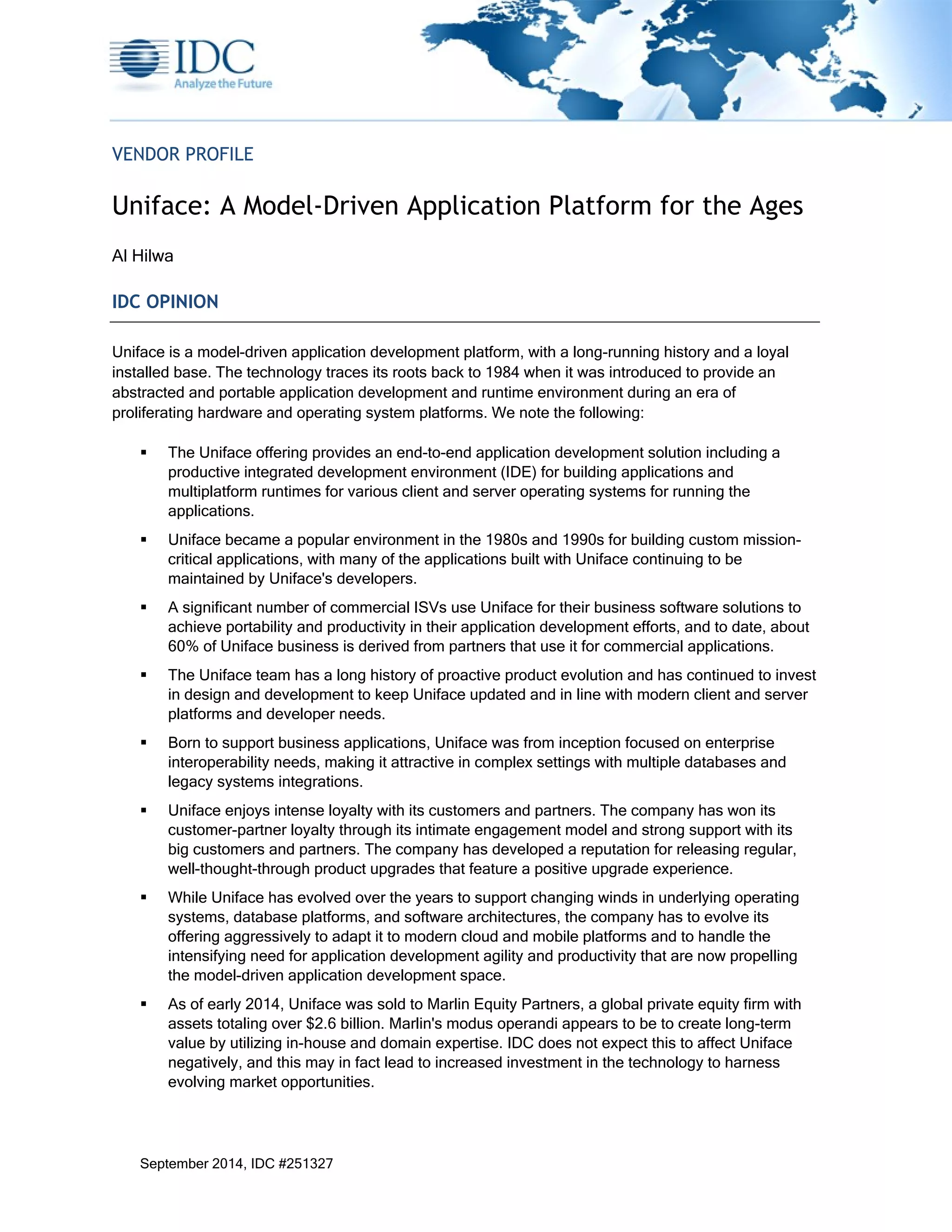
IDC OPINION 
Uniface is a model-driven application development platform, with a long-running history and a loyal 
installed base. The technology traces its roots back to 1984 when it was introduced to provide an 
abstracted and portable application development and runtime environment during an era of 
proliferating hardware and operating system platforms. We note the following: 
 The Uniface offering provides an end-to-end application development solution including a 
productive integrated development environment (IDE) for building applications and 
multiplatform runtimes for various client and server operating systems for running the 
applications. 
 Uniface became a popular environment in the 1980s and 1990s for building custom mission-critical 
applications, with many of the applications built with Uniface continuing to be 
maintained by Uniface's developers. 
 A significant number of commercial ISVs use Uniface for their business software solutions to 
achieve portability and productivity in their application development efforts, and to date, about 
60% of Uniface business is derived from partners that use it for commercial applications. 
 The Uniface team has a long history of proactive product evolution and has continued to invest 
in design and development to keep Uniface updated and in line with modern client and server 
platforms and developer needs. 
 Born to support business applications, Uniface was from inception focused on enterprise 
interoperability needs, making it attractive in complex settings with multiple databases and 
legacy systems integrations. 
 Uniface enjoys intense loyalty with its customers and partners. The company has won its 
customer-partner loyalty through its intimate engagement model and strong support with its 
big customers and partners. The company has developed a reputation for releasing regular, 
well-thought-through product upgrades that feature a positive upgrade experience. 
 While Uniface has evolved over the years to support changing winds in underlying operating 
systems, database platforms, and software architectures, the company has to evolve its 
offering aggressively to adapt it to modern cloud and mobile platforms and to handle the 
intensifying need for application development agility and productivity that are now propelling 
the model-driven application development space. 
 As of early 2014, Uniface was sold to Marlin Equity Partners, a global private equity firm with 
assets totaling over $2.6 billion. Marlin's modus operandi appears to be to create long-term 
value by utilizing in-house and domain expertise. IDC does not expect this to affect Uniface 
negatively, and this may in fact lead to increased investment in the technology to harness 
evolving market opportunities. 
September 2014, IDC #251327
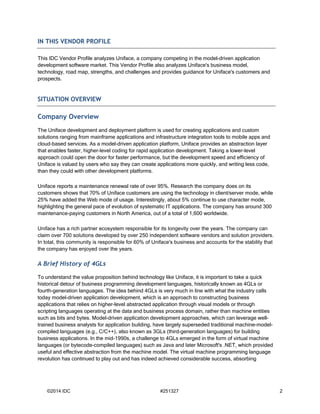
IN THIS VENDOR PROFILE 
This IDC Vendor Profile analyzes Uniface, a company competing in the model-driven application 
development software market. This Vendor Profile also analyzes Uniface's business model, 
technology, road map, strengths, and challenges and provides guidance for Uniface's customers and 
prospects. 
SITUATION OVERVIEW 
Company Overview 
The Uniface development and deployment platform is used for creating applications and custom 
solutions ranging from mainframe applications and infrastructure integration tools to mobile apps and 
cloud-based services. As a model-driven application platform, Uniface provides an abstraction layer 
that enables faster, higher-level coding for rapid application development. Taking a lower-level 
approach could open the door for faster performance, but the development speed and efficiency of 
Uniface is valued by users who say they can create applications more quickly, and writing less code, 
than they could with other development platforms. 
Uniface reports a maintenance renewal rate of over 95%. Research the company does on its 
customers shows that 70% of Uniface customers are using the technology in client/server mode, while 
25% have added the Web mode of usage. Interestingly, about 5% continue to use character mode, 
highlighting the general pace of evolution of systematic IT applications. The company has around 300 
maintenance-paying customers in North America, out of a total of 1,600 worldwide. 
Uniface has a rich partner ecosystem responsible for its longevity over the years. The company can 
claim over 700 solutions developed by over 250 independent software vendors and solution providers. 
In total, this community is responsible for 60% of Uniface's business and accounts for the stability that 
the company has enjoyed over the years. 
A Brief History of 4GLs 
To understand the value proposition behind technology like Uniface, it is important to take a quick 
historical detour of business programming development languages, historically known as 4GLs or 
fourth-generation languages. The idea behind 4GLs is very much in line with what the industry calls 
today model-driven application development, which is an approach to constructing business 
applications that relies on higher-level abstracted application through visual models or through 
scripting languages operating at the data and business process domain, rather than machine entities 
such as bits and bytes. Model-driven application development approaches, which can leverage well-trained 
business analysts for application building, have largely superseded traditional machine-model-compiled 
languages (e.g., C/C++), also known as 3GLs (third-generation languages) for building 
business applications. In the mid-1990s, a challenge to 4GLs emerged in the form of virtual machine 
languages (or bytecode-compiled languages) such as Java and later Microsoft's .NET, which provided 
useful and effective abstraction from the machine model. The virtual machine programming language 
revolution has continued to play out and has indeed achieved considerable success, absorbing 
©2014 IDC #251327 2
considerable business application development activity from both compiled-to-machine languages and 
4GLs, but has proven to require significant programming skill and is largely used today in commercial 
software development or to build and maintain large-scale systematic enterprise applications. 
Meantime, model-driven approaches are seeing a renaissance in the form of a considerable increase 
in adoption in recent years as the need for rapid innovation and business differentiation has 
accelerated. With model-driven approaches on the market today, including technologies from the likes 
of salesforce.com, Mendex, and OutSystems, enterprises strive to be more productive and agile in 
their application development and more engaging of the business power user or analyst in the 
application development life cycle. In many ways, we are entering the new age of the 4GL, in the guise 
of the modern model-driven application platform. 
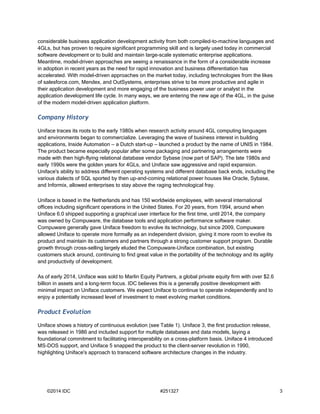
Company History 
Uniface traces its roots to the early 1980s when research activity around 4GL computing languages 
and environments began to commercialize. Leveraging the wave of business interest in building 
applications, Inside Automation — a Dutch start-up — launched a product by the name of UNIS in 1984. 
The product became especially popular after some packaging and partnering arrangements were 
made with then high-flying relational database vendor Sybase (now part of SAP). The late 1980s and 
early 1990s were the golden years for 4GLs, and Uniface saw aggressive and rapid expansion. 
Uniface's ability to address different operating systems and different database back ends, including the 
various dialects of SQL sported by then up-and-coming relational power houses like Oracle, Sybase, 
and Informix, allowed enterprises to stay above the raging technological fray. 
Uniface is based in the Netherlands and has 150 worldwide employees, with several international 
offices including significant operations in the United States. For 20 years, from 1994, around when 
Uniface 6.0 shipped supporting a graphical user interface for the first time, until 2014, the company 
was owned by Compuware, the database tools and application performance software maker. 
Compuware generally gave Uniface freedom to evolve its technology, but since 2009, Compuware 
allowed Uniface to operate more formally as an independent division, giving it more room to evolve its 
product and maintain its customers and partners through a strong customer support program. Durable 
growth through cross-selling largely eluded the Compuware-Uniface combination, but existing 
customers stuck around, continuing to find great value in the portability of the technology and its agility 
and productivity of development. 
As of early 2014, Uniface was sold to Marlin Equity Partners, a global private equity firm with over $2.6 
billion in assets and a long-term focus. IDC believes this is a generally positive development with 
minimal impact on Uniface customers. We expect Uniface to continue to operate independently and to 
enjoy a potentially increased level of investment to meet evolving market conditions. 
Product Evolution 
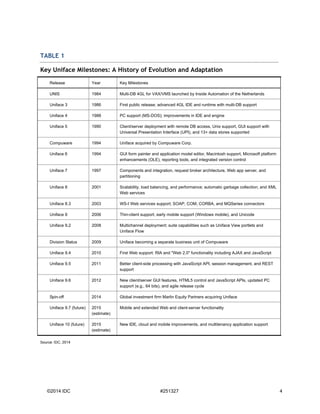
Uniface shows a history of continuous evolution (see Table 1). Uniface 3, the first production release, 
was released in 1986 and included support for multiple databases and data models, laying a 
foundational commitment to facilitating interoperability on a cross-platform basis. Uniface 4 introduced 
MS-DOS support, and Uniface 5 snapped the product to the client-server revolution in 1990, 
highlighting Uniface's approach to transcend software architecture changes in the industry. 
©2014 IDC #251327 3
TABLE 1 
Key Uniface Milestones: A History of Evolution and Adaptation 
Release Year Key Milestones 
UNIS 1984 Multi-DB 4GL for VAX/VMS launched by Inside Automation of the Netherlands 
Uniface 3 1986 First public release; advanced 4GL IDE and runtime with multi-DB support 
Uniface 4 1988 PC support (MS-DOS); improvements in IDE and engine 
Uniface 5 1990 Client/server deployment with remote DB access, Unix support, GUI support with 
Universal Presentation Interface (UPI), and 13+ data stores supported 
Compuware 1994 Uniface acquired by Compuware Corp. 
Uniface 6 1994 GUI form painter and application model editor, Macintosh support, Microsoft platform 
enhancements (OLE), reporting tools, and integrated version control 
Uniface 7 1997 Components and integration, request broker architecture, Web app server, and 
partitioning 
Uniface 8 2001 Scalability, load balancing, and performance; automatic garbage collection; and XML 
Web services 
Uniface 8.3 2003 WS-I Web services support; SOAP, COM, CORBA, and MQSeries connectors 
Uniface 9 2006 Thin-client support, early mobile support (Windows mobile), and Unicode 
Uniface 9.2 2008 Multichannel deployment; suite capabilities such as Uniface View portlets and 
Uniface Flow 
Division Status 2009 Uniface becoming a separate business unit of Compuware 
Uniface 9.4 2010 First Web support: RIA and "Web 2.0" functionality including AJAX and JavaScript 
Uniface 9.5 2011 Better client-side processing with JavaScript API, session management, and REST 
support 
Uniface 9.6 2012 New client/server GUI features, HTML5 control and JavaScript APIs, updated PC 
support (e.g., 64 bits), and agile release cycle 
Spin-off 2014 Global investment firm Marlin Equity Partners acquiring Uniface 
Uniface 9.7 (future) 2015 
(estimate) 
Mobile and extended Web and client-server functionality 
Uniface 10 (future) 2015 
(estimate) 
New IDE, cloud and mobile improvements, and multitenancy application support 
Source: IDC, 2014 
©2014 IDC #251327 4
Since 2010, Uniface has released updates on an annual basis as it has sought to incrementalize its 
evolution through a new agile approach to product development. Today, the company's R&D is 
focused on adapting the technology to agile application development for Web, mobile, and cloud, with 
the aim of delivering much of this functionality in the Uniface 10 release time frame of 2015. Version 
9.6 heralded a switch by the Uniface team to a more agile development approach that has resulted in 
incremental improvements coming out roughly every four months. This change is a positive one, 
although the transition likely took a toll on the long-planned road map for version 10, now destined for 
some time in 2015. 
The Uniface development and deployment platform is used for creating applications and custom 
solutions ranging from mainframe applications and infrastructure integration tools to mobile apps and 
cloud-based services. As a fourth-generation language, Uniface provides an abstraction layer that 
enables faster, higher-level coding for rapid application development. Taking a lower-level approach 
could open the door for faster performance, but the development speed and efficiency of Uniface is 
valued by users who say they can create applications more quickly, and writing less code, than they 
could with other development platforms. 
Company Leadership 
IDC believes that Uniface has a strong leadership team ready to take it forward. The key principles in 
charge of operating, marketing, and engineering are: 
 Jim Byrnes, CEO. Byrnes has taken the helm after the divestiture from Compuware. He has 
significant enterprise software experience at IBM and most recently at Infor. 
 Aad van Schetsen, President and General Manager. van Schetsen is responsible for running 
Uniface on a day–to-day basis and has been at the company since 1992 where he joined after 
working at Cognos in many positions. 
 Adrian Gosbell, Vice President of Product Management and Marketing. Gosbell has been at 
Uniface since 1994, having joined the company after stints at end-user organizations as a 
software developer often using the Uniface technology. 
 Maarten van Leer, Vice President of Uniface Technology. van Leer is Uniface's top software 
developer running the engineering team behind the product and has been at the company 
since 1993. 
 Deniz Yugnuk, Vice President of Sales. Yugnuk has been with Uniface since 2000 in sales 
and project management roles after stints at Baan and other companies. 
Company Strategy 
From its inception, Uniface has been focused on making available a portable approach for building 
business applications. Compuware's acquisition of Uniface two decades ago was motivated by 
synergies between Compuware's focus on application development tools and application 
management. With Compuware's extensive enterprise sales organization, Compuware promoted 
©2014 IDC #251327 5
Uniface to its customers, but changes in application development away from mainframe technology 
meant that most of Compuware's enterprise connections in IT operations were increasingly not the best 
targets for marketing portable application development tools. In addition, as Java was being adopted in 
the enterprise in the late 1990s and as enterprises focused their front-end application development on 
Microsoft PCs at the exclusion of any other platform, the grounds shifted, and portability requirements 
became less intense in the application development tools space. Thus while Uniface was able to 
continuously evolve its offering to remain relevant and valuable to its international base of customers, the 
expansion to a much larger base of customers through cross-selling was illusive. 
As platforms changed and architectures evolved, the Uniface team's diligence in supporting emerging 
technologies helped the company retain the loyalty and support of its customers. In recent years, new 
disruption in front-end devices brought about by smartphone technologies is creating new portability 
needs, but now in the guise of agile and productive development. Uniface provides the kind of platform-agnostic, 
model-driven development and deployment platform that developers can use to create new 
applications and to solve complex integration challenges with fewer lines of code and a faster time to 
completion than is typically possible with virtual machine-based technologies such as Java. 
Products and Services 
Uniface continues to be focused on its original mission. The Uniface development and deployment 
platform is used for creating applications and custom solutions ranging from mainframe applications 
and infrastructure integration tools to mobile apps and cloud-based services. As a fourth-generation 
language, Uniface provides an abstraction layer that enables faster, higher-level coding for rapid 
application development. Taking a lower-level approach could open the door for faster performance, 
but the development speed and efficiency of Uniface is valued by users who say they can create 
applications more quickly, and writing less code, than they could with other development platforms. 
Uniface's support for the Dojo Toolkit and HTML5 helps the company's customers create hybrid and 
Web-based applications, as part of a strategy to enable customers to deploy solutions on the platform 
of their choice, including the cloud. This strategy extends Uniface relevance to developers focused on 
cloud-based solutions, software as a service, and mobile apps. 
Customers and Partners 
Uniface appears to have a strong partner strategy, with partners making up 60% of its customer base. 
Partners provide a steady royalty revenue stream, as well as strategic longevity and viability for 
Uniface. Partners can be strategic door openers because when an enterprise takes on a vendor to 
create a custom application or to resolve an infrastructure integration challenge, the vendor usually is 
given a strong say in the tools the vendor wants to use in solving the problem. 
Enterprise ready has become a cliché, but Uniface enjoys a reputation for reliability. Its customers 
have used Uniface to develop and deploy an array of mission-critical line-of-business and back-end 
applications. The company's long-term commitment to supporting multiple databases, operating 
systems, and industry standards has given the company relevance, with companies undertaking large 
modernization projects. 
©2014 IDC #251327 6
Uniface has developed a reputation for taking care of the customer, which translates into a long-time 
value for Uniface. Uniface has remained relevant for decades because of its history of responding to 
developer needs through evolving the product. It has also developed a reputation for thoroughly testing 
updates prior to release and providing easy transitions. This strategy results in customers looking 
forward to new product releases, which isn't always the case in the computer industry. 
Market 
Uniface falls in a class of technologies known as model-driven application platforms that combine rapid 
application development capability through visual or abstract models with client-side and server-side 
runtimes, which execute the developed code. Such tools typically provide a significantly higher level of 
abstraction than a 3GL. Uniface is generally known as a data-centric application platform where the 
application development process is often guided by and centered around the application's data model. 
Process-centric model-driven application platforms are guided by and centered around an application's 
process model, essentially requiring a process-centric view of the application requirements. The focus 
of model-driven application platforms is often portability, development productivity, and agility and 
involves a trade-off between support for industry-standard and proprietary approaches to achieve 
these results. The overall model-driven application platform market is currently being sized as IDC has 
reconfigured its software taxonomy to aggregate all such tools, but it is estimated to be in excess of $3 
billion annually. IDC estimates that Uniface has license revenue in excess of $40 million. 
Competition 
Competition in the model-driven application platform space has heated up significantly. The market 
has a number of innovators leveraging the need for agile and productive development and using cloud 
and mobile technology to open new doors. In particular, players like Salesforce, Progress Software, 
Mendex, OutSystems, Caspio, Zoho, and Intuit are most likely to be evaluated when enterprises or 
ISVs look for model-driven development solutions. Vendors in this space also compete with business 
process management (BPM) players, which also layer highly visual compositional approaches on top 
of an orchestration engine. 
FUTURE OUTLOOK 
We see a stable future for Uniface as long as it remains focused on the strategies that have brought it 
this far — without losing its sight on where the world of development is headed. This means continuing 
to evolve Uniface. The company's future to an extent will be determined by the success of its partner 
program — and the extent to which partners can showcase their project work as a case for extending 
the use of Uniface within the enterprise. 
While the company hasn't yet announced a detailed feature list for its forthcoming Uniface 10, its 
history to this point suggests that when it arrives (currently set for mid-2015), the code should be clean 
and well tested and provide well-planned feature capabilities and enhancements that encourage 
upgrades. The question for Uniface as a business is whether it will be able to attract new customers 
and ISV partners. 
©2014 IDC #251327 7
Challenges and Opportunities 
The key challenges and opportunities facing Uniface are as follows: 
 Strategic safety. Like many model-driven application platforms, Uniface requires a strategic 
commitment to the development platform that some enterprises and ISVs are not willing to 
make. IDC finds that enterprises select such tools if they deem the return-on-investment (ROI) 
or time-to-market benefits outweigh these strategic risks. In addition, Uniface's longevity and 
customer loyalty stands as a strong testament that this is a vendor focused on customer 
satisfaction and continued adoption. 
 Cloud and mobile deployment. Uniface can be deployed today in cloud environments, but it 
does not provide specific support for the leverage of the cloud self-service model and does not 
enable ISVs or larger enterprises to deploy its servers in a multitenant model. Similarly, the 
product offers strong support for multiple platforms but only Web support for modern 
smartphone and tablet platforms. To broaden its customer base, Uniface must invest heavily in 
modern deployment approaches for its server and client technology by embracing cloud and 
mobile application models. 
 Complexity. Uniface was designed in an era where portability was the key value derived from 
abstraction. The product's early competitors were traditional compiled languages like C/C++, 
and later Uniface evolved in a world of Java competition, which while raising the abstraction 
layer somewhat with a virtual machine model retains considerable complexity to support a 
broad range of consumer and enterprise applications. Uniface thus has retained considerable 
complexity in its development model relative to modern model-driven environments that are 
more focused on agility and productivity for business applications. This is an area that the 
Uniface team needs to be mindful of as it evolves the product. 
Uniface appears focused on continuing the evolution of its offering in order to adapt to modern 
challenges. The company's Uniface 10 release, which has been talked about for several years, 
promises to make progress along many of the dimensions listed previously. 
ESSENTIAL GUIDANCE 
There is a long trail of development tools that have enjoyed their time in the sun only to be later 
abandoned as more efficient solutions were released, or even because less efficient (but more 
popular) alternatives came on the scene. In fact, many Uniface customers believe that today's market-leading 
development tools provide an example of the later — more popular, but less efficient. We fully 
realize that adherents of any development platform could be just as passionate, but Uniface has 
indeed earned a customer base that feels as though it has found a better way to get things done. 
©2014 IDC #251327 8
Advice for Technology Buyers 
The selection of application development tools can be a complex and confusing exercise. Enterprises 
need to assess their strengths and weaknesses realistically and identify goals and needs to make the 
right selection decisions. Some of the questions buyers need to answer are: 
 Are applications intended to extend existing systems or are they for greenfields settings? If 
existing applications are to be extended, what is the extensibility of the existing platform and 
toolset? Do the existing systems support modern application development processes? Do they 
enable the adaptation of existing code to modern Web services? 
 What are the application scale requirements in terms of front-end workflow complexity or back-end 
business integration or algorithmic complexity? How many users are likely to use the 
system concurrently? What are the platform's limitations? How stable is the architecture? 
 Is cloud enablement a strategic imperative? What is the preferred cloud deployment model — 
public, private, or hybrid? Does the application platform under consideration support these 
cloud models of deployment? 
 What are the mobile requirements for developing new applications or mobile extensions? 
What are the integration requirements or architectures to comply with in the enterprise? Does 
the existing toolset support the data synchronization patterns required? Is HTML5 adequate 
even in hybrid form for the requirements? Are multiplatform tools needed? 
 Is the vendor viable on a long-term basis and capable of supporting its offering, and is the 
vendor offering a stable architecture and product set? Is the vendor staffed to provide the 
required level of enterprise or partner support? 
Advice for Uniface 
Mode-driven application platform vendors like Uniface need to understand the specific requirements of 
technology buyers and address them clearly and directly, including case studies and ROI calculators 
where possible. Buyers should expect vendors to be conversant with buyer concerns around support 
for specific workloads and their scaling and around offering services to help transition to public, 
private, and hybrid cloud environments. 
IDC's guidance for Uniface is to continue to advance its development and deployment platform to meet 
the evolving needs of its partners and other customers, ranging from Windows to cloud and from 
mobile to modernization. This will require staying tightly attuned to its partner-customer ecosystem as 
well as proving nimble at accommodating new methodologies or standards as they emerge. 
©2014 IDC #251327 9
LEARN MORE 
Related Research 
 OutSystems Platform: A Cross-Ecosystem Model-Driven Application Platform and PaaS (IDC 
#250347, August 2014) 
 Worldwide Software Construction Components 2013 Vendor Shares (IDC #250545, August 
2014) 
 TrackVia: Model-Driven Application Platform and PaaS for the Citizen Developer (IDC 
#250496, August 2014) 
 Negotiating the Mobile Disruption: Approaches for Multiplatform Application Development (IDC 
#249202, June 2014) 
 Worldwide Business Rules Management Systems 2013 Vendor Shares (IDC #249018, June 
2014) 
 Worldwide Development Languages, Environments, and Tools 2013 Vendor Shares (IDC 
#248995, June 2014) 
 Worldwide Development Languages, Environments, and Tools 2014–2018 Forecast: The Shift 
to Mobile First (IDC #248879, May 2014) 
 Worldwide Application Development and Deployment 2014 Top 10 Predictions (IDC #246917, 
March 2014) 
 The Evolving State of HTML5 (IDC #247499, March 2014) 
 2014 Worldwide Software Developer and ICT-Skilled Worker Estimates (IDC #244709, 
December 2013) 
 IDC Predictions 2014: Battles for Dominance — and Survival — on the 3rd Platform (IDC 
#244606, December 2013) 
 Market Analysis Perspective: Worldwide Application Development Software, 2013 — The 
Transformations Continue (IDC #245089, December 2013) 
 The Evolving State of PaaS — Strategic Guidance on Cloud Application Platforms (IDC 
#244391, November 2013) 
 Progress Software Goes All-in on PaaS: Converged Pacific Platform Opens New Horizons 
(IDC #244384, November 2013) 
 BuyerPulse Snapshot: SixSq on Platform as a Service (IDC #lcUS24364313, October 2013) 
 BuyerPulse Snapshot: Caspio on Platform as a Service (IDC #lcUS24327113, September 
2013) 
 The Pressures That Are Reshaping Platform as a Service (IDC #240993, May 2013) 
©2014 IDC #251327 10
About IDC 
International Data Corporation (IDC) is the premier global provider of market intelligence, advisory 
services, and events for the information technology, telecommunications and consumer technology 
markets. IDC helps IT professionals, business executives, and the investment community make fact-based 
decisions on technology purchases and business strategy. More than 1,100 IDC analysts 
provide global, regional, and local expertise on technology and industry opportunities and trends in 
over 110 countries worldwide. For more than 50 years, IDC has provided strategic insights to help our 
clients achieve their key business objectives. IDC is a subsidiary of IDG, the world's leading 
technology media, research, and events company. 
Global Headquarters 
5 Speen Street 
Framingham, MA 01701 
USA 
508.872.8200 
Twitter: @IDC 
idc-insights-community.com 
www.idc.com 
Copyright Notice 
This IDC research document was published as part of an IDC continuous intelligence service, providing written 
research, analyst interactions, telebriefings, and conferences. Visit www.idc.com to learn more about IDC 
subscription and consulting services. To view a list of IDC offices worldwide, visit www.idc.com/offices. Please 
contact the IDC Hotline at 800.343.4952, ext. 7988 (or +1.508.988.7988) or sales@idc.com for information on 
applying the price of this document toward the purchase of an IDC service or for information on additional copies 
or Web rights. 
Copyright 2014 IDC. Reproduction is forbidden unless authorized. All rights reserved.

Uniface: A Model-Driven Application Platform for the Ages

  • 1.
    VENDOR PROFILE Uniface:A Model-Driven Application Platform for the Ages Al Hilwa IDC OPINION Uniface is a model-driven application development platform, with a long-running history and a loyal installed base. The technology traces its roots back to 1984 when it was introduced to provide an abstracted and portable application development and runtime environment during an era of proliferating hardware and operating system platforms. We note the following:  The Uniface offering provides an end-to-end application development solution including a productive integrated development environment (IDE) for building applications and multiplatform runtimes for various client and server operating systems for running the applications.  Uniface became a popular environment in the 1980s and 1990s for building custom mission-critical applications, with many of the applications built with Uniface continuing to be maintained by Uniface's developers.  A significant number of commercial ISVs use Uniface for their business software solutions to achieve portability and productivity in their application development efforts, and to date, about 60% of Uniface business is derived from partners that use it for commercial applications.  The Uniface team has a long history of proactive product evolution and has continued to invest in design and development to keep Uniface updated and in line with modern client and server platforms and developer needs.  Born to support business applications, Uniface was from inception focused on enterprise interoperability needs, making it attractive in complex settings with multiple databases and legacy systems integrations.  Uniface enjoys intense loyalty with its customers and partners. The company has won its customer-partner loyalty through its intimate engagement model and strong support with its big customers and partners. The company has developed a reputation for releasing regular, well-thought-through product upgrades that feature a positive upgrade experience.  While Uniface has evolved over the years to support changing winds in underlying operating systems, database platforms, and software architectures, the company has to evolve its offering aggressively to adapt it to modern cloud and mobile platforms and to handle the intensifying need for application development agility and productivity that are now propelling the model-driven application development space.  As of early 2014, Uniface was sold to Marlin Equity Partners, a global private equity firm with assets totaling over $2.6 billion. Marlin's modus operandi appears to be to create long-term value by utilizing in-house and domain expertise. IDC does not expect this to affect Uniface negatively, and this may in fact lead to increased investment in the technology to harness evolving market opportunities. September 2014, IDC #251327
  • 2.
    IN THIS VENDORPROFILE This IDC Vendor Profile analyzes Uniface, a company competing in the model-driven application development software market. This Vendor Profile also analyzes Uniface's business model, technology, road map, strengths, and challenges and provides guidance for Uniface's customers and prospects. SITUATION OVERVIEW Company Overview The Uniface development and deployment platform is used for creating applications and custom solutions ranging from mainframe applications and infrastructure integration tools to mobile apps and cloud-based services. As a model-driven application platform, Uniface provides an abstraction layer that enables faster, higher-level coding for rapid application development. Taking a lower-level approach could open the door for faster performance, but the development speed and efficiency of Uniface is valued by users who say they can create applications more quickly, and writing less code, than they could with other development platforms. Uniface reports a maintenance renewal rate of over 95%. Research the company does on its customers shows that 70% of Uniface customers are using the technology in client/server mode, while 25% have added the Web mode of usage. Interestingly, about 5% continue to use character mode, highlighting the general pace of evolution of systematic IT applications. The company has around 300 maintenance-paying customers in North America, out of a total of 1,600 worldwide. Uniface has a rich partner ecosystem responsible for its longevity over the years. The company can claim over 700 solutions developed by over 250 independent software vendors and solution providers. In total, this community is responsible for 60% of Uniface's business and accounts for the stability that the company has enjoyed over the years. A Brief History of 4GLs To understand the value proposition behind technology like Uniface, it is important to take a quick historical detour of business programming development languages, historically known as 4GLs or fourth-generation languages. The idea behind 4GLs is very much in line with what the industry calls today model-driven application development, which is an approach to constructing business applications that relies on higher-level abstracted application through visual models or through scripting languages operating at the data and business process domain, rather than machine entities such as bits and bytes. Model-driven application development approaches, which can leverage well-trained business analysts for application building, have largely superseded traditional machine-model-compiled languages (e.g., C/C++), also known as 3GLs (third-generation languages) for building business applications. In the mid-1990s, a challenge to 4GLs emerged in the form of virtual machine languages (or bytecode-compiled languages) such as Java and later Microsoft's .NET, which provided useful and effective abstraction from the machine model. The virtual machine programming language revolution has continued to play out and has indeed achieved considerable success, absorbing ©2014 IDC #251327 2
  • 3.
    considerable business applicationdevelopment activity from both compiled-to-machine languages and 4GLs, but has proven to require significant programming skill and is largely used today in commercial software development or to build and maintain large-scale systematic enterprise applications. Meantime, model-driven approaches are seeing a renaissance in the form of a considerable increase in adoption in recent years as the need for rapid innovation and business differentiation has accelerated. With model-driven approaches on the market today, including technologies from the likes of salesforce.com, Mendex, and OutSystems, enterprises strive to be more productive and agile in their application development and more engaging of the business power user or analyst in the application development life cycle. In many ways, we are entering the new age of the 4GL, in the guise of the modern model-driven application platform. Company History Uniface traces its roots to the early 1980s when research activity around 4GL computing languages and environments began to commercialize. Leveraging the wave of business interest in building applications, Inside Automation — a Dutch start-up — launched a product by the name of UNIS in 1984. The product became especially popular after some packaging and partnering arrangements were made with then high-flying relational database vendor Sybase (now part of SAP). The late 1980s and early 1990s were the golden years for 4GLs, and Uniface saw aggressive and rapid expansion. Uniface's ability to address different operating systems and different database back ends, including the various dialects of SQL sported by then up-and-coming relational power houses like Oracle, Sybase, and Informix, allowed enterprises to stay above the raging technological fray. Uniface is based in the Netherlands and has 150 worldwide employees, with several international offices including significant operations in the United States. For 20 years, from 1994, around when Uniface 6.0 shipped supporting a graphical user interface for the first time, until 2014, the company was owned by Compuware, the database tools and application performance software maker. Compuware generally gave Uniface freedom to evolve its technology, but since 2009, Compuware allowed Uniface to operate more formally as an independent division, giving it more room to evolve its product and maintain its customers and partners through a strong customer support program. Durable growth through cross-selling largely eluded the Compuware-Uniface combination, but existing customers stuck around, continuing to find great value in the portability of the technology and its agility and productivity of development. As of early 2014, Uniface was sold to Marlin Equity Partners, a global private equity firm with over $2.6 billion in assets and a long-term focus. IDC believes this is a generally positive development with minimal impact on Uniface customers. We expect Uniface to continue to operate independently and to enjoy a potentially increased level of investment to meet evolving market conditions. Product Evolution Uniface shows a history of continuous evolution (see Table 1). Uniface 3, the first production release, was released in 1986 and included support for multiple databases and data models, laying a foundational commitment to facilitating interoperability on a cross-platform basis. Uniface 4 introduced MS-DOS support, and Uniface 5 snapped the product to the client-server revolution in 1990, highlighting Uniface's approach to transcend software architecture changes in the industry. ©2014 IDC #251327 3
  • 4.
    TABLE 1 KeyUniface Milestones: A History of Evolution and Adaptation Release Year Key Milestones UNIS 1984 Multi-DB 4GL for VAX/VMS launched by Inside Automation of the Netherlands Uniface 3 1986 First public release; advanced 4GL IDE and runtime with multi-DB support Uniface 4 1988 PC support (MS-DOS); improvements in IDE and engine Uniface 5 1990 Client/server deployment with remote DB access, Unix support, GUI support with Universal Presentation Interface (UPI), and 13+ data stores supported Compuware 1994 Uniface acquired by Compuware Corp. Uniface 6 1994 GUI form painter and application model editor, Macintosh support, Microsoft platform enhancements (OLE), reporting tools, and integrated version control Uniface 7 1997 Components and integration, request broker architecture, Web app server, and partitioning Uniface 8 2001 Scalability, load balancing, and performance; automatic garbage collection; and XML Web services Uniface 8.3 2003 WS-I Web services support; SOAP, COM, CORBA, and MQSeries connectors Uniface 9 2006 Thin-client support, early mobile support (Windows mobile), and Unicode Uniface 9.2 2008 Multichannel deployment; suite capabilities such as Uniface View portlets and Uniface Flow Division Status 2009 Uniface becoming a separate business unit of Compuware Uniface 9.4 2010 First Web support: RIA and "Web 2.0" functionality including AJAX and JavaScript Uniface 9.5 2011 Better client-side processing with JavaScript API, session management, and REST support Uniface 9.6 2012 New client/server GUI features, HTML5 control and JavaScript APIs, updated PC support (e.g., 64 bits), and agile release cycle Spin-off 2014 Global investment firm Marlin Equity Partners acquiring Uniface Uniface 9.7 (future) 2015 (estimate) Mobile and extended Web and client-server functionality Uniface 10 (future) 2015 (estimate) New IDE, cloud and mobile improvements, and multitenancy application support Source: IDC, 2014 ©2014 IDC #251327 4
  • 5.
    Since 2010, Unifacehas released updates on an annual basis as it has sought to incrementalize its evolution through a new agile approach to product development. Today, the company's R&D is focused on adapting the technology to agile application development for Web, mobile, and cloud, with the aim of delivering much of this functionality in the Uniface 10 release time frame of 2015. Version 9.6 heralded a switch by the Uniface team to a more agile development approach that has resulted in incremental improvements coming out roughly every four months. This change is a positive one, although the transition likely took a toll on the long-planned road map for version 10, now destined for some time in 2015. The Uniface development and deployment platform is used for creating applications and custom solutions ranging from mainframe applications and infrastructure integration tools to mobile apps and cloud-based services. As a fourth-generation language, Uniface provides an abstraction layer that enables faster, higher-level coding for rapid application development. Taking a lower-level approach could open the door for faster performance, but the development speed and efficiency of Uniface is valued by users who say they can create applications more quickly, and writing less code, than they could with other development platforms. Company Leadership IDC believes that Uniface has a strong leadership team ready to take it forward. The key principles in charge of operating, marketing, and engineering are:  Jim Byrnes, CEO. Byrnes has taken the helm after the divestiture from Compuware. He has significant enterprise software experience at IBM and most recently at Infor.  Aad van Schetsen, President and General Manager. van Schetsen is responsible for running Uniface on a day–to-day basis and has been at the company since 1992 where he joined after working at Cognos in many positions.  Adrian Gosbell, Vice President of Product Management and Marketing. Gosbell has been at Uniface since 1994, having joined the company after stints at end-user organizations as a software developer often using the Uniface technology.  Maarten van Leer, Vice President of Uniface Technology. van Leer is Uniface's top software developer running the engineering team behind the product and has been at the company since 1993.  Deniz Yugnuk, Vice President of Sales. Yugnuk has been with Uniface since 2000 in sales and project management roles after stints at Baan and other companies. Company Strategy From its inception, Uniface has been focused on making available a portable approach for building business applications. Compuware's acquisition of Uniface two decades ago was motivated by synergies between Compuware's focus on application development tools and application management. With Compuware's extensive enterprise sales organization, Compuware promoted ©2014 IDC #251327 5
  • 6.
    Uniface to itscustomers, but changes in application development away from mainframe technology meant that most of Compuware's enterprise connections in IT operations were increasingly not the best targets for marketing portable application development tools. In addition, as Java was being adopted in the enterprise in the late 1990s and as enterprises focused their front-end application development on Microsoft PCs at the exclusion of any other platform, the grounds shifted, and portability requirements became less intense in the application development tools space. Thus while Uniface was able to continuously evolve its offering to remain relevant and valuable to its international base of customers, the expansion to a much larger base of customers through cross-selling was illusive. As platforms changed and architectures evolved, the Uniface team's diligence in supporting emerging technologies helped the company retain the loyalty and support of its customers. In recent years, new disruption in front-end devices brought about by smartphone technologies is creating new portability needs, but now in the guise of agile and productive development. Uniface provides the kind of platform-agnostic, model-driven development and deployment platform that developers can use to create new applications and to solve complex integration challenges with fewer lines of code and a faster time to completion than is typically possible with virtual machine-based technologies such as Java. Products and Services Uniface continues to be focused on its original mission. The Uniface development and deployment platform is used for creating applications and custom solutions ranging from mainframe applications and infrastructure integration tools to mobile apps and cloud-based services. As a fourth-generation language, Uniface provides an abstraction layer that enables faster, higher-level coding for rapid application development. Taking a lower-level approach could open the door for faster performance, but the development speed and efficiency of Uniface is valued by users who say they can create applications more quickly, and writing less code, than they could with other development platforms. Uniface's support for the Dojo Toolkit and HTML5 helps the company's customers create hybrid and Web-based applications, as part of a strategy to enable customers to deploy solutions on the platform of their choice, including the cloud. This strategy extends Uniface relevance to developers focused on cloud-based solutions, software as a service, and mobile apps. Customers and Partners Uniface appears to have a strong partner strategy, with partners making up 60% of its customer base. Partners provide a steady royalty revenue stream, as well as strategic longevity and viability for Uniface. Partners can be strategic door openers because when an enterprise takes on a vendor to create a custom application or to resolve an infrastructure integration challenge, the vendor usually is given a strong say in the tools the vendor wants to use in solving the problem. Enterprise ready has become a cliché, but Uniface enjoys a reputation for reliability. Its customers have used Uniface to develop and deploy an array of mission-critical line-of-business and back-end applications. The company's long-term commitment to supporting multiple databases, operating systems, and industry standards has given the company relevance, with companies undertaking large modernization projects. ©2014 IDC #251327 6
  • 7.
    Uniface has developeda reputation for taking care of the customer, which translates into a long-time value for Uniface. Uniface has remained relevant for decades because of its history of responding to developer needs through evolving the product. It has also developed a reputation for thoroughly testing updates prior to release and providing easy transitions. This strategy results in customers looking forward to new product releases, which isn't always the case in the computer industry. Market Uniface falls in a class of technologies known as model-driven application platforms that combine rapid application development capability through visual or abstract models with client-side and server-side runtimes, which execute the developed code. Such tools typically provide a significantly higher level of abstraction than a 3GL. Uniface is generally known as a data-centric application platform where the application development process is often guided by and centered around the application's data model. Process-centric model-driven application platforms are guided by and centered around an application's process model, essentially requiring a process-centric view of the application requirements. The focus of model-driven application platforms is often portability, development productivity, and agility and involves a trade-off between support for industry-standard and proprietary approaches to achieve these results. The overall model-driven application platform market is currently being sized as IDC has reconfigured its software taxonomy to aggregate all such tools, but it is estimated to be in excess of $3 billion annually. IDC estimates that Uniface has license revenue in excess of $40 million. Competition Competition in the model-driven application platform space has heated up significantly. The market has a number of innovators leveraging the need for agile and productive development and using cloud and mobile technology to open new doors. In particular, players like Salesforce, Progress Software, Mendex, OutSystems, Caspio, Zoho, and Intuit are most likely to be evaluated when enterprises or ISVs look for model-driven development solutions. Vendors in this space also compete with business process management (BPM) players, which also layer highly visual compositional approaches on top of an orchestration engine. FUTURE OUTLOOK We see a stable future for Uniface as long as it remains focused on the strategies that have brought it this far — without losing its sight on where the world of development is headed. This means continuing to evolve Uniface. The company's future to an extent will be determined by the success of its partner program — and the extent to which partners can showcase their project work as a case for extending the use of Uniface within the enterprise. While the company hasn't yet announced a detailed feature list for its forthcoming Uniface 10, its history to this point suggests that when it arrives (currently set for mid-2015), the code should be clean and well tested and provide well-planned feature capabilities and enhancements that encourage upgrades. The question for Uniface as a business is whether it will be able to attract new customers and ISV partners. ©2014 IDC #251327 7
  • 8.
    Challenges and Opportunities The key challenges and opportunities facing Uniface are as follows:  Strategic safety. Like many model-driven application platforms, Uniface requires a strategic commitment to the development platform that some enterprises and ISVs are not willing to make. IDC finds that enterprises select such tools if they deem the return-on-investment (ROI) or time-to-market benefits outweigh these strategic risks. In addition, Uniface's longevity and customer loyalty stands as a strong testament that this is a vendor focused on customer satisfaction and continued adoption.  Cloud and mobile deployment. Uniface can be deployed today in cloud environments, but it does not provide specific support for the leverage of the cloud self-service model and does not enable ISVs or larger enterprises to deploy its servers in a multitenant model. Similarly, the product offers strong support for multiple platforms but only Web support for modern smartphone and tablet platforms. To broaden its customer base, Uniface must invest heavily in modern deployment approaches for its server and client technology by embracing cloud and mobile application models.  Complexity. Uniface was designed in an era where portability was the key value derived from abstraction. The product's early competitors were traditional compiled languages like C/C++, and later Uniface evolved in a world of Java competition, which while raising the abstraction layer somewhat with a virtual machine model retains considerable complexity to support a broad range of consumer and enterprise applications. Uniface thus has retained considerable complexity in its development model relative to modern model-driven environments that are more focused on agility and productivity for business applications. This is an area that the Uniface team needs to be mindful of as it evolves the product. Uniface appears focused on continuing the evolution of its offering in order to adapt to modern challenges. The company's Uniface 10 release, which has been talked about for several years, promises to make progress along many of the dimensions listed previously. ESSENTIAL GUIDANCE There is a long trail of development tools that have enjoyed their time in the sun only to be later abandoned as more efficient solutions were released, or even because less efficient (but more popular) alternatives came on the scene. In fact, many Uniface customers believe that today's market-leading development tools provide an example of the later — more popular, but less efficient. We fully realize that adherents of any development platform could be just as passionate, but Uniface has indeed earned a customer base that feels as though it has found a better way to get things done. ©2014 IDC #251327 8
  • 9.
    Advice for TechnologyBuyers The selection of application development tools can be a complex and confusing exercise. Enterprises need to assess their strengths and weaknesses realistically and identify goals and needs to make the right selection decisions. Some of the questions buyers need to answer are:  Are applications intended to extend existing systems or are they for greenfields settings? If existing applications are to be extended, what is the extensibility of the existing platform and toolset? Do the existing systems support modern application development processes? Do they enable the adaptation of existing code to modern Web services?  What are the application scale requirements in terms of front-end workflow complexity or back-end business integration or algorithmic complexity? How many users are likely to use the system concurrently? What are the platform's limitations? How stable is the architecture?  Is cloud enablement a strategic imperative? What is the preferred cloud deployment model — public, private, or hybrid? Does the application platform under consideration support these cloud models of deployment?  What are the mobile requirements for developing new applications or mobile extensions? What are the integration requirements or architectures to comply with in the enterprise? Does the existing toolset support the data synchronization patterns required? Is HTML5 adequate even in hybrid form for the requirements? Are multiplatform tools needed?  Is the vendor viable on a long-term basis and capable of supporting its offering, and is the vendor offering a stable architecture and product set? Is the vendor staffed to provide the required level of enterprise or partner support? Advice for Uniface Mode-driven application platform vendors like Uniface need to understand the specific requirements of technology buyers and address them clearly and directly, including case studies and ROI calculators where possible. Buyers should expect vendors to be conversant with buyer concerns around support for specific workloads and their scaling and around offering services to help transition to public, private, and hybrid cloud environments. IDC's guidance for Uniface is to continue to advance its development and deployment platform to meet the evolving needs of its partners and other customers, ranging from Windows to cloud and from mobile to modernization. This will require staying tightly attuned to its partner-customer ecosystem as well as proving nimble at accommodating new methodologies or standards as they emerge. ©2014 IDC #251327 9
  • 10.
    LEARN MORE RelatedResearch  OutSystems Platform: A Cross-Ecosystem Model-Driven Application Platform and PaaS (IDC #250347, August 2014)  Worldwide Software Construction Components 2013 Vendor Shares (IDC #250545, August 2014)  TrackVia: Model-Driven Application Platform and PaaS for the Citizen Developer (IDC #250496, August 2014)  Negotiating the Mobile Disruption: Approaches for Multiplatform Application Development (IDC #249202, June 2014)  Worldwide Business Rules Management Systems 2013 Vendor Shares (IDC #249018, June 2014)  Worldwide Development Languages, Environments, and Tools 2013 Vendor Shares (IDC #248995, June 2014)  Worldwide Development Languages, Environments, and Tools 2014–2018 Forecast: The Shift to Mobile First (IDC #248879, May 2014)  Worldwide Application Development and Deployment 2014 Top 10 Predictions (IDC #246917, March 2014)  The Evolving State of HTML5 (IDC #247499, March 2014)  2014 Worldwide Software Developer and ICT-Skilled Worker Estimates (IDC #244709, December 2013)  IDC Predictions 2014: Battles for Dominance — and Survival — on the 3rd Platform (IDC #244606, December 2013)  Market Analysis Perspective: Worldwide Application Development Software, 2013 — The Transformations Continue (IDC #245089, December 2013)  The Evolving State of PaaS — Strategic Guidance on Cloud Application Platforms (IDC #244391, November 2013)  Progress Software Goes All-in on PaaS: Converged Pacific Platform Opens New Horizons (IDC #244384, November 2013)  BuyerPulse Snapshot: SixSq on Platform as a Service (IDC #lcUS24364313, October 2013)  BuyerPulse Snapshot: Caspio on Platform as a Service (IDC #lcUS24327113, September 2013)  The Pressures That Are Reshaping Platform as a Service (IDC #240993, May 2013) ©2014 IDC #251327 10
  • 11.
    About IDC InternationalData Corporation (IDC) is the premier global provider of market intelligence, advisory services, and events for the information technology, telecommunications and consumer technology markets. IDC helps IT professionals, business executives, and the investment community make fact-based decisions on technology purchases and business strategy. More than 1,100 IDC analysts provide global, regional, and local expertise on technology and industry opportunities and trends in over 110 countries worldwide. For more than 50 years, IDC has provided strategic insights to help our clients achieve their key business objectives. IDC is a subsidiary of IDG, the world's leading technology media, research, and events company. Global Headquarters 5 Speen Street Framingham, MA 01701 USA 508.872.8200 Twitter: @IDC idc-insights-community.com www.idc.com Copyright Notice This IDC research document was published as part of an IDC continuous intelligence service, providing written research, analyst interactions, telebriefings, and conferences. Visit www.idc.com to learn more about IDC subscription and consulting services. To view a list of IDC offices worldwide, visit www.idc.com/offices. Please contact the IDC Hotline at 800.343.4952, ext. 7988 (or +1.508.988.7988) or sales@idc.com for information on applying the price of this document toward the purchase of an IDC service or for information on additional copies or Web rights. Copyright 2014 IDC. Reproduction is forbidden unless authorized. All rights reserved.