Legal minimum ages
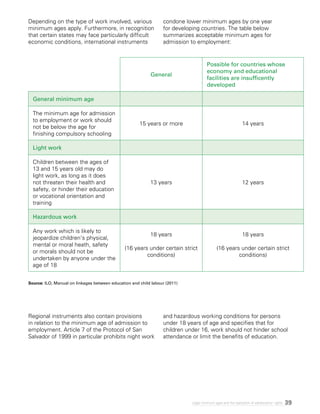
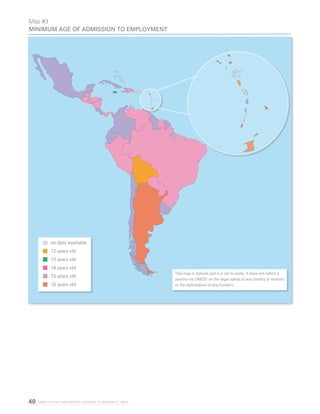
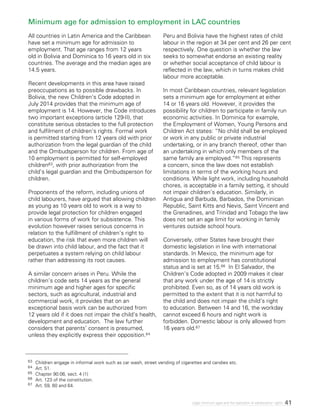
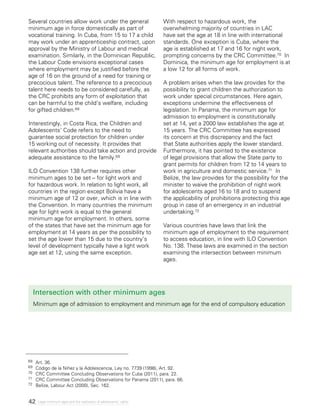
and the realization of
adolescents’ rights
A review of the situation in Latin America and the Caribbean
This document was prepared by Vanessa Sedletzki, consultant to United Nations Children’s Fund Latin America
and Caribbean Regional Office (UNICEF LACRO), Child Protection Section, coordinated by Nadine Perrault,
Regional Child Protection Advisor at UNICEF LACRO.
The opinions expressed in this document, which has not been submitted to and editorial review, are the
exclusive responsibility of the author and may not coincide with those of the organization.
It is important to note that this research collect information until January 2015, considering at the moment of its
publication that some approvals for legal reforms were done.
This publication may be reproduced for use in research, advocacy and education only, provided the source is
acknowledged (UNICEF).
ISBN: 978-92-806-4827-0
Published January 2016
Copyright © United Nations Children’s Fund (UNICEF)
Legal minimum ages
and the realization of
adolescents’ rights
A review of the situation in Latin America and the Caribbean
Introduction 		7
Objective and scope of the study 		9
Methodology 	10
Presentation 	 10
The importance of legal minimum ages for the realization of adolescents’ rights 	11
Setting legal minimum ages: A requirement under international standards 	11
The rationale: Protecting adolescents’ rights, not limiting them 	11
Legal minimum ages: An avenue for equity and social inclusion 	13
A holistic approach to the realization of adolescents’ rights 	13
Minimum age for marriage 	15
Child marriage – A significant issue for adolescents’ rights in LAC 	15
Minimum age for marriage in international standards 	 17
Minimum age for marriage in LAC countries 	18
Intersection with other minimum ages 	21
Key points 	21
Recommendations 	21
Minimum age of sexual consent 	 22
Early sexual initiation – A significant issue for adolescents’ rights in LAC 	22
Minimum age of sexual consent in international standards 	23
Minimum age of sexual consent in LAC countries 	24
Intersection with other minimum ages 	27
Key points 	27
Recommendations 	27
Minimum age of medical consent (without parental consent) 	28
Age of medical consent – A significant issue for adolescents’ rights in LAC 	28
Minimum age of medical consent in international standards 	32
Minimum age of medical consent in LAC countries 	33
Intersection with other minimum ages 	35
Key points 	35
Recommendations 	35
Minimum age for admission to employment 	36
Minimum age for admission to employment– A significant issue for adolescents’ rights in LAC 	36
The minimum age for the end of compulsory education in international standards 	38
Minimum age for admission to employment in LAC countries 	41
Intersection with other minimum ages 	42
Key points 	43
Recommendations 	43
Table of contents
Minimum age for the end of compulsory education 	 44
Minimum age for the end of compulsory education – A significant issue for adolescents’ rights in LAC 	 44
The minimum age for the end of compulsory education in international standards 	 46
Minimum ages for the end of compulsory education in LAC 	 46
Intersection with other minimum ages 	 47
Key points 	 48
Recommendations 	 48
Minimum age of criminal responsibility 	 49
Minimum age of criminal responsibility – A significant issue for adolescents’ rights in LAC 	 50
The minimum age of criminal responsibility in international standards 	 51
The minimum age of criminal responsibility in LAC countries 	 52
Intersection with other minimum ages 	 54
Key points 	 55
Recommendations 	 55
Intersection among minimum ages 	 56
Minimum age for marriage and minimum age of sexual consent 	 56
Minimum age of medical consent (without parental consent) and minimum age of sexual consent 	 57
Minimum age of admission to employment and minimum age for the end of compulsory education 	 58
Minimum age for marriage and minimum age for the end of compulsory education 	 59
Minimum age of criminal responsibility and minimum age for the end of compulsory education 	 59
Minimum age of criminal responsibility and minimum age for bringing a case to court without parental
consent (access to justice/legal capacity) 	 60
Key points 	 61
Recommendations 	 61
Conclusions 	 62
Recommendations 	 65
7Legal minimum ages and the realization of adolescents’ rights
Age is the primary element defining the end of childhood. In its very first article, the
Convention on the Rights of the Child (CRC) defines a child as “every human being below
the age of 18 years unless, under the law applicable to the child, majority is attained
earlier”. This provision therefore also recognizes that in some circumstances a child can
attain majority before reaching the age of 18.
Age considerations are present throughout the CRC in provisions dealing with a wide
array of issues. The possibility to set different minimum ages acknowledges that, as they
develop, children acquire the ability to make a number of informed decisions. However,
it should not be understood as allowing ages that might be contrary to the principles and
provisions of the Convention.1
The question of legal minimum ages is particularly relevant for adolescents’ rights – and
for policy and programming approaches supporting their realization. As the Committee
on the Rights of the Child has pointed out, adolescence is a period characterized by rapid
evolutions and the progressive acquisition of the capacity to assume adult behaviours and
increased responsibilities. While adolescence is a time of positive change and learning,
it also bears a number of risks, owing to specific vulnerabilities, pressure from society
including peers, the construction of one’s own identity and dealing with sexuality.2 The
second decade of their lives is when children are most at risk of making mistakes and
taking risks that may affect the course of their existence.3
Age considerations precisely represent one expression of the Convention’s delicate
balance between children’s right to be protected and the recognition that they also have
evolving capacities and should therefore have progressive autonomy in making decisions
about their lives. Minimum ages do not seek to restrict children’s ability to exercise their
rights. Rather, they aim to enhance their protection. They keep children from having to
make choices which consequences they do not have the experience or capacity to fully
understand, or for which they risk being taken advantage of due to uneven balance of
power and authority.
Reference to the age of the child is mentioned in the CRC and its Optional Protocols
in relation to issues ranging from the right to be heard, to provisions dealing with
employment, criminal responsibility, compulsory education, and recruitment into armed
forces among others. The Convention on All Forms of Discrimination Against Women
(CEDAW) also refers to State Parties’ obligation to set a minimum age for marriage.
However, these instruments do not always specify how the age should actually be
defined, leaving States Parties to decide on the appropriate age. Additional treaties, such
as the International Labour Conventions, as well as interpretations by treaty bodies have
further defined standards for acceptable ages in specific areas.
Setting minimum ages is part of States Parties’ obligations under Article 4 of the CRC,
which requires to “undertake all appropriate legislative, administrative and other measures
for the implementation of the rights recognized” therein.
1	 M. Santos Pais in Manual on Human Rights Reporting, UN High Commissioner for Human Rights, 1997, p. 416.
2 	 CRC Committee General Comment No. 4 (2003), Adolescent health and development in the context of the Convention on
the Rights of the Child, CRC/GC/2003/4, para 2.
3 	 UNICEF State of the World’s Children: Adolescence, An Age of Opportunities, 2011.
Introduction
8 Legal minimum ages and the realization of adolescents’ rights
Concerns arise when ages set are considered too low to offer adequate protection or too
high to respect children’s agency and capacities. Yet considerations on what age is too
low or too high can be elusive. Perceptions of children’s capacities vary according to time
and place. Furthermore, individual children of the same age within the same context may
demonstrate different levels of maturity depending on their life experiences.4
Does a child under 18 fully understand the lifelong implications of marriage and early
parenthood? At what age can someone fully consent to engaging in sexual activity with
another person who may be much older, in a position of authority, and/or promising
costly gifts? At what age can an adolescent work without compromising her or his
education, health, and development? When has a child reached the age at which he or
she has acquired the minimum knowledge and skills in the education system to act as a
responsible citizen and economically contribute to society? At what age can a child grasp
the full consequences of her or his actions in relation to criminal law?
The inclusion of minimum age(s) in the law is ultimately the legal translation of what a
society deems children capable of and entitled to. For this reason, in many countries in
Latin America and the Caribbean, the definition of minimum ages in various areas has
prompted heated social and political debates.
Far from the usual complexities of legal provisions, age is also in appearance a very
palpable and clear notion, summarized in one number. Yet, as this study shows, the
picture is much more complex. One age actually often conceals an intricate system of
conditions and exceptions, which affect its applicability and effects. Legal minimum age
provisions can either significantly strengthen, or drastically undermine adolescents’ rights.
Adequate legal provisions for minimum ages at which adolescents are deemed able
to make certain choices are therefore critical to their protection. They are integral to a
comprehensive approach to adolescent programming.
4	 G. Lansdown, The Evolving Capacities of the Child, Innocenti Insight, 2005.
9Legal minimum ages and the realization of adolescents’ rights
The present study aims to support the capacity
of UNICEF and its partners to advocate for legal
minimum ages that guarantee adolescents’ rights,
in particular their protection against all forms
of violence and their development to their full
potential. The analysis concentrates on legislative
provisions concerning minimum ages and how
they play out in the broader context.
The study provides an analytical overview of
selected minimum ages contained in domestic
legislation across the region in various areas.
It focuses on six minimum ages of specific
relevance to adolescent development. They
comprise: the minimum age for marriage, the
minimum age for sexual consent, the minimum
age for medical consent, the minimum age for
admission to employment, the legal age of end of
compulsory education, and the minimum age of
criminal responsibility.
Building on international standards, the study
offers a critical examination of the relevance
of the age in light of the challenges affecting
adolescents in LAC. It further examines the
consistency - or lack thereof - among various
minimum ages in domestic legislation, and the
impact this has on the fulfillment of adolescents’
rights.
Related issues, especially birth registration and
age determination, fall beyond the scope of this
study. They are however critical accompanying
measures for the implementation of legislation
and the CRC in general and are integral to
UNICEF’s strategy for the realization of children’s
rights in the region.
Objective and scope of the study
10 Legal minimum ages and the realization of adolescents’ rights
Presentation
The study combines quantitative and qualitative
analysis of the minimum ages contained in
domestic legislations and their implications for the
rights of adolescents.
The six minimum ages selected are of specific
relevance to adolescents’ development, in
particular with respect to their right to be
protected from harm and their right to education.
While ages are present in a wide range of areas of
law, the Study concentrates on those identified by
UNICEF LACRO in line with regional priorities for
its work with adolescents.
The data on minimum ages was systematically
collected in collaboration with UNICEF country
offices in the region, and verified against
additional sources, including State Party Reports
to the CRC Committee, CRC Concluding
Observations, studies issued by UNICEF and
other UN agencies, and review of legislation.
One challenge has consisted in reconciling
possibly diverging provisions from various texts
and assessing the implications of exceptions
and provisions from different legal sources.
Additionally, this is an area where reforms are
frequent and data relates to the situation as of
end 2014.
An analysis of international instruments and
treaty body recommendations has aimed to
determine, to the extent possible, the prevailing
international norms or guidance in terms of age
range in various areas and assess the conformity
of minimum ages set by individual countries with
these standards.
A review of existing data and relevant literature
and studies has enabled to put into perspective
the minimum ages with the main challenges
adolescents are confronted with in the region
for the realization of their rights, in order to shed
light on the intersection between ages and critical
outcomes for adolescents.
The Study first reviews key arguments for setting
minimum ages in legislation for the realization of
adolescents’ rights. It analyzes existing legislation
in LAC for each of the six selected minimum
ages, building on international standards and
highlighting its relevance in the LAC context for
adolescents’ rights.
It then explores how minimum ages intersect,
highlighting inconsistencies among legal
minimum ages in various areas and their
implications. The Study finally draws conclusions
and recommendations from the analysis for
adolescent programming.
Methodology
11Legal minimum ages and the realization of adolescents’ rights
Adolescence is an age of major changes, marked by exposure to a number of risks exacerbating
existing vulnerabilities. It is also a time of physical, emotional and intellectual growth, increased
autonomy, and opportunities. Legal minimum ages represent a tool that can concomitantly empower
adolescents, protect their rights, and prepare them to be responsible and active adult citizens.
A number of arguments call for clear and sound legal provisions for minimum ages.
The establishment of minimum ages in legislation
is an obligation under the CRC. Article 4 of the
Convention requires States Parties to “undertake
all appropriate legislative, administrative and other
measures for the implementation of the rights
recognized” therein.
The CRC Committee has explicitly stated the
importance of setting legal minimum ages. It has
emphasized that these ages should reflect the
recognition of the status of persons under 18
years of age as rights holders and their evolving
capacity, age and maturity.5 The Committee
consistently addresses issues related to minimum
ages in its Concluding Observations upon review
of States Parties’ reports.
Other international instruments, which most Latin
American and Caribbean States have subscribed
to, including CEDAW and the ILO Convention
No. 138 on Minimum age for admission to
employment, contain provisions related to
minimum ages in specific areas.
The primary objective of setting minimum ages
in legislation is to protect adolescents from harm.
Legal minimum ages aim to protect adolescents
from making choices and/or from taking
responsibility for actions that they do not have
the capacity to understand in their entirety and
comprehend the full consequences. The rationale
is not to limit the exercise of adolescents’ rights,
but to ensure that adolescents are protected from
actions that can potentially impair the current or
future realization of their rights. It is not about
protecting society from adolescents, but about
ensuring that adolescents can develop to their
full potential in a protective environment. For this
reason, it is essential that the process of setting
minimum ages be adolescent-centered and
focused on the best interests of adolescents.
A decisive dimension of any discussion around
minimum ages relates to the notion of consent.
The establishment of a minimum age to
undertake certain acts or to be responsible for
certain actions is the legal recognition of the
child’s ability to consent – hence the validity of
this consent. Adolescence is a time when children
are more likely to look for new experiences
and take risks. Adolescents may be subject to
various forms of pressure, from their peers, older
persons, their parents, and from the community
and society.
Legal minimum ages recognize that for some
actions, implications for adolescents’ rights and
their lives are so important that their consent
cannot be considered valid under a certain age.
This is the case for marriage for example, to
Setting legal minimum ages: A requirement under international standards
The rationale: Protecting adolescents’ rights, not limiting them
The importance of legal minimum ages for the realization of
adolescents’ rights
5	 CRC Committee General Comment no. 4 (2003), Adolescent health and development in the context of the Convention on
the Rights of the Child, CRC/GC/2003/4, para. 9.
12 Legal minimum ages and the realization of adolescents’ rights
which children should not be legally able to
consent before 18 years of age – or under strict
review and exceptional circumstances. Sexual
consent is another area where older persons may
lure adolescents into sexual activity they may not
genuinely want or that may lead to unwanted
pregnancies or sexual transmitted disease, with
repercussions for the rest of their lives. Similarly,
compulsory education and minimum age for
admission to employment protects adolescents
from ending schooling before they have reached a
certain level of knowledge and skills.
When considering the notion of consent in
relation to minimum ages, one crucial question
is whether someone else can give consent in
the name of the child. While the Convention
recognizes the right of children to be heard in all
matters affecting them, it also acknowledges that
others will make decisions on their behalf. As the
child’s legal representatives, parents and legal
guardians are entitled to take a number of actions
on behalf of the child. While decisions are in
principle to be based on children’s best interests,
in practice the weight of social norms, beliefs and
other considerations may compromise children’s
rights and lead to decisions that jeopardize
children’s development. For this reason,
exceptions to legal minimum ages providing
for the possibility for others to give consent on
behalf of the adolescent usually undermine the
protection legal minimum ages provide. As this
study demonstrates, in some areas the very
requirement of parental consent may put children
at risk, for example with respect to marriage and
in relation to sexual and reproductive health.
There are however topics for which adolescents
may demonstrate increased maturity and ability
to make informed choices. This is the case in
relation to medical treatment, in particular for
sexual and reproductive health, where consent
can be deemed valid at a lower age following
an assessment of the child’s maturity and
understanding. Yet here it is about transferring the
ability to consent from parents or legal guardians
to the child, therefore increasing the adolescent’s
autonomy in exercising rights. The approach is
very different from opposite situations, in which
legal minimum ages can be waived to transfer
consent from the child to parents, thereby
weakening the protection the law offers.
13Legal minimum ages and the realization of adolescents’ rights
The establishment of legal minimum ages in
legislation is an important tool for equity. Available
evidence shows that adolescents in situations
or at risk of exclusion are the most vulnerable
to having their rights violated and be exposed to
risky situations. Child marriage disproportionately
affects adolescents in rural areas, including
indigenous girls. Children most at risk of dropping
out of school or entering to employment at an
early age are those from the most marginalized
backgrounds. Adolescents from disadvantaged
backgrounds may be more vulnerable to sexual
abuse and to sexual exploitation in exchange for
gifts or out of pressure from peers and families.6
Similarly, children in contact with the justice
system are disproportionately from excluded
groups, typically because the justice system
tends to be harsher on them.
Age represents an objective, universal, criterion
protecting adolescents from the rights violations
that disproportionately affect the most excluded.
It safeguards adolescents from the effects of the
norms, influences, and socio-economic conditions
that may lead to actions and choices – forced or
so-called voluntary – that impair their development
and perpetuate the cycle of exclusion.
The establishment of a minimum age in
legislation also constitutes an important protective
mechanism against discretionary power and
discriminatory perceptions. When assessment of
the capacity of a child is left to the discretion of a
judge or other professionals, there is a high risk
that perceptions of that capacity be influenced
by a set of assumptions based on the ethnic
and social background of the child or their level
of physical development for example. Setting
minimum ages in legislation helps ensure the
equal protection of adolescents from various
walks of life – and therefore represents a
significant tool for equity.
Legal minimum ages are integral to a
comprehensive and holistic framework for
the realization of adolescents’ rights. Because
children’s rights are interdependent and
indivisible, legal provisions related to a minimum
age in one field have significant implications on a
range of rights. For instance, when the minimum
age for marriage is lower than 18, there are direct
implications on the right to health, education, and
an adequate standard of living among others.
Similarly, the minimum age for admission to
employment affects the right to education, health,
and the child’s right to recreational activities
among others.
Setting different ages for marriage for boys
and girls constitutes gender discrimination.
Furthermore, as mentioned above, some legal
provisions concerning minimum ages, in particular
exceptions enabling to waive the minimum
age, are likely to disproportionately affect some
groups and may lead to indirect discrimination.
In deciding on an appropriate minimum age and
envisaging possible exceptions, consideration
needs to be given to the far-reaching impact of
legal provisions on the realization of the full
range adolescents’ rights and on their future
lives as adults.
Examining legal minimum ages in relation to
one another reveals how a given national legal
system tackles adolescents’ rights. Minimum
ages are one explicit way in which these
perceptions translate into legal provisions and
affect adolescents’ rights. It helps uncover
contradictions in how adolescents are perceived.
For example, jointly considering the minimum
age of criminal responsibility and the minimum
age for the end of compulsory education sheds
light on the balance between the punitive and the
developmental approach of adolescent policies in
a given country.
Legal minimum ages: An avenue for equity and social inclusion
A holistic approach to the realization of adolescents’ rights
6	 See e.g. UNICEF, Sexual abuse against children in the Caribbean, 2013.
14 Legal minimum ages and the realization of adolescents’ rights
The indivisibility of children’s rights further
requires coherence among minimum ages
in order to ensure the effectiveness of the
protection provided by legal age provisions.
For instance, if the minimum age for marriage is
lower than the minimum age of sexual consent,
the protection the age of sexual consent offers is
seriously weakened. It may even pave the way
for situations in which child marriage is used to
cover and avoid prosecution for sexual abuse.
Another contradictory situation arises when the
minimum age for medical consent for treatment
without parental consent is higher than the
minimum age of sexual consent, meaning that
adolescents meet with barriers in accessing
needed treatment. Likewise, when the minimum
age for the end of compulsory education is
higher than the minimum age of admission into
full-time employment, children may refrain from
attending school in order to work. The section
on intersections among minimum ages provides
further examples and details on the importance of
the consistency among legal minimum ages for
the realization of adolescents’ rights. Importantly,
the establishment of minimum ages needs to be
grounded in a holistic approach to adolescents’
rights.
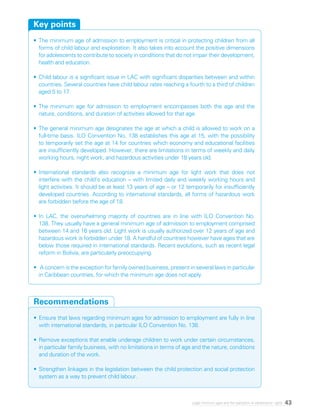
•	The establishment of legal minimum ages is a requirement under international standards.
•	Minimum ages aim to enhance adolescents’ protection from rights violations; they do not
seek to limit the exercise of their rights nor hinder their increased autonomy.
•	Discussion around minimum ages should tackle the question of consent – and who can
give it – with great care in order to ensure that transfer of consent to parents or legal
guardians does not undermine adolescents’ legal protection.
•	By representing objective and universal criteria, minimum ages protect adolescents from
marginalized groups from early choices and from discriminatory practices. They therefore
constitute important tools for equity.
•	In light of the indivisibility of children’s rights, consistency among minimum ages in
different areas is critical and calls for holistic approaches.
Key points
15Legal minimum ages and the realization of adolescents’ rights
Child marriage is a significant concern worldwide.
Various studies have demonstrated the negative
effects of child marriage on children’s rights and
development.7 Child marriage disproportionately
affects girls. Given its far-reaching consequences
on their development, it contributes to
perpetuating gender disparities.
Child marriage has negative effects on
adolescents’ health and is a cause of early
pregnancy. Early pregnancy bears significant risks
for the mother’s health, including risk of dying,
complications during delivery, and higher infant
mortality rate. A combination of physical factors
and socio-economic factors are involved, since
in addition to biological considerations related
to child bearing at a young age, early pregnancy
tends to primarily affect marginalized girls with
limited access to health information and services.
Child marriage represents a significant cause for
school dropout, with significant implications for
children’s, and especially girls’, lives. It impairs
their chances to earn a living independently,
making them financially dependent on their
spouse. Should the marriage come to an
end, they are more likely to fall into poverty.
Schooling also offers access to critical sexual and
reproductive health information and services.
It supports the multiple social interactions that
provide a protective environment and help build
one’s sense of identity and self-esteem.
Child marriage is correlated with higher levels of
domestic violence. Girls who marry early are more
likely to be beaten. They usually enjoy a lower
degree of self-confidence and lack the necessary
resources to oppose violence and seek adequate
help.
The situation in Latin America and the Caribbean
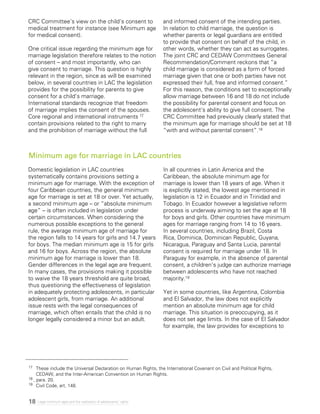
is preoccupying. UNICEF data indicate that 30
per cent of women aged 20 to 49 years were
married or in union before 18 years in the region,
while 8 per cent were married before the age of
15.8 Currently, 19 per cent of girls aged 15 to 19 –
almost 1 in 5 – are married or in union.9 Rates of
child marriage in Latin America and the Caribbean
are close to the global average. However, while
globally the practice of child marriage has been
slowly declining since the 1980s, no significant
change has been observed in the region.10
Child marriage – A significant issue for adolescents’ rights in LAC
7	 See e.g. UNFPA, Motherhood in Childhood – Facing the challenge of adolescent pregnancy, 2013; UNICEF
Innocenti Research Centre, Early Marriage, Innocenti Digest no. 7, 2001.
8 	 UNICEF, Ending Child Marriage: Progress and prospects, UNICEF, New York, 2014.
9 	UNICEF, data <http://data.unicef.org/child-protection/child-marriage.html>
10 	UNICEF, Ending Child Marriage: Progress and prospects, UNICEF, New York, 2014
Minimum age for marriage
The minimum age for marriage defines the age at which a person is legally permitted to get married.
All countries in the region have set a minimum age for marriage in their legislation. While the inclusion
of a legal minimum age for marriage could appear as a simple and straightforward step, a review of
legislation in LAC demonstrates that the issue is more complex than it seems. Laws often include
various minimum ages for marriage: for boys and for girls, with or without parental consent, depending
on specific situations such as pregnancy or birth of a child, and on the basis of ethnicity. As a result,
although the generic framework often sets 18 as the minimum age for marriage, the existence of
multiple exceptions and their scope, sometimes wide, means that many adolescents are not protected
from underage marriage. The persistence of child marriage in LAC is preoccupying and significantly
affects the realization of adolescents’ rights and their future. Adequate legal provisions for the
protection of adolescents from marriage constitute in many respects a fundamental element of the
policy framework for adolescents’ rights.
16 Legal minimum ages and the realization of adolescents’ rights
Dominican
Republic
Nicaragua
Cuba
Brazil
Honduras
Guatemala
Belize
ElSalvador
Colombia
Guyana
Mexico
Ecuador
Peru
Suriname
Haiti
Jamaica
Trinidadand
Tobago
Source: UNICEF datasets, State of the World’s Children 2014.
Bolivia
(PlurinationalStateof)
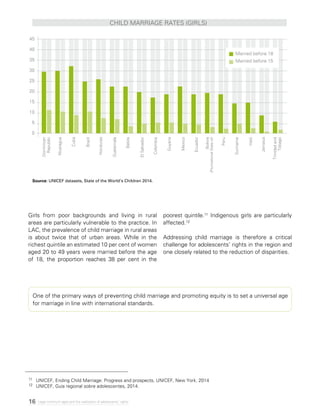
Girls from poor backgrounds and living in rural
areas are particularly vulnerable to the practice. In
LAC, the prevalence of child marriage in rural areas
is about twice that of urban areas. While in the
richest quintile an estimated 10 per cent of women
aged 20 to 49 years were married before the age
of 18, the proportion reaches 38 per cent in the
poorest quintile.11 Indigenous girls are particularly
affected.12
Addressing child marriage is therefore a critical
challenge for adolescents’ rights in the region and
one closely related to the reduction of disparities.
11	 UNICEF, Ending Child Marriage: Progress and prospects, UNICEF, New York, 2014
12 	UNICEF, Guía regional sobre adolescentes, 2014.
Child marriage rates (girls)
One of the primary ways of preventing child marriage and promoting equity is to set a universal age
for marriage in line with international standards.
45
40
35
30
25
20
15
10
5
0
Married before 18
Married before 15
17Legal minimum ages and the realization of adolescents’ rights
13 UNICEF, Child Marriage and the Law, Legislative Reforms Initiative – Paper series, New York, 2007
14 Joint general recommendation/general comment no. 31 of the Committee on the Elimination of Discrimination against
Women and No. 18 of the Committee on the Rights of the Child on harmful practices, CEDAW/C/GC/31-CRC/C/GC/18,
2014, para. 54 (f).
15 See e.g. CEDAW General Recommendation (1994) on Equality before marriage stating that the minimum age for marriage
should be 18 years for both man and woman and that the possibility to set an earlier age for majority as provided in Article
1 of the CRC does not apply in relation to marriage; CRC General Comment on Adolescent health which provides that the
minimum age for marriage should be set at 18 with and without parental consent. In its Concluding Observations, the CRC
Committee systematically calls on States Parties to bring the legal age of marriage to 18 for all.
16 	 UNICEF, Ending Child Marriage: Progress and prospects, UNICEF, New York, 2014
International standards set the minimum age of
marriage at 18. Consequently, the term “early
marriage” has been abandoned for the clearer
reference to the generic prohibition of “child
marriage”. The prohibition applies to all equally,
girls and boys. While gender discrimination is
quite common in this area, it is strictly prohibited
in international standards like any other form of
discrimination.
While child marriage is not referred to directly in
the CRC, it is closely connected to other rights
- such as the right to express views freely, the
right to protection from all forms of abuse, and
the right to be protected from harmful traditional
practices - and is frequently addressed by the
Committee on the Rights of the Child.13
The Convention on the Elimination of All Forms of
Discrimination against Women, however, makes
an unambiguous reference to the issue of child
marriage:
The betrothal and the marriage of a child shall
have no legal effect, and all necessary action,
including legislation, shall be taken to specify
a minimum age for marriage and to make the
registration of marriages in an official registry
compulsory. (CEDAW, Article 16.2)
Both the CRC Committee and the CEDAW
Committee have extensively addressed the issue
in their General Comments or Recommendations
and Concluding Observations. Significantly, the
first General Comment/Recommendations jointly
issued by the two Committees in November
2014 on harmful practices contains far-reaching
considerations in relation to child marriage.
In relation to the minimum age for marriage, the
Committees recommend:
A minimum legal age of marriage for girls and
boys is established, with or without parental
consent, at 18 years. When exceptions to
marriage at an earlier age are allowed in
exceptional circumstances, the absolute
minimum age is not below 16 years, grounds
for obtaining permission are legitimate
and strictly defined by law and marriage is
permitted only by a court of law upon full,
free and informed consent of the child or both
children who appear in person before the
court.14
This represents a significant evolution compared
with previous positions in which the CRC and
CEDAW Committees have each affirmed the
need for a complete ban of marriage under
the age of 1815. Of specific relevance to the
region, the CRC Committee has addressed the
issue in its General Comment on the rights of
indigenous children and called on states to work
with indigenous communities to end the practice
where it exists.16
The cautious evolution in the Committees’
approach to child marriage may be explained
by pragmatism in light of the sometimes-
difficult situations in which adolescents may
find themselves, for example when expecting or
having a child, given the high rates of adolescent
motherhood in various countries. In keeping
with the Committees’ overall approach, it also
seeks to recognize the evolving capacities of
children to make decisions about their lives. This
stance is in many respects consistent with the
Minimum age for marriage in international standards
18 Legal minimum ages and the realization of adolescents’ rights
CRC Committee’s view on the child’s consent to
medical treatment for instance (see Minimum age
for medical consent).
One critical issue regarding the minimum age for
marriage legislation therefore relates to the notion
of consent – and most importantly, who can
give consent to marriage. This question is highly
relevant in the region, since as will be examined
below, in several countries in LAC the legislation
provides for the possibility for parents to give
consent for a child’s marriage.
International standards recognize that freedom
of marriage implies the consent of the spouses.
Core regional and international instruments 17
contain provisions related to the right to marry
and the prohibition of marriage without the full
and informed consent of the intending parties.
In relation to child marriage, the question is
whether parents or legal guardians are entitled
to provide that consent on behalf of the child, in
other words, whether they can act as surrogates.
The joint CRC and CEDAW Committees General
Recommendation/Comment reckons that “a
child marriage is considered as a form of forced
marriage given that one or both parties have not
expressed their full, free and informed consent.”
For this reason, the conditions set to exceptionally
allow marriage between 16 and 18 do not include
the possibility for parental consent and focus on
the adolescent’s ability to give full consent. The
CRC Committee had previously clearly stated that
the minimum age for marriage should be set at 18
“with and without parental consent”.18
Domestic legislation in LAC countries
systematically contains provisions setting a
minimum age for marriage. With the exception of
four Caribbean countries, the general minimum
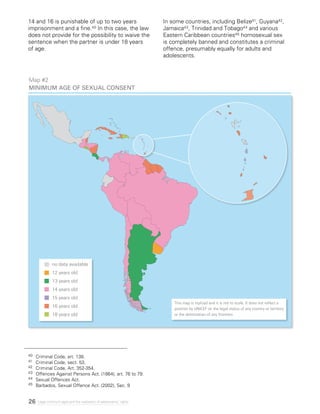
age for marriage is set at 18 or over. Yet actually,
a second minimum age – or “absolute minimum
age” – is often included in legislation under
certain circumstances. When considering the
numerous possible exceptions to the general
rule, the average minimum age of marriage for
the region falls to 14 years for girls and 14.7 years
for boys. The median minimum age is 15 for girls
and 16 for boys. Across the region, the absolute
minimum age for marriage is lower than 18.
Gender differences in the legal age are frequent.
In many cases, the provisions making it possible
to waive the 18 years threshold are quite broad,
thus questioning the effectiveness of legislation
in adequately protecting adolescents, in particular
adolescent girls, from marriage. An additional
issue rests with the legal consequences of
marriage, which often entails that the child is no
longer legally considered a minor but an adult.
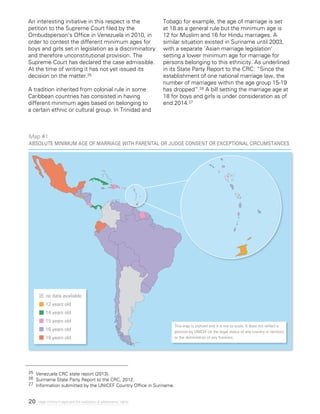
In all countries in Latin America and the
Caribbean, the absolute minimum age for
marriage is lower than 18 years of age. When it
is explicitly stated, the lowest age mentioned in
legislation is 12 in Ecuador and in Trinidad and
Tobago. In Ecuador however a legislative reform
process is underway aiming to set the age at 18
for boys and girls. Other countries have minimum
ages for marriage ranging from 14 to 16 years.
In several countries, including Brazil, Costa
Rica, Dominica, Dominican Republic, Guyana,
Nicaragua, Paraguay and Santa Lucia, parental
consent is required for marriage under 18. In
Paraguay for example, in the absence of parental
consent, a children’s judge can authorize marriage
between adolescents who have not reached
majority.19
Yet in some countries, like Argentina, Colombia
and El Salvador, the law does not explicitly
mention an absolute minimum age for child
marriage. This situation is preoccupying, as it
does not set age limits. In the case of El Salvador
for example, the law provides for exceptions to
Minimum age for marriage in LAC countries
17 	 These include the Universal Declaration on Human Rights, the International Covenant on Civil and Political Rights,
CEDAW, and the Inter-American Convention on Human Rights.
18 , para. 20.
19 	 Civil Code, art. 148.
19Legal minimum ages and the realization of adolescents’ rights
20 	 Código de Familia, art. 14.
21 	 Civil Code, art. 131-134.
22 	 Civil Code, art. 241.
23 	 Ley 659-44, art. 56.
24 	 CRC COBs for Honduras (2007), para 29.
the 18 years old rule if the intending spouses
have reached puberty or have or are expecting a
child in common.20 Colombia, in spite of a general
minimum age for marriage at 18, underage
children can marry with parental consent.
Further to exposing children to multiple risks in
terms of health and development, child marriage
can have significant implications in terms of the
child’s legal status. In many countries, marrying
is a motive for so-called emancipation, meaning
that children who are married are automatically
presumed to have reached majority. In Argentina
for instance, the civil code provides that marriage
entails emancipation and the acquisition of legal
capacity for all civil acts. The emancipation is
irrevocable.21 The combination of the lack of
minimum age for marriage and the important
responsibilities marriage implies raises serious
concerns in terms of child protection.
A major issue in many countries in the region
relates to the acceptable motives for the
exceptions to the 18-year-old rule. The vaguer the
provision, the higher the likelihood that children
will be at risk of underage marriage. The majority
of States recognize as a valid exception the
fact that the intending spouses have a child in
common or that the girl is pregnant. The objective
is presumably to deal with de facto situations
in which social norms value the importance of
marriage. This is a particular situation because it
involves the right of the newborn or future child to
grow up in a supportive family environment.
However, in many instances legal provisions leave
a wide margin of appreciation as to what could
be considered a valid reason for child marriage.
In Peru for example, the law provides that the
judge can waive the 18 years requirement for
“valid reasons” if the intending spouses are
at least 16 and have explicitly expressed their
willingness to get married.22 In the Dominican
Republic, the judge can waive even the 15-year-
old minimum age for girls (with parental consent)
for “valid reasons”.23 In Cuba, the law refers to
“exceptional circumstances and a good cause”,
leaving room for broad interpretation.
In their reports to the CRC Committee, some
State Parties have explained the rationale for
allowing exceptions for child marriage. Main
arguments revolve around the need to solve
difficult situations and/or address various
cultural norms. According to Cuba’s state report
to the CRC Committee (2010), a widespread
social practice consists in parents or other
family members forcing girls to marry when
they first engage in sexual activity. In its state
report (2008), Guatemala has pointed to the
need to take into account cultural traditions
prevailing in Mayan communities: “With regard
to adolescent marriage, the State is aware of
the recommendations made by the Committee.
However, the practice still has a firm hold among
Guatemala’s Mayan population, so the law states
that boys aged 16 and girls aged 14 wishing to
marry must obtain their parents’ consent.”
The fact that the age can be lower on an
exceptional basis presents an advantage over the
establishment of a general minimum age under
18. It may presumably be contested and subject
to judicial review in individual cases. While it does
not guarantee respect for the best interests of
the child as such, it may ensure some form of
monitoring of the decision.
About a third of the countries in the region
have set different minimum ages for marriage
for boys and girls. In these countries, the
minimum age for girls is consistently a year or
two lower than the minimum age for boys. This
is considered a discriminatory practice on the
basis of gender, which is not in accordance with
international standards. Not only does it make
girls particularly vulnerable to the practice, it
also conveys an official recognition that girls can
legitimately be “sexualized” earlier than boys
and therefore contributes to feeding prejudices
in relation to girls’ ownership of their lives. The
CRC Committee has criticized “the use of the
biological criterion of puberty to set different ages
of maturity between boys and girls”.24
20 Legal minimum ages and the realization of adolescents’ rights
25	 Venezuela CRC state report (2013).
26	 Suriname State Party Report to the CRC, 2012.
27 	Information submitted by the UNICEF Country Office in Suriname.
An interesting initiative in this respect is the
petition to the Supreme Court filed by the
Ombudsperson’s Office in Venezuela in 2010, in
order to contest the different minimum ages for
boys and girls set in legislation as a discriminatory
and therefore unconstitutional provision. The
Supreme Court has declared the case admissible.
At the time of writing it has not yet issued its
decision on the matter.25
A tradition inherited from colonial rule in some
Caribbean countries has consisted in having
different minimum ages based on belonging to
a certain ethnic or cultural group. In Trinidad and
Tobago for example, the age of marriage is set
at 18 as a general rule but the minimum age is
12 for Muslim and 16 for Hindu marriages. A
similar situation existed in Suriname until 2003,
with a separate ‘Asian marriage legislation’
setting a lower minimum age for marriage for
persons belonging to this ethnicity. As underlined
in its State Party Report to the CRC: “Since the
establishment of one national marriage law, the
number of marriages within the age group 15-19
has dropped”.26 A bill setting the marriage age at
18 for boys and girls is under consideration as of
end 2014.27
Map #1
Absolute Minimum age of marriage with parental or judge consent or Exceptional circumstances
This map is stylized and it is not to scale. It does not reflect a
position by UNICEF on the legal status of any country or territory
or the delimitation of any frontiers.
no data available
12 years old
14 years old
15 years old
16 years old
18 years old
21Legal minimum ages and the realization of adolescents’ rights
Intersection with other minimum ages
Minimum age for marriage and minimum age of sexual consent
Minimum age for marriage and minimum age for the end of compulsory education
•	Child marriage has numerous long-term negative implications on children’s rights, in
particular the right to education, the right to express views, the right to be protected from
violence, and the right to health, among others. Girls are particularly vulnerable to the
practice, with significant impact on their development and gender equality in general.
•	Rates of child marriage in the Latin America and the Caribbean remain significant and
close to global averages. However, they have not decreased in recent years like in other
regions.
•	Child marriage – i.e. marriage when at least one of the intending spouses is under 18 – is
generally forbidden under international standards, although recent evolutions provide for
the possibility for adolescents over 16 to marry under specific circumstances and on their
own consent, through judicial approval.
•	While providing that adolescents can fully consent to marriage on their own at 18,
legislations in the overwhelming majority of countries provide for the possibility for
children to get married with parental and/or a judge’s consent.
•	Approximately one third of the countries have different minimum ages for marriage for
boys and girls, thus effectively featuring discriminatory legislation.
•	Possible grounds for authorizing underage marriage due to “exceptional circumstances”
are in many instances extensive, thus significantly undermining the protection the legal
marriageable age offers.
Key points
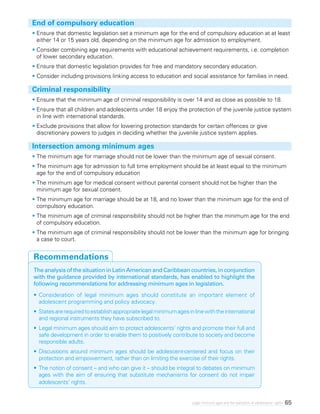
•	Set the legal minimum age for marriage at 18 for all, with or without parental consent.
•	Exceptions should only be allowed in exceptional circumstances clearly circumscribed by
law, and marriage only authorized by a court of law upon the child’s full, free, informed
consent, regardless of parents’ views. In any case, the legal minimum age for marriage
should never be below 16 years old.
Recommendations
22 Legal minimum ages and the realization of adolescents’ rights
Minimum age of sexual consent
The minimum age of sexual consent is the age from which someone is deemed capable of consenting
to sexual activity. It aims to protect adolescents from abuse and from the consequences they may not
be fully aware of when engaging in early sexual activity. Sexual activity with a person under the age of
sexual consent is considered non-consensual. It constitutes sexual abuse and is criminally sanctioned.
One rationale for a minimum age of sexual consent is to protect children and adolescents from
situations in which they may be pressured or coerced in any way to engage in sexual activity without
having the means or power to resist and/or give their genuine and fully informed consent. These
situations may range from older adults exercising a form of authority or offering “gifts” and other
benefits to obtain sexual favours from underage children, peers blackmailing sexual activity for
inclusion in a group or other forms of recognition, or various forms of prostitution enjoying some
degree of social acceptance.
The objective of the minimum age of sexual consent is also to protect children including adolescents
from the multiple risks associated with early sexual activity, such as sexually transmitted diseases and
early pregnancy, which have lifelong consequences on their health and development.
Like for the minimum age for marriage, the minimum age of sexual consent is far from being
straightforward. An important consideration is the age difference between those involved. There may
be exceptions when the adult is for instance only 2 or 3 years older than the adolescent concerned.
In these cases, it may be possible to demonstrate that consent was not affected by lack of balance of
power. Similarly, underage sexual activity often involves two adolescents under the age of consent and
too strict legislation may lead to criminalize attitudes rather than protect adolescents.
An additional question paradoxically relates to whether the age of consent may be too high. By making
sexual activity illegal under an age where most adolescents are already in practice sexually active, the
risk is to prevent them from accessing critical sexual and reproductive healthcare and information.
Adequate arrangements are therefore needed to avoid over-criminalizing adolescents’ behaviours and
ensure their access to health services.
Early sexual initiation – A significant issue for adolescents’ rights in LAC
The establishment of a minimum age for sexual
consent is an important component of the
protection of children from sexual abuse and from
the consequences of early sexual activity. The fine
line between sexual abuse and exploitation means
that social tolerance for early sexual activity may
also pave the way for child sexual exploitation
and prostitution.
Available data indicates that sexual initiation of
girls and women is more likely to be forced if it
occurs at younger ages,28 when peer pressure
and coercion may be more difficult to resist. The
Latin America and the Caribbean region features
the world’s highest rates in terms of girls’ early
sexual initiation. Over 22 per cent have had their
first sexual intercourse before the age of 15. In
some countries, the rate reaches 25 per cent.29
In the OECS, the initiation into sexual activity for
girls can begin as early as the age of 10. Sexual
activity among school children between the ages
of 13 to 15 ranges from 26 per cent in Grenada
28 	 UNICEF, Hidden in plain sight, 2014.
29 	 UNICEF, Guía regional sobre adolescentes, 2014.
23Legal minimum ages and the realization of adolescents’ rights
Minimum age of sexual consent in international standards
The international standards’ approach to the
minimum age of sexual consent is closely related
to the prohibition of child sexual abuse. Child
sexual abuse is characterized as comprising
all situations in which sexual activity with a
person under 18 is illegal. Because it delineates
illegal sexual activity, age is one of the defining
elements of sexual abuse.
The CRC contains important provisions in relation
to sexual abuse. Article 19 deals with all forms
of violence against children while in the care of
parents, legal guardians or any other person who
has the care of the child, and specifically refers
to sexual abuse. Even more importantly for the
issue under examination, Article 34 obliges States
parties to protect children from all forms of sexual
exploitation and sexual abuse. This includes “the
inducement or coercion of a child to engage in
any unlawful sexual activity”. The CRC therefore
infers that consent is irrelevant when sexual
activity is prohibited by law – in particular when
the child has not reached the minimum age of
sexual consent.
The 2007 Council of Europe Convention on the
Protection of Children against Sexual Exploitation
and Sexual Abuse commonly known as the
Lanzarote Convention is open for accession
to any country in the world. It is the most
comprehensive international instrument on this
issue and as such provides relevant guidance,
including in the LAC context. Its Article 18
requires States Parties to criminalize sexual
abuse, defined as engaging in sexual activities
with a child under the minimum age of sexual
consent. It obliges States Parties to define such a
minimum age.
International instruments do not however provide
a clear indication of what constitutes an adequate
age for sexual consent. A review of the CRC
Committee Concluding Observations nevertheless
provides some guidance on unacceptable lower
limits. In relation to Costa Rica, the Committee
has pointed to “the very low minimum age of
sexual consent of 13 years” and recommended
that the State party review that age.31 A similar
observation had been made to Guyana in 2004,
prompting legislative reform.
30 	 OECS Country Office Annual Report, 2013.
31 	 CRC COBs 2011, para 27 and 28.
and St. Lucia to 35.7 per cent in the British Virgin
Islands. Additionally, 44 per cent of sexually active
youth had their first experience before the age of
15.30
Early sexual activity is a significant cause of
concern for adolescents’ health and development.
Due to lack of information, adolescents are
particularly vulnerable to sexually transmittable
diseases including HIV and AIDS. Early sexual
activity also increases the risk of early pregnancy,
a major preoccupation in the region. Young
adolescent girls may not have access to the
sexual and reproductive health information and
services needed to use contraceptive methods
(see also next section on the minimum age for
medical consent).
24 Legal minimum ages and the realization of adolescents’ rights
One critical issue relates to the criminalization
of sexual activity between children who are
both under the age of sexual consent. Here
international standards suggest that consent
is a primary criterion. The Council of Europe
Convention excludes from its scope consensual
sexual activities between children under the age
of sexual consent. Similarly, the CRC Committee
has elaborated on the definition of child sexual
abuse. In the case of sexual activities between
persons under the age of sexual consent, it refers
in substance to the notion of equal power as a
proxy to define genuine consent. The Committee
has emphasized that any form of pressure from
one child on another characterizes abuse and
underlined the role of age difference:
Sexual abuse comprises any sexual activities
imposed by an adult on a child, against which
the child is entitled to protection by criminal
law. Sexual activities are also considered
as abuse when committed against a child
by another child, if the child offender is
significantly older than the child victim or uses
power, threat or other means of pressure.
Sexual activities between children are not
considered as sexual abuse if the children are
older than the age limit defined by the State
party for consensual sexual activities. (GC on
violence against children, footnote 9)
32	 Demographic and Health Survey, Preliminary Report, 2013.
33	 Criminal cod, art. 308bis.
34	 Criminal cod, art. 135.
35 	 Criminal cod, art. 128.
Minimum age of sexual consent in LAC countries
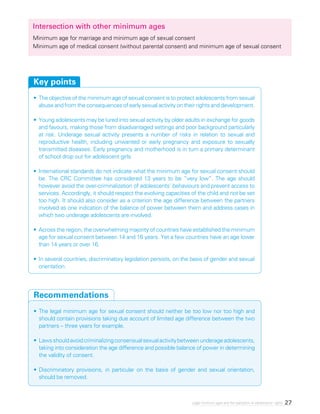
The minimum age of sexual consent in Latin
America and the Caribbean ranges from 12 to 18
years old. The average age is 15 and the median
is 16 years old.
Three countries in the region have set the
minimum of sexual consent below 14 years
old. They comprise Argentina, Costa Rica and
Uruguay. Ten more have established that age
at 14 years old. Most Caribbean countries have
set the minimum age at 16. In the Dominican
Republic and Ecuador, the age is set at 18. This
may be considered particularly high, given that
in the Dominican Republic for example, data
indicates that 28.4 per cent of adolescents are
mothers by the age of 18 32 and girls can get
married as early as 15 years old with parental
consent.
An important dimension in relation to adolescents’
rights concerns situations in which both persons
involved in underage sexual activity are under
the age of majority. As asserted in international
standards, criminalizing such acts could lead to
overly criminalizing adolescents’ behaviours. It can
also bear significant risks in terms of access to
health services. At the same time, it is important
to protect adolescents, especially adolescent
girls, against peer pressure and unwanted sexual
activity.
In Bolivia for instance, the law sets the minimum
age of sexual consent at 14 years old. Yet, it
also provides that consensual relationships
between adolescents over 12 years old will not be
punished, if they have no more than three years
of age difference and no violence nor intimidation
was involved.33 In Paraguay, the age of consent
is also 14, but when the perpetrator is under 18,
the sentence can be waived.34 The law does not
specify under which conditions. Presumably, if
the sexual activity is not consensual, it also falls
under the relevant provisions of the criminal code
penalizing coercion.35
Various domestic laws in the region feature
different levels of presumption of consent
depending on the age of the person concerned.
Accordingly, they set a minimum age under
which consent cannot be given. In these cases,
the question of consent is irrelevant and any
sexual activity represents a form of rape. The new
25Legal minimum ages and the realization of adolescents’ rights
36 	Nuevo Código Integral Penal, art. 175 (5).
37 	 Criminal cod, art. 272.
38 	 Sexual offences Act (2000), sections 6 to 8.
39 	 Criminal code, art. 137.
integral penal code adopted in Ecuador in 2014
for example explicitly stipulates that for sexual
offences, the consent given by a person under
18 is irrelevant.36
Laws may also set another age at which consent
is presumed to be invalid, but a person can prove
that the underage partner consented. In Uruguay
for example, sexual activity under 15 years old is
presumed to be a form of violence, but when the
victim is aged 12 to 15, the perpetrator can prove
otherwise.37
In Trinidad and Tobago, the minimum age of
consent is set at 16. Sexual intercourse with a
person under that age is a criminal offence unless
the partner honestly believed the person was over
16 years old or was not over three years older
and can prove he or she is not only or chiefly to
blame. However, the law provides that the issue
of consent or age belief is completely irrelevant
when the female is under fourteen. A parallel
provision does not exist for males.38
While this is an area where laws in the region do
not generally feature discriminatory provisions,
there are some notable exceptions in relation to
gender and to homosexual sexual activity. As
seen in the case of Trinidad and Tobago, the law
makes some distinction on the basis of gender.
In Jamaica sexual activity between two underage
children is also punishable with the presumption
of culpability usually falling on the male child.
In Paraguay and Chile, the law distinguishes
between homosexual and heterosexual sexual
activity. In Chile, the age of consent is 14 for
heterosexual sex and 18 for homosexual sex.
In Paraguay, the minimum age for consent for
heterosexual sex is set at 14, yet according to the
criminal code sexual intercourse of a man with a
“woman aged 14 to 16” is punishable by a fine.39
The fine can be waived if the partner is under
18. It is interesting to note here the assumption
in the formulation of the legal provision that the
man will necessarily be older than the woman.
Homosexual sex with a person aged between
26 Legal minimum ages and the realization of adolescents’ rights
14 and 16 is punishable of up to two years
imprisonment and a fine.40 In this case, the law
does not provide for the possibility to waive the
sentence when the partner is under 18 years
of age.
In some countries, including Belize41, Guyana42,
Jamaica43, Trinidad and Tobago44 and various
Eastern Caribbean countries45 homosexual sex
is completely banned and constitutes a criminal
offence, presumably equally for adults and
adolescents.
40 	 Criminal Code, art. 138.
41	 Criminal Code, sect. 53.
42 	 Criminal Code, Art. 352-354.
43 	 Offences Against Persons Act. (1864), art. 76 to 79.
44 	 Sexual Offences Act.
45 	 Barbados, Sexual Offence Act. (2002), Sec. 9
Map #2
Minimum age of sexual consent
no data available
12 years old
13 years old
14 years old
15 years old
16 years old
18 years old
This map is stylized and it is not to scale. It does not reflect a
position by UNICEF on the legal status of any country or territory
or the delimitation of any frontiers.
27Legal minimum ages and the realization of adolescents’ rights
Intersection with other minimum ages
Minimum age for marriage and minimum age of sexual consent
Minimum age of medical consent (without parental consent) and minimum age of sexual consent
•	The objective of the minimum age of sexual consent is to protect adolescents from sexual
abuse and from the consequences of early sexual activity on their rights and development.
•	Young adolescents may be lured into sexual activity by older adults in exchange for goods
and favours, making those from disadvantaged settings and poor background particularly
at risk. Underage sexual activity presents a number of risks in relation to sexual and
reproductive health, including unwanted or early pregnancy and exposure to sexually
transmitted diseases. Early pregnancy and motherhood is in turn a primary determinant
of school drop out for adolescent girls.
•	International standards do not indicate what the minimum age for sexual consent should
be. The CRC Committee has considered 13 years to be “very low”. The age should
however avoid the over-criminalization of adolescents’ behaviours and prevent access to
services. Accordingly, it should respect the evolving capacities of the child and not be set
too high. It should also consider as a criterion the age difference between the partners
involved as one indication of the balance of power between them and address cases in
which two underage adolescents are involved.
•	Across the region, the overwhelming majority of countries have established the minimum
age for sexual consent between 14 and 16 years. Yet a few countries have an age lower
than 14 years or over 16.
•	In several countries, discriminatory legislation persists, on the basis of gender and sexual
orientation.
Key points
•	The legal minimum age for sexual consent should neither be too low nor too high and
should contain provisions taking due account of limited age difference between the two
partners – three years for example.
•	Lawsshouldavoidcriminalizingconsensualsexualactivitybetweenunderageadolescents,
taking into consideration the age difference and possible balance of power in determining
the validity of consent.
•	Discriminatory provisions, in particular on the basis of gender and sexual orientation,
should be removed.
Recommendations
28 Legal minimum ages and the realization of adolescents’ rights
Age of medical consent – A significant issue for adolescents’ rights in LAC
Adolescents’ sexual and reproductive health is
a major challenge in the region. Indicators are
alarming. Latin America and the Caribbean is the
world region where the fertility rate for women
aged 15-19 is the highest after sub-Saharan
Africa. The proportion of adolescent mothers has
overall increased between 1990 and 2010. While
maternity rates decreased in all age groups of the
countries in the region, they continue to increase
in adolescents between 15 and 19 years of age.47
It reached over 12.5 per cent of all adolescent
girls in the region in 2010.
Disparities are high in this area. The proportion
of adolescent mothers is consistently higher in
rural areas than in urban areas – up to twice the
rate in countries like Bolivia and Peru. In Latin
America, income inequalities are reflected in
teenage fertility rates. The region shows the
highest difference in fertility among adolescents
in the poorest quintile and the richest quintile.48
Furthermore, a lower level of education is closely
correlated with a higher chance of being an
adolescent mother, raising the prospect of the
perpetuation of the cycle of poverty and lack of
opportunities for adolescent mothers.
Minimum age of medical consent (without parental consent)
The question of the minimum age of medical consent encompasses access to health information and
counselling on the one hand, and consent for medical treatment and care on the other. The minimum
age of medical consent refers to the ability to seek medical care and/or counseling without the
authorization of, or without being accompanied by, a parent or legal guardian.
Traditionally, consent for healthcare is understood as falling within the scope of parents’ primary
responsibility in the child’s upbringing and development (art. 18 of the CRC). This principle however
needs to be balanced with the evolving capacities of children to make decisions concerning their lives,
and their right to information.
In the area of sexual and reproductive health, the requirement of parental consent, especially
for information, counseling and testing, can constitute a significant obstacle to accessing health
services.46 Yet, sexual and reproductive health has significant implications for adolescents’ lives. In
light of the numerous challenges faced by adolescents in Latin America and the Caribbean in this area,
the question of the minimum age of medical consent is a significant – though sensitive – matter for
policies aiming to promote adolescents’ rights. Most countries however do not set a minimum age for
medical consent without parental consent, and when they do, it is frequently rather high.
46 	 United Nations Children’s Fund, Towards an AIDS-Free Generation – Children and AIDS: Sixth Stocktaking Report, 2013,
UNICEF, New York, 2013.
47 	 ECLAC, Notes for Equality, no. 5.
48 	 ECLAC, Notes for Equality, no. 5
29Legal minimum ages and the realization of adolescents’ rights
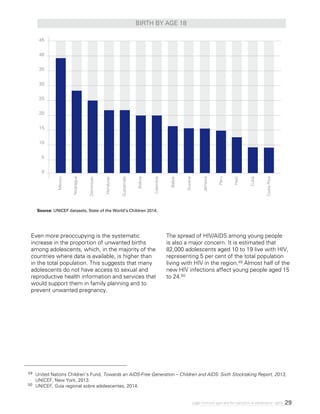
Even more preoccupying is the systematic
increase in the proportion of unwanted births
among adolescents, which, in the majority of the
countries where data is available, is higher than
in the total population. This suggests that many
adolescents do not have access to sexual and
reproductive health information and services that
would support them in family planning and to
prevent unwanted pregnancy.
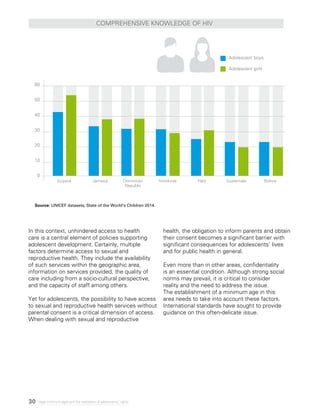
The spread of HIV/AIDS among young people
is also a major concern. It is estimated that
82,000 adolescents aged 10 to 19 live with HIV,
representing 5 per cent of the total population
living with HIV in the region.49 Almost half of the
new HIV infections affect young people aged 15
to 24.50
49 	 United Nations Children’s Fund, Towards an AIDS-Free Generation – Children and AIDS: Sixth Stocktaking Report, 2013,
UNICEF, New York, 2013.
50 	 UNICEF, Guía regional sobre adolescentes, 2014.
Birth by age 18
45
40
35
30
25
20
15
10
5
0
Nicaragua
Dominican
Honduras
Guatemala
Belize
Colombia
Guyana
Mexico
Bolivia
Peru
Cuba
CostaRica
Haiti
Jamaica
Source: UNICEF datasets, State of the World’s Children 2014.
30 Legal minimum ages and the realization of adolescents’ rights
Comprehensive knowledge of HIV
Source: UNICEF datasets, State of the World’s Children 2014.
60
50
40
30
20
10
0
Dominican
Republic
Honduras GuatemalaGuyana BoliviaHaitiJamaica
Adolescent boys
Adolescent girls
In this context, unhindered access to health
care is a central element of policies supporting
adolescent development. Certainly, multiple
factors determine access to sexual and
reproductive health. They include the availability
of such services within the geographic area,
information on services provided, the quality of
care including from a socio-cultural perspective,
and the capacity of staff among others.
Yet for adolescents, the possibility to have access
to sexual and reproductive health services without
parental consent is a critical dimension of access.
When dealing with sexual and reproductive
health, the obligation to inform parents and obtain
their consent becomes a significant barrier with
significant consequences for adolescents’ lives
and for public health in general.
Even more than in other areas, confidentiality
is an essential condition. Although strong social
norms may prevail, it is critical to consider
reality and the need to address the issue.
The establishment of a minimum age in this
area needs to take into account these factors.
International standards have sought to provide
guidance on this often-delicate issue.
31Legal minimum ages and the realization of adolescents’ rights
32 Legal minimum ages and the realization of adolescents’ rights
Access to health care and counseling for
adolescents relates to the right to health and
health services articulated in Article 24 of the
CRC, which provides that “States Parties shall
strive to ensure that no child is deprived of
his or her right of access to such health care
services.” In its interpretation of this article, the
CRC Committee has specifically addressed the
issue of access to health care without parental
consent, underlining the importance of waiving
the obligation to obtain permission in the area
with of sexual and reproductive health without
consideration of age:
In accordance with their evolving capacities,
children should have access to confidential
counseling and advice without parental or
legal guardian consent, where this is assessed
by the professionals working with the child
to be in the child’s best interests (…). States
should review and consider allowing children
to consent to certain medical treatments and
interventions without the permission of a
parent, caregiver, or guardian, such as HIV
testing and sexual and reproductive health
services, including education and guidance on
sexual health, contraception and safe abortion.
(General comment No. 15 (2013) on the right
of the child to the enjoyment of the highest
attainable standard of health)
On various occasions, the Committee has
dissociated access to medical counseling from
actual medical treatment, emphasizing the
importance of guaranteeing unrestricted access to
medical counseling in conditions of confidentiality
and without parental permission.
It has recommended that no minimum age be set
for medical counseling:
States parties need to introduce legislation
or regulations to ensure that children have
access to confidential medical counselling and
advice without parental consent, irrespective
of the child’s age, where this is needed for
the child’s safety or well-being. Children may
need such access, for example, where they
are experiencing violence or abuse at home,
or in need of reproductive health education
or services, or in case of conflicts between
parents and the child over access to health
services. The right to counselling and advice is
distinct from the right to give medical consent
and should not be subject to any age limit.
(General Comment on the right to be heard,
paragraph 101).
Similarly, in its General Comment on adolescent
health and development, the Committee has
emphasized that “States parties should ensure
that [adolescents] have access to appropriate
information, regardless of their marital status and
whether their parents or guardians consent.” 51
In relation to consent to medical treatment, the
Committee advocates for provisions that set a
minimum age, while at the same time recognizing
that a younger child may demonstrate capacity
to form informed views and should therefore be
heard:
The Committee welcomes the introduction
in some countries of a fixed age at which the
right to consent transfers to the child, and
encourages States parties to give consideration
to the introduction of such legislation. Thus,
children above that age have an entitlement to
give consent without the requirement for any
individual professional assessment of capacity
after consultation with an independent and
competent expert. However, the Committee
strongly recommends that States parties
ensure that, where a younger child can
demonstrate capacity to express an informed
view on her or his treatment, this view is given
due weight. (General Comment on the right to
be heard, paragraph 102).
The CEDAW Committee has also addressed the
issue of access of health, in particular sexual and
reproductive health for adolescents, underlining
the importance of confidentiality:
51 	 Para 28.
Minimum age of medical consent in international standards
33Legal minimum ages and the realization of adolescents’ rights
States parties should ensure, without prejudice
and discrimination, the right to sexual health
information, education and services for all
women and girls (…). In particular, States
parties should ensure the rights of female and
male adolescents to sexual and reproductive
health education by properly trained personnel
in specially designed programmes that respect
their rights to privacy and confidentiality.
(CEDAW General Comment on the right to
health, paragraph 18).
It has identified the need for preliminary
authorization by parents as one of the barriers to
access and called on States Parties to remove
such barriers:
States parties should report on measures
taken to eliminate barriers that women face
in gaining access to health care services and
what measures they have taken to ensure
women timely and affordable access to such
services. Barriers include requirements or
conditions that prejudice women’s access
such as high fees for health care services,
the requirement for preliminary authorization
by spouse, parent or hospital authorities,
distance from health facilities and absence of
convenient and affordable public transport.
(CEDAW General Comment on the right to
health, paragraph 21).
Minimum age of medical consent in LAC countries
In the majority of countries in Latin America and
the Caribbean, the legislation does not provide for
a minimum age for access to medical counseling
and medical treatment.
Where a minimum age is set in legislation,
which concerns a dozen countries in the region
according to available information, it usually
ranges between 16 and 18 years. Previous
analysis of domestic legislations in Latin America
on this issue52 has concluded that only four
countries have laws that explicitly recognize
adolescents’ access to health services without
parental consent. They comprise Argentina,
Costa Rica, Ecuador, Uruguay and Venezuela. In
these countries, available information suggests
that there is no explicit minimum age for medical
consent in the legislation, except in Venezuela
where it is set at 14. Interestingly, in Costa
Rica for example, the Children’s Code explicitly
prohibits denying medical attention to a child
because the legal guardians are not present.53
In Chile however, specific provisions apply to
emergency contraception. According to the law,
an adolescent under 14 can obtain emergency
contraception and parents or “a responsible
adult the child nominates” will only be informed
afterwards.54
Medical counseling for adolescents is usually
recognized across the region, either through
legislative provisions or through the various
strategies put in place to address adolescents’
sexual and reproductive health needs. However,
in only a handful of countries, including Argentina,
Costa Rica, the Dominican Republic and Uruguay,
does the law expressly guarantees the privacy
and confidentiality of information and services.
Uruguay is an interesting case in point, because
its legislation specifically refers to the evolving
capacities. The law on the right to sexual and
reproductive health provides for confidential
access to medical counseling to all children and
52 	 A. Morlachetti, Análisis legislativo comparado sobre embarazo adolescente y matrimonio temprano, UNFPA.
The analysis that follows significantly draws on information contained in this publication.
53 	 Art. 41. Quoted from A. Morlachetti.
54 	 Quoted from A. Morlachetti.
34 Legal minimum ages and the realization of adolescents’ rights
adolescents, and recognizes the progressive
autonomy of adolescents and joint
decision-making with parents when it comes
to making decisions on medical treatment and
sexual health prevention.55
Unless universal access is explicitly mentioned,
lack of legislation in this area leaves room for
interpretation by medical staff and others.
As in other areas, discretionary power may lead
to various forms of discrimination or expression
of prejudices and prevent access. In Guyana
and Barbados for example, the law does not
provide for a minimum age. Yet in practice,
UNICEF country offices report that it is generally
considered to be 16 years old.56
55 	 Ley no. 18.426 (2008), Defensa del derecho a la salud sexual y reproductiva, art. 7.
56 	 See e.g. UNICEF Belize Country Office Annual Report, 2013.
35Legal minimum ages and the realization of adolescents’ rights
Intersection with other minimum ages
Minimum age for medical consent (without parental consent) and minimum age of sexual consent
•	Age is one of the significant barriers adolescents meet with in accessing health services,
particularly sexual and reproductive health services. Given the high rates of early sexual
initiation in the region, in particular for girls, the question of the minimum for medical
consent without parental consent is a critical public health issue.
•	It is important to differentiate access to medical information, counseling and testing, and
access to medical treatment. According to international standards, the former should
not have any minimum age, while the latter may involve parental consent and should
provide the possibility to set a lower age according to the child’s maturity. In all cases,
confidentiality is an essential element.
•	In most countries in Latin America and the Caribbean, the legislation does not provide
for a minimum age for access to medical counseling and to medical treatment without
parental consent. Where there is one, it is usually comprised between 16 and 18 years.
A handful of countries have laws providing for privacy and confidentiality of services.
Yet, while there may not be a minimum age set in the law, prevailing practices in health
institutions may lead to require parental consent for counseling and testing – especially in
the area of sexual and reproductive health.
Key points
•	Domestic laws should not state a minimum age for access to medical information,
counseling and testing without parental consent. They should contain explicit provisions
requiringuniversalaccess,inparticularforsexualandreproductivehealth,andguaranteeing
the privacy and confidentiality of information.
•	When setting a minimum age for medical treatment without parental consent, laws
should provide for mechanisms to waive the minimum if the adolescent demonstrates
adequate maturity and understanding of the implications of the medical decision.
•	Health providers should be sensitized to the need to offer adequate counseling and testing
to adolescents, regardless of their age.
•	On sexual and reproductive health matters, the minimum age of medical consent should
never be higher than the age of sexual consent.
Recommendations
36 Legal minimum ages and the realization of adolescents’ rights
Minimum age for admission to employment– A significant issue for
adolescents’ rights in LAC
Although progress has been made in recent
years in the region, child labour continues to be
preoccupying. Child labour has major effects on
children’s development. It is a cause of school
dropout. Many forms of child labour have a
negative impact on children’s health. Child labour
makes children vulnerable to various forms of
exploitation and violence. It has significant effects
on the perpetuation of disparities and social
exclusion.
The ILO estimates that 12.5 per cent of children
aged 5 to 17 in Latin America and the Caribbean
are in employment. 12.5 million children across
the region (8.8 per cent of children aged 5 to 17)
are engaged in child labour and 9.6 million (6.8 per
cent) carry out hazardous work.58 It is estimated
that 2 million children are engaged in domestic
labour, with the highest levels in Brazil, Haiti and
Guatemala.59
Minimum age for admission to employment
The minimum age for admission to employment is the age at which a person is deemed able to work
without impairing his or her development, in particular his or her access to education. Yet “work” is a
broad concept that can have various understandings. The minimum age for admission to employment
refers to generic work, which involves actual employment on a full time basis – even if some
restrictions apply before 18. Work performed under the minimum age for employment is considered
child labour. Light work however, consisting in safe tasks and performed on a limited basis, can be
a way to recognize children’s evolving capacities and ability to contribute to society and prepare for
adulthood. In some cultural settings, in particular indigenous cultures, work is integral to children’s
upbringing.57 The nature of the work performed is also an important dimension in defining acceptable
forms of work. Some types of work can be dangerous or harmful to children’s health and development
and are inadequate for anyone under 18.
The challenge is to ensure that the minimum age for admission to employment addresses the need to
simultaneously recognize children’s evolving capacities and ability to contribute including economically
to society, and their right to adequate protection from child labour. As will be seen, the notion of
minimum age in this area cannot be dissociated from the nature of the work performed. For this
reason, international standards and many domestic laws have set different minimum ages depending
on the activity. However, there is a bottom limit under which children’s work is not acceptable. Yet,
like in other areas, exceptions contained in legislation, in particular in relation to work within the family
context, are legion and raise concerns in terms of adolescents’ rights and development.
An important additional question relates to the minimum age for admission to employment vis-à-vis the
age for compulsory education, which is tackled in the section on interaction among minimum ages.
57 	 UNICEF, Innocenti Research Centre, Ensuring the rights of indigenous children, Innocenti Digest no. 11, UNICEF, 2004.
58 	 ILO, Marking progress against child labour – Global estimates and trends (2000-2012), 2013.
59	 UNICEF, Guía regional sobre adolescentes, 2014. Using ILO data.
37Legal minimum ages and the realization of adolescents’ rights
The number of working children, including those
involved in child labour and hazardous work, has
declined in absolute and relative terms between
2008 and 2012, suggesting that progress is being
made.60 However, analyses have shown that
progress in this area can be precarious and easily
reversed in adverse economic conditions.61
This is an area where data heavily relies on
minimum age in order to define which category
children belong to. At the national level,
definitions of children involved in “acceptable”
forms of work are highly dependent on their age.
Age is the main criteria enabling to categorize
work as labour, combined with other dimensions
such as the nature and length of the work.
One issue is that some forms of child labour
remain hidden and hard to account for, in
particular for children involved in domestic work
or working within family settings. The minimum
age for admission to employment is critical to
providing adequate protection to children and
adolescents and ensuring that they can attend
school. The establishment of such a minimum
age and importantly the adequate definition of the
kind of employment admissible at which age are
also important elements in identifying the forms
of light work that are acceptable for children
to perform, and for assessing the reality of the
situation of children and adolescents.
Child labour rate (age 5-17)
40
35
30
25
20
15
10
5
0
Dominican
Republic
Nicaragua
Paraguay
Brazil
Uruguay
Venezuela
Honduras
Guatemala
Belize
Panama
ElSalvador
Colombia
Guyana
Mexico
Ecuador
Argentina
Peru
Suriname
Chile
CostaRica
Haiti
Jamaica
Trinidady
Tobago
Source: UNICEF datasets, State of the World’s Children 2014.
Bolivia
60 	 ILO, Marking progress against child labour – Global estimates and trends (2000-2012), 2013.
61 	 Understanding Child Work Programme, Trends in children’s employment and child labour in the Latin America and
Caribbean region, November 2010.
38 Legal minimum ages and the realization of adolescents’ rights
Minimum age for admission to employment in international standards
Children’s right to be protected from economic
exploitation and harmful forms of work is
formulated in Article 32 of the Convention on the
Rights of the Child. This provision also explicitly
requests States Parties to establish a minimum
age for employment, as well as specify hours and
conditions of employment.
The international framework for minimum age
for employment is primarily articulated in various
International Labour Organization Conventions,
namely ILO Convention No. 138 on the minimum
age for admission to employment and work
(1973) and ILO Convention No. 182 on the worst
forms of child labour (1999). These instruments
distinguish three main types of work involving
children:
-	 Child work (children in employment) includes
children engaged in any economic activity for
at least one hour. Economic activity is a broad
concept that includes formal and informal
forms of employment, including in family
settings.
-	 Child labour includes children in the worst
forms of child labour and children in
employment below the minimum age. It
excludes children involved in light work and
those whose work is not classified as a worst
form of child labour.
-	 Hazardous work by children or worst forms of
child labour are any activity or occupation that,
by its nature or type, has or leads to adverse
effects on the child’s safety, health and moral
development.62
62	 ILO, Marking progress against child labour – Global estimates and trends (2000-2012), 2013.
39Legal minimum ages and the realization of adolescents’ rights
Depending on the type of work involved, various
minimum ages apply. Furthermore, in recognition
that certain states may face particularly difficult
economic conditions, international instruments
condone lower minimum ages by one year
for developing countries. The table below
summarizes acceptable minimum ages for
admission to employment:
Regional instruments also contain provisions
in relation to the minimum age of admission to
employment. Article 7 of the Protocol of San
Salvador of 1999 in particular prohibits night work
and hazardous working conditions for persons
under 18 years of age and specifies that for
children under 16, work should not hinder school
attendance or limit the benefits of education.
General
Possible for countries whose
economy and educational
facilities are insufficently
developed
General minimum age
The minimum age for admission
to employment or work should
not be below the age for
finishing compulsory schooling
15 years or more 14 years
Light work
Children between the ages of
13 and 15 years old may do
light work, as long as it does
not threaten their health and
safety, or hinder their education
or vocational orientation and
training
13 years 12 years
Hazardous work
Any work which is likely to
jeopardize children’s physical,
mental or moral heath, safety
or morals should not be
undertaken by anyone under the
age of 18
18 years
(16 years under certain strict
conditions)
18 years
(16 years under certain strict
conditions)
Source: ILO, Manual on linkages between education and child labour (2011)
40 Legal minimum ages and the realization of adolescents’ rights
Map #3
Minimum age of admission to employment
This map is stylized and it is not to scale. It does not reflect a
position by UNICEF on the legal status of any country or territory
or the delimitation of any frontiers.
no data available
12 years old
13 years old
14 years old
15 years old
16 years old
41Legal minimum ages and the realization of adolescents’ rights
Minimum age for admission to employment in LAC countries
All countries in Latin America and the Caribbean
have set a minimum age for admission to
employment. That age ranges from 12 years
old in Bolivia and Dominica to 16 years old in six
countries. The average and the median ages are
14.5 years.
Recent developments in this area have raised
preoccupations as to possible drawbacks. In
Bolivia, the new Children’s Code adopted in
July 2014 provides that the minimum age of
employment is 14. However, the Code introduces
two important exceptions (article 129-II), that
constitute serious obstacles to the full protection
and fulfilment of children’s rights. Formal work
is permitted starting from 12 years old with prior
authorization from the legal guardian of the child
and the Ombudsperson for children. From age of
10 employment is permitted for self-employed
children63, with prior authorization from the
child’s legal guardian and the Ombudsperson for
children.
Proponents of the reform, including unions of
child labourers, have argued that allowing children
as young as 10 years old to work is a way to
provide legal protection for children engaged
in various forms of work for subsistence. This
evolution however raises serious concerns in
relation to the fulfillment of children’s right to
education, the risk that even more children will
be drawn into child labour, and the fact that it
perpetuates a system relying on child labour
rather than addressing its root causes.
A similar concern arises in Peru. While the
children’s code sets 14 years as the general
minimum age and higher ages for specific
sectors, such as agricultural, industrial and
commercial work, it provides that on an
exceptional basis work can be authorized from
12 years old if it does not impair the child’s health,
development and education. The law further
considers that parents’ consent is presumed,
unless they explicitly express their opposition.64
Peru and Bolivia have the highest rates of child
labour in the region at 34 per cent and 26 per cent
respectively. One question is whether the law
seeks to somewhat endorse an existing reality
or whether social acceptance of child labour is
reflected in the law, which in turns makes child
labour more acceptable.
In most Caribbean countries, relevant legislation
sets a minimum age for employment at either
14 or 16 years old. However, it provides the
possibility for children to participate in family run
economic activities. In Dominica for example,
the Employment of Women, Young Persons and
Children Act states: “No child shall be employed
or work in any public or private industrial
undertaking, or in any branch thereof, other than
an undertaking in which only members of the
same family are employed.”65 This represents
a concern, since the law does not establish
limitations in terms of the working hours and
conditions. While light work, including household
chores, is acceptable in a family setting, it should
not impair children’s education. Similarly, in
Antigua and Barbuda, Barbados, the Dominican
Republic, Saint Kitts and Nevis, Saint Vincent and
the Grenadines, and Trinidad and Tobago the law
does not set an age limit for working in family
ventures outside school hours.
Conversely, other States have brought their
domestic legislation in line with international
standards. In Mexico, the minimum age for
admission to employment has constitutional
status and is set at 15.66 In El Salvador, the
Children’s Code adopted in 2009 makes it clear
that any work under the age of 14 is strictly
prohibited. Even so, as of 14 years old work is
permitted to the extent that it is not harmful to
the child and does not impair the child’s right
to education. Between 14 and 16, the workday
cannot exceed 6 hours and night work is
forbidden. Domestic labour is only allowed from
16 years old.67
63	 Children engage in informal work such as car wash, street vending of cigarettes and candies etc.
64	 Art. 51.
65	 Chapter 90:06, sect. 4 (1)
66	 Art. 123 of the constitution.
67	 Art. 59, 60 and 64.
42 Legal minimum ages and the realization of adolescents’ rights
Intersection with other minimum ages
Minimum age of admission to employment and minimum age for the end of compulsory education
Several countries allow work under the general
minimum age in force domestically as part of
vocational training. In Cuba, from 15 to 17 a child
may work under an apprenticeship contract, upon
approval by the Ministry of Labour and medical
examination. Similarly, in the Dominican Republic,
the Labour Code envisions exceptional cases
where employment may be justified before the
age of 16 on the ground of a need for training or
precocious talent. The reference to a precocious
talent here needs to be considered carefully, as
the CRC prohibits any form of exploitation that
can be harmful to the child’s welfare, including
for gifted children.68
Interestingly, in Costa Rica, the Children and
Adolescents’ Code refers to the need to
guarantee social protection for children under
15 working out of necessity. It provides that
relevant authorities should take action and provide
adequate assistance to the family.69
ILO Convention 138 further requires other
minimum ages to be set – for light work and
for hazardous work. In relation to light work, all
countries in the region except Bolivia have a
minimum age of 12 or over, which is in line with
the Convention. In many countries the minimum
age for light work is equal to the general
minimum age for employment. In others, some
of the states that have set the minimum age for
employment at 14 years as per the possibility to
set the age lower than 15 due to the country’s
level of development typically have a light work
age set at 12, using the same exception.
With respect to hazardous work, the
overwhelming majority of countries in LAC
have set the age at 18 in line with international
standards. One exception is Cuba, where the
age is established at 17 and 16 for night work,
prompting concerns by the CRC Committee.70 In
Dominica, the minimum age for employment is at
a low 12 for all forms of work.
A problem arises when the law provides for the
possibility to grant children the authorization to
work under special circumstances. Here again,
exceptions undermine the effectiveness of
legislation. In Panama, the minimum age for
admission to employment is constitutionally
set at 14, yet a 2000 law establishes the age at
15 years. The CRC Committee has expressed
its concern at this discrepancy and the fact
that State authorities apply the lower standard.
Furthermore, it has pointed to the existence
of legal provisions that allow the State party to
grant permits for children from 12 to 14 years to
work in agriculture and domestic service.71 In
Belize, the law provides for the possibility for the
minister to waive the prohibition of night work
for adolescents aged 16 to 18 and to suspend
the applicability of prohibitions protecting this age
group in case of an emergency in an industrial
undertaking.72
Various countries have laws that link the
minimum age of employment to the requirement
to access education, in line with ILO Convention
No. 138. These laws are examined in the section
examining the intersection between minimum
ages.
68 	 Art. 36.
69 	 Código de la Niñez y la Adolescencia, Ley no. 7739 (1998), Art. 92.
70 	 CRC Committee Concluding Observations for Cuba (2011), para. 22.
71 	 CRC Committee Concluding Observations for Panama (2011), para. 66.
72 	 Belize, Labour Act (2000), Sec. 162.
43Legal minimum ages and the realization of adolescents’ rights
•	The minimum age of admission to employment is critical in protecting children from all
forms of child labour and exploitation. It also takes into account the positive dimensions
for adolescents to contribute to society in conditions that do not impair their development,
health and education.
•	Child labour is a significant issue in LAC with significant disparities between and within
countries. Several countries have child labour rates reaching a fourth to a third of children
aged 5 to 17.
•	The minimum age for admission to employment encompasses both the age and the
nature, conditions, and duration of activities allowed for that age.
•	The general minimum age designates the age at which a child is allowed to work on a
full-time basis. ILO Convention No. 138 establishes this age at 15, with the possibility
to temporarily set the age at 14 for countries which economy and educational facilities
are insufficiently developed. However, there are limitations in terms of weekly and daily
working hours, night work, and hazardous activities under 18 years old.
•	International standards also recognize a minimum age for light work that does not
interfere with the child’s education – with limited daily and weekly working hours and
light activities. It should be at least 13 years of age – or 12 temporarily for insufficiently
developed countries. According to international standards, all forms of hazardous work
are forbidden before the age of 18.
•	In LAC, the overwhelming majority of countries are in line with ILO Convention No.
138. They usually have a general minimum age of admission to employment comprised
between 14 and 16 years old. Light work is usually authorized over 12 years of age and
hazardous work is forbidden under 18. A handful of countries however have ages that are
below those required in international standards. Recent evolutions, such as recent legal
reform in Bolivia, are particularly preoccupying.
•	 A concern is the exception for family owned business, present in several laws in particular
in Caribbean countries, for which the minimum age does not apply.
Key points
•	Ensure that laws regarding minimum ages for admission to employment are fully in line
with international standards, in particular ILO Convention No. 138.
•	Remove exceptions that enable underage children to work under certain circumstances,
in particular family business, with no limitations in terms of age and the nature, conditions
and duration of the work.
•	Strengthen linkages in the legislation between the child protection and social protection
system as a way to prevent child labour.
Recommendations
44 Legal minimum ages and the realization of adolescents’ rights
Minimum age for the end of compulsory education
The minimum age for the end of compulsory education or age of completion of compulsory schooling
refers to the end of the minimum period of education required for a child. Hence parents or legal
guardians of children below that age who are not in school could face charges of child neglect. It
does not imply however that education should stop at that age – States are encouraged to facilitate
access to the highest possible level of education for all. Rather, it represents the age at which a child
is presumed to have acquired the minimum skills, knowledge and maturity required for his or her
development and contribution to society.
In practice, many children and adolescents are out of school. Yet the compulsory school age
represents the one criterion defining who should be in school and corresponding State’s obligations
in terms of investments, programmes and measures to facilitate school attendance. In light of the
importance of secondary education for the current and future rights and well-being of adolescents, the
establishment of a minimum age at an adequate level is critical. Most countries in the region have set
such a minimum age, usually during adolescence. Others refer to a level of educational achievement.
The minimum age for the end of compulsory education is also related to the age for the beginning
of compulsory schooling and the overall length of education. The present study, which focuses on
adolescents’ rights, only considers the age for the end of compulsory schooling.
Minimum age for the end of compulsory education – A significant issue for
adolescents’ rights in LAC
While primary education enrolment rates in Latin
American and the Caribbean are high (91 per
cent), lower secondary school enrolment drops
significantly. Lower secondary school enrolment
reaches only 74 per cent, with some countries
showing rates below 50 per cent.73 Across the
region, 1.5 million adolescents of secondary
school age are out of school and 7.6 million more
who are enrolled in lower secondary school are at
risk of dropping out.74 It is estimated that almost
one in five adolescents aged 12 to 18 years old
does not attend any educational institution.75
Completion of secondary education is however
important for a successful insertion into the
labour market. It is considered that completion
of primary education is no longer sufficient to
escape poverty and secondary education is the
minimum threshold for guaranteeing the future
well-being of adolescents, and reducing poverty
and inequalities.76
73 	 UNICEF, Guía regional sobre adolescentes, 2014, quoting MICS data.
74 	 UNICEF and UNESCO Institute of Statistics, Iniciativa Completar la escuela: logros y desafíos al año 2011, 2014.
75 	 UNICEF, Guía regional sobre adolescentes, 2014.
76 	 UNICEF and ECLAC, Challenges: Adolescents and the right to education, no. 17, November 2013.
45Legal minimum ages and the realization of adolescents’ rights
The establishment of a minimum age for the
end of compulsory education has important
implications for adolescent policies. Compulsory
schooling is associated with States’ obligations
to provide free education and ensure access to
education. For all children younger than the age
of end of compulsory education attending school
should be free of charge. This constitutes an
important element for equality of opportunities.
Accordingly, States are required to make
sufficient investments in terms of public finance
to ensure that free quality education is available to
all school aged children.
Age represents an important objective threshold
to determine who should be in school. All children
and adolescents under a certain age are expected
to attend school during school hours. If they do
not, it should alert child protection institutions
and action should be taken to address the issue.
Adolescents especially are more vulnerable to
being out of school to engage in work or because
they have taken family responsibilities as spouses
and/or parents. States have the obligation to set
up relevant, targeted, programmes and measures
to ensure that all children and adolescents are in
school, especially those most at risk of drop out
and exclusion.
Finally, setting an age at which adolescents must
be in school is an important element of a national
child protection system. School is an important
environment for identifying children at risk,
addressing vulnerabilities, detecting and reporting
situations of violence, and limiting children’s
exposure to being drawn into hazardous and
illegal activities and other forms of exploitation.
Education helps builds children’s resilience and
ability to protect themselves. It ensures that
adolescents have access to resources for their
intellectual and social development, promoting
their sense of citizenship. School constitutes an
important way of informing adolescents on sexual
and reproductive health and promoting safe
behaviours.
Net primary and secondary school enrolment rates (boys and girls)
Source: UNICEF datasets, State of the World’s Children 2014.
120
100
80
60
40
20
0
Dominican
Republic
Nicaragua
Granada
Venezuela
Honduras
Guatemala
Cuba
Panama
Peru
ElSalvador
Colombia
Mexico
Suriname
Chile
Trinidadand
Tobago
Bolivia
Net primary school enrolment
ratio (boys)
Net primary school enrolment
ratio (girls)
Net secondary school enrolment
ratio (boys)
Net secondary school enrolment
ratio (girls)
46 Legal minimum ages and the realization of adolescents’ rights
The minimum age for the end of compulsory education in international
standards
Minimum ages for the end of compulsory education in LAC
The right to education is recognized in numerous
core human rights instruments.77 While these
mainly require that primary education be free and
mandatory, they also provide important guidance
on secondary education.
The Convention on the Rights of the Child
requires States Parties to “encourage the
development of various forms of secondary
education (…), make them available and
accessible to every child, and take appropriate
measures such as the introduction of free
education and offering financial assistance in
case of need” (Article 28 (b)). The Protocol of San
Salvador uses a similar formulation. It provides
in its Article 16 that “every child has the right to
free and compulsory education, at least in the
elementary phase, and to continue his training at
higher levels of the educational system.”
International standards do not however provide
express guidance on an adequate level for
a minimum age for the end of compulsory
education. Education is first and foremost
approached in terms of outcome – completion of
primary schooling. International instruments do
however set a minimum age by proxy, through
the minimum age for admission to employment.
ILO Convention No. 138 concerning Minimum
Age for Admission to Employment stipulates in
Article 2 that “the minimum age [for admission
to employment] shall not be less than the age
of completion of compulsory schooling and, in
any case, shall not be less than 15 years,” - or
14 years for countries whose economy and
educational facilities are insufficiently developed.
The CRC Committee has repeatedly called on
States Parties to equalize the age for admission
to employment with the age for the end of
compulsory education.
As a consequence, the minimum age for the
end of compulsory education should follow the
guidelines mentioned in the previous section
regarding the
minimum age for admission to employment
without interfering with schooling. This implies
that the age of end of mandatory schooling should
be at least 15 years, with a possible temporary
exception at 14 years old.
Across the region, the minimum age for the end
of compulsory schooling has a very wide range,
from 12 to 21 years old. The average is 14.5 years
old median age is above 15.
In several countries, including Argentina, Bolivia,
and Mexico, compulsory education ends at 18
years of age. Conversely other States have set
the age at a very low level – 12 years old – in
Suriname and Trinidad and Tobago. Over two
thirds of the countries in the region have set
the minimum age for the end of compulsory
education at 14 years old or above.
A few countries, such as Haiti, Honduras,
Nicaragua and Uruguay, do not establish clear
ages for the end of mandatory education and
refer instead to schooling levels. In Haiti, there
is no exact minimum age but reference to an
educational achievement. Only completion of
primary education is mandatory. The lack of a
clear age limit for compulsory education raises
serious concerns as to the accessibility of
secondary education and the risks to which
out-of-school children are exposed, as mentioned
above. In Uruguay, the law on education provides
that preschool, primary, and lower and upper
77 	 Universal Declaration on Human Rights, International Covenant on Economic, Social and Cultural Rights, and Convention
on the Rights of the Child among others.
47Legal minimum ages and the realization of adolescents’ rights
78 	 Ley general de educacion no. 18.437 (2009), art. 7.
79 	 Ley fundamental de educacion (2012), art. 8 and 10.
secondary education is compulsory. While the age
for the beginning of education is four or five years
old, no age is indicated for the end of mandatory
schooling. Parents have an obligation to ensure
that children are enrolled in, and attend, an
educational institution.78 Likewise, in Honduras,
the law requires school attendance from
one-year before primary school to lower
secondary education (educacion media).
The law obliges parents and legal guardians to
ensure that children attend school.79 Approaching
the minimum age for the end of compulsory
education implies considering the minimum age
for admission to employment, as will be examined
in the next section on the intersection between
minimum ages.
Intersection with other minimum ages
Minimum age of admission to employment and minimum age for the end of compulsory education
Minimum age for marriage and minimum age for the end of compulsory education
Minimum age of criminal responsibility and minimum age for the end of compulsory education
48 Legal minimum ages and the realization of adolescents’ rights
•	The minimum age for the end of compulsory education refers to the end of the minimum
periodinwhichchildrenaresupposedtoattendschool.Itcreatescorrespondingobligations
for parents to ensure they do so and for the state to provide free education and take other
measures to guarantee universal access.
•	Itreferstotheageatwhichadolescentsaredeemedtohaveacquiredtheskills,knowledge
and maturity to economically contribute to society and act as responsible citizens. It is a
minimum requirement, rather than an upper limit, and States should support conditions
for increased access to secondary education for adolescents.
•	Primary education enrolment is almost universal in Latin America and the Caribbean. While
secondary schooling is considered the minimum level in today’s societies for employment
that will ensure stability and freedom from poverty, enrolment drops significantly from
primary to secondary. In some countries less than half of adolescents are enrolled in
secondary education.
•	International standards provide that the minimum age for the end of compulsory schooling
shall not be lower than the minimum age for admission to employment, hence at least 15
years old – or 14 as a temporary exception for countries whose economy and educational
facilities are insufficiently developed.
•	Most countries in LAC make education compulsory until 14 to 16 years of age. A handful
of countries have however set the age at 12 or 13. In some States, the law provides for
minimum educational achievement rather than define an exact age. The level is either
primary schooling like in Haiti or upper secondary like in Uruguay.
•	In several countries, the law obliges parents to ensure that children go to school. In
some, the state also has explicit specific obligations in guaranteeing that families receive
adequate support to ensure that their children have access to education.
Key points
•	Ensure that domestic legislation set a minimum age for the end of compulsory education
at 15 years old or exceptionally and temporarily at 14, depending on the minimum age for
admission to employment.
•	Consider combining age requirements with educational achievement requirements, i.e.
completion of lower secondary education as a minimum.
•	Ensure that domestic legislation provides for free and mandatory secondary education.
•	Consider including provisions linking access to education and social assistance for families
in need.
Recommendations
49Legal minimum ages and the realization of adolescents’ rights
The minimum age of criminal responsibility
is the age under which a child cannot be
held criminally responsible for his or her
actions, and cannot therefore be brought
before a criminal court. The rationale is
that children under a certain age do not
have the capacity to fully understand
the consequences of their actions.
They should neither be subject to the
traumatizing experience of a criminal
trial, and nor be put in detention. Crime
prevention instead calls for pedagogic and
educational approaches, as well as social
protection measures aiming to build a
protective environment for children and
give them the opportunity to become
responsible citizens.
The establishment of a minimum age
of criminal responsibility is therefore a
requirement under international standards and all countries in Latin America and the Caribbean have
legislation providing for such an age. The main question relates to the level of that age, which in many
countries in the region, especially in the Caribbean, is very low and under acceptable limits.
A separate but related issue concerns the upper limit for being protected under the juvenile justice
system – the age of penal majority. This refers to the system in which a person under-18 who has
reached the minimum age of criminal responsibility will be judged – the juvenile justice system or
the adult system. According to the CRC and other international instruments, all persons under 18 in
contact with the law are entitled be treated in accordance with juvenile justice standards. Yet legal
provisions in several countries in LAC mean that their justice systems treat adolescents under 18 years
old as adults.
An additional question, examined in the section on intersection among minimum ages, concerns
adolescents’ ability to bring a case to court, in civil, administrative and criminal proceedings.
Comparison between the age of criminal responsibility and legal capacity sheds light on the various
ways in which justice systems approach adolescents.
Minimum age of criminal responsibility
Juvenile justice
system
Adult justice
system
Educational
approach
MACR 18 years
50 Legal minimum ages and the realization of adolescents’ rights
Most countries in the region are equipped with
legislation aiming to address the situation of
children in contact with the law. In a study on
juvenile justice in the Americas, the
Inter-American Commission on Human Rights has
found that applicable legal provisions are overall
in line with international standards. However, it
has pointed to significant shortfalls in relation to
implementation, emphasizing the persisting gaps
between the normative framework and actual
practice.
The Commission has found that “juvenile justice
systems on the continent are characterized by
discrimination, violence, lack of specialization and
overuse of measures of deprivation of liberty.”80
According to the study, law enforcement officials
frequently deal with adolescents with brutality,
often arresting them and treating them on the
basis of discriminatory prejudices. Children and
adolescents are often held in preventive detention
and deprived of contact with their families. Lack
of alternative measures to detention means
that deprivation of liberty is not exclusively
used as a last resort. Furthermore, conditions
of detention often violate numerous children’s
rights. Dire material conditions, violence, absence
of recreation, and lack of access to education
among others, affect children in detention’s
daily lives and opportunities for reintegration and
rehabilitation. The situation is compounded by
the inexistence or inadequacy of monitoring and
reporting mechanisms. 81
Across Latin America and the Caribbean, negative
perceptions of adolescents in society continue
to pave the way for harsher juvenile justice
legislation. Children and adolescents are often
held responsible for high levels of criminality. As
indicated below, this perception has prompted
debates and law reform proposals in several
States aiming to dismantle the protection
guaranteed to adolescents in contact with the
law. However, research for the UN Study on
Violence against Children showed that a small
percentage - between 5 and 10% - of crimes was
actually committed by children and adolescents,
and in most cases the offences were minor.82
Evidence also suggests that children under the
age of criminal responsibility may be used by
others to commit offences, on the consideration
that they would not be prosecuted. Lowering
the age of criminal responsibility increases the
likelihood that even younger children will be used
for this purpose.
In this context, the establishment of a clear
minimum age of criminal responsibility at an
adequate level is central. It helps ensure that
adolescents do not become victim of a criminal
system that can often be discriminatory. It
reduces their vulnerability to exploitation by
others to commit crimes. It also contributes to
giving them access to the services and other
social protection measures needed for their
rehabilitation and reintegration – as well as to
prevent recidivism – and for becoming responsible
citizens.
Minimum age of criminal responsibility – A significant issue for adolescents’
rights in LAC
80 	 CIDH, Juvenile Justice and Human Rights in the Americas, 2011, p. x.
81	 CIDH, Juvenile Justice and Human Rights in the Americas, 2011.
82 	 UNICEF, La Violencia contra los niños, niñas y adolescents - Magnitud y desafíos para América Latina -Resultados Estudio
Mundial de Violencia, Conferencia Subregional Cultura de Paz y Prevención de la Violencia Juvenil, San José, Costa Rica
15 y 16 de Noviembre, 2007.
51Legal minimum ages and the realization of adolescents’ rights
The Convention on the Rights of the Child
requires States Parties to establish “a minimum
age below which children shall be presumed to
not have infringed the penal law”. Yet it does not
specify what the age should be. Rule 4 of the
Beijing Rules recommends that the minimum
age “shall not be fixed at too low an age level,
bearing in mind the facts of emotional, mental and
intellectual maturity.”
Building on these instruments, the CRC
Committee has provided additional guidance. In
its General Comment No. 10 on the administration
of juvenile justice, the Committee has concluded
that any minimum age of criminal responsibility
under the age of 12 is not considered acceptable
under international standards. Accordingly, States
Parties should consider 12 years old as the
absolute acceptable minimum age and continue
to increase it to a higher level. According to
the Committee, 14 or 16 years old represent
“commendable” minimum ages of criminal
responsibility in line with the Convention’s
requirements.
The Inter-American Commission on Human
Rights has expressed its concern that 12 years
old is too low and should not be considered an
acceptable minimum age of criminal responsibility
internationally. It has recalled that many States
have set a much higher age. Accordingly, it has
recommended the establishment of the minimum
age of criminal responsibility as close as possible
to 18, and reaffirmed that the principle of
non-regression of penal law excluded the
possibility to lower that age.83
Another question relates to the age until which
children are entitled to be treated in accordance
with juvenile justice rules. In its General
Comment, the Committee has underlined that
juvenile justice law should apply to all children
under 18, regardless of the nature of the offence.
The Committee further rejects the possibility of
allowing any exception to the minimum age, for
serious offences for example. Likewise, it has
explicitly stated that legislative provisions that
enable a judge to decide upon a child’s criminal
responsibility or the applicability of the juvenile
justice regime on the basis of an assessment of
a child’s maturity are not in line with international
standards.84 In its report on juvenile justice, the
Inter-American Commission has taken a similar
view.
The minimum age of criminal responsibility in international standards
83 	 CIDH, Juvenile Justice and Human Rights in the Americas, 2011.
84 	 General Comment no. 10.
52 Legal minimum ages and the realization of adolescents’ rights
The minimum age of criminal responsibility in LAC countries
The minimum age of criminal responsibility in
LAC ranges from a low 7 years old in Trinidad and
Tobago to 18 in Ecuador and Brazil. The average is
12.4 years and the median age is 12, suggesting
that this is an area where most countries are in
the lower limit or below the absolute minimum
set in international standards. Three quarters of
the countries have an age below 14, i.e. under
the minimum recommended age under the Inter-
American human rights system.
Numerous Caribbean countries have a minimum
age below the 12-year-old limit – and even below
the age of 10. Further to Trinidad and Tobago’s
age of 7, Antigua and Barbuda, Saint Lucia and
Saint Vincent and the Grenadines have all set
the age at 8. Guyana and Suriname have set the
minimum age at 10 years old – although in the
latter a proposed amendment raising the age
to 12 is before parliament for approval – and
Barbados at 11. This is presumably inherited
from the British legal tradition – the minimum
age remains at 10 today in the United Kingdom,
except for Scotland where it is 12.
One concern lies in the existence in several
countries of an intermediate regime consisting in
the “social responsibility” of children under the
age of criminal responsibility. The Inter-American
Commission has specifically highlighted this
issue.85
Under this approach, children under the minimum
age of criminal responsibility can be subject to
a form of social responsibility, which includes
the possibility of sanctions. Where it exists,
it generally applies to actions that would be
considered criminal offences if committed by a
person over the age of criminal responsibility. This
situation is preoccupying because it means that
children under the age of criminal responsibility
may be subject to so-called “administrative
sanctions” in proceedings that may not offer the
same degree of fair trial guarantees and possibility
of appeal as in a regular criminal procedure.
While juveniles in such cases are protected from
criminal punishment and record, they may actually
be vulnerable to inadequate sanctions.
In Ecuador, the age of criminal responsibility
is 18. Yet from the age of 12 adolescents are
accountable for their actions though a system that
establishes custodial and alternative measures
under the juvenile justice system, as provided by
the Children’s Code (2003). Several provisions
have been reviewed in the new penal code
approved in 2014, including the increased duration
of custodial measures for some specific crimes.
Likewise in Brazil, the minimum age of criminal
responsibility enshrined in the Constitution is 18
years.86 Actions that would constitute a criminal
offence if committed by adults are considered
infractions. While not judged under the criminal
justice system, these infractions may however
lead to trial and deprivation of liberty.
The current situation in relation to the minimum
age of criminal responsibility is fragile. In
Panama, a 2010 law reform has revised the 1999
legislation and lowered the minimum age of
criminal responsibility from 14 to 12 years old.87
Yet in August 2014, the age was brought up
again to 14. Discussions on the age of criminal
responsibility have taken place in places like Brazil
and Uruguay. In the latter, a proposal to lower
the age through constitutional reform has been
put to a referendum in 2014 – and did not pass.
This suggests that the minimum age for criminal
responsibility is affected by the pulls and pushes
of national political agendas.
Another issue relates to the upper age for being
protected by the juvenile justice system, i.e. the
period between the minimum age of criminal
responsibility and the age at which someone is
treated as an adult in the justice system. In some
countries, the legislation provides that children
under 18 years old and above a certain age do not
fall under the scope of juvenile justice provisions.
In Caribbean States for example, in addition to
85 	 CIDH, Juvenile Justice and Human Rights in the Americas, 2011, p. xi.
86 	 Art. 228.
87 	 Ley 6, 8 March 2010.
53Legal minimum ages and the realization of adolescents’ rights
the low level of the minimum age of criminal
responsibility, juvenile justice provisions do not
apply to children over 16 years of age.88 In Saint
Vincent and the Grenadines, the Criminal Code
(cap. 124, sect. 24) states that the sentence of
death shall not be pronounced against a person
convicted of an offence if at the time when
the offence was committed he was under the
age of 16 years. This implies that a 17-year-old
can be sentenced to death. In Cuba, criminal
responsibility begins at 16 and from then on
adolescents are treated like adults, although with
lower sentences.89
In limited instances, the judge may have the
power to decide whether an adolescent will be
treated as a child in accordance with juvenile
justice law or as an adult. Criteria include
assessment of the child’s maturity and the
seriousness of the crime committed. In Argentina
for example, while the minimum age of criminal
responsibility is set at 16, the law provides that
an adolescent aged 16 to 18 can be treated as an
adult if the offence is punishable by two or more
years of imprisonment. The judge decides on
the regime and sanctions applicable in a specific
case.90 As mentioned above, the Committee
considers such discretionary power not in line
with CRC requirements.
In Argentina, Brazil, Colombia, Costa Rica,
Guatemala, Ecuador, El Salvador, Peru, and
Uruguay, reform proposals have included the
possibility to include a criterion referring to the
child’s maturity to establish the child’s entitlement
to the set of special rights and protections the
juvenile justice system offers.91 Increasing the
discretionary power of judges to assess a child’s
evolving capacities in relation to criminal issues
raises significant risks for adolescents’ right to
a system that fosters their reintegration and
rehabilitation. It may perpetuate discriminatory
prejudices against specific groups, which are
already subject to harsher punishment.
In Uruguay, a proposal for constitutional reform
to lower the age at which adolescents in contact
with the law can be judged under the juvenile
justice system from 18 to 16 was put to a
referendum in October 2014. The proposal was
rejected.
Research has found that introducing harsher
juvenile justice provisions not in accordance with
international standards has not led to a decrease
in criminality for the countries concerned.92
88 	 J. Palummo, Juvenile Justice and Human Rights in the Latin America and Caribbean, 2014, quoting CIDH, Juvenile Justice
and Human Rights in the Americas, 2011.
89 	 Criminal Code, art. 16.
90 	 J. Palummo, Juvenile Justice and Human Rights in the Latin America and Caribbean, 2014, quoting CIDH, Juvenile Justice
and Human Rights in the Americas, 2011.
91 	 J. Palummo, Juvenile Justice and Human Rights in the Latin America and Caribbean, 2014, quoting CIDH, Juvenile Justice
and Human Rights in the Americas, 2011.
92	 J. Palummo, Juvenile Justice and Human Rights in the Latin America and Caribbean, 2014, quoting CIDH, Juvenile Justice
and Human Rights in the Americas, 2011.
54 Legal minimum ages and the realization of adolescents’ rights
Intersection with other minimum ages
Minimum age of criminal responsibility and minimum age for the end of compulsory education
Minimum age of criminal responsibility and minimum age for bringing a case to court (access to
justice/legal capacity)
This map is stylized and it is not to scale. It does not reflect a
position by UNICEF on the legal status of any country or territory
or the delimitation of any frontiers.
Map #4
Minimum age of criminal responsibility
Countries where MACR is below 12
12 years old
11 years old
10 years old
Countries where MACR is below 18
18 years old
16 years old
14 years old
13 years old
8 years old
7 years old
no data available
55Legal minimum ages and the realization of adolescents’ rights
•	The minimum age of criminal responsibility defines the age at which a child can be held
criminally responsible for his or her actions. While the CRC Committee has set the age at
an absolute minimum of 12 years old, it considers that ages in the range of 14 to 16 are
commendable. The Inter-American Commission on Human Rights considers the age of
12 as unacceptably low and recommends an age as close as possible to 18.
•	The upper limit age for the applicability of juvenile justice provisions – or age of penal
majority – defines the age until which someone in contact with the law is dealt with under
the juvenile justice system. As provided by the CRC and other instruments, all children
and adolescents under 18 years old should enjoy the protection offered by juvenile justice
standards.
•	The objective of the minimum age for criminal responsibility is to protect children from
taking responsibility for actions which consequences they cannot fully comprehend.
Juvenile justice aims to ensure that the criminal justice system is respectful of children’s
rights, capacities and understanding, and favour their long-term rehabilitation and
reintegration.
•	CountriesinLatinAmericaandtheCaribbeanhaveminimumagesforcriminalresponsibility,
ranging from 7 to 18. The lowest ages are found in the Caribbean, where it is in several
instances under 12 and even under 10. Over three quarters of the states in LAC have a
minimum age below 14.
•	While in most domestic legislations the juvenile justice system applies to all persons
under 18, in a number of cases, especially in the Caribbean, adolescents over 16 are tried
like adults.
•	In many countries, legislative proposals aiming to undermine the protection guaranteed
to adolescents, whether by lowering the minimum age of criminal responsibility or that
of the applicability of the adult justice system under 18 years of age, have been tabled
and sometimes passed. An additional concern is the tendency to seek to award some
discretionary power to judges in assessing the child’s maturity to decide on the applicable
system – exposing marginalized children to discriminatory practices.
Key points
•	Ensure that the minimum age of criminal responsibility is over 14 and as close as possible
to 18.
•	Ensure that all children and adolescents under 18 enjoy the protection of the juvenile
justice system in line with international standards.
•	Exclude provisions that allow for lowering protection standards for certain offences or give
discretionary powers to judges in deciding whether the juvenile justice system applies.
Recommendations
56 Legal minimum ages and the realization of adolescents’ rights
Intersection among minimum ages
Minimum age for marriage and minimum age of sexual consent
The minimum age of sexual consent defines the
minimum age at which one is deemed capable
of consenting to sexual activity. Consequently,
sexual activity with a child under that minimum
age is considered child sexual abuse and
constitutes a criminal offence. The minimum age
for marriage should therefore never be lower than
the minimum age of sexual consent.
While this is the case of the overwhelming
majority of countries in LAC, domestic legislations
in some countries feature inconsistencies in
this respect, which can have significant effects
on the protection of adolescents’ rights. In
Haiti for example, while the minimum age of
sexual consent is 16 years, girls and boys can
get married at age 15 and 18 respectively,
with consent of both parents. Similarly, in the
Dominican Republic, the minimum age of sexual
consent is set at 18 but girls can get married as
young as 15 with relevant authorizations.
A serious concern further arises when marriage
can be used to “legalize” sexual activity with
an underage person. This describes a situation
in which the law enables to waive the criminal
liability of the perpetrator if he or she marries
the victim.
In Brazil the minimum age of sexual consent
is 14 and the minimum age for marriage is
in principle set at 16 with parental consent.
The law used to provide that exceptionally
marriage under that age could be allowed in
order to avoid criminal sanctions (and in case
of pregnancy).93 This provision was concretely
dismantling the protection mechanism offered
by the establishment of both a minimum age for
marriage and a minimum age for sexual consent,
since they were mutually obliterating each
other. While the provision still formally exists,
subsequent legal reform has made it impossible
for the perpetrator to be forgiven by the victim
for crimes of sexual abuse committed on a
person under 18.94 Such a situation has however
recently emerged in Guyana, where in 2013, a
court authorized the marriage of a pregnant 15
year-old girl with a 38 year-old man facing charges
of statutory rape, on the basis of “humanitarian
grounds” and upon the girl’s parents’ request.95
In Cuba, the minimum age of sexual consent
is 16. However, the law provides that girls can
be authorized to marry at 14 under exceptional
circumstances. Although there is not clear
definition of concepts such as “exceptional
circumstances” “good causes” and/or “valid
reasons”, these exceptions often apply in cases
of adolescent pregnancy. As underlined in the
section on the minimum age for marriage, a
frequent practice is for parents to encourage or
force their daughters to marry when they start
engaging in sexual activity. In Belize, the
minimun age of sexual consent and the minimun
marriage with parental consent is 16.
Conversely, one question is whether the
minimum age of sexual consent can operate as
a substitute for a minimum age for marriage in
countries where there is no absolute bottom
limit. In Argentina, while legislation does not
recognize an absolute bottom age for marriage,
the minimum age of sexual consent is 13. This
may be understood as defining puberty and could
mean that a judge cannot authorize a union when
one of the intending spouses is under 13 years
old – still a very low age in light of international
standards requirements. Similarly in El Salvador,
there is no absolute minimum age for marriage –
only a reference to puberty and jointly having or
expecting a child.
93 	 Civil Code, art. 1.520
94 	 Law 11.106 (2005) and law 12.015 (2009)
95 	 Caribbean 360, Guyana riled by ruling allowing wedding of underage girl to accused rapist, 25 October 2013.
57Legal minimum ages and the realization of adolescents’ rights
Minimum age of medical consent (without parental consent) and minimum
age of sexual consent
The issue of the minimum age for medical
consent without parental consent primarily
concerns sexual and reproductive health for
adolescents and is a central dimension of
access to health care. International standards
differentiate medical information and counseling,
for which no minimum age should be set, and
medical treatment for which parental consent
may be required under a certain age with the
possibility to waive the minimum age when
the child demonstrates adequate maturity and
understanding. Testing should be understood as
falling under the scope of medical information and
counseling and be performed without the parental
consent requirement.
Given the critical relevance of ensuring access
to sexual and reproductive health treatment
for adolescents when they are sexually active,
the minimum age for medical consent (without
parental consent) should not be higher than the
minimum age for sexual consent. If the legislation
considers that adolescents over a certain age
have the capacity to make decisions in relation to
their own bodies for sexual activity, that capacity
should extend to sexual and reproductive health
counseling and treatment.
Yet laws in several countries in LAC show
discrepancies in this respect. In Panama and
Guatemala for example, the minimum age of
medical consent is 16 years while the age of
sexual consent is set at 14. Similarly in Belize and
Peru, the age of medical consent is 18 but the
age of sexual consent is respectively 16 and 14,
meaning that adolescents in need of sexual and
reproductive health care do not have access on
their own.
The question arises as to whether the ages of
consent for medical treatment and sexual activity
should be equal. It is worth reminding that a high
number of adolescents are sexually active several
years before the age of consent. Consequently,
the legislation should remain as open as possible
and provide for the possibility to ensure that
adolescents have access to adequate treatment,
including contraceptive methods, on the basis
of their needs. Given the fact that adolescents
who are sexually active below the age of sexual
consent may be deterred from seeking health
counseling and health care out of fear that they
or their partner may face criminal sanctions, the
law should contain provisions regarding privacy
and confidentiality. Furthermore, many may face
situations of sexual abuse within the family at
an even earlier age and require unimpeded and
confidential access to health care.
58 Legal minimum ages and the realization of adolescents’ rights
Minimum age of admission to employment and minimum age for the end
of compulsory education
A core principle in international standards
is that the minimum age for admission to
employment should be equal to the age of the
end of compulsory education. The rationale is
to prevent children from leaving school to work
on a full time basis, which impairs their right to
education. The risk is particularly high for children
from disadvantaged backgrounds who may early
on engage in full time work in order to support
themselves and their families. Under international
instruments, States are obliged to ensure that
families have an adequate standard of living
and provide them with necessary assistance for
children to go to school. Conversely, if the age
of admission to employment is higher than the
age of the end of compulsory schooling, children
who are not attending school but are too young to
work legally may enter the informal sector, with
increased risks of experiencing hazardous and/or
exploitative labour conditions.
Across the region, in approximately half of the
countries the age of employment and the age
of end of compulsory education are different,
suggesting inconsistencies in domestic legal
frameworks in this respect.
In some places, there is a one-year difference
between the two. In Guatemala, the employment
age is 14 while the age for end of compulsory
education is 15. The CRC Committee has
expressed its concern at the disparity.96 Similarly
in Costa Rica, there is a 6-month discrepancy
between the two ages, compulsory education
ending at 15.5 years while employment is
authorized from 15 years old.
In other countries, the gap between the two
ages is much wider. In Bolivia, children can start
working at 12 but education is compulsory until
18. In Chile, the minimum age for admission to
employment is 15 but mandatory schooling ends
at 21.
In several States, the law makes a direct link
between compulsory schooling and the ability
to work. The legislation in force in Chile is an
interesting case in point, in that it links some
level of educational achievement to the possibility
for adolescents to work. The law provides that
adolescents between 15 and 18 can engage in
light work with the legal guardian’s consent when
it does not impair their health, development,
and access to education. It also requires for
working adolescents to have either completed
secondary education or be attending school. The
employer has the responsibility to facilitate school
attendance and the working week is limited to
30 hours during the school year. In the same
vein, in Ecuador, the law obliges employers of
adolescents between 15 and 18 who have not
completed their basic education to give them
two hours a day to attend school. Employers are
subject to sanction if they prevent an adolescent
who has not completed basic education from
attending classes.97 In Barbados, the law prohibits
an employer to hire a child of compulsory
schooling age in any undertakings during school
hours.98
96 	CRC COBs (2010), para 88.
97 	Código del Trabajo, art. 135.
98 	Barbados Employment Act, art. 14.
59Legal minimum ages and the realization of adolescents’ rights
Minimum age for marriage and minimum age for the end of compulsory
education
Minimum age of criminal responsibility and minimum age for the end of
compulsory education
According to international standards, the
minimum age for marriage should be no lower
than 18 for boys and girls alike. Most countries in
the region have however provided for exceptions
and allow adolescent boys and girls to marry at a
younger age with the consent of their parent(s) or
a judge.
The relevance of a comparison between the
age of the end of compulsory schooling and
the minimum age for marriage draws on the
correlation that has been established between
child marriage, especially girls’ marriage, and
school dropout. Adolescent pregnancies and
motherhood have an even more serious impact on
adolescent girls’ right to education. Furthermore,
access to education is also a means of accessing
sexual and reproductive health information at
school, which can be critical for the prevention
of adolescent pregnancies. Accordingly, the
absolute minimum age for marriage, even
considering the exceptions, should not be lower
than the minimum age for the end of compulsory
education.
In at least a dozen countries in the region
however marriage can be authorized at an age
when school is still mandatory. In many cases,
the age difference is one year. However, in a
few countries, it can be significantly higher. In
Ecuador, compulsory education ends at 17 years
but marriage is possible for girls at 12 years old
and for boys at 14. In Guatemala, education is
mandatory until 15 years old but girls can get
married at 14 and boys at 16. In Chile, the end
of compulsory education is set at 21 but the
minimum age for marriage is 16. In Paraguay,
there is a two-year difference between the age
of the end of compulsory education and the
marriageable age.
In a few cases where girls are allowed to marry
at a younger age than boys, adolescent girls are
specifically penalized because the minimum age
for marriage for them is lower than the age of
end of compulsory schooling, while for boys,
it is equal or higher. In Cuba and Panama for
example, education is compulsory until 15 years
old. While girls can marry at 14 with parental
consent, boys are only allowed to marry at 16 –
meaning that girls are less protected against early
interruption of education. In Venezuela, education
is mandatory until 16 and the minimum age for
marriage is 16.
International standards are very clear on what
constitutes an acceptable minimum age of
criminal responsibility and the obligation for
all children above that age to be treated in
accordance with juvenile justice provisions. Yet an
appreciation of the consistency of the minimum
age of criminal responsibility with other minimum
ages can provide some insights on the perception
of children in the country. While not providing
strict guidance, it may offer avenues for reflection
– and possibly arguments for advocacy.
The assumption behind the minimum age of
criminal responsibility is that adolescents over
that age have reached a sufficient level of
maturity and understanding of the consequences
of their actions to be held criminally responsible.
Presumably, the minimum age for the end
of compulsory education is the age at which
an adolescent is supposed to have achieved
sufficient learning to be able to live responsibly
and economically contribute to society. That age
can be used as a proxy to define the minimum
age of criminal responsibility. The minimum age
60 Legal minimum ages and the realization of adolescents’ rights
of criminal responsibility should therefore not be
lower than the minimum age for completion of
mandatory schooling, the latter being in line with
international instruments.
It is therefore interesting to note that in the
overwhelming majority of the countries in LAC,
the age for the end of compulsory education is
higher than the age of criminal responsibility.
This sheds light on the punitive approach that
prevails in relation to adolescents in many
systems. Limited exceptions include Cuba, where
the minimum age of criminal responsibility is 16
while education is compulsory until 15, and Brazil
where criminal responsibility begins at 18 years
old and schooling is mandatory until 17.
Minimum age of criminal responsibility and minimum age for bringing a
case to court without parental consent (access to justice/legal capacity)
Children can enter in contact with the justice
system in different ways. They can be defendants
in a criminal case, when they are over the
minimum age of criminal responsibility and are
suspected of having breached criminal law.
They may act as victims or witnesses of crimes
perpetrated by others. They may also be a party
to a civil trial. The minimum age for filing a lawsuit
without parental representation is beyond the
scope of this study. However, it is relevant to
ask whether the children that can be brought to
justice (because they have reached the minimum
age of criminal responsibility) can also directly
bring others to justice (because they have
sufficient legal capacity) in criminal, civil and/or
administrative proceedings.
In many countries, adolescents acquire legal
capacity when they reach majority – usually 18.
Before that age, they cannot undertake legal
action unless their parents or another legal
representative does it on their behalf.
In Argentina for example, only parents can seek
judicial remedies for child rights violations – or
as the case may require, a legal representative
appointed by the State – until children reach the
age of 18.99 However, adolescents over 16 are
criminally responsible and can be tried as adults in
the criminal justice system.
In Saint Kitts and Nevis for example, the minimum
age of criminal responsibility is among the lowest
in the region at 8 years old. However, a child
under 18 cannot take a case to court and needs
a “next friend” to do so. The requirement also
applies in cases of domestic violence, which is
a significant concern.100 Similarly, in Dominica,
children need to have a “next friend” who brings
lawsuit on their behalf until they reach the age
of 18. This person does not need to be approved
by parents or legal guardians. A child cannot
file a lawsuit on their own, unless the court
authorizes them to do so on the child’s request.101
In this country the minimum age of criminal
responsibility is 12.
In El Salvador, children under 14 cannot bring a
case to court on their own but need to go through
their legal representatives (except when they are
victims of a violation perpetrated by them).102
Yet the minimum age of criminal responsibility
is 12. Similarly in Honduras, children cannot file
a lawsuit on their own,103 but they are criminally
responsible at age 12. Similar requirements are
found in additional countries such as Venezuela,
Mexico, Peru and Colombia among others.
99	 Child Rights International Network, Access to justice for children: Argentina, White & Case LLP, November 2013.
100 	 Child Rights International Network, Access to justice for children: Saint Kitts and Nevis, White & Case LLP, October 2014.
101 	 Child Rights International Network, Access to justice for children: Dominica, White & Case LLP, February 2014.
102 	 Child Rights International Network, Access to justice for children: El Salvador, White & Case LLP, June 2014.
103	 Child Rights International Network, Access to justice for children: Honduras, White & Case LLP, April 2014
61Legal minimum ages and the realization of adolescents’ rights
•	Many countries in Latin America and the Caribbean have legal frameworks featuring
inconsistent minimum ages in relation to one another, thereby undermining the protection
minimum ages provide for adolescents’ rights.
•	In some cases, discrepancies highlight critical lack of coherence (e.g. minimum age for
marriageandminimumageofsexualconsent,minimumageforadmissiontoemployment
and minimum age for end of compulsory education).
•	In other cases, they may put adolescents’ development at risk (e.g. minimum age for
sexual consent and minimum age for medical consent, minimum age for marriage and
minimum age for end of compulsory education).
•	In yet other situations, they may reveal societies’ perceptions of adolescents as punitive
rather than developmental (e.g. minimum age of criminal responsibility and minimum age
to bring a case to court, minimum age of criminal responsibility and minimum age for end
of compulsory education).
Key points
•	Ensure consistency among minimum ages bearing in mind the indivisibility of the rights
of children and adolescents.
•	The minimum age for marriage should not be lower than the minimum age of sexual
consent.
•	The minimum age for admission to full time employment should be at least equal to the
minimum age for the end of compulsory education
•	The minimum age for medical consent without parental consent should not be higher
than the minimum age for sexual consent.
•	The minimum age for marriage should be at 18, and no lower than the minimum age for
the end of compulsory education.
•	The minimum age of criminal responsibility should not be higher than the minimum age
for the end of compulsory education.
•	The minimum age of criminal responsibility should not be lower than the minimum age
for bringing a case to court.
Recommendations
62 Legal minimum ages and the realization of adolescents’ rights
Legal minimum ages are important instruments
for advancing the rights of adolescents and need
to be fully considered in adolescent programming
and policies. Minimum ages aim to enhance
adolescents’ protection from rights violations.
They protect adolescents from making choices or
for bearing the consequences of actions for which
they do not have the experience and maturity to
understand the full implications, including for their
own lives. Minimum ages do not seek to limit the
exercise of rights by adolescents nor hinder their
increased autonomy and development.
Discussions around minimum ages revolve
around the question of consent – and who can
give it. It is critical to ensure that transfer of
consent to parents or legal guardians does not
undermine adolescents’ legal protection.
By representing objective and universal criteria,
minimum ages protect adolescents from
marginalized groups from early choices and
from discriminatory practices. They therefore
constitute important tools for equity.
Across Latin America and the Caribbean, all
countries have set up minimum ages in their
legislation in most of the areas considered for this
study. An analysis of these minimum ages yields
the following findings.
Conclusions
63Legal minimum ages and the realization of adolescents’ rights
Marriage
•	While providing that adolescents can fully consent to marriage on their own at 18, legislations in the
overwhelming majority of countries provide for the possibility for children to get married with parental
and/or a judge’s consent.
•	Approximately one third of the countries have different minimum ages for marriage for boys and girls,
thus effectively featuring discriminatory legislation.
•	Possible grounds for authorizing underage marriage due to “exceptional circumstances” are in many
instances extensive, thus significantly undermining the protection the legal marriageable age offers.
Sexual consent
•	Across the region, the overwhelming majority of countries have established teh minimum age for
sexual consent between 14 and 16 years. Yet a few countries have an age lower than 14 years and
others over 16.
•	In several countries, discriminatory legislation persists, on the basis of gender and sexual orientation.
Medical consent
•	In most countries in Latin America and the Caribbean, the legislation does not provide for a minimum
age for access to medical counseling and to medical treatment without parental consent. Where there
is one, it is usually comprised between 16 and 18 years. A handful of countries have laws providing
for privacy and confidentiality of services. Yet, while there may not be a minimum age set in the law,
prevailing practices in health institutions may lead to require parental consent for counseling and testing
– especially in the area of sexual and reproductive health.
Admission to employment
•	The overwhelming majority of countries are in line with ILO Convention No. 138. They usually have
a general minimum age of admission to employment comprised between 14 and 16 years old. Light
work is usually authorized over 12 years of age and hazardous work is forbidden under 18. A handful
of countries however have ages that are below those required in international standards. Recent
evolutions, such as recent legal reform in Bolivia, are particularly preoccupying.
•	A concern is the exception for family owned business, present in several laws in particular in Caribbean
countries, for which the minimum age does not apply.
Compulsory education
•	Most countries in LAC make education compulsory until 14 to 16 years of age. A handful of countries
have however set the age at 12 or 13. In some states, the law provides for minimum educational
achievement rather than define an exact age. The level is either primary schooling or secondary
schooling.
•	In several countries, the law obliges parents to ensure that children go to school. In some, the state also
has explicit specific obligations in guaranteeing that families receive adequate support to ensure that
their children have access to education.
Criminal responsibility
•	Countries in Latin America and the Caribbean have minimum ages for criminal responsibility, ranging
from 7 to 16. The lowest ages are found in the Caribbean, where it is in several instances under 12 and
even under 10. Over three quarters of the states in LAC have a minimum age below 14.
64 Legal minimum ages and the realization of adolescents’ rights
•	While in most domestic legislations the juvenile justice system applies to all persons under 18, in a
number of cases, especially in the Caribbean, adolescents over 16 are tried like adults.
•	In many countries, legislative proposals aiming to undermine the protection guaranteed to adolescents,
whether by lowering the minimum age of criminal responsibility or that of the applicability of the adult
justice system under 18 years of age, have been tabled and sometimes passed. An additional concern
is the tendency to seek to award some discretionary power to judges in assessing the child’s maturity
to decide on the applicable system – exposing marginalized children to discriminatory practices.
Marriage
•	Set the legal minimum age for marriage at 18 for all, with or without parental consent.
•	Exceptions should only be allowed in exceptional circumstances clearly circumscribed by law, and
marriage only authorized by a court of law upon the child’s full, free, informed consent, regardless
of parents’ views. In any case, the legal minimum age for marriage should never be below 16
years old.
Sexual consent
•	The legal minimum age for sexual consent should neither be too low nor too high and should
contain provisions taking due account of limited age difference between the two partners – three
years for example.
•	Laws should avoid criminalizing consensual sexual activity between underage adolescents, taking
into consideration the age difference and possible balance of power in determining the validity
of consent.
•	Discriminatory provisions, in particular on the basis of gender and sexual orientation, should
be removed.
Medical consent
•	Domestic laws should not state a minimum age for access to medical information, counseling and
testing without parental consent. They should contain explicit provisions requiring universal access,
in particular for sexual and reproductive health, and guaranteeing the privacy and confidentiality
of information.
•	When setting a minimum age for medical treatment without parental consent, laws should provide
for mechanisms to waive the minimum if the adolescent demonstrates adequate maturity and
understanding of the implications of the medical decision.
•	Health providers should be sensitized to the need to offer adequate counseling and testing to
adolescents, regardless of their age.
Admission to employment
•	Ensure that laws regarding minimum ages for admission to employment are fully in line with
international standards, in particular ILO Convention No. 138.
•	Remove exceptions that enable underage children to work under certain circumstances, in particular
family business, with no limitations in terms of age and the nature, conditions and duration of
the work.
•	Strengthen linkages in the legislation between the child protection and social protection system as
a way to prevent child labour.
65Legal minimum ages and the realization of adolescents’ rights
End of compulsory education
•	Ensure that domestic legislation set a minimum age for the end of compulsory education at at least
either 14 or 15 years old, depending on the minimum age for admission to employment.
•	Consider combining age requirements with educational achievement requirements, i.e. completion
of lower secondary education.
•	Ensure that domestic legislation provides for free and mandatory secondary education.
•	Consider including provisions linking access to education and social assistance for families in need.
Criminal responsibility
•	Ensure that the minimum age of criminal responsibility is over 14 and as close as possible to 18.
•	Ensure that all children and adolescents under 18 enjoy the protection of the juvenile justice system
in line with international standards.
•	Exclude provisions that allow for lowering protection standards for certain offences or give
discretionary powers to judges in deciding whether the juvenile justice system applies.
Intersection among minimum ages
•	The minimum age for marriage should not be lower than the minimum age of sexual consent.
•	The minimum age for admission to full time employment should be at least equal to the minimum
age for the end of compulsory education
•	The minimum age for medical consent without parental consent should not be higher than the
minimum age for sexual consent.
•	The minimum age for marriage should be at 18, and no lower than the minimum age for the end of
compulsory education.
•	The minimum age of criminal responsibility should not be higher than the minimum age for the end
of compulsory education.
•	The minimum age of criminal responsibility should not be lower than the minimum age for bringing
a case to court.
The analysis of the situation in Latin American and Caribbean countries, in conjunction
with the guidance provided by international standards, has enabled to highlight the
following recommendations for addressing minimum ages in legislation.
•	Consideration of legal minimum ages should constitute an important element of
adolescent programming and policy advocacy.
•	Statesarerequiredtoestablishappropriatelegalminimumagesinlinewiththeinternational
and regional instruments they have subscribed to.
•	Legal minimum ages should aim to protect adolescents’ rights and promote their full and
safe development in order to enable them to positively contribute to society and become
responsible adults.
•	Discussions around minimum ages should be adolescent-centered and focus on their
protection and empowerment, rather than on limiting the exercise of their rights.
•	The notion of consent – and who can give it – should be integral to debates on minimum
ages with the aim of ensuring that substitute mechanisms for consent do not impair
adolescents’ rights.
Recommendations
66 Legal minimum ages and the realization of adolescents’ rights
Credits of photos
Front page: © UNICEF/UNI177582/Richter
Page 6: © UNICEF LACRO/PER2006-008/Cousineau
Page 9: © UNICEF Peru/2015
Page 10: © UNICEF Peru/2015
Page 12: © UNICEF/UNI166650/Fabres
Page 23: © UNICEF/UNI186297/Heger
Page 25: © UNICEF/UNI166636/Fabres
Page 31: © UNICEF LACRO/PAN2007-015/Bell
Page 34: © UNICEF LACRO/PAN2007-017/Bell
Page 38: © UNICEF/UNI166619/Fabres
Page 47: © UNICEF/UNI159373/Pirozzi
Page 49: © UNICEF/UNI186312/Heger
Page 51: © UNICEF/UNI44089/DeCesare
Page 57: © UNICEF/UNI169949/Markisz
Page 62: © UNICEF/HQ06-1330/Versiani
Page 66: © UNICEF Peru/2008
Latin America and Caribbean Regional Office
Building 102, Alberto Tejada St., City of Knowledge
Panama, Republic of Panama
Follow us on Facebook, Twitter, YouTube,
Instagram, Linkedin
www.unicef.org/lac

UNICEF

  • 1.
    Legal minimum ages andthe realization of adolescents’ rights A review of the situation in Latin America and the Caribbean
  • 2.
    This document wasprepared by Vanessa Sedletzki, consultant to United Nations Children’s Fund Latin America and Caribbean Regional Office (UNICEF LACRO), Child Protection Section, coordinated by Nadine Perrault, Regional Child Protection Advisor at UNICEF LACRO. The opinions expressed in this document, which has not been submitted to and editorial review, are the exclusive responsibility of the author and may not coincide with those of the organization. It is important to note that this research collect information until January 2015, considering at the moment of its publication that some approvals for legal reforms were done. This publication may be reproduced for use in research, advocacy and education only, provided the source is acknowledged (UNICEF). ISBN: 978-92-806-4827-0 Published January 2016 Copyright © United Nations Children’s Fund (UNICEF)
  • 3.
    Legal minimum ages andthe realization of adolescents’ rights A review of the situation in Latin America and the Caribbean
  • 4.
    Introduction 7 Objective andscope of the study 9 Methodology 10 Presentation 10 The importance of legal minimum ages for the realization of adolescents’ rights 11 Setting legal minimum ages: A requirement under international standards 11 The rationale: Protecting adolescents’ rights, not limiting them 11 Legal minimum ages: An avenue for equity and social inclusion 13 A holistic approach to the realization of adolescents’ rights 13 Minimum age for marriage 15 Child marriage – A significant issue for adolescents’ rights in LAC 15 Minimum age for marriage in international standards 17 Minimum age for marriage in LAC countries 18 Intersection with other minimum ages 21 Key points 21 Recommendations 21 Minimum age of sexual consent 22 Early sexual initiation – A significant issue for adolescents’ rights in LAC 22 Minimum age of sexual consent in international standards 23 Minimum age of sexual consent in LAC countries 24 Intersection with other minimum ages 27 Key points 27 Recommendations 27 Minimum age of medical consent (without parental consent) 28 Age of medical consent – A significant issue for adolescents’ rights in LAC 28 Minimum age of medical consent in international standards 32 Minimum age of medical consent in LAC countries 33 Intersection with other minimum ages 35 Key points 35 Recommendations 35 Minimum age for admission to employment 36 Minimum age for admission to employment– A significant issue for adolescents’ rights in LAC 36 The minimum age for the end of compulsory education in international standards 38 Minimum age for admission to employment in LAC countries 41 Intersection with other minimum ages 42 Key points 43 Recommendations 43 Table of contents
  • 5.
    Minimum age forthe end of compulsory education 44 Minimum age for the end of compulsory education – A significant issue for adolescents’ rights in LAC 44 The minimum age for the end of compulsory education in international standards 46 Minimum ages for the end of compulsory education in LAC 46 Intersection with other minimum ages 47 Key points 48 Recommendations 48 Minimum age of criminal responsibility 49 Minimum age of criminal responsibility – A significant issue for adolescents’ rights in LAC 50 The minimum age of criminal responsibility in international standards 51 The minimum age of criminal responsibility in LAC countries 52 Intersection with other minimum ages 54 Key points 55 Recommendations 55 Intersection among minimum ages 56 Minimum age for marriage and minimum age of sexual consent 56 Minimum age of medical consent (without parental consent) and minimum age of sexual consent 57 Minimum age of admission to employment and minimum age for the end of compulsory education 58 Minimum age for marriage and minimum age for the end of compulsory education 59 Minimum age of criminal responsibility and minimum age for the end of compulsory education 59 Minimum age of criminal responsibility and minimum age for bringing a case to court without parental consent (access to justice/legal capacity) 60 Key points 61 Recommendations 61 Conclusions 62 Recommendations 65
  • 7.
    7Legal minimum agesand the realization of adolescents’ rights Age is the primary element defining the end of childhood. In its very first article, the Convention on the Rights of the Child (CRC) defines a child as “every human being below the age of 18 years unless, under the law applicable to the child, majority is attained earlier”. This provision therefore also recognizes that in some circumstances a child can attain majority before reaching the age of 18. Age considerations are present throughout the CRC in provisions dealing with a wide array of issues. The possibility to set different minimum ages acknowledges that, as they develop, children acquire the ability to make a number of informed decisions. However, it should not be understood as allowing ages that might be contrary to the principles and provisions of the Convention.1 The question of legal minimum ages is particularly relevant for adolescents’ rights – and for policy and programming approaches supporting their realization. As the Committee on the Rights of the Child has pointed out, adolescence is a period characterized by rapid evolutions and the progressive acquisition of the capacity to assume adult behaviours and increased responsibilities. While adolescence is a time of positive change and learning, it also bears a number of risks, owing to specific vulnerabilities, pressure from society including peers, the construction of one’s own identity and dealing with sexuality.2 The second decade of their lives is when children are most at risk of making mistakes and taking risks that may affect the course of their existence.3 Age considerations precisely represent one expression of the Convention’s delicate balance between children’s right to be protected and the recognition that they also have evolving capacities and should therefore have progressive autonomy in making decisions about their lives. Minimum ages do not seek to restrict children’s ability to exercise their rights. Rather, they aim to enhance their protection. They keep children from having to make choices which consequences they do not have the experience or capacity to fully understand, or for which they risk being taken advantage of due to uneven balance of power and authority. Reference to the age of the child is mentioned in the CRC and its Optional Protocols in relation to issues ranging from the right to be heard, to provisions dealing with employment, criminal responsibility, compulsory education, and recruitment into armed forces among others. The Convention on All Forms of Discrimination Against Women (CEDAW) also refers to State Parties’ obligation to set a minimum age for marriage. However, these instruments do not always specify how the age should actually be defined, leaving States Parties to decide on the appropriate age. Additional treaties, such as the International Labour Conventions, as well as interpretations by treaty bodies have further defined standards for acceptable ages in specific areas. Setting minimum ages is part of States Parties’ obligations under Article 4 of the CRC, which requires to “undertake all appropriate legislative, administrative and other measures for the implementation of the rights recognized” therein. 1 M. Santos Pais in Manual on Human Rights Reporting, UN High Commissioner for Human Rights, 1997, p. 416. 2 CRC Committee General Comment No. 4 (2003), Adolescent health and development in the context of the Convention on the Rights of the Child, CRC/GC/2003/4, para 2. 3 UNICEF State of the World’s Children: Adolescence, An Age of Opportunities, 2011. Introduction
  • 8.
    8 Legal minimumages and the realization of adolescents’ rights Concerns arise when ages set are considered too low to offer adequate protection or too high to respect children’s agency and capacities. Yet considerations on what age is too low or too high can be elusive. Perceptions of children’s capacities vary according to time and place. Furthermore, individual children of the same age within the same context may demonstrate different levels of maturity depending on their life experiences.4 Does a child under 18 fully understand the lifelong implications of marriage and early parenthood? At what age can someone fully consent to engaging in sexual activity with another person who may be much older, in a position of authority, and/or promising costly gifts? At what age can an adolescent work without compromising her or his education, health, and development? When has a child reached the age at which he or she has acquired the minimum knowledge and skills in the education system to act as a responsible citizen and economically contribute to society? At what age can a child grasp the full consequences of her or his actions in relation to criminal law? The inclusion of minimum age(s) in the law is ultimately the legal translation of what a society deems children capable of and entitled to. For this reason, in many countries in Latin America and the Caribbean, the definition of minimum ages in various areas has prompted heated social and political debates. Far from the usual complexities of legal provisions, age is also in appearance a very palpable and clear notion, summarized in one number. Yet, as this study shows, the picture is much more complex. One age actually often conceals an intricate system of conditions and exceptions, which affect its applicability and effects. Legal minimum age provisions can either significantly strengthen, or drastically undermine adolescents’ rights. Adequate legal provisions for minimum ages at which adolescents are deemed able to make certain choices are therefore critical to their protection. They are integral to a comprehensive approach to adolescent programming. 4 G. Lansdown, The Evolving Capacities of the Child, Innocenti Insight, 2005.
  • 9.
    9Legal minimum agesand the realization of adolescents’ rights The present study aims to support the capacity of UNICEF and its partners to advocate for legal minimum ages that guarantee adolescents’ rights, in particular their protection against all forms of violence and their development to their full potential. The analysis concentrates on legislative provisions concerning minimum ages and how they play out in the broader context. The study provides an analytical overview of selected minimum ages contained in domestic legislation across the region in various areas. It focuses on six minimum ages of specific relevance to adolescent development. They comprise: the minimum age for marriage, the minimum age for sexual consent, the minimum age for medical consent, the minimum age for admission to employment, the legal age of end of compulsory education, and the minimum age of criminal responsibility. Building on international standards, the study offers a critical examination of the relevance of the age in light of the challenges affecting adolescents in LAC. It further examines the consistency - or lack thereof - among various minimum ages in domestic legislation, and the impact this has on the fulfillment of adolescents’ rights. Related issues, especially birth registration and age determination, fall beyond the scope of this study. They are however critical accompanying measures for the implementation of legislation and the CRC in general and are integral to UNICEF’s strategy for the realization of children’s rights in the region. Objective and scope of the study
  • 10.
    10 Legal minimumages and the realization of adolescents’ rights Presentation The study combines quantitative and qualitative analysis of the minimum ages contained in domestic legislations and their implications for the rights of adolescents. The six minimum ages selected are of specific relevance to adolescents’ development, in particular with respect to their right to be protected from harm and their right to education. While ages are present in a wide range of areas of law, the Study concentrates on those identified by UNICEF LACRO in line with regional priorities for its work with adolescents. The data on minimum ages was systematically collected in collaboration with UNICEF country offices in the region, and verified against additional sources, including State Party Reports to the CRC Committee, CRC Concluding Observations, studies issued by UNICEF and other UN agencies, and review of legislation. One challenge has consisted in reconciling possibly diverging provisions from various texts and assessing the implications of exceptions and provisions from different legal sources. Additionally, this is an area where reforms are frequent and data relates to the situation as of end 2014. An analysis of international instruments and treaty body recommendations has aimed to determine, to the extent possible, the prevailing international norms or guidance in terms of age range in various areas and assess the conformity of minimum ages set by individual countries with these standards. A review of existing data and relevant literature and studies has enabled to put into perspective the minimum ages with the main challenges adolescents are confronted with in the region for the realization of their rights, in order to shed light on the intersection between ages and critical outcomes for adolescents. The Study first reviews key arguments for setting minimum ages in legislation for the realization of adolescents’ rights. It analyzes existing legislation in LAC for each of the six selected minimum ages, building on international standards and highlighting its relevance in the LAC context for adolescents’ rights. It then explores how minimum ages intersect, highlighting inconsistencies among legal minimum ages in various areas and their implications. The Study finally draws conclusions and recommendations from the analysis for adolescent programming. Methodology
  • 11.
    11Legal minimum agesand the realization of adolescents’ rights Adolescence is an age of major changes, marked by exposure to a number of risks exacerbating existing vulnerabilities. It is also a time of physical, emotional and intellectual growth, increased autonomy, and opportunities. Legal minimum ages represent a tool that can concomitantly empower adolescents, protect their rights, and prepare them to be responsible and active adult citizens. A number of arguments call for clear and sound legal provisions for minimum ages. The establishment of minimum ages in legislation is an obligation under the CRC. Article 4 of the Convention requires States Parties to “undertake all appropriate legislative, administrative and other measures for the implementation of the rights recognized” therein. The CRC Committee has explicitly stated the importance of setting legal minimum ages. It has emphasized that these ages should reflect the recognition of the status of persons under 18 years of age as rights holders and their evolving capacity, age and maturity.5 The Committee consistently addresses issues related to minimum ages in its Concluding Observations upon review of States Parties’ reports. Other international instruments, which most Latin American and Caribbean States have subscribed to, including CEDAW and the ILO Convention No. 138 on Minimum age for admission to employment, contain provisions related to minimum ages in specific areas. The primary objective of setting minimum ages in legislation is to protect adolescents from harm. Legal minimum ages aim to protect adolescents from making choices and/or from taking responsibility for actions that they do not have the capacity to understand in their entirety and comprehend the full consequences. The rationale is not to limit the exercise of adolescents’ rights, but to ensure that adolescents are protected from actions that can potentially impair the current or future realization of their rights. It is not about protecting society from adolescents, but about ensuring that adolescents can develop to their full potential in a protective environment. For this reason, it is essential that the process of setting minimum ages be adolescent-centered and focused on the best interests of adolescents. A decisive dimension of any discussion around minimum ages relates to the notion of consent. The establishment of a minimum age to undertake certain acts or to be responsible for certain actions is the legal recognition of the child’s ability to consent – hence the validity of this consent. Adolescence is a time when children are more likely to look for new experiences and take risks. Adolescents may be subject to various forms of pressure, from their peers, older persons, their parents, and from the community and society. Legal minimum ages recognize that for some actions, implications for adolescents’ rights and their lives are so important that their consent cannot be considered valid under a certain age. This is the case for marriage for example, to Setting legal minimum ages: A requirement under international standards The rationale: Protecting adolescents’ rights, not limiting them The importance of legal minimum ages for the realization of adolescents’ rights 5 CRC Committee General Comment no. 4 (2003), Adolescent health and development in the context of the Convention on the Rights of the Child, CRC/GC/2003/4, para. 9.
  • 12.
    12 Legal minimumages and the realization of adolescents’ rights which children should not be legally able to consent before 18 years of age – or under strict review and exceptional circumstances. Sexual consent is another area where older persons may lure adolescents into sexual activity they may not genuinely want or that may lead to unwanted pregnancies or sexual transmitted disease, with repercussions for the rest of their lives. Similarly, compulsory education and minimum age for admission to employment protects adolescents from ending schooling before they have reached a certain level of knowledge and skills. When considering the notion of consent in relation to minimum ages, one crucial question is whether someone else can give consent in the name of the child. While the Convention recognizes the right of children to be heard in all matters affecting them, it also acknowledges that others will make decisions on their behalf. As the child’s legal representatives, parents and legal guardians are entitled to take a number of actions on behalf of the child. While decisions are in principle to be based on children’s best interests, in practice the weight of social norms, beliefs and other considerations may compromise children’s rights and lead to decisions that jeopardize children’s development. For this reason, exceptions to legal minimum ages providing for the possibility for others to give consent on behalf of the adolescent usually undermine the protection legal minimum ages provide. As this study demonstrates, in some areas the very requirement of parental consent may put children at risk, for example with respect to marriage and in relation to sexual and reproductive health. There are however topics for which adolescents may demonstrate increased maturity and ability to make informed choices. This is the case in relation to medical treatment, in particular for sexual and reproductive health, where consent can be deemed valid at a lower age following an assessment of the child’s maturity and understanding. Yet here it is about transferring the ability to consent from parents or legal guardians to the child, therefore increasing the adolescent’s autonomy in exercising rights. The approach is very different from opposite situations, in which legal minimum ages can be waived to transfer consent from the child to parents, thereby weakening the protection the law offers.
  • 13.
    13Legal minimum agesand the realization of adolescents’ rights The establishment of legal minimum ages in legislation is an important tool for equity. Available evidence shows that adolescents in situations or at risk of exclusion are the most vulnerable to having their rights violated and be exposed to risky situations. Child marriage disproportionately affects adolescents in rural areas, including indigenous girls. Children most at risk of dropping out of school or entering to employment at an early age are those from the most marginalized backgrounds. Adolescents from disadvantaged backgrounds may be more vulnerable to sexual abuse and to sexual exploitation in exchange for gifts or out of pressure from peers and families.6 Similarly, children in contact with the justice system are disproportionately from excluded groups, typically because the justice system tends to be harsher on them. Age represents an objective, universal, criterion protecting adolescents from the rights violations that disproportionately affect the most excluded. It safeguards adolescents from the effects of the norms, influences, and socio-economic conditions that may lead to actions and choices – forced or so-called voluntary – that impair their development and perpetuate the cycle of exclusion. The establishment of a minimum age in legislation also constitutes an important protective mechanism against discretionary power and discriminatory perceptions. When assessment of the capacity of a child is left to the discretion of a judge or other professionals, there is a high risk that perceptions of that capacity be influenced by a set of assumptions based on the ethnic and social background of the child or their level of physical development for example. Setting minimum ages in legislation helps ensure the equal protection of adolescents from various walks of life – and therefore represents a significant tool for equity. Legal minimum ages are integral to a comprehensive and holistic framework for the realization of adolescents’ rights. Because children’s rights are interdependent and indivisible, legal provisions related to a minimum age in one field have significant implications on a range of rights. For instance, when the minimum age for marriage is lower than 18, there are direct implications on the right to health, education, and an adequate standard of living among others. Similarly, the minimum age for admission to employment affects the right to education, health, and the child’s right to recreational activities among others. Setting different ages for marriage for boys and girls constitutes gender discrimination. Furthermore, as mentioned above, some legal provisions concerning minimum ages, in particular exceptions enabling to waive the minimum age, are likely to disproportionately affect some groups and may lead to indirect discrimination. In deciding on an appropriate minimum age and envisaging possible exceptions, consideration needs to be given to the far-reaching impact of legal provisions on the realization of the full range adolescents’ rights and on their future lives as adults. Examining legal minimum ages in relation to one another reveals how a given national legal system tackles adolescents’ rights. Minimum ages are one explicit way in which these perceptions translate into legal provisions and affect adolescents’ rights. It helps uncover contradictions in how adolescents are perceived. For example, jointly considering the minimum age of criminal responsibility and the minimum age for the end of compulsory education sheds light on the balance between the punitive and the developmental approach of adolescent policies in a given country. Legal minimum ages: An avenue for equity and social inclusion A holistic approach to the realization of adolescents’ rights 6 See e.g. UNICEF, Sexual abuse against children in the Caribbean, 2013.
  • 14.
    14 Legal minimumages and the realization of adolescents’ rights The indivisibility of children’s rights further requires coherence among minimum ages in order to ensure the effectiveness of the protection provided by legal age provisions. For instance, if the minimum age for marriage is lower than the minimum age of sexual consent, the protection the age of sexual consent offers is seriously weakened. It may even pave the way for situations in which child marriage is used to cover and avoid prosecution for sexual abuse. Another contradictory situation arises when the minimum age for medical consent for treatment without parental consent is higher than the minimum age of sexual consent, meaning that adolescents meet with barriers in accessing needed treatment. Likewise, when the minimum age for the end of compulsory education is higher than the minimum age of admission into full-time employment, children may refrain from attending school in order to work. The section on intersections among minimum ages provides further examples and details on the importance of the consistency among legal minimum ages for the realization of adolescents’ rights. Importantly, the establishment of minimum ages needs to be grounded in a holistic approach to adolescents’ rights. • The establishment of legal minimum ages is a requirement under international standards. • Minimum ages aim to enhance adolescents’ protection from rights violations; they do not seek to limit the exercise of their rights nor hinder their increased autonomy. • Discussion around minimum ages should tackle the question of consent – and who can give it – with great care in order to ensure that transfer of consent to parents or legal guardians does not undermine adolescents’ legal protection. • By representing objective and universal criteria, minimum ages protect adolescents from marginalized groups from early choices and from discriminatory practices. They therefore constitute important tools for equity. • In light of the indivisibility of children’s rights, consistency among minimum ages in different areas is critical and calls for holistic approaches. Key points
  • 15.
    15Legal minimum agesand the realization of adolescents’ rights Child marriage is a significant concern worldwide. Various studies have demonstrated the negative effects of child marriage on children’s rights and development.7 Child marriage disproportionately affects girls. Given its far-reaching consequences on their development, it contributes to perpetuating gender disparities. Child marriage has negative effects on adolescents’ health and is a cause of early pregnancy. Early pregnancy bears significant risks for the mother’s health, including risk of dying, complications during delivery, and higher infant mortality rate. A combination of physical factors and socio-economic factors are involved, since in addition to biological considerations related to child bearing at a young age, early pregnancy tends to primarily affect marginalized girls with limited access to health information and services. Child marriage represents a significant cause for school dropout, with significant implications for children’s, and especially girls’, lives. It impairs their chances to earn a living independently, making them financially dependent on their spouse. Should the marriage come to an end, they are more likely to fall into poverty. Schooling also offers access to critical sexual and reproductive health information and services. It supports the multiple social interactions that provide a protective environment and help build one’s sense of identity and self-esteem. Child marriage is correlated with higher levels of domestic violence. Girls who marry early are more likely to be beaten. They usually enjoy a lower degree of self-confidence and lack the necessary resources to oppose violence and seek adequate help. The situation in Latin America and the Caribbean is preoccupying. UNICEF data indicate that 30 per cent of women aged 20 to 49 years were married or in union before 18 years in the region, while 8 per cent were married before the age of 15.8 Currently, 19 per cent of girls aged 15 to 19 – almost 1 in 5 – are married or in union.9 Rates of child marriage in Latin America and the Caribbean are close to the global average. However, while globally the practice of child marriage has been slowly declining since the 1980s, no significant change has been observed in the region.10 Child marriage – A significant issue for adolescents’ rights in LAC 7 See e.g. UNFPA, Motherhood in Childhood – Facing the challenge of adolescent pregnancy, 2013; UNICEF Innocenti Research Centre, Early Marriage, Innocenti Digest no. 7, 2001. 8 UNICEF, Ending Child Marriage: Progress and prospects, UNICEF, New York, 2014. 9 UNICEF, data <http://data.unicef.org/child-protection/child-marriage.html> 10 UNICEF, Ending Child Marriage: Progress and prospects, UNICEF, New York, 2014 Minimum age for marriage The minimum age for marriage defines the age at which a person is legally permitted to get married. All countries in the region have set a minimum age for marriage in their legislation. While the inclusion of a legal minimum age for marriage could appear as a simple and straightforward step, a review of legislation in LAC demonstrates that the issue is more complex than it seems. Laws often include various minimum ages for marriage: for boys and for girls, with or without parental consent, depending on specific situations such as pregnancy or birth of a child, and on the basis of ethnicity. As a result, although the generic framework often sets 18 as the minimum age for marriage, the existence of multiple exceptions and their scope, sometimes wide, means that many adolescents are not protected from underage marriage. The persistence of child marriage in LAC is preoccupying and significantly affects the realization of adolescents’ rights and their future. Adequate legal provisions for the protection of adolescents from marriage constitute in many respects a fundamental element of the policy framework for adolescents’ rights.
  • 16.
    16 Legal minimumages and the realization of adolescents’ rights Dominican Republic Nicaragua Cuba Brazil Honduras Guatemala Belize ElSalvador Colombia Guyana Mexico Ecuador Peru Suriname Haiti Jamaica Trinidadand Tobago Source: UNICEF datasets, State of the World’s Children 2014. Bolivia (PlurinationalStateof) Girls from poor backgrounds and living in rural areas are particularly vulnerable to the practice. In LAC, the prevalence of child marriage in rural areas is about twice that of urban areas. While in the richest quintile an estimated 10 per cent of women aged 20 to 49 years were married before the age of 18, the proportion reaches 38 per cent in the poorest quintile.11 Indigenous girls are particularly affected.12 Addressing child marriage is therefore a critical challenge for adolescents’ rights in the region and one closely related to the reduction of disparities. 11 UNICEF, Ending Child Marriage: Progress and prospects, UNICEF, New York, 2014 12 UNICEF, Guía regional sobre adolescentes, 2014. Child marriage rates (girls) One of the primary ways of preventing child marriage and promoting equity is to set a universal age for marriage in line with international standards. 45 40 35 30 25 20 15 10 5 0 Married before 18 Married before 15
  • 17.
    17Legal minimum agesand the realization of adolescents’ rights 13 UNICEF, Child Marriage and the Law, Legislative Reforms Initiative – Paper series, New York, 2007 14 Joint general recommendation/general comment no. 31 of the Committee on the Elimination of Discrimination against Women and No. 18 of the Committee on the Rights of the Child on harmful practices, CEDAW/C/GC/31-CRC/C/GC/18, 2014, para. 54 (f). 15 See e.g. CEDAW General Recommendation (1994) on Equality before marriage stating that the minimum age for marriage should be 18 years for both man and woman and that the possibility to set an earlier age for majority as provided in Article 1 of the CRC does not apply in relation to marriage; CRC General Comment on Adolescent health which provides that the minimum age for marriage should be set at 18 with and without parental consent. In its Concluding Observations, the CRC Committee systematically calls on States Parties to bring the legal age of marriage to 18 for all. 16 UNICEF, Ending Child Marriage: Progress and prospects, UNICEF, New York, 2014 International standards set the minimum age of marriage at 18. Consequently, the term “early marriage” has been abandoned for the clearer reference to the generic prohibition of “child marriage”. The prohibition applies to all equally, girls and boys. While gender discrimination is quite common in this area, it is strictly prohibited in international standards like any other form of discrimination. While child marriage is not referred to directly in the CRC, it is closely connected to other rights - such as the right to express views freely, the right to protection from all forms of abuse, and the right to be protected from harmful traditional practices - and is frequently addressed by the Committee on the Rights of the Child.13 The Convention on the Elimination of All Forms of Discrimination against Women, however, makes an unambiguous reference to the issue of child marriage: The betrothal and the marriage of a child shall have no legal effect, and all necessary action, including legislation, shall be taken to specify a minimum age for marriage and to make the registration of marriages in an official registry compulsory. (CEDAW, Article 16.2) Both the CRC Committee and the CEDAW Committee have extensively addressed the issue in their General Comments or Recommendations and Concluding Observations. Significantly, the first General Comment/Recommendations jointly issued by the two Committees in November 2014 on harmful practices contains far-reaching considerations in relation to child marriage. In relation to the minimum age for marriage, the Committees recommend: A minimum legal age of marriage for girls and boys is established, with or without parental consent, at 18 years. When exceptions to marriage at an earlier age are allowed in exceptional circumstances, the absolute minimum age is not below 16 years, grounds for obtaining permission are legitimate and strictly defined by law and marriage is permitted only by a court of law upon full, free and informed consent of the child or both children who appear in person before the court.14 This represents a significant evolution compared with previous positions in which the CRC and CEDAW Committees have each affirmed the need for a complete ban of marriage under the age of 1815. Of specific relevance to the region, the CRC Committee has addressed the issue in its General Comment on the rights of indigenous children and called on states to work with indigenous communities to end the practice where it exists.16 The cautious evolution in the Committees’ approach to child marriage may be explained by pragmatism in light of the sometimes- difficult situations in which adolescents may find themselves, for example when expecting or having a child, given the high rates of adolescent motherhood in various countries. In keeping with the Committees’ overall approach, it also seeks to recognize the evolving capacities of children to make decisions about their lives. This stance is in many respects consistent with the Minimum age for marriage in international standards
  • 18.
    18 Legal minimumages and the realization of adolescents’ rights CRC Committee’s view on the child’s consent to medical treatment for instance (see Minimum age for medical consent). One critical issue regarding the minimum age for marriage legislation therefore relates to the notion of consent – and most importantly, who can give consent to marriage. This question is highly relevant in the region, since as will be examined below, in several countries in LAC the legislation provides for the possibility for parents to give consent for a child’s marriage. International standards recognize that freedom of marriage implies the consent of the spouses. Core regional and international instruments 17 contain provisions related to the right to marry and the prohibition of marriage without the full and informed consent of the intending parties. In relation to child marriage, the question is whether parents or legal guardians are entitled to provide that consent on behalf of the child, in other words, whether they can act as surrogates. The joint CRC and CEDAW Committees General Recommendation/Comment reckons that “a child marriage is considered as a form of forced marriage given that one or both parties have not expressed their full, free and informed consent.” For this reason, the conditions set to exceptionally allow marriage between 16 and 18 do not include the possibility for parental consent and focus on the adolescent’s ability to give full consent. The CRC Committee had previously clearly stated that the minimum age for marriage should be set at 18 “with and without parental consent”.18 Domestic legislation in LAC countries systematically contains provisions setting a minimum age for marriage. With the exception of four Caribbean countries, the general minimum age for marriage is set at 18 or over. Yet actually, a second minimum age – or “absolute minimum age” – is often included in legislation under certain circumstances. When considering the numerous possible exceptions to the general rule, the average minimum age of marriage for the region falls to 14 years for girls and 14.7 years for boys. The median minimum age is 15 for girls and 16 for boys. Across the region, the absolute minimum age for marriage is lower than 18. Gender differences in the legal age are frequent. In many cases, the provisions making it possible to waive the 18 years threshold are quite broad, thus questioning the effectiveness of legislation in adequately protecting adolescents, in particular adolescent girls, from marriage. An additional issue rests with the legal consequences of marriage, which often entails that the child is no longer legally considered a minor but an adult. In all countries in Latin America and the Caribbean, the absolute minimum age for marriage is lower than 18 years of age. When it is explicitly stated, the lowest age mentioned in legislation is 12 in Ecuador and in Trinidad and Tobago. In Ecuador however a legislative reform process is underway aiming to set the age at 18 for boys and girls. Other countries have minimum ages for marriage ranging from 14 to 16 years. In several countries, including Brazil, Costa Rica, Dominica, Dominican Republic, Guyana, Nicaragua, Paraguay and Santa Lucia, parental consent is required for marriage under 18. In Paraguay for example, in the absence of parental consent, a children’s judge can authorize marriage between adolescents who have not reached majority.19 Yet in some countries, like Argentina, Colombia and El Salvador, the law does not explicitly mention an absolute minimum age for child marriage. This situation is preoccupying, as it does not set age limits. In the case of El Salvador for example, the law provides for exceptions to Minimum age for marriage in LAC countries 17 These include the Universal Declaration on Human Rights, the International Covenant on Civil and Political Rights, CEDAW, and the Inter-American Convention on Human Rights. 18 , para. 20. 19 Civil Code, art. 148.
  • 19.
    19Legal minimum agesand the realization of adolescents’ rights 20 Código de Familia, art. 14. 21 Civil Code, art. 131-134. 22 Civil Code, art. 241. 23 Ley 659-44, art. 56. 24 CRC COBs for Honduras (2007), para 29. the 18 years old rule if the intending spouses have reached puberty or have or are expecting a child in common.20 Colombia, in spite of a general minimum age for marriage at 18, underage children can marry with parental consent. Further to exposing children to multiple risks in terms of health and development, child marriage can have significant implications in terms of the child’s legal status. In many countries, marrying is a motive for so-called emancipation, meaning that children who are married are automatically presumed to have reached majority. In Argentina for instance, the civil code provides that marriage entails emancipation and the acquisition of legal capacity for all civil acts. The emancipation is irrevocable.21 The combination of the lack of minimum age for marriage and the important responsibilities marriage implies raises serious concerns in terms of child protection. A major issue in many countries in the region relates to the acceptable motives for the exceptions to the 18-year-old rule. The vaguer the provision, the higher the likelihood that children will be at risk of underage marriage. The majority of States recognize as a valid exception the fact that the intending spouses have a child in common or that the girl is pregnant. The objective is presumably to deal with de facto situations in which social norms value the importance of marriage. This is a particular situation because it involves the right of the newborn or future child to grow up in a supportive family environment. However, in many instances legal provisions leave a wide margin of appreciation as to what could be considered a valid reason for child marriage. In Peru for example, the law provides that the judge can waive the 18 years requirement for “valid reasons” if the intending spouses are at least 16 and have explicitly expressed their willingness to get married.22 In the Dominican Republic, the judge can waive even the 15-year- old minimum age for girls (with parental consent) for “valid reasons”.23 In Cuba, the law refers to “exceptional circumstances and a good cause”, leaving room for broad interpretation. In their reports to the CRC Committee, some State Parties have explained the rationale for allowing exceptions for child marriage. Main arguments revolve around the need to solve difficult situations and/or address various cultural norms. According to Cuba’s state report to the CRC Committee (2010), a widespread social practice consists in parents or other family members forcing girls to marry when they first engage in sexual activity. In its state report (2008), Guatemala has pointed to the need to take into account cultural traditions prevailing in Mayan communities: “With regard to adolescent marriage, the State is aware of the recommendations made by the Committee. However, the practice still has a firm hold among Guatemala’s Mayan population, so the law states that boys aged 16 and girls aged 14 wishing to marry must obtain their parents’ consent.” The fact that the age can be lower on an exceptional basis presents an advantage over the establishment of a general minimum age under 18. It may presumably be contested and subject to judicial review in individual cases. While it does not guarantee respect for the best interests of the child as such, it may ensure some form of monitoring of the decision. About a third of the countries in the region have set different minimum ages for marriage for boys and girls. In these countries, the minimum age for girls is consistently a year or two lower than the minimum age for boys. This is considered a discriminatory practice on the basis of gender, which is not in accordance with international standards. Not only does it make girls particularly vulnerable to the practice, it also conveys an official recognition that girls can legitimately be “sexualized” earlier than boys and therefore contributes to feeding prejudices in relation to girls’ ownership of their lives. The CRC Committee has criticized “the use of the biological criterion of puberty to set different ages of maturity between boys and girls”.24
  • 20.
    20 Legal minimumages and the realization of adolescents’ rights 25 Venezuela CRC state report (2013). 26 Suriname State Party Report to the CRC, 2012. 27 Information submitted by the UNICEF Country Office in Suriname. An interesting initiative in this respect is the petition to the Supreme Court filed by the Ombudsperson’s Office in Venezuela in 2010, in order to contest the different minimum ages for boys and girls set in legislation as a discriminatory and therefore unconstitutional provision. The Supreme Court has declared the case admissible. At the time of writing it has not yet issued its decision on the matter.25 A tradition inherited from colonial rule in some Caribbean countries has consisted in having different minimum ages based on belonging to a certain ethnic or cultural group. In Trinidad and Tobago for example, the age of marriage is set at 18 as a general rule but the minimum age is 12 for Muslim and 16 for Hindu marriages. A similar situation existed in Suriname until 2003, with a separate ‘Asian marriage legislation’ setting a lower minimum age for marriage for persons belonging to this ethnicity. As underlined in its State Party Report to the CRC: “Since the establishment of one national marriage law, the number of marriages within the age group 15-19 has dropped”.26 A bill setting the marriage age at 18 for boys and girls is under consideration as of end 2014.27 Map #1 Absolute Minimum age of marriage with parental or judge consent or Exceptional circumstances This map is stylized and it is not to scale. It does not reflect a position by UNICEF on the legal status of any country or territory or the delimitation of any frontiers. no data available 12 years old 14 years old 15 years old 16 years old 18 years old
  • 21.
    21Legal minimum agesand the realization of adolescents’ rights Intersection with other minimum ages Minimum age for marriage and minimum age of sexual consent Minimum age for marriage and minimum age for the end of compulsory education • Child marriage has numerous long-term negative implications on children’s rights, in particular the right to education, the right to express views, the right to be protected from violence, and the right to health, among others. Girls are particularly vulnerable to the practice, with significant impact on their development and gender equality in general. • Rates of child marriage in the Latin America and the Caribbean remain significant and close to global averages. However, they have not decreased in recent years like in other regions. • Child marriage – i.e. marriage when at least one of the intending spouses is under 18 – is generally forbidden under international standards, although recent evolutions provide for the possibility for adolescents over 16 to marry under specific circumstances and on their own consent, through judicial approval. • While providing that adolescents can fully consent to marriage on their own at 18, legislations in the overwhelming majority of countries provide for the possibility for children to get married with parental and/or a judge’s consent. • Approximately one third of the countries have different minimum ages for marriage for boys and girls, thus effectively featuring discriminatory legislation. • Possible grounds for authorizing underage marriage due to “exceptional circumstances” are in many instances extensive, thus significantly undermining the protection the legal marriageable age offers. Key points • Set the legal minimum age for marriage at 18 for all, with or without parental consent. • Exceptions should only be allowed in exceptional circumstances clearly circumscribed by law, and marriage only authorized by a court of law upon the child’s full, free, informed consent, regardless of parents’ views. In any case, the legal minimum age for marriage should never be below 16 years old. Recommendations
  • 22.
    22 Legal minimumages and the realization of adolescents’ rights Minimum age of sexual consent The minimum age of sexual consent is the age from which someone is deemed capable of consenting to sexual activity. It aims to protect adolescents from abuse and from the consequences they may not be fully aware of when engaging in early sexual activity. Sexual activity with a person under the age of sexual consent is considered non-consensual. It constitutes sexual abuse and is criminally sanctioned. One rationale for a minimum age of sexual consent is to protect children and adolescents from situations in which they may be pressured or coerced in any way to engage in sexual activity without having the means or power to resist and/or give their genuine and fully informed consent. These situations may range from older adults exercising a form of authority or offering “gifts” and other benefits to obtain sexual favours from underage children, peers blackmailing sexual activity for inclusion in a group or other forms of recognition, or various forms of prostitution enjoying some degree of social acceptance. The objective of the minimum age of sexual consent is also to protect children including adolescents from the multiple risks associated with early sexual activity, such as sexually transmitted diseases and early pregnancy, which have lifelong consequences on their health and development. Like for the minimum age for marriage, the minimum age of sexual consent is far from being straightforward. An important consideration is the age difference between those involved. There may be exceptions when the adult is for instance only 2 or 3 years older than the adolescent concerned. In these cases, it may be possible to demonstrate that consent was not affected by lack of balance of power. Similarly, underage sexual activity often involves two adolescents under the age of consent and too strict legislation may lead to criminalize attitudes rather than protect adolescents. An additional question paradoxically relates to whether the age of consent may be too high. By making sexual activity illegal under an age where most adolescents are already in practice sexually active, the risk is to prevent them from accessing critical sexual and reproductive healthcare and information. Adequate arrangements are therefore needed to avoid over-criminalizing adolescents’ behaviours and ensure their access to health services. Early sexual initiation – A significant issue for adolescents’ rights in LAC The establishment of a minimum age for sexual consent is an important component of the protection of children from sexual abuse and from the consequences of early sexual activity. The fine line between sexual abuse and exploitation means that social tolerance for early sexual activity may also pave the way for child sexual exploitation and prostitution. Available data indicates that sexual initiation of girls and women is more likely to be forced if it occurs at younger ages,28 when peer pressure and coercion may be more difficult to resist. The Latin America and the Caribbean region features the world’s highest rates in terms of girls’ early sexual initiation. Over 22 per cent have had their first sexual intercourse before the age of 15. In some countries, the rate reaches 25 per cent.29 In the OECS, the initiation into sexual activity for girls can begin as early as the age of 10. Sexual activity among school children between the ages of 13 to 15 ranges from 26 per cent in Grenada 28 UNICEF, Hidden in plain sight, 2014. 29 UNICEF, Guía regional sobre adolescentes, 2014.
  • 23.
    23Legal minimum agesand the realization of adolescents’ rights Minimum age of sexual consent in international standards The international standards’ approach to the minimum age of sexual consent is closely related to the prohibition of child sexual abuse. Child sexual abuse is characterized as comprising all situations in which sexual activity with a person under 18 is illegal. Because it delineates illegal sexual activity, age is one of the defining elements of sexual abuse. The CRC contains important provisions in relation to sexual abuse. Article 19 deals with all forms of violence against children while in the care of parents, legal guardians or any other person who has the care of the child, and specifically refers to sexual abuse. Even more importantly for the issue under examination, Article 34 obliges States parties to protect children from all forms of sexual exploitation and sexual abuse. This includes “the inducement or coercion of a child to engage in any unlawful sexual activity”. The CRC therefore infers that consent is irrelevant when sexual activity is prohibited by law – in particular when the child has not reached the minimum age of sexual consent. The 2007 Council of Europe Convention on the Protection of Children against Sexual Exploitation and Sexual Abuse commonly known as the Lanzarote Convention is open for accession to any country in the world. It is the most comprehensive international instrument on this issue and as such provides relevant guidance, including in the LAC context. Its Article 18 requires States Parties to criminalize sexual abuse, defined as engaging in sexual activities with a child under the minimum age of sexual consent. It obliges States Parties to define such a minimum age. International instruments do not however provide a clear indication of what constitutes an adequate age for sexual consent. A review of the CRC Committee Concluding Observations nevertheless provides some guidance on unacceptable lower limits. In relation to Costa Rica, the Committee has pointed to “the very low minimum age of sexual consent of 13 years” and recommended that the State party review that age.31 A similar observation had been made to Guyana in 2004, prompting legislative reform. 30 OECS Country Office Annual Report, 2013. 31 CRC COBs 2011, para 27 and 28. and St. Lucia to 35.7 per cent in the British Virgin Islands. Additionally, 44 per cent of sexually active youth had their first experience before the age of 15.30 Early sexual activity is a significant cause of concern for adolescents’ health and development. Due to lack of information, adolescents are particularly vulnerable to sexually transmittable diseases including HIV and AIDS. Early sexual activity also increases the risk of early pregnancy, a major preoccupation in the region. Young adolescent girls may not have access to the sexual and reproductive health information and services needed to use contraceptive methods (see also next section on the minimum age for medical consent).
  • 24.
    24 Legal minimumages and the realization of adolescents’ rights One critical issue relates to the criminalization of sexual activity between children who are both under the age of sexual consent. Here international standards suggest that consent is a primary criterion. The Council of Europe Convention excludes from its scope consensual sexual activities between children under the age of sexual consent. Similarly, the CRC Committee has elaborated on the definition of child sexual abuse. In the case of sexual activities between persons under the age of sexual consent, it refers in substance to the notion of equal power as a proxy to define genuine consent. The Committee has emphasized that any form of pressure from one child on another characterizes abuse and underlined the role of age difference: Sexual abuse comprises any sexual activities imposed by an adult on a child, against which the child is entitled to protection by criminal law. Sexual activities are also considered as abuse when committed against a child by another child, if the child offender is significantly older than the child victim or uses power, threat or other means of pressure. Sexual activities between children are not considered as sexual abuse if the children are older than the age limit defined by the State party for consensual sexual activities. (GC on violence against children, footnote 9) 32 Demographic and Health Survey, Preliminary Report, 2013. 33 Criminal cod, art. 308bis. 34 Criminal cod, art. 135. 35 Criminal cod, art. 128. Minimum age of sexual consent in LAC countries The minimum age of sexual consent in Latin America and the Caribbean ranges from 12 to 18 years old. The average age is 15 and the median is 16 years old. Three countries in the region have set the minimum of sexual consent below 14 years old. They comprise Argentina, Costa Rica and Uruguay. Ten more have established that age at 14 years old. Most Caribbean countries have set the minimum age at 16. In the Dominican Republic and Ecuador, the age is set at 18. This may be considered particularly high, given that in the Dominican Republic for example, data indicates that 28.4 per cent of adolescents are mothers by the age of 18 32 and girls can get married as early as 15 years old with parental consent. An important dimension in relation to adolescents’ rights concerns situations in which both persons involved in underage sexual activity are under the age of majority. As asserted in international standards, criminalizing such acts could lead to overly criminalizing adolescents’ behaviours. It can also bear significant risks in terms of access to health services. At the same time, it is important to protect adolescents, especially adolescent girls, against peer pressure and unwanted sexual activity. In Bolivia for instance, the law sets the minimum age of sexual consent at 14 years old. Yet, it also provides that consensual relationships between adolescents over 12 years old will not be punished, if they have no more than three years of age difference and no violence nor intimidation was involved.33 In Paraguay, the age of consent is also 14, but when the perpetrator is under 18, the sentence can be waived.34 The law does not specify under which conditions. Presumably, if the sexual activity is not consensual, it also falls under the relevant provisions of the criminal code penalizing coercion.35 Various domestic laws in the region feature different levels of presumption of consent depending on the age of the person concerned. Accordingly, they set a minimum age under which consent cannot be given. In these cases, the question of consent is irrelevant and any sexual activity represents a form of rape. The new
  • 25.
    25Legal minimum agesand the realization of adolescents’ rights 36 Nuevo Código Integral Penal, art. 175 (5). 37 Criminal cod, art. 272. 38 Sexual offences Act (2000), sections 6 to 8. 39 Criminal code, art. 137. integral penal code adopted in Ecuador in 2014 for example explicitly stipulates that for sexual offences, the consent given by a person under 18 is irrelevant.36 Laws may also set another age at which consent is presumed to be invalid, but a person can prove that the underage partner consented. In Uruguay for example, sexual activity under 15 years old is presumed to be a form of violence, but when the victim is aged 12 to 15, the perpetrator can prove otherwise.37 In Trinidad and Tobago, the minimum age of consent is set at 16. Sexual intercourse with a person under that age is a criminal offence unless the partner honestly believed the person was over 16 years old or was not over three years older and can prove he or she is not only or chiefly to blame. However, the law provides that the issue of consent or age belief is completely irrelevant when the female is under fourteen. A parallel provision does not exist for males.38 While this is an area where laws in the region do not generally feature discriminatory provisions, there are some notable exceptions in relation to gender and to homosexual sexual activity. As seen in the case of Trinidad and Tobago, the law makes some distinction on the basis of gender. In Jamaica sexual activity between two underage children is also punishable with the presumption of culpability usually falling on the male child. In Paraguay and Chile, the law distinguishes between homosexual and heterosexual sexual activity. In Chile, the age of consent is 14 for heterosexual sex and 18 for homosexual sex. In Paraguay, the minimum age for consent for heterosexual sex is set at 14, yet according to the criminal code sexual intercourse of a man with a “woman aged 14 to 16” is punishable by a fine.39 The fine can be waived if the partner is under 18. It is interesting to note here the assumption in the formulation of the legal provision that the man will necessarily be older than the woman. Homosexual sex with a person aged between
  • 26.
    26 Legal minimumages and the realization of adolescents’ rights 14 and 16 is punishable of up to two years imprisonment and a fine.40 In this case, the law does not provide for the possibility to waive the sentence when the partner is under 18 years of age. In some countries, including Belize41, Guyana42, Jamaica43, Trinidad and Tobago44 and various Eastern Caribbean countries45 homosexual sex is completely banned and constitutes a criminal offence, presumably equally for adults and adolescents. 40 Criminal Code, art. 138. 41 Criminal Code, sect. 53. 42 Criminal Code, Art. 352-354. 43 Offences Against Persons Act. (1864), art. 76 to 79. 44 Sexual Offences Act. 45 Barbados, Sexual Offence Act. (2002), Sec. 9 Map #2 Minimum age of sexual consent no data available 12 years old 13 years old 14 years old 15 years old 16 years old 18 years old This map is stylized and it is not to scale. It does not reflect a position by UNICEF on the legal status of any country or territory or the delimitation of any frontiers.
  • 27.
    27Legal minimum agesand the realization of adolescents’ rights Intersection with other minimum ages Minimum age for marriage and minimum age of sexual consent Minimum age of medical consent (without parental consent) and minimum age of sexual consent • The objective of the minimum age of sexual consent is to protect adolescents from sexual abuse and from the consequences of early sexual activity on their rights and development. • Young adolescents may be lured into sexual activity by older adults in exchange for goods and favours, making those from disadvantaged settings and poor background particularly at risk. Underage sexual activity presents a number of risks in relation to sexual and reproductive health, including unwanted or early pregnancy and exposure to sexually transmitted diseases. Early pregnancy and motherhood is in turn a primary determinant of school drop out for adolescent girls. • International standards do not indicate what the minimum age for sexual consent should be. The CRC Committee has considered 13 years to be “very low”. The age should however avoid the over-criminalization of adolescents’ behaviours and prevent access to services. Accordingly, it should respect the evolving capacities of the child and not be set too high. It should also consider as a criterion the age difference between the partners involved as one indication of the balance of power between them and address cases in which two underage adolescents are involved. • Across the region, the overwhelming majority of countries have established the minimum age for sexual consent between 14 and 16 years. Yet a few countries have an age lower than 14 years or over 16. • In several countries, discriminatory legislation persists, on the basis of gender and sexual orientation. Key points • The legal minimum age for sexual consent should neither be too low nor too high and should contain provisions taking due account of limited age difference between the two partners – three years for example. • Lawsshouldavoidcriminalizingconsensualsexualactivitybetweenunderageadolescents, taking into consideration the age difference and possible balance of power in determining the validity of consent. • Discriminatory provisions, in particular on the basis of gender and sexual orientation, should be removed. Recommendations
  • 28.
    28 Legal minimumages and the realization of adolescents’ rights Age of medical consent – A significant issue for adolescents’ rights in LAC Adolescents’ sexual and reproductive health is a major challenge in the region. Indicators are alarming. Latin America and the Caribbean is the world region where the fertility rate for women aged 15-19 is the highest after sub-Saharan Africa. The proportion of adolescent mothers has overall increased between 1990 and 2010. While maternity rates decreased in all age groups of the countries in the region, they continue to increase in adolescents between 15 and 19 years of age.47 It reached over 12.5 per cent of all adolescent girls in the region in 2010. Disparities are high in this area. The proportion of adolescent mothers is consistently higher in rural areas than in urban areas – up to twice the rate in countries like Bolivia and Peru. In Latin America, income inequalities are reflected in teenage fertility rates. The region shows the highest difference in fertility among adolescents in the poorest quintile and the richest quintile.48 Furthermore, a lower level of education is closely correlated with a higher chance of being an adolescent mother, raising the prospect of the perpetuation of the cycle of poverty and lack of opportunities for adolescent mothers. Minimum age of medical consent (without parental consent) The question of the minimum age of medical consent encompasses access to health information and counselling on the one hand, and consent for medical treatment and care on the other. The minimum age of medical consent refers to the ability to seek medical care and/or counseling without the authorization of, or without being accompanied by, a parent or legal guardian. Traditionally, consent for healthcare is understood as falling within the scope of parents’ primary responsibility in the child’s upbringing and development (art. 18 of the CRC). This principle however needs to be balanced with the evolving capacities of children to make decisions concerning their lives, and their right to information. In the area of sexual and reproductive health, the requirement of parental consent, especially for information, counseling and testing, can constitute a significant obstacle to accessing health services.46 Yet, sexual and reproductive health has significant implications for adolescents’ lives. In light of the numerous challenges faced by adolescents in Latin America and the Caribbean in this area, the question of the minimum age of medical consent is a significant – though sensitive – matter for policies aiming to promote adolescents’ rights. Most countries however do not set a minimum age for medical consent without parental consent, and when they do, it is frequently rather high. 46 United Nations Children’s Fund, Towards an AIDS-Free Generation – Children and AIDS: Sixth Stocktaking Report, 2013, UNICEF, New York, 2013. 47 ECLAC, Notes for Equality, no. 5. 48 ECLAC, Notes for Equality, no. 5
  • 29.
    29Legal minimum agesand the realization of adolescents’ rights Even more preoccupying is the systematic increase in the proportion of unwanted births among adolescents, which, in the majority of the countries where data is available, is higher than in the total population. This suggests that many adolescents do not have access to sexual and reproductive health information and services that would support them in family planning and to prevent unwanted pregnancy. The spread of HIV/AIDS among young people is also a major concern. It is estimated that 82,000 adolescents aged 10 to 19 live with HIV, representing 5 per cent of the total population living with HIV in the region.49 Almost half of the new HIV infections affect young people aged 15 to 24.50 49 United Nations Children’s Fund, Towards an AIDS-Free Generation – Children and AIDS: Sixth Stocktaking Report, 2013, UNICEF, New York, 2013. 50 UNICEF, Guía regional sobre adolescentes, 2014. Birth by age 18 45 40 35 30 25 20 15 10 5 0 Nicaragua Dominican Honduras Guatemala Belize Colombia Guyana Mexico Bolivia Peru Cuba CostaRica Haiti Jamaica Source: UNICEF datasets, State of the World’s Children 2014.
  • 30.
    30 Legal minimumages and the realization of adolescents’ rights Comprehensive knowledge of HIV Source: UNICEF datasets, State of the World’s Children 2014. 60 50 40 30 20 10 0 Dominican Republic Honduras GuatemalaGuyana BoliviaHaitiJamaica Adolescent boys Adolescent girls In this context, unhindered access to health care is a central element of policies supporting adolescent development. Certainly, multiple factors determine access to sexual and reproductive health. They include the availability of such services within the geographic area, information on services provided, the quality of care including from a socio-cultural perspective, and the capacity of staff among others. Yet for adolescents, the possibility to have access to sexual and reproductive health services without parental consent is a critical dimension of access. When dealing with sexual and reproductive health, the obligation to inform parents and obtain their consent becomes a significant barrier with significant consequences for adolescents’ lives and for public health in general. Even more than in other areas, confidentiality is an essential condition. Although strong social norms may prevail, it is critical to consider reality and the need to address the issue. The establishment of a minimum age in this area needs to take into account these factors. International standards have sought to provide guidance on this often-delicate issue.
  • 31.
    31Legal minimum agesand the realization of adolescents’ rights
  • 32.
    32 Legal minimumages and the realization of adolescents’ rights Access to health care and counseling for adolescents relates to the right to health and health services articulated in Article 24 of the CRC, which provides that “States Parties shall strive to ensure that no child is deprived of his or her right of access to such health care services.” In its interpretation of this article, the CRC Committee has specifically addressed the issue of access to health care without parental consent, underlining the importance of waiving the obligation to obtain permission in the area with of sexual and reproductive health without consideration of age: In accordance with their evolving capacities, children should have access to confidential counseling and advice without parental or legal guardian consent, where this is assessed by the professionals working with the child to be in the child’s best interests (…). States should review and consider allowing children to consent to certain medical treatments and interventions without the permission of a parent, caregiver, or guardian, such as HIV testing and sexual and reproductive health services, including education and guidance on sexual health, contraception and safe abortion. (General comment No. 15 (2013) on the right of the child to the enjoyment of the highest attainable standard of health) On various occasions, the Committee has dissociated access to medical counseling from actual medical treatment, emphasizing the importance of guaranteeing unrestricted access to medical counseling in conditions of confidentiality and without parental permission. It has recommended that no minimum age be set for medical counseling: States parties need to introduce legislation or regulations to ensure that children have access to confidential medical counselling and advice without parental consent, irrespective of the child’s age, where this is needed for the child’s safety or well-being. Children may need such access, for example, where they are experiencing violence or abuse at home, or in need of reproductive health education or services, or in case of conflicts between parents and the child over access to health services. The right to counselling and advice is distinct from the right to give medical consent and should not be subject to any age limit. (General Comment on the right to be heard, paragraph 101). Similarly, in its General Comment on adolescent health and development, the Committee has emphasized that “States parties should ensure that [adolescents] have access to appropriate information, regardless of their marital status and whether their parents or guardians consent.” 51 In relation to consent to medical treatment, the Committee advocates for provisions that set a minimum age, while at the same time recognizing that a younger child may demonstrate capacity to form informed views and should therefore be heard: The Committee welcomes the introduction in some countries of a fixed age at which the right to consent transfers to the child, and encourages States parties to give consideration to the introduction of such legislation. Thus, children above that age have an entitlement to give consent without the requirement for any individual professional assessment of capacity after consultation with an independent and competent expert. However, the Committee strongly recommends that States parties ensure that, where a younger child can demonstrate capacity to express an informed view on her or his treatment, this view is given due weight. (General Comment on the right to be heard, paragraph 102). The CEDAW Committee has also addressed the issue of access of health, in particular sexual and reproductive health for adolescents, underlining the importance of confidentiality: 51 Para 28. Minimum age of medical consent in international standards
  • 33.
    33Legal minimum agesand the realization of adolescents’ rights States parties should ensure, without prejudice and discrimination, the right to sexual health information, education and services for all women and girls (…). In particular, States parties should ensure the rights of female and male adolescents to sexual and reproductive health education by properly trained personnel in specially designed programmes that respect their rights to privacy and confidentiality. (CEDAW General Comment on the right to health, paragraph 18). It has identified the need for preliminary authorization by parents as one of the barriers to access and called on States Parties to remove such barriers: States parties should report on measures taken to eliminate barriers that women face in gaining access to health care services and what measures they have taken to ensure women timely and affordable access to such services. Barriers include requirements or conditions that prejudice women’s access such as high fees for health care services, the requirement for preliminary authorization by spouse, parent or hospital authorities, distance from health facilities and absence of convenient and affordable public transport. (CEDAW General Comment on the right to health, paragraph 21). Minimum age of medical consent in LAC countries In the majority of countries in Latin America and the Caribbean, the legislation does not provide for a minimum age for access to medical counseling and medical treatment. Where a minimum age is set in legislation, which concerns a dozen countries in the region according to available information, it usually ranges between 16 and 18 years. Previous analysis of domestic legislations in Latin America on this issue52 has concluded that only four countries have laws that explicitly recognize adolescents’ access to health services without parental consent. They comprise Argentina, Costa Rica, Ecuador, Uruguay and Venezuela. In these countries, available information suggests that there is no explicit minimum age for medical consent in the legislation, except in Venezuela where it is set at 14. Interestingly, in Costa Rica for example, the Children’s Code explicitly prohibits denying medical attention to a child because the legal guardians are not present.53 In Chile however, specific provisions apply to emergency contraception. According to the law, an adolescent under 14 can obtain emergency contraception and parents or “a responsible adult the child nominates” will only be informed afterwards.54 Medical counseling for adolescents is usually recognized across the region, either through legislative provisions or through the various strategies put in place to address adolescents’ sexual and reproductive health needs. However, in only a handful of countries, including Argentina, Costa Rica, the Dominican Republic and Uruguay, does the law expressly guarantees the privacy and confidentiality of information and services. Uruguay is an interesting case in point, because its legislation specifically refers to the evolving capacities. The law on the right to sexual and reproductive health provides for confidential access to medical counseling to all children and 52 A. Morlachetti, Análisis legislativo comparado sobre embarazo adolescente y matrimonio temprano, UNFPA. The analysis that follows significantly draws on information contained in this publication. 53 Art. 41. Quoted from A. Morlachetti. 54 Quoted from A. Morlachetti.
  • 34.
    34 Legal minimumages and the realization of adolescents’ rights adolescents, and recognizes the progressive autonomy of adolescents and joint decision-making with parents when it comes to making decisions on medical treatment and sexual health prevention.55 Unless universal access is explicitly mentioned, lack of legislation in this area leaves room for interpretation by medical staff and others. As in other areas, discretionary power may lead to various forms of discrimination or expression of prejudices and prevent access. In Guyana and Barbados for example, the law does not provide for a minimum age. Yet in practice, UNICEF country offices report that it is generally considered to be 16 years old.56 55 Ley no. 18.426 (2008), Defensa del derecho a la salud sexual y reproductiva, art. 7. 56 See e.g. UNICEF Belize Country Office Annual Report, 2013.
  • 35.
    35Legal minimum agesand the realization of adolescents’ rights Intersection with other minimum ages Minimum age for medical consent (without parental consent) and minimum age of sexual consent • Age is one of the significant barriers adolescents meet with in accessing health services, particularly sexual and reproductive health services. Given the high rates of early sexual initiation in the region, in particular for girls, the question of the minimum for medical consent without parental consent is a critical public health issue. • It is important to differentiate access to medical information, counseling and testing, and access to medical treatment. According to international standards, the former should not have any minimum age, while the latter may involve parental consent and should provide the possibility to set a lower age according to the child’s maturity. In all cases, confidentiality is an essential element. • In most countries in Latin America and the Caribbean, the legislation does not provide for a minimum age for access to medical counseling and to medical treatment without parental consent. Where there is one, it is usually comprised between 16 and 18 years. A handful of countries have laws providing for privacy and confidentiality of services. Yet, while there may not be a minimum age set in the law, prevailing practices in health institutions may lead to require parental consent for counseling and testing – especially in the area of sexual and reproductive health. Key points • Domestic laws should not state a minimum age for access to medical information, counseling and testing without parental consent. They should contain explicit provisions requiringuniversalaccess,inparticularforsexualandreproductivehealth,andguaranteeing the privacy and confidentiality of information. • When setting a minimum age for medical treatment without parental consent, laws should provide for mechanisms to waive the minimum if the adolescent demonstrates adequate maturity and understanding of the implications of the medical decision. • Health providers should be sensitized to the need to offer adequate counseling and testing to adolescents, regardless of their age. • On sexual and reproductive health matters, the minimum age of medical consent should never be higher than the age of sexual consent. Recommendations
  • 36.
    36 Legal minimumages and the realization of adolescents’ rights Minimum age for admission to employment– A significant issue for adolescents’ rights in LAC Although progress has been made in recent years in the region, child labour continues to be preoccupying. Child labour has major effects on children’s development. It is a cause of school dropout. Many forms of child labour have a negative impact on children’s health. Child labour makes children vulnerable to various forms of exploitation and violence. It has significant effects on the perpetuation of disparities and social exclusion. The ILO estimates that 12.5 per cent of children aged 5 to 17 in Latin America and the Caribbean are in employment. 12.5 million children across the region (8.8 per cent of children aged 5 to 17) are engaged in child labour and 9.6 million (6.8 per cent) carry out hazardous work.58 It is estimated that 2 million children are engaged in domestic labour, with the highest levels in Brazil, Haiti and Guatemala.59 Minimum age for admission to employment The minimum age for admission to employment is the age at which a person is deemed able to work without impairing his or her development, in particular his or her access to education. Yet “work” is a broad concept that can have various understandings. The minimum age for admission to employment refers to generic work, which involves actual employment on a full time basis – even if some restrictions apply before 18. Work performed under the minimum age for employment is considered child labour. Light work however, consisting in safe tasks and performed on a limited basis, can be a way to recognize children’s evolving capacities and ability to contribute to society and prepare for adulthood. In some cultural settings, in particular indigenous cultures, work is integral to children’s upbringing.57 The nature of the work performed is also an important dimension in defining acceptable forms of work. Some types of work can be dangerous or harmful to children’s health and development and are inadequate for anyone under 18. The challenge is to ensure that the minimum age for admission to employment addresses the need to simultaneously recognize children’s evolving capacities and ability to contribute including economically to society, and their right to adequate protection from child labour. As will be seen, the notion of minimum age in this area cannot be dissociated from the nature of the work performed. For this reason, international standards and many domestic laws have set different minimum ages depending on the activity. However, there is a bottom limit under which children’s work is not acceptable. Yet, like in other areas, exceptions contained in legislation, in particular in relation to work within the family context, are legion and raise concerns in terms of adolescents’ rights and development. An important additional question relates to the minimum age for admission to employment vis-à-vis the age for compulsory education, which is tackled in the section on interaction among minimum ages. 57 UNICEF, Innocenti Research Centre, Ensuring the rights of indigenous children, Innocenti Digest no. 11, UNICEF, 2004. 58 ILO, Marking progress against child labour – Global estimates and trends (2000-2012), 2013. 59 UNICEF, Guía regional sobre adolescentes, 2014. Using ILO data.
  • 37.
    37Legal minimum agesand the realization of adolescents’ rights The number of working children, including those involved in child labour and hazardous work, has declined in absolute and relative terms between 2008 and 2012, suggesting that progress is being made.60 However, analyses have shown that progress in this area can be precarious and easily reversed in adverse economic conditions.61 This is an area where data heavily relies on minimum age in order to define which category children belong to. At the national level, definitions of children involved in “acceptable” forms of work are highly dependent on their age. Age is the main criteria enabling to categorize work as labour, combined with other dimensions such as the nature and length of the work. One issue is that some forms of child labour remain hidden and hard to account for, in particular for children involved in domestic work or working within family settings. The minimum age for admission to employment is critical to providing adequate protection to children and adolescents and ensuring that they can attend school. The establishment of such a minimum age and importantly the adequate definition of the kind of employment admissible at which age are also important elements in identifying the forms of light work that are acceptable for children to perform, and for assessing the reality of the situation of children and adolescents. Child labour rate (age 5-17) 40 35 30 25 20 15 10 5 0 Dominican Republic Nicaragua Paraguay Brazil Uruguay Venezuela Honduras Guatemala Belize Panama ElSalvador Colombia Guyana Mexico Ecuador Argentina Peru Suriname Chile CostaRica Haiti Jamaica Trinidady Tobago Source: UNICEF datasets, State of the World’s Children 2014. Bolivia 60 ILO, Marking progress against child labour – Global estimates and trends (2000-2012), 2013. 61 Understanding Child Work Programme, Trends in children’s employment and child labour in the Latin America and Caribbean region, November 2010.
  • 38.
    38 Legal minimumages and the realization of adolescents’ rights Minimum age for admission to employment in international standards Children’s right to be protected from economic exploitation and harmful forms of work is formulated in Article 32 of the Convention on the Rights of the Child. This provision also explicitly requests States Parties to establish a minimum age for employment, as well as specify hours and conditions of employment. The international framework for minimum age for employment is primarily articulated in various International Labour Organization Conventions, namely ILO Convention No. 138 on the minimum age for admission to employment and work (1973) and ILO Convention No. 182 on the worst forms of child labour (1999). These instruments distinguish three main types of work involving children: - Child work (children in employment) includes children engaged in any economic activity for at least one hour. Economic activity is a broad concept that includes formal and informal forms of employment, including in family settings. - Child labour includes children in the worst forms of child labour and children in employment below the minimum age. It excludes children involved in light work and those whose work is not classified as a worst form of child labour. - Hazardous work by children or worst forms of child labour are any activity or occupation that, by its nature or type, has or leads to adverse effects on the child’s safety, health and moral development.62 62 ILO, Marking progress against child labour – Global estimates and trends (2000-2012), 2013.
  • 39.
    39Legal minimum agesand the realization of adolescents’ rights Depending on the type of work involved, various minimum ages apply. Furthermore, in recognition that certain states may face particularly difficult economic conditions, international instruments condone lower minimum ages by one year for developing countries. The table below summarizes acceptable minimum ages for admission to employment: Regional instruments also contain provisions in relation to the minimum age of admission to employment. Article 7 of the Protocol of San Salvador of 1999 in particular prohibits night work and hazardous working conditions for persons under 18 years of age and specifies that for children under 16, work should not hinder school attendance or limit the benefits of education. General Possible for countries whose economy and educational facilities are insufficently developed General minimum age The minimum age for admission to employment or work should not be below the age for finishing compulsory schooling 15 years or more 14 years Light work Children between the ages of 13 and 15 years old may do light work, as long as it does not threaten their health and safety, or hinder their education or vocational orientation and training 13 years 12 years Hazardous work Any work which is likely to jeopardize children’s physical, mental or moral heath, safety or morals should not be undertaken by anyone under the age of 18 18 years (16 years under certain strict conditions) 18 years (16 years under certain strict conditions) Source: ILO, Manual on linkages between education and child labour (2011)
  • 40.
    40 Legal minimumages and the realization of adolescents’ rights Map #3 Minimum age of admission to employment This map is stylized and it is not to scale. It does not reflect a position by UNICEF on the legal status of any country or territory or the delimitation of any frontiers. no data available 12 years old 13 years old 14 years old 15 years old 16 years old
  • 41.
    41Legal minimum agesand the realization of adolescents’ rights Minimum age for admission to employment in LAC countries All countries in Latin America and the Caribbean have set a minimum age for admission to employment. That age ranges from 12 years old in Bolivia and Dominica to 16 years old in six countries. The average and the median ages are 14.5 years. Recent developments in this area have raised preoccupations as to possible drawbacks. In Bolivia, the new Children’s Code adopted in July 2014 provides that the minimum age of employment is 14. However, the Code introduces two important exceptions (article 129-II), that constitute serious obstacles to the full protection and fulfilment of children’s rights. Formal work is permitted starting from 12 years old with prior authorization from the legal guardian of the child and the Ombudsperson for children. From age of 10 employment is permitted for self-employed children63, with prior authorization from the child’s legal guardian and the Ombudsperson for children. Proponents of the reform, including unions of child labourers, have argued that allowing children as young as 10 years old to work is a way to provide legal protection for children engaged in various forms of work for subsistence. This evolution however raises serious concerns in relation to the fulfillment of children’s right to education, the risk that even more children will be drawn into child labour, and the fact that it perpetuates a system relying on child labour rather than addressing its root causes. A similar concern arises in Peru. While the children’s code sets 14 years as the general minimum age and higher ages for specific sectors, such as agricultural, industrial and commercial work, it provides that on an exceptional basis work can be authorized from 12 years old if it does not impair the child’s health, development and education. The law further considers that parents’ consent is presumed, unless they explicitly express their opposition.64 Peru and Bolivia have the highest rates of child labour in the region at 34 per cent and 26 per cent respectively. One question is whether the law seeks to somewhat endorse an existing reality or whether social acceptance of child labour is reflected in the law, which in turns makes child labour more acceptable. In most Caribbean countries, relevant legislation sets a minimum age for employment at either 14 or 16 years old. However, it provides the possibility for children to participate in family run economic activities. In Dominica for example, the Employment of Women, Young Persons and Children Act states: “No child shall be employed or work in any public or private industrial undertaking, or in any branch thereof, other than an undertaking in which only members of the same family are employed.”65 This represents a concern, since the law does not establish limitations in terms of the working hours and conditions. While light work, including household chores, is acceptable in a family setting, it should not impair children’s education. Similarly, in Antigua and Barbuda, Barbados, the Dominican Republic, Saint Kitts and Nevis, Saint Vincent and the Grenadines, and Trinidad and Tobago the law does not set an age limit for working in family ventures outside school hours. Conversely, other States have brought their domestic legislation in line with international standards. In Mexico, the minimum age for admission to employment has constitutional status and is set at 15.66 In El Salvador, the Children’s Code adopted in 2009 makes it clear that any work under the age of 14 is strictly prohibited. Even so, as of 14 years old work is permitted to the extent that it is not harmful to the child and does not impair the child’s right to education. Between 14 and 16, the workday cannot exceed 6 hours and night work is forbidden. Domestic labour is only allowed from 16 years old.67 63 Children engage in informal work such as car wash, street vending of cigarettes and candies etc. 64 Art. 51. 65 Chapter 90:06, sect. 4 (1) 66 Art. 123 of the constitution. 67 Art. 59, 60 and 64.
  • 42.
    42 Legal minimumages and the realization of adolescents’ rights Intersection with other minimum ages Minimum age of admission to employment and minimum age for the end of compulsory education Several countries allow work under the general minimum age in force domestically as part of vocational training. In Cuba, from 15 to 17 a child may work under an apprenticeship contract, upon approval by the Ministry of Labour and medical examination. Similarly, in the Dominican Republic, the Labour Code envisions exceptional cases where employment may be justified before the age of 16 on the ground of a need for training or precocious talent. The reference to a precocious talent here needs to be considered carefully, as the CRC prohibits any form of exploitation that can be harmful to the child’s welfare, including for gifted children.68 Interestingly, in Costa Rica, the Children and Adolescents’ Code refers to the need to guarantee social protection for children under 15 working out of necessity. It provides that relevant authorities should take action and provide adequate assistance to the family.69 ILO Convention 138 further requires other minimum ages to be set – for light work and for hazardous work. In relation to light work, all countries in the region except Bolivia have a minimum age of 12 or over, which is in line with the Convention. In many countries the minimum age for light work is equal to the general minimum age for employment. In others, some of the states that have set the minimum age for employment at 14 years as per the possibility to set the age lower than 15 due to the country’s level of development typically have a light work age set at 12, using the same exception. With respect to hazardous work, the overwhelming majority of countries in LAC have set the age at 18 in line with international standards. One exception is Cuba, where the age is established at 17 and 16 for night work, prompting concerns by the CRC Committee.70 In Dominica, the minimum age for employment is at a low 12 for all forms of work. A problem arises when the law provides for the possibility to grant children the authorization to work under special circumstances. Here again, exceptions undermine the effectiveness of legislation. In Panama, the minimum age for admission to employment is constitutionally set at 14, yet a 2000 law establishes the age at 15 years. The CRC Committee has expressed its concern at this discrepancy and the fact that State authorities apply the lower standard. Furthermore, it has pointed to the existence of legal provisions that allow the State party to grant permits for children from 12 to 14 years to work in agriculture and domestic service.71 In Belize, the law provides for the possibility for the minister to waive the prohibition of night work for adolescents aged 16 to 18 and to suspend the applicability of prohibitions protecting this age group in case of an emergency in an industrial undertaking.72 Various countries have laws that link the minimum age of employment to the requirement to access education, in line with ILO Convention No. 138. These laws are examined in the section examining the intersection between minimum ages. 68 Art. 36. 69 Código de la Niñez y la Adolescencia, Ley no. 7739 (1998), Art. 92. 70 CRC Committee Concluding Observations for Cuba (2011), para. 22. 71 CRC Committee Concluding Observations for Panama (2011), para. 66. 72 Belize, Labour Act (2000), Sec. 162.
  • 43.
    43Legal minimum agesand the realization of adolescents’ rights • The minimum age of admission to employment is critical in protecting children from all forms of child labour and exploitation. It also takes into account the positive dimensions for adolescents to contribute to society in conditions that do not impair their development, health and education. • Child labour is a significant issue in LAC with significant disparities between and within countries. Several countries have child labour rates reaching a fourth to a third of children aged 5 to 17. • The minimum age for admission to employment encompasses both the age and the nature, conditions, and duration of activities allowed for that age. • The general minimum age designates the age at which a child is allowed to work on a full-time basis. ILO Convention No. 138 establishes this age at 15, with the possibility to temporarily set the age at 14 for countries which economy and educational facilities are insufficiently developed. However, there are limitations in terms of weekly and daily working hours, night work, and hazardous activities under 18 years old. • International standards also recognize a minimum age for light work that does not interfere with the child’s education – with limited daily and weekly working hours and light activities. It should be at least 13 years of age – or 12 temporarily for insufficiently developed countries. According to international standards, all forms of hazardous work are forbidden before the age of 18. • In LAC, the overwhelming majority of countries are in line with ILO Convention No. 138. They usually have a general minimum age of admission to employment comprised between 14 and 16 years old. Light work is usually authorized over 12 years of age and hazardous work is forbidden under 18. A handful of countries however have ages that are below those required in international standards. Recent evolutions, such as recent legal reform in Bolivia, are particularly preoccupying. • A concern is the exception for family owned business, present in several laws in particular in Caribbean countries, for which the minimum age does not apply. Key points • Ensure that laws regarding minimum ages for admission to employment are fully in line with international standards, in particular ILO Convention No. 138. • Remove exceptions that enable underage children to work under certain circumstances, in particular family business, with no limitations in terms of age and the nature, conditions and duration of the work. • Strengthen linkages in the legislation between the child protection and social protection system as a way to prevent child labour. Recommendations
  • 44.
    44 Legal minimumages and the realization of adolescents’ rights Minimum age for the end of compulsory education The minimum age for the end of compulsory education or age of completion of compulsory schooling refers to the end of the minimum period of education required for a child. Hence parents or legal guardians of children below that age who are not in school could face charges of child neglect. It does not imply however that education should stop at that age – States are encouraged to facilitate access to the highest possible level of education for all. Rather, it represents the age at which a child is presumed to have acquired the minimum skills, knowledge and maturity required for his or her development and contribution to society. In practice, many children and adolescents are out of school. Yet the compulsory school age represents the one criterion defining who should be in school and corresponding State’s obligations in terms of investments, programmes and measures to facilitate school attendance. In light of the importance of secondary education for the current and future rights and well-being of adolescents, the establishment of a minimum age at an adequate level is critical. Most countries in the region have set such a minimum age, usually during adolescence. Others refer to a level of educational achievement. The minimum age for the end of compulsory education is also related to the age for the beginning of compulsory schooling and the overall length of education. The present study, which focuses on adolescents’ rights, only considers the age for the end of compulsory schooling. Minimum age for the end of compulsory education – A significant issue for adolescents’ rights in LAC While primary education enrolment rates in Latin American and the Caribbean are high (91 per cent), lower secondary school enrolment drops significantly. Lower secondary school enrolment reaches only 74 per cent, with some countries showing rates below 50 per cent.73 Across the region, 1.5 million adolescents of secondary school age are out of school and 7.6 million more who are enrolled in lower secondary school are at risk of dropping out.74 It is estimated that almost one in five adolescents aged 12 to 18 years old does not attend any educational institution.75 Completion of secondary education is however important for a successful insertion into the labour market. It is considered that completion of primary education is no longer sufficient to escape poverty and secondary education is the minimum threshold for guaranteeing the future well-being of adolescents, and reducing poverty and inequalities.76 73 UNICEF, Guía regional sobre adolescentes, 2014, quoting MICS data. 74 UNICEF and UNESCO Institute of Statistics, Iniciativa Completar la escuela: logros y desafíos al año 2011, 2014. 75 UNICEF, Guía regional sobre adolescentes, 2014. 76 UNICEF and ECLAC, Challenges: Adolescents and the right to education, no. 17, November 2013.
  • 45.
    45Legal minimum agesand the realization of adolescents’ rights The establishment of a minimum age for the end of compulsory education has important implications for adolescent policies. Compulsory schooling is associated with States’ obligations to provide free education and ensure access to education. For all children younger than the age of end of compulsory education attending school should be free of charge. This constitutes an important element for equality of opportunities. Accordingly, States are required to make sufficient investments in terms of public finance to ensure that free quality education is available to all school aged children. Age represents an important objective threshold to determine who should be in school. All children and adolescents under a certain age are expected to attend school during school hours. If they do not, it should alert child protection institutions and action should be taken to address the issue. Adolescents especially are more vulnerable to being out of school to engage in work or because they have taken family responsibilities as spouses and/or parents. States have the obligation to set up relevant, targeted, programmes and measures to ensure that all children and adolescents are in school, especially those most at risk of drop out and exclusion. Finally, setting an age at which adolescents must be in school is an important element of a national child protection system. School is an important environment for identifying children at risk, addressing vulnerabilities, detecting and reporting situations of violence, and limiting children’s exposure to being drawn into hazardous and illegal activities and other forms of exploitation. Education helps builds children’s resilience and ability to protect themselves. It ensures that adolescents have access to resources for their intellectual and social development, promoting their sense of citizenship. School constitutes an important way of informing adolescents on sexual and reproductive health and promoting safe behaviours. Net primary and secondary school enrolment rates (boys and girls) Source: UNICEF datasets, State of the World’s Children 2014. 120 100 80 60 40 20 0 Dominican Republic Nicaragua Granada Venezuela Honduras Guatemala Cuba Panama Peru ElSalvador Colombia Mexico Suriname Chile Trinidadand Tobago Bolivia Net primary school enrolment ratio (boys) Net primary school enrolment ratio (girls) Net secondary school enrolment ratio (boys) Net secondary school enrolment ratio (girls)
  • 46.
    46 Legal minimumages and the realization of adolescents’ rights The minimum age for the end of compulsory education in international standards Minimum ages for the end of compulsory education in LAC The right to education is recognized in numerous core human rights instruments.77 While these mainly require that primary education be free and mandatory, they also provide important guidance on secondary education. The Convention on the Rights of the Child requires States Parties to “encourage the development of various forms of secondary education (…), make them available and accessible to every child, and take appropriate measures such as the introduction of free education and offering financial assistance in case of need” (Article 28 (b)). The Protocol of San Salvador uses a similar formulation. It provides in its Article 16 that “every child has the right to free and compulsory education, at least in the elementary phase, and to continue his training at higher levels of the educational system.” International standards do not however provide express guidance on an adequate level for a minimum age for the end of compulsory education. Education is first and foremost approached in terms of outcome – completion of primary schooling. International instruments do however set a minimum age by proxy, through the minimum age for admission to employment. ILO Convention No. 138 concerning Minimum Age for Admission to Employment stipulates in Article 2 that “the minimum age [for admission to employment] shall not be less than the age of completion of compulsory schooling and, in any case, shall not be less than 15 years,” - or 14 years for countries whose economy and educational facilities are insufficiently developed. The CRC Committee has repeatedly called on States Parties to equalize the age for admission to employment with the age for the end of compulsory education. As a consequence, the minimum age for the end of compulsory education should follow the guidelines mentioned in the previous section regarding the minimum age for admission to employment without interfering with schooling. This implies that the age of end of mandatory schooling should be at least 15 years, with a possible temporary exception at 14 years old. Across the region, the minimum age for the end of compulsory schooling has a very wide range, from 12 to 21 years old. The average is 14.5 years old median age is above 15. In several countries, including Argentina, Bolivia, and Mexico, compulsory education ends at 18 years of age. Conversely other States have set the age at a very low level – 12 years old – in Suriname and Trinidad and Tobago. Over two thirds of the countries in the region have set the minimum age for the end of compulsory education at 14 years old or above. A few countries, such as Haiti, Honduras, Nicaragua and Uruguay, do not establish clear ages for the end of mandatory education and refer instead to schooling levels. In Haiti, there is no exact minimum age but reference to an educational achievement. Only completion of primary education is mandatory. The lack of a clear age limit for compulsory education raises serious concerns as to the accessibility of secondary education and the risks to which out-of-school children are exposed, as mentioned above. In Uruguay, the law on education provides that preschool, primary, and lower and upper 77 Universal Declaration on Human Rights, International Covenant on Economic, Social and Cultural Rights, and Convention on the Rights of the Child among others.
  • 47.
    47Legal minimum agesand the realization of adolescents’ rights 78 Ley general de educacion no. 18.437 (2009), art. 7. 79 Ley fundamental de educacion (2012), art. 8 and 10. secondary education is compulsory. While the age for the beginning of education is four or five years old, no age is indicated for the end of mandatory schooling. Parents have an obligation to ensure that children are enrolled in, and attend, an educational institution.78 Likewise, in Honduras, the law requires school attendance from one-year before primary school to lower secondary education (educacion media). The law obliges parents and legal guardians to ensure that children attend school.79 Approaching the minimum age for the end of compulsory education implies considering the minimum age for admission to employment, as will be examined in the next section on the intersection between minimum ages. Intersection with other minimum ages Minimum age of admission to employment and minimum age for the end of compulsory education Minimum age for marriage and minimum age for the end of compulsory education Minimum age of criminal responsibility and minimum age for the end of compulsory education
  • 48.
    48 Legal minimumages and the realization of adolescents’ rights • The minimum age for the end of compulsory education refers to the end of the minimum periodinwhichchildrenaresupposedtoattendschool.Itcreatescorrespondingobligations for parents to ensure they do so and for the state to provide free education and take other measures to guarantee universal access. • Itreferstotheageatwhichadolescentsaredeemedtohaveacquiredtheskills,knowledge and maturity to economically contribute to society and act as responsible citizens. It is a minimum requirement, rather than an upper limit, and States should support conditions for increased access to secondary education for adolescents. • Primary education enrolment is almost universal in Latin America and the Caribbean. While secondary schooling is considered the minimum level in today’s societies for employment that will ensure stability and freedom from poverty, enrolment drops significantly from primary to secondary. In some countries less than half of adolescents are enrolled in secondary education. • International standards provide that the minimum age for the end of compulsory schooling shall not be lower than the minimum age for admission to employment, hence at least 15 years old – or 14 as a temporary exception for countries whose economy and educational facilities are insufficiently developed. • Most countries in LAC make education compulsory until 14 to 16 years of age. A handful of countries have however set the age at 12 or 13. In some States, the law provides for minimum educational achievement rather than define an exact age. The level is either primary schooling like in Haiti or upper secondary like in Uruguay. • In several countries, the law obliges parents to ensure that children go to school. In some, the state also has explicit specific obligations in guaranteeing that families receive adequate support to ensure that their children have access to education. Key points • Ensure that domestic legislation set a minimum age for the end of compulsory education at 15 years old or exceptionally and temporarily at 14, depending on the minimum age for admission to employment. • Consider combining age requirements with educational achievement requirements, i.e. completion of lower secondary education as a minimum. • Ensure that domestic legislation provides for free and mandatory secondary education. • Consider including provisions linking access to education and social assistance for families in need. Recommendations
  • 49.
    49Legal minimum agesand the realization of adolescents’ rights The minimum age of criminal responsibility is the age under which a child cannot be held criminally responsible for his or her actions, and cannot therefore be brought before a criminal court. The rationale is that children under a certain age do not have the capacity to fully understand the consequences of their actions. They should neither be subject to the traumatizing experience of a criminal trial, and nor be put in detention. Crime prevention instead calls for pedagogic and educational approaches, as well as social protection measures aiming to build a protective environment for children and give them the opportunity to become responsible citizens. The establishment of a minimum age of criminal responsibility is therefore a requirement under international standards and all countries in Latin America and the Caribbean have legislation providing for such an age. The main question relates to the level of that age, which in many countries in the region, especially in the Caribbean, is very low and under acceptable limits. A separate but related issue concerns the upper limit for being protected under the juvenile justice system – the age of penal majority. This refers to the system in which a person under-18 who has reached the minimum age of criminal responsibility will be judged – the juvenile justice system or the adult system. According to the CRC and other international instruments, all persons under 18 in contact with the law are entitled be treated in accordance with juvenile justice standards. Yet legal provisions in several countries in LAC mean that their justice systems treat adolescents under 18 years old as adults. An additional question, examined in the section on intersection among minimum ages, concerns adolescents’ ability to bring a case to court, in civil, administrative and criminal proceedings. Comparison between the age of criminal responsibility and legal capacity sheds light on the various ways in which justice systems approach adolescents. Minimum age of criminal responsibility Juvenile justice system Adult justice system Educational approach MACR 18 years
  • 50.
    50 Legal minimumages and the realization of adolescents’ rights Most countries in the region are equipped with legislation aiming to address the situation of children in contact with the law. In a study on juvenile justice in the Americas, the Inter-American Commission on Human Rights has found that applicable legal provisions are overall in line with international standards. However, it has pointed to significant shortfalls in relation to implementation, emphasizing the persisting gaps between the normative framework and actual practice. The Commission has found that “juvenile justice systems on the continent are characterized by discrimination, violence, lack of specialization and overuse of measures of deprivation of liberty.”80 According to the study, law enforcement officials frequently deal with adolescents with brutality, often arresting them and treating them on the basis of discriminatory prejudices. Children and adolescents are often held in preventive detention and deprived of contact with their families. Lack of alternative measures to detention means that deprivation of liberty is not exclusively used as a last resort. Furthermore, conditions of detention often violate numerous children’s rights. Dire material conditions, violence, absence of recreation, and lack of access to education among others, affect children in detention’s daily lives and opportunities for reintegration and rehabilitation. The situation is compounded by the inexistence or inadequacy of monitoring and reporting mechanisms. 81 Across Latin America and the Caribbean, negative perceptions of adolescents in society continue to pave the way for harsher juvenile justice legislation. Children and adolescents are often held responsible for high levels of criminality. As indicated below, this perception has prompted debates and law reform proposals in several States aiming to dismantle the protection guaranteed to adolescents in contact with the law. However, research for the UN Study on Violence against Children showed that a small percentage - between 5 and 10% - of crimes was actually committed by children and adolescents, and in most cases the offences were minor.82 Evidence also suggests that children under the age of criminal responsibility may be used by others to commit offences, on the consideration that they would not be prosecuted. Lowering the age of criminal responsibility increases the likelihood that even younger children will be used for this purpose. In this context, the establishment of a clear minimum age of criminal responsibility at an adequate level is central. It helps ensure that adolescents do not become victim of a criminal system that can often be discriminatory. It reduces their vulnerability to exploitation by others to commit crimes. It also contributes to giving them access to the services and other social protection measures needed for their rehabilitation and reintegration – as well as to prevent recidivism – and for becoming responsible citizens. Minimum age of criminal responsibility – A significant issue for adolescents’ rights in LAC 80 CIDH, Juvenile Justice and Human Rights in the Americas, 2011, p. x. 81 CIDH, Juvenile Justice and Human Rights in the Americas, 2011. 82 UNICEF, La Violencia contra los niños, niñas y adolescents - Magnitud y desafíos para América Latina -Resultados Estudio Mundial de Violencia, Conferencia Subregional Cultura de Paz y Prevención de la Violencia Juvenil, San José, Costa Rica 15 y 16 de Noviembre, 2007.
  • 51.
    51Legal minimum agesand the realization of adolescents’ rights The Convention on the Rights of the Child requires States Parties to establish “a minimum age below which children shall be presumed to not have infringed the penal law”. Yet it does not specify what the age should be. Rule 4 of the Beijing Rules recommends that the minimum age “shall not be fixed at too low an age level, bearing in mind the facts of emotional, mental and intellectual maturity.” Building on these instruments, the CRC Committee has provided additional guidance. In its General Comment No. 10 on the administration of juvenile justice, the Committee has concluded that any minimum age of criminal responsibility under the age of 12 is not considered acceptable under international standards. Accordingly, States Parties should consider 12 years old as the absolute acceptable minimum age and continue to increase it to a higher level. According to the Committee, 14 or 16 years old represent “commendable” minimum ages of criminal responsibility in line with the Convention’s requirements. The Inter-American Commission on Human Rights has expressed its concern that 12 years old is too low and should not be considered an acceptable minimum age of criminal responsibility internationally. It has recalled that many States have set a much higher age. Accordingly, it has recommended the establishment of the minimum age of criminal responsibility as close as possible to 18, and reaffirmed that the principle of non-regression of penal law excluded the possibility to lower that age.83 Another question relates to the age until which children are entitled to be treated in accordance with juvenile justice rules. In its General Comment, the Committee has underlined that juvenile justice law should apply to all children under 18, regardless of the nature of the offence. The Committee further rejects the possibility of allowing any exception to the minimum age, for serious offences for example. Likewise, it has explicitly stated that legislative provisions that enable a judge to decide upon a child’s criminal responsibility or the applicability of the juvenile justice regime on the basis of an assessment of a child’s maturity are not in line with international standards.84 In its report on juvenile justice, the Inter-American Commission has taken a similar view. The minimum age of criminal responsibility in international standards 83 CIDH, Juvenile Justice and Human Rights in the Americas, 2011. 84 General Comment no. 10.
  • 52.
    52 Legal minimumages and the realization of adolescents’ rights The minimum age of criminal responsibility in LAC countries The minimum age of criminal responsibility in LAC ranges from a low 7 years old in Trinidad and Tobago to 18 in Ecuador and Brazil. The average is 12.4 years and the median age is 12, suggesting that this is an area where most countries are in the lower limit or below the absolute minimum set in international standards. Three quarters of the countries have an age below 14, i.e. under the minimum recommended age under the Inter- American human rights system. Numerous Caribbean countries have a minimum age below the 12-year-old limit – and even below the age of 10. Further to Trinidad and Tobago’s age of 7, Antigua and Barbuda, Saint Lucia and Saint Vincent and the Grenadines have all set the age at 8. Guyana and Suriname have set the minimum age at 10 years old – although in the latter a proposed amendment raising the age to 12 is before parliament for approval – and Barbados at 11. This is presumably inherited from the British legal tradition – the minimum age remains at 10 today in the United Kingdom, except for Scotland where it is 12. One concern lies in the existence in several countries of an intermediate regime consisting in the “social responsibility” of children under the age of criminal responsibility. The Inter-American Commission has specifically highlighted this issue.85 Under this approach, children under the minimum age of criminal responsibility can be subject to a form of social responsibility, which includes the possibility of sanctions. Where it exists, it generally applies to actions that would be considered criminal offences if committed by a person over the age of criminal responsibility. This situation is preoccupying because it means that children under the age of criminal responsibility may be subject to so-called “administrative sanctions” in proceedings that may not offer the same degree of fair trial guarantees and possibility of appeal as in a regular criminal procedure. While juveniles in such cases are protected from criminal punishment and record, they may actually be vulnerable to inadequate sanctions. In Ecuador, the age of criminal responsibility is 18. Yet from the age of 12 adolescents are accountable for their actions though a system that establishes custodial and alternative measures under the juvenile justice system, as provided by the Children’s Code (2003). Several provisions have been reviewed in the new penal code approved in 2014, including the increased duration of custodial measures for some specific crimes. Likewise in Brazil, the minimum age of criminal responsibility enshrined in the Constitution is 18 years.86 Actions that would constitute a criminal offence if committed by adults are considered infractions. While not judged under the criminal justice system, these infractions may however lead to trial and deprivation of liberty. The current situation in relation to the minimum age of criminal responsibility is fragile. In Panama, a 2010 law reform has revised the 1999 legislation and lowered the minimum age of criminal responsibility from 14 to 12 years old.87 Yet in August 2014, the age was brought up again to 14. Discussions on the age of criminal responsibility have taken place in places like Brazil and Uruguay. In the latter, a proposal to lower the age through constitutional reform has been put to a referendum in 2014 – and did not pass. This suggests that the minimum age for criminal responsibility is affected by the pulls and pushes of national political agendas. Another issue relates to the upper age for being protected by the juvenile justice system, i.e. the period between the minimum age of criminal responsibility and the age at which someone is treated as an adult in the justice system. In some countries, the legislation provides that children under 18 years old and above a certain age do not fall under the scope of juvenile justice provisions. In Caribbean States for example, in addition to 85 CIDH, Juvenile Justice and Human Rights in the Americas, 2011, p. xi. 86 Art. 228. 87 Ley 6, 8 March 2010.
  • 53.
    53Legal minimum agesand the realization of adolescents’ rights the low level of the minimum age of criminal responsibility, juvenile justice provisions do not apply to children over 16 years of age.88 In Saint Vincent and the Grenadines, the Criminal Code (cap. 124, sect. 24) states that the sentence of death shall not be pronounced against a person convicted of an offence if at the time when the offence was committed he was under the age of 16 years. This implies that a 17-year-old can be sentenced to death. In Cuba, criminal responsibility begins at 16 and from then on adolescents are treated like adults, although with lower sentences.89 In limited instances, the judge may have the power to decide whether an adolescent will be treated as a child in accordance with juvenile justice law or as an adult. Criteria include assessment of the child’s maturity and the seriousness of the crime committed. In Argentina for example, while the minimum age of criminal responsibility is set at 16, the law provides that an adolescent aged 16 to 18 can be treated as an adult if the offence is punishable by two or more years of imprisonment. The judge decides on the regime and sanctions applicable in a specific case.90 As mentioned above, the Committee considers such discretionary power not in line with CRC requirements. In Argentina, Brazil, Colombia, Costa Rica, Guatemala, Ecuador, El Salvador, Peru, and Uruguay, reform proposals have included the possibility to include a criterion referring to the child’s maturity to establish the child’s entitlement to the set of special rights and protections the juvenile justice system offers.91 Increasing the discretionary power of judges to assess a child’s evolving capacities in relation to criminal issues raises significant risks for adolescents’ right to a system that fosters their reintegration and rehabilitation. It may perpetuate discriminatory prejudices against specific groups, which are already subject to harsher punishment. In Uruguay, a proposal for constitutional reform to lower the age at which adolescents in contact with the law can be judged under the juvenile justice system from 18 to 16 was put to a referendum in October 2014. The proposal was rejected. Research has found that introducing harsher juvenile justice provisions not in accordance with international standards has not led to a decrease in criminality for the countries concerned.92 88 J. Palummo, Juvenile Justice and Human Rights in the Latin America and Caribbean, 2014, quoting CIDH, Juvenile Justice and Human Rights in the Americas, 2011. 89 Criminal Code, art. 16. 90 J. Palummo, Juvenile Justice and Human Rights in the Latin America and Caribbean, 2014, quoting CIDH, Juvenile Justice and Human Rights in the Americas, 2011. 91 J. Palummo, Juvenile Justice and Human Rights in the Latin America and Caribbean, 2014, quoting CIDH, Juvenile Justice and Human Rights in the Americas, 2011. 92 J. Palummo, Juvenile Justice and Human Rights in the Latin America and Caribbean, 2014, quoting CIDH, Juvenile Justice and Human Rights in the Americas, 2011.
  • 54.
    54 Legal minimumages and the realization of adolescents’ rights Intersection with other minimum ages Minimum age of criminal responsibility and minimum age for the end of compulsory education Minimum age of criminal responsibility and minimum age for bringing a case to court (access to justice/legal capacity) This map is stylized and it is not to scale. It does not reflect a position by UNICEF on the legal status of any country or territory or the delimitation of any frontiers. Map #4 Minimum age of criminal responsibility Countries where MACR is below 12 12 years old 11 years old 10 years old Countries where MACR is below 18 18 years old 16 years old 14 years old 13 years old 8 years old 7 years old no data available
  • 55.
    55Legal minimum agesand the realization of adolescents’ rights • The minimum age of criminal responsibility defines the age at which a child can be held criminally responsible for his or her actions. While the CRC Committee has set the age at an absolute minimum of 12 years old, it considers that ages in the range of 14 to 16 are commendable. The Inter-American Commission on Human Rights considers the age of 12 as unacceptably low and recommends an age as close as possible to 18. • The upper limit age for the applicability of juvenile justice provisions – or age of penal majority – defines the age until which someone in contact with the law is dealt with under the juvenile justice system. As provided by the CRC and other instruments, all children and adolescents under 18 years old should enjoy the protection offered by juvenile justice standards. • The objective of the minimum age for criminal responsibility is to protect children from taking responsibility for actions which consequences they cannot fully comprehend. Juvenile justice aims to ensure that the criminal justice system is respectful of children’s rights, capacities and understanding, and favour their long-term rehabilitation and reintegration. • CountriesinLatinAmericaandtheCaribbeanhaveminimumagesforcriminalresponsibility, ranging from 7 to 18. The lowest ages are found in the Caribbean, where it is in several instances under 12 and even under 10. Over three quarters of the states in LAC have a minimum age below 14. • While in most domestic legislations the juvenile justice system applies to all persons under 18, in a number of cases, especially in the Caribbean, adolescents over 16 are tried like adults. • In many countries, legislative proposals aiming to undermine the protection guaranteed to adolescents, whether by lowering the minimum age of criminal responsibility or that of the applicability of the adult justice system under 18 years of age, have been tabled and sometimes passed. An additional concern is the tendency to seek to award some discretionary power to judges in assessing the child’s maturity to decide on the applicable system – exposing marginalized children to discriminatory practices. Key points • Ensure that the minimum age of criminal responsibility is over 14 and as close as possible to 18. • Ensure that all children and adolescents under 18 enjoy the protection of the juvenile justice system in line with international standards. • Exclude provisions that allow for lowering protection standards for certain offences or give discretionary powers to judges in deciding whether the juvenile justice system applies. Recommendations
  • 56.
    56 Legal minimumages and the realization of adolescents’ rights Intersection among minimum ages Minimum age for marriage and minimum age of sexual consent The minimum age of sexual consent defines the minimum age at which one is deemed capable of consenting to sexual activity. Consequently, sexual activity with a child under that minimum age is considered child sexual abuse and constitutes a criminal offence. The minimum age for marriage should therefore never be lower than the minimum age of sexual consent. While this is the case of the overwhelming majority of countries in LAC, domestic legislations in some countries feature inconsistencies in this respect, which can have significant effects on the protection of adolescents’ rights. In Haiti for example, while the minimum age of sexual consent is 16 years, girls and boys can get married at age 15 and 18 respectively, with consent of both parents. Similarly, in the Dominican Republic, the minimum age of sexual consent is set at 18 but girls can get married as young as 15 with relevant authorizations. A serious concern further arises when marriage can be used to “legalize” sexual activity with an underage person. This describes a situation in which the law enables to waive the criminal liability of the perpetrator if he or she marries the victim. In Brazil the minimum age of sexual consent is 14 and the minimum age for marriage is in principle set at 16 with parental consent. The law used to provide that exceptionally marriage under that age could be allowed in order to avoid criminal sanctions (and in case of pregnancy).93 This provision was concretely dismantling the protection mechanism offered by the establishment of both a minimum age for marriage and a minimum age for sexual consent, since they were mutually obliterating each other. While the provision still formally exists, subsequent legal reform has made it impossible for the perpetrator to be forgiven by the victim for crimes of sexual abuse committed on a person under 18.94 Such a situation has however recently emerged in Guyana, where in 2013, a court authorized the marriage of a pregnant 15 year-old girl with a 38 year-old man facing charges of statutory rape, on the basis of “humanitarian grounds” and upon the girl’s parents’ request.95 In Cuba, the minimum age of sexual consent is 16. However, the law provides that girls can be authorized to marry at 14 under exceptional circumstances. Although there is not clear definition of concepts such as “exceptional circumstances” “good causes” and/or “valid reasons”, these exceptions often apply in cases of adolescent pregnancy. As underlined in the section on the minimum age for marriage, a frequent practice is for parents to encourage or force their daughters to marry when they start engaging in sexual activity. In Belize, the minimun age of sexual consent and the minimun marriage with parental consent is 16. Conversely, one question is whether the minimum age of sexual consent can operate as a substitute for a minimum age for marriage in countries where there is no absolute bottom limit. In Argentina, while legislation does not recognize an absolute bottom age for marriage, the minimum age of sexual consent is 13. This may be understood as defining puberty and could mean that a judge cannot authorize a union when one of the intending spouses is under 13 years old – still a very low age in light of international standards requirements. Similarly in El Salvador, there is no absolute minimum age for marriage – only a reference to puberty and jointly having or expecting a child. 93 Civil Code, art. 1.520 94 Law 11.106 (2005) and law 12.015 (2009) 95 Caribbean 360, Guyana riled by ruling allowing wedding of underage girl to accused rapist, 25 October 2013.
  • 57.
    57Legal minimum agesand the realization of adolescents’ rights Minimum age of medical consent (without parental consent) and minimum age of sexual consent The issue of the minimum age for medical consent without parental consent primarily concerns sexual and reproductive health for adolescents and is a central dimension of access to health care. International standards differentiate medical information and counseling, for which no minimum age should be set, and medical treatment for which parental consent may be required under a certain age with the possibility to waive the minimum age when the child demonstrates adequate maturity and understanding. Testing should be understood as falling under the scope of medical information and counseling and be performed without the parental consent requirement. Given the critical relevance of ensuring access to sexual and reproductive health treatment for adolescents when they are sexually active, the minimum age for medical consent (without parental consent) should not be higher than the minimum age for sexual consent. If the legislation considers that adolescents over a certain age have the capacity to make decisions in relation to their own bodies for sexual activity, that capacity should extend to sexual and reproductive health counseling and treatment. Yet laws in several countries in LAC show discrepancies in this respect. In Panama and Guatemala for example, the minimum age of medical consent is 16 years while the age of sexual consent is set at 14. Similarly in Belize and Peru, the age of medical consent is 18 but the age of sexual consent is respectively 16 and 14, meaning that adolescents in need of sexual and reproductive health care do not have access on their own. The question arises as to whether the ages of consent for medical treatment and sexual activity should be equal. It is worth reminding that a high number of adolescents are sexually active several years before the age of consent. Consequently, the legislation should remain as open as possible and provide for the possibility to ensure that adolescents have access to adequate treatment, including contraceptive methods, on the basis of their needs. Given the fact that adolescents who are sexually active below the age of sexual consent may be deterred from seeking health counseling and health care out of fear that they or their partner may face criminal sanctions, the law should contain provisions regarding privacy and confidentiality. Furthermore, many may face situations of sexual abuse within the family at an even earlier age and require unimpeded and confidential access to health care.
  • 58.
    58 Legal minimumages and the realization of adolescents’ rights Minimum age of admission to employment and minimum age for the end of compulsory education A core principle in international standards is that the minimum age for admission to employment should be equal to the age of the end of compulsory education. The rationale is to prevent children from leaving school to work on a full time basis, which impairs their right to education. The risk is particularly high for children from disadvantaged backgrounds who may early on engage in full time work in order to support themselves and their families. Under international instruments, States are obliged to ensure that families have an adequate standard of living and provide them with necessary assistance for children to go to school. Conversely, if the age of admission to employment is higher than the age of the end of compulsory schooling, children who are not attending school but are too young to work legally may enter the informal sector, with increased risks of experiencing hazardous and/or exploitative labour conditions. Across the region, in approximately half of the countries the age of employment and the age of end of compulsory education are different, suggesting inconsistencies in domestic legal frameworks in this respect. In some places, there is a one-year difference between the two. In Guatemala, the employment age is 14 while the age for end of compulsory education is 15. The CRC Committee has expressed its concern at the disparity.96 Similarly in Costa Rica, there is a 6-month discrepancy between the two ages, compulsory education ending at 15.5 years while employment is authorized from 15 years old. In other countries, the gap between the two ages is much wider. In Bolivia, children can start working at 12 but education is compulsory until 18. In Chile, the minimum age for admission to employment is 15 but mandatory schooling ends at 21. In several States, the law makes a direct link between compulsory schooling and the ability to work. The legislation in force in Chile is an interesting case in point, in that it links some level of educational achievement to the possibility for adolescents to work. The law provides that adolescents between 15 and 18 can engage in light work with the legal guardian’s consent when it does not impair their health, development, and access to education. It also requires for working adolescents to have either completed secondary education or be attending school. The employer has the responsibility to facilitate school attendance and the working week is limited to 30 hours during the school year. In the same vein, in Ecuador, the law obliges employers of adolescents between 15 and 18 who have not completed their basic education to give them two hours a day to attend school. Employers are subject to sanction if they prevent an adolescent who has not completed basic education from attending classes.97 In Barbados, the law prohibits an employer to hire a child of compulsory schooling age in any undertakings during school hours.98 96 CRC COBs (2010), para 88. 97 Código del Trabajo, art. 135. 98 Barbados Employment Act, art. 14.
  • 59.
    59Legal minimum agesand the realization of adolescents’ rights Minimum age for marriage and minimum age for the end of compulsory education Minimum age of criminal responsibility and minimum age for the end of compulsory education According to international standards, the minimum age for marriage should be no lower than 18 for boys and girls alike. Most countries in the region have however provided for exceptions and allow adolescent boys and girls to marry at a younger age with the consent of their parent(s) or a judge. The relevance of a comparison between the age of the end of compulsory schooling and the minimum age for marriage draws on the correlation that has been established between child marriage, especially girls’ marriage, and school dropout. Adolescent pregnancies and motherhood have an even more serious impact on adolescent girls’ right to education. Furthermore, access to education is also a means of accessing sexual and reproductive health information at school, which can be critical for the prevention of adolescent pregnancies. Accordingly, the absolute minimum age for marriage, even considering the exceptions, should not be lower than the minimum age for the end of compulsory education. In at least a dozen countries in the region however marriage can be authorized at an age when school is still mandatory. In many cases, the age difference is one year. However, in a few countries, it can be significantly higher. In Ecuador, compulsory education ends at 17 years but marriage is possible for girls at 12 years old and for boys at 14. In Guatemala, education is mandatory until 15 years old but girls can get married at 14 and boys at 16. In Chile, the end of compulsory education is set at 21 but the minimum age for marriage is 16. In Paraguay, there is a two-year difference between the age of the end of compulsory education and the marriageable age. In a few cases where girls are allowed to marry at a younger age than boys, adolescent girls are specifically penalized because the minimum age for marriage for them is lower than the age of end of compulsory schooling, while for boys, it is equal or higher. In Cuba and Panama for example, education is compulsory until 15 years old. While girls can marry at 14 with parental consent, boys are only allowed to marry at 16 – meaning that girls are less protected against early interruption of education. In Venezuela, education is mandatory until 16 and the minimum age for marriage is 16. International standards are very clear on what constitutes an acceptable minimum age of criminal responsibility and the obligation for all children above that age to be treated in accordance with juvenile justice provisions. Yet an appreciation of the consistency of the minimum age of criminal responsibility with other minimum ages can provide some insights on the perception of children in the country. While not providing strict guidance, it may offer avenues for reflection – and possibly arguments for advocacy. The assumption behind the minimum age of criminal responsibility is that adolescents over that age have reached a sufficient level of maturity and understanding of the consequences of their actions to be held criminally responsible. Presumably, the minimum age for the end of compulsory education is the age at which an adolescent is supposed to have achieved sufficient learning to be able to live responsibly and economically contribute to society. That age can be used as a proxy to define the minimum age of criminal responsibility. The minimum age
  • 60.
    60 Legal minimumages and the realization of adolescents’ rights of criminal responsibility should therefore not be lower than the minimum age for completion of mandatory schooling, the latter being in line with international instruments. It is therefore interesting to note that in the overwhelming majority of the countries in LAC, the age for the end of compulsory education is higher than the age of criminal responsibility. This sheds light on the punitive approach that prevails in relation to adolescents in many systems. Limited exceptions include Cuba, where the minimum age of criminal responsibility is 16 while education is compulsory until 15, and Brazil where criminal responsibility begins at 18 years old and schooling is mandatory until 17. Minimum age of criminal responsibility and minimum age for bringing a case to court without parental consent (access to justice/legal capacity) Children can enter in contact with the justice system in different ways. They can be defendants in a criminal case, when they are over the minimum age of criminal responsibility and are suspected of having breached criminal law. They may act as victims or witnesses of crimes perpetrated by others. They may also be a party to a civil trial. The minimum age for filing a lawsuit without parental representation is beyond the scope of this study. However, it is relevant to ask whether the children that can be brought to justice (because they have reached the minimum age of criminal responsibility) can also directly bring others to justice (because they have sufficient legal capacity) in criminal, civil and/or administrative proceedings. In many countries, adolescents acquire legal capacity when they reach majority – usually 18. Before that age, they cannot undertake legal action unless their parents or another legal representative does it on their behalf. In Argentina for example, only parents can seek judicial remedies for child rights violations – or as the case may require, a legal representative appointed by the State – until children reach the age of 18.99 However, adolescents over 16 are criminally responsible and can be tried as adults in the criminal justice system. In Saint Kitts and Nevis for example, the minimum age of criminal responsibility is among the lowest in the region at 8 years old. However, a child under 18 cannot take a case to court and needs a “next friend” to do so. The requirement also applies in cases of domestic violence, which is a significant concern.100 Similarly, in Dominica, children need to have a “next friend” who brings lawsuit on their behalf until they reach the age of 18. This person does not need to be approved by parents or legal guardians. A child cannot file a lawsuit on their own, unless the court authorizes them to do so on the child’s request.101 In this country the minimum age of criminal responsibility is 12. In El Salvador, children under 14 cannot bring a case to court on their own but need to go through their legal representatives (except when they are victims of a violation perpetrated by them).102 Yet the minimum age of criminal responsibility is 12. Similarly in Honduras, children cannot file a lawsuit on their own,103 but they are criminally responsible at age 12. Similar requirements are found in additional countries such as Venezuela, Mexico, Peru and Colombia among others. 99 Child Rights International Network, Access to justice for children: Argentina, White & Case LLP, November 2013. 100 Child Rights International Network, Access to justice for children: Saint Kitts and Nevis, White & Case LLP, October 2014. 101 Child Rights International Network, Access to justice for children: Dominica, White & Case LLP, February 2014. 102 Child Rights International Network, Access to justice for children: El Salvador, White & Case LLP, June 2014. 103 Child Rights International Network, Access to justice for children: Honduras, White & Case LLP, April 2014
  • 61.
    61Legal minimum agesand the realization of adolescents’ rights • Many countries in Latin America and the Caribbean have legal frameworks featuring inconsistent minimum ages in relation to one another, thereby undermining the protection minimum ages provide for adolescents’ rights. • In some cases, discrepancies highlight critical lack of coherence (e.g. minimum age for marriageandminimumageofsexualconsent,minimumageforadmissiontoemployment and minimum age for end of compulsory education). • In other cases, they may put adolescents’ development at risk (e.g. minimum age for sexual consent and minimum age for medical consent, minimum age for marriage and minimum age for end of compulsory education). • In yet other situations, they may reveal societies’ perceptions of adolescents as punitive rather than developmental (e.g. minimum age of criminal responsibility and minimum age to bring a case to court, minimum age of criminal responsibility and minimum age for end of compulsory education). Key points • Ensure consistency among minimum ages bearing in mind the indivisibility of the rights of children and adolescents. • The minimum age for marriage should not be lower than the minimum age of sexual consent. • The minimum age for admission to full time employment should be at least equal to the minimum age for the end of compulsory education • The minimum age for medical consent without parental consent should not be higher than the minimum age for sexual consent. • The minimum age for marriage should be at 18, and no lower than the minimum age for the end of compulsory education. • The minimum age of criminal responsibility should not be higher than the minimum age for the end of compulsory education. • The minimum age of criminal responsibility should not be lower than the minimum age for bringing a case to court. Recommendations
  • 62.
    62 Legal minimumages and the realization of adolescents’ rights Legal minimum ages are important instruments for advancing the rights of adolescents and need to be fully considered in adolescent programming and policies. Minimum ages aim to enhance adolescents’ protection from rights violations. They protect adolescents from making choices or for bearing the consequences of actions for which they do not have the experience and maturity to understand the full implications, including for their own lives. Minimum ages do not seek to limit the exercise of rights by adolescents nor hinder their increased autonomy and development. Discussions around minimum ages revolve around the question of consent – and who can give it. It is critical to ensure that transfer of consent to parents or legal guardians does not undermine adolescents’ legal protection. By representing objective and universal criteria, minimum ages protect adolescents from marginalized groups from early choices and from discriminatory practices. They therefore constitute important tools for equity. Across Latin America and the Caribbean, all countries have set up minimum ages in their legislation in most of the areas considered for this study. An analysis of these minimum ages yields the following findings. Conclusions
  • 63.
    63Legal minimum agesand the realization of adolescents’ rights Marriage • While providing that adolescents can fully consent to marriage on their own at 18, legislations in the overwhelming majority of countries provide for the possibility for children to get married with parental and/or a judge’s consent. • Approximately one third of the countries have different minimum ages for marriage for boys and girls, thus effectively featuring discriminatory legislation. • Possible grounds for authorizing underage marriage due to “exceptional circumstances” are in many instances extensive, thus significantly undermining the protection the legal marriageable age offers. Sexual consent • Across the region, the overwhelming majority of countries have established teh minimum age for sexual consent between 14 and 16 years. Yet a few countries have an age lower than 14 years and others over 16. • In several countries, discriminatory legislation persists, on the basis of gender and sexual orientation. Medical consent • In most countries in Latin America and the Caribbean, the legislation does not provide for a minimum age for access to medical counseling and to medical treatment without parental consent. Where there is one, it is usually comprised between 16 and 18 years. A handful of countries have laws providing for privacy and confidentiality of services. Yet, while there may not be a minimum age set in the law, prevailing practices in health institutions may lead to require parental consent for counseling and testing – especially in the area of sexual and reproductive health. Admission to employment • The overwhelming majority of countries are in line with ILO Convention No. 138. They usually have a general minimum age of admission to employment comprised between 14 and 16 years old. Light work is usually authorized over 12 years of age and hazardous work is forbidden under 18. A handful of countries however have ages that are below those required in international standards. Recent evolutions, such as recent legal reform in Bolivia, are particularly preoccupying. • A concern is the exception for family owned business, present in several laws in particular in Caribbean countries, for which the minimum age does not apply. Compulsory education • Most countries in LAC make education compulsory until 14 to 16 years of age. A handful of countries have however set the age at 12 or 13. In some states, the law provides for minimum educational achievement rather than define an exact age. The level is either primary schooling or secondary schooling. • In several countries, the law obliges parents to ensure that children go to school. In some, the state also has explicit specific obligations in guaranteeing that families receive adequate support to ensure that their children have access to education. Criminal responsibility • Countries in Latin America and the Caribbean have minimum ages for criminal responsibility, ranging from 7 to 16. The lowest ages are found in the Caribbean, where it is in several instances under 12 and even under 10. Over three quarters of the states in LAC have a minimum age below 14.
  • 64.
    64 Legal minimumages and the realization of adolescents’ rights • While in most domestic legislations the juvenile justice system applies to all persons under 18, in a number of cases, especially in the Caribbean, adolescents over 16 are tried like adults. • In many countries, legislative proposals aiming to undermine the protection guaranteed to adolescents, whether by lowering the minimum age of criminal responsibility or that of the applicability of the adult justice system under 18 years of age, have been tabled and sometimes passed. An additional concern is the tendency to seek to award some discretionary power to judges in assessing the child’s maturity to decide on the applicable system – exposing marginalized children to discriminatory practices. Marriage • Set the legal minimum age for marriage at 18 for all, with or without parental consent. • Exceptions should only be allowed in exceptional circumstances clearly circumscribed by law, and marriage only authorized by a court of law upon the child’s full, free, informed consent, regardless of parents’ views. In any case, the legal minimum age for marriage should never be below 16 years old. Sexual consent • The legal minimum age for sexual consent should neither be too low nor too high and should contain provisions taking due account of limited age difference between the two partners – three years for example. • Laws should avoid criminalizing consensual sexual activity between underage adolescents, taking into consideration the age difference and possible balance of power in determining the validity of consent. • Discriminatory provisions, in particular on the basis of gender and sexual orientation, should be removed. Medical consent • Domestic laws should not state a minimum age for access to medical information, counseling and testing without parental consent. They should contain explicit provisions requiring universal access, in particular for sexual and reproductive health, and guaranteeing the privacy and confidentiality of information. • When setting a minimum age for medical treatment without parental consent, laws should provide for mechanisms to waive the minimum if the adolescent demonstrates adequate maturity and understanding of the implications of the medical decision. • Health providers should be sensitized to the need to offer adequate counseling and testing to adolescents, regardless of their age. Admission to employment • Ensure that laws regarding minimum ages for admission to employment are fully in line with international standards, in particular ILO Convention No. 138. • Remove exceptions that enable underage children to work under certain circumstances, in particular family business, with no limitations in terms of age and the nature, conditions and duration of the work. • Strengthen linkages in the legislation between the child protection and social protection system as a way to prevent child labour.
  • 65.
    65Legal minimum agesand the realization of adolescents’ rights End of compulsory education • Ensure that domestic legislation set a minimum age for the end of compulsory education at at least either 14 or 15 years old, depending on the minimum age for admission to employment. • Consider combining age requirements with educational achievement requirements, i.e. completion of lower secondary education. • Ensure that domestic legislation provides for free and mandatory secondary education. • Consider including provisions linking access to education and social assistance for families in need. Criminal responsibility • Ensure that the minimum age of criminal responsibility is over 14 and as close as possible to 18. • Ensure that all children and adolescents under 18 enjoy the protection of the juvenile justice system in line with international standards. • Exclude provisions that allow for lowering protection standards for certain offences or give discretionary powers to judges in deciding whether the juvenile justice system applies. Intersection among minimum ages • The minimum age for marriage should not be lower than the minimum age of sexual consent. • The minimum age for admission to full time employment should be at least equal to the minimum age for the end of compulsory education • The minimum age for medical consent without parental consent should not be higher than the minimum age for sexual consent. • The minimum age for marriage should be at 18, and no lower than the minimum age for the end of compulsory education. • The minimum age of criminal responsibility should not be higher than the minimum age for the end of compulsory education. • The minimum age of criminal responsibility should not be lower than the minimum age for bringing a case to court. The analysis of the situation in Latin American and Caribbean countries, in conjunction with the guidance provided by international standards, has enabled to highlight the following recommendations for addressing minimum ages in legislation. • Consideration of legal minimum ages should constitute an important element of adolescent programming and policy advocacy. • Statesarerequiredtoestablishappropriatelegalminimumagesinlinewiththeinternational and regional instruments they have subscribed to. • Legal minimum ages should aim to protect adolescents’ rights and promote their full and safe development in order to enable them to positively contribute to society and become responsible adults. • Discussions around minimum ages should be adolescent-centered and focus on their protection and empowerment, rather than on limiting the exercise of their rights. • The notion of consent – and who can give it – should be integral to debates on minimum ages with the aim of ensuring that substitute mechanisms for consent do not impair adolescents’ rights. Recommendations
  • 66.
    66 Legal minimumages and the realization of adolescents’ rights Credits of photos Front page: © UNICEF/UNI177582/Richter Page 6: © UNICEF LACRO/PER2006-008/Cousineau Page 9: © UNICEF Peru/2015 Page 10: © UNICEF Peru/2015 Page 12: © UNICEF/UNI166650/Fabres Page 23: © UNICEF/UNI186297/Heger Page 25: © UNICEF/UNI166636/Fabres Page 31: © UNICEF LACRO/PAN2007-015/Bell Page 34: © UNICEF LACRO/PAN2007-017/Bell Page 38: © UNICEF/UNI166619/Fabres Page 47: © UNICEF/UNI159373/Pirozzi Page 49: © UNICEF/UNI186312/Heger Page 51: © UNICEF/UNI44089/DeCesare Page 57: © UNICEF/UNI169949/Markisz Page 62: © UNICEF/HQ06-1330/Versiani Page 66: © UNICEF Peru/2008
  • 68.
    Latin America andCaribbean Regional Office Building 102, Alberto Tejada St., City of Knowledge Panama, Republic of Panama Follow us on Facebook, Twitter, YouTube, Instagram, Linkedin www.unicef.org/lac