Introduction
Manufactured from extruded aluminum alloy
Providing a simple, continuous and functional anchorage system
with very high levels of user safety and great aesthetics
In addition to fall protection applications, it has also been used
extensively as the primary anchor point for suspended rope
access tasks.
Is OSHA compliant 1926.502
Features and Benefits
A discrete design and range of fixing brackets ensure design
flexibility and offer concealed fixing solutions to complement
building aesthetics
UniRail can be fitted to a wide range of structures and can
support multiple workers for both fall arrest and fall restraint
work applications.
Suitable for use as an anchorage system for rope access and abseil
6000 Series aluminum Alloy components ensure a quality safety
system that will withstand harsh environments
A UniRail system offers workers continuous hands free movement
and navigates corners and building contours, providing maximum
design and integration flexibility.
Application
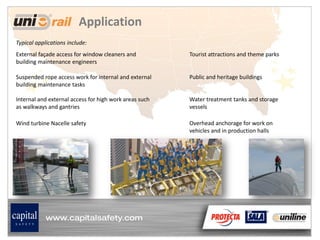
External façade access for window cleaners and
building maintenance engineers
Suspended rope access work for internal and external
building maintenance tasks
Internal and external access for high work areas such
as walkways and gantries
Wind turbine Nacelle safety
Tourist attractions and theme parks
Public and heritage buildings
Water treatment tanks and storage
vessels
Typical applications include:
Overhead anchorage for work on
vehicles and in production halls
System Components
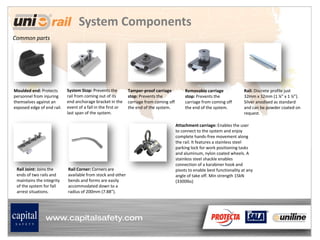
Moulded end: Protects
personnel from injuring
themselves against an
exposed edge of end rail.
Common parts
System Stop: Prevents the
rail from coming out of its
end anchorage bracket in the
event of a fall in the first or
last span of the system.
Tamper-proof carriage
stop: Prevents the
carriage from coming off
the end of the system.
Removable carriage
stop: Prevents the
carriage from coming off
the end of the system.
Rail Joint: Joins the
ends of two rails and
maintains the integrity
of the system for fall
arrest situations.
Rail Corner: Corners are
available from stock and other
bends and forms are easily
accommodated down to a
radius of 200mm (7.88”).
Attachment carriage: Enables the user
to connect to the system and enjoy
complete hands-free movement along
the rail. It features a stainless steel
parking lock for work positioning tasks
and aluminum, nylon coated wheels. A
stainless steel shackle enables
connection of a karabiner hook and
pivots to enable best functionality at any
angle of take off. Min strength 15kN
(3300lbs)
Rail: Discrete profile just
32mm x 32mm (1 ¼” x 1 ¼”).
Silver anodised as standard
and can be powder coated on
request.
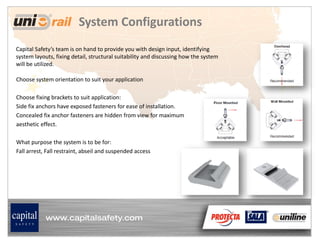
Choose system orientation to suit your application
Choose fixing brackets to suit application:
Side fix anchors have exposed fasteners for ease of installation.
Concealed fix anchor fasteners are hidden from view for maximum
aesthetic effect.
What purpose the system is to be for:
Fall arrest, Fall restraint, abseil and suspended access
System Configurations
Capital Safety’s team is on hand to provide you with design input, identifying
system layouts, fixing detail, structural suitability and discussing how the system
will be utilized.
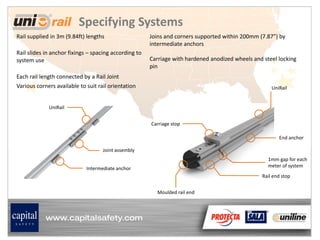
Rail supplied in 3m (9.84ft) lengths
Rail slides in anchor fixings – spacing according to
system use
Each rail length connected by a Rail Joint
Various corners available to suit rail orientation
Specifying Systems
UniRail
End anchor
1mm gap for each
meter of system
Rail end stop
Carriage stop
Moulded rail end
Joins and corners supported within 200mm (7.87”) by
intermediate anchors
Carriage with hardened anodized wheels and steel locking
pin
UniRail
Joint assembly
Intermediate anchor
Specifying Systems: Concealed fix v’s Side fix
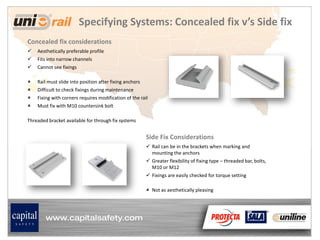
Concealed fix considerations
 Aesthetically preferable profile
 Fits into narrow channels
 Cannot see fixings
 Rail must slide into position after fixing anchors
 Difficult to check fixings during maintenance
 Fixing with corners requires modification of the rail
 Must fix with M10 countersink bolt
Threaded bracket available for through fix systems
Side Fix Considerations
 Rail can be in the brackets when marking and
mounting the anchors
 Greater flexibility of fixing type – threaded bar, bolts,
M10 or M12
 Fixings are easily checked for torque setting
 Not as aesthetically pleasing
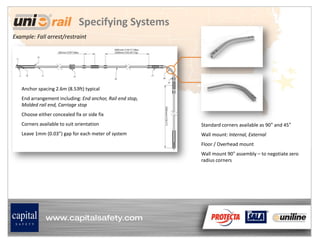
Specifying Systems
Example: Fall arrest/restraint
Anchor spacing 2.6m (8.53ft) typical
End arrangement including: End anchor, Rail end stop,
Molded rail end, Carriage stop
Choose either concealed fix or side fix
Corners available to suit orientation
Leave 1mm (0.03”) gap for each meter of system
Standard corners available as 90° and 45°
Wall mount: Internal, External
Floor / Overhead mount
Wall mount 90° assembly – to negotiate zero
radius corners
Case studies
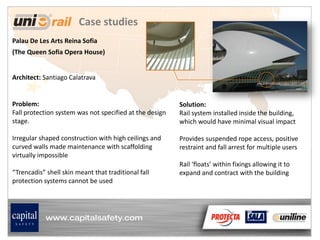
Palau De Les Arts Reina Sofia
(The Queen Sofia Opera House)
Architect: Santiago Calatrava
Problem:
Fall protection system was not specified at the design
stage.
Irregular shaped construction with high ceilings and
curved walls made maintenance with scaffolding
virtually impossible
“Trencadis” shell skin meant that traditional fall
protection systems cannot be used
Solution:
Rail system installed inside the building,
which would have minimal visual impact
Provides suspended rope access, positive
restraint and fall arrest for multiple users
Rail ‘floats’ within fixings allowing it to
expand and contract with the building
Case studies
The Agora
(Part of City of Arts & Science complex)
Architect: Santiago Calatrava
Problem:
Traditional fall protection systems unable to cope
with Irregular shaped construction
Restrictive access
Must be unobtrusive and blend in with
appearance of building
Solution:
Rail system was specified at design stage
ensuring a highly cost effective solution
Rail system was supplied in a white powder
coated finish to complement the building
Provided a safety solution during the building
phase
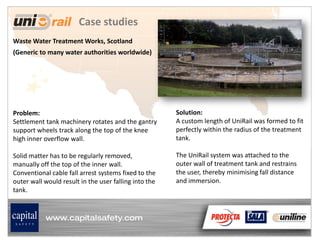
Waste Water Treatment Works, Scotland
(Generic to many water authorities worldwide)
Problem:
Settlement tank machinery rotates and the gantry
support wheels track along the top of the knee
high inner overflow wall.
Solid matter has to be regularly removed,
manually off the top of the inner wall.
Conventional cable fall arrest systems fixed to the
outer wall would result in the user falling into the
tank.
Solution:
A custom length of UniRail was formed to fit
perfectly within the radius of the treatment
tank.
The UniRail system was attached to the
outer wall of treatment tank and restrains
the user, thereby minimising fall distance
and immersion.
Case studies
Supporting information
Unirail Technical Manual – Hardcopy
Uniline Product Info File
Brochure
Designer’s Guide
Technical Datasheets
Installation Instructions
User Instruction Manual
Website
Case Studies
Uni rail system presentation

Uni rail system presentation

  • 2.
    Introduction Manufactured from extrudedaluminum alloy Providing a simple, continuous and functional anchorage system with very high levels of user safety and great aesthetics In addition to fall protection applications, it has also been used extensively as the primary anchor point for suspended rope access tasks. Is OSHA compliant 1926.502
  • 3.
    Features and Benefits Adiscrete design and range of fixing brackets ensure design flexibility and offer concealed fixing solutions to complement building aesthetics UniRail can be fitted to a wide range of structures and can support multiple workers for both fall arrest and fall restraint work applications. Suitable for use as an anchorage system for rope access and abseil 6000 Series aluminum Alloy components ensure a quality safety system that will withstand harsh environments A UniRail system offers workers continuous hands free movement and navigates corners and building contours, providing maximum design and integration flexibility.
  • 4.
    Application External façade accessfor window cleaners and building maintenance engineers Suspended rope access work for internal and external building maintenance tasks Internal and external access for high work areas such as walkways and gantries Wind turbine Nacelle safety Tourist attractions and theme parks Public and heritage buildings Water treatment tanks and storage vessels Typical applications include: Overhead anchorage for work on vehicles and in production halls
  • 5.
    System Components Moulded end:Protects personnel from injuring themselves against an exposed edge of end rail. Common parts System Stop: Prevents the rail from coming out of its end anchorage bracket in the event of a fall in the first or last span of the system. Tamper-proof carriage stop: Prevents the carriage from coming off the end of the system. Removable carriage stop: Prevents the carriage from coming off the end of the system. Rail Joint: Joins the ends of two rails and maintains the integrity of the system for fall arrest situations. Rail Corner: Corners are available from stock and other bends and forms are easily accommodated down to a radius of 200mm (7.88”). Attachment carriage: Enables the user to connect to the system and enjoy complete hands-free movement along the rail. It features a stainless steel parking lock for work positioning tasks and aluminum, nylon coated wheels. A stainless steel shackle enables connection of a karabiner hook and pivots to enable best functionality at any angle of take off. Min strength 15kN (3300lbs) Rail: Discrete profile just 32mm x 32mm (1 ¼” x 1 ¼”). Silver anodised as standard and can be powder coated on request.
  • 6.
    Choose system orientationto suit your application Choose fixing brackets to suit application: Side fix anchors have exposed fasteners for ease of installation. Concealed fix anchor fasteners are hidden from view for maximum aesthetic effect. What purpose the system is to be for: Fall arrest, Fall restraint, abseil and suspended access System Configurations Capital Safety’s team is on hand to provide you with design input, identifying system layouts, fixing detail, structural suitability and discussing how the system will be utilized.
  • 7.
    Rail supplied in3m (9.84ft) lengths Rail slides in anchor fixings – spacing according to system use Each rail length connected by a Rail Joint Various corners available to suit rail orientation Specifying Systems UniRail End anchor 1mm gap for each meter of system Rail end stop Carriage stop Moulded rail end Joins and corners supported within 200mm (7.87”) by intermediate anchors Carriage with hardened anodized wheels and steel locking pin UniRail Joint assembly Intermediate anchor
  • 8.
    Specifying Systems: Concealedfix v’s Side fix Concealed fix considerations  Aesthetically preferable profile  Fits into narrow channels  Cannot see fixings  Rail must slide into position after fixing anchors  Difficult to check fixings during maintenance  Fixing with corners requires modification of the rail  Must fix with M10 countersink bolt Threaded bracket available for through fix systems Side Fix Considerations  Rail can be in the brackets when marking and mounting the anchors  Greater flexibility of fixing type – threaded bar, bolts, M10 or M12  Fixings are easily checked for torque setting  Not as aesthetically pleasing
  • 9.
    Specifying Systems Example: Fallarrest/restraint Anchor spacing 2.6m (8.53ft) typical End arrangement including: End anchor, Rail end stop, Molded rail end, Carriage stop Choose either concealed fix or side fix Corners available to suit orientation Leave 1mm (0.03”) gap for each meter of system Standard corners available as 90° and 45° Wall mount: Internal, External Floor / Overhead mount Wall mount 90° assembly – to negotiate zero radius corners
  • 10.
    Case studies Palau DeLes Arts Reina Sofia (The Queen Sofia Opera House) Architect: Santiago Calatrava Problem: Fall protection system was not specified at the design stage. Irregular shaped construction with high ceilings and curved walls made maintenance with scaffolding virtually impossible “Trencadis” shell skin meant that traditional fall protection systems cannot be used Solution: Rail system installed inside the building, which would have minimal visual impact Provides suspended rope access, positive restraint and fall arrest for multiple users Rail ‘floats’ within fixings allowing it to expand and contract with the building
  • 11.
    Case studies The Agora (Partof City of Arts & Science complex) Architect: Santiago Calatrava Problem: Traditional fall protection systems unable to cope with Irregular shaped construction Restrictive access Must be unobtrusive and blend in with appearance of building Solution: Rail system was specified at design stage ensuring a highly cost effective solution Rail system was supplied in a white powder coated finish to complement the building Provided a safety solution during the building phase
  • 12.
    Waste Water TreatmentWorks, Scotland (Generic to many water authorities worldwide) Problem: Settlement tank machinery rotates and the gantry support wheels track along the top of the knee high inner overflow wall. Solid matter has to be regularly removed, manually off the top of the inner wall. Conventional cable fall arrest systems fixed to the outer wall would result in the user falling into the tank. Solution: A custom length of UniRail was formed to fit perfectly within the radius of the treatment tank. The UniRail system was attached to the outer wall of treatment tank and restrains the user, thereby minimising fall distance and immersion. Case studies
  • 13.
    Supporting information Unirail TechnicalManual – Hardcopy Uniline Product Info File Brochure Designer’s Guide Technical Datasheets Installation Instructions User Instruction Manual Website Case Studies